- axial_power_profileAxial power profile
C++ Type:FunctionName
Unit:(no unit assumed)
Controllable:No
Description:Axial power profile
- blockThe list of blocks (ids or names) that this object will be applied
C++ Type:std::vector<SubdomainName>
Controllable:No
Description:The list of blocks (ids or names) that this object will be applied
- blockage_ratio0flow blockage ratio
Default:0
C++ Type:double
Unit:(no unit assumed)
Controllable:No
Description:flow blockage ratio
- boundaryThe list of boundaries (ids or names) from the mesh where this object applies
C++ Type:std::vector<BoundaryName>
Controllable:No
Description:The list of boundaries (ids or names) from the mesh where this object applies
- chf_correlation_type4CHF correlation
Default:4
C++ Type:int
Controllable:No
Description:CHF correlation
- chf_scalef1scaling factor for critical heat flux
Default:1
C++ Type:double
Unit:(no unit assumed)
Controllable:No
Description:scaling factor for critical heat flux
- computeTrueWhen false, MOOSE will not call compute methods on this material. The user must call computeProperties() after retrieving the MaterialBase via MaterialBasePropertyInterface::getMaterialBase(). Non-computed MaterialBases are not sorted for dependencies.
Default:True
C++ Type:bool
Controllable:No
Description:When false, MOOSE will not call compute methods on this material. The user must call computeProperties() after retrieving the MaterialBase via MaterialBasePropertyInterface::getMaterialBase(). Non-computed MaterialBases are not sorted for dependencies.
- compute_effective_emissivityFalseWhether to compute the effective emissivity for radiation heat transfer as a function of temperature. If false the value provided by the parameter effective_emissivity is used.
Default:False
C++ Type:bool
Controllable:No
Description:Whether to compute the effective emissivity for radiation heat transfer as a function of temperature. If false the value provided by the parameter effective_emissivity is used.
- compute_enthalpyTrueSet false to use inlet temperature as bulk temperature
Default:True
C++ Type:bool
Controllable:No
Description:Set false to use inlet temperature as bulk temperature
- cond_metalConductivity of the metal
C++ Type:double
Unit:(no unit assumed)
Controllable:No
Description:Conductivity of the metal
- cond_oxideConductivity of the oxide
C++ Type:double
Unit:(no unit assumed)
Controllable:No
Description:Conductivity of the oxide
- constant_onNONEWhen ELEMENT, MOOSE will only call computeQpProperties() for the 0th quadrature point, and then copy that value to the other qps.When SUBDOMAIN, MOOSE will only call computeQpProperties() for the 0th quadrature point, and then copy that value to the other qps. Evaluations on element qps will be skipped
Default:NONE
C++ Type:MooseEnum
Controllable:No
Description:When ELEMENT, MOOSE will only call computeQpProperties() for the 0th quadrature point, and then copy that value to the other qps.When SUBDOMAIN, MOOSE will only call computeQpProperties() for the 0th quadrature point, and then copy that value to the other qps. Evaluations on element qps will be skipped
- coolant_enthalpy_objectThe CoolantChannelUserObject for computing coolant enthalpy
C++ Type:UserObjectName
Controllable:No
Description:The CoolantChannelUserObject for computing coolant enthalpy
- coolant_materialwaterThe name of the user object with fluid properties
Default:water
C++ Type:UserObjectName
Controllable:No
Description:The name of the user object with fluid properties
- coupledEnthalpycoupled coolant enthalpy
C++ Type:std::vector<VariableName>
Unit:(no unit assumed)
Controllable:No
Description:coupled coolant enthalpy
- declare_suffixAn optional suffix parameter that can be appended to any declared properties. The suffix will be prepended with a '_' character.
C++ Type:MaterialPropertyName
Unit:(no unit assumed)
Controllable:No
Description:An optional suffix parameter that can be appended to any declared properties. The suffix will be prepended with a '_' character.
- effective_emissivity0.75effective emissivity for radiation heat transfer
Default:0.75
C++ Type:double
Unit:(no unit assumed)
Controllable:No
Description:effective emissivity for radiation heat transfer
- flooding_rate0.15flooding rate in m/s
Default:0.15
C++ Type:double
Unit:(no unit assumed)
Controllable:No
Description:flooding rate in m/s
- flooding_time1e+30flooding time in sec
Default:1e+30
C++ Type:double
Unit:(no unit assumed)
Controllable:No
Description:flooding time in sec
- flow_areaThe flow area
C++ Type:double
Unit:(no unit assumed)
Controllable:No
Description:The flow area
- fuel_stack_bottom0fuel stack bottom in m
Default:0
C++ Type:double
Unit:(no unit assumed)
Controllable:No
Description:fuel stack bottom in m
- fuel_stack_length3.6576fuel stack length in m
Default:3.6576
C++ Type:double
Unit:(no unit assumed)
Controllable:No
Description:fuel stack length in m
- heat_fluxclad outer surface heat flux in W/m^2-K
C++ Type:FunctionName
Unit:(no unit assumed)
Controllable:No
Description:clad outer surface heat flux in W/m^2-K
- heat_flux_objectThe PartialSumHeatFluxIntegral object for integrated fluxes up the exterior cladding wall
C++ Type:UserObjectName
Controllable:No
Description:The PartialSumHeatFluxIntegral object for integrated fluxes up the exterior cladding wall
- heat_transfer_coefficientHeat transfer coefficient in W/m^2-K
C++ Type:FunctionName
Unit:(no unit assumed)
Controllable:No
Description:Heat transfer coefficient in W/m^2-K
- heat_transfer_modeheat transfer mode
C++ Type:FunctionName
Unit:(no unit assumed)
Controllable:No
Description:heat transfer mode
- heated_diameterThe heated diameter
C++ Type:double
Unit:(no unit assumed)
Controllable:No
Description:The heated diameter
- heated_perimeterThe heated perimeter
C++ Type:double
Unit:(no unit assumed)
Controllable:No
Description:The heated perimeter
- htc_correlation_type1heat transfer correlation type
Default:1
C++ Type:int
Controllable:No
Description:heat transfer correlation type
- htc_scalef1scaling factor for fuel the heat transfer coefficient
Default:1
C++ Type:double
Unit:(no unit assumed)
Controllable:No
Description:scaling factor for fuel the heat transfer coefficient
- hydraulic_diameterThe hydraulic diameter
C++ Type:double
Unit:(no unit assumed)
Controllable:No
Description:The hydraulic diameter
- initial_power3.2808initial peak power in kW/m
Default:3.2808
C++ Type:double
Unit:(no unit assumed)
Controllable:No
Description:initial peak power in kW/m
- initial_temperature800initial peak clad temperature in K
Default:800
C++ Type:double
Unit:(no unit assumed)
Controllable:No
Description:initial peak clad temperature in K
- inlet_massflux3600Inlet mass flux in kg/m^2-sec
Default:3600
C++ Type:FunctionName
Unit:(no unit assumed)
Controllable:No
Description:Inlet mass flux in kg/m^2-sec
- inlet_pressure15.5E6Inlet pressure in Pa
Default:15.5E6
C++ Type:FunctionName
Unit:(no unit assumed)
Controllable:No
Description:Inlet pressure in Pa
- inlet_qualityInlet quality
C++ Type:FunctionName
Unit:(no unit assumed)
Controllable:No
Description:Inlet quality
- inlet_temperature300Inlet temperature in K
Default:300
C++ Type:FunctionName
Unit:(no unit assumed)
Controllable:No
Description:Inlet temperature in K
- input_Tchf0Input critical heat flux temperature
Default:0
C++ Type:double
Unit:(no unit assumed)
Controllable:No
Description:Input critical heat flux temperature
- input_Tmin0input rewetting temperature
Default:0
C++ Type:double
Unit:(no unit assumed)
Controllable:No
Description:input rewetting temperature
- input_rewetting_htc100000input heat transfer coefficient for modeling rewetting
Default:100000
C++ Type:double
Unit:(no unit assumed)
Controllable:No
Description:input heat transfer coefficient for modeling rewetting
- linear_heat_rateLinear heat generation rate in W/m
C++ Type:FunctionName
Unit:(no unit assumed)
Controllable:No
Description:Linear heat generation rate in W/m
- model_post_chfTrueoption to turn/off post-chf correlatons
Default:True
C++ Type:bool
Controllable:No
Description:option to turn/off post-chf correlatons
- oxide_modelZIRCONIAOxide model
Default:ZIRCONIA
C++ Type:MooseEnum
Controllable:No
Description:Oxide model
- oxide_scale_factor1factor to scale oxide thickness
Default:1
C++ Type:double
Unit:(no unit assumed)
Controllable:No
Description:factor to scale oxide thickness
- oxide_thicknesscoupled oxide thickness
C++ Type:std::vector<VariableName>
Unit:(no unit assumed)
Controllable:No
Description:coupled oxide thickness
- pbrPilling-Bedworth ratio
C++ Type:double
Unit:(no unit assumed)
Controllable:No
Description:Pilling-Bedworth ratio
- peak_clad_temperatureThe peak clad temperature
C++ Type:PostprocessorName
Unit:(no unit assumed)
Controllable:No
Description:The peak clad temperature
- reflooding_model1reflooding model option, 0 or 1
Default:1
C++ Type:int
Controllable:No
Description:reflooding model option, 0 or 1
- rod_diameter0.01Rod diameter in meter
Default:0.01
C++ Type:double
Unit:(no unit assumed)
Controllable:No
Description:Rod diameter in meter
- rod_pitch0.0126Rod pitch in meter
Default:0.0126
C++ Type:double
Unit:(no unit assumed)
Controllable:No
Description:Rod pitch in meter
- specified_height0specified height for modeling reflooding
Default:0
C++ Type:double
Unit:(no unit assumed)
Controllable:No
Description:specified height for modeling reflooding
- subchannel_geometryGeometry of the pin array:square triangular
C++ Type:MooseEnum
Controllable:No
Description:Geometry of the pin array:square triangular
- thermal_conductivitythermal_conductivityCladding thermal conductivity name
Default:thermal_conductivity
C++ Type:MaterialPropertyName
Unit:(no unit assumed)
Controllable:No
Description:Cladding thermal conductivity name
- use_adFalseWhere to make this material compatible with automatic differentiation use
Default:False
C++ Type:bool
Controllable:No
Description:Where to make this material compatible with automatic differentiation use
- use_old_wall_temperatureTrueuse old wall temperature to compute reference temperature in film boiling correlation
Default:True
C++ Type:bool
Controllable:No
Description:use old wall temperature to compute reference temperature in film boiling correlation
- variableThe name of the variable representing temperature
C++ Type:std::vector<VariableName>
Unit:(no unit assumed)
Controllable:No
Description:The name of the variable representing temperature
CoolantChannelMaterial
Calculates the coolant temperature and the heat transfer coefficients with a single channel model and two different subchannel geometry options
This object can be set up automatically by using the CoolantChannel action.
Description
The coolant_material is water by default, given that this model was originally developed for LWRs. When water is the coolant material, a square sub-channel geometry is the default. The default heat transfer correlation is Thom, and the default critical heat flux (CHF) is the BIASI correlation. Other sub-channel geometries are forced if flow_area, hydraulic_diameter, heated_perimeter, and heated_diameter are all provided.
The coolant_material can be set to sodium, see Sodium Coolant Model below. The default heat transfer correlation is the modified Schad correlation for liquid sodium in a triangular sub-channel. The modified Schad correlation always requires the rod diameter and pitch to be provided. The Lyon's Law correlation and Seban-Shimazaki correlation for flow within a tube are available as well. With sodium coolant chosen, the calculations for phase change are disabled.
Coolant Enthalpy Model
In steady state operation, the enthalpy rise in a coolant channel with incompressible fluid can be derived using energy conservation equation: where is the coolant enthalpy at inlet in (J/kg), is the coolant enthalpy at axial location z in (J/kg), is axial location (m), is fuel rod surface heat flux (W/m), is fuel rod linear heat generation rate (W/m), is the fraction of heat generated in the coolant by neutron and gamma rays (dimensionless), is heated diameter (m), is coolant mass flux (kg/sec-m), is flow area of the coolant channel (m).
The mass flux, pressure, and coolant temperature at the inlet of coolant channel are provided as input for calculating coolant enthalpy rise. With calculated enthalpy and input coolant pressure, the corresponding thermodynamic condition can be determined using a steam table. The coolant temperature can be obtained and would be used in the convective boundary condition to compute the clad temperature. The thermal-physical properties of water and steam are evaluated at the corresponding bulk coolant temperature and/or at the cladding wall temperature for the use of calculating heat transfer coefficients between the cladding wall and the coolant.
The inlet mass flux, pressure, and coolant temperature can be provided as functions of time in the code input. Allowing the variation of inlet thermal-hydraulic conditions can be used to model a quasi-steady state when the velocity and thermal energy of coolant at a given location are assumed to achieve the equilibrium condition instantaneously.
Logic to Determine Heat Transfer Regime
The boiling curve in the BISON code depends on the selected [pre-Critical Heat Flux](#pre_chf_overview), Critical Heat Flux, and post-Critical Heat Flux correlations. Figure 1 shows the criteria used in the selection of different heat transfer regimes.
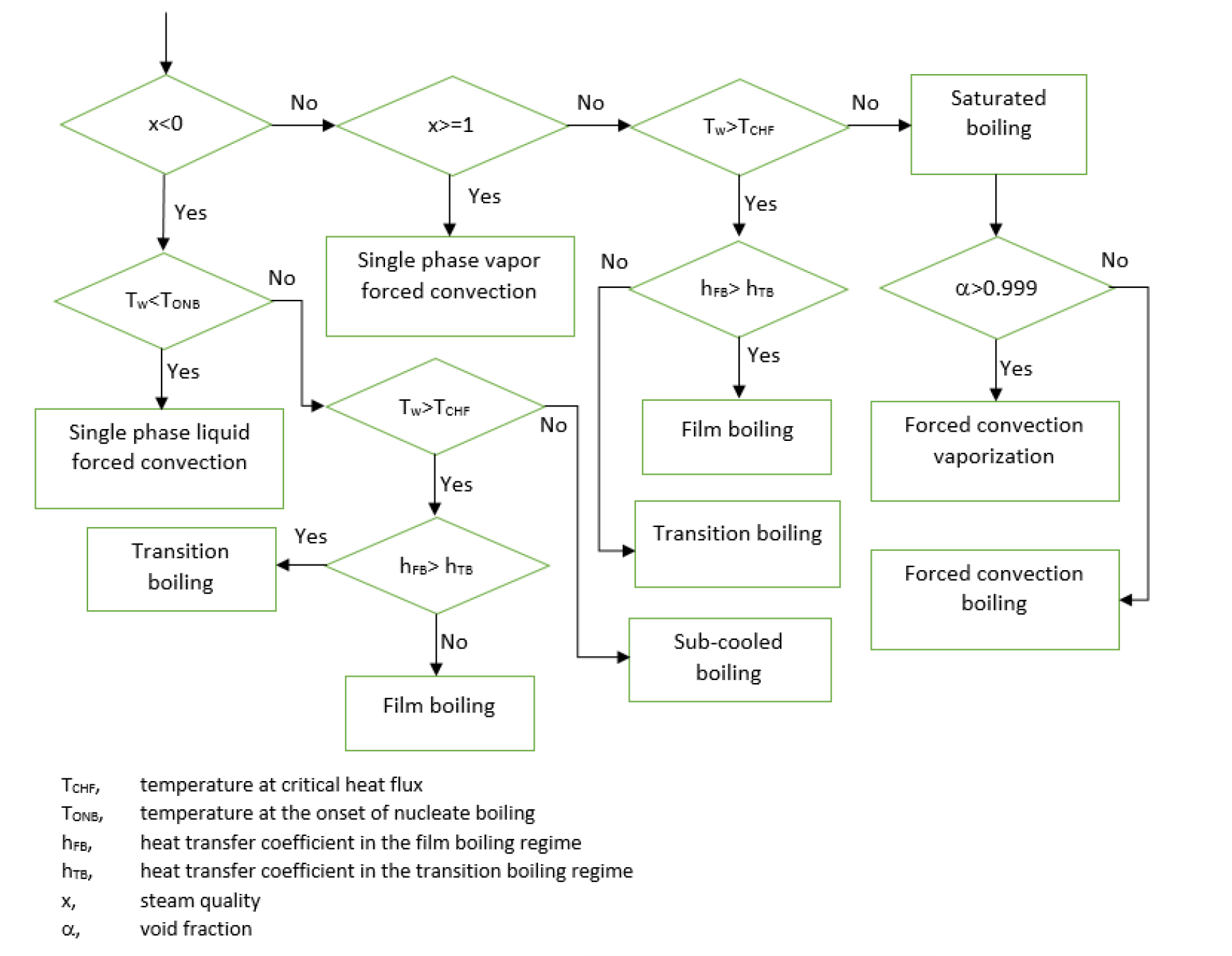
Figure 1: Schematic of heat transfer regimes selection criteria
Dittus-Boelter correlation is used for the single phase liquid forced convection and for the single phase vapor forced convection. The Thom or Jens-Lottes correlation is used for the sub-cooled boiling regime. Within the forced boiling regime the Thom, Jens-Lottes, or Chen correlation is used. The Shrock-Grossman correlation is used for the forced boiling convection and vaporization regime. In the transition boiling regime, either the McDonough-Milich-King correlation or the modified Condie-Bengtson correlation is used. In the film boiling regime, Dougall-Rohsenow or Groenveld correlation is used. is the temperate at the onset of nucleate boiling. is the temperature at the CHF. The selection of different types heat transfer correlations is described in the users manual. The logic described above is not applicable for radiation heat transfer and reflood heat transfer modes. They can be activated by using the input parameter heat_transfer_mode.
Pre-Critical Heat Flux Heat Transfer Correlations
Depending on the flow rate, flow pattern, and cladding wall surface heat flux, the heat transfer from cladding wall outer surface to coolant can be characterized into different heat transfer regimes.
A set of heat transfer correlations to describe the heat transfer condition prior to the point of CHF is described follows:
Dittus-Boelter Correlation
Under forced flow condition and when the coolant is still in the liquid phase, the heat transfer from the cladding wall to the coolant is in the regime of single phase forced convection, and the heat transfer can be described by Dittus-Boelter equation. The equation is applicable for 0.7 Pr 100, Re 10,000, and . Fluid properties are evaluated at the arithmetic mean bulk temperature (Todreas and Kazimi, 1990).
Jens-Lottes Correlation
where
is the cladding wall super heat = - in (K),
is the cladding wall surface heat flux (W/m-K)), and
P is the coolant pressure (Pa).
This correlation is developed based on data at a pressure between 500 psi (3.45 MPa) and 2000 psi (13.79 MPa) in sub-cooled boiling regime. The heat transfer coefficient is given as:
Thom Correlation
A similar correlation is given as follows: The heat transfer coefficient is: This correlation is for water at a pressure between 750 psi (5.17 MPa) and 2000 psi (13.79 MPa), but much of Thom's data were obtained at relatively low heat fluxes according to Tong and Weisman (1996).
Shrock-Grossman Correlation
Shrock-Grossman heat transfer correlation is used in the regime of saturated boiling. The heat transfer coefficient is given as:
where
is the steam quality,
is the latent heat of vaporization(J/kg),
is the heat transfer coefficient in the liquid phase at the same mass flux (J/kg),
is the mass flux (kg/m-sec),
(constant),
(constant), and
(constant).
Chen's Correlation
An alternative correlation that is used in the saturated boiling regime is Chen's correlation. Chen's correlation consists of a convective term () and a nucleation term (): is the modified Dittus-Boelter correlation: F is a factor to account for the enhanced heat transfer due to the turbulence caused by vapor.
The nucleation term is the Forster-Zuber equation:
S is a suppression factor: where and is the Reynold number for liquid phase only.
Rohsenow correlation
The Rohsenow correlation (Liu and Kazimi, 2006) is used to represent the heat transfer during a very short period of vapor bubbles nucleation, growth, and departure follows natural convection that occurs during the fast heat up of the fuel rod. The heat flux is given as: where
is the heat flux (W/m),
is the latent heat of vaporization (J/kg),
is the liquid viscosity at saturated temperature (kg/m-sec),
is the density of vapor at saturated temperature (kg/m),
is the density of liquid at saturated temperature (kg/m),
is the surface tension energy at saturated temperature (N/m),
is the acceleration due to gravity (m/s),
is specific heat of liquid at saturated temperature (kJ/kg-K),
is the wall temperature (K),
is the saturated temperature (K), and
is the Prandtl number.
Critical Heat Flux Correlations
The sub-cooled and saturated boiling can enhance the heat transfer; however at a critical condition when the cladding outer surface is enclosed by vapor film, the heat transfer can deteriorate significantly, the corresponding heat flux is the CHF. The following correlations are implemented in BISON to calculate CHF, which can be used to estimate the thermal margin in a coolant channel.
EPRI-Columbia Correlation
This correlation is used as the correlation for a Pressurized Water Reactor (PWR) environment.
where
is the critical pressure ratio=system pressure/critical pressure,
is the local mass velocity (Mlbm/hr-ft),
is the inlet quality, and
is the local heat flux (MBtu/hr-ft).
The following parameters in Table 1 are used in this correlation.
Table 1: Parameters used in the EPRI Columbia correlation
| Model Parameter | Parameter Value |
|---|---|
| G | |
| for cold wall, both and are set equal to 1.0 | |
is the non-uniform axial heat flux distribution parameter: Y is Bowring's non-uniform parameter defined as:
GE Correlation
The GE correlation is used for a boiling water reactor (BWR) environment.
The correlation is applicable for mass fluxes less than lb/ft-hr.
Zuber Correlation
Taken from Tong and Tang (1997), the Zuber correlation is where
is the CHF (W/m),
is the latent heat of vaporization (kJ/kg),
is the acceleration due to gravity = 9.8 (m/s),
is the density of vapor at saturation temperature (kg/m),
is the density of liquid at saturation temperature (kg/m), and
is the surface tension energy at saturation temperature (N/m).
Modified Zuber Correlation
The modified Zuber correlation (Liu and Kazimi, 2006) is included in the critical heat flux correlation selection option in BISON, and can be selected by user input. This correlation is based on pool boiling CHF hydrodynamics and is applicable to very low flow conditions. It was developed for CHF calculations in LWRs in severe accident conditions. where
is the CHF (W/m)
is the correction factor for bulk subcooled fluid conditions,
is the latent heat of vaporization (kJ/kg),
is the acceleration due to gravity (here set as 9.8 (m/s)),
is the density of vapor at saturation temperature (kg/m),
is the density of liquid at saturation temperature (kg/m), and
is the surface tension energy at saturation temperature (N/m).
The correction factor for bulk subcooled condition is where is the specific heat of saturated liquid (kJ/kg-K), is the saturation temperature (K), and is the bulk fluid temperature (K).
BIASI correlation
BIASI correlation is a function of pressure, mass flux, flow quality, and tube diameters. The correlations are provided in following equations. For lower mass fluxes, kg/m-s, Eq. (1) is used. (1) For larger mass flux values, the higher of either Eq. (1) or Eq. (2) is used:sg (2) where The parameter ranges for the correlation are given in Table 2.
Table 2: Parameters ranges for which the BIASI correlation is defined
| Model Parameter | Parameter Value |
|---|---|
| 0.003-0.0375 m | |
| 0.2-6.0 m | |
| 0.27-14 MPa | |
| 100-600 kg/m-s | |
MacBeth Correlation
The MacBeth correlation (Geelhood, 2014) was developed using based on compilation of a large amount of CHF data from a wide variety of sources. The database consists entirely of burnout tests for vertical upflow in round tubes. This correlation can be extrapolated to CHF in annuli and rod bundles at low pressure. The MacBeth CHF correlation is separated for low flow conditions and high flow conditions.
At low flow conditions, the correlation defines the CHF as: where
is the CHF (MBtu/hr-ft),
is the hydraulic diameter, based on wetted perimeter (in),
is the latent heat of vaporization (Btu/lbm),
is the mass velocity (lbm/hr-ft), and
is the equilibrium quality.
At high flow conditions, the correlation defines the CHF as: where A and C are the empirical parameters that were defined using statistical optimization for two overlapping sets of data.
The parameters A and C for the MacBeth's 12-coefficient model are formulated as:
where are the empirical coefficients (See Table 3)
Table 3: Coefficients for MacBeth's 12-coefficient model for various reference pressures
| Model Coefficient | 560 psia Reference Pressure | 1000 psia Reference Pressure | 1550 psia Reference Pressure | 2000 psia Reference Pressure |
|---|---|---|---|---|
| 237 | 114 | 36 | 65.5 | |
| 1.2 | 0.811 | 0.509 | 1.19 | |
| 0.425 | 0.221 | -0.109 | 0.376 | |
| -0.94 | -0.128 | -0.19 | -0.577 | |
| -0.0324 | 0.0274 | 0.024 | 0.22 | |
| -0.111 | -0.0667 | 0.463 | -0.373 | |
| 19.3 | 127 | 41.7 | 17.1 | |
| 0.959 | 1.32 | 0.953 | 1.18 | |
| 0.831 | 0.411 | 0.0191 | -0.456 | |
| 2.61 | -0.274 | 0.231 | -1.53 | |
| -0.0578 | -0.0397 | 0.0767 | 2.75 | |
| 0.124 | -0.0221 | 0.117 | 2.24 |
The acceptable parameter ranges for the correlation are given in the table below.
Table 4: Parameters ranges for which the MacBeth 12-correlation model is defined
| Model Parameter | Parameter Value |
|---|---|
| Pressure | 15-2700 psia |
| Mass Velocity | 0.0073-13.7 Mlbm/hr-ft |
| Hydraulic diameter | 0.04-1.475 in |
| Heated length | 1.0-144 in |
| Axial power profile | uniform |
Alternatively, an input temperature at CHF is allowed, which would use the selected heat transfer in the nucleate boiling regime and the input temperature to compute the CHF.
Post-Critical Heat Transfer Correlation
The post-CHF heat transfer regime is divided into transition boiling and film boiling.
The transition boiling heat transfer regime occurs when the cladding wall temperature exceeds the CHFtemperature, but remains below the minimum film boiling temperature. The heat flux decreases significantly with increasing temperature in this regime. Three heat transfer correlations are implemented for the transition boiling regime: the McDonough-Milich-King, modified Condie-Bengtson and Henry correlations.
The film boiling heat transfer regime occurs when the wall temperature reaches the minimum film boiling temperature. Four correlations are provided for the film boiling region: the Dougall-Rohsenow, Groenveld, Frederking and Bishop-Sandberg-Tong correlations. The heat transfer correlations at CHF and in the post-CHF regimes implemented in the BISON code is described as follows:
Transition Boiling
McDonough-Milich-King correlation, modified Condie-Bengtson correlation, and the Henry correlation are implemented for the transition boiling regime.
McDonough-Milich-King Correlation
The McDonough-Milich-King correlation (Todreas and Kazimi, 1990; Rashid et al., 2004) for forced convection transition boiling is given as The heat transfer coefficient is: where
is the CHF (kW/m),
is the transition region heat flux (kW/m),
is the wall temperature at CHF (K),
is the bulk temperature of coolant (K),
is the wall temperature in the transition region (K),
is the system pressure (MPa), and
is the transition boiling heat transfer coefficient (kW/m-K).
Table 5: Parameters ranges for which the McDonough-Milich-King correlation may be applied
| Model Parameter | Parameter Value |
|---|---|
| Pressure | 5.5 - 13.8 MPa |
| Mass flux | 271.246 - 1898.722 kg/m-sec |
| Channel geometry | tube |
| Diameter | 0.00386 m |
| Length | 0.3048m |
| Fluid | water |
Modified Condie-Bengtson Correlation
The modified Condie-Bengtson correlation (Rashid et al., 2004) for high flow rate transition boiling is given as follows: The heat transfer coefficient is:
where
is the CHF (Btu/hr-ft),
is the transition heat flux (Btu/hr-ft),
is the film boiling heat flux at (Btu/hr-ft),
is the wall temperature at CHF (F),
is the saturation temperature (F),
is the cladding wall temperature (F), and
is the transition boiling heat transfer coefficient (Btu/hr-ft-F).
At the CHF point, = , and
At , the CHF is equal to the sum of the film boiling component and the transition boiling component to ensure the predicted boiling curve is continuous.
Henry Correlation
The Henry correlation (Liu and Kazimi, 2006) for transition boiling has been developed to address the heat transfer at cold zero power condition and at high subcooling conditions. The heat flux in the transition boiling regime determined by an interpolation of the CHF and minimum heat flux is given as follow: where
The minimal temperature for the Henry correlation is strongly affected by the surface condition as well as the subcooling of the coolant and is given as: where
is the minimum heat flux (W/m)
is the CHF (W/m)
is the temperature at CHF (K)
is the minimal stable film boiling temperature(K)
is the homogeneous nucleation temperature (K)
is the bulk temperature (K)
is the cladding wall temperature (K)
is the pressure (Pa)
is the thermal conductivity of subcooled liquid (W/m-K)
is the density of subcooled liquid (W/m)
is the specific heat of subcooled liquid (kJ/kg-K)
is the thermal conductivity of cladding wall (W/m-K)
is the density of cladding wall (W/m)
is the specific heat of cladding wall (kJ/kg-K)
is an empirical parameter taken as 3.3
Film Boiling
Four correlations, Dougall-Rohsenow correlation, Groenveld correlation, Frederking correlation and Bishop-Sandberg-Tong correlation, are provided for modeling the heat transfer in the film boiling region. In the transition from the transition boiling regime to the film boiling regime, the intercept of the selected film boiling correlation and transition boiling correlation was used to determine the minimum film boiling temperature and minimum film boiling heat flux.
Dougall-Rohsenow Correlation
The Dougall-Rohsenow correlation (Dougall and Rohsenow, 1961; Rashid et al., 2004) for forced convection stable film boiling was developed for high flow rate and low quality (x 0.3) flow. The heat transfer coefficient is given as: where
is the mass flux (kg/m-sec),
is the hydraulic diameter(m),
is the thermal conductivity of vapor (W/m-K),
is the viscosity of vapor (kg/m-sec),
is the density of vapor (kg/m),
is the density of liquid (kg/m),
is the specific heat of vapor (J/kg-K), and
is the local quality.
The vapor properties of the Prandtl number are evaluated at the saturation temperature. The data range for this correlation is given below.
Table 6: Parameters ranges for the Dougall-Rohsenow correlation
| Model Parameter | Parameter Value |
|---|---|
| Pressure | 0.1154 - 0.1634 MPa |
| Mass flux | 450.268 - 1109.396 kg/m-sec |
| Heat flux | 45.426 - 131.862 kW/m |
| Exit quality | up to 0.4 |
| Channel geometry | tubes |
| Diameter, inner | 0.004572 m, 0.01036 m |
| Length | 0.381 m |
| Fluid | freon |
Groenveld Correlation
The Groenveld correlation (Todreas and Kazimi, 1990; Rashid et al., 2004) for forced convection stable film boiling heat transfer coefficient is: where the parameter Y is given as whichever is larger. In the two above equations:
is the mass flux (kg/m-sec),
is the hydraulic diameter (m),
is the thermal conductivity of vapor (W/m-K),
is the viscosity of vapor (kg/m-sec),
is the density of vapor (kg/m),
is the density of liquid (kg/m), and
is the local quality.
The coefficients a, b, c and d are given in Table 7 below. The Prandtl number of the film is given by where is the specific heat of vapor at film temperature (J/kg-K), is the viscosity of vapor at film temperature (kg/m-sec), and is the thermal conductivity of vapor at film temperature (W/m-K)
The vapor properties of the Prandtl number should be evaluated at the film temperature. where is the saturation Temperature (K) and is the cladding wall temperature (K) Prandtl number is currently evaluated at the saturation temperature in the code.
Table 7: Groenveld correlation coefficients a, b, c, d
| Parameter | Value |
|---|---|
| a | 0.0522 |
| b | 0.688 |
| c | 1.26 |
| d | -1.06 |
The applicable range of data for annuli geometry is shown in Table 8 below.
Table 8: Range of data for Groenveld correlation
| Parameter | Data Range for Annuli Geometry |
|---|---|
| Hydraulic Diameter (mm) | 1.5 - 6.3 |
| Pressure (MPa) | 3.4 - 10 |
| Mass Flux (kg/m-sec) | 800 - 4100 |
| Heat Flux (kW/m) | 450 - 2250 |
| Quality | 0.1 - 0.9 |
Frederking Correlation
The Frederking correlation (Liu and Kazimi, 2006) for turbulent film boiling heat transfer coefficient during RIA is: where
is the turbulent film boiling heat transfer coefficient (W/m-K),
is the thermal conductivity of vapor (W/m-K),
is the modified latent heat of vaporization (kJ/kg),
is the acceleration due to gravity = 9.8 (m/s),
is the density of vapor at saturation temperature (kg/m),
is the density of liquid at saturation temperature (kg/m),
is the saturation temperature (K), and is the cladding wall temperature (K).
The modified latent heat is given as where
is the latent heat of vaporization (kJ/kg),
is the specific heat of vapor at saturated temperature (kJ/kg-K),
is the saturation temperature (K), and
is the cladding wall temperature (K).
Bishop-Sandberg-Tong Correlation
The Bishop-Sandberg-Tong correlation (Geelhood, 2014) for film boiling heat transfer coefficient is: where
is the coolant thermal conductivity at the film temperature (W/m-K),
is the hydraulic diameter (m),
is the Reynolds number with fluid properties evaluated at the film temperature,
is the Prandtl number with fluid properties evaluated at the film temperature,
is the density of vapor at saturation temperature (kg/m),
is the density of liquid at saturation temperature (kg/m), and
is the bulk fluid density (kg/m).
This correlation is defined by the properties of the vapor film at the wall and the film temperature. The film temperature is defined as The film boiling heat flux for this correlation is: The bulk fluid density is defined as The equilibrium void fraction is defined as where is the equilibrium quality (dimensionless).
FLECHT Reflood Heat Transfer Correlations
An empirical approach for modeling the reflooding phase of a LOCA is using the correlations derived from Full Length Emergency Cooling Heat Transfer (FLECHT) tests (Cunningham et al., 2001; Cadek et al., 1972). Two reflood heat transfer correlations are implemented in BISON code. The first correlation is provided in Cunningham et al. (2001), and the second one is described in Cadek et al. (1972).
The heat transfer correlations compute heat transfer coefficients during reflooding phase of LOCA as a function of flooding rate, cladding temperature at the start of flooding, fuel rod power at the start of flooding, flooding water temperature, pressure, rod elevation and time. The applicable ranges of these variables are shown in Table 9 and Table 10 for the heat transfer correlations given in Cunningham et al. (2001) and Cadek et al. (1972) respectively. The variables are defined as follow:
= flooding rate (in/s)
= Peak cladding temperature at start of flooding (F)
= fuel rod power at axial peak at start of flooding (kW/ft)
= reactor vessel pressure (psia)
= equivalent FLECHT elevation (ft)
= flood water subcooling at inlet (F)
= time after start of flooding as adjusted for variable flooding rate (s)
= heat transfer coefficient (Btu/(hr-ft-F))
= radial power shape factor = 1.0 for a nuclear fuel rod = 1.1 for electrical rod with radially uniform power
= flow blockage ()
Generalized FLECHT Correlation
The generalized FLECHT correlation from Cunningham et al. (2001) divides the reflood heat transfer into four time periods: Period of Radiation Only, Period I, Period II, and Period III.
Period of Radiation Only
The heat transfer due to radiation is modeled during the time range of t 0 and t t. The heat transfer coefficient expression is given as
where
Period I
During Period I, the flow develops from the radiation dominated pre-reflood condition to heat transfer conditions in reflooding phase. where is defined as and is given as is defined as
The heat transfer coefficient during Period I is calculated as follow where
Period II
During this period, the heat transfer coefficient reaches a plateau with a rather slow increase. The time range for Period II is where
The heat transfer coefficient during Period II is computed by the equation
where
Period III
During this period, the flow pattern might have changed to film boiling regime ,and the heat transfer coefficient increases rapidly as the quench front approaches. The time range of Period III is where is the time of quenching.
The heat transfer coefficient during Period III is calculated as follow
where
Modification for Low Flooding Rates
The heat transfer coefficients for Periods I, II, and III is multiplied by a factor f to best match the test data performed at low flooding rates. The factor f is calculated as follow
where
The above correlations are valid over the ranges given in Table 9 (Cunningham et al., 2001):
Table 9: Range of applicability of generalized FLECHT correlation
| Variable | Applicable range of variable in British unit | Applicable range of variable in SI unit |
|---|---|---|
| Flooding rate | 0.4 - 10 in/s | 0.0102 - 0.254 m/s |
| Reactor vessel pressure | 15 - 90 psia | 0.103 - 0.62 MPa |
| Inlet coolant subcooling | 16 - 189 F | 264.3 - 360.4 K |
| Initial cladding temperature | 300 - 2200 F | 420 - 1478 K |
| Flow blockage ratio | 0 - 75 % | 0 - 75 % |
| Equivalent elevation in FLECHT facility | 2 - 10 ft | 0.6096 - 3.048 m |
WCAP-7931 FLECHT correlation
The WCAP-7931 correlation (Cadek et al., 1972) divides the reflood heat transfer into three time periods which are designated as Period I, Period II, and Period III.
Period I
The time range of Period I is where is defined as
The quench time is defined as where is given as
and is defined as
The heat transfer coefficient during Period I is calculated as follow
where
Period II
The time range of Period I is where
The heat transfer coefficient during Period II is computed by the equation where
Period III
The time range of Period III is
The heat transfer coefficient during Period III is calculated as follow where
The above correlations are valid over the following ranges of parameters:
Table 10: Range of applicability of FLECHT correlation from WCAP-7931 report
| Variable | Applicable range of variable in British unit | Applicable range of variable in SI unit |
|---|---|---|
| Flooding rate | 0.4 - 10 in/s | 0.0102 - 0.254 m/s |
| Reactor vessel pressure | 15 - 90 psia | 0.103 - 0.62 MPa |
| Inlet coolant subcooling | 16 - 189 F | 264.3 - 360.4 K |
| Initial cladding temperature | 1200 - 2200 F | 922 - 1479 K |
| Flow blockage ratio | 0 - 75 % | 0 - 75 % |
| Equivalent elevation in FLECHT facility | 4 - 8 ft | 1.219 - 2.438 m |
Radiation Heat Transfer
At high temperature, radiation heat transfer can occur from cladding outer surface to surrounding core structure components. In simulated LOCA tests at Halden, heat can be transferred to the heating element as well. Radiation heat transfer is described by following equation: where and are the surface emissivities of the cladding and heater, respectively, f and and are the radii of the two surfaces, is the Stefan-Boltzmann constant ( W/m-K). The default value for the effective emissivity () is 0.75 and can be specified by the user. An option also exists, compute_effective_emissivity, which defaults to false. If this option is set to true the effective emissivity is computed using the correlation provided by Stuckert (2002):
where is the temperature (K) and through are numerically determined constants through statistical fitting. The value of these constants are tabulated in Table 11.
Table 11: Coefficients for the effective emissivity correlation.
| Constant | Value |
|---|---|
| p | 0.25505 |
| p | 0.31783 |
| p | 1184.78 |
| p | 34.5649 |
| p | 0.76264 |
| p | 0.19449 |
| p | 0.10137 |
| p | 1063.73 |
| p | 62.0845 |
Properties for Water and Steam
Properties for water and steam consist of thermodynamic properties, transport properties, and other physical properties used in the heat transfer correlations. They are implemented based on a few standards specified by the International Association or Properties for Water and Steam (IAPWS). The thermodynamic properties, or the steam tables, are implemented in the IAPWS95 library, included as a submodule in BISON.
Sodium Coolant
Sodium coolant for fast reactors can also be simulated in BISON. The model uses the same framework as the above calculations for water/steam, but with appropriate correlations for liquid sodium. The model uses the modified Schad correlation (Waltar et al., 2011) by default for triangular subchannels where is the Nusselt number, is the Peclet number, and is the pitch-to-diameter ratio and is applicable for . For , the term is set to 1.0.
The Lyon's Law correlation (Lyon, 1951) is generally used for heat transfer from a rod to flow within a surrounding circular tube for liquid metals applicable for and .
The Seban and Shimazaki correlation (Subbotin et al., 1963) is specific to liquid sodium heat transfer from a rod to fluid within a surrounding circular tube with constant rod wall temperature and is applicable for , , and .
Sodium properties are taken from the ANL/RE-92/2 report (Fink and Leibowitz, 1995): where is thermal conductivity, is enthalpy, and units are SI.
Sub-Channel Geometry Models
BISON provides two different geometry options to model the sub-channel: a square and a triangle. An overview of the single channel model implemented in BISON, including a schematic, is given in the CoolantChannel action documentation. Users are also given the option to directly specify the sub-channel geometry characteristics.
Square Sub-Channel
In a square sub-channel configuration, it is assumed that each fuel rod is exposed to 1/4 of coolant fluid flow from 4 adjacent sub-channels. Thus the coolant fluid flow area is calculated as where is the pitch and is the rod diameter.
The heated perimeter is considered to be a function of the rod diameter
and the hydraulic diameter is given as
The heated diameter is set to be equivalent to the hydraulic diameter.
Triangle Sub-Channel
Each fuel rod in a triangular sub-channel configuration is assumed to receive 1/3 of the coolant flow from 6 adjacent sub-channels. The coolant channel flow area is determined as where is the pitch and is the rod diameter.
The heated perimeter is considered to be a function of the rod diameter
and the hydraulic diameter is given as
The heated diameter is set to be equivalent to the hydraulic diameter.
User-Defined Sub-Channel Characteristics
Rather than using these predefined sub-channel flow characteristics models, users may elect to enter values for the coolant flow ares, hydraulic diameter, heated diameter, and heated perimeter. All four values must be provided in the input file.
Input Parameters
- control_tagsAdds user-defined labels for accessing object parameters via control logic.
C++ Type:std::vector<std::string>
Controllable:No
Description:Adds user-defined labels for accessing object parameters via control logic.
- enableTrueSet the enabled status of the MooseObject.
Default:True
C++ Type:bool
Controllable:Yes
Description:Set the enabled status of the MooseObject.
- implicitTrueDetermines whether this object is calculated using an implicit or explicit form
Default:True
C++ Type:bool
Controllable:No
Description:Determines whether this object is calculated using an implicit or explicit form
- seed0The seed for the master random number generator
Default:0
C++ Type:unsigned int
Controllable:No
Description:The seed for the master random number generator
- use_displaced_meshFalseWhether or not this object should use the displaced mesh for computation. Note that in the case this is true but no displacements are provided in the Mesh block the undisplaced mesh will still be used.
Default:False
C++ Type:bool
Controllable:No
Description:Whether or not this object should use the displaced mesh for computation. Note that in the case this is true but no displacements are provided in the Mesh block the undisplaced mesh will still be used.
Advanced Parameters
- output_propertiesList of material properties, from this material, to output (outputs must also be defined to an output type)
C++ Type:std::vector<std::string>
Controllable:No
Description:List of material properties, from this material, to output (outputs must also be defined to an output type)
- outputsnone Vector of output names where you would like to restrict the output of variables(s) associated with this object
Default:none
C++ Type:std::vector<OutputName>
Controllable:No
Description:Vector of output names where you would like to restrict the output of variables(s) associated with this object
Outputs Parameters
- prop_getter_suffixAn optional suffix parameter that can be appended to any attempt to retrieve/get material properties. The suffix will be prepended with a '_' character.
C++ Type:MaterialPropertyName
Unit:(no unit assumed)
Controllable:No
Description:An optional suffix parameter that can be appended to any attempt to retrieve/get material properties. The suffix will be prepended with a '_' character.
- use_interpolated_stateFalseFor the old and older state use projected material properties interpolated at the quadrature points. To set up projection use the ProjectedStatefulMaterialStorageAction.
Default:False
C++ Type:bool
Controllable:No
Description:For the old and older state use projected material properties interpolated at the quadrature points. To set up projection use the ProjectedStatefulMaterialStorageAction.
Material Property Retrieval Parameters
References
- F. F. Cadek, D. P. Dominicis, H. C. Yeh, and R. H. Leyse.
PWR FLECHT final report supplement.
Technical Report WCAP-7931, Westinghouse, October 1972.[BibTeX]
- M E Cunningham, C E Beyer, P G Medvedev, and G A Berna.
Fraptran: a computer code for the transient analysis of oxide fuel rods.
Technical Report NUREG/CR-6739 Vol.1, Pacific Northwest National Laboratory, 2001.[BibTeX]
- R L Dougall and W M Rohsenow.
Film-boiling heat transfer from a horizontal surface.
Journal of Heat Transfer, 83:351–358, 1961.[BibTeX]
- J. K. Fink and L. Leibowitz.
Thermodynamic and transport properties of sodium liquid and vapor.
Technical Report ANL/Re-95/2, ANL Reactor Engineering Division, 1995.[BibTeX]
- K. J. Geelhood.
FRAPTRAN-1.5: a Computer Code for the Transient Analysis of Oxide Fuel Rods.
Technical Report NUREG/CF-7023 Vol.1, Rev.1, U.S. Nuclear Regulatory Commission, 2014.[BibTeX]
- W. Liu and M. S. Kazimi.
Modeling Cladding-Coolant Heat Transfer of High-Burnup Fuel During RIA.
In Proceedings of ICONE-14. 2006.[BibTeX]
- Richard N Lyon.
Liquid metal heat transfer coefficients.
Chem. Eng. Prog., 47:75–79, 1951.[BibTeX]
- Y Rashid, R Dunham, and R Montgomery.
Fuel Analysis and Licensing Code: FALCON MOD01.
Technical Report, Electric Power Research Institute, December 2004.[BibTeX]
- J. Stuckert.
On the thermo-physical properties of Zircaloy-4 and ZrO$_2$ at high temperature.
Technical Report FZKA 6739, Kernforschungszentrum Karlsruhe, Germany, 2002.[BibTeX]
- VI Subbotin, AK Papovyants, PL Kirillov, and NN Ivanovskii.
A study of heat transfer to molten sodium in tubes.
Soviet Atomic Energy, 13(4):991–994, 1963.[BibTeX]
- N. E. Todreas and M. S. Kazimi.
Nuclear systems I: thermal hyraulic fundamentals.
Hemisphere Publishing Corporation, New York, N.Y., USA, 1990.[BibTeX]
- L. S. Tong and Y. S. Tang.
Boiling heat transfer and two-phase flow.
Taylor and Francis, Washington, DC, USA, 1997.[BibTeX]
- L. S. Tong and J. Weisman.
Thermal analysis of pressurized water reactors.
American Nuclear Society, La Grange Park, Illinois, USA, 1996.[BibTeX]
- A.E. Waltar, D.R. Todd, and P.V. Tsvetkov.
Fast Spectrum Reactors.
Springer US, 2011.
ISBN 9781441995728.
URL: https://books.google.com/books?id=z8z\_RNUZSbEC.[BibTeX]