TREAT M7 Experiment
Overview
The M7 experiment in TREAT (Bauer et al., 1989) tested two EBR-II irradiated fuel pins. Currently, only the 2.9 at% burnup U-10Zr pin clad in HT9 is simulated in BISON. The other pin was a 9.8 at% burnup U-19Pu-10Zr pin clad in D9. During the M7 experiment, the ternary pin alone failed. The experiment was terminated with SCRAM when a failure was detected.
Test Description
The M7 test of pin T-427, which is from the X425 experiment of EBR-II, uses a TREAT shaped transient. The test was designed to melted a large portion of a fuel slug inside the cladding. The melted slug would promote eutectic formation causing fuel clad chemical interaction (FCCI) failure.
Rod Design Specifications
The TREAT M7 T-427 rod geometry for the assessment is provided in Table 1. These values are from PIE data after base irradiation has been completed. As such, the inner gap has closed and the fuel slug has expanded axially.
Table 1: T-427 Rod Geometry
| Dimension | Value | Source |
|---|---|---|
| Slug Radius | 2.54 mm | Bauer et al. (1989) |
| Slug Length | 37.3 cm | Bauer et al. (1989) |
| Gap Width | Closed | Bauer et al. (1989) |
| Clad Width | 0.38 mm | Bauer et al. (1989) |
| Plenum Length | 25.24 cm | Bauer et al. (1989) |
Operating Conditions and Irradiation History
The average power density of the T-427 pin is shown in Figure 1.
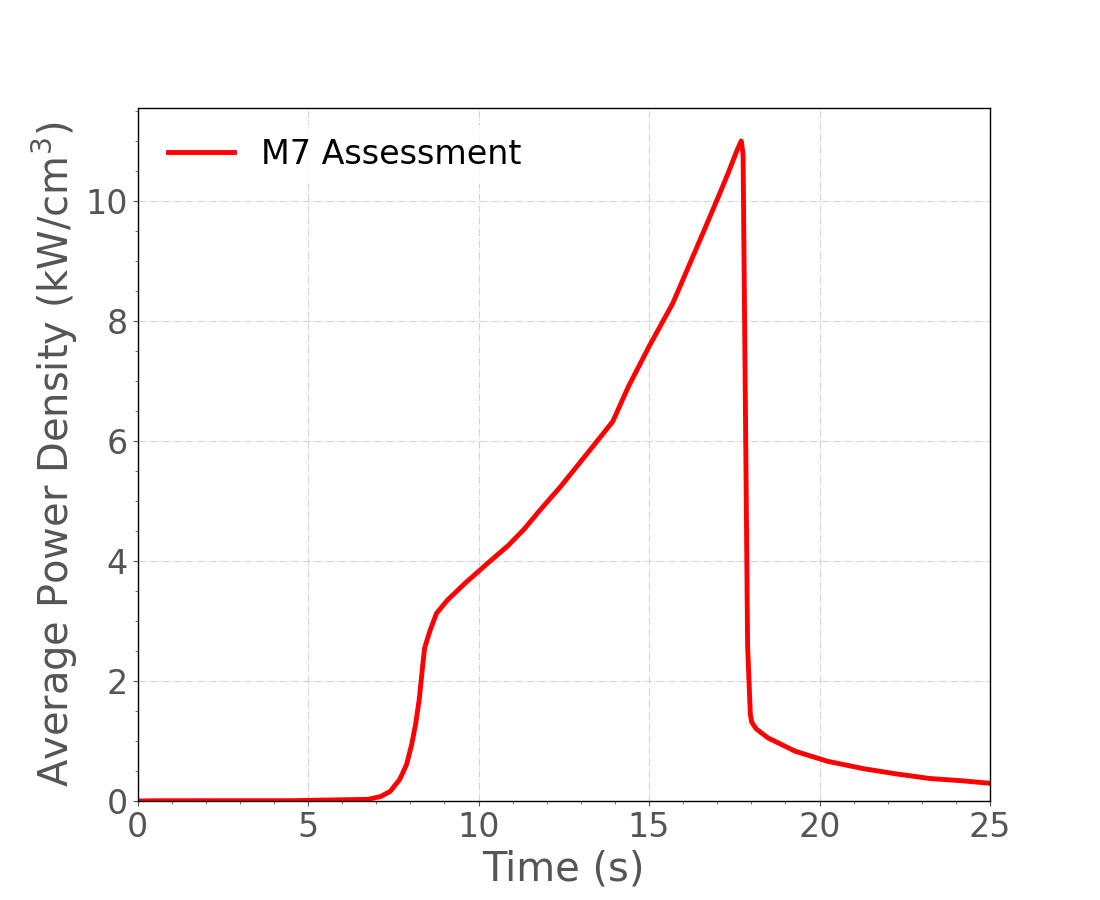
Figure 1: Average power density profile for TREAT M7 transient.
Model Description
The M7 assessment sets initial conditions from post irradiation examination (PIE) data of pin T-427 or sister pins from X425 experiment. The assessment couples tensor mechanics and heat transfer; it treats zirconium distribution as uniform and constant.
The assessment uses a BISON 2D-RZ single pin geometry with the fuel slug in initial contact with cladding using a frictionless contact boundary condition between the two. A "coolant channel" boundary condition representing a single pin in a flow channel annular tube configuration for the assessment is included as some heat is removed during the transient. Material strength and properties are temperature dependent.
Geometry and Mesh
The M7 assessment mesh is a 2D RZ half symmetric fuel pin. Table 2 provides mesh inputs for the [Mesh] block.
Table 2: T-427 Mesh Characteristics
| Fuel Slug | Elements |
|---|---|
| Radial | 5 |
| Axial | 175 |
| Cladding | Elements |
| Radial | 3 |
| Axial | 150 |
| End Plugs | 3 |
Material and Behavioral Models
As M7 was designed to melt fuel and BISON is not designed to handle melting material. As such, to allow simulation after melt, material properties in the slug are limited to properties evaluated at 1550 K for temperatures above 1550 K. This limit is applied only to mechanical properties. Table 3 provides the initial condition and material properties.
Table 3: T-427 Initial Conditions and Properties
| Fuel Slug | Value | Source |
|---|---|---|
| Zr | 22 at.% | Bauer et al. (1989) |
| Pu | 0.0969 at.% | Bauer et al. (1989) |
| Porosity | 0.31 | Bauer et al. (1989) |
| 1600 K | Bauer et al. (1989) | |
UPuZrElasticityTensor | UPuZrElasticityTensor | |
UPuZrElasticityTensor | UPuZrElasticityTensor | |
| 1.18e-5 K | X441 Assessment | |
| 15700 kg/m | X441 Assessment | |
UPuZrThermal | UPuZrThermal | |
UPuZrThermal | UPuZrThermal | |
| Cladding | Value | Source |
| 188 MPa | X441 Assessment | |
| 0.236 | X441 Assessment | |
| 1.2e-5 K | X441 Assessment | |
| 7874 kg/m | X441 Assessment | |
HT9Thermal | HT9Thermal | |
HT9Thermal | HT9Thermal | |
| Bond Sodium | Value | Source |
| 73.7 W/mK | Fink and Leibowitz (1995) |
As the M7 experiment had flowing sodium and the power transient was long enough to allow cooling to occur, a convection boundary condition outside the cladding is provided by BISON's CoolantChannel. Table 4 provides input needed for CoolantChannel.
Table 4: M7 Assessment CoolantChannel Input
| Input | Value | Source |
|---|---|---|
| Coolant Material | Sodium | Bauer et al. (1989) |
| Correlation | Seban | CoolantChannel |
| 586 K | Bauer et al. (1989) | |
| 455.1 kPa | Bauer et al. (1989) | |
| 4521 kg/ms | Bauer et al. (1989) | |
| Flow Area | 0.222 cm | Bauer et al. (1989) |
| 2.057 mm | Bauer et al. (1989) | |
| Heated Perimeter | 18.35 mm | Bauer et al. (1989) |
| 4.84 mm | Bauer et al. (1989) |
Input File
The input file and supporting files are located within the directory:
bison/assessment/metallic_fuel/TREAT/M7/analysis
Results Comparison
The M7 experiment has both experimental data and COBRA-PI simulation results (Bauer et al., 1989) to compare the assessment results with for validation purposes.
Peak Temperature
The peak bulk coolant temperature from BISON is compared with the M7 thermocouple TC-7 and the closest COBRA-PI results to TC-7. The thermocouple is located outside the sodium coolant channel's outer tube, which is thin walled. As such, the coolant's bulk temperature is being measured. Figure 2 provides the comparison.
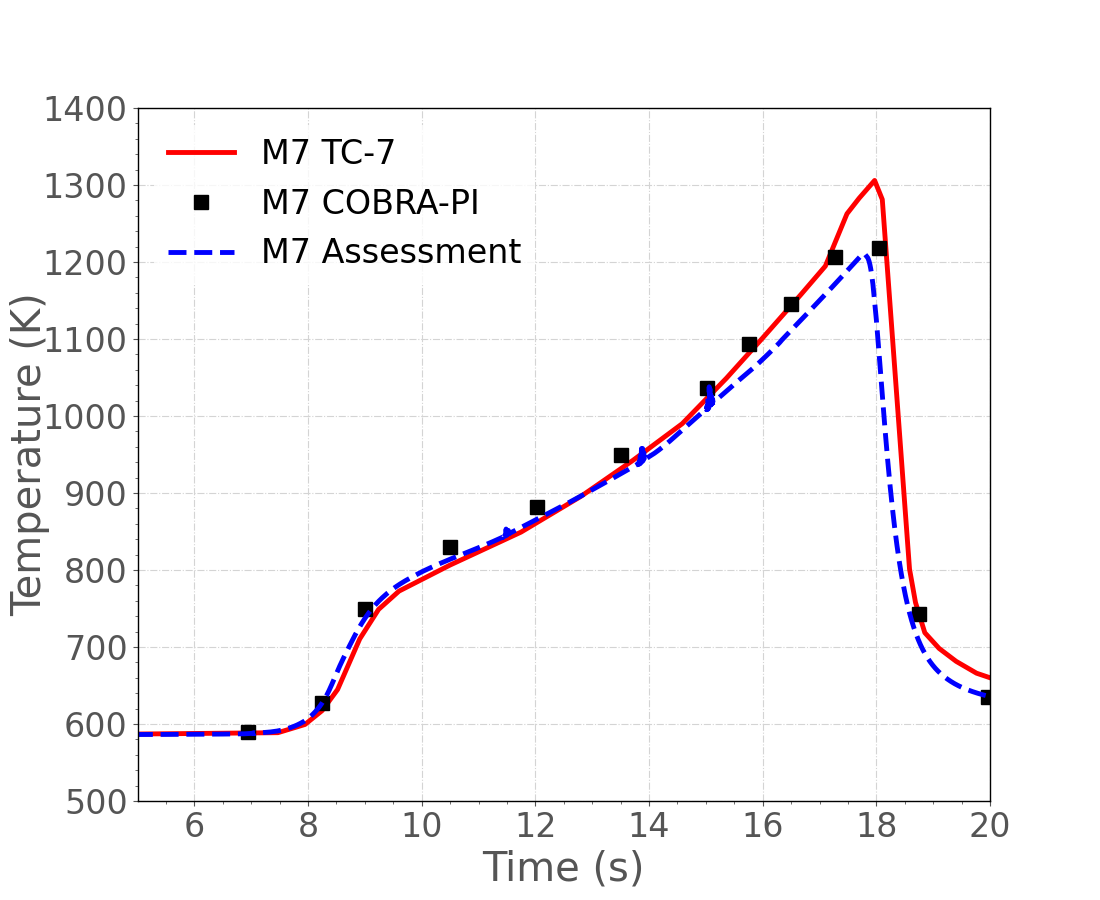
Figure 2: Comparison of peak coolant temperatures with measured flow tube temperatures.
Cladding Failure
The T-427 pin did not fail during the M7 experiment, though the other pin in the experiment did. T-427 was brought close to failure (Bauer et al., 1989). Two failure criteria were used in the M7 assessment:
HT9FailureClad using short Dorn parameters.
EutecticThicknessFCCI using the maximum inner cladding temperature.
The cumulative damage fraction (CDF) from HT9FailureClad did not show significant failure through the cladding. The typical CDF value was less than 0.5. A value of 1.0 indicates failure. The CDF value was initially set at zero even though base irradiation does increase the CDF value. The proper base irradiation CDF value is unknown, though could be found with a simulation of the base irradiation, which was not done for this assessment.
The eutectic penetration thickness depends on which surface temperature is provided to the penetration rate correlation. The outer surface temperature of the fuel pellet produced a final eutectic penetration of 232 m indicating likely cladding failure due to thinning; cladding failure did not happen in the M7 experiment. The inner surface temperature of the cladding produced a final eutectic penetration of 1.9 m indicating some FCCI attack but no failure.
Plastic Fuel Slug Elongation
The M7 experiment provided a fuel elongation of 2 to 4 %. The fuel slug from the M7 assessment had a final displacement of 5.04 mm making a fuel elongation of 1.35 %. The elongation is calculated using the initial condition of the M7 assessment which is not the as fabricated length of the fuel slug before base irradiation. It is unclear if the M7 experiment report used a similar approach.
Discussion
A comparison between experiment data, historic simulation results from COBRA-PI, and this BISON M7 assessment shows fairly good agreement. The M7 experiment is technically outside BISON's applicability due specifically to material melting. As such, temperature profiles in the fuel slug may change if BISON is developed to handle melting.
From Figure 2, BISON seems to decrease after SCRAM the fastest. The COBRA-PI results seem to have some of the same issues as BISON, but both miss the temperature behavior at the peak of the transient, which may be influenced by the failure of the other pin in the test assembly.
Cladding failure does not currently feedback to any other physics to affect the solution, e.g., eutectic penetration thinning the cladding creating stress concentrations. The failure models are in agreement with the experiment in indicating no failure, but the correlations depend strongly on temperature and local stress. Future development of BISON may remedy this reliance.
The M7 assessment is unique as the initial conditions were taken from PIE data from the base irradiation. Not all initial conditions were available. As such, the initial conditions are not the most accurate. A possible improvement could be to supplement PIE data with a base irradiation simulation to fill in missing values for the initial conditions.
References
- T. H. Bauer, W. R. Robinson, J. W. Holland, E. A. Rhodes, and A. E. Wright.
First overpower tests of metallic IFR fuel in TREAT: data and analysis from tests M5, M6, and M7.
Technical Report ANL-IFR-124, Argonne National Laboratory, 1989.[BibTeX]
- J. K. Fink and L. Leibowitz.
Thermodynamic and transport properties of sodium liquid and vapor.
Technical Report ANL/Re-95/2, ANL Reactor Engineering Division, 1995.[BibTeX]