LOCA PUZRY
Overview
Since the beginning of the 90s', several experimental series have been performed at the AEKI with Zr1%Nb (E110) and Zircaloy claddings (Perez-Feró et al., 2013). The aims of these experiments were to study and to compare the mechanical properties of the cladding materials in the temperature range of 20-1200C and to investigate the effect of oxidation and hydrogen uptake on the mechanical performance of the claddings. The objectives have been achieved through separate effect tests with well defined conditions. These cases are included in the IAEA Coordinated Research Project on Fuel Modeling in Accident Conditions (FUMAC). Limited to Zircaloy claddings (PUZRY test series), BISON simulations of these experiments have been performed.
The PUZRY single rod balloning tests were performed to investigate the mechanical behaviour and strength of Zircaloy cladding tubes and to provide adequate data for model validation. In particular, the effects of temperature and pressurization rate on the deformation and the failure (burst) pressure were investigated.
Tests Description
Thirty-one short Zircaloy-4 tube samples were investigated in a resistance furnace providing isothermal conditions in the temperature range of 700-1200C. The inner pressure of the test tube was increased linearly until the burst of the sample. The pressure history was monitored on-line by a computerized data acquisition system. The residual deformation of the samples was measured after the test.
For these experiments, the specimen was placed in a quartz test tube filled with inert gas (Ar) and heated up in an electrical furnace. The pressure of the inert gas in the quartz tube was kept at constant 1 bar by means of a buffer volume. After an approximately 1000 s heat-up period the sample was pressurized with Ar gas at a constant pressure gradient provided by choking with a capillary tube. Different pressurization rates between 0.005-0.263 bar/s could be achieved by using capillary tubes with different diameters. The temperature in the furnace and the cladding inner pressure were recorded by a PC with the data acquisition frequency of 10 records/s.
The specimens were 50 mm long pieces of Zircaloy-4 claddings. The specimens' inner / outer diameters of 9.3 / 10.75 mm corresponded to the parameters of PWR fuel claddings. The samples were closed with Zircaloy end-plugs welded to the cladding in argon atmosphere. The pressurization was performed through a Zircaloy-4 pipe (2.15 mm diameter, 0.25 mm thickness) attached to one end of the specimen. The schematic drawing of the specimen is reported in Figure 1. The effect of corrosion on the mechanical performance of Zircaloy-4 cladding was not investigated.
The main characteristics of the PUZRY test series are summarized in Table 1.
Table 1: Main characteristics of the PUZRY test series (Perez-Feró et al., 2013).
| Tube specimens | |
|---|---|
| Alloy | Zircaloy-4 |
| Inner radius (mm) | 4.65 |
| Thickness (m) | 725 |
| Length (mm) | 50 |
| ZrO layer (m) | 0 |
| End plugs | Zircaloy-4 |
| Experimental conditions | |
| Temperature range (C) | 700-1200 |
| Heating rate | isothermal tests |
| Pressure range (bar) | 0-106 |
| Pressurization rate (bar/s) | 0.005-0.263 |
| Atmosphere | Ar |
| Instrumentation | Pressure sensor, temperature sensor |
| Data acquisition (records/s) | 10 |
| Number of specimens tested successfully | 31 |
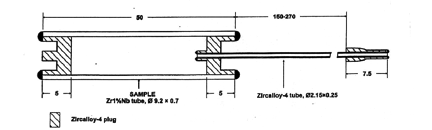
Figure 1: Drawing of the tube specimen for single-rod ballooning tests performed at AEKI (Perez-Feró et al., 2013). Note that Zircaloy-4 tubes were used for the PUZRY tests.
Modeling
Setup of Calculations
2D axisymmetric BISON models of the cladding tubes tested during the PUZRY experiments were built. The presence of the end plugs was accounted for by applying zero radial displacement boundary conditions to the tube surfaces in correspondence of the plugs. The furnace heating was simulated by a temperature boundary condition applied to the tube outer wall and consistent with the experimental conditions. A slight, linear variation of the temperature along the tube length was considered, with the total temperature difference being 6C Kulacsy (2015). The maximum temperature was considered at the tube mid-plane, which is consistent with visual inspections of the tested specimens showing ballooning around the mid-plane (Perez-Feró et al., 2013). Taking advantage of the axial symmetry of the problem, only the lower half of the heated cladding length was modelled.
Input Files
The BISON inputs and all supporting files (temperature, pressure histories) for the simulations of the 31 PUZRY cases are provided with the code distribution at bison/assessment/LWR/validation/LOCA_PUZRY_cladding_burst_tests/analysis.
Material and Behavioral Models
The following material and behavioral models were used for the Zircaloy-4 cladding:
ZryThermal: Thermophysical material properties of Zircaloy.
ZryCreepLOCAUpdate: Calculates the Erbacher secondary thermal creep under loss-of-coolant accident conditions, the Limback-Andersson primary thermal creep, and the Hoope irradiation creep for Zircaloy cladding
ComputeIsotropicElasticityTensor: Constant values are used for the Young's modulus ( Pa) and Poisson ratio ()
ZryThermalExpansionMATPROEigenstrain: Computes the thermal expansion of Zircaloy with the MATPRO model
ZrPhase: Calculates the relative amounts of the and material phases present in the zircaloy
ZryCladdingFailure: Criterion for cladding failure due to burst, based on the calculated hoop stress and creep strain rate.
Details and references for all of these models listed above can be found on the linked BISON documentation pages.
Results
The simulation results for the 31 PUZRY cases are compared to the available experimental data in order to validate the BISON models for Zircaloy cladding behavior under LOCA accident conditions. Figure 2 and Figure 3 show the comparisons between BISON predictions and experimental data of cladding inner pressure at failure and time to failure, respectively. The obtained accuracy is in line with the state of the art of fuel cladding modeling under LOCA conditions (Marcello et al., 2014).
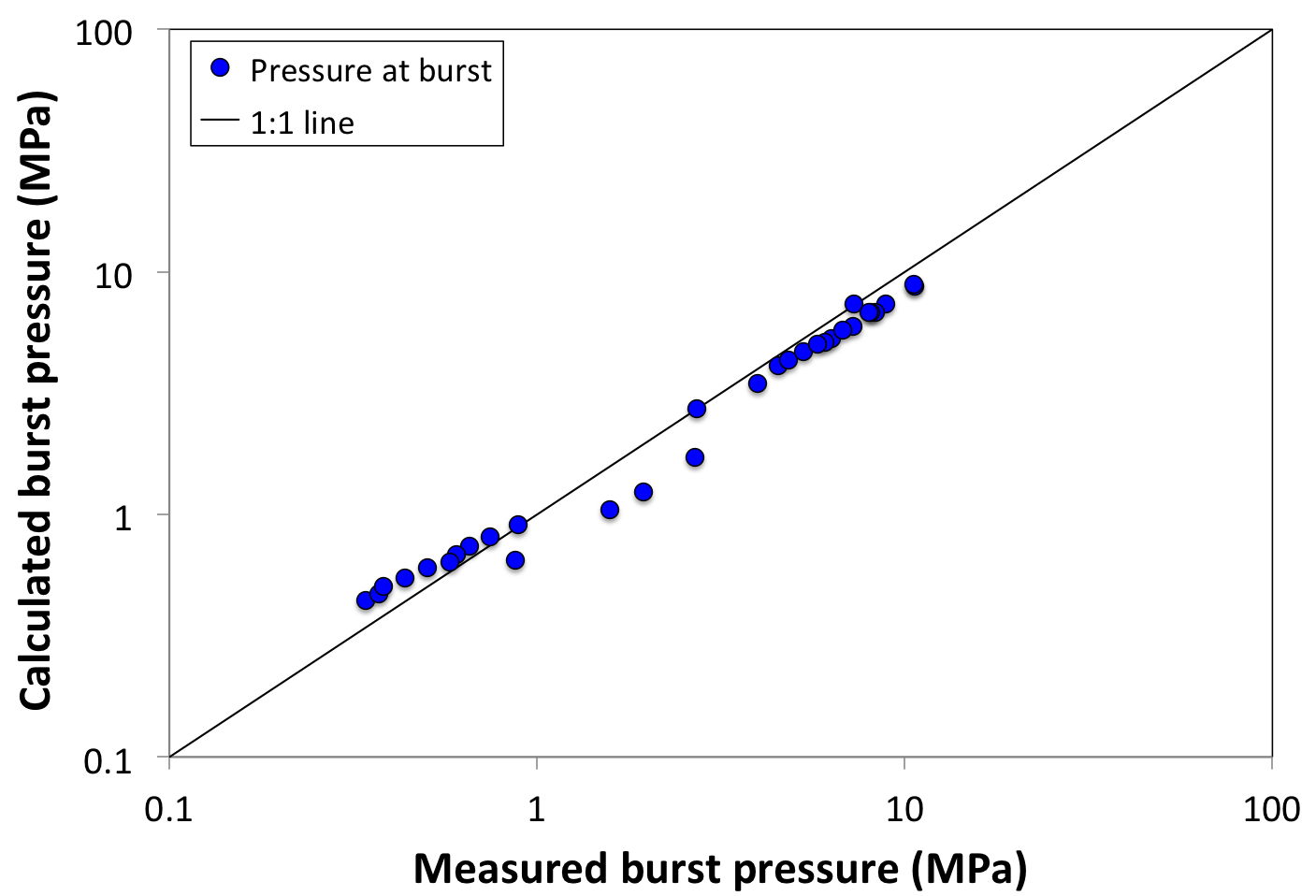
Figure 2: Comparison of calculated and measured tube inner pressures at burst for the PUZRY cases.
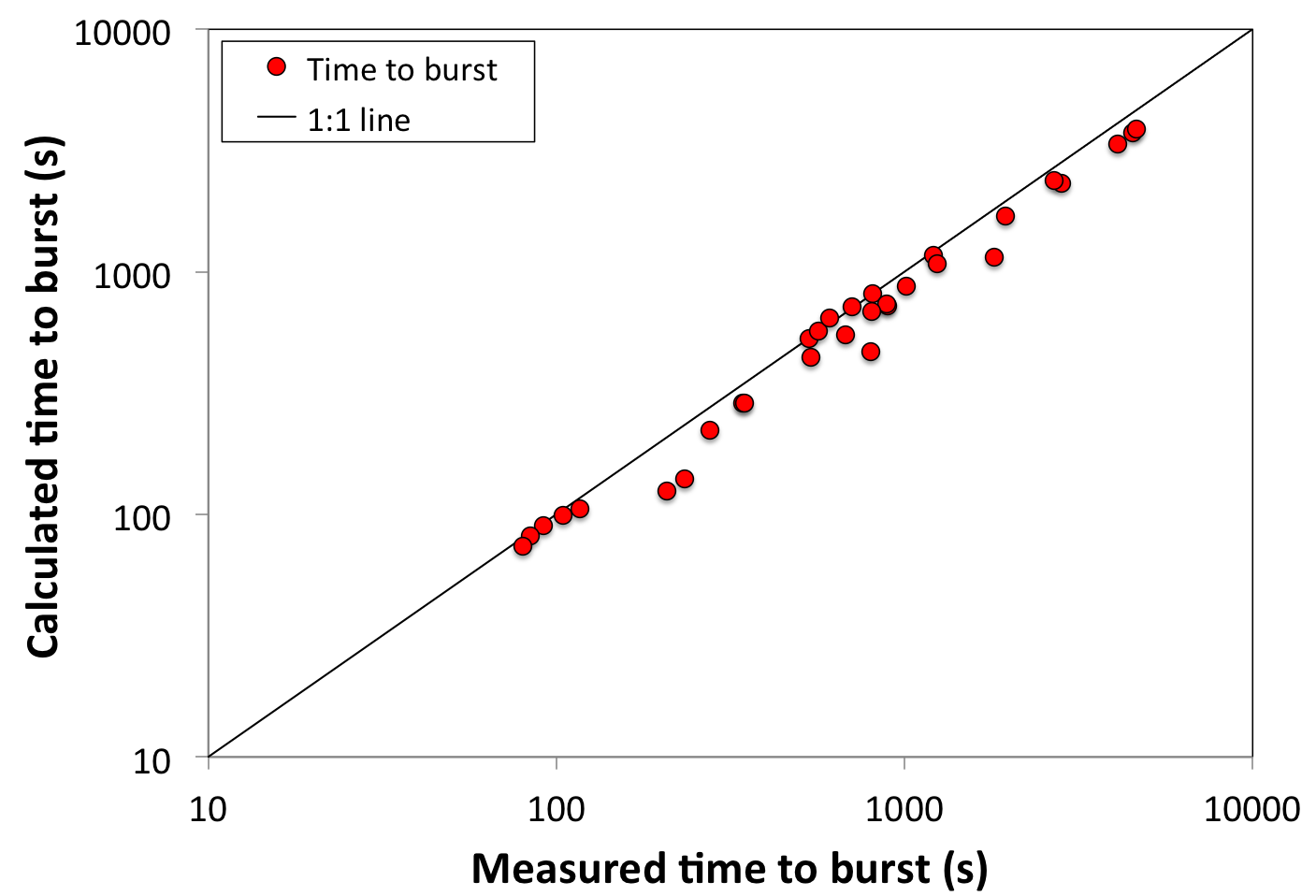
Figure 3: Comparison of calculated and measured time to burst for the PUZRY cases.
References
- K. Kulacsy.
personal information, 2015.[BibTeX]
- V. Di Marcello, A. Schubert, J. van de Laar, and P. Van Uffelen.
The TRANSURANUS mechanical model for large strain analysis.
Nuclear Engineering and Design, 276:19–29, 2014.[BibTeX]
- E. Perez-Feró, Z. Hózer, T. Novotny, G. Kracz, M. Horváth, I. Nagy, A. Vimi, A. Pintér-Csordás, Cs. Győri, L. Matus, L. Vasáros, P. Windberg, and L. Maróti.
Experimental Database of E110 Claddings under Accident Conditions.
Technical Report EK-FRL-2012-255-01/02, Centre for Energy Research, Hungarian Academy of Sciences, Budapest, Hungary, May 2013.[BibTeX]