- temperatureCoupled temperature
C++ Type:std::vector<VariableName>
Unit:(no unit assumed)
Controllable:No
Description:Coupled temperature
ZrPhase
Computes the volume fraction of beta phase for Zr-based cladding materials as a function of temperature and time.
Description
The ZrPhase model computes the volume fraction of phase for Zr-based cladding materials as a function of temperature and time.
Under extreme in-service conditions, e.g., during a postulated loss-of-coolant accident (LOCA), fuel cladding will be subjected to a rapid increase in temperature (up to 1000-1500K), which involves time-dependent phase transformation of Zr alloy from hexagonal (-phase) to cubic (-phase) crystal structure. Modeling the kinetics of crystallographic phase transformation is pivotal for the assessment of the mechanical properties essential for fuel rod integrity (deformation and burst) during a postulated LOCA.
The crucial parameter for the transformation kinetics is the evolution of the volume fraction of the new phase as a function of time and temperature. A model is available in BISON for calculation of the volume fraction of the favoured phase in Zircaloy-4 as a function of time and temperature during phase transformation in non- isothermal conditions. The model is based on Massih (2009), Massih and Jernkvist (2009), and Massih (2011). The phase transformation rate is expressed by (1) where is the volume fraction of -phase, (s) the time, (/) the steady- state or equilibrium value of , and (s) the rate parameter. The -phase equilibrium fraction is represented by a sigmoid function of temperature where and are material specific parameters related to the center and span of the mixed-phase temperature region, respectively. For Zircaloy-4, (K) and (K) (Massih, 2009) are used, with being the hydrogen concentration in the range wppm (weight parts per million hydrogen). The rate parameter is expressed in the form where is a kinetic prefactor, an effective activation energy, the Boltzmann constant, and a constant. For Zircaloy-4, (s) and (K) (Massih, 2009; Massih, 2011) are used, where (Ks) is the heat rate in the range Ks. The transformation is purely diffusion controlled, while the transformation is partly martensitic. This is represented by the constant given in the form (Massih, 2011): The starting temperatures for the onset of and phase transformations are calculated as (in Kelvin) (Massih, 2009)
for wppm. The -phase volume fraction as a function of time is calculated by numerical integration of Eq. (1). As default option, this is accomplished using the second order Adams-Moulton (AM2) method. The backward Euler method is also available. The calculated volume fractions of phase as a function of temperature at equilibrium and for temperature variation rates of 10 Ks are shown in Figure 1.
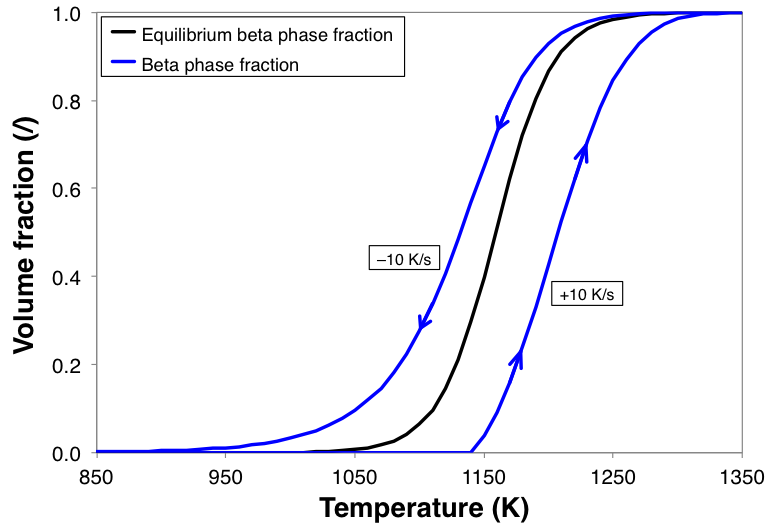
Figure 1: Calculated volume fraction of phase as a function of temperature. Equilibrium conditions (slow temperature variation) and temperature variation rates of 10 Ks are considered.
Example Input Syntax
[Materials<<<{"href": "../../syntax/Materials/index.html"}>>>]
  [phase]
    type = ZrPhase<<<{"description": "Computes the volume fraction of beta phase for Zr-based cladding materials as a function of temperature and time.", "href": "ZrPhase.html"}>>>
    block<<<{"description": "The list of blocks (ids or names) that this object will be applied"}>>> = 1
    numerical_method<<<{"description": "Select numerical method to solve the equation for beta phase fraction"}>>> = 2
  []
[]Input Parameters
- blockThe list of blocks (ids or names) that this object will be applied
C++ Type:std::vector<SubdomainName>
Controllable:No
Description:The list of blocks (ids or names) that this object will be applied
- boundaryThe list of boundaries (ids or names) from the mesh where this object applies
C++ Type:std::vector<BoundaryName>
Controllable:No
Description:The list of boundaries (ids or names) from the mesh where this object applies
- computeTrueWhen false, MOOSE will not call compute methods on this material. The user must call computeProperties() after retrieving the MaterialBase via MaterialBasePropertyInterface::getMaterialBase(). Non-computed MaterialBases are not sorted for dependencies.
Default:True
C++ Type:bool
Controllable:No
Description:When false, MOOSE will not call compute methods on this material. The user must call computeProperties() after retrieving the MaterialBase via MaterialBasePropertyInterface::getMaterialBase(). Non-computed MaterialBases are not sorted for dependencies.
- constant_onNONEWhen ELEMENT, MOOSE will only call computeQpProperties() for the 0th quadrature point, and then copy that value to the other qps.When SUBDOMAIN, MOOSE will only call computeQpProperties() for the 0th quadrature point, and then copy that value to the other qps. Evaluations on element qps will be skipped
Default:NONE
C++ Type:MooseEnum
Options:NONE, ELEMENT, SUBDOMAIN
Controllable:No
Description:When ELEMENT, MOOSE will only call computeQpProperties() for the 0th quadrature point, and then copy that value to the other qps.When SUBDOMAIN, MOOSE will only call computeQpProperties() for the 0th quadrature point, and then copy that value to the other qps. Evaluations on element qps will be skipped
- declare_suffixAn optional suffix parameter that can be appended to any declared properties. The suffix will be prepended with a '_' character.
C++ Type:MaterialPropertyName
Unit:(no unit assumed)
Controllable:No
Description:An optional suffix parameter that can be appended to any declared properties. The suffix will be prepended with a '_' character.
- numerical_method2Select numerical method to solve the equation for beta phase fraction
Default:2
C++ Type:short
Controllable:No
Description:Select numerical method to solve the equation for beta phase fraction
Optional Parameters
- control_tagsAdds user-defined labels for accessing object parameters via control logic.
C++ Type:std::vector<std::string>
Controllable:No
Description:Adds user-defined labels for accessing object parameters via control logic.
- enableTrueSet the enabled status of the MooseObject.
Default:True
C++ Type:bool
Controllable:Yes
Description:Set the enabled status of the MooseObject.
- implicitTrueDetermines whether this object is calculated using an implicit or explicit form
Default:True
C++ Type:bool
Controllable:No
Description:Determines whether this object is calculated using an implicit or explicit form
- seed0The seed for the master random number generator
Default:0
C++ Type:unsigned int
Controllable:No
Description:The seed for the master random number generator
- use_displaced_meshFalseWhether or not this object should use the displaced mesh for computation. Note that in the case this is true but no displacements are provided in the Mesh block the undisplaced mesh will still be used.
Default:False
C++ Type:bool
Controllable:No
Description:Whether or not this object should use the displaced mesh for computation. Note that in the case this is true but no displacements are provided in the Mesh block the undisplaced mesh will still be used.
Advanced Parameters
- output_propertiesList of material properties, from this material, to output (outputs must also be defined to an output type)
C++ Type:std::vector<std::string>
Controllable:No
Description:List of material properties, from this material, to output (outputs must also be defined to an output type)
- outputsnone Vector of output names where you would like to restrict the output of variables(s) associated with this object
Default:none
C++ Type:std::vector<OutputName>
Controllable:No
Description:Vector of output names where you would like to restrict the output of variables(s) associated with this object
Outputs Parameters
- prop_getter_suffixAn optional suffix parameter that can be appended to any attempt to retrieve/get material properties. The suffix will be prepended with a '_' character.
C++ Type:MaterialPropertyName
Unit:(no unit assumed)
Controllable:No
Description:An optional suffix parameter that can be appended to any attempt to retrieve/get material properties. The suffix will be prepended with a '_' character.
- use_interpolated_stateFalseFor the old and older state use projected material properties interpolated at the quadrature points. To set up projection use the ProjectedStatefulMaterialStorageAction.
Default:False
C++ Type:bool
Controllable:No
Description:For the old and older state use projected material properties interpolated at the quadrature points. To set up projection use the ProjectedStatefulMaterialStorageAction.
Material Property Retrieval Parameters
Input Files
- (assessment/LWR/validation/LOCA_Hardy_cladding_test/analysis/0pt5MPa/25C_sec/25C_sec_Hardy_Tube_Test_0pt5MPa.i)
- (test/tests/solid_mechanics/zry_creep/kaddour/ad_operating_to_loca_creep_2.i)
- (test/tests/solid_mechanics/zry_creep/kaddour/ad_operating_to_loca_creep_4.i)
- (assessment/LWR/validation/LOCA_PUZRY_cladding_burst_tests/analysis/puzry-16/puzry-16.i)
- (assessment/LWR/validation/LOCA_REBEKA_cladding_burst_tests/analysis/rebeka_2d_08MPa/rebeka_singlerod_2d_08MPa.i)
- (test/tests/solid_mechanics/zry_creep/erbacher/loca_creep_uniaxial_beta1.i)
- (test/tests/solid_mechanics/zry_creep/erbacher/operating_to_loca_creep_3.i)
- (assessment/LWR/validation/LOCA_PUZRY_cladding_burst_tests/analysis/puzry-23/puzry-23.i)
- (test/tests/solid_mechanics/zry_mechanics/zry_clad_failure/ad_zry_clad_failure_overstress_plastic_instability.i)
- (test/tests/solid_mechanics/zry_creep/donaldson/operating_to_loca_creep_4.i)
- (assessment/LWR/validation/LOCA_PUZRY_cladding_burst_tests/analysis/puzry-15/puzry-15.i)
- (test/tests/solid_mechanics/zry_creep/donaldson/ad_operating_to_loca_creep_5.i)
- (assessment/LWR/validation/LOCA_IFA_650/analysis/IFA_650_4/IFA_650_4_part1.i)
- (assessment/LWR/validation/LOCA_PUZRY_cladding_burst_tests/analysis/puzry-04/puzry-04_aniso.i)
- (test/tests/solid_mechanics/zry_mechanics/zry_clad_failure/zry_clad_failure_overstress.i)
- (assessment/LWR/validation/LOCA_PUZRY_cladding_burst_tests/analysis/puzry-05/puzry-05.i)
- (assessment/LWR/validation/LOCA_REBEKA_cladding_burst_tests/analysis/rebeka_2d_06MPa/rebeka_singlerod_2d_06MPa.i)
- (assessment/LWR/validation/LOCA_ORNL_cladding_burst_tests/analysis/Zr2_1/ornl_zr2_1.i)
- (benchmarks/loca/experimental_comparison/analysis/1473K/uniaxial_specimen_1473K.i)
- (assessment/LWR/validation/LOCA_PUZRY_cladding_burst_tests/analysis/puzry-31/puzry-31_aniso.i)
- (assessment/LWR/validation/LOCA_PUZRY_cladding_burst_tests/analysis/puzry-02/puzry-02.i)
- (test/tests/solid_mechanics/zry_mechanics/zry_clad_failure/ad_zry_clad_failure_overstrain.i)
- (test/tests/solid_mechanics/zry_creep/erbacher/operating_to_loca_hill_creep_5.i)
- (test/tests/solid_mechanics/zry_mechanics/zry_clad_failure/ad_zry_clad_failure_overstress.i)
- (test/tests/solid_mechanics/zry_creep/ad_operating_to_loca_creep_1.i)
- (test/tests/solid_mechanics/zry_creep/erbacher/loca_creep_uniaxial_beta2.i)
- (test/tests/phase_transition_zircaloy/ad_test_zrphase.i)
- (test/tests/solid_mechanics/zry_creep/donaldson/ad_operating_to_loca_creep_3.i)
- (test/tests/solid_mechanics/zry_creep/donaldson/operating_to_loca_creep_hoop.i)
- (assessment/LWR/validation/LOCA_REBEKA_cladding_burst_tests/analysis/rebeka_2d_06MPa/rebeka_singlerod_2d_06MPa_aniso.i)
- (test/tests/solid_mechanics/zry_creep/erbacher/operating_to_loca_creep_2.i)
- (assessment/LWR/validation/LOCA_REBEKA_cladding_burst_tests/analysis/rebeka_2d_01MPa/rebeka_singlerod_2d_01MPa.i)
- (assessment/LWR/validation/LOCA_Hardy_cladding_test/analysis/base_input/Hardy_Tube_Test.i)
- (assessment/LWR/validation/LOCA_PUZRY_cladding_burst_tests/analysis/puzry-22/puzry-22_aniso.i)
- (assessment/LWR/validation/RIA_CABRI_REP_Na4/analysis/REP_Na_4/REP_Na_4.i)
- (assessment/LWR/validation/LOCA_Hardy_cladding_test/analysis/2pt1MPa/100C_sec/100C_sec_Hardy_Tube_Test_2pt1MPa.i)
- (test/tests/solid_mechanics/zry_mechanics/zry_clad_failure/ad_zry_clad_failure_overstress_overstrain.i)
- (assessment/LWR/validation/LOCA_REBEKA_cladding_burst_tests/analysis/rebeka_2d_10MPa/rebeka_singlerod_2d_10MPa_aniso.i)
- (assessment/LWR/validation/LOCA_IFA_650/analysis/IFA_650_10/IFA_650_10_part1.i)
- (assessment/LWR/validation/LOCA_REBEKA_cladding_burst_tests/analysis/rebeka_3d_10MPa_01Kpers_90deg/rebeka_singlerod_3d_10MPa_90deg.i)
- (test/tests/solid_mechanics/zry_mechanics/zry_clad_failure/zry_clad_failure_overstress_plastic_instability.i)
- (assessment/LWR/validation/LOCA_PUZRY_cladding_burst_tests/analysis/puzry-08/puzry-08.i)
- (assessment/LWR/validation/LOCA_PUZRY_cladding_burst_tests/analysis/puzry-19/puzry-19_aniso.i)
- (assessment/LWR/validation/LOCA_REBEKA_cladding_burst_tests/analysis/rebeka_2d_10MPa/rebeka_singlerod_2d_10MPa_1pt5.i)
- (test/tests/solid_mechanics/zry_creep/kaddour/loca_creep_uniaxial_beta2.i)
- (assessment/LWR/validation/LOCA_ORNL_cladding_burst_tests/analysis/Zr2_2/ornl_zr2_2_aniso.i)
- (assessment/LWR/validation/LOCA_Studsvik/analysis/rod_191/Studsvik_191_part2.i)
- (test/tests/solid_mechanics/zry_creep/donaldson/loca_creep_uniaxial_beta1.i)
- (test/tests/solid_mechanics/zry_creep/erbacher/ad_operating_to_loca_creep_5.i)
- (assessment/LWR/validation/LOCA_PUZRY_cladding_burst_tests/analysis/puzry-06/puzry-06.i)
- (assessment/LWR/validation/LOCA_REBEKA_cladding_burst_tests/analysis/rebeka_2d_08MPa/rebeka_singlerod_2d_08MPa_aniso.i)
- (test/tests/phase_transition_zircaloy/test_zrphase.i)
- (test/tests/solid_mechanics/zry_creep/donaldson/operating_to_loca_creep_2.i)
- (test/tests/solid_mechanics/zry_creep/kaddour/loca_creep_uniaxial_beta1.i)
- (assessment/LWR/validation/LOCA_PUZRY_cladding_burst_tests/analysis/puzry-11/puzry-11_aniso.i)
- (assessment/LWR/validation/LOCA_IFA_650/analysis/IFA_650_4/IFA_650_4_part1_gas_communication.i)
- (assessment/LWR/validation/LOCA_Hardy_cladding_test/analysis/1pt0MPa/25C_sec/25C_sec_Hardy_Tube_Test_1pt0MPa.i)
- (assessment/LWR/validation/LOCA_ORNL_cladding_burst_tests/analysis/Zr4_1/ornl_zr4_1.i)
- (assessment/LWR/validation/LOCA_ANL_cladding_burst_tests/analysis/OCL5_8/OCL5_8.i)
- (test/tests/solid_mechanics/zry_creep/donaldson/ad_operating_to_loca_creep_4.i)
- (assessment/LWR/validation/LOCA_PUZRY_cladding_burst_tests/analysis/puzry-26/puzry-26.i)
- (assessment/LWR/validation/LOCA_REBEKA_cladding_burst_tests/analysis/rebeka_2d_14MPa/rebeka_singlerod_2d_14MPa.i)
- (assessment/LWR/validation/LOCA_IFA_650/analysis/IFA_650_4/IFA_650_4_part2.i)
- (assessment/LWR/validation/LOCA_PUZRY_cladding_burst_tests/analysis/puzry-15/puzry-15_aniso.i)
- (assessment/LWR/validation/LOCA_PUZRY_cladding_burst_tests/analysis/puzry-10/puzry-10.i)
- (assessment/LWR/validation/LOCA_ANL_cladding_burst_tests/analysis/OCL11/OCL11.i)
- (assessment/LWR/validation/LOCA_PUZRY_cladding_burst_tests/analysis/puzry-20/puzry-20_aniso.i)
- (assessment/LWR/validation/LOCA_Studsvik/analysis/rod_191/Studsvik_191_part2_1p5d_fr_frd.i)
- (assessment/LWR/validation/LOCA_ORNL_cladding_burst_tests/analysis/Zr2_2/ornl_zr2_2.i)
- (assessment/LWR/validation/LOCA_PUZRY_cladding_burst_tests/analysis/puzry-26/puzry-26_aniso.i)
- (assessment/LWR/validation/LOCA_Studsvik/analysis/rod_191/Studsvik_191_part1.i)
- (test/tests/solid_mechanics/zry_creep/kaddour/operating_to_loca_creep_5.i)
- (assessment/LWR/validation/LOCA_REBEKA_cladding_burst_tests/analysis/rebeka_2d_10MPa/rebeka_singlerod_2d_10MPa_1pt5_aniso.i)
- (assessment/LWR/validation/LOCA_PUZRY_cladding_burst_tests/analysis/puzry-08/puzry-08_aniso.i)
- (assessment/LWR/validation/LOCA_Hardy_cladding_test/analysis/0pt7MPa/100C_sec/Hardy_Tube_Test_0pt7MPa.i)
- (assessment/LWR/validation/LOCA_PUZRY_cladding_burst_tests/analysis/puzry-31/puzry-31.i)
- (assessment/LWR/validation/LOCA_Studsvik/analysis/rod_196/Studsvik_196_part1_1p5d_fr_ffrd.i)
- (benchmarks/loca/experimental_comparison/analysis/973K/uniaxial_specimen_973K.i)
- (test/tests/solid_mechanics/zry_creep/kaddour/ad_operating_to_loca_creep_3.i)
- (assessment/LWR/validation/LOCA_Hardy_cladding_test/analysis/0pt3MPa/100C_sec/100C_sec_Hardy_Tube_Test_0pt3MPa.i)
- (assessment/LWR/validation/LOCA_Studsvik/analysis/rod_191/Studsvik_191_part1_1p5d_fr_frd.i)
- (assessment/LWR/validation/LOCA_REBEKA_cladding_burst_tests/analysis/rebeka_2d_02MPa/rebeka_singlerod_2d_02MPa_aniso.i)
- (test/tests/solid_mechanics/zry_creep/erbacher/operating_to_loca_hill_creep_5_temperature.i)
- (assessment/LWR/validation/LOCA_Hardy_cladding_test/analysis/1pt4MPa/100C_sec/100C_sec_Hardy_Tube_Test_1pt4MPa.i)
- (assessment/LWR/validation/LOCA_PUZRY_cladding_burst_tests/analysis/puzry-14/puzry-14.i)
- (assessment/LWR/validation/LOCA_PUZRY_cladding_burst_tests/analysis/puzry-14/puzry-14_aniso.i)
- (benchmarks/loca/separate_effects/uniaxial_separate_effects.i)
- (assessment/LWR/validation/LOCA_Hardy_cladding_test/analysis/13pt8MPa/25C_sec/25C_sec_Hardy_Tube_Test_13pt8MPa.i)
- (assessment/LWR/validation/LOCA_PUZRY_cladding_burst_tests/analysis/puzry-07/puzry-07.i)
- (assessment/LWR/validation/LOCA_ORNL_cladding_burst_tests/analysis/Zr4_1/ornl_zr4_1_ad_hill.i)
- (test/tests/plenum_pressure/past_rupture.i)
- (test/tests/solid_mechanics/zry_creep/erbacher/ad_operating_to_loca_creep_3.i)
- (assessment/LWR/validation/LOCA_Studsvik/analysis/rod_196/Studsvik_196_part2.i)
- (assessment/LWR/validation/LOCA_PUZRY_cladding_burst_tests/analysis/puzry-20/puzry-20.i)
- (test/tests/solid_mechanics/zry_creep/donaldson/operating_to_loca_creep_5.i)
- (test/tests/solid_mechanics/zry_creep/erbacher/ad_operating_to_loca_hill_creep_5_temperature.i)
- (assessment/LWR/validation/LOCA_Hardy_cladding_test/analysis/1pt4MPa/25C_sec/25C_sec_Hardy_Tube_Test_1pt4MPa.i)
- (assessment/LWR/validation/LOCA_PUZRY_cladding_burst_tests/analysis/puzry-02/puzry-02_aniso.i)
- (test/tests/solid_mechanics/zry_creep/donaldson/operating_to_loca_creep_3.i)
- (assessment/LWR/validation/LOCA_Hardy_cladding_test/analysis/3pt8MPa/25C_sec/25C_sec_Hardy_Tube_Test_3pt8MPa.i)
- (test/tests/solid_mechanics/zry_creep/kaddour/ad_operating_to_loca_creep_5.i)
- (assessment/LWR/validation/LOCA_PUZRY_cladding_burst_tests/analysis/puzry-11/puzry-11.i)
- (assessment/LWR/validation/LOCA_IFA_650/analysis/IFA_650_9/IFA_650_9_part1.i)
- (assessment/LWR/validation/LOCA_PUZRY_cladding_burst_tests/analysis/puzry-09/puzry-09.i)
- (assessment/LWR/validation/LOCA_IFA_650/analysis/IFA_650_10/IFA_650_10_part2.i)
- (test/tests/solid_mechanics/zry_mechanics/zry_clad_failure/zry_clad_failure_overstrain.i)
- (assessment/LWR/validation/LOCA_PUZRY_cladding_burst_tests/analysis/puzry-01/puzry-01_aniso.i)
- (assessment/LWR/validation/LOCA_PUZRY_cladding_burst_tests/analysis/puzry-29/puzry-29.i)
- (assessment/LWR/validation/LOCA_PUZRY_cladding_burst_tests/analysis/puzry-28/puzry-28.i)
- (assessment/LWR/validation/LOCA_PUZRY_cladding_burst_tests/analysis/puzry-27/puzry-27_aniso.i)
- (assessment/LWR/validation/LOCA_PUZRY_cladding_burst_tests/analysis/puzry-10/puzry-10_aniso.i)
- (test/tests/solid_mechanics/zry_creep/erbacher/ad_operating_to_loca_hill_creep_5.i)
- (assessment/LWR/validation/LOCA_PUZRY_cladding_burst_tests/analysis/puzry-16/puzry-16_aniso.i)
- (assessment/LWR/validation/LOCA_REBEKA_cladding_burst_tests/analysis/rebeka_2d_10MPa/rebeka_singlerod_2d_10MPa.i)
- (assessment/LWR/validation/LOCA_ORNL_cladding_burst_tests/analysis/Zr4_1/ornl_zr4_1_ad_hill_aniso.i)
- (test/tests/solid_mechanics/zry_creep/erbacher/operating_to_loca_creep_5_no_trafo.i)
- (assessment/LWR/validation/LOCA_PUZRY_cladding_burst_tests/analysis/puzry-18/puzry-18_aniso.i)
- (test/tests/solid_mechanics/zry_creep/erbacher/ad_operating_to_loca_creep_4.i)
- (assessment/LWR/validation/LOCA_ANL_cladding_burst_tests/analysis/OCL11/OCL11_aniso.i)
- (assessment/LWR/validation/LOCA_REBEKA_cladding_burst_tests/analysis/rebeka_2d_12MPa/rebeka_singlerod_2d_12MPa_aniso.i)
- (assessment/LWR/validation/LOCA_Studsvik/analysis/rod_196/Studsvik_196_part1.i)
- (assessment/LWR/validation/LOCA_PUZRY_cladding_burst_tests/analysis/puzry-12/puzry-12_aniso.i)
- (assessment/LWR/validation/LOCA_PUZRY_cladding_burst_tests/analysis/puzry-04/puzry-04.i)
- (test/tests/solid_mechanics/zry_mechanics/zry_clad_failure/ad_zry_clad_failure_rupture_temperature.i)
- (test/tests/solid_mechanics/zry_creep/erbacher/ad_operating_to_loca_creep_2.i)
- (benchmarks/loca/experimental_comparison/analysis/1273K/uniaxial_specimen_1273K.i)
- (assessment/LWR/validation/LOCA_REBEKA_cladding_burst_tests/analysis/rebeka_2d_04MPa/rebeka_singlerod_2d_04MPa.i)
- (assessment/LWR/validation/LOCA_REBEKA_cladding_burst_tests/analysis/rebeka_2d_04MPa/rebeka_singlerod_2d_04MPa_aniso.i)
- (test/tests/solid_mechanics/zry_creep/erbacher/operating_to_loca_creep_5.i)
- (assessment/LWR/validation/LOCA_IFA_650/analysis/IFA_650_9/IFA_650_9_part2.i)
- (assessment/LWR/validation/LOCA_PUZRY_cladding_burst_tests/analysis/puzry-07/puzry-07_aniso.i)
- (test/tests/solid_mechanics/zry_creep/kaddour/operating_to_loca_creep_2.i)
- (test/tests/solid_mechanics/zry_creep/donaldson/loca_creep_uniaxial_beta2.i)
- (assessment/LWR/validation/LOCA_REBEKA_cladding_burst_tests/analysis/rebeka_2d_12MPa/rebeka_singlerod_2d_12MPa.i)
- (assessment/LWR/validation/LOCA_Hardy_cladding_test/analysis/0pt7MPa/25C_sec/25C_sec_Hardy_Tube_Test_0pt7MPa.i)
- (assessment/LWR/validation/LOCA_REBEKA_cladding_burst_tests/analysis/rebeka_2d_14MPa/rebeka_singlerod_2d_14MPa_aniso.i)
- (assessment/LWR/validation/LOCA_PUZRY_cladding_burst_tests/analysis/puzry-21/puzry-21.i)
- (assessment/LWR/validation/LOCA_Hardy_cladding_test/analysis/2pt8MPa/25C_sec/25C_sec_Hardy_Tube_Test_2pt8MPa.i)
- (assessment/LWR/validation/LOCA_ORNL_cladding_burst_tests/analysis/Zr2_1/ornl_zr2_1_aniso.i)
- (assessment/LWR/validation/LOCA_PUZRY_cladding_burst_tests/analysis/puzry-25/puzry-25.i)
- (assessment/LWR/validation/LOCA_ANL_cladding_burst_tests/analysis/OCL11/OCL11_ad.i)
- (assessment/LWR/validation/LOCA_IFA_650/analysis/IFA_650_4/IFA_650_4_part3_gas_communication.i)
- (assessment/LWR/validation/LOCA_PUZRY_cladding_burst_tests/analysis/puzry-01/puzry-01.i)
- (assessment/LWR/validation/LOCA_PUZRY_cladding_burst_tests/analysis/puzry-03/puzry-03.i)
- (assessment/LWR/validation/LOCA_REBEKA_cladding_burst_tests/analysis/rebeka_2d_01MPa/rebeka_singlerod_2d_01MPa_aniso.i)
- (assessment/LWR/validation/LOCA_IFA_650/analysis/IFA_650_4/IFA_650_4_part2_gas_communication.i)
- (test/tests/solid_mechanics/zry_creep/kaddour/operating_to_loca_creep_3.i)
- (test/tests/solid_mechanics/zry_creep/donaldson/ad_operating_to_loca_creep_2.i)
- (assessment/LWR/validation/LOCA_Studsvik/analysis/rod_196/Studsvik_196_part2_1p5d_fr_ffrd.i)
- (assessment/LWR/validation/LOCA_Hardy_cladding_test/analysis/3pt8MPa/100C_sec/100C_sec_Hardy_Tube_Test_3pt8MPa.i)
- (assessment/LWR/validation/LOCA_Hardy_cladding_test/analysis/5pt5MPa/100C_sec/100C_sec_Hardy_Tube_Test_5pt5MPa.i)
- (assessment/LWR/validation/LOCA_MT4_MT6A/analysis/MT4/MT4_1-2kW.i)
- (assessment/LWR/validation/LOCA_PUZRY_cladding_burst_tests/analysis/puzry-30/puzry-30_aniso.i)
- (test/tests/solid_mechanics/zry_mechanics/zry_clad_failure/zry_clad_failure_overstress_overstrain.i)
- (test/tests/solid_mechanics/zry_mechanics/zry_clad_failure/zry_clad_failure_plastic_instability.i)
- (assessment/LWR/validation/LOCA_PUZRY_cladding_burst_tests/analysis/puzry-24/puzry-24_aniso.i)
- (assessment/LWR/validation/LOCA_PUZRY_cladding_burst_tests/analysis/puzry-05/puzry-05_aniso.i)
- (assessment/LWR/validation/LOCA_Hardy_cladding_test/analysis/0pt3MPa/25C_sec/25C_sec_Hardy_Tube_Test_0pt3MPa.i)
- (assessment/LWR/validation/LOCA_PUZRY_cladding_burst_tests/analysis/puzry-30/puzry-30.i)
- (assessment/LWR/validation/LOCA_MT4_MT6A/analysis/MT6A/MT6A_1-1kW.i)
- (assessment/LWR/validation/RIA_CABRI_REP_Na4/analysis/REP_Na_4/RIA/REP_Na_4_RIA.i)
- (test/tests/solid_mechanics/zry_mechanics/zry_clad_failure/zry_clad_failure_rupture_temperature.i)
- (assessment/LWR/validation/RIA_CABRI_REP_Na/analysis/REP_Na_Base.i)
- (benchmarks/loca/experimental_comparison/analysis/1073K/uniaxial_specimen_1073K.i)
- (assessment/LWR/validation/LOCA_PUZRY_cladding_burst_tests/analysis/puzry-09/puzry-09_aniso.i)
- (assessment/LWR/validation/LOCA_REBEKA_cladding_burst_tests/analysis/rebeka_2d_10MPa/rebeka_singlerod_2d_10MPa_aniso_hunt.i)
- (assessment/LWR/validation/LOCA_PUZRY_cladding_burst_tests/analysis/puzry-29/puzry-29_aniso.i)
- (assessment/LWR/validation/LOCA_Hardy_cladding_test/analysis/2pt1MPa/25C_sec/25C_sec_Hardy_Tube_Test_2pt1MPa.i)
- (assessment/LWR/validation/LOCA_PUZRY_cladding_burst_tests/analysis/puzry-18/puzry-18.i)
- (assessment/LWR/validation/LOCA_PUZRY_cladding_burst_tests/analysis/puzry-17/puzry-17.i)
- (test/tests/solid_mechanics/zry_creep/operating_to_loca_creep_1.i)
- (assessment/LWR/validation/LOCA_PUZRY_cladding_burst_tests/analysis/puzry-24/puzry-24.i)
- (assessment/LWR/validation/LOCA_PUZRY_cladding_burst_tests/analysis/puzry-25/puzry-25_aniso.i)
- (test/tests/solid_mechanics/zry_creep/erbacher/operating_to_loca_creep_4.i)
- (assessment/LWR/validation/LOCA_MT4_MT6A/analysis/MT6A/MT6A_1-2kW.i)
- (test/tests/solid_mechanics/zry_creep/kaddour/operating_to_loca_creep_4.i)
- (assessment/LWR/validation/LOCA_PUZRY_cladding_burst_tests/analysis/puzry-13/puzry-13.i)
- (assessment/LWR/validation/LOCA_PUZRY_cladding_burst_tests/analysis/puzry-19/puzry-19.i)
- (assessment/LWR/validation/LOCA_MT4_MT6A/analysis/MT4/MT4_1-1kW.i)
- (test/tests/solid_mechanics/zry_creep/donaldson/ad_operating_to_loca_creep_hoop.i)
- (assessment/LWR/validation/LOCA_Hardy_cladding_test/analysis/5pt5MPa/25C_sec/25C_sec_Hardy_Tube_Test_5pt5MPa.i)
- (assessment/LWR/validation/LOCA_ANL_cladding_burst_tests/analysis/OCL5_8/OCL5_8_aniso.i)
- (assessment/LWR/validation/LOCA_PUZRY_cladding_burst_tests/analysis/puzry-23/puzry-23_aniso.i)
- (assessment/LWR/validation/LOCA_IFA_650/analysis/IFA_650_2/IFA_650_2.i)
- (assessment/LWR/validation/LOCA_PUZRY_cladding_burst_tests/analysis/puzry-03/puzry-03_aniso.i)
- (assessment/LWR/validation/LOCA_PUZRY_cladding_burst_tests/analysis/puzry-22/puzry-22.i)
- (assessment/LWR/validation/LOCA_ORNL_cladding_burst_tests/analysis/Zr2_2/ornl_zr2_2_ad.i)
- (assessment/LWR/validation/LOCA_ANL_cladding_burst_tests/analysis/OCL5_8/OCL5_8_ad.i)
- (assessment/LWR/validation/LOCA_PUZRY_cladding_burst_tests/analysis/puzry-12/puzry-12.i)
- (assessment/LWR/validation/LOCA_PUZRY_cladding_burst_tests/analysis/puzry-21/puzry-21_aniso.i)
- (test/tests/solid_mechanics/zry_mechanics/zry_clad_failure/ad_zry_clad_failure_plastic_instability.i)
- (assessment/LWR/validation/LOCA_PUZRY_cladding_burst_tests/analysis/puzry-17/puzry-17_aniso.i)
- (assessment/LWR/validation/LOCA_PUZRY_cladding_burst_tests/analysis/puzry-13/puzry-13_aniso.i)
- (assessment/LWR/validation/LOCA_PUZRY_cladding_burst_tests/analysis/puzry-27/puzry-27.i)
- (assessment/LWR/validation/LOCA_ORNL_cladding_burst_tests/analysis/Zr2_1/ornl_zr2_1_ad.i)
- (assessment/LWR/validation/LOCA_REBEKA_cladding_burst_tests/analysis/rebeka_2d_02MPa/rebeka_singlerod_2d_02MPa.i)
References
- A.R. Massih.
Transformation kinetics of zirconium alloys under non-isothermal conditions.
Journal of Nuclear Materials, 384:330–335, 2009.[BibTeX]
@article{massih_2009, author = "Massih, A.R.", title = "Transformation kinetics of zirconium alloys under non-isothermal conditions", journal = "Journal of Nuclear Materials", year = "2009", volume = "384", pages = "330-335" } - A.R. Massih.
Evaluation of loss-of-coolant accident simulation tests with the fuel rod analysis code FRAPTRAN-1.4.
Technical Report TR11-008V1, Quantum Technologies AB, 2011.[BibTeX]
@techreport{massih_2011, author = "Massih, A.R.", title = "Evaluation of loss-of-coolant accident simulation tests with the fuel rod analysis code {FRAPTRAN-1.4}", institution = "Quantum Technologies AB", year = "2011", number = "TR11-008V1" } - Ali R Massih and Lars Olof Jernkvist.
Transformation kinetics of alloys under non-isothermal conditions.
Modelling and Simulation in Materials Science and Engineering, 17(5):055002, 2009.[BibTeX]
@article{massih_jernkvist_2009,
    author = "Massih, Ali R and Jernkvist, Lars Olof",
    title = "Transformation kinetics of alloys under non-isothermal conditions",
    journal = "Modelling and Simulation in Materials Science and Engineering",
    volume = "17",
    number = "5",
    pages = "055002",
    year = "2009",
    publisher = "IOP Publishing"
}
(test/tests/phase_transition_zircaloy/test_zrphase.i)
# This test demonstrates the usage of the model for the high-temperature alpha <--> beta phase transition of Zircaloy. This is implemented in the class ZrPhase.
# Only Zircaloy-4 is considered at the moment.
[GlobalParams]
  displacements = 'disp_x disp_y disp_z'
  temperature = temp
[]

[Mesh]
  [mesh]
    type = FileMeshGenerator
    file = cube_111.e
  []
[]

[Functions]
  [Temp_func]
    type = PiecewiseLinear
    x = '0.   10800.  50000. 50075. 50150. 50260.'
    y = '300. 650.    650.   1400.  1400.  300.  '
  []
[]

[Variables]
  [temp]
    order = FIRST
    family = LAGRANGE
    initial_condition = 300.
  []
[]

[AuxVariables]
  [ratep_zrphase]  # rate parameter
    order  = CONSTANT
    family = MONOMIAL
  []
  [fract_bp_equilibrium]  # equilibrium beta/alpha phase fraction
    order  = CONSTANT
    family = MONOMIAL
  []
  [fract_beta_phase]  # actual beta/alpha phase fraction
    order  = CONSTANT
    family = MONOMIAL
  []
[]

[Physics/SolidMechanics/QuasiStatic]
  [solid]
    block = 1
    strain = FINITE
    incremental = true
    add_variables = true
  []
[]

[Kernels]
  [heat]
    type = HeatConduction
    variable = temp
  []
[]

[AuxKernels]
  [rateparam]
    type = MaterialRealAux
    variable = ratep_zrphase
    property = ratep_zrphase
    block = 1
  []
  [fractbp_eq]
    type = MaterialRealAux
    variable = fract_bp_equilibrium
    property = fract_bp_equilibrium
    block = 1
  []
  [fract_bphase]
    type = MaterialRealAux
    variable = fract_beta_phase
    property = fract_beta_phase
    block = 1
  []
[]

[BCs]
  [bottom_T]
    type = FunctionDirichletBC
    variable = temp
    function = Temp_func
    boundary = 1
  []
  [x_disp]
    type = DirichletBC
    variable = disp_x
    value = 0
    boundary = 1
  []
  [y_disp]
    type = DirichletBC
    variable = disp_y
    value = 0
    boundary = 2
  []
  [z_disp]
    type = DirichletBC
    variable = disp_z
    value = 0
    boundary = 3
  []
[]

[Materials]
  [felasticity_tensor]
    type = ComputeIsotropicElasticityTensor
    block = 1
    youngs_modulus = 7.5e+10
    poissons_ratio = 0.3
  []
  [elastic_stress]
    type = ComputeFiniteStrainElasticStress
    block = 1
  []
  [thermal]
    type = ZryThermal
    block = 1
    temperature = temp
  []
  [phase]
    type = ZrPhase
    block = 1
    numerical_method = 2
  []

[]

[Executioner]
  type = Transient
  solve_type = 'PJFNK'
  l_tol = 1.e-08
  nl_abs_tol = 1.e-08
  nl_rel_tol = 1.e-08
  start_time = 0.
  num_steps = 5000
  end_time = 50260
  [TimeStepper]
    type = IterationAdaptiveDT
    dt = 1.e+02
    optimal_iterations = 6
    iteration_window = 2
    linear_iteration_ratio = 100
    time_t =  '0.     10800.  50000. 50090. 50180. 50290.'
    time_dt = '1.e+03 2.e+03  1.     1.     1.     1.    '
    growth_factor = 1.
  []
[]

[Postprocessors]
  [_dt]
    type = TimestepSize
  []
  [temp]
    type = NodalVariableValue
    variable = temp
    nodeid = 0
    execute_on = 'initial timestep_end'
  []
  [rate_parameter]
    type = ElementalVariableValue
    elementid = 0
    variable = ratep_zrphase
  []
  [beta_equilibrium]
    type = ElementalVariableValue
    elementid = 0
    variable = fract_bp_equilibrium
  []
  [beta_phase_fraction]
    type = ElementalVariableValue
    elementid = 0
    variable = fract_beta_phase
  []
[]

[Outputs]
  file_base = out_test_zrphase
  [exodus]
    type = Exodus
  []
[]
(assessment/LWR/validation/LOCA_Hardy_cladding_test/analysis/0pt5MPa/25C_sec/25C_sec_Hardy_Tube_Test_0pt5MPa.i)
[GlobalParams]
  order = SECOND
  family = LAGRANGE
  volumetric_locking_correction = false
  displacements = 'disp_x disp_y'
[]

[Problem]
  type = ReferenceResidualProblem
  reference_vector = 'ref'
  extra_tag_vectors = 'ref'
  group_variables = 'disp_x disp_y'
[]

[Mesh]
  coord_type = RZ
  patch_size = 10
  patch_update_strategy = iteration
  partitioner = centroid
  centroid_partitioner_direction = y
  [gen]
    type = FuelPinMeshGenerator
    include_fuel = false
    include_clad = true
    pellet_outer_radius = 0.0072527
    clad_gap_width = 0.0
    clad_top_gap_height = 0.0
    clad_bot_gap_height = 0.0
    clad_thickness = 0.38e-3
    pellet_height = 0.5
    pellet_quantity = 1
    clad_mesh_density = customize
    nx_c = 2
    ny_c = 50
    elem_type = QUAD8
  []
[]

[Variables]
  [temperature]
    initial_condition = 600.0
  []
[]

[AuxVariables]
  [creep_rate_aux]
    order = CONSTANT
    family = MONOMIAL
  []
  [creep_strain_mag]
    order = CONSTANT
    family = MONOMIAL
  []
  [fract_beta_phase]
    order = CONSTANT
    family = MONOMIAL
  []
  [creep_rate]
    order = CONSTANT
    family = MONOMIAL
  []
  [total_hoop_strain]
    order = CONSTANT
    family = MONOMIAL
  []
  [burst_stress]
    order = CONSTANT
    family = MONOMIAL
  []
  [burst]
    order = CONSTANT
    family = MONOMIAL
  []
[]

[Functions]
  [pressure_function]
    type = PiecewiseLinear
    x = '0    40'
    y = '1    1'
  []
  [temp_function]
    type = PiecewiseLinear
    y = '600  1600'
  []
  [temperature_profile]
    type = PiecewiseBilinear
    y = '0 40'
    x = '0 0.25224 0.50448'
    z = '0.995 1.01 0.995 0.995 1.01 0.995'
    axis = 1
  []
  [inner_temperature]
    type = CompositeFunction
    functions = 'temp_function temperature_profile'
  []
[]

[Physics/SolidMechanics/QuasiStatic]
  [clad]
    block = clad
    add_variables = true
    strain = FINITE
    decomposition_method = EigenSolution
    eigenstrain_names = 'clad_thermal_eigenstrain'
    cylindrical_axis_point1 = '0 0 0'
    cylindrical_axis_point2 = '0 1 0'
    generate_output = 'vonmises_stress stress_xx stress_yy stress_zz strain_xx
      strain_yy strain_zz elastic_strain_xx elastic_strain_yy elastic_strain_zz
      creep_strain_xx creep_strain_yy creep_strain_zz hoop_stress'
    extra_vector_tags = 'ref'
  []
[]

[Kernels]
  [heat]
    type = HeatConduction
    variable = temperature
    extra_vector_tags = 'ref'
  []
  [heat_ie]
    type = HeatConductionTimeDerivative
    variable = temperature
    extra_vector_tags = 'ref'
  []
[]

[AuxKernels]
  [creep_rate_aux]
    type = MaterialRealAux
    variable = creep_rate_aux
    property = creep_rate
    execute_on = timestep_end
  []
  [creep_strain_mag]
    type = MaterialRealAux
    property = effective_creep_strain
    variable = creep_strain_mag
    execute_on = timestep_end
  []
  [fract_bphase]
    type = MaterialRealAux
    variable = fract_beta_phase
    property = fract_beta_phase
  []
  [creep_rate]
    type = MaterialRealAux
    variable = creep_rate
    property = creep_rate
    execute_on = timestep_end
  []
  [total_hoop_strain]
    type = RankTwoAux
    rank_two_tensor = total_strain
    variable = total_hoop_strain
    index_i = 2
    index_j = 2
    execute_on = timestep_end
    block = clad
  []
  [sigmaburst]
    type = MaterialRealAux
    variable = burst_stress
    property = burst_stress
    boundary = clad_outside_right
  []
  [hasburst]
    type = MaterialRealAux
    variable = burst
    property = failed
    boundary = clad_outside_right
    execute_on = timestep_end
  []
[]

[BCs]
  [Pressure]
    [outer_surface]
      boundary = 'clad_outside_bottom clad_outside_right clad_outside_top'
      factor = 0.0
      function = pressure_function
    []
    [inner_surface]
      boundary = 'clad_inside_right clad_inside_bottom clad_inside_top'
      function = pressure_function
    []
  []

  [u_bottom_fix]
    type = DirichletBC
    variable = disp_y
    boundary = 1001
    value = 0.0
  []
  [x_fix]
    type = DirichletBC
    variable = disp_x
    boundary = centerline
    value = 0.0
  []
  [temp_bc]
    type = FunctionDirichletBC
    function = inner_temperature
    variable = temperature
    boundary = 'clad_inside_bottom clad_inside_right clad_inside_top'
  []
[]

[Materials]
  [clad_thermal]
    type = ZryThermal
    block = clad
    zry_thermal_properties_model = MATPRO
    temperature = temperature
  []
  [clad_elasticity_tensor]
    type = ZryElasticityTensor
    block = clad
    matpro_youngs_modulus = true
    matpro_poissons_ratio = true
    temperature = temperature
  []
  [clad_stress]
    type = ComputeMultipleInelasticStress
    inelastic_models = 'clad_zrycreep'
    block = clad
    tangent_operator = nonlinear
  []
  [clad_zrycreep]
    type = ZryCreepLOCAUpdate
    block = clad
    temperature = temperature
    model_irradiation_creep = false
    model_primary_creep = true
    model_thermal_creep = true
    temperature_loca_creep_begin = 840 # values from the report
    temperature_standard_thermal_creep_end = 975
  []
  [thermal_expansion]
    type = ZryThermalExpansionMATPROEigenstrain
    block = clad
    temperature = temperature
    stress_free_temperature = 600.0
    eigenstrain_name = clad_thermal_eigenstrain
  []
  [clad_density]
    type = StrainAdjustedDensity
    block = clad
    strain_free_density = 6550.0
  []
  [phase]
    type = ZrPhase
    block = clad
    temperature = temperature
    numerical_method = 2
  []
  [clad_failure_criterion]
    type = ZryCladdingFailure
    boundary = clad_outside_right
    failure_criterion = combined_overstress_and_overstrain
    hoop_stress = hoop_stress
    hoop_creep_strain = creep_strain_zz
    effective_strain_rate_creep = creep_rate_aux
    temperature = temperature
    fraction_beta_phase = fract_beta_phase
  []
[]

[Preconditioning]
  [smp]
    type = SMP
    full = true
  []
[]

[Executioner]
  type = Transient
  petsc_options = '-snes_ksp_ew'
  petsc_options_iname = '-pc_type -pc_factor_mat_solver_package'
  petsc_options_value = ' lu       superlu_dist'
  line_search = 'none'

  l_max_its = 100
  l_tol = 1e-2
  nl_max_its = 15
  nl_rel_tol = 1.0e-5
  nl_abs_tol = 1.0e-8
  start_time = 0
  n_startup_steps = 1
  end_time = 40
  dtmax = 1
  dtmin = 0.0000001

  [TimeStepper]
    type = IterationAdaptiveDT
    timestep_limiting_postprocessor = material_timestep
    dt = 1.0
  []
[]

[Postprocessors]
  [ave_clad_temp]
    type = SideAverageValue
    boundary = clad_outside_right
    variable = temperature
  []
  [gas_volume]
    type = InternalVolume
    boundary = all_clad_interior
    execute_on = 'initial linear'
  []
  [max_clad_temp]
    type = NodalExtremeValue
    block = clad
    value_type = max
    variable = temperature
  []
  [material_timestep]
    type = MaterialTimeStepPostprocessor
    block = clad
  []
  [max_hoop_stress]
    type = ElementExtremeValue
    block = clad
    value_type = max
    variable = hoop_stress
  []
  [vonmises_stress_clad]
    type = ElementAverageValue
    block = clad
    variable = vonmises_stress
  []
  [max_betaph_fract]
    type = ElementExtremeValue
    value_type = max
    variable = fract_beta_phase
  []
  [max_creep_rate]
    type = ElementExtremeValue
    value_type = max
    variable = creep_rate
  []
  [max_hoop_strain]
    type = ElementExtremeValue
    value_type = max
    variable = total_hoop_strain
  []
  [max_disp_x]
    type = NodalExtremeValue
    block = clad
    value_type = max
    variable = disp_x
  []
  [min_burst_stress]
    type = ElementExtremeValue
    block = clad
    value_type = min
    variable = burst_stress
  []
  [burst]
    type = ElementExtremeValue
    block = clad
    value_type = max
    variable = burst
  []
  [peak_hoop_strain]
    type = ElementExtremeValue
    value_type = max
    variable = strain_zz
    block = clad
  []
  [zry_burst_opening_area]
    type = ZryBurstOpening
    fuel_pin_geometry = fuel_pin_geo
    peak_hoop_strain = peak_hoop_strain
    estimate = limiting
    opening_shape = rectangle
    output = area
  []
[]

[StandardLWRFuelRodOutputs]
  rod_component = clad
[]

[PerformanceMetricOutputs]
[]

[Outputs]
  color = false
  perf_graph = true
  [console]
    type = Console
    output_linear = true
    max_rows = 25
  []
  [csv]
    type = CSV
  []
  [chkfile]
    type = CSV
    show = 'max_disp_x max_hoop_stress vonmises_stress_clad'
    execute_on = 'FINAL'
  []
[]

[UserObjects]
  [terminator1]
    type = Terminator
    expression = 'burst > 0'
  []
  [fuel_pin_geo]
    type = FuelPinGeometry
    clad_outer_wall = '2'
    clad_inner_wall = '5'
    include_fuel = false
  []
[]
(test/tests/solid_mechanics/zry_creep/kaddour/ad_operating_to_loca_creep_2.i)
#   This test case is prepared to test the transition from the standard, or normal operation creep to loca creep in ZryCreepLOCAUpdate.
#   There are a series of 5 tests, with different effective stress, temperature, and fraction of beta phase.
#
#   - Geometry:
#     1x1x1 cube, single element
#
#   - Temperature = 800 K
#
#   - Boundary conditions:
#     Symetric boundary conditions for uniform expansion or contraction (in xy-plane disp_z = 0, xz-plane disp_y = 0, yz-plane disp_x = 0)
#
#   - Stresses
#     50 MPa applied to the top of the block.  This is the effective stress.
#
#
#  -  Loca creep rate from the Norton power equation:
#
#     Cs. Gyori, Z. Hozer, K. Lassmann, A. Schubert, J. van de Laar, M. Cvan, B. Hatala,
#     Conserted Actions (FISA-2003), Proceedings - EUR 21026, Luxembourg, 10-13 November 2003, p. 584
#     and
#
#     V. J. Betten, Creep Mechanics, Springer, 2002. p. 327.
#
#     Loca Thermal Creep rate = A / T  * exp(-Q/R*T + B(x)) * (sigma_effective)^n
#
#     where A, Q, and n depend on the fraction of beta phase, phi, which is supplied by the material model ZrPhase.C
#
#     ln(A_ab) = (1-phi)*ln(A_a) + phi*ln(A_b)
#     Q_ab = (1-phi)*Q_a + phi*Q_b
#     n_ab = (1-phi)*n_a + phi*n_b
#
#     Phase                            Temp(K)      A(MPa^-n s^-1)   Q(J/mol)          n
#     a(alpha) (<15MPa, beta = 0.0)   900-1085        1.00e6          190,000         1.30
#     a(alpha) (>15MPa)               900-1085        1.63e8          316,000         5.00
#     b(beta)                         1248-1873       1.00e4          150,000         4.25
#
#     In this test, temperature = 800K and stays constant.  The creep coefficients A, Q, and n values correspond to the beta phase =
#     0.  B(x) = 0 for now (a third degree polynomial of the oxygen weight concentration of the cladding).
#
#  -  Creep rate from the Matsuo thermal steady-state model
#     Y. Matsuo. Thermal creep of zircaloy-4 cladding under internal pressure. Journal of Nuclear Science and Technology, 24(2):111-119, February 1987.
#
#     Standard temperature creep rate = A * (E/T) * [sinh(ai * effective_stress/E)]^n * exp(-Q/R*T)
#
#     where, A = 3e5 (K/MPa/sec), T(K), Q = 201,000 (J/mol), a = 650 (dimensionless), R = 8.314 (J/mol/K), n = 2, ai = 1 (for no fluence),
#     E = 1.148e5 - 59.9*T.
#
#  -  Closed form solution results:
#     When the parameter _model_thermal_creep is true, the creep rate that is returned depends on the temperature.
#       calculated by the Matsuo model. If the temperature is below the parameter temperature_standard_thermal_creep_end (default 700K),
#       then the creep rate is directly. If the temperatue is between the parameters temperature_standard_thermal_creep_end and
#       temperature_loca_creep_begin (default 900K), then the creep rate is linearly interpolated using the current temperature
#       and the creep rates from the loca model at temperature_loca_creep_begin and the the creep rate from the Matsuo model at
#       temperature_standard_thermal_creep_end.
#
#       creeprate = creep_therm_rate + (_temperature[qp] - temperature_standard_thermal_creep_end)/(temperature_loca_creep_begin -
#                   temperature_standard_thermal_creep_end) * (creep_loca_rate - creep_therm_rate)
#
#     For Temperature = 800K,  temperature_standard_thermal_creep_end = 700K, temperature_loca_creep_begin = 900K,
#     the fraction of beta phase is zero.
#
#     creep_rate_standard = 6.645125e-9 1/s (at temperature = 700K)
#     creep_rate_loca =     2.582083e-5 1/s (at temperature = 900K)
#
#     the linearly interpolated creeprate is then
#     creep_rate = creep_rate_standard + (800. - 700.) / (900. - 700.) * (creep_rate_loca - creep_rate_standard)
#                = 1.2913739E-05 1/s
#
#     The BISON-calculated solid mechanics effective creep strain rate = 1.2913739e-05, and the
#         effective creep strain, after 1 second (end of this test) is also 1.2913739e-05.
#
#--------------------------------------------------------------------------------
[Mesh]
  [mesh]
    type = FileMeshGenerator
    file = cube.e
  []
[]

[GlobalParams]
  displacements = 'disp_x disp_y disp_z'
[]

[Variables]
  [temp]
    initial_condition = 800
  []
[]

[AuxVariables]
  [ratep_zrphase] # rate parameter
    order = CONSTANT
    family = MONOMIAL
  []
  [fract_bp_equilibrium] # equilibrium beta/alpha phase fraction
    order = CONSTANT
    family = MONOMIAL
  []
  [fract_beta_phase] # actual beta/alpha phase fraction
    order = CONSTANT
    family = MONOMIAL
  []

  [vonmises]
    order = CONSTANT
    family = MONOMIAL
  []
  [effective_creep_strain]
    order = CONSTANT
    family = MONOMIAL
  []

  [creep_rate_aux]
    order = CONSTANT
    family = MONOMIAL
  []
[]

[Functions]
  [pressure_function]
    type = PiecewiseLinear
    x = '0 10'
    y = '.1 .1'
  []
  [temperature_function]
    type = PiecewiseLinear
    x = '0   10'
    y = '800 800'
  []
  [time_function]
    type = PiecewiseLinear
    x = '0 10'
    y = '0.1 1'
  []
[]

[Physics/SolidMechanics/QuasiStatic/clad]
  strain = FINITE
  add_variables = true
  generate_output = 'stress_xx stress_yy stress_zz elastic_strain_xx elastic_strain_yy elastic_strain_zz creep_strain_xx creep_strain_yy creep_strain_zz'
  use_automatic_differentiation = true
[]

[Kernels]
  [heat]
    type = ADHeatConduction
    variable = temp
  []
  [heat_ie]
    type = ADHeatConductionTimeDerivative
    variable = temp
  []
[]

[AuxKernels]
  [rateparam]
    type = MaterialRealAux
    variable = ratep_zrphase
    property = ratep_zrphase
    block = 1
  []
  [fractbp_eq]
    type = MaterialRealAux
    variable = fract_bp_equilibrium
    property = fract_bp_equilibrium
    block = 1
  []
  [fract_bphase]
    type = MaterialRealAux
    variable = fract_beta_phase
    property = fract_beta_phase
    block = 1
  []

  [vonmises]
    type = ADRankTwoScalarAux
    rank_two_tensor = stress
    variable = vonmises
    scalar_type = VonMisesStress
    execute_on = timestep_end
  []
  [effective_creep_strain]
    type = ADMaterialRealAux
    property = effective_creep_strain
    variable = effective_creep_strain
    execute_on = timestep_end
  []

  [creep_rate_aux]
    type = ADMaterialRealAux
    variable = creep_rate_aux
    property = creep_rate
    execute_on = timestep_end
  []
[]

[BCs]
  [Pressure]
    [outer_surface]
      boundary = 5
      factor = 5e8
      function = pressure_function
      use_automatic_differentiation = true
    []
  []

  [u_x_fix]
    type = DirichletBC
    variable = disp_x
    boundary = 1
    value = 0.0
  []
  [u_y_fix]
    type = DirichletBC
    variable = disp_y
    boundary = 2
    value = 0.0
  []
  [u_z_fix]
    type = DirichletBC
    variable = disp_z
    boundary = 3
    value = 0.0
  []

  [temp_bc]
    type = FunctionDirichletBC
    variable = temp
    boundary = 4
    function = temperature_function
  []
[]

[Materials]
  # Model for Zircaloy phase transition
  [phase]
    type = ZrPhase
    temperature = temp
    numerical_method = 2
  []
  [converter]
    type = MaterialADConverter
    reg_props_in = 'fract_beta_phase'
    ad_props_out = 'ad_fract_beta_phase'
  []
  [elasticity_tensor]
    type = ADComputeIsotropicElasticityTensor
    youngs_modulus = 1.0e11
    poissons_ratio = 0.3
  []
  [stress]
    type = ADComputeMultipleInelasticStress
    inelastic_models = 'zry_thermal_creep'
  []
  [zry_thermal_creep]
    type = ADZryCreepLOCAUpdate
    high_temperature_creep_model = kaddour
    temperature = temp
    model_primary_creep = false
    model_irradiation_creep = false
    fract_beta_phase_name = 'ad_fract_beta_phase'
  []
  [clad_density]
    type = ADStrainAdjustedDensity
    strain_free_density = 6500
  []
  [thermal]
    type = ADHeatConductionMaterial
    specific_heat = 1.0
    thermal_conductivity = 100.
  []
[]

[Executioner]
  type = Transient

  solve_type = 'NEWTON'

  petsc_options = '-snes_ksp_ew'
  petsc_options_iname = '-ksp_gmres_restart'
  petsc_options_value = '101'

  line_search = 'none'

  l_max_its = 100
  nl_max_its = 100
  nl_rel_tol = 1e-8
  nl_abs_tol = 1e-6
  l_tol = 1e-5
  start_time = 0.0
  end_time = 1
  [TimeStepper]
    type = FunctionDT
    function = time_function
    min_dt = 0.1
  []
[]

[Postprocessors]
  [effective_creep_strain]
    type = ElementAverageValue
    variable = effective_creep_strain
  []
  [vonMises_stress]
    type = ElementAverageValue
    variable = vonmises
  []
  [temperature]
    type = AverageNodalVariableValue
    variable = temp
  []
[]

[Outputs]
  csv = true
  file_base = operating_to_loca_creep_2_exodus
  [exodus]
    type = Exodus
  []
[]
(test/tests/solid_mechanics/zry_creep/kaddour/ad_operating_to_loca_creep_4.i)
#   This test case is prepared to test the transition from the standard, or normal operation creep to loca creep in ZryCreepLOCAUpdate.
#   There are a series of 5 tests, with different effective stress, temperature, and fraction of beta phase.
#
#   - Geometry:
#     1x1x1 cube, single element
#
#   - Temperature = 1150 K
#
#   - Boundary conditions:
#     Symetric boundary conditions for uniform expansion or contraction (in xy-plane disp_z = 0, xz-plane disp_y = 0, yz-plane disp_x = 0)
#
#   - Stresses
#     5 MPa applied to the top of the block.  This is the effective stress.
#
#
#  -  Loca creep rate from the Norton power equation:
#
#     Cs. Gyori, Z. Hozer, K. Lassmann, A. Schubert, J. van de Laar, M. Cvan, B. Hatala,
#     Conserted Actions (FISA-2003), Proceedings - EUR 21026, Luxembourg, 10-13 November 2003, p. 584
#     and
#
#     V. J. Betten, Creep Mechanics, Springer, 2002. p. 327.
#
#     Loca Thermal Creep rate = A / T  * exp(-Q/R*T + B(x)) * (sigma_effective)^n
#
#     where A, Q, and n depend on the fraction of beta phase, phi, which is supplied by the material model ZrPhase.C
#
#     ln(A_ab) = (1-phi)*ln(A_a) + phi*ln(A_b)
#     Q_ab = (1-phi)*Q_a + phi*Q_b
#     n_ab = (1-phi)*n_a + phi*n_b
#
#     Phase                            Temp(K)      A(MPa^-n s^-1)   Q(J/mol)          n
#     a(alpha) (<15MPa, beta = 0.0)   900-1085        1.00e6          190,000         1.30
#     a(alpha) (>15MPa)               900-1085        1.63e8          316,000         5.00
#     b(beta)                         1248-1873       1.00e4          150,000         4.25
#
#     In this test, temperature = 1150K and stays constant.  The creep coefficients A, Q, and n values correspond to the beta phase =
#     0.  B(x) = 0 for now (a third degree polynomial of the oxygen weight concentration of the cladding).
#
#     Because the temperature in this test remains above the lower bound for the loca creep regime,
#     the standard Matsuo thermal creep model is not used in this test.
#
#  -  Closed form solution results:
#     For Temperature = 1150K,  and temperature_loca_creep_begin = 900K, where the fraction of beta
#     phase is 0.3977166, the creep rate, from the loca model is,
#
#     creep_rate_loca = 2.5572553E-05 1/s (at temperature = 1150 K, beta fraction 0.3977166)
#
#     The BISON-calculated solid mechanics effective creep strain rate = 2.5572548e-05 1/s.
#
#--------------------------------------------------------------------------------
[Mesh]
  [mesh]
    type = FileMeshGenerator
    file = cube.e
  []
[]

[GlobalParams]
  displacements = 'disp_x disp_y disp_z'
[]

[Variables]
  [temp]
    initial_condition = 1150
  []
[]

[AuxVariables]
  [ratep_zrphase] # rate parameter
    order = CONSTANT
    family = MONOMIAL
  []
  [fract_bp_equilibrium] # equilibrium beta/alpha phase fraction
    order = CONSTANT
    family = MONOMIAL
  []
  [fract_beta_phase] # actual beta/alpha phase fraction
    order = CONSTANT
    family = MONOMIAL
  []
  [creep_rate_aux]
    order = CONSTANT
    family = MONOMIAL
  []
  [effective_creep_strain]
    order = CONSTANT
    family = MONOMIAL
  []
[]

[Functions]
  [pressure_function]
    type = PiecewiseLinear
    x = '0 199 200'
    y = '0 0   0.01'
  []
  [temperature_function]
    type = PiecewiseLinear
    x = '0   10'
    y = '1150 1150'
  []
  [time_function]
    type = PiecewiseLinear
    x = '0 198 199  200'
    y = '50 10 0.01 0.01'
  []
[]

[Physics/SolidMechanics/QuasiStatic/clad]
  strain = FINITE
  add_variables = true
  generate_output = 'stress_xx stress_yy stress_zz elastic_strain_xx elastic_strain_yy elastic_strain_zz creep_strain_xx creep_strain_yy creep_strain_zz vonmises_stress'
  use_automatic_differentiation = true
[]

[Kernels]
  [heat]
    type = ADHeatConduction
    variable = temp
  []
  [heat_ie]
    type = ADHeatConductionTimeDerivative
    variable = temp
  []
[]

[AuxKernels]
  [rateparam]
    type = MaterialRealAux
    variable = ratep_zrphase
    property = ratep_zrphase
  []
  [fractbp_eq]
    type = MaterialRealAux
    variable = fract_bp_equilibrium
    property = fract_bp_equilibrium
  []
  [fract_bphase]
    type = MaterialRealAux
    variable = fract_beta_phase
    property = fract_beta_phase
  []
  [creep_rate_aux]
    type = ADMaterialRealAux
    variable = creep_rate_aux
    property = creep_rate
    execute_on = timestep_end
  []
  [effective_creep_strain]
    type = ADMaterialRealAux
    variable = effective_creep_strain
    property = effective_creep_strain
  []
[]

[BCs]
  [Pressure]
    [outer_surface]
      boundary = 5
      factor = 5e8
      function = pressure_function
      use_automatic_differentiation = true
    []
  []
  [u_x_fix]
    type = DirichletBC
    variable = disp_x
    boundary = 1
    value = 0.0
  []
  [u_y_fix]
    type = DirichletBC
    variable = disp_y
    boundary = 2
    value = 0.0
  []
  [u_z_fix]
    type = DirichletBC
    variable = disp_z
    boundary = 3
    value = 0.0
  []
  [temp_bc]
    type = FunctionDirichletBC
    variable = temp
    boundary = 4
    function = temperature_function
  []
[]

[Materials]
  # Model for Zircaloy phase transition
  [phase]
    type = ZrPhase
    temperature = temp
    numerical_method = 2
  []
  [converter]
    type = MaterialADConverter
    reg_props_in = 'fract_beta_phase'
    ad_props_out = 'ad_fract_beta_phase'
  []
  [elasticity_tensor]
    type = ADComputeIsotropicElasticityTensor
    youngs_modulus = 1.0e11
    poissons_ratio = 0.3
  []
  [stress]
    type = ADComputeMultipleInelasticStress
    inelastic_models = 'zry_thermal_creep'
  []
  [zry_thermal_creep]
    type = ADZryCreepLOCAUpdate
    high_temperature_creep_model = kaddour
    temperature = temp
    model_primary_creep = false
    model_irradiation_creep = false
    fract_beta_phase_name = 'ad_fract_beta_phase'
  []
  [clad_density]
    type = ADStrainAdjustedDensity
    strain_free_density = 6500
  []
  [thermal]
    type = ADHeatConductionMaterial
    specific_heat = 1.0
    thermal_conductivity = 100.
  []
[]

[Executioner]
  type = Transient
  solve_type = 'NEWTON'
  line_search = 'none'
  automatic_scaling = true

  l_max_its = 100
  nl_max_its = 100
  nl_rel_tol = 1e-8
  nl_abs_tol = 1e-14
  l_tol = 1e-5
  start_time = 0.0
  end_time = 200
  [TimeStepper]
    type = FunctionDT
    function = time_function
    min_dt = 0.1
  []
[]

[Outputs]
  csv = true
  file_base = operating_to_loca_creep_4_exodus
  [exodus]
    type = Exodus
  []
[]
(assessment/LWR/validation/LOCA_PUZRY_cladding_burst_tests/analysis/puzry-16/puzry-16.i)
# Simulation of REBEKA single-rod, cladding-only LOCA tests.

[GlobalParams]
  displacements = 'disp_x disp_y'
  order = SECOND
  family = LAGRANGE
[]

[Mesh]
  coord_type = RZ
  [mesh]
    type = FileMeshGenerator
    file = puzry_mesh.e
  []
[]

[Variables]
  [disp_x]
  []
  [disp_y]
  []
  [temperature]
    initial_condition = 300.
  []
[]

[Functions]
  [temperature_func]
    type = PiecewiseBilinear
    data_file = temperature_puzry-16.csv
    axis = 1 # (0,1,2) => (x,y,z)
  []
  [inner_pressure_func]
    type = PiecewiseLinear
    x = '0.     1000.  2000.    '
    y = '1.e+05 1.e+05 1.234e+07' # Linear increase at 0.1224 bar/s
  []
  [outer_pressure_func]
    type = PiecewiseLinear
    x = '0.      2000. '
    y = '1.e+05  1.e+05' # Argon at 1 bar
  []
[]

[AuxVariables]
  [creep_rate]
    order = CONSTANT
    family = MONOMIAL
  []
  [creep_strain_mag]
    order = CONSTANT
    family = MONOMIAL
  []
  [coolant_htc]
    order = CONSTANT
    family = MONOMIAL
  []
  [fract_beta_phase] # Fraction of beta phase in Zry
    order = CONSTANT
    family = MONOMIAL
  []
  [burst_stress] # Hoop stress at cladding burst
    order = CONSTANT
    family = MONOMIAL
  []
  [burst] # Did cladding burst occur?
    order = CONSTANT
    family = MONOMIAL
  []
[]

[Physics]
  [SolidMechanics]
    [QuasiStatic]
      [clad]
        strain = FINITE
        eigenstrain_names = 'clad_thermal_eigenstrain'
        cylindrical_axis_point1 = '0 0 0'
        cylindrical_axis_point2 = '0 1 0'
        additional_generate_output = 'stress_xx stress_yy stress_zz
          vonmises_stress strain_zz hoop_stress'
        decomposition_method = EigenSolution
      []
    []
  []
[]

[Kernels]
  [heat]
    type = HeatConduction
    variable = temperature
  []
  [heat_ie]
    type = HeatConductionTimeDerivative
    variable = temperature
  []
[]

[AuxKernels]
  [creep_rate]
    type = MaterialRealAux
    variable = creep_rate
    property = creep_rate
    execute_on = timestep_end
  []
  [creep_strain_mag]
    type = MaterialRealAux
    property = effective_creep_strain
    variable = creep_strain_mag
    execute_on = timestep_end
  []
  [fract_bphase]
    type = MaterialRealAux
    variable = fract_beta_phase
    property = fract_beta_phase
  []
  [sigmaburst]
    type = MaterialRealAux
    variable = burst_stress
    property = burst_stress
    boundary = '2 5'
  []
  [hasburst]
    type = MaterialRealAux
    variable = burst
    property = failed
    boundary = '2 5'
    execute_on = timestep_end
  []
[]

[BCs]
  [temperature]
    type = FunctionDirichletBC
    variable = temperature
    function = temperature_func
    boundary = '2 5'
  []
  [no_x_plug]
    type = DirichletBC
    variable = disp_x
    boundary = 6
    value = 0.
  []
  [no_y_mid_plane]
    type = DirichletBC
    variable = disp_y
    boundary = 3
    value = 0.
  []

  [Pressure]
    [outer_pressure] #  apply Ar pressure on clad outer wall
      boundary = 2
      function = outer_pressure_func
    []
    [inner_pressure] #  apply He pressure on clad inner wall
      boundary = 4
      function = inner_pressure_func
    []
  []
[]

[Constraints]
  [bottom_section_plane]
    type = EqualValueBoundaryConstraint
    variable = disp_y
    primary = 126 # node on boundary
    secondary = 1 # boundary
    penalty = 1.e+10
  []
[]

[Materials]
  [thermal]
    block = 1
    type = ZryThermal
    temperature = temperature
  []
  [elasticity_tensor]
    type = ComputeIsotropicElasticityTensor
    youngs_modulus = 1.e+11
    poissons_ratio = 0.3
    block = 1
  []
  [creep_update]
    type = ZryCreepLOCAUpdate
    block = 1
    model_irradiation_creep = false
    model_primary_creep = false
    model_thermal_creep = true
    max_inelastic_increment = 1.e-04
    temperature = temperature
    temperature_standard_thermal_creep_end = 700
    temperature_loca_creep_begin = 900.
  []
  [creep]
    type = ComputeMultipleInelasticStress
    block = 1
    tangent_operator = elastic
    inelastic_models = 'creep_update'
  []
  [clad_thermal_eigenstrain]
    type = ZryThermalExpansionMATPROEigenstrain
    block = 1
    stress_free_temperature = 300.
    temperature = temperature
    eigenstrain_name = 'clad_thermal_eigenstrain'
  []
  [density]
    type = StrainAdjustedDensity
    block = 1
    strain_free_density = 6550.0
  []
  [phase]
    type = ZrPhase
    block = 1
    temperature = temperature
    numerical_method = 2
  []
  [failure_criterion]
    type = ZryCladdingFailure
    boundary = '2 5'
    failure_criterion = combined_overstress_and_plastic_instability
    hoop_stress = hoop_stress
    effective_strain_rate_creep = creep_rate
    temperature = temperature
    fraction_beta_phase = fract_beta_phase
  []
[]

[Preconditioning]
  active = 'smp'
  [smp]
    type = SMP
    full = true
  []
[]

[Executioner]
  type = Transient
  petsc_options = '-snes_ksp_ew'
  petsc_options_iname = '-pc_type -pc_factor_mat_solver_package'
  petsc_options_value = ' lu       superlu_dist'
  line_search = 'none'
  l_max_its = 100
  l_tol = 1e-2
  nl_max_its = 15
  nl_rel_tol = 1.e-04
  nl_abs_tol = 1.e-08
  start_time = 0.
  n_startup_steps = 1
  end_time = 2000.
  dtmax = 1.
  dtmin = 0.00000001

  [TimeStepper]
    type = PostprocessorDT
    postprocessor = material_timestep
    dt = 1.
  []
[]

[UserObjects]
  [terminator]
    type = Terminator
    expression = 'burst > 0'
  []
  [fuel_pin_geo]
    type = FuelPinGeometry
    clad_outer_wall = '2'
    clad_inner_wall = '4'
    include_fuel = false
  []
[]

[Postprocessors]
  [ave_clad_exterior_temp] # average cladding temperature (outer)
    type = SideAverageValue
    boundary = 2
    variable = temperature
  []
  [material_timestep]
    type = MaterialTimeStepPostprocessor
  []
  [max_clad_temp]
    type = NodalExtremeValue
    value_type = max
    variable = temperature
  []
  [max_betaph_fract]
    type = ElementExtremeValue
    value_type = max
    variable = fract_beta_phase
  []
  [max_creep_rate]
    type = ElementExtremeValue
    value_type = max
    variable = creep_rate
  []
  [max_creep_strain_mag]
    type = ElementExtremeValue
    value_type = max
    variable = creep_strain_mag
  []
  [max_hoop_strain]
    type = ElementExtremeValue
    value_type = max
    variable = strain_zz
  []
  [max_hoop_stress]
    type = ElementExtremeValue
    value_type = max
    variable = hoop_stress
  []
  [min_burst_stress]
    type = ElementExtremeValue
    value_type = min
    variable = burst_stress
  []
  [pressure_inn]
    type = FunctionValuePostprocessor
    function = inner_pressure_func
  []
  [burst]
    type = ElementExtremeValue
    value_type = max
    variable = burst
  []
  [peak_hoop_strain]
    type = ElementExtremeValue
    value_type = max
    variable = strain_zz
    block = 1
  []
  [zry_burst_opening_area]
    type = ZryBurstOpening
    fuel_pin_geometry = fuel_pin_geo
    peak_hoop_strain = peak_hoop_strain
    estimate = limiting
    opening_shape = rectangle
    output = area
  []
[]

[StandardLWRFuelRodOutputs]
  rod_component = clad
  cladding_blocks = 1
  plenum_boundary_name = '4 6'
  external_clad_boundary_name = '2 5'
[]

[PerformanceMetricOutputs]
[]

[Outputs]
  perf_graph = true
  exodus = true
  csv = true
  [console]
    type = Console
    output_linear = true
    max_rows = 25
  []
  [chkfile]
    type = CSV
    file_base = puzry-16_out_chkfile
    show = 'average_interior_clad_temperature max_hoop_strain max_hoop_stress'
    execute_on = 'FINAL'
  []
[]
(assessment/LWR/validation/LOCA_REBEKA_cladding_burst_tests/analysis/rebeka_2d_08MPa/rebeka_singlerod_2d_08MPa.i)
# Simulation of REBEKA single-rod, cladding-only LOCA tests.

[GlobalParams]
  order = SECOND
  family = LAGRANGE
  displacements = 'disp_x disp_y'
[]

[Mesh]
  coord_type = RZ
  [mesh]
    type = FileMeshGenerator
    file = rebeka_singlerod.e
  []
[]

[Variables]
  [disp_x]
  []
  [disp_y]
  []
  [temperature]
    initial_condition = 573.0
  []
[]

[Functions]
  [temperature_func]
    type = PiecewiseLinear
    x = '0.   700. '
    y = '573. 1273.' # From 300 to 1000 C at 1 K/s
  []
  [inner_pressure_func]
    type = PiecewiseLinear
    x = '0.      700.  '
    y = '8.e+06  8.e+06' # 80 bar
  []
  [outer_pressure_func]
    type = PiecewiseLinear
    x = '0.      700.  '
    y = '1.e+05  1.e+05' # atmospheric pressure
  []
[]

[Physics/SolidMechanics/QuasiStatic]
  [clad]
    block = cladding
    add_variables = false
    strain = FINITE
    decomposition_method = EigenSolution
    cylindrical_axis_point1 = '0 0 0'
    cylindrical_axis_point2 = '0 1 0'
    eigenstrain_names = 'clad_thermal_eigenstrain'
    generate_output = 'vonmises_stress stress_xx stress_yy stress_zz strain_xx
      strain_yy strain_zz hoop_stress'
  []
[]

[AuxVariables]
  [creep_rate_aux]
    order = CONSTANT
    family = MONOMIAL
  []
  [creep_strain_mag]
    order = CONSTANT
    family = MONOMIAL
  []
  [coolant_htc]
    order = CONSTANT
    family = MONOMIAL
  []
  [fract_beta_phase]
    order = CONSTANT
    family = MONOMIAL
  []
  [scale_thickness]
    order = CONSTANT
    family = MONOMIAL
  []
  [oxywtfract_total]
    order = CONSTANT
    family = MONOMIAL
  []
  [oxywtfgain_total]
    order = CONSTANT
    family = MONOMIAL
  []
  [burst_stress]
    order = CONSTANT
    family = MONOMIAL
  []
  [burst]
    order = CONSTANT
    family = MONOMIAL
  []
[]

[Kernels]
  [heat]
    type = HeatConduction
    variable = temperature
  []
  [heat_ie]
    type = HeatConductionTimeDerivative
    variable = temperature
  []
[]

[AuxKernels]
  [creep_rate_aux]
    type = MaterialRealAux
    variable = creep_rate_aux
    property = creep_rate
    execute_on = timestep_end
  []
  [creep_strain_mag]
    type = MaterialRealAux
    property = effective_creep_strain
    variable = creep_strain_mag
    execute_on = timestep_end
  []
  [fract_bphase]
    type = MaterialRealAux
    variable = fract_beta_phase
    property = fract_beta_phase
  []
  [scl_thickness]
    type = MaterialRealAux
    variable = scale_thickness
    property = oxide_scale_thickness
    boundary = 2
  []
  [ofract_total]
    type = MaterialRealAux
    variable = oxywtfract_total
    property = current_oxygen_weight_frac_total
    boundary = 2
  []
  [ofgain_total]
    type = MaterialRealAux
    boundary = 2
    variable = oxywtfgain_total
    property = oxygen_weight_frac_gained_total
  []
  [sigmaburst]
    type = MaterialRealAux
    variable = burst_stress
    property = burst_stress
    boundary = 2
  []
  [hasburst]
    type = MaterialRealAux
    variable = burst
    property = failed
    boundary = 2
    execute_on = timestep_end
  []
[]

[BCs]
  [inner_temperature]
    type = REBEKADirichletBC
    variable = temperature
    function_tempm = temperature_func
    minimum_temperature = 573.
    translation = 0.1625
    boundary = 4
  []
  [no_y_midsection]
    type = DirichletBC
    variable = disp_y
    boundary = 3
    value = 0.
  []
  [Pressure]
    [outer_pressure] #  apply steam pressure on clad outer wall
      boundary = 2
      function = outer_pressure_func
    []
    [inner_pressure] #  apply He pressure on clad inner wall
      boundary = 4
      function = inner_pressure_func
    []
  []
[]

[Constraints]
  [bottom_section_plane]
    type = EqualValueBoundaryConstraint
    variable = disp_y
    primary = 101 # node on boundary
    secondary = 1 # boundary
    penalty = 1.e+10
  []
[]

[CoolantChannel]
  [convective_clad_surface]
    boundary = 2
    variable = temperature
    inlet_temperature = 473.
    inlet_pressure = 1.e+05
    inlet_massflux = 1.0 # kg/m^2-sec # almost stagnant steam
    rod_diameter = 10.75e-03
    rod_pitch = 1.26e-02 # default
    number_axial_zone = 15
    oxide_thickness = scale_thickness
  []
[]

[Materials]
  [thermal]
    type = ZryThermal
    block = cladding
    temperature = temperature
  []
  [clad_elasticity_tensor]
    type = ComputeIsotropicElasticityTensor
    block = cladding
    youngs_modulus = 1.0e11
    poissons_ratio = 0.3
  []
  [clad_stress]
    type = ComputeMultipleInelasticStress
    tangent_operator = elastic
    inelastic_models = 'clad_zrycreep'
    block = cladding
  []
  [clad_zrycreep]
    type = ZryCreepLOCAUpdate
    block = cladding
    temperature = temperature
    model_irradiation_creep = false
    model_primary_creep = false
    model_thermal_creep = true
    temperature_loca_creep_begin = 501 # see Erbacher et al., 1982
    temperature_standard_thermal_creep_end = 500
  []
  [thermal_expansion]
    type = ZryThermalExpansionMATPROEigenstrain
    block = cladding
    temperature = temperature
    stress_free_temperature = 573.0
    eigenstrain_name = clad_thermal_eigenstrain
  []
  [density]
    type = StrainAdjustedDensity
    block = cladding
    strain_free_density = 6550
  []
  [phase]
    type = ZrPhase
    block = cladding
    temperature = temperature
    numerical_method = 2
  []
  [oxidation]
    type = ZryOxidation
    boundary = 2
    temperature = temperature
    clad_inner_radius = 0.00465
    clad_outer_radius = 0.005375
    normal_operating_temperature_model = epri_kwu_ce
    high_temperature_model = leistikow
    use_coolant_channel = true
  []
  [clad_failure_criterion]
    type = ZryCladdingFailure
    boundary = 2
    failure_criterion = combined_overstress_and_plastic_instability
    hoop_stress = hoop_stress
    effective_strain_rate_creep = creep_rate_aux
    temperature = temperature
    fraction_beta_phase = fract_beta_phase
    fraction_oxygen_gain = oxywtfgain_total
  []
[]

[Preconditioning]
  [smp]
    type = SMP
    full = true
  []
[]

[Executioner]
  type = Transient
  petsc_options = '-snes_ksp_ew'
  petsc_options_iname = '-pc_type -pc_factor_mat_solver_package'
  petsc_options_value = ' lu       superlu_dist'
  line_search = 'none'
  l_max_its = 100
  l_tol = 1e-2
  nl_max_its = 15
  nl_rel_tol = 1.e-04
  nl_abs_tol = 1.e-08
  start_time = 0
  n_startup_steps = 1
  end_time = 700.
  dtmax = 1.
  dtmin = 0.00000001

  [TimeStepper]
    type = PostprocessorDT
    postprocessor = material_timestep
    dt = 1.
  []
[]

[Postprocessors]
  [ave_clad_exterior_temp] # average temperature of cladding exterior
    type = SideAverageValue
    boundary = 2
    variable = temperature
  []
  [material_timestep]
    type = MaterialTimeStepPostprocessor
    block = cladding
  []
  [max_clad_temp]
    type = NodalExtremeValue
    block = cladding
    value_type = max
    variable = temperature
  []
  [max_oxygen_fract]
    type = ElementExtremeValue
    block = cladding
    value_type = max
    variable = oxywtfract_total
  []
  [max_betaph_fract]
    type = ElementExtremeValue
    block = cladding
    value_type = max
    variable = fract_beta_phase
  []
  [max_creep_rate]
    type = ElementExtremeValue
    block = cladding
    value_type = max
    variable = creep_rate_aux
  []
  [max_creep_strain_mag]
    type = ElementExtremeValue
    block = cladding
    value_type = max
    variable = creep_strain_mag
  []
  [max_hoop_strain]
    type = ElementExtremeValue
    block = cladding
    value_type = max
    variable = strain_zz
  []
  [max_hoop_stress]
    type = ElementExtremeValue
    block = cladding
    value_type = max
    variable = hoop_stress
  []
  [vonmises_stress_clad]
    type = ElementAverageValue
    block = cladding
    variable = vonmises_stress
  []
  [min_burst_stress]
    type = ElementExtremeValue
    block = cladding
    value_type = min
    variable = burst_stress
  []
  [burst]
    type = ElementExtremeValue
    block = cladding
    value_type = max
    variable = burst
  []
  [peak_hoop_strain]
    type = ElementExtremeValue
    value_type = max
    variable = strain_zz
    block = cladding
  []
  [zry_burst_opening_area]
    type = ZryBurstOpening
    fuel_pin_geometry = fuel_pin_geo
    peak_hoop_strain = peak_hoop_strain
    estimate = limiting
    opening_shape = rectangle
    output = area
  []
[]

[StandardLWRFuelRodOutputs]
  rod_component = clad
  cladding_blocks = cladding
  plenum_boundary_name = 4
  external_clad_boundary_name = 2
[]

[PerformanceMetricOutputs]
[]

[Outputs]
  perf_graph = true
  exodus = true
  csv = true
  [console]
    type = Console
    output_linear = true
    max_rows = 25
  []
  [chkfile]
    type = CSV
    file_base = rebeka_2d_08MPa_out_chkfile
    show = 'average_interior_clad_temperature max_hoop_strain max_hoop_stress'
    execute_on = 'FINAL'
  []
[]

[UserObjects]
  [terminator]
    type = Terminator
    expression = 'burst > 0'
  []
  [fuel_pin_geo]
    type = FuelPinGeometry
    clad_outer_wall = '2'
    clad_inner_wall = '4'
    include_fuel = false
  []
[]
(test/tests/solid_mechanics/zry_creep/erbacher/loca_creep_uniaxial_beta1.i)
#--------------------------------------------------------------------------------
#
#   This test case is prepared to test the loca creep material model for Zirconium alloy in ZryCreepUpdate
#
#   - Geometry:
#     1x1x1 cube, single element
#
#   - Temperature = 1200 K
#
#   - Boundary conditions:
#     Symetric boundary conditions for uniform expansion or contraction (in xy-plane disp_z = 0, xz-plane disp_y = 0, yz-plane disp_x = 0)
#
#   - Stresses
#     5 MPa applied to the top of the block.  Effective stress is equal to 5 MPa
#
#
#  -  Creep rate from function output from the Norton power equation:
#
#     Cs. Gyori, Z. Hozer, K. Lassmann, A. Schubert, J. van de Laar, M. Cvan, B. Hatala,
#     Conserted Actions (FISA-2003), Proceedings - EUR 21026, Luxembourg, 10-13 November 2003, p. 584
#     and
#
#     V. J. Betten, Creep Mechanics, Springer, 2002. p. 327.
#
#     Loca Thermal Creep rate = A * exp(-Q/R*T + B(x)) * (sigma_effective)^n
#
#     where A, Q, and n depend on the fraction of beta phase, phi, which is supplied by the material model ZrPhase.C
#
#     ln(A_ab) = (1-phi)*ln(A_a) + phi*ln(A_b)
#     Q_ab = (1-phi)*Q_a + phi*Q_b
#     n_ab = (1-phi)*n_a + phi*n_b
#
#     Phase     Temp(K)         A(MPa^-n s^-1)  Q(J/mol)        n
#     a(alpha)  900-1085        1.94e4          320,000         5.89
#     b(beta)   1248-1873       7.9             142,000         3.78
#
#     In this test, temperature = 1200K and stays constant.  The creep coefficients A, Q, and n values correspond to the beta phase =
#     0.86572.  The beta phase takes about 150 seconds to stabilize at this value.  With B(x) = 0 for now (a third degree polynomial of
#     the oxygen weight concentration of the cladding).  At Time = 150, the pressure load goes from 0 to 5 MPa in one second.
#     The test goes for another 24 seconds, accumulating creep strain during this time.
#
#  -  Closed form solution results:
#     For Temperature = 1200K and fraction of beta phase = 0.8657:
#     A = 3.09, Q = 1.313e5, n = 3.39.
#     This gives an effective creep strain rate = 3.09 * exp(-1.313e5/(8.314*1200)) * 5^3.39 = 0.00155417
#     Total creep strain = (0.5 * 1 + 24) * 0.00155417 = 0.038077 (This is the area under the strain rate vs. time curve
#     with 1/2 base[1 sec] * height[0.00155417] for the time the load goes from 0 to maximum plus base[24 sec] * height[0.0009356]
#     for the remainder of solution time).
#
#     The BISON-calculated effective creep strain = 0.033727
#
#     Some notes about this test:
#     The reason that the fraction of beta phase is allowed to stabilize before the pressure load is applied is to make
#     the closed form solution for creep strain easier.  Another test that accounts for the effect of changing beta phase
#     on the effective creep strain should be considered. Also, once the load is applied, the solution is sensitive to
#     time step size.  Small values of dt give results that compare better with the closed form solution.
#
#--------------------------------------------------------------------------------
[Mesh]
  [mesh]
    type = FileMeshGenerator
    file = cube.e
  []
[]

[GlobalParams]
  displacements = 'disp_x disp_y disp_z'
[]

[Variables]
  [temp]
    initial_condition = 1200
  []
[]

[AuxVariables]
  [ratep_zrphase] # rate parameter
    order = CONSTANT
    family = MONOMIAL
  []
  [fract_bp_equilibrium] # equilibrium beta/alpha phase fraction
    order = CONSTANT
    family = MONOMIAL
  []
  [fract_beta_phase] # actual beta/alpha phase fraction
    order = CONSTANT
    family = MONOMIAL
  []
  [effective_creep_strain]
    order = CONSTANT
    family = MONOMIAL
  []
[]

[Functions]
  [pressure_function]
    type = PiecewiseLinear
    x = '0 150 151'
    y = '0 0 1'
  []
  [temperature_function]
    type = PiecewiseLinear
    x = '0   10'
    y = '1200  1200'
  []
  [time_function]
    type = PiecewiseLinear
    x = '0  120 140 150 151 152 153'
    y = '20 20  10  0.1 0.1 0.5 0.5'
  []
[]

[Physics/SolidMechanics/QuasiStatic/clad]
  strain = FINITE
  add_variables = true
  generate_output = 'stress_xx stress_yy stress_zz elastic_strain_xx elastic_strain_yy elastic_strain_zz creep_strain_xx creep_strain_yy creep_strain_zz vonmises_stress'
[]

[Kernels]
  [heat]
    type = HeatConduction
    variable = temp
  []
  [heat_ie]
    type = HeatConductionTimeDerivative
    variable = temp
  []
[]

[AuxKernels]
  [rateparam]
    type = MaterialRealAux
    variable = ratep_zrphase
    property = ratep_zrphase
  []
  [fractbp_eq]
    type = MaterialRealAux
    variable = fract_bp_equilibrium
    property = fract_bp_equilibrium
  []
  [fract_bphase]
    type = MaterialRealAux
    variable = fract_beta_phase
    property = fract_beta_phase
  []
  [effective_creep_strain]
    type = MaterialRealAux
    variable = effective_creep_strain
    property = effective_creep_strain
  []
[]

[BCs]
  [Pressure]
    [outer_surface]
      boundary = 5
      factor = 5e6
      function = pressure_function
    []
  []
  [u_x_fix]
    type = DirichletBC
    variable = disp_x
    boundary = 1
    value = 0.0
  []
  [u_y_fix]
    type = DirichletBC
    variable = disp_y
    boundary = 2
    value = 0.0
  []
  [u_z_fix]
    type = DirichletBC
    variable = disp_z
    boundary = 3
    value = 0.0
  []
  [temp_bc]
    type = FunctionDirichletBC
    variable = temp
    boundary = 4
    function = temperature_function
  []
[]

[Materials]
  # Model for Zircaloy phase transition
  [phase]
    type = ZrPhase
    temperature = temp
    numerical_method = 2
  []
  [elasticity_tensor]
    type = ComputeIsotropicElasticityTensor
    youngs_modulus = 1.0e11
    poissons_ratio = 0.3
  []
  [stress]
    type = ComputeMultipleInelasticStress
    tangent_operator = elastic
    inelastic_models = 'zry_thermal_creep'
  []
  [zry_thermal_creep]
    type = ZryCreepLOCAUpdate
    high_temperature_creep_model = erbacher
    temperature = temp
    model_primary_creep = false
    model_irradiation_creep = false
  []
  [clad_density]
    type = StrainAdjustedDensity
    strain_free_density = 6500
  []
  [thermal]
    type = HeatConductionMaterial
    specific_heat = 1.0
    thermal_conductivity = 100.
  []
[]

[Executioner]
  type = Transient
  solve_type = 'PJFNK'

  petsc_options = '-snes_ksp_ew'
  petsc_options_iname = '-ksp_gmres_restart'
  petsc_options_value = '101'

  line_search = 'none'

  l_max_its = 100
  nl_max_its = 100
  nl_rel_tol = 1e-8
  nl_abs_tol = 1e-6
  l_tol = 1e-5
  start_time = 0.0
  end_time = 175
  [TimeStepper]
    type = FunctionDT
    function = time_function
    min_dt = 0.1
  []
[]

[Outputs]
  file_base = loca_creep_uniaxial_beta1_out
  [exodus]
    type = Exodus
  []
[]
(test/tests/solid_mechanics/zry_creep/erbacher/operating_to_loca_creep_3.i)
#   This test case is prepared to test the transition from the standard, or normal operation creep to loca creep in ZryCreepUpdate..
#   There are a series of 5 tests, with different effective stress, temperature, and fraction of beta phase.
#
#   - Geometry:
#     1x1x1 cube, single element
#
#   - Temperature = 950 K
#
#   - Boundary conditions:
#     Symetric boundary conditions for uniform expansion or contraction (in xy-plane disp_z = 0, xz-plane disp_y = 0, yz-plane disp_x = 0)
#
#   - Stresses
#     25 MPa applied to the top of the block.  This is the effective stress.
#
#
#  -  Loca creep rate from the Norton power equation:
#
#     Cs. Gyori, Z. Hozer, K. Lassmann, A. Schubert, J. van de Laar, M. Cvan, B. Hatala,
#     Conserted Actions (FISA-2003), Proceedings - EUR 21026, Luxembourg, 10-13 November 2003, p. 584
#     and
#
#     V. J. Betten, Creep Mechanics, Springer, 2002. p. 327.
#
#     Loca Thermal Creep rate = A * exp(-Q/R*T + B(x)) * (sigma_effective)^n
#
#     where A, Q, and n depend on the fraction of beta phase, phi, which is supplied by the material model ZrPhase.C
#
#     ln(A_ab) = (1-phi)*ln(A_a) + phi*ln(A_b)
#     Q_ab = (1-phi)*Q_a + phi*Q_b
#     n_ab = (1-phi)*n_a + phi*n_b
#
#     Phase     Temp(K)         A(MPa^-n s^-1)  Q(J/mol)        n
#     a(alpha)  900-1085        1.94e4          320,000         5.89
#     b(beta)   1248-1873       7.9             142,000         3.78
#
#     In this test, temperature = 950K and stays constant.  The creep coefficients A, Q, and n values correspond to the beta phase =
#     0.  B(x) = 0 for now (a third degree polynomial of the oxygen weight concentration of the cladding).
#
#     Because the temperature in this test remains above the lower bound for the loca creep regime,
#     the standard Matsuo thermal creep model is not used in this test.
#
#  -  Closed form solution results:
#     For Temperature = 950K,  and temperature_loca_creep_begin = 900K, where the fraction of beta phase is zero
#     the creep rate, from the loca model, where A = 8736.8, Q = 321662.9.4, n = 5.89, is:
#
#     creep_rate_loca =     3.07837e-06 1/s (at temperature = 950 K)
#
#     The BISON-calculated solid mechanics effective creep strain rate = 3.07837e-06 1/s, and the
#         effective creep strain, after 1 second (end of this test) is also 3.078370e-06.
#
#--------------------------------------------------------------------------------
[Mesh]
  [mesh]
    type = FileMeshGenerator
    file = cube.e
  []
[]

[GlobalParams]
  displacements = 'disp_x disp_y disp_z'
[]

[Variables]
  [temp]
    initial_condition = 950
  []
[]

[AuxVariables]
  [ratep_zrphase] # rate parameter
    order = CONSTANT
    family = MONOMIAL
  []
  [fract_bp_equilibrium] # equilibrium beta/alpha phase fraction
    order = CONSTANT
    family = MONOMIAL
  []
  [fract_beta_phase] # actual beta/alpha phase fraction
    order = CONSTANT
    family = MONOMIAL
  []

  [creep_rate_aux]
    order = CONSTANT
    family = MONOMIAL
  []
  [effective_creep_strain]
    order = CONSTANT
    family = MONOMIAL
  []
[]

[Functions]
  [pressure_function]
    type = PiecewiseLinear
    x = '0 10'
    y = '0.05 0.05'
  []
  [temperature_function]
    type = PiecewiseLinear
    x = '0   10'
    y = '950 950'
  []
  [time_function]
    type = PiecewiseLinear
    x = '0 1'
    y = '0.1 1'
  []
[]

[Physics/SolidMechanics/QuasiStatic/clad]
  strain = FINITE
  add_variables = true
  generate_output = 'stress_xx stress_yy stress_zz elastic_strain_xx elastic_strain_yy elastic_strain_zz creep_strain_xx creep_strain_yy creep_strain_zz vonmises_stress'
[]

[Kernels]
  [heat]
    type = HeatConduction
    variable = temp
  []
  [heat_ie]
    type = HeatConductionTimeDerivative
    variable = temp
  []
[]

[AuxKernels]
  [rateparam]
    type = MaterialRealAux
    variable = ratep_zrphase
    property = ratep_zrphase
  []
  [fractbp_eq]
    type = MaterialRealAux
    variable = fract_bp_equilibrium
    property = fract_bp_equilibrium
  []
  [fract_bphase]
    type = MaterialRealAux
    variable = fract_beta_phase
    property = fract_beta_phase
  []
  [creep_rate_aux]
    type = MaterialRealAux
    variable = creep_rate_aux
    property = creep_rate
    execute_on = timestep_end
  []
  [effective_creep_strain]
    type = MaterialRealAux
    variable = effective_creep_strain
    property = effective_creep_strain
  []
[]

[BCs]
  [Pressure]
    [outer_surface]
      boundary = 5
      factor = 5e8
      function = pressure_function
    []
  []
  [u_x_fix]
    type = DirichletBC
    variable = disp_x
    boundary = 1
    value = 0.0
  []
  [u_y_fix]
    type = DirichletBC
    variable = disp_y
    boundary = 2
    value = 0.0
  []
  [u_z_fix]
    type = DirichletBC
    variable = disp_z
    boundary = 3
    value = 0.0
  []
  [temp_bc]
    type = FunctionDirichletBC
    variable = temp
    boundary = 4
    function = temperature_function
  []
[]

[Materials]
  # Model for Zircaloy phase transition
  [phase]
    type = ZrPhase
    temperature = temp
    numerical_method = 2
  []
  [elasticity_tensor]
    type = ComputeIsotropicElasticityTensor
    youngs_modulus = 1.0e11
    poissons_ratio = 0.3
  []
  [stress]
    type = ComputeMultipleInelasticStress
    tangent_operator = elastic
    inelastic_models = 'zry_thermal_creep'
  []
  [zry_thermal_creep]
    type = ZryCreepLOCAUpdate
    high_temperature_creep_model = erbacher
    temperature = temp
    model_primary_creep = false
    model_irradiation_creep = false
  []
  [clad_density]
    type = StrainAdjustedDensity
    strain_free_density = 6500
  []
  [thermal]
    type = HeatConductionMaterial
    specific_heat = 1.0
    thermal_conductivity = 100.
  []
[]

[Executioner]
  type = Transient
  solve_type = 'PJFNK'

  petsc_options = '-snes_ksp_ew'
  petsc_options_iname = '-ksp_gmres_restart'
  petsc_options_value = '101'

  line_search = 'none'

  l_max_its = 100
  nl_max_its = 100
  nl_rel_tol = 1e-8
  nl_abs_tol = 1e-6
  l_tol = 1e-5
  start_time = 0.0
  end_time = 1
  [TimeStepper]
    type = FunctionDT
    function = time_function
    min_dt = 0.1
  []
[]

[Outputs]
  csv = true
  file_base = operating_to_loca_creep_3_exodus
  [exodus]
    type = Exodus
  []
[]
(assessment/LWR/validation/LOCA_PUZRY_cladding_burst_tests/analysis/puzry-23/puzry-23.i)
# Simulation of REBEKA single-rod, cladding-only LOCA tests.

[GlobalParams]
  displacements = 'disp_x disp_y'
  order = SECOND
  family = LAGRANGE
[]

[Mesh]
  coord_type = RZ
  [mesh]
    type = FileMeshGenerator
    file = puzry_mesh.e
  []
[]

[Variables]
  [disp_x]
  []
  [disp_y]
  []
  [temperature]
    initial_condition = 300.
  []
[]

[Functions]
  [temperature_func]
    type = PiecewiseBilinear
    data_file = temperature_puzry-23.csv
    axis = 1 # (0,1,2) => (x,y,z)
  []
  [inner_pressure_func]
    type = PiecewiseLinear
    x = '0.     1000.  2500.    '
    y = '1.e+05 1.e+05 1.0855e+07' # Linear increase at 0.0717 bar/s
  []
  [outer_pressure_func]
    type = PiecewiseLinear
    x = '0.      2500. '
    y = '1.e+05  1.e+05' # Argon at 1 bar
  []
[]

[AuxVariables]
  [creep_rate]
    order = CONSTANT
    family = MONOMIAL
  []
  [creep_strain_mag]
    order = CONSTANT
    family = MONOMIAL
  []
  [coolant_htc]
    order = CONSTANT
    family = MONOMIAL
  []
  [fract_beta_phase] # Fraction of beta phase in Zry
    order = CONSTANT
    family = MONOMIAL
  []
  [burst_stress] # Hoop stress at cladding burst
    order = CONSTANT
    family = MONOMIAL
  []
  [burst] # Did cladding burst occur?
    order = CONSTANT
    family = MONOMIAL
  []
[]

[Physics]
  [SolidMechanics]
    [QuasiStatic]
      [clad]
        strain = FINITE
        eigenstrain_names = 'clad_thermal_eigenstrain'
        cylindrical_axis_point1 = '0 0 0'
        cylindrical_axis_point2 = '0 1 0'
        additional_generate_output = 'stress_xx stress_yy stress_zz
          vonmises_stress strain_zz hoop_stress'
        decomposition_method = EigenSolution
      []
    []
  []
[]

[Kernels]
  [heat]
    type = HeatConduction
    variable = temperature
  []
  [heat_ie]
    type = HeatConductionTimeDerivative
    variable = temperature
  []
[]

[AuxKernels]
  [creep_rate]
    type = MaterialRealAux
    variable = creep_rate
    property = creep_rate
    execute_on = timestep_end
  []
  [creep_strain_mag]
    type = MaterialRealAux
    property = effective_creep_strain
    variable = creep_strain_mag
    execute_on = timestep_end
  []
  [fract_bphase]
    type = MaterialRealAux
    variable = fract_beta_phase
    property = fract_beta_phase
  []
  [sigmaburst]
    type = MaterialRealAux
    variable = burst_stress
    property = burst_stress
    boundary = '2 5'
  []
  [hasburst]
    type = MaterialRealAux
    variable = burst
    property = failed
    boundary = '2 5'
    execute_on = timestep_end
  []
[]

[BCs]
  [temperature]
    type = FunctionDirichletBC
    variable = temperature
    function = temperature_func
    boundary = '2 5'
  []
  [no_x_plug]
    type = DirichletBC
    variable = disp_x
    boundary = 6
    value = 0.
  []
  [no_y_mid_plane]
    type = DirichletBC
    variable = disp_y
    boundary = 3
    value = 0.
  []

  [Pressure]
    [outer_pressure] #  apply Ar pressure on clad outer wall
      boundary = 2
      function = outer_pressure_func
    []
    [inner_pressure] #  apply He pressure on clad inner wall
      boundary = 4
      function = inner_pressure_func
    []
  []
[]

[Constraints]
  [bottom_section_plane]
    type = EqualValueBoundaryConstraint
    variable = disp_y
    primary = 126 # node on boundary
    secondary = 1 # boundary
    penalty = 1.e+10
  []
[]

[Materials]
  [thermal]
    block = 1
    type = ZryThermal
    temperature = temperature
  []
  [elasticity_tensor]
    type = ComputeIsotropicElasticityTensor
    youngs_modulus = 1.e+11
    poissons_ratio = 0.3
    block = 1
  []
  [creep_update]
    type = ZryCreepLOCAUpdate
    block = 1
    model_irradiation_creep = false
    model_primary_creep = false
    model_thermal_creep = true
    max_inelastic_increment = 1.e-04
    temperature = temperature
    temperature_standard_thermal_creep_end = 700
    temperature_loca_creep_begin = 900.
  []
  [creep]
    type = ComputeMultipleInelasticStress
    block = 1
    tangent_operator = elastic
    inelastic_models = 'creep_update'
  []
  [clad_thermal_eigenstrain]
    type = ZryThermalExpansionMATPROEigenstrain
    block = 1
    stress_free_temperature = 300.
    temperature = temperature
    eigenstrain_name = 'clad_thermal_eigenstrain'
  []
  [density]
    type = StrainAdjustedDensity
    block = 1
    strain_free_density = 6550.0
  []
  [phase]
    type = ZrPhase
    block = 1
    temperature = temperature
    numerical_method = 2
  []
  [failure_criterion]
    type = ZryCladdingFailure
    boundary = '2 5'
    failure_criterion = combined_overstress_and_plastic_instability
    hoop_stress = hoop_stress
    effective_strain_rate_creep = creep_rate
    temperature = temperature
    fraction_beta_phase = fract_beta_phase
  []
[]

[Preconditioning]
  active = 'smp'
  [smp]
    type = SMP
    full = true
  []
[]

[Executioner]
  type = Transient
  petsc_options = '-snes_ksp_ew'
  petsc_options_iname = '-pc_type -pc_factor_mat_solver_package'
  petsc_options_value = ' lu       superlu_dist'
  line_search = 'none'
  l_max_its = 100
  l_tol = 1e-2
  nl_max_its = 15
  nl_rel_tol = 1.e-04
  nl_abs_tol = 1.e-08
  start_time = 0.
  n_startup_steps = 1
  end_time = 2500.
  dtmax = 1.
  dtmin = 0.00000001

  [TimeStepper]
    type = PostprocessorDT
    postprocessor = material_timestep
    dt = 1.
  []
[]

[UserObjects]
  [terminator]
    type = Terminator
    expression = 'burst > 0'
  []
  [fuel_pin_geo]
    type = FuelPinGeometry
    clad_outer_wall = '2'
    clad_inner_wall = '4'
    include_fuel = false
  []
[]

[Postprocessors]
  [ave_clad_exterior_temp] # average cladding temperature (outer)
    type = SideAverageValue
    boundary = 2
    variable = temperature
  []
  [material_timestep]
    type = MaterialTimeStepPostprocessor
  []
  [max_clad_temp]
    type = NodalExtremeValue
    value_type = max
    variable = temperature
  []
  [max_betaph_fract]
    type = ElementExtremeValue
    value_type = max
    variable = fract_beta_phase
  []
  [max_creep_rate]
    type = ElementExtremeValue
    value_type = max
    variable = creep_rate
  []
  [max_creep_strain_mag]
    type = ElementExtremeValue
    value_type = max
    variable = creep_strain_mag
  []
  [max_hoop_strain]
    type = ElementExtremeValue
    value_type = max
    variable = strain_zz
  []
  [max_hoop_stress]
    type = ElementExtremeValue
    value_type = max
    variable = hoop_stress
  []
  [min_burst_stress]
    type = ElementExtremeValue
    value_type = min
    variable = burst_stress
  []
  [pressure_inn]
    type = FunctionValuePostprocessor
    function = inner_pressure_func
  []
  [burst]
    type = ElementExtremeValue
    value_type = max
    variable = burst
  []
  [peak_hoop_strain]
    type = ElementExtremeValue
    value_type = max
    variable = strain_zz
    block = 1
  []
  [zry_burst_opening_area]
    type = ZryBurstOpening
    fuel_pin_geometry = fuel_pin_geo
    peak_hoop_strain = peak_hoop_strain
    estimate = limiting
    opening_shape = rectangle
    output = area
  []
[]

[StandardLWRFuelRodOutputs]
  rod_component = clad
  cladding_blocks = 1
  plenum_boundary_name = '4 6'
  external_clad_boundary_name = '2 5'
[]

[PerformanceMetricOutputs]
[]

[Outputs]
  perf_graph = true
  exodus = true
  csv = true
  [console]
    type = Console
    output_linear = true
    max_rows = 25
  []
  [chkfile]
    type = CSV
    file_base = puzry-23_out_chkfile
    show = 'average_interior_clad_temperature max_hoop_strain max_hoop_stress'
    execute_on = 'FINAL'
  []
[]
(test/tests/solid_mechanics/zry_mechanics/zry_clad_failure/ad_zry_clad_failure_overstress_plastic_instability.i)
#--------------------------------------------------------------------------------
#
#   This test case is prepared to test the LOCA failure (burst) criterion for Zirconium alloy
#   using the ZryCladdingFailure and ZryCreepLOCAUpdate materials.
#
#   - Geometry:
#      ri = 0.005 m
#      ro = 0.0055 m
#      H  = 0.01 m
#
#   - Single element
#
#   - Temperature = 1000 K
#
#   - Boundary conditions:
#       pressure at inner surface (pi) = from 1 to 10 MPa in 10 s
#       pressure at outer surface (po) = 0.1 MPa
#
#   Cladding failure is considered to occur when either a limiting (burst) stress or a limiting creep
#   rate is exceeded (criterion = 2, i.e., combined overstress and plastic instability criterion).
#
#   The limiting creep rate is 100 h^-1 ~0.0278 s^-1.
#   At 1000 K, with Zry in 100% alpha phase and no oxidation considered, the burst stress is
#   sigma_burst = 830*exp(-0.001*1000) = 305.34 MPa
#   which is calculated correctly by the program.
#
#   For this case, failure occurs at the attainment of the limiting creep rate, which is
#   lim_creep_rate = 100 h^-1 ~0.0278 s^-1.
#
#--------------------------------------------------------------------------------

[Mesh]
  coord_type = RZ
  [generated_mesh]
    type = GeneratedMeshGenerator
    dim = 2
    nx = 1
    ny = 1
    xmin = 0.005
    xmax = 0.0055
    ymin = 0.0
    ymax = 0.01
  []
[]

[GlobalParams]
  displacements = 'disp_x disp_y'
  volumetric_locking_correction = true
[]

[Variables]
  [temp]
    order = FIRST
    family = LAGRANGE
    initial_condition = 1000.
  []
[]

[AuxVariables]
  [hoop_stress]
    order = CONSTANT
    family = MONOMIAL
  []
  [creep_rate]
    order = CONSTANT
    family = MONOMIAL
  []
  [fract_beta_phase] # Fraction of beta phase in Zry
    order  = CONSTANT
    family = MONOMIAL
  []
  [burst_stress]     # Hoop stress at cladding burst
    order  = CONSTANT
    family = MONOMIAL
  []
  [burst]          # Did cladding burst occur?
    order  = CONSTANT
    family = MONOMIAL
  []
[]

[Functions]
  [temperature_function]
    type = PiecewiseLinear
    x = '0   10'
    y = '1000 1000'
  []
  [inner_pressure_function]
    type = PiecewiseLinear
    x = '0 10'
    y = '1.0 10.0'
  []
  [outer_pressure_function]
    type = PiecewiseLinear
    x = '0 10'
    y = '1.0 1.0'
  []
[]

[Physics/SolidMechanics/QuasiStatic]
  [clad]
    use_automatic_differentiation = true
    block = 0
    add_variables = true
    strain = FINITE
  []
[]

[Kernels]
  [heat]
    type = ADHeatConduction
    variable = temp
  []
  [heat_ie]
    type = ADHeatConductionTimeDerivative
    variable = temp
  []
[]

[AuxKernels]
  [hoop_stress]
    type = ADRankTwoScalarAux
    rank_two_tensor = stress
    variable = hoop_stress
    scalar_type = HoopStress
    execute_on = timestep_end
  []
  [creep_rate]
    type = ADMaterialRealAux
    variable = creep_rate
    property = creep_rate
    execute_on = timestep_end
  []
  [fract_bphase]
    type = ADMaterialRealAux
    variable = fract_beta_phase
    property = fract_beta_phase
    block = 0
  []
  [sigmaburst]
    type = ADMaterialRealAux
    variable = burst_stress
    property = burst_stress
    boundary = right #3
  []
  [hasburst]
    type = ADMaterialRealAux
    variable = burst
    property = failed
    boundary = right #3
    execute_on = timestep_end
  []
[]

[BCs]
  [outersurface]
    type = ADPressure
    boundary = right
    variable = disp_x
    factor = 1.0e5
    function = outer_pressure_function
  []
  [innersurface]
    type = ADPressure
    boundary = left
    variable = disp_x
    factor = 1.0e6
    function = inner_pressure_function
  []

  [u_bottom_fix]
    type = ADDirichletBC
    variable = disp_y
    boundary = 'top bottom'
    value = 0.0
  []
  [temp_bc_1]
    type = ADFunctionDirichletBC
    variable = temp
    boundary = 'left right top bottom'
    function = temperature_function
  []
[]

[Materials]
  [phase]
    type = ADZrPhase
    block = 0
    temperature = temp
    numerical_method = 2
  []
  [elasticity_tensor]
    type = ADComputeIsotropicElasticityTensor
    block = 0
    youngs_modulus = 1.0e11
    poissons_ratio = 0.3
  []
  [stress]
    type = ADComputeMultipleInelasticStress
    inelastic_models = 'zry_thermal_creep'
    block = 0
  []
  [zry_thermal_creep]
    type = ADZryCreepLOCAUpdate
    block = 0
    temperature = temp
    model_thermal_creep = true
    model_irradiation_creep = false
    model_primary_creep = false
  []
  [clad_density]
    type = ADStrainAdjustedDensity
    block = 0
    strain_free_density = 6500
  []
  [thermal]
    type = ADHeatConductionMaterial
    block = 0
    specific_heat = 1.0
    thermal_conductivity = 100.
  []
  [failure_criterion]
    type = ADZryCladdingFailure
    boundary = right #3
    failure_criterion = combined_overstress_and_plastic_instability
    hoop_stress = hoop_stress
    effective_strain_rate_creep = creep_rate
    temperature = temp
    fraction_beta_phase = fract_beta_phase
  []
[]

[Executioner]
  type = Transient

  solve_type = 'PJFNK'

  petsc_options       = '-snes_ksp_ew'
  petsc_options_iname = '-ksp_gmres_restart'
  petsc_options_value = '101'

  line_search = 'none'

  l_max_its  = 100
  nl_max_its = 100
  nl_rel_tol = 1e-8
  nl_abs_tol = 1e-6
  l_tol      = 1e-5
  start_time = 0.0
  end_time   = 8.9
  dt         = 0.1
[]

[Postprocessors]
  [hoop_stress]
    type = ElementalVariableValue
    elementid = 0
    variable = hoop_stress
  []
  [creep_rate]
    type = ElementalVariableValue
    elementid = 0
    variable = creep_rate
  []
  [betaph_fract]
    type = ElementalVariableValue
    elementid = 0
    variable = fract_beta_phase
  []
  [burst_stress]
    type = ElementalVariableValue
    elementid = 0
    variable = burst_stress
  []
  [burst]
    type = ElementalVariableValue
    elementid = 0
    variable = burst
  []
[]

[Outputs]
  exodus = true
  [console]
    type = Console
    max_rows = 25
  []
[]
(test/tests/solid_mechanics/zry_creep/donaldson/operating_to_loca_creep_4.i)
#   This test case is prepared to test the transition from the standard, or normal operation creep to loca creep in ZryCreepLOCAUpdate.
#   There are a series of 5 tests, with different effective stress, temperature, and fraction of beta phase.
#   This tests the Donaldson formulation of the High temperature creep model.
#   - Geometry:
#     1x1x1 cube, single element
#
#   - Temperature = 1150 K
#
#   - Boundary conditions:
#     Symetric boundary conditions for uniform expansion or contraction (in xy-plane disp_z = 0, xz-plane disp_y = 0, yz-plane disp_x = 0)
#
#   - Stresses
#     5 MPa applied to the top of the block.  This is the effective stress.
#
#
#  -  Loca creep rate from the Norton power equation:
#
#     Cs. Gyori, Z. Hozer, K. Lassmann, A. Schubert, J. van de Laar, M. Cvan, B. Hatala,
#     Conserted Actions (FISA-2003), Proceedings - EUR 21026, Luxembourg, 10-13 November 2003, p. 584
#     and
#
#     V. J. Betten, Creep Mechanics, Springer, 2002. p. 327.
#
#     Loca Thermal Creep rate = A * G / T * exp(-Q/R*T + B(x)) * (sigma_effective / G)^n
#
#     where A, Q, and n depend on the fraction of beta phase, phi, which is supplied by the material model ZrPhase.C
#     G is the shear modulus
#
#     ln(A_ab) = (1-phi)*ln(A_a) + phi*ln(A_b)
#     Q_ab = (1-phi)*Q_a + phi*Q_b
#     n_ab = (1-phi)*n_a + phi*n_b
#
#     Phase                 Temp(K)     A(MPa^-n s^-1)  Q(J/mol)     n
#     a(alpha)            900-1085      4.55E+23         266800     5
#     a(alpha) + b(beta)                5.50E+10         196600     1.89
#     b(beta)            1248-1873      2.92E+13          93000     3.68
#
#     In this test, temperature = 1150K and stays constant.
#
#     Because the temperature in this test remains above the lower bound for the loca creep regime,
#     the standard Matsuo thermal creep model is not used in this test.
#
#  -  Closed form solution results:
#     For Temperature = 1150K,  and temperature_loca_creep_begin = 900K, where the fraction of beta
#     phase is 0.3977166, the creep rate, from the loca model is,
#
#          such that the weighted paramaters, using the expressions given as a function of phi above, are
#          A_ab = 2.41E+13, Q_ab = 210961, n_ab = 2.59
#
#     creep_rate_loca = 0.000079469198 1/s (at temperature = 1150 K, beta fraction 0.3977166)
#
#     The BISON-calculated creep strain rate = 7.946920E-05 1/s.
#
#
#--------------------------------------------------------------------------------

[Mesh]
  [mesh]
    type = FileMeshGenerator
    file = cube.e
  []
[]

[GlobalParams]
  displacements = 'disp_x disp_y disp_z'
[]

[Variables]
  [temp]
    initial_condition = 1150
  []
[]

[AuxVariables]
  [ratep_zrphase] # rate parameter
    order = CONSTANT
    family = MONOMIAL
  []
  [fract_bp_equilibrium] # equilibrium beta/alpha phase fraction
    order = CONSTANT
    family = MONOMIAL
  []
  [fract_beta_phase] # actual beta/alpha phase fraction
    order = CONSTANT
    family = MONOMIAL
  []
  [creep_rate_aux]
    order = CONSTANT
    family = MONOMIAL
  []
  [effective_creep_strain]
    order = CONSTANT
    family = MONOMIAL
  []
[]

[Functions]
  [pressure_function]
    type = PiecewiseLinear
    x = '0 199 200'
    y = '0 0   0.01'
  []
  [temperature_function]
    type = PiecewiseLinear
    x = '0   10'
    y = '1150 1150'
  []
  [time_function]
    type = PiecewiseLinear
    x = '0 198 199  200'
    y = '50 10 0.01 0.01'
  []
[]

[Physics/SolidMechanics/QuasiStatic/clad]
  strain = FINITE
  add_variables = true
  generate_output = 'stress_xx stress_yy stress_zz elastic_strain_xx elastic_strain_yy elastic_strain_zz creep_strain_xx creep_strain_yy creep_strain_zz vonmises_stress'
[]

[Kernels]
  [heat]
    type = HeatConduction
    variable = temp
  []
  [heat_ie]
    type = HeatConductionTimeDerivative
    variable = temp
  []
[]

[AuxKernels]
  [rateparam]
    type = MaterialRealAux
    variable = ratep_zrphase
    property = ratep_zrphase
  []
  [fractbp_eq]
    type = MaterialRealAux
    variable = fract_bp_equilibrium
    property = fract_bp_equilibrium
  []
  [fract_bphase]
    type = MaterialRealAux
    variable = fract_beta_phase
    property = fract_beta_phase
  []
  [creep_rate_aux]
    type = MaterialRealAux
    variable = creep_rate_aux
    property = creep_rate
    execute_on = timestep_end
  []
  [effective_creep_strain]
    type = MaterialRealAux
    variable = effective_creep_strain
    property = effective_creep_strain
  []
[]

[BCs]
  [Pressure]
    [outer_surface]
      boundary = 5
      factor = 5e8
      function = pressure_function
    []
  []
  [u_x_fix]
    type = DirichletBC
    variable = disp_x
    boundary = 1
    value = 0.0
  []
  [u_y_fix]
    type = DirichletBC
    variable = disp_y
    boundary = 2
    value = 0.0
  []
  [u_z_fix]
    type = DirichletBC
    variable = disp_z
    boundary = 3
    value = 0.0
  []
  [temp_bc]
    type = FunctionDirichletBC
    variable = temp
    boundary = 4
    function = temperature_function
  []
[]

[Materials]
  # Model for Zircaloy phase transition
  [phase]
    type = ZrPhase
    temperature = temp
    numerical_method = 2
  []
  [elasticity_tensor]
    type = ComputeIsotropicElasticityTensor
    youngs_modulus = 1.0e11
    poissons_ratio = 0.3
  []
  [stress]
    type = ComputeMultipleInelasticStress
    tangent_operator = elastic
    inelastic_models = 'zry_thermal_creep'
  []
  [zry_thermal_creep]
    type = ZryCreepLOCAUpdate
    high_temperature_creep_model = donaldson
    donaldson_creep_direction = Axial
    temperature = temp
    model_primary_creep = false
    model_irradiation_creep = false
  []
  [clad_density]
    type = StrainAdjustedDensity
    strain_free_density = 6500
  []
  [thermal]
    type = HeatConductionMaterial
    specific_heat = 1.0
    thermal_conductivity = 100.
  []
[]

[Executioner]
  type = Transient
  solve_type = 'PJFNK'

  petsc_options = '-snes_ksp_ew'
  petsc_options_iname = '-ksp_gmres_restart'
  petsc_options_value = '101'

  line_search = 'none'
  automatic_scaling = true

  l_max_its = 100
  nl_max_its = 100
  nl_rel_tol = 1e-8
  nl_abs_tol = 1e-14
  l_tol = 1e-5
  start_time = 0.0
  end_time = 200
  [TimeStepper]
    type = FunctionDT
    function = time_function
    min_dt = 0.1
  []
[]

[Outputs]
  csv = true
  file_base = operating_to_loca_creep_4_exodus
  [exodus]
    type = Exodus
  []
[]
(assessment/LWR/validation/LOCA_PUZRY_cladding_burst_tests/analysis/puzry-15/puzry-15.i)
# Simulation of REBEKA single-rod, cladding-only LOCA tests.

[GlobalParams]
  displacements = 'disp_x disp_y'
  order = SECOND
  family = LAGRANGE
[]

[Mesh]
  coord_type = RZ
  [mesh]
    type = FileMeshGenerator
    file = puzry_mesh.e
  []
[]

[Variables]
  [disp_x]
  []
  [disp_y]
  []
  [temperature]
    initial_condition = 300.
  []
[]

[Functions]
  [temperature_func]
    type = PiecewiseBilinear
    data_file = temperature_puzry-15.csv
    axis = 1 # (0,1,2) => (x,y,z)
  []
  [inner_pressure_func]
    type = PiecewiseLinear
    x = '0.     1000.  2000.    '
    y = '1.e+05 1.e+05 1.183e+07' # Linear increase at 0.1173 bar/s
  []
  [outer_pressure_func]
    type = PiecewiseLinear
    x = '0.      2000. '
    y = '1.e+05  1.e+05' # Argon at 1 bar
  []
[]

[AuxVariables]
  [creep_rate]
    order = CONSTANT
    family = MONOMIAL
  []
  [creep_strain_mag]
    order = CONSTANT
    family = MONOMIAL
  []
  [coolant_htc]
    order = CONSTANT
    family = MONOMIAL
  []
  [fract_beta_phase] # Fraction of beta phase in Zry
    order = CONSTANT
    family = MONOMIAL
  []
  [burst_stress] # Hoop stress at cladding burst
    order = CONSTANT
    family = MONOMIAL
  []
  [burst] # Did cladding burst occur?
    order = CONSTANT
    family = MONOMIAL
  []
[]

[Physics]
  [SolidMechanics]
    [QuasiStatic]
      [clad]
        strain = FINITE
        eigenstrain_names = 'clad_thermal_eigenstrain'
        cylindrical_axis_point1 = '0 0 0'
        cylindrical_axis_point2 = '0 1 0'
        additional_generate_output = 'stress_xx stress_yy stress_zz
          vonmises_stress strain_zz hoop_stress'
        decomposition_method = EigenSolution
      []
    []
  []
[]

[Kernels]
  [heat]
    type = HeatConduction
    variable = temperature
  []
  [heat_ie]
    type = HeatConductionTimeDerivative
    variable = temperature
  []
[]

[AuxKernels]
  [creep_rate]
    type = MaterialRealAux
    variable = creep_rate
    property = creep_rate
    execute_on = timestep_end
  []
  [creep_strain_mag]
    type = MaterialRealAux
    property = effective_creep_strain
    variable = creep_strain_mag
    execute_on = timestep_end
  []
  [fract_bphase]
    type = MaterialRealAux
    variable = fract_beta_phase
    property = fract_beta_phase
  []
  [sigmaburst]
    type = MaterialRealAux
    variable = burst_stress
    property = burst_stress
    boundary = '2 5'
  []
  [hasburst]
    type = MaterialRealAux
    variable = burst
    property = failed
    boundary = '2 5'
    execute_on = timestep_end
  []
[]

[BCs]
  [temperature]
    type = FunctionDirichletBC
    variable = temperature
    function = temperature_func
    boundary = '2 5'
  []
  [no_x_plug]
    type = DirichletBC
    variable = disp_x
    boundary = 6
    value = 0.
  []
  [no_y_mid_plane]
    type = DirichletBC
    variable = disp_y
    boundary = 3
    value = 0.
  []

  [Pressure]
    [outer_pressure] #  apply Ar pressure on clad outer wall
      boundary = 2
      function = outer_pressure_func
    []
    [inner_pressure] #  apply He pressure on clad inner wall
      boundary = 4
      function = inner_pressure_func
    []
  []
[]

[Constraints]
  [bottom_section_plane]
    type = EqualValueBoundaryConstraint
    variable = disp_y
    primary = 126 # node on boundary
    secondary = 1 # boundary
    penalty = 1.e+10
  []
[]

[Materials]
  [thermal]
    block = 1
    type = ZryThermal
    temperature = temperature
  []
  [elasticity_tensor]
    type = ComputeIsotropicElasticityTensor
    youngs_modulus = 1.e+11
    poissons_ratio = 0.3
    block = 1
  []
  [creep_update]
    type = ZryCreepLOCAUpdate
    block = 1
    model_irradiation_creep = false
    model_primary_creep = false
    model_thermal_creep = true
    max_inelastic_increment = 1.e-04
    temperature = temperature
    temperature_standard_thermal_creep_end = 700
    temperature_loca_creep_begin = 900.
  []
  [creep]
    type = ComputeMultipleInelasticStress
    block = 1
    tangent_operator = elastic
    inelastic_models = 'creep_update'
  []
  [clad_thermal_eigenstrain]
    type = ZryThermalExpansionMATPROEigenstrain
    block = 1
    stress_free_temperature = 300.
    temperature = temperature
    eigenstrain_name = 'clad_thermal_eigenstrain'
  []
  [density]
    type = StrainAdjustedDensity
    block = 1
    strain_free_density = 6550.0
  []
  [phase]
    type = ZrPhase
    block = 1
    temperature = temperature
    numerical_method = 2
  []
  [failure_criterion]
    type = ZryCladdingFailure
    boundary = '2 5'
    failure_criterion = combined_overstress_and_plastic_instability
    hoop_stress = hoop_stress
    effective_strain_rate_creep = creep_rate
    temperature = temperature
    fraction_beta_phase = fract_beta_phase
  []
[]

[Preconditioning]
  active = 'smp'
  [smp]
    type = SMP
    full = true
  []
[]

[Executioner]
  type = Transient
  petsc_options = '-snes_ksp_ew'
  petsc_options_iname = '-pc_type -pc_factor_mat_solver_package'
  petsc_options_value = ' lu       superlu_dist'
  line_search = 'none'
  l_max_its = 100
  l_tol = 1e-2
  nl_max_its = 15
  nl_rel_tol = 1.e-04
  nl_abs_tol = 1.e-08
  start_time = 0.
  n_startup_steps = 1
  end_time = 2000.
  dtmax = 1.
  dtmin = 0.00000001

  [TimeStepper]
    type = PostprocessorDT
    postprocessor = material_timestep
    dt = 1.
  []
[]

[UserObjects]
  [terminator]
    type = Terminator
    expression = 'burst > 0'
  []
  [fuel_pin_geo]
    type = FuelPinGeometry
    clad_outer_wall = '2'
    clad_inner_wall = '4'
    include_fuel = false
  []
[]

[Postprocessors]
  [ave_clad_exterior_temp] # average cladding temperature (outer)
    type = SideAverageValue
    boundary = 2
    variable = temperature
  []
  [material_timestep]
    type = MaterialTimeStepPostprocessor
  []
  [max_clad_temp]
    type = NodalExtremeValue
    value_type = max
    variable = temperature
  []
  [max_betaph_fract]
    type = ElementExtremeValue
    value_type = max
    variable = fract_beta_phase
  []
  [max_creep_rate]
    type = ElementExtremeValue
    value_type = max
    variable = creep_rate
  []
  [max_creep_strain_mag]
    type = ElementExtremeValue
    value_type = max
    variable = creep_strain_mag
  []
  [max_hoop_strain]
    type = ElementExtremeValue
    value_type = max
    variable = strain_zz
  []
  [max_hoop_stress]
    type = ElementExtremeValue
    value_type = max
    variable = hoop_stress
  []
  [min_burst_stress]
    type = ElementExtremeValue
    value_type = min
    variable = burst_stress
  []
  [pressure_inn]
    type = FunctionValuePostprocessor
    function = inner_pressure_func
  []
  [burst]
    type = ElementExtremeValue
    value_type = max
    variable = burst
  []
  [peak_hoop_strain]
    type = ElementExtremeValue
    value_type = max
    variable = strain_zz
    block = 1
  []
  [zry_burst_opening_area]
    type = ZryBurstOpening
    fuel_pin_geometry = fuel_pin_geo
    peak_hoop_strain = peak_hoop_strain
    estimate = limiting
    opening_shape = rectangle
    output = area
  []
[]

[StandardLWRFuelRodOutputs]
  rod_component = clad
  cladding_blocks = 1
  plenum_boundary_name = '4 6'
  external_clad_boundary_name = '2 5'
[]

[PerformanceMetricOutputs]
[]

[Outputs]
  perf_graph = true
  exodus = true
  csv = true
  [console]
    type = Console
    output_linear = true
    max_rows = 25
  []
  [chkfile]
    type = CSV
    file_base = puzry-15_out_chkfile
    show = 'average_interior_clad_temperature max_hoop_strain max_hoop_stress'
    execute_on = 'FINAL'
  []
[]
(test/tests/solid_mechanics/zry_creep/donaldson/ad_operating_to_loca_creep_5.i)
#   This test case is prepared to test the transition from the standard, or normal operation creep to loca creep in ZryCreepLOCAUpdate.
#   There are a series of 5 tests, with different effective stress, temperature, and fraction of beta phase.
#   This tests the Donaldson formulation of the High temperature creep model.
#   - Geometry:
#     1x1x1 cube, single element
#
#   - Temperature = 1250 K
#
#   - Boundary conditions:
#     Symetric boundary conditions for uniform expansion or contraction (in xy-plane disp_z = 0, xz-plane disp_y = 0, yz-plane disp_x = 0)
#
#   - Stresses
#     5 MPa applied to the top of the block.  This is the effective stress.
#
#
#  -  Loca creep rate from the Norton power equation:
#
#     Cs. Gyori, Z. Hozer, K. Lassmann, A. Schubert, J. van de Laar, M. Cvan, B. Hatala,
#     Conserted Actions (FISA-2003), Proceedings - EUR 21026, Luxembourg, 10-13 November 2003, p. 584
#     and
#
#     V. J. Betten, Creep Mechanics, Springer, 2002. p. 327.
#
#     Loca Thermal Creep rate = A * G / T * exp(-Q/R*T + B(x)) * (sigma_effective / G)^n
#
#     where A, Q, and n depend on the fraction of beta phase, phi, which is supplied by the material model ZrPhase.C
#     G is the shear modulus
#
#     ln(A_ab) = (1-phi)*ln(A_a) + phi*ln(A_b)
#     Q_ab = (1-phi)*Q_a + phi*Q_b
#     n_ab = (1-phi)*n_a + phi*n_b
#
#     Phase                 Temp(K)     A(MPa^-n s^-1)  Q(J/mol)     n
#     a(alpha)            900-1085      4.55E+23         266800     5
#     a(alpha) + b(beta)                5.50E+10         196600     1.89
#     b(beta)            1248-1873      2.92E+13          93000     3.68
#
#     In this test, temperature = 1250K and stays constant.
#
#     Because the temperature in this test remains above the lower bound for the loca creep regime,
#     the standard Matsuo thermal creep model is not used in this test.
#
#  -  Closed form solution results:
#     For Temperature = 1250K,  and temperature_loca_creep_begin = 900K, where the fraction of beta
#     phase is 0.9842320, the creep rate, from the loca model is,
#
#          such that the weighted paramaters, using the expressions given as a function of phi above, are
#          A_ab = 2.40E+13, Q_ab = 96267, n_ab = 3.62
#
#     creep_rate_loca = 9.2163317E-03 1/s (at temperature = 1250 K, beta fraction 0.9842320)
#
#     The BISON-calculated creep strain rate = 9.2163313e-03 1/s.
#
#
#--------------------------------------------------------------------------------
[Mesh]
  [mesh]
    type = FileMeshGenerator
    file = cube.e
  []
[]

[GlobalParams]
  displacements = 'disp_x disp_y disp_z'
[]

[Variables]
  [temp]
    initial_condition = 1250
  []
[]

[AuxVariables]
  [ratep_zrphase] # rate parameter
    order = CONSTANT
    family = MONOMIAL
  []
  [fract_bp_equilibrium] # equilibrium beta/alpha phase fraction
    order = CONSTANT
    family = MONOMIAL
  []
  [fract_beta_phase] # actual beta/alpha phase fraction
    order = CONSTANT
    family = MONOMIAL
  []
  [creep_rate_aux]
    order = CONSTANT
    family = MONOMIAL
  []
  [effective_creep_strain]
    order = CONSTANT
    family = MONOMIAL
  []
[]

[Functions]
  [pressure_function]
    type = PiecewiseLinear
    x = '0 99 100'
    y = '0 0  0.01'
  []
  [temperature_function]
    type = PiecewiseLinear
    x = '0   10'
    y = '1250 1250'
  []
  [time_function]
    type = PiecewiseLinear
    x = '0  98 99   100'
    y = '10 10 0.01 0.01'
  []
[]

[Physics/SolidMechanics/QuasiStatic/clad]
  strain = FINITE
  add_variables = true
  generate_output = 'stress_xx stress_yy stress_zz elastic_strain_xx elastic_strain_yy elastic_strain_zz creep_strain_xx creep_strain_yy creep_strain_zz vonmises_stress'
  use_automatic_differentiation = true
[]

[Kernels]
  [heat]
    type = ADHeatConduction
    variable = temp
  []
  [heat_ie]
    type = ADHeatConductionTimeDerivative
    variable = temp
  []
[]

[AuxKernels]
  [rateparam]
    type = MaterialRealAux
    variable = ratep_zrphase
    property = ratep_zrphase
  []
  [fractbp_eq]
    type = MaterialRealAux
    variable = fract_bp_equilibrium
    property = fract_bp_equilibrium
  []
  [fract_bphase]
    type = MaterialRealAux
    variable = fract_beta_phase
    property = fract_beta_phase
  []
  [creep_rate_aux]
    type = ADMaterialRealAux
    variable = creep_rate_aux
    property = creep_rate
    execute_on = timestep_end
  []
  [effective_creep_strain]
    type = ADMaterialRealAux
    variable = effective_creep_strain
    property = effective_creep_strain
  []
[]

[BCs]
  [Pressure]
    [outer_surface]
      boundary = 5
      factor = 5e8
      function = pressure_function
      use_automatic_differentiation = true
    []
  []
  [u_x_fix]
    type = DirichletBC
    variable = disp_x
    boundary = 1
    value = 0.0
  []
  [u_y_fix]
    type = DirichletBC
    variable = disp_y
    boundary = 2
    value = 0.0
  []
  [u_z_fix]
    type = DirichletBC
    variable = disp_z
    boundary = 3
    value = 0.0
  []
  [temp_bc]
    type = FunctionDirichletBC
    variable = temp
    boundary = 4
    function = temperature_function
  []
[]

[Materials]
  # Model for Zircaloy phase transition
  [phase]
    type = ZrPhase
    temperature = temp
    numerical_method = 2
  []
  [converter]
    type = MaterialADConverter
    reg_props_in = 'fract_beta_phase'
    ad_props_out = 'ad_fract_beta_phase'
  []
  [elasticity_tensor]
    type = ADComputeIsotropicElasticityTensor
    youngs_modulus = 1.0e11
    poissons_ratio = 0.3
  []
  [stress]
    type = ADComputeMultipleInelasticStress
    inelastic_models = 'zry_thermal_creep'
  []
  [zry_thermal_creep]
    type = ADZryCreepLOCAUpdate
    high_temperature_creep_model = donaldson
    donaldson_creep_direction = Axial
    temperature = temp
    model_primary_creep = false
    model_irradiation_creep = false
    fract_beta_phase_name = 'ad_fract_beta_phase'
  []
  [clad_density]
    type = ADStrainAdjustedDensity
    strain_free_density = 6500
  []
  [thermal]
    type = ADHeatConductionMaterial
    specific_heat = 1.0
    thermal_conductivity = 100.
  []
[]

[Executioner]
  type = Transient
  solve_type = 'PJFNK'

  petsc_options = '-snes_ksp_ew'
  petsc_options_iname = '-ksp_gmres_restart'
  petsc_options_value = '101'

  line_search = 'none'
  automatic_scaling = true

  l_max_its = 100
  nl_max_its = 100
  nl_rel_tol = 1e-8
  nl_abs_tol = 1e-14
  l_tol = 1e-5
  start_time = 0.0
  end_time = 100
  dtmin = 0.1
  timestep_tolerance = 2e-13
  [TimeStepper]
    type = FunctionDT
    function = time_function
  []
[]

[Outputs]
  file_base = operating_to_loca_creep_5_exodus
  csv = true
  [exodus]
    type = Exodus
  []
[]
(assessment/LWR/validation/LOCA_IFA_650/analysis/IFA_650_4/IFA_650_4_part1.i)
initial_fuel_density = 10452.96

[GlobalParams]
  density = ${initial_fuel_density}
  initial_porosity = 0.048
  order = SECOND
  family = LAGRANGE
  displacements = disp_x
  temperature = temperature
  energy_per_fission = 3.2e-11 #J/fission
[]

[Problem]
  type = ReferenceResidualProblem
  reference_vector = 'ref'
  extra_tag_vectors = 'ref'
  acceptable_multiplier = 10
[]

[Mesh]
  coord_type = RZ
  [layered1D_mesh]
    type = Layered1DMeshGenerator
    slices_per_block = 30
    pellet_outer_radius = 4.565e-3
    clad_gap_width = 0.085e-3
    clad_thickness = 0.725e-3
    fuel_height = 0.480
    plenum_height = 0.291185
    pellet_mesh_density = customize
    clad_mesh_density = customize
    nx_p = 11
    nx_c = 5
  []
  patch_update_strategy = auto
  partitioner = centroid
  centroid_partitioner_direction = y
[]

[Variables]
  [disp_x]
  []
  [temperature]
    initial_condition = 295.0
  []
[]

[Functions]
  [power_history]
    type = PiecewiseLinear
    data_file = power_history.csv
    scale_factor = 1.0
    format = columns
  []
  [axial_peaking_factors]
    type = PiecewiseBilinear
    data_file = axial_peaking_factors.csv
    axis = 1
    scale_factor = 1
  []
  [pressure_ramp]
    type = PiecewiseLinear
    data_file = coolant_pressure.csv
    scale_factor = 1
    format = columns
  []
  [average_htc]
    type = PiecewiseLinear
    data_file = average_coolant_htc.csv
    format = columns
    scale_factor = 1
  []
  [forced_times]
    type = PiecewiseLinear
    data_file = timestep_limiting.csv
    scale_factor = 1
    format = columns
  []
  [heat_sink_temperature]
    type = PiecewiseBilinear
    data_file = heater_temp.csv
    scale_factor = 1
    axis = 1
  []
  [clad_outer_temperature]
    type = PiecewiseBilinear
    data_file = clad_surface_temp.csv
    scale_factor = 1
    axis = 1
  []
  [heat_transfer_mode]
    type = PiecewiseConstant
    x = '-200  172489073 172489661'
    y = '9  9          8       '
    direction = 'right'
  []
  [clad_axial_pressure]
    type = CladdingAxialPressureFunction
    plenum_pressure = plenum_pressure
    coolant_pressure = pressure_ramp
    coolant_pressure_scaling_factor = 1.0
    fuel_pin_geometry = fuel_pin_geometry
  []
  [fuel_axial_pressure]
    type = ParsedFunction
    expression = plenum_pressure
    symbol_names = plenum_pressure
    symbol_values = plenum_pressure
  []
[]

[AuxVariables]
  [disp_y]
  []
  [disp_z]
  []
  [fast_neutron_flux]
    block = clad
  []
  [fast_neutron_fluence]
    block = clad
  []
  [grain_radius]
    block = fuel
    initial_condition = 5.0e-6
  []
  [hoop_stress]
    order = CONSTANT
    family = MONOMIAL
  []
  [effective_creep_strain]
    block = clad
    order = CONSTANT
    family = MONOMIAL
  []
  [fract_beta_phase]
    order = CONSTANT
    family = MONOMIAL
  []
  [oxide_thickness]
    order = CONSTANT
    family = MONOMIAL
  []
  [burst]
    order = CONSTANT
    family = MONOMIAL
  []
  [gap_conductance]
    order = CONSTANT
    family = MONOMIAL
  []
  [coolant_htc]
    order = CONSTANT
    family = MONOMIAL
  []
  [creep_rate]
    order = CONSTANT
    family = MONOMIAL
  []
  [layered_maximum_clad_radius]
    order = CONSTANT
    family = MONOMIAL
  []
[]

[Kernels]
  [heat]
    type = HeatConduction
    variable = temperature
    extra_vector_tags = 'ref'
  []
  [heat_ie]
    type = HeatConductionTimeDerivative
    variable = temperature
    extra_vector_tags = 'ref'
  []
  [heat_source]
    type = NeutronHeatSource
    variable = temperature
    block = fuel
    burnup_function = burnup
    axial_relocation_object = axial_relocation
    extra_vector_tags = 'ref'
  []
[]

[Physics]
  [SolidMechanics]
    [Layered1D]
      [fuel]
        add_scalar_variables = true
        out_of_plane_strain_name = strain_yy
        fuel_pin_geometry = fuel_pin_geometry
        out_of_plane_pressure_function = fuel_axial_pressure
        strain = finite
        block = fuel
        eigenstrain_names = 'fuel_thermal_strain fuel_swelling_strain fuel_relocation_strain axial_relocation_eigenstrain'
        decomposition_method = EigenSolution
        generate_output = 'stress_xx stress_yy stress_zz vonmises_stress'
        extra_vector_tags = 'ref'
        group_scalar_vars_in_reference_residual = true
        mesh_generator = layered1D_mesh
      []
      [clad]
        add_scalar_variables = true
        out_of_plane_strain_name = strain_yy
        fuel_pin_geometry = fuel_pin_geometry
        strain = finite
        out_of_plane_pressure_function = clad_axial_pressure
        block = clad
        eigenstrain_names = 'clad_thermal_strain clad_irradiation_strain'
        generate_output = 'stress_xx stress_yy stress_zz vonmises_stress strain_zz creep_strain_zz'
        decomposition_method = EigenSolution
        extra_vector_tags = 'ref'
        group_scalar_vars_in_reference_residual = true
        mesh_generator = layered1D_mesh
      []
    []
  []
[]

[Burnup]
  [burnup]
    block = fuel
    rod_ave_lin_pow = power_history
    axial_power_profile = axial_peaking_factors
    num_radial = 80
    num_axial = 11
    fuel_pin_geometry = fuel_pin_geometry
    fuel_volume_ratio = 1.0
    order = CONSTANT
    family = MONOMIAL
    RPF = RPF
    isotopes = 'U235 U238 Pu239 Pu240 Pu241 Pu242'
    isotope_fractions = '0.035 0.965 0 0 0 0'
  []
[]

[AuxKernels]
  [fast_neutron_flux]
    type = FastNeutronFluxAux
    block = clad
    variable = fast_neutron_flux
    rod_ave_lin_pow = power_history
    axial_power_profile = axial_peaking_factors
    factor = 3e13
    execute_on = timestep_begin
  []
  [fast_neutron_fluence]
    type = FastNeutronFluenceAux
    block = clad
    variable = fast_neutron_fluence
    fast_neutron_flux = fast_neutron_flux
    execute_on = timestep_begin
  []
  [grain_radius]
    type = GrainRadiusAux
    block = fuel
    variable = grain_radius
    temperature = temperature
    execute_on = linear
  []
  [hoop_stress]
    type = RankTwoScalarAux
    rank_two_tensor = stress
    variable = hoop_stress
    scalar_type = HoopStress
    execute_on = timestep_end
  []
  [effective_creep_strain]
    type = MaterialRealAux
    block = clad
    variable = effective_creep_strain
    property = effective_creep_strain
    execute_on = 'timestep_end'
  []
  [fract_bphase]
    type = MaterialRealAux
    block = clad
    variable = fract_beta_phase
    property = fract_beta_phase
    execute_on = 'initial linear'
  []
  [oxide_thickness]
    type = MaterialRealAux
    boundary = 2
    variable = oxide_thickness
    property = oxide_scale_thickness
    execute_on = 'initial linear'
  []
  [hasburst]
    type = MaterialRealAux
    boundary = 2
    variable = burst
    property = failed
    execute_on = timestep_end
  []
  [conductance]
    type = MaterialRealAux
    boundary = 10
    property = gap_conductance
    variable = gap_conductance
    execute_on = 'initial linear'
  []
  [coolant_htc]
    type = MaterialRealAux
    property = coolant_channel_htc
    variable = coolant_htc
    boundary = 2
    execute_on = 'initial linear'
  []
  [creep_rate]
    type = MaterialRealAux
    block = clad
    variable = creep_rate
    property = creep_rate
    execute_on = timestep_end
  []
[]

[AxialRelocation]
  [relocation]
    mesh_generator = layered1D_mesh
    rod_ave_lin_pow = power_history
    axial_direction = y
    fuel_blocks = fuel
    clad_blocks = clad
    contact_pressure_variable = contact_pressure
    out_of_plane_strain_variable = strain_yy
    penetration_variable = penetration
    clad_inner_volume_addition = 0
    burnup_variable = burnup
    temperature = temperature
    axial_relocation_output_options = MASS_FRACTION
  []
[]

[CoolantChannel]
  [convective_clad_surface] # apply convective boundary to clad outer surface
    boundary = 2
    variable = temperature
    heat_transfer_mode = heat_transfer_mode
    heat_transfer_coefficient = average_htc # Calculated from an initial simulation of the base irradiation using the inlet_pressure, inlet_massflux, and inlet_temperature commented out below.
    inlet_temperature = heat_sink_temperature # K
    effective_emissivity = 0.75
    # inlet_temperature = 580
    # inlet_pressure    = 15.3e6   # Pa
    # inlet_massflux    = 3800     # kg/m^2-sec
    rod_diameter = 0.01075 # m
    rod_pitch = 1.26e-2 # m
    compute_enthalpy = false
    linear_heat_rate = power_history
    axial_power_profile = axial_peaking_factors
    output_properties = 'coolant_channel_htype coolant_channel_hmode'
  []
[]

[Contact]
  [pellet_clad_mechanical]
    primary = 5
    secondary = 10
    penalty = 1e7
    formulation = kinematic
    model = frictionless
  []
[]

[ThermalContact]
  [thermal_contact]
    type = GasGapHeatTransfer
    variable = temperature
    primary = 5
    secondary = 10
    initial_moles = initial_moles
    gas_released = fis_gas_released
    plenum_pressure = plenum_pressure
    contact_pressure = contact_pressure
    jump_distance_model = LANNING
    roughness_coef = 3.2
    refab_gas_types = 'He Ar'
    refab_fractions = '0.05 0.95'
    refab_time = 172387800
    refab_type = 0
  []
[]

[BCs]
  [no_x_all]
    type = DirichletBC
    variable = disp_x
    boundary = 12
    value = 0.0
  []
  [Pressure]
    [coolantPressure]
      boundary = 2
      function = pressure_ramp
      factor = 1.0
    []
  []
  [clad_outer_temp]
    type = FunctionDirichletBC
    boundary = 2
    variable = temperature
    function = clad_outer_temperature
  []
  [PlenumPressure]
    [plenumPressure]
      boundary = 9
      initial_pressure = 2.0e6
      startup_time = 0
      R = 8.3143
      output_initial_moles = initial_moles
      temperature = plenum_temp
      volume = 'clad_volume pellet_volume'
      material_input = fis_gas_released
      output = plenum_pressure
      refab_time = 172387800
      refab_pressure = 4.0e6
      refab_temperature = 295.0
      refab_volume = 2.15e-05
    []
  []
[]

[LayeredPlenumTemperature]
  [plenum_temp]
    boundary = 5
    fuel_pin_geometry = fuel_pin_geometry
    out_of_plane_strain = strain_yy
    inner_surfaces = '5'
    outer_surfaces = '10'
    temperature = temperature
  []
[]

[Controls]
  [period0]
    type = TimePeriod
    disable_objects = 'BCs/clad_outer_temp'
    start_time = -200.0
    end_time = 172387800.0
  []
[]

[UserObjects]
  [terminator]
    type = Terminator
    expression = 'burst > 0'
    execute_on = timestep_end
  []
[]

[Materials]
  [fuel_thermal]
    type = UO2Thermal
    block = fuel
    thermal_conductivity_model = STAICU
    hbs_porosity_correction = KAMPF
    model_hbs_formation = true
    temperature = temperature
    burnup_function = burnup
    axial_relocation_object = axial_relocation
    gap_thermal_conductivity = layered_average_gap_conductivity
  []
  [relocation]
    type = UO2RelocationEigenstrain
    block = fuel
    burnup_function = burnup
    rod_ave_lin_pow = power_history
    axial_power_profile = axial_peaking_factors
    fuel_pin_geometry = fuel_pin_geometry
    burnup_relocation_stop = 0.024
    relocation_activation1 = 5000.0
    relocation_model = ESCORE_modified
    eigenstrain_name = fuel_relocation_strain
  []
  [fuel_thermal_strain]
    type = ComputeThermalExpansionEigenstrain
    block = fuel
    thermal_expansion_coeff = 10.0e-6
    stress_free_temperature = 295.0
    eigenstrain_name = fuel_thermal_strain
  []
  [fuel_swelling]
    type = UO2VolumetricSwellingEigenstrain
    gas_swelling_model_type = SIFGRS
    block = fuel
    burnup_function = burnup
    initial_fuel_density = 10452.96
    eigenstrain_name = fuel_swelling_strain
  []
  [fission_gas_release]
    type = UO2Sifgrs
    block = fuel
    temperature = temperature
    burnup_function = burnup
    grain_radius = grain_radius
    transient_option = MICROCRACKING_BURNUP
    diff_coeff_option = TURNBULL_D1_D2
    gbs_model = true
  []
  [fuel_elasticity_tensor]
    type = UO2IsotropicDamageElasticityTensor
    block = fuel
    fragmentation_model = BARANI
    temperature = temperature
    rod_ave_lin_pow = power_history
    axial_relocation_object = axial_relocation
    crumbling_scale_factor = 0.0001
  []
  [fuel_stress]
    type = ComputeMultipleInelasticStress
    tangent_operator = elastic
    inelastic_models = 'fuel_creep'
    block = fuel
  []
  [fuel_creep]
    type = UO2CreepUpdate
    block = fuel
    temperature = temperature
    burnup_function = burnup
    initial_grain_radius = 5.0e-6
  []
  [HBS]
    type = HighBurnupStructureFormation
    block = fuel
    burnup_function = burnup
    temperature = temperature
    output_properties = 'hbs_volume_fraction'
    outputs = 'exodus'
  []
  [clad_elasticity_tensor]
    type = ZryElasticityTensor
    block = clad
  []
  [stress]
    type = ComputeMultipleInelasticStress
    tangent_operator = elastic
    inelastic_models = 'zrycreep'
    block = clad
  []
  [zrycreep]
    type = ZryCreepLOCAUpdate
    fast_neutron_flux = fast_neutron_flux
    fast_neutron_fluence = fast_neutron_fluence
    model_irradiation_creep = true
    model_primary_creep = true
    model_thermal_creep = true
    max_inelastic_increment = 5e-4
    zircaloy_material_type = stress_relief_annealed
    block = clad
  []
  [thermal_expansion]
    type = ZryThermalExpansionMATPROEigenstrain
    block = clad
    stress_free_temperature = 295.0
    eigenstrain_name = clad_thermal_strain
  []
  [irradiation_swelling]
    type = ZryIrradiationGrowthEigenstrain
    block = clad
    fast_neutron_fluence = fast_neutron_fluence
    zircaloy_material_type = stress_relief_annealed
    eigenstrain_name = clad_irradiation_strain
  []
  [clad_phase]
    type = ZrPhase
    block = clad
    temperature = temperature
    numerical_method = 2
  []
  [clad_oxidation]
    type = ZryOxidation
    boundary = 2
    temperature = temperature
    clad_inner_radius = 4.65e-03
    clad_outer_radius = 5.375e-03
    normal_operating_temperature_model = epri_kwu_ce
    high_temperature_model = cathcart
    use_coolant_channel = true
  []
  [clad_failure_criterion]
    type = ZryCladdingFailure
    boundary = 2
    failure_criterion = overstrain
    hoop_stress = hoop_stress
    hoop_creep_strain = creep_strain_zz
    effective_strain_rate_creep = creep_rate
    temperature = temperature
    fraction_beta_phase = fract_beta_phase
  []
  [clad_thermal]
    type = ZryThermal
    block = clad
    temperature = temperature
  []
  [fuel_density]
    type = StrainAdjustedDensity
    block = fuel
    strain_free_density = ${initial_fuel_density}
  []
  [clad_density]
    type = StrainAdjustedDensity
    block = clad
    strain_free_density = 6551.0
  []
[]

[Postprocessors]
  [ave_temp_interior]
    type = LayeredSideAverageValuePostprocessor
    boundary = 9
    variable = temperature
    execute_on = 'initial linear'
    fuel_pin_geometry = fuel_pin_geometry
  []
  [pellet_volume_2]
    type = LayeredInternalVolumePostprocessor
    boundary = 8
    component = 0
    fuel_pin_geometry = fuel_pin_geometry
    out_of_plane_strain = strain_yy
    execute_on = 'initial linear'
  []
  [avg_clad_temp]
    type = LayeredSideAverageValuePostprocessor
    boundary = 7
    variable = temperature
    fuel_pin_geometry = fuel_pin_geometry
    execute_on = 'initial linear'
  []
  [fis_gas_produced]
    type = LayeredElementIntegralFisGasGeneratedSifgrsPostprocessor
    block = fuel
    fuel_pin_geometry = fuel_pin_geometry
  []
  [fis_gas_released]
    type = LayeredElementIntegralFisGasReleasedSifgrsPostprocessor
    block = fuel
    fuel_pin_geometry = fuel_pin_geometry
  []
  [fis_gas_grain]
    type = LayeredElementIntegralFisGasGrainSifgrsPostprocessor
    block = fuel
    outputs = exodus
    fuel_pin_geometry = fuel_pin_geometry
  []
  [fis_gas_boundary]
    type = LayeredElementIntegralFisGasBoundarySifgrsPostprocessor
    block = fuel
    outputs = exodus
    fuel_pin_geometry = fuel_pin_geometry
  []
  [fission_gas_release]
    type = FGRPercent
    fission_gas_released = fis_gas_released
    fission_gas_generated = fis_gas_produced
  []
  [average_coolant_htc]
    type = LayeredSideAverageValuePostprocessor
    boundary = 2
    variable = coolant_htc
    execute_on = 'initial linear'
    fuel_pin_geometry = fuel_pin_geometry
  []
  [average_burnup]
    type = RodAverageBurnup
    burnup_function = burnup
  []
  [temp_clad_max]
    type = NodalExtremeValue
    block = clad
    value_type = max
    variable = temperature
    execute_on = 'initial timestep_end'
  []
  [betaph_fract_max]
    type = ElementExtremeValue
    value_type = max
    variable = fract_beta_phase
    block = clad
    execute_on = 'initial timestep_end'
  []
  [burst]
    type = ElementExtremeValue
    value_type = max
    variable = burst
    block = clad
    execute_on = 'initial timestep_end'
  []
  [timestep_material]
    type = MaterialTimeStepPostprocessor
    block = clad
    execute_on = 'initial timestep_end'
  []
  [peak_hoop_strain]
    type = ElementExtremeValue
    value_type = max
    variable = strain_zz
    block = clad
  []
  [zry_burst_opening_area]
    type = ZryBurstOpening
    fuel_pin_geometry = fuel_pin_geometry
    peak_hoop_strain = peak_hoop_strain
    estimate = limiting
    opening_shape = rectangle
    output = area
  []
[]

[Dampers]
  [limitT]
    type = BoundingValueNodalDamper
    variable = temperature
    max_value = 3200.0
    min_value = 0.0
  []
  [limitX]
    type = MaxIncrement
    max_increment = 1e-5
    variable = disp_x
  []
[]

[Executioner]
  type = Transient
  solve_type = 'PJFNK'

  petsc_options = '-snes_ksp_ew'
  petsc_options_iname = '-pc_type -pc_factor_mat_solver_package -ksp_gmres_restart'
  petsc_options_value = 'lu       superlu_dist                  51'

  line_search = 'none'

  l_max_its = 50
  l_tol = 1e-3
  nl_max_its = 30
  nl_rel_tol = 1e-4
  nl_abs_tol = 1e-8
  dtmax = 5e5
  dtmin = 1e-5
  start_time = -200.0
  end_time = 172387800 # End base irradiation
  #  end_time = 172489043 # Begin Blowdown
  # end_time = 172489661 # End

  [TimeStepper]
    type = IterationAdaptiveDT
    dt = 200
    timestep_limiting_postprocessor = timestep_material
    optimal_iterations = 20
    iteration_window = 4
    linear_iteration_ratio = 100
    timestep_limiting_function = forced_times
    force_step_every_function_point = true
    max_function_change = 2000
    time_t = '172387800 172388043 172488043 172489043 172489073 172489661'
    time_dt = '1.0e04    1.0e04    10.0        5.0         0.5        5.0'
  []
[]

[VectorPostprocessors]
  [clad_radial_disp]
    type = NodalValueSampler
    variable = disp_x
    boundary = 2
    sort_by = y
    outputs = 'outfile_1'
  []
  [clad_out_temp]
    type = NodalValueSampler
    variable = temperature
    boundary = 2
    sort_by = y
    outputs = 'outfile_temp_1'
  []
  [mass_fraction]
    type = LineValueSampler
    start_point = '0 0.01124 0'
    end_point = '0 0.47524 0'
    num_points = 30
    sort_by = y
    variable = layered_mass_fraction
    outputs = 'outfile_mass_1'
  []
[]

[PerformanceMetricOutputs]
[]

[Outputs]
  csv = true
  color = false
  perf_graph = true
  [exodus]
    type = Exodus
    file_base = IFA_650_4_part1_out
    execute_on = 'initial timestep_end'
  []
  [checkpoint]
    type = Checkpoint
    time_step_interval =  1
    num_files = 1
  []
  [outfile_1]
    type = CSV
    execute_on = 'FINAL'
    create_final_symlink = true
  []
  [outfile_temp_1]
    type = CSV
    execute_on = 'FINAL'
    create_final_symlink = true
  []
  [outfile_mass_1]
    type = CSV
    execute_on = 'FINAL'
    create_final_symlink = true
  []
[]
(assessment/LWR/validation/LOCA_PUZRY_cladding_burst_tests/analysis/puzry-04/puzry-04_aniso.i)
# Simulation of REBEKA single-rod, cladding-only LOCA tests.

[GlobalParams]
  displacements = 'disp_x disp_y'
  order = SECOND
  family = LAGRANGE
[]

[Mesh]
  coord_type = RZ
  [mesh]
    type = FileMeshGenerator
    file = puzry_mesh.e
  []
[]

[Variables]
  [disp_x]
  []
  [disp_y]
  []
  [temperature]
    initial_condition = 300.
  []
[]

[Functions]
  [temperature_func]
    type = PiecewiseBilinear
    data_file = temperature_puzry-04.csv
    axis = 1 # (0,1,2) => (x,y,z)
  []
  [inner_pressure_func]
    type = PiecewiseLinear
    x = '0.     1000.  2000.    '
    y = '1.e+05 1.e+05 7.2e+05' # Linear increase at 0.062 bar/s
  []
  [outer_pressure_func]
    type = PiecewiseLinear
    x = '0.      2000. '
    y = '1.e+05  1.e+05' # Argon at 1 bar
  []
  # Circumferential steady-state creep test and analysis of Zircaloy-4 fuel cladding
  # Nuclear Engineering and Design, 53, 2312-2322 (2021)
  [F]
    type = PiecewiseLinear
    x = '293 1073 1400'
    y = '0.738 0.738 0.57'
  []
  [G]
    type = PiecewiseLinear
    x = '293 1073 1400'
    y = '0.174 0.174 0.45'
  []
  [H]
    type = PiecewiseLinear
    x = '293 1073 1400'
    y = '0.588 0.588 0.48'
  []
  [L]
    type = PiecewiseLinear
    x = '-1000 10000'
    y = '1.0 1.0'
  []
  [M]
    type = PiecewiseLinear
    x = '-1000 10000'
    y = '1.0 1.0'
  []
  [N]
    type = PiecewiseLinear
    x = '-1000 10000'
    y = '1.0 1.0'
  []
[]

[AuxVariables]
  [creep_rate]
    order = CONSTANT
    family = MONOMIAL
  []
  [creep_strain_mag]
    order = CONSTANT
    family = MONOMIAL
  []
  [coolant_htc]
    order = CONSTANT
    family = MONOMIAL
  []
  [fract_beta_phase] # Fraction of beta phase in Zry
    order = CONSTANT
    family = MONOMIAL
  []
  [burst_stress] # Hoop stress at cladding burst
    order = CONSTANT
    family = MONOMIAL
  []
  [burst] # Did cladding burst occur?
    order = CONSTANT
    family = MONOMIAL
  []
[]

[Physics]
  [SolidMechanics]
    [QuasiStatic]
      [clad]
        strain = FINITE
        eigenstrain_names = 'clad_thermal_eigenstrain'
        cylindrical_axis_point1 = '0 0 0'
        cylindrical_axis_point2 = '0 1 0'
        additional_generate_output = 'stress_xx stress_yy stress_zz
          vonmises_stress strain_zz hoop_stress'
        decomposition_method = TaylorExpansion
        use_automatic_differentiation = true
      []
    []
  []
[]

[Kernels]
  [heat]
    type = ADHeatConduction
    variable = temperature
  []
  [heat_ie]
    type = ADHeatConductionTimeDerivative
    variable = temperature
  []
[]

[AuxKernels]
  [creep_rate]
    type = ADMaterialRealAux
    variable = creep_rate
    property = creep_rate
    execute_on = timestep_end
  []
  [creep_strain_mag]
    type = ADMaterialRealAux
    property = effective_creep_strain
    variable = creep_strain_mag
    execute_on = timestep_end
  []
  [fract_bphase]
    type = ADMaterialRealAux
    variable = fract_beta_phase
    property = fract_beta_phase
  []
  [sigmaburst]
    type = ADMaterialRealAux
    variable = burst_stress
    property = burst_stress
    boundary = '2 5'
  []
  [hasburst]
    type = ADMaterialRealAux
    variable = burst
    property = failed
    boundary = '2 5'
    execute_on = timestep_end
  []
[]

[BCs]
  [temperature]
    type = ADFunctionDirichletBC
    variable = temperature
    function = temperature_func
    boundary = '2 5'
  []
  [no_x_plug]
    type = ADDirichletBC
    variable = disp_x
    boundary = 6
    value = 0.
  []
  [no_y_mid_plane]
    type = ADDirichletBC
    variable = disp_y
    boundary = 3
    value = 0.
  []

  [Pressure]
    [outer_pressure] #  apply Ar pressure on clad outer wall
      boundary = 2
      function = outer_pressure_func
    []
    [inner_pressure] #  apply He pressure on clad inner wall
      boundary = 4
      function = inner_pressure_func
    []
  []
[]

[Constraints]
  [bottom_section_plane]
    type = EqualValueBoundaryConstraint
    variable = disp_y
    primary = 126 # node on boundary
    secondary = 1 # boundary
    penalty = 1.e+10
  []
[]

[Materials]
  [thermal]
    block = 1
    type = ADZryThermal
    temperature = temperature
  []
  [elasticity_tensor]
    type = ADComputeIsotropicElasticityTensor
    youngs_modulus = 1.e+11
    poissons_ratio = 0.3
    block = 1
  []
  [hill_constants]
    type = ADHillConstants
    hill_constants = "0.738 0.174 0.588 1.0 1.0 1.0"
    function_names = "F G H L M N"
    temperature = temperature
  []
  [creep_update]
    type = ADZryAnisoCreepLOCAUpdate
    block = 1
    model_irradiation_creep = false
    model_primary_creep = false
    model_thermal_creep = true
    max_inelastic_increment = 1.5e-05
    temperature = temperature
    temperature_standard_thermal_creep_end = 700
    temperature_loca_creep_begin = 900.
    fract_beta_phase_name = 'fract_beta_phase'
    max_integration_error = 1000000.0
    absolute_tolerance = 1e-13
    relative_tolerance = 1e-11
  []
  [creep]
    type = ADComputeMultipleInelasticStress
    block = 1
    inelastic_models = 'creep_update'
  []
  [clad_thermal_eigenstrain]
    type = ADZryThermalExpansionMATPROEigenstrain
    block = 1
    stress_free_temperature = 300.
    temperature = temperature
    eigenstrain_name = 'clad_thermal_eigenstrain'
  []
  [density]
    type = ADStrainAdjustedDensity
    block = 1
    strain_free_density = 6550.0
  []
  [phase]
    type = ADZrPhase
    block = 1
    temperature = temperature
    numerical_method = 2
  []
  [failure_criterion]
    type = ADZryCladdingFailure
    boundary = '2 5'
    failure_criterion = combined_overstress_and_plastic_instability
    hoop_stress = hoop_stress
    effective_strain_rate_creep = creep_rate
    temperature = temperature
    fraction_beta_phase = fract_beta_phase
  []
[]

[Preconditioning]
  [smp]
    type = SMP
    full = true
  []
[]

[Executioner]
  type = Transient
  solve_type = NEWTON
  petsc_options = '-snes_ksp_ew'
  petsc_options_iname = '-pc_type -pc_factor_mat_solver_package'
  petsc_options_value = ' lu       superlu_dist'
  line_search = 'none'
  l_max_its = 100
  l_tol = 1e-2
  nl_max_its = 15
  nl_rel_tol = 1.e-04
  nl_abs_tol = 1.e-08
  start_time = 0.
  n_startup_steps = 1
  end_time = 2500.
  dtmax = 1.
  dtmin = 1.0e-9

  [TimeStepper]
    type = PostprocessorDT
    postprocessor = material_timestep
    dt = 1.
  []
[]

[UserObjects]
  [terminator]
    type = Terminator
    expression = 'burst > 0'
  []
  [fuel_pin_geo]
    type = FuelPinGeometry
    clad_outer_wall = '2'
    clad_inner_wall = '4'
    include_fuel = false
  []
[]

[Postprocessors]
  [ave_clad_exterior_temp] # average cladding temperature (outer)
    type = SideAverageValue
    boundary = 2
    variable = temperature
  []
  [material_timestep]
    type = MaterialTimeStepPostprocessor
  []
  [max_clad_temp]
    type = NodalExtremeValue
    value_type = max
    variable = temperature
  []
  [max_betaph_fract]
    type = ElementExtremeValue
    value_type = max
    variable = fract_beta_phase
  []
  [max_creep_rate]
    type = ElementExtremeValue
    value_type = max
    variable = creep_rate
  []
  [max_creep_strain_mag]
    type = ElementExtremeValue
    value_type = max
    variable = creep_strain_mag
  []
  [max_hoop_strain]
    type = ElementExtremeValue
    value_type = max
    variable = strain_zz
  []
  [max_hoop_stress]
    type = ElementExtremeValue
    value_type = max
    variable = hoop_stress
  []
  [min_burst_stress]
    type = ElementExtremeValue
    value_type = min
    variable = burst_stress
  []
  [pressure_inn]
    type = FunctionValuePostprocessor
    function = inner_pressure_func
  []
  [burst]
    type = ElementExtremeValue
    value_type = max
    variable = burst
  []
  [peak_hoop_strain]
    type = ElementExtremeValue
    value_type = max
    variable = strain_zz
    block = 1
  []
  [zry_burst_opening_area]
    type = ZryBurstOpening
    fuel_pin_geometry = fuel_pin_geo
    peak_hoop_strain = peak_hoop_strain
    estimate = limiting
    opening_shape = rectangle
    output = area
  []
[]

[StandardLWRFuelRodOutputs]
  rod_component = clad
  cladding_blocks = 1
  plenum_boundary_name = '4 6'
  external_clad_boundary_name = '2 5'
[]

[PerformanceMetricOutputs]
[]

[Outputs]
  perf_graph = true
  exodus = true
  csv = true
  [console]
    type = Console
    output_linear = true
    max_rows = 25
  []
  [chkfile]
    type = CSV
    file_base = puzry-04_aniso_out_chkfile
    show = 'average_interior_clad_temperature max_hoop_strain max_hoop_stress'
    execute_on = 'FINAL'
  []
[]
(test/tests/solid_mechanics/zry_mechanics/zry_clad_failure/zry_clad_failure_overstress.i)
#--------------------------------------------------------------------------------
#
#   This test case is prepared to test the LOCA failure (burst) criterion for Zirconium alloy
#   using the ZryCladdingFailure and ZryCreepLOCAUpdate materials.
#
#   - Geometry:
#      ri = 0.005 m
#      ro = 0.0055 m
#      H  = 0.01 m
#
#   - Single element
#
#   - Temperature = 1000 K
#
#   - Boundary conditions:
#       pressure at inner surface (pi) = from 1 to 10 MPa in 10 s
#       pressure at outer surface (po) = 0.1 MPa
#
#   Cladding failure is considered to occur when a limiting (burst) stress is exceeded
#   (criterion = 0, i.e., overstress criterion).
#
#   At 1000 K, with Zry in 100% alpha phase and no oxidation considered, the burst stress is
#   sigma_burst = 830*exp(-0.001*1000) = 305.34 MPa
#   which is calculated correctly by the program.
#
#   Failure occurs when the hoop stres reaches the burst stress of 305.34 MPa
#
#--------------------------------------------------------------------------------

[Mesh]
  coord_type = RZ
  [generated_mesh]
    type = GeneratedMeshGenerator
    dim = 2
    nx = 1
    ny = 1
    xmin = 0.005
    xmax = 0.0055
    ymin = 0.0
    ymax = 0.01
  []
[]

[GlobalParams]
  displacements = 'disp_x disp_y'
  volumetric_locking_correction = true
[]

[Variables]
  [temp]
    order = FIRST
    family = LAGRANGE
    initial_condition = 1000.
  []
[]

[AuxVariables]
  [hoop_stress]
    order = CONSTANT
    family = MONOMIAL
  []
  [fract_beta_phase] # Fraction of beta phase in Zry
    order  = CONSTANT
    family = MONOMIAL
  []
  [burst_stress]     # Hoop stress at cladding burst
    order  = CONSTANT
    family = MONOMIAL
  []
  [burst]          # Did cladding burst occur?
    order  = CONSTANT
    family = MONOMIAL
  []
[]

[Functions]
  [temperature_function]
    type = PiecewiseLinear
    x = '0   10'
    y = '1000 1000'
  []
  [inner_pressure_function]
    type = PiecewiseLinear
    x = '0 10'
    y = '1.0 10.0'
  []
  [outer_pressure_function]
    type = PiecewiseLinear
    x = '0 10'
    y = '1.0 1.0'
  []
[]

[Physics/SolidMechanics/QuasiStatic]
  [clad]
    block = 0
    add_variables = true
    strain = FINITE
  []
[]

[Kernels]
  [heat]
    type = HeatConduction
    variable = temp
  []
  [heat_ie]
    type = HeatConductionTimeDerivative
    variable = temp
  []
[]

[AuxKernels]
  [hoop_stress]
    type = RankTwoScalarAux
    rank_two_tensor = stress
    variable = hoop_stress
    scalar_type = HoopStress
    execute_on = timestep_end
  []
  [fract_bphase]
    type = MaterialRealAux
    variable = fract_beta_phase
    property = fract_beta_phase
    block = 0
  []
  [sigmaburst]
    type = MaterialRealAux
    variable = burst_stress
    property = burst_stress
    boundary = right #3
  []
  [hasburst]
    type = MaterialRealAux
    variable = burst
    property = failed
    boundary = right #3
    execute_on = timestep_end
  []
[]

[BCs]
  [outersurface]
    type = Pressure
    boundary = right
    variable = disp_x
    factor = 1.0e5
    function = outer_pressure_function
  []
  [innersurface]
    type = Pressure
    boundary = left
    variable = disp_x
    factor = 1.0e6
    function = inner_pressure_function
  []

  [u_bottom_fix]
    type = DirichletBC
    variable = disp_y
    boundary = 'top bottom'
    value = 0.0
  []
  [temp_bc_1]
    type = FunctionDirichletBC
    variable = temp
    boundary = 'left right top bottom'
    function = temperature_function
  []
[]

[Materials]
  [phase]
    type = ZrPhase
    block = 0
    temperature = temp
    numerical_method = 2
  []
  [elasticity_tensor]
    type = ComputeIsotropicElasticityTensor
    block = 0
    youngs_modulus = 1.0e11
    poissons_ratio = 0.3
  []
  [stress]
    type = ComputeMultipleInelasticStress
    tangent_operator = elastic
    inelastic_models = 'zry_thermal_creep'
    block = 0
  []
  [zry_thermal_creep]
    type = ZryCreepLOCAUpdate
    block = 0
    temperature = temp
    model_thermal_creep = true
    model_irradiation_creep = false
    model_primary_creep = false
    max_inelastic_increment = 1.e-2
  []
  [clad_density]
    type = StrainAdjustedDensity
    block = 0
    strain_free_density = 6500
  []
  [thermal]
    type = HeatConductionMaterial
    block = 0
    specific_heat = 1.0
    thermal_conductivity = 100.
  []
  [failure_criterion]
    type = ZryCladdingFailure
    boundary = right #3
    failure_criterion = overstress
    hoop_stress = hoop_stress
    temperature = temp
    fraction_beta_phase = fract_beta_phase
  []
[]

[Executioner]
  type = Transient

  solve_type = 'PJFNK'

  petsc_options       = '-snes_ksp_ew'
  petsc_options_iname = '-ksp_gmres_restart'
  petsc_options_value = '101'

  line_search = 'none'

  l_max_its  = 100
  nl_max_its = 100
  nl_rel_tol = 1e-8
  nl_abs_tol = 1e-6
  l_tol      = 1e-5
  start_time = 0.0
  end_time   = 20.0
  dtmax = 0.1
  dtmin = 0.00000001

  [TimeStepper]
    type = PostprocessorDT
    postprocessor = material_timestep
    dt = 0.1
  []
[]

[Postprocessors]
  [hoop_stress]
    type = ElementalVariableValue
    elementid = 0
    variable = hoop_stress
  []
  [betaph_fract]
    type = ElementalVariableValue
    elementid = 0
    variable = fract_beta_phase
  []
  [burst_stress]
    type = ElementalVariableValue
    elementid = 0
    variable = burst_stress
  []
  [burst]
    type = ElementalVariableValue
    elementid = 0
    variable = burst
  []
  [material_timestep]
    type = MaterialTimeStepPostprocessor
  []
[]

[UserObjects]
  [terminator]
    type = Terminator
    expression = 'burst > 0'
  []
[]

[Outputs]
  exodus = true
  perf_graph = true
  [console]
    type = Console
    max_rows = 25
  []
[]
(assessment/LWR/validation/LOCA_PUZRY_cladding_burst_tests/analysis/puzry-05/puzry-05.i)
# Simulation of REBEKA single-rod, cladding-only LOCA tests.

[GlobalParams]
  displacements = 'disp_x disp_y'
  order = SECOND
  family = LAGRANGE
[]

[Mesh]
  coord_type = RZ
  [mesh]
    type = FileMeshGenerator
    file = puzry_mesh.e
  []
[]

[Variables]
  [disp_x]
  []
  [disp_y]
  []
  [temperature]
    initial_condition = 300.
  []
[]

[Functions]
  [temperature_func]
    type = PiecewiseBilinear
    data_file = temperature_puzry-05.csv
    axis = 1 # (0,1,2) => (x,y,z)
  []
  [inner_pressure_func]
    type = PiecewiseLinear
    x = '0.     1000.  2000.  '
    y = '1.e+05 1.e+05 7.2e+05' # Linear increase at 0.0062 bar/s
  []
  [outer_pressure_func]
    type = PiecewiseLinear
    x = '0.      2000. '
    y = '1.e+05  1.e+05' # Argon at 1 bar
  []
[]

[AuxVariables]
  [creep_rate]
    order = CONSTANT
    family = MONOMIAL
  []
  [creep_strain_mag]
    order = CONSTANT
    family = MONOMIAL
  []
  [coolant_htc]
    order = CONSTANT
    family = MONOMIAL
  []
  [fract_beta_phase] # Fraction of beta phase in Zry
    order = CONSTANT
    family = MONOMIAL
  []
  [burst_stress] # Hoop stress at cladding burst
    order = CONSTANT
    family = MONOMIAL
  []
  [burst] # Did cladding burst occur?
    order = CONSTANT
    family = MONOMIAL
  []
[]

[Physics]
  [SolidMechanics]
    [QuasiStatic]
      [clad]
        strain = FINITE
        eigenstrain_names = 'clad_thermal_eigenstrain'
        cylindrical_axis_point1 = '0 0 0'
        cylindrical_axis_point2 = '0 1 0'
        additional_generate_output = 'stress_xx stress_yy stress_zz
          vonmises_stress strain_zz hoop_stress'
        decomposition_method = EigenSolution
      []
    []
  []
[]

[Kernels]
  [heat]
    type = HeatConduction
    variable = temperature
  []
  [heat_ie]
    type = HeatConductionTimeDerivative
    variable = temperature
  []
[]

[AuxKernels]
  [creep_rate]
    type = MaterialRealAux
    variable = creep_rate
    property = creep_rate
    execute_on = timestep_end
  []
  [creep_strain_mag]
    type = MaterialRealAux
    property = effective_creep_strain
    variable = creep_strain_mag
    execute_on = timestep_end
  []
  [fract_bphase]
    type = MaterialRealAux
    variable = fract_beta_phase
    property = fract_beta_phase
  []
  [sigmaburst]
    type = MaterialRealAux
    variable = burst_stress
    property = burst_stress
    boundary = '2 5'
  []
  [hasburst]
    type = MaterialRealAux
    variable = burst
    property = failed
    boundary = '2 5'
    execute_on = timestep_end
  []
[]

[BCs]
  [temperature]
    type = FunctionDirichletBC
    variable = temperature
    function = temperature_func
    boundary = '2 5'
  []
  [no_x_plug]
    type = DirichletBC
    variable = disp_x
    boundary = 6
    value = 0.
  []
  [no_y_mid_plane]
    type = DirichletBC
    variable = disp_y
    boundary = 3
    value = 0.
  []

  [Pressure]
    [outer_pressure] #  apply Ar pressure on clad outer wall
      boundary = 2
      function = outer_pressure_func
    []
    [inner_pressure] #  apply He pressure on clad inner wall
      boundary = 4
      function = inner_pressure_func
    []
  []
[]

[Constraints]
  [bottom_section_plane]
    type = EqualValueBoundaryConstraint
    variable = disp_y
    primary = 126 # node on boundary
    secondary = 1 # boundary
    penalty = 1.e+10
  []
[]

[Materials]
  [thermal]
    block = 1
    type = ZryThermal
    temperature = temperature
  []
  [elasticity_tensor]
    type = ComputeIsotropicElasticityTensor
    youngs_modulus = 1.e+11
    poissons_ratio = 0.3
    block = 1
  []
  [creep_update]
    type = ZryCreepLOCAUpdate
    block = 1
    model_irradiation_creep = false
    model_primary_creep = false
    model_thermal_creep = true
    max_inelastic_increment = 1.e-04
    temperature = temperature
    temperature_standard_thermal_creep_end = 700
    temperature_loca_creep_begin = 900.
  []
  [creep]
    type = ComputeMultipleInelasticStress
    block = 1
    tangent_operator = elastic
    inelastic_models = 'creep_update'
  []
  [clad_thermal_eigenstrain]
    type = ZryThermalExpansionMATPROEigenstrain
    block = 1
    stress_free_temperature = 300.
    temperature = temperature
    eigenstrain_name = 'clad_thermal_eigenstrain'
  []
  [density]
    type = StrainAdjustedDensity
    block = 1
    strain_free_density = 6550.0
  []
  [phase]
    type = ZrPhase
    block = 1
    temperature = temperature
    numerical_method = 2
  []
  [failure_criterion]
    type = ZryCladdingFailure
    boundary = '2 5'
    failure_criterion = combined_overstress_and_plastic_instability
    hoop_stress = hoop_stress
    effective_strain_rate_creep = creep_rate
    temperature = temperature
    fraction_beta_phase = fract_beta_phase
  []
[]

[Preconditioning]
  active = 'smp'
  [smp]
    type = SMP
    full = true
  []
[]

[Executioner]
  type = Transient
  petsc_options = '-snes_ksp_ew'
  petsc_options_iname = '-pc_type -pc_factor_mat_solver_package'
  petsc_options_value = ' lu       superlu_dist'
  line_search = 'none'
  l_max_its = 100
  l_tol = 1e-2
  nl_max_its = 15
  nl_rel_tol = 1.e-04
  nl_abs_tol = 1.e-08
  start_time = 0.
  n_startup_steps = 1
  end_time = 2000.
  dtmax = 1.
  dtmin = 0.00000001

  [TimeStepper]
    type = PostprocessorDT
    postprocessor = material_timestep
    dt = 1.
  []
[]

[UserObjects]
  [terminator]
    type = Terminator
    expression = 'burst > 0'
  []
  [fuel_pin_geo]
    type = FuelPinGeometry
    clad_outer_wall = '2'
    clad_inner_wall = '4'
    include_fuel = false
  []
[]

[Postprocessors]
  [ave_clad_exterior_temp] # average cladding temperature (outer)
    type = SideAverageValue
    boundary = 2
    variable = temperature
  []
  [material_timestep]
    type = MaterialTimeStepPostprocessor
  []
  [max_clad_temp]
    type = NodalExtremeValue
    value_type = max
    variable = temperature
  []
  [max_betaph_fract]
    type = ElementExtremeValue
    value_type = max
    variable = fract_beta_phase
  []
  [max_creep_rate]
    type = ElementExtremeValue
    value_type = max
    variable = creep_rate
  []
  [max_creep_strain_mag]
    type = ElementExtremeValue
    value_type = max
    variable = creep_strain_mag
  []
  [max_hoop_strain]
    type = ElementExtremeValue
    value_type = max
    variable = strain_zz
  []
  [max_hoop_stress]
    type = ElementExtremeValue
    value_type = max
    variable = hoop_stress
  []
  [min_burst_stress]
    type = ElementExtremeValue
    value_type = min
    variable = burst_stress
  []
  [pressure_inn]
    type = FunctionValuePostprocessor
    function = inner_pressure_func
  []
  [burst]
    type = ElementExtremeValue
    value_type = max
    variable = burst
  []
  [peak_hoop_strain]
    type = ElementExtremeValue
    value_type = max
    variable = strain_zz
    block = 1
  []
  [zry_burst_opening_area]
    type = ZryBurstOpening
    fuel_pin_geometry = fuel_pin_geo
    peak_hoop_strain = peak_hoop_strain
    estimate = limiting
    opening_shape = rectangle
    output = area
  []
[]

[StandardLWRFuelRodOutputs]
  rod_component = clad
  cladding_blocks = 1
  plenum_boundary_name = '4 6'
  external_clad_boundary_name = '2 5'
[]

[PerformanceMetricOutputs]
[]

[Outputs]
  perf_graph = true
  exodus = true
  csv = true
  [console]
    type = Console
    output_linear = true
    max_rows = 25
  []
  [chkfile]
    type = CSV
    file_base = puzry-05_out_chkfile
    show = 'average_interior_clad_temperature max_hoop_strain max_hoop_stress'
    execute_on = 'FINAL'
  []
[]
(assessment/LWR/validation/LOCA_REBEKA_cladding_burst_tests/analysis/rebeka_2d_06MPa/rebeka_singlerod_2d_06MPa.i)
# Simulation of REBEKA single-rod, cladding-only LOCA tests.

[GlobalParams]
  order = SECOND
  family = LAGRANGE
  displacements = 'disp_x disp_y'
[]

[Mesh]
  coord_type = RZ
  [mesh]
    type = FileMeshGenerator
    file = rebeka_singlerod.e
  []
[]

[Variables]
  [disp_x]
  []
  [disp_y]
  []
  [temperature]
    initial_condition = 573.0
  []
[]

[Functions]
  [temperature_func]
    type = PiecewiseLinear
    x = '0.   700. '
    y = '573. 1273.' # From 300 to 1000 C at 1 K/s
  []
  [inner_pressure_func]
    type = PiecewiseLinear
    x = '0.      700.  '
    y = '6.e+06  6.e+06' # 60 bar
  []
  [outer_pressure_func]
    type = PiecewiseLinear
    x = '0.      700.  '
    y = '1.e+05  1.e+05' # atmospheric pressure
  []
[]

[Physics/SolidMechanics/QuasiStatic]
  [clad]
    block = cladding
    add_variables = false
    strain = FINITE
    decomposition_method = EigenSolution
    eigenstrain_names = 'clad_thermal_eigenstrain'
    cylindrical_axis_point1 = '0 0 0'
    cylindrical_axis_point2 = '0 1 0'
    generate_output = 'vonmises_stress stress_xx stress_yy stress_zz strain_xx
      strain_yy strain_zz hoop_stress'
  []
[]

[AuxVariables]
  [creep_rate_aux]
    order = CONSTANT
    family = MONOMIAL
  []
  [creep_strain_mag]
    order = CONSTANT
    family = MONOMIAL
  []
  [coolant_htc]
    order = CONSTANT
    family = MONOMIAL
  []
  [fract_beta_phase]
    order = CONSTANT
    family = MONOMIAL
  []
  [scale_thickness]
    order = CONSTANT
    family = MONOMIAL
  []
  [oxywtfract_total]
    order = CONSTANT
    family = MONOMIAL
  []
  [oxywtfgain_total]
    order = CONSTANT
    family = MONOMIAL
  []
  [burst_stress]
    order = CONSTANT
    family = MONOMIAL
  []
  [burst]
    order = CONSTANT
    family = MONOMIAL
  []
[]

[Kernels]
  [heat]
    type = HeatConduction
    variable = temperature
  []
  [heat_ie]
    type = HeatConductionTimeDerivative
    variable = temperature
  []
[]

[AuxKernels]
  [creep_rate_aux]
    type = MaterialRealAux
    variable = creep_rate_aux
    property = creep_rate
    execute_on = timestep_end
  []
  [creep_strain_mag]
    type = MaterialRealAux
    property = effective_creep_strain
    variable = creep_strain_mag
    execute_on = timestep_end
  []
  [fract_bphase]
    type = MaterialRealAux
    variable = fract_beta_phase
    property = fract_beta_phase
  []
  [scl_thickness]
    type = MaterialRealAux
    variable = scale_thickness
    property = oxide_scale_thickness
    boundary = 2
  []
  [ofract_total]
    type = MaterialRealAux
    variable = oxywtfract_total
    property = current_oxygen_weight_frac_total
    boundary = 2
  []
  [ofgain_total]
    type = MaterialRealAux
    boundary = 2
    variable = oxywtfgain_total
    property = oxygen_weight_frac_gained_total
  []
  [sigmaburst]
    type = MaterialRealAux
    variable = burst_stress
    property = burst_stress
    boundary = 2
  []
  [hasburst]
    type = MaterialRealAux
    variable = burst
    property = failed
    boundary = 2
    execute_on = timestep_end
  []
[]

[BCs]
  [inner_temperature]
    type = REBEKADirichletBC
    variable = temperature
    function_tempm = temperature_func
    minimum_temperature = 573.
    translation = 0.1625
    boundary = 4
  []
  [no_y_midsection]
    type = DirichletBC
    variable = disp_y
    boundary = 3
    value = 0.
  []
  [Pressure]
    [outer_pressure] #  apply steam pressure on clad outer wall
      boundary = 2
      function = outer_pressure_func
    []
    [inner_pressure] #  apply He pressure on clad inner wall
      boundary = 4
      function = inner_pressure_func
    []
  []
[]

[Constraints]
  [bottom_section_plane]
    type = EqualValueBoundaryConstraint
    variable = disp_y
    primary = 101 # node on boundary
    secondary = 1 # boundary
    penalty = 1.e+10
  []
[]

[CoolantChannel]
  [convective_clad_surface]
    boundary = 2
    variable = temperature
    inlet_temperature = 473.
    inlet_pressure = 1.e+05
    inlet_massflux = 1.0 # kg/m^2-sec # almost stagnant steam
    rod_diameter = 10.75e-03
    rod_pitch = 1.26e-02 # default
    number_axial_zone = 15
    oxide_thickness = scale_thickness
  []
[]

[Materials]
  [thermal]
    type = ZryThermal
    block = cladding
    temperature = temperature
  []
  [clad_elasticity_tensor]
    type = ComputeIsotropicElasticityTensor
    block = cladding
    youngs_modulus = 1.0e11
    poissons_ratio = 0.3
  []
  [clad_stress]
    type = ComputeMultipleInelasticStress
    tangent_operator = elastic
    inelastic_models = 'clad_zrycreep'
    block = cladding
  []
  [clad_zrycreep]
    type = ZryCreepLOCAUpdate
    block = cladding
    temperature = temperature
    model_irradiation_creep = false
    model_primary_creep = false
    model_thermal_creep = true
    temperature_loca_creep_begin = 501 # see Erbacher et al., 1982
    temperature_standard_thermal_creep_end = 500
  []
  [thermal_expansion]
    type = ZryThermalExpansionMATPROEigenstrain
    block = cladding
    temperature = temperature
    stress_free_temperature = 573.0
    eigenstrain_name = clad_thermal_eigenstrain
  []
  [density]
    type = StrainAdjustedDensity
    block = cladding
    strain_free_density = 6550
  []
  [phase]
    type = ZrPhase
    block = cladding
    temperature = temperature
    numerical_method = 2
  []
  [oxidation]
    type = ZryOxidation
    boundary = 2
    temperature = temperature
    clad_inner_radius = 0.00465
    clad_outer_radius = 0.005375
    normal_operating_temperature_model = epri_kwu_ce
    high_temperature_model = leistikow
    use_coolant_channel = true
  []
  [clad_failure_criterion]
    type = ZryCladdingFailure
    boundary = 2
    failure_criterion = combined_overstress_and_plastic_instability
    hoop_stress = hoop_stress
    effective_strain_rate_creep = creep_rate_aux
    temperature = temperature
    fraction_beta_phase = fract_beta_phase
    fraction_oxygen_gain = oxywtfgain_total
  []
[]

[Preconditioning]
  [smp]
    type = SMP
    full = true
  []
[]

[Executioner]
  type = Transient
  petsc_options = '-snes_ksp_ew'
  petsc_options_iname = '-pc_type -pc_factor_mat_solver_package'
  petsc_options_value = ' lu       superlu_dist'
  line_search = 'none'
  l_max_its = 100
  l_tol = 1e-2
  nl_max_its = 15
  nl_rel_tol = 1.e-04
  nl_abs_tol = 1.e-08
  start_time = 0
  n_startup_steps = 1
  end_time = 700.
  dtmax = 1.
  dtmin = 0.00000001

  [TimeStepper]
    type = PostprocessorDT
    postprocessor = material_timestep
    dt = 1.
  []
[]

[Postprocessors]
  [ave_clad_exterior_temp] # average temperature of cladding exterior
    type = SideAverageValue
    boundary = 2
    variable = temperature
  []
  [material_timestep]
    type = MaterialTimeStepPostprocessor
    block = cladding
  []
  [max_clad_temp]
    type = NodalExtremeValue
    block = cladding
    value_type = max
    variable = temperature
  []
  [max_oxygen_fract]
    type = ElementExtremeValue
    block = cladding
    value_type = max
    variable = oxywtfract_total
  []
  [max_betaph_fract]
    type = ElementExtremeValue
    block = cladding
    value_type = max
    variable = fract_beta_phase
  []
  [max_creep_rate]
    type = ElementExtremeValue
    block = cladding
    value_type = max
    variable = creep_rate_aux
  []
  [max_creep_strain_mag]
    type = ElementExtremeValue
    block = cladding
    value_type = max
    variable = creep_strain_mag
  []
  [max_hoop_strain]
    type = ElementExtremeValue
    block = cladding
    value_type = max
    variable = strain_zz
  []
  [max_hoop_stress]
    type = ElementExtremeValue
    block = cladding
    value_type = max
    variable = hoop_stress
  []
  [vonmises_stress_clad]
    type = ElementAverageValue
    block = cladding
    variable = vonmises_stress
  []
  [min_burst_stress]
    type = ElementExtremeValue
    block = cladding
    value_type = min
    variable = burst_stress
  []
  [burst]
    type = ElementExtremeValue
    block = cladding
    value_type = max
    variable = burst
  []
  [peak_hoop_strain]
    type = ElementExtremeValue
    value_type = max
    variable = strain_zz
    block = cladding
  []
  [zry_burst_opening_area]
    type = ZryBurstOpening
    fuel_pin_geometry = fuel_pin_geo
    peak_hoop_strain = peak_hoop_strain
    estimate = limiting
    opening_shape = rectangle
    output = area
  []
[]

[StandardLWRFuelRodOutputs]
  rod_component = clad
  cladding_blocks = cladding
  plenum_boundary_name = 4
  external_clad_boundary_name = 2
[]

[PerformanceMetricOutputs]
[]

[Outputs]
  perf_graph = true
  exodus = true
  csv = true
  [console]
    type = Console
    output_linear = true
    max_rows = 25
  []
  [chkfile]
    type = CSV
    file_base = rebeka_2d_06MPa_out_chkfile
    show = 'average_interior_clad_temperature max_hoop_strain max_hoop_stress'
    execute_on = 'FINAL'
  []
[]

[UserObjects]
  [terminator]
    type = Terminator
    expression = 'burst > 0'
  []
  [fuel_pin_geo]
    type = FuelPinGeometry
    clad_outer_wall = '2'
    clad_inner_wall = '4'
    include_fuel = false
  []
[]
(assessment/LWR/validation/LOCA_ORNL_cladding_burst_tests/analysis/Zr2_1/ornl_zr2_1.i)
# Simulation ORNL burst tests Zr2_1

[GlobalParams]
  order = SECOND
  family = LAGRANGE
  displacements = 'disp_x disp_y'
[]

[Mesh]
  coord_type = RZ
  [mesh]
    type = FileMeshGenerator
    file = zr2_ornl_burst_test_mesh.e
  []
[]

[Variables]
  [temperature]
    initial_condition = 300.
  []
[]

[Functions]
  [temperature_func] # only 10 inches of the rod are within the heated zone (cf. Terrani email)
    type = PiecewiseBilinear
    data_file = temperature_ornl_zr2_1.csv
    axis = 1 # (0,1,2) => (x,y,z)
  []
  [inner_pressure_func]
    type = PiecewiseLinear
    data_file = pressure_inner_ornl_zr2_1.csv
    scale_factor = 1.e+06
    format = columns
  []
  [outer_pressure_func]
    type = PiecewiseLinear
    x = '0.   400. '
    y = '0.1  0.1  ' # atmospheric pressure
    scale_factor = 1.e+06
  []
[]

[Physics/SolidMechanics/QuasiStatic]
  [clad]
    block = cladding
    add_variables = true
    strain = FINITE
    decomposition_method = EigenSolution
    cylindrical_axis_point1 = '0 0 0'
    cylindrical_axis_point2 = '0 1 0'
    eigenstrain_names = 'clad_thermal_eigenstrain'
    generate_output = 'vonmises_stress stress_xx stress_yy stress_zz strain_xx
      strain_yy strain_zz hoop_stress'
  []
[]

[AuxVariables]
  [creep_rate_aux]
    order = CONSTANT
    family = MONOMIAL
  []
  [creep_strain_mag]
    order = CONSTANT
    family = MONOMIAL
  []
  [coolant_htc]
    order = CONSTANT
    family = MONOMIAL
  []
  [fract_beta_phase]
    order = CONSTANT
    family = MONOMIAL
  []
  [scale_thickness]
    order = CONSTANT
    family = MONOMIAL
  []
  [oxywtfract_total]
    order = CONSTANT
    family = MONOMIAL
  []
  [oxywtfgain_total]
    order = CONSTANT
    family = MONOMIAL
  []
  [burst_stress]
    order = CONSTANT
    family = MONOMIAL
  []
  [burst]
    order = CONSTANT
    family = MONOMIAL
  []
[]

[Kernels]
  [heat]
    type = HeatConduction
    variable = temperature
  []
  [heat_ie]
    type = HeatConductionTimeDerivative
    variable = temperature
  []
[]

[AuxKernels]
  [creep_rate_aux]
    type = MaterialRealAux
    variable = creep_rate_aux
    property = creep_rate
    execute_on = timestep_end
  []
  [creep_strain_mag]
    type = MaterialRealAux
    property = effective_creep_strain
    variable = creep_strain_mag
    execute_on = timestep_end
  []
  [fract_bphase]
    type = MaterialRealAux
    variable = fract_beta_phase
    property = fract_beta_phase
  []
  [scl_thickness]
    type = MaterialRealAux
    variable = scale_thickness
    property = oxide_scale_thickness
    boundary = 2
  []
  [ofract_total]
    type = MaterialRealAux
    variable = oxywtfract_total
    property = current_oxygen_weight_frac_total
    boundary = 2
  []
  [ofgain_total]
    type = MaterialRealAux
    boundary = 2
    variable = oxywtfgain_total
    property = oxygen_weight_frac_gained_total
  []
  [sigmaburst]
    type = MaterialRealAux
    variable = burst_stress
    property = burst_stress
    boundary = 2
  []
  [hasburst]
    type = MaterialRealAux
    variable = burst
    property = failed
    boundary = 2
    execute_on = timestep_end
  []
[]

[BCs]
  [temperature]
    type = FunctionDirichletBC
    variable = temperature
    function = temperature_func
    boundary = '2 4'
    preset = false
  []
  [no_y_top]
    type = DirichletBC
    variable = disp_y
    boundary = 3
    value = 0.
    preset = false
  []
  [Pressure]
    [outer_pressure] #  apply steam pressure on clad outer wall
      boundary = 2
      function = outer_pressure_func
    []
    [inner_pressure] #  apply He pressure on clad inner wall
      boundary = 4
      function = inner_pressure_func
    []
  []
[]

[Constraints]
  [mid_section_plane]
    type = EqualValueBoundaryConstraint
    variable = disp_y
    primary = 2 # node on boundary
    secondary = 1 # boundary
    penalty = 1.e+10
  []
[]

[Materials]
  [thermal]
    type = ZryThermal
    block = cladding
    temperature = temperature
  []
  [clad_elasticity_tensor]
    type = ZryElasticityTensor
    block = cladding
    matpro_youngs_modulus = false
    matpro_poissons_ratio = false
  []
  [clad_stress]
    type = ComputeMultipleInelasticStress
    tangent_operator = elastic
    inelastic_models = 'clad_zrycreep'
    block = cladding
  []
  [clad_zrycreep]
    type = ZryCreepLOCAUpdate
    block = cladding
    temperature = temperature
    model_irradiation_creep = false
    model_primary_creep = false
    model_thermal_creep = true
    temperature_loca_creep_begin = 301
    temperature_standard_thermal_creep_end = 300
  []
  [thermal_expansion]
    type = ZryThermalExpansionMATPROEigenstrain
    block = cladding
    temperature = temperature
    stress_free_temperature = 300.0
    eigenstrain_name = clad_thermal_eigenstrain
  []
  [density]
    type = StrainAdjustedDensity
    block = cladding
    strain_free_density = 6550
  []
  [phase]
    type = ZrPhase
    block = cladding
    temperature = temperature
    numerical_method = 2
  []
  [oxidation]
    type = ZryOxidation
    boundary = 2
    temperature = temperature
    clad_inner_radius = 0.004875
    clad_outer_radius = 0.005580
    normal_operating_temperature_model = epri_kwu_ce
    high_temperature_model = leistikow
    #use_coolant_channel = true
  []
  [clad_failure_criterion]
    type = ZryCladdingFailure
    boundary = 2
    failure_criterion = combined_overstress_and_plastic_instability
    hoop_stress = hoop_stress
    effective_strain_rate_creep = creep_rate_aux
    temperature = temperature
    fraction_beta_phase = fract_beta_phase
    fraction_oxygen_gain = oxywtfgain_total
  []
[]

[UserObjects]
  [terminator]
    type = Terminator
    expression = 'burst > 0'
  []
  [fuel_pin_geo]
    type = FuelPinGeometry
    clad_outer_wall = '2'
    clad_inner_wall = '4'
    include_fuel = false
  []
[]

[Preconditioning]
  [smp]
    type = SMP
    full = true
  []
[]

[Executioner]
  type = Transient
  petsc_options = '-snes_ksp_ew'
  petsc_options_iname = '-pc_type -pc_factor_mat_solver_package'
  petsc_options_value = ' lu       superlu_dist'
  line_search = 'none'
  l_max_its = 100
  l_tol = 1e-2
  nl_max_its = 15
  nl_rel_tol = 1.e-04
  nl_abs_tol = 1.e-08
  start_time = 0
  n_startup_steps = 1
  end_time = 400.
  dtmax = 1.
  dtmin = 0.00000001

  [TimeStepper]
    type = PostprocessorDT
    postprocessor = material_timestep
    dt = 1.
  []
[]

[Postprocessors]
  [pressure_inner]
    type = FunctionValuePostprocessor
    function = inner_pressure_func
    execute_on = 'initial timestep_end'
  []
  [pressure_outer]
    type = FunctionValuePostprocessor
    function = outer_pressure_func
    execute_on = 'initial timestep_end'
  []
  [ave_clad_temp]
    type = SideAverageValue
    boundary = 2
    variable = temperature
    execute_on = 'initial timestep_end'
  []
  [max_clad_temp]
    type = NodalExtremeValue
    block = cladding
    value_type = max
    variable = temperature
    execute_on = 'initial timestep_end'
  []
  [min_clad_temp]
    type = NodalExtremeValue
    block = cladding
    value_type = min
    variable = temperature
    execute_on = 'initial timestep_end'
  []
  [material_timestep]
    type = MaterialTimeStepPostprocessor
    block = cladding
  []
  [max_oxygen_fract]
    type = ElementExtremeValue
    block = cladding
    value_type = max
    variable = oxywtfract_total
    execute_on = 'initial timestep_end'
  []
  [max_betaph_fract]
    type = ElementExtremeValue
    block = cladding
    value_type = max
    variable = fract_beta_phase
    execute_on = 'initial timestep_end'
  []
  [max_creep_rate]
    type = ElementExtremeValue
    block = cladding
    value_type = max
    variable = creep_rate_aux
    execute_on = 'initial timestep_end'
  []
  [max_creep_strain_mag]
    type = ElementExtremeValue
    block = cladding
    value_type = max
    variable = creep_strain_mag
    execute_on = 'initial timestep_end'
  []
  [max_hoop_strain]
    type = ElementExtremeValue
    block = cladding
    value_type = max
    variable = strain_zz
    execute_on = 'initial timestep_end'
  []
  [max_hoop_stress]
    type = ElementExtremeValue
    block = cladding
    value_type = max
    variable = hoop_stress
  []
  [vonmises_stress_clad]
    type = ElementAverageValue
    block = cladding
    variable = vonmises_stress
    execute_on = 'initial timestep_end'
  []
  [min_burst_stress]
    type = ElementExtremeValue
    block = cladding
    value_type = min
    variable = burst_stress
    execute_on = 'initial timestep_end'
  []
  [burst]
    type = ElementExtremeValue
    block = cladding
    value_type = max
    variable = burst
    execute_on = 'initial timestep_end'
  []
  [peak_hoop_strain]
    type = ElementExtremeValue
    value_type = max
    variable = strain_zz
    block = cladding
  []
  [zry_burst_opening_area]
    type = ZryBurstOpening
    fuel_pin_geometry = fuel_pin_geo
    peak_hoop_strain = peak_hoop_strain
    estimate = limiting
    opening_shape = rectangle
    output = area
  []
  [mid_disp_r_clad]
    type = NodalVariableValue
    variable = disp_x
    nodeid = 22
  []
  [stress_xx_midplane] # stress in the mid Element
    type = ElementalVariableValue
    variable = stress_xx
    elementid = 19
  []
  [stress_yy_midplane] # stress in the mid Element
    type = ElementalVariableValue
    variable = stress_yy
    elementid = 19
  []
  [stress_zz_midplane] # stress in the mid Element
    type = ElementalVariableValue
    variable = stress_zz
    elementid = 19
  []
  [strain_zz_midplane] # strain in the mid Element
    type = ElementalVariableValue
    variable = strain_zz
    elementid = 19
  []
[]

[StandardLWRFuelRodOutputs]
  rod_component = clad
  plenum_boundary_name = 4
  cladding_blocks = cladding
[]

[PerformanceMetricOutputs]
[]

[Outputs]
  exodus = true
  perf_graph = true
  csv = true
  [console]
    type = Console
    output_linear = true
    max_rows = 20
  []
  [chkfile]
    type = CSV
    file_base = ornl_zr2_1_chkfile
    show = 'pressure_inner max_hoop_strain max_hoop_stress'
    execute_on = 'FINAL'
  []
[]
(benchmarks/loca/experimental_comparison/analysis/1473K/uniaxial_specimen_1473K.i)
#--------------------------------------------------------------------------------
# This input file was generated to compare the LOCA creep model in BISON against the experimental results presented in Rosinger et al. (1979) at 1473 K.
#  #--------------------------------------------------------------------------------
[Mesh]
  coord_type = RZ
  file = uniaxial_specimen.e
[]

[Variables]
  [disp_x]
    order = FIRST
    family = LAGRANGE
  []
  [disp_y]
    order = FIRST
    family = LAGRANGE
  []
  [temp]
    order = FIRST
    family = LAGRANGE
    initial_condition = 300.0
  []
[]

[AuxVariables]

  [ratep_zrphase]  # rate parameter
    order  = CONSTANT
    family = MONOMIAL
  []
  [fract_bp_equilibrium]  # equilibrium beta/alpha phase fraction
    order  = CONSTANT
    family = MONOMIAL
  []
  [fract_beta_phase]  # actual beta/alpha phase fraction
    order  = CONSTANT
    family = MONOMIAL
  []

  [stress_xx]
    order = CONSTANT
    family = MONOMIAL
  []
  [stress_yy]
    order = CONSTANT
    family = MONOMIAL
  []
  [stress_zz]
    order = CONSTANT
    family = MONOMIAL
  []
  [vonmises]
    order = CONSTANT
    family = MONOMIAL
  []
  [elastic_strain_yy]
    order = CONSTANT
    family = MONOMIAL
  []

  [elastic_strain_xx]
    order = CONSTANT
    family = MONOMIAL
  []

  [elastic_strain_zz]
    order = CONSTANT
    family = MONOMIAL
  []

  [creep_strain_yy]
    order = CONSTANT
    family = MONOMIAL
  []
  [creep_strain_xx]
    order = CONSTANT
    family = MONOMIAL
  []
  [creep_strain_zz]
    order = CONSTANT
    family = MONOMIAL
  []
  [creep_rate_aux]
    order = CONSTANT
    family = MONOMIAL
  []
[]

[Functions]
  [pressure_pull]
    type = PiecewiseLinear
    x = '0 40 41 800'
    y = '0 0 -1 -12'
  []
  [temperature_function]
    type = PiecewiseLinear
    x='0 20'
    y='300 1473'
  []
[]

[SolidMechanics]
  [solid]
  []
[]

[Kernels]
  [heat]
    type = HeatConduction
    variable = temp
  []

  [heat_ie]
    type = HeatConductionTimeDerivative
    variable = temp
  []
[]


[AuxKernels]

  [rateparam]
    type = MaterialRealAux
    variable = ratep_zrphase
    property = ratep_zrphase
    block = 1
  []
  [fractbp_eq]
    type = MaterialRealAux
    variable = fract_bp_equilibrium
    property = fract_bp_equilibrium
    block = 1
  []
  [fract_bphase]
    type = MaterialRealAux
    variable = fract_beta_phase
    property = fract_beta_phase
    block = 1
  []

  [stress_xx]               # computes stress components for output
    type = MaterialTensorAux
    tensor = stress
    variable = stress_xx
    index = 0
    execute_on = timestep_end     # for efficiency, only compute at the end of a timestep
  []
  [stress_yy]
    type = MaterialTensorAux
    tensor = stress
    variable = stress_yy
    index = 1
    execute_on = timestep_end
  []
  [stress_zz]
    type = MaterialTensorAux
    tensor = stress
    variable = stress_zz
    index = 2
    execute_on = timestep_end
  []
  [vonmises]
    type = MaterialTensorAux
    tensor = stress
    variable = vonmises
    quantity = vonmises
    execute_on = timestep_end
  []
  [elastic_strain_yy]
    type = MaterialTensorAux
    tensor = elastic_strain
    variable = elastic_strain_yy
    index = 1
    execute_on = timestep_end
  []

 [elastic_strain_xx]
    type = MaterialTensorAux
    tensor = elastic_strain
    variable = elastic_strain_xx
    index = 0
    execute_on = timestep_end
  []

  [elastic_strain_zz]
    type = MaterialTensorAux
    tensor = elastic_strain
    variable = elastic_strain_zz
    index = 2
    execute_on = timestep_end
  []

  [creep_strain_yy]
    type = MaterialTensorAux
    tensor = creep_strain
    variable = creep_strain_yy
    index = 1
    execute_on = timestep_end
  []
  [creep_strain_xx]
    type = MaterialTensorAux
    tensor = creep_strain
    variable = creep_strain_xx
    index = 0
    execute_on = timestep_end
  []
  [creep_strain_zz]
    type = MaterialTensorAux
    tensor = creep_strain
    variable = creep_strain_zz
    index = 2
    execute_on = timestep_end
  []
  [creep_rate_aux]
    type = MaterialRealAux
    variable = creep_rate_aux
    property = creep_rate
    execute_on = timestep_end
  []
[]


[BCs]

  [top_surface]
    type = Pressure
    boundary = 2
    component = 1
    factor =   1e6
    function = pressure_pull
    variable = disp_y
  []

  [u_bottom_fix]
    type = DirichletBC
    variable = disp_y
    boundary =4
    value = 0.0
  []

  [temp_bc_1]
    type = FunctionDirichletBC
    variable = temp
    boundary = 1
    function = temperature_function
  []

  [temp_bc_2]
    type = FunctionDirichletBC
    variable = temp
    boundary = 2
    function = temperature_function
  []

  [temp_bc_3]
    type = FunctionDirichletBC
    variable = temp
    boundary = 3
    function = temperature_function
  []

  [temp_bc_4]
    type = FunctionDirichletBC
    variable = temp
    boundary = 4
    function = temperature_function
  []

[]

[Materials]
  [fred]
    type = SolidModel
    block = 1
    youngs_modulus = 1.e11
    poissons_ratio = .3
    temp = temp
    constitutive_model = creep
    large_strain = true
  []
  [creep]
    type = MechZryModel
    block = 1
    absolute_tolerance = 1.0e-13
    temp = temp
    model_irradiation_creep = false
    model_primary_creep = false
    model_thermal_creep = false
    model_thermal_creep_loca = true
    model_irradiation_growth = false
    model_thermal_expansion = false
    model_elastic_modulus = false
    temp_standard_creep_end = 700
    temp_loca_creep_begin = 900
  []
  [clad_density]
    type = StrainAdjustedDensity
    block = 1
    strain_free_density = 6500
  []
  [thermal]
    type = HeatConductionMaterial
    block = 1
    specific_heat = 1.0
    thermal_conductivity = 100.
  []

  # Model for Zircaloy phase transition
  [phase]
    type = ZrPhase
    block = 1
    temperature = temp
    numerical_method = 2
  []

[]

[Executioner]
  type = Transient

  #Preconditioned JFNK (default)
  solve_type = 'PJFNK'


petsc_options = '-snes_ksp_ew'
  petsc_options_iname = '-pc_type -sub_pc_type -pc_asm_overlap -ksp_gmres_restart -snes_ksp_ew_rtol0 -snes_ksp_ew_rtolmax -snes_ksp_ew_gamma -snes_ksp_ew_alpha -snes_ksp_ew_apha2 -snes_ksp_ew_threshold'
  petsc_options_value = '     asm           lu              20                 20                0.5                  0.9                  1                  2                  2                    0.1'
  line_search = 'l2'


  l_max_its  = 100
  nl_max_its = 100
  nl_rel_tol = 1e-8
  nl_abs_tol = 1e-6
#  l_tol      = 1e-5
  start_time = 0.0
  end_time   = 800

  [TimeStepper]
    type = FunctionDT
    time_t =  '0  40 41 '
    time_dt = '10 1  0.1'
#    x = '0   100 1100'
#    y = '300 600 1200'
    min_dt = 0.001
  []
[]

[Outputs]
  csv = true
  [exodus]
    type = Exodus
    elemental_as_nodal = true
  []
[]

[Postprocessors]
  [_dt]                     # time step
    type = TimestepSize
  []
  [nonlinear_its]           # number of nonlinear iterations at each timestep
    type = NumNonlinearIterations
  []
  [creep_rate]
    type = ElementalVariableValue
    elementid = 0
    variable = creep_rate_aux
  []
  [vonmises]
    type = ElementalVariableValue
    elementid = 0
    variable = vonmises
  []
[]
(assessment/LWR/validation/LOCA_PUZRY_cladding_burst_tests/analysis/puzry-31/puzry-31_aniso.i)
# Simulation of REBEKA single-rod, cladding-only LOCA tests.

[GlobalParams]
  displacements = 'disp_x disp_y'
  order = SECOND
  family = LAGRANGE
[]

[Mesh]
  coord_type = RZ
  [mesh]
    type = FileMeshGenerator
    file = puzry_mesh.e
  []
[]

[Variables]
  [disp_x]
  []
  [disp_y]
  []
  [temperature]
    initial_condition = 300.
  []
[]

[Functions]
  [temperature_func]
    type = PiecewiseBilinear
    data_file = temperature_puzry-31.csv
    axis = 1 # (0,1,2) => (x,y,z)
  []
  [inner_pressure_func]
    type = PiecewiseLinear
    x = '0.     1000.  1400.    '
    y = '1.e+05 1.e+05 7.944e+06' # Linear increase at 0.1961 bar/s
  []
  [outer_pressure_func]
    type = PiecewiseLinear
    x = '0.      1400. '
    y = '1.e+05  1.e+05' # Argon at 1 bar
  []
  # Circumferential steady-state creep test and analysis of Zircaloy-4 fuel cladding
  # Nuclear Engineering and Design, 53, 2312-2322 (2021)
  [F]
    type = PiecewiseLinear
    x = '293 1073 1400'
    y = '0.738 0.738 0.57'
  []
  [G]
    type = PiecewiseLinear
    x = '293 1073 1400'
    y = '0.174 0.174 0.45'
  []
  [H]
    type = PiecewiseLinear
    x = '293 1073 1400'
    y = '0.588 0.588 0.48'
  []
  [L]
    type = PiecewiseLinear
    x = '-1000 10000'
    y = '1.0 1.0'
  []
  [M]
    type = PiecewiseLinear
    x = '-1000 10000'
    y = '1.0 1.0'
  []
  [N]
    type = PiecewiseLinear
    x = '-1000 10000'
    y = '1.0 1.0'
  []
[]

[AuxVariables]
  [creep_rate]
    order = CONSTANT
    family = MONOMIAL
  []
  [creep_strain_mag]
    order = CONSTANT
    family = MONOMIAL
  []
  [coolant_htc]
    order = CONSTANT
    family = MONOMIAL
  []
  [fract_beta_phase] # Fraction of beta phase in Zry
    order = CONSTANT
    family = MONOMIAL
  []
  [burst_stress] # Hoop stress at cladding burst
    order = CONSTANT
    family = MONOMIAL
  []
  [burst] # Did cladding burst occur?
    order = CONSTANT
    family = MONOMIAL
  []
[]

[Physics]
  [SolidMechanics]
    [QuasiStatic]
      [clad]
        strain = FINITE
        eigenstrain_names = 'clad_thermal_eigenstrain'
        cylindrical_axis_point1 = '0 0 0'
        cylindrical_axis_point2 = '0 1 0'
        additional_generate_output = 'stress_xx stress_yy stress_zz
          vonmises_stress strain_zz hoop_stress'
        decomposition_method = TaylorExpansion
        use_automatic_differentiation = true
      []
    []
  []
[]

[Kernels]
  [heat]
    type = ADHeatConduction
    variable = temperature
  []
  [heat_ie]
    type = ADHeatConductionTimeDerivative
    variable = temperature
  []
[]

[AuxKernels]
  [creep_rate]
    type = ADMaterialRealAux
    variable = creep_rate
    property = creep_rate
    execute_on = timestep_end
  []
  [creep_strain_mag]
    type = ADMaterialRealAux
    property = effective_creep_strain
    variable = creep_strain_mag
    execute_on = timestep_end
  []
  [fract_bphase]
    type = ADMaterialRealAux
    variable = fract_beta_phase
    property = fract_beta_phase
  []
  [sigmaburst]
    type = ADMaterialRealAux
    variable = burst_stress
    property = burst_stress
    boundary = '2 5'
  []
  [hasburst]
    type = ADMaterialRealAux
    variable = burst
    property = failed
    boundary = '2 5'
    execute_on = timestep_end
  []
[]

[BCs]
  [temperature]
    type = ADFunctionDirichletBC
    variable = temperature
    function = temperature_func
    boundary = '2 5'
  []
  [no_x_plug]
    type = ADDirichletBC
    variable = disp_x
    boundary = 6
    value = 0.
  []
  [no_y_mid_plane]
    type = ADDirichletBC
    variable = disp_y
    boundary = 3
    value = 0.
  []

  [Pressure]
    [outer_pressure] #  apply Ar pressure on clad outer wall
      boundary = 2
      function = outer_pressure_func
    []
    [inner_pressure] #  apply He pressure on clad inner wall
      boundary = 4
      function = inner_pressure_func
    []
  []
[]

[Constraints]
  [bottom_section_plane]
    type = EqualValueBoundaryConstraint
    variable = disp_y
    primary = 126 # node on boundary
    secondary = 1 # boundary
    penalty = 1.e+10
  []
[]

[Materials]
  [thermal]
    block = 1
    type = ADZryThermal
    temperature = temperature
  []
  [elasticity_tensor]
    type = ADComputeIsotropicElasticityTensor
    youngs_modulus = 1.e+11
    poissons_ratio = 0.3
    block = 1
  []
  [hill_constants]
    type = ADHillConstants
    hill_constants = "0.738 0.174 0.588 1.0 1.0 1.0"
    function_names = "F G H L M N"
    temperature = temperature
  []
  [creep_update]
    type = ADZryAnisoCreepLOCAUpdate
    block = 1
    model_irradiation_creep = false
    model_primary_creep = false
    model_thermal_creep = true
    max_inelastic_increment = 1.5e-05
    temperature = temperature
    temperature_standard_thermal_creep_end = 700
    temperature_loca_creep_begin = 900.
    fract_beta_phase_name = 'fract_beta_phase'
    max_integration_error = 1000000.0
    absolute_tolerance = 1e-13
    relative_tolerance = 1e-11
  []
  [creep]
    type = ADComputeMultipleInelasticStress
    block = 1
    inelastic_models = 'creep_update'
  []
  [clad_thermal_eigenstrain]
    type = ADZryThermalExpansionMATPROEigenstrain
    block = 1
    stress_free_temperature = 300.
    temperature = temperature
    eigenstrain_name = 'clad_thermal_eigenstrain'
  []
  [density]
    type = ADStrainAdjustedDensity
    block = 1
    strain_free_density = 6550.0
  []
  [phase]
    type = ADZrPhase
    block = 1
    temperature = temperature
    numerical_method = 2
  []
  [failure_criterion]
    type = ADZryCladdingFailure
    boundary = '2 5'
    failure_criterion = combined_overstress_and_plastic_instability
    hoop_stress = hoop_stress
    effective_strain_rate_creep = creep_rate
    temperature = temperature
    fraction_beta_phase = fract_beta_phase
  []
[]

[Preconditioning]
  [smp]
    type = SMP
    full = true
  []
[]

[Executioner]
  type = Transient
  solve_type = NEWTON
  petsc_options = '-snes_ksp_ew'
  petsc_options_iname = '-pc_type -pc_factor_mat_solver_package'
  petsc_options_value = ' lu       superlu_dist'
  line_search = 'none'
  l_max_its = 100
  l_tol = 1e-2
  nl_max_its = 15
  nl_rel_tol = 1.e-04
  nl_abs_tol = 1.e-07
  start_time = 0.
  n_startup_steps = 1
  end_time = 2500.
  dtmax = 1.
  dtmin = 1.0e-9

  [TimeStepper]
    type = PostprocessorDT
    postprocessor = material_timestep
    dt = 1.
  []
[]

[UserObjects]
  [terminator]
    type = Terminator
    expression = 'burst > 0'
  []
  [fuel_pin_geo]
    type = FuelPinGeometry
    clad_outer_wall = '2'
    clad_inner_wall = '4'
    include_fuel = false
  []
[]

[Postprocessors]
  [ave_clad_exterior_temp] # average cladding temperature (outer)
    type = SideAverageValue
    boundary = 2
    variable = temperature
  []
  [material_timestep]
    type = MaterialTimeStepPostprocessor
  []
  [max_clad_temp]
    type = NodalExtremeValue
    value_type = max
    variable = temperature
  []
  [max_betaph_fract]
    type = ElementExtremeValue
    value_type = max
    variable = fract_beta_phase
  []
  [max_creep_rate]
    type = ElementExtremeValue
    value_type = max
    variable = creep_rate
  []
  [max_creep_strain_mag]
    type = ElementExtremeValue
    value_type = max
    variable = creep_strain_mag
  []
  [max_hoop_strain]
    type = ElementExtremeValue
    value_type = max
    variable = strain_zz
  []
  [max_hoop_stress]
    type = ElementExtremeValue
    value_type = max
    variable = hoop_stress
  []
  [min_burst_stress]
    type = ElementExtremeValue
    value_type = min
    variable = burst_stress
  []
  [pressure_inn]
    type = FunctionValuePostprocessor
    function = inner_pressure_func
  []
  [burst]
    type = ElementExtremeValue
    value_type = max
    variable = burst
  []
  [peak_hoop_strain]
    type = ElementExtremeValue
    value_type = max
    variable = strain_zz
    block = 1
  []
  [zry_burst_opening_area]
    type = ZryBurstOpening
    fuel_pin_geometry = fuel_pin_geo
    peak_hoop_strain = peak_hoop_strain
    estimate = limiting
    opening_shape = rectangle
    output = area
  []
[]

[StandardLWRFuelRodOutputs]
  rod_component = clad
  cladding_blocks = 1
  plenum_boundary_name = '4 6'
  external_clad_boundary_name = '2 5'
[]

[PerformanceMetricOutputs]
[]

[Outputs]
  perf_graph = true
  exodus = true
  csv = true
  [console]
    type = Console
    output_linear = true
    max_rows = 25
  []
  [chkfile]
    type = CSV
    file_base = puzry-31_aniso_out_chkfile
    show = 'average_interior_clad_temperature max_hoop_strain max_hoop_stress'
    execute_on = 'FINAL'
  []
[]
(assessment/LWR/validation/LOCA_PUZRY_cladding_burst_tests/analysis/puzry-02/puzry-02.i)
# Simulation of REBEKA single-rod, cladding-only LOCA tests.

[GlobalParams]
  displacements = 'disp_x disp_y'
  order = SECOND
  family = LAGRANGE
[]

[Mesh]
  coord_type = RZ
  [mesh]
    type = FileMeshGenerator
    file = puzry_mesh.e
  []
[]

[Variables]
  [disp_x]
  []
  [disp_y]
  []
  [temperature]
    initial_condition = 300.
  []
[]

[Functions]
  [temperature_func]
    type = PiecewiseBilinear
    data_file = temperature_puzry-02.csv
    axis = 1 # (0,1,2) => (x,y,z)
  []
  [inner_pressure_func]
    type = PiecewiseLinear
    x = '0.     1000.  2000.  '
    y = '1.e+05 1.e+05 7.5e+05' # Linear increase at 0.0065 bar/s
  []
  [outer_pressure_func]
    type = PiecewiseLinear
    x = '0.      2000. '
    y = '1.e+05  1.e+05' # Argon at 1 bar
  []
[]

[AuxVariables]
  [creep_rate]
    order = CONSTANT
    family = MONOMIAL
  []
  [creep_strain_mag]
    order = CONSTANT
    family = MONOMIAL
  []
  [coolant_htc]
    order = CONSTANT
    family = MONOMIAL
  []
  [fract_beta_phase] # Fraction of beta phase in Zry
    order = CONSTANT
    family = MONOMIAL
  []
  [burst_stress] # Hoop stress at cladding burst
    order = CONSTANT
    family = MONOMIAL
  []
  [burst] # Did cladding burst occur?
    order = CONSTANT
    family = MONOMIAL
  []
[]

[Physics]
  [SolidMechanics]
    [QuasiStatic]
      [clad]
        strain = FINITE
        eigenstrain_names = 'clad_thermal_eigenstrain'
        cylindrical_axis_point1 = '0 0 0'
        cylindrical_axis_point2 = '0 1 0'
        additional_generate_output = 'stress_xx stress_yy stress_zz
          vonmises_stress strain_zz hoop_stress'
        decomposition_method = EigenSolution
      []
    []
  []
[]

[Kernels]
  [heat]
    type = HeatConduction
    variable = temperature
  []
  [heat_ie]
    type = HeatConductionTimeDerivative
    variable = temperature
  []
[]

[AuxKernels]
  [creep_rate]
    type = MaterialRealAux
    variable = creep_rate
    property = creep_rate
    execute_on = timestep_end
  []
  [creep_strain_mag]
    type = MaterialRealAux
    property = effective_creep_strain
    variable = creep_strain_mag
    execute_on = timestep_end
  []
  [fract_bphase]
    type = MaterialRealAux
    variable = fract_beta_phase
    property = fract_beta_phase
  []
  [sigmaburst]
    type = MaterialRealAux
    variable = burst_stress
    property = burst_stress
    boundary = '2 5'
  []
  [hasburst]
    type = MaterialRealAux
    variable = burst
    property = failed
    boundary = '2 5'
    execute_on = timestep_end
  []
[]

[BCs]
  [temperature]
    type = FunctionDirichletBC
    variable = temperature
    function = temperature_func
    boundary = '2 5'
  []
  [no_x_plug]
    type = DirichletBC
    variable = disp_x
    boundary = 6
    value = 0.
  []
  [no_y_mid_plane]
    type = DirichletBC
    variable = disp_y
    boundary = 3
    value = 0.
  []

  [Pressure]
    [outer_pressure] #  apply Ar pressure on clad outer wall
      boundary = 2
      function = outer_pressure_func
    []
    [inner_pressure] #  apply He pressure on clad inner wall
      boundary = 4
      function = inner_pressure_func
    []
  []
[]

[Constraints]
  [bottom_section_plane]
    type = EqualValueBoundaryConstraint
    variable = disp_y
    primary = 126 # node on boundary
    secondary = 1 # boundary
    penalty = 1.e+10
  []
[]

[Materials]
  [thermal]
    block = 1
    type = ZryThermal
    temperature = temperature
  []
  [elasticity_tensor]
    type = ComputeIsotropicElasticityTensor
    youngs_modulus = 1.e+11
    poissons_ratio = 0.3
    block = 1
  []
  [creep_update]
    type = ZryCreepLOCAUpdate
    block = 1
    model_irradiation_creep = false
    model_primary_creep = false
    model_thermal_creep = true
    max_inelastic_increment = 1.e-04
    temperature = temperature
    temperature_standard_thermal_creep_end = 700
    temperature_loca_creep_begin = 900.
  []
  [creep]
    type = ComputeMultipleInelasticStress
    block = 1
    tangent_operator = elastic
    inelastic_models = 'creep_update'
  []
  [clad_thermal_eigenstrain]
    type = ZryThermalExpansionMATPROEigenstrain
    block = 1
    stress_free_temperature = 300.
    temperature = temperature
    eigenstrain_name = 'clad_thermal_eigenstrain'
  []
  [density]
    type = StrainAdjustedDensity
    block = 1
    strain_free_density = 6550.0
  []
  [phase]
    type = ZrPhase
    block = 1
    temperature = temperature
    numerical_method = 2
  []
  [failure_criterion]
    type = ZryCladdingFailure
    boundary = '2 5'
    failure_criterion = combined_overstress_and_plastic_instability
    hoop_stress = hoop_stress
    effective_strain_rate_creep = creep_rate
    temperature = temperature
    fraction_beta_phase = fract_beta_phase
  []
[]

[Preconditioning]
  active = 'smp'
  [smp]
    type = SMP
    full = true
  []
[]

[Executioner]
  type = Transient
  petsc_options = '-snes_ksp_ew'
  petsc_options_iname = '-pc_type -pc_factor_mat_solver_package'
  petsc_options_value = ' lu       superlu_dist'
  line_search = 'none'
  l_max_its = 100
  l_tol = 1e-2
  nl_max_its = 15
  nl_rel_tol = 1.e-04
  nl_abs_tol = 1.e-08
  start_time = 0.
  n_startup_steps = 1
  end_time = 2000.
  dtmax = 1.
  dtmin = 0.00000001

  [TimeStepper]
    type = PostprocessorDT
    postprocessor = material_timestep
    dt = 1.
  []
[]

[UserObjects]
  [terminator]
    type = Terminator
    expression = 'burst > 0'
  []
  [fuel_pin_geo]
    type = FuelPinGeometry
    clad_outer_wall = '2'
    clad_inner_wall = '4'
    include_fuel = false
  []
[]

[Postprocessors]
  [ave_clad_exterior_temp] # average cladding temperature (outer)
    type = SideAverageValue
    boundary = 2
    variable = temperature
  []
  [material_timestep]
    type = MaterialTimeStepPostprocessor
  []
  [max_clad_temp]
    type = NodalExtremeValue
    value_type = max
    variable = temperature
  []
  [max_betaph_fract]
    type = ElementExtremeValue
    value_type = max
    variable = fract_beta_phase
  []
  [max_creep_rate]
    type = ElementExtremeValue
    value_type = max
    variable = creep_rate
  []
  [max_creep_strain_mag]
    type = ElementExtremeValue
    value_type = max
    variable = creep_strain_mag
  []
  [max_hoop_strain]
    type = ElementExtremeValue
    value_type = max
    variable = strain_zz
  []
  [max_hoop_stress]
    type = ElementExtremeValue
    value_type = max
    variable = hoop_stress
  []
  [min_burst_stress]
    type = ElementExtremeValue
    value_type = min
    variable = burst_stress
  []
  [pressure_inn]
    type = FunctionValuePostprocessor
    function = inner_pressure_func
  []
  [burst]
    type = ElementExtremeValue
    value_type = max
    variable = burst
  []
  [peak_hoop_strain]
    type = ElementExtremeValue
    value_type = max
    variable = strain_zz
    block = 1
  []
  [zry_burst_opening_area]
    type = ZryBurstOpening
    fuel_pin_geometry = fuel_pin_geo
    peak_hoop_strain = peak_hoop_strain
    estimate = limiting
    opening_shape = rectangle
    output = area
  []
[]

[StandardLWRFuelRodOutputs]
  rod_component = clad
  cladding_blocks = 1
  plenum_boundary_name = '4 6'
  external_clad_boundary_name = '2 5'
[]

[PerformanceMetricOutputs]
[]

[Outputs]
  perf_graph = true
  exodus = true
  csv = true
  [console]
    type = Console
    output_linear = true
    max_rows = 25
  []
  [chkfile]
    type = CSV
    file_base = puzry-02_out_chkfile
    show = 'average_interior_clad_temperature max_hoop_strain max_hoop_stress'
    execute_on = 'FINAL'
  []
[]
(test/tests/solid_mechanics/zry_mechanics/zry_clad_failure/ad_zry_clad_failure_overstrain.i)
#--------------------------------------------------------------------------------
#
#   This test case is prepared to test the LOCA failure (burst) criterion for Zirconium alloy
#   using the ZryCladdingFailure and ZryCreepLOCAUpdate materials.
#
#   - Geometry:
#      ri = 0.005 m
#      ro = 0.0055 m
#      H  = 0.01 m
#
#   - Single element
#
#   - Temperature = 1000 K
#
#   - Boundary conditions:
#       pressure at inner surface (pi) = from 1 to 10 MPa in 10 s
#       pressure at outer surface (po) = 0.1 MPa
#
#   Cladding failure is considered to occur when the overstrain criterion
#   is achieved (criterion = 3).
#
#   The limiting true creep hoop strain is 33.6%
#
#--------------------------------------------------------------------------------

[Mesh]
  coord_type = RZ
  [generated_mesh]
    type = GeneratedMeshGenerator
    dim = 2
    nx = 1
    ny = 1
    xmin = 0.005
    xmax = 0.0055
    ymin = 0.0
    ymax = 0.01
  []
[]

[GlobalParams]
  displacements = 'disp_x disp_y'
  volumetric_locking_correction = true
[]

[Variables]
  [temp]
    order = FIRST
    family = LAGRANGE
    initial_condition = 1000.
  []
[]

[AuxVariables]
  [burst] # Did cladding burst occur?
    order = CONSTANT
    family = MONOMIAL
  []
  [hoop_creep_strain]
    order = CONSTANT
    family = MONOMIAL
    initial_condition = .334
  []
[]

[Functions]
  [temperature_function]
    type = PiecewiseLinear
    x = '0   10'
    y = '1000 1000'
  []
  [inner_pressure_function]
    type = PiecewiseLinear
    x = '0 10'
    y = '1.0 10.0'
  []
  [outer_pressure_function]
    type = PiecewiseLinear
    x = '0 10'
    y = '1.0 1.0'
  []
[]

[Physics/SolidMechanics/QuasiStatic]
  [clad]
    use_automatic_differentiation = true
    block = 0
    add_variables = true
    strain = FINITE
  []
[]

[Kernels]
  [heat]
    type = ADHeatConduction
    variable = temp
  []
  [heat_ie]
    type = ADHeatConductionTimeDerivative
    variable = temp
  []
[]

[AuxKernels]
  [hoop_creep_strain]
    type = FunctionAux
    variable = hoop_creep_strain
    function = '.334+t'
  []
  # NOTE: a function corresponding to the strain is applied to test the failure
  #       model.  In reality, one would couple the displacements and the calculated
  #       strain as shown, but has been commented out.
  # [hoop_creep_strain]
  #   type = RankTwoScalarAux
  #   rank_two_tensor = creep_strain
  #   variable = hoop_creep_strain
  #   scalar_type = HoopStress
  #   execute_on = timestep_end
  # []
  [hasburst]
    type = ADMaterialRealAux
    variable = burst
    property = failed
    boundary = right #3
    execute_on = timestep_end
  []
[]

[BCs]
  [outersurface]
    type = ADPressure
    boundary = right
    variable = disp_x
    factor = 1.0e5
    function = outer_pressure_function
  []
  [innersurface]
    type = ADPressure
    boundary = left
    variable = disp_x
    factor = 1.0e6
    function = inner_pressure_function
  []

  [u_bottom_fix]
    type = ADDirichletBC
    variable = disp_y
    boundary = 'top bottom'
    value = 0.0
  []
  [temp_bc_1]
    type = ADFunctionDirichletBC
    variable = temp
    boundary = 'left right top bottom'
    function = temperature_function
  []
[]

[Materials]
  [phase]
    type = ADZrPhase
    block = 0
    temperature = temp
    numerical_method = 2
  []
  [elasticity_tensor]
    type = ADComputeIsotropicElasticityTensor
    block = 0
    youngs_modulus = 1.0e11
    poissons_ratio = 0.3
  []
  [stress]
    type = ADComputeMultipleInelasticStress
    inelastic_models = 'zry_thermal_creep'
    block = 0
  []
  [zry_thermal_creep]
    type = ADZryCreepLOCAUpdate
    block = 0
    temperature = temp
    model_thermal_creep = true
    model_irradiation_creep = false
    model_primary_creep = false
  []
  [clad_density]
    type = ADStrainAdjustedDensity
    block = 0
    strain_free_density = 6500
  []
  [thermal]
    type = ADHeatConductionMaterial
    block = 0
    specific_heat = 1.0
    thermal_conductivity = 100.
  []
  [failure_criterion]
    type = ADZryCladdingFailure
    boundary = right #3
    failure_criterion = overstrain
    hoop_creep_strain = hoop_creep_strain
    temperature = temp
  []
[]

[Executioner]
  type = Transient

  solve_type = 'PJFNK'

  petsc_options = '-snes_ksp_ew'
  petsc_options_iname = '-ksp_gmres_restart'
  petsc_options_value = '101'

  line_search = 'none'

  l_max_its = 100
  nl_max_its = 100
  nl_rel_tol = 1e-8
  nl_abs_tol = 1e-6
  l_tol = 1e-5
  start_time = 0.0
  end_time = 0.003
  dt = 0.001
[]

[Postprocessors]
  [hoop_creep_strain]
    type = ElementalVariableValue
    elementid = 0
    variable = hoop_creep_strain
  []
  [burst]
    type = ElementalVariableValue
    elementid = 0
    variable = burst
  []
[]

[Outputs]
  exodus = true
  [console]
    type = Console
    max_rows = 25
  []
[]
(test/tests/solid_mechanics/zry_creep/erbacher/operating_to_loca_hill_creep_5.i)
#   This test case is prepared to test the transition from the standard, or normal operation creep to loca creep in ZryCreepUpdate..
#   There are a series of 5 tests, with different effective stress, temperature, and fraction of beta phase.
#
#   - Geometry:
#     1x1x1 cube, single element
#
#   - Temperature = 1250 K
#
#   - Boundary conditions:
#     Symetric boundary conditions for uniform expansion or contraction (in xy-plane disp_z = 0, xz-plane disp_y = 0, yz-plane disp_x = 0)
#
#   - Stresses
#     5 MPa applied to the top of the block.  This is the effective stress.
#
#
#  -  Loca creep rate from the Norton power equation:
#
#     Cs. Gyori, Z. Hozer, K. Lassmann, A. Schubert, J. van de Laar, M. Cvan, B. Hatala,
#     Conserted Actions (FISA-2003), Proceedings - EUR 21026, Luxembourg, 10-13 November 2003, p. 584
#     and
#
#     V. J. Betten, Creep Mechanics, Springer, 2002. p. 327.
#
#     Loca Thermal Creep rate = A * exp(-Q/R*T + B(x)) * (sigma_effective)^n
#
#     where A, Q, and n depend on the fraction of beta phase, phi, which is supplied by the material model ZrPhase.C
#
#     ln(A_ab) = (1-phi)*ln(A_a) + phi*ln(A_b)
#     Q_ab = (1-phi)*Q_a + phi*Q_b
#     n_ab = (1-phi)*n_a + phi*n_b
#
#     Phase     Temp(K)         A(MPa^-n s^-1)  Q(J/mol)        n
#     a(alpha)  900-1085        1.94e4          320,000         5.89
#     b(beta)   1248-1873       7.9             142,000         3.78
#
#     In this test, temperature = 1150K and stays constant.  The creep coefficients A, Q, and n values correspond to the beta phase =
#     0.  B(x) = 0 for now (a third degree polynomial of the oxygen weight concentration of the cladding).
#
#     Because the temperature in this test remains above the lower bound for the loca creep regime,
#     the standard Matsuo thermal creep model is not used in this test.
#
#  -  Closed form solution results:
#     For Temperature = 1250K,  and temperature_loca_creep_begin = 900K, where the fraction of beta
#     phase is 0.9842320, the creep rate, from the loca model is,
#
#        where A_alpha = 19370, Q_alpha = 329070.0, n_alpha = 5.89,
#          and A_beta = 7.9, Q_beta = 1.41919e+05, and n_beta = 3.78
#          such that the weighted paramaters, using the expressions given as a function of phi above, are
#          A_ab = 8.9345, Q_ab = 144870, n_ab = 3.813
#
#     creep_rate_loca = 0.003651 1/s (at temperature = 1250 K, beta fraction 0.9842320)
#
#     The Bison-calculated creep strain rate = 0.003651 1/s.
#
#
#--------------------------------------------------------------------------------
[Mesh]
  [mesh]
    type = FileMeshGenerator
    file = cube.e
  []
[]

[GlobalParams]
  displacements = 'disp_x disp_y disp_z'
[]

[Variables]
  [temp]
    initial_condition = 1250
  []
[]

[AuxVariables]
  [ratep_zrphase]  # rate parameter
    order  = CONSTANT
    family = MONOMIAL
  []
  [fract_bp_equilibrium]  # equilibrium beta/alpha phase fraction
    order  = CONSTANT
    family = MONOMIAL
  []
  [fract_beta_phase]  # actual beta/alpha phase fraction
    order  = CONSTANT
    family = MONOMIAL
  []
  [creep_rate_aux]
    order = CONSTANT
    family = MONOMIAL
  []
  [effective_creep_strain]
    order  = CONSTANT
    family = MONOMIAL
  []
[]

[Functions]
  [pressure_function]
    type = PiecewiseLinear
    x = '0 99 100'
    y = '0 0  0.01'
  []
  [temperature_function]
    type = PiecewiseLinear
    x = '0   10'
    y = '1250 1250'
  []
  [time_function]
    type = PiecewiseLinear
    x = '0  98 99   100'
    y = '10 10 0.01 0.01'
  []
[]

[Physics/SolidMechanics/QuasiStatic/clad]
  strain = FINITE
  add_variables = true
  generate_output = 'stress_xx stress_yy stress_zz elastic_strain_xx elastic_strain_yy elastic_strain_zz creep_strain_xx creep_strain_yy creep_strain_zz vonmises_stress'
[]

[Kernels]
  [heat]
    type = HeatConduction
    variable = temp
  []
  [heat_ie]
    type = HeatConductionTimeDerivative
    variable = temp
  []
[]

[AuxKernels]
  [rateparam]
    type = MaterialRealAux
    variable = ratep_zrphase
    property = ratep_zrphase
  []
  [fractbp_eq]
    type = MaterialRealAux
    variable = fract_bp_equilibrium
    property = fract_bp_equilibrium
  []
  [fract_bphase]
    type = MaterialRealAux
    variable = fract_beta_phase
    property = fract_beta_phase
  []
  [creep_rate_aux]
    type = MaterialRealAux
    variable = creep_rate_aux
    property = creep_rate
    execute_on = timestep_end
  []
  [effective_creep_strain]
    type = MaterialRealAux
    variable = effective_creep_strain
    property = effective_creep_strain
  []
[]

[BCs]
  [Pressure]
    [outer_surface]
      boundary = 5
      factor =   5e8
      function = pressure_function
    []
  []
  [u_x_fix]
    type = DirichletBC
    variable = disp_x
    boundary = 1
    value = 0.0
  []
  [u_y_fix]
    type = DirichletBC
    variable = disp_y
    boundary = 2
    value = 0.0
  []
  [u_z_fix]
    type = DirichletBC
    variable = disp_z
    boundary = 3
    value = 0.0
  []
  [temp_bc]
    type = FunctionDirichletBC
    variable = temp
    boundary = 4
    function = temperature_function
  []
[]

[Materials]
  # Model for Zircaloy phase transition
  [phase]
    type = ZrPhase
    temperature = temp
    numerical_method = 2
  []
  [elasticity_tensor]
    type = ComputeIsotropicElasticityTensor
    youngs_modulus = 1.0e11
    poissons_ratio = 0.3
  []
  [stress]
    type = ComputeMultipleInelasticStress
    inelastic_models = 'zry_thermal_creep'
  []
  [hill]
    type = HillConstants
    hill_constants = "0.5 0.5 0.5 1.0 1.0 1.0"
  []
  [zry_thermal_creep]
    type = ZryAnisoCreepLOCAUpdate
    temperature = temp
    model_primary_creep = false
    model_irradiation_creep = false
    fract_beta_phase_name = 'fract_beta_phase'
  []
  [clad_density]
    type = StrainAdjustedDensity
    strain_free_density = 6500
  []
  [thermal]
    type = HeatConductionMaterial
    specific_heat = 1.0
    thermal_conductivity = 100.
  []
[]

[Executioner]
  type = Transient
  solve_type = 'PJFNK'

  petsc_options       = '-snes_ksp_ew'
  petsc_options_iname = '-ksp_gmres_restart'
  petsc_options_value = '201'

  line_search = 'none'
  automatic_scaling = true

  l_max_its  = 100
  nl_max_its = 100
  nl_rel_tol = 1e-8
  nl_abs_tol = 1e-14
  l_tol      = 1e-5
  start_time = 0.0
  end_time   = 100
  dtmin = 0.1
  timestep_tolerance = 2e-13
  [TimeStepper]
    type = FunctionDT
    function = time_function
  []
[]

[Outputs]
  file_base = nonad_operating_to_loca_hill_creep_5_exodus
  csv = true
  [exodus]
    type = Exodus
  []
[]
(test/tests/solid_mechanics/zry_mechanics/zry_clad_failure/ad_zry_clad_failure_overstress.i)
#--------------------------------------------------------------------------------
#
#   This test case is prepared to test the LOCA failure (burst) criterion for Zirconium alloy
#   using the ZryCladdingFailure and ZryCreepLOCAUpdate materials.
#
#   - Geometry:
#      ri = 0.005 m
#      ro = 0.0055 m
#      H  = 0.01 m
#
#   - Single element
#
#   - Temperature = 1000 K
#
#   - Boundary conditions:
#       pressure at inner surface (pi) = from 1 to 10 MPa in 10 s
#       pressure at outer surface (po) = 0.1 MPa
#
#   Cladding failure is considered to occur when a limiting (burst) stress is exceeded
#   (criterion = 0, i.e., overstress criterion).
#
#   At 1000 K, with Zry in 100% alpha phase and no oxidation considered, the burst stress is
#   sigma_burst = 830*exp(-0.001*1000) = 305.34 MPa
#   which is calculated correctly by the program.
#
#   Failure occurs when the hoop stres reaches the burst stress of 305.34 MPa
#
#--------------------------------------------------------------------------------

[Mesh]
  coord_type = RZ
  [generated_mesh]
    type = GeneratedMeshGenerator
    dim = 2
    nx = 1
    ny = 1
    xmin = 0.005
    xmax = 0.0055
    ymin = 0.0
    ymax = 0.01
  []
[]

[GlobalParams]
  displacements = 'disp_x disp_y'
  volumetric_locking_correction = true
[]

[Variables]
  [temp]
    order = FIRST
    family = LAGRANGE
    initial_condition = 1000.
  []
[]

[AuxVariables]
  [hoop_stress]
    order = CONSTANT
    family = MONOMIAL
  []
  [fract_beta_phase] # Fraction of beta phase in Zry
    order  = CONSTANT
    family = MONOMIAL
  []
  [burst_stress]     # Hoop stress at cladding burst
    order  = CONSTANT
    family = MONOMIAL
  []
  [burst]          # Did cladding burst occur?
    order  = CONSTANT
    family = MONOMIAL
  []
[]

[Functions]
  [temperature_function]
    type = PiecewiseLinear
    x = '0   10'
    y = '1000 1000'
  []
  [inner_pressure_function]
    type = PiecewiseLinear
    x = '0 10'
    y = '1.0 10.0'
  []
  [outer_pressure_function]
    type = PiecewiseLinear
    x = '0 10'
    y = '1.0 1.0'
  []
[]

[Physics/SolidMechanics/QuasiStatic]
  [clad]
    use_automatic_differentiation = true
    block = 0
    add_variables = true
    strain = FINITE
  []
[]

[Kernels]
  [heat]
    type = ADHeatConduction
    variable = temp
  []
  [heat_ie]
    type = ADHeatConductionTimeDerivative
    variable = temp
  []
[]

[AuxKernels]
  [hoop_stress]
    type = ADRankTwoScalarAux
    rank_two_tensor = stress
    variable = hoop_stress
    scalar_type = HoopStress
    execute_on = timestep_end
  []
  [fract_bphase]
    type = ADMaterialRealAux
    variable = fract_beta_phase
    property = fract_beta_phase
    block = 0
  []
  [sigmaburst]
    type = ADMaterialRealAux
    variable = burst_stress
    property = burst_stress
    boundary = right #3
  []
  [hasburst]
    type = ADMaterialRealAux
    variable = burst
    property = failed
    boundary = right #3
    execute_on = timestep_end
  []
[]

[BCs]
  [outersurface]
    type = ADPressure
    boundary = right
    variable = disp_x
    factor = 1.0e5
    function = outer_pressure_function
  []
  [innersurface]
    type = ADPressure
    boundary = left
    variable = disp_x
    factor = 1.0e6
    function = inner_pressure_function
  []
  [u_bottom_fix]
    type = ADDirichletBC
    variable = disp_y
    boundary = 'top bottom'
    value = 0.0
  []
  [temp_bc_1]
    type = ADFunctionDirichletBC
    variable = temp
    boundary = 'left right top bottom'
    function = temperature_function
  []
[]

[Materials]
  [phase]
    type = ADZrPhase
    block = 0
    temperature = temp
    numerical_method = 2
  []
  [elasticity_tensor]
    type = ADComputeIsotropicElasticityTensor
    block = 0
    youngs_modulus = 1.0e11
    poissons_ratio = 0.3
  []
  [stress]
    type = ADComputeMultipleInelasticStress
    inelastic_models = 'zry_thermal_creep'
    block = 0
  []
  [zry_thermal_creep]
    type = ADZryCreepLOCAUpdate
    block = 0
    temperature = temp
    model_thermal_creep = true
    model_irradiation_creep = false
    model_primary_creep = false
    max_inelastic_increment = 1.e-2
  []
  [clad_density]
    type = ADStrainAdjustedDensity
    block = 0
    strain_free_density = 6500
  []
  [thermal]
    type = ADHeatConductionMaterial
    block = 0
    specific_heat = 1.0
    thermal_conductivity = 100.
  []
  [failure_criterion]
    type = ADZryCladdingFailure
    boundary = right #3
    failure_criterion = overstress
    hoop_stress = hoop_stress
    temperature = temp
    fraction_beta_phase = fract_beta_phase
  []
[]

[Executioner]
  type = Transient

  solve_type = 'PJFNK'

  petsc_options       = '-snes_ksp_ew'
  petsc_options_iname = '-ksp_gmres_restart'
  petsc_options_value = '101'

  line_search = 'none'

  l_max_its  = 100
  nl_max_its = 100
  nl_rel_tol = 1e-8
  nl_abs_tol = 1e-6
  l_tol      = 1e-5
  start_time = 0.0
  end_time   = 20.0
  dtmax = 0.1
  dtmin = 0.00000001

  [TimeStepper]
    type = PostprocessorDT
    postprocessor = material_timestep
    dt = 0.1
  []
[]

[Postprocessors]
  [hoop_stress]
    type = ElementalVariableValue
    elementid = 0
    variable = hoop_stress
  []
  [betaph_fract]
    type = ElementalVariableValue
    elementid = 0
    variable = fract_beta_phase
  []
  [burst_stress]
    type = ElementalVariableValue
    elementid = 0
    variable = burst_stress
  []
  [burst]
    type = ElementalVariableValue
    elementid = 0
    variable = burst
  []
  [material_timestep]
    type = MaterialTimeStepPostprocessor
  []
[]

[UserObjects]
  [terminator]
    type = Terminator
    expression = 'burst > 0'
  []
[]

[Outputs]
  exodus = true
  perf_graph = true
  [console]
    type = Console
    max_rows = 25
  []
[]
(test/tests/solid_mechanics/zry_creep/ad_operating_to_loca_creep_1.i)
#--------------------------------------------------------------------------------
#
#   This test case is prepared to test the transition from the standard, or normal operation creep to loca creep in ZryCreepLOCAUpdate
#   There are a series of 5 tests, with different effective stress, temperature, and fraction of beta phase.
#
#   - Geometry:
#     1x1x1 cube, single element
#
#   - Temperature = 650 K
#
#   - Boundary conditions:
#     Symetric boundary conditions for uniform expansion or contraction (in xy-plane disp_z = 0, xz-plane disp_y = 0, yz-plane disp_x = 0)
#
#   - Stresses
#     500 MPa applied to the top of the block.  This is the effective stress.
#
#  -  Loca creep rate from the Norton power equation:
#
#     Cs. Gyori, Z. Hozer, K. Lassmann, A. Schubert, J. van de Laar, M. Cvan, B. Hatala,
#     Conserted Actions (FISA-2003), Proceedings - EUR 21026, Luxembourg, 10-13 November 2003, p. 584
#     and
#     V. J. Betten, Creep Mechanics, Springer, 2002. p. 327.
#
#     Loca Thermal Creep rate = A * exp(-Q/R*T + B(x)) * (sigma_effective)^n
#
#     where A, Q, and n depend on the fraction of beta phase, phi, which is supplied by the material model ZrPhase.C
#
#     ln(A_ab) = (1-phi)*ln(A_a) + phi*ln(A_b)
#     Q_ab = (1-phi)*Q_a + phi*Q_b
#     n_ab = (1-phi)*n_a + phi*n_b
#
#     Phase     Temp(K)         A(MPa^-n s^-1)  Q(J/mol)        n
#     a(alpha)  900-1085        1.94e4          320,000         5.89
#     b(beta)   1248-1873       7.9             142,000         3.78
#
#     In this test, temperature = 650K and stays constant.  The creep coefficients A, Q, and n values correspond to the beta phase =
#     0.  B(x) = 0 for now (a third degree polynomial of the oxygen weight concentration of the cladding).
#
#  -  Creep rate from the Matsuo thermal steady-state model
#     Y. Matsuo. Thermal creep of zircaloy-4 cladding under internal pressure. Journal of Nuclear Science and Technology, 24(2):111-119, February 1987.
#
#     Standard temperature creep rate = A * (E/T) * [sinh(ai * effective_stress/E)]^n * exp(-Q/R*T)
#
#     where, A = 3e5 (K/MPa/sec), T(K), Q = 201,000 (J/mol), A = 650 (dimensionless), R = 8.314 (J/mol/K), n = 2, ai = 1 (for no fluence),
#     E = 1.148e5 - 59.9*T.
#
#  -  Closed form solution results:
#     When the parameter _model_thermal_creep is true, the creep rate that is returned depends on the temperature.
#       calculated by the Matsuo model. If the temperature is below the parameter temperature_standard_thermal_creep_end (default 700K),
#       then the creep rate is directly. If the temperatue is between the parameters temperature_standard_thermal_creep_end and
#       temperature_loca_creep_begin (default 900K), then the creep rate is linearly interpolated using the current temperature
#       and the creep rates from the loca model at temperature_loca_creep_begin and the the creep rate from the Matsuo model at
#       temperature_standard_thermal_creep_end.
#
#       creeprate = creep_therm_rate + (_temperature[qp] - temperature_standard_thermal_creep_end)/(temperature_loca_creep_begin - temperature_standard_thermal_creep_end) *
#       (creep_loca_rate - creep_therm_rate)
#
#       If the temperature is above the parameter temperature_loca_creep_begin, the creep rate is directly calculated by the loca creep model.
#
#     For Temperature = 650K and temperature_standard_thermal_creep_end = 700K, the Matsuo creep model returns creeprate = 3.23484e-6
#     A = 22.53, Q = 1.66e5, n = 4.063.
#
#     The Bison-calculated solid mechanics effective creep strain rate = 3.2348e-06.
#
#--------------------------------------------------------------------------------
[Mesh]
  [mesh]
    type = FileMeshGenerator
    file = cube.e
  []
[]

[GlobalParams]
  displacements = 'disp_x disp_y disp_z'
[]

[Variables]
  [temp]
    initial_condition = 650.0
  []
[]

[AuxVariables]
  [ratep_zrphase] # rate parameter
    order = CONSTANT
    family = MONOMIAL
  []
  [fract_bp_equilibrium] # equilibrium beta/alpha phase fraction
    order = CONSTANT
    family = MONOMIAL
  []
  [fract_beta_phase] # actual beta/alpha phase fraction
    order = CONSTANT
    family = MONOMIAL
  []

  [vonmises]
    order = CONSTANT
    family = MONOMIAL
  []
  [effective_creep_strain]
    order = CONSTANT
    family = MONOMIAL
  []

  [creep_rate_aux]
    order = CONSTANT
    family = MONOMIAL
  []
[]

[Functions]
  [pressure_function]
    type = PiecewiseLinear
    x = '0 10'
    y = '1 1'
  []
  [temperature_function]
    type = PiecewiseLinear
    x = '0   10'
    y = '650 650'
  []
  [time_function]
    type = PiecewiseLinear
    x = '0 10'
    y = '1 1'
  []
[]

[Physics/SolidMechanics/QuasiStatic/clad]
  strain = FINITE
  add_variables = true
  generate_output = 'stress_xx stress_yy stress_zz elastic_strain_xx elastic_strain_yy elastic_strain_zz creep_strain_xx creep_strain_yy creep_strain_zz'
  use_automatic_differentiation = true
[]

[Kernels]
  [heat]
    type = ADHeatConduction
    variable = temp
  []
  [heat_ie]
    type = ADHeatConductionTimeDerivative
    variable = temp
  []
[]

[AuxKernels]
  [rateparam]
    type = MaterialRealAux
    variable = ratep_zrphase
    property = ratep_zrphase
  []
  [fractbp_eq]
    type = MaterialRealAux
    variable = fract_bp_equilibrium
    property = fract_bp_equilibrium
  []
  [fract_bphase]
    type = MaterialRealAux
    variable = fract_beta_phase
    property = fract_beta_phase
  []

  [vonmises]
    type = ADRankTwoScalarAux
    rank_two_tensor = stress
    variable = vonmises
    scalar_type = VonMisesStress
    execute_on = timestep_end
  []
  [effective_creep_strain]
    type = ADMaterialRealAux
    property = effective_creep_strain
    variable = effective_creep_strain
    execute_on = timestep_end
  []

  [creep_rate_aux]
    type = ADMaterialRealAux
    variable = creep_rate_aux
    property = creep_rate
    execute_on = timestep_end
  []
[]

[BCs]
  [Pressure]
    [outer_surface]
      boundary = 5
      factor = 5.0e8
      function = pressure_function
      use_automatic_differentiation = true
    []
  []

  [u_x_fix]
    type = DirichletBC
    variable = disp_x
    boundary = 1
    value = 0.0
  []
  [u_y_fix]
    type = DirichletBC
    variable = disp_y
    boundary = 2
    value = 0.0
  []
  [u_z_fix]
    type = DirichletBC
    variable = disp_z
    boundary = 3
    value = 0.0
  []

  [temp_bc]
    type = FunctionDirichletBC
    variable = temp
    boundary = 4
    function = temperature_function
  []
[]

[Materials]
  # Model for Zircaloy phase transition
  [phase]
    type = ZrPhase
    temperature = temp
    numerical_method = 2
  []
  [converter]
    type = MaterialADConverter
    reg_props_in = 'fract_beta_phase'
    ad_props_out = 'ad_fract_beta_phase'
  []
  [elasticity_tensor]
    type = ADComputeIsotropicElasticityTensor
    youngs_modulus = 1.0e11
    poissons_ratio = 0.3
  []
  [stress]
    type = ADComputeMultipleInelasticStress
    inelastic_models = 'zry_thermal_creep'
  []
  [zry_thermal_creep]
    type = ADZryCreepLOCAUpdate
    high_temperature_creep_model = erbacher
    temperature = temp
    model_primary_creep = false
    model_irradiation_creep = false
    fract_beta_phase_name = 'ad_fract_beta_phase'
  []
  [clad_density]
    type = ADStrainAdjustedDensity
    strain_free_density = 6500
  []
  [thermal]
    type = ADHeatConductionMaterial
    specific_heat = 1.0
    thermal_conductivity = 100.
  []
[]

[Executioner]
  type = Transient
  solve_type = 'NEWTON'

  petsc_options = '-snes_ksp_ew'
  petsc_options_iname = '-ksp_gmres_restart'
  petsc_options_value = '101'

  line_search = 'none'

  l_max_its = 100
  nl_max_its = 100
  nl_rel_tol = 1e-8
  nl_abs_tol = 1e-6
  l_tol = 1e-5
  start_time = 0.0
  end_time = 10

  [TimeStepper]
    type = FunctionDT
    function = time_function
    min_dt = 0.1
  []
[]

[Outputs]
  csv = true
  file_base = operating_to_loca_creep_1_exodus
  [exodus]
    type = Exodus
  []
[]
(test/tests/solid_mechanics/zry_creep/erbacher/loca_creep_uniaxial_beta2.i)
#--------------------------------------------------------------------------------
#
#   This test case is prepared to test the loca creep material model for Zirconium alloy in MechZryModel and MaterialZry
#
#   - Geometry:
#     1x1x1 cube
#
#   - Single element
#
#   - Temperature = 1150 K
#
#   - Boundary conditions:
#     Symetric boundary conditions for uniform expansion or contraction (in xy-plane disp_z = 0, xz-plane disp_y = 0, yz-plane disp_x = 0)
#
#   - Stresses
#     5 MPa applied to the top of the block.  Effective stress is equal to 10 MPa
#
#
#  -  Creep rate from function output from the Norton power equation:
#
#     Cs. Gyori, Z. Hozer, K. Lassmann, A. Schubert, J. van de Laar, M. Cvan, B. Hatala,
#     Conserted Actions (FISA-2003), Proceedings - EUR 21026, Luxembourg, 10-13 November 2003, p. 584
#     and
#
#     V. J. Betten, Creep Mechanics, Springer, 2002. p. 327.
#
#     EDOTTHLOCA = A * exp(-Q/R*T + B(x)) * sigma_eff^n
#
#     where A, Q, and n depend on the fraction of beta phase, phi, which is supplied by the material model ZrPhase.C
#
#     ln(A_ab) = (1-phi)*ln(A_a) + phi*ln(A_b)
#     Q_ab = (1-phi)*Q_a + phi*Q_b
#     n_ab = (1-phi)*n_a + phi*n_b
#
#     Phase     Temp(K)         A(MPa^-n s^-1)  Q(J/mol)        n
#     a(alpha)  900-1085        1.94e4          320,000         5.89
#     b(beta)   1248-1873       7.9             142,000         3.78
#
#     In this test, temperature = 1150K and stays constant.  The creep coefficients A, Q, and n values correspond to the beta phase =
#     0.399129.  The beta phase takes about 300 seconds to stabilize at this value.  With B(x) = 0 for now (a third degree polynomial of
#     the oxygen weight concentration of the cladding).  At Time = 300, the pressure load goes from 0 to 10 MPa in one second.
#     The test goes for another 69 seconds, accumulating creep strain during this time.
#
#  -  Closed form solution results:
#     For Temperature = 1150K and fraction of beta phase = 0.399129:
#     A = 860.369, Q = 2.490e5, n = 5.0478.
#     This gives an effective creep strain rate = 860.369 * exp(-2.49e5/(8.314*1150)) * 5^5.0487 = 0.000470
#     Total creep strain = (0.5 * 1 + 69) * 0.000470 = 0.0327 (This is the area under the strain rate vs. time curve
#     with 1/2 base[1 sec] * height[0.000470] for the time the load goes from 0 to maximum plus base[69 sec] * height[0.000470]
#     for the remainder of solution time).
#
#     The BISON-calculated effective creep strain = 0.0327
#
#     Some notes about this test:
#     The reason that the fraction of beta phase is allowed to stabilize before the pressure load is applied is to make
#     the closed form solution for creep strain easier.  Another test that accounts for the effect of changing beta phase
#     on the effective creep strain should be considered. Also, once the load is applied, the solution is sensitive to
#     time step size.  Small values of dt give results that compare better with the closed form solution.
#
#--------------------------------------------------------------------------------
[Mesh]
  [mesh]
    type = FileMeshGenerator
    file = cube.e
  []
[]

[GlobalParams]
  displacements = 'disp_x disp_y disp_z'
[]

[Variables]
  [temp]
    initial_condition = 1150
  []
[]

[AuxVariables]
  [ratep_zrphase] # rate parameter
    order = CONSTANT
    family = MONOMIAL
  []
  [fract_bp_equilibrium] # equilibrium beta/alpha phase fraction
    order = CONSTANT
    family = MONOMIAL
  []
  [fract_beta_phase] # actual beta/alpha phase fraction
    order = CONSTANT
    family = MONOMIAL
  []
  [effective_creep_strain]
    order = CONSTANT
    family = MONOMIAL
  []
[]

[Functions]
  [pressure_function]
    type = PiecewiseLinear
    x = '0 300 301'
    y = '0 0 1'
  []
  [temperature_function]
    type = PiecewiseLinear
    x = '0   10'
    y = '1150  1150'
  []
  [time_function]
    type = PiecewiseLinear
    x = '0  250 290 300 301 302 310'
    y = '50 50  10  0.1 0.1 1   1'
  []
[]

[Physics/SolidMechanics/QuasiStatic/clad]
  strain = FINITE
  add_variables = true
  generate_output = 'stress_xx stress_yy stress_zz elastic_strain_xx elastic_strain_yy elastic_strain_zz creep_strain_xx creep_strain_yy creep_strain_zz vonmises_stress'
[]

[Kernels]
  [heat]
    type = HeatConduction
    variable = temp
  []
  [heat_ie]
    type = HeatConductionTimeDerivative
    variable = temp
  []
[]

[AuxKernels]
  [rateparam]
    type = MaterialRealAux
    variable = ratep_zrphase
    property = ratep_zrphase
  []
  [fractbp_eq]
    type = MaterialRealAux
    variable = fract_bp_equilibrium
    property = fract_bp_equilibrium
  []
  [fract_bphase]
    type = MaterialRealAux
    variable = fract_beta_phase
    property = fract_beta_phase
  []
  [effective_creep_strain]
    type = MaterialRealAux
    variable = effective_creep_strain
    property = effective_creep_strain
  []
[]

[BCs]
  [Pressure]
    [outer_surface]
      boundary = 5
      factor = 10e6
      function = pressure_function
    []
  []
  [u_x_fix]
    type = DirichletBC
    variable = disp_x
    boundary = 1
    value = 0.0
  []
  [u_y_fix]
    type = DirichletBC
    variable = disp_y
    boundary = 2
    value = 0.0
  []
  [u_z_fix]
    type = DirichletBC
    variable = disp_z
    boundary = 3
    value = 0.0
  []
  [temp_bc]
    type = FunctionDirichletBC
    variable = temp
    boundary = 4
    function = temperature_function
  []
[]

[Materials]
  # Model for Zircaloy phase transition
  [phase]
    type = ZrPhase
    temperature = temp
    numerical_method = 2
  []
  [elasticity_tensor]
    type = ComputeIsotropicElasticityTensor
    youngs_modulus = 1.0e11
    poissons_ratio = 0.3
  []
  [stress]
    type = ComputeMultipleInelasticStress
    tangent_operator = elastic
    inelastic_models = 'zry_thermal_creep'
  []
  [zry_thermal_creep]
    type = ZryCreepLOCAUpdate
    high_temperature_creep_model = erbacher
    temperature = temp
    model_primary_creep = false
    model_irradiation_creep = false
  []
  [clad_density]
    type = StrainAdjustedDensity
    strain_free_density = 6500
  []
  [thermal]
    type = HeatConductionMaterial
    specific_heat = 1.0
    thermal_conductivity = 100.
  []
[]

[Executioner]
  type = Transient
  solve_type = 'PJFNK'

  petsc_options = '-snes_ksp_ew'
  petsc_options_iname = '-ksp_gmres_restart'
  petsc_options_value = '101'

  line_search = 'none'

  l_max_its = 100
  nl_max_its = 100
  nl_rel_tol = 1e-8
  nl_abs_tol = 1e-6
  l_tol = 1e-5
  start_time = 0.0
  end_time = 370
  [TimeStepper]
    type = FunctionDT
    function = time_function
    min_dt = 0.1
  []
[]

[Postprocessors]
  [effective_creep_strain]
    type = ElementAverageValue
    variable = effective_creep_strain
  []
  [vonMises_stress]
    type = ElementAverageValue
    variable = vonmises_stress
  []
  [temperature]
    type = AverageNodalVariableValue
    variable = temp
  []
[]

[Outputs]
  file_base = loca_creep_uniaxial_beta2_out
  csv = true
  [exodus]
    type = Exodus
  []
[]
(test/tests/phase_transition_zircaloy/ad_test_zrphase.i)
# This test demonstrates the usage of the model for the high-temperature alpha <--> beta phase transition of Zircaloy. This is implemented in the class ZrPhase.
# Only Zircaloy-4 is considered at the moment.
[GlobalParams]
  displacements = 'disp_x disp_y disp_z'
  temperature = temp
[]

[Mesh]
  [mesh]
    type = FileMeshGenerator
    file = cube_111.e
  []
[]

[Functions]
  [Temp_func]
    type = PiecewiseLinear
    x = '0.   10800.  50000. 50075. 50150. 50260.'
    y = '300. 650.    650.   1400.  1400.  300.  '
  []
[]

[Variables]
  [temp]
    order = FIRST
    family = LAGRANGE
    initial_condition = 300.
  []
[]

[AuxVariables]
  [ratep_zrphase]  # rate parameter
    order  = CONSTANT
    family = MONOMIAL
  []
  [fract_bp_equilibrium]  # equilibrium beta/alpha phase fraction
    order  = CONSTANT
    family = MONOMIAL
  []
  [fract_beta_phase]  # actual beta/alpha phase fraction
    order  = CONSTANT
    family = MONOMIAL
  []
[]

[Physics/SolidMechanics/QuasiStatic]
  [solid]
    block = 1
    strain = FINITE
    incremental = true
    add_variables = true
    use_automatic_differentiation = true
  []
[]

[Kernels]
  [heat]
    type = ADHeatConduction
    variable = temp
  []
[]

[AuxKernels]
  [rateparam]
    type = ADMaterialRealAux
    variable = ratep_zrphase
    property = ratep_zrphase
    block = 1
  []
  [fractbp_eq]
    type = ADMaterialRealAux
    variable = fract_bp_equilibrium
    property = fract_bp_equilibrium
    block = 1
  []
  [fract_bphase]
    type = ADMaterialRealAux
    variable = fract_beta_phase
    property = fract_beta_phase
    block = 1
  []
[]

[BCs]
  [bottom_T]
    type = ADFunctionDirichletBC
    variable = temp
    function = Temp_func
    boundary = 1
  []
  [x_disp]
    type = ADDirichletBC
    variable = disp_x
    value = 0
    boundary = 1
  []
  [y_disp]
    type = ADDirichletBC
    variable = disp_y
    value = 0
    boundary = 2
  []
  [z_disp]
    type = ADDirichletBC
    variable = disp_z
    value = 0
    boundary = 3
  []
[]

[Materials]
  [felasticity_tensor]
    type = ADComputeIsotropicElasticityTensor
    block = 1
    youngs_modulus = 7.5e+10
    poissons_ratio = 0.3
  []
  [elastic_stress]
    type = ADComputeFiniteStrainElasticStress
    block = 1
  []
  [thermal]
    type = ADZryThermal
    block = 1
    temperature = temp
  []
  [phase]
    type = ADZrPhase
    block = 1
    numerical_method = 2
  []

[]

[Executioner]
  type = Transient
  solve_type = 'PJFNK'
  l_tol = 1.e-08
  nl_abs_tol = 1.e-08
  nl_rel_tol = 1.e-08
  start_time = 0.
  num_steps = 5000
  end_time = 50260
  [TimeStepper]
    type = IterationAdaptiveDT
    dt = 1.e+02
    optimal_iterations = 6
    iteration_window = 2
    linear_iteration_ratio = 100
    time_t =  '0.     10800.  50000. 50090. 50180. 50290.'
    time_dt = '1.e+03 2.e+03  1.     1.     1.     1.    '
    growth_factor = 1.
  []
[]

[Postprocessors]
  [_dt]
    type = TimestepSize
  []
  [temp]
    type = NodalVariableValue
    variable = temp
    nodeid = 0
    execute_on = 'initial timestep_end'
  []
  [rate_parameter]
    type = ElementalVariableValue
    elementid = 0
    variable = ratep_zrphase
  []
  [beta_equilibrium]
    type = ElementalVariableValue
    elementid = 0
    variable = fract_bp_equilibrium
  []
  [beta_phase_fraction]
    type = ElementalVariableValue
    elementid = 0
    variable = fract_beta_phase
  []
[]

[Outputs]
  file_base = out_ad_test_zrphase
  [exodus]
    type = Exodus
  []
[]
(test/tests/solid_mechanics/zry_creep/donaldson/ad_operating_to_loca_creep_3.i)
#   This test case is prepared to test the transition from the standard, or normal operation creep to loca creep in ZryCreepLOCAUpdate.
#   There are a series of 5 tests, with different effective stress, temperature, and fraction of beta phase.
#   This tests the Donaldson formulation of the High temperature creep model.
#   - Geometry:
#     1x1x1 cube, single element
#
#   - Temperature = 950 K
#
#   - Boundary conditions:
#     Symetric boundary conditions for uniform expansion or contraction (in xy-plane disp_z = 0, xz-plane disp_y = 0, yz-plane disp_x = 0)
#
#   - Stresses
#     25 MPa applied to the top of the block.  This is the effective stress.
#
#
#  -  Loca creep rate from the Norton power equation:
#
#     Cs. Gyori, Z. Hozer, K. Lassmann, A. Schubert, J. van de Laar, M. Cvan, B. Hatala,
#     Conserted Actions (FISA-2003), Proceedings - EUR 21026, Luxembourg, 10-13 November 2003, p. 584
#     and
#
#     V. J. Betten, Creep Mechanics, Springer, 2002. p. 327.
#
#     Loca Thermal Creep rate = A * G / T * exp(-Q/R*T + B(x)) * (sigma_effective / G)^n
#
#     where A, Q, and n depend on the fraction of beta phase, phi, which is supplied by the material model ZrPhase.C
#     G is the shear modulus
#
#     ln(A_ab) = (1-phi)*ln(A_a) + phi*ln(A_b)
#     Q_ab = (1-phi)*Q_a + phi*Q_b
#     n_ab = (1-phi)*n_a + phi*n_b
#
#     Phase                 Temp(K)     A(MPa^-n s^-1)  Q(J/mol)     n
#     a(alpha)            900-1085      4.55E+23         266800     5
#     a(alpha) + b(beta)                5.50E+10         196600     1.89
#     b(beta)            1248-1873      2.92E+13          93000     3.68
#
#     In this test, temperature = 950K and stays constant.  The creep coefficients A, Q, and n values correspond to the beta phase =
#     0.
#
#     Because the temperature in this test remains above the lower bound for the loca creep regime,
#     the standard Matsuo thermal creep model is not used in this test.
#
#  -  Closed form solution results:
#     For Temperature = 950K,  and temperature_loca_creep_begin = 900K, where the fraction of beta
#     phase is 0.0, the creep rate, from the loca model is,
#
#          such that the weighted paramaters, using the expressions given as a function of phi above, are
#          A_ab = 4.55E+23, Q_ab = 266800, n_ab = 5.31
#
#     creep_rate_loca = 9.6751240E-06 1/s (at temperature = 950 K, beta fraction 0.0)
#
#     The BISON-calculated creep strain rate = 9.6751240e-06 1/s.
#
#
#--------------------------------------------------------------------------------
[Mesh]
  [mesh]
    type = FileMeshGenerator
    file = cube.e
  []
[]

[GlobalParams]
  displacements = 'disp_x disp_y disp_z'
[]

[Variables]
  [temp]
    initial_condition = 950
  []
[]

[AuxVariables]
  [ratep_zrphase] # rate parameter
    order = CONSTANT
    family = MONOMIAL
  []
  [fract_bp_equilibrium] # equilibrium beta/alpha phase fraction
    order = CONSTANT
    family = MONOMIAL
  []
  [fract_beta_phase] # actual beta/alpha phase fraction
    order = CONSTANT
    family = MONOMIAL
  []

  [creep_rate_aux]
    order = CONSTANT
    family = MONOMIAL
  []
  [effective_creep_strain]
    order = CONSTANT
    family = MONOMIAL
  []
[]

[Functions]
  [pressure_function]
    type = PiecewiseLinear
    x = '0 10'
    y = '0.05 0.05'
  []
  [temperature_function]
    type = PiecewiseLinear
    x = '0   10'
    y = '950 950'
  []
  [time_function]
    type = PiecewiseLinear
    x = '0 1'
    y = '0.1 1'
  []
[]

[Physics/SolidMechanics/QuasiStatic/clad]
  strain = FINITE
  add_variables = true
  generate_output = 'stress_xx stress_yy stress_zz elastic_strain_xx elastic_strain_yy elastic_strain_zz creep_strain_xx creep_strain_yy creep_strain_zz vonmises_stress'
  use_automatic_differentiation = true
[]

[Kernels]
  [heat]
    type = ADHeatConduction
    variable = temp
  []
  [heat_ie]
    type = ADHeatConductionTimeDerivative
    variable = temp
  []
[]

[AuxKernels]
  [rateparam]
    type = MaterialRealAux
    variable = ratep_zrphase
    property = ratep_zrphase
  []
  [fractbp_eq]
    type = MaterialRealAux
    variable = fract_bp_equilibrium
    property = fract_bp_equilibrium
  []
  [fract_bphase]
    type = MaterialRealAux
    variable = fract_beta_phase
    property = fract_beta_phase
  []
  [creep_rate_aux]
    type = ADMaterialRealAux
    variable = creep_rate_aux
    property = creep_rate
    execute_on = timestep_end
  []
  [effective_creep_strain]
    type = ADMaterialRealAux
    variable = effective_creep_strain
    property = effective_creep_strain
  []
[]

[BCs]
  [Pressure]
    [outer_surface]
      boundary = 5
      factor = 5e8
      function = pressure_function
      use_automatic_differentiation = true
    []
  []
  [u_x_fix]
    type = DirichletBC
    variable = disp_x
    boundary = 1
    value = 0.0
  []
  [u_y_fix]
    type = DirichletBC
    variable = disp_y
    boundary = 2
    value = 0.0
  []
  [u_z_fix]
    type = DirichletBC
    variable = disp_z
    boundary = 3
    value = 0.0
  []
  [temp_bc]
    type = FunctionDirichletBC
    variable = temp
    boundary = 4
    function = temperature_function
  []
[]

[Materials]
  # Model for Zircaloy phase transition
  [phase]
    type = ZrPhase
    temperature = temp
    numerical_method = 2
  []
  [converter]
    type = MaterialADConverter
    reg_props_in = 'fract_beta_phase'
    ad_props_out = 'ad_fract_beta_phase'
  []
  [elasticity_tensor]
    type = ADComputeIsotropicElasticityTensor
    youngs_modulus = 1.0e11
    poissons_ratio = 0.3
  []
  [stress]
    type = ADComputeMultipleInelasticStress
    inelastic_models = 'zry_thermal_creep'
  []
  [zry_thermal_creep]
    type = ADZryCreepLOCAUpdate
    high_temperature_creep_model = donaldson
    donaldson_creep_direction = Axial
    temperature = temp
    model_primary_creep = false
    model_irradiation_creep = false
    fract_beta_phase_name = 'ad_fract_beta_phase'
  []
  [clad_density]
    type = ADStrainAdjustedDensity
    strain_free_density = 6500
  []
  [thermal]
    type = ADHeatConductionMaterial
    specific_heat = 1.0
    thermal_conductivity = 100.
  []
[]

[Executioner]
  type = Transient
  solve_type = 'NEWTON'

  petsc_options = '-snes_ksp_ew'
  petsc_options_iname = '-ksp_gmres_restart'
  petsc_options_value = '101'

  line_search = 'none'

  l_max_its = 100
  nl_max_its = 100
  nl_rel_tol = 1e-8
  nl_abs_tol = 1e-6
  l_tol = 1e-5
  start_time = 0.0
  end_time = 1
  [TimeStepper]
    type = FunctionDT
    function = time_function
    min_dt = 0.1
  []
[]

[Outputs]
  csv = true
  file_base = operating_to_loca_creep_3_exodus
  [exodus]
    type = Exodus
  []
[]
(test/tests/solid_mechanics/zry_creep/donaldson/operating_to_loca_creep_hoop.i)
#   This test case is prepared to test the transition from the standard, or normal operation creep to loca creep in ZryCreepLOCAUpdate.
#   There are a series of 5 tests, with different effective stress, temperature, and fraction of beta phase.
#   This tests the Donaldson formulation of the High temperature creep model.
#   - Geometry:
#     1x1x1 cube, single element
#
#   - Temperature = 1250 K
#
#   - Boundary conditions:
#     Symetric boundary conditions for uniform expansion or contraction (in xy-plane disp_z = 0, xz-plane disp_y = 0, yz-plane disp_x = 0)
#
#   - Stresses
#     5 MPa applied to the top of the block.  This is the effective stress.
#
#
#  -  Loca creep rate from the Norton power equation:
#
#     Cs. Gyori, Z. Hozer, K. Lassmann, A. Schubert, J. van de Laar, M. Cvan, B. Hatala,
#     Conserted Actions (FISA-2003), Proceedings - EUR 21026, Luxembourg, 10-13 November 2003, p. 584
#     and
#
#     V. J. Betten, Creep Mechanics, Springer, 2002. p. 327.
#
#     Loca Thermal Creep rate = A * G / T * exp(-Q/R*T + B(x)) * (sigma_effective / G)^n
#
#     where A, Q, and n depend on the fraction of beta phase, phi, which is supplied by the material model ZrPhase.C
#     G is the shear modulus
#
#     ln(A_ab) = (1-phi)*ln(A_a) + phi*ln(A_b)
#     Q_ab = (1-phi)*Q_a + phi*Q_b
#     n_ab = (1-phi)*n_a + phi*n_b
#
#     Phase                 Temp(K)     A(MPa^-n s^-1)  Q(J/mol)     n
#     a(alpha)            900-1085      4.43E+22        266800      5
#     a(alpha) + b(beta)                3.63E+10        196600      1.89
#     b(beta)            1248-1873      1.49E+13         93000      3.68
#
#     In this test, temperature = 1250K and stays constant.
#
#     Because the temperature in this test remains above the lower bound for the loca creep regime,
#     the standard Matsuo thermal creep model is not used in this test.
#
#  -  Closed form solution results:
#     For Temperature = 1250K,  and temperature_loca_creep_begin = 900K, where the fraction of beta
#     phase is 0.9842320, the creep rate, from the loca model is,
#
#          such that the weighted paramaters, using the expressions given as a function of phi above, are
#          A_ab = 1.23E+13, Q_ab = 96267, n_ab = 3.62
#
#     creep_rate_loca = 0.0047411682 1/s (at temperature = 1250 K, beta fraction 0.9842320)
#
#     The BISON-calculated creep strain rate = .0047411680 1/s.
#
#
#--------------------------------------------------------------------------------
[Mesh]
  [mesh]
    type = FileMeshGenerator
    file = cube.e
  []
[]

[GlobalParams]
  displacements = 'disp_x disp_y disp_z'
[]

[Variables]
  [temp]
    initial_condition = 1250
  []
[]

[AuxVariables]
  [ratep_zrphase] # rate parameter
    order = CONSTANT
    family = MONOMIAL
  []
  [fract_bp_equilibrium] # equilibrium beta/alpha phase fraction
    order = CONSTANT
    family = MONOMIAL
  []
  [fract_beta_phase] # actual beta/alpha phase fraction
    order = CONSTANT
    family = MONOMIAL
  []
  [creep_rate_aux]
    order = CONSTANT
    family = MONOMIAL
  []
  [effective_creep_strain]
    order = CONSTANT
    family = MONOMIAL
  []
[]

[Functions]
  [pressure_function]
    type = PiecewiseLinear
    x = '0 99 100'
    y = '0 0  0.01'
  []
  [temperature_function]
    type = PiecewiseLinear
    x = '0   10'
    y = '1250 1250'
  []
  [time_function]
    type = PiecewiseLinear
    x = '0  98 99   100'
    y = '10 10 0.01 0.01'
  []
[]

[Physics/SolidMechanics/QuasiStatic/clad]
  strain = FINITE
  add_variables = true
  generate_output = 'stress_xx stress_yy stress_zz elastic_strain_xx elastic_strain_yy elastic_strain_zz creep_strain_xx creep_strain_yy creep_strain_zz vonmises_stress'
[]

[Kernels]
  [heat]
    type = HeatConduction
    variable = temp
  []
  [heat_ie]
    type = HeatConductionTimeDerivative
    variable = temp
  []
[]

[AuxKernels]
  [rateparam]
    type = MaterialRealAux
    variable = ratep_zrphase
    property = ratep_zrphase
  []
  [fractbp_eq]
    type = MaterialRealAux
    variable = fract_bp_equilibrium
    property = fract_bp_equilibrium
  []
  [fract_bphase]
    type = MaterialRealAux
    variable = fract_beta_phase
    property = fract_beta_phase
  []
  [creep_rate_aux]
    type = MaterialRealAux
    variable = creep_rate_aux
    property = creep_rate
    execute_on = timestep_end
  []
  [effective_creep_strain]
    type = MaterialRealAux
    variable = effective_creep_strain
    property = effective_creep_strain
  []
[]

[BCs]
  [Pressure]
    [outer_surface]
      boundary = 5
      factor = 5e8
      function = pressure_function
    []
  []
  [u_x_fix]
    type = DirichletBC
    variable = disp_x
    boundary = 1
    value = 0.0
  []
  [u_y_fix]
    type = DirichletBC
    variable = disp_y
    boundary = 2
    value = 0.0
  []
  [u_z_fix]
    type = DirichletBC
    variable = disp_z
    boundary = 3
    value = 0.0
  []
  [temp_bc]
    type = FunctionDirichletBC
    variable = temp
    boundary = 4
    function = temperature_function
  []
[]

[Materials]
  # Model for Zircaloy phase transition
  [phase]
    type = ZrPhase
    temperature = temp
    numerical_method = 2
  []
  [elasticity_tensor]
    type = ComputeIsotropicElasticityTensor
    youngs_modulus = 1.0e11
    poissons_ratio = 0.3
  []
  [stress]
    type = ComputeMultipleInelasticStress
    #tangent_operator = elastic
    inelastic_models = 'zry_thermal_creep'
  []
  [zry_thermal_creep]
    type = ZryCreepLOCAUpdate
    high_temperature_creep_model = Donaldson
    donaldson_creep_direction = Hoop
    temperature = temp
    model_primary_creep = false
    model_irradiation_creep = false
  []
  [clad_density]
    type = StrainAdjustedDensity
    strain_free_density = 6500
  []
  [thermal]
    type = HeatConductionMaterial
    specific_heat = 1.0
    thermal_conductivity = 100.
  []
[]

[Executioner]
  type = Transient
  solve_type = 'PJFNK'

  petsc_options = '-snes_ksp_ew'
  petsc_options_iname = '-ksp_gmres_restart'
  petsc_options_value = '101'

  line_search = 'none'
  automatic_scaling = true

  l_max_its = 100
  nl_max_its = 100
  nl_rel_tol = 1e-8
  nl_abs_tol = 1e-14
  l_tol = 1e-5
  start_time = 0.0
  end_time = 100
  dtmin = 0.1
  timestep_tolerance = 2e-13
  [TimeStepper]
    type = FunctionDT
    function = time_function
  []
[]

[Outputs]
  file_base = operating_to_loca_creep_hoop_exodus
  csv = true
  [exodus]
    type = Exodus
  []
[]
(assessment/LWR/validation/LOCA_REBEKA_cladding_burst_tests/analysis/rebeka_2d_06MPa/rebeka_singlerod_2d_06MPa_aniso.i)
# Simulation of REBEKA single-rod, cladding-only LOCA tests.

[GlobalParams]
  order = SECOND
  family = LAGRANGE
  displacements = 'disp_x disp_y'
[]

[Mesh]
  coord_type = RZ
  [mesh]
    type = FileMeshGenerator
    file = rebeka_singlerod.e
  []
[]

[Variables]
  [temperature]
    initial_condition = 573.0
  []
[]

[Functions]
  [temperature_func]
    type = PiecewiseLinear
    x = '0.   700. '
    y = '573. 1273.' # From 300 to 1000 C at 1 K/s
  []
  [inner_pressure_func]
    type = PiecewiseLinear
    x = '0.      700.  '
    y = '6.e+06  6.e+06' # 10 bar
  []
  [outer_pressure_func]
    type = PiecewiseLinear
    x = '0.      700.  '
    y = '1.e+05  1.e+05' # atmospheric pressure
  []
  # Circumferential steady-state creep test and analysis of Zircaloy-4 fuel cladding
  # Nuclear Engineering and Design, 53, 2312-2322 (2021)
  [F]
    type = PiecewiseLinear
    x = '293 1073 1400'
    y = '0.738 0.738 0.57'
  []
  [G]
    type = PiecewiseLinear
    x = '293 1073 1400'
    y = '0.174 0.174 0.45'
  []
  [H]
    type = PiecewiseLinear
    x = '293 1073 1400'
    y = '0.588 0.588 0.48'
  []
  [L]
    type = PiecewiseLinear
    x = '-1000 10000'
    y = '1.0 1.0'
  []
  [M]
    type = PiecewiseLinear
    x = '-1000 10000'
    y = '1.0 1.0'
  []
  [N]
    type = PiecewiseLinear
    x = '-1000 10000'
    y = '1.0 1.0'
  []
[]

[Physics/SolidMechanics/QuasiStatic]
  [clad]
    block = cladding
    add_variables = true
    strain = FINITE
    decomposition_method = TaylorExpansion
    eigenstrain_names = 'clad_thermal_eigenstrain'
    cylindrical_axis_point1 = '0 0 0'
    cylindrical_axis_point2 = '0 1 0'
    generate_output = 'vonmises_stress stress_xx stress_yy stress_zz strain_xx
      strain_yy strain_zz hoop_stress'
    use_automatic_differentiation = true
  []
[]

[AuxVariables]
  [creep_rate_aux]
    order = CONSTANT
    family = MONOMIAL
  []
  [creep_strain_mag]
    order = CONSTANT
    family = MONOMIAL
  []
  [coolant_htc]
    order = CONSTANT
    family = MONOMIAL
  []
  [fract_beta_phase]
    order = CONSTANT
    family = MONOMIAL
  []
  [scale_thickness]
    order = CONSTANT
    family = MONOMIAL
  []
  [oxywtfract_total]
    order = CONSTANT
    family = MONOMIAL
  []
  [oxywtfgain_total]
    order = CONSTANT
    family = MONOMIAL
  []
  [burst_stress]
    order = CONSTANT
    family = MONOMIAL
  []
  [burst]
    order = CONSTANT
    family = MONOMIAL
  []
[]

[Kernels]
  [heat]
    type = ADHeatConduction
    variable = temperature
  []
  [heat_ie]
    type = ADHeatConductionTimeDerivative
    variable = temperature
  []
[]

[AuxKernels]
  [creep_rate_aux]
    type = ADMaterialRealAux
    variable = creep_rate_aux
    property = creep_rate
    execute_on = timestep_end
  []
  [creep_strain_mag]
    type = ADMaterialRealAux
    property = effective_creep_strain
    variable = creep_strain_mag
    execute_on = timestep_end
  []
  [fract_bphase]
    type = MaterialRealAux
    variable = fract_beta_phase
    property = fract_beta_phase
  []
  [scl_thickness]
    type = ADMaterialRealAux
    variable = scale_thickness
    property = oxide_scale_thickness
    boundary = 2
  []
  [ofract_total]
    type = ADMaterialRealAux
    variable = oxywtfract_total
    property = current_oxygen_weight_frac_total
    boundary = 2
  []
  [ofgain_total]
    type = ADMaterialRealAux
    boundary = 2
    variable = oxywtfgain_total
    property = oxygen_weight_frac_gained_total
  []
  [sigmaburst]
    type = MaterialRealAux
    variable = burst_stress
    property = burst_stress
    boundary = 2
  []
  [hasburst]
    type = MaterialRealAux
    variable = burst
    property = failed
    boundary = 2
    execute_on = timestep_end
  []
[]

[BCs]
  [inner_temperature]
    type = REBEKADirichletBC
    variable = temperature
    function_tempm = temperature_func
    minimum_temperature = 573.
    translation = 0.1625
    boundary = 4
  []
  [no_y_midsection]
    type = ADDirichletBC
    variable = disp_y
    boundary = 3
    value = 0.
  []
  [Pressure]
    [outer_pressure] #  apply steam pressure on clad outer wall
      boundary = 2
      function = outer_pressure_func
    []
    [inner_pressure] #  apply He pressure on clad inner wall
      boundary = 4
      function = inner_pressure_func
    []
  []
[]

[Constraints]
  [bottom_section_plane]
    type = EqualValueBoundaryConstraint
    variable = disp_y
    primary = 101 # node on boundary
    secondary = 1 # boundary
    penalty = 1.e+10
  []
[]

[CoolantChannel]
  [convective_clad_surface]
    boundary = 2
    variable = temperature
    inlet_temperature = 473.
    inlet_pressure = 1.e+05
    inlet_massflux = 1.0 # kg/m^2-sec # almost stagnant steam
    rod_diameter = 10.75e-03
    rod_pitch = 1.26e-02 # default
    oxide_thickness = scale_thickness
    number_axial_zone = 15
    use_ad = true
  []
[]

[Materials]
  [converter]
    type = MaterialADConverter
    reg_props_in = 'fract_beta_phase'
    ad_props_out = 'ad_fract_beta_phase'
  []
  [thermal]
    type = ADZryThermal
    block = cladding
    temperature = temperature
  []
  [clad_elasticity_tensor]
    type = ADComputeIsotropicElasticityTensor
    block = cladding
    youngs_modulus = 1.0e11
    poissons_ratio = 0.3
  []
  [clad_stress]
    type = ADComputeMultipleInelasticStress
    inelastic_models = 'clad_zrycreep'
    block = cladding
  []
  [hill_constants]
    type = ADHillConstants
    hill_constants = "0.738 0.174 0.588 1.0 1.0 1.0"
    function_names = "F G H L M N"
    temperature = temperature
  []
  [clad_zrycreep]
    type = ADZryAnisoCreepLOCAUpdate
    block = cladding
    temperature = temperature
    model_irradiation_creep = false
    model_primary_creep = false
    model_thermal_creep = true
    temperature_loca_creep_begin = 501
    temperature_standard_thermal_creep_end = 500
    fract_beta_phase_name = 'ad_fract_beta_phase'
  []
  [thermal_expansion]
    type = ADZryThermalExpansionMATPROEigenstrain
    block = cladding
    temperature = temperature
    stress_free_temperature = 573.0
    eigenstrain_name = clad_thermal_eigenstrain
  []
  [density]
    type = ADStrainAdjustedDensity
    block = cladding
    strain_free_density = 6550
  []
  [phase]
    type = ZrPhase
    block = cladding
    temperature = temperature
    numerical_method = 2
  []
  [oxidation]
    type = ADZryOxidation
    boundary = 2
    temperature = temperature
    clad_inner_radius = 0.00465
    clad_outer_radius = 0.005375
    normal_operating_temperature_model = epri_kwu_ce
    high_temperature_model = leistikow
    use_coolant_channel = true
  []
  [clad_failure_criterion]
    type = ZryCladdingFailure
    boundary = 2
    failure_criterion = combined_overstress_and_plastic_instability
    hoop_stress = hoop_stress
    effective_strain_rate_creep = creep_rate_aux
    temperature = temperature
    fraction_beta_phase = fract_beta_phase
    fraction_oxygen_gain = oxywtfgain_total
  []
[]

[Preconditioning]
  [smp]
    type = SMP
    full = true
  []
[]

[Executioner]
  type = Transient
  petsc_options = '-snes_ksp_ew'
  petsc_options_iname = '-pc_type -pc_factor_mat_solver_package'
  petsc_options_value = ' lu       superlu_dist'
  line_search = 'none'
  l_max_its = 100
  l_tol = 1e-2
  nl_max_its = 15
  nl_rel_tol = 1.e-06
  nl_abs_tol = 1.e-08
  start_time = 0
  n_startup_steps = 1
  end_time = 700.
  dtmax = 1.
  dtmin = 0.00000001

  [TimeStepper]
    type = PostprocessorDT
    postprocessor = material_timestep
    dt = 1.
  []
[]

[Postprocessors]
  [ave_clad_exterior_temp]
    type = SideAverageValue
    boundary = 2
    variable = temperature
  []
  [max_clad_temp]
    type = NodalExtremeValue
    block = cladding
    value_type = max
    variable = temperature
  []
  [min_clad_temp]
    type = NodalExtremeValue
    block = cladding
    value_type = min
    variable = temperature
  []
  [material_timestep]
    type = MaterialTimeStepPostprocessor
    block = cladding
  []
  [max_oxygen_fract]
    type = ElementExtremeValue
    block = cladding
    value_type = max
    variable = oxywtfract_total
  []
  [max_betaph_fract]
    type = ElementExtremeValue
    block = cladding
    value_type = max
    variable = fract_beta_phase
  []
  [max_creep_rate]
    type = ElementExtremeValue
    block = cladding
    value_type = max
    variable = creep_rate_aux
  []
  [max_creep_strain_mag]
    type = ElementExtremeValue
    block = cladding
    value_type = max
    variable = creep_strain_mag
  []
  [max_hoop_strain]
    type = ElementExtremeValue
    block = cladding
    value_type = max
    variable = strain_zz
  []
  [max_hoop_stress]
    type = ElementExtremeValue
    block = cladding
    value_type = max
    variable = hoop_stress
  []
  [vonmises_stress_clad]
    type = ElementAverageValue
    block = cladding
    variable = vonmises_stress
  []
  [min_burst_stress]
    type = ElementExtremeValue
    block = cladding
    value_type = min
    variable = burst_stress
  []
  [burst]
    type = ElementExtremeValue
    block = cladding
    value_type = max
    variable = burst
  []
  [peak_hoop_strain]
    type = ElementExtremeValue
    value_type = max
    variable = strain_zz
    block = cladding
  []
  [zry_burst_opening_area]
    type = ZryBurstOpening
    fuel_pin_geometry = fuel_pin_geo
    peak_hoop_strain = peak_hoop_strain
    estimate = limiting
    opening_shape = rectangle
    output = area
  []
  [top_disp_r_clad] # this is mid height
    type = NodalVariableValue
    variable = disp_x
    nodeid = 0 #coords (0.005375, 0.1625)
  []
  [top_disp_r_clad_slice] # this is mid height matched to the 1.5d
    type = NodalVariableValue
    variable = disp_x
    nodeid = 3 #coords (0.005375, 0.1625)
  []
  [top_disp_z_clad]
    type = NodalVariableValue
    variable = disp_y
    nodeid = 0 #coords (0.005375, 0.1625)
  []
  [stress_xx] # stess in the top Element
    type = ElementalVariableValue
    variable = stress_xx
    elementid = 0
  []
  [stress_yy] # stess in the top Element
    type = ElementalVariableValue
    variable = stress_yy
    elementid = 0
  []
  [stress_zz] # stess in the top Element
    type = ElementalVariableValue
    variable = stress_zz
    elementid = 0
  []
[]

[StandardLWRFuelRodOutputs]
  rod_component = clad
  cladding_blocks = cladding
  plenum_boundary_name = 4
  external_clad_boundary_name = 2
[]

[PerformanceMetricOutputs]
[]

[Outputs]
  perf_graph = true
  exodus = true
  csv = true
  [console]
    type = Console
    output_linear = true
    max_rows = 25
  []
  [chkfile]
    type = CSV
    file_base = rebeka_2d_06MPa_aniso_out_chkfile
    show = 'average_interior_clad_temperature max_hoop_strain max_hoop_stress'
    execute_on = 'FINAL'
  []
[]

[UserObjects]
  [terminator]
    type = Terminator
    expression = 'burst > 0'
  []
  [fuel_pin_geo]
    type = FuelPinGeometry
    clad_outer_wall = '2'
    clad_inner_wall = '4'
    include_fuel = false
  []
[]
(test/tests/solid_mechanics/zry_creep/erbacher/operating_to_loca_creep_2.i)
#   This test case is prepared to test the transition from the standard, or normal operation creep to loca creep in ZryCreepLOCAUpdate
#   There are a series of 5 tests, with different effective stress, temperature, and fraction of beta phase.
#
#   - Geometry:
#     1x1x1 cube, single element
#
#   - Temperature = 800 K
#
#   - Boundary conditions:
#     Symetric boundary conditions for uniform expansion or contraction (in xy-plane disp_z = 0, xz-plane disp_y = 0, yz-plane disp_x = 0)
#
#   - Stresses
#     50 MPa applied to the top of the block.  This is the effective stress.
#
#
#  -  Loca creep rate from the Norton power equation:
#
#     Cs. Gyori, Z. Hozer, K. Lassmann, A. Schubert, J. van de Laar, M. Cvan, B. Hatala,
#     Conserted Actions (FISA-2003), Proceedings - EUR 21026, Luxembourg, 10-13 November 2003, p. 584
#     and
#
#     V. J. Betten, Creep Mechanics, Springer, 2002. p. 327.
#
#     Loca Thermal Creep rate = A * exp(-Q/R*T + B(x)) * sigma_eff^n
#
#     where A, Q, and n depend on the fraction of beta phase, phi, which is supplied by the material model ZrPhase.C
#
#     ln(A_ab) = (1-phi)*ln(A_a) + phi*ln(A_b)
#     Q_ab = (1-phi)*Q_a + phi*Q_b
#     n_ab = (1-phi)*n_a + phi*n_b
#
#     Phase     Temp(K)         A(MPa^-n s^-1)  Q(J/mol)        n
#     a(alpha)  900-1085        1.94e4          320,000         5.89
#     b(beta)   1248-1873       7.9             142,000         3.78
#
#     In this test, temperature = 800K and stays constant.  The creep coefficients A, Q, and n values correspond to the beta phase =
#     0.  B(x) = 0 for now (a third degree polynomial of the oxygen weight concentration of the cladding).
#
#  -  Creep rate from the Matsuo thermal steady-state model
#     Y. Matsuo. Thermal creep of zircaloy-4 cladding under internal pressure. Journal of Nuclear Science and Technology, 24(2):111-119, February 1987.
#
#     Standard temperature creep rate = A * (E/T) * [sinh(ai * effective_stress/E)]^n * exp(-Q/R*T)
#
#     where, A = 3e5 (K/MPa/sec), T(K), Q = 201,000 (J/mol), a = 650 (dimensionless), R = 8.314 (J/mol/K), n = 2, ai = 1 (for no fluence),
#     E = 1.148e5 - 59.9*T.
#
#  -  Closed form solution results:
#     When the parameter _model_thermal_creep is true, the creep rate that is returned depends on the temperature.
#       calculated by the Matsuo model. If the temperature is below the parameter temperature_standard_thermal_creep_end (default 700K),
#       then the creep rate is directly. If the temperatue is between the parameters temperature_standard_thermal_creep_end and
#       temperature_loca_creep_begin (default 900K), then the creep rate is linearly interpolated using the current temperature
#       and the creep rates from the loca model at temperature_loca_creep_begin and the the creep rate from the Matsuo model at
#       temperature_standard_thermal_creep_end.
#
#       creeprate = creep_therm_rate + (_temperature[qp] - temperature_standard_thermal_creep_end)/(temperature_loca_creep_begin -
#                   temperature_standard_thermal_creep_end) * (creep_loca_rate - creep_therm_rate)
#
#     For Temperature = 800K,  temperature_standard_thermal_creep_end = 700K, temperature_loca_creep_begin = 900K,
#     the fraction of beta phase is zero, from the loca model, A = 8736.8, Q = 320428.4, n = 5.89.
#
#     creep_rate_standard = 6.645125e-9 1/s (at temperature = 700K)
#     creep_rate_loca =     2.240954e-05 1/s (at temperature = 900 K)
#
#     the linearly interpolated creeprate is then
#     creep_rate = creep_rate_standard + (800. - 700.) / (900. - 700.) * (creep_rate_loca - creep_rate_standard)
#                = 1.12081e-05 1/s
#
#     The BISON-calculated solid mechanics effective creep strain rate = 1.12081e-05, and the
#         effective creep strain, after 1 second (end of this test) is also 1.12081e-05.
#
#--------------------------------------------------------------------------------
[Mesh]
  [mesh]
    type = FileMeshGenerator
    file = cube.e
  []
[]

[GlobalParams]
  displacements = 'disp_x disp_y disp_z'
[]

[Variables]
  [temp]
    initial_condition = 800
  []
[]

[AuxVariables]
  [ratep_zrphase] # rate parameter
    order = CONSTANT
    family = MONOMIAL
  []
  [fract_bp_equilibrium] # equilibrium beta/alpha phase fraction
    order = CONSTANT
    family = MONOMIAL
  []
  [fract_beta_phase] # actual beta/alpha phase fraction
    order = CONSTANT
    family = MONOMIAL
  []

  [vonmises]
    order = CONSTANT
    family = MONOMIAL
  []
  [effective_creep_strain]
    order = CONSTANT
    family = MONOMIAL
  []

  [creep_rate_aux]
    order = CONSTANT
    family = MONOMIAL
  []
[]

[Functions]
  [pressure_function]
    type = PiecewiseLinear
    x = '0 10'
    y = '.1 .1'
  []
  [temperature_function]
    type = PiecewiseLinear
    x = '0   10'
    y = '800 800'
  []
  [time_function]
    type = PiecewiseLinear
    x = '0 10'
    y = '0.1 1'
  []
[]

[Physics/SolidMechanics/QuasiStatic/clad]
  strain = FINITE
  add_variables = true
  generate_output = 'stress_xx stress_yy stress_zz elastic_strain_xx elastic_strain_yy elastic_strain_zz creep_strain_xx creep_strain_yy creep_strain_zz'
[]

[Kernels]
  [heat]
    type = HeatConduction
    variable = temp
  []
  [heat_ie]
    type = HeatConductionTimeDerivative
    variable = temp
  []
[]

[AuxKernels]
  [rateparam]
    type = MaterialRealAux
    variable = ratep_zrphase
    property = ratep_zrphase
    block = 1
  []
  [fractbp_eq]
    type = MaterialRealAux
    variable = fract_bp_equilibrium
    property = fract_bp_equilibrium
    block = 1
  []
  [fract_bphase]
    type = MaterialRealAux
    variable = fract_beta_phase
    property = fract_beta_phase
    block = 1
  []

  [vonmises]
    type = RankTwoScalarAux
    rank_two_tensor = stress
    variable = vonmises
    scalar_type = VonMisesStress
    execute_on = timestep_end
  []
  [effective_creep_strain]
    type = MaterialRealAux
    property = effective_creep_strain
    variable = effective_creep_strain
    execute_on = timestep_end
  []

  [creep_rate_aux]
    type = MaterialRealAux
    variable = creep_rate_aux
    property = creep_rate
    execute_on = timestep_end
  []
[]

[BCs]
  [Pressure]
    [outer_surface]
      boundary = 5
      factor = 5e8
      function = pressure_function
    []
  []

  [u_x_fix]
    type = DirichletBC
    variable = disp_x
    boundary = 1
    value = 0.0
  []
  [u_y_fix]
    type = DirichletBC
    variable = disp_y
    boundary = 2
    value = 0.0
  []
  [u_z_fix]
    type = DirichletBC
    variable = disp_z
    boundary = 3
    value = 0.0
  []

  [temp_bc]
    type = FunctionDirichletBC
    variable = temp
    boundary = 4
    function = temperature_function
  []
[]

[Materials]
  # Model for Zircaloy phase transition
  [phase]
    type = ZrPhase
    temperature = temp
    numerical_method = 2
  []
  [elasticity_tensor]
    type = ComputeIsotropicElasticityTensor
    youngs_modulus = 1.0e11
    poissons_ratio = 0.3
  []
  [stress]
    type = ComputeMultipleInelasticStress
    tangent_operator = elastic
    inelastic_models = 'zry_thermal_creep'
  []
  [zry_thermal_creep]
    type = ZryCreepLOCAUpdate
    high_temperature_creep_model = erbacher
    temperature = temp
    model_primary_creep = false
    model_irradiation_creep = false
  []
  [clad_density]
    type = StrainAdjustedDensity
    strain_free_density = 6500
  []
  [thermal]
    type = HeatConductionMaterial
    specific_heat = 1.0
    thermal_conductivity = 100.
  []
[]

[Executioner]
  type = Transient

  solve_type = 'PJFNK'

  petsc_options = '-snes_ksp_ew'
  petsc_options_iname = '-ksp_gmres_restart'
  petsc_options_value = '101'

  line_search = 'none'

  l_max_its = 100
  nl_max_its = 100
  nl_rel_tol = 1e-8
  nl_abs_tol = 1e-6
  l_tol = 1e-5
  start_time = 0.0
  end_time = 1
  [TimeStepper]
    type = FunctionDT
    function = time_function
    min_dt = 0.1
  []
[]

[Postprocessors]
  [effective_creep_strain]
    type = ElementAverageValue
    variable = effective_creep_strain
  []
  [vonMises_stress]
    type = ElementAverageValue
    variable = vonmises
  []
  [temperature]
    type = AverageNodalVariableValue
    variable = temp
  []
[]

[Outputs]
  csv = true
  file_base = operating_to_loca_creep_2_exodus
  [exodus]
    type = Exodus
  []
[]
(assessment/LWR/validation/LOCA_REBEKA_cladding_burst_tests/analysis/rebeka_2d_01MPa/rebeka_singlerod_2d_01MPa.i)
# Simulation of REBEKA single-rod, cladding-only LOCA tests.

[GlobalParams]
  order = SECOND
  family = LAGRANGE
  displacements = 'disp_x disp_y'
[]

[Mesh]
  coord_type = RZ
  [mesh]
    type = FileMeshGenerator
    file = rebeka_singlerod.e
  []
[]

[Variables]
  [disp_x]
  []
  [disp_y]
  []
  [temperature]
    initial_condition = 573.0
  []
[]

[Functions]
  [temperature_func]
    type = PiecewiseLinear
    x = '0.   700. '
    y = '573. 1273.' # From 300 to 1000 C at 1 K/s
  []
  [inner_pressure_func]
    type = PiecewiseLinear
    x = '0.      700.  '
    y = '1.e+06  1.e+06' # 10 bar
  []
  [outer_pressure_func]
    type = PiecewiseLinear
    x = '0.      700.  '
    y = '1.e+05  1.e+05' # atmospheric pressure
  []
[]

[Physics/SolidMechanics/QuasiStatic]
  [clad]
    block = cladding
    add_variables = false
    strain = FINITE
    decomposition_method = EigenSolution
    eigenstrain_names = 'clad_thermal_eigenstrain'
    cylindrical_axis_point1 = '0 0 0'
    cylindrical_axis_point2 = '0 1 0'
    generate_output = 'vonmises_stress stress_xx stress_yy stress_zz strain_xx
      strain_yy strain_zz hoop_stress'
  []
[]

[AuxVariables]
  [creep_rate_aux]
    order = CONSTANT
    family = MONOMIAL
  []
  [creep_strain_mag]
    order = CONSTANT
    family = MONOMIAL
  []
  [coolant_htc]
    order = CONSTANT
    family = MONOMIAL
  []
  [fract_beta_phase]
    order = CONSTANT
    family = MONOMIAL
  []
  [scale_thickness]
    order = CONSTANT
    family = MONOMIAL
  []
  [oxywtfract_total]
    order = CONSTANT
    family = MONOMIAL
  []
  [oxywtfgain_total]
    order = CONSTANT
    family = MONOMIAL
  []
  [burst_stress]
    order = CONSTANT
    family = MONOMIAL
  []
  [burst]
    order = CONSTANT
    family = MONOMIAL
  []
[]

[Kernels]
  [heat]
    type = HeatConduction
    variable = temperature
  []
  [heat_ie]
    type = HeatConductionTimeDerivative
    variable = temperature
  []
[]

[AuxKernels]
  [creep_rate_aux]
    type = MaterialRealAux
    variable = creep_rate_aux
    property = creep_rate
    execute_on = timestep_end
  []
  [creep_strain_mag]
    type = MaterialRealAux
    property = effective_creep_strain
    variable = creep_strain_mag
    execute_on = timestep_end
  []
  [fract_bphase]
    type = MaterialRealAux
    variable = fract_beta_phase
    property = fract_beta_phase
  []
  [scl_thickness]
    type = MaterialRealAux
    variable = scale_thickness
    property = oxide_scale_thickness
    boundary = 2
  []
  [ofract_total]
    type = MaterialRealAux
    variable = oxywtfract_total
    property = current_oxygen_weight_frac_total
    boundary = 2
  []
  [ofgain_total]
    type = MaterialRealAux
    boundary = 2
    variable = oxywtfgain_total
    property = oxygen_weight_frac_gained_total
  []
  [sigmaburst]
    type = MaterialRealAux
    variable = burst_stress
    property = burst_stress
    boundary = 2
  []
  [hasburst]
    type = MaterialRealAux
    variable = burst
    property = failed
    boundary = 2
    execute_on = timestep_end
  []
[]

[BCs]
  [inner_temperature]
    type = REBEKADirichletBC
    variable = temperature
    function_tempm = temperature_func
    minimum_temperature = 573.
    translation = 0.1625
    boundary = 4
  []
  [no_y_midsection]
    type = DirichletBC
    variable = disp_y
    boundary = 3
    value = 0.
  []
  [Pressure]
    [outer_pressure] #  apply steam pressure on clad outer wall
      boundary = 2
      function = outer_pressure_func
    []
    [inner_pressure] #  apply He pressure on clad inner wall
      boundary = 4
      function = inner_pressure_func
    []
  []
[]

[Constraints]
  [bottom_section_plane]
    type = EqualValueBoundaryConstraint
    variable = disp_y
    primary = 101 # node on boundary
    secondary = 1 # boundary
    penalty = 1.e+10
  []
[]

[CoolantChannel]
  [convective_clad_surface]
    boundary = 2
    variable = temperature
    inlet_temperature = 473.
    inlet_pressure = 1.e+05
    inlet_massflux = 1.0 # kg/m^2-sec # almost stagnant steam
    rod_diameter = 10.75e-03
    rod_pitch = 1.26e-02
    number_axial_zone = 15
    oxide_thickness = scale_thickness
  []
[]

[Materials]
  [thermal]
    type = ZryThermal
    block = cladding
    temperature = temperature
  []
  [clad_elasticity_tensor]
    type = ComputeIsotropicElasticityTensor
    block = cladding
    youngs_modulus = 1.0e11
    poissons_ratio = 0.3
  []
  [clad_stress]
    type = ComputeMultipleInelasticStress
    tangent_operator = elastic
    inelastic_models = 'clad_zrycreep'
    block = cladding
  []
  [clad_zrycreep]
    type = ZryCreepLOCAUpdate
    block = cladding
    temperature = temperature
    model_irradiation_creep = false
    model_primary_creep = false
    model_thermal_creep = true
    temperature_loca_creep_begin = 501 # see Erbacher et al., 1982
    temperature_standard_thermal_creep_end = 500
  []
  [thermal_expansion]
    type = ZryThermalExpansionMATPROEigenstrain
    block = cladding
    temperature = temperature
    stress_free_temperature = 573.0
    eigenstrain_name = clad_thermal_eigenstrain
  []
  [density]
    type = StrainAdjustedDensity
    block = cladding
    strain_free_density = 6550
  []
  [phase]
    type = ZrPhase
    block = cladding
    temperature = temperature
    numerical_method = 2
  []
  [oxidation]
    type = ZryOxidation
    boundary = 2
    temperature = temperature
    clad_inner_radius = 0.00465
    clad_outer_radius = 0.005375
    normal_operating_temperature_model = epri_kwu_ce
    high_temperature_model = leistikow
    use_coolant_channel = true
  []
  [clad_failure_criterion]
    type = ZryCladdingFailure
    boundary = 2
    failure_criterion = combined_overstress_and_plastic_instability
    hoop_stress = hoop_stress
    effective_strain_rate_creep = creep_rate_aux
    temperature = temperature
    fraction_beta_phase = fract_beta_phase
    fraction_oxygen_gain = oxywtfgain_total
  []
[]

[Preconditioning]
  [smp]
    type = SMP
    full = true
  []
[]

[Executioner]
  type = Transient
  petsc_options = '-snes_ksp_ew'
  petsc_options_iname = '-pc_type -pc_factor_mat_solver_package'
  petsc_options_value = ' lu       superlu_dist'
  line_search = 'none'
  l_max_its = 100
  l_tol = 1e-2
  nl_max_its = 15
  nl_rel_tol = 1.e-04
  nl_abs_tol = 1.e-08
  start_time = 0
  n_startup_steps = 1
  end_time = 700.
  dtmax = 1.
  dtmin = 0.00000001

  [TimeStepper]
    type = PostprocessorDT
    postprocessor = material_timestep
    dt = 1.
  []
[]

[Postprocessors]
  [ave_clad_exterior_temp] # average temperature of cladding exterior
    type = SideAverageValue
    boundary = 2
    variable = temperature
  []
  [material_timestep]
    type = MaterialTimeStepPostprocessor
    block = cladding
  []
  [max_clad_temp]
    type = NodalExtremeValue
    block = cladding
    value_type = max
    variable = temperature
  []
  [max_oxygen_fract]
    type = ElementExtremeValue
    block = cladding
    value_type = max
    variable = oxywtfract_total
  []
  [max_betaph_fract]
    type = ElementExtremeValue
    block = cladding
    value_type = max
    variable = fract_beta_phase
  []
  [max_creep_rate]
    type = ElementExtremeValue
    block = cladding
    value_type = max
    variable = creep_rate_aux
  []
  [max_creep_strain_mag]
    type = ElementExtremeValue
    block = cladding
    value_type = max
    variable = creep_strain_mag
  []
  [max_hoop_strain]
    type = ElementExtremeValue
    block = cladding
    value_type = max
    variable = strain_zz
  []
  [max_hoop_stress]
    type = ElementExtremeValue
    block = cladding
    value_type = max
    variable = hoop_stress
  []
  [vonmises_stress_clad]
    type = ElementAverageValue
    block = cladding
    variable = vonmises_stress
  []
  [min_burst_stress]
    type = ElementExtremeValue
    block = cladding
    value_type = min
    variable = burst_stress
  []
  [burst]
    type = ElementExtremeValue
    block = cladding
    value_type = max
    variable = burst
  []
  [peak_hoop_strain]
    type = ElementExtremeValue
    value_type = max
    variable = strain_zz
    block = cladding
  []
  [zry_burst_opening_area]
    type = ZryBurstOpening
    fuel_pin_geometry = fuel_pin_geo
    peak_hoop_strain = peak_hoop_strain
    estimate = limiting
    opening_shape = rectangle
    output = area
  []
[]

[StandardLWRFuelRodOutputs]
  rod_component = clad
  cladding_blocks = cladding
  plenum_boundary_name = 4
  external_clad_boundary_name = 2
[]

[PerformanceMetricOutputs]
[]

[Outputs]
  perf_graph = true
  exodus = true
  csv = true
  [console]
    type = Console
    output_linear = true
    max_rows = 25
  []
  [chkfile]
    type = CSV
    file_base = rebeka_2d_01MPa_out_chkfile
    show = 'average_interior_clad_temperature max_hoop_strain max_hoop_stress'
    execute_on = 'FINAL'
  []
[]

[UserObjects]
  [terminator]
    type = Terminator
    expression = 'burst > 0'
  []
  [fuel_pin_geo]
    type = FuelPinGeometry
    clad_outer_wall = '2'
    clad_inner_wall = '4'
    include_fuel = false
  []
[]
(assessment/LWR/validation/LOCA_Hardy_cladding_test/analysis/base_input/Hardy_Tube_Test.i)
[GlobalParams]
  order = SECOND
  family = LAGRANGE
  volumetric_locking_correction = false
  displacements = 'disp_x disp_y'
[]

[Problem]
  type = ReferenceResidualProblem
  reference_vector = 'ref'
  extra_tag_vectors = 'ref'
  group_variables = 'disp_x disp_y'
[]

[Mesh]
  coord_type = RZ
  patch_size = 10
  patch_update_strategy = iteration
  partitioner = centroid
  centroid_partitioner_direction = y
  [gen]
    type = FuelPinMeshGenerator
    include_fuel = false
    include_clad = true
    pellet_outer_radius = 0.0072527
    clad_gap_width = 0.0
    clad_top_gap_height = 0.0
    clad_bot_gap_height = 0.0
    clad_thickness = 0.38e-3
    pellet_height = 0.5
    pellet_quantity = 1
    clad_mesh_density = customize
    nx_c = 2
    ny_c = 50
    elem_type = QUAD8
  []
[]

[Variables]
  [temperature]
    initial_condition = 600.0
  []
[]

[AuxVariables]
  [creep_rate_aux]
    order = CONSTANT
    family = MONOMIAL
  []
  [creep_strain_mag]
    order = CONSTANT
    family = MONOMIAL
  []
  [fract_beta_phase]
    order = CONSTANT
    family = MONOMIAL
  []
  [creep_rate]
    order = CONSTANT
    family = MONOMIAL
  []
  [total_hoop_strain]
    order = CONSTANT
    family = MONOMIAL
  []
  [burst_stress]
    order = CONSTANT
    family = MONOMIAL
  []
  [burst]
    order = CONSTANT
    family = MONOMIAL
  []
[]

[Functions]
  [pressure_function]
    type = PiecewiseLinear
    x = '0    40'
    y = '1    1'
  []
  [temp_function]
    type = PiecewiseLinear
    y = '600  1600'
  []
  [temperature_profile]
    type = PiecewiseBilinear
    y = '0 40'
    x = '0 0.25224 0.50448'
    z = '0.995 1.01 0.995 0.995 1.01 0.995'
    axis = 1
  []
  [inner_temperature]
    type = CompositeFunction
    functions = 'temp_function temperature_profile'
  []
[]

[Physics/SolidMechanics/QuasiStatic]
  [clad]
    block = clad
    add_variables = true
    strain = FINITE
    decomposition_method = EigenSolution
    eigenstrain_names = 'clad_thermal_eigenstrain'
    cylindrical_axis_point1 = '0 0 0'
    cylindrical_axis_point2 = '0 1 0'
    generate_output = 'vonmises_stress stress_xx stress_yy stress_zz strain_xx
      strain_yy strain_zz elastic_strain_xx elastic_strain_yy elastic_strain_zz
      creep_strain_xx creep_strain_yy creep_strain_zz hoop_stress'
    extra_vector_tags = 'ref'
  []
[]

[Kernels]
  [heat]
    type = HeatConduction
    variable = temperature
    extra_vector_tags = 'ref'
  []
  [heat_ie]
    type = HeatConductionTimeDerivative
    variable = temperature
    extra_vector_tags = 'ref'
  []
[]

[AuxKernels]
  [creep_rate_aux]
    type = MaterialRealAux
    variable = creep_rate_aux
    property = creep_rate
    execute_on = timestep_end
  []
  [creep_strain_mag]
    type = MaterialRealAux
    property = effective_creep_strain
    variable = creep_strain_mag
    execute_on = timestep_end
  []
  [fract_bphase]
    type = MaterialRealAux
    variable = fract_beta_phase
    property = fract_beta_phase
  []
  [creep_rate]
    type = MaterialRealAux
    variable = creep_rate
    property = creep_rate
    execute_on = timestep_end
  []
  [total_hoop_strain]
    type = RankTwoAux
    rank_two_tensor = total_strain
    variable = total_hoop_strain
    index_i = 2
    index_j = 2
    execute_on = timestep_end
    block = clad
  []
  [sigmaburst]
    type = MaterialRealAux
    variable = burst_stress
    property = burst_stress
    boundary = clad_outside_right
  []
  [hasburst]
    type = MaterialRealAux
    variable = burst
    property = failed
    boundary = clad_outside_right
    execute_on = timestep_end
  []
[]

[BCs]
  [Pressure]
    [outer_surface]
      boundary = 'clad_outside_bottom clad_outside_right clad_outside_top'
      factor = 0.0
      function = pressure_function
    []
    [inner_surface]
      boundary = 'clad_inside_right clad_inside_bottom clad_inside_top'
      function = pressure_function
    []
  []

  [u_bottom_fix]
    type = DirichletBC
    variable = disp_y
    boundary = 1001
    value = 0.0
  []
  [x_fix]
    type = DirichletBC
    variable = disp_x
    boundary = centerline
    value = 0.0
  []
  [temp_bc]
    type = FunctionDirichletBC
    function = inner_temperature
    variable = temperature
    boundary = 'clad_inside_bottom clad_inside_right clad_inside_top'
  []
[]

[Materials]
  [clad_thermal]
    type = ZryThermal
    block = clad
    zry_thermal_properties_model = MATPRO
    temperature = temperature
  []
  [clad_elasticity_tensor]
    type = ZryElasticityTensor
    block = clad
    matpro_youngs_modulus = true
    matpro_poissons_ratio = true
    temperature = temperature
  []
  [clad_stress]
    type = ComputeMultipleInelasticStress
    inelastic_models = 'clad_zrycreep'
    block = clad
    tangent_operator = nonlinear
  []
  [clad_zrycreep]
    type = ZryCreepLOCAUpdate
    block = clad
    temperature = temperature
    model_irradiation_creep = false
    model_primary_creep = true
    model_thermal_creep = true
    temperature_loca_creep_begin = 840 # values from the report
    temperature_standard_thermal_creep_end = 975
  []
  [thermal_expansion]
    type = ZryThermalExpansionMATPROEigenstrain
    block = clad
    temperature = temperature
    stress_free_temperature = 600.0
    eigenstrain_name = clad_thermal_eigenstrain
  []
  [clad_density]
    type = StrainAdjustedDensity
    block = clad
    strain_free_density = 6550.0
  []
  [phase]
    type = ZrPhase
    block = clad
    temperature = temperature
    numerical_method = 2
  []
  [clad_failure_criterion]
    type = ZryCladdingFailure
    boundary = clad_outside_right
    failure_criterion = combined_overstress_and_overstrain
    hoop_stress = hoop_stress
    hoop_creep_strain = creep_strain_zz
    effective_strain_rate_creep = creep_rate_aux
    temperature = temperature
    fraction_beta_phase = fract_beta_phase
  []
[]

[Preconditioning]
  [smp]
    type = SMP
    full = true
  []
[]

[Executioner]
  type = Transient
  petsc_options = '-snes_ksp_ew'
  petsc_options_iname = '-pc_type -pc_factor_mat_solver_package'
  petsc_options_value = ' lu       superlu_dist'
  line_search = 'none'

  l_max_its = 100
  l_tol = 1e-2
  nl_max_its = 15
  nl_rel_tol = 1.0e-5
  nl_abs_tol = 1.0e-8
  start_time = 0
  n_startup_steps = 1
  end_time = 40
  dtmax = 1
  dtmin = 0.0000001

  [TimeStepper]
    type = IterationAdaptiveDT
    timestep_limiting_postprocessor = material_timestep
    dt = 1.0
  []
[]

[Postprocessors]
  [ave_clad_temp]
    type = SideAverageValue
    boundary = clad_outside_right
    variable = temperature
  []
  [gas_volume]
    type = InternalVolume
    boundary = all_clad_interior
    execute_on = 'initial linear'
  []
  [max_clad_temp]
    type = NodalExtremeValue
    block = clad
    value_type = max
    variable = temperature
  []
  [material_timestep]
    type = MaterialTimeStepPostprocessor
    block = clad
  []
  [max_hoop_stress]
    type = ElementExtremeValue
    block = clad
    value_type = max
    variable = hoop_stress
  []
  [vonmises_stress_clad]
    type = ElementAverageValue
    block = clad
    variable = vonmises_stress
  []
  [max_betaph_fract]
    type = ElementExtremeValue
    value_type = max
    variable = fract_beta_phase
  []
  [max_creep_rate]
    type = ElementExtremeValue
    value_type = max
    variable = creep_rate
  []
  [max_hoop_strain]
    type = ElementExtremeValue
    value_type = max
    variable = total_hoop_strain
  []
  [max_disp_x]
    type = NodalExtremeValue
    block = clad
    value_type = max
    variable = disp_x
  []
  [min_burst_stress]
    type = ElementExtremeValue
    block = clad
    value_type = min
    variable = burst_stress
  []
  [burst]
    type = ElementExtremeValue
    block = clad
    value_type = max
    variable = burst
  []
  [peak_hoop_strain]
    type = ElementExtremeValue
    value_type = max
    variable = strain_zz
    block = clad
  []
  [zry_burst_opening_area]
    type = ZryBurstOpening
    fuel_pin_geometry = fuel_pin_geo
    peak_hoop_strain = peak_hoop_strain
    estimate = limiting
    opening_shape = rectangle
    output = area
  []
[]

[StandardLWRFuelRodOutputs]
  rod_component = clad
[]

[PerformanceMetricOutputs]
[]

[Outputs]
  color = false
  perf_graph = true
  [console]
    type = Console
    output_linear = true
    max_rows = 25
  []
  [csv]
    type = CSV
  []
  [chkfile]
    type = CSV
    show = 'max_disp_x max_hoop_stress vonmises_stress_clad'
    execute_on = 'FINAL'
  []
[]

[UserObjects]
  [terminator1]
    type = Terminator
    expression = 'burst > 0'
  []
  [fuel_pin_geo]
    type = FuelPinGeometry
    clad_outer_wall = '2'
    clad_inner_wall = '5'
    include_fuel = false
  []
[]
(assessment/LWR/validation/LOCA_PUZRY_cladding_burst_tests/analysis/puzry-22/puzry-22_aniso.i)
# Simulation of REBEKA single-rod, cladding-only LOCA tests.

[GlobalParams]
  displacements = 'disp_x disp_y'
  order = SECOND
  family = LAGRANGE
[]

[Mesh]
  coord_type = RZ
  [mesh]
    type = FileMeshGenerator
    file = puzry_mesh.e
  []
[]

[Variables]
  [disp_x]
  []
  [disp_y]
  []
  [temperature]
    initial_condition = 300.
  []
[]

[Functions]
  [temperature_func]
    type = PiecewiseBilinear
    data_file = temperature_puzry-22.csv
    axis = 1 # (0,1,2) => (x,y,z)
  []
  [inner_pressure_func]
    type = PiecewiseLinear
    x = '0.     1000.  6000.    '
    y = '1.e+05 1.e+05 7.5e+06' # Linear increase at 0.0148 bar/s
  []
  [outer_pressure_func]
    type = PiecewiseLinear
    x = '0.      6000. '
    y = '1.e+05  1.e+05' # Argon at 1 bar
  []
  # Circumferential steady-state creep test and analysis of Zircaloy-4 fuel cladding
  # Nuclear Engineering and Design, 53, 2312-2322 (2021)
  [F]
    type = PiecewiseLinear
    x = '293 1073 1400'
    y = '0.738 0.738 0.57'
  []
  [G]
    type = PiecewiseLinear
    x = '293 1073 1400'
    y = '0.174 0.174 0.45'
  []
  [H]
    type = PiecewiseLinear
    x = '293 1073 1400'
    y = '0.588 0.588 0.48'
  []
  [L]
    type = PiecewiseLinear
    x = '-1000 10000'
    y = '1.0 1.0'
  []
  [M]
    type = PiecewiseLinear
    x = '-1000 10000'
    y = '1.0 1.0'
  []
  [N]
    type = PiecewiseLinear
    x = '-1000 10000'
    y = '1.0 1.0'
  []
[]

[AuxVariables]
  [creep_rate]
    order = CONSTANT
    family = MONOMIAL
  []
  [creep_strain_mag]
    order = CONSTANT
    family = MONOMIAL
  []
  [coolant_htc]
    order = CONSTANT
    family = MONOMIAL
  []
  [fract_beta_phase] # Fraction of beta phase in Zry
    order = CONSTANT
    family = MONOMIAL
  []
  [burst_stress] # Hoop stress at cladding burst
    order = CONSTANT
    family = MONOMIAL
  []
  [burst] # Did cladding burst occur?
    order = CONSTANT
    family = MONOMIAL
  []
[]

[Physics]
  [SolidMechanics]
    [QuasiStatic]
      [clad]
        strain = FINITE
        eigenstrain_names = 'clad_thermal_eigenstrain'
        cylindrical_axis_point1 = '0 0 0'
        cylindrical_axis_point2 = '0 1 0'
        additional_generate_output = 'stress_xx stress_yy stress_zz
          vonmises_stress strain_zz hoop_stress'
        decomposition_method = TaylorExpansion
        use_automatic_differentiation = true
      []
    []
  []
[]

[Kernels]
  [heat]
    type = ADHeatConduction
    variable = temperature
  []
  [heat_ie]
    type = ADHeatConductionTimeDerivative
    variable = temperature
  []
[]

[AuxKernels]
  [creep_rate]
    type = ADMaterialRealAux
    variable = creep_rate
    property = creep_rate
    execute_on = timestep_end
  []
  [creep_strain_mag]
    type = ADMaterialRealAux
    property = effective_creep_strain
    variable = creep_strain_mag
    execute_on = timestep_end
  []
  [fract_bphase]
    type = ADMaterialRealAux
    variable = fract_beta_phase
    property = fract_beta_phase
  []
  [sigmaburst]
    type = ADMaterialRealAux
    variable = burst_stress
    property = burst_stress
    boundary = '2 5'
  []
  [hasburst]
    type = ADMaterialRealAux
    variable = burst
    property = failed
    boundary = '2 5'
    execute_on = timestep_end
  []
[]

[BCs]
  [temperature]
    type = ADFunctionDirichletBC
    variable = temperature
    function = temperature_func
    boundary = '2 5'
  []
  [no_x_plug]
    type = ADDirichletBC
    variable = disp_x
    boundary = 6
    value = 0.
  []
  [no_y_mid_plane]
    type = ADDirichletBC
    variable = disp_y
    boundary = 3
    value = 0.
  []

  [Pressure]
    [outer_pressure] #  apply Ar pressure on clad outer wall
      boundary = 2
      function = outer_pressure_func
    []
    [inner_pressure] #  apply He pressure on clad inner wall
      boundary = 4
      function = inner_pressure_func
    []
  []
[]

[Constraints]
  [bottom_section_plane]
    type = EqualValueBoundaryConstraint
    variable = disp_y
    primary = 126 # node on boundary
    secondary = 1 # boundary
    penalty = 1.e+10
  []
[]

[Materials]
  [thermal]
    block = 1
    type = ADZryThermal
    temperature = temperature
  []
  [elasticity_tensor]
    type = ADComputeIsotropicElasticityTensor
    youngs_modulus = 1.e+11
    poissons_ratio = 0.3
    block = 1
  []
  [hill_constants]
    type = ADHillConstants
    hill_constants = "0.738 0.174 0.588 1.0 1.0 1.0"
    function_names = "F G H L M N"
    temperature = temperature
  []
  [creep_update]
    type = ADZryAnisoCreepLOCAUpdate
    block = 1
    model_irradiation_creep = false
    model_primary_creep = false
    model_thermal_creep = true
    max_inelastic_increment = 1.5e-05
    temperature = temperature
    temperature_standard_thermal_creep_end = 700
    temperature_loca_creep_begin = 900.
    fract_beta_phase_name = 'fract_beta_phase'
    max_integration_error = 1000000.0
    absolute_tolerance = 1e-13
    relative_tolerance = 1e-11
  []
  [creep]
    type = ADComputeMultipleInelasticStress
    block = 1
    inelastic_models = 'creep_update'
  []
  [clad_thermal_eigenstrain]
    type = ADZryThermalExpansionMATPROEigenstrain
    block = 1
    stress_free_temperature = 300.
    temperature = temperature
    eigenstrain_name = 'clad_thermal_eigenstrain'
  []
  [density]
    type = ADStrainAdjustedDensity
    block = 1
    strain_free_density = 6550.0
  []
  [phase]
    type = ADZrPhase
    block = 1
    temperature = temperature
    numerical_method = 2
  []
  [failure_criterion]
    type = ADZryCladdingFailure
    boundary = '2 5'
    failure_criterion = combined_overstress_and_plastic_instability
    hoop_stress = hoop_stress
    effective_strain_rate_creep = creep_rate
    temperature = temperature
    fraction_beta_phase = fract_beta_phase
  []
[]

[Preconditioning]
  [smp]
    type = SMP
    full = true
  []
[]

[Executioner]
  type = Transient
  solve_type = NEWTON
  petsc_options = '-snes_ksp_ew'
  petsc_options_iname = '-pc_type -pc_factor_mat_solver_package'
  petsc_options_value = ' lu       superlu_dist'
  line_search = 'none'
  l_max_its = 100
  l_tol = 1e-2
  nl_max_its = 15
  nl_rel_tol = 1.e-04
  nl_abs_tol = 1.e-07
  start_time = 0.
  n_startup_steps = 1
  end_time = 2500.
  dtmax = 1.
  dtmin = 1.0e-9

  [TimeStepper]
    type = PostprocessorDT
    postprocessor = material_timestep
    dt = 1.
  []
[]

[UserObjects]
  [terminator]
    type = Terminator
    expression = 'burst > 0'
  []
  [fuel_pin_geo]
    type = FuelPinGeometry
    clad_outer_wall = '2'
    clad_inner_wall = '4'
    include_fuel = false
  []
[]

[Postprocessors]
  [ave_clad_exterior_temp] # average cladding temperature (outer)
    type = SideAverageValue
    boundary = 2
    variable = temperature
  []
  [material_timestep]
    type = MaterialTimeStepPostprocessor
  []
  [max_clad_temp]
    type = NodalExtremeValue
    value_type = max
    variable = temperature
  []
  [max_betaph_fract]
    type = ElementExtremeValue
    value_type = max
    variable = fract_beta_phase
  []
  [max_creep_rate]
    type = ElementExtremeValue
    value_type = max
    variable = creep_rate
  []
  [max_creep_strain_mag]
    type = ElementExtremeValue
    value_type = max
    variable = creep_strain_mag
  []
  [max_hoop_strain]
    type = ElementExtremeValue
    value_type = max
    variable = strain_zz
  []
  [max_hoop_stress]
    type = ElementExtremeValue
    value_type = max
    variable = hoop_stress
  []
  [min_burst_stress]
    type = ElementExtremeValue
    value_type = min
    variable = burst_stress
  []
  [pressure_inn]
    type = FunctionValuePostprocessor
    function = inner_pressure_func
  []
  [burst]
    type = ElementExtremeValue
    value_type = max
    variable = burst
  []
  [peak_hoop_strain]
    type = ElementExtremeValue
    value_type = max
    variable = strain_zz
    block = 1
  []
  [zry_burst_opening_area]
    type = ZryBurstOpening
    fuel_pin_geometry = fuel_pin_geo
    peak_hoop_strain = peak_hoop_strain
    estimate = limiting
    opening_shape = rectangle
    output = area
  []
[]

[StandardLWRFuelRodOutputs]
  rod_component = clad
  cladding_blocks = 1
  plenum_boundary_name = '4 6'
  external_clad_boundary_name = '2 5'
[]

[PerformanceMetricOutputs]
[]

[Outputs]
  perf_graph = true
  exodus = true
  csv = true
  [console]
    type = Console
    output_linear = true
    max_rows = 25
  []
  [chkfile]
    type = CSV
    file_base = puzry-22_aniso_out_chkfile
    show = 'average_interior_clad_temperature max_hoop_strain max_hoop_stress'
    execute_on = 'FINAL'
  []
[]
(assessment/LWR/validation/RIA_CABRI_REP_Na4/analysis/REP_Na_4/REP_Na_4.i)
# REP Na 4 Rodlet Base Irradiation


initial_fuel_density = 10476.35

[GlobalParams]
  density = ${initial_fuel_density} # assumed TD = 10970
  order = SECOND
  family = LAGRANGE
  energy_per_fission = 3.2e-11 # J/fission
  displacements = 'disp_x disp_y'
[]

[Problem]
  type = AugmentedLagrangianContactProblem
  reference_vector = 'ref'
  extra_tag_vectors = 'ref'
  maximum_lagrangian_update_iterations = 200
  acceptable_iterations = 30
  acceptable_multiplier = 5
[]

[Mesh]
  coord_type = RZ
  patch_size = 40
  #patch_update_strategy = auto
  #partitioner = centroid
  #centroid_partitioner_direction = y
  [mesh]
    type = FileMeshGenerator
    file = REP_Na4.e
  []
[]

[Variables]
  [disp_x]
  []
  [disp_y]
  []
  [temp]
    initial_condition = 293.15
  []
[]

[UserObjects]
  [pin_geometry]
    type = FuelPinGeometry
    clad_inner_wall = 5
    clad_outer_wall = 2
    clad_top = 3
    clad_bottom = 1
    pellet_exteriors = 8
  []
[]

[AuxVariables]
  [fast_neutron_flux]
    block = 'clad'
  []
  [fast_neutron_fluence]
    block = 'clad'
  []
  [grain_radius]
    block = 'pellet_type_1 pellet_type_2 pellet_type_3'
    initial_condition = 5.0e-6 # Assume Grain size 10 microns
  []
  [gap_cond]
    order = CONSTANT
    family = MONOMIAL
  []
  [fuel_cond]
    order = CONSTANT
    family = MONOMIAL
  []
  [swelling_strain]
    order = CONSTANT
    family = MONOMIAL
    block = 'pellet_type_1 pellet_type_2 pellet_type_3'
  []
  [hoop_creep_strain]
    order = CONSTANT
    family = MONOMIAL
  []
  [hoop_plastic_strain]
    order = CONSTANT
    family = MONOMIAL
  []
  [axial_creep_strain]
    order = CONSTANT
    family = MONOMIAL
  []
  [hoop_elastic_strain]
    order = CONSTANT
    family = MONOMIAL
  []
  [axial_plastic_strain]
    order = CONSTANT
    family = MONOMIAL
  []
  [total_hoop_strain]
    order = CONSTANT
    family = MONOMIAL
  []
  [total_axial_strain]
    order = CONSTANT
    family = MONOMIAL
  []
  [axial_elastic_strain]
    order = CONSTANT
    family = MONOMIAL
  []
  [clad_coolant_htc]
    order = CONSTANT
    family = MONOMIAL
  []
  [coolant_temp]
    order = CONSTANT
    family = MONOMIAL
  []
  [clad_coolant_flux]
    order = CONSTANT
    family = MONOMIAL
  []
  [coolant_channel_hmode]
    order = CONSTANT
    family = MONOMIAL
  []
  [coolant_channel_htype]
    order = CONSTANT
    family = MONOMIAL
  []
  [critical_heat_flux]
    order = CONSTANT
    family = MONOMIAL
  []
  [oxide_thickness]
    order = CONSTANT
    family = MONOMIAL
  []
  [creep_strain_mag]
    order = CONSTANT
    family = MONOMIAL
  []
  [plastic_strain_mag]
    order = CONSTANT
    family = MONOMIAL
    block = 'clad'
  []
  [SED]
    order = CONSTANT
    family = MONOMIAL
    block = 'clad'
  []
  [oxywtfract_total]
    order = CONSTANT
    family = MONOMIAL
  []
  [oxywtfgain_total]
    order = CONSTANT
    family = MONOMIAL
  []
  [fract_beta_phase]
    order = CONSTANT
    family = MONOMIAL
  []
[]

[Functions]
  [power_profile]
    type = PiecewiseLinear # reads and interpolates an input file containing rod average linear power vs time
    data_file = REPNa4_power_history_Full.csv
    format = columns
    scale_factor = 1
  []
  [axial_peaking_factors] # reads and interpolates an input file containing the axial power profile vs time
    type = PiecewiseBilinear
    data_file = REPNa4_axial_peaking_Full.csv
    scale_factor = 1
    axis = 1
  []
  [pressure_ramp] # inlet coolant pressure evolution
    type = PiecewiseLinear
    scale_factor = 1.0
    xy_data = '0               101325
               8640            15499970
               124675200       15499970
               124718400       101325
               125193600       101325
               125193610       101325
               125193650       500008
               125193700       500008
               125193900       500008
               125194000       101325
               125194100       101325'
  []

  [temp_ramp] # inlet coolant temp evolution
    type = PiecewiseLinear
    scale_factor = 0.985
    xy_data = '0               293.15
               8640            591
               20476800        591
               21859200        600
               47692800        600
               51840000        593
               72144000        593
               73440000        586
               96940800        586
               99360000        583
               124675200       583
               124761600       293.15
               125193600       293.15
               125193650       553.15
               125193900.0     553.150
               125194000.0     293.150
               125194100.0     293.150'
  []

  [burnup_GWd]
    type = ParsedFunction
    expression = bu*950
    symbol_names = 'bu'
    symbol_values = 'average_burnup'
  []
[]

[Physics/SolidMechanics/QuasiStatic]
  [pellets]
    block = 'pellet_type_1 pellet_type_2 pellet_type_3'
    strain = FINITE
    eigenstrain_names = 'fuel_thermal_strain fuel_relocation_strain
      fuel_volumetric_strain'
    generate_output = 'vonmises_stress stress_xx stress_yy stress_zz strain_xx
      strain_yy strain_zz axial_stress'
    extra_vector_tags = 'ref'
  []
  [clad]
    block = 'clad'
    strain = FINITE
    cylindrical_axis_point1 = '0 0 0'
    cylindrical_axis_point2 = '0 1 0'
    eigenstrain_names = 'clad_thermal_eigenstrain clad_irradiation_strain'
    generate_output = 'vonmises_stress stress_xx stress_yy stress_zz strain_xx
      strain_yy strain_zz plastic_strain_xx plastic_strain_yy plastic_strain_zz
      creep_strain_xx creep_strain_yy creep_strain_zz elastic_strain_xx
      elastic_strain_yy elastic_strain_zz hoop_stress axial_stress'
    extra_vector_tags = 'ref'
  []
[]

[Kernels]
  [heat] # gradient term in heat conduction equation
    type = HeatConduction
    variable = temp
    extra_vector_tags = 'ref'
  []
  [heat_ie] # time term in heat conduction equation
    type = HeatConductionTimeDerivative
    variable = temp
    extra_vector_tags = 'ref'
  []
  [heat_source_fuel] # source term in heat conduction equation
    type = NeutronHeatSource
    variable = temp
    block = 'pellet_type_1 pellet_type_2 pellet_type_3'
    burnup_function = burnup
    extra_vector_tags = 'ref'
  []
[]

[Burnup]
  [burnup]
    block = 'pellet_type_1 pellet_type_2 pellet_type_3'
    rod_ave_lin_pow = power_profile
    axial_power_profile = axial_peaking_factors
    num_radial = 80
    num_axial = 11
    a_upper = 0.5678974
    a_lower = 0.0045
    fuel_inner_radius = 0
    fuel_outer_radius = 0.0040959
    fuel_volume_ratio = 1
    isotopes = 'U235 U238 Pu239 Pu240 Pu241 Pu242'
    isotope_fractions = '0.0449 0.9551 0 0 0 0'
    RPF = RPF
    order = CONSTANT
    family = MONOMIAL
  []
[]

[AuxKernels]
  [fast_neutron_flux]
    type = FastNeutronFluxAux
    variable = fast_neutron_flux
    axial_power_profile = axial_peaking_factors
    rod_ave_lin_pow = power_profile
    factor = 3e13 #n/m2-s
    block = 'clad'
    execute_on = timestep_begin
  []
  [fast_neutron_fluence]
    type = FastNeutronFluenceAux
    variable = fast_neutron_fluence
    fast_neutron_flux = fast_neutron_flux
    block = 'clad'
    execute_on = timestep_begin
  []
  [grain_radius]
    type = GrainRadiusAux
    block = 'pellet_type_1 pellet_type_2 pellet_type_3'
    variable = grain_radius
    temperature = temp
    execute_on = linear
  []
  [gap_conductance]
    type = MaterialRealAux
    property = gap_conductance
    variable = gap_cond
    boundary = 10
  []
  [fuel_conductance]
    type = MaterialRealAux
    property = thermal_conductivity
    variable = fuel_cond
    block = 'pellet_type_1 pellet_type_2 pellet_type_3'
  []
  [swelling_strain]
    type = MaterialRealAux
    property = volumetric_swelling_strain
    variable = swelling_strain
    block = 'pellet_type_1 pellet_type_2 pellet_type_3'
  []
  [hoop_creep_strain]
    type = RankTwoAux
    rank_two_tensor = creep_strain
    variable = hoop_creep_strain
    index_i = 2
    index_j = 2
    execute_on = timestep_end
    block = 'clad'
  []
  [axial_creep_strain]
    type = RankTwoAux
    rank_two_tensor = creep_strain
    variable = axial_creep_strain
    index_i = 1
    index_j = 1
    execute_on = timestep_end
    block = 'clad'
  []
  [hoop_plastic_strain]
    type = RankTwoAux
    rank_two_tensor = plastic_strain
    variable = hoop_plastic_strain
    index_i = 2
    index_j = 2
    execute_on = timestep_end
    block = 'clad'
  []
  [axial_plastic_strain]
    type = RankTwoAux
    rank_two_tensor = plastic_strain
    variable = axial_plastic_strain
    index_i = 1
    index_j = 1
    execute_on = timestep_end
    block = 'clad'
  []
  [total_hoop_strain]
    type = RankTwoAux
    rank_two_tensor = total_strain
    variable = total_hoop_strain
    index_i = 2
    index_j = 2
    execute_on = timestep_end
    block = 'clad'
  []
  [total_axial_strain]
    type = RankTwoAux
    rank_two_tensor = total_strain
    variable = total_axial_strain
    index_i = 1
    index_j = 1
    execute_on = timestep_end
    block = 'clad'
  []
  [hoop_elastic_strain]
    type = RankTwoAux
    rank_two_tensor = elastic_strain
    variable = hoop_elastic_strain
    index_i = 2
    index_j = 2
    execute_on = timestep_end
    block = 'clad'
  []
  [axial_elastic_strain]
    type = RankTwoAux
    rank_two_tensor = elastic_strain
    variable = axial_elastic_strain
    index_i = 1
    index_j = 1
    execute_on = timestep_end
    block = 'clad'
  []
  [creep_strain_mag]
    type = MaterialRealAux
    property = effective_creep_strain
    variable = creep_strain_mag
    block = clad
    execute_on = timestep_end
  []
  [plastic_strain_mag]
    type = MaterialRealAux
    property = effective_plastic_strain
    variable = plastic_strain_mag
    block = clad
    execute_on = timestep_end
  []
  [clad_coolant_htc]
    type = MaterialRealAux
    property = coolant_channel_htc
    variable = clad_coolant_htc
    boundary = 2
  []
  [coolant_temp]
    type = MaterialRealAux
    property = coolant_temperature
    variable = coolant_temp
    boundary = 2
  []
  [clad_coolant_flux]
    type = MaterialRealAux
    property = output_heat_flux
    variable = clad_coolant_flux
    boundary = 2
  []
  [coolant_channel_hmode]
    type = MaterialRealAux
    property = coolant_channel_hmode
    variable = coolant_channel_hmode
    boundary = 2
  []
  [coolant_channel_htype]
    type = MaterialRealAux
    property = coolant_channel_htype
    variable = coolant_channel_htype
    boundary = 2
  []
  [critical_heat_flux]
    type = MaterialRealAux
    property = critical_heat_flux
    variable = critical_heat_flux
    boundary = 2
  []
  [oxide]
    type = MaterialRealAux
    property = oxide_scale_thickness
    variable = oxide_thickness
    boundary = 2
  []
  [SED]
    type = MaterialRealAux
    variable = SED
    property = strain_energy_density
    execute_on = timestep_end
  []
  [ofract_total]
    type = MaterialRealAux
    property = current_oxygen_weight_frac_total
    variable = oxywtfract_total
    execute_on = timestep_end
    boundary = 2
  []
  [ofgain_total]
    type = MaterialRealAux
    property = oxygen_weight_frac_gained_total
    variable = oxywtfgain_total
    execute_on = timestep_end
    boundary = 2
  []
  [fract_bphase]
    type = MaterialRealAux
    property = fract_beta_phase
    variable = fract_beta_phase
    block = 'clad'
  []
[]

# Define mechanical contact between the fuel (sideset=10) and the clad (sideset=5)
[Contact]
  [pellet_clad_mechanical]
    primary = 5
    secondary = 210 #10
    penalty = 1e9
    model = coulomb
    formulation = augmented_lagrange
    friction_coefficient = 10.0
    tangential_tolerance = 1e-3
    normal_smoothing_distance = 0.1
    al_penetration_tolerance = 1e-6
    al_incremental_slip_tolerance = 1e-6
    al_frictional_force_tolerance = 5e-2
  []

  [pellet_clad_mechanical_2]
    primary = 5
    secondary = 410
    penalty = 1e9
    model = coulomb
    formulation = augmented_lagrange
    friction_coefficient = 0.0
    tangential_tolerance = 1e-3
    normal_smoothing_distance = 0.1
    al_penetration_tolerance = 1e-6
    al_incremental_slip_tolerance = 1e-6
    al_frictional_force_tolerance = 5e-2
  []
[]

# Define thermal contact between the fuel (sideset=10) and the clad (sideset=5)
[ThermalContact]
  [thermal_contact]
    type = GasGapHeatTransfer
    variable = temp
    primary = 5
    secondary = 10
    initial_moles = initial_moles # coupling to a postprocessor which supplies the initial plenum/gap gas mass
    gas_released = fission_gas_released # coupling to a postprocessor which supplies the fission gas addition
    jump_distance_model = LANNING
    plenum_pressure = plenum_pressure
    contact_pressure = contact_pressure
    roughness_primary = 2.0e-6
    roughness_secondary = 0.5e-6
    roughness_coef = 3.2
    normal_smoothing_distance = 0.1
    quadrature = true
    emissivity_primary = 0.800 #Emissivity for fuel
    emissivity_secondary = 0.325 #Emissivity for clad
    refab_time = 125107200
    refab_gas_types = He
    refab_fractions = 1
    contact_coef = 20 #10 default
  []
[]

[BCs]
  # pin pellets and clad along axis of symmetry (y)
  [no_x_all]
    type = DirichletBC
    variable = disp_x
    boundary = 12
    value = 0.0
  []
  # pin clad bottom in the axial direction (y)
  [no_y_clad_bottom]
    type = DirichletBC
    variable = disp_y
    boundary = 1
    value = 0.0
  []
  # pin fuel bottom in the axial direction (y)
  [no_y_fuel_bottom]
    type = DirichletBC
    variable = disp_y
    boundary = 20
    value = 0.0
  []
  [Pressure]
    #  apply coolant pressure on clad outer walls
    [coolantPressure]
      boundary = '1 2 3'
      factor = 1
      function = pressure_ramp # use the pressure_ramp function defined above
    []
  []
  [PlenumPressure]
    #  apply plenum pressure on clad inner walls and pellet surfaces
    [plenumPressure]
      boundary = 9
      initial_temperature = 293.15
      initial_pressure = 2.60e6
      startup_time = 0
      R = 8.3143
      output_initial_moles = initial_moles # coupling to post processor to get initial fill gas mass
      temperature = ave_temp_interior #plenumTemp
      volume = gas_volume # coupling to post processor to get gas volume
      material_input = fission_gas_released # coupling to post processor to get fission gas added
      output = plenum_pressure # coupling to post processor to output plenum/gap pressure
      displacements = 'disp_x disp_y'
      #      extra_vector_tags = 'ref'
      refab_time = 125107200
      refab_pressure = 0.301e6
      refab_temperature = 293.15
      refab_volume = 2.0e-6
    []
  []
[]

[CoolantChannel]
  [convective_clad_surface] # apply convective boundary to clad outer surface
    boundary = '1 2 3'
    variable = temp
    inlet_temperature = temp_ramp # K
    inlet_pressure = pressure_ramp # Pa
    inlet_massflux = 3244.044104 # kg/m^2-sec
    rod_diameter = 0.00951 # m
    rod_pitch = 1.26e-2 # m
    coolant_material = 'water'
    compute_enthalpy = true
    oxide_thickness = oxide_thickness # coupled oxide_thickness
    number_axial_zone = 50
  []
  #
  #    [convective_clad_surface_sodium] # apply convective boundary to clad outer surface
  #      boundary = '1 2 3'
  #      variable = temp
  #      inlet_temperature = temp_ramp      # K
  #      inlet_pressure    = pressure_ramp   # Pa
  #      inlet_massflux    = 3533     # kg/m^2-sec Based on flow rate provided and flow area and estimated density of 885.1 kg/m^3
  #      flow_area = 8.74855e-5         #m^2
  #      heated_diameter = 1.172526e-2   #m
  #      hydraulic_diameter = 4.7e-3     #m
  #      heated_perimeter = 2.984513e-2  #m
  #      coolant_material = 'sodium'
  #      compute_enthalpy = true
  #      heat_transfer_mode = 0
  #      oxide_thickness  = oxide_thickness # coupled oxide_thickness
  #      number_axial_zone = 50
  #      rod_diameter = 0.0095   # m
  #      htc_correlation_type = 2
  #    []
[]

[Materials]
  [fuel_density]
    type = StrainAdjustedDensity
    strain_free_density = ${initial_fuel_density}
    block = 'pellet_type_1 pellet_type_2 pellet_type_3'
  []
  [fuel_thermal]
    type = UO2Thermal
    block = 'pellet_type_1 pellet_type_2 pellet_type_3'
    temperature = temp
    burnup_function = burnup
    thermal_conductivity_model = NFIR
    initial_porosity = 0.045
  []
  [fuel_elasticity_tensor]
    type = UO2ElasticityTensor
    block = 'pellet_type_1 pellet_type_2 pellet_type_3'
    matpro_poissons_ratio = 1
    matpro_youngs_modulus = 1
    temperature = temp
  []
  [fuel_elastic_stress]
    type = ComputeFiniteStrainElasticStress
    block = 'pellet_type_1 pellet_type_2 pellet_type_3'
  []
  [fuel_thermal_expansion]
    type = UO2ThermalExpansionMATPROEigenstrain
    block = 'pellet_type_1 pellet_type_2 pellet_type_3'
    temperature = temp
    stress_free_temperature = 293.15
    eigenstrain_name = fuel_thermal_strain
  []
  [fuel_relocation]
    type = UO2RelocationEigenstrain
    block = 'pellet_type_1 pellet_type_2 pellet_type_3'
    burnup_function = burnup
    rod_ave_lin_pow = power_profile
    axial_power_profile = axial_peaking_factors
    relocation_activation1 = 5000
    burnup_relocation_stop = 0.0208
    relocation_model = ESCORE_modified
    eigenstrain_name = fuel_relocation_strain
    fuel_pin_geometry = 'pin_geometry'
  []
  [fuel_volumetric_swelling]
    type = UO2VolumetricSwellingEigenstrain
    gas_swelling_model_type = SIFGRS
    block = 'pellet_type_1 pellet_type_2 pellet_type_3'
    temperature = temp
    burnup_function = burnup
    initial_fuel_density = 10476.35
    total_densification = 0.00675
    initial_porosity = 0.045
    eigenstrain_name = fuel_volumetric_strain
  []
  [fission_gas_release]
    type = UO2Sifgrs
    block = 'pellet_type_1 pellet_type_2 pellet_type_3'
    temperature = temp
    fission_rate = fission_rate
    initial_porosity = 0.045
    grain_radius = grain_radius
    gbs_model = true
    transient_option = NO_TRANSIENT
  []

  [clad_density]
    type = StrainAdjustedDensity
    block = 'clad'
    strain_free_density = 6550
  []
  [clad_thermal]
    type = ZryThermal
    block = 'clad'
    temperature = temp
  []
  [clad_elasticity_tensor]
    type = ZryElasticityTensor
    temperature = temp
    matpro_poissons_ratio = true
    matpro_youngs_modulus = true
    cold_work_factor = 0.5
    fast_neutron_fluence = fast_neutron_fluence
    block = 'clad'
  []
  [clad_stress]
    type = ComputeMultipleInelasticStress
    tangent_operator = elastic
    inelastic_models = 'clad_zrycreep clad_zryplasticity'
    block = 'clad'
  []
  [clad_zrycreep]
    type = ZryCreepLimbackHoppeUpdate
    block = 'clad'
    temperature = temp
    fast_neutron_flux = fast_neutron_flux
    fast_neutron_fluence = fast_neutron_fluence
    creeprate_scale_factor = 1
    model_irradiation_creep = 1
    model_primary_creep = 1
    model_thermal_creep = 1
    max_inelastic_increment = 0.0002
  []
  [clad_zryplasticity]
    type = ZryPlasticityUpdate
    block = 'clad'
    temperature = temp
    fast_neutron_flux = fast_neutron_flux
    fast_neutron_fluence = fast_neutron_fluence
    cold_work_factor = 0.5
    plasticity_model_type = MATPRO
    zircaloy_alloy_type = 4
    max_inelastic_increment = 0.0002
  []
  [clad_thermal_expansion]
    type = ZryThermalExpansionMATPROEigenstrain
    block = 'clad'
    temperature = temp
    stress_free_temperature = 293.15
    eigenstrain_name = clad_thermal_eigenstrain
  []
  [clad_irradiation_swelling]
    type = ZryIrradiationGrowthEigenstrain
    block = 'clad'
    fast_neutron_fluence = fast_neutron_fluence
    zircaloy_material_type = stress_relief_annealed
    eigenstrain_name = clad_irradiation_strain
  []
  [clad_oxidation]
    type = ZryOxidation
    boundary = 2
    clad_inner_radius = 0.00417789
    clad_outer_radius = 0.00475615
    use_coolant_channel = true
    temperature = temp
    fast_neutron_flux = fast_neutron_flux
    oxygen_weight_fraction_initial = 0.0012
  []
  [phase]
    type = ZrPhase
    block = 'clad'
    numerical_method = 2
    temperature = temp
  []
  [StrainEnergyDensity]
    type = StrainEnergyDensity
    block = 'clad'
    incremental = 1
  []
[]

[Dampers]
  [BoundingValueNodalDamper]
    type = BoundingValueNodalDamper
    max_value = 3200 # The maximum permissible iterative value for the variable.
    min_value = 200 # The minimum permissible iterative value for the variable.
    variable = temp # The name of the variable that this damper operates on
  []
  [contact_slip]
    type = ContactSlipDamper
    primary = 5
    secondary = 10
    min_damping_factor = 0.05
  []
[]

[Preconditioning]
  [SMP]
    type = SMP
    full = true
  []
[]

[Executioner]
  type = Transient

  petsc_options = '-snes_ksp_ew'
  petsc_options_iname = '-pc_type -pc_factor_mat_solver_package'
  petsc_options_value = ' lu       superlu_dist'

  line_search = 'contact'
  contact_line_search_allowed_lambda_cuts = 0
  contact_line_search_ltol = 0.5

  verbose = true
  l_max_its = 100
  l_tol = 1e-3

  nl_max_its = 40
  nl_rel_tol = 1e-4
  nl_abs_tol = 1e-10

  start_time = 0
  end_time = 125193600 #125194100 is the end time for the RIA
  dtmax = 1e6
  dtmin = 1e-7

  [TimeStepper]
    type = IterationAdaptiveDT
    dt = 1.0e3
    optimal_iterations = 100
    iteration_window = 2
    linear_iteration_ratio = 100
    timestep_limiting_function = power_profile
    max_function_change = 1e6
    force_step_every_function_point = true
    timestep_limiting_postprocessor = material_timestep
    time_t = '125193610 125193620 125193630 125193640 125193650 125193660 125193670 125193680'
    time_dt = '10 10 10 10 10 10 10 10'
    growth_factor = 5
  []
  [Quadrature]
    order = FIFTH #SEVENTH
    side_order = SEVENTH #Comment out if order = SEVENTH
  []
[]

[Postprocessors]
  [ave_temp_interior] # average temperature of the cladding interior and all pellet exteriors
    type = SideAverageValue
    boundary = 9 #For RIA the node number is ##***8479***##
    variable = temp
    execute_on = 'initial linear'
  []
  [clad_inner_vol] # volume inside of cladding
    type = InternalVolume
    boundary = 7
    execute_on = 'initial linear'
  []
  [avg_clad_temp] # average temperature of cladding interior
    type = SideAverageValue
    boundary = 7
    variable = temp
    execute_on = 'initial timestep_end'
  []
  [max_fuel_temp]
    type = NodalExtremeValue
    block = 'pellet_type_1 pellet_type_2 pellet_type_3'
    value_type = max
    variable = temp
    execute_on = 'initial timestep_end'
  []
  [min_fuel_temp]
    type = NodalExtremeValue
    block = 'pellet_type_1 pellet_type_2 pellet_type_3'
    value_type = min
    variable = temp
    execute_on = 'initial timestep_end'
  []
  [max_clad_temp]
    type = NodalExtremeValue
    block = 'clad'
    value_type = max
    variable = temp
    execute_on = 'initial timestep_end'
  []
  [min_clad_temp]
    type = NodalExtremeValue
    block = 'clad'
    value_type = min
    variable = temp
    execute_on = 'initial timestep_end'
  []
  [fis_gas_grain]
    type = ElementIntegralFisGasGrainSifgrs
    block = 'pellet_type_1 pellet_type_2 pellet_type_3'
    outputs = exodus
  []
  [fis_gas_boundary]
    type = ElementIntegralFisGasBoundarySifgrs
    block = 'pellet_type_1 pellet_type_2 pellet_type_3'
    outputs = exodus
  []
  [gas_volume] # gas volume
    type = InternalVolume
    boundary = 9
    execute_on = 'initial linear'
  []
  [flux_from_clad] # area integrated heat flux from the cladding
    type = SideDiffusiveFluxIntegral
    variable = temp
    boundary = 5
    diffusivity = thermal_conductivity
  []
  [flux_from_fuel] # area integrated heat flux from the fuel
    type = SideDiffusiveFluxIntegral
    variable = temp
    boundary = 10
    diffusivity = thermal_conductivity
  []
  [1_rod_input_power]
    type = FunctionValuePostprocessor
    function = power_profile
  []
  [3_burnup_GWd]
    type = FunctionValuePostprocessor
    function = burnup_GWd
  []
  [vonmises_stress_fuel]
    type = ElementAverageValue
    block = 'pellet_type_1 pellet_type_2 pellet_type_3'
    variable = vonmises_stress
  []
  [vonmises_stress_clad]
    type = ElementAverageValue
    block = 'clad'
    variable = vonmises_stress
  []
  [z_average_RPF]
    type = ElementAverageValue
    block = 'pellet_type_1 pellet_type_2 pellet_type_3'
    variable = RPF
  []
  [material_timestep]
    type = MaterialTimeStepPostprocessor
    block = 'clad'
  []

  ## Nodal values
  [FCT] #fuel centerline temperature
    type = NodalVariableValue
    variable = temp
    nodeid = 3866 #(0, 0.303375, 0)
  []
  [FST] #fuel surface temperature
    type = NodalVariableValue
    variable = temp
    nodeid = 3823 #(0.0040959, 0.303375, 0)
  []
  [CIST] #clad inner surface temperature
    type = NodalVariableValue
    variable = temp
    nodeid = 9557 #(0.0041779, 0.305106, 0)
  []
  [COST] #clad outer surface temperature
    type = NodalVariableValue
    variable = temp
    nodeid = 9547 #(0.00475615, 0.305106, 0)
  []
  [gap]
    type = NodalVariableValue
    variable = penetration
    nodeid = 3823 #(0.0040959, 0.303375, 0)
    use_displaced_mesh = true
  []

  #######################################
  [qpoint_penetration] #FOCE
    type = ElementalVariableValue
    variable = qpoint_penetration
    elementid = 1200
    use_displaced_mesh = 1
  []

  [penetration] #FOCN
    type = NodalVariableValue
    variable = penetration
    nodeid = 3823
    use_displaced_mesh = 1
  []

  [contact_pressure] #FOCN
    type = NodalVariableValue
    variable = contact_pressure
    nodeid = 3823
    use_displaced_mesh = 1
  []

  [gap_cond] #FOCE
    type = ElementalVariableValue
    variable = gap_cond
    elementid = 1200
    use_displaced_mesh = 1
  []

  [creep_hoop_strain] #COCE
    type = ElementalVariableValue
    variable = hoop_creep_strain
    elementid = 2981
    use_displaced_mesh = 1
  []

  [elastic_hoop_strain] #COCE
    type = ElementalVariableValue
    variable = hoop_elastic_strain
    elementid = 2981
    use_displaced_mesh = 1
  []

  [plastic_hoop_strain] #COCE
    type = ElementalVariableValue
    variable = hoop_plastic_strain
    elementid = 2981
    use_displaced_mesh = 1
  []

  [total_hoop_strain] #COCE
    type = ElementalVariableValue
    variable = total_hoop_strain
    elementid = 2981
    use_displaced_mesh = 1
  []

  [clad_hoop_stress] #COCE
    type = ElementalVariableValue
    variable = hoop_stress
    elementid = 2981
    use_displaced_mesh = 1
  []

  [clad_axial_elongation] #COTN
    type = NodalVariableValue
    variable = disp_y
    nodeid = 10755
    use_displaced_mesh = 1
  []

  [clad_oxide_thickness] #COCE
    type = ElementalVariableValue
    variable = oxide_thickness
    elementid = 2981
    use_displaced_mesh = 1
  []

  [clad_coolant_htc] #COCE
    type = ElementalVariableValue
    variable = clad_coolant_htc
    elementid = 2981
    use_displaced_mesh = 1
  []

  [coolant_temp] #COCE
    type = ElementalVariableValue
    variable = coolant_temp
    elementid = 2981
    use_displaced_mesh = 1
  []

  [clad_coolant_flux] #COCE
    type = ElementalVariableValue
    variable = clad_coolant_flux
    elementid = 2981
    use_displaced_mesh = 1
  []

  [coolant_channel_hmode] #COCE
    type = ElementalVariableValue
    variable = coolant_channel_hmode
    elementid = 2981
    use_displaced_mesh = 1
  []

  [coolant_channel_htype] #COCE
    type = ElementalVariableValue
    variable = coolant_channel_htype
    elementid = 2981
    use_displaced_mesh = 1
  []

  [critical_heat_flux] #COCE
    type = ElementalVariableValue
    variable = critical_heat_flux
    elementid = 2981
    use_displaced_mesh = 1
  []

  [fuel_centerline_temp] #FICN
    type = NodalVariableValue
    variable = temp
    nodeid = 3866
  []

  [fuel_surface_temp] #FOCN
    type = NodalVariableValue
    variable = temp
    nodeid = 3823
  []

  [clad_inner_surface_temp] #CICN
    type = NodalVariableValue
    variable = temp
    nodeid = 9557
  []

  [clad_outer_surface_temp] #COCN
    type = NodalVariableValue
    variable = temp
    nodeid = 9547
  []

  [fuel_axial_elongation] #FOTN
    type = NodalVariableValue
    variable = disp_y
    nodeid = 7739
  []

  [clad_radial_elongation] #COCN
    type = NodalVariableValue
    variable = disp_x
    nodeid = 9547
  []

  [fuel_radial_elongation] #FOCN
    type = NodalVariableValue
    variable = disp_x
    nodeid = 3823
  []

  [SED_PPN_O] #COCE
    type = ElementalVariableValue
    variable = SED
    elementid = 2981
    use_displaced_mesh = 1
  []

  [SED_PPN_I] #CICE
    type = ElementalVariableValue
    variable = SED
    elementid = 2984
    use_displaced_mesh = 1
  []

  [zz_OFract_PPN_O] #COCE
    type = ElementalVariableValue
    variable = oxywtfract_total
    elementid = 2981
    use_displaced_mesh = 1
  []

  [zz_OGain_PPN_O] #COCE
    type = ElementalVariableValue
    variable = oxywtfgain_total
    elementid = 2981
    use_displaced_mesh = 1
  []
  #######################################

  [max_clad_SED]
    type = ElementExtremeValue
    block = 'clad'
    variable = SED
    value_type = max
  []

  #Post processor to calculate radial average enthalpy. This postprocessor isnt available yet in BISON
  [z_RAE]
    type = RadialAverageEnthalpy
    vector_postprocessor = rad_temp
    radial_direction = x
    axial_direction = y
    axial_position = 0.3
    temperature_name = temp
  []
  [peak_RAE]
    type = TimeExtremeValue
    postprocessor = z_RAE
  []
[]

[VectorPostprocessors]
  [clad_dia]
    type = NodalValueSampler
    variable = disp_x
    boundary = 2
    sort_by = y
    outputs = 'outfile_clad_diameter'
  []
  [pellet_dia]
    type = NodalValueSampler
    variable = disp_x
    boundary = 10
    sort_by = y
    outputs = 'outfile_pellet_diameter'
  []

  #Location of peak power node at appoximately 0.3 m in mesh
  [rad_temp]
    type = NodalValueSampler
    block = 3
    sort_by = y
    variable = temp
    execute_on = timestep_end
    outputs = 'outfile_radial_temp'
  []
[]

[StandardLWRFuelRodOutputs]
  fuel_pellet_blocks = 'pellet_type_1 pellet_type_2 pellet_type_3'
  temperature = temp
[]

[PerformanceMetricOutputs]
[]

[Outputs]
  perf_graph = true
  time_step_interval =  1
  csv = true
  #exodus = true
  color = false
  [outfile_clad_diameter]
    type = CSV
    sync_times = '125194100'
    sync_only = true
  []
  [outfile_pellet_diameter]
    type = CSV
    sync_times = '125194100'
    sync_only = true
  []
  [outfile_radial_temp]
    type = CSV
    end_time = -100000
  []

  [console]
    type = Console
    output_linear = true
    max_rows = 10
  []
  [chkfile]
    type = CSV
    show = 'ave_temp_interior fission_gas_released FCT average_burnup peak_RAE'
    execute_on = 'FINAL'
  []
  [exodus]
    type = Exodus
    time_step_interval =  4
    end_time = 125193700
  []
  [exodus_RIA]
    type = Exodus
    time_step_interval =  3
    start_time = 125193695
  []
  [checkpoint_RIA]
    type = Checkpoint
    file_base = recover_files_RIA
    sync_times = '124761600 125107200 125193600 125193650 125193700 125193700.06 125193700.07 125193700.08 125193700.09 125193700.10 125193700.20 125193700.30 125193700.40 125193700.50 125193700.60 125193700.70 125193700.80 125193700.90 125193701.00 125193701.25 125193701.50 125193701.75 125193702.00 125193702.25 125193702.50 125193702.75 125193703.00 125193704.00 125193705.00'
  []
[]

[Debug]
  show_var_residual = 'disp_x disp_y temp'
  show_var_residual_norms = true
  show_material_props = true
[]
(assessment/LWR/validation/LOCA_Hardy_cladding_test/analysis/2pt1MPa/100C_sec/100C_sec_Hardy_Tube_Test_2pt1MPa.i)
[GlobalParams]
  order = SECOND
  family = LAGRANGE
  volumetric_locking_correction = false
  displacements = 'disp_x disp_y'
[]

[Problem]
  type = ReferenceResidualProblem
  reference_vector = 'ref'
  extra_tag_vectors = 'ref'
  group_variables = 'disp_x disp_y'
[]

[Mesh]
  coord_type = RZ
  patch_size = 10
  patch_update_strategy = iteration
  partitioner = centroid
  centroid_partitioner_direction = y
  [gen]
    type = FuelPinMeshGenerator
    include_fuel = false
    include_clad = true
    pellet_outer_radius = 0.0072527
    clad_gap_width = 0.0
    clad_top_gap_height = 0.0
    clad_bot_gap_height = 0.0
    clad_thickness = 0.38e-3
    pellet_height = 0.5
    pellet_quantity = 1
    clad_mesh_density = customize
    nx_c = 2
    ny_c = 50
    elem_type = QUAD8
  []
[]

[Variables]
  [temperature]
    initial_condition = 600.0
  []
[]

[AuxVariables]
  [creep_rate_aux]
    order = CONSTANT
    family = MONOMIAL
  []
  [creep_strain_mag]
    order = CONSTANT
    family = MONOMIAL
  []
  [fract_beta_phase]
    order = CONSTANT
    family = MONOMIAL
  []
  [creep_rate]
    order = CONSTANT
    family = MONOMIAL
  []
  [total_hoop_strain]
    order = CONSTANT
    family = MONOMIAL
  []
  [burst_stress]
    order = CONSTANT
    family = MONOMIAL
  []
  [burst]
    order = CONSTANT
    family = MONOMIAL
  []
[]

[Functions]
  [pressure_function]
    type = PiecewiseLinear
    x = '0    40'
    y = '1    1'
  []
  [temp_function]
    type = PiecewiseLinear
    y = '600  1600'
  []
  [temperature_profile]
    type = PiecewiseBilinear
    y = '0 40'
    x = '0 0.25224 0.50448'
    z = '0.995 1.01 0.995 0.995 1.01 0.995'
    axis = 1
  []
  [inner_temperature]
    type = CompositeFunction
    functions = 'temp_function temperature_profile'
  []
[]

[Physics/SolidMechanics/QuasiStatic]
  [clad]
    block = clad
    add_variables = true
    strain = FINITE
    decomposition_method = EigenSolution
    eigenstrain_names = 'clad_thermal_eigenstrain'
    cylindrical_axis_point1 = '0 0 0'
    cylindrical_axis_point2 = '0 1 0'
    generate_output = 'vonmises_stress stress_xx stress_yy stress_zz strain_xx
      strain_yy strain_zz elastic_strain_xx elastic_strain_yy elastic_strain_zz
      creep_strain_xx creep_strain_yy creep_strain_zz hoop_stress'
    extra_vector_tags = 'ref'
  []
[]

[Kernels]
  [heat]
    type = HeatConduction
    variable = temperature
    extra_vector_tags = 'ref'
  []
  [heat_ie]
    type = HeatConductionTimeDerivative
    variable = temperature
    extra_vector_tags = 'ref'
  []
[]

[AuxKernels]
  [creep_rate_aux]
    type = MaterialRealAux
    variable = creep_rate_aux
    property = creep_rate
    execute_on = timestep_end
  []
  [creep_strain_mag]
    type = MaterialRealAux
    property = effective_creep_strain
    variable = creep_strain_mag
    execute_on = timestep_end
  []
  [fract_bphase]
    type = MaterialRealAux
    variable = fract_beta_phase
    property = fract_beta_phase
  []
  [creep_rate]
    type = MaterialRealAux
    variable = creep_rate
    property = creep_rate
    execute_on = timestep_end
  []
  [total_hoop_strain]
    type = RankTwoAux
    rank_two_tensor = total_strain
    variable = total_hoop_strain
    index_i = 2
    index_j = 2
    execute_on = timestep_end
    block = clad
  []
  [sigmaburst]
    type = MaterialRealAux
    variable = burst_stress
    property = burst_stress
    boundary = clad_outside_right
  []
  [hasburst]
    type = MaterialRealAux
    variable = burst
    property = failed
    boundary = clad_outside_right
    execute_on = timestep_end
  []
[]

[BCs]
  [Pressure]
    [outer_surface]
      boundary = 'clad_outside_bottom clad_outside_right clad_outside_top'
      factor = 0.0
      function = pressure_function
    []
    [inner_surface]
      boundary = 'clad_inside_right clad_inside_bottom clad_inside_top'
      function = pressure_function
    []
  []

  [u_bottom_fix]
    type = DirichletBC
    variable = disp_y
    boundary = 1001
    value = 0.0
  []
  [x_fix]
    type = DirichletBC
    variable = disp_x
    boundary = centerline
    value = 0.0
  []
  [temp_bc]
    type = FunctionDirichletBC
    function = inner_temperature
    variable = temperature
    boundary = 'clad_inside_bottom clad_inside_right clad_inside_top'
  []
[]

[Materials]
  [clad_thermal]
    type = ZryThermal
    block = clad
    zry_thermal_properties_model = MATPRO
    temperature = temperature
  []
  [clad_elasticity_tensor]
    type = ZryElasticityTensor
    block = clad
    matpro_youngs_modulus = true
    matpro_poissons_ratio = true
    temperature = temperature
  []
  [clad_stress]
    type = ComputeMultipleInelasticStress
    inelastic_models = 'clad_zrycreep'
    block = clad
    tangent_operator = nonlinear
  []
  [clad_zrycreep]
    type = ZryCreepLOCAUpdate
    block = clad
    temperature = temperature
    model_irradiation_creep = false
    model_primary_creep = true
    model_thermal_creep = true
    temperature_loca_creep_begin = 840 # values from the report
    temperature_standard_thermal_creep_end = 975
  []
  [thermal_expansion]
    type = ZryThermalExpansionMATPROEigenstrain
    block = clad
    temperature = temperature
    stress_free_temperature = 600.0
    eigenstrain_name = clad_thermal_eigenstrain
  []
  [clad_density]
    type = StrainAdjustedDensity
    block = clad
    strain_free_density = 6550.0
  []
  [phase]
    type = ZrPhase
    block = clad
    temperature = temperature
    numerical_method = 2
  []
  [clad_failure_criterion]
    type = ZryCladdingFailure
    boundary = clad_outside_right
    failure_criterion = combined_overstress_and_overstrain
    hoop_stress = hoop_stress
    hoop_creep_strain = creep_strain_zz
    effective_strain_rate_creep = creep_rate_aux
    temperature = temperature
    fraction_beta_phase = fract_beta_phase
  []
[]

[Preconditioning]
  [smp]
    type = SMP
    full = true
  []
[]

[Executioner]
  type = Transient
  petsc_options = '-snes_ksp_ew'
  petsc_options_iname = '-pc_type -pc_factor_mat_solver_package'
  petsc_options_value = ' lu       superlu_dist'
  line_search = 'none'

  l_max_its = 100
  l_tol = 1e-2
  nl_max_its = 15
  nl_rel_tol = 1.0e-5
  nl_abs_tol = 1.0e-8
  start_time = 0
  n_startup_steps = 1
  end_time = 40
  dtmax = 1
  dtmin = 0.0000001

  [TimeStepper]
    type = IterationAdaptiveDT
    timestep_limiting_postprocessor = material_timestep
    dt = 1.0
  []
[]

[Postprocessors]
  [ave_clad_temp]
    type = SideAverageValue
    boundary = clad_outside_right
    variable = temperature
  []
  [gas_volume]
    type = InternalVolume
    boundary = all_clad_interior
    execute_on = 'initial linear'
  []
  [max_clad_temp]
    type = NodalExtremeValue
    block = clad
    value_type = max
    variable = temperature
  []
  [material_timestep]
    type = MaterialTimeStepPostprocessor
    block = clad
  []
  [max_hoop_stress]
    type = ElementExtremeValue
    block = clad
    value_type = max
    variable = hoop_stress
  []
  [vonmises_stress_clad]
    type = ElementAverageValue
    block = clad
    variable = vonmises_stress
  []
  [max_betaph_fract]
    type = ElementExtremeValue
    value_type = max
    variable = fract_beta_phase
  []
  [max_creep_rate]
    type = ElementExtremeValue
    value_type = max
    variable = creep_rate
  []
  [max_hoop_strain]
    type = ElementExtremeValue
    value_type = max
    variable = total_hoop_strain
  []
  [max_disp_x]
    type = NodalExtremeValue
    block = clad
    value_type = max
    variable = disp_x
  []
  [min_burst_stress]
    type = ElementExtremeValue
    block = clad
    value_type = min
    variable = burst_stress
  []
  [burst]
    type = ElementExtremeValue
    block = clad
    value_type = max
    variable = burst
  []
  [peak_hoop_strain]
    type = ElementExtremeValue
    value_type = max
    variable = strain_zz
    block = clad
  []
  [zry_burst_opening_area]
    type = ZryBurstOpening
    fuel_pin_geometry = fuel_pin_geo
    peak_hoop_strain = peak_hoop_strain
    estimate = limiting
    opening_shape = rectangle
    output = area
  []
[]

[StandardLWRFuelRodOutputs]
  rod_component = clad
[]

[PerformanceMetricOutputs]
[]

[Outputs]
  color = false
  perf_graph = true
  [console]
    type = Console
    output_linear = true
    max_rows = 25
  []
  [csv]
    type = CSV
  []
  [chkfile]
    type = CSV
    show = 'max_disp_x max_hoop_stress vonmises_stress_clad'
    execute_on = 'FINAL'
  []
[]

[UserObjects]
  [terminator1]
    type = Terminator
    expression = 'burst > 0'
  []
  [fuel_pin_geo]
    type = FuelPinGeometry
    clad_outer_wall = '2'
    clad_inner_wall = '5'
    include_fuel = false
  []
[]
(test/tests/solid_mechanics/zry_mechanics/zry_clad_failure/ad_zry_clad_failure_overstress_overstrain.i)
#--------------------------------------------------------------------------------
#
#   This test case is prepared to test the LOCA failure (burst) criterion for Zirconium alloy
#   using the ZryCladdingFailure and ZryCreepLOCAUpdate materials.
#
#   - Geometry:
#      ri = 0.005 m
#      ro = 0.0055 m
#      H  = 0.01 m
#
#   - Single element
#
#   - Temperature = 1000 K
#
#   - Boundary conditions:
#       pressure at inner surface (pi) = from 1 to 10 MPa in 10 s
#       pressure at outer surface (po) = 0.1 MPa
#
#   Cladding failure is considered to occur when either a limiting (burst) stress or a limiting
#   hoop strain is exceeded (criterion = 4, i.e., combined overstress and overstrain criterion).
#
#   At 1000 K, with Zry in 100% alpha phase and no oxidation considered, the burst stress is
#   sigma_burst = 830*exp(-0.001*1000) = 305.34 MPa
#   which is calculated correctly by the program.
#
#   The limiting true creep hoop strain is 33.6%
#
#   For this case, failure occurs at the attainment of the limiting strain.
#
#--------------------------------------------------------------------------------

[Mesh]
  coord_type = RZ
  [generated_mesh]
    type = GeneratedMeshGenerator
    dim = 2
    nx = 1
    ny = 1
    xmin = 0.005
    xmax = 0.0055
    ymin = 0.0
    ymax = 0.01
  []
[]

[GlobalParams]
  displacements = 'disp_x disp_y'
  volumetric_locking_correction = true
[]

[Variables]
  [temp]
    order = FIRST
    family = LAGRANGE
    initial_condition = 1000.
  []
[]

[AuxVariables]
  [hoop_stress]
    order = CONSTANT
    family = MONOMIAL
  []
  [hoop_creep_strain]
    order = CONSTANT
    family = MONOMIAL
    initial_condition = .334
  []
  [fract_beta_phase] # Fraction of beta phase in Zry
    order = CONSTANT
    family = MONOMIAL
  []
  [burst_stress] # Hoop stress at cladding burst
    order = CONSTANT
    family = MONOMIAL
  []
  [burst] # Did cladding burst occur?
    order = CONSTANT
    family = MONOMIAL
  []
[]

[Functions]
  [temperature_function]
    type = PiecewiseLinear
    x = '0   10'
    y = '1000 1000'
  []
  [inner_pressure_function]
    type = PiecewiseLinear
    x = '0 10'
    y = '1.0 10.0'
  []
  [outer_pressure_function]
    type = PiecewiseLinear
    x = '0 10'
    y = '1.0 1.0'
  []
[]

[Physics/SolidMechanics/QuasiStatic]
  [clad]
    use_automatic_differentiation = true
    block = 0
    add_variables = true
    strain = FINITE
  []
[]

[Kernels]
  [heat]
    type = ADHeatConduction
    variable = temp
  []
  [heat_ie]
    type = ADHeatConductionTimeDerivative
    variable = temp
  []
[]

[AuxKernels]
  [hoop_stress]
    type = ADRankTwoScalarAux
    rank_two_tensor = stress
    variable = hoop_stress
    scalar_type = HoopStress
    execute_on = timestep_end
  []
  [hoop_creep_strain]
    type = FunctionAux
    variable = hoop_creep_strain
    function = '.334+t'
  []
  # NOTE: a function corresponding to the strain is applied to test the failure
  #       model.  In reality, one would couple the displacements and the calculated
  #       strain as shown, but has been commented out.
  # [hoop_creep_strain]
  #   type = RankTwoScalarAux
  #   rank_two_tensor = creep_strain
  #   variable = hoop_creep_strain
  #   scalar_type = HoopStress
  #   execute_on = timestep_end
  # []
  [fract_bphase]
    type = ADMaterialRealAux
    variable = fract_beta_phase
    property = fract_beta_phase
    block = 0
  []
  [sigmaburst]
    type = ADMaterialRealAux
    variable = burst_stress
    property = burst_stress
    boundary = right #3
  []
  [hasburst]
    type = ADMaterialRealAux
    variable = burst
    property = failed
    boundary = right #3
    execute_on = timestep_end
  []
[]

[BCs]
  [outersurface]
    type = ADPressure
    boundary = right
    variable = disp_x
    factor = 1.0e5
    function = outer_pressure_function
  []
  [innersurface]
    type = ADPressure
    boundary = left
    variable = disp_x
    factor = 1.0e6
    function = inner_pressure_function
  []

  [u_bottom_fix]
    type = ADDirichletBC
    variable = disp_y
    boundary = 'top bottom'
    value = 0.0
  []
  [temp_bc_1]
    type = ADFunctionDirichletBC
    variable = temp
    boundary = 'left right top bottom'
    function = temperature_function
  []
[]

[Materials]
  [phase]
    type = ADZrPhase
    block = 0
    temperature = temp
    numerical_method = 2
  []
  [elasticity_tensor]
    type = ADComputeIsotropicElasticityTensor
    block = 0
    youngs_modulus = 1.0e11
    poissons_ratio = 0.3
  []
  [stress]
    type = ADComputeMultipleInelasticStress
    inelastic_models = 'zry_thermal_creep'
    block = 0
  []
  [zry_thermal_creep]
    type = ADZryCreepLOCAUpdate
    block = 0
    temperature = temp
    model_thermal_creep = true
    model_irradiation_creep = false
    model_primary_creep = false
  []
  [clad_density]
    type = ADStrainAdjustedDensity
    block = 0
    strain_free_density = 6500
  []
  [thermal]
    type = ADHeatConductionMaterial
    block = 0
    specific_heat = 1.0
    thermal_conductivity = 100.
  []
  [failure_criterion]
    type = ADZryCladdingFailure
    boundary = right #3
    failure_criterion = combined_overstress_and_overstrain
    hoop_stress = hoop_stress
    hoop_creep_strain = hoop_creep_strain
    temperature = temp
    fraction_beta_phase = fract_beta_phase
  []
[]

[Executioner]
  type = Transient

  solve_type = 'PJFNK'

  petsc_options = '-snes_ksp_ew'
  petsc_options_iname = '-ksp_gmres_restart'
  petsc_options_value = '101'

  line_search = 'none'

  l_max_its = 100
  nl_max_its = 100
  nl_rel_tol = 1e-8
  nl_abs_tol = 1e-6
  l_tol = 1e-5
  start_time = 0.0
  end_time = 0.003
  dt = 0.001
[]

[Postprocessors]
  [hoop_stress]
    type = ElementalVariableValue
    elementid = 0
    variable = hoop_stress
  []
  [hoop_creep_strain]
    type = ElementalVariableValue
    elementid = 0
    variable = hoop_creep_strain
  []
  [betaph_fract]
    type = ElementalVariableValue
    elementid = 0
    variable = fract_beta_phase
  []
  [burst_stress]
    type = ElementalVariableValue
    elementid = 0
    variable = burst_stress
  []
  [burst]
    type = ElementalVariableValue
    elementid = 0
    variable = burst
  []
[]

[Outputs]
  exodus = true
  [console]
    type = Console
    max_rows = 25
  []
[]
(assessment/LWR/validation/LOCA_REBEKA_cladding_burst_tests/analysis/rebeka_2d_10MPa/rebeka_singlerod_2d_10MPa_aniso.i)
# Simulation of REBEKA single-rod, cladding-only LOCA tests.

[GlobalParams]
  order = SECOND
  family = LAGRANGE
  displacements = 'disp_x disp_y'
[]

[Mesh]
  coord_type = RZ
  [mesh]
    type = FileMeshGenerator
    file = rebeka_singlerod.e
  []
[]

[Variables]
  [temperature]
    initial_condition = 573.0
  []
[]

[Functions]
  [temperature_func]
    type = PiecewiseLinear
    x = '0.   700. '
    y = '573. 1273.' # From 300 to 1000 C at 1 K/s
  []
  [inner_pressure_func]
    type = PiecewiseLinear
    x = '0.      700.  '
    y = '1.e+07  1.e+07' # 100 bar
  []
  [outer_pressure_func]
    type = PiecewiseLinear
    x = '0.      700.  '
    y = '1.e+05  1.e+05' # atmospheric pressure
  []
  # Circumferential steady-state creep test and analysis of Zircaloy-4 fuel cladding
  # Nuclear Engineering and Design, 53, 2312-2322 (2021)
  [F]
    type = PiecewiseLinear
    x = '293 1073 1400'
    y = '0.738 0.738 0.57'
  []
  [G]
    type = PiecewiseLinear
    x = '293 1073 1400'
    y = '0.174 0.174 0.45'
  []
  [H]
    type = PiecewiseLinear
    x = '293 1073 1400'
    y = '0.588 0.588 0.48'
  []
  [L]
    type = PiecewiseLinear
    x = '-1000 10000'
    y = '1.0 1.0'
  []
  [M]
    type = PiecewiseLinear
    x = '-1000 10000'
    y = '1.0 1.0'
  []
  [N]
    type = PiecewiseLinear
    x = '-1000 10000'
    y = '1.0 1.0'
  []
[]

[Physics/SolidMechanics/QuasiStatic]
  [clad]
    block = cladding
    add_variables = true
    strain = FINITE
    decomposition_method = TaylorExpansion
    eigenstrain_names = 'clad_thermal_eigenstrain'
    cylindrical_axis_point1 = '0 0 0'
    cylindrical_axis_point2 = '0 1 0'
    generate_output = 'vonmises_stress stress_xx stress_yy stress_zz strain_xx
      strain_yy strain_zz hoop_stress'
    use_automatic_differentiation = true
  []
[]

[AuxVariables]
  [creep_rate_aux]
    order = CONSTANT
    family = MONOMIAL
  []
  [creep_strain_mag]
    order = CONSTANT
    family = MONOMIAL
  []
  [coolant_htc]
    order = CONSTANT
    family = MONOMIAL
  []
  [fract_beta_phase]
    order = CONSTANT
    family = MONOMIAL
  []
  [scale_thickness]
    order = CONSTANT
    family = MONOMIAL
  []
  [oxywtfract_total]
    order = CONSTANT
    family = MONOMIAL
  []
  [oxywtfgain_total]
    order = CONSTANT
    family = MONOMIAL
  []
  [burst_stress]
    order = CONSTANT
    family = MONOMIAL
  []
  [burst]
    order = CONSTANT
    family = MONOMIAL
  []
[]

[Kernels]
  [heat]
    type = ADHeatConduction
    variable = temperature
  []
  [heat_ie]
    type = ADHeatConductionTimeDerivative
    variable = temperature
  []
[]

[AuxKernels]
  [creep_rate_aux]
    type = ADMaterialRealAux
    variable = creep_rate_aux
    property = creep_rate
    execute_on = timestep_end
  []
  [creep_strain_mag]
    type = ADMaterialRealAux
    property = effective_creep_strain
    variable = creep_strain_mag
    execute_on = timestep_end
  []
  [fract_bphase]
    type = ADMaterialRealAux
    variable = fract_beta_phase
    property = fract_beta_phase
  []
  [scl_thickness]
    type = ADMaterialRealAux
    variable = scale_thickness
    property = oxide_scale_thickness
    boundary = 2
  []
  [ofract_total]
    type = ADMaterialRealAux
    variable = oxywtfract_total
    property = current_oxygen_weight_frac_total
    boundary = 2
  []
  [ofgain_total]
    type = ADMaterialRealAux
    boundary = 2
    variable = oxywtfgain_total
    property = oxygen_weight_frac_gained_total
  []
  [sigmaburst]
    type = ADMaterialRealAux
    variable = burst_stress
    property = burst_stress
    boundary = 2
  []
  [hasburst]
    type = ADMaterialRealAux
    variable = burst
    property = failed
    boundary = 2
    execute_on = timestep_end
  []
[]

[BCs]
  [inner_temperature]
    type = REBEKADirichletBC
    variable = temperature
    function_tempm = temperature_func
    minimum_temperature = 573.
    translation = 0.1625
    boundary = 4
  []
  [no_y_midsection]
    type = ADDirichletBC
    variable = disp_y
    boundary = 3
    value = 0.
  []
  [Pressure]
    [outer_pressure] #  apply steam pressure on clad outer wall
      boundary = 2
      function = outer_pressure_func
    []
    [inner_pressure] #  apply He pressure on clad inner wall
      boundary = 4
      function = inner_pressure_func
    []
  []
[]

[Constraints]
  [bottom_section_plane]
    type = EqualValueBoundaryConstraint
    variable = disp_y
    primary = 101 # node on boundary
    secondary = 1 # boundary
    penalty = 1.e+10
  []
[]

[CoolantChannel]
  [convective_clad_surface]
    boundary = 2
    variable = temperature
    inlet_temperature = 473.
    inlet_pressure = 1.e+05
    inlet_massflux = 1.0 # kg/m^2-sec # almost stagnant steam
    rod_diameter = 10.75e-03
    rod_pitch = 1.26e-02 # default
    oxide_thickness = scale_thickness
    use_ad = true
  []
[]

[Materials]
  [thermal]
    type = ADZryThermal
    block = cladding
    temperature = temperature
  []
  [clad_elasticity_tensor]
    type = ADZryElasticityTensor
    block = cladding
    matpro_youngs_modulus = false
    matpro_poissons_ratio = false
  []
  [clad_stress]
    type = ADComputeMultipleInelasticStress
    inelastic_models = 'clad_zrycreep'
    block = cladding
  []
  [hill_constants]
    type = ADHillConstants
    hill_constants = "0.738 0.174 0.588 1.0 1.0 1.0"
    function_names = "F G H L M N"
    temperature = temperature
  []
  [clad_zrycreep]
    type = ADZryAnisoCreepLOCAUpdate
    block = cladding
    temperature = temperature
    model_irradiation_creep = false
    model_primary_creep = false
    model_thermal_creep = true
    temperature_loca_creep_begin = 501
    temperature_standard_thermal_creep_end = 500
    fract_beta_phase_name = 'fract_beta_phase'
  []
  [thermal_expansion]
    type = ADZryThermalExpansionMATPROEigenstrain
    block = cladding
    temperature = temperature
    stress_free_temperature = 573.0
    eigenstrain_name = clad_thermal_eigenstrain
  []
  [density]
    type = ADStrainAdjustedDensity
    block = cladding
    strain_free_density = 6550
  []
  [phase]
    type = ADZrPhase
    block = cladding
    temperature = temperature
    numerical_method = 2
  []
  [oxidation]
    type = ADZryOxidation
    boundary = 2
    temperature = temperature
    clad_inner_radius = 0.00465
    clad_outer_radius = 0.005375
    normal_operating_temperature_model = epri_kwu_ce
    high_temperature_model = leistikow
    use_coolant_channel = true
  []
  [clad_failure_criterion]
    type = ADZryCladdingFailure
    boundary = 2
    failure_criterion = combined_overstress_and_plastic_instability
    hoop_stress = hoop_stress
    effective_strain_rate_creep = creep_rate_aux
    temperature = temperature
    fraction_beta_phase = fract_beta_phase
    fraction_oxygen_gain = oxywtfgain_total
  []
[]

[Preconditioning]
  [smp]
    type = SMP
    full = true
  []
[]

[Executioner]
  type = Transient
  solve_type = NEWTON
  petsc_options = '-snes_ksp_ew'
  petsc_options_iname = '-pc_type -pc_factor_mat_solver_package'
  petsc_options_value = ' lu       superlu_dist'
  line_search = 'none'
  l_max_its = 100
  l_tol = 1e-2
  nl_max_its = 15
  nl_rel_tol = 1.e-06
  nl_abs_tol = 1.e-08
  start_time = 0
  n_startup_steps = 1
  end_time = 700.
  dtmax = 1.
  dtmin = 0.00000001

  [TimeStepper]
    type = PostprocessorDT
    postprocessor = material_timestep
    dt = 1.
  []
[]

[Postprocessors]
  [ave_clad_exterior_temp]
    type = SideAverageValue
    boundary = 2
    variable = temperature
  []
  [max_clad_temp]
    type = NodalExtremeValue
    block = cladding
    value_type = max
    variable = temperature
  []
  [min_clad_temp]
    type = NodalExtremeValue
    block = cladding
    value_type = min
    variable = temperature
  []
  [material_timestep]
    type = MaterialTimeStepPostprocessor
    block = cladding
  []
  [max_oxygen_fract]
    type = ElementExtremeValue
    block = cladding
    value_type = max
    variable = oxywtfract_total
  []
  [max_betaph_fract]
    type = ElementExtremeValue
    block = cladding
    value_type = max
    variable = fract_beta_phase
  []
  [max_creep_rate]
    type = ElementExtremeValue
    block = cladding
    value_type = max
    variable = creep_rate_aux
  []
  [max_creep_strain_mag]
    type = ElementExtremeValue
    block = cladding
    value_type = max
    variable = creep_strain_mag
  []
  [max_hoop_strain]
    type = ElementExtremeValue
    block = cladding
    value_type = max
    variable = strain_zz
  []
  [max_hoop_stress]
    type = ElementExtremeValue
    block = cladding
    value_type = max
    variable = hoop_stress
  []
  [vonmises_stress_clad]
    type = ElementAverageValue
    block = cladding
    variable = vonmises_stress
  []
  [min_burst_stress]
    type = ElementExtremeValue
    block = cladding
    value_type = min
    variable = burst_stress
  []
  [burst]
    type = ElementExtremeValue
    block = cladding
    value_type = max
    variable = burst
  []
  [peak_hoop_strain]
    type = ElementExtremeValue
    value_type = max
    variable = strain_zz
    block = cladding
  []
  [zry_burst_opening_area]
    type = ZryBurstOpening
    fuel_pin_geometry = fuel_pin_geo
    peak_hoop_strain = peak_hoop_strain
    estimate = limiting
    opening_shape = rectangle
    output = area
  []
  [top_disp_r_clad] # this is mid height
    type = NodalVariableValue
    variable = disp_x
    nodeid = 0 #coords (0.005375, 0.1625)
  []
  [top_disp_r_clad_slice] # this is mid height matched to the 1.5d
    type = NodalVariableValue
    variable = disp_x
    nodeid = 3 #coords (0.005375, 0.1625)
  []
  [top_disp_z_clad]
    type = NodalVariableValue
    variable = disp_y
    nodeid = 0 #coords (0.005375, 0.1625)
  []
  [stress_xx] # stess in the top Element
    type = ElementalVariableValue
    variable = stress_xx
    elementid = 0
  []
  [stress_yy] # stess in the top Element
    type = ElementalVariableValue
    variable = stress_yy
    elementid = 0
  []
  [stress_zz] # stess in the top Element
    type = ElementalVariableValue
    variable = stress_zz
    elementid = 0
  []
[]

[StandardLWRFuelRodOutputs]
  rod_component = clad
  cladding_blocks = cladding
  plenum_boundary_name = 4
  external_clad_boundary_name = 2
[]

[PerformanceMetricOutputs]
[]

[Outputs]
  perf_graph = true
  exodus = true
  csv = true
  [console]
    type = Console
    output_linear = true
    max_rows = 25
  []
  [chkfile]
    type = CSV
    file_base = rebeka_2d_10MPa_aniso_out_chkfile
    show = 'average_interior_clad_temperature max_hoop_strain max_hoop_stress'
    execute_on = 'FINAL'
  []
[]

[UserObjects]
  [terminator]
    type = Terminator
    expression = 'burst > 0'
  []
  [fuel_pin_geo]
    type = FuelPinGeometry
    clad_outer_wall = '2'
    clad_inner_wall = '4'
    include_fuel = false
  []
[]
(assessment/LWR/validation/LOCA_IFA_650/analysis/IFA_650_10/IFA_650_10_part1.i)
# Halden test IFA-650.10


initial_fuel_density = 10447

[GlobalParams]
  density = ${initial_fuel_density}. # 95.32% of 10960
  displacements = 'disp_x disp_y'
  temperature = temp
  order = FIRST
  family = LAGRANGE
  energy_per_fission = 3.28451e-11 # J/fission
  volumetric_locking_correction = true
[]

[Mesh]
  coord_type = RZ
  patch_size = 5 # For contact algorithm
  patch_update_strategy = auto
  partitioner = centroid
  centroid_partitioner_direction = y
  [mesh]
    type = FileMeshGenerator
    file = mesh_ifa65010.e
  []
[]

[Variables]
  [disp_x]
  []
  [disp_y]
  []
  [temp]
    initial_condition = 300.
  []
[]

[Functions]
  [linear_heat_rate]
    type = PiecewiseLinear
    data_file = lhr_average.csv
    scale_factor = 1.e+03
    format = columns
  []
  [axial_power_peaking_factors]
    type = PiecewiseBilinear
    data_file = lhr_peaking_factors.csv
    scale_factor = 1
    axis = 1 # (0,1,2) => (x,y,z)
  []
  [rod_outer_pressure]
    type = PiecewiseLinear
    data_file = rod_outer_pressure.csv
    scale_factor = 1.e+06
    format = columns
  []
  [clad_outer_temperature]
    type = PiecewiseBilinear
    data_file = temp_outer_clad.csv
    scale_factor = 1.
    axis = 1 # (0,1,2) => (x,y,z)
  []
  [q] # same as linear_heat_rate for the base irradiation
    type = PiecewiseLinear
    data_file = lhr_average.csv
    scale_factor = 1.e+03
    format = columns
  []
  [heat_sink_temperature]
    type = PiecewiseBilinear
    data_file = heat_sink_temperature.csv
    scale_factor = 1.
    axis = 1 # (0,1,2) => (x,y,z)
  []
  [average_coolant_htc]
    type = PiecewiseLinear
    data_file = htc_average.csv
    scale_factor = 1.
    format = columns
  []
  [heat_transfer_mode]
    type = PiecewiseConstant
    x = '0  125690842. 125691189.5'
    y = '9  9          8          '
    direction = 'right'
  []
  [forced_times]
    type = PiecewiseLinear
    data_file = timestep_limiting.csv
    format = columns
  []
[]

[AuxVariables]
  [fast_neutron_flux]
  []
  [fast_neutron_fluence]
  []
  [grain_radius]
    initial_condition = 4.65e-06
  []
  [thermal_conductivity]
    order = CONSTANT
    family = MONOMIAL
  []
  [creep_rate]
    order = CONSTANT
    family = MONOMIAL
  []
  [fract_beta_phase] # Fraction of beta phase in Zry
    order = CONSTANT
    family = MONOMIAL
  []
  [oxide_thickness] # ZrO2 scale thickness (m)
    order = CONSTANT
    family = MONOMIAL
  []
  [oxywtfract_total] # Current oxigen weight fraction (oxide+metal) (/)
    order = CONSTANT
    family = MONOMIAL
  []
  [oxywtfgain_total] # Gained oxigen weight fraction (oxide+metal) (/)
    order = CONSTANT
    family = MONOMIAL
  []
  [burst] # Did cladding burst occur?
    order = CONSTANT
    family = MONOMIAL
  []
  [gap_conductance]
    order = CONSTANT
    family = MONOMIAL
  []
  [coolant_htc]
    order = CONSTANT
    family = MONOMIAL
  []
  [coolant_hflux]
    order = CONSTANT
    family = MONOMIAL
  []
  [coolant_temp]
    order = CONSTANT
    family = MONOMIAL
  []
  [hmode]
    order = CONSTANT
    family = MONOMIAL
  []
  [htype]
    order = CONSTANT
    family = MONOMIAL
  []
  [pellet_id]
    order = CONSTANT
    family = MONOMIAL
  []
[]

[AuxKernels]
  [fast_neutron_flux]
    type = FastNeutronFluxAux
    block = clad
    variable = fast_neutron_flux
    rod_ave_lin_pow = linear_heat_rate
    axial_power_profile = axial_power_peaking_factors
    factor = 3e13
    execute_on = timestep_begin
  []
  [fast_neutron_fluence]
    type = FastNeutronFluenceAux
    block = clad
    variable = fast_neutron_fluence
    fast_neutron_flux = fast_neutron_flux
    execute_on = timestep_begin
  []
  [grain_radius]
    type = GrainRadiusAux
    block = pellet_type_1
    variable = grain_radius
    temperature = temp
    execute_on = linear
  []
  [thcond]
    type = MaterialRealAux
    property = thermal_conductivity
    variable = thermal_conductivity
    block = pellet_type_1
  []
  [creep_rate]
    type = MaterialRealAux
    block = clad
    variable = creep_rate
    property = creep_rate
    execute_on = timestep_end
  []
  [fract_bphase]
    type = MaterialRealAux
    block = clad
    variable = fract_beta_phase
    property = fract_beta_phase
    execute_on = 'initial linear'
  []
  [oxi_thickness]
    type = MaterialRealAux
    boundary = 2
    variable = oxide_thickness
    property = oxide_scale_thickness
    execute_on = 'initial linear'
  []
  [ofract_total]
    type = MaterialRealAux
    boundary = 2
    variable = oxywtfract_total
    property = current_oxygen_weight_frac_total
    execute_on = 'initial linear'
  []
  [ofgain_total]
    type = MaterialRealAux
    boundary = 2
    variable = oxywtfgain_total
    property = oxygen_weight_frac_gained_total
    execute_on = 'initial linear'
  []
  [hasburst]
    type = MaterialRealAux
    boundary = 2
    variable = burst
    property = failed
    execute_on = timestep_end
  []
  [conductance]
    type = MaterialRealAux
    boundary = 10
    property = gap_conductance
    variable = gap_conductance
    execute_on = 'initial linear'
  []
  [coolant_htc]
    type = MaterialRealAux
    property = coolant_channel_htc
    variable = coolant_htc
    boundary = 2
    execute_on = 'initial linear'
  []
  [coolant_hflux]
    type = MaterialRealAux
    property = output_heat_flux
    variable = coolant_hflux
    boundary = 2
    execute_on = 'initial linear'
  []
  [coolant_temp]
    type = MaterialRealAux
    property = coolant_temperature
    variable = coolant_temp
    boundary = 2
    execute_on = 'initial linear'
  []
  [hmode]
    type = MaterialRealAux
    property = coolant_channel_hmode
    variable = hmode
    boundary = 2
    execute_on = 'initial linear'
  []
  [htype]
    type = MaterialRealAux
    property = coolant_channel_htype
    variable = htype
    boundary = 2
    execute_on = 'initial linear'
  []
  [pelletid]
    type = PelletIdAux
    block = pellet_type_1
    variable = pellet_id
    a_lower = 8.5e-03
    a_upper = 448.5e-03
    number_pellets = 44
    execute_on = initial
  []
[]

[Physics/SolidMechanics/QuasiStatic]
  [fuel]
    block = pellet_type_1
    strain = FINITE
    incremental = true
    cylindrical_axis_point1 = '0 0 0'
    cylindrical_axis_point2 = '0 1 0'
    eigenstrain_names = 'fuel_thermal_strain fuel_relocation_eigenstrain
      fuel_volumetric_swelling_eigenstrain'
    generate_output = 'vonmises_stress stress_xx stress_yy stress_zz hoop_stress
      hoop_strain'
  []
  [clad]
    block = clad
    strain = FINITE
    incremental = true
    cylindrical_axis_point1 = '0 0 0'
    cylindrical_axis_point2 = '0 1 0'
    eigenstrain_names = 'clad_thermal_strain clad_irradiation_growth'
    generate_output = 'vonmises_stress stress_xx stress_yy stress_zz hoop_stress
      hoop_strain'
    decomposition_method = EigenSolution
  []
[]

[Kernels]
  [gravity] # body force term in stress equilibrium equation
    type = Gravity
    variable = disp_y
    value = -9.81
  []
  [heat] # gradient term in heat conduction equation
    type = HeatConduction
    variable = temp
  []
  [heat_ie] # time term in heat conduction equation
    type = HeatConductionTimeDerivative
    variable = temp
  []
  [heat_source] # source term in heat conduction equation
    type = NeutronHeatSource
    variable = temp
    block = pellet_type_1
    fission_rate = fission_rate
  []
[]

[Burnup]
  [burnup]
    order = CONSTANT
    family = MONOMIAL
    block = pellet_type_1
    rod_ave_lin_pow = linear_heat_rate
    axial_power_profile = axial_power_peaking_factors
    num_radial = 50
    bias = 0.95
    num_axial = 20
    a_lower = 8.5e-03
    a_upper = 448.5e-03
    fuel_inner_radius = 0.
    fuel_outer_radius = 4.105e-03
    fuel_volume_ratio = 1.
    isotopes = 'U235 U238 Pu239 Pu240 Pu241 Pu242'
    isotope_fractions = '0.04487 0.95513 0 0 0 0'
    RPF = RPF
  []
[]

[Contact]
  [pellet_clad_mechanical]
    primary = 5
    secondary = 10
    penalty = 1.e+07
    model = frictionless
    normal_smoothing_distance = 0.1
  []
[]

[ThermalContact]
  [thermal_contact]
    type = GasGapHeatTransfer
    variable = temp
    primary = 5
    secondary = 10
    initial_moles = initial_moles
    gas_released = fission_gas_released
    plenum_pressure = plenum_pressure
    contact_pressure = contact_pressure
    jump_distance_model = LANNING
    quadrature = true
    normal_smoothing_distance = 0.1
    roughness_secondary = 1.8e-07
    roughness_primary = 2.e-06
    roughness_coef = 3.2
    refab_gas_types = 'He Ar'
    refab_fractions = '0.05 0.95'
    refab_time = 124861061.
    refab_type = 0
  []
[]

#TODO: Add option in StandardLWRFuelRodOutputs to compute plenum temperature this way.
#      We are using 'plenum_temp' rather than 'plenum_temperature', which is generated
#      automatically by StandardLWRFuelRodOutputs, but computed in a different way.
[PlenumTemperature]
  [plenum_temp]
    boundary = 5
    inner_surfaces = '5'
    outer_surfaces = '10'
    temperature = temp
  []
[]

[BCs]
  [no_x_all] # pin pellets and clad along axis of symmetry (y)
    type = DirichletBC
    variable = disp_x
    boundary = 12
    value = 0.
  []
  [no_y_clad_bottom] # pin clad bottom in the axial direction (y)
    type = DirichletBC
    variable = disp_y
    boundary = '1'
    value = 0.
  []
  [no_y_fuel_bottom] # pin fuel bottom in the axial direction (y)
    type = DirichletBC
    variable = disp_y
    boundary = '1020'
    value = 0.
  []
  [clad_outer_temp]
    type = FunctionDirichletBC
    boundary = '1 2 3'
    variable = temp
    function = clad_outer_temperature
  []

  [Pressure] # apply coolant pressure on clad outer walls
    [coolantPressure]
      boundary = '1 2 3'
      function = rod_outer_pressure
    []
  []

  [PlenumPressure] # apply plenum pressure on clad inner walls and pellet surfaces
    [plenumPressure]
      boundary = 9
      initial_pressure = 2.6e+06
      startup_time = 0.
      R = 8.3143
      output_initial_moles = initial_moles
      temperature = plenum_temp
      volume = plenum_volume
      material_input = fission_gas_released
      output = plenum_pressure
      refab_time = 124861061.
      refab_pressure = 4.e+06
      refab_temperature = 293.15
      refab_volume = 1.7e-05
    []
  []
[]

[Controls]
  [period0]
    type = TimePeriod
    disable_objects = 'BCs/clad_outer_temp'
    start_time = 0.
    end_time = 124861061.0
  []
  #[period1]
  #  type = TimePeriod
  #  disable_objects = 'BCs/clad_outer_temp'
  #  start_time = 125690771.0
  #  end_time = 125691189.5
  #[]
[]

[CoolantChannel]
  [convective_clad_surface] # PWR conditions (ignored after base irradiation)
    boundary = '1 2 3'
    variable = temp
    heat_transfer_mode = heat_transfer_mode # prescribe htc until end of blowdown. Then use radiative (+ convective prescribed)
    heat_transfer_coefficient = average_coolant_htc # For base irradiation, using averge htc from a previous simulation. Afterwards, use constant values (from jernkvist) plus radiation from end of blowdown
    effective_emissivity = 0.6 # 0.75 # cf. Jernkvist
    inlet_temperature = heat_sink_temperature # K
    #inlet_pressure = 15.5e+06    # Pa
    #inlet_massflux    = 3800.    # kg/m^2-s
    rod_diameter = 9.5e-03 # m
    rod_pitch = 1.26e-2 # m
    linear_heat_rate = linear_heat_rate
    axial_power_profile = axial_power_peaking_factors
    compute_enthalpy = false #true
    #oxide_thickness = oxide_thickness
    #heat_transfer_mode = 1 # Natural convection
    #htc_correlation_type = 2 # Jens-Lottes (recommended for Halden HBWR)
  []
[]

[Materials]
  [fuel_thermal]
    type = UO2Thermal
    block = pellet_type_1
    thermal_conductivity_model = NFIR
    temperature = temp
    burnup_function = burnup
    initial_porosity = 0.0468
  []
  [fuel_density]
    type = StrainAdjustedDensity
    block = pellet_type_1
    strain_free_density = ${initial_fuel_density}
  []
  [fuel_thermal_expansion]
    type = ComputeThermalExpansionEigenstrain
    block = pellet_type_1
    thermal_expansion_coeff = 10.0e-6
    temperature = temp
    stress_free_temperature = 295.0
    eigenstrain_name = fuel_thermal_strain
  []
  [fuel_elasticity_tensor]
    type = UO2IsotropicDamageElasticityTensor
    block = pellet_type_1
    fragmentation_model = BARANI
    rod_ave_lin_pow = linear_heat_rate
  []
  [fuel_stress]
    type = ComputeMultipleInelasticStress
    block = pellet_type_1
    inelastic_models = 'fuel_creep'
  []
  [fuel_swelling]
    type = UO2VolumetricSwellingEigenstrain
    gas_swelling_model_type = SIFGRS
    block = pellet_type_1
    temperature = temp
    burnup_function = burnup
    initial_porosity = 0.0468
    initial_fuel_density = 10447.
    eigenstrain_name = fuel_volumetric_swelling_eigenstrain
  []
  [fuel_creep]
    type = UO2CreepUpdate
    block = pellet_type_1
    temperature = temp
    fission_rate = fission_rate
    #burnup_function = burnup #TODO For consistency, we should specify burnup_function rather than fission_rate,
    #but keeping it this way to match the SM model
    initial_grain_radius = 4.65e-6
    oxygen_to_metal_ratio = 2.0
  []
  [fuel_relocation]
    type = UO2RelocationEigenstrain
    block = pellet_type_1
    burnup_function = burnup
    diameter = 8.21e-03
    rod_ave_lin_pow = linear_heat_rate
    axial_power_profile = axial_power_peaking_factors
    diametral_gap =150.e-06
    burnup_relocation_stop = 1.e+20
    eigenstrain_name = fuel_relocation_eigenstrain
    relocation_activation1 = 19685.039
  []
  [fission_gas]
    type = UO2Sifgrs
    block = pellet_type_1
    temperature = temp
    burnup_function = burnup
    grain_radius = grain_radius
    gbs_model = true
    initial_porosity = 0.0468
    diff_coeff_option = TURNBULL_D1_D2
    transient_option = MICROCRACKING_BURNUP
    pellet_id = pellet_id
    pellet_brittle_zone = pbz
    ath_model = true
    rod_ave_lin_pow = linear_heat_rate
    axial_power_profile = axial_power_peaking_factors
  []

  [clad_density]
    type = StrainAdjustedDensity
    block = clad
    strain_free_density = 6550.
  []
  [clad_thermal]
    type = HeatConductionMaterial
    block = clad
    thermal_conductivity = 16.
    specific_heat = 330.
  []
  [clad_thermal_expansion]
    type = ZryThermalExpansionMATPROEigenstrain
    block = clad
    temperature = temp
    stress_free_temperature = 300.0 #TODO: It is odd to have different values for fuel and clad, but keeping this way to match SM
    eigenstrain_name = clad_thermal_strain
  []
  [clad_elasticity_tensor]
    type = ComputeIsotropicElasticityTensor
    block = clad
    youngs_modulus = 1.e+11
    poissons_ratio = 0.3
  []
  [zry_thermal_creep]
    type = ZryCreepLOCAUpdate
    block = clad
    temperature = temp
    model_irradiation_creep = false
    model_primary_creep = false
    model_thermal_creep = true
    #TODO: The parameters below really should be provided, but they weren't specified in the SM model.
    # They may have not been included because irradiation creep wasn't modeled. However, they are used in the thermal
    # creep model as well.
    #    fast_neutron_flux = fast_neutron_flux
    #    fast_neutron_fluence = fast_neutron_fluence
  []
  [clad_stress]
    type = ComputeMultipleInelasticStress
    tangent_operator = elastic
    inelastic_models = 'zry_thermal_creep'
    block = clad
  []
  [clad_irradiation_growth]
    type = ZryIrradiationGrowthEigenstrain
    block = clad
    fast_neutron_fluence = fast_neutron_fluence
    zircaloy_material_type = ESCORE_IrradiationGrowthZr4
    eigenstrain_name = clad_irradiation_growth
  []
  [clad_phase]
    type = ZrPhase
    block = clad
    temperature = temp
    numerical_method = 2
  []
  [clad_oxidation]
    type = ZryOxidation
    boundary = 2
    temperature = temp
    clad_inner_radius = 4.18e-03
    clad_outer_radius = 4.75e-03
    normal_operating_temperature_model = epri_kwu_ce
    high_temperature_model = cathcart
    use_coolant_channel = true
  []
  [clad_failure_criterion]
    type = ZryCladdingFailure
    boundary = 2
    failure_criterion = plastic_instability
    hoop_stress = hoop_stress
    effective_strain_rate_creep = creep_rate
    #eff_strain_rate_plast =
    fraction_beta_phase = fract_beta_phase
    fraction_oxygen_gain = oxywtfract_total
    temperature = temp
  []
[]

[Dampers]
  [limitT]
    type = MaxIncrement
    max_increment = 50.0
    variable = temp
  []
  [limitX]
    type = MaxIncrement
    max_increment = 1.e-05
    variable = disp_x
  []
[]

[Executioner]
  type = Transient
  petsc_options = '-snes_ksp_ew'
  petsc_options_iname = '-pc_type -pc_factor_mat_solver_package'
  petsc_options_value = ' lu       superlu_dist'

  l_tol = 1.e-02 # <--- l_tol is ignored when EW is used.
  #l_tol = 8.e-03
  line_search = 'none'
  l_max_its = 200
  nl_max_its = 15
  nl_rel_tol = 1.e-04
  nl_abs_tol = 1.e-10
  start_time = 0.
  n_startup_steps = 1
  #end_time = 124861061. # End of base irradiation
  end_time = 125690771. # Blowdown. End prescribing clad outer temperature.
  #end_time = 125690842. # End of blowdown
  #end_time = 125691189.5
  dtmax = 5.e+05
  dtmin = 0.00000001

  [TimeStepper]
    type = IterationAdaptiveDT
    timestep_limiting_postprocessor = timestep_material
    dt = 1.e+02
    #growth_factor = 1.1
    #optimal_iterations = 4
    #iteration_window = 2
    timestep_limiting_function = forced_times #linear_heat_rate
    max_function_change = 2000.
    force_step_every_function_point = true
    time_t = '121509219. 124861061. 125680151. 125690151. 125690771. 125691027. 125691033.'
    time_dt = '5.e+05     1.e+04     1.e+04     10.        5.         0.5        5.        '
  []
[]

[UserObjects]
  [pbz]
    type = PelletBrittleZone
    block = pellet_type_1
    pellet_id = pellet_id
    temperature = temp
    a_lower = 8.5e-03
    a_upper = 448.5e-03
    pellet_radius = 4.105e-03
    number_pellets = 44
    execute_on = 'initial linear'
  []

  [terminator]
    type = Terminator
    expression = 'burst > 0'
    execute_on = timestep_end
  []
  [fuel_pin_geo]
    type = FuelPinGeometry
    clad_outer_wall = '2'
    clad_inner_wall = '5'
    include_fuel = true
  []
[]

[Postprocessors]
  [alhr_input]
    type = FunctionValuePostprocessor
    function = linear_heat_rate
    execute_on = 'initial timestep_end'
  []
  [temp_clad_max]
    type = NodalExtremeValue
    block = clad
    value_type = max
    variable = temp
    execute_on = 'initial timestep_end'
  []
  [betaph_fract_max]
    type = ElementExtremeValue
    value_type = max
    variable = fract_beta_phase
    block = clad
    execute_on = 'initial timestep_end'
  []
  [oxygen_fract_max]
    type = ElementExtremeValue
    block = clad
    value_type = max
    variable = oxywtfract_total
    execute_on = 'initial timestep_end'
  []
  [oxygen_fgain_max]
    type = ElementExtremeValue
    block = clad
    value_type = max
    variable = oxywtfgain_total
    execute_on = 'initial timestep_end'
  []
  [creep_rate_max]
    type = ElementExtremeValue
    value_type = max
    variable = creep_rate
    block = clad
  []
  [timestep_material]
    type = MaterialTimeStepPostprocessor
    block = clad
  []
  [strain_clad_hoop_max]
    type = ElementExtremeValue
    value_type = max
    variable = hoop_strain
    block = clad
  []
  [stress_clad_hoop_max]
    type = ElementExtremeValue
    value_type = max
    variable = hoop_stress
    block = clad
    execute_on = 'initial timestep_end'
  []
  [burst]
    type = ElementExtremeValue
    value_type = max
    variable = burst
    block = clad
    execute_on = 'initial timestep_end'
  []

  [temp_clad_outer_midplane]
    type = NodalVariableValue
    nodeid = 676 # !! Mesh dependent
    variable = temp
    execute_on = 'initial timestep_end'
  []
  [temp_clad_outer_tclow]
    type = NodalVariableValue
    nodeid = 826 # !! Mesh dependent
    variable = temp
    execute_on = 'initial timestep_end'
  []
  [temp_clad_outer_tchigh]
    type = NodalVariableValue
    nodeid = 511 # !! Mesh dependent
    variable = temp
    execute_on = 'initial timestep_end'
  []
  [temp_clad_outer_plenum_mid]
    type = NodalVariableValue
    nodeid = 241 # !! Mesh dependent
    variable = temp
    execute_on = 'initial timestep_end'
  []
  [temp_clad_inner_midplane]
    type = NodalVariableValue
    nodeid = 679 # !! Mesh dependent
    variable = temp
    execute_on = 'initial timestep_end'
  []
  [temp_clad_outer_max]
    type = NodalExtremeValue
    boundary = '1 2 3'
    value_type = max
    variable = temp
    execute_on = 'initial timestep_end'
  []
  [temp_clad_outer_ave]
    type = SideAverageValue
    boundary = 2
    variable = temp
    execute_on = 'initial timestep_end'
  []
  [temp_fuel_max]
    type = NodalExtremeValue
    block = pellet_type_1
    value_type = max
    variable = temp
    execute_on = 'initial timestep_end'
  []
  [temp_fuel_central]
    type = NodalVariableValue
    variable = temp
    nodeid = 1569 # !! Mesh dependent
    execute_on = 'initial timestep_end'
  []
  [temp_fuel_outer_max]
    type = NodalExtremeValue
    boundary = 10
    value_type = max
    variable = temp
    execute_on = 'initial timestep_end'
  []
  [strain_clad_hoop_outer_midplane]
    type = ElementalVariableValue
    elementid = 536 # !! Mesh dependent
    variable = hoop_strain
    execute_on = 'initial timestep_end'
  []
  [stress_clad_hoop_outer_midplane]
    type = ElementalVariableValue
    elementid = 536 # !! Mesh dependent
    variable = hoop_stress
    execute_on = 'initial timestep_end'
  []
  [contact_pressure_midplane]
    type = ElementalVariableValue
    elementid = 1300 # !! Mesh dependent
    variable = contact_pressure
    execute_on = 'initial timestep_end'
  []
  [oxide_thickness_midplane]
    type = ElementalVariableValue
    elementid = 536 # !! Mesh dependent
    variable = oxide_thickness
    execute_on = 'initial timestep_end'
  []
  [gap_conductance_average]
    type = SideAverageValue
    boundary = 10
    variable = gap_conductance
    execute_on = 'initial timestep_end'
  []
  [coolant_htc_midplane]
    type = ElementalVariableValue
    elementid = 536 # !! Mesh dependent
    variable = coolant_htc
    execute_on = 'initial timestep_end'
  []
  [coolant_htc_average]
    type = SideAverageValue
    boundary = 2
    variable = coolant_htc
    execute_on = 'initial timestep_end'
  []
  [coolant_hflux_midplane]
    type = ElementalVariableValue
    elementid = 536 # !! Mesh dependent
    variable = coolant_hflux
    execute_on = 'initial timestep_end'
  []
  [coolant_hflux_average]
    type = SideAverageValue
    boundary = 2
    variable = coolant_hflux
    execute_on = 'initial timestep_end'
  []
  [peak_hoop_strain]
    type = ElementExtremeValue
    value_type = max
    variable = hoop_strain
    block = clad
  []
  [zry_burst_opening_area]
    type = ZryBurstOpening
    fuel_pin_geometry = fuel_pin_geo
    peak_hoop_strain = peak_hoop_strain
    estimate = limiting
    opening_shape = rectangle
    output = area
  []
[]

[VectorPostprocessors]
  [clad_radial_disp]
    type = NodalValueSampler
    variable = disp_x
    boundary = 2
    sort_by = y
    outputs = 'outfile_1'
  []
  [clad_out_temp]
    type = NodalValueSampler
    variable = temp
    boundary = 2
    sort_by = y
    outputs = 'outfile_temp_1'
  []
[]

[StandardLWRFuelRodOutputs]
  fuel_pellet_blocks = pellet_type_1
  temperature = temp
[]

[PerformanceMetricOutputs]
[]

[Outputs]
  perf_graph = true
  exodus = true
  csv = true
  color = false
  [console]
    type = Console
    output_linear = true
    max_rows = 10
  []
  [checkpoint]
    type = Checkpoint
    time_step_interval =  1
    num_files = 1
  []
  [outfile_1]
    type = CSV
    execute_on = 'FINAL'
  []
  [outfile_temp_1]
    type = CSV
    execute_on = 'FINAL'
  []
[]
(assessment/LWR/validation/LOCA_REBEKA_cladding_burst_tests/analysis/rebeka_3d_10MPa_01Kpers_90deg/rebeka_singlerod_3d_10MPa_90deg.i)
# Simulation of REBEKA single-rod, cladding-only LOCA tests.

[GlobalParams]
  displacements = 'disp_x disp_y disp_z'
  order = SECOND
  family = LAGRANGE
[]

[Problem]
[]

[Mesh]
  [mesh]
    type = FileMeshGenerator
    file = 3d_rebeka_singlerod.e
  []
[]

[Variables]
  [disp_x]
  []
  [disp_y]
  []
  [disp_z]
  []
  [temperature]
    initial_condition = 573.0
  []
[]

[Functions]
  [temperature_func]
    type = PiecewiseLinear
    x = '0.   700. '
    y = '573. 1273.' # From 300 to 1000 C at 1 K/s
  []
  [inner_pressure_func]
    type = PiecewiseLinear
    x = '0.      700.  '
    y = '1.e+07  1.e+07' # 100 bar
  []
  [outer_pressure_func]
    type = PiecewiseLinear
    x = '0.      700.  '
    y = '1.e+05  1.e+05' # atmospheric pressure
  []
[]

[Physics/SolidMechanics/QuasiStatic]
  [clad]
    block = cladding
    add_variables = false
    strain = FINITE
    decomposition_method = EigenSolution
    eigenstrain_names = 'clad_thermal_eigenstrain'
    cylindrical_axis_point1 = '0 0 0'
    cylindrical_axis_point2 = '0 1 0'
    generate_output = 'vonmises_stress stress_xx stress_yy stress_zz strain_xx
      strain_yy strain_zz hoop_stress'
  []
[]

[AuxVariables]
  [creep_rate_aux]
    order = CONSTANT
    family = MONOMIAL
  []
  [creep_strain_mag]
    order = CONSTANT
    family = MONOMIAL
  []
  [coolant_htc]
    order = CONSTANT
    family = MONOMIAL
  []
  [fract_beta_phase] # Fraction of beta phase in Zry
    order = CONSTANT
    family = MONOMIAL
  []
  [scale_thickness] # ZrO2 scale thickness (m)
    order = CONSTANT
    family = MONOMIAL
  []
  [oxywtfract_total] # Total oxigen weight fraction (oxide+metal) (/)
    order = CONSTANT
    family = MONOMIAL
  []
  [oxywtfgain_total]
    order = CONSTANT
    family = MONOMIAL
  []
  [burst]
    order = CONSTANT
    family = MONOMIAL
  []
  [burst_stress] # Hoop stress at cladding burst
    order = CONSTANT
    family = MONOMIAL
  []
[]

[Kernels]
  [heat]
    type = HeatConduction
    variable = temperature
  []
  [heat_ie]
    type = HeatConductionTimeDerivative
    variable = temperature
  []
[]

[AuxKernels]
  [creep_rate_aux]
    type = MaterialRealAux
    variable = creep_rate_aux
    property = creep_rate
    execute_on = timestep_end
  []
  [creep_strain_mag]
    type = MaterialRealAux
    property = effective_creep_strain
    variable = creep_strain_mag
    execute_on = timestep_end
  []
  [fract_bphase]
    type = MaterialRealAux
    variable = fract_beta_phase
    property = fract_beta_phase
  []
  [scl_thickness]
    type = MaterialRealAux
    variable = scale_thickness
    property = oxide_scale_thickness
    boundary = 2
  []
  [ofract_total]
    type = MaterialRealAux
    variable = oxywtfract_total
    property = current_oxygen_weight_frac_total
    boundary = 2
  []
  [ofgain_total]
    type = MaterialRealAux
    boundary = 2
    variable = oxywtfgain_total
    property = oxygen_weight_frac_gained_total
  []
  [sigmaburst]
    type = MaterialRealAux
    variable = burst_stress
    property = burst_stress
    boundary = 2
  []
  [hasburst]
    type = MaterialRealAux
    variable = burst
    property = failed
    boundary = 2
    execute_on = timestep_end
  []
[]

[BCs]
  [inner_temperature]
    type = REBEKADirichletBC
    variable = temperature
    function_tempm = temperature_func
    translation = 0.1625
    vary_azimuthally = true
    azimuthal_variation_pi2 = -30.
    minimum_temperature = 573.0
    boundary = 4
  []
  [no_y_midsection]
    type = DirichletBC
    variable = disp_y
    boundary = 3
    value = 0.
  []
  [no_z_frontside]
    type = DirichletBC
    variable = disp_z
    boundary = 5
    value = 0.
  []
  [no_x_backside]
    type = DirichletBC
    variable = disp_x
    boundary = 6
    value = 0.
  []
  [Pressure]
    [outer_pressure] #  apply steam pressure on clad outer wall
      boundary = 2
      function = outer_pressure_func
    []
    [inner_pressure] #  apply He pressure on clad inner wall
      boundary = 4
      function = inner_pressure_func
    []
  []
[]

[CoolantChannel]
  [convective_clad_surface]
    boundary = 2
    variable = temperature
    inlet_temperature = 473.
    inlet_pressure = 1.e+05
    inlet_massflux = 1.0 # kg/m^2-sec # almost stagnant steam
    rod_diameter = 10.75e-03
    rod_pitch = 1.26e-02 # default
    number_axial_zone = 15
    oxide_thickness = scale_thickness
  []
[]

[Materials]
  [thermal]
    type = ZryThermal
    block = cladding
    temperature = temperature
  []
  [clad_elasticity_tensor]
    type = ComputeIsotropicElasticityTensor
    block = cladding
    youngs_modulus = 1.0e11
    poissons_ratio = 0.3
  []
  [clad_stress]
    type = ComputeMultipleInelasticStress
    tangent_operator = elastic
    inelastic_models = 'clad_zrycreep'
    block = cladding
  []
  [clad_zrycreep]
    type = ZryCreepLOCAUpdate
    block = cladding
    temperature = temperature
    model_irradiation_creep = false
    model_primary_creep = false
    model_thermal_creep = true
    temperature_loca_creep_begin = 501 # see Erbacher et al., 1982
    temperature_standard_thermal_creep_end = 500
  []
  [thermal_expansion]
    type = ZryThermalExpansionMATPROEigenstrain
    block = cladding
    temperature = temperature
    stress_free_temperature = 573.0
    eigenstrain_name = clad_thermal_eigenstrain
  []
  [density]
    type = StrainAdjustedDensity
    block = cladding
    strain_free_density = 6550
  []
  [phase]
    type = ZrPhase
    block = cladding
    temperature = temperature
    numerical_method = 2
  []
  [oxidation]
    type = ZryOxidation
    boundary = 2
    temperature = temperature
    clad_inner_radius = 0.00465
    clad_outer_radius = 0.005375
    use_coolant_channel = true
  []
  [clad_failure_criterion]
    type = ZryCladdingFailure
    boundary = 2
    failure_criterion = combined_overstress_and_plastic_instability
    hoop_stress = hoop_stress
    effective_strain_rate_creep = creep_rate_aux
    temperature = temperature
    fraction_beta_phase = fract_beta_phase
    fraction_oxygen_gain = oxywtfgain_total
  []
[]

[Preconditioning]
  [smp]
    type = SMP
    full = true
  []
[]

[Executioner]
  type = Transient
  petsc_options = '-snes_ksp_ew'
  petsc_options_iname = '-pc_type -pc_factor_mat_solver_package'
  petsc_options_value = ' lu       superlu_dist'
  line_search = 'none'
  l_max_its = 100
  l_tol = 1e-2
  nl_max_its = 15
  nl_rel_tol = 1.e-04
  nl_abs_tol = 1.e-08
  start_time = 0
  n_startup_steps = 1
  end_time = 700.
  dtmax = 1.
  dtmin = 0.00000001

  [TimeStepper]
    type = PostprocessorDT
    postprocessor = material_timestep
    dt = 1.
  []
[]

[Postprocessors]
  [ave_clad_exterior_temp]
    type = SideAverageValue
    boundary = 2
    variable = temperature
  []
  [material_timestep]
    type = MaterialTimeStepPostprocessor
    block = cladding
  []
  [max_clad_temp]
    type = NodalExtremeValue
    block = cladding
    value_type = max
    variable = temperature
  []
  [max_oxygen_fract]
    type = ElementExtremeValue
    block = cladding
    value_type = max
    variable = oxywtfract_total
  []
  [max_betaph_fract]
    type = ElementExtremeValue
    block = cladding
    value_type = max
    variable = fract_beta_phase
  []
  [max_creep_rate]
    type = ElementExtremeValue
    block = cladding
    value_type = max
    variable = creep_rate_aux
  []
  [max_creep_strain_mag]
    type = ElementExtremeValue
    block = cladding
    value_type = max
    variable = creep_strain_mag
  []
  [max_hoop_strain]
    type = ElementExtremeValue
    block = cladding
    value_type = max
    variable = strain_zz
  []
  [max_hoop_stress]
    type = ElementExtremeValue
    block = cladding
    value_type = max
    variable = hoop_stress
  []
  [min_burst_stress]
    type = ElementExtremeValue
    block = cladding
    value_type = min
    variable = burst_stress
  []
  [burst]
    type = ElementExtremeValue
    block = cladding
    value_type = max
    variable = burst
  []
[]

[StandardLWRFuelRodOutputs]
  rod_component = clad
  cladding_blocks = cladding
  plenum_boundary_name = 4
  external_clad_boundary_name = 2
[]

[PerformanceMetricOutputs]
[]

[Outputs]
  perf_graph = true
  exodus = true
  csv = true
  [console]
    type = Console
    output_linear = true
    max_rows = 25
  []
  [chkfile]
    type = CSV
    file_base = rebeka_singlerod_3d_10MPa_90deg_out_chkfile
    show = 'average_interior_clad_temperature max_hoop_strain max_hoop_stress'
    execute_on = 'FINAL'
  []
[]

[UserObjects]
  [terminator]
    type = Terminator
    expression = 'burst > 0'
  []
[]
(test/tests/solid_mechanics/zry_mechanics/zry_clad_failure/zry_clad_failure_overstress_plastic_instability.i)
#--------------------------------------------------------------------------------
#
#   This test case is prepared to test the LOCA failure (burst) criterion for Zirconium alloy
#   using the ZryCladdingFailure and ZryCreepLOCAUpdate materials.
#
#   - Geometry:
#      ri = 0.005 m
#      ro = 0.0055 m
#      H  = 0.01 m
#
#   - Single element
#
#   - Temperature = 1000 K
#
#   - Boundary conditions:
#       pressure at inner surface (pi) = from 1 to 10 MPa in 10 s
#       pressure at outer surface (po) = 0.1 MPa
#
#   Cladding failure is considered to occur when either a limiting (burst) stress or a limiting creep
#   rate is exceeded (criterion = 2, i.e., combined overstress and plastic instability criterion).
#
#   The limiting creep rate is 100 h^-1 ~0.0278 s^-1.
#   At 1000 K, with Zry in 100% alpha phase and no oxidation considered, the burst stress is
#   sigma_burst = 830*exp(-0.001*1000) = 305.34 MPa
#   which is calculated correctly by the program.
#
#   For this case, failure occurs at the attainment of the limiting creep rate, which is
#   lim_creep_rate = 100 h^-1 ~0.0278 s^-1.
#
#--------------------------------------------------------------------------------

[Mesh]
  coord_type = RZ
  [generated_mesh]
    type = GeneratedMeshGenerator
    dim = 2
    nx = 1
    ny = 1
    xmin = 0.005
    xmax = 0.0055
    ymin = 0.0
    ymax = 0.01
  []
[]

[GlobalParams]
  displacements = 'disp_x disp_y'
  volumetric_locking_correction = true
[]

[Variables]
  [temp]
    order = FIRST
    family = LAGRANGE
    initial_condition = 1000.
  []
[]

[AuxVariables]
  [hoop_stress]
    order = CONSTANT
    family = MONOMIAL
  []
  [creep_rate]
    order = CONSTANT
    family = MONOMIAL
  []
  [fract_beta_phase] # Fraction of beta phase in Zry
    order  = CONSTANT
    family = MONOMIAL
  []
  [burst_stress]     # Hoop stress at cladding burst
    order  = CONSTANT
    family = MONOMIAL
  []
  [burst]          # Did cladding burst occur?
    order  = CONSTANT
    family = MONOMIAL
  []
[]

[Functions]
  [temperature_function]
    type = PiecewiseLinear
    x = '0   10'
    y = '1000 1000'
  []
  [inner_pressure_function]
    type = PiecewiseLinear
    x = '0 10'
    y = '1.0 10.0'
  []
  [outer_pressure_function]
    type = PiecewiseLinear
    x = '0 10'
    y = '1.0 1.0'
  []
[]

[Physics/SolidMechanics/QuasiStatic]
  [clad]
    block = 0
    add_variables = true
    strain = FINITE
  []
[]

[Kernels]
  [heat]
    type = HeatConduction
    variable = temp
  []
  [heat_ie]
    type = HeatConductionTimeDerivative
    variable = temp
  []
[]

[AuxKernels]
  [hoop_stress]
    type = RankTwoScalarAux
    rank_two_tensor = stress
    variable = hoop_stress
    scalar_type = HoopStress
    execute_on = timestep_end
  []
  [creep_rate]
    type = MaterialRealAux
    variable = creep_rate
    property = creep_rate
    execute_on = timestep_end
  []
  [fract_bphase]
    type = MaterialRealAux
    variable = fract_beta_phase
    property = fract_beta_phase
    block = 0
  []
  [sigmaburst]
    type = MaterialRealAux
    variable = burst_stress
    property = burst_stress
    boundary = right #3
  []
  [hasburst]
    type = MaterialRealAux
    variable = burst
    property = failed
    boundary = right #3
    execute_on = timestep_end
  []
[]

[BCs]
  [outersurface]
    type = Pressure
    boundary = right
    variable = disp_x
    factor = 1.0e5
    function = outer_pressure_function
  []
  [innersurface]
    type = Pressure
    boundary = left
    variable = disp_x
    factor = 1.0e6
    function = inner_pressure_function
  []

  [u_bottom_fix]
    type = DirichletBC
    variable = disp_y
    boundary = 'top bottom'
    value = 0.0
  []
  [temp_bc_1]
    type = FunctionDirichletBC
    variable = temp
    boundary = 'left right top bottom'
    function = temperature_function
  []
[]

[Materials]
  [phase]
    type = ZrPhase
    block = 0
    temperature = temp
    numerical_method = 2
  []
  [elasticity_tensor]
    type = ComputeIsotropicElasticityTensor
    block = 0
    youngs_modulus = 1.0e11
    poissons_ratio = 0.3
  []
  [stress]
    type = ComputeMultipleInelasticStress
    tangent_operator = elastic
    inelastic_models = 'zry_thermal_creep'
    block = 0
  []
  [zry_thermal_creep]
    type = ZryCreepLOCAUpdate
    block = 0
    temperature = temp
    model_thermal_creep = true
    model_irradiation_creep = false
    model_primary_creep = false
  []
  [clad_density]
    type = StrainAdjustedDensity
    block = 0
    strain_free_density = 6500
  []
  [thermal]
    type = HeatConductionMaterial
    block = 0
    specific_heat = 1.0
    thermal_conductivity = 100.
  []
  [failure_criterion]
    type = ZryCladdingFailure
    boundary = right #3
    failure_criterion = combined_overstress_and_plastic_instability
    hoop_stress = hoop_stress
    effective_strain_rate_creep = creep_rate
    temperature = temp
    fraction_beta_phase = fract_beta_phase
  []
[]

[Executioner]
  type = Transient

  solve_type = 'PJFNK'

  petsc_options       = '-snes_ksp_ew'
  petsc_options_iname = '-ksp_gmres_restart'
  petsc_options_value = '101'

  line_search = 'none'

  l_max_its  = 100
  nl_max_its = 100
  nl_rel_tol = 1e-8
  nl_abs_tol = 1e-6
  l_tol      = 1e-5
  start_time = 0.0
  end_time   = 8.9
  dt         = 0.1
[]

[Postprocessors]
  [hoop_stress]
    type = ElementalVariableValue
    elementid = 0
    variable = hoop_stress
  []
  [creep_rate]
    type = ElementalVariableValue
    elementid = 0
    variable = creep_rate
  []
  [betaph_fract]
    type = ElementalVariableValue
    elementid = 0
    variable = fract_beta_phase
  []
  [burst_stress]
    type = ElementalVariableValue
    elementid = 0
    variable = burst_stress
  []
  [burst]
    type = ElementalVariableValue
    elementid = 0
    variable = burst
  []
[]

[Outputs]
  exodus = true
  [console]
    type = Console
    max_rows = 25
  []
[]
(assessment/LWR/validation/LOCA_PUZRY_cladding_burst_tests/analysis/puzry-08/puzry-08.i)
# Simulation of REBEKA single-rod, cladding-only LOCA tests.

[GlobalParams]
  displacements = 'disp_x disp_y'
  order = SECOND
  family = LAGRANGE
[]

[Mesh]
  coord_type = RZ
  [mesh]
    type = FileMeshGenerator
    file = puzry_mesh.e
  []
[]

[Variables]
  [disp_x]
  []
  [disp_y]
  []
  [temperature]
    initial_condition = 300.
  []
[]

[Functions]
  [temperature_func]
    type = PiecewiseBilinear
    data_file = temperature_puzry-08.csv
    axis = 1 # (0,1,2) => (x,y,z)
  []
  [inner_pressure_func]
    type = PiecewiseLinear
    x = '0.     1000.  1200.    '
    y = '1.e+05 1.e+05 1.626e+06' # Linear increase at 0.0763 bar/s
  []
  [outer_pressure_func]
    type = PiecewiseLinear
    x = '0.      1200. '
    y = '1.e+05  1.e+05' # Argon at 1 bar
  []
[]

[AuxVariables]
  [creep_rate]
    order = CONSTANT
    family = MONOMIAL
  []
  [creep_strain_mag]
    order = CONSTANT
    family = MONOMIAL
  []
  [coolant_htc]
    order = CONSTANT
    family = MONOMIAL
  []
  [fract_beta_phase] # Fraction of beta phase in Zry
    order = CONSTANT
    family = MONOMIAL
  []
  [burst_stress] # Hoop stress at cladding burst
    order = CONSTANT
    family = MONOMIAL
  []
  [burst] # Did cladding burst occur?
    order = CONSTANT
    family = MONOMIAL
  []
[]

[Physics]
  [SolidMechanics]
    [QuasiStatic]
      [clad]
        strain = FINITE
        eigenstrain_names = 'clad_thermal_eigenstrain'
        cylindrical_axis_point1 = '0 0 0'
        cylindrical_axis_point2 = '0 1 0'
        additional_generate_output = 'stress_xx stress_yy stress_zz
          vonmises_stress strain_zz hoop_stress'
        decomposition_method = EigenSolution
      []
    []
  []
[]

[Kernels]
  [heat]
    type = HeatConduction
    variable = temperature
  []
  [heat_ie]
    type = HeatConductionTimeDerivative
    variable = temperature
  []
[]

[AuxKernels]
  [creep_rate]
    type = MaterialRealAux
    variable = creep_rate
    property = creep_rate
    execute_on = timestep_end
  []
  [creep_strain_mag]
    type = MaterialRealAux
    property = effective_creep_strain
    variable = creep_strain_mag
    execute_on = timestep_end
  []
  [fract_bphase]
    type = MaterialRealAux
    variable = fract_beta_phase
    property = fract_beta_phase
  []
  [sigmaburst]
    type = MaterialRealAux
    variable = burst_stress
    property = burst_stress
    boundary = '2 5'
  []
  [hasburst]
    type = MaterialRealAux
    variable = burst
    property = failed
    boundary = '2 5'
    execute_on = timestep_end
  []
[]

[BCs]
  [temperature]
    type = FunctionDirichletBC
    variable = temperature
    function = temperature_func
    boundary = '2 5'
  []
  [no_x_plug]
    type = DirichletBC
    variable = disp_x
    boundary = 6
    value = 0.
  []
  [no_y_mid_plane]
    type = DirichletBC
    variable = disp_y
    boundary = 3
    value = 0.
  []

  [Pressure]
    [outer_pressure] #  apply Ar pressure on clad outer wall
      boundary = 2
      function = outer_pressure_func
    []
    [inner_pressure] #  apply He pressure on clad inner wall
      boundary = 4
      function = inner_pressure_func
    []
  []
[]

[Constraints]
  [bottom_section_plane]
    type = EqualValueBoundaryConstraint
    variable = disp_y
    primary = 126 # node on boundary
    secondary = 1 # boundary
    penalty = 1.e+10
  []
[]

[Materials]
  [thermal]
    block = 1
    type = ZryThermal
    temperature = temperature
  []
  [elasticity_tensor]
    type = ComputeIsotropicElasticityTensor
    youngs_modulus = 1.e+11
    poissons_ratio = 0.3
    block = 1
  []
  [creep_update]
    type = ZryCreepLOCAUpdate
    block = 1
    model_irradiation_creep = false
    model_primary_creep = false
    model_thermal_creep = true
    max_inelastic_increment = 1.e-04
    temperature = temperature
    temperature_standard_thermal_creep_end = 700
    temperature_loca_creep_begin = 900.
  []
  [creep]
    type = ComputeMultipleInelasticStress
    block = 1
    tangent_operator = elastic
    inelastic_models = 'creep_update'
  []
  [clad_thermal_eigenstrain]
    type = ZryThermalExpansionMATPROEigenstrain
    block = 1
    stress_free_temperature = 300.
    temperature = temperature
    eigenstrain_name = 'clad_thermal_eigenstrain'
  []
  [density]
    type = StrainAdjustedDensity
    block = 1
    strain_free_density = 6550.0
  []
  [phase]
    type = ZrPhase
    block = 1
    temperature = temperature
    numerical_method = 2
  []
  [failure_criterion]
    type = ZryCladdingFailure
    boundary = '2 5'
    failure_criterion = combined_overstress_and_plastic_instability
    hoop_stress = hoop_stress
    effective_strain_rate_creep = creep_rate
    temperature = temperature
    fraction_beta_phase = fract_beta_phase
  []
[]

[Preconditioning]
  active = 'smp'
  [smp]
    type = SMP
    full = true
  []
[]

[Executioner]
  type = Transient
  petsc_options = '-snes_ksp_ew'
  petsc_options_iname = '-pc_type -pc_factor_mat_solver_package'
  petsc_options_value = ' lu       superlu_dist'
  line_search = 'none'
  l_max_its = 100
  l_tol = 1e-2
  nl_max_its = 15
  nl_rel_tol = 1.e-04
  nl_abs_tol = 1.e-08
  start_time = 0.
  n_startup_steps = 1
  end_time = 1200.
  dtmax = 1.
  dtmin = 0.00000001

  [TimeStepper]
    type = PostprocessorDT
    postprocessor = material_timestep
    dt = 1.
  []
[]

[UserObjects]
  [terminator]
    type = Terminator
    expression = 'burst > 0'
  []
  [fuel_pin_geo]
    type = FuelPinGeometry
    clad_outer_wall = '2'
    clad_inner_wall = '4'
    include_fuel = false
  []
[]

[Postprocessors]
  [ave_clad_exterior_temp] # average cladding temperature (outer)
    type = SideAverageValue
    boundary = 2
    variable = temperature
  []
  [material_timestep]
    type = MaterialTimeStepPostprocessor
  []
  [max_clad_temp]
    type = NodalExtremeValue
    value_type = max
    variable = temperature
  []
  [max_betaph_fract]
    type = ElementExtremeValue
    value_type = max
    variable = fract_beta_phase
  []
  [max_creep_rate]
    type = ElementExtremeValue
    value_type = max
    variable = creep_rate
  []
  [max_creep_strain_mag]
    type = ElementExtremeValue
    value_type = max
    variable = creep_strain_mag
  []
  [max_hoop_strain]
    type = ElementExtremeValue
    value_type = max
    variable = strain_zz
  []
  [max_hoop_stress]
    type = ElementExtremeValue
    value_type = max
    variable = hoop_stress
  []
  [min_burst_stress]
    type = ElementExtremeValue
    value_type = min
    variable = burst_stress
  []
  [pressure_inn]
    type = FunctionValuePostprocessor
    function = inner_pressure_func
  []
  [burst]
    type = ElementExtremeValue
    value_type = max
    variable = burst
  []
  [peak_hoop_strain]
    type = ElementExtremeValue
    value_type = max
    variable = strain_zz
    block = 1
  []
  [zry_burst_opening_area]
    type = ZryBurstOpening
    fuel_pin_geometry = fuel_pin_geo
    peak_hoop_strain = peak_hoop_strain
    estimate = limiting
    opening_shape = rectangle
    output = area
  []
[]

[StandardLWRFuelRodOutputs]
  rod_component = clad
  cladding_blocks = 1
  plenum_boundary_name = '4 6'
  external_clad_boundary_name = '2 5'
[]

[PerformanceMetricOutputs]
[]

[Outputs]
  perf_graph = true
  exodus = true
  csv = true
  [console]
    type = Console
    output_linear = true
    max_rows = 25
  []
  [chkfile]
    type = CSV
    file_base = puzry-08_out_chkfile
    show = 'average_interior_clad_temperature max_hoop_strain max_hoop_stress'
    execute_on = 'FINAL'
  []
[]
(assessment/LWR/validation/LOCA_PUZRY_cladding_burst_tests/analysis/puzry-19/puzry-19_aniso.i)
# Simulation of REBEKA single-rod, cladding-only LOCA tests.

[GlobalParams]
  displacements = 'disp_x disp_y'
  order = SECOND
  family = LAGRANGE
[]

[Mesh]
  coord_type = RZ
  [mesh]
    type = FileMeshGenerator
    file = puzry_mesh.e
  []
[]

[Variables]
  [disp_x]
  []
  [disp_y]
  []
  [temperature]
    initial_condition = 300.
  []
[]

[Functions]
  [temperature_func]
    type = PiecewiseBilinear
    data_file = temperature_puzry-19.csv
    axis = 1 # (0,1,2) => (x,y,z)
  []
  [inner_pressure_func]
    type = PiecewiseLinear
    x = '0.     1000.  2000.    '
    y = '1.e+05 1.e+05 2.53e+06' # Linear increase at 0.0243 bar/s
  []
  [outer_pressure_func]
    type = PiecewiseLinear
    x = '0.      2000. '
    y = '1.e+05  1.e+05' # Argon at 1 bar
  []
  # Circumferential steady-state creep test and analysis of Zircaloy-4 fuel cladding
  # Nuclear Engineering and Design, 53, 2312-2322 (2021)
  [F]
    type = PiecewiseLinear
    x = '293 1073 1400'
    y = '0.738 0.738 0.57'
  []
  [G]
    type = PiecewiseLinear
    x = '293 1073 1400'
    y = '0.174 0.174 0.45'
  []
  [H]
    type = PiecewiseLinear
    x = '293 1073 1400'
    y = '0.588 0.588 0.48'
  []
  [L]
    type = PiecewiseLinear
    x = '-1000 10000'
    y = '1.0 1.0'
  []
  [M]
    type = PiecewiseLinear
    x = '-1000 10000'
    y = '1.0 1.0'
  []
  [N]
    type = PiecewiseLinear
    x = '-1000 10000'
    y = '1.0 1.0'
  []
[]

[AuxVariables]
  [creep_rate]
    order = CONSTANT
    family = MONOMIAL
  []
  [creep_strain_mag]
    order = CONSTANT
    family = MONOMIAL
  []
  [coolant_htc]
    order = CONSTANT
    family = MONOMIAL
  []
  [fract_beta_phase] # Fraction of beta phase in Zry
    order = CONSTANT
    family = MONOMIAL
  []
  [burst_stress] # Hoop stress at cladding burst
    order = CONSTANT
    family = MONOMIAL
  []
  [burst] # Did cladding burst occur?
    order = CONSTANT
    family = MONOMIAL
  []
[]

[Physics]
  [SolidMechanics]
    [QuasiStatic]
      [clad]
        strain = FINITE
        eigenstrain_names = 'clad_thermal_eigenstrain'
        cylindrical_axis_point1 = '0 0 0'
        cylindrical_axis_point2 = '0 1 0'
        additional_generate_output = 'stress_xx stress_yy stress_zz
          vonmises_stress strain_zz hoop_stress'
        decomposition_method = TaylorExpansion
        use_automatic_differentiation = true
      []
    []
  []
[]

[Kernels]
  [heat]
    type = ADHeatConduction
    variable = temperature
  []
  [heat_ie]
    type = ADHeatConductionTimeDerivative
    variable = temperature
  []
[]

[AuxKernels]
  [creep_rate]
    type = ADMaterialRealAux
    variable = creep_rate
    property = creep_rate
    execute_on = timestep_end
  []
  [creep_strain_mag]
    type = ADMaterialRealAux
    property = effective_creep_strain
    variable = creep_strain_mag
    execute_on = timestep_end
  []
  [fract_bphase]
    type = ADMaterialRealAux
    variable = fract_beta_phase
    property = fract_beta_phase
  []
  [sigmaburst]
    type = ADMaterialRealAux
    variable = burst_stress
    property = burst_stress
    boundary = '2 5'
  []
  [hasburst]
    type = ADMaterialRealAux
    variable = burst
    property = failed
    boundary = '2 5'
    execute_on = timestep_end
  []
[]

[BCs]
  [temperature]
    type = ADFunctionDirichletBC
    variable = temperature
    function = temperature_func
    boundary = '2 5'
  []
  [no_x_plug]
    type = ADDirichletBC
    variable = disp_x
    boundary = 6
    value = 0.
  []
  [no_y_mid_plane]
    type = ADDirichletBC
    variable = disp_y
    boundary = 3
    value = 0.
  []

  [Pressure]
    [outer_pressure] #  apply Ar pressure on clad outer wall
      boundary = 2
      function = outer_pressure_func
    []
    [inner_pressure] #  apply He pressure on clad inner wall
      boundary = 4
      function = inner_pressure_func
    []
  []
[]

[Constraints]
  [bottom_section_plane]
    type = EqualValueBoundaryConstraint
    variable = disp_y
    primary = 126 # node on boundary
    secondary = 1 # boundary
    penalty = 1.e+10
  []
[]

[Materials]
  [thermal]
    block = 1
    type = ADZryThermal
    temperature = temperature
  []
  [elasticity_tensor]
    type = ADComputeIsotropicElasticityTensor
    youngs_modulus = 1.e+11
    poissons_ratio = 0.3
    block = 1
  []
  [hill_constants]
    type = ADHillConstants
    hill_constants = "0.738 0.174 0.588 1.0 1.0 1.0"
    function_names = "F G H L M N"
    temperature = temperature
  []
  [creep_update]
    type = ADZryAnisoCreepLOCAUpdate
    block = 1
    model_irradiation_creep = false
    model_primary_creep = false
    model_thermal_creep = true
    max_inelastic_increment = 1.5e-05
    temperature = temperature
    temperature_standard_thermal_creep_end = 700
    temperature_loca_creep_begin = 900.
    fract_beta_phase_name = 'fract_beta_phase'
    max_integration_error = 1000000.0
    absolute_tolerance = 1e-13
    relative_tolerance = 1e-11
  []
  [creep]
    type = ADComputeMultipleInelasticStress
    block = 1
    inelastic_models = 'creep_update'
  []
  [clad_thermal_eigenstrain]
    type = ADZryThermalExpansionMATPROEigenstrain
    block = 1
    stress_free_temperature = 300.
    temperature = temperature
    eigenstrain_name = 'clad_thermal_eigenstrain'
  []
  [density]
    type = ADStrainAdjustedDensity
    block = 1
    strain_free_density = 6550.0
  []
  [phase]
    type = ADZrPhase
    block = 1
    temperature = temperature
    numerical_method = 2
  []
  [failure_criterion]
    type = ADZryCladdingFailure
    boundary = '2 5'
    failure_criterion = combined_overstress_and_plastic_instability
    hoop_stress = hoop_stress
    effective_strain_rate_creep = creep_rate
    temperature = temperature
    fraction_beta_phase = fract_beta_phase
  []
[]

[Preconditioning]
  [smp]
    type = SMP
    full = true
  []
[]

[Executioner]
  type = Transient
  solve_type = NEWTON
  petsc_options = '-snes_ksp_ew'
  petsc_options_iname = '-pc_type -pc_factor_mat_solver_package'
  petsc_options_value = ' lu       superlu_dist'
  line_search = 'none'
  l_max_its = 100
  l_tol = 1e-2
  nl_max_its = 15
  nl_rel_tol = 1.e-04
  nl_abs_tol = 1.e-08
  start_time = 0.
  n_startup_steps = 1
  end_time = 2500.
  dtmax = 1.
  dtmin = 1.0e-9

  [TimeStepper]
    type = PostprocessorDT
    postprocessor = material_timestep
    dt = 1.
  []
[]

[UserObjects]
  [terminator]
    type = Terminator
    expression = 'burst > 0'
  []
  [fuel_pin_geo]
    type = FuelPinGeometry
    clad_outer_wall = '2'
    clad_inner_wall = '4'
    include_fuel = false
  []
[]

[Postprocessors]
  [ave_clad_exterior_temp] # average cladding temperature (outer)
    type = SideAverageValue
    boundary = 2
    variable = temperature
  []
  [material_timestep]
    type = MaterialTimeStepPostprocessor
  []
  [max_clad_temp]
    type = NodalExtremeValue
    value_type = max
    variable = temperature
  []
  [max_betaph_fract]
    type = ElementExtremeValue
    value_type = max
    variable = fract_beta_phase
  []
  [max_creep_rate]
    type = ElementExtremeValue
    value_type = max
    variable = creep_rate
  []
  [max_creep_strain_mag]
    type = ElementExtremeValue
    value_type = max
    variable = creep_strain_mag
  []
  [max_hoop_strain]
    type = ElementExtremeValue
    value_type = max
    variable = strain_zz
  []
  [max_hoop_stress]
    type = ElementExtremeValue
    value_type = max
    variable = hoop_stress
  []
  [min_burst_stress]
    type = ElementExtremeValue
    value_type = min
    variable = burst_stress
  []
  [pressure_inn]
    type = FunctionValuePostprocessor
    function = inner_pressure_func
  []
  [burst]
    type = ElementExtremeValue
    value_type = max
    variable = burst
  []
  [peak_hoop_strain]
    type = ElementExtremeValue
    value_type = max
    variable = strain_zz
    block = 1
  []
  [zry_burst_opening_area]
    type = ZryBurstOpening
    fuel_pin_geometry = fuel_pin_geo
    peak_hoop_strain = peak_hoop_strain
    estimate = limiting
    opening_shape = rectangle
    output = area
  []
[]

[StandardLWRFuelRodOutputs]
  rod_component = clad
  cladding_blocks = 1
  plenum_boundary_name = '4 6'
  external_clad_boundary_name = '2 5'
[]

[PerformanceMetricOutputs]
[]

[Outputs]
  perf_graph = true
  exodus = true
  csv = true
  [console]
    type = Console
    output_linear = true
    max_rows = 25
  []
  [chkfile]
    type = CSV
    file_base = puzry-19_aniso_out_chkfile
    show = 'average_interior_clad_temperature max_hoop_strain max_hoop_stress'
    execute_on = 'FINAL'
  []
[]
(assessment/LWR/validation/LOCA_REBEKA_cladding_burst_tests/analysis/rebeka_2d_10MPa/rebeka_singlerod_2d_10MPa_1pt5.i)
# Simulation of REBEKA single-rod, cladding-only LOCA tests.
[GlobalParams]
  order = SECOND
  family = LAGRANGE
  volumetric_locking_correction = false
  displacements = 'disp_x'
[]

[Mesh]
  coord_type = RZ
  [layered1D_mesh]
    type = Layered1DMeshGenerator
    clad_mesh_density = customize
    include_fuel = false
    include_clad = true
    include_plenum = false
    pellet_outer_radius = 0.00465
    clad_gap_width = 0
    clad_thickness = 0.000725
    fuel_height = 0.1625
    slices_per_block = 10
    pellet_bottom_coor = 0.0
    nx_c = 1
  []
  patch_update_strategy = auto
  partitioner = centroid
  centroid_partitioner_direction = y
[]

[UserObjects]
  [pin_geometry]
    type = Layered1DFuelPinGeometry
    include_fuel = false
    mesh_generator = layered1D_mesh
  []
  [terminator]
    type = Terminator
    expression = 'burst > 0'
  []
[]

[Variables]
  [temperature]
    initial_condition = 573.0
  []
[]

[Functions]
  [temperature_func]
    type = PiecewiseLinear
    x = '0.   700. '
    y = '573. 1273.' # From 300 to 1000 C at 1 K/s
  []
  [inner_pressure_func]
    type = PiecewiseLinear
    x = '0.      700.  '
    y = '1.e+07  1.e+07' # 100 bar
  []
  [outer_pressure_func]
    type = PiecewiseLinear
    x = '0.      700.  '
    y = '1.e+05  1.e+05' # atmospheric pressure
  []
  [clad_axial_pressure]
    type = CladdingAxialPressureFunction
    plenum_pressure = inner_pressure_func
    coolant_pressure = outer_pressure_func
    coolant_pressure_scaling_factor = 1
    fuel_pin_geometry = pin_geometry
  []
[]

[Physics/SolidMechanics/Layered1D]
  [clad]
    block = clad
    add_variables = true
    strain = FINITE
    add_scalar_variables = true
    out_of_plane_strain_name = strain_yy
    fuel_pin_geometry = pin_geometry
    out_of_plane_pressure_function = clad_axial_pressure
    decomposition_method = EigenSolution
    cylindrical_axis_point1 = '0 0 0'
    cylindrical_axis_point2 = '0 1 0'
    eigenstrain_names = 'clad_thermal_eigenstrain'
    generate_output = 'vonmises_stress stress_xx stress_yy stress_zz
      creep_strain_xx creep_strain_yy creep_strain_xy creep_strain_zz strain_xx
      strain_yy strain_zz hoop_stress'
    group_scalar_vars_in_reference_residual = false
    mesh_generator = layered1D_mesh
  []
[]

[AuxVariables]
  [disp_y] ## Required for easier visualization in Paraview
  []
  [disp_z] ## Required for easier visualization in Paraview
  []
  [creep_rate_aux]
    order = CONSTANT
    family = MONOMIAL
  []
  [effective_creep_strain]
    order = CONSTANT
    family = MONOMIAL
  []
  [coolant_htc]
    order = CONSTANT
    family = MONOMIAL
  []
  [fract_beta_phase]
    order = CONSTANT
    family = MONOMIAL
  []
  [scale_thickness]
    order = CONSTANT
    family = MONOMIAL
  []
  [oxywtfract_total]
    order = CONSTANT
    family = MONOMIAL
  []
  [oxywtfgain_total]
    order = CONSTANT
    family = MONOMIAL
  []
  [burst_stress]
    order = CONSTANT
    family = MONOMIAL
  []
  [burst]
    order = CONSTANT
    family = MONOMIAL
  []
[]

[Kernels]
  [heat]
    type = HeatConduction
    variable = temperature
  []
  [heat_ie]
    type = HeatConductionTimeDerivative
    variable = temperature
  []
[]

[AuxKernels]
  [creep_rate_aux]
    type = MaterialRealAux
    variable = creep_rate_aux
    property = creep_rate
    execute_on = timestep_end
  []
  [effective_creep_strain]
    type = MaterialRealAux
    property = effective_creep_strain
    variable = effective_creep_strain
    execute_on = timestep_end
  []
  [fract_bphase]
    type = MaterialRealAux
    variable = fract_beta_phase
    property = fract_beta_phase
  []
  [scl_thickness]
    type = MaterialRealAux
    variable = scale_thickness
    property = oxide_scale_thickness
    boundary = 2
  []
  [ofract_total]
    type = MaterialRealAux
    variable = oxywtfract_total
    property = current_oxygen_weight_frac_total
    boundary = 2
  []
  [ofgain_total]
    type = MaterialRealAux
    boundary = 2
    variable = oxywtfgain_total
    property = oxygen_weight_frac_gained_total
  []
  [sigmaburst]
    type = MaterialRealAux
    variable = burst_stress
    property = burst_stress
    boundary = 2
  []
  [hasburst]
    type = MaterialRealAux
    variable = burst
    property = failed
    boundary = 2
    execute_on = timestep_end
  []
[]

[BCs]
  [inner_temperature]
    type = REBEKADirichletBC
    variable = temperature
    function_tempm = temperature_func
    minimum_temperature = 573.0
    translation = 0.1625
    boundary = 5
  []

  [Pressure]
    [outer_pressure] #  apply steam pressure on clad outer wall
      boundary = 2
      function = outer_pressure_func
    []
    [inner_pressure] #  apply He pressure on clad inner wall
      boundary = 5
      function = inner_pressure_func
    []
  []
[]

[CoolantChannel]
  [convective_clad_surface]
    boundary = 2
    variable = temperature
    inlet_temperature = 473.
    inlet_pressure = 1.e+05
    inlet_massflux = 1. # kg/m^2-sec # almost stagnant steam
    rod_diameter = 10.75e-03
    rod_pitch = 1.26e-02 # default
    oxide_thickness = scale_thickness
  []
[]

[Materials]
  [thermal]
    type = ZryThermal
    block = clad
    temperature = temperature
  []
  [clad_elasticity_tensor]
    type = ZryElasticityTensor
    block = clad
    matpro_youngs_modulus = false
    matpro_poissons_ratio = false
  []
  [clad_stress]
    type = ComputeMultipleInelasticStress
    tangent_operator = elastic
    inelastic_models = 'clad_zrycreep'
    block = clad
  []
  [clad_zrycreep]
    type = ZryCreepLOCAUpdate
    block = clad
    temperature = temperature
    model_irradiation_creep = false
    model_primary_creep = false
    model_thermal_creep = true
    temperature_loca_creep_begin = 501
    temperature_standard_thermal_creep_end = 500
  []
  [thermal_expansion]
    type = ZryThermalExpansionMATPROEigenstrain
    block = clad
    temperature = temperature
    stress_free_temperature = 573.0
    eigenstrain_name = clad_thermal_eigenstrain
  []
  [density]
    type = StrainAdjustedDensity
    block = clad
    strain_free_density = 6550
  []
  [phase]
    type = ZrPhase
    block = clad
    temperature = temperature
    numerical_method = 2
  []
  [oxidation]
    type = ZryOxidation
    boundary = 2
    temperature = temperature
    clad_inner_radius = 0.00465
    clad_outer_radius = 0.005375
    normal_operating_temperature_model = epri_kwu_ce
    high_temperature_model = leistikow
    use_coolant_channel = true
  []
  [clad_failure_criterion]
    type = ZryCladdingFailure
    boundary = 2
    failure_criterion = combined_overstress_and_plastic_instability
    hoop_stress = hoop_stress
    effective_strain_rate_creep = creep_rate_aux
    temperature = temperature
    fraction_beta_phase = fract_beta_phase
    fraction_oxygen_gain = oxywtfgain_total
  []
[]

[Preconditioning]
  [smp]
    type = SMP
    full = true
  []
[]

[Executioner]
  type = Transient
  petsc_options = '-snes_ksp_ew'
  petsc_options_iname = '-pc_type -pc_factor_mat_solver_package'
  petsc_options_value = ' lu       superlu_dist'
  line_search = 'none'
  l_max_its = 100
  l_tol = 1e-2
  nl_max_its = 15
  nl_rel_tol = 1.e-06
  nl_abs_tol = 1.e-08
  start_time = 0
  n_startup_steps = 1
  end_time = 700.
  dtmax = 1.
  dtmin = 0.00000001

  [TimeStepper]
    type = PostprocessorDT
    postprocessor = material_timestep
    dt = 1.
  []
[]

[Postprocessors]
  [ave_clad_exterior_temp]
    type = LayeredSideAverageValuePostprocessor
    boundary = 2
    variable = temperature
    fuel_pin_geometry = pin_geometry
  []
  [max_clad_temp]
    type = NodalExtremeValue
    block = clad
    value_type = max
    variable = temperature
  []
  [min_clad_temp]
    type = NodalExtremeValue
    block = clad
    value_type = min
    variable = temperature
  []
  [material_timestep]
    type = MaterialTimeStepPostprocessor
    block = clad
  []
  [max_oxygen_fract]
    type = ElementExtremeValue
    block = clad
    value_type = max
    variable = oxywtfract_total
  []
  [max_betaph_fract]
    type = ElementExtremeValue
    block = clad
    value_type = max
    variable = fract_beta_phase
  []
  [max_creep_rate]
    type = ElementExtremeValue
    block = clad
    value_type = max
    variable = creep_rate_aux
  []
  [max_eff_creep_strain]
    type = ElementExtremeValue
    block = clad
    value_type = max
    variable = effective_creep_strain
  []
  [max_hoop_strain]
    type = ElementExtremeValue
    block = clad
    value_type = max
    variable = strain_zz
  []
  [max_hoop_stress]
    type = ElementExtremeValue
    block = clad
    value_type = max
    variable = hoop_stress
  []
  [vonmises_stress_clad]
    type = ElementAverageValue
    block = clad
    variable = vonmises_stress
  []
  [min_burst_stress]
    type = ElementExtremeValue
    block = clad
    value_type = min
    variable = burst_stress
  []
  [burst]
    type = ElementExtremeValue
    block = clad
    value_type = max
    variable = burst
  []
  [peak_hoop_strain]
    type = ElementExtremeValue
    value_type = max
    variable = strain_zz
    block = clad
  []
  [zry_burst_opening_area]
    type = ZryBurstOpening
    fuel_pin_geometry = pin_geometry
    peak_hoop_strain = peak_hoop_strain
    estimate = limiting
    opening_shape = rectangle
    output = area
  []
  [top_disp_r_clad_slice] # this is mid height
    type = NodalVariableValue
    variable = disp_x
    nodeid = 28 # 1 line element
  []
  [inner_pressure_func]
    type = FunctionValuePostprocessor
    function = inner_pressure_func
    execute_on = 'initial linear'
  []
  [stress_xx] # stess in the top Element
    type = ElementalVariableValue
    variable = stress_xx
    elementid = 9 #single line element
  []
  [stress_yy] # stess in the top Element
    type = ElementalVariableValue
    variable = stress_yy
    elementid = 9 #single line element
  []
  [stress_zz] # stess in the top Element
    type = ElementalVariableValue
    variable = stress_zz
    elementid = 9 #single line element
  []
[]

[PerformanceMetricOutputs]
[]

[Outputs]
  perf_graph = true
  exodus = true
  csv = true
  [console]
    type = Console
    output_linear = true
    max_rows = 25
  []
  [chkfile]
    type = CSV
    file_base = rebeka_2d_10MPa_1pt5_out_chkfile
    show = 'ave_clad_exterior_temp max_hoop_strain max_hoop_stress'
    execute_on = 'FINAL'
  []
[]
(test/tests/solid_mechanics/zry_creep/kaddour/loca_creep_uniaxial_beta2.i)
#--------------------------------------------------------------------------------
#
#   This test case is prepared to test the loca creep material model for Zirconium alloy in ZryCreepLOCAUpdate
#
#   - Geometry:
#     1x1x1 cube
#
#   - Single element
#
#   - Temperature = 1150 K
#
#   - Boundary conditions:
#     Symetric boundary conditions for uniform expansion or contraction (in xy-plane disp_z = 0, xz-plane disp_y = 0, yz-plane disp_x = 0)
#
#   - Stresses
#     5 MPa applied to the top of the block.  Effective stress is equal to 10 MPa
#
#
#  -  Creep rate from function output from the Norton power equation:
#
#     Cs. Gyori, Z. Hozer, K. Lassmann, A. Schubert, J. van de Laar, M. Cvan, B. Hatala,
#     Conserted Actions (FISA-2003), Proceedings - EUR 21026, Luxembourg, 10-13 November 2003, p. 584
#     and
#
#     V. J. Betten, Creep Mechanics, Springer, 2002. p. 327.
#
#     Loca Thermal Creep rate = A / T  * exp(-Q/R*T + B(x)) * (sigma_effective)^n
#
#     where A, Q, and n depend on the fraction of beta phase, phi, which is supplied by the material model ZrPhase.C
#
#     ln(A_ab) = (1-phi)*ln(A_a) + phi*ln(A_b)
#     Q_ab = (1-phi)*Q_a + phi*Q_b
#     n_ab = (1-phi)*n_a + phi*n_b
#
#     Phase                            Temp(K)      A(MPa^-n s^-1)   Q(J/mol)          n
#     a(alpha) (<15MPa, beta = 0.0)   900-1085        1.00e6          190,000         1.30
#     a(alpha) (>15MPa)               900-1085        1.63e8          316,000         5.00
#     b(beta)                         1248-1873       1.00e4          150,000         4.25
#
#     In this test, temperature = 1150K and stays constant.  The creep coefficients A, Q, and n values correspond to the beta phase =
#     0.399129.  The beta phase takes about 300 seconds to stabilize at this value.  With B(x) = 0 for now (a third degree polynomial of
#     the oxygen weight concentration of the cladding).  At Time = 300, the pressure load goes from 0 to 10 MPa in one second.
#     The test goes for another 69 seconds, accumulating creep strain during this time.
#
#  -  Closed form solution results:
#     For Temperature = 1150K and fraction of beta phase = 0.399129:
#     To form the closed solution, the strain rate during is discretely calculated in .1s intervals as the load is applied and then
#     calculated for the steady-state creep rate:
#
#     strain rate (1MPa)  = 1.34E-08
#     strain rate (2MPa)  = 3.48E-07
#     strain rate (3MPa)  = 2.34E-06
#     strain rate (4MPa)  = 9.04E-06
#     strain rate (5MPa)  = 2.58E-05
#     strain rate (6MPa)  = 6.08E-05
#     strain rate (7MPa)  = 1.25E-04
#     strain rate (8MPa)  = 2.35E-04
#     strain rate (9MPa)  = 4.09E-04
#     strain rate (10MPa) = 6.71E-04
#     This gives an effective steady-state creep strain rate = 6.71E-04
#     Total creep strain = .1s * sum of strain rates (1 to 5MPa)  +  69s * strain rate (5MPa) = 4.6458016E-02
#
#     The BISON-calculated effective creep strain = 4.6457480e-02
#
#     Some notes about this test:
#     The reason that the fraction of beta phase is allowed to stabilize before the pressure load is applied is to make
#     the closed form solution for creep strain easier.  Another test that accounts for the effect of changing beta phase
#     on the effective creep strain should be considered. Also, once the load is applied, the solution is sensitive to
#     time step size.  Small values of dt give results that compare better with the closed form solution.
#
#--------------------------------------------------------------------------------
[Mesh]
  [mesh]
    type = FileMeshGenerator
    file = cube.e
  []
[]

[GlobalParams]
  displacements = 'disp_x disp_y disp_z'
[]

[Variables]
  [temp]
    initial_condition = 1150
  []
[]

[AuxVariables]
  [ratep_zrphase] # rate parameter
    order = CONSTANT
    family = MONOMIAL
  []
  [fract_bp_equilibrium] # equilibrium beta/alpha phase fraction
    order = CONSTANT
    family = MONOMIAL
  []
  [fract_beta_phase] # actual beta/alpha phase fraction
    order = CONSTANT
    family = MONOMIAL
  []
  [effective_creep_strain]
    order = CONSTANT
    family = MONOMIAL
  []
[]

[Functions]
  [pressure_function]
    type = PiecewiseLinear
    x = '0 300 301'
    y = '0 0 1'
  []
  [temperature_function]
    type = PiecewiseLinear
    x = '0   10'
    y = '1150  1150'
  []
  [time_function]
    type = PiecewiseLinear
    x = '0  250 290 300 301 302 310'
    y = '50 50  10  0.1 0.1 1   1'
  []
[]

[Physics/SolidMechanics/QuasiStatic/clad]
  strain = FINITE
  add_variables = true
  generate_output = 'stress_xx stress_yy stress_zz elastic_strain_xx elastic_strain_yy elastic_strain_zz creep_strain_xx creep_strain_yy creep_strain_zz vonmises_stress'
[]

[Kernels]
  [heat]
    type = HeatConduction
    variable = temp
  []
  [heat_ie]
    type = HeatConductionTimeDerivative
    variable = temp
  []
[]

[AuxKernels]
  [rateparam]
    type = MaterialRealAux
    variable = ratep_zrphase
    property = ratep_zrphase
  []
  [fractbp_eq]
    type = MaterialRealAux
    variable = fract_bp_equilibrium
    property = fract_bp_equilibrium
  []
  [fract_bphase]
    type = MaterialRealAux
    variable = fract_beta_phase
    property = fract_beta_phase
  []
  [effective_creep_strain]
    type = MaterialRealAux
    variable = effective_creep_strain
    property = effective_creep_strain
  []
[]

[BCs]
  [Pressure]
    [outer_surface]
      boundary = 5
      factor = 10e6
      function = pressure_function
    []
  []
  [u_x_fix]
    type = DirichletBC
    variable = disp_x
    boundary = 1
    value = 0.0
  []
  [u_y_fix]
    type = DirichletBC
    variable = disp_y
    boundary = 2
    value = 0.0
  []
  [u_z_fix]
    type = DirichletBC
    variable = disp_z
    boundary = 3
    value = 0.0
  []
  [temp_bc]
    type = FunctionDirichletBC
    variable = temp
    boundary = 4
    function = temperature_function
  []
[]

[Materials]
  # Model for Zircaloy phase transition
  [phase]
    type = ZrPhase
    temperature = temp
    numerical_method = 2
  []
  [elasticity_tensor]
    type = ComputeIsotropicElasticityTensor
    youngs_modulus = 1.0e11
    poissons_ratio = 0.3
  []
  [stress]
    type = ComputeMultipleInelasticStress
    tangent_operator = elastic
    inelastic_models = 'zry_thermal_creep'
  []
  [zry_thermal_creep]
    type = ZryCreepLOCAUpdate
    high_temperature_creep_model = kaddour
    temperature = temp
    model_primary_creep = false
    model_irradiation_creep = false
  []
  [clad_density]
    type = StrainAdjustedDensity
    strain_free_density = 6500
  []
  [thermal]
    type = HeatConductionMaterial
    specific_heat = 1.0
    thermal_conductivity = 100.
  []
[]

[Executioner]
  type = Transient
  solve_type = 'PJFNK'

  petsc_options = '-snes_ksp_ew'
  petsc_options_iname = '-ksp_gmres_restart'
  petsc_options_value = '101'

  line_search = 'none'

  l_max_its = 100
  nl_max_its = 100
  nl_rel_tol = 1e-8
  nl_abs_tol = 1e-6
  l_tol = 1e-5
  start_time = 0.0
  end_time = 370
  [TimeStepper]
    type = FunctionDT
    function = time_function
    min_dt = 0.1
  []
[]

[Postprocessors]
  [effective_creep_strain]
    type = ElementAverageValue
    variable = effective_creep_strain
  []
  [vonMises_stress]
    type = ElementAverageValue
    variable = vonmises_stress
  []
  [temperature]
    type = AverageNodalVariableValue
    variable = temp
  []
[]

[Outputs]
  file_base = loca_creep_uniaxial_beta2_out
  csv = true
  [exodus]
    type = Exodus
  []
[]
(assessment/LWR/validation/LOCA_ORNL_cladding_burst_tests/analysis/Zr2_2/ornl_zr2_2_aniso.i)
# Simulation ORNL burst tests Zr2_2

[GlobalParams]
  order = SECOND
  family = LAGRANGE
  displacements = 'disp_x disp_y'
[]

[Mesh]
  coord_type = RZ
  [mesh]
    type = FileMeshGenerator
    file = zr2_ornl_burst_test_mesh.e
  []
[]

[Variables]
  [temperature]
    initial_condition = 300.
  []
[]

[Functions]
  [temperature_func] # only 10 inches of the rod are within the heated zone (cf. Terrani email)
    type = PiecewiseBilinear
    data_file = temperature_ornl_zr2_2.csv
    axis = 1 # (0,1,2) => (x,y,z)
  []
  [inner_pressure_func]
    type = PiecewiseLinear
    data_file = pressure_inner_ornl_zr2_2.csv
    scale_factor = 1.e+06
    format = columns
  []
  [outer_pressure_func]
    type = PiecewiseLinear
    x = '0.   700. '
    y = '0.1  0.1  ' # atmospheric pressure
    scale_factor = 1.e+06
  []
  # Circumferential steady-state creep test and analysis of Zircaloy-4 fuelcladding
  # Nuclear Engineering and Design, 53, 2312-2322 (2021)
  [F]
    type = PiecewiseLinear
    x = '293 1073 1400'
    y = '0.738 0.57 0.57'
  []
  [G]
    type = PiecewiseLinear
    x = '293 1073 1400'
    y = '0.174 0.45 0.45'
  []
  [H]
    type = PiecewiseLinear
    x = '293 1073 1400'
    y = '0.588 0.48 0.48'
  []
  [L]
    type = PiecewiseLinear
    x = '-1000 10000'
    y = '1.0 1.0'
  []
  [M]
    type = PiecewiseLinear
    x = '-1000 10000'
    y = '1.0 1.0'
  []
  [N]
    type = PiecewiseLinear
    x = '-1000 10000'
    y = '1.0 1.0'
  []
[]

[Physics/SolidMechanics/QuasiStatic]
  [clad]
    use_automatic_differentiation = true
    block = cladding
    add_variables = true
    strain = FINITE
    decomposition_method = TaylorExpansion
    cylindrical_axis_point1 = '0 0 0'
    cylindrical_axis_point2 = '0 1 0'
    eigenstrain_names = 'clad_thermal_eigenstrain'
    generate_output = 'vonmises_stress stress_xx stress_yy stress_zz strain_xx
      strain_yy strain_zz hoop_stress'
  []
[]

[AuxVariables]
  [creep_rate_aux]
    order = CONSTANT
    family = MONOMIAL
  []
  [creep_strain_mag]
    order = CONSTANT
    family = MONOMIAL
  []
  [coolant_htc]
    order = CONSTANT
    family = MONOMIAL
  []
  [fract_beta_phase]
    order = CONSTANT
    family = MONOMIAL
  []
  [scale_thickness]
    order = CONSTANT
    family = MONOMIAL
  []
  [oxywtfract_total]
    order = CONSTANT
    family = MONOMIAL
  []
  [oxywtfgain_total]
    order = CONSTANT
    family = MONOMIAL
  []
  [burst_stress]
    order = CONSTANT
    family = MONOMIAL
  []
  [burst]
    order = CONSTANT
    family = MONOMIAL
  []
[]

[Kernels]
  [heat]
    type = ADHeatConduction
    variable = temperature
  []
  [heat_ie]
    type = ADHeatConductionTimeDerivative
    variable = temperature
  []
[]

[AuxKernels]
  [creep_rate_aux]
    type = ADMaterialRealAux
    variable = creep_rate_aux
    property = creep_rate
    execute_on = timestep_end
  []
  [creep_strain_mag]
    type = ADMaterialRealAux
    property = effective_creep_strain
    variable = creep_strain_mag
    execute_on = timestep_end
  []
  [fract_bphase]
    type = MaterialRealAux
    variable = fract_beta_phase
    property = fract_beta_phase
  []
  [scl_thickness]
    type = ADMaterialRealAux
    variable = scale_thickness
    property = oxide_scale_thickness
    boundary = 2
  []
  [ofract_total]
    type = ADMaterialRealAux
    variable = oxywtfract_total
    property = current_oxygen_weight_frac_total
    boundary = 2
  []
  [ofgain_total]
    type = ADMaterialRealAux
    boundary = 2
    variable = oxywtfgain_total
    property = oxygen_weight_frac_gained_total
  []
  [sigmaburst]
    type = MaterialRealAux
    variable = burst_stress
    property = burst_stress
    boundary = 2
  []
  [hasburst]
    type = MaterialRealAux
    variable = burst
    property = failed
    boundary = 2
    execute_on = timestep_end
  []
[]

[BCs]
  [temperature]
    type = ADFunctionDirichletBC
    variable = temperature
    function = temperature_func
    boundary = '2 4'
    preset = false
  []
  [no_y_top]
    type = ADDirichletBC
    variable = disp_y
    boundary = 3
    value = 0.
    preset = false
  []
  [Pressure]
    [outer_pressure] #  apply steam pressure on clad outer wall
      boundary = 2
      function = outer_pressure_func
    []
    [inner_pressure] #  apply He pressure on clad inner wall
      boundary = 4
      function = inner_pressure_func
    []
  []
[]

[Constraints]
  [mid_section_plane]
    type = EqualValueBoundaryConstraint
    variable = disp_y
    primary = 2 # node on boundary
    secondary = 1 # boundary
    penalty = 1.e+10
  []
[]

[Materials]
  [thermal]
    type = ADZryThermal
    block = cladding
    temperature = temperature
  []
  [clad_elasticity_tensor]
    type = ADZryElasticityTensor
    block = cladding
    matpro_youngs_modulus = false
    matpro_poissons_ratio = false
  []
  [clad_stress]
    type = ADComputeMultipleInelasticStress
    inelastic_models = 'clad_zrycreep'
    block = cladding
  []
  [hill_constants]
    type = ADHillConstants
    # hill_constants = "0.5 0.5 0.5 1.0 1.0 1.0"
    hill_constants = "0.738 0.174 0.588 1.0 1.0 1.0"
    function_names = "F G H L M N"
  []
  [clad_zrycreep]
    type = ADZryAnisoCreepLOCAUpdate
    block = cladding
    temperature = temperature
    model_irradiation_creep = false
    model_primary_creep = false
    model_thermal_creep = true
    temperature_loca_creep_begin = 301
    temperature_standard_thermal_creep_end = 300
    fract_beta_phase_name = 'ad_fract_beta_phase'
  []

  [thermal_expansion]
    type = ADZryThermalExpansionMATPROEigenstrain
    block = cladding
    temperature = temperature
    stress_free_temperature = 300.0
    eigenstrain_name = clad_thermal_eigenstrain
  []
  [density]
    type = ADStrainAdjustedDensity
    block = cladding
    strain_free_density = 6550
  []
  [phase]
    type = ZrPhase
    block = cladding
    temperature = temperature
    numerical_method = 2
  []
  [phase_converter]
    type = MaterialADConverter
    reg_props_in = 'fract_beta_phase'
    ad_props_out = 'ad_fract_beta_phase'
  []
  [oxidation]
    type = ADZryOxidation
    boundary = 2
    temperature = temperature
    clad_inner_radius = 0.004875
    clad_outer_radius = 0.005580
    normal_operating_temperature_model = epri_kwu_ce
    high_temperature_model = leistikow
    #use_coolant_channel = true
  []
  [clad_failure_criterion]
    type = ZryCladdingFailure
    boundary = 2
    failure_criterion = combined_overstress_and_plastic_instability
    hoop_stress = hoop_stress
    effective_strain_rate_creep = creep_rate_aux
    temperature = temperature
    fraction_beta_phase = fract_beta_phase
    fraction_oxygen_gain = oxywtfgain_total
  []
[]

[UserObjects]
  [terminator]
    type = Terminator
    expression = 'burst > 0'
  []
  [fuel_pin_geo]
    type = FuelPinGeometry
    clad_outer_wall = '2'
    clad_inner_wall = '4'
    include_fuel = false
  []
[]

[Preconditioning]
  [smp]
    type = SMP
    full = true
  []
[]

[Executioner]
  type = Transient
  solve_type = PJFNK
  petsc_options = '-snes_ksp_ew'
  petsc_options_iname = '-pc_type -pc_factor_mat_solver_package'
  petsc_options_value = ' lu       superlu_dist'
  line_search = 'none'
  l_max_its = 100
  l_tol = 1e-2
  nl_max_its = 15
  nl_rel_tol = 1.e-04
  nl_abs_tol = 1.e-08
  start_time = 0
  n_startup_steps = 1
  end_time = 700.
  dtmax = 2.
  dtmin = 0.00000001

  [TimeStepper]
    type = PostprocessorDT
    postprocessor = material_timestep
    dt = 2.
  []
[]

[Postprocessors]
  [pressure_inner]
    type = FunctionValuePostprocessor
    function = inner_pressure_func
    execute_on = 'initial timestep_end'
  []
  [pressure_outer]
    type = FunctionValuePostprocessor
    function = outer_pressure_func
    execute_on = 'initial timestep_end'
  []
  [ave_clad_temp]
    type = SideAverageValue
    boundary = 2
    variable = temperature
    execute_on = 'initial timestep_end'
  []
  [max_clad_temp]
    type = NodalExtremeValue
    block = cladding
    value_type = max
    variable = temperature
    execute_on = 'initial timestep_end'
  []
  [min_clad_temp]
    type = NodalExtremeValue
    block = cladding
    value_type = min
    variable = temperature
    execute_on = 'initial timestep_end'
  []
  [material_timestep]
    type = MaterialTimeStepPostprocessor
    block = cladding
  []
  [max_oxygen_fract]
    type = ElementExtremeValue
    block = cladding
    value_type = max
    variable = oxywtfract_total
    execute_on = 'initial timestep_end'
  []
  [max_betaph_fract]
    type = ElementExtremeValue
    block = cladding
    value_type = max
    variable = fract_beta_phase
    execute_on = 'initial timestep_end'
  []
  [max_creep_rate]
    type = ElementExtremeValue
    block = cladding
    value_type = max
    variable = creep_rate_aux
    execute_on = 'initial timestep_end'
  []
  [max_creep_strain_mag]
    type = ElementExtremeValue
    block = cladding
    value_type = max
    variable = creep_strain_mag
    execute_on = 'initial timestep_end'
  []
  [max_hoop_strain]
    type = ElementExtremeValue
    block = cladding
    value_type = max
    variable = strain_zz
    execute_on = 'initial timestep_end'
  []
  [max_hoop_stress]
    type = ElementExtremeValue
    block = cladding
    value_type = max
    variable = hoop_stress
  []
  [vonmises_stress_clad]
    type = ElementAverageValue
    block = cladding
    variable = vonmises_stress
    execute_on = 'initial timestep_end'
  []
  [min_burst_stress]
    type = ElementExtremeValue
    block = cladding
    value_type = min
    variable = burst_stress
    execute_on = 'initial timestep_end'
  []
  [burst]
    type = ElementExtremeValue
    block = cladding
    value_type = max
    variable = burst
    execute_on = 'initial timestep_end'
  []
  [peak_hoop_strain]
    type = ElementExtremeValue
    value_type = max
    variable = strain_zz
    block = cladding
  []
  [zry_burst_opening_area]
    type = ZryBurstOpening
    fuel_pin_geometry = fuel_pin_geo
    peak_hoop_strain = peak_hoop_strain
    estimate = limiting
    opening_shape = rectangle
    output = area
  []
  [mid_disp_r_clad]
    type = NodalVariableValue
    variable = disp_x
    nodeid = 22
  []
  [stress_xx_midplane] # stress in the mid Element
    type = ElementalVariableValue
    variable = stress_xx
    elementid = 19
  []
  [stress_yy_midplane] # stress in the mid Element
    type = ElementalVariableValue
    variable = stress_yy
    elementid = 19
  []
  [stress_zz_midplane] # stress in the mid Element
    type = ElementalVariableValue
    variable = stress_zz
    elementid = 19
  []
  [strain_zz_midplane] # strain in the mid Element
    type = ElementalVariableValue
    variable = strain_zz
    elementid = 19
  []
[]

[StandardLWRFuelRodOutputs]
  rod_component = clad
  plenum_boundary_name = 4
  cladding_blocks = cladding
[]

[PerformanceMetricOutputs]
[]

[Outputs]
  exodus = true
  perf_graph = true
  csv = true
  [console]
    type = Console
    output_linear = true
    max_rows = 20
  []
  [chkfile]
    type = CSV
    file_base = ornl_zr2_2_aniso_chkfile
    show = 'pressure_inner max_hoop_strain max_hoop_stress'
    execute_on = 'FINAL'
  []
[]
(assessment/LWR/validation/LOCA_Studsvik/analysis/rod_191/Studsvik_191_part2.i)
initial_fuel_density = 10431.0

[GlobalParams]
  density = ${initial_fuel_density}
  initial_porosity = 0.05
  order = SECOND
  family = LAGRANGE
  energy_per_fission = 3.2e-11 # J/fission
  volumetric_locking_correction = false
  displacements = 'disp_x disp_y'
[]

[Problem]
  type = ReferenceResidualProblem
  reference_vector = 'ref'
  extra_tag_vectors = 'ref'
  restart_file_base = 'Studsvik_191_part1_checkpoint_cp/LATEST'
[]

[Mesh]
  coord_type = RZ
  [smeared_mesh]
    type = FuelPinMeshGenerator
    clad_top_gap_height = 0.021861442
    pellet_height = 0.265388558
    pellet_quantity = 1
    clad_bot_gap_height = 0.01275
    pellet_outer_radius = 4.1e-3
    clad_gap_width = 80e-6
    clad_thickness = 0.57e-3
    clad_mesh_density = customize
    pellet_mesh_density = customize
    nx_c = 5
    ny_c = 50
    nx_p = 11
    ny_p = 60
    elem_type = QUAD8
  []
  patch_update_strategy = auto
  patch_size = 10 # For contact algorithm
  partitioner = centroid
  centroid_partitioner_direction = y
[]

[Variables]
  [temperature]
  []
[]

[AuxVariables]
  # Define auxilary variables
  [fast_neutron_flux]
    block = clad
  []
  [fast_neutron_fluence]
    block = clad
  []
  [grain_radius]
    block = pellet
  []
  [creep_strain_rate]
    order = CONSTANT
    family = MONOMIAL
  []
  [effective_creep_strain]
    order = CONSTANT
    family = MONOMIAL
  []
  [creep_strain_mag]
    order = CONSTANT
    family = MONOMIAL
  []
  [hoop_strain]
    order = CONSTANT
    family = MONOMIAL
  []
  [fract_beta_phase] # Fraction of beta phase in Zry
    order = CONSTANT
    family = MONOMIAL
  []
  [scale_thickness] # ZrO2 scale thickness (m)
    order = CONSTANT
    family = MONOMIAL
  []
  [oxywtfract_total] # Current oxigen weight fraction (oxide+metal) (/)
    order = CONSTANT
    family = MONOMIAL
  []
  [oxywtfgain_total] # Gained oxygen weight fraction (oxide+metal) (/)
    order = CONSTANT
    family = MONOMIAL
  []
  [burst_stress] # Hoop stress at cladding burst
    order = CONSTANT
    family = MONOMIAL
  []
  [burst] # Did cladding burst occur?
    order = CONSTANT
    family = MONOMIAL
  []

  [gap_cond]
    order = CONSTANT
    family = MONOMIAL
  []
[]

[Functions]
  [power_history]
    type = PiecewiseLinear
    data_file = power_history.csv
    format = columns
    scale_factor = 1
  []
  [axial_peaking_factors]
    type = ParsedFunction
    expression = 1
  []
  [pressure_ramp] # reads and interpolates input data defining amplitude curve for fill gas pressure
    type = PiecewiseLinear
    x = '-200 0  166755600 166842000'
    y = '0.006537 1 1 0.006537'
    scale_factor = 15.5e6
  []
  [clad_surface_temperature]
    type = PiecewiseBilinear
    axis = 1
    data_file = clad_temperature.csv
  []
  [forced_times]
    type = PiecewiseLinear
    data_file = timestep_limiting.csv
    scale_factor = 1
    format = columns
  []
[]

[Physics/SolidMechanics/QuasiStatic]
  [fuel]
    block = pellet
    add_variables = true
    strain = FINITE
    eigenstrain_names = 'fuel_thermal_eigenstrain fuel_relocation_eigenstrain fuel_volumetric_eigenstrain'
    generate_output = 'vonmises_stress stress_xx stress_yy stress_zz'
    decomposition_method = EigenSolution
    extra_vector_tags = 'ref'
    temperature = temperature
  []
  [clad]
    block = clad
    add_variables = true
    strain = FINITE
    eigenstrain_names = 'clad_thermal_eigenstrain clad_irradiation_eigenstrain'
    generate_output = 'vonmises_stress stress_xx stress_yy stress_zz creep_strain_zz strain_zz'
    extra_vector_tags = 'ref'
    decomposition_method = EigenSolution
    temperature = temperature
  []
[]

[Kernels]
  [gravity]
    type = Gravity
    variable = disp_y
    value = -9.81
  []
  [heat]
    type = HeatConduction
    variable = temperature
    extra_vector_tags = 'ref'
  []
  [heat_ie]
    type = HeatConductionTimeDerivative
    variable = temperature
    extra_vector_tags = 'ref'
  []
  [heat_source]
    type = NeutronHeatSource
    variable = temperature
    extra_vector_tags = 'ref'
    block = pellet
    burnup_function = burnup
  []
[]

[Burnup]
  [burnup]
    block = pellet
    rod_ave_lin_pow = power_history # using the power function defined above
    axial_power_profile = axial_peaking_factors # using the axial power profile function defined above
    num_radial = 80
    num_axial = 11
    fuel_pin_geometry = fuel_pin_geometry
    fuel_volume_ratio = 1.0 # for use with dished pellets (ratio of actual volume to cylinder volume)
    order = CONSTANT
    family = MONOMIAL
    RPF = RPF
    isotopes = 'U235 U238 Pu239 Pu240 Pu241 Pu242'
    isotope_fractions = '0.05 0.95 0 0 0 0'
  []
[]

[AuxKernels]
  # Define auxilliary kernels for each of the aux variables
  [fast_neutron_flux]
    type = FastNeutronFluxAux
    variable = fast_neutron_flux
    block = clad
    rod_ave_lin_pow = power_history
    axial_power_profile = axial_peaking_factors
    factor = 3e13
    execute_on = timestep_begin
  []
  [fast_neutron_fluence]
    type = FastNeutronFluenceAux
    variable = fast_neutron_fluence
    block = clad
    fast_neutron_flux = fast_neutron_flux
    execute_on = timestep_begin
  []
  [grain_radius]
    type = GrainRadiusAux
    block = pellet
    variable = grain_radius
    temperature = temperature
    execute_on = linear
  []
  [creep_strain_rate]
    type = MaterialRealAux
    property = creep_rate
    variable = creep_strain_rate
    block = clad
  []
  [effective_creep_strain]
    type = MaterialRealAux
    property = effective_creep_strain
    variable = effective_creep_strain
    block = clad
    execute_on = timestep_end
  []
  [fract_bphase]
    type = MaterialRealAux
    block = clad
    variable = fract_beta_phase
    property = fract_beta_phase
  []
  [scl_thickness]
    type = MaterialRealAux
    boundary = 2
    variable = scale_thickness
    property = oxide_scale_thickness
  []
  [ofract_total]
    type = MaterialRealAux
    boundary = 2
    variable = oxywtfract_total
    property = current_oxygen_weight_frac_total
  []
  [ofgain_total]
    type = MaterialRealAux
    boundary = 2
    variable = oxywtfgain_total
    property = oxygen_weight_frac_gained_total
  []
  [sigmaburst]
    type = MaterialRealAux
    boundary = 2
    variable = burst_stress
    property = burst_stress
  []
  [hasburst]
    type = MaterialRealAux
    boundary = 2
    variable = burst
    property = failed
    execute_on = timestep_end
  []
  [conductance]
    type = MaterialRealAux
    property = gap_conductance
    variable = gap_cond
    boundary = 10
    execute_on = 'linear'
  []
[]

[Contact]
  [pellet_clad_mechanical]
    primary = 5
    secondary = 10
    formulation = kinematic
    model = frictionless
    penalty = 1e7
  []
[]

[ThermalContact]
  [thermal_contact]
    type = GasGapHeatTransfer
    variable = temperature
    primary = 5
    secondary = 10
    initial_moles = initial_moles
    gas_released = fission_gas_released
    quadrature = true
    contact_pressure = contact_pressure
    refab_gas_types = He
    refab_fractions = 1
    refab_time = 166842000
    refab_type = 0
  []
[]

[BCs]
  [no_x_all]
    type = DirichletBC
    variable = disp_x
    boundary = 12
    value = 0.0
  []
  [no_y_clad_bottom]
    type = DirichletBC
    variable = disp_y
    boundary = '1'
    value = 0.0
  []
  [no_y_fuel_bottom]
    type = DirichletBC
    variable = disp_y
    boundary = '1020'
    value = 0.0
  []
  [Pressure]
    [coolantPressure]
      boundary = '1 2 3'
      function = pressure_ramp
    []
  []
  [PlenumPressure]
    [plenumPressure]
      boundary = 9
      initial_pressure = 3.44738e6
      startup_time = 0
      R = 8.3143
      output_initial_moles = initial_moles
      temperature = plenum_temp
      volume = plenum_volume
      material_input = fission_gas_released
      output = plenum_pressure
      refab_time = 166842000
      refab_pressure = 11e6
      refab_temperature = 295.0
      refab_volume = 1.04e-05
      cladding_failure_status = burst
      equilibrium_pressure = equilibrium_pressure
      additional_volumes = additional_volume
      temperature_of_additional_volumes = addition_temperature
    []
  []

  [clad_temp]
    type = FunctionDirichletBC
    function = clad_surface_temperature
    variable = temperature
    boundary = 2
  []
[]

[UserObjects]
  [fuel_pin_geometry]
    type = FuelPinGeometry
  []
  # [terminator]
  #   type = Terminator
  #   expression = 'burst > 0'
  # []
[]

[PlenumTemperature]
  [plenum_temp]
    boundary = 5
    inner_surfaces = '5'
    outer_surfaces = '10'
    temperature = temperature
  []
[]

[CoolantChannel]
  [convective_clad_surface] # apply convective boundary to clad outer surface
    boundary = 2
    variable = temperature
    inlet_temperature = 580
    inlet_pressure = 15.5e6 # Pa
    inlet_massflux = 3800 # kg/m^2-sec
    rod_diameter = 0.0095 # m
    rod_pitch = 1.26e-2 # m
    compute_enthalpy = false
    linear_heat_rate = power_history
    axial_power_profile = axial_peaking_factors
    output_properties = 'coolant_channel_htype coolant_channel_hmode'
  []
[]

[Materials]
  [uo2_pulverization]
    type = UO2Pulverization
    block = pellet
    layered_average_contact_pressure = contact_pressure
    temperature = temperature
    burnup_function = burnup
    output_properties = pulverized
    outputs = all
  []

  # Define material behavior models and input material property data
  [fuel_thermal] # temperature and burnup dependent thermal properties of UO2 (BISON kernel)
    type = UO2Thermal
    block = pellet
    thermal_conductivity_model = NFIR
    temperature = temperature
    burnup_function = burnup
  []
  [fuel_elasticity_tensor]
    type = UO2IsotropicDamageElasticityTensor
    block = pellet
    fragmentation_model = BARANI
    rod_ave_lin_pow = power_history
    temperature = temperature
  []
  [fuel_elastic_stress]
    type = ComputeMultipleInelasticStress
    tangent_operator = elastic
    inelastic_models = 'fuel_creep'
    block = pellet
  []
  [fuel_creep]
    type = UO2CreepUpdate
    block = pellet
    temperature = temperature
    fission_rate = fission_rate
    initial_grain_radius = 10.0e-6
    oxygen_to_metal_ratio = 2.0
  []
  [fuel_relocation]
    type = UO2RelocationEigenstrain
    block = pellet
    burnup_function = burnup
    rod_ave_lin_pow = power_history
    axial_power_profile = axial_peaking_factors
    fuel_pin_geometry = fuel_pin_geometry
    burnup_relocation_stop = 0.024
    relocation_activation1 = 5000
    relocation_model = ESCORE_modified
    eigenstrain_name = fuel_relocation_eigenstrain
  []
  [fuel_thermal_expansion]
    type = ComputeThermalExpansionEigenstrain
    block = pellet
    thermal_expansion_coeff = 10.0e-6
    temperature = temperature
    stress_free_temperature = 295.0
    eigenstrain_name = fuel_thermal_eigenstrain
  []
  [fuel_volumetric_swelling]
    type = UO2VolumetricSwellingEigenstrain
    gas_swelling_model_type = SIFGRS
    block = pellet
    temperature = temperature
    burnup_function = burnup
    initial_fuel_density = 10431.0
    eigenstrain_name = fuel_volumetric_eigenstrain
  []
  [fission_gas_release]
    type = UO2Sifgrs
    block = pellet
    temperature = temperature
    burnup_function = burnup
    grain_radius = grain_radius
    gbs_model = true
  []

  [clad_density]
    type = StrainAdjustedDensity
    block = clad
    strain_free_density = 6550.
  []
  [clad_thermal]
    block = clad
    type = ZryThermal
    temperature = temperature
  []
  [clad_thermal_expansion]
    type = ZryThermalExpansionMATPROEigenstrain
    block = clad
    temperature = temperature
    stress_free_temperature = 295.0
    eigenstrain_name = clad_thermal_eigenstrain
  []
  [clad_elasticity_tensor]
    type = ZryElasticityTensor
    block = clad
    temperature = temperature
  []
  [zry_thermal_creep]
    type = ZryCreepLOCAUpdate
    block = clad
    temperature = temperature
    model_irradiation_creep = true
    model_primary_creep = true
    model_thermal_creep = true
    max_inelastic_increment = 5e-4
    fast_neutron_flux = fast_neutron_flux
    fast_neutron_fluence = fast_neutron_fluence
    zircaloy_material_type = zirlo
  []
  [clad_stress]
    type = ComputeMultipleInelasticStress
    tangent_operator = elastic
    inelastic_models = 'zry_thermal_creep'
    block = clad
  []
  [clad_irradiation_growth]
    type = ZryIrradiationGrowthEigenstrain
    block = clad
    fast_neutron_fluence = fast_neutron_fluence
    zircaloy_material_type = zirlo
    eigenstrain_name = clad_irradiation_eigenstrain
  []
  [clad_phase]
    type = ZrPhase
    block = clad
    temperature = temperature
    numerical_method = 2
  []
  [clad_oxidation]
    type = ZryOxidation
    boundary = 2
    temperature = temperature
    clad_inner_radius = 4.18e-03
    clad_outer_radius = 4.75e-03
    normal_operating_temperature_model = epri_kwu_ce
    high_temperature_model = leistikow
  []
  [clad_failure_criterion]
    type = ZryCladdingFailure
    boundary = 2
    failure_criterion = overstrain
    #    effective_strain_rate_creep = creep_strain_rate
    #    failure_criterion = combined_overstress_and_plastic_instability
    hoop_stress = stress_zz
    hoop_creep_strain = creep_strain_zz
    fraction_beta_phase = fract_beta_phase
    fraction_oxygen_gain = oxywtfract_total
    temperature = temperature
  []
  [fuel_density]
    type = StrainAdjustedDensity
    block = pellet
    strain_free_density = ${initial_fuel_density}
  []

[]

[Dampers]
  [limitT]
    type = MaxIncrement
    max_increment = 100
    variable = temperature
  []
  [limitX]
    type = MaxIncrement
    max_increment = 1e-5
    variable = disp_x
  []
[]

[Executioner]
  type = Transient
  solve_type = 'PJFNK'

  petsc_options = '-snes_ksp_ew'
  petsc_options_iname = '-pc_type -pc_factor_mat_solver_package'
  petsc_options_value = 'lu       superlu_dist'

  line_search = 'none'

  l_max_its = 50
  l_tol = 8e-3
  nl_max_its = 15
  nl_rel_tol = 1e-4
  nl_abs_tol = 1e-8
  # n_startup_steps = 1
  end_time = 166843509.6
  dtmax = 20
  dtmin = 1e-6

  [TimeStepper]
    type = IterationAdaptiveDT
    timestep_limiting_postprocessor = material_timestep
    dt = 10
    optimal_iterations = 20
    iteration_window = 4
    linear_iteration_ratio = 100
    growth_factor = 2
    cutback_factor = .5
    timestep_limiting_function = forced_times
    force_step_every_function_point = true
  []
  [Quadrature]
    order = FIFTH
    side_order = SEVENTH
  []
[]

[Postprocessors]
  [ave_temp_interior]
    type = SideAverageValue
    boundary = 9
    variable = temperature
    execute_on = 'initial linear'
  []
  [clad_inner_vol]
    type = InternalVolume
    boundary = 7
    #outputs = exodus
    execute_on = 'initial timestep_end'
  []
  [fission_gas_produced] # fission gas produced (moles)
    type = ElementIntegralFisGasGeneratedSifgrs
    block = pellet
    execute_on = 'linear'
  []
  [fission_gas_grain]
    type = ElementIntegralFisGasGrainSifgrs
    block = pellet
    outputs = exodus
    execute_on = 'linear'
  []
  [fission_gas_boundary]
    type = ElementIntegralFisGasBoundarySifgrs
    block = pellet
    outputs = exodus
    execute_on = 'linear'
  []
  [flux_from_clad] # area integrated heat flux from the cladding
    type = SideDiffusiveFluxIntegral
    variable = temperature
    boundary = 5
    diffusivity = thermal_conductivity
  []
  [flux_from_fuel] # area integrated heat flux from the fuel
    type = SideDiffusiveFluxIntegral
    variable = temperature
    boundary = 10
    diffusivity = thermal_conductivity
  []

  [rod_total_power]
    type = ElementIntegralPower
    variable = temperature
    burnup_function = burnup
    block = pellet
  []
  [rod_input_power]
    type = FunctionValuePostprocessor
    function = power_history
    scale_factor = 0.1186 # rod height
  []
  [max_fuel_temp]
    type = NodalExtremeValue
    block = pellet
    value_type = max
    variable = temperature
  []
  [max_clad_temp]
    type = NodalExtremeValue
    block = clad
    value_type = max
    variable = temperature
  []
  [max_clad_hoop_strain]
    type = ElementExtremeValue
    block = clad
    value_type = max
    variable = strain_zz
  []
  [material_timestep]
    type = MaterialTimeStepPostprocessor
    block = clad
  []
  [burst]
    type = ElementExtremeValue
    value_type = max
    variable = burst
    block = clad
    execute_on = 'initial timestep_end'
  []
  [volume_pulverized]
    type = ElementIntegralMaterialProperty
    mat_prop = pulverized
    block = pellet
  []
  [max_fuel_temp_periphery]
    type = NodalExtremeValue
    value_type = max
    variable = temperature
    boundary = 10
  []
  [additional_volume]
    type = FunctionValuePostprocessor
    function = 8.5e-6
    execute_on = 'initial linear'
  []
  [addition_temperature]
    type = FunctionValuePostprocessor
    function = 300.0
    execute_on = 'initial linear'
  []
  [equilibrium_pressure]
    type = FunctionValuePostprocessor
    function = 101325.0
    execute_on = 'initial linear'
  []
[]

[PerformanceMetricOutputs]
[]

[StandardLWRFuelRodOutputs]
  temperature = temperature
  fuel_pellet_blocks = 3
[]

[Outputs]
  perf_graph = true
  exodus = true
  color = false
  csv = true
  [chkfile]
    type = CSV
    execute_on = FINAL
    show = 'volume_pulverized'
  []
[]
(test/tests/solid_mechanics/zry_creep/donaldson/loca_creep_uniaxial_beta1.i)
#--------------------------------------------------------------------------------
#
#   This test case is prepared to test the loca creep material model for Zirconium alloy in ZryCreepLOCAUpdate.
#
#   - Geometry:
#     1x1x1 cube, single element
#
#   - Temperature = 1200 K
#
#   - Boundary conditions:
#     Symetric boundary conditions for uniform expansion or contraction (in xy-plane disp_z = 0, xz-plane disp_y = 0, yz-plane disp_x = 0)
#
#   - Stresses
#     5 MPa applied to the top of the block.  Effective stress is equal to 5 MPa
#
#
#  -  Creep rate from function output from the Norton power equation:
#
#     Cs. Gyori, Z. Hozer, K. Lassmann, A. Schubert, J. van de Laar, M. Cvan, B. Hatala,
#     Conserted Actions (FISA-2003), Proceedings - EUR 21026, Luxembourg, 10-13 November 2003, p. 584
#     and
#
#     V. J. Betten, Creep Mechanics, Springer, 2002. p. 327.
#
#     Loca Thermal Creep rate = A * G / T * exp(-Q/R*T + B(x)) * (sigma_effective / G)^n
#
#     where A, Q, and n depend on the fraction of beta phase, phi, which is supplied by the material model ZrPhase.C
#     G is the shear modulus
#
#     ln(A_ab) = (1-phi)*ln(A_a) + phi*ln(A_b)
#     Q_ab = (1-phi)*Q_a + phi*Q_b
#     n_ab = (1-phi)*n_a + phi*n_b
#
#     Phase                 Temp(K)     A(MPa^-n s^-1)  Q(J/mol)     n
#     a(alpha)            900-1085      4.55E+23         266800     5
#     a(alpha) + b(beta)                5.50E+10         196600     1.89
#     b(beta)            1248-1873      2.92E+13          93000     3.68
#
#     In this test, temperature = 1200K and stays constant.  The creep coefficients A, Q, and n values correspond to the beta phase =
#     0.86572.  The beta phase takes about 150 seconds to stabilize at this value.  With B(x) = 0 for now (a third degree polynomial of
#     the oxygen weight concentration of the cladding).  At Time = 150, the pressure load goes from 0 to 5 MPa in one second.
#     The test goes for another 24 seconds, accumulating creep strain during this time.
#
#  -  Closed form solution results:
#     For Temperature = 1200K and fraction of beta phase = 0.8657:
#     To form the closed solution, the strain rate during is discretely calculated in .1s intervals as the load is applied and then
#     calculated for the steady-state creep rate:
#     strain rate (.5MPa) =  1.96E-06
#     strain rate (1MPa) =   1.80E-05
#     strain rate (1.5MPa) = 6.58E-05
#     strain rate (2MPa) =   1.65E-04
#     strain rate (2.5MPa) = 3.37E-04
#     strain rate (3MPa) =   6.05E-04
#     strain rate (3.5MPa) = 9.90E-04
#     strain rate (4MPa) =   1.52E-03
#     strain rate (4.5MPa) = 2.21E-03
#     strain rate (5MPa) =   3.10E-03

#     This gives an effective steady-state creep strain rate = 3.10E-03
#     Total creep strain = .1s * sum of strain rates (1 to 5MPa)  +  24s * strain rate (5MPa) = 7.5256467E-02
#
#     The BISON-calculated effective creep strain = 7.5243637e-02
#
#     Some notes about this test:
#     The reason that the fraction of beta phase is allowed to stabilize before the pressure load is applied is to make
#     the closed form solution for creep strain easier.  Another test that accounts for the effect of changing beta phase
#     on the effective creep strain should be considered. Also, once the load is applied, the solution is sensitive to
#     time step size.  Small values of dt give results that compare better with the closed form solution.
#
#--------------------------------------------------------------------------------
[Mesh]
  [mesh]
    type = FileMeshGenerator
    file = cube.e
  []
[]

[GlobalParams]
  displacements = 'disp_x disp_y disp_z'
[]

[Variables]
  [temp]
    initial_condition = 1200
  []
[]

[AuxVariables]
  [ratep_zrphase] # rate parameter
    order = CONSTANT
    family = MONOMIAL
  []
  [fract_bp_equilibrium] # equilibrium beta/alpha phase fraction
    order = CONSTANT
    family = MONOMIAL
  []
  [fract_beta_phase] # actual beta/alpha phase fraction
    order = CONSTANT
    family = MONOMIAL
  []
  [effective_creep_strain]
    order = CONSTANT
    family = MONOMIAL
  []
[]

[Functions]
  [pressure_function]
    type = PiecewiseLinear
    x = '0 150 151'
    y = '0 0 1'
  []
  [temperature_function]
    type = PiecewiseLinear
    x = '0   10'
    y = '1200  1200'
  []
  [time_function]
    type = PiecewiseLinear
    x = '0  120 140 150 151 152 153'
    y = '20 20  10  0.1 0.1 0.5 0.5'
  []
[]

[Physics/SolidMechanics/QuasiStatic/clad]
  strain = FINITE
  add_variables = true
  generate_output = 'stress_xx stress_yy stress_zz elastic_strain_xx elastic_strain_yy elastic_strain_zz creep_strain_xx creep_strain_yy creep_strain_zz vonmises_stress'
[]

[Kernels]
  [heat]
    type = HeatConduction
    variable = temp
  []
  [heat_ie]
    type = HeatConductionTimeDerivative
    variable = temp
  []
[]

[AuxKernels]
  [rateparam]
    type = MaterialRealAux
    variable = ratep_zrphase
    property = ratep_zrphase
  []
  [fractbp_eq]
    type = MaterialRealAux
    variable = fract_bp_equilibrium
    property = fract_bp_equilibrium
  []
  [fract_bphase]
    type = MaterialRealAux
    variable = fract_beta_phase
    property = fract_beta_phase
  []
  [effective_creep_strain]
    type = MaterialRealAux
    variable = effective_creep_strain
    property = effective_creep_strain
  []
[]

[BCs]
  [Pressure]
    [outer_surface]
      boundary = 5
      factor = 5e6
      function = pressure_function
    []
  []
  [u_x_fix]
    type = DirichletBC
    variable = disp_x
    boundary = 1
    value = 0.0
  []
  [u_y_fix]
    type = DirichletBC
    variable = disp_y
    boundary = 2
    value = 0.0
  []
  [u_z_fix]
    type = DirichletBC
    variable = disp_z
    boundary = 3
    value = 0.0
  []
  [temp_bc]
    type = FunctionDirichletBC
    variable = temp
    boundary = 4
    function = temperature_function
  []
[]

[Materials]
  # Model for Zircaloy phase transition
  [phase]
    type = ZrPhase
    temperature = temp
    numerical_method = 2
  []
  [elasticity_tensor]
    type = ComputeIsotropicElasticityTensor
    youngs_modulus = 1.0e11
    poissons_ratio = 0.3
  []
  [stress]
    type = ComputeMultipleInelasticStress
    tangent_operator = elastic
    inelastic_models = 'zry_thermal_creep'
  []
  [zry_thermal_creep]
    type = ZryCreepLOCAUpdate
    high_temperature_creep_model = donaldson
    donaldson_creep_direction = Axial
    temperature = temp
    model_primary_creep = false
    model_irradiation_creep = false
  []
  [clad_density]
    type = StrainAdjustedDensity
    strain_free_density = 6500
  []
  [thermal]
    type = HeatConductionMaterial
    specific_heat = 1.0
    thermal_conductivity = 100.
  []
[]

[Executioner]
  type = Transient
  solve_type = 'PJFNK'

  petsc_options = '-snes_ksp_ew'
  petsc_options_iname = '-ksp_gmres_restart'
  petsc_options_value = '101'

  line_search = 'none'

  l_max_its = 100
  nl_max_its = 100
  nl_rel_tol = 1e-8
  nl_abs_tol = 1e-6
  l_tol = 1e-5
  start_time = 0.0
  end_time = 175
  [TimeStepper]
    type = FunctionDT
    function = time_function
    min_dt = 0.1
  []
[]

[Outputs]
  file_base = loca_creep_uniaxial_beta1_out
  [exodus]
    type = Exodus
  []
[]
(test/tests/solid_mechanics/zry_creep/erbacher/ad_operating_to_loca_creep_5.i)
#   This test case is prepared to test the transition from the standard, or normal operation creep to loca creep in ZryCreepUpdate..
#   There are a series of 5 tests, with different effective stress, temperature, and fraction of beta phase.
#
#   - Geometry:
#     1x1x1 cube, single element
#
#   - Temperature = 1250 K
#
#   - Boundary conditions:
#     Symetric boundary conditions for uniform expansion or contraction (in xy-plane disp_z = 0, xz-plane disp_y = 0, yz-plane disp_x = 0)
#
#   - Stresses
#     5 MPa applied to the top of the block.  This is the effective stress.
#
#
#  -  Loca creep rate from the Norton power equation:
#
#     Cs. Gyori, Z. Hozer, K. Lassmann, A. Schubert, J. van de Laar, M. Cvan, B. Hatala,
#     Conserted Actions (FISA-2003), Proceedings - EUR 21026, Luxembourg, 10-13 November 2003, p. 584
#     and
#
#     V. J. Betten, Creep Mechanics, Springer, 2002. p. 327.
#
#     Loca Thermal Creep rate = A * exp(-Q/R*T + B(x)) * (sigma_effective)^n
#
#     where A, Q, and n depend on the fraction of beta phase, phi, which is supplied by the material model ZrPhase.C
#
#     ln(A_ab) = (1-phi)*ln(A_a) + phi*ln(A_b)
#     Q_ab = (1-phi)*Q_a + phi*Q_b
#     n_ab = (1-phi)*n_a + phi*n_b
#
#     Phase     Temp(K)         A(MPa^-n s^-1)  Q(J/mol)        n
#     a(alpha)  900-1085        1.94e4          320,000         5.89
#     b(beta)   1248-1873       7.9             142,000         3.78
#
#     In this test, temperature = 1150K and stays constant.  The creep coefficients A, Q, and n values correspond to the beta phase =
#     0.  B(x) = 0 for now (a third degree polynomial of the oxygen weight concentration of the cladding).
#
#     Because the temperature in this test remains above the lower bound for the loca creep regime,
#     the standard Matsuo thermal creep model is not used in this test.
#
#  -  Closed form solution results:
#     For Temperature = 1250K,  and temperature_loca_creep_begin = 900K, where the fraction of beta
#     phase is 0.9842320, the creep rate, from the loca model is,
#
#        where A_alpha = 19370, Q_alpha = 329070.0, n_alpha = 5.89,
#          and A_beta = 7.9, Q_beta = 1.41919e+05, and n_beta = 3.78
#          such that the weighted paramaters, using the expressions given as a function of phi above, are
#          A_ab = 8.9345, Q_ab = 144870, n_ab = 3.813
#
#     creep_rate_loca = 0.003651 1/s (at temperature = 1250 K, beta fraction 0.9842320)
#
#     The Bison-calculated creep strain rate = 0.003651 1/s.
#
#
#--------------------------------------------------------------------------------
[Mesh]
  [mesh]
    type = FileMeshGenerator
    file = cube.e
  []
[]

[GlobalParams]
  displacements = 'disp_x disp_y disp_z'
[]

[Variables]
  [temp]
    initial_condition = 1250
  []
[]

[AuxVariables]
  [ratep_zrphase] # rate parameter
    order = CONSTANT
    family = MONOMIAL
  []
  [fract_bp_equilibrium] # equilibrium beta/alpha phase fraction
    order = CONSTANT
    family = MONOMIAL
  []
  [fract_beta_phase] # actual beta/alpha phase fraction
    order = CONSTANT
    family = MONOMIAL
  []
  [creep_rate_aux]
    order = CONSTANT
    family = MONOMIAL
  []
  [effective_creep_strain]
    order = CONSTANT
    family = MONOMIAL
  []
[]

[Functions]
  [pressure_function]
    type = PiecewiseLinear
    x = '0 99 100'
    y = '0 0  0.01'
  []
  [temperature_function]
    type = PiecewiseLinear
    x = '0   10'
    y = '1250 1250'
  []
  [time_function]
    type = PiecewiseLinear
    x = '0  98 99   100'
    y = '10 10 0.01 0.01'
  []
[]

[Physics/SolidMechanics/QuasiStatic/clad]
  strain = FINITE
  add_variables = true
  generate_output = 'stress_xx stress_yy stress_zz elastic_strain_xx elastic_strain_yy elastic_strain_zz creep_strain_xx creep_strain_yy creep_strain_zz vonmises_stress'
  use_automatic_differentiation = true
[]

[Kernels]
  [heat]
    type = ADHeatConduction
    variable = temp
  []
  [heat_ie]
    type = ADHeatConductionTimeDerivative
    variable = temp
  []
[]

[AuxKernels]
  [rateparam]
    type = MaterialRealAux
    variable = ratep_zrphase
    property = ratep_zrphase
  []
  [fractbp_eq]
    type = MaterialRealAux
    variable = fract_bp_equilibrium
    property = fract_bp_equilibrium
  []
  [fract_bphase]
    type = MaterialRealAux
    variable = fract_beta_phase
    property = fract_beta_phase
  []
  [creep_rate_aux]
    type = ADMaterialRealAux
    variable = creep_rate_aux
    property = creep_rate
    execute_on = timestep_end
  []
  [effective_creep_strain]
    type = ADMaterialRealAux
    variable = effective_creep_strain
    property = effective_creep_strain
  []
[]

[BCs]
  [Pressure]
    [outer_surface]
      boundary = 5
      factor = 5e8
      function = pressure_function
      use_automatic_differentiation = true
    []
  []
  [u_x_fix]
    type = DirichletBC
    variable = disp_x
    boundary = 1
    value = 0.0
  []
  [u_y_fix]
    type = DirichletBC
    variable = disp_y
    boundary = 2
    value = 0.0
  []
  [u_z_fix]
    type = DirichletBC
    variable = disp_z
    boundary = 3
    value = 0.0
  []
  [temp_bc]
    type = FunctionDirichletBC
    variable = temp
    boundary = 4
    function = temperature_function
  []
[]

[Materials]
  # Model for Zircaloy phase transition
  [phase]
    type = ZrPhase
    temperature = temp
    numerical_method = 2
  []
  [converter]
    type = MaterialADConverter
    reg_props_in = 'fract_beta_phase'
    ad_props_out = 'ad_fract_beta_phase'
  []
  [elasticity_tensor]
    type = ADComputeIsotropicElasticityTensor
    youngs_modulus = 1.0e11
    poissons_ratio = 0.3
  []
  [stress]
    type = ADComputeMultipleInelasticStress
    inelastic_models = 'zry_thermal_creep'
  []
  [zry_thermal_creep]
    type = ADZryCreepLOCAUpdate
    high_temperature_creep_model = erbacher
    temperature = temp
    model_primary_creep = false
    model_irradiation_creep = false
    fract_beta_phase_name = 'ad_fract_beta_phase'
  []
  [clad_density]
    type = ADStrainAdjustedDensity
    strain_free_density = 6500
  []
  [thermal]
    type = ADHeatConductionMaterial
    specific_heat = 1.0
    thermal_conductivity = 100.
  []
[]

[Executioner]
  type = Transient
  solve_type = 'PJFNK'

  petsc_options = '-snes_ksp_ew'
  petsc_options_iname = '-ksp_gmres_restart'
  petsc_options_value = '101'

  line_search = 'none'
  automatic_scaling = true

  l_max_its = 100
  nl_max_its = 100
  nl_rel_tol = 1e-8
  nl_abs_tol = 1e-14
  l_tol = 1e-5
  start_time = 0.0
  end_time = 100
  dtmin = 0.1
  timestep_tolerance = 2e-13
  [TimeStepper]
    type = FunctionDT
    function = time_function
  []
[]

[Outputs]
  file_base = operating_to_loca_creep_5_exodus
  csv = true
  [exodus]
    type = Exodus
  []
[]
(assessment/LWR/validation/LOCA_PUZRY_cladding_burst_tests/analysis/puzry-06/puzry-06.i)
# Simulation of REBEKA single-rod, cladding-only LOCA tests.

[GlobalParams]
  displacements = 'disp_x disp_y'
  order = SECOND
  family = LAGRANGE
[]

[Mesh]
  coord_type = RZ
  [mesh]
    type = FileMeshGenerator
    file = puzry_mesh.e
  []
[]

[Variables]
  [disp_x]
  []
  [disp_y]
  []
  [temperature]
    initial_condition = 300.
  []
[]

[Functions]
  [temperature_func]
    type = PiecewiseBilinear
    data_file = temperature_puzry-06.csv
    axis = 1 # (0,1,2) => (x,y,z)
  []
  [inner_pressure_func]
    type = PiecewiseLinear
    x = '0.     1000.  3000.  '
    y = '1.e+05 1.e+05 1.06e+06' # Linear increase at 0.0759 bar/s
  []
  [outer_pressure_func]
    type = PiecewiseLinear
    x = '0.      3000. '
    y = '1.e+05  1.e+05' # Argon at 1 bar
  []
[]

[AuxVariables]
  [creep_rate]
    order = CONSTANT
    family = MONOMIAL
  []
  [creep_strain_mag]
    order = CONSTANT
    family = MONOMIAL
  []
  [coolant_htc]
    order = CONSTANT
    family = MONOMIAL
  []
  [fract_beta_phase] # Fraction of beta phase in Zry
    order = CONSTANT
    family = MONOMIAL
  []
  [burst_stress] # Hoop stress at cladding burst
    order = CONSTANT
    family = MONOMIAL
  []
  [burst] # Did cladding burst occur?
    order = CONSTANT
    family = MONOMIAL
  []
[]

[Physics]
  [SolidMechanics]
    [QuasiStatic]
      [clad]
        strain = FINITE
        eigenstrain_names = 'clad_thermal_eigenstrain'
        cylindrical_axis_point1 = '0 0 0'
        cylindrical_axis_point2 = '0 1 0'
        additional_generate_output = 'stress_xx stress_yy stress_zz
          vonmises_stress strain_zz hoop_stress'
        decomposition_method = EigenSolution
      []
    []
  []
[]

[Kernels]
  [heat]
    type = HeatConduction
    variable = temperature
  []
  [heat_ie]
    type = HeatConductionTimeDerivative
    variable = temperature
  []
[]

[AuxKernels]
  [creep_rate]
    type = MaterialRealAux
    variable = creep_rate
    property = creep_rate
    execute_on = timestep_end
  []
  [creep_strain_mag]
    type = MaterialRealAux
    property = effective_creep_strain
    variable = creep_strain_mag
    execute_on = timestep_end
  []
  [fract_bphase]
    type = MaterialRealAux
    variable = fract_beta_phase
    property = fract_beta_phase
  []
  [sigmaburst]
    type = MaterialRealAux
    variable = burst_stress
    property = burst_stress
    boundary = '2 5'
  []
  [hasburst]
    type = MaterialRealAux
    variable = burst
    property = failed
    boundary = '2 5'
    execute_on = timestep_end
  []
[]

[BCs]
  [temperature]
    type = FunctionDirichletBC
    variable = temperature
    function = temperature_func
    boundary = '2 5'
  []
  [no_x_plug]
    type = DirichletBC
    variable = disp_x
    boundary = 6
    value = 0.
  []
  [no_y_mid_plane]
    type = DirichletBC
    variable = disp_y
    boundary = 3
    value = 0.
  []

  [Pressure]
    [outer_pressure] #  apply Ar pressure on clad outer wall
      boundary = 2
      function = outer_pressure_func
    []
    [inner_pressure] #  apply He pressure on clad inner wall
      boundary = 4
      function = inner_pressure_func
    []
  []
[]

[Constraints]
  [bottom_section_plane]
    type = EqualValueBoundaryConstraint
    variable = disp_y
    primary = 126 # node on boundary
    secondary = 1 # boundary
    penalty = 1.e+10
  []
[]

[Materials]
  [thermal]
    block = 1
    type = ZryThermal
    temperature = temperature
  []
  [elasticity_tensor]
    type = ComputeIsotropicElasticityTensor
    youngs_modulus = 1.e+11
    poissons_ratio = 0.3
    block = 1
  []
  [creep_update]
    type = ZryCreepLOCAUpdate
    block = 1
    model_irradiation_creep = false
    model_primary_creep = false
    model_thermal_creep = true
    max_inelastic_increment = 1.e-04
    temperature = temperature
    temperature_standard_thermal_creep_end = 700
    temperature_loca_creep_begin = 900.
  []
  [creep]
    type = ComputeMultipleInelasticStress
    block = 1
    tangent_operator = elastic
    inelastic_models = 'creep_update'
  []
  [clad_thermal_eigenstrain]
    type = ZryThermalExpansionMATPROEigenstrain
    block = 1
    stress_free_temperature = 300.
    temperature = temperature
    eigenstrain_name = 'clad_thermal_eigenstrain'
  []
  [density]
    type = StrainAdjustedDensity
    block = 1
    strain_free_density = 6550.0
  []
  [phase]
    type = ZrPhase
    block = 1
    temperature = temperature
    numerical_method = 2
  []
  [failure_criterion]
    type = ZryCladdingFailure
    boundary = '2 5'
    failure_criterion = combined_overstress_and_plastic_instability
    hoop_stress = hoop_stress
    effective_strain_rate_creep = creep_rate
    temperature = temperature
    fraction_beta_phase = fract_beta_phase
  []
[]

[Preconditioning]
  active = 'smp'
  [smp]
    type = SMP
    full = true
  []
[]

[Executioner]
  type = Transient
  petsc_options = '-snes_ksp_ew'
  petsc_options_iname = '-pc_type -pc_factor_mat_solver_package'
  petsc_options_value = ' lu       superlu_dist'
  line_search = 'none'
  l_max_its = 100
  l_tol = 1e-2
  nl_max_its = 15
  nl_rel_tol = 1.e-04
  nl_abs_tol = 1.e-08
  start_time = 0.
  n_startup_steps = 1
  end_time = 3000.
  dtmax = 1.
  dtmin = 0.00000001

  [TimeStepper]
    type = PostprocessorDT
    postprocessor = material_timestep
    dt = 1.
  []
[]

[UserObjects]
  [terminator]
    type = Terminator
    expression = 'burst > 0'
  []
  [fuel_pin_geo]
    type = FuelPinGeometry
    clad_outer_wall = '2'
    clad_inner_wall = '4'
    include_fuel = false
  []
[]

[Postprocessors]
  [ave_clad_exterior_temp] # average cladding temperature (outer)
    type = SideAverageValue
    boundary = 2
    variable = temperature
  []
  [material_timestep]
    type = MaterialTimeStepPostprocessor
  []
  [max_clad_temp]
    type = NodalExtremeValue
    value_type = max
    variable = temperature
  []
  [max_betaph_fract]
    type = ElementExtremeValue
    value_type = max
    variable = fract_beta_phase
  []
  [max_creep_rate]
    type = ElementExtremeValue
    value_type = max
    variable = creep_rate
  []
  [max_creep_strain_mag]
    type = ElementExtremeValue
    value_type = max
    variable = creep_strain_mag
  []
  [max_hoop_strain]
    type = ElementExtremeValue
    value_type = max
    variable = strain_zz
  []
  [max_hoop_stress]
    type = ElementExtremeValue
    value_type = max
    variable = hoop_stress
  []
  [min_burst_stress]
    type = ElementExtremeValue
    value_type = min
    variable = burst_stress
  []
  [pressure_inn]
    type = FunctionValuePostprocessor
    function = inner_pressure_func
  []
  [burst]
    type = ElementExtremeValue
    value_type = max
    variable = burst
  []
  [peak_hoop_strain]
    type = ElementExtremeValue
    value_type = max
    variable = strain_zz
    block = 1
  []
  [zry_burst_opening_area]
    type = ZryBurstOpening
    fuel_pin_geometry = fuel_pin_geo
    peak_hoop_strain = peak_hoop_strain
    estimate = limiting
    opening_shape = rectangle
    output = area
  []
[]

[StandardLWRFuelRodOutputs]
  rod_component = clad
  cladding_blocks = 1
  plenum_boundary_name = '4 6'
  external_clad_boundary_name = '2 5'
[]

[PerformanceMetricOutputs]
[]

[Outputs]
  perf_graph = true
  exodus = true
  csv = true
  [console]
    type = Console
    output_linear = true
    max_rows = 25
  []
  [chkfile]
    type = CSV
    file_base = puzry-06_out_chkfile
    show = 'average_interior_clad_temperature max_hoop_strain max_hoop_stress'
    execute_on = 'FINAL'
  []
[]
(assessment/LWR/validation/LOCA_REBEKA_cladding_burst_tests/analysis/rebeka_2d_08MPa/rebeka_singlerod_2d_08MPa_aniso.i)
# Simulation of REBEKA single-rod, cladding-only LOCA tests.

[GlobalParams]
  order = SECOND
  family = LAGRANGE
  displacements = 'disp_x disp_y'
[]

[Mesh]
  coord_type = RZ
  [mesh]
    type = FileMeshGenerator
    file = rebeka_singlerod.e
  []
[]

[Variables]
  [temperature]
    initial_condition = 573.0
  []
[]

[Functions]
  [temperature_func]
    type = PiecewiseLinear
    x = '0.   700. '
    y = '573. 1273.' # From 300 to 1000 C at 1 K/s
  []
  [inner_pressure_func]
    type = PiecewiseLinear
    x = '0.      700.  '
    y = '8.e+06  8.e+06' # 80 bar
  []
  [outer_pressure_func]
    type = PiecewiseLinear
    x = '0.      700.  '
    y = '1.e+05  1.e+05' # atmospheric pressure
  []
  # Circumferential steady-state creep test and analysis of Zircaloy-4 fuel cladding
  # Nuclear Engineering and Design, 53, 2312-2322 (2021)
  [F]
    type = PiecewiseLinear
    x = '293 1073 1400'
    y = '0.738 0.738 0.57'
  []
  [G]
    type = PiecewiseLinear
    x = '293 1073 1400'
    y = '0.174 0.174 0.45'
  []
  [H]
    type = PiecewiseLinear
    x = '293 1073 1400'
    y = '0.588 0.588 0.48'
  []
  [L]
    type = PiecewiseLinear
    x = '-1000 10000'
    y = '1.0 1.0'
  []
  [M]
    type = PiecewiseLinear
    x = '-1000 10000'
    y = '1.0 1.0'
  []
  [N]
    type = PiecewiseLinear
    x = '-1000 10000'
    y = '1.0 1.0'
  []
[]

[Physics/SolidMechanics/QuasiStatic]
  [clad]
    block = cladding
    add_variables = true
    strain = FINITE
    decomposition_method = TaylorExpansion
    eigenstrain_names = 'clad_thermal_eigenstrain'
    cylindrical_axis_point1 = '0 0 0'
    cylindrical_axis_point2 = '0 1 0'
    generate_output = 'vonmises_stress stress_xx stress_yy stress_zz strain_xx
      strain_yy strain_zz hoop_stress'
    use_automatic_differentiation = true
  []
[]

[AuxVariables]
  [creep_rate_aux]
    order = CONSTANT
    family = MONOMIAL
  []
  [creep_strain_mag]
    order = CONSTANT
    family = MONOMIAL
  []
  [coolant_htc]
    order = CONSTANT
    family = MONOMIAL
  []
  [fract_beta_phase]
    order = CONSTANT
    family = MONOMIAL
  []
  [scale_thickness]
    order = CONSTANT
    family = MONOMIAL
  []
  [oxywtfract_total]
    order = CONSTANT
    family = MONOMIAL
  []
  [oxywtfgain_total]
    order = CONSTANT
    family = MONOMIAL
  []
  [burst_stress]
    order = CONSTANT
    family = MONOMIAL
  []
  [burst]
    order = CONSTANT
    family = MONOMIAL
  []
[]

[Kernels]
  [heat]
    type = ADHeatConduction
    variable = temperature
  []
  [heat_ie]
    type = ADHeatConductionTimeDerivative
    variable = temperature
  []
[]

[AuxKernels]
  [creep_rate_aux]
    type = ADMaterialRealAux
    variable = creep_rate_aux
    property = creep_rate
    execute_on = timestep_end
  []
  [creep_strain_mag]
    type = ADMaterialRealAux
    property = effective_creep_strain
    variable = creep_strain_mag
    execute_on = timestep_end
  []
  [fract_bphase]
    type = MaterialRealAux
    variable = fract_beta_phase
    property = fract_beta_phase
  []
  [scl_thickness]
    type = ADMaterialRealAux
    variable = scale_thickness
    property = oxide_scale_thickness
    boundary = 2
  []
  [ofract_total]
    type = ADMaterialRealAux
    variable = oxywtfract_total
    property = current_oxygen_weight_frac_total
    boundary = 2
  []
  [ofgain_total]
    type = ADMaterialRealAux
    boundary = 2
    variable = oxywtfgain_total
    property = oxygen_weight_frac_gained_total
  []
  [sigmaburst]
    type = MaterialRealAux
    variable = burst_stress
    property = burst_stress
    boundary = 2
  []
  [hasburst]
    type = MaterialRealAux
    variable = burst
    property = failed
    boundary = 2
    execute_on = timestep_end
  []
[]

[BCs]
  [inner_temperature]
    type = REBEKADirichletBC
    variable = temperature
    function_tempm = temperature_func
    minimum_temperature = 573.
    translation = 0.1625
    boundary = 4
  []
  [no_y_midsection]
    type = ADDirichletBC
    variable = disp_y
    boundary = 3
    value = 0.
  []
  [Pressure]
    [outer_pressure] #  apply steam pressure on clad outer wall
      boundary = 2
      function = outer_pressure_func
    []
    [inner_pressure] #  apply He pressure on clad inner wall
      boundary = 4
      function = inner_pressure_func
    []
  []
[]

[Constraints]
  [bottom_section_plane]
    type = EqualValueBoundaryConstraint
    variable = disp_y
    primary = 101 # node on boundary
    secondary = 1 # boundary
    penalty = 1.e+10
  []
[]

[CoolantChannel]
  [convective_clad_surface]
    boundary = 2
    variable = temperature
    inlet_temperature = 473.
    inlet_pressure = 1.e+05
    inlet_massflux = 1.0 # kg/m^2-sec # almost stagnant steam
    rod_diameter = 10.75e-03
    rod_pitch = 1.26e-02 # default
    oxide_thickness = scale_thickness
    number_axial_zone = 15
    use_ad = true
  []
[]

[Materials]
  [converter]
    type = MaterialADConverter
    reg_props_in = 'fract_beta_phase'
    ad_props_out = 'ad_fract_beta_phase'
  []
  [thermal]
    type = ADZryThermal
    block = cladding
    temperature = temperature
  []
  [clad_elasticity_tensor]
    type = ADComputeIsotropicElasticityTensor
    block = cladding
    youngs_modulus = 1.0e11
    poissons_ratio = 0.3
  []
  [clad_stress]
    type = ADComputeMultipleInelasticStress
    inelastic_models = 'clad_zrycreep'
    block = cladding
  []
  [hill_constants]
    type = ADHillConstants
    hill_constants = "0.738 0.174 0.588 1.0 1.0 1.0"
    function_names = "F G H L M N"
    temperature = temperature
  []
  [clad_zrycreep]
    type = ADZryAnisoCreepLOCAUpdate
    block = cladding
    temperature = temperature
    model_irradiation_creep = false
    model_primary_creep = false
    model_thermal_creep = true
    temperature_loca_creep_begin = 501
    temperature_standard_thermal_creep_end = 500
    fract_beta_phase_name = 'ad_fract_beta_phase'
  []
  [thermal_expansion]
    type = ADZryThermalExpansionMATPROEigenstrain
    block = cladding
    temperature = temperature
    stress_free_temperature = 573.0
    eigenstrain_name = clad_thermal_eigenstrain
  []
  [density]
    type = ADStrainAdjustedDensity
    block = cladding
    strain_free_density = 6550
  []
  [phase]
    type = ZrPhase
    block = cladding
    temperature = temperature
    numerical_method = 2
  []
  [oxidation]
    type = ADZryOxidation
    boundary = 2
    temperature = temperature
    clad_inner_radius = 0.00465
    clad_outer_radius = 0.005375
    normal_operating_temperature_model = epri_kwu_ce
    high_temperature_model = leistikow
    use_coolant_channel = true
  []
  [clad_failure_criterion]
    type = ZryCladdingFailure
    boundary = 2
    failure_criterion = combined_overstress_and_plastic_instability
    hoop_stress = hoop_stress
    effective_strain_rate_creep = creep_rate_aux
    temperature = temperature
    fraction_beta_phase = fract_beta_phase
    fraction_oxygen_gain = oxywtfgain_total
  []
[]

[Preconditioning]
  [smp]
    type = SMP
    full = true
  []
[]

[Executioner]
  type = Transient
  petsc_options = '-snes_ksp_ew'
  petsc_options_iname = '-pc_type -pc_factor_mat_solver_package'
  petsc_options_value = ' lu       superlu_dist'
  line_search = 'none'
  l_max_its = 100
  l_tol = 1e-2
  nl_max_its = 15
  nl_rel_tol = 1.e-06
  nl_abs_tol = 1.e-08
  start_time = 0
  n_startup_steps = 1
  end_time = 700.
  dtmax = 1.
  dtmin = 0.00000001

  [TimeStepper]
    type = PostprocessorDT
    postprocessor = material_timestep
    dt = 1.
  []
[]

[Postprocessors]
  [ave_clad_exterior_temp]
    type = SideAverageValue
    boundary = 2
    variable = temperature
  []
  [max_clad_temp]
    type = NodalExtremeValue
    block = cladding
    value_type = max
    variable = temperature
  []
  [min_clad_temp]
    type = NodalExtremeValue
    block = cladding
    value_type = min
    variable = temperature
  []
  [material_timestep]
    type = MaterialTimeStepPostprocessor
    block = cladding
  []
  [max_oxygen_fract]
    type = ElementExtremeValue
    block = cladding
    value_type = max
    variable = oxywtfract_total
  []
  [max_betaph_fract]
    type = ElementExtremeValue
    block = cladding
    value_type = max
    variable = fract_beta_phase
  []
  [max_creep_rate]
    type = ElementExtremeValue
    block = cladding
    value_type = max
    variable = creep_rate_aux
  []
  [max_creep_strain_mag]
    type = ElementExtremeValue
    block = cladding
    value_type = max
    variable = creep_strain_mag
  []
  [max_hoop_strain]
    type = ElementExtremeValue
    block = cladding
    value_type = max
    variable = strain_zz
  []
  [max_hoop_stress]
    type = ElementExtremeValue
    block = cladding
    value_type = max
    variable = hoop_stress
  []
  [vonmises_stress_clad]
    type = ElementAverageValue
    block = cladding
    variable = vonmises_stress
  []
  [min_burst_stress]
    type = ElementExtremeValue
    block = cladding
    value_type = min
    variable = burst_stress
  []
  [burst]
    type = ElementExtremeValue
    block = cladding
    value_type = max
    variable = burst
  []
  [peak_hoop_strain]
    type = ElementExtremeValue
    value_type = max
    variable = strain_zz
    block = cladding
  []
  [zry_burst_opening_area]
    type = ZryBurstOpening
    fuel_pin_geometry = fuel_pin_geo
    peak_hoop_strain = peak_hoop_strain
    estimate = limiting
    opening_shape = rectangle
    output = area
  []
  [top_disp_r_clad] # this is mid height
    type = NodalVariableValue
    variable = disp_x
    nodeid = 0 #coords (0.005375, 0.1625)
  []
  [top_disp_r_clad_slice] # this is mid height matched to the 1.5d
    type = NodalVariableValue
    variable = disp_x
    nodeid = 3 #coords (0.005375, 0.1625)
  []
  [top_disp_z_clad]
    type = NodalVariableValue
    variable = disp_y
    nodeid = 0 #coords (0.005375, 0.1625)
  []
  [stress_xx] # stess in the top Element
    type = ElementalVariableValue
    variable = stress_xx
    elementid = 0
  []
  [stress_yy] # stess in the top Element
    type = ElementalVariableValue
    variable = stress_yy
    elementid = 0
  []
  [stress_zz] # stess in the top Element
    type = ElementalVariableValue
    variable = stress_zz
    elementid = 0
  []
[]

[StandardLWRFuelRodOutputs]
  rod_component = clad
  cladding_blocks = cladding
  plenum_boundary_name = 4
  external_clad_boundary_name = 2
[]

[PerformanceMetricOutputs]
[]

[Outputs]
  perf_graph = true
  exodus = true
  csv = true
  [console]
    type = Console
    output_linear = true
    max_rows = 25
  []
  [chkfile]
    type = CSV
    file_base = rebeka_2d_08MPa_aniso_out_chkfile
    show = 'average_interior_clad_temperature max_hoop_strain max_hoop_stress'
    execute_on = 'FINAL'
  []
[]

[UserObjects]
  [terminator]
    type = Terminator
    expression = 'burst > 0'
  []
  [fuel_pin_geo]
    type = FuelPinGeometry
    clad_outer_wall = '2'
    clad_inner_wall = '4'
    include_fuel = false
  []
[]
(test/tests/phase_transition_zircaloy/test_zrphase.i)
# This test demonstrates the usage of the model for the high-temperature alpha <--> beta phase transition of Zircaloy. This is implemented in the class ZrPhase.
# Only Zircaloy-4 is considered at the moment.
[GlobalParams]
  displacements = 'disp_x disp_y disp_z'
  temperature = temp
[]

[Mesh]
  [mesh]
    type = FileMeshGenerator
    file = cube_111.e
  []
[]

[Functions]
  [Temp_func]
    type = PiecewiseLinear
    x = '0.   10800.  50000. 50075. 50150. 50260.'
    y = '300. 650.    650.   1400.  1400.  300.  '
  []
[]

[Variables]
  [temp]
    order = FIRST
    family = LAGRANGE
    initial_condition = 300.
  []
[]

[AuxVariables]
  [ratep_zrphase]  # rate parameter
    order  = CONSTANT
    family = MONOMIAL
  []
  [fract_bp_equilibrium]  # equilibrium beta/alpha phase fraction
    order  = CONSTANT
    family = MONOMIAL
  []
  [fract_beta_phase]  # actual beta/alpha phase fraction
    order  = CONSTANT
    family = MONOMIAL
  []
[]

[Physics/SolidMechanics/QuasiStatic]
  [solid]
    block = 1
    strain = FINITE
    incremental = true
    add_variables = true
  []
[]

[Kernels]
  [heat]
    type = HeatConduction
    variable = temp
  []
[]

[AuxKernels]
  [rateparam]
    type = MaterialRealAux
    variable = ratep_zrphase
    property = ratep_zrphase
    block = 1
  []
  [fractbp_eq]
    type = MaterialRealAux
    variable = fract_bp_equilibrium
    property = fract_bp_equilibrium
    block = 1
  []
  [fract_bphase]
    type = MaterialRealAux
    variable = fract_beta_phase
    property = fract_beta_phase
    block = 1
  []
[]

[BCs]
  [bottom_T]
    type = FunctionDirichletBC
    variable = temp
    function = Temp_func
    boundary = 1
  []
  [x_disp]
    type = DirichletBC
    variable = disp_x
    value = 0
    boundary = 1
  []
  [y_disp]
    type = DirichletBC
    variable = disp_y
    value = 0
    boundary = 2
  []
  [z_disp]
    type = DirichletBC
    variable = disp_z
    value = 0
    boundary = 3
  []
[]

[Materials]
  [felasticity_tensor]
    type = ComputeIsotropicElasticityTensor
    block = 1
    youngs_modulus = 7.5e+10
    poissons_ratio = 0.3
  []
  [elastic_stress]
    type = ComputeFiniteStrainElasticStress
    block = 1
  []
  [thermal]
    type = ZryThermal
    block = 1
    temperature = temp
  []
  [phase]
    type = ZrPhase
    block = 1
    numerical_method = 2
  []

[]

[Executioner]
  type = Transient
  solve_type = 'PJFNK'
  l_tol = 1.e-08
  nl_abs_tol = 1.e-08
  nl_rel_tol = 1.e-08
  start_time = 0.
  num_steps = 5000
  end_time = 50260
  [TimeStepper]
    type = IterationAdaptiveDT
    dt = 1.e+02
    optimal_iterations = 6
    iteration_window = 2
    linear_iteration_ratio = 100
    time_t =  '0.     10800.  50000. 50090. 50180. 50290.'
    time_dt = '1.e+03 2.e+03  1.     1.     1.     1.    '
    growth_factor = 1.
  []
[]

[Postprocessors]
  [_dt]
    type = TimestepSize
  []
  [temp]
    type = NodalVariableValue
    variable = temp
    nodeid = 0
    execute_on = 'initial timestep_end'
  []
  [rate_parameter]
    type = ElementalVariableValue
    elementid = 0
    variable = ratep_zrphase
  []
  [beta_equilibrium]
    type = ElementalVariableValue
    elementid = 0
    variable = fract_bp_equilibrium
  []
  [beta_phase_fraction]
    type = ElementalVariableValue
    elementid = 0
    variable = fract_beta_phase
  []
[]

[Outputs]
  file_base = out_test_zrphase
  [exodus]
    type = Exodus
  []
[]
(test/tests/solid_mechanics/zry_creep/donaldson/operating_to_loca_creep_2.i)
#   This test case is prepared to test the transition from the standard, or normal operation creep to loca creep in ZryCreepLOCAUpdate.
#   There are a series of 5 tests, with different effective stress, temperature, and fraction of beta phase.
#   This tests the Donaldson formulation of the High temperature creep model.
#   - Geometry:
#     1x1x1 cube, single element
#
#   - Temperature = 800 K
#
#   - Boundary conditions:
#     Symetric boundary conditions for uniform expansion or contraction (in xy-plane disp_z = 0, xz-plane disp_y = 0, yz-plane disp_x = 0)
#
#   - Stresses
#     50 MPa applied to the top of the block.  This is the effective stress.
#
#
#  -  Loca creep rate from the Norton power equation:
#
#     Cs. Gyori, Z. Hozer, K. Lassmann, A. Schubert, J. van de Laar, M. Cvan, B. Hatala,
#     Conserted Actions (FISA-2003), Proceedings - EUR 21026, Luxembourg, 10-13 November 2003, p. 584
#     and
#
#     V. J. Betten, Creep Mechanics, Springer, 2002. p. 327.
#
#     Loca Thermal Creep rate = A * G / T * exp(-Q/R*T + B(x)) * (sigma_effective / G)^n
#
#     where A, Q, and n depend on the fraction of beta phase, phi, which is supplied by the material model ZrPhase.C
#     G is the shear modulus
#
#     ln(A_ab) = (1-phi)*ln(A_a) + phi*ln(A_b)
#     Q_ab = (1-phi)*Q_a + phi*Q_b
#     n_ab = (1-phi)*n_a + phi*n_b
#
#     Phase                 Temp(K)     A(MPa^-n s^-1)  Q(J/mol)     n
#     a(alpha)            900-1085      4.55E+23         266800     5
#     a(alpha) + b(beta)                5.50E+10         196600     1.89
#     b(beta)            1248-1873      2.92E+13          93000     3.68
#
#     In this test, temperature = 800K and stays constant.  The creep coefficients A, Q, and n values correspond to the beta phase =
#     0.
#
#  -  Creep rate from the Matsuo thermal steady-state model
#     Y. Matsuo. Thermal creep of zircaloy-4 cladding under internal pressure. Journal of Nuclear Science and Technology, 24(2):111-119, February 1987.
#
#     Standard temperature creep rate = A * (E/T) * [sinh(ai * effective_stress/E)]^n * exp(-Q/R*T)
#
#     where, A = 3e5 (K/MPa/sec), T(K), Q = 201,000 (J/mol), a = 650 (dimensionless), R = 8.314 (J/mol/K), n = 2, ai = 1 (for no fluence),
#     E = 1.148e5 - 59.9*T.
#
#  -  Closed form solution results:
#     When the parameter _model_thermal_creep is true, the creep rate that is returned depends on the temperature.
#       calculated by the Matsuo model. If the temperature is below the parameter temperature_standard_thermal_creep_end (default 700K),
#       then the creep rate is directly. If the temperatue is between the parameters temperature_standard_thermal_creep_end and
#       temperature_loca_creep_begin (default 900K), then the creep rate is linearly interpolated using the current temperature
#       and the creep rates from the loca model at temperature_loca_creep_begin and the the creep rate from the Matsuo model at
#       temperature_standard_thermal_creep_end.
#
#       creeprate = creep_therm_rate + (_temperature[qp] - temperature_standard_thermal_creep_end)/(temperature_loca_creep_begin -
#                   temperature_standard_thermal_creep_end) * (creep_loca_rate - creep_therm_rate)
#
#     For Temperature = 800K,  temperature_standard_thermal_creep_end = 700K, temperature_loca_creep_begin = 900K,
#     the fraction of beta phase is zero.
#
#     creep_rate_standard = 6.645125e-09 1/s (at temperature = 700K)
#     creep_rate_loca =     4.996277E-05 1/s (at temperature = 900K)
#
#     the linearly interpolated creeprate is then
#     creep_rate = creep_rate_standard + (800. - 700.) / (900. - 700.) * (creep_rate_loca - creep_rate_standard)
#                = 2.4984712E-05 1/s
#
#     The BISON-calculated solid mechanics effective creep strain rate = 2.4984712e-05, and the
#         effective creep strain, after 1 second (end of this test) is also 2.4984711e-05.
#
#
#--------------------------------------------------------------------------------

[Mesh]
  [mesh]
    type = FileMeshGenerator
    file = cube.e
  []
[]

[GlobalParams]
  displacements = 'disp_x disp_y disp_z'
[]

[Variables]
  [temp]
    initial_condition = 800
  []
[]

[AuxVariables]
  [ratep_zrphase] # rate parameter
    order = CONSTANT
    family = MONOMIAL
  []
  [fract_bp_equilibrium] # equilibrium beta/alpha phase fraction
    order = CONSTANT
    family = MONOMIAL
  []
  [fract_beta_phase] # actual beta/alpha phase fraction
    order = CONSTANT
    family = MONOMIAL
  []

  [vonmises]
    order = CONSTANT
    family = MONOMIAL
  []
  [effective_creep_strain]
    order = CONSTANT
    family = MONOMIAL
  []

  [creep_rate_aux]
    order = CONSTANT
    family = MONOMIAL
  []
[]

[Functions]
  [pressure_function]
    type = PiecewiseLinear
    x = '0 10'
    y = '.1 .1'
  []
  [temperature_function]
    type = PiecewiseLinear
    x = '0   10'
    y = '800 800'
  []
  [time_function]
    type = PiecewiseLinear
    x = '0 10'
    y = '0.1 1'
  []
[]

[Physics/SolidMechanics/QuasiStatic/clad]
  strain = FINITE
  add_variables = true
  generate_output = 'stress_xx stress_yy stress_zz elastic_strain_xx elastic_strain_yy elastic_strain_zz creep_strain_xx creep_strain_yy creep_strain_zz'
[]

[Kernels]
  [heat]
    type = HeatConduction
    variable = temp
  []
  [heat_ie]
    type = HeatConductionTimeDerivative
    variable = temp
  []
[]

[AuxKernels]
  [rateparam]
    type = MaterialRealAux
    variable = ratep_zrphase
    property = ratep_zrphase
    block = 1
  []
  [fractbp_eq]
    type = MaterialRealAux
    variable = fract_bp_equilibrium
    property = fract_bp_equilibrium
    block = 1
  []
  [fract_bphase]
    type = MaterialRealAux
    variable = fract_beta_phase
    property = fract_beta_phase
    block = 1
  []

  [vonmises]
    type = RankTwoScalarAux
    rank_two_tensor = stress
    variable = vonmises
    scalar_type = VonMisesStress
    execute_on = timestep_end
  []
  [effective_creep_strain]
    type = MaterialRealAux
    property = effective_creep_strain
    variable = effective_creep_strain
    execute_on = timestep_end
  []

  [creep_rate_aux]
    type = MaterialRealAux
    variable = creep_rate_aux
    property = creep_rate
    execute_on = timestep_end
  []
[]

[BCs]
  [Pressure]
    [outer_surface]
      boundary = 5
      factor = 5e8
      function = pressure_function
    []
  []

  [u_x_fix]
    type = DirichletBC
    variable = disp_x
    boundary = 1
    value = 0.0
  []
  [u_y_fix]
    type = DirichletBC
    variable = disp_y
    boundary = 2
    value = 0.0
  []
  [u_z_fix]
    type = DirichletBC
    variable = disp_z
    boundary = 3
    value = 0.0
  []

  [temp_bc]
    type = FunctionDirichletBC
    variable = temp
    boundary = 4
    function = temperature_function
  []
[]

[Materials]
  # Model for Zircaloy phase transition
  [phase]
    type = ZrPhase
    temperature = temp
    numerical_method = 2
  []
  [elasticity_tensor]
    type = ComputeIsotropicElasticityTensor
    youngs_modulus = 1.0e11
    poissons_ratio = 0.3
  []
  [stress]
    type = ComputeMultipleInelasticStress
    tangent_operator = elastic
    inelastic_models = 'zry_thermal_creep'
  []
  [zry_thermal_creep]
    type = ZryCreepLOCAUpdate
    high_temperature_creep_model = donaldson
    donaldson_creep_direction = Axial
    temperature = temp
    model_primary_creep = false
    model_irradiation_creep = false
  []
  [clad_density]
    type = StrainAdjustedDensity
    strain_free_density = 6500
  []
  [thermal]
    type = HeatConductionMaterial
    specific_heat = 1.0
    thermal_conductivity = 100.
  []
[]

[Executioner]
  type = Transient

  solve_type = 'PJFNK'

  petsc_options = '-snes_ksp_ew'
  petsc_options_iname = '-ksp_gmres_restart'
  petsc_options_value = '101'

  line_search = 'none'

  l_max_its = 100
  nl_max_its = 100
  nl_rel_tol = 1e-8
  nl_abs_tol = 1e-6
  l_tol = 1e-5
  start_time = 0.0
  end_time = 1
  [TimeStepper]
    type = FunctionDT
    function = time_function
    min_dt = 0.1
  []
[]

[Postprocessors]
  [effective_creep_strain]
    type = ElementAverageValue
    variable = effective_creep_strain
  []
  [vonMises_stress]
    type = ElementAverageValue
    variable = vonmises
  []
  [temperature]
    type = AverageNodalVariableValue
    variable = temp
  []
[]

[Outputs]
  csv = true
  file_base = operating_to_loca_creep_2_exodus
  [exodus]
    type = Exodus
  []
[]
(test/tests/solid_mechanics/zry_creep/kaddour/loca_creep_uniaxial_beta1.i)
#--------------------------------------------------------------------------------
#
#   This test case is prepared to test the loca creep material model for Zirconium alloy in ZryCreepLOCAUpdate.
#
#   - Geometry:
#     1x1x1 cube, single element
#
#   - Temperature = 1200 K
#
#   - Boundary conditions:
#     Symetric boundary conditions for uniform expansion or contraction (in xy-plane disp_z = 0, xz-plane disp_y = 0, yz-plane disp_x = 0)
#
#   - Stresses
#     5 MPa applied to the top of the block.  Effective stress is equal to 5 MPa
#
#
#  -  Creep rate from function output from the Norton power equation:
#
#     Cs. Gyori, Z. Hozer, K. Lassmann, A. Schubert, J. van de Laar, M. Cvan, B. Hatala,
#     Conserted Actions (FISA-2003), Proceedings - EUR 21026, Luxembourg, 10-13 November 2003, p. 584
#     and
#
#     V. J. Betten, Creep Mechanics, Springer, 2002. p. 327.
#
#     Loca Thermal Creep rate = A / T  * exp(-Q/R*T + B(x)) * (sigma_effective)^n
#
#     where A, Q, and n depend on the fraction of beta phase, phi, which is supplied by the material model ZrPhase.C
#
#     ln(A_ab) = (1-phi)*ln(A_a) + phi*ln(A_b)
#     Q_ab = (1-phi)*Q_a + phi*Q_b
#     n_ab = (1-phi)*n_a + phi*n_b
#
#     Phase                            Temp(K)      A(MPa^-n s^-1)   Q(J/mol)          n
#     a(alpha) (<15MPa, beta = 0.0)   900-1085        1.00e6          190,000         1.30
#     a(alpha) (>15MPa)               900-1085        1.63e8          316,000         5.00
#     b(beta)                         1248-1873       1.00e4          150,000         4.25
#
#     In this test, temperature = 1200K and stays constant.  The creep coefficients A, Q, and n values correspond to the beta phase =
#     0.86572.  The beta phase takes about 150 seconds to stabilize at this value.  With B(x) = 0 for now (a third degree polynomial of
#     the oxygen weight concentration of the cladding).  At Time = 150, the pressure load goes from 0 to 5 MPa in one second.
#     The test goes for another 24 seconds, accumulating creep strain during this time.
#
#  -  Closed form solution results:
#     For Temperature = 1200K and fraction of beta phase = 0.8657:
#     To form the closed solution, the strain rate during is discretely calculated in .1s intervals as the load is applied and then
#     calculated for the steady-state creep rate:
#
#     strain rate (.5MPa)  = 4.75E-08
#     strain rate (1MPa)   = 9.70E-07
#     strain rate (1.5MPa) = 5.66E-06
#     strain rate (2MPa)   = 1.98E-05
#     strain rate (2.5MPa) = 5.22E-05
#     strain rate (3MPa)   = 1.15E-04
#     strain rate (3.5MPa) = 2.26E-04
#     strain rate (4MPa)   = 4.04E-04
#     strain rate (4.5MPa) = 6.74E-04
#     strain rate (5MPa)   = 1.07E-03
#
#     This gives an effective steady-state creep strain rate = 1.07E-03
#     Total creep strain = .1s * sum of strain rates (1 to 5MPa)  +  24s * strain rate (5MPa) = 2.5829065E-02
#
#     The BISON-calculated effective creep strain = 2.5819209e-02
#
#     Some notes about this test:
#     The reason that the fraction of beta phase is allowed to stabilize before the pressure load is applied is to make
#     the closed form solution for creep strain easier.  Another test that accounts for the effect of changing beta phase
#     on the effective creep strain should be considered. Also, once the load is applied, the solution is sensitive to
#     time step size.  Small values of dt give results that compare better with the closed form solution.
#
#--------------------------------------------------------------------------------
[Mesh]
  [mesh]
    type = FileMeshGenerator
    file = cube.e
  []
[]

[GlobalParams]
  displacements = 'disp_x disp_y disp_z'
[]

[Variables]
  [temp]
    initial_condition = 1200
  []
[]

[AuxVariables]
  [ratep_zrphase] # rate parameter
    order = CONSTANT
    family = MONOMIAL
  []
  [fract_bp_equilibrium] # equilibrium beta/alpha phase fraction
    order = CONSTANT
    family = MONOMIAL
  []
  [fract_beta_phase] # actual beta/alpha phase fraction
    order = CONSTANT
    family = MONOMIAL
  []
  [effective_creep_strain]
    order = CONSTANT
    family = MONOMIAL
  []
[]

[Functions]
  [pressure_function]
    type = PiecewiseLinear
    x = '0 150 151'
    y = '0 0 1'
  []
  [temperature_function]
    type = PiecewiseLinear
    x = '0   10'
    y = '1200  1200'
  []
  [time_function]
    type = PiecewiseLinear
    x = '0  120 140 150 151 152 153'
    y = '20 20  10  0.1 0.1 0.5 0.5'
  []
[]

[Physics/SolidMechanics/QuasiStatic/clad]
  strain = FINITE
  add_variables = true
  generate_output = 'stress_xx stress_yy stress_zz elastic_strain_xx elastic_strain_yy elastic_strain_zz creep_strain_xx creep_strain_yy creep_strain_zz vonmises_stress'
[]

[Kernels]
  [heat]
    type = HeatConduction
    variable = temp
  []
  [heat_ie]
    type = HeatConductionTimeDerivative
    variable = temp
  []
[]

[AuxKernels]
  [rateparam]
    type = MaterialRealAux
    variable = ratep_zrphase
    property = ratep_zrphase
  []
  [fractbp_eq]
    type = MaterialRealAux
    variable = fract_bp_equilibrium
    property = fract_bp_equilibrium
  []
  [fract_bphase]
    type = MaterialRealAux
    variable = fract_beta_phase
    property = fract_beta_phase
  []
  [effective_creep_strain]
    type = MaterialRealAux
    variable = effective_creep_strain
    property = effective_creep_strain
  []
[]

[BCs]
  [Pressure]
    [outer_surface]
      boundary = 5
      factor = 5e6
      function = pressure_function
    []
  []
  [u_x_fix]
    type = DirichletBC
    variable = disp_x
    boundary = 1
    value = 0.0
  []
  [u_y_fix]
    type = DirichletBC
    variable = disp_y
    boundary = 2
    value = 0.0
  []
  [u_z_fix]
    type = DirichletBC
    variable = disp_z
    boundary = 3
    value = 0.0
  []
  [temp_bc]
    type = FunctionDirichletBC
    variable = temp
    boundary = 4
    function = temperature_function
  []
[]

[Materials]
  # Model for Zircaloy phase transition
  [phase]
    type = ZrPhase
    temperature = temp
    numerical_method = 2
  []
  [elasticity_tensor]
    type = ComputeIsotropicElasticityTensor
    youngs_modulus = 1.0e11
    poissons_ratio = 0.3
  []
  [stress]
    type = ComputeMultipleInelasticStress
    tangent_operator = elastic
    inelastic_models = 'zry_thermal_creep'
  []
  [zry_thermal_creep]
    type = ZryCreepLOCAUpdate
    high_temperature_creep_model = kaddour
    temperature = temp
    model_primary_creep = false
    model_irradiation_creep = false
  []
  [clad_density]
    type = StrainAdjustedDensity
    strain_free_density = 6500
  []
  [thermal]
    type = HeatConductionMaterial
    specific_heat = 1.0
    thermal_conductivity = 100.
  []
[]

[Executioner]
  type = Transient
  solve_type = 'PJFNK'

  petsc_options = '-snes_ksp_ew'
  petsc_options_iname = '-ksp_gmres_restart'
  petsc_options_value = '101'

  line_search = 'none'

  l_max_its = 100
  nl_max_its = 100
  nl_rel_tol = 1e-8
  nl_abs_tol = 1e-6
  l_tol = 1e-5
  start_time = 0.0
  end_time = 175
  [TimeStepper]
    type = FunctionDT
    function = time_function
    min_dt = 0.1
  []
[]

[Outputs]
  file_base = loca_creep_uniaxial_beta1_out
  [exodus]
    type = Exodus
  []
[]
(assessment/LWR/validation/LOCA_PUZRY_cladding_burst_tests/analysis/puzry-11/puzry-11_aniso.i)
# Simulation of REBEKA single-rod, cladding-only LOCA tests.

[GlobalParams]
  displacements = 'disp_x disp_y'
  order = SECOND
  family = LAGRANGE
[]

[Mesh]
  coord_type = RZ
  [mesh]
    type = FileMeshGenerator
    file = puzry_mesh.e
  []
[]

[Variables]
  [disp_x]
  []
  [disp_y]
  []
  [temperature]
    initial_condition = 300.
  []
[]

[Functions]
  [temperature_func]
    type = PiecewiseBilinear
    data_file = temperature_puzry-11.csv
    axis = 1 # (0,1,2) => (x,y,z)
  []
  [inner_pressure_func]
    type = PiecewiseLinear
    x = '0.     1000.  1200.    '
    y = '1.e+05 1.e+05 1.534e+06' # Linear increase at 0.0717 bar/s
  []
  [outer_pressure_func]
    type = PiecewiseLinear
    x = '0.      1200. '
    y = '1.e+05  1.e+05' # Argon at 1 bar
  []
  # Circumferential steady-state creep test and analysis of Zircaloy-4 fuel cladding
  # Nuclear Engineering and Design, 53, 2312-2322 (2021)
  [F]
    type = PiecewiseLinear
    x = '293 1073 1400'
    y = '0.738 0.738 0.57'
  []
  [G]
    type = PiecewiseLinear
    x = '293 1073 1400'
    y = '0.174 0.174 0.45'
  []
  [H]
    type = PiecewiseLinear
    x = '293 1073 1400'
    y = '0.588 0.588 0.48'
  []
  [L]
    type = PiecewiseLinear
    x = '-1000 10000'
    y = '1.0 1.0'
  []
  [M]
    type = PiecewiseLinear
    x = '-1000 10000'
    y = '1.0 1.0'
  []
  [N]
    type = PiecewiseLinear
    x = '-1000 10000'
    y = '1.0 1.0'
  []
[]

[AuxVariables]
  [creep_rate]
    order = CONSTANT
    family = MONOMIAL
  []
  [creep_strain_mag]
    order = CONSTANT
    family = MONOMIAL
  []
  [coolant_htc]
    order = CONSTANT
    family = MONOMIAL
  []
  [fract_beta_phase] # Fraction of beta phase in Zry
    order = CONSTANT
    family = MONOMIAL
  []
  [burst_stress] # Hoop stress at cladding burst
    order = CONSTANT
    family = MONOMIAL
  []
  [burst] # Did cladding burst occur?
    order = CONSTANT
    family = MONOMIAL
  []
[]

[Physics]
  [SolidMechanics]
    [QuasiStatic]
      [clad]
        strain = FINITE
        eigenstrain_names = 'clad_thermal_eigenstrain'
        cylindrical_axis_point1 = '0 0 0'
        cylindrical_axis_point2 = '0 1 0'
        additional_generate_output = 'stress_xx stress_yy stress_zz
          vonmises_stress strain_zz hoop_stress'
        decomposition_method = TaylorExpansion
        use_automatic_differentiation = true
      []
    []
  []
[]

[Kernels]
  [heat]
    type = ADHeatConduction
    variable = temperature
  []
  [heat_ie]
    type = ADHeatConductionTimeDerivative
    variable = temperature
  []
[]

[AuxKernels]
  [creep_rate]
    type = ADMaterialRealAux
    variable = creep_rate
    property = creep_rate
    execute_on = timestep_end
  []
  [creep_strain_mag]
    type = ADMaterialRealAux
    property = effective_creep_strain
    variable = creep_strain_mag
    execute_on = timestep_end
  []
  [fract_bphase]
    type = ADMaterialRealAux
    variable = fract_beta_phase
    property = fract_beta_phase
  []
  [sigmaburst]
    type = ADMaterialRealAux
    variable = burst_stress
    property = burst_stress
    boundary = '2 5'
  []
  [hasburst]
    type = ADMaterialRealAux
    variable = burst
    property = failed
    boundary = '2 5'
    execute_on = timestep_end
  []
[]

[BCs]
  [temperature]
    type = ADFunctionDirichletBC
    variable = temperature
    function = temperature_func
    boundary = '2 5'
  []
  [no_x_plug]
    type = ADDirichletBC
    variable = disp_x
    boundary = 6
    value = 0.
  []
  [no_y_mid_plane]
    type = ADDirichletBC
    variable = disp_y
    boundary = 3
    value = 0.
  []

  [Pressure]
    [outer_pressure] #  apply Ar pressure on clad outer wall
      boundary = 2
      function = outer_pressure_func
    []
    [inner_pressure] #  apply He pressure on clad inner wall
      boundary = 4
      function = inner_pressure_func
    []
  []
[]

[Constraints]
  [bottom_section_plane]
    type = EqualValueBoundaryConstraint
    variable = disp_y
    primary = 126 # node on boundary
    secondary = 1 # boundary
    penalty = 1.e+10
  []
[]

[Materials]
  [thermal]
    block = 1
    type = ADZryThermal
    temperature = temperature
  []
  [elasticity_tensor]
    type = ADComputeIsotropicElasticityTensor
    youngs_modulus = 1.e+11
    poissons_ratio = 0.3
    block = 1
  []
  [hill_constants]
    type = ADHillConstants
    hill_constants = "0.738 0.174 0.588 1.0 1.0 1.0"
    function_names = "F G H L M N"
    temperature = temperature
  []
  [creep_update]
    type = ADZryAnisoCreepLOCAUpdate
    block = 1
    model_irradiation_creep = false
    model_primary_creep = false
    model_thermal_creep = true
    max_inelastic_increment = 1.5e-05
    temperature = temperature
    temperature_standard_thermal_creep_end = 700
    temperature_loca_creep_begin = 900.
    fract_beta_phase_name = 'fract_beta_phase'
    max_integration_error = 1000000.0
    absolute_tolerance = 1e-13
    relative_tolerance = 1e-11
  []
  [creep]
    type = ADComputeMultipleInelasticStress
    block = 1
    inelastic_models = 'creep_update'
  []
  [clad_thermal_eigenstrain]
    type = ADZryThermalExpansionMATPROEigenstrain
    block = 1
    stress_free_temperature = 300.
    temperature = temperature
    eigenstrain_name = 'clad_thermal_eigenstrain'
  []
  [density]
    type = ADStrainAdjustedDensity
    block = 1
    strain_free_density = 6550.0
  []
  [phase]
    type = ADZrPhase
    block = 1
    temperature = temperature
    numerical_method = 2
  []
  [failure_criterion]
    type = ADZryCladdingFailure
    boundary = '2 5'
    failure_criterion = combined_overstress_and_plastic_instability
    hoop_stress = hoop_stress
    effective_strain_rate_creep = creep_rate
    temperature = temperature
    fraction_beta_phase = fract_beta_phase
  []
[]

[Preconditioning]
  [smp]
    type = SMP
    full = true
  []
[]

[Executioner]
  type = Transient
  solve_type = NEWTON
  petsc_options = '-snes_ksp_ew'
  petsc_options_iname = '-pc_type -pc_factor_mat_solver_package'
  petsc_options_value = ' lu       superlu_dist'
  line_search = 'none'
  l_max_its = 100
  l_tol = 1e-2
  nl_max_its = 15
  nl_rel_tol = 1.e-04
  nl_abs_tol = 1.e-08
  start_time = 0.
  n_startup_steps = 1
  end_time = 2500.
  dtmax = 1.
  dtmin = 1.0e-9

  [TimeStepper]
    type = PostprocessorDT
    postprocessor = material_timestep
    dt = 1.
  []
[]

[UserObjects]
  [terminator]
    type = Terminator
    expression = 'burst > 0'
  []
  [fuel_pin_geo]
    type = FuelPinGeometry
    clad_outer_wall = '2'
    clad_inner_wall = '4'
    include_fuel = false
  []
[]

[Postprocessors]
  [ave_clad_exterior_temp] # average cladding temperature (outer)
    type = SideAverageValue
    boundary = 2
    variable = temperature
  []
  [material_timestep]
    type = MaterialTimeStepPostprocessor
  []
  [max_clad_temp]
    type = NodalExtremeValue
    value_type = max
    variable = temperature
  []
  [max_betaph_fract]
    type = ElementExtremeValue
    value_type = max
    variable = fract_beta_phase
  []
  [max_creep_rate]
    type = ElementExtremeValue
    value_type = max
    variable = creep_rate
  []
  [max_creep_strain_mag]
    type = ElementExtremeValue
    value_type = max
    variable = creep_strain_mag
  []
  [max_hoop_strain]
    type = ElementExtremeValue
    value_type = max
    variable = strain_zz
  []
  [max_hoop_stress]
    type = ElementExtremeValue
    value_type = max
    variable = hoop_stress
  []
  [min_burst_stress]
    type = ElementExtremeValue
    value_type = min
    variable = burst_stress
  []
  [pressure_inn]
    type = FunctionValuePostprocessor
    function = inner_pressure_func
  []
  [burst]
    type = ElementExtremeValue
    value_type = max
    variable = burst
  []
  [peak_hoop_strain]
    type = ElementExtremeValue
    value_type = max
    variable = strain_zz
    block = 1
  []
  [zry_burst_opening_area]
    type = ZryBurstOpening
    fuel_pin_geometry = fuel_pin_geo
    peak_hoop_strain = peak_hoop_strain
    estimate = limiting
    opening_shape = rectangle
    output = area
  []
[]

[StandardLWRFuelRodOutputs]
  rod_component = clad
  cladding_blocks = 1
  plenum_boundary_name = '4 6'
  external_clad_boundary_name = '2 5'
[]

[PerformanceMetricOutputs]
[]

[Outputs]
  perf_graph = true
  exodus = true
  csv = true
  [console]
    type = Console
    output_linear = true
    max_rows = 25
  []
  [chkfile]
    type = CSV
    file_base = puzry-11_aniso_out_chkfile
    show = 'average_interior_clad_temperature max_hoop_strain max_hoop_stress'
    execute_on = 'FINAL'
  []
[]
(assessment/LWR/validation/LOCA_IFA_650/analysis/IFA_650_4/IFA_650_4_part1_gas_communication.i)
[GlobalParams]
  density = 10452.96
  initial_porosity = 0.048
  order = SECOND
  family = LAGRANGE
  displacements = disp_x
  temperature = temperature
  energy_per_fission = 3.2e-11 #J/fission
[]

[Problem]
  type = ReferenceResidualProblem
  reference_vector = 'ref'
  extra_tag_vectors = 'ref'
  acceptable_multiplier = 10
[]

[Mesh]
  coord_type = RZ
  [layered1D_mesh]
    type = Layered1DMeshGenerator
    slices_per_block = 30
    slices_within_upper_plenum = 3
    pellet_outer_radius = 4.565e-3
    clad_gap_width = 0.085e-3
    clad_thickness = 0.725e-3
    fuel_height = 0.480
    plenum_height = 0.291185
    pellet_mesh_density = customize
    clad_mesh_density = customize
    nx_p = 11
    nx_c = 5
  []
  patch_update_strategy = auto
  partitioner = centroid
  centroid_partitioner_direction = y
[]

[Variables]
  [disp_x]
  []
  [temperature]
    initial_condition = 295.0
  []
[]

[Functions]
  [power_history]
    type = PiecewiseLinear
    data_file = power_history.csv
    scale_factor = 1.0
    format = columns
  []
  [axial_peaking_factors]
    type = PiecewiseBilinear
    data_file = axial_peaking_factors.csv
    axis = 1
    scale_factor = 1
  []
  [pressure_ramp]
    type = PiecewiseLinear
    data_file = coolant_pressure.csv
    scale_factor = 1
    format = columns
  []
  [average_htc]
    type = PiecewiseLinear
    data_file = average_coolant_htc.csv
    format = columns
    scale_factor = 1
  []
  [forced_times]
    type = PiecewiseLinear
    data_file = timestep_limiting.csv
    scale_factor = 1
    format = columns
  []
  [heat_sink_temperature]
    type = PiecewiseBilinear
    data_file = heater_temp.csv
    scale_factor = 1
    axis = 1
  []
  [clad_outer_temperature]
    type = PiecewiseBilinear
    data_file = clad_surface_temp.csv
    scale_factor = 1
    axis = 1
  []
  [heat_transfer_mode]
    type = PiecewiseConstant
    x = '-200  172489073 172489661'
    y = '9  9          8       '
    direction = 'right'
  []
  [clad_axial_pressure]
    type = CladdingAxialPressureFunction
    plenum_pressure = plenum_pressure
    coolant_pressure = pressure_ramp
    coolant_pressure_scaling_factor = 1.0
    fuel_pin_geometry = fuel_pin_geometry
  []
  [fuel_axial_pressure]
    type = ParsedFunction
    expression = plenum_pressure
    symbol_names = plenum_pressure
    symbol_values = plenum_pressure
  []
[]

[AuxVariables]
  [disp_y]
  []
  [disp_z]
  []
  [fast_neutron_flux]
    block = clad
  []
  [fast_neutron_fluence]
    block = clad
  []
  [grain_radius]
    block = fuel
    initial_condition = 5.0e-6
  []
  [hoop_stress]
    order = CONSTANT
    family = MONOMIAL
  []
  [effective_creep_strain]
    block = clad
    order = CONSTANT
    family = MONOMIAL
  []
  [fract_beta_phase]
    order = CONSTANT
    family = MONOMIAL
  []
  [oxide_thickness]
    order = CONSTANT
    family = MONOMIAL
  []
  [burst]
    order = CONSTANT
    family = MONOMIAL
  []
  [gap_conductance]
    order = CONSTANT
    family = MONOMIAL
  []
  [coolant_htc]
    order = CONSTANT
    family = MONOMIAL
  []
  [creep_rate]
    order = CONSTANT
    family = MONOMIAL
  []
  [gap_thermal_conductivity]
    order = CONSTANT
    family = MONOMIAL
  []
  [layered_maximum_clad_radius]
    order = CONSTANT
    family = MONOMIAL
  []
  [layered_maximum_fuel_radius]
    order = FIRST
    family = LAGRANGE
  []
  [gap_layer_pressure]
    order = CONSTANT
    family = MONOMIAL
  []
  [gap_layer_moles]
    order = CONSTANT
    family = MONOMIAL
  []
  [gap_layer_mole_rate]
    order = CONSTANT
    family = MONOMIAL
  []
  [gap_layer_temperature]
    order = CONSTANT
    family = MONOMIAL
  []
  [gap_layer_volume]
    order = CONSTANT
    family = MONOMIAL
  []
  [plenum_layer_pressure]
    order = CONSTANT
    family = MONOMIAL
  []
  [total_moles]
    order = CONSTANT
    family = MONOMIAL
  []
[]

[Kernels]
  [heat]
    type = HeatConduction
    variable = temperature
    extra_vector_tags = 'ref'
  []
  [heat_ie]
    type = HeatConductionTimeDerivative
    variable = temperature
    extra_vector_tags = 'ref'
  []
  [heat_source]
    type = NeutronHeatSource
    variable = temperature
    block = fuel
    burnup_function = burnup
    axial_relocation_object = axial_relocation
    extra_vector_tags = 'ref'
  []
[]

[Physics]
  [SolidMechanics]
    [Layered1D]
      [fuel]
        add_scalar_variables = true
        out_of_plane_strain_name = strain_yy
        fuel_pin_geometry = fuel_pin_geometry
        out_of_plane_pressure_function = fuel_axial_pressure
        strain = finite
        block = fuel
        eigenstrain_names = 'fuel_thermal_strain fuel_swelling_strain fuel_relocation_strain axial_relocation_eigenstrain'
        decomposition_method = EigenSolution
        generate_output = 'stress_xx stress_yy stress_zz vonmises_stress'
        extra_vector_tags = 'ref'
        group_scalar_vars_in_reference_residual = true
        mesh_generator = layered1D_mesh
      []
      [clad]
        add_scalar_variables = true
        out_of_plane_strain_name = strain_yy
        fuel_pin_geometry = fuel_pin_geometry
        strain = finite
        out_of_plane_pressure_function = clad_axial_pressure
        block = clad
        eigenstrain_names = 'clad_thermal_strain clad_irradiation_strain'
        generate_output = 'stress_xx stress_yy stress_zz vonmises_stress strain_zz creep_strain_zz'
        decomposition_method = EigenSolution
        extra_vector_tags = 'ref'
        group_scalar_vars_in_reference_residual = true
        mesh_generator = layered1D_mesh
      []
    []
  []
[]

[Burnup]
  [burnup]
    block = fuel
    rod_ave_lin_pow = power_history
    axial_power_profile = axial_peaking_factors
    num_radial = 80
    num_axial = 11
    fuel_pin_geometry = fuel_pin_geometry
    fuel_volume_ratio = 1.0
    order = CONSTANT
    family = MONOMIAL
    RPF = RPF
    isotopes = 'U235 U238 Pu239 Pu240 Pu241 Pu242'
    isotope_fractions = '0.035 0.965 0 0 0 0'
  []
[]

[AuxKernels]
  [fast_neutron_flux]
    type = FastNeutronFluxAux
    block = clad
    variable = fast_neutron_flux
    rod_ave_lin_pow = power_history
    axial_power_profile = axial_peaking_factors
    factor = 3e13
    execute_on = timestep_begin
  []
  [fast_neutron_fluence]
    type = FastNeutronFluenceAux
    block = clad
    variable = fast_neutron_fluence
    fast_neutron_flux = fast_neutron_flux
    execute_on = timestep_begin
  []
  [grain_radius]
    type = GrainRadiusAux
    block = fuel
    variable = grain_radius
    temperature = temperature
    execute_on = linear
  []
  [hoop_stress]
    type = RankTwoScalarAux
    rank_two_tensor = stress
    variable = hoop_stress
    scalar_type = HoopStress
    execute_on = timestep_end
  []
  [effective_creep_strain]
    type = MaterialRealAux
    block = clad
    variable = effective_creep_strain
    property = effective_creep_strain
    execute_on = 'timestep_end'
  []
  [layered_maximum_fuel_radius]
    type = SpatialUserObjectAux
    block = fuel
    user_object = layered_maximum_fuel_radius
    variable = layered_maximum_fuel_radius
    execute_on = 'TIMESTEP_BEGIN'
  []
  [gap_layer_pressure]
    type = AxialGasCommunicationAux
    axial_gas_communication = axial_gas_communication
    variable = gap_layer_pressure
    output_option = 'LAYER_PRESSURE'
    execute_on = 'final timestep_end'
  []
  [gap_layer_moles]
    type = AxialGasCommunicationAux
    axial_gas_communication = axial_gas_communication
    output_option = 'LAYER_MOLES'
    variable = gap_layer_moles
    execute_on = 'timestep_end'
  []
  [gap_layer_mole_rate]
    type = AxialGasCommunicationAux
    axial_gas_communication = axial_gas_communication
    output_option = 'PLENUM_MOLE_RATE'
    variable = gap_layer_mole_rate
    execute_on = 'timestep_end'
  []
  [gap_layer_temperature]
    type = SpatialUserObjectAux
    user_object = gap_layer_temperature
    variable = gap_layer_temperature
    execute_on = 'timestep_end'
  []
  [gap_layer_volume]
    type = AxialGasCommunicationAux
    axial_gas_communication = axial_gas_communication
    output_option = 'LAYER_VOLUME'
    variable = gap_layer_volume
    execute_on = 'timestep_end'
  []
  [total_moles]
    type = AxialGasCommunicationAux
    axial_gas_communication = axial_gas_communication
    output_option = 'TOTAL_MOLES'
    variable = total_moles
    execute_on = 'TIMESTEP_END'
  []
  [fract_bphase]
    type = MaterialRealAux
    block = clad
    variable = fract_beta_phase
    property = fract_beta_phase
    execute_on = 'initial linear'
  []
  [oxide_thickness]
    type = MaterialRealAux
    boundary = 2
    variable = oxide_thickness
    property = oxide_scale_thickness
    execute_on = 'initial linear'
  []
  [hasburst]
    type = MaterialRealAux
    boundary = 2
    variable = burst
    property = failed
    execute_on = timestep_end
  []
  [conductance]
    type = MaterialRealAux
    boundary = 10
    property = gap_conductance
    variable = gap_conductance
    execute_on = 'initial linear'
  []
  [coolant_htc]
    type = MaterialRealAux
    property = coolant_channel_htc
    variable = coolant_htc
    boundary = 2
    execute_on = 'initial linear'
  []
  [creep_rate]
    type = MaterialRealAux
    block = clad
    variable = creep_rate
    property = creep_rate
    execute_on = timestep_end
  []
  [gas_th_cond]
    type = MaterialRealAux
    variable = gap_thermal_conductivity
    property = gap_conductivity
    boundary = 10
    execute_on = 'initial linear'
  []
[]

[AxialRelocation]
  [relocation]
    mesh_generator = layered1D_mesh
    rod_ave_lin_pow = power_history
    axial_direction = y
    fuel_blocks = fuel
    clad_blocks = clad
    contact_pressure_variable = contact_pressure
    out_of_plane_strain_variable = strain_yy
    penetration_variable = penetration
    clad_inner_volume_addition = 0
    burnup_variable = burnup
    temperature = temperature
    axial_relocation_output_options = 'MASS_FRACTION PACKING_FRACTION'
    use_axial_gas_communication = true
  []
[]

[CoolantChannel]
  [convective_clad_surface] # apply convective boundary to clad outer surface
    boundary = 2
    variable = temperature
    heat_transfer_mode = heat_transfer_mode
    heat_transfer_coefficient = average_htc # Calculated from an initial simulation of the base irradiation using the inlet_pressure, inlet_massflux, and inlet_temperature commented out below.
    inlet_temperature = heat_sink_temperature # K
    effective_emissivity = 0.75
    # inlet_temperature = 580
    # inlet_pressure    = 15.3e6   # Pa
    # inlet_massflux    = 3800     # kg/m^2-sec
    rod_diameter = 0.01075 # m
    rod_pitch = 1.26e-2 # m
    compute_enthalpy = false
    linear_heat_rate = power_history
    axial_power_profile = axial_peaking_factors
    output_properties = 'coolant_channel_htype coolant_channel_hmode'
  []
[]

[Contact]
  [pellet_clad_mechanical]
    primary = 5
    secondary = 10
    penalty = 1e7
    formulation = kinematic
    model = frictionless
  []
[]

[ThermalContact]
  [thermal_contact]
    type = GasGapHeatTransfer
    variable = temperature
    primary = 5
    secondary = 10
    initial_moles = 0.0170917878663391
    gas_released = fis_gas_released
    plenum_pressure = plenum_pressure
    contact_pressure = contact_pressure
    jump_distance_model = LANNING
    roughness_coef = 3.2
    refab_gas_types = 'He Ar'
    refab_fractions = '0.05 0.95'
    refab_time = 172387800
    refab_type = 0
    output_gas_mixture = true
    outputs = GasMixture
    execution_order_group = -2
  []
[]

[BCs]
  [no_x_all]
    type = DirichletBC
    variable = disp_x
    boundary = 12
    value = 0.0
  []
  [Pressure]
    [coolantPressure]
      boundary = 2
      function = pressure_ramp
      factor = 1.0
    []
  []
  [clad_outer_temp]
    type = FunctionDirichletBC
    boundary = 2
    variable = temperature
    function = clad_outer_temperature
  []
  [PlenumPressure]
    [plenumPressure]
      boundary = 9
      initial_pressure = 2.0e6
      startup_time = 0
      R = 8.3143
      output_initial_moles = initial_moles
      temperature = plenum_temp
      volume = 'clad_volume pellet_volume'
      output = plenum_pressure
      refab_time = 172387800
      refab_pressure = 4.0e6
      refab_temperature = 295.0
      refab_volume = 2.15e-05
      incremental_calculation = true
      execute_on = 'INITIAL LINEAR'
      axial_gas_communication = axial_gas_communication
    []
  []
[]

[LayeredPlenumTemperature]
  [plenum_temp]
    boundary = 5
    fuel_pin_geometry = fuel_pin_geometry
    out_of_plane_strain = strain_yy
    inner_surfaces = '5'
    outer_surfaces = '10'
    temperature = temperature
  []
[]

[Controls]
  [period0]
    type = TimePeriod
    disable_objects = 'BCs/clad_outer_temp'
    start_time = -200.0
    end_time = 172387800.0
  []
[]

[Materials]
  [fuel_thermal]
    type = UO2Thermal
    block = fuel
    thermal_conductivity_model = STAICU
    hbs_porosity_correction = KAMPF
    model_hbs_formation = true
    temperature = temperature
    burnup_function = burnup
    axial_relocation_object = axial_relocation
    gap_thermal_conductivity = layered_average_gap_conductivity
  []
  [relocation]
    type = UO2RelocationEigenstrain
    block = fuel
    burnup_function = burnup
    rod_ave_lin_pow = power_history
    axial_power_profile = axial_peaking_factors
    fuel_pin_geometry = fuel_pin_geometry
    burnup_relocation_stop = 0.024
    relocation_activation1 = 5000.0
    relocation_model = ESCORE_modified
    eigenstrain_name = fuel_relocation_strain
  []
  [fuel_thermal_strain]
    type = ComputeThermalExpansionEigenstrain
    block = fuel
    thermal_expansion_coeff = 10.0e-6
    stress_free_temperature = 295.0
    eigenstrain_name = fuel_thermal_strain
  []
  [fuel_swelling]
    type = UO2VolumetricSwellingEigenstrain
    gas_swelling_model_type = SIFGRS
    block = fuel
    burnup_function = burnup
    initial_fuel_density = 10452.96
    eigenstrain_name = fuel_swelling_strain
  []
  [fission_gas_release]
    type = UO2Sifgrs
    block = fuel
    temperature = temperature
    burnup_function = burnup
    grain_radius = grain_radius
    transient_option = MICROCRACKING_BURNUP
    diff_coeff_option = TURNBULL_D1_D2
    gbs_model = true
  []
  [fuel_elasticity_tensor]
    type = UO2IsotropicDamageElasticityTensor
    block = fuel
    fragmentation_model = BARANI
    temperature = temperature
    rod_ave_lin_pow = power_history
    axial_relocation_object = axial_relocation
    crumbling_scale_factor = 0.0001
  []
  [fuel_stress]
    type = ComputeMultipleInelasticStress
    tangent_operator = elastic
    inelastic_models = 'fuel_creep'
    block = fuel
  []
  [fuel_creep]
    type = UO2CreepUpdate
    block = fuel
    temperature = temperature
    burnup_function = burnup
    initial_grain_radius = 5.0e-6
  []
  [HBS]
    type = HighBurnupStructureFormation
    block = fuel
    burnup_function = burnup
    temperature = temperature
    output_properties = 'hbs_volume_fraction'
    outputs = 'exodus'
  []
  [clad_elasticity_tensor]
    type = ZryElasticityTensor
    block = clad
  []
  [stress]
    type = ComputeMultipleInelasticStress
    tangent_operator = elastic
    inelastic_models = 'zrycreep'
    block = clad
  []
  [zrycreep]
    type = ZryCreepLOCAUpdate
    fast_neutron_flux = fast_neutron_flux
    fast_neutron_fluence = fast_neutron_fluence
    model_irradiation_creep = true
    model_primary_creep = true
    model_thermal_creep = true
    max_inelastic_increment = 5e-4
    zircaloy_material_type = stress_relief_annealed
    block = clad
  []
  [thermal_expansion]
    type = ZryThermalExpansionMATPROEigenstrain
    block = clad
    stress_free_temperature = 295.0
    eigenstrain_name = clad_thermal_strain
  []
  [irradiation_swelling]
    type = ZryIrradiationGrowthEigenstrain
    block = clad
    fast_neutron_fluence = fast_neutron_fluence
    zircaloy_material_type = stress_relief_annealed
    eigenstrain_name = clad_irradiation_strain
  []
  [clad_phase]
    type = ZrPhase
    block = clad
    temperature = temperature
    numerical_method = 2
  []
  [clad_oxidation]
    type = ZryOxidation
    boundary = 2
    temperature = temperature
    clad_inner_radius = 4.65e-03
    clad_outer_radius = 5.375e-03
    normal_operating_temperature_model = epri_kwu_ce
    high_temperature_model = cathcart
    use_coolant_channel = true
  []
  [clad_failure_criterion]
    type = ZryCladdingFailure
    boundary = 2
    failure_criterion = overstrain
    hoop_stress = hoop_stress
    hoop_creep_strain = creep_strain_zz
    effective_strain_rate_creep = creep_rate
    temperature = temperature
    fraction_beta_phase = fract_beta_phase
  []
  [clad_thermal]
    type = ZryThermal
    block = clad
    temperature = temperature
  []
  [fuel_density]
    type = StrainAdjustedDensity
    block = fuel
    strain_free_density = 10452.96
  []
  [clad_density]
    type = StrainAdjustedDensity
    block = clad
    strain_free_density = 6551.0
  []
[]

[UserObjects]
  [terminator]
    type = Terminator
    expression = 'burst > 0'
    execute_on = timestep_end
  []
  [cladding_strain_yy]
    type = LayeredAverage
    block = clad
    num_layers = 11
    direction = y
    variable = strain_yy
    execute_on = 'initial timestep_end'
  []
  [fuel_strain_yy]
    type = LayeredAverage
    block = fuel
    num_layers = 10
    direction = y
    variable = strain_yy
    execute_on = 'initial timestep_end'
  []
  [layered_fuel_average]
    type = LayeredSideAverage
    variable = temperature
    direction = y
    num_layers = 30
    boundary = 2
    direction_min = 0
    direction_max = .48
    use_displaced_mesh = false
    execute_on = 'TIMESTEP_BEGIN'
  []
  [gap_layer_temperature]
    type = LayeredGasGapTemperatureUserObject
    direction = y
    num_layers = 33
    fuel_pin_geometry = fuel_pin_geometry
    gap_temp = gap_value
    variable = temperature
    boundary = '5'
    distance = pt_distance
    execute_on = 'INITIAL TIMESTEP_BEGIN'
    execution_order_group = -1
  []
  [cladding_failure_status]
    type = LayeredSideAverage
    variable = burst
    direction = y
    num_layers = 30
    boundary = 2
    direction_min = 0
    direction_max = .48
    execute_on = 'TIMESTEP_BEGIN'
  []
  [layered_maximum_fuel_radius]
    type = LayeredNodalExtremeValue
    variable = 'outer_fuel_radius'
    direction_min = 0.0
    direction_max = 0.48
    num_layers = 30
    direction = y
    boundary = 10
    value_type = max
    execute_on = 'INITIAL TIMESTEP_END'
  []

  [axial_gas_communication]
    type = AxialGasCommunication
    direction = y
    num_layers = 33
    distance = pt_distance
    fuel_pin_geometry = fuel_pin_geometry
    out_of_plane_strain_fuel = fuel_strain_yy
    out_of_plane_strain_cladding = cladding_strain_yy
    layered_clad_internal_volume = layered_clad_internal_volume
    layered_maximum_clad_radius = layered_maximum_clad_radius
    layered_maximum_fuel_radius = layered_maximum_fuel_radius
    layered_fuel_temperature = layered_fuel_average
    layered_gas_gap_temperature = gap_layer_temperature
    axial_relocation_object = axial_relocation
    cladding_failure_status = cladding_failure_status
    gas_mixture = gas_mixture_thermal_contact
    initial_pressure = 2.0e6
    material_input = 'fis_gas_released'
    execute_on = 'initial timestep_end'
    debug_output = true
    refab_time = 172387800
    refab_pressure = 4.0e6
    refab_temperature = 295.0
    refab_volume = 2.15e-05
  []
[]

[Postprocessors]
  [ave_temp_interior]
    type = LayeredSideAverageValuePostprocessor
    boundary = 9
    variable = temperature
    execute_on = 'initial linear'
    fuel_pin_geometry = fuel_pin_geometry
  []
  [pellet_volume_2]
    type = LayeredInternalVolumePostprocessor
    boundary = 8
    component = 0
    fuel_pin_geometry = fuel_pin_geometry
    out_of_plane_strain = strain_yy
    execute_on = 'initial linear'
  []
  [avg_clad_temp]
    type = LayeredSideAverageValuePostprocessor
    boundary = 7
    variable = temperature
    fuel_pin_geometry = fuel_pin_geometry
    execute_on = 'initial linear'
  []
  [fis_gas_produced]
    type = LayeredElementIntegralFisGasGeneratedSifgrsPostprocessor
    block = fuel
    fuel_pin_geometry = fuel_pin_geometry
  []
  [fis_gas_released]
    type = LayeredElementIntegralFisGasReleasedSifgrsPostprocessor
    block = fuel
    fuel_pin_geometry = fuel_pin_geometry
  []
  [fis_gas_grain]
    type = LayeredElementIntegralFisGasGrainSifgrsPostprocessor
    block = fuel
    outputs = exodus
    fuel_pin_geometry = fuel_pin_geometry
  []
  [fis_gas_boundary]
    type = LayeredElementIntegralFisGasBoundarySifgrsPostprocessor
    block = fuel
    outputs = exodus
    fuel_pin_geometry = fuel_pin_geometry
  []
  [fission_gas_release]
    type = FGRPercent
    fission_gas_released = fis_gas_released
    fission_gas_generated = fis_gas_produced
  []
  [average_coolant_htc]
    type = LayeredSideAverageValuePostprocessor
    boundary = 2
    variable = coolant_htc
    execute_on = 'initial linear'
    fuel_pin_geometry = fuel_pin_geometry
  []
  [average_burnup]
    type = RodAverageBurnup
    burnup_function = burnup
  []
  [temp_clad_max]
    type = NodalExtremeValue
    block = clad
    value_type = max
    variable = temperature
    execute_on = 'initial timestep_end'
  []
  [temp_fuel_max]
    type = NodalExtremeValue
    block = fuel
    value_type = max
    variable = temperature
    execute_on = 'initial timestep_end'
  []
  [betaph_fract_max]
    type = ElementExtremeValue
    value_type = max
    variable = fract_beta_phase
    block = clad
    execute_on = 'initial timestep_end'
  []
  [burst]
    type = ElementExtremeValue
    value_type = max
    variable = burst
    block = clad
    execute_on = 'initial timestep_end'
  []
  [timestep_material]
    type = MaterialTimeStepPostprocessor
    block = clad
    execute_on = 'initial timestep_end'
  []
  [peak_hoop_strain]
    type = ElementExtremeValue
    value_type = max
    variable = strain_zz
    block = clad
  []
  [zry_burst_opening_area]
    type = ZryBurstOpening
    fuel_pin_geometry = fuel_pin_geometry
    peak_hoop_strain = peak_hoop_strain
    estimate = limiting
    opening_shape = rectangle
    output = area
  []
  [plenum_volume]
    type = LayeredInternalVolumePostprocessor
    boundary = 9
    execute_on = 'initial TIMESTEP_BEGIN'
    component = 0
    fuel_pin_geometry = fuel_pin_geometry
    out_of_plane_strain = strain_yy
  []
  [gap_layer_pressure_min]
    type = ElementExtremeValue
    variable = gap_layer_pressure
    value_type = min
    execute_on = 'initial timestep_end'
  []
  [gap_layer_pressure_max]
    type = ElementExtremeValue
    variable = gap_layer_pressure
    value_type = max
    execute_on = 'initial timestep_end'
  []
  [gap_layer_moles]
    type = ElementExtremeValue
    value_type = max
    variable = gap_layer_moles
    execute_on = 'initial timestep_end'
  []
  [plenum_mole_rate]
    type = ElementAverageValue
    variable = gap_layer_mole_rate
    execute_on = 'initial timestep_end'
  []
  [total_moles]
    type = ElementExtremeValue
    value_type = max
    variable = total_moles
    execute_on = 'INITIAL TIMESTEP_END'
  []
[]

[Dampers]
  [limitT]
    type = BoundingValueNodalDamper
    variable = temperature
    max_value = 3200.0
    min_value = 0.0
  []
  [limitX]
    type = MaxIncrement
    max_increment = 1e-5
    variable = disp_x
  []
[]

[Executioner]
  type = Transient
  solve_type = 'PJFNK'

  petsc_options = '-snes_ksp_ew'
  petsc_options_iname = '-pc_type -pc_factor_mat_solver_package -ksp_gmres_restart'
  petsc_options_value = 'lu       superlu_dist                  51'

  line_search = 'none'

  l_max_its = 50
  l_tol = 1e-3
  nl_max_its = 30
  nl_rel_tol = 1e-4
  nl_abs_tol = 1e-8
  dtmax = 5e5
  dtmin = 1e-5
  start_time = -200.0
  end_time = 172387800 # End base irradiation

  [TimeStepper]
    type = IterationAdaptiveDT
    dt = 200
    timestep_limiting_postprocessor = timestep_material
    optimal_iterations = 20
    iteration_window = 4
    linear_iteration_ratio = 100
    timestep_limiting_function = forced_times
    force_step_every_function_point = true
    max_function_change = 2000
    time_t = '172387800 172388043 172488043 172489043 172489073 172489661'
    time_dt = '1.0e04    1.0e04    10.0        5.0         0.5        5.0'
  []
[]

[VectorPostprocessors]
  [clad_radial_disp]
    type = NodalValueSampler
    variable = disp_x
    boundary = 2
    sort_by = y
    outputs = 'outfile_1'
  []
  [clad_out_temp]
    type = NodalValueSampler
    variable = temperature
    boundary = 2
    sort_by = y
    outputs = 'outfile_temp_1'
  []
[]

[PerformanceMetricOutputs]
[]

[Outputs]
  csv = true
  color = false
  perf_graph = true
  exodus = true

  [checkpoint]
    type = Checkpoint
    time_step_interval = 1
    num_files = 1
  []
  [outfile_1]
    type = CSV
    # execute_on = 'FINAL'
    # create_final_symlink = true
    file_base = 'clad/new'
  []
  [outfile_temp_1]
    type = CSV
    execute_on = 'FINAL'
    create_final_symlink = true
  []
  [outfile_mass_1]
    type = CSV
    execute_on = 'FINAL'
    create_final_symlink = true
  []
  [GasMixture]
    type = CSV
    file_base = 'GasMixture/'
  []
[]
(assessment/LWR/validation/LOCA_Hardy_cladding_test/analysis/1pt0MPa/25C_sec/25C_sec_Hardy_Tube_Test_1pt0MPa.i)
[GlobalParams]
  order = SECOND
  family = LAGRANGE
  volumetric_locking_correction = false
  displacements = 'disp_x disp_y'
[]

[Problem]
  type = ReferenceResidualProblem
  reference_vector = 'ref'
  extra_tag_vectors = 'ref'
  group_variables = 'disp_x disp_y'
[]

[Mesh]
  coord_type = RZ
  patch_size = 10
  patch_update_strategy = iteration
  partitioner = centroid
  centroid_partitioner_direction = y
  [gen]
    type = FuelPinMeshGenerator
    include_fuel = false
    include_clad = true
    pellet_outer_radius = 0.0072527
    clad_gap_width = 0.0
    clad_top_gap_height = 0.0
    clad_bot_gap_height = 0.0
    clad_thickness = 0.38e-3
    pellet_height = 0.5
    pellet_quantity = 1
    clad_mesh_density = customize
    nx_c = 2
    ny_c = 50
    elem_type = QUAD8
  []
[]

[Variables]
  [temperature]
    initial_condition = 600.0
  []
[]

[AuxVariables]
  [creep_rate_aux]
    order = CONSTANT
    family = MONOMIAL
  []
  [creep_strain_mag]
    order = CONSTANT
    family = MONOMIAL
  []
  [fract_beta_phase]
    order = CONSTANT
    family = MONOMIAL
  []
  [creep_rate]
    order = CONSTANT
    family = MONOMIAL
  []
  [total_hoop_strain]
    order = CONSTANT
    family = MONOMIAL
  []
  [burst_stress]
    order = CONSTANT
    family = MONOMIAL
  []
  [burst]
    order = CONSTANT
    family = MONOMIAL
  []
[]

[Functions]
  [pressure_function]
    type = PiecewiseLinear
    x = '0    40'
    y = '1    1'
  []
  [temp_function]
    type = PiecewiseLinear
    y = '600  1600'
  []
  [temperature_profile]
    type = PiecewiseBilinear
    y = '0 40'
    x = '0 0.25224 0.50448'
    z = '0.995 1.01 0.995 0.995 1.01 0.995'
    axis = 1
  []
  [inner_temperature]
    type = CompositeFunction
    functions = 'temp_function temperature_profile'
  []
[]

[Physics/SolidMechanics/QuasiStatic]
  [clad]
    block = clad
    add_variables = true
    strain = FINITE
    decomposition_method = EigenSolution
    eigenstrain_names = 'clad_thermal_eigenstrain'
    cylindrical_axis_point1 = '0 0 0'
    cylindrical_axis_point2 = '0 1 0'
    generate_output = 'vonmises_stress stress_xx stress_yy stress_zz strain_xx
      strain_yy strain_zz elastic_strain_xx elastic_strain_yy elastic_strain_zz
      creep_strain_xx creep_strain_yy creep_strain_zz hoop_stress'
    extra_vector_tags = 'ref'
  []
[]

[Kernels]
  [heat]
    type = HeatConduction
    variable = temperature
    extra_vector_tags = 'ref'
  []
  [heat_ie]
    type = HeatConductionTimeDerivative
    variable = temperature
    extra_vector_tags = 'ref'
  []
[]

[AuxKernels]
  [creep_rate_aux]
    type = MaterialRealAux
    variable = creep_rate_aux
    property = creep_rate
    execute_on = timestep_end
  []
  [creep_strain_mag]
    type = MaterialRealAux
    property = effective_creep_strain
    variable = creep_strain_mag
    execute_on = timestep_end
  []
  [fract_bphase]
    type = MaterialRealAux
    variable = fract_beta_phase
    property = fract_beta_phase
  []
  [creep_rate]
    type = MaterialRealAux
    variable = creep_rate
    property = creep_rate
    execute_on = timestep_end
  []
  [total_hoop_strain]
    type = RankTwoAux
    rank_two_tensor = total_strain
    variable = total_hoop_strain
    index_i = 2
    index_j = 2
    execute_on = timestep_end
    block = clad
  []
  [sigmaburst]
    type = MaterialRealAux
    variable = burst_stress
    property = burst_stress
    boundary = clad_outside_right
  []
  [hasburst]
    type = MaterialRealAux
    variable = burst
    property = failed
    boundary = clad_outside_right
    execute_on = timestep_end
  []
[]

[BCs]
  [Pressure]
    [outer_surface]
      boundary = 'clad_outside_bottom clad_outside_right clad_outside_top'
      factor = 0.0
      function = pressure_function
    []
    [inner_surface]
      boundary = 'clad_inside_right clad_inside_bottom clad_inside_top'
      function = pressure_function
    []
  []

  [u_bottom_fix]
    type = DirichletBC
    variable = disp_y
    boundary = 1001
    value = 0.0
  []
  [x_fix]
    type = DirichletBC
    variable = disp_x
    boundary = centerline
    value = 0.0
  []
  [temp_bc]
    type = FunctionDirichletBC
    function = inner_temperature
    variable = temperature
    boundary = 'clad_inside_bottom clad_inside_right clad_inside_top'
  []
[]

[Materials]
  [clad_thermal]
    type = ZryThermal
    block = clad
    zry_thermal_properties_model = MATPRO
    temperature = temperature
  []
  [clad_elasticity_tensor]
    type = ZryElasticityTensor
    block = clad
    matpro_youngs_modulus = true
    matpro_poissons_ratio = true
    temperature = temperature
  []
  [clad_stress]
    type = ComputeMultipleInelasticStress
    inelastic_models = 'clad_zrycreep'
    block = clad
    tangent_operator = nonlinear
  []
  [clad_zrycreep]
    type = ZryCreepLOCAUpdate
    block = clad
    temperature = temperature
    model_irradiation_creep = false
    model_primary_creep = true
    model_thermal_creep = true
    temperature_loca_creep_begin = 840 # values from the report
    temperature_standard_thermal_creep_end = 975
  []
  [thermal_expansion]
    type = ZryThermalExpansionMATPROEigenstrain
    block = clad
    temperature = temperature
    stress_free_temperature = 600.0
    eigenstrain_name = clad_thermal_eigenstrain
  []
  [clad_density]
    type = StrainAdjustedDensity
    block = clad
    strain_free_density = 6550.0
  []
  [phase]
    type = ZrPhase
    block = clad
    temperature = temperature
    numerical_method = 2
  []
  [clad_failure_criterion]
    type = ZryCladdingFailure
    boundary = clad_outside_right
    failure_criterion = combined_overstress_and_overstrain
    hoop_stress = hoop_stress
    hoop_creep_strain = creep_strain_zz
    effective_strain_rate_creep = creep_rate_aux
    temperature = temperature
    fraction_beta_phase = fract_beta_phase
  []
[]

[Preconditioning]
  [smp]
    type = SMP
    full = true
  []
[]

[Executioner]
  type = Transient
  petsc_options = '-snes_ksp_ew'
  petsc_options_iname = '-pc_type -pc_factor_mat_solver_package'
  petsc_options_value = ' lu       superlu_dist'
  line_search = 'none'

  l_max_its = 100
  l_tol = 1e-2
  nl_max_its = 15
  nl_rel_tol = 1.0e-5
  nl_abs_tol = 1.0e-8
  start_time = 0
  n_startup_steps = 1
  end_time = 40
  dtmax = 1
  dtmin = 0.0000001

  [TimeStepper]
    type = IterationAdaptiveDT
    timestep_limiting_postprocessor = material_timestep
    dt = 1.0
  []
[]

[Postprocessors]
  [ave_clad_temp]
    type = SideAverageValue
    boundary = clad_outside_right
    variable = temperature
  []
  [gas_volume]
    type = InternalVolume
    boundary = all_clad_interior
    execute_on = 'initial linear'
  []
  [max_clad_temp]
    type = NodalExtremeValue
    block = clad
    value_type = max
    variable = temperature
  []
  [material_timestep]
    type = MaterialTimeStepPostprocessor
    block = clad
  []
  [max_hoop_stress]
    type = ElementExtremeValue
    block = clad
    value_type = max
    variable = hoop_stress
  []
  [vonmises_stress_clad]
    type = ElementAverageValue
    block = clad
    variable = vonmises_stress
  []
  [max_betaph_fract]
    type = ElementExtremeValue
    value_type = max
    variable = fract_beta_phase
  []
  [max_creep_rate]
    type = ElementExtremeValue
    value_type = max
    variable = creep_rate
  []
  [max_hoop_strain]
    type = ElementExtremeValue
    value_type = max
    variable = total_hoop_strain
  []
  [max_disp_x]
    type = NodalExtremeValue
    block = clad
    value_type = max
    variable = disp_x
  []
  [min_burst_stress]
    type = ElementExtremeValue
    block = clad
    value_type = min
    variable = burst_stress
  []
  [burst]
    type = ElementExtremeValue
    block = clad
    value_type = max
    variable = burst
  []
  [peak_hoop_strain]
    type = ElementExtremeValue
    value_type = max
    variable = strain_zz
    block = clad
  []
  [zry_burst_opening_area]
    type = ZryBurstOpening
    fuel_pin_geometry = fuel_pin_geo
    peak_hoop_strain = peak_hoop_strain
    estimate = limiting
    opening_shape = rectangle
    output = area
  []
[]

[StandardLWRFuelRodOutputs]
  rod_component = clad
[]

[PerformanceMetricOutputs]
[]

[Outputs]
  color = false
  perf_graph = true
  [console]
    type = Console
    output_linear = true
    max_rows = 25
  []
  [csv]
    type = CSV
  []
  [chkfile]
    type = CSV
    show = 'max_disp_x max_hoop_stress vonmises_stress_clad'
    execute_on = 'FINAL'
  []
[]

[UserObjects]
  [terminator1]
    type = Terminator
    expression = 'burst > 0'
  []
  [fuel_pin_geo]
    type = FuelPinGeometry
    clad_outer_wall = '2'
    clad_inner_wall = '5'
    include_fuel = false
  []
[]
(assessment/LWR/validation/LOCA_ORNL_cladding_burst_tests/analysis/Zr4_1/ornl_zr4_1.i)
# Simulation ORNL burst tests Zr4_1

[GlobalParams]
  order = SECOND
  family = LAGRANGE
  displacements = 'disp_x disp_y'
[]

[Mesh]
  coord_type = RZ
  [mesh]
    type = FileMeshGenerator
    file = zr4_ornl_burst_test_mesh.e
  []
[]

[Variables]
  [temperature]
    initial_condition = 300.
  []
[]

[Functions]
  [temperature_func] # only 10 inches of the rod are within the heated zone (cf. Terrani email)
    type = PiecewiseBilinear
    data_file = temperature_ornl_zr4_1.csv
    axis = 1 # (0,1,2) => (x,y,z)
  []
  [inner_pressure_func]
    type = PiecewiseLinear
    data_file = pressure_inner_ornl_zr4_1.csv
    scale_factor = 1.e+06
    format = columns
  []
  [outer_pressure_func]
    type = PiecewiseLinear
    x = '0.   373.9'
    y = '0.1  0.1  ' # atmospheric pressure
    scale_factor = 1.e+06
  []
[]

[Physics/SolidMechanics/QuasiStatic]
  [clad]
    block = cladding
    add_variables = true
    strain = FINITE
    cylindrical_axis_point1 = '0 0 0'
    cylindrical_axis_point2 = '0 1 0'
    decomposition_method = EigenSolution
    eigenstrain_names = 'clad_thermal_eigenstrain'
    generate_output = 'vonmises_stress stress_xx stress_yy stress_zz strain_xx
      strain_yy strain_zz hoop_stress'
  []
[]

[AuxVariables]
  [creep_rate_aux]
    order = CONSTANT
    family = MONOMIAL
  []
  [creep_strain_mag]
    order = CONSTANT
    family = MONOMIAL
  []
  [coolant_htc]
    order = CONSTANT
    family = MONOMIAL
  []
  [fract_beta_phase]
    order = CONSTANT
    family = MONOMIAL
  []
  [scale_thickness]
    order = CONSTANT
    family = MONOMIAL
  []
  [oxywtfract_total]
    order = CONSTANT
    family = MONOMIAL
  []
  [oxywtfgain_total]
    order = CONSTANT
    family = MONOMIAL
  []
  [burst_stress]
    order = CONSTANT
    family = MONOMIAL
  []
  [burst]
    order = CONSTANT
    family = MONOMIAL
  []
[]

[Kernels]
  [heat]
    type = HeatConduction
    variable = temperature
  []
  [heat_ie]
    type = HeatConductionTimeDerivative
    variable = temperature
  []
[]

[AuxKernels]
  [creep_rate_aux]
    type = MaterialRealAux
    variable = creep_rate_aux
    property = creep_rate
    execute_on = timestep_end
  []
  [creep_strain_mag]
    type = MaterialRealAux
    property = effective_creep_strain
    variable = creep_strain_mag
    execute_on = timestep_end
  []
  [fract_bphase]
    type = MaterialRealAux
    variable = fract_beta_phase
    property = fract_beta_phase
  []
  [scl_thickness]
    type = MaterialRealAux
    variable = scale_thickness
    property = oxide_scale_thickness
    boundary = 2
  []
  [ofract_total]
    type = MaterialRealAux
    variable = oxywtfract_total
    property = current_oxygen_weight_frac_total
    boundary = 2
  []
  [ofgain_total]
    type = MaterialRealAux
    boundary = 2
    variable = oxywtfgain_total
    property = oxygen_weight_frac_gained_total
  []
  [sigmaburst]
    type = MaterialRealAux
    variable = burst_stress
    property = burst_stress
    boundary = 2
  []
  [hasburst]
    type = MaterialRealAux
    variable = burst
    property = failed
    boundary = 2
    execute_on = timestep_end
  []
[]

[BCs]
  [temperature]
    type = FunctionDirichletBC
    variable = temperature
    function = temperature_func
    boundary = '2 4'
    preset = false
  []
  [no_y_top]
    type = DirichletBC
    variable = disp_y
    boundary = 3
    value = 0.
    preset = false
  []
  [Pressure]
    [outer_pressure] #  apply steam pressure on clad outer wall
      boundary = 2
      function = outer_pressure_func
    []
    [inner_pressure] #  apply He pressure on clad inner wall
      boundary = 4
      function = inner_pressure_func
    []
  []
[]

[Constraints]
  [mid_section_plane]
    type = EqualValueBoundaryConstraint
    variable = disp_y
    primary = 98 # node on boundary
    secondary = 1 # boundary
    penalty = 1.e+10
  []
[]

[Materials]
  [thermal]
    type = ZryThermal
    block = cladding
    temperature = temperature
  []
  [clad_elasticity_tensor]
    type = ZryElasticityTensor
    block = cladding
    matpro_youngs_modulus = false
    matpro_poissons_ratio = false
  []
  [clad_stress]
    type = ComputeMultipleInelasticStress
    tangent_operator = elastic
    inelastic_models = 'clad_zrycreep'
    block = cladding
  []
  [clad_zrycreep]
    type = ZryCreepLOCAUpdate
    block = cladding
    temperature = temperature
    model_irradiation_creep = false
    model_primary_creep = false
    model_thermal_creep = true
    temperature_loca_creep_begin = 301
    temperature_standard_thermal_creep_end = 300
  []
  [thermal_expansion]
    type = ZryThermalExpansionMATPROEigenstrain
    block = cladding
    temperature = temperature
    stress_free_temperature = 300.0
    eigenstrain_name = clad_thermal_eigenstrain
  []
  [density]
    type = StrainAdjustedDensity
    block = cladding
    strain_free_density = 6550
  []
  [phase]
    type = ZrPhase
    block = cladding
    temperature = temperature
    numerical_method = 2
  []
  [oxidation]
    type = ZryOxidation
    boundary = 2
    temperature = temperature
    clad_inner_radius = 0.004175
    clad_outer_radius = 0.004750
    normal_operating_temperature_model = epri_kwu_ce
    high_temperature_model = leistikow
    #use_coolant_channel = true
  []
  [clad_failure_criterion]
    type = ZryCladdingFailure
    boundary = 2
    failure_criterion = combined_overstress_and_plastic_instability
    hoop_stress = hoop_stress
    effective_strain_rate_creep = creep_rate_aux
    temperature = temperature
    fraction_beta_phase = fract_beta_phase
    fraction_oxygen_gain = oxywtfgain_total
  []
[]

[UserObjects]
  [terminator]
    type = Terminator
    expression = 'burst > 0'
  []
  [fuel_pin_geo]
    type = FuelPinGeometry
    clad_outer_wall = '2'
    clad_inner_wall = '4'
    include_fuel = false
  []
[]

[Preconditioning]
  [smp]
    type = SMP
    full = true
  []
[]

[Executioner]
  type = Transient
  petsc_options = '-snes_ksp_ew'
  petsc_options_iname = '-pc_type -pc_factor_mat_solver_package'
  petsc_options_value = ' lu       superlu_dist'
  line_search = 'none'
  l_max_its = 100
  l_tol = 1e-2
  nl_max_its = 15
  nl_rel_tol = 1.e-04
  nl_abs_tol = 1.e-08
  start_time = 0
  n_startup_steps = 1
  end_time = 373.9
  dtmax = 1.
  dtmin = 0.00000001

  [TimeStepper]
    type = PostprocessorDT
    postprocessor = material_timestep
    dt = 1.
  []
[]

[Postprocessors]
  [pressure_inner]
    type = FunctionValuePostprocessor
    function = inner_pressure_func
    execute_on = 'initial timestep_end'
  []
  [pressure_outer]
    type = FunctionValuePostprocessor
    function = outer_pressure_func
    execute_on = 'initial timestep_end'
  []
  [ave_clad_temp]
    type = SideAverageValue
    boundary = 2
    variable = temperature
    execute_on = 'initial timestep_end'
  []
  [max_clad_temp]
    type = NodalExtremeValue
    block = cladding
    value_type = max
    variable = temperature
    execute_on = 'initial timestep_end'
  []
  [min_clad_temp]
    type = NodalExtremeValue
    block = cladding
    value_type = min
    variable = temperature
    execute_on = 'initial timestep_end'
  []
  [material_timestep]
    type = MaterialTimeStepPostprocessor
    block = cladding
  []
  [max_oxygen_fract]
    type = ElementExtremeValue
    block = cladding
    value_type = max
    variable = oxywtfract_total
    execute_on = 'initial timestep_end'
  []
  [max_betaph_fract]
    type = ElementExtremeValue
    block = cladding
    value_type = max
    variable = fract_beta_phase
    execute_on = 'initial timestep_end'
  []
  [max_creep_rate]
    type = ElementExtremeValue
    block = cladding
    value_type = max
    variable = creep_rate_aux
    execute_on = 'initial timestep_end'
  []
  [max_creep_strain_mag]
    type = ElementExtremeValue
    block = cladding
    value_type = max
    variable = creep_strain_mag
    execute_on = 'initial timestep_end'
  []
  [max_hoop_strain]
    type = ElementExtremeValue
    block = cladding
    value_type = max
    variable = strain_zz
    execute_on = 'initial timestep_end'
  []
  [max_hoop_stress]
    type = ElementExtremeValue
    block = cladding
    value_type = max
    variable = hoop_stress
  []
  [vonmises_stress_clad]
    type = ElementAverageValue
    block = cladding
    variable = vonmises_stress
    execute_on = 'initial timestep_end'
  []
  [min_burst_stress]
    type = ElementExtremeValue
    block = cladding
    value_type = min
    variable = burst_stress
    execute_on = 'initial timestep_end'
  []
  [burst]
    type = ElementExtremeValue
    block = cladding
    value_type = max
    variable = burst
    execute_on = 'initial timestep_end'
  []
  [peak_hoop_strain]
    type = ElementExtremeValue
    value_type = max
    variable = strain_zz
    block = cladding
  []
  [zry_burst_opening_area]
    type = ZryBurstOpening
    fuel_pin_geometry = fuel_pin_geo
    peak_hoop_strain = peak_hoop_strain
    estimate = limiting
    opening_shape = rectangle
    output = area
  []
  [mid_disp_r_clad]
    type = NodalVariableValue
    variable = disp_x
    nodeid = 22
  []
  [stress_xx_midplane] # stress in the mid Element
    type = ElementalVariableValue
    variable = stress_xx
    elementid = 19
  []
  [stress_yy_midplane] # stress in the mid Element
    type = ElementalVariableValue
    variable = stress_yy
    elementid = 19
  []
  [stress_zz_midplane] # stress in the mid Element
    type = ElementalVariableValue
    variable = stress_zz
    elementid = 19
  []
  [strain_zz_midplane] # strain in the mid Element
    type = ElementalVariableValue
    variable = strain_zz
    elementid = 19
  []
[]

[StandardLWRFuelRodOutputs]
  rod_component = clad
  plenum_boundary_name = 4
  cladding_blocks = cladding
[]

[PerformanceMetricOutputs]
[]

[Outputs]
  exodus = true
  perf_graph = true
  csv = true
  [console]
    type = Console
    output_linear = true
    max_rows = 20
  []
  [chkfile]
    type = CSV
    file_base = ornl_zr4_1_chkfile
    show = 'pressure_inner max_hoop_strain max_hoop_stress'
    execute_on = 'FINAL'
  []
[]
(assessment/LWR/validation/LOCA_ANL_cladding_burst_tests/analysis/OCL5_8/OCL5_8.i)
[GlobalParams]
  order = SECOND
  family = LAGRANGE
  displacements = 'disp_x disp_y'
[]

[Problem]
  type = ReferenceResidualProblem
  reference_vector = 'ref'
  extra_tag_vectors = 'ref'
[]

[Mesh]
  coord_type = RZ
  [smeared_pellet_mesh]
    type = FuelPinMeshGenerator
    pellet_quantity = 1
    pellet_height = 0.270
    pellet_outer_radius = 4.78e-3
    clad_bot_gap_height = 0.001
    clad_top_gap_height = 0.013
    clad_thickness = 0.71e-3
    clad_gap_width = 0.1e-3
    pellet_mesh_density = coarse
    clad_mesh_density = coarse
    elem_type = QUAD8
  []
  patch_size = 10
  patch_update_strategy = auto
  partitioner = centroid
  centroid_partitioner_direction = y
[]

[Variables]
  [temperature]
    initial_condition = 300.0
  []
[]

[Functions]
  [temperature_func]
    type = PiecewiseLinear
    x = '0 496.02 520.74 528.12  545.94 551.28  671.52 885.3 1195.74 1410.36 1657.86 1680  1690 1700  1710 1720  1730 1740  1750 1760  1770 1780  1790 1800  1810 1820  1830 1840  1848'
    y = '300 300 405.465 482.048 583.351 632.287 634.297 632.825 630.378 631.059 632.59  633  683  733  783  833  883  933  983  1033 1083  1133 1183  1233 1283  1333 1383  1433 1477'
  []
  [temperature_profile]
    type = PiecewiseBilinear
    data_file = 'temp_profile.csv'
    axis = 1
  []
  [cladding_temperature]
    type = CompositeFunction
    functions = 'temperature_func temperature_profile'
  []
[]

[Physics/SolidMechanics/QuasiStatic]
  [pellets]
    block = pellet
    add_variables = true
    strain = FINITE
    eigenstrain_names = 'fuel_thermal_strain'
    cylindrical_axis_point1 = '0 0 0'
    cylindrical_axis_point2 = '0 1 0'
    generate_output = 'vonmises_stress hydrostatic_stress stress_xx stress_yy
      stress_zz strain_xx strain_yy strain_zz hoop_stress'
    extra_vector_tags = 'ref'
  []
  [clad]
    block = clad
    add_variables = true
    strain = FINITE
    decomposition_method = EigenSolution
    eigenstrain_names = 'clad_thermal_eigenstrain'
    cylindrical_axis_point1 = '0 0 0'
    cylindrical_axis_point2 = '0 1 0'
    generate_output = 'vonmises_stress stress_xx stress_yy stress_zz strain_xx
      strain_yy strain_zz hoop_stress'
    extra_vector_tags = 'ref'
  []
[]

[AuxVariables]
  [creep_rate_aux]
    order = CONSTANT
    family = MONOMIAL
    block = clad
  []
  [creep_strain_mag]
    order = CONSTANT
    family = MONOMIAL
    block = clad
  []
  [fract_beta_phase]
    order = CONSTANT
    family = MONOMIAL
    block = clad
  []
  [burst_stress]
    order = CONSTANT
    family = MONOMIAL
    block = clad
  []
  [burst]
    order = CONSTANT
    family = MONOMIAL
    block = clad
  []
[]

[Kernels]
  [heat]
    type = HeatConduction
    variable = temperature
    extra_vector_tags = 'ref'
  []
  [heat_ie]
    type = HeatConductionTimeDerivative
    variable = temperature
    extra_vector_tags = 'ref'
  []
[]

[AuxKernels]
  [creep_rate_aux]
    type = MaterialRealAux
    variable = creep_rate_aux
    property = creep_rate
    execute_on = timestep_end
  []
  [creep_strain_mag]
    type = MaterialRealAux
    property = effective_creep_strain
    variable = creep_strain_mag
    execute_on = timestep_end
  []
  [fract_bphase]
    type = MaterialRealAux
    variable = fract_beta_phase
    property = fract_beta_phase
    block = clad
  []
  [sigmaburst]
    type = MaterialRealAux
    variable = burst_stress
    property = burst_stress
    boundary = clad_outside_right
  []
  [hasburst]
    type = MaterialRealAux
    variable = burst
    property = failed
    boundary = clad_outside_right
    execute_on = timestep_end
  []
[]

[ThermalContact]
  [thermal_contact]
    type = GapHeatTransfer
    primary = 5
    secondary = 10
    variable = temperature
    gap_conductivity = 0.15 # k of He per Netzsch
  []
[]

[BCs]
  [clad_surface_temperature]
    type = FunctionDirichletBC
    variable = temperature
    boundary = '2'
    function = cladding_temperature
  []
  [no_x_all]
    type = DirichletBC
    variable = disp_x
    boundary = 12
    value = 0.0
  []
  [no_y_clad_bottom]
    type = DirichletBC
    variable = disp_y
    boundary = '1'
    value = 0.0
  []
  [no_y_fuel_bottom]
    type = DirichletBC
    variable = disp_y
    boundary = '1020'
    value = 0.0
  []
  [Pressure]
    [outer_pressure]
      boundary = '1 2 3'
      factor = 101325
    []
    [inner_pressure]
      boundary = '4 5 6'
      factor = 8.28e6
    []
  []
[]

[PlenumTemperature]
  [plenum_temp]
    boundary = 5
    inner_surfaces = '5'
    outer_surfaces = '10'
    temperature = temperature
  []
[]

[Materials]
  [fuel_thermal]
    type = HeatConductionMaterial
    block = pellet
    thermal_conductivity = 3.5
    specific_heat = 330.0
  []
  [fuel_elasticity_tensor]
    type = ComputeIsotropicElasticityTensor
    block = pellet
    youngs_modulus = 2.0e11
    poissons_ratio = 0.345
  []
  [fuel_elastic_stress]
    type = ComputeFiniteStrainElasticStress
    block = pellet
  []
  [fuel_thermal_expansion]
    type = ComputeThermalExpansionEigenstrain
    block = pellet
    thermal_expansion_coeff = 10.0e-6
    temperature = temperature
    stress_free_temperature = 300.0
    eigenstrain_name = fuel_thermal_strain
  []
  [fuel_density]
    type = StrainAdjustedDensity
    block = pellet
    strain_free_density = 10980.0 #perfectly dense UO2
  []
  [clad_thermal]
    type = ZryThermal
    block = clad
    temperature = temperature
  []
  [clad_elasticity_tensor]
    type = ZryElasticityTensor
    block = clad
    matpro_youngs_modulus = false
    matpro_poissons_ratio = false
  []
  [clad_stress]
    type = ComputeMultipleInelasticStress
    inelastic_models = 'clad_zrycreep'
    block = clad
    tangent_operator = nonlinear
  []
  [clad_zrycreep]
    type = ZryCreepLOCAUpdate
    block = clad
    temperature = temperature
    model_irradiation_creep = false
    model_primary_creep = false
    model_thermal_creep = true
    temperature_loca_creep_begin = 501
    temperature_standard_thermal_creep_end = 500
  []
  [thermal_expansion]
    type = ZryThermalExpansionMATPROEigenstrain
    block = clad
    temperature = temperature
    stress_free_temperature = 300.0
    eigenstrain_name = clad_thermal_eigenstrain
  []
  [clad_density]
    type = StrainAdjustedDensity
    block = clad
    strain_free_density = 6550.0
  []
  [phase]
    type = ZrPhase
    block = clad
    temperature = temperature
    numerical_method = 2
  []
  [clad_failure_criterion]
    type = ZryCladdingFailure
    boundary = clad_outside_right
    failure_criterion = combined_overstress_and_plastic_instability
    hoop_stress = hoop_stress
    effective_strain_rate_creep = creep_rate_aux
    temperature = temperature
    fraction_beta_phase = fract_beta_phase
  []
[]

[Preconditioning]
  [smp]
    type = SMP
    full = true
  []
[]

[Executioner]
  type = Transient
  petsc_options = '-snes_ksp_ew'
  petsc_options_iname = '-pc_type -pc_factor_mat_solver_package'
  petsc_options_value = ' lu       superlu_dist'
  line_search = 'none'
  verbose = true
  l_max_its = 100
  l_tol = 1e-2
  nl_max_its = 15
  nl_rel_tol = 1.0e-04
  nl_abs_tol = 1.0e-08
  start_time = 0
  n_startup_steps = 1
  end_time = 1800.0
  dtmax = 100
  dtmin = 0.0001

  [TimeStepper]
    type = IterationAdaptiveDT
    timestep_limiting_postprocessor = material_timestep
    dt = 10.0
    time_dt = '100 10'
    time_t = '10 400'
  []
[]

[Postprocessors]
  [ave_clad_temp]
    type = SideAverageValue
    boundary = clad_outside_right
    variable = temperature
  []
  [gas_volume]
    type = InternalVolume
    boundary = 9
    execute_on = 'initial linear'
  []
  [max_clad_temp]
    type = NodalExtremeValue
    block = clad
    value_type = max
    variable = temperature
  []
  [material_timestep]
    type = MaterialTimeStepPostprocessor
    block = clad
  []
  [max_hoop_stress]
    type = ElementExtremeValue
    block = clad
    value_type = max
    variable = hoop_stress
  []
  [vonmises_stress_clad]
    type = ElementAverageValue
    block = clad
    variable = vonmises_stress
  []
  [min_burst_stress]
    type = ElementExtremeValue
    block = clad
    value_type = min
    variable = burst_stress
  []
  [burst]
    type = ElementExtremeValue
    block = clad
    value_type = max
    variable = burst
  []
  [peak_hoop_strain]
    type = ElementExtremeValue
    value_type = max
    variable = strain_zz
    block = clad
  []
  [zry_burst_opening_area]
    type = ZryBurstOpening
    fuel_pin_geometry = fuel_pin_geo
    peak_hoop_strain = peak_hoop_strain
    estimate = limiting
    opening_shape = rectangle
    output = area
  []
[]

[StandardLWRFuelRodOutputs]
  rod_component = clad
[]

[PerformanceMetricOutputs]
[]

[Outputs]
  exodus = true
  csv = true
  color = false
  perf_graph = true
  [console]
    type = Console
    output_linear = true
    max_rows = 25
  []
  [chkfile]
    type = CSV
    show = 'max_clad_temp max_hoop_stress vonmises_stress_clad'
    execute_on = 'FINAL'
  []
[]

[UserObjects]
  [terminator1]
    type = Terminator
    expression = 'burst > 0'
  []
  [fuel_pin_geo]
    type = FuelPinGeometry
  []
[]
(test/tests/solid_mechanics/zry_creep/donaldson/ad_operating_to_loca_creep_4.i)
#   This test case is prepared to test the transition from the standard, or normal operation creep to loca creep in ZryCreepLOCAUpdate.
#   There are a series of 5 tests, with different effective stress, temperature, and fraction of beta phase.
#   This tests the Donaldson formulation of the High temperature creep model.
#   - Geometry:
#     1x1x1 cube, single element
#
#   - Temperature = 1150 K
#
#   - Boundary conditions:
#     Symetric boundary conditions for uniform expansion or contraction (in xy-plane disp_z = 0, xz-plane disp_y = 0, yz-plane disp_x = 0)
#
#   - Stresses
#     5 MPa applied to the top of the block.  This is the effective stress.
#
#
#  -  Loca creep rate from the Norton power equation:
#
#     Cs. Gyori, Z. Hozer, K. Lassmann, A. Schubert, J. van de Laar, M. Cvan, B. Hatala,
#     Conserted Actions (FISA-2003), Proceedings - EUR 21026, Luxembourg, 10-13 November 2003, p. 584
#     and
#
#     V. J. Betten, Creep Mechanics, Springer, 2002. p. 327.
#
#     Loca Thermal Creep rate = A * G / T * exp(-Q/R*T + B(x)) * (sigma_effective / G)^n
#
#     where A, Q, and n depend on the fraction of beta phase, phi, which is supplied by the material model ZrPhase.C
#     G is the shear modulus
#
#     ln(A_ab) = (1-phi)*ln(A_a) + phi*ln(A_b)
#     Q_ab = (1-phi)*Q_a + phi*Q_b
#     n_ab = (1-phi)*n_a + phi*n_b
#
#     Phase                 Temp(K)     A(MPa^-n s^-1)  Q(J/mol)     n
#     a(alpha)            900-1085      4.55E+23         266800     5
#     a(alpha) + b(beta)                5.50E+10         196600     1.89
#     b(beta)            1248-1873      2.92E+13          93000     3.68
#
#     In this test, temperature = 1150K and stays constant.
#
#     Because the temperature in this test remains above the lower bound for the loca creep regime,
#     the standard Matsuo thermal creep model is not used in this test.
#
#  -  Closed form solution results:
#     For Temperature = 1150K,  and temperature_loca_creep_begin = 900K, where the fraction of beta
#     phase is 0.3977166, the creep rate, from the loca model is,
#
#          such that the weighted paramaters, using the expressions given as a function of phi above, are
#          A_ab = 2.41E+13, Q_ab = 210961, n_ab = 2.59
#
#     creep_rate_loca = 0.000079469198 1/s (at temperature = 1150 K, beta fraction 0.3977166)
#
#     The BISON-calculated creep strain rate = 7.946920E-05 1/s.
#
#
#--------------------------------------------------------------------------------
[Mesh]
  [mesh]
    type = FileMeshGenerator
    file = cube.e
  []
[]

[GlobalParams]
  displacements = 'disp_x disp_y disp_z'
[]

[Variables]
  [temp]
    initial_condition = 1150
  []
[]

[AuxVariables]
  [ratep_zrphase] # rate parameter
    order = CONSTANT
    family = MONOMIAL
  []
  [fract_bp_equilibrium] # equilibrium beta/alpha phase fraction
    order = CONSTANT
    family = MONOMIAL
  []
  [fract_beta_phase] # actual beta/alpha phase fraction
    order = CONSTANT
    family = MONOMIAL
  []
  [creep_rate_aux]
    order = CONSTANT
    family = MONOMIAL
  []
  [effective_creep_strain]
    order = CONSTANT
    family = MONOMIAL
  []
[]

[Functions]
  [pressure_function]
    type = PiecewiseLinear
    x = '0 199 200'
    y = '0 0   0.01'
  []
  [temperature_function]
    type = PiecewiseLinear
    x = '0   10'
    y = '1150 1150'
  []
  [time_function]
    type = PiecewiseLinear
    x = '0 198 199  200'
    y = '50 10 0.01 0.01'
  []
[]

[Physics/SolidMechanics/QuasiStatic/clad]
  strain = FINITE
  add_variables = true
  generate_output = 'stress_xx stress_yy stress_zz elastic_strain_xx elastic_strain_yy elastic_strain_zz creep_strain_xx creep_strain_yy creep_strain_zz vonmises_stress'
  use_automatic_differentiation = true
[]

[Kernels]
  [heat]
    type = ADHeatConduction
    variable = temp
  []
  [heat_ie]
    type = ADHeatConductionTimeDerivative
    variable = temp
  []
[]

[AuxKernels]
  [rateparam]
    type = MaterialRealAux
    variable = ratep_zrphase
    property = ratep_zrphase
  []
  [fractbp_eq]
    type = MaterialRealAux
    variable = fract_bp_equilibrium
    property = fract_bp_equilibrium
  []
  [fract_bphase]
    type = MaterialRealAux
    variable = fract_beta_phase
    property = fract_beta_phase
  []
  [creep_rate_aux]
    type = ADMaterialRealAux
    variable = creep_rate_aux
    property = creep_rate
    execute_on = timestep_end
  []
  [effective_creep_strain]
    type = ADMaterialRealAux
    variable = effective_creep_strain
    property = effective_creep_strain
  []
[]

[BCs]
  [Pressure]
    [outer_surface]
      boundary = 5
      factor = 5e8
      function = pressure_function
      use_automatic_differentiation = true
    []
  []
  [u_x_fix]
    type = DirichletBC
    variable = disp_x
    boundary = 1
    value = 0.0
  []
  [u_y_fix]
    type = DirichletBC
    variable = disp_y
    boundary = 2
    value = 0.0
  []
  [u_z_fix]
    type = DirichletBC
    variable = disp_z
    boundary = 3
    value = 0.0
  []
  [temp_bc]
    type = FunctionDirichletBC
    variable = temp
    boundary = 4
    function = temperature_function
  []
[]

[Materials]
  # Model for Zircaloy phase transition
  [phase]
    type = ZrPhase
    temperature = temp
    numerical_method = 2
  []
  [converter]
    type = MaterialADConverter
    reg_props_in = 'fract_beta_phase'
    ad_props_out = 'ad_fract_beta_phase'
  []
  [elasticity_tensor]
    type = ADComputeIsotropicElasticityTensor
    youngs_modulus = 1.0e11
    poissons_ratio = 0.3
  []
  [stress]
    type = ADComputeMultipleInelasticStress
    inelastic_models = 'zry_thermal_creep'
  []
  [zry_thermal_creep]
    type = ADZryCreepLOCAUpdate
    high_temperature_creep_model = donaldson
    donaldson_creep_direction = Axial
    temperature = temp
    model_primary_creep = false
    model_irradiation_creep = false
    fract_beta_phase_name = 'ad_fract_beta_phase'
  []
  [clad_density]
    type = ADStrainAdjustedDensity
    strain_free_density = 6500
  []
  [thermal]
    type = ADHeatConductionMaterial
    specific_heat = 1.0
    thermal_conductivity = 100.
  []
[]

[Executioner]
  type = Transient
  solve_type = 'NEWTON'
  line_search = 'none'
  automatic_scaling = true

  l_max_its = 100
  nl_max_its = 100
  nl_rel_tol = 1e-8
  nl_abs_tol = 1e-14
  l_tol = 1e-5
  start_time = 0.0
  end_time = 200
  [TimeStepper]
    type = FunctionDT
    function = time_function
    min_dt = 0.1
  []
[]

[Outputs]
  csv = true
  file_base = operating_to_loca_creep_4_exodus
  [exodus]
    type = Exodus
  []
[]
(assessment/LWR/validation/LOCA_PUZRY_cladding_burst_tests/analysis/puzry-26/puzry-26.i)
# Simulation of REBEKA single-rod, cladding-only LOCA tests.

[GlobalParams]
  displacements = 'disp_x disp_y'
  order = SECOND
  family = LAGRANGE
[]

[Mesh]
  coord_type = RZ
  [mesh]
    type = FileMeshGenerator
    file = puzry_mesh.e
  []
[]

[Variables]
  [disp_x]
  []
  [disp_y]
  []
  [temperature]
    initial_condition = 300.
  []
[]

[Functions]
  [temperature_func]
    type = PiecewiseBilinear
    data_file = temperature_puzry-26.csv
    axis = 1 # (0,1,2) => (x,y,z)
  []
  [inner_pressure_func]
    type = PiecewiseLinear
    x = '0.     1000.  2000.    '
    y = '1.e+05 1.e+05 1.203e+07' # Linear increase at 0.1193 bar/s
  []
  [outer_pressure_func]
    type = PiecewiseLinear
    x = '0.      2000. '
    y = '1.e+05  1.e+05' # Argon at 1 bar
  []
[]

[AuxVariables]
  [creep_rate]
    order = CONSTANT
    family = MONOMIAL
  []
  [creep_strain_mag]
    order = CONSTANT
    family = MONOMIAL
  []
  [coolant_htc]
    order = CONSTANT
    family = MONOMIAL
  []
  [fract_beta_phase] # Fraction of beta phase in Zry
    order = CONSTANT
    family = MONOMIAL
  []
  [burst_stress] # Hoop stress at cladding burst
    order = CONSTANT
    family = MONOMIAL
  []
  [burst] # Did cladding burst occur?
    order = CONSTANT
    family = MONOMIAL
  []
[]

[Physics]
  [SolidMechanics]
    [QuasiStatic]
      [clad]
        strain = FINITE
        eigenstrain_names = 'clad_thermal_eigenstrain'
        cylindrical_axis_point1 = '0 0 0'
        cylindrical_axis_point2 = '0 1 0'
        additional_generate_output = 'stress_xx stress_yy stress_zz
          vonmises_stress strain_zz hoop_stress'
        decomposition_method = EigenSolution
      []
    []
  []
[]

[Kernels]
  [heat]
    type = HeatConduction
    variable = temperature
  []
  [heat_ie]
    type = HeatConductionTimeDerivative
    variable = temperature
  []
[]

[AuxKernels]
  [creep_rate]
    type = MaterialRealAux
    variable = creep_rate
    property = creep_rate
    execute_on = timestep_end
  []
  [creep_strain_mag]
    type = MaterialRealAux
    property = effective_creep_strain
    variable = creep_strain_mag
    execute_on = timestep_end
  []
  [fract_bphase]
    type = MaterialRealAux
    variable = fract_beta_phase
    property = fract_beta_phase
  []
  [sigmaburst]
    type = MaterialRealAux
    variable = burst_stress
    property = burst_stress
    boundary = '2 5'
  []
  [hasburst]
    type = MaterialRealAux
    variable = burst
    property = failed
    boundary = '2 5'
    execute_on = timestep_end
  []
[]

[BCs]
  [temperature]
    type = FunctionDirichletBC
    variable = temperature
    function = temperature_func
    boundary = '2 5'
  []
  [no_x_plug]
    type = DirichletBC
    variable = disp_x
    boundary = 6
    value = 0.
  []
  [no_y_mid_plane]
    type = DirichletBC
    variable = disp_y
    boundary = 3
    value = 0.
  []

  [Pressure]
    [outer_pressure] #  apply Ar pressure on clad outer wall
      boundary = 2
      function = outer_pressure_func
    []
    [inner_pressure] #  apply He pressure on clad inner wall
      boundary = 4
      function = inner_pressure_func
    []
  []
[]

[Constraints]
  [bottom_section_plane]
    type = EqualValueBoundaryConstraint
    variable = disp_y
    primary = 126 # node on boundary
    secondary = 1 # boundary
    penalty = 1.e+10
  []
[]

[Materials]
  [thermal]
    block = 1
    type = ZryThermal
    temperature = temperature
  []
  [elasticity_tensor]
    type = ComputeIsotropicElasticityTensor
    youngs_modulus = 1.e+11
    poissons_ratio = 0.3
    block = 1
  []
  [creep_update]
    type = ZryCreepLOCAUpdate
    block = 1
    model_irradiation_creep = false
    model_primary_creep = false
    model_thermal_creep = true
    max_inelastic_increment = 1.e-04
    temperature = temperature
    temperature_standard_thermal_creep_end = 700
    temperature_loca_creep_begin = 900.
  []
  [creep]
    type = ComputeMultipleInelasticStress
    block = 1
    tangent_operator = elastic
    inelastic_models = 'creep_update'
  []
  [clad_thermal_eigenstrain]
    type = ZryThermalExpansionMATPROEigenstrain
    block = 1
    stress_free_temperature = 300.
    temperature = temperature
    eigenstrain_name = 'clad_thermal_eigenstrain'
  []
  [density]
    type = StrainAdjustedDensity
    block = 1
    strain_free_density = 6550.0
  []
  [phase]
    type = ZrPhase
    block = 1
    temperature = temperature
    numerical_method = 2
  []
  [failure_criterion]
    type = ZryCladdingFailure
    boundary = '2 5'
    failure_criterion = combined_overstress_and_plastic_instability
    hoop_stress = hoop_stress
    effective_strain_rate_creep = creep_rate
    temperature = temperature
    fraction_beta_phase = fract_beta_phase
  []
[]

[Preconditioning]
  active = 'smp'
  [smp]
    type = SMP
    full = true
  []
[]

[Executioner]
  type = Transient
  petsc_options = '-snes_ksp_ew'
  petsc_options_iname = '-pc_type -pc_factor_mat_solver_package'
  petsc_options_value = ' lu       superlu_dist'
  line_search = 'none'
  l_max_its = 100
  l_tol = 1e-2
  nl_max_its = 15
  nl_rel_tol = 1.e-04
  nl_abs_tol = 1.e-08
  start_time = 0.
  n_startup_steps = 1
  end_time = 2000.
  dtmax = 1.
  dtmin = 0.00000001

  [TimeStepper]
    type = PostprocessorDT
    postprocessor = material_timestep
    dt = 1.
  []
[]

[UserObjects]
  [terminator]
    type = Terminator
    expression = 'burst > 0'
  []
  [fuel_pin_geo]
    type = FuelPinGeometry
    clad_outer_wall = '2'
    clad_inner_wall = '4'
    include_fuel = false
  []
[]

[Postprocessors]
  [ave_clad_exterior_temp] # average cladding temperature (outer)
    type = SideAverageValue
    boundary = 2
    variable = temperature
  []
  [material_timestep]
    type = MaterialTimeStepPostprocessor
  []
  [max_clad_temp]
    type = NodalExtremeValue
    value_type = max
    variable = temperature
  []
  [max_betaph_fract]
    type = ElementExtremeValue
    value_type = max
    variable = fract_beta_phase
  []
  [max_creep_rate]
    type = ElementExtremeValue
    value_type = max
    variable = creep_rate
  []
  [max_creep_strain_mag]
    type = ElementExtremeValue
    value_type = max
    variable = creep_strain_mag
  []
  [max_hoop_strain]
    type = ElementExtremeValue
    value_type = max
    variable = strain_zz
  []
  [max_hoop_stress]
    type = ElementExtremeValue
    value_type = max
    variable = hoop_stress
  []
  [min_burst_stress]
    type = ElementExtremeValue
    value_type = min
    variable = burst_stress
  []
  [pressure_inn]
    type = FunctionValuePostprocessor
    function = inner_pressure_func
  []
  [burst]
    type = ElementExtremeValue
    value_type = max
    variable = burst
  []
  [peak_hoop_strain]
    type = ElementExtremeValue
    value_type = max
    variable = strain_zz
    block = 1
  []
  [zry_burst_opening_area]
    type = ZryBurstOpening
    fuel_pin_geometry = fuel_pin_geo
    peak_hoop_strain = peak_hoop_strain
    estimate = limiting
    opening_shape = rectangle
    output = area
  []
[]

[StandardLWRFuelRodOutputs]
  rod_component = clad
  cladding_blocks = 1
  plenum_boundary_name = '4 6'
  external_clad_boundary_name = '2 5'
[]

[PerformanceMetricOutputs]
[]

[Outputs]
  perf_graph = true
  exodus = true
  csv = true
  [console]
    type = Console
    output_linear = true
    max_rows = 25
  []
  [chkfile]
    type = CSV
    file_base = puzry-26_out_chkfile
    show = 'average_interior_clad_temperature max_hoop_strain max_hoop_stress'
    execute_on = 'FINAL'
  []
[]
(assessment/LWR/validation/LOCA_REBEKA_cladding_burst_tests/analysis/rebeka_2d_14MPa/rebeka_singlerod_2d_14MPa.i)
# Simulation of REBEKA single-rod, cladding-only LOCA tests.

[GlobalParams]
  order = SECOND
  family = LAGRANGE
  displacements = 'disp_x disp_y'
[]

[Mesh]
  coord_type = RZ
  [mesh]
    type = FileMeshGenerator
    file = rebeka_singlerod.e
  []
[]

[Variables]
  [disp_x]
  []
  [disp_y]
  []
  [temperature]
    initial_condition = 573.0
  []
[]

[Functions]
  [temperature_func]
    type = PiecewiseLinear
    x = '0.   700. '
    y = '573. 1273.' # From 300 to 1000 C at 1 K/s
  []
  [inner_pressure_func]
    type = PiecewiseLinear
    x = '0.      700.  '
    y = '1.4e+07  1.4e+07' # 140 bar
  []
  [outer_pressure_func]
    type = PiecewiseLinear
    x = '0.      700.  '
    y = '1.e+05  1.e+05' # atmospheric pressure
  []
[]

[Physics/SolidMechanics/QuasiStatic]
  [clad]
    block = cladding
    add_variables = false
    strain = FINITE
    decomposition_method = EigenSolution
    eigenstrain_names = 'clad_thermal_eigenstrain'
    cylindrical_axis_point1 = '0 0 0'
    cylindrical_axis_point2 = '0 1 0'
    generate_output = 'vonmises_stress stress_xx stress_yy stress_zz strain_xx
      strain_yy strain_zz hoop_stress'
  []
[]

[AuxVariables]
  [creep_rate_aux]
    order = CONSTANT
    family = MONOMIAL
  []
  [creep_strain_mag]
    order = CONSTANT
    family = MONOMIAL
  []
  [coolant_htc]
    order = CONSTANT
    family = MONOMIAL
  []
  [fract_beta_phase]
    order = CONSTANT
    family = MONOMIAL
  []
  [scale_thickness]
    order = CONSTANT
    family = MONOMIAL
  []
  [oxywtfract_total]
    order = CONSTANT
    family = MONOMIAL
  []
  [oxywtfgain_total]
    order = CONSTANT
    family = MONOMIAL
  []
  [burst_stress]
    order = CONSTANT
    family = MONOMIAL
  []
  [burst]
    order = CONSTANT
    family = MONOMIAL
  []
[]

[Kernels]
  [heat]
    type = HeatConduction
    variable = temperature
  []
  [heat_ie]
    type = HeatConductionTimeDerivative
    variable = temperature
  []
[]

[AuxKernels]
  [creep_rate_aux]
    type = MaterialRealAux
    variable = creep_rate_aux
    property = creep_rate
    execute_on = timestep_end
  []
  [creep_strain_mag]
    type = MaterialRealAux
    property = effective_creep_strain
    variable = creep_strain_mag
    execute_on = timestep_end
  []
  [fract_bphase]
    type = MaterialRealAux
    variable = fract_beta_phase
    property = fract_beta_phase
  []
  [scl_thickness]
    type = MaterialRealAux
    variable = scale_thickness
    property = oxide_scale_thickness
    boundary = 2
  []
  [ofract_total]
    type = MaterialRealAux
    variable = oxywtfract_total
    property = current_oxygen_weight_frac_total
    boundary = 2
  []
  [ofgain_total]
    type = MaterialRealAux
    boundary = 2
    variable = oxywtfgain_total
    property = oxygen_weight_frac_gained_total
  []
  [sigmaburst]
    type = MaterialRealAux
    variable = burst_stress
    property = burst_stress
    boundary = 2
  []
  [hasburst]
    type = MaterialRealAux
    variable = burst
    property = failed
    boundary = 2
    execute_on = timestep_end
  []
[]

[BCs]
  [inner_temperature]
    type = REBEKADirichletBC
    variable = temperature
    function_tempm = temperature_func
    minimum_temperature = 573.0
    translation = 0.1625
    boundary = 4
  []
  [no_y_midsection]
    type = DirichletBC
    variable = disp_y
    boundary = 3
    value = 0.
  []
  [Pressure]
    [outer_pressure] #  apply steam pressure on clad outer wall
      boundary = 2
      function = outer_pressure_func
    []
    [inner_pressure] #  apply He pressure on clad inner wall
      boundary = 4
      function = inner_pressure_func
    []
  []
[]

[Constraints]
  [bottom_section_plane]
    type = EqualValueBoundaryConstraint
    variable = disp_y
    primary = 101 # node on boundary
    secondary = 1 # boundary
    penalty = 1.e+10
  []
[]

[CoolantChannel]
  [convective_clad_surface]
    boundary = 2
    variable = temperature
    inlet_temperature = 473.
    inlet_pressure = 1.e+05
    inlet_massflux = 1.0 # kg/m^2-sec # almost stagnant steam
    rod_diameter = 10.75e-03
    rod_pitch = 1.26e-02 # default
    number_axial_zone = 15
    oxide_thickness = scale_thickness
  []
[]

[Materials]
  [thermal]
    type = ZryThermal
    block = cladding
    temperature = temperature
  []
  [clad_elasticity_tensor]
    type = ComputeIsotropicElasticityTensor
    block = cladding
    youngs_modulus = 1.0e11
    poissons_ratio = 0.3
  []
  [clad_stress]
    type = ComputeMultipleInelasticStress
    tangent_operator = elastic
    inelastic_models = 'clad_zrycreep'
    block = cladding
  []
  [clad_zrycreep]
    type = ZryCreepLOCAUpdate
    block = cladding
    temperature = temperature
    model_irradiation_creep = false
    model_primary_creep = false
    model_thermal_creep = true
    temperature_loca_creep_begin = 501 # see Erbacher et al., 1982
    temperature_standard_thermal_creep_end = 500
  []
  [thermal_expansion]
    type = ZryThermalExpansionMATPROEigenstrain
    block = cladding
    temperature = temperature
    stress_free_temperature = 573.0
    eigenstrain_name = clad_thermal_eigenstrain
  []
  [density]
    type = StrainAdjustedDensity
    block = cladding
    strain_free_density = 6550
  []
  [phase]
    type = ZrPhase
    block = cladding
    temperature = temperature
    numerical_method = 2
  []
  [oxidation]
    type = ZryOxidation
    boundary = 2
    temperature = temperature
    clad_inner_radius = 0.00465
    clad_outer_radius = 0.005375
    normal_operating_temperature_model = epri_kwu_ce
    high_temperature_model = leistikow
    use_coolant_channel = true
  []
  [clad_failure_criterion]
    type = ZryCladdingFailure
    boundary = 2
    failure_criterion = combined_overstress_and_plastic_instability
    hoop_stress = hoop_stress
    effective_strain_rate_creep = creep_rate_aux
    temperature = temperature
    fraction_beta_phase = fract_beta_phase
    fraction_oxygen_gain = oxywtfgain_total
  []
[]

[Preconditioning]
  [smp]
    type = SMP
    full = true
  []
[]

[Executioner]
  type = Transient
  petsc_options = '-snes_ksp_ew'
  petsc_options_iname = '-pc_type -pc_factor_mat_solver_package'
  petsc_options_value = ' lu       superlu_dist'
  line_search = 'none'
  l_max_its = 100
  l_tol = 1e-2
  nl_max_its = 15
  nl_rel_tol = 1.e-04
  nl_abs_tol = 1.e-08
  start_time = 0
  n_startup_steps = 1
  end_time = 700.
  dtmax = 1.
  dtmin = 0.00000001

  [TimeStepper]
    type = PostprocessorDT
    postprocessor = material_timestep
    dt = 1.
  []
[]

[Postprocessors]
  [ave_clad_exterior_temp] # average temperature of cladding exterior
    type = SideAverageValue
    boundary = 2
    variable = temperature
  []
  [material_timestep]
    type = MaterialTimeStepPostprocessor
    block = cladding
  []

  [max_clad_temp]
    type = NodalExtremeValue
    block = cladding
    value_type = max
    variable = temperature
  []
  [max_oxygen_fract]
    type = ElementExtremeValue
    block = cladding
    value_type = max
    variable = oxywtfract_total
  []
  [max_betaph_fract]
    type = ElementExtremeValue
    block = cladding
    value_type = max
    variable = fract_beta_phase
  []
  [max_creep_rate]
    type = ElementExtremeValue
    block = cladding
    value_type = max
    variable = creep_rate_aux
  []
  [max_creep_strain_mag]
    type = ElementExtremeValue
    block = cladding
    value_type = max
    variable = creep_strain_mag
  []
  [max_hoop_strain]
    type = ElementExtremeValue
    block = cladding
    value_type = max
    variable = strain_zz
  []
  [max_hoop_stress]
    type = ElementExtremeValue
    block = cladding
    value_type = max
    variable = hoop_stress
  []
  [vonmises_stress_clad]
    type = ElementAverageValue
    block = cladding
    variable = vonmises_stress
  []
  [min_burst_stress]
    type = ElementExtremeValue
    block = cladding
    value_type = min
    variable = burst_stress
  []
  [burst]
    type = ElementExtremeValue
    block = cladding
    value_type = max
    variable = burst
  []
  [peak_hoop_strain]
    type = ElementExtremeValue
    value_type = max
    variable = strain_zz
    block = cladding
  []
  [zry_burst_opening_area]
    type = ZryBurstOpening
    fuel_pin_geometry = fuel_pin_geo
    peak_hoop_strain = peak_hoop_strain
    estimate = limiting
    opening_shape = rectangle
    output = area
  []
[]

[StandardLWRFuelRodOutputs]
  rod_component = clad
  cladding_blocks = cladding
  plenum_boundary_name = 4
  external_clad_boundary_name = 2
[]

[PerformanceMetricOutputs]
[]

[Outputs]
  perf_graph = true
  exodus = true
  csv = true
  [console]
    type = Console
    output_linear = true
    max_rows = 25
  []
  [chkfile]
    type = CSV
    file_base = rebeka_2d_14MPa_out_chkfile
    show = 'average_interior_clad_temperature max_hoop_strain max_hoop_stress'
    execute_on = 'FINAL'
  []
[]

[UserObjects]
  [terminator]
    type = Terminator
    expression = 'burst > 0'
  []
  [fuel_pin_geo]
    type = FuelPinGeometry
    clad_outer_wall = '2'
    clad_inner_wall = '4'
    include_fuel = false
  []
[]
(assessment/LWR/validation/LOCA_IFA_650/analysis/IFA_650_4/IFA_650_4_part2.i)
initial_fuel_density = 10452.96

[GlobalParams]
  density = ${initial_fuel_density}
  initial_porosity = 0.048
  order = SECOND
  family = LAGRANGE
  displacements = disp_x
  temperature = temperature
  energy_per_fission = 3.2e-11 #J/fission
[]

[Problem]
  type = ReferenceResidualProblem
  reference_vector = 'ref'
  extra_tag_vectors = 'ref'
  acceptable_multiplier = 10
  restart_file_base = 'IFA_650_4_part1_checkpoint_cp/LATEST'
[]

[Mesh]
  coord_type = RZ
  [layered1D_mesh]
    type = Layered1DMeshGenerator
    slices_per_block = 30
    pellet_outer_radius = 4.565e-3
    clad_gap_width = 0.085e-3
    clad_thickness = 0.725e-3
    fuel_height = 0.480
    plenum_height = 0.291185
    pellet_mesh_density = customize
    clad_mesh_density = customize
    nx_p = 11
    nx_c = 5
  []
  patch_update_strategy = auto
  partitioner = centroid
  centroid_partitioner_direction = y
[]

[Variables]
  [disp_x]
  []
  [temperature]
  []
[]

[Functions]
  [power_history]
    type = PiecewiseLinear
    data_file = power_history.csv
    scale_factor = 1.0
    format = columns
  []
  [axial_peaking_factors]
    type = PiecewiseBilinear
    data_file = axial_peaking_factors.csv
    axis = 1
    scale_factor = 1
  []
  [pressure_ramp]
    type = PiecewiseLinear
    data_file = coolant_pressure.csv
    scale_factor = 1
    format = columns
  []
  [average_htc]
    type = PiecewiseLinear
    data_file = average_coolant_htc.csv
    format = columns
    scale_factor = 1
  []
  [forced_times]
    type = PiecewiseLinear
    data_file = timestep_limiting.csv
    scale_factor = 1
    format = columns
  []
  [heat_sink_temperature]
    type = PiecewiseBilinear
    data_file = heater_temp.csv
    scale_factor = 1
    axis = 1
  []
  [clad_outer_temperature]
    type = PiecewiseBilinear
    data_file = clad_surface_temp.csv
    scale_factor = 1
    axis = 1
  []
  [heat_transfer_mode]
    type = PiecewiseConstant
    x = '-200  172489073 172489661'
    y = '9  9          8       '
    direction = 'right'
  []
  [clad_axial_pressure]
    type = CladdingAxialPressureFunction
    plenum_pressure = plenum_pressure
    coolant_pressure = pressure_ramp
    coolant_pressure_scaling_factor = 1.0
    fuel_pin_geometry = fuel_pin_geometry
  []
  [fuel_axial_pressure]
    type = ParsedFunction
    expression = plenum_pressure
    symbol_names = plenum_pressure
    symbol_values = plenum_pressure
  []
[]

[AuxVariables]
  [disp_y]
  []
  [disp_z]
  []
  [fast_neutron_flux]
    block = clad
  []
  [fast_neutron_fluence]
    block = clad
  []
  [grain_radius]
    block = fuel
  []
  [hoop_stress]
    order = CONSTANT
    family = MONOMIAL
  []
  [effective_creep_strain]
    block = clad
    order = CONSTANT
    family = MONOMIAL
  []
  [fract_beta_phase]
    order = CONSTANT
    family = MONOMIAL
  []
  [oxide_thickness]
    order = CONSTANT
    family = MONOMIAL
  []
  [burst]
    order = CONSTANT
    family = MONOMIAL
  []
  [gap_conductance]
    order = CONSTANT
    family = MONOMIAL
  []
  [coolant_htc]
    order = CONSTANT
    family = MONOMIAL
  []
  [creep_rate]
    order = CONSTANT
    family = MONOMIAL
  []
  [layered_maximum_clad_radius]
    order = CONSTANT
    family = MONOMIAL
  []
[]

[Kernels]
  [heat]
    type = HeatConduction
    variable = temperature
    extra_vector_tags = 'ref'
  []
  [heat_ie]
    type = HeatConductionTimeDerivative
    variable = temperature
    extra_vector_tags = 'ref'
  []
  [heat_source]
    type = NeutronHeatSource
    variable = temperature
    block = fuel
    burnup_function = burnup
    axial_relocation_object = axial_relocation
    extra_vector_tags = 'ref'
  []
[]

[Physics]
  [SolidMechanics]
    [Layered1D]
      [fuel]
        add_scalar_variables = true
        out_of_plane_strain_name = strain_yy
        fuel_pin_geometry = fuel_pin_geometry
        out_of_plane_pressure_function = fuel_axial_pressure
        strain = finite
        block = fuel
        eigenstrain_names = 'fuel_thermal_strain fuel_swelling_strain fuel_relocation_strain axial_relocation_eigenstrain'
        decomposition_method = EigenSolution
        generate_output = 'stress_xx stress_yy stress_zz vonmises_stress'
        extra_vector_tags = 'ref'
        group_scalar_vars_in_reference_residual = true
        mesh_generator = layered1D_mesh
      []
      [clad]
        add_scalar_variables = true
        out_of_plane_strain_name = strain_yy
        fuel_pin_geometry = fuel_pin_geometry
        strain = finite
        out_of_plane_pressure_function = clad_axial_pressure
        block = clad
        eigenstrain_names = 'clad_thermal_strain clad_irradiation_strain'
        generate_output = 'stress_xx stress_yy stress_zz vonmises_stress strain_zz creep_strain_zz'
        decomposition_method = EigenSolution
        extra_vector_tags = 'ref'
        group_scalar_vars_in_reference_residual = true
        mesh_generator = layered1D_mesh
      []
    []
  []
[]

[Burnup]
  [burnup]
    block = fuel
    rod_ave_lin_pow = power_history
    axial_power_profile = axial_peaking_factors
    num_radial = 80
    num_axial = 11
    fuel_pin_geometry = fuel_pin_geometry
    fuel_volume_ratio = 1.0
    order = CONSTANT
    family = MONOMIAL
    RPF = RPF
    isotopes = 'U235 U238 Pu239 Pu240 Pu241 Pu242'
    isotope_fractions = '0.035 0.965 0 0 0 0'
  []
[]

[AuxKernels]
  [fast_neutron_flux]
    type = FastNeutronFluxAux
    block = clad
    variable = fast_neutron_flux
    rod_ave_lin_pow = power_history
    axial_power_profile = axial_peaking_factors
    factor = 3e13
    execute_on = timestep_begin
  []
  [fast_neutron_fluence]
    type = FastNeutronFluenceAux
    block = clad
    variable = fast_neutron_fluence
    fast_neutron_flux = fast_neutron_flux
    execute_on = timestep_begin
  []
  [grain_radius]
    type = GrainRadiusAux
    block = fuel
    variable = grain_radius
    temperature = temperature
    execute_on = linear
  []
  [hoop_stress]
    type = RankTwoScalarAux
    rank_two_tensor = stress
    variable = hoop_stress
    scalar_type = HoopStress
    execute_on = timestep_end
  []
  [effective_creep_strain]
    type = MaterialRealAux
    block = clad
    variable = effective_creep_strain
    property = effective_creep_strain
    execute_on = 'timestep_end'
  []
  [fract_bphase]
    type = MaterialRealAux
    block = clad
    variable = fract_beta_phase
    property = fract_beta_phase
    execute_on = 'initial linear'
  []
  [oxide_thickness]
    type = MaterialRealAux
    boundary = 2
    variable = oxide_thickness
    property = oxide_scale_thickness
    execute_on = 'initial linear'
  []
  [hasburst]
    type = MaterialRealAux
    boundary = 2
    variable = burst
    property = failed
    execute_on = timestep_end
  []
  [conductance]
    type = MaterialRealAux
    boundary = 10
    property = gap_conductance
    variable = gap_conductance
    execute_on = 'initial linear'
  []
  [coolant_htc]
    type = MaterialRealAux
    property = coolant_channel_htc
    variable = coolant_htc
    boundary = 2
    execute_on = 'initial linear'
  []
  [creep_rate]
    type = MaterialRealAux
    block = clad
    variable = creep_rate
    property = creep_rate
    execute_on = timestep_end
  []
[]

[AxialRelocation]
  [fuel_relo]
    mesh_generator = layered1D_mesh
    rod_ave_lin_pow = power_history
    axial_direction = y
    fuel_blocks = fuel
    clad_blocks = clad
    contact_pressure_variable = contact_pressure
    out_of_plane_strain_variable = strain_yy
    penetration_variable = penetration
    clad_inner_volume_addition = 3.17755E-06 # Addition of the volume to bring the starting total volume to 21.5cm^3 to begin the transient experiment
    burnup_variable = burnup
    temperature = temperature
    axial_relocation_output_options = MASS_FRACTION
  []
[]

[CoolantChannel]
  [convective_clad_surface] # apply convective boundary to clad outer surface
    boundary = 2
    variable = temperature
    heat_transfer_mode = heat_transfer_mode
    heat_transfer_coefficient = average_htc # Calculated from an initial simulation of the base irradiation using the inlet_pressure, inlet_massflux, and inlet_temperature commented out below.
    inlet_temperature = heat_sink_temperature # K
    effective_emissivity = 0.75
    # inlet_temperature = 580
    # inlet_pressure    = 15.3e6   # Pa
    # inlet_massflux    = 3800     # kg/m^2-sec
    rod_diameter = 0.01075 # m
    rod_pitch = 1.26e-2 # m
    compute_enthalpy = false
    linear_heat_rate = power_history
    axial_power_profile = axial_peaking_factors
    output_properties = 'coolant_channel_htype coolant_channel_hmode'
  []
[]

[Contact]
  [pellet_clad_mechanical]
    primary = 5
    secondary = 10
    penalty = 1e7
    formulation = kinematic
    model = frictionless
  []
[]

[ThermalContact]
  [thermal_contact]
    type = GasGapHeatTransfer
    variable = temperature
    primary = 5
    secondary = 10
    initial_gas_types = 'He Ar'
    initial_fractions = '0.05 0.95'
    initial_moles = initial_moles
    gas_released = fis_gas_released
    plenum_pressure = plenum_pressure
    contact_pressure = contact_pressure
    jump_distance_model = LANNING
    roughness_coef = 3.2
    refab_gas_types = 'He Ar'
    refab_fractions = '0.05 0.95'
    refab_time = 172387800
    refab_type = 0
  []
[]

[BCs]
  [no_x_all]
    type = DirichletBC
    variable = disp_x
    boundary = 12
    value = 0.0
  []
  [Pressure]
    [coolantPressure]
      boundary = 2
      function = pressure_ramp
      factor = 1.0
    []
  []
  [clad_outer_temp]
    type = FunctionDirichletBC
    boundary = 2
    variable = temperature
    function = clad_outer_temperature
  []
  [PlenumPressure]
    [plenumPressure]
      boundary = 9
      initial_pressure = 2.0e6
      startup_time = 0
      R = 8.3143
      output_initial_moles = initial_moles
      temperature = plenum_temp
      volume = 'clad_volume pellet_volume'
      material_input = fis_gas_released
      output = plenum_pressure
      refab_time = 172387800
      refab_pressure = 4.0e6
      refab_temperature = 295.0
      refab_volume = 2.15e-05
    []
  []
[]

[LayeredPlenumTemperature]
  [plenum_temp]
    boundary = 5
    fuel_pin_geometry = fuel_pin_geometry
    out_of_plane_strain = strain_yy
    inner_surfaces = '5'
    outer_surfaces = '10'
    temperature = temperature
  []
[]

[Controls]
  [period1]
    type = TimePeriod
    disable_objects = 'BCs/clad_outer_temp'
    start_time = 172489043
    end_time = 172489661
  []
[]

[UserObjects]
  [terminator]
    type = Terminator
    expression = 'burst > 0'
    execute_on = timestep_end
  []
[]

[Materials]
  [fuel_thermal]
    type = UO2Thermal
    block = fuel
    thermal_conductivity_model = STAICU
    hbs_porosity_correction = KAMPF
    model_hbs_formation = true
    temperature = temperature
    burnup_function = burnup
    axial_relocation_object = axial_relocation
    gap_thermal_conductivity = layered_average_gap_conductivity
  []
  [relocation]
    type = UO2RelocationEigenstrain
    block = fuel
    burnup_function = burnup
    rod_ave_lin_pow = power_history
    axial_power_profile = axial_peaking_factors
    fuel_pin_geometry = fuel_pin_geometry
    burnup_relocation_stop = 0.024
    relocation_activation1 = 5000.0
    relocation_model = ESCORE_modified
    eigenstrain_name = fuel_relocation_strain
  []
  [fuel_thermal_strain]
    type = ComputeThermalExpansionEigenstrain
    block = fuel
    thermal_expansion_coeff = 10.0e-6
    stress_free_temperature = 295.0
    eigenstrain_name = fuel_thermal_strain
  []
  [fuel_swelling]
    type = UO2VolumetricSwellingEigenstrain
    gas_swelling_model_type = SIFGRS
    block = fuel
    burnup_function = burnup
    initial_fuel_density = 10452.96
    eigenstrain_name = fuel_swelling_strain
  []
  [fission_gas_release]
    type = UO2Sifgrs
    block = fuel
    temperature = temperature
    burnup_function = burnup
    grain_radius = grain_radius
    transient_option = MICROCRACKING_BURNUP
    diff_coeff_option = TURNBULL_D1_D2
    gbs_model = true
  []
  [fuel_elasticity_tensor]
    type = UO2IsotropicDamageElasticityTensor
    block = fuel
    fragmentation_model = BARANI
    temperature = temperature
    rod_ave_lin_pow = power_history
    # axial_relocation_object = axial_relocation
    crumbling_scale_factor = 0.0001
  []
  [fuel_stress]
    type = ComputeMultipleInelasticStress
    tangent_operator = elastic
    inelastic_models = 'fuel_creep'
    block = fuel
  []
  [fuel_creep]
    type = UO2CreepUpdate
    block = fuel
    temperature = temperature
    burnup_function = burnup
    initial_grain_radius = 5.0e-6
  []
  [HBS]
    type = HighBurnupStructureFormation
    block = fuel
    burnup_function = burnup
    temperature = temperature
    output_properties = 'hbs_volume_fraction'
    outputs = 'exodus'
  []
  [clad_elasticity_tensor]
    type = ZryElasticityTensor
    block = clad
  []
  [stress]
    type = ComputeMultipleInelasticStress
    tangent_operator = elastic
    inelastic_models = 'zrycreep'
    block = clad
  []
  [zrycreep]
    type = ZryCreepLOCAUpdate
    fast_neutron_flux = fast_neutron_flux
    fast_neutron_fluence = fast_neutron_fluence
    model_irradiation_creep = true
    model_primary_creep = true
    model_thermal_creep = true
    max_inelastic_increment = 5e-4
    zircaloy_material_type = stress_relief_annealed
    block = clad
  []
  [thermal_expansion]
    type = ZryThermalExpansionMATPROEigenstrain
    block = clad
    stress_free_temperature = 295.0
    eigenstrain_name = clad_thermal_strain
  []
  [irradiation_swelling]
    type = ZryIrradiationGrowthEigenstrain
    block = clad
    fast_neutron_fluence = fast_neutron_fluence
    zircaloy_material_type = stress_relief_annealed
    eigenstrain_name = clad_irradiation_strain
  []
  [clad_phase]
    type = ZrPhase
    block = clad
    temperature = temperature
    numerical_method = 2
  []
  [clad_oxidation]
    type = ZryOxidation
    boundary = 2
    temperature = temperature
    clad_inner_radius = 4.65e-03
    clad_outer_radius = 5.375e-03
    normal_operating_temperature_model = epri_kwu_ce
    high_temperature_model = cathcart
    use_coolant_channel = true
  []
  [clad_failure_criterion]
    type = ZryCladdingFailure
    boundary = 2
    failure_criterion = plastic_instability
    hoop_stress = hoop_stress
    # hoop_creep_strain = creep_strain_zz
    effective_strain_rate_creep = creep_rate
    temperature = temperature
    fraction_beta_phase = fract_beta_phase
  []
  [clad_thermal]
    type = ZryThermal
    block = clad
    temperature = temperature
  []
  [fuel_density]
    type = StrainAdjustedDensity
    block = fuel
    strain_free_density = ${initial_fuel_density}
  []
  [clad_density]
    type = StrainAdjustedDensity
    block = clad
    strain_free_density = 6551.0
  []
[]

[Postprocessors]
  [ave_temp_interior]
    type = LayeredSideAverageValuePostprocessor
    boundary = 9
    variable = temperature
    execute_on = 'initial linear'
    fuel_pin_geometry = fuel_pin_geometry
  []
  [pellet_volume_2]
    type = LayeredInternalVolumePostprocessor
    boundary = 8
    component = 0
    fuel_pin_geometry = fuel_pin_geometry
    out_of_plane_strain = strain_yy
    execute_on = 'initial linear'
  []
  [avg_clad_temp]
    type = LayeredSideAverageValuePostprocessor
    boundary = 7
    variable = temperature
    fuel_pin_geometry = fuel_pin_geometry
    execute_on = 'initial linear'
  []
  [fis_gas_produced]
    type = LayeredElementIntegralFisGasGeneratedSifgrsPostprocessor
    block = fuel
    fuel_pin_geometry = fuel_pin_geometry
  []
  [fis_gas_released]
    type = LayeredElementIntegralFisGasReleasedSifgrsPostprocessor
    block = fuel
    fuel_pin_geometry = fuel_pin_geometry
  []
  [fis_gas_grain]
    type = LayeredElementIntegralFisGasGrainSifgrsPostprocessor
    block = fuel
    outputs = exodus
    fuel_pin_geometry = fuel_pin_geometry
  []
  [fis_gas_boundary]
    type = LayeredElementIntegralFisGasBoundarySifgrsPostprocessor
    block = fuel
    outputs = exodus
    fuel_pin_geometry = fuel_pin_geometry
  []
  [fission_gas_release]
    type = FGRPercent
    fission_gas_released = fis_gas_released
    fission_gas_generated = fis_gas_produced
  []
  [average_coolant_htc]
    type = LayeredSideAverageValuePostprocessor
    boundary = 2
    variable = coolant_htc
    execute_on = 'initial linear'
    fuel_pin_geometry = fuel_pin_geometry
  []
  [average_burnup]
    type = RodAverageBurnup
    burnup_function = burnup
  []
  [temp_clad_max]
    type = NodalExtremeValue
    block = clad
    value_type = max
    variable = temperature
    execute_on = 'initial timestep_end'
  []
  [betaph_fract_max]
    type = ElementExtremeValue
    value_type = max
    variable = fract_beta_phase
    block = clad
    execute_on = 'initial timestep_end'
  []
  [burst]
    type = ElementExtremeValue
    value_type = max
    variable = burst
    block = clad
    execute_on = 'initial timestep_end'
  []
  [timestep_material]
    type = MaterialTimeStepPostprocessor
    block = clad
    execute_on = 'initial timestep_end'
  []
  [peak_hoop_strain]
    type = ElementExtremeValue
    value_type = max
    variable = strain_zz
    block = clad
  []
  [zry_burst_opening_area]
    type = ZryBurstOpening
    fuel_pin_geometry = fuel_pin_geometry
    peak_hoop_strain = peak_hoop_strain
    estimate = limiting
    opening_shape = rectangle
    output = area
  []
[]

[Dampers]
  [limitT]
    type = BoundingValueNodalDamper
    variable = temperature
    max_value = 3200.0
    min_value = 0.0
  []
  [limitX]
    type = MaxIncrement
    max_increment = 1e-5
    variable = disp_x
  []
[]

[Executioner]
  type = Transient
  solve_type = 'PJFNK'

  petsc_options = '-snes_ksp_ew'
  petsc_options_iname = '-pc_type -pc_factor_mat_solver_package -ksp_gmres_restart'
  petsc_options_value = 'lu       superlu_dist                  51'

  line_search = 'none'

  l_max_its = 50
  l_tol = 1e-3
  nl_max_its = 100
  nl_rel_tol = 1e-4
  nl_abs_tol = 1e-8
  dtmax = 5e5
  dtmin = 1e-5
  #  end_time = 172387800 # End base irradiation
  #  end_time = 172489043 # Begin Blowdown
  end_time = 172489661 # End

  [TimeStepper]
    type = IterationAdaptiveDT
    dt = 200
    timestep_limiting_postprocessor = timestep_material
    optimal_iterations = 20
    iteration_window = 4
    linear_iteration_ratio = 100
    timestep_limiting_function = forced_times
    force_step_every_function_point = true
    max_function_change = 2000
    time_t = '172387800 172388043 172488043 172489043 172489073 172489661'
    time_dt = '1.0e04    1.0e04    10.0        5.0         3.0       5.0'
  []
[]

[VectorPostprocessors]
  [clad_radial_disp]
    type = NodalValueSampler
    variable = disp_x
    boundary = 2
    sort_by = y
    outputs = 'outfile_2'
  []
  [clad_out_temp]
    type = NodalValueSampler
    variable = temperature
    boundary = 2
    sort_by = y
    outputs = 'outfile_temp_2'
  []
  [mass_fraction]
    type = LineValueSampler
    start_point = '0 0.01124 0'
    end_point = '0 0.47524 0'
    num_points = 30
    sort_by = y
    variable = layered_mass_fraction
    outputs = 'outfile_mass_2'
  []
[]

[PerformanceMetricOutputs]
[]

[Outputs]
  csv = true
  color = false
  exodus = true
  execute_on = 'initial timestep_end'
  perf_graph = true
  [outfile_2]
    type = CSV
    execute_on = 'FINAL'
    create_final_symlink = true
  []
  [outfile_temp_2]
    type = CSV
    execute_on = 'FINAL'
    create_final_symlink = true
  []
  [outfile_mass_2]
    type = CSV
    execute_on = 'FINAL'
    create_final_symlink = true
  []
[]
(assessment/LWR/validation/LOCA_PUZRY_cladding_burst_tests/analysis/puzry-15/puzry-15_aniso.i)
# Simulation of REBEKA single-rod, cladding-only LOCA tests.

[GlobalParams]
  displacements = 'disp_x disp_y'
  order = SECOND
  family = LAGRANGE
[]

[Mesh]
  coord_type = RZ
  [mesh]
    type = FileMeshGenerator
    file = puzry_mesh.e
  []
[]

[Variables]
  [disp_x]
  []
  [disp_y]
  []
  [temperature]
    initial_condition = 300.
  []
[]

[Functions]
  [temperature_func]
    type = PiecewiseBilinear
    data_file = temperature_puzry-15.csv
    axis = 1 # (0,1,2) => (x,y,z)
  []
  [inner_pressure_func]
    type = PiecewiseLinear
    x = '0.     1000.  2000.    '
    y = '1.e+05 1.e+05 1.183e+07' # Linear increase at 0.1173 bar/s
  []
  [outer_pressure_func]
    type = PiecewiseLinear
    x = '0.      2000. '
    y = '1.e+05  1.e+05' # Argon at 1 bar
  []
  # Circumferential steady-state creep test and analysis of Zircaloy-4 fuel cladding
  # Nuclear Engineering and Design, 53, 2312-2322 (2021)
  [F]
    type = PiecewiseLinear
    x = '293 1073 1400'
    y = '0.738 0.738 0.57'
  []
  [G]
    type = PiecewiseLinear
    x = '293 1073 1400'
    y = '0.174 0.174 0.45'
  []
  [H]
    type = PiecewiseLinear
    x = '293 1073 1400'
    y = '0.588 0.588 0.48'
  []
  [L]
    type = PiecewiseLinear
    x = '-1000 10000'
    y = '1.0 1.0'
  []
  [M]
    type = PiecewiseLinear
    x = '-1000 10000'
    y = '1.0 1.0'
  []
  [N]
    type = PiecewiseLinear
    x = '-1000 10000'
    y = '1.0 1.0'
  []
[]

[AuxVariables]
  [creep_rate]
    order = CONSTANT
    family = MONOMIAL
  []
  [creep_strain_mag]
    order = CONSTANT
    family = MONOMIAL
  []
  [coolant_htc]
    order = CONSTANT
    family = MONOMIAL
  []
  [fract_beta_phase] # Fraction of beta phase in Zry
    order = CONSTANT
    family = MONOMIAL
  []
  [burst_stress] # Hoop stress at cladding burst
    order = CONSTANT
    family = MONOMIAL
  []
  [burst] # Did cladding burst occur?
    order = CONSTANT
    family = MONOMIAL
  []
[]

[Physics]
  [SolidMechanics]
    [QuasiStatic]
      [clad]
        strain = FINITE
        eigenstrain_names = 'clad_thermal_eigenstrain'
        cylindrical_axis_point1 = '0 0 0'
        cylindrical_axis_point2 = '0 1 0'
        additional_generate_output = 'stress_xx stress_yy stress_zz
          vonmises_stress strain_zz hoop_stress'
        decomposition_method = TaylorExpansion
        use_automatic_differentiation = true
      []
    []
  []
[]

[Kernels]
  [heat]
    type = ADHeatConduction
    variable = temperature
  []
  [heat_ie]
    type = ADHeatConductionTimeDerivative
    variable = temperature
  []
[]

[AuxKernels]
  [creep_rate]
    type = ADMaterialRealAux
    variable = creep_rate
    property = creep_rate
    execute_on = timestep_end
  []
  [creep_strain_mag]
    type = ADMaterialRealAux
    property = effective_creep_strain
    variable = creep_strain_mag
    execute_on = timestep_end
  []
  [fract_bphase]
    type = ADMaterialRealAux
    variable = fract_beta_phase
    property = fract_beta_phase
  []
  [sigmaburst]
    type = ADMaterialRealAux
    variable = burst_stress
    property = burst_stress
    boundary = '2 5'
  []
  [hasburst]
    type = ADMaterialRealAux
    variable = burst
    property = failed
    boundary = '2 5'
    execute_on = timestep_end
  []
[]

[BCs]
  [temperature]
    type = ADFunctionDirichletBC
    variable = temperature
    function = temperature_func
    boundary = '2 5'
  []
  [no_x_plug]
    type = ADDirichletBC
    variable = disp_x
    boundary = 6
    value = 0.
  []
  [no_y_mid_plane]
    type = ADDirichletBC
    variable = disp_y
    boundary = 3
    value = 0.
  []

  [Pressure]
    [outer_pressure] #  apply Ar pressure on clad outer wall
      boundary = 2
      function = outer_pressure_func
    []
    [inner_pressure] #  apply He pressure on clad inner wall
      boundary = 4
      function = inner_pressure_func
    []
  []
[]

[Constraints]
  [bottom_section_plane]
    type = EqualValueBoundaryConstraint
    variable = disp_y
    primary = 126 # node on boundary
    secondary = 1 # boundary
    penalty = 1.e+10
  []
[]

[Materials]
  [thermal]
    block = 1
    type = ADZryThermal
    temperature = temperature
  []
  [elasticity_tensor]
    type = ADComputeIsotropicElasticityTensor
    youngs_modulus = 1.e+11
    poissons_ratio = 0.3
    block = 1
  []
  [hill_constants]
    type = ADHillConstants
    hill_constants = "0.738 0.174 0.588 1.0 1.0 1.0"
    function_names = "F G H L M N"
    temperature = temperature
  []
  [creep_update]
    type = ADZryAnisoCreepLOCAUpdate
    block = 1
    model_irradiation_creep = false
    model_primary_creep = false
    model_thermal_creep = true
    max_inelastic_increment = 1.5e-05
    temperature = temperature
    temperature_standard_thermal_creep_end = 700
    temperature_loca_creep_begin = 900.
    fract_beta_phase_name = 'fract_beta_phase'
    max_integration_error = 1000000.0
    absolute_tolerance = 1e-13
    relative_tolerance = 1e-11
  []
  [creep]
    type = ADComputeMultipleInelasticStress
    block = 1
    inelastic_models = 'creep_update'
  []
  [clad_thermal_eigenstrain]
    type = ADZryThermalExpansionMATPROEigenstrain
    block = 1
    stress_free_temperature = 300.
    temperature = temperature
    eigenstrain_name = 'clad_thermal_eigenstrain'
  []
  [density]
    type = ADStrainAdjustedDensity
    block = 1
    strain_free_density = 6550.0
  []
  [phase]
    type = ADZrPhase
    block = 1
    temperature = temperature
    numerical_method = 2
  []
  [failure_criterion]
    type = ADZryCladdingFailure
    boundary = '2 5'
    failure_criterion = combined_overstress_and_plastic_instability
    hoop_stress = hoop_stress
    effective_strain_rate_creep = creep_rate
    temperature = temperature
    fraction_beta_phase = fract_beta_phase
  []
[]

[Preconditioning]
  [smp]
    type = SMP
    full = true
  []
[]

[Executioner]
  type = Transient
  solve_type = NEWTON
  petsc_options = '-snes_ksp_ew'
  petsc_options_iname = '-pc_type -pc_factor_mat_solver_package'
  petsc_options_value = ' lu       superlu_dist'
  line_search = 'none'
  l_max_its = 100
  l_tol = 1e-2
  nl_max_its = 15
  nl_rel_tol = 1.e-04
  nl_abs_tol = 1.e-07
  start_time = 0.
  n_startup_steps = 1
  end_time = 2500.
  dtmax = 1.
  dtmin = 1.0e-9

  [TimeStepper]
    type = PostprocessorDT
    postprocessor = material_timestep
    dt = 1.
  []
[]

[UserObjects]
  [terminator]
    type = Terminator
    expression = 'burst > 0'
  []
  [fuel_pin_geo]
    type = FuelPinGeometry
    clad_outer_wall = '2'
    clad_inner_wall = '4'
    include_fuel = false
  []
[]

[Postprocessors]
  [ave_clad_exterior_temp] # average cladding temperature (outer)
    type = SideAverageValue
    boundary = 2
    variable = temperature
  []
  [material_timestep]
    type = MaterialTimeStepPostprocessor
  []
  [max_clad_temp]
    type = NodalExtremeValue
    value_type = max
    variable = temperature
  []
  [max_betaph_fract]
    type = ElementExtremeValue
    value_type = max
    variable = fract_beta_phase
  []
  [max_creep_rate]
    type = ElementExtremeValue
    value_type = max
    variable = creep_rate
  []
  [max_creep_strain_mag]
    type = ElementExtremeValue
    value_type = max
    variable = creep_strain_mag
  []
  [max_hoop_strain]
    type = ElementExtremeValue
    value_type = max
    variable = strain_zz
  []
  [max_hoop_stress]
    type = ElementExtremeValue
    value_type = max
    variable = hoop_stress
  []
  [min_burst_stress]
    type = ElementExtremeValue
    value_type = min
    variable = burst_stress
  []
  [pressure_inn]
    type = FunctionValuePostprocessor
    function = inner_pressure_func
  []
  [burst]
    type = ElementExtremeValue
    value_type = max
    variable = burst
  []
  [peak_hoop_strain]
    type = ElementExtremeValue
    value_type = max
    variable = strain_zz
    block = 1
  []
  [zry_burst_opening_area]
    type = ZryBurstOpening
    fuel_pin_geometry = fuel_pin_geo
    peak_hoop_strain = peak_hoop_strain
    estimate = limiting
    opening_shape = rectangle
    output = area
  []
[]

[StandardLWRFuelRodOutputs]
  rod_component = clad
  cladding_blocks = 1
  plenum_boundary_name = '4 6'
  external_clad_boundary_name = '2 5'
[]

[PerformanceMetricOutputs]
[]

[Outputs]
  perf_graph = true
  exodus = true
  csv = true
  [console]
    type = Console
    output_linear = true
    max_rows = 25
  []
  [chkfile]
    type = CSV
    file_base = puzry-15_aniso_out_chkfile
    show = 'average_interior_clad_temperature max_hoop_strain max_hoop_stress'
    execute_on = 'FINAL'
  []
[]
(assessment/LWR/validation/LOCA_PUZRY_cladding_burst_tests/analysis/puzry-10/puzry-10.i)
# Simulation of REBEKA single-rod, cladding-only LOCA tests.

[GlobalParams]
  displacements = 'disp_x disp_y'
  order = SECOND
  family = LAGRANGE
[]

[Mesh]
  coord_type = RZ
  [mesh]
    type = FileMeshGenerator
    file = puzry_mesh.e
  []
[]

[Variables]
  [disp_x]
  []
  [disp_y]
  []
  [temperature]
    initial_condition = 300.
  []
[]

[Functions]
  [temperature_func]
    type = PiecewiseBilinear
    data_file = temperature_puzry-10.csv
    axis = 1 # (0,1,2) => (x,y,z)
  []
  [inner_pressure_func]
    type = PiecewiseLinear
    x = '0.     1000.  1200.    '
    y = '1.e+05 1.e+05 1.52e+06' # Linear increase at 0.0710 bar/s
  []
  [outer_pressure_func]
    type = PiecewiseLinear
    x = '0.      1200. '
    y = '1.e+05  1.e+05' # Argon at 1 bar
  []
[]

[AuxVariables]
  [creep_rate]
    order = CONSTANT
    family = MONOMIAL
  []
  [creep_strain_mag]
    order = CONSTANT
    family = MONOMIAL
  []
  [coolant_htc]
    order = CONSTANT
    family = MONOMIAL
  []
  [fract_beta_phase] # Fraction of beta phase in Zry
    order = CONSTANT
    family = MONOMIAL
  []
  [burst_stress] # Hoop stress at cladding burst
    order = CONSTANT
    family = MONOMIAL
  []
  [burst] # Did cladding burst occur?
    order = CONSTANT
    family = MONOMIAL
  []
[]

[Physics]
  [SolidMechanics]
    [QuasiStatic]
      [clad]
        strain = FINITE
        eigenstrain_names = 'clad_thermal_eigenstrain'
        cylindrical_axis_point1 = '0 0 0'
        cylindrical_axis_point2 = '0 1 0'
        additional_generate_output = 'stress_xx stress_yy stress_zz
          vonmises_stress strain_zz hoop_stress'
        decomposition_method = EigenSolution
      []
    []
  []
[]

[Kernels]
  [heat]
    type = HeatConduction
    variable = temperature
  []
  [heat_ie]
    type = HeatConductionTimeDerivative
    variable = temperature
  []
[]

[AuxKernels]
  [creep_rate]
    type = MaterialRealAux
    variable = creep_rate
    property = creep_rate
    execute_on = timestep_end
  []
  [creep_strain_mag]
    type = MaterialRealAux
    property = effective_creep_strain
    variable = creep_strain_mag
    execute_on = timestep_end
  []
  [fract_bphase]
    type = MaterialRealAux
    variable = fract_beta_phase
    property = fract_beta_phase
  []
  [sigmaburst]
    type = MaterialRealAux
    variable = burst_stress
    property = burst_stress
    boundary = '2 5'
  []
  [hasburst]
    type = MaterialRealAux
    variable = burst
    property = failed
    boundary = '2 5'
    execute_on = timestep_end
  []
[]

[BCs]
  [temperature]
    type = FunctionDirichletBC
    variable = temperature
    function = temperature_func
    boundary = '2 5'
  []
  [no_x_plug]
    type = DirichletBC
    variable = disp_x
    boundary = 6
    value = 0.
  []
  [no_y_mid_plane]
    type = DirichletBC
    variable = disp_y
    boundary = 3
    value = 0.
  []

  [Pressure]
    [outer_pressure] #  apply Ar pressure on clad outer wall
      boundary = 2
      function = outer_pressure_func
    []
    [inner_pressure] #  apply He pressure on clad inner wall
      boundary = 4
      function = inner_pressure_func
    []
  []
[]

[Constraints]
  [bottom_section_plane]
    type = EqualValueBoundaryConstraint
    variable = disp_y
    primary = 126 # node on boundary
    secondary = 1 # boundary
    penalty = 1.e+10
  []
[]

[Materials]
  [thermal]
    block = 1
    type = ZryThermal
    temperature = temperature
  []
  [elasticity_tensor]
    type = ComputeIsotropicElasticityTensor
    youngs_modulus = 1.e+11
    poissons_ratio = 0.3
    block = 1
  []
  [creep_update]
    type = ZryCreepLOCAUpdate
    block = 1
    model_irradiation_creep = false
    model_primary_creep = false
    model_thermal_creep = true
    max_inelastic_increment = 1.e-04
    temperature = temperature
    temperature_standard_thermal_creep_end = 700
    temperature_loca_creep_begin = 900.
  []
  [creep]
    type = ComputeMultipleInelasticStress
    block = 1
    tangent_operator = elastic
    inelastic_models = 'creep_update'
  []
  [clad_thermal_eigenstrain]
    type = ZryThermalExpansionMATPROEigenstrain
    block = 1
    stress_free_temperature = 300.
    temperature = temperature
    eigenstrain_name = 'clad_thermal_eigenstrain'
  []
  [density]
    type = StrainAdjustedDensity
    block = 1
    strain_free_density = 6550.0
  []
  [phase]
    type = ZrPhase
    block = 1
    temperature = temperature
    numerical_method = 2
  []
  [failure_criterion]
    type = ZryCladdingFailure
    boundary = '2 5'
    failure_criterion = combined_overstress_and_plastic_instability
    hoop_stress = hoop_stress
    effective_strain_rate_creep = creep_rate
    temperature = temperature
    fraction_beta_phase = fract_beta_phase
  []
[]

[Preconditioning]
  active = 'smp'
  [smp]
    type = SMP
    full = true
  []
[]

[Executioner]
  type = Transient
  petsc_options = '-snes_ksp_ew'
  petsc_options_iname = '-pc_type -pc_factor_mat_solver_package'
  petsc_options_value = ' lu       superlu_dist'
  line_search = 'none'
  l_max_its = 100
  l_tol = 1e-2
  nl_max_its = 15
  nl_rel_tol = 1.e-04
  nl_abs_tol = 1.e-08
  start_time = 0.
  n_startup_steps = 1
  end_time = 1200.
  dtmax = 1.
  dtmin = 0.00000001

  [TimeStepper]
    type = PostprocessorDT
    postprocessor = material_timestep
    dt = 1.
  []
[]

[UserObjects]
  [terminator]
    type = Terminator
    expression = 'burst > 0'
  []
  [fuel_pin_geo]
    type = FuelPinGeometry
    clad_outer_wall = '2'
    clad_inner_wall = '4'
    include_fuel = false
  []
[]

[Postprocessors]
  [ave_clad_exterior_temp] # average cladding temperature (outer)
    type = SideAverageValue
    boundary = 2
    variable = temperature
  []
  [material_timestep]
    type = MaterialTimeStepPostprocessor
  []
  [max_clad_temp]
    type = NodalExtremeValue
    value_type = max
    variable = temperature
  []
  [max_betaph_fract]
    type = ElementExtremeValue
    value_type = max
    variable = fract_beta_phase
  []
  [max_creep_rate]
    type = ElementExtremeValue
    value_type = max
    variable = creep_rate
  []
  [max_creep_strain_mag]
    type = ElementExtremeValue
    value_type = max
    variable = creep_strain_mag
  []
  [max_hoop_strain]
    type = ElementExtremeValue
    value_type = max
    variable = strain_zz
  []
  [max_hoop_stress]
    type = ElementExtremeValue
    value_type = max
    variable = hoop_stress
  []
  [min_burst_stress]
    type = ElementExtremeValue
    value_type = min
    variable = burst_stress
  []
  [pressure_inn]
    type = FunctionValuePostprocessor
    function = inner_pressure_func
  []
  [burst]
    type = ElementExtremeValue
    value_type = max
    variable = burst
  []
  [peak_hoop_strain]
    type = ElementExtremeValue
    value_type = max
    variable = strain_zz
    block = 1
  []
  [zry_burst_opening_area]
    type = ZryBurstOpening
    fuel_pin_geometry = fuel_pin_geo
    peak_hoop_strain = peak_hoop_strain
    estimate = limiting
    opening_shape = rectangle
    output = area
  []
[]

[StandardLWRFuelRodOutputs]
  rod_component = clad
  cladding_blocks = 1
  plenum_boundary_name = '4 6'
  external_clad_boundary_name = '2 5'
[]

[PerformanceMetricOutputs]
[]

[Outputs]
  perf_graph = true
  exodus = true
  csv = true
  [console]
    type = Console
    output_linear = true
    max_rows = 25
  []
  [chkfile]
    type = CSV
    file_base = puzry-10_out_chkfile
    show = 'average_interior_clad_temperature max_hoop_strain max_hoop_stress'
    execute_on = 'FINAL'
  []
[]
(assessment/LWR/validation/LOCA_ANL_cladding_burst_tests/analysis/OCL11/OCL11.i)
[GlobalParams]
  order = SECOND
  family = LAGRANGE
  displacements = 'disp_x disp_y'
[]

[Problem]
  type = ReferenceResidualProblem
  reference_vector = 'ref'
  extra_tag_vectors = 'ref'
[]

[Mesh]
  coord_type = RZ
  [smeared_pellet_mesh]
    type = FuelPinMeshGenerator
    pellet_quantity = 1
    pellet_height = 0.270
    pellet_outer_radius = 4.78e-3
    clad_bot_gap_height = 0.001
    clad_top_gap_height = 0.013
    clad_thickness = 0.71e-3
    clad_gap_width = 0.1e-3
    pellet_mesh_density = coarse
    clad_mesh_density = coarse
    elem_type = QUAD8
  []
  patch_size = 10
  patch_update_strategy = auto
  partitioner = centroid
  centroid_partitioner_direction = y
[]

[Variables]
  [temperature]
    initial_condition = 300.0
  []
[]

[Functions]
  [temperature_func]
    type = PiecewiseLinear
    x = '0 496.02 520.74 528.12  545.94 551.28  671.52 885.3 1195.74 1410.36 1657.86 1680  1690 1700  1710 1720  1730 1740  1750 1760  1770 1780  1790 1800  1810 1820  1830 1840  1848'
    y = '300 300 405.465 482.048 583.351 632.287 634.297 632.825 630.378 631.059 632.59  633  683  733  783  833  883  933  983  1033 1083  1133 1183  1233 1283  1333 1383  1433 1477'
  []
  [temperature_profile]
    type = PiecewiseBilinear
    data_file = 'temp_profile.csv'
    axis = 1
  []
  [cladding_temperature]
    type = CompositeFunction
    functions = 'temperature_func temperature_profile'
  []
[]

[Physics/SolidMechanics/QuasiStatic]
  [pellets]
    block = pellet
    add_variables = true
    strain = FINITE
    eigenstrain_names = 'fuel_thermal_strain'
    cylindrical_axis_point1 = '0 0 0'
    cylindrical_axis_point2 = '0 1 0'
    generate_output = 'vonmises_stress hydrostatic_stress stress_xx stress_yy
      stress_zz strain_xx strain_yy strain_zz hoop_stress'
    extra_vector_tags = 'ref'
  []
  [clad]
    block = clad
    add_variables = true
    strain = FINITE
    decomposition_method = EigenSolution
    eigenstrain_names = 'clad_thermal_eigenstrain'
    cylindrical_axis_point1 = '0 0 0'
    cylindrical_axis_point2 = '0 1 0'
    generate_output = 'vonmises_stress stress_xx stress_yy stress_zz strain_xx
      strain_yy strain_zz hoop_stress'
    extra_vector_tags = 'ref'
  []
[]

[AuxVariables]
  [creep_rate_aux]
    order = CONSTANT
    family = MONOMIAL
    block = clad
  []
  [creep_strain_mag]
    order = CONSTANT
    family = MONOMIAL
    block = clad
  []
  [fract_beta_phase]
    order = CONSTANT
    family = MONOMIAL
    block = clad
  []
  [scale_thickness]
    order = CONSTANT
    family = MONOMIAL
    block = clad
  []
  [oxywtfract_total]
    order = CONSTANT
    family = MONOMIAL
    block = clad
  []
  [oxywtfgain_total]
    order = CONSTANT
    family = MONOMIAL
    block = clad
  []
  [burst_stress]
    order = CONSTANT
    family = MONOMIAL
    block = clad
  []
  [burst]
    order = CONSTANT
    family = MONOMIAL
    block = clad
  []
[]

[Kernels]
  [heat]
    type = HeatConduction
    variable = temperature
    extra_vector_tags = 'ref'
  []
  [heat_ie]
    type = HeatConductionTimeDerivative
    variable = temperature
    extra_vector_tags = 'ref'
  []
[]

[AuxKernels]
  [creep_rate_aux]
    type = MaterialRealAux
    variable = creep_rate_aux
    property = creep_rate
    execute_on = timestep_end
  []
  [creep_strain_mag]
    type = MaterialRealAux
    property = effective_creep_strain
    variable = creep_strain_mag
    execute_on = timestep_end
  []
  [fract_bphase]
    type = MaterialRealAux
    variable = fract_beta_phase
    property = fract_beta_phase
    block = clad
  []
  [scl_thickness]
    type = MaterialRealAux
    variable = scale_thickness
    property = oxide_scale_thickness
    boundary = clad_outside_right
  []
  [ofract_total]
    type = MaterialRealAux
    variable = oxywtfract_total
    property = current_oxygen_weight_frac_total
    boundary = clad_outside_right
  []
  [ofgain_total]
    type = MaterialRealAux
    boundary = clad_outside_right
    variable = oxywtfgain_total
    property = oxygen_weight_frac_gained_total
  []
  [sigmaburst]
    type = MaterialRealAux
    variable = burst_stress
    property = burst_stress
    boundary = clad_outside_right
  []
  [hasburst]
    type = MaterialRealAux
    variable = burst
    property = failed
    boundary = clad_outside_right
    execute_on = timestep_end
  []
[]

[ThermalContact]
  [thermal_contact]
    type = GapHeatTransfer
    primary = 5
    secondary = 10
    variable = temperature
    gap_conductivity = 0.15 # k of He per Netzsch
  []
[]

[BCs]
  [clad_surface_temperature]
    type = FunctionDirichletBC
    variable = temperature
    boundary = '2'
    function = cladding_temperature
  []
  [no_x_all]
    type = DirichletBC
    variable = disp_x
    boundary = 12
    value = 0.0
  []
  [no_y_clad_bottom]
    type = DirichletBC
    variable = disp_y
    boundary = '1'
    value = 0.0
  []
  [no_y_fuel_bottom]
    type = DirichletBC
    variable = disp_y
    boundary = '1020'
    value = 0.0
  []
  [Pressure]
    [outer_pressure]
      boundary = '1 2 3'
      factor = 101325
    []
    [inner_pressure]
      boundary = '4 5 6'
      factor = 8.28e6
    []
  []
[]

[PlenumTemperature]
  [plenum_temp]
    boundary = 5
    inner_surfaces = '5'
    outer_surfaces = '10'
    temperature = temperature
  []
[]

[CoolantChannel]
  [convective_clad_surface]
    boundary = 2
    variable = temperature
    inlet_temperature = 473.0
    inlet_pressure = 101325
    inlet_massflux = 1.0 # kg/m^2-sec # almost stagnant steam
    rod_diameter = 0.01118
    rod_pitch = 1.26e-02 # default
    oxide_thickness = scale_thickness
  []
[]

[Materials]
  [fuel_thermal]
    type = HeatConductionMaterial
    block = pellet
    thermal_conductivity = 3.5
    specific_heat = 330.0
  []
  [fuel_elasticity_tensor]
    type = ComputeIsotropicElasticityTensor
    block = pellet
    youngs_modulus = 2.0e11
    poissons_ratio = 0.345
  []
  [fuel_elastic_stress]
    type = ComputeFiniteStrainElasticStress
    block = pellet
  []
  [fuel_thermal_expansion]
    type = ComputeThermalExpansionEigenstrain
    block = pellet
    thermal_expansion_coeff = 10.0e-6
    temperature = temperature
    stress_free_temperature = 300.0
    eigenstrain_name = fuel_thermal_strain
  []
  [fuel_density]
    type = StrainAdjustedDensity
    block = pellet
    strain_free_density = 10980.0 #perfectly dense UO2
  []
  [clad_thermal]
    type = ZryThermal
    block = clad
    temperature = temperature
  []
  [clad_elasticity_tensor]
    type = ZryElasticityTensor
    block = clad
    matpro_youngs_modulus = false
    matpro_poissons_ratio = false
  []
  [clad_stress]
    type = ComputeMultipleInelasticStress
    inelastic_models = 'clad_zrycreep'
    block = clad
    tangent_operator = nonlinear
  []
  [clad_zrycreep]
    type = ZryCreepLOCAUpdate
    block = clad
    temperature = temperature
    model_irradiation_creep = false
    model_primary_creep = false
    model_thermal_creep = true
    temperature_loca_creep_begin = 501
    temperature_standard_thermal_creep_end = 500
  []
  [thermal_expansion]
    type = ZryThermalExpansionMATPROEigenstrain
    block = clad
    temperature = temperature
    stress_free_temperature = 300.0
    eigenstrain_name = clad_thermal_eigenstrain
  []
  [clad_density]
    type = StrainAdjustedDensity
    block = clad
    strain_free_density = 6550.0
  []
  [phase]
    type = ZrPhase
    block = clad
    temperature = temperature
    numerical_method = 2
  []
  [oxidation]
    type = ZryOxidation
    boundary = clad_outside_right
    temperature = temperature
    clad_inner_radius = 4.88e-3 #checked
    clad_outer_radius = 5.59e-3 #checked
    normal_operating_temperature_model = epri_kwu_ce
    high_temperature_model = leistikow
    use_coolant_channel = true
  []
  [clad_failure_criterion]
    type = ZryCladdingFailure
    boundary = clad_outside_right
    failure_criterion = combined_overstress_and_plastic_instability
    hoop_stress = hoop_stress
    effective_strain_rate_creep = creep_rate_aux
    temperature = temperature
    fraction_beta_phase = fract_beta_phase
    fraction_oxygen_gain = oxywtfgain_total
  []
[]

[Preconditioning]
  [smp]
    type = SMP
    full = true
  []
[]

[Executioner]
  type = Transient
  petsc_options = '-snes_ksp_ew'
  petsc_options_iname = '-pc_type -pc_factor_mat_solver_package'
  petsc_options_value = ' lu       superlu_dist'
  line_search = 'none'
  verbose = true
  l_max_its = 100
  l_tol = 1e-2
  nl_max_its = 15
  nl_rel_tol = 1.0e-04
  nl_abs_tol = 1.0e-08
  start_time = 0
  n_startup_steps = 1
  end_time = 1800.0
  dtmax = 100
  dtmin = 0.0001

  [TimeStepper]
    type = IterationAdaptiveDT
    timestep_limiting_postprocessor = material_timestep
    dt = 10.0
    time_dt = '100 10'
    time_t = '10 400'
  []
[]

[Postprocessors]
  [ave_clad_temp]
    type = SideAverageValue
    boundary = clad_outside_right
    variable = temperature
  []
  [gas_volume]
    type = InternalVolume
    boundary = 9
    execute_on = 'initial linear'
  []
  [max_clad_temp]
    type = NodalExtremeValue
    block = clad
    value_type = max
    variable = temperature
  []
  [material_timestep]
    type = MaterialTimeStepPostprocessor
    block = clad
  []
  [max_oxygen_fract]
    type = ElementExtremeValue
    block = clad
    value_type = max
    variable = oxywtfract_total
  []
  [max_betaph_fract]
    type = ElementExtremeValue
    block = clad
    value_type = max
    variable = fract_beta_phase
  []
  [max_hoop_stress]
    type = ElementExtremeValue
    block = clad
    value_type = max
    variable = hoop_stress
  []
  [vonmises_stress_clad]
    type = ElementAverageValue
    block = clad
    variable = vonmises_stress
  []
  [min_burst_stress]
    type = ElementExtremeValue
    block = clad
    value_type = min
    variable = burst_stress
  []
  [burst]
    type = ElementExtremeValue
    block = clad
    value_type = max
    variable = burst
  []
  [oxide_thickness]
    type = ElementAverageValue
    block = clad
    variable = scale_thickness
    execute_on = TIMESTEP_END
  []
  [peak_hoop_strain]
    type = ElementExtremeValue
    value_type = max
    variable = strain_zz
    block = clad
  []
  [zry_burst_opening_area]
    type = ZryBurstOpening
    fuel_pin_geometry = fuel_pin_geo
    peak_hoop_strain = peak_hoop_strain
    estimate = limiting
    opening_shape = rectangle
    output = area
  []
[]

[StandardLWRFuelRodOutputs]
  rod_component = clad
[]

[PerformanceMetricOutputs]
[]

[Outputs]
  exodus = true
  csv = true
  color = false
  perf_graph = true
  [console]
    type = Console
    output_linear = true
    max_rows = 25
  []
  [chkfile]
    type = CSV
    show = 'max_clad_temp max_hoop_stress vonmises_stress_clad'
    execute_on = 'FINAL'
  []
[]

[UserObjects]
  [terminator1]
    type = Terminator
    expression = 'burst > 0'
  []
  [fuel_pin_geo]
    type = FuelPinGeometry
  []
[]
(assessment/LWR/validation/LOCA_PUZRY_cladding_burst_tests/analysis/puzry-20/puzry-20_aniso.i)
# Simulation of REBEKA single-rod, cladding-only LOCA tests.

[GlobalParams]
  displacements = 'disp_x disp_y'
  order = SECOND
  family = LAGRANGE
[]

[Mesh]
  coord_type = RZ
  [mesh]
    type = FileMeshGenerator
    file = puzry_mesh.e
  []
[]

[Variables]
  [disp_x]
  []
  [disp_y]
  []
  [temperature]
    initial_condition = 300.
  []
[]

[Functions]
  [temperature_func]
    type = PiecewiseBilinear
    data_file = temperature_puzry-20.csv
    axis = 1 # (0,1,2) => (x,y,z)
  []
  [inner_pressure_func]
    type = PiecewiseLinear
    x = '0.     1000.  2500.    '
    y = '1.e+05 1.e+05 3.475e+06' # Linear increase at 0.0225 bar/s
  []
  [outer_pressure_func]
    type = PiecewiseLinear
    x = '0.      2500. '
    y = '1.e+05  1.e+05' # Argon at 1 bar
  []
  # Circumferential steady-state creep test and analysis of Zircaloy-4 fuel cladding
  # Nuclear Engineering and Design, 53, 2312-2322 (2021)
  [F]
    type = PiecewiseLinear
    x = '293 1073 1400'
    y = '0.738 0.738 0.57'
  []
  [G]
    type = PiecewiseLinear
    x = '293 1073 1400'
    y = '0.174 0.174 0.45'
  []
  [H]
    type = PiecewiseLinear
    x = '293 1073 1400'
    y = '0.588 0.588 0.48'
  []
  [L]
    type = PiecewiseLinear
    x = '-1000 10000'
    y = '1.0 1.0'
  []
  [M]
    type = PiecewiseLinear
    x = '-1000 10000'
    y = '1.0 1.0'
  []
  [N]
    type = PiecewiseLinear
    x = '-1000 10000'
    y = '1.0 1.0'
  []
[]

[AuxVariables]
  [creep_rate]
    order = CONSTANT
    family = MONOMIAL
  []
  [creep_strain_mag]
    order = CONSTANT
    family = MONOMIAL
  []
  [coolant_htc]
    order = CONSTANT
    family = MONOMIAL
  []
  [fract_beta_phase] # Fraction of beta phase in Zry
    order = CONSTANT
    family = MONOMIAL
  []
  [burst_stress] # Hoop stress at cladding burst
    order = CONSTANT
    family = MONOMIAL
  []
  [burst] # Did cladding burst occur?
    order = CONSTANT
    family = MONOMIAL
  []
[]

[Physics]
  [SolidMechanics]
    [QuasiStatic]
      [clad]
        strain = FINITE
        eigenstrain_names = 'clad_thermal_eigenstrain'
        cylindrical_axis_point1 = '0 0 0'
        cylindrical_axis_point2 = '0 1 0'
        additional_generate_output = 'stress_xx stress_yy stress_zz
          vonmises_stress strain_zz hoop_stress'
        decomposition_method = TaylorExpansion
        use_automatic_differentiation = true
      []
    []
  []
[]

[Kernels]
  [heat]
    type = ADHeatConduction
    variable = temperature
  []
  [heat_ie]
    type = ADHeatConductionTimeDerivative
    variable = temperature
  []
[]

[AuxKernels]
  [creep_rate]
    type = ADMaterialRealAux
    variable = creep_rate
    property = creep_rate
    execute_on = timestep_end
  []
  [creep_strain_mag]
    type = ADMaterialRealAux
    property = effective_creep_strain
    variable = creep_strain_mag
    execute_on = timestep_end
  []
  [fract_bphase]
    type = ADMaterialRealAux
    variable = fract_beta_phase
    property = fract_beta_phase
  []
  [sigmaburst]
    type = ADMaterialRealAux
    variable = burst_stress
    property = burst_stress
    boundary = '2 5'
  []
  [hasburst]
    type = ADMaterialRealAux
    variable = burst
    property = failed
    boundary = '2 5'
    execute_on = timestep_end
  []
[]

[BCs]
  [temperature]
    type = ADFunctionDirichletBC
    variable = temperature
    function = temperature_func
    boundary = '2 5'
  []
  [no_x_plug]
    type = ADDirichletBC
    variable = disp_x
    boundary = 6
    value = 0.
  []
  [no_y_mid_plane]
    type = ADDirichletBC
    variable = disp_y
    boundary = 3
    value = 0.
  []

  [Pressure]
    [outer_pressure] #  apply Ar pressure on clad outer wall
      boundary = 2
      function = outer_pressure_func
    []
    [inner_pressure] #  apply He pressure on clad inner wall
      boundary = 4
      function = inner_pressure_func
    []
  []
[]

[Constraints]
  [bottom_section_plane]
    type = EqualValueBoundaryConstraint
    variable = disp_y
    primary = 126 # node on boundary
    secondary = 1 # boundary
    penalty = 1.e+10
  []
[]

[Materials]
  [thermal]
    block = 1
    type = ADZryThermal
    temperature = temperature
  []
  [elasticity_tensor]
    type = ADComputeIsotropicElasticityTensor
    youngs_modulus = 1.e+11
    poissons_ratio = 0.3
    block = 1
  []
  [hill_constants]
    type = ADHillConstants
    hill_constants = "0.738 0.174 0.588 1.0 1.0 1.0"
    function_names = "F G H L M N"
    temperature = temperature
  []
  [creep_update]
    type = ADZryAnisoCreepLOCAUpdate
    block = 1
    model_irradiation_creep = false
    model_primary_creep = false
    model_thermal_creep = true
    max_inelastic_increment = 7.5e-05
    temperature = temperature
    temperature_standard_thermal_creep_end = 700
    temperature_loca_creep_begin = 900.
    fract_beta_phase_name = 'fract_beta_phase'
    max_integration_error = 1000000.0
    absolute_tolerance = 1e-07
    relative_tolerance = 1e-07
  []
  [creep]
    type = ADComputeMultipleInelasticStress
    block = 1
    inelastic_models = 'creep_update'
  []
  [clad_thermal_eigenstrain]
    type = ADZryThermalExpansionMATPROEigenstrain
    block = 1
    stress_free_temperature = 300.
    temperature = temperature
    eigenstrain_name = 'clad_thermal_eigenstrain'
  []
  [density]
    type = ADStrainAdjustedDensity
    block = 1
    strain_free_density = 6550.0
  []
  [phase]
    type = ADZrPhase
    block = 1
    temperature = temperature
    numerical_method = 2
  []
  [failure_criterion]
    type = ADZryCladdingFailure
    boundary = '2 5'
    failure_criterion = combined_overstress_and_plastic_instability
    hoop_stress = hoop_stress
    effective_strain_rate_creep = creep_rate
    temperature = temperature
    fraction_beta_phase = fract_beta_phase
  []
[]

[Preconditioning]
  [smp]
    type = SMP
    full = true
  []
[]

[Executioner]
  type = Transient
  solve_type = NEWTON
  petsc_options = '-snes_ksp_ew'
  petsc_options_iname = '-pc_type -pc_factor_mat_solver_package'
  petsc_options_value = ' lu       superlu_dist'
  line_search = 'none'
  l_max_its = 100
  l_tol = 1e-2
  nl_max_its = 15
  nl_rel_tol = 1.e-04
  nl_abs_tol = 1.e-08
  start_time = 0.
  n_startup_steps = 1
  end_time = 2500.
  dtmax = 1.
  dtmin = 1.0e-9

  [TimeStepper]
    type = PostprocessorDT
    postprocessor = material_timestep
    dt = 1.
  []
[]

[UserObjects]
  [terminator]
    type = Terminator
    expression = 'burst > 0'
  []
  [fuel_pin_geo]
    type = FuelPinGeometry
    clad_outer_wall = '2'
    clad_inner_wall = '4'
    include_fuel = false
  []
[]

[Postprocessors]
  [ave_clad_exterior_temp] # average cladding temperature (outer)
    type = SideAverageValue
    boundary = 2
    variable = temperature
  []
  [material_timestep]
    type = MaterialTimeStepPostprocessor
  []
  [max_clad_temp]
    type = NodalExtremeValue
    value_type = max
    variable = temperature
  []
  [max_betaph_fract]
    type = ElementExtremeValue
    value_type = max
    variable = fract_beta_phase
  []
  [max_creep_rate]
    type = ElementExtremeValue
    value_type = max
    variable = creep_rate
  []
  [max_creep_strain_mag]
    type = ElementExtremeValue
    value_type = max
    variable = creep_strain_mag
  []
  [max_hoop_strain]
    type = ElementExtremeValue
    value_type = max
    variable = strain_zz
  []
  [max_hoop_stress]
    type = ElementExtremeValue
    value_type = max
    variable = hoop_stress
  []
  [min_burst_stress]
    type = ElementExtremeValue
    value_type = min
    variable = burst_stress
  []
  [pressure_inn]
    type = FunctionValuePostprocessor
    function = inner_pressure_func
  []
  [burst]
    type = ElementExtremeValue
    value_type = max
    variable = burst
  []
  [peak_hoop_strain]
    type = ElementExtremeValue
    value_type = max
    variable = strain_zz
    block = 1
  []
  [zry_burst_opening_area]
    type = ZryBurstOpening
    fuel_pin_geometry = fuel_pin_geo
    peak_hoop_strain = peak_hoop_strain
    estimate = limiting
    opening_shape = rectangle
    output = area
  []
[]

[StandardLWRFuelRodOutputs]
  rod_component = clad
  cladding_blocks = 1
  plenum_boundary_name = '4 6'
  external_clad_boundary_name = '2 5'
[]

[PerformanceMetricOutputs]
[]

[Outputs]
  perf_graph = true
  exodus = true
  csv = true
  [console]
    type = Console
    output_linear = true
    max_rows = 25
  []
  [chkfile]
    type = CSV
    file_base = puzry-20_aniso_out_chkfile
    show = 'average_interior_clad_temperature max_hoop_strain max_hoop_stress'
    execute_on = 'FINAL'
  []
[]
(assessment/LWR/validation/LOCA_Studsvik/analysis/rod_191/Studsvik_191_part2_1p5d_fr_frd.i)
initial_fuel_density = 10431.0

[GlobalParams]
  density = ${initial_fuel_density}
  initial_porosity = 0.05
  order = SECOND
  family = LAGRANGE
  energy_per_fission = 3.2e-11 # J/fission
  volumetric_locking_correction = false
  displacements = 'disp_x'
[]

[Problem]
  type = ReferenceResidualProblem
  reference_vector = 'ref'
  extra_tag_vectors = 'ref'
  restart_file_base = 'Studsvik_191_part1_1p5d_fr_frd_checkpoint_cp/LATEST'
[]

[Mesh]
  coord_type = RZ
  [layered1D_mesh]
    type = Layered1DMeshGenerator
    slices_per_block = 10
    clad_gap_width = 8.0e-5
    clad_thickness = 0.57e-3
    fuel_height = 0.265388558
    plenum_height = 0.034861442
    elem_type = EDGE3
    nx_p = 11
    pellet_mesh_density = customize
  []
  patch_update_strategy = auto
  partitioner = centroid
  centroid_partitioner_direction = y
[]

[Variables]
  [temperature]
  []
[]

[AuxVariables]
  [strain_yy_0]
    order = CONSTANT
    family = MONOMIAL
  []
  [tangential_contact_pressure_aux]
    block = fuel
  []
  # Define auxilary variables
  [fast_neutron_flux]
    block = clad
  []
  [fast_neutron_fluence]
    block = clad
  []
  [grain_radius]
    block = fuel
  []
  [creep_strain_rate]
    order = CONSTANT
    family = MONOMIAL
  []
  [effective_creep_strain]
    order = CONSTANT
    family = MONOMIAL
  []
  [creep_strain_mag]
    order = CONSTANT
    family = MONOMIAL
  []
  [hoop_strain]
    order = CONSTANT
    family = MONOMIAL
  []
  [fract_beta_phase] # Fraction of beta phase in Zry
    order = CONSTANT
    family = MONOMIAL
  []
  [scale_thickness] # ZrO2 scale thickness (m)
    order = CONSTANT
    family = MONOMIAL
  []
  [oxywtfract_total] # Current oxigen weight fraction (oxide+metal) (/)
    order = CONSTANT
    family = MONOMIAL
  []
  [oxywtfgain_total] # Gained oxygen weight fraction (oxide+metal) (/)
    order = CONSTANT
    family = MONOMIAL
  []
  [burst_stress] # Hoop stress at cladding burst
    order = CONSTANT
    family = MONOMIAL
  []
  [burst] # Did cladding burst occur?
    order = CONSTANT
    family = MONOMIAL
  []

  [gap_cond]
    order = CONSTANT
    family = MONOMIAL
  []
[]

[Functions]
  [power_history]
    type = PiecewiseLinear
    data_file = power_history.csv
    format = columns
    scale_factor = 1
  []
  [axial_peaking_factors]
    type = ParsedFunction
    expression = 1
  []
  [pressure_ramp] # reads and interpolates input data defining amplitude curve for fill gas pressure
    type = PiecewiseLinear
    x = '-200 0  166755600 166842000'
    y = '0.006537 1 1 0.006537'
    scale_factor = 15.5e6
  []
  [forced_times]
    type = PiecewiseLinear
    data_file = timestep_limiting.csv
    scale_factor = 1
    format = columns
  []
  # Add this to accident part
  [clad_surface_temperature]
    type = PiecewiseBilinear
    axis = 1
    data_file = clad_temperature.csv
  []
  [clad_axial_pressure]
    type = CladdingAxialPressureFunction
    plenum_pressure = plenum_pressure
    coolant_pressure = pressure_ramp
    coolant_pressure_scaling_factor = 1.0
    fuel_pin_geometry = fuel_pin_geometry
  []
  [fuel_axial_pressure]
    type = ParsedFunction
    expression = plenum_pressure
    symbol_names = plenum_pressure
    symbol_values = plenum_pressure
  []
[]

[Physics]
  [SolidMechanics]
    [Layered1D]
      [fuel]
        block = fuel
        add_variables = true
        add_scalar_variables = true
        strain = FINITE
        out_of_plane_strain_name = strain_yy
        eigenstrain_names = 'fuel_thermal_eigenstrain fuel_volumetric_eigenstrain '
                            'axial_relocation_eigenstrain'
        generate_output = 'stress_xx stress_yy stress_zz vonmises_stress strain_xx hoop_stress '
                          'creep_strain_zz strain_zz'
        extra_vector_tags = 'ref'
        fuel_pin_geometry = fuel_pin_geometry
        group_scalar_vars_in_reference_residual = true
        mesh_generator = layered1D_mesh
        decomposition_method = EigenSolution
        layer_friction_user_object = 1DFriction_secondary
        temperature = temperature
        out_of_plane_pressure_function = fuel_axial_pressure
      []
      [clad]
        block = clad
        add_variables = true
        add_scalar_variables = true
        strain = FINITE
        out_of_plane_strain_name = strain_yy
        eigenstrain_names = 'clad_thermal_eigenstrain clad_irradiation_eigenstrain'
        generate_output = 'stress_xx stress_yy stress_zz vonmises_stress strain_xx hoop_stress '
                          'creep_strain_zz strain_zz'
        extra_vector_tags = 'ref'
        fuel_pin_geometry = fuel_pin_geometry
        group_scalar_vars_in_reference_residual = true
        mesh_generator = layered1D_mesh
        decomposition_method = EigenSolution
        layer_friction_user_object = 1DFriction_primary
        temperature = temperature
        out_of_plane_pressure_function = clad_axial_pressure
      []
    []
  []
[]

[Kernels]
  [heat]
    type = HeatConduction
    variable = temperature
    extra_vector_tags = 'ref'
  []
  [heat_ie]
    type = HeatConductionTimeDerivative
    variable = temperature
    extra_vector_tags = 'ref'
  []
  [heat_source]
    type = NeutronHeatSource
    variable = temperature
    extra_vector_tags = 'ref'
    block = fuel
    burnup_function = burnup
    axial_relocation_object = axial_relocation
  []
[]

[Burnup]
  [burnup]
    block = fuel
    rod_ave_lin_pow = power_history # using the power function defined above
    axial_power_profile = axial_peaking_factors # using the axial power profile function defined above
    num_radial = 80
    num_axial = 11
    fuel_pin_geometry = fuel_pin_geometry
    fuel_volume_ratio = 1.0 # for use with dished pellets (ratio of actual volume to cylinder volume)
    order = CONSTANT
    family = MONOMIAL
    RPF = RPF
    isotopes = 'U235 U238 Pu239 Pu240 Pu241 Pu242'
    isotope_fractions = '0.05 0.95 0 0 0 0'
  []
[]

[AuxKernels]
  # Define auxilliary kernels for each of the aux variables
  [tangential_contact_pressure_aux]
    type = SpatialUserObjectAux
    variable = tangential_contact_pressure_aux
    user_object = 1DFriction_secondary
    block = fuel
    execute_on = 'TIMESTEP_END'
  []
  [fast_neutron_flux]
    type = FastNeutronFluxAux
    variable = fast_neutron_flux
    block = clad
    rod_ave_lin_pow = power_history
    axial_power_profile = axial_peaking_factors
    factor = 3e13
    execute_on = timestep_begin
  []
  [fast_neutron_fluence]
    type = FastNeutronFluenceAux
    variable = fast_neutron_fluence
    block = clad
    fast_neutron_flux = fast_neutron_flux
    execute_on = timestep_begin
  []
  [grain_radius]
    type = GrainRadiusAux
    block = fuel
    variable = grain_radius
    temperature = temperature
    execute_on = linear
  []
  [creep_strain_rate]
    type = MaterialRealAux
    property = creep_rate
    variable = creep_strain_rate
    block = clad
  []
  [effective_creep_strain]
    type = MaterialRealAux
    property = effective_creep_strain
    variable = effective_creep_strain
    block = clad
    execute_on = timestep_end
  []
  [fract_bphase]
    type = MaterialRealAux
    block = clad
    variable = fract_beta_phase
    property = fract_beta_phase
  []
  [scl_thickness]
    type = MaterialRealAux
    boundary = 2
    variable = scale_thickness
    property = oxide_scale_thickness
  []
  [ofract_total]
    type = MaterialRealAux
    boundary = 2
    variable = oxywtfract_total
    property = current_oxygen_weight_frac_total
  []
  [ofgain_total]
    type = MaterialRealAux
    boundary = 2
    variable = oxywtfgain_total
    property = oxygen_weight_frac_gained_total
  []
  [sigmaburst]
    type = MaterialRealAux
    boundary = 2
    variable = burst_stress
    property = burst_stress
  []
  [hasburst]
    type = MaterialRealAux
    boundary = 2
    variable = burst
    property = failed
    execute_on = timestep_end
  []
  [conductance]
    type = MaterialRealAux
    property = gap_conductance
    variable = gap_cond
    boundary = 10
    execute_on = 'linear'
  []
[]

[Contact]
  [pellet_clad_mechanical]
    primary = 5
    secondary = 10
    formulation = kinematic
    model = frictionless
    penalty = 1e7
  []
[]

[ThermalContact]
  [thermal_contact]
    type = GasGapHeatTransfer
    variable = temperature
    primary = 5
    secondary = 10
    initial_moles = initial_moles
    gas_released = fission_gas_released
    quadrature = true
    contact_pressure = contact_pressure
    refab_gas_types = He
    refab_fractions = 1
    refab_time = 166842000
    refab_type = 0
  []
[]

[BCs]
  [no_x_all]
    type = DirichletBC
    variable = disp_x
    boundary = 12
    value = 0.0
  []
  [Pressure]
    [coolantPressure]
      boundary = '2'
      function = pressure_ramp
    []
  []
  [PlenumPressure]
    [plenumPressure]
      boundary = 9
      initial_pressure = 3.44738e6
      startup_time = 0
      R = 8.3143
      output_initial_moles = initial_moles
      temperature = plenum_temp
      volume = plenum_volume
      material_input = fission_gas_released
      output = plenum_pressure
      refab_time = 166842000
      refab_pressure = 11e6
      refab_temperature = 295.0
      refab_volume = 1.04e-05
      cladding_failure_status = burst
      equilibrium_pressure = equilibrium_pressure
      additional_volumes = additional_volume
      temperature_of_additional_volumes = addition_temperature
    []
  []
  [clad_temp]
    type = FunctionDirichletBC
    function = clad_surface_temperature
    variable = temperature
    boundary = 2
  []
[]

[UserObjects]
  # Fuel dispersal
  [layered_average_hoop_strain]
    type = LayeredAverage
    block = clad
    num_layers = 10
    direction = y
    variable = strain_zz
  []

  [cladding_strain_yy]
    type = LayeredAverage
    block = clad
    num_layers = 11
    direction = y
    variable = strain_yy
    execute_on = 'initial timestep_end'
  []
  [fuel_strain_yy]
    type = LayeredAverage
    block = fuel
    num_layers = 10
    direction = y
    variable = strain_yy
    execute_on = 'initial timestep_end'
  []

  # We could have two element UOs to obtain interface stress
  [1DContactStressOOP_fuel]
    type = Layered1DContactInterfaceStress
    direction = y
    stress_name = stress
    num_layers = 10
    # If we do not provide the numbers below, it will look at the mesh, in all blocks to set the layer number. Then, it will
    # be wrong because the cladding has more height and won't be able to identify layers in the fuel.
    direction_min = 0.0165094
    direction_max = 0.255359

    block = fuel
    execute_on = 'LINEAR NONLINEAR'
  []
  [1DContactStressOOP_cladding]
    type = Layered1DContactInterfaceStress
    direction = y
    stress_name = stress
    num_layers = 10
    # If we do not provide the numbers below, it will look at the mesh, in all blocks to set the layer number. Then, it will
    # be wrong because the cladding has more height and won't be able to identify layers in the fuel.
    direction_min = 0.0165094
    direction_max = 0.255359

    block = clad
    execute_on = 'LINEAR NONLINEAR'
  []
  [1DFriction_secondary]
    type = Layered1DFrictionalForce
    force_postaux = true
    contact_pressure = contact_pressure
    direction = y
    boundary = pellet_outer_radial_surface
    num_layers = 10
    interface_oop_stress_provider_fuel = 1DContactStressOOP_fuel
    interface_oop_stress_provider_cladding = 1DContactStressOOP_cladding
    is_secondary_side = true
    tangential_pressure = tangential_contact_pressure_aux
    friction_coefficient = 0.2
    thickness = 0.0265
    penalty_factor = 1.0e13
    # If we do not provide the numbers below, it will look at the mesh, in all blocks to set the layer number. Then, it will
    # be wrong because the cladding has more height and won't be able to identify layers in the fuel.
    direction_min = 0.0165094
    direction_max = 0.255359

    scalar_var_name_base_fuel = scalar_strain_yy_fuel
    scalar_num_variable_fuel = 10
    scalar_var_name_base_cladding = scalar_strain_yy_clad
    scalar_num_variable_cladding = 10

    execute_on = 'LINEAR NONLINEAR'
  []
  [1DFriction_primary]
    type = Layered1DFrictionalForce
    force_postaux = true
    contact_pressure = contact_pressure
    direction = y

    boundary = clad_inside_right
    num_layers = 10
    # If we do not provide the numbers below, it will look at the mesh, in all blocks to set the layer number. Then, it will
    # be wrong because the cladding has more height and won't be able to identify layers in the fuel.
    direction_min = 0.0165094
    direction_max = 0.255359

    interface_oop_stress_provider_fuel = 1DContactStressOOP_fuel
    interface_oop_stress_provider_cladding = 1DContactStressOOP_cladding
    is_secondary_side = false
    secondary_side_frictional_user_object = 1DFriction_secondary
    friction_coefficient = 0.2
    thickness = 0.0265
    penalty_factor = 1.0e13
    scalar_var_name_base_fuel = scalar_strain_yy_fuel
    scalar_num_variable_fuel = 10
    scalar_var_name_base_cladding = scalar_strain_yy_clad
    scalar_num_variable_cladding = 10

    execute_on = 'LINEAR NONLINEAR'
  []

  # Axial relocation object is created by axial relocation action
  [terminator]
    type = Terminator
    expression = 'burst > 0'
  []
[]

[PlenumTemperature]
  [plenum_temp]
    boundary = 5
    inner_surfaces = '5'
    outer_surfaces = '10'
    temperature = temperature
  []
[]

[CoolantChannel]
  [convective_clad_surface] # apply convective boundary to clad outer surface
    boundary = 2
    variable = temperature
    inlet_temperature = 580
    inlet_pressure = 15.5e6 # Pa
    inlet_massflux = 3800 # kg/m^2-sec
    rod_diameter = 0.0095 # m
    rod_pitch = 1.26e-2 # m
    compute_enthalpy = false
    linear_heat_rate = power_history
    axial_power_profile = axial_peaking_factors
    output_properties = 'coolant_channel_htype coolant_channel_hmode'
  []
[]

[Materials]
  [fuel_dispersal]
    type = UO2Dispersal
    block = fuel
    axial_relocation_object = axial_relocation
    layered_average_burnup = layered_average_burnup
    layered_average_hoop_strain = layered_average_hoop_strain
    dispersal_model = ONE_MM_TWO_PERCENT_STRAIN
  []
  # Define material behavior models and input material property data
  [fuel_thermal] # temperature and burnup dependent thermal properties of UO2 (BISON kernel)
    type = UO2Thermal
    block = fuel
    thermal_conductivity_model = NFIR
    temperature = temperature
    burnup_function = burnup
    axial_relocation_object = axial_relocation
    gap_thermal_conductivity = layered_average_gap_conductivity
  []
  [fuel_elasticity_tensor]
    type = UO2IsotropicDamageElasticityTensor
    block = fuel
    fragmentation_model = BARANI
    temperature = temperature
    rod_ave_lin_pow = power_history
    axial_relocation_object = axial_relocation
  []
  [fuel_elastic_stress]
    type = ComputeMultipleInelasticStress
    tangent_operator = elastic
    inelastic_models = 'fuel_creep'
    block = fuel
  []
  [fuel_creep]
    type = UO2CreepUpdate
    block = fuel
    temperature = temperature
    fission_rate = fission_rate
    initial_grain_radius = 10.0e-6
    oxygen_to_metal_ratio = 2.0
  []
  [fuel_thermal_expansion]
    type = ComputeThermalExpansionEigenstrain
    block = fuel
    thermal_expansion_coeff = 10.0e-6
    temperature = temperature
    stress_free_temperature = 295.0
    eigenstrain_name = fuel_thermal_eigenstrain
  []
  [fuel_volumetric_swelling]
    type = UO2VolumetricSwellingEigenstrain
    gas_swelling_model_type = SIFGRS
    block = fuel
    temperature = temperature
    burnup_function = burnup
    initial_fuel_density = 10431.0
    eigenstrain_name = fuel_volumetric_eigenstrain
  []
  [fission_gas_release]
    type = UO2Sifgrs
    block = fuel
    temperature = temperature
    burnup_function = burnup
    grain_radius = grain_radius
    gbs_model = true
  []
  [clad_density]
    type = StrainAdjustedDensity
    block = clad
    strain_free_density = 6550.
  []
  [clad_thermal]
    block = clad
    type = ZryThermal
    temperature = temperature
  []
  [clad_thermal_expansion]
    type = ZryThermalExpansionMATPROEigenstrain
    block = clad
    temperature = temperature
    stress_free_temperature = 295.0
    eigenstrain_name = clad_thermal_eigenstrain
  []
  [clad_elasticity_tensor]
    type = ZryElasticityTensor
    block = clad
    temperature = temperature
  []
  [zry_thermal_creep]
    type = ZryCreepLOCAUpdate
    block = clad
    temperature = temperature
    model_irradiation_creep = true
    model_primary_creep = true
    model_thermal_creep = true
    max_inelastic_increment = 5e-4
    fast_neutron_flux = fast_neutron_flux
    fast_neutron_fluence = fast_neutron_fluence
    zircaloy_material_type = zirlo
  []
  [clad_stress]
    type = ComputeMultipleInelasticStress
    tangent_operator = elastic
    inelastic_models = 'zry_thermal_creep'
    block = clad
  []
  [clad_irradiation_growth]
    type = ZryIrradiationGrowthEigenstrain
    block = clad
    fast_neutron_fluence = fast_neutron_fluence
    zircaloy_material_type = zirlo
    eigenstrain_name = clad_irradiation_eigenstrain
  []
  [clad_phase]
    type = ZrPhase
    block = clad
    temperature = temperature
    numerical_method = 2
  []
  [clad_oxidation]
    type = ZryOxidation
    boundary = 2
    temperature = temperature
    clad_inner_radius = 4.18e-03
    clad_outer_radius = 4.75e-03
    normal_operating_temperature_model = epri_kwu_ce
    high_temperature_model = leistikow
  []
  [clad_failure_criterion]
    type = ZryCladdingFailure
    boundary = 2
    failure_criterion = overstrain
    #    effective_strain_rate_creep = creep_strain_rate
    #    failure_criterion = combined_overstress_and_plastic_instability
    hoop_stress = hoop_stress
    hoop_creep_strain = creep_strain_zz
    fraction_beta_phase = fract_beta_phase
    fraction_oxygen_gain = oxywtfract_total
    temperature = temperature
  []
  [fuel_density]
    type = StrainAdjustedDensity
    block = fuel
    strain_free_density = ${initial_fuel_density}
  []

[]

##
[AxialRelocation]
  [relocation]
    rod_ave_lin_pow = power_history
    axial_direction = y
    fuel_blocks = fuel
    clad_blocks = clad
    contact_pressure_variable = contact_pressure
    out_of_plane_strain_variable = strain_yy_0
    penetration_variable = penetration
    clad_inner_volume_addition = 0
    burnup_variable = burnup
    temperature = temperature
    axial_relocation_output_options = MASS_FRACTION
    mesh_generator = layered1D_mesh
    gap_thickness_threshold = 0.00005
  []
[]

[Postprocessors]
  [volume_fuel_dispersed]
    type = LayeredElementIntegralMaterialProperty
    block = fuel
    mat_prop = dispersed
    fuel_pin_geometry = fuel_pin_geometry
    execute_on = 'initial timestep_end'
  []
  [mass_fuel_dispersed]
    type = ParsedPostprocessor
    pp_names = volume_fuel_dispersed
    expression = '10431 * volume_fuel_dispersed'
    execute_on = 'initial timestep_end'
  []
[]

[Executioner]
  type = Transient
  solve_type = 'PJFNK'

  petsc_options = '-snes_ksp_ew'
  petsc_options_iname = '-pc_type -pc_factor_mat_solver_package'
  petsc_options_value = 'lu       superlu_dist'

  line_search = 'none'

  l_max_its = 50
  l_tol = 8e-3
  nl_max_its = 15
  nl_rel_tol = 1e-4
  nl_abs_tol = 1e-8
  n_startup_steps = 1
  end_time = 166843509.6
  dtmax = 20
  dtmin = 1e-6

  [TimeStepper]
    type = IterationAdaptiveDT
    timestep_limiting_postprocessor = material_timestep
    dt = 10
    optimal_iterations = 20
    iteration_window = 4
    linear_iteration_ratio = 100
    growth_factor = 2
    cutback_factor = .5
    timestep_limiting_function = forced_times
    force_step_every_function_point = true
  []
  [Quadrature]
    order = FIFTH
    side_order = SEVENTH
  []
[]

[Postprocessors]
  [ave_temp_interior]
    type = SideAverageValue
    boundary = 9
    variable = temperature
    execute_on = 'initial linear'
  []
  [clad_inner_vol]
    type = InternalVolume
    boundary = 7
    #outputs = exodus
    execute_on = 'initial timestep_end'
  []
  [fission_gas_produced] # fission gas produced (moles)
    type = ElementIntegralFisGasGeneratedSifgrs
    block = fuel
    execute_on = 'linear'
  []
  [fission_gas_grain]
    type = ElementIntegralFisGasGrainSifgrs
    block = fuel
    outputs = exodus
    execute_on = 'linear'
  []
  [fission_gas_boundary]
    type = ElementIntegralFisGasBoundarySifgrs
    block = fuel
    outputs = exodus
    execute_on = 'linear'
  []
  [flux_from_clad] # area integrated heat flux from the cladding
    type = SideDiffusiveFluxIntegral
    variable = temperature
    boundary = 5
    diffusivity = thermal_conductivity
  []
  [flux_from_fuel] # area integrated heat flux from the fuel
    type = SideDiffusiveFluxIntegral
    variable = temperature
    boundary = 10
    diffusivity = thermal_conductivity
  []

  [rod_total_power]
    type = ElementIntegralPower
    variable = temperature
    burnup_function = burnup
    block = fuel
  []
  [max_fuel_temp]
    type = NodalExtremeValue
    block = fuel
    value_type = max
    variable = temperature
  []
  [max_clad_temp]
    type = NodalExtremeValue
    block = clad
    value_type = max
    variable = temperature
  []
  [max_clad_hoop_strain]
    type = ElementExtremeValue
    block = clad
    value_type = max
    variable = strain_zz
  []
  [material_timestep]
    type = MaterialTimeStepPostprocessor
    block = clad
  []
  [burst]
    type = ElementExtremeValue
    value_type = max
    variable = burst
    block = clad
    execute_on = 'initial timestep_end'
  []
  [volume_pulverized]
    type = ElementIntegralMaterialProperty
    mat_prop = pulverized
    block = fuel
  []
  [max_fuel_temp_periphery]
    type = NodalExtremeValue
    value_type = max
    variable = temperature
    boundary = 10
  []
  [additional_volume]
    type = FunctionValuePostprocessor
    function = 8.5e-6
    execute_on = 'initial linear'
  []
  [addition_temperature]
    type = FunctionValuePostprocessor
    function = 300.0
    execute_on = 'initial linear'
  []
  [equilibrium_pressure]
    type = FunctionValuePostprocessor
    function = 101325.0
    execute_on = 'initial linear'
  []
[]

[VectorPostprocessors]
  [cladding_outer]
    type = NodalValueSampler
    boundary = 5
    variable = disp_x
    sort_by = y
  []
[]
[PerformanceMetricOutputs]
[]

[StandardLWRFuelRodOutputs]
  temperature = temperature
  layered = true
  fuel_pin_geometry = fuel_pin_geometry
  fuel_pellet_blocks = 'fuel'
[]

[Outputs]
  perf_graph = true
  exodus = true
  color = false
  csv = true
  [checkpoint]
    type = Checkpoint
    num_files = 2
  []
  [chkfile]
    type = CSV
    execute_on = FINAL
    show = 'volume_pulverized'
  []
[]
(assessment/LWR/validation/LOCA_ORNL_cladding_burst_tests/analysis/Zr2_2/ornl_zr2_2.i)
# Simulation ORNL burst tests Zr2_2

[GlobalParams]
  order = SECOND
  family = LAGRANGE
  displacements = 'disp_x disp_y'
[]

[Mesh]
  coord_type = RZ
  [mesh]
    type = FileMeshGenerator
    file = zr2_ornl_burst_test_mesh.e
  []
[]

[Variables]
  [temperature]
    initial_condition = 300.
  []
[]

[Functions]
  [temperature_func] # only 10 inches of the rod are within the heated zone (cf. Terrani email)
    type = PiecewiseBilinear
    data_file = temperature_ornl_zr2_2.csv
    axis = 1 # (0,1,2) => (x,y,z)
  []
  [inner_pressure_func]
    type = PiecewiseLinear
    data_file = pressure_inner_ornl_zr2_2.csv
    scale_factor = 1.e+06
    format = columns
  []
  [outer_pressure_func]
    type = PiecewiseLinear
    x = '0.   700. '
    y = '0.1  0.1  ' # atmospheric pressure
    scale_factor = 1.e+06
  []
[]

[Physics/SolidMechanics/QuasiStatic]
  [clad]
    block = cladding
    add_variables = true
    strain = FINITE
    decomposition_method = EigenSolution
    eigenstrain_names = 'clad_thermal_eigenstrain'
    cylindrical_axis_point1 = '0 0 0'
    cylindrical_axis_point2 = '0 1 0'
    generate_output = 'vonmises_stress stress_xx stress_yy stress_zz strain_xx
      strain_yy strain_zz hoop_stress'
  []
[]

[AuxVariables]
  [creep_rate_aux]
    order = CONSTANT
    family = MONOMIAL
  []
  [creep_strain_mag]
    order = CONSTANT
    family = MONOMIAL
  []
  [coolant_htc]
    order = CONSTANT
    family = MONOMIAL
  []
  [fract_beta_phase]
    order = CONSTANT
    family = MONOMIAL
  []
  [scale_thickness]
    order = CONSTANT
    family = MONOMIAL
  []
  [oxywtfract_total]
    order = CONSTANT
    family = MONOMIAL
  []
  [oxywtfgain_total]
    order = CONSTANT
    family = MONOMIAL
  []
  [burst_stress]
    order = CONSTANT
    family = MONOMIAL
  []
  [burst]
    order = CONSTANT
    family = MONOMIAL
  []
[]

[Kernels]
  [heat]
    type = HeatConduction
    variable = temperature
  []
  [heat_ie]
    type = HeatConductionTimeDerivative
    variable = temperature
  []
[]

[AuxKernels]
  [creep_rate_aux]
    type = MaterialRealAux
    variable = creep_rate_aux
    property = creep_rate
    execute_on = timestep_end
  []
  [creep_strain_mag]
    type = MaterialRealAux
    property = effective_creep_strain
    variable = creep_strain_mag
    execute_on = timestep_end
  []
  [fract_bphase]
    type = MaterialRealAux
    variable = fract_beta_phase
    property = fract_beta_phase
  []
  [scl_thickness]
    type = MaterialRealAux
    variable = scale_thickness
    property = oxide_scale_thickness
    boundary = 2
  []
  [ofract_total]
    type = MaterialRealAux
    variable = oxywtfract_total
    property = current_oxygen_weight_frac_total
    boundary = 2
  []
  [ofgain_total]
    type = MaterialRealAux
    boundary = 2
    variable = oxywtfgain_total
    property = oxygen_weight_frac_gained_total
  []
  [sigmaburst]
    type = MaterialRealAux
    variable = burst_stress
    property = burst_stress
    boundary = 2
  []
  [hasburst]
    type = MaterialRealAux
    variable = burst
    property = failed
    boundary = 2
    execute_on = timestep_end
  []
[]

[BCs]
  [temperature]
    type = FunctionDirichletBC
    variable = temperature
    function = temperature_func
    boundary = '2 4'
    preset = false
  []
  [no_y_top]
    type = DirichletBC
    variable = disp_y
    boundary = 3
    value = 0.
    preset = false
  []
  [Pressure]
    [outer_pressure] #  apply steam pressure on clad outer wall
      boundary = 2
      function = outer_pressure_func
    []
    [inner_pressure] #  apply He pressure on clad inner wall
      boundary = 4
      function = inner_pressure_func
    []
  []
[]

[Constraints]
  [mid_section_plane]
    type = EqualValueBoundaryConstraint
    variable = disp_y
    primary = 2 # node on boundary
    secondary = 1 # boundary
    penalty = 1.e+10
  []
[]

[Materials]
  [thermal]
    type = ZryThermal
    block = cladding
    temperature = temperature
  []
  [clad_elasticity_tensor]
    type = ZryElasticityTensor
    block = cladding
    matpro_youngs_modulus = false
    matpro_poissons_ratio = false
  []
  [clad_stress]
    type = ComputeMultipleInelasticStress
    tangent_operator = elastic
    inelastic_models = 'clad_zrycreep'
    block = cladding
  []
  [clad_zrycreep]
    type = ZryCreepLOCAUpdate
    block = cladding
    temperature = temperature
    model_irradiation_creep = false
    model_primary_creep = false
    model_thermal_creep = true
    temperature_loca_creep_begin = 301
    temperature_standard_thermal_creep_end = 300
  []
  [thermal_expansion]
    type = ZryThermalExpansionMATPROEigenstrain
    block = cladding
    temperature = temperature
    stress_free_temperature = 300.0
    eigenstrain_name = clad_thermal_eigenstrain
  []
  [density]
    type = StrainAdjustedDensity
    block = cladding
    strain_free_density = 6550
  []
  [phase]
    type = ZrPhase
    block = cladding
    temperature = temperature
    numerical_method = 2
  []
  [oxidation]
    type = ZryOxidation
    boundary = 2
    temperature = temperature
    clad_inner_radius = 0.004875
    clad_outer_radius = 0.005580
    normal_operating_temperature_model = epri_kwu_ce
    high_temperature_model = leistikow
    #use_coolant_channel = true
  []
  [clad_failure_criterion]
    type = ZryCladdingFailure
    boundary = 2
    failure_criterion = combined_overstress_and_plastic_instability
    hoop_stress = hoop_stress
    effective_strain_rate_creep = creep_rate_aux
    temperature = temperature
    fraction_beta_phase = fract_beta_phase
    fraction_oxygen_gain = oxywtfgain_total
  []
[]

[UserObjects]
  [terminator]
    type = Terminator
    expression = 'burst > 0'
  []
  [fuel_pin_geo]
    type = FuelPinGeometry
    clad_outer_wall = '2'
    clad_inner_wall = '4'
    include_fuel = false
  []
[]

[Preconditioning]
  [smp]
    type = SMP
    full = true
  []
[]

[Executioner]
  type = Transient
  petsc_options = '-snes_ksp_ew'
  petsc_options_iname = '-pc_type -pc_factor_mat_solver_package'
  petsc_options_value = ' lu       superlu_dist'
  line_search = 'none'
  l_max_its = 100
  l_tol = 1e-2
  nl_max_its = 15
  nl_rel_tol = 1.e-04
  nl_abs_tol = 1.e-08
  start_time = 0
  n_startup_steps = 1
  end_time = 700.
  dtmax = 2.
  dtmin = 0.00000001

  [TimeStepper]
    type = PostprocessorDT
    postprocessor = material_timestep
    dt = 2.
  []
[]

[Postprocessors]
  [pressure_inner]
    type = FunctionValuePostprocessor
    function = inner_pressure_func
    execute_on = 'initial timestep_end'
  []
  [pressure_outer]
    type = FunctionValuePostprocessor
    function = outer_pressure_func
    execute_on = 'initial timestep_end'
  []
  [ave_clad_temp]
    type = SideAverageValue
    boundary = 2
    variable = temperature
    execute_on = 'initial timestep_end'
  []
  [max_clad_temp]
    type = NodalExtremeValue
    block = cladding
    value_type = max
    variable = temperature
    execute_on = 'initial timestep_end'
  []
  [min_clad_temp]
    type = NodalExtremeValue
    block = cladding
    value_type = min
    variable = temperature
    execute_on = 'initial timestep_end'
  []
  [material_timestep]
    type = MaterialTimeStepPostprocessor
    block = cladding
  []
  [max_oxygen_fract]
    type = ElementExtremeValue
    block = cladding
    value_type = max
    variable = oxywtfract_total
    execute_on = 'initial timestep_end'
  []
  [max_betaph_fract]
    type = ElementExtremeValue
    block = cladding
    value_type = max
    variable = fract_beta_phase
    execute_on = 'initial timestep_end'
  []
  [max_creep_rate]
    type = ElementExtremeValue
    block = cladding
    value_type = max
    variable = creep_rate_aux
    execute_on = 'initial timestep_end'
  []
  [max_creep_strain_mag]
    type = ElementExtremeValue
    block = cladding
    value_type = max
    variable = creep_strain_mag
    execute_on = 'initial timestep_end'
  []
  [max_hoop_strain]
    type = ElementExtremeValue
    block = cladding
    value_type = max
    variable = strain_zz
    execute_on = 'initial timestep_end'
  []
  [max_hoop_stress]
    type = ElementExtremeValue
    block = cladding
    value_type = max
    variable = hoop_stress
  []
  [vonmises_stress_clad]
    type = ElementAverageValue
    block = cladding
    variable = vonmises_stress
    execute_on = 'initial timestep_end'
  []
  [min_burst_stress]
    type = ElementExtremeValue
    block = cladding
    value_type = min
    variable = burst_stress
    execute_on = 'initial timestep_end'
  []
  [burst]
    type = ElementExtremeValue
    block = cladding
    value_type = max
    variable = burst
    execute_on = 'initial timestep_end'
  []
  [peak_hoop_strain]
    type = ElementExtremeValue
    value_type = max
    variable = strain_zz
    block = cladding
  []
  [zry_burst_opening_area]
    type = ZryBurstOpening
    fuel_pin_geometry = fuel_pin_geo
    peak_hoop_strain = peak_hoop_strain
    estimate = limiting
    opening_shape = rectangle
    output = area
  []
  [mid_disp_r_clad]
    type = NodalVariableValue
    variable = disp_x
    nodeid = 22
  []
  [stress_xx_midplane] # stress in the mid Element
    type = ElementalVariableValue
    variable = stress_xx
    elementid = 19
  []
  [stress_yy_midplane] # stress in the mid Element
    type = ElementalVariableValue
    variable = stress_yy
    elementid = 19
  []
  [stress_zz_midplane] # stress in the mid Element
    type = ElementalVariableValue
    variable = stress_zz
    elementid = 19
  []
  [strain_zz_midplane] # strain in the mid Element
    type = ElementalVariableValue
    variable = strain_zz
    elementid = 19
  []
[]

[StandardLWRFuelRodOutputs]
  rod_component = clad
  plenum_boundary_name = 4
  cladding_blocks = cladding
[]

[PerformanceMetricOutputs]
[]

[Outputs]
  exodus = true
  perf_graph = true
  csv = true
  [console]
    type = Console
    output_linear = true
    max_rows = 20
  []
  [chkfile]
    type = CSV
    file_base = ornl_zr2_2_chkfile
    show = 'pressure_inner max_hoop_strain max_hoop_stress'
    execute_on = 'FINAL'
  []
[]
(assessment/LWR/validation/LOCA_PUZRY_cladding_burst_tests/analysis/puzry-26/puzry-26_aniso.i)
# Simulation of REBEKA single-rod, cladding-only LOCA tests.

[GlobalParams]
  displacements = 'disp_x disp_y'
  order = SECOND
  family = LAGRANGE
[]

[Mesh]
  coord_type = RZ
  [mesh]
    type = FileMeshGenerator
    file = puzry_mesh.e
  []
[]

[Variables]
  [disp_x]
  []
  [disp_y]
  []
  [temperature]
    initial_condition = 300.
  []
[]

[Functions]
  [temperature_func]
    type = PiecewiseBilinear
    data_file = temperature_puzry-26.csv
    axis = 1 # (0,1,2) => (x,y,z)
  []
  [inner_pressure_func]
    type = PiecewiseLinear
    x = '0.     1000.  2000.    '
    y = '1.e+05 1.e+05 1.203e+07' # Linear increase at 0.1193 bar/s
  []
  [outer_pressure_func]
    type = PiecewiseLinear
    x = '0.      2000. '
    y = '1.e+05  1.e+05' # Argon at 1 bar
  []
  # Circumferential steady-state creep test and analysis of Zircaloy-4 fuel cladding
  # Nuclear Engineering and Design, 53, 2312-2322 (2021)
  [F]
    type = PiecewiseLinear
    x = '293 1073 1400'
    y = '0.738 0.738 0.57'
  []
  [G]
    type = PiecewiseLinear
    x = '293 1073 1400'
    y = '0.174 0.174 0.45'
  []
  [H]
    type = PiecewiseLinear
    x = '293 1073 1400'
    y = '0.588 0.588 0.48'
  []
  [L]
    type = PiecewiseLinear
    x = '-1000 10000'
    y = '1.0 1.0'
  []
  [M]
    type = PiecewiseLinear
    x = '-1000 10000'
    y = '1.0 1.0'
  []
  [N]
    type = PiecewiseLinear
    x = '-1000 10000'
    y = '1.0 1.0'
  []
[]

[AuxVariables]
  [creep_rate]
    order = CONSTANT
    family = MONOMIAL
  []
  [creep_strain_mag]
    order = CONSTANT
    family = MONOMIAL
  []
  [coolant_htc]
    order = CONSTANT
    family = MONOMIAL
  []
  [fract_beta_phase] # Fraction of beta phase in Zry
    order = CONSTANT
    family = MONOMIAL
  []
  [burst_stress] # Hoop stress at cladding burst
    order = CONSTANT
    family = MONOMIAL
  []
  [burst] # Did cladding burst occur?
    order = CONSTANT
    family = MONOMIAL
  []
[]

[Physics]
  [SolidMechanics]
    [QuasiStatic]
      [clad]
        strain = FINITE
        eigenstrain_names = 'clad_thermal_eigenstrain'
        cylindrical_axis_point1 = '0 0 0'
        cylindrical_axis_point2 = '0 1 0'
        additional_generate_output = 'stress_xx stress_yy stress_zz
          vonmises_stress strain_zz hoop_stress'
        decomposition_method = TaylorExpansion
        use_automatic_differentiation = true
      []
    []
  []
[]

[Kernels]
  [heat]
    type = ADHeatConduction
    variable = temperature
  []
  [heat_ie]
    type = ADHeatConductionTimeDerivative
    variable = temperature
  []
[]

[AuxKernels]
  [creep_rate]
    type = ADMaterialRealAux
    variable = creep_rate
    property = creep_rate
    execute_on = timestep_end
  []
  [creep_strain_mag]
    type = ADMaterialRealAux
    property = effective_creep_strain
    variable = creep_strain_mag
    execute_on = timestep_end
  []
  [fract_bphase]
    type = ADMaterialRealAux
    variable = fract_beta_phase
    property = fract_beta_phase
  []
  [sigmaburst]
    type = ADMaterialRealAux
    variable = burst_stress
    property = burst_stress
    boundary = '2 5'
  []
  [hasburst]
    type = ADMaterialRealAux
    variable = burst
    property = failed
    boundary = '2 5'
    execute_on = timestep_end
  []
[]

[BCs]
  [temperature]
    type = ADFunctionDirichletBC
    variable = temperature
    function = temperature_func
    boundary = '2 5'
  []
  [no_x_plug]
    type = ADDirichletBC
    variable = disp_x
    boundary = 6
    value = 0.
  []
  [no_y_mid_plane]
    type = ADDirichletBC
    variable = disp_y
    boundary = 3
    value = 0.
  []

  [Pressure]
    [outer_pressure] #  apply Ar pressure on clad outer wall
      boundary = 2
      function = outer_pressure_func
    []
    [inner_pressure] #  apply He pressure on clad inner wall
      boundary = 4
      function = inner_pressure_func
    []
  []
[]

[Constraints]
  [bottom_section_plane]
    type = EqualValueBoundaryConstraint
    variable = disp_y
    primary = 126 # node on boundary
    secondary = 1 # boundary
    penalty = 1.e+10
  []
[]

[Materials]
  [thermal]
    block = 1
    type = ADZryThermal
    temperature = temperature
  []
  [elasticity_tensor]
    type = ADComputeIsotropicElasticityTensor
    youngs_modulus = 1.e+11
    poissons_ratio = 0.3
    block = 1
  []
  [hill_constants]
    type = ADHillConstants
    hill_constants = "0.738 0.174 0.588 1.0 1.0 1.0"
    function_names = "F G H L M N"
    temperature = temperature
  []
  [creep_update]
    type = ADZryAnisoCreepLOCAUpdate
    block = 1
    model_irradiation_creep = false
    model_primary_creep = false
    model_thermal_creep = true
    max_inelastic_increment = 1.5e-05
    temperature = temperature
    temperature_standard_thermal_creep_end = 700
    temperature_loca_creep_begin = 900.
    fract_beta_phase_name = 'fract_beta_phase'
    max_integration_error = 1000000.0
    absolute_tolerance = 1e-13
    relative_tolerance = 1e-11
  []
  [creep]
    type = ADComputeMultipleInelasticStress
    block = 1
    inelastic_models = 'creep_update'
  []
  [clad_thermal_eigenstrain]
    type = ADZryThermalExpansionMATPROEigenstrain
    block = 1
    stress_free_temperature = 300.
    temperature = temperature
    eigenstrain_name = 'clad_thermal_eigenstrain'
  []
  [density]
    type = ADStrainAdjustedDensity
    block = 1
    strain_free_density = 6550.0
  []
  [phase]
    type = ADZrPhase
    block = 1
    temperature = temperature
    numerical_method = 2
  []
  [failure_criterion]
    type = ADZryCladdingFailure
    boundary = '2 5'
    failure_criterion = combined_overstress_and_plastic_instability
    hoop_stress = hoop_stress
    effective_strain_rate_creep = creep_rate
    temperature = temperature
    fraction_beta_phase = fract_beta_phase
  []
[]

[Preconditioning]
  [smp]
    type = SMP
    full = true
  []
[]

[Executioner]
  type = Transient
  solve_type = NEWTON
  petsc_options = '-snes_ksp_ew'
  petsc_options_iname = '-pc_type -pc_factor_mat_solver_package'
  petsc_options_value = ' lu       superlu_dist'
  line_search = 'none'
  l_max_its = 100
  l_tol = 1e-2
  nl_max_its = 15
  nl_rel_tol = 1.e-04
  nl_abs_tol = 1.e-07
  start_time = 0.
  n_startup_steps = 1
  end_time = 2500.
  dtmax = 1.
  dtmin = 1.0e-9

  [TimeStepper]
    type = PostprocessorDT
    postprocessor = material_timestep
    dt = 1.
  []
[]

[UserObjects]
  [terminator]
    type = Terminator
    expression = 'burst > 0'
  []
  [fuel_pin_geo]
    type = FuelPinGeometry
    clad_outer_wall = '2'
    clad_inner_wall = '4'
    include_fuel = false
  []
[]

[Postprocessors]
  [ave_clad_exterior_temp] # average cladding temperature (outer)
    type = SideAverageValue
    boundary = 2
    variable = temperature
  []
  [material_timestep]
    type = MaterialTimeStepPostprocessor
  []
  [max_clad_temp]
    type = NodalExtremeValue
    value_type = max
    variable = temperature
  []
  [max_betaph_fract]
    type = ElementExtremeValue
    value_type = max
    variable = fract_beta_phase
  []
  [max_creep_rate]
    type = ElementExtremeValue
    value_type = max
    variable = creep_rate
  []
  [max_creep_strain_mag]
    type = ElementExtremeValue
    value_type = max
    variable = creep_strain_mag
  []
  [max_hoop_strain]
    type = ElementExtremeValue
    value_type = max
    variable = strain_zz
  []
  [max_hoop_stress]
    type = ElementExtremeValue
    value_type = max
    variable = hoop_stress
  []
  [min_burst_stress]
    type = ElementExtremeValue
    value_type = min
    variable = burst_stress
  []
  [pressure_inn]
    type = FunctionValuePostprocessor
    function = inner_pressure_func
  []
  [burst]
    type = ElementExtremeValue
    value_type = max
    variable = burst
  []
  [peak_hoop_strain]
    type = ElementExtremeValue
    value_type = max
    variable = strain_zz
    block = 1
  []
  [zry_burst_opening_area]
    type = ZryBurstOpening
    fuel_pin_geometry = fuel_pin_geo
    peak_hoop_strain = peak_hoop_strain
    estimate = limiting
    opening_shape = rectangle
    output = area
  []
[]

[StandardLWRFuelRodOutputs]
  rod_component = clad
  cladding_blocks = 1
  plenum_boundary_name = '4 6'
  external_clad_boundary_name = '2 5'
[]

[PerformanceMetricOutputs]
[]

[Outputs]
  perf_graph = true
  exodus = true
  csv = true
  [console]
    type = Console
    output_linear = true
    max_rows = 25
  []
  [chkfile]
    type = CSV
    file_base = puzry-26_aniso_out_chkfile
    show = 'average_interior_clad_temperature max_hoop_strain max_hoop_stress'
    execute_on = 'FINAL'
  []
[]
(assessment/LWR/validation/LOCA_Studsvik/analysis/rod_191/Studsvik_191_part1.i)
initial_fuel_density = 10431.0

[GlobalParams]
  density = ${initial_fuel_density}
  initial_porosity = 0.05
  order = SECOND
  family = LAGRANGE
  energy_per_fission = 3.2e-11 # J/fission
  volumetric_locking_correction = false
  displacements = 'disp_x disp_y'
[]

[Problem]
  type = ReferenceResidualProblem
  reference_vector = 'ref'
  extra_tag_vectors = 'ref'
[]

[Mesh]
  coord_type = RZ
  [smeared_mesh]
    type = FuelPinMeshGenerator
    clad_top_gap_height = 0.021861442
    pellet_height = 0.265388558
    pellet_quantity = 1
    clad_bot_gap_height = 0.01275
    pellet_outer_radius = 4.1e-3
    clad_gap_width = 80e-6
    clad_thickness = 0.57e-3
    clad_mesh_density = customize
    pellet_mesh_density = customize
    nx_c = 5
    ny_c = 50
    nx_p = 11
    ny_p = 60
    elem_type = QUAD8
  []
  patch_update_strategy = auto
  patch_size = 10 # For contact algorithm
  partitioner = centroid
  centroid_partitioner_direction = y
[]

[Variables]
  # Define dependent variables and initial conditions
  [temperature]
    initial_condition = 295.0 # set initial temp to coolant inlet
  []
[]

[AuxVariables]
  # Define auxilary variables
  [fast_neutron_flux]
    block = clad
  []
  [fast_neutron_fluence]
    block = clad
  []
  [grain_radius]
    block = pellet
    initial_condition = 10e-6
  []
  [creep_strain_rate]
    order = CONSTANT
    family = MONOMIAL
  []
  [effective_creep_strain]
    order = CONSTANT
    family = MONOMIAL
  []
  [creep_strain_mag]
    order = CONSTANT
    family = MONOMIAL
  []
  [hoop_strain]
    order = CONSTANT
    family = MONOMIAL
  []
  [fract_beta_phase] # Fraction of beta phase in Zry
    order = CONSTANT
    family = MONOMIAL
  []
  [scale_thickness] # ZrO2 scale thickness (m)
    order = CONSTANT
    family = MONOMIAL
  []
  [oxywtfract_total] # Current oxigen weight fraction (oxide+metal) (/)
    order = CONSTANT
    family = MONOMIAL
  []
  [oxywtfgain_total] # Gained oxygen weight fraction (oxide+metal) (/)
    order = CONSTANT
    family = MONOMIAL
  []
  [burst_stress] # Hoop stress at cladding burst
    order = CONSTANT
    family = MONOMIAL
  []
  [burst] # Did cladding burst occur?
    order = CONSTANT
    family = MONOMIAL
  []

  [gap_cond]
    order = CONSTANT
    family = MONOMIAL
  []
[]

[Functions]
  [power_history]
    type = PiecewiseLinear
    data_file = power_history.csv
    format = columns
    scale_factor = 1
  []
  [axial_peaking_factors]
    type = ParsedFunction
    expression = 1
  []
  [pressure_ramp] # reads and interpolates input data defining amplitude curve for fill gas pressure
    type = PiecewiseLinear
    x = '-200 0  166755600 166842000'
    y = '0.006537 1 1 0.006537'
    scale_factor = 15.5e6
  []
  [forced_times]
    type = PiecewiseLinear
    data_file = timestep_limiting.csv
    scale_factor = 1
    format = columns
  []
[]

[Physics/SolidMechanics/QuasiStatic]
  [fuel]
    block = pellet
    add_variables = true
    strain = FINITE
    eigenstrain_names = 'fuel_thermal_eigenstrain fuel_relocation_eigenstrain fuel_volumetric_eigenstrain'
    generate_output = 'vonmises_stress stress_xx stress_yy stress_zz'
    decomposition_method = EigenSolution
    extra_vector_tags = 'ref'
    temperature = temperature
  []
  [clad]
    block = clad
    add_variables = true
    strain = FINITE
    eigenstrain_names = 'clad_thermal_eigenstrain clad_irradiation_eigenstrain'
    generate_output = 'vonmises_stress stress_xx stress_yy stress_zz creep_strain_zz strain_zz'
    extra_vector_tags = 'ref'
    decomposition_method = EigenSolution
    temperature = temperature
  []
[]

[Kernels]
  [gravity]
    type = Gravity
    variable = disp_y
    value = -9.81
  []
  [heat]
    type = HeatConduction
    variable = temperature
    extra_vector_tags = 'ref'
  []
  [heat_ie]
    type = HeatConductionTimeDerivative
    variable = temperature
    extra_vector_tags = 'ref'
  []
  [heat_source]
    type = NeutronHeatSource
    variable = temperature
    extra_vector_tags = 'ref'
    block = pellet
    burnup_function = burnup
  []
[]

[Burnup]
  [burnup]
    block = pellet
    rod_ave_lin_pow = power_history # using the power function defined above
    axial_power_profile = axial_peaking_factors # using the axial power profile function defined above
    num_radial = 80
    num_axial = 11
    fuel_pin_geometry = fuel_pin_geometry
    fuel_volume_ratio = 1.0 # for use with dished pellets (ratio of actual volume to cylinder volume)
    order = CONSTANT
    family = MONOMIAL
    RPF = RPF
    isotopes = 'U235 U238 Pu239 Pu240 Pu241 Pu242'
    isotope_fractions = '0.05 0.95 0 0 0 0'
  []
[]

[AuxKernels]
  # Define auxilliary kernels for each of the aux variables
  [fast_neutron_flux]
    type = FastNeutronFluxAux
    variable = fast_neutron_flux
    block = clad
    rod_ave_lin_pow = power_history
    axial_power_profile = axial_peaking_factors
    factor = 3e13
    execute_on = timestep_begin
  []
  [fast_neutron_fluence]
    type = FastNeutronFluenceAux
    variable = fast_neutron_fluence
    block = clad
    fast_neutron_flux = fast_neutron_flux
    execute_on = timestep_begin
  []
  [grain_radius]
    type = GrainRadiusAux
    block = pellet
    variable = grain_radius
    temperature = temperature
    execute_on = linear
  []
  [creep_strain_rate]
    type = MaterialRealAux
    property = creep_rate
    variable = creep_strain_rate
    block = clad
  []
  [effective_creep_strain]
    type = MaterialRealAux
    property = effective_creep_strain
    variable = effective_creep_strain
    block = clad
    execute_on = timestep_end
  []
  [fract_bphase]
    type = MaterialRealAux
    block = clad
    variable = fract_beta_phase
    property = fract_beta_phase
  []
  [scl_thickness]
    type = MaterialRealAux
    boundary = 2
    variable = scale_thickness
    property = oxide_scale_thickness
  []
  [ofract_total]
    type = MaterialRealAux
    boundary = 2
    variable = oxywtfract_total
    property = current_oxygen_weight_frac_total
  []
  [ofgain_total]
    type = MaterialRealAux
    boundary = 2
    variable = oxywtfgain_total
    property = oxygen_weight_frac_gained_total
  []
  [sigmaburst]
    type = MaterialRealAux
    boundary = 2
    variable = burst_stress
    property = burst_stress
  []
  [hasburst]
    type = MaterialRealAux
    boundary = 2
    variable = burst
    property = failed
    execute_on = timestep_end
  []
  [conductance]
    type = MaterialRealAux
    property = gap_conductance
    variable = gap_cond
    boundary = 10
    execute_on = 'linear'
  []
[]

[Contact]
  [pellet_clad_mechanical]
    primary = 5
    secondary = 10
    formulation = kinematic
    model = frictionless
    penalty = 1e7
  []
[]

[ThermalContact]
  [thermal_contact]
    type = GasGapHeatTransfer
    variable = temperature
    primary = 5
    secondary = 10
    initial_moles = initial_moles
    gas_released = fission_gas_released
    quadrature = true
    contact_pressure = contact_pressure
    refab_gas_types = He
    refab_fractions = 1
    refab_time = 166842000
    refab_type = 0
  []
[]

[BCs]
  [no_x_all]
    type = DirichletBC
    variable = disp_x
    boundary = 12
    value = 0.0
  []
  [no_y_clad_bottom]
    type = DirichletBC
    variable = disp_y
    boundary = '1'
    value = 0.0
  []
  [no_y_fuel_bottom]
    type = DirichletBC
    variable = disp_y
    boundary = '1020'
    value = 0.0
  []
  [Pressure]
    [coolantPressure]
      boundary = '1 2 3'
      function = pressure_ramp
    []
  []
  [PlenumPressure]
    [plenumPressure]
      boundary = 9
      initial_pressure = 3.44738e6
      startup_time = 0
      R = 8.3143
      output_initial_moles = initial_moles
      temperature = plenum_temp
      volume = plenum_volume
      material_input = fission_gas_released
      output = plenum_pressure
      refab_time = 166842000
      refab_pressure = 11e6
      refab_temperature = 295.0
      refab_volume = 1.04e-05
      cladding_failure_status = burst
      equilibrium_pressure = equilibrium_pressure
      additional_volumes = additional_volume
      temperature_of_additional_volumes = addition_temperature
    []
  []
[]

[UserObjects]
  [fuel_pin_geometry]
    type = FuelPinGeometry
  []
  [terminator]
    type = Terminator
    expression = 'burst > 0'
  []
[]

[PlenumTemperature]
  [plenum_temp]
    boundary = 5
    inner_surfaces = '5'
    outer_surfaces = '10'
    temperature = temperature
  []
[]

[CoolantChannel]
  [convective_clad_surface] # apply convective boundary to clad outer surface
    boundary = 2
    variable = temperature
    inlet_temperature = 580
    inlet_pressure = 15.5e6 # Pa
    inlet_massflux = 3800 # kg/m^2-sec
    rod_diameter = 0.0095 # m
    rod_pitch = 1.26e-2 # m
    compute_enthalpy = false
    linear_heat_rate = power_history
    axial_power_profile = axial_peaking_factors
    output_properties = 'coolant_channel_htype coolant_channel_hmode'
  []
[]

[Materials]
  [uo2_pulverization]
    type = UO2Pulverization
    block = pellet
    layered_average_contact_pressure = contact_pressure
    temperature = temperature
    burnup_function = burnup
    output_properties = pulverized
    outputs = all
  []

  # Define material behavior models and input material property data
  [fuel_thermal] # temperature and burnup dependent thermal properties of UO2 (BISON kernel)
    type = UO2Thermal
    block = pellet
    thermal_conductivity_model = NFIR
    temperature = temperature
    burnup_function = burnup
  []
  [fuel_elasticity_tensor]
    type = UO2IsotropicDamageElasticityTensor
    block = pellet
    fragmentation_model = BARANI
    temperature = temperature
    rod_ave_lin_pow = power_history
  []
  [fuel_elastic_stress]
    type = ComputeMultipleInelasticStress
    tangent_operator = elastic
    inelastic_models = 'fuel_creep'
    block = pellet
  []
  [fuel_creep]
    type = UO2CreepUpdate
    block = pellet
    temperature = temperature
    fission_rate = fission_rate
    initial_grain_radius = 10.0e-6
    oxygen_to_metal_ratio = 2.0
  []
  [fuel_relocation]
    type = UO2RelocationEigenstrain
    block = pellet
    burnup_function = burnup
    fuel_pin_geometry = fuel_pin_geometry
    rod_ave_lin_pow = power_history
    axial_power_profile = axial_peaking_factors
    burnup_relocation_stop = 0.024
    relocation_activation1 = 5000
    relocation_model = ESCORE_modified
    eigenstrain_name = fuel_relocation_eigenstrain
  []
  [fuel_thermal_expansion]
    type = ComputeThermalExpansionEigenstrain
    block = pellet
    thermal_expansion_coeff = 10.0e-6
    temperature = temperature
    stress_free_temperature = 295.0
    eigenstrain_name = fuel_thermal_eigenstrain
  []
  [fuel_volumetric_swelling]
    type = UO2VolumetricSwellingEigenstrain
    gas_swelling_model_type = SIFGRS
    block = pellet
    temperature = temperature
    burnup_function = burnup
    initial_fuel_density = 10431.0
    eigenstrain_name = fuel_volumetric_eigenstrain
  []
  [fission_gas_release]
    type = UO2Sifgrs
    block = pellet
    temperature = temperature
    burnup_function = burnup
    grain_radius = grain_radius
    gbs_model = true
  []

  [clad_density]
    type = StrainAdjustedDensity
    block = clad
    strain_free_density = 6550.
  []
  [clad_thermal]
    block = clad
    type = ZryThermal
    temperature = temperature
  []
  [clad_thermal_expansion]
    type = ZryThermalExpansionMATPROEigenstrain
    block = clad
    temperature = temperature
    stress_free_temperature = 295.0
    eigenstrain_name = clad_thermal_eigenstrain
  []
  [clad_elasticity_tensor]
    type = ZryElasticityTensor
    block = clad
    temperature = temperature
  []
  [zry_thermal_creep]
    type = ZryCreepLOCAUpdate
    block = clad
    temperature = temperature
    model_irradiation_creep = true
    model_primary_creep = true
    model_thermal_creep = true
    max_inelastic_increment = 5e-4
    fast_neutron_flux = fast_neutron_flux
    fast_neutron_fluence = fast_neutron_fluence
    zircaloy_material_type = zirlo
  []
  [clad_stress]
    type = ComputeMultipleInelasticStress
    tangent_operator = elastic
    inelastic_models = 'zry_thermal_creep'
    block = clad
  []
  [clad_irradiation_growth]
    type = ZryIrradiationGrowthEigenstrain
    block = clad
    fast_neutron_fluence = fast_neutron_fluence
    zircaloy_material_type = zirlo
    eigenstrain_name = clad_irradiation_eigenstrain
  []
  [clad_phase]
    type = ZrPhase
    block = clad
    temperature = temperature
    numerical_method = 2
  []
  [clad_oxidation]
    type = ZryOxidation
    boundary = 2
    temperature = temperature
    clad_inner_radius = 4.18e-03
    clad_outer_radius = 4.75e-03
    normal_operating_temperature_model = epri_kwu_ce
    high_temperature_model = leistikow
  []
  [clad_failure_criterion]
    type = ZryCladdingFailure
    boundary = 2
    failure_criterion = overstrain
    #    effective_strain_rate_creep = creep_strain_rate
    #    failure_criterion = combined_overstress_and_plastic_instability
    hoop_stress = stress_zz
    hoop_creep_strain = creep_strain_zz
    fraction_beta_phase = fract_beta_phase
    fraction_oxygen_gain = oxywtfract_total
    temperature = temperature
  []
  [fuel_density]
    type = StrainAdjustedDensity
    block = pellet
    strain_free_density = ${initial_fuel_density}
  []

[]

[Dampers]
  [limitT]
    type = BoundingValueElementDamper
    min_value = 290.0
    max_value = 3000.0
    variable = temperature
  []
  [limitX]
    type = MaxIncrement
    max_increment = 1e-5
    variable = disp_x
  []
[]

[Executioner]
  type = Transient
  solve_type = 'PJFNK'

  petsc_options = '-snes_ksp_ew'
  petsc_options_iname = '-pc_type -pc_factor_mat_solver_package'
  petsc_options_value = 'lu       superlu_dist'

  line_search = 'none'

  l_max_its = 50
  l_tol = 8e-3
  nl_max_its = 15
  nl_rel_tol = 1e-4
  nl_abs_tol = 1e-8
  start_time = -10
  n_startup_steps = 1
  end_time = 166842000
  dtmax = 1e6
  dtmin = 1e-6

  [TimeStepper]
    type = IterationAdaptiveDT
    timestep_limiting_postprocessor = material_timestep
    dt = 10
    optimal_iterations = 20
    iteration_window = 4
    linear_iteration_ratio = 100
    growth_factor = 2
    cutback_factor = .5
    timestep_limiting_function = forced_times
    force_step_every_function_point = true
  []
  [Quadrature]
    order = FIFTH
    side_order = SEVENTH
  []
[]

[Postprocessors]
  [ave_temp_interior]
    type = SideAverageValue
    boundary = 9
    variable = temperature
    execute_on = 'initial linear'
  []
  [clad_inner_vol]
    type = InternalVolume
    boundary = 7
    #outputs = exodus
    execute_on = 'initial timestep_end'
  []
  [fission_gas_produced] # fission gas produced (moles)
    type = ElementIntegralFisGasGeneratedSifgrs
    block = pellet
    execute_on = 'linear'
  []
  [fission_gas_grain]
    type = ElementIntegralFisGasGrainSifgrs
    block = pellet
    outputs = exodus
    execute_on = 'linear'
  []
  [fission_gas_boundary]
    type = ElementIntegralFisGasBoundarySifgrs
    block = pellet
    outputs = exodus
    execute_on = 'linear'
  []
  [flux_from_clad] # area integrated heat flux from the cladding
    type = SideDiffusiveFluxIntegral
    variable = temperature
    boundary = 5
    diffusivity = thermal_conductivity
  []
  [flux_from_fuel] # area integrated heat flux from the fuel
    type = SideDiffusiveFluxIntegral
    variable = temperature
    boundary = 10
    diffusivity = thermal_conductivity
  []

  [rod_total_power]
    type = ElementIntegralPower
    variable = temperature
    burnup_function = burnup
    block = pellet
  []
  [rod_input_power]
    type = FunctionValuePostprocessor
    function = power_history
    scale_factor = 0.1186 # rod height
  []
  [max_fuel_temp]
    type = NodalExtremeValue
    block = pellet
    value_type = max
    variable = temperature
  []
  [max_clad_temp]
    type = NodalExtremeValue
    block = clad
    value_type = max
    variable = temperature
  []
  [max_clad_hoop_strain]
    type = ElementExtremeValue
    block = clad
    value_type = max
    variable = strain_zz
  []
  [material_timestep]
    type = MaterialTimeStepPostprocessor
    block = clad
  []
  [burst]
    type = ElementExtremeValue
    value_type = max
    variable = burst
    block = clad
    execute_on = 'initial timestep_end'
  []
  [volume_pulverized]
    type = ElementIntegralMaterialProperty
    mat_prop = pulverized
    block = pellet
  []
  [max_fuel_temp_periphery]
    type = NodalExtremeValue
    value_type = max
    variable = temperature
    boundary = 10
  []
  [additional_volume]
    type = FunctionValuePostprocessor
    function = 8.5e-6
    execute_on = 'initial linear'
  []
  [addition_temperature]
    type = FunctionValuePostprocessor
    function = 300.0
    execute_on = 'initial linear'
  []
  [equilibrium_pressure]
    type = FunctionValuePostprocessor
    function = 101325.0
    execute_on = 'initial linear'
  []
[]

[PerformanceMetricOutputs]
[]

[StandardLWRFuelRodOutputs]
  temperature = temperature
  fuel_pellet_blocks = 3
[]

[Outputs]
  perf_graph = true
  exodus = true
  color = false
  csv = true
  [checkpoint]
    type = Checkpoint
    num_files = 2
  []
  [chkfile]
    type = CSV
    execute_on = FINAL
    show = 'volume_pulverized'
  []
[]
(test/tests/solid_mechanics/zry_creep/kaddour/operating_to_loca_creep_5.i)
#   This test case is prepared to test the transition from the standard, or normal operation creep to loca creep in ZryCreepLOCAUpdate.
#   There are a series of 5 tests, with different effective stress, temperature, and fraction of beta phase.
#
#   - Geometry:
#     1x1x1 cube, single element
#
#   - Temperature = 1250 K
#
#   - Boundary conditions:
#     Symetric boundary conditions for uniform expansion or contraction (in xy-plane disp_z = 0, xz-plane disp_y = 0, yz-plane disp_x = 0)
#
#   - Stresses
#     5 MPa applied to the top of the block.  This is the effective stress.
#
#
#  -  Loca creep rate from the Norton power equation:
#
#     Cs. Gyori, Z. Hozer, K. Lassmann, A. Schubert, J. van de Laar, M. Cvan, B. Hatala,
#     Conserted Actions (FISA-2003), Proceedings - EUR 21026, Luxembourg, 10-13 November 2003, p. 584
#     and
#
#     V. J. Betten, Creep Mechanics, Springer, 2002. p. 327.
#
#     Loca Thermal Creep rate = A / T  * exp(-Q/R*T + B(x)) * (sigma_effective)^n
#
#     where A, Q, and n depend on the fraction of beta phase, phi, which is supplied by the material model ZrPhase.C
#
#     ln(A_ab) = (1-phi)*ln(A_a) + phi*ln(A_b)
#     Q_ab = (1-phi)*Q_a + phi*Q_b
#     n_ab = (1-phi)*n_a + phi*n_b
#
#     Phase                            Temp(K)      A(MPa^-n s^-1)   Q(J/mol)          n
#     a(alpha) (<15MPa, beta = 0.0)   900-1085        1.00e6          190,000         1.30
#     a(alpha) (>15MPa)               900-1085        1.63e8          316,000         5.00
#     b(beta)                         1248-1873       1.00e4          150,000         4.25
#
#     In this test, temperature = 1150K and stays constant.  The creep coefficients A, Q, and n values correspond to the beta phase =
#     0.  B(x) = 0 for now (a third degree polynomial of the oxygen weight concentration of the cladding).
#
#     Because the temperature in this test remains above the lower bound for the loca creep regime,
#     the standard Matsuo thermal creep model is not used in this test.
#
#  -  Closed form solution results:
#     For Temperature = 1250K,  and temperature_loca_creep_begin = 900K, where the fraction of beta
#     phase is 0.9842320, the creep rate, from the loca model is,
#
#     creep_rate_loca = 3.7207486E-03 1/s (at temperature = 1250 K, beta fraction 0.9842320)
#
#     The BISON-calculated creep strain rate = 3.7207484e-03 1/s.
#
#
#--------------------------------------------------------------------------------
[Mesh]
  [mesh]
    type = FileMeshGenerator
    file = cube.e
  []
[]

[GlobalParams]
  displacements = 'disp_x disp_y disp_z'
[]

[Variables]
  [temp]
    initial_condition = 1250
  []
[]

[AuxVariables]
  [ratep_zrphase] # rate parameter
    order = CONSTANT
    family = MONOMIAL
  []
  [fract_bp_equilibrium] # equilibrium beta/alpha phase fraction
    order = CONSTANT
    family = MONOMIAL
  []
  [fract_beta_phase] # actual beta/alpha phase fraction
    order = CONSTANT
    family = MONOMIAL
  []
  [creep_rate_aux]
    order = CONSTANT
    family = MONOMIAL
  []
  [effective_creep_strain]
    order = CONSTANT
    family = MONOMIAL
  []
[]

[Functions]
  [pressure_function]
    type = PiecewiseLinear
    x = '0 99 100'
    y = '0 0  0.01'
  []
  [temperature_function]
    type = PiecewiseLinear
    x = '0   10'
    y = '1250 1250'
  []
  [time_function]
    type = PiecewiseLinear
    x = '0  98 99   100'
    y = '10 10 0.01 0.01'
  []
[]

[Physics/SolidMechanics/QuasiStatic/clad]
  strain = FINITE
  add_variables = true
  generate_output = 'stress_xx stress_yy stress_zz elastic_strain_xx elastic_strain_yy elastic_strain_zz creep_strain_xx creep_strain_yy creep_strain_zz vonmises_stress'
[]

[Kernels]
  [heat]
    type = HeatConduction
    variable = temp
  []
  [heat_ie]
    type = HeatConductionTimeDerivative
    variable = temp
  []
[]

[AuxKernels]
  [rateparam]
    type = MaterialRealAux
    variable = ratep_zrphase
    property = ratep_zrphase
  []
  [fractbp_eq]
    type = MaterialRealAux
    variable = fract_bp_equilibrium
    property = fract_bp_equilibrium
  []
  [fract_bphase]
    type = MaterialRealAux
    variable = fract_beta_phase
    property = fract_beta_phase
  []
  [creep_rate_aux]
    type = MaterialRealAux
    variable = creep_rate_aux
    property = creep_rate
    execute_on = timestep_end
  []
  [effective_creep_strain]
    type = MaterialRealAux
    variable = effective_creep_strain
    property = effective_creep_strain
  []
[]

[BCs]
  [Pressure]
    [outer_surface]
      boundary = 5
      factor = 5e8
      function = pressure_function
    []
  []
  [u_x_fix]
    type = DirichletBC
    variable = disp_x
    boundary = 1
    value = 0.0
  []
  [u_y_fix]
    type = DirichletBC
    variable = disp_y
    boundary = 2
    value = 0.0
  []
  [u_z_fix]
    type = DirichletBC
    variable = disp_z
    boundary = 3
    value = 0.0
  []
  [temp_bc]
    type = FunctionDirichletBC
    variable = temp
    boundary = 4
    function = temperature_function
  []
[]

[Materials]
  # Model for Zircaloy phase transition
  [phase]
    type = ZrPhase
    temperature = temp
    numerical_method = 2
  []
  [elasticity_tensor]
    type = ComputeIsotropicElasticityTensor
    youngs_modulus = 1.0e11
    poissons_ratio = 0.3
  []
  [stress]
    type = ComputeMultipleInelasticStress
    tangent_operator = elastic
    inelastic_models = 'zry_thermal_creep'
  []
  [zry_thermal_creep]
    type = ZryCreepLOCAUpdate
    high_temperature_creep_model = kaddour
    temperature = temp
    model_primary_creep = false
    model_irradiation_creep = false
  []
  [clad_density]
    type = StrainAdjustedDensity
    strain_free_density = 6500
  []
  [thermal]
    type = HeatConductionMaterial
    specific_heat = 1.0
    thermal_conductivity = 100.
  []
[]

[Executioner]
  type = Transient
  solve_type = 'PJFNK'

  petsc_options = '-snes_ksp_ew'
  petsc_options_iname = '-ksp_gmres_restart'
  petsc_options_value = '101'

  line_search = 'none'
  automatic_scaling = true

  l_max_its = 100
  nl_max_its = 100
  nl_rel_tol = 1e-8
  nl_abs_tol = 1e-14
  l_tol = 1e-5
  start_time = 0.0
  end_time = 100
  dtmin = 0.1
  timestep_tolerance = 2e-13
  [TimeStepper]
    type = FunctionDT
    function = time_function
  []
[]

[Outputs]
  file_base = operating_to_loca_creep_5_exodus
  csv = true
  [exodus]
    type = Exodus
  []
[]
(assessment/LWR/validation/LOCA_REBEKA_cladding_burst_tests/analysis/rebeka_2d_10MPa/rebeka_singlerod_2d_10MPa_1pt5_aniso.i)
# Simulation of REBEKA single-rod, cladding-only LOCA tests.
[GlobalParams]
  order = SECOND
  family = LAGRANGE
  volumetric_locking_correction = false
  displacements = 'disp_x'
[]

[Mesh]
  coord_type = RZ
  [layered1D_mesh]
    type = Layered1DMeshGenerator
    clad_mesh_density = customize
    include_fuel = false
    include_clad = true
    include_plenum = false
    pellet_outer_radius = 0.00465
    clad_gap_width = 0
    clad_thickness = 0.000725
    fuel_height = 0.1625
    slices_per_block = 10
    pellet_bottom_coor = 0.0
    nx_c = 1
  []
  patch_update_strategy = auto
  partitioner = centroid
  centroid_partitioner_direction = y
[]

[UserObjects]
  [pin_geometry]
    type = Layered1DFuelPinGeometry
    include_fuel = false
    mesh_generator = layered1D_mesh
  []
  [terminator]
    type = Terminator
    expression = 'burst > 0'
  []
[]

[Variables]
  [temperature]
    initial_condition = 573.0
  []
[]

[Functions]
  [temperature_func]
    type = PiecewiseLinear
    x = '0.   700. '
    y = '573. 1273.' # From 300 to 1000 C at 1 K/s
  []
  [inner_pressure_func]
    type = PiecewiseLinear
    x = '0.      700.  '
    y = '1.e+07  1.e+07' # 100 bar
  []
  [outer_pressure_func]
    type = PiecewiseLinear
    x = '0.      700.  '
    y = '1.e+05  1.e+05' # atmospheric pressure
  []
  [clad_axial_pressure]
    type = CladdingAxialPressureFunction
    plenum_pressure = inner_pressure_func
    coolant_pressure = outer_pressure_func
    coolant_pressure_scaling_factor = 1
    fuel_pin_geometry = pin_geometry
  []
  # Circumferential steady-state creep test and analysis of Zircaloy-4 fuelcladding
  # Nuclear Engineering and Design, 53, 2312-2322 (2021)
  [F]
    type = PiecewiseLinear
    x = '293 1073 1400'
    y = '0.738 0.57 0.57'
  []
  [G]
    type = PiecewiseLinear
    x = '293 1073 1400'
    y = '0.174 0.45 0.45'
  []
  [H]
    type = PiecewiseLinear
    x = '293 1073 1400'
    y = '0.588 0.48 0.48'
  []
  [L]
    type = PiecewiseLinear
    x = '-1000 10000'
    y = '1.0 1.0'
  []
  [M]
    type = PiecewiseLinear
    x = '-1000 10000'
    y = '1.0 1.0'
  []
  [N]
    type = PiecewiseLinear
    x = '-1000 10000'
    y = '1.0 1.0'
  []
[]

[Physics/SolidMechanics/Layered1D]
  [clad]
    block = clad
    add_variables = true
    strain = FINITE
    add_scalar_variables = true
    out_of_plane_strain_name = strain_yy
    fuel_pin_geometry = pin_geometry
    out_of_plane_pressure_function = clad_axial_pressure
    decomposition_method = TaylorExpansion
    cylindrical_axis_point1 = '0 0 0'
    cylindrical_axis_point2 = '0 1 0'
    eigenstrain_names = 'clad_thermal_eigenstrain'
    generate_output = 'vonmises_stress stress_xx stress_yy stress_zz
      creep_strain_xx creep_strain_yy creep_strain_xy creep_strain_zz strain_xx
      strain_yy strain_zz hoop_stress'
    group_scalar_vars_in_reference_residual = false
    mesh_generator = layered1D_mesh
    use_automatic_differentiation = true
  []
[]

[AuxVariables]
  [disp_y] ## Required for easier visualization in Paraview
  []
  [disp_z] ## Required for easier visualization in Paraview
  []
  [creep_rate_aux]
    order = CONSTANT
    family = MONOMIAL
  []
  [effective_creep_strain]
    order = CONSTANT
    family = MONOMIAL
  []
  [coolant_htc]
    order = CONSTANT
    family = MONOMIAL
  []
  [fract_beta_phase]
    order = CONSTANT
    family = MONOMIAL
  []
  [scale_thickness]
    order = CONSTANT
    family = MONOMIAL
  []
  [oxywtfract_total]
    order = CONSTANT
    family = MONOMIAL
  []
  [oxywtfgain_total]
    order = CONSTANT
    family = MONOMIAL
  []
  [burst_stress]
    order = CONSTANT
    family = MONOMIAL
  []
  [burst]
    order = CONSTANT
    family = MONOMIAL
  []
[]

[Kernels]
  [heat]
    type = ADHeatConduction
    variable = temperature
  []
  [heat_ie]
    type = ADHeatConductionTimeDerivative
    variable = temperature
  []
[]

[AuxKernels]
  [creep_rate_aux]
    type = ADMaterialRealAux
    variable = creep_rate_aux
    property = creep_rate
    execute_on = timestep_end
  []
  [effective_creep_strain]
    type = ADMaterialRealAux
    property = effective_creep_strain
    variable = effective_creep_strain
    execute_on = timestep_end
  []
  [fract_bphase]
    type = MaterialRealAux
    variable = fract_beta_phase
    property = fract_beta_phase
  []
  [scl_thickness]
    type = ADMaterialRealAux
    variable = scale_thickness
    property = oxide_scale_thickness
    boundary = 2
  []
  [ofract_total]
    type = ADMaterialRealAux
    variable = oxywtfract_total
    property = current_oxygen_weight_frac_total
    boundary = 2
  []
  [ofgain_total]
    type = ADMaterialRealAux
    boundary = 2
    variable = oxywtfgain_total
    property = oxygen_weight_frac_gained_total
  []
  [sigmaburst]
    type = MaterialRealAux
    variable = burst_stress
    property = burst_stress
    boundary = 2
  []
  [hasburst]
    type = MaterialRealAux
    variable = burst
    property = failed
    boundary = 2
    execute_on = timestep_end
  []
[]

[BCs]
  # [inner_temperature]
  #   type = REBEKADirichletBC
  #   variable = temperature
  #   function_tempm = temperature_func
  #   minimum_temperature = 573.0
  #   translation = 0.1625
  #   boundary = 5
  # []

  [Pressure]
    [outer_pressure] #  apply steam pressure on clad outer wall
      boundary = 2
      function = outer_pressure_func
    []
    [inner_pressure] #  apply He pressure on clad inner wall
      boundary = 5
      function = inner_pressure_func
    []
  []
[]

# [CoolantChannel]
#  [convective_clad_surface]
#     boundary = 2
#     variable = temperature
#     inlet_temperature = 473.
#     inlet_pressure    = 1.e+05
#     inlet_massflux    = 1. # kg/m^2-sec # almost stagnant steam
#     rod_diameter      = 10.75e-03
#     rod_pitch         = 1.26e-02  # default
#     oxide_thickness = scale_thickness
#   []
# []

[Materials]
  [converter]
    type = MaterialADConverter
    reg_props_in = 'fract_beta_phase'
    ad_props_out = 'ad_fract_beta_phase'
  []
  [thermal]
    type = ADZryThermal
    block = clad
    temperature = temperature
  []
  [clad_elasticity_tensor]
    type = ADZryElasticityTensor
    block = clad
    matpro_youngs_modulus = false
    matpro_poissons_ratio = false
  []
  [clad_stress]
    type = ADComputeMultipleInelasticStress
    inelastic_models = 'clad_zrycreep'
    block = clad
  []
  [hill_constants]
    type = ADHillConstants
    hill_constants = "0.738 0.174 0.588 1.0 1.0 1.0"
    function_names = "F G H L M N"
    temperature = temperature
  []
  [clad_zrycreep]
    type = ADZryAnisoCreepLOCAUpdate
    block = clad
    temperature = temperature
    model_irradiation_creep = false
    model_primary_creep = false
    model_thermal_creep = true
    temperature_loca_creep_begin = 501
    temperature_standard_thermal_creep_end = 500
    fract_beta_phase_name = 'ad_fract_beta_phase'
  []
  [thermal_expansion]
    type = ADZryThermalExpansionMATPROEigenstrain
    block = clad
    temperature = temperature
    stress_free_temperature = 573.0
    eigenstrain_name = clad_thermal_eigenstrain
  []
  [density]
    type = StrainAdjustedDensity
    block = clad
    strain_free_density = 6550
  []
  [phase]
    type = ZrPhase
    block = clad
    temperature = temperature
    numerical_method = 2
  []
  [oxidation]
    type = ADZryOxidation
    boundary = 2
    temperature = temperature
    clad_inner_radius = 0.00465
    clad_outer_radius = 0.005375
    normal_operating_temperature_model = epri_kwu_ce
    high_temperature_model = leistikow
    # use_coolant_channel = true
  []
  [clad_failure_criterion]
    type = ZryCladdingFailure
    boundary = 2
    failure_criterion = combined_overstress_and_plastic_instability
    hoop_stress = hoop_stress
    effective_strain_rate_creep = creep_rate_aux
    temperature = temperature
    fraction_beta_phase = 'ad_fract_beta_phase'
    fraction_oxygen_gain = oxywtfgain_total
  []
[]

[Preconditioning]
  [smp]
    type = SMP
    full = true
  []
[]

[Executioner]
  type = Transient
  petsc_options = '-snes_ksp_ew'
  petsc_options_iname = '-pc_type -pc_factor_mat_solver_package'
  petsc_options_value = ' lu       superlu_dist'
  line_search = 'none'
  l_max_its = 100
  l_tol = 1e-2
  nl_max_its = 15
  nl_rel_tol = 1.e-06
  nl_abs_tol = 1.e-08
  start_time = 0
  n_startup_steps = 1
  end_time = 700.
  dtmax = 1.
  dtmin = 0.00000001

  [TimeStepper]
    type = PostprocessorDT
    postprocessor = material_timestep
    dt = 1.
  []
[]

[Postprocessors]
  [ave_clad_exterior_temp]
    type = LayeredSideAverageValuePostprocessor
    boundary = 2
    variable = temperature
    fuel_pin_geometry = pin_geometry
  []
  [max_clad_temp]
    type = NodalExtremeValue
    block = clad
    value_type = max
    variable = temperature
  []
  [min_clad_temp]
    type = NodalExtremeValue
    block = clad
    value_type = min
    variable = temperature
  []
  [material_timestep]
    type = MaterialTimeStepPostprocessor
    block = clad
  []
  [max_oxygen_fract]
    type = ElementExtremeValue
    block = clad
    value_type = max
    variable = oxywtfract_total
  []
  [max_betaph_fract]
    type = ElementExtremeValue
    block = clad
    value_type = max
    variable = fract_beta_phase
  []
  [max_creep_rate]
    type = ElementExtremeValue
    block = clad
    value_type = max
    variable = creep_rate_aux
  []
  [max_eff_creep_strain]
    type = ElementExtremeValue
    block = clad
    value_type = max
    variable = effective_creep_strain
  []
  [max_hoop_strain]
    type = ElementExtremeValue
    block = clad
    value_type = max
    variable = strain_zz
  []
  [max_hoop_stress]
    type = ElementExtremeValue
    block = clad
    value_type = max
    variable = hoop_stress
  []
  [vonmises_stress_clad]
    type = ElementAverageValue
    block = clad
    variable = vonmises_stress
  []
  [min_burst_stress]
    type = ElementExtremeValue
    block = clad
    value_type = min
    variable = burst_stress
  []
  [burst]
    type = ElementExtremeValue
    block = clad
    value_type = max
    variable = burst
  []
  [peak_hoop_strain]
    type = ElementExtremeValue
    value_type = max
    variable = strain_zz
    block = clad
  []
  [zry_burst_opening_area]
    type = ZryBurstOpening
    fuel_pin_geometry = pin_geometry
    peak_hoop_strain = peak_hoop_strain
    estimate = limiting
    opening_shape = rectangle
    output = area
  []
  [top_disp_r_clad_slice] # this is mid height
    type = NodalVariableValue
    variable = disp_x
    nodeid = 28 # 1 line element
  []
  [inner_pressure_func]
    type = FunctionValuePostprocessor
    function = inner_pressure_func
    execute_on = 'initial linear'
  []
  [stress_xx] # stess in the top Element
    type = ElementalVariableValue
    variable = stress_xx
    elementid = 9 #single line element
  []
  [stress_yy] # stess in the top Element
    type = ElementalVariableValue
    variable = stress_yy
    elementid = 9 #single line element
  []
  [stress_zz] # stess in the top Element
    type = ElementalVariableValue
    variable = stress_zz
    elementid = 9 #single line element
  []
[]

[PerformanceMetricOutputs]
[]

[Outputs]
  perf_graph = true
  exodus = true
  csv = true
  [console]
    type = Console
    output_linear = true
    max_rows = 25
  []
  [chkfile]
    type = CSV
    file_base = rebeka_2d_10MPa_1pt5_out_chkfile
    show = 'ave_clad_exterior_temp max_hoop_strain max_hoop_stress'
    execute_on = 'FINAL'
  []
[]
(assessment/LWR/validation/LOCA_PUZRY_cladding_burst_tests/analysis/puzry-08/puzry-08_aniso.i)
# Simulation of REBEKA single-rod, cladding-only LOCA tests.

[GlobalParams]
  displacements = 'disp_x disp_y'
  order = SECOND
  family = LAGRANGE
[]

[Mesh]
  coord_type = RZ
  [mesh]
    type = FileMeshGenerator
    file = puzry_mesh.e
  []
[]

[Variables]
  [disp_x]
  []
  [disp_y]
  []
  [temperature]
    initial_condition = 300.
  []
[]

[Functions]
  [temperature_func]
    type = PiecewiseBilinear
    data_file = temperature_puzry-08.csv
    axis = 1 # (0,1,2) => (x,y,z)
  []
  [inner_pressure_func]
    type = PiecewiseLinear
    x = '0.     1000.  1200.    '
    y = '1.e+05 1.e+05 1.626e+06' # Linear increase at 0.0763 bar/s
  []
  [outer_pressure_func]
    type = PiecewiseLinear
    x = '0.      1200. '
    y = '1.e+05  1.e+05' # Argon at 1 bar
  []
  # Circumferential steady-state creep test and analysis of Zircaloy-4 fuel cladding
  # Nuclear Engineering and Design, 53, 2312-2322 (2021)
  [F]
    type = PiecewiseLinear
    x = '293 1073 1400'
    y = '0.738 0.738 0.57'
  []
  [G]
    type = PiecewiseLinear
    x = '293 1073 1400'
    y = '0.174 0.174 0.45'
  []
  [H]
    type = PiecewiseLinear
    x = '293 1073 1400'
    y = '0.588 0.588 0.48'
  []
  [L]
    type = PiecewiseLinear
    x = '-1000 10000'
    y = '1.0 1.0'
  []
  [M]
    type = PiecewiseLinear
    x = '-1000 10000'
    y = '1.0 1.0'
  []
  [N]
    type = PiecewiseLinear
    x = '-1000 10000'
    y = '1.0 1.0'
  []
[]

[AuxVariables]
  [creep_rate]
    order = CONSTANT
    family = MONOMIAL
  []
  [creep_strain_mag]
    order = CONSTANT
    family = MONOMIAL
  []
  [coolant_htc]
    order = CONSTANT
    family = MONOMIAL
  []
  [fract_beta_phase] # Fraction of beta phase in Zry
    order = CONSTANT
    family = MONOMIAL
  []
  [burst_stress] # Hoop stress at cladding burst
    order = CONSTANT
    family = MONOMIAL
  []
  [burst] # Did cladding burst occur?
    order = CONSTANT
    family = MONOMIAL
  []
[]

[Physics]
  [SolidMechanics]
    [QuasiStatic]
      [clad]
        strain = FINITE
        eigenstrain_names = 'clad_thermal_eigenstrain'
        cylindrical_axis_point1 = '0 0 0'
        cylindrical_axis_point2 = '0 1 0'
        additional_generate_output = 'stress_xx stress_yy stress_zz
          vonmises_stress strain_zz hoop_stress'
        decomposition_method = TaylorExpansion
        use_automatic_differentiation = true
      []
    []
  []
[]

[Kernels]
  [heat]
    type = ADHeatConduction
    variable = temperature
  []
  [heat_ie]
    type = ADHeatConductionTimeDerivative
    variable = temperature
  []
[]

[AuxKernels]
  [creep_rate]
    type = ADMaterialRealAux
    variable = creep_rate
    property = creep_rate
    execute_on = timestep_end
  []
  [creep_strain_mag]
    type = ADMaterialRealAux
    property = effective_creep_strain
    variable = creep_strain_mag
    execute_on = timestep_end
  []
  [fract_bphase]
    type = ADMaterialRealAux
    variable = fract_beta_phase
    property = fract_beta_phase
  []
  [sigmaburst]
    type = ADMaterialRealAux
    variable = burst_stress
    property = burst_stress
    boundary = '2 5'
  []
  [hasburst]
    type = ADMaterialRealAux
    variable = burst
    property = failed
    boundary = '2 5'
    execute_on = timestep_end
  []
[]

[BCs]
  [temperature]
    type = ADFunctionDirichletBC
    variable = temperature
    function = temperature_func
    boundary = '2 5'
  []
  [no_x_plug]
    type = ADDirichletBC
    variable = disp_x
    boundary = 6
    value = 0.
  []
  [no_y_mid_plane]
    type = ADDirichletBC
    variable = disp_y
    boundary = 3
    value = 0.
  []

  [Pressure]
    [outer_pressure] #  apply Ar pressure on clad outer wall
      boundary = 2
      function = outer_pressure_func
    []
    [inner_pressure] #  apply He pressure on clad inner wall
      boundary = 4
      function = inner_pressure_func
    []
  []
[]

[Constraints]
  [bottom_section_plane]
    type = EqualValueBoundaryConstraint
    variable = disp_y
    primary = 126 # node on boundary
    secondary = 1 # boundary
    penalty = 1.e+10
  []
[]

[Materials]
  [thermal]
    block = 1
    type = ADZryThermal
    temperature = temperature
  []
  [elasticity_tensor]
    type = ADComputeIsotropicElasticityTensor
    youngs_modulus = 1.e+11
    poissons_ratio = 0.3
    block = 1
  []
  [hill_constants]
    type = ADHillConstants
    hill_constants = "0.738 0.174 0.588 1.0 1.0 1.0"
    function_names = "F G H L M N"
    temperature = temperature
  []
  [creep_update]
    type = ADZryAnisoCreepLOCAUpdate
    block = 1
    model_irradiation_creep = false
    model_primary_creep = false
    model_thermal_creep = true
    max_inelastic_increment = 3.45e-05
    temperature = temperature
    temperature_standard_thermal_creep_end = 700
    temperature_loca_creep_begin = 900.
    fract_beta_phase_name = 'fract_beta_phase'
    max_integration_error = 1000000.0
    absolute_tolerance = 1e-07
    relative_tolerance = 1e-07
  []
  [creep]
    type = ADComputeMultipleInelasticStress
    block = 1
    inelastic_models = 'creep_update'
  []
  [clad_thermal_eigenstrain]
    type = ADZryThermalExpansionMATPROEigenstrain
    block = 1
    stress_free_temperature = 300.
    temperature = temperature
    eigenstrain_name = 'clad_thermal_eigenstrain'
  []
  [density]
    type = ADStrainAdjustedDensity
    block = 1
    strain_free_density = 6550.0
  []
  [phase]
    type = ADZrPhase
    block = 1
    temperature = temperature
    numerical_method = 2
  []
  [failure_criterion]
    type = ADZryCladdingFailure
    boundary = '2 5'
    failure_criterion = combined_overstress_and_plastic_instability
    hoop_stress = hoop_stress
    effective_strain_rate_creep = creep_rate
    temperature = temperature
    fraction_beta_phase = fract_beta_phase
  []
[]

[Preconditioning]
  [smp]
    type = SMP
    full = true
  []
[]

[Executioner]
  type = Transient
  solve_type = NEWTON
  petsc_options = '-snes_ksp_ew'
  petsc_options_iname = '-pc_type -pc_factor_mat_solver_package'
  petsc_options_value = ' lu       superlu_dist'
  line_search = 'none'
  l_max_its = 100
  l_tol = 1e-2
  nl_max_its = 15
  nl_rel_tol = 1.e-04
  nl_abs_tol = 1.e-08
  start_time = 0.
  n_startup_steps = 1
  end_time = 2500.
  dtmax = 1.
  dtmin = 1.0e-9

  [TimeStepper]
    type = PostprocessorDT
    postprocessor = material_timestep
    dt = 1.
  []
[]

[UserObjects]
  [terminator]
    type = Terminator
    expression = 'burst > 0'
  []
  [fuel_pin_geo]
    type = FuelPinGeometry
    clad_outer_wall = '2'
    clad_inner_wall = '4'
    include_fuel = false
  []
[]

[Postprocessors]
  [ave_clad_exterior_temp] # average cladding temperature (outer)
    type = SideAverageValue
    boundary = 2
    variable = temperature
  []
  [material_timestep]
    type = MaterialTimeStepPostprocessor
  []
  [max_clad_temp]
    type = NodalExtremeValue
    value_type = max
    variable = temperature
  []
  [max_betaph_fract]
    type = ElementExtremeValue
    value_type = max
    variable = fract_beta_phase
  []
  [max_creep_rate]
    type = ElementExtremeValue
    value_type = max
    variable = creep_rate
  []
  [max_creep_strain_mag]
    type = ElementExtremeValue
    value_type = max
    variable = creep_strain_mag
  []
  [max_hoop_strain]
    type = ElementExtremeValue
    value_type = max
    variable = strain_zz
  []
  [max_hoop_stress]
    type = ElementExtremeValue
    value_type = max
    variable = hoop_stress
  []
  [min_burst_stress]
    type = ElementExtremeValue
    value_type = min
    variable = burst_stress
  []
  [pressure_inn]
    type = FunctionValuePostprocessor
    function = inner_pressure_func
  []
  [burst]
    type = ElementExtremeValue
    value_type = max
    variable = burst
  []
  [peak_hoop_strain]
    type = ElementExtremeValue
    value_type = max
    variable = strain_zz
    block = 1
  []
  [zry_burst_opening_area]
    type = ZryBurstOpening
    fuel_pin_geometry = fuel_pin_geo
    peak_hoop_strain = peak_hoop_strain
    estimate = limiting
    opening_shape = rectangle
    output = area
  []
[]

[StandardLWRFuelRodOutputs]
  rod_component = clad
  cladding_blocks = 1
  plenum_boundary_name = '4 6'
  external_clad_boundary_name = '2 5'
[]

[PerformanceMetricOutputs]
[]

[Outputs]
  perf_graph = true
  exodus = true
  csv = true
  [console]
    type = Console
    output_linear = true
    max_rows = 25
  []
  [chkfile]
    type = CSV
    file_base = puzry-08_aniso_out_chkfile
    show = 'average_interior_clad_temperature max_hoop_strain max_hoop_stress'
    execute_on = 'FINAL'
  []
[]
(assessment/LWR/validation/LOCA_Hardy_cladding_test/analysis/0pt7MPa/100C_sec/Hardy_Tube_Test_0pt7MPa.i)
[GlobalParams]
  order = SECOND
  family = LAGRANGE
  volumetric_locking_correction = false
  displacements = 'disp_x disp_y'
[]

[Problem]
  type = ReferenceResidualProblem
  reference_vector = 'ref'
  extra_tag_vectors = 'ref'
  group_variables = 'disp_x disp_y'
[]

[Mesh]
  coord_type = RZ
  patch_size = 10
  patch_update_strategy = iteration
  partitioner = centroid
  centroid_partitioner_direction = y
  [gen]
    type = FuelPinMeshGenerator
    include_fuel = false
    include_clad = true
    pellet_outer_radius = 0.0072527
    clad_gap_width = 0.0
    clad_top_gap_height = 0.0
    clad_bot_gap_height = 0.0
    clad_thickness = 0.38e-3
    pellet_height = 0.5
    pellet_quantity = 1
    clad_mesh_density = customize
    nx_c = 2
    ny_c = 50
    elem_type = QUAD8
  []
[]

[Variables]
  [temperature]
    initial_condition = 600.0
  []
[]

[AuxVariables]
  [creep_rate_aux]
    order = CONSTANT
    family = MONOMIAL
  []
  [creep_strain_mag]
    order = CONSTANT
    family = MONOMIAL
  []
  [fract_beta_phase]
    order = CONSTANT
    family = MONOMIAL
  []
  [creep_rate]
    order = CONSTANT
    family = MONOMIAL
  []
  [total_hoop_strain]
    order = CONSTANT
    family = MONOMIAL
  []
  [burst_stress]
    order = CONSTANT
    family = MONOMIAL
  []
  [burst]
    order = CONSTANT
    family = MONOMIAL
  []
[]

[Functions]
  [pressure_function]
    type = PiecewiseLinear
    x = '0    40'
    y = '1    1'
  []
  [temp_function]
    type = PiecewiseLinear
    y = '600  1600'
  []
  [temperature_profile]
    type = PiecewiseBilinear
    y = '0 40'
    x = '0 0.25224 0.50448'
    z = '0.995 1.01 0.995 0.995 1.01 0.995'
    axis = 1
  []
  [inner_temperature]
    type = CompositeFunction
    functions = 'temp_function temperature_profile'
  []
[]

[Physics/SolidMechanics/QuasiStatic]
  [clad]
    block = clad
    add_variables = true
    strain = FINITE
    decomposition_method = EigenSolution
    eigenstrain_names = 'clad_thermal_eigenstrain'
    cylindrical_axis_point1 = '0 0 0'
    cylindrical_axis_point2 = '0 1 0'
    generate_output = 'vonmises_stress stress_xx stress_yy stress_zz strain_xx
      strain_yy strain_zz elastic_strain_xx elastic_strain_yy elastic_strain_zz
      creep_strain_xx creep_strain_yy creep_strain_zz hoop_stress'
    extra_vector_tags = 'ref'
  []
[]

[Kernels]
  [heat]
    type = HeatConduction
    variable = temperature
    extra_vector_tags = 'ref'
  []
  [heat_ie]
    type = HeatConductionTimeDerivative
    variable = temperature
    extra_vector_tags = 'ref'
  []
[]

[AuxKernels]
  [creep_rate_aux]
    type = MaterialRealAux
    variable = creep_rate_aux
    property = creep_rate
    execute_on = timestep_end
  []
  [creep_strain_mag]
    type = MaterialRealAux
    property = effective_creep_strain
    variable = creep_strain_mag
    execute_on = timestep_end
  []
  [fract_bphase]
    type = MaterialRealAux
    variable = fract_beta_phase
    property = fract_beta_phase
  []
  [creep_rate]
    type = MaterialRealAux
    variable = creep_rate
    property = creep_rate
    execute_on = timestep_end
  []
  [total_hoop_strain]
    type = RankTwoAux
    rank_two_tensor = total_strain
    variable = total_hoop_strain
    index_i = 2
    index_j = 2
    execute_on = timestep_end
    block = clad
  []
  [sigmaburst]
    type = MaterialRealAux
    variable = burst_stress
    property = burst_stress
    boundary = clad_outside_right
  []
  [hasburst]
    type = MaterialRealAux
    variable = burst
    property = failed
    boundary = clad_outside_right
    execute_on = timestep_end
  []
[]

[BCs]
  [Pressure]
    [outer_surface]
      boundary = 'clad_outside_bottom clad_outside_right clad_outside_top'
      factor = 0.0
      function = pressure_function
    []
    [inner_surface]
      boundary = 'clad_inside_right clad_inside_bottom clad_inside_top'
      function = pressure_function
    []
  []

  [u_bottom_fix]
    type = DirichletBC
    variable = disp_y
    boundary = 1001
    value = 0.0
  []
  [x_fix]
    type = DirichletBC
    variable = disp_x
    boundary = centerline
    value = 0.0
  []
  [temp_bc]
    type = FunctionDirichletBC
    function = inner_temperature
    variable = temperature
    boundary = 'clad_inside_bottom clad_inside_right clad_inside_top'
  []
[]

[Materials]
  [clad_thermal]
    type = ZryThermal
    block = clad
    zry_thermal_properties_model = MATPRO
    temperature = temperature
  []
  [clad_elasticity_tensor]
    type = ZryElasticityTensor
    block = clad
    matpro_youngs_modulus = true
    matpro_poissons_ratio = true
    temperature = temperature
  []
  [clad_stress]
    type = ComputeMultipleInelasticStress
    inelastic_models = 'clad_zrycreep'
    block = clad
    tangent_operator = nonlinear
  []
  [clad_zrycreep]
    type = ZryCreepLOCAUpdate
    block = clad
    temperature = temperature
    model_irradiation_creep = false
    model_primary_creep = true
    model_thermal_creep = true
    temperature_loca_creep_begin = 840 # values from the report
    temperature_standard_thermal_creep_end = 975
  []
  [thermal_expansion]
    type = ZryThermalExpansionMATPROEigenstrain
    block = clad
    temperature = temperature
    stress_free_temperature = 600.0
    eigenstrain_name = clad_thermal_eigenstrain
  []
  [clad_density]
    type = StrainAdjustedDensity
    block = clad
    strain_free_density = 6550.0
  []
  [phase]
    type = ZrPhase
    block = clad
    temperature = temperature
    numerical_method = 2
  []
  [clad_failure_criterion]
    type = ZryCladdingFailure
    boundary = clad_outside_right
    failure_criterion = combined_overstress_and_overstrain
    hoop_stress = hoop_stress
    hoop_creep_strain = creep_strain_zz
    effective_strain_rate_creep = creep_rate_aux
    temperature = temperature
    fraction_beta_phase = fract_beta_phase
  []
[]

[Preconditioning]
  [smp]
    type = SMP
    full = true
  []
[]

[Executioner]
  type = Transient
  petsc_options = '-snes_ksp_ew'
  petsc_options_iname = '-pc_type -pc_factor_mat_solver_package'
  petsc_options_value = ' lu       superlu_dist'
  line_search = 'none'

  l_max_its = 100
  l_tol = 1e-2
  nl_max_its = 15
  nl_rel_tol = 1.0e-5
  nl_abs_tol = 1.0e-8
  start_time = 0
  n_startup_steps = 1
  end_time = 40
  dtmax = 1
  dtmin = 0.0000001

  [TimeStepper]
    type = IterationAdaptiveDT
    timestep_limiting_postprocessor = material_timestep
    dt = 1.0
  []
[]

[Postprocessors]
  [ave_clad_temp]
    type = SideAverageValue
    boundary = clad_outside_right
    variable = temperature
  []
  [gas_volume]
    type = InternalVolume
    boundary = all_clad_interior
    execute_on = 'initial linear'
  []
  [max_clad_temp]
    type = NodalExtremeValue
    block = clad
    value_type = max
    variable = temperature
  []
  [material_timestep]
    type = MaterialTimeStepPostprocessor
    block = clad
  []
  [max_hoop_stress]
    type = ElementExtremeValue
    block = clad
    value_type = max
    variable = hoop_stress
  []
  [vonmises_stress_clad]
    type = ElementAverageValue
    block = clad
    variable = vonmises_stress
  []
  [max_betaph_fract]
    type = ElementExtremeValue
    value_type = max
    variable = fract_beta_phase
  []
  [max_creep_rate]
    type = ElementExtremeValue
    value_type = max
    variable = creep_rate
  []
  [max_hoop_strain]
    type = ElementExtremeValue
    value_type = max
    variable = total_hoop_strain
  []
  [max_disp_x]
    type = NodalExtremeValue
    block = clad
    value_type = max
    variable = disp_x
  []
  [min_burst_stress]
    type = ElementExtremeValue
    block = clad
    value_type = min
    variable = burst_stress
  []
  [burst]
    type = ElementExtremeValue
    block = clad
    value_type = max
    variable = burst
  []
  [peak_hoop_strain]
    type = ElementExtremeValue
    value_type = max
    variable = strain_zz
    block = clad
  []
  [zry_burst_opening_area]
    type = ZryBurstOpening
    fuel_pin_geometry = fuel_pin_geo
    peak_hoop_strain = peak_hoop_strain
    estimate = limiting
    opening_shape = rectangle
    output = area
  []
[]

[StandardLWRFuelRodOutputs]
  rod_component = clad
[]

[PerformanceMetricOutputs]
[]

[Outputs]
  color = false
  perf_graph = true
  [console]
    type = Console
    output_linear = true
    max_rows = 25
  []
  [csv]
    type = CSV
  []
  [chkfile]
    type = CSV
    show = 'max_disp_x max_hoop_stress vonmises_stress_clad'
    execute_on = 'FINAL'
  []
[]

[UserObjects]
  [terminator1]
    type = Terminator
    expression = 'burst > 0'
  []
  [fuel_pin_geo]
    type = FuelPinGeometry
    clad_outer_wall = '2'
    clad_inner_wall = '5'
    include_fuel = false
  []
[]
(assessment/LWR/validation/LOCA_PUZRY_cladding_burst_tests/analysis/puzry-31/puzry-31.i)
# Simulation of REBEKA single-rod, cladding-only LOCA tests.

[GlobalParams]
  displacements = 'disp_x disp_y'
  order = SECOND
  family = LAGRANGE
[]

[Mesh]
  coord_type = RZ
  [mesh]
    type = FileMeshGenerator
    file = puzry_mesh.e
  []
[]

[Variables]
  [disp_x]
  []
  [disp_y]
  []
  [temperature]
    initial_condition = 300.
  []
[]

[Functions]
  [temperature_func]
    type = PiecewiseBilinear
    data_file = temperature_puzry-31.csv
    axis = 1 # (0,1,2) => (x,y,z)
  []
  [inner_pressure_func]
    type = PiecewiseLinear
    x = '0.     1000.  1400.    '
    y = '1.e+05 1.e+05 7.944e+06' # Linear increase at 0.1961 bar/s
  []
  [outer_pressure_func]
    type = PiecewiseLinear
    x = '0.      1400. '
    y = '1.e+05  1.e+05' # Argon at 1 bar
  []
[]

[AuxVariables]
  [creep_rate]
    order = CONSTANT
    family = MONOMIAL
  []
  [creep_strain_mag]
    order = CONSTANT
    family = MONOMIAL
  []
  [coolant_htc]
    order = CONSTANT
    family = MONOMIAL
  []
  [fract_beta_phase] # Fraction of beta phase in Zry
    order = CONSTANT
    family = MONOMIAL
  []
  [burst_stress] # Hoop stress at cladding burst
    order = CONSTANT
    family = MONOMIAL
  []
  [burst] # Did cladding burst occur?
    order = CONSTANT
    family = MONOMIAL
  []
[]

[Physics]
  [SolidMechanics]
    [QuasiStatic]
      [clad]
        strain = FINITE
        eigenstrain_names = 'clad_thermal_eigenstrain'
        cylindrical_axis_point1 = '0 0 0'
        cylindrical_axis_point2 = '0 1 0'
        additional_generate_output = 'stress_xx stress_yy stress_zz
          vonmises_stress strain_zz hoop_stress'
        decomposition_method = EigenSolution
      []
    []
  []
[]

[Kernels]
  [heat]
    type = HeatConduction
    variable = temperature
  []
  [heat_ie]
    type = HeatConductionTimeDerivative
    variable = temperature
  []
[]

[AuxKernels]
  [creep_rate]
    type = MaterialRealAux
    variable = creep_rate
    property = creep_rate
    execute_on = timestep_end
  []
  [creep_strain_mag]
    type = MaterialRealAux
    property = effective_creep_strain
    variable = creep_strain_mag
    execute_on = timestep_end
  []
  [fract_bphase]
    type = MaterialRealAux
    variable = fract_beta_phase
    property = fract_beta_phase
  []
  [sigmaburst]
    type = MaterialRealAux
    variable = burst_stress
    property = burst_stress
    boundary = '2 5'
  []
  [hasburst]
    type = MaterialRealAux
    variable = burst
    property = failed
    boundary = '2 5'
    execute_on = timestep_end
  []
[]

[BCs]
  [temperature]
    type = FunctionDirichletBC
    variable = temperature
    function = temperature_func
    boundary = '2 5'
  []
  [no_x_plug]
    type = DirichletBC
    variable = disp_x
    boundary = 6
    value = 0.
  []
  [no_y_mid_plane]
    type = DirichletBC
    variable = disp_y
    boundary = 3
    value = 0.
  []

  [Pressure]
    [outer_pressure] #  apply Ar pressure on clad outer wall
      boundary = 2
      function = outer_pressure_func
    []
    [inner_pressure] #  apply He pressure on clad inner wall
      boundary = 4
      function = inner_pressure_func
    []
  []
[]

[Constraints]
  [bottom_section_plane]
    type = EqualValueBoundaryConstraint
    variable = disp_y
    primary = 126 # node on boundary
    secondary = 1 # boundary
    penalty = 1.e+10
  []
[]

[Materials]
  [thermal]
    block = 1
    type = ZryThermal
    temperature = temperature
  []
  [elasticity_tensor]
    type = ComputeIsotropicElasticityTensor
    youngs_modulus = 1.e+11
    poissons_ratio = 0.3
    block = 1
  []
  [creep_update]
    type = ZryCreepLOCAUpdate
    block = 1
    model_irradiation_creep = false
    model_primary_creep = false
    model_thermal_creep = true
    max_inelastic_increment = 1.e-04
    temperature = temperature
    temperature_standard_thermal_creep_end = 700
    temperature_loca_creep_begin = 900.
  []
  [creep]
    type = ComputeMultipleInelasticStress
    block = 1
    tangent_operator = elastic
    inelastic_models = 'creep_update'
  []
  [clad_thermal_eigenstrain]
    type = ZryThermalExpansionMATPROEigenstrain
    block = 1
    stress_free_temperature = 300.
    temperature = temperature
    eigenstrain_name = 'clad_thermal_eigenstrain'
  []
  [density]
    type = StrainAdjustedDensity
    block = 1
    strain_free_density = 6550.0
  []
  [phase]
    type = ZrPhase
    block = 1
    temperature = temperature
    numerical_method = 2
  []
  [failure_criterion]
    type = ZryCladdingFailure
    boundary = '2 5'
    failure_criterion = combined_overstress_and_plastic_instability
    hoop_stress = hoop_stress
    effective_strain_rate_creep = creep_rate
    temperature = temperature
    fraction_beta_phase = fract_beta_phase
  []
[]

[Preconditioning]
  active = 'smp'
  [smp]
    type = SMP
    full = true
  []
[]

[Executioner]
  type = Transient
  petsc_options = '-snes_ksp_ew'
  petsc_options_iname = '-pc_type -pc_factor_mat_solver_package'
  petsc_options_value = ' lu       superlu_dist'
  line_search = 'none'
  l_max_its = 100
  l_tol = 1e-2
  nl_max_its = 15
  nl_rel_tol = 1.e-04
  nl_abs_tol = 1.e-08
  start_time = 0.
  n_startup_steps = 1
  end_time = 1400.
  dtmax = 1.
  dtmin = 0.00000001

  [TimeStepper]
    type = PostprocessorDT
    postprocessor = material_timestep
    dt = 1.
  []
[]

[UserObjects]
  [terminator]
    type = Terminator
    expression = 'burst > 0'
  []
  [fuel_pin_geo]
    type = FuelPinGeometry
    clad_outer_wall = '2'
    clad_inner_wall = '4'
    include_fuel = false
  []
[]

[Postprocessors]
  [ave_clad_exterior_temp] # average cladding temperature (outer)
    type = SideAverageValue
    boundary = 2
    variable = temperature
  []
  [material_timestep]
    type = MaterialTimeStepPostprocessor
  []
  [max_clad_temp]
    type = NodalExtremeValue
    value_type = max
    variable = temperature
  []
  [max_betaph_fract]
    type = ElementExtremeValue
    value_type = max
    variable = fract_beta_phase
  []
  [max_creep_rate]
    type = ElementExtremeValue
    value_type = max
    variable = creep_rate
  []
  [max_creep_strain_mag]
    type = ElementExtremeValue
    value_type = max
    variable = creep_strain_mag
  []
  [max_hoop_strain]
    type = ElementExtremeValue
    value_type = max
    variable = strain_zz
  []
  [max_hoop_stress]
    type = ElementExtremeValue
    value_type = max
    variable = hoop_stress
  []
  [min_burst_stress]
    type = ElementExtremeValue
    value_type = min
    variable = burst_stress
  []
  [pressure_inn]
    type = FunctionValuePostprocessor
    function = inner_pressure_func
  []
  [burst]
    type = ElementExtremeValue
    value_type = max
    variable = burst
  []
  [peak_hoop_strain]
    type = ElementExtremeValue
    value_type = max
    variable = strain_zz
    block = 1
  []
  [zry_burst_opening_area]
    type = ZryBurstOpening
    fuel_pin_geometry = fuel_pin_geo
    peak_hoop_strain = peak_hoop_strain
    estimate = limiting
    opening_shape = rectangle
    output = area
  []
[]

[StandardLWRFuelRodOutputs]
  rod_component = clad
  cladding_blocks = 1
  plenum_boundary_name = '4 6'
  external_clad_boundary_name = '2 5'
[]

[PerformanceMetricOutputs]
[]

[Outputs]
  perf_graph = true
  exodus = true
  csv = true
  [console]
    type = Console
    output_linear = true
    max_rows = 25
  []
  [chkfile]
    type = CSV
    file_base = puzry-31_out_chkfile
    show = 'average_interior_clad_temperature max_hoop_strain max_hoop_stress'
    execute_on = 'FINAL'
  []
[]
(assessment/LWR/validation/LOCA_Studsvik/analysis/rod_196/Studsvik_196_part1_1p5d_fr_ffrd.i)
initial_fuel_density = 10431.0

[GlobalParams]
  density = ${initial_fuel_density}
  initial_porosity = 0.05
  order = SECOND
  family = LAGRANGE
  energy_per_fission = 3.2e-11 # J/fission
  volumetric_locking_correction = false
  displacements = 'disp_x'
[]

[Problem]
  type = ReferenceResidualProblem
  reference_vector = 'ref'
  extra_tag_vectors = 'ref'
[]

[Mesh]
  coord_type = RZ
  [layered1D_mesh]
    type = Layered1DMeshGenerator
    slices_per_block = 10
    clad_gap_width = 80e-6
    plenum_height = 0.0393576
    pellet_outer_radius = 3.92e-3
    clad_thickness = 0.57e-3
    fuel_height = 0.2606424
    # nx_c = 2
    # nx_p = 11
    elem_type = EDGE3
  []
  patch_update_strategy = auto
  patch_size = 10 # For contact algorithm
  partitioner = centroid
  centroid_partitioner_direction = y
[]

[Variables]
  # Define dependent variables and initial conditions
  [temperature]
    initial_condition = 295.0 # set initial temp to coolant inlet
  []
[]

[AuxVariables]
  # Define auxilary variables
  [strain_yy_0]
    order = CONSTANT
    family = MONOMIAL
  []
  [tangential_contact_pressure_aux]
    block = fuel
  []
  [fast_neutron_flux]
    block = clad
  []
  [fast_neutron_fluence]
    block = clad
  []
  [grain_radius]
    block = fuel
    initial_condition = 10e-6
  []
  [creep_strain_rate]
    order = CONSTANT
    family = MONOMIAL
  []
  [effective_creep_strain]
    order = CONSTANT
    family = MONOMIAL
  []
  [creep_strain_mag]
    order = CONSTANT
    family = MONOMIAL
  []
  [hoop_strain]
    order = CONSTANT
    family = MONOMIAL
  []
  [fract_beta_phase] # Fraction of beta phase in Zry
    order = CONSTANT
    family = MONOMIAL
  []
  [scale_thickness] # ZrO2 scale thickness (m)
    order = CONSTANT
    family = MONOMIAL
  []
  [oxywtfract_total] # Current oxigen weight fraction (oxide+metal) (/)
    order = CONSTANT
    family = MONOMIAL
  []
  [oxywtfgain_total] # Gained oxygen weight fraction (oxide+metal) (/)
    order = CONSTANT
    family = MONOMIAL
  []
  [burst_stress] # Hoop stress at cladding burst
    order = CONSTANT
    family = MONOMIAL
  []
  [burst] # Did cladding burst occur?
    order = CONSTANT
    family = MONOMIAL
  []

  [gap_cond]
    order = CONSTANT
    family = MONOMIAL
  []
[]

[Functions]
  [power_history]
    type = PiecewiseLinear
    data_file = power_history.csv
    format = columns
    scale_factor = 1
  []
  [axial_peaking_factors]
    type = ParsedFunction
    expression = 1
  []
  [pressure_ramp] # reads and interpolates input data defining amplitude curve for fill gas pressure
    type = PiecewiseLinear
    x = '-200 0  86400  47386400  47472800  47559200  47645600  94945600  95032000'
    y = '0.0065371 1 1 1 1 1 1 1 0.0065371'
    scale_factor = 15.5e6
  []
  [forced_times]
    type = PiecewiseLinear
    data_file = timestep_limiting.csv
    scale_factor = 1
    format = columns
  []
  [clad_axial_pressure]
    type = CladdingAxialPressureFunction
    plenum_pressure = plenum_pressure
    coolant_pressure = pressure_ramp
    coolant_pressure_scaling_factor = 1.0
    fuel_pin_geometry = fuel_pin_geometry
  []
  [fuel_axial_pressure]
    type = ParsedFunction
    expression = plenum_pressure
    symbol_names = plenum_pressure
    symbol_values = plenum_pressure
  []
[]

[Physics]
  [SolidMechanics]
    [Layered1D]
      [fuel]
        block = fuel
        add_variables = true
        add_scalar_variables = true
        strain = FINITE
        out_of_plane_strain_name = strain_yy
        eigenstrain_names = 'fuel_thermal_eigenstrain fuel_volumetric_eigenstrain axial_relocation_eigenstrain'
        generate_output = 'stress_xx stress_yy stress_zz vonmises_stress strain_xx hoop_stress creep_strain_zz strain_zz'
        extra_vector_tags = 'ref'
        fuel_pin_geometry = fuel_pin_geometry
        group_scalar_vars_in_reference_residual = true
        mesh_generator = layered1D_mesh
        decomposition_method = EigenSolution
        temperature = temperature
        out_of_plane_pressure_function = fuel_axial_pressure
        layer_friction_user_object = 1DFriction_secondary
      []
      [clad]
        block = clad
        add_variables = true
        add_scalar_variables = true
        strain = FINITE
        out_of_plane_strain_name = strain_yy
        eigenstrain_names = 'clad_thermal_eigenstrain clad_irradiation_eigenstrain'
        generate_output = 'stress_xx stress_yy stress_zz vonmises_stress strain_xx hoop_stress creep_strain_zz strain_zz'
        extra_vector_tags = 'ref'
        fuel_pin_geometry = fuel_pin_geometry
        group_scalar_vars_in_reference_residual = true
        mesh_generator = layered1D_mesh
        decomposition_method = EigenSolution
        temperature = temperature
        out_of_plane_pressure_function = clad_axial_pressure
        layer_friction_user_object = 1DFriction_primary
      []
    []
  []
[]

[Kernels]
  [heat]
    type = HeatConduction
    variable = temperature
    extra_vector_tags = 'ref'
  []
  [heat_ie]
    type = HeatConductionTimeDerivative
    variable = temperature
    extra_vector_tags = 'ref'
  []
  [heat_source]
    type = NeutronHeatSource
    variable = temperature
    extra_vector_tags = 'ref'
    block = fuel
    burnup_function = burnup
    axial_relocation_object = axial_relocation
  []
[]

[Burnup]
  [burnup]
    block = fuel
    rod_ave_lin_pow = power_history # using the power function defined above
    axial_power_profile = axial_peaking_factors # using the axial power profile function defined above
    num_radial = 80
    num_axial = 11
    fuel_pin_geometry = fuel_pin_geometry
    fuel_volume_ratio = 1.0 # for use with dished fuels (ratio of actual volume to cylinder volume)
    order = CONSTANT
    family = MONOMIAL
    RPF = RPF
    isotopes = 'U235 U238 Pu239 Pu240 Pu241 Pu242'
    isotope_fractions = '0.05 0.95 0 0 0 0'
  []
[]

[AuxKernels]
  # Define auxilliary kernels for each of the aux variables
  [fast_neutron_flux]
    type = FastNeutronFluxAux
    variable = fast_neutron_flux
    block = clad
    rod_ave_lin_pow = power_history
    axial_power_profile = axial_peaking_factors
    factor = 3e13
    execute_on = timestep_begin
  []
  [fast_neutron_fluence]
    type = FastNeutronFluenceAux
    variable = fast_neutron_fluence
    block = clad
    fast_neutron_flux = fast_neutron_flux
    execute_on = timestep_begin
  []
  [grain_radius]
    type = GrainRadiusAux
    block = fuel
    variable = grain_radius
    temperature = temperature
    execute_on = linear
  []
  [creep_strain_rate]
    type = MaterialRealAux
    property = creep_rate
    variable = creep_strain_rate
    block = clad
  []
  [effective_creep_strain]
    type = MaterialRealAux
    property = effective_creep_strain
    variable = effective_creep_strain
    block = clad
    execute_on = timestep_end
  []
  [fract_bphase]
    type = MaterialRealAux
    block = clad
    variable = fract_beta_phase
    property = fract_beta_phase
  []
  [scl_thickness]
    type = MaterialRealAux
    boundary = 2
    variable = scale_thickness
    property = oxide_scale_thickness
  []
  [ofract_total]
    type = MaterialRealAux
    boundary = 2
    variable = oxywtfract_total
    property = current_oxygen_weight_frac_total
  []
  [ofgain_total]
    type = MaterialRealAux
    boundary = 2
    variable = oxywtfgain_total
    property = oxygen_weight_frac_gained_total
  []
  [sigmaburst]
    type = MaterialRealAux
    boundary = 2
    variable = burst_stress
    property = burst_stress
  []
  [hasburst]
    type = MaterialRealAux
    boundary = 2
    variable = burst
    property = failed
    execute_on = timestep_end
  []
  [conductance]
    type = MaterialRealAux
    property = gap_conductance
    variable = gap_cond
    boundary = 10
    execute_on = 'linear'
  []
  [tangential_contact_pressure_aux]
    type = SpatialUserObjectAux
    variable = tangential_contact_pressure_aux
    user_object = 1DFriction_secondary
    block = fuel
    execute_on = 'TIMESTEP_END'
  []
[]

[Contact]
  [pellet_clad_mechanical]
    primary = 5
    secondary = 10
    formulation = kinematic
    model = frictionless
    penalty = 1e7
  []
[]

[ThermalContact]
  [thermal_contact]
    type = GasGapHeatTransfer
    variable = temperature
    primary = 5
    secondary = 10
    initial_moles = initial_moles
    gas_released = 'fission_gas_released he_prod'
    released_gas_types = 'Kr Xe;
                          He'
    released_fractions = '0.153 0.847;
                          1'
    quadrature = true
    contact_pressure = contact_pressure
    refab_gas_types = He
    refab_fractions = 1
    refab_time = 95032000
    refab_type = 0
  []
[]

[BCs]
  [no_x_all]
    type = DirichletBC
    variable = disp_x
    boundary = 12
    value = 0.0
  []
  [Pressure]
    [coolantPressure]
      boundary = '2'
      function = pressure_ramp
    []
  []
  [PlenumPressure]
    [plenumPressure]
      boundary = 9
      initial_pressure = 3.44738e6
      startup_time = 0
      R = 8.3143
      output_initial_moles = initial_moles
      temperature = plenum_temp
      volume = plenum_volume
      material_input = 'fission_gas_released he_prod'
      output = plenum_pressure
      refab_time = 95032000
      refab_pressure = 8.2e6
      refab_temperature = 295.0
      refab_volume = 1.04e-05
      cladding_failure_status = burst
      equilibrium_pressure = equilibrium_pressure
      additional_volumes = additional_volume
      temperature_of_additional_volumes = addition_temperature
    []
  []
[]

[UserObjects]
  [layered_average_hoop_strain]
    type = LayeredAverage
    block = clad
    num_layers = 10
    direction = y
    variable = strain_zz
  []
  [cladding_strain_yy]
    type = LayeredAverage
    block = clad
    num_layers = 11
    direction = y
    variable = strain_yy
    execute_on = 'initial timestep_end'
  []
  [fuel_strain_yy]
    type = LayeredAverage
    block = fuel
    num_layers = 10
    direction = y
    variable = strain_yy
    execute_on = 'initial timestep_end'
  []
  # [fuel_pin_geometry]
  #   type = Layered1DFuelPinGeometry
  #   mesh_generator = layered1D_mesh
  # []
  [terminator]
    type = Terminator
    expression = 'burst > 0'
  []
  # We could have two element UOs to obtain interface stress
  [1DContactStressOOP_fuel]
    type = Layered1DContactInterfaceStress
    direction = y
    stress_name = stress
    num_layers = 10
    # If we do not provide the numbers below, it will look at the mesh, in all blocks to set the layer number. Then, it will
    # be wrong because the cladding has more height and won't be able to identify layers in the fuel.
    direction_min = 0.01306
    direction_max = 0.24761028

    block = fuel
    execute_on = 'LINEAR NONLINEAR'
  []
  [1DContactStressOOP_cladding]
    type = Layered1DContactInterfaceStress
    direction = y
    stress_name = stress
    num_layers = 10
    # If we do not provide the numbers below, it will look at the mesh, in all blocks to set the layer number. Then, it will
    # be wrong because the cladding has more height and won't be able to identify layers in the fuel.
    direction_min = 0.01306
    direction_max = 0.24761028

    block = clad
    execute_on = 'LINEAR NONLINEAR'
  []
  [1DFriction_secondary]
    type = Layered1DFrictionalForce
    force_postaux = true
    contact_pressure = contact_pressure
    direction = y
    boundary = pellet_outer_radial_surface
    num_layers = 10
    interface_oop_stress_provider_fuel = 1DContactStressOOP_fuel
    interface_oop_stress_provider_cladding = 1DContactStressOOP_cladding
    is_secondary_side = true
    tangential_pressure = tangential_contact_pressure_aux
    friction_coefficient = 0.2
    thickness = 0.02606424
    penalty_factor = 1.0e13
    # If we do not provide the numbers below, it will look at the mesh, in all blocks to set the layer number. Then, it will
    # be wrong because the cladding has more height and won't be able to identify layers in the fuel.
    direction_min = 0.01306
    direction_max = 0.24761028

    scalar_var_name_base_fuel = scalar_strain_yy_fuel
    scalar_num_variable_fuel = 10
    scalar_var_name_base_cladding = scalar_strain_yy_clad
    scalar_num_variable_cladding = 10

    execute_on = 'LINEAR NONLINEAR'
  []
  [1DFriction_primary]
    type = Layered1DFrictionalForce
    force_postaux = true
    contact_pressure = contact_pressure
    direction = y

    boundary = clad_inside_right
    num_layers = 10
    # If we do not provide the numbers below, it will look at the mesh, in all blocks to set the layer number. Then, it will
    # be wrong because the cladding has more height and won't be able to identify layers in the fuel.
    direction_min = 0.0165094
    direction_max = 0.24761028

    interface_oop_stress_provider_fuel = 1DContactStressOOP_fuel
    interface_oop_stress_provider_cladding = 1DContactStressOOP_cladding
    is_secondary_side = false
    secondary_side_frictional_user_object = 1DFriction_secondary
    friction_coefficient = 0.2
    thickness = 0.02606424
    penalty_factor = 1.0e13
    scalar_var_name_base_fuel = scalar_strain_yy_fuel
    scalar_num_variable_fuel = 10
    scalar_var_name_base_cladding = scalar_strain_yy_clad
    scalar_num_variable_cladding = 10

    execute_on = 'LINEAR NONLINEAR'
  []
[]

[PlenumTemperature]
  [plenum_temp]
    boundary = 5
    inner_surfaces = '5'
    outer_surfaces = '10'
    temperature = temperature
  []
[]

[CoolantChannel]
  [convective_clad_surface] # apply convective boundary to clad outer surface
    boundary = 2
    variable = temperature
    inlet_temperature = 580
    inlet_pressure = 15.5e6 # Pa
    inlet_massflux = 3800 # kg/m^2-sec
    rod_diameter = 0.00914 # m
    rod_pitch = 1.26e-2 # m
    compute_enthalpy = false
    linear_heat_rate = power_history
    axial_power_profile = axial_peaking_factors
    output_properties = 'coolant_channel_htype coolant_channel_hmode'
  []
[]

[Materials]
  # [uo2_pulverization]
  #   type = UO2Pulverization
  #   block = fuel
  #   layered_average_contact_pressure = contact_pressure
  #   temperature = temperature
  #   burnup_function = burnup
  #   output_properties = pulverized
  #   outputs = all
  # []
  [fuel_dispersal]
    type = UO2Dispersal
    block = fuel
    axial_relocation_object = axial_relocation
    layered_average_burnup = layered_average_burnup
    layered_average_hoop_strain = layered_average_hoop_strain
    dispersal_model = ONE_MM_TWO_PERCENT_STRAIN
  []

  # Define material behavior models and input material property data
  [fuel_thermal] # temperature and burnup dependent thermal properties of UO2 (BISON kernel)
    type = UO2Thermal
    block = fuel
    thermal_conductivity_model = NFIR
    temperature = temperature
    burnup_function = burnup
    axial_relocation_object = axial_relocation
    gap_thermal_conductivity = layered_average_gap_conductivity
  []
  [fuel_elasticity_tensor]
    type = UO2IsotropicDamageElasticityTensor
    block = fuel
    fragmentation_model = BARANI
    temperature = temperature
    rod_ave_lin_pow = power_history
    axial_relocation_object = axial_relocation
  []
  [fuel_elastic_stress]
    type = ComputeMultipleInelasticStress
    tangent_operator = elastic
    inelastic_models = 'fuel_creep'
    block = fuel
  []
  [fuel_creep]
    type = UO2CreepUpdate
    block = fuel
    temperature = temperature
    fission_rate = fission_rate
    initial_grain_radius = 10.0e-6
    oxygen_to_metal_ratio = 2.0
  []
  # [fuel_relocation]
  #   type = UO2RelocationEigenstrain
  #   block = fuel
  #   burnup_function = burnup
  #   fuel_pin_geometry = fuel_pin_geometry
  #   rod_ave_lin_pow = power_history
  #   axial_power_profile = axial_peaking_factors
  #   burnup_relocation_stop = 0.024
  #   relocation_activation1 = 5000
  #   relocation_model = ESCORE_modified
  #   eigenstrain_name = fuel_relocation_eigenstrain
  # []
  [fuel_thermal_expansion]
    type = ComputeThermalExpansionEigenstrain
    block = fuel
    thermal_expansion_coeff = 10.0e-6
    temperature = temperature
    stress_free_temperature = 295.0
    eigenstrain_name = fuel_thermal_eigenstrain
  []
  [fuel_volumetric_swelling]
    type = UO2VolumetricSwellingEigenstrain
    gas_swelling_model_type = SIFGRS
    block = fuel
    temperature = temperature
    burnup_function = burnup
    initial_fuel_density = 10431.0
    eigenstrain_name = fuel_volumetric_eigenstrain
  []
  [fission_gas_release]
    type = UO2Sifgrs
    block = fuel
    temperature = temperature
    burnup_function = burnup
    grain_radius = grain_radius
    gbs_model = true
  []

  [clad_density]
    type = StrainAdjustedDensity
    block = clad
    strain_free_density = 6550.
  []
  [clad_thermal]
    block = clad
    type = ZryThermal
    temperature = temperature
  []
  [clad_thermal_expansion]
    type = ZryThermalExpansionMATPROEigenstrain
    block = clad
    temperature = temperature
    stress_free_temperature = 295.0
    eigenstrain_name = clad_thermal_eigenstrain
  []
  [clad_elasticity_tensor]
    type = ZryElasticityTensor
    block = clad
    temperature = temperature
  []
  [zry_thermal_creep]
    type = ZryCreepLOCAUpdate
    block = clad
    temperature = temperature
    model_irradiation_creep = true
    model_primary_creep = true
    model_thermal_creep = true
    max_inelastic_increment = 5e-4
    fast_neutron_flux = fast_neutron_flux
    fast_neutron_fluence = fast_neutron_fluence
    zircaloy_material_type = zirlo
  []
  [clad_stress]
    type = ComputeMultipleInelasticStress
    tangent_operator = elastic
    inelastic_models = 'zry_thermal_creep'
    block = clad
  []
  [clad_irradiation_growth]
    type = ZryIrradiationGrowthEigenstrain
    block = clad
    fast_neutron_fluence = fast_neutron_fluence
    zircaloy_material_type = zirlo
    eigenstrain_name = clad_irradiation_eigenstrain
  []
  [clad_phase]
    type = ZrPhase
    block = clad
    temperature = temperature
    numerical_method = 2
  []
  [clad_oxidation]
    type = ZryOxidation
    boundary = 2
    temperature = temperature
    clad_inner_radius = 4.18e-03
    clad_outer_radius = 4.75e-03
    normal_operating_temperature_model = epri_kwu_ce
    high_temperature_model = leistikow
  []
  [clad_failure_criterion]
    type = ZryCladdingFailure
    boundary = 2
    failure_criterion = overstrain
    #    effective_strain_rate_creep = creep_strain_rate
    #    failure_criterion = combined_overstress_and_plastic_instability
    hoop_stress = hoop_stress
    hoop_creep_strain = creep_strain_zz
    fraction_beta_phase = fract_beta_phase
    fraction_oxygen_gain = oxywtfract_total
    temperature = temperature
  []
  [fuel_density]
    type = StrainAdjustedDensity
    block = fuel
    strain_free_density = ${initial_fuel_density}
  []
[]

[VectorPostprocessors]
  [cladding_outer]
    type = NodalValueSampler
    boundary = 5
    variable = disp_x
    sort_by = y
  []
[]

[AxialRelocation]
  [relocation]
    rod_ave_lin_pow = power_history
    axial_direction = y
    fuel_blocks = fuel
    clad_blocks = clad
    contact_pressure_variable = contact_pressure
    out_of_plane_strain_variable = strain_yy_0
    penetration_variable = penetration
    clad_inner_volume_addition = 0
    burnup_variable = burnup
    temperature = temperature
    axial_relocation_output_options = MASS_FRACTION
    mesh_generator = layered1D_mesh
    # CHANGE
    gap_thickness_threshold = 0.000050
  []
[]

[Postprocessors]
  [volume_fuel_dispersed]
    type = LayeredElementIntegralMaterialProperty
    block = fuel
    mat_prop = dispersed
    fuel_pin_geometry = fuel_pin_geometry
    execute_on = 'initial timestep_end'
  []
  [mass_fuel_dispersed]
    type = ParsedPostprocessor
    pp_names = volume_fuel_dispersed
    expression = '10431 * volume_fuel_dispersed'
    execute_on = 'initial timestep_end'
  []
[]

[Executioner]
  type = Transient
  solve_type = 'PJFNK'

  petsc_options = '-snes_ksp_ew'
  petsc_options_iname = '-pc_type -pc_factor_mat_solver_package'
  petsc_options_value = 'lu       superlu_dist'

  line_search = 'none'

  l_max_its = 50
  l_tol = 8e-3
  nl_max_its = 15
  nl_rel_tol = 1e-4
  nl_abs_tol = 1e-8
  start_time = -10
  n_startup_steps = 1
  end_time = 95032000
  dtmax = 1e6
  dtmin = 1e-6

  [TimeStepper]
    type = IterationAdaptiveDT
    timestep_limiting_postprocessor = material_timestep
    dt = 10
    optimal_iterations = 20
    iteration_window = 4
    linear_iteration_ratio = 100
    growth_factor = 2
    cutback_factor = .5
    timestep_limiting_function = forced_times
    force_step_every_function_point = true
  []
  [Quadrature]
    order = FIFTH
    side_order = SEVENTH
  []
[]

[Postprocessors]
  [ave_temp_interior]
    type = SideAverageValue
    boundary = 9
    variable = temperature
    execute_on = 'initial linear'
  []
  [clad_inner_vol]
    type = InternalVolume
    boundary = 7
    #outputs = exodus
    execute_on = 'initial timestep_end'
  []
  [fission_gas_produced] # fission gas produced (moles)
    type = ElementIntegralFisGasGeneratedSifgrs
    block = fuel
    execute_on = 'linear'
  []
  [fission_gas_grain]
    type = ElementIntegralFisGasGrainSifgrs
    block = fuel
    outputs = exodus
    execute_on = 'linear'
  []
  [fission_gas_boundary]
    type = ElementIntegralFisGasBoundarySifgrs
    block = fuel
    outputs = exodus
    execute_on = 'linear'
  []
  [flux_from_clad] # area integrated heat flux from the cladding
    type = SideDiffusiveFluxIntegral
    variable = temperature
    boundary = 5
    diffusivity = thermal_conductivity
  []
  [flux_from_fuel] # area integrated heat flux from the fuel
    type = SideDiffusiveFluxIntegral
    variable = temperature
    boundary = 10
    diffusivity = thermal_conductivity
  []

  [rod_total_power]
    type = ElementIntegralPower
    variable = temperature
    burnup_function = burnup
    block = fuel
  []
  [max_fuel_temp]
    type = NodalExtremeValue
    block = fuel
    value_type = max
    variable = temperature
  []
  [max_clad_temp]
    type = NodalExtremeValue
    block = clad
    value_type = max
    variable = temperature
  []
  [max_clad_hoop_strain]
    type = ElementExtremeValue
    block = clad
    value_type = max
    variable = strain_zz
  []
  [material_timestep]
    type = MaterialTimeStepPostprocessor
    block = clad
  []
  [burst]
    type = ElementExtremeValue
    value_type = max
    variable = burst
    block = clad
    execute_on = 'initial timestep_end'
  []
  [he_prod]
    type = IFBAHeProduction
    b10_load = 9.27165354e-5
    b10_enrich = 0.5
    burnup = average_burnup
    zrb2_thick = 10e-6
    fuel_out_rad = 9.32e-3
    ifba_len = 0.3
    u235_enrich = 0.05
  []
  [volume_pulverized]
    type = ElementIntegralMaterialProperty
    mat_prop = pulverized
    block = fuel
  []
  [max_fuel_temp_periphery]
    type = NodalExtremeValue
    value_type = max
    variable = temperature
    boundary = 10
  []
  [additional_volume]
    type = FunctionValuePostprocessor
    function = 8.5e-6
    execute_on = 'initial linear'
  []
  [addition_temperature]
    type = FunctionValuePostprocessor
    function = 300.0
    execute_on = 'initial linear'
  []
  [equilibrium_pressure]
    type = FunctionValuePostprocessor
    function = 101325.0
    execute_on = 'initial linear'
  []
[]

[PerformanceMetricOutputs]
[]

[StandardLWRFuelRodOutputs]
  layered = true
  fuel_pin_geometry = fuel_pin_geometry
  fuel_pellet_blocks = 'fuel'
[]

[Outputs]
  perf_graph = true
  exodus = true
  color = false
  csv = true
  [checkpoint]
    type = Checkpoint
    num_files = 2
  []
  [chkfile]
    type = CSV
    execute_on = FINAL
    show = 'volume_pulverized'
  []
[]
(benchmarks/loca/experimental_comparison/analysis/973K/uniaxial_specimen_973K.i)
#--------------------------------------------------------------------------------
# This input file was generated to compare the LOCA creep model in BISON against the experimental results presented in Rosinger et al. (1979) at 973 K.
#--------------------------------------------------------------------------------
[Mesh]
  coord_type = RZ
  file = unaxial_specimen.e
[]

[Variables]
  [disp_x]
    order = FIRST
    family = LAGRANGE
  []
  [disp_y]
    order = FIRST
    family = LAGRANGE
  []
  [temp]
    order = FIRST
    family = LAGRANGE
    initial_condition = 300.0
  []
[]

[AuxVariables]

  [ratep_zrphase]  # rate parameter
    order  = CONSTANT
    family = MONOMIAL
  []
  [fract_bp_equilibrium]  # equilibrium beta/alpha phase fraction
    order  = CONSTANT
    family = MONOMIAL
  []
  [fract_beta_phase]  # actual beta/alpha phase fraction
    order  = CONSTANT
    family = MONOMIAL
  []

  [stress_xx]
    order = CONSTANT
    family = MONOMIAL
  []
  [stress_yy]
    order = CONSTANT
    family = MONOMIAL
  []
  [stress_zz]
    order = CONSTANT
    family = MONOMIAL
  []
  [vonmises]
    order = CONSTANT
    family = MONOMIAL
  []
  [elastic_strain_yy]
    order = CONSTANT
    family = MONOMIAL
  []

  [elastic_strain_xx]
    order = CONSTANT
    family = MONOMIAL
  []

  [elastic_strain_zz]
    order = CONSTANT
    family = MONOMIAL
  []

  [creep_strain_yy]
    order = CONSTANT
    family = MONOMIAL
  []
  [creep_strain_xx]
    order = CONSTANT
    family = MONOMIAL
  []
  [creep_strain_zz]
    order = CONSTANT
    family = MONOMIAL
  []
  [creep_rate_aux]
    order = CONSTANT
    family = MONOMIAL
  []
[]

[Functions]
  [pressure_pull]
    type = PiecewiseLinear
    x = '0 40 41 200'
    y = '0 0 -20 -70'
  []
  [temperature_function]
    type = PiecewiseLinear
    x='0 20'
    y='300 973'
  []
[]

[SolidMechanics]
  [solid]
  []
[]

[Kernels]
  [heat]
    type = HeatConduction
    variable = temp
  []

  [heat_ie]
    type = HeatConductionTimeDerivative
    variable = temp
  []
[]


[AuxKernels]

  [rateparam]
    type = MaterialRealAux
    variable = ratep_zrphase
    property = ratep_zrphase
    block = 1
  []
  [fractbp_eq]
    type = MaterialRealAux
    variable = fract_bp_equilibrium
    property = fract_bp_equilibrium
    block = 1
  []
  [fract_bphase]
    type = MaterialRealAux
    variable = fract_beta_phase
    property = fract_beta_phase
    block = 1
  []

  [stress_xx]               # computes stress components for output
    type = MaterialTensorAux
    tensor = stress
    variable = stress_xx
    index = 0
    execute_on = timestep_end     # for efficiency, only compute at the end of a timestep
  []
  [stress_yy]
    type = MaterialTensorAux
    tensor = stress
    variable = stress_yy
    index = 1
    execute_on = timestep_end
  []
  [stress_zz]
    type = MaterialTensorAux
    tensor = stress
    variable = stress_zz
    index = 2
    execute_on = timestep_end
  []
  [vonmises]
    type = MaterialTensorAux
    tensor = stress
    variable = vonmises
    quantity = vonmises
    execute_on = timestep_end
  []
  [elastic_strain_yy]
    type = MaterialTensorAux
    tensor = elastic_strain
    variable = elastic_strain_yy
    index = 1
    execute_on = timestep_end
  []

 [elastic_strain_xx]
    type = MaterialTensorAux
    tensor = elastic_strain
    variable = elastic_strain_xx
    index = 0
    execute_on = timestep_end
  []

  [elastic_strain_zz]
    type = MaterialTensorAux
    tensor = elastic_strain
    variable = elastic_strain_zz
    index = 2
    execute_on = timestep_end
  []

  [creep_strain_yy]
    type = MaterialTensorAux
    tensor = creep_strain
    variable = creep_strain_yy
    index = 1
    execute_on = timestep_end
  []
  [creep_strain_xx]
    type = MaterialTensorAux
    tensor = creep_strain
    variable = creep_strain_xx
    index = 0
    execute_on = timestep_end
  []
  [creep_strain_zz]
    type = MaterialTensorAux
    tensor = creep_strain
    variable = creep_strain_zz
    index = 2
    execute_on = timestep_end
  []
  [creep_rate_aux]
    type = MaterialRealAux
    variable = creep_rate_aux
    property = creep_rate
    execute_on = timestep_end
  []
[]


[BCs]

  [top_surface]
    type = Pressure
    boundary = 2
    component = 1
    factor =   1e6
    function = pressure_pull
    variable = disp_y
  []

  [u_bottom_fix]
    type = DirichletBC
    variable = disp_y
    boundary =4
    value = 0.0
  []

  [temp_bc_1]
    type = FunctionDirichletBC
    variable = temp
    boundary = 1
    function = temperature_function
  []

  [temp_bc_2]
    type = FunctionDirichletBC
    variable = temp
    boundary = 2
    function = temperature_function
  []

  [temp_bc_3]
    type = FunctionDirichletBC
    variable = temp
    boundary = 3
    function = temperature_function
  []

  [temp_bc_4]
    type = FunctionDirichletBC
    variable = temp
    boundary = 4
    function = temperature_function
  []

[]

[Materials]
  [fred]
    type = SolidModel
    block = 1
    youngs_modulus = 1.e11
    poissons_ratio = .3
    temp = temp
    constitutive_model = creep
    large_strain = true
  []
  [creep]
    type = MechZryModel
    block = 1
    absolute_tolerance = 1.0e-13
    temp = temp
    model_irradiation_creep = false
    model_primary_creep = false
    model_thermal_creep = false
    model_thermal_creep_loca = true
    model_irradiation_growth = false
    model_thermal_expansion = false
    model_elastic_modulus = false
    temp_standard_creep_end = 700
    temp_loca_creep_begin = 900
  []
  [clad_density]
    type = StrainAdjustedDensity
    block = 1
    strain_free_density = 6500
  []
  [thermal]
    type = HeatConductionMaterial
    block = 1
    specific_heat = 1.0
    thermal_conductivity = 100.
  []

  # Model for Zircaloy phase transition
  [phase]
    type = ZrPhase
    block = 1
    temperature = temp
    numerical_method = 2
  []

[]

[Executioner]
  type = Transient

  #Preconditioned JFNK (default)
  solve_type = 'PJFNK'


  petsc_options = '-snes_ksp_ew'
  petsc_options_iname = '-pc_type -sub_pc_type -pc_asm_overlap -ksp_gmres_restart -snes_ksp_ew_rtol0 -snes_ksp_ew_rtolmax -snes_ksp_ew_gamma -snes_ksp_ew_alpha -snes_ksp_ew_apha2 -snes_ksp_ew_threshold'
  petsc_options_value = '     asm           lu              20                 20                0.5                  0.9                  1                  2                  2                    0.1'
  line_search = 'l2'

  l_max_its  = 100

  nl_max_its = 100
  nl_rel_tol = 1e-8
  nl_abs_tol = 1e-6
  l_tol      = 1e-5
  start_time = 0.0
  end_time   = 200
  [TimeStepper]
    type = FunctionDT
    time_t =  '0  40 41'
    time_dt = '10 0.2  0.2'
#    x = '0   100 1100'
#    y = '300 600 1200'
    min_dt = 0.1
  []
[]

[Outputs]
  csv = true
  [exodus]
    type = Exodus
    elemental_as_nodal = true
  []
[]

[Postprocessors]
  [_dt]                     # time step
    type = TimestepSize
  []
  [nonlinear_its]           # number of nonlinear iterations at each timestep
    type = NumNonlinearIterations
  []
  [creep_rate]
    type = ElementalVariableValue
    elementid = 0
    variable = creep_rate_aux
  []
  [vonmises]
    type = ElementalVariableValue
    elementid = 0
    variable = vonmises
  []
[]
(test/tests/solid_mechanics/zry_creep/kaddour/ad_operating_to_loca_creep_3.i)
#   This test case is prepared to test the transition from the standard, or normal operation creep to loca creep in ZryCreepLOCAUpdate.
#   There are a series of 5 tests, with different effective stress, temperature, and fraction of beta phase.
#
#   - Geometry:
#     1x1x1 cube, single element
#
#   - Temperature = 950 K
#
#   - Boundary conditions:
#     Symetric boundary conditions for uniform expansion or contraction (in xy-plane disp_z = 0, xz-plane disp_y = 0, yz-plane disp_x = 0)
#
#   - Stresses
#     25 MPa applied to the top of the block.  This is the effective stress.
#
#
#  -  Loca creep rate from the Norton power equation:
#
#     Cs. Gyori, Z. Hozer, K. Lassmann, A. Schubert, J. van de Laar, M. Cvan, B. Hatala,
#     Conserted Actions (FISA-2003), Proceedings - EUR 21026, Luxembourg, 10-13 November 2003, p. 584
#     and
#
#     V. J. Betten, Creep Mechanics, Springer, 2002. p. 327.
#
#     Loca Thermal Creep rate = A / T  * exp(-Q/R*T + B(x)) * (sigma_effective)^n
#
#     where A, Q, and n depend on the fraction of beta phase, phi, which is supplied by the material model ZrPhase.C
#
#     ln(A_ab) = (1-phi)*ln(A_a) + phi*ln(A_b)
#     Q_ab = (1-phi)*Q_a + phi*Q_b
#     n_ab = (1-phi)*n_a + phi*n_b
#
#     Phase                            Temp(K)      A(MPa^-n s^-1)   Q(J/mol)          n
#     a(alpha) (<15MPa, beta = 0.0)   900-1085        1.00e6          190,000         1.30
#     a(alpha) (>15MPa)               900-1085        1.63e8          316,000         5.00
#     b(beta)                         1248-1873       1.00e4          150,000         4.25
#
#     In this test, temperature = 950K and stays constant.  The creep coefficients A, Q, and n values correspond to the beta phase =
#     0.  B(x) = 0 for now (a third degree polynomial of the oxygen weight concentration of the cladding).
#
#     Because the temperature in this test remains above the lower bound for the loca creep regime,
#     the standard Matsuo thermal creep model is not used in this test.
#
#  -  Closed form solution results:
#     For Temperature = 950K,  and temperature_loca_creep_begin = 900K, where the fraction of beta phase is zero
#     the creep rate.
#
#     creep_rate_loca =     7.0574162E-06 1/s (at temperature = 950 K)
#
#     The BISON-calculated solid mechanics effective creep strain rate = 7.0574162e-06 1/s, and the
#         effective creep strain, after 1 second (end of this test) is also 7.0574162e-06.
#
#--------------------------------------------------------------------------------
[Mesh]
  [mesh]
    type = FileMeshGenerator
    file = cube.e
  []
[]

[GlobalParams]
  displacements = 'disp_x disp_y disp_z'
[]

[Variables]
  [temp]
    initial_condition = 950
  []
[]

[AuxVariables]
  [ratep_zrphase] # rate parameter
    order = CONSTANT
    family = MONOMIAL
  []
  [fract_bp_equilibrium] # equilibrium beta/alpha phase fraction
    order = CONSTANT
    family = MONOMIAL
  []
  [fract_beta_phase] # actual beta/alpha phase fraction
    order = CONSTANT
    family = MONOMIAL
  []

  [creep_rate_aux]
    order = CONSTANT
    family = MONOMIAL
  []
  [effective_creep_strain]
    order = CONSTANT
    family = MONOMIAL
  []
[]

[Functions]
  [pressure_function]
    type = PiecewiseLinear
    x = '0 10'
    y = '0.05 0.05'
  []
  [temperature_function]
    type = PiecewiseLinear
    x = '0   10'
    y = '950 950'
  []
  [time_function]
    type = PiecewiseLinear
    x = '0 1'
    y = '0.1 1'
  []
[]

[Physics/SolidMechanics/QuasiStatic/clad]
  strain = FINITE
  add_variables = true
  generate_output = 'stress_xx stress_yy stress_zz elastic_strain_xx elastic_strain_yy elastic_strain_zz creep_strain_xx creep_strain_yy creep_strain_zz vonmises_stress'
  use_automatic_differentiation = true
[]

[Kernels]
  [heat]
    type = ADHeatConduction
    variable = temp
  []
  [heat_ie]
    type = ADHeatConductionTimeDerivative
    variable = temp
  []
[]

[AuxKernels]
  [rateparam]
    type = MaterialRealAux
    variable = ratep_zrphase
    property = ratep_zrphase
  []
  [fractbp_eq]
    type = MaterialRealAux
    variable = fract_bp_equilibrium
    property = fract_bp_equilibrium
  []
  [fract_bphase]
    type = MaterialRealAux
    variable = fract_beta_phase
    property = fract_beta_phase
  []
  [creep_rate_aux]
    type = ADMaterialRealAux
    variable = creep_rate_aux
    property = creep_rate
    execute_on = timestep_end
  []
  [effective_creep_strain]
    type = ADMaterialRealAux
    variable = effective_creep_strain
    property = effective_creep_strain
  []
[]

[BCs]
  [Pressure]
    [outer_surface]
      boundary = 5
      factor = 5e8
      function = pressure_function
      use_automatic_differentiation = true
    []
  []
  [u_x_fix]
    type = DirichletBC
    variable = disp_x
    boundary = 1
    value = 0.0
  []
  [u_y_fix]
    type = DirichletBC
    variable = disp_y
    boundary = 2
    value = 0.0
  []
  [u_z_fix]
    type = DirichletBC
    variable = disp_z
    boundary = 3
    value = 0.0
  []
  [temp_bc]
    type = FunctionDirichletBC
    variable = temp
    boundary = 4
    function = temperature_function
  []
[]

[Materials]
  # Model for Zircaloy phase transition
  [phase]
    type = ZrPhase
    temperature = temp
    numerical_method = 2
  []
  [converter]
    type = MaterialADConverter
    reg_props_in = 'fract_beta_phase'
    ad_props_out = 'ad_fract_beta_phase'
  []
  [elasticity_tensor]
    type = ADComputeIsotropicElasticityTensor
    youngs_modulus = 1.0e11
    poissons_ratio = 0.3
  []
  [stress]
    type = ADComputeMultipleInelasticStress
    inelastic_models = 'zry_thermal_creep'
  []
  [zry_thermal_creep]
    type = ADZryCreepLOCAUpdate
    high_temperature_creep_model = kaddour
    temperature = temp
    model_primary_creep = false
    model_irradiation_creep = false
    fract_beta_phase_name = 'ad_fract_beta_phase'
  []
  [clad_density]
    type = ADStrainAdjustedDensity
    strain_free_density = 6500
  []
  [thermal]
    type = ADHeatConductionMaterial
    specific_heat = 1.0
    thermal_conductivity = 100.
  []
[]

[Executioner]
  type = Transient
  solve_type = 'NEWTON'

  petsc_options = '-snes_ksp_ew'
  petsc_options_iname = '-ksp_gmres_restart'
  petsc_options_value = '101'

  line_search = 'none'

  l_max_its = 100
  nl_max_its = 100
  nl_rel_tol = 1e-8
  nl_abs_tol = 1e-6
  l_tol = 1e-5
  start_time = 0.0
  end_time = 1
  [TimeStepper]
    type = FunctionDT
    function = time_function
    min_dt = 0.1
  []
[]

[Outputs]
  csv = true
  file_base = operating_to_loca_creep_3_exodus
  [exodus]
    type = Exodus
  []
[]
(assessment/LWR/validation/LOCA_Hardy_cladding_test/analysis/0pt3MPa/100C_sec/100C_sec_Hardy_Tube_Test_0pt3MPa.i)
[GlobalParams]
  order = SECOND
  family = LAGRANGE
  volumetric_locking_correction = false
  displacements = 'disp_x disp_y'
[]

[Problem]
  type = ReferenceResidualProblem
  reference_vector = 'ref'
  extra_tag_vectors = 'ref'
  group_variables = 'disp_x disp_y'
[]

[Mesh]
  coord_type = RZ
  patch_size = 10
  patch_update_strategy = iteration
  partitioner = centroid
  centroid_partitioner_direction = y
  [gen]
    type = FuelPinMeshGenerator
    include_fuel = false
    include_clad = true
    pellet_outer_radius = 0.0072527
    clad_gap_width = 0.0
    clad_top_gap_height = 0.0
    clad_bot_gap_height = 0.0
    clad_thickness = 0.38e-3
    pellet_height = 0.5
    pellet_quantity = 1
    clad_mesh_density = customize
    nx_c = 2
    ny_c = 50
    elem_type = QUAD8
  []
[]

[Variables]
  [temperature]
    initial_condition = 600.0
  []
[]

[AuxVariables]
  [creep_rate_aux]
    order = CONSTANT
    family = MONOMIAL
  []
  [creep_strain_mag]
    order = CONSTANT
    family = MONOMIAL
  []
  [fract_beta_phase]
    order = CONSTANT
    family = MONOMIAL
  []
  [creep_rate]
    order = CONSTANT
    family = MONOMIAL
  []
  [total_hoop_strain]
    order = CONSTANT
    family = MONOMIAL
  []
  [burst_stress]
    order = CONSTANT
    family = MONOMIAL
  []
  [burst]
    order = CONSTANT
    family = MONOMIAL
  []
[]

[Functions]
  [pressure_function]
    type = PiecewiseLinear
    x = '0    40'
    y = '1    1'
  []
  [temp_function]
    type = PiecewiseLinear
    y = '600  1600'
  []
  [temperature_profile]
    type = PiecewiseBilinear
    y = '0 40'
    x = '0 0.25224 0.50448'
    z = '0.995 1.01 0.995 0.995 1.01 0.995'
    axis = 1
  []
  [inner_temperature]
    type = CompositeFunction
    functions = 'temp_function temperature_profile'
  []
[]

[Physics/SolidMechanics/QuasiStatic]
  [clad]
    block = clad
    add_variables = true
    strain = FINITE
    decomposition_method = EigenSolution
    eigenstrain_names = 'clad_thermal_eigenstrain'
    cylindrical_axis_point1 = '0 0 0'
    cylindrical_axis_point2 = '0 1 0'
    generate_output = 'vonmises_stress stress_xx stress_yy stress_zz strain_xx
      strain_yy strain_zz elastic_strain_xx elastic_strain_yy elastic_strain_zz
      creep_strain_xx creep_strain_yy creep_strain_zz hoop_stress'
    extra_vector_tags = 'ref'
  []
[]

[Kernels]
  [heat]
    type = HeatConduction
    variable = temperature
    extra_vector_tags = 'ref'
  []
  [heat_ie]
    type = HeatConductionTimeDerivative
    variable = temperature
    extra_vector_tags = 'ref'
  []
[]

[AuxKernels]
  [creep_rate_aux]
    type = MaterialRealAux
    variable = creep_rate_aux
    property = creep_rate
    execute_on = timestep_end
  []
  [creep_strain_mag]
    type = MaterialRealAux
    property = effective_creep_strain
    variable = creep_strain_mag
    execute_on = timestep_end
  []
  [fract_bphase]
    type = MaterialRealAux
    variable = fract_beta_phase
    property = fract_beta_phase
  []
  [creep_rate]
    type = MaterialRealAux
    variable = creep_rate
    property = creep_rate
    execute_on = timestep_end
  []
  [total_hoop_strain]
    type = RankTwoAux
    rank_two_tensor = total_strain
    variable = total_hoop_strain
    index_i = 2
    index_j = 2
    execute_on = timestep_end
    block = clad
  []
  [sigmaburst]
    type = MaterialRealAux
    variable = burst_stress
    property = burst_stress
    boundary = clad_outside_right
  []
  [hasburst]
    type = MaterialRealAux
    variable = burst
    property = failed
    boundary = clad_outside_right
    execute_on = timestep_end
  []
[]

[BCs]
  [Pressure]
    [outer_surface]
      boundary = 'clad_outside_bottom clad_outside_right clad_outside_top'
      factor = 0.0
      function = pressure_function
    []
    [inner_surface]
      boundary = 'clad_inside_right clad_inside_bottom clad_inside_top'
      function = pressure_function
    []
  []

  [u_bottom_fix]
    type = DirichletBC
    variable = disp_y
    boundary = 1001
    value = 0.0
  []
  [x_fix]
    type = DirichletBC
    variable = disp_x
    boundary = centerline
    value = 0.0
  []
  [temp_bc]
    type = FunctionDirichletBC
    function = inner_temperature
    variable = temperature
    boundary = 'clad_inside_bottom clad_inside_right clad_inside_top'
  []
[]

[Materials]
  [clad_thermal]
    type = ZryThermal
    block = clad
    zry_thermal_properties_model = MATPRO
    temperature = temperature
  []
  [clad_elasticity_tensor]
    type = ZryElasticityTensor
    block = clad
    matpro_youngs_modulus = true
    matpro_poissons_ratio = true
    temperature = temperature
  []
  [clad_stress]
    type = ComputeMultipleInelasticStress
    inelastic_models = 'clad_zrycreep'
    block = clad
    tangent_operator = nonlinear
  []
  [clad_zrycreep]
    type = ZryCreepLOCAUpdate
    block = clad
    temperature = temperature
    model_irradiation_creep = false
    model_primary_creep = true
    model_thermal_creep = true
    temperature_loca_creep_begin = 840 # values from the report
    temperature_standard_thermal_creep_end = 975
  []
  [thermal_expansion]
    type = ZryThermalExpansionMATPROEigenstrain
    block = clad
    temperature = temperature
    stress_free_temperature = 600.0
    eigenstrain_name = clad_thermal_eigenstrain
  []
  [clad_density]
    type = StrainAdjustedDensity
    block = clad
    strain_free_density = 6550.0
  []
  [phase]
    type = ZrPhase
    block = clad
    temperature = temperature
    numerical_method = 2
  []
  [clad_failure_criterion]
    type = ZryCladdingFailure
    boundary = clad_outside_right
    failure_criterion = combined_overstress_and_overstrain
    hoop_stress = hoop_stress
    hoop_creep_strain = creep_strain_zz
    effective_strain_rate_creep = creep_rate_aux
    temperature = temperature
    fraction_beta_phase = fract_beta_phase
  []
[]

[Preconditioning]
  [smp]
    type = SMP
    full = true
  []
[]

[Executioner]
  type = Transient
  petsc_options = '-snes_ksp_ew'
  petsc_options_iname = '-pc_type -pc_factor_mat_solver_package'
  petsc_options_value = ' lu       superlu_dist'
  line_search = 'none'

  l_max_its = 100
  l_tol = 1e-2
  nl_max_its = 15
  nl_rel_tol = 1.0e-5
  nl_abs_tol = 1.0e-8
  start_time = 0
  n_startup_steps = 1
  end_time = 40
  dtmax = 1
  dtmin = 0.0000001

  [TimeStepper]
    type = IterationAdaptiveDT
    timestep_limiting_postprocessor = material_timestep
    dt = 1.0
  []
[]

[Postprocessors]
  [ave_clad_temp]
    type = SideAverageValue
    boundary = clad_outside_right
    variable = temperature
  []
  [gas_volume]
    type = InternalVolume
    boundary = all_clad_interior
    execute_on = 'initial linear'
  []
  [max_clad_temp]
    type = NodalExtremeValue
    block = clad
    value_type = max
    variable = temperature
  []
  [material_timestep]
    type = MaterialTimeStepPostprocessor
    block = clad
  []
  [max_hoop_stress]
    type = ElementExtremeValue
    block = clad
    value_type = max
    variable = hoop_stress
  []
  [vonmises_stress_clad]
    type = ElementAverageValue
    block = clad
    variable = vonmises_stress
  []
  [max_betaph_fract]
    type = ElementExtremeValue
    value_type = max
    variable = fract_beta_phase
  []
  [max_creep_rate]
    type = ElementExtremeValue
    value_type = max
    variable = creep_rate
  []
  [max_hoop_strain]
    type = ElementExtremeValue
    value_type = max
    variable = total_hoop_strain
  []
  [max_disp_x]
    type = NodalExtremeValue
    block = clad
    value_type = max
    variable = disp_x
  []
  [min_burst_stress]
    type = ElementExtremeValue
    block = clad
    value_type = min
    variable = burst_stress
  []
  [burst]
    type = ElementExtremeValue
    block = clad
    value_type = max
    variable = burst
  []
  [peak_hoop_strain]
    type = ElementExtremeValue
    value_type = max
    variable = strain_zz
    block = clad
  []
  [zry_burst_opening_area]
    type = ZryBurstOpening
    fuel_pin_geometry = fuel_pin_geo
    peak_hoop_strain = peak_hoop_strain
    estimate = limiting
    opening_shape = rectangle
    output = area
  []
[]

[StandardLWRFuelRodOutputs]
  rod_component = clad
[]

[PerformanceMetricOutputs]
[]

[Outputs]
  color = false
  perf_graph = true
  [console]
    type = Console
    output_linear = true
    max_rows = 25
  []
  [csv]
    type = CSV
  []
  [chkfile]
    type = CSV
    show = 'max_disp_x max_hoop_stress vonmises_stress_clad'
    execute_on = 'FINAL'
  []
[]

[UserObjects]
  [terminator1]
    type = Terminator
    expression = 'burst > 0'
  []
  [fuel_pin_geo]
    type = FuelPinGeometry
    clad_outer_wall = '2'
    clad_inner_wall = '5'
    include_fuel = false
  []
[]
(assessment/LWR/validation/LOCA_Studsvik/analysis/rod_191/Studsvik_191_part1_1p5d_fr_frd.i)
initial_fuel_density = 10431.0

[GlobalParams]
  density = ${initial_fuel_density}
  initial_porosity = 0.05
  order = SECOND
  family = LAGRANGE
  energy_per_fission = 3.2e-11 # J/fission
  volumetric_locking_correction = false
  displacements = 'disp_x'
[]

[Problem]
  type = ReferenceResidualProblem
  reference_vector = 'ref'
  extra_tag_vectors = 'ref'
[]

[Mesh]
  coord_type = RZ
  [layered1D_mesh]
    type = Layered1DMeshGenerator
    slices_per_block = 10
    clad_gap_width = 8.0e-5
    clad_thickness = 0.57e-3
    fuel_height = 0.265388558
    plenum_height = 0.034861442
    elem_type = EDGE3
    nx_p = 11
    pellet_mesh_density = customize
  []
  patch_update_strategy = auto
  partitioner = centroid
  centroid_partitioner_direction = y
[]

[Variables]
  # Define dependent variables and initial conditions
  [temperature]
    initial_condition = 295.0 # set initial temp to coolant inlet
  []
[]

[AuxVariables]
  [strain_yy_0]
    order = CONSTANT
    family = MONOMIAL
  []
  # Define auxilary variables
  [tangential_contact_pressure_aux]
    block = fuel
  []
  [fast_neutron_flux]
    block = clad
  []
  [fast_neutron_fluence]
    block = clad
  []
  [grain_radius]
    block = fuel
    initial_condition = 10e-6
  []
  [creep_strain_rate]
    order = CONSTANT
    family = MONOMIAL
  []
  [effective_creep_strain]
    order = CONSTANT
    family = MONOMIAL
  []
  [creep_strain_mag]
    order = CONSTANT
    family = MONOMIAL
  []
  [hoop_strain]
    order = CONSTANT
    family = MONOMIAL
  []
  [fract_beta_phase] # Fraction of beta phase in Zry
    order = CONSTANT
    family = MONOMIAL
  []
  [scale_thickness] # ZrO2 scale thickness (m)
    order = CONSTANT
    family = MONOMIAL
  []
  [oxywtfract_total] # Current oxigen weight fraction (oxide+metal) (/)
    order = CONSTANT
    family = MONOMIAL
  []
  [oxywtfgain_total] # Gained oxygen weight fraction (oxide+metal) (/)
    order = CONSTANT
    family = MONOMIAL
  []
  [burst_stress] # Hoop stress at cladding burst
    order = CONSTANT
    family = MONOMIAL
  []
  [burst] # Did cladding burst occur?
    order = CONSTANT
    family = MONOMIAL
  []

  [gap_cond]
    order = CONSTANT
    family = MONOMIAL
  []
[]

[Functions]
  [power_history]
    type = PiecewiseLinear
    data_file = power_history.csv
    format = columns
    scale_factor = 1
  []
  [axial_peaking_factors]
    type = ParsedFunction
    expression = 1
  []
  [pressure_ramp] # reads and interpolates input data defining amplitude curve for fill gas pressure
    type = PiecewiseLinear
    x = '-200 0  166755600 166842000'
    y = '0.006537 1 1 0.006537'
    scale_factor = 15.5e6
  []
  [forced_times]
    type = PiecewiseLinear
    data_file = timestep_limiting.csv
    scale_factor = 1
    format = columns
  []
  [clad_axial_pressure]
    type = CladdingAxialPressureFunction
    plenum_pressure = plenum_pressure
    coolant_pressure = pressure_ramp
    coolant_pressure_scaling_factor = 1.0
    fuel_pin_geometry = fuel_pin_geometry
  []
  [fuel_axial_pressure]
    type = ParsedFunction
    expression = plenum_pressure
    symbol_names = plenum_pressure
    symbol_values = plenum_pressure
  []
[]

[Physics]
  [SolidMechanics]
    [Layered1D]
      [fuel]
        block = fuel
        add_variables = true
        add_scalar_variables = true
        strain = FINITE
        out_of_plane_strain_name = strain_yy
        eigenstrain_names = 'fuel_thermal_eigenstrain fuel_volumetric_eigenstrain axial_relocation_eigenstrain'
        generate_output = 'stress_xx stress_yy stress_zz vonmises_stress strain_xx hoop_stress creep_strain_zz strain_zz'
        extra_vector_tags = 'ref'
        fuel_pin_geometry = fuel_pin_geometry
        group_scalar_vars_in_reference_residual = true
        mesh_generator = layered1D_mesh
        decomposition_method = EigenSolution
        temperature = temperature
        layer_friction_user_object = 1DFriction_secondary
        out_of_plane_pressure_function = fuel_axial_pressure
      []
      [clad]
        block = clad
        add_variables = true
        add_scalar_variables = true
        strain = FINITE
        out_of_plane_strain_name = strain_yy
        eigenstrain_names = 'clad_thermal_eigenstrain clad_irradiation_eigenstrain'
        generate_output = 'stress_xx stress_yy stress_zz vonmises_stress strain_xx hoop_stress creep_strain_zz strain_zz'
        extra_vector_tags = 'ref'
        fuel_pin_geometry = fuel_pin_geometry
        group_scalar_vars_in_reference_residual = true
        mesh_generator = layered1D_mesh
        decomposition_method = EigenSolution
        temperature = temperature
        layer_friction_user_object = 1DFriction_primary
        out_of_plane_pressure_function = clad_axial_pressure
      []
    []
  []
[]

[Kernels]
  [heat]
    type = HeatConduction
    variable = temperature
    extra_vector_tags = 'ref'
  []
  [heat_ie]
    type = HeatConductionTimeDerivative
    variable = temperature
    extra_vector_tags = 'ref'
  []
  [heat_source]
    type = NeutronHeatSource
    variable = temperature
    extra_vector_tags = 'ref'
    block = fuel
    burnup_function = burnup
    axial_relocation_object = axial_relocation
  []
[]

[Burnup]
  [burnup]
    block = fuel
    rod_ave_lin_pow = power_history # using the power function defined above
    axial_power_profile = axial_peaking_factors # using the axial power profile function defined above
    num_radial = 80
    num_axial = 11
    fuel_pin_geometry = fuel_pin_geometry
    fuel_volume_ratio = 1.0 # for use with dished pellets (ratio of actual volume to cylinder volume)
    order = CONSTANT
    family = MONOMIAL
    RPF = RPF
    isotopes = 'U235 U238 Pu239 Pu240 Pu241 Pu242'
    isotope_fractions = '0.05 0.95 0 0 0 0'
  []
[]

[AuxKernels]
  [tangential_contact_pressure_aux]
    type = SpatialUserObjectAux
    variable = tangential_contact_pressure_aux
    user_object = 1DFriction_secondary
    block = fuel
    execute_on = 'TIMESTEP_END'
  []
  # Define auxilliary kernels for each of the aux variables
  [fast_neutron_flux]
    type = FastNeutronFluxAux
    variable = fast_neutron_flux
    block = clad
    rod_ave_lin_pow = power_history
    axial_power_profile = axial_peaking_factors
    factor = 3e13
    execute_on = timestep_begin
  []
  [fast_neutron_fluence]
    type = FastNeutronFluenceAux
    variable = fast_neutron_fluence
    block = clad
    fast_neutron_flux = fast_neutron_flux
    execute_on = timestep_begin
  []
  [grain_radius]
    type = GrainRadiusAux
    block = fuel
    variable = grain_radius
    temperature = temperature
    execute_on = linear
  []
  [creep_strain_rate]
    type = MaterialRealAux
    property = creep_rate
    variable = creep_strain_rate
    block = clad
  []
  [effective_creep_strain]
    type = MaterialRealAux
    property = effective_creep_strain
    variable = effective_creep_strain
    block = clad
    execute_on = timestep_end
  []
  [fract_bphase]
    type = MaterialRealAux
    block = clad
    variable = fract_beta_phase
    property = fract_beta_phase
  []
  [scl_thickness]
    type = MaterialRealAux
    boundary = 2
    variable = scale_thickness
    property = oxide_scale_thickness
  []
  [ofract_total]
    type = MaterialRealAux
    boundary = 2
    variable = oxywtfract_total
    property = current_oxygen_weight_frac_total
  []
  [ofgain_total]
    type = MaterialRealAux
    boundary = 2
    variable = oxywtfgain_total
    property = oxygen_weight_frac_gained_total
  []
  [sigmaburst]
    type = MaterialRealAux
    boundary = 2
    variable = burst_stress
    property = burst_stress
  []
  [hasburst]
    type = MaterialRealAux
    boundary = 2
    variable = burst
    property = failed
    execute_on = timestep_end
  []
  [conductance]
    type = MaterialRealAux
    property = gap_conductance
    variable = gap_cond
    boundary = 10
    execute_on = 'linear'
  []
[]

[Contact]
  [pellet_clad_mechanical]
    primary = 5
    secondary = 10
    formulation = kinematic
    model = frictionless
    penalty = 1e7
  []
[]

[ThermalContact]
  [thermal_contact]
    type = GasGapHeatTransfer
    variable = temperature
    primary = 5
    secondary = 10
    initial_moles = initial_moles
    gas_released = fission_gas_released
    quadrature = true
    contact_pressure = contact_pressure
    refab_gas_types = He
    refab_fractions = 1
    refab_time = 166842000
    refab_type = 0
  []
[]

[BCs]
  [no_x_all]
    type = DirichletBC
    variable = disp_x
    boundary = 12
    value = 0.0
  []
  [Pressure]
    [coolantPressure]
      boundary = '2'
      function = pressure_ramp
    []
  []
  [PlenumPressure]
    [plenumPressure]
      boundary = 9
      initial_pressure = 3.44738e6
      startup_time = 0
      R = 8.3143
      output_initial_moles = initial_moles
      temperature = plenum_temp
      volume = plenum_volume
      material_input = fission_gas_released
      output = plenum_pressure
      refab_time = 166842000
      refab_pressure = 11e6
      refab_temperature = 295.0
      refab_volume = 1.04e-05
      cladding_failure_status = burst
      equilibrium_pressure = equilibrium_pressure
      additional_volumes = additional_volume
      temperature_of_additional_volumes = addition_temperature
    []
  []
[]

[UserObjects]
  # Fuel dispersal
  [layered_average_hoop_strain]
    type = LayeredAverage
    block = clad
    num_layers = 10
    direction = y
    variable = strain_zz
  []
  [cladding_strain_yy]
    type = LayeredAverage
    block = clad
    num_layers = 11
    direction = y
    variable = strain_yy
    execute_on = 'initial timestep_end'
  []
  [fuel_strain_yy]
    type = LayeredAverage
    block = fuel
    num_layers = 10
    direction = y
    variable = strain_yy
    execute_on = 'initial timestep_end'
  []

  # We could have two element UOs to obtain interface stress
  [1DContactStressOOP_fuel]
    type = Layered1DContactInterfaceStress
    direction = y
    stress_name = stress
    num_layers = 10
    # If we do not provide the numbers below, it will look at the mesh, in all blocks to set the layer number. Then, it will
    # be wrong because the cladding has more height and won't be able to identify layers in the fuel.
    direction_min = 0.0165094
    direction_max = 0.255359

    block = fuel
    execute_on = 'LINEAR NONLINEAR'
  []
  [1DContactStressOOP_cladding]
    type = Layered1DContactInterfaceStress
    direction = y
    stress_name = stress
    num_layers = 10
    # If we do not provide the numbers below, it will look at the mesh, in all blocks to set the layer number. Then, it will
    # be wrong because the cladding has more height and won't be able to identify layers in the fuel.
    direction_min = 0.0165094
    direction_max = 0.255359

    block = clad
    execute_on = 'LINEAR NONLINEAR'
  []
  [1DFriction_secondary]
    type = Layered1DFrictionalForce
    force_postaux = true
    contact_pressure = contact_pressure
    direction = y
    boundary = pellet_outer_radial_surface
    num_layers = 10
    interface_oop_stress_provider_fuel = 1DContactStressOOP_fuel
    interface_oop_stress_provider_cladding = 1DContactStressOOP_cladding
    is_secondary_side = true
    tangential_pressure = tangential_contact_pressure_aux
    friction_coefficient = 0.2
    thickness = 0.0265
    penalty_factor = 1.0e13
    # If we do not provide the numbers below, it will look at the mesh, in all blocks to set the layer number. Then, it will
    # be wrong because the cladding has more height and won't be able to identify layers in the fuel.
    direction_min = 0.0165094
    direction_max = 0.255359

    scalar_var_name_base_fuel = scalar_strain_yy_fuel
    scalar_num_variable_fuel = 10
    scalar_var_name_base_cladding = scalar_strain_yy_clad
    scalar_num_variable_cladding = 10

    execute_on = 'LINEAR NONLINEAR'
  []
  [1DFriction_primary]
    type = Layered1DFrictionalForce
    force_postaux = true
    contact_pressure = contact_pressure
    direction = y

    boundary = clad_inside_right
    num_layers = 10
    # If we do not provide the numbers below, it will look at the mesh, in all blocks to set the layer number. Then, it will
    # be wrong because the cladding has more height and won't be able to identify layers in the fuel.
    direction_min = 0.0165094
    direction_max = 0.255359

    interface_oop_stress_provider_fuel = 1DContactStressOOP_fuel
    interface_oop_stress_provider_cladding = 1DContactStressOOP_cladding
    is_secondary_side = false
    secondary_side_frictional_user_object = 1DFriction_secondary
    friction_coefficient = 0.2
    thickness = 0.0265
    penalty_factor = 1.0e13
    scalar_var_name_base_fuel = scalar_strain_yy_fuel
    scalar_num_variable_fuel = 10
    scalar_var_name_base_cladding = scalar_strain_yy_clad
    scalar_num_variable_cladding = 10

    execute_on = 'LINEAR NONLINEAR'
  []

  [terminator]
    type = Terminator
    expression = 'burst > 0'
  []
[]

[PlenumTemperature]
  [plenum_temp]
    boundary = 5
    inner_surfaces = '5'
    outer_surfaces = '10'
    temperature = temperature
  []
[]

[CoolantChannel]
  [convective_clad_surface] # apply convective boundary to clad outer surface
    boundary = 2
    variable = temperature
    inlet_temperature = 580
    inlet_pressure = 15.5e6 # Pa
    inlet_massflux = 3800 # kg/m^2-sec
    rod_diameter = 0.0095 # m
    rod_pitch = 1.26e-2 # m
    compute_enthalpy = false
    linear_heat_rate = power_history
    axial_power_profile = axial_peaking_factors
    output_properties = 'coolant_channel_htype coolant_channel_hmode'
  []
[]

[Materials]
  [fuel_dispersal]
    type = UO2Dispersal
    block = fuel
    axial_relocation_object = axial_relocation
    layered_average_burnup = layered_average_burnup
    layered_average_hoop_strain = layered_average_hoop_strain
    dispersal_model = ONE_MM_TWO_PERCENT_STRAIN
  []
  # Define material behavior models and input material property data
  [fuel_thermal] # temperature and burnup dependent thermal properties of UO2 (BISON kernel)
    type = UO2Thermal
    block = fuel
    thermal_conductivity_model = NFIR
    temperature = temperature
    burnup_function = burnup
    axial_relocation_object = axial_relocation
    gap_thermal_conductivity = layered_average_gap_conductivity
  []
  [fuel_elasticity_tensor]
    type = UO2IsotropicDamageElasticityTensor
    block = fuel
    fragmentation_model = BARANI
    temperature = temperature
    rod_ave_lin_pow = power_history
    axial_relocation_object = axial_relocation
  []
  [fuel_elastic_stress]
    type = ComputeMultipleInelasticStress
    tangent_operator = elastic
    inelastic_models = 'fuel_creep'
    block = fuel
  []
  [fuel_creep]
    type = UO2CreepUpdate
    block = fuel
    temperature = temperature
    fission_rate = fission_rate
    initial_grain_radius = 10.0e-6
    oxygen_to_metal_ratio = 2.0
  []
  [fuel_thermal_expansion]
    type = ComputeThermalExpansionEigenstrain
    block = fuel
    thermal_expansion_coeff = 10.0e-6
    temperature = temperature
    stress_free_temperature = 295.0
    eigenstrain_name = fuel_thermal_eigenstrain
  []
  [fuel_volumetric_swelling]
    type = UO2VolumetricSwellingEigenstrain
    gas_swelling_model_type = SIFGRS
    block = fuel
    temperature = temperature
    burnup_function = burnup
    initial_fuel_density = 10431.0
    eigenstrain_name = fuel_volumetric_eigenstrain
  []
  [fission_gas_release]
    type = UO2Sifgrs
    block = fuel
    temperature = temperature
    burnup_function = burnup
    grain_radius = grain_radius
    gbs_model = true
  []

  [clad_density]
    type = StrainAdjustedDensity
    block = clad
    strain_free_density = 6550.
  []
  [clad_thermal]
    block = clad
    type = ZryThermal
    temperature = temperature
  []
  [clad_thermal_expansion]
    type = ZryThermalExpansionMATPROEigenstrain
    block = clad
    temperature = temperature
    stress_free_temperature = 295.0
    eigenstrain_name = clad_thermal_eigenstrain
  []
  [clad_elasticity_tensor]
    type = ZryElasticityTensor
    block = clad
    temperature = temperature
  []
  [zry_thermal_creep]
    type = ZryCreepLOCAUpdate
    block = clad
    temperature = temperature
    model_irradiation_creep = true
    model_primary_creep = true
    model_thermal_creep = true
    max_inelastic_increment = 5e-4
    fast_neutron_flux = fast_neutron_flux
    fast_neutron_fluence = fast_neutron_fluence
    zircaloy_material_type = zirlo
  []
  [clad_stress]
    type = ComputeMultipleInelasticStress
    tangent_operator = elastic
    inelastic_models = 'zry_thermal_creep'
    block = clad
  []
  [clad_irradiation_growth]
    type = ZryIrradiationGrowthEigenstrain
    block = clad
    fast_neutron_fluence = fast_neutron_fluence
    zircaloy_material_type = zirlo
    eigenstrain_name = clad_irradiation_eigenstrain
  []
  [clad_phase]
    type = ZrPhase
    block = clad
    temperature = temperature
    numerical_method = 2
  []
  [clad_oxidation]
    type = ZryOxidation
    boundary = 2
    temperature = temperature
    clad_inner_radius = 4.18e-03
    clad_outer_radius = 4.75e-03
    normal_operating_temperature_model = epri_kwu_ce
    high_temperature_model = leistikow
  []
  [clad_failure_criterion]
    type = ZryCladdingFailure
    boundary = 2
    failure_criterion = overstrain
    hoop_stress = hoop_stress
    hoop_creep_strain = creep_strain_zz
    fraction_beta_phase = fract_beta_phase
    fraction_oxygen_gain = oxywtfract_total
    temperature = temperature
  []
  [fuel_density]
    type = StrainAdjustedDensity
    block = fuel
    strain_free_density = ${initial_fuel_density}
  []

[]

[Dampers]
  [limitT]
    type = BoundingValueElementDamper
    min_value = 290.0
    max_value = 3000.0
    variable = temperature
  []
  [limitX]
    type = MaxIncrement
    max_increment = 1e-5
    variable = disp_x
  []
[]

[AxialRelocation]
  [relocation]
    rod_ave_lin_pow = power_history
    axial_direction = y
    fuel_blocks = fuel
    clad_blocks = clad
    contact_pressure_variable = contact_pressure
    out_of_plane_strain_variable = strain_yy_0
    penetration_variable = penetration
    clad_inner_volume_addition = 0
    burnup_variable = burnup
    temperature = temperature
    axial_relocation_output_options = MASS_FRACTION
    mesh_generator = layered1D_mesh
    # CHANGE
    gap_thickness_threshold = 0.000050
  []
[]

[Postprocessors]
  [volume_fuel_dispersed]
    type = LayeredElementIntegralMaterialProperty
    block = fuel
    mat_prop = dispersed
    fuel_pin_geometry = fuel_pin_geometry
    execute_on = 'initial timestep_end'
  []
  [mass_fuel_dispersed]
    type = ParsedPostprocessor
    pp_names = volume_fuel_dispersed
    expression = '10431 * volume_fuel_dispersed'
    execute_on = 'initial timestep_end'
  []
[]

[Executioner]
  type = Transient
  solve_type = 'PJFNK'

  petsc_options = '-snes_ksp_ew'
  petsc_options_iname = '-pc_type -pc_factor_mat_solver_package'
  petsc_options_value = 'lu       superlu_dist'

  line_search = 'none'

  l_max_its = 50
  l_tol = 8e-3
  nl_max_its = 15
  nl_rel_tol = 1e-4
  nl_abs_tol = 1e-8
  start_time = -10
  n_startup_steps = 1
  end_time = 166842000
  dtmax = 1e6
  dtmin = 1e-6

  [TimeStepper]
    type = IterationAdaptiveDT
    timestep_limiting_postprocessor = material_timestep
    dt = 10
    optimal_iterations = 20
    iteration_window = 4
    linear_iteration_ratio = 100
    growth_factor = 2
    cutback_factor = .5
    timestep_limiting_function = forced_times
    force_step_every_function_point = true
  []
  [Quadrature]
    order = FIFTH
    side_order = SEVENTH
  []
[]

[Postprocessors]
  [ave_temp_interior]
    type = SideAverageValue
    boundary = 9
    variable = temperature
    execute_on = 'initial linear'
  []
  [clad_inner_vol]
    type = InternalVolume
    boundary = 7
    #outputs = exodus
    execute_on = 'initial timestep_end'
  []
  [fission_gas_produced] # fission gas produced (moles)
    type = ElementIntegralFisGasGeneratedSifgrs
    block = fuel
    execute_on = 'linear'
  []
  [fission_gas_grain]
    type = ElementIntegralFisGasGrainSifgrs
    block = fuel
    outputs = exodus
    execute_on = 'linear'
  []
  [fission_gas_boundary]
    type = ElementIntegralFisGasBoundarySifgrs
    block = fuel
    outputs = exodus
    execute_on = 'linear'
  []
  [flux_from_clad] # area integrated heat flux from the cladding
    type = SideDiffusiveFluxIntegral
    variable = temperature
    boundary = 5
    diffusivity = thermal_conductivity
  []
  [flux_from_fuel] # area integrated heat flux from the fuel
    type = SideDiffusiveFluxIntegral
    variable = temperature
    boundary = 10
    diffusivity = thermal_conductivity
  []

  [rod_total_power]
    type = ElementIntegralPower
    variable = temperature
    burnup_function = burnup
    block = fuel
  []
  [max_fuel_temp]
    type = NodalExtremeValue
    block = fuel
    value_type = max
    variable = temperature
  []
  [max_clad_temp]
    type = NodalExtremeValue
    block = clad
    value_type = max
    variable = temperature
  []
  [max_clad_hoop_strain]
    type = ElementExtremeValue
    block = clad
    value_type = max
    variable = strain_zz
  []
  [material_timestep]
    type = MaterialTimeStepPostprocessor
    block = clad
  []
  [burst]
    type = ElementExtremeValue
    value_type = max
    variable = burst
    block = clad
    execute_on = 'initial timestep_end'
  []
  [volume_pulverized]
    type = ElementIntegralMaterialProperty
    mat_prop = pulverized
    block = fuel
  []
  [max_fuel_temp_periphery]
    type = NodalExtremeValue
    value_type = max
    variable = temperature
    boundary = 10
  []
  [additional_volume]
    type = FunctionValuePostprocessor
    function = 8.5e-6
    execute_on = 'initial linear'
  []
  [addition_temperature]
    type = FunctionValuePostprocessor
    function = 300.0
    execute_on = 'initial linear'
  []
  [equilibrium_pressure]
    type = FunctionValuePostprocessor
    function = 101325.0
    execute_on = 'initial linear'
  []
[]

[VectorPostprocessors]
  [cladding_outer]
    type = NodalValueSampler
    boundary = 5
    variable = disp_x
    sort_by = y
  []
[]

[PerformanceMetricOutputs]
[]

[StandardLWRFuelRodOutputs]
  temperature = temperature
  layered = true
  fuel_pin_geometry = fuel_pin_geometry
  fuel_pellet_blocks = 'fuel'
[]

[Outputs]
  perf_graph = true
  exodus = true
  color = false
  csv = true
  [checkpoint]
    type = Checkpoint
    num_files = 2
  []
  [chkfile]
    type = CSV
    execute_on = FINAL
    show = 'volume_pulverized'
  []
[]
(assessment/LWR/validation/LOCA_REBEKA_cladding_burst_tests/analysis/rebeka_2d_02MPa/rebeka_singlerod_2d_02MPa_aniso.i)
# Simulation of REBEKA single-rod, cladding-only LOCA tests.

[GlobalParams]
  order = SECOND
  family = LAGRANGE
  displacements = 'disp_x disp_y'
[]

[Mesh]
  coord_type = RZ
  [mesh]
    type = FileMeshGenerator
    file = rebeka_singlerod.e
  []
[]

[Variables]
  [temperature]
    initial_condition = 573.0
  []
[]

[Functions]
  [temperature_func]
    type = PiecewiseLinear
    x = '0.   700. '
    y = '573. 1273.' # From 300 to 1000 C at 1 K/s
  []
  [inner_pressure_func]
    type = PiecewiseLinear
    x = '0.      700.  '
    y = '2.e+06  2.e+06' # 10 bar
  []
  [outer_pressure_func]
    type = PiecewiseLinear
    x = '0.      700.  '
    y = '1.e+05  1.e+05' # atmospheric pressure
  []
  # Circumferential steady-state creep test and analysis of Zircaloy-4 fuel cladding
  # Nuclear Engineering and Design, 53, 2312-2322 (2021)
  [F]
    type = PiecewiseLinear
    x = '293 1073 1400'
    y = '0.738 0.738 0.57'
  []
  [G]
    type = PiecewiseLinear
    x = '293 1073 1400'
    y = '0.174 0.174 0.45'
  []
  [H]
    type = PiecewiseLinear
    x = '293 1073 1400'
    y = '0.588 0.588 0.48'
  []
  [L]
    type = PiecewiseLinear
    x = '-1000 10000'
    y = '1.0 1.0'
  []
  [M]
    type = PiecewiseLinear
    x = '-1000 10000'
    y = '1.0 1.0'
  []
  [N]
    type = PiecewiseLinear
    x = '-1000 10000'
    y = '1.0 1.0'
  []
[]

[Physics/SolidMechanics/QuasiStatic]
  [clad]
    block = cladding
    add_variables = true
    strain = FINITE
    decomposition_method = TaylorExpansion
    eigenstrain_names = 'clad_thermal_eigenstrain'
    cylindrical_axis_point1 = '0 0 0'
    cylindrical_axis_point2 = '0 1 0'
    generate_output = 'vonmises_stress stress_xx stress_yy stress_zz strain_xx
      strain_yy strain_zz hoop_stress'
    use_automatic_differentiation = true
  []
[]

[AuxVariables]
  [creep_rate_aux]
    order = CONSTANT
    family = MONOMIAL
  []
  [creep_strain_mag]
    order = CONSTANT
    family = MONOMIAL
  []
  [coolant_htc]
    order = CONSTANT
    family = MONOMIAL
  []
  [fract_beta_phase]
    order = CONSTANT
    family = MONOMIAL
  []
  [scale_thickness]
    order = CONSTANT
    family = MONOMIAL
  []
  [oxywtfract_total]
    order = CONSTANT
    family = MONOMIAL
  []
  [oxywtfgain_total]
    order = CONSTANT
    family = MONOMIAL
  []
  [burst_stress]
    order = CONSTANT
    family = MONOMIAL
  []
  [burst]
    order = CONSTANT
    family = MONOMIAL
  []
[]

[Kernels]
  [heat]
    type = ADHeatConduction
    variable = temperature
  []
  [heat_ie]
    type = ADHeatConductionTimeDerivative
    variable = temperature
  []
[]

[AuxKernels]
  [creep_rate_aux]
    type = ADMaterialRealAux
    variable = creep_rate_aux
    property = creep_rate
    execute_on = timestep_end
  []
  [creep_strain_mag]
    type = ADMaterialRealAux
    property = effective_creep_strain
    variable = creep_strain_mag
    execute_on = timestep_end
  []
  [fract_bphase]
    type = ADMaterialRealAux
    variable = fract_beta_phase
    property = fract_beta_phase
  []
  [scl_thickness]
    type = ADMaterialRealAux
    variable = scale_thickness
    property = oxide_scale_thickness
    boundary = 2
  []
  [ofract_total]
    type = ADMaterialRealAux
    variable = oxywtfract_total
    property = current_oxygen_weight_frac_total
    boundary = 2
  []
  [ofgain_total]
    type = ADMaterialRealAux
    boundary = 2
    variable = oxywtfgain_total
    property = oxygen_weight_frac_gained_total
  []
  [sigmaburst]
    type = ADMaterialRealAux
    variable = burst_stress
    property = burst_stress
    boundary = 2
  []
  [hasburst]
    type = ADMaterialRealAux
    variable = burst
    property = failed
    boundary = 2
    execute_on = timestep_end
  []
[]

[BCs]
  [inner_temperature]
    type = REBEKADirichletBC
    variable = temperature
    function_tempm = temperature_func
    minimum_temperature = 573.
    translation = 0.1625
    boundary = 4
  []
  [no_y_midsection]
    type = ADDirichletBC
    variable = disp_y
    boundary = 3
    value = 0.
  []
  [Pressure]
    [outer_pressure] #  apply steam pressure on clad outer wall
      boundary = 2
      function = outer_pressure_func
    []
    [inner_pressure] #  apply He pressure on clad inner wall
      boundary = 4
      function = inner_pressure_func
    []
  []
[]

[Constraints]
  [bottom_section_plane]
    type = EqualValueBoundaryConstraint
    variable = disp_y
    primary = 101 # node on boundary
    secondary = 1 # boundary
    penalty = 1.e+10
  []
[]

[CoolantChannel]
  [convective_clad_surface]
    boundary = 2
    variable = temperature
    inlet_temperature = 473.
    inlet_pressure = 1.e+05
    inlet_massflux = 1.0 # kg/m^2-sec # almost stagnant steam
    rod_diameter = 10.75e-03
    rod_pitch = 1.26e-02 # default
    oxide_thickness = scale_thickness
    number_axial_zone = 15
    use_ad = true
  []
[]

[Materials]
  [thermal]
    type = ADZryThermal
    block = cladding
    temperature = temperature
  []
  [clad_elasticity_tensor]
    type = ADComputeIsotropicElasticityTensor
    block = cladding
    youngs_modulus = 1.0e11
    poissons_ratio = 0.3
  []
  [clad_stress]
    type = ADComputeMultipleInelasticStress
    inelastic_models = 'clad_zrycreep'
    block = cladding
  []
  [hill_constants]
    type = ADHillConstants
    hill_constants = "0.738 0.174 0.588 1.0 1.0 1.0"
    function_names = "F G H L M N"
    temperature = temperature
  []
  [clad_zrycreep]
    type = ADZryAnisoCreepLOCAUpdate
    block = cladding
    temperature = temperature
    model_irradiation_creep = false
    model_primary_creep = false
    model_thermal_creep = true
    temperature_loca_creep_begin = 501
    temperature_standard_thermal_creep_end = 500
    fract_beta_phase_name = 'fract_beta_phase'
  []
  [thermal_expansion]
    type = ADZryThermalExpansionMATPROEigenstrain
    block = cladding
    temperature = temperature
    stress_free_temperature = 573.0
    eigenstrain_name = clad_thermal_eigenstrain
  []
  [density]
    type = ADStrainAdjustedDensity
    block = cladding
    strain_free_density = 6550
  []
  [phase]
    type = ADZrPhase
    block = cladding
    temperature = temperature
    numerical_method = 2
  []
  [oxidation]
    type = ADZryOxidation
    boundary = 2
    temperature = temperature
    clad_inner_radius = 0.00465
    clad_outer_radius = 0.005375
    normal_operating_temperature_model = epri_kwu_ce
    high_temperature_model = leistikow
    use_coolant_channel = true
  []
  [clad_failure_criterion]
    type = ADZryCladdingFailure
    boundary = 2
    failure_criterion = combined_overstress_and_plastic_instability
    hoop_stress = hoop_stress
    effective_strain_rate_creep = creep_rate_aux
    temperature = temperature
    fraction_beta_phase = fract_beta_phase
    fraction_oxygen_gain = oxywtfgain_total
  []
[]

[Preconditioning]
  [smp]
    type = SMP
    full = true
  []
[]

[Executioner]
  type = Transient
  solve_type = NEWTON
  petsc_options = '-snes_ksp_ew'
  petsc_options_iname = '-pc_type -pc_factor_mat_solver_package'
  petsc_options_value = ' lu       superlu_dist'
  line_search = 'none'
  l_max_its = 100
  l_tol = 1e-2
  nl_max_its = 15
  nl_rel_tol = 1.e-06
  nl_abs_tol = 1.e-08
  start_time = 0
  n_startup_steps = 1
  end_time = 700.
  dtmax = 1.
  dtmin = 0.00000001

  [TimeStepper]
    type = PostprocessorDT
    postprocessor = material_timestep
    dt = 1.
  []
[]

[Postprocessors]
  [ave_clad_exterior_temp]
    type = SideAverageValue
    boundary = 2
    variable = temperature
  []
  [max_clad_temp]
    type = NodalExtremeValue
    block = cladding
    value_type = max
    variable = temperature
  []
  [min_clad_temp]
    type = NodalExtremeValue
    block = cladding
    value_type = min
    variable = temperature
  []
  [material_timestep]
    type = MaterialTimeStepPostprocessor
    block = cladding
  []
  [max_oxygen_fract]
    type = ElementExtremeValue
    block = cladding
    value_type = max
    variable = oxywtfract_total
  []
  [max_betaph_fract]
    type = ElementExtremeValue
    block = cladding
    value_type = max
    variable = fract_beta_phase
  []
  [max_creep_rate]
    type = ElementExtremeValue
    block = cladding
    value_type = max
    variable = creep_rate_aux
  []
  [max_creep_strain_mag]
    type = ElementExtremeValue
    block = cladding
    value_type = max
    variable = creep_strain_mag
  []
  [max_hoop_strain]
    type = ElementExtremeValue
    block = cladding
    value_type = max
    variable = strain_zz
  []
  [max_hoop_stress]
    type = ElementExtremeValue
    block = cladding
    value_type = max
    variable = hoop_stress
  []
  [vonmises_stress_clad]
    type = ElementAverageValue
    block = cladding
    variable = vonmises_stress
  []
  [min_burst_stress]
    type = ElementExtremeValue
    block = cladding
    value_type = min
    variable = burst_stress
  []
  [burst]
    type = ElementExtremeValue
    block = cladding
    value_type = max
    variable = burst
  []
  [peak_hoop_strain]
    type = ElementExtremeValue
    value_type = max
    variable = strain_zz
    block = cladding
  []
  [zry_burst_opening_area]
    type = ZryBurstOpening
    fuel_pin_geometry = fuel_pin_geo
    peak_hoop_strain = peak_hoop_strain
    estimate = limiting
    opening_shape = rectangle
    output = area
  []
  [top_disp_r_clad] # this is mid height
    type = NodalVariableValue
    variable = disp_x
    nodeid = 0 #coords (0.005375, 0.1625)
  []
  [top_disp_r_clad_slice] # this is mid height matched to the 1.5d
    type = NodalVariableValue
    variable = disp_x
    nodeid = 3 #coords (0.005375, 0.1625)
  []
  [top_disp_z_clad]
    type = NodalVariableValue
    variable = disp_y
    nodeid = 0 #coords (0.005375, 0.1625)
  []
  [stress_xx] # stess in the top Element
    type = ElementalVariableValue
    variable = stress_xx
    elementid = 0
  []
  [stress_yy] # stess in the top Element
    type = ElementalVariableValue
    variable = stress_yy
    elementid = 0
  []
  [stress_zz] # stess in the top Element
    type = ElementalVariableValue
    variable = stress_zz
    elementid = 0
  []
[]

[StandardLWRFuelRodOutputs]
  rod_component = clad
  cladding_blocks = cladding
  plenum_boundary_name = 4
  external_clad_boundary_name = 2
[]

[PerformanceMetricOutputs]
[]

[Outputs]
  perf_graph = true
  exodus = true
  csv = true
  [console]
    type = Console
    output_linear = true
    max_rows = 25
  []
  [chkfile]
    type = CSV
    file_base = rebeka_2d_02MPa_aniso_out_chkfile
    show = 'average_interior_clad_temperature max_hoop_strain max_hoop_stress'
    execute_on = 'FINAL'
  []
[]

[UserObjects]
  [terminator]
    type = Terminator
    expression = 'burst > 0'
  []
  [fuel_pin_geo]
    type = FuelPinGeometry
    clad_outer_wall = '2'
    clad_inner_wall = '4'
    include_fuel = false
  []
[]
(test/tests/solid_mechanics/zry_creep/erbacher/operating_to_loca_hill_creep_5_temperature.i)
# The purpose of this test is to avoid regression in the use of anisotropic temperature
# dependent Hill parameters (F, G, H) when used in conjunction with advanced zry
# creep models for LOCA.

[Mesh]
  [mesh]
    type = FileMeshGenerator
    file = cube.e
  []
[]

[GlobalParams]
  displacements = 'disp_x disp_y disp_z'
[]

[Variables]
  [temp]
    initial_condition = 1250
  []
[]

[AuxVariables]
  [ratep_zrphase] # rate parameter
    order = CONSTANT
    family = MONOMIAL
  []
  [fract_bp_equilibrium] # equilibrium beta/alpha phase fraction
    order = CONSTANT
    family = MONOMIAL
  []
  [fract_beta_phase] # actual beta/alpha phase fraction
    order = CONSTANT
    family = MONOMIAL
  []
  [creep_rate_aux]
    order = CONSTANT
    family = MONOMIAL
  []
  [effective_creep_strain]
    order = CONSTANT
    family = MONOMIAL
  []
  [hill_constants_f]
    order = CONSTANT
    family = MONOMIAL
  []
  [hill_constants_g]
    order = CONSTANT
    family = MONOMIAL
  []
  [hill_constants_h]
    order = CONSTANT
    family = MONOMIAL
  []
[]

[Functions]
  [pressure_function]
    type = PiecewiseLinear
    x = '0 99 100'
    y = '0 0  0.01'
  []
  [temperature_function]
    type = PiecewiseLinear
    x = '0   100'
    y = '1250 1400'
  []
  [time_function]
    type = PiecewiseLinear
    x = '0  98 99   100'
    y = '10 10 0.01 0.01'
  []
  [F]
    type = PiecewiseLinear
    x = '1250 1400'
    y = '0.738 0.57'
  []
  [G]
    type = PiecewiseLinear
    x = '1250 1400'
    y = '0.174 0.45'
  []
  [H]
    type = PiecewiseLinear
    x = '1250 1400'
    y = '0.588 0.48'
  []
  [L]
    type = PiecewiseLinear
    x = '-1000 10000'
    y = '1.0 1.0'
  []
  [M]
    type = PiecewiseLinear
    x = '-1000 10000'
    y = '1.0 1.0'
  []
  [N]
    type = PiecewiseLinear
    x = '-1000 10000'
    y = '1.0 1.0'
  []
[]

[Physics/SolidMechanics/QuasiStatic/clad]
  strain = FINITE
  add_variables = true
  generate_output = 'stress_xx stress_yy stress_zz elastic_strain_xx elastic_strain_yy '
                    'elastic_strain_zz creep_strain_xx creep_strain_yy creep_strain_zz '
                    'vonmises_stress'
[]

[Kernels]
  [heat]
    type = HeatConduction
    variable = temp
  []
  [heat_ie]
    type = HeatConductionTimeDerivative
    variable = temp
  []
[]

[AuxKernels]
  [rateparam]
    type = MaterialRealAux
    variable = ratep_zrphase
    property = ratep_zrphase
  []
  [fractbp_eq]
    type = MaterialRealAux
    variable = fract_bp_equilibrium
    property = fract_bp_equilibrium
  []
  [fract_bphase]
    type = MaterialRealAux
    variable = fract_beta_phase
    property = fract_beta_phase
  []
  [creep_rate_aux]
    type = MaterialRealAux
    variable = creep_rate_aux
    property = creep_rate
    execute_on = timestep_end
  []
  [effective_creep_strain]
    type = MaterialRealAux
    variable = effective_creep_strain
    property = effective_creep_strain
  []
  [hill_constant_f]
    type = MaterialStdVectorAux
    property = hill_constants
    variable = hill_constants_f
    index = 0
  []
  [hill_constant_g]
    type = MaterialStdVectorAux
    property = hill_constants
    variable = hill_constants_g
    index = 1
  []
  [hill_constant_h]
    type = MaterialStdVectorAux
    property = hill_constants
    variable = hill_constants_h
    index = 2
  []
[]

[BCs]
  [Pressure]
    [outer_surface]
      boundary = 5
      factor = 5e8
      function = pressure_function
    []
  []
  [u_x_fix]
    type = DirichletBC
    variable = disp_x
    boundary = 1
    value = 0.0
  []
  [u_y_fix]
    type = DirichletBC
    variable = disp_y
    boundary = 2
    value = 0.0
  []
  [u_z_fix]
    type = DirichletBC
    variable = disp_z
    boundary = 3
    value = 0.0
  []
  [temp_bc]
    type = FunctionDirichletBC
    variable = temp
    boundary = 4
    function = temperature_function
  []
[]

[Materials]
  # Model for Zircaloy phase transition
  [phase]
    type = ZrPhase
    temperature = temp
    numerical_method = 2
  []
  [elasticity_tensor]
    type = ComputeIsotropicElasticityTensor
    youngs_modulus = 1.0e11
    poissons_ratio = 0.3
  []
  [stress]
    type = ComputeMultipleInelasticStress
    inelastic_models = 'zry_thermal_creep'
  []
  [hill]
    type = HillConstants
    hill_constants = "0.738 0.175 0.588 1.0 1.0 1.0"
    temperature = temp
    function_names = "F G H L M N"
  []
  [zry_thermal_creep]
    type = ZryAnisoCreepLOCAUpdate
    temperature = temp
    model_primary_creep = false
    model_irradiation_creep = false
    fract_beta_phase_name = 'fract_beta_phase'
  []
  [clad_density]
    type = StrainAdjustedDensity
    strain_free_density = 6500
  []
  [thermal]
    type = HeatConductionMaterial
    specific_heat = 1.0
    thermal_conductivity = 100.
  []
[]

[Executioner]
  type = Transient
  solve_type = 'PJFNK'

  petsc_options = '-snes_ksp_ew'
  petsc_options_iname = '-ksp_gmres_restart'
  petsc_options_value = '201'

  line_search = 'none'

  l_max_its = 100
  nl_max_its = 100
  nl_rel_tol = 1e-10
  nl_abs_tol = 1e-14
  l_tol = 1e-5
  start_time = 0.0
  end_time = 100
  dtmin = 0.1
  timestep_tolerance = 2e-13
  [TimeStepper]
    type = FunctionDT
    function = time_function
  []
[]

[Outputs]
  file_base = nonad_operating_to_loca_hill_creep_5_temp_exodus
  csv = true
  [exodus]
    type = Exodus
  []
[]
(assessment/LWR/validation/LOCA_Hardy_cladding_test/analysis/1pt4MPa/100C_sec/100C_sec_Hardy_Tube_Test_1pt4MPa.i)
[GlobalParams]
  order = SECOND
  family = LAGRANGE
  volumetric_locking_correction = false
  displacements = 'disp_x disp_y'
[]

[Problem]
  type = ReferenceResidualProblem
  reference_vector = 'ref'
  extra_tag_vectors = 'ref'
  group_variables = 'disp_x disp_y'
[]

[Mesh]
  coord_type = RZ
  patch_size = 10
  patch_update_strategy = iteration
  partitioner = centroid
  centroid_partitioner_direction = y
  [gen]
    type = FuelPinMeshGenerator
    include_fuel = false
    include_clad = true
    pellet_outer_radius = 0.0072527
    clad_gap_width = 0.0
    clad_top_gap_height = 0.0
    clad_bot_gap_height = 0.0
    clad_thickness = 0.38e-3
    pellet_height = 0.5
    pellet_quantity = 1
    clad_mesh_density = customize
    nx_c = 2
    ny_c = 50
    elem_type = QUAD8
  []
[]

[Variables]
  [temperature]
    initial_condition = 600.0
  []
[]

[AuxVariables]
  [creep_rate_aux]
    order = CONSTANT
    family = MONOMIAL
  []
  [creep_strain_mag]
    order = CONSTANT
    family = MONOMIAL
  []
  [fract_beta_phase]
    order = CONSTANT
    family = MONOMIAL
  []
  [creep_rate]
    order = CONSTANT
    family = MONOMIAL
  []
  [total_hoop_strain]
    order = CONSTANT
    family = MONOMIAL
  []
  [burst_stress]
    order = CONSTANT
    family = MONOMIAL
  []
  [burst]
    order = CONSTANT
    family = MONOMIAL
  []
[]

[Functions]
  [pressure_function]
    type = PiecewiseLinear
    x = '0    40'
    y = '1    1'
  []
  [temp_function]
    type = PiecewiseLinear
    y = '600  1600'
  []
  [temperature_profile]
    type = PiecewiseBilinear
    y = '0 40'
    x = '0 0.25224 0.50448'
    z = '0.995 1.01 0.995 0.995 1.01 0.995'
    axis = 1
  []
  [inner_temperature]
    type = CompositeFunction
    functions = 'temp_function temperature_profile'
  []
[]

[Physics/SolidMechanics/QuasiStatic]
  [clad]
    block = clad
    add_variables = true
    strain = FINITE
    decomposition_method = EigenSolution
    eigenstrain_names = 'clad_thermal_eigenstrain'
    cylindrical_axis_point1 = '0 0 0'
    cylindrical_axis_point2 = '0 1 0'
    generate_output = 'vonmises_stress stress_xx stress_yy stress_zz strain_xx
      strain_yy strain_zz elastic_strain_xx elastic_strain_yy elastic_strain_zz
      creep_strain_xx creep_strain_yy creep_strain_zz hoop_stress'
    extra_vector_tags = 'ref'
  []
[]

[Kernels]
  [heat]
    type = HeatConduction
    variable = temperature
    extra_vector_tags = 'ref'
  []
  [heat_ie]
    type = HeatConductionTimeDerivative
    variable = temperature
    extra_vector_tags = 'ref'
  []
[]

[AuxKernels]
  [creep_rate_aux]
    type = MaterialRealAux
    variable = creep_rate_aux
    property = creep_rate
    execute_on = timestep_end
  []
  [creep_strain_mag]
    type = MaterialRealAux
    property = effective_creep_strain
    variable = creep_strain_mag
    execute_on = timestep_end
  []
  [fract_bphase]
    type = MaterialRealAux
    variable = fract_beta_phase
    property = fract_beta_phase
  []
  [creep_rate]
    type = MaterialRealAux
    variable = creep_rate
    property = creep_rate
    execute_on = timestep_end
  []
  [total_hoop_strain]
    type = RankTwoAux
    rank_two_tensor = total_strain
    variable = total_hoop_strain
    index_i = 2
    index_j = 2
    execute_on = timestep_end
    block = clad
  []
  [sigmaburst]
    type = MaterialRealAux
    variable = burst_stress
    property = burst_stress
    boundary = clad_outside_right
  []
  [hasburst]
    type = MaterialRealAux
    variable = burst
    property = failed
    boundary = clad_outside_right
    execute_on = timestep_end
  []
[]

[BCs]
  [Pressure]
    [outer_surface]
      boundary = 'clad_outside_bottom clad_outside_right clad_outside_top'
      factor = 0.0
      function = pressure_function
    []
    [inner_surface]
      boundary = 'clad_inside_right clad_inside_bottom clad_inside_top'
      function = pressure_function
    []
  []

  [u_bottom_fix]
    type = DirichletBC
    variable = disp_y
    boundary = 1001
    value = 0.0
  []
  [x_fix]
    type = DirichletBC
    variable = disp_x
    boundary = centerline
    value = 0.0
  []
  [temp_bc]
    type = FunctionDirichletBC
    function = inner_temperature
    variable = temperature
    boundary = 'clad_inside_bottom clad_inside_right clad_inside_top'
  []
[]

[Materials]
  [clad_thermal]
    type = ZryThermal
    block = clad
    zry_thermal_properties_model = MATPRO
    temperature = temperature
  []
  [clad_elasticity_tensor]
    type = ZryElasticityTensor
    block = clad
    matpro_youngs_modulus = true
    matpro_poissons_ratio = true
    temperature = temperature
  []
  [clad_stress]
    type = ComputeMultipleInelasticStress
    inelastic_models = 'clad_zrycreep'
    block = clad
    tangent_operator = nonlinear
  []
  [clad_zrycreep]
    type = ZryCreepLOCAUpdate
    block = clad
    temperature = temperature
    model_irradiation_creep = false
    model_primary_creep = true
    model_thermal_creep = true
    temperature_loca_creep_begin = 840 # values from the report
    temperature_standard_thermal_creep_end = 975
  []
  [thermal_expansion]
    type = ZryThermalExpansionMATPROEigenstrain
    block = clad
    temperature = temperature
    stress_free_temperature = 600.0
    eigenstrain_name = clad_thermal_eigenstrain
  []
  [clad_density]
    type = StrainAdjustedDensity
    block = clad
    strain_free_density = 6550.0
  []
  [phase]
    type = ZrPhase
    block = clad
    temperature = temperature
    numerical_method = 2
  []
  [clad_failure_criterion]
    type = ZryCladdingFailure
    boundary = clad_outside_right
    failure_criterion = combined_overstress_and_overstrain
    hoop_stress = hoop_stress
    hoop_creep_strain = creep_strain_zz
    effective_strain_rate_creep = creep_rate_aux
    temperature = temperature
    fraction_beta_phase = fract_beta_phase
  []
[]

[Preconditioning]
  [smp]
    type = SMP
    full = true
  []
[]

[Executioner]
  type = Transient
  petsc_options = '-snes_ksp_ew'
  petsc_options_iname = '-pc_type -pc_factor_mat_solver_package'
  petsc_options_value = ' lu       superlu_dist'
  line_search = 'none'

  l_max_its = 100
  l_tol = 1e-2
  nl_max_its = 15
  nl_rel_tol = 1.0e-5
  nl_abs_tol = 1.0e-8
  start_time = 0
  n_startup_steps = 1
  end_time = 40
  dtmax = 1
  dtmin = 0.0000001

  [TimeStepper]
    type = IterationAdaptiveDT
    timestep_limiting_postprocessor = material_timestep
    dt = 1.0
  []
[]

[Postprocessors]
  [ave_clad_temp]
    type = SideAverageValue
    boundary = clad_outside_right
    variable = temperature
  []
  [gas_volume]
    type = InternalVolume
    boundary = all_clad_interior
    execute_on = 'initial linear'
  []
  [max_clad_temp]
    type = NodalExtremeValue
    block = clad
    value_type = max
    variable = temperature
  []
  [material_timestep]
    type = MaterialTimeStepPostprocessor
    block = clad
  []
  [max_hoop_stress]
    type = ElementExtremeValue
    block = clad
    value_type = max
    variable = hoop_stress
  []
  [vonmises_stress_clad]
    type = ElementAverageValue
    block = clad
    variable = vonmises_stress
  []
  [max_betaph_fract]
    type = ElementExtremeValue
    value_type = max
    variable = fract_beta_phase
  []
  [max_creep_rate]
    type = ElementExtremeValue
    value_type = max
    variable = creep_rate
  []
  [max_hoop_strain]
    type = ElementExtremeValue
    value_type = max
    variable = total_hoop_strain
  []
  [max_disp_x]
    type = NodalExtremeValue
    block = clad
    value_type = max
    variable = disp_x
  []
  [min_burst_stress]
    type = ElementExtremeValue
    block = clad
    value_type = min
    variable = burst_stress
  []
  [burst]
    type = ElementExtremeValue
    block = clad
    value_type = max
    variable = burst
  []
  [peak_hoop_strain]
    type = ElementExtremeValue
    value_type = max
    variable = strain_zz
    block = clad
  []
  [zry_burst_opening_area]
    type = ZryBurstOpening
    fuel_pin_geometry = fuel_pin_geo
    peak_hoop_strain = peak_hoop_strain
    estimate = limiting
    opening_shape = rectangle
    output = area
  []
[]

[StandardLWRFuelRodOutputs]
  rod_component = clad
[]

[PerformanceMetricOutputs]
[]

[Outputs]
  color = false
  perf_graph = true
  [console]
    type = Console
    output_linear = true
    max_rows = 25
  []
  [csv]
    type = CSV
  []
  [chkfile]
    type = CSV
    show = 'max_disp_x max_hoop_stress vonmises_stress_clad'
    execute_on = 'FINAL'
  []
[]

[UserObjects]
  [terminator1]
    type = Terminator
    expression = 'burst > 0'
  []
  [fuel_pin_geo]
    type = FuelPinGeometry
    clad_outer_wall = '2'
    clad_inner_wall = '5'
    include_fuel = false
  []
[]
(assessment/LWR/validation/LOCA_PUZRY_cladding_burst_tests/analysis/puzry-14/puzry-14.i)
# Simulation of REBEKA single-rod, cladding-only LOCA tests.

[GlobalParams]
  displacements = 'disp_x disp_y'
  order = SECOND
  family = LAGRANGE
[]

[Mesh]
  coord_type = RZ
  [mesh]
    type = FileMeshGenerator
    file = puzry_mesh.e
  []
[]

[Variables]
  [disp_x]
  []
  [disp_y]
  []
  [temperature]
    initial_condition = 300.
  []
[]

[Functions]
  [temperature_func]
    type = PiecewiseBilinear
    data_file = temperature_puzry-14.csv
    axis = 1 # (0,1,2) => (x,y,z)
  []
  [inner_pressure_func]
    type = PiecewiseLinear
    x = '0.     1000.  2500.    '
    y = '1.e+05 1.e+05 1.795e+07' # Linear increase at 0.1190 bar/s
  []
  [outer_pressure_func]
    type = PiecewiseLinear
    x = '0.      2500. '
    y = '1.e+05  1.e+05' # Argon at 1 bar
  []
[]

[AuxVariables]
  [creep_rate]
    order = CONSTANT
    family = MONOMIAL
  []
  [creep_strain_mag]
    order = CONSTANT
    family = MONOMIAL
  []
  [coolant_htc]
    order = CONSTANT
    family = MONOMIAL
  []
  [fract_beta_phase] # Fraction of beta phase in Zry
    order = CONSTANT
    family = MONOMIAL
  []
  [burst_stress] # Hoop stress at cladding burst
    order = CONSTANT
    family = MONOMIAL
  []
  [burst] # Did cladding burst occur?
    order = CONSTANT
    family = MONOMIAL
  []
[]

[Physics]
  [SolidMechanics]
    [QuasiStatic]
      [clad]
        strain = FINITE
        eigenstrain_names = 'clad_thermal_eigenstrain'
        cylindrical_axis_point1 = '0 0 0'
        cylindrical_axis_point2 = '0 1 0'
        additional_generate_output = 'stress_xx stress_yy stress_zz
          vonmises_stress strain_zz hoop_stress'
        decomposition_method = EigenSolution
      []
    []
  []
[]

[Kernels]
  [heat]
    type = HeatConduction
    variable = temperature
  []
  [heat_ie]
    type = HeatConductionTimeDerivative
    variable = temperature
  []
[]

[AuxKernels]
  [creep_rate]
    type = MaterialRealAux
    variable = creep_rate
    property = creep_rate
    execute_on = timestep_end
  []
  [creep_strain_mag]
    type = MaterialRealAux
    property = effective_creep_strain
    variable = creep_strain_mag
    execute_on = timestep_end
  []
  [fract_bphase]
    type = MaterialRealAux
    variable = fract_beta_phase
    property = fract_beta_phase
  []
  [sigmaburst]
    type = MaterialRealAux
    variable = burst_stress
    property = burst_stress
    boundary = '2 5'
  []
  [hasburst]
    type = MaterialRealAux
    variable = burst
    property = failed
    boundary = '2 5'
    execute_on = timestep_end
  []
[]

[BCs]
  [temperature]
    type = FunctionDirichletBC
    variable = temperature
    function = temperature_func
    boundary = '2 5'
  []
  [no_x_plug]
    type = DirichletBC
    variable = disp_x
    boundary = 6
    value = 0.
  []
  [no_y_mid_plane]
    type = DirichletBC
    variable = disp_y
    boundary = 3
    value = 0.
  []

  [Pressure]
    [outer_pressure] #  apply Ar pressure on clad outer wall
      boundary = 2
      function = outer_pressure_func
    []
    [inner_pressure] #  apply He pressure on clad inner wall
      boundary = 4
      function = inner_pressure_func
    []
  []
[]

[Constraints]
  [bottom_section_plane]
    type = EqualValueBoundaryConstraint
    variable = disp_y
    primary = 126 # node on boundary
    secondary = 1 # boundary
    penalty = 1.e+10
  []
[]

[Materials]
  [thermal]
    block = 1
    type = ZryThermal
    temperature = temperature
  []
  [elasticity_tensor]
    type = ComputeIsotropicElasticityTensor
    youngs_modulus = 1.e+11
    poissons_ratio = 0.3
    block = 1
  []
  [creep_update]
    type = ZryCreepLOCAUpdate
    block = 1
    model_irradiation_creep = false
    model_primary_creep = false
    model_thermal_creep = true
    max_inelastic_increment = 1.e-04
    temperature = temperature
    temperature_standard_thermal_creep_end = 700
    temperature_loca_creep_begin = 900.
  []
  [creep]
    type = ComputeMultipleInelasticStress
    block = 1
    tangent_operator = elastic
    inelastic_models = 'creep_update'
  []
  [clad_thermal_eigenstrain]
    type = ZryThermalExpansionMATPROEigenstrain
    block = 1
    stress_free_temperature = 300.
    temperature = temperature
    eigenstrain_name = 'clad_thermal_eigenstrain'
  []
  [density]
    type = StrainAdjustedDensity
    block = 1
    strain_free_density = 6550.0
  []
  [phase]
    type = ZrPhase
    block = 1
    temperature = temperature
    numerical_method = 2
  []
  [failure_criterion]
    type = ZryCladdingFailure
    boundary = '2 5'
    failure_criterion = combined_overstress_and_plastic_instability
    hoop_stress = hoop_stress
    effective_strain_rate_creep = creep_rate
    temperature = temperature
    fraction_beta_phase = fract_beta_phase
  []
[]

[Preconditioning]
  active = 'smp'
  [smp]
    type = SMP
    full = true
  []
[]

[Executioner]
  type = Transient
  petsc_options = '-snes_ksp_ew'
  petsc_options_iname = '-pc_type -pc_factor_mat_solver_package'
  petsc_options_value = ' lu       superlu_dist'
  line_search = 'none'
  l_max_its = 100
  l_tol = 1e-2
  nl_max_its = 15
  nl_rel_tol = 1.e-04
  nl_abs_tol = 1.e-08
  start_time = 0.
  n_startup_steps = 1
  end_time = 2500.
  dtmax = 1.
  dtmin = 0.00000001

  [TimeStepper]
    type = PostprocessorDT
    postprocessor = material_timestep
    dt = 1.
  []
[]

[UserObjects]
  [terminator]
    type = Terminator
    expression = 'burst > 0'
  []
  [fuel_pin_geo]
    type = FuelPinGeometry
    clad_outer_wall = '2'
    clad_inner_wall = '4'
    include_fuel = false
  []
[]

[Postprocessors]
  [ave_clad_exterior_temp] # average cladding temperature (outer)
    type = SideAverageValue
    boundary = 2
    variable = temperature
  []
  [material_timestep]
    type = MaterialTimeStepPostprocessor
  []
  [max_clad_temp]
    type = NodalExtremeValue
    value_type = max
    variable = temperature
  []
  [max_betaph_fract]
    type = ElementExtremeValue
    value_type = max
    variable = fract_beta_phase
  []
  [max_creep_rate]
    type = ElementExtremeValue
    value_type = max
    variable = creep_rate
  []
  [max_creep_strain_mag]
    type = ElementExtremeValue
    value_type = max
    variable = creep_strain_mag
  []
  [max_hoop_strain]
    type = ElementExtremeValue
    value_type = max
    variable = strain_zz
  []
  [max_hoop_stress]
    type = ElementExtremeValue
    value_type = max
    variable = hoop_stress
  []
  [min_burst_stress]
    type = ElementExtremeValue
    value_type = min
    variable = burst_stress
  []
  [pressure_inn]
    type = FunctionValuePostprocessor
    function = inner_pressure_func
  []
  [burst]
    type = ElementExtremeValue
    value_type = max
    variable = burst
  []
  [peak_hoop_strain]
    type = ElementExtremeValue
    value_type = max
    variable = strain_zz
    block = 1
  []
  [zry_burst_opening_area]
    type = ZryBurstOpening
    fuel_pin_geometry = fuel_pin_geo
    peak_hoop_strain = peak_hoop_strain
    estimate = limiting
    opening_shape = rectangle
    output = area
  []
[]

[StandardLWRFuelRodOutputs]
  rod_component = clad
  cladding_blocks = 1
  plenum_boundary_name = '4 6'
  external_clad_boundary_name = '2 5'
[]

[PerformanceMetricOutputs]
[]

[Outputs]
  perf_graph = true
  exodus = true
  csv = true
  [console]
    type = Console
    output_linear = true
    max_rows = 25
  []
  [chkfile]
    type = CSV
    file_base = puzry-14_out_chkfile
    show = 'average_interior_clad_temperature max_hoop_strain max_hoop_stress'
    execute_on = 'FINAL'
  []
[]
(assessment/LWR/validation/LOCA_PUZRY_cladding_burst_tests/analysis/puzry-14/puzry-14_aniso.i)
# Simulation of REBEKA single-rod, cladding-only LOCA tests.

[GlobalParams]
  displacements = 'disp_x disp_y'
  order = SECOND
  family = LAGRANGE
[]

[Mesh]
  coord_type = RZ
  [mesh]
    type = FileMeshGenerator
    file = puzry_mesh.e
  []
[]

[Variables]
  [disp_x]
  []
  [disp_y]
  []
  [temperature]
    initial_condition = 300.
  []
[]

[Functions]
  [temperature_func]
    type = PiecewiseBilinear
    data_file = temperature_puzry-14.csv
    axis = 1 # (0,1,2) => (x,y,z)
  []
  [inner_pressure_func]
    type = PiecewiseLinear
    x = '0.     1000.  2500.    '
    y = '1.e+05 1.e+05 1.795e+07' # Linear increase at 0.1190 bar/s
  []
  [outer_pressure_func]
    type = PiecewiseLinear
    x = '0.      2500. '
    y = '1.e+05  1.e+05' # Argon at 1 bar
  []
  # Circumferential steady-state creep test and analysis of Zircaloy-4 fuel cladding
  # Nuclear Engineering and Design, 53, 2312-2322 (2021)
  [F]
    type = PiecewiseLinear
    x = '293 1073 1400'
    y = '0.738 0.738 0.57'
  []
  [G]
    type = PiecewiseLinear
    x = '293 1073 1400'
    y = '0.174 0.174 0.45'
  []
  [H]
    type = PiecewiseLinear
    x = '293 1073 1400'
    y = '0.588 0.588 0.48'
  []
  [L]
    type = PiecewiseLinear
    x = '-1000 10000'
    y = '1.0 1.0'
  []
  [M]
    type = PiecewiseLinear
    x = '-1000 10000'
    y = '1.0 1.0'
  []
  [N]
    type = PiecewiseLinear
    x = '-1000 10000'
    y = '1.0 1.0'
  []
[]

[AuxVariables]
  [creep_rate]
    order = CONSTANT
    family = MONOMIAL
  []
  [creep_strain_mag]
    order = CONSTANT
    family = MONOMIAL
  []
  [coolant_htc]
    order = CONSTANT
    family = MONOMIAL
  []
  [fract_beta_phase] # Fraction of beta phase in Zry
    order = CONSTANT
    family = MONOMIAL
  []
  [burst_stress] # Hoop stress at cladding burst
    order = CONSTANT
    family = MONOMIAL
  []
  [burst] # Did cladding burst occur?
    order = CONSTANT
    family = MONOMIAL
  []
[]

[Physics]
  [SolidMechanics]
    [QuasiStatic]
      [clad]
        strain = FINITE
        eigenstrain_names = 'clad_thermal_eigenstrain'
        cylindrical_axis_point1 = '0 0 0'
        cylindrical_axis_point2 = '0 1 0'
        additional_generate_output = 'stress_xx stress_yy stress_zz
          vonmises_stress strain_zz hoop_stress'
        decomposition_method = TaylorExpansion
        use_automatic_differentiation = true
      []
    []
  []
[]

[Kernels]
  [heat]
    type = ADHeatConduction
    variable = temperature
  []
  [heat_ie]
    type = ADHeatConductionTimeDerivative
    variable = temperature
  []
[]

[AuxKernels]
  [creep_rate]
    type = ADMaterialRealAux
    variable = creep_rate
    property = creep_rate
    execute_on = timestep_end
  []
  [creep_strain_mag]
    type = ADMaterialRealAux
    property = effective_creep_strain
    variable = creep_strain_mag
    execute_on = timestep_end
  []
  [fract_bphase]
    type = ADMaterialRealAux
    variable = fract_beta_phase
    property = fract_beta_phase
  []
  [sigmaburst]
    type = ADMaterialRealAux
    variable = burst_stress
    property = burst_stress
    boundary = '2 5'
  []
  [hasburst]
    type = ADMaterialRealAux
    variable = burst
    property = failed
    boundary = '2 5'
    execute_on = timestep_end
  []
[]

[BCs]
  [temperature]
    type = ADFunctionDirichletBC
    variable = temperature
    function = temperature_func
    boundary = '2 5'
  []
  [no_x_plug]
    type = ADDirichletBC
    variable = disp_x
    boundary = 6
    value = 0.
  []
  [no_y_mid_plane]
    type = ADDirichletBC
    variable = disp_y
    boundary = 3
    value = 0.
  []

  [Pressure]
    [outer_pressure] #  apply Ar pressure on clad outer wall
      boundary = 2
      function = outer_pressure_func
    []
    [inner_pressure] #  apply He pressure on clad inner wall
      boundary = 4
      function = inner_pressure_func
    []
  []
[]

[Constraints]
  [bottom_section_plane]
    type = EqualValueBoundaryConstraint
    variable = disp_y
    primary = 126 # node on boundary
    secondary = 1 # boundary
    penalty = 1.e+10
  []
[]

[Materials]
  [thermal]
    block = 1
    type = ADZryThermal
    temperature = temperature
  []
  [elasticity_tensor]
    type = ADComputeIsotropicElasticityTensor
    youngs_modulus = 1.e+11
    poissons_ratio = 0.3
    block = 1
  []
  [hill_constants]
    type = ADHillConstants
    hill_constants = "0.738 0.174 0.588 1.0 1.0 1.0"
    function_names = "F G H L M N"
    temperature = temperature
  []
  [creep_update]
    type = ADZryAnisoCreepLOCAUpdate
    block = 1
    model_irradiation_creep = false
    model_primary_creep = false
    model_thermal_creep = true
    max_inelastic_increment = 1.5e-05
    temperature = temperature
    temperature_standard_thermal_creep_end = 700
    temperature_loca_creep_begin = 900.
    fract_beta_phase_name = 'fract_beta_phase'
    max_integration_error = 1000000.0
    absolute_tolerance = 1e-13
    relative_tolerance = 1e-11
  []
  [creep]
    type = ADComputeMultipleInelasticStress
    block = 1
    inelastic_models = 'creep_update'
  []
  [clad_thermal_eigenstrain]
    type = ADZryThermalExpansionMATPROEigenstrain
    block = 1
    stress_free_temperature = 300.
    temperature = temperature
    eigenstrain_name = 'clad_thermal_eigenstrain'
  []
  [density]
    type = ADStrainAdjustedDensity
    block = 1
    strain_free_density = 6550.0
  []
  [phase]
    type = ADZrPhase
    block = 1
    temperature = temperature
    numerical_method = 2
  []
  [failure_criterion]
    type = ADZryCladdingFailure
    boundary = '2 5'
    failure_criterion = combined_overstress_and_plastic_instability
    hoop_stress = hoop_stress
    effective_strain_rate_creep = creep_rate
    temperature = temperature
    fraction_beta_phase = fract_beta_phase
  []
[]

[Preconditioning]
  [smp]
    type = SMP
    full = true
  []
[]

[Executioner]
  type = Transient
  petsc_options = '-snes_ksp_ew'
  petsc_options_iname = '-pc_type -pc_factor_mat_solver_package'
  petsc_options_value = ' lu       superlu_dist'
  line_search = 'none'
  l_max_its = 100
  l_tol = 1e-2
  nl_max_its = 15
  nl_rel_tol = 1.e-04
  nl_abs_tol = 1.e-07
  start_time = 0.
  n_startup_steps = 1
  end_time = 2500.
  dtmax = 1.
  dtmin = 1.0e-9

  [TimeStepper]
    type = PostprocessorDT
    postprocessor = material_timestep
    dt = 1.
  []
[]

[UserObjects]
  [terminator]
    type = Terminator
    expression = 'burst > 0'
  []
  [fuel_pin_geo]
    type = FuelPinGeometry
    clad_outer_wall = '2'
    clad_inner_wall = '4'
    include_fuel = false
  []
[]

[Postprocessors]
  [ave_clad_exterior_temp] # average cladding temperature (outer)
    type = SideAverageValue
    boundary = 2
    variable = temperature
  []
  [material_timestep]
    type = MaterialTimeStepPostprocessor
  []
  [max_clad_temp]
    type = NodalExtremeValue
    value_type = max
    variable = temperature
  []
  [max_betaph_fract]
    type = ElementExtremeValue
    value_type = max
    variable = fract_beta_phase
  []
  [max_creep_rate]
    type = ElementExtremeValue
    value_type = max
    variable = creep_rate
  []
  [max_creep_strain_mag]
    type = ElementExtremeValue
    value_type = max
    variable = creep_strain_mag
  []
  [max_hoop_strain]
    type = ElementExtremeValue
    value_type = max
    variable = strain_zz
  []
  [max_hoop_stress]
    type = ElementExtremeValue
    value_type = max
    variable = hoop_stress
  []
  [min_burst_stress]
    type = ElementExtremeValue
    value_type = min
    variable = burst_stress
  []
  [pressure_inn]
    type = FunctionValuePostprocessor
    function = inner_pressure_func
  []
  [burst]
    type = ElementExtremeValue
    value_type = max
    variable = burst
  []
  [peak_hoop_strain]
    type = ElementExtremeValue
    value_type = max
    variable = strain_zz
    block = 1
  []
  [zry_burst_opening_area]
    type = ZryBurstOpening
    fuel_pin_geometry = fuel_pin_geo
    peak_hoop_strain = peak_hoop_strain
    estimate = limiting
    opening_shape = rectangle
    output = area
  []
[]

[StandardLWRFuelRodOutputs]
  rod_component = clad
  cladding_blocks = 1
  plenum_boundary_name = '4 6'
  external_clad_boundary_name = '2 5'
[]

[PerformanceMetricOutputs]
[]

[Outputs]
  perf_graph = true
  exodus = true
  csv = true
  [console]
    type = Console
    output_linear = true
    max_rows = 25
  []
  [chkfile]
    type = CSV
    file_base = puzry-14_aniso_out_chkfile
    show = 'average_interior_clad_temperature max_hoop_strain max_hoop_stress'
    execute_on = 'FINAL'
  []
[]
(benchmarks/loca/separate_effects/uniaxial_separate_effects.i)
#--------------------------------------------------------------------------------
#
#   This benchmark case is prepared to test the loca creep material model for Zirconium alloy in MechZryModel and MaterialZry.  The geometry represents a Zircaloy tube that is unaxially pulled.  This case goes through all phases of Zircaloy from alpha through transition to beta.  The BISON results are compared against analytical hand calculations at three temperatures (900 K (alpha), 1150 (transition), 1500 (beta)) to verify the creep model is behaving correctly through all phases.
#
#   - Geometry:
#      ri = 0.00718 m
#      ro = 0.00762 m
#      H  = 0.0381 (0.0762 m due to symmetry)
#
#   - Single element
#
#   - Temperature = Transitions from room temperature (300 K) through the whole temperature
#                   range to 1500 K.
#
#   - Boundary conditions:
#       pressure at top of specimen = Varies from 10 MPa to 2 MPa as the temperature increases.
#       pressure at outer surface (po) = 10 MPa
#
#   - Stresses
#     The effective stress (Von Mises) is equal to the load applied because it is uniaxial.
#
#
#  -  Creep rate from function output from the Norton power equation:
#
#     Cs. Gyori, Z. Hozer, K. Lassmann, A. Schubert, J. van de Laar, M. Cvan, B. Hatala,
#     Conserted Actions (FISA-2003), Proceedings - EUR 21026, Luxembourg, 10-13 November 2003, p. 584
#     and
#
#     V. J. Betten, Creep Mechanics, Springer, 2002. p. 327.
#
#     EDOTTHLOCA = A * exp(-Q/R*T + B(x)) * sigma_eff^n
#
#     where A, Q, and n depend on the fraction of beta phase, phi, which is supplied by the material model ZrPhase.C
#
#     ln(A_ab) = (1-phi)*ln(A_a) + phi*ln(A_b)
#     Q_ab = (1-phi)*Q_a + phi*Q_b
#     n_ab = (1-phi)*n_a + phi*n_b
#
#     Phase     Temp(K)         A(MPa^-n s^-1)  Q(J/mol)        n
#     a(alpha)  900-1085        1.94e4          320,000         5.89
#     b(beta)   1248-1873       7.9             142,000         3.78
#
#     In this test, three temperatures are investigated.  Therefore A, Q, and n values correspond to the pure alpha phase (900 K), a mixture phase (1150 K) and the pure beta phase (1500 K).  With B(x) = 0 for now (a third degree polynomial of the oxygen weight concentration of the cladding), here is the value of the creep strain:
#
#  -  Hand calculation results:
#
#     Alpha Phase (900 K):
#     EDOTTHLOCA = 7.66397e-10
#
#     Transition Phase (1150 K):
#     EDOTTHLOCA = 1.74199e-6
#
#     Beta Phase (1500 K):
#     EDOTTHLOCA = 1.23242e-3
#
#  -  Bison Results
#
#     Alpha Phase (900 K):
#     EDOTTHLOCA = 7.64428e-10
#
#     Transition Phase (1150 K):
#     EDOTTHLOCA = 1.73894e-6
#
#     Beta Phase (1500 K):
#     EDOTTHLOCA = 1.231579e-3
#
#--------------------------------------------------------------------------------
[Mesh]
  coord_type = RZ
  file = uniaxial_specimen.e
[]

[Variables]
  [disp_x]
    order = FIRST
    family = LAGRANGE
  []
  [disp_y]
    order = FIRST
    family = LAGRANGE
  []
  [temp]
    order = FIRST
    family = LAGRANGE
    initial_condition = 300.0
  []
[]

[AuxVariables]

  [ratep_zrphase]  # rate parameter
    order  = CONSTANT
    family = MONOMIAL
  []
  [fract_bp_equilibrium]  # equilibrium beta/alpha phase fraction
    order  = CONSTANT
    family = MONOMIAL
  []
  [fract_beta_phase]  # actual beta/alpha phase fraction
    order  = CONSTANT
    family = MONOMIAL
  []

  [stress_xx]
    order = CONSTANT
    family = MONOMIAL
  []
  [stress_yy]
    order = CONSTANT
    family = MONOMIAL
  []
  [stress_zz]
    order = CONSTANT
    family = MONOMIAL
  []
  [vonmises]
    order = CONSTANT
    family = MONOMIAL
  []
  [elastic_strain_yy]
    order = CONSTANT
    family = MONOMIAL
  []

  [elastic_strain_xx]
    order = CONSTANT
    family = MONOMIAL
  []

  [elastic_strain_zz]
    order = CONSTANT
    family = MONOMIAL
  []

  [creep_strain_yy]
    order = CONSTANT
    family = MONOMIAL
  []
  [creep_strain_xx]
    order = CONSTANT
    family = MONOMIAL
  []
  [creep_strain_zz]
    order = CONSTANT
    family = MONOMIAL
  []
  [creep_rate_aux]
    order = CONSTANT
    family = MONOMIAL
  []
[]

[Functions]
  [pressure_pull]
    type = PiecewiseLinear
    x = '0 10 600 900'
    y = '0 10 5  2'
  []
  [temperature_function]
    type = PiecewiseLinear
    x='0 300 600 900 1200'
    y='300 900 1100 1300 1500'
  []
[]

[SolidMechanics]
  [solid]
  []
[]

[Kernels]
  [heat]
    type = HeatConduction
    variable = temp
  []

  [heat_ie]
    type = HeatConductionTimeDerivative
    variable = temp
  []
[]


[AuxKernels]

  [rateparam]
    type = MaterialRealAux
    variable = ratep_zrphase
    property = ratep_zrphase
    block = 1
  []
  [fractbp_eq]
    type = MaterialRealAux
    variable = fract_bp_equilibrium
    property = fract_bp_equilibrium
    block = 1
  []
  [fract_bphase]
    type = MaterialRealAux
    variable = fract_beta_phase
    property = fract_beta_phase
    block = 1
  []

  [stress_xx]               # computes stress components for output
    type = MaterialTensorAux
    tensor = stress
    variable = stress_xx
    index = 0
    execute_on = timestep_end     # for efficiency, only compute at the end of a timestep
  []
  [stress_yy]
    type = MaterialTensorAux
    tensor = stress
    variable = stress_yy
    index = 1
    execute_on = timestep_end
  []
  [stress_zz]
    type = MaterialTensorAux
    tensor = stress
    variable = stress_zz
    index = 2
    execute_on = timestep_end
  []
  [vonmises]
    type = MaterialTensorAux
    tensor = stress
    variable = vonmises
    quantity = vonmises
    execute_on = timestep_end
  []
  [elastic_strain_yy]
    type = MaterialTensorAux
    tensor = elastic_strain
    variable = elastic_strain_yy
    index = 1
    execute_on = timestep_end
  []

 [elastic_strain_xx]
    type = MaterialTensorAux
    tensor = elastic_strain
    variable = elastic_strain_xx
    index = 0
    execute_on = timestep_end
  []

  [elastic_strain_zz]
    type = MaterialTensorAux
    tensor = elastic_strain
    variable = elastic_strain_zz
    index = 2
    execute_on = timestep_end
  []

  [creep_strain_yy]
    type = MaterialTensorAux
    tensor = creep_strain
    variable = creep_strain_yy
    index = 1
    execute_on = timestep_end
  []
  [creep_strain_xx]
    type = MaterialTensorAux
    tensor = creep_strain
    variable = creep_strain_xx
    index = 0
    execute_on = timestep_end
  []
  [creep_strain_zz]
    type = MaterialTensorAux
    tensor = creep_strain
    variable = creep_strain_zz
    index = 2
    execute_on = timestep_end
  []
  [creep_rate_aux]
    type = MaterialRealAux
    variable = creep_rate_aux
    property = creep_rate
    execute_on = timestep_end
  []
[]


[BCs]

  [top_surface]
    type = Pressure
    boundary = 2
    component = 1
    factor =   1e6
    function = pressure_pull
    variable = disp_y
  []

  [u_bottom_fix]
    type = DirichletBC
    variable = disp_y
    boundary =4
    value = 0.0
  []

  [temp_bc_1]
    type = FunctionDirichletBC
    variable = temp
    boundary = 1
    function = temperature_function
  []

  [temp_bc_2]
    type = FunctionDirichletBC
    variable = temp
    boundary = 2
    function = temperature_function
  []

  [temp_bc_3]
    type = FunctionDirichletBC
    variable = temp
    boundary = 3
    function = temperature_function
  []

  [temp_bc_4]
    type = FunctionDirichletBC
    variable = temp
    boundary = 4
    function = temperature_function
  []

[]

[Materials]
  [fred]
    type = SolidModel
    block = 1
    youngs_modulus = 1.e11
    poissons_ratio = .3
    temp = temp
    constitutive_model = creep
    large_strain = true
  []
  [creep]
    type = MechZryModel
    block = 1
    absolute_tolerance = 1.0e-13
    temp = temp
    model_irradiation_creep = false
    model_primary_creep = false
    model_thermal_creep = false
    model_thermal_creep_loca = true
    model_irradiation_growth = false
    model_thermal_expansion = false
    model_elastic_modulus = false
    temp_standard_creep_end = 700
    temp_loca_creep_begin = 900
  []
  [clad_density]
    type = StrainAdjustedDensity
    block = 1
    strain_free_density = 6500
  []
  [thermal]
    type = HeatConductionMaterial
    block = 1
    specific_heat = 1.0
    thermal_conductivity = 100.
  []

  # Model for Zircaloy phase transition
  [phase]
    type = ZrPhase
    block = 1
    temperature = temp
    numerical_method = 2
  []

[]

[Executioner]
  type = Transient

  #Preconditioned JFNK (default)
  solve_type = 'PJFNK'


  petsc_options = '-snes_ksp_ew'
  petsc_options_iname = '-pc_type -sub_pc_type -pc_asm_overlap -ksp_gmres_restart -snes_ksp_ew_rtol0 -snes_ksp_ew_rtolmax -snes_ksp_ew_gamma -snes_ksp_ew_alpha -snes_ksp_ew_apha2 -snes_ksp_ew_threshold'
  petsc_options_value = '     asm           lu              20                 20                0.5                  0.9                  1                  2                  2                    0.1'
  line_search = 'l2'

  l_max_its  = 100

  nl_max_its = 100
  nl_rel_tol = 1e-8
  nl_abs_tol = 1e-6
  l_tol      = 1e-5
  start_time = 0.0
  end_time   = 1200
  [TimeStepper]
    type = FunctionDT
    time_t =  '0  300 600 900 1200'
    time_dt = '10 0.2  0.2 0.1 0.05'
#    x = '0   100 1100'
#    y = '300 600 1200'
    min_dt = 0.1
  []
[]

[Outputs]
  csv = true
  [exodus]
    type = Exodus
    elemental_as_nodal = true
  []
[]

[Postprocessors]
  [_dt]                     # time step
    type = TimestepSize
  []
  [nonlinear_its]           # number of nonlinear iterations at each timestep
    type = NumNonlinearIterations
  []
  [creep_rate]
    type = ElementalVariableValue
    elementid = 0
    variable = creep_rate_aux
  []
  [vonmises]
    type = ElementalVariableValue
    elementid = 0
    variable = vonmises
  []
[]
(assessment/LWR/validation/LOCA_Hardy_cladding_test/analysis/13pt8MPa/25C_sec/25C_sec_Hardy_Tube_Test_13pt8MPa.i)
[GlobalParams]
  order = SECOND
  family = LAGRANGE
  volumetric_locking_correction = false
  displacements = 'disp_x disp_y'
[]

[Problem]
  type = ReferenceResidualProblem
  reference_vector = 'ref'
  extra_tag_vectors = 'ref'
  group_variables = 'disp_x disp_y'
[]

[Mesh]
  coord_type = RZ
  patch_size = 10
  patch_update_strategy = iteration
  partitioner = centroid
  centroid_partitioner_direction = y
  [gen]
    type = FuelPinMeshGenerator
    include_fuel = false
    include_clad = true
    pellet_outer_radius = 0.0072527
    clad_gap_width = 0.0
    clad_top_gap_height = 0.0
    clad_bot_gap_height = 0.0
    clad_thickness = 0.38e-3
    pellet_height = 0.5
    pellet_quantity = 1
    clad_mesh_density = customize
    nx_c = 2
    ny_c = 50
    elem_type = QUAD8
  []
[]

[Variables]
  [temperature]
    initial_condition = 600.0
  []
[]

[AuxVariables]
  [creep_rate_aux]
    order = CONSTANT
    family = MONOMIAL
  []
  [creep_strain_mag]
    order = CONSTANT
    family = MONOMIAL
  []
  [fract_beta_phase]
    order = CONSTANT
    family = MONOMIAL
  []
  [creep_rate]
    order = CONSTANT
    family = MONOMIAL
  []
  [total_hoop_strain]
    order = CONSTANT
    family = MONOMIAL
  []
  [burst_stress]
    order = CONSTANT
    family = MONOMIAL
  []
  [burst]
    order = CONSTANT
    family = MONOMIAL
  []
[]

[Functions]
  [pressure_function]
    type = PiecewiseLinear
    x = '0    40'
    y = '1    1'
  []
  [temp_function]
    type = PiecewiseLinear
    y = '600  1600'
  []
  [temperature_profile]
    type = PiecewiseBilinear
    y = '0 40'
    x = '0 0.25224 0.50448'
    z = '0.995 1.01 0.995 0.995 1.01 0.995'
    axis = 1
  []
  [inner_temperature]
    type = CompositeFunction
    functions = 'temp_function temperature_profile'
  []
[]

[Physics/SolidMechanics/QuasiStatic]
  [clad]
    block = clad
    add_variables = true
    strain = FINITE
    decomposition_method = EigenSolution
    eigenstrain_names = 'clad_thermal_eigenstrain'
    cylindrical_axis_point1 = '0 0 0'
    cylindrical_axis_point2 = '0 1 0'
    generate_output = 'vonmises_stress stress_xx stress_yy stress_zz strain_xx
      strain_yy strain_zz elastic_strain_xx elastic_strain_yy elastic_strain_zz
      creep_strain_xx creep_strain_yy creep_strain_zz hoop_stress'
    extra_vector_tags = 'ref'
  []
[]

[Kernels]
  [heat]
    type = HeatConduction
    variable = temperature
    extra_vector_tags = 'ref'
  []
  [heat_ie]
    type = HeatConductionTimeDerivative
    variable = temperature
    extra_vector_tags = 'ref'
  []
[]

[AuxKernels]
  [creep_rate_aux]
    type = MaterialRealAux
    variable = creep_rate_aux
    property = creep_rate
    execute_on = timestep_end
  []
  [creep_strain_mag]
    type = MaterialRealAux
    property = effective_creep_strain
    variable = creep_strain_mag
    execute_on = timestep_end
  []
  [fract_bphase]
    type = MaterialRealAux
    variable = fract_beta_phase
    property = fract_beta_phase
  []
  [creep_rate]
    type = MaterialRealAux
    variable = creep_rate
    property = creep_rate
    execute_on = timestep_end
  []
  [total_hoop_strain]
    type = RankTwoAux
    rank_two_tensor = total_strain
    variable = total_hoop_strain
    index_i = 2
    index_j = 2
    execute_on = timestep_end
    block = clad
  []
  [sigmaburst]
    type = MaterialRealAux
    variable = burst_stress
    property = burst_stress
    boundary = clad_outside_right
  []
  [hasburst]
    type = MaterialRealAux
    variable = burst
    property = failed
    boundary = clad_outside_right
    execute_on = timestep_end
  []
[]

[BCs]
  [Pressure]
    [outer_surface]
      boundary = 'clad_outside_bottom clad_outside_right clad_outside_top'
      factor = 0.0
      function = pressure_function
    []
    [inner_surface]
      boundary = 'clad_inside_right clad_inside_bottom clad_inside_top'
      function = pressure_function
    []
  []

  [u_bottom_fix]
    type = DirichletBC
    variable = disp_y
    boundary = 1001
    value = 0.0
  []
  [x_fix]
    type = DirichletBC
    variable = disp_x
    boundary = centerline
    value = 0.0
  []
  [temp_bc]
    type = FunctionDirichletBC
    function = inner_temperature
    variable = temperature
    boundary = 'clad_inside_bottom clad_inside_right clad_inside_top'
  []
[]

[Materials]
  [clad_thermal]
    type = ZryThermal
    block = clad
    zry_thermal_properties_model = MATPRO
    temperature = temperature
  []
  [clad_elasticity_tensor]
    type = ZryElasticityTensor
    block = clad
    matpro_youngs_modulus = true
    matpro_poissons_ratio = true
    temperature = temperature
  []
  [clad_stress]
    type = ComputeMultipleInelasticStress
    inelastic_models = 'clad_zrycreep'
    block = clad
    tangent_operator = nonlinear
  []
  [clad_zrycreep]
    type = ZryCreepLOCAUpdate
    block = clad
    temperature = temperature
    model_irradiation_creep = false
    model_primary_creep = true
    model_thermal_creep = true
    temperature_loca_creep_begin = 840 # values from the report
    temperature_standard_thermal_creep_end = 975
  []
  [thermal_expansion]
    type = ZryThermalExpansionMATPROEigenstrain
    block = clad
    temperature = temperature
    stress_free_temperature = 600.0
    eigenstrain_name = clad_thermal_eigenstrain
  []
  [clad_density]
    type = StrainAdjustedDensity
    block = clad
    strain_free_density = 6550.0
  []
  [phase]
    type = ZrPhase
    block = clad
    temperature = temperature
    numerical_method = 2
  []
  [clad_failure_criterion]
    type = ZryCladdingFailure
    boundary = clad_outside_right
    failure_criterion = combined_overstress_and_overstrain
    hoop_stress = hoop_stress
    hoop_creep_strain = creep_strain_zz
    effective_strain_rate_creep = creep_rate_aux
    temperature = temperature
    fraction_beta_phase = fract_beta_phase
  []
[]

[Preconditioning]
  [smp]
    type = SMP
    full = true
  []
[]

[Executioner]
  type = Transient
  petsc_options = '-snes_ksp_ew'
  petsc_options_iname = '-pc_type -pc_factor_mat_solver_package'
  petsc_options_value = ' lu       superlu_dist'
  line_search = 'none'

  l_max_its = 100
  l_tol = 1e-2
  nl_max_its = 15
  nl_rel_tol = 1.0e-5
  nl_abs_tol = 1.0e-8
  start_time = 0
  n_startup_steps = 1
  end_time = 40
  dtmax = 1
  dtmin = 0.0000001

  [TimeStepper]
    type = IterationAdaptiveDT
    timestep_limiting_postprocessor = material_timestep
    dt = 1.0
  []
[]

[Postprocessors]
  [ave_clad_temp]
    type = SideAverageValue
    boundary = clad_outside_right
    variable = temperature
  []
  [gas_volume]
    type = InternalVolume
    boundary = all_clad_interior
    execute_on = 'initial linear'
  []
  [max_clad_temp]
    type = NodalExtremeValue
    block = clad
    value_type = max
    variable = temperature
  []
  [material_timestep]
    type = MaterialTimeStepPostprocessor
    block = clad
  []
  [max_hoop_stress]
    type = ElementExtremeValue
    block = clad
    value_type = max
    variable = hoop_stress
  []
  [vonmises_stress_clad]
    type = ElementAverageValue
    block = clad
    variable = vonmises_stress
  []
  [max_betaph_fract]
    type = ElementExtremeValue
    value_type = max
    variable = fract_beta_phase
  []
  [max_creep_rate]
    type = ElementExtremeValue
    value_type = max
    variable = creep_rate
  []
  [max_hoop_strain]
    type = ElementExtremeValue
    value_type = max
    variable = total_hoop_strain
  []
  [max_disp_x]
    type = NodalExtremeValue
    block = clad
    value_type = max
    variable = disp_x
  []
  [min_burst_stress]
    type = ElementExtremeValue
    block = clad
    value_type = min
    variable = burst_stress
  []
  [burst]
    type = ElementExtremeValue
    block = clad
    value_type = max
    variable = burst
  []
  [peak_hoop_strain]
    type = ElementExtremeValue
    value_type = max
    variable = strain_zz
    block = clad
  []
  [zry_burst_opening_area]
    type = ZryBurstOpening
    fuel_pin_geometry = fuel_pin_geo
    peak_hoop_strain = peak_hoop_strain
    estimate = limiting
    opening_shape = rectangle
    output = area
  []
[]

[StandardLWRFuelRodOutputs]
  rod_component = clad
[]

[PerformanceMetricOutputs]
[]

[Outputs]
  color = false
  perf_graph = true
  [console]
    type = Console
    output_linear = true
    max_rows = 25
  []
  [csv]
    type = CSV
  []
  [chkfile]
    type = CSV
    show = 'max_disp_x max_hoop_stress vonmises_stress_clad'
    execute_on = 'FINAL'
  []
[]

[UserObjects]
  [terminator1]
    type = Terminator
    expression = 'burst > 0'
  []
  [fuel_pin_geo]
    type = FuelPinGeometry
    clad_outer_wall = '2'
    clad_inner_wall = '5'
    include_fuel = false
  []
[]
(assessment/LWR/validation/LOCA_PUZRY_cladding_burst_tests/analysis/puzry-07/puzry-07.i)
# Simulation of REBEKA single-rod, cladding-only LOCA tests.

[GlobalParams]
  displacements = 'disp_x disp_y'
  order = SECOND
  family = LAGRANGE
[]

[Mesh]
  coord_type = RZ
  [mesh]
    type = FileMeshGenerator
    file = puzry_mesh.e
  []
[]

[Variables]
  [disp_x]
  []
  [disp_y]
  []
  [temperature]
    initial_condition = 300.
  []
[]

[Functions]
  [temperature_func]
    type = PiecewiseBilinear
    data_file = temperature_puzry-07.csv
    axis = 1 # (0,1,2) => (x,y,z)
  []
  [inner_pressure_func]
    type = PiecewiseLinear
    x = '0.     1000.  1300.    '
    y = '1.e+05 1.e+05 2.377e+06' # Linear increase at 0.0759 bar/s
  []
  [outer_pressure_func]
    type = PiecewiseLinear
    x = '0.      1300. '
    y = '1.e+05  1.e+05' # Argon at 1 bar
  []
[]

[AuxVariables]
  [creep_rate]
    order = CONSTANT
    family = MONOMIAL
  []
  [creep_strain_mag]
    order = CONSTANT
    family = MONOMIAL
  []
  [coolant_htc]
    order = CONSTANT
    family = MONOMIAL
  []
  [fract_beta_phase] # Fraction of beta phase in Zry
    order = CONSTANT
    family = MONOMIAL
  []
  [burst_stress] # Hoop stress at cladding burst
    order = CONSTANT
    family = MONOMIAL
  []
  [burst] # Did cladding burst occur?
    order = CONSTANT
    family = MONOMIAL
  []
[]

[Physics]
  [SolidMechanics]
    [QuasiStatic]
      [clad]
        strain = FINITE
        eigenstrain_names = 'clad_thermal_eigenstrain'
        cylindrical_axis_point1 = '0 0 0'
        cylindrical_axis_point2 = '0 1 0'
        additional_generate_output = 'stress_xx stress_yy stress_zz
          vonmises_stress strain_zz hoop_stress'
        decomposition_method = EigenSolution
      []
    []
  []
[]

[Kernels]
  [heat]
    type = HeatConduction
    variable = temperature
  []
  [heat_ie]
    type = HeatConductionTimeDerivative
    variable = temperature
  []
[]

[AuxKernels]
  [creep_rate]
    type = MaterialRealAux
    variable = creep_rate
    property = creep_rate
    execute_on = timestep_end
  []
  [creep_strain_mag]
    type = MaterialRealAux
    property = effective_creep_strain
    variable = creep_strain_mag
    execute_on = timestep_end
  []
  [fract_bphase]
    type = MaterialRealAux
    variable = fract_beta_phase
    property = fract_beta_phase
  []
  [sigmaburst]
    type = MaterialRealAux
    variable = burst_stress
    property = burst_stress
    boundary = '2 5'
  []
  [hasburst]
    type = MaterialRealAux
    variable = burst
    property = failed
    boundary = '2 5'
    execute_on = timestep_end
  []
[]

[BCs]
  [temperature]
    type = FunctionDirichletBC
    variable = temperature
    function = temperature_func
    boundary = '2 5'
  []
  [no_x_plug]
    type = DirichletBC
    variable = disp_x
    boundary = 6
    value = 0.
  []
  [no_y_mid_plane]
    type = DirichletBC
    variable = disp_y
    boundary = 3
    value = 0.
  []

  [Pressure]
    [outer_pressure] #  apply Ar pressure on clad outer wall
      boundary = 2
      function = outer_pressure_func
    []
    [inner_pressure] #  apply He pressure on clad inner wall
      boundary = 4
      function = inner_pressure_func
    []
  []
[]

[Constraints]
  [bottom_section_plane]
    type = EqualValueBoundaryConstraint
    variable = disp_y
    primary = 126 # node on boundary
    secondary = 1 # boundary
    penalty = 1.e+10
  []
[]

[Materials]
  [thermal]
    block = 1
    type = ZryThermal
    temperature = temperature
  []
  [elasticity_tensor]
    type = ComputeIsotropicElasticityTensor
    youngs_modulus = 1.e+11
    poissons_ratio = 0.3
    block = 1
  []
  [creep_update]
    type = ZryCreepLOCAUpdate
    block = 1
    model_irradiation_creep = false
    model_primary_creep = false
    model_thermal_creep = true
    max_inelastic_increment = 1.e-04
    temperature = temperature
    temperature_standard_thermal_creep_end = 700
    temperature_loca_creep_begin = 900.
  []
  [creep]
    type = ComputeMultipleInelasticStress
    block = 1
    tangent_operator = elastic
    inelastic_models = 'creep_update'
  []
  [clad_thermal_eigenstrain]
    type = ZryThermalExpansionMATPROEigenstrain
    block = 1
    stress_free_temperature = 300.
    temperature = temperature
    eigenstrain_name = 'clad_thermal_eigenstrain'
  []
  [density]
    type = StrainAdjustedDensity
    block = 1
    strain_free_density = 6550.0
  []
  [phase]
    type = ZrPhase
    block = 1
    temperature = temperature
    numerical_method = 2
  []
  [failure_criterion]
    type = ZryCladdingFailure
    boundary = '2 5'
    failure_criterion = combined_overstress_and_plastic_instability
    hoop_stress = hoop_stress
    effective_strain_rate_creep = creep_rate
    temperature = temperature
    fraction_beta_phase = fract_beta_phase
  []
[]

[Preconditioning]
  active = 'smp'
  [smp]
    type = SMP
    full = true
  []
[]

[Executioner]
  type = Transient
  petsc_options = '-snes_ksp_ew'
  petsc_options_iname = '-pc_type -pc_factor_mat_solver_package'
  petsc_options_value = ' lu       superlu_dist'
  line_search = 'none'
  l_max_its = 100
  l_tol = 1e-2
  nl_max_its = 15
  nl_rel_tol = 1.e-04
  nl_abs_tol = 1.e-08
  start_time = 0.
  n_startup_steps = 1
  end_time = 1300.
  dtmax = 1.
  dtmin = 0.00000001

  [TimeStepper]
    type = PostprocessorDT
    postprocessor = material_timestep
    dt = 1.
  []
[]

[UserObjects]
  [terminator]
    type = Terminator
    expression = 'burst > 0'
  []
  [fuel_pin_geo]
    type = FuelPinGeometry
    clad_outer_wall = '2'
    clad_inner_wall = '4'
    include_fuel = false
  []
[]

[Postprocessors]
  [ave_clad_exterior_temp] # average cladding temperature (outer)
    type = SideAverageValue
    boundary = 2
    variable = temperature
  []
  [material_timestep]
    type = MaterialTimeStepPostprocessor
  []
  [max_clad_temp]
    type = NodalExtremeValue
    value_type = max
    variable = temperature
  []
  [max_betaph_fract]
    type = ElementExtremeValue
    value_type = max
    variable = fract_beta_phase
  []
  [max_creep_rate]
    type = ElementExtremeValue
    value_type = max
    variable = creep_rate
  []
  [max_creep_strain_mag]
    type = ElementExtremeValue
    value_type = max
    variable = creep_strain_mag
  []
  [max_hoop_strain]
    type = ElementExtremeValue
    value_type = max
    variable = strain_zz
  []
  [max_hoop_stress]
    type = ElementExtremeValue
    value_type = max
    variable = hoop_stress
  []
  [min_burst_stress]
    type = ElementExtremeValue
    value_type = min
    variable = burst_stress
  []
  [pressure_inn]
    type = FunctionValuePostprocessor
    function = inner_pressure_func
  []
  [burst]
    type = ElementExtremeValue
    value_type = max
    variable = burst
  []
  [peak_hoop_strain]
    type = ElementExtremeValue
    value_type = max
    variable = strain_zz
    block = 1
  []
  [zry_burst_opening_area]
    type = ZryBurstOpening
    fuel_pin_geometry = fuel_pin_geo
    peak_hoop_strain = peak_hoop_strain
    estimate = limiting
    opening_shape = rectangle
    output = area
  []
[]

[StandardLWRFuelRodOutputs]
  rod_component = clad
  cladding_blocks = 1
  plenum_boundary_name = '4 6'
  external_clad_boundary_name = '2 5'
[]

[PerformanceMetricOutputs]
[]

[Outputs]
  perf_graph = true
  exodus = true
  csv = true
  [console]
    type = Console
    output_linear = true
    max_rows = 25
  []
  [chkfile]
    type = CSV
    file_base = puzry-07_out_chkfile
    show = 'average_interior_clad_temperature max_hoop_strain max_hoop_stress'
    execute_on = 'FINAL'
  []
[]
(assessment/LWR/validation/LOCA_ORNL_cladding_burst_tests/analysis/Zr4_1/ornl_zr4_1_ad_hill.i)
# Simulation ORNL burst tests Zr4_1

[GlobalParams]
  order = SECOND
  family = LAGRANGE
  displacements = 'disp_x disp_y'
[]

[Mesh]
  coord_type = RZ
  [mesh]
    type = FileMeshGenerator
    file = zr4_ornl_burst_test_mesh.e
  []
[]

[Variables]
  [temperature]
    initial_condition = 300.
  []
[]

[Functions]
  [temperature_func] # only 10 inches of the rod are within the heated zone (cf. Terrani email)
    type = PiecewiseBilinear
    data_file = temperature_ornl_zr4_1.csv
    axis = 1 # (0,1,2) => (x,y,z)
  []
  [inner_pressure_func]
    type = PiecewiseLinear
    data_file = pressure_inner_ornl_zr4_1.csv
    scale_factor = 1.e+06
    format = columns
  []
  [outer_pressure_func]
    type = PiecewiseLinear
    x = '0.   373.9'
    y = '0.1  0.1  ' # atmospheric pressure
    scale_factor = 1.e+06
  []
[]

[Physics/SolidMechanics/QuasiStatic]
  [clad]
    block = cladding
    add_variables = true
    strain = FINITE
    cylindrical_axis_point1 = '0 0 0'
    cylindrical_axis_point2 = '0 1 0'
    # decomposition_method = EigenSolution
    eigenstrain_names = 'clad_thermal_eigenstrain'
    generate_output = 'vonmises_stress stress_xx stress_yy stress_zz strain_xx
      strain_yy strain_zz hoop_stress'
    use_automatic_differentiation = true
    decomposition_method = TaylorExpansion
  []
[]

[AuxVariables]
  [creep_rate_aux]
    order = CONSTANT
    family = MONOMIAL
  []
  [creep_strain_mag]
    order = CONSTANT
    family = MONOMIAL
  []
  [coolant_htc]
    order = CONSTANT
    family = MONOMIAL
  []
  [fract_beta_phase]
    order = CONSTANT
    family = MONOMIAL
  []
  [scale_thickness]
    order = CONSTANT
    family = MONOMIAL
  []
  [oxywtfract_total]
    order = CONSTANT
    family = MONOMIAL
  []
  [oxywtfgain_total]
    order = CONSTANT
    family = MONOMIAL
  []
  [burst_stress]
    order = CONSTANT
    family = MONOMIAL
  []
  [burst]
    order = CONSTANT
    family = MONOMIAL
  []
[]

[Kernels]
  [heat]
    type = ADHeatConduction
    variable = temperature
  []
  [heat_ie]
    type = ADHeatConductionTimeDerivative
    variable = temperature
  []
[]

[AuxKernels]
  [creep_rate_aux]
    type = ADMaterialRealAux
    variable = creep_rate_aux
    property = creep_rate
    execute_on = timestep_end
  []
  [creep_strain_mag]
    type = ADMaterialRealAux
    property = effective_creep_strain
    variable = creep_strain_mag
    execute_on = timestep_end
  []
  [fract_bphase]
    type = MaterialRealAux
    variable = fract_beta_phase
    property = fract_beta_phase
  []
  [scl_thickness]
    type = ADMaterialRealAux
    variable = scale_thickness
    property = oxide_scale_thickness
    boundary = 2
  []
  [ofract_total]
    type = ADMaterialRealAux
    variable = oxywtfract_total
    property = current_oxygen_weight_frac_total
    boundary = 2
  []
  [ofgain_total]
    type = ADMaterialRealAux
    boundary = 2
    variable = oxywtfgain_total
    property = oxygen_weight_frac_gained_total
  []
  [sigmaburst]
    type = MaterialRealAux
    variable = burst_stress
    property = burst_stress
    boundary = 2
  []
  [hasburst]
    type = MaterialRealAux
    variable = burst
    property = failed
    boundary = 2
    execute_on = timestep_end
  []
[]

[BCs]
  [temperature]
    type = ADFunctionDirichletBC
    variable = temperature
    function = temperature_func
    boundary = '2 4'
    preset = false
  []
  [no_y_top]
    type = ADDirichletBC
    variable = disp_y
    boundary = 3
    value = 0.
    preset = false
  []
  [Pressure]
    [outer_pressure] #  apply steam pressure on clad outer wall
      boundary = 2
      function = outer_pressure_func
    []
    [inner_pressure] #  apply He pressure on clad inner wall
      boundary = 4
      function = inner_pressure_func
    []
  []
[]

[Constraints]
  [mid_section_plane]
    type = EqualValueBoundaryConstraint
    variable = disp_y
    primary = 98 # node on boundary
    secondary = 1 # boundary
    penalty = 1.e+10
  []
[]

[Materials]
  [converter]
    type = MaterialADConverter
    reg_props_in = 'fract_beta_phase'
    ad_props_out = 'ad_fract_beta_phase'
  []
  [thermal]
    type = ADZryThermal
    block = cladding
    temperature = temperature
  []
  [clad_elasticity_tensor]
    type = ADZryElasticityTensor
    block = cladding
    matpro_youngs_modulus = false
    matpro_poissons_ratio = false
  []
  [clad_stress]
    type = ADComputeMultipleInelasticStress
    inelastic_models = 'clad_zrycreep'
    block = cladding
  []
  [hill_constants]
    type = ADHillConstants
    hill_constants = "0.5 0.5 0.5 1.0 1.0 1.0"
    # hill_constants = "0.304 0.240 0.956 1.0 1.0 1.0"
  []
  [clad_zrycreep]
    type = ADZryAnisoCreepLOCAUpdate
    block = cladding
    temperature = temperature
    model_irradiation_creep = false
    model_primary_creep = false
    model_thermal_creep = true
    temperature_loca_creep_begin = 301
    temperature_standard_thermal_creep_end = 300
    fract_beta_phase_name = 'ad_fract_beta_phase'
  []
  [thermal_expansion]
    type = ADZryThermalExpansionMATPROEigenstrain
    block = cladding
    temperature = temperature
    stress_free_temperature = 300.0
    eigenstrain_name = clad_thermal_eigenstrain
  []
  [density]
    type = ADStrainAdjustedDensity
    block = cladding
    strain_free_density = 6550
  []
  [phase]
    type = ZrPhase
    block = cladding
    temperature = temperature
    numerical_method = 2
  []
  [oxidation]
    type = ADZryOxidation
    boundary = 2
    temperature = temperature
    clad_inner_radius = 0.004175
    clad_outer_radius = 0.004750
    normal_operating_temperature_model = epri_kwu_ce
    high_temperature_model = leistikow
    #use_coolant_channel = true
  []
  [clad_failure_criterion]
    type = ZryCladdingFailure
    boundary = 2
    failure_criterion = combined_overstress_and_plastic_instability
    hoop_stress = hoop_stress
    effective_strain_rate_creep = creep_rate_aux
    temperature = temperature
    fraction_beta_phase = fract_beta_phase
    fraction_oxygen_gain = oxywtfgain_total
  []
[]

[UserObjects]
  [terminator]
    type = Terminator
    expression = 'burst > 0'
  []
  [fuel_pin_geo]
    type = FuelPinGeometry
    clad_outer_wall = '2'
    clad_inner_wall = '4'
    include_fuel = false
  []
[]

[Preconditioning]
  [smp]
    type = SMP
    full = true
  []
[]

[Executioner]
  type = Transient
  solve_type = PJFNK
  petsc_options = '-snes_ksp_ew'
  petsc_options_iname = '-pc_type -pc_factor_mat_solver_package'
  petsc_options_value = ' lu       superlu_dist'
  line_search = 'none'
  l_max_its = 100
  l_tol = 1e-2
  nl_max_its = 15
  nl_rel_tol = 1.e-04
  nl_abs_tol = 1.e-08
  start_time = 0
  n_startup_steps = 1
  end_time = 373.9
  dtmax = 1.
  dtmin = 0.00000001

  [TimeStepper]
    type = PostprocessorDT
    postprocessor = material_timestep
    dt = 1.
  []
[]

[Postprocessors]
  [pressure_inner]
    type = FunctionValuePostprocessor
    function = inner_pressure_func
    execute_on = 'initial timestep_end'
  []
  [pressure_outer]
    type = FunctionValuePostprocessor
    function = outer_pressure_func
    execute_on = 'initial timestep_end'
  []
  [ave_clad_temp]
    type = SideAverageValue
    boundary = 2
    variable = temperature
    execute_on = 'initial timestep_end'
  []
  [max_clad_temp]
    type = NodalExtremeValue
    block = cladding
    value_type = max
    variable = temperature
    execute_on = 'initial timestep_end'
  []
  [min_clad_temp]
    type = NodalExtremeValue
    block = cladding
    value_type = min
    variable = temperature
    execute_on = 'initial timestep_end'
  []
  [material_timestep]
    type = MaterialTimeStepPostprocessor
    block = cladding
  []
  [max_oxygen_fract]
    type = ElementExtremeValue
    block = cladding
    value_type = max
    variable = oxywtfract_total
    execute_on = 'initial timestep_end'
  []
  [max_betaph_fract]
    type = ElementExtremeValue
    block = cladding
    value_type = max
    variable = fract_beta_phase
    execute_on = 'initial timestep_end'
  []
  [max_creep_rate]
    type = ElementExtremeValue
    block = cladding
    value_type = max
    variable = creep_rate_aux
    execute_on = 'initial timestep_end'
  []
  [max_creep_strain_mag]
    type = ElementExtremeValue
    block = cladding
    value_type = max
    variable = creep_strain_mag
    execute_on = 'initial timestep_end'
  []
  [max_hoop_strain]
    type = ElementExtremeValue
    block = cladding
    value_type = max
    variable = strain_zz
    execute_on = 'initial timestep_end'
  []
  [max_hoop_stress]
    type = ElementExtremeValue
    block = cladding
    value_type = max
    variable = hoop_stress
  []
  [vonmises_stress_clad]
    type = ElementAverageValue
    block = cladding
    variable = vonmises_stress
    execute_on = 'initial timestep_end'
  []
  [min_burst_stress]
    type = ElementExtremeValue
    block = cladding
    value_type = min
    variable = burst_stress
    execute_on = 'initial timestep_end'
  []
  [burst]
    type = ElementExtremeValue
    block = cladding
    value_type = max
    variable = burst
    execute_on = 'initial timestep_end'
  []
  [peak_hoop_strain]
    type = ElementExtremeValue
    value_type = max
    variable = strain_zz
    block = cladding
  []
  [zry_burst_opening_area]
    type = ZryBurstOpening
    fuel_pin_geometry = fuel_pin_geo
    peak_hoop_strain = peak_hoop_strain
    estimate = limiting
    opening_shape = rectangle
    output = area
  []
  [mid_disp_r_clad]
    type = NodalVariableValue
    variable = disp_x
    nodeid = 22
  []
  [stress_xx_midplane] # stress in the mid Element
    type = ElementalVariableValue
    variable = stress_xx
    elementid = 19
  []
  [stress_yy_midplane] # stress in the mid Element
    type = ElementalVariableValue
    variable = stress_yy
    elementid = 19
  []
  [stress_zz_midplane] # stress in the mid Element
    type = ElementalVariableValue
    variable = stress_zz
    elementid = 19
  []
  [strain_zz_midplane] # strain in the mid Element
    type = ElementalVariableValue
    variable = strain_zz
    elementid = 19
  []
[]

[StandardLWRFuelRodOutputs]
  rod_component = clad
  plenum_boundary_name = 4
  cladding_blocks = cladding
[]

[PerformanceMetricOutputs]
[]

[Outputs]
  exodus = true
  perf_graph = true
  csv = true
  [console]
    type = Console
    output_linear = true
    max_rows = 20
  []
  [chkfile]
    type = CSV
    file_base = ornl_zr4_1_ad_hill_chkfile
    show = 'pressure_inner max_hoop_strain max_hoop_stress'
    execute_on = 'FINAL'
  []
[]
(test/tests/plenum_pressure/past_rupture.i)
#  This simulation is prepared to test the equilibrating of the plenum pressure
#  after cladding rupture.
#
#   - Geometry:
#      ri = 0.005 m
#      ro = 0.0055 m
#      H  = 0.01 m
#
#   - Single element
#
#   - Temperature = 1000 K
#
#   - Boundary conditions:
#       initial internal pressure is 1 MPa
#       additional material is added at a rate of 2e-4 * t where t is in seconds
#       pressure at outer surface (po) = 0.1 MPa
#
#   After failure the pressure at the inner surface is set equal to the pressure
#   at the outer surface.
#--------------------------------------------------------------------------------

[Mesh]
  coord_type = RZ
  [generated_mesh]
    type = GeneratedMeshGenerator
    dim = 2
    nx = 1
    ny = 1
    xmin = 0.005
    xmax = 0.0055
    ymin = 0.0
    ymax = 0.01
  []
[]

[GlobalParams]
  displacements = 'disp_x disp_y'
  volumetric_locking_correction = true
[]

[AuxVariables]
  [creep_rate]
    order = CONSTANT
    family = MONOMIAL
  []
  [burst] # Did cladding burst occur?
    order = CONSTANT
    family = MONOMIAL
  []
  [temperature]
    initial_condition = 1000.0
  []
[]

[Functions]
  [material_input_function]
    type = ParsedFunction
    expression = '2e-4 * t'
  []
  [outer_pressure_function]
    type = ConstantFunction
    value = 0.1e5
  []
[]

[Physics/SolidMechanics/QuasiStatic]
  [clad]
    block = 0
    add_variables = true
    strain = FINITE
  []
[]

[AuxKernels]
  [creep_rate]
    type = MaterialRealAux
    variable = creep_rate
    property = creep_rate
    execute_on = timestep_end
  []
  [hasburst]
    type = MaterialRealAux
    variable = burst
    property = failed
    boundary = right #3
    execute_on = timestep_end
  []
  [temperature]
    type = ConstantAux
    variable = temperature
    value = 1000.0
  []
[]

[BCs]
  [outersurface]
    type = Pressure
    boundary = right
    variable = disp_x
    function = outer_pressure_function
  []
  [u_bottom_fix]
    type = DirichletBC
    variable = disp_y
    boundary = 'top bottom'
    value = 0.0
  []

  [PlenumPressure]
    [1]
      boundary = left
      initial_pressure = 1e6
      R = 8.314472
      temperature = aveTempInterior
      volume = internalVolume
      output = ppress
      output_initial_moles = initial_moles
      material_input = materialInput
    []
  []
[]

[Materials]
  [phase]
    type = ZrPhase
    block = 0
    temperature = temperature
    numerical_method = 2
  []
  [elasticity_tensor]
    type = ComputeIsotropicElasticityTensor
    block = 0
    youngs_modulus = 1.0e11
    poissons_ratio = 0.3
  []
  [stress]
    type = ComputeMultipleInelasticStress
    tangent_operator = elastic
    inelastic_models = 'zry_thermal_creep'
    block = 0
  []
  [zry_thermal_creep]
    type = ZryCreepLOCAUpdate
    block = 0
    temperature = temperature
    model_thermal_creep = true
    model_irradiation_creep = false
    model_primary_creep = false
  []
  [clad_density]
    type = StrainAdjustedDensity
    block = 0
    strain_free_density = 6500
  []
  [thermal]
    type = HeatConductionMaterial
    block = 0
    specific_heat = 1.0
    thermal_conductivity = 100.0
  []
  [failure_criterion]
    type = ZryCladdingFailure
    boundary = right
    failure_criterion = plastic_instability
    effective_strain_rate_creep = creep_rate
    temperature = temperature
  []
[]

[Executioner]
  type = Transient

  solve_type = 'PJFNK'

  petsc_options = '-snes_ksp_ew'
  petsc_options_iname = '-ksp_gmres_restart'
  petsc_options_value = '101'

  line_search = 'none'

  l_max_its = 100
  nl_max_its = 100
  nl_rel_tol = 1e-8
  nl_abs_tol = 1e-6
  l_tol = 1e-5
  start_time = 0.0
  end_time = 5.0
  dt = 0.1
[]

[Postprocessors]
  [creep_rate]
    type = ElementalVariableValue
    elementid = 0
    variable = creep_rate
  []
  [burst]
    type = ElementalVariableValue
    elementid = 0
    variable = burst
  []
  [internalVolume]
    type = InternalVolume
    boundary = left
    execute_on = 'initial linear'
  []
  [aveTempInterior]
    type = SideAverageValue
    boundary = left
    variable = temperature
    execute_on = 'initial linear'
  []
  [materialInput]
    type = FunctionValuePostprocessor
    function = material_input_function
  []
  [equilibrium_pressure]
    type = FunctionValuePostprocessor
    function = outer_pressure_function
  []
[]

[Outputs]
  csv = true
[]
(test/tests/solid_mechanics/zry_creep/erbacher/ad_operating_to_loca_creep_3.i)
#   This test case is prepared to test the transition from the standard, or normal operation creep to loca creep in ZryCreepUpdate..
#   There are a series of 5 tests, with different effective stress, temperature, and fraction of beta phase.
#
#   - Geometry:
#     1x1x1 cube, single element
#
#   - Temperature = 950 K
#
#   - Boundary conditions:
#     Symetric boundary conditions for uniform expansion or contraction (in xy-plane disp_z = 0, xz-plane disp_y = 0, yz-plane disp_x = 0)
#
#   - Stresses
#     25 MPa applied to the top of the block.  This is the effective stress.
#
#
#  -  Loca creep rate from the Norton power equation:
#
#     Cs. Gyori, Z. Hozer, K. Lassmann, A. Schubert, J. van de Laar, M. Cvan, B. Hatala,
#     Conserted Actions (FISA-2003), Proceedings - EUR 21026, Luxembourg, 10-13 November 2003, p. 584
#     and
#
#     V. J. Betten, Creep Mechanics, Springer, 2002. p. 327.
#
#     Loca Thermal Creep rate = A * exp(-Q/R*T + B(x)) * (sigma_effective)^n
#
#     where A, Q, and n depend on the fraction of beta phase, phi, which is supplied by the material model ZrPhase.C
#
#     ln(A_ab) = (1-phi)*ln(A_a) + phi*ln(A_b)
#     Q_ab = (1-phi)*Q_a + phi*Q_b
#     n_ab = (1-phi)*n_a + phi*n_b
#
#     Phase     Temp(K)         A(MPa^-n s^-1)  Q(J/mol)        n
#     a(alpha)  900-1085        1.94e4          320,000         5.89
#     b(beta)   1248-1873       7.9             142,000         3.78
#
#     In this test, temperature = 950K and stays constant.  The creep coefficients A, Q, and n values correspond to the beta phase =
#     0.  B(x) = 0 for now (a third degree polynomial of the oxygen weight concentration of the cladding).
#
#     Because the temperature in this test remains above the lower bound for the loca creep regime,
#     the standard Matsuo thermal creep model is not used in this test.
#
#  -  Closed form solution results:
#     For Temperature = 950K,  and temperature_loca_creep_begin = 900K, where the fraction of beta phase is zero
#     the creep rate, from the loca model, where A = 8736.8, Q = 321662.9.4, n = 5.89, is:
#
#     creep_rate_loca =     3.07837e-06 1/s (at temperature = 950 K)
#
#     The Bison-calculated solid mechanics effective creep strain rate = 3.07837e-06 1/s, and the
#         effective creep strain, after 1 second (end of this test) is also 3.078370e-06.
#
#--------------------------------------------------------------------------------
[Mesh]
  [mesh]
    type = FileMeshGenerator
    file = cube.e
  []
[]

[GlobalParams]
  displacements = 'disp_x disp_y disp_z'
[]

[Variables]
  [temp]
    initial_condition = 950
  []
[]

[AuxVariables]
  [ratep_zrphase] # rate parameter
    order = CONSTANT
    family = MONOMIAL
  []
  [fract_bp_equilibrium] # equilibrium beta/alpha phase fraction
    order = CONSTANT
    family = MONOMIAL
  []
  [fract_beta_phase] # actual beta/alpha phase fraction
    order = CONSTANT
    family = MONOMIAL
  []

  [creep_rate_aux]
    order = CONSTANT
    family = MONOMIAL
  []
  [effective_creep_strain]
    order = CONSTANT
    family = MONOMIAL
  []
[]

[Functions]
  [pressure_function]
    type = PiecewiseLinear
    x = '0 10'
    y = '0.05 0.05'
  []
  [temperature_function]
    type = PiecewiseLinear
    x = '0   10'
    y = '950 950'
  []
  [time_function]
    type = PiecewiseLinear
    x = '0 1'
    y = '0.1 1'
  []
[]

[Physics/SolidMechanics/QuasiStatic/clad]
  strain = FINITE
  add_variables = true
  generate_output = 'stress_xx stress_yy stress_zz elastic_strain_xx elastic_strain_yy elastic_strain_zz creep_strain_xx creep_strain_yy creep_strain_zz vonmises_stress'
  use_automatic_differentiation = true
[]

[Kernels]
  [heat]
    type = ADHeatConduction
    variable = temp
  []
  [heat_ie]
    type = ADHeatConductionTimeDerivative
    variable = temp
  []
[]

[AuxKernels]
  [rateparam]
    type = MaterialRealAux
    variable = ratep_zrphase
    property = ratep_zrphase
  []
  [fractbp_eq]
    type = MaterialRealAux
    variable = fract_bp_equilibrium
    property = fract_bp_equilibrium
  []
  [fract_bphase]
    type = MaterialRealAux
    variable = fract_beta_phase
    property = fract_beta_phase
  []
  [creep_rate_aux]
    type = ADMaterialRealAux
    variable = creep_rate_aux
    property = creep_rate
    execute_on = timestep_end
  []
  [effective_creep_strain]
    type = ADMaterialRealAux
    variable = effective_creep_strain
    property = effective_creep_strain
  []
[]

[BCs]
  [Pressure]
    [outer_surface]
      boundary = 5
      factor = 5e8
      function = pressure_function
      use_automatic_differentiation = true
    []
  []
  [u_x_fix]
    type = DirichletBC
    variable = disp_x
    boundary = 1
    value = 0.0
  []
  [u_y_fix]
    type = DirichletBC
    variable = disp_y
    boundary = 2
    value = 0.0
  []
  [u_z_fix]
    type = DirichletBC
    variable = disp_z
    boundary = 3
    value = 0.0
  []
  [temp_bc]
    type = FunctionDirichletBC
    variable = temp
    boundary = 4
    function = temperature_function
  []
[]

[Materials]
  # Model for Zircaloy phase transition
  [phase]
    type = ZrPhase
    temperature = temp
    numerical_method = 2
  []
  [converter]
    type = MaterialADConverter
    reg_props_in = 'fract_beta_phase'
    ad_props_out = 'ad_fract_beta_phase'
  []
  [elasticity_tensor]
    type = ADComputeIsotropicElasticityTensor
    youngs_modulus = 1.0e11
    poissons_ratio = 0.3
  []
  [stress]
    type = ADComputeMultipleInelasticStress
    inelastic_models = 'zry_thermal_creep'
  []
  [zry_thermal_creep]
    type = ADZryCreepLOCAUpdate
    high_temperature_creep_model = erbacher
    temperature = temp
    model_primary_creep = false
    model_irradiation_creep = false
    fract_beta_phase_name = 'ad_fract_beta_phase'
  []
  [clad_density]
    type = ADStrainAdjustedDensity
    strain_free_density = 6500
  []
  [thermal]
    type = ADHeatConductionMaterial
    specific_heat = 1.0
    thermal_conductivity = 100.
  []
[]

[Executioner]
  type = Transient
  solve_type = 'NEWTON'

  petsc_options = '-snes_ksp_ew'
  petsc_options_iname = '-ksp_gmres_restart'
  petsc_options_value = '101'

  line_search = 'none'

  l_max_its = 100
  nl_max_its = 100
  nl_rel_tol = 1e-8
  nl_abs_tol = 1e-6
  l_tol = 1e-5
  start_time = 0.0
  end_time = 1
  [TimeStepper]
    type = FunctionDT
    function = time_function
    min_dt = 0.1
  []
[]

[Outputs]
  csv = true
  file_base = operating_to_loca_creep_3_exodus
  [exodus]
    type = Exodus
  []
[]
(assessment/LWR/validation/LOCA_Studsvik/analysis/rod_196/Studsvik_196_part2.i)
initial_fuel_density = 10431.0

[GlobalParams]
  density = ${initial_fuel_density}
  initial_porosity = 0.05
  order = SECOND
  family = LAGRANGE
  energy_per_fission = 3.2e-11 # J/fission
  volumetric_locking_correction = false
  displacements = 'disp_x disp_y'
[]

[Problem]
  type = ReferenceResidualProblem
  reference_vector = 'ref'
  extra_tag_vectors = 'ref'
  restart_file_base = 'Studsvik_196_part1_checkpoint_cp/LATEST'
[]

[Mesh]
  coord_type = RZ
  [smeared_mesh]
    type = FuelPinMeshGenerator
    clad_top_gap_height = 0.0248576
    pellet_height = 0.2606424
    pellet_quantity = 1
    clad_bot_gap_height = 0.0145
    pellet_outer_radius = 3.92e-3
    clad_gap_width = 80e-6
    clad_thickness = 0.57e-3
    clad_mesh_density = customize
    pellet_mesh_density = customize
    nx_c = 5
    ny_c = 50
    nx_p = 11
    ny_p = 60
    elem_type = QUAD8
  []
  patch_update_strategy = auto
  patch_size = 10 # For contact algorithm
  partitioner = centroid
  centroid_partitioner_direction = y
[]

[Variables]
  [temperature]
  []
[]

[AuxVariables]
  # Define auxilary variables
  [fast_neutron_flux]
    block = clad
  []
  [fast_neutron_fluence]
    block = clad
  []
  [grain_radius]
    block = pellet
  []
  [creep_strain_rate]
    order = CONSTANT
    family = MONOMIAL
  []
  [effective_creep_strain]
    order = CONSTANT
    family = MONOMIAL
  []
  [creep_strain_mag]
    order = CONSTANT
    family = MONOMIAL
  []
  [hoop_strain]
    order = CONSTANT
    family = MONOMIAL
  []
  [fract_beta_phase] # Fraction of beta phase in Zry
    order = CONSTANT
    family = MONOMIAL
  []
  [scale_thickness] # ZrO2 scale thickness (m)
    order = CONSTANT
    family = MONOMIAL
  []
  [oxywtfract_total] # Current oxigen weight fraction (oxide+metal) (/)
    order = CONSTANT
    family = MONOMIAL
  []
  [oxywtfgain_total] # Gained oxygen weight fraction (oxide+metal) (/)
    order = CONSTANT
    family = MONOMIAL
  []
  [burst_stress] # Hoop stress at cladding burst
    order = CONSTANT
    family = MONOMIAL
  []
  [burst] # Did cladding burst occur?
    order = CONSTANT
    family = MONOMIAL
  []

  [gap_cond]
    order = CONSTANT
    family = MONOMIAL
  []
[]

[Functions]
  [power_history]
    type = PiecewiseLinear
    data_file = power_history.csv
    format = columns
    scale_factor = 1
  []
  [axial_peaking_factors]
    type = ParsedFunction
    expression = 1
  []
  [pressure_ramp] # reads and interpolates input data defining amplitude curve for fill gas pressure
    type = PiecewiseLinear
    x = '-200 0  86400  47386400  47472800  47559200  47645600  94945600  95032000'
    y = '0.0065371 1 1 1 1 1 1 1 0.0065371'
    scale_factor = 15.5e6
  []
  [clad_surface_temperature]
    type = PiecewiseBilinear
    axis = 1
    data_file = clad_temperature.csv
  []
  [forced_times]
    type = PiecewiseLinear
    data_file = timestep_limiting.csv
    scale_factor = 1
    format = columns
  []
[]

[Physics/SolidMechanics/QuasiStatic]
  [fuel]
    block = pellet
    add_variables = true
    strain = FINITE
    eigenstrain_names = 'fuel_thermal_eigenstrain fuel_relocation_eigenstrain fuel_volumetric_eigenstrain'
    generate_output = 'vonmises_stress stress_xx stress_yy stress_zz'
    decomposition_method = EigenSolution
    extra_vector_tags = 'ref'
    temperature = temperature
  []
  [clad]
    block = clad
    add_variables = true
    strain = FINITE
    eigenstrain_names = 'clad_thermal_eigenstrain clad_irradiation_eigenstrain'
    generate_output = 'vonmises_stress stress_xx stress_yy stress_zz creep_strain_zz strain_zz'
    extra_vector_tags = 'ref'
    decomposition_method = EigenSolution
    temperature = temperature
  []
[]

[Kernels]
  [gravity]
    type = Gravity
    variable = disp_y
    value = -9.81
  []
  [heat]
    type = HeatConduction
    variable = temperature
    extra_vector_tags = 'ref'
  []
  [heat_ie]
    type = HeatConductionTimeDerivative
    variable = temperature
    extra_vector_tags = 'ref'
  []
  [heat_source]
    type = NeutronHeatSource
    variable = temperature
    extra_vector_tags = 'ref'
    block = pellet
    burnup_function = burnup
  []
[]

[Burnup]
  [burnup]
    block = pellet
    rod_ave_lin_pow = power_history # using the power function defined above
    axial_power_profile = axial_peaking_factors # using the axial power profile function defined above
    num_radial = 80
    num_axial = 11
    fuel_pin_geometry = fuel_pin_geometry
    fuel_volume_ratio = 1.0 # for use with dished pellets (ratio of actual volume to cylinder volume)
    order = CONSTANT
    family = MONOMIAL
    RPF = RPF
    isotopes = 'U235 U238 Pu239 Pu240 Pu241 Pu242'
    isotope_fractions = '0.05 0.95 0 0 0 0'
  []
[]

[AuxKernels]
  # Define auxilliary kernels for each of the aux variables
  [fast_neutron_flux]
    type = FastNeutronFluxAux
    variable = fast_neutron_flux
    block = clad
    rod_ave_lin_pow = power_history
    axial_power_profile = axial_peaking_factors
    factor = 3e13
    execute_on = timestep_begin
  []
  [fast_neutron_fluence]
    type = FastNeutronFluenceAux
    variable = fast_neutron_fluence
    block = clad
    fast_neutron_flux = fast_neutron_flux
    execute_on = timestep_begin
  []
  [grain_radius]
    type = GrainRadiusAux
    block = pellet
    variable = grain_radius
    temperature = temperature
    execute_on = linear
  []
  [creep_strain_rate]
    type = MaterialRealAux
    property = creep_rate
    variable = creep_strain_rate
    block = clad
  []
  [effective_creep_strain]
    type = MaterialRealAux
    property = effective_creep_strain
    variable = effective_creep_strain
    block = clad
    execute_on = timestep_end
  []
  [fract_bphase]
    type = MaterialRealAux
    block = clad
    variable = fract_beta_phase
    property = fract_beta_phase
  []
  [scl_thickness]
    type = MaterialRealAux
    boundary = 2
    variable = scale_thickness
    property = oxide_scale_thickness
  []
  [ofract_total]
    type = MaterialRealAux
    boundary = 2
    variable = oxywtfract_total
    property = current_oxygen_weight_frac_total
  []
  [ofgain_total]
    type = MaterialRealAux
    boundary = 2
    variable = oxywtfgain_total
    property = oxygen_weight_frac_gained_total
  []
  [sigmaburst]
    type = MaterialRealAux
    boundary = 2
    variable = burst_stress
    property = burst_stress
  []
  [hasburst]
    type = MaterialRealAux
    boundary = 2
    variable = burst
    property = failed
    execute_on = timestep_end
  []
  [conductance]
    type = MaterialRealAux
    property = gap_conductance
    variable = gap_cond
    boundary = 10
    execute_on = 'linear'
  []
[]

[Contact]
  [pellet_clad_mechanical]
    primary = 5
    secondary = 10
    formulation = kinematic
    model = frictionless
    penalty = 1e7
  []
[]

[ThermalContact]
  [thermal_contact]
    type = GasGapHeatTransfer
    variable = temperature
    primary = 5
    secondary = 10
    initial_moles = initial_moles
    gas_released = 'fission_gas_released he_prod'
    released_gas_types = 'Kr Xe;
                          He'
    released_fractions = '0.153 0.847;
                          1'
    quadrature = true
    contact_pressure = contact_pressure
    refab_gas_types = He
    refab_fractions = 1
    refab_time = 95032000
    refab_type = 0
  []
[]

[BCs]
  [no_x_all]
    type = DirichletBC
    variable = disp_x
    boundary = 12
    value = 0.0
  []
  [no_y_clad_bottom]
    type = DirichletBC
    variable = disp_y
    boundary = '1'
    value = 0.0
  []
  [no_y_fuel_bottom]
    type = DirichletBC
    variable = disp_y
    boundary = '1020'
    value = 0.0
  []
  [Pressure]
    [coolantPressure]
      boundary = '1 2 3'
      function = pressure_ramp
    []
  []
  [PlenumPressure]
    [plenumPressure]
      boundary = 9
      initial_pressure = 3.44738e6
      startup_time = 0
      R = 8.3143
      output_initial_moles = initial_moles
      temperature = plenum_temp
      volume = plenum_volume
      material_input = 'fission_gas_released he_prod'
      output = plenum_pressure
      refab_time = 95032000
      refab_pressure = 8.2e6
      refab_temperature = 295.0
      refab_volume = 1.04e-05
      cladding_failure_status = burst
      equilibrium_pressure = equilibrium_pressure
      additional_volumes = additional_volume
      temperature_of_additional_volumes = addition_temperature
    []
  []

  [clad_temp]
    type = FunctionDirichletBC
    function = clad_surface_temperature
    variable = temperature
    boundary = 2
  []
[]

[UserObjects]
  [fuel_pin_geometry]
    type = FuelPinGeometry
  []
  # [terminator]
  #   type = Terminator
  #   expression = 'burst > 0'
  # []
[]

[PlenumTemperature]
  [plenum_temp]
    boundary = 5
    inner_surfaces = '5'
    outer_surfaces = '10'
    temperature = temperature
  []
[]

[CoolantChannel]
  [convective_clad_surface] # apply convective boundary to clad outer surface
    boundary = 2
    variable = temperature
    inlet_temperature = 580
    inlet_pressure = 15.5e6 # Pa
    inlet_massflux = 3800 # kg/m^2-sec
    rod_diameter = 0.00914 # m
    rod_pitch = 1.26e-2 # m
    compute_enthalpy = false
    linear_heat_rate = power_history
    axial_power_profile = axial_peaking_factors
    output_properties = 'coolant_channel_htype coolant_channel_hmode'
  []
[]

[Materials]
  [uo2_pulverization]
    type = UO2Pulverization
    block = pellet
    layered_average_contact_pressure = contact_pressure
    temperature = temperature
    burnup_function = burnup
    output_properties = pulverized
    outputs = all
  []

  # Define material behavior models and input material property data
  [fuel_thermal] # temperature and burnup dependent thermal properties of UO2 (BISON kernel)
    type = UO2Thermal
    block = pellet
    thermal_conductivity_model = NFIR
    temperature = temperature
    burnup_function = burnup
  []
  [fuel_elasticity_tensor]
    type = UO2IsotropicDamageElasticityTensor
    block = pellet
    fragmentation_model = BARANI
    rod_ave_lin_pow = power_history
    temperature = temperature
  []
  [fuel_elastic_stress]
    type = ComputeMultipleInelasticStress
    tangent_operator = elastic
    inelastic_models = 'fuel_creep'
    block = pellet
  []
  [fuel_creep]
    type = UO2CreepUpdate
    block = pellet
    temperature = temperature
    fission_rate = fission_rate
    initial_grain_radius = 10.0e-6
    oxygen_to_metal_ratio = 2.0
  []
  [fuel_relocation]
    type = UO2RelocationEigenstrain
    block = pellet
    burnup_function = burnup
    fuel_pin_geometry = fuel_pin_geometry
    rod_ave_lin_pow = power_history
    axial_power_profile = axial_peaking_factors
    burnup_relocation_stop = 0.024
    relocation_activation1 = 5000
    relocation_model = ESCORE_modified
    eigenstrain_name = fuel_relocation_eigenstrain
  []
  [fuel_thermal_expansion]
    type = ComputeThermalExpansionEigenstrain
    block = pellet
    thermal_expansion_coeff = 10.0e-6
    temperature = temperature
    stress_free_temperature = 295.0
    eigenstrain_name = fuel_thermal_eigenstrain
  []
  [fuel_volumetric_swelling]
    type = UO2VolumetricSwellingEigenstrain
    gas_swelling_model_type = SIFGRS
    block = pellet
    temperature = temperature
    burnup_function = burnup
    initial_fuel_density = 10431.0
    eigenstrain_name = fuel_volumetric_eigenstrain
  []
  [fission_gas_release]
    type = UO2Sifgrs
    block = pellet
    temperature = temperature
    burnup_function = burnup
    grain_radius = grain_radius
    gbs_model = true
  []

  [clad_density]
    type = StrainAdjustedDensity
    block = clad
    strain_free_density = 6550.
  []
  [clad_thermal]
    block = clad
    type = ZryThermal
    temperature = temperature
  []
  [clad_thermal_expansion]
    type = ZryThermalExpansionMATPROEigenstrain
    block = clad
    temperature = temperature
    stress_free_temperature = 295.0
    eigenstrain_name = clad_thermal_eigenstrain
  []
  [clad_elasticity_tensor]
    type = ZryElasticityTensor
    block = clad
    temperature = temperature
  []
  [zry_thermal_creep]
    type = ZryCreepLOCAUpdate
    block = clad
    temperature = temperature
    model_irradiation_creep = true
    model_primary_creep = true
    model_thermal_creep = true
    max_inelastic_increment = 5e-4
    fast_neutron_flux = fast_neutron_flux
    fast_neutron_fluence = fast_neutron_fluence
    zircaloy_material_type = zirlo
  []
  [clad_stress]
    type = ComputeMultipleInelasticStress
    tangent_operator = elastic
    inelastic_models = 'zry_thermal_creep'
    block = clad
  []
  [clad_irradiation_growth]
    type = ZryIrradiationGrowthEigenstrain
    block = clad
    fast_neutron_fluence = fast_neutron_fluence
    zircaloy_material_type = zirlo
    eigenstrain_name = clad_irradiation_eigenstrain
  []
  [clad_phase]
    type = ZrPhase
    block = clad
    temperature = temperature
    numerical_method = 2
  []
  [clad_oxidation]
    type = ZryOxidation
    boundary = 2
    temperature = temperature
    clad_inner_radius = 4.18e-03
    clad_outer_radius = 4.75e-03
    normal_operating_temperature_model = epri_kwu_ce
    high_temperature_model = leistikow
  []
  [clad_failure_criterion]
    type = ZryCladdingFailure
    boundary = 2
    failure_criterion = overstrain
    #    effective_strain_rate_creep = creep_strain_rate
    #    failure_criterion = combined_overstress_and_plastic_instability
    hoop_stress = stress_zz
    hoop_creep_strain = creep_strain_zz
    fraction_beta_phase = fract_beta_phase
    fraction_oxygen_gain = oxywtfract_total
    temperature = temperature
  []
  [fuel_density]
    type = StrainAdjustedDensity
    block = pellet
    strain_free_density = ${initial_fuel_density}
  []

[]

[Dampers]
  [limitT]
    type = BoundingValueElementDamper
    min_value = 290.0
    max_value = 3000.0
    variable = temperature
  []
  [limitX]
    type = MaxIncrement
    max_increment = 1e-5
    variable = disp_x
  []
[]

[Executioner]
  type = Transient
  solve_type = 'PJFNK'

  petsc_options = '-snes_ksp_ew'
  petsc_options_iname = '-pc_type -pc_factor_mat_solver_package'
  petsc_options_value = 'lu       superlu_dist'

  line_search = 'none'

  l_max_its = 50
  l_tol = 8e-3
  nl_max_its = 15
  nl_rel_tol = 1e-4
  nl_abs_tol = 1e-8
  # n_startup_steps = 1
  end_time = 95033429.6
  dtmax = 20
  dtmin = 1e-6

  [TimeStepper]
    type = IterationAdaptiveDT
    timestep_limiting_postprocessor = material_timestep
    dt = 10
    optimal_iterations = 20
    iteration_window = 4
    linear_iteration_ratio = 100
    growth_factor = 2
    cutback_factor = .5
    timestep_limiting_function = forced_times
    force_step_every_function_point = true
  []
  [Quadrature]
    order = FIFTH
    side_order = SEVENTH
  []
[]

[Postprocessors]
  [ave_temp_interior]
    type = SideAverageValue
    boundary = 9
    variable = temperature
    execute_on = 'initial linear'
  []
  [clad_inner_vol]
    type = InternalVolume
    boundary = 7
    #outputs = exodus
    execute_on = 'initial timestep_end'
  []
  [fission_gas_produced] # fission gas produced (moles)
    type = ElementIntegralFisGasGeneratedSifgrs
    block = pellet
    execute_on = 'linear'
  []
  [fission_gas_grain]
    type = ElementIntegralFisGasGrainSifgrs
    block = pellet
    outputs = exodus
    execute_on = 'linear'
  []
  [fission_gas_boundary]
    type = ElementIntegralFisGasBoundarySifgrs
    block = pellet
    outputs = exodus
    execute_on = 'linear'
  []
  [flux_from_clad] # area integrated heat flux from the cladding
    type = SideDiffusiveFluxIntegral
    variable = temperature
    boundary = 5
    diffusivity = thermal_conductivity
  []
  [flux_from_fuel] # area integrated heat flux from the fuel
    type = SideDiffusiveFluxIntegral
    variable = temperature
    boundary = 10
    diffusivity = thermal_conductivity
  []

  [rod_total_power]
    type = ElementIntegralPower
    variable = temperature
    burnup_function = burnup
    block = pellet
  []
  [rod_input_power]
    type = FunctionValuePostprocessor
    function = power_history
    scale_factor = 0.1186 # rod height
  []
  [max_fuel_temp]
    type = NodalExtremeValue
    block = pellet
    value_type = max
    variable = temperature
  []
  [max_clad_temp]
    type = NodalExtremeValue
    block = clad
    value_type = max
    variable = temperature
  []
  [max_clad_hoop_strain]
    type = ElementExtremeValue
    block = clad
    value_type = max
    variable = strain_zz
  []
  [material_timestep]
    type = MaterialTimeStepPostprocessor
    block = clad
  []
  [burst]
    type = ElementExtremeValue
    value_type = max
    variable = burst
    block = clad
    execute_on = 'initial timestep_end'
  []
  [he_prod]
    type = IFBAHeProduction
    b10_load = 9.27165354e-5
    b10_enrich = 0.5
    burnup = average_burnup
    zrb2_thick = 10e-6
    fuel_out_rad = 9.32e-3
    ifba_len = 0.3
    u235_enrich = 0.05
  []
  [volume_pulverized]
    type = ElementIntegralMaterialProperty
    mat_prop = pulverized
    block = pellet
  []
  [max_fuel_temp_periphery]
    type = NodalExtremeValue
    value_type = max
    variable = temperature
    boundary = 10
  []
  [additional_volume]
    type = FunctionValuePostprocessor
    function = 8.5e-6
    execute_on = 'initial linear'
  []
  [addition_temperature]
    type = FunctionValuePostprocessor
    function = 300.0
    execute_on = 'initial linear'
  []
  [equilibrium_pressure]
    type = FunctionValuePostprocessor
    function = 101325.0
    execute_on = 'initial linear'
  []
[]

[PerformanceMetricOutputs]
[]

[StandardLWRFuelRodOutputs]
  temperature = temperature
  fuel_pellet_blocks = 3
[]

[Outputs]
  perf_graph = true
  exodus = true
  color = false
  csv = true
  [chkfile]
    type = CSV
    execute_on = FINAL
    show = 'volume_pulverized'
  []
[]
(assessment/LWR/validation/LOCA_PUZRY_cladding_burst_tests/analysis/puzry-20/puzry-20.i)
# Simulation of REBEKA single-rod, cladding-only LOCA tests.

[GlobalParams]
  displacements = 'disp_x disp_y'
  order = SECOND
  family = LAGRANGE
[]

[Mesh]
  coord_type = RZ
  [mesh]
    type = FileMeshGenerator
    file = puzry_mesh.e
  []
[]

[Variables]
  [disp_x]
  []
  [disp_y]
  []
  [temperature]
    initial_condition = 300.
  []
[]

[Functions]
  [temperature_func]
    type = PiecewiseBilinear
    data_file = temperature_puzry-20.csv
    axis = 1 # (0,1,2) => (x,y,z)
  []
  [inner_pressure_func]
    type = PiecewiseLinear
    x = '0.     1000.  2500.    '
    y = '1.e+05 1.e+05 3.475e+06' # Linear increase at 0.0225 bar/s
  []
  [outer_pressure_func]
    type = PiecewiseLinear
    x = '0.      2500. '
    y = '1.e+05  1.e+05' # Argon at 1 bar
  []
[]

[AuxVariables]
  [creep_rate]
    order = CONSTANT
    family = MONOMIAL
  []
  [creep_strain_mag]
    order = CONSTANT
    family = MONOMIAL
  []
  [coolant_htc]
    order = CONSTANT
    family = MONOMIAL
  []
  [fract_beta_phase] # Fraction of beta phase in Zry
    order = CONSTANT
    family = MONOMIAL
  []
  [burst_stress] # Hoop stress at cladding burst
    order = CONSTANT
    family = MONOMIAL
  []
  [burst] # Did cladding burst occur?
    order = CONSTANT
    family = MONOMIAL
  []
[]

[Physics]
  [SolidMechanics]
    [QuasiStatic]
      [clad]
        strain = FINITE
        eigenstrain_names = 'clad_thermal_eigenstrain'
        cylindrical_axis_point1 = '0 0 0'
        cylindrical_axis_point2 = '0 1 0'
        additional_generate_output = 'stress_xx stress_yy stress_zz
          vonmises_stress strain_zz hoop_stress'
        decomposition_method = EigenSolution
      []
    []
  []
[]

[Kernels]
  [heat]
    type = HeatConduction
    variable = temperature
  []
  [heat_ie]
    type = HeatConductionTimeDerivative
    variable = temperature
  []
[]

[AuxKernels]
  [creep_rate]
    type = MaterialRealAux
    variable = creep_rate
    property = creep_rate
    execute_on = timestep_end
  []
  [creep_strain_mag]
    type = MaterialRealAux
    property = effective_creep_strain
    variable = creep_strain_mag
    execute_on = timestep_end
  []
  [fract_bphase]
    type = MaterialRealAux
    variable = fract_beta_phase
    property = fract_beta_phase
  []
  [sigmaburst]
    type = MaterialRealAux
    variable = burst_stress
    property = burst_stress
    boundary = '2 5'
  []
  [hasburst]
    type = MaterialRealAux
    variable = burst
    property = failed
    boundary = '2 5'
    execute_on = timestep_end
  []
[]

[BCs]
  [temperature]
    type = FunctionDirichletBC
    variable = temperature
    function = temperature_func
    boundary = '2 5'
  []
  [no_x_plug]
    type = DirichletBC
    variable = disp_x
    boundary = 6
    value = 0.
  []
  [no_y_mid_plane]
    type = DirichletBC
    variable = disp_y
    boundary = 3
    value = 0.
  []

  [Pressure]
    [outer_pressure] #  apply Ar pressure on clad outer wall
      boundary = 2
      function = outer_pressure_func
    []
    [inner_pressure] #  apply He pressure on clad inner wall
      boundary = 4
      function = inner_pressure_func
    []
  []
[]

[Constraints]
  [bottom_section_plane]
    type = EqualValueBoundaryConstraint
    variable = disp_y
    primary = 126 # node on boundary
    secondary = 1 # boundary
    penalty = 1.e+10
  []
[]

[Materials]
  [thermal]
    block = 1
    type = ZryThermal
    temperature = temperature
  []
  [elasticity_tensor]
    type = ComputeIsotropicElasticityTensor
    youngs_modulus = 1.e+11
    poissons_ratio = 0.3
    block = 1
  []
  [creep_update]
    type = ZryCreepLOCAUpdate
    block = 1
    model_irradiation_creep = false
    model_primary_creep = false
    model_thermal_creep = true
    max_inelastic_increment = 1.e-04
    temperature = temperature
    temperature_standard_thermal_creep_end = 700
    temperature_loca_creep_begin = 900.
  []
  [creep]
    type = ComputeMultipleInelasticStress
    block = 1
    tangent_operator = elastic
    inelastic_models = 'creep_update'
  []
  [clad_thermal_eigenstrain]
    type = ZryThermalExpansionMATPROEigenstrain
    block = 1
    stress_free_temperature = 300.
    temperature = temperature
    eigenstrain_name = 'clad_thermal_eigenstrain'
  []
  [density]
    type = StrainAdjustedDensity
    block = 1
    strain_free_density = 6550.0
  []
  [phase]
    type = ZrPhase
    block = 1
    temperature = temperature
    numerical_method = 2
  []
  [failure_criterion]
    type = ZryCladdingFailure
    boundary = '2 5'
    failure_criterion = combined_overstress_and_plastic_instability
    hoop_stress = hoop_stress
    effective_strain_rate_creep = creep_rate
    temperature = temperature
    fraction_beta_phase = fract_beta_phase
  []
[]

[Preconditioning]
  active = 'smp'
  [smp]
    type = SMP
    full = true
  []
[]

[Executioner]
  type = Transient
  petsc_options = '-snes_ksp_ew'
  petsc_options_iname = '-pc_type -pc_factor_mat_solver_package'
  petsc_options_value = ' lu       superlu_dist'
  line_search = 'none'
  l_max_its = 100
  l_tol = 1e-2
  nl_max_its = 15
  nl_rel_tol = 1.e-04
  nl_abs_tol = 1.e-08
  start_time = 0.
  n_startup_steps = 1
  end_time = 2500.
  dtmax = 1.
  dtmin = 0.00000001

  [TimeStepper]
    type = PostprocessorDT
    postprocessor = material_timestep
    dt = 1.
  []
[]

[UserObjects]
  [terminator]
    type = Terminator
    expression = 'burst > 0'
  []
  [fuel_pin_geo]
    type = FuelPinGeometry
    clad_outer_wall = '2'
    clad_inner_wall = '4'
    include_fuel = false
  []
[]

[Postprocessors]
  [ave_clad_exterior_temp] # average cladding temperature (outer)
    type = SideAverageValue
    boundary = 2
    variable = temperature
  []
  [material_timestep]
    type = MaterialTimeStepPostprocessor
  []
  [max_clad_temp]
    type = NodalExtremeValue
    value_type = max
    variable = temperature
  []
  [max_betaph_fract]
    type = ElementExtremeValue
    value_type = max
    variable = fract_beta_phase
  []
  [max_creep_rate]
    type = ElementExtremeValue
    value_type = max
    variable = creep_rate
  []
  [max_creep_strain_mag]
    type = ElementExtremeValue
    value_type = max
    variable = creep_strain_mag
  []
  [max_hoop_strain]
    type = ElementExtremeValue
    value_type = max
    variable = strain_zz
  []
  [max_hoop_stress]
    type = ElementExtremeValue
    value_type = max
    variable = hoop_stress
  []
  [min_burst_stress]
    type = ElementExtremeValue
    value_type = min
    variable = burst_stress
  []
  [pressure_inn]
    type = FunctionValuePostprocessor
    function = inner_pressure_func
  []
  [burst]
    type = ElementExtremeValue
    value_type = max
    variable = burst
  []
  [peak_hoop_strain]
    type = ElementExtremeValue
    value_type = max
    variable = strain_zz
    block = 1
  []
  [zry_burst_opening_area]
    type = ZryBurstOpening
    fuel_pin_geometry = fuel_pin_geo
    peak_hoop_strain = peak_hoop_strain
    estimate = limiting
    opening_shape = rectangle
    output = area
  []
[]

[StandardLWRFuelRodOutputs]
  rod_component = clad
  cladding_blocks = 1
  plenum_boundary_name = '4 6'
  external_clad_boundary_name = '2 5'
[]

[PerformanceMetricOutputs]
[]

[Outputs]
  perf_graph = true
  exodus = true
  csv = true
  [console]
    type = Console
    output_linear = true
    max_rows = 25
  []
  [chkfile]
    type = CSV
    file_base = puzry-20_out_chkfile
    show = 'average_interior_clad_temperature max_hoop_strain max_hoop_stress'
    execute_on = 'FINAL'
  []
[]
(test/tests/solid_mechanics/zry_creep/donaldson/operating_to_loca_creep_5.i)
#   This test case is prepared to test the transition from the standard, or normal operation creep to loca creep in ZryCreepLOCAUpdate.
#   There are a series of 5 tests, with different effective stress, temperature, and fraction of beta phase.
#   This tests the Donaldson formulation of the High temperature creep model.
#   - Geometry:
#     1x1x1 cube, single element
#
#   - Temperature = 1250 K
#
#   - Boundary conditions:
#     Symetric boundary conditions for uniform expansion or contraction (in xy-plane disp_z = 0, xz-plane disp_y = 0, yz-plane disp_x = 0)
#
#   - Stresses
#     5 MPa applied to the top of the block.  This is the effective stress.
#
#
#  -  Loca creep rate from the Norton power equation:
#
#     Cs. Gyori, Z. Hozer, K. Lassmann, A. Schubert, J. van de Laar, M. Cvan, B. Hatala,
#     Conserted Actions (FISA-2003), Proceedings - EUR 21026, Luxembourg, 10-13 November 2003, p. 584
#     and
#
#     V. J. Betten, Creep Mechanics, Springer, 2002. p. 327.
#
#     Loca Thermal Creep rate = A * G / T * exp(-Q/R*T + B(x)) * (sigma_effective / G)^n
#
#     where A, Q, and n depend on the fraction of beta phase, phi, which is supplied by the material model ZrPhase.C
#     G is the shear modulus
#
#     ln(A_ab) = (1-phi)*ln(A_a) + phi*ln(A_b)
#     Q_ab = (1-phi)*Q_a + phi*Q_b
#     n_ab = (1-phi)*n_a + phi*n_b
#
#     Phase                 Temp(K)     A(MPa^-n s^-1)  Q(J/mol)     n
#     a(alpha)            900-1085      4.55E+23         266800     5
#     a(alpha) + b(beta)                5.50E+10         196600     1.89
#     b(beta)            1248-1873      2.92E+13          93000     3.68
#
#     In this test, temperature = 1250K and stays constant.
#
#     Because the temperature in this test remains above the lower bound for the loca creep regime,
#     the standard Matsuo thermal creep model is not used in this test.
#
#  -  Closed form solution results:
#     For Temperature = 1250K,  and temperature_loca_creep_begin = 900K, where the fraction of beta
#     phase is 0.9842320, the creep rate, from the loca model is,
#
#          such that the weighted paramaters, using the expressions given as a function of phi above, are
#          A_ab = 2.40E+13, Q_ab = 96267, n_ab = 3.62
#
#     creep_rate_loca = 9.2163317E-03 1/s (at temperature = 1250 K, beta fraction 0.9842320)
#
#     The BISON-calculated creep strain rate = 9.2163313e-03 1/s.
#
#
#--------------------------------------------------------------------------------
[Mesh]
  [mesh]
    type = FileMeshGenerator
    file = cube.e
  []
[]

[GlobalParams]
  displacements = 'disp_x disp_y disp_z'
[]

[Variables]
  [temp]
    initial_condition = 1250
  []
[]

[AuxVariables]
  [ratep_zrphase] # rate parameter
    order = CONSTANT
    family = MONOMIAL
  []
  [fract_bp_equilibrium] # equilibrium beta/alpha phase fraction
    order = CONSTANT
    family = MONOMIAL
  []
  [fract_beta_phase] # actual beta/alpha phase fraction
    order = CONSTANT
    family = MONOMIAL
  []
  [creep_rate_aux]
    order = CONSTANT
    family = MONOMIAL
  []
  [effective_creep_strain]
    order = CONSTANT
    family = MONOMIAL
  []
[]

[Functions]
  [pressure_function]
    type = PiecewiseLinear
    x = '0 99 100'
    y = '0 0  0.01'
  []
  [temperature_function]
    type = PiecewiseLinear
    x = '0   10'
    y = '1250 1250'
  []
  [time_function]
    type = PiecewiseLinear
    x = '0  98 99   100'
    y = '10 10 0.01 0.01'
  []
[]

[Physics/SolidMechanics/QuasiStatic/clad]
  strain = FINITE
  add_variables = true
  generate_output = 'stress_xx stress_yy stress_zz elastic_strain_xx elastic_strain_yy elastic_strain_zz creep_strain_xx creep_strain_yy creep_strain_zz vonmises_stress'
[]

[Kernels]
  [heat]
    type = HeatConduction
    variable = temp
  []
  [heat_ie]
    type = HeatConductionTimeDerivative
    variable = temp
  []
[]

[AuxKernels]
  [rateparam]
    type = MaterialRealAux
    variable = ratep_zrphase
    property = ratep_zrphase
  []
  [fractbp_eq]
    type = MaterialRealAux
    variable = fract_bp_equilibrium
    property = fract_bp_equilibrium
  []
  [fract_bphase]
    type = MaterialRealAux
    variable = fract_beta_phase
    property = fract_beta_phase
  []
  [creep_rate_aux]
    type = MaterialRealAux
    variable = creep_rate_aux
    property = creep_rate
    execute_on = timestep_end
  []
  [effective_creep_strain]
    type = MaterialRealAux
    variable = effective_creep_strain
    property = effective_creep_strain
  []
[]

[BCs]
  [Pressure]
    [outer_surface]
      boundary = 5
      factor = 5e8
      function = pressure_function
    []
  []
  [u_x_fix]
    type = DirichletBC
    variable = disp_x
    boundary = 1
    value = 0.0
  []
  [u_y_fix]
    type = DirichletBC
    variable = disp_y
    boundary = 2
    value = 0.0
  []
  [u_z_fix]
    type = DirichletBC
    variable = disp_z
    boundary = 3
    value = 0.0
  []
  [temp_bc]
    type = FunctionDirichletBC
    variable = temp
    boundary = 4
    function = temperature_function
  []
[]

[Materials]
  # Model for Zircaloy phase transition
  [phase]
    type = ZrPhase
    temperature = temp
    numerical_method = 2
  []
  [elasticity_tensor]
    type = ComputeIsotropicElasticityTensor
    youngs_modulus = 1.0e11
    poissons_ratio = 0.3
  []
  [stress]
    type = ComputeMultipleInelasticStress
    #tangent_operator = elastic
    inelastic_models = 'zry_thermal_creep'
  []
  [zry_thermal_creep]
    type = ZryCreepLOCAUpdate
    high_temperature_creep_model = Donaldson
    donaldson_creep_direction = Axial
    temperature = temp
    model_primary_creep = false
    model_irradiation_creep = false
  []
  [clad_density]
    type = StrainAdjustedDensity
    strain_free_density = 6500
  []
  [thermal]
    type = HeatConductionMaterial
    specific_heat = 1.0
    thermal_conductivity = 100.
  []
[]

[Executioner]
  type = Transient
  solve_type = 'PJFNK'

  petsc_options = '-snes_ksp_ew'
  petsc_options_iname = '-ksp_gmres_restart'
  petsc_options_value = '101'

  line_search = 'none'
  automatic_scaling = true

  l_max_its = 100
  nl_max_its = 100
  nl_rel_tol = 1e-8
  nl_abs_tol = 1e-14
  l_tol = 1e-5
  start_time = 0.0
  end_time = 100
  dtmin = 0.1
  timestep_tolerance = 2e-13
  [TimeStepper]
    type = FunctionDT
    function = time_function
  []
[]

[Outputs]
  file_base = operating_to_loca_creep_5_exodus
  csv = true
  [exodus]
    type = Exodus
  []
[]
(test/tests/solid_mechanics/zry_creep/erbacher/ad_operating_to_loca_hill_creep_5_temperature.i)
# The purpose of this test is to avoid regression in the use of anisotropic temperature
# dependent Hill parameters (F, G, H) when used in conjunction with advanced zry
# creep models for LOCA.

[Mesh]
  [mesh]
    type = FileMeshGenerator
    file = cube.e
  []
[]

[GlobalParams]
  displacements = 'disp_x disp_y disp_z'
[]

[Variables]
  [temp]
    initial_condition = 1250
  []
[]

[AuxVariables]
  [ratep_zrphase] # rate parameter
    order = CONSTANT
    family = MONOMIAL
  []
  [fract_bp_equilibrium] # equilibrium beta/alpha phase fraction
    order = CONSTANT
    family = MONOMIAL
  []
  [fract_beta_phase] # actual beta/alpha phase fraction
    order = CONSTANT
    family = MONOMIAL
  []
  [creep_rate_aux]
    order = CONSTANT
    family = MONOMIAL
  []
  [effective_creep_strain]
    order = CONSTANT
    family = MONOMIAL
  []
  [hill_constants_f]
    order = CONSTANT
    family = MONOMIAL
  []
  [hill_constants_g]
    order = CONSTANT
    family = MONOMIAL
  []
  [hill_constants_h]
    order = CONSTANT
    family = MONOMIAL
  []
[]

[Functions]
  [pressure_function]
    type = PiecewiseLinear
    x = '0 99 100'
    y = '0 0  0.01'
  []
  [temperature_function]
    type = PiecewiseLinear
    x = '0   100'
    y = '1250 1400'
  []
  [time_function]
    type = PiecewiseLinear
    x = '0  98 99   100'
    y = '10 10 0.01 0.01'
  []
  [F]
    type = PiecewiseLinear
    x = '1250 1400'
    y = '0.738 0.57'
  []
  [G]
    type = PiecewiseLinear
    x = '1250 1400'
    y = '0.174 0.45'
  []
  [H]
    type = PiecewiseLinear
    x = '1250 1400'
    y = '0.588 0.48'
  []
  [L]
    type = PiecewiseLinear
    x = '-1000 10000'
    y = '1.0 1.0'
  []
  [M]
    type = PiecewiseLinear
    x = '-1000 10000'
    y = '1.0 1.0'
  []
  [N]
    type = PiecewiseLinear
    x = '-1000 10000'
    y = '1.0 1.0'
  []
[]

[Physics/SolidMechanics/QuasiStatic/clad]
  strain = FINITE
  add_variables = true
  generate_output = 'stress_xx stress_yy stress_zz elastic_strain_xx elastic_strain_yy elastic_strain_zz creep_strain_xx creep_strain_yy creep_strain_zz vonmises_stress'
  use_automatic_differentiation = true
[]

[Kernels]
  [heat]
    type = ADHeatConduction
    variable = temp
  []
  [heat_ie]
    type = ADHeatConductionTimeDerivative
    variable = temp
  []
[]

[AuxKernels]
  [rateparam]
    type = MaterialRealAux
    variable = ratep_zrphase
    property = ratep_zrphase
  []
  [fractbp_eq]
    type = MaterialRealAux
    variable = fract_bp_equilibrium
    property = fract_bp_equilibrium
  []
  [fract_bphase]
    type = MaterialRealAux
    variable = fract_beta_phase
    property = fract_beta_phase
  []
  [creep_rate_aux]
    type = ADMaterialRealAux
    variable = creep_rate_aux
    property = creep_rate
    execute_on = timestep_end
  []
  [effective_creep_strain]
    type = ADMaterialRealAux
    variable = effective_creep_strain
    property = effective_creep_strain
  []
  [hill_constant_f]
    type = MaterialStdVectorAux
    property = hill_constants
    variable = hill_constants_f
    index = 0
  []
  [hill_constant_g]
    type = MaterialStdVectorAux
    property = hill_constants
    variable = hill_constants_g
    index = 1
  []
  [hill_constant_h]
    type = MaterialStdVectorAux
    property = hill_constants
    variable = hill_constants_h
    index = 2
  []
[]

[BCs]
  [Pressure]
    [outer_surface]
      boundary = 5
      factor = 5e8
      function = pressure_function
      use_automatic_differentiation = true
    []
  []
  [u_x_fix]
    type = DirichletBC
    variable = disp_x
    boundary = 1
    value = 0.0
  []
  [u_y_fix]
    type = DirichletBC
    variable = disp_y
    boundary = 2
    value = 0.0
  []
  [u_z_fix]
    type = DirichletBC
    variable = disp_z
    boundary = 3
    value = 0.0
  []
  [temp_bc]
    type = FunctionDirichletBC
    variable = temp
    boundary = 4
    function = temperature_function
  []
[]

[Materials]
  # Model for Zircaloy phase transition
  [phase]
    type = ZrPhase
    temperature = temp
    numerical_method = 2
  []
  [converter]
    type = MaterialADConverter
    reg_props_in = 'fract_beta_phase'
    ad_props_out = 'ad_fract_beta_phase'
  []
  [elasticity_tensor]
    type = ADComputeIsotropicElasticityTensor
    youngs_modulus = 1.0e11
    poissons_ratio = 0.3
  []
  [stress]
    type = ADComputeMultipleInelasticStress
    inelastic_models = 'zry_thermal_creep'
  []
  [hill]
    type = ADHillConstants
    hill_constants = "0.738 0.175 0.588 1.0 1.0 1.0"
    temperature = temp
    function_names = "F G H L M N"
  []
  [zry_thermal_creep]
    type = ADZryAnisoCreepLOCAUpdate
    high_temperature_creep_model = erbacher
    temperature = temp
    model_primary_creep = false
    model_irradiation_creep = false
    fract_beta_phase_name = 'ad_fract_beta_phase'
  []
  [clad_density]
    type = ADStrainAdjustedDensity
    strain_free_density = 6500
  []
  [thermal]
    type = ADHeatConductionMaterial
    specific_heat = 1.0
    thermal_conductivity = 100.
  []
[]

[Executioner]
  type = Transient
  solve_type = 'PJFNK'

  petsc_options = '-snes_ksp_ew'
  petsc_options_iname = '-ksp_gmres_restart'
  petsc_options_value = '101'

  line_search = 'none'
  automatic_scaling = true

  l_max_its = 100
  nl_max_its = 100
  nl_rel_tol = 1e-10
  nl_abs_tol = 1e-14
  l_tol = 1e-5
  start_time = 0.0
  end_time = 100
  dtmin = 0.1
  timestep_tolerance = 2e-13
  [TimeStepper]
    type = FunctionDT
    function = time_function
  []
[]

[Outputs]
  file_base = operating_to_loca_hill_creep_5_temp_exodus
  csv = true
  [exodus]
    type = Exodus
  []
[]
(assessment/LWR/validation/LOCA_Hardy_cladding_test/analysis/1pt4MPa/25C_sec/25C_sec_Hardy_Tube_Test_1pt4MPa.i)
[GlobalParams]
  order = SECOND
  family = LAGRANGE
  volumetric_locking_correction = false
  displacements = 'disp_x disp_y'
[]

[Problem]
  type = ReferenceResidualProblem
  reference_vector = 'ref'
  extra_tag_vectors = 'ref'
  group_variables = 'disp_x disp_y'
[]

[Mesh]
  coord_type = RZ
  patch_size = 10
  patch_update_strategy = iteration
  partitioner = centroid
  centroid_partitioner_direction = y
  [gen]
    type = FuelPinMeshGenerator
    include_fuel = false
    include_clad = true
    pellet_outer_radius = 0.0072527
    clad_gap_width = 0.0
    clad_top_gap_height = 0.0
    clad_bot_gap_height = 0.0
    clad_thickness = 0.38e-3
    pellet_height = 0.5
    pellet_quantity = 1
    clad_mesh_density = customize
    nx_c = 2
    ny_c = 50
    elem_type = QUAD8
  []
[]

[Variables]
  [temperature]
    initial_condition = 600.0
  []
[]

[AuxVariables]
  [creep_rate_aux]
    order = CONSTANT
    family = MONOMIAL
  []
  [creep_strain_mag]
    order = CONSTANT
    family = MONOMIAL
  []
  [fract_beta_phase]
    order = CONSTANT
    family = MONOMIAL
  []
  [creep_rate]
    order = CONSTANT
    family = MONOMIAL
  []
  [total_hoop_strain]
    order = CONSTANT
    family = MONOMIAL
  []
  [burst_stress]
    order = CONSTANT
    family = MONOMIAL
  []
  [burst]
    order = CONSTANT
    family = MONOMIAL
  []
[]

[Functions]
  [pressure_function]
    type = PiecewiseLinear
    x = '0    40'
    y = '1    1'
  []
  [temp_function]
    type = PiecewiseLinear
    y = '600  1600'
  []
  [temperature_profile]
    type = PiecewiseBilinear
    y = '0 40'
    x = '0 0.25224 0.50448'
    z = '0.995 1.01 0.995 0.995 1.01 0.995'
    axis = 1
  []
  [inner_temperature]
    type = CompositeFunction
    functions = 'temp_function temperature_profile'
  []
[]

[Physics/SolidMechanics/QuasiStatic]
  [clad]
    block = clad
    add_variables = true
    strain = FINITE
    decomposition_method = EigenSolution
    eigenstrain_names = 'clad_thermal_eigenstrain'
    cylindrical_axis_point1 = '0 0 0'
    cylindrical_axis_point2 = '0 1 0'
    generate_output = 'vonmises_stress stress_xx stress_yy stress_zz strain_xx
      strain_yy strain_zz elastic_strain_xx elastic_strain_yy elastic_strain_zz
      creep_strain_xx creep_strain_yy creep_strain_zz hoop_stress'
    extra_vector_tags = 'ref'
  []
[]

[Kernels]
  [heat]
    type = HeatConduction
    variable = temperature
    extra_vector_tags = 'ref'
  []
  [heat_ie]
    type = HeatConductionTimeDerivative
    variable = temperature
    extra_vector_tags = 'ref'
  []
[]

[AuxKernels]
  [creep_rate_aux]
    type = MaterialRealAux
    variable = creep_rate_aux
    property = creep_rate
    execute_on = timestep_end
  []
  [creep_strain_mag]
    type = MaterialRealAux
    property = effective_creep_strain
    variable = creep_strain_mag
    execute_on = timestep_end
  []
  [fract_bphase]
    type = MaterialRealAux
    variable = fract_beta_phase
    property = fract_beta_phase
  []
  [creep_rate]
    type = MaterialRealAux
    variable = creep_rate
    property = creep_rate
    execute_on = timestep_end
  []
  [total_hoop_strain]
    type = RankTwoAux
    rank_two_tensor = total_strain
    variable = total_hoop_strain
    index_i = 2
    index_j = 2
    execute_on = timestep_end
    block = clad
  []
  [sigmaburst]
    type = MaterialRealAux
    variable = burst_stress
    property = burst_stress
    boundary = clad_outside_right
  []
  [hasburst]
    type = MaterialRealAux
    variable = burst
    property = failed
    boundary = clad_outside_right
    execute_on = timestep_end
  []
[]

[BCs]
  [Pressure]
    [outer_surface]
      boundary = 'clad_outside_bottom clad_outside_right clad_outside_top'
      factor = 0.0
      function = pressure_function
    []
    [inner_surface]
      boundary = 'clad_inside_right clad_inside_bottom clad_inside_top'
      function = pressure_function
    []
  []

  [u_bottom_fix]
    type = DirichletBC
    variable = disp_y
    boundary = 1001
    value = 0.0
  []
  [x_fix]
    type = DirichletBC
    variable = disp_x
    boundary = centerline
    value = 0.0
  []
  [temp_bc]
    type = FunctionDirichletBC
    function = inner_temperature
    variable = temperature
    boundary = 'clad_inside_bottom clad_inside_right clad_inside_top'
  []
[]

[Materials]
  [clad_thermal]
    type = ZryThermal
    block = clad
    zry_thermal_properties_model = MATPRO
    temperature = temperature
  []
  [clad_elasticity_tensor]
    type = ZryElasticityTensor
    block = clad
    matpro_youngs_modulus = true
    matpro_poissons_ratio = true
    temperature = temperature
  []
  [clad_stress]
    type = ComputeMultipleInelasticStress
    inelastic_models = 'clad_zrycreep'
    block = clad
    tangent_operator = nonlinear
  []
  [clad_zrycreep]
    type = ZryCreepLOCAUpdate
    block = clad
    temperature = temperature
    model_irradiation_creep = false
    model_primary_creep = true
    model_thermal_creep = true
    temperature_loca_creep_begin = 840 # values from the report
    temperature_standard_thermal_creep_end = 975
  []
  [thermal_expansion]
    type = ZryThermalExpansionMATPROEigenstrain
    block = clad
    temperature = temperature
    stress_free_temperature = 600.0
    eigenstrain_name = clad_thermal_eigenstrain
  []
  [clad_density]
    type = StrainAdjustedDensity
    block = clad
    strain_free_density = 6550.0
  []
  [phase]
    type = ZrPhase
    block = clad
    temperature = temperature
    numerical_method = 2
  []
  [clad_failure_criterion]
    type = ZryCladdingFailure
    boundary = clad_outside_right
    failure_criterion = combined_overstress_and_overstrain
    hoop_stress = hoop_stress
    hoop_creep_strain = creep_strain_zz
    effective_strain_rate_creep = creep_rate_aux
    temperature = temperature
    fraction_beta_phase = fract_beta_phase
  []
[]

[Preconditioning]
  [smp]
    type = SMP
    full = true
  []
[]

[Executioner]
  type = Transient
  petsc_options = '-snes_ksp_ew'
  petsc_options_iname = '-pc_type -pc_factor_mat_solver_package'
  petsc_options_value = ' lu       superlu_dist'
  line_search = 'none'

  l_max_its = 100
  l_tol = 1e-2
  nl_max_its = 15
  nl_rel_tol = 1.0e-5
  nl_abs_tol = 1.0e-8
  start_time = 0
  n_startup_steps = 1
  end_time = 40
  dtmax = 1
  dtmin = 0.0000001

  [TimeStepper]
    type = IterationAdaptiveDT
    timestep_limiting_postprocessor = material_timestep
    dt = 1.0
  []
[]

[Postprocessors]
  [ave_clad_temp]
    type = SideAverageValue
    boundary = clad_outside_right
    variable = temperature
  []
  [gas_volume]
    type = InternalVolume
    boundary = all_clad_interior
    execute_on = 'initial linear'
  []
  [max_clad_temp]
    type = NodalExtremeValue
    block = clad
    value_type = max
    variable = temperature
  []
  [material_timestep]
    type = MaterialTimeStepPostprocessor
    block = clad
  []
  [max_hoop_stress]
    type = ElementExtremeValue
    block = clad
    value_type = max
    variable = hoop_stress
  []
  [vonmises_stress_clad]
    type = ElementAverageValue
    block = clad
    variable = vonmises_stress
  []
  [max_betaph_fract]
    type = ElementExtremeValue
    value_type = max
    variable = fract_beta_phase
  []
  [max_creep_rate]
    type = ElementExtremeValue
    value_type = max
    variable = creep_rate
  []
  [max_hoop_strain]
    type = ElementExtremeValue
    value_type = max
    variable = total_hoop_strain
  []
  [max_disp_x]
    type = NodalExtremeValue
    block = clad
    value_type = max
    variable = disp_x
  []
  [min_burst_stress]
    type = ElementExtremeValue
    block = clad
    value_type = min
    variable = burst_stress
  []
  [burst]
    type = ElementExtremeValue
    block = clad
    value_type = max
    variable = burst
  []
  [peak_hoop_strain]
    type = ElementExtremeValue
    value_type = max
    variable = strain_zz
    block = clad
  []
  [zry_burst_opening_area]
    type = ZryBurstOpening
    fuel_pin_geometry = fuel_pin_geo
    peak_hoop_strain = peak_hoop_strain
    estimate = limiting
    opening_shape = rectangle
    output = area
  []
[]

[StandardLWRFuelRodOutputs]
  rod_component = clad
[]

[PerformanceMetricOutputs]
[]

[Outputs]
  color = false
  perf_graph = true
  [console]
    type = Console
    output_linear = true
    max_rows = 25
  []
  [csv]
    type = CSV
  []
  [chkfile]
    type = CSV
    show = 'max_disp_x max_hoop_stress vonmises_stress_clad'
    execute_on = 'FINAL'
  []
[]

[UserObjects]
  [terminator1]
    type = Terminator
    expression = 'burst > 0'
  []
  [fuel_pin_geo]
    type = FuelPinGeometry
    clad_outer_wall = '2'
    clad_inner_wall = '5'
    include_fuel = false
  []
[]
(assessment/LWR/validation/LOCA_PUZRY_cladding_burst_tests/analysis/puzry-02/puzry-02_aniso.i)
# Simulation of REBEKA single-rod, cladding-only LOCA tests.

[GlobalParams]
  displacements = 'disp_x disp_y'
  order = SECOND
  family = LAGRANGE
[]

[Mesh]
  coord_type = RZ
  [mesh]
    type = FileMeshGenerator
    file = puzry_mesh.e
  []
[]

[Variables]
  [disp_x]
  []
  [disp_y]
  []
  [temperature]
    initial_condition = 300.
  []
[]

[Functions]
  [temperature_func]
    type = PiecewiseBilinear
    data_file = temperature_puzry-02.csv
    axis = 1 # (0,1,2) => (x,y,z)
  []
  [inner_pressure_func]
    type = PiecewiseLinear
    x = '0.     1000.  2000.    '
    y = '1.e+05 1.e+05 7.5e+05' # Linear increase at 0.064 bar/s
  []
  [outer_pressure_func]
    type = PiecewiseLinear
    x = '0.      2000. '
    y = '1.e+05  1.e+05' # Argon at 1 bar
  []
  # Circumferential steady-state creep test and analysis of Zircaloy-4 fuel cladding
  # Nuclear Engineering and Design, 53, 2312-2322 (2021)
  [F]
    type = PiecewiseLinear
    x = '293 1073 1400'
    y = '0.738 0.738 0.57'
  []
  [G]
    type = PiecewiseLinear
    x = '293 1073 1400'
    y = '0.174 0.174 0.45'
  []
  [H]
    type = PiecewiseLinear
    x = '293 1073 1400'
    y = '0.588 0.588 0.48'
  []
  [L]
    type = PiecewiseLinear
    x = '-1000 10000'
    y = '1.0 1.0'
  []
  [M]
    type = PiecewiseLinear
    x = '-1000 10000'
    y = '1.0 1.0'
  []
  [N]
    type = PiecewiseLinear
    x = '-1000 10000'
    y = '1.0 1.0'
  []
[]

[AuxVariables]
  [creep_rate]
    order = CONSTANT
    family = MONOMIAL
  []
  [creep_strain_mag]
    order = CONSTANT
    family = MONOMIAL
  []
  [coolant_htc]
    order = CONSTANT
    family = MONOMIAL
  []
  [fract_beta_phase] # Fraction of beta phase in Zry
    order = CONSTANT
    family = MONOMIAL
  []
  [burst_stress] # Hoop stress at cladding burst
    order = CONSTANT
    family = MONOMIAL
  []
  [burst] # Did cladding burst occur?
    order = CONSTANT
    family = MONOMIAL
  []
[]

[Physics]
  [SolidMechanics]
    [QuasiStatic]
      [clad]
        strain = FINITE
        eigenstrain_names = 'clad_thermal_eigenstrain'
        cylindrical_axis_point1 = '0 0 0'
        cylindrical_axis_point2 = '0 1 0'
        additional_generate_output = 'stress_xx stress_yy stress_zz
          vonmises_stress strain_zz hoop_stress'
        decomposition_method = TaylorExpansion
        use_automatic_differentiation = true
      []
    []
  []
[]

[Kernels]
  [heat]
    type = ADHeatConduction
    variable = temperature
  []
  [heat_ie]
    type = ADHeatConductionTimeDerivative
    variable = temperature
  []
[]

[AuxKernels]
  [creep_rate]
    type = ADMaterialRealAux
    variable = creep_rate
    property = creep_rate
    execute_on = timestep_end
  []
  [creep_strain_mag]
    type = ADMaterialRealAux
    property = effective_creep_strain
    variable = creep_strain_mag
    execute_on = timestep_end
  []
  [fract_bphase]
    type = ADMaterialRealAux
    variable = fract_beta_phase
    property = fract_beta_phase
  []
  [sigmaburst]
    type = ADMaterialRealAux
    variable = burst_stress
    property = burst_stress
    boundary = '2 5'
  []
  [hasburst]
    type = ADMaterialRealAux
    variable = burst
    property = failed
    boundary = '2 5'
    execute_on = timestep_end
  []
[]

[BCs]
  [temperature]
    type = ADFunctionDirichletBC
    variable = temperature
    function = temperature_func
    boundary = '2 5'
  []
  [no_x_plug]
    type = ADDirichletBC
    variable = disp_x
    boundary = 6
    value = 0.
  []
  [no_y_mid_plane]
    type = ADDirichletBC
    variable = disp_y
    boundary = 3
    value = 0.
  []

  [Pressure]
    [outer_pressure] #  apply Ar pressure on clad outer wall
      boundary = 2
      function = outer_pressure_func
    []
    [inner_pressure] #  apply He pressure on clad inner wall
      boundary = 4
      function = inner_pressure_func
    []
  []
[]

[Constraints]
  [bottom_section_plane]
    type = EqualValueBoundaryConstraint
    variable = disp_y
    primary = 126 # node on boundary
    secondary = 1 # boundary
    penalty = 1.e+10
  []
[]

[Materials]
  [thermal]
    block = 1
    type = ADZryThermal
    temperature = temperature
  []
  [elasticity_tensor]
    type = ADComputeIsotropicElasticityTensor
    youngs_modulus = 1.e+11
    poissons_ratio = 0.3
    block = 1
  []
  [hill_constants]
    type = ADHillConstants
    hill_constants = "0.738 0.174 0.588 1.0 1.0 1.0"
    function_names = "F G H L M N"
    temperature = temperature
  []
  [creep_update]
    type = ADZryAnisoCreepLOCAUpdate
    block = 1
    model_irradiation_creep = false
    model_primary_creep = false
    model_thermal_creep = true
    max_inelastic_increment = 2.5e-05
    temperature = temperature
    temperature_standard_thermal_creep_end = 700
    temperature_loca_creep_begin = 900.
    fract_beta_phase_name = 'fract_beta_phase'
    max_integration_error = 1000000.0
    absolute_tolerance = 1e-07
    relative_tolerance = 1e-07
  []
  [creep]
    type = ADComputeMultipleInelasticStress
    block = 1
    inelastic_models = 'creep_update'
  []
  [clad_thermal_eigenstrain]
    type = ADZryThermalExpansionMATPROEigenstrain
    block = 1
    stress_free_temperature = 300.
    temperature = temperature
    eigenstrain_name = 'clad_thermal_eigenstrain'
  []
  [density]
    type = ADStrainAdjustedDensity
    block = 1
    strain_free_density = 6550.0
  []
  [phase]
    type = ADZrPhase
    block = 1
    temperature = temperature
    numerical_method = 2
  []
  [failure_criterion]
    type = ADZryCladdingFailure
    boundary = '2 5'
    failure_criterion = combined_overstress_and_plastic_instability
    hoop_stress = hoop_stress
    effective_strain_rate_creep = creep_rate
    temperature = temperature
    fraction_beta_phase = fract_beta_phase
  []
[]

[Preconditioning]
  [smp]
    type = SMP
    full = true
  []
[]

[Executioner]
  type = Transient
  solve_type = NEWTON
  petsc_options = '-snes_ksp_ew'
  petsc_options_iname = '-pc_type -pc_factor_mat_solver_package'
  petsc_options_value = ' lu       superlu_dist'
  line_search = 'none'
  l_max_its = 100
  l_tol = 1e-2
  nl_max_its = 15
  nl_rel_tol = 1.e-04
  nl_abs_tol = 1.e-08
  start_time = 0.
  n_startup_steps = 1
  end_time = 2500.
  dtmax = 1.
  dtmin = 1.0e-9

  [TimeStepper]
    type = PostprocessorDT
    postprocessor = material_timestep
    dt = 1.
  []
[]

[UserObjects]
  [terminator]
    type = Terminator
    expression = 'burst > 0'
  []
  [fuel_pin_geo]
    type = FuelPinGeometry
    clad_outer_wall = '2'
    clad_inner_wall = '4'
    include_fuel = false
  []
[]

[Postprocessors]
  [ave_clad_exterior_temp] # average cladding temperature (outer)
    type = SideAverageValue
    boundary = 2
    variable = temperature
  []
  [material_timestep]
    type = MaterialTimeStepPostprocessor
  []
  [max_clad_temp]
    type = NodalExtremeValue
    value_type = max
    variable = temperature
  []
  [max_betaph_fract]
    type = ElementExtremeValue
    value_type = max
    variable = fract_beta_phase
  []
  [max_creep_rate]
    type = ElementExtremeValue
    value_type = max
    variable = creep_rate
  []
  [max_creep_strain_mag]
    type = ElementExtremeValue
    value_type = max
    variable = creep_strain_mag
  []
  [max_hoop_strain]
    type = ElementExtremeValue
    value_type = max
    variable = strain_zz
  []
  [max_hoop_stress]
    type = ElementExtremeValue
    value_type = max
    variable = hoop_stress
  []
  [min_burst_stress]
    type = ElementExtremeValue
    value_type = min
    variable = burst_stress
  []
  [pressure_inn]
    type = FunctionValuePostprocessor
    function = inner_pressure_func
  []
  [burst]
    type = ElementExtremeValue
    value_type = max
    variable = burst
  []
  [peak_hoop_strain]
    type = ElementExtremeValue
    value_type = max
    variable = strain_zz
    block = 1
  []
  [zry_burst_opening_area]
    type = ZryBurstOpening
    fuel_pin_geometry = fuel_pin_geo
    peak_hoop_strain = peak_hoop_strain
    estimate = limiting
    opening_shape = rectangle
    output = area
  []
[]

[StandardLWRFuelRodOutputs]
  rod_component = clad
  cladding_blocks = 1
  plenum_boundary_name = '4 6'
  external_clad_boundary_name = '2 5'
[]

[PerformanceMetricOutputs]
[]

[Outputs]
  perf_graph = true
  exodus = true
  csv = true
  [console]
    type = Console
    output_linear = true
    max_rows = 25
  []
  [chkfile]
    type = CSV
    file_base = puzry-02_aniso_out_chkfile
    show = 'average_interior_clad_temperature max_hoop_strain max_hoop_stress'
    execute_on = 'FINAL'
  []
[]
(test/tests/solid_mechanics/zry_creep/donaldson/operating_to_loca_creep_3.i)
#   This test case is prepared to test the transition from the standard, or normal operation creep to loca creep in ZryCreepLOCAUpdate.
#   There are a series of 5 tests, with different effective stress, temperature, and fraction of beta phase.
#   This tests the Donaldson formulation of the High temperature creep model.
#   - Geometry:
#     1x1x1 cube, single element
#
#   - Temperature = 950 K
#
#   - Boundary conditions:
#     Symetric boundary conditions for uniform expansion or contraction (in xy-plane disp_z = 0, xz-plane disp_y = 0, yz-plane disp_x = 0)
#
#   - Stresses
#     25 MPa applied to the top of the block.  This is the effective stress.
#
#
#  -  Loca creep rate from the Norton power equation:
#
#     Cs. Gyori, Z. Hozer, K. Lassmann, A. Schubert, J. van de Laar, M. Cvan, B. Hatala,
#     Conserted Actions (FISA-2003), Proceedings - EUR 21026, Luxembourg, 10-13 November 2003, p. 584
#     and
#
#     V. J. Betten, Creep Mechanics, Springer, 2002. p. 327.
#
#     Loca Thermal Creep rate = A * G / T * exp(-Q/R*T + B(x)) * (sigma_effective / G)^n
#
#     where A, Q, and n depend on the fraction of beta phase, phi, which is supplied by the material model ZrPhase.C
#     G is the shear modulus
#
#     ln(A_ab) = (1-phi)*ln(A_a) + phi*ln(A_b)
#     Q_ab = (1-phi)*Q_a + phi*Q_b
#     n_ab = (1-phi)*n_a + phi*n_b
#
#     Phase                 Temp(K)     A(MPa^-n s^-1)  Q(J/mol)     n
#     a(alpha)            900-1085      4.55E+23         266800     5
#     a(alpha) + b(beta)                5.50E+10         196600     1.89
#     b(beta)            1248-1873      2.92E+13          93000     3.68
#
#     In this test, temperature = 950K and stays constant.  The creep coefficients A, Q, and n values correspond to the beta phase =
#     0.
#
#     Because the temperature in this test remains above the lower bound for the loca creep regime,
#     the standard Matsuo thermal creep model is not used in this test.
#
#  -  Closed form solution results:
#     For Temperature = 950K,  and temperature_loca_creep_begin = 900K, where the fraction of beta
#     phase is 0.0, the creep rate, from the loca model is,
#
#          such that the weighted paramaters, using the expressions given as a function of phi above, are
#          A_ab = 4.55E+23, Q_ab = 266800, n_ab = 5.31
#
#     creep_rate_loca = 9.6751240E-06 1/s (at temperature = 950 K, beta fraction 0.0)
#
#     The BISON-calculated creep strain rate = 9.6751240e-06 1/s.
#
#
#--------------------------------------------------------------------------------

[Mesh]
  [mesh]
    type = FileMeshGenerator
    file = cube.e
  []
[]

[GlobalParams]
  displacements = 'disp_x disp_y disp_z'
[]

[Variables]
  [temp]
    initial_condition = 950
  []
[]

[AuxVariables]
  [ratep_zrphase] # rate parameter
    order = CONSTANT
    family = MONOMIAL
  []
  [fract_bp_equilibrium] # equilibrium beta/alpha phase fraction
    order = CONSTANT
    family = MONOMIAL
  []
  [fract_beta_phase] # actual beta/alpha phase fraction
    order = CONSTANT
    family = MONOMIAL
  []

  [creep_rate_aux]
    order = CONSTANT
    family = MONOMIAL
  []
  [effective_creep_strain]
    order = CONSTANT
    family = MONOMIAL
  []
[]

[Functions]
  [pressure_function]
    type = PiecewiseLinear
    x = '0 10'
    y = '0.05 0.05'
  []
  [temperature_function]
    type = PiecewiseLinear
    x = '0   10'
    y = '950 950'
  []
  [time_function]
    type = PiecewiseLinear
    x = '0 1'
    y = '0.1 1'
  []
[]

[Physics/SolidMechanics/QuasiStatic/clad]
  strain = FINITE
  add_variables = true
  generate_output = 'stress_xx stress_yy stress_zz elastic_strain_xx elastic_strain_yy elastic_strain_zz creep_strain_xx creep_strain_yy creep_strain_zz vonmises_stress'
[]

[Kernels]
  [heat]
    type = HeatConduction
    variable = temp
  []
  [heat_ie]
    type = HeatConductionTimeDerivative
    variable = temp
  []
[]

[AuxKernels]
  [rateparam]
    type = MaterialRealAux
    variable = ratep_zrphase
    property = ratep_zrphase
  []
  [fractbp_eq]
    type = MaterialRealAux
    variable = fract_bp_equilibrium
    property = fract_bp_equilibrium
  []
  [fract_bphase]
    type = MaterialRealAux
    variable = fract_beta_phase
    property = fract_beta_phase
  []
  [creep_rate_aux]
    type = MaterialRealAux
    variable = creep_rate_aux
    property = creep_rate
    execute_on = timestep_end
  []
  [effective_creep_strain]
    type = MaterialRealAux
    variable = effective_creep_strain
    property = effective_creep_strain
  []
[]

[BCs]
  [Pressure]
    [outer_surface]
      boundary = 5
      factor = 5e8
      function = pressure_function
    []
  []
  [u_x_fix]
    type = DirichletBC
    variable = disp_x
    boundary = 1
    value = 0.0
  []
  [u_y_fix]
    type = DirichletBC
    variable = disp_y
    boundary = 2
    value = 0.0
  []
  [u_z_fix]
    type = DirichletBC
    variable = disp_z
    boundary = 3
    value = 0.0
  []
  [temp_bc]
    type = FunctionDirichletBC
    variable = temp
    boundary = 4
    function = temperature_function
  []
[]

[Materials]
  # Model for Zircaloy phase transition
  [phase]
    type = ZrPhase
    temperature = temp
    numerical_method = 2
  []
  [elasticity_tensor]
    type = ComputeIsotropicElasticityTensor
    youngs_modulus = 1.0e11
    poissons_ratio = 0.3
  []
  [stress]
    type = ComputeMultipleInelasticStress
    tangent_operator = elastic
    inelastic_models = 'zry_thermal_creep'
  []
  [zry_thermal_creep]
    type = ZryCreepLOCAUpdate
    high_temperature_creep_model = donaldson
    donaldson_creep_direction = Axial
    temperature = temp
    model_primary_creep = false
    model_irradiation_creep = false
  []
  [clad_density]
    type = StrainAdjustedDensity
    strain_free_density = 6500
  []
  [thermal]
    type = HeatConductionMaterial
    specific_heat = 1.0
    thermal_conductivity = 100.
  []
[]

[Executioner]
  type = Transient
  solve_type = 'PJFNK'

  petsc_options = '-snes_ksp_ew'
  petsc_options_iname = '-ksp_gmres_restart'
  petsc_options_value = '101'

  line_search = 'none'

  l_max_its = 100
  nl_max_its = 100
  nl_rel_tol = 1e-8
  nl_abs_tol = 1e-6
  l_tol = 1e-5
  start_time = 0.0
  end_time = 1
  [TimeStepper]
    type = FunctionDT
    function = time_function
    min_dt = 0.1
  []
[]

[Outputs]
  csv = true
  file_base = operating_to_loca_creep_3_exodus
  [exodus]
    type = Exodus
  []
[]
(assessment/LWR/validation/LOCA_Hardy_cladding_test/analysis/3pt8MPa/25C_sec/25C_sec_Hardy_Tube_Test_3pt8MPa.i)
[GlobalParams]
  order = SECOND
  family = LAGRANGE
  volumetric_locking_correction = false
  displacements = 'disp_x disp_y'
[]

[Problem]
  type = ReferenceResidualProblem
  reference_vector = 'ref'
  extra_tag_vectors = 'ref'
  group_variables = 'disp_x disp_y'
[]

[Mesh]
  coord_type = RZ
  patch_size = 10
  patch_update_strategy = iteration
  partitioner = centroid
  centroid_partitioner_direction = y
  [gen]
    type = FuelPinMeshGenerator
    include_fuel = false
    include_clad = true
    pellet_outer_radius = 0.0072527
    clad_gap_width = 0.0
    clad_top_gap_height = 0.0
    clad_bot_gap_height = 0.0
    clad_thickness = 0.38e-3
    pellet_height = 0.5
    pellet_quantity = 1
    clad_mesh_density = customize
    nx_c = 2
    ny_c = 50
    elem_type = QUAD8
  []
[]

[Variables]
  [temperature]
    initial_condition = 600.0
  []
[]

[AuxVariables]
  [creep_rate_aux]
    order = CONSTANT
    family = MONOMIAL
  []
  [creep_strain_mag]
    order = CONSTANT
    family = MONOMIAL
  []
  [fract_beta_phase]
    order = CONSTANT
    family = MONOMIAL
  []
  [creep_rate]
    order = CONSTANT
    family = MONOMIAL
  []
  [total_hoop_strain]
    order = CONSTANT
    family = MONOMIAL
  []
  [burst_stress]
    order = CONSTANT
    family = MONOMIAL
  []
  [burst]
    order = CONSTANT
    family = MONOMIAL
  []
[]

[Functions]
  [pressure_function]
    type = PiecewiseLinear
    x = '0    40'
    y = '1    1'
  []
  [temp_function]
    type = PiecewiseLinear
    y = '600  1600'
  []
  [temperature_profile]
    type = PiecewiseBilinear
    y = '0 40'
    x = '0 0.25224 0.50448'
    z = '0.995 1.01 0.995 0.995 1.01 0.995'
    axis = 1
  []
  [inner_temperature]
    type = CompositeFunction
    functions = 'temp_function temperature_profile'
  []
[]

[Physics/SolidMechanics/QuasiStatic]
  [clad]
    block = clad
    add_variables = true
    strain = FINITE
    decomposition_method = EigenSolution
    eigenstrain_names = 'clad_thermal_eigenstrain'
    cylindrical_axis_point1 = '0 0 0'
    cylindrical_axis_point2 = '0 1 0'
    generate_output = 'vonmises_stress stress_xx stress_yy stress_zz strain_xx
      strain_yy strain_zz elastic_strain_xx elastic_strain_yy elastic_strain_zz
      creep_strain_xx creep_strain_yy creep_strain_zz hoop_stress'
    extra_vector_tags = 'ref'
  []
[]

[Kernels]
  [heat]
    type = HeatConduction
    variable = temperature
    extra_vector_tags = 'ref'
  []
  [heat_ie]
    type = HeatConductionTimeDerivative
    variable = temperature
    extra_vector_tags = 'ref'
  []
[]

[AuxKernels]
  [creep_rate_aux]
    type = MaterialRealAux
    variable = creep_rate_aux
    property = creep_rate
    execute_on = timestep_end
  []
  [creep_strain_mag]
    type = MaterialRealAux
    property = effective_creep_strain
    variable = creep_strain_mag
    execute_on = timestep_end
  []
  [fract_bphase]
    type = MaterialRealAux
    variable = fract_beta_phase
    property = fract_beta_phase
  []
  [creep_rate]
    type = MaterialRealAux
    variable = creep_rate
    property = creep_rate
    execute_on = timestep_end
  []
  [total_hoop_strain]
    type = RankTwoAux
    rank_two_tensor = total_strain
    variable = total_hoop_strain
    index_i = 2
    index_j = 2
    execute_on = timestep_end
    block = clad
  []
  [sigmaburst]
    type = MaterialRealAux
    variable = burst_stress
    property = burst_stress
    boundary = clad_outside_right
  []
  [hasburst]
    type = MaterialRealAux
    variable = burst
    property = failed
    boundary = clad_outside_right
    execute_on = timestep_end
  []
[]

[BCs]
  [Pressure]
    [outer_surface]
      boundary = 'clad_outside_bottom clad_outside_right clad_outside_top'
      factor = 0.0
      function = pressure_function
    []
    [inner_surface]
      boundary = 'clad_inside_right clad_inside_bottom clad_inside_top'
      function = pressure_function
    []
  []

  [u_bottom_fix]
    type = DirichletBC
    variable = disp_y
    boundary = 1001
    value = 0.0
  []
  [x_fix]
    type = DirichletBC
    variable = disp_x
    boundary = centerline
    value = 0.0
  []
  [temp_bc]
    type = FunctionDirichletBC
    function = inner_temperature
    variable = temperature
    boundary = 'clad_inside_bottom clad_inside_right clad_inside_top'
  []
[]

[Materials]
  [clad_thermal]
    type = ZryThermal
    block = clad
    zry_thermal_properties_model = MATPRO
    temperature = temperature
  []
  [clad_elasticity_tensor]
    type = ZryElasticityTensor
    block = clad
    matpro_youngs_modulus = true
    matpro_poissons_ratio = true
    temperature = temperature
  []
  [clad_stress]
    type = ComputeMultipleInelasticStress
    inelastic_models = 'clad_zrycreep'
    block = clad
    tangent_operator = nonlinear
  []
  [clad_zrycreep]
    type = ZryCreepLOCAUpdate
    block = clad
    temperature = temperature
    model_irradiation_creep = false
    model_primary_creep = true
    model_thermal_creep = true
    temperature_loca_creep_begin = 840 # values from the report
    temperature_standard_thermal_creep_end = 975
  []
  [thermal_expansion]
    type = ZryThermalExpansionMATPROEigenstrain
    block = clad
    temperature = temperature
    stress_free_temperature = 600.0
    eigenstrain_name = clad_thermal_eigenstrain
  []
  [clad_density]
    type = StrainAdjustedDensity
    block = clad
    strain_free_density = 6550.0
  []
  [phase]
    type = ZrPhase
    block = clad
    temperature = temperature
    numerical_method = 2
  []
  [clad_failure_criterion]
    type = ZryCladdingFailure
    boundary = clad_outside_right
    failure_criterion = combined_overstress_and_overstrain
    hoop_stress = hoop_stress
    hoop_creep_strain = creep_strain_zz
    effective_strain_rate_creep = creep_rate_aux
    temperature = temperature
    fraction_beta_phase = fract_beta_phase
  []
[]

[Preconditioning]
  [smp]
    type = SMP
    full = true
  []
[]

[Executioner]
  type = Transient
  petsc_options = '-snes_ksp_ew'
  petsc_options_iname = '-pc_type -pc_factor_mat_solver_package'
  petsc_options_value = ' lu       superlu_dist'
  line_search = 'none'

  l_max_its = 100
  l_tol = 1e-2
  nl_max_its = 15
  nl_rel_tol = 1.0e-5
  nl_abs_tol = 1.0e-8
  start_time = 0
  n_startup_steps = 1
  end_time = 40
  dtmax = 1
  dtmin = 0.0000001

  [TimeStepper]
    type = IterationAdaptiveDT
    timestep_limiting_postprocessor = material_timestep
    dt = 1.0
  []
[]

[Postprocessors]
  [ave_clad_temp]
    type = SideAverageValue
    boundary = clad_outside_right
    variable = temperature
  []
  [gas_volume]
    type = InternalVolume
    boundary = all_clad_interior
    execute_on = 'initial linear'
  []
  [max_clad_temp]
    type = NodalExtremeValue
    block = clad
    value_type = max
    variable = temperature
  []
  [material_timestep]
    type = MaterialTimeStepPostprocessor
    block = clad
  []
  [max_hoop_stress]
    type = ElementExtremeValue
    block = clad
    value_type = max
    variable = hoop_stress
  []
  [vonmises_stress_clad]
    type = ElementAverageValue
    block = clad
    variable = vonmises_stress
  []
  [max_betaph_fract]
    type = ElementExtremeValue
    value_type = max
    variable = fract_beta_phase
  []
  [max_creep_rate]
    type = ElementExtremeValue
    value_type = max
    variable = creep_rate
  []
  [max_hoop_strain]
    type = ElementExtremeValue
    value_type = max
    variable = total_hoop_strain
  []
  [max_disp_x]
    type = NodalExtremeValue
    block = clad
    value_type = max
    variable = disp_x
  []
  [min_burst_stress]
    type = ElementExtremeValue
    block = clad
    value_type = min
    variable = burst_stress
  []
  [burst]
    type = ElementExtremeValue
    block = clad
    value_type = max
    variable = burst
  []
  [peak_hoop_strain]
    type = ElementExtremeValue
    value_type = max
    variable = strain_zz
    block = clad
  []
  [zry_burst_opening_area]
    type = ZryBurstOpening
    fuel_pin_geometry = fuel_pin_geo
    peak_hoop_strain = peak_hoop_strain
    estimate = limiting
    opening_shape = rectangle
    output = area
  []
[]

[StandardLWRFuelRodOutputs]
  rod_component = clad
[]

[PerformanceMetricOutputs]
[]

[Outputs]
  color = false
  perf_graph = true
  [console]
    type = Console
    output_linear = true
    max_rows = 25
  []
  [csv]
    type = CSV
  []
  [chkfile]
    type = CSV
    show = 'max_disp_x max_hoop_stress vonmises_stress_clad'
    execute_on = 'FINAL'
  []
[]

[UserObjects]
  [terminator1]
    type = Terminator
    expression = 'burst > 0'
  []
  [fuel_pin_geo]
    type = FuelPinGeometry
    clad_outer_wall = '2'
    clad_inner_wall = '5'
    include_fuel = false
  []
[]
(test/tests/solid_mechanics/zry_creep/kaddour/ad_operating_to_loca_creep_5.i)
#   This test case is prepared to test the transition from the standard, or normal operation creep to loca creep in ZryCreepLOCAUpdate.
#   There are a series of 5 tests, with different effective stress, temperature, and fraction of beta phase.
#
#   - Geometry:
#     1x1x1 cube, single element
#
#   - Temperature = 1250 K
#
#   - Boundary conditions:
#     Symetric boundary conditions for uniform expansion or contraction (in xy-plane disp_z = 0, xz-plane disp_y = 0, yz-plane disp_x = 0)
#
#   - Stresses
#     5 MPa applied to the top of the block.  This is the effective stress.
#
#
#  -  Loca creep rate from the Norton power equation:
#
#     Cs. Gyori, Z. Hozer, K. Lassmann, A. Schubert, J. van de Laar, M. Cvan, B. Hatala,
#     Conserted Actions (FISA-2003), Proceedings - EUR 21026, Luxembourg, 10-13 November 2003, p. 584
#     and
#
#     V. J. Betten, Creep Mechanics, Springer, 2002. p. 327.
#
#     Loca Thermal Creep rate = A / T  * exp(-Q/R*T + B(x)) * (sigma_effective)^n
#
#     where A, Q, and n depend on the fraction of beta phase, phi, which is supplied by the material model ZrPhase.C
#
#     ln(A_ab) = (1-phi)*ln(A_a) + phi*ln(A_b)
#     Q_ab = (1-phi)*Q_a + phi*Q_b
#     n_ab = (1-phi)*n_a + phi*n_b
#
#     Phase                            Temp(K)      A(MPa^-n s^-1)   Q(J/mol)          n
#     a(alpha) (<15MPa, beta = 0.0)   900-1085        1.00e6          190,000         1.30
#     a(alpha) (>15MPa)               900-1085        1.63e8          316,000         5.00
#     b(beta)                         1248-1873       1.00e4          150,000         4.25
#
#     In this test, temperature = 1150K and stays constant.  The creep coefficients A, Q, and n values correspond to the beta phase =
#     0.  B(x) = 0 for now (a third degree polynomial of the oxygen weight concentration of the cladding).
#
#     Because the temperature in this test remains above the lower bound for the loca creep regime,
#     the standard Matsuo thermal creep model is not used in this test.
#
#  -  Closed form solution results:
#     For Temperature = 1250K,  and temperature_loca_creep_begin = 900K, where the fraction of beta
#     phase is 0.9842320, the creep rate, from the loca model is,
#
#     creep_rate_loca = 3.7207486E-03 1/s (at temperature = 1250 K, beta fraction 0.9842320)
#
#     The BISON-calculated creep strain rate = 3.7207484e-03 1/s.
#
#--------------------------------------------------------------------------------
[Mesh]
  [mesh]
    type = FileMeshGenerator
    file = cube.e
  []
[]

[GlobalParams]
  displacements = 'disp_x disp_y disp_z'
[]

[Variables]
  [temp]
    initial_condition = 1250
  []
[]

[AuxVariables]
  [ratep_zrphase] # rate parameter
    order = CONSTANT
    family = MONOMIAL
  []
  [fract_bp_equilibrium] # equilibrium beta/alpha phase fraction
    order = CONSTANT
    family = MONOMIAL
  []
  [fract_beta_phase] # actual beta/alpha phase fraction
    order = CONSTANT
    family = MONOMIAL
  []
  [creep_rate_aux]
    order = CONSTANT
    family = MONOMIAL
  []
  [effective_creep_strain]
    order = CONSTANT
    family = MONOMIAL
  []
[]

[Functions]
  [pressure_function]
    type = PiecewiseLinear
    x = '0 99 100'
    y = '0 0  0.01'
  []
  [temperature_function]
    type = PiecewiseLinear
    x = '0   10'
    y = '1250 1250'
  []
  [time_function]
    type = PiecewiseLinear
    x = '0  98 99   100'
    y = '10 10 0.01 0.01'
  []
[]

[Physics/SolidMechanics/QuasiStatic/clad]
  strain = FINITE
  add_variables = true
  generate_output = 'stress_xx stress_yy stress_zz elastic_strain_xx elastic_strain_yy elastic_strain_zz creep_strain_xx creep_strain_yy creep_strain_zz vonmises_stress'
  use_automatic_differentiation = true
[]

[Kernels]
  [heat]
    type = ADHeatConduction
    variable = temp
  []
  [heat_ie]
    type = ADHeatConductionTimeDerivative
    variable = temp
  []
[]

[AuxKernels]
  [rateparam]
    type = MaterialRealAux
    variable = ratep_zrphase
    property = ratep_zrphase
  []
  [fractbp_eq]
    type = MaterialRealAux
    variable = fract_bp_equilibrium
    property = fract_bp_equilibrium
  []
  [fract_bphase]
    type = MaterialRealAux
    variable = fract_beta_phase
    property = fract_beta_phase
  []
  [creep_rate_aux]
    type = ADMaterialRealAux
    variable = creep_rate_aux
    property = creep_rate
    execute_on = timestep_end
  []
  [effective_creep_strain]
    type = ADMaterialRealAux
    variable = effective_creep_strain
    property = effective_creep_strain
  []
[]

[BCs]
  [Pressure]
    [outer_surface]
      boundary = 5
      factor = 5e8
      function = pressure_function
      use_automatic_differentiation = true
    []
  []
  [u_x_fix]
    type = DirichletBC
    variable = disp_x
    boundary = 1
    value = 0.0
  []
  [u_y_fix]
    type = DirichletBC
    variable = disp_y
    boundary = 2
    value = 0.0
  []
  [u_z_fix]
    type = DirichletBC
    variable = disp_z
    boundary = 3
    value = 0.0
  []
  [temp_bc]
    type = FunctionDirichletBC
    variable = temp
    boundary = 4
    function = temperature_function
  []
[]

[Materials]
  # Model for Zircaloy phase transition
  [phase]
    type = ZrPhase
    temperature = temp
    numerical_method = 2
  []
  [converter]
    type = MaterialADConverter
    reg_props_in = 'fract_beta_phase'
    ad_props_out = 'ad_fract_beta_phase'
  []
  [elasticity_tensor]
    type = ADComputeIsotropicElasticityTensor
    youngs_modulus = 1.0e11
    poissons_ratio = 0.3
  []
  [stress]
    type = ADComputeMultipleInelasticStress
    inelastic_models = 'zry_thermal_creep'
  []
  [zry_thermal_creep]
    type = ADZryCreepLOCAUpdate
    high_temperature_creep_model = kaddour
    temperature = temp
    model_primary_creep = false
    model_irradiation_creep = false
    fract_beta_phase_name = 'ad_fract_beta_phase'
  []
  [clad_density]
    type = ADStrainAdjustedDensity
    strain_free_density = 6500
  []
  [thermal]
    type = ADHeatConductionMaterial
    specific_heat = 1.0
    thermal_conductivity = 100.
  []
[]

[Executioner]
  type = Transient
  solve_type = 'PJFNK'

  petsc_options = '-snes_ksp_ew'
  petsc_options_iname = '-ksp_gmres_restart'
  petsc_options_value = '101'

  line_search = 'none'
  automatic_scaling = true

  l_max_its = 100
  nl_max_its = 100
  nl_rel_tol = 1e-8
  nl_abs_tol = 1e-14
  l_tol = 1e-5
  start_time = 0.0
  end_time = 100
  dtmin = 0.1
  timestep_tolerance = 2e-13
  [TimeStepper]
    type = FunctionDT
    function = time_function
  []
[]

[Outputs]
  file_base = operating_to_loca_creep_5_exodus
  csv = true
  [exodus]
    type = Exodus
  []
[]
(assessment/LWR/validation/LOCA_PUZRY_cladding_burst_tests/analysis/puzry-11/puzry-11.i)
# Simulation of REBEKA single-rod, cladding-only LOCA tests.

[GlobalParams]
  displacements = 'disp_x disp_y'
  order = SECOND
  family = LAGRANGE
[]

[Mesh]
  coord_type = RZ
  [mesh]
    type = FileMeshGenerator
    file = puzry_mesh.e
  []
[]

[Variables]
  [disp_x]
  []
  [disp_y]
  []
  [temperature]
    initial_condition = 300.
  []
[]

[Functions]
  [temperature_func]
    type = PiecewiseBilinear
    data_file = temperature_puzry-11.csv
    axis = 1 # (0,1,2) => (x,y,z)
  []
  [inner_pressure_func]
    type = PiecewiseLinear
    x = '0.     1000.  1200.    '
    y = '1.e+05 1.e+05 1.534e+06' # Linear increase at 0.0717 bar/s
  []
  [outer_pressure_func]
    type = PiecewiseLinear
    x = '0.      1200. '
    y = '1.e+05  1.e+05' # Argon at 1 bar
  []
[]

[AuxVariables]
  [creep_rate]
    order = CONSTANT
    family = MONOMIAL
  []
  [creep_strain_mag]
    order = CONSTANT
    family = MONOMIAL
  []
  [coolant_htc]
    order = CONSTANT
    family = MONOMIAL
  []
  [fract_beta_phase] # Fraction of beta phase in Zry
    order = CONSTANT
    family = MONOMIAL
  []
  [burst_stress] # Hoop stress at cladding burst
    order = CONSTANT
    family = MONOMIAL
  []
  [burst] # Did cladding burst occur?
    order = CONSTANT
    family = MONOMIAL
  []
[]

[Physics]
  [SolidMechanics]
    [QuasiStatic]
      [clad]
        strain = FINITE
        eigenstrain_names = 'clad_thermal_eigenstrain'
        cylindrical_axis_point1 = '0 0 0'
        cylindrical_axis_point2 = '0 1 0'
        additional_generate_output = 'stress_xx stress_yy stress_zz
          vonmises_stress strain_zz hoop_stress'
        decomposition_method = EigenSolution
      []
    []
  []
[]

[Kernels]
  [heat]
    type = HeatConduction
    variable = temperature
  []
  [heat_ie]
    type = HeatConductionTimeDerivative
    variable = temperature
  []
[]

[AuxKernels]
  [creep_rate]
    type = MaterialRealAux
    variable = creep_rate
    property = creep_rate
    execute_on = timestep_end
  []
  [creep_strain_mag]
    type = MaterialRealAux
    property = effective_creep_strain
    variable = creep_strain_mag
    execute_on = timestep_end
  []
  [fract_bphase]
    type = MaterialRealAux
    variable = fract_beta_phase
    property = fract_beta_phase
  []
  [sigmaburst]
    type = MaterialRealAux
    variable = burst_stress
    property = burst_stress
    boundary = '2 5'
  []
  [hasburst]
    type = MaterialRealAux
    variable = burst
    property = failed
    boundary = '2 5'
    execute_on = timestep_end
  []
[]

[BCs]
  [temperature]
    type = FunctionDirichletBC
    variable = temperature
    function = temperature_func
    boundary = '2 5'
  []
  [no_x_plug]
    type = DirichletBC
    variable = disp_x
    boundary = 6
    value = 0.
  []
  [no_y_mid_plane]
    type = DirichletBC
    variable = disp_y
    boundary = 3
    value = 0.
  []

  [Pressure]
    [outer_pressure] #  apply Ar pressure on clad outer wall
      boundary = 2
      function = outer_pressure_func
    []
    [inner_pressure] #  apply He pressure on clad inner wall
      boundary = 4
      function = inner_pressure_func
    []
  []
[]

[Constraints]
  [bottom_section_plane]
    type = EqualValueBoundaryConstraint
    variable = disp_y
    primary = 126 # node on boundary
    secondary = 1 # boundary
    penalty = 1.e+10
  []
[]

[Materials]
  [thermal]
    block = 1
    type = ZryThermal
    temperature = temperature
  []
  [elasticity_tensor]
    type = ComputeIsotropicElasticityTensor
    youngs_modulus = 1.e+11
    poissons_ratio = 0.3
    block = 1
  []
  [creep_update]
    type = ZryCreepLOCAUpdate
    block = 1
    model_irradiation_creep = false
    model_primary_creep = false
    model_thermal_creep = true
    max_inelastic_increment = 1.e-04
    temperature = temperature
    temperature_standard_thermal_creep_end = 700
    temperature_loca_creep_begin = 900.
  []
  [creep]
    type = ComputeMultipleInelasticStress
    block = 1
    tangent_operator = elastic
    inelastic_models = 'creep_update'
  []
  [clad_thermal_eigenstrain]
    type = ZryThermalExpansionMATPROEigenstrain
    block = 1
    stress_free_temperature = 300.
    temperature = temperature
    eigenstrain_name = 'clad_thermal_eigenstrain'
  []
  [density]
    type = StrainAdjustedDensity
    block = 1
    strain_free_density = 6550.0
  []
  [phase]
    type = ZrPhase
    block = 1
    temperature = temperature
    numerical_method = 2
  []
  [failure_criterion]
    type = ZryCladdingFailure
    boundary = '2 5'
    failure_criterion = combined_overstress_and_plastic_instability
    hoop_stress = hoop_stress
    effective_strain_rate_creep = creep_rate
    temperature = temperature
    fraction_beta_phase = fract_beta_phase
  []
[]

[Preconditioning]
  active = 'smp'
  [smp]
    type = SMP
    full = true
  []
[]

[Executioner]
  type = Transient
  petsc_options = '-snes_ksp_ew'
  petsc_options_iname = '-pc_type -pc_factor_mat_solver_package'
  petsc_options_value = ' lu       superlu_dist'
  line_search = 'none'
  l_max_its = 100
  l_tol = 1e-2
  nl_max_its = 15
  nl_rel_tol = 1.e-04
  nl_abs_tol = 1.e-08
  start_time = 0.
  n_startup_steps = 1
  end_time = 1200.
  dtmax = 1.
  dtmin = 0.00000001

  [TimeStepper]
    type = PostprocessorDT
    postprocessor = material_timestep
    dt = 1.
  []
[]

[UserObjects]
  [terminator]
    type = Terminator
    expression = 'burst > 0'
  []
  [fuel_pin_geo]
    type = FuelPinGeometry
    clad_outer_wall = '2'
    clad_inner_wall = '4'
    include_fuel = false
  []
[]

[Postprocessors]
  [ave_clad_exterior_temp] # average cladding temperature (outer)
    type = SideAverageValue
    boundary = 2
    variable = temperature
  []
  [material_timestep]
    type = MaterialTimeStepPostprocessor
  []
  [max_clad_temp]
    type = NodalExtremeValue
    value_type = max
    variable = temperature
  []
  [max_betaph_fract]
    type = ElementExtremeValue
    value_type = max
    variable = fract_beta_phase
  []
  [max_creep_rate]
    type = ElementExtremeValue
    value_type = max
    variable = creep_rate
  []
  [max_creep_strain_mag]
    type = ElementExtremeValue
    value_type = max
    variable = creep_strain_mag
  []
  [max_hoop_strain]
    type = ElementExtremeValue
    value_type = max
    variable = strain_zz
  []
  [max_hoop_stress]
    type = ElementExtremeValue
    value_type = max
    variable = hoop_stress
  []
  [min_burst_stress]
    type = ElementExtremeValue
    value_type = min
    variable = burst_stress
  []
  [pressure_inn]
    type = FunctionValuePostprocessor
    function = inner_pressure_func
  []
  [burst]
    type = ElementExtremeValue
    value_type = max
    variable = burst
  []
  [peak_hoop_strain]
    type = ElementExtremeValue
    value_type = max
    variable = strain_zz
    block = 1
  []
  [zry_burst_opening_area]
    type = ZryBurstOpening
    fuel_pin_geometry = fuel_pin_geo
    peak_hoop_strain = peak_hoop_strain
    estimate = limiting
    opening_shape = rectangle
    output = area
  []
[]

[StandardLWRFuelRodOutputs]
  rod_component = clad
  cladding_blocks = 1
  plenum_boundary_name = '4 6'
  external_clad_boundary_name = '2 5'
[]

[PerformanceMetricOutputs]
[]

[Outputs]
  perf_graph = true
  exodus = true
  csv = true
  [console]
    type = Console
    output_linear = true
    max_rows = 25
  []
  [chkfile]
    type = CSV
    file_base = puzry-11_out_chkfile
    show = 'average_interior_clad_temperature max_hoop_strain max_hoop_stress'
    execute_on = 'FINAL'
  []
[]
(assessment/LWR/validation/LOCA_IFA_650/analysis/IFA_650_9/IFA_650_9_part1.i)
initial_fuel_density = 10430.0

[GlobalParams]
  density = ${initial_fuel_density}
  initial_porosity = 0.048
  order = SECOND
  family = LAGRANGE
  displacements = disp_x
  temperature = temperature
  energy_per_fission = 3.2e-11 #J/fission
[]

[Problem]
  type = ReferenceResidualProblem
  reference_vector = 'ref'
  extra_tag_vectors = 'ref'
  acceptable_multiplier = 10
[]

[Mesh]
  coord_type = RZ
  [layered1D_mesh]
    type = Layered1DMeshGenerator
    slices_per_block = 30
    pellet_outer_radius = 4.565e-3
    clad_gap_width = 0.085e-3
    clad_thickness = 0.725e-3
    fuel_height = 0.480
    plenum_height = 0.262416
    pellet_mesh_density = customize
    clad_mesh_density = customize
    nx_p = 11
    nx_c = 5
  []
  patch_update_strategy = auto
  partitioner = centroid
  centroid_partitioner_direction = y
[]

[Variables]
  [disp_x]
  []
  [temperature]
    initial_condition = 295.0
  []
[]

[Functions]
  [power_history]
    type = PiecewiseLinear
    data_file = power_history.csv
    scale_factor = 1.0
    format = columns
  []
  [axial_peaking_factors]
    type = PiecewiseBilinear
    data_file = axial_peaking_factors.csv
    axis = 1
    scale_factor = 1
  []
  [pressure_ramp]
    type = PiecewiseLinear
    data_file = coolant_pressure.csv
    scale_factor = 1
    format = columns
  []
  [average_htc]
    type = PiecewiseBilinear
    data_file = average_coolant_htc.csv
    axis = 1
    scale_factor = 1
  []
  [forced_times]
    type = PiecewiseLinear
    data_file = timestep_limiting.csv
    scale_factor = 1
    format = columns
  []
  [heat_sink_temperature]
    type = PiecewiseBilinear
    data_file = heater_temp.csv
    scale_factor = 1
    axis = 1
  []
  [clad_outer_temperature]
    type = PiecewiseBilinear
    data_file = clad_surface_temp.csv
    scale_factor = 1
    axis = 1
  []
  [heat_transfer_mode]
    type = PiecewiseConstant
    x = '-200  200412461 200413048'
    y = '9  9          8       '
    direction = 'right'
  []
  [clad_axial_pressure]
    type = CladdingAxialPressureFunction
    plenum_pressure = plenum_pressure
    coolant_pressure = pressure_ramp
    coolant_pressure_scaling_factor = 1.0
    fuel_pin_geometry = fuel_pin_geometry
  []
  [fuel_axial_pressure]
    type = ParsedFunction
    expression = plenum_pressure
    symbol_names = plenum_pressure
    symbol_values = plenum_pressure
  []
[]

[AuxVariables]
  [disp_y]
  []
  [disp_z]
  []
  [fast_neutron_flux]
    block = clad
  []
  [fast_neutron_fluence]
    block = clad
  []
  [grain_radius]
    block = fuel
    initial_condition = 5.0e-6
  []
  [effective_creep_strain]
    block = clad
    order = CONSTANT
    family = MONOMIAL
  []
  [fract_beta_phase]
    order = CONSTANT
    family = MONOMIAL
  []
  [oxide_thickness]
    order = CONSTANT
    family = MONOMIAL
  []
  [burst]
    order = CONSTANT
    family = MONOMIAL
  []
  [gap_conductance]
    order = CONSTANT
    family = MONOMIAL
  []
  [coolant_htc]
    order = CONSTANT
    family = MONOMIAL
  []
  [creep_rate]
    order = CONSTANT
    family = MONOMIAL
  []
  [layered_maximum_clad_radius]
    order = CONSTANT
    family = MONOMIAL
  []
[]

[Kernels]
  [heat]
    type = HeatConduction
    variable = temperature
    extra_vector_tags = 'ref'
  []
  [heat_ie]
    type = HeatConductionTimeDerivative
    variable = temperature
    extra_vector_tags = 'ref'
  []
  [heat_source]
    type = NeutronHeatSource
    variable = temperature
    block = fuel
    burnup_function = burnup
    axial_relocation_object = axial_relocation
    extra_vector_tags = 'ref'
  []
[]

[Physics]
  [SolidMechanics]
    [Layered1D]
      [fuel]
        add_scalar_variables = true
        out_of_plane_strain_name = strain_yy
        fuel_pin_geometry = fuel_pin_geometry
        out_of_plane_pressure_function = fuel_axial_pressure
        strain = finite
        block = fuel
        eigenstrain_names = 'fuel_thermal_strain fuel_swelling_strain
          fuel_relocation_strain axial_relocation_eigenstrain'
        decomposition_method = EigenSolution
        cylindrical_axis_point1 = '0 0 0'
        cylindrical_axis_point2 = '0 1 0'
        generate_output = 'stress_xx stress_yy stress_zz vonmises_stress
          hoop_stress'
        extra_vector_tags = 'ref'
        group_scalar_vars_in_reference_residual = true
        mesh_generator = layered1D_mesh
      []
      [clad]
        add_scalar_variables = true
        out_of_plane_strain_name = strain_yy
        fuel_pin_geometry = fuel_pin_geometry
        strain = finite
        out_of_plane_pressure_function = clad_axial_pressure
        block = clad
        cylindrical_axis_point1 = '0 0 0'
        cylindrical_axis_point2 = '0 1 0'
        eigenstrain_names = 'clad_thermal_strain clad_irradiation_strain'
        generate_output = 'stress_xx stress_yy stress_zz vonmises_stress
          strain_zz creep_strain_zz hoop_stress'
        decomposition_method = EigenSolution
        extra_vector_tags = 'ref'
        group_scalar_vars_in_reference_residual = true
        mesh_generator = layered1D_mesh
      []
    []
  []
[]

[Burnup]
  [burnup]
    block = fuel
    rod_ave_lin_pow = power_history
    axial_power_profile = axial_peaking_factors
    num_radial = 80
    num_axial = 11
    fuel_pin_geometry = fuel_pin_geometry
    fuel_volume_ratio = 1.0
    order = CONSTANT
    family = MONOMIAL
    RPF = RPF
    isotopes = 'U235 U238 Pu239 Pu240 Pu241 Pu242'
    isotope_fractions = '0.035 0.965 0 0 0 0'
  []
[]

[AuxKernels]
  [fast_neutron_flux]
    type = FastNeutronFluxAux
    block = clad
    variable = fast_neutron_flux
    rod_ave_lin_pow = power_history
    axial_power_profile = axial_peaking_factors
    factor = 3e13
    execute_on = timestep_begin
  []
  [fast_neutron_fluence]
    type = FastNeutronFluenceAux
    block = clad
    variable = fast_neutron_fluence
    fast_neutron_flux = fast_neutron_flux
    execute_on = timestep_begin
  []
  [grain_radius]
    type = GrainRadiusAux
    block = fuel
    variable = grain_radius
    temperature = temperature
    execute_on = linear
  []
  [effective_creep_strain]
    type = MaterialRealAux
    block = clad
    variable = effective_creep_strain
    property = effective_creep_strain
    execute_on = 'timestep_end'
  []
  [fract_bphase]
    type = MaterialRealAux
    block = clad
    variable = fract_beta_phase
    property = fract_beta_phase
    execute_on = 'initial linear'
  []
  [oxide_thickness]
    type = MaterialRealAux
    boundary = 2
    variable = oxide_thickness
    property = oxide_scale_thickness
    execute_on = 'initial linear'
  []
  [hasburst]
    type = MaterialRealAux
    boundary = 2
    variable = burst
    property = failed
    execute_on = timestep_end
  []
  [conductance]
    type = MaterialRealAux
    boundary = 10
    property = gap_conductance
    variable = gap_conductance
    execute_on = 'initial linear'
  []
  [coolant_htc]
    type = MaterialRealAux
    property = coolant_channel_htc
    variable = coolant_htc
    boundary = 2
    execute_on = 'initial linear'
  []
  [creep_rate]
    type = MaterialRealAux
    block = clad
    variable = creep_rate
    property = creep_rate
    execute_on = timestep_end
  []
[]

[AxialRelocation]
  [rel]
    rod_ave_lin_pow = power_history
    axial_direction = y
    fuel_blocks = fuel
    clad_blocks = clad
    contact_pressure_variable = contact_pressure
    out_of_plane_strain_variable = strain_yy
    penetration_variable = penetration
    clad_inner_volume_addition = 0
    burnup_variable = burnup
    temperature = temperature
    gap_thickness_threshold = 0.00039
    axial_relocation_output_options = 'MASS_FRACTION'
    mesh_generator = layered1D_mesh
  []
[]

[CoolantChannel]
  [convective_clad_surface] # apply convective boundary to clad outer surface
    boundary = 2
    variable = temperature
    heat_transfer_mode = heat_transfer_mode
    heat_transfer_coefficient = average_htc # Calculated from an initial simulation of the base irradiation using the inlet_pressure, inlet_massflux, and inlet_temperature commented out below.
    inlet_temperature = heat_sink_temperature # K
    effective_emissivity = 0.75
    # inlet_temperature = 580
    # inlet_pressure    = 15.3e6   # Pa
    # inlet_massflux    = 3800     # kg/m^2-sec
    rod_diameter = 0.01075 # m
    rod_pitch = 1.26e-2 # m
    compute_enthalpy = false
    linear_heat_rate = power_history
    axial_power_profile = axial_peaking_factors
    output_properties = 'coolant_channel_htype coolant_channel_hmode'
  []
[]

[Contact]
  [pellet_clad_mechanical]
    primary = 5
    secondary = 10
    penalty = 1e7
    formulation = kinematic
    model = frictionless
  []
[]

[ThermalContact]
  [thermal_contact]
    type = GasGapHeatTransfer
    variable = temperature
    primary = 5
    secondary = 10
    initial_moles = initial_moles
    gas_released = fis_gas_released
    plenum_pressure = plenum_pressure
    contact_pressure = contact_pressure
    jump_distance_model = LANNING
    roughness_coef = 3.2
    refab_gas_types = 'He Ar'
    refab_fractions = '0.05 0.95'
    refab_time = 199159200
    refab_type = 0
  []
[]

[BCs]
  [no_x_all]
    type = DirichletBC
    variable = disp_x
    boundary = 12
    value = 0.0
  []
  [Pressure]
    [coolantPressure]
      boundary = 2
      function = pressure_ramp
      factor = 1.0
    []
  []
  [clad_outer_temp]
    type = FunctionDirichletBC
    boundary = 2
    variable = temperature
    function = clad_outer_temperature
  []
  [PlenumPressure]
    [plenumPressure]
      boundary = 9
      initial_pressure = 2.0e6
      startup_time = 0
      R = 8.3143
      output_initial_moles = initial_moles
      temperature = plenum_temp
      volume = 'clad_volume pellet_volume'
      material_input = fis_gas_released
      output = plenum_pressure
      refab_time = 199159200
      refab_pressure = 4.0e6
      refab_temperature = 295.0
      refab_volume = 1.9e-05
    []
  []
[]

[LayeredPlenumTemperature]
  [plenum_temp]
    boundary = 5
    fuel_pin_geometry = fuel_pin_geometry
    out_of_plane_strain = strain_yy
    inner_surfaces = '5'
    outer_surfaces = '10'
    temperature = temperature
  []
[]

[Controls]
  [period0]
    type = TimePeriod
    disable_objects = 'BCs/clad_outer_temp'
    start_time = -200.0
    end_time = 199159200.0
  []
[]

[UserObjects]
  [terminator]
    type = Terminator
    expression = 'burst > 0'
    execute_on = timestep_end
  []
[]

[Materials]
  [fuel_thermal]
    type = UO2Thermal
    block = fuel
    thermal_conductivity_model = STAICU
    hbs_porosity_correction = KAMPF
    model_hbs_formation = true
    temperature = temperature
    burnup_function = burnup
    axial_relocation_object = axial_relocation
    gap_thermal_conductivity = layered_average_gap_conductivity
  []
  [relocation]
    type = UO2RelocationEigenstrain
    block = fuel
    burnup_function = burnup
    rod_ave_lin_pow = power_history
    axial_power_profile = axial_peaking_factors
    fuel_pin_geometry = fuel_pin_geometry
    burnup_relocation_stop = 0.024
    relocation_activation1 = 5000.0
    relocation_model = ESCORE_modified
    eigenstrain_name = fuel_relocation_strain
  []
  [fuel_thermal_strain]
    type = ComputeThermalExpansionEigenstrain
    block = fuel
    thermal_expansion_coeff = 10.0e-6
    stress_free_temperature = 295.0
    eigenstrain_name = fuel_thermal_strain
  []
  [fuel_swelling]
    type = UO2VolumetricSwellingEigenstrain
    gas_swelling_model_type = SIFGRS
    block = fuel
    burnup_function = burnup
    initial_fuel_density = 10430.0
    eigenstrain_name = fuel_swelling_strain
  []
  [fission_gas_release]
    type = UO2Sifgrs
    block = fuel
    temperature = temperature
    burnup_function = burnup
    grain_radius = grain_radius
    transient_option = MICROCRACKING_BURNUP
    diff_coeff_option = TURNBULL_D1_D2
    gbs_model = true
  []
  [fuel_elasticity_tensor]
    type = UO2IsotropicDamageElasticityTensor
    block = fuel
    fragmentation_model = BARANI
    temperature = temperature
    rod_ave_lin_pow = power_history
    axial_relocation_object = axial_relocation
    crumbling_scale_factor = 0.0001
  []
  [fuel_stress]
    type = ComputeMultipleInelasticStress
    tangent_operator = elastic
    inelastic_models = 'fuel_creep'
    block = fuel
  []

  [fuel_creep]
    type = UO2CreepUpdate
    block = fuel
    temperature = temperature
    burnup_function = burnup
    initial_grain_radius = 5.0e-6
  []

  [HBS]
    type = HighBurnupStructureFormation
    block = fuel
    burnup_function = burnup
    temperature = temperature
    output_properties = 'hbs_volume_fraction'
    outputs = 'exodus'
  []

  [clad_elasticity_tensor]
    type = ZryElasticityTensor
    block = clad
  []
  [stress]
    type = ComputeMultipleInelasticStress
    tangent_operator = elastic
    inelastic_models = 'zrycreep'
    block = clad
  []
  [zrycreep]
    type = ZryCreepLOCAUpdate
    fast_neutron_flux = fast_neutron_flux
    fast_neutron_fluence = fast_neutron_fluence
    model_irradiation_creep = true
    model_primary_creep = true
    model_thermal_creep = true
    max_inelastic_increment = 5e-4
    zircaloy_material_type = stress_relief_annealed
    block = clad
  []
  [thermal_expansion]
    type = ZryThermalExpansionMATPROEigenstrain
    block = clad
    stress_free_temperature = 295.0
    eigenstrain_name = clad_thermal_strain
  []
  [irradiation_swelling]
    type = ZryIrradiationGrowthEigenstrain
    block = clad
    fast_neutron_fluence = fast_neutron_fluence
    zircaloy_material_type = stress_relief_annealed
    eigenstrain_name = clad_irradiation_strain
  []
  [clad_phase]
    type = ZrPhase
    block = clad
    temperature = temperature
    numerical_method = 2
  []
  [clad_oxidation]
    type = ZryOxidation
    boundary = 2
    temperature = temperature
    clad_inner_radius = 4.65e-03
    clad_outer_radius = 5.375e-03
    normal_operating_temperature_model = epri_kwu_ce
    high_temperature_model = cathcart
    use_coolant_channel = true
  []
  [clad_failure_criterion]
    type = ZryCladdingFailure
    boundary = 2
    failure_criterion = plastic_instability
    hoop_stress = hoop_stress
    effective_strain_rate_creep = creep_rate
    temperature = temperature
    fraction_beta_phase = fract_beta_phase
  []
  [clad_thermal]
    type = ZryThermal
    block = clad
    temperature = temperature
  []
  [fuel_density]
    type = StrainAdjustedDensity
    block = fuel
    strain_free_density = ${initial_fuel_density}
  []
  [clad_density]
    type = StrainAdjustedDensity
    block = clad
    strain_free_density = 6551.0
  []
[]

[Postprocessors]
  [ave_temp_interior]
    type = LayeredSideAverageValuePostprocessor
    boundary = 9
    variable = temperature
    execute_on = 'initial linear'
    fuel_pin_geometry = fuel_pin_geometry
  []
  [pellet_volume_2]
    type = LayeredInternalVolumePostprocessor
    boundary = 8
    component = 0
    fuel_pin_geometry = fuel_pin_geometry
    out_of_plane_strain = strain_yy
    execute_on = 'initial linear'
  []
  [avg_clad_temp]
    type = LayeredSideAverageValuePostprocessor
    boundary = 7
    variable = temperature
    fuel_pin_geometry = fuel_pin_geometry
    execute_on = 'initial linear'
  []
  [fis_gas_produced]
    type = LayeredElementIntegralFisGasGeneratedSifgrsPostprocessor
    block = fuel
    fuel_pin_geometry = fuel_pin_geometry
  []
  [fis_gas_released]
    type = LayeredElementIntegralFisGasReleasedSifgrsPostprocessor
    block = fuel
    fuel_pin_geometry = fuel_pin_geometry
  []
  [fis_gas_grain]
    type = LayeredElementIntegralFisGasGrainSifgrsPostprocessor
    block = fuel
    outputs = exodus
    fuel_pin_geometry = fuel_pin_geometry
  []
  [fis_gas_boundary]
    type = LayeredElementIntegralFisGasBoundarySifgrsPostprocessor
    block = fuel
    outputs = exodus
    fuel_pin_geometry = fuel_pin_geometry
  []
  [fission_gas_release]
    type = FGRPercent
    fission_gas_released = fis_gas_released
    fission_gas_generated = fis_gas_produced
  []
  [average_coolant_htc]
    type = LayeredSideAverageValuePostprocessor
    boundary = 2
    variable = coolant_htc
    execute_on = 'initial linear'
    fuel_pin_geometry = fuel_pin_geometry
  []
  [average_burnup]
    type = RodAverageBurnup
    burnup_function = burnup
  []
  [temp_clad_max]
    type = NodalExtremeValue
    block = clad
    value_type = max
    variable = temperature
    execute_on = 'initial timestep_end'
  []
  [betaph_fract_max]
    type = ElementExtremeValue
    value_type = max
    variable = fract_beta_phase
    block = clad
    execute_on = 'initial timestep_end'
  []
  [burst]
    type = ElementExtremeValue
    value_type = max
    variable = burst
    block = clad
    execute_on = 'initial timestep_end'
  []
  [timestep_material]
    type = MaterialTimeStepPostprocessor
    block = clad
    execute_on = 'initial timestep_end'
  []
  [peak_hoop_strain]
    type = ElementExtremeValue
    value_type = max
    variable = strain_zz
    block = clad
  []
  [zry_burst_opening_area]
    type = ZryBurstOpening
    fuel_pin_geometry = fuel_pin_geometry
    peak_hoop_strain = peak_hoop_strain
    estimate = limiting
    opening_shape = rectangle
    output = area
  []
[]

[Dampers]
  [limitT]
    type = BoundingValueNodalDamper
    variable = temperature
    max_value = 3200.0
    min_value = 0.0
  []
  [limitX]
    type = MaxIncrement
    max_increment = 1e-5
    variable = disp_x
  []
[]

[Executioner]
  type = Transient
  solve_type = 'PJFNK'

  petsc_options = '-snes_ksp_ew'
  petsc_options_iname = '-pc_type -pc_factor_mat_solver_package -ksp_gmres_restart'
  petsc_options_value = 'lu       superlu_dist                  51'

  line_search = 'none'

  l_max_its = 50
  l_tol = 1e-3
  nl_max_its = 30
  nl_rel_tol = 1e-4
  nl_abs_tol = 1e-8
  dtmax = 5e5
  dtmin = 1e-5
  start_time = -200.0
  end_time = 199159200 # End base irradiation
  #  end_time = 200412431 # Begin Blowdown
  # end_time = 200413048 # End

  [TimeStepper]
    type = IterationAdaptiveDT
    dt = 200
    timestep_limiting_postprocessor = timestep_material
    optimal_iterations = 20
    iteration_window = 4
    linear_iteration_ratio = 100
    timestep_limiting_function = forced_times
    force_step_every_function_point = true
    max_function_change = 2000
    time_t = '199159200 200312431 200411431 200412431 200412461 200413048'
    time_dt = '1.0e04    1.0e04    10.0        5.0         0.5        5.0'
  []
[]

[VectorPostprocessors]
  [clad_radial_disp]
    type = NodalValueSampler
    variable = disp_x
    boundary = 2
    sort_by = y
    outputs = 'outfile_1'
  []
  [clad_out_temp]
    type = NodalValueSampler
    variable = temperature
    boundary = 2
    sort_by = y
    outputs = 'outfile_temp_1'
  []
  [mass_fraction]
    type = LineValueSampler
    start_point = '0 0.01124 0'
    end_point = '0 0.47524 0'
    num_points = 30
    sort_by = y
    variable = layered_mass_fraction
    outputs = 'outfile_mass_1'
  []
[]

[PerformanceMetricOutputs]
[]

[Outputs]
  csv = true
  color = false
  perf_graph = true
  [exodus]
    type = Exodus
    file_base = IFA_650_9_part1_out
    execute_on = 'initial timestep_end'
  []
  [checkpoint]
    type = Checkpoint
    time_step_interval =  1
    num_files = 1
  []
  [outfile_1]
    type = CSV
    execute_on = 'FINAL'
    create_final_symlink = true
  []
  [outfile_temp_1]
    type = CSV
    execute_on = 'FINAL'
    create_final_symlink = true
  []
  [outfile_mass_1]
    type = CSV
    execute_on = 'FINAL'
    create_final_symlink = true
  []
[]
(assessment/LWR/validation/LOCA_PUZRY_cladding_burst_tests/analysis/puzry-09/puzry-09.i)
# Simulation of REBEKA single-rod, cladding-only LOCA tests.

[GlobalParams]
  displacements = 'disp_x disp_y'
  order = SECOND
  family = LAGRANGE
[]

[Mesh]
  coord_type = RZ
  [mesh]
    type = FileMeshGenerator
    file = puzry_mesh.e
  []
[]

[Variables]
  [temperature]
    initial_condition = 300.
  []
  [disp_x]
  []
  [disp_y]
  []
[]

[Functions]
  [temperature_func]
    type = PiecewiseBilinear
    data_file = temperature_puzry-09.csv
    axis = 1 # (0,1,2) => (x,y,z)
  []
  [inner_pressure_func]
    type = PiecewiseLinear
    x = '0.     1000.  1200.    '
    y = '1.e+05 1.e+05 1.524e+06' # Linear increase at 0.0712 bar/s
  []
  [outer_pressure_func]
    type = PiecewiseLinear
    x = '0.      1200. '
    y = '1.e+05  1.e+05' # Argon at 1 bar
  []
[]

[AuxVariables]
  [creep_rate]
    order = CONSTANT
    family = MONOMIAL
  []
  [creep_strain_mag]
    order = CONSTANT
    family = MONOMIAL
  []
  [coolant_htc]
    order = CONSTANT
    family = MONOMIAL
  []
  [fract_beta_phase] # Fraction of beta phase in Zry
    order = CONSTANT
    family = MONOMIAL
  []
  [burst_stress] # Hoop stress at cladding burst
    order = CONSTANT
    family = MONOMIAL
  []
  [burst] # Did cladding burst occur?
    order = CONSTANT
    family = MONOMIAL
  []
[]

[Physics]
  [SolidMechanics]
    [QuasiStatic]
      [clad]
        strain = FINITE
        eigenstrain_names = 'clad_thermal_eigenstrain'
        cylindrical_axis_point1 = '0 0 0'
        cylindrical_axis_point2 = '0 1 0'
        additional_generate_output = 'stress_xx stress_yy stress_zz
          vonmises_stress strain_zz hoop_stress'
        decomposition_method = EigenSolution
      []
    []
  []
[]

[Kernels]
  [heat]
    type = HeatConduction
    variable = temperature
  []
  [heat_ie]
    type = HeatConductionTimeDerivative
    variable = temperature
  []
[]

[AuxKernels]
  [creep_rate]
    type = MaterialRealAux
    variable = creep_rate
    property = creep_rate
    execute_on = timestep_end
  []
  [creep_strain_mag]
    type = MaterialRealAux
    property = effective_creep_strain
    variable = creep_strain_mag
    execute_on = timestep_end
  []
  [fract_bphase]
    type = MaterialRealAux
    variable = fract_beta_phase
    property = fract_beta_phase
  []
  [sigmaburst]
    type = MaterialRealAux
    variable = burst_stress
    property = burst_stress
    boundary = '2 5'
  []
  [hasburst]
    type = MaterialRealAux
    variable = burst
    property = failed
    boundary = '2 5'
    execute_on = timestep_end
  []
[]

[BCs]
  [temperature]
    type = FunctionDirichletBC
    variable = temperature
    function = temperature_func
    boundary = '2 5'
  []
  [no_x_plug]
    type = DirichletBC
    variable = disp_x
    boundary = 6
    value = 0.
  []
  [no_y_mid_plane]
    type = DirichletBC
    variable = disp_y
    boundary = 3
    value = 0.
  []

  [Pressure]
    [outer_pressure] #  apply Ar pressure on clad outer wall
      boundary = 2
      function = outer_pressure_func
    []
    [inner_pressure] #  apply He pressure on clad inner wall
      boundary = 4
      function = inner_pressure_func
    []
  []
[]

[Constraints]
  [bottom_section_plane]
    type = EqualValueBoundaryConstraint
    variable = disp_y
    primary = 126 # node on boundary
    secondary = 1 # boundary
    penalty = 1.e+10
  []
[]

[Materials]
  [thermal]
    block = 1
    type = ZryThermal
    temperature = temperature
  []
  [elasticity_tensor]
    type = ComputeIsotropicElasticityTensor
    youngs_modulus = 1.e+11
    poissons_ratio = 0.3
    block = 1
  []
  [creep_update]
    type = ZryCreepLOCAUpdate
    block = 1
    model_irradiation_creep = false
    model_primary_creep = false
    model_thermal_creep = true
    max_inelastic_increment = 1.e-04
    temperature = temperature
    temperature_standard_thermal_creep_end = 700
    temperature_loca_creep_begin = 900.
  []
  [creep]
    type = ComputeMultipleInelasticStress
    block = 1
    tangent_operator = elastic
    inelastic_models = 'creep_update'
  []
  [clad_thermal_eigenstrain]
    type = ZryThermalExpansionMATPROEigenstrain
    block = 1
    stress_free_temperature = 300.
    temperature = temperature
    eigenstrain_name = 'clad_thermal_eigenstrain'
  []
  [density]
    type = StrainAdjustedDensity
    block = 1
    strain_free_density = 6550.0
  []
  [phase]
    type = ZrPhase
    block = 1
    temperature = temperature
    numerical_method = 2
  []
  [failure_criterion]
    type = ZryCladdingFailure
    boundary = '2 5'
    failure_criterion = combined_overstress_and_plastic_instability
    hoop_stress = hoop_stress
    effective_strain_rate_creep = creep_rate
    temperature = temperature
    fraction_beta_phase = fract_beta_phase
  []
[]

[Preconditioning]
  active = 'smp'
  [smp]
    type = SMP
    full = true
  []
[]

[Executioner]
  type = Transient
  petsc_options = '-snes_ksp_ew'
  petsc_options_iname = '-pc_type -pc_factor_mat_solver_package'
  petsc_options_value = ' lu       superlu_dist'
  line_search = 'none'
  l_max_its = 100
  l_tol = 1e-2
  nl_max_its = 15
  nl_rel_tol = 1.e-04
  nl_abs_tol = 1.e-08
  start_time = 0.
  n_startup_steps = 1
  end_time = 1200.
  dtmax = 1.
  dtmin = 0.00000001

  [TimeStepper]
    type = PostprocessorDT
    postprocessor = material_timestep
    dt = 1.
  []
[]

[UserObjects]
  [terminator]
    type = Terminator
    expression = 'burst > 0'
  []
  [fuel_pin_geo]
    type = FuelPinGeometry
    clad_outer_wall = '2'
    clad_inner_wall = '4'
    include_fuel = false
  []
[]

[Postprocessors]
  [ave_clad_temp] # average cladding temperature (outer)
    type = SideAverageValue
    boundary = 2
    variable = temperature
  []
  [material_timestep]
    type = MaterialTimeStepPostprocessor
  []
  [max_clad_temp]
    type = NodalExtremeValue
    value_type = max
    variable = temperature
  []
  [max_betaph_fract]
    type = ElementExtremeValue
    value_type = max
    variable = fract_beta_phase
  []
  [max_creep_rate]
    type = ElementExtremeValue
    value_type = max
    variable = creep_rate
  []
  [max_creep_strain_mag]
    type = ElementExtremeValue
    value_type = max
    variable = creep_strain_mag
  []
  [max_hoop_strain]
    type = ElementExtremeValue
    value_type = max
    variable = strain_zz
  []
  [max_hoop_stress]
    type = ElementExtremeValue
    value_type = max
    variable = hoop_stress
  []
  [min_burst_stress]
    type = ElementExtremeValue
    value_type = min
    variable = burst_stress
  []
  [pressure_inn]
    type = FunctionValuePostprocessor
    function = inner_pressure_func
  []
  [burst]
    type = ElementExtremeValue
    value_type = max
    variable = burst
  []
  [peak_hoop_strain]
    type = ElementExtremeValue
    value_type = max
    variable = strain_zz
    block = 1
  []
  [zry_burst_opening_area]
    type = ZryBurstOpening
    fuel_pin_geometry = fuel_pin_geo
    peak_hoop_strain = peak_hoop_strain
    estimate = limiting
    opening_shape = rectangle
    output = area
  []
[]

[StandardLWRFuelRodOutputs]
  rod_component = clad
  cladding_blocks = 1
  plenum_boundary_name = '4 6'
  external_clad_boundary_name = '2 5'
[]

[PerformanceMetricOutputs]
[]

[Outputs]
  perf_graph = true
  exodus = true
  csv = true
  [console]
    type = Console
    output_linear = true
    max_rows = 25
  []
  [chkfile]
    type = CSV
    file_base = puzry-09_out_chkfile
    show = 'average_interior_clad_temperature max_hoop_strain max_hoop_stress'
    execute_on = 'FINAL'
  []
[]
(assessment/LWR/validation/LOCA_IFA_650/analysis/IFA_650_10/IFA_650_10_part2.i)
# Halden test IFA-650.10


initial_fuel_density = 10447

[GlobalParams]
  density = ${initial_fuel_density}. # 95.32% of 10960
  displacements = 'disp_x disp_y'
  temperature = temp
  order = FIRST
  family = LAGRANGE
  energy_per_fission = 3.28451e-11 # J/fission
  volumetric_locking_correction = true
[]

[Problem]
  restart_file_base = 'IFA_650_10_part1_checkpoint_cp/LATEST'
[]

[Mesh]
  coord_type = RZ
  patch_size = 10 # For contact algorithm
  patch_update_strategy = auto
  partitioner = centroid
  centroid_partitioner_direction = y
  [mesh]
    type = FileMeshGenerator
    file = mesh_ifa65010.e
  []
[]

[Variables]
  [disp_x]
  []
  [disp_y]
  []
  [temp]
  []
[]

[Functions]
  [linear_heat_rate]
    type = PiecewiseLinear
    data_file = lhr_average.csv
    scale_factor = 1.e+03
    format = columns
  []
  [axial_power_peaking_factors]
    type = PiecewiseBilinear
    data_file = lhr_peaking_factors.csv
    scale_factor = 1
    axis = 1 # (0,1,2) => (x,y,z)
  []
  [rod_outer_pressure]
    type = PiecewiseLinear
    data_file = rod_outer_pressure.csv
    scale_factor = 1.e+06
    format = columns
  []
  [clad_outer_temperature]
    type = PiecewiseBilinear
    data_file = temp_outer_clad.csv
    scale_factor = 1.
    axis = 1 # (0,1,2) => (x,y,z)
  []
  [q] # same as linear_heat_rate for the base irradiation
    type = PiecewiseLinear
    data_file = lhr_average.csv
    scale_factor = 1.e+03
    format = columns
  []
  [heat_sink_temperature]
    type = PiecewiseBilinear
    data_file = heat_sink_temperature.csv
    scale_factor = 1.
    axis = 1 # (0,1,2) => (x,y,z)
  []
  [average_coolant_htc]
    type = PiecewiseLinear
    data_file = htc_average.csv
    scale_factor = 1.
    format = columns
  []
  [heat_transfer_mode]
    type = PiecewiseConstant
    x = '0  125690842. 125691189.5'
    y = '9  9          8          '
    direction = 'right'
  []
  [forced_times]
    type = PiecewiseLinear
    data_file = timestep_limiting.csv
    format = columns
  []
[]

[AuxVariables]
  [fast_neutron_flux]
  []
  [fast_neutron_fluence]
  []
  [grain_radius]
  []
  [thermal_conductivity]
    order = CONSTANT
    family = MONOMIAL
  []
  [creep_rate]
    order = CONSTANT
    family = MONOMIAL
  []
  [fract_beta_phase] # Fraction of beta phase in Zry
    order = CONSTANT
    family = MONOMIAL
  []
  [oxide_thickness] # ZrO2 scale thickness (m)
    order = CONSTANT
    family = MONOMIAL
  []
  [oxywtfract_total] # Current oxigen weight fraction (oxide+metal) (/)
    order = CONSTANT
    family = MONOMIAL
  []
  [oxywtfgain_total] # Gained oxigen weight fraction (oxide+metal) (/)
    order = CONSTANT
    family = MONOMIAL
  []
  [burst] # Did cladding burst occur?
    order = CONSTANT
    family = MONOMIAL
  []
  [gap_conductance]
    order = CONSTANT
    family = MONOMIAL
  []
  [coolant_htc]
    order = CONSTANT
    family = MONOMIAL
  []
  [coolant_hflux]
    order = CONSTANT
    family = MONOMIAL
  []
  [coolant_temp]
    order = CONSTANT
    family = MONOMIAL
  []
  [hmode]
    order = CONSTANT
    family = MONOMIAL
  []
  [htype]
    order = CONSTANT
    family = MONOMIAL
  []
  [pellet_id]
    order = CONSTANT
    family = MONOMIAL
  []
[]

[AuxKernels]
  [fast_neutron_flux]
    type = FastNeutronFluxAux
    block = clad
    variable = fast_neutron_flux
    rod_ave_lin_pow = linear_heat_rate
    axial_power_profile = axial_power_peaking_factors
    factor = 3e13
    execute_on = timestep_begin
  []
  [fast_neutron_fluence]
    type = FastNeutronFluenceAux
    block = clad
    variable = fast_neutron_fluence
    fast_neutron_flux = fast_neutron_flux
    execute_on = timestep_begin
  []
  [grain_radius]
    type = GrainRadiusAux
    block = pellet_type_1
    variable = grain_radius
    temperature = temp
    execute_on = linear
  []
  [thcond]
    type = MaterialRealAux
    property = thermal_conductivity
    variable = thermal_conductivity
    block = pellet_type_1
  []
  [creep_rate]
    type = MaterialRealAux
    block = clad
    variable = creep_rate
    property = creep_rate
    execute_on = timestep_end
  []
  [fract_bphase]
    type = MaterialRealAux
    block = clad
    variable = fract_beta_phase
    property = fract_beta_phase
    execute_on = 'initial linear'
  []
  [oxi_thickness]
    type = MaterialRealAux
    boundary = 2
    variable = oxide_thickness
    property = oxide_scale_thickness
    execute_on = 'initial linear'
  []
  [ofract_total]
    type = MaterialRealAux
    boundary = 2
    variable = oxywtfract_total
    property = current_oxygen_weight_frac_total
    execute_on = 'initial linear'
  []
  [ofgain_total]
    type = MaterialRealAux
    boundary = 2
    variable = oxywtfgain_total
    property = oxygen_weight_frac_gained_total
    execute_on = 'initial linear'
  []
  [hasburst]
    type = MaterialRealAux
    boundary = 2
    variable = burst
    property = failed
    execute_on = timestep_end
  []
  [conductance]
    type = MaterialRealAux
    boundary = 10
    property = gap_conductance
    variable = gap_conductance
    execute_on = 'initial linear'
  []
  [coolant_htc]
    type = MaterialRealAux
    property = coolant_channel_htc
    variable = coolant_htc
    boundary = 2
    execute_on = 'initial linear'
  []
  [coolant_hflux]
    type = MaterialRealAux
    property = output_heat_flux
    variable = coolant_hflux
    boundary = 2
    execute_on = 'initial linear'
  []
  [coolant_temp]
    type = MaterialRealAux
    property = coolant_temperature
    variable = coolant_temp
    boundary = 2
    execute_on = 'initial linear'
  []
  [hmode]
    type = MaterialRealAux
    property = coolant_channel_hmode
    variable = hmode
    boundary = 2
    execute_on = 'initial linear'
  []
  [htype]
    type = MaterialRealAux
    property = coolant_channel_htype
    variable = htype
    boundary = 2
    execute_on = 'initial linear'
  []
  [pelletid]
    type = PelletIdAux
    block = pellet_type_1
    variable = pellet_id
    a_lower = 8.5e-03
    a_upper = 448.5e-03
    number_pellets = 44
    execute_on = initial
  []
[]

[Physics/SolidMechanics/QuasiStatic]
  [fuel]
    block = pellet_type_1
    strain = FINITE
    incremental = true
    cylindrical_axis_point1 = '0 0 0'
    cylindrical_axis_point2 = '0 1 0'
    eigenstrain_names = 'fuel_thermal_strain fuel_relocation_eigenstrain
      fuel_volumetric_swelling_eigenstrain'
    generate_output = 'vonmises_stress stress_xx stress_yy stress_zz hoop_stress
      hoop_strain'
  []
  [clad]
    block = clad
    strain = FINITE
    incremental = true
    cylindrical_axis_point1 = '0 0 0'
    cylindrical_axis_point2 = '0 1 0'
    eigenstrain_names = 'clad_thermal_strain clad_irradiation_growth'
    generate_output = 'vonmises_stress stress_xx stress_yy stress_zz hoop_stress
      hoop_strain'
    decomposition_method = EigenSolution
  []
[]

[Kernels]
  [gravity] # body force term in stress equilibrium equation
    type = Gravity
    variable = disp_y
    value = -9.81
  []
  [heat] # gradient term in heat conduction equation
    type = HeatConduction
    variable = temp
  []
  [heat_ie] # time term in heat conduction equation
    type = HeatConductionTimeDerivative
    variable = temp
  []
  [heat_source] # source term in heat conduction equation
    type = NeutronHeatSource
    variable = temp
    block = pellet_type_1
    fission_rate = fission_rate
  []
[]

[Burnup]
  [burnup]
    order = CONSTANT
    family = MONOMIAL
    block = pellet_type_1
    rod_ave_lin_pow = linear_heat_rate
    axial_power_profile = axial_power_peaking_factors
    num_radial = 50
    bias = 0.95
    num_axial = 20
    a_lower = 8.5e-03
    a_upper = 448.5e-03
    fuel_inner_radius = 0.
    fuel_outer_radius = 4.105e-03
    fuel_volume_ratio = 1.
    isotopes = 'U235 U238 Pu239 Pu240 Pu241 Pu242'
    isotope_fractions = '0.04487 0.95513 0 0 0 0'
    RPF = RPF
  []
[]

[Contact]
  [pellet_clad_mechanical]
    primary = 5
    secondary = 10
    penalty = 1.e+07
    model = frictionless
    normal_smoothing_distance = 0.1
  []
[]

[ThermalContact]
  [thermal_contact]
    type = GasGapHeatTransfer
    variable = temp
    primary = 5
    secondary = 10
    initial_moles = initial_moles
    gas_released = fission_gas_released
    plenum_pressure = plenum_pressure
    contact_pressure = contact_pressure
    jump_distance_model = LANNING
    quadrature = true
    normal_smoothing_distance = 0.1
    roughness_secondary = 1.8e-07
    roughness_primary = 2.e-06
    roughness_coef = 3.2
    refab_gas_types = 'He Ar'
    refab_fractions = '0.05 0.95'
    refab_time = 124861061.
    refab_type = 0
  []
[]

#TODO: Add option in StandardLWRFuelRodOutputs to compute plenum temperature this way.
#      We are using 'plenum_temp' rather than 'plenum_temperature', which is generated
#      automatically by StandardLWRFuelRodOutputs, but computed in a different way.
[PlenumTemperature]
  [plenum_temp]
    boundary = 5
    inner_surfaces = '5'
    outer_surfaces = '10'
    temperature = temp
  []
[]

[BCs]
  [no_x_all] # pin pellets and clad along axis of symmetry (y)
    type = DirichletBC
    variable = disp_x
    boundary = 12
    value = 0.
  []
  [no_y_clad_bottom] # pin clad bottom in the axial direction (y)
    type = DirichletBC
    variable = disp_y
    boundary = '1'
    value = 0.
  []
  [no_y_fuel_bottom] # pin fuel bottom in the axial direction (y)
    type = DirichletBC
    variable = disp_y
    boundary = '1020'
    value = 0.
  []
  [clad_outer_temp]
    type = FunctionDirichletBC
    boundary = '1 2 3'
    variable = temp
    function = clad_outer_temperature
  []

  [Pressure] # apply coolant pressure on clad outer walls
    [coolantPressure]
      boundary = '1 2 3'
      function = rod_outer_pressure
    []
  []

  [PlenumPressure] # apply plenum pressure on clad inner walls and pellet surfaces
    [plenumPressure]
      boundary = 9
      initial_pressure = 2.6e+06
      startup_time = 0.
      R = 8.3143
      output_initial_moles = initial_moles
      temperature = plenum_temp
      volume = plenum_volume
      material_input = fission_gas_released
      output = plenum_pressure
      refab_time = 124861061.
      refab_pressure = 4.e+06
      refab_temperature = 293.15
      refab_volume = 1.7e-05
    []
  []
[]

[Controls]
  #[period0]
  #  type = TimePeriod
  #  disable_objects = 'BCs/clad_outer_temp'
  #  start_time = 0.
  #  end_time = 124861061.0
  #[]
  [period1]
    type = TimePeriod
    disable_objects = 'BCs/clad_outer_temp'
    start_time = 125690771.0
    end_time = 125691189.5
  []
[]

[CoolantChannel]
  [convective_clad_surface] # PWR conditions (ignored after base irradiation)
    boundary = '1 2 3'
    variable = temp
    heat_transfer_mode = heat_transfer_mode # prescribe htc until end of blowdown. Then use radiative (+ convective prescribed)
    heat_transfer_coefficient = average_coolant_htc # For base irradiation, using averge htc from a previous simulation. Afterwards, use constant values (from jernkvist) plus radiation from end of blowdown
    effective_emissivity = 0.6 # 0.75 # cf. Jernkvist
    inlet_temperature = heat_sink_temperature # K
    #inlet_pressure = 15.5e+06    # Pa
    #inlet_massflux    = 3800.    # kg/m^2-s
    rod_diameter = 9.5e-03 # m
    rod_pitch = 1.26e-2 # m
    linear_heat_rate = linear_heat_rate
    axial_power_profile = axial_power_peaking_factors
    compute_enthalpy = false #true
    #oxide_thickness = oxide_thickness
    #heat_transfer_mode = 1 # Natural convection
    #htc_correlation_type = 2 # Jens-Lottes (recommended for Halden HBWR)
  []
[]

[Materials]
  [fuel_thermal]
    type = UO2Thermal
    block = pellet_type_1
    thermal_conductivity_model = NFIR
    temperature = temp
    burnup_function = burnup
    initial_porosity = 0.0468
  []
  [fuel_density]
    type = StrainAdjustedDensity
    block = pellet_type_1
    strain_free_density = ${initial_fuel_density}
  []
  [fuel_thermal_expansion]
    type = ComputeThermalExpansionEigenstrain
    block = pellet_type_1
    thermal_expansion_coeff = 10.0e-6
    temperature = temp
    stress_free_temperature = 295.0
    eigenstrain_name = fuel_thermal_strain
  []
  [fuel_elasticity_tensor]
    type = UO2IsotropicDamageElasticityTensor
    block = pellet_type_1
    fragmentation_model = BARANI
    rod_ave_lin_pow = linear_heat_rate
  []
  [fuel_stress]
    type = ComputeMultipleInelasticStress
    block = pellet_type_1
    inelastic_models = 'fuel_creep'
  []
  [fuel_swelling]
    type = UO2VolumetricSwellingEigenstrain
    gas_swelling_model_type = SIFGRS
    block = pellet_type_1
    temperature = temp
    burnup_function = burnup
    initial_porosity = 0.0468
    initial_fuel_density = 10447.
    eigenstrain_name = fuel_volumetric_swelling_eigenstrain
  []
  [fuel_creep]
    type = UO2CreepUpdate
    block = pellet_type_1
    temperature = temp
    fission_rate = fission_rate
    #burnup_function = burnup #TODO For consistency, we should specify burnup_function rather than fission_rate,
    #but keeping it this way to match the SM model
    initial_grain_radius = 4.65e-6
    oxygen_to_metal_ratio = 2.0
  []
  [fuel_relocation]
    type = UO2RelocationEigenstrain
    block = pellet_type_1
    burnup_function = burnup
    diameter = 8.21e-03
    rod_ave_lin_pow = linear_heat_rate
    axial_power_profile = axial_power_peaking_factors
    diametral_gap =150.e-06
    burnup_relocation_stop = 1.e+20
    eigenstrain_name = fuel_relocation_eigenstrain
    relocation_activation1 = 19685.039
  []
  [fission_gas]
    type = UO2Sifgrs
    block = pellet_type_1
    temperature = temp
    burnup_function = burnup
    grain_radius = grain_radius
    gbs_model = true
    initial_porosity = 0.0468
    diff_coeff_option = TURNBULL_D1_D2
    transient_option = MICROCRACKING_BURNUP
    pellet_id = pellet_id
    pellet_brittle_zone = pbz
    ath_model = true
    rod_ave_lin_pow = linear_heat_rate
    axial_power_profile = axial_power_peaking_factors
  []

  [clad_density]
    type = StrainAdjustedDensity
    block = clad
    strain_free_density = 6550.
  []
  [clad_thermal]
    type = HeatConductionMaterial
    block = clad
    thermal_conductivity = 16.
    specific_heat = 330.
  []
  [clad_thermal_expansion]
    type = ZryThermalExpansionMATPROEigenstrain
    block = clad
    temperature = temp
    stress_free_temperature = 300.0 #TODO: It is odd to have different values for fuel and clad, but keeping this way to match SM
    eigenstrain_name = clad_thermal_strain
  []
  [clad_elasticity_tensor]
    type = ComputeIsotropicElasticityTensor
    block = clad
    youngs_modulus = 1.e+11
    poissons_ratio = 0.3
  []
  [zry_thermal_creep]
    type = ZryCreepLOCAUpdate
    block = clad
    temperature = temp
    model_irradiation_creep = false
    model_primary_creep = false
    model_thermal_creep = true
    #TODO: The parameters below really should be provided, but they weren't specified in the SM model.
    # They may have not been included because irradiation creep wasn't modeled. However, they are used in the thermal
    # creep model as well.
    #    fast_neutron_flux = fast_neutron_flux
    #    fast_neutron_fluence = fast_neutron_fluence
  []
  [clad_stress]
    type = ComputeMultipleInelasticStress
    tangent_operator = elastic
    inelastic_models = 'zry_thermal_creep'
    block = clad
  []
  [clad_irradiation_growth]
    type = ZryIrradiationGrowthEigenstrain
    block = clad
    fast_neutron_fluence = fast_neutron_fluence
    zircaloy_material_type = ESCORE_IrradiationGrowthZr4
    eigenstrain_name = clad_irradiation_growth
  []
  [clad_phase]
    type = ZrPhase
    block = clad
    temperature = temp
    numerical_method = 2
  []
  [clad_oxidation]
    type = ZryOxidation
    boundary = 2
    temperature = temp
    clad_inner_radius = 4.18e-03
    clad_outer_radius = 4.75e-03
    normal_operating_temperature_model = epri_kwu_ce
    high_temperature_model = cathcart
    use_coolant_channel = true
  []
  [clad_failure_criterion]
    type = ZryCladdingFailure
    boundary = 2
    failure_criterion = plastic_instability
    hoop_stress = hoop_stress
    effective_strain_rate_creep = creep_rate
    #eff_strain_rate_plast =
    fraction_beta_phase = fract_beta_phase
    fraction_oxygen_gain = oxywtfract_total
    temperature = temp
  []
[]

[Dampers]
  [limitT]
    type = MaxIncrement
    max_increment = 50.0
    variable = temp
  []
  [limitX]
    type = MaxIncrement
    max_increment = 1.e-05
    variable = disp_x
  []
[]

[Executioner]
  type = Transient
  petsc_options = '-snes_ksp_ew'
  petsc_options_iname = '-pc_type -pc_factor_mat_solver_package'
  petsc_options_value = ' lu       superlu_dist'

  l_tol = 1.e-02 # <--- l_tol is ignored when EW is used.
  #l_tol = 8.e-03
  line_search = 'none'
  l_max_its = 200
  nl_max_its = 15
  nl_rel_tol = 1.e-04
  nl_abs_tol = 1.e-10
  n_startup_steps = 1
  #end_time = 124861061. # End of base irradiation
  #end_time = 125690771. # Blowdown. End prescribing clad outer temperature.
  #end_time = 125690842. # End of blowdown
  end_time = 125691189.5
  dtmax = 5.e+05
  dtmin = 0.00000001

  [TimeStepper]
    type = IterationAdaptiveDT
    timestep_limiting_postprocessor = timestep_material
    dt = 1.e+02
    #growth_factor = 1.1
    #optimal_iterations = 4
    #iteration_window = 2
    timestep_limiting_function = forced_times #linear_heat_rate
    max_function_change = 2000.
    force_step_every_function_point = true
    time_t = '121509219. 124861061. 125680151. 125690151. 125690771. 125691027. 125691033.'
    time_dt = '5.e+05     1.e+04     1.e+04     10.        5.         0.5        5.        '
  []
[]

[UserObjects]
  [pbz]
    type = PelletBrittleZone
    block = pellet_type_1
    pellet_id = pellet_id
    temperature = temp
    a_lower = 8.5e-03
    a_upper = 448.5e-03
    pellet_radius = 4.105e-03
    number_pellets = 44
    execute_on = 'initial linear'
  []

  [terminator]
    type = Terminator
    expression = 'burst > 0'
    execute_on = timestep_end
  []
  [fuel_pin_geo]
    type = FuelPinGeometry
    clad_outer_wall = '2'
    clad_inner_wall = '5'
    include_fuel = true
  []
[]

[Postprocessors]
  [alhr_input]
    type = FunctionValuePostprocessor
    function = linear_heat_rate
    execute_on = 'initial timestep_end'
  []
  [temp_clad_max]
    type = NodalExtremeValue
    block = clad
    value_type = max
    variable = temp
    execute_on = 'initial timestep_end'
  []
  [betaph_fract_max]
    type = ElementExtremeValue
    value_type = max
    variable = fract_beta_phase
    block = clad
    execute_on = 'initial timestep_end'
  []
  [oxygen_fract_max]
    type = ElementExtremeValue
    block = clad
    value_type = max
    variable = oxywtfract_total
    execute_on = 'initial timestep_end'
  []
  [oxygen_fgain_max]
    type = ElementExtremeValue
    block = clad
    value_type = max
    variable = oxywtfgain_total
    execute_on = 'initial timestep_end'
  []
  [creep_rate_max]
    type = ElementExtremeValue
    value_type = max
    variable = creep_rate
    block = clad
  []
  [timestep_material]
    type = MaterialTimeStepPostprocessor
    block = clad
  []
  [strain_clad_hoop_max]
    type = ElementExtremeValue
    value_type = max
    variable = hoop_strain
    block = clad
  []
  [stress_clad_hoop_max]
    type = ElementExtremeValue
    value_type = max
    variable = hoop_stress
    block = clad
    execute_on = 'initial timestep_end'
  []
  [burst]
    type = ElementExtremeValue
    value_type = max
    variable = burst
    block = clad
    execute_on = 'initial timestep_end'
  []

  [temp_clad_outer_midplane]
    type = NodalVariableValue
    nodeid = 676 # !! Mesh dependent
    variable = temp
    execute_on = 'initial timestep_end'
  []
  [temp_clad_outer_tclow]
    type = NodalVariableValue
    nodeid = 826 # !! Mesh dependent
    variable = temp
    execute_on = 'initial timestep_end'
  []
  [temp_clad_outer_tchigh]
    type = NodalVariableValue
    nodeid = 511 # !! Mesh dependent
    variable = temp
    execute_on = 'initial timestep_end'
  []
  [temp_clad_outer_plenum_mid]
    type = NodalVariableValue
    nodeid = 241 # !! Mesh dependent
    variable = temp
    execute_on = 'initial timestep_end'
  []
  [temp_clad_inner_midplane]
    type = NodalVariableValue
    nodeid = 679 # !! Mesh dependent
    variable = temp
    execute_on = 'initial timestep_end'
  []
  [temp_clad_outer_max]
    type = NodalExtremeValue
    boundary = '1 2 3'
    value_type = max
    variable = temp
    execute_on = 'initial timestep_end'
  []
  [temp_clad_outer_ave]
    type = SideAverageValue
    boundary = 2
    variable = temp
    execute_on = 'initial timestep_end'
  []
  [temp_fuel_max]
    type = NodalExtremeValue
    block = pellet_type_1
    value_type = max
    variable = temp
    execute_on = 'initial timestep_end'
  []
  [temp_fuel_central]
    type = NodalVariableValue
    variable = temp
    nodeid = 1569 # !! Mesh dependent
    execute_on = 'initial timestep_end'
  []
  [temp_fuel_outer_max]
    type = NodalExtremeValue
    boundary = 10
    value_type = max
    variable = temp
    execute_on = 'initial timestep_end'
  []
  [strain_clad_hoop_outer_midplane]
    type = ElementalVariableValue
    elementid = 536 # !! Mesh dependent
    variable = hoop_strain
    execute_on = 'initial timestep_end'
  []
  [stress_clad_hoop_outer_midplane]
    type = ElementalVariableValue
    elementid = 536 # !! Mesh dependent
    variable = hoop_stress
    execute_on = 'initial timestep_end'
  []
  [contact_pressure_midplane]
    type = ElementalVariableValue
    elementid = 1300 # !! Mesh dependent
    variable = contact_pressure
    execute_on = 'initial timestep_end'
  []
  [oxide_thickness_midplane]
    type = ElementalVariableValue
    elementid = 536 # !! Mesh dependent
    variable = oxide_thickness
    execute_on = 'initial timestep_end'
  []
  [gap_conductance_average]
    type = SideAverageValue
    boundary = 10
    variable = gap_conductance
    execute_on = 'initial timestep_end'
  []
  [coolant_htc_midplane]
    type = ElementalVariableValue
    elementid = 536 # !! Mesh dependent
    variable = coolant_htc
    execute_on = 'initial timestep_end'
  []
  [coolant_htc_average]
    type = SideAverageValue
    boundary = 2
    variable = coolant_htc
    execute_on = 'initial timestep_end'
  []
  [coolant_hflux_midplane]
    type = ElementalVariableValue
    elementid = 536 # !! Mesh dependent
    variable = coolant_hflux
    execute_on = 'initial timestep_end'
  []
  [coolant_hflux_average]
    type = SideAverageValue
    boundary = 2
    variable = coolant_hflux
    execute_on = 'initial timestep_end'
  []
  [peak_hoop_strain]
    type = ElementExtremeValue
    value_type = max
    variable = hoop_strain
    block = clad
  []
  [zry_burst_opening_area]
    type = ZryBurstOpening
    fuel_pin_geometry = fuel_pin_geo
    peak_hoop_strain = peak_hoop_strain
    estimate = limiting
    opening_shape = rectangle
    output = area
  []
[]

[VectorPostprocessors]
  [clad_radial_disp]
    type = NodalValueSampler
    variable = disp_x
    boundary = 2
    sort_by = y
    outputs = 'outfile_2'
  []
  [clad_out_temp]
    type = NodalValueSampler
    variable = temp
    boundary = 2
    sort_by = y
    outputs = 'outfile_temp_2'
  []
[]

[StandardLWRFuelRodOutputs]
  fuel_pellet_blocks = pellet_type_1
  temperature = temp
[]

[PerformanceMetricOutputs]
[]

[Outputs]
  perf_graph = true
  exodus = true
  csv = true
  color = false
  [console]
    type = Console
    output_linear = true
    max_rows = 10
  []
  [outfile_2]
    type = CSV
    execute_on = 'FINAL'
  []
  [outfile_temp_2]
    type = CSV
    execute_on = 'FINAL'
  []
[]
(test/tests/solid_mechanics/zry_mechanics/zry_clad_failure/zry_clad_failure_overstrain.i)
#--------------------------------------------------------------------------------
#
#   This test case is prepared to test the LOCA failure (burst) criterion for Zirconium alloy
#   using the ZryCladdingFailure and ZryCreepLOCAUpdate materials.
#
#   - Geometry:
#      ri = 0.005 m
#      ro = 0.0055 m
#      H  = 0.01 m
#
#   - Single element
#
#   - Temperature = 1000 K
#
#   - Boundary conditions:
#       pressure at inner surface (pi) = from 1 to 10 MPa in 10 s
#       pressure at outer surface (po) = 0.1 MPa
#
#   Cladding failure is considered to occur when the overstrain criterion
#   is achieved (criterion = 3).
#
#   The limiting true creep hoop strain is 33.6%
#
#--------------------------------------------------------------------------------

[Mesh]
  coord_type = RZ
  [generated_mesh]
    type = GeneratedMeshGenerator
    dim = 2
    nx = 1
    ny = 1
    xmin = 0.005
    xmax = 0.0055
    ymin = 0.0
    ymax = 0.01
  []
[]

[GlobalParams]
  displacements = 'disp_x disp_y'
  volumetric_locking_correction = true
[]

[Variables]
  [temp]
    order = FIRST
    family = LAGRANGE
    initial_condition = 1000.
  []
[]

[AuxVariables]
  [burst] # Did cladding burst occur?
    order = CONSTANT
    family = MONOMIAL
  []
  [hoop_creep_strain]
    order = CONSTANT
    family = MONOMIAL
    initial_condition = .334
  []
[]

[Functions]
  [temperature_function]
    type = PiecewiseLinear
    x = '0   10'
    y = '1000 1000'
  []
  [inner_pressure_function]
    type = PiecewiseLinear
    x = '0 10'
    y = '1.0 10.0'
  []
  [outer_pressure_function]
    type = PiecewiseLinear
    x = '0 10'
    y = '1.0 1.0'
  []
[]

[Physics/SolidMechanics/QuasiStatic]
  [clad]
    block = 0
    add_variables = true
    strain = FINITE
  []
[]

[Kernels]
  [heat]
    type = HeatConduction
    variable = temp
  []
  [heat_ie]
    type = HeatConductionTimeDerivative
    variable = temp
  []
[]

[AuxKernels]
  [hoop_creep_strain]
    type = FunctionAux
    variable = hoop_creep_strain
    function = '.334+t'
  []
  # NOTE: a function corresponding to the strain is applied to test the failure
  #       model.  In reality, one would couple the displacements and the calculated
  #       strain as shown, but has been commented out.
  # [hoop_creep_strain]
  #   type = RankTwoScalarAux
  #   rank_two_tensor = creep_strain
  #   variable = hoop_creep_strain
  #   scalar_type = HoopStress
  #   execute_on = timestep_end
  # []
  [hasburst]
    type = MaterialRealAux
    variable = burst
    property = failed
    boundary = right #3
    execute_on = timestep_end
  []
[]

[BCs]
  [outersurface]
    type = Pressure
    boundary = right
    variable = disp_x
    factor = 1.0e5
    function = outer_pressure_function
  []
  [innersurface]
    type = Pressure
    boundary = left
    variable = disp_x
    factor = 1.0e6
    function = inner_pressure_function
  []

  [u_bottom_fix]
    type = DirichletBC
    variable = disp_y
    boundary = 'top bottom'
    value = 0.0
  []
  [temp_bc_1]
    type = FunctionDirichletBC
    variable = temp
    boundary = 'left right top bottom'
    function = temperature_function
  []
[]

[Materials]
  [phase]
    type = ZrPhase
    block = 0
    temperature = temp
    numerical_method = 2
  []
  [elasticity_tensor]
    type = ComputeIsotropicElasticityTensor
    block = 0
    youngs_modulus = 1.0e11
    poissons_ratio = 0.3
  []
  [stress]
    type = ComputeMultipleInelasticStress
    tangent_operator = elastic
    inelastic_models = 'zry_thermal_creep'
    block = 0
  []
  [zry_thermal_creep]
    type = ZryCreepLOCAUpdate
    block = 0
    temperature = temp
    model_thermal_creep = true
    model_irradiation_creep = false
    model_primary_creep = false
  []
  [clad_density]
    type = StrainAdjustedDensity
    block = 0
    strain_free_density = 6500
  []
  [thermal]
    type = HeatConductionMaterial
    block = 0
    specific_heat = 1.0
    thermal_conductivity = 100.
  []
  [failure_criterion]
    type = ZryCladdingFailure
    boundary = right #3
    failure_criterion = overstrain
    hoop_creep_strain = hoop_creep_strain
    temperature = temp
  []
[]

[Executioner]
  type = Transient

  solve_type = 'PJFNK'

  petsc_options = '-snes_ksp_ew'
  petsc_options_iname = '-ksp_gmres_restart'
  petsc_options_value = '101'

  line_search = 'none'

  l_max_its = 100
  nl_max_its = 100
  nl_rel_tol = 1e-8
  nl_abs_tol = 1e-6
  l_tol = 1e-5
  start_time = 0.0
  end_time = 0.003
  dt = 0.001
[]

[Postprocessors]
  [hoop_creep_strain]
    type = ElementalVariableValue
    elementid = 0
    variable = hoop_creep_strain

  []
  [burst]
    type = ElementalVariableValue
    elementid = 0
    variable = burst
  []
[]

[Outputs]
  exodus = true
  [console]
    type = Console
    max_rows = 25
  []
[]
(assessment/LWR/validation/LOCA_PUZRY_cladding_burst_tests/analysis/puzry-01/puzry-01_aniso.i)
# Simulation of REBEKA single-rod, cladding-only LOCA tests.

[GlobalParams]
  displacements = 'disp_x disp_y'
  order = SECOND
  family = LAGRANGE
[]

[Mesh]
  coord_type = RZ
  [mesh]
    type = FileMeshGenerator
    file = puzry_mesh.e
  []
[]

[Variables]
  [disp_x]
  []
  [disp_y]
  []
  [temperature]
    initial_condition = 300.
  []
[]

[Functions]
  [temperature_func]
    type = PiecewiseBilinear
    data_file = temperature_puzry-01.csv
    axis = 1 # (0,1,2) => (x,y,z)
  []
  [inner_pressure_func]
    type = PiecewiseLinear
    x = '0.     1000.  2000.    '
    y = '1.e+05 1.e+05 7.4e+05' # Linear increase at 0.064 bar/s
  []
  [outer_pressure_func]
    type = PiecewiseLinear
    x = '0.      2000. '
    y = '1.e+05  1.e+05' # Argon at 1 bar
  []
  # Circumferential steady-state creep test and analysis of Zircaloy-4 fuel cladding
  # Nuclear Engineering and Design, 53, 2312-2322 (2021)
  [F]
    type = PiecewiseLinear
    x = '293 1073 1400'
    y = '0.738 0.738 0.57'
  []
  [G]
    type = PiecewiseLinear
    x = '293 1073 1400'
    y = '0.174 0.174 0.45'
  []
  [H]
    type = PiecewiseLinear
    x = '293 1073 1400'
    y = '0.588 0.588 0.48'
  []
  [L]
    type = PiecewiseLinear
    x = '-1000 10000'
    y = '1.0 1.0'
  []
  [M]
    type = PiecewiseLinear
    x = '-1000 10000'
    y = '1.0 1.0'
  []
  [N]
    type = PiecewiseLinear
    x = '-1000 10000'
    y = '1.0 1.0'
  []
[]

[AuxVariables]
  [creep_rate]
    order = CONSTANT
    family = MONOMIAL
  []
  [creep_strain_mag]
    order = CONSTANT
    family = MONOMIAL
  []
  [coolant_htc]
    order = CONSTANT
    family = MONOMIAL
  []
  [fract_beta_phase] # Fraction of beta phase in Zry
    order = CONSTANT
    family = MONOMIAL
  []
  [burst_stress] # Hoop stress at cladding burst
    order = CONSTANT
    family = MONOMIAL
  []
  [burst] # Did cladding burst occur?
    order = CONSTANT
    family = MONOMIAL
  []
[]

[Physics]
  [SolidMechanics]
    [QuasiStatic]
      [clad]
        strain = FINITE
        eigenstrain_names = 'clad_thermal_eigenstrain'
        cylindrical_axis_point1 = '0 0 0'
        cylindrical_axis_point2 = '0 1 0'
        additional_generate_output = 'stress_xx stress_yy stress_zz
          vonmises_stress strain_zz hoop_stress'
        decomposition_method = TaylorExpansion
        use_automatic_differentiation = true
      []
    []
  []
[]

[Kernels]
  [heat]
    type = ADHeatConduction
    variable = temperature
  []
  [heat_ie]
    type = ADHeatConductionTimeDerivative
    variable = temperature
  []
[]

[AuxKernels]
  [creep_rate]
    type = ADMaterialRealAux
    variable = creep_rate
    property = creep_rate
    execute_on = timestep_end
  []
  [creep_strain_mag]
    type = ADMaterialRealAux
    property = effective_creep_strain
    variable = creep_strain_mag
    execute_on = timestep_end
  []
  [fract_bphase]
    type = ADMaterialRealAux
    variable = fract_beta_phase
    property = fract_beta_phase
  []
  [sigmaburst]
    type = ADMaterialRealAux
    variable = burst_stress
    property = burst_stress
    boundary = '2 5'
  []
  [hasburst]
    type = ADMaterialRealAux
    variable = burst
    property = failed
    boundary = '2 5'
    execute_on = timestep_end
  []
[]

[BCs]
  [temperature]
    type = ADFunctionDirichletBC
    variable = temperature
    function = temperature_func
    boundary = '2 5'
  []
  [no_x_plug]
    type = ADDirichletBC
    variable = disp_x
    boundary = 6
    value = 0.
  []
  [no_y_mid_plane]
    type = ADDirichletBC
    variable = disp_y
    boundary = 3
    value = 0.
  []

  [Pressure]
    [outer_pressure] #  apply Ar pressure on clad outer wall
      boundary = 2
      function = outer_pressure_func
    []
    [inner_pressure] #  apply He pressure on clad inner wall
      boundary = 4
      function = inner_pressure_func
    []
  []
[]

[Constraints]
  [bottom_section_plane]
    type = EqualValueBoundaryConstraint
    variable = disp_y
    primary = 126 # node on boundary
    secondary = 1 # boundary
    penalty = 1.e+10
  []
[]

[Materials]
  [thermal]
    block = 1
    type = ADZryThermal
    temperature = temperature
  []
  [elasticity_tensor]
    type = ADComputeIsotropicElasticityTensor
    youngs_modulus = 1.e+11
    poissons_ratio = 0.3
    block = 1
  []
  [hill_constants]
    type = ADHillConstants
    hill_constants = "0.738 0.174 0.588 1.0 1.0 1.0"
    function_names = "F G H L M N"
    temperature = temperature
  []
  [creep_update]
    type = ADZryAnisoCreepLOCAUpdate
    block = 1
    model_irradiation_creep = false
    model_primary_creep = false
    model_thermal_creep = true
    max_inelastic_increment = 1.5e-05
    temperature = temperature
    temperature_standard_thermal_creep_end = 700
    temperature_loca_creep_begin = 900.
    fract_beta_phase_name = 'fract_beta_phase'
    max_integration_error = 1000000.0
    absolute_tolerance = 1e-07
    relative_tolerance = 1e-07
  []
  [creep]
    type = ADComputeMultipleInelasticStress
    block = 1
    inelastic_models = 'creep_update'
  []
  [clad_thermal_eigenstrain]
    type = ADZryThermalExpansionMATPROEigenstrain
    block = 1
    stress_free_temperature = 300.
    temperature = temperature
    eigenstrain_name = 'clad_thermal_eigenstrain'
  []
  [density]
    type = ADStrainAdjustedDensity
    block = 1
    strain_free_density = 6550.0
  []
  [phase]
    type = ADZrPhase
    block = 1
    temperature = temperature
    numerical_method = 2
  []
  [failure_criterion]
    type = ADZryCladdingFailure
    boundary = '2 5'
    failure_criterion = combined_overstress_and_plastic_instability
    hoop_stress = hoop_stress
    effective_strain_rate_creep = creep_rate
    temperature = temperature
    fraction_beta_phase = fract_beta_phase
  []
[]

[Preconditioning]
  [smp]
    type = SMP
    full = true
  []
[]

[Executioner]
  type = Transient
  solve_type = NEWTON
  petsc_options = '-snes_ksp_ew'
  petsc_options_iname = '-pc_type -pc_factor_mat_solver_package'
  petsc_options_value = ' lu       superlu_dist'
  line_search = 'none'
  l_max_its = 100
  l_tol = 1e-2
  nl_max_its = 15
  nl_rel_tol = 1.e-04
  nl_abs_tol = 1.e-08
  start_time = 0.
  n_startup_steps = 1
  end_time = 2500.
  dtmax = 1.
  dtmin = 1.0e-9

  [TimeStepper]
    type = PostprocessorDT
    postprocessor = material_timestep
    dt = 1.
  []
[]

[UserObjects]
  [terminator]
    type = Terminator
    expression = 'burst > 0'
  []
  [fuel_pin_geo]
    type = FuelPinGeometry
    clad_outer_wall = '2'
    clad_inner_wall = '4'
    include_fuel = false
  []
[]

[Postprocessors]
  [ave_clad_exterior_temp] # average cladding temperature (outer)
    type = SideAverageValue
    boundary = 2
    variable = temperature
  []
  [material_timestep]
    type = MaterialTimeStepPostprocessor
  []
  [max_clad_temp]
    type = NodalExtremeValue
    value_type = max
    variable = temperature
  []
  [max_betaph_fract]
    type = ElementExtremeValue
    value_type = max
    variable = fract_beta_phase
  []
  [max_creep_rate]
    type = ElementExtremeValue
    value_type = max
    variable = creep_rate
  []
  [max_creep_strain_mag]
    type = ElementExtremeValue
    value_type = max
    variable = creep_strain_mag
  []
  [max_hoop_strain]
    type = ElementExtremeValue
    value_type = max
    variable = strain_zz
  []
  [max_hoop_stress]
    type = ElementExtremeValue
    value_type = max
    variable = hoop_stress
  []
  [min_burst_stress]
    type = ElementExtremeValue
    value_type = min
    variable = burst_stress
  []
  [pressure_inn]
    type = FunctionValuePostprocessor
    function = inner_pressure_func
  []
  [burst]
    type = ElementExtremeValue
    value_type = max
    variable = burst
  []
  [peak_hoop_strain]
    type = ElementExtremeValue
    value_type = max
    variable = strain_zz
    block = 1
  []
  [zry_burst_opening_area]
    type = ZryBurstOpening
    fuel_pin_geometry = fuel_pin_geo
    peak_hoop_strain = peak_hoop_strain
    estimate = limiting
    opening_shape = rectangle
    output = area
  []
[]

[StandardLWRFuelRodOutputs]
  rod_component = clad
  cladding_blocks = 1
  plenum_boundary_name = '4 6'
  external_clad_boundary_name = '2 5'
[]

[PerformanceMetricOutputs]
[]

[Outputs]
  perf_graph = true
  exodus = true
  csv = true
  [console]
    type = Console
    output_linear = true
    max_rows = 25
  []
  [chkfile]
    type = CSV
    file_base = puzry-01_aniso_out_chkfile
    show = 'average_interior_clad_temperature max_hoop_strain max_hoop_stress'
    execute_on = 'FINAL'
  []
[]
(assessment/LWR/validation/LOCA_PUZRY_cladding_burst_tests/analysis/puzry-29/puzry-29.i)
# Simulation of REBEKA single-rod, cladding-only LOCA tests.

[GlobalParams]
  displacements = 'disp_x disp_y'
  order = SECOND
  family = LAGRANGE
[]

[Mesh]
  coord_type = RZ
  [mesh]
    type = FileMeshGenerator
    file = puzry_mesh.e
  []
[]

[Variables]
  [disp_x]
  []
  [disp_y]
  []
  [temperature]
    initial_condition = 300.
  []
[]

[Functions]
  [temperature_func]
    type = PiecewiseBilinear
    data_file = temperature_puzry-29.csv
    axis = 1 # (0,1,2) => (x,y,z)
  []
  [inner_pressure_func]
    type = PiecewiseLinear
    x = '0.     1000.  2000.    '
    y = '1.e+05 1.e+05 7.3e+06' # Linear increase at 0.0720 bar/s
  []
  [outer_pressure_func]
    type = PiecewiseLinear
    x = '0.      2000. '
    y = '1.e+05  1.e+05' # Argon at 1 bar
  []
[]

[AuxVariables]
  [creep_rate]
    order = CONSTANT
    family = MONOMIAL
  []
  [creep_strain_mag]
    order = CONSTANT
    family = MONOMIAL
  []
  [coolant_htc]
    order = CONSTANT
    family = MONOMIAL
  []
  [fract_beta_phase] # Fraction of beta phase in Zry
    order = CONSTANT
    family = MONOMIAL
  []
  [burst_stress] # Hoop stress at cladding burst
    order = CONSTANT
    family = MONOMIAL
  []
  [burst] # Did cladding burst occur?
    order = CONSTANT
    family = MONOMIAL
  []
[]

[Physics]
  [SolidMechanics]
    [QuasiStatic]
      [clad]
        strain = FINITE
        eigenstrain_names = 'clad_thermal_eigenstrain'
        cylindrical_axis_point1 = '0 0 0'
        cylindrical_axis_point2 = '0 1 0'
        additional_generate_output = 'stress_xx stress_yy stress_zz
          vonmises_stress strain_zz hoop_stress'
        decomposition_method = EigenSolution
      []
    []
  []
[]

[Kernels]
  [heat]
    type = HeatConduction
    variable = temperature
  []
  [heat_ie]
    type = HeatConductionTimeDerivative
    variable = temperature
  []
[]

[AuxKernels]
  [creep_rate]
    type = MaterialRealAux
    variable = creep_rate
    property = creep_rate
    execute_on = timestep_end
  []
  [creep_strain_mag]
    type = MaterialRealAux
    property = effective_creep_strain
    variable = creep_strain_mag
    execute_on = timestep_end
  []
  [fract_bphase]
    type = MaterialRealAux
    variable = fract_beta_phase
    property = fract_beta_phase
  []
  [sigmaburst]
    type = MaterialRealAux
    variable = burst_stress
    property = burst_stress
    boundary = '2 5'
  []
  [hasburst]
    type = MaterialRealAux
    variable = burst
    property = failed
    boundary = '2 5'
    execute_on = timestep_end
  []
[]

[BCs]
  [temperature]
    type = FunctionDirichletBC
    variable = temperature
    function = temperature_func
    boundary = '2 5'
  []
  [no_x_plug]
    type = DirichletBC
    variable = disp_x
    boundary = 6
    value = 0.
  []
  [no_y_mid_plane]
    type = DirichletBC
    variable = disp_y
    boundary = 3
    value = 0.
  []

  [Pressure]
    [outer_pressure] #  apply Ar pressure on clad outer wall
      boundary = 2
      function = outer_pressure_func
    []
    [inner_pressure] #  apply He pressure on clad inner wall
      boundary = 4
      function = inner_pressure_func
    []
  []
[]

[Constraints]
  [bottom_section_plane]
    type = EqualValueBoundaryConstraint
    variable = disp_y
    primary = 126 # node on boundary
    secondary = 1 # boundary
    penalty = 1.e+10
  []
[]

[Materials]
  [thermal]
    block = 1
    type = ZryThermal
    temperature = temperature
  []
  [elasticity_tensor]
    type = ComputeIsotropicElasticityTensor
    youngs_modulus = 1.e+11
    poissons_ratio = 0.3
    block = 1
  []
  [creep_update]
    type = ZryCreepLOCAUpdate
    block = 1
    model_irradiation_creep = false
    model_primary_creep = false
    model_thermal_creep = true
    max_inelastic_increment = 1.e-04
    temperature = temperature
    temperature_standard_thermal_creep_end = 700
    temperature_loca_creep_begin = 900.
  []
  [creep]
    type = ComputeMultipleInelasticStress
    block = 1
    tangent_operator = elastic
    inelastic_models = 'creep_update'
  []
  [clad_thermal_eigenstrain]
    type = ZryThermalExpansionMATPROEigenstrain
    block = 1
    stress_free_temperature = 300.
    temperature = temperature
    eigenstrain_name = 'clad_thermal_eigenstrain'
  []
  [density]
    type = StrainAdjustedDensity
    block = 1
    strain_free_density = 6550.0
  []
  [phase]
    type = ZrPhase
    block = 1
    temperature = temperature
    numerical_method = 2
  []
  [failure_criterion]
    type = ZryCladdingFailure
    boundary = '2 5'
    failure_criterion = combined_overstress_and_plastic_instability
    hoop_stress = hoop_stress
    effective_strain_rate_creep = creep_rate
    temperature = temperature
    fraction_beta_phase = fract_beta_phase
  []
[]

[Preconditioning]
  active = 'smp'
  [smp]
    type = SMP
    full = true
  []
[]

[Executioner]
  type = Transient
  petsc_options = '-snes_ksp_ew'
  petsc_options_iname = '-pc_type -pc_factor_mat_solver_package'
  petsc_options_value = ' lu       superlu_dist'
  line_search = 'none'
  l_max_its = 100
  l_tol = 1e-2
  nl_max_its = 15
  nl_rel_tol = 1.e-04
  nl_abs_tol = 1.e-08
  start_time = 0.
  n_startup_steps = 1
  end_time = 2000.
  dtmax = 1.
  dtmin = 0.00000001

  [TimeStepper]
    type = PostprocessorDT
    postprocessor = material_timestep
    dt = 1.
  []
[]

[UserObjects]
  [terminator]
    type = Terminator
    expression = 'burst > 0'
  []
  [fuel_pin_geo]
    type = FuelPinGeometry
    clad_outer_wall = '2'
    clad_inner_wall = '4'
    include_fuel = false
  []
[]

[Postprocessors]
  [ave_clad_exterior_temp] # average cladding temperature (outer)
    type = SideAverageValue
    boundary = 2
    variable = temperature
  []
  [material_timestep]
    type = MaterialTimeStepPostprocessor
  []
  [max_clad_temp]
    type = NodalExtremeValue
    value_type = max
    variable = temperature
  []
  [max_betaph_fract]
    type = ElementExtremeValue
    value_type = max
    variable = fract_beta_phase
  []
  [max_creep_rate]
    type = ElementExtremeValue
    value_type = max
    variable = creep_rate
  []
  [max_creep_strain_mag]
    type = ElementExtremeValue
    value_type = max
    variable = creep_strain_mag
  []
  [max_hoop_strain]
    type = ElementExtremeValue
    value_type = max
    variable = strain_zz
  []
  [max_hoop_stress]
    type = ElementExtremeValue
    value_type = max
    variable = hoop_stress
  []
  [min_burst_stress]
    type = ElementExtremeValue
    value_type = min
    variable = burst_stress
  []
  [pressure_inn]
    type = FunctionValuePostprocessor
    function = inner_pressure_func
  []
  [burst]
    type = ElementExtremeValue
    value_type = max
    variable = burst
  []
  [peak_hoop_strain]
    type = ElementExtremeValue
    value_type = max
    variable = strain_zz
    block = 1
  []
  [zry_burst_opening_area]
    type = ZryBurstOpening
    fuel_pin_geometry = fuel_pin_geo
    peak_hoop_strain = peak_hoop_strain
    estimate = limiting
    opening_shape = rectangle
    output = area
  []
[]

[StandardLWRFuelRodOutputs]
  rod_component = clad
  cladding_blocks = 1
  plenum_boundary_name = '4 6'
  external_clad_boundary_name = '2 5'
[]

[PerformanceMetricOutputs]
[]

[Outputs]
  perf_graph = true
  exodus = true
  csv = true
  [console]
    type = Console
    output_linear = true
    max_rows = 25
  []
  [chkfile]
    type = CSV
    file_base = puzry-29_out_chkfile
    show = 'average_interior_clad_temperature max_hoop_strain max_hoop_stress'
    execute_on = 'FINAL'
  []
[]
(assessment/LWR/validation/LOCA_PUZRY_cladding_burst_tests/analysis/puzry-28/puzry-28.i)
# Simulation of REBEKA single-rod, cladding-only LOCA tests.

[GlobalParams]
  displacements = 'disp_x disp_y'
  order = SECOND
  family = LAGRANGE
[]

[Mesh]
  coord_type = RZ
  [mesh]
    type = FileMeshGenerator
    file = puzry_mesh.e
  []
[]

[Variables]
  [disp_x]
  []
  [disp_y]
  []
  [temperature]
    initial_condition = 300.
  []
[]

[Functions]
  [temperature_func]
    type = PiecewiseBilinear
    data_file = temperature_puzry-28.csv
    axis = 1 # (0,1,2) => (x,y,z)
  []
  [inner_pressure_func]
    type = PiecewiseLinear
    x = '0.     1000.  2500.    '
    y = '1.e+05 1.e+05 6.475e+06' # Linear increase at 0.0425 bar/s
  []
  [outer_pressure_func]
    type = PiecewiseLinear
    x = '0.      2500. '
    y = '1.e+05  1.e+05' # Argon at 1 bar
  []
[]

[AuxVariables]
  [creep_rate]
    order = CONSTANT
    family = MONOMIAL
  []
  [creep_strain_mag]
    order = CONSTANT
    family = MONOMIAL
  []
  [coolant_htc]
    order = CONSTANT
    family = MONOMIAL
  []
  [fract_beta_phase] # Fraction of beta phase in Zry
    order = CONSTANT
    family = MONOMIAL
  []
  [burst_stress] # Hoop stress at cladding burst
    order = CONSTANT
    family = MONOMIAL
  []
  [burst] # Did cladding burst occur?
    order = CONSTANT
    family = MONOMIAL
  []
[]

[Physics]
  [SolidMechanics]
    [QuasiStatic]
      [clad]
        strain = FINITE
        eigenstrain_names = 'clad_thermal_eigenstrain'
        cylindrical_axis_point1 = '0 0 0'
        cylindrical_axis_point2 = '0 1 0'
        additional_generate_output = 'stress_xx stress_yy stress_zz
          vonmises_stress strain_zz hoop_stress'
        decomposition_method = EigenSolution
      []
    []
  []
[]

[Kernels]
  [heat]
    type = HeatConduction
    variable = temperature
  []
  [heat_ie]
    type = HeatConductionTimeDerivative
    variable = temperature
  []
[]

[AuxKernels]
  [creep_rate]
    type = MaterialRealAux
    variable = creep_rate
    property = creep_rate
    execute_on = timestep_end
  []
  [creep_strain_mag]
    type = MaterialRealAux
    property = effective_creep_strain
    variable = creep_strain_mag
    execute_on = timestep_end
  []
  [fract_bphase]
    type = MaterialRealAux
    variable = fract_beta_phase
    property = fract_beta_phase
  []
  [sigmaburst]
    type = MaterialRealAux
    variable = burst_stress
    property = burst_stress
    boundary = '2 5'
  []
  [hasburst]
    type = MaterialRealAux
    variable = burst
    property = failed
    boundary = '2 5'
    execute_on = timestep_end
  []
[]

[BCs]
  [temperature]
    type = FunctionDirichletBC
    variable = temperature
    function = temperature_func
    boundary = '2 5'
  []
  [no_x_plug]
    type = DirichletBC
    variable = disp_x
    boundary = 6
    value = 0.
  []
  [no_y_mid_plane]
    type = DirichletBC
    variable = disp_y
    boundary = 3
    value = 0.
  []

  [Pressure]
    [outer_pressure] #  apply Ar pressure on clad outer wall
      boundary = 2
      function = outer_pressure_func
    []
    [inner_pressure] #  apply He pressure on clad inner wall
      boundary = 4
      function = inner_pressure_func
    []
  []
[]

[Constraints]
  [bottom_section_plane]
    type = EqualValueBoundaryConstraint
    variable = disp_y
    primary = 126 # node on boundary
    secondary = 1 # boundary
    penalty = 1.e+10
  []
[]

[Materials]
  [thermal]
    block = 1
    type = ZryThermal
    temperature = temperature
  []
  [elasticity_tensor]
    type = ComputeIsotropicElasticityTensor
    youngs_modulus = 1.e+11
    poissons_ratio = 0.3
    block = 1
  []
  [creep_update]
    type = ZryCreepLOCAUpdate
    block = 1
    model_irradiation_creep = false
    model_primary_creep = false
    model_thermal_creep = true
    max_inelastic_increment = 1.e-04
    temperature = temperature
    temperature_standard_thermal_creep_end = 700
    temperature_loca_creep_begin = 900.
  []
  [creep]
    type = ComputeMultipleInelasticStress
    block = 1
    tangent_operator = elastic
    inelastic_models = 'creep_update'
  []
  [clad_thermal_eigenstrain]
    type = ZryThermalExpansionMATPROEigenstrain
    block = 1
    stress_free_temperature = 300.
    temperature = temperature
    eigenstrain_name = 'clad_thermal_eigenstrain'
  []
  [density]
    type = StrainAdjustedDensity
    block = 1
    strain_free_density = 6550.0
  []
  [phase]
    type = ZrPhase
    block = 1
    temperature = temperature
    numerical_method = 2
  []
  [failure_criterion]
    type = ZryCladdingFailure
    boundary = '2 5'
    failure_criterion = combined_overstress_and_plastic_instability
    hoop_stress = hoop_stress
    effective_strain_rate_creep = creep_rate
    temperature = temperature
    fraction_beta_phase = fract_beta_phase
  []
[]

[Preconditioning]
  active = 'smp'
  [smp]
    type = SMP
    full = true
  []
[]

[Executioner]
  type = Transient
  petsc_options = '-snes_ksp_ew'
  petsc_options_iname = '-pc_type -pc_factor_mat_solver_package'
  petsc_options_value = ' lu       superlu_dist'
  line_search = 'none'
  l_max_its = 100
  l_tol = 1e-2
  nl_max_its = 15
  nl_rel_tol = 1.e-04
  nl_abs_tol = 1.e-08
  start_time = 0.
  n_startup_steps = 1
  end_time = 2500.
  dtmax = 1.
  dtmin = 0.00000001

  [TimeStepper]
    type = PostprocessorDT
    postprocessor = material_timestep
    dt = 1.
  []
[]

[UserObjects]
  [terminator]
    type = Terminator
    expression = 'burst > 0'
  []
  [fuel_pin_geo]
    type = FuelPinGeometry
    clad_outer_wall = '2'
    clad_inner_wall = '4'
    include_fuel = false
  []
[]

[Postprocessors]
  [ave_clad_exterior_temp] # average cladding temperature (outer)
    type = SideAverageValue
    boundary = 2
    variable = temperature
  []
  [material_timestep]
    type = MaterialTimeStepPostprocessor
  []
  [max_clad_temp]
    type = NodalExtremeValue
    value_type = max
    variable = temperature
  []
  [max_betaph_fract]
    type = ElementExtremeValue
    value_type = max
    variable = fract_beta_phase
  []
  [max_creep_rate]
    type = ElementExtremeValue
    value_type = max
    variable = creep_rate
  []
  [max_creep_strain_mag]
    type = ElementExtremeValue
    value_type = max
    variable = creep_strain_mag
  []
  [max_hoop_strain]
    type = ElementExtremeValue
    value_type = max
    variable = strain_zz
  []
  [max_hoop_stress]
    type = ElementExtremeValue
    value_type = max
    variable = hoop_stress
  []
  [min_burst_stress]
    type = ElementExtremeValue
    value_type = min
    variable = burst_stress
  []
  [pressure_inn]
    type = FunctionValuePostprocessor
    function = inner_pressure_func
  []
  [burst]
    type = ElementExtremeValue
    value_type = max
    variable = burst
  []
  [peak_hoop_strain]
    type = ElementExtremeValue
    value_type = max
    variable = strain_zz
    block = 1
  []
  [zry_burst_opening_area]
    type = ZryBurstOpening
    fuel_pin_geometry = fuel_pin_geo
    peak_hoop_strain = peak_hoop_strain
    estimate = limiting
    opening_shape = rectangle
    output = area
  []
[]

[StandardLWRFuelRodOutputs]
  rod_component = clad
  cladding_blocks = 1
  plenum_boundary_name = '4 6'
  external_clad_boundary_name = '2 5'
[]

[PerformanceMetricOutputs]
[]

[Outputs]
  perf_graph = true
  exodus = true
  csv = true
  [console]
    type = Console
    output_linear = true
    max_rows = 25
  []
  [chkfile]
    type = CSV
    file_base = puzry-28_out_chkfile
    show = 'average_interior_clad_temperature max_hoop_strain max_hoop_stress'
    execute_on = 'FINAL'
  []
[]
(assessment/LWR/validation/LOCA_PUZRY_cladding_burst_tests/analysis/puzry-27/puzry-27_aniso.i)
# Simulation of REBEKA single-rod, cladding-only LOCA tests.

[GlobalParams]
  displacements = 'disp_x disp_y'
  order = SECOND
  family = LAGRANGE
[]

[Mesh]
  coord_type = RZ
  [mesh]
    type = FileMeshGenerator
    file = puzry_mesh.e
  []
[]

[Variables]
  [disp_x]
  []
  [disp_y]
  []
  [temperature]
    initial_condition = 300.
  []
[]

[Functions]
  [temperature_func]
    type = PiecewiseBilinear
    data_file = temperature_puzry-27.csv
    axis = 1 # (0,1,2) => (x,y,z)
  []
  [inner_pressure_func]
    type = PiecewiseLinear
    x = '0.     1000.  3000.    '
    y = '1.e+05 1.e+05 5.06e+06' # Linear increase at 0.0248 bar/s
  []
  [outer_pressure_func]
    type = PiecewiseLinear
    x = '0.      3000. '
    y = '1.e+05  1.e+05' # Argon at 1 bar
  []
  # Circumferential steady-state creep test and analysis of Zircaloy-4 fuel cladding
  # Nuclear Engineering and Design, 53, 2312-2322 (2021)
  [F]
    type = PiecewiseLinear
    x = '293 1073 1400'
    y = '0.738 0.738 0.57'
  []
  [G]
    type = PiecewiseLinear
    x = '293 1073 1400'
    y = '0.174 0.174 0.45'
  []
  [H]
    type = PiecewiseLinear
    x = '293 1073 1400'
    y = '0.588 0.588 0.48'
  []
  [L]
    type = PiecewiseLinear
    x = '-1000 10000'
    y = '1.0 1.0'
  []
  [M]
    type = PiecewiseLinear
    x = '-1000 10000'
    y = '1.0 1.0'
  []
  [N]
    type = PiecewiseLinear
    x = '-1000 10000'
    y = '1.0 1.0'
  []
[]

[AuxVariables]
  [creep_rate]
    order = CONSTANT
    family = MONOMIAL
  []
  [creep_strain_mag]
    order = CONSTANT
    family = MONOMIAL
  []
  [coolant_htc]
    order = CONSTANT
    family = MONOMIAL
  []
  [fract_beta_phase] # Fraction of beta phase in Zry
    order = CONSTANT
    family = MONOMIAL
  []
  [burst_stress] # Hoop stress at cladding burst
    order = CONSTANT
    family = MONOMIAL
  []
  [burst] # Did cladding burst occur?
    order = CONSTANT
    family = MONOMIAL
  []
[]

[Physics]
  [SolidMechanics]
    [QuasiStatic]
      [clad]
        strain = FINITE
        eigenstrain_names = 'clad_thermal_eigenstrain'
        cylindrical_axis_point1 = '0 0 0'
        cylindrical_axis_point2 = '0 1 0'
        additional_generate_output = 'stress_xx stress_yy stress_zz
          vonmises_stress strain_zz hoop_stress'
        decomposition_method = TaylorExpansion
        use_automatic_differentiation = true
      []
    []
  []
[]

[Kernels]
  [heat]
    type = ADHeatConduction
    variable = temperature
  []
  [heat_ie]
    type = ADHeatConductionTimeDerivative
    variable = temperature
  []
[]

[AuxKernels]
  [creep_rate]
    type = ADMaterialRealAux
    variable = creep_rate
    property = creep_rate
    execute_on = timestep_end
  []
  [creep_strain_mag]
    type = ADMaterialRealAux
    property = effective_creep_strain
    variable = creep_strain_mag
    execute_on = timestep_end
  []
  [fract_bphase]
    type = ADMaterialRealAux
    variable = fract_beta_phase
    property = fract_beta_phase
  []
  [sigmaburst]
    type = ADMaterialRealAux
    variable = burst_stress
    property = burst_stress
    boundary = '2 5'
  []
  [hasburst]
    type = ADMaterialRealAux
    variable = burst
    property = failed
    boundary = '2 5'
    execute_on = timestep_end
  []
[]

[BCs]
  [temperature]
    type = ADFunctionDirichletBC
    variable = temperature
    function = temperature_func
    boundary = '2 5'
  []
  [no_x_plug]
    type = ADDirichletBC
    variable = disp_x
    boundary = 6
    value = 0.
  []
  [no_y_mid_plane]
    type = ADDirichletBC
    variable = disp_y
    boundary = 3
    value = 0.
  []

  [Pressure]
    [outer_pressure] #  apply Ar pressure on clad outer wall
      boundary = 2
      function = outer_pressure_func
    []
    [inner_pressure] #  apply He pressure on clad inner wall
      boundary = 4
      function = inner_pressure_func
    []
  []
[]

[Constraints]
  [bottom_section_plane]
    type = EqualValueBoundaryConstraint
    variable = disp_y
    primary = 126 # node on boundary
    secondary = 1 # boundary
    penalty = 1.e+10
  []
[]

[Materials]
  [thermal]
    block = 1
    type = ADZryThermal
    temperature = temperature
  []
  [elasticity_tensor]
    type = ADComputeIsotropicElasticityTensor
    youngs_modulus = 1.e+11
    poissons_ratio = 0.3
    block = 1
  []
  [hill_constants]
    type = ADHillConstants
    hill_constants = "0.738 0.174 0.588 1.0 1.0 1.0"
    function_names = "F G H L M N"
    temperature = temperature
  []
  [creep_update]
    type = ADZryAnisoCreepLOCAUpdate
    block = 1
    model_irradiation_creep = false
    model_primary_creep = false
    model_thermal_creep = true
    max_inelastic_increment = 1.5e-05
    temperature = temperature
    temperature_standard_thermal_creep_end = 700
    temperature_loca_creep_begin = 900.
    fract_beta_phase_name = 'fract_beta_phase'
    max_integration_error = 1000000.0
    absolute_tolerance = 1e-13
    relative_tolerance = 1e-11
  []
  [creep]
    type = ADComputeMultipleInelasticStress
    block = 1
    inelastic_models = 'creep_update'
  []
  [clad_thermal_eigenstrain]
    type = ADZryThermalExpansionMATPROEigenstrain
    block = 1
    stress_free_temperature = 300.
    temperature = temperature
    eigenstrain_name = 'clad_thermal_eigenstrain'
  []
  [density]
    type = ADStrainAdjustedDensity
    block = 1
    strain_free_density = 6550.0
  []
  [phase]
    type = ADZrPhase
    block = 1
    temperature = temperature
    numerical_method = 2
  []
  [failure_criterion]
    type = ADZryCladdingFailure
    boundary = '2 5'
    failure_criterion = combined_overstress_and_plastic_instability
    hoop_stress = hoop_stress
    effective_strain_rate_creep = creep_rate
    temperature = temperature
    fraction_beta_phase = fract_beta_phase
  []
[]

[Preconditioning]
  [smp]
    type = SMP
    full = true
  []
[]

[Executioner]
  type = Transient
  solve_type = NEWTON
  petsc_options = '-snes_ksp_ew'
  petsc_options_iname = '-pc_type -pc_factor_mat_solver_package'
  petsc_options_value = ' lu       superlu_dist'
  line_search = 'none'
  l_max_its = 100
  l_tol = 1e-2
  nl_max_its = 15
  nl_rel_tol = 1.e-04
  nl_abs_tol = 1.e-07
  start_time = 0.
  n_startup_steps = 1
  end_time = 2500.
  dtmax = 1.
  dtmin = 1.0e-9

  [TimeStepper]
    type = PostprocessorDT
    postprocessor = material_timestep
    dt = 1.
  []
[]

[UserObjects]
  [terminator]
    type = Terminator
    expression = 'burst > 0'
  []
  [fuel_pin_geo]
    type = FuelPinGeometry
    clad_outer_wall = '2'
    clad_inner_wall = '4'
    include_fuel = false
  []
[]

[Postprocessors]
  [ave_clad_exterior_temp] # average cladding temperature (outer)
    type = SideAverageValue
    boundary = 2
    variable = temperature
  []
  [material_timestep]
    type = MaterialTimeStepPostprocessor
  []
  [max_clad_temp]
    type = NodalExtremeValue
    value_type = max
    variable = temperature
  []
  [max_betaph_fract]
    type = ElementExtremeValue
    value_type = max
    variable = fract_beta_phase
  []
  [max_creep_rate]
    type = ElementExtremeValue
    value_type = max
    variable = creep_rate
  []
  [max_creep_strain_mag]
    type = ElementExtremeValue
    value_type = max
    variable = creep_strain_mag
  []
  [max_hoop_strain]
    type = ElementExtremeValue
    value_type = max
    variable = strain_zz
  []
  [max_hoop_stress]
    type = ElementExtremeValue
    value_type = max
    variable = hoop_stress
  []
  [min_burst_stress]
    type = ElementExtremeValue
    value_type = min
    variable = burst_stress
  []
  [pressure_inn]
    type = FunctionValuePostprocessor
    function = inner_pressure_func
  []
  [burst]
    type = ElementExtremeValue
    value_type = max
    variable = burst
  []
  [peak_hoop_strain]
    type = ElementExtremeValue
    value_type = max
    variable = strain_zz
    block = 1
  []
  [zry_burst_opening_area]
    type = ZryBurstOpening
    fuel_pin_geometry = fuel_pin_geo
    peak_hoop_strain = peak_hoop_strain
    estimate = limiting
    opening_shape = rectangle
    output = area
  []
[]

[StandardLWRFuelRodOutputs]
  rod_component = clad
  cladding_blocks = 1
  plenum_boundary_name = '4 6'
  external_clad_boundary_name = '2 5'
[]

[PerformanceMetricOutputs]
[]

[Outputs]
  perf_graph = true
  exodus = true
  csv = true
  [console]
    type = Console
    output_linear = true
    max_rows = 25
  []
  [chkfile]
    type = CSV
    file_base = puzry-27_aniso_out_chkfile
    show = 'average_interior_clad_temperature max_hoop_strain max_hoop_stress'
    execute_on = 'FINAL'
  []
[]
(assessment/LWR/validation/LOCA_PUZRY_cladding_burst_tests/analysis/puzry-10/puzry-10_aniso.i)
# Simulation of REBEKA single-rod, cladding-only LOCA tests.

[GlobalParams]
  displacements = 'disp_x disp_y'
  order = SECOND
  family = LAGRANGE
[]

[Mesh]
  coord_type = RZ
  [mesh]
    type = FileMeshGenerator
    file = puzry_mesh.e
  []
[]

[Variables]
  [disp_x]
  []
  [disp_y]
  []
  [temperature]
    initial_condition = 300.
  []
[]

[Functions]
  [temperature_func]
    type = PiecewiseBilinear
    data_file = temperature_puzry-10.csv
    axis = 1 # (0,1,2) => (x,y,z)
  []
  [inner_pressure_func]
    type = PiecewiseLinear
    x = '0.     1000.  1200.    '
    y = '1.e+05 1.e+05 1.52e+06' # Linear increase at 0.0710 bar/s
  []
  [outer_pressure_func]
    type = PiecewiseLinear
    x = '0.      1200. '
    y = '1.e+05  1.e+05' # Argon at 1 bar
  []
  # Circumferential steady-state creep test and analysis of Zircaloy-4 fuel cladding
  # Nuclear Engineering and Design, 53, 2312-2322 (2021)
  [F]
    type = PiecewiseLinear
    x = '293 1073 1400'
    y = '0.738 0.738 0.57'
  []
  [G]
    type = PiecewiseLinear
    x = '293 1073 1400'
    y = '0.174 0.174 0.45'
  []
  [H]
    type = PiecewiseLinear
    x = '293 1073 1400'
    y = '0.588 0.588 0.48'
  []
  [L]
    type = PiecewiseLinear
    x = '-1000 10000'
    y = '1.0 1.0'
  []
  [M]
    type = PiecewiseLinear
    x = '-1000 10000'
    y = '1.0 1.0'
  []
  [N]
    type = PiecewiseLinear
    x = '-1000 10000'
    y = '1.0 1.0'
  []
[]

[AuxVariables]
  [creep_rate]
    order = CONSTANT
    family = MONOMIAL
  []
  [creep_strain_mag]
    order = CONSTANT
    family = MONOMIAL
  []
  [coolant_htc]
    order = CONSTANT
    family = MONOMIAL
  []
  [fract_beta_phase] # Fraction of beta phase in Zry
    order = CONSTANT
    family = MONOMIAL
  []
  [burst_stress] # Hoop stress at cladding burst
    order = CONSTANT
    family = MONOMIAL
  []
  [burst] # Did cladding burst occur?
    order = CONSTANT
    family = MONOMIAL
  []
[]

[Physics]
  [SolidMechanics]
    [QuasiStatic]
      [clad]
        strain = FINITE
        eigenstrain_names = 'clad_thermal_eigenstrain'
        cylindrical_axis_point1 = '0 0 0'
        cylindrical_axis_point2 = '0 1 0'
        additional_generate_output = 'stress_xx stress_yy stress_zz
          vonmises_stress strain_zz hoop_stress'
        decomposition_method = TaylorExpansion
        use_automatic_differentiation = true
      []
    []
  []
[]

[Kernels]
  [heat]
    type = ADHeatConduction
    variable = temperature
  []
  [heat_ie]
    type = ADHeatConductionTimeDerivative
    variable = temperature
  []
[]

[AuxKernels]
  [creep_rate]
    type = ADMaterialRealAux
    variable = creep_rate
    property = creep_rate
    execute_on = timestep_end
  []
  [creep_strain_mag]
    type = ADMaterialRealAux
    property = effective_creep_strain
    variable = creep_strain_mag
    execute_on = timestep_end
  []
  [fract_bphase]
    type = ADMaterialRealAux
    variable = fract_beta_phase
    property = fract_beta_phase
  []
  [sigmaburst]
    type = ADMaterialRealAux
    variable = burst_stress
    property = burst_stress
    boundary = '2 5'
  []
  [hasburst]
    type = ADMaterialRealAux
    variable = burst
    property = failed
    boundary = '2 5'
    execute_on = timestep_end
  []
[]

[BCs]
  [temperature]
    type = ADFunctionDirichletBC
    variable = temperature
    function = temperature_func
    boundary = '2 5'
  []
  [no_x_plug]
    type = ADDirichletBC
    variable = disp_x
    boundary = 6
    value = 0.
  []
  [no_y_mid_plane]
    type = ADDirichletBC
    variable = disp_y
    boundary = 3
    value = 0.
  []

  [Pressure]
    [outer_pressure] #  apply Ar pressure on clad outer wall
      boundary = 2
      function = outer_pressure_func
    []
    [inner_pressure] #  apply He pressure on clad inner wall
      boundary = 4
      function = inner_pressure_func
    []
  []
[]

[Constraints]
  [bottom_section_plane]
    type = EqualValueBoundaryConstraint
    variable = disp_y
    primary = 126 # node on boundary
    secondary = 1 # boundary
    penalty = 1.e+10
  []
[]

[Materials]
  [thermal]
    block = 1
    type = ADZryThermal
    temperature = temperature
  []
  [elasticity_tensor]
    type = ADComputeIsotropicElasticityTensor
    youngs_modulus = 1.e+11
    poissons_ratio = 0.3
    block = 1
  []
  [hill_constants]
    type = ADHillConstants
    hill_constants = "0.738 0.174 0.588 1.0 1.0 1.0"
    function_names = "F G H L M N"
    temperature = temperature
  []
  [creep_update]
    type = ADZryAnisoCreepLOCAUpdate
    block = 1
    model_irradiation_creep = false
    model_primary_creep = false
    model_thermal_creep = true
    max_inelastic_increment = 1.5e-05
    temperature = temperature
    temperature_standard_thermal_creep_end = 700
    temperature_loca_creep_begin = 900.
    fract_beta_phase_name = 'fract_beta_phase'
    max_integration_error = 1000000.0
    absolute_tolerance = 1e-13
    relative_tolerance = 1e-11
  []
  [creep]
    type = ADComputeMultipleInelasticStress
    block = 1
    inelastic_models = 'creep_update'
  []
  [clad_thermal_eigenstrain]
    type = ADZryThermalExpansionMATPROEigenstrain
    block = 1
    stress_free_temperature = 300.
    temperature = temperature
    eigenstrain_name = 'clad_thermal_eigenstrain'
  []
  [density]
    type = ADStrainAdjustedDensity
    block = 1
    strain_free_density = 6550.0
  []
  [phase]
    type = ADZrPhase
    block = 1
    temperature = temperature
    numerical_method = 2
  []
  [failure_criterion]
    type = ADZryCladdingFailure
    boundary = '2 5'
    failure_criterion = combined_overstress_and_plastic_instability
    hoop_stress = hoop_stress
    effective_strain_rate_creep = creep_rate
    temperature = temperature
    fraction_beta_phase = fract_beta_phase
  []
[]

[Preconditioning]
  [smp]
    type = SMP
    full = true
  []
[]

[Executioner]
  type = Transient
  solve_type = NEWTON
  petsc_options = '-snes_ksp_ew'
  petsc_options_iname = '-pc_type -pc_factor_mat_solver_package'
  petsc_options_value = ' lu       superlu_dist'
  line_search = 'none'
  l_max_its = 100
  l_tol = 1e-2
  nl_max_its = 15
  nl_rel_tol = 1.e-04
  nl_abs_tol = 1.e-08
  start_time = 0.
  n_startup_steps = 1
  end_time = 2500.
  dtmax = 1.
  dtmin = 1.0e-9

  [TimeStepper]
    type = PostprocessorDT
    postprocessor = material_timestep
    dt = 1.
  []
[]

[UserObjects]
  [terminator]
    type = Terminator
    expression = 'burst > 0'
  []
  [fuel_pin_geo]
    type = FuelPinGeometry
    clad_outer_wall = '2'
    clad_inner_wall = '4'
    include_fuel = false
  []
[]

[Postprocessors]
  [ave_clad_exterior_temp] # average cladding temperature (outer)
    type = SideAverageValue
    boundary = 2
    variable = temperature
  []
  [material_timestep]
    type = MaterialTimeStepPostprocessor
  []
  [max_clad_temp]
    type = NodalExtremeValue
    value_type = max
    variable = temperature
  []
  [max_betaph_fract]
    type = ElementExtremeValue
    value_type = max
    variable = fract_beta_phase
  []
  [max_creep_rate]
    type = ElementExtremeValue
    value_type = max
    variable = creep_rate
  []
  [max_creep_strain_mag]
    type = ElementExtremeValue
    value_type = max
    variable = creep_strain_mag
  []
  [max_hoop_strain]
    type = ElementExtremeValue
    value_type = max
    variable = strain_zz
  []
  [max_hoop_stress]
    type = ElementExtremeValue
    value_type = max
    variable = hoop_stress
  []
  [min_burst_stress]
    type = ElementExtremeValue
    value_type = min
    variable = burst_stress
  []
  [pressure_inn]
    type = FunctionValuePostprocessor
    function = inner_pressure_func
  []
  [burst]
    type = ElementExtremeValue
    value_type = max
    variable = burst
  []
  [peak_hoop_strain]
    type = ElementExtremeValue
    value_type = max
    variable = strain_zz
    block = 1
  []
  [zry_burst_opening_area]
    type = ZryBurstOpening
    fuel_pin_geometry = fuel_pin_geo
    peak_hoop_strain = peak_hoop_strain
    estimate = limiting
    opening_shape = rectangle
    output = area
  []
[]

[StandardLWRFuelRodOutputs]
  rod_component = clad
  cladding_blocks = 1
  plenum_boundary_name = '4 6'
  external_clad_boundary_name = '2 5'
[]

[PerformanceMetricOutputs]
[]

[Outputs]
  perf_graph = true
  exodus = true
  csv = true
  [console]
    type = Console
    output_linear = true
    max_rows = 25
  []
  [chkfile]
    type = CSV
    file_base = puzry-10_aniso_out_chkfile
    show = 'average_interior_clad_temperature max_hoop_strain max_hoop_stress'
    execute_on = 'FINAL'
  []
[]
(test/tests/solid_mechanics/zry_creep/erbacher/ad_operating_to_loca_hill_creep_5.i)
#   This test case is prepared to test the transition from the standard, or normal operation creep to loca creep in ZryCreepUpdate..
#   There are a series of 5 tests, with different effective stress, temperature, and fraction of beta phase.
#
#   - Geometry:
#     1x1x1 cube, single element
#
#   - Temperature = 1250 K
#
#   - Boundary conditions:
#     Symetric boundary conditions for uniform expansion or contraction (in xy-plane disp_z = 0, xz-plane disp_y = 0, yz-plane disp_x = 0)
#
#   - Stresses
#     5 MPa applied to the top of the block.  This is the effective stress.
#
#
#  -  Loca creep rate from the Norton power equation:
#
#     Cs. Gyori, Z. Hozer, K. Lassmann, A. Schubert, J. van de Laar, M. Cvan, B. Hatala,
#     Conserted Actions (FISA-2003), Proceedings - EUR 21026, Luxembourg, 10-13 November 2003, p. 584
#     and
#
#     V. J. Betten, Creep Mechanics, Springer, 2002. p. 327.
#
#     Loca Thermal Creep rate = A * exp(-Q/R*T + B(x)) * (sigma_effective)^n
#
#     where A, Q, and n depend on the fraction of beta phase, phi, which is supplied by the material model ZrPhase.C
#
#     ln(A_ab) = (1-phi)*ln(A_a) + phi*ln(A_b)
#     Q_ab = (1-phi)*Q_a + phi*Q_b
#     n_ab = (1-phi)*n_a + phi*n_b
#
#     Phase     Temp(K)         A(MPa^-n s^-1)  Q(J/mol)        n
#     a(alpha)  900-1085        1.94e4          320,000         5.89
#     b(beta)   1248-1873       7.9             142,000         3.78
#
#     In this test, temperature = 1150K and stays constant.  The creep coefficients A, Q, and n values correspond to the beta phase =
#     0.  B(x) = 0 for now (a third degree polynomial of the oxygen weight concentration of the cladding).
#
#     Because the temperature in this test remains above the lower bound for the loca creep regime,
#     the standard Matsuo thermal creep model is not used in this test.
#
#  -  Closed form solution results:
#     For Temperature = 1250K,  and temperature_loca_creep_begin = 900K, where the fraction of beta
#     phase is 0.9842320, the creep rate, from the loca model is,
#
#        where A_alpha = 19370, Q_alpha = 329070.0, n_alpha = 5.89,
#          and A_beta = 7.9, Q_beta = 1.41919e+05, and n_beta = 3.78
#          such that the weighted paramaters, using the expressions given as a function of phi above, are
#          A_ab = 8.9345, Q_ab = 144870, n_ab = 3.813
#
#     creep_rate_loca = 0.003651 1/s (at temperature = 1250 K, beta fraction 0.9842320)
#
#     The Bison-calculated creep strain rate = 0.003651 1/s.
#
#
#--------------------------------------------------------------------------------
[Mesh]
  [mesh]
    type = FileMeshGenerator
    file = cube.e
  []
[]

[GlobalParams]
  displacements = 'disp_x disp_y disp_z'
[]

[Variables]
  [temp]
    initial_condition = 1250
  []
[]

[AuxVariables]
  [ratep_zrphase] # rate parameter
    order = CONSTANT
    family = MONOMIAL
  []
  [fract_bp_equilibrium] # equilibrium beta/alpha phase fraction
    order = CONSTANT
    family = MONOMIAL
  []
  [fract_beta_phase] # actual beta/alpha phase fraction
    order = CONSTANT
    family = MONOMIAL
  []
  [creep_rate_aux]
    order = CONSTANT
    family = MONOMIAL
  []
  [effective_creep_strain]
    order = CONSTANT
    family = MONOMIAL
  []
[]

[Functions]
  [pressure_function]
    type = PiecewiseLinear
    x = '0 99 100'
    y = '0 0  0.01'
  []
  [temperature_function]
    type = PiecewiseLinear
    x = '0   10'
    y = '1250 1250'
  []
  [time_function]
    type = PiecewiseLinear
    x = '0  98 99   100'
    y = '10 10 0.01 0.01'
  []
[]

[Physics/SolidMechanics/QuasiStatic/clad]
  strain = FINITE
  add_variables = true
  generate_output = 'stress_xx stress_yy stress_zz elastic_strain_xx elastic_strain_yy elastic_strain_zz creep_strain_xx creep_strain_yy creep_strain_zz vonmises_stress'
  use_automatic_differentiation = true
[]

[Kernels]
  [heat]
    type = ADHeatConduction
    variable = temp
  []
  [heat_ie]
    type = ADHeatConductionTimeDerivative
    variable = temp
  []
[]

[AuxKernels]
  [rateparam]
    type = MaterialRealAux
    variable = ratep_zrphase
    property = ratep_zrphase
  []
  [fractbp_eq]
    type = MaterialRealAux
    variable = fract_bp_equilibrium
    property = fract_bp_equilibrium
  []
  [fract_bphase]
    type = MaterialRealAux
    variable = fract_beta_phase
    property = fract_beta_phase
  []
  [creep_rate_aux]
    type = ADMaterialRealAux
    variable = creep_rate_aux
    property = creep_rate
    execute_on = timestep_end
  []
  [effective_creep_strain]
    type = ADMaterialRealAux
    variable = effective_creep_strain
    property = effective_creep_strain
  []
[]

[BCs]
  [Pressure]
    [outer_surface]
      boundary = 5
      factor = 5e8
      function = pressure_function
      use_automatic_differentiation = true
    []
  []
  [u_x_fix]
    type = DirichletBC
    variable = disp_x
    boundary = 1
    value = 0.0
  []
  [u_y_fix]
    type = DirichletBC
    variable = disp_y
    boundary = 2
    value = 0.0
  []
  [u_z_fix]
    type = DirichletBC
    variable = disp_z
    boundary = 3
    value = 0.0
  []
  [temp_bc]
    type = FunctionDirichletBC
    variable = temp
    boundary = 4
    function = temperature_function
  []
[]

[Materials]
  # Model for Zircaloy phase transition
  [phase]
    type = ZrPhase
    temperature = temp
    numerical_method = 2
  []
  [converter]
    type = MaterialADConverter
    reg_props_in = 'fract_beta_phase'
    ad_props_out = 'ad_fract_beta_phase'
  []
  [elasticity_tensor]
    type = ADComputeIsotropicElasticityTensor
    youngs_modulus = 1.0e11
    poissons_ratio = 0.3
  []
  [stress]
    type = ADComputeMultipleInelasticStress
    inelastic_models = 'zry_thermal_creep'
  []
  [hill]
    type = ADHillConstants
    hill_constants = "0.5 0.5 0.5 1.0 1.0 1.0"
  []
  [zry_thermal_creep]
    type = ADZryAnisoCreepLOCAUpdate
    high_temperature_creep_model = erbacher
    temperature = temp
    model_primary_creep = false
    model_irradiation_creep = false
    fract_beta_phase_name = 'ad_fract_beta_phase'
  []
  [clad_density]
    type = ADStrainAdjustedDensity
    strain_free_density = 6500
  []
  [thermal]
    type = ADHeatConductionMaterial
    specific_heat = 1.0
    thermal_conductivity = 100.
  []
[]

[Executioner]
  type = Transient
  solve_type = 'PJFNK'

  petsc_options = '-snes_ksp_ew'
  petsc_options_iname = '-ksp_gmres_restart'
  petsc_options_value = '101'

  line_search = 'none'
  automatic_scaling = true

  l_max_its = 100
  nl_max_its = 100
  nl_rel_tol = 1e-8
  nl_abs_tol = 1e-14
  l_tol = 1e-5
  start_time = 0.0
  end_time = 100
  dtmin = 0.1
  timestep_tolerance = 2e-13
  [TimeStepper]
    type = FunctionDT
    function = time_function
  []
[]

[Outputs]
  file_base = operating_to_loca_hill_creep_5_exodus
  csv = true
  [exodus]
    type = Exodus
  []
[]
(assessment/LWR/validation/LOCA_PUZRY_cladding_burst_tests/analysis/puzry-16/puzry-16_aniso.i)
# Simulation of REBEKA single-rod, cladding-only LOCA tests.

[GlobalParams]
  displacements = 'disp_x disp_y'
  order = SECOND
  family = LAGRANGE
[]

[Mesh]
  coord_type = RZ
  [mesh]
    type = FileMeshGenerator
    file = puzry_mesh.e
  []
[]

[Variables]
  [disp_x]
  []
  [disp_y]
  []
  [temperature]
    initial_condition = 300.
  []
[]

[Functions]
  [temperature_func]
    type = PiecewiseBilinear
    data_file = temperature_puzry-16.csv
    axis = 1 # (0,1,2) => (x,y,z)
  []
  [inner_pressure_func]
    type = PiecewiseLinear
    x = '0.     1000.  2000.    '
    y = '1.e+05 1.e+05 1.234e+07' # Linear increase at 0.1224 bar/s
  []
  [outer_pressure_func]
    type = PiecewiseLinear
    x = '0.      2000. '
    y = '1.e+05  1.e+05' # Argon at 1 bar
  []
  # Circumferential steady-state creep test and analysis of Zircaloy-4 fuel cladding
  # Nuclear Engineering and Design, 53, 2312-2322 (2021)
  [F]
    type = PiecewiseLinear
    x = '293 1073 1400'
    y = '0.738 0.738 0.57'
  []
  [G]
    type = PiecewiseLinear
    x = '293 1073 1400'
    y = '0.174 0.174 0.45'
  []
  [H]
    type = PiecewiseLinear
    x = '293 1073 1400'
    y = '0.588 0.588 0.48'
  []
  [L]
    type = PiecewiseLinear
    x = '-1000 10000'
    y = '1.0 1.0'
  []
  [M]
    type = PiecewiseLinear
    x = '-1000 10000'
    y = '1.0 1.0'
  []
  [N]
    type = PiecewiseLinear
    x = '-1000 10000'
    y = '1.0 1.0'
  []
[]

[AuxVariables]
  [creep_rate]
    order = CONSTANT
    family = MONOMIAL
  []
  [creep_strain_mag]
    order = CONSTANT
    family = MONOMIAL
  []
  [coolant_htc]
    order = CONSTANT
    family = MONOMIAL
  []
  [fract_beta_phase] # Fraction of beta phase in Zry
    order = CONSTANT
    family = MONOMIAL
  []
  [burst_stress] # Hoop stress at cladding burst
    order = CONSTANT
    family = MONOMIAL
  []
  [burst] # Did cladding burst occur?
    order = CONSTANT
    family = MONOMIAL
  []
[]

[Physics]
  [SolidMechanics]
    [QuasiStatic]
      [clad]
        strain = FINITE
        eigenstrain_names = 'clad_thermal_eigenstrain'
        cylindrical_axis_point1 = '0 0 0'
        cylindrical_axis_point2 = '0 1 0'
        additional_generate_output = 'stress_xx stress_yy stress_zz
          vonmises_stress strain_zz hoop_stress'
        decomposition_method = TaylorExpansion
        use_automatic_differentiation = true
      []
    []
  []
[]

[Kernels]
  [heat]
    type = ADHeatConduction
    variable = temperature
  []
  [heat_ie]
    type = ADHeatConductionTimeDerivative
    variable = temperature
  []
[]

[AuxKernels]
  [creep_rate]
    type = ADMaterialRealAux
    variable = creep_rate
    property = creep_rate
    execute_on = timestep_end
  []
  [creep_strain_mag]
    type = ADMaterialRealAux
    property = effective_creep_strain
    variable = creep_strain_mag
    execute_on = timestep_end
  []
  [fract_bphase]
    type = ADMaterialRealAux
    variable = fract_beta_phase
    property = fract_beta_phase
  []
  [sigmaburst]
    type = ADMaterialRealAux
    variable = burst_stress
    property = burst_stress
    boundary = '2 5'
  []
  [hasburst]
    type = ADMaterialRealAux
    variable = burst
    property = failed
    boundary = '2 5'
    execute_on = timestep_end
  []
[]

[BCs]
  [temperature]
    type = ADFunctionDirichletBC
    variable = temperature
    function = temperature_func
    boundary = '2 5'
  []
  [no_x_plug]
    type = ADDirichletBC
    variable = disp_x
    boundary = 6
    value = 0.
  []
  [no_y_mid_plane]
    type = ADDirichletBC
    variable = disp_y
    boundary = 3
    value = 0.
  []

  [Pressure]
    [outer_pressure] #  apply Ar pressure on clad outer wall
      boundary = 2
      function = outer_pressure_func
    []
    [inner_pressure] #  apply He pressure on clad inner wall
      boundary = 4
      function = inner_pressure_func
    []
  []
[]

[Constraints]
  [bottom_section_plane]
    type = EqualValueBoundaryConstraint
    variable = disp_y
    primary = 126 # node on boundary
    secondary = 1 # boundary
    penalty = 1.e+10
  []
[]

[Materials]
  [thermal]
    block = 1
    type = ADZryThermal
    temperature = temperature
  []
  [elasticity_tensor]
    type = ADComputeIsotropicElasticityTensor
    youngs_modulus = 1.e+11
    poissons_ratio = 0.3
    block = 1
  []
  [hill_constants]
    type = ADHillConstants
    hill_constants = "0.738 0.174 0.588 1.0 1.0 1.0"
    function_names = "F G H L M N"
    temperature = temperature
  []
  [creep_update]
    type = ADZryAnisoCreepLOCAUpdate
    block = 1
    model_irradiation_creep = false
    model_primary_creep = false
    model_thermal_creep = true
    max_inelastic_increment = 1.5e-05
    temperature = temperature
    temperature_standard_thermal_creep_end = 700
    temperature_loca_creep_begin = 900.
    fract_beta_phase_name = 'fract_beta_phase'
    max_integration_error = 1000000.0
    absolute_tolerance = 1e-13
    relative_tolerance = 1e-11
  []
  [creep]
    type = ADComputeMultipleInelasticStress
    block = 1
    inelastic_models = 'creep_update'
  []
  [clad_thermal_eigenstrain]
    type = ADZryThermalExpansionMATPROEigenstrain
    block = 1
    stress_free_temperature = 300.
    temperature = temperature
    eigenstrain_name = 'clad_thermal_eigenstrain'
  []
  [density]
    type = ADStrainAdjustedDensity
    block = 1
    strain_free_density = 6550.0
  []
  [phase]
    type = ADZrPhase
    block = 1
    temperature = temperature
    numerical_method = 2
  []
  [failure_criterion]
    type = ADZryCladdingFailure
    boundary = '2 5'
    failure_criterion = combined_overstress_and_plastic_instability
    hoop_stress = hoop_stress
    effective_strain_rate_creep = creep_rate
    temperature = temperature
    fraction_beta_phase = fract_beta_phase
  []
[]

[Preconditioning]
  [smp]
    type = SMP
    full = true
  []
[]

[Executioner]
  type = Transient
  solve_type = NEWTON
  petsc_options = '-snes_ksp_ew'
  petsc_options_iname = '-pc_type -pc_factor_mat_solver_package'
  petsc_options_value = ' lu       superlu_dist'
  line_search = 'none'
  l_max_its = 100
  l_tol = 1e-2
  nl_max_its = 15
  nl_rel_tol = 1.e-04
  nl_abs_tol = 1.e-07
  start_time = 0.
  n_startup_steps = 1
  end_time = 2500.
  dtmax = 1.
  dtmin = 1.0e-9

  [TimeStepper]
    type = PostprocessorDT
    postprocessor = material_timestep
    dt = 1.
  []
[]

[UserObjects]
  [terminator]
    type = Terminator
    expression = 'burst > 0'
  []
  [fuel_pin_geo]
    type = FuelPinGeometry
    clad_outer_wall = '2'
    clad_inner_wall = '4'
    include_fuel = false
  []
[]

[Postprocessors]
  [ave_clad_exterior_temp] # average cladding temperature (outer)
    type = SideAverageValue
    boundary = 2
    variable = temperature
  []
  [material_timestep]
    type = MaterialTimeStepPostprocessor
  []
  [max_clad_temp]
    type = NodalExtremeValue
    value_type = max
    variable = temperature
  []
  [max_betaph_fract]
    type = ElementExtremeValue
    value_type = max
    variable = fract_beta_phase
  []
  [max_creep_rate]
    type = ElementExtremeValue
    value_type = max
    variable = creep_rate
  []
  [max_creep_strain_mag]
    type = ElementExtremeValue
    value_type = max
    variable = creep_strain_mag
  []
  [max_hoop_strain]
    type = ElementExtremeValue
    value_type = max
    variable = strain_zz
  []
  [max_hoop_stress]
    type = ElementExtremeValue
    value_type = max
    variable = hoop_stress
  []
  [min_burst_stress]
    type = ElementExtremeValue
    value_type = min
    variable = burst_stress
  []
  [pressure_inn]
    type = FunctionValuePostprocessor
    function = inner_pressure_func
  []
  [burst]
    type = ElementExtremeValue
    value_type = max
    variable = burst
  []
  [peak_hoop_strain]
    type = ElementExtremeValue
    value_type = max
    variable = strain_zz
    block = 1
  []
  [zry_burst_opening_area]
    type = ZryBurstOpening
    fuel_pin_geometry = fuel_pin_geo
    peak_hoop_strain = peak_hoop_strain
    estimate = limiting
    opening_shape = rectangle
    output = area
  []
[]

[StandardLWRFuelRodOutputs]
  rod_component = clad
  cladding_blocks = 1
  plenum_boundary_name = '4 6'
  external_clad_boundary_name = '2 5'
[]

[PerformanceMetricOutputs]
[]

[Outputs]
  perf_graph = true
  exodus = true
  csv = true
  [console]
    type = Console
    output_linear = true
    max_rows = 25
  []
  [chkfile]
    type = CSV
    file_base = puzry-16_aniso_out_chkfile
    show = 'average_interior_clad_temperature max_hoop_strain max_hoop_stress'
    execute_on = 'FINAL'
  []
[]
(assessment/LWR/validation/LOCA_REBEKA_cladding_burst_tests/analysis/rebeka_2d_10MPa/rebeka_singlerod_2d_10MPa.i)
# Simulation of REBEKA single-rod, cladding-only LOCA tests.

[GlobalParams]
  order = SECOND
  family = LAGRANGE
  displacements = 'disp_x disp_y'
[]

[Mesh]
  coord_type = RZ
  [mesh]
    type = FileMeshGenerator
    file = rebeka_singlerod.e
  []
[]

[Variables]
  [temperature]
    initial_condition = 573.0
  []
[]

[Functions]
  [temperature_func]
    type = PiecewiseLinear
    x = '0.   700. '
    y = '573. 1273.' # From 300 to 1000 C at 1 K/s
  []
  [inner_pressure_func]
    type = PiecewiseLinear
    x = '0.      700.  '
    y = '1.e+07  1.e+07' # 100 bar
  []
  [outer_pressure_func]
    type = PiecewiseLinear
    x = '0.      700.  '
    y = '1.e+05  1.e+05' # atmospheric pressure
  []
[]

[Physics/SolidMechanics/QuasiStatic]
  [clad]
    block = cladding
    add_variables = true
    strain = FINITE
    decomposition_method = EigenSolution
    eigenstrain_names = 'clad_thermal_eigenstrain'
    cylindrical_axis_point1 = '0 0 0'
    cylindrical_axis_point2 = '0 1 0'
    generate_output = 'vonmises_stress stress_xx stress_yy stress_zz strain_xx
      strain_yy strain_zz hoop_stress'
  []
[]

[AuxVariables]
  [creep_rate_aux]
    order = CONSTANT
    family = MONOMIAL
  []
  [creep_strain_mag]
    order = CONSTANT
    family = MONOMIAL
  []
  [coolant_htc]
    order = CONSTANT
    family = MONOMIAL
  []
  [fract_beta_phase]
    order = CONSTANT
    family = MONOMIAL
  []
  [scale_thickness]
    order = CONSTANT
    family = MONOMIAL
  []
  [oxywtfract_total]
    order = CONSTANT
    family = MONOMIAL
  []
  [oxywtfgain_total]
    order = CONSTANT
    family = MONOMIAL
  []
  [burst_stress]
    order = CONSTANT
    family = MONOMIAL
  []
  [burst]
    order = CONSTANT
    family = MONOMIAL
  []
[]

[Kernels]
  [heat]
    type = HeatConduction
    variable = temperature
  []
  [heat_ie]
    type = HeatConductionTimeDerivative
    variable = temperature
  []
[]

[AuxKernels]
  [creep_rate_aux]
    type = MaterialRealAux
    variable = creep_rate_aux
    property = creep_rate
    execute_on = timestep_end
  []
  [creep_strain_mag]
    type = MaterialRealAux
    property = effective_creep_strain
    variable = creep_strain_mag
    execute_on = timestep_end
  []
  [fract_bphase]
    type = MaterialRealAux
    variable = fract_beta_phase
    property = fract_beta_phase
  []
  [scl_thickness]
    type = MaterialRealAux
    variable = scale_thickness
    property = oxide_scale_thickness
    boundary = 2
  []
  [ofract_total]
    type = MaterialRealAux
    variable = oxywtfract_total
    property = current_oxygen_weight_frac_total
    boundary = 2
  []
  [ofgain_total]
    type = MaterialRealAux
    boundary = 2
    variable = oxywtfgain_total
    property = oxygen_weight_frac_gained_total
  []
  [sigmaburst]
    type = MaterialRealAux
    variable = burst_stress
    property = burst_stress
    boundary = 2
  []
  [hasburst]
    type = MaterialRealAux
    variable = burst
    property = failed
    boundary = 2
    execute_on = timestep_end
  []
[]

[BCs]
  [inner_temperature]
    type = REBEKADirichletBC
    variable = temperature
    function_tempm = temperature_func
    minimum_temperature = 573.
    translation = 0.1625
    boundary = 4
  []
  [no_y_midsection]
    type = DirichletBC
    variable = disp_y
    boundary = 3
    value = 0.
  []
  [Pressure]
    [outer_pressure] #  apply steam pressure on clad outer wall
      boundary = 2
      function = outer_pressure_func
    []
    [inner_pressure] #  apply He pressure on clad inner wall
      boundary = 4
      function = inner_pressure_func
    []
  []
[]

[Constraints]
  [bottom_section_plane]
    type = EqualValueBoundaryConstraint
    variable = disp_y
    primary = 101 # node on boundary
    secondary = 1 # boundary
    penalty = 1.e+10
  []
[]

[CoolantChannel]
  [convective_clad_surface]
    boundary = 2
    variable = temperature
    inlet_temperature = 473.
    inlet_pressure = 1.e+05
    inlet_massflux = 1.0 # kg/m^2-sec # almost stagnant steam
    rod_diameter = 10.75e-03
    rod_pitch = 1.26e-02 # default
    oxide_thickness = scale_thickness
  []
[]

[Materials]
  [thermal]
    type = ZryThermal
    block = cladding
    temperature = temperature
  []
  [clad_elasticity_tensor]
    type = ZryElasticityTensor
    block = cladding
    matpro_youngs_modulus = false
    matpro_poissons_ratio = false
  []
  [clad_stress]
    type = ComputeMultipleInelasticStress
    tangent_operator = elastic
    inelastic_models = 'clad_zrycreep'
    block = cladding
  []
  [clad_zrycreep]
    type = ZryCreepLOCAUpdate
    block = cladding
    temperature = temperature
    model_irradiation_creep = false
    model_primary_creep = false
    model_thermal_creep = true
    temperature_loca_creep_begin = 501
    temperature_standard_thermal_creep_end = 500
  []
  [thermal_expansion]
    type = ZryThermalExpansionMATPROEigenstrain
    block = cladding
    temperature = temperature
    stress_free_temperature = 573.0
    eigenstrain_name = clad_thermal_eigenstrain
  []
  [density]
    type = StrainAdjustedDensity
    block = cladding
    strain_free_density = 6550
  []
  [phase]
    type = ZrPhase
    block = cladding
    temperature = temperature
    numerical_method = 2
  []
  [oxidation]
    type = ZryOxidation
    boundary = 2
    temperature = temperature
    clad_inner_radius = 0.00465
    clad_outer_radius = 0.005375
    normal_operating_temperature_model = epri_kwu_ce
    high_temperature_model = leistikow
    use_coolant_channel = true
  []
  [clad_failure_criterion]
    type = ZryCladdingFailure
    boundary = 2
    failure_criterion = combined_overstress_and_plastic_instability
    hoop_stress = hoop_stress
    effective_strain_rate_creep = creep_rate_aux
    temperature = temperature
    fraction_beta_phase = fract_beta_phase
    fraction_oxygen_gain = oxywtfgain_total
  []
[]

[Preconditioning]
  [smp]
    type = SMP
    full = true
  []
[]

[Executioner]
  type = Transient
  petsc_options = '-snes_ksp_ew'
  petsc_options_iname = '-pc_type -pc_factor_mat_solver_package'
  petsc_options_value = ' lu       superlu_dist'
  line_search = 'none'
  l_max_its = 100
  l_tol = 1e-2
  nl_max_its = 15
  nl_rel_tol = 1.e-06
  nl_abs_tol = 1.e-08
  start_time = 0
  n_startup_steps = 1
  end_time = 700.
  dtmax = 1.
  dtmin = 0.00000001

  [TimeStepper]
    type = PostprocessorDT
    postprocessor = material_timestep
    dt = 1.
  []
[]

[Postprocessors]
  [ave_clad_exterior_temp]
    type = SideAverageValue
    boundary = 2
    variable = temperature
  []
  [max_clad_temp]
    type = NodalExtremeValue
    block = cladding
    value_type = max
    variable = temperature
  []
  [min_clad_temp]
    type = NodalExtremeValue
    block = cladding
    value_type = min
    variable = temperature
  []
  [material_timestep]
    type = MaterialTimeStepPostprocessor
    block = cladding
  []
  [max_oxygen_fract]
    type = ElementExtremeValue
    block = cladding
    value_type = max
    variable = oxywtfract_total
  []
  [max_betaph_fract]
    type = ElementExtremeValue
    block = cladding
    value_type = max
    variable = fract_beta_phase
  []
  [max_creep_rate]
    type = ElementExtremeValue
    block = cladding
    value_type = max
    variable = creep_rate_aux
  []
  [max_creep_strain_mag]
    type = ElementExtremeValue
    block = cladding
    value_type = max
    variable = creep_strain_mag
  []
  [max_hoop_strain]
    type = ElementExtremeValue
    block = cladding
    value_type = max
    variable = strain_zz
  []
  [max_hoop_stress]
    type = ElementExtremeValue
    block = cladding
    value_type = max
    variable = hoop_stress
  []
  [vonmises_stress_clad]
    type = ElementAverageValue
    block = cladding
    variable = vonmises_stress
  []
  [min_burst_stress]
    type = ElementExtremeValue
    block = cladding
    value_type = min
    variable = burst_stress
  []
  [burst]
    type = ElementExtremeValue
    block = cladding
    value_type = max
    variable = burst
  []
  [peak_hoop_strain]
    type = ElementExtremeValue
    value_type = max
    variable = strain_zz
    block = cladding
  []
  [zry_burst_opening_area]
    type = ZryBurstOpening
    fuel_pin_geometry = fuel_pin_geo
    peak_hoop_strain = peak_hoop_strain
    estimate = limiting
    opening_shape = rectangle
    output = area
  []
  [top_disp_r_clad] # this is mid height
    type = NodalVariableValue
    variable = disp_x
    nodeid = 0 #coords (0.005375, 0.1625)
  []
  [top_disp_r_clad_slice] # this is mid height matched to the 1.5d
    type = NodalVariableValue
    variable = disp_x
    nodeid = 3 #coords (0.005375, 0.1625)
  []
  [top_disp_z_clad]
    type = NodalVariableValue
    variable = disp_y
    nodeid = 0 #coords (0.005375, 0.1625)
  []
  [stress_xx] # stess in the top Element
    type = ElementalVariableValue
    variable = stress_xx
    elementid = 0
  []
  [stress_yy] # stess in the top Element
    type = ElementalVariableValue
    variable = stress_yy
    elementid = 0
  []
  [stress_zz] # stess in the top Element
    type = ElementalVariableValue
    variable = stress_zz
    elementid = 0
  []
[]

[StandardLWRFuelRodOutputs]
  rod_component = clad
  cladding_blocks = cladding
  plenum_boundary_name = 4
  external_clad_boundary_name = 2
[]

[PerformanceMetricOutputs]
[]

[Outputs]
  perf_graph = true
  exodus = true
  csv = true
  [console]
    type = Console
    output_linear = true
    max_rows = 25
  []
  [chkfile]
    type = CSV
    file_base = rebeka_2d_10MPa_out_chkfile
    show = 'average_interior_clad_temperature max_hoop_strain max_hoop_stress'
    execute_on = 'FINAL'
  []
[]

[UserObjects]
  [terminator]
    type = Terminator
    expression = 'burst > 0'
  []
  [fuel_pin_geo]
    type = FuelPinGeometry
    clad_outer_wall = '2'
    clad_inner_wall = '4'
    include_fuel = false
  []
[]
(assessment/LWR/validation/LOCA_ORNL_cladding_burst_tests/analysis/Zr4_1/ornl_zr4_1_ad_hill_aniso.i)
# Simulation ORNL burst tests Zr4_1

[GlobalParams]
  order = SECOND
  family = LAGRANGE
  displacements = 'disp_x disp_y'
[]

[Mesh]
  coord_type = RZ
  [mesh]
    type = FileMeshGenerator
    file = zr4_ornl_burst_test_mesh.e
  []
[]

[Variables]
  [temperature]
    initial_condition = 300.
  []
[]

[Functions]
  [temperature_func] # only 10 inches of the rod are within the heated zone (cf. Terrani email)
    type = PiecewiseBilinear
    data_file = temperature_ornl_zr4_1.csv
    axis = 1 # (0,1,2) => (x,y,z)
  []
  [inner_pressure_func]
    type = PiecewiseLinear
    data_file = pressure_inner_ornl_zr4_1.csv
    scale_factor = 1.e+06
    format = columns
  []
  [outer_pressure_func]
    type = PiecewiseLinear
    x = '0.   373.9'
    y = '0.1  0.1  ' # atmospheric pressure
    scale_factor = 1.e+06
  []
  # Circumferential steady-state creep test and analysis of Zircaloy-4 fuel cladding
  # Nuclear Engineering and Design, 53, 2312-2322 (2021)
  [F]
    type = PiecewiseLinear
    x = '293 1073 1400'
    y = '0.738 0.738 0.57'
  []
  [G]
    type = PiecewiseLinear
    x = '293 1073 1400'
    y = '0.174 0.174 0.45'
  []
  [H]
    type = PiecewiseLinear
    x = '293 1073 1400'
    y = '0.588 0.588 0.48'
  []
  [L]
    type = PiecewiseLinear
    x = '-1000 10000'
    y = '1.0 1.0'
  []
  [M]
    type = PiecewiseLinear
    x = '-1000 10000'
    y = '1.0 1.0'
  []
  [N]
    type = PiecewiseLinear
    x = '-1000 10000'
    y = '1.0 1.0'
  []
[]

[Physics/SolidMechanics/QuasiStatic]
  [clad]
    block = cladding
    add_variables = true
    strain = FINITE
    cylindrical_axis_point1 = '0 0 0'
    cylindrical_axis_point2 = '0 1 0'
    # decomposition_method = EigenSolution
    eigenstrain_names = 'clad_thermal_eigenstrain'
    generate_output = 'vonmises_stress stress_xx stress_yy stress_zz strain_xx
      strain_yy strain_zz hoop_stress'
    use_automatic_differentiation = true
    decomposition_method = TaylorExpansion
  []
[]

[AuxVariables]
  [creep_rate_aux]
    order = CONSTANT
    family = MONOMIAL
  []
  [creep_strain_mag]
    order = CONSTANT
    family = MONOMIAL
  []
  [coolant_htc]
    order = CONSTANT
    family = MONOMIAL
  []
  [fract_beta_phase]
    order = CONSTANT
    family = MONOMIAL
  []
  [scale_thickness]
    order = CONSTANT
    family = MONOMIAL
  []
  [oxywtfract_total]
    order = CONSTANT
    family = MONOMIAL
  []
  [oxywtfgain_total]
    order = CONSTANT
    family = MONOMIAL
  []
  [burst_stress]
    order = CONSTANT
    family = MONOMIAL
  []
  [burst]
    order = CONSTANT
    family = MONOMIAL
  []
[]

[Kernels]
  [heat]
    type = ADHeatConduction
    variable = temperature
  []
  [heat_ie]
    type = ADHeatConductionTimeDerivative
    variable = temperature
  []
[]

[AuxKernels]
  [creep_rate_aux]
    type = ADMaterialRealAux
    variable = creep_rate_aux
    property = creep_rate
    execute_on = timestep_end
  []
  [creep_strain_mag]
    type = ADMaterialRealAux
    property = effective_creep_strain
    variable = creep_strain_mag
    execute_on = timestep_end
  []
  [fract_bphase]
    type = MaterialRealAux
    variable = fract_beta_phase
    property = fract_beta_phase
  []
  [scl_thickness]
    type = ADMaterialRealAux
    variable = scale_thickness
    property = oxide_scale_thickness
    boundary = 2
  []
  [ofract_total]
    type = ADMaterialRealAux
    variable = oxywtfract_total
    property = current_oxygen_weight_frac_total
    boundary = 2
  []
  [ofgain_total]
    type = ADMaterialRealAux
    boundary = 2
    variable = oxywtfgain_total
    property = oxygen_weight_frac_gained_total
  []
  [sigmaburst]
    type = MaterialRealAux
    variable = burst_stress
    property = burst_stress
    boundary = 2
  []
  [hasburst]
    type = MaterialRealAux
    variable = burst
    property = failed
    boundary = 2
    execute_on = timestep_end
  []
[]

[BCs]
  [temperature]
    type = ADFunctionDirichletBC
    variable = temperature
    function = temperature_func
    boundary = '2 4'
    preset = false
  []
  [no_y_top]
    type = ADDirichletBC
    variable = disp_y
    boundary = 3
    value = 0.
    preset = false
  []
  [Pressure]
    [outer_pressure] #  apply steam pressure on clad outer wall
      boundary = 2
      function = outer_pressure_func
    []
    [inner_pressure] #  apply He pressure on clad inner wall
      boundary = 4
      function = inner_pressure_func
    []
  []
[]

[Constraints]
  [mid_section_plane]
    type = EqualValueBoundaryConstraint
    variable = disp_y
    primary = 98 # node on boundary
    secondary = 1 # boundary
    penalty = 1.e+10
  []
[]

[Materials]
  [converter]
    type = MaterialADConverter
    reg_props_in = 'fract_beta_phase'
    ad_props_out = 'ad_fract_beta_phase'
  []
  [thermal]
    type = ADZryThermal
    block = cladding
    temperature = temperature
  []
  [clad_elasticity_tensor]
    type = ADZryElasticityTensor
    block = cladding
    matpro_youngs_modulus = false
    matpro_poissons_ratio = false
  []
  [clad_stress]
    type = ADComputeMultipleInelasticStress
    inelastic_models = 'clad_zrycreep'
    block = cladding
  []
  [hill_constants]
    type = ADHillConstants
    hill_constants = "0.738 0.174 0.588 1.0 1.0 1.0"
    function_names = "F G H L M N"
    temperature = temperature
  []
  [clad_zrycreep]
    type = ADZryAnisoCreepLOCAUpdate
    block = cladding
    temperature = temperature
    model_irradiation_creep = false
    model_primary_creep = false
    model_thermal_creep = true
    temperature_loca_creep_begin = 301
    temperature_standard_thermal_creep_end = 300
    fract_beta_phase_name = 'ad_fract_beta_phase'
  []
  [thermal_expansion]
    type = ADZryThermalExpansionMATPROEigenstrain
    block = cladding
    temperature = temperature
    stress_free_temperature = 300.0
    eigenstrain_name = clad_thermal_eigenstrain
  []
  [density]
    type = ADStrainAdjustedDensity
    block = cladding
    strain_free_density = 6550
  []
  [phase]
    type = ZrPhase
    block = cladding
    temperature = temperature
    numerical_method = 2
  []
  [oxidation]
    type = ADZryOxidation
    boundary = 2
    temperature = temperature
    clad_inner_radius = 0.004175
    clad_outer_radius = 0.004750
    normal_operating_temperature_model = epri_kwu_ce
    high_temperature_model = leistikow
    #use_coolant_channel = true
  []
  [clad_failure_criterion]
    type = ZryCladdingFailure
    boundary = 2
    failure_criterion = combined_overstress_and_plastic_instability
    hoop_stress = hoop_stress
    effective_strain_rate_creep = creep_rate_aux
    temperature = temperature
    fraction_beta_phase = fract_beta_phase
    fraction_oxygen_gain = oxywtfgain_total
  []
[]

[UserObjects]
  [terminator]
    type = Terminator
    expression = 'burst > 0'
  []
  [fuel_pin_geo]
    type = FuelPinGeometry
    clad_outer_wall = '2'
    clad_inner_wall = '4'
    include_fuel = false
  []
[]

[Preconditioning]
  [smp]
    type = SMP
    full = true
  []
[]

[Executioner]
  type = Transient
  solve_type = PJFNK
  petsc_options = '-snes_ksp_ew'
  petsc_options_iname = '-pc_type -pc_factor_mat_solver_package'
  petsc_options_value = ' lu       superlu_dist'
  line_search = 'none'
  l_max_its = 100
  l_tol = 1e-2
  nl_max_its = 15
  nl_rel_tol = 1.e-04
  nl_abs_tol = 1.e-08
  start_time = 0
  n_startup_steps = 1
  end_time = 373.9
  dtmax = 1.
  dtmin = 0.00000001

  [TimeStepper]
    type = PostprocessorDT
    postprocessor = material_timestep
    dt = 1.
  []
[]

[Postprocessors]
  [pressure_inner]
    type = FunctionValuePostprocessor
    function = inner_pressure_func
    execute_on = 'initial timestep_end'
  []
  [pressure_outer]
    type = FunctionValuePostprocessor
    function = outer_pressure_func
    execute_on = 'initial timestep_end'
  []
  [ave_clad_temp]
    type = SideAverageValue
    boundary = 2
    variable = temperature
    execute_on = 'initial timestep_end'
  []
  [max_clad_temp]
    type = NodalExtremeValue
    block = cladding
    value_type = max
    variable = temperature
    execute_on = 'initial timestep_end'
  []
  [min_clad_temp]
    type = NodalExtremeValue
    block = cladding
    value_type = min
    variable = temperature
    execute_on = 'initial timestep_end'
  []
  [material_timestep]
    type = MaterialTimeStepPostprocessor
    block = cladding
  []
  [max_oxygen_fract]
    type = ElementExtremeValue
    block = cladding
    value_type = max
    variable = oxywtfract_total
    execute_on = 'initial timestep_end'
  []
  [max_betaph_fract]
    type = ElementExtremeValue
    block = cladding
    value_type = max
    variable = fract_beta_phase
    execute_on = 'initial timestep_end'
  []
  [max_creep_rate]
    type = ElementExtremeValue
    block = cladding
    value_type = max
    variable = creep_rate_aux
    execute_on = 'initial timestep_end'
  []
  [max_creep_strain_mag]
    type = ElementExtremeValue
    block = cladding
    value_type = max
    variable = creep_strain_mag
    execute_on = 'initial timestep_end'
  []
  [max_hoop_strain]
    type = ElementExtremeValue
    block = cladding
    value_type = max
    variable = strain_zz
    execute_on = 'initial timestep_end'
  []
  [max_hoop_stress]
    type = ElementExtremeValue
    block = cladding
    value_type = max
    variable = hoop_stress
  []
  [vonmises_stress_clad]
    type = ElementAverageValue
    block = cladding
    variable = vonmises_stress
    execute_on = 'initial timestep_end'
  []
  [min_burst_stress]
    type = ElementExtremeValue
    block = cladding
    value_type = min
    variable = burst_stress
    execute_on = 'initial timestep_end'
  []
  [burst]
    type = ElementExtremeValue
    block = cladding
    value_type = max
    variable = burst
    execute_on = 'initial timestep_end'
  []
  [peak_hoop_strain]
    type = ElementExtremeValue
    value_type = max
    variable = strain_zz
    block = cladding
  []
  [zry_burst_opening_area]
    type = ZryBurstOpening
    fuel_pin_geometry = fuel_pin_geo
    peak_hoop_strain = peak_hoop_strain
    estimate = limiting
    opening_shape = rectangle
    output = area
  []
  [mid_disp_r_clad]
    type = NodalVariableValue
    variable = disp_x
    nodeid = 22
  []
  [stress_xx_midplane] # stress in the mid Element
    type = ElementalVariableValue
    variable = stress_xx
    elementid = 19
  []
  [stress_yy_midplane] # stress in the mid Element
    type = ElementalVariableValue
    variable = stress_yy
    elementid = 19
  []
  [stress_zz_midplane] # stress in the mid Element
    type = ElementalVariableValue
    variable = stress_zz
    elementid = 19
  []
  [strain_zz_midplane] # strain in the mid Element
    type = ElementalVariableValue
    variable = strain_zz
    elementid = 19
  []
[]

[StandardLWRFuelRodOutputs]
  rod_component = clad
  plenum_boundary_name = 4
  cladding_blocks = cladding
[]

[PerformanceMetricOutputs]
[]

[Outputs]
  exodus = true
  perf_graph = true
  csv = true
  [console]
    type = Console
    output_linear = true
    max_rows = 20
  []
  [chkfile]
    type = CSV
    file_base = ornl_zr4_1_ad_hill_aniso_chkfile
    show = 'pressure_inner max_hoop_strain max_hoop_stress'
    execute_on = 'FINAL'
  []
[]
(test/tests/solid_mechanics/zry_creep/erbacher/operating_to_loca_creep_5_no_trafo.i)
#   This test case is prepared to test the transition from the standard, or normal operation creep to loca creep in ZryCreepUpdate..
#   There are a series of 5 tests, with different effective stress, temperature, and fraction of beta phase.
#
#   - Geometry:
#     1x1x1 cube, single element
#
#   - Temperature = 1250 K
#
#   - Boundary conditions:
#     Symetric boundary conditions for uniform expansion or contraction (in xy-plane disp_z = 0, xz-plane disp_y = 0, yz-plane disp_x = 0)
#
#   - Stresses
#     5 MPa applied to the top of the block.  This is the effective stress.
#
#
#  -  Loca creep rate from the Norton power equation:
#
#     Cs. Gyori, Z. Hozer, K. Lassmann, A. Schubert, J. van de Laar, M. Cvan, B. Hatala,
#     Conserted Actions (FISA-2003), Proceedings - EUR 21026, Luxembourg, 10-13 November 2003, p. 584
#     and
#
#     V. J. Betten, Creep Mechanics, Springer, 2002. p. 327.
#
#     Loca Thermal Creep rate = A * exp(-Q/R*T + B(x)) * (sigma_effective)^n
#
#     where A, Q, and n depend on the fraction of beta phase, phi, which is supplied by the material model ZrPhase.C
#
#     ln(A_ab) = (1-phi)*ln(A_a) + phi*ln(A_b)
#     Q_ab = (1-phi)*Q_a + phi*Q_b
#     n_ab = (1-phi)*n_a + phi*n_b
#
#     Phase     Temp(K)         A(MPa^-n s^-1)  Q(J/mol)        n
#     a(alpha)  900-1085        1.94e4          320,000         5.89
#     b(beta)   1248-1873       7.9             142,000         3.78
#
#     In this test, temperature = 1150K and stays constant.  The creep coefficients A, Q, and n values correspond to the beta phase =
#     0.  B(x) = 0 for now (a third degree polynomial of the oxygen weight concentration of the cladding).
#
#     Because the temperature in this test remains above the lower bound for the loca creep regime,
#     the standard Matsuo thermal creep model is not used in this test.
#
#  -  Closed form solution results:
#     For Temperature = 1250K,  and temperature_loca_creep_begin = 900K, where the fraction of beta
#     phase is 0.9842320, the creep rate, from the loca model is,
#
#        where A_alpha = 19370, Q_alpha = 329070.0, n_alpha = 5.89,
#          and A_beta = 7.9, Q_beta = 1.41919e+05, and n_beta = 3.78
#          such that the weighted paramaters, using the expressions given as a function of phi above, are
#          A_ab = 8.9345, Q_ab = 144870, n_ab = 3.813
#
#     creep_rate_loca = 0.003651 1/s (at temperature = 1250 K, beta fraction 0.9842320)
#
#     The Bison-calculated creep strain rate = 0.003651 1/s.
#
#
#--------------------------------------------------------------------------------
[Mesh]
  [mesh]
    type = FileMeshGenerator
    file = cube.e
  []
[]

[GlobalParams]
  displacements = 'disp_x disp_y disp_z'
[]

[Variables]
  [temp]
    initial_condition = 1250
  []
[]

[AuxVariables]
  [ratep_zrphase]  # rate parameter
    order  = CONSTANT
    family = MONOMIAL
  []
  [fract_bp_equilibrium]  # equilibrium beta/alpha phase fraction
    order  = CONSTANT
    family = MONOMIAL
  []
  [fract_beta_phase]  # actual beta/alpha phase fraction
    order  = CONSTANT
    family = MONOMIAL
  []
  [creep_rate_aux]
    order = CONSTANT
    family = MONOMIAL
  []
  [effective_creep_strain]
    order  = CONSTANT
    family = MONOMIAL
  []
[]

[Functions]
  [pressure_function]
    type = PiecewiseLinear
    x = '0 99 100'
    y = '0 0  0.01'
  []
  [temperature_function]
    type = PiecewiseLinear
    x = '0   10'
    y = '1250 1250'
  []
  [time_function]
    type = PiecewiseLinear
    x = '0  98 99   100'
    y = '10 10 0.01 0.01'
  []
[]

[Physics/SolidMechanics/QuasiStatic/clad]
  strain = FINITE
  add_variables = true
  generate_output = 'stress_xx stress_yy stress_zz elastic_strain_xx elastic_strain_yy elastic_strain_zz creep_strain_xx creep_strain_yy creep_strain_zz vonmises_stress'
[]

[Kernels]
  [heat]
    type = HeatConduction
    variable = temp
  []
  [heat_ie]
    type = HeatConductionTimeDerivative
    variable = temp
  []
[]

[AuxKernels]
  [rateparam]
    type = MaterialRealAux
    variable = ratep_zrphase
    property = ratep_zrphase
  []
  [fractbp_eq]
    type = MaterialRealAux
    variable = fract_bp_equilibrium
    property = fract_bp_equilibrium
  []
  [fract_bphase]
    type = MaterialRealAux
    variable = fract_beta_phase
    property = fract_beta_phase
  []
  [creep_rate_aux]
    type = MaterialRealAux
    variable = creep_rate_aux
    property = creep_rate
    execute_on = timestep_end
  []
  [effective_creep_strain]
    type = MaterialRealAux
    variable = effective_creep_strain
    property = effective_creep_strain
  []
[]

[BCs]
  [Pressure]
    [outer_surface]
      boundary = 5
      factor =   5e8
      function = pressure_function
    []
  []
  [u_x_fix]
    type = DirichletBC
    variable = disp_x
    boundary = 1
    value = 0.0
  []
  [u_y_fix]
    type = DirichletBC
    variable = disp_y
    boundary = 2
    value = 0.0
  []
  [u_z_fix]
    type = DirichletBC
    variable = disp_z
    boundary = 3
    value = 0.0
  []
  [temp_bc]
    type = FunctionDirichletBC
    variable = temp
    boundary = 4
    function = temperature_function
  []
[]

[Materials]
  # Model for Zircaloy phase transition
  [phase]
    type = ZrPhase
    temperature = temp
    numerical_method = 2
  []
  [elasticity_tensor]
    type = ComputeIsotropicElasticityTensor
    youngs_modulus = 1.0e11
    poissons_ratio = 0.3
  []
  [stress]
    type = ComputeMultipleInelasticStress
    inelastic_models = 'zry_thermal_creep'
  []
  [hill]
    type = HillConstants
    hill_constants = "0.5 0.5 0.5 1.0 1.0 1.0"
  []
  [zry_thermal_creep]
    type = ZryAnisoCreepLOCAUpdate
    temperature = temp
    model_primary_creep = false
    model_irradiation_creep = false
    fract_beta_phase_name = 'fract_beta_phase'
    use_transformation = false
  []
  [clad_density]
    type = StrainAdjustedDensity
    strain_free_density = 6500
  []
  [thermal]
    type = HeatConductionMaterial
    specific_heat = 1.0
    thermal_conductivity = 100.
  []
[]

[Executioner]
  type = Transient
  solve_type = 'PJFNK'

  petsc_options       = '-snes_ksp_ew'
  petsc_options_iname = '-ksp_gmres_restart'
  petsc_options_value = '201'

  line_search = 'none'
  automatic_scaling = true

  l_max_its  = 100
  nl_max_its = 100
  nl_rel_tol = 1e-8
  nl_abs_tol = 1e-14
  l_tol      = 1e-5
  start_time = 0.0
  end_time   = 100
  dtmin = 0.1
  timestep_tolerance = 2e-13
  [TimeStepper]
    type = FunctionDT
    function = time_function
  []
[]

[Outputs]
  file_base = nonad_operating_to_loca_hill_creep_5_exodus
  csv = true
  [exodus]
    type = Exodus
  []
[]
(assessment/LWR/validation/LOCA_PUZRY_cladding_burst_tests/analysis/puzry-18/puzry-18_aniso.i)
# Simulation of REBEKA single-rod, cladding-only LOCA tests.

[GlobalParams]
  displacements = 'disp_x disp_y'
  order = SECOND
  family = LAGRANGE
[]

[Mesh]
  coord_type = RZ
  [mesh]
    type = FileMeshGenerator
    file = puzry_mesh.e
  []
[]

[Variables]
  [disp_x]
  []
  [disp_y]
  []
  [temperature]
    initial_condition = 300.
  []
[]

[Functions]
  [temperature_func]
    type = PiecewiseBilinear
    data_file = temperature_puzry-18.csv
    axis = 1 # (0,1,2) => (x,y,z)
  []
  [inner_pressure_func]
    type = PiecewiseLinear
    x = '0.     1000.  1500.    '
    y = '1.e+05 1.e+05 5.855e+06' # Linear increase at 0.1151 bar/s
  []
  [outer_pressure_func]
    type = PiecewiseLinear
    x = '0.      1500. '
    y = '1.e+05  1.e+05' # Argon at 1 bar
  []
  # Circumferential steady-state creep test and analysis of Zircaloy-4 fuel cladding
  # Nuclear Engineering and Design, 53, 2312-2322 (2021)
  [F]
    type = PiecewiseLinear
    x = '293 1073 1400'
    y = '0.738 0.738 0.57'
  []
  [G]
    type = PiecewiseLinear
    x = '293 1073 1400'
    y = '0.174 0.174 0.45'
  []
  [H]
    type = PiecewiseLinear
    x = '293 1073 1400'
    y = '0.588 0.588 0.48'
  []
  [L]
    type = PiecewiseLinear
    x = '-1000 10000'
    y = '1.0 1.0'
  []
  [M]
    type = PiecewiseLinear
    x = '-1000 10000'
    y = '1.0 1.0'
  []
  [N]
    type = PiecewiseLinear
    x = '-1000 10000'
    y = '1.0 1.0'
  []
[]

[AuxVariables]
  [creep_rate]
    order = CONSTANT
    family = MONOMIAL
  []
  [creep_strain_mag]
    order = CONSTANT
    family = MONOMIAL
  []
  [coolant_htc]
    order = CONSTANT
    family = MONOMIAL
  []
  [fract_beta_phase] # Fraction of beta phase in Zry
    order = CONSTANT
    family = MONOMIAL
  []
  [burst_stress] # Hoop stress at cladding burst
    order = CONSTANT
    family = MONOMIAL
  []
  [burst] # Did cladding burst occur?
    order = CONSTANT
    family = MONOMIAL
  []
[]

[Physics]
  [SolidMechanics]
    [QuasiStatic]
      [clad]
        strain = FINITE
        eigenstrain_names = 'clad_thermal_eigenstrain'
        cylindrical_axis_point1 = '0 0 0'
        cylindrical_axis_point2 = '0 1 0'
        additional_generate_output = 'stress_xx stress_yy stress_zz
          vonmises_stress strain_zz hoop_stress'
        decomposition_method = TaylorExpansion
        use_automatic_differentiation = true
      []
    []
  []
[]

[Kernels]
  [heat]
    type = ADHeatConduction
    variable = temperature
  []
  [heat_ie]
    type = ADHeatConductionTimeDerivative
    variable = temperature
  []
[]

[AuxKernels]
  [creep_rate]
    type = ADMaterialRealAux
    variable = creep_rate
    property = creep_rate
    execute_on = timestep_end
  []
  [creep_strain_mag]
    type = ADMaterialRealAux
    property = effective_creep_strain
    variable = creep_strain_mag
    execute_on = timestep_end
  []
  [fract_bphase]
    type = ADMaterialRealAux
    variable = fract_beta_phase
    property = fract_beta_phase
  []
  [sigmaburst]
    type = ADMaterialRealAux
    variable = burst_stress
    property = burst_stress
    boundary = '2 5'
  []
  [hasburst]
    type = ADMaterialRealAux
    variable = burst
    property = failed
    boundary = '2 5'
    execute_on = timestep_end
  []
[]

[BCs]
  [temperature]
    type = ADFunctionDirichletBC
    variable = temperature
    function = temperature_func
    boundary = '2 5'
  []
  [no_x_plug]
    type = ADDirichletBC
    variable = disp_x
    boundary = 6
    value = 0.
  []
  [no_y_mid_plane]
    type = ADDirichletBC
    variable = disp_y
    boundary = 3
    value = 0.
  []

  [Pressure]
    [outer_pressure] #  apply Ar pressure on clad outer wall
      boundary = 2
      function = outer_pressure_func
    []
    [inner_pressure] #  apply He pressure on clad inner wall
      boundary = 4
      function = inner_pressure_func
    []
  []
[]

[Constraints]
  [bottom_section_plane]
    type = EqualValueBoundaryConstraint
    variable = disp_y
    primary = 126 # node on boundary
    secondary = 1 # boundary
    penalty = 1.e+10
  []
[]

[Materials]
  [thermal]
    block = 1
    type = ADZryThermal
    temperature = temperature
  []
  [elasticity_tensor]
    type = ADComputeIsotropicElasticityTensor
    youngs_modulus = 1.e+11
    poissons_ratio = 0.3
    block = 1
  []
  [hill_constants]
    type = ADHillConstants
    hill_constants = "0.738 0.174 0.588 1.0 1.0 1.0"
    function_names = "F G H L M N"
    temperature = temperature
  []
  [creep_update]
    type = ADZryAnisoCreepLOCAUpdate
    block = 1
    model_irradiation_creep = false
    model_primary_creep = false
    model_thermal_creep = true
    max_inelastic_increment = 5.0e-05
    temperature = temperature
    temperature_standard_thermal_creep_end = 700
    temperature_loca_creep_begin = 900.
    fract_beta_phase_name = 'fract_beta_phase'
    max_integration_error = 1000000.0
    absolute_tolerance = 1e-13
    relative_tolerance = 1e-11
  []
  [creep]
    type = ADComputeMultipleInelasticStress
    block = 1
    inelastic_models = 'creep_update'
  []
  [clad_thermal_eigenstrain]
    type = ADZryThermalExpansionMATPROEigenstrain
    block = 1
    stress_free_temperature = 300.
    temperature = temperature
    eigenstrain_name = 'clad_thermal_eigenstrain'
  []
  [density]
    type = ADStrainAdjustedDensity
    block = 1
    strain_free_density = 6550.0
  []
  [phase]
    type = ADZrPhase
    block = 1
    temperature = temperature
    numerical_method = 2
  []
  [failure_criterion]
    type = ADZryCladdingFailure
    boundary = '2 5'
    failure_criterion = combined_overstress_and_plastic_instability
    hoop_stress = hoop_stress
    effective_strain_rate_creep = creep_rate
    temperature = temperature
    fraction_beta_phase = fract_beta_phase
  []
[]

[Preconditioning]
  [smp]
    type = SMP
    full = true
  []
[]

[Executioner]
  type = Transient
  solve_type = NEWTON
  petsc_options = '-snes_ksp_ew'
  petsc_options_iname = '-pc_type -pc_factor_mat_solver_package'
  petsc_options_value = ' lu       superlu_dist'
  line_search = 'none'
  l_max_its = 100
  l_tol = 1e-2
  nl_max_its = 15
  nl_rel_tol = 1.e-04
  nl_abs_tol = 1.e-08
  start_time = 0.
  n_startup_steps = 1
  end_time = 2500.
  dtmax = 1.
  dtmin = 1.0e-9

  [TimeStepper]
    type = PostprocessorDT
    postprocessor = material_timestep
    dt = 1.
  []
[]

[UserObjects]
  [terminator]
    type = Terminator
    expression = 'burst > 0'
  []
  [fuel_pin_geo]
    type = FuelPinGeometry
    clad_outer_wall = '2'
    clad_inner_wall = '4'
    include_fuel = false
  []
[]

[Postprocessors]
  [ave_clad_exterior_temp] # average cladding temperature (outer)
    type = SideAverageValue
    boundary = 2
    variable = temperature
  []
  [material_timestep]
    type = MaterialTimeStepPostprocessor
  []
  [max_clad_temp]
    type = NodalExtremeValue
    value_type = max
    variable = temperature
  []
  [max_betaph_fract]
    type = ElementExtremeValue
    value_type = max
    variable = fract_beta_phase
  []
  [max_creep_rate]
    type = ElementExtremeValue
    value_type = max
    variable = creep_rate
  []
  [max_creep_strain_mag]
    type = ElementExtremeValue
    value_type = max
    variable = creep_strain_mag
  []
  [max_hoop_strain]
    type = ElementExtremeValue
    value_type = max
    variable = strain_zz
  []
  [max_hoop_stress]
    type = ElementExtremeValue
    value_type = max
    variable = hoop_stress
  []
  [min_burst_stress]
    type = ElementExtremeValue
    value_type = min
    variable = burst_stress
  []
  [pressure_inn]
    type = FunctionValuePostprocessor
    function = inner_pressure_func
  []
  [burst]
    type = ElementExtremeValue
    value_type = max
    variable = burst
  []
  [peak_hoop_strain]
    type = ElementExtremeValue
    value_type = max
    variable = strain_zz
    block = 1
  []
  [zry_burst_opening_area]
    type = ZryBurstOpening
    fuel_pin_geometry = fuel_pin_geo
    peak_hoop_strain = peak_hoop_strain
    estimate = limiting
    opening_shape = rectangle
    output = area
  []
[]

[StandardLWRFuelRodOutputs]
  rod_component = clad
  cladding_blocks = 1
  plenum_boundary_name = '4 6'
  external_clad_boundary_name = '2 5'
[]

[PerformanceMetricOutputs]
[]

[Outputs]
  perf_graph = true
  exodus = true
  csv = true
  [console]
    type = Console
    output_linear = true
    max_rows = 25
  []
  [chkfile]
    type = CSV
    file_base = puzry-18_aniso_out_chkfile
    show = 'average_interior_clad_temperature max_hoop_strain max_hoop_stress'
    execute_on = 'FINAL'
  []
[]
(test/tests/solid_mechanics/zry_creep/erbacher/ad_operating_to_loca_creep_4.i)
#   This test case is prepared to test the transition from the standard, or normal operation creep to loca creep in ZryCreepUpdate..
#   There are a series of 5 tests, with different effective stress, temperature, and fraction of beta phase.
#
#   - Geometry:
#     1x1x1 cube, single element
#
#   - Temperature = 1150 K
#
#   - Boundary conditions:
#     Symetric boundary conditions for uniform expansion or contraction (in xy-plane disp_z = 0, xz-plane disp_y = 0, yz-plane disp_x = 0)
#
#   - Stresses
#     5 MPa applied to the top of the block.  This is the effective stress.
#
#
#  -  Loca creep rate from the Norton power equation:
#
#     Cs. Gyori, Z. Hozer, K. Lassmann, A. Schubert, J. van de Laar, M. Cvan, B. Hatala,
#     Conserted Actions (FISA-2003), Proceedings - EUR 21026, Luxembourg, 10-13 November 2003, p. 584
#     and
#
#     V. J. Betten, Creep Mechanics, Springer, 2002. p. 327.
#
#     Loca Thermal Creep rate = A * exp(-Q/R*T + B(x)) * (sigma_effective)^n
#
#     where A, Q, and n depend on the fraction of beta phase, phi, which is supplied by the material model ZrPhase.C
#
#     ln(A_ab) = (1-phi)*ln(A_a) + phi*ln(A_b)
#     Q_ab = (1-phi)*Q_a + phi*Q_b
#     n_ab = (1-phi)*n_a + phi*n_b
#
#     Phase     Temp(K)         A(MPa^-n s^-1)  Q(J/mol)        n
#     a(alpha)  900-1085        1.94e4          320,000         5.89
#     b(beta)   1248-1873       7.9             142,000         3.78
#
#     In this test, temperature = 1150K and stays constant.  The creep coefficients A, Q, and n values correspond to the beta phase =
#     0.  B(x) = 0 for now (a third degree polynomial of the oxygen weight concentration of the cladding).
#
#     Because the temperature in this test remains above the lower bound for the loca creep regime,
#     the standard Matsuo thermal creep model is not used in this test.
#
#  -  Closed form solution results:
#     For Temperature = 1150K,  and temperature_loca_creep_begin = 900K, where the fraction of beta
#     phase is 0.3977166, the creep rate, from the loca model is,
#
#        where A_alpha = 19370, Q_alpha = 326601, n_alpha = 5.89,
#          and A_partial = 0.24, Q_partial = 102366, and n_partial = 2.33
#          such that the weighted paramaters, using the expressions given as a function of phi above, are
#          A_ab = 2.42105, Q_ab = 148237, n_ab = 3.0583
#
#     creep_rate_loca = 6.14121e-5 1/s (at temperature = 1150 K, beta fraction 0.3977166)
#
#     The Bison-calculated solid mechanics effective creep strain rate = 6.14121e-5 1/s.
#
#--------------------------------------------------------------------------------
[Mesh]
  [mesh]
    type = FileMeshGenerator
    file = cube.e
  []
[]

[GlobalParams]
  displacements = 'disp_x disp_y disp_z'
[]

[Variables]
  [temp]
    initial_condition = 1150
  []
[]

[AuxVariables]
  [ratep_zrphase] # rate parameter
    order = CONSTANT
    family = MONOMIAL
  []
  [fract_bp_equilibrium] # equilibrium beta/alpha phase fraction
    order = CONSTANT
    family = MONOMIAL
  []
  [fract_beta_phase] # actual beta/alpha phase fraction
    order = CONSTANT
    family = MONOMIAL
  []
  [creep_rate_aux]
    order = CONSTANT
    family = MONOMIAL
  []
  [effective_creep_strain]
    order = CONSTANT
    family = MONOMIAL
  []
[]

[Functions]
  [pressure_function]
    type = PiecewiseLinear
    x = '0 199 200'
    y = '0 0   0.01'
  []
  [temperature_function]
    type = PiecewiseLinear
    x = '0   10'
    y = '1150 1150'
  []
  [time_function]
    type = PiecewiseLinear
    x = '0 198 199  200'
    y = '50 10 0.01 0.01'
  []
[]

[Physics/SolidMechanics/QuasiStatic/clad]
  strain = FINITE
  add_variables = true
  generate_output = 'stress_xx stress_yy stress_zz elastic_strain_xx elastic_strain_yy elastic_strain_zz creep_strain_xx creep_strain_yy creep_strain_zz vonmises_stress'
  use_automatic_differentiation = true
[]

[Kernels]
  [heat]
    type = ADHeatConduction
    variable = temp
  []
  [heat_ie]
    type = ADHeatConductionTimeDerivative
    variable = temp
  []
[]

[AuxKernels]
  [rateparam]
    type = MaterialRealAux
    variable = ratep_zrphase
    property = ratep_zrphase
  []
  [fractbp_eq]
    type = MaterialRealAux
    variable = fract_bp_equilibrium
    property = fract_bp_equilibrium
  []
  [fract_bphase]
    type = MaterialRealAux
    variable = fract_beta_phase
    property = fract_beta_phase
  []
  [creep_rate_aux]
    type = ADMaterialRealAux
    variable = creep_rate_aux
    property = creep_rate
    execute_on = timestep_end
  []
  [effective_creep_strain]
    type = ADMaterialRealAux
    variable = effective_creep_strain
    property = effective_creep_strain
  []
[]

[BCs]
  [Pressure]
    [outer_surface]
      boundary = 5
      factor = 5e8
      function = pressure_function
      use_automatic_differentiation = true
    []
  []
  [u_x_fix]
    type = DirichletBC
    variable = disp_x
    boundary = 1
    value = 0.0
  []
  [u_y_fix]
    type = DirichletBC
    variable = disp_y
    boundary = 2
    value = 0.0
  []
  [u_z_fix]
    type = DirichletBC
    variable = disp_z
    boundary = 3
    value = 0.0
  []
  [temp_bc]
    type = FunctionDirichletBC
    variable = temp
    boundary = 4
    function = temperature_function
  []
[]

[Materials]
  # Model for Zircaloy phase transition
  [phase]
    type = ZrPhase
    temperature = temp
    numerical_method = 2
  []
  [converter]
    type = MaterialADConverter
    reg_props_in = 'fract_beta_phase'
    ad_props_out = 'ad_fract_beta_phase'
  []
  [elasticity_tensor]
    type = ADComputeIsotropicElasticityTensor
    youngs_modulus = 1.0e11
    poissons_ratio = 0.3
  []
  [stress]
    type = ADComputeMultipleInelasticStress
    inelastic_models = 'zry_thermal_creep'
  []
  [zry_thermal_creep]
    type = ADZryCreepLOCAUpdate
    high_temperature_creep_model = erbacher
    temperature = temp
    model_primary_creep = false
    model_irradiation_creep = false
    fract_beta_phase_name = 'ad_fract_beta_phase'
  []
  [clad_density]
    type = ADStrainAdjustedDensity
    strain_free_density = 6500
  []
  [thermal]
    type = ADHeatConductionMaterial
    specific_heat = 1.0
    thermal_conductivity = 100.
  []
[]

[Executioner]
  type = Transient
  solve_type = 'NEWTON'
  line_search = 'none'
  automatic_scaling = true

  l_max_its = 100
  nl_max_its = 100
  nl_rel_tol = 1e-8
  nl_abs_tol = 1e-14
  l_tol = 1e-5
  start_time = 0.0
  end_time = 200
  [TimeStepper]
    type = FunctionDT
    function = time_function
    min_dt = 0.1
  []
[]

[Outputs]
  csv = true
  file_base = operating_to_loca_creep_4_exodus
  [exodus]
    type = Exodus
  []
[]
(assessment/LWR/validation/LOCA_ANL_cladding_burst_tests/analysis/OCL11/OCL11_aniso.i)
[GlobalParams]
  order = SECOND
  family = LAGRANGE
  displacements = 'disp_x disp_y'
[]

[Problem]
  type = ReferenceResidualProblem
  reference_vector = 'ref'
  extra_tag_vectors = 'ref'
[]

[Mesh]
  coord_type = RZ
  [smeared_pellet_mesh]
    type = FuelPinMeshGenerator
    pellet_quantity = 1
    pellet_height = 0.270
    pellet_outer_radius = 4.78e-3
    clad_bot_gap_height = 0.001
    clad_top_gap_height = 0.013
    clad_thickness = 0.71e-3
    clad_gap_width = 0.1e-3
    pellet_mesh_density = coarse
    clad_mesh_density = coarse
    elem_type = QUAD8
  []
  patch_size = 10
  patch_update_strategy = auto
  partitioner = centroid
  centroid_partitioner_direction = y
[]

[Variables]
  [temperature]
    initial_condition = 300.0
  []
[]

[Functions]
  [temperature_func]
    type = PiecewiseLinear
    x = '0 496.02 520.74 528.12  545.94 551.28  671.52 885.3 1195.74 1410.36 1657.86 1680  1690 1700  1710 1720  1730 1740  1750 1760  1770 1780  1790 1800  1810 1820  1830 1840  1848'
    y = '300 300 405.465 482.048 583.351 632.287 634.297 632.825 630.378 631.059 632.59  633  683  733  783  833  883  933  983  1033 1083  1133 1183  1233 1283  1333 1383  1433 1477'
  []
  [temperature_profile]
    type = PiecewiseBilinear
    data_file = 'temp_profile.csv'
    axis = 1
  []
  [cladding_temperature]
    type = CompositeFunction
    functions = 'temperature_func temperature_profile'
  []
  # Circumferential steady-state creep test and analysis of Zircaloy-4 fuelcladding
  # Nuclear Engineering and Design, 53, 2312-2322 (2021)
  [F]
    type = PiecewiseLinear
    x = '293 1073 1400'
    y = '0.738 0.57 0.57'
  []
  [G]
    type = PiecewiseLinear
    x = '293 1073 1400'
    y = '0.174 0.45 0.45'
  []
  [H]
    type = PiecewiseLinear
    x = '293 1073 1400'
    y = '0.588 0.48 0.48'
  []
  [L]
    type = PiecewiseLinear
    x = '-1000 10000'
    y = '1.0 1.0'
  []
  [M]
    type = PiecewiseLinear
    x = '-1000 10000'
    y = '1.0 1.0'
  []
  [N]
    type = PiecewiseLinear
    x = '-1000 10000'
    y = '1.0 1.0'
  []
[]

[Physics/SolidMechanics/QuasiStatic]
  [pellets]
    block = pellet
    use_automatic_differentiation = true
    add_variables = true
    strain = FINITE
    decomposition_method = TaylorExpansion
    eigenstrain_names = 'fuel_thermal_strain'
    cylindrical_axis_point1 = '0 0 0'
    cylindrical_axis_point2 = '0 1 0'
    generate_output = 'vonmises_stress hydrostatic_stress stress_xx stress_yy
      stress_zz strain_xx strain_yy strain_zz hoop_stress'
    extra_vector_tags = 'ref'
  []
  [clad]
    block = clad
    use_automatic_differentiation = true
    add_variables = true
    strain = FINITE
    decomposition_method = TaylorExpansion
    eigenstrain_names = 'clad_thermal_eigenstrain'
    cylindrical_axis_point1 = '0 0 0'
    cylindrical_axis_point2 = '0 1 0'
    generate_output = 'vonmises_stress stress_xx stress_yy stress_zz strain_xx
      strain_yy strain_zz hoop_stress'
    extra_vector_tags = 'ref'
  []
[]

[AuxVariables]
  [creep_rate_aux]
    order = CONSTANT
    family = MONOMIAL
    block = clad
  []
  [creep_strain_mag]
    order = CONSTANT
    family = MONOMIAL
    block = clad
  []
  [fract_beta_phase]
    order = CONSTANT
    family = MONOMIAL
    block = clad
  []
  [scale_thickness]
    order = CONSTANT
    family = MONOMIAL
    block = clad
  []
  [oxywtfract_total]
    order = CONSTANT
    family = MONOMIAL
    block = clad
  []
  [oxywtfgain_total]
    order = CONSTANT
    family = MONOMIAL
    block = clad
  []
  [burst_stress]
    order = CONSTANT
    family = MONOMIAL
    block = clad
  []
  [burst]
    order = CONSTANT
    family = MONOMIAL
    block = clad
  []
[]

[Kernels]
  [heat]
    type = ADHeatConduction
    variable = temperature
    extra_vector_tags = 'ref'
  []
  [heat_ie]
    type = ADHeatConductionTimeDerivative
    variable = temperature
    extra_vector_tags = 'ref'
  []
[]

[AuxKernels]
  [creep_rate_aux]
    type = ADMaterialRealAux
    variable = creep_rate_aux
    property = creep_rate
    execute_on = timestep_end
  []
  [creep_strain_mag]
    type = ADMaterialRealAux
    property = effective_creep_strain
    variable = creep_strain_mag
    execute_on = timestep_end
  []
  [fract_bphase]
    type = MaterialRealAux
    variable = fract_beta_phase
    property = fract_beta_phase
    block = clad
  []
  [scl_thickness]
    type = ADMaterialRealAux
    variable = scale_thickness
    property = oxide_scale_thickness
    boundary = clad_outside_right
  []
  [ofract_total]
    type = ADMaterialRealAux
    variable = oxywtfract_total
    property = current_oxygen_weight_frac_total
    boundary = clad_outside_right
  []
  [ofgain_total]
    type = ADMaterialRealAux
    boundary = clad_outside_right
    variable = oxywtfgain_total
    property = oxygen_weight_frac_gained_total
  []
  [sigmaburst]
    type = MaterialRealAux
    variable = burst_stress
    property = burst_stress
    boundary = clad_outside_right
  []
  [hasburst]
    type = MaterialRealAux
    variable = burst
    property = failed
    boundary = clad_outside_right
    execute_on = timestep_end
  []
[]

[ThermalContact]
  [thermal_contact]
    type = GapHeatTransfer
    primary = 5
    secondary = 10
    variable = temperature
    gap_conductivity = 0.15 # k of He per Netzsch
  []
[]

[BCs]
  [clad_surface_temperature]
    type = ADFunctionDirichletBC
    variable = temperature
    boundary = '2'
    function = cladding_temperature
  []
  [no_x_all]
    type = ADDirichletBC
    variable = disp_x
    boundary = 12
    value = 0.0
  []
  [no_y_clad_bottom]
    type = ADDirichletBC
    variable = disp_y
    boundary = '1'
    value = 0.0
  []
  [no_y_fuel_bottom]
    type = ADDirichletBC
    variable = disp_y
    boundary = '1020'
    value = 0.0
  []
  [Pressure]
    [outer_pressure]
      boundary = '1 2 3'
      factor = 101325
    []
    [inner_pressure]
      boundary = '4 5 6'
      factor = 8.28e6
    []
  []
[]

[PlenumTemperature]
  [plenum_temp]
    boundary = 5
    inner_surfaces = '5'
    outer_surfaces = '10'
    temperature = temperature
  []
[]

[CoolantChannel]
  [convective_clad_surface]
    boundary = 2
    variable = temperature
    inlet_temperature = 473.0
    inlet_pressure = 101325
    inlet_massflux = 1.0 # kg/m^2-sec # almost stagnant steam
    rod_diameter = 0.01118
    rod_pitch = 1.26e-02 # default
    oxide_thickness = scale_thickness
    thermal_conductivity = reg_thermal_conductivity
  []
[]

[Materials]
  [fuel_thermal]
    type = ADHeatConductionMaterial
    block = pellet
    thermal_conductivity = 3.5
    specific_heat = 330.0
  []
  [fuel_converter]
    type = MaterialADConverter
    block = pellet
    ad_props_in = 'thermal_conductivity'
    reg_props_out = 'reg_thermal_conductivity'
  []
  [fuel_elasticity_tensor]
    type = ADComputeIsotropicElasticityTensor
    block = pellet
    youngs_modulus = 2.0e11
    poissons_ratio = 0.345
  []
  [fuel_elastic_stress]
    type = ADComputeFiniteStrainElasticStress
    block = pellet
  []
  [fuel_thermal_expansion]
    type = ADComputeThermalExpansionEigenstrain
    block = pellet
    thermal_expansion_coeff = 10.0e-6
    temperature = temperature
    stress_free_temperature = 300.0
    eigenstrain_name = fuel_thermal_strain
  []
  [fuel_density]
    type = ADStrainAdjustedDensity
    block = pellet
    strain_free_density = 10980.0 #perfectly dense UO2
  []
  [clad_thermal]
    type = ADZryThermal
    block = clad
    temperature = temperature
  []
  [clad_converter]
    type = MaterialADConverter
    block = clad
    ad_props_in = 'thermal_conductivity'
    reg_props_out = 'reg_thermal_conductivity'
  []
  [clad_elasticity_tensor]
    type = ADZryElasticityTensor
    block = clad
    matpro_youngs_modulus = false
    matpro_poissons_ratio = false
  []
  [clad_stress]
    type = ADComputeMultipleInelasticStress
    inelastic_models = 'clad_zrycreep'
    block = clad
  []
  [hill_constants]
    type = ADHillConstants
    #hill_constants = "0.5 0.5 0.5 1.0 1.0 1.0"
    hill_constants = "0.738 0.174 0.588 1.0 1.0 1.0"
    function_names = "F G H L M N"
  []
  [clad_zrycreep]
    type = ADZryAnisoCreepLOCAUpdate
    block = clad
    temperature = temperature
    model_irradiation_creep = false
    model_primary_creep = false
    model_thermal_creep = true
    temperature_loca_creep_begin = 501
    temperature_standard_thermal_creep_end = 500
    fract_beta_phase_name = 'ad_fract_beta_phase'
  []
  [thermal_expansion]
    type = ADZryThermalExpansionMATPROEigenstrain
    block = clad
    temperature = temperature
    stress_free_temperature = 300.0
    eigenstrain_name = clad_thermal_eigenstrain
  []
  [clad_density]
    type = ADStrainAdjustedDensity
    block = clad
    strain_free_density = 6550.0
  []
  [phase]
    type = ZrPhase
    block = clad
    temperature = temperature
    numerical_method = 2
  []
  [phase_converter]
    type = MaterialADConverter
    block = clad
    reg_props_in = 'fract_beta_phase'
    ad_props_out = 'ad_fract_beta_phase'
  []
  [oxidation]
    type = ADZryOxidation
    boundary = clad_outside_right
    temperature = temperature
    clad_inner_radius = 4.88e-3 #checked
    clad_outer_radius = 5.59e-3 #checked
    normal_operating_temperature_model = epri_kwu_ce
    high_temperature_model = leistikow
    use_coolant_channel = true
  []
  [clad_failure_criterion]
    type = ZryCladdingFailure
    boundary = clad_outside_right
    failure_criterion = combined_overstress_and_plastic_instability
    hoop_stress = hoop_stress
    effective_strain_rate_creep = creep_rate_aux
    temperature = temperature
    fraction_beta_phase = fract_beta_phase
    fraction_oxygen_gain = oxywtfgain_total
  []
[]

[Preconditioning]
  [smp]
    type = SMP
    full = true
  []
[]

[Executioner]
  type = Transient
  petsc_options = '-snes_ksp_ew'
  petsc_options_iname = '-pc_type -pc_factor_mat_solver_package'
  petsc_options_value = ' lu       superlu_dist'
  line_search = 'none'
  verbose = true
  l_max_its = 100
  l_tol = 1e-2
  nl_max_its = 15
  nl_rel_tol = 1.0e-04
  nl_abs_tol = 1.0e-08
  start_time = 0
  n_startup_steps = 1
  end_time = 1800.0
  dtmax = 100
  dtmin = 0.0001

  [TimeStepper]
    type = IterationAdaptiveDT
    timestep_limiting_postprocessor = material_timestep
    dt = 10.0
    time_dt = '100 10'
    time_t = '10 400'
  []
[]

[Postprocessors]
  [ave_clad_temp]
    type = SideAverageValue
    boundary = clad_outside_right
    variable = temperature
  []
  [gas_volume]
    type = InternalVolume
    boundary = 9
    execute_on = 'initial linear'
  []
  [max_clad_temp]
    type = NodalExtremeValue
    block = clad
    value_type = max
    variable = temperature
  []
  [material_timestep]
    type = MaterialTimeStepPostprocessor
    block = clad
  []
  [max_oxygen_fract]
    type = ElementExtremeValue
    block = clad
    value_type = max
    variable = oxywtfract_total
  []
  [max_betaph_fract]
    type = ElementExtremeValue
    block = clad
    value_type = max
    variable = fract_beta_phase
  []
  [max_hoop_stress]
    type = ElementExtremeValue
    block = clad
    value_type = max
    variable = hoop_stress
  []
  [vonmises_stress_clad]
    type = ElementAverageValue
    block = clad
    variable = vonmises_stress
  []
  [min_burst_stress]
    type = ElementExtremeValue
    block = clad
    value_type = min
    variable = burst_stress
  []
  [burst]
    type = ElementExtremeValue
    block = clad
    value_type = max
    variable = burst
  []
  [peak_hoop_strain]
    type = ElementExtremeValue
    value_type = max
    variable = strain_zz
    block = clad
  []
  [zry_burst_opening_area]
    type = ZryBurstOpening
    fuel_pin_geometry = fuel_pin_geo
    peak_hoop_strain = peak_hoop_strain
    estimate = limiting
    opening_shape = rectangle
    output = area
  []
  [oxide_thickness]
    type = ElementAverageValue
    block = clad
    variable = scale_thickness
    execute_on = TIMESTEP_END
  []
[]

[StandardLWRFuelRodOutputs]
  rod_component = clad
[]

[PerformanceMetricOutputs]
[]

[Outputs]
  exodus = true
  csv = true
  color = false
  perf_graph = true
  [console]
    type = Console
    output_linear = true
    max_rows = 25
  []
  [chkfile]
    type = CSV
    show = 'max_clad_temp max_hoop_stress vonmises_stress_clad'
    execute_on = 'FINAL'
  []
[]

[UserObjects]
  [terminator1]
    type = Terminator
    expression = 'burst > 0'
  []
  [fuel_pin_geo]
    type = FuelPinGeometry
  []
[]
(assessment/LWR/validation/LOCA_REBEKA_cladding_burst_tests/analysis/rebeka_2d_12MPa/rebeka_singlerod_2d_12MPa_aniso.i)
# Simulation of REBEKA single-rod, cladding-only LOCA tests.

[GlobalParams]
  order = SECOND
  family = LAGRANGE
  displacements = 'disp_x disp_y'
[]

[Mesh]
  coord_type = RZ
  [mesh]
    type = FileMeshGenerator
    file = rebeka_singlerod.e
  []
[]

[Variables]
  [temperature]
    initial_condition = 573.0
  []
[]

[Functions]
  [temperature_func]
    type = PiecewiseLinear
    x = '0.   700. '
    y = '573. 1273.' # From 300 to 1000 C at 1 K/s
  []
  [inner_pressure_func]
    type = PiecewiseLinear
    x = '0.      700.  '
    y = '12.e+06  12.e+06' # 120 bar
  []
  [outer_pressure_func]
    type = PiecewiseLinear
    x = '0.      700.  '
    y = '1.e+05  1.e+05' # atmospheric pressure
  []
  # Circumferential steady-state creep test and analysis of Zircaloy-4 fuel cladding
  # Nuclear Engineering and Design, 53, 2312-2322 (2021)
  [F]
    type = PiecewiseLinear
    x = '293 1073 1400'
    y = '0.738 0.738 0.57'
  []
  [G]
    type = PiecewiseLinear
    x = '293 1073 1400'
    y = '0.174 0.174 0.45'
  []
  [H]
    type = PiecewiseLinear
    x = '293 1073 1400'
    y = '0.588 0.588 0.48'
  []
  [L]
    type = PiecewiseLinear
    x = '-1000 10000'
    y = '1.0 1.0'
  []
  [M]
    type = PiecewiseLinear
    x = '-1000 10000'
    y = '1.0 1.0'
  []
  [N]
    type = PiecewiseLinear
    x = '-1000 10000'
    y = '1.0 1.0'
  []
[]

[Physics/SolidMechanics/QuasiStatic]
  [clad]
    block = cladding
    add_variables = true
    strain = FINITE
    decomposition_method = TaylorExpansion
    eigenstrain_names = 'clad_thermal_eigenstrain'
    cylindrical_axis_point1 = '0 0 0'
    cylindrical_axis_point2 = '0 1 0'
    generate_output = 'vonmises_stress stress_xx stress_yy stress_zz strain_xx
      strain_yy strain_zz hoop_stress'
    use_automatic_differentiation = true
  []
[]

[AuxVariables]
  [creep_rate_aux]
    order = CONSTANT
    family = MONOMIAL
  []
  [creep_strain_mag]
    order = CONSTANT
    family = MONOMIAL
  []
  [coolant_htc]
    order = CONSTANT
    family = MONOMIAL
  []
  [fract_beta_phase]
    order = CONSTANT
    family = MONOMIAL
  []
  [scale_thickness]
    order = CONSTANT
    family = MONOMIAL
  []
  [oxywtfract_total]
    order = CONSTANT
    family = MONOMIAL
  []
  [oxywtfgain_total]
    order = CONSTANT
    family = MONOMIAL
  []
  [burst_stress]
    order = CONSTANT
    family = MONOMIAL
  []
  [burst]
    order = CONSTANT
    family = MONOMIAL
  []
[]

[Kernels]
  [heat]
    type = ADHeatConduction
    variable = temperature
  []
  [heat_ie]
    type = ADHeatConductionTimeDerivative
    variable = temperature
  []
[]

[AuxKernels]
  [creep_rate_aux]
    type = ADMaterialRealAux
    variable = creep_rate_aux
    property = creep_rate
    execute_on = timestep_end
  []
  [creep_strain_mag]
    type = ADMaterialRealAux
    property = effective_creep_strain
    variable = creep_strain_mag
    execute_on = timestep_end
  []
  [fract_bphase]
    type = MaterialRealAux
    variable = fract_beta_phase
    property = fract_beta_phase
  []
  [scl_thickness]
    type = ADMaterialRealAux
    variable = scale_thickness
    property = oxide_scale_thickness
    boundary = 2
  []
  [ofract_total]
    type = ADMaterialRealAux
    variable = oxywtfract_total
    property = current_oxygen_weight_frac_total
    boundary = 2
  []
  [ofgain_total]
    type = ADMaterialRealAux
    boundary = 2
    variable = oxywtfgain_total
    property = oxygen_weight_frac_gained_total
  []
  [sigmaburst]
    type = MaterialRealAux
    variable = burst_stress
    property = burst_stress
    boundary = 2
  []
  [hasburst]
    type = MaterialRealAux
    variable = burst
    property = failed
    boundary = 2
    execute_on = timestep_end
  []
[]

[BCs]
  [inner_temperature]
    type = REBEKADirichletBC
    variable = temperature
    function_tempm = temperature_func
    minimum_temperature = 573.
    translation = 0.1625
    boundary = 4
  []
  [no_y_midsection]
    type = ADDirichletBC
    variable = disp_y
    boundary = 3
    value = 0.
  []
  [Pressure]
    [outer_pressure] #  apply steam pressure on clad outer wall
      boundary = 2
      function = outer_pressure_func
    []
    [inner_pressure] #  apply He pressure on clad inner wall
      boundary = 4
      function = inner_pressure_func
    []
  []
[]

[Constraints]
  [bottom_section_plane]
    type = EqualValueBoundaryConstraint
    variable = disp_y
    primary = 101 # node on boundary
    secondary = 1 # boundary
    penalty = 1.e+10
  []
[]

[CoolantChannel]
  [convective_clad_surface]
    boundary = 2
    variable = temperature
    inlet_temperature = 473.
    inlet_pressure = 1.e+05
    inlet_massflux = 1.0 # kg/m^2-sec # almost stagnant steam
    rod_diameter = 10.75e-03
    rod_pitch = 1.26e-02 # default
    oxide_thickness = scale_thickness
    number_axial_zone = 15
    use_ad = true
  []
[]

[Materials]
  [converter]
    type = MaterialADConverter
    reg_props_in = 'fract_beta_phase'
    ad_props_out = 'ad_fract_beta_phase'
  []
  [thermal]
    type = ADZryThermal
    block = cladding
    temperature = temperature
  []
  [clad_elasticity_tensor]
    type = ADComputeIsotropicElasticityTensor
    block = cladding
    youngs_modulus = 1.0e11
    poissons_ratio = 0.3
  []
  [clad_stress]
    type = ADComputeMultipleInelasticStress
    inelastic_models = 'clad_zrycreep'
    block = cladding
  []
  [hill_constants]
    type = ADHillConstants
    hill_constants = "0.738 0.174 0.588 1.0 1.0 1.0"
    function_names = "F G H L M N"
    temperature = temperature
  []
  [clad_zrycreep]
    type = ADZryAnisoCreepLOCAUpdate
    block = cladding
    temperature = temperature
    model_irradiation_creep = false
    model_primary_creep = false
    model_thermal_creep = true
    temperature_loca_creep_begin = 501
    temperature_standard_thermal_creep_end = 500
    fract_beta_phase_name = 'ad_fract_beta_phase'
  []
  [thermal_expansion]
    type = ADZryThermalExpansionMATPROEigenstrain
    block = cladding
    temperature = temperature
    stress_free_temperature = 573.0
    eigenstrain_name = clad_thermal_eigenstrain
  []
  [density]
    type = ADStrainAdjustedDensity
    block = cladding
    strain_free_density = 6550
  []
  [phase]
    type = ZrPhase
    block = cladding
    temperature = temperature
    numerical_method = 2
  []
  [oxidation]
    type = ADZryOxidation
    boundary = 2
    temperature = temperature
    clad_inner_radius = 0.00465
    clad_outer_radius = 0.005375
    normal_operating_temperature_model = epri_kwu_ce
    high_temperature_model = leistikow
    use_coolant_channel = true
  []
  [clad_failure_criterion]
    type = ZryCladdingFailure
    boundary = 2
    failure_criterion = combined_overstress_and_plastic_instability
    hoop_stress = hoop_stress
    effective_strain_rate_creep = creep_rate_aux
    temperature = temperature
    fraction_beta_phase = fract_beta_phase
    fraction_oxygen_gain = oxywtfgain_total
  []
[]

[Preconditioning]
  [smp]
    type = SMP
    full = true
  []
[]

[Executioner]
  type = Transient
  petsc_options = '-snes_ksp_ew'
  petsc_options_iname = '-pc_type -pc_factor_mat_solver_package'
  petsc_options_value = ' lu       superlu_dist'
  line_search = 'none'
  l_max_its = 100
  l_tol = 1e-2
  nl_max_its = 15
  nl_rel_tol = 1.e-06
  nl_abs_tol = 1.e-08
  start_time = 0
  n_startup_steps = 1
  end_time = 700.
  dtmax = 1.
  dtmin = 0.00000001

  [TimeStepper]
    type = PostprocessorDT
    postprocessor = material_timestep
    dt = 1.
  []
[]

[Postprocessors]
  [ave_clad_exterior_temp]
    type = SideAverageValue
    boundary = 2
    variable = temperature
  []
  [max_clad_temp]
    type = NodalExtremeValue
    block = cladding
    value_type = max
    variable = temperature
  []
  [min_clad_temp]
    type = NodalExtremeValue
    block = cladding
    value_type = min
    variable = temperature
  []
  [material_timestep]
    type = MaterialTimeStepPostprocessor
    block = cladding
  []
  [max_oxygen_fract]
    type = ElementExtremeValue
    block = cladding
    value_type = max
    variable = oxywtfract_total
  []
  [max_betaph_fract]
    type = ElementExtremeValue
    block = cladding
    value_type = max
    variable = fract_beta_phase
  []
  [max_creep_rate]
    type = ElementExtremeValue
    block = cladding
    value_type = max
    variable = creep_rate_aux
  []
  [max_creep_strain_mag]
    type = ElementExtremeValue
    block = cladding
    value_type = max
    variable = creep_strain_mag
  []
  [max_hoop_strain]
    type = ElementExtremeValue
    block = cladding
    value_type = max
    variable = strain_zz
  []
  [max_hoop_stress]
    type = ElementExtremeValue
    block = cladding
    value_type = max
    variable = hoop_stress
  []
  [vonmises_stress_clad]
    type = ElementAverageValue
    block = cladding
    variable = vonmises_stress
  []
  [min_burst_stress]
    type = ElementExtremeValue
    block = cladding
    value_type = min
    variable = burst_stress
  []
  [burst]
    type = ElementExtremeValue
    block = cladding
    value_type = max
    variable = burst
  []
  [peak_hoop_strain]
    type = ElementExtremeValue
    value_type = max
    variable = strain_zz
    block = cladding
  []
  [zry_burst_opening_area]
    type = ZryBurstOpening
    fuel_pin_geometry = fuel_pin_geo
    peak_hoop_strain = peak_hoop_strain
    estimate = limiting
    opening_shape = rectangle
    output = area
  []
  [top_disp_r_clad] # this is mid height
    type = NodalVariableValue
    variable = disp_x
    nodeid = 0 #coords (0.005375, 0.1625)
  []
  [top_disp_r_clad_slice] # this is mid height matched to the 1.5d
    type = NodalVariableValue
    variable = disp_x
    nodeid = 3 #coords (0.005375, 0.1625)
  []
  [top_disp_z_clad]
    type = NodalVariableValue
    variable = disp_y
    nodeid = 0 #coords (0.005375, 0.1625)
  []
  [stress_xx] # stess in the top Element
    type = ElementalVariableValue
    variable = stress_xx
    elementid = 0
  []
  [stress_yy] # stess in the top Element
    type = ElementalVariableValue
    variable = stress_yy
    elementid = 0
  []
  [stress_zz] # stess in the top Element
    type = ElementalVariableValue
    variable = stress_zz
    elementid = 0
  []
[]

[StandardLWRFuelRodOutputs]
  rod_component = clad
  cladding_blocks = cladding
  plenum_boundary_name = 4
  external_clad_boundary_name = 2
[]

[PerformanceMetricOutputs]
[]

[Outputs]
  perf_graph = true
  exodus = true
  csv = true
  [console]
    type = Console
    output_linear = true
    max_rows = 25
  []
  [chkfile]
    type = CSV
    file_base = rebeka_2d_12MPa_aniso_out_chkfile
    show = 'average_interior_clad_temperature max_hoop_strain max_hoop_stress'
    execute_on = 'FINAL'
  []
[]

[UserObjects]
  [terminator]
    type = Terminator
    expression = 'burst > 0'
  []
  [fuel_pin_geo]
    type = FuelPinGeometry
    clad_outer_wall = '2'
    clad_inner_wall = '4'
    include_fuel = false
  []
[]
(assessment/LWR/validation/LOCA_Studsvik/analysis/rod_196/Studsvik_196_part1.i)
initial_fuel_density = 10431.0

[GlobalParams]
  density = ${initial_fuel_density}
  initial_porosity = 0.05
  order = SECOND
  family = LAGRANGE
  energy_per_fission = 3.2e-11 # J/fission
  volumetric_locking_correction = false
  displacements = 'disp_x disp_y'
[]

[Problem]
  type = ReferenceResidualProblem
  reference_vector = 'ref'
  extra_tag_vectors = 'ref'
[]

[Mesh]
  coord_type = RZ
  [smeared_mesh]
    type = FuelPinMeshGenerator
    clad_top_gap_height = 0.0248576
    pellet_height = 0.2606424
    pellet_quantity = 1
    clad_bot_gap_height = 0.0145
    pellet_outer_radius = 3.92e-3
    clad_gap_width = 80e-6
    clad_thickness = 0.57e-3
    clad_mesh_density = customize
    pellet_mesh_density = customize
    nx_c = 5
    ny_c = 50
    nx_p = 11
    ny_p = 60
    elem_type = QUAD8
  []
  patch_update_strategy = auto
  patch_size = 10 # For contact algorithm
  partitioner = centroid
  centroid_partitioner_direction = y
[]

[Variables]
  # Define dependent variables and initial conditions
  [temperature]
    initial_condition = 295.0 # set initial temp to coolant inlet
  []
[]

[AuxVariables]
  # Define auxilary variables
  [fast_neutron_flux]
    block = clad
  []
  [fast_neutron_fluence]
    block = clad
  []
  [grain_radius]
    block = pellet
    initial_condition = 10e-6
  []
  [creep_strain_rate]
    order = CONSTANT
    family = MONOMIAL
  []
  [effective_creep_strain]
    order = CONSTANT
    family = MONOMIAL
  []
  [creep_strain_mag]
    order = CONSTANT
    family = MONOMIAL
  []
  [hoop_strain]
    order = CONSTANT
    family = MONOMIAL
  []
  [fract_beta_phase] # Fraction of beta phase in Zry
    order = CONSTANT
    family = MONOMIAL
  []
  [scale_thickness] # ZrO2 scale thickness (m)
    order = CONSTANT
    family = MONOMIAL
  []
  [oxywtfract_total] # Current oxigen weight fraction (oxide+metal) (/)
    order = CONSTANT
    family = MONOMIAL
  []
  [oxywtfgain_total] # Gained oxygen weight fraction (oxide+metal) (/)
    order = CONSTANT
    family = MONOMIAL
  []
  [burst_stress] # Hoop stress at cladding burst
    order = CONSTANT
    family = MONOMIAL
  []
  [burst] # Did cladding burst occur?
    order = CONSTANT
    family = MONOMIAL
  []

  [gap_cond]
    order = CONSTANT
    family = MONOMIAL
  []
[]

[Functions]
  [power_history]
    type = PiecewiseLinear
    data_file = power_history.csv
    format = columns
    scale_factor = 1
  []
  [axial_peaking_factors]
    type = ParsedFunction
    expression = 1
  []
  [pressure_ramp] # reads and interpolates input data defining amplitude curve for fill gas pressure
    type = PiecewiseLinear
    x = '-200 0  86400  47386400  47472800  47559200  47645600  94945600  95032000'
    y = '0.0065371 1 1 1 1 1 1 1 0.0065371'
    scale_factor = 15.5e6
  []
  [forced_times]
    type = PiecewiseLinear
    data_file = timestep_limiting.csv
    scale_factor = 1
    format = columns
  []
[]

[Physics/SolidMechanics/QuasiStatic]
  [fuel]
    block = pellet
    add_variables = true
    strain = FINITE
    eigenstrain_names = 'fuel_thermal_eigenstrain fuel_relocation_eigenstrain fuel_volumetric_eigenstrain'
    generate_output = 'vonmises_stress stress_xx stress_yy stress_zz'
    decomposition_method = EigenSolution
    extra_vector_tags = 'ref'
    temperature = temperature
  []
  [clad]
    block = clad
    add_variables = true
    strain = FINITE
    eigenstrain_names = 'clad_thermal_eigenstrain clad_irradiation_eigenstrain'
    generate_output = 'vonmises_stress stress_xx stress_yy stress_zz creep_strain_zz strain_zz'
    extra_vector_tags = 'ref'
    decomposition_method = EigenSolution
    temperature = temperature
  []
[]

[Kernels]
  [gravity]
    type = Gravity
    variable = disp_y
    value = -9.81
  []
  [heat]
    type = HeatConduction
    variable = temperature
    extra_vector_tags = 'ref'
  []
  [heat_ie]
    type = HeatConductionTimeDerivative
    variable = temperature
    extra_vector_tags = 'ref'
  []
  [heat_source]
    type = NeutronHeatSource
    variable = temperature
    extra_vector_tags = 'ref'
    block = pellet
    burnup_function = burnup
  []
[]

[Burnup]
  [burnup]
    block = pellet
    rod_ave_lin_pow = power_history # using the power function defined above
    axial_power_profile = axial_peaking_factors # using the axial power profile function defined above
    num_radial = 80
    num_axial = 11
    fuel_pin_geometry = fuel_pin_geometry
    fuel_volume_ratio = 1.0 # for use with dished pellets (ratio of actual volume to cylinder volume)
    order = CONSTANT
    family = MONOMIAL
    RPF = RPF
    isotopes = 'U235 U238 Pu239 Pu240 Pu241 Pu242'
    isotope_fractions = '0.05 0.95 0 0 0 0'
  []
[]

[AuxKernels]
  # Define auxilliary kernels for each of the aux variables
  [fast_neutron_flux]
    type = FastNeutronFluxAux
    variable = fast_neutron_flux
    block = clad
    rod_ave_lin_pow = power_history
    axial_power_profile = axial_peaking_factors
    factor = 3e13
    execute_on = timestep_begin
  []
  [fast_neutron_fluence]
    type = FastNeutronFluenceAux
    variable = fast_neutron_fluence
    block = clad
    fast_neutron_flux = fast_neutron_flux
    execute_on = timestep_begin
  []
  [grain_radius]
    type = GrainRadiusAux
    block = pellet
    variable = grain_radius
    temperature = temperature
    execute_on = linear
  []
  [creep_strain_rate]
    type = MaterialRealAux
    property = creep_rate
    variable = creep_strain_rate
    block = clad
  []
  [effective_creep_strain]
    type = MaterialRealAux
    property = effective_creep_strain
    variable = effective_creep_strain
    block = clad
    execute_on = timestep_end
  []
  [fract_bphase]
    type = MaterialRealAux
    block = clad
    variable = fract_beta_phase
    property = fract_beta_phase
  []
  [scl_thickness]
    type = MaterialRealAux
    boundary = 2
    variable = scale_thickness
    property = oxide_scale_thickness
  []
  [ofract_total]
    type = MaterialRealAux
    boundary = 2
    variable = oxywtfract_total
    property = current_oxygen_weight_frac_total
  []
  [ofgain_total]
    type = MaterialRealAux
    boundary = 2
    variable = oxywtfgain_total
    property = oxygen_weight_frac_gained_total
  []
  [sigmaburst]
    type = MaterialRealAux
    boundary = 2
    variable = burst_stress
    property = burst_stress
  []
  [hasburst]
    type = MaterialRealAux
    boundary = 2
    variable = burst
    property = failed
    execute_on = timestep_end
  []
  [conductance]
    type = MaterialRealAux
    property = gap_conductance
    variable = gap_cond
    boundary = 10
    execute_on = 'linear'
  []
[]

[Contact]
  [pellet_clad_mechanical]
    primary = 5
    secondary = 10
    formulation = kinematic
    model = frictionless
    penalty = 1e7
  []
[]

[ThermalContact]
  [thermal_contact]
    type = GasGapHeatTransfer
    variable = temperature
    primary = 5
    secondary = 10
    initial_moles = initial_moles
    gas_released = 'fission_gas_released he_prod'
    released_gas_types = 'Kr Xe;
                          He'
    released_fractions = '0.153 0.847;
                          1'
    quadrature = true
    contact_pressure = contact_pressure
    refab_gas_types = He
    refab_fractions = 1
    refab_time = 95032000
    refab_type = 0
  []
[]

[BCs]
  [no_x_all]
    type = DirichletBC
    variable = disp_x
    boundary = 12
    value = 0.0
  []
  [no_y_clad_bottom]
    type = DirichletBC
    variable = disp_y
    boundary = '1'
    value = 0.0
  []
  [no_y_fuel_bottom]
    type = DirichletBC
    variable = disp_y
    boundary = '1020'
    value = 0.0
  []
  [Pressure]
    [coolantPressure]
      boundary = '1 2 3'
      function = pressure_ramp
    []
  []
  [PlenumPressure]
    [plenumPressure]
      boundary = 9
      initial_pressure = 3.44738e6
      startup_time = 0
      R = 8.3143
      output_initial_moles = initial_moles
      temperature = plenum_temp
      volume = plenum_volume
      material_input = 'fission_gas_released he_prod'
      output = plenum_pressure
      refab_time = 95032000
      refab_pressure = 8.2e6
      refab_temperature = 295.0
      refab_volume = 1.04e-05
      cladding_failure_status = burst
      equilibrium_pressure = equilibrium_pressure
      additional_volumes = additional_volume
      temperature_of_additional_volumes = addition_temperature
    []
  []
[]

[UserObjects]
  [fuel_pin_geometry]
    type = FuelPinGeometry
  []
  [terminator]
    type = Terminator
    expression = 'burst > 0'
  []
[]

[PlenumTemperature]
  [plenum_temp]
    boundary = 5
    inner_surfaces = '5'
    outer_surfaces = '10'
    temperature = temperature
  []
[]

[CoolantChannel]
  [convective_clad_surface] # apply convective boundary to clad outer surface
    boundary = 2
    variable = temperature
    inlet_temperature = 580
    inlet_pressure = 15.5e6 # Pa
    inlet_massflux = 3800 # kg/m^2-sec
    rod_diameter = 0.00914 # m
    rod_pitch = 1.26e-2 # m
    compute_enthalpy = false
    linear_heat_rate = power_history
    axial_power_profile = axial_peaking_factors
    output_properties = 'coolant_channel_htype coolant_channel_hmode'
  []
[]

[Materials]
  [uo2_pulverization]
    type = UO2Pulverization
    block = pellet
    layered_average_contact_pressure = contact_pressure
    temperature = temperature
    burnup_function = burnup
    output_properties = pulverized
    outputs = all
  []

  # Define material behavior models and input material property data
  [fuel_thermal] # temperature and burnup dependent thermal properties of UO2 (BISON kernel)
    type = UO2Thermal
    block = pellet
    thermal_conductivity_model = NFIR
    temperature = temperature
    burnup_function = burnup
  []
  [fuel_elasticity_tensor]
    type = UO2IsotropicDamageElasticityTensor
    block = pellet
    fragmentation_model = BARANI
    temperature = temperature
    rod_ave_lin_pow = power_history
  []
  [fuel_elastic_stress]
    type = ComputeMultipleInelasticStress
    tangent_operator = elastic
    inelastic_models = 'fuel_creep'
    block = pellet
  []
  [fuel_creep]
    type = UO2CreepUpdate
    block = pellet
    temperature = temperature
    fission_rate = fission_rate
    initial_grain_radius = 10.0e-6
    oxygen_to_metal_ratio = 2.0
  []
  [fuel_relocation]
    type = UO2RelocationEigenstrain
    block = pellet
    burnup_function = burnup
    fuel_pin_geometry = fuel_pin_geometry
    rod_ave_lin_pow = power_history
    axial_power_profile = axial_peaking_factors
    burnup_relocation_stop = 0.024
    relocation_activation1 = 5000
    relocation_model = ESCORE_modified
    eigenstrain_name = fuel_relocation_eigenstrain
  []
  [fuel_thermal_expansion]
    type = ComputeThermalExpansionEigenstrain
    block = pellet
    thermal_expansion_coeff = 10.0e-6
    temperature = temperature
    stress_free_temperature = 295.0
    eigenstrain_name = fuel_thermal_eigenstrain
  []
  [fuel_volumetric_swelling]
    type = UO2VolumetricSwellingEigenstrain
    gas_swelling_model_type = SIFGRS
    block = pellet
    temperature = temperature
    burnup_function = burnup
    initial_fuel_density = 10431.0
    eigenstrain_name = fuel_volumetric_eigenstrain
  []
  [fission_gas_release]
    type = UO2Sifgrs
    block = pellet
    temperature = temperature
    burnup_function = burnup
    grain_radius = grain_radius
    gbs_model = true
  []

  [clad_density]
    type = StrainAdjustedDensity
    block = clad
    strain_free_density = 6550.
  []
  [clad_thermal]
    block = clad
    type = ZryThermal
    temperature = temperature
  []
  [clad_thermal_expansion]
    type = ZryThermalExpansionMATPROEigenstrain
    block = clad
    temperature = temperature
    stress_free_temperature = 295.0
    eigenstrain_name = clad_thermal_eigenstrain
  []
  [clad_elasticity_tensor]
    type = ZryElasticityTensor
    block = clad
    temperature = temperature
  []
  [zry_thermal_creep]
    type = ZryCreepLOCAUpdate
    block = clad
    temperature = temperature
    model_irradiation_creep = true
    model_primary_creep = true
    model_thermal_creep = true
    max_inelastic_increment = 5e-4
    fast_neutron_flux = fast_neutron_flux
    fast_neutron_fluence = fast_neutron_fluence
    zircaloy_material_type = zirlo
  []
  [clad_stress]
    type = ComputeMultipleInelasticStress
    tangent_operator = elastic
    inelastic_models = 'zry_thermal_creep'
    block = clad
  []
  [clad_irradiation_growth]
    type = ZryIrradiationGrowthEigenstrain
    block = clad
    fast_neutron_fluence = fast_neutron_fluence
    zircaloy_material_type = zirlo
    eigenstrain_name = clad_irradiation_eigenstrain
  []
  [clad_phase]
    type = ZrPhase
    block = clad
    temperature = temperature
    numerical_method = 2
  []
  [clad_oxidation]
    type = ZryOxidation
    boundary = 2
    temperature = temperature
    clad_inner_radius = 4.18e-03
    clad_outer_radius = 4.75e-03
    normal_operating_temperature_model = epri_kwu_ce
    high_temperature_model = leistikow
  []
  [clad_failure_criterion]
    type = ZryCladdingFailure
    boundary = 2
    failure_criterion = overstrain
    #    effective_strain_rate_creep = creep_strain_rate
    #    failure_criterion = combined_overstress_and_plastic_instability
    hoop_stress = stress_zz
    hoop_creep_strain = creep_strain_zz
    fraction_beta_phase = fract_beta_phase
    fraction_oxygen_gain = oxywtfract_total
    temperature = temperature
  []
  [fuel_density]
    type = StrainAdjustedDensity
    block = pellet
    strain_free_density = ${initial_fuel_density}
  []
[]

[Dampers]
  [limitT]
    type = BoundingValueElementDamper
    min_value = 290.0
    max_value = 3000.0
    variable = temperature
  []
  [limitX]
    type = MaxIncrement
    max_increment = 1e-5
    variable = disp_x
  []
[]

[Executioner]
  type = Transient
  solve_type = 'PJFNK'

  petsc_options = '-snes_ksp_ew'
  petsc_options_iname = '-pc_type -pc_factor_mat_solver_package'
  petsc_options_value = 'lu       superlu_dist'

  line_search = 'none'

  l_max_its = 50
  l_tol = 8e-3
  nl_max_its = 15
  nl_rel_tol = 1e-4
  nl_abs_tol = 1e-8
  start_time = -10
  n_startup_steps = 1
  end_time = 95032000
  dtmax = 1e6
  dtmin = 1e-6

  [TimeStepper]
    type = IterationAdaptiveDT
    timestep_limiting_postprocessor = material_timestep
    dt = 10
    optimal_iterations = 20
    iteration_window = 4
    linear_iteration_ratio = 100
    growth_factor = 2
    cutback_factor = .5
    timestep_limiting_function = forced_times
    force_step_every_function_point = true
  []
  [Quadrature]
    order = FIFTH
    side_order = SEVENTH
  []
[]

[Postprocessors]
  [ave_temp_interior]
    type = SideAverageValue
    boundary = 9
    variable = temperature
    execute_on = 'initial linear'
  []
  [clad_inner_vol]
    type = InternalVolume
    boundary = 7
    #outputs = exodus
    execute_on = 'initial timestep_end'
  []
  [fission_gas_produced] # fission gas produced (moles)
    type = ElementIntegralFisGasGeneratedSifgrs
    block = pellet
    execute_on = 'linear'
  []
  [fission_gas_grain]
    type = ElementIntegralFisGasGrainSifgrs
    block = pellet
    outputs = exodus
    execute_on = 'linear'
  []
  [fission_gas_boundary]
    type = ElementIntegralFisGasBoundarySifgrs
    block = pellet
    outputs = exodus
    execute_on = 'linear'
  []
  [flux_from_clad] # area integrated heat flux from the cladding
    type = SideDiffusiveFluxIntegral
    variable = temperature
    boundary = 5
    diffusivity = thermal_conductivity
  []
  [flux_from_fuel] # area integrated heat flux from the fuel
    type = SideDiffusiveFluxIntegral
    variable = temperature
    boundary = 10
    diffusivity = thermal_conductivity
  []

  [rod_total_power]
    type = ElementIntegralPower
    variable = temperature
    burnup_function = burnup
    block = pellet
  []
  [rod_input_power]
    type = FunctionValuePostprocessor
    function = power_history
    scale_factor = 0.1186 # rod height
  []
  [max_fuel_temp]
    type = NodalExtremeValue
    block = pellet
    value_type = max
    variable = temperature
  []
  [max_clad_temp]
    type = NodalExtremeValue
    block = clad
    value_type = max
    variable = temperature
  []
  [max_clad_hoop_strain]
    type = ElementExtremeValue
    block = clad
    value_type = max
    variable = strain_zz
  []
  [material_timestep]
    type = MaterialTimeStepPostprocessor
    block = clad
  []
  [burst]
    type = ElementExtremeValue
    value_type = max
    variable = burst
    block = clad
    execute_on = 'initial timestep_end'
  []
  [he_prod]
    type = IFBAHeProduction
    b10_load = 9.27165354e-5
    b10_enrich = 0.5
    burnup = average_burnup
    zrb2_thick = 10e-6
    fuel_out_rad = 9.32e-3
    ifba_len = 0.3
    u235_enrich = 0.05
  []
  [volume_pulverized]
    type = ElementIntegralMaterialProperty
    mat_prop = pulverized
    block = pellet
  []
  [max_fuel_temp_periphery]
    type = NodalExtremeValue
    value_type = max
    variable = temperature
    boundary = 10
  []
  [additional_volume]
    type = FunctionValuePostprocessor
    function = 8.5e-6
    execute_on = 'initial linear'
  []
  [addition_temperature]
    type = FunctionValuePostprocessor
    function = 300.0
    execute_on = 'initial linear'
  []
  [equilibrium_pressure]
    type = FunctionValuePostprocessor
    function = 101325.0
    execute_on = 'initial linear'
  []
[]

[PerformanceMetricOutputs]
[]

[StandardLWRFuelRodOutputs]
  temperature = temperature
  fuel_pellet_blocks = 3
[]

[Outputs]
  perf_graph = true
  exodus = true
  color = false
  csv = true
  [checkpoint]
    type = Checkpoint
    num_files = 2
  []
  [chkfile]
    type = CSV
    execute_on = FINAL
    show = 'volume_pulverized'
  []
[]
(assessment/LWR/validation/LOCA_PUZRY_cladding_burst_tests/analysis/puzry-12/puzry-12_aniso.i)
# Simulation of REBEKA single-rod, cladding-only LOCA tests.

[GlobalParams]
  displacements = 'disp_x disp_y'
  order = SECOND
  family = LAGRANGE
[]

[Mesh]
  coord_type = RZ
  [mesh]
    type = FileMeshGenerator
    file = puzry_mesh.e
  []
[]

[Variables]
  [disp_x]
  []
  [disp_y]
  []
  [temperature]
    initial_condition = 300.
  []
[]

[Functions]
  [temperature_func]
    type = PiecewiseBilinear
    data_file = temperature_puzry-12.csv
    axis = 1 # (0,1,2) => (x,y,z)
  []
  [inner_pressure_func]
    type = PiecewiseLinear
    x = '0.     1000.  1200.    '
    y = '1.e+05 1.e+05 1.546e+06' # Linear increase at 0.0723 bar/s
  []
  [outer_pressure_func]
    type = PiecewiseLinear
    x = '0.      1200. '
    y = '1.e+05  1.e+05' # Argon at 1 bar
  []
  # Circumferential steady-state creep test and analysis of Zircaloy-4 fuel cladding
  # Nuclear Engineering and Design, 53, 2312-2322 (2021)
  [F]
    type = PiecewiseLinear
    x = '293 1073 1400'
    y = '0.738 0.738 0.57'
  []
  [G]
    type = PiecewiseLinear
    x = '293 1073 1400'
    y = '0.174 0.174 0.45'
  []
  [H]
    type = PiecewiseLinear
    x = '293 1073 1400'
    y = '0.588 0.588 0.48'
  []
  [L]
    type = PiecewiseLinear
    x = '-1000 10000'
    y = '1.0 1.0'
  []
  [M]
    type = PiecewiseLinear
    x = '-1000 10000'
    y = '1.0 1.0'
  []
  [N]
    type = PiecewiseLinear
    x = '-1000 10000'
    y = '1.0 1.0'
  []
[]

[AuxVariables]
  [creep_rate]
    order = CONSTANT
    family = MONOMIAL
  []
  [creep_strain_mag]
    order = CONSTANT
    family = MONOMIAL
  []
  [coolant_htc]
    order = CONSTANT
    family = MONOMIAL
  []
  [fract_beta_phase] # Fraction of beta phase in Zry
    order = CONSTANT
    family = MONOMIAL
  []
  [burst_stress] # Hoop stress at cladding burst
    order = CONSTANT
    family = MONOMIAL
  []
  [burst] # Did cladding burst occur?
    order = CONSTANT
    family = MONOMIAL
  []
[]

[Physics]
  [SolidMechanics]
    [QuasiStatic]
      [clad]
        strain = FINITE
        eigenstrain_names = 'clad_thermal_eigenstrain'
        cylindrical_axis_point1 = '0 0 0'
        cylindrical_axis_point2 = '0 1 0'
        additional_generate_output = 'stress_xx stress_yy stress_zz
          vonmises_stress strain_zz hoop_stress'
        decomposition_method = TaylorExpansion
        use_automatic_differentiation = true
      []
    []
  []
[]

[Kernels]
  [heat]
    type = ADHeatConduction
    variable = temperature
  []
  [heat_ie]
    type = ADHeatConductionTimeDerivative
    variable = temperature
  []
[]

[AuxKernels]
  [creep_rate]
    type = ADMaterialRealAux
    variable = creep_rate
    property = creep_rate
    execute_on = timestep_end
  []
  [creep_strain_mag]
    type = ADMaterialRealAux
    property = effective_creep_strain
    variable = creep_strain_mag
    execute_on = timestep_end
  []
  [fract_bphase]
    type = ADMaterialRealAux
    variable = fract_beta_phase
    property = fract_beta_phase
  []
  [sigmaburst]
    type = ADMaterialRealAux
    variable = burst_stress
    property = burst_stress
    boundary = '2 5'
  []
  [hasburst]
    type = ADMaterialRealAux
    variable = burst
    property = failed
    boundary = '2 5'
    execute_on = timestep_end
  []
[]

[BCs]
  [temperature]
    type = ADFunctionDirichletBC
    variable = temperature
    function = temperature_func
    boundary = '2 5'
  []
  [no_x_plug]
    type = ADDirichletBC
    variable = disp_x
    boundary = 6
    value = 0.
  []
  [no_y_mid_plane]
    type = ADDirichletBC
    variable = disp_y
    boundary = 3
    value = 0.
  []

  [Pressure]
    [outer_pressure] #  apply Ar pressure on clad outer wall
      boundary = 2
      function = outer_pressure_func
    []
    [inner_pressure] #  apply He pressure on clad inner wall
      boundary = 4
      function = inner_pressure_func
    []
  []
[]

[Constraints]
  [bottom_section_plane]
    type = EqualValueBoundaryConstraint
    variable = disp_y
    primary = 126 # node on boundary
    secondary = 1 # boundary
    penalty = 1.e+10
  []
[]

[Materials]
  [thermal]
    block = 1
    type = ADZryThermal
    temperature = temperature
  []
  [elasticity_tensor]
    type = ADComputeIsotropicElasticityTensor
    youngs_modulus = 1.e+11
    poissons_ratio = 0.3
    block = 1
  []
  [hill_constants]
    type = ADHillConstants
    hill_constants = "0.738 0.174 0.588 1.0 1.0 1.0"
    function_names = "F G H L M N"
    temperature = temperature
  []
  [creep_update]
    type = ADZryAnisoCreepLOCAUpdate
    block = 1
    model_irradiation_creep = false
    model_primary_creep = false
    model_thermal_creep = true
    max_inelastic_increment = 2.5e-05
    temperature = temperature
    temperature_standard_thermal_creep_end = 700
    temperature_loca_creep_begin = 900.
    fract_beta_phase_name = 'fract_beta_phase'
    max_integration_error = 1000000.0
    absolute_tolerance = 1e-07
    relative_tolerance = 1e-07
  []
  [creep]
    type = ADComputeMultipleInelasticStress
    block = 1
    inelastic_models = 'creep_update'
  []
  [clad_thermal_eigenstrain]
    type = ADZryThermalExpansionMATPROEigenstrain
    block = 1
    stress_free_temperature = 300.
    temperature = temperature
    eigenstrain_name = 'clad_thermal_eigenstrain'
  []
  [density]
    type = ADStrainAdjustedDensity
    block = 1
    strain_free_density = 6550.0
  []
  [phase]
    type = ADZrPhase
    block = 1
    temperature = temperature
    numerical_method = 2
  []
  [failure_criterion]
    type = ADZryCladdingFailure
    boundary = '2 5'
    failure_criterion = combined_overstress_and_plastic_instability
    hoop_stress = hoop_stress
    effective_strain_rate_creep = creep_rate
    temperature = temperature
    fraction_beta_phase = fract_beta_phase
  []
[]

[Preconditioning]
  [smp]
    type = SMP
    full = true
  []
[]

[Executioner]
  type = Transient
  solve_type = NEWTON
  petsc_options = '-snes_ksp_ew'
  petsc_options_iname = '-pc_type -pc_factor_mat_solver_package'
  petsc_options_value = ' lu       superlu_dist'
  line_search = 'none'
  l_max_its = 100
  l_tol = 1e-2
  nl_max_its = 15
  nl_rel_tol = 1.e-04
  nl_abs_tol = 1.e-08
  start_time = 0.
  n_startup_steps = 1
  end_time = 2500.
  dtmax = 1.
  dtmin = 1.0e-9

  [TimeStepper]
    type = PostprocessorDT
    postprocessor = material_timestep
    dt = 1.
  []
[]

[UserObjects]
  [terminator]
    type = Terminator
    expression = 'burst > 0'
  []
  [fuel_pin_geo]
    type = FuelPinGeometry
    clad_outer_wall = '2'
    clad_inner_wall = '4'
    include_fuel = false
  []
[]

[Postprocessors]
  [ave_clad_exterior_temp] # average cladding temperature (outer)
    type = SideAverageValue
    boundary = 2
    variable = temperature
  []
  [material_timestep]
    type = MaterialTimeStepPostprocessor
  []
  [max_clad_temp]
    type = NodalExtremeValue
    value_type = max
    variable = temperature
  []
  [max_betaph_fract]
    type = ElementExtremeValue
    value_type = max
    variable = fract_beta_phase
  []
  [max_creep_rate]
    type = ElementExtremeValue
    value_type = max
    variable = creep_rate
  []
  [max_creep_strain_mag]
    type = ElementExtremeValue
    value_type = max
    variable = creep_strain_mag
  []
  [max_hoop_strain]
    type = ElementExtremeValue
    value_type = max
    variable = strain_zz
  []
  [max_hoop_stress]
    type = ElementExtremeValue
    value_type = max
    variable = hoop_stress
  []
  [min_burst_stress]
    type = ElementExtremeValue
    value_type = min
    variable = burst_stress
  []
  [pressure_inn]
    type = FunctionValuePostprocessor
    function = inner_pressure_func
  []
  [burst]
    type = ElementExtremeValue
    value_type = max
    variable = burst
  []
  [peak_hoop_strain]
    type = ElementExtremeValue
    value_type = max
    variable = strain_zz
    block = 1
  []
  [zry_burst_opening_area]
    type = ZryBurstOpening
    fuel_pin_geometry = fuel_pin_geo
    peak_hoop_strain = peak_hoop_strain
    estimate = limiting
    opening_shape = rectangle
    output = area
  []
[]

[StandardLWRFuelRodOutputs]
  rod_component = clad
  cladding_blocks = 1
  plenum_boundary_name = '4 6'
  external_clad_boundary_name = '2 5'
[]

[PerformanceMetricOutputs]
[]

[Outputs]
  perf_graph = true
  exodus = true
  csv = true
  [console]
    type = Console
    output_linear = true
    max_rows = 25
  []
  [chkfile]
    type = CSV
    file_base = puzry-12_aniso_out_chkfile
    show = 'average_interior_clad_temperature max_hoop_strain max_hoop_stress'
    execute_on = 'FINAL'
  []
[]
(assessment/LWR/validation/LOCA_PUZRY_cladding_burst_tests/analysis/puzry-04/puzry-04.i)
# Simulation of REBEKA single-rod, cladding-only LOCA tests.

[GlobalParams]
  displacements = 'disp_x disp_y'
  order = SECOND
  family = LAGRANGE
[]

[Mesh]
  coord_type = RZ
  [mesh]
    type = FileMeshGenerator
    file = puzry_mesh.e
  []
[]

[Variables]
  [disp_x]
  []
  [disp_y]
  []
  [temperature]
    initial_condition = 300.
  []
[]

[Functions]
  [temperature_func]
    type = PiecewiseBilinear
    data_file = temperature_puzry-04.csv
    axis = 1 # (0,1,2) => (x,y,z)
  []
  [inner_pressure_func]
    type = PiecewiseLinear
    x = '0.     1000.  2000.  '
    y = '1.e+05 1.e+05 7.2e+05' # Linear increase at 0.0062 bar/s
  []
  [outer_pressure_func]
    type = PiecewiseLinear
    x = '0.      2000. '
    y = '1.e+05  1.e+05' # Argon at 1 bar
  []
[]

[AuxVariables]
  [creep_rate]
    order = CONSTANT
    family = MONOMIAL
  []
  [creep_strain_mag]
    order = CONSTANT
    family = MONOMIAL
  []
  [coolant_htc]
    order = CONSTANT
    family = MONOMIAL
  []
  [fract_beta_phase] # Fraction of beta phase in Zry
    order = CONSTANT
    family = MONOMIAL
  []
  [burst_stress] # Hoop stress at cladding burst
    order = CONSTANT
    family = MONOMIAL
  []
  [burst] # Did cladding burst occur?
    order = CONSTANT
    family = MONOMIAL
  []
[]

[Physics]
  [SolidMechanics]
    [QuasiStatic]
      [clad]
        strain = FINITE
        eigenstrain_names = 'clad_thermal_eigenstrain'
        cylindrical_axis_point1 = '0 0 0'
        cylindrical_axis_point2 = '0 1 0'
        additional_generate_output = 'stress_xx stress_yy stress_zz
          vonmises_stress strain_zz hoop_stress'
        decomposition_method = EigenSolution
      []
    []
  []
[]

[Kernels]
  [heat]
    type = HeatConduction
    variable = temperature
  []
  [heat_ie]
    type = HeatConductionTimeDerivative
    variable = temperature
  []
[]

[AuxKernels]
  [creep_rate]
    type = MaterialRealAux
    variable = creep_rate
    property = creep_rate
    execute_on = timestep_end
  []
  [creep_strain_mag]
    type = MaterialRealAux
    property = effective_creep_strain
    variable = creep_strain_mag
    execute_on = timestep_end
  []
  [fract_bphase]
    type = MaterialRealAux
    variable = fract_beta_phase
    property = fract_beta_phase
  []
  [sigmaburst]
    type = MaterialRealAux
    variable = burst_stress
    property = burst_stress
    boundary = '2 5'
  []
  [hasburst]
    type = MaterialRealAux
    variable = burst
    property = failed
    boundary = '2 5'
    execute_on = timestep_end
  []
[]

[BCs]
  [temperature]
    type = FunctionDirichletBC
    variable = temperature
    function = temperature_func
    boundary = '2 5'
  []
  [no_x_plug]
    type = DirichletBC
    variable = disp_x
    boundary = 6
    value = 0.
  []
  [no_y_mid_plane]
    type = DirichletBC
    variable = disp_y
    boundary = 3
    value = 0.
  []

  [Pressure]
    [outer_pressure] #  apply Ar pressure on clad outer wall
      boundary = 2
      function = outer_pressure_func
    []
    [inner_pressure] #  apply He pressure on clad inner wall
      boundary = 4
      function = inner_pressure_func
    []
  []
[]

[Constraints]
  [bottom_section_plane]
    type = EqualValueBoundaryConstraint
    variable = disp_y
    primary = 126 # node on boundary
    secondary = 1 # boundary
    penalty = 1.e+10
  []
[]

[Materials]
  [thermal]
    block = 1
    type = ZryThermal
    temperature = temperature
  []
  [elasticity_tensor]
    type = ComputeIsotropicElasticityTensor
    youngs_modulus = 1.e+11
    poissons_ratio = 0.3
    block = 1
  []
  [creep_update]
    type = ZryCreepLOCAUpdate
    block = 1
    model_irradiation_creep = false
    model_primary_creep = false
    model_thermal_creep = true
    max_inelastic_increment = 1.e-04
    temperature = temperature
    temperature_standard_thermal_creep_end = 700
    temperature_loca_creep_begin = 900.
  []
  [creep]
    type = ComputeMultipleInelasticStress
    block = 1
    tangent_operator = elastic
    inelastic_models = 'creep_update'
  []
  [clad_thermal_eigenstrain]
    type = ZryThermalExpansionMATPROEigenstrain
    block = 1
    stress_free_temperature = 300.
    temperature = temperature
    eigenstrain_name = 'clad_thermal_eigenstrain'
  []
  [density]
    type = StrainAdjustedDensity
    block = 1
    strain_free_density = 6550.0
  []
  [phase]
    type = ZrPhase
    block = 1
    temperature = temperature
    numerical_method = 2
  []
  [failure_criterion]
    type = ZryCladdingFailure
    boundary = '2 5'
    failure_criterion = combined_overstress_and_plastic_instability
    hoop_stress = hoop_stress
    effective_strain_rate_creep = creep_rate
    temperature = temperature
    fraction_beta_phase = fract_beta_phase
  []
[]

[Preconditioning]
  active = 'smp'
  [smp]
    type = SMP
    full = true
  []
[]

[Executioner]
  type = Transient
  petsc_options = '-snes_ksp_ew'
  petsc_options_iname = '-pc_type -pc_factor_mat_solver_package'
  petsc_options_value = ' lu       superlu_dist'
  line_search = 'none'
  l_max_its = 100
  l_tol = 1e-2
  nl_max_its = 15
  nl_rel_tol = 1.e-04
  nl_abs_tol = 1.e-08
  start_time = 0.
  n_startup_steps = 1
  end_time = 2000.
  dtmax = 1.
  dtmin = 0.00000001

  [TimeStepper]
    type = PostprocessorDT
    postprocessor = material_timestep
    dt = 1.
  []
[]

[UserObjects]
  [terminator]
    type = Terminator
    expression = 'burst > 0'
  []
  [fuel_pin_geo]
    type = FuelPinGeometry
    clad_outer_wall = '2'
    clad_inner_wall = '4'
    include_fuel = false
  []
[]

[Postprocessors]
  [ave_clad_exterior_temp] # average cladding temperature (outer)
    type = SideAverageValue
    boundary = 2
    variable = temperature
  []
  [material_timestep]
    type = MaterialTimeStepPostprocessor
  []
  [max_clad_temp]
    type = NodalExtremeValue
    value_type = max
    variable = temperature
  []
  [max_betaph_fract]
    type = ElementExtremeValue
    value_type = max
    variable = fract_beta_phase
  []
  [max_creep_rate]
    type = ElementExtremeValue
    value_type = max
    variable = creep_rate
  []
  [max_creep_strain_mag]
    type = ElementExtremeValue
    value_type = max
    variable = creep_strain_mag
  []
  [max_hoop_strain]
    type = ElementExtremeValue
    value_type = max
    variable = strain_zz
  []
  [max_hoop_stress]
    type = ElementExtremeValue
    value_type = max
    variable = hoop_stress
  []
  [min_burst_stress]
    type = ElementExtremeValue
    value_type = min
    variable = burst_stress
  []
  [pressure_inn]
    type = FunctionValuePostprocessor
    function = inner_pressure_func
  []
  [burst]
    type = ElementExtremeValue
    value_type = max
    variable = burst
  []
  [peak_hoop_strain]
    type = ElementExtremeValue
    value_type = max
    variable = strain_zz
    block = 1
  []
  [zry_burst_opening_area]
    type = ZryBurstOpening
    fuel_pin_geometry = fuel_pin_geo
    peak_hoop_strain = peak_hoop_strain
    estimate = limiting
    opening_shape = rectangle
    output = area
  []
[]

[StandardLWRFuelRodOutputs]
  rod_component = clad
  cladding_blocks = 1
  plenum_boundary_name = '4 6'
  external_clad_boundary_name = '2 5'
[]

[PerformanceMetricOutputs]
[]

[Outputs]
  perf_graph = true
  exodus = true
  csv = true
  [console]
    type = Console
    output_linear = true
    max_rows = 25
  []
  [chkfile]
    type = CSV
    file_base = puzry-04_out_chkfile
    show = 'average_interior_clad_temperature max_hoop_strain max_hoop_stress'
    execute_on = 'FINAL'
  []
[]
(test/tests/solid_mechanics/zry_mechanics/zry_clad_failure/ad_zry_clad_failure_rupture_temperature.i)
#--------------------------------------------------------------------------------
#
#   This test case is prepared to test the LOCA failure (burst) criterion for Zirconium alloy
#   using the ZryCladdingFailure and ZryCreepLOCAUpdate materials.
#
#   - Geometry:
#      ri = 0.005 m
#      ro = 0.0055 m
#      H  = 0.01 m
#
#   - Single element
#
#   - Temperature rampes from 300 K to 1000 K in 10 s
#
#   - Boundary conditions:
#       pressure at inner surface (pi) = 10 MPa
#       pressure at outer surface (po) = 0.1 MPa
#
#   Cladding failure is considered to occur when a rupture temperature is exceeded
#   (criterion = 5, i.e., rupture temperature criterion).
#
#   Failure occurs when the temperature exceeds the calculated rupture temperature
#   and the simulation is terminated. This occurs at 128 s when the rupture
#   temperature is 933.01 K and the prescribed temperature is 940 K.
#
#--------------------------------------------------------------------------------

[Mesh]
  coord_type = RZ
  [generated_mesh]
    type = GeneratedMeshGenerator
    dim = 2
    nx = 1
    ny = 1
    xmin = 0.005
    xmax = 0.0055
    ymin = 0.0
    ymax = 0.01
  []
[]

[GlobalParams]
  displacements = 'disp_x disp_y'
  volumetric_locking_correction = true
[]

[Variables]
  [temperature]
    order = FIRST
    family = LAGRANGE
    initial_condition = 300.0
  []
[]

[AuxVariables]
  [fract_beta_phase] # Fraction of beta phase in Zry
    order  = CONSTANT
    family = MONOMIAL
  []
  [rupture_temperature]
    order = CONSTANT
    family = MONOMIAL
  []
  [burst]          # Did cladding burst occur?
    order  = CONSTANT
    family = MONOMIAL
  []
[]

[Functions]
  [temperature_function]
    type = PiecewiseLinear
    x = '0   140'
    y = '300 1000'
  []
  [inner_pressure_function]
    type = PiecewiseLinear
    x = '0 10'
    y = '10.0 10.0'
  []
  [outer_pressure_function]
    type = PiecewiseLinear
    x = '0 10'
    y = '1.0 1.0'
  []
[]

[Physics/SolidMechanics/QuasiStatic]
  [clad]
    use_automatic_differentiation = true
    block = 0
    add_variables = true
    strain = FINITE
    generate_output = 'stress_zz strain_zz'
  []
[]

[Kernels]
  [heat]
    type = ADHeatConduction
    variable = temperature
  []
  [heat_ie]
    type = ADHeatConductionTimeDerivative
    variable = temperature
  []
[]

[AuxKernels]
  [fract_bphase]
    type = ADMaterialRealAux
    variable = fract_beta_phase
    property = fract_beta_phase
    block = 0
  []
  [rupture_temperature]
    type = ADMaterialRealAux
    variable = rupture_temperature
    property = rupture_temperature
    boundary = right
  []
  [hasburst]
    type = ADMaterialRealAux
    variable = burst
    property = failed
    boundary = right
    execute_on = timestep_end
  []
[]

[BCs]
  [outersurface]
    type = ADPressure
    boundary = right
    variable = disp_x
    factor = 1.0e5
    function = outer_pressure_function
  []
  [innersurface]
    type = ADPressure
    boundary = left
    variable = disp_x
    factor = 1.0e6
    function = inner_pressure_function
  []

  [u_bottom_fix]
    type = ADDirichletBC
    variable = disp_y
    boundary = 'top bottom'
    value = 0.0
  []
  [temp_bc_1]
    type = ADFunctionDirichletBC
    variable = temperature
    boundary = 'left right top bottom'
    function = temperature_function
  []
[]

[Materials]
  [phase]
    type = ADZrPhase
    block = 0
    temperature = temperature
    numerical_method = 2
  []
  [elasticity_tensor]
    type = ADComputeIsotropicElasticityTensor
    block = 0
    youngs_modulus = 1.0e11
    poissons_ratio = 0.3
  []
  [stress]
    type = ADComputeMultipleInelasticStress
    inelastic_models = 'zry_thermal_creep'
    block = 0
  []
  [zry_thermal_creep]
    type = ADZryCreepLOCAUpdate
    block = 0
    temperature = temperature
    model_thermal_creep = true
    model_irradiation_creep = false
    model_primary_creep = false
    max_inelastic_increment = 1.e-2
  []
  [clad_density]
    type = ADStrainAdjustedDensity
    block = 0
    strain_free_density = 6500
  []
  [thermal]
    type = ADHeatConductionMaterial
    block = 0
    specific_heat = 1.0
    thermal_conductivity = 100.0
  []
  [failure_criterion]
    type = ADZryCladdingFailure
    boundary = right
    failure_criterion = rupture_temperature
    hoop_stress = stress_zz
    hoop_strain = strain_zz
    heating_rate = 5.0
    temperature = temperature
    fraction_beta_phase = fract_beta_phase
  []
[]

[Executioner]
  type = Transient

  solve_type = 'PJFNK'

  petsc_options       = '-snes_ksp_ew'
  petsc_options_iname = '-ksp_gmres_restart'
  petsc_options_value = '101'

  line_search = 'none'

  l_max_its  = 100
  nl_max_its = 100
  nl_rel_tol = 1e-8
  nl_abs_tol = 1e-6
  l_tol      = 1e-5
  start_time = 0.0
  end_time   = 140.0

  [TimeStepper]
    type = ConstantDT
    dt = 2
  []
[]

[Postprocessors]
  [hoop_stress]
    type = ElementExtremeValue
    variable = stress_zz
  []
  [temperature]
    type = NodalExtremeValue
    variable = temperature
  []
  [rupture_temperature]
    type = ElementExtremeValue
    variable = rupture_temperature
  []
  [burst]
    type = ElementExtremeValue
    variable = burst
  []
[]

[UserObjects]
  [terminator]
    type = Terminator
    expression = 'burst > 0'
  []
[]

[Outputs]
  csv = true
[]
(test/tests/solid_mechanics/zry_creep/erbacher/ad_operating_to_loca_creep_2.i)
#   This test case is prepared to test the transition from the standard, or normal operation creep to loca creep in ZryCreepLOCAUpdate
#   There are a series of 5 tests, with different effective stress, temperature, and fraction of beta phase.
#
#   - Geometry:
#     1x1x1 cube, single element
#
#   - Temperature = 800 K
#
#   - Boundary conditions:
#     Symetric boundary conditions for uniform expansion or contraction (in xy-plane disp_z = 0, xz-plane disp_y = 0, yz-plane disp_x = 0)
#
#   - Stresses
#     50 MPa applied to the top of the block.  This is the effective stress.
#
#
#  -  Loca creep rate from the Norton power equation:
#
#     Cs. Gyori, Z. Hozer, K. Lassmann, A. Schubert, J. van de Laar, M. Cvan, B. Hatala,
#     Conserted Actions (FISA-2003), Proceedings - EUR 21026, Luxembourg, 10-13 November 2003, p. 584
#     and
#
#     V. J. Betten, Creep Mechanics, Springer, 2002. p. 327.
#
#     Loca Thermal Creep rate = A * exp(-Q/R*T + B(x)) * sigma_eff^n
#
#     where A, Q, and n depend on the fraction of beta phase, phi, which is supplied by the material model ZrPhase.C
#
#     ln(A_ab) = (1-phi)*ln(A_a) + phi*ln(A_b)
#     Q_ab = (1-phi)*Q_a + phi*Q_b
#     n_ab = (1-phi)*n_a + phi*n_b
#
#     Phase     Temp(K)         A(MPa^-n s^-1)  Q(J/mol)        n
#     a(alpha)  900-1085        1.94e4          320,000         5.89
#     b(beta)   1248-1873       7.9             142,000         3.78
#
#     In this test, temperature = 800K and stays constant.  The creep coefficients A, Q, and n values correspond to the beta phase =
#     0.  B(x) = 0 for now (a third degree polynomial of the oxygen weight concentration of the cladding).
#
#  -  Creep rate from the Matsuo thermal steady-state model
#     Y. Matsuo. Thermal creep of zircaloy-4 cladding under internal pressure. Journal of Nuclear Science and Technology, 24(2):111-119, February 1987.
#
#     Standard temperature creep rate = A * (E/T) * [sinh(ai * effective_stress/E)]^n * exp(-Q/R*T)
#
#     where, A = 3e5 (K/MPa/sec), T(K), Q = 201,000 (J/mol), a = 650 (dimensionless), R = 8.314 (J/mol/K), n = 2, ai = 1 (for no fluence),
#     E = 1.148e5 - 59.9*T.
#
#  -  Closed form solution results:
#     When the parameter _model_thermal_creep is true, the creep rate that is returned depends on the temperature.
#       calculated by the Matsuo model. If the temperature is below the parameter temperature_standard_thermal_creep_end (default 700K),
#       then the creep rate is directly. If the temperatue is between the parameters temperature_standard_thermal_creep_end and
#       temperature_loca_creep_begin (default 900K), then the creep rate is linearly interpolated using the current temperature
#       and the creep rates from the loca model at temperature_loca_creep_begin and the the creep rate from the Matsuo model at
#       temperature_standard_thermal_creep_end.
#
#       creeprate = creep_therm_rate + (_temperature[qp] - temperature_standard_thermal_creep_end)/(temperature_loca_creep_begin -
#                   temperature_standard_thermal_creep_end) * (creep_loca_rate - creep_therm_rate)
#
#     For Temperature = 800K,  temperature_standard_thermal_creep_end = 700K, temperature_loca_creep_begin = 900K,
#     the fraction of beta phase is zero, from the loca model, A = 8736.8, Q = 320428.4, n = 5.89.
#
#     creep_rate_standard = 6.645125e-9 1/s (at temperature = 700K)
#     creep_rate_loca =     2.240954e-05 1/s (at temperature = 900 K)
#
#     the linearly interpolated creeprate is then
#     creep_rate = creep_rate_standard + (800. - 700.) / (900. - 700.) * (creep_rate_loca - creep_rate_standard)
#                = 1.12081e-05 1/s
#
#     The Bison-calculated solid mechanics effective creep strain rate = 1.12081e-05, and the
#         effective creep strain, after 1 second (end of this test) is also 1.12081e-05.
#
#--------------------------------------------------------------------------------
[Mesh]
  [mesh]
    type = FileMeshGenerator
    file = cube.e
  []
[]

[GlobalParams]
  displacements = 'disp_x disp_y disp_z'
[]

[Variables]
  [temp]
    initial_condition = 800
  []
[]

[AuxVariables]
  [ratep_zrphase] # rate parameter
    order = CONSTANT
    family = MONOMIAL
  []
  [fract_bp_equilibrium] # equilibrium beta/alpha phase fraction
    order = CONSTANT
    family = MONOMIAL
  []
  [fract_beta_phase] # actual beta/alpha phase fraction
    order = CONSTANT
    family = MONOMIAL
  []

  [vonmises]
    order = CONSTANT
    family = MONOMIAL
  []
  [effective_creep_strain]
    order = CONSTANT
    family = MONOMIAL
  []

  [creep_rate_aux]
    order = CONSTANT
    family = MONOMIAL
  []
[]

[Functions]
  [pressure_function]
    type = PiecewiseLinear
    x = '0 10'
    y = '.1 .1'
  []
  [temperature_function]
    type = PiecewiseLinear
    x = '0   10'
    y = '800 800'
  []
  [time_function]
    type = PiecewiseLinear
    x = '0 10'
    y = '0.1 1'
  []
[]

[Physics/SolidMechanics/QuasiStatic/clad]
  strain = FINITE
  add_variables = true
  generate_output = 'stress_xx stress_yy stress_zz elastic_strain_xx elastic_strain_yy elastic_strain_zz creep_strain_xx creep_strain_yy creep_strain_zz'
  use_automatic_differentiation = true
[]

[Kernels]
  [heat]
    type = ADHeatConduction
    variable = temp
  []
  [heat_ie]
    type = ADHeatConductionTimeDerivative
    variable = temp
  []
[]

[AuxKernels]
  [rateparam]
    type = MaterialRealAux
    variable = ratep_zrphase
    property = ratep_zrphase
    block = 1
  []
  [fractbp_eq]
    type = MaterialRealAux
    variable = fract_bp_equilibrium
    property = fract_bp_equilibrium
    block = 1
  []
  [fract_bphase]
    type = MaterialRealAux
    variable = fract_beta_phase
    property = fract_beta_phase
    block = 1
  []

  [vonmises]
    type = ADRankTwoScalarAux
    rank_two_tensor = stress
    variable = vonmises
    scalar_type = VonMisesStress
    execute_on = timestep_end
  []
  [effective_creep_strain]
    type = ADMaterialRealAux
    property = effective_creep_strain
    variable = effective_creep_strain
    execute_on = timestep_end
  []

  [creep_rate_aux]
    type = ADMaterialRealAux
    variable = creep_rate_aux
    property = creep_rate
    execute_on = timestep_end
  []
[]

[BCs]
  [Pressure]
    [outer_surface]
      boundary = 5
      factor = 5e8
      function = pressure_function
      use_automatic_differentiation = true
    []
  []

  [u_x_fix]
    type = DirichletBC
    variable = disp_x
    boundary = 1
    value = 0.0
  []
  [u_y_fix]
    type = DirichletBC
    variable = disp_y
    boundary = 2
    value = 0.0
  []
  [u_z_fix]
    type = DirichletBC
    variable = disp_z
    boundary = 3
    value = 0.0
  []

  [temp_bc]
    type = FunctionDirichletBC
    variable = temp
    boundary = 4
    function = temperature_function
  []
[]

[Materials]
  # Model for Zircaloy phase transition
  [phase]
    type = ZrPhase
    temperature = temp
    numerical_method = 2
  []
  [converter]
    type = MaterialADConverter
    reg_props_in = 'fract_beta_phase'
    ad_props_out = 'ad_fract_beta_phase'
  []
  [elasticity_tensor]
    type = ADComputeIsotropicElasticityTensor
    youngs_modulus = 1.0e11
    poissons_ratio = 0.3
  []
  [stress]
    type = ADComputeMultipleInelasticStress
    inelastic_models = 'zry_thermal_creep'
  []
  [zry_thermal_creep]
    type = ADZryCreepLOCAUpdate
    high_temperature_creep_model = erbacher
    temperature = temp
    model_primary_creep = false
    model_irradiation_creep = false
    fract_beta_phase_name = 'ad_fract_beta_phase'
  []
  [clad_density]
    type = ADStrainAdjustedDensity
    strain_free_density = 6500
  []
  [thermal]
    type = ADHeatConductionMaterial
    specific_heat = 1.0
    thermal_conductivity = 100.
  []
[]

[Executioner]
  type = Transient

  solve_type = 'NEWTON'

  petsc_options = '-snes_ksp_ew'
  petsc_options_iname = '-ksp_gmres_restart'
  petsc_options_value = '101'

  line_search = 'none'

  l_max_its = 100
  nl_max_its = 100
  nl_rel_tol = 1e-8
  nl_abs_tol = 1e-6
  l_tol = 1e-5
  start_time = 0.0
  end_time = 1
  [TimeStepper]
    type = FunctionDT
    function = time_function
    min_dt = 0.1
  []
[]

[Postprocessors]
  [effective_creep_strain]
    type = ElementAverageValue
    variable = effective_creep_strain
  []
  [vonMises_stress]
    type = ElementAverageValue
    variable = vonmises
  []
  [temperature]
    type = AverageNodalVariableValue
    variable = temp
  []
[]

[Outputs]
  csv = true
  file_base = operating_to_loca_creep_2_exodus
  [exodus]
    type = Exodus
  []
[]
(benchmarks/loca/experimental_comparison/analysis/1273K/uniaxial_specimen_1273K.i)
###############################################################################
#
#This input file was generated to compare the LOCA creep model in BISON against
# the experimental results presented in Rosinger et al. (1979) at 1273 K.
###############################################################################
[Mesh]
  coord_type = RZ
  file = uniaxial_specimen.e
[]

[Variables]
  [disp_x]
    order = FIRST
    family = LAGRANGE
  []
  [disp_y]
    order = FIRST
    family = LAGRANGE
  []
  [temp]
    order = FIRST
    family = LAGRANGE
    initial_condition = 300.0
  []
[]

[AuxVariables]

  [ratep_zrphase]  # rate parameter
    order  = CONSTANT
    family = MONOMIAL
  []
  [fract_bp_equilibrium]  # equilibrium beta/alpha phase fraction
    order  = CONSTANT
    family = MONOMIAL
  []
  [fract_beta_phase]  # actual beta/alpha phase fraction
    order  = CONSTANT
    family = MONOMIAL
  []

  [stress_xx]
    order = CONSTANT
    family = MONOMIAL
  []
  [stress_yy]
    order = CONSTANT
    family = MONOMIAL
  []
  [stress_zz]
    order = CONSTANT
    family = MONOMIAL
  []
  [vonmises]
    order = CONSTANT
    family = MONOMIAL
  []
  [elastic_strain_yy]
    order = CONSTANT
    family = MONOMIAL
  []

  [elastic_strain_xx]
    order = CONSTANT
    family = MONOMIAL
  []

  [elastic_strain_zz]
    order = CONSTANT
    family = MONOMIAL
  []

  [creep_strain_yy]
    order = CONSTANT
    family = MONOMIAL
  []
  [creep_strain_xx]
    order = CONSTANT
    family = MONOMIAL
  []
  [creep_strain_zz]
    order = CONSTANT
    family = MONOMIAL
  []
  [creep_rate_aux]
    order = CONSTANT
    family = MONOMIAL
  []
[]

[Functions]
  [pressure_pull]
    type = PiecewiseLinear
    x = '0 40 41 200'
    y = '0 0 -1.3 -11'
  []
  [temperature_function]
    type = PiecewiseLinear
    x='0 20'
    y='300 1273'
  []
[]

[SolidMechanics]
  [solid]
  []
[]

[Kernels]
  [heat]
    type = HeatConduction
    variable = temp
  []

  [heat_ie]
    type = HeatConductionTimeDerivative
    variable = temp
  []
[]


[AuxKernels]

  [rateparam]
    type = MaterialRealAux
    variable = ratep_zrphase
    property = ratep_zrphase
    block = 1
  []
  [fractbp_eq]
    type = MaterialRealAux
    variable = fract_bp_equilibrium
    property = fract_bp_equilibrium
    block = 1
  []
  [fract_bphase]
    type = MaterialRealAux
    variable = fract_beta_phase
    property = fract_beta_phase
    block = 1
  []

  [stress_xx]               # computes stress components for output
    type = MaterialTensorAux
    tensor = stress
    variable = stress_xx
    index = 0
    execute_on = timestep_end     # for efficiency, only compute at the end of a timestep
  []
  [stress_yy]
    type = MaterialTensorAux
    tensor = stress
    variable = stress_yy
    index = 1
    execute_on = timestep_end
  []
  [stress_zz]
    type = MaterialTensorAux
    tensor = stress
    variable = stress_zz
    index = 2
    execute_on = timestep_end
  []
  [vonmises]
    type = MaterialTensorAux
    tensor = stress
    variable = vonmises
    quantity = vonmises
    execute_on = timestep_end
  []
  [elastic_strain_yy]
    type = MaterialTensorAux
    tensor = elastic_strain
    variable = elastic_strain_yy
    index = 1
    execute_on = timestep_end
  []

 [elastic_strain_xx]
    type = MaterialTensorAux
    tensor = elastic_strain
    variable = elastic_strain_xx
    index = 0
    execute_on = timestep_end
  []

  [elastic_strain_zz]
    type = MaterialTensorAux
    tensor = elastic_strain
    variable = elastic_strain_zz
    index = 2
    execute_on = timestep_end
  []

  [creep_strain_yy]
    type = MaterialTensorAux
    tensor = creep_strain
    variable = creep_strain_yy
    index = 1
    execute_on = timestep_end
  []
  [creep_strain_xx]
    type = MaterialTensorAux
    tensor = creep_strain
    variable = creep_strain_xx
    index = 0
    execute_on = timestep_end
  []
  [creep_strain_zz]
    type = MaterialTensorAux
    tensor = creep_strain
    variable = creep_strain_zz
    index = 2
    execute_on = timestep_end
  []
  [creep_rate_aux]
    type = MaterialRealAux
    variable = creep_rate_aux
    property = creep_rate
    execute_on = timestep_end
  []
[]


[BCs]

  [top_surface]
    type = Pressure
    boundary = 2
    component = 1
    factor =   1e6
    function = pressure_pull
    variable = disp_y
  []

  [u_bottom_fix]
    type = DirichletBC
    variable = disp_y
    boundary =4
    value = 0.0
  []

  [temp_bc_1]
    type = FunctionDirichletBC
    variable = temp
    boundary = 1
    function = temperature_function
  []

  [temp_bc_2]
    type = FunctionDirichletBC
    variable = temp
    boundary = 2
    function = temperature_function
  []

  [temp_bc_3]
    type = FunctionDirichletBC
    variable = temp
    boundary = 3
    function = temperature_function
  []

  [temp_bc_4]
    type = FunctionDirichletBC
    variable = temp
    boundary = 4
    function = temperature_function
  []

[]

[Materials]
  [fred]
    type = SolidModel
    block = 1
    youngs_modulus = 1.e11
    poissons_ratio = .3
    temp = temp
    constitutive_model = creep
    large_strain = true
  []
  [creep]
    type = MechZryModel
    block = 1
    absolute_tolerance = 1.0e-13
    temp = temp
    model_irradiation_creep = false
    model_primary_creep = false
    model_thermal_creep = false
    model_thermal_creep_loca = true
    model_irradiation_growth = false
    model_thermal_expansion = false
    model_elastic_modulus = false
    temp_standard_creep_end = 700
    temp_loca_creep_begin = 900
  []
  [clad_density]
    type = StrainAdjustedDensity
    block = 1
    strain_free_density = 6500
  []
  [thermal]
    type = HeatConductionMaterial
    block = 1
    specific_heat = 1.0
    thermal_conductivity = 100.
  []

  # Model for Zircaloy phase transition
  [phase]
    type = ZrPhase
    block = 1
    temperature = temp
    numerical_method = 2
  []

[]

[Executioner]
  type = Transient

  #Preconditioned JFNK (default)
  solve_type = 'PJFNK'


petsc_options = '-snes_ksp_ew'
  petsc_options_iname = '-pc_type -sub_pc_type -pc_asm_overlap -ksp_gmres_restart -snes_ksp_ew_rtol0 -snes_ksp_ew_rtolmax -snes_ksp_ew_gamma -snes_ksp_ew_alpha -snes_ksp_ew_apha2 -snes_ksp_ew_threshold'
  petsc_options_value = '     asm           lu              20                 20                0.5                  0.9                  1                  2                  2                    0.1'
  line_search = 'l2'


  l_max_its  = 100
  nl_max_its = 100
  nl_rel_tol = 1e-8
  nl_abs_tol = 1e-6
#  l_tol      = 1e-5
  start_time = 0.0
  end_time   = 200

  [TimeStepper]
    type = FunctionDT
    time_t =  '0  40 41'
    time_dt = '10 1 0.25'
#    x = '0   100 1100'
#    y = '300 600 1200'
    min_dt = 0.001
  []
[]

[Outputs]
  csv = true
  [exodus]
    type = Exodus
    elemental_as_nodal = true
  []
[]

[Postprocessors]
  [_dt]                     # time step
    type = TimestepSize
  []
  [nonlinear_its]           # number of nonlinear iterations at each timestep
    type = NumNonlinearIterations
  []
  [creep_rate]
    type = ElementalVariableValue
    elementid = 0
    variable = creep_rate_aux
  []
  [vonmises]
    type = ElementalVariableValue
    elementid = 0
    variable = vonmises
  []
[]
(assessment/LWR/validation/LOCA_REBEKA_cladding_burst_tests/analysis/rebeka_2d_04MPa/rebeka_singlerod_2d_04MPa.i)
# Simulation of REBEKA single-rod, cladding-only LOCA tests.

[GlobalParams]
  order = SECOND
  family = LAGRANGE
  displacements = 'disp_x disp_y'
[]

[Mesh]
  coord_type = RZ
  [mesh]
    type = FileMeshGenerator
    file = rebeka_singlerod.e
  []
[]

[Variables]
  [disp_x]
  []
  [disp_y]
  []
  [temperature]
    initial_condition = 573.0
  []
[]

[Functions]
  [temperature_func]
    type = PiecewiseLinear
    x = '0.   700. '
    y = '573. 1273.' # From 300 to 1000 C at 1 K/s
  []
  [inner_pressure_func]
    type = PiecewiseLinear
    x = '0.      700.  '
    y = '4.e+06  4.e+06' # 40 bar
  []
  [outer_pressure_func]
    type = PiecewiseLinear
    x = '0.      700.  '
    y = '1.e+05  1.e+05' # atmospheric pressure
  []
[]

[Physics/SolidMechanics/QuasiStatic]
  [clad]
    block = cladding
    add_variables = false
    strain = FINITE
    decomposition_method = EigenSolution
    eigenstrain_names = 'clad_thermal_eigenstrain'
    cylindrical_axis_point1 = '0 0 0'
    cylindrical_axis_point2 = '0 1 0'
    generate_output = 'vonmises_stress stress_xx stress_yy stress_zz strain_xx
      strain_yy strain_zz hoop_stress'
  []
[]

[AuxVariables]
  [creep_rate_aux]
    order = CONSTANT
    family = MONOMIAL
  []
  [creep_strain_mag]
    order = CONSTANT
    family = MONOMIAL
  []
  [coolant_htc]
    order = CONSTANT
    family = MONOMIAL
  []
  [fract_beta_phase]
    order = CONSTANT
    family = MONOMIAL
  []
  [scale_thickness]
    order = CONSTANT
    family = MONOMIAL
  []
  [oxywtfract_total]
    order = CONSTANT
    family = MONOMIAL
  []
  [oxywtfgain_total]
    order = CONSTANT
    family = MONOMIAL
  []
  [burst_stress]
    order = CONSTANT
    family = MONOMIAL
  []
  [burst]
    order = CONSTANT
    family = MONOMIAL
  []
[]

[Kernels]
  [heat]
    type = HeatConduction
    variable = temperature
  []
  [heat_ie]
    type = HeatConductionTimeDerivative
    variable = temperature
  []
[]

[AuxKernels]
  [creep_rate_aux]
    type = MaterialRealAux
    variable = creep_rate_aux
    property = creep_rate
    execute_on = timestep_end
  []
  [creep_strain_mag]
    type = MaterialRealAux
    property = effective_creep_strain
    variable = creep_strain_mag
    execute_on = timestep_end
  []
  [fract_bphase]
    type = MaterialRealAux
    variable = fract_beta_phase
    property = fract_beta_phase
  []
  [scl_thickness]
    type = MaterialRealAux
    variable = scale_thickness
    property = oxide_scale_thickness
    boundary = 2
  []
  [ofract_total]
    type = MaterialRealAux
    variable = oxywtfract_total
    property = current_oxygen_weight_frac_total
    boundary = 2
  []
  [ofgain_total]
    type = MaterialRealAux
    boundary = 2
    variable = oxywtfgain_total
    property = oxygen_weight_frac_gained_total
  []
  [sigmaburst]
    type = MaterialRealAux
    variable = burst_stress
    property = burst_stress
    boundary = 2
  []
  [hasburst]
    type = MaterialRealAux
    variable = burst
    property = failed
    boundary = 2
    execute_on = timestep_end
  []
[]

[BCs]
  [inner_temperature]
    type = REBEKADirichletBC
    variable = temperature
    function_tempm = temperature_func
    minimum_temperature = 573.0
    translation = 0.1625
    boundary = 4
  []
  [no_y_midsection]
    type = DirichletBC
    variable = disp_y
    boundary = 3
    value = 0.
  []
  [Pressure]
    [outer_pressure] #  apply steam pressure on clad outer wall
      boundary = 2
      function = outer_pressure_func
    []
    [inner_pressure] #  apply He pressure on clad inner wall
      boundary = 4
      function = inner_pressure_func
    []
  []
[]

[Constraints]
  [bottom_section_plane]
    type = EqualValueBoundaryConstraint
    variable = disp_y
    primary = 101 # node on boundary
    secondary = 1 # boundary
    penalty = 1.e+10
  []
[]

[CoolantChannel]
  [convective_clad_surface]
    boundary = 2
    variable = temperature
    inlet_temperature = 473.
    inlet_pressure = 1.e+05
    inlet_massflux = 1.0 # kg/m^2-sec # almost stagnant steam
    rod_diameter = 10.75e-03
    rod_pitch = 1.26e-02 # default
    number_axial_zone = 15
    oxide_thickness = scale_thickness
  []
[]

[Materials]
  [thermal]
    type = ZryThermal
    block = cladding
    temperature = temperature
  []
  [clad_elasticity_tensor]
    type = ComputeIsotropicElasticityTensor
    block = cladding
    youngs_modulus = 1.0e11
    poissons_ratio = 0.3
  []
  [clad_stress]
    type = ComputeMultipleInelasticStress
    tangent_operator = elastic
    inelastic_models = 'clad_zrycreep'
    block = cladding
  []
  [clad_zrycreep]
    type = ZryCreepLOCAUpdate
    block = cladding
    temperature = temperature
    model_irradiation_creep = false
    model_primary_creep = false
    model_thermal_creep = true
    temperature_loca_creep_begin = 501 # see Erbacher et al., 1982
    temperature_standard_thermal_creep_end = 500
  []
  [thermal_expansion]
    type = ZryThermalExpansionMATPROEigenstrain
    block = cladding
    temperature = temperature
    stress_free_temperature = 573.0
    eigenstrain_name = clad_thermal_eigenstrain
  []
  [density]
    type = StrainAdjustedDensity
    block = cladding
    strain_free_density = 6550
  []
  [phase]
    type = ZrPhase
    block = cladding
    temperature = temperature
    numerical_method = 2
  []
  [oxidation]
    type = ZryOxidation
    boundary = 2
    temperature = temperature
    clad_inner_radius = 0.00465
    clad_outer_radius = 0.005375
    normal_operating_temperature_model = epri_kwu_ce
    high_temperature_model = leistikow
    use_coolant_channel = true
  []
  [clad_failure_criterion]
    type = ZryCladdingFailure
    boundary = 2
    failure_criterion = combined_overstress_and_plastic_instability
    hoop_stress = hoop_stress
    effective_strain_rate_creep = creep_rate_aux
    temperature = temperature
    fraction_beta_phase = fract_beta_phase
    fraction_oxygen_gain = oxywtfgain_total
  []
[]

[Preconditioning]
  [smp]
    type = SMP
    full = true
  []
[]

[Executioner]
  type = Transient
  petsc_options = '-snes_ksp_ew'
  petsc_options_iname = '-pc_type -pc_factor_mat_solver_package'
  petsc_options_value = ' lu       superlu_dist'
  line_search = 'none'
  l_max_its = 100
  l_tol = 1e-2
  nl_max_its = 15
  nl_rel_tol = 1.e-04
  nl_abs_tol = 1.e-08
  start_time = 0
  n_startup_steps = 1
  end_time = 700.
  dtmax = 1.
  dtmin = 0.00000001

  [TimeStepper]
    type = PostprocessorDT
    postprocessor = material_timestep
    dt = 1.
  []
[]

[Postprocessors]
  [ave_clad_exterior_temp] # average temperature of cladding exterior
    type = SideAverageValue
    boundary = 2
    variable = temperature
  []
  [material_timestep]
    type = MaterialTimeStepPostprocessor
    block = cladding
  []
  [max_clad_temp]
    type = NodalExtremeValue
    block = cladding
    value_type = max
    variable = temperature
  []
  [max_oxygen_fract]
    type = ElementExtremeValue
    block = cladding
    value_type = max
    variable = oxywtfract_total
  []
  [max_betaph_fract]
    type = ElementExtremeValue
    block = cladding
    value_type = max
    variable = fract_beta_phase
  []
  [max_creep_rate]
    type = ElementExtremeValue
    block = cladding
    value_type = max
    variable = creep_rate_aux
  []
  [max_creep_strain_mag]
    type = ElementExtremeValue
    block = cladding
    value_type = max
    variable = creep_strain_mag
  []
  [max_hoop_strain]
    type = ElementExtremeValue
    block = cladding
    value_type = max
    variable = strain_zz
  []
  [max_hoop_stress]
    type = ElementExtremeValue
    block = cladding
    value_type = max
    variable = hoop_stress
  []
  [vonmises_stress_clad]
    type = ElementAverageValue
    block = cladding
    variable = vonmises_stress
  []
  [min_burst_stress]
    type = ElementExtremeValue
    block = cladding
    value_type = min
    variable = burst_stress
  []
  [burst]
    type = ElementExtremeValue
    block = cladding
    value_type = max
    variable = burst
  []
  [peak_hoop_strain]
    type = ElementExtremeValue
    value_type = max
    variable = strain_zz
    block = cladding
  []
  [zry_burst_opening_area]
    type = ZryBurstOpening
    fuel_pin_geometry = fuel_pin_geo
    peak_hoop_strain = peak_hoop_strain
    estimate = limiting
    opening_shape = rectangle
    output = area
  []
[]

[StandardLWRFuelRodOutputs]
  rod_component = clad
  cladding_blocks = cladding
  plenum_boundary_name = 4
  external_clad_boundary_name = 2
[]

[PerformanceMetricOutputs]
[]

[Outputs]
  perf_graph = true
  exodus = true
  csv = true
  [console]
    type = Console
    output_linear = true
    max_rows = 25
  []
  [chkfile]
    type = CSV
    file_base = rebeka_2d_04MPa_out_chkfile
    show = 'average_interior_clad_temperature max_hoop_strain max_hoop_stress'
    execute_on = 'FINAL'
  []
[]

[UserObjects]
  [terminator]
    type = Terminator
    expression = 'burst > 0'
  []
  [fuel_pin_geo]
    type = FuelPinGeometry
    clad_outer_wall = '2'
    clad_inner_wall = '4'
    include_fuel = false
  []
[]
(assessment/LWR/validation/LOCA_REBEKA_cladding_burst_tests/analysis/rebeka_2d_04MPa/rebeka_singlerod_2d_04MPa_aniso.i)
# Simulation of REBEKA single-rod, cladding-only LOCA tests.

[GlobalParams]
  order = SECOND
  family = LAGRANGE
  displacements = 'disp_x disp_y'
[]

[Mesh]
  coord_type = RZ
  [mesh]
    type = FileMeshGenerator
    file = rebeka_singlerod.e
  []
[]

[Variables]
  [temperature]
    initial_condition = 573.0
  []
[]

[Functions]
  [temperature_func]
    type = PiecewiseLinear
    x = '0.   700. '
    y = '573. 1273.' # From 300 to 1000 C at 1 K/s
  []
  [inner_pressure_func]
    type = PiecewiseLinear
    x = '0.      700.  '
    y = '4.e+06  4.e+06' # 10 bar
  []
  [outer_pressure_func]
    type = PiecewiseLinear
    x = '0.      700.  '
    y = '1.e+05  1.e+05' # atmospheric pressure
  []
  # Circumferential steady-state creep test and analysis of Zircaloy-4 fuel cladding
  # Nuclear Engineering and Design, 53, 2312-2322 (2021)
  [F]
    type = PiecewiseLinear
    x = '293 1073 1400'
    y = '0.738 0.738 0.57'
  []
  [G]
    type = PiecewiseLinear
    x = '293 1073 1400'
    y = '0.174 0.174 0.45'
  []
  [H]
    type = PiecewiseLinear
    x = '293 1073 1400'
    y = '0.588 0.588 0.48'
  []
  [L]
    type = PiecewiseLinear
    x = '-1000 10000'
    y = '1.0 1.0'
  []
  [M]
    type = PiecewiseLinear
    x = '-1000 10000'
    y = '1.0 1.0'
  []
  [N]
    type = PiecewiseLinear
    x = '-1000 10000'
    y = '1.0 1.0'
  []
[]

[Physics/SolidMechanics/QuasiStatic]
  [clad]
    block = cladding
    add_variables = true
    strain = FINITE
    decomposition_method = TaylorExpansion
    eigenstrain_names = 'clad_thermal_eigenstrain'
    cylindrical_axis_point1 = '0 0 0'
    cylindrical_axis_point2 = '0 1 0'
    generate_output = 'vonmises_stress stress_xx stress_yy stress_zz strain_xx
      strain_yy strain_zz hoop_stress'
    use_automatic_differentiation = true
  []
[]

[AuxVariables]
  [creep_rate_aux]
    order = CONSTANT
    family = MONOMIAL
  []
  [creep_strain_mag]
    order = CONSTANT
    family = MONOMIAL
  []
  [coolant_htc]
    order = CONSTANT
    family = MONOMIAL
  []
  [fract_beta_phase]
    order = CONSTANT
    family = MONOMIAL
  []
  [scale_thickness]
    order = CONSTANT
    family = MONOMIAL
  []
  [oxywtfract_total]
    order = CONSTANT
    family = MONOMIAL
  []
  [oxywtfgain_total]
    order = CONSTANT
    family = MONOMIAL
  []
  [burst_stress]
    order = CONSTANT
    family = MONOMIAL
  []
  [burst]
    order = CONSTANT
    family = MONOMIAL
  []
[]

[Kernels]
  [heat]
    type = ADHeatConduction
    variable = temperature
  []
  [heat_ie]
    type = ADHeatConductionTimeDerivative
    variable = temperature
  []
[]

[AuxKernels]
  [creep_rate_aux]
    type = ADMaterialRealAux
    variable = creep_rate_aux
    property = creep_rate
    execute_on = timestep_end
  []
  [creep_strain_mag]
    type = ADMaterialRealAux
    property = effective_creep_strain
    variable = creep_strain_mag
    execute_on = timestep_end
  []
  [fract_bphase]
    type = ADMaterialRealAux
    variable = fract_beta_phase
    property = fract_beta_phase
  []
  [scl_thickness]
    type = ADMaterialRealAux
    variable = scale_thickness
    property = oxide_scale_thickness
    boundary = 2
  []
  [ofract_total]
    type = ADMaterialRealAux
    variable = oxywtfract_total
    property = current_oxygen_weight_frac_total
    boundary = 2
  []
  [ofgain_total]
    type = ADMaterialRealAux
    boundary = 2
    variable = oxywtfgain_total
    property = oxygen_weight_frac_gained_total
  []
  [sigmaburst]
    type = ADMaterialRealAux
    variable = burst_stress
    property = burst_stress
    boundary = 2
  []
  [hasburst]
    type = ADMaterialRealAux
    variable = burst
    property = failed
    boundary = 2
    execute_on = timestep_end
  []
[]

[BCs]
  [inner_temperature]
    type = REBEKADirichletBC
    variable = temperature
    function_tempm = temperature_func
    minimum_temperature = 573.
    translation = 0.1625
    boundary = 4
  []
  [no_y_midsection]
    type = ADDirichletBC
    variable = disp_y
    boundary = 3
    value = 0.
  []
  [Pressure]
    [outer_pressure] #  apply steam pressure on clad outer wall
      boundary = 2
      function = outer_pressure_func
    []
    [inner_pressure] #  apply He pressure on clad inner wall
      boundary = 4
      function = inner_pressure_func
    []
  []
[]

[Constraints]
  [bottom_section_plane]
    type = EqualValueBoundaryConstraint
    variable = disp_y
    primary = 101 # node on boundary
    secondary = 1 # boundary
    penalty = 1.e+10
  []
[]

[CoolantChannel]
  [convective_clad_surface]
    boundary = 2
    variable = temperature
    inlet_temperature = 473.
    inlet_pressure = 1.e+05
    inlet_massflux = 1.0 # kg/m^2-sec # almost stagnant steam
    rod_diameter = 10.75e-03
    rod_pitch = 1.26e-02 # default
    oxide_thickness = scale_thickness
    number_axial_zone = 15
    use_ad = true
  []
[]

[Materials]
  [thermal]
    type = ADZryThermal
    block = cladding
    temperature = temperature
  []
  [clad_elasticity_tensor]
    type = ADComputeIsotropicElasticityTensor
    block = cladding
    youngs_modulus = 1.0e11
    poissons_ratio = 0.3
  []
  [clad_stress]
    type = ADComputeMultipleInelasticStress
    inelastic_models = 'clad_zrycreep'
    block = cladding
  []
  [hill_constants]
    type = ADHillConstants
    hill_constants = "0.738 0.174 0.588 1.0 1.0 1.0"
    function_names = "F G H L M N"
    temperature = temperature
  []
  [clad_zrycreep]
    type = ADZryAnisoCreepLOCAUpdate
    block = cladding
    temperature = temperature
    model_irradiation_creep = false
    model_primary_creep = false
    model_thermal_creep = true
    temperature_loca_creep_begin = 501
    temperature_standard_thermal_creep_end = 500
    fract_beta_phase_name = 'fract_beta_phase'
  []
  [thermal_expansion]
    type = ADZryThermalExpansionMATPROEigenstrain
    block = cladding
    temperature = temperature
    stress_free_temperature = 573.0
    eigenstrain_name = clad_thermal_eigenstrain
  []
  [density]
    type = ADStrainAdjustedDensity
    block = cladding
    strain_free_density = 6550
  []
  [phase]
    type = ADZrPhase
    block = cladding
    temperature = temperature
    numerical_method = 2
  []
  [oxidation]
    type = ADZryOxidation
    boundary = 2
    temperature = temperature
    clad_inner_radius = 0.00465
    clad_outer_radius = 0.005375
    normal_operating_temperature_model = epri_kwu_ce
    high_temperature_model = leistikow
    use_coolant_channel = true
  []
  [clad_failure_criterion]
    type = ADZryCladdingFailure
    boundary = 2
    failure_criterion = combined_overstress_and_plastic_instability
    hoop_stress = hoop_stress
    effective_strain_rate_creep = creep_rate_aux
    temperature = temperature
    fraction_beta_phase = fract_beta_phase
    fraction_oxygen_gain = oxywtfgain_total
  []
[]

[Preconditioning]
  [smp]
    type = SMP
    full = true
  []
[]

[Executioner]
  type = Transient
  solve_type = NEWTON
  petsc_options = '-snes_ksp_ew'
  petsc_options_iname = '-pc_type -pc_factor_mat_solver_package'
  petsc_options_value = ' lu       superlu_dist'
  line_search = 'none'
  l_max_its = 100
  l_tol = 1e-2
  nl_max_its = 15
  nl_rel_tol = 1.e-06
  nl_abs_tol = 1.e-08
  start_time = 0
  n_startup_steps = 1
  end_time = 700.
  dtmax = 1.
  dtmin = 0.00000001

  [TimeStepper]
    type = PostprocessorDT
    postprocessor = material_timestep
    dt = 1.
  []
[]

[Postprocessors]
  [ave_clad_exterior_temp]
    type = SideAverageValue
    boundary = 2
    variable = temperature
  []
  [max_clad_temp]
    type = NodalExtremeValue
    block = cladding
    value_type = max
    variable = temperature
  []
  [min_clad_temp]
    type = NodalExtremeValue
    block = cladding
    value_type = min
    variable = temperature
  []
  [material_timestep]
    type = MaterialTimeStepPostprocessor
    block = cladding
  []
  [max_oxygen_fract]
    type = ElementExtremeValue
    block = cladding
    value_type = max
    variable = oxywtfract_total
  []
  [max_betaph_fract]
    type = ElementExtremeValue
    block = cladding
    value_type = max
    variable = fract_beta_phase
  []
  [max_creep_rate]
    type = ElementExtremeValue
    block = cladding
    value_type = max
    variable = creep_rate_aux
  []
  [max_creep_strain_mag]
    type = ElementExtremeValue
    block = cladding
    value_type = max
    variable = creep_strain_mag
  []
  [max_hoop_strain]
    type = ElementExtremeValue
    block = cladding
    value_type = max
    variable = strain_zz
  []
  [max_hoop_stress]
    type = ElementExtremeValue
    block = cladding
    value_type = max
    variable = hoop_stress
  []
  [vonmises_stress_clad]
    type = ElementAverageValue
    block = cladding
    variable = vonmises_stress
  []
  [min_burst_stress]
    type = ElementExtremeValue
    block = cladding
    value_type = min
    variable = burst_stress
  []
  [burst]
    type = ElementExtremeValue
    block = cladding
    value_type = max
    variable = burst
  []
  [peak_hoop_strain]
    type = ElementExtremeValue
    value_type = max
    variable = strain_zz
    block = cladding
  []
  [zry_burst_opening_area]
    type = ZryBurstOpening
    fuel_pin_geometry = fuel_pin_geo
    peak_hoop_strain = peak_hoop_strain
    estimate = limiting
    opening_shape = rectangle
    output = area
  []
  [top_disp_r_clad] # this is mid height
    type = NodalVariableValue
    variable = disp_x
    nodeid = 0 #coords (0.005375, 0.1625)
  []
  [top_disp_r_clad_slice] # this is mid height matched to the 1.5d
    type = NodalVariableValue
    variable = disp_x
    nodeid = 3 #coords (0.005375, 0.1625)
  []
  [top_disp_z_clad]
    type = NodalVariableValue
    variable = disp_y
    nodeid = 0 #coords (0.005375, 0.1625)
  []
  [stress_xx] # stess in the top Element
    type = ElementalVariableValue
    variable = stress_xx
    elementid = 0
  []
  [stress_yy] # stess in the top Element
    type = ElementalVariableValue
    variable = stress_yy
    elementid = 0
  []
  [stress_zz] # stess in the top Element
    type = ElementalVariableValue
    variable = stress_zz
    elementid = 0
  []
[]

[StandardLWRFuelRodOutputs]
  rod_component = clad
  cladding_blocks = cladding
  plenum_boundary_name = 4
  external_clad_boundary_name = 2
[]

[PerformanceMetricOutputs]
[]

[Outputs]
  perf_graph = true
  exodus = true
  csv = true
  [console]
    type = Console
    output_linear = true
    max_rows = 25
  []
  [chkfile]
    type = CSV
    file_base = rebeka_2d_04MPa_aniso_out_chkfile
    show = 'average_interior_clad_temperature max_hoop_strain max_hoop_stress'
    execute_on = 'FINAL'
  []
[]

[UserObjects]
  [terminator]
    type = Terminator
    expression = 'burst > 0'
  []
  [fuel_pin_geo]
    type = FuelPinGeometry
    clad_outer_wall = '2'
    clad_inner_wall = '4'
    include_fuel = false
  []
[]
(test/tests/solid_mechanics/zry_creep/erbacher/operating_to_loca_creep_5.i)
#   This test case is prepared to test the transition from the standard, or normal operation creep to loca creep in ZryCreepUpdate..
#   There are a series of 5 tests, with different effective stress, temperature, and fraction of beta phase.
#
#   - Geometry:
#     1x1x1 cube, single element
#
#   - Temperature = 1250 K
#
#   - Boundary conditions:
#     Symetric boundary conditions for uniform expansion or contraction (in xy-plane disp_z = 0, xz-plane disp_y = 0, yz-plane disp_x = 0)
#
#   - Stresses
#     5 MPa applied to the top of the block.  This is the effective stress.
#
#
#  -  Loca creep rate from the Norton power equation:
#
#     Cs. Gyori, Z. Hozer, K. Lassmann, A. Schubert, J. van de Laar, M. Cvan, B. Hatala,
#     Conserted Actions (FISA-2003), Proceedings - EUR 21026, Luxembourg, 10-13 November 2003, p. 584
#     and
#
#     V. J. Betten, Creep Mechanics, Springer, 2002. p. 327.
#
#     Loca Thermal Creep rate = A * exp(-Q/R*T + B(x)) * (sigma_effective)^n
#
#     where A, Q, and n depend on the fraction of beta phase, phi, which is supplied by the material model ZrPhase.C
#
#     ln(A_ab) = (1-phi)*ln(A_a) + phi*ln(A_b)
#     Q_ab = (1-phi)*Q_a + phi*Q_b
#     n_ab = (1-phi)*n_a + phi*n_b
#
#     Phase     Temp(K)         A(MPa^-n s^-1)  Q(J/mol)        n
#     a(alpha)  900-1085        1.94e4          320,000         5.89
#     b(beta)   1248-1873       7.9             142,000         3.78
#
#     In this test, temperature = 1150K and stays constant.  The creep coefficients A, Q, and n values correspond to the beta phase =
#     0.  B(x) = 0 for now (a third degree polynomial of the oxygen weight concentration of the cladding).
#
#     Because the temperature in this test remains above the lower bound for the loca creep regime,
#     the standard Matsuo thermal creep model is not used in this test.
#
#  -  Closed form solution results:
#     For Temperature = 1250K,  and temperature_loca_creep_begin = 900K, where the fraction of beta
#     phase is 0.9842320, the creep rate, from the loca model is,
#
#        where A_alpha = 19370, Q_alpha = 329070.0, n_alpha = 5.89,
#          and A_beta = 7.9, Q_beta = 1.41919e+05, and n_beta = 3.78
#          such that the weighted paramaters, using the expressions given as a function of phi above, are
#          A_ab = 8.9345, Q_ab = 144870, n_ab = 3.813
#
#     creep_rate_loca = 0.003651 1/s (at temperature = 1250 K, beta fraction 0.9842320)
#
#     The BISON-calculated creep strain rate = 0.003651 1/s.
#
#
#--------------------------------------------------------------------------------
[Mesh]
  [mesh]
    type = FileMeshGenerator
    file = cube.e
  []
[]

[GlobalParams]
  displacements = 'disp_x disp_y disp_z'
[]

[Variables]
  [temp]
    initial_condition = 1250
  []
[]

[AuxVariables]
  [ratep_zrphase] # rate parameter
    order = CONSTANT
    family = MONOMIAL
  []
  [fract_bp_equilibrium] # equilibrium beta/alpha phase fraction
    order = CONSTANT
    family = MONOMIAL
  []
  [fract_beta_phase] # actual beta/alpha phase fraction
    order = CONSTANT
    family = MONOMIAL
  []
  [creep_rate_aux]
    order = CONSTANT
    family = MONOMIAL
  []
  [effective_creep_strain]
    order = CONSTANT
    family = MONOMIAL
  []
[]

[Functions]
  [pressure_function]
    type = PiecewiseLinear
    x = '0 99 100'
    y = '0 0  0.01'
  []
  [temperature_function]
    type = PiecewiseLinear
    x = '0   10'
    y = '1250 1250'
  []
  [time_function]
    type = PiecewiseLinear
    x = '0  98 99   100'
    y = '10 10 0.01 0.01'
  []
[]

[Physics/SolidMechanics/QuasiStatic/clad]
  strain = FINITE
  add_variables = true
  generate_output = 'stress_xx stress_yy stress_zz elastic_strain_xx elastic_strain_yy elastic_strain_zz creep_strain_xx creep_strain_yy creep_strain_zz vonmises_stress'
[]

[Kernels]
  [heat]
    type = HeatConduction
    variable = temp
  []
  [heat_ie]
    type = HeatConductionTimeDerivative
    variable = temp
  []
[]

[AuxKernels]
  [rateparam]
    type = MaterialRealAux
    variable = ratep_zrphase
    property = ratep_zrphase
  []
  [fractbp_eq]
    type = MaterialRealAux
    variable = fract_bp_equilibrium
    property = fract_bp_equilibrium
  []
  [fract_bphase]
    type = MaterialRealAux
    variable = fract_beta_phase
    property = fract_beta_phase
  []
  [creep_rate_aux]
    type = MaterialRealAux
    variable = creep_rate_aux
    property = creep_rate
    execute_on = timestep_end
  []
  [effective_creep_strain]
    type = MaterialRealAux
    variable = effective_creep_strain
    property = effective_creep_strain
  []
[]

[BCs]
  [Pressure]
    [outer_surface]
      boundary = 5
      factor = 5e8
      function = pressure_function
    []
  []
  [u_x_fix]
    type = DirichletBC
    variable = disp_x
    boundary = 1
    value = 0.0
  []
  [u_y_fix]
    type = DirichletBC
    variable = disp_y
    boundary = 2
    value = 0.0
  []
  [u_z_fix]
    type = DirichletBC
    variable = disp_z
    boundary = 3
    value = 0.0
  []
  [temp_bc]
    type = FunctionDirichletBC
    variable = temp
    boundary = 4
    function = temperature_function
  []
[]

[Materials]
  # Model for Zircaloy phase transition
  [phase]
    type = ZrPhase
    temperature = temp
    numerical_method = 2
  []
  [elasticity_tensor]
    type = ComputeIsotropicElasticityTensor
    youngs_modulus = 1.0e11
    poissons_ratio = 0.3
  []
  [stress]
    type = ComputeMultipleInelasticStress
    tangent_operator = elastic
    inelastic_models = 'zry_thermal_creep'
  []
  [zry_thermal_creep]
    type = ZryCreepLOCAUpdate
    high_temperature_creep_model = erbacher
    temperature = temp
    model_primary_creep = false
    model_irradiation_creep = false
  []
  [clad_density]
    type = StrainAdjustedDensity
    strain_free_density = 6500
  []
  [thermal]
    type = HeatConductionMaterial
    specific_heat = 1.0
    thermal_conductivity = 100.
  []
[]

[Executioner]
  type = Transient
  solve_type = 'PJFNK'

  petsc_options = '-snes_ksp_ew'
  petsc_options_iname = '-ksp_gmres_restart'
  petsc_options_value = '101'

  line_search = 'none'
  automatic_scaling = true

  l_max_its = 100
  nl_max_its = 100
  nl_rel_tol = 1e-8
  nl_abs_tol = 1e-14
  l_tol = 1e-5
  start_time = 0.0
  end_time = 100
  dtmin = 0.1
  timestep_tolerance = 2e-13
  [TimeStepper]
    type = FunctionDT
    function = time_function
  []
[]

[Outputs]
  file_base = operating_to_loca_creep_5_exodus
  csv = true
  [exodus]
    type = Exodus
  []
[]
(assessment/LWR/validation/LOCA_IFA_650/analysis/IFA_650_9/IFA_650_9_part2.i)
initial_fuel_density = 10430.0

[GlobalParams]
  density = ${initial_fuel_density}
  initial_porosity = 0.048
  order = SECOND
  family = LAGRANGE
  displacements = disp_x
  temperature = temperature
  energy_per_fission = 3.2e-11 #J/fission
[]

[Problem]
  type = ReferenceResidualProblem
  reference_vector = 'ref'
  extra_tag_vectors = 'ref'
  acceptable_multiplier = 10
  restart_file_base = 'IFA_650_9_part1_checkpoint_cp/LATEST'
[]

[Mesh]
  coord_type = RZ
  [layered1D_mesh]
    type = Layered1DMeshGenerator
    slices_per_block = 30
    pellet_outer_radius = 4.565e-3
    clad_gap_width = 0.085e-3
    clad_thickness = 0.725e-3
    fuel_height = 0.480
    plenum_height = 0.262416
    pellet_mesh_density = customize
    clad_mesh_density = customize
    nx_p = 11
    nx_c = 5
  []
  patch_update_strategy = auto
  partitioner = centroid
  centroid_partitioner_direction = y
[]

[Variables]
  [disp_x]
  []
  [temperature]
  []
[]

[Functions]
  [power_history]
    type = PiecewiseLinear
    data_file = power_history.csv
    scale_factor = 1.0
    format = columns
  []
  [axial_peaking_factors]
    type = PiecewiseBilinear
    data_file = axial_peaking_factors.csv
    axis = 1
    scale_factor = 1
  []
  [pressure_ramp]
    type = PiecewiseLinear
    data_file = coolant_pressure.csv
    scale_factor = 1
    format = columns
  []
  [average_htc]
    type = PiecewiseBilinear
    data_file = average_coolant_htc.csv
    axis = 1
    scale_factor = 1
  []
  [forced_times]
    type = PiecewiseLinear
    data_file = timestep_limiting.csv
    scale_factor = 1
    format = columns
  []
  [heat_sink_temperature]
    type = PiecewiseBilinear
    data_file = heater_temp.csv
    scale_factor = 1
    axis = 1
  []
  [clad_outer_temperature]
    type = PiecewiseBilinear
    data_file = clad_surface_temp.csv
    scale_factor = 1
    axis = 1
  []
  [heat_transfer_mode]
    type = PiecewiseConstant
    x = '-200  200412461 200413048'
    y = '9  9          8       '
    direction = 'right'
  []
  [clad_axial_pressure]
    type = CladdingAxialPressureFunction
    plenum_pressure = plenum_pressure
    coolant_pressure = pressure_ramp
    coolant_pressure_scaling_factor = 1.0
    fuel_pin_geometry = fuel_pin_geometry
  []
  [fuel_axial_pressure]
    type = ParsedFunction
    expression = plenum_pressure
    symbol_names = plenum_pressure
    symbol_values = plenum_pressure
  []
[]

[AuxVariables]
  [disp_y]
  []
  [disp_z]
  []
  [fast_neutron_flux]
    block = clad
  []
  [fast_neutron_fluence]
    block = clad
  []
  [grain_radius]
    block = fuel
  []
  [effective_creep_strain]
    block = clad
    order = CONSTANT
    family = MONOMIAL
  []
  [fract_beta_phase]
    order = CONSTANT
    family = MONOMIAL
  []
  [oxide_thickness]
    order = CONSTANT
    family = MONOMIAL
  []
  [burst]
    order = CONSTANT
    family = MONOMIAL
  []
  [gap_conductance]
    order = CONSTANT
    family = MONOMIAL
  []
  [coolant_htc]
    order = CONSTANT
    family = MONOMIAL
  []
  [creep_rate]
    order = CONSTANT
    family = MONOMIAL
  []
  [layered_maximum_clad_radius]
    order = CONSTANT
    family = MONOMIAL
  []
[]

[Kernels]
  [heat]
    type = HeatConduction
    variable = temperature
    extra_vector_tags = 'ref'
  []
  [heat_ie]
    type = HeatConductionTimeDerivative
    variable = temperature
    extra_vector_tags = 'ref'
  []
  [heat_source]
    type = NeutronHeatSource
    variable = temperature
    block = fuel
    burnup_function = burnup
    axial_relocation_object = axial_relocation
    extra_vector_tags = 'ref'
  []
[]

[Physics]
  [SolidMechanics]
    [Layered1D]
      [fuel]
        add_scalar_variables = true
        out_of_plane_strain_name = strain_yy
        fuel_pin_geometry = fuel_pin_geometry
        out_of_plane_pressure_function = fuel_axial_pressure
        strain = finite
        block = fuel
        eigenstrain_names = 'fuel_thermal_strain fuel_swelling_strain
          fuel_relocation_strain axial_relocation_eigenstrain'
        decomposition_method = EigenSolution
        cylindrical_axis_point1 = '0 0 0'
        cylindrical_axis_point2 = '0 1 0'
        generate_output = 'stress_xx stress_yy stress_zz vonmises_stress
          hoop_stress'
        extra_vector_tags = 'ref'
        group_scalar_vars_in_reference_residual = true
        mesh_generator = layered1D_mesh
      []
      [clad]
        add_scalar_variables = true
        out_of_plane_strain_name = strain_yy
        fuel_pin_geometry = fuel_pin_geometry
        strain = finite
        out_of_plane_pressure_function = clad_axial_pressure
        block = clad
        cylindrical_axis_point1 = '0 0 0'
        cylindrical_axis_point2 = '0 1 0'
        eigenstrain_names = 'clad_thermal_strain clad_irradiation_strain'
        generate_output = 'stress_xx stress_yy stress_zz vonmises_stress
          strain_zz creep_strain_zz hoop_stress'
        decomposition_method = EigenSolution
        extra_vector_tags = 'ref'
        group_scalar_vars_in_reference_residual = true
        mesh_generator = layered1D_mesh
      []
    []
  []
[]

[Burnup]
  [burnup]
    block = fuel
    rod_ave_lin_pow = power_history
    axial_power_profile = axial_peaking_factors
    num_radial = 80
    num_axial = 11
    fuel_pin_geometry = fuel_pin_geometry
    fuel_volume_ratio = 1.0
    order = CONSTANT
    family = MONOMIAL
    RPF = RPF
    isotopes = 'U235 U238 Pu239 Pu240 Pu241 Pu242'
    isotope_fractions = '0.035 0.965 0 0 0 0'
  []
[]

[AuxKernels]
  [fast_neutron_flux]
    type = FastNeutronFluxAux
    block = clad
    variable = fast_neutron_flux
    rod_ave_lin_pow = power_history
    axial_power_profile = axial_peaking_factors
    factor = 3e13
    execute_on = timestep_begin
  []
  [fast_neutron_fluence]
    type = FastNeutronFluenceAux
    block = clad
    variable = fast_neutron_fluence
    fast_neutron_flux = fast_neutron_flux
    execute_on = timestep_begin
  []
  [grain_radius]
    type = GrainRadiusAux
    block = fuel
    variable = grain_radius
    temperature = temperature
    execute_on = linear
  []
  [effective_creep_strain]
    type = MaterialRealAux
    block = clad
    variable = effective_creep_strain
    property = effective_creep_strain
    execute_on = 'timestep_end'
  []
  [fract_bphase]
    type = MaterialRealAux
    block = clad
    variable = fract_beta_phase
    property = fract_beta_phase
    execute_on = 'initial linear'
  []
  [oxide_thickness]
    type = MaterialRealAux
    boundary = 2
    variable = oxide_thickness
    property = oxide_scale_thickness
    execute_on = 'initial linear'
  []
  [hasburst]
    type = MaterialRealAux
    boundary = 2
    variable = burst
    property = failed
    execute_on = timestep_end
  []
  [conductance]
    type = MaterialRealAux
    boundary = 10
    property = gap_conductance
    variable = gap_conductance
    execute_on = 'initial linear'
  []
  [coolant_htc]
    type = MaterialRealAux
    property = coolant_channel_htc
    variable = coolant_htc
    boundary = 2
    execute_on = 'initial linear'
  []
  [creep_rate]
    type = MaterialRealAux
    block = clad
    variable = creep_rate
    property = creep_rate
    execute_on = timestep_end
  []
[]

[AxialRelocation]
  [rel]
    rod_ave_lin_pow = power_history
    axial_direction = y
    fuel_blocks = fuel
    clad_blocks = clad
    contact_pressure_variable = contact_pressure
    out_of_plane_strain_variable = strain_yy
    penetration_variable = penetration
    clad_inner_volume_addition = 2.73291E-06 # Addition of the volume to bring the starting total volume to 19cm^3 to begin the transient experiment
    burnup_variable = burnup
    temperature = temperature
    gap_thickness_threshold = 0.00039
    axial_relocation_output_options = 'MASS_FRACTION'
    mesh_generator = layered1D_mesh
  []
[]

[CoolantChannel]
  [convective_clad_surface] # apply convective boundary to clad outer surface
    boundary = 2
    variable = temperature
    heat_transfer_mode = heat_transfer_mode
    heat_transfer_coefficient = average_htc # Calculated from an initial simulation of the base irradiation using the inlet_pressure, inlet_massflux, and inlet_temperature commented out below.
    inlet_temperature = heat_sink_temperature # K
    effective_emissivity = 0.75
    # inlet_temperature = 580
    # inlet_pressure    = 15.3e6   # Pa
    # inlet_massflux    = 3800     # kg/m^2-sec
    rod_diameter = 0.01075 # m
    rod_pitch = 1.26e-2 # m
    compute_enthalpy = false
    linear_heat_rate = power_history
    axial_power_profile = axial_peaking_factors
    output_properties = 'coolant_channel_htype coolant_channel_hmode'
  []
[]

[Contact]
  [pellet_clad_mechanical]
    primary = 5
    secondary = 10
    penalty = 1e7
    formulation = kinematic
    model = frictionless
  []
[]

[ThermalContact]
  [thermal_contact]
    type = GasGapHeatTransfer
    variable = temperature
    primary = 5
    secondary = 10
    initial_moles = initial_moles
    gas_released = fis_gas_released
    plenum_pressure = plenum_pressure
    contact_pressure = contact_pressure
    jump_distance_model = LANNING
    roughness_coef = 3.2
    refab_gas_types = 'He Ar'
    refab_fractions = '0.05 0.95'
    refab_time = 199159200
    refab_type = 0
  []
[]

[BCs]
  [no_x_all]
    type = DirichletBC
    variable = disp_x
    boundary = 12
    value = 0.0
  []
  [Pressure]
    [coolantPressure]
      boundary = 2
      function = pressure_ramp
      factor = 1.0
    []
  []
  [clad_outer_temp]
    type = FunctionDirichletBC
    boundary = 2
    variable = temperature
    function = clad_outer_temperature
  []
  [PlenumPressure]
    [plenumPressure]
      boundary = 9
      initial_pressure = 2.0e6
      startup_time = 0
      R = 8.3143
      output_initial_moles = initial_moles
      temperature = plenum_temp
      volume = 'clad_volume pellet_volume'
      material_input = fis_gas_released
      output = plenum_pressure
      refab_time = 199159200
      refab_pressure = 4.0e6
      refab_temperature = 295.0
      refab_volume = 1.9e-05
    []
  []
[]

[LayeredPlenumTemperature]
  [plenum_temp]
    boundary = 5
    fuel_pin_geometry = fuel_pin_geometry
    out_of_plane_strain = strain_yy
    inner_surfaces = '5'
    outer_surfaces = '10'
    temperature = temperature
  []
[]

[Controls]
  [period1]
    type = TimePeriod
    disable_objects = 'BCs/clad_outer_temp'
    start_time = 200412431
    end_time = 200413048
  []
[]

[UserObjects]
  [terminator]
    type = Terminator
    expression = 'burst > 0'
    execute_on = timestep_end
  []
[]

[Materials]
  [fuel_thermal]
    type = UO2Thermal
    block = fuel
    thermal_conductivity_model = STAICU
    hbs_porosity_correction = KAMPF
    model_hbs_formation = true
    temperature = temperature
    burnup_function = burnup
    axial_relocation_object = axial_relocation
    gap_thermal_conductivity = layered_average_gap_conductivity
  []
  [relocation]
    type = UO2RelocationEigenstrain
    block = fuel
    burnup_function = burnup
    rod_ave_lin_pow = power_history
    axial_power_profile = axial_peaking_factors
    fuel_pin_geometry = fuel_pin_geometry
    burnup_relocation_stop = 0.024
    relocation_activation1 = 5000.0
    relocation_model = ESCORE_modified
    eigenstrain_name = fuel_relocation_strain
  []
  [fuel_thermal_strain]
    type = ComputeThermalExpansionEigenstrain
    block = fuel
    thermal_expansion_coeff = 10.0e-6
    stress_free_temperature = 295.0
    eigenstrain_name = fuel_thermal_strain
  []
  [fuel_swelling]
    type = UO2VolumetricSwellingEigenstrain
    gas_swelling_model_type = SIFGRS
    block = fuel
    burnup_function = burnup
    initial_fuel_density = 10430.0
    eigenstrain_name = fuel_swelling_strain
  []
  [fission_gas_release]
    type = UO2Sifgrs
    block = fuel
    temperature = temperature
    burnup_function = burnup
    grain_radius = grain_radius
    transient_option = MICROCRACKING_BURNUP
    diff_coeff_option = TURNBULL_D1_D2
    gbs_model = true
  []
  [fuel_elasticity_tensor]
    type = UO2IsotropicDamageElasticityTensor
    block = fuel
    fragmentation_model = BARANI
    temperature = temperature
    rod_ave_lin_pow = power_history
    # axial_relocation_object = axial_relocation
    crumbling_scale_factor = 0.0001
  []
  [fuel_stress]
    type = ComputeMultipleInelasticStress
    tangent_operator = elastic
    inelastic_models = 'fuel_creep'
    block = fuel
  []

  [fuel_creep]
    type = UO2CreepUpdate
    block = fuel
    temperature = temperature
    burnup_function = burnup
    initial_grain_radius = 5.0e-6
  []

  [HBS]
    type = HighBurnupStructureFormation
    block = fuel
    burnup_function = burnup
    temperature = temperature
    output_properties = 'hbs_volume_fraction'
    outputs = 'exodus'
  []

  [clad_elasticity_tensor]
    type = ZryElasticityTensor
    block = clad
  []
  [stress]
    type = ComputeMultipleInelasticStress
    tangent_operator = elastic
    inelastic_models = 'zrycreep'
    block = clad
  []
  [zrycreep]
    type = ZryCreepLOCAUpdate
    fast_neutron_flux = fast_neutron_flux
    fast_neutron_fluence = fast_neutron_fluence
    model_irradiation_creep = true
    model_primary_creep = true
    model_thermal_creep = true
    max_inelastic_increment = 1e-3
    zircaloy_material_type = stress_relief_annealed
    block = clad
  []
  [thermal_expansion]
    type = ZryThermalExpansionMATPROEigenstrain
    block = clad
    stress_free_temperature = 295.0
    eigenstrain_name = clad_thermal_strain
  []
  [irradiation_swelling]
    type = ZryIrradiationGrowthEigenstrain
    block = clad
    fast_neutron_fluence = fast_neutron_fluence
    zircaloy_material_type = stress_relief_annealed
    eigenstrain_name = clad_irradiation_strain
  []
  [clad_phase]
    type = ZrPhase
    block = clad
    temperature = temperature
    numerical_method = 2
  []
  [clad_oxidation]
    type = ZryOxidation
    boundary = 2
    temperature = temperature
    clad_inner_radius = 4.65e-03
    clad_outer_radius = 5.375e-03
    normal_operating_temperature_model = epri_kwu_ce
    high_temperature_model = cathcart
    use_coolant_channel = true
  []
  [clad_failure_criterion]
    type = ZryCladdingFailure
    boundary = 2
    failure_criterion = plastic_instability
    hoop_stress = hoop_stress
    effective_strain_rate_creep = creep_rate
    temperature = temperature
    fraction_beta_phase = fract_beta_phase
  []
  [clad_thermal]
    type = ZryThermal
    block = clad
    temperature = temperature
  []
  [fuel_density]
    type = StrainAdjustedDensity
    block = fuel
    strain_free_density = ${initial_fuel_density}
  []
  [clad_density]
    type = StrainAdjustedDensity
    block = clad
    strain_free_density = 6551.0
  []
[]

[Postprocessors]
  [ave_temp_interior]
    type = LayeredSideAverageValuePostprocessor
    boundary = 9
    variable = temperature
    execute_on = 'initial linear'
    fuel_pin_geometry = fuel_pin_geometry
  []
  [pellet_volume_2]
    type = LayeredInternalVolumePostprocessor
    boundary = 8
    component = 0
    fuel_pin_geometry = fuel_pin_geometry
    out_of_plane_strain = strain_yy
    execute_on = 'initial linear'
  []
  [avg_clad_temp]
    type = LayeredSideAverageValuePostprocessor
    boundary = 7
    variable = temperature
    fuel_pin_geometry = fuel_pin_geometry
    execute_on = 'initial linear'
  []
  [fis_gas_produced]
    type = LayeredElementIntegralFisGasGeneratedSifgrsPostprocessor
    block = fuel
    fuel_pin_geometry = fuel_pin_geometry
  []
  [fis_gas_released]
    type = LayeredElementIntegralFisGasReleasedSifgrsPostprocessor
    block = fuel
    fuel_pin_geometry = fuel_pin_geometry
  []
  [fis_gas_grain]
    type = LayeredElementIntegralFisGasGrainSifgrsPostprocessor
    block = fuel
    outputs = exodus
    fuel_pin_geometry = fuel_pin_geometry
  []
  [fis_gas_boundary]
    type = LayeredElementIntegralFisGasBoundarySifgrsPostprocessor
    block = fuel
    outputs = exodus
    fuel_pin_geometry = fuel_pin_geometry
  []
  [fission_gas_release]
    type = FGRPercent
    fission_gas_released = fis_gas_released
    fission_gas_generated = fis_gas_produced
  []
  [average_coolant_htc]
    type = LayeredSideAverageValuePostprocessor
    boundary = 2
    variable = coolant_htc
    execute_on = 'initial linear'
    fuel_pin_geometry = fuel_pin_geometry
  []
  [average_burnup]
    type = RodAverageBurnup
    burnup_function = burnup
  []
  [temp_clad_max]
    type = NodalExtremeValue
    block = clad
    value_type = max
    variable = temperature
    execute_on = 'initial timestep_end'
  []
  [betaph_fract_max]
    type = ElementExtremeValue
    value_type = max
    variable = fract_beta_phase
    block = clad
    execute_on = 'initial timestep_end'
  []
  [burst]
    type = ElementExtremeValue
    value_type = max
    variable = burst
    block = clad
    execute_on = 'initial timestep_end'
  []
  [timestep_material]
    type = MaterialTimeStepPostprocessor
    block = clad
    execute_on = 'initial timestep_end'
  []
  [peak_hoop_strain]
    type = ElementExtremeValue
    value_type = max
    variable = strain_zz
    block = clad
  []
  [zry_burst_opening_area]
    type = ZryBurstOpening
    fuel_pin_geometry = fuel_pin_geometry
    peak_hoop_strain = peak_hoop_strain
    estimate = limiting
    opening_shape = rectangle
    output = area
  []
[]

[Dampers]
  [limitT]
    type = BoundingValueNodalDamper
    variable = temperature
    max_value = 3200.0
    min_value = 0.0
  []
  [limitX]
    type = MaxIncrement
    max_increment = 1e-5
    variable = disp_x
  []
[]

[Executioner]
  type = Transient
  solve_type = 'PJFNK'

  petsc_options = '-snes_ksp_ew'
  petsc_options_iname = '-pc_type -pc_factor_mat_solver_package -ksp_gmres_restart'
  petsc_options_value = 'lu       superlu_dist                  51'

  line_search = 'none'

  l_max_its = 50
  l_tol = 1e-3
  nl_max_its = 100
  nl_rel_tol = 1e-4
  nl_abs_tol = 1e-8
  dtmax = 5e5
  dtmin = 1e-5
  #  end_time = 199159200 # End base irradiation
  #  end_time = 200412431 # Begin Blowdown
  end_time = 200413048 # End

  [TimeStepper]
    type = IterationAdaptiveDT
    dt = 200
    timestep_limiting_postprocessor = timestep_material
    optimal_iterations = 20
    iteration_window = 4
    linear_iteration_ratio = 100
    timestep_limiting_function = forced_times
    force_step_every_function_point = true
    max_function_change = 2000
    time_t = '199159200 200312431 200411431 200412431 200412461 200413048'
    time_dt = '1.0e04    1.0e04    10.0        5.0         0.5        5.0'
  []
[]

[VectorPostprocessors]
  [clad_radial_disp]
    type = NodalValueSampler
    variable = disp_x
    boundary = 2
    sort_by = y
    outputs = 'outfile_2'
  []
  [clad_out_temp]
    type = NodalValueSampler
    variable = temperature
    boundary = 2
    sort_by = y
    outputs = 'outfile_temp_2'
  []
  [mass_fraction]
    type = LineValueSampler
    start_point = '0 0.01124 0'
    end_point = '0 0.47524 0'
    num_points = 30
    sort_by = y
    variable = layered_mass_fraction
    outputs = 'outfile_mass_2'
  []
[]

[PerformanceMetricOutputs]
[]

[Outputs]
  csv = true
  color = false
  exodus = true
  execute_on = 'initial timestep_end'
  perf_graph = true
  [outfile_2]
    type = CSV
    execute_on = 'FINAL'
    create_final_symlink = true
  []
  [outfile_temp_2]
    type = CSV
    execute_on = 'FINAL'
    create_final_symlink = true
  []
  [outfile_mass_2]
    type = CSV
    execute_on = 'FINAL'
    create_final_symlink = true
  []
[]
(assessment/LWR/validation/LOCA_PUZRY_cladding_burst_tests/analysis/puzry-07/puzry-07_aniso.i)
# Simulation of REBEKA single-rod, cladding-only LOCA tests.

[GlobalParams]
  displacements = 'disp_x disp_y'
  order = SECOND
  family = LAGRANGE
[]

[Mesh]
  coord_type = RZ
  [mesh]
    type = FileMeshGenerator
    file = puzry_mesh.e
  []
[]

[Variables]
  [disp_x]
  []
  [disp_y]
  []
  [temperature]
    initial_condition = 300.
  []
[]

[Functions]
  [temperature_func]
    type = PiecewiseBilinear
    data_file = temperature_puzry-07.csv
    axis = 1 # (0,1,2) => (x,y,z)
  []
  [inner_pressure_func]
    type = PiecewiseLinear
    x = '0.     1000.  1300.    '
    y = '1.e+05 1.e+05 2.377e+06' # Linear increase at 0.0759 bar/s
  []
  [outer_pressure_func]
    type = PiecewiseLinear
    x = '0.      1300. '
    y = '1.e+05  1.e+05' # Argon at 1 bar
  []
  # Circumferential steady-state creep test and analysis of Zircaloy-4 fuel cladding
  # Nuclear Engineering and Design, 53, 2312-2322 (2021)
  [F]
    type = PiecewiseLinear
    x = '293 1073 1400'
    y = '0.738 0.738 0.57'
  []
  [G]
    type = PiecewiseLinear
    x = '293 1073 1400'
    y = '0.174 0.174 0.45'
  []
  [H]
    type = PiecewiseLinear
    x = '293 1073 1400'
    y = '0.588 0.588 0.48'
  []
  [L]
    type = PiecewiseLinear
    x = '-1000 10000'
    y = '1.0 1.0'
  []
  [M]
    type = PiecewiseLinear
    x = '-1000 10000'
    y = '1.0 1.0'
  []
  [N]
    type = PiecewiseLinear
    x = '-1000 10000'
    y = '1.0 1.0'
  []
[]

[AuxVariables]
  [creep_rate]
    order = CONSTANT
    family = MONOMIAL
  []
  [creep_strain_mag]
    order = CONSTANT
    family = MONOMIAL
  []
  [coolant_htc]
    order = CONSTANT
    family = MONOMIAL
  []
  [fract_beta_phase] # Fraction of beta phase in Zry
    order = CONSTANT
    family = MONOMIAL
  []
  [burst_stress] # Hoop stress at cladding burst
    order = CONSTANT
    family = MONOMIAL
  []
  [burst] # Did cladding burst occur?
    order = CONSTANT
    family = MONOMIAL
  []
[]

[Physics]
  [SolidMechanics]
    [QuasiStatic]
      [clad]
        strain = FINITE
        eigenstrain_names = 'clad_thermal_eigenstrain'
        cylindrical_axis_point1 = '0 0 0'
        cylindrical_axis_point2 = '0 1 0'
        additional_generate_output = 'stress_xx stress_yy stress_zz
          vonmises_stress strain_zz hoop_stress'
        decomposition_method = TaylorExpansion
        use_automatic_differentiation = true
      []
    []
  []
[]

[Kernels]
  [heat]
    type = ADHeatConduction
    variable = temperature
  []
  [heat_ie]
    type = ADHeatConductionTimeDerivative
    variable = temperature
  []
[]

[AuxKernels]
  [creep_rate]
    type = ADMaterialRealAux
    variable = creep_rate
    property = creep_rate
    execute_on = timestep_end
  []
  [creep_strain_mag]
    type = ADMaterialRealAux
    property = effective_creep_strain
    variable = creep_strain_mag
    execute_on = timestep_end
  []
  [fract_bphase]
    type = ADMaterialRealAux
    variable = fract_beta_phase
    property = fract_beta_phase
  []
  [sigmaburst]
    type = ADMaterialRealAux
    variable = burst_stress
    property = burst_stress
    boundary = '2 5'
  []
  [hasburst]
    type = ADMaterialRealAux
    variable = burst
    property = failed
    boundary = '2 5'
    execute_on = timestep_end
  []
[]

[BCs]
  [temperature]
    type = ADFunctionDirichletBC
    variable = temperature
    function = temperature_func
    boundary = '2 5'
  []
  [no_x_plug]
    type = ADDirichletBC
    variable = disp_x
    boundary = 6
    value = 0.
  []
  [no_y_mid_plane]
    type = ADDirichletBC
    variable = disp_y
    boundary = 3
    value = 0.
  []

  [Pressure]
    [outer_pressure] #  apply Ar pressure on clad outer wall
      boundary = 2
      function = outer_pressure_func
    []
    [inner_pressure] #  apply He pressure on clad inner wall
      boundary = 4
      function = inner_pressure_func
    []
  []
[]

[Constraints]
  [bottom_section_plane]
    type = EqualValueBoundaryConstraint
    variable = disp_y
    primary = 126 # node on boundary
    secondary = 1 # boundary
    penalty = 1.e+10
  []
[]

[Materials]
  [thermal]
    block = 1
    type = ADZryThermal
    temperature = temperature
  []
  [elasticity_tensor]
    type = ADComputeIsotropicElasticityTensor
    youngs_modulus = 1.e+11
    poissons_ratio = 0.3
    block = 1
  []
  [hill_constants]
    type = ADHillConstants
    hill_constants = "0.738 0.174 0.588 1.0 1.0 1.0"
    function_names = "F G H L M N"
    temperature = temperature
  []
  [creep_update]
    type = ADZryAnisoCreepLOCAUpdate
    block = 1
    model_irradiation_creep = false
    model_primary_creep = false
    model_thermal_creep = true
    max_inelastic_increment = 2.0e-05
    temperature = temperature
    temperature_standard_thermal_creep_end = 700
    temperature_loca_creep_begin = 900.
    fract_beta_phase_name = 'fract_beta_phase'
    max_integration_error = 1000000.0
    absolute_tolerance = 1e-07
    relative_tolerance = 1e-07
  []
  [creep]
    type = ADComputeMultipleInelasticStress
    block = 1
    inelastic_models = 'creep_update'
  []
  [clad_thermal_eigenstrain]
    type = ADZryThermalExpansionMATPROEigenstrain
    block = 1
    stress_free_temperature = 300.
    temperature = temperature
    eigenstrain_name = 'clad_thermal_eigenstrain'
  []
  [density]
    type = ADStrainAdjustedDensity
    block = 1
    strain_free_density = 6550.0
  []
  [phase]
    type = ADZrPhase
    block = 1
    temperature = temperature
    numerical_method = 2
  []
  [failure_criterion]
    type = ADZryCladdingFailure
    boundary = '2 5'
    failure_criterion = combined_overstress_and_plastic_instability
    hoop_stress = hoop_stress
    effective_strain_rate_creep = creep_rate
    temperature = temperature
    fraction_beta_phase = fract_beta_phase
  []
[]

[Preconditioning]
  [smp]
    type = SMP
    full = true
  []
[]

[Executioner]
  type = Transient
  solve_type = NEWTON
  petsc_options = '-snes_ksp_ew'
  petsc_options_iname = '-pc_type -pc_factor_mat_solver_package'
  petsc_options_value = ' lu       superlu_dist'
  line_search = 'none'
  l_max_its = 100
  l_tol = 1e-2
  nl_max_its = 15
  nl_rel_tol = 1.e-04
  nl_abs_tol = 1.e-08
  start_time = 0.
  n_startup_steps = 1
  end_time = 2500.
  dtmax = 1.
  dtmin = 1.0e-9

  [TimeStepper]
    type = PostprocessorDT
    postprocessor = material_timestep
    dt = 1.
  []
[]

[UserObjects]
  [terminator]
    type = Terminator
    expression = 'burst > 0'
  []
  [fuel_pin_geo]
    type = FuelPinGeometry
    clad_outer_wall = '2'
    clad_inner_wall = '4'
    include_fuel = false
  []
[]

[Postprocessors]
  [ave_clad_exterior_temp] # average cladding temperature (outer)
    type = SideAverageValue
    boundary = 2
    variable = temperature
  []
  [material_timestep]
    type = MaterialTimeStepPostprocessor
  []
  [max_clad_temp]
    type = NodalExtremeValue
    value_type = max
    variable = temperature
  []
  [max_betaph_fract]
    type = ElementExtremeValue
    value_type = max
    variable = fract_beta_phase
  []
  [max_creep_rate]
    type = ElementExtremeValue
    value_type = max
    variable = creep_rate
  []
  [max_creep_strain_mag]
    type = ElementExtremeValue
    value_type = max
    variable = creep_strain_mag
  []
  [max_hoop_strain]
    type = ElementExtremeValue
    value_type = max
    variable = strain_zz
  []
  [max_hoop_stress]
    type = ElementExtremeValue
    value_type = max
    variable = hoop_stress
  []
  [min_burst_stress]
    type = ElementExtremeValue
    value_type = min
    variable = burst_stress
  []
  [pressure_inn]
    type = FunctionValuePostprocessor
    function = inner_pressure_func
  []
  [burst]
    type = ElementExtremeValue
    value_type = max
    variable = burst
  []
  [peak_hoop_strain]
    type = ElementExtremeValue
    value_type = max
    variable = strain_zz
    block = 1
  []
  [zry_burst_opening_area]
    type = ZryBurstOpening
    fuel_pin_geometry = fuel_pin_geo
    peak_hoop_strain = peak_hoop_strain
    estimate = limiting
    opening_shape = rectangle
    output = area
  []
[]

[StandardLWRFuelRodOutputs]
  rod_component = clad
  cladding_blocks = 1
  plenum_boundary_name = '4 6'
  external_clad_boundary_name = '2 5'
[]

[PerformanceMetricOutputs]
[]

[Outputs]
  perf_graph = true
  exodus = true
  csv = true
  [console]
    type = Console
    output_linear = true
    max_rows = 25
  []
  [chkfile]
    type = CSV
    file_base = puzry-07_aniso_out_chkfile
    show = 'average_interior_clad_temperature max_hoop_strain max_hoop_stress'
    execute_on = 'FINAL'
  []
[]
(test/tests/solid_mechanics/zry_creep/kaddour/operating_to_loca_creep_2.i)
#   This test case is prepared to test the transition from the standard, or normal operation creep to loca creep in ZryCreepLOCAUpdate.
#   There are a series of 5 tests, with different effective stress, temperature, and fraction of beta phase.
#
#   - Geometry:
#     1x1x1 cube, single element
#
#   - Temperature = 800 K
#
#   - Boundary conditions:
#     Symetric boundary conditions for uniform expansion or contraction (in xy-plane disp_z = 0, xz-plane disp_y = 0, yz-plane disp_x = 0)
#
#   - Stresses
#     50 MPa applied to the top of the block.  This is the effective stress.
#
#
#  -  Loca creep rate from the Norton power equation:
#
#     Cs. Gyori, Z. Hozer, K. Lassmann, A. Schubert, J. van de Laar, M. Cvan, B. Hatala,
#     Conserted Actions (FISA-2003), Proceedings - EUR 21026, Luxembourg, 10-13 November 2003, p. 584
#     and
#
#     V. J. Betten, Creep Mechanics, Springer, 2002. p. 327.
#
#     Loca Thermal Creep rate = A / T  * exp(-Q/R*T + B(x)) * (sigma_effective)^n
#
#     where A, Q, and n depend on the fraction of beta phase, phi, which is supplied by the material model ZrPhase.C
#
#     ln(A_ab) = (1-phi)*ln(A_a) + phi*ln(A_b)
#     Q_ab = (1-phi)*Q_a + phi*Q_b
#     n_ab = (1-phi)*n_a + phi*n_b
#
#     Phase                            Temp(K)      A(MPa^-n s^-1)   Q(J/mol)          n
#     a(alpha) (<15MPa, beta = 0.0)   900-1085        1.00e6          190,000         1.30
#     a(alpha) (>15MPa)               900-1085        1.63e8          316,000         5.00
#     b(beta)                         1248-1873       1.00e4          150,000         4.25
#
#     In this test, temperature = 800K and stays constant.  The creep coefficients A, Q, and n values correspond to the beta phase =
#     0.  B(x) = 0 for now (a third degree polynomial of the oxygen weight concentration of the cladding).
#
#  -  Creep rate from the Matsuo thermal steady-state model
#     Y. Matsuo. Thermal creep of zircaloy-4 cladding under internal pressure. Journal of Nuclear Science and Technology, 24(2):111-119, February 1987.
#
#     Standard temperature creep rate = A * (E/T) * [sinh(ai * effective_stress/E)]^n * exp(-Q/R*T)
#
#     where, A = 3e5 (K/MPa/sec), T(K), Q = 201,000 (J/mol), a = 650 (dimensionless), R = 8.314 (J/mol/K), n = 2, ai = 1 (for no fluence),
#     E = 1.148e5 - 59.9*T.
#
#  -  Closed form solution results:
#     When the parameter _model_thermal_creep is true, the creep rate that is returned depends on the temperature.
#       calculated by the Matsuo model. If the temperature is below the parameter temperature_standard_thermal_creep_end (default 700K),
#       then the creep rate is directly. If the temperatue is between the parameters temperature_standard_thermal_creep_end and
#       temperature_loca_creep_begin (default 900K), then the creep rate is linearly interpolated using the current temperature
#       and the creep rates from the loca model at temperature_loca_creep_begin and the the creep rate from the Matsuo model at
#       temperature_standard_thermal_creep_end.
#
#       creeprate = creep_therm_rate + (_temperature[qp] - temperature_standard_thermal_creep_end)/(temperature_loca_creep_begin -
#                   temperature_standard_thermal_creep_end) * (creep_loca_rate - creep_therm_rate)
#
#     For Temperature = 800K,  temperature_standard_thermal_creep_end = 700K, temperature_loca_creep_begin = 900K,
#     the fraction of beta phase is zero.
#
#     creep_rate_standard = 6.645125e-9 1/s (at temperature = 700K)
#     creep_rate_loca =     2.582083e-5 1/s (at temperature = 900K)
#
#     the linearly interpolated creeprate is then
#     creep_rate = creep_rate_standard + (800. - 700.) / (900. - 700.) * (creep_rate_loca - creep_rate_standard)
#                = 1.2913739E-05 1/s
#
#     The BISON-calculated solid mechanics effective creep strain rate = 1.2913739e-05, and the
#         effective creep strain, after 1 second (end of this test) is also 1.2913739e-05.
#
#--------------------------------------------------------------------------------
[Mesh]
  [mesh]
    type = FileMeshGenerator
    file = cube.e
  []
[]

[GlobalParams]
  displacements = 'disp_x disp_y disp_z'
[]

[Variables]
  [temp]
    initial_condition = 800
  []
[]

[AuxVariables]
  [ratep_zrphase] # rate parameter
    order = CONSTANT
    family = MONOMIAL
  []
  [fract_bp_equilibrium] # equilibrium beta/alpha phase fraction
    order = CONSTANT
    family = MONOMIAL
  []
  [fract_beta_phase] # actual beta/alpha phase fraction
    order = CONSTANT
    family = MONOMIAL
  []

  [vonmises]
    order = CONSTANT
    family = MONOMIAL
  []
  [effective_creep_strain]
    order = CONSTANT
    family = MONOMIAL
  []

  [creep_rate_aux]
    order = CONSTANT
    family = MONOMIAL
  []
[]

[Functions]
  [pressure_function]
    type = PiecewiseLinear
    x = '0 10'
    y = '.1 .1'
  []
  [temperature_function]
    type = PiecewiseLinear
    x = '0   10'
    y = '800 800'
  []
  [time_function]
    type = PiecewiseLinear
    x = '0 10'
    y = '0.1 1'
  []
[]

[Physics/SolidMechanics/QuasiStatic/clad]
  strain = FINITE
  add_variables = true
  generate_output = 'stress_xx stress_yy stress_zz elastic_strain_xx elastic_strain_yy elastic_strain_zz creep_strain_xx creep_strain_yy creep_strain_zz'
[]

[Kernels]
  [heat]
    type = HeatConduction
    variable = temp
  []
  [heat_ie]
    type = HeatConductionTimeDerivative
    variable = temp
  []
[]

[AuxKernels]
  [rateparam]
    type = MaterialRealAux
    variable = ratep_zrphase
    property = ratep_zrphase
    block = 1
  []
  [fractbp_eq]
    type = MaterialRealAux
    variable = fract_bp_equilibrium
    property = fract_bp_equilibrium
    block = 1
  []
  [fract_bphase]
    type = MaterialRealAux
    variable = fract_beta_phase
    property = fract_beta_phase
    block = 1
  []

  [vonmises]
    type = RankTwoScalarAux
    rank_two_tensor = stress
    variable = vonmises
    scalar_type = VonMisesStress
    execute_on = timestep_end
  []
  [effective_creep_strain]
    type = MaterialRealAux
    property = effective_creep_strain
    variable = effective_creep_strain
    execute_on = timestep_end
  []

  [creep_rate_aux]
    type = MaterialRealAux
    variable = creep_rate_aux
    property = creep_rate
    execute_on = timestep_end
  []
[]

[BCs]
  [Pressure]
    [outer_surface]
      boundary = 5
      factor = 5e8
      function = pressure_function
    []
  []

  [u_x_fix]
    type = DirichletBC
    variable = disp_x
    boundary = 1
    value = 0.0
  []
  [u_y_fix]
    type = DirichletBC
    variable = disp_y
    boundary = 2
    value = 0.0
  []
  [u_z_fix]
    type = DirichletBC
    variable = disp_z
    boundary = 3
    value = 0.0
  []

  [temp_bc]
    type = FunctionDirichletBC
    variable = temp
    boundary = 4
    function = temperature_function
  []
[]

[Materials]
  # Model for Zircaloy phase transition
  [phase]
    type = ZrPhase
    temperature = temp
    numerical_method = 2
  []
  [elasticity_tensor]
    type = ComputeIsotropicElasticityTensor
    youngs_modulus = 1.0e11
    poissons_ratio = 0.3
  []
  [stress]
    type = ComputeMultipleInelasticStress
    tangent_operator = elastic
    inelastic_models = 'zry_thermal_creep'
  []
  [zry_thermal_creep]
    type = ZryCreepLOCAUpdate
    high_temperature_creep_model = kaddour
    temperature = temp
    model_primary_creep = false
    model_irradiation_creep = false
  []
  [clad_density]
    type = StrainAdjustedDensity
    strain_free_density = 6500
  []
  [thermal]
    type = HeatConductionMaterial
    specific_heat = 1.0
    thermal_conductivity = 100.
  []
[]

[Executioner]
  type = Transient

  solve_type = 'PJFNK'

  petsc_options = '-snes_ksp_ew'
  petsc_options_iname = '-ksp_gmres_restart'
  petsc_options_value = '101'

  line_search = 'none'

  l_max_its = 100
  nl_max_its = 100
  nl_rel_tol = 1e-8
  nl_abs_tol = 1e-6
  l_tol = 1e-5
  start_time = 0.0
  end_time = 1
  [TimeStepper]
    type = FunctionDT
    function = time_function
    min_dt = 0.1
  []
[]

[Postprocessors]
  [effective_creep_strain]
    type = ElementAverageValue
    variable = effective_creep_strain
  []
  [vonMises_stress]
    type = ElementAverageValue
    variable = vonmises
  []
  [temperature]
    type = AverageNodalVariableValue
    variable = temp
  []
[]

[Outputs]
  csv = true
  file_base = operating_to_loca_creep_2_exodus
  [exodus]
    type = Exodus
  []
[]
(test/tests/solid_mechanics/zry_creep/donaldson/loca_creep_uniaxial_beta2.i)
#--------------------------------------------------------------------------------
#
#   This test case is prepared to test the loca creep material model for Zirconium alloy in ZryCreepLOCAUpdate.
#
#   - Geometry:
#     1x1x1 cube
#
#   - Single element
#
#   - Temperature = 1150 K
#
#   - Boundary conditions:
#     Symetric boundary conditions for uniform expansion or contraction (in xy-plane disp_z = 0, xz-plane disp_y = 0, yz-plane disp_x = 0)
#
#   - Stresses
#     10 MPa applied to the top of the block.  Effective stress is equal to 10 MPa
#
#
#  -  Creep rate from function output from the Norton power equation:
#
#     Cs. Gyori, Z. Hozer, K. Lassmann, A. Schubert, J. van de Laar, M. Cvan, B. Hatala,
#     Conserted Actions (FISA-2003), Proceedings - EUR 21026, Luxembourg, 10-13 November 2003, p. 584
#     and
#
#     V. J. Betten, Creep Mechanics, Springer, 2002. p. 327.
#
#     Loca Thermal Creep rate = A * G / T * exp(-Q/R*T + B(x)) * (sigma_effective / G)^n
#
#     where A, Q, and n depend on the fraction of beta phase, phi, which is supplied by the material model ZrPhase.C
#     G is the shear modulus
#
#     ln(A_ab) = (1-phi)*ln(A_a) + phi*ln(A_b)
#     Q_ab = (1-phi)*Q_a + phi*Q_b
#     n_ab = (1-phi)*n_a + phi*n_b
#
#     Phase                 Temp(K)     A(MPa^-n s^-1)  Q(J/mol)     n
#     a(alpha)            900-1085      4.55E+23         266800     5
#     a(alpha) + b(beta)                5.50E+10         196600     1.89
#     b(beta)            1248-1873      2.92E+13          93000     3.68
#
#     In this test, temperature = 1150K and stays constant.  The creep coefficients A, Q, and n values correspond to the beta phase =
#     0.399129.  The beta phase takes about 300 seconds to stabilize at this value.  With B(x) = 0 for now (a third degree polynomial of
#     the oxygen weight concentration of the cladding).  At Time = 300, the pressure load goes from 0 to 10 MPa in one second.
#     The test goes for another 69 seconds, accumulating creep strain during this time.
#
#  -  Closed form solution results:
#     For Temperature = 1150K and fraction of beta phase = 0.399129:
#     A = 2.22E+13, Q = 210762, n = 2.58.
#     To form the closed solution, the strain rate during is discretely calculated in .1s intervals as the load is applied and then
#     calculated for the steady-state creep rate:
#    strain rate (1MPa) = 1.27E-06
#    strain rate (2MPa) = 7.58E-06
#    strain rate (3MPa) = 2.16E-05
#    strain rate (4MPa) = 4.53E-05
#    strain rate (5MPa) = 8.06E-05
#    strain rate (6MPa) = 1.29E-04
#    strain rate (7MPa) = 1.92E-04
#    strain rate (8MPa) = 2.71E-04
#    strain rate (9MPa) = 3.67E-04
#    strain rate (10MPa) = 4.82E-04

#     This gives an effective steady-state creep strain rate = 4.82E-04
#     Total creep strain = .1s * sum of strain rates (1 to 10MPa)  +  69s * strain rate (10MPa) = 3.341568E-02
#
#     The BISON-calculated effective creep strain = 3.341533e-02
#
#     Some notes about this test:
#     The reason that the fraction of beta phase is allowed to stabilize before the pressure load is applied is to make
#     the closed form solution for creep strain easier.  Another test that accounts for the effect of changing beta phase
#     on the effective creep strain should be considered. Also, once the load is applied, the solution is sensitive to
#     time step size.  Small values of dt give results that compare better with the closed form solution.
#
#--------------------------------------------------------------------------------
[Mesh]
  [mesh]
    type = FileMeshGenerator
    file = cube.e
  []
[]

[GlobalParams]
  displacements = 'disp_x disp_y disp_z'
[]

[Variables]
  [temp]
    initial_condition = 1150
  []
[]

[AuxVariables]
  [ratep_zrphase] # rate parameter
    order = CONSTANT
    family = MONOMIAL
  []
  [fract_bp_equilibrium] # equilibrium beta/alpha phase fraction
    order = CONSTANT
    family = MONOMIAL
  []
  [fract_beta_phase] # actual beta/alpha phase fraction
    order = CONSTANT
    family = MONOMIAL
  []
  [effective_creep_strain]
    order = CONSTANT
    family = MONOMIAL
  []
[]

[Functions]
  [pressure_function]
    type = PiecewiseLinear
    x = '0 300 301'
    y = '0 0 1'
  []
  [temperature_function]
    type = PiecewiseLinear
    x = '0   10'
    y = '1150  1150'
  []
  [time_function]
    type = PiecewiseLinear
    x = '0  250 290 300 301 302 310'
    y = '50 50  10  0.1 0.1 1   1'
  []
[]

[Physics/SolidMechanics/QuasiStatic/clad]
  strain = FINITE
  add_variables = true
  generate_output = 'stress_xx stress_yy stress_zz elastic_strain_xx elastic_strain_yy elastic_strain_zz creep_strain_xx creep_strain_yy creep_strain_zz vonmises_stress'
[]

[Kernels]
  [heat]
    type = HeatConduction
    variable = temp
  []
  [heat_ie]
    type = HeatConductionTimeDerivative
    variable = temp
  []
[]

[AuxKernels]
  [rateparam]
    type = MaterialRealAux
    variable = ratep_zrphase
    property = ratep_zrphase
  []
  [fractbp_eq]
    type = MaterialRealAux
    variable = fract_bp_equilibrium
    property = fract_bp_equilibrium
  []
  [fract_bphase]
    type = MaterialRealAux
    variable = fract_beta_phase
    property = fract_beta_phase
  []
  [effective_creep_strain]
    type = MaterialRealAux
    variable = effective_creep_strain
    property = effective_creep_strain
  []
[]

[BCs]
  [Pressure]
    [outer_surface]
      boundary = 5
      factor = 10e6
      function = pressure_function
    []
  []
  [u_x_fix]
    type = DirichletBC
    variable = disp_x
    boundary = 1
    value = 0.0
  []
  [u_y_fix]
    type = DirichletBC
    variable = disp_y
    boundary = 2
    value = 0.0
  []
  [u_z_fix]
    type = DirichletBC
    variable = disp_z
    boundary = 3
    value = 0.0
  []
  [temp_bc]
    type = FunctionDirichletBC
    variable = temp
    boundary = 4
    function = temperature_function
  []
[]

[Materials]
  # Model for Zircaloy phase transition
  [phase]
    type = ZrPhase
    temperature = temp
    numerical_method = 2
  []
  [elasticity_tensor]
    type = ComputeIsotropicElasticityTensor
    youngs_modulus = 1.0e11
    poissons_ratio = 0.3
  []
  [stress]
    type = ComputeMultipleInelasticStress
    tangent_operator = elastic
    inelastic_models = 'zry_thermal_creep'
  []
  [zry_thermal_creep]
    type = ZryCreepLOCAUpdate
    high_temperature_creep_model = donaldson
    donaldson_creep_direction = Axial
    temperature = temp
    model_primary_creep = false
    model_irradiation_creep = false
  []
  [clad_density]
    type = StrainAdjustedDensity
    strain_free_density = 6500
  []
  [thermal]
    type = HeatConductionMaterial
    specific_heat = 1.0
    thermal_conductivity = 100.
  []
[]

[Executioner]
  type = Transient
  solve_type = 'PJFNK'

  petsc_options = '-snes_ksp_ew'
  petsc_options_iname = '-ksp_gmres_restart'
  petsc_options_value = '101'

  line_search = 'none'

  l_max_its = 100
  nl_max_its = 100
  nl_rel_tol = 1e-8
  nl_abs_tol = 1e-8
  l_tol = 1e-5
  start_time = 0.0
  end_time = 370
  [TimeStepper]
    type = FunctionDT
    function = time_function
    min_dt = 0.1
  []
[]

[Postprocessors]
  [effective_creep_strain]
    type = ElementAverageValue
    variable = effective_creep_strain
  []
  [vonMises_stress]
    type = ElementAverageValue
    variable = vonmises_stress
  []
  [temperature]
    type = AverageNodalVariableValue
    variable = temp
  []
[]

[Outputs]
  file_base = loca_creep_uniaxial_beta2_out
  csv = true
  [exodus]
    type = Exodus
  []
[]
(assessment/LWR/validation/LOCA_REBEKA_cladding_burst_tests/analysis/rebeka_2d_12MPa/rebeka_singlerod_2d_12MPa.i)
# Simulation of REBEKA single-rod, cladding-only LOCA tests.

[GlobalParams]
  order = SECOND
  family = LAGRANGE
  displacements = 'disp_x disp_y'
[]

[Mesh]
  coord_type = RZ
  [mesh]
    type = FileMeshGenerator
    file = rebeka_singlerod.e
  []
[]

[Variables]
  [disp_x]
  []
  [disp_y]
  []
  [temperature]
    initial_condition = 573.0
  []
[]

[Functions]
  [temperature_func]
    type = PiecewiseLinear
    x = '0.   700. '
    y = '573. 1273.' # From 300 to 1000 C at 1 K/s
  []
  [inner_pressure_func]
    type = PiecewiseLinear
    x = '0.      700.  '
    y = '1.2e+07  1.2e+07' # 120 bar
  []
  [outer_pressure_func]
    type = PiecewiseLinear
    x = '0.      700.  '
    y = '1.e+05  1.e+05' # atmospheric pressure
  []
[]

[Physics/SolidMechanics/QuasiStatic]
  [clad]
    block = cladding
    add_variables = false
    strain = FINITE
    decomposition_method = EigenSolution
    eigenstrain_names = 'clad_thermal_eigenstrain'
    cylindrical_axis_point1 = '0 0 0'
    cylindrical_axis_point2 = '0 1 0'
    generate_output = 'vonmises_stress stress_xx stress_yy stress_zz strain_xx
      strain_yy strain_zz hoop_stress'
  []
[]

[AuxVariables]
  [creep_rate_aux]
    order = CONSTANT
    family = MONOMIAL
  []
  [creep_strain_mag]
    order = CONSTANT
    family = MONOMIAL
  []
  [coolant_htc]
    order = CONSTANT
    family = MONOMIAL
  []
  [fract_beta_phase]
    order = CONSTANT
    family = MONOMIAL
  []
  [scale_thickness]
    order = CONSTANT
    family = MONOMIAL
  []
  [oxywtfract_total]
    order = CONSTANT
    family = MONOMIAL
  []
  [oxywtfgain_total]
    order = CONSTANT
    family = MONOMIAL
  []
  [burst_stress]
    order = CONSTANT
    family = MONOMIAL
  []
  [burst]
    order = CONSTANT
    family = MONOMIAL
  []
[]

[Kernels]
  [heat]
    type = HeatConduction
    variable = temperature
  []
  [heat_ie]
    type = HeatConductionTimeDerivative
    variable = temperature
  []
[]

[AuxKernels]
  [creep_rate_aux]
    type = MaterialRealAux
    variable = creep_rate_aux
    property = creep_rate
    execute_on = timestep_end
  []
  [creep_strain_mag]
    type = MaterialRealAux
    property = effective_creep_strain
    variable = creep_strain_mag
    execute_on = timestep_end
  []
  [fract_bphase]
    type = MaterialRealAux
    variable = fract_beta_phase
    property = fract_beta_phase
  []
  [scl_thickness]
    type = MaterialRealAux
    variable = scale_thickness
    property = oxide_scale_thickness
    boundary = 2
  []
  [ofract_total]
    type = MaterialRealAux
    variable = oxywtfract_total
    property = current_oxygen_weight_frac_total
    boundary = 2
  []
  [ofgain_total]
    type = MaterialRealAux
    boundary = 2
    variable = oxywtfgain_total
    property = oxygen_weight_frac_gained_total
  []
  [sigmaburst]
    type = MaterialRealAux
    variable = burst_stress
    property = burst_stress
    boundary = 2
  []
  [hasburst]
    type = MaterialRealAux
    variable = burst
    property = failed
    boundary = 2
    execute_on = timestep_end
  []
[]

[BCs]
  [inner_temperature]
    type = REBEKADirichletBC
    variable = temperature
    function_tempm = temperature_func
    minimum_temperature = 573.0
    translation = 0.1625
    boundary = 4
  []
  [no_y_midsection]
    type = DirichletBC
    variable = disp_y
    boundary = 3
    value = 0.
  []
  [Pressure]
    [outer_pressure] #  apply steam pressure on clad outer wall
      boundary = 2
      function = outer_pressure_func
    []
    [inner_pressure] #  apply He pressure on clad inner wall
      boundary = 4
      function = inner_pressure_func
    []
  []
[]

[Constraints]
  [bottom_section_plane]
    type = EqualValueBoundaryConstraint
    variable = disp_y
    primary = 101 # node on boundary
    secondary = 1 # boundary
    penalty = 1.e+10
  []
[]

[CoolantChannel]
  [convective_clad_surface]
    boundary = 2
    variable = temperature
    inlet_temperature = 473.
    inlet_pressure = 1.e+05
    inlet_massflux = 1.0 # kg/m^2-sec # almost stagnant steam
    rod_diameter = 10.75e-03
    rod_pitch = 1.26e-02 # default
    number_axial_zone = 15
    oxide_thickness = scale_thickness
  []
[]

[Materials]
  [thermal]
    type = ZryThermal
    block = cladding
    temperature = temperature
  []
  [clad_elasticity_tensor]
    type = ComputeIsotropicElasticityTensor
    block = cladding
    youngs_modulus = 1.0e11
    poissons_ratio = 0.3
  []
  [clad_stress]
    type = ComputeMultipleInelasticStress
    tangent_operator = elastic
    inelastic_models = 'clad_zrycreep'
    block = cladding
  []
  [clad_zrycreep]
    type = ZryCreepLOCAUpdate
    block = cladding
    temperature = temperature
    model_irradiation_creep = false
    model_primary_creep = false
    model_thermal_creep = true
    temperature_loca_creep_begin = 501 # see Erbacher et al., 1982
    temperature_standard_thermal_creep_end = 500
  []
  [thermal_expansion]
    type = ZryThermalExpansionMATPROEigenstrain
    block = cladding
    temperature = temperature
    stress_free_temperature = 573.0
    eigenstrain_name = clad_thermal_eigenstrain
  []
  [density]
    type = StrainAdjustedDensity
    block = cladding
    strain_free_density = 6550
  []
  [phase]
    type = ZrPhase
    block = cladding
    temperature = temperature
    numerical_method = 2
  []
  [oxidation]
    type = ZryOxidation
    boundary = 2
    temperature = temperature
    clad_inner_radius = 0.00465
    clad_outer_radius = 0.005375
    normal_operating_temperature_model = epri_kwu_ce
    high_temperature_model = leistikow
    use_coolant_channel = true
  []
  [clad_failure_criterion]
    type = ZryCladdingFailure
    boundary = 2
    failure_criterion = combined_overstress_and_plastic_instability
    hoop_stress = hoop_stress
    effective_strain_rate_creep = creep_rate_aux
    temperature = temperature
    fraction_beta_phase = fract_beta_phase
    fraction_oxygen_gain = oxywtfgain_total
  []
[]

[Preconditioning]
  [smp]
    type = SMP
    full = true
  []
[]

[Executioner]
  type = Transient
  petsc_options = '-snes_ksp_ew'
  petsc_options_iname = '-pc_type -pc_factor_mat_solver_package'
  petsc_options_value = ' lu       superlu_dist'
  line_search = 'none'
  l_max_its = 100
  l_tol = 1e-2
  nl_max_its = 15
  nl_rel_tol = 1.e-04
  nl_abs_tol = 1.e-08
  start_time = 0
  n_startup_steps = 1
  end_time = 700.
  dtmax = 1.
  dtmin = 0.00000001

  [TimeStepper]
    type = PostprocessorDT
    postprocessor = material_timestep
    dt = 1.
  []
[]

[Postprocessors]
  [ave_clad_exterior_temp] # average temperature of cladding exterior
    type = SideAverageValue
    boundary = 2
    variable = temperature
  []
  [material_timestep]
    type = MaterialTimeStepPostprocessor
    block = cladding
  []
  [max_clad_temp]
    type = NodalExtremeValue
    block = cladding
    value_type = max
    variable = temperature
  []
  [max_oxygen_fract]
    type = ElementExtremeValue
    block = cladding
    value_type = max
    variable = oxywtfract_total
  []
  [max_betaph_fract]
    type = ElementExtremeValue
    block = cladding
    value_type = max
    variable = fract_beta_phase
  []
  [max_creep_rate]
    type = ElementExtremeValue
    block = cladding
    value_type = max
    variable = creep_rate_aux
  []
  [max_creep_strain_mag]
    type = ElementExtremeValue
    block = cladding
    value_type = max
    variable = creep_strain_mag
  []
  [max_hoop_strain]
    type = ElementExtremeValue
    block = cladding
    value_type = max
    variable = strain_zz
  []
  [max_hoop_stress]
    type = ElementExtremeValue
    block = cladding
    value_type = max
    variable = hoop_stress
  []
  [vonmises_stress_clad]
    type = ElementAverageValue
    block = cladding
    variable = vonmises_stress
  []
  [min_burst_stress]
    type = ElementExtremeValue
    block = cladding
    value_type = min
    variable = burst_stress
  []
  [burst]
    type = ElementExtremeValue
    block = cladding
    value_type = max
    variable = burst
  []
  [peak_hoop_strain]
    type = ElementExtremeValue
    value_type = max
    variable = strain_zz
    block = cladding
  []
  [zry_burst_opening_area]
    type = ZryBurstOpening
    fuel_pin_geometry = fuel_pin_geo
    peak_hoop_strain = peak_hoop_strain
    estimate = limiting
    opening_shape = rectangle
    output = area
  []
[]

[StandardLWRFuelRodOutputs]
  rod_component = clad
  cladding_blocks = cladding
  plenum_boundary_name = 4
  external_clad_boundary_name = 2
[]

[PerformanceMetricOutputs]
[]

[Outputs]
  perf_graph = true
  exodus = true
  csv = true
  [console]
    type = Console
    output_linear = true
    max_rows = 25
  []
  [chkfile]
    type = CSV
    file_base = rebeka_2d_12MPa_out_chkfile
    show = 'average_interior_clad_temperature max_hoop_strain max_hoop_stress'
    execute_on = 'FINAL'
  []
[]

[UserObjects]
  [terminator]
    type = Terminator
    expression = 'burst > 0'
  []
  [fuel_pin_geo]
    type = FuelPinGeometry
    clad_outer_wall = '2'
    clad_inner_wall = '4'
    include_fuel = false
  []
[]
(assessment/LWR/validation/LOCA_Hardy_cladding_test/analysis/0pt7MPa/25C_sec/25C_sec_Hardy_Tube_Test_0pt7MPa.i)
[GlobalParams]
  order = SECOND
  family = LAGRANGE
  volumetric_locking_correction = false
  displacements = 'disp_x disp_y'
[]

[Problem]
  type = ReferenceResidualProblem
  reference_vector = 'ref'
  extra_tag_vectors = 'ref'
  group_variables = 'disp_x disp_y'
[]

[Mesh]
  coord_type = RZ
  patch_size = 10
  patch_update_strategy = iteration
  partitioner = centroid
  centroid_partitioner_direction = y
  [gen]
    type = FuelPinMeshGenerator
    include_fuel = false
    include_clad = true
    pellet_outer_radius = 0.0072527
    clad_gap_width = 0.0
    clad_top_gap_height = 0.0
    clad_bot_gap_height = 0.0
    clad_thickness = 0.38e-3
    pellet_height = 0.5
    pellet_quantity = 1
    clad_mesh_density = customize
    nx_c = 2
    ny_c = 50
    elem_type = QUAD8
  []
[]

[Variables]
  [temperature]
    initial_condition = 600.0
  []
[]

[AuxVariables]
  [creep_rate_aux]
    order = CONSTANT
    family = MONOMIAL
  []
  [creep_strain_mag]
    order = CONSTANT
    family = MONOMIAL
  []
  [fract_beta_phase]
    order = CONSTANT
    family = MONOMIAL
  []
  [creep_rate]
    order = CONSTANT
    family = MONOMIAL
  []
  [total_hoop_strain]
    order = CONSTANT
    family = MONOMIAL
  []
  [burst_stress]
    order = CONSTANT
    family = MONOMIAL
  []
  [burst]
    order = CONSTANT
    family = MONOMIAL
  []
[]

[Functions]
  [pressure_function]
    type = PiecewiseLinear
    x = '0    40'
    y = '1    1'
  []
  [temp_function]
    type = PiecewiseLinear
    y = '600  1600'
  []
  [temperature_profile]
    type = PiecewiseBilinear
    y = '0 40'
    x = '0 0.25224 0.50448'
    z = '0.995 1.01 0.995 0.995 1.01 0.995'
    axis = 1
  []
  [inner_temperature]
    type = CompositeFunction
    functions = 'temp_function temperature_profile'
  []
[]

[Physics/SolidMechanics/QuasiStatic]
  [clad]
    block = clad
    add_variables = true
    strain = FINITE
    decomposition_method = EigenSolution
    eigenstrain_names = 'clad_thermal_eigenstrain'
    cylindrical_axis_point1 = '0 0 0'
    cylindrical_axis_point2 = '0 1 0'
    generate_output = 'vonmises_stress stress_xx stress_yy stress_zz strain_xx
      strain_yy strain_zz elastic_strain_xx elastic_strain_yy elastic_strain_zz
      creep_strain_xx creep_strain_yy creep_strain_zz hoop_stress'
    extra_vector_tags = 'ref'
  []
[]

[Kernels]
  [heat]
    type = HeatConduction
    variable = temperature
    extra_vector_tags = 'ref'
  []
  [heat_ie]
    type = HeatConductionTimeDerivative
    variable = temperature
    extra_vector_tags = 'ref'
  []
[]

[AuxKernels]
  [creep_rate_aux]
    type = MaterialRealAux
    variable = creep_rate_aux
    property = creep_rate
    execute_on = timestep_end
  []
  [creep_strain_mag]
    type = MaterialRealAux
    property = effective_creep_strain
    variable = creep_strain_mag
    execute_on = timestep_end
  []
  [fract_bphase]
    type = MaterialRealAux
    variable = fract_beta_phase
    property = fract_beta_phase
  []
  [creep_rate]
    type = MaterialRealAux
    variable = creep_rate
    property = creep_rate
    execute_on = timestep_end
  []
  [total_hoop_strain]
    type = RankTwoAux
    rank_two_tensor = total_strain
    variable = total_hoop_strain
    index_i = 2
    index_j = 2
    execute_on = timestep_end
    block = clad
  []
  [sigmaburst]
    type = MaterialRealAux
    variable = burst_stress
    property = burst_stress
    boundary = clad_outside_right
  []
  [hasburst]
    type = MaterialRealAux
    variable = burst
    property = failed
    boundary = clad_outside_right
    execute_on = timestep_end
  []
[]

[BCs]
  [Pressure]
    [outer_surface]
      boundary = 'clad_outside_bottom clad_outside_right clad_outside_top'
      factor = 0.0
      function = pressure_function
    []
    [inner_surface]
      boundary = 'clad_inside_right clad_inside_bottom clad_inside_top'
      function = pressure_function
    []
  []

  [u_bottom_fix]
    type = DirichletBC
    variable = disp_y
    boundary = 1001
    value = 0.0
  []
  [x_fix]
    type = DirichletBC
    variable = disp_x
    boundary = centerline
    value = 0.0
  []
  [temp_bc]
    type = FunctionDirichletBC
    function = inner_temperature
    variable = temperature
    boundary = 'clad_inside_bottom clad_inside_right clad_inside_top'
  []
[]

[Materials]
  [clad_thermal]
    type = ZryThermal
    block = clad
    zry_thermal_properties_model = MATPRO
    temperature = temperature
  []
  [clad_elasticity_tensor]
    type = ZryElasticityTensor
    block = clad
    matpro_youngs_modulus = true
    matpro_poissons_ratio = true
    temperature = temperature
  []
  [clad_stress]
    type = ComputeMultipleInelasticStress
    inelastic_models = 'clad_zrycreep'
    block = clad
    tangent_operator = nonlinear
  []
  [clad_zrycreep]
    type = ZryCreepLOCAUpdate
    block = clad
    temperature = temperature
    model_irradiation_creep = false
    model_primary_creep = true
    model_thermal_creep = true
    temperature_loca_creep_begin = 840 # values from the report
    temperature_standard_thermal_creep_end = 975
  []
  [thermal_expansion]
    type = ZryThermalExpansionMATPROEigenstrain
    block = clad
    temperature = temperature
    stress_free_temperature = 600.0
    eigenstrain_name = clad_thermal_eigenstrain
  []
  [clad_density]
    type = StrainAdjustedDensity
    block = clad
    strain_free_density = 6550.0
  []
  [phase]
    type = ZrPhase
    block = clad
    temperature = temperature
    numerical_method = 2
  []
  [clad_failure_criterion]
    type = ZryCladdingFailure
    boundary = clad_outside_right
    failure_criterion = combined_overstress_and_overstrain
    hoop_stress = hoop_stress
    hoop_creep_strain = creep_strain_zz
    effective_strain_rate_creep = creep_rate_aux
    temperature = temperature
    fraction_beta_phase = fract_beta_phase
  []
[]

[Preconditioning]
  [smp]
    type = SMP
    full = true
  []
[]

[Executioner]
  type = Transient
  petsc_options = '-snes_ksp_ew'
  petsc_options_iname = '-pc_type -pc_factor_mat_solver_package'
  petsc_options_value = ' lu       superlu_dist'
  line_search = 'none'

  l_max_its = 100
  l_tol = 1e-2
  nl_max_its = 15
  nl_rel_tol = 1.0e-5
  nl_abs_tol = 1.0e-8
  start_time = 0
  n_startup_steps = 1
  end_time = 40
  dtmax = 1
  dtmin = 0.0000001

  [TimeStepper]
    type = IterationAdaptiveDT
    timestep_limiting_postprocessor = material_timestep
    dt = 1.0
  []
[]

[Postprocessors]
  [ave_clad_temp]
    type = SideAverageValue
    boundary = clad_outside_right
    variable = temperature
  []
  [gas_volume]
    type = InternalVolume
    boundary = all_clad_interior
    execute_on = 'initial linear'
  []
  [max_clad_temp]
    type = NodalExtremeValue
    block = clad
    value_type = max
    variable = temperature
  []
  [material_timestep]
    type = MaterialTimeStepPostprocessor
    block = clad
  []
  [max_hoop_stress]
    type = ElementExtremeValue
    block = clad
    value_type = max
    variable = hoop_stress
  []
  [vonmises_stress_clad]
    type = ElementAverageValue
    block = clad
    variable = vonmises_stress
  []
  [max_betaph_fract]
    type = ElementExtremeValue
    value_type = max
    variable = fract_beta_phase
  []
  [max_creep_rate]
    type = ElementExtremeValue
    value_type = max
    variable = creep_rate
  []
  [max_hoop_strain]
    type = ElementExtremeValue
    value_type = max
    variable = total_hoop_strain
  []
  [max_disp_x]
    type = NodalExtremeValue
    block = clad
    value_type = max
    variable = disp_x
  []
  [min_burst_stress]
    type = ElementExtremeValue
    block = clad
    value_type = min
    variable = burst_stress
  []
  [burst]
    type = ElementExtremeValue
    block = clad
    value_type = max
    variable = burst
  []
  [peak_hoop_strain]
    type = ElementExtremeValue
    value_type = max
    variable = strain_zz
    block = clad
  []
  [zry_burst_opening_area]
    type = ZryBurstOpening
    fuel_pin_geometry = fuel_pin_geo
    peak_hoop_strain = peak_hoop_strain
    estimate = limiting
    opening_shape = rectangle
    output = area
  []
[]

[StandardLWRFuelRodOutputs]
  rod_component = clad
[]

[PerformanceMetricOutputs]
[]

[Outputs]
  color = false
  perf_graph = true
  [console]
    type = Console
    output_linear = true
    max_rows = 25
  []
  [csv]
    type = CSV
  []
  [chkfile]
    type = CSV
    show = 'max_disp_x max_hoop_stress vonmises_stress_clad'
    execute_on = 'FINAL'
  []
[]

[UserObjects]
  [terminator1]
    type = Terminator
    expression = 'burst > 0'
  []
  [fuel_pin_geo]
    type = FuelPinGeometry
    clad_outer_wall = '2'
    clad_inner_wall = '5'
    include_fuel = false
  []
[]
(assessment/LWR/validation/LOCA_REBEKA_cladding_burst_tests/analysis/rebeka_2d_14MPa/rebeka_singlerod_2d_14MPa_aniso.i)
# Simulation of REBEKA single-rod, cladding-only LOCA tests.

[GlobalParams]
  order = SECOND
  family = LAGRANGE
  displacements = 'disp_x disp_y'
[]

[Mesh]
  coord_type = RZ
  [mesh]
    type = FileMeshGenerator
    file = rebeka_singlerod.e
  []
[]

[Variables]
  [temperature]
    initial_condition = 573.0
  []
[]

[Functions]
  [temperature_func]
    type = PiecewiseLinear
    x = '0.   700. '
    y = '573. 1273.' # From 300 to 1000 C at 1 K/s
  []
  [inner_pressure_func]
    type = PiecewiseLinear
    x = '0.      700.  '
    y = '14.e+06  14.e+06' # 140 bar
  []
  [outer_pressure_func]
    type = PiecewiseLinear
    x = '0.      700.  '
    y = '1.e+05  1.e+05' # atmospheric pressure
  []
  # Circumferential steady-state creep test and analysis of Zircaloy-4 fuel cladding
  # Nuclear Engineering and Design, 53, 2312-2322 (2021)
  [F]
    type = PiecewiseLinear
    x = '293 1073 1400'
    y = '0.738 0.738 0.57'
  []
  [G]
    type = PiecewiseLinear
    x = '293 1073 1400'
    y = '0.174 0.174 0.45'
  []
  [H]
    type = PiecewiseLinear
    x = '293 1073 1400'
    y = '0.588 0.588 0.48'
  []
  [L]
    type = PiecewiseLinear
    x = '-1000 10000'
    y = '1.0 1.0'
  []
  [M]
    type = PiecewiseLinear
    x = '-1000 10000'
    y = '1.0 1.0'
  []
  [N]
    type = PiecewiseLinear
    x = '-1000 10000'
    y = '1.0 1.0'
  []
[]

[Physics/SolidMechanics/QuasiStatic]
  [clad]
    block = cladding
    add_variables = true
    strain = FINITE
    decomposition_method = TaylorExpansion
    eigenstrain_names = 'clad_thermal_eigenstrain'
    cylindrical_axis_point1 = '0 0 0'
    cylindrical_axis_point2 = '0 1 0'
    generate_output = 'vonmises_stress stress_xx stress_yy stress_zz strain_xx
      strain_yy strain_zz hoop_stress'
    use_automatic_differentiation = true
  []
[]

[AuxVariables]
  [creep_rate_aux]
    order = CONSTANT
    family = MONOMIAL
  []
  [creep_strain_mag]
    order = CONSTANT
    family = MONOMIAL
  []
  [coolant_htc]
    order = CONSTANT
    family = MONOMIAL
  []
  [fract_beta_phase]
    order = CONSTANT
    family = MONOMIAL
  []
  [scale_thickness]
    order = CONSTANT
    family = MONOMIAL
  []
  [oxywtfract_total]
    order = CONSTANT
    family = MONOMIAL
  []
  [oxywtfgain_total]
    order = CONSTANT
    family = MONOMIAL
  []
  [burst_stress]
    order = CONSTANT
    family = MONOMIAL
  []
  [burst]
    order = CONSTANT
    family = MONOMIAL
  []
[]

[Kernels]
  [heat]
    type = ADHeatConduction
    variable = temperature
  []
  [heat_ie]
    type = ADHeatConductionTimeDerivative
    variable = temperature
  []
[]

[AuxKernels]
  [creep_rate_aux]
    type = ADMaterialRealAux
    variable = creep_rate_aux
    property = creep_rate
    execute_on = timestep_end
  []
  [creep_strain_mag]
    type = ADMaterialRealAux
    property = effective_creep_strain
    variable = creep_strain_mag
    execute_on = timestep_end
  []
  [fract_bphase]
    type = MaterialRealAux
    variable = fract_beta_phase
    property = fract_beta_phase
  []
  [scl_thickness]
    type = ADMaterialRealAux
    variable = scale_thickness
    property = oxide_scale_thickness
    boundary = 2
  []
  [ofract_total]
    type = ADMaterialRealAux
    variable = oxywtfract_total
    property = current_oxygen_weight_frac_total
    boundary = 2
  []
  [ofgain_total]
    type = ADMaterialRealAux
    boundary = 2
    variable = oxywtfgain_total
    property = oxygen_weight_frac_gained_total
  []
  [sigmaburst]
    type = MaterialRealAux
    variable = burst_stress
    property = burst_stress
    boundary = 2
  []
  [hasburst]
    type = MaterialRealAux
    variable = burst
    property = failed
    boundary = 2
    execute_on = timestep_end
  []
[]

[BCs]
  [inner_temperature]
    type = REBEKADirichletBC
    variable = temperature
    function_tempm = temperature_func
    minimum_temperature = 573.
    translation = 0.1625
    boundary = 4
  []
  [no_y_midsection]
    type = ADDirichletBC
    variable = disp_y
    boundary = 3
    value = 0.
  []
  [Pressure]
    [outer_pressure] #  apply steam pressure on clad outer wall
      boundary = 2
      function = outer_pressure_func
    []
    [inner_pressure] #  apply He pressure on clad inner wall
      boundary = 4
      function = inner_pressure_func
    []
  []
[]

[Constraints]
  [bottom_section_plane]
    type = EqualValueBoundaryConstraint
    variable = disp_y
    primary = 101 # node on boundary
    secondary = 1 # boundary
    penalty = 1.e+10
  []
[]

[CoolantChannel]
  [convective_clad_surface]
    boundary = 2
    variable = temperature
    inlet_temperature = 473.
    inlet_pressure = 1.e+05
    inlet_massflux = 1.0 # kg/m^2-sec # almost stagnant steam
    rod_diameter = 10.75e-03
    rod_pitch = 1.26e-02 # default
    oxide_thickness = scale_thickness
    number_axial_zone = 15
    use_ad = true
  []
[]

[Materials]
  [converter]
    type = MaterialADConverter
    reg_props_in = 'fract_beta_phase'
    ad_props_out = 'ad_fract_beta_phase'
  []
  [thermal]
    type = ADZryThermal
    block = cladding
    temperature = temperature
  []
  [clad_elasticity_tensor]
    type = ADComputeIsotropicElasticityTensor
    block = cladding
    youngs_modulus = 1.0e11
    poissons_ratio = 0.3
  []
  [clad_stress]
    type = ADComputeMultipleInelasticStress
    inelastic_models = 'clad_zrycreep'
    block = cladding
  []
  [hill_constants]
    type = ADHillConstants
    hill_constants = "0.738 0.174 0.588 1.0 1.0 1.0"
    function_names = "F G H L M N"
    temperature = temperature
  []
  [clad_zrycreep]
    type = ADZryAnisoCreepLOCAUpdate
    block = cladding
    temperature = temperature
    model_irradiation_creep = false
    model_primary_creep = false
    model_thermal_creep = true
    temperature_loca_creep_begin = 501
    temperature_standard_thermal_creep_end = 500
    fract_beta_phase_name = 'ad_fract_beta_phase'
  []
  [thermal_expansion]
    type = ADZryThermalExpansionMATPROEigenstrain
    block = cladding
    temperature = temperature
    stress_free_temperature = 573.0
    eigenstrain_name = clad_thermal_eigenstrain
  []
  [density]
    type = ADStrainAdjustedDensity
    block = cladding
    strain_free_density = 6550
  []
  [phase]
    type = ZrPhase
    block = cladding
    temperature = temperature
    numerical_method = 2
  []
  [oxidation]
    type = ADZryOxidation
    boundary = 2
    temperature = temperature
    clad_inner_radius = 0.00465
    clad_outer_radius = 0.005375
    normal_operating_temperature_model = epri_kwu_ce
    high_temperature_model = leistikow
    use_coolant_channel = true
  []
  [clad_failure_criterion]
    type = ZryCladdingFailure
    boundary = 2
    failure_criterion = combined_overstress_and_plastic_instability
    hoop_stress = hoop_stress
    effective_strain_rate_creep = creep_rate_aux
    temperature = temperature
    fraction_beta_phase = fract_beta_phase
    fraction_oxygen_gain = oxywtfgain_total
  []
[]

[Preconditioning]
  [smp]
    type = SMP
    full = true
  []
[]

[Executioner]
  type = Transient
  petsc_options = '-snes_ksp_ew'
  petsc_options_iname = '-pc_type -pc_factor_mat_solver_package'
  petsc_options_value = ' lu       superlu_dist'
  line_search = 'none'
  l_max_its = 100
  l_tol = 1e-2
  nl_max_its = 15
  nl_rel_tol = 1.e-06
  nl_abs_tol = 1.e-08
  start_time = 0
  n_startup_steps = 1
  end_time = 700.
  dtmax = 1.
  dtmin = 0.00000001

  [TimeStepper]
    type = PostprocessorDT
    postprocessor = material_timestep
    dt = 1.
  []
[]

[Postprocessors]
  [ave_clad_exterior_temp]
    type = SideAverageValue
    boundary = 2
    variable = temperature
  []
  [max_clad_temp]
    type = NodalExtremeValue
    block = cladding
    value_type = max
    variable = temperature
  []
  [min_clad_temp]
    type = NodalExtremeValue
    block = cladding
    value_type = min
    variable = temperature
  []
  [material_timestep]
    type = MaterialTimeStepPostprocessor
    block = cladding
  []
  [max_oxygen_fract]
    type = ElementExtremeValue
    block = cladding
    value_type = max
    variable = oxywtfract_total
  []
  [max_betaph_fract]
    type = ElementExtremeValue
    block = cladding
    value_type = max
    variable = fract_beta_phase
  []
  [max_creep_rate]
    type = ElementExtremeValue
    block = cladding
    value_type = max
    variable = creep_rate_aux
  []
  [max_creep_strain_mag]
    type = ElementExtremeValue
    block = cladding
    value_type = max
    variable = creep_strain_mag
  []
  [max_hoop_strain]
    type = ElementExtremeValue
    block = cladding
    value_type = max
    variable = strain_zz
  []
  [max_hoop_stress]
    type = ElementExtremeValue
    block = cladding
    value_type = max
    variable = hoop_stress
  []
  [vonmises_stress_clad]
    type = ElementAverageValue
    block = cladding
    variable = vonmises_stress
  []
  [min_burst_stress]
    type = ElementExtremeValue
    block = cladding
    value_type = min
    variable = burst_stress
  []
  [burst]
    type = ElementExtremeValue
    block = cladding
    value_type = max
    variable = burst
  []
  [peak_hoop_strain]
    type = ElementExtremeValue
    value_type = max
    variable = strain_zz
    block = cladding
  []
  [zry_burst_opening_area]
    type = ZryBurstOpening
    fuel_pin_geometry = fuel_pin_geo
    peak_hoop_strain = peak_hoop_strain
    estimate = limiting
    opening_shape = rectangle
    output = area
  []
  [top_disp_r_clad] # this is mid height
    type = NodalVariableValue
    variable = disp_x
    nodeid = 0 #coords (0.005375, 0.1625)
  []
  [top_disp_r_clad_slice] # this is mid height matched to the 1.5d
    type = NodalVariableValue
    variable = disp_x
    nodeid = 3 #coords (0.005375, 0.1625)
  []
  [top_disp_z_clad]
    type = NodalVariableValue
    variable = disp_y
    nodeid = 0 #coords (0.005375, 0.1625)
  []
  [stress_xx] # stess in the top Element
    type = ElementalVariableValue
    variable = stress_xx
    elementid = 0
  []
  [stress_yy] # stess in the top Element
    type = ElementalVariableValue
    variable = stress_yy
    elementid = 0
  []
  [stress_zz] # stess in the top Element
    type = ElementalVariableValue
    variable = stress_zz
    elementid = 0
  []
[]

[StandardLWRFuelRodOutputs]
  rod_component = clad
  cladding_blocks = cladding
  plenum_boundary_name = 4
  external_clad_boundary_name = 2
[]

[PerformanceMetricOutputs]
[]

[Outputs]
  perf_graph = true
  exodus = true
  csv = true
  [console]
    type = Console
    output_linear = true
    max_rows = 25
  []
  [chkfile]
    type = CSV
    file_base = rebeka_2d_14MPa_aniso_out_chkfile
    show = 'average_interior_clad_temperature max_hoop_strain max_hoop_stress'
    execute_on = 'FINAL'
  []
[]

[UserObjects]
  [terminator]
    type = Terminator
    expression = 'burst > 0'
  []
  [fuel_pin_geo]
    type = FuelPinGeometry
    clad_outer_wall = '2'
    clad_inner_wall = '4'
    include_fuel = false
  []
[]
(assessment/LWR/validation/LOCA_PUZRY_cladding_burst_tests/analysis/puzry-21/puzry-21.i)
# Simulation of REBEKA single-rod, cladding-only LOCA tests.

[GlobalParams]
  displacements = 'disp_x disp_y'
  order = SECOND
  family = LAGRANGE
[]

[Mesh]
  coord_type = RZ
  [mesh]
    type = FileMeshGenerator
    file = puzry_mesh.e
  []
[]

[Variables]
  [disp_x]
  []
  [disp_y]
  []
  [temperature]
    initial_condition = 300.
  []
[]

[Functions]
  [temperature_func]
    type = PiecewiseBilinear
    data_file = temperature_puzry-21.csv
    axis = 1 # (0,1,2) => (x,y,z)
  []
  [inner_pressure_func]
    type = PiecewiseLinear
    x = '0.     1000.  4000.    '
    y = '1.e+05 1.e+05 5.14e+06' # Linear increase at 0.0168 bar/s
  []
  [outer_pressure_func]
    type = PiecewiseLinear
    x = '0.      4000. '
    y = '1.e+05  1.e+05' # Argon at 1 bar
  []
[]

[AuxVariables]
  [creep_rate]
    order = CONSTANT
    family = MONOMIAL
  []
  [creep_strain_mag]
    order = CONSTANT
    family = MONOMIAL
  []
  [coolant_htc]
    order = CONSTANT
    family = MONOMIAL
  []
  [fract_beta_phase] # Fraction of beta phase in Zry
    order = CONSTANT
    family = MONOMIAL
  []
  [burst_stress] # Hoop stress at cladding burst
    order = CONSTANT
    family = MONOMIAL
  []
  [burst] # Did cladding burst occur?
    order = CONSTANT
    family = MONOMIAL
  []
[]

[Physics]
  [SolidMechanics]
    [QuasiStatic]
      [clad]
        strain = FINITE
        eigenstrain_names = 'clad_thermal_eigenstrain'
        cylindrical_axis_point1 = '0 0 0'
        cylindrical_axis_point2 = '0 1 0'
        additional_generate_output = 'stress_xx stress_yy stress_zz
          vonmises_stress strain_zz hoop_stress'
        decomposition_method = EigenSolution
      []
    []
  []
[]

[Kernels]
  [heat]
    type = HeatConduction
    variable = temperature
  []
  [heat_ie]
    type = HeatConductionTimeDerivative
    variable = temperature
  []
[]

[AuxKernels]
  [creep_rate]
    type = MaterialRealAux
    variable = creep_rate
    property = creep_rate
    execute_on = timestep_end
  []
  [creep_strain_mag]
    type = MaterialRealAux
    property = effective_creep_strain
    variable = creep_strain_mag
    execute_on = timestep_end
  []
  [fract_bphase]
    type = MaterialRealAux
    variable = fract_beta_phase
    property = fract_beta_phase
  []
  [sigmaburst]
    type = MaterialRealAux
    variable = burst_stress
    property = burst_stress
    boundary = '2 5'
  []
  [hasburst]
    type = MaterialRealAux
    variable = burst
    property = failed
    boundary = '2 5'
    execute_on = timestep_end
  []
[]

[BCs]
  [temperature]
    type = FunctionDirichletBC
    variable = temperature
    function = temperature_func
    boundary = '2 5'
  []
  [no_x_plug]
    type = DirichletBC
    variable = disp_x
    boundary = 6
    value = 0.
  []
  [no_y_mid_plane]
    type = DirichletBC
    variable = disp_y
    boundary = 3
    value = 0.
  []

  [Pressure]
    [outer_pressure] #  apply Ar pressure on clad outer wall
      boundary = 2
      function = outer_pressure_func
    []
    [inner_pressure] #  apply He pressure on clad inner wall
      boundary = 4
      function = inner_pressure_func
    []
  []
[]

[Constraints]
  [bottom_section_plane]
    type = EqualValueBoundaryConstraint
    variable = disp_y
    primary = 126 # node on boundary
    secondary = 1 # boundary
    penalty = 1.e+10
  []
[]

[Materials]
  [thermal]
    block = 1
    type = ZryThermal
    temperature = temperature
  []
  [elasticity_tensor]
    type = ComputeIsotropicElasticityTensor
    youngs_modulus = 1.e+11
    poissons_ratio = 0.3
    block = 1
  []
  [creep_update]
    type = ZryCreepLOCAUpdate
    block = 1
    model_irradiation_creep = false
    model_primary_creep = false
    model_thermal_creep = true
    max_inelastic_increment = 1.e-04
    temperature = temperature
    temperature_standard_thermal_creep_end = 700
    temperature_loca_creep_begin = 900.
  []
  [creep]
    type = ComputeMultipleInelasticStress
    block = 1
    tangent_operator = elastic
    inelastic_models = 'creep_update'
  []
  [clad_thermal_eigenstrain]
    type = ZryThermalExpansionMATPROEigenstrain
    block = 1
    stress_free_temperature = 300.
    temperature = temperature
    eigenstrain_name = 'clad_thermal_eigenstrain'
  []
  [density]
    type = StrainAdjustedDensity
    block = 1
    strain_free_density = 6550.0
  []
  [phase]
    type = ZrPhase
    block = 1
    temperature = temperature
    numerical_method = 2
  []
  [failure_criterion]
    type = ZryCladdingFailure
    boundary = '2 5'
    failure_criterion = combined_overstress_and_plastic_instability
    hoop_stress = hoop_stress
    effective_strain_rate_creep = creep_rate
    temperature = temperature
    fraction_beta_phase = fract_beta_phase
  []
[]

[Preconditioning]
  active = 'smp'
  [smp]
    type = SMP
    full = true
  []
[]

[Executioner]
  type = Transient
  petsc_options = '-snes_ksp_ew'
  petsc_options_iname = '-pc_type -pc_factor_mat_solver_package'
  petsc_options_value = ' lu       superlu_dist'
  line_search = 'none'
  l_max_its = 100
  l_tol = 1e-2
  nl_max_its = 15
  nl_rel_tol = 1.e-04
  nl_abs_tol = 1.e-08
  start_time = 0.
  n_startup_steps = 1
  end_time = 4000.
  dtmax = 1.
  dtmin = 0.00000001

  [TimeStepper]
    type = PostprocessorDT
    postprocessor = material_timestep
    dt = 1.
  []
[]

[UserObjects]
  [terminator]
    type = Terminator
    expression = 'burst > 0'
  []
  [fuel_pin_geo]
    type = FuelPinGeometry
    clad_outer_wall = '2'
    clad_inner_wall = '4'
    include_fuel = false
  []
[]

[Postprocessors]
  [ave_clad_exterior_temp] # average cladding temperature (outer)
    type = SideAverageValue
    boundary = 2
    variable = temperature
  []
  [material_timestep]
    type = MaterialTimeStepPostprocessor
  []
  [max_clad_temp]
    type = NodalExtremeValue
    value_type = max
    variable = temperature
  []
  [max_betaph_fract]
    type = ElementExtremeValue
    value_type = max
    variable = fract_beta_phase
  []
  [max_creep_rate]
    type = ElementExtremeValue
    value_type = max
    variable = creep_rate
  []
  [max_creep_strain_mag]
    type = ElementExtremeValue
    value_type = max
    variable = creep_strain_mag
  []
  [max_hoop_strain]
    type = ElementExtremeValue
    value_type = max
    variable = strain_zz
  []
  [max_hoop_stress]
    type = ElementExtremeValue
    value_type = max
    variable = hoop_stress
  []
  [min_burst_stress]
    type = ElementExtremeValue
    value_type = min
    variable = burst_stress
  []
  [pressure_inn]
    type = FunctionValuePostprocessor
    function = inner_pressure_func
  []
  [burst]
    type = ElementExtremeValue
    value_type = max
    variable = burst
  []
  [peak_hoop_strain]
    type = ElementExtremeValue
    value_type = max
    variable = strain_zz
    block = 1
  []
  [zry_burst_opening_area]
    type = ZryBurstOpening
    fuel_pin_geometry = fuel_pin_geo
    peak_hoop_strain = peak_hoop_strain
    estimate = limiting
    opening_shape = rectangle
    output = area
  []
[]

[StandardLWRFuelRodOutputs]
  rod_component = clad
  cladding_blocks = 1
  plenum_boundary_name = '4 6'
  external_clad_boundary_name = '2 5'
[]

[PerformanceMetricOutputs]
[]

[Outputs]
  perf_graph = true
  exodus = true
  csv = true
  [console]
    type = Console
    output_linear = true
    max_rows = 25
  []
  [chkfile]
    type = CSV
    file_base = puzry-21_out_chkfile
    show = 'average_interior_clad_temperature max_hoop_strain max_hoop_stress'
    execute_on = 'FINAL'
  []
[]
(assessment/LWR/validation/LOCA_Hardy_cladding_test/analysis/2pt8MPa/25C_sec/25C_sec_Hardy_Tube_Test_2pt8MPa.i)
[GlobalParams]
  order = SECOND
  family = LAGRANGE
  volumetric_locking_correction = false
  displacements = 'disp_x disp_y'
[]

[Problem]
  type = ReferenceResidualProblem
  reference_vector = 'ref'
  extra_tag_vectors = 'ref'
  group_variables = 'disp_x disp_y'
[]

[Mesh]
  coord_type = RZ
  patch_size = 10
  patch_update_strategy = iteration
  partitioner = centroid
  centroid_partitioner_direction = y
  [gen]
    type = FuelPinMeshGenerator
    include_fuel = false
    include_clad = true
    pellet_outer_radius = 0.0072527
    clad_gap_width = 0.0
    clad_top_gap_height = 0.0
    clad_bot_gap_height = 0.0
    clad_thickness = 0.38e-3
    pellet_height = 0.5
    pellet_quantity = 1
    clad_mesh_density = customize
    nx_c = 2
    ny_c = 50
    elem_type = QUAD8
  []
[]

[Variables]
  [temperature]
    initial_condition = 600.0
  []
[]

[AuxVariables]
  [creep_rate_aux]
    order = CONSTANT
    family = MONOMIAL
  []
  [creep_strain_mag]
    order = CONSTANT
    family = MONOMIAL
  []
  [fract_beta_phase]
    order = CONSTANT
    family = MONOMIAL
  []
  [creep_rate]
    order = CONSTANT
    family = MONOMIAL
  []
  [total_hoop_strain]
    order = CONSTANT
    family = MONOMIAL
  []
  [burst_stress]
    order = CONSTANT
    family = MONOMIAL
  []
  [burst]
    order = CONSTANT
    family = MONOMIAL
  []
[]

[Functions]
  [pressure_function]
    type = PiecewiseLinear
    x = '0    40'
    y = '1    1'
  []
  [temp_function]
    type = PiecewiseLinear
    y = '600  1600'
  []
  [temperature_profile]
    type = PiecewiseBilinear
    y = '0 40'
    x = '0 0.25224 0.50448'
    z = '0.995 1.01 0.995 0.995 1.01 0.995'
    axis = 1
  []
  [inner_temperature]
    type = CompositeFunction
    functions = 'temp_function temperature_profile'
  []
[]

[Physics/SolidMechanics/QuasiStatic]
  [clad]
    block = clad
    add_variables = true
    strain = FINITE
    decomposition_method = EigenSolution
    eigenstrain_names = 'clad_thermal_eigenstrain'
    cylindrical_axis_point1 = '0 0 0'
    cylindrical_axis_point2 = '0 1 0'
    generate_output = 'vonmises_stress stress_xx stress_yy stress_zz strain_xx
      strain_yy strain_zz elastic_strain_xx elastic_strain_yy elastic_strain_zz
      creep_strain_xx creep_strain_yy creep_strain_zz hoop_stress'
    extra_vector_tags = 'ref'
  []
[]

[Kernels]
  [heat]
    type = HeatConduction
    variable = temperature
    extra_vector_tags = 'ref'
  []
  [heat_ie]
    type = HeatConductionTimeDerivative
    variable = temperature
    extra_vector_tags = 'ref'
  []
[]

[AuxKernels]
  [creep_rate_aux]
    type = MaterialRealAux
    variable = creep_rate_aux
    property = creep_rate
    execute_on = timestep_end
  []
  [creep_strain_mag]
    type = MaterialRealAux
    property = effective_creep_strain
    variable = creep_strain_mag
    execute_on = timestep_end
  []
  [fract_bphase]
    type = MaterialRealAux
    variable = fract_beta_phase
    property = fract_beta_phase
  []
  [creep_rate]
    type = MaterialRealAux
    variable = creep_rate
    property = creep_rate
    execute_on = timestep_end
  []
  [total_hoop_strain]
    type = RankTwoAux
    rank_two_tensor = total_strain
    variable = total_hoop_strain
    index_i = 2
    index_j = 2
    execute_on = timestep_end
    block = clad
  []
  [sigmaburst]
    type = MaterialRealAux
    variable = burst_stress
    property = burst_stress
    boundary = clad_outside_right
  []
  [hasburst]
    type = MaterialRealAux
    variable = burst
    property = failed
    boundary = clad_outside_right
    execute_on = timestep_end
  []
[]

[BCs]
  [Pressure]
    [outer_surface]
      boundary = 'clad_outside_bottom clad_outside_right clad_outside_top'
      factor = 0.0
      function = pressure_function
    []
    [inner_surface]
      boundary = 'clad_inside_right clad_inside_bottom clad_inside_top'
      function = pressure_function
    []
  []

  [u_bottom_fix]
    type = DirichletBC
    variable = disp_y
    boundary = 1001
    value = 0.0
  []
  [x_fix]
    type = DirichletBC
    variable = disp_x
    boundary = centerline
    value = 0.0
  []
  [temp_bc]
    type = FunctionDirichletBC
    function = inner_temperature
    variable = temperature
    boundary = 'clad_inside_bottom clad_inside_right clad_inside_top'
  []
[]

[Materials]
  [clad_thermal]
    type = ZryThermal
    block = clad
    zry_thermal_properties_model = MATPRO
    temperature = temperature
  []
  [clad_elasticity_tensor]
    type = ZryElasticityTensor
    block = clad
    matpro_youngs_modulus = true
    matpro_poissons_ratio = true
    temperature = temperature
  []
  [clad_stress]
    type = ComputeMultipleInelasticStress
    inelastic_models = 'clad_zrycreep'
    block = clad
    tangent_operator = nonlinear
  []
  [clad_zrycreep]
    type = ZryCreepLOCAUpdate
    block = clad
    temperature = temperature
    model_irradiation_creep = false
    model_primary_creep = true
    model_thermal_creep = true
    temperature_loca_creep_begin = 840 # values from the report
    temperature_standard_thermal_creep_end = 975
  []
  [thermal_expansion]
    type = ZryThermalExpansionMATPROEigenstrain
    block = clad
    temperature = temperature
    stress_free_temperature = 600.0
    eigenstrain_name = clad_thermal_eigenstrain
  []
  [clad_density]
    type = StrainAdjustedDensity
    block = clad
    strain_free_density = 6550.0
  []
  [phase]
    type = ZrPhase
    block = clad
    temperature = temperature
    numerical_method = 2
  []
  [clad_failure_criterion]
    type = ZryCladdingFailure
    boundary = clad_outside_right
    failure_criterion = combined_overstress_and_overstrain
    hoop_stress = hoop_stress
    hoop_creep_strain = creep_strain_zz
    effective_strain_rate_creep = creep_rate_aux
    temperature = temperature
    fraction_beta_phase = fract_beta_phase
  []
[]

[Preconditioning]
  [smp]
    type = SMP
    full = true
  []
[]

[Executioner]
  type = Transient
  petsc_options = '-snes_ksp_ew'
  petsc_options_iname = '-pc_type -pc_factor_mat_solver_package'
  petsc_options_value = ' lu       superlu_dist'
  line_search = 'none'

  l_max_its = 100
  l_tol = 1e-2
  nl_max_its = 15
  nl_rel_tol = 1.0e-5
  nl_abs_tol = 1.0e-8
  start_time = 0
  n_startup_steps = 1
  end_time = 40
  dtmax = 1
  dtmin = 0.0000001

  [TimeStepper]
    type = IterationAdaptiveDT
    timestep_limiting_postprocessor = material_timestep
    dt = 1.0
  []
[]

[Postprocessors]
  [ave_clad_temp]
    type = SideAverageValue
    boundary = clad_outside_right
    variable = temperature
  []
  [gas_volume]
    type = InternalVolume
    boundary = all_clad_interior
    execute_on = 'initial linear'
  []
  [max_clad_temp]
    type = NodalExtremeValue
    block = clad
    value_type = max
    variable = temperature
  []
  [material_timestep]
    type = MaterialTimeStepPostprocessor
    block = clad
  []
  [max_hoop_stress]
    type = ElementExtremeValue
    block = clad
    value_type = max
    variable = hoop_stress
  []
  [vonmises_stress_clad]
    type = ElementAverageValue
    block = clad
    variable = vonmises_stress
  []
  [max_betaph_fract]
    type = ElementExtremeValue
    value_type = max
    variable = fract_beta_phase
  []
  [max_creep_rate]
    type = ElementExtremeValue
    value_type = max
    variable = creep_rate
  []
  [max_hoop_strain]
    type = ElementExtremeValue
    value_type = max
    variable = total_hoop_strain
  []
  [max_disp_x]
    type = NodalExtremeValue
    block = clad
    value_type = max
    variable = disp_x
  []
  [min_burst_stress]
    type = ElementExtremeValue
    block = clad
    value_type = min
    variable = burst_stress
  []
  [burst]
    type = ElementExtremeValue
    block = clad
    value_type = max
    variable = burst
  []
  [peak_hoop_strain]
    type = ElementExtremeValue
    value_type = max
    variable = strain_zz
    block = clad
  []
  [zry_burst_opening_area]
    type = ZryBurstOpening
    fuel_pin_geometry = fuel_pin_geo
    peak_hoop_strain = peak_hoop_strain
    estimate = limiting
    opening_shape = rectangle
    output = area
  []
[]

[StandardLWRFuelRodOutputs]
  rod_component = clad
[]

[PerformanceMetricOutputs]
[]

[Outputs]
  color = false
  perf_graph = true
  [console]
    type = Console
    output_linear = true
    max_rows = 25
  []
  [csv]
    type = CSV
  []
  [chkfile]
    type = CSV
    show = 'max_disp_x max_hoop_stress vonmises_stress_clad'
    execute_on = 'FINAL'
  []
[]

[UserObjects]
  [terminator1]
    type = Terminator
    expression = 'burst > 0'
  []
  [fuel_pin_geo]
    type = FuelPinGeometry
    clad_outer_wall = '2'
    clad_inner_wall = '5'
    include_fuel = false
  []
[]
(assessment/LWR/validation/LOCA_ORNL_cladding_burst_tests/analysis/Zr2_1/ornl_zr2_1_aniso.i)
# Simulation ORNL burst tests Zr2_1

[GlobalParams]
  order = SECOND
  family = LAGRANGE
  displacements = 'disp_x disp_y'
[]

[Mesh]
  coord_type = RZ
  [mesh]
    type = FileMeshGenerator
    file = zr2_ornl_burst_test_mesh.e
  []
[]

[Variables]
  [temperature]
    initial_condition = 300.
  []
[]

[Functions]
  [temperature_func] # only 10 inches of the rod are within the heated zone (cf. Terrani email)
    type = PiecewiseBilinear
    data_file = temperature_ornl_zr2_1.csv
    axis = 1 # (0,1,2) => (x,y,z)
  []
  [inner_pressure_func]
    type = PiecewiseLinear
    data_file = pressure_inner_ornl_zr2_1.csv
    scale_factor = 1.e+06
    format = columns
  []
  [outer_pressure_func]
    type = PiecewiseLinear
    x = '0.   400. '
    y = '0.1  0.1  ' # atmospheric pressure
    scale_factor = 1.e+06
  []
  # Circumferential steady-state creep test and analysis of Zircaloy-4 fuelcladding
  # Nuclear Engineering and Design, 53, 2312-2322 (2021)
  [F]
    type = PiecewiseLinear
    x = '293 1073 1400'
    y = '0.738 0.57 0.57'
  []
  [G]
    type = PiecewiseLinear
    x = '293 1073 1400'
    y = '0.174 0.45 0.45'
  []
  [H]
    type = PiecewiseLinear
    x = '293 1073 1400'
    y = '0.588 0.48 0.48'
  []
  [L]
    type = PiecewiseLinear
    x = '-1000 10000'
    y = '1.0 1.0'
  []
  [M]
    type = PiecewiseLinear
    x = '-1000 10000'
    y = '1.0 1.0'
  []
  [N]
    type = PiecewiseLinear
    x = '-1000 10000'
    y = '1.0 1.0'
  []
[]

[Physics/SolidMechanics/QuasiStatic]
  [clad]
    use_automatic_differentiation = true
    block = cladding
    add_variables = true
    strain = FINITE
    decomposition_method = TaylorExpansion
    cylindrical_axis_point1 = '0 0 0'
    cylindrical_axis_point2 = '0 1 0'
    eigenstrain_names = 'clad_thermal_eigenstrain'
    generate_output = 'vonmises_stress stress_xx stress_yy stress_zz strain_xx
      strain_yy strain_zz hoop_stress'
  []
[]

[AuxVariables]
  [creep_rate_aux]
    order = CONSTANT
    family = MONOMIAL
  []
  [creep_strain_mag]
    order = CONSTANT
    family = MONOMIAL
  []
  [coolant_htc]
    order = CONSTANT
    family = MONOMIAL
  []
  [fract_beta_phase]
    order = CONSTANT
    family = MONOMIAL
  []
  [scale_thickness]
    order = CONSTANT
    family = MONOMIAL
  []
  [oxywtfract_total]
    order = CONSTANT
    family = MONOMIAL
  []
  [oxywtfgain_total]
    order = CONSTANT
    family = MONOMIAL
  []
  [burst_stress]
    order = CONSTANT
    family = MONOMIAL
  []
  [burst]
    order = CONSTANT
    family = MONOMIAL
  []
[]

[Kernels]
  [heat]
    type = ADHeatConduction
    variable = temperature
  []
  [heat_ie]
    type = ADHeatConductionTimeDerivative
    variable = temperature
  []
[]

[AuxKernels]
  [creep_rate_aux]
    type = ADMaterialRealAux
    variable = creep_rate_aux
    property = creep_rate
    execute_on = timestep_end
  []
  [creep_strain_mag]
    type = ADMaterialRealAux
    property = effective_creep_strain
    variable = creep_strain_mag
    execute_on = timestep_end
  []
  [fract_bphase]
    type = MaterialRealAux
    variable = fract_beta_phase
    property = fract_beta_phase
  []
  [scl_thickness]
    type = ADMaterialRealAux
    variable = scale_thickness
    property = oxide_scale_thickness
    boundary = 2
  []
  [ofract_total]
    type = ADMaterialRealAux
    variable = oxywtfract_total
    property = current_oxygen_weight_frac_total
    boundary = 2
  []
  [ofgain_total]
    type = ADMaterialRealAux
    boundary = 2
    variable = oxywtfgain_total
    property = oxygen_weight_frac_gained_total
  []
  [sigmaburst]
    type = MaterialRealAux
    variable = burst_stress
    property = burst_stress
    boundary = 2
  []
  [hasburst]
    type = MaterialRealAux
    variable = burst
    property = failed
    boundary = 2
    execute_on = timestep_end
  []
[]

[BCs]
  [temperature]
    type = ADFunctionDirichletBC
    variable = temperature
    function = temperature_func
    boundary = '2 4'
    preset = false
  []
  [no_y_top]
    type = ADDirichletBC
    variable = disp_y
    boundary = 3
    value = 0.
    preset = false
  []
  [Pressure]
    [outer_pressure] #  apply steam pressure on clad outer wall
      boundary = 2
      function = outer_pressure_func
    []
    [inner_pressure] #  apply He pressure on clad inner wall
      boundary = 4
      function = inner_pressure_func
    []
  []
[]

[Constraints]
  [mid_section_plane]
    type = EqualValueBoundaryConstraint
    variable = disp_y
    primary = 2 # node on boundary
    secondary = 1 # boundary
    penalty = 1.e+10
  []
[]

[Materials]
  [thermal]
    type = ADZryThermal
    block = cladding
    temperature = temperature
  []
  [clad_elasticity_tensor]
    type = ADZryElasticityTensor
    block = cladding
    matpro_youngs_modulus = false
    matpro_poissons_ratio = false
  []
  [clad_stress]
    type = ADComputeMultipleInelasticStress
    inelastic_models = 'clad_zrycreep'
    block = cladding
  []
  [hill_constants]
    type = ADHillConstants
    hill_constants = "0.738 0.174 0.588 1.0 1.0 1.0"
    function_names = "F G H L M N"
    temperature = temperature
  []
  [clad_zrycreep]
    type = ADZryAnisoCreepLOCAUpdate
    block = cladding
    temperature = temperature
    model_irradiation_creep = false
    model_primary_creep = false
    model_thermal_creep = true
    temperature_loca_creep_begin = 301
    temperature_standard_thermal_creep_end = 300
    fract_beta_phase_name = 'ad_fract_beta_phase'
  []

  [thermal_expansion]
    type = ADZryThermalExpansionMATPROEigenstrain
    block = cladding
    temperature = temperature
    stress_free_temperature = 300.0
    eigenstrain_name = clad_thermal_eigenstrain
  []
  [density]
    type = ADStrainAdjustedDensity
    block = cladding
    strain_free_density = 6550
  []
  [phase]
    type = ZrPhase
    block = cladding
    temperature = temperature
    numerical_method = 2
  []
  [phase_converter]
    type = MaterialADConverter
    reg_props_in = 'fract_beta_phase'
    ad_props_out = 'ad_fract_beta_phase'
  []
  [oxidation]
    type = ADZryOxidation
    boundary = 2
    temperature = temperature
    clad_inner_radius = 0.004875
    clad_outer_radius = 0.005580
    normal_operating_temperature_model = epri_kwu_ce
    high_temperature_model = leistikow
    #use_coolant_channel = true
  []
  [clad_failure_criterion]
    type = ZryCladdingFailure
    boundary = 2
    failure_criterion = combined_overstress_and_plastic_instability
    hoop_stress = hoop_stress
    effective_strain_rate_creep = creep_rate_aux
    temperature = temperature
    fraction_beta_phase = fract_beta_phase
    fraction_oxygen_gain = oxywtfgain_total
  []
[]

[UserObjects]
  [terminator]
    type = Terminator
    expression = 'burst > 0'
  []
  [fuel_pin_geo]
    type = FuelPinGeometry
    clad_outer_wall = '2'
    clad_inner_wall = '4'
    include_fuel = false
  []
[]

[Preconditioning]
  [smp]
    type = SMP
    full = true
  []
[]

[Executioner]
  type = Transient
  solve_type = PJFNK
  petsc_options = '-snes_ksp_ew'
  petsc_options_iname = '-pc_type -pc_factor_mat_solver_package'
  petsc_options_value = ' lu       superlu_dist'
  line_search = 'none'
  l_max_its = 100
  l_tol = 1e-2
  nl_max_its = 15
  nl_rel_tol = 1.e-04
  nl_abs_tol = 1.e-08
  start_time = 0
  n_startup_steps = 1
  end_time = 400.
  dtmax = 1.
  dtmin = 0.00000001

  [TimeStepper]
    type = PostprocessorDT
    postprocessor = material_timestep
    dt = 1.
  []
[]

[Postprocessors]
  [pressure_inner]
    type = FunctionValuePostprocessor
    function = inner_pressure_func
    execute_on = 'initial timestep_end'
  []
  [pressure_outer]
    type = FunctionValuePostprocessor
    function = outer_pressure_func
    execute_on = 'initial timestep_end'
  []
  [ave_clad_temp]
    type = SideAverageValue
    boundary = 2
    variable = temperature
    execute_on = 'initial timestep_end'
  []
  [max_clad_temp]
    type = NodalExtremeValue
    block = cladding
    value_type = max
    variable = temperature
    execute_on = 'initial timestep_end'
  []
  [min_clad_temp]
    type = NodalExtremeValue
    block = cladding
    value_type = min
    variable = temperature
    execute_on = 'initial timestep_end'
  []
  [material_timestep]
    type = MaterialTimeStepPostprocessor
    block = cladding
  []
  [max_oxygen_fract]
    type = ElementExtremeValue
    block = cladding
    value_type = max
    variable = oxywtfract_total
    execute_on = 'initial timestep_end'
  []
  [max_betaph_fract]
    type = ElementExtremeValue
    block = cladding
    value_type = max
    variable = fract_beta_phase
    execute_on = 'initial timestep_end'
  []
  [max_creep_rate]
    type = ElementExtremeValue
    block = cladding
    value_type = max
    variable = creep_rate_aux
    execute_on = 'initial timestep_end'
  []
  [max_creep_strain_mag]
    type = ElementExtremeValue
    block = cladding
    value_type = max
    variable = creep_strain_mag
    execute_on = 'initial timestep_end'
  []
  [max_hoop_strain]
    type = ElementExtremeValue
    block = cladding
    value_type = max
    variable = strain_zz
    execute_on = 'initial timestep_end'
  []
  [max_hoop_stress]
    type = ElementExtremeValue
    block = cladding
    value_type = max
    variable = hoop_stress
  []
  [vonmises_stress_clad]
    type = ElementAverageValue
    block = cladding
    variable = vonmises_stress
    execute_on = 'initial timestep_end'
  []
  [min_burst_stress]
    type = ElementExtremeValue
    block = cladding
    value_type = min
    variable = burst_stress
    execute_on = 'initial timestep_end'
  []
  [burst]
    type = ElementExtremeValue
    block = cladding
    value_type = max
    variable = burst
    execute_on = 'initial timestep_end'
  []
  [peak_hoop_strain]
    type = ElementExtremeValue
    value_type = max
    variable = strain_zz
    block = cladding
  []
  [zry_burst_opening_area]
    type = ZryBurstOpening
    fuel_pin_geometry = fuel_pin_geo
    peak_hoop_strain = peak_hoop_strain
    estimate = limiting
    opening_shape = rectangle
    output = area
  []
  [mid_disp_r_clad]
    type = NodalVariableValue
    variable = disp_x
    nodeid = 22
  []
  [stress_xx_midplane] # stress in the mid Element
    type = ElementalVariableValue
    variable = stress_xx
    elementid = 19
  []
  [stress_yy_midplane] # stress in the mid Element
    type = ElementalVariableValue
    variable = stress_yy
    elementid = 19
  []
  [stress_zz_midplane] # stress in the mid Element
    type = ElementalVariableValue
    variable = stress_zz
    elementid = 19
  []
  [strain_zz_midplane] # strain in the mid Element
    type = ElementalVariableValue
    variable = strain_zz
    elementid = 19
  []
[]

[StandardLWRFuelRodOutputs]
  rod_component = clad
  plenum_boundary_name = 4
  cladding_blocks = cladding
[]

[PerformanceMetricOutputs]
[]

[Outputs]
  exodus = true
  perf_graph = true
  csv = true
  [console]
    type = Console
    output_linear = true
    max_rows = 20
  []
  [chkfile]
    type = CSV
    file_base = ornl_zr2_1_aniso_chkfile
    show = 'pressure_inner max_hoop_strain max_hoop_stress'
    execute_on = 'FINAL'
  []
[]
(assessment/LWR/validation/LOCA_PUZRY_cladding_burst_tests/analysis/puzry-25/puzry-25.i)
# Simulation of REBEKA single-rod, cladding-only LOCA tests.

[GlobalParams]
  displacements = 'disp_x disp_y'
  order = SECOND
  family = LAGRANGE
[]

[Mesh]
  coord_type = RZ
  [mesh]
    type = FileMeshGenerator
    file = puzry_mesh.e
  []
[]

[Variables]
  [disp_x]
  []
  [disp_y]
  []
  [temperature]
    initial_condition = 300.
  []
[]

[Functions]
  [temperature_func]
    type = PiecewiseBilinear
    data_file = temperature_puzry-25.csv
    axis = 1 # (0,1,2) => (x,y,z)
  []
  [inner_pressure_func]
    type = PiecewiseLinear
    x = '0.     1000.  6000.    '
    y = '1.e+05 1.e+05 8.75e+06' # Linear increase at 0.0173 bar/s
  []
  [outer_pressure_func]
    type = PiecewiseLinear
    x = '0.      6000. '
    y = '1.e+05  1.e+05' # Argon at 1 bar
  []
[]

[AuxVariables]
  [creep_rate]
    order = CONSTANT
    family = MONOMIAL
  []
  [creep_strain_mag]
    order = CONSTANT
    family = MONOMIAL
  []
  [coolant_htc]
    order = CONSTANT
    family = MONOMIAL
  []
  [fract_beta_phase] # Fraction of beta phase in Zry
    order = CONSTANT
    family = MONOMIAL
  []
  [burst_stress] # Hoop stress at cladding burst
    order = CONSTANT
    family = MONOMIAL
  []
  [burst] # Did cladding burst occur?
    order = CONSTANT
    family = MONOMIAL
  []
[]

[Physics]
  [SolidMechanics]
    [QuasiStatic]
      [clad]
        strain = FINITE
        eigenstrain_names = 'clad_thermal_eigenstrain'
        cylindrical_axis_point1 = '0 0 0'
        cylindrical_axis_point2 = '0 1 0'
        additional_generate_output = 'stress_xx stress_yy stress_zz
          vonmises_stress strain_zz hoop_stress'
        decomposition_method = EigenSolution
      []
    []
  []
[]

[Kernels]
  [heat]
    type = HeatConduction
    variable = temperature
  []
  [heat_ie]
    type = HeatConductionTimeDerivative
    variable = temperature
  []
[]

[AuxKernels]
  [creep_rate]
    type = MaterialRealAux
    variable = creep_rate
    property = creep_rate
    execute_on = timestep_end
  []
  [creep_strain_mag]
    type = MaterialRealAux
    property = effective_creep_strain
    variable = creep_strain_mag
    execute_on = timestep_end
  []
  [fract_bphase]
    type = MaterialRealAux
    variable = fract_beta_phase
    property = fract_beta_phase
  []
  [sigmaburst]
    type = MaterialRealAux
    variable = burst_stress
    property = burst_stress
    boundary = '2 5'
  []
  [hasburst]
    type = MaterialRealAux
    variable = burst
    property = failed
    boundary = '2 5'
    execute_on = timestep_end
  []
[]

[BCs]
  [temperature]
    type = FunctionDirichletBC
    variable = temperature
    function = temperature_func
    boundary = '2 5'
  []
  [no_x_plug]
    type = DirichletBC
    variable = disp_x
    boundary = 6
    value = 0.
  []
  [no_y_mid_plane]
    type = DirichletBC
    variable = disp_y
    boundary = 3
    value = 0.
  []

  [Pressure]
    [outer_pressure] #  apply Ar pressure on clad outer wall
      boundary = 2
      function = outer_pressure_func
    []
    [inner_pressure] #  apply He pressure on clad inner wall
      boundary = 4
      function = inner_pressure_func
    []
  []
[]

[Constraints]
  [bottom_section_plane]
    type = EqualValueBoundaryConstraint
    variable = disp_y
    primary = 126 # node on boundary
    secondary = 1 # boundary
    penalty = 1.e+10
  []
[]

[Materials]
  [thermal]
    block = 1
    type = ZryThermal
    temperature = temperature
  []
  [elasticity_tensor]
    type = ComputeIsotropicElasticityTensor
    youngs_modulus = 1.e+11
    poissons_ratio = 0.3
    block = 1
  []
  [creep_update]
    type = ZryCreepLOCAUpdate
    block = 1
    model_irradiation_creep = false
    model_primary_creep = false
    model_thermal_creep = true
    max_inelastic_increment = 1.e-04
    temperature = temperature
    temperature_standard_thermal_creep_end = 700
    temperature_loca_creep_begin = 900.
  []
  [creep]
    type = ComputeMultipleInelasticStress
    block = 1
    tangent_operator = elastic
    inelastic_models = 'creep_update'
  []
  [clad_thermal_eigenstrain]
    type = ZryThermalExpansionMATPROEigenstrain
    block = 1
    stress_free_temperature = 300.
    temperature = temperature
    eigenstrain_name = 'clad_thermal_eigenstrain'
  []
  [density]
    type = StrainAdjustedDensity
    block = 1
    strain_free_density = 6550.0
  []
  [phase]
    type = ZrPhase
    block = 1
    temperature = temperature
    numerical_method = 2
  []
  [failure_criterion]
    type = ZryCladdingFailure
    boundary = '2 5'
    failure_criterion = combined_overstress_and_plastic_instability
    hoop_stress = hoop_stress
    effective_strain_rate_creep = creep_rate
    temperature = temperature
    fraction_beta_phase = fract_beta_phase
  []
[]

[Preconditioning]
  active = 'smp'
  [smp]
    type = SMP
    full = true
  []
[]

[Executioner]
  type = Transient
  petsc_options = '-snes_ksp_ew'
  petsc_options_iname = '-pc_type -pc_factor_mat_solver_package'
  petsc_options_value = ' lu       superlu_dist'
  line_search = 'none'
  l_max_its = 100
  l_tol = 1e-2
  nl_max_its = 15
  nl_rel_tol = 1.e-04
  nl_abs_tol = 1.e-08
  start_time = 0.
  n_startup_steps = 1
  end_time = 6000.
  dtmax = 1.
  dtmin = 0.00000001

  [TimeStepper]
    type = PostprocessorDT
    postprocessor = material_timestep
    dt = 1.
  []
[]

[UserObjects]
  [terminator]
    type = Terminator
    expression = 'burst > 0'
  []
  [fuel_pin_geo]
    type = FuelPinGeometry
    clad_outer_wall = '2'
    clad_inner_wall = '4'
    include_fuel = false
  []
[]

[Postprocessors]
  [ave_clad_exterior_temp] # average cladding temperature (outer)
    type = SideAverageValue
    boundary = 2
    variable = temperature
  []
  [material_timestep]
    type = MaterialTimeStepPostprocessor
  []
  [max_clad_temp]
    type = NodalExtremeValue
    value_type = max
    variable = temperature
  []
  [max_betaph_fract]
    type = ElementExtremeValue
    value_type = max
    variable = fract_beta_phase
  []
  [max_creep_rate]
    type = ElementExtremeValue
    value_type = max
    variable = creep_rate
  []
  [max_creep_strain_mag]
    type = ElementExtremeValue
    value_type = max
    variable = creep_strain_mag
  []
  [max_hoop_strain]
    type = ElementExtremeValue
    value_type = max
    variable = strain_zz
  []
  [max_hoop_stress]
    type = ElementExtremeValue
    value_type = max
    variable = hoop_stress
  []
  [min_burst_stress]
    type = ElementExtremeValue
    value_type = min
    variable = burst_stress
  []
  [pressure_inn]
    type = FunctionValuePostprocessor
    function = inner_pressure_func
  []
  [burst]
    type = ElementExtremeValue
    value_type = max
    variable = burst
  []
  [peak_hoop_strain]
    type = ElementExtremeValue
    value_type = max
    variable = strain_zz
    block = 1
  []
  [zry_burst_opening_area]
    type = ZryBurstOpening
    fuel_pin_geometry = fuel_pin_geo
    peak_hoop_strain = peak_hoop_strain
    estimate = limiting
    opening_shape = rectangle
    output = area
  []
[]

[StandardLWRFuelRodOutputs]
  rod_component = clad
  cladding_blocks = 1
  plenum_boundary_name = '4 6'
  external_clad_boundary_name = '2 5'
[]

[PerformanceMetricOutputs]
[]

[Outputs]
  perf_graph = true
  exodus = true
  csv = true
  [console]
    type = Console
    output_linear = true
    max_rows = 25
  []
  [chkfile]
    type = CSV
    file_base = puzry-25_out_chkfile
    show = 'average_interior_clad_temperature max_hoop_strain max_hoop_stress'
    execute_on = 'FINAL'
  []
[]
(assessment/LWR/validation/LOCA_ANL_cladding_burst_tests/analysis/OCL11/OCL11_ad.i)
[GlobalParams]
  order = SECOND
  family = LAGRANGE
  displacements = 'disp_x disp_y'
[]

[Problem]
  type = ReferenceResidualProblem
  reference_vector = 'ref'
  extra_tag_vectors = 'ref'
[]

[Mesh]
  coord_type = RZ
  [smeared_pellet_mesh]
    type = FuelPinMeshGenerator
    pellet_quantity = 1
    pellet_height = 0.270
    pellet_outer_radius = 4.78e-3
    clad_bot_gap_height = 0.001
    clad_top_gap_height = 0.013
    clad_thickness = 0.71e-3
    clad_gap_width = 0.1e-3
    pellet_mesh_density = coarse
    clad_mesh_density = coarse
    elem_type = QUAD8
  []
  patch_size = 10
  patch_update_strategy = auto
  partitioner = centroid
  centroid_partitioner_direction = y
[]

[Variables]
  [temperature]
    initial_condition = 300.0
  []
[]

[Functions]
  [temperature_func]
    type = PiecewiseLinear
    x = '0 496.02 520.74 528.12  545.94 551.28  671.52 885.3 1195.74 1410.36 1657.86 1680  1690 1700  1710 1720  1730 1740  1750 1760  1770 1780  1790 1800  1810 1820  1830 1840  1848'
    y = '300 300 405.465 482.048 583.351 632.287 634.297 632.825 630.378 631.059 632.59  633  683  733  783  833  883  933  983  1033 1083  1133 1183  1233 1283  1333 1383  1433 1477'
  []
  [temperature_profile]
    type = PiecewiseBilinear
    data_file = 'temp_profile.csv'
    axis = 1
  []
  [cladding_temperature]
    type = CompositeFunction
    functions = 'temperature_func temperature_profile'
  []
[]

[Physics/SolidMechanics/QuasiStatic]
  [pellets]
    block = pellet
    use_automatic_differentiation = true
    add_variables = true
    strain = FINITE
    decomposition_method = TaylorExpansion
    eigenstrain_names = 'fuel_thermal_strain'
    cylindrical_axis_point1 = '0 0 0'
    cylindrical_axis_point2 = '0 1 0'
    generate_output = 'vonmises_stress hydrostatic_stress stress_xx stress_yy
      stress_zz strain_xx strain_yy strain_zz hoop_stress'
    extra_vector_tags = 'ref'
  []
  [clad]
    block = clad
    use_automatic_differentiation = true
    add_variables = true
    strain = FINITE
    decomposition_method = TaylorExpansion
    eigenstrain_names = 'clad_thermal_eigenstrain'
    cylindrical_axis_point1 = '0 0 0'
    cylindrical_axis_point2 = '0 1 0'
    generate_output = 'vonmises_stress stress_xx stress_yy stress_zz strain_xx
      strain_yy strain_zz hoop_stress'
    extra_vector_tags = 'ref'
  []
[]

[AuxVariables]
  [creep_rate_aux]
    order = CONSTANT
    family = MONOMIAL
    block = clad
  []
  [creep_strain_mag]
    order = CONSTANT
    family = MONOMIAL
    block = clad
  []
  [fract_beta_phase]
    order = CONSTANT
    family = MONOMIAL
    block = clad
  []
  [scale_thickness]
    order = CONSTANT
    family = MONOMIAL
    block = clad
  []
  [oxywtfract_total]
    order = CONSTANT
    family = MONOMIAL
    block = clad
  []
  [oxywtfgain_total]
    order = CONSTANT
    family = MONOMIAL
    block = clad
  []
  [burst_stress]
    order = CONSTANT
    family = MONOMIAL
    block = clad
  []
  [burst]
    order = CONSTANT
    family = MONOMIAL
    block = clad
  []
[]

[Kernels]
  [heat]
    type = ADHeatConduction
    variable = temperature
    extra_vector_tags = 'ref'
  []
  [heat_ie]
    type = ADHeatConductionTimeDerivative
    variable = temperature
    extra_vector_tags = 'ref'
  []
[]

[AuxKernels]
  [creep_rate_aux]
    type = ADMaterialRealAux
    variable = creep_rate_aux
    property = creep_rate
    execute_on = timestep_end
  []
  [creep_strain_mag]
    type = ADMaterialRealAux
    property = effective_creep_strain
    variable = creep_strain_mag
    execute_on = timestep_end
  []
  [fract_bphase]
    type = MaterialRealAux
    variable = fract_beta_phase
    property = fract_beta_phase
    block = clad
  []
  [scl_thickness]
    type = ADMaterialRealAux
    variable = scale_thickness
    property = oxide_scale_thickness
    boundary = clad_outside_right
  []
  [ofract_total]
    type = ADMaterialRealAux
    variable = oxywtfract_total
    property = current_oxygen_weight_frac_total
    boundary = clad_outside_right
  []
  [ofgain_total]
    type = ADMaterialRealAux
    boundary = clad_outside_right
    variable = oxywtfgain_total
    property = oxygen_weight_frac_gained_total
  []
  [sigmaburst]
    type = MaterialRealAux
    variable = burst_stress
    property = burst_stress
    boundary = clad_outside_right
  []
  [hasburst]
    type = MaterialRealAux
    variable = burst
    property = failed
    boundary = clad_outside_right
    execute_on = timestep_end
  []
[]

[ThermalContact]
  [thermal_contact]
    type = GapHeatTransfer
    primary = 5
    secondary = 10
    variable = temperature
    gap_conductivity = 0.15 # k of He per Netzsch
  []
[]

[BCs]
  [clad_surface_temperature]
    type = ADFunctionDirichletBC
    variable = temperature
    boundary = '2'
    function = cladding_temperature
  []
  [no_x_all]
    type = ADDirichletBC
    variable = disp_x
    boundary = 12
    value = 0.0
  []
  [no_y_clad_bottom]
    type = ADDirichletBC
    variable = disp_y
    boundary = '1'
    value = 0.0
  []
  [no_y_fuel_bottom]
    type = ADDirichletBC
    variable = disp_y
    boundary = '1020'
    value = 0.0
  []
  [Pressure]
    [outer_pressure]
      boundary = '1 2 3'
      factor = 101325
    []
    [inner_pressure]
      boundary = '4 5 6'
      factor = 8.28e6
    []
  []
[]

[PlenumTemperature]
  [plenum_temp]
    boundary = 5
    inner_surfaces = '5'
    outer_surfaces = '10'
    temperature = temperature
  []
[]

[CoolantChannel]
  [convective_clad_surface]
    boundary = 2
    variable = temperature
    inlet_temperature = 473.0
    inlet_pressure = 101325
    inlet_massflux = 1.0 # kg/m^2-sec # almost stagnant steam
    rod_diameter = 0.01118
    rod_pitch = 1.26e-02 # default
    oxide_thickness = scale_thickness
    thermal_conductivity = reg_thermal_conductivity
  []
[]

[Materials]
  [fuel_thermal]
    type = ADHeatConductionMaterial
    block = pellet
    thermal_conductivity = 3.5
    specific_heat = 330.0
  []
  [fuel_converter]
    type = MaterialADConverter
    block = pellet
    ad_props_in = 'thermal_conductivity'
    reg_props_out = 'reg_thermal_conductivity'
  []
  [fuel_elasticity_tensor]
    type = ADComputeIsotropicElasticityTensor
    block = pellet
    youngs_modulus = 2.0e11
    poissons_ratio = 0.345
  []
  [fuel_elastic_stress]
    type = ADComputeFiniteStrainElasticStress
    block = pellet
  []
  [fuel_thermal_expansion]
    type = ADComputeThermalExpansionEigenstrain
    block = pellet
    thermal_expansion_coeff = 10.0e-6
    temperature = temperature
    stress_free_temperature = 300.0
    eigenstrain_name = fuel_thermal_strain
  []
  [fuel_density]
    type = ADStrainAdjustedDensity
    block = pellet
    strain_free_density = 10980.0 #perfectly dense UO2
  []
  [clad_thermal]
    type = ADZryThermal
    block = clad
    temperature = temperature
  []
  [clad_converter]
    type = MaterialADConverter
    block = clad
    ad_props_in = 'thermal_conductivity'
    reg_props_out = 'reg_thermal_conductivity'
  []
  [clad_elasticity_tensor]
    type = ADZryElasticityTensor
    block = clad
    matpro_youngs_modulus = false
    matpro_poissons_ratio = false
  []
  [clad_stress]
    type = ADComputeMultipleInelasticStress
    inelastic_models = 'clad_zrycreep'
    block = clad
  []
  [hill_constants]
    type = ADHillConstants
    hill_constants = "0.5 0.5 0.5 1.0 1.0 1.0"
    #hill_constants = "0.738 0.174 0.588 1.0 1.0 1.0"
    #function_names = "F G H L M N"
  []
  [clad_zrycreep]
    type = ADZryAnisoCreepLOCAUpdate
    block = clad
    temperature = temperature
    model_irradiation_creep = false
    model_primary_creep = false
    model_thermal_creep = true
    temperature_loca_creep_begin = 501
    temperature_standard_thermal_creep_end = 500
    fract_beta_phase_name = 'ad_fract_beta_phase'
  []
  [thermal_expansion]
    type = ADZryThermalExpansionMATPROEigenstrain
    block = clad
    temperature = temperature
    stress_free_temperature = 300.0
    eigenstrain_name = clad_thermal_eigenstrain
  []
  [clad_density]
    type = ADStrainAdjustedDensity
    block = clad
    strain_free_density = 6550.0
  []
  [phase]
    type = ZrPhase
    block = clad
    temperature = temperature
    numerical_method = 2
  []
  [phase_converter]
    type = MaterialADConverter
    block = clad
    reg_props_in = 'fract_beta_phase'
    ad_props_out = 'ad_fract_beta_phase'
  []
  [oxidation]
    type = ADZryOxidation
    boundary = clad_outside_right
    temperature = temperature
    clad_inner_radius = 4.88e-3 #checked
    clad_outer_radius = 5.59e-3 #checked
    normal_operating_temperature_model = epri_kwu_ce
    high_temperature_model = leistikow
    use_coolant_channel = true
  []
  [clad_failure_criterion]
    type = ZryCladdingFailure
    boundary = clad_outside_right
    failure_criterion = combined_overstress_and_plastic_instability
    hoop_stress = hoop_stress
    effective_strain_rate_creep = creep_rate_aux
    temperature = temperature
    fraction_beta_phase = fract_beta_phase
    fraction_oxygen_gain = oxywtfgain_total
  []
[]

[Preconditioning]
  [smp]
    type = SMP
    full = true
  []
[]

[Executioner]
  type = Transient
  petsc_options = '-snes_ksp_ew'
  petsc_options_iname = '-pc_type -pc_factor_mat_solver_package'
  petsc_options_value = ' lu       superlu_dist'
  line_search = 'none'
  verbose = true
  l_max_its = 100
  l_tol = 1e-2
  nl_max_its = 15
  nl_rel_tol = 1.0e-04
  nl_abs_tol = 1.0e-08
  start_time = 0
  n_startup_steps = 1
  end_time = 1800.0
  dtmax = 100
  dtmin = 0.0001

  [TimeStepper]
    type = IterationAdaptiveDT
    timestep_limiting_postprocessor = material_timestep
    dt = 10.0
    time_dt = '100 10'
    time_t = '10 400'
  []
[]

[Postprocessors]
  [ave_clad_temp]
    type = SideAverageValue
    boundary = clad_outside_right
    variable = temperature
  []
  [gas_volume]
    type = InternalVolume
    boundary = 9
    execute_on = 'initial linear'
  []
  [max_clad_temp]
    type = NodalExtremeValue
    block = clad
    value_type = max
    variable = temperature
  []
  [material_timestep]
    type = MaterialTimeStepPostprocessor
    block = clad
  []
  [max_oxygen_fract]
    type = ElementExtremeValue
    block = clad
    value_type = max
    variable = oxywtfract_total
  []
  [max_betaph_fract]
    type = ElementExtremeValue
    block = clad
    value_type = max
    variable = fract_beta_phase
  []
  [max_hoop_stress]
    type = ElementExtremeValue
    block = clad
    value_type = max
    variable = hoop_stress
  []
  [vonmises_stress_clad]
    type = ElementAverageValue
    block = clad
    variable = vonmises_stress
  []
  [min_burst_stress]
    type = ElementExtremeValue
    block = clad
    value_type = min
    variable = burst_stress
  []
  [burst]
    type = ElementExtremeValue
    block = clad
    value_type = max
    variable = burst
  []
  [peak_hoop_strain]
    type = ElementExtremeValue
    value_type = max
    variable = strain_zz
    block = clad
  []
  [zry_burst_opening_area]
    type = ZryBurstOpening
    fuel_pin_geometry = fuel_pin_geo
    peak_hoop_strain = peak_hoop_strain
    estimate = limiting
    opening_shape = rectangle
    output = area
  []
  [oxide_thickness]
    type = ElementAverageValue
    block = clad
    variable = scale_thickness
    execute_on = TIMESTEP_END
  []
[]

[StandardLWRFuelRodOutputs]
  rod_component = clad
[]

[PerformanceMetricOutputs]
[]

[Outputs]
  exodus = true
  csv = true
  color = false
  perf_graph = true
  [console]
    type = Console
    output_linear = true
    max_rows = 25
  []
  [chkfile]
    type = CSV
    show = 'max_clad_temp max_hoop_stress vonmises_stress_clad'
    execute_on = 'FINAL'
  []
[]

[UserObjects]
  [terminator1]
    type = Terminator
    expression = 'burst > 0'
  []
  [fuel_pin_geo]
    type = FuelPinGeometry
  []
[]
(assessment/LWR/validation/LOCA_IFA_650/analysis/IFA_650_4/IFA_650_4_part3_gas_communication.i)
[GlobalParams]
  density = 10452.96
  initial_porosity = 0.048
  order = SECOND
  family = LAGRANGE
  displacements = disp_x
  temperature = temperature
  energy_per_fission = 3.2e-11 #J/fission
[]

[Problem]
  type = ReferenceResidualProblem
  reference_vector = 'ref'
  extra_tag_vectors = 'ref'
  acceptable_multiplier = 10
  restart_file_base = 'IFA_650_4_part2_gas_communication_checkpoint2_cp/LATEST'
[]

[Mesh]
  coord_type = RZ
  [layered1D_mesh]
    type = Layered1DMeshGenerator
    slices_per_block = 30
    slices_within_upper_plenum = 3
    pellet_outer_radius = 4.565e-3
    clad_gap_width = 0.085e-3
    clad_thickness = 0.725e-3
    fuel_height = 0.480
    plenum_height = 0.291185
    pellet_mesh_density = customize
    clad_mesh_density = customize
    nx_p = 11
    nx_c = 5
  []
  patch_update_strategy = auto
  partitioner = centroid
  centroid_partitioner_direction = y
[]

[Variables]
  [disp_x]
  []
  [temperature]
  []
[]

[Functions]
  [power_history]
    type = PiecewiseLinear
    data_file = power_history.csv
    scale_factor = 1.0
    format = columns
  []
  [axial_peaking_factors]
    type = PiecewiseBilinear
    data_file = axial_peaking_factors.csv
    axis = 1
    scale_factor = 1
  []
  [pressure_ramp]
    type = PiecewiseLinear
    data_file = coolant_pressure.csv
    scale_factor = 1
    format = columns
  []
  [average_htc]
    type = PiecewiseLinear
    data_file = average_coolant_htc.csv
    format = columns
    scale_factor = 1
  []
  [forced_times]
    type = PiecewiseLinear
    data_file = timestep_limiting.csv
    scale_factor = 1
    format = columns
  []
  [heat_sink_temperature]
    type = PiecewiseBilinear
    data_file = heater_temp.csv
    scale_factor = 1
    axis = 1
  []
  [clad_outer_temperature]
    type = PiecewiseBilinear
    data_file = clad_surface_temp.csv
    scale_factor = 1
    axis = 1
  []
  [heat_transfer_mode]
    type = PiecewiseConstant
    x = '-200  172489073 172489661'
    y = '9  9          8       '
    direction = 'right'
  []
  [clad_axial_pressure]
    type = CladdingAxialPressureFunction
    plenum_pressure = plenum_pressure
    coolant_pressure = pressure_ramp
    coolant_pressure_scaling_factor = 1.0
    fuel_pin_geometry = fuel_pin_geometry
  []
  [fuel_axial_pressure]
    type = ParsedFunction
    expression = plenum_pressure
    symbol_names = plenum_pressure
    symbol_values = plenum_pressure
  []
[]

[AuxVariables]
  [disp_y]
  []
  [disp_z]
  []
  [fast_neutron_flux]
    block = clad
  []
  [fast_neutron_fluence]
    block = clad
  []
  [grain_radius]
    block = fuel
  []
  [hoop_stress]
    order = CONSTANT
    family = MONOMIAL
  []
  [effective_creep_strain]
    block = clad
    order = CONSTANT
    family = MONOMIAL
  []
  [fract_beta_phase]
    order = CONSTANT
    family = MONOMIAL
  []
  [oxide_thickness]
    order = CONSTANT
    family = MONOMIAL
  []
  [burst]
    order = CONSTANT
    family = MONOMIAL
  []
  [gap_conductance]
    order = CONSTANT
    family = MONOMIAL
  []
  [coolant_htc]
    order = CONSTANT
    family = MONOMIAL
  []
  [creep_rate]
    order = CONSTANT
    family = MONOMIAL
  []
  [gap_thermal_conductivity]
    order = CONSTANT
    family = MONOMIAL
  []
  [layered_maximum_clad_radius]
    order = CONSTANT
    family = MONOMIAL
  []
  [layered_maximum_fuel_radius]
    order = FIRST
    family = LAGRANGE
  []
  [gap_layer_pressure]
    order = CONSTANT
    family = MONOMIAL
  []
  [gap_layer_moles]
    order = CONSTANT
    family = MONOMIAL
  []
  [gap_layer_mole_rate]
    order = CONSTANT
    family = MONOMIAL
  []
  [gap_layer_temperature]
    order = CONSTANT
    family = MONOMIAL
  []
  [gap_layer_volume]
    order = CONSTANT
    family = MONOMIAL
  []
  [plenum_layer_pressure]
    order = CONSTANT
    family = MONOMIAL
  []
  [total_moles]
    order = CONSTANT
    family = MONOMIAL
  []
[]

[Kernels]
  [heat]
    type = HeatConduction
    variable = temperature
    extra_vector_tags = 'ref'
  []
  [heat_ie]
    type = HeatConductionTimeDerivative
    variable = temperature
    extra_vector_tags = 'ref'
  []
  [heat_source]
    type = NeutronHeatSource
    variable = temperature
    block = fuel
    burnup_function = burnup
    axial_relocation_object = axial_relocation
    extra_vector_tags = 'ref'
  []
[]

[Physics]
  [SolidMechanics]
    [Layered1D]
      [fuel]
        add_scalar_variables = true
        out_of_plane_strain_name = strain_yy
        fuel_pin_geometry = fuel_pin_geometry
        out_of_plane_pressure_function = fuel_axial_pressure
        strain = finite
        block = fuel
        eigenstrain_names = 'fuel_thermal_strain fuel_swelling_strain fuel_relocation_strain axial_relocation_eigenstrain'
        decomposition_method = EigenSolution
        generate_output = 'stress_xx stress_yy stress_zz vonmises_stress'
        extra_vector_tags = 'ref'
        group_scalar_vars_in_reference_residual = true
        mesh_generator = layered1D_mesh
      []
      [clad]
        add_scalar_variables = true
        out_of_plane_strain_name = strain_yy
        fuel_pin_geometry = fuel_pin_geometry
        strain = finite
        out_of_plane_pressure_function = clad_axial_pressure
        block = clad
        eigenstrain_names = 'clad_thermal_strain clad_irradiation_strain'
        generate_output = 'stress_xx stress_yy stress_zz vonmises_stress strain_zz creep_strain_zz'
        decomposition_method = EigenSolution
        extra_vector_tags = 'ref'
        group_scalar_vars_in_reference_residual = true
        mesh_generator = layered1D_mesh
      []
    []
  []
[]

[Burnup]
  [burnup]
    block = fuel
    rod_ave_lin_pow = power_history
    axial_power_profile = axial_peaking_factors
    num_radial = 80
    num_axial = 11
    fuel_pin_geometry = fuel_pin_geometry
    fuel_volume_ratio = 1.0
    order = CONSTANT
    family = MONOMIAL
    RPF = RPF
    isotopes = 'U235 U238 Pu239 Pu240 Pu241 Pu242'
    isotope_fractions = '0.035 0.965 0 0 0 0'
  []
[]

[AuxKernels]
  [fast_neutron_flux]
    type = FastNeutronFluxAux
    block = clad
    variable = fast_neutron_flux
    rod_ave_lin_pow = power_history
    axial_power_profile = axial_peaking_factors
    factor = 3e13
    execute_on = timestep_begin
  []
  [fast_neutron_fluence]
    type = FastNeutronFluenceAux
    block = clad
    variable = fast_neutron_fluence
    fast_neutron_flux = fast_neutron_flux
    execute_on = timestep_begin
  []
  [grain_radius]
    type = GrainRadiusAux
    block = fuel
    variable = grain_radius
    temperature = temperature
    execute_on = linear
  []
  [hoop_stress]
    type = RankTwoScalarAux
    rank_two_tensor = stress
    variable = hoop_stress
    scalar_type = HoopStress
    execute_on = timestep_end
  []
  [effective_creep_strain]
    type = MaterialRealAux
    block = clad
    variable = effective_creep_strain
    property = effective_creep_strain
    execute_on = 'timestep_end'
  []
  [layered_maximum_fuel_radius]
    type = SpatialUserObjectAux
    block = fuel
    user_object = layered_maximum_fuel_radius
    variable = layered_maximum_fuel_radius
    execute_on = 'TIMESTEP_BEGIN'
  []
  [gap_layer_pressure]
    type = AxialGasCommunicationAux
    axial_gas_communication = axial_gas_communication
    variable = gap_layer_pressure
    output_option = 'LAYER_PRESSURE'
    execute_on = 'final timestep_end'
  []
  [gap_layer_moles]
    type = AxialGasCommunicationAux
    axial_gas_communication = axial_gas_communication
    output_option = 'LAYER_MOLES'
    variable = gap_layer_moles
    execute_on = 'timestep_end'
  []
  [gap_layer_mole_rate]
    type = AxialGasCommunicationAux
    axial_gas_communication = axial_gas_communication
    output_option = 'PLENUM_MOLE_RATE'
    variable = gap_layer_mole_rate
    execute_on = 'timestep_end'
  []
  [gap_layer_temperature]
    type = SpatialUserObjectAux
    user_object = gap_layer_temperature
    variable = gap_layer_temperature
    execute_on = 'timestep_end'
  []
  [gap_layer_volume]
    type = AxialGasCommunicationAux
    axial_gas_communication = axial_gas_communication
    output_option = 'LAYER_VOLUME'
    variable = gap_layer_volume
    execute_on = 'timestep_end'
  []
  [total_moles]
    type = AxialGasCommunicationAux
    axial_gas_communication = axial_gas_communication
    output_option = 'TOTAL_MOLES'
    variable = total_moles
    execute_on = 'TIMESTEP_END'
  []
  [fract_bphase]
    type = MaterialRealAux
    block = clad
    variable = fract_beta_phase
    property = fract_beta_phase
    execute_on = 'initial linear'
  []
  [oxide_thickness]
    type = MaterialRealAux
    boundary = 2
    variable = oxide_thickness
    property = oxide_scale_thickness
    execute_on = 'initial linear'
  []
  [hasburst]
    type = MaterialRealAux
    boundary = 2
    variable = burst
    property = failed
    execute_on = timestep_end
  []
  [conductance]
    type = MaterialRealAux
    boundary = 10
    property = gap_conductance
    variable = gap_conductance
    execute_on = 'initial linear'
  []
  [coolant_htc]
    type = MaterialRealAux
    property = coolant_channel_htc
    variable = coolant_htc
    boundary = 2
    execute_on = 'initial linear'
  []
  [creep_rate]
    type = MaterialRealAux
    block = clad
    variable = creep_rate
    property = creep_rate
    execute_on = timestep_end
  []
  [gas_th_cond]
    type = MaterialRealAux
    variable = gap_thermal_conductivity
    property = gap_conductivity
    boundary = 10
    execute_on = 'initial linear'
  []
[]

[AxialRelocation]
  [relocation]
    mesh_generator = layered1D_mesh
    rod_ave_lin_pow = power_history
    axial_direction = y
    fuel_blocks = fuel
    clad_blocks = clad
    contact_pressure_variable = contact_pressure
    out_of_plane_strain_variable = strain_yy
    penetration_variable = penetration
    clad_inner_volume_addition = 3.17755E-06 # Addition of the volume to bring the starting total volume to 21.5cm^3 to begin the transient experiment
    burnup_variable = burnup
    temperature = temperature
    axial_relocation_output_options = 'MASS_FRACTION PACKING_FRACTION'
    use_axial_gas_communication = true
  []
[]

[CoolantChannel]
  [convective_clad_surface] # apply convective boundary to clad outer surface
    boundary = 2
    variable = temperature
    heat_transfer_mode = heat_transfer_mode
    heat_transfer_coefficient = average_htc # Calculated from an initial simulation of the base irradiation using the inlet_pressure, inlet_massflux, and inlet_temperature commented out below.
    inlet_temperature = heat_sink_temperature # K
    effective_emissivity = 0.75
    # inlet_temperature = 580
    # inlet_pressure    = 15.3e6   # Pa
    # inlet_massflux    = 3800     # kg/m^2-sec
    rod_diameter = 0.01075 # m
    rod_pitch = 1.26e-2 # m
    compute_enthalpy = false
    linear_heat_rate = power_history
    axial_power_profile = axial_peaking_factors
    output_properties = 'coolant_channel_htype coolant_channel_hmode'
  []
[]

[Contact]
  [pellet_clad_mechanical]
    primary = 5
    secondary = 10
    penalty = 1e7
    formulation = kinematic
    model = frictionless
  []
[]

[ThermalContact]
  [thermal_contact]
    type = GasGapHeatTransfer
    variable = temperature
    primary = 5
    secondary = 10
    initial_gas_types = 'He Ar'
    initial_fractions = '0.05 0.95'
    # initial_moles = initial_moles
    # gas_released = fis_gas_released
    plenum_pressure = plenum_pressure
    contact_pressure = contact_pressure
    jump_distance_model = LANNING
    roughness_coef = 3.2
    refab_gas_types = 'He Ar'
    refab_fractions = '0.05 0.95'
    refab_time = 172387800
    refab_type = 0
    output_gas_mixture = true
    outputs = GasMixture
    execution_order_group = -2
  []
[]

[BCs]
  [no_x_all]
    type = DirichletBC
    variable = disp_x
    boundary = 12
    value = 0.0
  []
  [Pressure]
    [coolantPressure]
      boundary = 2
      function = pressure_ramp
      factor = 1.0
    []
  []
  [clad_outer_temp]
    type = FunctionDirichletBC
    boundary = 2
    variable = temperature
    function = clad_outer_temperature
  []
  [PlenumPressure]
    [plenumPressure]
      boundary = 9
      initial_pressure = 2.0e6
      startup_time = 0
      R = 8.3143
      output_initial_moles = initial_moles
      temperature = plenum_temp
      volume = 'clad_volume pellet_volume'
      output = plenum_pressure
      refab_time = 172387800
      refab_pressure = 4.0e6
      refab_temperature = 295.0
      refab_volume = 2.15e-05
      incremental_calculation = true
      execute_on = 'INITIAL LINEAR'
      axial_gas_communication = axial_gas_communication
    []
  []
[]

[LayeredPlenumTemperature]
  [plenum_temp]
    boundary = 5
    fuel_pin_geometry = fuel_pin_geometry
    out_of_plane_strain = strain_yy
    inner_surfaces = '5'
    outer_surfaces = '10'
    temperature = temperature
  []
[]

[Materials]
  [fuel_thermal]
    type = UO2Thermal
    block = fuel
    thermal_conductivity_model = STAICU
    hbs_porosity_correction = KAMPF
    model_hbs_formation = true
    temperature = temperature
    burnup_function = burnup
    axial_relocation_object = axial_relocation
    gap_thermal_conductivity = layered_average_gap_conductivity
  []
  [relocation]
    type = UO2RelocationEigenstrain
    block = fuel
    burnup_function = burnup
    rod_ave_lin_pow = power_history
    axial_power_profile = axial_peaking_factors
    fuel_pin_geometry = fuel_pin_geometry
    burnup_relocation_stop = 0.024
    relocation_activation1 = 5000.0
    relocation_model = ESCORE_modified
    eigenstrain_name = fuel_relocation_strain
  []
  [fuel_thermal_strain]
    type = ComputeThermalExpansionEigenstrain
    block = fuel
    thermal_expansion_coeff = 10.0e-6
    stress_free_temperature = 295.0
    eigenstrain_name = fuel_thermal_strain
  []
  [fuel_swelling]
    type = UO2VolumetricSwellingEigenstrain
    gas_swelling_model_type = SIFGRS
    block = fuel
    burnup_function = burnup
    initial_fuel_density = 10452.96
    eigenstrain_name = fuel_swelling_strain
  []
  [fission_gas_release]
    type = UO2Sifgrs
    block = fuel
    temperature = temperature
    burnup_function = burnup
    grain_radius = grain_radius
    transient_option = MICROCRACKING_BURNUP
    diff_coeff_option = TURNBULL_D1_D2
    gbs_model = true
  []
  [fuel_elasticity_tensor]
    type = UO2IsotropicDamageElasticityTensor
    block = fuel
    fragmentation_model = BARANI
    temperature = temperature
    rod_ave_lin_pow = power_history
    #axial_relocation_object = axial_relocation
    crumbling_scale_factor = 0.0001
  []
  [fuel_stress]
    type = ComputeMultipleInelasticStress
    tangent_operator = elastic
    inelastic_models = 'fuel_creep'
    block = fuel
  []
  [fuel_creep]
    type = UO2CreepUpdate
    block = fuel
    temperature = temperature
    burnup_function = burnup
    initial_grain_radius = 5.0e-6
  []
  [HBS]
    type = HighBurnupStructureFormation
    block = fuel
    burnup_function = burnup
    temperature = temperature
    output_properties = 'hbs_volume_fraction'
    outputs = 'exodus'
  []
  [clad_elasticity_tensor]
    type = ZryElasticityTensor
    block = clad
  []
  [stress]
    type = ComputeMultipleInelasticStress
    tangent_operator = elastic
    inelastic_models = 'zrycreep'
    block = clad
  []
  [zrycreep]
    type = ZryCreepLOCAUpdate
    fast_neutron_flux = fast_neutron_flux
    fast_neutron_fluence = fast_neutron_fluence
    model_irradiation_creep = true
    model_primary_creep = true
    model_thermal_creep = true
    max_inelastic_increment = 5e-4
    zircaloy_material_type = stress_relief_annealed
    block = clad
  []
  [thermal_expansion]
    type = ZryThermalExpansionMATPROEigenstrain
    block = clad
    stress_free_temperature = 295.0
    eigenstrain_name = clad_thermal_strain
  []
  [irradiation_swelling]
    type = ZryIrradiationGrowthEigenstrain
    block = clad
    fast_neutron_fluence = fast_neutron_fluence
    zircaloy_material_type = stress_relief_annealed
    eigenstrain_name = clad_irradiation_strain
  []
  [clad_phase]
    type = ZrPhase
    block = clad
    temperature = temperature
    numerical_method = 2
  []
  [clad_oxidation]
    type = ZryOxidation
    boundary = 2
    temperature = temperature
    clad_inner_radius = 4.65e-03
    clad_outer_radius = 5.375e-03
    normal_operating_temperature_model = epri_kwu_ce
    high_temperature_model = cathcart
    use_coolant_channel = true
  []
  [clad_failure_criterion]
    type = ZryCladdingFailure
    boundary = 2
    failure_criterion = plastic_instability
    hoop_stress = hoop_stress
    #hoop_creep_strain = creep_strain_zz
    effective_strain_rate_creep = creep_rate
    temperature = temperature
    fraction_beta_phase = fract_beta_phase
  []
  [clad_thermal]
    type = ZryThermal
    block = clad
    temperature = temperature
  []
  [fuel_density]
    type = StrainAdjustedDensity
    block = fuel
    strain_free_density = 10452.96
  []
  [clad_density]
    type = StrainAdjustedDensity
    block = clad
    strain_free_density = 6551.0
  []
[]

[UserObjects]
  [terminator]
    type = Terminator
    expression = 'gap_layer_pressure_max < 101325.01'
    execute_on = 'TIMESTEP_END'
  []
  [cladding_strain_yy]
    type = LayeredAverage
    block = clad
    num_layers = 11
    direction = y
    variable = strain_yy
    execute_on = 'initial timestep_end'
  []
  [fuel_strain_yy]
    type = LayeredAverage
    block = fuel
    num_layers = 10
    direction = y
    variable = strain_yy
    execute_on = 'initial timestep_end'
  []
  [layered_fuel_average]
    type = LayeredSideAverage
    variable = temperature
    direction = y
    num_layers = 30
    boundary = 2
    direction_min = 0
    direction_max = .48
    use_displaced_mesh = false
    execute_on = 'TIMESTEP_BEGIN'
  []
  [gap_layer_temperature]
    type = LayeredGasGapTemperatureUserObject
    direction = y
    num_layers = 33
    fuel_pin_geometry = fuel_pin_geometry
    gap_temp = gap_value
    variable = temperature
    boundary = '5'
    distance = pt_distance
    execute_on = 'INITIAL TIMESTEP_BEGIN'
    execution_order_group = -1
  []
  [cladding_failure_status]
    type = LayeredSideAverage
    variable = burst
    direction = y
    num_layers = 30
    boundary = 2
    direction_min = 0
    direction_max = .48
    execute_on = 'TIMESTEP_BEGIN'
  []
  [layered_maximum_fuel_radius]
    type = LayeredNodalExtremeValue
    variable = 'outer_fuel_radius'
    direction_min = 0.0
    direction_max = 0.48
    num_layers = 30
    direction = y
    boundary = 10
    value_type = max
    execute_on = 'INITIAL TIMESTEP_END'
  []

  [axial_gas_communication]
    type = AxialGasCommunication
    direction = y
    num_layers = 33
    distance = pt_distance
    fuel_pin_geometry = fuel_pin_geometry
    out_of_plane_strain_fuel = fuel_strain_yy
    out_of_plane_strain_cladding = cladding_strain_yy
    layered_clad_internal_volume = layered_clad_internal_volume
    layered_maximum_clad_radius = layered_maximum_clad_radius
    layered_maximum_fuel_radius = layered_maximum_fuel_radius
    layered_fuel_temperature = layered_fuel_average
    layered_gas_gap_temperature = gap_layer_temperature
    axial_relocation_object = axial_relocation
    cladding_failure_status = cladding_failure_status
    gas_mixture = gas_mixture_thermal_contact
    initial_pressure = 2.0e6
    equilibrium_pressure = 7.5e5
    material_input = 'fis_gas_released'
    execute_on = 'initial timestep_end'
    debug_output = true
  []
[]

[Postprocessors]
  [ave_temp_interior]
    type = LayeredSideAverageValuePostprocessor
    boundary = 9
    variable = temperature
    execute_on = 'initial linear'
    fuel_pin_geometry = fuel_pin_geometry
  []
  [pellet_volume_2]
    type = LayeredInternalVolumePostprocessor
    boundary = 8
    component = 0
    fuel_pin_geometry = fuel_pin_geometry
    out_of_plane_strain = strain_yy
    execute_on = 'initial linear'
  []
  [avg_clad_temp]
    type = LayeredSideAverageValuePostprocessor
    boundary = 7
    variable = temperature
    fuel_pin_geometry = fuel_pin_geometry
    execute_on = 'initial linear'
  []
  [fis_gas_produced]
    type = LayeredElementIntegralFisGasGeneratedSifgrsPostprocessor
    block = fuel
    fuel_pin_geometry = fuel_pin_geometry
  []
  [fis_gas_released]
    type = LayeredElementIntegralFisGasReleasedSifgrsPostprocessor
    block = fuel
    fuel_pin_geometry = fuel_pin_geometry
  []
  [fis_gas_grain]
    type = LayeredElementIntegralFisGasGrainSifgrsPostprocessor
    block = fuel
    outputs = exodus
    fuel_pin_geometry = fuel_pin_geometry
  []
  [fis_gas_boundary]
    type = LayeredElementIntegralFisGasBoundarySifgrsPostprocessor
    block = fuel
    outputs = exodus
    fuel_pin_geometry = fuel_pin_geometry
  []
  [fission_gas_release]
    type = FGRPercent
    fission_gas_released = fis_gas_released
    fission_gas_generated = fis_gas_produced
  []
  [average_coolant_htc]
    type = LayeredSideAverageValuePostprocessor
    boundary = 2
    variable = coolant_htc
    execute_on = 'initial linear'
    fuel_pin_geometry = fuel_pin_geometry
  []
  [average_burnup]
    type = RodAverageBurnup
    burnup_function = burnup
  []
  [temp_clad_max]
    type = NodalExtremeValue
    block = clad
    value_type = max
    variable = temperature
    execute_on = 'initial timestep_end'
  []
  [temp_fuel_max]
    type = NodalExtremeValue
    block = fuel
    value_type = max
    variable = temperature
    execute_on = 'initial timestep_end'
  []
  [betaph_fract_max]
    type = ElementExtremeValue
    value_type = max
    variable = fract_beta_phase
    block = clad
    execute_on = 'initial timestep_end'
  []
  [burst]
    type = ElementExtremeValue
    value_type = max
    variable = burst
    block = clad
    execute_on = 'initial timestep_end'
  []
  [timestep_material]
    type = MaterialTimeStepPostprocessor
    block = clad
    execute_on = 'initial timestep_end'
  []
  [peak_hoop_strain]
    type = ElementExtremeValue
    value_type = max
    variable = strain_zz
    block = clad
  []
  [zry_burst_opening_area]
    type = ZryBurstOpening
    fuel_pin_geometry = fuel_pin_geometry
    peak_hoop_strain = peak_hoop_strain
    estimate = limiting
    opening_shape = rectangle
    output = area
  []
  [plenum_volume]
    type = LayeredInternalVolumePostprocessor
    boundary = 9
    execute_on = 'initial TIMESTEP_BEGIN'
    component = 0
    fuel_pin_geometry = fuel_pin_geometry
    out_of_plane_strain = strain_yy
  []
  [gap_layer_pressure_min]
    type = ElementExtremeValue
    variable = gap_layer_pressure
    value_type = min
    execute_on = 'initial timestep_end'
  []
  [gap_layer_pressure_max]
    type = ElementExtremeValue
    variable = gap_layer_pressure
    value_type = max
    execute_on = 'initial timestep_end'
  []
  [gap_layer_moles]
    type = ElementExtremeValue
    value_type = max
    variable = gap_layer_moles
    execute_on = 'initial timestep_end'
  []
  [plenum_mole_rate]
    type = ElementAverageValue
    variable = gap_layer_mole_rate
    execute_on = 'initial timestep_end'
  []
  [total_moles]
    type = ElementExtremeValue
    value_type = max
    variable = total_moles
    execute_on = 'INITIAL TIMESTEP_END'
  []
[]

[Executioner]
  type = Transient
  solve_type = 'PJFNK'

  petsc_options = '-snes_ksp_ew'
  petsc_options_iname = '-pc_type -pc_factor_mat_solver_package -ksp_gmres_restart'
  petsc_options_value = 'lu       superlu_dist                  51'

  line_search = 'none'

  l_max_its = 50
  l_tol = 1e-3
  nl_max_its = 30
  nl_rel_tol = 1e-4
  nl_abs_tol = 1e-8
  dt = .1
  end_time = 172489651 # End
[]

[VectorPostprocessors]
  [clad_radial_disp]
    type = NodalValueSampler
    variable = disp_x
    boundary = 2
    sort_by = y
    outputs = 'outfile_3'
  []
  [clad_out_temp]
    type = NodalValueSampler
    variable = temperature
    boundary = 2
    sort_by = y
    outputs = 'outfile_temp_3'
  []
[]

[PerformanceMetricOutputs]
[]

[Outputs]
  csv = true
  color = false
  exodus = true
  [exodus3]
    type = Exodus
    file_base = IFA_650_4_gas_part3_out
    execute_on = 'initial timestep_end'
  []
  [checkpoint3]
    type = Checkpoint
    time_step_interval = 1
    num_files = 1
  []
  [outfile_3]
    type = CSV
    #execute_on = 'FINAL'
    #create_final_symlink = true
    file_base = 'clad3/new'
  []
  [outfile_temp_3]
    type = CSV
    execute_on = 'FINAL'
    create_final_symlink = true
  []
  [outfile_mass_3]
    type = CSV
    execute_on = 'FINAL'
    create_final_symlink = true
  []
  [GasMixture]
    type = CSV
    file_base = 'GasMixture/'
  []
[]
(assessment/LWR/validation/LOCA_PUZRY_cladding_burst_tests/analysis/puzry-01/puzry-01.i)
# Simulation of REBEKA single-rod, cladding-only LOCA tests.

[GlobalParams]
  displacements = 'disp_x disp_y'
  order = SECOND
  family = LAGRANGE
[]

[Mesh]
  coord_type = RZ
  [mesh]
    type = FileMeshGenerator
    file = puzry_mesh.e
  []
[]

[Variables]
  [disp_x]
  []
  [disp_y]
  []
  [temperature]
    initial_condition = 300.
  []
[]

[Functions]
  [temperature_func]
    type = PiecewiseBilinear
    data_file = temperature_puzry-01.csv
    axis = 1 # (0,1,2) => (x,y,z)
  []
  [inner_pressure_func]
    type = PiecewiseLinear
    x = '0.     1000.  2000.  '
    y = '1.e+05 1.e+05 7.4e+05' # Linear increase at 0.0064 bar/s
  []
  [outer_pressure_func]
    type = PiecewiseLinear
    x = '0.      2000. '
    y = '1.e+05  1.e+05' # Argon at 1 bar
  []
[]

[AuxVariables]
  [creep_rate]
    order = CONSTANT
    family = MONOMIAL
  []
  [creep_strain_mag]
    order = CONSTANT
    family = MONOMIAL
  []
  [coolant_htc]
    order = CONSTANT
    family = MONOMIAL
  []
  [fract_beta_phase] # Fraction of beta phase in Zry
    order = CONSTANT
    family = MONOMIAL
  []
  [burst_stress] # Hoop stress at cladding burst
    order = CONSTANT
    family = MONOMIAL
  []
  [burst] # Did cladding burst occur?
    order = CONSTANT
    family = MONOMIAL
  []
[]

[Physics]
  [SolidMechanics]
    [QuasiStatic]
      [clad]
        strain = FINITE
        eigenstrain_names = 'clad_thermal_eigenstrain'
        cylindrical_axis_point1 = '0 0 0'
        cylindrical_axis_point2 = '0 1 0'
        additional_generate_output = 'stress_xx stress_yy stress_zz
          vonmises_stress strain_zz hoop_stress'
        decomposition_method = EigenSolution
      []
    []
  []
[]

[Kernels]
  [heat]
    type = HeatConduction
    variable = temperature
  []
  [heat_ie]
    type = HeatConductionTimeDerivative
    variable = temperature
  []
[]

[AuxKernels]
  [creep_rate]
    type = MaterialRealAux
    variable = creep_rate
    property = creep_rate
    execute_on = timestep_end
  []
  [creep_strain_mag]
    type = MaterialRealAux
    property = effective_creep_strain
    variable = creep_strain_mag
    execute_on = timestep_end
  []
  [fract_bphase]
    type = MaterialRealAux
    variable = fract_beta_phase
    property = fract_beta_phase
  []
  [sigmaburst]
    type = MaterialRealAux
    variable = burst_stress
    property = burst_stress
    boundary = '2 5'
  []
  [hasburst]
    type = MaterialRealAux
    variable = burst
    property = failed
    boundary = '2 5'
    execute_on = timestep_end
  []
[]

[BCs]
  [temperature]
    type = FunctionDirichletBC
    variable = temperature
    function = temperature_func
    boundary = '2 5'
  []
  [no_x_plug]
    type = DirichletBC
    variable = disp_x
    boundary = 6
    value = 0.
  []
  [no_y_mid_plane]
    type = DirichletBC
    variable = disp_y
    boundary = 3
    value = 0.
  []

  [Pressure]
    [outer_pressure] #  apply Ar pressure on clad outer wall
      boundary = 2
      function = outer_pressure_func
    []
    [inner_pressure] #  apply He pressure on clad inner wall
      boundary = 4
      function = inner_pressure_func
    []
  []
[]

[Constraints]
  [bottom_section_plane]
    type = EqualValueBoundaryConstraint
    variable = disp_y
    primary = 126 # node on boundary
    secondary = 1 # boundary
    penalty = 1.e+10
  []
[]

[Materials]
  [thermal]
    block = 1
    type = ZryThermal
    temperature = temperature
  []
  [elasticity_tensor]
    type = ComputeIsotropicElasticityTensor
    youngs_modulus = 1.e+11
    poissons_ratio = 0.3
    block = 1
  []
  [creep_update]
    type = ZryCreepLOCAUpdate
    block = 1
    model_irradiation_creep = false
    model_primary_creep = false
    model_thermal_creep = true
    max_inelastic_increment = 1.e-04
    temperature = temperature
    temperature_standard_thermal_creep_end = 700.0
    temperature_loca_creep_begin = 900.0
  []
  [creep]
    type = ComputeMultipleInelasticStress
    block = 1
    tangent_operator = elastic
    inelastic_models = 'creep_update'
  []
  [clad_thermal_eigenstrain]
    type = ZryThermalExpansionMATPROEigenstrain
    block = 1
    stress_free_temperature = 300.0
    temperature = temperature
    eigenstrain_name = 'clad_thermal_eigenstrain'
  []
  [density]
    type = StrainAdjustedDensity
    block = 1
    strain_free_density = 6550.0
  []
  [phase]
    type = ZrPhase
    block = 1
    temperature = temperature
    numerical_method = 2
  []
  [failure_criterion]
    type = ZryCladdingFailure
    boundary = '2 5'
    failure_criterion = combined_overstress_and_plastic_instability
    hoop_stress = hoop_stress
    effective_strain_rate_creep = creep_rate
    temperature = temperature
    fraction_beta_phase = fract_beta_phase
  []
[]

[Preconditioning]
  active = 'smp'
  [smp]
    type = SMP
    full = true
  []
[]

[Executioner]
  type = Transient
  petsc_options = '-snes_ksp_ew'
  petsc_options_iname = '-pc_type -pc_factor_mat_solver_package'
  petsc_options_value = ' lu       superlu_dist'
  line_search = 'none'
  l_max_its = 100
  l_tol = 1e-2
  nl_max_its = 15
  nl_rel_tol = 1.e-04
  nl_abs_tol = 1.e-08
  start_time = 0.
  n_startup_steps = 1
  end_time = 2000.
  dtmax = 1.
  dtmin = 0.00000001

  [TimeStepper]
    type = PostprocessorDT
    postprocessor = material_timestep
    dt = 1.
  []
[]

[UserObjects]
  [terminator]
    type = Terminator
    expression = 'burst > 0'
  []
  [fuel_pin_geo]
    type = FuelPinGeometry
    clad_outer_wall = '2'
    clad_inner_wall = '4'
    include_fuel = false
  []
[]

[Postprocessors]
  [ave_clad_exterior_temp] # average cladding temperature (outer)
    type = SideAverageValue
    boundary = 2
    variable = temperature
  []
  [material_timestep]
    type = MaterialTimeStepPostprocessor
  []
  [max_clad_temp]
    type = NodalExtremeValue
    value_type = max
    variable = temperature
  []
  [max_betaph_fract]
    type = ElementExtremeValue
    value_type = max
    variable = fract_beta_phase
  []
  [max_creep_rate]
    type = ElementExtremeValue
    value_type = max
    variable = creep_rate
  []
  [max_creep_strain_mag]
    type = ElementExtremeValue
    value_type = max
    variable = creep_strain_mag
  []
  [max_hoop_strain]
    type = ElementExtremeValue
    value_type = max
    variable = strain_zz
  []
  [max_hoop_stress]
    type = ElementExtremeValue
    value_type = max
    variable = hoop_stress
  []
  [min_burst_stress]
    type = ElementExtremeValue
    value_type = min
    variable = burst_stress
  []
  [pressure_inn]
    type = FunctionValuePostprocessor
    function = inner_pressure_func
  []
  [burst]
    type = ElementExtremeValue
    value_type = max
    variable = burst
  []
  [peak_hoop_strain]
    type = ElementExtremeValue
    value_type = max
    variable = strain_zz
    block = 1
  []
  [zry_burst_opening_area]
    type = ZryBurstOpening
    fuel_pin_geometry = fuel_pin_geo
    peak_hoop_strain = peak_hoop_strain
    estimate = limiting
    opening_shape = rectangle
    output = area
  []
[]

[StandardLWRFuelRodOutputs]
  rod_component = clad
  cladding_blocks = 1
  plenum_boundary_name = '4 6'
  external_clad_boundary_name = '2 5'
[]

[PerformanceMetricOutputs]
[]

[Outputs]
  perf_graph = true
  exodus = true
  csv = true
  [console]
    type = Console
    output_linear = true
    max_rows = 25
  []
  [chkfile]
    type = CSV
    file_base = puzry-01_out_chkfile
    show = 'average_interior_clad_temperature max_hoop_strain max_hoop_stress'
    execute_on = 'FINAL'
  []
[]
(assessment/LWR/validation/LOCA_PUZRY_cladding_burst_tests/analysis/puzry-03/puzry-03.i)
# Simulation of REBEKA single-rod, cladding-only LOCA tests.

[GlobalParams]
  displacements = 'disp_x disp_y'
  order = SECOND
  family = LAGRANGE
[]

[Mesh]
  coord_type = RZ
  [mesh]
    type = FileMeshGenerator
    file = puzry_mesh.e
  []
[]

[Variables]
  [disp_x]
  []
  [disp_y]
  []
  [temperature]
    initial_condition = 300.
  []
[]

[Functions]
  [temperature_func]
    type = PiecewiseBilinear
    data_file = temperature_puzry-03.csv
    axis = 1 # (0,1,2) => (x,y,z)
  []
  [inner_pressure_func]
    type = PiecewiseLinear
    x = '0.     1000.  2000.  '
    y = '1.e+05 1.e+05 7.3e+05' # Linear increase at 0.0063 bar/s
  []
  [outer_pressure_func]
    type = PiecewiseLinear
    x = '0.      2000. '
    y = '1.e+05  1.e+05' # Argon at 1 bar
  []
[]

[AuxVariables]
  [creep_rate]
    order = CONSTANT
    family = MONOMIAL
  []
  [creep_strain_mag]
    order = CONSTANT
    family = MONOMIAL
  []
  [coolant_htc]
    order = CONSTANT
    family = MONOMIAL
  []
  [fract_beta_phase] # Fraction of beta phase in Zry
    order = CONSTANT
    family = MONOMIAL
  []
  [burst_stress] # Hoop stress at cladding burst
    order = CONSTANT
    family = MONOMIAL
  []
  [burst] # Did cladding burst occur?
    order = CONSTANT
    family = MONOMIAL
  []
[]

[Physics]
  [SolidMechanics]
    [QuasiStatic]
      [clad]
        strain = FINITE
        eigenstrain_names = 'clad_thermal_eigenstrain'
        cylindrical_axis_point1 = '0 0 0'
        cylindrical_axis_point2 = '0 1 0'
        additional_generate_output = 'stress_xx stress_yy stress_zz
          vonmises_stress strain_zz hoop_stress'
        decomposition_method = EigenSolution
      []
    []
  []
[]

[Kernels]
  [heat]
    type = HeatConduction
    variable = temperature
  []
  [heat_ie]
    type = HeatConductionTimeDerivative
    variable = temperature
  []
[]

[AuxKernels]
  [creep_rate]
    type = MaterialRealAux
    variable = creep_rate
    property = creep_rate
    execute_on = timestep_end
  []
  [creep_strain_mag]
    type = MaterialRealAux
    property = effective_creep_strain
    variable = creep_strain_mag
    execute_on = timestep_end
  []
  [fract_bphase]
    type = MaterialRealAux
    variable = fract_beta_phase
    property = fract_beta_phase
  []
  [sigmaburst]
    type = MaterialRealAux
    variable = burst_stress
    property = burst_stress
    boundary = '2 5'
  []
  [hasburst]
    type = MaterialRealAux
    variable = burst
    property = failed
    boundary = '2 5'
    execute_on = timestep_end
  []
[]

[BCs]
  [temperature]
    type = FunctionDirichletBC
    variable = temperature
    function = temperature_func
    boundary = '2 5'
  []
  [no_x_plug]
    type = DirichletBC
    variable = disp_x
    boundary = 6
    value = 0.
  []
  [no_y_mid_plane]
    type = DirichletBC
    variable = disp_y
    boundary = 3
    value = 0.
  []

  [Pressure]
    [outer_pressure] #  apply Ar pressure on clad outer wall
      boundary = 2
      function = outer_pressure_func
    []
    [inner_pressure] #  apply He pressure on clad inner wall
      boundary = 4
      function = inner_pressure_func
    []
  []
[]

[Constraints]
  [bottom_section_plane]
    type = EqualValueBoundaryConstraint
    variable = disp_y
    primary = 126 # node on boundary
    secondary = 1 # boundary
    penalty = 1.e+10
  []
[]

[Materials]
  [thermal]
    block = 1
    type = ZryThermal
    temperature = temperature
  []
  [elasticity_tensor]
    type = ComputeIsotropicElasticityTensor
    youngs_modulus = 1.e+11
    poissons_ratio = 0.3
    block = 1
  []
  [creep_update]
    type = ZryCreepLOCAUpdate
    block = 1
    model_irradiation_creep = false
    model_primary_creep = false
    model_thermal_creep = true
    max_inelastic_increment = 1.e-04
    temperature = temperature
    temperature_standard_thermal_creep_end = 700
    temperature_loca_creep_begin = 900.
  []
  [creep]
    type = ComputeMultipleInelasticStress
    block = 1
    tangent_operator = elastic
    inelastic_models = 'creep_update'
  []
  [clad_thermal_eigenstrain]
    type = ZryThermalExpansionMATPROEigenstrain
    block = 1
    stress_free_temperature = 300.
    temperature = temperature
    eigenstrain_name = 'clad_thermal_eigenstrain'
  []
  [density]
    type = StrainAdjustedDensity
    block = 1
    strain_free_density = 6550.0
  []
  [phase]
    type = ZrPhase
    block = 1
    temperature = temperature
    numerical_method = 2
  []
  [failure_criterion]
    type = ZryCladdingFailure
    boundary = '2 5'
    failure_criterion = combined_overstress_and_plastic_instability
    hoop_stress = hoop_stress
    effective_strain_rate_creep = creep_rate
    temperature = temperature
    fraction_beta_phase = fract_beta_phase
  []
[]

[Preconditioning]
  active = 'smp'
  [smp]
    type = SMP
    full = true
  []
[]

[Executioner]
  type = Transient
  petsc_options = '-snes_ksp_ew'
  petsc_options_iname = '-pc_type -pc_factor_mat_solver_package'
  petsc_options_value = ' lu       superlu_dist'
  line_search = 'none'
  l_max_its = 100
  l_tol = 1e-2
  nl_max_its = 15
  nl_rel_tol = 1.e-04
  nl_abs_tol = 1.e-08
  start_time = 0.
  n_startup_steps = 1
  end_time = 2000.
  dtmax = 1.
  dtmin = 0.00000001

  [TimeStepper]
    type = PostprocessorDT
    postprocessor = material_timestep
    dt = 1.
  []
[]

[UserObjects]
  [terminator]
    type = Terminator
    expression = 'burst > 0'
  []
  [fuel_pin_geo]
    type = FuelPinGeometry
    clad_outer_wall = '2'
    clad_inner_wall = '4'
    include_fuel = false
  []
[]

[Postprocessors]
  [ave_clad_exterior_temp] # average cladding temperature (outer)
    type = SideAverageValue
    boundary = 2
    variable = temperature
  []
  [material_timestep]
    type = MaterialTimeStepPostprocessor
  []
  [max_clad_temp]
    type = NodalExtremeValue
    value_type = max
    variable = temperature
  []
  [max_betaph_fract]
    type = ElementExtremeValue
    value_type = max
    variable = fract_beta_phase
  []
  [max_creep_rate]
    type = ElementExtremeValue
    value_type = max
    variable = creep_rate
  []
  [max_creep_strain_mag]
    type = ElementExtremeValue
    value_type = max
    variable = creep_strain_mag
  []
  [max_hoop_strain]
    type = ElementExtremeValue
    value_type = max
    variable = strain_zz
  []
  [max_hoop_stress]
    type = ElementExtremeValue
    value_type = max
    variable = hoop_stress
  []
  [min_burst_stress]
    type = ElementExtremeValue
    value_type = min
    variable = burst_stress
  []
  [pressure_inn]
    type = FunctionValuePostprocessor
    function = inner_pressure_func
  []
  [burst]
    type = ElementExtremeValue
    value_type = max
    variable = burst
  []
  [peak_hoop_strain]
    type = ElementExtremeValue
    value_type = max
    variable = strain_zz
    block = 1
  []
  [zry_burst_opening_area]
    type = ZryBurstOpening
    fuel_pin_geometry = fuel_pin_geo
    peak_hoop_strain = peak_hoop_strain
    estimate = limiting
    opening_shape = rectangle
    output = area
  []
[]

[StandardLWRFuelRodOutputs]
  rod_component = clad
  cladding_blocks = 1
  plenum_boundary_name = '4 6'
  external_clad_boundary_name = '2 5'
[]

[PerformanceMetricOutputs]
[]

[Outputs]
  perf_graph = true
  exodus = true
  csv = true
  [console]
    type = Console
    output_linear = true
    max_rows = 25
  []
  [chkfile]
    type = CSV
    file_base = puzry-03_out_chkfile
    show = 'average_interior_clad_temperature max_hoop_strain max_hoop_stress'
    execute_on = 'FINAL'
  []
[]
(assessment/LWR/validation/LOCA_REBEKA_cladding_burst_tests/analysis/rebeka_2d_01MPa/rebeka_singlerod_2d_01MPa_aniso.i)
# Simulation of REBEKA single-rod, cladding-only LOCA tests.

[GlobalParams]
  order = SECOND
  family = LAGRANGE
  displacements = 'disp_x disp_y'
[]

[Mesh]
  coord_type = RZ
  [mesh]
    type = FileMeshGenerator
    file = rebeka_singlerod.e
  []
[]

[Variables]
  [temperature]
    initial_condition = 573.0
  []
[]

[Functions]
  [temperature_func]
    type = PiecewiseLinear
    x = '0.   700. '
    y = '573. 1273.' # From 300 to 1000 C at 1 K/s
  []
  [inner_pressure_func]
    type = PiecewiseLinear
    x = '0.      700.  '
    y = '1.e+06  1.e+06' # 10 bar
  []
  [outer_pressure_func]
    type = PiecewiseLinear
    x = '0.      700.  '
    y = '1.e+05  1.e+05' # atmospheric pressure
  []
  # Circumferential steady-state creep test and analysis of Zircaloy-4 fuel cladding
  # Nuclear Engineering and Design, 53, 2312-2322 (2021)
  [F]
    type = PiecewiseLinear
    x = '293 1073 1400'
    y = '0.738 0.738 0.57'
  []
  [G]
    type = PiecewiseLinear
    x = '293 1073 1400'
    y = '0.174 0.174 0.45'
  []
  [H]
    type = PiecewiseLinear
    x = '293 1073 1400'
    y = '0.588 0.588 0.48'
  []
  [L]
    type = PiecewiseLinear
    x = '-1000 10000'
    y = '1.0 1.0'
  []
  [M]
    type = PiecewiseLinear
    x = '-1000 10000'
    y = '1.0 1.0'
  []
  [N]
    type = PiecewiseLinear
    x = '-1000 10000'
    y = '1.0 1.0'
  []
[]

[Physics/SolidMechanics/QuasiStatic]
  [clad]
    block = cladding
    add_variables = true
    strain = FINITE
    decomposition_method = TaylorExpansion
    eigenstrain_names = 'clad_thermal_eigenstrain'
    cylindrical_axis_point1 = '0 0 0'
    cylindrical_axis_point2 = '0 1 0'
    generate_output = 'vonmises_stress stress_xx stress_yy stress_zz strain_xx
      strain_yy strain_zz hoop_stress'
    use_automatic_differentiation = true
  []
[]

[AuxVariables]
  [creep_rate_aux]
    order = CONSTANT
    family = MONOMIAL
  []
  [creep_strain_mag]
    order = CONSTANT
    family = MONOMIAL
  []
  [coolant_htc]
    order = CONSTANT
    family = MONOMIAL
  []
  [fract_beta_phase]
    order = CONSTANT
    family = MONOMIAL
  []
  [scale_thickness]
    order = CONSTANT
    family = MONOMIAL
  []
  [oxywtfract_total]
    order = CONSTANT
    family = MONOMIAL
  []
  [oxywtfgain_total]
    order = CONSTANT
    family = MONOMIAL
  []
  [burst_stress]
    order = CONSTANT
    family = MONOMIAL
  []
  [burst]
    order = CONSTANT
    family = MONOMIAL
  []
[]

[Kernels]
  [heat]
    type = ADHeatConduction
    variable = temperature
  []
  [heat_ie]
    type = ADHeatConductionTimeDerivative
    variable = temperature
  []
[]

[AuxKernels]
  [creep_rate_aux]
    type = ADMaterialRealAux
    variable = creep_rate_aux
    property = creep_rate
    execute_on = timestep_end
  []
  [creep_strain_mag]
    type = ADMaterialRealAux
    property = effective_creep_strain
    variable = creep_strain_mag
    execute_on = timestep_end
  []
  [fract_bphase]
    type = ADMaterialRealAux
    variable = fract_beta_phase
    property = fract_beta_phase
  []
  [scl_thickness]
    type = ADMaterialRealAux
    variable = scale_thickness
    property = oxide_scale_thickness
    boundary = 2
  []
  [ofract_total]
    type = ADMaterialRealAux
    variable = oxywtfract_total
    property = current_oxygen_weight_frac_total
    boundary = 2
  []
  [ofgain_total]
    type = ADMaterialRealAux
    boundary = 2
    variable = oxywtfgain_total
    property = oxygen_weight_frac_gained_total
  []
  [sigmaburst]
    type = ADMaterialRealAux
    variable = burst_stress
    property = burst_stress
    boundary = 2
  []
  [hasburst]
    type = ADMaterialRealAux
    variable = burst
    property = failed
    boundary = 2
    execute_on = timestep_end
  []
[]

[BCs]
  [inner_temperature]
    type = REBEKADirichletBC
    variable = temperature
    function_tempm = temperature_func
    minimum_temperature = 573.
    translation = 0.1625
    boundary = 4
  []
  [no_y_midsection]
    type = ADDirichletBC
    variable = disp_y
    boundary = 3
    value = 0.
  []
  [Pressure]
    [outer_pressure] #  apply steam pressure on clad outer wall
      boundary = 2
      function = outer_pressure_func
    []
    [inner_pressure] #  apply He pressure on clad inner wall
      boundary = 4
      function = inner_pressure_func
    []
  []
[]

[Constraints]
  [bottom_section_plane]
    type = EqualValueBoundaryConstraint
    variable = disp_y
    primary = 101 # node on boundary
    secondary = 1 # boundary
    penalty = 1.e+10
  []
[]

[CoolantChannel]
  [convective_clad_surface]
    boundary = 2
    variable = temperature
    inlet_temperature = 473.
    inlet_pressure = 1.e+05
    inlet_massflux = 1.0 # kg/m^2-sec # almost stagnant steam
    rod_diameter = 10.75e-03
    rod_pitch = 1.26e-02 # default
    oxide_thickness = scale_thickness
    number_axial_zone = 15
    use_ad = true
  []
[]

[Materials]
  [thermal]
    type = ADZryThermal
    block = cladding
    temperature = temperature
  []
  [clad_elasticity_tensor]
    type = ADComputeIsotropicElasticityTensor
    block = cladding
    youngs_modulus = 1.0e11
    poissons_ratio = 0.3
  []
  [clad_stress]
    type = ADComputeMultipleInelasticStress
    inelastic_models = 'clad_zrycreep'
    block = cladding
  []
  [hill_constants]
    type = ADHillConstants
    hill_constants = "0.738 0.174 0.588 1.0 1.0 1.0"
    function_names = "F G H L M N"
    temperature = temperature
  []
  [clad_zrycreep]
    type = ADZryAnisoCreepLOCAUpdate
    block = cladding
    temperature = temperature
    model_irradiation_creep = false
    model_primary_creep = false
    model_thermal_creep = true
    temperature_loca_creep_begin = 501
    temperature_standard_thermal_creep_end = 500
    fract_beta_phase_name = 'fract_beta_phase'
  []
  [thermal_expansion]
    type = ADZryThermalExpansionMATPROEigenstrain
    block = cladding
    temperature = temperature
    stress_free_temperature = 573.0
    eigenstrain_name = clad_thermal_eigenstrain
  []
  [density]
    type = ADStrainAdjustedDensity
    block = cladding
    strain_free_density = 6550
  []
  [phase]
    type = ADZrPhase
    block = cladding
    temperature = temperature
    numerical_method = 2
  []
  [oxidation]
    type = ADZryOxidation
    boundary = 2
    temperature = temperature
    clad_inner_radius = 0.00465
    clad_outer_radius = 0.005375
    normal_operating_temperature_model = epri_kwu_ce
    high_temperature_model = leistikow
    use_coolant_channel = true
  []
  [clad_failure_criterion]
    type = ADZryCladdingFailure
    boundary = 2
    failure_criterion = combined_overstress_and_plastic_instability
    hoop_stress = hoop_stress
    effective_strain_rate_creep = creep_rate_aux
    temperature = temperature
    fraction_beta_phase = fract_beta_phase
    fraction_oxygen_gain = oxywtfgain_total
  []
[]

[Preconditioning]
  [smp]
    type = SMP
    full = true
  []
[]

[Executioner]
  type = Transient
  solve_type = NEWTON
  petsc_options = '-snes_ksp_ew'
  petsc_options_iname = '-pc_type -pc_factor_mat_solver_package'
  petsc_options_value = ' lu       superlu_dist'
  line_search = 'none'
  l_max_its = 100
  l_tol = 1e-2
  nl_max_its = 15
  nl_rel_tol = 1.e-06
  nl_abs_tol = 1.e-08
  start_time = 0
  n_startup_steps = 1
  end_time = 700.
  dtmax = 1.
  dtmin = 0.00000001

  [TimeStepper]
    type = PostprocessorDT
    postprocessor = material_timestep
    dt = 1.
  []
[]

[Postprocessors]
  [ave_clad_exterior_temp]
    type = SideAverageValue
    boundary = 2
    variable = temperature
  []
  [max_clad_temp]
    type = NodalExtremeValue
    block = cladding
    value_type = max
    variable = temperature
  []
  [min_clad_temp]
    type = NodalExtremeValue
    block = cladding
    value_type = min
    variable = temperature
  []
  [material_timestep]
    type = MaterialTimeStepPostprocessor
    block = cladding
  []
  [max_oxygen_fract]
    type = ElementExtremeValue
    block = cladding
    value_type = max
    variable = oxywtfract_total
  []
  [max_betaph_fract]
    type = ElementExtremeValue
    block = cladding
    value_type = max
    variable = fract_beta_phase
  []
  [max_creep_rate]
    type = ElementExtremeValue
    block = cladding
    value_type = max
    variable = creep_rate_aux
  []
  [max_creep_strain_mag]
    type = ElementExtremeValue
    block = cladding
    value_type = max
    variable = creep_strain_mag
  []
  [max_hoop_strain]
    type = ElementExtremeValue
    block = cladding
    value_type = max
    variable = strain_zz
  []
  [max_hoop_stress]
    type = ElementExtremeValue
    block = cladding
    value_type = max
    variable = hoop_stress
  []
  [vonmises_stress_clad]
    type = ElementAverageValue
    block = cladding
    variable = vonmises_stress
  []
  [min_burst_stress]
    type = ElementExtremeValue
    block = cladding
    value_type = min
    variable = burst_stress
  []
  [burst]
    type = ElementExtremeValue
    block = cladding
    value_type = max
    variable = burst
  []
  [peak_hoop_strain]
    type = ElementExtremeValue
    value_type = max
    variable = strain_zz
    block = cladding
  []
  [zry_burst_opening_area]
    type = ZryBurstOpening
    fuel_pin_geometry = fuel_pin_geo
    peak_hoop_strain = peak_hoop_strain
    estimate = limiting
    opening_shape = rectangle
    output = area
  []
  [top_disp_r_clad] # this is mid height
    type = NodalVariableValue
    variable = disp_x
    nodeid = 0 #coords (0.005375, 0.1625)
  []
  [top_disp_r_clad_slice] # this is mid height matched to the 1.5d
    type = NodalVariableValue
    variable = disp_x
    nodeid = 3 #coords (0.005375, 0.1625)
  []
  [top_disp_z_clad]
    type = NodalVariableValue
    variable = disp_y
    nodeid = 0 #coords (0.005375, 0.1625)
  []
  [stress_xx] # stess in the top Element
    type = ElementalVariableValue
    variable = stress_xx
    elementid = 0
  []
  [stress_yy] # stess in the top Element
    type = ElementalVariableValue
    variable = stress_yy
    elementid = 0
  []
  [stress_zz] # stess in the top Element
    type = ElementalVariableValue
    variable = stress_zz
    elementid = 0
  []
[]

[StandardLWRFuelRodOutputs]
  rod_component = clad
  cladding_blocks = cladding
  plenum_boundary_name = 4
  external_clad_boundary_name = 2
[]

[PerformanceMetricOutputs]
[]

[Outputs]
  perf_graph = true
  exodus = true
  csv = true
  [console]
    type = Console
    output_linear = true
    max_rows = 25
  []
  [chkfile]
    type = CSV
    file_base = rebeka_2d_01MPa_aniso_out_chkfile
    show = 'average_interior_clad_temperature max_hoop_strain max_hoop_stress'
    execute_on = 'FINAL'
  []
[]

[UserObjects]
  [terminator]
    type = Terminator
    expression = 'burst > 0'
  []
  [fuel_pin_geo]
    type = FuelPinGeometry
    clad_outer_wall = '2'
    clad_inner_wall = '4'
    include_fuel = false
  []
[]
(assessment/LWR/validation/LOCA_IFA_650/analysis/IFA_650_4/IFA_650_4_part2_gas_communication.i)
[GlobalParams]
  density = 10452.96
  initial_porosity = 0.048
  order = SECOND
  family = LAGRANGE
  displacements = disp_x
  temperature = temperature
  energy_per_fission = 3.2e-11 #J/fission
[]

[Problem]
  type = ReferenceResidualProblem
  reference_vector = 'ref'
  extra_tag_vectors = 'ref'
  acceptable_multiplier = 10
  restart_file_base = 'IFA_650_4_part1_gas_communication_checkpoint_cp/LATEST'
[]

[Mesh]
  coord_type = RZ
  [layered1D_mesh]
    type = Layered1DMeshGenerator
    slices_per_block = 30
    slices_within_upper_plenum = 3
    pellet_outer_radius = 4.565e-3
    clad_gap_width = 0.085e-3
    clad_thickness = 0.725e-3
    fuel_height = 0.480
    plenum_height = 0.291185
    pellet_mesh_density = customize
    clad_mesh_density = customize
    nx_p = 11
    nx_c = 5
  []
  patch_update_strategy = auto
  partitioner = centroid
  centroid_partitioner_direction = y
[]

[Variables]
  [disp_x]
  []
  [temperature]
  []
[]

[Functions]
  [power_history]
    type = PiecewiseLinear
    data_file = power_history.csv
    scale_factor = 1.0
    format = columns
  []
  [axial_peaking_factors]
    type = PiecewiseBilinear
    data_file = axial_peaking_factors.csv
    axis = 1
    scale_factor = 1
  []
  [pressure_ramp]
    type = PiecewiseLinear
    data_file = coolant_pressure.csv
    scale_factor = 1
    format = columns
  []
  [average_htc]
    type = PiecewiseLinear
    data_file = average_coolant_htc.csv
    format = columns
    scale_factor = 1
  []
  [forced_times]
    type = PiecewiseLinear
    data_file = timestep_limiting.csv
    scale_factor = 1
    format = columns
  []
  [heat_sink_temperature]
    type = PiecewiseBilinear
    data_file = heater_temp.csv
    scale_factor = 1
    axis = 1
  []
  [clad_outer_temperature]
    type = PiecewiseBilinear
    data_file = clad_surface_temp.csv
    scale_factor = 1
    axis = 1
  []
  [heat_transfer_mode]
    type = PiecewiseConstant
    x = '-200  172489073 172489661'
    y = '9  9          8       '
    direction = 'right'
  []
  [clad_axial_pressure]
    type = CladdingAxialPressureFunction
    plenum_pressure = plenum_pressure
    coolant_pressure = pressure_ramp
    coolant_pressure_scaling_factor = 1.0
    fuel_pin_geometry = fuel_pin_geometry
  []
  [fuel_axial_pressure]
    type = ParsedFunction
    expression = plenum_pressure
    symbol_names = plenum_pressure
    symbol_values = plenum_pressure
  []
[]

[AuxVariables]
  [disp_y]
  []
  [disp_z]
  []
  [fast_neutron_flux]
    block = clad
  []
  [fast_neutron_fluence]
    block = clad
  []
  [grain_radius]
    block = fuel
  []
  [hoop_stress]
    order = CONSTANT
    family = MONOMIAL
  []
  [effective_creep_strain]
    block = clad
    order = CONSTANT
    family = MONOMIAL
  []
  [fract_beta_phase]
    order = CONSTANT
    family = MONOMIAL
  []
  [oxide_thickness]
    order = CONSTANT
    family = MONOMIAL
  []
  [burst]
    order = CONSTANT
    family = MONOMIAL
  []
  [gap_conductance]
    order = CONSTANT
    family = MONOMIAL
  []
  [coolant_htc]
    order = CONSTANT
    family = MONOMIAL
  []
  [creep_rate]
    order = CONSTANT
    family = MONOMIAL
  []
  [gap_thermal_conductivity]
    order = CONSTANT
    family = MONOMIAL
  []
  [layered_maximum_clad_radius]
    order = CONSTANT
    family = MONOMIAL
  []
  [layered_maximum_fuel_radius]
    order = FIRST
    family = LAGRANGE
  []
  [gap_layer_pressure]
    order = CONSTANT
    family = MONOMIAL
  []
  [gap_layer_moles]
    order = CONSTANT
    family = MONOMIAL
  []
  [gap_layer_mole_rate]
    order = CONSTANT
    family = MONOMIAL
  []
  [gap_layer_temperature]
    order = CONSTANT
    family = MONOMIAL
  []
  [gap_layer_volume]
    order = CONSTANT
    family = MONOMIAL
  []
  [plenum_layer_pressure]
    order = CONSTANT
    family = MONOMIAL
  []
  [total_moles]
    order = CONSTANT
    family = MONOMIAL
  []
[]

[Kernels]
  [heat]
    type = HeatConduction
    variable = temperature
    extra_vector_tags = 'ref'
  []
  [heat_ie]
    type = HeatConductionTimeDerivative
    variable = temperature
    extra_vector_tags = 'ref'
  []
  [heat_source]
    type = NeutronHeatSource
    variable = temperature
    block = fuel
    burnup_function = burnup
    axial_relocation_object = axial_relocation
    extra_vector_tags = 'ref'
  []
[]

[Physics]
  [SolidMechanics]
    [Layered1D]
      [fuel]
        add_scalar_variables = true
        out_of_plane_strain_name = strain_yy
        fuel_pin_geometry = fuel_pin_geometry
        out_of_plane_pressure_function = fuel_axial_pressure
        strain = finite
        block = fuel
        eigenstrain_names = 'fuel_thermal_strain fuel_swelling_strain fuel_relocation_strain axial_relocation_eigenstrain'
        decomposition_method = EigenSolution
        generate_output = 'stress_xx stress_yy stress_zz vonmises_stress'
        extra_vector_tags = 'ref'
        group_scalar_vars_in_reference_residual = true
        mesh_generator = layered1D_mesh
      []
      [clad]
        add_scalar_variables = true
        out_of_plane_strain_name = strain_yy
        fuel_pin_geometry = fuel_pin_geometry
        strain = finite
        out_of_plane_pressure_function = clad_axial_pressure
        block = clad
        eigenstrain_names = 'clad_thermal_strain clad_irradiation_strain'
        generate_output = 'stress_xx stress_yy stress_zz vonmises_stress strain_zz creep_strain_zz'
        decomposition_method = EigenSolution
        extra_vector_tags = 'ref'
        group_scalar_vars_in_reference_residual = true
        mesh_generator = layered1D_mesh
      []
    []
  []
[]

[Burnup]
  [burnup]
    block = fuel
    rod_ave_lin_pow = power_history
    axial_power_profile = axial_peaking_factors
    num_radial = 80
    num_axial = 11
    fuel_pin_geometry = fuel_pin_geometry
    fuel_volume_ratio = 1.0
    order = CONSTANT
    family = MONOMIAL
    RPF = RPF
    isotopes = 'U235 U238 Pu239 Pu240 Pu241 Pu242'
    isotope_fractions = '0.035 0.965 0 0 0 0'
  []
[]

[AuxKernels]
  [fast_neutron_flux]
    type = FastNeutronFluxAux
    block = clad
    variable = fast_neutron_flux
    rod_ave_lin_pow = power_history
    axial_power_profile = axial_peaking_factors
    factor = 3e13
    execute_on = timestep_begin
  []
  [fast_neutron_fluence]
    type = FastNeutronFluenceAux
    block = clad
    variable = fast_neutron_fluence
    fast_neutron_flux = fast_neutron_flux
    execute_on = timestep_begin
  []
  [grain_radius]
    type = GrainRadiusAux
    block = fuel
    variable = grain_radius
    temperature = temperature
    execute_on = linear
  []
  [hoop_stress]
    type = RankTwoScalarAux
    rank_two_tensor = stress
    variable = hoop_stress
    scalar_type = HoopStress
    execute_on = timestep_end
  []
  [effective_creep_strain]
    type = MaterialRealAux
    block = clad
    variable = effective_creep_strain
    property = effective_creep_strain
    execute_on = 'timestep_end'
  []
  [layered_maximum_fuel_radius]
    type = SpatialUserObjectAux
    block = fuel
    user_object = layered_maximum_fuel_radius
    variable = layered_maximum_fuel_radius
    execute_on = 'TIMESTEP_BEGIN'
  []
  [gap_layer_pressure]
    type = AxialGasCommunicationAux
    axial_gas_communication = axial_gas_communication
    variable = gap_layer_pressure
    output_option = 'LAYER_PRESSURE'
    execute_on = 'final timestep_end'
  []
  [gap_layer_moles]
    type = AxialGasCommunicationAux
    axial_gas_communication = axial_gas_communication
    output_option = 'LAYER_MOLES'
    variable = gap_layer_moles
    execute_on = 'timestep_end'
  []
  [gap_layer_mole_rate]
    type = AxialGasCommunicationAux
    axial_gas_communication = axial_gas_communication
    output_option = 'PLENUM_MOLE_RATE'
    variable = gap_layer_mole_rate
    execute_on = 'timestep_end'
  []
  [gap_layer_temperature]
    type = SpatialUserObjectAux
    user_object = gap_layer_temperature
    variable = gap_layer_temperature
    execute_on = 'timestep_end'
  []
  [gap_layer_volume]
    type = AxialGasCommunicationAux
    axial_gas_communication = axial_gas_communication
    output_option = 'LAYER_VOLUME'
    variable = gap_layer_volume
    execute_on = 'timestep_end'
  []
  [total_moles]
    type = AxialGasCommunicationAux
    axial_gas_communication = axial_gas_communication
    output_option = 'TOTAL_MOLES'
    variable = total_moles
    execute_on = 'TIMESTEP_END'
  []
  [fract_bphase]
    type = MaterialRealAux
    block = clad
    variable = fract_beta_phase
    property = fract_beta_phase
    execute_on = 'initial linear'
  []
  [oxide_thickness]
    type = MaterialRealAux
    boundary = 2
    variable = oxide_thickness
    property = oxide_scale_thickness
    execute_on = 'initial linear'
  []
  [hasburst]
    type = MaterialRealAux
    boundary = 2
    variable = burst
    property = failed
    execute_on = timestep_end
  []
  [conductance]
    type = MaterialRealAux
    boundary = 10
    property = gap_conductance
    variable = gap_conductance
    execute_on = 'initial linear'
  []
  [coolant_htc]
    type = MaterialRealAux
    property = coolant_channel_htc
    variable = coolant_htc
    boundary = 2
    execute_on = 'initial linear'
  []
  [creep_rate]
    type = MaterialRealAux
    block = clad
    variable = creep_rate
    property = creep_rate
    execute_on = timestep_end
  []
  [gas_th_cond]
    type = MaterialRealAux
    variable = gap_thermal_conductivity
    property = gap_conductivity
    boundary = 10
    execute_on = 'initial linear'
  []
[]

[AxialRelocation]
  [relocation]
    mesh_generator = layered1D_mesh
    rod_ave_lin_pow = power_history
    axial_direction = y
    fuel_blocks = fuel
    clad_blocks = clad
    contact_pressure_variable = contact_pressure
    out_of_plane_strain_variable = strain_yy
    penetration_variable = penetration
    clad_inner_volume_addition = 3.17755E-06 # Addition of the volume to bring the starting total volume to 21.5cm^3 to begin the transient experiment
    burnup_variable = burnup
    temperature = temperature
    axial_relocation_output_options = 'MASS_FRACTION PACKING_FRACTION'
    use_axial_gas_communication = true
  []
[]

[CoolantChannel]
  [convective_clad_surface] # apply convective boundary to clad outer surface
    boundary = 2
    variable = temperature
    heat_transfer_mode = heat_transfer_mode
    heat_transfer_coefficient = average_htc # Calculated from an initial simulation of the base irradiation using the inlet_pressure, inlet_massflux, and inlet_temperature commented out below.
    inlet_temperature = heat_sink_temperature # K
    effective_emissivity = 0.75
    # inlet_temperature = 580
    # inlet_pressure    = 15.3e6   # Pa
    # inlet_massflux    = 3800     # kg/m^2-sec
    rod_diameter = 0.01075 # m
    rod_pitch = 1.26e-2 # m
    compute_enthalpy = false
    linear_heat_rate = power_history
    axial_power_profile = axial_peaking_factors
    output_properties = 'coolant_channel_htype coolant_channel_hmode'
  []
[]

[Contact]
  [pellet_clad_mechanical]
    primary = 5
    secondary = 10
    penalty = 1e7
    formulation = kinematic
    model = frictionless
  []
[]

[ThermalContact]
  [thermal_contact]
    type = GasGapHeatTransfer
    variable = temperature
    primary = 5
    secondary = 10
    initial_gas_types = 'He Ar'
    initial_fractions = '0.05 0.95'
    # initial_moles = initial_moles
    # gas_released = fis_gas_released
    plenum_pressure = plenum_pressure
    contact_pressure = contact_pressure
    jump_distance_model = LANNING
    roughness_coef = 3.2
    refab_gas_types = 'He Ar'
    refab_fractions = '0.05 0.95'
    refab_time = 172387800
    refab_type = 0
    output_gas_mixture = true
    outputs = GasMixture
    execution_order_group = -2
  []
[]

[BCs]
  [no_x_all]
    type = DirichletBC
    variable = disp_x
    boundary = 12
    value = 0.0
  []
  [Pressure]
    [coolantPressure]
      boundary = 2
      function = pressure_ramp
      factor = 1.0
    []
  []
  [clad_outer_temp]
    type = FunctionDirichletBC
    boundary = 2
    variable = temperature
    function = clad_outer_temperature
  []
  [PlenumPressure]
    [plenumPressure]
      boundary = 9
      initial_pressure = 2.0e6
      startup_time = 0
      R = 8.3143
      output_initial_moles = initial_moles
      temperature = plenum_temp
      volume = 'clad_volume pellet_volume'
      output = plenum_pressure
      refab_time = 172387800
      refab_pressure = 4.0e6
      refab_temperature = 295.0
      refab_volume = 2.15e-05
      incremental_calculation = true
      execute_on = 'INITIAL LINEAR'
      axial_gas_communication = axial_gas_communication
    []
  []
[]

[LayeredPlenumTemperature]
  [plenum_temp]
    boundary = 5
    fuel_pin_geometry = fuel_pin_geometry
    out_of_plane_strain = strain_yy
    inner_surfaces = '5'
    outer_surfaces = '10'
    temperature = temperature
  []
[]

[Controls]
  [period1]
    type = TimePeriod
    disable_objects = 'BCs/clad_outer_temp'
    start_time = 172489043
    end_time = 172489661
  []
[]

[Materials]
  [fuel_thermal]
    type = UO2Thermal
    block = fuel
    thermal_conductivity_model = STAICU
    hbs_porosity_correction = KAMPF
    model_hbs_formation = true
    temperature = temperature
    burnup_function = burnup
    axial_relocation_object = axial_relocation
    gap_thermal_conductivity = layered_average_gap_conductivity
  []
  [relocation]
    type = UO2RelocationEigenstrain
    block = fuel
    burnup_function = burnup
    rod_ave_lin_pow = power_history
    axial_power_profile = axial_peaking_factors
    fuel_pin_geometry = fuel_pin_geometry
    burnup_relocation_stop = 0.024
    relocation_activation1 = 5000.0
    relocation_model = ESCORE_modified
    eigenstrain_name = fuel_relocation_strain
  []
  [fuel_thermal_strain]
    type = ComputeThermalExpansionEigenstrain
    block = fuel
    thermal_expansion_coeff = 10.0e-6
    stress_free_temperature = 295.0
    eigenstrain_name = fuel_thermal_strain
  []
  [fuel_swelling]
    type = UO2VolumetricSwellingEigenstrain
    gas_swelling_model_type = SIFGRS
    block = fuel
    burnup_function = burnup
    initial_fuel_density = 10452.96
    eigenstrain_name = fuel_swelling_strain
  []
  [fission_gas_release]
    type = UO2Sifgrs
    block = fuel
    temperature = temperature
    burnup_function = burnup
    grain_radius = grain_radius
    transient_option = MICROCRACKING_BURNUP
    diff_coeff_option = TURNBULL_D1_D2
    gbs_model = true
  []
  [fuel_elasticity_tensor]
    type = UO2IsotropicDamageElasticityTensor
    block = fuel
    fragmentation_model = BARANI
    temperature = temperature
    rod_ave_lin_pow = power_history
    #axial_relocation_object = axial_relocation
    crumbling_scale_factor = 0.0001
  []
  [fuel_stress]
    type = ComputeMultipleInelasticStress
    tangent_operator = elastic
    inelastic_models = 'fuel_creep'
    block = fuel
  []
  [fuel_creep]
    type = UO2CreepUpdate
    block = fuel
    temperature = temperature
    burnup_function = burnup
    initial_grain_radius = 5.0e-6
  []
  [HBS]
    type = HighBurnupStructureFormation
    block = fuel
    burnup_function = burnup
    temperature = temperature
    output_properties = 'hbs_volume_fraction'
    outputs = 'exodus'
  []
  [clad_elasticity_tensor]
    type = ZryElasticityTensor
    block = clad
  []
  [stress]
    type = ComputeMultipleInelasticStress
    tangent_operator = elastic
    inelastic_models = 'zrycreep'
    block = clad
  []
  [zrycreep]
    type = ZryCreepLOCAUpdate
    fast_neutron_flux = fast_neutron_flux
    fast_neutron_fluence = fast_neutron_fluence
    model_irradiation_creep = true
    model_primary_creep = true
    model_thermal_creep = true
    max_inelastic_increment = 5e-4
    zircaloy_material_type = stress_relief_annealed
    block = clad
  []
  [thermal_expansion]
    type = ZryThermalExpansionMATPROEigenstrain
    block = clad
    stress_free_temperature = 295.0
    eigenstrain_name = clad_thermal_strain
  []
  [irradiation_swelling]
    type = ZryIrradiationGrowthEigenstrain
    block = clad
    fast_neutron_fluence = fast_neutron_fluence
    zircaloy_material_type = stress_relief_annealed
    eigenstrain_name = clad_irradiation_strain
  []
  [clad_phase]
    type = ZrPhase
    block = clad
    temperature = temperature
    numerical_method = 2
  []
  [clad_oxidation]
    type = ZryOxidation
    boundary = 2
    temperature = temperature
    clad_inner_radius = 4.65e-03
    clad_outer_radius = 5.375e-03
    normal_operating_temperature_model = epri_kwu_ce
    high_temperature_model = cathcart
    use_coolant_channel = true
  []
  [clad_failure_criterion]
    type = ZryCladdingFailure
    boundary = 2
    failure_criterion = plastic_instability
    hoop_stress = hoop_stress
    #hoop_creep_strain = creep_strain_zz
    effective_strain_rate_creep = creep_rate
    temperature = temperature
    fraction_beta_phase = fract_beta_phase
  []
  [clad_thermal]
    type = ZryThermal
    block = clad
    temperature = temperature
  []
  [fuel_density]
    type = StrainAdjustedDensity
    block = fuel
    strain_free_density = 10452.96
  []
  [clad_density]
    type = StrainAdjustedDensity
    block = clad
    strain_free_density = 6551.0
  []
[]

[UserObjects]
  [terminator]
    type = Terminator
    expression = 'burst > 0'
    execute_on = timestep_end
  []
  [cladding_strain_yy]
    type = LayeredAverage
    block = clad
    num_layers = 11
    direction = y
    variable = strain_yy
    execute_on = 'initial timestep_end'
  []
  [fuel_strain_yy]
    type = LayeredAverage
    block = fuel
    num_layers = 10
    direction = y
    variable = strain_yy
    execute_on = 'initial timestep_end'
  []
  [layered_fuel_average]
    type = LayeredSideAverage
    variable = temperature
    direction = y
    num_layers = 30
    boundary = 2
    direction_min = 0
    direction_max = .48
    use_displaced_mesh = false
    execute_on = 'TIMESTEP_BEGIN'
  []
  [gap_layer_temperature]
    type = LayeredGasGapTemperatureUserObject
    direction = y
    num_layers = 33
    fuel_pin_geometry = fuel_pin_geometry
    gap_temp = gap_value
    variable = temperature
    boundary = '5'
    distance = pt_distance
    execute_on = 'INITIAL TIMESTEP_BEGIN'
    execution_order_group = -1
  []
  [cladding_failure_status]
    type = LayeredSideAverage
    variable = burst
    direction = y
    num_layers = 30
    boundary = 2
    direction_min = 0
    direction_max = .48
    execute_on = 'TIMESTEP_BEGIN'
  []
  [layered_maximum_fuel_radius]
    type = LayeredNodalExtremeValue
    variable = 'outer_fuel_radius'
    direction_min = 0.0
    direction_max = 0.48
    num_layers = 30
    direction = y
    boundary = 10
    value_type = max
    execute_on = 'INITIAL TIMESTEP_END'
  []

  [axial_gas_communication]
    type = AxialGasCommunication
    direction = y
    num_layers = 33
    distance = pt_distance
    fuel_pin_geometry = fuel_pin_geometry
    out_of_plane_strain_fuel = fuel_strain_yy
    out_of_plane_strain_cladding = cladding_strain_yy
    layered_clad_internal_volume = layered_clad_internal_volume
    layered_maximum_clad_radius = layered_maximum_clad_radius
    layered_maximum_fuel_radius = layered_maximum_fuel_radius
    layered_fuel_temperature = layered_fuel_average
    layered_gas_gap_temperature = gap_layer_temperature
    axial_relocation_object = axial_relocation
    cladding_failure_status = cladding_failure_status
    gas_mixture = gas_mixture_thermal_contact
    initial_pressure = 2.0e6
    material_input = 'fis_gas_released'
    execute_on = 'initial timestep_end'
    debug_output = true
  []
[]

[Postprocessors]
  [ave_temp_interior]
    type = LayeredSideAverageValuePostprocessor
    boundary = 9
    variable = temperature
    execute_on = 'initial linear'
    fuel_pin_geometry = fuel_pin_geometry
  []
  [pellet_volume_2]
    type = LayeredInternalVolumePostprocessor
    boundary = 8
    component = 0
    fuel_pin_geometry = fuel_pin_geometry
    out_of_plane_strain = strain_yy
    execute_on = 'initial linear'
  []
  [avg_clad_temp]
    type = LayeredSideAverageValuePostprocessor
    boundary = 7
    variable = temperature
    fuel_pin_geometry = fuel_pin_geometry
    execute_on = 'initial linear'
  []
  [fis_gas_produced]
    type = LayeredElementIntegralFisGasGeneratedSifgrsPostprocessor
    block = fuel
    fuel_pin_geometry = fuel_pin_geometry
  []
  [fis_gas_released]
    type = LayeredElementIntegralFisGasReleasedSifgrsPostprocessor
    block = fuel
    fuel_pin_geometry = fuel_pin_geometry
  []
  [fis_gas_grain]
    type = LayeredElementIntegralFisGasGrainSifgrsPostprocessor
    block = fuel
    outputs = exodus
    fuel_pin_geometry = fuel_pin_geometry
  []
  [fis_gas_boundary]
    type = LayeredElementIntegralFisGasBoundarySifgrsPostprocessor
    block = fuel
    outputs = exodus
    fuel_pin_geometry = fuel_pin_geometry
  []
  [fission_gas_release]
    type = FGRPercent
    fission_gas_released = fis_gas_released
    fission_gas_generated = fis_gas_produced
  []
  [average_coolant_htc]
    type = LayeredSideAverageValuePostprocessor
    boundary = 2
    variable = coolant_htc
    execute_on = 'initial linear'
    fuel_pin_geometry = fuel_pin_geometry
  []
  [average_burnup]
    type = RodAverageBurnup
    burnup_function = burnup
  []
  [temp_clad_max]
    type = NodalExtremeValue
    block = clad
    value_type = max
    variable = temperature
    execute_on = 'initial timestep_end'
  []
  [temp_fuel_max]
    type = NodalExtremeValue
    block = fuel
    value_type = max
    variable = temperature
    execute_on = 'initial timestep_end'
  []
  [betaph_fract_max]
    type = ElementExtremeValue
    value_type = max
    variable = fract_beta_phase
    block = clad
    execute_on = 'initial timestep_end'
  []
  [burst]
    type = ElementExtremeValue
    value_type = max
    variable = burst
    block = clad
    execute_on = 'initial timestep_end'
  []
  [timestep_material]
    type = MaterialTimeStepPostprocessor
    block = clad
    execute_on = 'initial timestep_end'
  []
  [peak_hoop_strain]
    type = ElementExtremeValue
    value_type = max
    variable = strain_zz
    block = clad
  []
  [zry_burst_opening_area]
    type = ZryBurstOpening
    fuel_pin_geometry = fuel_pin_geometry
    peak_hoop_strain = peak_hoop_strain
    estimate = limiting
    opening_shape = rectangle
    output = area
  []
  [plenum_volume]
    type = LayeredInternalVolumePostprocessor
    boundary = 9
    execute_on = 'initial TIMESTEP_BEGIN'
    component = 0
    fuel_pin_geometry = fuel_pin_geometry
    out_of_plane_strain = strain_yy
  []
  [gap_layer_pressure_min]
    type = ElementExtremeValue
    variable = gap_layer_pressure
    value_type = min
    execute_on = 'initial timestep_end'
  []
  [gap_layer_pressure_max]
    type = ElementExtremeValue
    variable = gap_layer_pressure
    value_type = max
    execute_on = 'initial timestep_end'
  []
  [gap_layer_moles]
    type = ElementExtremeValue
    value_type = max
    variable = gap_layer_moles
    execute_on = 'initial timestep_end'
  []
  [plenum_mole_rate]
    type = ElementAverageValue
    variable = gap_layer_mole_rate
    execute_on = 'initial timestep_end'
  []
  [total_moles]
    type = ElementExtremeValue
    value_type = max
    variable = total_moles
    execute_on = 'INITIAL TIMESTEP_END'
  []
[]

[Dampers]
  [limitT]
    type = BoundingValueNodalDamper
    variable = temperature
    max_value = 3200.0
    min_value = 0.0
  []
  [limitX]
    type = MaxIncrement
    max_increment = 1e-5
    variable = disp_x
  []
[]

[Executioner]
  type = Transient
  solve_type = 'PJFNK'

  petsc_options = '-snes_ksp_ew'
  petsc_options_iname = '-pc_type -pc_factor_mat_solver_package -ksp_gmres_restart'
  petsc_options_value = 'lu       superlu_dist                  51'

  line_search = 'none'

  l_max_its = 50
  l_tol = 1e-3
  nl_max_its = 100
  nl_rel_tol = 1e-4
  nl_abs_tol = 1e-8
  dtmax = 5e5
  dtmin = 1e-5
  end_time = 172489661 # End

  [TimeStepper]
    type = IterationAdaptiveDT
    dt = 200
    timestep_limiting_postprocessor = timestep_material
    optimal_iterations = 20
    iteration_window = 4
    linear_iteration_ratio = 100
    timestep_limiting_function = forced_times
    force_step_every_function_point = true
    max_function_change = 2000
    time_t = '172387800 172388043 172488043 172489043 172489073 172489661'
    time_dt = '1.0e04    1.0e04    10.0        5.0         3.0       5.0'
  []
[]

[VectorPostprocessors]
  [clad_radial_disp]
    type = NodalValueSampler
    variable = disp_x
    boundary = 2
    sort_by = y
    outputs = 'outfile_2'
  []
  [clad_out_temp]
    type = NodalValueSampler
    variable = temperature
    boundary = 2
    sort_by = y
    outputs = 'outfile_temp_2'
  []
[]

[PerformanceMetricOutputs]
[]

[Outputs]
  csv = true
  color = false
  perf_graph = true
  exodus = true
  [exodus2]
    type = Exodus
    file_base = IFA_650_4_gas_part2_out
    execute_on = 'initial timestep_end'
  []
  [checkpoint2]
    type = Checkpoint
    time_step_interval = 1
    num_files = 1
  []
  [outfile_2]
    type = CSV
    #execute_on = 'FINAL'
    #create_final_symlink = true
    file_base = 'clad2/new'
  []
  [outfile_temp_2]
    type = CSV
    execute_on = 'FINAL'
    create_final_symlink = true
  []
  [outfile_mass_2]
    type = CSV
    execute_on = 'FINAL'
    create_final_symlink = true
  []
  [GasMixture]
    type = CSV
    file_base = 'GasMixture/'
  []
[]
(test/tests/solid_mechanics/zry_creep/kaddour/operating_to_loca_creep_3.i)
#   This test case is prepared to test the transition from the standard, or normal operation creep to loca creep in ZryCreepLOCAUpdate.
#   There are a series of 5 tests, with different effective stress, temperature, and fraction of beta phase.
#
#   - Geometry:
#     1x1x1 cube, single element
#
#   - Temperature = 950 K
#
#   - Boundary conditions:
#     Symetric boundary conditions for uniform expansion or contraction (in xy-plane disp_z = 0, xz-plane disp_y = 0, yz-plane disp_x = 0)
#
#   - Stresses
#     25 MPa applied to the top of the block.  This is the effective stress.
#
#
#  -  Loca creep rate from the Norton power equation:
#
#     Cs. Gyori, Z. Hozer, K. Lassmann, A. Schubert, J. van de Laar, M. Cvan, B. Hatala,
#     Conserted Actions (FISA-2003), Proceedings - EUR 21026, Luxembourg, 10-13 November 2003, p. 584
#     and
#
#     V. J. Betten, Creep Mechanics, Springer, 2002. p. 327.
#
#     Loca Thermal Creep rate = A / T  * exp(-Q/R*T + B(x)) * (sigma_effective)^n
#
#     where A, Q, and n depend on the fraction of beta phase, phi, which is supplied by the material model ZrPhase.C
#
#     ln(A_ab) = (1-phi)*ln(A_a) + phi*ln(A_b)
#     Q_ab = (1-phi)*Q_a + phi*Q_b
#     n_ab = (1-phi)*n_a + phi*n_b
#
#     Phase                            Temp(K)      A(MPa^-n s^-1)   Q(J/mol)          n
#     a(alpha) (<15MPa, beta = 0.0)   900-1085        1.00e6          190,000         1.30
#     a(alpha) (>15MPa)               900-1085        1.63e8          316,000         5.00
#     b(beta)                         1248-1873       1.00e4          150,000         4.25
#
#     In this test, temperature = 950K and stays constant.  The creep coefficients A, Q, and n values correspond to the beta phase =
#     0.  B(x) = 0 for now (a third degree polynomial of the oxygen weight concentration of the cladding).
#
#     Because the temperature in this test remains above the lower bound for the loca creep regime,
#     the standard Matsuo thermal creep model is not used in this test.
#
#  -  Closed form solution results:
#     For Temperature = 950K,  and temperature_loca_creep_begin = 900K, where the fraction of beta phase is zero
#     the creep rate.
#
#     creep_rate_loca =     7.0574162E-06 1/s (at temperature = 950 K)
#
#     The BISON-calculated solid mechanics effective creep strain rate = 7.0574162e-06 1/s, and the
#         effective creep strain, after 1 second (end of this test) is also 7.0574162e-06.
#
#--------------------------------------------------------------------------------
[Mesh]
  [mesh]
    type = FileMeshGenerator
    file = cube.e
  []
[]

[GlobalParams]
  displacements = 'disp_x disp_y disp_z'
[]

[Variables]
  [temp]
    initial_condition = 950
  []
[]

[AuxVariables]
  [ratep_zrphase] # rate parameter
    order = CONSTANT
    family = MONOMIAL
  []
  [fract_bp_equilibrium] # equilibrium beta/alpha phase fraction
    order = CONSTANT
    family = MONOMIAL
  []
  [fract_beta_phase] # actual beta/alpha phase fraction
    order = CONSTANT
    family = MONOMIAL
  []

  [creep_rate_aux]
    order = CONSTANT
    family = MONOMIAL
  []
  [effective_creep_strain]
    order = CONSTANT
    family = MONOMIAL
  []
[]

[Functions]
  [pressure_function]
    type = PiecewiseLinear
    x = '0 10'
    y = '0.05 0.05'
  []
  [temperature_function]
    type = PiecewiseLinear
    x = '0   10'
    y = '950 950'
  []
  [time_function]
    type = PiecewiseLinear
    x = '0 1'
    y = '0.1 1'
  []
[]

[Physics/SolidMechanics/QuasiStatic/clad]
  strain = FINITE
  add_variables = true
  generate_output = 'stress_xx stress_yy stress_zz elastic_strain_xx elastic_strain_yy elastic_strain_zz creep_strain_xx creep_strain_yy creep_strain_zz vonmises_stress'
[]

[Kernels]
  [heat]
    type = HeatConduction
    variable = temp
  []
  [heat_ie]
    type = HeatConductionTimeDerivative
    variable = temp
  []
[]

[AuxKernels]
  [rateparam]
    type = MaterialRealAux
    variable = ratep_zrphase
    property = ratep_zrphase
  []
  [fractbp_eq]
    type = MaterialRealAux
    variable = fract_bp_equilibrium
    property = fract_bp_equilibrium
  []
  [fract_bphase]
    type = MaterialRealAux
    variable = fract_beta_phase
    property = fract_beta_phase
  []
  [creep_rate_aux]
    type = MaterialRealAux
    variable = creep_rate_aux
    property = creep_rate
    execute_on = timestep_end
  []
  [effective_creep_strain]
    type = MaterialRealAux
    variable = effective_creep_strain
    property = effective_creep_strain
  []
[]

[BCs]
  [Pressure]
    [outer_surface]
      boundary = 5
      factor = 5e8
      function = pressure_function
    []
  []
  [u_x_fix]
    type = DirichletBC
    variable = disp_x
    boundary = 1
    value = 0.0
  []
  [u_y_fix]
    type = DirichletBC
    variable = disp_y
    boundary = 2
    value = 0.0
  []
  [u_z_fix]
    type = DirichletBC
    variable = disp_z
    boundary = 3
    value = 0.0
  []
  [temp_bc]
    type = FunctionDirichletBC
    variable = temp
    boundary = 4
    function = temperature_function
  []
[]

[Materials]
  # Model for Zircaloy phase transition
  [phase]
    type = ZrPhase
    temperature = temp
    numerical_method = 2
  []
  [elasticity_tensor]
    type = ComputeIsotropicElasticityTensor
    youngs_modulus = 1.0e11
    poissons_ratio = 0.3
  []
  [stress]
    type = ComputeMultipleInelasticStress
    tangent_operator = elastic
    inelastic_models = 'zry_thermal_creep'
  []
  [zry_thermal_creep]
    type = ZryCreepLOCAUpdate
    high_temperature_creep_model = kaddour
    temperature = temp
    model_primary_creep = false
    model_irradiation_creep = false
  []
  [clad_density]
    type = StrainAdjustedDensity
    strain_free_density = 6500
  []
  [thermal]
    type = HeatConductionMaterial
    specific_heat = 1.0
    thermal_conductivity = 100.
  []
[]

[Executioner]
  type = Transient
  solve_type = 'PJFNK'

  petsc_options = '-snes_ksp_ew'
  petsc_options_iname = '-ksp_gmres_restart'
  petsc_options_value = '101'

  line_search = 'none'

  l_max_its = 100
  nl_max_its = 100
  nl_rel_tol = 1e-8
  nl_abs_tol = 1e-6
  l_tol = 1e-5
  start_time = 0.0
  end_time = 1
  [TimeStepper]
    type = FunctionDT
    function = time_function
    min_dt = 0.1
  []
[]

[Outputs]
  csv = true
  file_base = operating_to_loca_creep_3_exodus
  [exodus]
    type = Exodus
  []
[]
(test/tests/solid_mechanics/zry_creep/donaldson/ad_operating_to_loca_creep_2.i)
#   This test case is prepared to test the transition from the standard, or normal operation creep to loca creep in ZryCreepLOCAUpdate.
#   There are a series of 5 tests, with different effective stress, temperature, and fraction of beta phase.
#   This tests the Donaldson formulation of the High temperature creep model.
#   - Geometry:
#     1x1x1 cube, single element
#
#   - Temperature = 800 K
#
#   - Boundary conditions:
#     Symetric boundary conditions for uniform expansion or contraction (in xy-plane disp_z = 0, xz-plane disp_y = 0, yz-plane disp_x = 0)
#
#   - Stresses
#     50 MPa applied to the top of the block.  This is the effective stress.
#
#
#  -  Loca creep rate from the Norton power equation:
#
#     Cs. Gyori, Z. Hozer, K. Lassmann, A. Schubert, J. van de Laar, M. Cvan, B. Hatala,
#     Conserted Actions (FISA-2003), Proceedings - EUR 21026, Luxembourg, 10-13 November 2003, p. 584
#     and
#
#     V. J. Betten, Creep Mechanics, Springer, 2002. p. 327.
#
#     Loca Thermal Creep rate = A * G / T * exp(-Q/R*T + B(x)) * (sigma_effective / G)^n
#
#     where A, Q, and n depend on the fraction of beta phase, phi, which is supplied by the material model ZrPhase.C
#     G is the shear modulus
#
#     ln(A_ab) = (1-phi)*ln(A_a) + phi*ln(A_b)
#     Q_ab = (1-phi)*Q_a + phi*Q_b
#     n_ab = (1-phi)*n_a + phi*n_b
#
#     Phase                 Temp(K)     A(MPa^-n s^-1)  Q(J/mol)     n
#     a(alpha)            900-1085      4.55E+23         266800     5
#     a(alpha) + b(beta)                5.50E+10         196600     1.89
#     b(beta)            1248-1873      2.92E+13          93000     3.68
#
#     In this test, temperature = 800K and stays constant.  The creep coefficients A, Q, and n values correspond to the beta phase =
#     0.
#
#  -  Creep rate from the Matsuo thermal steady-state model
#     Y. Matsuo. Thermal creep of zircaloy-4 cladding under internal pressure. Journal of Nuclear Science and Technology, 24(2):111-119, February 1987.
#
#     Standard temperature creep rate = A * (E/T) * [sinh(ai * effective_stress/E)]^n * exp(-Q/R*T)
#
#     where, A = 3e5 (K/MPa/sec), T(K), Q = 201,000 (J/mol), a = 650 (dimensionless), R = 8.314 (J/mol/K), n = 2, ai = 1 (for no fluence),
#     E = 1.148e5 - 59.9*T.
#
#  -  Closed form solution results:
#     When the parameter _model_thermal_creep is true, the creep rate that is returned depends on the temperature.
#       calculated by the Matsuo model. If the temperature is below the parameter temperature_standard_thermal_creep_end (default 700K),
#       then the creep rate is directly. If the temperatue is between the parameters temperature_standard_thermal_creep_end and
#       temperature_loca_creep_begin (default 900K), then the creep rate is linearly interpolated using the current temperature
#       and the creep rates from the loca model at temperature_loca_creep_begin and the the creep rate from the Matsuo model at
#       temperature_standard_thermal_creep_end.
#
#       creeprate = creep_therm_rate + (_temperature[qp] - temperature_standard_thermal_creep_end)/(temperature_loca_creep_begin -
#                   temperature_standard_thermal_creep_end) * (creep_loca_rate - creep_therm_rate)
#
#     For Temperature = 800K,  temperature_standard_thermal_creep_end = 700K, temperature_loca_creep_begin = 900K,
#     the fraction of beta phase is zero.
#
#     creep_rate_standard = 6.645125e-09 1/s (at temperature = 700K)
#     creep_rate_loca =     4.996277E-05 1/s (at temperature = 900K)
#
#     the linearly interpolated creeprate is then
#     creep_rate = creep_rate_standard + (800. - 700.) / (900. - 700.) * (creep_rate_loca - creep_rate_standard)
#                = 2.4984712E-05 1/s
#
#     The BISON-calculated solid mechanics effective creep strain rate = 2.4984712e-05, and the
#         effective creep strain, after 1 second (end of this test) is also 2.4984711e-05.
#
#
#--------------------------------------------------------------------------------
[Mesh]
  [mesh]
    type = FileMeshGenerator
    file = cube.e
  []
[]

[GlobalParams]
  displacements = 'disp_x disp_y disp_z'
[]

[Variables]
  [temp]
    initial_condition = 800
  []
[]

[AuxVariables]
  [ratep_zrphase] # rate parameter
    order = CONSTANT
    family = MONOMIAL
  []
  [fract_bp_equilibrium] # equilibrium beta/alpha phase fraction
    order = CONSTANT
    family = MONOMIAL
  []
  [fract_beta_phase] # actual beta/alpha phase fraction
    order = CONSTANT
    family = MONOMIAL
  []

  [vonmises]
    order = CONSTANT
    family = MONOMIAL
  []
  [effective_creep_strain]
    order = CONSTANT
    family = MONOMIAL
  []

  [creep_rate_aux]
    order = CONSTANT
    family = MONOMIAL
  []
[]

[Functions]
  [pressure_function]
    type = PiecewiseLinear
    x = '0 10'
    y = '.1 .1'
  []
  [temperature_function]
    type = PiecewiseLinear
    x = '0   10'
    y = '800 800'
  []
  [time_function]
    type = PiecewiseLinear
    x = '0 10'
    y = '0.1 1'
  []
[]

[Physics/SolidMechanics/QuasiStatic/clad]
  strain = FINITE
  add_variables = true
  generate_output = 'stress_xx stress_yy stress_zz elastic_strain_xx elastic_strain_yy elastic_strain_zz creep_strain_xx creep_strain_yy creep_strain_zz'
  use_automatic_differentiation = true
[]

[Kernels]
  [heat]
    type = ADHeatConduction
    variable = temp
  []
  [heat_ie]
    type = ADHeatConductionTimeDerivative
    variable = temp
  []
[]

[AuxKernels]
  [rateparam]
    type = MaterialRealAux
    variable = ratep_zrphase
    property = ratep_zrphase
    block = 1
  []
  [fractbp_eq]
    type = MaterialRealAux
    variable = fract_bp_equilibrium
    property = fract_bp_equilibrium
    block = 1
  []
  [fract_bphase]
    type = MaterialRealAux
    variable = fract_beta_phase
    property = fract_beta_phase
    block = 1
  []

  [vonmises]
    type = ADRankTwoScalarAux
    rank_two_tensor = stress
    variable = vonmises
    scalar_type = VonMisesStress
    execute_on = timestep_end
  []
  [effective_creep_strain]
    type = ADMaterialRealAux
    property = effective_creep_strain
    variable = effective_creep_strain
    execute_on = timestep_end
  []

  [creep_rate_aux]
    type = ADMaterialRealAux
    variable = creep_rate_aux
    property = creep_rate
    execute_on = timestep_end
  []
[]

[BCs]
  [Pressure]
    [outer_surface]
      boundary = 5
      factor = 5e8
      function = pressure_function
      use_automatic_differentiation = true
    []
  []

  [u_x_fix]
    type = DirichletBC
    variable = disp_x
    boundary = 1
    value = 0.0
  []
  [u_y_fix]
    type = DirichletBC
    variable = disp_y
    boundary = 2
    value = 0.0
  []
  [u_z_fix]
    type = DirichletBC
    variable = disp_z
    boundary = 3
    value = 0.0
  []

  [temp_bc]
    type = FunctionDirichletBC
    variable = temp
    boundary = 4
    function = temperature_function
  []
[]

[Materials]
  # Model for Zircaloy phase transition
  [phase]
    type = ZrPhase
    temperature = temp
    numerical_method = 2
  []
  [converter]
    type = MaterialADConverter
    reg_props_in = 'fract_beta_phase'
    ad_props_out = 'ad_fract_beta_phase'
  []
  [elasticity_tensor]
    type = ADComputeIsotropicElasticityTensor
    youngs_modulus = 1.0e11
    poissons_ratio = 0.3
  []
  [stress]
    type = ADComputeMultipleInelasticStress
    inelastic_models = 'zry_thermal_creep'
  []
  [zry_thermal_creep]
    type = ADZryCreepLOCAUpdate
    high_temperature_creep_model = donaldson
    donaldson_creep_direction = Axial
    temperature = temp
    model_primary_creep = false
    model_irradiation_creep = false
    fract_beta_phase_name = 'ad_fract_beta_phase'
  []
  [clad_density]
    type = ADStrainAdjustedDensity
    strain_free_density = 6500
  []
  [thermal]
    type = ADHeatConductionMaterial
    specific_heat = 1.0
    thermal_conductivity = 100.
  []
[]

[Executioner]
  type = Transient

  solve_type = 'NEWTON'

  petsc_options = '-snes_ksp_ew'
  petsc_options_iname = '-ksp_gmres_restart'
  petsc_options_value = '101'

  line_search = 'none'

  l_max_its = 100
  nl_max_its = 100
  nl_rel_tol = 1e-8
  nl_abs_tol = 1e-6
  l_tol = 1e-5
  start_time = 0.0
  end_time = 1
  [TimeStepper]
    type = FunctionDT
    function = time_function
    min_dt = 0.1
  []
[]

[Postprocessors]
  [effective_creep_strain]
    type = ElementAverageValue
    variable = effective_creep_strain
  []
  [vonMises_stress]
    type = ElementAverageValue
    variable = vonmises
  []
  [temperature]
    type = AverageNodalVariableValue
    variable = temp
  []
[]

[Outputs]
  csv = true
  file_base = operating_to_loca_creep_2_exodus
  [exodus]
    type = Exodus
  []
[]
(assessment/LWR/validation/LOCA_Studsvik/analysis/rod_196/Studsvik_196_part2_1p5d_fr_ffrd.i)
initial_fuel_density = 10431.0

[GlobalParams]
  density = ${initial_fuel_density}
  initial_porosity = 0.05
  order = SECOND
  family = LAGRANGE
  energy_per_fission = 3.2e-11 # J/fission
  volumetric_locking_correction = false
  displacements = 'disp_x'
[]

[Problem]
  type = ReferenceResidualProblem
  reference_vector = 'ref'
  extra_tag_vectors = 'ref'
  restart_file_base = 'Studsvik_196_part1_1p5d_fr_ffrd_checkpoint_cp/LATEST'
[]

[Mesh]
  coord_type = RZ
  [layered1D_mesh]
    type = Layered1DMeshGenerator
    slices_per_block = 10
    clad_gap_width = 80e-6
    plenum_height = 0.0393576
    pellet_outer_radius = 3.92e-3
    clad_thickness = 0.57e-3
    fuel_height = 0.2606424
    # nx_c = 2
    # nx_p = 11
    elem_type = EDGE3
  []
  patch_update_strategy = auto
  patch_size = 10 # For contact algorithm
  partitioner = centroid
  centroid_partitioner_direction = y
[]

[Variables]
  [temperature]
  []
[]

[AuxVariables]
  # Define auxilary variables
  [strain_yy_0]
    order = CONSTANT
    family = MONOMIAL
  []
  [fast_neutron_flux]
    block = clad
  []
  [fast_neutron_fluence]
    block = clad
  []
  [grain_radius]
    block = fuel
  []
  [creep_strain_rate]
    order = CONSTANT
    family = MONOMIAL
  []
  [effective_creep_strain]
    order = CONSTANT
    family = MONOMIAL
  []
  [creep_strain_mag]
    order = CONSTANT
    family = MONOMIAL
  []
  [hoop_strain]
    order = CONSTANT
    family = MONOMIAL
  []
  [fract_beta_phase] # Fraction of beta phase in Zry
    order = CONSTANT
    family = MONOMIAL
  []
  [scale_thickness] # ZrO2 scale thickness (m)
    order = CONSTANT
    family = MONOMIAL
  []
  [oxywtfract_total] # Current oxigen weight fraction (oxide+metal) (/)
    order = CONSTANT
    family = MONOMIAL
  []
  [oxywtfgain_total] # Gained oxygen weight fraction (oxide+metal) (/)
    order = CONSTANT
    family = MONOMIAL
  []
  [burst_stress] # Hoop stress at cladding burst
    order = CONSTANT
    family = MONOMIAL
  []
  [burst] # Did cladding burst occur?
    order = CONSTANT
    family = MONOMIAL
  []

  [gap_cond]
    order = CONSTANT
    family = MONOMIAL
  []
  [tangential_contact_pressure_aux]
    block = fuel
  []
[]

[Functions]
  [power_history]
    type = PiecewiseLinear
    data_file = power_history.csv
    format = columns
    scale_factor = 1
  []
  [axial_peaking_factors]
    type = ParsedFunction
    expression = 1
  []
  [pressure_ramp] # reads and interpolates input data defining amplitude curve for fill gas pressure
    type = PiecewiseLinear
    x = '-200 0  86400  47386400  47472800  47559200  47645600  94945600  95032000'
    y = '0.0065371 1 1 1 1 1 1 1 0.0065371'
    scale_factor = 15.5e6
  []
  [clad_surface_temperature]
    type = PiecewiseBilinear
    axis = 1
    data_file = clad_temperature.csv
  []
  [forced_times]
    type = PiecewiseLinear
    data_file = timestep_limiting.csv
    scale_factor = 1
    format = columns
  []
  [clad_axial_pressure]
    type = CladdingAxialPressureFunction
    plenum_pressure = plenum_pressure
    coolant_pressure = pressure_ramp
    coolant_pressure_scaling_factor = 1.0
    fuel_pin_geometry = fuel_pin_geometry
  []
  [fuel_axial_pressure]
    type = ParsedFunction
    expression = plenum_pressure
    symbol_names = plenum_pressure
    symbol_values = plenum_pressure
  []
[]

[Physics]
  [SolidMechanics]
    [Layered1D]
      [fuel]
        block = fuel
        add_variables = true
        add_scalar_variables = true
        strain = FINITE
        out_of_plane_strain_name = strain_yy
        eigenstrain_names = 'fuel_thermal_eigenstrain fuel_volumetric_eigenstrain axial_relocation_eigenstrain'
        generate_output = 'stress_xx stress_yy stress_zz vonmises_stress strain_xx hoop_stress creep_strain_zz strain_zz'
        extra_vector_tags = 'ref'
        fuel_pin_geometry = fuel_pin_geometry
        group_scalar_vars_in_reference_residual = true
        mesh_generator = layered1D_mesh
        decomposition_method = EigenSolution
        temperature = temperature
        out_of_plane_pressure_function = fuel_axial_pressure
        layer_friction_user_object = 1DFriction_secondary
      []
      [clad]
        block = clad
        add_variables = true
        add_scalar_variables = true
        strain = FINITE
        out_of_plane_strain_name = strain_yy
        eigenstrain_names = 'clad_thermal_eigenstrain clad_irradiation_eigenstrain'
        generate_output = 'stress_xx stress_yy stress_zz vonmises_stress strain_xx hoop_stress creep_strain_zz strain_zz'
        extra_vector_tags = 'ref'
        fuel_pin_geometry = fuel_pin_geometry
        group_scalar_vars_in_reference_residual = true
        mesh_generator = layered1D_mesh
        decomposition_method = EigenSolution
        temperature = temperature
        out_of_plane_pressure_function = clad_axial_pressure
        layer_friction_user_object = 1DFriction_primary
      []
    []
  []
[]

[Kernels]
  [heat]
    type = HeatConduction
    variable = temperature
    extra_vector_tags = 'ref'
  []
  [heat_ie]
    type = HeatConductionTimeDerivative
    variable = temperature
    extra_vector_tags = 'ref'
  []
  [heat_source]
    type = NeutronHeatSource
    variable = temperature
    extra_vector_tags = 'ref'
    block = fuel
    burnup_function = burnup
    axial_relocation_object = axial_relocation
  []
[]

[Burnup]
  [burnup]
    block = fuel
    rod_ave_lin_pow = power_history # using the power function defined above
    axial_power_profile = axial_peaking_factors # using the axial power profile function defined above
    num_radial = 80
    num_axial = 11
    fuel_pin_geometry = fuel_pin_geometry
    fuel_volume_ratio = 1.0 # for use with dished pellets (ratio of actual volume to cylinder volume)
    order = CONSTANT
    family = MONOMIAL
    RPF = RPF
    isotopes = 'U235 U238 Pu239 Pu240 Pu241 Pu242'
    isotope_fractions = '0.05 0.95 0 0 0 0'
  []
[]

[AuxKernels]
  # Define auxilliary kernels for each of the aux variables
  [tangential_contact_pressure_aux]
    type = SpatialUserObjectAux
    variable = tangential_contact_pressure_aux
    user_object = 1DFriction_secondary
    block = fuel
    execute_on = 'TIMESTEP_END'
  []
  [fast_neutron_flux]
    type = FastNeutronFluxAux
    variable = fast_neutron_flux
    block = clad
    rod_ave_lin_pow = power_history
    axial_power_profile = axial_peaking_factors
    factor = 3e13
    execute_on = timestep_begin
  []
  [fast_neutron_fluence]
    type = FastNeutronFluenceAux
    variable = fast_neutron_fluence
    block = clad
    fast_neutron_flux = fast_neutron_flux
    execute_on = timestep_begin
  []
  [grain_radius]
    type = GrainRadiusAux
    block = fuel
    variable = grain_radius
    temperature = temperature
    execute_on = linear
  []
  [creep_strain_rate]
    type = MaterialRealAux
    property = creep_rate
    variable = creep_strain_rate
    block = clad
  []
  [effective_creep_strain]
    type = MaterialRealAux
    property = effective_creep_strain
    variable = effective_creep_strain
    block = clad
    execute_on = timestep_end
  []
  [fract_bphase]
    type = MaterialRealAux
    block = clad
    variable = fract_beta_phase
    property = fract_beta_phase
  []
  [scl_thickness]
    type = MaterialRealAux
    boundary = 2
    variable = scale_thickness
    property = oxide_scale_thickness
  []
  [ofract_total]
    type = MaterialRealAux
    boundary = 2
    variable = oxywtfract_total
    property = current_oxygen_weight_frac_total
  []
  [ofgain_total]
    type = MaterialRealAux
    boundary = 2
    variable = oxywtfgain_total
    property = oxygen_weight_frac_gained_total
  []
  [sigmaburst]
    type = MaterialRealAux
    boundary = 2
    variable = burst_stress
    property = burst_stress
  []
  [hasburst]
    type = MaterialRealAux
    boundary = 2
    variable = burst
    property = failed
    execute_on = timestep_end
  []
  [conductance]
    type = MaterialRealAux
    property = gap_conductance
    variable = gap_cond
    boundary = 10
    execute_on = 'linear'
  []
[]

[Contact]
  [pellet_clad_mechanical]
    primary = 5
    secondary = 10
    formulation = kinematic
    model = frictionless
    penalty = 1e7
  []
[]

[ThermalContact]
  [thermal_contact]
    type = GasGapHeatTransfer
    variable = temperature
    primary = 5
    secondary = 10
    initial_moles = initial_moles
    gas_released = 'fission_gas_released he_prod'
    released_gas_types = 'Kr Xe;
                          He'
    released_fractions = '0.153 0.847;
                          1'
    quadrature = true
    contact_pressure = contact_pressure
    refab_gas_types = He
    refab_fractions = 1
    refab_time = 95032000
    refab_type = 0
  []
[]

[BCs]
  [no_x_all]
    type = DirichletBC
    variable = disp_x
    boundary = 12
    value = 0.0
  []
  [Pressure]
    [coolantPressure]
      boundary = '2'
      function = pressure_ramp
    []
  []
  [PlenumPressure]
    [plenumPressure]
      boundary = 9
      initial_pressure = 3.44738e6
      startup_time = 0
      R = 8.3143
      output_initial_moles = initial_moles
      temperature = plenum_temp
      volume = plenum_volume
      material_input = 'fission_gas_released he_prod'
      output = plenum_pressure
      refab_time = 95032000
      refab_pressure = 8.2e6
      refab_temperature = 295.0
      refab_volume = 1.04e-05
      cladding_failure_status = burst
      equilibrium_pressure = equilibrium_pressure
      additional_volumes = additional_volume
      temperature_of_additional_volumes = addition_temperature
    []
  []

  [clad_temp]
    type = FunctionDirichletBC
    function = clad_surface_temperature
    variable = temperature
    boundary = 2
  []
[]

[UserObjects]
  [layered_average_hoop_strain]
    type = LayeredAverage
    block = clad
    num_layers = 10
    direction = y
    variable = strain_zz
  []
  [cladding_strain_yy]
    type = LayeredAverage
    block = clad
    num_layers = 11
    direction = y
    variable = strain_yy
    execute_on = 'initial timestep_end'
  []
  [fuel_strain_yy]
    type = LayeredAverage
    block = fuel
    num_layers = 10
    direction = y
    variable = strain_yy
    execute_on = 'initial timestep_end'
  []
  [1DContactStressOOP_fuel]
    type = Layered1DContactInterfaceStress
    direction = y
    stress_name = stress
    num_layers = 10
    # If we do not provide the numbers below, it will look at the mesh, in all blocks to set the layer number. Then, it will
    # be wrong because the cladding has more height and won't be able to identify layers in the fuel.
    direction_min = 0.01306
    direction_max = 0.24761028

    block = fuel
    execute_on = 'LINEAR NONLINEAR'
  []
  [1DContactStressOOP_cladding]
    type = Layered1DContactInterfaceStress
    direction = y
    stress_name = stress
    num_layers = 10
    # If we do not provide the numbers below, it will look at the mesh, in all blocks to set the layer number. Then, it will
    # be wrong because the cladding has more height and won't be able to identify layers in the fuel.
    direction_min = 0.01306
    direction_max = 0.24761028

    block = clad
    execute_on = 'LINEAR NONLINEAR'
  []
  [1DFriction_secondary]
    type = Layered1DFrictionalForce
    force_postaux = true
    contact_pressure = contact_pressure
    direction = y
    boundary = pellet_outer_radial_surface
    num_layers = 10
    interface_oop_stress_provider_fuel = 1DContactStressOOP_fuel
    interface_oop_stress_provider_cladding = 1DContactStressOOP_cladding
    is_secondary_side = true
    tangential_pressure = tangential_contact_pressure_aux
    friction_coefficient = 0.2
    thickness = 0.02606424
    penalty_factor = 1.0e13
    # If we do not provide the numbers below, it will look at the mesh, in all blocks to set the layer number. Then, it will
    # be wrong because the cladding has more height and won't be able to identify layers in the fuel.
    direction_min = 0.01306
    direction_max = 0.24761028

    scalar_var_name_base_fuel = scalar_strain_yy_fuel
    scalar_num_variable_fuel = 10
    scalar_var_name_base_cladding = scalar_strain_yy_clad
    scalar_num_variable_cladding = 10

    execute_on = 'LINEAR NONLINEAR'
  []
  [1DFriction_primary]
    type = Layered1DFrictionalForce
    force_postaux = true
    contact_pressure = contact_pressure
    direction = y

    boundary = clad_inside_right
    num_layers = 10
    # If we do not provide the numbers below, it will look at the mesh, in all blocks to set the layer number. Then, it will
    # be wrong because the cladding has more height and won't be able to identify layers in the fuel.
    direction_min = 0.0165094
    direction_max = 0.24761028

    interface_oop_stress_provider_fuel = 1DContactStressOOP_fuel
    interface_oop_stress_provider_cladding = 1DContactStressOOP_cladding
    is_secondary_side = false
    secondary_side_frictional_user_object = 1DFriction_secondary
    friction_coefficient = 0.2
    thickness = 0.02606424
    penalty_factor = 1.0e13
    scalar_var_name_base_fuel = scalar_strain_yy_fuel
    scalar_num_variable_fuel = 10
    scalar_var_name_base_cladding = scalar_strain_yy_clad
    scalar_num_variable_cladding = 10

    execute_on = 'LINEAR NONLINEAR'
  []
  [terminator]
    type = Terminator
    expression = 'max_axial_relocation_strain > 0.25'
  []
[]

[PlenumTemperature]
  [plenum_temp]
    boundary = 5
    inner_surfaces = '5'
    outer_surfaces = '10'
    temperature = temperature
  []
[]

[CoolantChannel]
  [convective_clad_surface] # apply convective boundary to clad outer surface
    boundary = 2
    variable = temperature
    inlet_temperature = 580
    inlet_pressure = 15.5e6 # Pa
    inlet_massflux = 3800 # kg/m^2-sec
    rod_diameter = 0.00914 # m
    rod_pitch = 1.26e-2 # m
    compute_enthalpy = false
    linear_heat_rate = power_history
    axial_power_profile = axial_peaking_factors
    output_properties = 'coolant_channel_htype coolant_channel_hmode'
  []
[]

[Materials]
  [fuel_dispersal]
    type = UO2Dispersal
    block = fuel
    axial_relocation_object = axial_relocation
    layered_average_burnup = layered_average_burnup
    layered_average_hoop_strain = layered_average_hoop_strain
    dispersal_model = ONE_MM_TWO_PERCENT_STRAIN
  []

  # Define material behavior models and input material property data
  [fuel_thermal] # temperature and burnup dependent thermal properties of UO2 (BISON kernel)
    type = UO2Thermal
    block = fuel
    thermal_conductivity_model = NFIR
    temperature = temperature
    burnup_function = burnup
    axial_relocation_object = axial_relocation
    gap_thermal_conductivity = layered_average_gap_conductivity
  []
  [fuel_elasticity_tensor]
    type = UO2IsotropicDamageElasticityTensor
    block = fuel
    fragmentation_model = BARANI
    rod_ave_lin_pow = power_history
    temperature = temperature
    axial_relocation_object = axial_relocation
  []
  [fuel_elastic_stress]
    type = ComputeMultipleInelasticStress
    tangent_operator = elastic
    inelastic_models = 'fuel_creep'
    block = fuel
  []
  [fuel_creep]
    type = UO2CreepUpdate
    block = fuel
    temperature = temperature
    fission_rate = fission_rate
    initial_grain_radius = 10.0e-6
    oxygen_to_metal_ratio = 2.0
  []
  [fuel_thermal_expansion]
    type = ComputeThermalExpansionEigenstrain
    block = fuel
    thermal_expansion_coeff = 10.0e-6
    temperature = temperature
    stress_free_temperature = 295.0
    eigenstrain_name = fuel_thermal_eigenstrain
  []
  [fuel_volumetric_swelling]
    type = UO2VolumetricSwellingEigenstrain
    gas_swelling_model_type = SIFGRS
    block = fuel
    temperature = temperature
    burnup_function = burnup
    initial_fuel_density = 10431.0
    eigenstrain_name = fuel_volumetric_eigenstrain
  []
  [fission_gas_release]
    type = UO2Sifgrs
    block = fuel
    temperature = temperature
    burnup_function = burnup
    grain_radius = grain_radius
    gbs_model = true
  []

  [clad_density]
    type = StrainAdjustedDensity
    block = clad
    strain_free_density = 6550.
  []
  [clad_thermal]
    block = clad
    type = ZryThermal
    temperature = temperature
  []
  [clad_thermal_expansion]
    type = ZryThermalExpansionMATPROEigenstrain
    block = clad
    temperature = temperature
    stress_free_temperature = 295.0
    eigenstrain_name = clad_thermal_eigenstrain
  []
  [clad_elasticity_tensor]
    type = ZryElasticityTensor
    block = clad
    temperature = temperature
  []
  [zry_thermal_creep]
    type = ZryCreepLOCAUpdate
    block = clad
    temperature = temperature
    model_irradiation_creep = true
    model_primary_creep = true
    model_thermal_creep = true
    max_inelastic_increment = 5e-4
    fast_neutron_flux = fast_neutron_flux
    fast_neutron_fluence = fast_neutron_fluence
    zircaloy_material_type = zirlo
  []
  [clad_stress]
    type = ComputeMultipleInelasticStress
    tangent_operator = elastic
    inelastic_models = 'zry_thermal_creep'
    block = clad
  []
  [clad_irradiation_growth]
    type = ZryIrradiationGrowthEigenstrain
    block = clad
    fast_neutron_fluence = fast_neutron_fluence
    zircaloy_material_type = zirlo
    eigenstrain_name = clad_irradiation_eigenstrain
  []
  [clad_phase]
    type = ZrPhase
    block = clad
    temperature = temperature
    numerical_method = 2
  []
  [clad_oxidation]
    type = ZryOxidation
    boundary = 2
    temperature = temperature
    clad_inner_radius = 4.18e-03
    clad_outer_radius = 4.75e-03
    normal_operating_temperature_model = epri_kwu_ce
    high_temperature_model = leistikow
  []
  [clad_failure_criterion]
    type = ZryCladdingFailure
    boundary = 2
    failure_criterion = overstrain
    hoop_stress = hoop_stress
    hoop_creep_strain = creep_strain_zz
    fraction_beta_phase = fract_beta_phase
    fraction_oxygen_gain = oxywtfract_total
    temperature = temperature
  []
  [fuel_density]
    type = StrainAdjustedDensity
    block = fuel
    strain_free_density = ${initial_fuel_density}
  []
[]

[VectorPostprocessors]
  [cladding_outer]
    type = NodalValueSampler
    boundary = 5
    variable = disp_x
    sort_by = y
  []
[]

[AxialRelocation]
  [relocation]
    rod_ave_lin_pow = power_history
    axial_direction = y
    fuel_blocks = fuel
    clad_blocks = clad
    contact_pressure_variable = contact_pressure
    out_of_plane_strain_variable = strain_yy_0
    penetration_variable = penetration
    clad_inner_volume_addition = 0
    burnup_variable = burnup
    temperature = temperature
    axial_relocation_output_options = MASS_FRACTION
    mesh_generator = layered1D_mesh
    # CHANGE
    gap_thickness_threshold = 0.000050
  []
[]

[Postprocessors]
  [volume_fuel_dispersed]
    type = LayeredElementIntegralMaterialProperty
    block = fuel
    mat_prop = dispersed
    fuel_pin_geometry = fuel_pin_geometry
    execute_on = 'initial timestep_end'
  []
  [mass_fuel_dispersed]
    type = ParsedPostprocessor
    pp_names = volume_fuel_dispersed
    expression = '10431 * volume_fuel_dispersed'
    execute_on = 'initial timestep_end'
  []
[]

[Executioner]
  type = Transient
  solve_type = 'PJFNK'

  petsc_options = '-snes_ksp_ew'
  petsc_options_iname = '-pc_type -pc_factor_mat_solver_package'
  petsc_options_value = 'lu       superlu_dist'

  line_search = 'none'

  l_max_its = 50
  l_tol = 8e-3
  nl_max_its = 15
  nl_rel_tol = 1e-4
  nl_abs_tol = 1e-8
  n_startup_steps = 1
  end_time = 95033429.6
  dtmax = 20
  dtmin = 1e-6

  [TimeStepper]
    type = IterationAdaptiveDT
    timestep_limiting_postprocessor = material_timestep
    dt = 10
    optimal_iterations = 20
    iteration_window = 4
    linear_iteration_ratio = 100
    growth_factor = 2
    cutback_factor = .5
    timestep_limiting_function = forced_times
    force_step_every_function_point = true
  []
  [Quadrature]
    order = FIFTH
    side_order = SEVENTH
  []
[]

[Postprocessors]
  [ave_temp_interior]
    type = SideAverageValue
    boundary = 9
    variable = temperature
    execute_on = 'initial linear'
  []
  [clad_inner_vol]
    type = InternalVolume
    boundary = 7
    #outputs = exodus
    execute_on = 'initial timestep_end'
  []
  [fission_gas_produced] # fission gas produced (moles)
    type = ElementIntegralFisGasGeneratedSifgrs
    block = fuel
    execute_on = 'linear'
  []
  [fission_gas_grain]
    type = ElementIntegralFisGasGrainSifgrs
    block = fuel
    outputs = exodus
    execute_on = 'linear'
  []
  [fission_gas_boundary]
    type = ElementIntegralFisGasBoundarySifgrs
    block = fuel
    outputs = exodus
    execute_on = 'linear'
  []
  [flux_from_clad] # area integrated heat flux from the cladding
    type = SideDiffusiveFluxIntegral
    variable = temperature
    boundary = 5
    diffusivity = thermal_conductivity
  []
  [flux_from_fuel] # area integrated heat flux from the fuel
    type = SideDiffusiveFluxIntegral
    variable = temperature
    boundary = 10
    diffusivity = thermal_conductivity
  []

  [rod_total_power]
    type = ElementIntegralPower
    variable = temperature
    burnup_function = burnup
    block = fuel
  []
  [max_fuel_temp]
    type = NodalExtremeValue
    block = fuel
    value_type = max
    variable = temperature
  []
  [max_clad_temp]
    type = NodalExtremeValue
    block = clad
    value_type = max
    variable = temperature
  []
  [max_clad_hoop_strain]
    type = ElementExtremeValue
    block = clad
    value_type = max
    variable = strain_zz
  []
  [material_timestep]
    type = MaterialTimeStepPostprocessor
    block = clad
  []
  [max_axial_relocation_strain]
    type = ElementExtremeValue
    value_type = max
    variable = axial_relocation_strain
    block = fuel
    execute_on = 'initial timestep_end'
  []
  [he_prod]
    type = IFBAHeProduction
    b10_load = 9.27165354e-5
    b10_enrich = 0.5
    burnup = average_burnup
    zrb2_thick = 10e-6
    fuel_out_rad = 9.32e-3
    ifba_len = 0.3
    u235_enrich = 0.05
  []
  [burst]
    type = ElementExtremeValue
    value_type = max
    variable = burst
    block = clad
    execute_on = 'initial timestep_end'
  []
  [volume_pulverized]
    type = ElementIntegralMaterialProperty
    mat_prop = pulverized
    block = fuel
  []
  [max_fuel_temp_periphery]
    type = NodalExtremeValue
    value_type = max
    variable = temperature
    boundary = 10
  []
  [additional_volume]
    type = FunctionValuePostprocessor
    function = 8.5e-6
    execute_on = 'initial linear'
  []
  [addition_temperature]
    type = FunctionValuePostprocessor
    function = 300.0
    execute_on = 'initial linear'
  []
  [equilibrium_pressure]
    type = FunctionValuePostprocessor
    function = 101325.0
    execute_on = 'initial linear'
  []
[]

[PerformanceMetricOutputs]
[]

[StandardLWRFuelRodOutputs]
  temperature = temperature
  layered = true
  fuel_pellet_blocks = 'fuel'
  fuel_pin_geometry = fuel_pin_geometry
[]

[Outputs]
  perf_graph = true
  exodus = true
  color = false
  csv = true
  [chkfile]
    type = CSV
    execute_on = FINAL
    show = 'volume_pulverized'
  []
[]
(assessment/LWR/validation/LOCA_Hardy_cladding_test/analysis/3pt8MPa/100C_sec/100C_sec_Hardy_Tube_Test_3pt8MPa.i)
[GlobalParams]
  order = SECOND
  family = LAGRANGE
  volumetric_locking_correction = false
  displacements = 'disp_x disp_y'
[]

[Problem]
  type = ReferenceResidualProblem
  reference_vector = 'ref'
  extra_tag_vectors = 'ref'
  group_variables = 'disp_x disp_y'
[]

[Mesh]
  coord_type = RZ
  patch_size = 10
  patch_update_strategy = iteration
  partitioner = centroid
  centroid_partitioner_direction = y
  [gen]
    type = FuelPinMeshGenerator
    include_fuel = false
    include_clad = true
    pellet_outer_radius = 0.0072527
    clad_gap_width = 0.0
    clad_top_gap_height = 0.0
    clad_bot_gap_height = 0.0
    clad_thickness = 0.38e-3
    pellet_height = 0.5
    pellet_quantity = 1
    clad_mesh_density = customize
    nx_c = 2
    ny_c = 50
    elem_type = QUAD8
  []
[]

[Variables]
  [temperature]
    initial_condition = 600.0
  []
[]

[AuxVariables]
  [creep_rate_aux]
    order = CONSTANT
    family = MONOMIAL
  []
  [creep_strain_mag]
    order = CONSTANT
    family = MONOMIAL
  []
  [fract_beta_phase]
    order = CONSTANT
    family = MONOMIAL
  []
  [creep_rate]
    order = CONSTANT
    family = MONOMIAL
  []
  [total_hoop_strain]
    order = CONSTANT
    family = MONOMIAL
  []
  [burst_stress]
    order = CONSTANT
    family = MONOMIAL
  []
  [burst]
    order = CONSTANT
    family = MONOMIAL
  []
[]

[Functions]
  [pressure_function]
    type = PiecewiseLinear
    x = '0    40'
    y = '1    1'
  []
  [temp_function]
    type = PiecewiseLinear
    y = '600  1600'
  []
  [temperature_profile]
    type = PiecewiseBilinear
    y = '0 40'
    x = '0 0.25224 0.50448'
    z = '0.995 1.01 0.995 0.995 1.01 0.995'
    axis = 1
  []
  [inner_temperature]
    type = CompositeFunction
    functions = 'temp_function temperature_profile'
  []
[]

[Physics/SolidMechanics/QuasiStatic]
  [clad]
    block = clad
    add_variables = true
    strain = FINITE
    decomposition_method = EigenSolution
    eigenstrain_names = 'clad_thermal_eigenstrain'
    cylindrical_axis_point1 = '0 0 0'
    cylindrical_axis_point2 = '0 1 0'
    generate_output = 'vonmises_stress stress_xx stress_yy stress_zz strain_xx
      strain_yy strain_zz elastic_strain_xx elastic_strain_yy elastic_strain_zz
      creep_strain_xx creep_strain_yy creep_strain_zz hoop_stress'
    extra_vector_tags = 'ref'
  []
[]

[Kernels]
  [heat]
    type = HeatConduction
    variable = temperature
    extra_vector_tags = 'ref'
  []
  [heat_ie]
    type = HeatConductionTimeDerivative
    variable = temperature
    extra_vector_tags = 'ref'
  []
[]

[AuxKernels]
  [creep_rate_aux]
    type = MaterialRealAux
    variable = creep_rate_aux
    property = creep_rate
    execute_on = timestep_end
  []
  [creep_strain_mag]
    type = MaterialRealAux
    property = effective_creep_strain
    variable = creep_strain_mag
    execute_on = timestep_end
  []
  [fract_bphase]
    type = MaterialRealAux
    variable = fract_beta_phase
    property = fract_beta_phase
  []
  [creep_rate]
    type = MaterialRealAux
    variable = creep_rate
    property = creep_rate
    execute_on = timestep_end
  []
  [total_hoop_strain]
    type = RankTwoAux
    rank_two_tensor = total_strain
    variable = total_hoop_strain
    index_i = 2
    index_j = 2
    execute_on = timestep_end
    block = clad
  []
  [sigmaburst]
    type = MaterialRealAux
    variable = burst_stress
    property = burst_stress
    boundary = clad_outside_right
  []
  [hasburst]
    type = MaterialRealAux
    variable = burst
    property = failed
    boundary = clad_outside_right
    execute_on = timestep_end
  []
[]

[BCs]
  [Pressure]
    [outer_surface]
      boundary = 'clad_outside_bottom clad_outside_right clad_outside_top'
      factor = 0.0
      function = pressure_function
    []
    [inner_surface]
      boundary = 'clad_inside_right clad_inside_bottom clad_inside_top'
      function = pressure_function
    []
  []

  [u_bottom_fix]
    type = DirichletBC
    variable = disp_y
    boundary = 1001
    value = 0.0
  []
  [x_fix]
    type = DirichletBC
    variable = disp_x
    boundary = centerline
    value = 0.0
  []
  [temp_bc]
    type = FunctionDirichletBC
    function = inner_temperature
    variable = temperature
    boundary = 'clad_inside_bottom clad_inside_right clad_inside_top'
  []
[]

[Materials]
  [clad_thermal]
    type = ZryThermal
    block = clad
    zry_thermal_properties_model = MATPRO
    temperature = temperature
  []
  [clad_elasticity_tensor]
    type = ZryElasticityTensor
    block = clad
    matpro_youngs_modulus = true
    matpro_poissons_ratio = true
    temperature = temperature
  []
  [clad_stress]
    type = ComputeMultipleInelasticStress
    inelastic_models = 'clad_zrycreep'
    block = clad
    tangent_operator = nonlinear
  []
  [clad_zrycreep]
    type = ZryCreepLOCAUpdate
    block = clad
    temperature = temperature
    model_irradiation_creep = false
    model_primary_creep = true
    model_thermal_creep = true
    temperature_loca_creep_begin = 840 # values from the report
    temperature_standard_thermal_creep_end = 975
  []
  [thermal_expansion]
    type = ZryThermalExpansionMATPROEigenstrain
    block = clad
    temperature = temperature
    stress_free_temperature = 600.0
    eigenstrain_name = clad_thermal_eigenstrain
  []
  [clad_density]
    type = StrainAdjustedDensity
    block = clad
    strain_free_density = 6550.0
  []
  [phase]
    type = ZrPhase
    block = clad
    temperature = temperature
    numerical_method = 2
  []
  [clad_failure_criterion]
    type = ZryCladdingFailure
    boundary = clad_outside_right
    failure_criterion = combined_overstress_and_overstrain
    hoop_stress = hoop_stress
    hoop_creep_strain = creep_strain_zz
    effective_strain_rate_creep = creep_rate_aux
    temperature = temperature
    fraction_beta_phase = fract_beta_phase
  []
[]

[Preconditioning]
  [smp]
    type = SMP
    full = true
  []
[]

[Executioner]
  type = Transient
  petsc_options = '-snes_ksp_ew'
  petsc_options_iname = '-pc_type -pc_factor_mat_solver_package'
  petsc_options_value = ' lu       superlu_dist'
  line_search = 'none'

  l_max_its = 100
  l_tol = 1e-2
  nl_max_its = 15
  nl_rel_tol = 1.0e-5
  nl_abs_tol = 1.0e-8
  start_time = 0
  n_startup_steps = 1
  end_time = 40
  dtmax = 1
  dtmin = 0.0000001

  [TimeStepper]
    type = IterationAdaptiveDT
    timestep_limiting_postprocessor = material_timestep
    dt = 1.0
  []
[]

[Postprocessors]
  [ave_clad_temp]
    type = SideAverageValue
    boundary = clad_outside_right
    variable = temperature
  []
  [gas_volume]
    type = InternalVolume
    boundary = all_clad_interior
    execute_on = 'initial linear'
  []
  [max_clad_temp]
    type = NodalExtremeValue
    block = clad
    value_type = max
    variable = temperature
  []
  [material_timestep]
    type = MaterialTimeStepPostprocessor
    block = clad
  []
  [max_hoop_stress]
    type = ElementExtremeValue
    block = clad
    value_type = max
    variable = hoop_stress
  []
  [vonmises_stress_clad]
    type = ElementAverageValue
    block = clad
    variable = vonmises_stress
  []
  [max_betaph_fract]
    type = ElementExtremeValue
    value_type = max
    variable = fract_beta_phase
  []
  [max_creep_rate]
    type = ElementExtremeValue
    value_type = max
    variable = creep_rate
  []
  [max_hoop_strain]
    type = ElementExtremeValue
    value_type = max
    variable = total_hoop_strain
  []
  [max_disp_x]
    type = NodalExtremeValue
    block = clad
    value_type = max
    variable = disp_x
  []
  [min_burst_stress]
    type = ElementExtremeValue
    block = clad
    value_type = min
    variable = burst_stress
  []
  [burst]
    type = ElementExtremeValue
    block = clad
    value_type = max
    variable = burst
  []
  [peak_hoop_strain]
    type = ElementExtremeValue
    value_type = max
    variable = strain_zz
    block = clad
  []
  [zry_burst_opening_area]
    type = ZryBurstOpening
    fuel_pin_geometry = fuel_pin_geo
    peak_hoop_strain = peak_hoop_strain
    estimate = limiting
    opening_shape = rectangle
    output = area
  []
[]

[StandardLWRFuelRodOutputs]
  rod_component = clad
[]

[PerformanceMetricOutputs]
[]

[Outputs]
  color = false
  perf_graph = true
  [console]
    type = Console
    output_linear = true
    max_rows = 25
  []
  [csv]
    type = CSV
  []
  [chkfile]
    type = CSV
    show = 'max_disp_x max_hoop_stress vonmises_stress_clad'
    execute_on = 'FINAL'
  []
[]

[UserObjects]
  [terminator1]
    type = Terminator
    expression = 'burst > 0'
  []
  [fuel_pin_geo]
    type = FuelPinGeometry
    clad_outer_wall = '2'
    clad_inner_wall = '5'
    include_fuel = false
  []
[]
(assessment/LWR/validation/LOCA_Hardy_cladding_test/analysis/5pt5MPa/100C_sec/100C_sec_Hardy_Tube_Test_5pt5MPa.i)
[GlobalParams]
  order = SECOND
  family = LAGRANGE
  volumetric_locking_correction = false
  displacements = 'disp_x disp_y'
[]

[Problem]
  type = ReferenceResidualProblem
  reference_vector = 'ref'
  extra_tag_vectors = 'ref'
  group_variables = 'disp_x disp_y'
[]

[Mesh]
  coord_type = RZ
  patch_size = 10
  patch_update_strategy = iteration
  partitioner = centroid
  centroid_partitioner_direction = y
  [gen]
    type = FuelPinMeshGenerator
    include_fuel = false
    include_clad = true
    pellet_outer_radius = 0.0072527
    clad_gap_width = 0.0
    clad_top_gap_height = 0.0
    clad_bot_gap_height = 0.0
    clad_thickness = 0.38e-3
    pellet_height = 0.5
    pellet_quantity = 1
    clad_mesh_density = customize
    nx_c = 2
    ny_c = 50
    elem_type = QUAD8
  []
[]

[Variables]
  [temperature]
    initial_condition = 600.0
  []
[]

[AuxVariables]
  [creep_rate_aux]
    order = CONSTANT
    family = MONOMIAL
  []
  [creep_strain_mag]
    order = CONSTANT
    family = MONOMIAL
  []
  [fract_beta_phase]
    order = CONSTANT
    family = MONOMIAL
  []
  [creep_rate]
    order = CONSTANT
    family = MONOMIAL
  []
  [total_hoop_strain]
    order = CONSTANT
    family = MONOMIAL
  []
  [burst_stress]
    order = CONSTANT
    family = MONOMIAL
  []
  [burst]
    order = CONSTANT
    family = MONOMIAL
  []
[]

[Functions]
  [pressure_function]
    type = PiecewiseLinear
    x = '0    40'
    y = '1    1'
  []
  [temp_function]
    type = PiecewiseLinear
    y = '600  1600'
  []
  [temperature_profile]
    type = PiecewiseBilinear
    y = '0 40'
    x = '0 0.25224 0.50448'
    z = '0.995 1.01 0.995 0.995 1.01 0.995'
    axis = 1
  []
  [inner_temperature]
    type = CompositeFunction
    functions = 'temp_function temperature_profile'
  []
[]

[Physics/SolidMechanics/QuasiStatic]
  [clad]
    block = clad
    add_variables = true
    strain = FINITE
    decomposition_method = EigenSolution
    eigenstrain_names = 'clad_thermal_eigenstrain'
    cylindrical_axis_point1 = '0 0 0'
    cylindrical_axis_point2 = '0 1 0'
    generate_output = 'vonmises_stress stress_xx stress_yy stress_zz strain_xx
      strain_yy strain_zz elastic_strain_xx elastic_strain_yy elastic_strain_zz
      creep_strain_xx creep_strain_yy creep_strain_zz hoop_stress'
    extra_vector_tags = 'ref'
  []
[]

[Kernels]
  [heat]
    type = HeatConduction
    variable = temperature
    extra_vector_tags = 'ref'
  []
  [heat_ie]
    type = HeatConductionTimeDerivative
    variable = temperature
    extra_vector_tags = 'ref'
  []
[]

[AuxKernels]
  [creep_rate_aux]
    type = MaterialRealAux
    variable = creep_rate_aux
    property = creep_rate
    execute_on = timestep_end
  []
  [creep_strain_mag]
    type = MaterialRealAux
    property = effective_creep_strain
    variable = creep_strain_mag
    execute_on = timestep_end
  []
  [fract_bphase]
    type = MaterialRealAux
    variable = fract_beta_phase
    property = fract_beta_phase
  []
  [creep_rate]
    type = MaterialRealAux
    variable = creep_rate
    property = creep_rate
    execute_on = timestep_end
  []
  [total_hoop_strain]
    type = RankTwoAux
    rank_two_tensor = total_strain
    variable = total_hoop_strain
    index_i = 2
    index_j = 2
    execute_on = timestep_end
    block = clad
  []
  [sigmaburst]
    type = MaterialRealAux
    variable = burst_stress
    property = burst_stress
    boundary = clad_outside_right
  []
  [hasburst]
    type = MaterialRealAux
    variable = burst
    property = failed
    boundary = clad_outside_right
    execute_on = timestep_end
  []
[]

[BCs]
  [Pressure]
    [outer_surface]
      boundary = 'clad_outside_bottom clad_outside_right clad_outside_top'
      factor = 0.0
      function = pressure_function
    []
    [inner_surface]
      boundary = 'clad_inside_right clad_inside_bottom clad_inside_top'
      function = pressure_function
    []
  []

  [u_bottom_fix]
    type = DirichletBC
    variable = disp_y
    boundary = 1001
    value = 0.0
  []
  [x_fix]
    type = DirichletBC
    variable = disp_x
    boundary = centerline
    value = 0.0
  []
  [temp_bc]
    type = FunctionDirichletBC
    function = inner_temperature
    variable = temperature
    boundary = 'clad_inside_bottom clad_inside_right clad_inside_top'
  []
[]

[Materials]
  [clad_thermal]
    type = ZryThermal
    block = clad
    zry_thermal_properties_model = MATPRO
    temperature = temperature
  []
  [clad_elasticity_tensor]
    type = ZryElasticityTensor
    block = clad
    matpro_youngs_modulus = true
    matpro_poissons_ratio = true
    temperature = temperature
  []
  [clad_stress]
    type = ComputeMultipleInelasticStress
    inelastic_models = 'clad_zrycreep'
    block = clad
    tangent_operator = nonlinear
  []
  [clad_zrycreep]
    type = ZryCreepLOCAUpdate
    block = clad
    temperature = temperature
    model_irradiation_creep = false
    model_primary_creep = true
    model_thermal_creep = true
    temperature_loca_creep_begin = 840 # values from the report
    temperature_standard_thermal_creep_end = 975
  []
  [thermal_expansion]
    type = ZryThermalExpansionMATPROEigenstrain
    block = clad
    temperature = temperature
    stress_free_temperature = 600.0
    eigenstrain_name = clad_thermal_eigenstrain
  []
  [clad_density]
    type = StrainAdjustedDensity
    block = clad
    strain_free_density = 6550.0
  []
  [phase]
    type = ZrPhase
    block = clad
    temperature = temperature
    numerical_method = 2
  []
  [clad_failure_criterion]
    type = ZryCladdingFailure
    boundary = clad_outside_right
    failure_criterion = combined_overstress_and_overstrain
    hoop_stress = hoop_stress
    hoop_creep_strain = creep_strain_zz
    effective_strain_rate_creep = creep_rate_aux
    temperature = temperature
    fraction_beta_phase = fract_beta_phase
  []
[]

[Preconditioning]
  [smp]
    type = SMP
    full = true
  []
[]

[Executioner]
  type = Transient
  petsc_options = '-snes_ksp_ew'
  petsc_options_iname = '-pc_type -pc_factor_mat_solver_package'
  petsc_options_value = ' lu       superlu_dist'
  line_search = 'none'

  l_max_its = 100
  l_tol = 1e-2
  nl_max_its = 15
  nl_rel_tol = 1.0e-5
  nl_abs_tol = 1.0e-8
  start_time = 0
  n_startup_steps = 1
  end_time = 40
  dtmax = 1
  dtmin = 0.0000001

  [TimeStepper]
    type = IterationAdaptiveDT
    timestep_limiting_postprocessor = material_timestep
    dt = 1.0
  []
[]

[Postprocessors]
  [ave_clad_temp]
    type = SideAverageValue
    boundary = clad_outside_right
    variable = temperature
  []
  [gas_volume]
    type = InternalVolume
    boundary = all_clad_interior
    execute_on = 'initial linear'
  []
  [max_clad_temp]
    type = NodalExtremeValue
    block = clad
    value_type = max
    variable = temperature
  []
  [material_timestep]
    type = MaterialTimeStepPostprocessor
    block = clad
  []
  [max_hoop_stress]
    type = ElementExtremeValue
    block = clad
    value_type = max
    variable = hoop_stress
  []
  [vonmises_stress_clad]
    type = ElementAverageValue
    block = clad
    variable = vonmises_stress
  []
  [max_betaph_fract]
    type = ElementExtremeValue
    value_type = max
    variable = fract_beta_phase
  []
  [max_creep_rate]
    type = ElementExtremeValue
    value_type = max
    variable = creep_rate
  []
  [max_hoop_strain]
    type = ElementExtremeValue
    value_type = max
    variable = total_hoop_strain
  []
  [max_disp_x]
    type = NodalExtremeValue
    block = clad
    value_type = max
    variable = disp_x
  []
  [min_burst_stress]
    type = ElementExtremeValue
    block = clad
    value_type = min
    variable = burst_stress
  []
  [burst]
    type = ElementExtremeValue
    block = clad
    value_type = max
    variable = burst
  []
  [peak_hoop_strain]
    type = ElementExtremeValue
    value_type = max
    variable = strain_zz
    block = clad
  []
  [zry_burst_opening_area]
    type = ZryBurstOpening
    fuel_pin_geometry = fuel_pin_geo
    peak_hoop_strain = peak_hoop_strain
    estimate = limiting
    opening_shape = rectangle
    output = area
  []
[]

[StandardLWRFuelRodOutputs]
  rod_component = clad
[]

[PerformanceMetricOutputs]
[]

[Outputs]
  color = false
  perf_graph = true
  [console]
    type = Console
    output_linear = true
    max_rows = 25
  []
  [csv]
    type = CSV
  []
  [chkfile]
    type = CSV
    show = 'max_disp_x max_hoop_stress vonmises_stress_clad'
    execute_on = 'FINAL'
  []
[]

[UserObjects]
  [terminator1]
    type = Terminator
    expression = 'burst > 0'
  []
  [fuel_pin_geo]
    type = FuelPinGeometry
    clad_outer_wall = '2'
    clad_inner_wall = '5'
    include_fuel = false
  []
[]
(assessment/LWR/validation/LOCA_MT4_MT6A/analysis/MT4/MT4_1-2kW.i)
################################################################################
#
# Description: LOCA MT-4 Test with constant power level of 1.2 kW/m
#
#
# External files:
#                axial peaking factor file MT4_axial_peaking.csv
#
################################################################################
[GlobalParams]
  order = SECOND
  family = LAGRANGE
  energy_per_fission = 3.2e-11
  displacements = 'disp_x disp_y'
  volumetric_locking_correction = false
[]

[Problem]
  type = ReferenceResidualProblem
  group_variables = 'disp_x disp_y'
  extra_tag_vectors = 'ref'
  reference_vector = 'ref'
[]

[Mesh]
  coord_type = RZ
  [smeared_pellet_mesh]
    type = FuelPinMeshGenerator
    clad_mesh_density = customize
    clad_thickness = 6.1e-4
    pellet_mesh_density = customize
    ny_p = 100
    nx_c = 4
    nx_p = 12
    pellet_outer_radius = .00413
    ny_cu = 3
    ny_c = 100
    clad_bot_gap_height = 2.54e-3
    pellet_quantity = 1
    pellet_height = 3.66
    ny_cl = 3
    clad_top_gap_height = 0.18613
    clad_gap_width = 7.5e-5
    elem_type = QUAD8
  []
  patch_size = 20
  patch_update_strategy = auto
  partitioner = centroid
  centroid_partitioner_direction = y
[]

[DefaultElementQuality]
  aspect_ratio_upper_bound = 253
[]

[Variables]
  [disp_x]
  []
  [disp_y]
  []
  [temp]
    [InitialCondition]
      type = FunctionIC
      function = temp_func
    []
  []
[]

[AuxVariables]
  [temp_initial]
    [InitialCondition]
      type = FunctionIC
      function = temp_func
    []
  []
  [fast_neutron_flux]
    block = clad
  []
  [fast_neutron_fluence]
    block = clad
  []
  [grain_radius]
    block = pellet
    initial_condition = 7.8e-6 # 2D grain radius
  []
  [effective_creep_strain]
    block = clad
    order = CONSTANT
    family = MONOMIAL
  []
  [fract_beta_phase] # Fraction of beta phase in Zry
    order = CONSTANT
    family = MONOMIAL
  []
  [creep_rate]
    order = CONSTANT
    family = MONOMIAL
  []
  [creep_rate_aux]
    order = CONSTANT
    family = MONOMIAL
  []
  [burst]
    order = CONSTANT
    family = MONOMIAL
  []
  [creep_strain_mag]
    order = CONSTANT
    family = MONOMIAL
  []
  [gap_cond]
    order = CONSTANT
    family = MONOMIAL
  []
  [coolant_htc]
    order = CONSTANT
    family = MONOMIAL
  []
  [coolant_temp]
    order = CONSTANT
    family = MONOMIAL
  []
  [hmode]
    order = CONSTANT
    family = MONOMIAL
  []
  [htype]
    order = CONSTANT
    family = MONOMIAL
  []
[]

[Functions]
  [power_history]
    type = PiecewiseLinear
    x = '0 110'
    y = '1.2e3 1.2e3'
  []
  [hmode_function]
    type = PiecewiseConstant
    x = '0 57 110'
    y = '9 10 10'
  []
  [axial_peaking_factors]
    type = PiecewiseBilinear
    data_file = MT4_axial_peaking.csv
    scale_factor = 1
    axis = 1
  []
  [pressure_ramp] # reads and interpolates input data defining amplitude curve for coolant and fill gas pressure
    type = PiecewiseLinear
    x = '0  110'
    y = '0.28 0.28'
    scale_factor = 1e6
  []
  [temp_func]
    type = ParsedFunction
    expression = '-24.096*y*y+152.47*y+437.81'
  []
  [q]
    type = CompositeFunction
    functions = 'power_history axial_peaking_factors' # W/m
  []
[]

[Physics/SolidMechanics/QuasiStatic]
  [pellets]
    block = pellet
    strain = FINITE
    incremental = true
    eigenstrain_names = 'fuel_thermal_strain fuel_volumetric_strain'
    cylindrical_axis_point1 = '0 0 0'
    cylindrical_axis_point2 = '0 1 0'
    generate_output = 'vonmises_stress hydrostatic_stress stress_xx stress_yy
      stress_zz elastic_strain_yy strain_xx strain_yy strain_zz hoop_stress'
    extra_vector_tags = 'ref'
  []
  [clad]
    block = clad
    strain = FINITE
    incremental = true
    eigenstrain_names = 'clad_thermal_eigenstrain'
    cylindrical_axis_point1 = '0 0 0'
    cylindrical_axis_point2 = '0 1 0'
    generate_output = 'vonmises_stress stress_xx stress_yy stress_zz
      creep_strain_xx creep_strain_yy creep_strain_xy creep_strain_zz
      elastic_strain_xx elastic_strain_yy elastic_strain_zz strain_xx strain_yy
      strain_zz hoop_stress' #plastic_strain_xx plastic_strain_yy plastic_strain_zz
    extra_vector_tags = 'ref'
  []
[]

[Kernels]
  [heat]
    type = HeatConduction
    variable = temp
    extra_vector_tags = 'ref'
  []
  [heat_ie]
    type = HeatConductionTimeDerivative
    variable = temp
    extra_vector_tags = 'ref'
  []
  [heat_source]
    type = NeutronHeatSource
    variable = temp
    block = pellet
    fission_rate = fission_rate
    extra_vector_tags = 'ref'
  []
[]

[AuxKernels]
  [fast_neutron_flux]
    type = FastNeutronFluxAux
    variable = fast_neutron_flux
    block = clad
    axial_power_profile = axial_peaking_factors
    factor = 0.16e15 #n/m2-s
    execute_on = timestep_begin
  []
  [grain_radius]
    type = GrainRadiusAux
    block = pellet
    variable = grain_radius
    temperature = temp
    execute_on = linear
  []
  [fast_neutron_fluence]
    type = FastNeutronFluenceAux
    block = clad
    variable = fast_neutron_fluence
    fast_neutron_flux = fast_neutron_flux
    execute_on = timestep_begin
  []
  [creep_strain_mag]
    type = MaterialRealAux
    property = effective_creep_strain
    variable = creep_strain_mag
    block = clad
    execute_on = timestep_end
  []
  [effective_creep_strain]
    type = MaterialRealAux
    property = effective_creep_strain
    variable = effective_creep_strain
    block = clad
    execute_on = timestep_end
  []
  [conductance]
    type = MaterialRealAux
    property = gap_conductance
    variable = gap_cond
    boundary = 10
  []
  [coolant_htc]
    type = MaterialRealAux
    property = coolant_channel_htc
    variable = coolant_htc
    boundary = 2
  []
  [coolant_temp]
    type = MaterialRealAux
    property = coolant_temperature
    variable = coolant_temp
    boundary = 2
  []
  [hmode]
    type = MaterialRealAux
    property = coolant_channel_hmode
    variable = hmode
    boundary = 2
  []
  [htype]
    type = MaterialRealAux
    property = coolant_channel_htype
    variable = htype
    boundary = 2
  []
  [fract_bphase]
    type = MaterialRealAux
    variable = fract_beta_phase
    property = fract_beta_phase
    block = clad
  []
  [creep_rate]
    type = MaterialRealAux
    variable = creep_rate
    property = creep_rate
    block = clad
    execute_on = timestep_end
  []
  [creep_rate_aux]
    type = MaterialRealAux
    variable = creep_rate_aux
    property = creep_rate
    block = clad
    execute_on = timestep_end
  []
  [burst]
    type = MaterialRealAux
    variable = burst
    property = failed
    boundary = 2
    execute_on = timestep_end
  []
[]

# TODO: Have StandardLWRFuelRodOutputs create this when the feature in issue #1054 is
#       developed.
#      We are using 'plenum_temp' rather than 'plenum_temperature', which is generated
#      automatically by StandardLWRFuelRodOutputs, but computed in a different way.
[PlenumTemperature]
  [plenum_temp]
    boundary = 5
    inner_surfaces = '5'
    outer_surfaces = '10'
    temperature = temp
  []
[]

[Burnup]
  [burnup]
    block = pellet
    rod_ave_lin_pow = power_history
    axial_power_profile = axial_peaking_factors
    num_radial = 81
    num_axial = 11
    a_lower = 0.00478
    a_upper = 3.66478
    fuel_inner_radius = 0.0
    fuel_outer_radius = 0.00413 # m
    fuel_volume_ratio = 1.0
    isotopes = 'U235 U238 Pu239 Pu240 Pu241 Pu242'
    isotope_fractions = '0.0293 .9707 0 0 0 0'
    RPF = RPF
    density = 10431.0 #95 %TD  Assume TD = 10980 kg/cm3
  []
[]

[Contact]
  [pellet_clad_mechanical]
    primary = 5
    secondary = 10
    penalty = 1e7
    normalize_penalty = true
    model = frictionless
    #    model = coulomb
    formulation = penalty
    #    friction_coefficient = 1.0
    tangential_tolerance = 1e-3
    normal_smoothing_distance = 0.1
  []
[]

[ThermalContact]
  [thermal_contact]
    type = GasGapHeatTransfer
    variable = temp
    primary = 5
    secondary = 10
    initial_moles = initial_moles
    gas_released = fission_gas_released
    jump_distance_model = LANNING
    plenum_pressure = plenum_pressure
    contact_pressure = contact_pressure
    roughness_primary = 2e-6
    roughness_secondary = 1e-6
    roughness_coef = 3.2
    normal_smoothing_distance = 0.1
    quadrature = true
  []
[]

[BCs]
  [no_x_all]
    type = DirichletBC
    variable = disp_x
    boundary = 12
    value = 0.0
  []
  [no_y_clad_bottom]
    type = DirichletBC
    variable = disp_y
    boundary = '1'
    value = 0.0
  []
  [no_y_fuel_bottom]
    type = DirichletBC
    variable = disp_y
    boundary = '1020'
    value = 0.0
  []
  [Pressure]
    [coolantPressure]
      boundary = '1 2 3'
      factor = 1.0 # Pa
      function = pressure_ramp
    []
  []
  [PlenumPressure]
    [plenumPressure]
      boundary = 9 # clad interior + fuel exterior
      initial_pressure = 9.3e6 # Pa
      startup_time = 0
      R = 8.3143
      output_initial_moles = initial_moles
      temperature = plenum_temp
      volume = plenum_volume
      material_input = fission_gas_released
      output = plenum_pressure
    []
  []
[]

[CoolantChannel]
  [convective_clad_surface] # apply convective boundary to clad outer surface
    boundary = '1 2 3'
    variable = temp
    inlet_temperature = 311 # K
    inlet_pressure = 0.28e6 # Pa
    #    inlet_massflux    = massfluxfunc     # kg/m^2-sec
    rod_diameter = 0.00963 # m
    rod_pitch = 1.275e-2 # m
    linear_heat_rate = power_history
    axial_power_profile = axial_peaking_factors
    heat_transfer_mode = hmode_function
    heat_transfer_coefficient = 0.0000001 #W/m^2-K
    #    heat_transfer_mode = 10
    htc_correlation_type = 1
    flooding_time = 57.0
    flooding_rate = 0.127 # m/s
    initial_temperature = 1140 # K
    initial_power = 1.776 # kW/m
    blockage_ratio = 0.0 #
    fuel_stack_length = 3.66 # m
    reflooding_model = 1
    compute_enthalpy = false
  []
[]

[Materials]
  [fuel_thermal] # temperature and burnup dependent thermal properties of UO2
    type = UO2Thermal
    block = pellet
    thermal_conductivity_model = NFIR
    temperature = temp
    burnup = burnup
  []
  [fuel_elasticity_tensor]
    type = ComputeIsotropicElasticityTensor
    block = pellet
    youngs_modulus = 2.0e11
    poissons_ratio = 0.345
  []
  [fuel_elastic_stress]
    type = ComputeFiniteStrainElasticStress
    block = pellet
  []
  [fuel_thermal_expansion]
    type = ComputeThermalExpansionEigenstrain
    block = pellet
    thermal_expansion_coeff = 10.0e-6
    temperature = temp
    stress_free_temperature = temp_initial
    eigenstrain_name = fuel_thermal_strain
  []
  [fuel_volumetric_swelling]
    type = UO2VolumetricSwellingEigenstrain
    gas_swelling_model_type = SIFGRS
    block = pellet
    temperature = temp
    burnup = burnup
    initial_fuel_density = 10431.0 #95 %TD  Assume TD = 10980 kg/cm3
    eigenstrain_name = fuel_volumetric_strain
  []
  [fission_gas_release]
    type = UO2Sifgrs
    block = pellet
    temperature = temp
    fission_rate = fission_rate # coupling to fission_rate aux variable
    #    initial_grain_radius = 6.552e-6    # 2D grain radius 4.2e-6
    grain_radius = grain_radius
    gbs_model = true
    burnup = burnup
    #    compute_swelling = true
    transient_option = MICROCRACKING
  []
  [fuel_density]
    type = StrainAdjustedDensity
    block = pellet
    strain_free_density = 10431 #95 %TD  Assume TD = 10980 kg/cm3
  []
  [clad_thermal]
    type = HeatConductionMaterial
    block = clad
    thermal_conductivity = 16.0
    specific_heat = 330.0
  []
  [clad_elasticity_tensor]
    type = ZryElasticityTensor
    block = clad
    temperature = temp
  []
  [clad_stress]
    type = ComputeMultipleInelasticStress
    tangent_operator = elastic
    inelastic_models = 'clad_zrycreep'
    block = clad
  []
  [clad_zrycreep]
    type = ZryCreepLOCAUpdate
    block = clad
    temperature = temp
    fast_neutron_flux = fast_neutron_flux
    fast_neutron_fluence = fast_neutron_fluence
    model_irradiation_creep = false
    model_primary_creep = false
    model_thermal_creep = true
    temperature_standard_thermal_creep_end = 700.0
    temperature_loca_creep_begin = 900.0
    max_inelastic_increment = 1e-4
  []
  [thermal_expansion]
    type = ComputeThermalExpansionEigenstrain
    block = clad
    temperature = temp
    thermal_expansion_coeff = 5.0e-6
    stress_free_temperature = temp_initial
    eigenstrain_name = clad_thermal_eigenstrain
  []
  [phase]
    type = ZrPhase
    block = clad
    temperature = temp
    numerical_method = 2
  []
  [failure_criterion]
    type = ZryCladdingFailure
    boundary = '2'
    failure_criterion = combined_overstress_and_plastic_instability
    hoop_stress = hoop_stress
    effective_strain_rate_creep = creep_rate
    temperature = temp
    fraction_beta_phase = fract_beta_phase
    outputs = all
    output_properties = 'failed burst_stress'
  []
  [clad_density]
    type = StrainAdjustedDensity
    block = clad
    strain_free_density = 6551.0
  []
[]

[Dampers]
  [limitT]
    type = MaxIncrement
    variable = temp
    max_increment = 50
  []
[]

[Executioner]
  type = Transient

  petsc_options = '-snes_ksp_ew'
  petsc_options_iname = '-pc_type -pc_factor_mat_solver_package'
  petsc_options_value = ' lu       superlu_dist'

  line_search = 'none'
  verbose = true

  # controls for linear iterations
  l_max_its = 100
  l_tol = 8e-3

  # controls for nonlinear iterations
  nl_max_its = 50
  nl_rel_tol = 1e-4
  nl_abs_tol = 1e-10

  # time control
  start_time = 0.0
  end_time = 58.2

  dtmax = 5
  dtmin = 0.00001
  [TimeStepper]
    type = PostprocessorDT
    postprocessor = material_timestep
    dt = 0.01
  []
  [Quadrature]
    order = FIFTH
    side_order = SEVENTH
  []

[]

[Postprocessors]
  [ave_temp_interior] # average temperature of the cladding interior and all pellet exteriors
    type = SideAverageValue
    boundary = 9
    variable = temp
    execute_on = 'initial linear'
  []
  [avg_clad_temp] # average temperature of cladding interior
    type = SideAverageValue
    boundary = 7
    variable = temp
    execute_on = 'initial timestep_end'
  []
  [fis_gas_released]
    type = ElementIntegralFisGasReleasedSifgrs
    block = pellet
  []
  [fis_gas_grain]
    type = ElementIntegralFisGasGrainSifgrs
    block = pellet
    outputs = exodus
    execute_on = linear
  []
  [fis_gas_boundary]
    type = ElementIntegralFisGasBoundarySifgrs
    block = pellet
    outputs = exodus
    execute_on = linear
  []
  [max_betaph_fract]
    type = ElementExtremeValue
    value_type = max
    variable = fract_beta_phase
  []
  [flux_from_clad] # area integrated heat flux from the cladding
    type = SideDiffusiveFluxIntegral
    variable = temp
    boundary = 5
    diffusivity = thermal_conductivity
    execute_on = timestep_end
  []
  [flux_from_fuel] # area integrated heat flux from the fuel
    type = SideDiffusiveFluxIntegral
    variable = temp
    boundary = 10
    diffusivity = thermal_conductivity
    execute_on = timestep_end
  []
  [average_fission_rate]
    type = ElementAverageValue
    block = pellet
    variable = fission_rate
    execute_on = timestep_end
  []
  [rod_ave_lin_pow]
    type = ElementIntegralPower
    block = pellet
    fission_rate = fission_rate
    variable = temp
    execute_on = timestep_end
  []
  [rod_input_power]
    type = FunctionValuePostprocessor
    function = power_history
    scale_factor = 3.66 # rod height
    execute_on = timestep_end
  []
  [material_timestep]
    type = MaterialTimeStepPostprocessor
    block = clad
  []
  [max_creep_rate]
    type = ElementExtremeValue
    block = clad
    value_type = max
    variable = creep_rate_aux
  []
  [burst]
    type = ElementExtremeValue
    block = clad
    value_type = max
    variable = burst
  []
  [peak_hoop_strain]
    type = ElementExtremeValue
    value_type = max
    variable = strain_zz
    block = clad
  []
  [zry_burst_opening_area]
    type = ZryBurstOpening
    fuel_pin_geometry = fuel_pin_geo
    peak_hoop_strain = peak_hoop_strain
    estimate = limiting
    opening_shape = rectangle
    output = area
  []
[]

[UserObjects]
  [terminator]
    type = Terminator
    expression = 'burst > 0'
  []
  [fuel_pin_geo]
    type = FuelPinGeometry
  []
[]

[StandardLWRFuelRodOutputs]
  fuel_pellet_blocks = 3
  temperature = temp
[]

[PerformanceMetricOutputs]
[]

[Outputs]
  exodus = true
  csv = true
  color = false
  perf_graph = true
  [console]
    type = Console
    output_linear = true
    max_rows = 40
  []
[]

[Debug]
  show_var_residual = 'disp_x disp_y temp'
  show_var_residual_norms = true
[]
(assessment/LWR/validation/LOCA_PUZRY_cladding_burst_tests/analysis/puzry-30/puzry-30_aniso.i)
# Simulation of REBEKA single-rod, cladding-only LOCA tests.

[GlobalParams]
  displacements = 'disp_x disp_y'
  order = SECOND
  family = LAGRANGE
[]

[Mesh]
  coord_type = RZ
  [mesh]
    type = FileMeshGenerator
    file = puzry_mesh.e
  []
[]

[Variables]
  [disp_x]
  []
  [disp_y]
  []
  [temperature]
    initial_condition = 300.
  []
[]

[Functions]
  [temperature_func]
    type = PiecewiseBilinear
    data_file = temperature_puzry-30.csv
    axis = 1 # (0,1,2) => (x,y,z)
  []
  [inner_pressure_func]
    type = PiecewiseLinear
    x = '0.     1000.  1300.    '
    y = '1.e+05 1.e+05 7.99e+06' # Linear increase at 0.2630 bar/s
  []
  [outer_pressure_func]
    type = PiecewiseLinear
    x = '0.      1300. '
    y = '1.e+05  1.e+05' # Argon at 1 bar
  []
  # Circumferential steady-state creep test and analysis of Zircaloy-4 fuel cladding
  # Nuclear Engineering and Design, 53, 2312-2322 (2021)
  [F]
    type = PiecewiseLinear
    x = '293 1073 1400'
    y = '0.738 0.738 0.57'
  []
  [G]
    type = PiecewiseLinear
    x = '293 1073 1400'
    y = '0.174 0.174 0.45'
  []
  [H]
    type = PiecewiseLinear
    x = '293 1073 1400'
    y = '0.588 0.588 0.48'
  []
  [L]
    type = PiecewiseLinear
    x = '-1000 10000'
    y = '1.0 1.0'
  []
  [M]
    type = PiecewiseLinear
    x = '-1000 10000'
    y = '1.0 1.0'
  []
  [N]
    type = PiecewiseLinear
    x = '-1000 10000'
    y = '1.0 1.0'
  []
[]

[AuxVariables]
  [creep_rate]
    order = CONSTANT
    family = MONOMIAL
  []
  [creep_strain_mag]
    order = CONSTANT
    family = MONOMIAL
  []
  [coolant_htc]
    order = CONSTANT
    family = MONOMIAL
  []
  [fract_beta_phase] # Fraction of beta phase in Zry
    order = CONSTANT
    family = MONOMIAL
  []
  [burst_stress] # Hoop stress at cladding burst
    order = CONSTANT
    family = MONOMIAL
  []
  [burst] # Did cladding burst occur?
    order = CONSTANT
    family = MONOMIAL
  []
[]

[Physics]
  [SolidMechanics]
    [QuasiStatic]
      [clad]
        strain = FINITE
        eigenstrain_names = 'clad_thermal_eigenstrain'
        cylindrical_axis_point1 = '0 0 0'
        cylindrical_axis_point2 = '0 1 0'
        additional_generate_output = 'stress_xx stress_yy stress_zz
          vonmises_stress strain_zz hoop_stress'
        decomposition_method = TaylorExpansion
        use_automatic_differentiation = true
      []
    []
  []
[]

[Kernels]
  [heat]
    type = ADHeatConduction
    variable = temperature
  []
  [heat_ie]
    type = ADHeatConductionTimeDerivative
    variable = temperature
  []
[]

[AuxKernels]
  [creep_rate]
    type = ADMaterialRealAux
    variable = creep_rate
    property = creep_rate
    execute_on = timestep_end
  []
  [creep_strain_mag]
    type = ADMaterialRealAux
    property = effective_creep_strain
    variable = creep_strain_mag
    execute_on = timestep_end
  []
  [fract_bphase]
    type = ADMaterialRealAux
    variable = fract_beta_phase
    property = fract_beta_phase
  []
  [sigmaburst]
    type = ADMaterialRealAux
    variable = burst_stress
    property = burst_stress
    boundary = '2 5'
  []
  [hasburst]
    type = ADMaterialRealAux
    variable = burst
    property = failed
    boundary = '2 5'
    execute_on = timestep_end
  []
[]

[BCs]
  [temperature]
    type = ADFunctionDirichletBC
    variable = temperature
    function = temperature_func
    boundary = '2 5'
  []
  [no_x_plug]
    type = ADDirichletBC
    variable = disp_x
    boundary = 6
    value = 0.
  []
  [no_y_mid_plane]
    type = ADDirichletBC
    variable = disp_y
    boundary = 3
    value = 0.
  []

  [Pressure]
    [outer_pressure] #  apply Ar pressure on clad outer wall
      boundary = 2
      function = outer_pressure_func
    []
    [inner_pressure] #  apply He pressure on clad inner wall
      boundary = 4
      function = inner_pressure_func
    []
  []
[]

[Constraints]
  [bottom_section_plane]
    type = EqualValueBoundaryConstraint
    variable = disp_y
    primary = 126 # node on boundary
    secondary = 1 # boundary
    penalty = 1.e+10
  []
[]

[Materials]
  [thermal]
    block = 1
    type = ADZryThermal
    temperature = temperature
  []
  [elasticity_tensor]
    type = ADComputeIsotropicElasticityTensor
    youngs_modulus = 1.e+11
    poissons_ratio = 0.3
    block = 1
  []
  [hill_constants]
    type = ADHillConstants
    hill_constants = "0.738 0.174 0.588 1.0 1.0 1.0"
    function_names = "F G H L M N"
    temperature = temperature
  []
  [creep_update]
    type = ADZryAnisoCreepLOCAUpdate
    block = 1
    model_irradiation_creep = false
    model_primary_creep = false
    model_thermal_creep = true
    max_inelastic_increment = 1.5e-05
    temperature = temperature
    temperature_standard_thermal_creep_end = 700
    temperature_loca_creep_begin = 900.
    fract_beta_phase_name = 'fract_beta_phase'
    max_integration_error = 1000000.0
    absolute_tolerance = 1e-13
    relative_tolerance = 1e-11
  []
  [creep]
    type = ADComputeMultipleInelasticStress
    block = 1
    inelastic_models = 'creep_update'
  []
  [clad_thermal_eigenstrain]
    type = ADZryThermalExpansionMATPROEigenstrain
    block = 1
    stress_free_temperature = 300.
    temperature = temperature
    eigenstrain_name = 'clad_thermal_eigenstrain'
  []
  [density]
    type = ADStrainAdjustedDensity
    block = 1
    strain_free_density = 6550.0
  []
  [phase]
    type = ADZrPhase
    block = 1
    temperature = temperature
    numerical_method = 2
  []
  [failure_criterion]
    type = ADZryCladdingFailure
    boundary = '2 5'
    failure_criterion = combined_overstress_and_plastic_instability
    hoop_stress = hoop_stress
    effective_strain_rate_creep = creep_rate
    temperature = temperature
    fraction_beta_phase = fract_beta_phase
  []
[]

[Preconditioning]
  [smp]
    type = SMP
    full = true
  []
[]

[Executioner]
  type = Transient
  solve_type = NEWTON
  petsc_options = '-snes_ksp_ew'
  petsc_options_iname = '-pc_type -pc_factor_mat_solver_package'
  petsc_options_value = ' lu       superlu_dist'
  line_search = 'none'
  l_max_its = 100
  l_tol = 1e-2
  nl_max_its = 15
  nl_rel_tol = 1.e-04
  nl_abs_tol = 1.e-07
  start_time = 0.
  n_startup_steps = 1
  end_time = 2500.
  dtmax = 1.
  dtmin = 1.0e-9

  [TimeStepper]
    type = PostprocessorDT
    postprocessor = material_timestep
    dt = 1.
  []
[]

[UserObjects]
  [terminator]
    type = Terminator
    expression = 'burst > 0'
  []
  [fuel_pin_geo]
    type = FuelPinGeometry
    clad_outer_wall = '2'
    clad_inner_wall = '4'
    include_fuel = false
  []
[]

[Postprocessors]
  [ave_clad_exterior_temp] # average cladding temperature (outer)
    type = SideAverageValue
    boundary = 2
    variable = temperature
  []
  [material_timestep]
    type = MaterialTimeStepPostprocessor
  []
  [max_clad_temp]
    type = NodalExtremeValue
    value_type = max
    variable = temperature
  []
  [max_betaph_fract]
    type = ElementExtremeValue
    value_type = max
    variable = fract_beta_phase
  []
  [max_creep_rate]
    type = ElementExtremeValue
    value_type = max
    variable = creep_rate
  []
  [max_creep_strain_mag]
    type = ElementExtremeValue
    value_type = max
    variable = creep_strain_mag
  []
  [max_hoop_strain]
    type = ElementExtremeValue
    value_type = max
    variable = strain_zz
  []
  [max_hoop_stress]
    type = ElementExtremeValue
    value_type = max
    variable = hoop_stress
  []
  [min_burst_stress]
    type = ElementExtremeValue
    value_type = min
    variable = burst_stress
  []
  [pressure_inn]
    type = FunctionValuePostprocessor
    function = inner_pressure_func
  []
  [burst]
    type = ElementExtremeValue
    value_type = max
    variable = burst
  []
  [peak_hoop_strain]
    type = ElementExtremeValue
    value_type = max
    variable = strain_zz
    block = 1
  []
  [zry_burst_opening_area]
    type = ZryBurstOpening
    fuel_pin_geometry = fuel_pin_geo
    peak_hoop_strain = peak_hoop_strain
    estimate = limiting
    opening_shape = rectangle
    output = area
  []
[]

[StandardLWRFuelRodOutputs]
  rod_component = clad
  cladding_blocks = 1
  plenum_boundary_name = '4 6'
  external_clad_boundary_name = '2 5'
[]

[PerformanceMetricOutputs]
[]

[Outputs]
  perf_graph = true
  exodus = true
  csv = true
  [console]
    type = Console
    output_linear = true
    max_rows = 25
  []
  [chkfile]
    type = CSV
    file_base = puzry-30_aniso_out_chkfile
    show = 'average_interior_clad_temperature max_hoop_strain max_hoop_stress'
    execute_on = 'FINAL'
  []
[]
(test/tests/solid_mechanics/zry_mechanics/zry_clad_failure/zry_clad_failure_overstress_overstrain.i)
#--------------------------------------------------------------------------------
#
#   This test case is prepared to test the LOCA failure (burst) criterion for Zirconium alloy
#   using the ZryCladdingFailure and ZryCreepLOCAUpdate materials.
#
#   - Geometry:
#      ri = 0.005 m
#      ro = 0.0055 m
#      H  = 0.01 m
#
#   - Single element
#
#   - Temperature = 1000 K
#
#   - Boundary conditions:
#       pressure at inner surface (pi) = from 1 to 10 MPa in 10 s
#       pressure at outer surface (po) = 0.1 MPa
#
#   Cladding failure is considered to occur when either a limiting (burst) stress or a limiting
#   hoop strain is exceeded (criterion = 4, i.e., combined overstress and overstrain criterion).
#
#   At 1000 K, with Zry in 100% alpha phase and no oxidation considered, the burst stress is
#   sigma_burst = 830*exp(-0.001*1000) = 305.34 MPa
#   which is calculated correctly by the program.
#
#   The limiting true creep hoop strain is 33.6%
#
#   For this case, failure occurs at the attainment of the limiting strain.
#
#--------------------------------------------------------------------------------

[Mesh]
  coord_type = RZ
  [generated_mesh]
    type = GeneratedMeshGenerator
    dim = 2
    nx = 1
    ny = 1
    xmin = 0.005
    xmax = 0.0055
    ymin = 0.0
    ymax = 0.01
  []
[]

[GlobalParams]
  displacements = 'disp_x disp_y'
  volumetric_locking_correction = true
[]

[Variables]
  [temp]
    order = FIRST
    family = LAGRANGE
    initial_condition = 1000.
  []
[]

[AuxVariables]
  [hoop_stress]
    order = CONSTANT
    family = MONOMIAL
  []
  [hoop_creep_strain]
    order = CONSTANT
    family = MONOMIAL
    initial_condition = .334
  []
  [fract_beta_phase] # Fraction of beta phase in Zry
    order = CONSTANT
    family = MONOMIAL
  []
  [burst_stress] # Hoop stress at cladding burst
    order = CONSTANT
    family = MONOMIAL
  []
  [burst] # Did cladding burst occur?
    order = CONSTANT
    family = MONOMIAL
  []
[]

[Functions]
  [temperature_function]
    type = PiecewiseLinear
    x = '0   10'
    y = '1000 1000'
  []
  [inner_pressure_function]
    type = PiecewiseLinear
    x = '0 10'
    y = '1.0 10.0'
  []
  [outer_pressure_function]
    type = PiecewiseLinear
    x = '0 10'
    y = '1.0 1.0'
  []
[]

[Physics/SolidMechanics/QuasiStatic]
  [clad]
    block = 0
    add_variables = true
    strain = FINITE
  []
[]

[Kernels]
  [heat]
    type = HeatConduction
    variable = temp
  []
  [heat_ie]
    type = HeatConductionTimeDerivative
    variable = temp
  []
[]

[AuxKernels]
  [hoop_stress]
    type = RankTwoScalarAux
    rank_two_tensor = stress
    variable = hoop_stress
    scalar_type = HoopStress
    execute_on = timestep_end
  []
  [hoop_creep_strain]
    type = FunctionAux
    variable = hoop_creep_strain
    function = '.334+t'
  []
  # NOTE: a function corresponding to the strain is applied to test the failure
  #       model.  In reality, one would couple the displacements and the calculated
  #       strain as shown, but has been commented out.
  # [hoop_creep_strain]
  #   type = RankTwoScalarAux
  #   rank_two_tensor = creep_strain
  #   variable = hoop_creep_strain
  #   scalar_type = HoopStress
  #   execute_on = timestep_end
  # []
  [fract_bphase]
    type = MaterialRealAux
    variable = fract_beta_phase
    property = fract_beta_phase
    block = 0
  []
  [sigmaburst]
    type = MaterialRealAux
    variable = burst_stress
    property = burst_stress
    boundary = right #3
  []
  [hasburst]
    type = MaterialRealAux
    variable = burst
    property = failed
    boundary = right #3
    execute_on = timestep_end
  []
[]

[BCs]
  [outersurface]
    type = Pressure
    boundary = right
    variable = disp_x
    factor = 1.0e5
    function = outer_pressure_function
  []
  [innersurface]
    type = Pressure
    boundary = left
    variable = disp_x
    factor = 1.0e6
    function = inner_pressure_function
  []

  [u_bottom_fix]
    type = DirichletBC
    variable = disp_y
    boundary = 'top bottom'
    value = 0.0
  []
  [temp_bc_1]
    type = FunctionDirichletBC
    variable = temp
    boundary = 'left right top bottom'
    function = temperature_function
  []
[]

[Materials]
  [phase]
    type = ZrPhase
    block = 0
    temperature = temp
    numerical_method = 2
  []
  [elasticity_tensor]
    type = ComputeIsotropicElasticityTensor
    block = 0
    youngs_modulus = 1.0e11
    poissons_ratio = 0.3
  []
  [stress]
    type = ComputeMultipleInelasticStress
    tangent_operator = elastic
    inelastic_models = 'zry_thermal_creep'
    block = 0
  []
  [zry_thermal_creep]
    type = ZryCreepLOCAUpdate
    block = 0
    temperature = temp
    model_thermal_creep = true
    model_irradiation_creep = false
    model_primary_creep = false
  []
  [clad_density]
    type = StrainAdjustedDensity
    block = 0
    strain_free_density = 6500
  []
  [thermal]
    type = HeatConductionMaterial
    block = 0
    specific_heat = 1.0
    thermal_conductivity = 100.
  []
  [failure_criterion]
    type = ZryCladdingFailure
    boundary = right #3
    failure_criterion = combined_overstress_and_overstrain
    hoop_stress = hoop_stress
    hoop_creep_strain = hoop_creep_strain
    temperature = temp
    fraction_beta_phase = fract_beta_phase
  []
[]

[Executioner]
  type = Transient

  solve_type = 'PJFNK'

  petsc_options = '-snes_ksp_ew'
  petsc_options_iname = '-ksp_gmres_restart'
  petsc_options_value = '101'

  line_search = 'none'

  l_max_its = 100
  nl_max_its = 100
  nl_rel_tol = 1e-8
  nl_abs_tol = 1e-6
  l_tol = 1e-5
  start_time = 0.0
  end_time = 0.003
  dt = 0.001
[]

[Postprocessors]
  [hoop_stress]
    type = ElementalVariableValue
    elementid = 0
    variable = hoop_stress
  []
  [hoop_creep_strain]
    type = ElementalVariableValue
    elementid = 0
    variable = hoop_creep_strain
  []
  [betaph_fract]
    type = ElementalVariableValue
    elementid = 0
    variable = fract_beta_phase
  []
  [burst_stress]
    type = ElementalVariableValue
    elementid = 0
    variable = burst_stress
  []
  [burst]
    type = ElementalVariableValue
    elementid = 0
    variable = burst
  []
[]

[Outputs]
  exodus = true
  [console]
    type = Console
    max_rows = 25
  []
[]
(test/tests/solid_mechanics/zry_mechanics/zry_clad_failure/zry_clad_failure_plastic_instability.i)
#--------------------------------------------------------------------------------
#
#   This test case is prepared to test the LOCA failure (burst) criterion for Zirconium alloy
#   using the ZryCladdingFailure and ZryCreepLOCAUpdate materials.
#
#   - Geometry:
#      ri = 0.005 m
#      ro = 0.0055 m
#      H  = 0.01 m
#
#   - Single element
#
#   - Temperature = 1000 K
#
#   - Boundary conditions:
#       pressure at inner surface (pi) = from 1 to 10 MPa in 10 s
#       pressure at outer surface (po) = 0.1 MPa
#
#   Cladding failure is considered to occur when either a limiting creep rate is exceeded
#   (criterion = 1, i.e., plastic instability criterion).
#
#
#   Failure occurs at the attainment of the limiting creep rate, which is
#   lim_creep_rate = 100 h^-1 ~0.0278 s^-1.
#
#--------------------------------------------------------------------------------

[Mesh]
  coord_type = RZ
  [generated_mesh]
    type = GeneratedMeshGenerator
    dim = 2
    nx = 1
    ny = 1
    xmin = 0.005
    xmax = 0.0055
    ymin = 0.0
    ymax = 0.01
  []
[]

[GlobalParams]
  displacements = 'disp_x disp_y'
  volumetric_locking_correction = true
[]

[Variables]
  [temp]
    order = FIRST
    family = LAGRANGE
    initial_condition = 1000.
  []
[]

[AuxVariables]
  [creep_rate]
    order = CONSTANT
    family = MONOMIAL
  []
  [burst]          # Did cladding burst occur?
    order  = CONSTANT
    family = MONOMIAL
  []
[]

[Functions]
  [temperature_function]
    type = PiecewiseLinear
    x = '0   10'
    y = '1000 1000'
  []
  [inner_pressure_function]
    type = PiecewiseLinear
    x = '0 10'
    y = '1.0 10.0'
  []
  [outer_pressure_function]
    type = PiecewiseLinear
    x = '0 10'
    y = '1.0 1.0'
  []
[]

[Physics/SolidMechanics/QuasiStatic]
  [clad]
    block = 0
    add_variables = true
    strain = FINITE
  []
[]

[Kernels]
  [heat]
    type = HeatConduction
    variable = temp
  []
  [heat_ie]
    type = HeatConductionTimeDerivative
    variable = temp
  []
[]

[AuxKernels]
  [creep_rate]
    type = MaterialRealAux
    variable = creep_rate
    property = creep_rate
    execute_on = timestep_end
  []
  [hasburst]
    type = MaterialRealAux
    variable = burst
    property = failed
    boundary = right #3
    execute_on = timestep_end
  []
[]

[BCs]
  [outersurface]
    type = Pressure
    boundary = right
    variable = disp_x
    factor = 1.0e5
    function = outer_pressure_function
  []
  [innersurface]
    type = Pressure
    boundary = left
    variable = disp_x
    factor = 1.0e6
    function = inner_pressure_function
  []

  [u_bottom_fix]
    type = DirichletBC
    variable = disp_y
    boundary = 'top bottom'
    value = 0.0
  []
  [temp_bc_1]
    type = FunctionDirichletBC
    variable = temp
    boundary = 'left right top bottom'
    function = temperature_function
  []
[]

[Materials]
  [phase]
    type = ZrPhase
    block = 0
    temperature = temp
    numerical_method = 2
  []
  [elasticity_tensor]
    type = ComputeIsotropicElasticityTensor
    block = 0
    youngs_modulus = 1.0e11
    poissons_ratio = 0.3
  []
  [stress]
    type = ComputeMultipleInelasticStress
    tangent_operator = elastic
    inelastic_models = 'zry_thermal_creep'
    block = 0
  []
  [zry_thermal_creep]
    type = ZryCreepLOCAUpdate
    block = 0
    temperature = temp
    model_thermal_creep = true
    model_irradiation_creep = false
    model_primary_creep = false
  []
  [clad_density]
    type = StrainAdjustedDensity
    block = 0
    strain_free_density = 6500
  []
  [thermal]
    type = HeatConductionMaterial
    block = 0
    specific_heat = 1.0
    thermal_conductivity = 100.
  []
  [failure_criterion]
    type = ZryCladdingFailure
    boundary = right #3
    failure_criterion = plastic_instability
    effective_strain_rate_creep = creep_rate
    temperature = temp
  []
[]

[Executioner]
  type = Transient

  solve_type = 'PJFNK'

  petsc_options       = '-snes_ksp_ew'
  petsc_options_iname = '-ksp_gmres_restart'
  petsc_options_value = '101'

  line_search = 'none'

  l_max_its  = 100
  nl_max_its = 100
  nl_rel_tol = 1e-8
  nl_abs_tol = 1e-6
  l_tol      = 1e-5
  start_time = 0.0
  end_time   = 8.9
  dt         = 0.1
[]

[Postprocessors]
  [creep_rate]
    type = ElementalVariableValue
    elementid = 0
    variable = creep_rate
  []
  [burst]
    type = ElementalVariableValue
    elementid = 0
    variable = burst
  []
[]

[Outputs]
  exodus = true
  [console]
    type = Console
    max_rows = 25
  []
[]
(assessment/LWR/validation/LOCA_PUZRY_cladding_burst_tests/analysis/puzry-24/puzry-24_aniso.i)
# Simulation of REBEKA single-rod, cladding-only LOCA tests.

[GlobalParams]
  displacements = 'disp_x disp_y'
  order = SECOND
  family = LAGRANGE
[]

[Mesh]
  coord_type = RZ
  [mesh]
    type = FileMeshGenerator
    file = puzry_mesh.e
  []
[]

[Variables]
  [disp_x]
  []
  [disp_y]
  []
  [temperature]
    initial_condition = 300.
  []
[]

[Functions]
  [temperature_func]
    type = PiecewiseBilinear
    data_file = temperature_puzry-24.csv
    axis = 1 # (0,1,2) => (x,y,z)
  []
  [inner_pressure_func]
    type = PiecewiseLinear
    x = '0.     1000.  6000.    '
    y = '1.e+05 1.e+05 9.05e+06' # Linear increase at 0.0179 bar/s
  []
  [outer_pressure_func]
    type = PiecewiseLinear
    x = '0.      6000. '
    y = '1.e+05  1.e+05' # Argon at 1 bar
  []
  # Circumferential steady-state creep test and analysis of Zircaloy-4 fuel cladding
  # Nuclear Engineering and Design, 53, 2312-2322 (2021)
  [F]
    type = PiecewiseLinear
    x = '293 1073 1400'
    y = '0.738 0.738 0.57'
  []
  [G]
    type = PiecewiseLinear
    x = '293 1073 1400'
    y = '0.174 0.174 0.45'
  []
  [H]
    type = PiecewiseLinear
    x = '293 1073 1400'
    y = '0.588 0.588 0.48'
  []
  [L]
    type = PiecewiseLinear
    x = '-1000 10000'
    y = '1.0 1.0'
  []
  [M]
    type = PiecewiseLinear
    x = '-1000 10000'
    y = '1.0 1.0'
  []
  [N]
    type = PiecewiseLinear
    x = '-1000 10000'
    y = '1.0 1.0'
  []
[]

[AuxVariables]
  [creep_rate]
    order = CONSTANT
    family = MONOMIAL
  []
  [creep_strain_mag]
    order = CONSTANT
    family = MONOMIAL
  []
  [coolant_htc]
    order = CONSTANT
    family = MONOMIAL
  []
  [fract_beta_phase] # Fraction of beta phase in Zry
    order = CONSTANT
    family = MONOMIAL
  []
  [burst_stress] # Hoop stress at cladding burst
    order = CONSTANT
    family = MONOMIAL
  []
  [burst] # Did cladding burst occur?
    order = CONSTANT
    family = MONOMIAL
  []
[]

[Physics]
  [SolidMechanics]
    [QuasiStatic]
      [clad]
        strain = FINITE
        eigenstrain_names = 'clad_thermal_eigenstrain'
        cylindrical_axis_point1 = '0 0 0'
        cylindrical_axis_point2 = '0 1 0'
        additional_generate_output = 'stress_xx stress_yy stress_zz
          vonmises_stress strain_zz hoop_stress'
        decomposition_method = TaylorExpansion
        use_automatic_differentiation = true
      []
    []
  []
[]

[Kernels]
  [heat]
    type = ADHeatConduction
    variable = temperature
  []
  [heat_ie]
    type = ADHeatConductionTimeDerivative
    variable = temperature
  []
[]

[AuxKernels]
  [creep_rate]
    type = ADMaterialRealAux
    variable = creep_rate
    property = creep_rate
    execute_on = timestep_end
  []
  [creep_strain_mag]
    type = ADMaterialRealAux
    property = effective_creep_strain
    variable = creep_strain_mag
    execute_on = timestep_end
  []
  [fract_bphase]
    type = ADMaterialRealAux
    variable = fract_beta_phase
    property = fract_beta_phase
  []
  [sigmaburst]
    type = ADMaterialRealAux
    variable = burst_stress
    property = burst_stress
    boundary = '2 5'
  []
  [hasburst]
    type = ADMaterialRealAux
    variable = burst
    property = failed
    boundary = '2 5'
    execute_on = timestep_end
  []
[]

[BCs]
  [temperature]
    type = ADFunctionDirichletBC
    variable = temperature
    function = temperature_func
    boundary = '2 5'
  []
  [no_x_plug]
    type = ADDirichletBC
    variable = disp_x
    boundary = 6
    value = 0.
  []
  [no_y_mid_plane]
    type = ADDirichletBC
    variable = disp_y
    boundary = 3
    value = 0.
  []

  [Pressure]
    [outer_pressure] #  apply Ar pressure on clad outer wall
      boundary = 2
      function = outer_pressure_func
    []
    [inner_pressure] #  apply He pressure on clad inner wall
      boundary = 4
      function = inner_pressure_func
    []
  []
[]

[Constraints]
  [bottom_section_plane]
    type = EqualValueBoundaryConstraint
    variable = disp_y
    primary = 126 # node on boundary
    secondary = 1 # boundary
    penalty = 1.e+10
  []
[]

[Materials]
  [thermal]
    block = 1
    type = ADZryThermal
    temperature = temperature
  []
  [elasticity_tensor]
    type = ADComputeIsotropicElasticityTensor
    youngs_modulus = 1.e+11
    poissons_ratio = 0.3
    block = 1
  []
  [hill_constants]
    type = ADHillConstants
    hill_constants = "0.738 0.174 0.588 1.0 1.0 1.0"
    function_names = "F G H L M N"
    temperature = temperature
  []
  [creep_update]
    type = ADZryAnisoCreepLOCAUpdate
    block = 1
    model_irradiation_creep = false
    model_primary_creep = false
    model_thermal_creep = true
    max_inelastic_increment = 1.5e-05
    temperature = temperature
    temperature_standard_thermal_creep_end = 700
    temperature_loca_creep_begin = 900.
    fract_beta_phase_name = 'fract_beta_phase'
    max_integration_error = 1000000.0
    absolute_tolerance = 1e-13
    relative_tolerance = 1e-11
  []
  [creep]
    type = ADComputeMultipleInelasticStress
    block = 1
    inelastic_models = 'creep_update'
  []
  [clad_thermal_eigenstrain]
    type = ADZryThermalExpansionMATPROEigenstrain
    block = 1
    stress_free_temperature = 300.
    temperature = temperature
    eigenstrain_name = 'clad_thermal_eigenstrain'
  []
  [density]
    type = ADStrainAdjustedDensity
    block = 1
    strain_free_density = 6550.0
  []
  [phase]
    type = ADZrPhase
    block = 1
    temperature = temperature
    numerical_method = 2
  []
  [failure_criterion]
    type = ADZryCladdingFailure
    boundary = '2 5'
    failure_criterion = combined_overstress_and_plastic_instability
    hoop_stress = hoop_stress
    effective_strain_rate_creep = creep_rate
    temperature = temperature
    fraction_beta_phase = fract_beta_phase
  []
[]

[Preconditioning]
  [smp]
    type = SMP
    full = true
  []
[]

[Executioner]
  type = Transient
  solve_type = NEWTON
  petsc_options = '-snes_ksp_ew'
  petsc_options_iname = '-pc_type -pc_factor_mat_solver_package'
  petsc_options_value = ' lu       superlu_dist'
  line_search = 'none'
  l_max_its = 100
  l_tol = 1e-2
  nl_max_its = 15
  nl_rel_tol = 1.e-04
  nl_abs_tol = 1.e-07
  start_time = 0.
  n_startup_steps = 1
  end_time = 2500.
  dtmax = 1.
  dtmin = 1.0e-9

  [TimeStepper]
    type = PostprocessorDT
    postprocessor = material_timestep
    dt = 1.
  []
[]

[UserObjects]
  [terminator]
    type = Terminator
    expression = 'burst > 0'
  []
  [fuel_pin_geo]
    type = FuelPinGeometry
    clad_outer_wall = '2'
    clad_inner_wall = '4'
    include_fuel = false
  []
[]

[Postprocessors]
  [ave_clad_exterior_temp] # average cladding temperature (outer)
    type = SideAverageValue
    boundary = 2
    variable = temperature
  []
  [material_timestep]
    type = MaterialTimeStepPostprocessor
  []
  [max_clad_temp]
    type = NodalExtremeValue
    value_type = max
    variable = temperature
  []
  [max_betaph_fract]
    type = ElementExtremeValue
    value_type = max
    variable = fract_beta_phase
  []
  [max_creep_rate]
    type = ElementExtremeValue
    value_type = max
    variable = creep_rate
  []
  [max_creep_strain_mag]
    type = ElementExtremeValue
    value_type = max
    variable = creep_strain_mag
  []
  [max_hoop_strain]
    type = ElementExtremeValue
    value_type = max
    variable = strain_zz
  []
  [max_hoop_stress]
    type = ElementExtremeValue
    value_type = max
    variable = hoop_stress
  []
  [min_burst_stress]
    type = ElementExtremeValue
    value_type = min
    variable = burst_stress
  []
  [pressure_inn]
    type = FunctionValuePostprocessor
    function = inner_pressure_func
  []
  [burst]
    type = ElementExtremeValue
    value_type = max
    variable = burst
  []
  [peak_hoop_strain]
    type = ElementExtremeValue
    value_type = max
    variable = strain_zz
    block = 1
  []
  [zry_burst_opening_area]
    type = ZryBurstOpening
    fuel_pin_geometry = fuel_pin_geo
    peak_hoop_strain = peak_hoop_strain
    estimate = limiting
    opening_shape = rectangle
    output = area
  []
[]

[StandardLWRFuelRodOutputs]
  rod_component = clad
  cladding_blocks = 1
  plenum_boundary_name = '4 6'
  external_clad_boundary_name = '2 5'
[]

[PerformanceMetricOutputs]
[]

[Outputs]
  perf_graph = true
  exodus = true
  csv = true
  [console]
    type = Console
    output_linear = true
    max_rows = 25
  []
  [chkfile]
    type = CSV
    file_base = puzry-24_aniso_out_chkfile
    show = 'average_interior_clad_temperature max_hoop_strain max_hoop_stress'
    execute_on = 'FINAL'
  []
[]
(assessment/LWR/validation/LOCA_PUZRY_cladding_burst_tests/analysis/puzry-05/puzry-05_aniso.i)
# Simulation of REBEKA single-rod, cladding-only LOCA tests.

[GlobalParams]
  displacements = 'disp_x disp_y'
  order = SECOND
  family = LAGRANGE
[]

[Mesh]
  coord_type = RZ
  [mesh]
    type = FileMeshGenerator
    file = puzry_mesh.e
  []
[]

[Variables]
  [disp_x]
  []
  [disp_y]
  []
  [temperature]
    initial_condition = 300.
  []
[]

[Functions]
  [temperature_func]
    type = PiecewiseBilinear
    data_file = temperature_puzry-05.csv
    axis = 1 # (0,1,2) => (x,y,z)
  []
  [inner_pressure_func]
    type = PiecewiseLinear
    x = '0.     1000.  2000.    '
    y = '1.e+05 1.e+05 7.2e+05' # Linear increase at 0.062 bar/s
  []
  [outer_pressure_func]
    type = PiecewiseLinear
    x = '0.      2000. '
    y = '1.e+05  1.e+05' # Argon at 1 bar
  []
  # Circumferential steady-state creep test and analysis of Zircaloy-4 fuel cladding
  # Nuclear Engineering and Design, 53, 2312-2322 (2021)
  [F]
    type = PiecewiseLinear
    x = '293 1073 1400'
    y = '0.738 0.738 0.57'
  []
  [G]
    type = PiecewiseLinear
    x = '293 1073 1400'
    y = '0.174 0.174 0.45'
  []
  [H]
    type = PiecewiseLinear
    x = '293 1073 1400'
    y = '0.588 0.588 0.48'
  []
  [L]
    type = PiecewiseLinear
    x = '-1000 10000'
    y = '1.0 1.0'
  []
  [M]
    type = PiecewiseLinear
    x = '-1000 10000'
    y = '1.0 1.0'
  []
  [N]
    type = PiecewiseLinear
    x = '-1000 10000'
    y = '1.0 1.0'
  []
[]

[AuxVariables]
  [creep_rate]
    order = CONSTANT
    family = MONOMIAL
  []
  [creep_strain_mag]
    order = CONSTANT
    family = MONOMIAL
  []
  [coolant_htc]
    order = CONSTANT
    family = MONOMIAL
  []
  [fract_beta_phase] # Fraction of beta phase in Zry
    order = CONSTANT
    family = MONOMIAL
  []
  [burst_stress] # Hoop stress at cladding burst
    order = CONSTANT
    family = MONOMIAL
  []
  [burst] # Did cladding burst occur?
    order = CONSTANT
    family = MONOMIAL
  []
[]

[Physics]
  [SolidMechanics]
    [QuasiStatic]
      [clad]
        strain = FINITE
        eigenstrain_names = 'clad_thermal_eigenstrain'
        cylindrical_axis_point1 = '0 0 0'
        cylindrical_axis_point2 = '0 1 0'
        additional_generate_output = 'stress_xx stress_yy stress_zz
          vonmises_stress strain_zz hoop_stress'
        decomposition_method = TaylorExpansion
        use_automatic_differentiation = true
      []
    []
  []
[]

[Kernels]
  [heat]
    type = ADHeatConduction
    variable = temperature
  []
  [heat_ie]
    type = ADHeatConductionTimeDerivative
    variable = temperature
  []
[]

[AuxKernels]
  [creep_rate]
    type = ADMaterialRealAux
    variable = creep_rate
    property = creep_rate
    execute_on = timestep_end
  []
  [creep_strain_mag]
    type = ADMaterialRealAux
    property = effective_creep_strain
    variable = creep_strain_mag
    execute_on = timestep_end
  []
  [fract_bphase]
    type = ADMaterialRealAux
    variable = fract_beta_phase
    property = fract_beta_phase
  []
  [sigmaburst]
    type = ADMaterialRealAux
    variable = burst_stress
    property = burst_stress
    boundary = '2 5'
  []
  [hasburst]
    type = ADMaterialRealAux
    variable = burst
    property = failed
    boundary = '2 5'
    execute_on = timestep_end
  []
[]

[BCs]
  [temperature]
    type = ADFunctionDirichletBC
    variable = temperature
    function = temperature_func
    boundary = '2 5'
  []
  [no_x_plug]
    type = ADDirichletBC
    variable = disp_x
    boundary = 6
    value = 0.
  []
  [no_y_mid_plane]
    type = ADDirichletBC
    variable = disp_y
    boundary = 3
    value = 0.
  []

  [Pressure]
    [outer_pressure] #  apply Ar pressure on clad outer wall
      boundary = 2
      function = outer_pressure_func
    []
    [inner_pressure] #  apply He pressure on clad inner wall
      boundary = 4
      function = inner_pressure_func
    []
  []
[]

[Constraints]
  [bottom_section_plane]
    type = EqualValueBoundaryConstraint
    variable = disp_y
    primary = 126 # node on boundary
    secondary = 1 # boundary
    penalty = 1.e+10
  []
[]

[Materials]
  [thermal]
    block = 1
    type = ADZryThermal
    temperature = temperature
  []
  [elasticity_tensor]
    type = ADComputeIsotropicElasticityTensor
    youngs_modulus = 1.e+11
    poissons_ratio = 0.3
    block = 1
  []
  [hill_constants]
    type = ADHillConstants
    hill_constants = "0.738 0.174 0.588 1.0 1.0 1.0"
    function_names = "F G H L M N"
    temperature = temperature
  []
  [creep_update]
    type = ADZryAnisoCreepLOCAUpdate
    block = 1
    model_irradiation_creep = false
    model_primary_creep = false
    model_thermal_creep = true
    max_inelastic_increment = 1.5e-05
    temperature = temperature
    temperature_standard_thermal_creep_end = 700
    temperature_loca_creep_begin = 900.
    fract_beta_phase_name = 'fract_beta_phase'
    max_integration_error = 1000000.0
    absolute_tolerance = 1e-07
    relative_tolerance = 1e-07
  []
  [creep]
    type = ADComputeMultipleInelasticStress
    block = 1
    inelastic_models = 'creep_update'
  []
  [clad_thermal_eigenstrain]
    type = ADZryThermalExpansionMATPROEigenstrain
    block = 1
    stress_free_temperature = 300.
    temperature = temperature
    eigenstrain_name = 'clad_thermal_eigenstrain'
  []
  [density]
    type = ADStrainAdjustedDensity
    block = 1
    strain_free_density = 6550.0
  []
  [phase]
    type = ADZrPhase
    block = 1
    temperature = temperature
    numerical_method = 2
  []
  [failure_criterion]
    type = ADZryCladdingFailure
    boundary = '2 5'
    failure_criterion = combined_overstress_and_plastic_instability
    hoop_stress = hoop_stress
    effective_strain_rate_creep = creep_rate
    temperature = temperature
    fraction_beta_phase = fract_beta_phase
  []
[]

[Preconditioning]
  [smp]
    type = SMP
    full = true
  []
[]

[Executioner]
  type = Transient
  solve_type = NEWTON
  petsc_options = '-snes_ksp_ew'
  petsc_options_iname = '-pc_type -pc_factor_mat_solver_package'
  petsc_options_value = ' lu       superlu_dist'
  line_search = 'none'
  l_max_its = 100
  l_tol = 1e-2
  nl_max_its = 15
  nl_rel_tol = 1.e-04
  nl_abs_tol = 1.e-08
  start_time = 0.
  n_startup_steps = 1
  end_time = 2500.
  dtmax = 1.
  dtmin = 1.0e-9

  [TimeStepper]
    type = PostprocessorDT
    postprocessor = material_timestep
    dt = 1.
  []
[]

[UserObjects]
  [terminator]
    type = Terminator
    expression = 'burst > 0'
  []
  [fuel_pin_geo]
    type = FuelPinGeometry
    clad_outer_wall = '2'
    clad_inner_wall = '4'
    include_fuel = false
  []
[]

[Postprocessors]
  [ave_clad_exterior_temp] # average cladding temperature (outer)
    type = SideAverageValue
    boundary = 2
    variable = temperature
  []
  [material_timestep]
    type = MaterialTimeStepPostprocessor
  []
  [max_clad_temp]
    type = NodalExtremeValue
    value_type = max
    variable = temperature
  []
  [max_betaph_fract]
    type = ElementExtremeValue
    value_type = max
    variable = fract_beta_phase
  []
  [max_creep_rate]
    type = ElementExtremeValue
    value_type = max
    variable = creep_rate
  []
  [max_creep_strain_mag]
    type = ElementExtremeValue
    value_type = max
    variable = creep_strain_mag
  []
  [max_hoop_strain]
    type = ElementExtremeValue
    value_type = max
    variable = strain_zz
  []
  [max_hoop_stress]
    type = ElementExtremeValue
    value_type = max
    variable = hoop_stress
  []
  [min_burst_stress]
    type = ElementExtremeValue
    value_type = min
    variable = burst_stress
  []
  [pressure_inn]
    type = FunctionValuePostprocessor
    function = inner_pressure_func
  []
  [burst]
    type = ElementExtremeValue
    value_type = max
    variable = burst
  []
  [peak_hoop_strain]
    type = ElementExtremeValue
    value_type = max
    variable = strain_zz
    block = 1
  []
  [zry_burst_opening_area]
    type = ZryBurstOpening
    fuel_pin_geometry = fuel_pin_geo
    peak_hoop_strain = peak_hoop_strain
    estimate = limiting
    opening_shape = rectangle
    output = area
  []
[]

[StandardLWRFuelRodOutputs]
  rod_component = clad
  cladding_blocks = 1
  plenum_boundary_name = '4 6'
  external_clad_boundary_name = '2 5'
[]

[PerformanceMetricOutputs]
[]

[Outputs]
  perf_graph = true
  exodus = true
  csv = true
  [console]
    type = Console
    output_linear = true
    max_rows = 25
  []
  [chkfile]
    type = CSV
    file_base = puzry-05_aniso_out_chkfile
    show = 'average_interior_clad_temperature max_hoop_strain max_hoop_stress'
    execute_on = 'FINAL'
  []
[]
(assessment/LWR/validation/LOCA_Hardy_cladding_test/analysis/0pt3MPa/25C_sec/25C_sec_Hardy_Tube_Test_0pt3MPa.i)
[GlobalParams]
  order = SECOND
  family = LAGRANGE
  volumetric_locking_correction = false
  displacements = 'disp_x disp_y'
[]

[Problem]
  type = ReferenceResidualProblem
  reference_vector = 'ref'
  extra_tag_vectors = 'ref'
  group_variables = 'disp_x disp_y'
[]

[Mesh]
  coord_type = RZ
  patch_size = 10
  patch_update_strategy = iteration
  partitioner = centroid
  centroid_partitioner_direction = y
  [gen]
    type = FuelPinMeshGenerator
    include_fuel = false
    include_clad = true
    pellet_outer_radius = 0.0072527
    clad_gap_width = 0.0
    clad_top_gap_height = 0.0
    clad_bot_gap_height = 0.0
    clad_thickness = 0.38e-3
    pellet_height = 0.5
    pellet_quantity = 1
    clad_mesh_density = customize
    nx_c = 2
    ny_c = 50
    elem_type = QUAD8
  []
[]

[Variables]
  [temperature]
    initial_condition = 600.0
  []
[]

[AuxVariables]
  [creep_rate_aux]
    order = CONSTANT
    family = MONOMIAL
  []
  [creep_strain_mag]
    order = CONSTANT
    family = MONOMIAL
  []
  [fract_beta_phase]
    order = CONSTANT
    family = MONOMIAL
  []
  [creep_rate]
    order = CONSTANT
    family = MONOMIAL
  []
  [total_hoop_strain]
    order = CONSTANT
    family = MONOMIAL
  []
  [burst_stress]
    order = CONSTANT
    family = MONOMIAL
  []
  [burst]
    order = CONSTANT
    family = MONOMIAL
  []
[]

[Functions]
  [pressure_function]
    type = PiecewiseLinear
    x = '0    40'
    y = '1    1'
  []
  [temp_function]
    type = PiecewiseLinear
    y = '600  1600'
  []
  [temperature_profile]
    type = PiecewiseBilinear
    y = '0 40'
    x = '0 0.25224 0.50448'
    z = '0.995 1.01 0.995 0.995 1.01 0.995'
    axis = 1
  []
  [inner_temperature]
    type = CompositeFunction
    functions = 'temp_function temperature_profile'
  []
[]

[Physics/SolidMechanics/QuasiStatic]
  [clad]
    block = clad
    add_variables = true
    strain = FINITE
    decomposition_method = EigenSolution
    eigenstrain_names = 'clad_thermal_eigenstrain'
    cylindrical_axis_point1 = '0 0 0'
    cylindrical_axis_point2 = '0 1 0'
    generate_output = 'vonmises_stress stress_xx stress_yy stress_zz strain_xx
      strain_yy strain_zz elastic_strain_xx elastic_strain_yy elastic_strain_zz
      creep_strain_xx creep_strain_yy creep_strain_zz hoop_stress'
    extra_vector_tags = 'ref'
  []
[]

[Kernels]
  [heat]
    type = HeatConduction
    variable = temperature
    extra_vector_tags = 'ref'
  []
  [heat_ie]
    type = HeatConductionTimeDerivative
    variable = temperature
    extra_vector_tags = 'ref'
  []
[]

[AuxKernels]
  [creep_rate_aux]
    type = MaterialRealAux
    variable = creep_rate_aux
    property = creep_rate
    execute_on = timestep_end
  []
  [creep_strain_mag]
    type = MaterialRealAux
    property = effective_creep_strain
    variable = creep_strain_mag
    execute_on = timestep_end
  []
  [fract_bphase]
    type = MaterialRealAux
    variable = fract_beta_phase
    property = fract_beta_phase
  []
  [creep_rate]
    type = MaterialRealAux
    variable = creep_rate
    property = creep_rate
    execute_on = timestep_end
  []
  [total_hoop_strain]
    type = RankTwoAux
    rank_two_tensor = total_strain
    variable = total_hoop_strain
    index_i = 2
    index_j = 2
    execute_on = timestep_end
    block = clad
  []
  [sigmaburst]
    type = MaterialRealAux
    variable = burst_stress
    property = burst_stress
    boundary = clad_outside_right
  []
  [hasburst]
    type = MaterialRealAux
    variable = burst
    property = failed
    boundary = clad_outside_right
    execute_on = timestep_end
  []
[]

[BCs]
  [Pressure]
    [outer_surface]
      boundary = 'clad_outside_bottom clad_outside_right clad_outside_top'
      factor = 0.0
      function = pressure_function
    []
    [inner_surface]
      boundary = 'clad_inside_right clad_inside_bottom clad_inside_top'
      function = pressure_function
    []
  []

  [u_bottom_fix]
    type = DirichletBC
    variable = disp_y
    boundary = 1001
    value = 0.0
  []
  [x_fix]
    type = DirichletBC
    variable = disp_x
    boundary = centerline
    value = 0.0
  []
  [temp_bc]
    type = FunctionDirichletBC
    function = inner_temperature
    variable = temperature
    boundary = 'clad_inside_bottom clad_inside_right clad_inside_top'
  []
[]

[Materials]
  [clad_thermal]
    type = ZryThermal
    block = clad
    zry_thermal_properties_model = MATPRO
    temperature = temperature
  []
  [clad_elasticity_tensor]
    type = ZryElasticityTensor
    block = clad
    matpro_youngs_modulus = true
    matpro_poissons_ratio = true
    temperature = temperature
  []
  [clad_stress]
    type = ComputeMultipleInelasticStress
    inelastic_models = 'clad_zrycreep'
    block = clad
    tangent_operator = nonlinear
  []
  [clad_zrycreep]
    type = ZryCreepLOCAUpdate
    block = clad
    temperature = temperature
    model_irradiation_creep = false
    model_primary_creep = true
    model_thermal_creep = true
    temperature_loca_creep_begin = 840 # values from the report
    temperature_standard_thermal_creep_end = 975
  []
  [thermal_expansion]
    type = ZryThermalExpansionMATPROEigenstrain
    block = clad
    temperature = temperature
    stress_free_temperature = 600.0
    eigenstrain_name = clad_thermal_eigenstrain
  []
  [clad_density]
    type = StrainAdjustedDensity
    block = clad
    strain_free_density = 6550.0
  []
  [phase]
    type = ZrPhase
    block = clad
    temperature = temperature
    numerical_method = 2
  []
  [clad_failure_criterion]
    type = ZryCladdingFailure
    boundary = clad_outside_right
    failure_criterion = combined_overstress_and_overstrain
    hoop_stress = hoop_stress
    hoop_creep_strain = creep_strain_zz
    effective_strain_rate_creep = creep_rate_aux
    temperature = temperature
    fraction_beta_phase = fract_beta_phase
  []
[]

[Preconditioning]
  [smp]
    type = SMP
    full = true
  []
[]

[Executioner]
  type = Transient
  petsc_options = '-snes_ksp_ew'
  petsc_options_iname = '-pc_type -pc_factor_mat_solver_package'
  petsc_options_value = ' lu       superlu_dist'
  line_search = 'none'

  l_max_its = 100
  l_tol = 1e-2
  nl_max_its = 15
  nl_rel_tol = 1.0e-5
  nl_abs_tol = 1.0e-8
  start_time = 0
  n_startup_steps = 1
  end_time = 40
  dtmax = 1
  dtmin = 0.0000001

  [TimeStepper]
    type = IterationAdaptiveDT
    timestep_limiting_postprocessor = material_timestep
    dt = 1.0
  []
[]

[Postprocessors]
  [ave_clad_temp]
    type = SideAverageValue
    boundary = clad_outside_right
    variable = temperature
  []
  [gas_volume]
    type = InternalVolume
    boundary = all_clad_interior
    execute_on = 'initial linear'
  []
  [max_clad_temp]
    type = NodalExtremeValue
    block = clad
    value_type = max
    variable = temperature
  []
  [material_timestep]
    type = MaterialTimeStepPostprocessor
    block = clad
  []
  [max_hoop_stress]
    type = ElementExtremeValue
    block = clad
    value_type = max
    variable = hoop_stress
  []
  [vonmises_stress_clad]
    type = ElementAverageValue
    block = clad
    variable = vonmises_stress
  []
  [max_betaph_fract]
    type = ElementExtremeValue
    value_type = max
    variable = fract_beta_phase
  []
  [max_creep_rate]
    type = ElementExtremeValue
    value_type = max
    variable = creep_rate
  []
  [max_hoop_strain]
    type = ElementExtremeValue
    value_type = max
    variable = total_hoop_strain
  []
  [max_disp_x]
    type = NodalExtremeValue
    block = clad
    value_type = max
    variable = disp_x
  []
  [min_burst_stress]
    type = ElementExtremeValue
    block = clad
    value_type = min
    variable = burst_stress
  []
  [burst]
    type = ElementExtremeValue
    block = clad
    value_type = max
    variable = burst
  []
  [peak_hoop_strain]
    type = ElementExtremeValue
    value_type = max
    variable = strain_zz
    block = clad
  []
  [zry_burst_opening_area]
    type = ZryBurstOpening
    fuel_pin_geometry = fuel_pin_geo
    peak_hoop_strain = peak_hoop_strain
    estimate = limiting
    opening_shape = rectangle
    output = area
  []
[]

[StandardLWRFuelRodOutputs]
  rod_component = clad
[]

[PerformanceMetricOutputs]
[]

[Outputs]
  color = false
  perf_graph = true
  [console]
    type = Console
    output_linear = true
    max_rows = 25
  []
  [csv]
    type = CSV
  []
  [chkfile]
    type = CSV
    show = 'max_disp_x max_hoop_stress vonmises_stress_clad'
    execute_on = 'FINAL'
  []
[]

[UserObjects]
  [terminator1]
    type = Terminator
    expression = 'burst > 0'
  []
  [fuel_pin_geo]
    type = FuelPinGeometry
    clad_outer_wall = '2'
    clad_inner_wall = '5'
    include_fuel = false
  []
[]
(assessment/LWR/validation/LOCA_PUZRY_cladding_burst_tests/analysis/puzry-30/puzry-30.i)
# Simulation of REBEKA single-rod, cladding-only LOCA tests.

[GlobalParams]
  displacements = 'disp_x disp_y'
  order = SECOND
  family = LAGRANGE
[]

[Mesh]
  coord_type = RZ
  [mesh]
    type = FileMeshGenerator
    file = puzry_mesh.e
  []
[]

[Variables]
  [disp_x]
  []
  [disp_y]
  []
  [temperature]
    initial_condition = 300.
  []
[]

[Functions]
  [temperature_func]
    type = PiecewiseBilinear
    data_file = temperature_puzry-30.csv
    axis = 1 # (0,1,2) => (x,y,z)
  []
  [inner_pressure_func]
    type = PiecewiseLinear
    x = '0.     1000.  1300.    '
    y = '1.e+05 1.e+05 7.99e+06' # Linear increase at 0.2630 bar/s
  []
  [outer_pressure_func]
    type = PiecewiseLinear
    x = '0.      1300. '
    y = '1.e+05  1.e+05' # Argon at 1 bar
  []
[]

[AuxVariables]
  [creep_rate]
    order = CONSTANT
    family = MONOMIAL
  []
  [creep_strain_mag]
    order = CONSTANT
    family = MONOMIAL
  []
  [coolant_htc]
    order = CONSTANT
    family = MONOMIAL
  []
  [fract_beta_phase] # Fraction of beta phase in Zry
    order = CONSTANT
    family = MONOMIAL
  []
  [burst_stress] # Hoop stress at cladding burst
    order = CONSTANT
    family = MONOMIAL
  []
  [burst] # Did cladding burst occur?
    order = CONSTANT
    family = MONOMIAL
  []
[]

[Physics]
  [SolidMechanics]
    [QuasiStatic]
      [clad]
        strain = FINITE
        eigenstrain_names = 'clad_thermal_eigenstrain'
        cylindrical_axis_point1 = '0 0 0'
        cylindrical_axis_point2 = '0 1 0'
        additional_generate_output = 'stress_xx stress_yy stress_zz
          vonmises_stress strain_zz hoop_stress'
        decomposition_method = EigenSolution
      []
    []
  []
[]

[Kernels]
  [heat]
    type = HeatConduction
    variable = temperature
  []
  [heat_ie]
    type = HeatConductionTimeDerivative
    variable = temperature
  []
[]

[AuxKernels]
  [creep_rate]
    type = MaterialRealAux
    variable = creep_rate
    property = creep_rate
    execute_on = timestep_end
  []
  [creep_strain_mag]
    type = MaterialRealAux
    property = effective_creep_strain
    variable = creep_strain_mag
    execute_on = timestep_end
  []
  [fract_bphase]
    type = MaterialRealAux
    variable = fract_beta_phase
    property = fract_beta_phase
  []
  [sigmaburst]
    type = MaterialRealAux
    variable = burst_stress
    property = burst_stress
    boundary = '2 5'
  []
  [hasburst]
    type = MaterialRealAux
    variable = burst
    property = failed
    boundary = '2 5'
    execute_on = timestep_end
  []
[]

[BCs]
  [temperature]
    type = FunctionDirichletBC
    variable = temperature
    function = temperature_func
    boundary = '2 5'
  []
  [no_x_plug]
    type = DirichletBC
    variable = disp_x
    boundary = 6
    value = 0.
  []
  [no_y_mid_plane]
    type = DirichletBC
    variable = disp_y
    boundary = 3
    value = 0.
  []

  [Pressure]
    [outer_pressure] #  apply Ar pressure on clad outer wall
      boundary = 2
      function = outer_pressure_func
    []
    [inner_pressure] #  apply He pressure on clad inner wall
      boundary = 4
      function = inner_pressure_func
    []
  []
[]

[Constraints]
  [bottom_section_plane]
    type = EqualValueBoundaryConstraint
    variable = disp_y
    primary = 126 # node on boundary
    secondary = 1 # boundary
    penalty = 1.e+10
  []
[]

[Materials]
  [thermal]
    block = 1
    type = ZryThermal
    temperature = temperature
  []
  [elasticity_tensor]
    type = ComputeIsotropicElasticityTensor
    youngs_modulus = 1.e+11
    poissons_ratio = 0.3
    block = 1
  []
  [creep_update]
    type = ZryCreepLOCAUpdate
    block = 1
    model_irradiation_creep = false
    model_primary_creep = false
    model_thermal_creep = true
    max_inelastic_increment = 1.e-04
    temperature = temperature
    temperature_standard_thermal_creep_end = 700
    temperature_loca_creep_begin = 900.
  []
  [creep]
    type = ComputeMultipleInelasticStress
    block = 1
    tangent_operator = elastic
    inelastic_models = 'creep_update'
  []
  [clad_thermal_eigenstrain]
    type = ZryThermalExpansionMATPROEigenstrain
    block = 1
    stress_free_temperature = 300.
    temperature = temperature
    eigenstrain_name = 'clad_thermal_eigenstrain'
  []
  [density]
    type = StrainAdjustedDensity
    block = 1
    strain_free_density = 6550.0
  []
  [phase]
    type = ZrPhase
    block = 1
    temperature = temperature
    numerical_method = 2
  []
  [failure_criterion]
    type = ZryCladdingFailure
    boundary = '2 5'
    failure_criterion = combined_overstress_and_plastic_instability
    hoop_stress = hoop_stress
    effective_strain_rate_creep = creep_rate
    temperature = temperature
    fraction_beta_phase = fract_beta_phase
  []
[]

[Preconditioning]
  active = 'smp'
  [smp]
    type = SMP
    full = true
  []
[]

[Executioner]
  type = Transient
  petsc_options = '-snes_ksp_ew'
  petsc_options_iname = '-pc_type -pc_factor_mat_solver_package'
  petsc_options_value = ' lu       superlu_dist'
  line_search = 'none'
  l_max_its = 100
  l_tol = 1e-2
  nl_max_its = 15
  nl_rel_tol = 1.e-04
  nl_abs_tol = 1.e-08
  start_time = 0.
  n_startup_steps = 1
  end_time = 1300.
  dtmax = 1.
  dtmin = 0.00000001

  [TimeStepper]
    type = PostprocessorDT
    postprocessor = material_timestep
    dt = 1.
  []
[]

[UserObjects]
  [terminator]
    type = Terminator
    expression = 'burst > 0'
  []
  [fuel_pin_geo]
    type = FuelPinGeometry
    clad_outer_wall = '2'
    clad_inner_wall = '4'
    include_fuel = false
  []
[]

[Postprocessors]
  [ave_clad_exterior_temp] # average cladding temperature (outer)
    type = SideAverageValue
    boundary = 2
    variable = temperature
  []
  [material_timestep]
    type = MaterialTimeStepPostprocessor
  []
  [max_clad_temp]
    type = NodalExtremeValue
    value_type = max
    variable = temperature
  []
  [max_betaph_fract]
    type = ElementExtremeValue
    value_type = max
    variable = fract_beta_phase
  []
  [max_creep_rate]
    type = ElementExtremeValue
    value_type = max
    variable = creep_rate
  []
  [max_creep_strain_mag]
    type = ElementExtremeValue
    value_type = max
    variable = creep_strain_mag
  []
  [max_hoop_strain]
    type = ElementExtremeValue
    value_type = max
    variable = strain_zz
  []
  [max_hoop_stress]
    type = ElementExtremeValue
    value_type = max
    variable = hoop_stress
  []
  [min_burst_stress]
    type = ElementExtremeValue
    value_type = min
    variable = burst_stress
  []
  [pressure_inn]
    type = FunctionValuePostprocessor
    function = inner_pressure_func
  []
  [burst]
    type = ElementExtremeValue
    value_type = max
    variable = burst
  []
  [peak_hoop_strain]
    type = ElementExtremeValue
    value_type = max
    variable = strain_zz
    block = 1
  []
  [zry_burst_opening_area]
    type = ZryBurstOpening
    fuel_pin_geometry = fuel_pin_geo
    peak_hoop_strain = peak_hoop_strain
    estimate = limiting
    opening_shape = rectangle
    output = area
  []
[]

[StandardLWRFuelRodOutputs]
  rod_component = clad
  cladding_blocks = 1
  plenum_boundary_name = '4 6'
  external_clad_boundary_name = '2 5'
[]

[PerformanceMetricOutputs]
[]

[Outputs]
  perf_graph = true
  exodus = true
  csv = true
  [console]
    type = Console
    output_linear = true
    max_rows = 25
  []
  [chkfile]
    type = CSV
    file_base = puzry-30_out_chkfile
    show = 'average_interior_clad_temperature max_hoop_strain max_hoop_stress'
    execute_on = 'FINAL'
  []
[]
(assessment/LWR/validation/LOCA_MT4_MT6A/analysis/MT6A/MT6A_1-1kW.i)
################################################################################
#
# Description: LOCA MT-6A Test with constant power level of 1.1 kW/m
#
#
# External files:
#                axial peaking factor file MT6A_axial_peaking.csv
#
################################################################################
[GlobalParams]
  order = SECOND
  family = LAGRANGE
  energy_per_fission = 3.2e-11
  displacements = 'disp_x disp_y'
  volumetric_locking_correction = false
[]

[Problem]
  type = ReferenceResidualProblem
  group_variables = 'disp_x disp_y'
  extra_tag_vectors = 'ref'
  reference_vector = 'ref'
[]

[Mesh]
  coord_type = RZ
  [smeared_pellet_mesh]
    type = FuelPinMeshGenerator
    clad_mesh_density = customize
    clad_thickness = 6.1e-4
    pellet_mesh_density = customize
    ny_p = 100
    nx_c = 4
    nx_p = 12
    pellet_outer_radius = .00413
    ny_cu = 3
    ny_c = 100
    clad_bot_gap_height = 2.54e-3
    pellet_quantity = 1
    pellet_height = 3.66
    ny_cl = 3
    clad_top_gap_height = 0.18613
    clad_gap_width = 7.5e-5
    elem_type = QUAD8
  []
  patch_size = 20
  patch_update_strategy = auto
  partitioner = centroid
  centroid_partitioner_direction = y
[]

[DefaultElementQuality]
  aspect_ratio_upper_bound = 253
[]

[Variables]
  [disp_x]
  []
  [disp_y]
  []
  [temp]
    [InitialCondition]
      type = FunctionIC
      function = temp_func
    []
  []
[]

[AuxVariables]
  [temp_initial]
    [InitialCondition]
      type = FunctionIC
      function = temp_func
    []
  []
  [fast_neutron_flux]
    block = clad
  []
  [fast_neutron_fluence]
    block = clad
  []
  [grain_radius]
    block = pellet
    initial_condition = 7.8e-6 # 2D grain radius
  []
  [effective_creep_strain]
    block = clad
    order = CONSTANT
    family = MONOMIAL
  []
  [fract_beta_phase] # Fraction of beta phase in Zry
    order = CONSTANT
    family = MONOMIAL
  []
  [creep_rate]
    order = CONSTANT
    family = MONOMIAL
  []
  [creep_rate_aux]
    order = CONSTANT
    family = MONOMIAL
  []
  [burst]
    order = CONSTANT
    family = MONOMIAL
  []
  [creep_strain_mag]
    order = CONSTANT
    family = MONOMIAL
  []
  [gap_cond]
    order = CONSTANT
    family = MONOMIAL
  []
  [coolant_htc]
    order = CONSTANT
    family = MONOMIAL
  []
  [coolant_temp]
    order = CONSTANT
    family = MONOMIAL
  []
  [hmode]
    order = CONSTANT
    family = MONOMIAL
  []
  [htype]
    order = CONSTANT
    family = MONOMIAL
  []
[]

[Functions]
  [power_history]
    type = PiecewiseLinear
    x = '0 150'
    y = '1.1e3 1.1e3'
  []
  [hmode_function]
    type = PiecewiseConstant
    x = '0 60 150'
    y = '9 10 10'
  []
  [axial_peaking_factors]
    type = PiecewiseBilinear
    data_file = MT6A_axial_peaking.csv
    scale_factor = 1
    axis = 1
  []
  [pressure_ramp] # reads and interpolates input data defining amplitude curve for coolant and fill gas pressure
    type = PiecewiseLinear
    x = '0 150'
    y = '1.72 1.72'
    scale_factor = 1e6
  []
  [temp_func]
    type = ParsedFunction
    expression = '-24.096*y*y+152.47*y+437.81'
  []
  [q]
    type = CompositeFunction
    functions = 'power_history axial_peaking_factors' # W/m
  []
[]

[Physics/SolidMechanics/QuasiStatic]
  [pellets]
    block = pellet
    strain = FINITE
    incremental = true
    eigenstrain_names = 'fuel_thermal_strain fuel_volumetric_strain'
    cylindrical_axis_point1 = '0 0 0'
    cylindrical_axis_point2 = '0 1 0'
    generate_output = 'vonmises_stress hydrostatic_stress stress_xx stress_yy
      stress_zz elastic_strain_yy strain_xx strain_yy strain_zz hoop_stress'
    extra_vector_tags = 'ref'
  []
  [clad]
    block = clad
    strain = FINITE
    incremental = true
    eigenstrain_names = 'clad_thermal_eigenstrain'
    cylindrical_axis_point1 = '0 0 0'
    cylindrical_axis_point2 = '0 1 0'
    generate_output = 'vonmises_stress stress_xx stress_yy stress_zz
      creep_strain_xx creep_strain_yy creep_strain_xy creep_strain_zz
      elastic_strain_xx elastic_strain_yy elastic_strain_zz strain_xx strain_yy
      strain_zz hoop_stress' #plastic_strain_xx plastic_strain_yy plastic_strain_zz
    extra_vector_tags = 'ref'
  []
[]

[Kernels]
  [heat]
    type = HeatConduction
    variable = temp
    extra_vector_tags = 'ref'
  []
  [heat_ie]
    type = HeatConductionTimeDerivative
    variable = temp
    extra_vector_tags = 'ref'
  []
  [heat_source]
    type = NeutronHeatSource
    variable = temp
    block = pellet
    fission_rate = fission_rate
    extra_vector_tags = 'ref'
  []
[]

[AuxKernels]
  [fast_neutron_flux]
    type = FastNeutronFluxAux
    variable = fast_neutron_flux
    block = clad
    axial_power_profile = axial_peaking_factors
    factor = 0.16e15 #n/m2-s
    execute_on = timestep_begin
  []
  [grain_radius]
    type = GrainRadiusAux
    block = pellet
    variable = grain_radius
    temperature = temp
    execute_on = linear
  []
  [fast_neutron_fluence]
    type = FastNeutronFluenceAux
    block = clad
    variable = fast_neutron_fluence
    fast_neutron_flux = fast_neutron_flux
    execute_on = timestep_begin
  []
  [creep_strain_mag]
    type = MaterialRealAux
    property = effective_creep_strain
    variable = creep_strain_mag
    block = clad
    execute_on = timestep_end
  []
  [effective_creep_strain]
    type = MaterialRealAux
    property = effective_creep_strain
    variable = effective_creep_strain
    block = clad
    execute_on = timestep_end
  []
  [conductance]
    type = MaterialRealAux
    property = gap_conductance
    variable = gap_cond
    boundary = 10
  []
  [coolant_htc]
    type = MaterialRealAux
    property = coolant_channel_htc
    variable = coolant_htc
    boundary = 2
  []
  [coolant_temp]
    type = MaterialRealAux
    property = coolant_temperature
    variable = coolant_temp
    boundary = 2
  []
  [hmode]
    type = MaterialRealAux
    property = coolant_channel_hmode
    variable = hmode
    boundary = 2
  []
  [htype]
    type = MaterialRealAux
    property = coolant_channel_htype
    variable = htype
    boundary = 2
  []
  [fract_bphase]
    type = MaterialRealAux
    variable = fract_beta_phase
    property = fract_beta_phase
    block = clad
  []
  [creep_rate]
    type = MaterialRealAux
    variable = creep_rate
    property = creep_rate
    block = clad
    execute_on = timestep_end
  []
  [creep_rate_aux]
    type = MaterialRealAux
    variable = creep_rate_aux
    property = creep_rate
    block = clad
    execute_on = timestep_end
  []
  [burst]
    type = MaterialRealAux
    variable = burst
    property = failed
    boundary = 2
    execute_on = timestep_end
  []
[]

# TODO: Have StandardLWRFuelRodOutputs create this when the feature in issue #1054 is
#       developed.
#      We are using 'plenum_temp' rather than 'plenum_temperature', which is generated
#      automatically by StandardLWRFuelRodOutputs, but computed in a different way.
[PlenumTemperature]
  [plenum_temp]
    boundary = 5
    inner_surfaces = '5'
    outer_surfaces = '10'
    temperature = temp
  []
[]

[Burnup]
  [burnup]
    block = pellet
    rod_ave_lin_pow = power_history
    axial_power_profile = axial_peaking_factors
    num_radial = 81
    num_axial = 11
    a_lower = 0.00478
    a_upper = 3.66478
    fuel_inner_radius = 0.0
    fuel_outer_radius = 0.00413 # m
    fuel_volume_ratio = 1.0
    isotopes = 'U235 U238 Pu239 Pu240 Pu241 Pu242'
    isotope_fractions = '0.0293 .9707 0 0 0 0' #TODO: Looks like it's set for 2.93%!
    RPF = RPF
    density = 10431 #95 %TD  Assume TD = 10980 kg/cm3
  []
[]

[Contact]
  [pellet_clad_mechanical]
    primary = 5
    secondary = 10
    penalty = 1e11
    normalize_penalty = true
    model = frictionless
    #    model = coulomb
    formulation = penalty
    #    friction_coefficient = 1.0
    tangential_tolerance = 1e-3
    normal_smoothing_distance = 0.1
  []
[]

[ThermalContact]
  [thermal_contact]
    type = GasGapHeatTransfer
    variable = temp
    primary = 5
    secondary = 10
    initial_moles = initial_moles
    gas_released = fission_gas_released
    jump_distance_model = LANNING
    plenum_pressure = plenum_pressure
    contact_pressure = contact_pressure
    roughness_primary = 2e-6
    roughness_secondary = 1e-6
    roughness_coef = 3.2
    normal_smoothing_distance = 0.1
    quadrature = true
  []
[]

[BCs]
  [no_x_all]
    type = DirichletBC
    variable = disp_x
    boundary = 12
    value = 0.0
  []
  [no_y_clad_bottom]
    type = DirichletBC
    variable = disp_y
    boundary = '1'
    value = 0.0
  []
  [no_y_fuel_bottom]
    type = DirichletBC
    variable = disp_y
    boundary = '1020'
    value = 0.0
  []
  [Pressure]
    [coolantPressure]
      boundary = '1 2 3'
      factor = 1.0 # Pa
      function = pressure_ramp
    []
  []
  [PlenumPressure]
    [plenumPressure]
      boundary = 9 # clad interior + fuel exterior
      initial_pressure = 9.15e6 # Pa
      startup_time = 0
      R = 8.3143
      output_initial_moles = initial_moles
      temperature = plenum_temp
      volume = plenum_volume
      material_input = fission_gas_released
      output = plenum_pressure
    []
  []
[]

[CoolantChannel]
  [convective_clad_surface] # apply convective boundary to clad outer surface
    boundary = '1 2 3'
    variable = temp
    inlet_temperature = 310 # K
    inlet_pressure = 1.72e6 # Pa
    #    inlet_massflux    = massfluxfunc     # kg/m^2-sec
    rod_diameter = 0.00963 # m
    rod_pitch = 1.275e-2 # m
    linear_heat_rate = power_history
    axial_power_profile = axial_peaking_factors
    heat_transfer_mode = hmode_function
    heat_transfer_coefficient = 0.0000001 #W/m^2-K
    #    heat_transfer_mode = htc_function
    htc_correlation_type = 1
    flooding_time = 60.0
    flooding_rate = 0.059182 # m/s
    initial_temperature = 1175 # K
    initial_power = 1.628 # kW/m
    blockage_ratio = 0.0 #
    fuel_stack_length = 3.66 # m
    reflooding_model = 1
    compute_enthalpy = false
  []
[]

[Materials]
  [fuel_thermal] # temperature and burnup dependent thermal properties of UO2
    type = UO2Thermal
    block = pellet
    thermal_conductivity_model = NFIR
    temperature = temp
    burnup = burnup
  []
  [fuel_elasticity_tensor]
    type = ComputeIsotropicElasticityTensor
    block = pellet
    youngs_modulus = 2.0e11
    poissons_ratio = 0.345
  []
  [fuel_elastic_stress]
    type = ComputeFiniteStrainElasticStress
    block = pellet
  []
  [fuel_thermal_expansion]
    type = ComputeThermalExpansionEigenstrain
    block = pellet
    thermal_expansion_coeff = 10.0e-6
    temperature = temp
    stress_free_temperature = temp_initial
    eigenstrain_name = fuel_thermal_strain
  []
  [fuel_volumetric_swelling]
    type = UO2VolumetricSwellingEigenstrain
    gas_swelling_model_type = SIFGRS
    block = pellet
    temperature = temp
    burnup = burnup
    initial_fuel_density = 10431.0 #95 %TD  Assume TD = 10980 kg/cm3
    eigenstrain_name = fuel_volumetric_strain
  []
  [fission_gas_release]
    type = UO2Sifgrs
    block = pellet
    temperature = temp
    fission_rate = fission_rate # coupling to fission_rate aux variable
    #    initial_grain_radius = 6.552e-6    # 2D grain radius 4.2e-6
    grain_radius = grain_radius
    gbs_model = true
    burnup = burnup
    #    compute_swelling = true
    transient_option = MICROCRACKING
  []
  [fuel_density]
    type = StrainAdjustedDensity
    block = pellet
    strain_free_density = 10431 #95 %TD  Assume TD = 10980 kg/cm3
  []
  [clad_thermal]
    type = HeatConductionMaterial
    block = clad
    thermal_conductivity = 16.0
    specific_heat = 330.0
  []
  [clad_elasticity_tensor]
    type = ZryElasticityTensor
    block = clad
    temperature = temp
  []
  [clad_stress]
    type = ComputeMultipleInelasticStress
    tangent_operator = elastic
    inelastic_models = 'clad_zrycreep'
    block = clad
  []
  [clad_zrycreep]
    type = ZryCreepLOCAUpdate
    block = clad
    temperature = temp
    fast_neutron_flux = fast_neutron_flux
    fast_neutron_fluence = fast_neutron_fluence
    model_irradiation_creep = false
    model_primary_creep = false
    model_thermal_creep = true
    temperature_standard_thermal_creep_end = 700.0
    temperature_loca_creep_begin = 900.0
    max_inelastic_increment = 1e-4
  []
  [thermal_expansion]
    type = ComputeThermalExpansionEigenstrain
    block = clad
    temperature = temp
    thermal_expansion_coeff = 5.0e-6
    stress_free_temperature = temp_initial
    eigenstrain_name = clad_thermal_eigenstrain
  []
  [phase]
    type = ZrPhase
    block = clad
    temperature = temp
    numerical_method = 2
  []
  [failure_criterion]
    type = ZryCladdingFailure
    boundary = '2'
    failure_criterion = combined_overstress_and_plastic_instability
    hoop_stress = hoop_stress
    effective_strain_rate_creep = creep_rate
    temperature = temp
    fraction_beta_phase = fract_beta_phase
    outputs = all
    output_properties = 'failed burst_stress'
  []
  [clad_density]
    type = StrainAdjustedDensity
    block = clad
    strain_free_density = 6551.0
  []
[]

[Dampers]
  [limitT]
    type = MaxIncrement
    variable = temp
    max_increment = 50
  []
[]

[Executioner]
  type = Transient

  petsc_options = '-snes_ksp_ew'
  petsc_options_iname = '-pc_type -pc_factor_mat_solver_package'
  petsc_options_value = ' lu       superlu_dist'

  line_search = 'none'
  verbose = true

  # controls for linear iterations
  l_max_its = 100
  l_tol = 8e-3

  # controls for nonlinear iterations
  nl_max_its = 50
  nl_rel_tol = 1e-4
  nl_abs_tol = 1e-10

  # time control
  start_time = 0.0
  end_time = 76.48

  dtmax = 5
  dtmin = 0.00001
  [TimeStepper]
    type = PostprocessorDT
    postprocessor = material_timestep
    dt = 0.01
  []
  [Quadrature]
    order = FIFTH
    side_order = SEVENTH
  []

[]

[Postprocessors]
  [ave_temp_interior] # average temperature of the cladding interior and all pellet exteriors
    type = SideAverageValue
    boundary = 9
    variable = temp
    execute_on = 'initial linear'
  []
  [avg_clad_temp] # average temperature of cladding interior
    type = SideAverageValue
    boundary = 7
    variable = temp
    execute_on = 'initial timestep_end'
  []
  [fis_gas_released]
    type = ElementIntegralFisGasReleasedSifgrs
    block = pellet
  []
  [fis_gas_grain]
    type = ElementIntegralFisGasGrainSifgrs
    block = pellet
    outputs = exodus
    execute_on = linear
  []
  [fis_gas_boundary]
    type = ElementIntegralFisGasBoundarySifgrs
    block = pellet
    outputs = exodus
    execute_on = linear
  []
  [max_betaph_fract]
    type = ElementExtremeValue
    value_type = max
    variable = fract_beta_phase
  []
  [flux_from_clad] # area integrated heat flux from the cladding
    type = SideDiffusiveFluxIntegral
    variable = temp
    boundary = 5
    diffusivity = thermal_conductivity
    execute_on = timestep_end
  []
  [flux_from_fuel] # area integrated heat flux from the fuel
    type = SideDiffusiveFluxIntegral
    variable = temp
    boundary = 10
    diffusivity = thermal_conductivity
    execute_on = timestep_end
  []
  [average_fission_rate]
    type = ElementAverageValue
    block = pellet
    variable = fission_rate
    execute_on = timestep_end
  []
  [rod_ave_lin_pow]
    type = ElementIntegralPower
    block = pellet
    fission_rate = fission_rate
    variable = temp
    execute_on = timestep_end
  []
  [rod_input_power]
    type = FunctionValuePostprocessor
    function = power_history
    scale_factor = 3.66 # rod height
    execute_on = timestep_end
  []
  [material_timestep]
    type = MaterialTimeStepPostprocessor
    block = clad
  []
  [max_creep_rate]
    type = ElementExtremeValue
    block = clad
    value_type = max
    variable = creep_rate_aux
  []
  [burst]
    type = ElementExtremeValue
    block = clad
    value_type = max
    variable = burst
  []
  [peak_hoop_strain]
    type = ElementExtremeValue
    value_type = max
    variable = strain_zz
    block = clad
  []
  [zry_burst_opening_area]
    type = ZryBurstOpening
    fuel_pin_geometry = fuel_pin_geo
    peak_hoop_strain = peak_hoop_strain
    estimate = limiting
    opening_shape = rectangle
    output = area
  []
[]

[UserObjects]
  [terminator]
    type = Terminator
    expression = 'burst > 0'
  []
  [fuel_pin_geo]
    type = FuelPinGeometry
  []
[]

[StandardLWRFuelRodOutputs]
  fuel_pellet_blocks = 3
  temperature = temp
[]

[PerformanceMetricOutputs]
[]

[Outputs]
  exodus = true
  csv = true
  color = false
  perf_graph = true
  [console]
    type = Console
    output_linear = true
    max_rows = 40
  []
[]

[Debug]
  show_var_residual = 'disp_x disp_y temp'
  show_var_residual_norms = true
[]
(assessment/LWR/validation/RIA_CABRI_REP_Na4/analysis/REP_Na_4/RIA/REP_Na_4_RIA.i)
# REP Na 4 RIA


initial_fuel_density = 10476.35

[GlobalParams]
  density = ${initial_fuel_density} # assumed TD = 10970
  order = SECOND
  family = LAGRANGE
  energy_per_fission = 3.2e-11 # J/fission
  displacements = 'disp_x disp_y'
[]

[Problem]
  coord_type = RZ
  type = AugmentedLagrangianContactProblem
  reference_vector = 'ref'
  extra_tag_vectors = 'ref'
  maximum_lagrangian_update_iterations = 200
  acceptable_iterations = 30
  acceptable_multiplier = 10
[]

[Mesh]
  patch_size = 40
  #patch_update_strategy = auto
  #partitioner = centroid
  #centroid_partitioner_direction = y
  [mesh]
    type = FileMeshGenerator
    file = REP_Na4.e
  []
[]

[Variables]
  [disp_x]
  []
  [disp_y]
  []
  [temp]
  []
[]

[UserObjects]
  [pin_geometry]
    type = FuelPinGeometry
    clad_inner_wall = 5
    clad_outer_wall = 2
    clad_top = 3
    clad_bottom = 1
    pellet_exteriors = 8
  []
[]

[AuxVariables]
  [fast_neutron_flux]
    block = 'clad'
  []
  [fast_neutron_fluence]
    block = 'clad'
  []
  [grain_radius]
    block = 'pellet_type_1 pellet_type_2 pellet_type_3'
  []
  [gap_cond]
    order = CONSTANT
    family = MONOMIAL
  []
  [fuel_cond]
    order = CONSTANT
    family = MONOMIAL
  []
  [swelling_strain]
    order = CONSTANT
    family = MONOMIAL
    block = 'pellet_type_1 pellet_type_2 pellet_type_3'
  []
  [hoop_creep_strain]
    order = CONSTANT
    family = MONOMIAL
  []
  [axial_creep_strain]
    order = CONSTANT
    family = MONOMIAL
  []
  [hoop_plastic_strain]
    order = CONSTANT
    family = MONOMIAL
  []
  [axial_plastic_strain]
    order = CONSTANT
    family = MONOMIAL
  []
  [total_hoop_strain]
    order = CONSTANT
    family = MONOMIAL
  []
  [total_axial_strain]
    order = CONSTANT
    family = MONOMIAL
  []
  [hoop_elastic_strain]
    order = CONSTANT
    family = MONOMIAL
  []
  [axial_elastic_strain]
    order = CONSTANT
    family = MONOMIAL
  []
  [clad_coolant_htc]
    order = CONSTANT
    family = MONOMIAL
  []
  [coolant_temp]
    order = CONSTANT
    family = MONOMIAL
  []
  [clad_coolant_flux]
    order = CONSTANT
    family = MONOMIAL
  []
  [coolant_channel_hmode]
    order = CONSTANT
    family = MONOMIAL
  []
  [coolant_channel_htype]
    order = CONSTANT
    family = MONOMIAL
  []
  [critical_heat_flux]
    order = CONSTANT
    family = MONOMIAL
  []
  [oxide_thickness]
    order = CONSTANT
    family = MONOMIAL
  []
  [creep_strain_mag]
    order = CONSTANT
    family = MONOMIAL
  []
  [plastic_strain_mag]
    order = CONSTANT
    family = MONOMIAL
    block = 'clad'
  []
  [SED]
    order = CONSTANT
    family = MONOMIAL
    block = 'clad'
  []
  [oxywtfract_total]
    order = CONSTANT
    family = MONOMIAL
  []
  [oxywtfgain_total]
    order = CONSTANT
    family = MONOMIAL
  []
  [fract_beta_phase]
    order = CONSTANT
    family = MONOMIAL
  []
[]

[Functions]
  [power_profile]
    type = PiecewiseLinear # reads and interpolates an input file containing rod average linear power vs time
    data_file = REPNa4_power_history_Full.csv
    format = columns
    scale_factor = 1
  []
  [axial_peaking_factors] # reads and interpolates an input file containing the axial power profile vs time
    type = PiecewiseBilinear
    data_file = REPNa4_axial_peaking_Full.csv
    scale_factor = 1
    axis = 1
  []
  [pressure_ramp] # inlet coolant pressure evolution
    type = PiecewiseLinear
    format = columns
    scale_factor = 1.0
    xy_data = '0               101325
               8640            15499970
               124675200       15499970
               124718400       101325
               125193600       101325
               125193610       101325
               125193650       500008
               125193700       500008
               125193900       500008
               125194000       101325
               125194100       101325'
  []

  [temp_ramp] # inlet coolant temp evolution
    type = PiecewiseLinear
    format = columns
    scale_factor = 1.0
    xy_data = '0               293.15
               8640            591
               20476800        591
               21859200        600
               47692800        600
               51840000        593
               72144000        593
               73440000        586
               96940800        586
               99360000        583
               124675200.0     583
               124761600.0     293.150
               125193600.0     293.150
               125193650.0     553.150
               125193900.0     553.150
               125194000.0     293.150
               125194100.0     293.150'
  []

  [burnup_GWd]
    type = ParsedFunction
    expression = bu*950
    symbol_names = 'bu'
    symbol_values = 'average_burnup'
  []
[]

[Physics/SolidMechanics/QuasiStatic]
  [pellets]
    block = 'pellet_type_1 pellet_type_2 pellet_type_3'
    strain = FINITE
    eigenstrain_names = 'fuel_thermal_strain fuel_relocation_strain
      fuel_volumetric_strain'
    generate_output = 'vonmises_stress stress_xx stress_yy stress_zz strain_xx
      strain_yy strain_zz axial_stress'
    extra_vector_tags = 'ref'
  []
  [clad]
    block = 'clad'
    strain = FINITE
    cylindrical_axis_point1 = '0 0 0'
    cylindrical_axis_point2 = '0 1 0'
    eigenstrain_names = 'clad_thermal_eigenstrain clad_irradiation_strain'
    generate_output = 'vonmises_stress stress_xx stress_yy stress_zz strain_xx
      strain_yy strain_zz plastic_strain_xx plastic_strain_yy plastic_strain_zz
      creep_strain_xx creep_strain_yy creep_strain_zz elastic_strain_xx
      elastic_strain_yy elastic_strain_zz hoop_stress axial_stress'
    extra_vector_tags = 'ref'
  []
[]

[Kernels]
  [heat] # gradient term in heat conduction equation
    type = HeatConduction
    variable = temp
    extra_vector_tags = 'ref'
  []
  [heat_ie] # time term in heat conduction equation
    type = HeatConductionTimeDerivative
    variable = temp
    extra_vector_tags = 'ref'
  []
  [heat_source_fuel] # source term in heat conduction equation
    type = NeutronHeatSource
    variable = temp
    block = 'pellet_type_1 pellet_type_2 pellet_type_3'
    burnup_function = burnup
    extra_vector_tags = 'ref'
  []
[]

[Burnup]
  [burnup]
    block = 'pellet_type_1 pellet_type_2 pellet_type_3'
    rod_ave_lin_pow = power_profile
    axial_power_profile = axial_peaking_factors
    num_radial = 80
    num_axial = 11
    a_upper = 0.5678974
    a_lower = 0.0045
    fuel_inner_radius = 0
    fuel_outer_radius = 0.0040959
    fuel_volume_ratio = 1
    isotopes = 'U235 U238 Pu239 Pu240 Pu241 Pu242'
    isotope_fractions = '0.0449 0.9551 0 0 0 0'
    RPF = RPF
    order = CONSTANT
    family = MONOMIAL
  []
[]

[AuxKernels]
  [fast_neutron_flux]
    type = FastNeutronFluxAux
    variable = fast_neutron_flux
    axial_power_profile = axial_peaking_factors
    rod_ave_lin_pow = power_profile
    factor = 3e13 #n/m2-s
    block = 'clad'
    execute_on = timestep_begin
  []
  [fast_neutron_fluence]
    type = FastNeutronFluenceAux
    variable = fast_neutron_fluence
    fast_neutron_flux = fast_neutron_flux
    block = 'clad'
    execute_on = timestep_begin
  []
  [grain_radius]
    type = GrainRadiusAux
    block = 'pellet_type_1 pellet_type_2 pellet_type_3'
    variable = grain_radius
    temperature = temp
    execute_on = linear
  []
  [gap_conductance]
    type = MaterialRealAux
    property = gap_conductance
    variable = gap_cond
    boundary = 10
  []
  [fuel_conductance]
    type = MaterialRealAux
    property = thermal_conductivity
    variable = fuel_cond
    block = 'pellet_type_1 pellet_type_2 pellet_type_3'
  []
  [swelling_strain]
    type = MaterialRealAux
    property = volumetric_swelling_strain
    variable = swelling_strain
    block = 'pellet_type_1 pellet_type_2 pellet_type_3'
  []
  [vonmises_stress]
    type = RankTwoScalarAux
    rank_two_tensor = stress
    variable = vonmises_stress
    scalar_type = VonMisesStress
    execute_on = timestep_end
  []
  [hoop_creep_strain]
    type = RankTwoAux
    rank_two_tensor = creep_strain
    variable = hoop_creep_strain
    index_i = 2
    index_j = 2
    execute_on = timestep_end
    block = 'clad'
  []
  [axial_creep_strain]
    type = RankTwoAux
    rank_two_tensor = creep_strain
    variable = axial_creep_strain
    index_i = 1
    index_j = 1
    execute_on = timestep_end
    block = 'clad'
  []
  [hoop_plastic_strain]
    type = RankTwoAux
    rank_two_tensor = plastic_strain
    variable = hoop_plastic_strain
    index_i = 2
    index_j = 2
    execute_on = timestep_end
    block = 'clad'
  []
  [axial_plastic_strain]
    type = RankTwoAux
    rank_two_tensor = plastic_strain
    variable = axial_plastic_strain
    index_i = 1
    index_j = 1
    execute_on = timestep_end
    block = 'clad'
  []
  [total_hoop_strain]
    type = RankTwoAux
    rank_two_tensor = total_strain
    variable = total_hoop_strain
    index_i = 2
    index_j = 2
    execute_on = timestep_end
    block = 'clad'
  []
  [total_axial_strain]
    type = RankTwoAux
    rank_two_tensor = total_strain
    variable = total_axial_strain
    index_i = 1
    index_j = 1
    execute_on = timestep_end
    block = 'clad'
  []
  [hoop_elastic_strain]
    type = RankTwoAux
    rank_two_tensor = elastic_strain
    variable = hoop_elastic_strain
    index_i = 2
    index_j = 2
    execute_on = timestep_end
    block = 'clad'
  []
  [axial_elastic_strain]
    type = RankTwoAux
    rank_two_tensor = elastic_strain
    variable = axial_elastic_strain
    index_i = 1
    index_j = 1
    execute_on = timestep_end
    block = 'clad'
  []
  [creep_strain_mag]
    type = MaterialRealAux
    property = effective_creep_strain
    variable = creep_strain_mag
    block = clad
    execute_on = timestep_end
  []
  [plastic_strain_mag]
    type = MaterialRealAux
    property = effective_plastic_strain
    variable = plastic_strain_mag
    block = clad
    execute_on = timestep_end
  []
  [clad_coolant_htc]
    type = MaterialRealAux
    property = coolant_channel_htc
    variable = clad_coolant_htc
    boundary = 2
  []
  [coolant_temp]
    type = MaterialRealAux
    property = coolant_temperature
    variable = coolant_temp
    boundary = 2
  []
  [clad_coolant_flux]
    type = MaterialRealAux
    property = output_heat_flux
    variable = clad_coolant_flux
    boundary = 2
  []
  [coolant_channel_hmode]
    type = MaterialRealAux
    property = coolant_channel_hmode
    variable = coolant_channel_hmode
    boundary = 2
  []
  [coolant_channel_htype]
    type = MaterialRealAux
    property = coolant_channel_htype
    variable = coolant_channel_htype
    boundary = 2
  []
  [critical_heat_flux]
    type = MaterialRealAux
    property = critical_heat_flux
    variable = critical_heat_flux
    boundary = 2
  []
  [oxide]
    type = MaterialRealAux
    property = oxide_scale_thickness
    variable = oxide_thickness
    boundary = 2
  []
  [SED]
    type = MaterialRealAux
    variable = SED
    property = strain_energy_density
    execute_on = timestep_end
  []
  [ofract_total]
    type = MaterialRealAux
    property = current_oxygen_weight_frac_total
    variable = oxywtfract_total
    execute_on = timestep_end
    boundary = 2
  []
  [ofgain_total]
    type = MaterialRealAux
    property = oxygen_weight_frac_gained_total
    variable = oxywtfgain_total
    execute_on = timestep_end
    boundary = 2
  []
  [fract_bphase]
    type = MaterialRealAux
    property = fract_beta_phase
    variable = fract_beta_phase
    block = 'clad'
  []
[]

# Define mechanical contact between the fuel (sideset=10) and the clad (sideset=5)
[Contact]
  [pellet_clad_mechanical]
    primary = 5
    secondary = 210 #10
    penalty = 1e9
    model = coulomb
    formulation = augmented_lagrange
    friction_coefficient = 0.3
    tangential_tolerance = 1e-3
    normal_smoothing_distance = 0.1
    al_penetration_tolerance = 1e-6
    al_incremental_slip_tolerance = 1e-6
    al_frictional_force_tolerance = 5e-2
  []

  [pellet_clad_mechanical_2]
    primary = 5
    secondary = 410
    penalty = 1e9
    model = coulomb
    formulation = augmented_lagrange
    friction_coefficient = 0.0
    tangential_tolerance = 1e-3
    normal_smoothing_distance = 0.1
    al_penetration_tolerance = 1e-6
    al_incremental_slip_tolerance = 1e-6
    al_frictional_force_tolerance = 5e-2
  []
[]

# Define thermal contact between the fuel (sideset=10) and the clad (sideset=5)
[ThermalContact]
  [thermal_contact]
    type = GasGapHeatTransfer
    variable = temp
    primary = 5
    secondary = 10
    initial_moles = initial_moles # coupling to a postprocessor which supplies the initial plenum/gap gas mass
    gas_released = fis_gas_released # coupling to a postprocessor which supplies the fission gas addition
    jump_distance_model = LANNING
    plenum_pressure = plenum_pressure
    contact_pressure = contact_pressure
    roughness_primary = 0.1e-6 #2.0e-6
    roughness_secondary = 0.1e-6 #0.5e-6
    roughness_coef = 3.2
    normal_smoothing_distance = 0.1
    quadrature = true
    emissivity_primary = 0.800 #Emissivity for fuel
    emissivity_secondary = 0.325 #Emissivity for clad
    refab_time = 125107200
    refab_gas_types = He
    refab_fractions = 1
    contact_coef = 20 #10 default
  []
[]

[BCs]
  # pin pellets and clad along axis of symmetry (y)
  [no_x_all]
    type = DirichletBC
    variable = disp_x
    boundary = 12
    value = 0.0
  []
  # pin clad bottom in the axial direction (y)
  [no_y_clad_bottom]
    type = DirichletBC
    variable = disp_y
    boundary = 1
    value = 0.0
  []
  # pin fuel bottom in the axial direction (y)
  [no_y_fuel_bottom]
    type = DirichletBC
    variable = disp_y
    boundary = 20
    value = 0.0
  []
  [Pressure]
    #  apply coolant pressure on clad outer walls
    [coolantPressure]
      boundary = '1 2 3'
      factor = 1
      function = pressure_ramp # use the pressure_ramp function defined above
    []
  []
  [PlenumPressure]
    #  apply plenum pressure on clad inner walls and pellet surfaces
    [plenumPressure]
      boundary = 9
      initial_temperature = 293.15
      initial_pressure = 2.60e6
      startup_time = 0
      R = 8.3143
      output_initial_moles = initial_moles # coupling to post processor to get initial fill gas mass
      temperature = ave_temp_interior #plenumTemp
      volume = gas_volume # coupling to post processor to get gas volume
      material_input = fis_gas_released # coupling to post processor to get fission gas added
      output = plenum_pressure # coupling to post processor to output plenum/gap pressure
      displacements = 'disp_x disp_y'
      #      extra_vector_tags = 'ref'
      refab_time = 125107200
      refab_pressure = 0.301e6
      refab_temperature = 293.15
      refab_volume = 2.0e-6
    []
  []
[]

[CoolantChannel]
  #    [convective_clad_surface_water] # apply convective boundary to clad outer surface
  #      boundary = '1 2 3'
  #      variable = temp
  #      inlet_temperature = temp_ramp      # K
  #      inlet_pressure    = pressure_ramp   # Pa
  #      inlet_massflux    = 3244.044104     # kg/m^2-sec
  #      rod_diameter      = 0.00951   # m
  #      rod_pitch         = 1.26e-2  # m
  #      coolant_material = 'water'
  #      compute_enthalpy = true
  #      oxide_thickness  = oxide_thickness # coupled oxide_thickness
  #      number_axial_zone = 50
  #    []
  #
  [convective_clad_surface] # apply convective boundary to clad outer surface
    boundary = '1 2 3'
    variable = temp
    inlet_temperature = temp_ramp # K
    inlet_pressure = pressure_ramp # Pa
    inlet_massflux = 3533 # kg/m^2-sec Based on flow rate provided and flow area and estimated density of 885.1 kg/m^3
    flow_area = 8.74855e-5 #m^2
    heated_diameter = 1.172526e-2 #m
    hydraulic_diameter = 4.7e-3 #m
    heated_perimeter = 2.984513e-2 #m
    coolant_material = 'sodium'
    compute_enthalpy = true
    heat_transfer_mode = 0
    oxide_thickness = oxide_thickness # coupled oxide_thickness
    number_axial_zone = 50
    rod_diameter = 0.0095 # m
    htc_correlation_type = 2
  []
[]

[Materials]
  [fuel_density]
    type = StrainAdjustedDensity
    #density = 10476.35
    block = 'pellet_type_1 pellet_type_2 pellet_type_3'
  []
  [fuel_thermal]
    type = UO2Thermal
    block = 'pellet_type_1 pellet_type_2 pellet_type_3'
    temperature = temp
    burnup_function = burnup
    thermal_conductivity_model = NFIR
    initial_porosity = 0.045
  []
  [fuel_elasticity_tensor]
    type = UO2ElasticityTensor
    block = 'pellet_type_1 pellet_type_2 pellet_type_3'
    matpro_poissons_ratio = 1
    matpro_youngs_modulus = 1
    temperature = temp
  []
  [fuel_elastic_stress]
    type = ComputeFiniteStrainElasticStress
    block = 'pellet_type_1 pellet_type_2 pellet_type_3'
  []
  [fuel_thermal_expansion]
    type = UO2ThermalExpansionMATPROEigenstrain
    block = 'pellet_type_1 pellet_type_2 pellet_type_3'
    temperature = temp
    stress_free_temperature = 293.15
    eigenstrain_name = fuel_thermal_strain
  []
  [fuel_relocation]
    type = UO2RelocationEigenstrain
    block = 'pellet_type_1 pellet_type_2 pellet_type_3'
    burnup_function = burnup
    rod_ave_lin_pow = power_profile
    axial_power_profile = axial_peaking_factors
    relocation_activation1 = 5000
    burnup_relocation_stop = 0.0 #0.0208
    relocation_model = ESCORE_modified
    eigenstrain_name = fuel_relocation_strain
    fuel_pin_geometry = 'pin_geometry'
  []
  [fuel_volumetric_swelling]
    type = UO2VolumetricSwellingEigenstrain
    gas_swelling_model_type = SIFGRS
    block = 'pellet_type_1 pellet_type_2 pellet_type_3'
    temperature = temp
    burnup_function = burnup
    initial_fuel_density = 10476.35
    total_densification = 0.00675
    initial_porosity = 0.045
    eigenstrain_name = fuel_volumetric_strain
  []
  [fission_gas_release]
    type = UO2Sifgrs
    block = 'pellet_type_1 pellet_type_2 pellet_type_3'
    temperature = temp
    fission_rate = fission_rate
    burnup_function = burnup
    initial_porosity = 0.045
    grain_radius_const = 5.0e-6
    gbs_model = false
    transient_option = MICROCRACKING_BURNUP
  []

  [clad_density]
    type = StrainAdjustedDensity
    block = 'clad'
    strain_free_density = 6550
  []
  [clad_thermal]
    type = ZryThermal
    block = 'clad'
    temperature = temp
  []
  [clad_elasticity_tensor]
    type = ZryElasticityTensor
    temperature = temp
    matpro_poissons_ratio = true
    matpro_youngs_modulus = true
    cold_work_factor = 0.5
    fast_neutron_fluence = fast_neutron_fluence
    block = 'clad'
  []
  [clad_stress]
    type = ComputeMultipleInelasticStress
    tangent_operator = elastic
    #inelastic_models = 'clad_zrycreep clad_zryplasticity'
    inelastic_models = 'clad_zryplasticity'
    block = 'clad'
  []
  [clad_zrycreep]
    type = ZryCreepLimbackHoppeUpdate
    block = 'clad'
    temperature = temp
    fast_neutron_flux = fast_neutron_flux
    fast_neutron_fluence = fast_neutron_fluence
    #creeprate_scale_factor = 1
    model_irradiation_creep = 1
    model_primary_creep = 1
    model_thermal_creep = 1
    max_inelastic_increment = 0.0001

    creeprate_scale_factor = 0
    enable = 0
  []
  [clad_zryplasticity]
    type = ZryPlasticityUpdate
    block = 'clad'
    temperature = temp
    fast_neutron_flux = fast_neutron_flux
    fast_neutron_fluence = fast_neutron_fluence
    cold_work_factor = 0.5
    plasticity_model_type = MATPRO
    zircaloy_alloy_type = 4
    max_inelastic_increment = 0.0001
  []
  [clad_thermal_expansion]
    type = ZryThermalExpansionMATPROEigenstrain
    block = 'clad'
    temperature = temp
    stress_free_temperature = 293.15
    eigenstrain_name = clad_thermal_eigenstrain
  []
  [clad_irradiation_swelling]
    type = ZryIrradiationGrowthEigenstrain
    block = 'clad'
    fast_neutron_fluence = fast_neutron_fluence
    zircaloy_material_type = stress_relief_annealed
    eigenstrain_name = clad_irradiation_strain
    compute = 0
  []
  [clad_oxidation]
    type = ZryOxidation
    boundary = 2
    clad_inner_radius = 0.00417789
    clad_outer_radius = 0.00475615
    use_coolant_channel = true
    temperature = temp
    fast_neutron_flux = fast_neutron_flux
    oxygen_weight_fraction_initial = 0.0012
  []
  [phase]
    type = ZrPhase
    block = 'clad'
    numerical_method = 2
    temperature = temp
  []
  [StrainEnergyDensity]
    type = StrainEnergyDensity
    block = 'clad'
    incremental = 1
  []
[]

[Dampers]
  [BoundingValueNodalDamper]
    type = BoundingValueNodalDamper
    max_value = 3200 # The maximum permissible iterative value for the variable.
    min_value = 200 # The minimum permissible iterative value for the variable.
    variable = temp # The name of the variable that this damper operates on
  []
  [contact_slip]
    type = ContactSlipDamper
    primary = 5
    secondary = 10
    min_damping_factor = 0.05
  []
[]

[Preconditioning]
  [SMP]
    type = SMP
    full = true
  []
[]

[Executioner]
  type = Transient

  petsc_options = '-snes_ksp_ew'
  petsc_options_iname = '-pc_type -pc_factor_mat_solver_package'
  petsc_options_value = ' lu       superlu_dist'

  line_search = 'contact'
  contact_line_search_allowed_lambda_cuts = 0
  contact_line_search_ltol = 0.5

  verbose = true
  l_max_its = 100
  l_tol = 1e-3

  nl_max_its = 40
  nl_rel_tol = 1e-4
  nl_abs_tol = 1e-10

  start_time = 0
  end_time = 125194100 #125193600    #125194100 is the end time for the RIA
  dtmax = 10
  dtmin = 1e-7

  [TimeStepper]
    type = IterationAdaptiveDT
    dt = 10
    optimal_iterations = 20
    iteration_window = 4
    linear_iteration_ratio = 100
    timestep_limiting_function = power_profile
    max_function_change = 5e5
    force_step_every_function_point = true
    timestep_limiting_postprocessor = material_timestep
    time_t = '125193610 125193620 125193630 125193640 125193650 125193660 125193670 125193680'
    time_dt = '10 10 10 10 10 10 10 10'
  []
  [Quadrature]
    order = FIFTH #SEVENTH
    side_order = SEVENTH #Comment out if order = SEVENTH
  []
[]

[Postprocessors]
  #  [ave_temp_interior]            # average temperature of the cladding interior and all pellet exteriors
  #    type = SideAverageValue
  #    boundary = 9                   #For RIA the node number is ##***8479***##
  #    variable = temp
  #    execute_on = 'initial linear'
  #  []
  [ave_temp_interior]
    type = NodalVariableValue
    variable = temp
    nodeid = 8479
    execute_on = 'initial linear'
  []
  [clad_inner_vol] # volume inside of cladding
    type = InternalVolume
    boundary = 7
    execute_on = 'initial linear'
  []
  [avg_clad_temp] # average temperature of cladding interior
    type = SideAverageValue
    boundary = 7
    variable = temp
    execute_on = 'initial timestep_end'
  []
  [max_fuel_temp]
    type = NodalExtremeValue
    block = 'pellet_type_1 pellet_type_2 pellet_type_3'
    value_type = max
    variable = temp
    execute_on = 'initial timestep_end'
  []
  [min_fuel_temp]
    type = NodalExtremeValue
    block = 'pellet_type_1 pellet_type_2 pellet_type_3'
    value_type = min
    variable = temp
    execute_on = 'initial timestep_end'
  []
  [max_clad_temp]
    type = NodalExtremeValue
    block = 'clad'
    value_type = max
    variable = temp
    execute_on = 'initial timestep_end'
  []
  [min_clad_temp]
    type = NodalExtremeValue
    block = 'clad'
    value_type = min
    variable = temp
    execute_on = 'initial timestep_end'
  []
  [fis_gas_generated]
    type = ElementIntegralFisGasGeneratedSifgrs
    block = 'pellet_type_1 pellet_type_2 pellet_type_3'
  []
  [fis_gas_released]
    type = ElementIntegralFisGasReleasedSifgrs
    block = 'pellet_type_1 pellet_type_2 pellet_type_3'
  []
  [fis_gas_grain]
    type = ElementIntegralFisGasGrainSifgrs
    block = 'pellet_type_1 pellet_type_2 pellet_type_3'
    outputs = exodus
  []
  [fis_gas_boundary]
    type = ElementIntegralFisGasBoundarySifgrs
    block = 'pellet_type_1 pellet_type_2 pellet_type_3'
    outputs = exodus
  []
  [gas_volume] # gas volume
    type = InternalVolume
    boundary = 9
    execute_on = 'initial linear'
  []
  [flux_from_clad] # area integrated heat flux from the cladding
    type = SideDiffusiveFluxIntegral
    variable = temp
    boundary = 5
    diffusivity = thermal_conductivity
  []
  [flux_from_fuel] # area integrated heat flux from the fuel
    type = SideDiffusiveFluxIntegral
    variable = temp
    boundary = 10
    diffusivity = thermal_conductivity
  []
  [1_rod_input_power]
    type = FunctionValuePostprocessor
    function = power_profile
  []
  [3_burnup_GWd]
    type = FunctionValuePostprocessor
    function = burnup_GWd
  []
  [fis_gas_percent]
    type = FGRPercent
    fission_gas_released = fis_gas_released
    fission_gas_generated = fis_gas_generated
  []
  [vonmises_stress_fuel]
    type = ElementAverageValue
    block = 'pellet_type_1 pellet_type_2 pellet_type_3'
    variable = vonmises_stress
  []
  [vonmises_stress_clad]
    type = ElementAverageValue
    block = 'clad'
    variable = vonmises_stress
  []
  [z_average_RPF]
    type = ElementAverageValue
    block = 'pellet_type_1 pellet_type_2 pellet_type_3'
    variable = RPF
  []
  [material_timestep]
    type = MaterialTimeStepPostprocessor
    block = 'clad'
  []
  ## Nodal values
  [FCT] #fuel centerline temperature
    type = NodalVariableValue
    variable = temp
    nodeid = 3866 #(0, 0.303375, 0)
  []
  [FST] #fuel surface temperature
    type = NodalVariableValue
    variable = temp
    nodeid = 3823 #(0.0040959, 0.303375, 0)
  []
  [CIST] #clad inner surface temperature
    type = NodalVariableValue
    variable = temp
    nodeid = 9557 #(0.0041779, 0.305106, 0)
  []
  [COST] #clad outer surface temperature
    type = NodalVariableValue
    variable = temp
    nodeid = 9547 #(0.00475615, 0.305106, 0)
  []
  [gap]
    type = NodalVariableValue
    variable = penetration
    nodeid = 3823 #(0.0040959, 0.303375, 0)
    use_displaced_mesh = true
  []

  #######################################
  [qpoint_penetration] #FOCE
    type = ElementalVariableValue
    variable = qpoint_penetration
    elementid = 1200
    use_displaced_mesh = 1
  []

  [penetration] #FOCN
    type = NodalVariableValue
    variable = penetration
    nodeid = 3823
    use_displaced_mesh = 1
  []

  [contact_pressure] #FOCN
    type = NodalVariableValue
    variable = contact_pressure
    nodeid = 3823
    use_displaced_mesh = 1
  []

  [gap_cond] #FOCE
    type = ElementalVariableValue
    variable = gap_cond
    elementid = 1200
    use_displaced_mesh = 1
  []

  [creep_hoop_strain] #COCE
    type = ElementalVariableValue
    variable = hoop_creep_strain
    elementid = 2981
    use_displaced_mesh = 1
  []

  [elastic_hoop_strain] #COCE
    type = ElementalVariableValue
    variable = hoop_elastic_strain
    elementid = 2981
    use_displaced_mesh = 1
  []

  [plastic_hoop_strain] #COCE
    type = ElementalVariableValue
    variable = hoop_plastic_strain
    elementid = 2981
    use_displaced_mesh = 1
  []

  [total_hoop_strain] #COCE
    type = ElementalVariableValue
    variable = total_hoop_strain
    elementid = 2981
    use_displaced_mesh = 1
  []

  [clad_hoop_stress] #COCE
    type = ElementalVariableValue
    variable = hoop_stress
    elementid = 2981
    use_displaced_mesh = 1
  []

  [clad_axial_elongation] #COTN
    type = NodalVariableValue
    variable = disp_y
    nodeid = 10755
    use_displaced_mesh = 1
  []

  [clad_oxide_thickness] #COCE
    type = ElementalVariableValue
    variable = oxide_thickness
    elementid = 2981
    use_displaced_mesh = 1
  []

  [clad_coolant_htc] #COCE
    type = ElementalVariableValue
    variable = clad_coolant_htc
    elementid = 2981
    use_displaced_mesh = 1
  []

  [coolant_temp] #COCE
    type = ElementalVariableValue
    variable = coolant_temp
    elementid = 2981
    use_displaced_mesh = 1
  []

  [clad_coolant_flux] #COCE
    type = ElementalVariableValue
    variable = clad_coolant_flux
    elementid = 2981
    use_displaced_mesh = 1
  []

  [coolant_channel_hmode] #COCE
    type = ElementalVariableValue
    variable = coolant_channel_hmode
    elementid = 2981
    use_displaced_mesh = 1
  []

  [coolant_channel_htype] #COCE
    type = ElementalVariableValue
    variable = coolant_channel_htype
    elementid = 2981
    use_displaced_mesh = 1
  []

  [critical_heat_flux] #COCE
    type = ElementalVariableValue
    variable = critical_heat_flux
    elementid = 2981
    use_displaced_mesh = 1
  []

  [fuel_centerline_temp] #FICN
    type = NodalVariableValue
    variable = temp
    nodeid = 3866
  []

  [fuel_surface_temp] #FOCN
    type = NodalVariableValue
    variable = temp
    nodeid = 3823
  []

  [clad_inner_surface_temp] #CICN
    type = NodalVariableValue
    variable = temp
    nodeid = 9557
  []

  [clad_outer_surface_temp] #COCN
    type = NodalVariableValue
    variable = temp
    nodeid = 9547
  []

  [fuel_axial_elongation] #FOTN
    type = NodalVariableValue
    variable = disp_y
    nodeid = 7739
  []

  [clad_radial_elongation] #COCN
    type = NodalVariableValue
    variable = disp_x
    nodeid = 9547
  []

  [fuel_radial_elongation] #FOCN
    type = NodalVariableValue
    variable = disp_x
    nodeid = 3823
  []

  [SED_PPN_O] #COCE
    type = ElementalVariableValue
    variable = SED
    elementid = 2981
    use_displaced_mesh = 1
  []

  [SED_PPN_I] #CICE
    type = ElementalVariableValue
    variable = SED
    elementid = 2984
    use_displaced_mesh = 1
  []

  [zz_OFract_PPN_O] #COCE
    type = ElementalVariableValue
    variable = oxywtfract_total
    elementid = 2981
    use_displaced_mesh = 1
  []

  [zz_OGain_PPN_O] #COCE
    type = ElementalVariableValue
    variable = oxywtfgain_total
    elementid = 2981
    use_displaced_mesh = 1
  []
  #######################################

  [max_clad_SED]
    type = ElementExtremeValue
    block = 'clad'
    variable = SED
    value_type = max
  []

  #Post processor to calculate radial average enthalpy. This postprocessor isnt available yet in BISON
  [z_RAE]
    type = RadialAverageEnthalpy
    vector_postprocessor = rad_temp
    radial_direction = x
    axial_direction = y
    axial_position = 0.3
    temperature_name = temp
  []
  [peak_RAE]
    type = TimeExtremeValue
    postprocessor = z_RAE
  []
[]

[VectorPostprocessors]
  [clad_dia]
    type = NodalValueSampler
    variable = disp_x
    boundary = 2
    sort_by = y
    outputs = 'outfile_clad_diameter'
  []
  [pellet_dia]
    type = NodalValueSampler
    variable = disp_x
    boundary = 10
    sort_by = y
    outputs = 'outfile_pellet_diameter'
  []

  #Location of peak power node at appoximately 0.3 m in mesh
  [rad_temp]
    type = NodalValueSampler
    block = 3
    sort_by = y
    variable = temp
    execute_on = timestep_end
    outputs = 'outfile_radial_temp'
  []
[]

[StandardLWRFuelRodOutputs]
  fuel_pellet_blocks = 'pellet_type_1 pellet_type_2 pellet_type_3'
  temperature = temp
[]

[PerformanceMetricOutputs]
[]

[Outputs]
  perf_graph = true
  time_step_interval =  1
  csv = true
  #exodus = true
  color = false
  [outfile_clad_diameter]
    type = CSV
    sync_times = '125194100'
    sync_only = true
  []
  [outfile_pellet_diameter]
    type = CSV
    sync_times = '125194100'
    sync_only = true
  []
  [outfile_radial_temp]
    type = CSV
    end_time = -100000
  []

  [console]
    type = Console
    output_linear = true
    max_rows = 10
  []
  [checkpoint]
    type = Checkpoint
    num_files = 2
    file_base = recover_files
  []
  [chkfile]
    type = CSV
    show = 'ave_temp_interior fis_gas_released FCT average_burnup peak_RAE'
    execute_on = 'FINAL'
  []
  [exodus]
    type = Exodus
    time_step_interval =  4
    end_time = 125193700
  []
  [exodus_RIA]
    type = Exodus
    time_step_interval =  3
    start_time = 125193695
  []
  [checkpoint_RIA]
    type = Checkpoint
    file_base = recover_files_RIA
    sync_times = '124761600 125107200 125193600 125193650 125193700 125193700.06 125193700.07 125193700.08 125193700.09 125193700.10 125193700.20 125193700.30 125193700.40 125193700.50 125193700.60 125193700.70 125193700.80 125193700.90 125193701.00 125193701.25 125193701.50 125193701.75 125193702.00 125193702.25 125193702.50 125193702.75 125193703.00 125193704.00 125193705.00'
    sync_only = true
  []
[]

[Debug]
  show_var_residual = 'disp_x disp_y temp'
  show_var_residual_norms = true
  show_material_props = true
[]
(test/tests/solid_mechanics/zry_mechanics/zry_clad_failure/zry_clad_failure_rupture_temperature.i)
#--------------------------------------------------------------------------------
#
#   This test case is prepared to test the LOCA failure (burst) criterion for Zirconium alloy
#   using the ZryCladdingFailure and ZryCreepLOCAUpdate materials.
#
#   - Geometry:
#      ri = 0.005 m
#      ro = 0.0055 m
#      H  = 0.01 m
#
#   - Single element
#
#   - Temperature rampes from 300 K to 1000 K in 10 s
#
#   - Boundary conditions:
#       pressure at inner surface (pi) = 10 MPa
#       pressure at outer surface (po) = 0.1 MPa
#
#   Cladding failure is considered to occur when a rupture temperature is exceeded
#   (criterion = 5, i.e., rupture temperature criterion).
#
#   Failure occurs when the temperature exceeds the calculated rupture temperature
#   and the simulation is terminated. This occurs at 128 s when the rupture
#   temperature is 933.01 K and the prescribed temperature is 940 K.
#
#--------------------------------------------------------------------------------

[Mesh]
  coord_type = RZ
  [generated_mesh]
    type = GeneratedMeshGenerator
    dim = 2
    nx = 1
    ny = 1
    xmin = 0.005
    xmax = 0.0055
    ymin = 0.0
    ymax = 0.01
  []
[]

[GlobalParams]
  displacements = 'disp_x disp_y'
  volumetric_locking_correction = true
[]

[Variables]
  [temperature]
    order = FIRST
    family = LAGRANGE
    initial_condition = 300.0
  []
[]

[AuxVariables]
  [fract_beta_phase] # Fraction of beta phase in Zry
    order  = CONSTANT
    family = MONOMIAL
  []
  [rupture_temperature]
    order = CONSTANT
    family = MONOMIAL
  []
  [burst]          # Did cladding burst occur?
    order  = CONSTANT
    family = MONOMIAL
  []
[]

[Functions]
  [temperature_function]
    type = PiecewiseLinear
    x = '0   140'
    y = '300 1000'
  []
  [inner_pressure_function]
    type = PiecewiseLinear
    x = '0 10'
    y = '10.0 10.0'
  []
  [outer_pressure_function]
    type = PiecewiseLinear
    x = '0 10'
    y = '1.0 1.0'
  []
[]

[Physics/SolidMechanics/QuasiStatic]
  [clad]
    block = 0
    add_variables = true
    strain = FINITE
    generate_output = 'stress_zz strain_zz'
  []
[]

[Kernels]
  [heat]
    type = HeatConduction
    variable = temperature
  []
  [heat_ie]
    type = HeatConductionTimeDerivative
    variable = temperature
  []
[]

[AuxKernels]
  [fract_bphase]
    type = MaterialRealAux
    variable = fract_beta_phase
    property = fract_beta_phase
    block = 0
  []
  [rupture_temperature]
    type = MaterialRealAux
    variable = rupture_temperature
    property = rupture_temperature
    boundary = right
  []
  [hasburst]
    type = MaterialRealAux
    variable = burst
    property = failed
    boundary = right
    execute_on = timestep_end
  []
[]

[BCs]
  [outersurface]
    type = Pressure
    boundary = right
    variable = disp_x
    factor = 1.0e5
    function = outer_pressure_function
  []
  [innersurface]
    type = Pressure
    boundary = left
    variable = disp_x
    factor = 1.0e6
    function = inner_pressure_function
  []

  [u_bottom_fix]
    type = DirichletBC
    variable = disp_y
    boundary = 'top bottom'
    value = 0.0
  []
  [temp_bc_1]
    type = FunctionDirichletBC
    variable = temperature
    boundary = 'left right top bottom'
    function = temperature_function
  []
[]

[Materials]
  [phase]
    type = ZrPhase
    block = 0
    temperature = temperature
    numerical_method = 2
  []
  [elasticity_tensor]
    type = ComputeIsotropicElasticityTensor
    block = 0
    youngs_modulus = 1.0e11
    poissons_ratio = 0.3
  []
  [stress]
    type = ComputeMultipleInelasticStress
    tangent_operator = elastic
    inelastic_models = 'zry_thermal_creep'
    block = 0
  []
  [zry_thermal_creep]
    type = ZryCreepLOCAUpdate
    block = 0
    temperature = temperature
    model_thermal_creep = true
    model_irradiation_creep = false
    model_primary_creep = false
    max_inelastic_increment = 1.e-2
  []
  [clad_density]
    type = StrainAdjustedDensity
    block = 0
    strain_free_density = 6500
  []
  [thermal]
    type = HeatConductionMaterial
    block = 0
    specific_heat = 1.0
    thermal_conductivity = 100.0
  []
  [failure_criterion]
    type = ZryCladdingFailure
    boundary = right
    failure_criterion = rupture_temperature
    hoop_stress = stress_zz
    hoop_strain = strain_zz
    temperature = temperature
    fraction_beta_phase = fract_beta_phase
  []
[]

[Executioner]
  type = Transient

  solve_type = 'PJFNK'

  petsc_options       = '-snes_ksp_ew'
  petsc_options_iname = '-ksp_gmres_restart'
  petsc_options_value = '101'

  line_search = 'none'

  l_max_its  = 100
  nl_max_its = 100
  nl_rel_tol = 1e-8
  nl_abs_tol = 1e-6
  l_tol      = 1e-5
  start_time = 0.0
  end_time   = 140.0

  [TimeStepper]
    type = ConstantDT
    dt = 2
  []
[]

[Postprocessors]
  [hoop_stress]
    type = ElementExtremeValue
    variable = stress_zz
  []
  [temperature]
    type = NodalExtremeValue
    variable = temperature
  []
  [rupture_temperature]
    type = ElementExtremeValue
    variable = rupture_temperature
  []
  [burst]
    type = ElementExtremeValue
    variable = burst
  []
[]

[UserObjects]
  [terminator]
    type = Terminator
    expression = 'burst > 0'
  []
[]

[Outputs]
  csv = true
[]
(assessment/LWR/validation/RIA_CABRI_REP_Na/analysis/REP_Na_Base.i)
# Base input file

# Problem parameters
acceptable_iterations = 30
acceptable_multiplier = 10

# Neutronics, power, and isotope fractions
energy_per_fission = 3.2e-11 # J/fission
fast_neutron_flux_factor = 3e13 # n/m^2-s
isotope_fraction_Pu239 = 0.0
isotope_fraction_Pu240 = 0.0
isotope_fraction_Pu241 = 0.0
isotope_fraction_Pu242 = 0.0

# Function data
Fuel_CTE_function_xy_data = '    0        1.000E-05
300      1.000E-05
350      1.000E-05
400      1.000E-05
450      1.000E-05
500      1.001E-05
550      1.002E-05
600      1.003E-05
650      1.005E-05
700      1.008E-05
750      1.011E-05
800      1.015E-05
850      1.020E-05
900      1.026E-05
950      1.032E-05
1000     1.039E-05
1050     1.046E-05
1100     1.053E-05
1150     1.061E-05
1200     1.069E-05
1250     1.077E-05
1300     1.085E-05
1350     1.094E-05
1400     1.102E-05
1450     1.111E-05
1500     1.119E-05
1550     1.127E-05
1600     1.135E-05
1650     1.143E-05
1700     1.151E-05
1750     1.158E-05
1800     1.166E-05
1850     1.173E-05
1900     1.180E-05
1950     1.187E-05
2000     1.193E-05
2050     1.199E-05
2100     1.205E-05
2150     1.211E-05
2200     1.217E-05
2250     1.222E-05
2300     1.227E-05
2350     1.232E-05
2400     1.237E-05
2450     1.242E-05
2500     1.246E-05
2550     1.250E-05
2600     1.254E-05
2650     1.258E-05
2700     1.262E-05
2750     1.265E-05
2800     1.268E-05
2850     1.271E-05
2900     1.274E-05
2950     1.277E-05
3000     1.280E-05
3050     1.282E-05
3100     1.285E-05'

# Cladding material properties
cladding_density = 6550 # kg/m^3

# Rod geometry
num_radial = 80
a_lower = 0.0045 # m
fuel_inner_radius = 0 # m
fuel_volume_ratio = 1 # (-)

# Contact
roughness_coef = 3.2

# Relocation
relocation_activation1 = 5000 # W/m

# Plenum parameters
startup_time = 0 # s
refab_temperature = 293.15 # K

# Temperature conditions
stress_free_temperature = 293.15 # K
initial_temperature = 293.15 # K

# Physical constants
ideal_gas_constant = 8.3143 # J/mol-K

# Numerical options
slip_min_damping_factor = 0.05 # (-)

l_max_its = 100
l_tol = 1e-3
nl_max_its = 40
nl_rel_tol = 1e-4
dtmin = 1e-7 # s

TimeStepper_iteration_window = 4
TimeStepper_linear_iteration_ratio = 100

[GlobalParams]
  displacements = ${displacements_option}
  temperature = temperature
  order = SECOND
  family = LAGRANGE
  energy_per_fission = ${energy_per_fission}
[]

[Problem]
  type = ReferenceResidualProblem
  reference_vector = 'ref'
  extra_tag_vectors = 'ref'
  acceptable_iterations = ${acceptable_iterations}
  acceptable_multiplier = ${acceptable_multiplier}
[]

[Mesh]
  coord_type = RZ
[]

[Variables]
  [temperature]
  []
[]

[AuxVariables]
  [fast_neutron_flux]
    block = ${clad_block_name}
  []
  [fast_neutron_fluence]
    block = ${clad_block_name}
  []
  [grain_radius]
    block = ${fuel_block_name}
  []
  [gap_cond]
    order = CONSTANT
    family = MONOMIAL
  []
  [fuel_cond]
    order = CONSTANT
    family = MONOMIAL
  []
  [swelling_strain]
    order = CONSTANT
    family = MONOMIAL
    block = ${fuel_block_name}
  []
  [total_hoop_strain]
    order = CONSTANT
    family = MONOMIAL
  []
  [total_axial_strain]
    order = CONSTANT
    family = MONOMIAL
  []
  [clad_coolant_htc]
    order = CONSTANT
    family = MONOMIAL
  []
  [coolant_temperature]
    order = CONSTANT
    family = MONOMIAL
  []
  [clad_coolant_flux]
    order = CONSTANT
    family = MONOMIAL
  []
  [coolant_channel_hmode]
    order = CONSTANT
    family = MONOMIAL
  []
  [coolant_channel_htype]
    order = CONSTANT
    family = MONOMIAL
  []
  [critical_heat_flux]
    order = CONSTANT
    family = MONOMIAL
  []
  [oxide_thickness]
    order = CONSTANT
    family = MONOMIAL
  []
  [oxywtfract_total]
    order = CONSTANT
    family = MONOMIAL
  []
  [oxywtfgain_total]
    order = CONSTANT
    family = MONOMIAL
  []
  [fract_beta_phase]
    order = CONSTANT
    family = MONOMIAL
  []
[]

[Functions]
  [power_profile]
    type = PiecewiseLinear # reads and interpolates an input file containing rod average linear power vs time
    data_file = ${power_history_data_file}
    format = columns
  []
  [axial_peaking_factors] # reads and interpolates an input file containing the axial power profile vs time
    type = PiecewiseBilinear
    data_file = ${axial_peaking_data_file}
    axis = 1
  []
  [pressure_ramp] # inlet coolant pressure evolution
    type = PiecewiseLinear
    xy_data = ${pressure_ramp_xy_data}
  []
  [temperature_ramp] # inlet coolant temperature evolution
    type = PiecewiseLinear
    xy_data = ${temperature_ramp_xy_data}
  []
  [Fuel_CTE_function] #Fuel CTE as a function of temperature from MATPRO data
    type = PiecewiseLinear
    xy_data = ${Fuel_CTE_function_xy_data}
  []
  [burnup_GWd]
    type = ParsedFunction
    expression = bu*950
    symbol_names = 'bu'
    symbol_values = ${burnup_symbol_values}
  []
[]

[Kernels]
  [heat] # gradient term in heat conduction equation
    type = HeatConduction
    variable = temperature
    extra_vector_tags = 'ref'
  []
  [heat_ie] # time term in heat conduction equation
    type = HeatConductionTimeDerivative
    variable = temperature
    extra_vector_tags = 'ref'
  []
  [heat_source_fuel] # source term in heat conduction equation
    type = NeutronHeatSource
    variable = temperature
    block = ${fuel_block_name}
    burnup_function = burnup
    extra_vector_tags = 'ref'
  []
[]

[Burnup]
  [burnup]
    block = ${fuel_block_name}
    rod_ave_lin_pow = power_profile
    axial_power_profile = axial_peaking_factors
    num_radial = ${num_radial}
    num_axial = ${BU_num_axial}
    a_upper = ${a_upper}
    a_lower = ${a_lower}
    fuel_inner_radius = ${fuel_inner_radius}
    fuel_outer_radius = ${fuel_outer_radius}
    fuel_volume_ratio = ${fuel_volume_ratio}
    isotopes = 'U235 U238 Pu239 Pu240 Pu241 Pu242'
    isotope_fractions = '${isotope_fraction_U235} ${isotope_fraction_U238} ${isotope_fraction_Pu239} ${isotope_fraction_Pu240} ${isotope_fraction_Pu241} ${isotope_fraction_Pu242}'
    RPF = RPF
    order = CONSTANT
    family = MONOMIAL
  []
[]

[AuxKernels]
  [fast_neutron_flux]
    type = FastNeutronFluxAux
    variable = fast_neutron_flux
    block = ${clad_block_name}
    axial_power_profile = axial_peaking_factors
    rod_ave_lin_pow = power_profile
    factor = ${fast_neutron_flux_factor}
    execute_on = timestep_begin
  []
  [fast_neutron_fluence]
    type = FastNeutronFluenceAux
    variable = fast_neutron_fluence
    fast_neutron_flux = fast_neutron_flux
    block = ${clad_block_name}
    execute_on = timestep_begin
  []
  [grain_radius]
    type = GrainRadiusAux
    block = ${fuel_block_name}
    variable = grain_radius
    temperature = temperature
    execute_on = linear
  []
  [gap_conductance]
    type = MaterialRealAux
    property = gap_conductance
    variable = gap_cond
    boundary = 10
  []
  [fuel_conductance]
    type = MaterialRealAux
    property = thermal_conductivity
    variable = fuel_cond
    block = ${fuel_block_name}
  []
  [swelling_strain]
    type = MaterialRealAux
    property = volumetric_swelling_strain
    variable = swelling_strain
    block = ${fuel_block_name}
  []
  [clad_coolant_htc]
    type = MaterialRealAux
    property = coolant_channel_htc
    variable = clad_coolant_htc
    boundary = 2
  []
  [coolant_temperature]
    type = MaterialRealAux
    property = coolant_temperature
    variable = coolant_temperature
    boundary = 2
  []
  [clad_coolant_flux]
    type = MaterialRealAux
    property = output_heat_flux
    variable = clad_coolant_flux
    boundary = 2
  []
  [coolant_channel_hmode]
    type = MaterialRealAux
    property = coolant_channel_hmode
    variable = coolant_channel_hmode
    boundary = 2
  []
  [coolant_channel_htype]
    type = MaterialRealAux
    property = coolant_channel_htype
    variable = coolant_channel_htype
    boundary = 2
  []
  [critical_heat_flux]
    type = MaterialRealAux
    property = critical_heat_flux
    variable = critical_heat_flux
    boundary = 2
  []
  [oxide]
    type = MaterialRealAux
    property = oxide_scale_thickness
    variable = oxide_thickness
    boundary = 2
  []
  [ofract_total]
    type = MaterialRealAux
    variable = oxywtfract_total
    property = current_oxygen_weight_frac_total
    execute_on = timestep_end
    boundary = 2
  []
  [ofgain_total]
    type = MaterialRealAux
    variable = oxywtfgain_total
    property = oxygen_weight_frac_gained_total
    execute_on = timestep_end
    boundary = 2
  []
  [fract_bphase]
    type = MaterialRealAux
    variable = fract_beta_phase
    property = fract_beta_phase
    block = ${clad_block_name}
  []
[]

[Contact]
  [pellet_clad_mechanical]
    primary = 5
    secondary = 10
    penalty = ${contact_penalty}
    formulation = penalty
    normalize_penalty = ${normalize_contact_penalty_option}
    model = frictionless
  []
[]

[ThermalContact]
  [thermal_contact]
    type = GasGapHeatTransfer
    variable = temperature
    primary = 5
    secondary = 10
    initial_moles = initial_moles # coupling to a postprocessor which supplies the initial plenum/gap gas mass
    gas_released = fission_gas_released # coupling to a postprocessor which supplies the fission gas addition
    jump_distance_model = LANNING
    plenum_pressure = plenum_pressure
    contact_pressure = contact_pressure
    roughness_primary = ${roughness_primary}
    roughness_secondary = ${roughness_secondary}
    roughness_coef = ${roughness_coef}
    quadrature = true
    emissivity_primary = ${emissivity_primary} # Emissivity for fuel
    emissivity_secondary = ${emissivity_secondary} # Emissivity for clad
    refab_time = ${refab_time}
    refab_gas_types = He
    refab_fractions = 1
  []
[]

[BCs]
  [no_x_all]
    type = DirichletBC
    variable = disp_x
    boundary = 12
    value = 0.0
  []
  [Pressure]
    [coolantPressure]
      boundary = ${coolantPressure_boundary}
      function = pressure_ramp # use the pressure_ramp function defined above
    []
  []
  [PlenumPressure]
    [plenumPressure]
      boundary = 9
      initial_temperature = ${initial_temperature}
      initial_pressure = ${initial_plenum_pressure}
      startup_time = ${startup_time}
      R = ${ideal_gas_constant}
      output_initial_moles = initial_moles # coupling to post processor to get initial fill gas mass
      temperature = ${PP_temperature} #plenumtemperature
      volume = ${PP_volume} # coupling to post processor to get gas volume
      material_input = fission_gas_released # coupling to post processor to get fission gas added
      output = plenum_pressure # coupling to post processor to output plenum/gap pressure
      refab_time = ${refab_time}
      refab_pressure = ${refab_pressure}
      refab_temperature = ${refab_temperature}
      refab_volume = ${refab_volume}
    []
  []
[]

[CoolantChannel]
  [convective_clad_surface] # apply convective boundary to clad outer surface
    boundary = ${convective_clad_surface_boundary}
    variable = temperature
    inlet_temperature = temperature_ramp # K
    inlet_pressure = pressure_ramp # Pa
    coolant_material = ${coolant_material}
    compute_enthalpy = true
  []
[]

[Materials]
  [fuel_volumetric_swelling]
    type = UO2VolumetricSwellingEigenstrain
    block = ${fuel_block_name}
    burnup_function = burnup
    initial_fuel_density = ${initial_fuel_density}
    total_densification = ${total_densification}
    initial_porosity = ${initial_fuel_porosity}
    eigenstrain_name = ${fuel_volumetric_swelling_eigenstrain_name}
  []
  [fuel_density]
    type = StrainAdjustedDensity
    block = ${fuel_block_name}
    strain_free_density = ${initial_fuel_density}
  []
  [fuel_thermal]
    type = UO2Thermal
    block = ${fuel_block_name}
    thermal_conductivity_model = NFIR
    temperature = temperature
    burnup_function = burnup
    initial_porosity = ${initial_fuel_porosity}
  []
  [fuel_elastic_stress]
    type = ComputeFiniteStrainElasticStress
    block = ${fuel_block_name}
  []
  [fuel_elasticity_tensor]
    type = ${fuel_elasticity_tensor_type}
    block = ${fuel_block_name}
  []
  [fuel_thermal_expansion]
    type = ComputeInstantaneousThermalExpansionFunctionEigenstrain
    block = ${fuel_block_name}
    stress_free_temperature = ${stress_free_temperature}
    thermal_expansion_function = Fuel_CTE_function
    eigenstrain_name = ${fuel_thermal_expansion_eigenstrain_name}
  []
  [fuel_relocation]
    type = UO2RelocationEigenstrain
    block = ${fuel_block_name}
    burnup_function = burnup
    diameter = ${fuel_diameter}
    rod_ave_lin_pow = power_profile
    axial_power_profile = axial_peaking_factors
    diametral_gap = ${diametral_gap}
    burnup_relocation_stop = ${burnup_relocation_stop}
    relocation_activation1 = ${relocation_activation1}
    eigenstrain_name = ${fuel_relocation_eigenstrain_name}
  []
  [fission_gas_release]
    type = UO2Sifgrs
    block = ${fuel_block_name}
    temperature = temperature
    burnup_function = burnup
    initial_porosity = ${initial_fuel_porosity}
    gbs_model = ${gbs_model_option}
  []
  [clad_density]
    type = StrainAdjustedDensity
    block = ${clad_block_name}
    strain_free_density = ${cladding_density}
  []
  [clad_thermal]
    type = ZryThermal
    block = ${clad_block_name}
    temperature = temperature
  []
  [clad_zrycreep]
    type = ZryCreepLimbackHoppeUpdate
    block = ${clad_block_name}
    fast_neutron_flux = fast_neutron_flux
    fast_neutron_fluence = fast_neutron_fluence
    max_inelastic_increment = ${max_inelastic_increment}
  []
  [clad_elasticity_tensor]
    type = ZryElasticityTensor
    block = ${clad_block_name}
    fast_neutron_fluence = fast_neutron_fluence
  []
  [clad_inelastic_stress]
    type = ComputeMultipleInelasticStress
    block = ${clad_block_name}
    tangent_operator = elastic
    inelastic_models = ${clad_inelastic_models_type}
  []
  [clad_irradiation_swelling]
    type = ZryIrradiationGrowthEigenstrain
    block = ${clad_block_name}
    fast_neutron_fluence = fast_neutron_fluence
    zircaloy_material_type = stress_relief_annealed
    eigenstrain_name = ${clad_irradiation_swelling_eigenstrain_name}
  []
  [clad_zryplasticity]
    type = ZryPlasticityUpdate
    block = ${clad_block_name}
    cold_work_factor = 0.5
    fast_neutron_fluence = fast_neutron_fluence
    fast_neutron_flux = fast_neutron_flux
    plasticity_model_type = MATPRO
    max_inelastic_increment = ${max_inelastic_increment}
  []
  [clad_thermal_expansion] # thermoelasticity, plasticity, and thermal and irradiation creep for Zr4
    type = ZryThermalExpansionMATPROEigenstrain
    block = ${clad_block_name}
    stress_free_temperature = ${stress_free_temperature}
    eigenstrain_name = ${clad_thermal_expansion_eigenstrain_name}
  []
  [ZryOxidation]
    type = ZryOxidation
    boundary = 2
    clad_inner_radius = ${clad_inner_radius}
    clad_outer_radius = ${clad_outer_radius}
    use_coolant_channel = true
    fast_neutron_flux = fast_neutron_flux
  []
  [phase]
    type = ZrPhase
    block = ${clad_block_name}
    numerical_method = 2
  []
[]

[Dampers]
  [contact_slip]
    type = ContactSlipDamper
    primary = 5
    secondary = 10
    min_damping_factor = ${slip_min_damping_factor}
  []
[]

[Executioner]
  type = Transient
  petsc_options = '-snes_ksp_ew'
  petsc_options_iname = '-pc_type -pc_factor_mat_solver_package'
  petsc_options_value = ' lu       superlu_dist'
  line_search = 'none'

  l_max_its = ${l_max_its}
  l_tol = ${l_tol}

  nl_max_its =${nl_max_its}
  nl_rel_tol = ${nl_rel_tol}
  nl_abs_tol = ${nl_abs_tol}

  end_time = ${end_time}
  dtmax = ${dtmax}
  dtmin = ${dtmin}

  [TimeStepper]
    type = IterationAdaptiveDT
    dt = ${TimeStepper_dt}
    optimal_iterations = ${TimeStepper_optimal_iterations}
    iteration_window = ${TimeStepper_iteration_window}
    linear_iteration_ratio = ${TimeStepper_linear_iteration_ratio}
    timestep_limiting_function = power_profile
    max_function_change = ${TimeStepper_max_function_change}
    force_step_every_function_point = true
    timestep_limiting_postprocessor = material_timestep_control
    time_t = ${time_t}
    time_dt = ${time_dt}
  []
  [Quadrature]
    order = FIFTH
    side_order = SEVENTH
  []
[]

[Postprocessors]
  [fis_gas_grain]
    type = ${fis_gas_grain_type}
    block = ${fuel_block_name}
    outputs = exodus
  []
  [fis_gas_boundary]
    type = ${fis_gas_boundary_type}
    block = ${fuel_block_name}
    outputs = exodus
  []
  [rod_input_power]
    type = FunctionValuePostprocessor
    function = power_profile
  []
  [burnup_GWd]
    type = FunctionValuePostprocessor
    function = burnup_GWd
  []
  #######################################
  [penetration]
    type = NodalVariableValue
    variable = penetration
    nodeid = ${penetration_nodeid}
    use_displaced_mesh = 1
  []
  [contact_pressure]
    type = NodalVariableValue
    variable = contact_pressure
    nodeid = ${contact_pressure_nodeid}
    use_displaced_mesh = 1
  []
  [fuel_centerline_temperature]
    type = NodalVariableValue
    variable = temperature
    nodeid = ${fuel_centerline_temperature_nodeid}
  []
  [fuel_surface_temperature]
    type = NodalVariableValue
    variable = temperature
    nodeid = ${fuel_surface_temperature_nodeid}
  []
  [clad_inner_surface_temperature]
    type = NodalVariableValue
    variable = temperature
    nodeid = ${clad_inner_surface_temperature_nodeid}
  []
  [clad_outer_surface_temperature]
    type = NodalVariableValue
    variable = temperature
    nodeid = ${clad_outer_surface_temperature_nodeid}
  []
  #######################################
  [max_fuel_temperature]
    type = NodalExtremeValue
    block = ${fuel_block_name}
    variable = temperature
  []
  [max_clad_temperature]
    type = NodalExtremeValue
    block = ${clad_block_name}
    variable = temperature
  []
  [material_timestep_control]
    type = MaterialTimeStepPostprocessor
    block = ${clad_block_name}
  []
[]

[VectorPostprocessors]
  [ox_thick]
    type = SideValueSampler
    variable = oxide_thickness
    boundary = 2
    sort_by = y
    outputs = 'outfile_oxide_thickness'
  []
[]

[PerformanceMetricOutputs]
[]

[Outputs]
  perf_graph = true
  color = ${color_option}
  [console]
    type = Console
    output_linear = true
    max_rows = 10
  []
  [chkfile]
    type = CSV
    file_base = '${id}_chkfile'
    show = ${chkfile_show}
    execute_on = 'FINAL'
  []
  [exodus]
    type = Exodus
    file_base = '${id}_exodus'
    time_step_interval =  4
  []
  [csv]
    type = CSV
    file_base = '${id}_csv'
  []
[]
(benchmarks/loca/experimental_comparison/analysis/1073K/uniaxial_specimen_1073K.i)
#--------------------------------------------------------------------------------
#
# This input file was generated to compare the LOCA creep model in BISON against the experimental results presented in Rosinger et al. (1979) at 1073 K.
#--------------------------------------------------------------------------------
[Mesh]
  coord_type = RZ
  file = unaxial_specimen.e
[]

[Variables]
  [disp_x]
    order = FIRST
    family = LAGRANGE
  []
  [disp_y]
    order = FIRST
    family = LAGRANGE
  []
  [temp]
    order = FIRST
    family = LAGRANGE
    initial_condition = 300.0
  []
[]

[AuxVariables]

  [ratep_zrphase]  # rate parameter
    order  = CONSTANT
    family = MONOMIAL
  []
  [fract_bp_equilibrium]  # equilibrium beta/alpha phase fraction
    order  = CONSTANT
    family = MONOMIAL
  []
  [fract_beta_phase]  # actual beta/alpha phase fraction
    order  = CONSTANT
    family = MONOMIAL
  []

  [stress_xx]
    order = CONSTANT
    family = MONOMIAL
  []
  [stress_yy]
    order = CONSTANT
    family = MONOMIAL
  []
  [stress_zz]
    order = CONSTANT
    family = MONOMIAL
  []
  [vonmises]
    order = CONSTANT
    family = MONOMIAL
  []
  [elastic_strain_yy]
    order = CONSTANT
    family = MONOMIAL
  []

  [elastic_strain_xx]
    order = CONSTANT
    family = MONOMIAL
  []

  [elastic_strain_zz]
    order = CONSTANT
    family = MONOMIAL
  []

  [creep_strain_yy]
    order = CONSTANT
    family = MONOMIAL
  []
  [creep_strain_xx]
    order = CONSTANT
    family = MONOMIAL
  []
  [creep_strain_zz]
    order = CONSTANT
    family = MONOMIAL
  []
  [creep_rate_aux]
    order = CONSTANT
    family = MONOMIAL
  []
[]

[Functions]
  [pressure_pull]
    type = PiecewiseLinear
    x = '0 40 41 200'
    y = '0 0 -12 -40'
  []
  [temperature_function]
    type = PiecewiseLinear
    x='0 20'
    y='300 1073'
  []
[]

[SolidMechanics]
  [solid]
  []
[]

[Kernels]
  [heat]
    type = HeatConduction
    variable = temp
  []

  [heat_ie]
    type = HeatConductionTimeDerivative
    variable = temp
  []
[]


[AuxKernels]

  [rateparam]
    type = MaterialRealAux
    variable = ratep_zrphase
    property = ratep_zrphase
    block = 1
  []
  [fractbp_eq]
    type = MaterialRealAux
    variable = fract_bp_equilibrium
    property = fract_bp_equilibrium
    block = 1
  []
  [fract_bphase]
    type = MaterialRealAux
    variable = fract_beta_phase
    property = fract_beta_phase
    block = 1
  []

  [stress_xx]               # computes stress components for output
    type = MaterialTensorAux
    tensor = stress
    variable = stress_xx
    index = 0
    execute_on = timestep_end     # for efficiency, only compute at the end of a timestep
  []
  [stress_yy]
    type = MaterialTensorAux
    tensor = stress
    variable = stress_yy
    index = 1
    execute_on = timestep_end
  []
  [stress_zz]
    type = MaterialTensorAux
    tensor = stress
    variable = stress_zz
    index = 2
    execute_on = timestep_end
  []
  [vonmises]
    type = MaterialTensorAux
    tensor = stress
    variable = vonmises
    quantity = vonmises
    execute_on = timestep_end
  []
  [elastic_strain_yy]
    type = MaterialTensorAux
    tensor = elastic_strain
    variable = elastic_strain_yy
    index = 1
    execute_on = timestep_end
  []

 [elastic_strain_xx]
    type = MaterialTensorAux
    tensor = elastic_strain
    variable = elastic_strain_xx
    index = 0
    execute_on = timestep_end
  []

  [elastic_strain_zz]
    type = MaterialTensorAux
    tensor = elastic_strain
    variable = elastic_strain_zz
    index = 2
    execute_on = timestep_end
  []

  [creep_strain_yy]
    type = MaterialTensorAux
    tensor = creep_strain
    variable = creep_strain_yy
    index = 1
    execute_on = timestep_end
  []
  [creep_strain_xx]
    type = MaterialTensorAux
    tensor = creep_strain
    variable = creep_strain_xx
    index = 0
    execute_on = timestep_end
  []
  [creep_strain_zz]
    type = MaterialTensorAux
    tensor = creep_strain
    variable = creep_strain_zz
    index = 2
    execute_on = timestep_end
  []
  [creep_rate_aux]
    type = MaterialRealAux
    variable = creep_rate_aux
    property = creep_rate
    execute_on = timestep_end
  []
[]


[BCs]

  [top_surface]
    type = Pressure
    boundary = 2
    component = 1
    factor =   1e6
    function = pressure_pull
    variable = disp_y
  []

  [u_bottom_fix]
    type = DirichletBC
    variable = disp_y
    boundary =4
    value = 0.0
  []

  [temp_bc_1]
    type = FunctionDirichletBC
    variable = temp
    boundary = 1
    function = temperature_function
  []

  [temp_bc_2]
    type = FunctionDirichletBC
    variable = temp
    boundary = 2
    function = temperature_function
  []

  [temp_bc_3]
    type = FunctionDirichletBC
    variable = temp
    boundary = 3
    function = temperature_function
  []

  [temp_bc_4]
    type = FunctionDirichletBC
    variable = temp
    boundary = 4
    function = temperature_function
  []

[]

[Materials]
  [fred]
    type = SolidModel
    block = 1
    youngs_modulus = 1.e11
    poissons_ratio = .3
    temp = temp
    constitutive_model = creep
    large_strain = true
  []
  [creep]
    type = MechZryModel
    block = 1
    absolute_tolerance = 1.0e-13
    temp = temp
    model_irradiation_creep = false
    model_primary_creep = false
    model_thermal_creep = false
    model_thermal_creep_loca = true
    model_irradiation_growth = false
    model_thermal_expansion = false
    model_elastic_modulus = false
    temp_standard_creep_end = 700
    temp_loca_creep_begin = 900
  []
  [clad_density]
    type = StrainAdjustedDensity
    block = 1
    strain_free_density = 6500
  []
  [thermal]
    type = HeatConductionMaterial
    block = 1
    specific_heat = 1.0
    thermal_conductivity = 100.
  []

  # Model for Zircaloy phase transition
  [phase]
    type = ZrPhase
    block = 1
    temperature = temp
    numerical_method = 2
  []

[]

[Executioner]
  type = Transient

  #Preconditioned JFNK (default)
  solve_type = 'PJFNK'


  petsc_options       = '-snes_ksp_ew'
  petsc_options_iname = '-ksp_gmres_restart'
  petsc_options_value = '101'


  line_search = 'none'


  l_max_its  = 100
  nl_max_its = 100
  nl_rel_tol = 1e-8
  nl_abs_tol = 1e-6
  l_tol      = 1e-5
  start_time = 0.0
  end_time   = 200
  [TimeStepper]
    type = FunctionDT
    time_t =  '0  40 200'
    time_dt = '10 0.2  0.2'
#    x = '0   100 1100'
#    y = '300 600 1200'
    min_dt = 0.1
  []
[]

[Outputs]
  csv = true
  [exodus]
    type = Exodus
    elemental_as_nodal = true
  []
[]

[Postprocessors]
  [_dt]                     # time step
    type = TimestepSize
  []
  [nonlinear_its]           # number of nonlinear iterations at each timestep
    type = NumNonlinearIterations
  []
  [creep_rate]
    type = ElementalVariableValue
    elementid = 0
    variable = creep_rate_aux
  []
  [vonmises]
    type = ElementalVariableValue
    elementid = 0
    variable = vonmises
  []
[]
(assessment/LWR/validation/LOCA_PUZRY_cladding_burst_tests/analysis/puzry-09/puzry-09_aniso.i)
# Simulation of REBEKA single-rod, cladding-only LOCA tests.

[GlobalParams]
  displacements = 'disp_x disp_y'
  order = SECOND
  family = LAGRANGE
[]

[Mesh]
  coord_type = RZ
  [mesh]
    type = FileMeshGenerator
    file = puzry_mesh.e
  []
[]

[Variables]
  [disp_x]
  []
  [disp_y]
  []
  [temperature]
    initial_condition = 300.
  []
[]

[Functions]
  [temperature_func]
    type = PiecewiseBilinear
    data_file = temperature_puzry-09.csv
    axis = 1 # (0,1,2) => (x,y,z)
  []
  [inner_pressure_func]
    type = PiecewiseLinear
    x = '0.     1000.  1200.    '
    y = '1.e+05 1.e+05 1.524e+06' # Linear increase at 0.0712 bar/s
  []
  [outer_pressure_func]
    type = PiecewiseLinear
    x = '0.      1200. '
    y = '1.e+05  1.e+05' # Argon at 1 bar
  []
  # Circumferential steady-state creep test and analysis of Zircaloy-4 fuel cladding
  # Nuclear Engineering and Design, 53, 2312-2322 (2021)
  [F]
    type = PiecewiseLinear
    x = '293 1073 1400'
    y = '0.738 0.738 0.57'
  []
  [G]
    type = PiecewiseLinear
    x = '293 1073 1400'
    y = '0.174 0.174 0.45'
  []
  [H]
    type = PiecewiseLinear
    x = '293 1073 1400'
    y = '0.588 0.588 0.48'
  []
  [L]
    type = PiecewiseLinear
    x = '-1000 10000'
    y = '1.0 1.0'
  []
  [M]
    type = PiecewiseLinear
    x = '-1000 10000'
    y = '1.0 1.0'
  []
  [N]
    type = PiecewiseLinear
    x = '-1000 10000'
    y = '1.0 1.0'
  []
[]

[AuxVariables]
  [creep_rate]
    order = CONSTANT
    family = MONOMIAL
  []
  [creep_strain_mag]
    order = CONSTANT
    family = MONOMIAL
  []
  [coolant_htc]
    order = CONSTANT
    family = MONOMIAL
  []
  [fract_beta_phase] # Fraction of beta phase in Zry
    order = CONSTANT
    family = MONOMIAL
  []
  [burst_stress] # Hoop stress at cladding burst
    order = CONSTANT
    family = MONOMIAL
  []
  [burst] # Did cladding burst occur?
    order = CONSTANT
    family = MONOMIAL
  []
[]

[Physics]
  [SolidMechanics]
    [QuasiStatic]
      [clad]
        strain = FINITE
        eigenstrain_names = 'clad_thermal_eigenstrain'
        cylindrical_axis_point1 = '0 0 0'
        cylindrical_axis_point2 = '0 1 0'
        additional_generate_output = 'stress_xx stress_yy stress_zz
          vonmises_stress strain_zz hoop_stress'
        decomposition_method = TaylorExpansion
        use_automatic_differentiation = true
      []
    []
  []
[]

[Kernels]
  [heat]
    type = ADHeatConduction
    variable = temperature
  []
  [heat_ie]
    type = ADHeatConductionTimeDerivative
    variable = temperature
  []
[]

[AuxKernels]
  [creep_rate]
    type = ADMaterialRealAux
    variable = creep_rate
    property = creep_rate
    execute_on = timestep_end
  []
  [creep_strain_mag]
    type = ADMaterialRealAux
    property = effective_creep_strain
    variable = creep_strain_mag
    execute_on = timestep_end
  []
  [fract_bphase]
    type = ADMaterialRealAux
    variable = fract_beta_phase
    property = fract_beta_phase
  []
  [sigmaburst]
    type = ADMaterialRealAux
    variable = burst_stress
    property = burst_stress
    boundary = '2 5'
  []
  [hasburst]
    type = ADMaterialRealAux
    variable = burst
    property = failed
    boundary = '2 5'
    execute_on = timestep_end
  []
[]

[BCs]
  [temperature]
    type = ADFunctionDirichletBC
    variable = temperature
    function = temperature_func
    boundary = '2 5'
  []
  [no_x_plug]
    type = ADDirichletBC
    variable = disp_x
    boundary = 6
    value = 0.
  []
  [no_y_mid_plane]
    type = ADDirichletBC
    variable = disp_y
    boundary = 3
    value = 0.
  []

  [Pressure]
    [outer_pressure] #  apply Ar pressure on clad outer wall
      boundary = 2
      function = outer_pressure_func
    []
    [inner_pressure] #  apply He pressure on clad inner wall
      boundary = 4
      function = inner_pressure_func
    []
  []
[]

[Constraints]
  [bottom_section_plane]
    type = EqualValueBoundaryConstraint
    variable = disp_y
    primary = 126 # node on boundary
    secondary = 1 # boundary
    penalty = 1.e+10
  []
[]

[Materials]
  [thermal]
    block = 1
    type = ADZryThermal
    temperature = temperature
  []
  [elasticity_tensor]
    type = ADComputeIsotropicElasticityTensor
    youngs_modulus = 1.e+11
    poissons_ratio = 0.3
    block = 1
  []
  [hill_constants]
    type = ADHillConstants
    hill_constants = "0.738 0.174 0.588 1.0 1.0 1.0"
    function_names = "F G H L M N"
    temperature = temperature
  []
  [creep_update]
    type = ADZryAnisoCreepLOCAUpdate
    block = 1
    model_irradiation_creep = false
    model_primary_creep = false
    model_thermal_creep = true
    max_inelastic_increment = 2.5e-05
    temperature = temperature
    temperature_standard_thermal_creep_end = 700
    temperature_loca_creep_begin = 900.
    fract_beta_phase_name = 'fract_beta_phase'
    max_integration_error = 1000000.0
    absolute_tolerance = 1e-07
    relative_tolerance = 1e-07
  []
  [creep]
    type = ADComputeMultipleInelasticStress
    block = 1
    inelastic_models = 'creep_update'
  []
  [clad_thermal_eigenstrain]
    type = ADZryThermalExpansionMATPROEigenstrain
    block = 1
    stress_free_temperature = 300.
    temperature = temperature
    eigenstrain_name = 'clad_thermal_eigenstrain'
  []
  [density]
    type = ADStrainAdjustedDensity
    block = 1
    strain_free_density = 6550.0
  []
  [phase]
    type = ADZrPhase
    block = 1
    temperature = temperature
    numerical_method = 2
  []
  [failure_criterion]
    type = ADZryCladdingFailure
    boundary = '2 5'
    failure_criterion = combined_overstress_and_plastic_instability
    hoop_stress = hoop_stress
    effective_strain_rate_creep = creep_rate
    temperature = temperature
    fraction_beta_phase = fract_beta_phase
  []
[]

[Preconditioning]
  [smp]
    type = SMP
    full = true
  []
[]

[Executioner]
  type = Transient
  solve_type = NEWTON
  petsc_options = '-snes_ksp_ew'
  petsc_options_iname = '-pc_type -pc_factor_mat_solver_package'
  petsc_options_value = ' lu       superlu_dist'
  line_search = 'none'
  l_max_its = 100
  l_tol = 1e-2
  nl_max_its = 15
  nl_rel_tol = 1.e-04
  nl_abs_tol = 1.e-08
  start_time = 0.
  n_startup_steps = 1
  end_time = 2500.
  dtmax = 1.
  dtmin = 1.0e-9

  [TimeStepper]
    type = PostprocessorDT
    postprocessor = material_timestep
    dt = 1.
  []
[]

[UserObjects]
  [terminator]
    type = Terminator
    expression = 'burst > 0'
  []
  [fuel_pin_geo]
    type = FuelPinGeometry
    clad_outer_wall = '2'
    clad_inner_wall = '4'
    include_fuel = false
  []
[]

[Postprocessors]
  [ave_clad_exterior_temp] # average cladding temperature (outer)
    type = SideAverageValue
    boundary = 2
    variable = temperature
  []
  [material_timestep]
    type = MaterialTimeStepPostprocessor
  []
  [max_clad_temp]
    type = NodalExtremeValue
    value_type = max
    variable = temperature
  []
  [max_betaph_fract]
    type = ElementExtremeValue
    value_type = max
    variable = fract_beta_phase
  []
  [max_creep_rate]
    type = ElementExtremeValue
    value_type = max
    variable = creep_rate
  []
  [max_creep_strain_mag]
    type = ElementExtremeValue
    value_type = max
    variable = creep_strain_mag
  []
  [max_hoop_strain]
    type = ElementExtremeValue
    value_type = max
    variable = strain_zz
  []
  [max_hoop_stress]
    type = ElementExtremeValue
    value_type = max
    variable = hoop_stress
  []
  [min_burst_stress]
    type = ElementExtremeValue
    value_type = min
    variable = burst_stress
  []
  [pressure_inn]
    type = FunctionValuePostprocessor
    function = inner_pressure_func
  []
  [burst]
    type = ElementExtremeValue
    value_type = max
    variable = burst
  []
  [peak_hoop_strain]
    type = ElementExtremeValue
    value_type = max
    variable = strain_zz
    block = 1
  []
  [zry_burst_opening_area]
    type = ZryBurstOpening
    fuel_pin_geometry = fuel_pin_geo
    peak_hoop_strain = peak_hoop_strain
    estimate = limiting
    opening_shape = rectangle
    output = area
  []
[]

[StandardLWRFuelRodOutputs]
  rod_component = clad
  cladding_blocks = 1
  plenum_boundary_name = '4 6'
  external_clad_boundary_name = '2 5'
[]

[PerformanceMetricOutputs]
[]

[Outputs]
  perf_graph = true
  exodus = true
  csv = true
  [console]
    type = Console
    output_linear = true
    max_rows = 25
  []
  [chkfile]
    type = CSV
    file_base = puzry-09_aniso_out_chkfile
    show = 'average_interior_clad_temperature max_hoop_strain max_hoop_stress'
    execute_on = 'FINAL'
  []
[]
(assessment/LWR/validation/LOCA_REBEKA_cladding_burst_tests/analysis/rebeka_2d_10MPa/rebeka_singlerod_2d_10MPa_aniso_hunt.i)
# Simulation of REBEKA single-rod, cladding-only LOCA tests.

[GlobalParams]
  order = SECOND
  family = LAGRANGE
  displacements = 'disp_x disp_y'
[]

[Mesh]
  coord_type = RZ
  [mesh]
    type = FileMeshGenerator
    file = rebeka_singlerod.e
  []
[]

[Variables]
  [temperature]
    initial_condition = 573.0
  []
[]

[Functions]
  [temperature_func]
    type = PiecewiseLinear
    x = '0.   700. '
    y = '573. 1273.' # From 300 to 1000 C at 1 K/s
  []
  [inner_pressure_func]
    type = PiecewiseLinear
    x = '0.      700.  '
    y = '1.e+07  1.e+07' # 100 bar
  []
  [outer_pressure_func]
    type = PiecewiseLinear
    x = '0.      700.  '
    y = '1.e+05  1.e+05' # atmospheric pressure
  []
  # Circumferential steady-state creep test and analysis of Zircaloy-4 fuelcladding
  # Nuclear Engineering and Design, 53, 2312-2322 (2021)
  [F]
    type = PiecewiseLinear
    x = '293 1073 1400'
    y = '0.738 0.57 0.57'
  []
  [G]
    type = PiecewiseLinear
    x = '293 1073 1400'
    y = '0.174 0.45 0.45'
  []
  [H]
    type = PiecewiseLinear
    x = '293 1073 1400'
    y = '0.588 0.48 0.48'
  []
  [L]
    type = PiecewiseLinear
    x = '-1000 10000'
    y = '1.0 1.0'
  []
  [M]
    type = PiecewiseLinear
    x = '-1000 10000'
    y = '1.0 1.0'
  []
  [N]
    type = PiecewiseLinear
    x = '-1000 10000'
    y = '1.0 1.0'
  []
[]

[Physics/SolidMechanics/QuasiStatic]
  [clad]
    block = cladding
    add_variables = true
    strain = FINITE
    decomposition_method = TaylorExpansion
    eigenstrain_names = 'clad_thermal_eigenstrain'
    cylindrical_axis_point1 = '0 0 0'
    cylindrical_axis_point2 = '0 1 0'
    generate_output = 'vonmises_stress stress_xx stress_yy stress_zz strain_xx
      strain_yy strain_zz hoop_stress'
    use_automatic_differentiation = true
  []
[]

[AuxVariables]
  [creep_rate_aux]
    order = CONSTANT
    family = MONOMIAL
  []
  [creep_strain_mag]
    order = CONSTANT
    family = MONOMIAL
  []
  [coolant_htc]
    order = CONSTANT
    family = MONOMIAL
  []
  [fract_beta_phase]
    order = CONSTANT
    family = MONOMIAL
  []
  [scale_thickness]
    order = CONSTANT
    family = MONOMIAL
  []
  [oxywtfract_total]
    order = CONSTANT
    family = MONOMIAL
  []
  [oxywtfgain_total]
    order = CONSTANT
    family = MONOMIAL
  []
  [burst_stress]
    order = CONSTANT
    family = MONOMIAL
  []
  [burst]
    order = CONSTANT
    family = MONOMIAL
  []
[]

[Kernels]
  [heat]
    type = ADHeatConduction
    variable = temperature
  []
  [heat_ie]
    type = ADHeatConductionTimeDerivative
    variable = temperature
  []
[]

[AuxKernels]
  [creep_rate_aux]
    type = ADMaterialRealAux
    variable = creep_rate_aux
    property = creep_rate
    execute_on = timestep_end
  []
  [creep_strain_mag]
    type = ADMaterialRealAux
    property = effective_creep_strain
    variable = creep_strain_mag
    execute_on = timestep_end
  []
  [fract_bphase]
    type = ADMaterialRealAux
    variable = fract_beta_phase
    property = fract_beta_phase
  []
  [scl_thickness]
    type = ADMaterialRealAux
    variable = scale_thickness
    property = oxide_scale_thickness
    boundary = 2
  []
  [ofract_total]
    type = ADMaterialRealAux
    variable = oxywtfract_total
    property = current_oxygen_weight_frac_total
    boundary = 2
  []
  [ofgain_total]
    type = ADMaterialRealAux
    boundary = 2
    variable = oxywtfgain_total
    property = oxygen_weight_frac_gained_total
  []
  [sigmaburst]
    type = ADMaterialRealAux
    variable = burst_stress
    property = burst_stress
    boundary = 2
  []
  [hasburst]
    type = ADMaterialRealAux
    variable = burst
    property = failed
    boundary = 2
    execute_on = timestep_end
  []
[]

[BCs]
  [inner_temperature]
    type = REBEKADirichletBC
    variable = temperature
    function_tempm = temperature_func
    minimum_temperature = 573.
    translation = 0.1625
    boundary = 4
  []
  [no_y_midsection]
    type = ADDirichletBC
    variable = disp_y
    boundary = 3
    value = 0.
  []
  [Pressure]
    [outer_pressure] #  apply steam pressure on clad outer wall
      boundary = 2
      function = outer_pressure_func
    []
    [inner_pressure] #  apply He pressure on clad inner wall
      boundary = 4
      function = inner_pressure_func
    []
  []
[]

[Constraints]
  [bottom_section_plane]
    type = EqualValueBoundaryConstraint
    variable = disp_y
    primary = 101 # node on boundary
    secondary = 1 # boundary
    penalty = 1.e+10
  []
[]

[CoolantChannel]
  [convective_clad_surface]
    boundary = 2
    variable = temperature
    inlet_temperature = 473.
    inlet_pressure = 1.e+05
    inlet_massflux = 1.0 # kg/m^2-sec # almost stagnant steam
    rod_diameter = 10.75e-03
    rod_pitch = 1.26e-02 # default
    oxide_thickness = scale_thickness
    use_ad = true
  []
[]

[Materials]
  [thermal]
    type = ADZryThermal
    block = cladding
    temperature = temperature
  []
  [clad_elasticity_tensor]
    type = ADZryElasticityTensor
    block = cladding
    matpro_youngs_modulus = false
    matpro_poissons_ratio = false
  []
  [clad_stress]
    type = ADComputeMultipleInelasticStress
    inelastic_models = 'clad_zrycreep'
    block = cladding
  []
  [hill_constants]
    type = ADHillConstants
    hill_constants = "0.956 0.240 0.304 1.0 1.0 1.0"
    # function_names = "F G H L M N"
    # temperature = temperature
  []
  [clad_zrycreep]
    type = ADZryAnisoCreepLOCAUpdate
    block = cladding
    temperature = temperature
    model_irradiation_creep = false
    model_primary_creep = false
    model_thermal_creep = true
    temperature_loca_creep_begin = 501
    temperature_standard_thermal_creep_end = 500
    fract_beta_phase_name = 'fract_beta_phase'
  []
  [thermal_expansion]
    type = ADZryThermalExpansionMATPROEigenstrain
    block = cladding
    temperature = temperature
    stress_free_temperature = 573.0
    eigenstrain_name = clad_thermal_eigenstrain
  []
  [density]
    type = ADStrainAdjustedDensity
    block = cladding
    strain_free_density = 6550
  []
  [phase]
    type = ADZrPhase
    block = cladding
    temperature = temperature
    numerical_method = 2
  []
  [oxidation]
    type = ADZryOxidation
    boundary = 2
    temperature = temperature
    clad_inner_radius = 0.00465
    clad_outer_radius = 0.005375
    normal_operating_temperature_model = epri_kwu_ce
    high_temperature_model = leistikow
    use_coolant_channel = true
  []
  [clad_failure_criterion]
    type = ADZryCladdingFailure
    boundary = 2
    failure_criterion = combined_overstress_and_plastic_instability
    hoop_stress = hoop_stress
    effective_strain_rate_creep = creep_rate_aux
    temperature = temperature
    fraction_beta_phase = fract_beta_phase
    fraction_oxygen_gain = oxywtfgain_total
  []
[]

[Preconditioning]
  [smp]
    type = SMP
    full = true
  []
[]

[Executioner]
  type = Transient
  solve_type = NEWTON
  petsc_options = '-snes_ksp_ew'
  petsc_options_iname = '-pc_type -pc_factor_mat_solver_package'
  petsc_options_value = ' lu       superlu_dist'
  line_search = 'none'
  l_max_its = 100
  l_tol = 1e-2
  nl_max_its = 15
  nl_rel_tol = 1.e-06
  nl_abs_tol = 1.e-08
  start_time = 0
  n_startup_steps = 1
  end_time = 700.
  dtmax = 1.
  dtmin = 0.00000001

  [TimeStepper]
    type = PostprocessorDT
    postprocessor = material_timestep
    dt = 1.
  []
[]

[Postprocessors]
  [ave_clad_exterior_temp]
    type = SideAverageValue
    boundary = 2
    variable = temperature
  []
  [max_clad_temp]
    type = NodalExtremeValue
    block = cladding
    value_type = max
    variable = temperature
  []
  [min_clad_temp]
    type = NodalExtremeValue
    block = cladding
    value_type = min
    variable = temperature
  []
  [material_timestep]
    type = MaterialTimeStepPostprocessor
    block = cladding
  []
  [max_oxygen_fract]
    type = ElementExtremeValue
    block = cladding
    value_type = max
    variable = oxywtfract_total
  []
  [max_betaph_fract]
    type = ElementExtremeValue
    block = cladding
    value_type = max
    variable = fract_beta_phase
  []
  [max_creep_rate]
    type = ElementExtremeValue
    block = cladding
    value_type = max
    variable = creep_rate_aux
  []
  [max_creep_strain_mag]
    type = ElementExtremeValue
    block = cladding
    value_type = max
    variable = creep_strain_mag
  []
  [max_hoop_strain]
    type = ElementExtremeValue
    block = cladding
    value_type = max
    variable = strain_zz
  []
  [max_hoop_stress]
    type = ElementExtremeValue
    block = cladding
    value_type = max
    variable = hoop_stress
  []
  [vonmises_stress_clad]
    type = ElementAverageValue
    block = cladding
    variable = vonmises_stress
  []
  [min_burst_stress]
    type = ElementExtremeValue
    block = cladding
    value_type = min
    variable = burst_stress
  []
  [burst]
    type = ElementExtremeValue
    block = cladding
    value_type = max
    variable = burst
  []
  [peak_hoop_strain]
    type = ElementExtremeValue
    value_type = max
    variable = strain_zz
    block = cladding
  []
  [zry_burst_opening_area]
    type = ZryBurstOpening
    fuel_pin_geometry = fuel_pin_geo
    peak_hoop_strain = peak_hoop_strain
    estimate = limiting
    opening_shape = rectangle
    output = area
  []
  [top_disp_r_clad] # this is mid height
    type = NodalVariableValue
    variable = disp_x
    nodeid = 0 #coords (0.005375, 0.1625)
  []
  [top_disp_r_clad_slice] # this is mid height matched to the 1.5d
    type = NodalVariableValue
    variable = disp_x
    nodeid = 3 #coords (0.005375, 0.1625)
  []
  [top_disp_z_clad]
    type = NodalVariableValue
    variable = disp_y
    nodeid = 0 #coords (0.005375, 0.1625)
  []
  [stress_xx] # stess in the top Element
    type = ElementalVariableValue
    variable = stress_xx
    elementid = 0
  []
  [stress_yy] # stess in the top Element
    type = ElementalVariableValue
    variable = stress_yy
    elementid = 0
  []
  [stress_zz] # stess in the top Element
    type = ElementalVariableValue
    variable = stress_zz
    elementid = 0
  []
[]

[StandardLWRFuelRodOutputs]
  rod_component = clad
  cladding_blocks = cladding
  plenum_boundary_name = 4
  external_clad_boundary_name = 2
[]

[PerformanceMetricOutputs]
[]

[Outputs]
  perf_graph = true
  exodus = true
  csv = true
  [console]
    type = Console
    output_linear = true
    max_rows = 25
  []
  [chkfile]
    type = CSV
    file_base = rebeka_2d_10MPa_aniso_hunt_out_chkfile
    show = 'average_interior_clad_temperature max_hoop_strain max_hoop_stress'
    execute_on = 'FINAL'
  []
[]

[UserObjects]
  [terminator]
    type = Terminator
    expression = 'burst > 0'
  []
  [fuel_pin_geo]
    type = FuelPinGeometry
    clad_outer_wall = '2'
    clad_inner_wall = '4'
    include_fuel = false
  []
[]
(assessment/LWR/validation/LOCA_PUZRY_cladding_burst_tests/analysis/puzry-29/puzry-29_aniso.i)
# Simulation of REBEKA single-rod, cladding-only LOCA tests.

[GlobalParams]
  displacements = 'disp_x disp_y'
  order = SECOND
  family = LAGRANGE
[]

[Mesh]
  coord_type = RZ
  [mesh]
    type = FileMeshGenerator
    file = puzry_mesh.e
  []
[]

[Variables]
  [disp_x]
  []
  [disp_y]
  []
  [temperature]
    initial_condition = 300.
  []
[]

[Functions]
  [temperature_func]
    type = PiecewiseBilinear
    data_file = temperature_puzry-29.csv
    axis = 1 # (0,1,2) => (x,y,z)
  []
  [inner_pressure_func]
    type = PiecewiseLinear
    x = '0.     1000.  2000.    '
    y = '1.e+05 1.e+05 7.3e+06' # Linear increase at 0.0720 bar/s
  []
  [outer_pressure_func]
    type = PiecewiseLinear
    x = '0.      2000. '
    y = '1.e+05  1.e+05' # Argon at 1 bar
  []
  # Circumferential steady-state creep test and analysis of Zircaloy-4 fuel cladding
  # Nuclear Engineering and Design, 53, 2312-2322 (2021)
  [F]
    type = PiecewiseLinear
    x = '293 1073 1400'
    y = '0.738 0.738 0.57'
  []
  [G]
    type = PiecewiseLinear
    x = '293 1073 1400'
    y = '0.174 0.174 0.45'
  []
  [H]
    type = PiecewiseLinear
    x = '293 1073 1400'
    y = '0.588 0.588 0.48'
  []
  [L]
    type = PiecewiseLinear
    x = '-1000 10000'
    y = '1.0 1.0'
  []
  [M]
    type = PiecewiseLinear
    x = '-1000 10000'
    y = '1.0 1.0'
  []
  [N]
    type = PiecewiseLinear
    x = '-1000 10000'
    y = '1.0 1.0'
  []
[]

[AuxVariables]
  [creep_rate]
    order = CONSTANT
    family = MONOMIAL
  []
  [creep_strain_mag]
    order = CONSTANT
    family = MONOMIAL
  []
  [coolant_htc]
    order = CONSTANT
    family = MONOMIAL
  []
  [fract_beta_phase] # Fraction of beta phase in Zry
    order = CONSTANT
    family = MONOMIAL
  []
  [burst_stress] # Hoop stress at cladding burst
    order = CONSTANT
    family = MONOMIAL
  []
  [burst] # Did cladding burst occur?
    order = CONSTANT
    family = MONOMIAL
  []
[]

[Physics]
  [SolidMechanics]
    [QuasiStatic]
      [clad]
        strain = FINITE
        eigenstrain_names = 'clad_thermal_eigenstrain'
        cylindrical_axis_point1 = '0 0 0'
        cylindrical_axis_point2 = '0 1 0'
        additional_generate_output = 'stress_xx stress_yy stress_zz
          vonmises_stress strain_zz hoop_stress'
        decomposition_method = TaylorExpansion
        use_automatic_differentiation = true
      []
    []
  []
[]

[Kernels]
  [heat]
    type = ADHeatConduction
    variable = temperature
  []
  [heat_ie]
    type = ADHeatConductionTimeDerivative
    variable = temperature
  []
[]

[AuxKernels]
  [creep_rate]
    type = ADMaterialRealAux
    variable = creep_rate
    property = creep_rate
    execute_on = timestep_end
  []
  [creep_strain_mag]
    type = ADMaterialRealAux
    property = effective_creep_strain
    variable = creep_strain_mag
    execute_on = timestep_end
  []
  [fract_bphase]
    type = ADMaterialRealAux
    variable = fract_beta_phase
    property = fract_beta_phase
  []
  [sigmaburst]
    type = ADMaterialRealAux
    variable = burst_stress
    property = burst_stress
    boundary = '2 5'
  []
  [hasburst]
    type = ADMaterialRealAux
    variable = burst
    property = failed
    boundary = '2 5'
    execute_on = timestep_end
  []
[]

[BCs]
  [temperature]
    type = ADFunctionDirichletBC
    variable = temperature
    function = temperature_func
    boundary = '2 5'
  []
  [no_x_plug]
    type = ADDirichletBC
    variable = disp_x
    boundary = 6
    value = 0.
  []
  [no_y_mid_plane]
    type = ADDirichletBC
    variable = disp_y
    boundary = 3
    value = 0.
  []

  [Pressure]
    [outer_pressure] #  apply Ar pressure on clad outer wall
      boundary = 2
      function = outer_pressure_func
    []
    [inner_pressure] #  apply He pressure on clad inner wall
      boundary = 4
      function = inner_pressure_func
    []
  []
[]

[Constraints]
  [bottom_section_plane]
    type = EqualValueBoundaryConstraint
    variable = disp_y
    primary = 126 # node on boundary
    secondary = 1 # boundary
    penalty = 1.e+10
  []
[]

[Materials]
  [thermal]
    block = 1
    type = ADZryThermal
    temperature = temperature
  []
  [elasticity_tensor]
    type = ADComputeIsotropicElasticityTensor
    youngs_modulus = 1.e+11
    poissons_ratio = 0.3
    block = 1
  []
  [hill_constants]
    type = ADHillConstants
    hill_constants = "0.738 0.174 0.588 1.0 1.0 1.0"
    function_names = "F G H L M N"
    temperature = temperature
  []
  [creep_update]
    type = ADZryAnisoCreepLOCAUpdate
    block = 1
    model_irradiation_creep = false
    model_primary_creep = false
    model_thermal_creep = true
    max_inelastic_increment = 1.5e-05
    temperature = temperature
    temperature_standard_thermal_creep_end = 700
    temperature_loca_creep_begin = 900.
    fract_beta_phase_name = 'fract_beta_phase'
    max_integration_error = 1000000.0
    absolute_tolerance = 1e-13
    relative_tolerance = 1e-11
  []
  [creep]
    type = ADComputeMultipleInelasticStress
    block = 1
    inelastic_models = 'creep_update'
  []
  [clad_thermal_eigenstrain]
    type = ADZryThermalExpansionMATPROEigenstrain
    block = 1
    stress_free_temperature = 300.
    temperature = temperature
    eigenstrain_name = 'clad_thermal_eigenstrain'
  []
  [density]
    type = ADStrainAdjustedDensity
    block = 1
    strain_free_density = 6550.0
  []
  [phase]
    type = ADZrPhase
    block = 1
    temperature = temperature
    numerical_method = 2
  []
  [failure_criterion]
    type = ADZryCladdingFailure
    boundary = '2 5'
    failure_criterion = combined_overstress_and_plastic_instability
    hoop_stress = hoop_stress
    effective_strain_rate_creep = creep_rate
    temperature = temperature
    fraction_beta_phase = fract_beta_phase
  []
[]

[Preconditioning]
  [smp]
    type = SMP
    full = true
  []
[]

[Executioner]
  type = Transient
  solve_type = NEWTON
  petsc_options = '-snes_ksp_ew'
  petsc_options_iname = '-pc_type -pc_factor_mat_solver_package'
  petsc_options_value = ' lu       superlu_dist'
  line_search = 'none'
  l_max_its = 100
  l_tol = 1e-2
  nl_max_its = 15
  nl_rel_tol = 1.e-04
  nl_abs_tol = 1.e-07
  start_time = 0.
  n_startup_steps = 1
  end_time = 2500.
  dtmax = 1.
  dtmin = 1.0e-9

  [TimeStepper]
    type = PostprocessorDT
    postprocessor = material_timestep
    dt = 1.
  []
[]

[UserObjects]
  [terminator]
    type = Terminator
    expression = 'burst > 0'
  []
  [fuel_pin_geo]
    type = FuelPinGeometry
    clad_outer_wall = '2'
    clad_inner_wall = '4'
    include_fuel = false
  []
[]

[Postprocessors]
  [ave_clad_exterior_temp] # average cladding temperature (outer)
    type = SideAverageValue
    boundary = 2
    variable = temperature
  []
  [material_timestep]
    type = MaterialTimeStepPostprocessor
  []
  [max_clad_temp]
    type = NodalExtremeValue
    value_type = max
    variable = temperature
  []
  [max_betaph_fract]
    type = ElementExtremeValue
    value_type = max
    variable = fract_beta_phase
  []
  [max_creep_rate]
    type = ElementExtremeValue
    value_type = max
    variable = creep_rate
  []
  [max_creep_strain_mag]
    type = ElementExtremeValue
    value_type = max
    variable = creep_strain_mag
  []
  [max_hoop_strain]
    type = ElementExtremeValue
    value_type = max
    variable = strain_zz
  []
  [max_hoop_stress]
    type = ElementExtremeValue
    value_type = max
    variable = hoop_stress
  []
  [min_burst_stress]
    type = ElementExtremeValue
    value_type = min
    variable = burst_stress
  []
  [pressure_inn]
    type = FunctionValuePostprocessor
    function = inner_pressure_func
  []
  [burst]
    type = ElementExtremeValue
    value_type = max
    variable = burst
  []
  [peak_hoop_strain]
    type = ElementExtremeValue
    value_type = max
    variable = strain_zz
    block = 1
  []
  [zry_burst_opening_area]
    type = ZryBurstOpening
    fuel_pin_geometry = fuel_pin_geo
    peak_hoop_strain = peak_hoop_strain
    estimate = limiting
    opening_shape = rectangle
    output = area
  []
[]

[StandardLWRFuelRodOutputs]
  rod_component = clad
  cladding_blocks = 1
  plenum_boundary_name = '4 6'
  external_clad_boundary_name = '2 5'
[]

[PerformanceMetricOutputs]
[]

[Outputs]
  perf_graph = true
  exodus = true
  csv = true
  [console]
    type = Console
    output_linear = true
    max_rows = 25
  []
  [chkfile]
    type = CSV
    file_base = puzry-29_aniso_out_chkfile
    show = 'average_interior_clad_temperature max_hoop_strain max_hoop_stress'
    execute_on = 'FINAL'
  []
[]
(assessment/LWR/validation/LOCA_Hardy_cladding_test/analysis/2pt1MPa/25C_sec/25C_sec_Hardy_Tube_Test_2pt1MPa.i)
[GlobalParams]
  order = SECOND
  family = LAGRANGE
  volumetric_locking_correction = false
  displacements = 'disp_x disp_y'
[]

[Problem]
  type = ReferenceResidualProblem
  reference_vector = 'ref'
  extra_tag_vectors = 'ref'
  group_variables = 'disp_x disp_y'
[]

[Mesh]
  coord_type = RZ
  patch_size = 10
  patch_update_strategy = iteration
  partitioner = centroid
  centroid_partitioner_direction = y
  [gen]
    type = FuelPinMeshGenerator
    include_fuel = false
    include_clad = true
    pellet_outer_radius = 0.0072527
    clad_gap_width = 0.0
    clad_top_gap_height = 0.0
    clad_bot_gap_height = 0.0
    clad_thickness = 0.38e-3
    pellet_height = 0.5
    pellet_quantity = 1
    clad_mesh_density = customize
    nx_c = 2
    ny_c = 50
    elem_type = QUAD8
  []
[]

[Variables]
  [temperature]
    initial_condition = 600.0
  []
[]

[AuxVariables]
  [creep_rate_aux]
    order = CONSTANT
    family = MONOMIAL
  []
  [creep_strain_mag]
    order = CONSTANT
    family = MONOMIAL
  []
  [fract_beta_phase]
    order = CONSTANT
    family = MONOMIAL
  []
  [creep_rate]
    order = CONSTANT
    family = MONOMIAL
  []
  [total_hoop_strain]
    order = CONSTANT
    family = MONOMIAL
  []
  [burst_stress]
    order = CONSTANT
    family = MONOMIAL
  []
  [burst]
    order = CONSTANT
    family = MONOMIAL
  []
[]

[Functions]
  [pressure_function]
    type = PiecewiseLinear
    x = '0    40'
    y = '1    1'
  []
  [temp_function]
    type = PiecewiseLinear
    y = '600  1600'
  []
  [temperature_profile]
    type = PiecewiseBilinear
    y = '0 40'
    x = '0 0.25224 0.50448'
    z = '0.995 1.01 0.995 0.995 1.01 0.995'
    axis = 1
  []
  [inner_temperature]
    type = CompositeFunction
    functions = 'temp_function temperature_profile'
  []
[]

[Physics/SolidMechanics/QuasiStatic]
  [clad]
    block = clad
    add_variables = true
    strain = FINITE
    decomposition_method = EigenSolution
    eigenstrain_names = 'clad_thermal_eigenstrain'
    cylindrical_axis_point1 = '0 0 0'
    cylindrical_axis_point2 = '0 1 0'
    generate_output = 'vonmises_stress stress_xx stress_yy stress_zz strain_xx
      strain_yy strain_zz elastic_strain_xx elastic_strain_yy elastic_strain_zz
      creep_strain_xx creep_strain_yy creep_strain_zz hoop_stress'
    extra_vector_tags = 'ref'
  []
[]

[Kernels]
  [heat]
    type = HeatConduction
    variable = temperature
    extra_vector_tags = 'ref'
  []
  [heat_ie]
    type = HeatConductionTimeDerivative
    variable = temperature
    extra_vector_tags = 'ref'
  []
[]

[AuxKernels]
  [creep_rate_aux]
    type = MaterialRealAux
    variable = creep_rate_aux
    property = creep_rate
    execute_on = timestep_end
  []
  [creep_strain_mag]
    type = MaterialRealAux
    property = effective_creep_strain
    variable = creep_strain_mag
    execute_on = timestep_end
  []
  [fract_bphase]
    type = MaterialRealAux
    variable = fract_beta_phase
    property = fract_beta_phase
  []
  [creep_rate]
    type = MaterialRealAux
    variable = creep_rate
    property = creep_rate
    execute_on = timestep_end
  []
  [total_hoop_strain]
    type = RankTwoAux
    rank_two_tensor = total_strain
    variable = total_hoop_strain
    index_i = 2
    index_j = 2
    execute_on = timestep_end
    block = clad
  []
  [sigmaburst]
    type = MaterialRealAux
    variable = burst_stress
    property = burst_stress
    boundary = clad_outside_right
  []
  [hasburst]
    type = MaterialRealAux
    variable = burst
    property = failed
    boundary = clad_outside_right
    execute_on = timestep_end
  []
[]

[BCs]
  [Pressure]
    [outer_surface]
      boundary = 'clad_outside_bottom clad_outside_right clad_outside_top'
      factor = 0.0
      function = pressure_function
    []
    [inner_surface]
      boundary = 'clad_inside_right clad_inside_bottom clad_inside_top'
      function = pressure_function
    []
  []

  [u_bottom_fix]
    type = DirichletBC
    variable = disp_y
    boundary = 1001
    value = 0.0
  []
  [x_fix]
    type = DirichletBC
    variable = disp_x
    boundary = centerline
    value = 0.0
  []
  [temp_bc]
    type = FunctionDirichletBC
    function = inner_temperature
    variable = temperature
    boundary = 'clad_inside_bottom clad_inside_right clad_inside_top'
  []
[]

[Materials]
  [clad_thermal]
    type = ZryThermal
    block = clad
    zry_thermal_properties_model = MATPRO
    temperature = temperature
  []
  [clad_elasticity_tensor]
    type = ZryElasticityTensor
    block = clad
    matpro_youngs_modulus = true
    matpro_poissons_ratio = true
    temperature = temperature
  []
  [clad_stress]
    type = ComputeMultipleInelasticStress
    inelastic_models = 'clad_zrycreep'
    block = clad
    tangent_operator = nonlinear
  []
  [clad_zrycreep]
    type = ZryCreepLOCAUpdate
    block = clad
    temperature = temperature
    model_irradiation_creep = false
    model_primary_creep = true
    model_thermal_creep = true
    temperature_loca_creep_begin = 840 # values from the report
    temperature_standard_thermal_creep_end = 975
  []
  [thermal_expansion]
    type = ZryThermalExpansionMATPROEigenstrain
    block = clad
    temperature = temperature
    stress_free_temperature = 600.0
    eigenstrain_name = clad_thermal_eigenstrain
  []
  [clad_density]
    type = StrainAdjustedDensity
    block = clad
    strain_free_density = 6550.0
  []
  [phase]
    type = ZrPhase
    block = clad
    temperature = temperature
    numerical_method = 2
  []
  [clad_failure_criterion]
    type = ZryCladdingFailure
    boundary = clad_outside_right
    failure_criterion = combined_overstress_and_overstrain
    hoop_stress = hoop_stress
    hoop_creep_strain = creep_strain_zz
    effective_strain_rate_creep = creep_rate_aux
    temperature = temperature
    fraction_beta_phase = fract_beta_phase
  []
[]

[Preconditioning]
  [smp]
    type = SMP
    full = true
  []
[]

[Executioner]
  type = Transient
  petsc_options = '-snes_ksp_ew'
  petsc_options_iname = '-pc_type -pc_factor_mat_solver_package'
  petsc_options_value = ' lu       superlu_dist'
  line_search = 'none'

  l_max_its = 100
  l_tol = 1e-2
  nl_max_its = 15
  nl_rel_tol = 1.0e-5
  nl_abs_tol = 1.0e-8
  start_time = 0
  n_startup_steps = 1
  end_time = 40
  dtmax = 1
  dtmin = 0.0000001

  [TimeStepper]
    type = IterationAdaptiveDT
    timestep_limiting_postprocessor = material_timestep
    dt = 1.0
  []
[]

[Postprocessors]
  [ave_clad_temp]
    type = SideAverageValue
    boundary = clad_outside_right
    variable = temperature
  []
  [gas_volume]
    type = InternalVolume
    boundary = all_clad_interior
    execute_on = 'initial linear'
  []
  [max_clad_temp]
    type = NodalExtremeValue
    block = clad
    value_type = max
    variable = temperature
  []
  [material_timestep]
    type = MaterialTimeStepPostprocessor
    block = clad
  []
  [max_hoop_stress]
    type = ElementExtremeValue
    block = clad
    value_type = max
    variable = hoop_stress
  []
  [vonmises_stress_clad]
    type = ElementAverageValue
    block = clad
    variable = vonmises_stress
  []
  [max_betaph_fract]
    type = ElementExtremeValue
    value_type = max
    variable = fract_beta_phase
  []
  [max_creep_rate]
    type = ElementExtremeValue
    value_type = max
    variable = creep_rate
  []
  [max_hoop_strain]
    type = ElementExtremeValue
    value_type = max
    variable = total_hoop_strain
  []
  [max_disp_x]
    type = NodalExtremeValue
    block = clad
    value_type = max
    variable = disp_x
  []
  [min_burst_stress]
    type = ElementExtremeValue
    block = clad
    value_type = min
    variable = burst_stress
  []
  [burst]
    type = ElementExtremeValue
    block = clad
    value_type = max
    variable = burst
  []
  [peak_hoop_strain]
    type = ElementExtremeValue
    value_type = max
    variable = strain_zz
    block = clad
  []
  [zry_burst_opening_area]
    type = ZryBurstOpening
    fuel_pin_geometry = fuel_pin_geo
    peak_hoop_strain = peak_hoop_strain
    estimate = limiting
    opening_shape = rectangle
    output = area
  []
[]

[StandardLWRFuelRodOutputs]
  rod_component = clad
[]

[PerformanceMetricOutputs]
[]

[Outputs]
  color = false
  perf_graph = true
  [console]
    type = Console
    output_linear = true
    max_rows = 25
  []
  [csv]
    type = CSV
  []
  [chkfile]
    type = CSV
    show = 'max_disp_x max_hoop_stress vonmises_stress_clad'
    execute_on = 'FINAL'
  []
[]

[UserObjects]
  [terminator1]
    type = Terminator
    expression = 'burst > 0'
  []
  [fuel_pin_geo]
    type = FuelPinGeometry
    clad_outer_wall = '2'
    clad_inner_wall = '5'
    include_fuel = false
  []
[]
(assessment/LWR/validation/LOCA_PUZRY_cladding_burst_tests/analysis/puzry-18/puzry-18.i)
# Simulation of REBEKA single-rod, cladding-only LOCA tests.

[GlobalParams]
  displacements = 'disp_x disp_y'
  order = SECOND
  family = LAGRANGE
[]

[Mesh]
  coord_type = RZ
  [mesh]
    type = FileMeshGenerator
    file = puzry_mesh.e
  []
[]

[Variables]
  [disp_x]
  []
  [disp_y]
  []
  [temperature]
    initial_condition = 300.
  []
[]

[Functions]
  [temperature_func]
    type = PiecewiseBilinear
    data_file = temperature_puzry-18.csv
    axis = 1 # (0,1,2) => (x,y,z)
  []
  [inner_pressure_func]
    type = PiecewiseLinear
    x = '0.     1000.  1500.    '
    y = '1.e+05 1.e+05 5.855e+06' # Linear increase at 0.1151 bar/s
  []
  [outer_pressure_func]
    type = PiecewiseLinear
    x = '0.      1500. '
    y = '1.e+05  1.e+05' # Argon at 1 bar
  []
[]

[AuxVariables]
  [creep_rate]
    order = CONSTANT
    family = MONOMIAL
  []
  [creep_strain_mag]
    order = CONSTANT
    family = MONOMIAL
  []
  [coolant_htc]
    order = CONSTANT
    family = MONOMIAL
  []
  [fract_beta_phase] # Fraction of beta phase in Zry
    order = CONSTANT
    family = MONOMIAL
  []
  [burst_stress] # Hoop stress at cladding burst
    order = CONSTANT
    family = MONOMIAL
  []
  [burst] # Did cladding burst occur?
    order = CONSTANT
    family = MONOMIAL
  []
[]

[Physics]
  [SolidMechanics]
    [QuasiStatic]
      [clad]
        strain = FINITE
        eigenstrain_names = 'clad_thermal_eigenstrain'
        cylindrical_axis_point1 = '0 0 0'
        cylindrical_axis_point2 = '0 1 0'
        additional_generate_output = 'stress_xx stress_yy stress_zz
          vonmises_stress strain_zz hoop_stress'
        decomposition_method = EigenSolution
      []
    []
  []
[]

[Kernels]
  [heat]
    type = HeatConduction
    variable = temperature
  []
  [heat_ie]
    type = HeatConductionTimeDerivative
    variable = temperature
  []
[]

[AuxKernels]
  [creep_rate]
    type = MaterialRealAux
    variable = creep_rate
    property = creep_rate
    execute_on = timestep_end
  []
  [creep_strain_mag]
    type = MaterialRealAux
    property = effective_creep_strain
    variable = creep_strain_mag
    execute_on = timestep_end
  []
  [fract_bphase]
    type = MaterialRealAux
    variable = fract_beta_phase
    property = fract_beta_phase
  []
  [sigmaburst]
    type = MaterialRealAux
    variable = burst_stress
    property = burst_stress
    boundary = '2 5'
  []
  [hasburst]
    type = MaterialRealAux
    variable = burst
    property = failed
    boundary = '2 5'
    execute_on = timestep_end
  []
[]

[BCs]
  [temperature]
    type = FunctionDirichletBC
    variable = temperature
    function = temperature_func
    boundary = '2 5'
  []
  [no_x_plug]
    type = DirichletBC
    variable = disp_x
    boundary = 6
    value = 0.
  []
  [no_y_mid_plane]
    type = DirichletBC
    variable = disp_y
    boundary = 3
    value = 0.
  []

  [Pressure]
    [outer_pressure] #  apply Ar pressure on clad outer wall
      boundary = 2
      function = outer_pressure_func
    []
    [inner_pressure] #  apply He pressure on clad inner wall
      boundary = 4
      function = inner_pressure_func
    []
  []
[]

[Constraints]
  [bottom_section_plane]
    type = EqualValueBoundaryConstraint
    variable = disp_y
    primary = 126 # node on boundary
    secondary = 1 # boundary
    penalty = 1.e+10
  []
[]

[Materials]
  [thermal]
    block = 1
    type = ZryThermal
    temperature = temperature
  []
  [elasticity_tensor]
    type = ComputeIsotropicElasticityTensor
    youngs_modulus = 1.e+11
    poissons_ratio = 0.3
    block = 1
  []
  [creep_update]
    type = ZryCreepLOCAUpdate
    block = 1
    model_irradiation_creep = false
    model_primary_creep = false
    model_thermal_creep = true
    max_inelastic_increment = 1.e-04
    temperature = temperature
    temperature_standard_thermal_creep_end = 700
    temperature_loca_creep_begin = 900.
  []
  [creep]
    type = ComputeMultipleInelasticStress
    block = 1
    tangent_operator = elastic
    inelastic_models = 'creep_update'
  []
  [clad_thermal_eigenstrain]
    type = ZryThermalExpansionMATPROEigenstrain
    block = 1
    stress_free_temperature = 300.
    temperature = temperature
    eigenstrain_name = 'clad_thermal_eigenstrain'
  []
  [density]
    type = StrainAdjustedDensity
    block = 1
    strain_free_density = 6550.0
  []
  [phase]
    type = ZrPhase
    block = 1
    temperature = temperature
    numerical_method = 2
  []
  [failure_criterion]
    type = ZryCladdingFailure
    boundary = '2 5'
    failure_criterion = combined_overstress_and_plastic_instability
    hoop_stress = hoop_stress
    effective_strain_rate_creep = creep_rate
    temperature = temperature
    fraction_beta_phase = fract_beta_phase
  []
[]

[Preconditioning]
  active = 'smp'
  [smp]
    type = SMP
    full = true
  []
[]

[Executioner]
  type = Transient
  petsc_options = '-snes_ksp_ew'
  petsc_options_iname = '-pc_type -pc_factor_mat_solver_package'
  petsc_options_value = ' lu       superlu_dist'
  line_search = 'none'
  l_max_its = 100
  l_tol = 1e-2
  nl_max_its = 15
  nl_rel_tol = 1.e-04
  nl_abs_tol = 1.e-08
  start_time = 0.
  n_startup_steps = 1
  end_time = 1500.
  dtmax = 1.
  dtmin = 0.00000001

  [TimeStepper]
    type = PostprocessorDT
    postprocessor = material_timestep
    dt = 1.
  []
[]

[UserObjects]
  [terminator]
    type = Terminator
    expression = 'burst > 0'
  []
  [fuel_pin_geo]
    type = FuelPinGeometry
    clad_outer_wall = '2'
    clad_inner_wall = '4'
    include_fuel = false
  []
[]

[Postprocessors]
  [ave_clad_exterior_temp] # average cladding temperature (outer)
    type = SideAverageValue
    boundary = 2
    variable = temperature
  []
  [material_timestep]
    type = MaterialTimeStepPostprocessor
  []
  [max_clad_temp]
    type = NodalExtremeValue
    value_type = max
    variable = temperature
  []
  [max_betaph_fract]
    type = ElementExtremeValue
    value_type = max
    variable = fract_beta_phase
  []
  [max_creep_rate]
    type = ElementExtremeValue
    value_type = max
    variable = creep_rate
  []
  [max_creep_strain_mag]
    type = ElementExtremeValue
    value_type = max
    variable = creep_strain_mag
  []
  [max_hoop_strain]
    type = ElementExtremeValue
    value_type = max
    variable = strain_zz
  []
  [max_hoop_stress]
    type = ElementExtremeValue
    value_type = max
    variable = hoop_stress
  []
  [min_burst_stress]
    type = ElementExtremeValue
    value_type = min
    variable = burst_stress
  []
  [pressure_inn]
    type = FunctionValuePostprocessor
    function = inner_pressure_func
  []
  [burst]
    type = ElementExtremeValue
    value_type = max
    variable = burst
  []
  [peak_hoop_strain]
    type = ElementExtremeValue
    value_type = max
    variable = strain_zz
    block = 1
  []
  [zry_burst_opening_area]
    type = ZryBurstOpening
    fuel_pin_geometry = fuel_pin_geo
    peak_hoop_strain = peak_hoop_strain
    estimate = limiting
    opening_shape = rectangle
    output = area
  []
[]

[StandardLWRFuelRodOutputs]
  rod_component = clad
  cladding_blocks = 1
  plenum_boundary_name = '4 6'
  external_clad_boundary_name = '2 5'
[]

[PerformanceMetricOutputs]
[]

[Outputs]
  perf_graph = true
  exodus = true
  csv = true
  [console]
    type = Console
    output_linear = true
    max_rows = 25
  []
  [chkfile]
    type = CSV
    file_base = puzry-18_out_chkfile
    show = 'average_interior_clad_temperature max_hoop_strain max_hoop_stress'
    execute_on = 'FINAL'
  []
[]
(assessment/LWR/validation/LOCA_PUZRY_cladding_burst_tests/analysis/puzry-17/puzry-17.i)
# Simulation of REBEKA single-rod, cladding-only LOCA tests.

[GlobalParams]
  displacements = 'disp_x disp_y'
  order = SECOND
  family = LAGRANGE
[]

[Mesh]
  coord_type = RZ
  [mesh]
    type = FileMeshGenerator
    file = puzry_mesh.e
  []
[]

[Variables]
  [disp_x]
  []
  [disp_y]
  []
  [temperature]
    initial_condition = 300.
  []
[]

[Functions]
  [temperature_func]
    type = PiecewiseBilinear
    data_file = temperature_puzry-17.csv
    axis = 1 # (0,1,2) => (x,y,z)
  []
  [inner_pressure_func]
    type = PiecewiseLinear
    x = '0.     1000.  1500.    '
    y = '1.e+05 1.e+05 5.91e+06' # Linear increase at 0.1162 bar/s
  []
  [outer_pressure_func]
    type = PiecewiseLinear
    x = '0.      1500. '
    y = '1.e+05  1.e+05' # Argon at 1 bar
  []
[]

[AuxVariables]
  [creep_rate]
    order = CONSTANT
    family = MONOMIAL
  []
  [creep_strain_mag]
    order = CONSTANT
    family = MONOMIAL
  []
  [coolant_htc]
    order = CONSTANT
    family = MONOMIAL
  []
  [fract_beta_phase] # Fraction of beta phase in Zry
    order = CONSTANT
    family = MONOMIAL
  []
  [burst_stress] # Hoop stress at cladding burst
    order = CONSTANT
    family = MONOMIAL
  []
  [burst] # Did cladding burst occur?
    order = CONSTANT
    family = MONOMIAL
  []
[]

[Physics]
  [SolidMechanics]
    [QuasiStatic]
      [clad]
        strain = FINITE
        eigenstrain_names = 'clad_thermal_eigenstrain'
        cylindrical_axis_point1 = '0 0 0'
        cylindrical_axis_point2 = '0 1 0'
        additional_generate_output = 'stress_xx stress_yy stress_zz
          vonmises_stress strain_zz hoop_stress'
        decomposition_method = EigenSolution
      []
    []
  []
[]

[Kernels]
  [heat]
    type = HeatConduction
    variable = temperature
  []
  [heat_ie]
    type = HeatConductionTimeDerivative
    variable = temperature
  []
[]

[AuxKernels]
  [creep_rate]
    type = MaterialRealAux
    variable = creep_rate
    property = creep_rate
    execute_on = timestep_end
  []
  [creep_strain_mag]
    type = MaterialRealAux
    property = effective_creep_strain
    variable = creep_strain_mag
    execute_on = timestep_end
  []
  [fract_bphase]
    type = MaterialRealAux
    variable = fract_beta_phase
    property = fract_beta_phase
  []
  [sigmaburst]
    type = MaterialRealAux
    variable = burst_stress
    property = burst_stress
    boundary = '2 5'
  []
  [hasburst]
    type = MaterialRealAux
    variable = burst
    property = failed
    boundary = '2 5'
    execute_on = timestep_end
  []
[]

[BCs]
  [temperature]
    type = FunctionDirichletBC
    variable = temperature
    function = temperature_func
    boundary = '2 5'
  []
  [no_x_plug]
    type = DirichletBC
    variable = disp_x
    boundary = 6
    value = 0.
  []
  [no_y_mid_plane]
    type = DirichletBC
    variable = disp_y
    boundary = 3
    value = 0.
  []

  [Pressure]
    [outer_pressure] #  apply Ar pressure on clad outer wall
      boundary = 2
      function = outer_pressure_func
    []
    [inner_pressure] #  apply He pressure on clad inner wall
      boundary = 4
      function = inner_pressure_func
    []
  []
[]

[Constraints]
  [bottom_section_plane]
    type = EqualValueBoundaryConstraint
    variable = disp_y
    primary = 126 # node on boundary
    secondary = 1 # boundary
    penalty = 1.e+10
  []
[]

[Materials]
  [thermal]
    block = 1
    type = ZryThermal
    temperature = temperature
  []
  [elasticity_tensor]
    type = ComputeIsotropicElasticityTensor
    youngs_modulus = 1.0e+11
    poissons_ratio = 0.3
    block = 1
  []
  [creep_update]
    type = ZryCreepLOCAUpdate
    block = 1
    model_irradiation_creep = false
    model_primary_creep = false
    model_thermal_creep = true
    max_inelastic_increment = 1.e-04
    temperature = temperature
    temperature_standard_thermal_creep_end = 700
    temperature_loca_creep_begin = 900.
  []
  [creep]
    type = ComputeMultipleInelasticStress
    block = 1
    tangent_operator = elastic
    inelastic_models = 'creep_update'
  []
  [clad_thermal_eigenstrain]
    type = ZryThermalExpansionMATPROEigenstrain
    block = 1
    stress_free_temperature = 300.0
    temperature = temperature
    eigenstrain_name = 'clad_thermal_eigenstrain'
  []
  [density]
    type = StrainAdjustedDensity
    block = 1
    strain_free_density = 6550.0
  []
  [phase]
    type = ZrPhase
    block = 1
    temperature = temperature
    numerical_method = 2
  []
  [failure_criterion]
    type = ZryCladdingFailure
    boundary = '2 5'
    failure_criterion = combined_overstress_and_plastic_instability
    hoop_stress = hoop_stress
    effective_strain_rate_creep = creep_rate
    temperature = temperature
    fraction_beta_phase = fract_beta_phase
  []
[]

[Preconditioning]
  active = 'smp'
  [smp]
    type = SMP
    full = true
  []
[]

[Executioner]
  type = Transient
  petsc_options = '-snes_ksp_ew'
  petsc_options_iname = '-pc_type -pc_factor_mat_solver_package'
  petsc_options_value = ' lu       superlu_dist'
  line_search = 'none'
  l_max_its = 100
  l_tol = 1e-2
  nl_max_its = 15
  nl_rel_tol = 1.e-04
  nl_abs_tol = 1.e-08
  start_time = 0.
  n_startup_steps = 1
  end_time = 1500.
  dtmax = 1.
  dtmin = 0.00000001

  [TimeStepper]
    type = PostprocessorDT
    postprocessor = material_timestep
    dt = 1.
  []
[]

[UserObjects]
  [terminator]
    type = Terminator
    expression = 'burst > 0'
  []
  [fuel_pin_geo]
    type = FuelPinGeometry
    clad_outer_wall = '2'
    clad_inner_wall = '4'
    include_fuel = false
  []
[]

[Postprocessors]
  [ave_clad_exterior_temp] # average cladding temperature (outer)
    type = SideAverageValue
    boundary = 2
    variable = temperature
  []
  [material_timestep]
    type = MaterialTimeStepPostprocessor
  []
  [max_clad_temp]
    type = NodalExtremeValue
    value_type = max
    variable = temperature
  []
  [max_betaph_fract]
    type = ElementExtremeValue
    value_type = max
    variable = fract_beta_phase
  []
  [max_creep_rate]
    type = ElementExtremeValue
    value_type = max
    variable = creep_rate
  []
  [max_creep_strain_mag]
    type = ElementExtremeValue
    value_type = max
    variable = creep_strain_mag
  []
  [max_hoop_strain]
    type = ElementExtremeValue
    value_type = max
    variable = strain_zz
  []
  [max_hoop_stress]
    type = ElementExtremeValue
    value_type = max
    variable = hoop_stress
  []
  [min_burst_stress]
    type = ElementExtremeValue
    value_type = min
    variable = burst_stress
  []
  [pressure_inn]
    type = FunctionValuePostprocessor
    function = inner_pressure_func
  []
  [burst]
    type = ElementExtremeValue
    value_type = max
    variable = burst
  []
  [peak_hoop_strain]
    type = ElementExtremeValue
    value_type = max
    variable = strain_zz
    block = 1
  []
  [zry_burst_opening_area]
    type = ZryBurstOpening
    fuel_pin_geometry = fuel_pin_geo
    peak_hoop_strain = peak_hoop_strain
    estimate = limiting
    opening_shape = rectangle
    output = area
  []
[]

[StandardLWRFuelRodOutputs]
  rod_component = clad
  cladding_blocks = 1
  plenum_boundary_name = '4 6'
  external_clad_boundary_name = '2 5'
[]

[PerformanceMetricOutputs]
[]

[Outputs]
  perf_graph = true
  exodus = true
  csv = true
  [console]
    type = Console
    output_linear = true
    max_rows = 25
  []
  [chkfile]
    type = CSV
    file_base = puzry-17_out_chkfile
    show = 'average_interior_clad_temperature max_hoop_strain max_hoop_stress'
    execute_on = 'FINAL'
  []
[]
(test/tests/solid_mechanics/zry_creep/operating_to_loca_creep_1.i)
#--------------------------------------------------------------------------------
#
#   This test case is prepared to test the transition from the standard, or normal operation creep to loca creep in ZryCreepLOCAUpdate
#   There are a series of 5 tests, with different effective stress, temperature, and fraction of beta phase.
#
#   - Geometry:
#     1x1x1 cube, single element
#
#   - Temperature = 650 K
#
#   - Boundary conditions:
#     Symetric boundary conditions for uniform expansion or contraction (in xy-plane disp_z = 0, xz-plane disp_y = 0, yz-plane disp_x = 0)
#
#   - Stresses
#     500 MPa applied to the top of the block.  This is the effective stress.
#
#  -  Loca creep rate from the Norton power equation:
#
#     Cs. Gyori, Z. Hozer, K. Lassmann, A. Schubert, J. van de Laar, M. Cvan, B. Hatala,
#     Conserted Actions (FISA-2003), Proceedings - EUR 21026, Luxembourg, 10-13 November 2003, p. 584
#     and
#     V. J. Betten, Creep Mechanics, Springer, 2002. p. 327.
#
#     Loca Thermal Creep rate = A * exp(-Q/R*T + B(x)) * (sigma_effective)^n
#
#     where A, Q, and n depend on the fraction of beta phase, phi, which is supplied by the material model ZrPhase.C
#
#     ln(A_ab) = (1-phi)*ln(A_a) + phi*ln(A_b)
#     Q_ab = (1-phi)*Q_a + phi*Q_b
#     n_ab = (1-phi)*n_a + phi*n_b
#
#     Phase     Temp(K)         A(MPa^-n s^-1)  Q(J/mol)        n
#     a(alpha)  900-1085        1.94e4          320,000         5.89
#     b(beta)   1248-1873       7.9             142,000         3.78
#
#     In this test, temperature = 650K and stays constant.  The creep coefficients A, Q, and n values correspond to the beta phase =
#     0.  B(x) = 0 for now (a third degree polynomial of the oxygen weight concentration of the cladding).
#
#  -  Creep rate from the Matsuo thermal steady-state model
#     Y. Matsuo. Thermal creep of zircaloy-4 cladding under internal pressure. Journal of Nuclear Science and Technology, 24(2):111-119, February 1987.
#
#     Standard temperature creep rate = A * (E/T) * [sinh(ai * effective_stress/E)]^n * exp(-Q/R*T)
#
#     where, A = 3e5 (K/MPa/sec), T(K), Q = 201,000 (J/mol), A = 650 (dimensionless), R = 8.314 (J/mol/K), n = 2, ai = 1 (for no fluence),
#     E = 1.148e5 - 59.9*T.
#
#  -  Closed form solution results:
#     When the parameter _model_thermal_creep is true, the creep rate that is returned depends on the temperature.
#       calculated by the Matsuo model. If the temperature is below the parameter temperature_standard_thermal_creep_end (default 700K),
#       then the creep rate is directly. If the temperatue is between the parameters temperature_standard_thermal_creep_end and
#       temperature_loca_creep_begin (default 900K), then the creep rate is linearly interpolated using the current temperature
#       and the creep rates from the loca model at temperature_loca_creep_begin and the the creep rate from the Matsuo model at
#       temperature_standard_thermal_creep_end.
#
#       creeprate = creep_therm_rate + (_temperature[qp] - temperature_standard_thermal_creep_end)/(temperature_loca_creep_begin - temperature_standard_thermal_creep_end) *
#       (creep_loca_rate - creep_therm_rate)
#
#       If the temperature is above the parameter temperature_loca_creep_begin, the creep rate is directly calculated by the loca creep model.
#
#     For Temperature = 650K and temperature_standard_thermal_creep_end = 700K, the Matsuo creep model returns creeprate = 3.23484e-6
#     A = 22.53, Q = 1.66e5, n = 4.063.
#
#     The BISON-calculated solid mechanics effective creep strain rate = 3.2348e-06.
#
#--------------------------------------------------------------------------------
[Mesh]
  [mesh]
    type = FileMeshGenerator
    file = cube.e
  []
[]

[GlobalParams]
  displacements = 'disp_x disp_y disp_z'
[]

[Variables]
  [temp]
    initial_condition = 650.0
  []
[]

[AuxVariables]
  [ratep_zrphase] # rate parameter
    order = CONSTANT
    family = MONOMIAL
  []
  [fract_bp_equilibrium] # equilibrium beta/alpha phase fraction
    order = CONSTANT
    family = MONOMIAL
  []
  [fract_beta_phase] # actual beta/alpha phase fraction
    order = CONSTANT
    family = MONOMIAL
  []

  [vonmises]
    order = CONSTANT
    family = MONOMIAL
  []
  [effective_creep_strain]
    order = CONSTANT
    family = MONOMIAL
  []

  [creep_rate_aux]
    order = CONSTANT
    family = MONOMIAL
  []
[]

[Functions]
  [pressure_function]
    type = PiecewiseLinear
    x = '0 10'
    y = '1 1'
  []
  [temperature_function]
    type = PiecewiseLinear
    x = '0   10'
    y = '650 650'
  []
  [time_function]
    type = PiecewiseLinear
    x = '0 10'
    y = '1 1'
  []
[]

[Physics/SolidMechanics/QuasiStatic/clad]
  strain = FINITE
  add_variables = true
  generate_output = 'stress_xx stress_yy stress_zz elastic_strain_xx elastic_strain_yy elastic_strain_zz creep_strain_xx creep_strain_yy creep_strain_zz'
[]

[Kernels]
  [heat]
    type = HeatConduction
    variable = temp
  []
  [heat_ie]
    type = HeatConductionTimeDerivative
    variable = temp
  []
[]

[AuxKernels]
  [rateparam]
    type = MaterialRealAux
    variable = ratep_zrphase
    property = ratep_zrphase
  []
  [fractbp_eq]
    type = MaterialRealAux
    variable = fract_bp_equilibrium
    property = fract_bp_equilibrium
  []
  [fract_bphase]
    type = MaterialRealAux
    variable = fract_beta_phase
    property = fract_beta_phase
  []

  [vonmises]
    type = RankTwoScalarAux
    rank_two_tensor = stress
    variable = vonmises
    scalar_type = VonMisesStress
    execute_on = timestep_end
  []
  [effective_creep_strain]
    type = MaterialRealAux
    property = effective_creep_strain
    variable = effective_creep_strain
    execute_on = timestep_end
  []

  [creep_rate_aux]
    type = MaterialRealAux
    variable = creep_rate_aux
    property = creep_rate
    execute_on = timestep_end
  []
[]

[BCs]
  [Pressure]
    [outer_surface]
      boundary = 5
      factor = 5.0e8
      function = pressure_function
    []
  []

  [u_x_fix]
    type = DirichletBC
    variable = disp_x
    boundary = 1
    value = 0.0
  []
  [u_y_fix]
    type = DirichletBC
    variable = disp_y
    boundary = 2
    value = 0.0
  []
  [u_z_fix]
    type = DirichletBC
    variable = disp_z
    boundary = 3
    value = 0.0
  []

  [temp_bc]
    type = FunctionDirichletBC
    variable = temp
    boundary = 4
    function = temperature_function
  []
[]

[Materials]
  # Model for Zircaloy phase transition
  [phase]
    type = ZrPhase
    temperature = temp
    numerical_method = 2
  []
  [elasticity_tensor]
    type = ComputeIsotropicElasticityTensor
    youngs_modulus = 1.0e11
    poissons_ratio = 0.3
  []
  [stress]
    type = ComputeMultipleInelasticStress
    tangent_operator = elastic
    inelastic_models = 'zry_thermal_creep'
  []
  [zry_thermal_creep]
    type = ZryCreepLOCAUpdate
    high_temperature_creep_model = erbacher
    temperature = temp
    model_primary_creep = false
    model_irradiation_creep = false
  []
  [clad_density]
    type = StrainAdjustedDensity
    strain_free_density = 6500
  []
  [thermal]
    type = HeatConductionMaterial
    specific_heat = 1.0
    thermal_conductivity = 100.
  []
[]

[Executioner]
  type = Transient
  solve_type = 'PJFNK'

  petsc_options = '-snes_ksp_ew'
  petsc_options_iname = '-ksp_gmres_restart'
  petsc_options_value = '101'

  line_search = 'none'

  l_max_its = 100
  nl_max_its = 100
  nl_rel_tol = 1e-8
  nl_abs_tol = 1e-6
  l_tol = 1e-5
  start_time = 0.0
  end_time = 10

  [TimeStepper]
    type = FunctionDT
    function = time_function
    min_dt = 0.1
  []
[]

[Outputs]
  csv = true
  file_base = operating_to_loca_creep_1_exodus
  [exodus]
    type = Exodus
  []
[]
(assessment/LWR/validation/LOCA_PUZRY_cladding_burst_tests/analysis/puzry-24/puzry-24.i)
# Simulation of REBEKA single-rod, cladding-only LOCA tests.

[GlobalParams]
  displacements = 'disp_x disp_y'
  order = SECOND
  family = LAGRANGE
[]

[Mesh]
  coord_type = RZ
  [mesh]
    type = FileMeshGenerator
    file = puzry_mesh.e
  []
[]

[Variables]
  [disp_x]
  []
  [disp_y]
  []
  [temperature]
    initial_condition = 300.
  []
[]

[Functions]
  [temperature_func]
    type = PiecewiseBilinear
    data_file = temperature_puzry-24.csv
    axis = 1 # (0,1,2) => (x,y,z)
  []
  [inner_pressure_func]
    type = PiecewiseLinear
    x = '0.     1000.  6000.    '
    y = '1.e+05 1.e+05 9.05e+06' # Linear increase at 0.0179 bar/s
  []
  [outer_pressure_func]
    type = PiecewiseLinear
    x = '0.      6000. '
    y = '1.e+05  1.e+05' # Argon at 1 bar
  []
[]

[AuxVariables]
  [creep_rate]
    order = CONSTANT
    family = MONOMIAL
  []
  [creep_strain_mag]
    order = CONSTANT
    family = MONOMIAL
  []
  [coolant_htc]
    order = CONSTANT
    family = MONOMIAL
  []
  [fract_beta_phase] # Fraction of beta phase in Zry
    order = CONSTANT
    family = MONOMIAL
  []
  [burst_stress] # Hoop stress at cladding burst
    order = CONSTANT
    family = MONOMIAL
  []
  [burst] # Did cladding burst occur?
    order = CONSTANT
    family = MONOMIAL
  []
[]

[Physics]
  [SolidMechanics]
    [QuasiStatic]
      [clad]
        strain = FINITE
        eigenstrain_names = 'clad_thermal_eigenstrain'
        cylindrical_axis_point1 = '0 0 0'
        cylindrical_axis_point2 = '0 1 0'
        additional_generate_output = 'stress_xx stress_yy stress_zz
          vonmises_stress strain_zz hoop_stress'
        decomposition_method = EigenSolution
      []
    []
  []
[]

[Kernels]
  [heat]
    type = HeatConduction
    variable = temperature
  []
  [heat_ie]
    type = HeatConductionTimeDerivative
    variable = temperature
  []
[]

[AuxKernels]
  [creep_rate]
    type = MaterialRealAux
    variable = creep_rate
    property = creep_rate
    execute_on = timestep_end
  []
  [creep_strain_mag]
    type = MaterialRealAux
    property = effective_creep_strain
    variable = creep_strain_mag
    execute_on = timestep_end
  []
  [fract_bphase]
    type = MaterialRealAux
    variable = fract_beta_phase
    property = fract_beta_phase
  []
  [sigmaburst]
    type = MaterialRealAux
    variable = burst_stress
    property = burst_stress
    boundary = '2 5'
  []
  [hasburst]
    type = MaterialRealAux
    variable = burst
    property = failed
    boundary = '2 5'
    execute_on = timestep_end
  []
[]

[BCs]
  [temperature]
    type = FunctionDirichletBC
    variable = temperature
    function = temperature_func
    boundary = '2 5'
  []
  [no_x_plug]
    type = DirichletBC
    variable = disp_x
    boundary = 6
    value = 0.
  []
  [no_y_mid_plane]
    type = DirichletBC
    variable = disp_y
    boundary = 3
    value = 0.
  []

  [Pressure]
    [outer_pressure] #  apply Ar pressure on clad outer wall
      boundary = 2
      function = outer_pressure_func
    []
    [inner_pressure] #  apply He pressure on clad inner wall
      boundary = 4
      function = inner_pressure_func
    []
  []
[]

[Constraints]
  [bottom_section_plane]
    type = EqualValueBoundaryConstraint
    variable = disp_y
    primary = 126 # node on boundary
    secondary = 1 # boundary
    penalty = 1.e+10
  []
[]

[Materials]
  [thermal]
    block = 1
    type = ZryThermal
    temperature = temperature
  []
  [elasticity_tensor]
    type = ComputeIsotropicElasticityTensor
    youngs_modulus = 1.e+11
    poissons_ratio = 0.3
    block = 1
  []
  [creep_update]
    type = ZryCreepLOCAUpdate
    block = 1
    model_irradiation_creep = false
    model_primary_creep = false
    model_thermal_creep = true
    max_inelastic_increment = 1.e-04
    temperature = temperature
    temperature_standard_thermal_creep_end = 700
    temperature_loca_creep_begin = 900.
  []
  [creep]
    type = ComputeMultipleInelasticStress
    block = 1
    tangent_operator = elastic
    inelastic_models = 'creep_update'
  []
  [clad_thermal_eigenstrain]
    type = ZryThermalExpansionMATPROEigenstrain
    block = 1
    stress_free_temperature = 300.
    temperature = temperature
    eigenstrain_name = 'clad_thermal_eigenstrain'
  []
  [density]
    type = StrainAdjustedDensity
    block = 1
    strain_free_density = 6550.0
  []
  [phase]
    type = ZrPhase
    block = 1
    temperature = temperature
    numerical_method = 2
  []
  [failure_criterion]
    type = ZryCladdingFailure
    boundary = '2 5'
    failure_criterion = combined_overstress_and_plastic_instability
    hoop_stress = hoop_stress
    effective_strain_rate_creep = creep_rate
    temperature = temperature
    fraction_beta_phase = fract_beta_phase
  []
[]

[Preconditioning]
  active = 'smp'
  [smp]
    type = SMP
    full = true
  []
[]

[Executioner]
  type = Transient
  petsc_options = '-snes_ksp_ew'
  petsc_options_iname = '-pc_type -pc_factor_mat_solver_package'
  petsc_options_value = ' lu       superlu_dist'
  line_search = 'none'
  l_max_its = 100
  l_tol = 1e-2
  nl_max_its = 15
  nl_rel_tol = 1.e-04
  nl_abs_tol = 1.e-08
  start_time = 0.
  n_startup_steps = 1
  end_time = 6000.
  dtmax = 1.
  dtmin = 0.00000001

  [TimeStepper]
    type = PostprocessorDT
    postprocessor = material_timestep
    dt = 1.
  []
[]

[UserObjects]
  [terminator]
    type = Terminator
    expression = 'burst > 0'
  []
  [fuel_pin_geo]
    type = FuelPinGeometry
    clad_outer_wall = '2'
    clad_inner_wall = '4'
    include_fuel = false
  []
[]

[Postprocessors]
  [ave_clad_exterior_temp] # average cladding temperature (outer)
    type = SideAverageValue
    boundary = 2
    variable = temperature
  []
  [material_timestep]
    type = MaterialTimeStepPostprocessor
  []
  [max_clad_temp]
    type = NodalExtremeValue
    value_type = max
    variable = temperature
  []
  [max_betaph_fract]
    type = ElementExtremeValue
    value_type = max
    variable = fract_beta_phase
  []
  [max_creep_rate]
    type = ElementExtremeValue
    value_type = max
    variable = creep_rate
  []
  [max_creep_strain_mag]
    type = ElementExtremeValue
    value_type = max
    variable = creep_strain_mag
  []
  [max_hoop_strain]
    type = ElementExtremeValue
    value_type = max
    variable = strain_zz
  []
  [max_hoop_stress]
    type = ElementExtremeValue
    value_type = max
    variable = hoop_stress
  []
  [min_burst_stress]
    type = ElementExtremeValue
    value_type = min
    variable = burst_stress
  []
  [pressure_inn]
    type = FunctionValuePostprocessor
    function = inner_pressure_func
  []
  [burst]
    type = ElementExtremeValue
    value_type = max
    variable = burst
  []
  [peak_hoop_strain]
    type = ElementExtremeValue
    value_type = max
    variable = strain_zz
    block = 1
  []
  [zry_burst_opening_area]
    type = ZryBurstOpening
    fuel_pin_geometry = fuel_pin_geo
    peak_hoop_strain = peak_hoop_strain
    estimate = limiting
    opening_shape = rectangle
    output = area
  []
[]

[StandardLWRFuelRodOutputs]
  rod_component = clad
  cladding_blocks = 1
  plenum_boundary_name = '4 6'
  external_clad_boundary_name = '2 5'
[]

[PerformanceMetricOutputs]
[]

[Outputs]
  perf_graph = true
  exodus = true
  csv = true
  [console]
    type = Console
    output_linear = true
    max_rows = 25
  []
  [chkfile]
    type = CSV
    file_base = puzry-24_out_chkfile
    show = 'average_interior_clad_temperature max_hoop_strain max_hoop_stress'
    execute_on = 'FINAL'
  []
[]
(assessment/LWR/validation/LOCA_PUZRY_cladding_burst_tests/analysis/puzry-25/puzry-25_aniso.i)
# Simulation of REBEKA single-rod, cladding-only LOCA tests.

[GlobalParams]
  displacements = 'disp_x disp_y'
  order = SECOND
  family = LAGRANGE
[]

[Mesh]
  coord_type = RZ
  [mesh]
    type = FileMeshGenerator
    file = puzry_mesh.e
  []
[]

[Variables]
  [disp_x]
  []
  [disp_y]
  []
  [temperature]
    initial_condition = 300.
  []
[]

[Functions]
  [temperature_func]
    type = PiecewiseBilinear
    data_file = temperature_puzry-25.csv
    axis = 1 # (0,1,2) => (x,y,z)
  []
  [inner_pressure_func]
    type = PiecewiseLinear
    x = '0.     1000.  6000.    '
    y = '1.e+05 1.e+05 8.75e+06' # Linear increase at 0.0173 bar/s
  []
  [outer_pressure_func]
    type = PiecewiseLinear
    x = '0.      6000. '
    y = '1.e+05  1.e+05' # Argon at 1 bar
  []
  # Circumferential steady-state creep test and analysis of Zircaloy-4 fuel cladding
  # Nuclear Engineering and Design, 53, 2312-2322 (2021)
  [F]
    type = PiecewiseLinear
    x = '293 1073 1400'
    y = '0.738 0.738 0.57'
  []
  [G]
    type = PiecewiseLinear
    x = '293 1073 1400'
    y = '0.174 0.174 0.45'
  []
  [H]
    type = PiecewiseLinear
    x = '293 1073 1400'
    y = '0.588 0.588 0.48'
  []
  [L]
    type = PiecewiseLinear
    x = '-1000 10000'
    y = '1.0 1.0'
  []
  [M]
    type = PiecewiseLinear
    x = '-1000 10000'
    y = '1.0 1.0'
  []
  [N]
    type = PiecewiseLinear
    x = '-1000 10000'
    y = '1.0 1.0'
  []
[]

[AuxVariables]
  [creep_rate]
    order = CONSTANT
    family = MONOMIAL
  []
  [creep_strain_mag]
    order = CONSTANT
    family = MONOMIAL
  []
  [coolant_htc]
    order = CONSTANT
    family = MONOMIAL
  []
  [fract_beta_phase] # Fraction of beta phase in Zry
    order = CONSTANT
    family = MONOMIAL
  []
  [burst_stress] # Hoop stress at cladding burst
    order = CONSTANT
    family = MONOMIAL
  []
  [burst] # Did cladding burst occur?
    order = CONSTANT
    family = MONOMIAL
  []
[]

[Physics]
  [SolidMechanics]
    [QuasiStatic]
      [clad]
        strain = FINITE
        eigenstrain_names = 'clad_thermal_eigenstrain'
        cylindrical_axis_point1 = '0 0 0'
        cylindrical_axis_point2 = '0 1 0'
        additional_generate_output = 'stress_xx stress_yy stress_zz
          vonmises_stress strain_zz hoop_stress'
        decomposition_method = TaylorExpansion
        use_automatic_differentiation = true
      []
    []
  []
[]

[Kernels]
  [heat]
    type = ADHeatConduction
    variable = temperature
  []
  [heat_ie]
    type = ADHeatConductionTimeDerivative
    variable = temperature
  []
[]

[AuxKernels]
  [creep_rate]
    type = ADMaterialRealAux
    variable = creep_rate
    property = creep_rate
    execute_on = timestep_end
  []
  [creep_strain_mag]
    type = ADMaterialRealAux
    property = effective_creep_strain
    variable = creep_strain_mag
    execute_on = timestep_end
  []
  [fract_bphase]
    type = ADMaterialRealAux
    variable = fract_beta_phase
    property = fract_beta_phase
  []
  [sigmaburst]
    type = ADMaterialRealAux
    variable = burst_stress
    property = burst_stress
    boundary = '2 5'
  []
  [hasburst]
    type = ADMaterialRealAux
    variable = burst
    property = failed
    boundary = '2 5'
    execute_on = timestep_end
  []
[]

[BCs]
  [temperature]
    type = ADFunctionDirichletBC
    variable = temperature
    function = temperature_func
    boundary = '2 5'
  []
  [no_x_plug]
    type = ADDirichletBC
    variable = disp_x
    boundary = 6
    value = 0.
  []
  [no_y_mid_plane]
    type = ADDirichletBC
    variable = disp_y
    boundary = 3
    value = 0.
  []

  [Pressure]
    [outer_pressure] #  apply Ar pressure on clad outer wall
      boundary = 2
      function = outer_pressure_func
    []
    [inner_pressure] #  apply He pressure on clad inner wall
      boundary = 4
      function = inner_pressure_func
    []
  []
[]

[Constraints]
  [bottom_section_plane]
    type = EqualValueBoundaryConstraint
    variable = disp_y
    primary = 126 # node on boundary
    secondary = 1 # boundary
    penalty = 1.e+10
  []
[]

[Materials]
  [thermal]
    block = 1
    type = ADZryThermal
    temperature = temperature
  []
  [elasticity_tensor]
    type = ADComputeIsotropicElasticityTensor
    youngs_modulus = 1.e+11
    poissons_ratio = 0.3
    block = 1
  []
  [hill_constants]
    type = ADHillConstants
    hill_constants = "0.738 0.174 0.588 1.0 1.0 1.0"
    function_names = "F G H L M N"
    temperature = temperature
  []
  [creep_update]
    type = ADZryAnisoCreepLOCAUpdate
    block = 1
    model_irradiation_creep = false
    model_primary_creep = false
    model_thermal_creep = true
    max_inelastic_increment = 7.5e-05
    temperature = temperature
    temperature_standard_thermal_creep_end = 700
    temperature_loca_creep_begin = 900.
    fract_beta_phase_name = 'fract_beta_phase'
    max_integration_error = 1000000.0
    absolute_tolerance = 1e-13
    relative_tolerance = 1e-11
  []
  [creep]
    type = ADComputeMultipleInelasticStress
    block = 1
    inelastic_models = 'creep_update'
  []
  [clad_thermal_eigenstrain]
    type = ADZryThermalExpansionMATPROEigenstrain
    block = 1
    stress_free_temperature = 300.
    temperature = temperature
    eigenstrain_name = 'clad_thermal_eigenstrain'
  []
  [density]
    type = ADStrainAdjustedDensity
    block = 1
    strain_free_density = 6550.0
  []
  [phase]
    type = ADZrPhase
    block = 1
    temperature = temperature
    numerical_method = 2
  []
  [failure_criterion]
    type = ADZryCladdingFailure
    boundary = '2 5'
    failure_criterion = combined_overstress_and_plastic_instability
    hoop_stress = hoop_stress
    effective_strain_rate_creep = creep_rate
    temperature = temperature
    fraction_beta_phase = fract_beta_phase
  []
[]

[Preconditioning]
  [smp]
    type = SMP
    full = true
  []
[]

[Executioner]
  type = Transient
  solve_type = NEWTON
  petsc_options = '-snes_ksp_ew'
  petsc_options_iname = '-pc_type -pc_factor_mat_solver_package'
  petsc_options_value = ' lu       superlu_dist'
  line_search = 'none'
  l_max_its = 100
  l_tol = 1e-2
  nl_max_its = 15
  nl_rel_tol = 1.e-04
  nl_abs_tol = 1.e-07
  start_time = 0.
  n_startup_steps = 1
  end_time = 2500.
  dtmax = 1.
  dtmin = 1.0e-9

  [TimeStepper]
    type = PostprocessorDT
    postprocessor = material_timestep
    dt = 1.
  []
[]

[UserObjects]
  [terminator]
    type = Terminator
    expression = 'burst > 0'
  []
  [fuel_pin_geo]
    type = FuelPinGeometry
    clad_outer_wall = '2'
    clad_inner_wall = '4'
    include_fuel = false
  []
[]

[Postprocessors]
  [ave_clad_exterior_temp] # average cladding temperature (outer)
    type = SideAverageValue
    boundary = 2
    variable = temperature
  []
  [material_timestep]
    type = MaterialTimeStepPostprocessor
  []
  [max_clad_temp]
    type = NodalExtremeValue
    value_type = max
    variable = temperature
  []
  [max_betaph_fract]
    type = ElementExtremeValue
    value_type = max
    variable = fract_beta_phase
  []
  [max_creep_rate]
    type = ElementExtremeValue
    value_type = max
    variable = creep_rate
  []
  [max_creep_strain_mag]
    type = ElementExtremeValue
    value_type = max
    variable = creep_strain_mag
  []
  [max_hoop_strain]
    type = ElementExtremeValue
    value_type = max
    variable = strain_zz
  []
  [max_hoop_stress]
    type = ElementExtremeValue
    value_type = max
    variable = hoop_stress
  []
  [min_burst_stress]
    type = ElementExtremeValue
    value_type = min
    variable = burst_stress
  []
  [pressure_inn]
    type = FunctionValuePostprocessor
    function = inner_pressure_func
  []
  [burst]
    type = ElementExtremeValue
    value_type = max
    variable = burst
  []
  [peak_hoop_strain]
    type = ElementExtremeValue
    value_type = max
    variable = strain_zz
    block = 1
  []
  [zry_burst_opening_area]
    type = ZryBurstOpening
    fuel_pin_geometry = fuel_pin_geo
    peak_hoop_strain = peak_hoop_strain
    estimate = limiting
    opening_shape = rectangle
    output = area
  []
[]

[StandardLWRFuelRodOutputs]
  rod_component = clad
  cladding_blocks = 1
  plenum_boundary_name = '4 6'
  external_clad_boundary_name = '2 5'
[]

[PerformanceMetricOutputs]
[]

[Outputs]
  perf_graph = true
  exodus = true
  csv = true
  [console]
    type = Console
    output_linear = true
    max_rows = 25
  []
  [chkfile]
    type = CSV
    file_base = puzry-25_aniso_out_chkfile
    show = 'average_interior_clad_temperature max_hoop_strain max_hoop_stress'
    execute_on = 'FINAL'
  []
[]
(test/tests/solid_mechanics/zry_creep/erbacher/operating_to_loca_creep_4.i)
#   This test case is prepared to test the transition from the standard, or normal operation creep to loca creep in ZryCreepUpdate..
#   There are a series of 5 tests, with different effective stress, temperature, and fraction of beta phase.
#
#   - Geometry:
#     1x1x1 cube, single element
#
#   - Temperature = 1150 K
#
#   - Boundary conditions:
#     Symetric boundary conditions for uniform expansion or contraction (in xy-plane disp_z = 0, xz-plane disp_y = 0, yz-plane disp_x = 0)
#
#   - Stresses
#     5 MPa applied to the top of the block.  This is the effective stress.
#
#
#  -  Loca creep rate from the Norton power equation:
#
#     Cs. Gyori, Z. Hozer, K. Lassmann, A. Schubert, J. van de Laar, M. Cvan, B. Hatala,
#     Conserted Actions (FISA-2003), Proceedings - EUR 21026, Luxembourg, 10-13 November 2003, p. 584
#     and
#
#     V. J. Betten, Creep Mechanics, Springer, 2002. p. 327.
#
#     Loca Thermal Creep rate = A * exp(-Q/R*T + B(x)) * (sigma_effective)^n
#
#     where A, Q, and n depend on the fraction of beta phase, phi, which is supplied by the material model ZrPhase.C
#
#     ln(A_ab) = (1-phi)*ln(A_a) + phi*ln(A_b)
#     Q_ab = (1-phi)*Q_a + phi*Q_b
#     n_ab = (1-phi)*n_a + phi*n_b
#
#     Phase     Temp(K)         A(MPa^-n s^-1)  Q(J/mol)        n
#     a(alpha)  900-1085        1.94e4          320,000         5.89
#     b(beta)   1248-1873       7.9             142,000         3.78
#
#     In this test, temperature = 1150K and stays constant.  The creep coefficients A, Q, and n values correspond to the beta phase =
#     0.  B(x) = 0 for now (a third degree polynomial of the oxygen weight concentration of the cladding).
#
#     Because the temperature in this test remains above the lower bound for the loca creep regime,
#     the standard Matsuo thermal creep model is not used in this test.
#
#  -  Closed form solution results:
#     For Temperature = 1150K,  and temperature_loca_creep_begin = 900K, where the fraction of beta
#     phase is 0.3977166, the creep rate, from the loca model is,
#
#        where A_alpha = 19370, Q_alpha = 326601, n_alpha = 5.89,
#          and A_partial = 0.24, Q_partial = 102366, and n_partial = 2.33
#          such that the weighted paramaters, using the expressions given as a function of phi above, are
#          A_ab = 2.42105, Q_ab = 148237, n_ab = 3.0583
#
#     creep_rate_loca = 6.14121e-5 1/s (at temperature = 1150 K, beta fraction 0.3977166)
#
#     The BISON-calculated solid mechanics effective creep strain rate = 6.14121e-5 1/s.
#
#--------------------------------------------------------------------------------
[Mesh]
  [mesh]
    type = FileMeshGenerator
    file = cube.e
  []
[]

[GlobalParams]
  displacements = 'disp_x disp_y disp_z'
[]

[Variables]
  [temp]
    initial_condition = 1150
  []
[]

[AuxVariables]
  [ratep_zrphase] # rate parameter
    order = CONSTANT
    family = MONOMIAL
  []
  [fract_bp_equilibrium] # equilibrium beta/alpha phase fraction
    order = CONSTANT
    family = MONOMIAL
  []
  [fract_beta_phase] # actual beta/alpha phase fraction
    order = CONSTANT
    family = MONOMIAL
  []
  [creep_rate_aux]
    order = CONSTANT
    family = MONOMIAL
  []
  [effective_creep_strain]
    order = CONSTANT
    family = MONOMIAL
  []
[]

[Functions]
  [pressure_function]
    type = PiecewiseLinear
    x = '0 199 200'
    y = '0 0   0.01'
  []
  [temperature_function]
    type = PiecewiseLinear
    x = '0   10'
    y = '1150 1150'
  []
  [time_function]
    type = PiecewiseLinear
    x = '0 198 199  200'
    y = '50 10 0.01 0.01'
  []
[]

[Physics/SolidMechanics/QuasiStatic/clad]
  strain = FINITE
  add_variables = true
  generate_output = 'stress_xx stress_yy stress_zz elastic_strain_xx elastic_strain_yy elastic_strain_zz creep_strain_xx creep_strain_yy creep_strain_zz vonmises_stress'
[]

[Kernels]
  [heat]
    type = HeatConduction
    variable = temp
  []
  [heat_ie]
    type = HeatConductionTimeDerivative
    variable = temp
  []
[]

[AuxKernels]
  [rateparam]
    type = MaterialRealAux
    variable = ratep_zrphase
    property = ratep_zrphase
  []
  [fractbp_eq]
    type = MaterialRealAux
    variable = fract_bp_equilibrium
    property = fract_bp_equilibrium
  []
  [fract_bphase]
    type = MaterialRealAux
    variable = fract_beta_phase
    property = fract_beta_phase
  []
  [creep_rate_aux]
    type = MaterialRealAux
    variable = creep_rate_aux
    property = creep_rate
    execute_on = timestep_end
  []
  [effective_creep_strain]
    type = MaterialRealAux
    variable = effective_creep_strain
    property = effective_creep_strain
  []
[]

[BCs]
  [Pressure]
    [outer_surface]
      boundary = 5
      factor = 5e8
      function = pressure_function
    []
  []
  [u_x_fix]
    type = DirichletBC
    variable = disp_x
    boundary = 1
    value = 0.0
  []
  [u_y_fix]
    type = DirichletBC
    variable = disp_y
    boundary = 2
    value = 0.0
  []
  [u_z_fix]
    type = DirichletBC
    variable = disp_z
    boundary = 3
    value = 0.0
  []
  [temp_bc]
    type = FunctionDirichletBC
    variable = temp
    boundary = 4
    function = temperature_function
  []
[]

[Materials]
  # Model for Zircaloy phase transition
  [phase]
    type = ZrPhase
    temperature = temp
    numerical_method = 2
  []
  [elasticity_tensor]
    type = ComputeIsotropicElasticityTensor
    youngs_modulus = 1.0e11
    poissons_ratio = 0.3
  []
  [stress]
    type = ComputeMultipleInelasticStress
    tangent_operator = elastic
    inelastic_models = 'zry_thermal_creep'
  []
  [zry_thermal_creep]
    type = ZryCreepLOCAUpdate
    high_temperature_creep_model = erbacher
    temperature = temp
    model_primary_creep = false
    model_irradiation_creep = false
  []
  [clad_density]
    type = StrainAdjustedDensity
    strain_free_density = 6500
  []
  [thermal]
    type = HeatConductionMaterial
    specific_heat = 1.0
    thermal_conductivity = 100.
  []
[]

[Executioner]
  type = Transient
  solve_type = 'PJFNK'

  petsc_options = '-snes_ksp_ew'
  petsc_options_iname = '-ksp_gmres_restart'
  petsc_options_value = '101'

  line_search = 'none'
  automatic_scaling = true

  l_max_its = 100
  nl_max_its = 100
  nl_rel_tol = 1e-8
  nl_abs_tol = 1e-14
  l_tol = 1e-5
  start_time = 0.0
  end_time = 200
  [TimeStepper]
    type = FunctionDT
    function = time_function
    min_dt = 0.1
  []
[]

[Outputs]
  csv = true
  file_base = operating_to_loca_creep_4_exodus
  [exodus]
    type = Exodus
  []
[]
(assessment/LWR/validation/LOCA_MT4_MT6A/analysis/MT6A/MT6A_1-2kW.i)
################################################################################
#
# Description: LOCA MT-6A Test with constant power level of 1.2 kW/m
#
#
# External files:
#                axial peaking factor file MT6A_axial_peaking.csv
#
################################################################################
[GlobalParams]
  order = SECOND
  family = LAGRANGE
  energy_per_fission = 3.2e-11
  displacements = 'disp_x disp_y'
  volumetric_locking_correction = false
[]

[Problem]
  type = ReferenceResidualProblem
  group_variables = 'disp_x disp_y'
  extra_tag_vectors = 'ref'
  reference_vector = 'ref'
[]

[Mesh]
  coord_type = RZ
  [smeared_pellet_mesh]
    type = FuelPinMeshGenerator
    clad_mesh_density = customize
    clad_thickness = 6.1e-4
    pellet_mesh_density = customize
    ny_p = 100
    nx_c = 4
    nx_p = 12
    pellet_outer_radius = .00413
    ny_cu = 3
    ny_c = 100
    clad_bot_gap_height = 2.54e-3
    pellet_quantity = 1
    pellet_height = 3.66
    ny_cl = 3
    clad_top_gap_height = 0.18613
    clad_gap_width = 7.5e-5
    elem_type = QUAD8
  []
  patch_size = 20
  patch_update_strategy = auto
  partitioner = centroid
  centroid_partitioner_direction = y
[]

[DefaultElementQuality]
  aspect_ratio_upper_bound = 253
[]

[Variables]
  [disp_x]
  []
  [disp_y]
  []
  [temp]
    [InitialCondition]
      type = FunctionIC
      function = temp_func
    []
  []
[]

[AuxVariables]
  [temp_initial]
    [InitialCondition]
      type = FunctionIC
      function = temp_func
    []
  []
  [fast_neutron_flux]
    block = clad
  []
  [fast_neutron_fluence]
    block = clad
  []
  [grain_radius]
    block = pellet
    initial_condition = 7.8e-6 # 2D grain radius
  []
  [effective_creep_strain]
    block = clad
    order = CONSTANT
    family = MONOMIAL
  []
  [fract_beta_phase] # Fraction of beta phase in Zry
    order = CONSTANT
    family = MONOMIAL
  []
  [creep_rate]
    order = CONSTANT
    family = MONOMIAL
  []
  [creep_rate_aux]
    order = CONSTANT
    family = MONOMIAL
  []
  [burst]
    order = CONSTANT
    family = MONOMIAL
  []
  [creep_strain_mag]
    order = CONSTANT
    family = MONOMIAL
  []
  [gap_cond]
    order = CONSTANT
    family = MONOMIAL
  []
  [coolant_htc]
    order = CONSTANT
    family = MONOMIAL
  []
  [coolant_temp]
    order = CONSTANT
    family = MONOMIAL
  []
  [hmode]
    order = CONSTANT
    family = MONOMIAL
  []
  [htype]
    order = CONSTANT
    family = MONOMIAL
  []
[]

[Functions]
  [power_history]
    type = PiecewiseLinear
    x = '0 150'
    y = '1.2e3 1.2e3'
  []
  [hmode_function]
    type = PiecewiseConstant
    x = '0 60 150'
    y = '9 10 10'
  []
  [axial_peaking_factors]
    type = PiecewiseBilinear
    data_file = MT6A_axial_peaking.csv
    scale_factor = 1
    axis = 1
  []
  [pressure_ramp] # reads and interpolates input data defining amplitude curve for coolant and fill gas pressure
    type = PiecewiseLinear
    x = '0 150'
    y = '1.72 1.72'
    scale_factor = 1e6
  []
  [temp_func]
    type = ParsedFunction
    expression = '-24.096*y*y+152.47*y+437.81'
  []
  [q]
    type = CompositeFunction
    functions = 'power_history axial_peaking_factors' # W/m
  []
[]

[Physics/SolidMechanics/QuasiStatic]
  [pellets]
    block = pellet
    strain = FINITE
    incremental = true
    eigenstrain_names = 'fuel_thermal_strain fuel_volumetric_strain'
    cylindrical_axis_point1 = '0 0 0'
    cylindrical_axis_point2 = '0 1 0'
    generate_output = 'vonmises_stress hydrostatic_stress stress_xx stress_yy
      stress_zz elastic_strain_yy strain_xx strain_yy strain_zz hoop_stress'
    extra_vector_tags = 'ref'
  []
  [clad]
    block = clad
    strain = FINITE
    incremental = true
    eigenstrain_names = 'clad_thermal_eigenstrain'
    cylindrical_axis_point1 = '0 0 0'
    cylindrical_axis_point2 = '0 1 0'
    generate_output = 'vonmises_stress stress_xx stress_yy stress_zz
      creep_strain_xx creep_strain_yy creep_strain_xy creep_strain_zz
      elastic_strain_xx elastic_strain_yy elastic_strain_zz strain_xx strain_yy
      strain_zz hoop_stress' #plastic_strain_xx plastic_strain_yy plastic_strain_zz
    extra_vector_tags = 'ref'
  []
[]

[Kernels]
  [heat]
    type = HeatConduction
    variable = temp
    extra_vector_tags = 'ref'
  []
  [heat_ie]
    type = HeatConductionTimeDerivative
    variable = temp
    extra_vector_tags = 'ref'
  []
  [heat_source]
    type = NeutronHeatSource
    variable = temp
    block = pellet
    fission_rate = fission_rate
    extra_vector_tags = 'ref'
  []
[]

[AuxKernels]
  [fast_neutron_flux]
    type = FastNeutronFluxAux
    variable = fast_neutron_flux
    block = clad
    axial_power_profile = axial_peaking_factors
    factor = 0.16e15 #n/m2-s
    execute_on = timestep_begin
  []
  [grain_radius]
    type = GrainRadiusAux
    block = pellet
    variable = grain_radius
    temperature = temp
    execute_on = linear
  []
  [fast_neutron_fluence]
    type = FastNeutronFluenceAux
    block = clad
    variable = fast_neutron_fluence
    fast_neutron_flux = fast_neutron_flux
    execute_on = timestep_begin
  []
  [creep_strain_mag]
    type = MaterialRealAux
    property = effective_creep_strain
    variable = creep_strain_mag
    block = clad
    execute_on = timestep_end
  []
  [effective_creep_strain]
    type = MaterialRealAux
    property = effective_creep_strain
    variable = effective_creep_strain
    block = clad
    execute_on = timestep_end
  []
  [conductance]
    type = MaterialRealAux
    property = gap_conductance
    variable = gap_cond
    boundary = 10
  []
  [coolant_htc]
    type = MaterialRealAux
    property = coolant_channel_htc
    variable = coolant_htc
    boundary = 2
  []
  [coolant_temp]
    type = MaterialRealAux
    property = coolant_temperature
    variable = coolant_temp
    boundary = 2
  []
  [hmode]
    type = MaterialRealAux
    property = coolant_channel_hmode
    variable = hmode
    boundary = 2
  []
  [htype]
    type = MaterialRealAux
    property = coolant_channel_htype
    variable = htype
    boundary = 2
  []
  [fract_bphase]
    type = MaterialRealAux
    variable = fract_beta_phase
    property = fract_beta_phase
    block = clad
  []
  [creep_rate]
    type = MaterialRealAux
    variable = creep_rate
    property = creep_rate
    block = clad
    execute_on = timestep_end
  []
  [creep_rate_aux]
    type = MaterialRealAux
    variable = creep_rate_aux
    property = creep_rate
    block = clad
    execute_on = timestep_end
  []
  [burst]
    type = MaterialRealAux
    variable = burst
    property = failed
    boundary = 2
    execute_on = timestep_end
  []
[]

# TODO: Have StandardLWRFuelRodOutputs create this when the feature in issue #1054 is
#       developed.
#      We are using 'plenum_temp' rather than 'plenum_temperature', which is generated
#      automatically by StandardLWRFuelRodOutputs, but computed in a different way.
[PlenumTemperature]
  [plenum_temp]
    boundary = 5
    inner_surfaces = '5'
    outer_surfaces = '10'
    temperature = temp
  []
[]

[Burnup]
  [burnup]
    block = pellet
    rod_ave_lin_pow = power_history
    axial_power_profile = axial_peaking_factors
    num_radial = 81
    num_axial = 11
    a_lower = 0.00478
    a_upper = 3.66478
    fuel_inner_radius = 0.0
    fuel_outer_radius = 0.00413 # m
    fuel_volume_ratio = 1.0
    isotopes = 'U235 U238 Pu239 Pu240 Pu241 Pu242'
    isotope_fractions = '0.0293 .9707 0 0 0 0' #TODO: Looks like it's set for 2.93%!
    RPF = RPF
    density = 10431 #95 %TD  Assume TD = 10980 kg/cm3
  []
[]

[Contact]
  [pellet_clad_mechanical]
    primary = 5
    secondary = 10
    penalty = 1e11
    normalize_penalty = true
    model = frictionless
    #    model = coulomb
    formulation = penalty
    #    friction_coefficient = 1.0
    tangential_tolerance = 1e-3
    normal_smoothing_distance = 0.1
  []
[]

[ThermalContact]
  [thermal_contact]
    type = GasGapHeatTransfer
    variable = temp
    primary = 5
    secondary = 10
    initial_moles = initial_moles
    gas_released = fission_gas_released
    jump_distance_model = LANNING
    plenum_pressure = plenum_pressure
    contact_pressure = contact_pressure
    roughness_primary = 2e-6
    roughness_secondary = 1e-6
    roughness_coef = 3.2
    normal_smoothing_distance = 0.1
    quadrature = true
  []
[]

[BCs]
  [no_x_all]
    type = DirichletBC
    variable = disp_x
    boundary = 12
    value = 0.0
  []
  [no_y_clad_bottom]
    type = DirichletBC
    variable = disp_y
    boundary = '1'
    value = 0.0
  []
  [no_y_fuel_bottom]
    type = DirichletBC
    variable = disp_y
    boundary = '1020'
    value = 0.0
  []
  [Pressure]
    [coolantPressure]
      boundary = '1 2 3'
      factor = 1.0 # Pa
      function = pressure_ramp
    []
  []
  [PlenumPressure]
    [plenumPressure]
      boundary = 9 # clad interior + fuel exterior
      initial_pressure = 9.15e6 # Pa
      startup_time = 0
      R = 8.3143
      output_initial_moles = initial_moles
      temperature = plenum_temp
      volume = plenum_volume
      material_input = fission_gas_released
      output = plenum_pressure
    []
  []
[]

[CoolantChannel]
  [convective_clad_surface] # apply convective boundary to clad outer surface
    boundary = '1 2 3'
    variable = temp
    inlet_temperature = 310 # K
    inlet_pressure = 1.72e6 # Pa
    #    inlet_massflux    = massfluxfunc     # kg/m^2-sec
    rod_diameter = 0.00963 # m
    rod_pitch = 1.275e-2 # m
    linear_heat_rate = power_history
    axial_power_profile = axial_peaking_factors
    heat_transfer_mode = hmode_function
    heat_transfer_coefficient = 0.0000001 #W/m^2-K
    #    heat_transfer_mode = htc_function
    htc_correlation_type = 1
    flooding_time = 60.0
    flooding_rate = 0.059182 # m/s
    initial_temperature = 1175 # K
    initial_power = 1.776 # kW/m
    blockage_ratio = 0.0 #
    fuel_stack_length = 3.66 # m
    reflooding_model = 1
    compute_enthalpy = false
  []
[]

[Materials]
  [fuel_thermal] # temperature and burnup dependent thermal properties of UO2
    type = UO2Thermal
    block = pellet
    thermal_conductivity_model = NFIR
    temperature = temp
    burnup = burnup
  []
  [fuel_elasticity_tensor]
    type = ComputeIsotropicElasticityTensor
    block = pellet
    youngs_modulus = 2.0e11
    poissons_ratio = 0.345
  []
  [fuel_elastic_stress]
    type = ComputeFiniteStrainElasticStress
    block = pellet
  []
  [fuel_thermal_expansion]
    type = ComputeThermalExpansionEigenstrain
    block = pellet
    thermal_expansion_coeff = 10.0e-6
    temperature = temp
    stress_free_temperature = temp_initial
    eigenstrain_name = fuel_thermal_strain
  []
  [fuel_volumetric_swelling]
    type = UO2VolumetricSwellingEigenstrain
    gas_swelling_model_type = SIFGRS
    block = pellet
    temperature = temp
    burnup = burnup
    initial_fuel_density = 10431.0 #95 %TD  Assume TD = 10980 kg/cm3
    eigenstrain_name = fuel_volumetric_strain
  []
  [fission_gas_release]
    type = UO2Sifgrs
    block = pellet
    temperature = temp
    fission_rate = fission_rate # coupling to fission_rate aux variable
    #    initial_grain_radius = 6.552e-6    # 2D grain radius 4.2e-6
    grain_radius = grain_radius
    gbs_model = true
    burnup = burnup
    #    compute_swelling = true
    transient_option = MICROCRACKING
  []
  [fuel_density]
    type = StrainAdjustedDensity
    block = pellet
    strain_free_density = 10431 #95 %TD  Assume TD = 10980 kg/cm3
  []
  [clad_thermal]
    type = HeatConductionMaterial
    block = clad
    thermal_conductivity = 16.0
    specific_heat = 330.0
  []
  [clad_elasticity_tensor]
    type = ZryElasticityTensor
    block = clad
    temperature = temp
  []
  [clad_stress]
    type = ComputeMultipleInelasticStress
    tangent_operator = elastic
    inelastic_models = 'clad_zrycreep'
    block = clad
  []
  [clad_zrycreep]
    type = ZryCreepLOCAUpdate
    block = clad
    temperature = temp
    fast_neutron_flux = fast_neutron_flux
    fast_neutron_fluence = fast_neutron_fluence
    model_irradiation_creep = false
    model_primary_creep = false
    model_thermal_creep = true
    temperature_standard_thermal_creep_end = 700.0
    temperature_loca_creep_begin = 900.0
    max_inelastic_increment = 1e-4
  []
  [thermal_expansion]
    type = ComputeThermalExpansionEigenstrain
    block = clad
    temperature = temp
    thermal_expansion_coeff = 5.0e-6
    stress_free_temperature = temp_initial
    eigenstrain_name = clad_thermal_eigenstrain
  []
  [phase]
    type = ZrPhase
    block = clad
    temperature = temp
    numerical_method = 2
  []
  [failure_criterion]
    type = ZryCladdingFailure
    boundary = '2'
    failure_criterion = combined_overstress_and_plastic_instability
    hoop_stress = hoop_stress
    effective_strain_rate_creep = creep_rate
    temperature = temp
    fraction_beta_phase = fract_beta_phase
    outputs = all
    output_properties = 'failed burst_stress'
  []
  [clad_density]
    type = StrainAdjustedDensity
    block = clad
    strain_free_density = 6551.0
  []
[]

[Dampers]
  [limitT]
    type = MaxIncrement
    variable = temp
    max_increment = 50
  []
[]

[Executioner]
  type = Transient

  petsc_options = '-snes_ksp_ew'
  petsc_options_iname = '-pc_type -pc_factor_mat_solver_package'
  petsc_options_value = ' lu       superlu_dist'

  line_search = 'none'
  verbose = true

  # controls for linear iterations
  l_max_its = 100
  l_tol = 8e-3

  # controls for nonlinear iterations
  nl_max_its = 50
  nl_rel_tol = 1e-4
  nl_abs_tol = 1e-10

  # time control
  start_time = 0.0
  end_time = 63.02

  dtmax = 5
  dtmin = 0.00001
  [TimeStepper]
    type = PostprocessorDT
    postprocessor = material_timestep
    dt = 0.01
  []
  [Quadrature]
    order = FIFTH
    side_order = SEVENTH
  []

[]

[Postprocessors]
  [ave_temp_interior] # average temperature of the cladding interior and all pellet exteriors
    type = SideAverageValue
    boundary = 9
    variable = temp
    execute_on = 'initial linear'
  []
  [avg_clad_temp] # average temperature of cladding interior
    type = SideAverageValue
    boundary = 7
    variable = temp
    execute_on = 'initial timestep_end'
  []
  [fis_gas_released]
    type = ElementIntegralFisGasReleasedSifgrs
    block = pellet
  []
  [fis_gas_grain]
    type = ElementIntegralFisGasGrainSifgrs
    block = pellet
    outputs = exodus
    execute_on = linear
  []
  [fis_gas_boundary]
    type = ElementIntegralFisGasBoundarySifgrs
    block = pellet
    outputs = exodus
    execute_on = linear
  []
  [max_betaph_fract]
    type = ElementExtremeValue
    value_type = max
    variable = fract_beta_phase
  []
  [flux_from_clad] # area integrated heat flux from the cladding
    type = SideDiffusiveFluxIntegral
    variable = temp
    boundary = 5
    diffusivity = thermal_conductivity
    execute_on = timestep_end
  []
  [flux_from_fuel] # area integrated heat flux from the fuel
    type = SideDiffusiveFluxIntegral
    variable = temp
    boundary = 10
    diffusivity = thermal_conductivity
    execute_on = timestep_end
  []
  [average_fission_rate]
    type = ElementAverageValue
    block = pellet
    variable = fission_rate
    execute_on = timestep_end
  []
  [rod_ave_lin_pow]
    type = ElementIntegralPower
    block = pellet
    fission_rate = fission_rate
    variable = temp
    execute_on = timestep_end
  []
  [rod_input_power]
    type = FunctionValuePostprocessor
    function = power_history
    scale_factor = 3.66 # rod height
    execute_on = timestep_end
  []
  [material_timestep]
    type = MaterialTimeStepPostprocessor
    block = clad
  []
  [max_creep_rate]
    type = ElementExtremeValue
    block = clad
    value_type = max
    variable = creep_rate_aux
  []
  [burst]
    type = ElementExtremeValue
    block = clad
    value_type = max
    variable = burst
  []
  [peak_hoop_strain]
    type = ElementExtremeValue
    value_type = max
    variable = strain_zz
    block = clad
  []
  [zry_burst_opening_area]
    type = ZryBurstOpening
    fuel_pin_geometry = fuel_pin_geo
    peak_hoop_strain = peak_hoop_strain
    estimate = limiting
    opening_shape = rectangle
    output = area
  []
[]

[UserObjects]
  [terminator]
    type = Terminator
    expression = 'burst > 0'
  []
  [fuel_pin_geo]
    type = FuelPinGeometry
  []
[]

[StandardLWRFuelRodOutputs]
  fuel_pellet_blocks = 3
  temperature = temp
[]

[PerformanceMetricOutputs]
[]

[Outputs]
  exodus = true
  csv = true
  color = false
  perf_graph = true
  [console]
    type = Console
    output_linear = true
    max_rows = 40
  []
[]

[Debug]
  show_var_residual = 'disp_x disp_y temp'
  show_var_residual_norms = true
[]
(test/tests/solid_mechanics/zry_creep/kaddour/operating_to_loca_creep_4.i)
#   This test case is prepared to test the transition from the standard, or normal operation creep to loca creep in ZryCreepLOCAUpdate.
#   There are a series of 5 tests, with different effective stress, temperature, and fraction of beta phase.
#
#   - Geometry:
#     1x1x1 cube, single element
#
#   - Temperature = 1150 K
#
#   - Boundary conditions:
#     Symetric boundary conditions for uniform expansion or contraction (in xy-plane disp_z = 0, xz-plane disp_y = 0, yz-plane disp_x = 0)
#
#   - Stresses
#     5 MPa applied to the top of the block.  This is the effective stress.
#
#
#  -  Loca creep rate from the Norton power equation:
#
#     Cs. Gyori, Z. Hozer, K. Lassmann, A. Schubert, J. van de Laar, M. Cvan, B. Hatala,
#     Conserted Actions (FISA-2003), Proceedings - EUR 21026, Luxembourg, 10-13 November 2003, p. 584
#     and
#
#     V. J. Betten, Creep Mechanics, Springer, 2002. p. 327.
#
#     Loca Thermal Creep rate = A / T  * exp(-Q/R*T + B(x)) * (sigma_effective)^n
#
#     where A, Q, and n depend on the fraction of beta phase, phi, which is supplied by the material model ZrPhase.C
#
#     ln(A_ab) = (1-phi)*ln(A_a) + phi*ln(A_b)
#     Q_ab = (1-phi)*Q_a + phi*Q_b
#     n_ab = (1-phi)*n_a + phi*n_b
#
#     Phase                            Temp(K)      A(MPa^-n s^-1)   Q(J/mol)          n
#     a(alpha) (<15MPa, beta = 0.0)   900-1085        1.00e6          190,000         1.30
#     a(alpha) (>15MPa)               900-1085        1.63e8          316,000         5.00
#     b(beta)                         1248-1873       1.00e4          150,000         4.25
#
#     In this test, temperature = 1150K and stays constant.  The creep coefficients A, Q, and n values correspond to the beta phase =
#     0.  B(x) = 0 for now (a third degree polynomial of the oxygen weight concentration of the cladding).
#
#     Because the temperature in this test remains above the lower bound for the loca creep regime,
#     the standard Matsuo thermal creep model is not used in this test.
#
#  -  Closed form solution results:
#     For Temperature = 1150K,  and temperature_loca_creep_begin = 900K, where the fraction of beta
#     phase is 0.3977166, the creep rate, from the loca model is,
#
#     creep_rate_loca = 2.5572553E-05 1/s (at temperature = 1150 K, beta fraction 0.3977166)
#
#     The BISON-calculated solid mechanics effective creep strain rate = 2.5572548e-05 1/s.
#
#--------------------------------------------------------------------------------
[Mesh]
  [mesh]
    type = FileMeshGenerator
    file = cube.e
  []
[]

[GlobalParams]
  displacements = 'disp_x disp_y disp_z'
[]

[Variables]
  [temp]
    initial_condition = 1150
  []
[]

[AuxVariables]
  [ratep_zrphase] # rate parameter
    order = CONSTANT
    family = MONOMIAL
  []
  [fract_bp_equilibrium] # equilibrium beta/alpha phase fraction
    order = CONSTANT
    family = MONOMIAL
  []
  [fract_beta_phase] # actual beta/alpha phase fraction
    order = CONSTANT
    family = MONOMIAL
  []
  [creep_rate_aux]
    order = CONSTANT
    family = MONOMIAL
  []
  [effective_creep_strain]
    order = CONSTANT
    family = MONOMIAL
  []
[]

[Functions]
  [pressure_function]
    type = PiecewiseLinear
    x = '0 199 200'
    y = '0 0   0.01'
  []
  [temperature_function]
    type = PiecewiseLinear
    x = '0   10'
    y = '1150 1150'
  []
  [time_function]
    type = PiecewiseLinear
    x = '0 198 199  200'
    y = '50 10 0.01 0.01'
  []
[]

[Physics/SolidMechanics/QuasiStatic/clad]
  strain = FINITE
  add_variables = true
  generate_output = 'stress_xx stress_yy stress_zz elastic_strain_xx elastic_strain_yy elastic_strain_zz creep_strain_xx creep_strain_yy creep_strain_zz vonmises_stress'
[]

[Kernels]
  [heat]
    type = HeatConduction
    variable = temp
  []
  [heat_ie]
    type = HeatConductionTimeDerivative
    variable = temp
  []
[]

[AuxKernels]
  [rateparam]
    type = MaterialRealAux
    variable = ratep_zrphase
    property = ratep_zrphase
  []
  [fractbp_eq]
    type = MaterialRealAux
    variable = fract_bp_equilibrium
    property = fract_bp_equilibrium
  []
  [fract_bphase]
    type = MaterialRealAux
    variable = fract_beta_phase
    property = fract_beta_phase
  []
  [creep_rate_aux]
    type = MaterialRealAux
    variable = creep_rate_aux
    property = creep_rate
    execute_on = timestep_end
  []
  [effective_creep_strain]
    type = MaterialRealAux
    variable = effective_creep_strain
    property = effective_creep_strain
  []
[]

[BCs]
  [Pressure]
    [outer_surface]
      boundary = 5
      factor = 5e8
      function = pressure_function
    []
  []
  [u_x_fix]
    type = DirichletBC
    variable = disp_x
    boundary = 1
    value = 0.0
  []
  [u_y_fix]
    type = DirichletBC
    variable = disp_y
    boundary = 2
    value = 0.0
  []
  [u_z_fix]
    type = DirichletBC
    variable = disp_z
    boundary = 3
    value = 0.0
  []
  [temp_bc]
    type = FunctionDirichletBC
    variable = temp
    boundary = 4
    function = temperature_function
  []
[]

[Materials]
  # Model for Zircaloy phase transition
  [phase]
    type = ZrPhase
    temperature = temp
    numerical_method = 2
  []
  [elasticity_tensor]
    type = ComputeIsotropicElasticityTensor
    youngs_modulus = 1.0e11
    poissons_ratio = 0.3
  []
  [stress]
    type = ComputeMultipleInelasticStress
    tangent_operator = elastic
    inelastic_models = 'zry_thermal_creep'
  []
  [zry_thermal_creep]
    type = ZryCreepLOCAUpdate
    high_temperature_creep_model = kaddour
    temperature = temp
    model_primary_creep = false
    model_irradiation_creep = false
  []
  [clad_density]
    type = StrainAdjustedDensity
    strain_free_density = 6500
  []
  [thermal]
    type = HeatConductionMaterial
    specific_heat = 1.0
    thermal_conductivity = 100.
  []
[]

[Executioner]
  type = Transient
  solve_type = 'PJFNK'

  petsc_options = '-snes_ksp_ew'
  petsc_options_iname = '-ksp_gmres_restart'
  petsc_options_value = '101'

  line_search = 'none'
  automatic_scaling = true

  l_max_its = 100
  nl_max_its = 100
  nl_rel_tol = 1e-8
  nl_abs_tol = 1e-14
  l_tol = 1e-5
  start_time = 0.0
  end_time = 200
  [TimeStepper]
    type = FunctionDT
    function = time_function
    min_dt = 0.1
  []
[]

[Outputs]
  csv = true
  file_base = operating_to_loca_creep_4_exodus
  [exodus]
    type = Exodus
  []
[]
(assessment/LWR/validation/LOCA_PUZRY_cladding_burst_tests/analysis/puzry-13/puzry-13.i)
# Simulation of REBEKA single-rod, cladding-only LOCA tests.

[GlobalParams]
  displacements = 'disp_x disp_y'
  order = SECOND
  family = LAGRANGE
[]

[Mesh]
  coord_type = RZ
  [mesh]
    type = FileMeshGenerator
    file = puzry_mesh.e
  []
[]

[Variables]
  [disp_x]
  []
  [disp_y]
  []
  [temperature]
    initial_condition = 300.
  []
[]

[Functions]
  [temperature_func]
    type = PiecewiseBilinear
    data_file = temperature_puzry-13.csv
    axis = 1 # (0,1,2) => (x,y,z)
  []
  [inner_pressure_func]
    type = PiecewiseLinear
    x = '0.     1000.  5000.    '
    y = '1.e+05 1.e+05 1.266e+07' # Linear increase at 0.0314 bar/s
  []
  [outer_pressure_func]
    type = PiecewiseLinear
    x = '0.      5000. '
    y = '1.e+05  1.e+05' # Argon at 1 bar
  []
[]

[AuxVariables]
  [creep_rate]
    order = CONSTANT
    family = MONOMIAL
  []
  [creep_strain_mag]
    order = CONSTANT
    family = MONOMIAL
  []
  [coolant_htc]
    order = CONSTANT
    family = MONOMIAL
  []
  [fract_beta_phase] # Fraction of beta phase in Zry
    order = CONSTANT
    family = MONOMIAL
  []
  [burst_stress] # Hoop stress at cladding burst
    order = CONSTANT
    family = MONOMIAL
  []
  [burst] # Did cladding burst occur?
    order = CONSTANT
    family = MONOMIAL
  []
[]

[Physics]
  [SolidMechanics]
    [QuasiStatic]
      [clad]
        strain = FINITE
        eigenstrain_names = 'clad_thermal_eigenstrain'
        cylindrical_axis_point1 = '0 0 0'
        cylindrical_axis_point2 = '0 1 0'
        additional_generate_output = 'stress_xx stress_yy stress_zz
          vonmises_stress strain_zz hoop_stress'
        decomposition_method = EigenSolution
      []
    []
  []
[]

[Kernels]
  [heat]
    type = HeatConduction
    variable = temperature
  []
  [heat_ie]
    type = HeatConductionTimeDerivative
    variable = temperature
  []
[]

[AuxKernels]
  [creep_rate]
    type = MaterialRealAux
    variable = creep_rate
    property = creep_rate
    execute_on = timestep_end
  []
  [creep_strain_mag]
    type = MaterialRealAux
    property = effective_creep_strain
    variable = creep_strain_mag
    execute_on = timestep_end
  []
  [fract_bphase]
    type = MaterialRealAux
    variable = fract_beta_phase
    property = fract_beta_phase
  []
  [sigmaburst]
    type = MaterialRealAux
    variable = burst_stress
    property = burst_stress
    boundary = '2 5'
  []
  [hasburst]
    type = MaterialRealAux
    variable = burst
    property = failed
    boundary = '2 5'
    execute_on = timestep_end
  []
[]

[BCs]
  [temperature]
    type = FunctionDirichletBC
    variable = temperature
    function = temperature_func
    boundary = '2 5'
  []
  [no_x_plug]
    type = DirichletBC
    variable = disp_x
    boundary = 6
    value = 0.
  []
  [no_y_mid_plane]
    type = DirichletBC
    variable = disp_y
    boundary = 3
    value = 0.
  []

  [Pressure]
    [outer_pressure] #  apply Ar pressure on clad outer wall
      boundary = 2
      function = outer_pressure_func
    []
    [inner_pressure] #  apply He pressure on clad inner wall
      boundary = 4
      function = inner_pressure_func
    []
  []
[]

[Constraints]
  [bottom_section_plane]
    type = EqualValueBoundaryConstraint
    variable = disp_y
    primary = 126 # node on boundary
    secondary = 1 # boundary
    penalty = 1.e+10
  []
[]

[Materials]
  [thermal]
    block = 1
    type = ZryThermal
    temperature = temperature
  []
  [elasticity_tensor]
    type = ComputeIsotropicElasticityTensor
    youngs_modulus = 1.e+11
    poissons_ratio = 0.3
    block = 1
  []
  [creep_update]
    type = ZryCreepLOCAUpdate
    block = 1
    model_irradiation_creep = false
    model_primary_creep = false
    model_thermal_creep = true
    max_inelastic_increment = 1.e-04
    temperature = temperature
    temperature_standard_thermal_creep_end = 700
    temperature_loca_creep_begin = 900.
  []
  [creep]
    type = ComputeMultipleInelasticStress
    block = 1
    tangent_operator = elastic
    inelastic_models = 'creep_update'
  []
  [clad_thermal_eigenstrain]
    type = ZryThermalExpansionMATPROEigenstrain
    block = 1
    stress_free_temperature = 300.
    temperature = temperature
    eigenstrain_name = 'clad_thermal_eigenstrain'
  []
  [density]
    type = StrainAdjustedDensity
    block = 1
    strain_free_density = 6550.0
  []
  [phase]
    type = ZrPhase
    block = 1
    temperature = temperature
    numerical_method = 2
  []
  [failure_criterion]
    type = ZryCladdingFailure
    boundary = '2 5'
    failure_criterion = combined_overstress_and_plastic_instability
    hoop_stress = hoop_stress
    effective_strain_rate_creep = creep_rate
    temperature = temperature
    fraction_beta_phase = fract_beta_phase
  []
[]

[Preconditioning]
  active = 'smp'
  [smp]
    type = SMP
    full = true
  []
[]

[Executioner]
  type = Transient
  petsc_options = '-snes_ksp_ew'
  petsc_options_iname = '-pc_type -pc_factor_mat_solver_package'
  petsc_options_value = ' lu       superlu_dist'
  line_search = 'none'
  l_max_its = 100
  l_tol = 1e-2
  nl_max_its = 15
  nl_rel_tol = 1.e-04
  nl_abs_tol = 1.e-08
  start_time = 0.
  n_startup_steps = 1
  end_time = 5000.
  dtmax = 1.
  dtmin = 0.00000001

  [TimeStepper]
    type = PostprocessorDT
    postprocessor = material_timestep
    dt = 1.
  []
[]

[UserObjects]
  [terminator]
    type = Terminator
    expression = 'burst > 0'
  []
  [fuel_pin_geo]
    type = FuelPinGeometry
    clad_outer_wall = '2'
    clad_inner_wall = '4'
    include_fuel = false
  []
[]

[Postprocessors]
  [ave_clad_exterior_temp] # average cladding temperature (outer)
    type = SideAverageValue
    boundary = 2
    variable = temperature
  []
  [material_timestep]
    type = MaterialTimeStepPostprocessor
  []
  [max_clad_temp]
    type = NodalExtremeValue
    value_type = max
    variable = temperature
  []
  [max_betaph_fract]
    type = ElementExtremeValue
    value_type = max
    variable = fract_beta_phase
  []
  [max_creep_rate]
    type = ElementExtremeValue
    value_type = max
    variable = creep_rate
  []
  [max_creep_strain_mag]
    type = ElementExtremeValue
    value_type = max
    variable = creep_strain_mag
  []
  [max_hoop_strain]
    type = ElementExtremeValue
    value_type = max
    variable = strain_zz
  []
  [max_hoop_stress]
    type = ElementExtremeValue
    value_type = max
    variable = hoop_stress
  []
  [min_burst_stress]
    type = ElementExtremeValue
    value_type = min
    variable = burst_stress
  []
  [pressure_inn]
    type = FunctionValuePostprocessor
    function = inner_pressure_func
  []
  [burst]
    type = ElementExtremeValue
    value_type = max
    variable = burst
  []
  [peak_hoop_strain]
    type = ElementExtremeValue
    value_type = max
    variable = strain_zz
    block = 1
  []
  [zry_burst_opening_area]
    type = ZryBurstOpening
    fuel_pin_geometry = fuel_pin_geo
    peak_hoop_strain = peak_hoop_strain
    estimate = limiting
    opening_shape = rectangle
    output = area
  []
[]

[StandardLWRFuelRodOutputs]
  rod_component = clad
  cladding_blocks = 1
  plenum_boundary_name = '4 6'
  external_clad_boundary_name = '2 5'
[]

[PerformanceMetricOutputs]
[]

[Outputs]
  perf_graph = true
  exodus = true
  csv = true
  [console]
    type = Console
    output_linear = true
    max_rows = 25
  []
  [chkfile]
    type = CSV
    file_base = puzry-13_out_chkfile
    show = 'average_interior_clad_temperature max_hoop_strain max_hoop_stress'
    execute_on = 'FINAL'
  []
[]
(assessment/LWR/validation/LOCA_PUZRY_cladding_burst_tests/analysis/puzry-19/puzry-19.i)
# Simulation of REBEKA single-rod, cladding-only LOCA tests.

[GlobalParams]
  displacements = 'disp_x disp_y'
  order = SECOND
  family = LAGRANGE
[]

[Mesh]
  coord_type = RZ
  [mesh]
    type = FileMeshGenerator
    file = puzry_mesh.e
  []
[]

[Variables]
  [disp_x]
  []
  [disp_y]
  []
  [temperature]
    initial_condition = 300.
  []
[]

[Functions]
  [temperature_func]
    type = PiecewiseBilinear
    data_file = temperature_puzry-19.csv
    axis = 1 # (0,1,2) => (x,y,z)
  []
  [inner_pressure_func]
    type = PiecewiseLinear
    x = '0.     1000.  2000.    '
    y = '1.e+05 1.e+05 2.53e+06' # Linear increase at 0.0243 bar/s
  []
  [outer_pressure_func]
    type = PiecewiseLinear
    x = '0.      2000. '
    y = '1.e+05  1.e+05' # Argon at 1 bar
  []
[]

[AuxVariables]
  [creep_rate]
    order = CONSTANT
    family = MONOMIAL
  []
  [creep_strain_mag]
    order = CONSTANT
    family = MONOMIAL
  []
  [coolant_htc]
    order = CONSTANT
    family = MONOMIAL
  []
  [fract_beta_phase] # Fraction of beta phase in Zry
    order = CONSTANT
    family = MONOMIAL
  []
  [burst_stress] # Hoop stress at cladding burst
    order = CONSTANT
    family = MONOMIAL
  []
  [burst] # Did cladding burst occur?
    order = CONSTANT
    family = MONOMIAL
  []
[]

[Physics]
  [SolidMechanics]
    [QuasiStatic]
      [clad]
        strain = FINITE
        eigenstrain_names = 'clad_thermal_eigenstrain'
        cylindrical_axis_point1 = '0 0 0'
        cylindrical_axis_point2 = '0 1 0'
        additional_generate_output = 'stress_xx stress_yy stress_zz
          vonmises_stress strain_zz hoop_stress'
        decomposition_method = EigenSolution
      []
    []
  []
[]

[Kernels]
  [heat]
    type = HeatConduction
    variable = temperature
  []
  [heat_ie]
    type = HeatConductionTimeDerivative
    variable = temperature
  []
[]

[AuxKernels]
  [creep_rate]
    type = MaterialRealAux
    variable = creep_rate
    property = creep_rate
    execute_on = timestep_end
  []
  [creep_strain_mag]
    type = MaterialRealAux
    property = effective_creep_strain
    variable = creep_strain_mag
    execute_on = timestep_end
  []
  [fract_bphase]
    type = MaterialRealAux
    variable = fract_beta_phase
    property = fract_beta_phase
  []
  [sigmaburst]
    type = MaterialRealAux
    variable = burst_stress
    property = burst_stress
    boundary = '2 5'
  []
  [hasburst]
    type = MaterialRealAux
    variable = burst
    property = failed
    boundary = '2 5'
    execute_on = timestep_end
  []
[]

[BCs]
  [temperature]
    type = FunctionDirichletBC
    variable = temperature
    function = temperature_func
    boundary = '2 5'
  []
  [no_x_plug]
    type = DirichletBC
    variable = disp_x
    boundary = 6
    value = 0.
  []
  [no_y_mid_plane]
    type = DirichletBC
    variable = disp_y
    boundary = 3
    value = 0.
  []

  [Pressure]
    [outer_pressure] #  apply Ar pressure on clad outer wall
      boundary = 2
      function = outer_pressure_func
    []
    [inner_pressure] #  apply He pressure on clad inner wall
      boundary = 4
      function = inner_pressure_func
    []
  []
[]

[Constraints]
  [bottom_section_plane]
    type = EqualValueBoundaryConstraint
    variable = disp_y
    primary = 126 # node on boundary
    secondary = 1 # boundary
    penalty = 1.e+10
  []
[]

[Materials]
  [thermal]
    block = 1
    type = ZryThermal
    temperature = temperature
  []
  [elasticity_tensor]
    type = ComputeIsotropicElasticityTensor
    youngs_modulus = 1.e+11
    poissons_ratio = 0.3
    block = 1
  []
  [creep_update]
    type = ZryCreepLOCAUpdate
    block = 1
    model_irradiation_creep = false
    model_primary_creep = false
    model_thermal_creep = true
    max_inelastic_increment = 1.e-04
    temperature = temperature
    temperature_standard_thermal_creep_end = 700
    temperature_loca_creep_begin = 900.
  []
  [creep]
    type = ComputeMultipleInelasticStress
    block = 1
    tangent_operator = elastic
    inelastic_models = 'creep_update'
  []
  [clad_thermal_eigenstrain]
    type = ZryThermalExpansionMATPROEigenstrain
    block = 1
    stress_free_temperature = 300.
    temperature = temperature
    eigenstrain_name = 'clad_thermal_eigenstrain'
  []
  [density]
    type = StrainAdjustedDensity
    block = 1
    strain_free_density = 6550.0
  []
  [phase]
    type = ZrPhase
    block = 1
    temperature = temperature
    numerical_method = 2
  []
  [failure_criterion]
    type = ZryCladdingFailure
    boundary = '2 5'
    failure_criterion = combined_overstress_and_plastic_instability
    hoop_stress = hoop_stress
    effective_strain_rate_creep = creep_rate
    temperature = temperature
    fraction_beta_phase = fract_beta_phase
  []
[]

[Preconditioning]
  active = 'smp'
  [smp]
    type = SMP
    full = true
  []
[]

[Executioner]
  type = Transient
  petsc_options = '-snes_ksp_ew'
  petsc_options_iname = '-pc_type -pc_factor_mat_solver_package'
  petsc_options_value = ' lu       superlu_dist'
  line_search = 'none'
  l_max_its = 100
  l_tol = 1e-2
  nl_max_its = 15
  nl_rel_tol = 1.e-04
  nl_abs_tol = 1.e-08
  start_time = 0.
  n_startup_steps = 1
  end_time = 2000.
  dtmax = 1.
  dtmin = 0.00000001

  [TimeStepper]
    type = PostprocessorDT
    postprocessor = material_timestep
    dt = 1.
  []
[]

[UserObjects]
  [terminator]
    type = Terminator
    expression = 'burst > 0'
  []
  [fuel_pin_geo]
    type = FuelPinGeometry
    clad_outer_wall = '2'
    clad_inner_wall = '4'
    include_fuel = false
  []
[]

[Postprocessors]
  [ave_clad_exterior_temp] # average cladding temperature (outer)
    type = SideAverageValue
    boundary = 2
    variable = temperature
  []
  [material_timestep]
    type = MaterialTimeStepPostprocessor
  []
  [max_clad_temp]
    type = NodalExtremeValue
    value_type = max
    variable = temperature
  []
  [max_betaph_fract]
    type = ElementExtremeValue
    value_type = max
    variable = fract_beta_phase
  []
  [max_creep_rate]
    type = ElementExtremeValue
    value_type = max
    variable = creep_rate
  []
  [max_creep_strain_mag]
    type = ElementExtremeValue
    value_type = max
    variable = creep_strain_mag
  []
  [max_hoop_strain]
    type = ElementExtremeValue
    value_type = max
    variable = strain_zz
  []
  [max_hoop_stress]
    type = ElementExtremeValue
    value_type = max
    variable = hoop_stress
  []
  [min_burst_stress]
    type = ElementExtremeValue
    value_type = min
    variable = burst_stress
  []
  [pressure_inn]
    type = FunctionValuePostprocessor
    function = inner_pressure_func
  []
  [burst]
    type = ElementExtremeValue
    value_type = max
    variable = burst
  []
  [peak_hoop_strain]
    type = ElementExtremeValue
    value_type = max
    variable = strain_zz
    block = 1
  []
  [zry_burst_opening_area]
    type = ZryBurstOpening
    fuel_pin_geometry = fuel_pin_geo
    peak_hoop_strain = peak_hoop_strain
    estimate = limiting
    opening_shape = rectangle
    output = area
  []
[]

[StandardLWRFuelRodOutputs]
  rod_component = clad
  cladding_blocks = 1
  plenum_boundary_name = '4 6'
  external_clad_boundary_name = '2 5'
[]

[PerformanceMetricOutputs]
[]

[Outputs]
  perf_graph = true
  exodus = true
  csv = true
  [console]
    type = Console
    output_linear = true
    max_rows = 25
  []
  [chkfile]
    type = CSV
    file_base = puzry-19_out_chkfile
    show = 'average_interior_clad_temperature max_hoop_strain max_hoop_stress'
    execute_on = 'FINAL'
  []
[]
(assessment/LWR/validation/LOCA_MT4_MT6A/analysis/MT4/MT4_1-1kW.i)
################################################################################
#
# Description: LOCA MT-4 Test with constant power level of 1.1 kW/m
#
#
# External files:
#                axial peaking factor file MT4_axial_peaking.csv
#
################################################################################
[GlobalParams]
  order = SECOND
  family = LAGRANGE
  energy_per_fission = 3.2e-11
  displacements = 'disp_x disp_y'
  volumetric_locking_correction = false
[]

[Problem]
  type = ReferenceResidualProblem
  group_variables = 'disp_x disp_y'
  extra_tag_vectors = 'ref'
  reference_vector = 'ref'
[]

[Mesh]
  coord_type = RZ
  [smeared_pellet_mesh]
    type = FuelPinMeshGenerator
    clad_mesh_density = customize
    clad_thickness = 6.1e-4
    pellet_mesh_density = customize
    ny_p = 100
    nx_c = 4
    nx_p = 12
    pellet_outer_radius = .00413
    ny_cu = 3
    ny_c = 100
    clad_bot_gap_height = 2.54e-3
    pellet_quantity = 1
    pellet_height = 3.66
    ny_cl = 3
    clad_top_gap_height = 0.18613
    clad_gap_width = 7.5e-5
    elem_type = QUAD8
  []
  patch_size = 20
  patch_update_strategy = auto
  partitioner = centroid
  centroid_partitioner_direction = y
[]

[DefaultElementQuality]
  aspect_ratio_upper_bound = 253
[]

[Variables]
  [disp_x]
  []
  [disp_y]
  []
  [temp]
    [InitialCondition]
      type = FunctionIC
      function = temp_func
    []
  []
[]

[AuxVariables]
  [temp_initial]
    [InitialCondition]
      type = FunctionIC
      function = temp_func
    []
  []
  [fast_neutron_flux]
    block = clad
  []
  [fast_neutron_fluence]
    block = clad
  []
  [grain_radius]
    block = pellet
    initial_condition = 7.8e-6 # 2D grain radius
  []
  [effective_creep_strain]
    block = clad
    order = CONSTANT
    family = MONOMIAL
  []
  [fract_beta_phase] # Fraction of beta phase in Zry
    order = CONSTANT
    family = MONOMIAL
  []
  [creep_rate]
    order = CONSTANT
    family = MONOMIAL
  []
  [creep_rate_aux]
    order = CONSTANT
    family = MONOMIAL
  []
  [burst]
    order = CONSTANT
    family = MONOMIAL
  []
  [creep_strain_mag]
    order = CONSTANT
    family = MONOMIAL
  []
  [gap_cond]
    order = CONSTANT
    family = MONOMIAL
  []
  [coolant_htc]
    order = CONSTANT
    family = MONOMIAL
  []
  [coolant_temp]
    order = CONSTANT
    family = MONOMIAL
  []
  [hmode]
    order = CONSTANT
    family = MONOMIAL
  []
  [htype]
    order = CONSTANT
    family = MONOMIAL
  []
[]

[Functions]
  [power_history]
    type = PiecewiseLinear
    x = '0 110'
    y = '1.1e3 1.1e3'
  []
  [hmode_function]
    type = PiecewiseConstant
    x = '0 57 110'
    y = '9 10 10'
  []
  [axial_peaking_factors]
    type = PiecewiseBilinear
    data_file = MT4_axial_peaking.csv
    scale_factor = 1
    axis = 1
  []
  [pressure_ramp] # reads and interpolates input data defining amplitude curve for coolant and fill gas pressure
    type = PiecewiseLinear
    x = '0  110'
    y = '0.28 0.28'
    scale_factor = 1e6
  []
  [temp_func]
    type = ParsedFunction
    expression = '-24.096*y*y+152.47*y+437.81'
  []
  [q]
    type = CompositeFunction
    functions = 'power_history axial_peaking_factors' # W/m
  []
[]

[Physics/SolidMechanics/QuasiStatic]
  [pellets]
    block = pellet
    strain = FINITE
    incremental = true
    eigenstrain_names = 'fuel_thermal_strain fuel_volumetric_strain'
    cylindrical_axis_point1 = '0 0 0'
    cylindrical_axis_point2 = '0 1 0'
    generate_output = 'vonmises_stress hydrostatic_stress stress_xx stress_yy
      stress_zz elastic_strain_yy strain_xx strain_yy strain_zz hoop_stress'
    extra_vector_tags = 'ref'
  []
  [clad]
    block = clad
    strain = FINITE
    incremental = true
    eigenstrain_names = 'clad_thermal_eigenstrain'
    cylindrical_axis_point1 = '0 0 0'
    cylindrical_axis_point2 = '0 1 0'
    generate_output = 'vonmises_stress stress_xx stress_yy stress_zz
      creep_strain_xx creep_strain_yy creep_strain_xy creep_strain_zz
      elastic_strain_xx elastic_strain_yy elastic_strain_zz strain_xx strain_yy
      strain_zz hoop_stress' #plastic_strain_xx plastic_strain_yy plastic_strain_zz
    extra_vector_tags = 'ref'
  []
[]

[Kernels]
  [heat]
    type = HeatConduction
    variable = temp
    extra_vector_tags = 'ref'
  []
  [heat_ie]
    type = HeatConductionTimeDerivative
    variable = temp
    extra_vector_tags = 'ref'
  []
  [heat_source]
    type = NeutronHeatSource
    variable = temp
    block = pellet
    fission_rate = fission_rate
    extra_vector_tags = 'ref'
  []
[]

[AuxKernels]
  [fast_neutron_flux]
    type = FastNeutronFluxAux
    variable = fast_neutron_flux
    block = clad
    axial_power_profile = axial_peaking_factors
    factor = 0.16e15 #n/m2-s
    execute_on = timestep_begin
  []
  [grain_radius]
    type = GrainRadiusAux
    block = pellet
    variable = grain_radius
    temperature = temp
    execute_on = linear
  []
  [fast_neutron_fluence]
    type = FastNeutronFluenceAux
    block = clad
    variable = fast_neutron_fluence
    fast_neutron_flux = fast_neutron_flux
    execute_on = timestep_begin
  []
  [creep_strain_mag]
    type = MaterialRealAux
    property = effective_creep_strain
    variable = creep_strain_mag
    block = clad
    execute_on = timestep_end
  []
  [effective_creep_strain]
    type = MaterialRealAux
    property = effective_creep_strain
    variable = effective_creep_strain
    block = clad
    execute_on = timestep_end
  []
  [conductance]
    type = MaterialRealAux
    property = gap_conductance
    variable = gap_cond
    boundary = 10
  []
  [coolant_htc]
    type = MaterialRealAux
    property = coolant_channel_htc
    variable = coolant_htc
    boundary = 2
  []
  [coolant_temp]
    type = MaterialRealAux
    property = coolant_temperature
    variable = coolant_temp
    boundary = 2
  []
  [hmode]
    type = MaterialRealAux
    property = coolant_channel_hmode
    variable = hmode
    boundary = 2
  []
  [htype]
    type = MaterialRealAux
    property = coolant_channel_htype
    variable = htype
    boundary = 2
  []
  [fract_bphase]
    type = MaterialRealAux
    variable = fract_beta_phase
    property = fract_beta_phase
    block = clad
  []
  [creep_rate]
    type = MaterialRealAux
    variable = creep_rate
    property = creep_rate
    block = clad
    execute_on = timestep_end
  []
  [creep_rate_aux]
    type = MaterialRealAux
    variable = creep_rate_aux
    property = creep_rate
    block = clad
    execute_on = timestep_end
  []
  [burst]
    type = MaterialRealAux
    variable = burst
    property = failed
    boundary = 2
    execute_on = timestep_end
  []
[]

# TODO: Have StandardLWRFuelRodOutputs create this when the feature in issue #1054 is
#       developed.
#      We are using 'plenum_temp' rather than 'plenum_temperature', which is generated
#      automatically by StandardLWRFuelRodOutputs, but computed in a different way.
[PlenumTemperature]
  [plenum_temp]
    boundary = 5
    inner_surfaces = '5'
    outer_surfaces = '10'
    temperature = temp
  []
[]

[Burnup]
  [burnup]
    block = pellet
    rod_ave_lin_pow = power_history
    axial_power_profile = axial_peaking_factors
    num_radial = 81
    num_axial = 11
    a_lower = 0.00478
    a_upper = 3.66478
    fuel_inner_radius = 0.0
    fuel_outer_radius = 0.00413 # m
    fuel_volume_ratio = 1.0
    isotopes = 'U235 U238 Pu239 Pu240 Pu241 Pu242'
    isotope_fractions = '0.0293 .9707 0 0 0 0'
    RPF = RPF
    density = 10431.0 #95 %TD  Assume TD = 10980 kg/cm3
  []
[]

[Contact]
  [pellet_clad_mechanical]
    primary = 5
    secondary = 10
    penalty = 1e7
    normalize_penalty = true
    model = frictionless
    #    model = coulomb
    formulation = penalty
    #    friction_coefficient = 1.0
    tangential_tolerance = 1e-3
    normal_smoothing_distance = 0.1
  []
[]

[ThermalContact]
  [thermal_contact]
    type = GasGapHeatTransfer
    variable = temp
    primary = 5
    secondary = 10
    initial_moles = initial_moles
    gas_released = fission_gas_released
    jump_distance_model = LANNING
    plenum_pressure = plenum_pressure
    contact_pressure = contact_pressure
    roughness_primary = 2e-6
    roughness_secondary = 1e-6
    roughness_coef = 3.2
    normal_smoothing_distance = 0.1
    quadrature = true
  []
[]

[BCs]
  [no_x_all]
    type = DirichletBC
    variable = disp_x
    boundary = 12
    value = 0.0
  []
  [no_y_clad_bottom]
    type = DirichletBC
    variable = disp_y
    boundary = '1'
    value = 0.0
  []
  [no_y_fuel_bottom]
    type = DirichletBC
    variable = disp_y
    boundary = '1020'
    value = 0.0
  []
  [Pressure]
    [coolantPressure]
      boundary = '1 2 3'
      factor = 1.0 # Pa
      function = pressure_ramp
    []
  []
  [PlenumPressure]
    [plenumPressure]
      boundary = 9 # clad interior + fuel exterior
      initial_pressure = 9.3e6 # Pa
      startup_time = 0
      R = 8.3143
      output_initial_moles = initial_moles
      temperature = plenum_temp
      volume = plenum_volume
      material_input = fission_gas_released
      output = plenum_pressure
    []
  []
[]

[CoolantChannel]
  [convective_clad_surface] # apply convective boundary to clad outer surface
    boundary = '1 2 3'
    variable = temp
    inlet_temperature = 311 # K
    inlet_pressure = 0.28e6 # Pa
    #    inlet_massflux    = massfluxfunc     # kg/m^2-sec
    rod_diameter = 0.00963 # m
    rod_pitch = 1.275e-2 # m
    linear_heat_rate = power_history
    axial_power_profile = axial_peaking_factors
    heat_transfer_mode = hmode_function
    heat_transfer_coefficient = 0.0000001 #W/m^2-K
    #    heat_transfer_mode = 10
    htc_correlation_type = 1
    flooding_time = 57.0
    flooding_rate = 0.127 # m/s
    initial_temperature = 1140 # K
    initial_power = 1.628 # kW/m
    blockage_ratio = 0.0 #
    fuel_stack_length = 3.66 # m
    reflooding_model = 1
    compute_enthalpy = false
  []
[]

[Materials]
  [fuel_thermal] # temperature and burnup dependent thermal properties of UO2
    type = UO2Thermal
    block = pellet
    thermal_conductivity_model = NFIR
    temperature = temp
    burnup = burnup
  []
  [fuel_elasticity_tensor]
    type = ComputeIsotropicElasticityTensor
    block = pellet
    youngs_modulus = 2.0e11
    poissons_ratio = 0.345
  []
  [fuel_elastic_stress]
    type = ComputeFiniteStrainElasticStress
    block = pellet
  []
  [fuel_thermal_expansion]
    type = ComputeThermalExpansionEigenstrain
    block = pellet
    thermal_expansion_coeff = 10.0e-6
    temperature = temp
    stress_free_temperature = temp_initial
    eigenstrain_name = fuel_thermal_strain
  []
  [fuel_volumetric_swelling]
    type = UO2VolumetricSwellingEigenstrain
    gas_swelling_model_type = SIFGRS
    block = pellet
    temperature = temp
    burnup = burnup
    initial_fuel_density = 10431.0 #95 %TD  Assume TD = 10980 kg/cm3
    eigenstrain_name = fuel_volumetric_strain
  []
  [fission_gas_release]
    type = UO2Sifgrs
    block = pellet
    temperature = temp
    fission_rate = fission_rate # coupling to fission_rate aux variable
    #    initial_grain_radius = 6.552e-6    # 2D grain radius 4.2e-6
    grain_radius = grain_radius
    gbs_model = true
    burnup = burnup
    #    compute_swelling = true
    transient_option = MICROCRACKING
  []
  [fuel_density]
    type = StrainAdjustedDensity
    block = pellet
    strain_free_density = 10431 #95 %TD  Assume TD = 10980 kg/cm3
  []
  [clad_thermal]
    type = HeatConductionMaterial
    block = clad
    thermal_conductivity = 16.0
    specific_heat = 330.0
  []
  [clad_elasticity_tensor]
    type = ZryElasticityTensor
    block = clad
    temperature = temp
  []
  [clad_stress]
    type = ComputeMultipleInelasticStress
    tangent_operator = elastic
    inelastic_models = 'clad_zrycreep'
    block = clad
  []
  [clad_zrycreep]
    type = ZryCreepLOCAUpdate
    block = clad
    temperature = temp
    fast_neutron_flux = fast_neutron_flux
    fast_neutron_fluence = fast_neutron_fluence
    model_irradiation_creep = false
    model_primary_creep = false
    model_thermal_creep = true
    temperature_standard_thermal_creep_end = 700.0
    temperature_loca_creep_begin = 900.0
    max_inelastic_increment = 1e-4
  []
  [thermal_expansion]
    type = ComputeThermalExpansionEigenstrain
    block = clad
    temperature = temp
    thermal_expansion_coeff = 5.0e-6
    stress_free_temperature = temp_initial
    eigenstrain_name = clad_thermal_eigenstrain
  []
  [phase]
    type = ZrPhase
    block = clad
    temperature = temp
    numerical_method = 2
  []
  [failure_criterion]
    type = ZryCladdingFailure
    boundary = '2'
    failure_criterion = combined_overstress_and_plastic_instability
    hoop_stress = hoop_stress
    effective_strain_rate_creep = creep_rate
    temperature = temp
    fraction_beta_phase = fract_beta_phase
    outputs = all
    output_properties = 'failed burst_stress'
  []
  [clad_density]
    type = StrainAdjustedDensity
    block = clad
    strain_free_density = 6551.0
  []
[]

[Dampers]
  [limitT]
    type = MaxIncrement
    variable = temp
    max_increment = 50
  []
[]

[Executioner]
  type = Transient

  petsc_options = '-snes_ksp_ew'
  petsc_options_iname = '-pc_type -pc_factor_mat_solver_package'
  petsc_options_value = ' lu       superlu_dist'

  line_search = 'none'
  verbose = true

  # controls for linear iterations
  l_max_its = 100
  l_tol = 8e-3

  # controls for nonlinear iterations
  nl_max_its = 50
  nl_rel_tol = 1e-4
  nl_abs_tol = 1e-10

  # time control
  start_time = 0.0
  end_time = 110

  dtmax = 5
  dtmin = 0.00001
  [TimeStepper]
    type = PostprocessorDT
    postprocessor = material_timestep
    dt = 0.01
  []
  [Quadrature]
    order = FIFTH
    side_order = SEVENTH
  []

[]

[Postprocessors]
  [ave_temp_interior] # average temperature of the cladding interior and all pellet exteriors
    type = SideAverageValue
    boundary = 9
    variable = temp
    execute_on = 'initial linear'
  []
  [avg_clad_temp] # average temperature of cladding interior
    type = SideAverageValue
    boundary = 7
    variable = temp
    execute_on = 'initial timestep_end'
  []
  [fis_gas_released]
    type = ElementIntegralFisGasReleasedSifgrs
    block = pellet
  []
  [fis_gas_grain]
    type = ElementIntegralFisGasGrainSifgrs
    block = pellet
    outputs = exodus
    execute_on = linear
  []
  [fis_gas_boundary]
    type = ElementIntegralFisGasBoundarySifgrs
    block = pellet
    outputs = exodus
    execute_on = linear
  []
  [max_betaph_fract]
    type = ElementExtremeValue
    value_type = max
    variable = fract_beta_phase
  []
  [flux_from_clad] # area integrated heat flux from the cladding
    type = SideDiffusiveFluxIntegral
    variable = temp
    boundary = 5
    diffusivity = thermal_conductivity
    execute_on = timestep_end
  []
  [flux_from_fuel] # area integrated heat flux from the fuel
    type = SideDiffusiveFluxIntegral
    variable = temp
    boundary = 10
    diffusivity = thermal_conductivity
    execute_on = timestep_end
  []
  [average_fission_rate]
    type = ElementAverageValue
    block = pellet
    variable = fission_rate
    execute_on = timestep_end
  []
  [rod_ave_lin_pow]
    type = ElementIntegralPower
    block = pellet
    fission_rate = fission_rate
    variable = temp
    execute_on = timestep_end
  []
  [rod_input_power]
    type = FunctionValuePostprocessor
    function = power_history
    scale_factor = 3.66 # rod height
    execute_on = timestep_end
  []
  [material_timestep]
    type = MaterialTimeStepPostprocessor
    block = clad
  []
  [max_creep_rate]
    type = ElementExtremeValue
    block = clad
    value_type = max
    variable = creep_rate_aux
  []
  [burst]
    type = ElementExtremeValue
    block = clad
    value_type = max
    variable = burst
  []
  [peak_hoop_strain]
    type = ElementExtremeValue
    value_type = max
    variable = strain_zz
    block = clad
  []
  [zry_burst_opening_area]
    type = ZryBurstOpening
    fuel_pin_geometry = fuel_pin_geo
    peak_hoop_strain = peak_hoop_strain
    estimate = limiting
    opening_shape = rectangle
    output = area
  []
[]

[UserObjects]
  [terminator]
    type = Terminator
    expression = 'burst > 0'
  []
  [fuel_pin_geo]
    type = FuelPinGeometry
  []
[]

[StandardLWRFuelRodOutputs]
  fuel_pellet_blocks = 3
  temperature = temp
[]

[PerformanceMetricOutputs]
[]

[Outputs]
  exodus = true
  csv = true
  color = false
  perf_graph = true
  [console]
    type = Console
    output_linear = true
    max_rows = 40
  []
[]

[Debug]
  show_var_residual = 'disp_x disp_y temp'
  show_var_residual_norms = true
[]
(test/tests/solid_mechanics/zry_creep/donaldson/ad_operating_to_loca_creep_hoop.i)
#   This test case is prepared to test the transition from the standard, or normal operation creep to loca creep in ZryCreepLOCAUpdate.
#   There are a series of 5 tests, with different effective stress, temperature, and fraction of beta phase.
#   This tests the Donaldson formulation of the High temperature creep model.
#   - Geometry:
#     1x1x1 cube, single element
#
#   - Temperature = 1250 K
#
#   - Boundary conditions:
#     Symetric boundary conditions for uniform expansion or contraction (in xy-plane disp_z = 0, xz-plane disp_y = 0, yz-plane disp_x = 0)
#
#   - Stresses
#     5 MPa applied to the top of the block.  This is the effective stress.
#
#
#  -  Loca creep rate from the Norton power equation:
#
#     Cs. Gyori, Z. Hozer, K. Lassmann, A. Schubert, J. van de Laar, M. Cvan, B. Hatala,
#     Conserted Actions (FISA-2003), Proceedings - EUR 21026, Luxembourg, 10-13 November 2003, p. 584
#     and
#
#     V. J. Betten, Creep Mechanics, Springer, 2002. p. 327.
#
#     Loca Thermal Creep rate = A * G / T * exp(-Q/R*T + B(x)) * (sigma_effective / G)^n
#
#     where A, Q, and n depend on the fraction of beta phase, phi, which is supplied by the material model ZrPhase.C
#     G is the shear modulus
#
#     ln(A_ab) = (1-phi)*ln(A_a) + phi*ln(A_b)
#     Q_ab = (1-phi)*Q_a + phi*Q_b
#     n_ab = (1-phi)*n_a + phi*n_b
#
#     Phase                 Temp(K)     A(MPa^-n s^-1)  Q(J/mol)     n
#     a(alpha)            900-1085      4.43E+22         266800      5
#     a(alpha) + b(beta)                3.63E+10         196600      1.89
#     b(beta)            1248-1873      1.49E+13          93000      3.68
#
#     In this test, temperature = 1250K and stays constant.
#
#     Because the temperature in this test remains above the lower bound for the loca creep regime,
#     the standard Matsuo thermal creep model is not used in this test.
#
#  -  Closed form solution results:
#     For Temperature = 1250K,  and temperature_loca_creep_begin = 900K, where the fraction of beta
#     phase is 0.9842320, the creep rate, from the loca model is,
#
#          such that the weighted paramaters, using the expressions given as a function of phi above, are
#          A_ab = 1.23E+13, Q_ab = 96267, n_ab = 3.62
#
#     creep_rate_loca = 0.0047411682 1/s (at temperature = 1250 K, beta fraction 0.9842320)
#
#     The BISON-calculated creep strain rate = .0047411680 1/s.
#
#
#--------------------------------------------------------------------------------
[Mesh]
  [mesh]
    type = FileMeshGenerator
    file = cube.e
  []
[]

[GlobalParams]
  displacements = 'disp_x disp_y disp_z'
[]

[Variables]
  [temp]
    initial_condition = 1250
  []
[]

[AuxVariables]
  [ratep_zrphase] # rate parameter
    order = CONSTANT
    family = MONOMIAL
  []
  [fract_bp_equilibrium] # equilibrium beta/alpha phase fraction
    order = CONSTANT
    family = MONOMIAL
  []
  [fract_beta_phase] # actual beta/alpha phase fraction
    order = CONSTANT
    family = MONOMIAL
  []
  [creep_rate_aux]
    order = CONSTANT
    family = MONOMIAL
  []
  [effective_creep_strain]
    order = CONSTANT
    family = MONOMIAL
  []
[]

[Functions]
  [pressure_function]
    type = PiecewiseLinear
    x = '0 99 100'
    y = '0 0  0.01'
  []
  [temperature_function]
    type = PiecewiseLinear
    x = '0   10'
    y = '1250 1250'
  []
  [time_function]
    type = PiecewiseLinear
    x = '0  98 99   100'
    y = '10 10 0.01 0.01'
  []
[]

[Physics/SolidMechanics/QuasiStatic/clad]
  strain = FINITE
  add_variables = true
  generate_output = 'stress_xx stress_yy stress_zz elastic_strain_xx elastic_strain_yy elastic_strain_zz creep_strain_xx creep_strain_yy creep_strain_zz vonmises_stress'
  use_automatic_differentiation = true
[]

[Kernels]
  [heat]
    type = ADHeatConduction
    variable = temp
  []
  [heat_ie]
    type = ADHeatConductionTimeDerivative
    variable = temp
  []
[]

[AuxKernels]
  [rateparam]
    type = MaterialRealAux
    variable = ratep_zrphase
    property = ratep_zrphase
  []
  [fractbp_eq]
    type = MaterialRealAux
    variable = fract_bp_equilibrium
    property = fract_bp_equilibrium
  []
  [fract_bphase]
    type = MaterialRealAux
    variable = fract_beta_phase
    property = fract_beta_phase
  []
  [creep_rate_aux]
    type = ADMaterialRealAux
    variable = creep_rate_aux
    property = creep_rate
    execute_on = timestep_end
  []
  [effective_creep_strain]
    type = ADMaterialRealAux
    variable = effective_creep_strain
    property = effective_creep_strain
  []
[]

[BCs]
  [Pressure]
    [outer_surface]
      boundary = 5
      factor = 5e8
      function = pressure_function
      use_automatic_differentiation = true
    []
  []
  [u_x_fix]
    type = DirichletBC
    variable = disp_x
    boundary = 1
    value = 0.0
  []
  [u_y_fix]
    type = DirichletBC
    variable = disp_y
    boundary = 2
    value = 0.0
  []
  [u_z_fix]
    type = DirichletBC
    variable = disp_z
    boundary = 3
    value = 0.0
  []
  [temp_bc]
    type = FunctionDirichletBC
    variable = temp
    boundary = 4
    function = temperature_function
  []
[]

[Materials]
  # Model for Zircaloy phase transition
  [phase]
    type = ZrPhase
    temperature = temp
    numerical_method = 2
  []
  [converter]
    type = MaterialADConverter
    reg_props_in = 'fract_beta_phase'
    ad_props_out = 'ad_fract_beta_phase'
  []
  [elasticity_tensor]
    type = ADComputeIsotropicElasticityTensor
    youngs_modulus = 1.0e11
    poissons_ratio = 0.3
  []
  [stress]
    type = ADComputeMultipleInelasticStress
    inelastic_models = 'zry_thermal_creep'
  []
  [zry_thermal_creep]
    type = ADZryCreepLOCAUpdate
    high_temperature_creep_model = donaldson
    donaldson_creep_direction = Hoop
    temperature = temp
    model_primary_creep = false
    model_irradiation_creep = false
    fract_beta_phase_name = 'ad_fract_beta_phase'
  []
  [clad_density]
    type = ADStrainAdjustedDensity
    strain_free_density = 6500
  []
  [thermal]
    type = ADHeatConductionMaterial
    specific_heat = 1.0
    thermal_conductivity = 100.
  []
[]

[Executioner]
  type = Transient
  solve_type = 'PJFNK'

  petsc_options = '-snes_ksp_ew'
  petsc_options_iname = '-ksp_gmres_restart'
  petsc_options_value = '101'

  line_search = 'none'
  automatic_scaling = true

  l_max_its = 100
  nl_max_its = 100
  nl_rel_tol = 1e-8
  nl_abs_tol = 1e-14
  l_tol = 1e-5
  start_time = 0.0
  end_time = 100
  dtmin = 0.1
  timestep_tolerance = 2e-13
  [TimeStepper]
    type = FunctionDT
    function = time_function
  []
[]

[Outputs]
  file_base = operating_to_loca_creep_hoop_exodus
  csv = true
  [exodus]
    type = Exodus
  []
[]
(assessment/LWR/validation/LOCA_Hardy_cladding_test/analysis/5pt5MPa/25C_sec/25C_sec_Hardy_Tube_Test_5pt5MPa.i)
[GlobalParams]
  order = SECOND
  family = LAGRANGE
  volumetric_locking_correction = false
  displacements = 'disp_x disp_y'
[]

[Problem]
  type = ReferenceResidualProblem
  reference_vector = 'ref'
  extra_tag_vectors = 'ref'
  group_variables = 'disp_x disp_y'
[]

[Mesh]
  coord_type = RZ
  patch_size = 10
  patch_update_strategy = iteration
  partitioner = centroid
  centroid_partitioner_direction = y
  [gen]
    type = FuelPinMeshGenerator
    include_fuel = false
    include_clad = true
    pellet_outer_radius = 0.0072527
    clad_gap_width = 0.0
    clad_top_gap_height = 0.0
    clad_bot_gap_height = 0.0
    clad_thickness = 0.38e-3
    pellet_height = 0.5
    pellet_quantity = 1
    clad_mesh_density = customize
    nx_c = 2
    ny_c = 50
    elem_type = QUAD8
  []
[]

[Variables]
  [temperature]
    initial_condition = 600.0
  []
[]

[AuxVariables]
  [creep_rate_aux]
    order = CONSTANT
    family = MONOMIAL
  []
  [creep_strain_mag]
    order = CONSTANT
    family = MONOMIAL
  []
  [fract_beta_phase]
    order = CONSTANT
    family = MONOMIAL
  []
  [creep_rate]
    order = CONSTANT
    family = MONOMIAL
  []
  [total_hoop_strain]
    order = CONSTANT
    family = MONOMIAL
  []
  [burst_stress]
    order = CONSTANT
    family = MONOMIAL
  []
  [burst]
    order = CONSTANT
    family = MONOMIAL
  []
[]

[Functions]
  [pressure_function]
    type = PiecewiseLinear
    x = '0    40'
    y = '1    1'
  []
  [temp_function]
    type = PiecewiseLinear
    y = '600  1600'
  []
  [temperature_profile]
    type = PiecewiseBilinear
    y = '0 40'
    x = '0 0.25224 0.50448'
    z = '0.995 1.01 0.995 0.995 1.01 0.995'
    axis = 1
  []
  [inner_temperature]
    type = CompositeFunction
    functions = 'temp_function temperature_profile'
  []
[]

[Physics/SolidMechanics/QuasiStatic]
  [clad]
    block = clad
    add_variables = true
    strain = FINITE
    decomposition_method = EigenSolution
    eigenstrain_names = 'clad_thermal_eigenstrain'
    cylindrical_axis_point1 = '0 0 0'
    cylindrical_axis_point2 = '0 1 0'
    generate_output = 'vonmises_stress stress_xx stress_yy stress_zz strain_xx
      strain_yy strain_zz elastic_strain_xx elastic_strain_yy elastic_strain_zz
      creep_strain_xx creep_strain_yy creep_strain_zz hoop_stress'
    extra_vector_tags = 'ref'
  []
[]

[Kernels]
  [heat]
    type = HeatConduction
    variable = temperature
    extra_vector_tags = 'ref'
  []
  [heat_ie]
    type = HeatConductionTimeDerivative
    variable = temperature
    extra_vector_tags = 'ref'
  []
[]

[AuxKernels]
  [creep_rate_aux]
    type = MaterialRealAux
    variable = creep_rate_aux
    property = creep_rate
    execute_on = timestep_end
  []
  [creep_strain_mag]
    type = MaterialRealAux
    property = effective_creep_strain
    variable = creep_strain_mag
    execute_on = timestep_end
  []
  [fract_bphase]
    type = MaterialRealAux
    variable = fract_beta_phase
    property = fract_beta_phase
  []
  [creep_rate]
    type = MaterialRealAux
    variable = creep_rate
    property = creep_rate
    execute_on = timestep_end
  []
  [total_hoop_strain]
    type = RankTwoAux
    rank_two_tensor = total_strain
    variable = total_hoop_strain
    index_i = 2
    index_j = 2
    execute_on = timestep_end
    block = clad
  []
  [sigmaburst]
    type = MaterialRealAux
    variable = burst_stress
    property = burst_stress
    boundary = clad_outside_right
  []
  [hasburst]
    type = MaterialRealAux
    variable = burst
    property = failed
    boundary = clad_outside_right
    execute_on = timestep_end
  []
[]

[BCs]
  [Pressure]
    [outer_surface]
      boundary = 'clad_outside_bottom clad_outside_right clad_outside_top'
      factor = 0.0
      function = pressure_function
    []
    [inner_surface]
      boundary = 'clad_inside_right clad_inside_bottom clad_inside_top'
      function = pressure_function
    []
  []

  [u_bottom_fix]
    type = DirichletBC
    variable = disp_y
    boundary = 1001
    value = 0.0
  []
  [x_fix]
    type = DirichletBC
    variable = disp_x
    boundary = centerline
    value = 0.0
  []
  [temp_bc]
    type = FunctionDirichletBC
    function = inner_temperature
    variable = temperature
    boundary = 'clad_inside_bottom clad_inside_right clad_inside_top'
  []
[]

[Materials]
  [clad_thermal]
    type = ZryThermal
    block = clad
    zry_thermal_properties_model = MATPRO
    temperature = temperature
  []
  [clad_elasticity_tensor]
    type = ZryElasticityTensor
    block = clad
    matpro_youngs_modulus = true
    matpro_poissons_ratio = true
    temperature = temperature
  []
  [clad_stress]
    type = ComputeMultipleInelasticStress
    inelastic_models = 'clad_zrycreep'
    block = clad
    tangent_operator = nonlinear
  []
  [clad_zrycreep]
    type = ZryCreepLOCAUpdate
    block = clad
    temperature = temperature
    model_irradiation_creep = false
    model_primary_creep = true
    model_thermal_creep = true
    temperature_loca_creep_begin = 840 # values from the report
    temperature_standard_thermal_creep_end = 975
  []
  [thermal_expansion]
    type = ZryThermalExpansionMATPROEigenstrain
    block = clad
    temperature = temperature
    stress_free_temperature = 600.0
    eigenstrain_name = clad_thermal_eigenstrain
  []
  [clad_density]
    type = StrainAdjustedDensity
    block = clad
    strain_free_density = 6550.0
  []
  [phase]
    type = ZrPhase
    block = clad
    temperature = temperature
    numerical_method = 2
  []
  [clad_failure_criterion]
    type = ZryCladdingFailure
    boundary = clad_outside_right
    failure_criterion = combined_overstress_and_overstrain
    hoop_stress = hoop_stress
    hoop_creep_strain = creep_strain_zz
    effective_strain_rate_creep = creep_rate_aux
    temperature = temperature
    fraction_beta_phase = fract_beta_phase
  []
[]

[Preconditioning]
  [smp]
    type = SMP
    full = true
  []
[]

[Executioner]
  type = Transient
  petsc_options = '-snes_ksp_ew'
  petsc_options_iname = '-pc_type -pc_factor_mat_solver_package'
  petsc_options_value = ' lu       superlu_dist'
  line_search = 'none'

  l_max_its = 100
  l_tol = 1e-2
  nl_max_its = 15
  nl_rel_tol = 1.0e-5
  nl_abs_tol = 1.0e-8
  start_time = 0
  n_startup_steps = 1
  end_time = 40
  dtmax = 1
  dtmin = 0.0000001

  [TimeStepper]
    type = IterationAdaptiveDT
    timestep_limiting_postprocessor = material_timestep
    dt = 1.0
  []
[]

[Postprocessors]
  [ave_clad_temp]
    type = SideAverageValue
    boundary = clad_outside_right
    variable = temperature
  []
  [gas_volume]
    type = InternalVolume
    boundary = all_clad_interior
    execute_on = 'initial linear'
  []
  [max_clad_temp]
    type = NodalExtremeValue
    block = clad
    value_type = max
    variable = temperature
  []
  [material_timestep]
    type = MaterialTimeStepPostprocessor
    block = clad
  []
  [max_hoop_stress]
    type = ElementExtremeValue
    block = clad
    value_type = max
    variable = hoop_stress
  []
  [vonmises_stress_clad]
    type = ElementAverageValue
    block = clad
    variable = vonmises_stress
  []
  [max_betaph_fract]
    type = ElementExtremeValue
    value_type = max
    variable = fract_beta_phase
  []
  [max_creep_rate]
    type = ElementExtremeValue
    value_type = max
    variable = creep_rate
  []
  [max_hoop_strain]
    type = ElementExtremeValue
    value_type = max
    variable = total_hoop_strain
  []
  [max_disp_x]
    type = NodalExtremeValue
    block = clad
    value_type = max
    variable = disp_x
  []
  [min_burst_stress]
    type = ElementExtremeValue
    block = clad
    value_type = min
    variable = burst_stress
  []
  [burst]
    type = ElementExtremeValue
    block = clad
    value_type = max
    variable = burst
  []
  [peak_hoop_strain]
    type = ElementExtremeValue
    value_type = max
    variable = strain_zz
    block = clad
  []
  [zry_burst_opening_area]
    type = ZryBurstOpening
    fuel_pin_geometry = fuel_pin_geo
    peak_hoop_strain = peak_hoop_strain
    estimate = limiting
    opening_shape = rectangle
    output = area
  []
[]

[StandardLWRFuelRodOutputs]
  rod_component = clad
[]

[PerformanceMetricOutputs]
[]

[Outputs]
  color = false
  perf_graph = true
  [console]
    type = Console
    output_linear = true
    max_rows = 25
  []
  [csv]
    type = CSV
  []
  [chkfile]
    type = CSV
    show = 'max_disp_x max_hoop_stress vonmises_stress_clad'
    execute_on = 'FINAL'
  []
[]

[UserObjects]
  [terminator1]
    type = Terminator
    expression = 'burst > 0'
  []
  [fuel_pin_geo]
    type = FuelPinGeometry
    clad_outer_wall = '2'
    clad_inner_wall = '5'
    include_fuel = false
  []
[]
(assessment/LWR/validation/LOCA_ANL_cladding_burst_tests/analysis/OCL5_8/OCL5_8_aniso.i)
[GlobalParams]
  order = SECOND
  family = LAGRANGE
  displacements = 'disp_x disp_y'
[]

[Problem]
  type = ReferenceResidualProblem
  reference_vector = 'ref'
  extra_tag_vectors = 'ref'
[]

[Mesh]
  coord_type = RZ
  [smeared_pellet_mesh]
    type = FuelPinMeshGenerator
    pellet_quantity = 1
    pellet_height = 0.270
    pellet_outer_radius = 4.78e-3
    clad_bot_gap_height = 0.001
    clad_top_gap_height = 0.013
    clad_thickness = 0.71e-3
    clad_gap_width = 0.1e-3
    pellet_mesh_density = coarse
    clad_mesh_density = coarse
    elem_type = QUAD8
  []
  patch_size = 10
  patch_update_strategy = auto
  partitioner = centroid
  centroid_partitioner_direction = y
[]

[Variables]
  [temperature]
    initial_condition = 300.0
  []
[]

[Functions]
  [temperature_func]
    type = PiecewiseLinear
    x = '0 496.02 520.74 528.12  545.94 551.28  671.52 885.3 1195.74 1410.36 1657.86 1680  1690 1700  1710 1720  1730 1740  1750 1760  1770 1780  1790 1800  1810 1820  1830 1840  1848'
    y = '300 300 405.465 482.048 583.351 632.287 634.297 632.825 630.378 631.059 632.59  633  683  733  783  833  883  933  983  1033 1083  1133 1183  1233 1283  1333 1383  1433 1477'
  []
  [temperature_profile]
    type = PiecewiseBilinear
    data_file = 'temp_profile.csv'
    axis = 1
  []
  [cladding_temperature]
    type = CompositeFunction
    functions = 'temperature_func temperature_profile'
  []
  # Circumferential steady-state creep test and analysis of Zircaloy-4 fuelcladding
  # Nuclear Engineering and Design, 53, 2312-2322 (2021)
  [F]
    type = PiecewiseLinear
    x = '293 1073 1400'
    y = '0.738 0.57 0.57'
  []
  [G]
    type = PiecewiseLinear
    x = '293 1073 1400'
    y = '0.174 0.45 0.45'
  []
  [H]
    type = PiecewiseLinear
    x = '293 1073 1400'
    y = '0.588 0.48 0.48'
  []
  [L]
    type = PiecewiseLinear
    x = '-1000 10000'
    y = '1.0 1.0'
  []
  [M]
    type = PiecewiseLinear
    x = '-1000 10000'
    y = '1.0 1.0'
  []
  [N]
    type = PiecewiseLinear
    x = '-1000 10000'
    y = '1.0 1.0'
  []
[]

[Physics/SolidMechanics/QuasiStatic]
  [pellets]
    block = pellet
    use_automatic_differentiation = true
    add_variables = true
    strain = FINITE
    decomposition_method = TaylorExpansion
    eigenstrain_names = 'fuel_thermal_strain'
    cylindrical_axis_point1 = '0 0 0'
    cylindrical_axis_point2 = '0 1 0'
    generate_output = 'vonmises_stress hydrostatic_stress stress_xx stress_yy
      stress_zz strain_xx strain_yy strain_zz hoop_stress'
    extra_vector_tags = 'ref'
  []
  [clad]
    block = clad
    use_automatic_differentiation = true
    add_variables = true
    strain = FINITE
    decomposition_method = TaylorExpansion
    eigenstrain_names = 'clad_thermal_eigenstrain'
    cylindrical_axis_point1 = '0 0 0'
    cylindrical_axis_point2 = '0 1 0'
    generate_output = 'vonmises_stress stress_xx stress_yy stress_zz strain_xx
      strain_yy strain_zz hoop_stress'
    extra_vector_tags = 'ref'
  []
[]

[AuxVariables]
  [creep_rate_aux]
    order = CONSTANT
    family = MONOMIAL
    block = clad
  []
  [creep_strain_mag]
    order = CONSTANT
    family = MONOMIAL
    block = clad
  []
  [fract_beta_phase]
    order = CONSTANT
    family = MONOMIAL
    block = clad
  []
  [burst_stress]
    order = CONSTANT
    family = MONOMIAL
    block = clad
  []
  [burst]
    order = CONSTANT
    family = MONOMIAL
    block = clad
  []
[]

[Kernels]
  [heat]
    type = ADHeatConduction
    variable = temperature
    extra_vector_tags = 'ref'
  []
  [heat_ie]
    type = ADHeatConductionTimeDerivative
    variable = temperature
    extra_vector_tags = 'ref'
  []
[]

[AuxKernels]
  [creep_rate_aux]
    type = ADMaterialRealAux
    variable = creep_rate_aux
    property = creep_rate
    execute_on = timestep_end
  []
  [creep_strain_mag]
    type = ADMaterialRealAux
    property = effective_creep_strain
    variable = creep_strain_mag
    execute_on = timestep_end
  []
  [fract_bphase]
    type = MaterialRealAux
    variable = fract_beta_phase
    property = fract_beta_phase
    block = clad
  []
  [sigmaburst]
    type = MaterialRealAux
    variable = burst_stress
    property = burst_stress
    boundary = clad_outside_right
  []
  [hasburst]
    type = MaterialRealAux
    variable = burst
    property = failed
    boundary = clad_outside_right
    execute_on = timestep_end
  []
[]

[ThermalContact]
  [thermal_contact]
    type = GapHeatTransfer
    primary = 5
    secondary = 10
    variable = temperature
    gap_conductivity = 0.15 # k of He per Netzsch
  []
[]

[BCs]
  [clad_surface_temperature]
    type = ADFunctionDirichletBC
    variable = temperature
    boundary = '2'
    function = cladding_temperature
  []
  [no_x_all]
    type = ADDirichletBC
    variable = disp_x
    boundary = 12
    value = 0.0
  []
  [no_y_clad_bottom]
    type = ADDirichletBC
    variable = disp_y
    boundary = '1'
    value = 0.0
  []
  [no_y_fuel_bottom]
    type = ADDirichletBC
    variable = disp_y
    boundary = '1020'
    value = 0.0
  []
  [Pressure]
    [outer_pressure]
      boundary = '1 2 3'
      factor = 101325
    []
    [inner_pressure]
      boundary = '4 5 6'
      factor = 8.28e6
    []
  []
[]

[PlenumTemperature]
  [plenum_temp]
    boundary = 5
    inner_surfaces = '5'
    outer_surfaces = '10'
    temperature = temperature
  []
[]

[Materials]
  [fuel_thermal]
    type = ADHeatConductionMaterial
    block = pellet
    thermal_conductivity = 3.5
    specific_heat = 330.0
  []
  [fuel_elasticity_tensor]
    type = ADComputeIsotropicElasticityTensor
    block = pellet
    youngs_modulus = 2.0e11
    poissons_ratio = 0.345
  []
  [fuel_elastic_stress]
    type = ADComputeFiniteStrainElasticStress
    block = pellet
  []
  [fuel_thermal_expansion]
    type = ADComputeThermalExpansionEigenstrain
    block = pellet
    thermal_expansion_coeff = 10.0e-6
    temperature = temperature
    stress_free_temperature = 300.0
    eigenstrain_name = fuel_thermal_strain
  []
  [fuel_density]
    type = ADStrainAdjustedDensity
    block = pellet
    strain_free_density = 10980.0 #perfectly dense UO2
  []
  [clad_thermal]
    type = ADZryThermal
    block = clad
    temperature = temperature
  []
  [clad_elasticity_tensor]
    type = ADZryElasticityTensor
    block = clad
    matpro_youngs_modulus = false
    matpro_poissons_ratio = false
  []
  [clad_stress]
    type = ADComputeMultipleInelasticStress
    inelastic_models = 'clad_zrycreep'
    block = clad
  []
  [hill_constants]
    type = ADHillConstants
    #hill_constants = "0.5 0.5 0.5 1.0 1.0 1.0"
    hill_constants = "0.738 0.174 0.588 1.0 1.0 1.0"
    function_names = "F G H L M N"
  []
  [clad_zrycreep]
    type = ADZryAnisoCreepLOCAUpdate
    block = clad
    temperature = temperature
    model_irradiation_creep = false
    model_primary_creep = false
    model_thermal_creep = true
    temperature_loca_creep_begin = 301
    temperature_standard_thermal_creep_end = 300
    fract_beta_phase_name = 'ad_fract_beta_phase'
  []
  [thermal_expansion]
    type = ADZryThermalExpansionMATPROEigenstrain
    block = clad
    temperature = temperature
    stress_free_temperature = 300.0
    eigenstrain_name = clad_thermal_eigenstrain
  []
  [clad_density]
    type = ADStrainAdjustedDensity
    block = clad
    strain_free_density = 6550.0
  []
  [phase]
    type = ZrPhase
    block = clad
    temperature = temperature
    numerical_method = 2
  []
  [phase_converter]
    type = MaterialADConverter
    block = clad
    reg_props_in = 'fract_beta_phase'
    ad_props_out = 'ad_fract_beta_phase'
  []
  [clad_failure_criterion]
    type = ZryCladdingFailure
    boundary = clad_outside_right
    failure_criterion = combined_overstress_and_plastic_instability
    hoop_stress = hoop_stress
    effective_strain_rate_creep = creep_rate_aux
    temperature = temperature
    fraction_beta_phase = fract_beta_phase
  []
[]

[Preconditioning]
  [smp]
    type = SMP
    full = true
  []
[]

[Executioner]
  type = Transient
  petsc_options = '-snes_ksp_ew'
  petsc_options_iname = '-pc_type -pc_factor_mat_solver_package'
  petsc_options_value = ' lu       superlu_dist'
  line_search = 'none'
  verbose = true
  l_max_its = 100
  l_tol = 1e-2
  nl_max_its = 15
  nl_rel_tol = 1.0e-04
  nl_abs_tol = 1.0e-08
  start_time = 0
  n_startup_steps = 1
  end_time = 1800.0
  dtmax = 100
  dtmin = 0.0001

  [TimeStepper]
    type = IterationAdaptiveDT
    timestep_limiting_postprocessor = material_timestep
    dt = 10.0
    time_dt = '100 10'
    time_t = '10 400'
  []
[]

[Postprocessors]
  [ave_clad_temp]
    type = SideAverageValue
    boundary = clad_outside_right
    variable = temperature
  []
  [gas_volume]
    type = InternalVolume
    boundary = 9
    execute_on = 'initial linear'
  []
  [max_clad_temp]
    type = NodalExtremeValue
    block = clad
    value_type = max
    variable = temperature
  []
  [material_timestep]
    type = MaterialTimeStepPostprocessor
    block = clad
  []
  [max_hoop_stress]
    type = ElementExtremeValue
    block = clad
    value_type = max
    variable = hoop_stress
  []
  [vonmises_stress_clad]
    type = ElementAverageValue
    block = clad
    variable = vonmises_stress
  []
  [min_burst_stress]
    type = ElementExtremeValue
    block = clad
    value_type = min
    variable = burst_stress
  []
  [burst]
    type = ElementExtremeValue
    block = clad
    value_type = max
    variable = burst
  []
  [peak_hoop_strain]
    type = ElementExtremeValue
    value_type = max
    variable = strain_zz
    block = clad
  []
  [zry_burst_opening_area]
    type = ZryBurstOpening
    fuel_pin_geometry = fuel_pin_geo
    peak_hoop_strain = peak_hoop_strain
    estimate = limiting
    opening_shape = rectangle
    output = area
  []
[]

[StandardLWRFuelRodOutputs]
  rod_component = clad
[]

[PerformanceMetricOutputs]
[]

[Outputs]
  exodus = true
  csv = true
  color = false
  perf_graph = true
  [console]
    type = Console
    output_linear = true
    max_rows = 25
  []
  [chkfile]
    type = CSV
    show = 'max_clad_temp max_hoop_stress vonmises_stress_clad'
    execute_on = 'FINAL'
  []
[]

[UserObjects]
  [terminator1]
    type = Terminator
    expression = 'burst > 0'
  []
  [fuel_pin_geo]
    type = FuelPinGeometry
  []
[]
(assessment/LWR/validation/LOCA_PUZRY_cladding_burst_tests/analysis/puzry-23/puzry-23_aniso.i)
# Simulation of REBEKA single-rod, cladding-only LOCA tests.

[GlobalParams]
  displacements = 'disp_x disp_y'
  order = SECOND
  family = LAGRANGE
[]

[Mesh]
  coord_type = RZ
  [mesh]
    type = FileMeshGenerator
    file = puzry_mesh.e
  []
[]

[Variables]
  [disp_x]
  []
  [disp_y]
  []
  [temperature]
    initial_condition = 300.
  []
[]

[Functions]
  [temperature_func]
    type = PiecewiseBilinear
    data_file = temperature_puzry-23.csv
    axis = 1 # (0,1,2) => (x,y,z)
  []
  [inner_pressure_func]
    type = PiecewiseLinear
    x = '0.     1000.  2500.    '
    y = '1.e+05 1.e+05 1.0855e+07' # Linear increase at 0.0717 bar/s
  []
  [outer_pressure_func]
    type = PiecewiseLinear
    x = '0.      2500. '
    y = '1.e+05  1.e+05' # Argon at 1 bar
  []
  # Circumferential steady-state creep test and analysis of Zircaloy-4 fuel cladding
  # Nuclear Engineering and Design, 53, 2312-2322 (2021)
  [F]
    type = PiecewiseLinear
    x = '293 1073 1400'
    y = '0.738 0.738 0.57'
  []
  [G]
    type = PiecewiseLinear
    x = '293 1073 1400'
    y = '0.174 0.174 0.45'
  []
  [H]
    type = PiecewiseLinear
    x = '293 1073 1400'
    y = '0.588 0.588 0.48'
  []
  [L]
    type = PiecewiseLinear
    x = '-1000 10000'
    y = '1.0 1.0'
  []
  [M]
    type = PiecewiseLinear
    x = '-1000 10000'
    y = '1.0 1.0'
  []
  [N]
    type = PiecewiseLinear
    x = '-1000 10000'
    y = '1.0 1.0'
  []
[]

[AuxVariables]
  [creep_rate]
    order = CONSTANT
    family = MONOMIAL
  []
  [creep_strain_mag]
    order = CONSTANT
    family = MONOMIAL
  []
  [coolant_htc]
    order = CONSTANT
    family = MONOMIAL
  []
  [fract_beta_phase] # Fraction of beta phase in Zry
    order = CONSTANT
    family = MONOMIAL
  []
  [burst_stress] # Hoop stress at cladding burst
    order = CONSTANT
    family = MONOMIAL
  []
  [burst] # Did cladding burst occur?
    order = CONSTANT
    family = MONOMIAL
  []
[]

[Physics]
  [SolidMechanics]
    [QuasiStatic]
      [clad]
        strain = FINITE
        eigenstrain_names = 'clad_thermal_eigenstrain'
        cylindrical_axis_point1 = '0 0 0'
        cylindrical_axis_point2 = '0 1 0'
        additional_generate_output = 'stress_xx stress_yy stress_zz
          vonmises_stress strain_zz hoop_stress'
        decomposition_method = TaylorExpansion
        use_automatic_differentiation = true
      []
    []
  []
[]

[Kernels]
  [heat]
    type = ADHeatConduction
    variable = temperature
  []
  [heat_ie]
    type = ADHeatConductionTimeDerivative
    variable = temperature
  []
[]

[AuxKernels]
  [creep_rate]
    type = ADMaterialRealAux
    variable = creep_rate
    property = creep_rate
    execute_on = timestep_end
  []
  [creep_strain_mag]
    type = ADMaterialRealAux
    property = effective_creep_strain
    variable = creep_strain_mag
    execute_on = timestep_end
  []
  [fract_bphase]
    type = ADMaterialRealAux
    variable = fract_beta_phase
    property = fract_beta_phase
  []
  [sigmaburst]
    type = ADMaterialRealAux
    variable = burst_stress
    property = burst_stress
    boundary = '2 5'
  []
  [hasburst]
    type = ADMaterialRealAux
    variable = burst
    property = failed
    boundary = '2 5'
    execute_on = timestep_end
  []
[]

[BCs]
  [temperature]
    type = ADFunctionDirichletBC
    variable = temperature
    function = temperature_func
    boundary = '2 5'
  []
  [no_x_plug]
    type = ADDirichletBC
    variable = disp_x
    boundary = 6
    value = 0.
  []
  [no_y_mid_plane]
    type = ADDirichletBC
    variable = disp_y
    boundary = 3
    value = 0.
  []

  [Pressure]
    [outer_pressure] #  apply Ar pressure on clad outer wall
      boundary = 2
      function = outer_pressure_func
    []
    [inner_pressure] #  apply He pressure on clad inner wall
      boundary = 4
      function = inner_pressure_func
    []
  []
[]

[Constraints]
  [bottom_section_plane]
    type = EqualValueBoundaryConstraint
    variable = disp_y
    primary = 126 # node on boundary
    secondary = 1 # boundary
    penalty = 1.e+10
  []
[]

[Materials]
  [thermal]
    block = 1
    type = ADZryThermal
    temperature = temperature
  []
  [elasticity_tensor]
    type = ADComputeIsotropicElasticityTensor
    youngs_modulus = 1.e+11
    poissons_ratio = 0.3
    block = 1
  []
  [hill_constants]
    type = ADHillConstants
    hill_constants = "0.738 0.174 0.588 1.0 1.0 1.0"
    function_names = "F G H L M N"
    temperature = temperature
  []
  [creep_update]
    type = ADZryAnisoCreepLOCAUpdate
    block = 1
    model_irradiation_creep = false
    model_primary_creep = false
    model_thermal_creep = true
    max_inelastic_increment = 1.5e-05
    temperature = temperature
    temperature_standard_thermal_creep_end = 700
    temperature_loca_creep_begin = 900.
    fract_beta_phase_name = 'fract_beta_phase'
    max_integration_error = 1000000.0
    absolute_tolerance = 1e-13
    relative_tolerance = 1e-11
  []
  [creep]
    type = ADComputeMultipleInelasticStress
    block = 1
    inelastic_models = 'creep_update'
  []
  [clad_thermal_eigenstrain]
    type = ADZryThermalExpansionMATPROEigenstrain
    block = 1
    stress_free_temperature = 300.
    temperature = temperature
    eigenstrain_name = 'clad_thermal_eigenstrain'
  []
  [density]
    type = ADStrainAdjustedDensity
    block = 1
    strain_free_density = 6550.0
  []
  [phase]
    type = ADZrPhase
    block = 1
    temperature = temperature
    numerical_method = 2
  []
  [failure_criterion]
    type = ADZryCladdingFailure
    boundary = '2 5'
    failure_criterion = combined_overstress_and_plastic_instability
    hoop_stress = hoop_stress
    effective_strain_rate_creep = creep_rate
    temperature = temperature
    fraction_beta_phase = fract_beta_phase
  []
[]

[Preconditioning]
  [smp]
    type = SMP
    full = true
  []
[]

[Executioner]
  type = Transient
  solve_type = NEWTON
  petsc_options = '-snes_ksp_ew'
  petsc_options_iname = '-pc_type -pc_factor_mat_solver_package'
  petsc_options_value = ' lu       superlu_dist'
  line_search = 'none'
  l_max_its = 100
  l_tol = 1e-2
  nl_max_its = 15
  nl_rel_tol = 1.e-04
  nl_abs_tol = 1.e-07
  start_time = 0.
  n_startup_steps = 1
  end_time = 2500.
  dtmax = 1.
  dtmin = 1.0e-9

  [TimeStepper]
    type = PostprocessorDT
    postprocessor = material_timestep
    dt = 1.
  []
[]

[UserObjects]
  [terminator]
    type = Terminator
    expression = 'burst > 0'
  []
  [fuel_pin_geo]
    type = FuelPinGeometry
    clad_outer_wall = '2'
    clad_inner_wall = '4'
    include_fuel = false
  []
[]

[Postprocessors]
  [ave_clad_exterior_temp] # average cladding temperature (outer)
    type = SideAverageValue
    boundary = 2
    variable = temperature
  []
  [material_timestep]
    type = MaterialTimeStepPostprocessor
  []
  [max_clad_temp]
    type = NodalExtremeValue
    value_type = max
    variable = temperature
  []
  [max_betaph_fract]
    type = ElementExtremeValue
    value_type = max
    variable = fract_beta_phase
  []
  [max_creep_rate]
    type = ElementExtremeValue
    value_type = max
    variable = creep_rate
  []
  [max_creep_strain_mag]
    type = ElementExtremeValue
    value_type = max
    variable = creep_strain_mag
  []
  [max_hoop_strain]
    type = ElementExtremeValue
    value_type = max
    variable = strain_zz
  []
  [max_hoop_stress]
    type = ElementExtremeValue
    value_type = max
    variable = hoop_stress
  []
  [min_burst_stress]
    type = ElementExtremeValue
    value_type = min
    variable = burst_stress
  []
  [pressure_inn]
    type = FunctionValuePostprocessor
    function = inner_pressure_func
  []
  [burst]
    type = ElementExtremeValue
    value_type = max
    variable = burst
  []
  [peak_hoop_strain]
    type = ElementExtremeValue
    value_type = max
    variable = strain_zz
    block = 1
  []
  [zry_burst_opening_area]
    type = ZryBurstOpening
    fuel_pin_geometry = fuel_pin_geo
    peak_hoop_strain = peak_hoop_strain
    estimate = limiting
    opening_shape = rectangle
    output = area
  []
[]

[StandardLWRFuelRodOutputs]
  rod_component = clad
  cladding_blocks = 1
  plenum_boundary_name = '4 6'
  external_clad_boundary_name = '2 5'
[]

[PerformanceMetricOutputs]
[]

[Outputs]
  perf_graph = true
  exodus = true
  csv = true
  [console]
    type = Console
    output_linear = true
    max_rows = 25
  []
  [chkfile]
    type = CSV
    file_base = puzry-23_aniso_out_chkfile
    show = 'average_interior_clad_temperature max_hoop_strain max_hoop_stress'
    execute_on = 'FINAL'
  []
[]
(assessment/LWR/validation/LOCA_IFA_650/analysis/IFA_650_2/IFA_650_2.i)
initial_fuel_density = 10412

[GlobalParams]
  density = ${initial_fuel_density} # 0.95TD UO2, TD=10960
  temperature = temp
  displacements = 'disp_x disp_y'
  order = SECOND
  family = LAGRANGE
  energy_per_fission = 3.2e-11 # J/fission
  volumetric_locking_correction = false
[]

[Mesh]
  coord_type = RZ
  patch_size = 10 # For contact algorithm
  patch_update_strategy = auto
  partitioner = centroid
  centroid_partitioner_direction = y
  [mesh]
    type = FileMeshGenerator
    file = mesh_ife6502_medium2.e
  []
[]

[Variables]
  [disp_x]
  []
  [disp_y]
  []
  [temp]
    initial_condition = 300.
  []
[]

[AuxVariables]
  [fast_neutron_flux]
  []
  [fast_neutron_fluence]
  []
  [grain_radius]
    initial_condition = 5.e-06 # !! assumption
  []
  [max_fission_rate]
  []
  [creep_rate]
    order = CONSTANT
    family = MONOMIAL
  []
  [creep_strain_mag]
    order = CONSTANT
    family = MONOMIAL
  []
  [fract_beta_phase] # Fraction of beta phase in Zry
    order = CONSTANT
    family = MONOMIAL
  []
  [scale_thickness] # ZrO2 scale thickness (m)
    order = CONSTANT
    family = MONOMIAL
  []
  [oxywtfract_total] # Current oxigen weight fraction (oxide+metal) (/)
    order = CONSTANT
    family = MONOMIAL
  []
  [oxywtfgain_total] # Gained oxigen weight fraction (oxide+metal) (/)
    order = CONSTANT
    family = MONOMIAL
  []
  [burst_stress] # Hoop stress at cladding burst
    order = CONSTANT
    family = MONOMIAL
  []
  [burst] # Did cladding burst occur?
    order = CONSTANT
    family = MONOMIAL
  []
  [gap_cond]
    order = CONSTANT
    family = MONOMIAL
  []
  [bbl_bdr_2]
    order = CONSTANT
    family = MONOMIAL
  []
  [rad_bbl_bdr]
    order = CONSTANT
    family = MONOMIAL
  []
  [sat_coverage]
    order = CONSTANT
    family = MONOMIAL
  []
  [GBCoverage]
    order = CONSTANT
    family = MONOMIAL
  []
  [deltav_v0_bd]
    order = CONSTANT
    family = MONOMIAL
  []
[]

[Functions]
  [average_linear_heat_rate]
    type = PiecewiseLinear
    data_file = linear_heat_rate_av.csv
    format = columns
    scale_factor = 1
  []
  [axial_power_peaking_factors]
    type = PiecewiseBilinear
    data_file = axial_peaking_factors_lhr.csv
    scale_factor = 1
    axis = 1 # (0,1,2) => (x,y,z)
  []
  [average_clad_outer_temperature]
    type = PiecewiseLinear
    data_file = temperature_clad_outer_av.csv
    format = columns
    scale_factor = 1
  []
  [axial_temperature_peaking_factors]
    type = PiecewiseBilinear
    data_file = axial_peaking_factors_ctemp.csv
    scale_factor = 1
    axis = 1 # (0,1,2) => (x,y,z)
  []
  [clad_outer_temperature]
    type = CompositeFunction
    functions = 'average_clad_outer_temperature axial_temperature_peaking_factors'
  []
  [coolant_pressure]
    type = PiecewiseLinear
    data_file = pressure_rig.csv
    format = columns
    scale_factor = 1
  []
[]

[Physics/SolidMechanics/QuasiStatic]
  [uo2nat]
    block = 'pellet_type_1 pellet_type_3'
    strain = FINITE
    incremental = true
    cylindrical_axis_point1 = '0 0 0'
    cylindrical_axis_point2 = '0 1 0'
    eigenstrain_names = 'uo2nat_thermal_strain'
    generate_output = 'vonmises_stress stress_xx stress_yy stress_zz hoop_stress
      hoop_strain'
    decomposition_method = EigenSolution
  []
  [fuel]
    block = pellet_type_2
    strain = FINITE
    incremental = true
    cylindrical_axis_point1 = '0 0 0'
    cylindrical_axis_point2 = '0 1 0'
    eigenstrain_names = 'fuel_thermal_strain fuel_relocation_eigenstrain
      fuel_volumetric_swelling_eigenstrain'
    generate_output = 'vonmises_stress stress_xx stress_yy stress_zz hoop_stress
      hoop_strain'
  []
  [clad]
    block = clad
    strain = FINITE
    incremental = true
    cylindrical_axis_point1 = '0 0 0'
    cylindrical_axis_point2 = '0 1 0'
    eigenstrain_names = 'clad_thermal_strain clad_irradiation_growth'
    generate_output = 'vonmises_stress stress_xx stress_yy stress_zz hoop_stress
      hoop_strain'
    decomposition_method = EigenSolution
  []
[]

[Kernels]
  [gravity] # body force term in stress equilibrium equation
    type = Gravity
    variable = disp_y
    value = -9.81
  []
  [heat]
    type = HeatConduction
    variable = temp
    #extra_vector_tags = 'ref'
  []
  [heat_ie]
    type = HeatConductionTimeDerivative
    variable = temp
    #extra_vector_tags = 'ref'
  []
  [heat_source]
    type = NeutronHeatSource
    variable = temp
    #extra_vector_tags = 'ref'
    block = pellet_type_2
    fission_rate = fission_rate
    decay_heat_function = decay_heat_function # Couple to postprocessor which defines the decay heat function
    max_fission_rate = max_fission_rate # Couple to auxvariable which defines maximum fission rate over irradiation
  []
[]

[Burnup]
  [burnup]
    block = pellet_type_2
    rod_ave_lin_pow = average_linear_heat_rate
    axial_power_profile = axial_power_peaking_factors
    num_radial = 80
    num_axial = 11
    a_lower = 28.5e-03 # mesh dependent
    a_upper = 528.5e-03 # mesh dependent
    fuel_inner_radius = 0.
    fuel_outer_radius = 4.145e-03
    fuel_volume_ratio = 1. # for use with dished pellets (ratio of actual volume to cylinder volume)
    RPF = RPF
  []
[]

[AuxKernels]
  [fast_neutron_flux]
    type = FastNeutronFluxAux
    variable = fast_neutron_flux
    block = clad
    rod_ave_lin_pow = average_linear_heat_rate
    axial_power_profile = axial_power_peaking_factors
    factor = 3.e+13
    execute_on = timestep_begin
  []
  [fast_neutron_fluence]
    type = FastNeutronFluenceAux
    variable = fast_neutron_fluence
    block = clad
    fast_neutron_flux = fast_neutron_flux
    execute_on = timestep_begin
  []
  [grain_radius]
    type = GrainRadiusAux
    block = pellet_type_2
    variable = grain_radius
    temperature = temp
    execute_on = linear
  []
  [max_fission_rate]
    type = MaxFissionRateAux
    variable = max_fission_rate
    block = pellet_type_2
    fission_rate = fission_rate
    execute_on = timestep_begin
  []
  [creep_rate]
    type = MaterialRealAux
    block = clad
    variable = creep_rate
    property = creep_rate
    execute_on = timestep_end
  []
  [creep_strain_mag]
    type = MaterialRealAux
    property = effective_creep_strain
    block = clad
    variable = creep_strain_mag
    execute_on = timestep_end
  []
  [fract_bphase]
    type = MaterialRealAux
    block = clad
    variable = fract_beta_phase
    property = fract_beta_phase
  []
  [scl_thickness]
    type = MaterialRealAux
    boundary = 2
    variable = scale_thickness
    property = oxide_scale_thickness
  []
  [ofract_total]
    type = MaterialRealAux
    boundary = 2
    variable = oxywtfract_total
    property = current_oxygen_weight_frac_total
  []
  [ofgain_total]
    type = MaterialRealAux
    boundary = 2
    variable = oxywtfgain_total
    property = oxygen_weight_frac_gained_total
  []
  [sigmaburst]
    type = MaterialRealAux
    boundary = 2
    variable = burst_stress
    property = burst_stress
  []
  [hasburst]
    type = MaterialRealAux
    boundary = 2
    variable = burst
    property = failed
    execute_on = timestep_end
  []
  [conductance]
    type = MaterialRealAux
    boundary = 10
    property = gap_conductance
    variable = gap_cond
  []
  [nbbl2]
    type = MaterialRealAux
    block = pellet_type_2
    variable = bbl_bdr_2
    property = bubble_GB_surface_density
  []
  [radbbl]
    type = MaterialRealAux
    block = pellet_type_2
    variable = rad_bbl_bdr
    property = bubble_radius_GB
  []
  [stcvrg]
    type = MaterialRealAux
    block = pellet_type_2
    variable = sat_coverage
    property = sat_coverage
  []
  [frcvrg]
    type = MaterialRealAux
    block = pellet_type_2
    variable = GBCoverage
    property = GBCoverage
  []
  [dvv0bd]
    type = MaterialRealAux
    block = pellet_type_2
    variable = deltav_v0_bd
    property = deltav_v0_bubble_GB
  []
[]

[Contact]
  # Define mechanical contact between the fuel (sideset=10) and the clad (sideset=5)
  [pellet_clad_mechanical]
    primary = 5
    secondary = 10
    penalty = 1.e+07
  []
[]

#TODO: Add option in StandardLWRFuelRodOutputs to compute plenum temperature this way.
#      We are using 'plenum_temp' rather than 'plenum_temperature', which is generated
#      automatically by StandardLWRFuelRodOutputs, but computed in a different way.

[PlenumTemperature]
  [plenum_temp]
    boundary = 5
    inner_surfaces = '5'
    outer_surfaces = '10'
    temperature = temp
  []
[]

[ThermalContact]
  # Define thermal contact between the fuel (sideset=10) and the clad (sideset=5)
  [thermal_contact]
    type = GasGapHeatTransfer
    variable = temp
    primary = 5
    secondary = 10
    initial_moles = initial_moles
    gas_released = fission_gas_released
    plenum_pressure = plenum_pressure
    contact_pressure = contact_pressure
    jump_distance_model = LANNING
    quadrature = true
    normal_smoothing_distance = 0.1
  []
[]

[BCs]
  [no_x_all] # pin pellets and clad along axis of symmetry (y)
    type = DirichletBC
    variable = disp_x
    boundary = 12
    value = 0.
  []
  [no_y_clad_bottom] # pin clad bottom in the axial direction (y)
    type = DirichletBC
    variable = disp_y
    boundary = 1
    value = 0.
  []
  [no_y_fuel_bottom] # pin fuel bottom in the axial direction (y)
    type = DirichletBC
    variable = disp_y
    boundary = '1020'
    value = 0.
  []
  [clad_outer_temperature]
    type = FunctionDirichletBC
    boundary = '1 2 3'
    variable = temp
    function = clad_outer_temperature
  []
  [Pressure] #  apply coolant pressure on clad outer walls
    [coolantPressure]
      boundary = '1 2 3'
      function = coolant_pressure # use the pressure_ramp function defined above
    []
  []
  [PlenumPressure] #  apply plenum pressure on clad inner walls and pellet surfaces
    [plenumPressure]
      boundary = 9
      initial_pressure = 4.e+06
      startup_time = -200
      R = 8.3143
      output_initial_moles = initial_moles
      temperature = plenum_temp
      volume = plenum_volume
      material_input = fission_gas_released
      output = plenum_pressure
    []
  []
[]

[Materials]
  [fuel_density]
    type = StrainAdjustedDensity
    block = pellet_type_2
    strain_free_density = ${initial_fuel_density}
  []
  [fuel_thermal]
    type = UO2Thermal
    block = pellet_type_2
    thermal_conductivity_model = FINK_LUCUTA
    temperature = temp
    burnup_function = burnup
  []
  [fuel_thermal_expansion]
    type = ComputeThermalExpansionEigenstrain
    block = pellet_type_2
    thermal_expansion_coeff = 10.0e-6
    temperature = temp
    stress_free_temperature = 295.0
    eigenstrain_name = fuel_thermal_strain
  []
  [fuel_elasticity_tensor]
    type = UO2ElasticityTensor
    block = pellet_type_2
  []
  [fuel_stress]
    type = ComputeFiniteStrainElasticStress
    block = pellet_type_2
  []
  [fuel_swelling]
    type = UO2VolumetricSwellingEigenstrain
    gas_swelling_model_type = SIFGRS
    block = pellet_type_2
    temperature = temp
    burnup_function = burnup
    initial_porosity = 0.0468
    initial_fuel_density = 10447.
    eigenstrain_name = fuel_volumetric_swelling_eigenstrain
  []
  [fuel_relocation]
    type = UO2RelocationEigenstrain
    block = pellet_type_2
    burnup_function = burnup
    diameter = 0.00829
    rod_ave_lin_pow = average_linear_heat_rate
    axial_power_profile = axial_power_peaking_factors
    diametral_gap =70.e-06
    burnup_relocation_stop = 1.e+20
    eigenstrain_name = fuel_relocation_eigenstrain
    relocation_activation1 = 19685.039
  []
  [fission_gas]
    type = UO2Sifgrs
    block = pellet_type_2
    temperature = temp
    fission_rate = fission_rate
    grain_radius = grain_radius
    gbs_model = true
    transient_option = MICROCRACKING_BURNUP
  []

  [clad_density]
    type = StrainAdjustedDensity
    block = clad
    strain_free_density = 6550.
  []
  [clad_thermal]
    block = clad
    type = ZryThermal
    temperature = temp
  []
  [clad_thermal_expansion]
    type = ZryThermalExpansionMATPROEigenstrain
    block = clad
    temperature = temp
    stress_free_temperature = 300.0 #TODO: It is odd to have different values for fuel and clad, but keeping this way to match SM
    eigenstrain_name = clad_thermal_strain
  []
  [clad_elasticity_tensor]
    type = ComputeIsotropicElasticityTensor
    block = clad
    youngs_modulus = 1.e+11
    poissons_ratio = 0.3
  []
  [zry_thermal_creep]
    type = ZryCreepLOCAUpdate
    block = clad
    temperature = temp
    model_irradiation_creep = false
    model_primary_creep = false
    model_thermal_creep = true
    max_inelastic_increment = 3.e-03
    #TODO: The parameters below really should be provided, but they weren't specified in the SM model.
    # They may have not been included because irradiation creep wasn't modeled. However, they are used in the thermal
    # creep model as well.
    #    fast_neutron_flux = fast_neutron_flux
    #    fast_neutron_fluence = fast_neutron_fluence
  []
  [clad_stress]
    type = ComputeMultipleInelasticStress
    tangent_operator = elastic
    inelastic_models = 'zry_thermal_creep'
    block = clad
  []
  [clad_irradiation_growth]
    type = ZryIrradiationGrowthEigenstrain
    block = clad
    fast_neutron_fluence = fast_neutron_fluence
    zircaloy_material_type = ESCORE_IrradiationGrowthZr4
    eigenstrain_name = clad_irradiation_growth
  []
  [clad_phase]
    type = ZrPhase
    block = clad
    temperature = temp
    numerical_method = 2
  []
  [clad_oxidation]
    type = ZryOxidation
    boundary = 2
    temperature = temp
    clad_inner_radius = 4.18e-03
    clad_outer_radius = 4.75e-03
    normal_operating_temperature_model = epri_kwu_ce
    high_temperature_model = leistikow
    #use_coolant_channel = true
  []
  [clad_failure_criterion]
    type = ZryCladdingFailure
    boundary = 2
    failure_criterion = combined_overstress_and_plastic_instability
    hoop_stress = hoop_stress
    effective_strain_rate_creep = creep_rate
    #eff_strain_rate_plast =
    fraction_beta_phase = fract_beta_phase
    fraction_oxygen_gain = oxywtfract_total
    temperature = temp
  []

  [uo2nat_thermal]
    type = HeatConductionMaterial
    block = 'pellet_type_1 pellet_type_3'
    thermal_conductivity = 3. # !! assumption
    specific_heat = 300. # !! assumption
  []
  [uo2nat_density]
    type = StrainAdjustedDensity
    block = 'pellet_type_1 pellet_type_3'
    strain_free_density = ${initial_fuel_density}
  []
  [uo2nat_thermal_expansion]
    type = ComputeThermalExpansionEigenstrain
    block = 'pellet_type_1 pellet_type_3'
    thermal_expansion_coeff = 10.0e-6
    temperature = temp
    stress_free_temperature = 295.0
    eigenstrain_name = uo2nat_thermal_strain
  []
  [uo2nat_elasticity_tensor]
    type = UO2ElasticityTensor
    block = 'pellet_type_1 pellet_type_3'
  []
  [uo2nat_stress]
    type = ComputeFiniteStrainElasticStress
    block = 'pellet_type_1 pellet_type_3'
  []
[]

[Dampers]
  [limitT]
    type = MaxIncrement
    max_increment = 100.
    variable = temp
  []
  [limitX]
    type = MaxIncrement
    max_increment = 1.e-05
    variable = disp_x
  []
[]

[Executioner]
  type = Transient

  petsc_options = '-snes_ksp_ew'
  petsc_options_iname = '-pc_type -pc_factor_mat_solver_package'
  petsc_options_value = ' lu       superlu_dist'

  line_search = 'none'
  l_max_its = 100
  l_tol = 1.e-02
  nl_max_its = 15
  nl_rel_tol = 1.e-04
  nl_abs_tol = 1.e-10
  start_time = -200
  n_startup_steps = 1
  end_time = 229440
  dtmax = 2700. #1000.
  dtmin = 0.00000001

  [TimeStepper]
    type = IterationAdaptiveDT
    dt = 200.
    #optimal_iterations = 4
    #iteration_window = 2
    #linear_iteration_ratio = 100
    timestep_limiting_function = average_clad_outer_temperature
    max_function_change = 10
    timestep_limiting_postprocessor = material_timestep
    time_t = '-200.   0. 3.5e+04 216000. 218700. 219180. 219240.  219799. 219819. 219821. 219999.'
    time_dt = ' 200. 900.    2700.  2700.     60.     60.     20.      20.
               10.      10.      2.'
  []
[]

[UserObjects]
  [terminator]
    type = Terminator
    expression = 'burst > 0'
  []
  [fuel_pin_geo]
    type = FuelPinGeometry
    clad_outer_wall = '2'
    clad_inner_wall = '5'
    include_fuel = true
  []
[]

[Postprocessors]
  [decay_heat_function]
    type = DecayHeatFunction
    time_at_shutdown = 100000001.
  []
  [clad_inner_vol] # volume inside of cladding
    type = InternalVolume
    boundary = 7
    execute_on = 'initial linear'
  []
  [avg_clad_temp] # average temperature of cladding interior
    type = SideAverageValue
    boundary = 7
    variable = temp
    execute_on = 'initial timestep_end'
  []
  [max_clad_temp]
    type = NodalExtremeValue
    value_type = max
    variable = temp
    block = clad
    execute_on = 'initial timestep_end'
  []
  [max_fuel_temp]
    type = NodalExtremeValue
    value_type = max
    variable = temp
    block = pellet_type_2
    execute_on = 'initial timestep_end'
  []
  [central_fuel_temp]
    type = NodalVariableValue
    variable = temp
    nodeid = 54 # Global node ID = 55 !! Mesh dependent
    execute_on = 'initial timestep_end'
  []
  [flux_from_clad] # area integrated heat flux from the cladding
    type = SideDiffusiveFluxIntegral
    variable = temp
    boundary = 5
    diffusivity = thermal_conductivity
    execute_on = 'initial linear'
  []
  [flux_from_fuel] # area integrated heat flux from the fuel
    type = SideDiffusiveFluxIntegral
    variable = temp
    boundary = 10
    diffusivity = thermal_conductivity
    execute_on = 'initial linear'
  []
  [alhr_input]
    type = FunctionValuePostprocessor
    function = average_linear_heat_rate
  []
  [material_timestep]
    type = MaterialTimeStepPostprocessor
    block = clad
  []
  [max_betaph_fract]
    type = ElementExtremeValue
    value_type = max
    variable = fract_beta_phase
    block = clad
    execute_on = 'initial timestep_end'
  []
  [max_oxygen_fract]
    type = ElementExtremeValue
    block = clad
    value_type = max
    variable = oxywtfract_total
    execute_on = 'initial timestep_end'
  []
  [max_oxygen_fgain]
    type = ElementExtremeValue
    block = clad
    value_type = max
    variable = oxywtfgain_total
    execute_on = 'initial timestep_end'
  []
  [max_creep_rate]
    type = ElementExtremeValue
    value_type = max
    variable = creep_rate
    block = clad
    execute_on = 'initial timestep_end'
  []
  [max_creep_strain_mag]
    type = ElementExtremeValue
    value_type = max
    variable = creep_strain_mag
    block = clad
    execute_on = 'initial timestep_end'
  []
  [max_hoop_strain]
    type = ElementExtremeValue
    value_type = max
    variable = hoop_strain
    block = clad
    execute_on = 'initial timestep_end'
  []
  [max_hoop_stress]
    type = ElementExtremeValue
    value_type = max
    variable = hoop_stress
    block = clad
    execute_on = 'initial timestep_end'
  []
  [burst]
    type = ElementExtremeValue
    value_type = max
    variable = burst
    block = clad
    execute_on = 'initial timestep_end'
  []
  [peak_hoop_strain]
    type = ElementExtremeValue
    value_type = max
    variable = hoop_strain
    block = clad
  []
  [zry_burst_opening_area]
    type = ZryBurstOpening
    fuel_pin_geometry = fuel_pin_geo
    peak_hoop_strain = peak_hoop_strain
    estimate = limiting
    opening_shape = rectangle
    output = area
  []
[]

[StandardLWRFuelRodOutputs]
  fuel_pellet_blocks = pellet_type_2
  temperature = temp
[]

[PerformanceMetricOutputs]
[]

[Outputs]
  perf_graph = true
  exodus = true
  print_linear_residuals = true
  csv = true
  [console]
    type = Console
    output_linear = true
    max_rows = 25
  []
  [out_vector_pp]
    execute_vector_postprocessors_on = 'timestep_end'
    type = CSV
  []
[]
(assessment/LWR/validation/LOCA_PUZRY_cladding_burst_tests/analysis/puzry-03/puzry-03_aniso.i)
# Simulation of REBEKA single-rod, cladding-only LOCA tests.

[GlobalParams]
  displacements = 'disp_x disp_y'
  order = SECOND
  family = LAGRANGE
[]

[Mesh]
  coord_type = RZ
  [mesh]
    type = FileMeshGenerator
    file = puzry_mesh.e
  []
[]

[Variables]
  [disp_x]
  []
  [disp_y]
  []
  [temperature]
    initial_condition = 300.
  []
[]

[Functions]
  [temperature_func]
    type = PiecewiseBilinear
    data_file = temperature_puzry-03.csv
    axis = 1 # (0,1,2) => (x,y,z)
  []
  [inner_pressure_func]
    type = PiecewiseLinear
    x = '0.     1000.  2000.    '
    y = '1.e+05 1.e+05 7.3e+05' # Linear increase at 0.063 bar/s
  []
  [outer_pressure_func]
    type = PiecewiseLinear
    x = '0.      2000. '
    y = '1.e+05  1.e+05' # Argon at 1 bar
  []
  # Circumferential steady-state creep test and analysis of Zircaloy-4 fuel cladding
  # Nuclear Engineering and Design, 53, 2312-2322 (2021)
  [F]
    type = PiecewiseLinear
    x = '293 1073 1400'
    y = '0.738 0.738 0.57'
  []
  [G]
    type = PiecewiseLinear
    x = '293 1073 1400'
    y = '0.174 0.174 0.45'
  []
  [H]
    type = PiecewiseLinear
    x = '293 1073 1400'
    y = '0.588 0.588 0.48'
  []
  [L]
    type = PiecewiseLinear
    x = '-1000 10000'
    y = '1.0 1.0'
  []
  [M]
    type = PiecewiseLinear
    x = '-1000 10000'
    y = '1.0 1.0'
  []
  [N]
    type = PiecewiseLinear
    x = '-1000 10000'
    y = '1.0 1.0'
  []
[]

[AuxVariables]
  [creep_rate]
    order = CONSTANT
    family = MONOMIAL
  []
  [creep_strain_mag]
    order = CONSTANT
    family = MONOMIAL
  []
  [coolant_htc]
    order = CONSTANT
    family = MONOMIAL
  []
  [fract_beta_phase] # Fraction of beta phase in Zry
    order = CONSTANT
    family = MONOMIAL
  []
  [burst_stress] # Hoop stress at cladding burst
    order = CONSTANT
    family = MONOMIAL
  []
  [burst] # Did cladding burst occur?
    order = CONSTANT
    family = MONOMIAL
  []
[]

[Physics]
  [SolidMechanics]
    [QuasiStatic]
      [clad]
        strain = FINITE
        eigenstrain_names = 'clad_thermal_eigenstrain'
        cylindrical_axis_point1 = '0 0 0'
        cylindrical_axis_point2 = '0 1 0'
        additional_generate_output = 'stress_xx stress_yy stress_zz
          vonmises_stress strain_zz hoop_stress'
        decomposition_method = TaylorExpansion
        use_automatic_differentiation = true
      []
    []
  []
[]

[Kernels]
  [heat]
    type = ADHeatConduction
    variable = temperature
  []
  [heat_ie]
    type = ADHeatConductionTimeDerivative
    variable = temperature
  []
[]

[AuxKernels]
  [creep_rate]
    type = ADMaterialRealAux
    variable = creep_rate
    property = creep_rate
    execute_on = timestep_end
  []
  [creep_strain_mag]
    type = ADMaterialRealAux
    property = effective_creep_strain
    variable = creep_strain_mag
    execute_on = timestep_end
  []
  [fract_bphase]
    type = ADMaterialRealAux
    variable = fract_beta_phase
    property = fract_beta_phase
  []
  [sigmaburst]
    type = ADMaterialRealAux
    variable = burst_stress
    property = burst_stress
    boundary = '2 5'
  []
  [hasburst]
    type = ADMaterialRealAux
    variable = burst
    property = failed
    boundary = '2 5'
    execute_on = timestep_end
  []
[]

[BCs]
  [temperature]
    type = ADFunctionDirichletBC
    variable = temperature
    function = temperature_func
    boundary = '2 5'
  []
  [no_x_plug]
    type = ADDirichletBC
    variable = disp_x
    boundary = 6
    value = 0.
  []
  [no_y_mid_plane]
    type = ADDirichletBC
    variable = disp_y
    boundary = 3
    value = 0.
  []

  [Pressure]
    [outer_pressure] #  apply Ar pressure on clad outer wall
      boundary = 2
      function = outer_pressure_func
    []
    [inner_pressure] #  apply He pressure on clad inner wall
      boundary = 4
      function = inner_pressure_func
    []
  []
[]

[Constraints]
  [bottom_section_plane]
    type = EqualValueBoundaryConstraint
    variable = disp_y
    primary = 126 # node on boundary
    secondary = 1 # boundary
    penalty = 1.e+10
  []
[]

[Materials]
  [thermal]
    block = 1
    type = ADZryThermal
    temperature = temperature
  []
  [elasticity_tensor]
    type = ADComputeIsotropicElasticityTensor
    youngs_modulus = 1.e+11
    poissons_ratio = 0.3
    block = 1
  []
  [hill_constants]
    type = ADHillConstants
    hill_constants = "0.738 0.174 0.588 1.0 1.0 1.0"
    function_names = "F G H L M N"
    temperature = temperature
  []
  [creep_update]
    type = ADZryAnisoCreepLOCAUpdate
    block = 1
    model_irradiation_creep = false
    model_primary_creep = false
    model_thermal_creep = true
    max_inelastic_increment = 1.5e-05
    temperature = temperature
    temperature_standard_thermal_creep_end = 700
    temperature_loca_creep_begin = 900.
    fract_beta_phase_name = 'fract_beta_phase'
    max_integration_error = 1000000.0
    absolute_tolerance = 1e-07
    relative_tolerance = 1e-07
  []
  [creep]
    type = ADComputeMultipleInelasticStress
    block = 1
    inelastic_models = 'creep_update'
  []
  [clad_thermal_eigenstrain]
    type = ADZryThermalExpansionMATPROEigenstrain
    block = 1
    stress_free_temperature = 300.
    temperature = temperature
    eigenstrain_name = 'clad_thermal_eigenstrain'
  []
  [density]
    type = ADStrainAdjustedDensity
    block = 1
    strain_free_density = 6550.0
  []
  [phase]
    type = ADZrPhase
    block = 1
    temperature = temperature
    numerical_method = 2
  []
  [failure_criterion]
    type = ADZryCladdingFailure
    boundary = '2 5'
    failure_criterion = combined_overstress_and_plastic_instability
    hoop_stress = hoop_stress
    effective_strain_rate_creep = creep_rate
    temperature = temperature
    fraction_beta_phase = fract_beta_phase
  []
[]

[Preconditioning]
  [smp]
    type = SMP
    full = true
  []
[]

[Executioner]
  type = Transient
  solve_type = NEWTON
  petsc_options = '-snes_ksp_ew'
  petsc_options_iname = '-pc_type -pc_factor_mat_solver_package'
  petsc_options_value = ' lu       superlu_dist'
  line_search = 'none'
  l_max_its = 100
  l_tol = 1e-2
  nl_max_its = 15
  nl_rel_tol = 1.e-04
  nl_abs_tol = 1.e-08
  start_time = 0.
  n_startup_steps = 1
  end_time = 2500.
  dtmax = 1.
  dtmin = 1.0e-9

  [TimeStepper]
    type = PostprocessorDT
    postprocessor = material_timestep
    dt = 1.
  []
[]

[UserObjects]
  [terminator]
    type = Terminator
    expression = 'burst > 0'
  []
  [fuel_pin_geo]
    type = FuelPinGeometry
    clad_outer_wall = '2'
    clad_inner_wall = '4'
    include_fuel = false
  []
[]

[Postprocessors]
  [ave_clad_exterior_temp] # average cladding temperature (outer)
    type = SideAverageValue
    boundary = 2
    variable = temperature
  []
  [material_timestep]
    type = MaterialTimeStepPostprocessor
  []
  [max_clad_temp]
    type = NodalExtremeValue
    value_type = max
    variable = temperature
  []
  [max_betaph_fract]
    type = ElementExtremeValue
    value_type = max
    variable = fract_beta_phase
  []
  [max_creep_rate]
    type = ElementExtremeValue
    value_type = max
    variable = creep_rate
  []
  [max_creep_strain_mag]
    type = ElementExtremeValue
    value_type = max
    variable = creep_strain_mag
  []
  [max_hoop_strain]
    type = ElementExtremeValue
    value_type = max
    variable = strain_zz
  []
  [max_hoop_stress]
    type = ElementExtremeValue
    value_type = max
    variable = hoop_stress
  []
  [min_burst_stress]
    type = ElementExtremeValue
    value_type = min
    variable = burst_stress
  []
  [pressure_inn]
    type = FunctionValuePostprocessor
    function = inner_pressure_func
  []
  [burst]
    type = ElementExtremeValue
    value_type = max
    variable = burst
  []
  [peak_hoop_strain]
    type = ElementExtremeValue
    value_type = max
    variable = strain_zz
    block = 1
  []
  [zry_burst_opening_area]
    type = ZryBurstOpening
    fuel_pin_geometry = fuel_pin_geo
    peak_hoop_strain = peak_hoop_strain
    estimate = limiting
    opening_shape = rectangle
    output = area
  []
[]

[StandardLWRFuelRodOutputs]
  rod_component = clad
  cladding_blocks = 1
  plenum_boundary_name = '4 6'
  external_clad_boundary_name = '2 5'
[]

[PerformanceMetricOutputs]
[]

[Outputs]
  perf_graph = true
  exodus = true
  csv = true
  [console]
    type = Console
    output_linear = true
    max_rows = 25
  []
  [chkfile]
    type = CSV
    file_base = puzry-03_aniso_out_chkfile
    show = 'average_interior_clad_temperature max_hoop_strain max_hoop_stress'
    execute_on = 'FINAL'
  []
[]
(assessment/LWR/validation/LOCA_PUZRY_cladding_burst_tests/analysis/puzry-22/puzry-22.i)
# Simulation of REBEKA single-rod, cladding-only LOCA tests.

[GlobalParams]
  displacements = 'disp_x disp_y'
  order = SECOND
  family = LAGRANGE
[]

[Mesh]
  coord_type = RZ
  [mesh]
    type = FileMeshGenerator
    file = puzry_mesh.e
  []
[]

[Variables]
  [disp_x]
  []
  [disp_y]
  []
  [temperature]
    initial_condition = 300.
  []
[]

[Functions]
  [temperature_func]
    type = PiecewiseBilinear
    data_file = temperature_puzry-22.csv
    axis = 1 # (0,1,2) => (x,y,z)
  []
  [inner_pressure_func]
    type = PiecewiseLinear
    x = '0.     1000.  6000.    '
    y = '1.e+05 1.e+05 7.5e+06' # Linear increase at 0.0148 bar/s
  []
  [outer_pressure_func]
    type = PiecewiseLinear
    x = '0.      6000. '
    y = '1.e+05  1.e+05' # Argon at 1 bar
  []
[]

[AuxVariables]
  [creep_rate]
    order = CONSTANT
    family = MONOMIAL
  []
  [creep_strain_mag]
    order = CONSTANT
    family = MONOMIAL
  []
  [coolant_htc]
    order = CONSTANT
    family = MONOMIAL
  []
  [fract_beta_phase] # Fraction of beta phase in Zry
    order = CONSTANT
    family = MONOMIAL
  []
  [burst_stress] # Hoop stress at cladding burst
    order = CONSTANT
    family = MONOMIAL
  []
  [burst] # Did cladding burst occur?
    order = CONSTANT
    family = MONOMIAL
  []
[]

[Physics]
  [SolidMechanics]
    [QuasiStatic]
      [clad]
        strain = FINITE
        eigenstrain_names = 'clad_thermal_eigenstrain'
        cylindrical_axis_point1 = '0 0 0'
        cylindrical_axis_point2 = '0 1 0'
        additional_generate_output = 'stress_xx stress_yy stress_zz
          vonmises_stress strain_zz hoop_stress'
        decomposition_method = EigenSolution
      []
    []
  []
[]

[Kernels]
  [heat]
    type = HeatConduction
    variable = temperature
  []
  [heat_ie]
    type = HeatConductionTimeDerivative
    variable = temperature
  []
[]

[AuxKernels]
  [creep_rate]
    type = MaterialRealAux
    variable = creep_rate
    property = creep_rate
    execute_on = timestep_end
  []
  [creep_strain_mag]
    type = MaterialRealAux
    property = effective_creep_strain
    variable = creep_strain_mag
    execute_on = timestep_end
  []
  [fract_bphase]
    type = MaterialRealAux
    variable = fract_beta_phase
    property = fract_beta_phase
  []
  [sigmaburst]
    type = MaterialRealAux
    variable = burst_stress
    property = burst_stress
    boundary = '2 5'
  []
  [hasburst]
    type = MaterialRealAux
    variable = burst
    property = failed
    boundary = '2 5'
    execute_on = timestep_end
  []
[]

[BCs]
  [temperature]
    type = FunctionDirichletBC
    variable = temperature
    function = temperature_func
    boundary = '2 5'
  []
  [no_x_plug]
    type = DirichletBC
    variable = disp_x
    boundary = 6
    value = 0.
  []
  [no_y_mid_plane]
    type = DirichletBC
    variable = disp_y
    boundary = 3
    value = 0.
  []

  [Pressure]
    [outer_pressure] #  apply Ar pressure on clad outer wall
      boundary = 2
      function = outer_pressure_func
    []
    [inner_pressure] #  apply He pressure on clad inner wall
      boundary = 4
      function = inner_pressure_func
    []
  []
[]

[Constraints]
  [bottom_section_plane]
    type = EqualValueBoundaryConstraint
    variable = disp_y
    primary = 126 # node on boundary
    secondary = 1 # boundary
    penalty = 1.e+10
  []
[]

[Materials]
  [thermal]
    block = 1
    type = ZryThermal
    temperature = temperature
  []
  [elasticity_tensor]
    type = ComputeIsotropicElasticityTensor
    youngs_modulus = 1.e+11
    poissons_ratio = 0.3
    block = 1
  []
  [creep_update]
    type = ZryCreepLOCAUpdate
    block = 1
    model_irradiation_creep = false
    model_primary_creep = false
    model_thermal_creep = true
    max_inelastic_increment = 1.e-04
    temperature = temperature
    temperature_standard_thermal_creep_end = 700
    temperature_loca_creep_begin = 900.
  []
  [creep]
    type = ComputeMultipleInelasticStress
    block = 1
    tangent_operator = elastic
    inelastic_models = 'creep_update'
  []
  [clad_thermal_eigenstrain]
    type = ZryThermalExpansionMATPROEigenstrain
    block = 1
    stress_free_temperature = 300.
    temperature = temperature
    eigenstrain_name = 'clad_thermal_eigenstrain'
  []
  [density]
    type = StrainAdjustedDensity
    block = 1
    strain_free_density = 6550.0
  []
  [phase]
    type = ZrPhase
    block = 1
    temperature = temperature
    numerical_method = 2
  []
  [failure_criterion]
    type = ZryCladdingFailure
    boundary = '2 5'
    failure_criterion = combined_overstress_and_plastic_instability
    hoop_stress = hoop_stress
    effective_strain_rate_creep = creep_rate
    temperature = temperature
    fraction_beta_phase = fract_beta_phase
  []
[]

[Preconditioning]
  active = 'smp'
  [smp]
    type = SMP
    full = true
  []
[]

[Executioner]
  type = Transient
  petsc_options = '-snes_ksp_ew'
  petsc_options_iname = '-pc_type -pc_factor_mat_solver_package'
  petsc_options_value = ' lu       superlu_dist'
  line_search = 'none'
  l_max_its = 100
  l_tol = 1e-2
  nl_max_its = 15
  nl_rel_tol = 1.e-04
  nl_abs_tol = 1.e-08
  start_time = 0.
  n_startup_steps = 1
  end_time = 6000.
  dtmax = 1.
  dtmin = 0.00000001

  [TimeStepper]
    type = PostprocessorDT
    postprocessor = material_timestep
    dt = 1.
  []
[]

[UserObjects]
  [terminator]
    type = Terminator
    expression = 'burst > 0'
  []
  [fuel_pin_geo]
    type = FuelPinGeometry
    clad_outer_wall = '2'
    clad_inner_wall = '4'
    include_fuel = false
  []
[]

[Postprocessors]
  [ave_clad_exterior_temp] # average cladding temperature (outer)
    type = SideAverageValue
    boundary = 2
    variable = temperature
  []
  [material_timestep]
    type = MaterialTimeStepPostprocessor
  []
  [max_clad_temp]
    type = NodalExtremeValue
    value_type = max
    variable = temperature
  []
  [max_betaph_fract]
    type = ElementExtremeValue
    value_type = max
    variable = fract_beta_phase
  []
  [max_creep_rate]
    type = ElementExtremeValue
    value_type = max
    variable = creep_rate
  []
  [max_creep_strain_mag]
    type = ElementExtremeValue
    value_type = max
    variable = creep_strain_mag
  []
  [max_hoop_strain]
    type = ElementExtremeValue
    value_type = max
    variable = strain_zz
  []
  [max_hoop_stress]
    type = ElementExtremeValue
    value_type = max
    variable = hoop_stress
  []
  [min_burst_stress]
    type = ElementExtremeValue
    value_type = min
    variable = burst_stress
  []
  [pressure_inn]
    type = FunctionValuePostprocessor
    function = inner_pressure_func
  []
  [burst]
    type = ElementExtremeValue
    value_type = max
    variable = burst
  []
  [peak_hoop_strain]
    type = ElementExtremeValue
    value_type = max
    variable = strain_zz
    block = 1
  []
  [zry_burst_opening_area]
    type = ZryBurstOpening
    fuel_pin_geometry = fuel_pin_geo
    peak_hoop_strain = peak_hoop_strain
    estimate = limiting
    opening_shape = rectangle
    output = area
  []
[]

[StandardLWRFuelRodOutputs]
  rod_component = clad
  cladding_blocks = 1
  plenum_boundary_name = '4 6'
  external_clad_boundary_name = '2 5'
[]

[PerformanceMetricOutputs]
[]

[Outputs]
  perf_graph = true
  exodus = true
  csv = true
  [console]
    type = Console
    output_linear = true
    max_rows = 25
  []
  [chkfile]
    type = CSV
    file_base = puzry-22_out_chkfile
    show = 'average_interior_clad_temperature max_hoop_strain max_hoop_stress'
    execute_on = 'FINAL'
  []
[]
(assessment/LWR/validation/LOCA_ORNL_cladding_burst_tests/analysis/Zr2_2/ornl_zr2_2_ad.i)
# Simulation ORNL burst tests Zr2_2

[GlobalParams]
  order = SECOND
  family = LAGRANGE
  displacements = 'disp_x disp_y'
[]

[Mesh]
  coord_type = RZ
  [mesh]
    type = FileMeshGenerator
    file = zr2_ornl_burst_test_mesh.e
  []
[]

[Variables]
  [temperature]
    initial_condition = 300.
  []
[]

[Functions]
  [temperature_func] # only 10 inches of the rod are within the heated zone (cf. Terrani email)
    type = PiecewiseBilinear
    data_file = temperature_ornl_zr2_2.csv
    axis = 1 # (0,1,2) => (x,y,z)
  []
  [inner_pressure_func]
    type = PiecewiseLinear
    data_file = pressure_inner_ornl_zr2_2.csv
    scale_factor = 1.e+06
    format = columns
  []
  [outer_pressure_func]
    type = PiecewiseLinear
    x = '0.   700. '
    y = '0.1  0.1  ' # atmospheric pressure
    scale_factor = 1.e+06
  []
[]

[Physics/SolidMechanics/QuasiStatic]
  [clad]
    use_automatic_differentiation = true
    block = cladding
    add_variables = true
    strain = FINITE
    decomposition_method = TaylorExpansion
    cylindrical_axis_point1 = '0 0 0'
    cylindrical_axis_point2 = '0 1 0'
    eigenstrain_names = 'clad_thermal_eigenstrain'
    generate_output = 'vonmises_stress stress_xx stress_yy stress_zz strain_xx
      strain_yy strain_zz hoop_stress'
  []
[]

[AuxVariables]
  [creep_rate_aux]
    order = CONSTANT
    family = MONOMIAL
  []
  [creep_strain_mag]
    order = CONSTANT
    family = MONOMIAL
  []
  [coolant_htc]
    order = CONSTANT
    family = MONOMIAL
  []
  [fract_beta_phase]
    order = CONSTANT
    family = MONOMIAL
  []
  [scale_thickness]
    order = CONSTANT
    family = MONOMIAL
  []
  [oxywtfract_total]
    order = CONSTANT
    family = MONOMIAL
  []
  [oxywtfgain_total]
    order = CONSTANT
    family = MONOMIAL
  []
  [burst_stress]
    order = CONSTANT
    family = MONOMIAL
  []
  [burst]
    order = CONSTANT
    family = MONOMIAL
  []
[]

[Kernels]
  [heat]
    type = ADHeatConduction
    variable = temperature
  []
  [heat_ie]
    type = ADHeatConductionTimeDerivative
    variable = temperature
  []
[]

[AuxKernels]
  [creep_rate_aux]
    type = ADMaterialRealAux
    variable = creep_rate_aux
    property = creep_rate
    execute_on = timestep_end
  []
  [creep_strain_mag]
    type = ADMaterialRealAux
    property = effective_creep_strain
    variable = creep_strain_mag
    execute_on = timestep_end
  []
  [fract_bphase]
    type = MaterialRealAux
    variable = fract_beta_phase
    property = fract_beta_phase
  []
  [scl_thickness]
    type = ADMaterialRealAux
    variable = scale_thickness
    property = oxide_scale_thickness
    boundary = 2
  []
  [ofract_total]
    type = ADMaterialRealAux
    variable = oxywtfract_total
    property = current_oxygen_weight_frac_total
    boundary = 2
  []
  [ofgain_total]
    type = ADMaterialRealAux
    boundary = 2
    variable = oxywtfgain_total
    property = oxygen_weight_frac_gained_total
  []
  [sigmaburst]
    type = MaterialRealAux
    variable = burst_stress
    property = burst_stress
    boundary = 2
  []
  [hasburst]
    type = MaterialRealAux
    variable = burst
    property = failed
    boundary = 2
    execute_on = timestep_end
  []
[]

[BCs]
  [temperature]
    type = ADFunctionDirichletBC
    variable = temperature
    function = temperature_func
    boundary = '2 4'
    preset = false
  []
  [no_y_top]
    type = ADDirichletBC
    variable = disp_y
    boundary = 3
    value = 0.
    preset = false
  []
  [Pressure]
    [outer_pressure] #  apply steam pressure on clad outer wall
      boundary = 2
      function = outer_pressure_func
    []
    [inner_pressure] #  apply He pressure on clad inner wall
      boundary = 4
      function = inner_pressure_func
    []
  []
[]

[Constraints]
  [mid_section_plane]
    type = EqualValueBoundaryConstraint
    variable = disp_y
    primary = 2 # node on boundary
    secondary = 1 # boundary
    penalty = 1.e+10
  []
[]

[Materials]
  [thermal]
    type = ADZryThermal
    block = cladding
    temperature = temperature
  []
  [clad_elasticity_tensor]
    type = ADZryElasticityTensor
    block = cladding
    matpro_youngs_modulus = false
    matpro_poissons_ratio = false
  []
  [clad_stress]
    type = ADComputeMultipleInelasticStress
    inelastic_models = 'clad_zrycreep'
    block = cladding
  []
  [hill_constants]
    type = ADHillConstants
    hill_constants = "0.5 0.5 0.5 1.0 1.0 1.0"
    #hill_constants = "0.738 0.174 0.588 1.0 1.0 1.0"
    #function_names = "F G H L M N"
  []
  [clad_zrycreep]
    type = ADZryAnisoCreepLOCAUpdate
    block = cladding
    temperature = temperature
    model_irradiation_creep = false
    model_primary_creep = false
    model_thermal_creep = true
    temperature_loca_creep_begin = 301
    temperature_standard_thermal_creep_end = 300
    fract_beta_phase_name = 'ad_fract_beta_phase'
  []

  [thermal_expansion]
    type = ADZryThermalExpansionMATPROEigenstrain
    block = cladding
    temperature = temperature
    stress_free_temperature = 300.0
    eigenstrain_name = clad_thermal_eigenstrain
  []
  [density]
    type = ADStrainAdjustedDensity
    block = cladding
    strain_free_density = 6550
  []
  [phase]
    type = ZrPhase
    block = cladding
    temperature = temperature
    numerical_method = 2
  []
  [phase_converter]
    type = MaterialADConverter
    reg_props_in = 'fract_beta_phase'
    ad_props_out = 'ad_fract_beta_phase'
  []
  [oxidation]
    type = ADZryOxidation
    boundary = 2
    temperature = temperature
    clad_inner_radius = 0.004875
    clad_outer_radius = 0.005580
    normal_operating_temperature_model = epri_kwu_ce
    high_temperature_model = leistikow
    #use_coolant_channel = true
  []
  [clad_failure_criterion]
    type = ZryCladdingFailure
    boundary = 2
    failure_criterion = combined_overstress_and_plastic_instability
    hoop_stress = hoop_stress
    effective_strain_rate_creep = creep_rate_aux
    temperature = temperature
    fraction_beta_phase = fract_beta_phase
    fraction_oxygen_gain = oxywtfgain_total
  []
[]

[UserObjects]
  [terminator]
    type = Terminator
    expression = 'burst > 0'
  []
  [fuel_pin_geo]
    type = FuelPinGeometry
    clad_outer_wall = '2'
    clad_inner_wall = '4'
    include_fuel = false
  []
[]

[Preconditioning]
  [smp]
    type = SMP
    full = true
  []
[]

[Executioner]
  type = Transient
  solve_type = PJFNK
  petsc_options = '-snes_ksp_ew'
  petsc_options_iname = '-pc_type -pc_factor_mat_solver_package'
  petsc_options_value = ' lu       superlu_dist'
  line_search = 'none'
  l_max_its = 100
  l_tol = 1e-2
  nl_max_its = 15
  nl_rel_tol = 1.e-04
  nl_abs_tol = 1.e-08
  start_time = 0
  n_startup_steps = 1
  end_time = 700.
  dtmax = 2.
  dtmin = 0.00000001

  [TimeStepper]
    type = PostprocessorDT
    postprocessor = material_timestep
    dt = 2.
  []
[]

[Postprocessors]
  [pressure_inner]
    type = FunctionValuePostprocessor
    function = inner_pressure_func
    execute_on = 'initial timestep_end'
  []
  [pressure_outer]
    type = FunctionValuePostprocessor
    function = outer_pressure_func
    execute_on = 'initial timestep_end'
  []
  [ave_clad_temp]
    type = SideAverageValue
    boundary = 2
    variable = temperature
    execute_on = 'initial timestep_end'
  []
  [max_clad_temp]
    type = NodalExtremeValue
    block = cladding
    value_type = max
    variable = temperature
    execute_on = 'initial timestep_end'
  []
  [min_clad_temp]
    type = NodalExtremeValue
    block = cladding
    value_type = min
    variable = temperature
    execute_on = 'initial timestep_end'
  []
  [material_timestep]
    type = MaterialTimeStepPostprocessor
    block = cladding
  []
  [max_oxygen_fract]
    type = ElementExtremeValue
    block = cladding
    value_type = max
    variable = oxywtfract_total
    execute_on = 'initial timestep_end'
  []
  [max_betaph_fract]
    type = ElementExtremeValue
    block = cladding
    value_type = max
    variable = fract_beta_phase
    execute_on = 'initial timestep_end'
  []
  [max_creep_rate]
    type = ElementExtremeValue
    block = cladding
    value_type = max
    variable = creep_rate_aux
    execute_on = 'initial timestep_end'
  []
  [max_creep_strain_mag]
    type = ElementExtremeValue
    block = cladding
    value_type = max
    variable = creep_strain_mag
    execute_on = 'initial timestep_end'
  []
  [max_hoop_strain]
    type = ElementExtremeValue
    block = cladding
    value_type = max
    variable = strain_zz
    execute_on = 'initial timestep_end'
  []
  [max_hoop_stress]
    type = ElementExtremeValue
    block = cladding
    value_type = max
    variable = hoop_stress
  []
  [vonmises_stress_clad]
    type = ElementAverageValue
    block = cladding
    variable = vonmises_stress
    execute_on = 'initial timestep_end'
  []
  [min_burst_stress]
    type = ElementExtremeValue
    block = cladding
    value_type = min
    variable = burst_stress
    execute_on = 'initial timestep_end'
  []
  [burst]
    type = ElementExtremeValue
    block = cladding
    value_type = max
    variable = burst
    execute_on = 'initial timestep_end'
  []
  [peak_hoop_strain]
    type = ElementExtremeValue
    value_type = max
    variable = strain_zz
    block = cladding
  []
  [zry_burst_opening_area]
    type = ZryBurstOpening
    fuel_pin_geometry = fuel_pin_geo
    peak_hoop_strain = peak_hoop_strain
    estimate = limiting
    opening_shape = rectangle
    output = area
  []
  [mid_disp_r_clad]
    type = NodalVariableValue
    variable = disp_x
    nodeid = 22
  []
  [stress_xx_midplane] # stress in the mid Element
    type = ElementalVariableValue
    variable = stress_xx
    elementid = 19
  []
  [stress_yy_midplane] # stress in the mid Element
    type = ElementalVariableValue
    variable = stress_yy
    elementid = 19
  []
  [stress_zz_midplane] # stress in the mid Element
    type = ElementalVariableValue
    variable = stress_zz
    elementid = 19
  []
  [strain_zz_midplane] # strain in the mid Element
    type = ElementalVariableValue
    variable = strain_zz
    elementid = 19
  []
[]

[StandardLWRFuelRodOutputs]
  rod_component = clad
  plenum_boundary_name = 4
  cladding_blocks = cladding
[]

[PerformanceMetricOutputs]
[]

[Outputs]
  exodus = true
  perf_graph = true
  csv = true
  [console]
    type = Console
    output_linear = true
    max_rows = 20
  []
  [chkfile]
    type = CSV
    file_base = ornl_zr2_2_ad_chkfile
    show = 'pressure_inner max_hoop_strain max_hoop_stress'
    execute_on = 'FINAL'
  []
[]
(assessment/LWR/validation/LOCA_ANL_cladding_burst_tests/analysis/OCL5_8/OCL5_8_ad.i)
[GlobalParams]
  order = SECOND
  family = LAGRANGE
  displacements = 'disp_x disp_y'
[]

[Problem]
  type = ReferenceResidualProblem
  reference_vector = 'ref'
  extra_tag_vectors = 'ref'
[]

[Mesh]
  coord_type = RZ
  [smeared_pellet_mesh]
    type = FuelPinMeshGenerator
    pellet_quantity = 1
    pellet_height = 0.270
    pellet_outer_radius = 4.78e-3
    clad_bot_gap_height = 0.001
    clad_top_gap_height = 0.013
    clad_thickness = 0.71e-3
    clad_gap_width = 0.1e-3
    pellet_mesh_density = coarse
    clad_mesh_density = coarse
    elem_type = QUAD8
  []
  patch_size = 10
  patch_update_strategy = auto
  partitioner = centroid
  centroid_partitioner_direction = y
[]

[Variables]
  [temperature]
    initial_condition = 300.0
  []
[]

[Functions]
  [temperature_func]
    type = PiecewiseLinear
    x = '0 496.02 520.74 528.12  545.94 551.28  671.52 885.3 1195.74 1410.36 1657.86 1680  1690 1700  1710 1720  1730 1740  1750 1760  1770 1780  1790 1800  1810 1820  1830 1840  1848'
    y = '300 300 405.465 482.048 583.351 632.287 634.297 632.825 630.378 631.059 632.59  633  683  733  783  833  883  933  983  1033 1083  1133 1183  1233 1283  1333 1383  1433 1477'
  []
  [temperature_profile]
    type = PiecewiseBilinear
    data_file = 'temp_profile.csv'
    axis = 1
  []
  [cladding_temperature]
    type = CompositeFunction
    functions = 'temperature_func temperature_profile'
  []
[]

[Physics/SolidMechanics/QuasiStatic]
  [pellets]
    block = pellet
    use_automatic_differentiation = true
    add_variables = true
    strain = FINITE
    decomposition_method = TaylorExpansion
    eigenstrain_names = 'fuel_thermal_strain'
    cylindrical_axis_point1 = '0 0 0'
    cylindrical_axis_point2 = '0 1 0'
    generate_output = 'vonmises_stress hydrostatic_stress stress_xx stress_yy
      stress_zz strain_xx strain_yy strain_zz hoop_stress'
    extra_vector_tags = 'ref'
  []
  [clad]
    block = clad
    use_automatic_differentiation = true
    add_variables = true
    strain = FINITE
    decomposition_method = TaylorExpansion
    eigenstrain_names = 'clad_thermal_eigenstrain'
    cylindrical_axis_point1 = '0 0 0'
    cylindrical_axis_point2 = '0 1 0'
    generate_output = 'vonmises_stress stress_xx stress_yy stress_zz strain_xx
      strain_yy strain_zz hoop_stress'
    extra_vector_tags = 'ref'
  []
[]

[AuxVariables]
  [creep_rate_aux]
    order = CONSTANT
    family = MONOMIAL
    block = clad
  []
  [creep_strain_mag]
    order = CONSTANT
    family = MONOMIAL
    block = clad
  []
  [fract_beta_phase]
    order = CONSTANT
    family = MONOMIAL
    block = clad
  []
  [burst_stress]
    order = CONSTANT
    family = MONOMIAL
    block = clad
  []
  [burst]
    order = CONSTANT
    family = MONOMIAL
    block = clad
  []
[]

[Kernels]
  [heat]
    type = ADHeatConduction
    variable = temperature
    extra_vector_tags = 'ref'
  []
  [heat_ie]
    type = ADHeatConductionTimeDerivative
    variable = temperature
    extra_vector_tags = 'ref'
  []
[]

[AuxKernels]
  [creep_rate_aux]
    type = ADMaterialRealAux
    variable = creep_rate_aux
    property = creep_rate
    execute_on = timestep_end
  []
  [creep_strain_mag]
    type = ADMaterialRealAux
    property = effective_creep_strain
    variable = creep_strain_mag
    execute_on = timestep_end
  []
  [fract_bphase]
    type = MaterialRealAux
    variable = fract_beta_phase
    property = fract_beta_phase
    block = clad
  []
  [sigmaburst]
    type = MaterialRealAux
    variable = burst_stress
    property = burst_stress
    boundary = clad_outside_right
  []
  [hasburst]
    type = MaterialRealAux
    variable = burst
    property = failed
    boundary = clad_outside_right
    execute_on = timestep_end
  []
[]

[ThermalContact]
  [thermal_contact]
    type = GapHeatTransfer
    primary = 5
    secondary = 10
    variable = temperature
    gap_conductivity = 0.15 # k of He per Netzsch
  []
[]

[BCs]
  [clad_surface_temperature]
    type = ADFunctionDirichletBC
    variable = temperature
    boundary = '2'
    function = cladding_temperature
  []
  [no_x_all]
    type = ADDirichletBC
    variable = disp_x
    boundary = 12
    value = 0.0
  []
  [no_y_clad_bottom]
    type = ADDirichletBC
    variable = disp_y
    boundary = '1'
    value = 0.0
  []
  [no_y_fuel_bottom]
    type = ADDirichletBC
    variable = disp_y
    boundary = '1020'
    value = 0.0
  []
  [Pressure]
    [outer_pressure]
      boundary = '1 2 3'
      factor = 101325
    []
    [inner_pressure]
      boundary = '4 5 6'
      factor = 8.28e6
    []
  []
[]

[PlenumTemperature]
  [plenum_temp]
    boundary = 5
    inner_surfaces = '5'
    outer_surfaces = '10'
    temperature = temperature
  []
[]

[Materials]
  [fuel_thermal]
    type = ADHeatConductionMaterial
    block = pellet
    thermal_conductivity = 3.5
    specific_heat = 330.0
  []
  [fuel_elasticity_tensor]
    type = ADComputeIsotropicElasticityTensor
    block = pellet
    youngs_modulus = 2.0e11
    poissons_ratio = 0.345
  []
  [fuel_elastic_stress]
    type = ADComputeFiniteStrainElasticStress
    block = pellet
  []
  [fuel_thermal_expansion]
    type = ADComputeThermalExpansionEigenstrain
    block = pellet
    thermal_expansion_coeff = 10.0e-6
    temperature = temperature
    stress_free_temperature = 300.0
    eigenstrain_name = fuel_thermal_strain
  []
  [fuel_density]
    type = ADStrainAdjustedDensity
    block = pellet
    strain_free_density = 10980.0 #perfectly dense UO2
  []
  [clad_thermal]
    type = ADZryThermal
    block = clad
    temperature = temperature
  []
  [clad_elasticity_tensor]
    type = ADZryElasticityTensor
    block = clad
    matpro_youngs_modulus = false
    matpro_poissons_ratio = false
  []
  [clad_stress]
    type = ADComputeMultipleInelasticStress
    inelastic_models = 'clad_zrycreep'
    block = clad
  []
  [hill_constants]
    type = ADHillConstants
    hill_constants = "0.5 0.5 0.5 1.0 1.0 1.0"
    #hill_constants = "0.738 0.174 0.588 1.0 1.0 1.0"
    #function_names = "F G H L M N"
  []
  [clad_zrycreep]
    type = ADZryAnisoCreepLOCAUpdate
    block = clad
    temperature = temperature
    model_irradiation_creep = false
    model_primary_creep = false
    model_thermal_creep = true
    temperature_loca_creep_begin = 301
    temperature_standard_thermal_creep_end = 300
    fract_beta_phase_name = 'ad_fract_beta_phase'
  []
  [thermal_expansion]
    type = ADZryThermalExpansionMATPROEigenstrain
    block = clad
    temperature = temperature
    stress_free_temperature = 300.0
    eigenstrain_name = clad_thermal_eigenstrain
  []
  [clad_density]
    type = ADStrainAdjustedDensity
    block = clad
    strain_free_density = 6550.0
  []
  [phase]
    type = ZrPhase
    block = clad
    temperature = temperature
    numerical_method = 2
  []
  [phase_converter]
    type = MaterialADConverter
    block = clad
    reg_props_in = 'fract_beta_phase'
    ad_props_out = 'ad_fract_beta_phase'
  []
  [clad_failure_criterion]
    type = ZryCladdingFailure
    boundary = clad_outside_right
    failure_criterion = combined_overstress_and_plastic_instability
    hoop_stress = hoop_stress
    effective_strain_rate_creep = creep_rate_aux
    temperature = temperature
    fraction_beta_phase = fract_beta_phase
  []
[]

[Preconditioning]
  [smp]
    type = SMP
    full = true
  []
[]

[Executioner]
  type = Transient
  petsc_options = '-snes_ksp_ew'
  petsc_options_iname = '-pc_type -pc_factor_mat_solver_package'
  petsc_options_value = ' lu       superlu_dist'
  line_search = 'none'
  verbose = true
  l_max_its = 100
  l_tol = 1e-2
  nl_max_its = 15
  nl_rel_tol = 1.0e-04
  nl_abs_tol = 1.0e-08
  start_time = 0
  n_startup_steps = 1
  end_time = 1800.0
  dtmax = 100
  dtmin = 0.0001

  [TimeStepper]
    type = IterationAdaptiveDT
    timestep_limiting_postprocessor = material_timestep
    dt = 10.0
    time_dt = '100 10'
    time_t = '10 400'
  []
[]

[Postprocessors]
  [ave_clad_temp]
    type = SideAverageValue
    boundary = clad_outside_right
    variable = temperature
  []
  [gas_volume]
    type = InternalVolume
    boundary = 9
    execute_on = 'initial linear'
  []
  [max_clad_temp]
    type = NodalExtremeValue
    block = clad
    value_type = max
    variable = temperature
  []
  [material_timestep]
    type = MaterialTimeStepPostprocessor
    block = clad
  []
  [max_hoop_stress]
    type = ElementExtremeValue
    block = clad
    value_type = max
    variable = hoop_stress
  []
  [vonmises_stress_clad]
    type = ElementAverageValue
    block = clad
    variable = vonmises_stress
  []
  [min_burst_stress]
    type = ElementExtremeValue
    block = clad
    value_type = min
    variable = burst_stress
  []
  [burst]
    type = ElementExtremeValue
    block = clad
    value_type = max
    variable = burst
  []
  [peak_hoop_strain]
    type = ElementExtremeValue
    value_type = max
    variable = strain_zz
    block = clad
  []
  [zry_burst_opening_area]
    type = ZryBurstOpening
    fuel_pin_geometry = fuel_pin_geo
    peak_hoop_strain = peak_hoop_strain
    estimate = limiting
    opening_shape = rectangle
    output = area
  []
[]

[StandardLWRFuelRodOutputs]
  rod_component = clad
[]

[PerformanceMetricOutputs]
[]

[Outputs]
  exodus = true
  csv = true
  color = false
  perf_graph = true
  [console]
    type = Console
    output_linear = true
    max_rows = 25
  []
  [chkfile]
    type = CSV
    show = 'max_clad_temp max_hoop_stress vonmises_stress_clad'
    execute_on = 'FINAL'
  []
[]

[UserObjects]
  [terminator1]
    type = Terminator
    expression = 'burst > 0'
  []
  [fuel_pin_geo]
    type = FuelPinGeometry
  []
[]
(assessment/LWR/validation/LOCA_PUZRY_cladding_burst_tests/analysis/puzry-12/puzry-12.i)
# Simulation of REBEKA single-rod, cladding-only LOCA tests.

[GlobalParams]
  displacements = 'disp_x disp_y'
  order = SECOND
  family = LAGRANGE
[]

[Mesh]
  coord_type = RZ
  [mesh]
    type = FileMeshGenerator
    file = puzry_mesh.e
  []
[]

[Variables]
  [disp_x]
  []
  [disp_y]
  []
  [temperature]
    initial_condition = 300.
  []
[]

[Functions]
  [temperature_func]
    type = PiecewiseBilinear
    data_file = temperature_puzry-12.csv
    axis = 1 # (0,1,2) => (x,y,z)
  []
  [inner_pressure_func]
    type = PiecewiseLinear
    x = '0.     1000.  1200.    '
    y = '1.e+05 1.e+05 1.546e+06' # Linear increase at 0.0723 bar/s
  []
  [outer_pressure_func]
    type = PiecewiseLinear
    x = '0.      1200. '
    y = '1.e+05  1.e+05' # Argon at 1 bar
  []
[]

[AuxVariables]
  [creep_rate]
    order = CONSTANT
    family = MONOMIAL
  []
  [creep_strain_mag]
    order = CONSTANT
    family = MONOMIAL
  []
  [coolant_htc]
    order = CONSTANT
    family = MONOMIAL
  []
  [fract_beta_phase] # Fraction of beta phase in Zry
    order = CONSTANT
    family = MONOMIAL
  []
  [burst_stress] # Hoop stress at cladding burst
    order = CONSTANT
    family = MONOMIAL
  []
  [burst] # Did cladding burst occur?
    order = CONSTANT
    family = MONOMIAL
  []
[]

[Physics]
  [SolidMechanics]
    [QuasiStatic]
      [clad]
        strain = FINITE
        eigenstrain_names = 'clad_thermal_eigenstrain'
        cylindrical_axis_point1 = '0 0 0'
        cylindrical_axis_point2 = '0 1 0'
        additional_generate_output = 'stress_xx stress_yy stress_zz
          vonmises_stress strain_zz hoop_stress'
        decomposition_method = EigenSolution
      []
    []
  []
[]

[Kernels]
  [heat]
    type = HeatConduction
    variable = temperature
  []
  [heat_ie]
    type = HeatConductionTimeDerivative
    variable = temperature
  []
[]

[AuxKernels]
  [creep_rate]
    type = MaterialRealAux
    variable = creep_rate
    property = creep_rate
    execute_on = timestep_end
  []
  [creep_strain_mag]
    type = MaterialRealAux
    property = effective_creep_strain
    variable = creep_strain_mag
    execute_on = timestep_end
  []
  [fract_bphase]
    type = MaterialRealAux
    variable = fract_beta_phase
    property = fract_beta_phase
  []
  [sigmaburst]
    type = MaterialRealAux
    variable = burst_stress
    property = burst_stress
    boundary = '2 5'
  []
  [hasburst]
    type = MaterialRealAux
    variable = burst
    property = failed
    boundary = '2 5'
    execute_on = timestep_end
  []
[]

[BCs]
  [temperature]
    type = FunctionDirichletBC
    variable = temperature
    function = temperature_func
    boundary = '2 5'
  []
  [no_x_plug]
    type = DirichletBC
    variable = disp_x
    boundary = 6
    value = 0.
  []
  [no_y_mid_plane]
    type = DirichletBC
    variable = disp_y
    boundary = 3
    value = 0.
  []

  [Pressure]
    [outer_pressure] #  apply Ar pressure on clad outer wall
      boundary = 2
      function = outer_pressure_func
    []
    [inner_pressure] #  apply He pressure on clad inner wall
      boundary = 4
      function = inner_pressure_func
    []
  []
[]

[Constraints]
  [bottom_section_plane]
    type = EqualValueBoundaryConstraint
    variable = disp_y
    primary = 126 # node on boundary
    secondary = 1 # boundary
    penalty = 1.e+10
  []
[]

[Materials]
  [thermal]
    block = 1
    type = ZryThermal
    temperature = temperature
  []
  [elasticity_tensor]
    type = ComputeIsotropicElasticityTensor
    youngs_modulus = 1.e+11
    poissons_ratio = 0.3
    block = 1
  []
  [creep_update]
    type = ZryCreepLOCAUpdate
    block = 1
    model_irradiation_creep = false
    model_primary_creep = false
    model_thermal_creep = true
    max_inelastic_increment = 1.e-04
    temperature = temperature
    temperature_standard_thermal_creep_end = 700
    temperature_loca_creep_begin = 900.
  []
  [creep]
    type = ComputeMultipleInelasticStress
    block = 1
    tangent_operator = elastic
    inelastic_models = 'creep_update'
  []
  [clad_thermal_eigenstrain]
    type = ZryThermalExpansionMATPROEigenstrain
    block = 1
    stress_free_temperature = 300.
    temperature = temperature
    eigenstrain_name = 'clad_thermal_eigenstrain'
  []
  [density]
    type = StrainAdjustedDensity
    block = 1
    strain_free_density = 6550.0
  []
  [phase]
    type = ZrPhase
    block = 1
    temperature = temperature
    numerical_method = 2
  []
  [failure_criterion]
    type = ZryCladdingFailure
    boundary = '2 5'
    failure_criterion = combined_overstress_and_plastic_instability
    hoop_stress = hoop_stress
    effective_strain_rate_creep = creep_rate
    temperature = temperature
    fraction_beta_phase = fract_beta_phase
  []
[]

[Preconditioning]
  active = 'smp'
  [smp]
    type = SMP
    full = true
  []
[]

[Executioner]
  type = Transient
  petsc_options = '-snes_ksp_ew'
  petsc_options_iname = '-pc_type -pc_factor_mat_solver_package'
  petsc_options_value = ' lu       superlu_dist'
  line_search = 'none'
  l_max_its = 100
  l_tol = 1e-2
  nl_max_its = 15
  nl_rel_tol = 1.e-04
  nl_abs_tol = 1.e-08
  start_time = 0.
  n_startup_steps = 1
  end_time = 1200.
  dtmax = 1.
  dtmin = 0.00000001

  [TimeStepper]
    type = PostprocessorDT
    postprocessor = material_timestep
    dt = 1.
  []
[]

[UserObjects]
  [terminator]
    type = Terminator
    expression = 'burst > 0'
  []
  [fuel_pin_geo]
    type = FuelPinGeometry
    clad_outer_wall = '2'
    clad_inner_wall = '4'
    include_fuel = false
  []
[]

[Postprocessors]
  [ave_clad_exterior_temp] # average cladding temperature (outer)
    type = SideAverageValue
    boundary = 2
    variable = temperature
  []
  [material_timestep]
    type = MaterialTimeStepPostprocessor
  []
  [max_clad_temp]
    type = NodalExtremeValue
    value_type = max
    variable = temperature
  []
  [max_betaph_fract]
    type = ElementExtremeValue
    value_type = max
    variable = fract_beta_phase
  []
  [max_creep_rate]
    type = ElementExtremeValue
    value_type = max
    variable = creep_rate
  []
  [max_creep_strain_mag]
    type = ElementExtremeValue
    value_type = max
    variable = creep_strain_mag
  []
  [max_hoop_strain]
    type = ElementExtremeValue
    value_type = max
    variable = strain_zz
  []
  [max_hoop_stress]
    type = ElementExtremeValue
    value_type = max
    variable = hoop_stress
  []
  [min_burst_stress]
    type = ElementExtremeValue
    value_type = min
    variable = burst_stress
  []
  [pressure_inn]
    type = FunctionValuePostprocessor
    function = inner_pressure_func
  []
  [burst]
    type = ElementExtremeValue
    value_type = max
    variable = burst
  []
  [peak_hoop_strain]
    type = ElementExtremeValue
    value_type = max
    variable = strain_zz
    block = 1
  []
  [zry_burst_opening_area]
    type = ZryBurstOpening
    fuel_pin_geometry = fuel_pin_geo
    peak_hoop_strain = peak_hoop_strain
    estimate = limiting
    opening_shape = rectangle
    output = area
  []
[]

[StandardLWRFuelRodOutputs]
  rod_component = clad
  cladding_blocks = 1
  plenum_boundary_name = '4 6'
  external_clad_boundary_name = '2 5'
[]

[PerformanceMetricOutputs]
[]

[Outputs]
  perf_graph = true
  exodus = true
  csv = true
  [console]
    type = Console
    output_linear = true
    max_rows = 25
  []
  [chkfile]
    type = CSV
    file_base = puzry-12_out_chkfile
    show = 'average_interior_clad_temperature max_hoop_strain max_hoop_stress'
    execute_on = 'FINAL'
  []
[]
(assessment/LWR/validation/LOCA_PUZRY_cladding_burst_tests/analysis/puzry-21/puzry-21_aniso.i)
# Simulation of REBEKA single-rod, cladding-only LOCA tests.

[GlobalParams]
  displacements = 'disp_x disp_y'
  order = SECOND
  family = LAGRANGE
[]

[Mesh]
  coord_type = RZ
  [mesh]
    type = FileMeshGenerator
    file = puzry_mesh.e
  []
[]

[Variables]
  [disp_x]
  []
  [disp_y]
  []
  [temperature]
    initial_condition = 300.
  []
[]

[Functions]
  [temperature_func]
    type = PiecewiseBilinear
    data_file = temperature_puzry-21.csv
    axis = 1 # (0,1,2) => (x,y,z)
  []
  [inner_pressure_func]
    type = PiecewiseLinear
    x = '0.     1000.  4000.    '
    y = '1.e+05 1.e+05 5.14e+06' # Linear increase at 0.0168 bar/s
  []
  [outer_pressure_func]
    type = PiecewiseLinear
    x = '0.      4000. '
    y = '1.e+05  1.e+05' # Argon at 1 bar
  []
  # Circumferential steady-state creep test and analysis of Zircaloy-4 fuel cladding
  # Nuclear Engineering and Design, 53, 2312-2322 (2021)
  [F]
    type = PiecewiseLinear
    x = '293 1073 1400'
    y = '0.738 0.738 0.57'
  []
  [G]
    type = PiecewiseLinear
    x = '293 1073 1400'
    y = '0.174 0.174 0.45'
  []
  [H]
    type = PiecewiseLinear
    x = '293 1073 1400'
    y = '0.588 0.588 0.48'
  []
  [L]
    type = PiecewiseLinear
    x = '-1000 10000'
    y = '1.0 1.0'
  []
  [M]
    type = PiecewiseLinear
    x = '-1000 10000'
    y = '1.0 1.0'
  []
  [N]
    type = PiecewiseLinear
    x = '-1000 10000'
    y = '1.0 1.0'
  []
[]

[AuxVariables]
  [creep_rate]
    order = CONSTANT
    family = MONOMIAL
  []
  [creep_strain_mag]
    order = CONSTANT
    family = MONOMIAL
  []
  [coolant_htc]
    order = CONSTANT
    family = MONOMIAL
  []
  [fract_beta_phase] # Fraction of beta phase in Zry
    order = CONSTANT
    family = MONOMIAL
  []
  [burst_stress] # Hoop stress at cladding burst
    order = CONSTANT
    family = MONOMIAL
  []
  [burst] # Did cladding burst occur?
    order = CONSTANT
    family = MONOMIAL
  []
[]

[Physics]
  [SolidMechanics]
    [QuasiStatic]
      [clad]
        strain = FINITE
        eigenstrain_names = 'clad_thermal_eigenstrain'
        cylindrical_axis_point1 = '0 0 0'
        cylindrical_axis_point2 = '0 1 0'
        additional_generate_output = 'stress_xx stress_yy stress_zz
          vonmises_stress strain_zz hoop_stress'
        decomposition_method = TaylorExpansion
        use_automatic_differentiation = true
      []
    []
  []
[]

[Kernels]
  [heat]
    type = ADHeatConduction
    variable = temperature
  []
  [heat_ie]
    type = ADHeatConductionTimeDerivative
    variable = temperature
  []
[]

[AuxKernels]
  [creep_rate]
    type = ADMaterialRealAux
    variable = creep_rate
    property = creep_rate
    execute_on = timestep_end
  []
  [creep_strain_mag]
    type = ADMaterialRealAux
    property = effective_creep_strain
    variable = creep_strain_mag
    execute_on = timestep_end
  []
  [fract_bphase]
    type = ADMaterialRealAux
    variable = fract_beta_phase
    property = fract_beta_phase
  []
  [sigmaburst]
    type = ADMaterialRealAux
    variable = burst_stress
    property = burst_stress
    boundary = '2 5'
  []
  [hasburst]
    type = ADMaterialRealAux
    variable = burst
    property = failed
    boundary = '2 5'
    execute_on = timestep_end
  []
[]

[BCs]
  [temperature]
    type = ADFunctionDirichletBC
    variable = temperature
    function = temperature_func
    boundary = '2 5'
  []
  [no_x_plug]
    type = ADDirichletBC
    variable = disp_x
    boundary = 6
    value = 0.
  []
  [no_y_mid_plane]
    type = ADDirichletBC
    variable = disp_y
    boundary = 3
    value = 0.
  []

  [Pressure]
    [outer_pressure] #  apply Ar pressure on clad outer wall
      boundary = 2
      function = outer_pressure_func
    []
    [inner_pressure] #  apply He pressure on clad inner wall
      boundary = 4
      function = inner_pressure_func
    []
  []
[]

[Constraints]
  [bottom_section_plane]
    type = EqualValueBoundaryConstraint
    variable = disp_y
    primary = 126 # node on boundary
    secondary = 1 # boundary
    penalty = 1.e+10
  []
[]

[Materials]
  [thermal]
    block = 1
    type = ADZryThermal
    temperature = temperature
  []
  [elasticity_tensor]
    type = ADComputeIsotropicElasticityTensor
    youngs_modulus = 1.e+11
    poissons_ratio = 0.3
    block = 1
  []
  [hill_constants]
    type = ADHillConstants
    hill_constants = "0.738 0.174 0.588 1.0 1.0 1.0"
    function_names = "F G H L M N"
    temperature = temperature
  []
  [creep_update]
    type = ADZryAnisoCreepLOCAUpdate
    block = 1
    model_irradiation_creep = false
    model_primary_creep = false
    model_thermal_creep = true
    max_inelastic_increment = 1.5e-05
    temperature = temperature
    temperature_standard_thermal_creep_end = 700
    temperature_loca_creep_begin = 900.
    fract_beta_phase_name = 'fract_beta_phase'
    max_integration_error = 1000000.0
    absolute_tolerance = 1e-13
    relative_tolerance = 1e-11
  []
  [creep]
    type = ADComputeMultipleInelasticStress
    block = 1
    inelastic_models = 'creep_update'
  []
  [clad_thermal_eigenstrain]
    type = ADZryThermalExpansionMATPROEigenstrain
    block = 1
    stress_free_temperature = 300.
    temperature = temperature
    eigenstrain_name = 'clad_thermal_eigenstrain'
  []
  [density]
    type = ADStrainAdjustedDensity
    block = 1
    strain_free_density = 6550.0
  []
  [phase]
    type = ADZrPhase
    block = 1
    temperature = temperature
    numerical_method = 2
  []
  [failure_criterion]
    type = ADZryCladdingFailure
    boundary = '2 5'
    failure_criterion = combined_overstress_and_plastic_instability
    hoop_stress = hoop_stress
    effective_strain_rate_creep = creep_rate
    temperature = temperature
    fraction_beta_phase = fract_beta_phase
  []
[]

[Preconditioning]
  [smp]
    type = SMP
    full = true
  []
[]

[Executioner]
  type = Transient
  solve_type = NEWTON
  petsc_options = '-snes_ksp_ew'
  petsc_options_iname = '-pc_type -pc_factor_mat_solver_package'
  petsc_options_value = ' lu       superlu_dist'
  line_search = 'none'
  l_max_its = 100
  l_tol = 1e-2
  nl_max_its = 15
  nl_rel_tol = 1.e-04
  nl_abs_tol = 1.e-07
  start_time = 0.
  n_startup_steps = 1
  end_time = 2500.
  dtmax = 1.
  dtmin = 1.0e-9

  [TimeStepper]
    type = PostprocessorDT
    postprocessor = material_timestep
    dt = 1.
  []
[]

[UserObjects]
  [terminator]
    type = Terminator
    expression = 'burst > 0'
  []
  [fuel_pin_geo]
    type = FuelPinGeometry
    clad_outer_wall = '2'
    clad_inner_wall = '4'
    include_fuel = false
  []
[]

[Postprocessors]
  [ave_clad_exterior_temp] # average cladding temperature (outer)
    type = SideAverageValue
    boundary = 2
    variable = temperature
  []
  [material_timestep]
    type = MaterialTimeStepPostprocessor
  []
  [max_clad_temp]
    type = NodalExtremeValue
    value_type = max
    variable = temperature
  []
  [max_betaph_fract]
    type = ElementExtremeValue
    value_type = max
    variable = fract_beta_phase
  []
  [max_creep_rate]
    type = ElementExtremeValue
    value_type = max
    variable = creep_rate
  []
  [max_creep_strain_mag]
    type = ElementExtremeValue
    value_type = max
    variable = creep_strain_mag
  []
  [max_hoop_strain]
    type = ElementExtremeValue
    value_type = max
    variable = strain_zz
  []
  [max_hoop_stress]
    type = ElementExtremeValue
    value_type = max
    variable = hoop_stress
  []
  [min_burst_stress]
    type = ElementExtremeValue
    value_type = min
    variable = burst_stress
  []
  [pressure_inn]
    type = FunctionValuePostprocessor
    function = inner_pressure_func
  []
  [burst]
    type = ElementExtremeValue
    value_type = max
    variable = burst
  []
  [peak_hoop_strain]
    type = ElementExtremeValue
    value_type = max
    variable = strain_zz
    block = 1
  []
  [zry_burst_opening_area]
    type = ZryBurstOpening
    fuel_pin_geometry = fuel_pin_geo
    peak_hoop_strain = peak_hoop_strain
    estimate = limiting
    opening_shape = rectangle
    output = area
  []
[]

[StandardLWRFuelRodOutputs]
  rod_component = clad
  cladding_blocks = 1
  plenum_boundary_name = '4 6'
  external_clad_boundary_name = '2 5'
[]

[PerformanceMetricOutputs]
[]

[Outputs]
  perf_graph = true
  exodus = true
  csv = true
  [console]
    type = Console
    output_linear = true
    max_rows = 25
  []
  [chkfile]
    type = CSV
    file_base = puzry-21_aniso_out_chkfile
    show = 'average_interior_clad_temperature max_hoop_strain max_hoop_stress'
    execute_on = 'FINAL'
  []
[]
(test/tests/solid_mechanics/zry_mechanics/zry_clad_failure/ad_zry_clad_failure_plastic_instability.i)
#--------------------------------------------------------------------------------
#
#   This test case is prepared to test the LOCA failure (burst) criterion for Zirconium alloy
#   using the ZryCladdingFailure and ZryCreepLOCAUpdate materials.
#
#   - Geometry:
#      ri = 0.005 m
#      ro = 0.0055 m
#      H  = 0.01 m
#
#   - Single element
#
#   - Temperature = 1000 K
#
#   - Boundary conditions:
#       pressure at inner surface (pi) = from 1 to 10 MPa in 10 s
#       pressure at outer surface (po) = 0.1 MPa
#
#   Cladding failure is considered to occur when either a limiting creep rate is exceeded
#   (criterion = 1, i.e., plastic instability criterion).
#
#
#   Failure occurs at the attainment of the limiting creep rate, which is
#   lim_creep_rate = 100 h^-1 ~0.0278 s^-1.
#
#--------------------------------------------------------------------------------

[Mesh]
  coord_type = RZ
  [generated_mesh]
    type = GeneratedMeshGenerator
    dim = 2
    nx = 1
    ny = 1
    xmin = 0.005
    xmax = 0.0055
    ymin = 0.0
    ymax = 0.01
  []
[]

[GlobalParams]
  displacements = 'disp_x disp_y'
  volumetric_locking_correction = true
[]

[Variables]
  [temp]
    order = FIRST
    family = LAGRANGE
    initial_condition = 1000.
  []
[]

[AuxVariables]
  [creep_rate]
    order = CONSTANT
    family = MONOMIAL
  []
  [burst]          # Did cladding burst occur?
    order  = CONSTANT
    family = MONOMIAL
  []
[]

[Functions]
  [temperature_function]
    type = PiecewiseLinear
    x = '0   10'
    y = '1000 1000'
  []
  [inner_pressure_function]
    type = PiecewiseLinear
    x = '0 10'
    y = '1.0 10.0'
  []
  [outer_pressure_function]
    type = PiecewiseLinear
    x = '0 10'
    y = '1.0 1.0'
  []
[]

[Physics/SolidMechanics/QuasiStatic]
  [clad]
    use_automatic_differentiation = true
    block = 0
    add_variables = true
    strain = FINITE
  []
[]

[Kernels]
  [heat]
    type = ADHeatConduction
    variable = temp
  []
  [heat_ie]
    type = ADHeatConductionTimeDerivative
    variable = temp
  []
[]

[AuxKernels]
  [creep_rate]
    type = ADMaterialRealAux
    variable = creep_rate
    property = creep_rate
    execute_on = timestep_end
  []
  [hasburst]
    type = ADMaterialRealAux
    variable = burst
    property = failed
    boundary = right #3
    execute_on = timestep_end
  []
[]

[BCs]
  [outersurface]
    type = ADPressure
    boundary = right
    variable = disp_x
    factor = 1.0e5
    function = outer_pressure_function
  []
  [innersurface]
    type = ADPressure
    boundary = left
    variable = disp_x
    factor = 1.0e6
    function = inner_pressure_function
  []

  [u_bottom_fix]
    type = ADDirichletBC
    variable = disp_y
    boundary = 'top bottom'
    value = 0.0
  []
  [temp_bc_1]
    type = ADFunctionDirichletBC
    variable = temp
    boundary = 'left right top bottom'
    function = temperature_function
  []
[]

[Materials]
  [phase]
    type = ADZrPhase
    block = 0
    temperature = temp
    numerical_method = 2
  []
  [elasticity_tensor]
    type = ADComputeIsotropicElasticityTensor
    block = 0
    youngs_modulus = 1.0e11
    poissons_ratio = 0.3
  []
  [stress]
    type = ADComputeMultipleInelasticStress
    inelastic_models = 'zry_thermal_creep'
    block = 0
  []
  [zry_thermal_creep]
    type = ADZryCreepLOCAUpdate
    block = 0
    temperature = temp
    model_thermal_creep = true
    model_irradiation_creep = false
    model_primary_creep = false
  []
  [clad_density]
    type = ADStrainAdjustedDensity
    block = 0
    strain_free_density = 6500
  []
  [thermal]
    type = ADHeatConductionMaterial
    block = 0
    specific_heat = 1.0
    thermal_conductivity = 100.
  []
  [failure_criterion]
    type = ADZryCladdingFailure
    boundary = right #3
    failure_criterion = plastic_instability
    effective_strain_rate_creep = creep_rate
    temperature = temp
  []
[]

[Executioner]
  type = Transient

  solve_type = 'PJFNK'

  petsc_options       = '-snes_ksp_ew'
  petsc_options_iname = '-ksp_gmres_restart'
  petsc_options_value = '101'

  line_search = 'none'

  l_max_its  = 100
  nl_max_its = 100
  nl_rel_tol = 1e-8
  nl_abs_tol = 1e-6
  l_tol      = 1e-5
  start_time = 0.0
  end_time   = 8.9
  dt         = 0.1
[]

[Postprocessors]
  [creep_rate]
    type = ElementalVariableValue
    elementid = 0
    variable = creep_rate
  []
  [burst]
    type = ElementalVariableValue
    elementid = 0
    variable = burst
  []
[]

[Outputs]
  exodus = true
  [console]
    type = Console
    max_rows = 25
  []
[]
(assessment/LWR/validation/LOCA_PUZRY_cladding_burst_tests/analysis/puzry-17/puzry-17_aniso.i)
# Simulation of REBEKA single-rod, cladding-only LOCA tests.

[GlobalParams]
  displacements = 'disp_x disp_y'
  order = SECOND
  family = LAGRANGE
[]

[Mesh]
  coord_type = RZ
  [mesh]
    type = FileMeshGenerator
    file = puzry_mesh.e
  []
[]

[Variables]
  [disp_x]
  []
  [disp_y]
  []
  [temperature]
    initial_condition = 300.
  []
[]

[Functions]
  [temperature_func]
    type = PiecewiseBilinear
    data_file = temperature_puzry-17.csv
    axis = 1 # (0,1,2) => (x,y,z)
  []
  [inner_pressure_func]
    type = PiecewiseLinear
    x = '0.     1000.  1500.    '
    y = '1.e+05 1.e+05 5.91e+06' # Linear increase at 0.1162 bar/s
  []
  [outer_pressure_func]
    type = PiecewiseLinear
    x = '0.      1500. '
    y = '1.e+05  1.e+05' # Argon at 1 bar
  []
  # Circumferential steady-state creep test and analysis of Zircaloy-4 fuel cladding
  # Nuclear Engineering and Design, 53, 2312-2322 (2021)
  [F]
    type = PiecewiseLinear
    x = '293 1073 1400'
    y = '0.738 0.738 0.57'
  []
  [G]
    type = PiecewiseLinear
    x = '293 1073 1400'
    y = '0.174 0.174 0.45'
  []
  [H]
    type = PiecewiseLinear
    x = '293 1073 1400'
    y = '0.588 0.588 0.48'
  []
  [L]
    type = PiecewiseLinear
    x = '-1000 10000'
    y = '1.0 1.0'
  []
  [M]
    type = PiecewiseLinear
    x = '-1000 10000'
    y = '1.0 1.0'
  []
  [N]
    type = PiecewiseLinear
    x = '-1000 10000'
    y = '1.0 1.0'
  []
[]

[AuxVariables]
  [creep_rate]
    order = CONSTANT
    family = MONOMIAL
  []
  [creep_strain_mag]
    order = CONSTANT
    family = MONOMIAL
  []
  [coolant_htc]
    order = CONSTANT
    family = MONOMIAL
  []
  [fract_beta_phase] # Fraction of beta phase in Zry
    order = CONSTANT
    family = MONOMIAL
  []
  [burst_stress] # Hoop stress at cladding burst
    order = CONSTANT
    family = MONOMIAL
  []
  [burst] # Did cladding burst occur?
    order = CONSTANT
    family = MONOMIAL
  []
[]

[Physics]
  [SolidMechanics]
    [QuasiStatic]
      [clad]
        strain = FINITE
        eigenstrain_names = 'clad_thermal_eigenstrain'
        cylindrical_axis_point1 = '0 0 0'
        cylindrical_axis_point2 = '0 1 0'
        additional_generate_output = 'stress_xx stress_yy stress_zz
          vonmises_stress strain_zz hoop_stress'
        decomposition_method = TaylorExpansion
        use_automatic_differentiation = true
      []
    []
  []
[]

[Kernels]
  [heat]
    type = ADHeatConduction
    variable = temperature
  []
  [heat_ie]
    type = ADHeatConductionTimeDerivative
    variable = temperature
  []
[]

[AuxKernels]
  [creep_rate]
    type = ADMaterialRealAux
    variable = creep_rate
    property = creep_rate
    execute_on = timestep_end
  []
  [creep_strain_mag]
    type = ADMaterialRealAux
    property = effective_creep_strain
    variable = creep_strain_mag
    execute_on = timestep_end
  []
  [fract_bphase]
    type = ADMaterialRealAux
    variable = fract_beta_phase
    property = fract_beta_phase
  []
  [sigmaburst]
    type = ADMaterialRealAux
    variable = burst_stress
    property = burst_stress
    boundary = '2 5'
  []
  [hasburst]
    type = ADMaterialRealAux
    variable = burst
    property = failed
    boundary = '2 5'
    execute_on = timestep_end
  []
[]

[BCs]
  [temperature]
    type = ADFunctionDirichletBC
    variable = temperature
    function = temperature_func
    boundary = '2 5'
  []
  [no_x_plug]
    type = ADDirichletBC
    variable = disp_x
    boundary = 6
    value = 0.
  []
  [no_y_mid_plane]
    type = ADDirichletBC
    variable = disp_y
    boundary = 3
    value = 0.
  []

  [Pressure]
    [outer_pressure] #  apply Ar pressure on clad outer wall
      boundary = 2
      function = outer_pressure_func
    []
    [inner_pressure] #  apply He pressure on clad inner wall
      boundary = 4
      function = inner_pressure_func
    []
  []
[]

[Constraints]
  [bottom_section_plane]
    type = EqualValueBoundaryConstraint
    variable = disp_y
    primary = 126 # node on boundary
    secondary = 1 # boundary
    penalty = 1.e+10
  []
[]

[Materials]
  [thermal]
    block = 1
    type = ADZryThermal
    temperature = temperature
  []
  [elasticity_tensor]
    type = ADComputeIsotropicElasticityTensor
    youngs_modulus = 1.e+11
    poissons_ratio = 0.3
    block = 1
  []
  [hill_constants]
    type = ADHillConstants
    hill_constants = "0.738 0.174 0.588 1.0 1.0 1.0"
    function_names = "F G H L M N"
    temperature = temperature
  []
  [creep_update]
    type = ADZryAnisoCreepLOCAUpdate
    block = 1
    model_irradiation_creep = false
    model_primary_creep = false
    model_thermal_creep = true
    max_inelastic_increment = 1.5e-05
    temperature = temperature
    temperature_standard_thermal_creep_end = 700
    temperature_loca_creep_begin = 900.
    fract_beta_phase_name = 'fract_beta_phase'
    max_integration_error = 1000000.0
    absolute_tolerance = 1e-13
    relative_tolerance = 1e-11
  []
  [creep]
    type = ADComputeMultipleInelasticStress
    block = 1
    inelastic_models = 'creep_update'
  []
  [clad_thermal_eigenstrain]
    type = ADZryThermalExpansionMATPROEigenstrain
    block = 1
    stress_free_temperature = 300.
    temperature = temperature
    eigenstrain_name = 'clad_thermal_eigenstrain'
  []
  [density]
    type = ADStrainAdjustedDensity
    block = 1
    strain_free_density = 6550.0
  []
  [phase]
    type = ADZrPhase
    block = 1
    temperature = temperature
    numerical_method = 2
  []
  [failure_criterion]
    type = ADZryCladdingFailure
    boundary = '2 5'
    failure_criterion = combined_overstress_and_plastic_instability
    hoop_stress = hoop_stress
    effective_strain_rate_creep = creep_rate
    temperature = temperature
    fraction_beta_phase = fract_beta_phase
  []
[]

[Preconditioning]
  [smp]
    type = SMP
    full = true
  []
[]

[Executioner]
  type = Transient
  solve_type = NEWTON
  petsc_options = '-snes_ksp_ew'
  petsc_options_iname = '-pc_type -pc_factor_mat_solver_package'
  petsc_options_value = ' lu       superlu_dist'
  line_search = 'none'
  l_max_its = 100
  l_tol = 1e-2
  nl_max_its = 15
  nl_rel_tol = 1.e-04
  nl_abs_tol = 1.e-07
  start_time = 0.
  n_startup_steps = 1
  end_time = 2500.
  dtmax = 1.
  dtmin = 1.0e-9

  [TimeStepper]
    type = PostprocessorDT
    postprocessor = material_timestep
    dt = 1.
  []
[]

[UserObjects]
  [terminator]
    type = Terminator
    expression = 'burst > 0'
  []
  [fuel_pin_geo]
    type = FuelPinGeometry
    clad_outer_wall = '2'
    clad_inner_wall = '4'
    include_fuel = false
  []
[]

[Postprocessors]
  [ave_clad_exterior_temp] # average cladding temperature (outer)
    type = SideAverageValue
    boundary = 2
    variable = temperature
  []
  [material_timestep]
    type = MaterialTimeStepPostprocessor
  []
  [max_clad_temp]
    type = NodalExtremeValue
    value_type = max
    variable = temperature
  []
  [max_betaph_fract]
    type = ElementExtremeValue
    value_type = max
    variable = fract_beta_phase
  []
  [max_creep_rate]
    type = ElementExtremeValue
    value_type = max
    variable = creep_rate
  []
  [max_creep_strain_mag]
    type = ElementExtremeValue
    value_type = max
    variable = creep_strain_mag
  []
  [max_hoop_strain]
    type = ElementExtremeValue
    value_type = max
    variable = strain_zz
  []
  [max_hoop_stress]
    type = ElementExtremeValue
    value_type = max
    variable = hoop_stress
  []
  [min_burst_stress]
    type = ElementExtremeValue
    value_type = min
    variable = burst_stress
  []
  [pressure_inn]
    type = FunctionValuePostprocessor
    function = inner_pressure_func
  []
  [burst]
    type = ElementExtremeValue
    value_type = max
    variable = burst
  []
  [peak_hoop_strain]
    type = ElementExtremeValue
    value_type = max
    variable = strain_zz
    block = 1
  []
  [zry_burst_opening_area]
    type = ZryBurstOpening
    fuel_pin_geometry = fuel_pin_geo
    peak_hoop_strain = peak_hoop_strain
    estimate = limiting
    opening_shape = rectangle
    output = area
  []
[]

[StandardLWRFuelRodOutputs]
  rod_component = clad
  cladding_blocks = 1
  plenum_boundary_name = '4 6'
  external_clad_boundary_name = '2 5'
[]

[PerformanceMetricOutputs]
[]

[Outputs]
  perf_graph = true
  exodus = true
  csv = true
  [console]
    type = Console
    output_linear = true
    max_rows = 25
  []
  [chkfile]
    type = CSV
    file_base = puzry-17_aniso_out_chkfile
    show = 'average_interior_clad_temperature max_hoop_strain max_hoop_stress'
    execute_on = 'FINAL'
  []
[]
(assessment/LWR/validation/LOCA_PUZRY_cladding_burst_tests/analysis/puzry-13/puzry-13_aniso.i)
# Simulation of REBEKA single-rod, cladding-only LOCA tests.

[GlobalParams]
  displacements = 'disp_x disp_y'
  order = SECOND
  family = LAGRANGE
[]

[Mesh]
  coord_type = RZ
  [mesh]
    type = FileMeshGenerator
    file = puzry_mesh.e
  []
[]

[Variables]
  [disp_x]
  []
  [disp_y]
  []
  [temperature]
    initial_condition = 300.
  []
[]

[Functions]
  [temperature_func]
    type = PiecewiseBilinear
    data_file = temperature_puzry-13.csv
    axis = 1 # (0,1,2) => (x,y,z)
  []
  [inner_pressure_func]
    type = PiecewiseLinear
    x = '0.     1000.  5000.    '
    y = '1.e+05 1.e+05 1.266e+07' # Linear increase at 0.0314 bar/s
  []
  [outer_pressure_func]
    type = PiecewiseLinear
    x = '0.      5000. '
    y = '1.e+05  1.e+05' # Argon at 1 bar
  []
  # Circumferential steady-state creep test and analysis of Zircaloy-4 fuel cladding
  # Nuclear Engineering and Design, 53, 2312-2322 (2021)
  [F]
    type = PiecewiseLinear
    x = '293 1073 1400'
    y = '0.738 0.738 0.57'
  []
  [G]
    type = PiecewiseLinear
    x = '293 1073 1400'
    y = '0.174 0.174 0.45'
  []
  [H]
    type = PiecewiseLinear
    x = '293 1073 1400'
    y = '0.588 0.588 0.48'
  []
  [L]
    type = PiecewiseLinear
    x = '-1000 10000'
    y = '1.0 1.0'
  []
  [M]
    type = PiecewiseLinear
    x = '-1000 10000'
    y = '1.0 1.0'
  []
  [N]
    type = PiecewiseLinear
    x = '-1000 10000'
    y = '1.0 1.0'
  []
[]

[AuxVariables]
  [creep_rate]
    order = CONSTANT
    family = MONOMIAL
  []
  [creep_strain_mag]
    order = CONSTANT
    family = MONOMIAL
  []
  [coolant_htc]
    order = CONSTANT
    family = MONOMIAL
  []
  [fract_beta_phase] # Fraction of beta phase in Zry
    order = CONSTANT
    family = MONOMIAL
  []
  [burst_stress] # Hoop stress at cladding burst
    order = CONSTANT
    family = MONOMIAL
  []
  [burst] # Did cladding burst occur?
    order = CONSTANT
    family = MONOMIAL
  []
[]

[Physics]
  [SolidMechanics]
    [QuasiStatic]
      [clad]
        strain = FINITE
        eigenstrain_names = 'clad_thermal_eigenstrain'
        cylindrical_axis_point1 = '0 0 0'
        cylindrical_axis_point2 = '0 1 0'
        additional_generate_output = 'stress_xx stress_yy stress_zz
          vonmises_stress strain_zz hoop_stress'
        decomposition_method = TaylorExpansion
        use_automatic_differentiation = true
      []
    []
  []
[]

[Kernels]
  [heat]
    type = ADHeatConduction
    variable = temperature
  []
  [heat_ie]
    type = ADHeatConductionTimeDerivative
    variable = temperature
  []
[]

[AuxKernels]
  [creep_rate]
    type = ADMaterialRealAux
    variable = creep_rate
    property = creep_rate
    execute_on = timestep_end
  []
  [creep_strain_mag]
    type = ADMaterialRealAux
    property = effective_creep_strain
    variable = creep_strain_mag
    execute_on = timestep_end
  []
  [fract_bphase]
    type = ADMaterialRealAux
    variable = fract_beta_phase
    property = fract_beta_phase
  []
  [sigmaburst]
    type = ADMaterialRealAux
    variable = burst_stress
    property = burst_stress
    boundary = '2 5'
  []
  [hasburst]
    type = ADMaterialRealAux
    variable = burst
    property = failed
    boundary = '2 5'
    execute_on = timestep_end
  []
[]

[BCs]
  [temperature]
    type = ADFunctionDirichletBC
    variable = temperature
    function = temperature_func
    boundary = '2 5'
  []
  [no_x_plug]
    type = ADDirichletBC
    variable = disp_x
    boundary = 6
    value = 0.
  []
  [no_y_mid_plane]
    type = ADDirichletBC
    variable = disp_y
    boundary = 3
    value = 0.
  []

  [Pressure]
    [outer_pressure] #  apply Ar pressure on clad outer wall
      boundary = 2
      function = outer_pressure_func
    []
    [inner_pressure] #  apply He pressure on clad inner wall
      boundary = 4
      function = inner_pressure_func
    []
  []
[]

[Constraints]
  [bottom_section_plane]
    type = EqualValueBoundaryConstraint
    variable = disp_y
    primary = 126 # node on boundary
    secondary = 1 # boundary
    penalty = 1.e+10
  []
[]

[Materials]
  [thermal]
    block = 1
    type = ADZryThermal
    temperature = temperature
  []
  [elasticity_tensor]
    type = ADComputeIsotropicElasticityTensor
    youngs_modulus = 1.e+11
    poissons_ratio = 0.3
    block = 1
  []
  [hill_constants]
    type = ADHillConstants
    hill_constants = "0.738 0.174 0.588 1.0 1.0 1.0"
    function_names = "F G H L M N"
    temperature = temperature
  []
  [creep_update]
    type = ADZryAnisoCreepLOCAUpdate
    block = 1
    model_irradiation_creep = false
    model_primary_creep = false
    model_thermal_creep = true
    max_inelastic_increment = 5e-05
    temperature = temperature
    temperature_standard_thermal_creep_end = 700
    temperature_loca_creep_begin = 900.
    fract_beta_phase_name = 'fract_beta_phase'
    max_integration_error = 1000000.0
    absolute_tolerance = 1e-13
    relative_tolerance = 1e-11
  []
  [creep]
    type = ADComputeMultipleInelasticStress
    block = 1
    inelastic_models = 'creep_update'
  []
  [clad_thermal_eigenstrain]
    type = ADZryThermalExpansionMATPROEigenstrain
    block = 1
    stress_free_temperature = 300.
    temperature = temperature
    eigenstrain_name = 'clad_thermal_eigenstrain'
  []
  [density]
    type = ADStrainAdjustedDensity
    block = 1
    strain_free_density = 6550.0
  []
  [phase]
    type = ADZrPhase
    block = 1
    temperature = temperature
    numerical_method = 2
  []
  [failure_criterion]
    type = ADZryCladdingFailure
    boundary = '2 5'
    failure_criterion = combined_overstress_and_plastic_instability
    hoop_stress = hoop_stress
    effective_strain_rate_creep = creep_rate
    temperature = temperature
    fraction_beta_phase = fract_beta_phase
  []
[]

[Preconditioning]
  [smp]
    type = SMP
    full = true
  []
[]

[Executioner]
  type = Transient
  solve_type = NEWTON
  petsc_options = '-snes_ksp_ew'
  petsc_options_iname = '-pc_type -pc_factor_mat_solver_package'
  petsc_options_value = ' lu       superlu_dist'
  line_search = 'none'
  l_max_its = 100
  l_tol = 1e-2
  nl_max_its = 15
  nl_rel_tol = 1.e-04
  nl_abs_tol = 1.e-07
  start_time = 0.
  n_startup_steps = 1
  end_time = 2500.
  dtmax = 1.
  dtmin = 1.0e-9

  [TimeStepper]
    type = PostprocessorDT
    postprocessor = material_timestep
    dt = 1.
  []
[]

[UserObjects]
  [terminator]
    type = Terminator
    expression = 'burst > 0'
  []
  [fuel_pin_geo]
    type = FuelPinGeometry
    clad_outer_wall = '2'
    clad_inner_wall = '4'
    include_fuel = false
  []
[]

[Postprocessors]
  [ave_clad_exterior_temp] # average cladding temperature (outer)
    type = SideAverageValue
    boundary = 2
    variable = temperature
  []
  [material_timestep]
    type = MaterialTimeStepPostprocessor
  []
  [max_clad_temp]
    type = NodalExtremeValue
    value_type = max
    variable = temperature
  []
  [max_betaph_fract]
    type = ElementExtremeValue
    value_type = max
    variable = fract_beta_phase
  []
  [max_creep_rate]
    type = ElementExtremeValue
    value_type = max
    variable = creep_rate
  []
  [max_creep_strain_mag]
    type = ElementExtremeValue
    value_type = max
    variable = creep_strain_mag
  []
  [max_hoop_strain]
    type = ElementExtremeValue
    value_type = max
    variable = strain_zz
  []
  [max_hoop_stress]
    type = ElementExtremeValue
    value_type = max
    variable = hoop_stress
  []
  [min_burst_stress]
    type = ElementExtremeValue
    value_type = min
    variable = burst_stress
  []
  [pressure_inn]
    type = FunctionValuePostprocessor
    function = inner_pressure_func
  []
  [burst]
    type = ElementExtremeValue
    value_type = max
    variable = burst
  []
  [peak_hoop_strain]
    type = ElementExtremeValue
    value_type = max
    variable = strain_zz
    block = 1
  []
  [zry_burst_opening_area]
    type = ZryBurstOpening
    fuel_pin_geometry = fuel_pin_geo
    peak_hoop_strain = peak_hoop_strain
    estimate = limiting
    opening_shape = rectangle
    output = area
  []
[]

[StandardLWRFuelRodOutputs]
  rod_component = clad
  cladding_blocks = 1
  plenum_boundary_name = '4 6'
  external_clad_boundary_name = '2 5'
[]

[PerformanceMetricOutputs]
[]

[Outputs]
  perf_graph = true
  exodus = true
  csv = true
  [console]
    type = Console
    output_linear = true
    max_rows = 25
  []
  [chkfile]
    type = CSV
    file_base = puzry-13_aniso_out_chkfile
    show = 'average_interior_clad_temperature max_hoop_strain max_hoop_stress'
    execute_on = 'FINAL'
  []
[]
(assessment/LWR/validation/LOCA_PUZRY_cladding_burst_tests/analysis/puzry-27/puzry-27.i)
# Simulation of REBEKA single-rod, cladding-only LOCA tests.

[GlobalParams]
  displacements = 'disp_x disp_y'
  order = SECOND
  family = LAGRANGE
[]

[Mesh]
  coord_type = RZ
  [mesh]
    type = FileMeshGenerator
    file = puzry_mesh.e
  []
[]

[Variables]
  [disp_x]
  []
  [disp_y]
  []
  [temperature]
    initial_condition = 300.
  []
[]

[Functions]
  [temperature_func]
    type = PiecewiseBilinear
    data_file = temperature_puzry-27.csv
    axis = 1 # (0,1,2) => (x,y,z)
  []
  [inner_pressure_func]
    type = PiecewiseLinear
    x = '0.     1000.  3000.    '
    y = '1.e+05 1.e+05 5.06e+06' # Linear increase at 0.0248 bar/s
  []
  [outer_pressure_func]
    type = PiecewiseLinear
    x = '0.      3000. '
    y = '1.e+05  1.e+05' # Argon at 1 bar
  []
[]

[AuxVariables]
  [creep_rate]
    order = CONSTANT
    family = MONOMIAL
  []
  [creep_strain_mag]
    order = CONSTANT
    family = MONOMIAL
  []
  [coolant_htc]
    order = CONSTANT
    family = MONOMIAL
  []
  [fract_beta_phase] # Fraction of beta phase in Zry
    order = CONSTANT
    family = MONOMIAL
  []
  [burst_stress] # Hoop stress at cladding burst
    order = CONSTANT
    family = MONOMIAL
  []
  [burst] # Did cladding burst occur?
    order = CONSTANT
    family = MONOMIAL
  []
[]

[Physics]
  [SolidMechanics]
    [QuasiStatic]
      [clad]
        strain = FINITE
        eigenstrain_names = 'clad_thermal_eigenstrain'
        cylindrical_axis_point1 = '0 0 0'
        cylindrical_axis_point2 = '0 1 0'
        additional_generate_output = 'stress_xx stress_yy stress_zz
          vonmises_stress strain_zz hoop_stress'
        decomposition_method = EigenSolution
      []
    []
  []
[]

[Kernels]
  [heat]
    type = HeatConduction
    variable = temperature
  []
  [heat_ie]
    type = HeatConductionTimeDerivative
    variable = temperature
  []
[]

[AuxKernels]
  [creep_rate]
    type = MaterialRealAux
    variable = creep_rate
    property = creep_rate
    execute_on = timestep_end
  []
  [creep_strain_mag]
    type = MaterialRealAux
    property = effective_creep_strain
    variable = creep_strain_mag
    execute_on = timestep_end
  []
  [fract_bphase]
    type = MaterialRealAux
    variable = fract_beta_phase
    property = fract_beta_phase
  []
  [sigmaburst]
    type = MaterialRealAux
    variable = burst_stress
    property = burst_stress
    boundary = '2 5'
  []
  [hasburst]
    type = MaterialRealAux
    variable = burst
    property = failed
    boundary = '2 5'
    execute_on = timestep_end
  []
[]

[BCs]
  [temperature]
    type = FunctionDirichletBC
    variable = temperature
    function = temperature_func
    boundary = '2 5'
  []
  [no_x_plug]
    type = DirichletBC
    variable = disp_x
    boundary = 6
    value = 0.
  []
  [no_y_mid_plane]
    type = DirichletBC
    variable = disp_y
    boundary = 3
    value = 0.
  []

  [Pressure]
    [outer_pressure] #  apply Ar pressure on clad outer wall
      boundary = 2
      function = outer_pressure_func
    []
    [inner_pressure] #  apply He pressure on clad inner wall
      boundary = 4
      function = inner_pressure_func
    []
  []
[]

[Constraints]
  [bottom_section_plane]
    type = EqualValueBoundaryConstraint
    variable = disp_y
    primary = 126 # node on boundary
    secondary = 1 # boundary
    penalty = 1.e+10
  []
[]

[Materials]
  [thermal]
    block = 1
    type = ZryThermal
    temperature = temperature
  []
  [elasticity_tensor]
    type = ComputeIsotropicElasticityTensor
    youngs_modulus = 1.e+11
    poissons_ratio = 0.3
    block = 1
  []
  [creep_update]
    type = ZryCreepLOCAUpdate
    block = 1
    model_irradiation_creep = false
    model_primary_creep = false
    model_thermal_creep = true
    max_inelastic_increment = 1.e-04
    temperature = temperature
    temperature_standard_thermal_creep_end = 700
    temperature_loca_creep_begin = 900.
  []
  [creep]
    type = ComputeMultipleInelasticStress
    block = 1
    tangent_operator = elastic
    inelastic_models = 'creep_update'
  []
  [clad_thermal_eigenstrain]
    type = ZryThermalExpansionMATPROEigenstrain
    block = 1
    stress_free_temperature = 300.
    temperature = temperature
    eigenstrain_name = 'clad_thermal_eigenstrain'
  []
  [density]
    type = StrainAdjustedDensity
    block = 1
    strain_free_density = 6550.0
  []
  [phase]
    type = ZrPhase
    block = 1
    temperature = temperature
    numerical_method = 2
  []
  [failure_criterion]
    type = ZryCladdingFailure
    boundary = '2 5'
    failure_criterion = combined_overstress_and_plastic_instability
    hoop_stress = hoop_stress
    effective_strain_rate_creep = creep_rate
    temperature = temperature
    fraction_beta_phase = fract_beta_phase
  []
[]

[Preconditioning]
  active = 'smp'
  [smp]
    type = SMP
    full = true
  []
[]

[Executioner]
  type = Transient
  petsc_options = '-snes_ksp_ew'
  petsc_options_iname = '-pc_type -pc_factor_mat_solver_package'
  petsc_options_value = ' lu       superlu_dist'
  line_search = 'none'
  l_max_its = 100
  l_tol = 1e-2
  nl_max_its = 15
  nl_rel_tol = 1.e-04
  nl_abs_tol = 1.e-08
  start_time = 0.
  n_startup_steps = 1
  end_time = 3000.
  dtmax = 1.
  dtmin = 0.00000001

  [TimeStepper]
    type = PostprocessorDT
    postprocessor = material_timestep
    dt = 1.
  []
[]

[UserObjects]
  [terminator]
    type = Terminator
    expression = 'burst > 0'
  []
  [fuel_pin_geo]
    type = FuelPinGeometry
    clad_outer_wall = '2'
    clad_inner_wall = '4'
    include_fuel = false
  []
[]

[Postprocessors]
  [ave_clad_exterior_temp] # average cladding temperature (outer)
    type = SideAverageValue
    boundary = 2
    variable = temperature
  []
  [material_timestep]
    type = MaterialTimeStepPostprocessor
  []
  [max_clad_temp]
    type = NodalExtremeValue
    value_type = max
    variable = temperature
  []
  [max_betaph_fract]
    type = ElementExtremeValue
    value_type = max
    variable = fract_beta_phase
  []
  [max_creep_rate]
    type = ElementExtremeValue
    value_type = max
    variable = creep_rate
  []
  [max_creep_strain_mag]
    type = ElementExtremeValue
    value_type = max
    variable = creep_strain_mag
  []
  [max_hoop_strain]
    type = ElementExtremeValue
    value_type = max
    variable = strain_zz
  []
  [max_hoop_stress]
    type = ElementExtremeValue
    value_type = max
    variable = hoop_stress
  []
  [min_burst_stress]
    type = ElementExtremeValue
    value_type = min
    variable = burst_stress
  []
  [pressure_inn]
    type = FunctionValuePostprocessor
    function = inner_pressure_func
  []
  [burst]
    type = ElementExtremeValue
    value_type = max
    variable = burst
  []
  [peak_hoop_strain]
    type = ElementExtremeValue
    value_type = max
    variable = strain_zz
    block = 1
  []
  [zry_burst_opening_area]
    type = ZryBurstOpening
    fuel_pin_geometry = fuel_pin_geo
    peak_hoop_strain = peak_hoop_strain
    estimate = limiting
    opening_shape = rectangle
    output = area
  []
[]

[StandardLWRFuelRodOutputs]
  rod_component = clad
  cladding_blocks = 1
  plenum_boundary_name = '4 6'
  external_clad_boundary_name = '2 5'
[]

[PerformanceMetricOutputs]
[]

[Outputs]
  perf_graph = true
  exodus = true
  csv = true
  [console]
    type = Console
    output_linear = true
    max_rows = 25
  []
  [chkfile]
    type = CSV
    file_base = puzry-27_out_chkfile
    show = 'average_interior_clad_temperature max_hoop_strain max_hoop_stress'
    execute_on = 'FINAL'
  []
[]
(assessment/LWR/validation/LOCA_ORNL_cladding_burst_tests/analysis/Zr2_1/ornl_zr2_1_ad.i)
# Simulation ORNL burst tests Zr2_1

[GlobalParams]
  order = SECOND
  family = LAGRANGE
  displacements = 'disp_x disp_y'
[]

[Mesh]
  coord_type = RZ
  [mesh]
    type = FileMeshGenerator
    file = zr2_ornl_burst_test_mesh.e
  []
[]

[Variables]
  [temperature]
    initial_condition = 300.
  []
[]

[Functions]
  [temperature_func] # only 10 inches of the rod are within the heated zone (cf. Terrani email)
    type = PiecewiseBilinear
    data_file = temperature_ornl_zr2_1.csv
    axis = 1 # (0,1,2) => (x,y,z)
  []
  [inner_pressure_func]
    type = PiecewiseLinear
    data_file = pressure_inner_ornl_zr2_1.csv
    scale_factor = 1.e+06
    format = columns
  []
  [outer_pressure_func]
    type = PiecewiseLinear
    x = '0.   400. '
    y = '0.1  0.1  ' # atmospheric pressure
    scale_factor = 1.e+06
  []
[]

[Physics/SolidMechanics/QuasiStatic]
  [clad]
    use_automatic_differentiation = true
    block = cladding
    add_variables = true
    strain = FINITE
    decomposition_method = TaylorExpansion
    cylindrical_axis_point1 = '0 0 0'
    cylindrical_axis_point2 = '0 1 0'
    eigenstrain_names = 'clad_thermal_eigenstrain'
    generate_output = 'vonmises_stress stress_xx stress_yy stress_zz strain_xx
      strain_yy strain_zz hoop_stress'
  []
[]

[AuxVariables]
  [creep_rate_aux]
    order = CONSTANT
    family = MONOMIAL
  []
  [creep_strain_mag]
    order = CONSTANT
    family = MONOMIAL
  []
  [coolant_htc]
    order = CONSTANT
    family = MONOMIAL
  []
  [fract_beta_phase]
    order = CONSTANT
    family = MONOMIAL
  []
  [scale_thickness]
    order = CONSTANT
    family = MONOMIAL
  []
  [oxywtfract_total]
    order = CONSTANT
    family = MONOMIAL
  []
  [oxywtfgain_total]
    order = CONSTANT
    family = MONOMIAL
  []
  [burst_stress]
    order = CONSTANT
    family = MONOMIAL
  []
  [burst]
    order = CONSTANT
    family = MONOMIAL
  []
[]

[Kernels]
  [heat]
    type = ADHeatConduction
    variable = temperature
  []
  [heat_ie]
    type = ADHeatConductionTimeDerivative
    variable = temperature
  []
[]

[AuxKernels]
  [creep_rate_aux]
    type = ADMaterialRealAux
    variable = creep_rate_aux
    property = creep_rate
    execute_on = timestep_end
  []
  [creep_strain_mag]
    type = ADMaterialRealAux
    property = effective_creep_strain
    variable = creep_strain_mag
    execute_on = timestep_end
  []
  [fract_bphase]
    type = MaterialRealAux
    variable = fract_beta_phase
    property = fract_beta_phase
  []
  [scl_thickness]
    type = ADMaterialRealAux
    variable = scale_thickness
    property = oxide_scale_thickness
    boundary = 2
  []
  [ofract_total]
    type = ADMaterialRealAux
    variable = oxywtfract_total
    property = current_oxygen_weight_frac_total
    boundary = 2
  []
  [ofgain_total]
    type = ADMaterialRealAux
    boundary = 2
    variable = oxywtfgain_total
    property = oxygen_weight_frac_gained_total
  []
  [sigmaburst]
    type = MaterialRealAux
    variable = burst_stress
    property = burst_stress
    boundary = 2
  []
  [hasburst]
    type = MaterialRealAux
    variable = burst
    property = failed
    boundary = 2
    execute_on = timestep_end
  []
[]

[BCs]
  [temperature]
    type = ADFunctionDirichletBC
    variable = temperature
    function = temperature_func
    boundary = '2 4'
    preset = false
  []
  [no_y_top]
    type = ADDirichletBC
    variable = disp_y
    boundary = 3
    value = 0.
    preset = false
  []
  [Pressure]
    [outer_pressure] #  apply steam pressure on clad outer wall
      boundary = 2
      function = outer_pressure_func
    []
    [inner_pressure] #  apply He pressure on clad inner wall
      boundary = 4
      function = inner_pressure_func
    []
  []
[]

[Constraints]
  [mid_section_plane]
    type = EqualValueBoundaryConstraint
    variable = disp_y
    primary = 2 # node on boundary
    secondary = 1 # boundary
    penalty = 1.e+10
  []
[]

[Materials]
  [thermal]
    type = ADZryThermal
    block = cladding
    temperature = temperature
  []
  [clad_elasticity_tensor]
    type = ADZryElasticityTensor
    block = cladding
    matpro_youngs_modulus = false
    matpro_poissons_ratio = false
  []
  [clad_stress]
    type = ADComputeMultipleInelasticStress
    inelastic_models = 'clad_zrycreep'
    block = cladding
  []
  [hill_constants]
    type = ADHillConstants
    hill_constants = "0.5 0.5 0.5 1.0 1.0 1.0"
    #hill_constants = "0.738 0.174 0.588 1.0 1.0 1.0"
    #function_names = "F G H L M N"
  []
  [clad_zrycreep]
    type = ADZryAnisoCreepLOCAUpdate
    block = cladding
    temperature = temperature
    model_irradiation_creep = false
    model_primary_creep = false
    model_thermal_creep = true
    temperature_loca_creep_begin = 301
    temperature_standard_thermal_creep_end = 300
    fract_beta_phase_name = 'ad_fract_beta_phase'
  []

  [thermal_expansion]
    type = ADZryThermalExpansionMATPROEigenstrain
    block = cladding
    temperature = temperature
    stress_free_temperature = 300.0
    eigenstrain_name = clad_thermal_eigenstrain
  []
  [density]
    type = ADStrainAdjustedDensity
    block = cladding
    strain_free_density = 6550
  []
  [phase]
    type = ZrPhase
    block = cladding
    temperature = temperature
    numerical_method = 2
  []
  [phase_converter]
    type = MaterialADConverter
    reg_props_in = 'fract_beta_phase'
    ad_props_out = 'ad_fract_beta_phase'
  []
  [oxidation]
    type = ADZryOxidation
    boundary = 2
    temperature = temperature
    clad_inner_radius = 0.004875
    clad_outer_radius = 0.005580
    normal_operating_temperature_model = epri_kwu_ce
    high_temperature_model = leistikow
    #use_coolant_channel = true
  []
  [clad_failure_criterion]
    type = ZryCladdingFailure
    boundary = 2
    failure_criterion = combined_overstress_and_plastic_instability
    hoop_stress = hoop_stress
    effective_strain_rate_creep = creep_rate_aux
    temperature = temperature
    fraction_beta_phase = fract_beta_phase
    fraction_oxygen_gain = oxywtfgain_total
  []
[]

[UserObjects]
  [terminator]
    type = Terminator
    expression = 'burst > 0'
  []
  [fuel_pin_geo]
    type = FuelPinGeometry
    clad_outer_wall = '2'
    clad_inner_wall = '4'
    include_fuel = false
  []
[]

[Preconditioning]
  [smp]
    type = SMP
    full = true
  []
[]

[Executioner]
  type = Transient
  solve_type = PJFNK
  petsc_options = '-snes_ksp_ew'
  petsc_options_iname = '-pc_type -pc_factor_mat_solver_package'
  petsc_options_value = ' lu       superlu_dist'
  line_search = 'none'
  l_max_its = 100
  l_tol = 1e-2
  nl_max_its = 15
  nl_rel_tol = 1.e-04
  nl_abs_tol = 1.e-08
  start_time = 0
  n_startup_steps = 1
  end_time = 400.
  dtmax = 1.
  dtmin = 0.00000001

  [TimeStepper]
    type = PostprocessorDT
    postprocessor = material_timestep
    dt = 1.
  []
[]

[Postprocessors]
  [pressure_inner]
    type = FunctionValuePostprocessor
    function = inner_pressure_func
    execute_on = 'initial timestep_end'
  []
  [pressure_outer]
    type = FunctionValuePostprocessor
    function = outer_pressure_func
    execute_on = 'initial timestep_end'
  []
  [ave_clad_temp]
    type = SideAverageValue
    boundary = 2
    variable = temperature
    execute_on = 'initial timestep_end'
  []
  [max_clad_temp]
    type = NodalExtremeValue
    block = cladding
    value_type = max
    variable = temperature
    execute_on = 'initial timestep_end'
  []
  [min_clad_temp]
    type = NodalExtremeValue
    block = cladding
    value_type = min
    variable = temperature
    execute_on = 'initial timestep_end'
  []
  [material_timestep]
    type = MaterialTimeStepPostprocessor
    block = cladding
  []
  [max_oxygen_fract]
    type = ElementExtremeValue
    block = cladding
    value_type = max
    variable = oxywtfract_total
    execute_on = 'initial timestep_end'
  []
  [max_betaph_fract]
    type = ElementExtremeValue
    block = cladding
    value_type = max
    variable = fract_beta_phase
    execute_on = 'initial timestep_end'
  []
  [max_creep_rate]
    type = ElementExtremeValue
    block = cladding
    value_type = max
    variable = creep_rate_aux
    execute_on = 'initial timestep_end'
  []
  [max_creep_strain_mag]
    type = ElementExtremeValue
    block = cladding
    value_type = max
    variable = creep_strain_mag
    execute_on = 'initial timestep_end'
  []
  [max_hoop_strain]
    type = ElementExtremeValue
    block = cladding
    value_type = max
    variable = strain_zz
    execute_on = 'initial timestep_end'
  []
  [max_hoop_stress]
    type = ElementExtremeValue
    block = cladding
    value_type = max
    variable = hoop_stress
  []
  [vonmises_stress_clad]
    type = ElementAverageValue
    block = cladding
    variable = vonmises_stress
    execute_on = 'initial timestep_end'
  []
  [min_burst_stress]
    type = ElementExtremeValue
    block = cladding
    value_type = min
    variable = burst_stress
    execute_on = 'initial timestep_end'
  []
  [burst]
    type = ElementExtremeValue
    block = cladding
    value_type = max
    variable = burst
    execute_on = 'initial timestep_end'
  []
  [peak_hoop_strain]
    type = ElementExtremeValue
    value_type = max
    variable = strain_zz
    block = cladding
  []
  [zry_burst_opening_area]
    type = ZryBurstOpening
    fuel_pin_geometry = fuel_pin_geo
    peak_hoop_strain = peak_hoop_strain
    estimate = limiting
    opening_shape = rectangle
    output = area
  []
  [mid_disp_r_clad]
    type = NodalVariableValue
    variable = disp_x
    nodeid = 22
  []
  [stress_xx_midplane] # stress in the mid Element
    type = ElementalVariableValue
    variable = stress_xx
    elementid = 19
  []
  [stress_yy_midplane] # stress in the mid Element
    type = ElementalVariableValue
    variable = stress_yy
    elementid = 19
  []
  [stress_zz_midplane] # stress in the mid Element
    type = ElementalVariableValue
    variable = stress_zz
    elementid = 19
  []
  [strain_zz_midplane] # strain in the mid Element
    type = ElementalVariableValue
    variable = strain_zz
    elementid = 19
  []
[]

[StandardLWRFuelRodOutputs]
  rod_component = clad
  plenum_boundary_name = 4
  cladding_blocks = cladding
[]

[PerformanceMetricOutputs]
[]

[Outputs]
  exodus = true
  perf_graph = true
  csv = true
  [console]
    type = Console
    output_linear = true
    max_rows = 20
  []
  [chkfile]
    type = CSV
    file_base = ornl_zr2_1_ad_chkfile
    show = 'pressure_inner max_hoop_strain max_hoop_stress'
    execute_on = 'FINAL'
  []
[]
(assessment/LWR/validation/LOCA_REBEKA_cladding_burst_tests/analysis/rebeka_2d_02MPa/rebeka_singlerod_2d_02MPa.i)
# Simulation of REBEKA single-rod, cladding-only LOCA tests.
[GlobalParams]
order = SECOND
family = LAGRANGE
displacements = 'disp_x disp_y'
[]
[Mesh]
coord_type = RZ
[mesh]
type = FileMeshGenerator
file = rebeka_singlerod.e
[]
[]
[Variables]
[disp_x]
[]
[disp_y]
[]
[temperature]
initial_condition = 573.0
[]
[]
[Functions]
[temperature_func]
type = PiecewiseLinear
x = '0. 700. '
y = '573. 1273.' # From 300 to 1000 C at 1 K/s
[]
[inner_pressure_func]
type = PiecewiseLinear
x = '0. 700. '
y = '2.e+06 2.e+06' # 20 bar
[]
[outer_pressure_func]
type = PiecewiseLinear
x = '0. 700. '
y = '1.e+05 1.e+05' # atmospheric pressure
[]
[]
[Physics/SolidMechanics/QuasiStatic]
[clad]
block = cladding
add_variables = false
strain = FINITE
decomposition_method = EigenSolution
eigenstrain_names = 'clad_thermal_eigenstrain'
cylindrical_axis_point1 = '0 0 0'
cylindrical_axis_point2 = '0 1 0'
generate_output = 'vonmises_stress stress_xx stress_yy stress_zz strain_xx
strain_yy strain_zz hoop_stress'
[]
[]
[AuxVariables]
[creep_rate_aux]
order = CONSTANT
family = MONOMIAL
[]
[creep_strain_mag]
order = CONSTANT
family = MONOMIAL
[]
[coolant_htc]
order = CONSTANT
family = MONOMIAL
[]
[fract_beta_phase]
order = CONSTANT
family = MONOMIAL
[]
[scale_thickness]
order = CONSTANT
family = MONOMIAL
[]
[oxywtfract_total]
order = CONSTANT
family = MONOMIAL
[]
[oxywtfgain_total]
order = CONSTANT
family = MONOMIAL
[]
[burst_stress]
order = CONSTANT
family = MONOMIAL
[]
[burst]
order = CONSTANT
family = MONOMIAL
[]
[]
[Kernels]
[heat]
type = HeatConduction
variable = temperature
[]
[heat_ie]
type = HeatConductionTimeDerivative
variable = temperature
[]
[]
[AuxKernels]
[creep_rate_aux]
type = MaterialRealAux
variable = creep_rate_aux
property = creep_rate
execute_on = timestep_end
[]
[creep_strain_mag]
type = MaterialRealAux
property = effective_creep_strain
variable = creep_strain_mag
execute_on = timestep_end
[]
[fract_bphase]
type = MaterialRealAux
variable = fract_beta_phase
property = fract_beta_phase
[]
[scl_thickness]
type = MaterialRealAux
variable = scale_thickness
property = oxide_scale_thickness
boundary = 2
[]
[ofract_total]
type = MaterialRealAux
variable = oxywtfract_total
property = current_oxygen_weight_frac_total
boundary = 2
[]
[ofgain_total]
type = MaterialRealAux
boundary = 2
variable = oxywtfgain_total
property = oxygen_weight_frac_gained_total
[]
[sigmaburst]
type = MaterialRealAux
variable = burst_stress
property = burst_stress
boundary = 2
[]
[hasburst]
type = MaterialRealAux
variable = burst
property = failed
boundary = 2
execute_on = timestep_end
[]
[]
[BCs]
[inner_temperature]
type = REBEKADirichletBC
variable = temperature
function_tempm = temperature_func
minimum_temperature = 573.
translation = 0.1625
boundary = 4
[]
[no_y_midsection]
type = DirichletBC
variable = disp_y
boundary = 3
value = 0.
[]
[Pressure]
[outer_pressure] # apply steam pressure on clad outer wall
boundary = 2
function = outer_pressure_func
[]
[inner_pressure] # apply He pressure on clad inner wall
boundary = 4
function = inner_pressure_func
[]
[]
[]
[Constraints]
[bottom_section_plane]
type = EqualValueBoundaryConstraint
variable = disp_y
primary = 101 # node on boundary
secondary = 1 # boundary
penalty = 1.e+10
[]
[]
[CoolantChannel]
[convective_clad_surface]
boundary = 2
variable = temperature
inlet_temperature = 473.
inlet_pressure = 1.e+05
inlet_massflux = 1.0 # kg/m^2-sec # almost stagnant steam
rod_diameter = 10.75e-03
rod_pitch = 1.26e-02 # default
number_axial_zone = 15
oxide_thickness = scale_thickness
[]
[]
[Materials]
[thermal]
type = ZryThermal
block = cladding
temperature = temperature
[]
[clad_elasticity_tensor]
type = ComputeIsotropicElasticityTensor
block = cladding
youngs_modulus = 1.0e11
poissons_ratio = 0.3
[]
[clad_stress]
type = ComputeMultipleInelasticStress
tangent_operator = elastic
inelastic_models = 'clad_zrycreep'
block = cladding
[]
[clad_zrycreep]
type = ZryCreepLOCAUpdate
block = cladding
temperature = temperature
model_irradiation_creep = false
model_primary_creep = false
model_thermal_creep = true
temperature_loca_creep_begin = 501 # see Erbacher et al., 1982
temperature_standard_thermal_creep_end = 500
[]
[thermal_expansion]
type = ZryThermalExpansionMATPROEigenstrain
block = cladding
temperature = temperature
stress_free_temperature = 573.0
eigenstrain_name = clad_thermal_eigenstrain
[]
[density]
type = StrainAdjustedDensity
block = cladding
strain_free_density = 6550
[]
[phase]
type = ZrPhase
block = cladding
temperature = temperature
numerical_method = 2
[]
[oxidation]
type = ZryOxidation
boundary = 2
temperature = temperature
clad_inner_radius = 0.00465
clad_outer_radius = 0.005375
normal_operating_temperature_model = epri_kwu_ce
high_temperature_model = leistikow
use_coolant_channel = true
[]
[clad_failure_criterion]
type = ZryCladdingFailure
boundary = 2
failure_criterion = combined_overstress_and_plastic_instability
hoop_stress = hoop_stress
effective_strain_rate_creep = creep_rate_aux
temperature = temperature
fraction_beta_phase = fract_beta_phase
fraction_oxygen_gain = oxywtfgain_total
[]
[]
[Preconditioning]
[smp]
type = SMP
full = true
[]
[]
[Executioner]
type = Transient
petsc_options = '-snes_ksp_ew'
petsc_options_iname = '-pc_type -pc_factor_mat_solver_package'
petsc_options_value = ' lu superlu_dist'
line_search = 'none'
l_max_its = 100
l_tol = 1e-2
nl_max_its = 15
nl_rel_tol = 1.e-04
nl_abs_tol = 1.e-08
start_time = 0
n_startup_steps = 1
end_time = 700.
dtmax = 1.
dtmin = 0.00000001
[TimeStepper]
type = PostprocessorDT
postprocessor = material_timestep
dt = 1.
[]
[]
[Postprocessors]
[ave_clad_exterior_temp] # average temperature of cladding exterior
type = SideAverageValue
boundary = 2
variable = temperature
[]
[material_timestep]
type = MaterialTimeStepPostprocessor
block = cladding
[]
[max_clad_temp]
type = NodalExtremeValue
block = cladding
value_type = max
variable = temperature
[]
[max_oxygen_fract]
type = ElementExtremeValue
block = cladding
value_type = max
variable = oxywtfract_total
[]
[max_betaph_fract]
type = ElementExtremeValue
block = cladding
value_type = max
variable = fract_beta_phase
[]
[max_creep_rate]
type = ElementExtremeValue
block = cladding
value_type = max
variable = creep_rate_aux
[]
[max_creep_strain_mag]
type = ElementExtremeValue
block = cladding
value_type = max
variable = creep_strain_mag
[]
[max_hoop_strain]
type = ElementExtremeValue
block = cladding
value_type = max
variable = strain_zz
[]
[max_hoop_stress]
type = ElementExtremeValue
block = cladding
value_type = max
variable = hoop_stress
[]
[vonmises_stress_clad]
type = ElementAverageValue
block = cladding
variable = vonmises_stress
[]
[min_burst_stress]
type = ElementExtremeValue
block = cladding
value_type = min
variable = burst_stress
[]
[burst]
type = ElementExtremeValue
block = cladding
value_type = max
variable = burst
[]
[peak_hoop_strain]
type = ElementExtremeValue
value_type = max
variable = strain_zz
block = cladding
[]
[zry_burst_opening_area]
type = ZryBurstOpening
fuel_pin_geometry = fuel_pin_geo
peak_hoop_strain = peak_hoop_strain
estimate = limiting
opening_shape = rectangle
output = area
[]
[]
[StandardLWRFuelRodOutputs]
rod_component = clad
cladding_blocks = cladding
plenum_boundary_name = 4
external_clad_boundary_name = 2
[]
[PerformanceMetricOutputs]
[]
[Outputs]
perf_graph = true
exodus = true
csv = true
[console]
type = Console
output_linear = true
max_rows = 25
[]
[chkfile]
type = CSV
file_base = rebeka_2d_02MPa_out_chkfile
show = 'average_interior_clad_temperature max_hoop_strain max_hoop_stress'
execute_on = 'FINAL'
[]
[]
[UserObjects]
[terminator]
type = Terminator
expression = 'burst > 0'
[]
[fuel_pin_geo]
type = FuelPinGeometry
clad_outer_wall = '2'
clad_inner_wall = '4'
include_fuel = false
[]
[]