- temperatureTemperature in cladding (K)
C++ Type:std::vector<VariableName>
Unit:(no unit assumed)
Controllable:No
Description:Temperature in cladding (K)
FeCrAlCladdingFailure
A failure model for FeCrAl cladding. Four failure criteria exist including ultimate tensile strength, Tresca criterion, an Idaho National Laboratory developed criterion and an University of Tennessee developed criterion.
Description
The model FeCrAlCladdingFailure determines whether or not FeCrAl claddings have failed based upon a chosen criterion. There are four options available to choose from in this model:
Ultimate Tensile Strength Criterion
For the UTS criterion the hoop stress is compared to the UTS of the material. For FeCrAl alloys the UTS is calculated as a function of temperature based upon the data of Yamamoto et al. (2015) as shown in Table 1. Yamamoto et al. (2015)`s data only covers temperatures ranging from 300 to 1000 K. Based on research by Yano et al. (2016) on other ferritic and martensitic steels, there are distinct temperature dependent regions (low, mid, high) of the ultimate tensile strength (UTS). In the low temperature region the UTS drops relatively slowly with increasing temperature. In the midrange temperatures there is a rapid decrease in the UTS as temperature increases. The high temperature region results in a slow reduction of the UTS to approximately zero at the melting point. Using these observations on other alloys, an additional data point of a UTS of zero was added to Yamamoto's data at the melting point of FeCrAl alloys (1773 K). The minimum UTS is used if the temperature is outside the temperature bounds presented here. For example if the temperature is 280 K the UTS is taken as 569.475 MPa.
Table 1: Value of FeCrAl Ultimate Tensile Strength as a Function of Temperature
| Temperature (K) | Ultimate Tensile Strength (MPa) |
|---|---|
| 294.738 | 569.475 |
| 551.495 | 543.205 |
| 644.048 | 527.023 |
| 829.850 | 288.826 |
| 1011.95 | 65.373 |
| 1773.00 | 0.0 |
Tresca Criterion
In the well known Tresca failure criterion if the maximum shear stress exceeds one half of the yield stress the material is considered failed. According to Boresi and Schmidt (2003) the maximum shear stress is determined from the principal stresses. The maximum shear stress is the largest value of the following three quantities: where , , and are the max, mid, and min prinicipal stresses respectively.
Idaho National Laboratory Criterion
The INL model for failure of FeCrAl alloys is based upon the experimental work of Massey et al. (2016). It was found that the UTS and Tresca criteria described above do not accurately predict the failure observed in Massey et al. (2016)'s experiments. Therefore, in the absence of other burst data for FeCrAl, it is argued that the data can be used directly to develop a failure criterion. In particular, data from Massey et al. (2016) relative to the B135Y alloy, which is a 13Cr-5Al first-generation FeCrAl alloy developed at Oak Ridge National Laboratory (ORNL) Pint and Baldesberger (2018) and Pint et al. (2020), were used in the development of this failure criterion.
The developed failure model is a burst stress () that varies as a function of temperature. The experimental data can be visualized as hoop stress as a function of temperature. Using a least squares methodology a best fit to the experimental data is performed to obtain a correlation for burst stress as an exponential function of temperature. Below 796.8 K the UTS is used as the burst stress. Therefore, the combined equation is given by: Further details of the derivation of the above model can be found in Gamble et al. (2017).
University of Tennessee Criterion
The UTK model for failure of FeCrAl cladding is based on the experimental data from LOCA testing of C26M FeCrAl claddings performed in ORNL's Severe Accident Test Station Pint and Baldesberger (2018) and Pint et al. (2020). C26M is a Fe-12Cr-6Al-2Mo-0.2Si-0.03Y alloy developed at ORNL and under irradiation in a lead test rod in the Edwin I. Hatch commercial nuclear power plant since 2018 (Rebak, 2018). Experimental data for the burst hoop stress of the C26M claddings as a function of temperature were fitted to derive the criterion (Sweet and Wirth, 2020). The burst stress reaches zero at 1550 K, based-on the high temperature performance of stainless steels, which lose much of their strength before the alloy reaches the melting temperature (Sweet and Wirth, 2020). Below 829.4 K the UTS is used as the burst stress. The equation for the burst stress reads:
Experimental data for burst hoop stress vs. temperature of FeCrAl alloys and corresponding failure criteria from INL and UTK are illustrated in Figure 1. The UTK failure criterion tends to be less conservative than the INL criterion, consistent with the higher strength of the C26M FeCrAl alloy compared to the first-generation B135Y alloy.
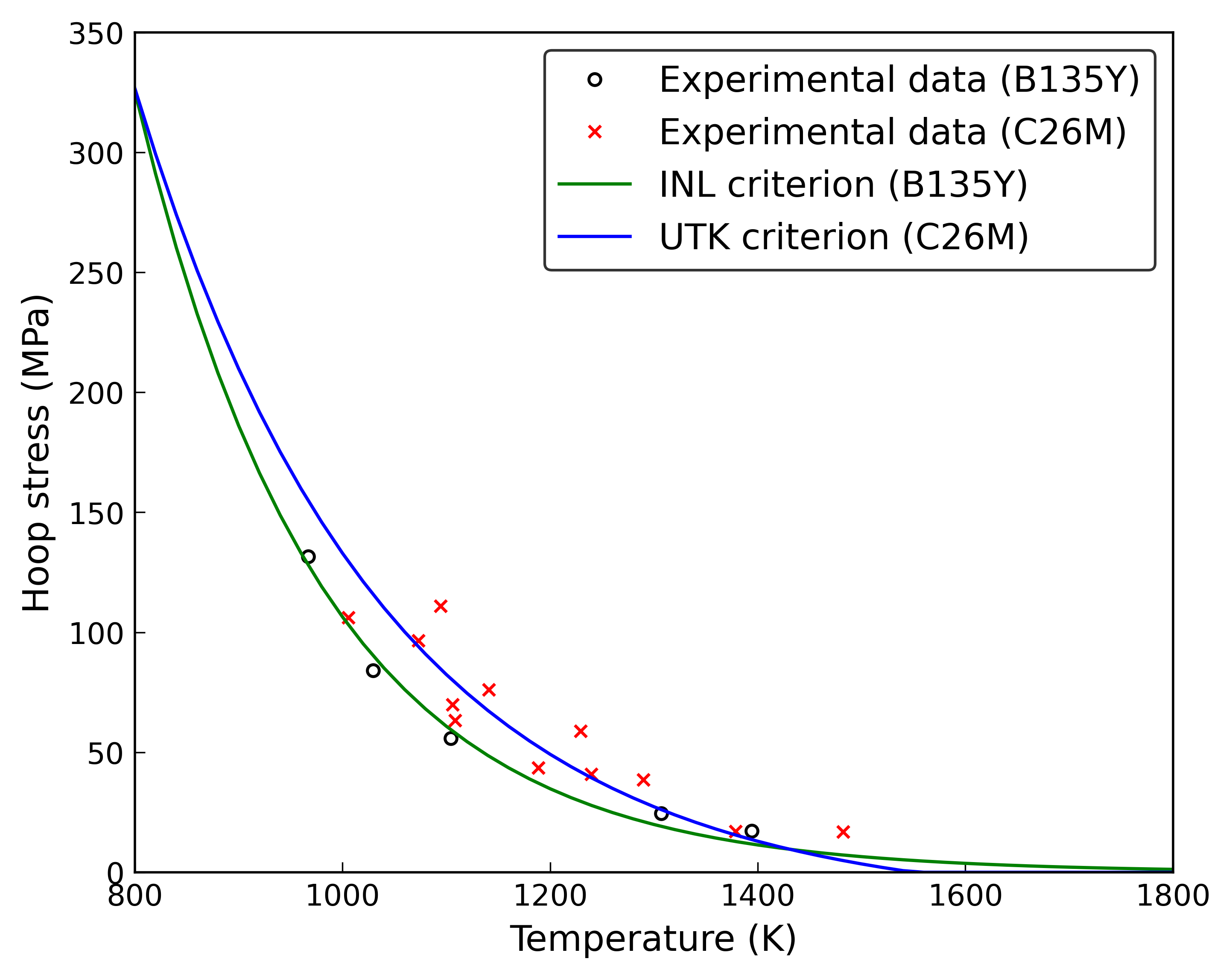
Figure 1: Experimental data for burst stress vs. temperature of FeCrAl alloys B135Y (Massey et al., 2016) and C26M (Pint et al., 2020) and corresponding failure criteria from INL (Gamble et al., 2017) and UTK (Sweet and Wirth, 2020).
Example Input Syntax
[Materials<<<{"href": "../../../syntax/Materials/index.html"}>>>]
  [failure_fecral]
    type = FeCrAlCladdingFailure<<<{"description": "A failure model for FeCrAl cladding. Four failure criteria exist including ultimate tensile strength, Tresca criterion, an Idaho National Laboratory developed criterion and an University of Tennessee developed criterion.", "href": "FeCrAlCladdingFailure.html"}>>>
    temperature<<<{"description": "Temperature in cladding (K)"}>>> = temp
    hoop_stress<<<{"description": "Hoop stress in cladding (Pa)"}>>> = hoop_stress
    failure_criterion<<<{"description": "The criterion selected for failure of the material. Default is Ultimate Tensile Strength."}>>> = INL
  []
[]Input Parameters
- blockThe list of blocks (ids or names) that this object will be applied
C++ Type:std::vector<SubdomainName>
Controllable:No
Description:The list of blocks (ids or names) that this object will be applied
- boundaryThe list of boundaries (ids or names) from the mesh where this object applies
C++ Type:std::vector<BoundaryName>
Controllable:No
Description:The list of boundaries (ids or names) from the mesh where this object applies
- burst_stress_scale_factor1Scaling factor on the burst stress.
Default:1
C++ Type:double
Unit:(no unit assumed)
Controllable:No
Description:Scaling factor on the burst stress.
- comparedless_equalOptions for variable _compared_ to criteria: greater_than greater_equal less_equal less_than
Default:less_equal
C++ Type:MooseEnum
Controllable:No
Description:Options for variable _compared_ to criteria: greater_than greater_equal less_equal less_than
- computeTrueWhen false, MOOSE will not call compute methods on this material. The user must call computeProperties() after retrieving the MaterialBase via MaterialBasePropertyInterface::getMaterialBase(). Non-computed MaterialBases are not sorted for dependencies.
Default:True
C++ Type:bool
Controllable:No
Description:When false, MOOSE will not call compute methods on this material. The user must call computeProperties() after retrieving the MaterialBase via MaterialBasePropertyInterface::getMaterialBase(). Non-computed MaterialBases are not sorted for dependencies.
- constant_criteria0Numerical value providing criteria value.
Default:0
C++ Type:double
Unit:(no unit assumed)
Controllable:No
Description:Numerical value providing criteria value.
- constant_onNONEWhen ELEMENT, MOOSE will only call computeQpProperties() for the 0th quadrature point, and then copy that value to the other qps.When SUBDOMAIN, MOOSE will only call computeQpProperties() for the 0th quadrature point, and then copy that value to the other qps. Evaluations on element qps will be skipped
Default:NONE
C++ Type:MooseEnum
Controllable:No
Description:When ELEMENT, MOOSE will only call computeQpProperties() for the 0th quadrature point, and then copy that value to the other qps.When SUBDOMAIN, MOOSE will only call computeQpProperties() for the 0th quadrature point, and then copy that value to the other qps. Evaluations on element qps will be skipped
- declare_suffixAn optional suffix parameter that can be appended to any declared properties. The suffix will be prepended with a '_' character.
C++ Type:MaterialPropertyName
Unit:(no unit assumed)
Controllable:No
Description:An optional suffix parameter that can be appended to any declared properties. The suffix will be prepended with a '_' character.
- failure_criterionUTSThe criterion selected for failure of the material. Default is Ultimate Tensile Strength.
Default:UTS
C++ Type:MooseEnum
Controllable:No
Description:The criterion selected for failure of the material. Default is Ultimate Tensile Strength.
- function_criteriaFunction name providing criteria value.
C++ Type:FunctionName
Unit:(no unit assumed)
Controllable:No
Description:Function name providing criteria value.
- hoop_stressHoop stress in cladding (Pa)
C++ Type:std::vector<VariableName>
Unit:(no unit assumed)
Controllable:No
Description:Hoop stress in cladding (Pa)
- max_principal_stressMax principal stress (Pa)
C++ Type:std::vector<VariableName>
Unit:(no unit assumed)
Controllable:No
Description:Max principal stress (Pa)
- mid_principal_stressMid principal stress (Pa)
C++ Type:std::vector<VariableName>
Unit:(no unit assumed)
Controllable:No
Description:Mid principal stress (Pa)
- min_principal_stressMin principal stress (Pa)
C++ Type:std::vector<VariableName>
Unit:(no unit assumed)
Controllable:No
Description:Min principal stress (Pa)
- variable_checkVariable name which is compared to criteria. Example: Var < 0, true=failed
C++ Type:std::vector<VariableName>
Unit:(no unit assumed)
Controllable:No
Description:Variable name which is compared to criteria. Example: Var < 0, true=failed
Optional Parameters
- control_tagsAdds user-defined labels for accessing object parameters via control logic.
C++ Type:std::vector<std::string>
Controllable:No
Description:Adds user-defined labels for accessing object parameters via control logic.
- enableTrueSet the enabled status of the MooseObject.
Default:True
C++ Type:bool
Controllable:Yes
Description:Set the enabled status of the MooseObject.
- implicitTrueDetermines whether this object is calculated using an implicit or explicit form
Default:True
C++ Type:bool
Controllable:No
Description:Determines whether this object is calculated using an implicit or explicit form
- seed0The seed for the master random number generator
Default:0
C++ Type:unsigned int
Controllable:No
Description:The seed for the master random number generator
- use_displaced_meshFalseWhether or not this object should use the displaced mesh for computation. Note that in the case this is true but no displacements are provided in the Mesh block the undisplaced mesh will still be used.
Default:False
C++ Type:bool
Controllable:No
Description:Whether or not this object should use the displaced mesh for computation. Note that in the case this is true but no displacements are provided in the Mesh block the undisplaced mesh will still be used.
Advanced Parameters
- output_propertiesList of material properties, from this material, to output (outputs must also be defined to an output type)
C++ Type:std::vector<std::string>
Controllable:No
Description:List of material properties, from this material, to output (outputs must also be defined to an output type)
- outputsnone Vector of output names where you would like to restrict the output of variables(s) associated with this object
Default:none
C++ Type:std::vector<OutputName>
Controllable:No
Description:Vector of output names where you would like to restrict the output of variables(s) associated with this object
Outputs Parameters
- prop_getter_suffixAn optional suffix parameter that can be appended to any attempt to retrieve/get material properties. The suffix will be prepended with a '_' character.
C++ Type:MaterialPropertyName
Unit:(no unit assumed)
Controllable:No
Description:An optional suffix parameter that can be appended to any attempt to retrieve/get material properties. The suffix will be prepended with a '_' character.
- use_interpolated_stateFalseFor the old and older state use projected material properties interpolated at the quadrature points. To set up projection use the ProjectedStatefulMaterialStorageAction.
Default:False
C++ Type:bool
Controllable:No
Description:For the old and older state use projected material properties interpolated at the quadrature points. To set up projection use the ProjectedStatefulMaterialStorageAction.
Material Property Retrieval Parameters
Input Files
- (test/tests/solid_mechanics/fecral_failure/fecral_failure_inl.i)
- (test/tests/solid_mechanics/fecral_failure/fecral_failure_utk.i)
- (examples/accident_tolerant_fuel/uo2_fecral/uo2_fecral.i)
- (test/tests/solid_mechanics/fecral_failure/fecral_failure_uts.i)
- (test/tests/solid_mechanics/fecral_failure/fecral_failure_tresca.i)
References
- A. P. Boresi and R. J. Schmidt.
Advanced Mechanics of Materials, 6th Edition.
John Wiley & Sons, Inc., 2003.[BibTeX]
- K.A. Gamble, T. Barani, D. Pizzocri, J.D. Hales, K.A. Terrani, and G. Pastore.
An investigation of FeCrAl cladding behavior under normal operating and loss of coolant conditions.
Journal of Nuclear Materials, 491:55–66, 2017.
doi:10.1016/j.jnucmat.2017.04.039.[BibTeX]
- Caleb P. Massey, Kurt A. Terrani, Sebastien N. Dryepondt, and Bruce A. Pint.
Cladding burst behavior of Fe-based alloys under LOCA.
Journal of Nuclear Materials, 470():128–138, 2016.
URL: http://www.sciencedirect.com/science/article/pii/S0022311515303871, doi:http://dx.doi.org/10.1016/j.jnucmat.2015.12.018.[BibTeX]
- B. A. Pint and L. A. Baldesberger.
Steam Oxidation and Burst Testing in the Severe Accident Test Station.
Technical Report ORNL/LTR-2018/527, Oak Ridge National Laboratory, 2018.[BibTeX]
- B. A. Pint, L. A. Baldesberger, and K. A. Kane.
Steam oxidation, burst and critical heat flux testing of commercial FeCrAl cladding.
In J.H. Jackson et al., editor, Proc. of the 19th International Conference on Environmental Degradation of Materials in Nuclear Power Systems - Water Reactors, 311–319. Boston, MA, United States, August 2020. ANS.[BibTeX]
- R. B. Rebak.
Beneficial Oxidation Resistance of FeCrAl Alloys for Accident Tolerant Fuel Cladding.
In The European Corrosion Congress (EUROCORR). Krakow, Poland, September 2018.[BibTeX]
- R. T. Sweet and B. D. Wirth.
BISON analysis of Accident Tolerant Fuel clad concepts during normal operation and LOCA conditions.
In CASL Virtual Meeting, 157–160. ANS, November 2020.[BibTeX]
- Y. Yamamoto, B.A. Pint, K.A. Terrani, K.G. Field, Y. Yang, and L.L. Snead.
Development and property evaluation of nuclear grade wrought FeCrAl fuel cladding for light water reactors.
Journal of Nuclear Materials, 467:703–716, 2015.[BibTeX]
- Y. Yano, T. Tanno, Y. Sekio, H. Oka, S. Ohtsuka, T. Uwaba, and T. Kaito.
Tensile properties and hardness of two types of 11cr-ferritic/martensitic steel after aging up to 45,000 h.
Nuclear Materials and Energy, 000:1–7, 2016.[BibTeX]