- temperatureCoupled temperature
C++ Type:std::vector<VariableName>
Unit:(no unit assumed)
Controllable:No
Description:Coupled temperature
- thermal_conductivity_modelThe thermal conductivity model.
C++ Type:MooseEnum
Controllable:No
Description:The thermal conductivity model.
MOXThermal
Computes specific heat and thermal conductivity for oxide fuel.
Description
The MOXThermal model computes specific heat and thermal conductivity for mixed oxide (MOX) fuel. A number of correlations are available. This model is also compliant for use in AD-based simulations by adding the AD prefix to the type name.
Thermal Conductivity
Three models are available to compute MOX thermal properties. For these models, thermal conductivity of unirradiated material is first defined. In general, these relationships are then multiplied by correction factors to account for effects of irradiation, burnup, MOX content, and porosity. The corrections factors used in BISON have been developed by Lucuta et al. (1996) and are recommended by Carbajo et al. (2001). Choices for MOX fuel include:
Duriez-Ronchi model, a combination of models by Duriez et al. (2000) and Ronchi et al. (1999), is recommended by Carbajo et al. (2001).
Halden model is from Lanning et al. (2005).
Amaya model is proposed by Amaya et al. (2011)
1. Duriez-Ronchi model
The Duriez-Ronchi model is recommended by Carbajo et al. (2001) and is a combination of Duriez et al. (2000) and Ronchi et al. (1999) models. In this model, thermal conductivity of unirradiated MOX is given by: where is the thermal conductivity (W/m-K), is a deviation from stoichiometry (unitless), and the following expressions define the remaining terms: This model provides temperature and deviation from stoechiometry. It is valid from 700 to 3100 K, less than 0.05, and plutonium concentration between 3 and 15 wt.%. According to Carbajo et al. (2001), thermal conductivity does not depend on Pu concentration in this range. Thus this model is valid essentially for thermal reactor MOX.
2. Halden model
The Halden correlation discussed in the previous section for uranium fuel is also applicable, with one change, to MOX fuel. Reduction in thermal conductivity due to the presence of mixed oxides is accounted for by multiplying the k term by 0.92 for UO fuel. This is consistent with the statement above regarding the lack of dependence of MOX thermal conductivity on Pu concentration. The k part of the equation and the porosity correction to account for the theoretical density (TD) of interest are unchanged.
Figure 1 is a comparison of the Fink-Lucuta (for reference) urania correlation and the Fink-Amaya, Duriez-Ronchi, and Halden correlations for MOX for unirradiated 95% TD MOX fuel with 0.07% Pu concentration.
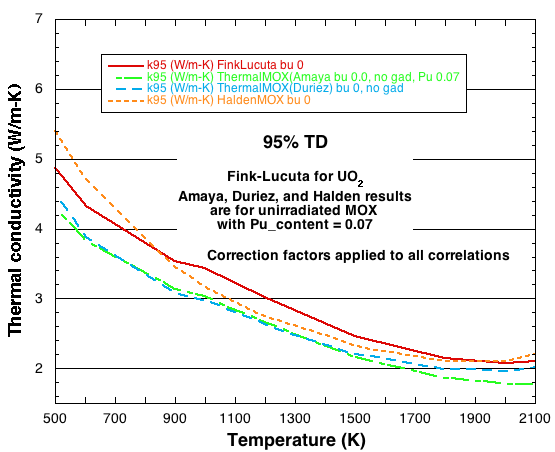
Figure 1: Unirradiated thermal conductivities for UO (for reference) and MOX from different models implemented in BISON. Results are for 95% TD and Pu concentraton of 7 weight percent. Correction factors appropriate for each correlation have been applied.
3. Amaya model
The model available in BISON has been proposed by Amaya et al. (2011). Unlike the previous model, Amaya provides a plutonium concentration dependence. It starts from pure UO thermal conductivity and applies corrections to account for Pu content. Unirradiated MOX thermal conductivity is given by: where is the MOX unirradiated thermal conductivity (), is the UO unirradiated thermal conductivity (), is the temperature (K), is the plutonium concentration (weight percent), and the following constants are used:
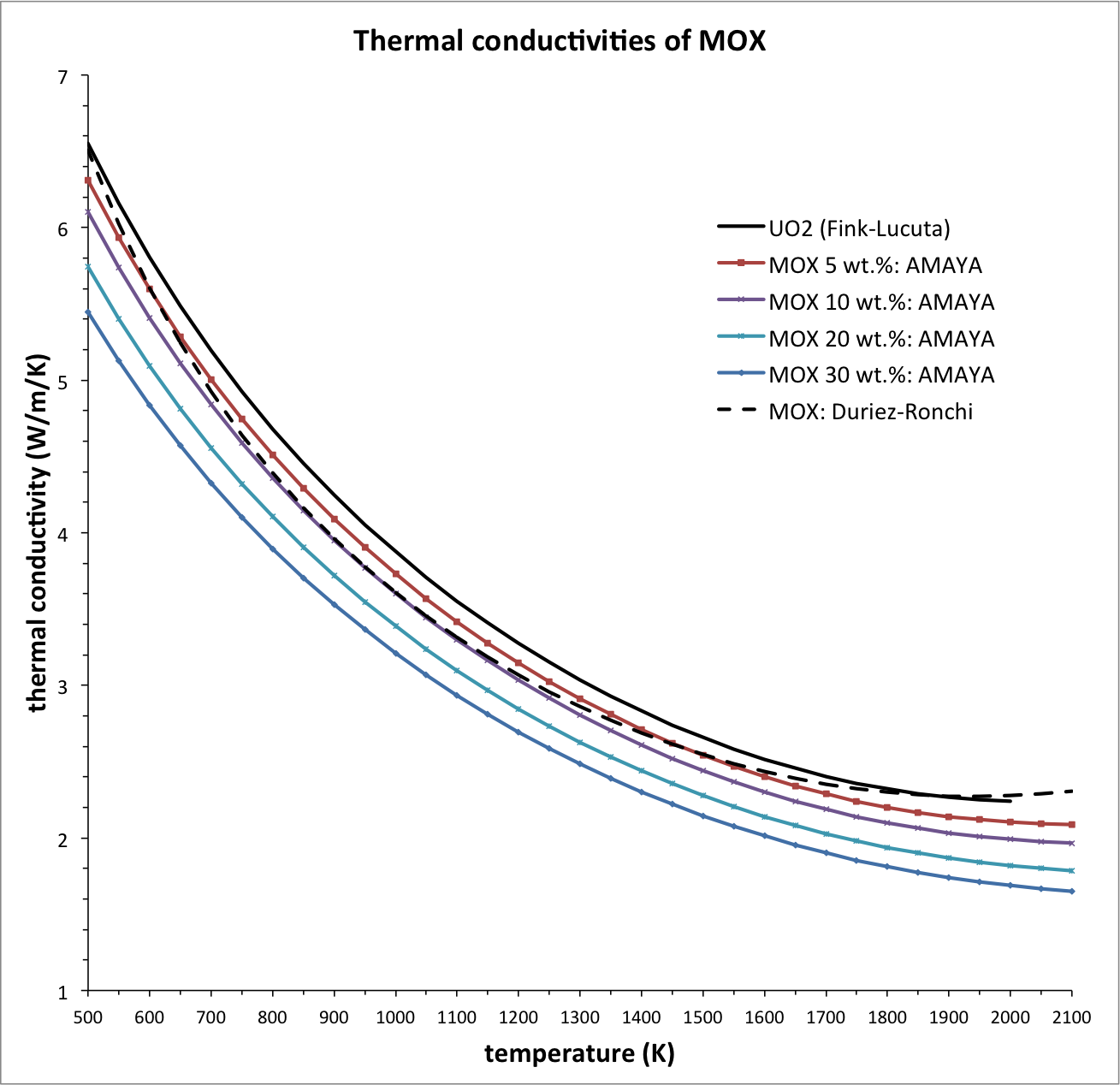
Figure 2: Unirradiated thermal conductivities for UO and MOX from different models implemented in BISON.
BISON uses Fink model to compute unirradiated UO thermal conductivity. Amaya model's coefficients have been fitted in the temperature range from 400 K to 1500 K and the plutonium concentration up to 30 wt.% (Amaya et al., 2011). Figure 2 shows a comparison of the computed thermal conductivities for the Fink-Lucuta (for reference), Fink-Amaya, and Duriez-Ronchi models for unirradiated MOX at 95% TD.
Crumbled thermal conductivity
When simulating LOCA conditions some portions of the fuel column may collapse into a crumbled mixture of fuel fragments and gas. In these regions the effective fuel thermal conductivity of the mixture is calculated by the model proposed by Chiew and Glandt (1983). This model can be used for both UO and MOX fuel.
The correlation is given by: where is the reduced thermal polarizability, is the thermal conductivity of the fuel determined by one of the models above, is the packing fraction of the crumbled fuel, and is a function of and defined later. The reduced thermal polarizability is given by: where is the thermal conductivity of the gas surrounding the crumbled fuel particles. The function is approximated by: where Jernkvist and Massih (2015) used best fit approximations to the tabulated values of Chiew and Glandt (1983) to obtain:
Specific Heat Capacity
The specific heat capacity (J/kg-K) is expressed by (1) where is the temperature (K), is the oxygen-to-metal ratio (dimensionless), and is the universal gas constant (8.3145 J/mol-K). The empirical coefficients (, , , , and ) are tabulated in Table 1 for UO, and PuO.
The specific heat capacity of MOX fuel is computed as: where is the fraction of gadolina or plutonium content (dimensionless) and is the specific heat capacity for UO, and PuO.
Table 1: The empirical constants used in Eq. (1) from Luscher et al. (2015).
| Constant | (J/kg-K) | (J/kg-K) | (J/kg) | (K) | (J/mol) |
|---|---|---|---|---|---|
| UO | 296.7 | 2.4310 | 8.74510 | 535.285 | 1.57710 |
| PuO | 347.4 | 3.9510 | 3.86010 | 571.0 | 1.96710 |
Example Input Syntax
[Materials<<<{"href": "../../syntax/Materials/index.html"}>>>]
  [fuel_thermal]
    type = MOXThermal<<<{"description": "Computes specific heat and thermal conductivity for oxide fuel.", "href": "MOXThermal.html"}>>>
    temperature<<<{"description": "Coupled temperature"}>>> = T
    burnup<<<{"description": "Coupled burnup"}>>> = burnup
    thermal_conductivity_model<<<{"description": "The thermal conductivity model."}>>> = HALDEN
    oxy_to_metal_ratio<<<{"description": "Oxygen-to-metal ratio."}>>> = 2.0
    initial_porosity<<<{"description": "Initial porosity.  Must be between 0.0 and 1.0."}>>> = 0.05
    Pu_content<<<{"description": "Weight fraction of Pu in MOX fuel (typically ~0.07)."}>>> = 0.07
  []
[]Input Parameters
- Pu_content0Weight fraction of Pu in MOX fuel (typically ~0.07).
Default:0
C++ Type:double
Unit:(no unit assumed)
Controllable:No
Description:Weight fraction of Pu in MOX fuel (typically ~0.07).
- axial_relocation_objectName of the AxialRelocationUserObject that determines whether the fuel has crumbled.
C++ Type:UserObjectName
Controllable:No
Description:Name of the AxialRelocationUserObject that determines whether the fuel has crumbled.
- base_nameOptional parameter that allows the user to define multiple material systems on the same block, i.e. for multiple phases
C++ Type:std::string
Controllable:No
Description:Optional parameter that allows the user to define multiple material systems on the same block, i.e. for multiple phases
- blockThe list of blocks (ids or names) that this object will be applied
C++ Type:std::vector<SubdomainName>
Controllable:No
Description:The list of blocks (ids or names) that this object will be applied
- boundaryThe list of boundaries (ids or names) from the mesh where this object applies
C++ Type:std::vector<BoundaryName>
Controllable:No
Description:The list of boundaries (ids or names) from the mesh where this object applies
- burnupCoupled burnup
C++ Type:std::vector<VariableName>
Unit:(no unit assumed)
Controllable:No
Description:Coupled burnup
- burnup_functionBurnup function
C++ Type:FunctionName
Unit:(no unit assumed)
Controllable:No
Description:Burnup function
- computeTrueWhen false, MOOSE will not call compute methods on this material. The user must call computeProperties() after retrieving the MaterialBase via MaterialBasePropertyInterface::getMaterialBase(). Non-computed MaterialBases are not sorted for dependencies.
Default:True
C++ Type:bool
Controllable:No
Description:When false, MOOSE will not call compute methods on this material. The user must call computeProperties() after retrieving the MaterialBase via MaterialBasePropertyInterface::getMaterialBase(). Non-computed MaterialBases are not sorted for dependencies.
- constant_onNONEWhen ELEMENT, MOOSE will only call computeQpProperties() for the 0th quadrature point, and then copy that value to the other qps.When SUBDOMAIN, MOOSE will only call computeQpProperties() for the 0th quadrature point, and then copy that value to the other qps. Evaluations on element qps will be skipped
Default:NONE
C++ Type:MooseEnum
Controllable:No
Description:When ELEMENT, MOOSE will only call computeQpProperties() for the 0th quadrature point, and then copy that value to the other qps.When SUBDOMAIN, MOOSE will only call computeQpProperties() for the 0th quadrature point, and then copy that value to the other qps. Evaluations on element qps will be skipped
- declare_suffixAn optional suffix parameter that can be appended to any declared properties. The suffix will be prepended with a '_' character.
C++ Type:MaterialPropertyName
Unit:(no unit assumed)
Controllable:No
Description:An optional suffix parameter that can be appended to any declared properties. The suffix will be prepended with a '_' character.
- gap_thermal_conductivityThe layered average thermal conductivity across the gas gap.
C++ Type:std::vector<VariableName>
Unit:(no unit assumed)
Controllable:No
Description:The layered average thermal conductivity across the gas gap.
- initial_porosity0.05Initial porosity. Must be between 0.0 and 1.0.
Default:0.05
C++ Type:double
Unit:(no unit assumed)
Controllable:No
Description:Initial porosity. Must be between 0.0 and 1.0.
- oxy_to_metal_ratio2Oxygen-to-metal ratio.
Default:2
C++ Type:double
Unit:(no unit assumed)
Controllable:No
Description:Oxygen-to-metal ratio.
- porosityCoupled porosity
C++ Type:std::vector<VariableName>
Unit:(no unit assumed)
Controllable:No
Description:Coupled porosity
- porosity_materialFalseWhether a material property for porosity is supplied.
Default:False
C++ Type:bool
Controllable:No
Description:Whether a material property for porosity is supplied.
Optional Parameters
- control_tagsAdds user-defined labels for accessing object parameters via control logic.
C++ Type:std::vector<std::string>
Controllable:No
Description:Adds user-defined labels for accessing object parameters via control logic.
- enableTrueSet the enabled status of the MooseObject.
Default:True
C++ Type:bool
Controllable:Yes
Description:Set the enabled status of the MooseObject.
- implicitTrueDetermines whether this object is calculated using an implicit or explicit form
Default:True
C++ Type:bool
Controllable:No
Description:Determines whether this object is calculated using an implicit or explicit form
- seed0The seed for the master random number generator
Default:0
C++ Type:unsigned int
Controllable:No
Description:The seed for the master random number generator
- use_displaced_meshFalseWhether or not this object should use the displaced mesh for computation. Note that in the case this is true but no displacements are provided in the Mesh block the undisplaced mesh will still be used.
Default:False
C++ Type:bool
Controllable:No
Description:Whether or not this object should use the displaced mesh for computation. Note that in the case this is true but no displacements are provided in the Mesh block the undisplaced mesh will still be used.
Advanced Parameters
- output_propertiesList of material properties, from this material, to output (outputs must also be defined to an output type)
C++ Type:std::vector<std::string>
Controllable:No
Description:List of material properties, from this material, to output (outputs must also be defined to an output type)
- outputsnone Vector of output names where you would like to restrict the output of variables(s) associated with this object
Default:none
C++ Type:std::vector<OutputName>
Controllable:No
Description:Vector of output names where you would like to restrict the output of variables(s) associated with this object
Outputs Parameters
- prop_getter_suffixAn optional suffix parameter that can be appended to any attempt to retrieve/get material properties. The suffix will be prepended with a '_' character.
C++ Type:MaterialPropertyName
Unit:(no unit assumed)
Controllable:No
Description:An optional suffix parameter that can be appended to any attempt to retrieve/get material properties. The suffix will be prepended with a '_' character.
- use_interpolated_stateFalseFor the old and older state use projected material properties interpolated at the quadrature points. To set up projection use the ProjectedStatefulMaterialStorageAction.
Default:False
C++ Type:bool
Controllable:No
Description:For the old and older state use projected material properties interpolated at the quadrature points. To set up projection use the ProjectedStatefulMaterialStorageAction.
Material Property Retrieval Parameters
- specific_heat_scale_factor1Optional scaling factor applied to the overall specific heat.
Default:1
C++ Type:double
Unit:(no unit assumed)
Controllable:No
Description:Optional scaling factor applied to the overall specific heat.
- thermal_conductivity_scale_factor1Optional scaling factor applied to the overall thermal conductivity.
Default:1
C++ Type:double
Unit:(no unit assumed)
Controllable:No
Description:Optional scaling factor applied to the overall thermal conductivity.
Advanced: Scaling Factors Parameters
Input Files
- (test/tests/ThermalFuel_error_messages/Fink-Amaya_error.i)
- (test/tests/thermalMOX/ThermalMOX_porosity_function_test.i)
- (test/tests/mox_thermal/Duriez/ad_test.i)
- (test/tests/mox_thermal/Duriez/test.i)
- (test/tests/mox_thermal/Halden/ad_test.i)
- (test/tests/mox_thermal/Halden/test.i)
- (test/tests/thermalMOX/ThermalMOX_test.i)
- (test/tests/mox_thermal/Halden/negative_temperature_exception.i)
- (test/tests/mox_thermal/Amaya/test.i)
- (test/tests/mox_thermal/Amaya/ad_test.i)
References
- M. Amaya, J. Nakamura, F. Nagase, and T. Fuketa.
Thermal conductivity evaluation of high burnup mixed-oxide (mox) fuel pellet.
Journal of Nuclear Materials, 414:303–308, 2011.[BibTeX]
- J. Carbajo, L. Gradyon, S. Popov, and V. Ivanov.
A review of the thermophysical properties of mox and uo2 fuels.
Journal of Nuclear Materials, 299:181–198, 2001.[BibTeX]
- Y. C. Chiew and E. D. Glandt.
The effect of structure on the conductivity of a dispersion.
Journal of Colloid and Interface Science, 91(1):90–104, 1983.
doi:10.1016/0021-9797(83)90238-2.[BibTeX]
- C. Duriez, J.-P. Alessandri, T. Gervais, and Y. Philipponneau.
Thermal conductivity of hypostoichiometriclow pu content mixed oxide.
Journal of Nuclear Materials, 277:143–158, 2000.[BibTeX]
- L. O. Jernkvist and A. Massih.
Model for axial relocation of fragmented and pulverized fuel pellets in distending fuel rods and its effects on fuel rod heat load.
Technical Report SSM-2015:37, Strål säkerhets myndigheten, 2015.[BibTeX]
- D. D. Lanning, C. E. Beyer, and K. J. Geelhood.
Frapcon-3 updates, including mixed-oxide fuel properties.
Technical Report NUREG/CR-6534, Vol. 4 PNNL-11513, Pacific Northwest National Laboratory, 2005.[BibTeX]
- P.G. Lucuta, Hj. Matzke, and I.J. Hastings.
A pragmatic approach to modelling thermal conductivity of irradiated UO$_2$ fuel: review and recommendations.
Journal of Nuclear Materials, 232(2-3):166–180, 1996.
URL: http://www.sciencedirect.com/science/article/pii/S0022311596004047, doi:10.1016/S0022-3115(96)00404-7.[BibTeX]
- WJ Luscher, KJ Geelhood, and IE Porter.
Material property correlations: comparisons between FRAPCON-4.0, FRAPTRAN-2.0, and MATPRO.
Technical Report PNNL-19417 Rev. 2, Pacific Northwest National Laboratory, 9 2015.[BibTeX]
- C. Ronchi, M. Sheindlin, M. Musella, and G.J. Hyland.
Thermal conductivity of uranium dioxide up to 2900 K from simultaneous measurement of the heat capacity and thermal diffusivity.
Journal of Applied Physics, 85:776–789, 1999.[BibTeX]