AGR-3/4
AGR-3/4 Assessment Cases
AGR-3/4 is a combination of the third and fourth of a series of irradiation tests sponsored by Department of Energy (DOE)'s AGR program. The experiment involved a multi-monitored capsule test train with compacts containing "driver" TRISO fuel particles and twenty "designed-to-fail (DTF)" fuel particles, surrounded by rings of carbonous material. The DTF fuel particles were used in fission product transport testing with a reference kernel coated with a 20 m thick PyC coating. As mentioned earlier, the test train was designed to determine fission product diffusivities in fuel kernels as well as sorptivities and diffusivities in both compact matrix and carbonous rings. The PIE data cover fission product release from failed and irradiated fuel samples. The AGR-3/4 fuel compacts were irradiated up to a burnup of 5.35–15.24% FIMA, with a fast neutron fluence of 1.50–5.31 n/m (0.18 MeV) and time-average volume-average (TAVA) temperature of 854–1345C. The experiment involved 8 capsules with three stacks of four compacts in each for a total of 32 compacts. Each compact consisted of TRISO particles in a matrix. Details of AGR-3/4 can be found in Skerjanc and Jiang (2022). Many of the compacts were analyzed with Bison. Results were compared to results from Particle Fuel Model (PARFUME) and to PIE data.
Like for AGR-1 and AGR-2, the mesh for the simulation was generated internally using TRISO1DFiveLayerMeshGenerator. Second-order finite elements were used. Biasing was used to concentrate elements at internal material boundaries.
Surface temperature, power level, fast neutron flux, and experiment duration were extracted from a data file prepared by the AGR program and placed in separate data files, one for each compact. Using a script, each compact in a list was run one at a time, reading data from the appropriate data file, with results subsequently placed in plots using a Python script.
The analysis is done in following section(s): irradiation test, silver. A subset of results is given below. In all cases, it is assumed that any fission product that diffuses outside the particle will diffuse outside the compact.
Irradiation Test, Silver Release
The release fraction for 32 compacts as computed by Bison and PARFUME and as measured experimentally is shown in Figure 1. It can be seen that Bison and PARFUME results are very similar. Fuel for AGR-3/4 contained two types of UCO fuel: (1) conventional driver fuel similar to the AGR-1 fuel; and (2) DTF fuel particles whose kernels were identical to the driver fuel kernels and its coatings were DTF under irradiation, leaving fission-products to migrate through the surrounding materials (Skerjanc and Jiang, 2022). Only 20 out of 1892 particles were DTF.
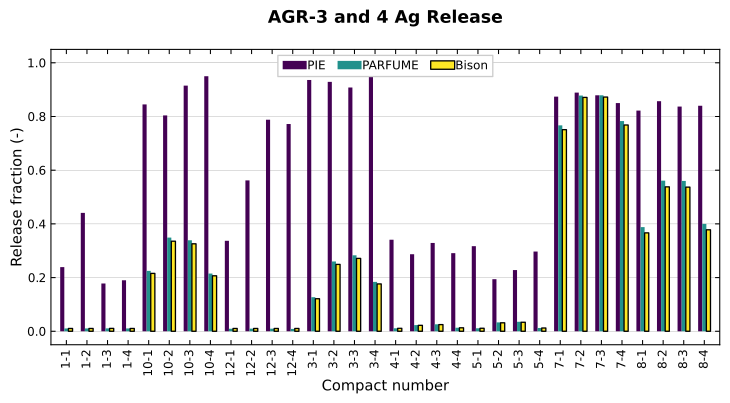
Figure 1: Comparison of measured and computed silver release fractions for 32 compacts.
Ring Simulations
Figure 2 through Figure 9 show comparisons of measured and computed concentration profiles in each ring for the AGR-3/4 Capsules. Each ring is shown in shaded regions in each plot, where the rings are (from inner to outer) DTF, driver, inner ring (IR), outer ring (OR), and sink ring (SR). The PIE data are obtained from Stempien (2021) and Skerjanc and Jiang (2022).
Table 1: Capsule information.
| Capsule No | 1 | 2 | 3 | 4 | 5 | 6 | 7 | 8 | 9 | 10 | 11 | 12 |
|---|---|---|---|---|---|---|---|---|---|---|---|---|
| Capsule type | Standard | Fuel body | Standard | Fuel body | Standard | Fuel body | Standard | Standard | Fuel body | Standard | Fuel body | Standard |
| IR material | Matrix | Matrix | PCEA | Matrix | Matrix | Matrix | Matrix | IG-110 | Matrix | PCEA | Matrix | Matrix |
| OR material | PCEA | PCEA | PCEA | PCEA | PCEA | PCEA | PCEA | IG-110 | IG-110 | PCEA | PCEA | PCEA |
| SR material | PCEA | PCEA | PCEA | PCEA | PCEA | PCEA | PCEA | PCEA | PCEA | PCEA | PCEA | PCEA |
Sorption coefficients for cesium (Cs) and strontium (Sr) are tabulated in Table 2, taken from IAEA (1997). Refer to Sorption Isotherm Gap Interface for more detailed information. For silver (Ag), sorption constants in both matrix and graphite are taken from Skerjanc and Jiang (2022).
Table 2: Sorption coefficient used in the AGR-3/4 simulations from IAEA (1997).
| (-) | (K) | (-) | (-) | (-) | (1/K) | Reference | ||
|---|---|---|---|---|---|---|---|---|
| Cs | H-451 graphite | 24.00 | -35730 | -1.561 | 6123 | -2.035 | 1.79 | Myers and Bell (1979) |
| Sr | H-451 graphite | 19.38 | -40090 | -0.324 | 4088 | -2.12 | 0 | Myers and Bell (1974) |
| Cs | Fuel compact matrix | 19.33 | -47290 | 1.518 | 4338 | 3.397 | 6.15 | Myers and Bell (1979) |
| Sr | Fuel compact matrix | 54.3 | -149000 | -8.52 | 28500 | 3.13 | 0 | General Atomics (1977) |
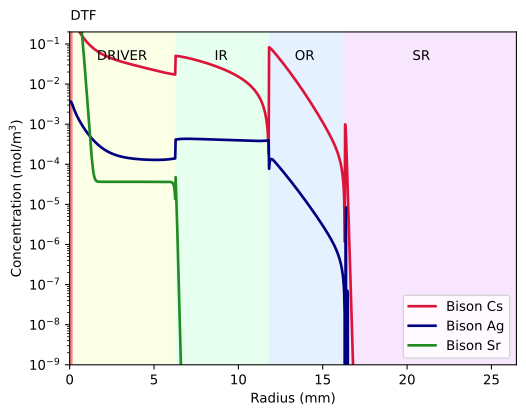
Figure 2: Computed Capsule 1 concentration profiles.
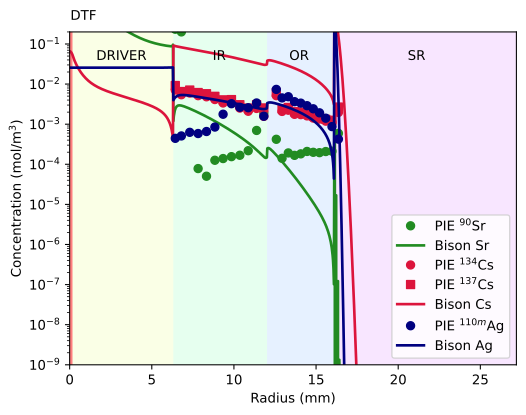
Figure 3: Measured vs. computed Capsule 3 concentration profiles.
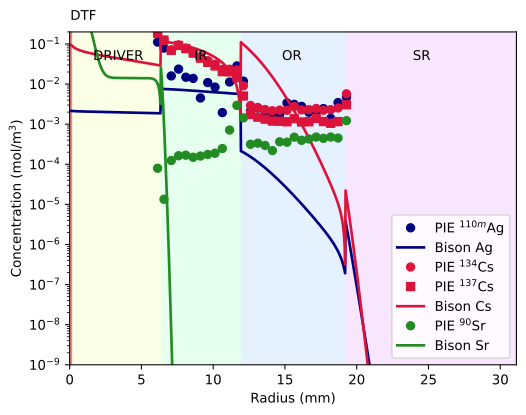
Figure 4: Measured vs. computed Capsule 4 concentration profiles.
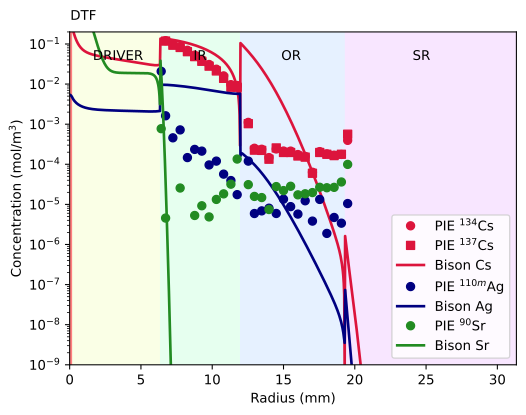
Figure 5: Measured vs. computed Capsule 5 concentration profiles.
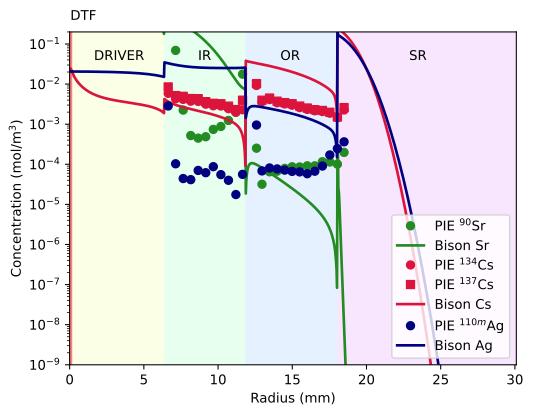
Figure 6: Measured vs. computed Capsule 7 concentration profiles.
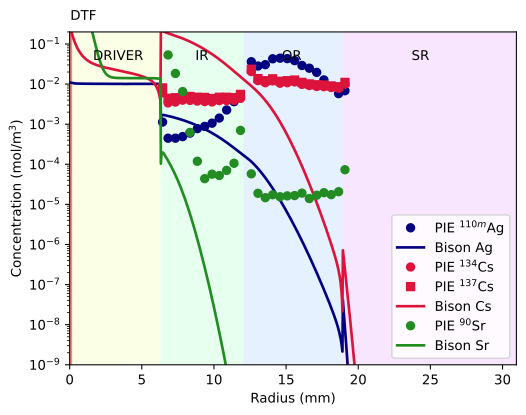
Figure 7: Measured vs. computed Capsule 8 concentration profiles.
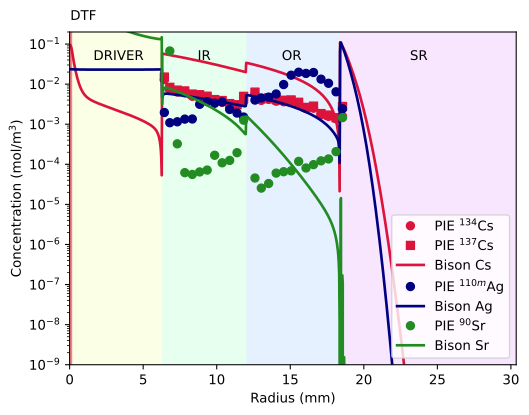
Figure 8: Measured vs. computed Capsule 10 concentration profiles.
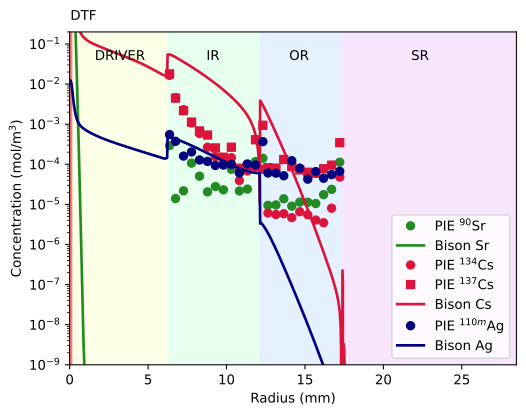
Figure 9: Measured vs. computed Capsule 12 concentration profiles.
Summary
The AGR-3/4 experiment provided data on silver diffusion in TRISO particle. Bison's predictions of that diffusion compare favorably with predictions from PARFUME. Improved diffusion coefficients and sorption coefficients in each graphite ring would improve comparisons to experimental data.
References
- IAEA.
Fuel performance and fission product behavior in gas cooled reactors.
Technical Report IAEA-TECDOC-978, IAEA, 1997.[BibTeX]
- B. F. Myers and W. E. Bell.
Strontium transport data for HTGR systems.
Technical Report GA-A13168, General Atomic Company, 1974.[BibTeX]
- B. F. Myers and W. E. Bell.
Cesium transport data for HTGR systems.
Technical Report GA-A13990, General Atomic Company, 1979.[BibTeX]
- W. F. Skerjanc and W. Jiang.
Comparison of fission product release predictions using PARFUME and BISON with results from the AGR-3/4 irradiation experiment.
Technical Report INL/RPT-22-69003, Idaho National Laboratory, 9 2022.
URL: https://www.osti.gov/biblio/1906454.[BibTeX]
- J. D. Stempien.
Measurement of fission product concentration profiles in AGR-3/4 TRISO fuel graphitic matrix and nuclear graphites.
Technical Report INL/EXT-21-62863, Idaho National Laboratory, 6 2021.
URL: https://www.osti.gov/biblio/1811841.[BibTeX]
- General Atomics.
HTGR fuels and core development program.
Report GA-A14479, General Atomics Company, 1977.[BibTeX]