AGR-2
Material presented here is a subset of information in Hales et al. (2022). See the JNM paper for more information.
AGR-2 Assessment Cases
AGR-2 is the second of a series of irradiation tests sponsored by DOE's Advanced Gas Reactor program. The experiment involved six capsules with three stacks of four compacts in each for a total of 72 compacts. Each compact consisted of TRISO particles in a matrix. Details of AGR-2 can be found in Collin (2018a). Many of the compacts were analyzed with Bison. Results were compared to results from PARFUME and to experimental data. The general analysis procedure followed with Bison matches that in Skerjanc (2020).
Like for AGR-1, the mesh for the simulation was generated internally using TRISO1DFiveLayerMeshGenerator. Second order elements were used. Biasing was used to concentrate elements at internal material boundaries.
Surface temperature, power level, fast neutron flux, and experiment duration were extracted from a data file prepared by the Advanced Gas Reactor program and placed in separate data files, one for each compact. Using a script, each compact in a list was run one at a time, reading data from the appropriate data file, with results subsequently placed in plots using a Python script.
The analysis is done in several sections: irradiation test, silver; irradiation test, cesium and strontium with no failed particles; irradiation test, cesium and strontium with failed particles; safety test, silver, cesium, and strontium with no failed particles; safety test, silver, cesium, and strontium with failed particles; safety test, krypton with no failed particles; and safety test, krypton with failed particles. A subset of results is given below. In all cases, it is assumed that any fission product that diffuses outside the particle will diffuse outside the compact.
The release fraction is the quantity of interest. It is defined as the ratio of the amount of a fission product released to the total amount produced:
In some cases, particles in the compact failed. Failed particles are assumed to have a high diffusion coefficient in the silicon carbide (SiC) layer (10 m/s). The number of failed particles in each compact was determined in post-irradiation examination (PIE). For compacts with failed particles, the release fraction is: where is the overall release fraction, is the release fraction from the intact particle, is the release fraction from the failed particle, is the total number of particles in the compact, and is the number of failed particles in the compact.
It was necessary to include the effect of uranium contamination in order to obtain reasonable results for the fractional release of krypton. Uranium contamination is trace amounts of uranium found outside the kernel. This uranium is picked up at the exterior of the SiC or in the outer pyrolytic carbon (OPyC) during manufacturing. For modeling purposes, we assume the uranium contamination is uniformly distributed in the OPyC layer. Although this additional fission product generation is more significant for Krypton, it is added for a species (Ag, Cs, Kr, and Sr). The values are provided in Skerjanc (2020) and Hales et al. (2022); they are different for UO2 and uranium oxycarbide (UCO) kernels.
Irradiation Test, Silver Release
The release fraction for 48 compacts as computed by Bison and PARFUME and as measured experimentally is shown in Figure 1. It can be seen that Bison and PARFUME results are very similar.
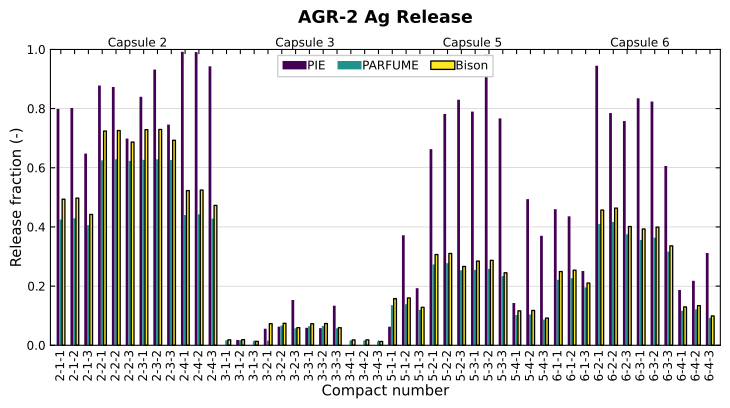
Figure 1: Comparison of measured and computed silver release fractions for 48 compacts.
A multiscale modeling effort to account for the effect of microstructure on the Ag diffusion coefficient in the SiC layer improves the predictions for most compacts. Since Ag diffuses faster along the SiC grain boundary than in the bulk, the microstructure of the SiC layer affects Ag release. This effect has been quantified in Jiang et al. (2021) and Simon et al. (2022) using the microstructure data published in Gerczak et al. (2016) and the improved results are shown in Figure 2.
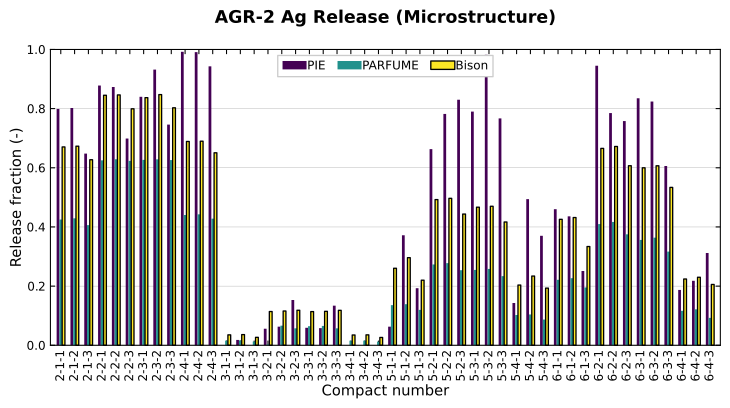
Figure 2: Comparison of measured and computed silver release fractions for 48 compacts, with Bison accounting for microstructural effects on Ag diffusion in SiC.
Recently, the irradiation-enhance diffusivity has been quantified at the lower lengthscale, and a new temperature, microstructure, and irradiation-dependent effective Ag diffusivity has been developed (Aagesen et al., 2022). The Ag release predictions accounting for irradiation-enhanced diffusivity are shown in Figure 3.
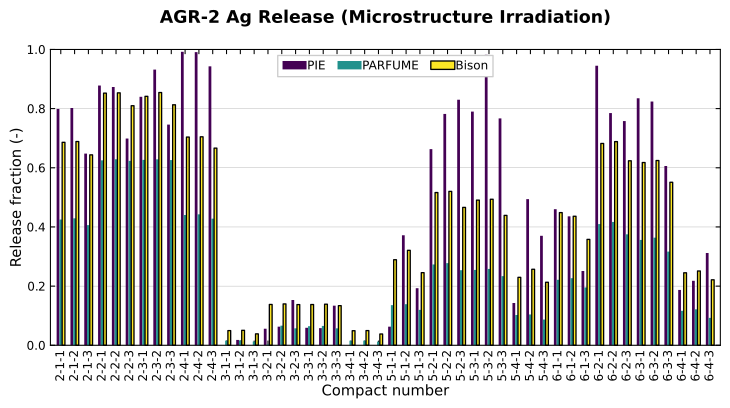
Figure 3: Comparison of measured and computed silver release fractions for seventeen compacts, with Bison accounting for microstructural and irradiation effects on Ag diffusion in SiC.
Irradiation Test, Cesium and Strontium Release, No Failed Particles
The release fraction of cesium for three compacts with no failed particles as computed by Bison and PARFUME and as measured experimentally is shown in Figure 4.
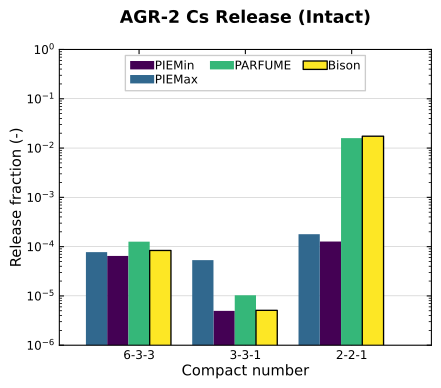
Figure 4: Comparison of measured and computed cesium release fractions for three compacts.
The release fraction of strontium for three compacts with no failed particles as computed by Bison and PARFUME and as measured experimentally is shown in Figure 5.
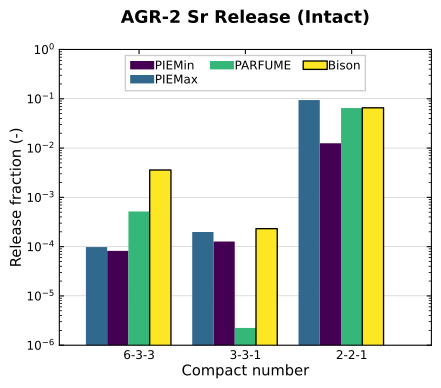
Figure 5: Comparison of measured and computed strontium release fractions for three compacts.
Irradiation Test, Cesium and Strontium Release, Failed Particles
The release fraction of strontium for five compacts with failed particles as computed by Bison and PARFUME and as measured experimentally is shown in Figure 6 (see Hales et al. (2022) for a similar plot for cesium).
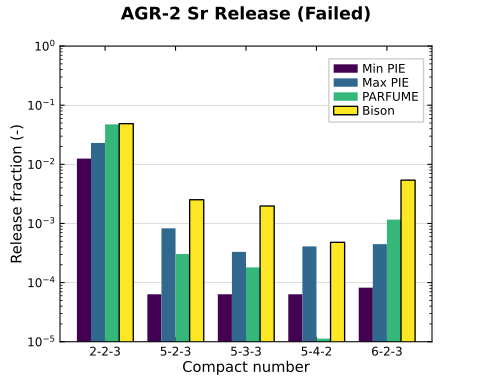
Figure 6: Comparison of measured and computed strontium release fractions for five compacts with failed particles.
Safety Test, Krypton, No Failed Particles
Compact 6-4-3 had a maximum safety temperature of 1800 C, higher than the other six compacts used to evaluate krypton release with no failed particles. Despite this high temperature, PIE showed a low level of krypton release. In order to match this behavior, the diffusion coefficient parameters for krypton in SiC were taken as m/s and J/mol, ignoring the higher-temperature contribution given in Collin (2016).
The release fraction of krypton for seven compacts with no failed particles as computed by Bison and PARFUME and as measured experimentally is shown in Figure 7.
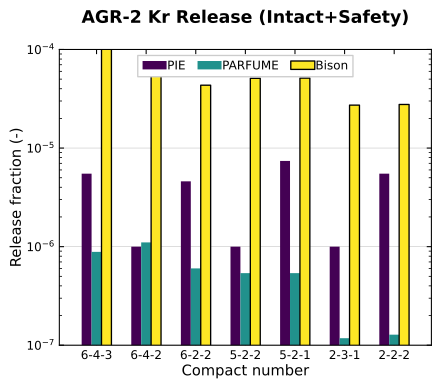
Figure 7: Comparison of measured and computed krypton release fractions for seven compacts with no failed particles.
Summary
The AGR-2 experiment provided data on silver, cesium, strontium, and krypton diffusion in TRISO fuel. Bison's predictions of that diffusion compare favorably with predictions from PARFUME. Improved diffusion coefficients would improve comparisons to experimental data.
References
- Larry K. Aagesen, Chao Jiang, Wen Jiang, Jia-Hong Ke, Pierre-Clément A. Simon, and Lin Yang.
Demonstrate improved Ag diffusion and describe the basis for Pd penetration modeling in SiC.
Technical Report INL/RPT-22-02769, Idaho National Laboratory, 9 2022.[BibTeX]
- B.P. Collin.
AGR-2 Irradiation Test Final As-Run Report.
Report INL/EXT-14-32277 (Rev.4), Idaho National Laboratory, February 2018a.[BibTeX]
- Blaise P. Collin.
Diffusivities of Ag, Cs, Sr, and Kr in TRISO fuel particles and graphite.
Technical Report INL/EXT-16-39548, Idaho National Laboratory, September 2016.[BibTeX]
- Tyler J. Gerczak, John D. Hunn, Richard A. Lowden, and Todd R. Allen.
Sic layer microstructure in agr-1 and agr-2 triso fuel particles and the influence of its variation on the effective diffusion of key fission products.
Journal of Nuclear Materials, 480:257–270, 11 2016.
doi:10.1016/J.JNUCMAT.2016.08.011.[BibTeX]
- J.D. Hales, A. Toptan, W. Jiang, and B.W. Spencer.
Numerical evaluation of AGR-2 fission product release.
Journal of Nuclear Materials, 558:153325, 2022.
doi:10.1016/j.jnucmat.2021.153325.[BibTeX]
- C. Jiang, J.-H. Ke, P.-C. A. Simon, W. Jiang, and L. K. Aagesen.
Atomistic and mesoscale simulations to determine effective diffusion coefficient of fission products in SiC.
Technical Report INL/EXT-21-64633, Idaho National Laboratory, September 2021.[BibTeX]
- P.-C.A. Simon, L. K. Aagesen, C. Jiang, W. Jiang, and J.-H. Ke.
Mechanistic calculation of the effective silver diffusion coefficient in polycrystalline silicon carbide: application to silver release in AGR-1 TRISO particles.
Journal of Nuclear Materials, 563:153669, 2022.
doi:10.1016/j.jnucmat.2022.153669.[BibTeX]
- William F. Skerjanc.
Comparison of fission product release predictions using PARFUME with results from the AGR-2 irradiation experiment.
Technical Report INL/EXT 20 59448 (Rev.0), Idaho National Laboratory, August 2020.[BibTeX]