Riso II3
Overview
The Riso II3 experiment conducted at the Riso DR3 water-cooled HP1 rig utilized a re-fabricated rod from the Millstone-1 BWR (IAEA, 2008-2012),(R, 1990). The mother rod, STR014, was irradiated over three reactor cyclers up to about 14.5 GWd/t, and re-fabricated to a shorter length. The re-fabricated rod, II3 (STR014-3R), was instrumented with a fuel centerline thermocouple and a pressure transducer. The fuel centerline temperature, fission gas release, rod internal pressure, and rod outer diameter can be used for comparison.
Test Description
Rod Design Specifications
Rod II3 was a re-fabricated rod extracted from a full length rod. The hole for the thermocouple was at the top of the fuel rod and did not penetrate the entire fuel stack. The re-fabricated rod geometry is tabulated in Table 1.
Table 1: Riso II3 Test Rod Specifications
| Fuel Rod | Measurement | Unit |
|---|---|---|
| Overall length | 0.3616 | m |
| Fuel stack height | 0.291 | m |
| Nominal plenum height | 51.0 | mm |
| Mother Rod | Measurement | Unit |
| Fill gas composition | He | |
| Fill gas pressure | 1.53 | MPa |
| Re-Fabricated Rod | Measurement | Unit |
| Fill gas composition | He | |
| Fill gas pressure | 0.684 | MPa |
| Fuel | Measurement | Unit |
| Material | UO | |
| Enrichment | 2.89 | |
| Density | 95.77 | |
| Inner diameter | 2.5 | mm |
| Outer diameter | 10.89 | mm |
| Pellet geometry | both ends | |
| Grain diameter | 12.2 | m |
| Pellet Dishing | Measurement | Unit |
| Dish diameter | 0.0 | cm |
| Dish depth | 0.0 | cm |
| Chamfer width | 0.038 | cm |
| Chamfer depth | 0.018 | cm |
| Cladding | Measurement | Unit |
| Material | Zr-2 | |
| Outer diameter | 12.53 | mm |
| Inner diameter | 11.11 | mm |
| Wall thickness | 0.71 | mm |
Operating Conditions and Irradiation History
The power history for the base irradiation carried out at the Millstone-1 BWR is shown in Figure 1. The experiment power history carried out at the Riso DR3 facility is shown in Figure 2 and run at BWR conditions by reducing the system pressure to 7.24 MPa. A prescribed axial profile for this experiment was provided in the FUMEX-III data (IAEA, 2008-2012). The measured clad surface temperature as a function of time was also provided in the FUMEX-III data (IAEA, 2008-2012) and used as a boundary condition for this simulation. The other reactor operation parameters are tabulated in Table 2.
Table 2: Operational input parameters.
| Base Irradiation | ||
|---|---|---|
| Coolant inlet temperature | C | 287.8 |
| Coolant pressure | MPa | 7.24 |
| Fast neutron flux | n/(cms) per (kW/m) | 1.6 |
| Power Ramps | ||
| Coolant inlet temperature | C | NA |
| Coolant pressure | MPa | 7.24 |
| Fast neutron flux | n/(cms) per (kW/m) | 4.0 |
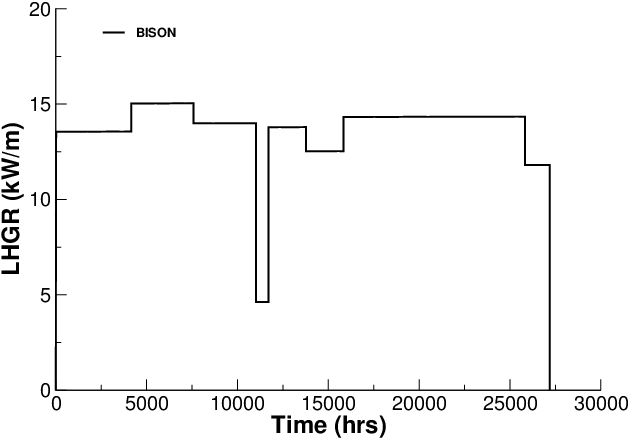
Figure 1: Base irradiation history for fuel segment STR014, carried out at Millstone-1 BWR.
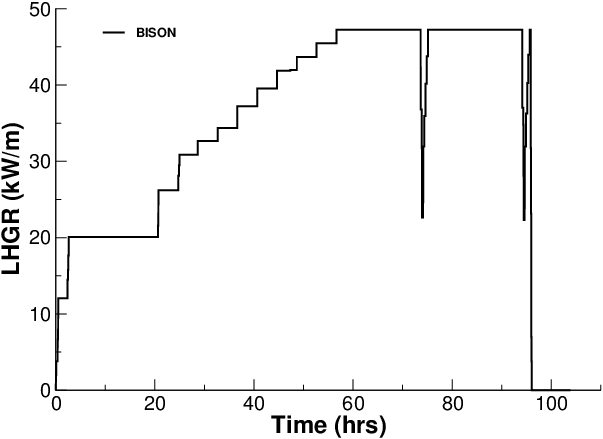
Figure 2: Riso DR3 irradiation period for test II3 (STR014-3R).
Model Description
Geometry and Mesh
The re-fabricated rod geometry was modeled for the entire simulation considering a smeared column of flat ended pellets, with the top pellets containing the hole for the thermocouple. The plenum height was adjusted such that the plenum volume at the beginning of the bump test was approximately 7.41 cm.
A 2-dimensional axisymmetric quadratic (Quad8 elements) mesh was used to model the geometry of the rod used in the II3 experiment. The fuel was meshed considering two fuel pellet types. The first pellet type was 4.2 cm in length with a hole down the center, the second pellet type was 24.9 cm in length with no hole down the center. The first pellet type's mesh is comprised of elements 3.953 mm in the axial direction and 0.3889 mm in the radial direction (for an aspect ratio of 10.16). The second pellet type's mesh is comprised of elements 2.0 mm in the axial direction and 0.3813 mm in the radial direction (for an aspect ratio of 5.244). The clad mesh is comprised of elements 4.278 mm in the axial direction and 0.1775 mm in the radial direction (for an aspect ratio of 24.1).
Material and Behavioral Models
The following material and behavioral models for UO fuel were used:
UO2Thermal - NFIR: NFIR model for temperature and burnup dependent thermal properties
ComputeFiniteStrainElasticStress and UO2ElasticityTensor: elastic mechanical behavior
UO2RelocationEigenstrain: relocation strains, relocation activation threshold power set to 5 kW/m
ComputeThermalExpansionEigenstrain: thermal expansion with a constant instantaneous thermal expansion coefficient
UO2VolumetricSwellingEigenstrain: volumetric expansion due to solid and gaseous swelling
UO2Sifgrs: fission gas release model used with the gaseous swelling model
UO2VolumetricSwellingEigenstrain(Pastore et al., 2015)
For the cladding material, a constant thermal conductivity of 16 W/m-K was used and both thermal and irradiation creep were considered using the Limback model (Limbäck and Andersson, 1996). The following material and thermal behavior models were used for the clad:
HeatConductionMaterial: Thermophysical material properties
ZryCreepLimbackHoppeUpdate and ZryElasticityTensor: mechanical creep and elastic deformation behavior
ZryIrradiationGrowthEigenstrain: ESCORE model for volumetric swelling due to irradiation exposure
ComputeThermalExpansionEigenstrain: thermal expansion with a constant instantaneous thermal expansion coefficient
Details and references for all of these models listed above can be found on the linked BISON documentation pages.
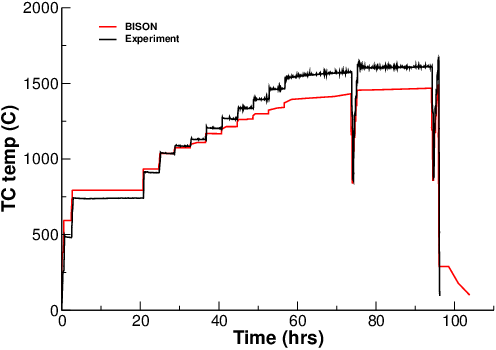
Figure 3: BISON fuel centerline temperature comparison to Riso experimental data
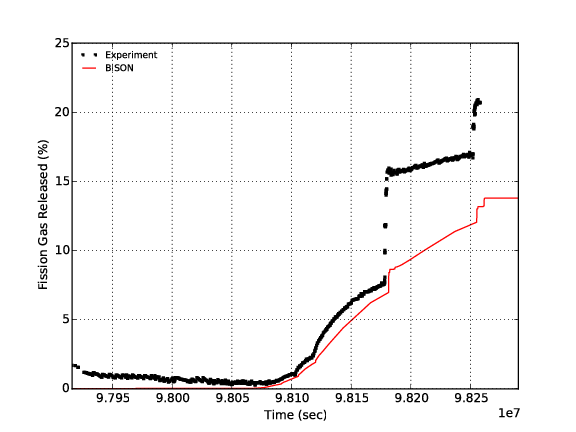
Figure 4: BISON ramp test fission gas release comparison to Riso experimental data.
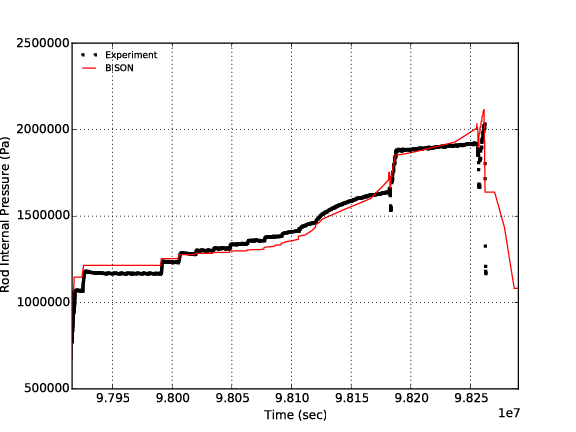
Figure 5: BISON rod internal pressure comparison to Riso experimental data.
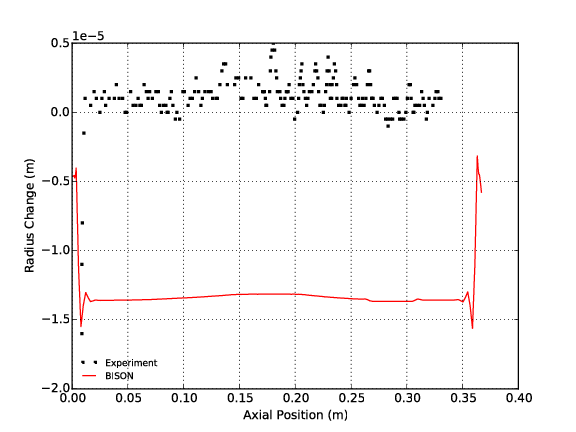
Figure 6: BISON rod outer diameter comparison to Riso experimental data.
Boundary and Operating Conditions
The Riso DR3 irradiation period for the II3 test shown in Figure 2 was appended to the base irradiation power history shown in Figure 1. It was assumed that the clad temperature during the down time between base irradiation and the Riso test was 373K. The fast neutron flux was input as a function of power.
Input files
The BISON input and all supporting files (power histories, axial power profile, fast neutron flux history, etc.) for this case are provided with the code distribution at bison/assessment/LWR/validation/ and bison/assessment/LWR/validation/Riso_II3/analysis.
To avoid code duplication, the input files are structured in this format: A first base input file contains characteristics common to all the Riso cases: Riso_Base.i. A second base input file contains characteristics common to all the Riso case that do not use the action: Riso_Base_sub.i. Input files containing information specific to the fuel rod and the type of problem solving use the !include function to build a complete input file with the base files.
To run a specific assessment, such as the Riso II3, run: Riso_II3.i.
Results Comparison
The Riso II3 experiment is used to assess the code's capability to capture the fuel centerline temperature, the integral fuel rod fission gas release, rod internal pressure, and rod outer diameter. All results were compared against the II3 data found in the FUMEX-III data sets (IAEA, 2008-2012).
Temperature
BISON predicts the shape of temperature curve well, but fails to reach measured thermocouple temperatures as shown in Figure 3. One possible explanation for the lower predicted temperature is the underprediction of fission gas release as seen in Figure 4. The fuel centerline temperature is taken at a node approximately 38 mm from the top of the fuel stack.
Fission Gas Release
The calculated integral fuel rod fission gas release is compared to the measured data in Figure 4. In view of the uncertainties involved in FGR modeling, the predictive accuracy is satisfactory, falling well within the uncertainty factor of 2 (Killeen et al., 2007).
Rod Internal Pressure
The calculated rod internal pressure matches the measured data set well as seen in Figure 5 following the given shape of the measured curve accurately.
Rod Outer Diameter
The calculated rod diameter seems to predict more cladding creepdown than experiment results suggest as shown in Figure 6. Since BISON currently does not have a cladding option for cold worked Zry2, a SRA Zry4 cladding was chosen instead.
Discussion
For the grain size, a chosen diameter of 12.2 m was used. A brief discussion of how the grain size had already been multiplied by the correction factor of 1.56 can be found in the PRECHAR.II3 file included in the FUMEX-II3 data sets (IAEA, 2008-2012).
References
- IAEA.
Improvement of Computer Codes Used for Fuel Behaviour Simulation (FUMEX-III): Report of a Coordinated Research Project 2008-2012.
Technical Report IAEA-TECDOC-1697, International Atomic Energy Agency, 2008-2012.[BibTeX]
- J. C. Killeen, J. A. Turnbull, and E. Sartori.
Fuel modelling at extended burnup: IAEA coordinated research project FUMEX-II.
In Proceedings of the 2007 International LWR Fuel Performance Meeting. San Francisco, California, Paper 1102, September 30-October 3 2007.[BibTeX]
- M. Limbäck and T. Andersson.
A model for analysis of the effect of final annealing on the in- and out-of-reactor creep behavior of zircaloy cladding.
In Zirconium in the Nuclear Industry: Eleventh International Symposium, ASTM STP 1295, 448–468. 1996.[BibTeX]
- G. Pastore, L.P. Swiler, J.D. Hales, S.R. Novascone, D.M. Perez, B.W. Spencer, L. Luzzi, P. Van Uffelen, and R.L. Williamson.
Uncertainty and sensitivity analysis of fission gas behavior in engineering-scale fuel modeling.
Journal of Nuclear Materials, 465:398–408, 2015.[BibTeX]
- R.
The Third Risø Fission Gas Project: Bump Test II3 (STR014-3R).
Technical Report Risø-FGP3-II3, Risø, September 1990.[BibTeX]