Riso AN2
Overview
The Riso AN2 experiment conducted at the Riso DR3 water-cooled HP1 rig utilized a non re-fabricated rod from the Biblis A pressurized water reactor (PWR) (IAEA, 2002-2007),(R, 1990). The rod, CB6, was irradiated over four reactor cycles up to about 41 GWd/t and inserted into the DR3 reactor without any modifications made. The rod diameter at the end of the base and experimental irradiation periods and the final fission gas release can be used for comparison.
BISON time domain results on this page have not been updated to reflect the latest modeling and simulation formulations.
Test Description
Rod Design Specifications
Fuel pin CB6 was the upper-middle segment of four, 675 mm-long barrier clad segments (from top CB9, CB6, CB7, CB8) which together with a top and a bottom segment constituted a fuel rod stringer. CB6 was bump tested in the unopened condition. The CB6 rod geometry is tabulated in Table 1.
Table 1: Riso AN2 Test Rod Specifications
| Fuel Rod | Measurement | Unit |
|---|---|---|
| Overall length | 0.65354 | m |
| Fuel stack height | 0.5418 | m |
| Nominal plenum height | 61.0 | mm |
| Mother Rod | Measurement | Unit |
| Fill gas composition | He | |
| Fill gas pressure | 2.31 | MPa |
| Fuel | Measurement | Unit |
| Material | UO | |
| Enrichment | 2.95 | |
| Density | 93.74 | |
| Outer diameter | 9.053 | mm |
| Pellet geometry | both ends | |
| Grain diameter (3D) | 9.36 | m |
| Pellet Dishing | Measurement | Unit |
| Dish diameter | 0.665 | cm |
| Dish depth | 0.013 | cm |
| Chamfer width | 0.046 | cm |
| Chamfer depth | 0.016 | cm |
| Cladding | Measurement | Unit |
| Material | Zr-4 | |
| Outer diameter | 10.811 | mm |
| Inner diameter | 9.261 | mm |
| Wall thickness | 0.775 | mm |
Operating Conditions and Irradiation History
The power history for the base irradiation carried out at the Biblis A PWR is shown in Figure 1. The experiment power history carried out at the Riso DR3 facility is shown in Figure 2. A prescribed axial profile for this experiment was provided in the FUMEX-II data (IAEA, 2002-2007). The measured clad surface temperature as a function of time was also provided in the FUMEX-II data (IAEA, 2002-2007) and was used as a boundary condition for this simulation. The other reactor operation parameters are tabulated in Table 2.
Table 2: Operational input parameters.
| Base Irradiation | ||
|---|---|---|
| Coolant inlet temperature | C | 284.7 |
| Coolant pressure | MPa | 15.52 |
| Fast neutron flux | n/(cms) per (kW/m) | 3.4 |
| Power Ramps | ||
| Coolant inlet temperature | C | NA |
| Coolant pressure | MPa | 15.3 |
| Fast neutron flux | n/(cms) per (kW/m) | 4.0 |
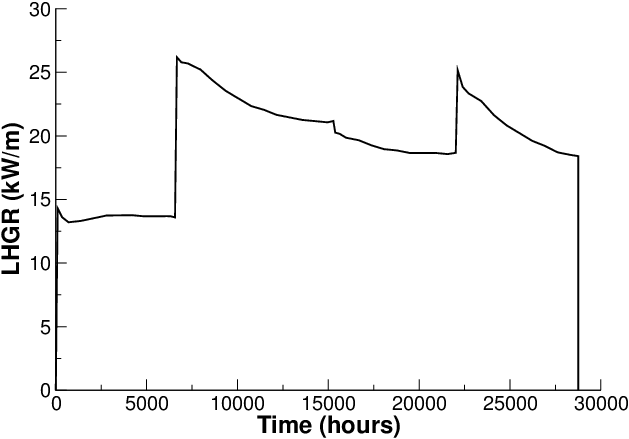
Figure 1: Base irradiation history for fuel segment CB6, carried out at Biblis A PWR.
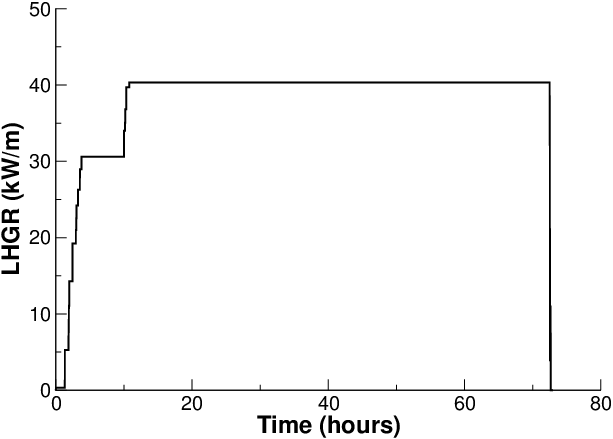
Figure 2: Riso DR3 irradiation period for test AN2 (CB6).
Model Description
Geometry and Mesh
The CB6 section rod geometry was modeled for the entire simulation considering a smeared column of flat ended pellets. The entire fuel stack was shifted up from the bottom of the clad by 5.1 mm, which is the height of the insulator pellet at the bottom of the fuel rod.
A 2-dimensional axisymmetric quadratic (Quad8 elements) mesh was used to model the geometry of the rod used in the AN2 experiment. The fuel was meshed so that the total active fuel length would equal 0.54 m, leaving a total upper plenum length of 61 mm. The fuel mesh consisted of elements 2.31 mm in the axial direction and 0.4115 mm in the radial direction (for an aspect ratio of 5.613). The clad mesh consisted of elements 2.57565 mm in the axial direction and 0.19375 mm in the radial direction (for an aspect ratio of 13.29).
Input files
The BISON input and all supporting files (power histories, axial power profile, fast neutron flux history, etc.) for this case are provided with the code distribution at bison/assessment/LWR/validation/ and bison/assessment/LWR/validation/Riso_AN2/analysis.
To avoid code duplication, the input files are structured in this format: A first base input file contains characteristics common to all the Riso cases: Riso_Base.i. A second base input file contains characteristics common to all the Riso case that do not use the action: Riso_Base_sub.i. Input files containing information specific to the fuel rod and the type of problem solving use the !include function to build a complete input file with the base files.
To run a specific assessment, such as the Riso AN2, run: Riso_AN2.i.
Material and Behavioral Models
The following material and behavioral models for UO fuel were used:
UO2Thermal - NFIR: NFIR model for temperature and burnup dependent thermal properties
ComputeFiniteStrainElasticStress and UO2ElasticityTensor: elastic mechanical behavior
UO2RelocationEigenstrain: relocation strains, relocation activation threshold power set to 5 kW/m
ComputeThermalExpansionEigenstrain: thermal expansion with a constant instantaneous thermal expansion coefficient
UO2VolumetricSwellingEigenstrain : volumetric expansion due to solid and gaseous swelling
UO2Sifgrs: fission gas release model used with the gaseous swelling model
UO2VolumetricSwellingEigenstrain(Pastore et al., 2015)
For the cladding material, a constant thermal conductivity of 16 W/m-K was used and both thermal and irradiation creep were considered using the Limback model (Limbäck and Andersson, 1996). The following material and thermal behavior models were used for the Zircaloy-4 cladding:
HeatConductionMaterial: Thermophysical material properties
ZryCreepLimbackHoppeUpdate and ZryElasticityTensor: mechanical creep and elastic deformation behavior for Zircaloy-4
ZryIrradiationGrowthEigenstrain: ESCORE model for volumetric swelling due to irradiation exposure
ZryThermalExpansionMATPROEigenstrain: thermal expansion with an instantaneous thermal expansion coefficient that varies according to the MATPRO cthexp model
Details and references for all of these models listed above can be found on the linked BISON documentation pages.
Boundary and Operating Conditions
The Riso DR3 irradiation period for the AN2 test shown in Figure 2 was appended to the base irradiation power history shown in Figure 1. It was assumed that the clad temperature during the down time between base irradiation and the Riso test was 300K. The fast neutron flux was input as a function of power and scaled to 4.9e17.
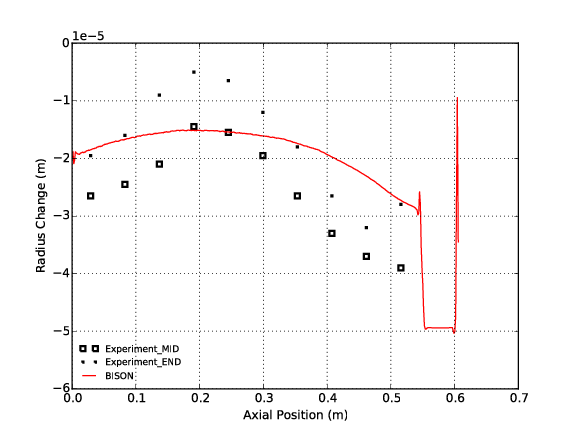
Figure 3: BISON fuel cladding displacement comparison to Riso experimental data.
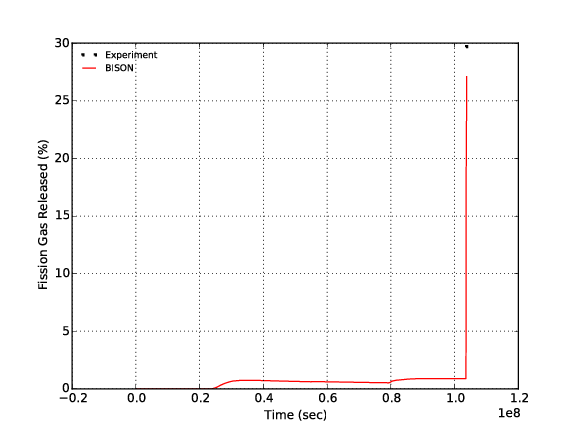
Figure 4: BISON total fission gas release comparison to Riso experimental data.
Results Comparison
The Riso AN2 experiment is used to assess the code's capability to capture the total radial displacement of the cladding surface as well as the final amount of fission gas that is released. Cladding surface displacement measurements were given with the AN2 data packet taken at ten different locations along the cladding which are used for comparison. A final fission gas release point was also taken after all testing by puncturing the rod to obtain all gasses.
Cladding Displacement
BISON predicts the final cladding surface displacement with sufficient accuracy, as seen in Figure 3 where the sudden diameter decrease denotes the pellet-stack's edge. The cladding displacement was measured at 10 equidistant node lengths at both the pellet end and mid sections.
Fission Gas Release
The calculated integral fuel rod fission gas release is compared to the measured data point, in Figure 4. In view of the uncertainties involved in FGR modeling, the predictive accuracy is satisfactory.
References
- IAEA.
Fuel Modelling at Extened Burnup (FUMEX-II): Report of a Coordinated Research Project 2002-2007.
Technical Report IAEA-TECDOC-1687, International Atomic Energy Agency, 2002-2007.[BibTeX]
- M. Limbäck and T. Andersson.
A model for analysis of the effect of final annealing on the in- and out-of-reactor creep behavior of zircaloy cladding.
In Zirconium in the Nuclear Industry: Eleventh International Symposium, ASTM STP 1295, 448–468. 1996.[BibTeX]
- G. Pastore, L.P. Swiler, J.D. Hales, S.R. Novascone, D.M. Perez, B.W. Spencer, L. Luzzi, P. Van Uffelen, and R.L. Williamson.
Uncertainty and sensitivity analysis of fission gas behavior in engineering-scale fuel modeling.
Journal of Nuclear Materials, 465:398–408, 2015.[BibTeX]
- R.
The Third Risø Fission Gas Project: Bump Test AN2 (CB6).
Technical Report Risø-FGP3-AN2, Risø, September 1990.[BibTeX]