IFA 519 Rod DH and Rod DK
Overview
The IFA-519.9 experiment was base irradiated in the Halden Boiling Water Reactor (HBWR), experiment IFA-429, to a burnup of 26-29 MWd/kg UO. The three rods (rods DC, DH, and DK) were then re-fabricated to include a bellows type pressure transducer and inserted back in to the HBWR to a burnup of approximately 90 MWd/kg UO (Turnbull, 2001). The bellows transducer in rod DC failed, therefore, in-pile data is only available for rod DH and rod DK.
Test Description
Rod Design Specifications
Summary of the rod specifications for rods DH and DK are shown in Table 1.
Table 1: IFA-519 rod DH and DK Test Rod Specifications
| DH | DK | Unit | |
|---|---|---|---|
| Fuel Rod | |||
| Fuel stack height | 0.244 | 0.245 | m |
| Nominal plenum height | 25 | 24 | mm |
| Fill gas composition | He | He | |
| Fill gas pressure | 2.59 | 2.59 | MPa |
| Fuel | |||
| Material | UO | UO | |
| Enrichment | 13 | 13 | |
| Density | 94.7 | 94.7 | |
| Outer diameter | 9.3 | 9.14 | mm |
| Pellet geometry | Dished both ends | Dished both ends | |
| Dish radius | 16.8 | 16.8 | mm |
| Dish depth | 0.33 | 0.33 | mm |
| Land width | 1.4 | 1.4 | m |
| Grain diameter (2D) | 6 | 17 | m |
| Cladding | |||
| Material | Zr-4 | Zr-4 | |
| Outer diameter | 10.73 | 10.73 | mm |
| Inner diameter | 9.5 | 9.5 | mm |
| Wall thickness | 0.61 | 0.61 | mm |
Operating Conditions and Irradiation History
The HBWR operating conditions are tabulated in Table 2. The total reactor power history for rods DH and DK in the IFA-519.9 experiment is shown in Figure 1 and Figure 2. The measured reactor coolant temperature was used as the boundary temperature on the clad outer surface.
Table 2: Operational input parameters.
| Coolant temperature | C | 227 |
| Coolant pressure | MPa | 3.4 |
| Fast neutron flux | n/(cms) per (kW/m) | 1.6 |
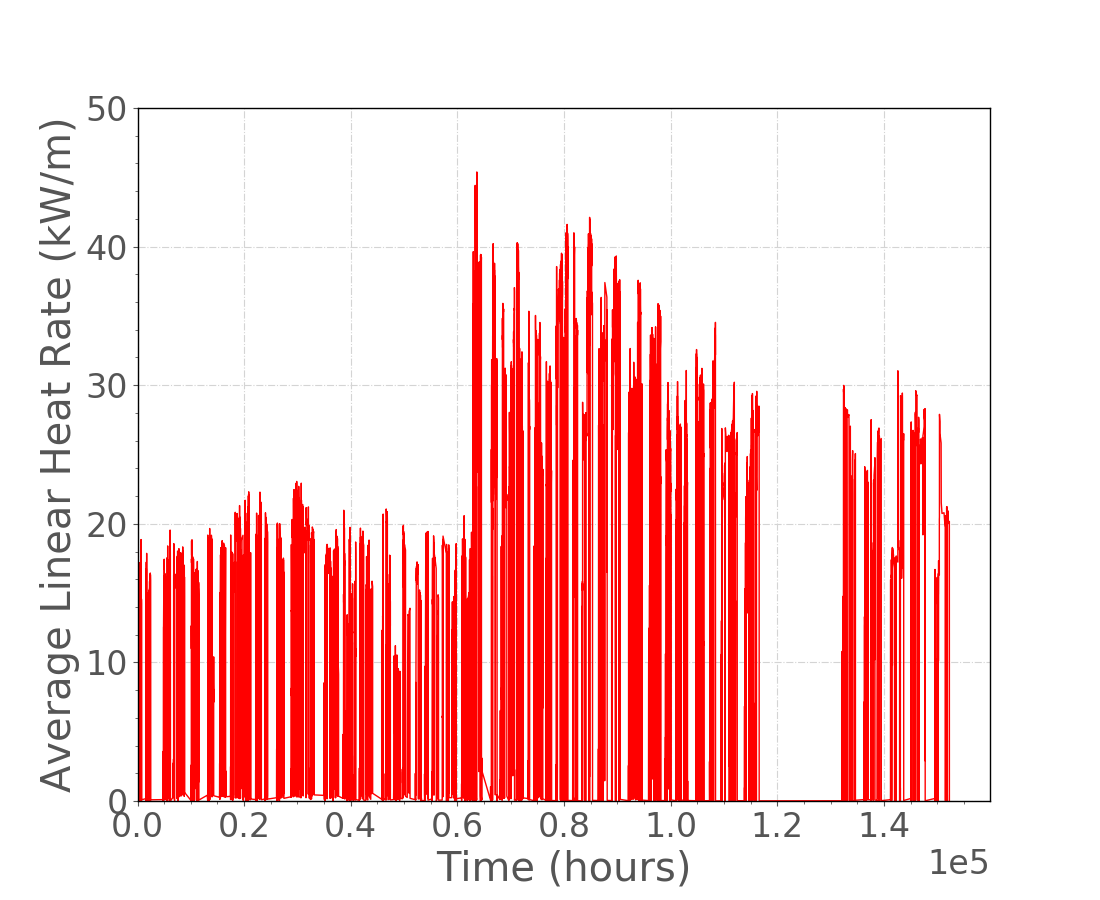
Figure 1: Full irradiation power history for rod DH in the IFA-519.9 experiment.
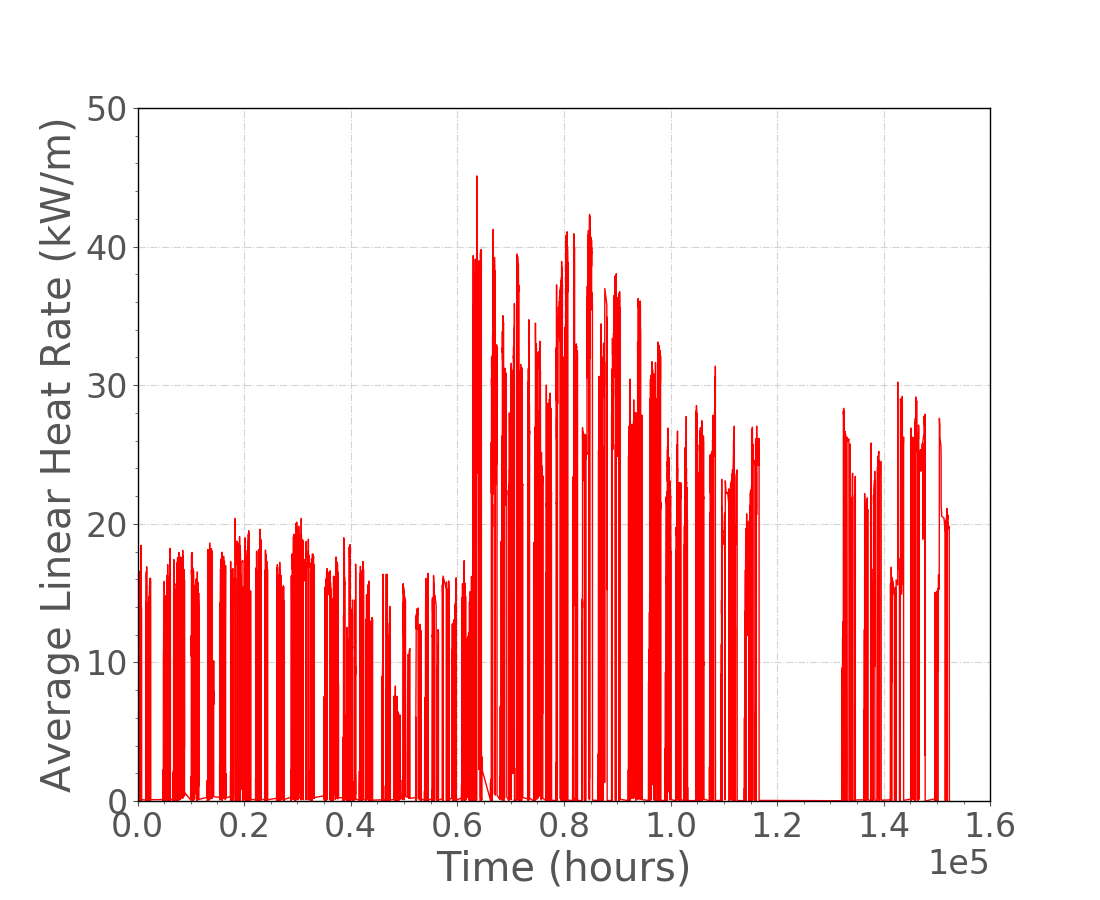
Figure 2: Full irradiation power history for rod DK in the IFA-519.9 experiment.
Model Description
Geometry and Mesh
The assumed geometry and mesh for the two rods are shown in Figure 3. The fuel pellet stack for each rod was modeled as a smeared column. A 2-dimensional axisymmetric quadratic mesh was used for each rod. The fuel columns were meshed with 48 axial and 11 radial element and the clad were meshed with 48 axial and 4 radial elements.
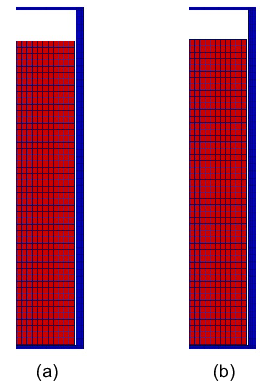
Figure 3: (a)2-D axisymmetric quadratic mesh for IFA-519 Rod DH simulation. (b)2-D axisymmetric quadratic mesh for IFA-519 Rod DH simulation. Note the figures above are scaled radially by a factor of 10.
Material and Behavioral Models
The following material and behavioral models were used for the fuel:
UO2Thermal - NFIR: For temperature and burnup dependent thermal properties.
ComputeFiniteStrainElasticStress and UO2ElasticityTensor: elastic mechanical behavior
UO2VolumetricSwellingEigenstrain: volumetric expansion due to solid and gaseous swelling
UO2RelocationEigenstrain: relocation strains, relocation activation threshold power set to 5 kW/m
ComputeThermalExpansionEigenstrain:thermal expansion with a constant instantaneous thermal expansion coefficient
UO2Sifgrs: fission gas release model used with the gaseous swelling model
UO2VolumetricSwellingEigenstrain
For the clad material, a constant thermal conductivity of 16 W/m-K was used and both thermal (primary and secondary) and irradiation creep were considered using the Limback creep model (Limbäck and Andersson, 1996). The following material and thermal behavior models were used for the cladding:
HeatConductionMaterial: Thermophysical material properties
ZryCreepLimbackHoppeUpdate and ZryElasticityTensor: mechanical creep and elastic deformation behavior for Zircaloy-0
ZryIrradiationGrowthEigenstrain: ESCORE model for volumetric swelling due to irradiation exposure
ZryThermalExpansionMATPROEigenstrain: thermal expansion of Zircaloy with the MATPRO model
Details and references for all of these models listed above can be found on the linked BISON documentation pages.
Input files
The BISON input and all supporting files (power histories, axial power profile, clad surface temperature boundary condition, fast neutron flux history, etc.) for this case are provided with the code distribution at BISON/assessment/LWR/validation/IFA_519/analysis/rod_DH and BISON/assessment/LWR/validation/IFA_519/analysis/rod_DK.
To avoid code duplication, the input files are built as follows: A base input file contains characteristics common to the entire assessment case. Specific model, numerical, and configuration parameters are listed in .params files, as well as locations to irradiation history data. IFA_519_rod_XX.params list the information specific to each rod. The base input file requires the information contained in the .params files and cannot run on its own. To run a specific assessment case, the input file can be created by listing the input file and the desired parameters, such as, for IFA_519_rod_DH: IFA_519_Base.i IFA_519_rod_DH.params
Results Comparison
A BISON postprocessor was used to extract the data needed to compute the total fission gas released (FGR) from each rod. The total FGR is computed by dividing the fission gas released by the fission gas produced.
Fission Gas Release
Table 3 summarizes the end of life (EOL) total fission gas release comparisons to the puncture results obtained durning post irradiation examination (PIE). It has been shown that the prediction of total FGR within a factor of 2 is considered acceptable (Pastore et al., 2015). Since the BISON FGR prediction is within this range, it is concluded that the FGR predictions are acceptable. As there is no fuel centerline temperature data available for comparisons, it is unknown if the underprediction of FGR is caused by a difference in the predicted and actual fuel temperature.
Table 3: End of Life Fission Gas Release for IFA-519.9 Rods DH and DK.
| Rod | BISON Burnup (MWd/kg UO) | Halden Burnup (MWd/kg UO) | BISON FGR (%) | Halden FGR (%) | BU diff (%) | FGR diff (%) |
|---|---|---|---|---|---|---|
| DH | 86.97 | 87.0 | 38.0 | 57.4 | 0.04 | 33.75 |
| DK | 83.16 | 88.5 | 33.8 | 52.8 | 6.03 | 36.02 |
References
- M. Limbäck and T. Andersson.
A model for analysis of the effect of final annealing on the in- and out-of-reactor creep behavior of zircaloy cladding.
In Zirconium in the Nuclear Industry: Eleventh International Symposium, ASTM STP 1295, 448–468. 1996.[BibTeX]
- Giovanni Pastore, L.P. Swiler, J.D. Hales, S.R. Novascone, D.M. Perez, B.W. Spencer, L. Luzzi, P. Van Uffelen, and R.L. Williamson.
Uncertainty and sensitivity analysis of fission gas behavior in engineering-scale fuel modeling.
Journal of Nuclear Materials, 456:398–408, 2015.
doi:10.1016/j.jnucmat.2014.09.077.[BibTeX]
- J. A. Turnbull.
Concluding Report on Three PWR Rods Irradiated to 90 MWd/kgUO2 in IFa-519.9: Analysis of Measurements Obtained In-Pile and By PIE.
Technical Report HWR-668, Halden, January 2001.[BibTeX]