HFIR Experiment
Overview
SiC cladding is a long-term Accident Tolerant Fuels (ATF) cladding concept to replace zirconium alloy-based cladding in current LWR. SiC-based materials have several important properties that make them an attractive choice for LWR applications such as: irradiation stability Katoh et al. (2011), the ability to maintain mechanical properties and chemical inertness at high temperatures Katoh et al. (2011), resistance to steam oxidation Terrani et al. (2014) and Avincola et al. (2015), and reasonable fracture toughness Hasegawa et al. (2000). Comprehensive details of nuclear-grade SiC fiber-reinforced SiC matrix (SiC-SiC) composite and monolithic SiC can be found in Katoh et al. (2014) and Snead et al. (2007), respectively. Although SiC cladding concept is promising, the challenges of hydrothermal corrosion and loss of hermiticity need to be addressed along the path for development and deployment of these claddings Kim et al. (2013) and Bragg-Sitton et al. (2013).
The elastic moduli of the SiC-SiC specimens were evaluated before and after the irradiation using resonant ultrasound spectroscopy. A significant decrease in the Young’s and shear moduli of 12–36\% was reported, with the maximum decrease in the hoop direction. The micro-computed tomography scans of the irradiated specimens showed the presence of radial microcracks in the hoop as well as the axial direction. These microcracks were only present on the inside of the specimen, indicating that the cracks originated at the inner surface and propagated outward. The study concluded that the significant decrease in the elastic constants was due to matrix microcracking. The stresses generated due to differential swelling across the thickness of the specimens were identified as the likely cause of these microcracks.
Test Description
Tubular SiC-SiC specimens were used for irradiation in High Flux Isotope Reactor (HFIR). These specimens were manufactured by General Atomics Inc. using the chemical vapor infiltration process. The specimens were made of Hi-Nicalon Type S fibers reinforced in a SiC matrix. The specimens had an nominal outer diameter of 8.54 mm, inner diameter of 7.02 mm, length of 16.04 mm, and mass of 0.8 g. The fiber tow bundles were biaxially braided in a 50 orientation.
The irradiation test was designed such that the SiC surface temperature of the cladding specimens was 300–350. The inner surface of the specimens were subjected to a high heat flux of 0.6 MW/m for one cycle of irradiation (24 days) in an un-instrumented capsule. Both SiC-SiC composite and monolithic SiC specimens were irradiated in this test. The fuel was replaced by a molybdenum cylinder, which generated heat through gamma heating. The design of the capsule prevented the tube surface temperature from varying by more than 12. The average specimen temperature, calculated through finite element simulation, was 415, and the the irradiation temperature estimated to be 300–470. The irradiation capsule was kept at the reactor mid-plane and subjected to a fast neutron flux (neutron energy > 0.1 MeV) of 1.1 n/cm-s and a total neutron flux of 4.3 n/cm-s, which generated a neutron dose of 2.3 dpa in the SiC-SiC specimens. The test specimens were surrounded by an aluminum sleeve, foil, and housing, and the housing was cooled by the reactor primary coolant. Further details on this experiment are available in Petrie et al. (2017).
Rod Design Specifications
Tubular SiC-SiC specimens were used for irradiation in HFIR. These specimens were manufactured by General Atomics Inc. using the chemical vapor infiltration process. The specimens were made of Hi-Nicalon fibers reinforced in a SiC matrix. The specimens had an nominal outer diameter of 8.54 mm, inner diameter of 7.02 mm, length of 16.04 mm, and mass of 0.8 g. The fiber tow bundles were biaxially braided in a +-50 orientation.
Model Description
The models used for the SiC-SiC cladding were:
CompositeSiCThermal: (STONE model) thermal properties of SiC-SiC
CompositeSiCElasticityTensor: (SINGH model) elastic deformation of SiC-SiC
CompositeSiCVolumetricSwellingEigenstrain: (KATOH model) volumetric swelling due to neutron irradiation of SiC-SiC
CompositeSiCThermalExpansionEigenstrain: thermal expansion of SiC-SiC
CompositeSiCCreepUpdate: irradiation-induced creep strain of SiC-SiC.
Geometry and Mesh
A 2D axisymmetric model was used to perform this simulation. The mesh consisted of 10 elements in radial direction and 100 elements in vertical direction. Bilinear quadrilateral 2D finite element were used to generate the mesh.
A heat flux of 0.6 MW/m was applied to the inner surface model. The neutron flux was simulated using the FastNeutronFlux material object in the code. On the outer boundary of the model, a surface convective heat loss boundary condition was imposed with convective heat transfer coefficient of 12 kW/m-K. The value of the coefficient was selected so that a temperature gradient of about 150 K could be generated across the thickness of the cladding Petrie et al. (2017).
Results
The hoop and axial stress profile at the inner and outer surface of the cladding, at the mid-height plane, is shown in Figure 2 as a function of time. The variation of irradiation-induced linear swelling strain and thermal expansion strain with time at the same locations are shown in Figure 1.
It is clear from Figure 1 that, at the end of irradiation, when the temperature of the specimen returns to room temperature, the thermal strain will become zero while the irradiation-induced swelling strain will continue to persist. The swelling strain at the inner surface is greater than that at the outer surface because irradiation-induced swelling in SiC is temperature dependent and is greater for lower temperatures. The outer surface, being at a lower temperature, has greater swelling. The gradient in the strain across the thickness leads to the development of stresses in the cladding specimens. It may be noted that there is a stress jump at the end of irradiation. This stress jump occurs because, at the end of irradiation, the thermal expansion decreases to zero, due to which the net strain gradient across the thickness increases, thus increasing the stress magnitude in the cladding.
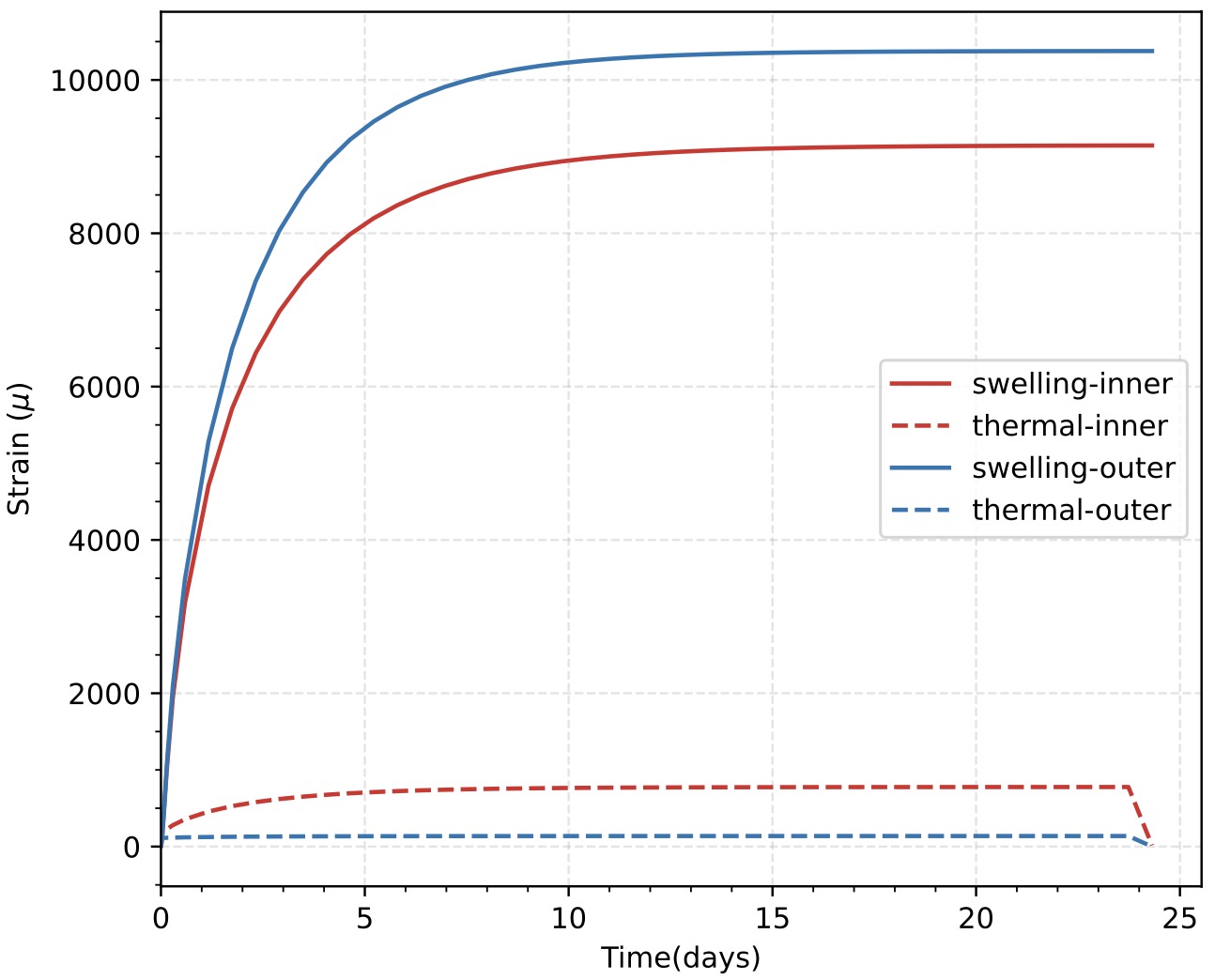
Figure 1: Evolution of strains in the specimen with time.
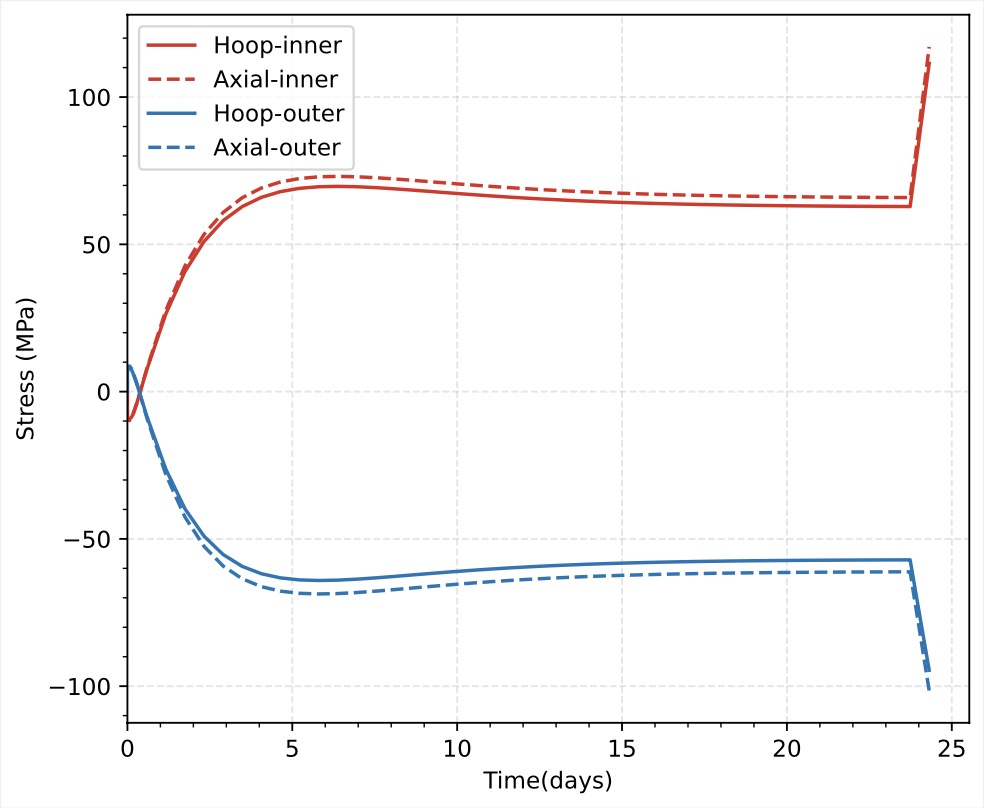
Figure 2: Evolution of stresses in the specimen with time.
Discussion
Although the post-irradiation examination studies of the irradiated specimens did not include an evaluation of stresses, significant cracks were reported in the specimens. These cracks originated from inside the specimen and propagated radially outward. It was also reported that the outer surface of the cladding specimens did not show any cracks. The BISON simulation results confirm that the inner region of the cladding specimens will develop tensile stresses while the outer region will develop compressive stresses. These results explain the origination of cracks from the inner surface, since the tensile stresses at the inner region are conducive to the initiation of cracks. These results also support the findings that the outer surface of the specimens had no cracks. The stress state of the specimens at their outer region is compression, which is not conducive for the crack initiation or propagation in that region.
Figure 2 shows that the maximum magnitude of stresses will be more than 100 MPa. The proportional limit stress for SiC-SiC composites have been reported as 80–100 MPa Koyanagi et al. (2017). The microcracking in SiC-SiC has been reported to start even before the proportional limit stress is reached Singh et al. (2018). Thus, the stress magnitudes in the cladding inner region, predicted from a BISON simulation, are high enough to initiate microcracking in SiC-SiC composites.
References
- V. A. Avincola, M. Grosse, U. Stegmaier, M. Steinbrueck, and H. J. Seifert.
Oxidation at high temperatures in steam atmosphere and quench of silicon carbide composites for nuclear application.
Nucl. Eng. Des., 295:468–478, 2015.
doi:10.1016/j.nucengdes.2015.10.002.[BibTeX]
- S. Bragg-Sitton, D. Hurley, M. Khafizov, B. Merrill, R. Schley, K. McHugh, I. van Rooyen, Y. Katoh, and C. Shih.
Silicon carbide gap analysis and feasibility study.
Technical Report INL/EXT-13-29728, Idaho National Laboratory, Idaho Falls, Idaho (United States), 2013.[BibTeX]
- A. Hasegawa, A. Kohyama, R. H. Jones, L. L. Snead, B. Riccardi, and P. Fenici.
Critical issues and current status of SiC/SiC composites for fusion.
J. Nucl. Mater., 283:128–137, 2000.
doi:10.1016/S0022-3115(00)00374-3.[BibTeX]
- Y. Katoh, T. Nozawa, L. L. Snead, K. Ozawa, and H. Tanigawa.
Stability of SiC and its composites at high neutron fluence.
J. Nucl. Mater., 417(1-3):400–405, 2011.
doi:10.1016/j.jnucmat.2010.12.088.[BibTeX]
- Y. Katoh, K. Ozawa, T. Hinoki, Y. Choi, L. L. Snead, and A. Hasegawa.
Mechanical properties of advanced SiC fiber composites irradiated at very high temperatures.
J. Nucl. Mater., 417(1-3):416–420, 2011.
doi:10.1016/j.jnucmat.2011.02.006.[BibTeX]
- Y. Katoh, K. Ozawa, C. Shih, T. Nozawa, R. J. Shinavski, A. Hasegawa, and L. L. Snead.
Continuous SiC fiber, CVI SiC matrix composites for nuclear applications: properties and irradiation effects.
Journal of Nuclear Materials, 448:448–476, 2014.[BibTeX]
- W.-J. Kim, D. Kim, and J. Y. Park.
Fabrication and material issues for the application of SiC composites to LWR fuel cladding.
Nucl. Eng. Technol., 45(4):565–572, 2013.
doi:10.5516/NET.07.2012.084.[BibTeX]
- T. Koyanagi, Y. Katoh, G. Singh, and M. Snead.
SiC/SiC cladding materials properties handbook.
Technical Report ORNL/TM-2017/385, Oak Ridge National Laboratory, 2017.[BibTeX]
- C. M. Petrie, T. Koyanagi, J. L. McDuffee, C. P. Deck, Y. Katoh, and K. A. Terrani.
Experimental design and analysis for irradiation of sic/sic composite tubes under a prototypic high heat flux.
J. Nucl. Mater., 491:94–104, 2017.
doi:10.1016/j.jnucmat.2017.04.058.[BibTeX]
- G. Singh, S. Gonczy, C. Deck, E. Lara-Curzio, and Y. Katoh.
Interlaboratory round robin study on axial tensile properties of SiC-SiC CMC tubular test specimens.
Int. J. Appl. Ceram., 15(6):1334–1349, 2018.
doi:10.1111/ijac.13010.[BibTeX]
- L. L. Snead, T. Nozawa, Y. Katoh, T.-S. Byun, S. Kondo, and D. A. Petti.
Handbook of sic properties for fuel performance modeling.
Journal of Nuclear Materials, 371:329–377, 2007.[BibTeX]
- Kurt A. Terrani, Bruce A. Pint, Chad M. Parish, Chinthaka M. Silva, Lance L. Snead, and Yutai Katoh.
Silicon carbide oxidation in steam up to 2 MPa.
Journal of the American Ceramic Society, 97(8):2331–2352, 2014.
doi:doi.org/10.1111/jace.13094.[BibTeX]