- base_nameOptional parameter that allows the user to define multiple mechanics material systems on the same block, i.e. for multiple phases
C++ Type:std::string
Controllable:No
Description:Optional parameter that allows the user to define multiple mechanics material systems on the same block, i.e. for multiple phases
- blockThe list of blocks (ids or names) that this object will be applied
C++ Type:std::vector<SubdomainName>
Controllable:No
Description:The list of blocks (ids or names) that this object will be applied
- boundaryThe list of boundaries (ids or names) from the mesh where this object applies
C++ Type:std::vector<BoundaryName>
Controllable:No
Description:The list of boundaries (ids or names) from the mesh where this object applies
- computeTrueWhen false, MOOSE will not call compute methods on this material. The user must call computeProperties() after retrieving the MaterialBase via MaterialBasePropertyInterface::getMaterialBase(). Non-computed MaterialBases are not sorted for dependencies.
Default:True
C++ Type:bool
Controllable:No
Description:When false, MOOSE will not call compute methods on this material. The user must call computeProperties() after retrieving the MaterialBase via MaterialBasePropertyInterface::getMaterialBase(). Non-computed MaterialBases are not sorted for dependencies.
- constant_onNONEWhen ELEMENT, MOOSE will only call computeQpProperties() for the 0th quadrature point, and then copy that value to the other qps.When SUBDOMAIN, MOOSE will only call computeQpProperties() for the 0th quadrature point, and then copy that value to the other qps. Evaluations on element qps will be skipped
Default:NONE
C++ Type:MooseEnum
Controllable:No
Description:When ELEMENT, MOOSE will only call computeQpProperties() for the 0th quadrature point, and then copy that value to the other qps.When SUBDOMAIN, MOOSE will only call computeQpProperties() for the 0th quadrature point, and then copy that value to the other qps. Evaluations on element qps will be skipped
- declare_suffixAn optional suffix parameter that can be appended to any declared properties. The suffix will be prepended with a '_' character.
C++ Type:MaterialPropertyName
Unit:(no unit assumed)
Controllable:No
Description:An optional suffix parameter that can be appended to any declared properties. The suffix will be prepended with a '_' character.
- elasticity_modelGENERALComposite SiC elasticity model
Default:GENERAL
C++ Type:MooseEnum
Controllable:No
Description:Composite SiC elasticity model
- elasticity_tensor_prefactorOptional function to use as a scalar prefactor on the elasticity tensor.
C++ Type:FunctionName
Unit:(no unit assumed)
Controllable:No
Description:Optional function to use as a scalar prefactor on the elasticity tensor.
- fiber_winding_angle45The angle at which the fibers in the composite are wound relative to the axial direction.
Default:45
C++ Type:double
Unit:(no unit assumed)
Controllable:No
Description:The angle at which the fibers in the composite are wound relative to the axial direction.
- swellingswellingIrradiation induced swelling strain in SiC composite
Default:swelling
C++ Type:MaterialPropertyName
Unit:(no unit assumed)
Controllable:No
Description:Irradiation induced swelling strain in SiC composite
CompositeSiCElasticityTensor
Computes the orthotropic elasticity tensor for composite (CVI) SiC-SiC
Description
The CompositeSiCElasticityTensor material model determines the elasticity tensor for composite SiC-SiC. Composite SiC-SiC for cladding application is generally orthotropic: 3D braided architecture with fibers along the axial direction as well as at angles and from the axial direction of the cladding. The angle is generally in the range 40 - 60.
There are three models available for the user: 1) A general model based on the properties presented in Koyanagi et al. (2017) and assumed properties 2) Model based on the properties from GA (2020) and assumed properties and 3) Model based on the properties from Singh et al. (2019). Either of these models can be invoked by providing the parameter elasticity_model with a value from GENERAL, GA and SINGH. It should be noted that the elastic properties of SiC-SiC composite depends on several factors including the fiber orientation and porosity. These models are based on tests conducted on SiC-SiC samples that had a specific orientation of fibers and porosity. The details of these physical properties can be found in respective references.
Note that for a 3D simulation, this model assumes that the cladding's axis is aligned along the Y-axis and continues to be so during the operation. If the axis bends during operation then the elasticity tensor obtained will be erroneous, with the error increasing with the extent of bending.
The variation of the stiffness () of the material with irradiation dose is considered in all of these models as:
where (unitless) is the swelling strain Singh and Wirth (2022). Note that is linear swelling strain and not the volumetric swelling strain.
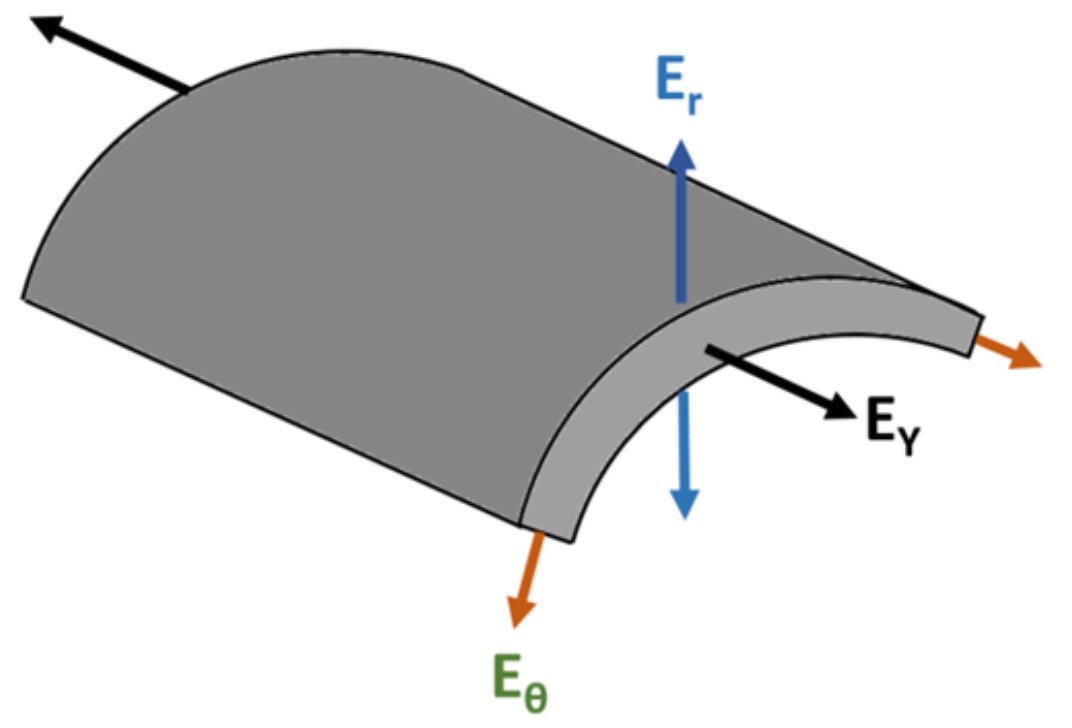
Figure 1: Schematic of cladding with Young's moduli along different directions.
The GENERAL model is the default model with following values of elastic constants:
Table 1: Elastic constants for the GENERAL model
| Elastic constant | Value | Remarks/Reference |
|---|---|---|
| (GPa) | 100 | assumed |
| (GPa) | 302.24 - 1.9148 | estimated from Koyanagi et al. (2017) |
| (GPa) | 160 | Koyanagi et al. (2017) |
| 0.25 | assumed based on Nozawa et al. (2012) | |
| 0.13 | assumed based on Nozawa et al. (2012) | |
| 0.13 | assumed based on Nozawa et al. (2012) | |
| (GPa) | 110 | assumed |
| (GPa) | 90 | assumed |
| (GPa) | 90 | assumed |
where is the angle between fiber orientation and cladding axis. Note that the value of is valid only for in the range 30 - 55. For unknown elastic constants (Young's and shear moduli) in GENERAL and GA models, values close to those reported in Singh et al. (2019) are assumed.
The GA model has the following elastic properties:
Table 2: Elastic constants for the GA model
| Elastic constant | Value | Remarks/Reference |
|---|---|---|
| (GPa) | 100 | assumed |
| (GPa) | 171 | GA (2020) |
| (GPa) | 207 | GA (2020) |
| 0.12 | GA (2020) | |
| 0.13 | assumed based on Nozawa et al. (2012) | |
| 0.13 | assumed based on Nozawa et al. (2012) | |
| (GPa) | 101 | GA (2020) |
| (GPa) | 90 | assumed |
| (GPa) | 90 | assumed |
The SINGH model has the following elastic properties:
Table 3: Elastic constancts for the SINGH model
| Elastic constant | Value | Remarks/Reference |
|---|---|---|
| (GPa) | 79.9 | Singh et al. (2019) |
| (GPa) | 263.9 | Singh et al. (2019) |
| (GPa) | 248.8 | Singh et al. (2019) |
| 0.170 | Singh et al. (2019) | |
| 0.191 | Singh et al. (2019) | |
| 0.204 | Singh et al. (2019) | |
| (GPa) | 109.5 | Singh et al. (2019) |
| (GPa) | 70.5 | Singh et al. (2019) |
| (GPa) | 85.7 | Singh et al. (2019) |
Example Input Syntax
[Materials<<<{"href": "../../../syntax/Materials/index.html"}>>>]
  [composite_elasticity_tensor]
    type = CompositeSiCElasticityTensor<<<{"description": "Computes the orthotropic elasticity tensor for composite (CVI) SiC-SiC", "href": "CompositeSiCElasticityTensor.html"}>>>
    block<<<{"description": "The list of blocks (ids or names) that this object will be applied"}>>> = clad
    elasticity_model<<<{"description": "Composite SiC elasticity model"}>>> = GA
  []
[]Input Parameters
- control_tagsAdds user-defined labels for accessing object parameters via control logic.
C++ Type:std::vector<std::string>
Controllable:No
Description:Adds user-defined labels for accessing object parameters via control logic.
- enableTrueSet the enabled status of the MooseObject.
Default:True
C++ Type:bool
Controllable:Yes
Description:Set the enabled status of the MooseObject.
- implicitTrueDetermines whether this object is calculated using an implicit or explicit form
Default:True
C++ Type:bool
Controllable:No
Description:Determines whether this object is calculated using an implicit or explicit form
- seed0The seed for the master random number generator
Default:0
C++ Type:unsigned int
Controllable:No
Description:The seed for the master random number generator
- use_displaced_meshFalseWhether or not this object should use the displaced mesh for computation. Note that in the case this is true but no displacements are provided in the Mesh block the undisplaced mesh will still be used.
Default:False
C++ Type:bool
Controllable:No
Description:Whether or not this object should use the displaced mesh for computation. Note that in the case this is true but no displacements are provided in the Mesh block the undisplaced mesh will still be used.
Advanced Parameters
- output_propertiesList of material properties, from this material, to output (outputs must also be defined to an output type)
C++ Type:std::vector<std::string>
Controllable:No
Description:List of material properties, from this material, to output (outputs must also be defined to an output type)
- outputsnone Vector of output names where you would like to restrict the output of variables(s) associated with this object
Default:none
C++ Type:std::vector<OutputName>
Controllable:No
Description:Vector of output names where you would like to restrict the output of variables(s) associated with this object
Outputs Parameters
- prop_getter_suffixAn optional suffix parameter that can be appended to any attempt to retrieve/get material properties. The suffix will be prepended with a '_' character.
C++ Type:MaterialPropertyName
Unit:(no unit assumed)
Controllable:No
Description:An optional suffix parameter that can be appended to any attempt to retrieve/get material properties. The suffix will be prepended with a '_' character.
- use_interpolated_stateFalseFor the old and older state use projected material properties interpolated at the quadrature points. To set up projection use the ProjectedStatefulMaterialStorageAction.
Default:False
C++ Type:bool
Controllable:No
Description:For the old and older state use projected material properties interpolated at the quadrature points. To set up projection use the ProjectedStatefulMaterialStorageAction.
Material Property Retrieval Parameters
Input Files
- (test/tests/solid_mechanics/compositeSiC_mechanics/axial_3D.i)
- (test/tests/solid_mechanics/compositeSiC_mechanics/axial_2D_ad.i)
- (test/tests/solid_mechanics/compositeSiC_mechanics/hoop_2D.i)
- (test/tests/solid_mechanics/compositeSiC_mechanics/axial_2D.i)
- (test/tests/solid_mechanics/compositeSiC_mechanics/swelling_dependence_2D.i)
- (assessment/LWR/validation/ATF_SiC_HFIR/analysis/base.i)
- (test/tests/solid_mechanics/compositeSiC_mechanics/hoop_3D.i)
- (test/tests/solid_mechanics/compositeSiC_mechanics/hoop_2D_ad.i)
- (examples/accident_tolerant_fuel/u3si2_sic/u3si2_outer_monolith_1.5D.i)
References
- GA.
Material properties manual: general atomics silicon carbide cladding.
Technical Report GA-A28712X, General Atomics Inc., 2020.[BibTeX]
- T. Koyanagi, Y. Katoh, G. Singh, and M. Snead.
SiC/SiC cladding materials properties handbook.
Technical Report ORNL/TM-2017/385, Oak Ridge National Laboratory, 2017.[BibTeX]
- Takashi Nozawa, Kazumi Ozawa, Yong-Bum Choi, Akira Kohyama, and Hiroyasu Tanigawa.
Determination and prediction of axial/off-axial mechanical properties of SiC/SiC composites.
Fusion Engineering and Design, 87(5-6):803–807, 2012.
doi:10.1016/j.fusengdes.2012.02.026.[BibTeX]
- G. Singh, T. Koyanagi, C. Petrie, C. Deck, K. Terrani, J.D. Arregui-Mena, and Y. Katoh.
Elastic moduli reduction in SiC-SiC tubular specimen after high heat flux neutron irradiation measured by resonant ultrasound spectroscopy.
Journal of Nuclear Materials, 523:391–401, 2019.
doi:10.1016/j.jnucmat.2019.06.026.[BibTeX]
- Gyanender Singh and Brian D Wirth.
Impact of circumferential variation in power, neutron flux and spacer grids on structural behavior of sic-sic cladding.
Journal of Nuclear Materials, 565:153726, 2022.
doi:10.1016/j.jnucmat.2022.153726.[BibTeX]