FUMEX XII
Overview
Over the last few decades, the International Atomic Energy Agency (IAEA) has supported several programs related to nuclear power reactor fuel behavior and fuel behavior modeling. These efforts have collected fuel behavior experimental data, fuel irradiation experiment and hardware descriptions, and fuel modeling code results to develop a useful database of information for code assessment and to determine the maturity of currently existing fuel performance codes. One such program was the Fuel Modeling at Extended Burnup (FUMEXII (IAEA, 2002-2007)) program. This program, conducted from 1999-2007, outlined relevant collections of analytical exercises and appropriate experiments and encouraged participants to submit calculation results for a wide variety of fuel performance experiments in a format that readily allowed comparisons between specific codes and to experiment data when available. Given the success of this approach and ready access to the results, we chose to use some test cases from the FUMEXII program for initial assessment of certain BISON code elements. In particular, FUMEXII participants devoted significant effort to fission gas release (FGR) and an impressive compilation of experiment data and code results is given in Ref. (IAEA, 2002-2007).
FGR is of particular interest for the present BISON assessment since calculation of fuel centerline temperature and radial and axial temperature distribution depends heavily on fission gas generation in the pellets, migration of the gas to grain boundaries, and eventual release to the fuel pin gap and plenum. FUMEXII Case No. 27, so-called 'Simplified cases', provide an ideal basis for examining the BISON FGR model(s) performance and comparison of BISON results with results from other fuel performance codes that participated in the FUMEXII exercises. The first of the simplified cases, 27(1) focused on the Vitanza criterion (Vitanza et al., 1979), which is the comparison of fuel centerline temperature versus burnup at onset of FGR (e.g. 1% release). The second case was to assess the codes' ability to predict total FGR as a function of burnup up to 100 MWd/kgU. Four separate simulations were used for this case:
27(2a) a constant power of 15 kW/m from BOL to 100 MWd/kgU,
27(2b) a linearly decreasing power from 20 kW/m at BOL to 10 kW/m at 100 MWd/kgU,
27(2c) more realistic power history supplied by G Rossiter of BNFL,
27(2d) idealized 'real' history supplied by F Sontheimer of FANP.
Test Description
Rod Design Specifications
For Case 27(1), 27(2a), and 27(2b), a standard fuel description representative of a boiling water reactor (BWR) fuel rod typically irradiated in the Halden reactor was specified. The rod plenum was specified as being large as to avoid thermal feedback, the rod plenum fill gas was helium at 0.5 MPa (5 bar). The fuel pellet was solid and flat ended (no chamfer, no dish) with 13% U enrichment and a grain diameter of 15 microns. Cladding consisted of standard Zr-2. In the Halden reactor, fast neutron flux is typically assumed negligible and thus irradiation induced cladding creep is negligible. Also, the axial power profile in Halden is flat. The detailed specification of the pellet, cladding, and other information relevant to the exercise is shown in Table 1.
Table 1: FUMEX-II 27(1), 27(2a), and 27(2b) Fuel Rod/Pellet Specifiactions.
| Fuel Rod | ||
|---|---|---|
| Fuel stack length | 0.0127 | m |
| Number of pellets per rod | 1 | |
| Fill gas composition | He | |
| Fill gas pressure | 0.5 | MPa |
| Fuel | ||
| Material | UO | |
| Enrichment | 13 | |
| Density | 95 | |
| Outer diameter | 10.61 | mm |
| Pellet geometry | Flat Ended | |
| Grain diameter | 15 | m |
| Cladding | ||
| Material | Zr-2 | |
| Outer diameter | 12.7 | mm |
| Inner diameter | 10.8 | mm |
| Wall thickness | 0.95 | mm |
For case 27(2c) and 27(2d) the fuel rod specifications were provided by BNFL (Table 2) and FANP (Table 3), respectively.
Table 2: FUMEX-II 27(2c) Fuel Rod/Pellet Specifications.
| Fuel Rod | ||
|---|---|---|
| Fuel stack length | 3.658 | m |
| Nominal plenum length | 162 | mm |
| Number of pellets per rod | 275 | |
| Fill gas composition | He | |
| Fill gas pressure | 2.5 | MPa |
| Fuel | ||
| Material | UO | |
| Enrichment | 8 | |
| Density | 95 | |
| Outer diameter | 8.2 | mm |
| Pellet length | 9.8 | mm |
| Pellet geometry | dished | |
| Grain diameter | 75 | m |
| Pellet Dishing (no chamfers) | ||
| Dish diameter | 5.24 | mm |
| Dish depth | 0.3 | mm |
| Cladding | ||
| Material | Zr-4 | |
| Outer diameter | 9.5 | mm |
| Inner diameter | 8.36 | mm |
| Wall thickness | 0.57 | mm |
Table 3: FUMEX-II 27(2d) Fuel Rod/Pellet Specifications.
| Fuel Rod | ||
|---|---|---|
| Fuel stack length | 3.5 | m |
| Total free volume | 30 | cm |
| Number of pellets per rod | 318 | |
| Fill gas composition | He | |
| Fill gas pressure | 2.2 | MPa |
| Fuel | ||
| Material | UO | |
| Enrichment | 4 | |
| Density | 95.5 | |
| Outer diameter | 9.12 | mm |
| Pellet length | 11.0 | mm |
| Pellet geometry | standard UO | |
| Grain diameter | 10 | m |
| Cladding | ||
| Material | Zr-4 | |
| Outer diameter | 10.75 | mm |
| Inner diameter | 9.29 | mm |
| Wall thickness | 0.73 | mm |
Operating Conditions and Irradiation History
To match the Vitanza Threshold (described above) multiple simulations are ran at multiple powers until 1% FGR is reached. This was done for 20, 25, 30, 35, 40, and 45 kW/m. For case 27(2a) a constant power of 15 kW/m was used up to a burnup of 100 MWd/kgU. The power for case 27(2b) linearly decreased from 20 kW/m at BOL to 10 kW/m at a burnup of 100 MWd/kgU. Typical Halden BWR (HBWR) conditions were used for the operating conditions (fast neutron flux of 1.6E11 n/cm-sec per kW/m, coolant temperature of 232 C, and a coolant pressure of 3.2 MPa) for cases 27(1), 27(2a), and 27(2b).
The power history used for case 27(2c) is shown in Figure 1, the power is provided as a thermal power in the fuel. The ratio of thermal heat to total heat for the rod is 0.975, thus the input power is scaled by a factor of 1.025641 as BISON requires the total fission power as input. The fast neutron flux was specified as a function and is shown in Figure 2. The coolant pressure was specified as 15.5 MPa with an average clad temperature of 325 C.
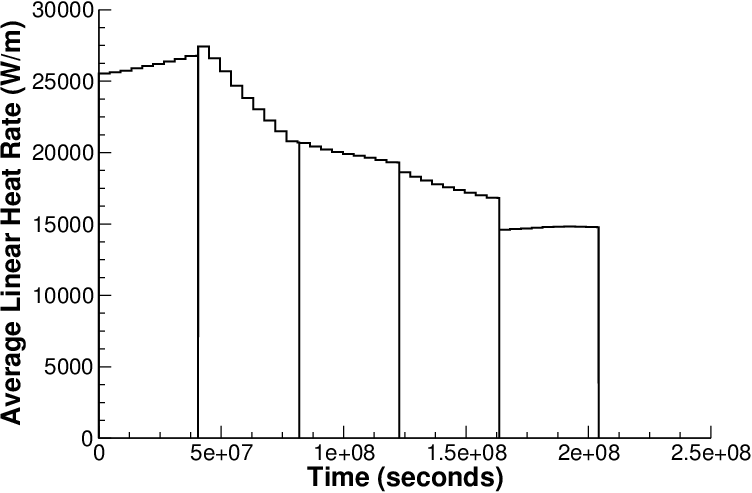
Figure 1: Case 27(2c) average linear heat rate.
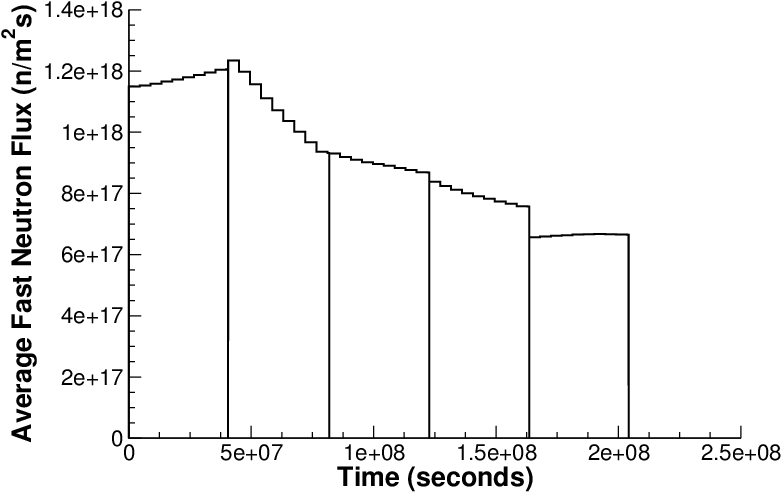
Figure 2: Case 27(2c) average flux rate.
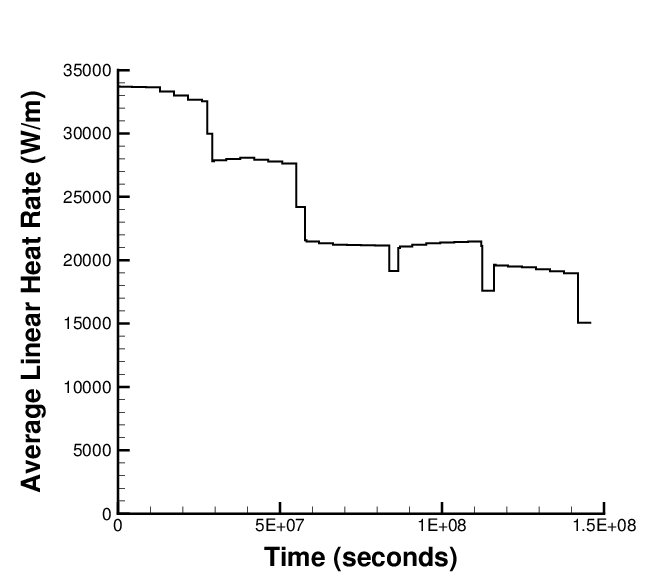
Figure 3: Case 27(2d) average linear heat rate.
The power history used for case 27(2d) is shown in Figure 3. The fast neutron flux had a suggested value of 4E16 n/m-sec per kW/m. The coolant pressure was 15.5 MPa, with a coolant temperature of 290 C and a mass flow rate of 0.4 kg/s.
Model Description
Geometry and Mesh
Case 27(1)
For this exercise, the main interest was interaction between the fission gas generation and release and the thermal behavior of the fuel. As such, several simplifications could be made. First, since fractional fission gas release was of prime interest, only a single fuel pellet reflecting the parameters given in Table 1 was modeled. Second, since fuel-cladding interaction was not of interest, the cladding was removed and only the fuel pellet was modeled. A convective boundary condition representative of Halden operating conditions was applied directly to the pellet outer radius and the top and bottom of the pellet were insulated.
Figure 4 shows the mesh used for BISON calculation of the Vitanza criteria. This mesh represents a 2D-RZ axi-symmetric geometry and with 12 radial and 8 axial quadratic elements.
Cases 27(2a) and 27(2b)
A similar mesh was used for cases 27(2a) and 27(2b), except the clad was modeled in these two cases. This mesh consisted of 12 radial and 8 axial quadratic elements in the fuel and 4 radial elements in the clad (see Figure 5).
Case 27(2c)
Fuel rod specifications in Table 2 were used to generate the mesh for case 27(2c). The fuel rod was meshed as a 2D-RZ axi-symmetric geometry, with 11 radial and 5 axial quadratic elements per fuel pellet. The clad thickness was meshed with 4 radial quadratic elements. A section of the fuel rod is shown in Figure 6.
Case 27(2d)
Fuel rod specifications in Table 3 were used to generate the mesh for case 27(2d). The fuel rod was meshed as a 2D-RZ axi-symmetric geometry, with 11 radial and 4 axial quadratic elements per fuel pellet. The clad thickness was meshed with 4 radial quadratic elements. A section of the fuel rod is shown in Figure 7.
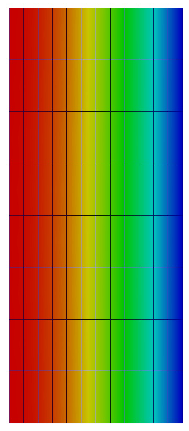
Figure 4: BISON single pellet mesh used for Vitanza Criteria calculation. Fuel temperature profile shown at 1% FGR for LHR of 45 kW/m.
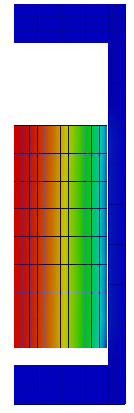
Figure 5: BISON mesh used for cases 27(2a) and 27(2b). Temperature contour of 27(2a) at a burnup of 100 MWd/kgU.
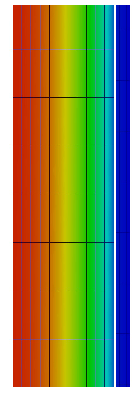
Figure 6: BISON mesh used for cases 27(2c). Temperature contour at a burnup of approximately 100 MWd/kgU.
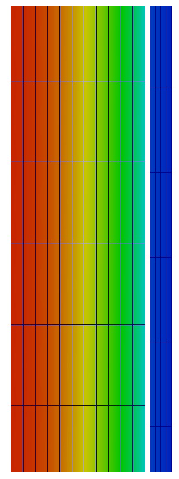
Figure 7: BISON mesh used for cases 27(2d). Temperature contour at a burnup of approximately 67.5 MWd/kgU.
Material and Behavioral Models
The following material and behavioral models were used for the UO fuel:
UO2Thermal - NFIR: temperature and burnup dependent thermal properties
UO2RelocationEigenstrain: provides burnup dependent relocation, with a relocation activation power of 5 kW/m
UO2Sifgrs: provides mechanistic fission gas release calculation with coupled gaseous swelling
Since the case 1 model did not include cladding, no cladding irradiation growth, cladding thermal, or cladding solid mechanics material models were included. For the case 2 series, the clad material had a constant thermal conductivity of 16 W/m-K was used and both thermal (primary and secondary) and irradiation creep were considered using the Limback model (Limbäck and Andersson, 1996).
Input files
The BISON input and all supporting files (power histories, axial power profile, mesh input, etc.) for this case are provided with the code distribution at bison/assessment/LWR/benchmark/FUMEXII_simplified_cases/analysis.
Results Comparison
Fission Gas Release
As mentioned above, the Vitanza criteria is an empirical relationship derived from operational data at the Halden reactor. The empirical relationship has the form
(1)
where T is the fuel pellet centerline temperature in C and Bu is the burnup in MWd/kgUO. Eq. (1) provides the locus of centerline temperature-Bu pairs at the onset of fission gas release (onset taken to be approximately 1% FGR) for Halden operational history (e.g. various LHR with standard BWR flow, pressure, and fluid temperature values). The computational process described above was implemented with BISON to determine the onset of 1% FGR for several different LHR. Table 4 shows BISON numerical results for linear heat rates ranging from 15 to 45 kW/m.
Table 4: BISON fuel centerline temperature versus burnup at onset of FGR (various linear heat rates) for the simplified case FUMEXII 27(1).
| Burnup (MWd/kgU) | FCT (C) | LHR (kW/m) |
|---|---|---|
| 80.0 | 956.5 | 20.0 |
| 49.6 | 1033.0 | 25.0 |
| 32.9 | 1093.3 | 30.0 |
| 22.0 | 1147.3 | 35.0 |
| 14.1 | 1198.9 | 40.0 |
| 7.8 | 1248.0 | 45.0 |
The BISON predictions and other code comparisons (data digitized from FUMEX-II report (IAEA, 2002-2007) are shown with the Vitanza Criteria in Figure 8.
The Vitanza criteria was derived from pressure, burnup, and centerline temperature data gathered during Halden reactor operations. Most of the experimental data base for the threshold development was for maximum Bu of about 40 MWd/kgU. Reference (IAEA, 2002-2007) suggests that the threshold may be somewhat conservative at higher burnups as recent high burnup data shows enhancement of FGR due to rim effect (enhanced porosity) development at the pellet surface. Several of the codes shown in Figure 8 have FGR models that predict gas release to be independent of fuel temperature above some burnup limit. Predictions that become vertical are indicative of this feature. BISON results are generally in good agreement with the other code results though it is clear that considerable scatter exists among the predictions.
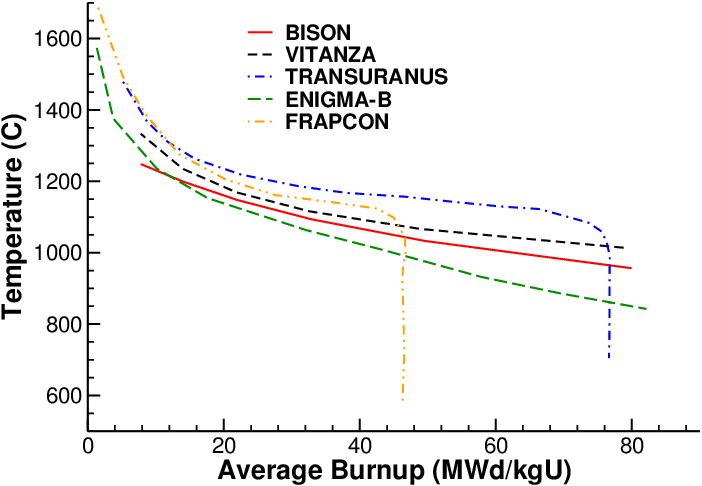
Figure 8: 27(1) BISON and other code results compared to Vitanza criteria (IAEA, 2002-2007).
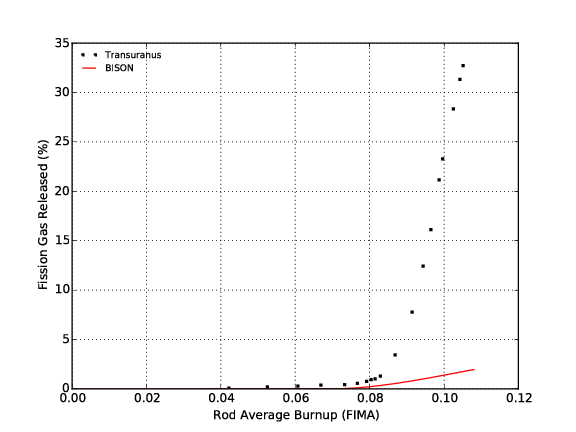
Figure 9: Case 27(2a) BISON comparisons with other well known fuel performance codes (IAEA, 2002-2007).
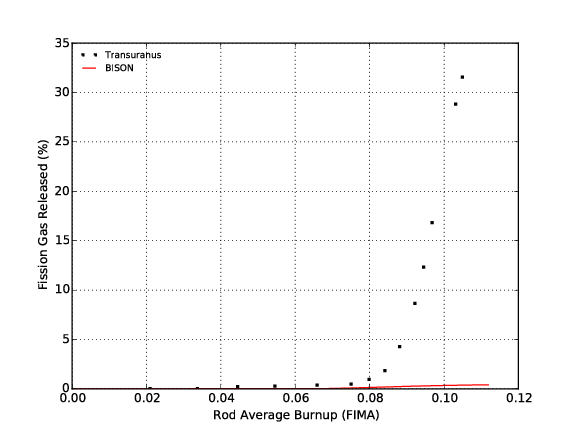
Figure 10: Case 27(2b) BISON comparisons with other well known fuel performance codes (IAEA, 2002-2007).
BISON compares well with other well known fuel performance codes. All of the data for the other codes were digitized from plots in the FUMEX-II report (IAEA, 2002-2007). Code comparisons for cases 27(2a) and 27(2b) are shown in Figure 9 and Figure 10, respectively.
BISON under predicts the total FGR at high burnup, but is within an acceptable range at low and moderate burnup. The BISON comparisons to other fuel performance codes for case 27(2c) are shown in Figure 11. The BISON comparisons to expected FGR values and other fuel performance codes for case 27(2d) are shown in Figure 12.
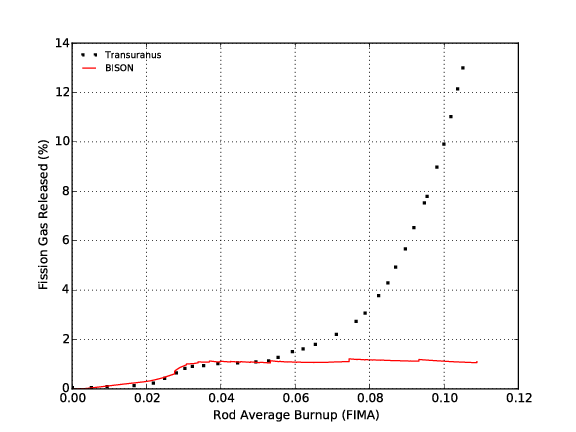
Figure 11: Case 27(2c) BISON comparisons with other well known fuel performance codes (IAEA, 2002-2007).
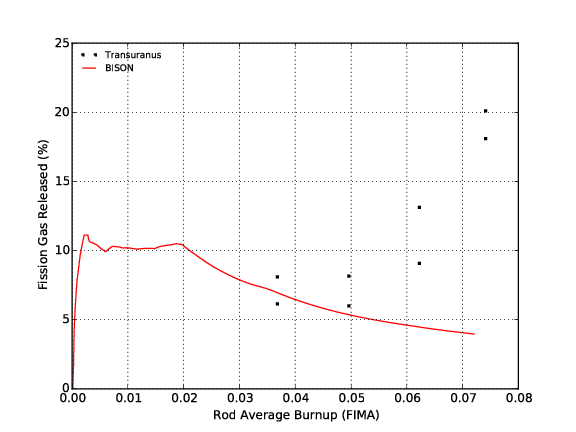
Figure 12: Case 27(2d) BISON comparisons with other well known fuel performance codes (IAEA, 2002-2007).
Discussion
As discussed above, the mesh shown in Figure 4 includes only the fuel pellet. Specifications for FUMEXII 27(1) problem suggested that modelers use a large fuel rod plenum to preclude thermal feedback effects from the plenum and gap on FGR. After some experimentation with this concept, it became apparent that in BISON it was computationally more efficient to eliminate the cladding and plenum altogether since unrestricted fission gas release was the matter of interest.
The overall results from the FUMEX-II simplified cases study indicate that a more accurate high burnup release model is needed in BISON. At low and moderate burnup, BISON does an adequate job predicting total fission gas release.
References
- IAEA.
Fuel Modelling at Extened Burnup (FUMEX-II): Report of a Coordinated Research Project 2002-2007.
Technical Report IAEA-TECDOC-1687, International Atomic Energy Agency, 2002-2007.[BibTeX]
- M. Limbäck and T. Andersson.
A model for analysis of the effect of final annealing on the in- and out-of-reactor creep behavior of zircaloy cladding.
In Zirconium in the Nuclear Industry: Eleventh International Symposium, ASTM STP 1295, 448–468. 1996.[BibTeX]
- C. Vitanza, E. Kolstad, and U. Graziani.
Fission gas release from UO$_2$ pellet fuel at high burnup.
In Proceedings of the American Nuclear Society Meeting on Light Water Reactor Fuel Performance, 361. Portland, Oregon, Apr 29 to May 3, 1979.[BibTeX]