- densityInitial fuel density
C++ Type:double
Unit:(no unit assumed)
Controllable:No
Description:Initial fuel density
- temperatureCoupled temperature
C++ Type:std::vector<VariableName>
Unit:(no unit assumed)
Controllable:No
Description:Coupled temperature
UO2HotPressingCreepUpdate
Computes the secondary thermal and irradiation creep for UO2 LWR fuel. This material must be run in conjunction with ComputeMultipleInelasticStress.
Description
This model accounts for creep and, if selected, instantaneous plastic flow surrounding pores in ceramic UO2 fuel pellet, which under pressure, can reduce pore volume and consequently reduce fuel porosity and increase fuel density. This is a densification mechanism of UO fuel under compressive stresses, which contributes to fuel densification in addition to the irradiation induced densification. Such mechanical densification process is more pronounced at high temperatures with high creep rate or plastic deformations, and it is also referred to as hot-pressing.
The mathematical model of hot-pressing of ceramic UO was described by Rashid et al. (1974). By using an analogy of close-packed spherical shells in infinite media under hydrostatic compression, model on the stress-induced densification based on the mechanism of instantaneous plasticity and creep was derived. This section describes the implementation of the hot-pressing model based on the mechanisms of creep as follows. For the details of the instantaneous plasticity model implementation, see UO2HotPressingPlasticityUpdate.
Creep is modeling with a power-law form The tangential creep rate of porous media, with density , at the pore surface is given as in Rashid et al. (1974). And, the volumetric creep rate is (1) Hot-pressing parameter is defined as (2) where the hydrostatic pressure (Pa), is the exponent in the power law creep equation, is the leading coefficient in the power law creep equation, is the fractional density (dimensionless), is the creep rate, and the subscripts and represent tangential and volumetric components respectively.
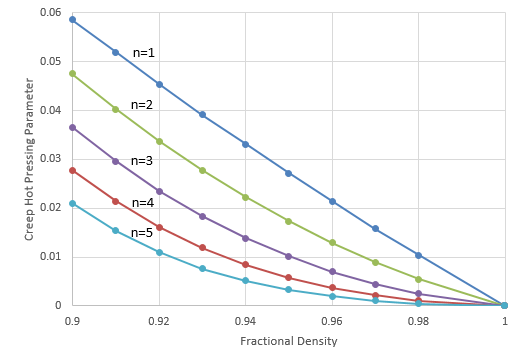
Figure 1: Hot-pressing parameter vs. fractional density
This material parameter is used in the hot-pressing model for the volumetric creep of UO. The creep of UO involves several mechanisms, and in their mathematical descriptions, different exponent could be used for the different mechanisms. The volumetric creep strain implemented in BISON code is assumed to be the combination of all the creep strains together. From Eq. (2), the hot-pressing parameter depends on the fuel density. With the increase of fuel density, the parameter would be reduced; when fractional density approaches 1.0, the parameter approaches zero, and the densification would essentially be terminated, i.e., the volumetric creep strain rate in Eq. (1) becomes zero. A plot of the hot-pressing parameter versus initial density at different is shown in Figure 1.
Example Input Syntax
[Materials<<<{"href": "../../../syntax/Materials/index.html"}>>>]
  [hotpressing]
    type = UO2HotPressingCreepUpdate<<<{"description": "Computes the secondary thermal and irradiation creep for UO2 LWR fuel. This material must be run in conjunction with ComputeMultipleInelasticStress.", "href": "UO2HotPressingCreepUpdate.html"}>>>
    block<<<{"description": "The list of blocks (ids or names) that this object will be applied"}>>> = 1
    base_name<<<{"description": "Optional parameter that defines a prefix for all material properties related to this stress update model. This allows for multiple models of the same type to be used without naming conflicts."}>>> = hp
    temperature<<<{"description": "Coupled temperature"}>>> = temp
    input_hotpressing<<<{"description": "Flag for using input hot pressing parameter"}>>> = true
    hotpressing_nu<<<{"description": "Input hot pressing parameter"}>>> = 0.01
    fission_rate<<<{"description": "Coupled fission rate"}>>> = fission_rate
    initial_grain_radius<<<{"description": "Fuel grain radius (m)"}>>> = 10.0e-6
    oxygen_to_metal_ratio<<<{"description": "Oxygen to metal ratio"}>>> = 2.0
    a7<<<{"description": "Coefficient on irradiation creep term"}>>> = 3.72264e-35
    q3<<<{"description": "Activation energy for irradiation creep, divided by gas constant (1/K)"}>>> = 2617
  []
[]UO2HotPressingCreepUpdate must be run in conjunction with the inelastic strain return mapping stress calculator as shown below:
[Materials<<<{"href": "../../../syntax/Materials/index.html"}>>>]
  [radial_return_stress]
    type = ComputeMultipleInelasticStress<<<{"description": "Compute state (stress and internal parameters such as plastic strains and internal parameters) using an iterative process.  Combinations of creep models and plastic models may be used.", "href": "../ComputeMultipleInelasticStress.html"}>>>
    tangent_operator<<<{"description": "Type of tangent operator to return.  'elastic': return the elasticity tensor.  'nonlinear': return the full, general consistent tangent operator."}>>> = elastic
    inelastic_models<<<{"description": "The material objects to use to calculate stress and inelastic strains. Note: specify creep models first and plasticity models second."}>>> = 'creep hotpressing plasticity'
    block<<<{"description": "The list of blocks (ids or names) that this object will be applied"}>>> = 1
    max_iterations<<<{"description": "Maximum number of the stress update iterations over the stress change after all update materials are called"}>>> = 30
    relative_tolerance<<<{"description": "Relative convergence tolerance for the stress update iterations over the stress change after all update materials are called"}>>> = 1e-7
    absolute_tolerance<<<{"description": "Absolute convergence tolerance for the stress update iterations over the stress change after all update materials are called"}>>> = 1e-7
  []
[]Input Parameters
- a77.78e-37Coefficient on irradiation creep term
Default:7.78e-37
C++ Type:double
Unit:(no unit assumed)
Controllable:No
Description:Coefficient on irradiation creep term
- abs_error1e-06Absolute error in the iteration loop to compute trial pressure
Default:1e-06
C++ Type:double
Unit:(no unit assumed)
Controllable:No
Description:Absolute error in the iteration loop to compute trial pressure
- absolute_tolerance1e-11Absolute convergence tolerance for Newton iteration
Default:1e-11
C++ Type:double
Unit:(no unit assumed)
Controllable:No
Description:Absolute convergence tolerance for Newton iteration
- acceptable_multiplier10Factor applied to relative and absolute tolerance for acceptable convergence if iterations are no longer making progress
Default:10
C++ Type:double
Unit:(no unit assumed)
Controllable:No
Description:Factor applied to relative and absolute tolerance for acceptable convergence if iterations are no longer making progress
- adaptive_substeppingFalseUse adaptive substepping, where the number of substeps is successively doubled until the return mapping model successfully converges or the maximum number of substeps is reached.
Default:False
C++ Type:bool
Controllable:No
Description:Use adaptive substepping, where the number of substeps is successively doubled until the return mapping model successfully converges or the maximum number of substeps is reached.
- automatic_differentiation_return_mappingFalseWhether to use automatic differentiation to compute the derivative.
Default:False
C++ Type:bool
Controllable:No
Description:Whether to use automatic differentiation to compute the derivative.
- base_nameOptional parameter that defines a prefix for all material properties related to this stress update model. This allows for multiple models of the same type to be used without naming conflicts.
C++ Type:std::string
Controllable:No
Description:Optional parameter that defines a prefix for all material properties related to this stress update model. This allows for multiple models of the same type to be used without naming conflicts.
- blockThe list of blocks (ids or names) that this object will be applied
C++ Type:std::vector<SubdomainName>
Controllable:No
Description:The list of blocks (ids or names) that this object will be applied
- boundaryThe list of boundaries (ids or names) from the mesh where this object applies
C++ Type:std::vector<BoundaryName>
Controllable:No
Description:The list of boundaries (ids or names) from the mesh where this object applies
- burnup_functionBurnup function
C++ Type:BurnupFunctionName
Unit:(no unit assumed)
Controllable:No
Description:Burnup function
- constant_onNONEWhen ELEMENT, MOOSE will only call computeQpProperties() for the 0th quadrature point, and then copy that value to the other qps.When SUBDOMAIN, MOOSE will only call computeQpProperties() for the 0th quadrature point, and then copy that value to the other qps. Evaluations on element qps will be skipped
Default:NONE
C++ Type:MooseEnum
Controllable:No
Description:When ELEMENT, MOOSE will only call computeQpProperties() for the 0th quadrature point, and then copy that value to the other qps.When SUBDOMAIN, MOOSE will only call computeQpProperties() for the 0th quadrature point, and then copy that value to the other qps. Evaluations on element qps will be skipped
- debug_outputFalseFlag for turn on debug output
Default:False
C++ Type:bool
Controllable:No
Description:Flag for turn on debug output
- declare_suffixAn optional suffix parameter that can be appended to any declared properties. The suffix will be prepended with a '_' character.
C++ Type:MaterialPropertyName
Unit:(no unit assumed)
Controllable:No
Description:An optional suffix parameter that can be appended to any declared properties. The suffix will be prepended with a '_' character.
- fission_rateCoupled fission rate
C++ Type:std::vector<VariableName>
Unit:(no unit assumed)
Controllable:No
Description:Coupled fission rate
- has_hotpressing_plasticityFalseFlag to turn on instantaneous plasticity model
Default:False
C++ Type:bool
Controllable:No
Description:Flag to turn on instantaneous plasticity model
- hotpressing_nu0Input hot pressing parameter
Default:0
C++ Type:double
Unit:(no unit assumed)
Controllable:No
Description:Input hot pressing parameter
- initial_grain_radius1e-05Fuel grain radius (m)
Default:1e-05
C++ Type:double
Unit:(no unit assumed)
Controllable:No
Description:Fuel grain radius (m)
- input_hardening_modulus0Input UO2 hardening modulus
Default:0
C++ Type:double
Unit:(no unit assumed)
Controllable:No
Description:Input UO2 hardening modulus
- input_hotpressingFalseFlag for using input hot pressing parameter
Default:False
C++ Type:bool
Controllable:No
Description:Flag for using input hot pressing parameter
- max_inelastic_increment0.0001The maximum inelastic strain increment allowed in a time step
Default:0.0001
C++ Type:double
Unit:(no unit assumed)
Controllable:No
Description:The maximum inelastic strain increment allowed in a time step
- max_iteration1000Maximum iteration number
Default:1000
C++ Type:int
Controllable:No
Description:Maximum iteration number
- maximum_number_substeps25The maximum number of substeps allowed before cutting the time step.
Default:25
C++ Type:unsigned int
Controllable:No
Description:The maximum number of substeps allowed before cutting the time step.
- oxygen_to_metal_ratio2Oxygen to metal ratio
Default:2
C++ Type:double
Unit:(no unit assumed)
Controllable:No
Description:Oxygen to metal ratio
- po2_fraction0Weight fraction of PO2
Default:0
C++ Type:double
Unit:(no unit assumed)
Controllable:No
Description:Weight fraction of PO2
- q30Activation energy for irradiation creep, divided by gas constant (1/K)
Default:0
C++ Type:double
Unit:(no unit assumed)
Controllable:No
Description:Activation energy for irradiation creep, divided by gas constant (1/K)
- rel_error0.001Relative error in the iteration loop to computer trial pressure
Default:0.001
C++ Type:double
Unit:(no unit assumed)
Controllable:No
Description:Relative error in the iteration loop to computer trial pressure
- relative_tolerance1e-08Relative convergence tolerance for Newton iteration
Default:1e-08
C++ Type:double
Unit:(no unit assumed)
Controllable:No
Description:Relative convergence tolerance for Newton iteration
- use_substep_integration_errorFalseIf true, it establishes a substep size that will yield, at most,the creep numerical integration error given by substep_strain_tolerance.
Default:False
C++ Type:bool
Controllable:No
Description:If true, it establishes a substep size that will yield, at most,the creep numerical integration error given by substep_strain_tolerance.
- use_substeppingNONEWhether and how to use substepping
Default:NONE
C++ Type:MooseEnum
Controllable:No
Description:Whether and how to use substepping
Optional Parameters
- apply_strainTrueFlag to apply strain. Used for testing.
Default:True
C++ Type:bool
Controllable:No
Description:Flag to apply strain. Used for testing.
- control_tagsAdds user-defined labels for accessing object parameters via control logic.
C++ Type:std::vector<std::string>
Controllable:No
Description:Adds user-defined labels for accessing object parameters via control logic.
- effective_inelastic_strain_nameeffective_hotpressing_strainName of the material property that stores the effective inelastic strain
Default:effective_hotpressing_strain
C++ Type:std::string
Controllable:No
Description:Name of the material property that stores the effective inelastic strain
- enableTrueSet the enabled status of the MooseObject.
Default:True
C++ Type:bool
Controllable:Yes
Description:Set the enabled status of the MooseObject.
- implicitTrueDetermines whether this object is calculated using an implicit or explicit form
Default:True
C++ Type:bool
Controllable:No
Description:Determines whether this object is calculated using an implicit or explicit form
- seed0The seed for the master random number generator
Default:0
C++ Type:unsigned int
Controllable:No
Description:The seed for the master random number generator
- substep_strain_tolerance0.1Maximum ratio of the initial elastic strain increment at start of the return mapping solve to the maximum inelastic strain allowable in a single substep. Reduce this value to increase the number of substeps
Default:0.1
C++ Type:double
Unit:(no unit assumed)
Controllable:No
Description:Maximum ratio of the initial elastic strain increment at start of the return mapping solve to the maximum inelastic strain allowable in a single substep. Reduce this value to increase the number of substeps
- use_displaced_meshFalseWhether or not this object should use the displaced mesh for computation. Note that in the case this is true but no displacements are provided in the Mesh block the undisplaced mesh will still be used.
Default:False
C++ Type:bool
Controllable:No
Description:Whether or not this object should use the displaced mesh for computation. Note that in the case this is true but no displacements are provided in the Mesh block the undisplaced mesh will still be used.
Advanced Parameters
- internal_solve_full_iteration_historyFalseSet true to output full internal Newton iteration history at times determined by `internal_solve_output_on`. If false, only a summary is output.
Default:False
C++ Type:bool
Controllable:No
Description:Set true to output full internal Newton iteration history at times determined by `internal_solve_output_on`. If false, only a summary is output.
- internal_solve_output_onon_errorWhen to output internal Newton solve information
Default:on_error
C++ Type:MooseEnum
Controllable:No
Description:When to output internal Newton solve information
Debug Parameters
- output_propertiesList of material properties, from this material, to output (outputs must also be defined to an output type)
C++ Type:std::vector<std::string>
Controllable:No
Description:List of material properties, from this material, to output (outputs must also be defined to an output type)
- outputsnone Vector of output names where you would like to restrict the output of variables(s) associated with this object
Default:none
C++ Type:std::vector<OutputName>
Controllable:No
Description:Vector of output names where you would like to restrict the output of variables(s) associated with this object
Outputs Parameters
- prop_getter_suffixAn optional suffix parameter that can be appended to any attempt to retrieve/get material properties. The suffix will be prepended with a '_' character.
C++ Type:MaterialPropertyName
Unit:(no unit assumed)
Controllable:No
Description:An optional suffix parameter that can be appended to any attempt to retrieve/get material properties. The suffix will be prepended with a '_' character.
- use_interpolated_stateFalseFor the old and older state use projected material properties interpolated at the quadrature points. To set up projection use the ProjectedStatefulMaterialStorageAction.
Default:False
C++ Type:bool
Controllable:No
Description:For the old and older state use projected material properties interpolated at the quadrature points. To set up projection use the ProjectedStatefulMaterialStorageAction.
Material Property Retrieval Parameters
Input Files
References
- Y. R. Rashid, H. T. Tang, and E. B. Johansson.
Mathematical treatment of hot pressing of reactor fuel.
Nuclear Engineering Design, 29:1–6, 1974.[BibTeX]