- densityInitial fuel density
C++ Type:double
Unit:(no unit assumed)
Controllable:No
Description:Initial fuel density
- temperatureCoupled temperature
C++ Type:std::vector<VariableName>
Unit:(no unit assumed)
Controllable:No
Description:Coupled temperature
UO2CreepUpdate
Computes the secondary thermal and irradiation creep for UO2 LWR fuel. This material must be run in conjunction with ComputeMultipleInelasticStress.
Description
A model for combined secondary thermal creep and irradiation creep of UO fuel is available, with the creep rate modeled as a function of time, temperature, effective stress, density, grain size, fission rate, and oxygen-to-metal ratio (O/M). The constitutive relation is taken from the MATPRO FCREEP material model (Allison et al., 1993) and given as (1) where is the creep rate (1/s), is the effective (von Mises) stress (Pa), is the temperature (K), is the fuel density (percent of theoretical), is the grain size (, is the volumetric fission rate (fissions/-s), are the activation energies (J/mol), and is the universal gas constant (8.3145 J/mol-K).
The first term in Eq. (1) represents diffusional thermal creep and is applicable to low stress and low temperature conditions. The second term in Eq. (1) represents thermal dislocation or power-law creep and is applicable to high stress and high temperature conditions. Note that irradiation creep is included in both the first and third terms, as both are functions of the fission rate (). Irradiation enhances normal diffusional thermal creep (at elevated temperatures) as indicated in the first term. Irradiation creep also occurs at lower temperatures where thermal creep is not active, and is accounted for by the third term in Eq. (1). Material constants for the thermal creep terms are listed in Table 1.
Table 1: Parameters used in the UO Thermal Creep Model (Allison et al., 1993)
| Parameter | Value | Parameter | Value |
|---|---|---|---|
The activation energies for the thermal creep terms (Q and Q) are strongly dependent upon the fuel oxygen to metal ratio and, in MATPRO, are defined using the Arrhenius type relations where the energies are given in J/mole and (2) This function, Eq. (2), is plotted in Figure 1.
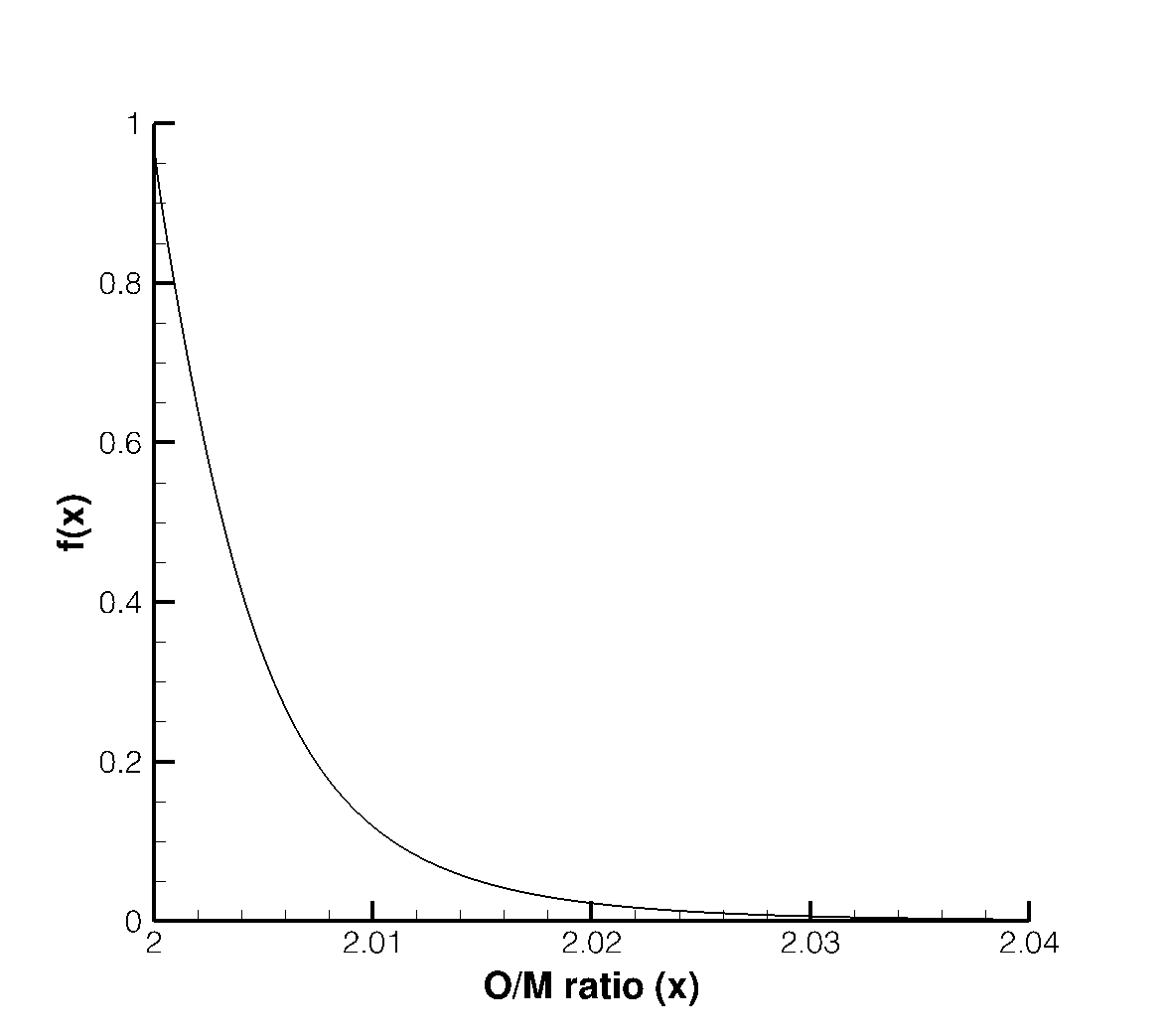
Figure 1: The function defining the dependence of the activation energies for thermal creep on the UO oxygen to metal ratio.
Transitional Stress
In MATPRO, a transition stress is defined to govern the transition between the first (low stress) and second (high stress) regions. When the applied stress is larger than the transition stress, the applied stress is used in the power-law relation and the transition stress is used in the linear creep relation. When the applied stress is lower than the transition stress, the applied stress is used in the linear relation and the power-law contribution is zero. Mai et al. (2010) investigated the MATPRO transition approach in comparison to experimental data and concluded that a better fit to the data could be achieved by simply ignoring the transition stress and applying both the low and high stress terms in all cases. This approach has been adopted in BISON.
MATPRO-Halden Creep Model
The low temperature irradiation creep (third term in Eq. (1)) requires further discussion. As the equation indicates, the original MATPRO formulation included exponential temperature dependence in this term. After a careful review of the MATPRO documentation and supporting literature, it is clear that this temperature dependency was based on a single experimental study (Brucklacher et al., 1973) involving only a very limited number of experiments. Additionally, this early study specified a relatively narrow applicability range for the correlation (523 K 773 K), which was not enforced in the MATPRO implementation. Several other studies, both early (Brucklacher and Dienst, 1972; Perrin, 1972; Solomon, 1973; Dienst, 1977) and more recent (Sakai et al., 2011; Sakai, 2013; Szoke and Tverberg, 2014), did not observe temperature dependency for low temperature irradiation creep, but reported creep rate variation as a function of only stress and fission rate. The most extensive data for irradiation creep of UO has been generated at the Halden Research Reactor, resulting in the following correlation (Sakai, 2013): (3) where A = .
The default model in BISON, which is referred to as the MATPRO-Halden model, replaces the third term in Eq. (1) with Eq. (3), thus removing temperature dependency. Note that the temperature dependent formulation can still be specified simply by providing the original MATPRO material constants (given in the table below) as input parameters.
Table 2: Irradiation creep material parameters for the original MATPRO model which included temperature dependence
| Parameter | Value |
|---|---|
| 1/K |
Example Input Syntax
[Materials<<<{"href": "../../../syntax/Materials/index.html"}>>>]
  [creep]
    type = UO2CreepUpdate<<<{"description": "Computes the secondary thermal and irradiation creep for UO2 LWR fuel. This material must be run in conjunction with ComputeMultipleInelasticStress.", "href": "UO2CreepUpdate.html"}>>>
    block<<<{"description": "The list of blocks (ids or names) that this object will be applied"}>>> = 1
    temperature<<<{"description": "Coupled temperature"}>>> = temp
    fission_rate<<<{"description": "Coupled fission rate"}>>> = fission_rate
    initial_grain_radius<<<{"description": "Fuel grain radius (m)"}>>> = 10.0e-6
    oxygen_to_metal_ratio<<<{"description": "Oxygen to metal ratio"}>>> = 2.0
  []
[]UO2CreepUpdate must be run in conjunction with the inelastic strain return mapping stress calculator as shown below:
[Materials<<<{"href": "../../../syntax/Materials/index.html"}>>>]
  [radial_return_stress]
    type = ComputeMultipleInelasticStress<<<{"description": "Compute state (stress and internal parameters such as plastic strains and internal parameters) using an iterative process.  Combinations of creep models and plastic models may be used.", "href": "../ComputeMultipleInelasticStress.html"}>>>
    tangent_operator<<<{"description": "Type of tangent operator to return.  'elastic': return the elasticity tensor.  'nonlinear': return the full, general consistent tangent operator."}>>> = elastic
    inelastic_models<<<{"description": "The material objects to use to calculate stress and inelastic strains. Note: specify creep models first and plasticity models second."}>>> = 'creep'
    block<<<{"description": "The list of blocks (ids or names) that this object will be applied"}>>> = 1
  []
[]Input Parameters
- a77.78e-37Coefficient on irradiation creep term
Default:7.78e-37
C++ Type:double
Unit:(no unit assumed)
Controllable:No
Description:Coefficient on irradiation creep term
- absolute_tolerance1e-11Absolute convergence tolerance for Newton iteration
Default:1e-11
C++ Type:double
Unit:(no unit assumed)
Controllable:No
Description:Absolute convergence tolerance for Newton iteration
- acceptable_multiplier10Factor applied to relative and absolute tolerance for acceptable convergence if iterations are no longer making progress
Default:10
C++ Type:double
Unit:(no unit assumed)
Controllable:No
Description:Factor applied to relative and absolute tolerance for acceptable convergence if iterations are no longer making progress
- adaptive_substeppingFalseUse adaptive substepping, where the number of substeps is successively doubled until the return mapping model successfully converges or the maximum number of substeps is reached.
Default:False
C++ Type:bool
Controllable:No
Description:Use adaptive substepping, where the number of substeps is successively doubled until the return mapping model successfully converges or the maximum number of substeps is reached.
- automatic_differentiation_return_mappingFalseWhether to use automatic differentiation to compute the derivative.
Default:False
C++ Type:bool
Controllable:No
Description:Whether to use automatic differentiation to compute the derivative.
- base_nameOptional parameter that defines a prefix for all material properties related to this stress update model. This allows for multiple models of the same type to be used without naming conflicts.
C++ Type:std::string
Controllable:No
Description:Optional parameter that defines a prefix for all material properties related to this stress update model. This allows for multiple models of the same type to be used without naming conflicts.
- blockThe list of blocks (ids or names) that this object will be applied
C++ Type:std::vector<SubdomainName>
Controllable:No
Description:The list of blocks (ids or names) that this object will be applied
- boundaryThe list of boundaries (ids or names) from the mesh where this object applies
C++ Type:std::vector<BoundaryName>
Controllable:No
Description:The list of boundaries (ids or names) from the mesh where this object applies
- burnup_functionBurnup function
C++ Type:BurnupFunctionName
Unit:(no unit assumed)
Controllable:No
Description:Burnup function
- constant_onNONEWhen ELEMENT, MOOSE will only call computeQpProperties() for the 0th quadrature point, and then copy that value to the other qps.When SUBDOMAIN, MOOSE will only call computeQpProperties() for the 0th quadrature point, and then copy that value to the other qps. Evaluations on element qps will be skipped
Default:NONE
C++ Type:MooseEnum
Options:NONE, ELEMENT, SUBDOMAIN
Controllable:No
Description:When ELEMENT, MOOSE will only call computeQpProperties() for the 0th quadrature point, and then copy that value to the other qps.When SUBDOMAIN, MOOSE will only call computeQpProperties() for the 0th quadrature point, and then copy that value to the other qps. Evaluations on element qps will be skipped
- declare_suffixAn optional suffix parameter that can be appended to any declared properties. The suffix will be prepended with a '_' character.
C++ Type:MaterialPropertyName
Unit:(no unit assumed)
Controllable:No
Description:An optional suffix parameter that can be appended to any declared properties. The suffix will be prepended with a '_' character.
- fission_rateCoupled fission rate
C++ Type:std::vector<VariableName>
Unit:(no unit assumed)
Controllable:No
Description:Coupled fission rate
- initial_grain_radius1e-05Fuel grain radius (m)
Default:1e-05
C++ Type:double
Unit:(no unit assumed)
Controllable:No
Description:Fuel grain radius (m)
- max_inelastic_increment0.0001The maximum inelastic strain increment allowed in a time step
Default:0.0001
C++ Type:double
Unit:(no unit assumed)
Controllable:No
Description:The maximum inelastic strain increment allowed in a time step
- maximum_number_substeps25The maximum number of substeps allowed before cutting the time step.
Default:25
C++ Type:unsigned int
Controllable:No
Description:The maximum number of substeps allowed before cutting the time step.
- oxygen_to_metal_ratio2Oxygen to metal ratio
Default:2
C++ Type:double
Unit:(no unit assumed)
Controllable:No
Description:Oxygen to metal ratio
- po2_fraction0Weight fraction of PO2
Default:0
C++ Type:double
Unit:(no unit assumed)
Controllable:No
Description:Weight fraction of PO2
- q30Activation energy for irradiation creep, divided by gas constant (1/K)
Default:0
C++ Type:double
Unit:(no unit assumed)
Controllable:No
Description:Activation energy for irradiation creep, divided by gas constant (1/K)
- relative_tolerance1e-08Relative convergence tolerance for Newton iteration
Default:1e-08
C++ Type:double
Unit:(no unit assumed)
Controllable:No
Description:Relative convergence tolerance for Newton iteration
- use_substep_integration_errorFalseIf true, it establishes a substep size that will yield, at most,the creep numerical integration error given by substep_strain_tolerance.
Default:False
C++ Type:bool
Controllable:No
Description:If true, it establishes a substep size that will yield, at most,the creep numerical integration error given by substep_strain_tolerance.
- use_substeppingNONEWhether and how to use substepping
Default:NONE
C++ Type:MooseEnum
Options:NONE, ERROR_BASED, INCREMENT_BASED
Controllable:No
Description:Whether and how to use substepping
Optional Parameters
- apply_strainTrueFlag to apply strain. Used for testing.
Default:True
C++ Type:bool
Controllable:No
Description:Flag to apply strain. Used for testing.
- control_tagsAdds user-defined labels for accessing object parameters via control logic.
C++ Type:std::vector<std::string>
Controllable:No
Description:Adds user-defined labels for accessing object parameters via control logic.
- effective_inelastic_strain_nameeffective_creep_strainName of the material property that stores the effective inelastic strain
Default:effective_creep_strain
C++ Type:std::string
Controllable:No
Description:Name of the material property that stores the effective inelastic strain
- enableTrueSet the enabled status of the MooseObject.
Default:True
C++ Type:bool
Controllable:Yes
Description:Set the enabled status of the MooseObject.
- implicitTrueDetermines whether this object is calculated using an implicit or explicit form
Default:True
C++ Type:bool
Controllable:No
Description:Determines whether this object is calculated using an implicit or explicit form
- seed0The seed for the master random number generator
Default:0
C++ Type:unsigned int
Controllable:No
Description:The seed for the master random number generator
- substep_strain_tolerance0.1Maximum ratio of the initial elastic strain increment at start of the return mapping solve to the maximum inelastic strain allowable in a single substep. Reduce this value to increase the number of substeps
Default:0.1
C++ Type:double
Unit:(no unit assumed)
Controllable:No
Description:Maximum ratio of the initial elastic strain increment at start of the return mapping solve to the maximum inelastic strain allowable in a single substep. Reduce this value to increase the number of substeps
- use_displaced_meshFalseWhether or not this object should use the displaced mesh for computation. Note that in the case this is true but no displacements are provided in the Mesh block the undisplaced mesh will still be used.
Default:False
C++ Type:bool
Controllable:No
Description:Whether or not this object should use the displaced mesh for computation. Note that in the case this is true but no displacements are provided in the Mesh block the undisplaced mesh will still be used.
Advanced Parameters
- internal_solve_full_iteration_historyFalseSet true to output full internal Newton iteration history at times determined by `internal_solve_output_on`. If false, only a summary is output.
Default:False
C++ Type:bool
Controllable:No
Description:Set true to output full internal Newton iteration history at times determined by `internal_solve_output_on`. If false, only a summary is output.
- internal_solve_output_onon_errorWhen to output internal Newton solve information
Default:on_error
C++ Type:MooseEnum
Options:never, on_error, always
Controllable:No
Description:When to output internal Newton solve information
Debug Parameters
- output_propertiesList of material properties, from this material, to output (outputs must also be defined to an output type)
C++ Type:std::vector<std::string>
Controllable:No
Description:List of material properties, from this material, to output (outputs must also be defined to an output type)
- outputsnone Vector of output names where you would like to restrict the output of variables(s) associated with this object
Default:none
C++ Type:std::vector<OutputName>
Controllable:No
Description:Vector of output names where you would like to restrict the output of variables(s) associated with this object
Outputs Parameters
- prop_getter_suffixAn optional suffix parameter that can be appended to any attempt to retrieve/get material properties. The suffix will be prepended with a '_' character.
C++ Type:MaterialPropertyName
Unit:(no unit assumed)
Controllable:No
Description:An optional suffix parameter that can be appended to any attempt to retrieve/get material properties. The suffix will be prepended with a '_' character.
- use_interpolated_stateFalseFor the old and older state use projected material properties interpolated at the quadrature points. To set up projection use the ProjectedStatefulMaterialStorageAction.
Default:False
C++ Type:bool
Controllable:No
Description:For the old and older state use projected material properties interpolated at the quadrature points. To set up projection use the ProjectedStatefulMaterialStorageAction.
Material Property Retrieval Parameters
Input Files
- (assessment/LWR/validation/LOCA_IFA_650/analysis/IFA_650_4/IFA_650_4_part2_gas_communication.i)
- (assessment/LWR/validation/LOCA_IFA_650/analysis/IFA_650_9/IFA_650_9_part1.i)
- (assessment/LWR/validation/LOCA_IFA_650/analysis/IFA_650_10/IFA_650_10_part2.i)
- (test/tests/solid_mechanics/uo2_mechanics/uo2_creep_matpro_pr.i)
- (assessment/LWR/validation/LOCA_Studsvik/analysis/rod_196/Studsvik_196_part2_1p5d_fr_ffrd.i)
- (assessment/LWR/validation/LOCA_IFA_650/analysis/IFA_650_4/IFA_650_4_part1_gas_communication.i)
- (test/tests/solid_mechanics/uo2_creep/adUo2_creep_smeared_cracking.i)
- (assessment/LWR/validation/Super_Ramp/analysis/Super_Ramp_Base.i)
- (test/tests/solid_mechanics/uo2_creep/uo2_creep_rate.i)
- (assessment/LWR/validation/Super_Ramp/analysis/PK62/PK62_weighted_gap_VCP.i)
- (examples/2D_plane_strain_fretting_wear/fretting-wear-initial.i)
- (assessment/LWR/validation/LOCA_IFA_650/analysis/IFA_650_4/IFA_650_4_part1.i)
- (test/tests/solid_mechanics/uo2_eigenstrains/uo2_relocation/relo_recov_fuel_rod.i)
- (assessment/LWR/validation/LOCA_IFA_650/analysis/IFA_650_4/IFA_650_4_part2.i)
- (test/tests/solid_mechanics/uo2_mechanics/uo2_creep_matpro_none.i)
- (assessment/LWR/validation/LOCA_Studsvik/analysis/rod_191/Studsvik_191_part2_1p5d_fr_frd.i)
- (examples/2D-RZ_rodlet_10pellets/smeared_cracking/SmearedCracking.i)
- (examples/2D-RZ_rodlet_10pellets/smeared_cracking/ADSmearedCracking.i)
- (assessment/LWR/validation/LOCA_Studsvik/analysis/rod_196/Studsvik_196_part1.i)
- (assessment/LWR/validation/LOCA_Studsvik/analysis/rod_191/Studsvik_191_part1.i)
- (test/tests/solid_mechanics/uo2_creep/adUo2_creep.i)
- (test/tests/solid_mechanics/uo2_creep/uo2_creep.i)
- (examples/accident_tolerant_fuel/uo2_coated_zircaloy/uo2_coated_zircaloy.i)
- (assessment/LWR/validation/LOCA_Studsvik/analysis/rod_196/Studsvik_196_part1_1p5d_fr_ffrd.i)
- (assessment/LWR/validation/LOCA_IFA_650/analysis/IFA_650_9/IFA_650_9_part2.i)
- (test/tests/solid_mechanics/uo2_creep/adUo2_creep_rate.i)
- (assessment/LWR/validation/LOCA_Studsvik/analysis/rod_191/Studsvik_191_part1_1p5d_fr_frd.i)
- (examples/2D_plane_strain_rod/planestrain.i)
- (test/tests/solid_mechanics/uo2_creep/uo2_creep_x01.i)
- (assessment/LWR/validation/IFA_677/analysis/IFA_677_Base.i)
- (test/tests/solid_mechanics/uo2_creep/uo2_creep_irradiation.i)
- (assessment/LWR/validation/LOCA_IFA_650/analysis/IFA_650_10/IFA_650_10_part1.i)
- (assessment/LWR/validation/IFA_716/analysis/IFA_716_Base.i)
- (examples/accident_tolerant_fuel/uo2_fecral/uo2_fecral.i)
- (examples/2D_plane_strain_fretting_wear/fretting-wear-initial-dyn-exc.i)
- (assessment/LWR/validation/LOCA_Studsvik/analysis/rod_196/Studsvik_196_part2.i)
- (assessment/LWR/validation/LOCA_IFA_650/analysis/IFA_650_4/IFA_650_4_part3_gas_communication.i)
- (assessment/LWR/validation/LOCA_Studsvik/analysis/rod_191/Studsvik_191_part2.i)
- (test/tests/solid_mechanics/uo2_creep/adUo2_creep_rz.i)
- (test/tests/solid_mechanics/uo2_hotpressing/hotpressing_creep_plasticity.i)
- (test/tests/solid_mechanics/uo2_mechanics/uo2_creep_matpro_ym.i)
- (test/tests/solid_mechanics/uo2_hotpressing/creep_plasticity.i)
- (test/tests/solid_mechanics/uo2_creep/uo2_creep_smeared_cracking.i)
- (assessment/LWR/validation/US_PWR_16_x_16/analysis/TSQ002/cracking/TSQ002_cracking.i)
- (assessment/LWR/validation/Riso_GE7_ZX115/analysis/cracking_creep/Riso_GE7_smeared_cracking_creep.i)
- (test/tests/solid_mechanics/uo2_creep/uo2_creep_rz.i)
Child Objects
References
- C. M. Allison, G. A. Berna, R. Chambers, E. W. Coryell, K. L. Davis, D. L. Hagrman, D. T. Hagrman, N. L. Hampton, J. K. Hohorst, R. E. Mason, M. L. McComas, K. A. McNeil, R. L. Miller, C. S. Olsen, G. A. Reymann, and L. J. Siefken.
SCDAP/RELAP5/MOD3.1 code manual, volume IV: MATPRO-A library of materials properties for light-water-reactor accident analysis.
Technical Report NUREG/CR-6150, EGG-2720, Idaho National Engineering Laboratory, 1993.[BibTeX]
@TECHREPORT{hagrman93, author = "Allison, C. M. and Berna, G. A. and Chambers, R. and Coryell, E. W. and Davis, K. L. and Hagrman, D. L. and Hagrman, D. T. and Hampton, N. L. and Hohorst, J. K. and Mason, R. E. and McComas, M. L. and McNeil, K. A. and Miller, R. L. and Olsen, C. S. and Reymann, G. A. and Siefken, L. J.", editor = "Hagrman, D. T.", title = "{SCDAP/RELAP5/MOD3.1} Code Manual, Volume {IV}: {MATPRO}-{A} Library of Materials Properties for Light-Water-Reactor Accident Analysis", institution = "Idaho National Engineering Laboratory", year = "1993", number = "NUREG/CR-6150, EGG-2720" } - D. Brucklacher and W. Dienst.
Creep behavior of ceramic nuclear fuels under neutron irradiation.
Journal of Nuclear Materials, 42(3):285–296, 1972.
doi:10.1016/0022-3115(72)90079-7.[BibTeX]
@article{brucklacher_et_al_1972, author = "Brucklacher, D. and Dienst, W.", title = "Creep behavior of ceramic nuclear fuels under neutron irradiation", journal = "Journal of Nuclear Materials", year = "1972", volume = "42", number = "3", pages = "285-296", doi = "10.1016/0022-3115(72)90079-7" } - D. Brucklacher, W. Dienst, and F. Thummler.
Creep behavior of oxide fuels under neutron irradiation, Paper 251.
In Proceedings REAKTORTAGUNG 1973 des Deutschen Atomforums/KTG held in Karlsruhe, 413–416. Apr 10-13 1973.[BibTeX]
@INPROCEEDINGS{brucklacher_et_al_1973, author = "Brucklacher, D. and Dienst, W. and Thummler, F.", title = "Creep Behavior of Oxide Fuels Under Neutron Irradiation, {P}aper 251", booktitle = "Proceedings {REAKTORTAGUNG} 1973 des Deutschen Atomforums/{KTG} held in Karlsruhe", year = "1973", month = "Apr 10-13", pages = "413-416" } - W. Dienst.
Irradiation induced creep of ceramic materials.
Journal of Nuclear Materials, 65:1–8, 1977.
doi:10.1016/0022-3115(77)90035-6.[BibTeX]
@article{dienst_1977, author = "Dienst, W.", title = "Irradiation induced creep of ceramic materials", journal = "Journal of Nuclear Materials", year = "1977", volume = "65", pages = "1-8", doi = "10.1016/0022-3115(77)90035-6" } - A. T. Mai, W. F. Lyon, R. O. Montgomery, and R. S. Dunham.
An evaluation of the MATPRO fuel creep model using the FALCON fuel analysis code.
Trans. Am. Nucl. Soc., 102:888–889, 2010.[BibTeX]
@ARTICLE{mai2010, author = "Mai, A. T. and Lyon, W. F. and Montgomery, R. O. and Dunham, R. S.", title = "An Evaluation of the {MATPRO} Fuel Creep Model Using the {FALCON} Fuel Analysis Code", journal = "Trans. Am. Nucl. Soc.", year = "2010", volume = "102", pages = "888-889" } - J. S. Perrin.
Effect of irradiation on creep of UO_2-PuO_2.
Journal of Nuclear Materials, 42:101–104, 1972.[BibTeX]
@article{perrin_1972, author = "Perrin, J. S.", title = "Effect of irradiation on creep of {UO}\_2-{P}u{O}\_2", journal = "Journal of Nuclear Materials", year = "1972", volume = "42", pages = "101-104" } - K. Sakai.
The fuel creep test IFA-701: results after four irradiation cycles.
Technical Report HWR-1039, OECD Halden Reactor Project, 2013.[BibTeX]
@TECHREPORT{hwr-1039, author = "Sakai, K.", title = "The fuel creep test {IFA}-701: results after four irradiation cycles", institution = "OECD Halden Reactor Project", year = "2013", number = "HWR-1039" } - K. Sakai, H. Hanakawa, and T. Tverberg.
Investigation of fission induced creep of UO2 and Cr-doped fuel in IFA-701.
Technical Report HWR-1006, OECD Halden Reactor Project, 2011.[BibTeX]
@TECHREPORT{hwr-1006, author = "Sakai, K. and Hanakawa, H. and Tverberg, T.", title = "Investigation of fission induced creep of {UO2} and {C}r-doped fuel in {IFA}-701", institution = "OECD Halden Reactor Project", year = "2011", number = "HWR-1006" } - A. A. Solomon.
Radiation induced creep of UO_2.
American Ceramic Society, 56(3):164–171, 1973.
doi:10.1111/j.1151-2916.1973.tb15435.x.[BibTeX]
@article{solomon_1973, author = "Solomon, A. A.", title = "Radiation induced creep of {UO}\_2", journal = "American Ceramic Society", year = "1973", volume = "56", number = "3", doi = "10.1111/j.1151-2916.1973.tb15435.x", pages = "164-171" } - R. Szoke and T. Tverberg.
Update on in-pile results from the fuel creep test IFA-701.
Technical Report HWR-1092, OECD Halden Reactor Project, 2014.[BibTeX]
@TECHREPORT{hwr-1092,
    author = "Szoke, R. and Tverberg, T.",
    title = "Update on in-pile results from the fuel creep test {IFA}-701",
    institution = "OECD Halden Reactor Project",
    year = "2014",
    number = "HWR-1092"
}
(test/tests/solid_mechanics/uo2_creep/uo2_creep_irradiation.i)
# Tests material model CreepUO2, which computes the combined thermal and
#   irradiation creep for UO2 fuel. This test is specifically designed
#   to verify the non temperature dependent irradiation creep option, which
#   differs from the original MATPRO correlation (which included temperature
#   dependence via an exponential term). The material parameters for the irradiation
#   creep term (code defaults) are:
#
#     A7 = 7.78e-37
#     Q3 = 0
#
# The test is a single element unit cube which is pulled in the y direction
#   with a pressure of 5.0e6 Pa. The temperature and fission rate within the cube
#   are uniform and constant at 600 K and 2e19 fissios/m**3-s. The total time is
#   1e6, which is solved in 10 equal steps of 1e5.

# The small-strain anaytical solution for the total y displacement at time=1e6s is:
#   y_disp = elastic_component + irradiation_creep_component + thermal_creep_component
#          = (uniaxial_stress/elastic_modulus)*cube_height + (A7*mises_stress*fission_rate)*time + negligible
#          = (5e6/2e11)*1 + (7.78e-37*5e6*2e19)*1e6
#          = 1.02800e-4.
#
# BISON gets 1.02805e-4 using large deformation solid mechanics. The difference in the two solutions is 0.005%.

[GlobalParams]
  density = 10431.0
  displacements = 'disp_x disp_y disp_z'
  order = FIRST
  family = LAGRANGE
[]

[Mesh]
  [mesh]
    type = FileMeshGenerator
    file = 1x1x1_cube.e
  []
[]

[Variables]
  [disp_x]
  []
  [disp_y]
  []
  [disp_z]
  []
  [temp]
    initial_condition = 600.0
  []
[]

[AuxVariables]
  [fission_rate]
  []
  [stress_yy]
    order = CONSTANT
    family = MONOMIAL
  []
[]

[Functions]
  [top_pull]
    type = PiecewiseLinear
    x = '0 1'
    y = '1 1'
  []
[]

[Physics/SolidMechanics/QuasiStatic]
  [all]
    strain = finite
  []
[]

[Kernels]
  [heat]
    type = HeatConduction
    variable = temp
  []
  [heat_ie]
    type = HeatConductionTimeDerivative
    variable = temp
  []
[]


[AuxKernels]
  [fissionrate]
    type = FissionRateGeneral
    fission_rate_formulation = GENERIC
    variable = fission_rate
    value = 2.0e19
  []
  [stress_yy]
    type = RankTwoAux
    rank_two_tensor = stress
    variable = stress_yy
    index_i = 1
    index_j = 1
  []
[]


[BCs]
  [u_top_pull]
    type = Pressure
    variable = disp_y
    boundary = 5
    factor = -5e6
    function = top_pull
  []
  [u_bottom_fix]
    type = DirichletBC
    variable = disp_y
    boundary = 3
    value = 0.0
  []
  [u_yz_fix]
    type = DirichletBC
    variable = disp_x
    boundary = 4
    value = 0.0
  []
  [u_xy_fix]
    type = DirichletBC
    variable = disp_z
    boundary = 2
    value = 0.0
  []
  [temp_top_bottom_fix]
    type = DirichletBC
    variable = temp
    boundary = '3 5'
    value = 600.0
  []
[]

[Materials]
  [elasticity_tensor]
    type = ComputeIsotropicElasticityTensor
    block = 1
    youngs_modulus = 2e11
    poissons_ratio = 0.3
  []
  [creep]
    type = UO2CreepUpdate
    block = 1
    temperature = temp
    fission_rate = fission_rate
    initial_grain_radius = 10.0e-6
    oxygen_to_metal_ratio = 2.0
  []
  [radial_return_stress]
    type = ComputeMultipleInelasticStress
    tangent_operator = elastic
    inelastic_models = 'creep'
    block = 1
  []
  [thermal]
    type = HeatConductionMaterial
    block = 1
    specific_heat = 1.0
    thermal_conductivity = 100.
  []
  [density]
    type = StrainAdjustedDensity
    block = 1
    strain_free_density = 10431.0
  []
[]

[Executioner]
  type = Transient

  solve_type = PJFNK

  petsc_options = '-snes_ksp_ew'
  petsc_options_iname = '-ksp_gmres_restart'
  petsc_options_value = '101'


  line_search = 'none'


  l_max_its = 100
  nl_max_its = 100
  nl_rel_tol = 1e-8
  nl_abs_tol = 1e-10
  l_tol = 1e-5
  start_time = 0.0
  num_steps = 10
  dt = 100000
[]

[Outputs]
  exodus = true
[]
(test/tests/solid_mechanics/uo2_creep/uo2_creep_irradiation.i)
# Tests material model CreepUO2, which computes the combined thermal and
#   irradiation creep for UO2 fuel. This test is specifically designed
#   to verify the non temperature dependent irradiation creep option, which
#   differs from the original MATPRO correlation (which included temperature
#   dependence via an exponential term). The material parameters for the irradiation
#   creep term (code defaults) are:
#
#     A7 = 7.78e-37
#     Q3 = 0
#
# The test is a single element unit cube which is pulled in the y direction
#   with a pressure of 5.0e6 Pa. The temperature and fission rate within the cube
#   are uniform and constant at 600 K and 2e19 fissios/m**3-s. The total time is
#   1e6, which is solved in 10 equal steps of 1e5.

# The small-strain anaytical solution for the total y displacement at time=1e6s is:
#   y_disp = elastic_component + irradiation_creep_component + thermal_creep_component
#          = (uniaxial_stress/elastic_modulus)*cube_height + (A7*mises_stress*fission_rate)*time + negligible
#          = (5e6/2e11)*1 + (7.78e-37*5e6*2e19)*1e6
#          = 1.02800e-4.
#
# BISON gets 1.02805e-4 using large deformation solid mechanics. The difference in the two solutions is 0.005%.

[GlobalParams]
  density = 10431.0
  displacements = 'disp_x disp_y disp_z'
  order = FIRST
  family = LAGRANGE
[]

[Mesh]
  [mesh]
    type = FileMeshGenerator
    file = 1x1x1_cube.e
  []
[]

[Variables]
  [disp_x]
  []
  [disp_y]
  []
  [disp_z]
  []
  [temp]
    initial_condition = 600.0
  []
[]

[AuxVariables]
  [fission_rate]
  []
  [stress_yy]
    order = CONSTANT
    family = MONOMIAL
  []
[]

[Functions]
  [top_pull]
    type = PiecewiseLinear
    x = '0 1'
    y = '1 1'
  []
[]

[Physics/SolidMechanics/QuasiStatic]
  [all]
    strain = finite
  []
[]

[Kernels]
  [heat]
    type = HeatConduction
    variable = temp
  []
  [heat_ie]
    type = HeatConductionTimeDerivative
    variable = temp
  []
[]


[AuxKernels]
  [fissionrate]
    type = FissionRateGeneral
    fission_rate_formulation = GENERIC
    variable = fission_rate
    value = 2.0e19
  []
  [stress_yy]
    type = RankTwoAux
    rank_two_tensor = stress
    variable = stress_yy
    index_i = 1
    index_j = 1
  []
[]


[BCs]
  [u_top_pull]
    type = Pressure
    variable = disp_y
    boundary = 5
    factor = -5e6
    function = top_pull
  []
  [u_bottom_fix]
    type = DirichletBC
    variable = disp_y
    boundary = 3
    value = 0.0
  []
  [u_yz_fix]
    type = DirichletBC
    variable = disp_x
    boundary = 4
    value = 0.0
  []
  [u_xy_fix]
    type = DirichletBC
    variable = disp_z
    boundary = 2
    value = 0.0
  []
  [temp_top_bottom_fix]
    type = DirichletBC
    variable = temp
    boundary = '3 5'
    value = 600.0
  []
[]

[Materials]
  [elasticity_tensor]
    type = ComputeIsotropicElasticityTensor
    block = 1
    youngs_modulus = 2e11
    poissons_ratio = 0.3
  []
  [creep]
    type = UO2CreepUpdate
    block = 1
    temperature = temp
    fission_rate = fission_rate
    initial_grain_radius = 10.0e-6
    oxygen_to_metal_ratio = 2.0
  []
  [radial_return_stress]
    type = ComputeMultipleInelasticStress
    tangent_operator = elastic
    inelastic_models = 'creep'
    block = 1
  []
  [thermal]
    type = HeatConductionMaterial
    block = 1
    specific_heat = 1.0
    thermal_conductivity = 100.
  []
  [density]
    type = StrainAdjustedDensity
    block = 1
    strain_free_density = 10431.0
  []
[]

[Executioner]
  type = Transient

  solve_type = PJFNK

  petsc_options = '-snes_ksp_ew'
  petsc_options_iname = '-ksp_gmres_restart'
  petsc_options_value = '101'


  line_search = 'none'


  l_max_its = 100
  nl_max_its = 100
  nl_rel_tol = 1e-8
  nl_abs_tol = 1e-10
  l_tol = 1e-5
  start_time = 0.0
  num_steps = 10
  dt = 100000
[]

[Outputs]
  exodus = true
[]
(assessment/LWR/validation/LOCA_IFA_650/analysis/IFA_650_4/IFA_650_4_part2_gas_communication.i)
[GlobalParams]
  density = 10452.96
  initial_porosity = 0.048
  order = SECOND
  family = LAGRANGE
  displacements = disp_x
  temperature = temperature
  energy_per_fission = 3.2e-11 #J/fission
[]

[Problem]
  type = ReferenceResidualProblem
  reference_vector = 'ref'
  extra_tag_vectors = 'ref'
  acceptable_multiplier = 10
  restart_file_base = 'IFA_650_4_part1_gas_communication_checkpoint_cp/LATEST'
[]

[Mesh]
  coord_type = RZ
  [layered1D_mesh]
    type = Layered1DMeshGenerator
    slices_per_block = 30
    slices_within_upper_plenum = 3
    pellet_outer_radius = 4.565e-3
    clad_gap_width = 0.085e-3
    clad_thickness = 0.725e-3
    fuel_height = 0.480
    plenum_height = 0.291185
    pellet_mesh_density = customize
    clad_mesh_density = customize
    nx_p = 11
    nx_c = 5
  []
  patch_update_strategy = auto
  partitioner = centroid
  centroid_partitioner_direction = y
[]

[Variables]
  [disp_x]
  []
  [temperature]
  []
[]

[Functions]
  [power_history]
    type = PiecewiseLinear
    data_file = power_history.csv
    scale_factor = 1.0
    format = columns
  []
  [axial_peaking_factors]
    type = PiecewiseBilinear
    data_file = axial_peaking_factors.csv
    axis = 1
    scale_factor = 1
  []
  [pressure_ramp]
    type = PiecewiseLinear
    data_file = coolant_pressure.csv
    scale_factor = 1
    format = columns
  []
  [average_htc]
    type = PiecewiseLinear
    data_file = average_coolant_htc.csv
    format = columns
    scale_factor = 1
  []
  [forced_times]
    type = PiecewiseLinear
    data_file = timestep_limiting.csv
    scale_factor = 1
    format = columns
  []
  [heat_sink_temperature]
    type = PiecewiseBilinear
    data_file = heater_temp.csv
    scale_factor = 1
    axis = 1
  []
  [clad_outer_temperature]
    type = PiecewiseBilinear
    data_file = clad_surface_temp.csv
    scale_factor = 1
    axis = 1
  []
  [heat_transfer_mode]
    type = PiecewiseConstant
    x = '-200  172489073 172489661'
    y = '9  9          8       '
    direction = 'right'
  []
  [clad_axial_pressure]
    type = CladdingAxialPressureFunction
    plenum_pressure = plenum_pressure
    coolant_pressure = pressure_ramp
    coolant_pressure_scaling_factor = 1.0
    fuel_pin_geometry = fuel_pin_geometry
  []
  [fuel_axial_pressure]
    type = ParsedFunction
    expression = plenum_pressure
    symbol_names = plenum_pressure
    symbol_values = plenum_pressure
  []
[]

[AuxVariables]
  [disp_y]
  []
  [disp_z]
  []
  [fast_neutron_flux]
    block = clad
  []
  [fast_neutron_fluence]
    block = clad
  []
  [grain_radius]
    block = fuel
  []
  [hoop_stress]
    order = CONSTANT
    family = MONOMIAL
  []
  [effective_creep_strain]
    block = clad
    order = CONSTANT
    family = MONOMIAL
  []
  [fract_beta_phase]
    order = CONSTANT
    family = MONOMIAL
  []
  [oxide_thickness]
    order = CONSTANT
    family = MONOMIAL
  []
  [burst]
    order = CONSTANT
    family = MONOMIAL
  []
  [gap_conductance]
    order = CONSTANT
    family = MONOMIAL
  []
  [coolant_htc]
    order = CONSTANT
    family = MONOMIAL
  []
  [creep_rate]
    order = CONSTANT
    family = MONOMIAL
  []
  [gap_thermal_conductivity]
    order = CONSTANT
    family = MONOMIAL
  []
  [layered_maximum_clad_radius]
    order = CONSTANT
    family = MONOMIAL
  []
  [layered_maximum_fuel_radius]
    order = FIRST
    family = LAGRANGE
  []
  [gap_layer_pressure]
    order = CONSTANT
    family = MONOMIAL
  []
  [gap_layer_moles]
    order = CONSTANT
    family = MONOMIAL
  []
  [gap_layer_mole_rate]
    order = CONSTANT
    family = MONOMIAL
  []
  [gap_layer_temperature]
    order = CONSTANT
    family = MONOMIAL
  []
  [gap_layer_volume]
    order = CONSTANT
    family = MONOMIAL
  []
  [plenum_layer_pressure]
    order = CONSTANT
    family = MONOMIAL
  []
  [total_moles]
    order = CONSTANT
    family = MONOMIAL
  []
[]

[Kernels]
  [heat]
    type = HeatConduction
    variable = temperature
    extra_vector_tags = 'ref'
  []
  [heat_ie]
    type = HeatConductionTimeDerivative
    variable = temperature
    extra_vector_tags = 'ref'
  []
  [heat_source]
    type = NeutronHeatSource
    variable = temperature
    block = fuel
    burnup_function = burnup
    axial_relocation_object = axial_relocation
    extra_vector_tags = 'ref'
  []
[]

[Physics]
  [SolidMechanics]
    [Layered1D]
      [fuel]
        add_scalar_variables = true
        out_of_plane_strain_name = strain_yy
        fuel_pin_geometry = fuel_pin_geometry
        out_of_plane_pressure_function = fuel_axial_pressure
        strain = finite
        block = fuel
        eigenstrain_names = 'fuel_thermal_strain fuel_swelling_strain fuel_relocation_strain axial_relocation_eigenstrain'
        decomposition_method = EigenSolution
        generate_output = 'stress_xx stress_yy stress_zz vonmises_stress'
        extra_vector_tags = 'ref'
        group_scalar_vars_in_reference_residual = true
        mesh_generator = layered1D_mesh
      []
      [clad]
        add_scalar_variables = true
        out_of_plane_strain_name = strain_yy
        fuel_pin_geometry = fuel_pin_geometry
        strain = finite
        out_of_plane_pressure_function = clad_axial_pressure
        block = clad
        eigenstrain_names = 'clad_thermal_strain clad_irradiation_strain'
        generate_output = 'stress_xx stress_yy stress_zz vonmises_stress strain_zz creep_strain_zz'
        decomposition_method = EigenSolution
        extra_vector_tags = 'ref'
        group_scalar_vars_in_reference_residual = true
        mesh_generator = layered1D_mesh
      []
    []
  []
[]

[Burnup]
  [burnup]
    block = fuel
    rod_ave_lin_pow = power_history
    axial_power_profile = axial_peaking_factors
    num_radial = 80
    num_axial = 11
    fuel_pin_geometry = fuel_pin_geometry
    fuel_volume_ratio = 1.0
    order = CONSTANT
    family = MONOMIAL
    RPF = RPF
    isotopes = 'U235 U238 Pu239 Pu240 Pu241 Pu242'
    isotope_fractions = '0.035 0.965 0 0 0 0'
  []
[]

[AuxKernels]
  [fast_neutron_flux]
    type = FastNeutronFluxAux
    block = clad
    variable = fast_neutron_flux
    rod_ave_lin_pow = power_history
    axial_power_profile = axial_peaking_factors
    factor = 3e13
    execute_on = timestep_begin
  []
  [fast_neutron_fluence]
    type = FastNeutronFluenceAux
    block = clad
    variable = fast_neutron_fluence
    fast_neutron_flux = fast_neutron_flux
    execute_on = timestep_begin
  []
  [grain_radius]
    type = GrainRadiusAux
    block = fuel
    variable = grain_radius
    temperature = temperature
    execute_on = linear
  []
  [hoop_stress]
    type = RankTwoScalarAux
    rank_two_tensor = stress
    variable = hoop_stress
    scalar_type = HoopStress
    execute_on = timestep_end
  []
  [effective_creep_strain]
    type = MaterialRealAux
    block = clad
    variable = effective_creep_strain
    property = effective_creep_strain
    execute_on = 'timestep_end'
  []
  [layered_maximum_fuel_radius]
    type = SpatialUserObjectAux
    block = fuel
    user_object = layered_maximum_fuel_radius
    variable = layered_maximum_fuel_radius
    execute_on = 'TIMESTEP_BEGIN'
  []
  [gap_layer_pressure]
    type = AxialGasCommunicationAux
    axial_gas_communication = axial_gas_communication
    variable = gap_layer_pressure
    output_option = 'LAYER_PRESSURE'
    execute_on = 'final timestep_end'
  []
  [gap_layer_moles]
    type = AxialGasCommunicationAux
    axial_gas_communication = axial_gas_communication
    output_option = 'LAYER_MOLES'
    variable = gap_layer_moles
    execute_on = 'timestep_end'
  []
  [gap_layer_mole_rate]
    type = AxialGasCommunicationAux
    axial_gas_communication = axial_gas_communication
    output_option = 'PLENUM_MOLE_RATE'
    variable = gap_layer_mole_rate
    execute_on = 'timestep_end'
  []
  [gap_layer_temperature]
    type = SpatialUserObjectAux
    user_object = gap_layer_temperature
    variable = gap_layer_temperature
    execute_on = 'timestep_end'
  []
  [gap_layer_volume]
    type = AxialGasCommunicationAux
    axial_gas_communication = axial_gas_communication
    output_option = 'LAYER_VOLUME'
    variable = gap_layer_volume
    execute_on = 'timestep_end'
  []
  [total_moles]
    type = AxialGasCommunicationAux
    axial_gas_communication = axial_gas_communication
    output_option = 'TOTAL_MOLES'
    variable = total_moles
    execute_on = 'TIMESTEP_END'
  []
  [fract_bphase]
    type = MaterialRealAux
    block = clad
    variable = fract_beta_phase
    property = fract_beta_phase
    execute_on = 'initial linear'
  []
  [oxide_thickness]
    type = MaterialRealAux
    boundary = 2
    variable = oxide_thickness
    property = oxide_scale_thickness
    execute_on = 'initial linear'
  []
  [hasburst]
    type = MaterialRealAux
    boundary = 2
    variable = burst
    property = failed
    execute_on = timestep_end
  []
  [conductance]
    type = MaterialRealAux
    boundary = 10
    property = gap_conductance
    variable = gap_conductance
    execute_on = 'initial linear'
  []
  [coolant_htc]
    type = MaterialRealAux
    property = coolant_channel_htc
    variable = coolant_htc
    boundary = 2
    execute_on = 'initial linear'
  []
  [creep_rate]
    type = MaterialRealAux
    block = clad
    variable = creep_rate
    property = creep_rate
    execute_on = timestep_end
  []
  [gas_th_cond]
    type = MaterialRealAux
    variable = gap_thermal_conductivity
    property = gap_conductivity
    boundary = 10
    execute_on = 'initial linear'
  []
[]

[AxialRelocation]
  [relocation]
    mesh_generator = layered1D_mesh
    rod_ave_lin_pow = power_history
    axial_direction = y
    fuel_blocks = fuel
    clad_blocks = clad
    contact_pressure_variable = contact_pressure
    out_of_plane_strain_variable = strain_yy
    penetration_variable = penetration
    clad_inner_volume_addition = 3.17755E-06 # Addition of the volume to bring the starting total volume to 21.5cm^3 to begin the transient experiment
    burnup_variable = burnup
    temperature = temperature
    axial_relocation_output_options = 'MASS_FRACTION PACKING_FRACTION'
    use_axial_gas_communication = true
  []
[]

[CoolantChannel]
  [convective_clad_surface] # apply convective boundary to clad outer surface
    boundary = 2
    variable = temperature
    heat_transfer_mode = heat_transfer_mode
    heat_transfer_coefficient = average_htc # Calculated from an initial simulation of the base irradiation using the inlet_pressure, inlet_massflux, and inlet_temperature commented out below.
    inlet_temperature = heat_sink_temperature # K
    effective_emissivity = 0.75
    # inlet_temperature = 580
    # inlet_pressure    = 15.3e6   # Pa
    # inlet_massflux    = 3800     # kg/m^2-sec
    rod_diameter = 0.01075 # m
    rod_pitch = 1.26e-2 # m
    compute_enthalpy = false
    linear_heat_rate = power_history
    axial_power_profile = axial_peaking_factors
    output_properties = 'coolant_channel_htype coolant_channel_hmode'
  []
[]

[Contact]
  [pellet_clad_mechanical]
    primary = 5
    secondary = 10
    penalty = 1e7
    formulation = kinematic
    model = frictionless
  []
[]

[ThermalContact]
  [thermal_contact]
    type = GasGapHeatTransfer
    variable = temperature
    primary = 5
    secondary = 10
    initial_gas_types = 'He Ar'
    initial_fractions = '0.05 0.95'
    # initial_moles = initial_moles
    # gas_released = fis_gas_released
    plenum_pressure = plenum_pressure
    contact_pressure = contact_pressure
    jump_distance_model = LANNING
    roughness_coef = 3.2
    refab_gas_types = 'He Ar'
    refab_fractions = '0.05 0.95'
    refab_time = 172387800
    refab_type = 0
    output_gas_mixture = true
    outputs = GasMixture
    execution_order_group = -2
  []
[]

[BCs]
  [no_x_all]
    type = DirichletBC
    variable = disp_x
    boundary = 12
    value = 0.0
  []
  [Pressure]
    [coolantPressure]
      boundary = 2
      function = pressure_ramp
      factor = 1.0
    []
  []
  [clad_outer_temp]
    type = FunctionDirichletBC
    boundary = 2
    variable = temperature
    function = clad_outer_temperature
  []
  [PlenumPressure]
    [plenumPressure]
      boundary = 9
      initial_pressure = 2.0e6
      startup_time = 0
      R = 8.3143
      output_initial_moles = initial_moles
      temperature = plenum_temp
      volume = 'clad_volume pellet_volume'
      output = plenum_pressure
      refab_time = 172387800
      refab_pressure = 4.0e6
      refab_temperature = 295.0
      refab_volume = 2.15e-05
      incremental_calculation = true
      execute_on = 'INITIAL LINEAR'
      axial_gas_communication = axial_gas_communication
    []
  []
[]

[LayeredPlenumTemperature]
  [plenum_temp]
    boundary = 5
    fuel_pin_geometry = fuel_pin_geometry
    out_of_plane_strain = strain_yy
    inner_surfaces = '5'
    outer_surfaces = '10'
    temperature = temperature
  []
[]

[Controls]
  [period1]
    type = TimePeriod
    disable_objects = 'BCs/clad_outer_temp'
    start_time = 172489043
    end_time = 172489661
  []
[]

[Materials]
  [fuel_thermal]
    type = UO2Thermal
    block = fuel
    thermal_conductivity_model = STAICU
    hbs_porosity_correction = KAMPF
    model_hbs_formation = true
    temperature = temperature
    burnup_function = burnup
    axial_relocation_object = axial_relocation
    gap_thermal_conductivity = layered_average_gap_conductivity
  []
  [relocation]
    type = UO2RelocationEigenstrain
    block = fuel
    burnup_function = burnup
    rod_ave_lin_pow = power_history
    axial_power_profile = axial_peaking_factors
    fuel_pin_geometry = fuel_pin_geometry
    burnup_relocation_stop = 0.024
    relocation_activation1 = 5000.0
    relocation_model = ESCORE_modified
    eigenstrain_name = fuel_relocation_strain
  []
  [fuel_thermal_strain]
    type = ComputeThermalExpansionEigenstrain
    block = fuel
    thermal_expansion_coeff = 10.0e-6
    stress_free_temperature = 295.0
    eigenstrain_name = fuel_thermal_strain
  []
  [fuel_swelling]
    type = UO2VolumetricSwellingEigenstrain
    gas_swelling_model_type = SIFGRS
    block = fuel
    burnup_function = burnup
    initial_fuel_density = 10452.96
    eigenstrain_name = fuel_swelling_strain
  []
  [fission_gas_release]
    type = UO2Sifgrs
    block = fuel
    temperature = temperature
    burnup_function = burnup
    grain_radius = grain_radius
    transient_option = MICROCRACKING_BURNUP
    diff_coeff_option = TURNBULL_D1_D2
    gbs_model = true
  []
  [fuel_elasticity_tensor]
    type = UO2IsotropicDamageElasticityTensor
    block = fuel
    fragmentation_model = BARANI
    temperature = temperature
    rod_ave_lin_pow = power_history
    #axial_relocation_object = axial_relocation
    crumbling_scale_factor = 0.0001
  []
  [fuel_stress]
    type = ComputeMultipleInelasticStress
    tangent_operator = elastic
    inelastic_models = 'fuel_creep'
    block = fuel
  []
  [fuel_creep]
    type = UO2CreepUpdate
    block = fuel
    temperature = temperature
    burnup_function = burnup
    initial_grain_radius = 5.0e-6
  []
  [HBS]
    type = HighBurnupStructureFormation
    block = fuel
    burnup_function = burnup
    temperature = temperature
    output_properties = 'hbs_volume_fraction'
    outputs = 'exodus'
  []
  [clad_elasticity_tensor]
    type = ZryElasticityTensor
    block = clad
  []
  [stress]
    type = ComputeMultipleInelasticStress
    tangent_operator = elastic
    inelastic_models = 'zrycreep'
    block = clad
  []
  [zrycreep]
    type = ZryCreepLOCAUpdate
    fast_neutron_flux = fast_neutron_flux
    fast_neutron_fluence = fast_neutron_fluence
    model_irradiation_creep = true
    model_primary_creep = true
    model_thermal_creep = true
    max_inelastic_increment = 5e-4
    zircaloy_material_type = stress_relief_annealed
    block = clad
  []
  [thermal_expansion]
    type = ZryThermalExpansionMATPROEigenstrain
    block = clad
    stress_free_temperature = 295.0
    eigenstrain_name = clad_thermal_strain
  []
  [irradiation_swelling]
    type = ZryIrradiationGrowthEigenstrain
    block = clad
    fast_neutron_fluence = fast_neutron_fluence
    zircaloy_material_type = stress_relief_annealed
    eigenstrain_name = clad_irradiation_strain
  []
  [clad_phase]
    type = ZrPhase
    block = clad
    temperature = temperature
    numerical_method = 2
  []
  [clad_oxidation]
    type = ZryOxidation
    boundary = 2
    temperature = temperature
    clad_inner_radius = 4.65e-03
    clad_outer_radius = 5.375e-03
    normal_operating_temperature_model = epri_kwu_ce
    high_temperature_model = cathcart
    use_coolant_channel = true
  []
  [clad_failure_criterion]
    type = ZryCladdingFailure
    boundary = 2
    failure_criterion = plastic_instability
    hoop_stress = hoop_stress
    #hoop_creep_strain = creep_strain_zz
    effective_strain_rate_creep = creep_rate
    temperature = temperature
    fraction_beta_phase = fract_beta_phase
  []
  [clad_thermal]
    type = ZryThermal
    block = clad
    temperature = temperature
  []
  [fuel_density]
    type = StrainAdjustedDensity
    block = fuel
    strain_free_density = 10452.96
  []
  [clad_density]
    type = StrainAdjustedDensity
    block = clad
    strain_free_density = 6551.0
  []
[]

[UserObjects]
  [terminator]
    type = Terminator
    expression = 'burst > 0'
    execute_on = timestep_end
  []
  [cladding_strain_yy]
    type = LayeredAverage
    block = clad
    num_layers = 11
    direction = y
    variable = strain_yy
    execute_on = 'initial timestep_end'
  []
  [fuel_strain_yy]
    type = LayeredAverage
    block = fuel
    num_layers = 10
    direction = y
    variable = strain_yy
    execute_on = 'initial timestep_end'
  []
  [layered_fuel_average]
    type = LayeredSideAverage
    variable = temperature
    direction = y
    num_layers = 30
    boundary = 2
    direction_min = 0
    direction_max = .48
    use_displaced_mesh = false
    execute_on = 'TIMESTEP_BEGIN'
  []
  [gap_layer_temperature]
    type = LayeredGasGapTemperatureUserObject
    direction = y
    num_layers = 33
    fuel_pin_geometry = fuel_pin_geometry
    gap_temp = gap_value
    variable = temperature
    boundary = '5'
    distance = pt_distance
    execute_on = 'INITIAL TIMESTEP_BEGIN'
    execution_order_group = -1
  []
  [cladding_failure_status]
    type = LayeredSideAverage
    variable = burst
    direction = y
    num_layers = 30
    boundary = 2
    direction_min = 0
    direction_max = .48
    execute_on = 'TIMESTEP_BEGIN'
  []
  [layered_maximum_fuel_radius]
    type = LayeredNodalExtremeValue
    variable = 'outer_fuel_radius'
    direction_min = 0.0
    direction_max = 0.48
    num_layers = 30
    direction = y
    boundary = 10
    value_type = max
    execute_on = 'INITIAL TIMESTEP_END'
  []

  [axial_gas_communication]
    type = AxialGasCommunication
    direction = y
    num_layers = 33
    distance = pt_distance
    fuel_pin_geometry = fuel_pin_geometry
    out_of_plane_strain_fuel = fuel_strain_yy
    out_of_plane_strain_cladding = cladding_strain_yy
    layered_clad_internal_volume = layered_clad_internal_volume
    layered_maximum_clad_radius = layered_maximum_clad_radius
    layered_maximum_fuel_radius = layered_maximum_fuel_radius
    layered_fuel_temperature = layered_fuel_average
    layered_gas_gap_temperature = gap_layer_temperature
    axial_relocation_object = axial_relocation
    cladding_failure_status = cladding_failure_status
    gas_mixture = gas_mixture_thermal_contact
    initial_pressure = 2.0e6
    material_input = 'fis_gas_released'
    execute_on = 'initial timestep_end'
    debug_output = true
  []
[]

[Postprocessors]
  [ave_temp_interior]
    type = LayeredSideAverageValuePostprocessor
    boundary = 9
    variable = temperature
    execute_on = 'initial linear'
    fuel_pin_geometry = fuel_pin_geometry
  []
  [pellet_volume_2]
    type = LayeredInternalVolumePostprocessor
    boundary = 8
    component = 0
    fuel_pin_geometry = fuel_pin_geometry
    out_of_plane_strain = strain_yy
    execute_on = 'initial linear'
  []
  [avg_clad_temp]
    type = LayeredSideAverageValuePostprocessor
    boundary = 7
    variable = temperature
    fuel_pin_geometry = fuel_pin_geometry
    execute_on = 'initial linear'
  []
  [fis_gas_produced]
    type = LayeredElementIntegralFisGasGeneratedSifgrsPostprocessor
    block = fuel
    fuel_pin_geometry = fuel_pin_geometry
  []
  [fis_gas_released]
    type = LayeredElementIntegralFisGasReleasedSifgrsPostprocessor
    block = fuel
    fuel_pin_geometry = fuel_pin_geometry
  []
  [fis_gas_grain]
    type = LayeredElementIntegralFisGasGrainSifgrsPostprocessor
    block = fuel
    outputs = exodus
    fuel_pin_geometry = fuel_pin_geometry
  []
  [fis_gas_boundary]
    type = LayeredElementIntegralFisGasBoundarySifgrsPostprocessor
    block = fuel
    outputs = exodus
    fuel_pin_geometry = fuel_pin_geometry
  []
  [fission_gas_release]
    type = FGRPercent
    fission_gas_released = fis_gas_released
    fission_gas_generated = fis_gas_produced
  []
  [average_coolant_htc]
    type = LayeredSideAverageValuePostprocessor
    boundary = 2
    variable = coolant_htc
    execute_on = 'initial linear'
    fuel_pin_geometry = fuel_pin_geometry
  []
  [average_burnup]
    type = RodAverageBurnup
    burnup_function = burnup
  []
  [temp_clad_max]
    type = NodalExtremeValue
    block = clad
    value_type = max
    variable = temperature
    execute_on = 'initial timestep_end'
  []
  [temp_fuel_max]
    type = NodalExtremeValue
    block = fuel
    value_type = max
    variable = temperature
    execute_on = 'initial timestep_end'
  []
  [betaph_fract_max]
    type = ElementExtremeValue
    value_type = max
    variable = fract_beta_phase
    block = clad
    execute_on = 'initial timestep_end'
  []
  [burst]
    type = ElementExtremeValue
    value_type = max
    variable = burst
    block = clad
    execute_on = 'initial timestep_end'
  []
  [timestep_material]
    type = MaterialTimeStepPostprocessor
    block = clad
    execute_on = 'initial timestep_end'
  []
  [peak_hoop_strain]
    type = ElementExtremeValue
    value_type = max
    variable = strain_zz
    block = clad
  []
  [zry_burst_opening_area]
    type = ZryBurstOpening
    fuel_pin_geometry = fuel_pin_geometry
    peak_hoop_strain = peak_hoop_strain
    estimate = limiting
    opening_shape = rectangle
    output = area
  []
  [plenum_volume]
    type = LayeredInternalVolumePostprocessor
    boundary = 9
    execute_on = 'initial TIMESTEP_BEGIN'
    component = 0
    fuel_pin_geometry = fuel_pin_geometry
    out_of_plane_strain = strain_yy
  []
  [gap_layer_pressure_min]
    type = ElementExtremeValue
    variable = gap_layer_pressure
    value_type = min
    execute_on = 'initial timestep_end'
  []
  [gap_layer_pressure_max]
    type = ElementExtremeValue
    variable = gap_layer_pressure
    value_type = max
    execute_on = 'initial timestep_end'
  []
  [gap_layer_moles]
    type = ElementExtremeValue
    value_type = max
    variable = gap_layer_moles
    execute_on = 'initial timestep_end'
  []
  [plenum_mole_rate]
    type = ElementAverageValue
    variable = gap_layer_mole_rate
    execute_on = 'initial timestep_end'
  []
  [total_moles]
    type = ElementExtremeValue
    value_type = max
    variable = total_moles
    execute_on = 'INITIAL TIMESTEP_END'
  []
[]

[Dampers]
  [limitT]
    type = BoundingValueNodalDamper
    variable = temperature
    max_value = 3200.0
    min_value = 0.0
  []
  [limitX]
    type = MaxIncrement
    max_increment = 1e-5
    variable = disp_x
  []
[]

[Executioner]
  type = Transient
  solve_type = 'PJFNK'

  petsc_options = '-snes_ksp_ew'
  petsc_options_iname = '-pc_type -pc_factor_mat_solver_package -ksp_gmres_restart'
  petsc_options_value = 'lu       superlu_dist                  51'

  line_search = 'none'

  l_max_its = 50
  l_tol = 1e-3
  nl_max_its = 100
  nl_rel_tol = 1e-4
  nl_abs_tol = 1e-8
  dtmax = 5e5
  dtmin = 1e-5
  end_time = 172489661 # End

  [TimeStepper]
    type = IterationAdaptiveDT
    dt = 200
    timestep_limiting_postprocessor = timestep_material
    optimal_iterations = 20
    iteration_window = 4
    linear_iteration_ratio = 100
    timestep_limiting_function = forced_times
    force_step_every_function_point = true
    max_function_change = 2000
    time_t = '172387800 172388043 172488043 172489043 172489073 172489661'
    time_dt = '1.0e04    1.0e04    10.0        5.0         3.0       5.0'
  []
[]

[VectorPostprocessors]
  [clad_radial_disp]
    type = NodalValueSampler
    variable = disp_x
    boundary = 2
    sort_by = y
    outputs = 'outfile_2'
  []
  [clad_out_temp]
    type = NodalValueSampler
    variable = temperature
    boundary = 2
    sort_by = y
    outputs = 'outfile_temp_2'
  []
[]

[PerformanceMetricOutputs]
[]

[Outputs]
  csv = true
  color = false
  perf_graph = true
  exodus = true
  [exodus2]
    type = Exodus
    file_base = IFA_650_4_gas_part2_out
    execute_on = 'initial timestep_end'
  []
  [checkpoint2]
    type = Checkpoint
    time_step_interval = 1
    num_files = 1
  []
  [outfile_2]
    type = CSV
    #execute_on = 'FINAL'
    #create_final_symlink = true
    file_base = 'clad2/new'
  []
  [outfile_temp_2]
    type = CSV
    execute_on = 'FINAL'
    create_final_symlink = true
  []
  [outfile_mass_2]
    type = CSV
    execute_on = 'FINAL'
    create_final_symlink = true
  []
  [GasMixture]
    type = CSV
    file_base = 'GasMixture/'
  []
[]
(assessment/LWR/validation/LOCA_IFA_650/analysis/IFA_650_9/IFA_650_9_part1.i)
initial_fuel_density = 10430.0

[GlobalParams]
  density = ${initial_fuel_density}
  initial_porosity = 0.048
  order = SECOND
  family = LAGRANGE
  displacements = disp_x
  temperature = temperature
  energy_per_fission = 3.2e-11 #J/fission
[]

[Problem]
  type = ReferenceResidualProblem
  reference_vector = 'ref'
  extra_tag_vectors = 'ref'
  acceptable_multiplier = 10
[]

[Mesh]
  coord_type = RZ
  [layered1D_mesh]
    type = Layered1DMeshGenerator
    slices_per_block = 30
    pellet_outer_radius = 4.565e-3
    clad_gap_width = 0.085e-3
    clad_thickness = 0.725e-3
    fuel_height = 0.480
    plenum_height = 0.262416
    pellet_mesh_density = customize
    clad_mesh_density = customize
    nx_p = 11
    nx_c = 5
  []
  patch_update_strategy = auto
  partitioner = centroid
  centroid_partitioner_direction = y
[]

[Variables]
  [disp_x]
  []
  [temperature]
    initial_condition = 295.0
  []
[]

[Functions]
  [power_history]
    type = PiecewiseLinear
    data_file = power_history.csv
    scale_factor = 1.0
    format = columns
  []
  [axial_peaking_factors]
    type = PiecewiseBilinear
    data_file = axial_peaking_factors.csv
    axis = 1
    scale_factor = 1
  []
  [pressure_ramp]
    type = PiecewiseLinear
    data_file = coolant_pressure.csv
    scale_factor = 1
    format = columns
  []
  [average_htc]
    type = PiecewiseBilinear
    data_file = average_coolant_htc.csv
    axis = 1
    scale_factor = 1
  []
  [forced_times]
    type = PiecewiseLinear
    data_file = timestep_limiting.csv
    scale_factor = 1
    format = columns
  []
  [heat_sink_temperature]
    type = PiecewiseBilinear
    data_file = heater_temp.csv
    scale_factor = 1
    axis = 1
  []
  [clad_outer_temperature]
    type = PiecewiseBilinear
    data_file = clad_surface_temp.csv
    scale_factor = 1
    axis = 1
  []
  [heat_transfer_mode]
    type = PiecewiseConstant
    x = '-200  200412461 200413048'
    y = '9  9          8       '
    direction = 'right'
  []
  [clad_axial_pressure]
    type = CladdingAxialPressureFunction
    plenum_pressure = plenum_pressure
    coolant_pressure = pressure_ramp
    coolant_pressure_scaling_factor = 1.0
    fuel_pin_geometry = fuel_pin_geometry
  []
  [fuel_axial_pressure]
    type = ParsedFunction
    expression = plenum_pressure
    symbol_names = plenum_pressure
    symbol_values = plenum_pressure
  []
[]

[AuxVariables]
  [disp_y]
  []
  [disp_z]
  []
  [fast_neutron_flux]
    block = clad
  []
  [fast_neutron_fluence]
    block = clad
  []
  [grain_radius]
    block = fuel
    initial_condition = 5.0e-6
  []
  [effective_creep_strain]
    block = clad
    order = CONSTANT
    family = MONOMIAL
  []
  [fract_beta_phase]
    order = CONSTANT
    family = MONOMIAL
  []
  [oxide_thickness]
    order = CONSTANT
    family = MONOMIAL
  []
  [burst]
    order = CONSTANT
    family = MONOMIAL
  []
  [gap_conductance]
    order = CONSTANT
    family = MONOMIAL
  []
  [coolant_htc]
    order = CONSTANT
    family = MONOMIAL
  []
  [creep_rate]
    order = CONSTANT
    family = MONOMIAL
  []
  [layered_maximum_clad_radius]
    order = CONSTANT
    family = MONOMIAL
  []
[]

[Kernels]
  [heat]
    type = HeatConduction
    variable = temperature
    extra_vector_tags = 'ref'
  []
  [heat_ie]
    type = HeatConductionTimeDerivative
    variable = temperature
    extra_vector_tags = 'ref'
  []
  [heat_source]
    type = NeutronHeatSource
    variable = temperature
    block = fuel
    burnup_function = burnup
    axial_relocation_object = axial_relocation
    extra_vector_tags = 'ref'
  []
[]

[Physics]
  [SolidMechanics]
    [Layered1D]
      [fuel]
        add_scalar_variables = true
        out_of_plane_strain_name = strain_yy
        fuel_pin_geometry = fuel_pin_geometry
        out_of_plane_pressure_function = fuel_axial_pressure
        strain = finite
        block = fuel
        eigenstrain_names = 'fuel_thermal_strain fuel_swelling_strain
          fuel_relocation_strain axial_relocation_eigenstrain'
        decomposition_method = EigenSolution
        cylindrical_axis_point1 = '0 0 0'
        cylindrical_axis_point2 = '0 1 0'
        generate_output = 'stress_xx stress_yy stress_zz vonmises_stress
          hoop_stress'
        extra_vector_tags = 'ref'
        group_scalar_vars_in_reference_residual = true
        mesh_generator = layered1D_mesh
      []
      [clad]
        add_scalar_variables = true
        out_of_plane_strain_name = strain_yy
        fuel_pin_geometry = fuel_pin_geometry
        strain = finite
        out_of_plane_pressure_function = clad_axial_pressure
        block = clad
        cylindrical_axis_point1 = '0 0 0'
        cylindrical_axis_point2 = '0 1 0'
        eigenstrain_names = 'clad_thermal_strain clad_irradiation_strain'
        generate_output = 'stress_xx stress_yy stress_zz vonmises_stress
          strain_zz creep_strain_zz hoop_stress'
        decomposition_method = EigenSolution
        extra_vector_tags = 'ref'
        group_scalar_vars_in_reference_residual = true
        mesh_generator = layered1D_mesh
      []
    []
  []
[]

[Burnup]
  [burnup]
    block = fuel
    rod_ave_lin_pow = power_history
    axial_power_profile = axial_peaking_factors
    num_radial = 80
    num_axial = 11
    fuel_pin_geometry = fuel_pin_geometry
    fuel_volume_ratio = 1.0
    order = CONSTANT
    family = MONOMIAL
    RPF = RPF
    isotopes = 'U235 U238 Pu239 Pu240 Pu241 Pu242'
    isotope_fractions = '0.035 0.965 0 0 0 0'
  []
[]

[AuxKernels]
  [fast_neutron_flux]
    type = FastNeutronFluxAux
    block = clad
    variable = fast_neutron_flux
    rod_ave_lin_pow = power_history
    axial_power_profile = axial_peaking_factors
    factor = 3e13
    execute_on = timestep_begin
  []
  [fast_neutron_fluence]
    type = FastNeutronFluenceAux
    block = clad
    variable = fast_neutron_fluence
    fast_neutron_flux = fast_neutron_flux
    execute_on = timestep_begin
  []
  [grain_radius]
    type = GrainRadiusAux
    block = fuel
    variable = grain_radius
    temperature = temperature
    execute_on = linear
  []
  [effective_creep_strain]
    type = MaterialRealAux
    block = clad
    variable = effective_creep_strain
    property = effective_creep_strain
    execute_on = 'timestep_end'
  []
  [fract_bphase]
    type = MaterialRealAux
    block = clad
    variable = fract_beta_phase
    property = fract_beta_phase
    execute_on = 'initial linear'
  []
  [oxide_thickness]
    type = MaterialRealAux
    boundary = 2
    variable = oxide_thickness
    property = oxide_scale_thickness
    execute_on = 'initial linear'
  []
  [hasburst]
    type = MaterialRealAux
    boundary = 2
    variable = burst
    property = failed
    execute_on = timestep_end
  []
  [conductance]
    type = MaterialRealAux
    boundary = 10
    property = gap_conductance
    variable = gap_conductance
    execute_on = 'initial linear'
  []
  [coolant_htc]
    type = MaterialRealAux
    property = coolant_channel_htc
    variable = coolant_htc
    boundary = 2
    execute_on = 'initial linear'
  []
  [creep_rate]
    type = MaterialRealAux
    block = clad
    variable = creep_rate
    property = creep_rate
    execute_on = timestep_end
  []
[]

[AxialRelocation]
  [rel]
    rod_ave_lin_pow = power_history
    axial_direction = y
    fuel_blocks = fuel
    clad_blocks = clad
    contact_pressure_variable = contact_pressure
    out_of_plane_strain_variable = strain_yy
    penetration_variable = penetration
    clad_inner_volume_addition = 0
    burnup_variable = burnup
    temperature = temperature
    gap_thickness_threshold = 0.00039
    axial_relocation_output_options = 'MASS_FRACTION'
    mesh_generator = layered1D_mesh
  []
[]

[CoolantChannel]
  [convective_clad_surface] # apply convective boundary to clad outer surface
    boundary = 2
    variable = temperature
    heat_transfer_mode = heat_transfer_mode
    heat_transfer_coefficient = average_htc # Calculated from an initial simulation of the base irradiation using the inlet_pressure, inlet_massflux, and inlet_temperature commented out below.
    inlet_temperature = heat_sink_temperature # K
    effective_emissivity = 0.75
    # inlet_temperature = 580
    # inlet_pressure    = 15.3e6   # Pa
    # inlet_massflux    = 3800     # kg/m^2-sec
    rod_diameter = 0.01075 # m
    rod_pitch = 1.26e-2 # m
    compute_enthalpy = false
    linear_heat_rate = power_history
    axial_power_profile = axial_peaking_factors
    output_properties = 'coolant_channel_htype coolant_channel_hmode'
  []
[]

[Contact]
  [pellet_clad_mechanical]
    primary = 5
    secondary = 10
    penalty = 1e7
    formulation = kinematic
    model = frictionless
  []
[]

[ThermalContact]
  [thermal_contact]
    type = GasGapHeatTransfer
    variable = temperature
    primary = 5
    secondary = 10
    initial_moles = initial_moles
    gas_released = fis_gas_released
    plenum_pressure = plenum_pressure
    contact_pressure = contact_pressure
    jump_distance_model = LANNING
    roughness_coef = 3.2
    refab_gas_types = 'He Ar'
    refab_fractions = '0.05 0.95'
    refab_time = 199159200
    refab_type = 0
  []
[]

[BCs]
  [no_x_all]
    type = DirichletBC
    variable = disp_x
    boundary = 12
    value = 0.0
  []
  [Pressure]
    [coolantPressure]
      boundary = 2
      function = pressure_ramp
      factor = 1.0
    []
  []
  [clad_outer_temp]
    type = FunctionDirichletBC
    boundary = 2
    variable = temperature
    function = clad_outer_temperature
  []
  [PlenumPressure]
    [plenumPressure]
      boundary = 9
      initial_pressure = 2.0e6
      startup_time = 0
      R = 8.3143
      output_initial_moles = initial_moles
      temperature = plenum_temp
      volume = 'clad_volume pellet_volume'
      material_input = fis_gas_released
      output = plenum_pressure
      refab_time = 199159200
      refab_pressure = 4.0e6
      refab_temperature = 295.0
      refab_volume = 1.9e-05
    []
  []
[]

[LayeredPlenumTemperature]
  [plenum_temp]
    boundary = 5
    fuel_pin_geometry = fuel_pin_geometry
    out_of_plane_strain = strain_yy
    inner_surfaces = '5'
    outer_surfaces = '10'
    temperature = temperature
  []
[]

[Controls]
  [period0]
    type = TimePeriod
    disable_objects = 'BCs/clad_outer_temp'
    start_time = -200.0
    end_time = 199159200.0
  []
[]

[UserObjects]
  [terminator]
    type = Terminator
    expression = 'burst > 0'
    execute_on = timestep_end
  []
[]

[Materials]
  [fuel_thermal]
    type = UO2Thermal
    block = fuel
    thermal_conductivity_model = STAICU
    hbs_porosity_correction = KAMPF
    model_hbs_formation = true
    temperature = temperature
    burnup_function = burnup
    axial_relocation_object = axial_relocation
    gap_thermal_conductivity = layered_average_gap_conductivity
  []
  [relocation]
    type = UO2RelocationEigenstrain
    block = fuel
    burnup_function = burnup
    rod_ave_lin_pow = power_history
    axial_power_profile = axial_peaking_factors
    fuel_pin_geometry = fuel_pin_geometry
    burnup_relocation_stop = 0.024
    relocation_activation1 = 5000.0
    relocation_model = ESCORE_modified
    eigenstrain_name = fuel_relocation_strain
  []
  [fuel_thermal_strain]
    type = ComputeThermalExpansionEigenstrain
    block = fuel
    thermal_expansion_coeff = 10.0e-6
    stress_free_temperature = 295.0
    eigenstrain_name = fuel_thermal_strain
  []
  [fuel_swelling]
    type = UO2VolumetricSwellingEigenstrain
    gas_swelling_model_type = SIFGRS
    block = fuel
    burnup_function = burnup
    initial_fuel_density = 10430.0
    eigenstrain_name = fuel_swelling_strain
  []
  [fission_gas_release]
    type = UO2Sifgrs
    block = fuel
    temperature = temperature
    burnup_function = burnup
    grain_radius = grain_radius
    transient_option = MICROCRACKING_BURNUP
    diff_coeff_option = TURNBULL_D1_D2
    gbs_model = true
  []
  [fuel_elasticity_tensor]
    type = UO2IsotropicDamageElasticityTensor
    block = fuel
    fragmentation_model = BARANI
    temperature = temperature
    rod_ave_lin_pow = power_history
    axial_relocation_object = axial_relocation
    crumbling_scale_factor = 0.0001
  []
  [fuel_stress]
    type = ComputeMultipleInelasticStress
    tangent_operator = elastic
    inelastic_models = 'fuel_creep'
    block = fuel
  []

  [fuel_creep]
    type = UO2CreepUpdate
    block = fuel
    temperature = temperature
    burnup_function = burnup
    initial_grain_radius = 5.0e-6
  []

  [HBS]
    type = HighBurnupStructureFormation
    block = fuel
    burnup_function = burnup
    temperature = temperature
    output_properties = 'hbs_volume_fraction'
    outputs = 'exodus'
  []

  [clad_elasticity_tensor]
    type = ZryElasticityTensor
    block = clad
  []
  [stress]
    type = ComputeMultipleInelasticStress
    tangent_operator = elastic
    inelastic_models = 'zrycreep'
    block = clad
  []
  [zrycreep]
    type = ZryCreepLOCAUpdate
    fast_neutron_flux = fast_neutron_flux
    fast_neutron_fluence = fast_neutron_fluence
    model_irradiation_creep = true
    model_primary_creep = true
    model_thermal_creep = true
    max_inelastic_increment = 5e-4
    zircaloy_material_type = stress_relief_annealed
    block = clad
  []
  [thermal_expansion]
    type = ZryThermalExpansionMATPROEigenstrain
    block = clad
    stress_free_temperature = 295.0
    eigenstrain_name = clad_thermal_strain
  []
  [irradiation_swelling]
    type = ZryIrradiationGrowthEigenstrain
    block = clad
    fast_neutron_fluence = fast_neutron_fluence
    zircaloy_material_type = stress_relief_annealed
    eigenstrain_name = clad_irradiation_strain
  []
  [clad_phase]
    type = ZrPhase
    block = clad
    temperature = temperature
    numerical_method = 2
  []
  [clad_oxidation]
    type = ZryOxidation
    boundary = 2
    temperature = temperature
    clad_inner_radius = 4.65e-03
    clad_outer_radius = 5.375e-03
    normal_operating_temperature_model = epri_kwu_ce
    high_temperature_model = cathcart
    use_coolant_channel = true
  []
  [clad_failure_criterion]
    type = ZryCladdingFailure
    boundary = 2
    failure_criterion = plastic_instability
    hoop_stress = hoop_stress
    effective_strain_rate_creep = creep_rate
    temperature = temperature
    fraction_beta_phase = fract_beta_phase
  []
  [clad_thermal]
    type = ZryThermal
    block = clad
    temperature = temperature
  []
  [fuel_density]
    type = StrainAdjustedDensity
    block = fuel
    strain_free_density = ${initial_fuel_density}
  []
  [clad_density]
    type = StrainAdjustedDensity
    block = clad
    strain_free_density = 6551.0
  []
[]

[Postprocessors]
  [ave_temp_interior]
    type = LayeredSideAverageValuePostprocessor
    boundary = 9
    variable = temperature
    execute_on = 'initial linear'
    fuel_pin_geometry = fuel_pin_geometry
  []
  [pellet_volume_2]
    type = LayeredInternalVolumePostprocessor
    boundary = 8
    component = 0
    fuel_pin_geometry = fuel_pin_geometry
    out_of_plane_strain = strain_yy
    execute_on = 'initial linear'
  []
  [avg_clad_temp]
    type = LayeredSideAverageValuePostprocessor
    boundary = 7
    variable = temperature
    fuel_pin_geometry = fuel_pin_geometry
    execute_on = 'initial linear'
  []
  [fis_gas_produced]
    type = LayeredElementIntegralFisGasGeneratedSifgrsPostprocessor
    block = fuel
    fuel_pin_geometry = fuel_pin_geometry
  []
  [fis_gas_released]
    type = LayeredElementIntegralFisGasReleasedSifgrsPostprocessor
    block = fuel
    fuel_pin_geometry = fuel_pin_geometry
  []
  [fis_gas_grain]
    type = LayeredElementIntegralFisGasGrainSifgrsPostprocessor
    block = fuel
    outputs = exodus
    fuel_pin_geometry = fuel_pin_geometry
  []
  [fis_gas_boundary]
    type = LayeredElementIntegralFisGasBoundarySifgrsPostprocessor
    block = fuel
    outputs = exodus
    fuel_pin_geometry = fuel_pin_geometry
  []
  [fission_gas_release]
    type = FGRPercent
    fission_gas_released = fis_gas_released
    fission_gas_generated = fis_gas_produced
  []
  [average_coolant_htc]
    type = LayeredSideAverageValuePostprocessor
    boundary = 2
    variable = coolant_htc
    execute_on = 'initial linear'
    fuel_pin_geometry = fuel_pin_geometry
  []
  [average_burnup]
    type = RodAverageBurnup
    burnup_function = burnup
  []
  [temp_clad_max]
    type = NodalExtremeValue
    block = clad
    value_type = max
    variable = temperature
    execute_on = 'initial timestep_end'
  []
  [betaph_fract_max]
    type = ElementExtremeValue
    value_type = max
    variable = fract_beta_phase
    block = clad
    execute_on = 'initial timestep_end'
  []
  [burst]
    type = ElementExtremeValue
    value_type = max
    variable = burst
    block = clad
    execute_on = 'initial timestep_end'
  []
  [timestep_material]
    type = MaterialTimeStepPostprocessor
    block = clad
    execute_on = 'initial timestep_end'
  []
  [peak_hoop_strain]
    type = ElementExtremeValue
    value_type = max
    variable = strain_zz
    block = clad
  []
  [zry_burst_opening_area]
    type = ZryBurstOpening
    fuel_pin_geometry = fuel_pin_geometry
    peak_hoop_strain = peak_hoop_strain
    estimate = limiting
    opening_shape = rectangle
    output = area
  []
[]

[Dampers]
  [limitT]
    type = BoundingValueNodalDamper
    variable = temperature
    max_value = 3200.0
    min_value = 0.0
  []
  [limitX]
    type = MaxIncrement
    max_increment = 1e-5
    variable = disp_x
  []
[]

[Executioner]
  type = Transient
  solve_type = 'PJFNK'

  petsc_options = '-snes_ksp_ew'
  petsc_options_iname = '-pc_type -pc_factor_mat_solver_package -ksp_gmres_restart'
  petsc_options_value = 'lu       superlu_dist                  51'

  line_search = 'none'

  l_max_its = 50
  l_tol = 1e-3
  nl_max_its = 30
  nl_rel_tol = 1e-4
  nl_abs_tol = 1e-8
  dtmax = 5e5
  dtmin = 1e-5
  start_time = -200.0
  end_time = 199159200 # End base irradiation
  #  end_time = 200412431 # Begin Blowdown
  # end_time = 200413048 # End

  [TimeStepper]
    type = IterationAdaptiveDT
    dt = 200
    timestep_limiting_postprocessor = timestep_material
    optimal_iterations = 20
    iteration_window = 4
    linear_iteration_ratio = 100
    timestep_limiting_function = forced_times
    force_step_every_function_point = true
    max_function_change = 2000
    time_t = '199159200 200312431 200411431 200412431 200412461 200413048'
    time_dt = '1.0e04    1.0e04    10.0        5.0         0.5        5.0'
  []
[]

[VectorPostprocessors]
  [clad_radial_disp]
    type = NodalValueSampler
    variable = disp_x
    boundary = 2
    sort_by = y
    outputs = 'outfile_1'
  []
  [clad_out_temp]
    type = NodalValueSampler
    variable = temperature
    boundary = 2
    sort_by = y
    outputs = 'outfile_temp_1'
  []
  [mass_fraction]
    type = LineValueSampler
    start_point = '0 0.01124 0'
    end_point = '0 0.47524 0'
    num_points = 30
    sort_by = y
    variable = layered_mass_fraction
    outputs = 'outfile_mass_1'
  []
[]

[PerformanceMetricOutputs]
[]

[Outputs]
  csv = true
  color = false
  perf_graph = true
  [exodus]
    type = Exodus
    file_base = IFA_650_9_part1_out
    execute_on = 'initial timestep_end'
  []
  [checkpoint]
    type = Checkpoint
    time_step_interval =  1
    num_files = 1
  []
  [outfile_1]
    type = CSV
    execute_on = 'FINAL'
    create_final_symlink = true
  []
  [outfile_temp_1]
    type = CSV
    execute_on = 'FINAL'
    create_final_symlink = true
  []
  [outfile_mass_1]
    type = CSV
    execute_on = 'FINAL'
    create_final_symlink = true
  []
[]
(assessment/LWR/validation/LOCA_IFA_650/analysis/IFA_650_10/IFA_650_10_part2.i)
# Halden test IFA-650.10


initial_fuel_density = 10447

[GlobalParams]
  density = ${initial_fuel_density}. # 95.32% of 10960
  displacements = 'disp_x disp_y'
  temperature = temp
  order = FIRST
  family = LAGRANGE
  energy_per_fission = 3.28451e-11 # J/fission
  volumetric_locking_correction = true
[]

[Problem]
  restart_file_base = 'IFA_650_10_part1_checkpoint_cp/LATEST'
[]

[Mesh]
  coord_type = RZ
  patch_size = 10 # For contact algorithm
  patch_update_strategy = auto
  partitioner = centroid
  centroid_partitioner_direction = y
  [mesh]
    type = FileMeshGenerator
    file = mesh_ifa65010.e
  []
[]

[Variables]
  [disp_x]
  []
  [disp_y]
  []
  [temp]
  []
[]

[Functions]
  [linear_heat_rate]
    type = PiecewiseLinear
    data_file = lhr_average.csv
    scale_factor = 1.e+03
    format = columns
  []
  [axial_power_peaking_factors]
    type = PiecewiseBilinear
    data_file = lhr_peaking_factors.csv
    scale_factor = 1
    axis = 1 # (0,1,2) => (x,y,z)
  []
  [rod_outer_pressure]
    type = PiecewiseLinear
    data_file = rod_outer_pressure.csv
    scale_factor = 1.e+06
    format = columns
  []
  [clad_outer_temperature]
    type = PiecewiseBilinear
    data_file = temp_outer_clad.csv
    scale_factor = 1.
    axis = 1 # (0,1,2) => (x,y,z)
  []
  [q] # same as linear_heat_rate for the base irradiation
    type = PiecewiseLinear
    data_file = lhr_average.csv
    scale_factor = 1.e+03
    format = columns
  []
  [heat_sink_temperature]
    type = PiecewiseBilinear
    data_file = heat_sink_temperature.csv
    scale_factor = 1.
    axis = 1 # (0,1,2) => (x,y,z)
  []
  [average_coolant_htc]
    type = PiecewiseLinear
    data_file = htc_average.csv
    scale_factor = 1.
    format = columns
  []
  [heat_transfer_mode]
    type = PiecewiseConstant
    x = '0  125690842. 125691189.5'
    y = '9  9          8          '
    direction = 'right'
  []
  [forced_times]
    type = PiecewiseLinear
    data_file = timestep_limiting.csv
    format = columns
  []
[]

[AuxVariables]
  [fast_neutron_flux]
  []
  [fast_neutron_fluence]
  []
  [grain_radius]
  []
  [thermal_conductivity]
    order = CONSTANT
    family = MONOMIAL
  []
  [creep_rate]
    order = CONSTANT
    family = MONOMIAL
  []
  [fract_beta_phase] # Fraction of beta phase in Zry
    order = CONSTANT
    family = MONOMIAL
  []
  [oxide_thickness] # ZrO2 scale thickness (m)
    order = CONSTANT
    family = MONOMIAL
  []
  [oxywtfract_total] # Current oxigen weight fraction (oxide+metal) (/)
    order = CONSTANT
    family = MONOMIAL
  []
  [oxywtfgain_total] # Gained oxigen weight fraction (oxide+metal) (/)
    order = CONSTANT
    family = MONOMIAL
  []
  [burst] # Did cladding burst occur?
    order = CONSTANT
    family = MONOMIAL
  []
  [gap_conductance]
    order = CONSTANT
    family = MONOMIAL
  []
  [coolant_htc]
    order = CONSTANT
    family = MONOMIAL
  []
  [coolant_hflux]
    order = CONSTANT
    family = MONOMIAL
  []
  [coolant_temp]
    order = CONSTANT
    family = MONOMIAL
  []
  [hmode]
    order = CONSTANT
    family = MONOMIAL
  []
  [htype]
    order = CONSTANT
    family = MONOMIAL
  []
  [pellet_id]
    order = CONSTANT
    family = MONOMIAL
  []
[]

[AuxKernels]
  [fast_neutron_flux]
    type = FastNeutronFluxAux
    block = clad
    variable = fast_neutron_flux
    rod_ave_lin_pow = linear_heat_rate
    axial_power_profile = axial_power_peaking_factors
    factor = 3e13
    execute_on = timestep_begin
  []
  [fast_neutron_fluence]
    type = FastNeutronFluenceAux
    block = clad
    variable = fast_neutron_fluence
    fast_neutron_flux = fast_neutron_flux
    execute_on = timestep_begin
  []
  [grain_radius]
    type = GrainRadiusAux
    block = pellet_type_1
    variable = grain_radius
    temperature = temp
    execute_on = linear
  []
  [thcond]
    type = MaterialRealAux
    property = thermal_conductivity
    variable = thermal_conductivity
    block = pellet_type_1
  []
  [creep_rate]
    type = MaterialRealAux
    block = clad
    variable = creep_rate
    property = creep_rate
    execute_on = timestep_end
  []
  [fract_bphase]
    type = MaterialRealAux
    block = clad
    variable = fract_beta_phase
    property = fract_beta_phase
    execute_on = 'initial linear'
  []
  [oxi_thickness]
    type = MaterialRealAux
    boundary = 2
    variable = oxide_thickness
    property = oxide_scale_thickness
    execute_on = 'initial linear'
  []
  [ofract_total]
    type = MaterialRealAux
    boundary = 2
    variable = oxywtfract_total
    property = current_oxygen_weight_frac_total
    execute_on = 'initial linear'
  []
  [ofgain_total]
    type = MaterialRealAux
    boundary = 2
    variable = oxywtfgain_total
    property = oxygen_weight_frac_gained_total
    execute_on = 'initial linear'
  []
  [hasburst]
    type = MaterialRealAux
    boundary = 2
    variable = burst
    property = failed
    execute_on = timestep_end
  []
  [conductance]
    type = MaterialRealAux
    boundary = 10
    property = gap_conductance
    variable = gap_conductance
    execute_on = 'initial linear'
  []
  [coolant_htc]
    type = MaterialRealAux
    property = coolant_channel_htc
    variable = coolant_htc
    boundary = 2
    execute_on = 'initial linear'
  []
  [coolant_hflux]
    type = MaterialRealAux
    property = output_heat_flux
    variable = coolant_hflux
    boundary = 2
    execute_on = 'initial linear'
  []
  [coolant_temp]
    type = MaterialRealAux
    property = coolant_temperature
    variable = coolant_temp
    boundary = 2
    execute_on = 'initial linear'
  []
  [hmode]
    type = MaterialRealAux
    property = coolant_channel_hmode
    variable = hmode
    boundary = 2
    execute_on = 'initial linear'
  []
  [htype]
    type = MaterialRealAux
    property = coolant_channel_htype
    variable = htype
    boundary = 2
    execute_on = 'initial linear'
  []
  [pelletid]
    type = PelletIdAux
    block = pellet_type_1
    variable = pellet_id
    a_lower = 8.5e-03
    a_upper = 448.5e-03
    number_pellets = 44
    execute_on = initial
  []
[]

[Physics/SolidMechanics/QuasiStatic]
  [fuel]
    block = pellet_type_1
    strain = FINITE
    incremental = true
    cylindrical_axis_point1 = '0 0 0'
    cylindrical_axis_point2 = '0 1 0'
    eigenstrain_names = 'fuel_thermal_strain fuel_relocation_eigenstrain
      fuel_volumetric_swelling_eigenstrain'
    generate_output = 'vonmises_stress stress_xx stress_yy stress_zz hoop_stress
      hoop_strain'
  []
  [clad]
    block = clad
    strain = FINITE
    incremental = true
    cylindrical_axis_point1 = '0 0 0'
    cylindrical_axis_point2 = '0 1 0'
    eigenstrain_names = 'clad_thermal_strain clad_irradiation_growth'
    generate_output = 'vonmises_stress stress_xx stress_yy stress_zz hoop_stress
      hoop_strain'
    decomposition_method = EigenSolution
  []
[]

[Kernels]
  [gravity] # body force term in stress equilibrium equation
    type = Gravity
    variable = disp_y
    value = -9.81
  []
  [heat] # gradient term in heat conduction equation
    type = HeatConduction
    variable = temp
  []
  [heat_ie] # time term in heat conduction equation
    type = HeatConductionTimeDerivative
    variable = temp
  []
  [heat_source] # source term in heat conduction equation
    type = NeutronHeatSource
    variable = temp
    block = pellet_type_1
    fission_rate = fission_rate
  []
[]

[Burnup]
  [burnup]
    order = CONSTANT
    family = MONOMIAL
    block = pellet_type_1
    rod_ave_lin_pow = linear_heat_rate
    axial_power_profile = axial_power_peaking_factors
    num_radial = 50
    bias = 0.95
    num_axial = 20
    a_lower = 8.5e-03
    a_upper = 448.5e-03
    fuel_inner_radius = 0.
    fuel_outer_radius = 4.105e-03
    fuel_volume_ratio = 1.
    isotopes = 'U235 U238 Pu239 Pu240 Pu241 Pu242'
    isotope_fractions = '0.04487 0.95513 0 0 0 0'
    RPF = RPF
  []
[]

[Contact]
  [pellet_clad_mechanical]
    primary = 5
    secondary = 10
    penalty = 1.e+07
    model = frictionless
    normal_smoothing_distance = 0.1
  []
[]

[ThermalContact]
  [thermal_contact]
    type = GasGapHeatTransfer
    variable = temp
    primary = 5
    secondary = 10
    initial_moles = initial_moles
    gas_released = fission_gas_released
    plenum_pressure = plenum_pressure
    contact_pressure = contact_pressure
    jump_distance_model = LANNING
    quadrature = true
    normal_smoothing_distance = 0.1
    roughness_secondary = 1.8e-07
    roughness_primary = 2.e-06
    roughness_coef = 3.2
    refab_gas_types = 'He Ar'
    refab_fractions = '0.05 0.95'
    refab_time = 124861061.
    refab_type = 0
  []
[]

#TODO: Add option in StandardLWRFuelRodOutputs to compute plenum temperature this way.
#      We are using 'plenum_temp' rather than 'plenum_temperature', which is generated
#      automatically by StandardLWRFuelRodOutputs, but computed in a different way.
[PlenumTemperature]
  [plenum_temp]
    boundary = 5
    inner_surfaces = '5'
    outer_surfaces = '10'
    temperature = temp
  []
[]

[BCs]
  [no_x_all] # pin pellets and clad along axis of symmetry (y)
    type = DirichletBC
    variable = disp_x
    boundary = 12
    value = 0.
  []
  [no_y_clad_bottom] # pin clad bottom in the axial direction (y)
    type = DirichletBC
    variable = disp_y
    boundary = '1'
    value = 0.
  []
  [no_y_fuel_bottom] # pin fuel bottom in the axial direction (y)
    type = DirichletBC
    variable = disp_y
    boundary = '1020'
    value = 0.
  []
  [clad_outer_temp]
    type = FunctionDirichletBC
    boundary = '1 2 3'
    variable = temp
    function = clad_outer_temperature
  []

  [Pressure] # apply coolant pressure on clad outer walls
    [coolantPressure]
      boundary = '1 2 3'
      function = rod_outer_pressure
    []
  []

  [PlenumPressure] # apply plenum pressure on clad inner walls and pellet surfaces
    [plenumPressure]
      boundary = 9
      initial_pressure = 2.6e+06
      startup_time = 0.
      R = 8.3143
      output_initial_moles = initial_moles
      temperature = plenum_temp
      volume = plenum_volume
      material_input = fission_gas_released
      output = plenum_pressure
      refab_time = 124861061.
      refab_pressure = 4.e+06
      refab_temperature = 293.15
      refab_volume = 1.7e-05
    []
  []
[]

[Controls]
  #[period0]
  #  type = TimePeriod
  #  disable_objects = 'BCs/clad_outer_temp'
  #  start_time = 0.
  #  end_time = 124861061.0
  #[]
  [period1]
    type = TimePeriod
    disable_objects = 'BCs/clad_outer_temp'
    start_time = 125690771.0
    end_time = 125691189.5
  []
[]

[CoolantChannel]
  [convective_clad_surface] # PWR conditions (ignored after base irradiation)
    boundary = '1 2 3'
    variable = temp
    heat_transfer_mode = heat_transfer_mode # prescribe htc until end of blowdown. Then use radiative (+ convective prescribed)
    heat_transfer_coefficient = average_coolant_htc # For base irradiation, using averge htc from a previous simulation. Afterwards, use constant values (from jernkvist) plus radiation from end of blowdown
    effective_emissivity = 0.6 # 0.75 # cf. Jernkvist
    inlet_temperature = heat_sink_temperature # K
    #inlet_pressure = 15.5e+06    # Pa
    #inlet_massflux    = 3800.    # kg/m^2-s
    rod_diameter = 9.5e-03 # m
    rod_pitch = 1.26e-2 # m
    linear_heat_rate = linear_heat_rate
    axial_power_profile = axial_power_peaking_factors
    compute_enthalpy = false #true
    #oxide_thickness = oxide_thickness
    #heat_transfer_mode = 1 # Natural convection
    #htc_correlation_type = 2 # Jens-Lottes (recommended for Halden HBWR)
  []
[]

[Materials]
  [fuel_thermal]
    type = UO2Thermal
    block = pellet_type_1
    thermal_conductivity_model = NFIR
    temperature = temp
    burnup_function = burnup
    initial_porosity = 0.0468
  []
  [fuel_density]
    type = StrainAdjustedDensity
    block = pellet_type_1
    strain_free_density = ${initial_fuel_density}
  []
  [fuel_thermal_expansion]
    type = ComputeThermalExpansionEigenstrain
    block = pellet_type_1
    thermal_expansion_coeff = 10.0e-6
    temperature = temp
    stress_free_temperature = 295.0
    eigenstrain_name = fuel_thermal_strain
  []
  [fuel_elasticity_tensor]
    type = UO2IsotropicDamageElasticityTensor
    block = pellet_type_1
    fragmentation_model = BARANI
    rod_ave_lin_pow = linear_heat_rate
  []
  [fuel_stress]
    type = ComputeMultipleInelasticStress
    block = pellet_type_1
    inelastic_models = 'fuel_creep'
  []
  [fuel_swelling]
    type = UO2VolumetricSwellingEigenstrain
    gas_swelling_model_type = SIFGRS
    block = pellet_type_1
    temperature = temp
    burnup_function = burnup
    initial_porosity = 0.0468
    initial_fuel_density = 10447.
    eigenstrain_name = fuel_volumetric_swelling_eigenstrain
  []
  [fuel_creep]
    type = UO2CreepUpdate
    block = pellet_type_1
    temperature = temp
    fission_rate = fission_rate
    #burnup_function = burnup #TODO For consistency, we should specify burnup_function rather than fission_rate,
    #but keeping it this way to match the SM model
    initial_grain_radius = 4.65e-6
    oxygen_to_metal_ratio = 2.0
  []
  [fuel_relocation]
    type = UO2RelocationEigenstrain
    block = pellet_type_1
    burnup_function = burnup
    diameter = 8.21e-03
    rod_ave_lin_pow = linear_heat_rate
    axial_power_profile = axial_power_peaking_factors
    diametral_gap =150.e-06
    burnup_relocation_stop = 1.e+20
    eigenstrain_name = fuel_relocation_eigenstrain
    relocation_activation1 = 19685.039
  []
  [fission_gas]
    type = UO2Sifgrs
    block = pellet_type_1
    temperature = temp
    burnup_function = burnup
    grain_radius = grain_radius
    gbs_model = true
    initial_porosity = 0.0468
    diff_coeff_option = TURNBULL_D1_D2
    transient_option = MICROCRACKING_BURNUP
    pellet_id = pellet_id
    pellet_brittle_zone = pbz
    ath_model = true
    rod_ave_lin_pow = linear_heat_rate
    axial_power_profile = axial_power_peaking_factors
  []

  [clad_density]
    type = StrainAdjustedDensity
    block = clad
    strain_free_density = 6550.
  []
  [clad_thermal]
    type = HeatConductionMaterial
    block = clad
    thermal_conductivity = 16.
    specific_heat = 330.
  []
  [clad_thermal_expansion]
    type = ZryThermalExpansionMATPROEigenstrain
    block = clad
    temperature = temp
    stress_free_temperature = 300.0 #TODO: It is odd to have different values for fuel and clad, but keeping this way to match SM
    eigenstrain_name = clad_thermal_strain
  []
  [clad_elasticity_tensor]
    type = ComputeIsotropicElasticityTensor
    block = clad
    youngs_modulus = 1.e+11
    poissons_ratio = 0.3
  []
  [zry_thermal_creep]
    type = ZryCreepLOCAUpdate
    block = clad
    temperature = temp
    model_irradiation_creep = false
    model_primary_creep = false
    model_thermal_creep = true
    #TODO: The parameters below really should be provided, but they weren't specified in the SM model.
    # They may have not been included because irradiation creep wasn't modeled. However, they are used in the thermal
    # creep model as well.
    #    fast_neutron_flux = fast_neutron_flux
    #    fast_neutron_fluence = fast_neutron_fluence
  []
  [clad_stress]
    type = ComputeMultipleInelasticStress
    tangent_operator = elastic
    inelastic_models = 'zry_thermal_creep'
    block = clad
  []
  [clad_irradiation_growth]
    type = ZryIrradiationGrowthEigenstrain
    block = clad
    fast_neutron_fluence = fast_neutron_fluence
    zircaloy_material_type = ESCORE_IrradiationGrowthZr4
    eigenstrain_name = clad_irradiation_growth
  []
  [clad_phase]
    type = ZrPhase
    block = clad
    temperature = temp
    numerical_method = 2
  []
  [clad_oxidation]
    type = ZryOxidation
    boundary = 2
    temperature = temp
    clad_inner_radius = 4.18e-03
    clad_outer_radius = 4.75e-03
    normal_operating_temperature_model = epri_kwu_ce
    high_temperature_model = cathcart
    use_coolant_channel = true
  []
  [clad_failure_criterion]
    type = ZryCladdingFailure
    boundary = 2
    failure_criterion = plastic_instability
    hoop_stress = hoop_stress
    effective_strain_rate_creep = creep_rate
    #eff_strain_rate_plast =
    fraction_beta_phase = fract_beta_phase
    fraction_oxygen_gain = oxywtfract_total
    temperature = temp
  []
[]

[Dampers]
  [limitT]
    type = MaxIncrement
    max_increment = 50.0
    variable = temp
  []
  [limitX]
    type = MaxIncrement
    max_increment = 1.e-05
    variable = disp_x
  []
[]

[Executioner]
  type = Transient
  petsc_options = '-snes_ksp_ew'
  petsc_options_iname = '-pc_type -pc_factor_mat_solver_package'
  petsc_options_value = ' lu       superlu_dist'

  l_tol = 1.e-02 # <--- l_tol is ignored when EW is used.
  #l_tol = 8.e-03
  line_search = 'none'
  l_max_its = 200
  nl_max_its = 15
  nl_rel_tol = 1.e-04
  nl_abs_tol = 1.e-10
  n_startup_steps = 1
  #end_time = 124861061. # End of base irradiation
  #end_time = 125690771. # Blowdown. End prescribing clad outer temperature.
  #end_time = 125690842. # End of blowdown
  end_time = 125691189.5
  dtmax = 5.e+05
  dtmin = 0.00000001

  [TimeStepper]
    type = IterationAdaptiveDT
    timestep_limiting_postprocessor = timestep_material
    dt = 1.e+02
    #growth_factor = 1.1
    #optimal_iterations = 4
    #iteration_window = 2
    timestep_limiting_function = forced_times #linear_heat_rate
    max_function_change = 2000.
    force_step_every_function_point = true
    time_t = '121509219. 124861061. 125680151. 125690151. 125690771. 125691027. 125691033.'
    time_dt = '5.e+05     1.e+04     1.e+04     10.        5.         0.5        5.        '
  []
[]

[UserObjects]
  [pbz]
    type = PelletBrittleZone
    block = pellet_type_1
    pellet_id = pellet_id
    temperature = temp
    a_lower = 8.5e-03
    a_upper = 448.5e-03
    pellet_radius = 4.105e-03
    number_pellets = 44
    execute_on = 'initial linear'
  []

  [terminator]
    type = Terminator
    expression = 'burst > 0'
    execute_on = timestep_end
  []
  [fuel_pin_geo]
    type = FuelPinGeometry
    clad_outer_wall = '2'
    clad_inner_wall = '5'
    include_fuel = true
  []
[]

[Postprocessors]
  [alhr_input]
    type = FunctionValuePostprocessor
    function = linear_heat_rate
    execute_on = 'initial timestep_end'
  []
  [temp_clad_max]
    type = NodalExtremeValue
    block = clad
    value_type = max
    variable = temp
    execute_on = 'initial timestep_end'
  []
  [betaph_fract_max]
    type = ElementExtremeValue
    value_type = max
    variable = fract_beta_phase
    block = clad
    execute_on = 'initial timestep_end'
  []
  [oxygen_fract_max]
    type = ElementExtremeValue
    block = clad
    value_type = max
    variable = oxywtfract_total
    execute_on = 'initial timestep_end'
  []
  [oxygen_fgain_max]
    type = ElementExtremeValue
    block = clad
    value_type = max
    variable = oxywtfgain_total
    execute_on = 'initial timestep_end'
  []
  [creep_rate_max]
    type = ElementExtremeValue
    value_type = max
    variable = creep_rate
    block = clad
  []
  [timestep_material]
    type = MaterialTimeStepPostprocessor
    block = clad
  []
  [strain_clad_hoop_max]
    type = ElementExtremeValue
    value_type = max
    variable = hoop_strain
    block = clad
  []
  [stress_clad_hoop_max]
    type = ElementExtremeValue
    value_type = max
    variable = hoop_stress
    block = clad
    execute_on = 'initial timestep_end'
  []
  [burst]
    type = ElementExtremeValue
    value_type = max
    variable = burst
    block = clad
    execute_on = 'initial timestep_end'
  []

  [temp_clad_outer_midplane]
    type = NodalVariableValue
    nodeid = 676 # !! Mesh dependent
    variable = temp
    execute_on = 'initial timestep_end'
  []
  [temp_clad_outer_tclow]
    type = NodalVariableValue
    nodeid = 826 # !! Mesh dependent
    variable = temp
    execute_on = 'initial timestep_end'
  []
  [temp_clad_outer_tchigh]
    type = NodalVariableValue
    nodeid = 511 # !! Mesh dependent
    variable = temp
    execute_on = 'initial timestep_end'
  []
  [temp_clad_outer_plenum_mid]
    type = NodalVariableValue
    nodeid = 241 # !! Mesh dependent
    variable = temp
    execute_on = 'initial timestep_end'
  []
  [temp_clad_inner_midplane]
    type = NodalVariableValue
    nodeid = 679 # !! Mesh dependent
    variable = temp
    execute_on = 'initial timestep_end'
  []
  [temp_clad_outer_max]
    type = NodalExtremeValue
    boundary = '1 2 3'
    value_type = max
    variable = temp
    execute_on = 'initial timestep_end'
  []
  [temp_clad_outer_ave]
    type = SideAverageValue
    boundary = 2
    variable = temp
    execute_on = 'initial timestep_end'
  []
  [temp_fuel_max]
    type = NodalExtremeValue
    block = pellet_type_1
    value_type = max
    variable = temp
    execute_on = 'initial timestep_end'
  []
  [temp_fuel_central]
    type = NodalVariableValue
    variable = temp
    nodeid = 1569 # !! Mesh dependent
    execute_on = 'initial timestep_end'
  []
  [temp_fuel_outer_max]
    type = NodalExtremeValue
    boundary = 10
    value_type = max
    variable = temp
    execute_on = 'initial timestep_end'
  []
  [strain_clad_hoop_outer_midplane]
    type = ElementalVariableValue
    elementid = 536 # !! Mesh dependent
    variable = hoop_strain
    execute_on = 'initial timestep_end'
  []
  [stress_clad_hoop_outer_midplane]
    type = ElementalVariableValue
    elementid = 536 # !! Mesh dependent
    variable = hoop_stress
    execute_on = 'initial timestep_end'
  []
  [contact_pressure_midplane]
    type = ElementalVariableValue
    elementid = 1300 # !! Mesh dependent
    variable = contact_pressure
    execute_on = 'initial timestep_end'
  []
  [oxide_thickness_midplane]
    type = ElementalVariableValue
    elementid = 536 # !! Mesh dependent
    variable = oxide_thickness
    execute_on = 'initial timestep_end'
  []
  [gap_conductance_average]
    type = SideAverageValue
    boundary = 10
    variable = gap_conductance
    execute_on = 'initial timestep_end'
  []
  [coolant_htc_midplane]
    type = ElementalVariableValue
    elementid = 536 # !! Mesh dependent
    variable = coolant_htc
    execute_on = 'initial timestep_end'
  []
  [coolant_htc_average]
    type = SideAverageValue
    boundary = 2
    variable = coolant_htc
    execute_on = 'initial timestep_end'
  []
  [coolant_hflux_midplane]
    type = ElementalVariableValue
    elementid = 536 # !! Mesh dependent
    variable = coolant_hflux
    execute_on = 'initial timestep_end'
  []
  [coolant_hflux_average]
    type = SideAverageValue
    boundary = 2
    variable = coolant_hflux
    execute_on = 'initial timestep_end'
  []
  [peak_hoop_strain]
    type = ElementExtremeValue
    value_type = max
    variable = hoop_strain
    block = clad
  []
  [zry_burst_opening_area]
    type = ZryBurstOpening
    fuel_pin_geometry = fuel_pin_geo
    peak_hoop_strain = peak_hoop_strain
    estimate = limiting
    opening_shape = rectangle
    output = area
  []
[]

[VectorPostprocessors]
  [clad_radial_disp]
    type = NodalValueSampler
    variable = disp_x
    boundary = 2
    sort_by = y
    outputs = 'outfile_2'
  []
  [clad_out_temp]
    type = NodalValueSampler
    variable = temp
    boundary = 2
    sort_by = y
    outputs = 'outfile_temp_2'
  []
[]

[StandardLWRFuelRodOutputs]
  fuel_pellet_blocks = pellet_type_1
  temperature = temp
[]

[PerformanceMetricOutputs]
[]

[Outputs]
  perf_graph = true
  exodus = true
  csv = true
  color = false
  [console]
    type = Console
    output_linear = true
    max_rows = 10
  []
  [outfile_2]
    type = CSV
    execute_on = 'FINAL'
  []
  [outfile_temp_2]
    type = CSV
    execute_on = 'FINAL'
  []
[]
(test/tests/solid_mechanics/uo2_mechanics/uo2_creep_matpro_pr.i)
# Tests material model UO2CreepUpdate, which computes the combined thermal
#   and irradiation creep for UO2 fuel.
#
# The test is a single element unit cube which is pulled in the y direction
#   with a pressure of 5.0e5 Pa. The temperature is ramped up and the fission
#   rate within the cube is constant.

# MATPRO is used to calculate Poisson's ratio.

[GlobalParams]
  density = 10431.0
  displacements = 'disp_x disp_y disp_z'
[]

[Mesh]
  [mesh]
    type = FileMeshGenerator
    file = patch.e
  []
[]

[Variables]
  [temp]
    order = FIRST
    family = LAGRANGE
    initial_condition = 300.0
    scaling = 1e7
  []
[]

[Functions]
  [top_pull]
    type = PiecewiseLinear
    x = '0 1'
    y = '1 1'
  []
  [power]
    type = ParsedFunction
    expression = 2.5e4
  []
  [temp]
    type = ParsedFunction
    expression = 300+1.2e3*t
  []
[]

[Physics]
  [SolidMechanics]
    [QuasiStatic]
      [clad]
        block = '1 2 3 4 5 6 7'
        add_variables = true
        strain = FINITE
        generate_output = 'stress_yy'
      []
    []
  []
[]

[Kernels]
  [heat]
    type = HeatConduction
    variable = temp
  []
[]

[Burnup]
  [burnup]
    block = '1 2 3 4 5 6 7'
    order = FIRST
    family = LAGRANGE
    rod_ave_lin_pow = power
    num_radial = 11
    num_axial = 2
    a_lower = 0
    a_upper = .00041
    fuel_inner_radius = 0
    fuel_outer_radius = .0041
    fuel_volume_ratio = 1
    rpf_active = false
  []
[]

[BCs]
  [u_top_pull]
    type = Pressure
    variable = disp_y
    boundary = 11
    factor = -0.5e6
    function = top_pull
  []
  [u_bottom_fix]
    type = DirichletBC
    variable = disp_y
    boundary = 9
    value = 0.0
  []
  [u_yz_fix]
    type = DirichletBC
    variable = disp_x
    boundary = 10
    value = 0.0
  []
  [u_xy_fix]
    type = DirichletBC
    variable = disp_z
    boundary = 14
    value = 0.0
  []
  [temp]
    type = FunctionDirichletBC
    variable = temp
    boundary = '9 11'
    function = temp
  []
[]

[Materials]
  [elasticity_tensor]
    type = UO2ElasticityTensor
    block = '1 2 3 4 5 6 7'
    temperature = temp
    matpro_youngs_modulus = false
    matpro_poissons_ratio = true
  []
  [creep]
    type = UO2CreepUpdate
    block = '1 2 3 4 5 6 7'
    temperature = temp
    initial_grain_radius = 10.0e-6
    oxygen_to_metal_ratio = 2.0
    burnup_function = burnup
  []
  [radial_return_stress]
    type = ComputeMultipleInelasticStress
    tangent_operator = elastic
    inelastic_models = 'creep'
    block = '1 2 3 4 5 6 7'
  []
  [thermal]
    type = HeatConductionMaterial
    block = '1 2 3 4 5 6 7'
    specific_heat = 1.0
    thermal_conductivity = 100.
  []
  [density]
    type = StrainAdjustedDensity
    block = '1 2 3 4 5 6 7'
    strain_free_density = 10431.0
  []
[]

[Preconditioning]
  [SMP]
    type = SMP
    full = true
  []
[]

[Executioner]
  type = Transient

  petsc_options = '-snes_ksp'

  petsc_options_iname = '-pc_type -pc_factor_mat_solver_package'
  petsc_options_value = 'lu superlu_dist'
  line_search = 'none'

  l_max_its = 100
  nl_max_its = 100
  nl_rel_tol = 1e-6
  nl_abs_tol = 1e-10
  l_tol = 1e-5
  start_time = 0.0
  end_time = 1
  dt = 1e-1
[]

[Outputs]
  exodus = true
[]
(assessment/LWR/validation/LOCA_Studsvik/analysis/rod_196/Studsvik_196_part2_1p5d_fr_ffrd.i)
initial_fuel_density = 10431.0

[GlobalParams]
  density = ${initial_fuel_density}
  initial_porosity = 0.05
  order = SECOND
  family = LAGRANGE
  energy_per_fission = 3.2e-11 # J/fission
  volumetric_locking_correction = false
  displacements = 'disp_x'
[]

[Problem]
  type = ReferenceResidualProblem
  reference_vector = 'ref'
  extra_tag_vectors = 'ref'
  restart_file_base = 'Studsvik_196_part1_1p5d_fr_ffrd_checkpoint_cp/LATEST'
[]

[Mesh]
  coord_type = RZ
  [layered1D_mesh]
    type = Layered1DMeshGenerator
    slices_per_block = 10
    clad_gap_width = 80e-6
    plenum_height = 0.0393576
    pellet_outer_radius = 3.92e-3
    clad_thickness = 0.57e-3
    fuel_height = 0.2606424
    # nx_c = 2
    # nx_p = 11
    elem_type = EDGE3
  []
  patch_update_strategy = auto
  patch_size = 10 # For contact algorithm
  partitioner = centroid
  centroid_partitioner_direction = y
[]

[Variables]
  [temperature]
  []
[]

[AuxVariables]
  # Define auxilary variables
  [strain_yy_0]
    order = CONSTANT
    family = MONOMIAL
  []
  [fast_neutron_flux]
    block = clad
  []
  [fast_neutron_fluence]
    block = clad
  []
  [grain_radius]
    block = fuel
  []
  [creep_strain_rate]
    order = CONSTANT
    family = MONOMIAL
  []
  [effective_creep_strain]
    order = CONSTANT
    family = MONOMIAL
  []
  [creep_strain_mag]
    order = CONSTANT
    family = MONOMIAL
  []
  [hoop_strain]
    order = CONSTANT
    family = MONOMIAL
  []
  [fract_beta_phase] # Fraction of beta phase in Zry
    order = CONSTANT
    family = MONOMIAL
  []
  [scale_thickness] # ZrO2 scale thickness (m)
    order = CONSTANT
    family = MONOMIAL
  []
  [oxywtfract_total] # Current oxigen weight fraction (oxide+metal) (/)
    order = CONSTANT
    family = MONOMIAL
  []
  [oxywtfgain_total] # Gained oxygen weight fraction (oxide+metal) (/)
    order = CONSTANT
    family = MONOMIAL
  []
  [burst_stress] # Hoop stress at cladding burst
    order = CONSTANT
    family = MONOMIAL
  []
  [burst] # Did cladding burst occur?
    order = CONSTANT
    family = MONOMIAL
  []

  [gap_cond]
    order = CONSTANT
    family = MONOMIAL
  []
  [tangential_contact_pressure_aux]
    block = fuel
  []
[]

[Functions]
  [power_history]
    type = PiecewiseLinear
    data_file = power_history.csv
    format = columns
    scale_factor = 1
  []
  [axial_peaking_factors]
    type = ParsedFunction
    expression = 1
  []
  [pressure_ramp] # reads and interpolates input data defining amplitude curve for fill gas pressure
    type = PiecewiseLinear
    x = '-200 0  86400  47386400  47472800  47559200  47645600  94945600  95032000'
    y = '0.0065371 1 1 1 1 1 1 1 0.0065371'
    scale_factor = 15.5e6
  []
  [clad_surface_temperature]
    type = PiecewiseBilinear
    axis = 1
    data_file = clad_temperature.csv
  []
  [forced_times]
    type = PiecewiseLinear
    data_file = timestep_limiting.csv
    scale_factor = 1
    format = columns
  []
  [clad_axial_pressure]
    type = CladdingAxialPressureFunction
    plenum_pressure = plenum_pressure
    coolant_pressure = pressure_ramp
    coolant_pressure_scaling_factor = 1.0
    fuel_pin_geometry = fuel_pin_geometry
  []
  [fuel_axial_pressure]
    type = ParsedFunction
    expression = plenum_pressure
    symbol_names = plenum_pressure
    symbol_values = plenum_pressure
  []
[]

[Physics]
  [SolidMechanics]
    [Layered1D]
      [fuel]
        block = fuel
        add_variables = true
        add_scalar_variables = true
        strain = FINITE
        out_of_plane_strain_name = strain_yy
        eigenstrain_names = 'fuel_thermal_eigenstrain fuel_volumetric_eigenstrain axial_relocation_eigenstrain'
        generate_output = 'stress_xx stress_yy stress_zz vonmises_stress strain_xx hoop_stress creep_strain_zz strain_zz'
        extra_vector_tags = 'ref'
        fuel_pin_geometry = fuel_pin_geometry
        group_scalar_vars_in_reference_residual = true
        mesh_generator = layered1D_mesh
        decomposition_method = EigenSolution
        temperature = temperature
        out_of_plane_pressure_function = fuel_axial_pressure
        layer_friction_user_object = 1DFriction_secondary
      []
      [clad]
        block = clad
        add_variables = true
        add_scalar_variables = true
        strain = FINITE
        out_of_plane_strain_name = strain_yy
        eigenstrain_names = 'clad_thermal_eigenstrain clad_irradiation_eigenstrain'
        generate_output = 'stress_xx stress_yy stress_zz vonmises_stress strain_xx hoop_stress creep_strain_zz strain_zz'
        extra_vector_tags = 'ref'
        fuel_pin_geometry = fuel_pin_geometry
        group_scalar_vars_in_reference_residual = true
        mesh_generator = layered1D_mesh
        decomposition_method = EigenSolution
        temperature = temperature
        out_of_plane_pressure_function = clad_axial_pressure
        layer_friction_user_object = 1DFriction_primary
      []
    []
  []
[]

[Kernels]
  [heat]
    type = HeatConduction
    variable = temperature
    extra_vector_tags = 'ref'
  []
  [heat_ie]
    type = HeatConductionTimeDerivative
    variable = temperature
    extra_vector_tags = 'ref'
  []
  [heat_source]
    type = NeutronHeatSource
    variable = temperature
    extra_vector_tags = 'ref'
    block = fuel
    burnup_function = burnup
    axial_relocation_object = axial_relocation
  []
[]

[Burnup]
  [burnup]
    block = fuel
    rod_ave_lin_pow = power_history # using the power function defined above
    axial_power_profile = axial_peaking_factors # using the axial power profile function defined above
    num_radial = 80
    num_axial = 11
    fuel_pin_geometry = fuel_pin_geometry
    fuel_volume_ratio = 1.0 # for use with dished pellets (ratio of actual volume to cylinder volume)
    order = CONSTANT
    family = MONOMIAL
    RPF = RPF
    isotopes = 'U235 U238 Pu239 Pu240 Pu241 Pu242'
    isotope_fractions = '0.05 0.95 0 0 0 0'
  []
[]

[AuxKernels]
  # Define auxilliary kernels for each of the aux variables
  [tangential_contact_pressure_aux]
    type = SpatialUserObjectAux
    variable = tangential_contact_pressure_aux
    user_object = 1DFriction_secondary
    block = fuel
    execute_on = 'TIMESTEP_END'
  []
  [fast_neutron_flux]
    type = FastNeutronFluxAux
    variable = fast_neutron_flux
    block = clad
    rod_ave_lin_pow = power_history
    axial_power_profile = axial_peaking_factors
    factor = 3e13
    execute_on = timestep_begin
  []
  [fast_neutron_fluence]
    type = FastNeutronFluenceAux
    variable = fast_neutron_fluence
    block = clad
    fast_neutron_flux = fast_neutron_flux
    execute_on = timestep_begin
  []
  [grain_radius]
    type = GrainRadiusAux
    block = fuel
    variable = grain_radius
    temperature = temperature
    execute_on = linear
  []
  [creep_strain_rate]
    type = MaterialRealAux
    property = creep_rate
    variable = creep_strain_rate
    block = clad
  []
  [effective_creep_strain]
    type = MaterialRealAux
    property = effective_creep_strain
    variable = effective_creep_strain
    block = clad
    execute_on = timestep_end
  []
  [fract_bphase]
    type = MaterialRealAux
    block = clad
    variable = fract_beta_phase
    property = fract_beta_phase
  []
  [scl_thickness]
    type = MaterialRealAux
    boundary = 2
    variable = scale_thickness
    property = oxide_scale_thickness
  []
  [ofract_total]
    type = MaterialRealAux
    boundary = 2
    variable = oxywtfract_total
    property = current_oxygen_weight_frac_total
  []
  [ofgain_total]
    type = MaterialRealAux
    boundary = 2
    variable = oxywtfgain_total
    property = oxygen_weight_frac_gained_total
  []
  [sigmaburst]
    type = MaterialRealAux
    boundary = 2
    variable = burst_stress
    property = burst_stress
  []
  [hasburst]
    type = MaterialRealAux
    boundary = 2
    variable = burst
    property = failed
    execute_on = timestep_end
  []
  [conductance]
    type = MaterialRealAux
    property = gap_conductance
    variable = gap_cond
    boundary = 10
    execute_on = 'linear'
  []
[]

[Contact]
  [pellet_clad_mechanical]
    primary = 5
    secondary = 10
    formulation = kinematic
    model = frictionless
    penalty = 1e7
  []
[]

[ThermalContact]
  [thermal_contact]
    type = GasGapHeatTransfer
    variable = temperature
    primary = 5
    secondary = 10
    initial_moles = initial_moles
    gas_released = 'fission_gas_released he_prod'
    released_gas_types = 'Kr Xe;
                          He'
    released_fractions = '0.153 0.847;
                          1'
    quadrature = true
    contact_pressure = contact_pressure
    refab_gas_types = He
    refab_fractions = 1
    refab_time = 95032000
    refab_type = 0
  []
[]

[BCs]
  [no_x_all]
    type = DirichletBC
    variable = disp_x
    boundary = 12
    value = 0.0
  []
  [Pressure]
    [coolantPressure]
      boundary = '2'
      function = pressure_ramp
    []
  []
  [PlenumPressure]
    [plenumPressure]
      boundary = 9
      initial_pressure = 3.44738e6
      startup_time = 0
      R = 8.3143
      output_initial_moles = initial_moles
      temperature = plenum_temp
      volume = plenum_volume
      material_input = 'fission_gas_released he_prod'
      output = plenum_pressure
      refab_time = 95032000
      refab_pressure = 8.2e6
      refab_temperature = 295.0
      refab_volume = 1.04e-05
      cladding_failure_status = burst
      equilibrium_pressure = equilibrium_pressure
      additional_volumes = additional_volume
      temperature_of_additional_volumes = addition_temperature
    []
  []

  [clad_temp]
    type = FunctionDirichletBC
    function = clad_surface_temperature
    variable = temperature
    boundary = 2
  []
[]

[UserObjects]
  [layered_average_hoop_strain]
    type = LayeredAverage
    block = clad
    num_layers = 10
    direction = y
    variable = strain_zz
  []
  [cladding_strain_yy]
    type = LayeredAverage
    block = clad
    num_layers = 11
    direction = y
    variable = strain_yy
    execute_on = 'initial timestep_end'
  []
  [fuel_strain_yy]
    type = LayeredAverage
    block = fuel
    num_layers = 10
    direction = y
    variable = strain_yy
    execute_on = 'initial timestep_end'
  []
  [1DContactStressOOP_fuel]
    type = Layered1DContactInterfaceStress
    direction = y
    stress_name = stress
    num_layers = 10
    # If we do not provide the numbers below, it will look at the mesh, in all blocks to set the layer number. Then, it will
    # be wrong because the cladding has more height and won't be able to identify layers in the fuel.
    direction_min = 0.01306
    direction_max = 0.24761028

    block = fuel
    execute_on = 'LINEAR NONLINEAR'
  []
  [1DContactStressOOP_cladding]
    type = Layered1DContactInterfaceStress
    direction = y
    stress_name = stress
    num_layers = 10
    # If we do not provide the numbers below, it will look at the mesh, in all blocks to set the layer number. Then, it will
    # be wrong because the cladding has more height and won't be able to identify layers in the fuel.
    direction_min = 0.01306
    direction_max = 0.24761028

    block = clad
    execute_on = 'LINEAR NONLINEAR'
  []
  [1DFriction_secondary]
    type = Layered1DFrictionalForce
    force_postaux = true
    contact_pressure = contact_pressure
    direction = y
    boundary = pellet_outer_radial_surface
    num_layers = 10
    interface_oop_stress_provider_fuel = 1DContactStressOOP_fuel
    interface_oop_stress_provider_cladding = 1DContactStressOOP_cladding
    is_secondary_side = true
    tangential_pressure = tangential_contact_pressure_aux
    friction_coefficient = 0.2
    thickness = 0.02606424
    penalty_factor = 1.0e13
    # If we do not provide the numbers below, it will look at the mesh, in all blocks to set the layer number. Then, it will
    # be wrong because the cladding has more height and won't be able to identify layers in the fuel.
    direction_min = 0.01306
    direction_max = 0.24761028

    scalar_var_name_base_fuel = scalar_strain_yy_fuel
    scalar_num_variable_fuel = 10
    scalar_var_name_base_cladding = scalar_strain_yy_clad
    scalar_num_variable_cladding = 10

    execute_on = 'LINEAR NONLINEAR'
  []
  [1DFriction_primary]
    type = Layered1DFrictionalForce
    force_postaux = true
    contact_pressure = contact_pressure
    direction = y

    boundary = clad_inside_right
    num_layers = 10
    # If we do not provide the numbers below, it will look at the mesh, in all blocks to set the layer number. Then, it will
    # be wrong because the cladding has more height and won't be able to identify layers in the fuel.
    direction_min = 0.0165094
    direction_max = 0.24761028

    interface_oop_stress_provider_fuel = 1DContactStressOOP_fuel
    interface_oop_stress_provider_cladding = 1DContactStressOOP_cladding
    is_secondary_side = false
    secondary_side_frictional_user_object = 1DFriction_secondary
    friction_coefficient = 0.2
    thickness = 0.02606424
    penalty_factor = 1.0e13
    scalar_var_name_base_fuel = scalar_strain_yy_fuel
    scalar_num_variable_fuel = 10
    scalar_var_name_base_cladding = scalar_strain_yy_clad
    scalar_num_variable_cladding = 10

    execute_on = 'LINEAR NONLINEAR'
  []
  [terminator]
    type = Terminator
    expression = 'max_axial_relocation_strain > 0.25'
  []
[]

[PlenumTemperature]
  [plenum_temp]
    boundary = 5
    inner_surfaces = '5'
    outer_surfaces = '10'
    temperature = temperature
  []
[]

[CoolantChannel]
  [convective_clad_surface] # apply convective boundary to clad outer surface
    boundary = 2
    variable = temperature
    inlet_temperature = 580
    inlet_pressure = 15.5e6 # Pa
    inlet_massflux = 3800 # kg/m^2-sec
    rod_diameter = 0.00914 # m
    rod_pitch = 1.26e-2 # m
    compute_enthalpy = false
    linear_heat_rate = power_history
    axial_power_profile = axial_peaking_factors
    output_properties = 'coolant_channel_htype coolant_channel_hmode'
  []
[]

[Materials]
  [fuel_dispersal]
    type = UO2Dispersal
    block = fuel
    axial_relocation_object = axial_relocation
    layered_average_burnup = layered_average_burnup
    layered_average_hoop_strain = layered_average_hoop_strain
    dispersal_model = ONE_MM_TWO_PERCENT_STRAIN
  []

  # Define material behavior models and input material property data
  [fuel_thermal] # temperature and burnup dependent thermal properties of UO2 (BISON kernel)
    type = UO2Thermal
    block = fuel
    thermal_conductivity_model = NFIR
    temperature = temperature
    burnup_function = burnup
    axial_relocation_object = axial_relocation
    gap_thermal_conductivity = layered_average_gap_conductivity
  []
  [fuel_elasticity_tensor]
    type = UO2IsotropicDamageElasticityTensor
    block = fuel
    fragmentation_model = BARANI
    rod_ave_lin_pow = power_history
    temperature = temperature
    axial_relocation_object = axial_relocation
  []
  [fuel_elastic_stress]
    type = ComputeMultipleInelasticStress
    tangent_operator = elastic
    inelastic_models = 'fuel_creep'
    block = fuel
  []
  [fuel_creep]
    type = UO2CreepUpdate
    block = fuel
    temperature = temperature
    fission_rate = fission_rate
    initial_grain_radius = 10.0e-6
    oxygen_to_metal_ratio = 2.0
  []
  [fuel_thermal_expansion]
    type = ComputeThermalExpansionEigenstrain
    block = fuel
    thermal_expansion_coeff = 10.0e-6
    temperature = temperature
    stress_free_temperature = 295.0
    eigenstrain_name = fuel_thermal_eigenstrain
  []
  [fuel_volumetric_swelling]
    type = UO2VolumetricSwellingEigenstrain
    gas_swelling_model_type = SIFGRS
    block = fuel
    temperature = temperature
    burnup_function = burnup
    initial_fuel_density = 10431.0
    eigenstrain_name = fuel_volumetric_eigenstrain
  []
  [fission_gas_release]
    type = UO2Sifgrs
    block = fuel
    temperature = temperature
    burnup_function = burnup
    grain_radius = grain_radius
    gbs_model = true
  []

  [clad_density]
    type = StrainAdjustedDensity
    block = clad
    strain_free_density = 6550.
  []
  [clad_thermal]
    block = clad
    type = ZryThermal
    temperature = temperature
  []
  [clad_thermal_expansion]
    type = ZryThermalExpansionMATPROEigenstrain
    block = clad
    temperature = temperature
    stress_free_temperature = 295.0
    eigenstrain_name = clad_thermal_eigenstrain
  []
  [clad_elasticity_tensor]
    type = ZryElasticityTensor
    block = clad
    temperature = temperature
  []
  [zry_thermal_creep]
    type = ZryCreepLOCAUpdate
    block = clad
    temperature = temperature
    model_irradiation_creep = true
    model_primary_creep = true
    model_thermal_creep = true
    max_inelastic_increment = 5e-4
    fast_neutron_flux = fast_neutron_flux
    fast_neutron_fluence = fast_neutron_fluence
    zircaloy_material_type = zirlo
  []
  [clad_stress]
    type = ComputeMultipleInelasticStress
    tangent_operator = elastic
    inelastic_models = 'zry_thermal_creep'
    block = clad
  []
  [clad_irradiation_growth]
    type = ZryIrradiationGrowthEigenstrain
    block = clad
    fast_neutron_fluence = fast_neutron_fluence
    zircaloy_material_type = zirlo
    eigenstrain_name = clad_irradiation_eigenstrain
  []
  [clad_phase]
    type = ZrPhase
    block = clad
    temperature = temperature
    numerical_method = 2
  []
  [clad_oxidation]
    type = ZryOxidation
    boundary = 2
    temperature = temperature
    clad_inner_radius = 4.18e-03
    clad_outer_radius = 4.75e-03
    normal_operating_temperature_model = epri_kwu_ce
    high_temperature_model = leistikow
  []
  [clad_failure_criterion]
    type = ZryCladdingFailure
    boundary = 2
    failure_criterion = overstrain
    hoop_stress = hoop_stress
    hoop_creep_strain = creep_strain_zz
    fraction_beta_phase = fract_beta_phase
    fraction_oxygen_gain = oxywtfract_total
    temperature = temperature
  []
  [fuel_density]
    type = StrainAdjustedDensity
    block = fuel
    strain_free_density = ${initial_fuel_density}
  []
[]

[VectorPostprocessors]
  [cladding_outer]
    type = NodalValueSampler
    boundary = 5
    variable = disp_x
    sort_by = y
  []
[]

[AxialRelocation]
  [relocation]
    rod_ave_lin_pow = power_history
    axial_direction = y
    fuel_blocks = fuel
    clad_blocks = clad
    contact_pressure_variable = contact_pressure
    out_of_plane_strain_variable = strain_yy_0
    penetration_variable = penetration
    clad_inner_volume_addition = 0
    burnup_variable = burnup
    temperature = temperature
    axial_relocation_output_options = MASS_FRACTION
    mesh_generator = layered1D_mesh
    # CHANGE
    gap_thickness_threshold = 0.000050
  []
[]

[Postprocessors]
  [volume_fuel_dispersed]
    type = LayeredElementIntegralMaterialProperty
    block = fuel
    mat_prop = dispersed
    fuel_pin_geometry = fuel_pin_geometry
    execute_on = 'initial timestep_end'
  []
  [mass_fuel_dispersed]
    type = ParsedPostprocessor
    pp_names = volume_fuel_dispersed
    expression = '10431 * volume_fuel_dispersed'
    execute_on = 'initial timestep_end'
  []
[]

[Executioner]
  type = Transient
  solve_type = 'PJFNK'

  petsc_options = '-snes_ksp_ew'
  petsc_options_iname = '-pc_type -pc_factor_mat_solver_package'
  petsc_options_value = 'lu       superlu_dist'

  line_search = 'none'

  l_max_its = 50
  l_tol = 8e-3
  nl_max_its = 15
  nl_rel_tol = 1e-4
  nl_abs_tol = 1e-8
  n_startup_steps = 1
  end_time = 95033429.6
  dtmax = 20
  dtmin = 1e-6

  [TimeStepper]
    type = IterationAdaptiveDT
    timestep_limiting_postprocessor = material_timestep
    dt = 10
    optimal_iterations = 20
    iteration_window = 4
    linear_iteration_ratio = 100
    growth_factor = 2
    cutback_factor = .5
    timestep_limiting_function = forced_times
    force_step_every_function_point = true
  []
  [Quadrature]
    order = FIFTH
    side_order = SEVENTH
  []
[]

[Postprocessors]
  [ave_temp_interior]
    type = SideAverageValue
    boundary = 9
    variable = temperature
    execute_on = 'initial linear'
  []
  [clad_inner_vol]
    type = InternalVolume
    boundary = 7
    #outputs = exodus
    execute_on = 'initial timestep_end'
  []
  [fission_gas_produced] # fission gas produced (moles)
    type = ElementIntegralFisGasGeneratedSifgrs
    block = fuel
    execute_on = 'linear'
  []
  [fission_gas_grain]
    type = ElementIntegralFisGasGrainSifgrs
    block = fuel
    outputs = exodus
    execute_on = 'linear'
  []
  [fission_gas_boundary]
    type = ElementIntegralFisGasBoundarySifgrs
    block = fuel
    outputs = exodus
    execute_on = 'linear'
  []
  [flux_from_clad] # area integrated heat flux from the cladding
    type = SideDiffusiveFluxIntegral
    variable = temperature
    boundary = 5
    diffusivity = thermal_conductivity
  []
  [flux_from_fuel] # area integrated heat flux from the fuel
    type = SideDiffusiveFluxIntegral
    variable = temperature
    boundary = 10
    diffusivity = thermal_conductivity
  []

  [rod_total_power]
    type = ElementIntegralPower
    variable = temperature
    burnup_function = burnup
    block = fuel
  []
  [max_fuel_temp]
    type = NodalExtremeValue
    block = fuel
    value_type = max
    variable = temperature
  []
  [max_clad_temp]
    type = NodalExtremeValue
    block = clad
    value_type = max
    variable = temperature
  []
  [max_clad_hoop_strain]
    type = ElementExtremeValue
    block = clad
    value_type = max
    variable = strain_zz
  []
  [material_timestep]
    type = MaterialTimeStepPostprocessor
    block = clad
  []
  [max_axial_relocation_strain]
    type = ElementExtremeValue
    value_type = max
    variable = axial_relocation_strain
    block = fuel
    execute_on = 'initial timestep_end'
  []
  [he_prod]
    type = IFBAHeProduction
    b10_load = 9.27165354e-5
    b10_enrich = 0.5
    burnup = average_burnup
    zrb2_thick = 10e-6
    fuel_out_rad = 9.32e-3
    ifba_len = 0.3
    u235_enrich = 0.05
  []
  [burst]
    type = ElementExtremeValue
    value_type = max
    variable = burst
    block = clad
    execute_on = 'initial timestep_end'
  []
  [volume_pulverized]
    type = ElementIntegralMaterialProperty
    mat_prop = pulverized
    block = fuel
  []
  [max_fuel_temp_periphery]
    type = NodalExtremeValue
    value_type = max
    variable = temperature
    boundary = 10
  []
  [additional_volume]
    type = FunctionValuePostprocessor
    function = 8.5e-6
    execute_on = 'initial linear'
  []
  [addition_temperature]
    type = FunctionValuePostprocessor
    function = 300.0
    execute_on = 'initial linear'
  []
  [equilibrium_pressure]
    type = FunctionValuePostprocessor
    function = 101325.0
    execute_on = 'initial linear'
  []
[]

[PerformanceMetricOutputs]
[]

[StandardLWRFuelRodOutputs]
  temperature = temperature
  layered = true
  fuel_pellet_blocks = 'fuel'
  fuel_pin_geometry = fuel_pin_geometry
[]

[Outputs]
  perf_graph = true
  exodus = true
  color = false
  csv = true
  [chkfile]
    type = CSV
    execute_on = FINAL
    show = 'volume_pulverized'
  []
[]
(assessment/LWR/validation/LOCA_IFA_650/analysis/IFA_650_4/IFA_650_4_part1_gas_communication.i)
[GlobalParams]
  density = 10452.96
  initial_porosity = 0.048
  order = SECOND
  family = LAGRANGE
  displacements = disp_x
  temperature = temperature
  energy_per_fission = 3.2e-11 #J/fission
[]

[Problem]
  type = ReferenceResidualProblem
  reference_vector = 'ref'
  extra_tag_vectors = 'ref'
  acceptable_multiplier = 10
[]

[Mesh]
  coord_type = RZ
  [layered1D_mesh]
    type = Layered1DMeshGenerator
    slices_per_block = 30
    slices_within_upper_plenum = 3
    pellet_outer_radius = 4.565e-3
    clad_gap_width = 0.085e-3
    clad_thickness = 0.725e-3
    fuel_height = 0.480
    plenum_height = 0.291185
    pellet_mesh_density = customize
    clad_mesh_density = customize
    nx_p = 11
    nx_c = 5
  []
  patch_update_strategy = auto
  partitioner = centroid
  centroid_partitioner_direction = y
[]

[Variables]
  [disp_x]
  []
  [temperature]
    initial_condition = 295.0
  []
[]

[Functions]
  [power_history]
    type = PiecewiseLinear
    data_file = power_history.csv
    scale_factor = 1.0
    format = columns
  []
  [axial_peaking_factors]
    type = PiecewiseBilinear
    data_file = axial_peaking_factors.csv
    axis = 1
    scale_factor = 1
  []
  [pressure_ramp]
    type = PiecewiseLinear
    data_file = coolant_pressure.csv
    scale_factor = 1
    format = columns
  []
  [average_htc]
    type = PiecewiseLinear
    data_file = average_coolant_htc.csv
    format = columns
    scale_factor = 1
  []
  [forced_times]
    type = PiecewiseLinear
    data_file = timestep_limiting.csv
    scale_factor = 1
    format = columns
  []
  [heat_sink_temperature]
    type = PiecewiseBilinear
    data_file = heater_temp.csv
    scale_factor = 1
    axis = 1
  []
  [clad_outer_temperature]
    type = PiecewiseBilinear
    data_file = clad_surface_temp.csv
    scale_factor = 1
    axis = 1
  []
  [heat_transfer_mode]
    type = PiecewiseConstant
    x = '-200  172489073 172489661'
    y = '9  9          8       '
    direction = 'right'
  []
  [clad_axial_pressure]
    type = CladdingAxialPressureFunction
    plenum_pressure = plenum_pressure
    coolant_pressure = pressure_ramp
    coolant_pressure_scaling_factor = 1.0
    fuel_pin_geometry = fuel_pin_geometry
  []
  [fuel_axial_pressure]
    type = ParsedFunction
    expression = plenum_pressure
    symbol_names = plenum_pressure
    symbol_values = plenum_pressure
  []
[]

[AuxVariables]
  [disp_y]
  []
  [disp_z]
  []
  [fast_neutron_flux]
    block = clad
  []
  [fast_neutron_fluence]
    block = clad
  []
  [grain_radius]
    block = fuel
    initial_condition = 5.0e-6
  []
  [hoop_stress]
    order = CONSTANT
    family = MONOMIAL
  []
  [effective_creep_strain]
    block = clad
    order = CONSTANT
    family = MONOMIAL
  []
  [fract_beta_phase]
    order = CONSTANT
    family = MONOMIAL
  []
  [oxide_thickness]
    order = CONSTANT
    family = MONOMIAL
  []
  [burst]
    order = CONSTANT
    family = MONOMIAL
  []
  [gap_conductance]
    order = CONSTANT
    family = MONOMIAL
  []
  [coolant_htc]
    order = CONSTANT
    family = MONOMIAL
  []
  [creep_rate]
    order = CONSTANT
    family = MONOMIAL
  []
  [gap_thermal_conductivity]
    order = CONSTANT
    family = MONOMIAL
  []
  [layered_maximum_clad_radius]
    order = CONSTANT
    family = MONOMIAL
  []
  [layered_maximum_fuel_radius]
    order = FIRST
    family = LAGRANGE
  []
  [gap_layer_pressure]
    order = CONSTANT
    family = MONOMIAL
  []
  [gap_layer_moles]
    order = CONSTANT
    family = MONOMIAL
  []
  [gap_layer_mole_rate]
    order = CONSTANT
    family = MONOMIAL
  []
  [gap_layer_temperature]
    order = CONSTANT
    family = MONOMIAL
  []
  [gap_layer_volume]
    order = CONSTANT
    family = MONOMIAL
  []
  [plenum_layer_pressure]
    order = CONSTANT
    family = MONOMIAL
  []
  [total_moles]
    order = CONSTANT
    family = MONOMIAL
  []
[]

[Kernels]
  [heat]
    type = HeatConduction
    variable = temperature
    extra_vector_tags = 'ref'
  []
  [heat_ie]
    type = HeatConductionTimeDerivative
    variable = temperature
    extra_vector_tags = 'ref'
  []
  [heat_source]
    type = NeutronHeatSource
    variable = temperature
    block = fuel
    burnup_function = burnup
    axial_relocation_object = axial_relocation
    extra_vector_tags = 'ref'
  []
[]

[Physics]
  [SolidMechanics]
    [Layered1D]
      [fuel]
        add_scalar_variables = true
        out_of_plane_strain_name = strain_yy
        fuel_pin_geometry = fuel_pin_geometry
        out_of_plane_pressure_function = fuel_axial_pressure
        strain = finite
        block = fuel
        eigenstrain_names = 'fuel_thermal_strain fuel_swelling_strain fuel_relocation_strain axial_relocation_eigenstrain'
        decomposition_method = EigenSolution
        generate_output = 'stress_xx stress_yy stress_zz vonmises_stress'
        extra_vector_tags = 'ref'
        group_scalar_vars_in_reference_residual = true
        mesh_generator = layered1D_mesh
      []
      [clad]
        add_scalar_variables = true
        out_of_plane_strain_name = strain_yy
        fuel_pin_geometry = fuel_pin_geometry
        strain = finite
        out_of_plane_pressure_function = clad_axial_pressure
        block = clad
        eigenstrain_names = 'clad_thermal_strain clad_irradiation_strain'
        generate_output = 'stress_xx stress_yy stress_zz vonmises_stress strain_zz creep_strain_zz'
        decomposition_method = EigenSolution
        extra_vector_tags = 'ref'
        group_scalar_vars_in_reference_residual = true
        mesh_generator = layered1D_mesh
      []
    []
  []
[]

[Burnup]
  [burnup]
    block = fuel
    rod_ave_lin_pow = power_history
    axial_power_profile = axial_peaking_factors
    num_radial = 80
    num_axial = 11
    fuel_pin_geometry = fuel_pin_geometry
    fuel_volume_ratio = 1.0
    order = CONSTANT
    family = MONOMIAL
    RPF = RPF
    isotopes = 'U235 U238 Pu239 Pu240 Pu241 Pu242'
    isotope_fractions = '0.035 0.965 0 0 0 0'
  []
[]

[AuxKernels]
  [fast_neutron_flux]
    type = FastNeutronFluxAux
    block = clad
    variable = fast_neutron_flux
    rod_ave_lin_pow = power_history
    axial_power_profile = axial_peaking_factors
    factor = 3e13
    execute_on = timestep_begin
  []
  [fast_neutron_fluence]
    type = FastNeutronFluenceAux
    block = clad
    variable = fast_neutron_fluence
    fast_neutron_flux = fast_neutron_flux
    execute_on = timestep_begin
  []
  [grain_radius]
    type = GrainRadiusAux
    block = fuel
    variable = grain_radius
    temperature = temperature
    execute_on = linear
  []
  [hoop_stress]
    type = RankTwoScalarAux
    rank_two_tensor = stress
    variable = hoop_stress
    scalar_type = HoopStress
    execute_on = timestep_end
  []
  [effective_creep_strain]
    type = MaterialRealAux
    block = clad
    variable = effective_creep_strain
    property = effective_creep_strain
    execute_on = 'timestep_end'
  []
  [layered_maximum_fuel_radius]
    type = SpatialUserObjectAux
    block = fuel
    user_object = layered_maximum_fuel_radius
    variable = layered_maximum_fuel_radius
    execute_on = 'TIMESTEP_BEGIN'
  []
  [gap_layer_pressure]
    type = AxialGasCommunicationAux
    axial_gas_communication = axial_gas_communication
    variable = gap_layer_pressure
    output_option = 'LAYER_PRESSURE'
    execute_on = 'final timestep_end'
  []
  [gap_layer_moles]
    type = AxialGasCommunicationAux
    axial_gas_communication = axial_gas_communication
    output_option = 'LAYER_MOLES'
    variable = gap_layer_moles
    execute_on = 'timestep_end'
  []
  [gap_layer_mole_rate]
    type = AxialGasCommunicationAux
    axial_gas_communication = axial_gas_communication
    output_option = 'PLENUM_MOLE_RATE'
    variable = gap_layer_mole_rate
    execute_on = 'timestep_end'
  []
  [gap_layer_temperature]
    type = SpatialUserObjectAux
    user_object = gap_layer_temperature
    variable = gap_layer_temperature
    execute_on = 'timestep_end'
  []
  [gap_layer_volume]
    type = AxialGasCommunicationAux
    axial_gas_communication = axial_gas_communication
    output_option = 'LAYER_VOLUME'
    variable = gap_layer_volume
    execute_on = 'timestep_end'
  []
  [total_moles]
    type = AxialGasCommunicationAux
    axial_gas_communication = axial_gas_communication
    output_option = 'TOTAL_MOLES'
    variable = total_moles
    execute_on = 'TIMESTEP_END'
  []
  [fract_bphase]
    type = MaterialRealAux
    block = clad
    variable = fract_beta_phase
    property = fract_beta_phase
    execute_on = 'initial linear'
  []
  [oxide_thickness]
    type = MaterialRealAux
    boundary = 2
    variable = oxide_thickness
    property = oxide_scale_thickness
    execute_on = 'initial linear'
  []
  [hasburst]
    type = MaterialRealAux
    boundary = 2
    variable = burst
    property = failed
    execute_on = timestep_end
  []
  [conductance]
    type = MaterialRealAux
    boundary = 10
    property = gap_conductance
    variable = gap_conductance
    execute_on = 'initial linear'
  []
  [coolant_htc]
    type = MaterialRealAux
    property = coolant_channel_htc
    variable = coolant_htc
    boundary = 2
    execute_on = 'initial linear'
  []
  [creep_rate]
    type = MaterialRealAux
    block = clad
    variable = creep_rate
    property = creep_rate
    execute_on = timestep_end
  []
  [gas_th_cond]
    type = MaterialRealAux
    variable = gap_thermal_conductivity
    property = gap_conductivity
    boundary = 10
    execute_on = 'initial linear'
  []
[]

[AxialRelocation]
  [relocation]
    mesh_generator = layered1D_mesh
    rod_ave_lin_pow = power_history
    axial_direction = y
    fuel_blocks = fuel
    clad_blocks = clad
    contact_pressure_variable = contact_pressure
    out_of_plane_strain_variable = strain_yy
    penetration_variable = penetration
    clad_inner_volume_addition = 0
    burnup_variable = burnup
    temperature = temperature
    axial_relocation_output_options = 'MASS_FRACTION PACKING_FRACTION'
    use_axial_gas_communication = true
  []
[]

[CoolantChannel]
  [convective_clad_surface] # apply convective boundary to clad outer surface
    boundary = 2
    variable = temperature
    heat_transfer_mode = heat_transfer_mode
    heat_transfer_coefficient = average_htc # Calculated from an initial simulation of the base irradiation using the inlet_pressure, inlet_massflux, and inlet_temperature commented out below.
    inlet_temperature = heat_sink_temperature # K
    effective_emissivity = 0.75
    # inlet_temperature = 580
    # inlet_pressure    = 15.3e6   # Pa
    # inlet_massflux    = 3800     # kg/m^2-sec
    rod_diameter = 0.01075 # m
    rod_pitch = 1.26e-2 # m
    compute_enthalpy = false
    linear_heat_rate = power_history
    axial_power_profile = axial_peaking_factors
    output_properties = 'coolant_channel_htype coolant_channel_hmode'
  []
[]

[Contact]
  [pellet_clad_mechanical]
    primary = 5
    secondary = 10
    penalty = 1e7
    formulation = kinematic
    model = frictionless
  []
[]

[ThermalContact]
  [thermal_contact]
    type = GasGapHeatTransfer
    variable = temperature
    primary = 5
    secondary = 10
    initial_moles = 0.0170917878663391
    gas_released = fis_gas_released
    plenum_pressure = plenum_pressure
    contact_pressure = contact_pressure
    jump_distance_model = LANNING
    roughness_coef = 3.2
    refab_gas_types = 'He Ar'
    refab_fractions = '0.05 0.95'
    refab_time = 172387800
    refab_type = 0
    output_gas_mixture = true
    outputs = GasMixture
    execution_order_group = -2
  []
[]

[BCs]
  [no_x_all]
    type = DirichletBC
    variable = disp_x
    boundary = 12
    value = 0.0
  []
  [Pressure]
    [coolantPressure]
      boundary = 2
      function = pressure_ramp
      factor = 1.0
    []
  []
  [clad_outer_temp]
    type = FunctionDirichletBC
    boundary = 2
    variable = temperature
    function = clad_outer_temperature
  []
  [PlenumPressure]
    [plenumPressure]
      boundary = 9
      initial_pressure = 2.0e6
      startup_time = 0
      R = 8.3143
      output_initial_moles = initial_moles
      temperature = plenum_temp
      volume = 'clad_volume pellet_volume'
      output = plenum_pressure
      refab_time = 172387800
      refab_pressure = 4.0e6
      refab_temperature = 295.0
      refab_volume = 2.15e-05
      incremental_calculation = true
      execute_on = 'INITIAL LINEAR'
      axial_gas_communication = axial_gas_communication
    []
  []
[]

[LayeredPlenumTemperature]
  [plenum_temp]
    boundary = 5
    fuel_pin_geometry = fuel_pin_geometry
    out_of_plane_strain = strain_yy
    inner_surfaces = '5'
    outer_surfaces = '10'
    temperature = temperature
  []
[]

[Controls]
  [period0]
    type = TimePeriod
    disable_objects = 'BCs/clad_outer_temp'
    start_time = -200.0
    end_time = 172387800.0
  []
[]

[Materials]
  [fuel_thermal]
    type = UO2Thermal
    block = fuel
    thermal_conductivity_model = STAICU
    hbs_porosity_correction = KAMPF
    model_hbs_formation = true
    temperature = temperature
    burnup_function = burnup
    axial_relocation_object = axial_relocation
    gap_thermal_conductivity = layered_average_gap_conductivity
  []
  [relocation]
    type = UO2RelocationEigenstrain
    block = fuel
    burnup_function = burnup
    rod_ave_lin_pow = power_history
    axial_power_profile = axial_peaking_factors
    fuel_pin_geometry = fuel_pin_geometry
    burnup_relocation_stop = 0.024
    relocation_activation1 = 5000.0
    relocation_model = ESCORE_modified
    eigenstrain_name = fuel_relocation_strain
  []
  [fuel_thermal_strain]
    type = ComputeThermalExpansionEigenstrain
    block = fuel
    thermal_expansion_coeff = 10.0e-6
    stress_free_temperature = 295.0
    eigenstrain_name = fuel_thermal_strain
  []
  [fuel_swelling]
    type = UO2VolumetricSwellingEigenstrain
    gas_swelling_model_type = SIFGRS
    block = fuel
    burnup_function = burnup
    initial_fuel_density = 10452.96
    eigenstrain_name = fuel_swelling_strain
  []
  [fission_gas_release]
    type = UO2Sifgrs
    block = fuel
    temperature = temperature
    burnup_function = burnup
    grain_radius = grain_radius
    transient_option = MICROCRACKING_BURNUP
    diff_coeff_option = TURNBULL_D1_D2
    gbs_model = true
  []
  [fuel_elasticity_tensor]
    type = UO2IsotropicDamageElasticityTensor
    block = fuel
    fragmentation_model = BARANI
    temperature = temperature
    rod_ave_lin_pow = power_history
    axial_relocation_object = axial_relocation
    crumbling_scale_factor = 0.0001
  []
  [fuel_stress]
    type = ComputeMultipleInelasticStress
    tangent_operator = elastic
    inelastic_models = 'fuel_creep'
    block = fuel
  []
  [fuel_creep]
    type = UO2CreepUpdate
    block = fuel
    temperature = temperature
    burnup_function = burnup
    initial_grain_radius = 5.0e-6
  []
  [HBS]
    type = HighBurnupStructureFormation
    block = fuel
    burnup_function = burnup
    temperature = temperature
    output_properties = 'hbs_volume_fraction'
    outputs = 'exodus'
  []
  [clad_elasticity_tensor]
    type = ZryElasticityTensor
    block = clad
  []
  [stress]
    type = ComputeMultipleInelasticStress
    tangent_operator = elastic
    inelastic_models = 'zrycreep'
    block = clad
  []
  [zrycreep]
    type = ZryCreepLOCAUpdate
    fast_neutron_flux = fast_neutron_flux
    fast_neutron_fluence = fast_neutron_fluence
    model_irradiation_creep = true
    model_primary_creep = true
    model_thermal_creep = true
    max_inelastic_increment = 5e-4
    zircaloy_material_type = stress_relief_annealed
    block = clad
  []
  [thermal_expansion]
    type = ZryThermalExpansionMATPROEigenstrain
    block = clad
    stress_free_temperature = 295.0
    eigenstrain_name = clad_thermal_strain
  []
  [irradiation_swelling]
    type = ZryIrradiationGrowthEigenstrain
    block = clad
    fast_neutron_fluence = fast_neutron_fluence
    zircaloy_material_type = stress_relief_annealed
    eigenstrain_name = clad_irradiation_strain
  []
  [clad_phase]
    type = ZrPhase
    block = clad
    temperature = temperature
    numerical_method = 2
  []
  [clad_oxidation]
    type = ZryOxidation
    boundary = 2
    temperature = temperature
    clad_inner_radius = 4.65e-03
    clad_outer_radius = 5.375e-03
    normal_operating_temperature_model = epri_kwu_ce
    high_temperature_model = cathcart
    use_coolant_channel = true
  []
  [clad_failure_criterion]
    type = ZryCladdingFailure
    boundary = 2
    failure_criterion = overstrain
    hoop_stress = hoop_stress
    hoop_creep_strain = creep_strain_zz
    effective_strain_rate_creep = creep_rate
    temperature = temperature
    fraction_beta_phase = fract_beta_phase
  []
  [clad_thermal]
    type = ZryThermal
    block = clad
    temperature = temperature
  []
  [fuel_density]
    type = StrainAdjustedDensity
    block = fuel
    strain_free_density = 10452.96
  []
  [clad_density]
    type = StrainAdjustedDensity
    block = clad
    strain_free_density = 6551.0
  []
[]

[UserObjects]
  [terminator]
    type = Terminator
    expression = 'burst > 0'
    execute_on = timestep_end
  []
  [cladding_strain_yy]
    type = LayeredAverage
    block = clad
    num_layers = 11
    direction = y
    variable = strain_yy
    execute_on = 'initial timestep_end'
  []
  [fuel_strain_yy]
    type = LayeredAverage
    block = fuel
    num_layers = 10
    direction = y
    variable = strain_yy
    execute_on = 'initial timestep_end'
  []
  [layered_fuel_average]
    type = LayeredSideAverage
    variable = temperature
    direction = y
    num_layers = 30
    boundary = 2
    direction_min = 0
    direction_max = .48
    use_displaced_mesh = false
    execute_on = 'TIMESTEP_BEGIN'
  []
  [gap_layer_temperature]
    type = LayeredGasGapTemperatureUserObject
    direction = y
    num_layers = 33
    fuel_pin_geometry = fuel_pin_geometry
    gap_temp = gap_value
    variable = temperature
    boundary = '5'
    distance = pt_distance
    execute_on = 'INITIAL TIMESTEP_BEGIN'
    execution_order_group = -1
  []
  [cladding_failure_status]
    type = LayeredSideAverage
    variable = burst
    direction = y
    num_layers = 30
    boundary = 2
    direction_min = 0
    direction_max = .48
    execute_on = 'TIMESTEP_BEGIN'
  []
  [layered_maximum_fuel_radius]
    type = LayeredNodalExtremeValue
    variable = 'outer_fuel_radius'
    direction_min = 0.0
    direction_max = 0.48
    num_layers = 30
    direction = y
    boundary = 10
    value_type = max
    execute_on = 'INITIAL TIMESTEP_END'
  []

  [axial_gas_communication]
    type = AxialGasCommunication
    direction = y
    num_layers = 33
    distance = pt_distance
    fuel_pin_geometry = fuel_pin_geometry
    out_of_plane_strain_fuel = fuel_strain_yy
    out_of_plane_strain_cladding = cladding_strain_yy
    layered_clad_internal_volume = layered_clad_internal_volume
    layered_maximum_clad_radius = layered_maximum_clad_radius
    layered_maximum_fuel_radius = layered_maximum_fuel_radius
    layered_fuel_temperature = layered_fuel_average
    layered_gas_gap_temperature = gap_layer_temperature
    axial_relocation_object = axial_relocation
    cladding_failure_status = cladding_failure_status
    gas_mixture = gas_mixture_thermal_contact
    initial_pressure = 2.0e6
    material_input = 'fis_gas_released'
    execute_on = 'initial timestep_end'
    debug_output = true
    refab_time = 172387800
    refab_pressure = 4.0e6
    refab_temperature = 295.0
    refab_volume = 2.15e-05
  []
[]

[Postprocessors]
  [ave_temp_interior]
    type = LayeredSideAverageValuePostprocessor
    boundary = 9
    variable = temperature
    execute_on = 'initial linear'
    fuel_pin_geometry = fuel_pin_geometry
  []
  [pellet_volume_2]
    type = LayeredInternalVolumePostprocessor
    boundary = 8
    component = 0
    fuel_pin_geometry = fuel_pin_geometry
    out_of_plane_strain = strain_yy
    execute_on = 'initial linear'
  []
  [avg_clad_temp]
    type = LayeredSideAverageValuePostprocessor
    boundary = 7
    variable = temperature
    fuel_pin_geometry = fuel_pin_geometry
    execute_on = 'initial linear'
  []
  [fis_gas_produced]
    type = LayeredElementIntegralFisGasGeneratedSifgrsPostprocessor
    block = fuel
    fuel_pin_geometry = fuel_pin_geometry
  []
  [fis_gas_released]
    type = LayeredElementIntegralFisGasReleasedSifgrsPostprocessor
    block = fuel
    fuel_pin_geometry = fuel_pin_geometry
  []
  [fis_gas_grain]
    type = LayeredElementIntegralFisGasGrainSifgrsPostprocessor
    block = fuel
    outputs = exodus
    fuel_pin_geometry = fuel_pin_geometry
  []
  [fis_gas_boundary]
    type = LayeredElementIntegralFisGasBoundarySifgrsPostprocessor
    block = fuel
    outputs = exodus
    fuel_pin_geometry = fuel_pin_geometry
  []
  [fission_gas_release]
    type = FGRPercent
    fission_gas_released = fis_gas_released
    fission_gas_generated = fis_gas_produced
  []
  [average_coolant_htc]
    type = LayeredSideAverageValuePostprocessor
    boundary = 2
    variable = coolant_htc
    execute_on = 'initial linear'
    fuel_pin_geometry = fuel_pin_geometry
  []
  [average_burnup]
    type = RodAverageBurnup
    burnup_function = burnup
  []
  [temp_clad_max]
    type = NodalExtremeValue
    block = clad
    value_type = max
    variable = temperature
    execute_on = 'initial timestep_end'
  []
  [temp_fuel_max]
    type = NodalExtremeValue
    block = fuel
    value_type = max
    variable = temperature
    execute_on = 'initial timestep_end'
  []
  [betaph_fract_max]
    type = ElementExtremeValue
    value_type = max
    variable = fract_beta_phase
    block = clad
    execute_on = 'initial timestep_end'
  []
  [burst]
    type = ElementExtremeValue
    value_type = max
    variable = burst
    block = clad
    execute_on = 'initial timestep_end'
  []
  [timestep_material]
    type = MaterialTimeStepPostprocessor
    block = clad
    execute_on = 'initial timestep_end'
  []
  [peak_hoop_strain]
    type = ElementExtremeValue
    value_type = max
    variable = strain_zz
    block = clad
  []
  [zry_burst_opening_area]
    type = ZryBurstOpening
    fuel_pin_geometry = fuel_pin_geometry
    peak_hoop_strain = peak_hoop_strain
    estimate = limiting
    opening_shape = rectangle
    output = area
  []
  [plenum_volume]
    type = LayeredInternalVolumePostprocessor
    boundary = 9
    execute_on = 'initial TIMESTEP_BEGIN'
    component = 0
    fuel_pin_geometry = fuel_pin_geometry
    out_of_plane_strain = strain_yy
  []
  [gap_layer_pressure_min]
    type = ElementExtremeValue
    variable = gap_layer_pressure
    value_type = min
    execute_on = 'initial timestep_end'
  []
  [gap_layer_pressure_max]
    type = ElementExtremeValue
    variable = gap_layer_pressure
    value_type = max
    execute_on = 'initial timestep_end'
  []
  [gap_layer_moles]
    type = ElementExtremeValue
    value_type = max
    variable = gap_layer_moles
    execute_on = 'initial timestep_end'
  []
  [plenum_mole_rate]
    type = ElementAverageValue
    variable = gap_layer_mole_rate
    execute_on = 'initial timestep_end'
  []
  [total_moles]
    type = ElementExtremeValue
    value_type = max
    variable = total_moles
    execute_on = 'INITIAL TIMESTEP_END'
  []
[]

[Dampers]
  [limitT]
    type = BoundingValueNodalDamper
    variable = temperature
    max_value = 3200.0
    min_value = 0.0
  []
  [limitX]
    type = MaxIncrement
    max_increment = 1e-5
    variable = disp_x
  []
[]

[Executioner]
  type = Transient
  solve_type = 'PJFNK'

  petsc_options = '-snes_ksp_ew'
  petsc_options_iname = '-pc_type -pc_factor_mat_solver_package -ksp_gmres_restart'
  petsc_options_value = 'lu       superlu_dist                  51'

  line_search = 'none'

  l_max_its = 50
  l_tol = 1e-3
  nl_max_its = 30
  nl_rel_tol = 1e-4
  nl_abs_tol = 1e-8
  dtmax = 5e5
  dtmin = 1e-5
  start_time = -200.0
  end_time = 172387800 # End base irradiation

  [TimeStepper]
    type = IterationAdaptiveDT
    dt = 200
    timestep_limiting_postprocessor = timestep_material
    optimal_iterations = 20
    iteration_window = 4
    linear_iteration_ratio = 100
    timestep_limiting_function = forced_times
    force_step_every_function_point = true
    max_function_change = 2000
    time_t = '172387800 172388043 172488043 172489043 172489073 172489661'
    time_dt = '1.0e04    1.0e04    10.0        5.0         0.5        5.0'
  []
[]

[VectorPostprocessors]
  [clad_radial_disp]
    type = NodalValueSampler
    variable = disp_x
    boundary = 2
    sort_by = y
    outputs = 'outfile_1'
  []
  [clad_out_temp]
    type = NodalValueSampler
    variable = temperature
    boundary = 2
    sort_by = y
    outputs = 'outfile_temp_1'
  []
[]

[PerformanceMetricOutputs]
[]

[Outputs]
  csv = true
  color = false
  perf_graph = true
  exodus = true

  [checkpoint]
    type = Checkpoint
    time_step_interval = 1
    num_files = 1
  []
  [outfile_1]
    type = CSV
    # execute_on = 'FINAL'
    # create_final_symlink = true
    file_base = 'clad/new'
  []
  [outfile_temp_1]
    type = CSV
    execute_on = 'FINAL'
    create_final_symlink = true
  []
  [outfile_mass_1]
    type = CSV
    execute_on = 'FINAL'
    create_final_symlink = true
  []
  [GasMixture]
    type = CSV
    file_base = 'GasMixture/'
  []
[]
(test/tests/solid_mechanics/uo2_creep/adUo2_creep_smeared_cracking.i)
# Tests material model CreepUO2, which computes the combined thermal
#   and irradiation creep for UO2 fuel, in conjunction with smeared cracking
#
# This test is based on uo2_creep.i.  It is a single element unit cube which
#   is pulled in the y direction using the displacement history obtained from the
#   response of uo2_creep_test.i under a pressure of 50 MPa. During this phase,
#   the recovered stress is almost exactly 50 MPa. Starting at time 100000, the
#   displacement is rapidly increased, resulting in cracking. At that point,
#   the creep model is de-activated. The creep strains are frozen, and the model
#   follows the softening law of the smeared cracking model.

[GlobalParams]
  density = 10431.0
  displacements = 'disp_x disp_y disp_z'
  order = FIRST
  family = LAGRANGE
[]

[Mesh]
  [mesh]
    type = FileMeshGenerator
    file = 1x1x1_cube.e
  []
[]

[Variables]
  [temp]
    initial_condition = 1500.0
  []
[]

[AuxVariables]
  [fission_rate]
  []
  [stress_yy]
    order = CONSTANT
    family = MONOMIAL
  []
  [effective_creep_strain]
    order = CONSTANT
    family = MONOMIAL
  []
  [crack_flags3]
    order = CONSTANT
    family = MONOMIAL
  []
[]

[Functions]
  [top_pull]
    type = PiecewiseLinear
    xy_data = '0.0000000E+000  0.0000000E+000
               1.0000000E+004  2.6631798E-004
               2.0000000E+004  2.8260494E-004
               3.0000000E+004  2.9889218E-004
               4.0000000E+004  3.1517967E-004
               5.0000000E+004  3.3146743E-004
               6.0000000E+004  3.4775546E-004
               7.0000000E+004  3.6404375E-004
               8.0000000E+004  3.8033231E-004
               9.0000000E+004  3.9662113E-004
               1.0000000E+005  4.1291022E-004
               1.0004000E+005 12.1291022E-004'
  []
  [time_function]
    type = PiecewiseLinear
    x = '0       100000  100001  200000'
    y = '10000    10000       1       1'
  []
[]

[Physics/SolidMechanics/QuasiStatic/system]
  add_variables = true
  strain = FINITE
  use_automatic_differentiation = true
  generate_output = 'stress_yy'
[]

[Kernels]
  [heat]
    type = ADHeatConduction
    variable = temp
  []
  [heat_ie]
    type = ADHeatConductionTimeDerivative
    variable = temp
  []
[]


[AuxKernels]
  [fissionrate]
    type = FissionRateGeneral
    fission_rate_formulation = GENERIC
    variable = fission_rate
    value = 2.0e18
  []
  [stress_yy]
    type = ADRankTwoAux
    rank_two_tensor = stress
    variable = stress_yy
    index_i = 1
    index_j = 1
  []
  [effective_creep_strain]
    type = ADMaterialRealAux
    property = effective_creep_strain
    variable = effective_creep_strain
  []
  [crack_3]
    type = ADMaterialRealVectorValueAux
    property = crack_flags
    variable = crack_flags3
    component = 2
  []
[]


[BCs]
  [u_top_pull]
    type = ADFunctionDirichletBC
    variable = disp_y
    boundary = 5
    function = top_pull
  []
  [u_bottom_fix]
    type = ADDirichletBC
    variable = disp_y
    boundary = 3
    value = 0.0
  []
  [u_yz_fix]
    type = ADDirichletBC
    variable = disp_x
    boundary = 4
    value = 0.0
  []
  [u_xy_fix]
    type = ADDirichletBC
    variable = disp_z
    boundary = 2
    value = 0.0
  []
  [temp_top_fix]
    type = ADDirichletBC
    variable = temp
    boundary = '3 5'
    value = 1500.0
  []
[]

[Materials]
  [elasticity_tensor]
    type = ADComputeIsotropicElasticityTensor
    youngs_modulus = 2e11
    poissons_ratio = 0.3
  []
  [creep]
    type = ADUO2CreepUpdate
    temperature = temp
    fission_rate = fission_rate
    initial_grain_radius = 10.0e-6
    oxygen_to_metal_ratio = 2.0
    a7 = 3.72264e-35
    q3 = 2617
  []
  [fuel_stress]
    type = ADComputeSmearedCrackingStress
    cracking_stress = 130e6
    shear_retention_factor = 0.05
#    max_stress_correction = 0.0
    inelastic_models = 'creep'
    softening_models = exponential_softening
    cracked_elasticity_type = DIAGONAL
  []
  [exponential_softening]
    type = ADExponentialSoftening
  []
#  [radial_return_stress]
#    type = ComputeMultipleInelasticStress
#    tangent_operator = elastic
#    inelastic_models = 'creep'
#    block = 1
#  []
  [thermal]
    type = ADHeatConductionMaterial
    specific_heat = 1.0
    thermal_conductivity = 100.
  []
  [density]
    type = ADStrainAdjustedDensity
    strain_free_density = 10431.0
  []
[]

[Executioner]
  type = Transient

  solve_type = NEWTON

  petsc_options = '-snes_ksp_ew'
  petsc_options_iname = '-ksp_gmres_restart'
  petsc_options_value = '101'


  line_search = 'none'


  l_max_its = 100
  nl_max_its = 100
  nl_rel_tol = 1e-8
  nl_abs_tol = 1e-4
  l_tol = 1e-5
  start_time = 0.0
  dt = 10000
  end_time = 100040
  [TimeStepper]
    type = FunctionDT
    function = time_function
  []
[]

[Outputs]
  exodus = true
[]
(assessment/LWR/validation/Super_Ramp/analysis/Super_Ramp_Base.i)
#This is a partial input file base with information/features common to several experiments within this assessment
#NOTE: This file will NOT run on its own, it requires a PK#X.params file and a PK##.params file to run

# physical constants
R = 8.3143 # (J/K*mol) -- THIS SHOULD BE EDITED TO USE PHYSICALCONSTANTS' VALUE

# fuel isotope fractions and fission energy
energy_per_fission = 3.28451e-11 # (J/fission)
isotope_fraction_Pu239 = 0.0
isotope_fraction_Pu240 = 0.0
isotope_fraction_Pu241 = 0.0
isotope_fraction_Pu242 = 0.0

# rod geometry
clad_bot_gap_height = 1.0e-3 # (m)

# variable and kernel initial values
initial_temperature = 293.15 # (K)
gravity_constant = -9.81 # (m/s^2)

# fuel/cladding contact
friction_coefficient = 0.4
c_normal = 1e+12
c_tangential = 1e+24
tangential_lm_scaling = 1.0e-16
normal_lm_scaling = 1.0e-10
roughness_secondary = 1.0e-6 # (m)
roughness_primary = 2.0e-6 # (m)
roughness_coef = 3.2
jump_distance_model = LANNING
contact_pressure = mechanical_normal_lm
thermal_lm_scaling = 1.0e-2

# plenum parameters
initial_pressure = 2.25e6 # (Pa)
startup_time = 0 # (s)

# fuel/clad material properties
fuel_cracking_stress = 1.68e8
stress_free_temperature = 293.15 # (K)
clad_density = 6550.0 # (kg/m^3)

# numerical options
l_max_its = 100
l_tol = 1e-4
nl_max_its = 30
start_time = 0.0 # s
dtmin = 1.0 # s


[GlobalParams]
  density = ${fuel_density}
  displacements = 'disp_x disp_y'
  order = SECOND
  family = LAGRANGE
  energy_per_fission = ${energy_per_fission}
  volumetric_locking_correction = false
  initial_porosity = ${initial_fuel_porosity}
[]

[Problem]
  type = ReferenceResidualProblem
  reference_vector = 'ref'
  extra_tag_vectors = 'ref'
  converge_on = 'disp_x disp_y temperature'
[]

[Mesh]
  coord_type = RZ
  [smeared_pellet_mesh]
    type = FuelPinMeshGenerator
    pellet_quantity = ${number_pellets}
    pellet_height = ${pellet_height}
    pellet_outer_radius = ${pellet_outer_radius}
    pellet_mesh_density = customize
    nx_p = 11
    ny_p = 84
    clad_mesh_density = customize
    nx_c = 4
    ny_c = 84
    clad_gap_width = ${clad_gap_width}
    clad_thickness = ${clad_thickness}
    clad_bot_gap_height = ${clad_bot_gap_height}
    bottom_clad_height = ${bottom_clad_height}
    top_clad_height = ${top_clad_height}
    clad_top_gap_height = ${clad_top_gap_height}
    ny_cu = 3
    ny_cl = 3
    elem_type = QUAD8
  []
  patch_size = 10
  patch_update_strategy = iteration
  partitioner = centroid
  centroid_partitioner_direction = y
[]

[Variables]
  [temperature]
    initial_condition = ${initial_temperature}
  []
[]

[Functions]
  [power_history]
    type = PiecewiseLinear
    data_file = ${power_history_data_file}
    format = columns
  []
  [axial_power_factors]
    type = PiecewiseBilinear
    data_file = ${axial_power_factors_data_file}
    axis = 1
  []
  [clad_out_temp]
    type = PiecewiseLinear
    data_file = ${clad_out_temp_data_file}
    format = columns
  []
  [axial_temp_factors]
    type = PiecewiseBilinear
    data_file = ${axial_temp_factors_data_file}
    axis = 1
  []
  [clad_temp_bc]
    type = CompositeFunction
    functions = 'clad_out_temp axial_temp_factors'
  []
  [coolant_pressure]
    type = PiecewiseLinear
    data_file = ${coolant_pressure_data_file}
    format = columns
  []
  [fast_flux]
    type = PiecewiseLinear
    data_file = ${fast_neutron_flux_data_file}
    format = columns
  []
[]

[AuxVariables]
  [gap_conductance]
    block = 'mechanical_secondary_subdomain'
  []
  [fast_neutron_flux]
    block = clad
  []
  [fast_neutron_fluence]
    block = clad
  []
  [grain_radius]
    block = pellet
    initial_condition = ${initial_grain_radius}
  []
  [porosity]
    order = CONSTANT
    family = MONOMIAL
    block = pellet
    initial_condition = ${initial_fuel_porosity}
  []
  [pellet_id]
    order = CONSTANT
    family = MONOMIAL
    block = pellet
  []
  [oxide_thickness]
    order = CONSTANT
    family = MONOMIAL
  []
  [creep_strain_mag]
    order = CONSTANT
    family = MONOMIAL
    block = clad
  []
  [gas_gen_3]
    order = CONSTANT
    family = MONOMIAL
    block = pellet
  []
  [gas_grn_3]
    order = CONSTANT
    family = MONOMIAL
    block = pellet
  []
  [gas_bdr_3]
    order = CONSTANT
    family = MONOMIAL
    block = pellet
  []
  [gas_rel_3]
    order = CONSTANT
    family = MONOMIAL
    block = pellet
  []
  [bbl_bdr_2]
    order = CONSTANT
    family = MONOMIAL
    block = pellet
  []
  [prs_bbl_bdr]
    order = CONSTANT
    family = MONOMIAL
    block = pellet
  []
  [prseq_bbl_bdr]
    order = CONSTANT
    family = MONOMIAL
    block = pellet
  []
  [rad_bbl_bdr]
    order = CONSTANT
    family = MONOMIAL
    block = pellet
  []
  [GBCoverage]
    order = CONSTANT
    family = MONOMIAL
    block = pellet
  []
  [sat_coverage]
    order = CONSTANT
    family = MONOMIAL
    block = pellet
  []
  [eff_diff_coeff]
    order = CONSTANT
    family = MONOMIAL
    block = pellet
  []
  [deltav_v0_bd]
    order = CONSTANT
    family = MONOMIAL
    block = pellet
  []
  [gaseous_porosity]
    order = CONSTANT
    family = MONOMIAL
    block = pellet
  []
  [thermal_conductivity]
    order = CONSTANT
    family = MONOMIAL
    block = pellet
  []
  [layered_average_contact_pressure]
    order = CONSTANT
    family = MONOMIAL
  []
  [volumetric_swelling_strain]
    order = CONSTANT
    family = MONOMIAL
  []
  [gap_cond]
    order = CONSTANT
    family = MONOMIAL
  []
[]

[Physics/SolidMechanics/QuasiStatic]
  [pellets]
    block = pellet
    temperature = temperature
    add_variables = true
    strain = FINITE
    eigenstrain_names = 'fuel_relocation_strain fuel_thermal_strain
      fuel_volumetric_strain'
    generate_output = 'vonmises_stress hydrostatic_stress stress_xx stress_yy
      stress_zz strain_xx strain_yy strain_zz'
    extra_vector_tags = 'ref'
  []
  [clad]
    block = clad
    temperature = temperature
    add_variables = true
    strain = FINITE
    cylindrical_axis_point1 = '0 0 0'
    cylindrical_axis_point2 = '0 1 0'
    eigenstrain_names = 'clad_thermal_eigenstrain clad_irradiation_strain'
    generate_output = 'vonmises_stress stress_xx stress_yy stress_zz
      creep_strain_xx creep_strain_yy creep_strain_xy creep_strain_zz strain_xx
      strain_yy strain_zz hoop_stress'
    extra_vector_tags = 'ref'
  []
[]

[Kernels]
  [heat]
    type = HeatConduction
    variable = temperature
    extra_vector_tags = 'ref'
    block = '1 3'
  []
  [heat_ie]
    type = HeatConductionTimeDerivative
    variable = temperature
    extra_vector_tags = 'ref'
    block = '1 3'
  []
  [heat_source]
    type = NeutronHeatSource
    variable = temperature
    block = pellet
    burnup_function = burnup
    extra_vector_tags = 'ref'
  []
  [gravity]
    type = Gravity
    variable = disp_y
    value = ${gravity_constant}
    block = '1 3'
  []
[]

[AuxKernels]
  [gap_conductance]
    type = GapConductanceMortar
    primary_boundary = 5
    secondary_boundary = 10
    primary_subdomain = 'mechanical_primary_subdomain'
    secondary_subdomain = 'mechanical_secondary_subdomain'
    heat_flux = thermal_contact_thermal_lm
    temperature = temperature
    variable = gap_conductance
  []
  [fast_neutron_flux]
    type = FastNeutronFluxAux
    variable = fast_neutron_flux
    block = clad
    function = fast_flux
    execute_on = timestep_begin
  []
  [fast_neutron_fluence]
    type = FastNeutronFluenceAux
    variable = fast_neutron_fluence
    fast_neutron_flux = fast_neutron_flux
    execute_on = timestep_begin
  []
  [grain_radius]
    type = GrainRadiusAux
    block = pellet
    variable = grain_radius
    temperature = temperature
    execute_on = linear
  []
  [porosity]
    type = PorosityAuxUO2
    block = pellet
    variable = porosity
    execute_on = linear
  []
  [pelletid]
    type = PelletIdAux
    block = pellet
    variable = pellet_id
    fuel_pin_geometry = pin_geometry
    number_pellets = ${number_pellets}
    execute_on = initial
  []
  [oxi_thickness]
    type = MaterialRealAux
    variable = oxide_thickness
    property = oxide_scale_thickness
    boundary = 2
  []
  [creep_strain_mag]
    type = MaterialRealAux
    property = effective_creep_strain
    variable = creep_strain_mag
    execute_on = timestep_end
  []
  [fggen]
    type = MaterialRealAux
    variable = gas_gen_3
    property = gas_concentration_generated_total
  []
  [fggrn]
    type = MaterialRealAux
    variable = gas_grn_3
    property = gas_concentration_intra_total
  []
  [fgbdr]
    type = MaterialRealAux
    variable = gas_bdr_3
    property = gas_concentration_GB_bubble_volume
  []
  [fgrel]
    type = MaterialRealAux
    variable = gas_rel_3
    property = gas_concentration_release_total
  []
  [nbbl2]
    type = MaterialRealAux
    variable = bbl_bdr_2
    property = bubble_GB_surface_density
  []
  [prsbbl]
    type = MaterialRealAux
    variable = prs_bbl_bdr
    property = bubble_GB_pressure
  []
  [prseqbbl]
    type = MaterialRealAux
    variable = prseq_bbl_bdr
    property = bubble_GB_pressure_equilibrium
  []
  [radbbl]
    type = MaterialRealAux
    variable = rad_bbl_bdr
    property = bubble_radius_GB
  []
  [frcvrg]
    type = MaterialRealAux
    variable = GBCoverage
    property = GBCoverage
  []
  [stcvrg]
    type = MaterialRealAux
    variable = sat_coverage
    property = sat_coverage
  []
  [diffc]
    type = MaterialRealAux
    variable = eff_diff_coeff
    property = eff_diff_coeff
  []
  [dvv0bd]
    type = MaterialRealAux
    variable = deltav_v0_bd
    property = deltav_v0_bubble_GB
  []
  [gaspor]
    type = MaterialRealAux
    variable = gaseous_porosity
    property = gaseous_porosity
  []
  [fuel_conductivity]
    type = MaterialRealAux
    variable = thermal_conductivity
    property = thermal_conductivity
  []
  [layered_average_contact_pressure]
    type = SpatialUserObjectAux
    block = pellet
    variable = layered_average_contact_pressure
    execute_on = nonlinear
    user_object = layered_average_contact_pressure
  []
  [volumetric_swelling_strain]
    type = MaterialRealAux
    variable = volumetric_swelling_strain
    property = volumetric_swelling_strain
    block = pellet
    execute_on = nonlinear
  []
[]

[Burnup]
  [burnup]
    block = pellet
    rod_ave_lin_pow = power_history
    axial_power_profile = axial_power_factors
    num_radial = 80
    num_axial = 20
    isotopes = 'U235 U238 Pu239 Pu240 Pu241 Pu242'
    isotope_fractions = '${isotope_fraction_U235} ${isotope_fraction_U238} ${isotope_fraction_Pu239} ${isotope_fraction_Pu240} ${isotope_fraction_Pu241} ${isotope_fraction_Pu242}'
    RPF = RPF
    fuel_pin_geometry = pin_geometry
    fuel_volume_ratio = 1.0
  []
[]

[Contact]
  [mechanical]
    model = coulomb
    formulation = mortar
    primary = 5
    secondary = 10
    friction_coefficient = ${friction_coefficient}
    c_normal = ${c_normal}
    c_tangential = ${c_tangential}
    tangential_lm_scaling = ${tangential_lm_scaling}
    normal_lm_scaling = ${normal_lm_scaling}
  []
[]

[ThermalContactMortar]
  [thermal_contact]
    secondary_variable = temperature
    primary_boundary = '5'
    secondary_boundary = '10'
    initial_moles = initial_moles
    gas_released = fission_gas_released
    roughness_secondary = ${roughness_secondary}
    roughness_primary = ${roughness_primary}
    roughness_coef = ${roughness_coef}
    plenum_pressure = plenum_pressure
    jump_distance_model = ${jump_distance_model}
    contact_pressure = ${contact_pressure}
    thermal_lm_scaling = ${thermal_lm_scaling}
  []
[]

[PlenumTemperature]
  [plenum_temp]
    boundary = 5
    inner_surfaces = 5
    outer_surfaces = 10
    temperature = temperature
  []
[]

[BCs]
  [no_x_all]
    type = DirichletBC
    variable = disp_x
    boundary = 12
    value = 0.0
  []
  [no_y_clad_bottom]
    type = DirichletBC
    variable = disp_y
    boundary = 1
    value = 0.0
  []
  [no_y_fuel_bottom]
    type = DirichletBC
    variable = disp_y
    boundary = 1020
    value = 0.0
  []
  [temp]
    type = FunctionDirichletBC
    boundary = '1 2 3'
    variable = temperature
    function = clad_temp_bc
  []
  [Pressure]
    [coolantPressure]
      boundary = '1 2 3'
      function = coolant_pressure
    []
  []
  [PlenumPressure]
    [plenumPressure]
      boundary = 9
      initial_pressure = ${initial_pressure}
      startup_time = ${startup_time}
      R = ${R}
      output_initial_moles = initial_moles
      temperature = plenum_temp
      volume = plenum_volume
      material_input = fission_gas_released
      output = plenum_pressure
    []
  []
[]

[Materials]
  [fuel_thermal]
    type = UO2Thermal
    block = pellet
    thermal_conductivity_model = NFIR
    temperature = temperature
    burnup_function = burnup
  []
  [fuel_volumetric_swelling]
    type = UO2VolumetricSwellingEigenstrain
    gas_swelling_model_type = SIFGRS
    block = pellet
    temperature = temperature
    burnup_function = burnup
    initial_fuel_density = ${fuel_density}
    eigenstrain_name = fuel_volumetric_strain
  []
  [fuel_elasticity_tensor]
    type = UO2ElasticityTensor
    block = pellet
    density = ${fuel_density}
    temperature = temperature
    matpro_youngs_modulus = true
    matpro_poissons_ratio = true
  []
  [fuel_creep]
    type = UO2CreepUpdate
    block = pellet
    temperature = temperature
    burnup_function = burnup
    initial_grain_radius = ${initial_grain_radius}
  []
  [fuel_stress]
    type = ComputeSmearedCrackingStress
    block = pellet
    cracking_stress = ${fuel_cracking_stress}
    inelastic_models = 'fuel_creep'
    softening_models = exponential_softening
    shear_retention_factor = 0.1
    max_stress_correction = 0
    cracked_elasticity_type = DIAGONAL
    output_properties = crack_damage
    outputs = exodus
  []
  [exponential_softening]
    type = ExponentialSoftening
  []
  [fuel_relocation]
    type = UO2RelocationEigenstrain
    block = pellet
    burnup_function = burnup
    rod_ave_lin_pow = power_history
    axial_power_profile = axial_power_factors
    relocation_activation1 = 5000
    relocation_model = ESCORE_modified
    eigenstrain_name = fuel_relocation_strain
    fuel_pin_geometry = pin_geometry
    model_relocation_recovery = true
    max_relocation_recovery_fraction = 0.5
    relocation_scaling_factor = 1
    volumetric_swelling_increment = vol_swell_increment
    layered_average_contact_pressure = layered_average_contact_pressure
    outputs = all
    output_properties = 'relocation_strain recovered_relocation_strain'
  []
  [fuel_thermal_expansion]
    type = UO2ThermalExpansionMATPROEigenstrain
    block = pellet
    temperature = temperature
    stress_free_temperature = ${stress_free_temperature}
    eigenstrain_name = fuel_thermal_strain
  []
  [fission_gas_release]
    type = UO2Sifgrs
    block = pellet
    hydrostatic_stress = hydrostatic_stress
    diff_coeff_option = TURNBULL_D1_4D2_D3
    transient_option = MICROCRACKING_BURNUP
    res_param_option = HETEROGENEOUS_WHITE
    ig_bubble_model = NUCLEATION_RESOLUTION
    ig_diff_algorithm = polypole2
    temperature = temperature
    burnup_function = burnup
    grain_radius = grain_radius
    gbs_model = true
    pellet_id = pellet_id
    pellet_brittle_zone = pbz
    ath_model = true
    rod_ave_lin_pow = power_history
    axial_power_profile = axial_power_factors
  []
  [fuel_density]
    type = StrainAdjustedDensity
    block = pellet
    strain_free_density = ${fuel_density}
  []

  [clad_thermal]
    type = ZryThermal
    block = clad
    temperature = temperature
  []
  [clad_elasticity_tensor]
    type = ZryElasticityTensor
    block = clad
    fast_neutron_fluence = fast_neutron_fluence
    temperature = temperature
    matpro_youngs_modulus = true
    matpro_poissons_ratio = true
  []
  [clad_stress]
    type = ComputeMultipleInelasticStress
    tangent_operator = nonlinear
    inelastic_models = 'clad_zrycreep'
    block = clad
  []
  [clad_zrycreep]
    type = ZryCreepLimbackHoppeUpdate
    block = clad
    temperature = temperature
    fast_neutron_flux = fast_neutron_flux
    fast_neutron_fluence = fast_neutron_fluence
    model_irradiation_creep = true
    model_primary_creep = true
    model_thermal_creep = true
    zircaloy_material_type = stress_relief_annealed
  []
  [thermal_expansion]
    type = ZryThermalExpansionMATPROEigenstrain
    block = clad
    temperature = temperature
    stress_free_temperature = ${stress_free_temperature}
    eigenstrain_name = clad_thermal_eigenstrain
  []
  [irradiation_swelling]
    type = ZryIrradiationGrowthEigenstrain
    block = clad
    fast_neutron_fluence = fast_neutron_fluence
    zircaloy_material_type = stress_relief_annealed
    eigenstrain_name = clad_irradiation_strain
  []
  [clad_density]
    type = StrainAdjustedDensity
    block = clad
    strain_free_density = ${clad_density}
  []
  [clad_oxidation]
    type = ZryOxidation
    boundary = 2
    temperature = temperature
    normal_operating_temperature_model = epri_kwu_ce
    high_temperature_model = leistikow
    fuel_pin_geometry = pin_geometry
  []
[]

[Preconditioning]
  [SMP]
    type = SMP
    full = true
  []
[]

[Executioner]
  type = Transient

  petsc_options = '-snes_converged_reason -ksp_converged_reason -snes_ksp_ew'
  petsc_options_iname = '-pc_type -pc_factor_mat_solver_package -mat_mffd_err -pc_factor_shift_type -pc_factor_shift_amount'
  petsc_options_value = ${petsc_options_value}
  line_search = 'none'
  verbose = true

  l_max_its = ${l_max_its}
  l_tol = ${l_tol}

  nl_max_its = ${nl_max_its}
  nl_rel_tol = ${nl_rel_tol}
  nl_abs_tol = ${nl_abs_tol}

  start_time = ${start_time}
  n_startup_steps = 1
  end_time = ${end_time}
  dtmax = ${dtmax}
  dtmin = ${dtmin}

  [TimeStepper]
    type = IterationAdaptiveDT
    dt = 100
    optimal_iterations = ${optimal_iterations}
    iteration_window = ${iteration_window}
    timestep_limiting_function = power_history
    force_step_every_function_point = true
  []
[]

[Postprocessors]
  [avg_gap_conductance]
    type = ElementAverageValue
    block = 'mechanical_secondary_subdomain'
    variable = gap_conductance
    execute_on = 'initial timestep_end'
  []
  [central_fuel_temp]
    type = NodalVariableValue
    variable = temperature
    nodeid = 3110 #Mesh dependent!
    execute_on = 'initial timestep_end'
  []
  [max_fuel_temp]
    type = NodalExtremeValue
    block = pellet
    value_type = max
    variable = temperature
    execute_on = 'initial timestep_end'
  []
  [max_clad_temp]
    type = NodalExtremeValue
    block = clad
    value_type = max
    variable = temperature
    execute_on = 'initial timestep_end'
  []
  [midplane_hoop_strain_inner_clad]
    type = ElementalVariableValue
    elementid = 209 # Mesh dependent
    variable = strain_zz
    execute_on = 'initial timestep_end'
  []
  [midplane_hoop_stress_inner_clad]
    type = ElementalVariableValue
    elementid = 209 # Mesh dependent
    variable = hoop_stress
    execute_on = 'initial timestep_end'
  []
  [midplane_contact_pressure]
    type = NodalVariableValue
    variable = contact_pressure
    nodeid = 3141 # Mesh dependent
    execute_on = 'initial timestep_end'
  []
  [total_rod_integral_power]
    type = ElementIntegralPower
    variable = temperature
    burnup_function = burnup
    block = pellet
  []
  [total_rod_input_power]
    type = FunctionValuePostprocessor
    function = power_history
    scale_factor = ${scale_factor}
  []
  [vol_swell_increment]
    type = SideAverageIncrementTensorComponent
    boundary = 10
    variable = volumetric_swelling_strain
    execute_on = nonlinear
  []
  [midplane_clad_outer_temp]
    type = NodalVariableValue
    nodeid = 757 # Mesh dependent
    variable = temperature
  []
  [midplane_clad_inner_temp]
    type = NodalVariableValue
    nodeid = 747 # Mesh dependent
    variable = temperature
  []
[]

[StandardLWRFuelRodOutputs]
  fuel_pellet_blocks = 3
[]

[PerformanceMetricOutputs]
[]

[Outputs]
  perf_graph = true
  color = false
  [csv]
    type = CSV
    file_base = '${id}_csv'
  []
  [exodus]
    type = Exodus
    file_base = '${id}_exodus'
  []
  [console]
    type = Console
    max_rows = 25
  []
  [chkfile]
    type = CSV
    file_base = '${id}_chkfile'
    show = 'average_burnup fission_gas_released_percentage central_fuel_temp midplane_contact_pressure'
    execute_on = 'FINAL'
  []
[]

[UserObjects]
  [pin_geometry]
    type = FuelPinGeometry
  []
  [pbz]
    type = PelletBrittleZone
    block = pellet
    pellet_id = pellet_id
    temperature = temperature
    fuel_pin_geometry = pin_geometry
    number_pellets = ${number_pellets}
    execute_on = 'initial linear'
  []
  [layered_average_contact_pressure]
    type = LayeredSideAverage
    variable = contact_pressure
    direction = y
    num_layers = 1
    execute_on = timestep_end
    boundary = 10
  []
[]
(test/tests/solid_mechanics/uo2_creep/uo2_creep_rate.i)
# Tests material model CreepUO2 which computes the combined thermal
#   and irradiation creep for UO2 fuel.
#
# The test is a single element unit cube which is pulled in the y direction
#   with a pressure of 5.0e7 Pa. The temperature and fission rate within the cube
#   are uniform and constant at 1500 K and 2e18 fissios/m**3-s. The total time is
#   1e5, which is solved in 10 equal steps of 1e4.

# The small-strain anaytical solution for the total y displacement (elastic + thermal
#   creep + irradiation creep) is 4.12825e-4. BISON gets 4.12910e-4 using large
#   deformation solid mechanics. The difference in the two solutions is 0.021%.

[GlobalParams]
  density = 10431.0
  displacements = 'disp_x disp_y disp_z'
  order = FIRST
  family = LAGRANGE
[]

[Mesh]
  [mesh]
    type = FileMeshGenerator
    file = 1x1x1_cube.e
  []
[]

[Variables]
  [disp_x]
  []
  [disp_y]
  []
  [disp_z]
  []
  [temp]
    initial_condition = 1500.0
  []
[]

[AuxVariables]
  [fission_rate]
  []
  [stress_yy]
    order = CONSTANT
    family = MONOMIAL
  []
  [creep_strain]
    order = CONSTANT
    family = MONOMIAL
  []
  [creep_rate]
    order = CONSTANT
    family = MONOMIAL
  []
[]

[Functions]
  [top_pull]
    type = PiecewiseLinear
    x = '0 1'
    y = '1 1'
  []
[]

[Physics/SolidMechanics/QuasiStatic]
  [all]
    strain = finite
  []
[]

[Kernels]
  [heat]
    type = HeatConduction
    variable = temp
  []
  [heat_ie]
    type = HeatConductionTimeDerivative
    variable = temp
  []
[]


[AuxKernels]
  [fissionrate]
    type = FissionRateGeneral
    fission_rate_formulation = GENERIC
    variable = fission_rate
    value = 2.0e18
  []
  [stress_yy]
    type = RankTwoAux
    rank_two_tensor = stress
    variable = stress_yy
    index_i = 1
    index_j = 1
  []
  [creep_strain]
    type = MaterialRealAux
    property = effective_creep_strain
    variable = creep_strain
    execute_on = 'TIMESTEP_END'
  []
  [creep_rate]
    type = MaterialRealAux
    property = creep_rate
    variable = creep_rate
    execute_on = 'TIMESTEP_END'
  []
[]


[BCs]
  [u_top_pull]
    type = Pressure
    variable = disp_y
    boundary = 5
    factor = -0.5e8
    function = top_pull
  []
  [u_bottom_fix]
    type = DirichletBC
    variable = disp_y
    boundary = 3
    value = 0.0
  []
  [u_yz_fix]
    type = DirichletBC
    variable = disp_x
    boundary = 4
    value = 0.0
  []
  [u_xy_fix]
    type = DirichletBC
    variable = disp_z
    boundary = 2
    value = 0.0
  []
  [temp_top_fix]
    type = DirichletBC
    variable = temp
    boundary = '3 5'
    value = 1500.0
  []
[]

[Materials]
  [elasticity_tensor]
    type = ComputeIsotropicElasticityTensor
    block = 1
    youngs_modulus = 2e11
    poissons_ratio = 0.3
  []
  [creep]
    type = UO2CreepUpdate
    block = 1
    temperature = temp
    fission_rate = fission_rate
    initial_grain_radius = 10.0e-6
    oxygen_to_metal_ratio = 2.0
    a7 = 3.72264e-35
    q3 = 2617
  []
  [radial_return_stress]
    type = ComputeMultipleInelasticStress
    tangent_operator = elastic
    inelastic_models = 'creep'
    block = 1
  []
  [thermal]
    type = HeatConductionMaterial
    block = 1
    specific_heat = 1.0
    thermal_conductivity = 100.
  []
  [density]
    type = StrainAdjustedDensity
    block = 1
    strain_free_density = 10431.0
  []
[]

[Postprocessors]
  [creep_strain]
    type = ElementAverageValue
    variable = creep_strain
  []
  [creep_rate]
    type = ElementAverageValue
    variable = creep_rate
  []
[]

[Executioner]
  type = Transient

  solve_type = PJFNK

  petsc_options = '-snes_ksp_ew'
  petsc_options_iname = '-ksp_gmres_restart'
  petsc_options_value = '101'


  line_search = 'none'


  l_max_its = 100
  nl_max_its = 100
  nl_rel_tol = 1e-8
  nl_abs_tol = 1e-10
  l_tol = 1e-5
  start_time = 0.0
  num_steps = 10
  dt = 10000
[]

[Outputs]
  csv = true
[]
(assessment/LWR/validation/Super_Ramp/analysis/PK62/PK62_weighted_gap_VCP.i)
# This assessment case requires increasing the default automatic differentiation
# vector (AD size). At the time of writing, the default size is 50. This test
# requires, at least, 56. The minimum size required for a test to run can be
# specified in the 'assesment' file via "min_ad_size". To configure MOOSE
# to increase the AD vector size, one can use the command below in the MOOSE
# folder to expand this size, e.g., to 200:
#
# ./configure --with-derivative-type=sparse --with-ad-indexing-type=global --with-derivative-size=200

# physical constants
R = 8.3143 # J/mol*K -- THIS SHOULD BE EDITED TO USE PHYSICALCONSTANTS' VALUE

# fuel isotope fractions and fission energy
energy_per_fission = 3.28451e-11 # J/fission
isotope_fraction_U235 = 0.02985
isotope_fraction_U238 = 0.97015
isotope_fraction_Pu239 = 0.0
isotope_fraction_Pu240 = 0.0
isotope_fraction_Pu241 = 0.0
isotope_fraction_Pu242 = 0.0

# rod geometry
pellet_quantity = 29 # (-)
pellet_height = 0.010862 # m
pellet_outer_radius = 4.57e-3 # m
clad_gap_width = 75.0e-6 # m
clad_thickness = 0.725e-3 # m
clad_bot_gap_height = 1.0e-3 # m
bottom_clad_height = 15.5e-3 # m
top_clad_height = 15.5e-3 # m
clad_top_gap_height = 32.5e-3 # m
fuel_volume_ratio = 1.0 # (-)
rod_input_power_scale_factor = 0.376004 # m (rod height)

# variable and kernel initial values
initial_temperature = 293.15 # K
gravity_constant = -9.81 # m/s^2

# fuel/cladding contact
c_normal = 1e+05 # (-)
jump_distance_model = 'LANNING'
roughness_primary = 2e-6 # (-)
roughness_secondary = 1e-6 # (-)
roughness_coef = 3.2 # (-)
relocation_activation1 = 5000 # W/m
max_relocation_recovery_fraction = 0.5 # (-)
relocation_scaling_factor = 1 # (-)

# plenum parameters
initial_plenum_pressure = 2.25e6 # Pa
startup_time = 0 # s

# fuel/clad material properties
initial_fuel_density = 10420.0 # kg/m^3
initial_fuel_porosity = 0.049 # (-)
initial_grain_radius = 17.16e-6 # m
fuel_cracking_stress = 1.68e8 # Pa
fuel_shear_retention_factor = 0.1 # (-)
fuel_max_stress_correction = 0 # (-)
stress_free_temperature = 293.15 # K
cladding_density = 6550.0 # kg/m^3

# numerical options
damper_max_temperature_increment = 150.0 # K (was 30 K)
l_max_its = 35
l_tol = 1e-5
nl_max_its = 30
nl_rel_tol = 2e-6
nl_abs_tol = 1e-5
start_time = 0.0 # s
n_startup_steps = 1
dtmax = 1.0e6 # s
dtmin = 1.0 # s
Timestepper_dt = 100 # s
Timestepper_optimal_iterations = 15
Timestepper_iteration_window = 3

# irradiation history
end_time = 76630068.0 # s

# data files
power_history_data_file = 'alhr_history.csv'
axial_power_factors_data_file = 'axial_lhr_factors.csv'
clad_out_temp_data_file = 'temp_outer_clad_history.csv'
axial_temp_factors_data_file = 'axial_temp_factors.csv'
coolant_pressure_data_file = 'pressure_coolant.csv'
fast_neutron_flux_data_file = 'fast_neutron_flux.csv'

[GlobalParams]
  density = ${initial_fuel_density}
  displacements = 'disp_x disp_y'
  order = FIRST
  family = LAGRANGE
  energy_per_fission = ${energy_per_fission}
  volumetric_locking_correction = true
  initial_porosity = ${initial_fuel_porosity}
[]

[Problem]
  type = ReferenceResidualProblem
  reference_vector = 'ref'
  extra_tag_vectors = 'ref'
[]

[Mesh]
  coord_type = RZ
  patch_size = 80
  patch_update_strategy = iteration
  [smeared_pellet_mesh]
    type = FuelPinMeshGenerator
    pellet_quantity = ${pellet_quantity}
    pellet_height = ${pellet_height}
    pellet_outer_radius = ${pellet_outer_radius}
    pellet_mesh_density = customize
    nx_p = 11
    ny_p = 168
    clad_mesh_density = customize
    nx_c = 4
    ny_c = 84
    clad_gap_width = ${clad_gap_width}
    clad_thickness = ${clad_thickness}
    clad_bot_gap_height = ${clad_bot_gap_height}
    bottom_clad_height = ${bottom_clad_height}
    top_clad_height = ${top_clad_height}
    clad_top_gap_height = ${clad_top_gap_height}
    ny_cu = 3
    ny_cl = 3
    elem_type = QUAD4
  []
  partitioner = centroid
  centroid_partitioner_direction = y
[]

[Variables]
  [temperature]
    initial_condition = ${initial_temperature}
    block = '1 3'
  []
  [disp_x]
    order = FIRST
    family = LAGRANGE
    block = '1 3'
    scaling = 1.0e3
  []

  [disp_y]
    order = FIRST
    family = LAGRANGE
    block = '1 3'
    scaling = 1.0e3
  []
[]

[Functions]
  [power_history]
    type = PiecewiseLinear
    data_file = ${power_history_data_file}
    format = columns
  []
  [axial_power_factors]
    type = PiecewiseBilinear
    data_file = ${axial_power_factors_data_file}
    axis = 1
  []
  [clad_out_temp]
    type = PiecewiseLinear
    data_file = ${clad_out_temp_data_file}
    format = columns
  []
  [axial_temp_factors]
    type = PiecewiseBilinear
    data_file = ${axial_temp_factors_data_file}
    axis = 1
  []
  [clad_temp_bc]
    type = CompositeFunction
    functions = 'clad_out_temp axial_temp_factors'
  []
  [coolant_pressure]
    type = PiecewiseLinear
    data_file = ${coolant_pressure_data_file}
    format = columns
  []
  [fast_flux]
    type = PiecewiseLinear
    data_file = ${fast_neutron_flux_data_file}
    format = columns
  []
  [axial_power_constant]
    type = ConstantFunction
    value = 1
  []
[]

[AuxVariables]
  [fast_neutron_flux]
    block = clad
  []
  [fast_neutron_fluence]
    block = clad
  []
  [grain_radius]
    block = pellet
    initial_condition = ${initial_grain_radius}
  []
  [porosity]
    order = CONSTANT
    family = MONOMIAL
    block = pellet
    initial_condition = ${initial_fuel_porosity}
  []
  [pellet_id]
    order = CONSTANT
    family = MONOMIAL
    block = pellet
  []
  [oxide_thickness]
    order = CONSTANT
    family = MONOMIAL
  []
  [creep_strain_mag]
    order = CONSTANT
    family = MONOMIAL
    block = clad
  []
  [gas_gen_3]
    order = CONSTANT
    family = MONOMIAL
    block = pellet
  []
  [gas_grn_3]
    order = CONSTANT
    family = MONOMIAL
    block = pellet
  []
  [gas_bdr_3]
    order = CONSTANT
    family = MONOMIAL
    block = pellet
  []
  [gas_rel_3]
    order = CONSTANT
    family = MONOMIAL
    block = pellet
  []
  [bbl_bdr_2]
    order = CONSTANT
    family = MONOMIAL
    block = pellet
  []
  [prs_bbl_bdr]
    order = CONSTANT
    family = MONOMIAL
    block = pellet
  []
  [prseq_bbl_bdr]
    order = CONSTANT
    family = MONOMIAL
    block = pellet
  []
  [rad_bbl_bdr]
    order = CONSTANT
    family = MONOMIAL
    block = pellet
  []
  [GBCoverage]
    order = CONSTANT
    family = MONOMIAL
    block = pellet
  []
  [sat_coverage]
    order = CONSTANT
    family = MONOMIAL
    block = pellet
  []
  [eff_diff_coeff]
    order = CONSTANT
    family = MONOMIAL
    block = pellet
  []
  [deltav_v0_bd]
    order = CONSTANT
    family = MONOMIAL
    block = pellet
  []
  [gaseous_porosity]
    order = CONSTANT
    family = MONOMIAL
    block = pellet
  []
  [thermal_conductivity]
    order = CONSTANT
    family = MONOMIAL
    block = pellet
  []
  [gap_cond]
    order = CONSTANT
    family = MONOMIAL
  []
  [layered_average_contact_pressure]
    order = CONSTANT
    family = MONOMIAL
  []
  [volumetric_swelling_strain]
    order = CONSTANT
    family = MONOMIAL
  []
[]

[Physics/SolidMechanics/QuasiStatic]
  [pellets]
    block = pellet
    temperature = temperature
    strain = FINITE
    eigenstrain_names = 'fuel_relocation_strain fuel_thermal_strain
      fuel_volumetric_strain'
    generate_output = 'vonmises_stress hydrostatic_stress stress_xx stress_yy
      stress_zz strain_xx strain_yy strain_zz'
    extra_vector_tags = 'ref'
  []
  [clad]
    block = clad
    temperature = temperature
    strain = FINITE
    cylindrical_axis_point1 = '0 0 0'
    cylindrical_axis_point2 = '0 1 0'
    eigenstrain_names = 'clad_thermal_eigenstrain clad_irradiation_strain'
    generate_output = 'vonmises_stress stress_xx stress_yy stress_zz
      creep_strain_xx creep_strain_yy creep_strain_xy creep_strain_zz strain_xx
      strain_yy strain_zz hoop_stress'
    extra_vector_tags = 'ref'
  []
[]

[Kernels]
  [heat]
    type = HeatConduction
    variable = temperature
    extra_vector_tags = 'ref'
    block = '1 3'
  []
  [heat_ie]
    type = HeatConductionTimeDerivative
    variable = temperature
    extra_vector_tags = 'ref'
    block = '1 3'
  []
  [heat_source]
    type = NeutronHeatSource
    variable = temperature
    block = pellet
    burnup_function = burnup
    extra_vector_tags = 'ref'
  []
  [gravity]
    type = Gravity
    variable = disp_y
    value = ${gravity_constant}
  []
[]

[AuxKernels]
  [fast_neutron_flux]
    type = FastNeutronFluxAux
    variable = fast_neutron_flux
    block = clad
    function = fast_flux
    execute_on = timestep_begin
  []
  [fast_neutron_fluence]
    block = clad
    type = FastNeutronFluenceAux
    variable = fast_neutron_fluence
    fast_neutron_flux = fast_neutron_flux
    execute_on = timestep_begin
  []
  [grain_radius]
    type = GrainRadiusAux
    block = pellet
    variable = grain_radius
    temperature = temperature
    execute_on = linear
  []
  [porosity]
    type = PorosityAuxUO2
    block = pellet
    variable = porosity
    execute_on = linear
  []
  [pelletid]
    type = PelletIdAux
    block = pellet
    variable = pellet_id
    fuel_pin_geometry = pin_geometry
    number_pellets = ${pellet_quantity}
    execute_on = initial
  []
  [oxi_thickness]
    type = MaterialRealAux
    variable = oxide_thickness
    property = oxide_scale_thickness
    boundary = 2
  []
  [creep_strain_mag]
    type = MaterialRealAux
    property = effective_creep_strain
    variable = creep_strain_mag
    execute_on = timestep_end
  []
  [fggen]
    type = MaterialRealAux
    variable = gas_gen_3
    property = gas_concentration_generated_total
  []
  [fggrn]
    type = MaterialRealAux
    variable = gas_grn_3
    property = gas_concentration_intra_total
  []
  [fgbdr]
    type = MaterialRealAux
    variable = gas_bdr_3
    property = gas_concentration_GB_bubble_volume
  []
  [fgrel]
    type = MaterialRealAux
    variable = gas_rel_3
    property = gas_concentration_release_total
  []
  [nbbl2]
    type = MaterialRealAux
    variable = bbl_bdr_2
    property = bubble_GB_surface_density
  []
  [prsbbl]
    type = MaterialRealAux
    variable = prs_bbl_bdr
    property = bubble_GB_pressure
  []
  [prseqbbl]
    type = MaterialRealAux
    variable = prseq_bbl_bdr
    property = bubble_GB_pressure_equilibrium
  []
  [radbbl]
    type = MaterialRealAux
    variable = rad_bbl_bdr
    property = bubble_radius_GB
  []
  [frcvrg]
    type = MaterialRealAux
    variable = GBCoverage
    property = GBCoverage
  []
  [stcvrg]
    type = MaterialRealAux
    variable = sat_coverage
    property = sat_coverage
  []
  [diffc]
    type = MaterialRealAux
    variable = eff_diff_coeff
    property = eff_diff_coeff
  []
  [dvv0bd]
    type = MaterialRealAux
    variable = deltav_v0_bd
    property = deltav_v0_bubble_GB
  []
  [gaspor]
    type = MaterialRealAux
    variable = gaseous_porosity
    property = gaseous_porosity
  []
  [fuel_conductivity]
    type = MaterialRealAux
    variable = thermal_conductivity
    property = thermal_conductivity
  []
  [layered_average_contact_pressure]
    type = SpatialUserObjectAux
    block = pellet
    variable = layered_average_contact_pressure
    execute_on = nonlinear
    user_object = layered_average_contact_pressure
  []
  [volumetric_swelling_strain]
    type = MaterialRealAux
    variable = volumetric_swelling_strain
    property = volumetric_swelling_strain
    block = pellet
    execute_on = nonlinear
  []
[]

[Burnup]
  [burnup]
    block = pellet
    fuel_volume_ratio = ${fuel_volume_ratio}
    rod_ave_lin_pow = power_history
    axial_power_profile = axial_power_factors
    num_radial = 80
    num_axial = 20
    isotopes = 'U235 U238 Pu239 Pu240 Pu241 Pu242'
    isotope_fractions = '${isotope_fraction_U235} ${isotope_fraction_U238} ${isotope_fraction_Pu239} ${isotope_fraction_Pu240} ${isotope_fraction_Pu241} ${isotope_fraction_Pu242}'
    RPF = RPF
    fuel_pin_geometry = pin_geometry
  []
[]

[Contact]
  [mechanical]
    model = frictionless
    formulation = mortar
    primary = 5
    secondary = 10
    c_normal = ${c_normal}
  []
[]

[ThermalContactMortar]
  [thermal]
    secondary_variable = temperature
    primary_boundary = 5
    secondary_boundary = 10
    initial_moles = initial_moles
    gas_released = fission_gas_released
    jump_distance_model = ${jump_distance_model}
    plenum_pressure = plenum_pressure
    roughness_primary = ${roughness_primary}
    roughness_secondary = ${roughness_secondary}
    roughness_coef = ${roughness_coef}
    contact_pressure = mechanical_normal_lm
    layer_thickness = layer_thickness_action
  []
[]

[PlenumTemperature]
  [plenum_temp]
    boundary = 5
    inner_surfaces = 5
    outer_surfaces = 10
    temperature = temperature
  []
[]

[BCs]
  [no_x_all]
    type = DirichletBC
    variable = disp_x
    boundary = 12
    value = 0.0
  []
  [no_y_clad_bottom]
    type = DirichletBC
    variable = disp_y
    boundary = 1
    value = 0.0
  []
  [no_y_fuel_bottom]
    type = DirichletBC
    variable = disp_y
    boundary = 1020
    value = 0.0
  []
  [temp]
    type = FunctionDirichletBC
    boundary = '1 2 3'
    variable = temperature
    function = clad_temp_bc
  []
  [Pressure]
    [coolantPressure]
      boundary = '1 2 3'
      function = coolant_pressure
    []
  []
  [PlenumPressure]
    [plenumPressure]
      boundary = 9
      initial_pressure = ${initial_plenum_pressure}
      startup_time = ${startup_time}
      R = ${R}
      output_initial_moles = initial_moles
      temperature = plenum_temp
      volume = plenum_volume
      material_input = fission_gas_released
      output = plenum_pressure
    []
  []
[]

[Materials]
  [fuel_thermal]
    type = UO2Thermal
    block = pellet
    thermal_conductivity_model = NFIR
    temperature = temperature
    burnup_function = burnup
  []
  [fuel_volumetric_swelling]
    type = UO2VolumetricSwellingEigenstrain
    gas_swelling_model_type = SIFGRS
    block = pellet
    temperature = temperature
    burnup_function = burnup
    initial_fuel_density = ${initial_fuel_density}
    eigenstrain_name = fuel_volumetric_strain
  []
  [fuel_elasticity_tensor]
    type = UO2ElasticityTensor
    block = pellet
    density = ${initial_fuel_density}
    temperature = temperature
    matpro_youngs_modulus = true
    matpro_poissons_ratio = true
  []
  [fuel_creep]
    type = UO2CreepUpdate
    block = pellet
    temperature = temperature
    burnup_function = burnup
    initial_grain_radius = ${initial_grain_radius}
  []
  [fuel_stress]
    type = ComputeSmearedCrackingStress
    block = pellet
    cracking_stress = ${fuel_cracking_stress}
    inelastic_models = 'fuel_creep'
    softening_models = exponential_softening
    shear_retention_factor = ${fuel_shear_retention_factor}
    max_stress_correction = ${fuel_max_stress_correction}
    cracked_elasticity_type = DIAGONAL
    output_properties = crack_damage
    outputs = exodus
  []
  [exponential_softening]
    type = ExponentialSoftening
  []
  [fuel_relocation]
    type = UO2RelocationEigenstrain
    block = pellet
    burnup_function = burnup
    rod_ave_lin_pow = power_history
    axial_power_profile = axial_power_factors
    relocation_activation1 = ${relocation_activation1}
    relocation_model = ESCORE_modified
    eigenstrain_name = fuel_relocation_strain
    fuel_pin_geometry = pin_geometry
    model_relocation_recovery = true
    max_relocation_recovery_fraction = ${max_relocation_recovery_fraction}
    relocation_scaling_factor = ${relocation_scaling_factor}
    volumetric_swelling_increment = vol_swell_increment
    layered_average_contact_pressure = layered_average_contact_pressure
    outputs = all
    output_properties = 'relocation_strain recovered_relocation_strain'
  []
  [fuel_thermal_expansion]
    type = UO2ThermalExpansionMATPROEigenstrain
    block = pellet
    temperature = temperature
    stress_free_temperature = ${stress_free_temperature}
    eigenstrain_name = fuel_thermal_strain
  []
  [fission_gas_release]
    type = UO2Sifgrs
    block = pellet
    hydrostatic_stress = hydrostatic_stress
    diff_coeff_option = TURNBULL_D1_4D2_D3
    transient_option = MICROCRACKING_BURNUP
    res_param_option = HETEROGENEOUS_WHITE
    ig_bubble_model = NUCLEATION_RESOLUTION
    ig_diff_algorithm = polypole2
    temperature = temperature
    burnup_function = burnup
    grain_radius = grain_radius
    gbs_model = true
    pellet_id = pellet_id
    pellet_brittle_zone = pbz
    ath_model = true
    rod_ave_lin_pow = power_history
    axial_power_profile = axial_power_factors
  []
  [fuel_density]
    type = StrainAdjustedDensity
    block = pellet
    strain_free_density = ${initial_fuel_density}
  []

  [clad_thermal]
    type = ZryThermal
    block = clad
    temperature = temperature
  []
  [clad_elasticity_tensor]
    type = ZryElasticityTensor
    block = clad
    fast_neutron_fluence = fast_neutron_fluence
    temperature = temperature
    matpro_youngs_modulus = true
    matpro_poissons_ratio = true
  []
  [clad_stress]
    type = ComputeMultipleInelasticStress
    tangent_operator = nonlinear
    inelastic_models = 'clad_zrycreep'
    block = clad
  []
  [clad_zrycreep]
    type = ZryCreepLimbackHoppeUpdate
    block = clad
    temperature = temperature
    fast_neutron_flux = fast_neutron_flux
    fast_neutron_fluence = fast_neutron_fluence
    model_irradiation_creep = true
    model_primary_creep = true
    model_thermal_creep = true
  []
  [thermal_expansion]
    type = ZryThermalExpansionMATPROEigenstrain
    block = clad
    temperature = temperature
    stress_free_temperature = ${stress_free_temperature}
    eigenstrain_name = clad_thermal_eigenstrain
  []
  [irradiation_swelling]
    type = ZryIrradiationGrowthEigenstrain
    block = clad
    fast_neutron_fluence = fast_neutron_fluence
    zircaloy_material_type = stress_relief_annealed
    eigenstrain_name = clad_irradiation_strain
  []
  [clad_density]
    type = StrainAdjustedDensity
    block = clad
    strain_free_density = ${cladding_density}
  []
  [clad_oxidation]
    type = ZryOxidation
    boundary = 2
    temperature = temperature
    normal_operating_temperature_model = epri_kwu_ce
    high_temperature_model = leistikow
    fuel_pin_geometry = pin_geometry
  []
[]

#### This is the part where VCP is set up

[Preconditioning]
  [vcp]
    type = VCP
    full = true
    # condense out the normal LM from mechanical contact and the LM from thermal contact
    lm_variable = 'mechanical_normal_lm thermal_thermal_lm'
    primary_variable = 'disp_x temperature'
    # we use LU to solve the system after condensation
    # AMG and other solver types have shown convergence for simpler mechanical/thermo-mechanical contact problems but has not luck with this one
    preconditioner = 'LU'
    is_lm_coupling_diagonal = true
    adaptive_condensation = true
  []
[]

[Dampers]
  [maxincrement]
    type = MaxIncrement
    max_increment = ${damper_max_temperature_increment}
    variable = temperature
  []
[]

[Debug]
  show_var_residual_norms = true
[]

[Executioner]
  type = Transient
  solve_type = 'PJFNK'
  petsc_options = '-snes_converged_reason -ksp_converged_reason'
  # IMPORTANT: we should not specify the pc_type below, otherwise the VCP setting will be overriden
  petsc_options_iname = ' -mat_mffd_err -pc_factor_shift_type -pc_factor_shift_amount'
  petsc_options_value = '   1e-5          NONZERO               1e-15'
  snesmf_reuse_base = false

  line_search = 'none'

  verbose = true
  l_max_its = ${l_max_its}
  l_tol = ${l_tol}

  nl_max_its = ${nl_max_its}
  nl_rel_tol = ${nl_rel_tol}
  nl_abs_tol = ${nl_abs_tol}

  start_time = ${start_time}
  n_startup_steps = ${n_startup_steps}
  end_time = ${end_time}
  dtmax = ${dtmax}
  dtmin = ${dtmin}

  [TimeStepper]
    type = IterationAdaptiveDT
    dt = ${Timestepper_dt}
    optimal_iterations = ${Timestepper_optimal_iterations}
    iteration_window = ${Timestepper_iteration_window}
    timestep_limiting_function = power_history
    force_step_every_function_point = true
  []
[]

[Postprocessors]
  [avg_gap_conductance]
    type = SideAverageValue
    boundary = 10
    variable = gap_cond
    execute_on = 'initial timestep_end'
  []
  [max_fuel_temp]
    type = NodalExtremeValue
    block = pellet
    value_type = max
    variable = temperature
    execute_on = 'initial timestep_end'
  []
  [max_clad_temp]
    type = NodalExtremeValue
    block = clad
    value_type = max
    variable = temperature
    execute_on = 'initial timestep_end'
  []
  [total_rod_integral_power]
    type = ElementIntegralPower
    variable = temperature
    burnup_function = burnup
    block = pellet
  []
  [total_rod_input_power]
    type = FunctionValuePostprocessor
    function = power_history
    scale_factor = ${rod_input_power_scale_factor}
  []
  [vol_swell_increment]
    type = SideAverageIncrementTensorComponent
    boundary = 10
    variable = volumetric_swelling_strain
    execute_on = nonlinear
  []
  [contact_dof]
    type = ContactDOFSetSize
    variable = 'mechanical_normal_lm'
    subdomain = 'secondary_lower'
    execute_on = 'nonlinear timestep_end'
  []
  [nl_its]
    type = NumNonlinearIterations
  []
  [total_nl_its]
    type = CumulativeValuePostprocessor
    postprocessor = nl_its
  []
  [l_its]
    type = NumLinearIterations
  []
  [total_l_its]
    type = CumulativeValuePostprocessor
    postprocessor = l_its
  []
[]

[StandardLWRFuelRodOutputs]
  fuel_pellet_blocks = 3
[]

[Outputs]
  perf_graph = true
  csv = true
  exodus = true
  color = false
  [console]
    type = Console
    max_rows = 25
  []
  [chkfile]
    type = CSV
    show = 'average_burnup fission_gas_released_percentage'
    execute_on = 'FINAL'
  []
[]

[VectorPostprocessors]
  [temperature_post]
    type = NodalValueSampler
    variable = temperature
    boundary = '10'
    sort_by = y
  []
  [contact_post]
    type = NodalValueSampler
    variable = mechanical_normal_lm
    boundary = '10'
    sort_by = y
  []
  [disp_x]
    type = NodalValueSampler
    variable = disp_x
    boundary = '10'
    sort_by = y
  []
  [disp_y]
    type = NodalValueSampler
    variable = disp_y
    boundary = '10'
    sort_by = y
  []
[]

[UserObjects]
  [pin_geometry]
    type = FuelPinGeometry
  []
  [pbz]
    type = PelletBrittleZone
    block = pellet
    pellet_id = pellet_id
    temperature = temperature
    fuel_pin_geometry = pin_geometry
    number_pellets = ${pellet_quantity}
    execute_on = 'initial linear'
  []
  [layered_average_contact_pressure]
    type = LayeredSideAverage
    variable = mechanical_normal_lm
    direction = y
    num_layers = 1
    execute_on = timestep_end
    boundary = 10
  []
[]
(examples/2D_plane_strain_fretting_wear/fretting-wear-initial.i)
initial_fuel_density = 10431.0

[GlobalParams]
  temperature = temp
  displacements = 'disp_x disp_y'
  order = FIRST
  family = LAGRANGE
  energy_per_fission = 3.2e-11 # J/fission
  volumetric_locking_correction = true
[]

[Mesh]
  [file]
    type = FileMeshGenerator
    file = refined_excitation_better_mesh.e
  []
  construct_node_list_from_side_list = true
  patch_size = 100 # For contact algorithm
[]

[Variables]
  [temp]
    initial_condition = 580.0 # set initial temp to ambient
  []
[]

[Problem]
  type = ReferenceResidualProblem
  reference_vector = 'ref'
  extra_tag_vectors = 'ref'
  group_variables = 'disp_x disp_y '
  converge_on = 'disp_x disp_y  temp'
  material_coverage_check = false
  kernel_coverage_check = false
  #  restart_file_base = planestrain_grid_aux_vars_out_cp/LATEST
[]

[AuxVariables]
  [fission_rate]
    block = pellet_type_1
  []
  [burnup]
    block = pellet_type_1
  []
  [fast_neutron_flux]
    block = 'clad grid'
  []
  [fast_neutron_fluence]
    block = 'clad grid'
  []
  [relocation_strain]
    order = CONSTANT
    family = MONOMIAL
  []
  [worn_depth]
    order = FIRST
    family = LAGRANGE
    block = 'spacer_clad_mechanical_secondary_subdomain'
  []
[]

[Functions]
  [power_history]
    type = PiecewiseLinear # reads and interpolates an input file containing rod average linear power vs time
    data_file = powerhistory.csv
    scale_factor = 1
  []
  [axial_peaking_factors]
    type = ConstantFunction
    value = 1
  []
  [pressure_var] # reads and interpolates input data defining amplitude curve for fill gas pressure
    type = PiecewiseLinear
    x = '0 1e4'
    y = '0 1'
  []
  [pressure_var_variable] # reads and interpolates input data defining amplitude curve for fill gas pressure
    type = ParsedFunction
    expression = 'if(t < 1e4, 1, 1 + sin((t-1e4)*pi/10.0) * (t-1e4))'
  []
[]

[Physics/SolidMechanics/Dynamic]
  [pellets]
    add_variables = true
    newmark_beta = 0.25
    newmark_gamma = 0.5
    block = pellet_type_1
    strain = FINITE
    planar_formulation = PLANE_STRAIN
    eigenstrain_names = 'fuel_relocation_eigenstrain fuel_thermal_eigenstrain
      fuel_volumetric_eigenstrain'
    generate_output = 'vonmises_stress stress_xx stress_yy stress_zz'
    decomposition_method = EigenSolution
    temperature = temp
    extra_vector_tags = 'ref'
  []
  [clad]
    add_variables = true
    newmark_beta = 0.25
    newmark_gamma = 0.5
    block = clad
    strain = FINITE
    planar_formulation = PLANE_STRAIN
    eigenstrain_names = 'clad_thermal_eigenstrain clad_irradiation_eigenstrain'
    generate_output = 'vonmises_stress stress_xx stress_yy stress_zz'
    decomposition_method = EigenSolution
    temperature = temp
    extra_vector_tags = 'ref'
  []
  [grid]
    add_variables = true
    newmark_beta = 0.25
    newmark_gamma = 0.5
    block = grid
    strain = FINITE
    planar_formulation = PLANE_STRAIN
    eigenstrain_names = 'grid_thermal_eigenstrain grid_irradiation_eigenstrain'
    generate_output = 'vonmises_stress stress_xx stress_yy stress_zz'
    decomposition_method = EigenSolution
    temperature = temp
    extra_vector_tags = 'ref'
  []
[]

[Kernels]
  [heat] # gradient term in heat conduction equation
    type = HeatConduction
    variable = temp
    block = 'pellet_type_1 clad grid'
    extra_vector_tags = 'ref'
  []
  [heat_ie] # time term in heat conduction equation
    type = HeatConductionTimeDerivative
    variable = temp
    block = 'pellet_type_1 clad'
    extra_vector_tags = 'ref'
  []
  [heat_source] # source term in heat conduction equation
    type = NeutronHeatSource
    variable = temp
    block = pellet_type_1
    fission_rate = fission_rate
    extra_vector_tags = 'ref'
  []
[]

[Contact]
  # Define mechanical contact between the fuel (sideset=10) and the clad (sideset=5)
  [spacer_clad_mechanical]
    formulation = mortar
    model = coulomb
    primary = 101
    secondary = 102
    c_normal = 1e+16 # 1e+7
    c_tangential = 1e+20
    friction_coefficient = 0.4
    # Do not apply dynamic stabilization
    newmark_beta = 0.0001
    newmark_gamma = 0.5
    capture_tolerance = 0.0
    mortar_dynamics = true
    interpolate_normals = false
    generate_mortar_mesh = true
    wear_depth = worn_depth
  []
[]

[Contact]
  # Define mechanical contact between the fuel (sideset=10) and the clad (sideset=5)
  [pellet_clad_mechanical_real]
    formulation = mortar
    model = frictionless
    primary = 7
    secondary = 8
    c_normal = 1e+16 #
    c_tangential = 1e+16
    friction_coefficient = 0.4
    # Do not apply dynamic stabilization
    newmark_beta = 0.0001
    newmark_gamma = 0.5
    capture_tolerance = 0.0
    mortar_dynamics = true
    interpolate_normals = false
    generate_mortar_mesh = true
  []
[]

[ThermalContactMortar]
  [thermal_contact]
    secondary_variable = temp
    primary_boundary = 7
    secondary_boundary = 8
    initial_moles = initial_moles # coupling to a postprocessor which supplies the initial plenum/gap gas mass
    gas_released = fission_gas_released # coupling to a postprocessor which supplies the fission gas addition
  []
[]

[Burnup]
  [burnup]
    block = pellet_type_1
    rod_ave_lin_pow = power_history # using the power function defined above
    axial_power_profile = axial_peaking_factors # using the axial power profile function defined above
    num_radial = 80
    num_axial = 21
    axial_axis = 2
    density = ${initial_fuel_density}
    a_lower = -1e-3 # mesh dependent!
    a_upper = 1e-3 # mesh dependent!
    fuel_inner_radius = 0
    fuel_outer_radius = .0041
    fuel_volume_ratio = 0.987775 # for use with dished pellets (ratio of actual volume to cylinder volume)

    #N235 = N235 # Activate to write N235 concentration to output file
    #N238 = N238 # Activate to write N238 concentration to output file
    #N239 = N239 # Activate to write N239 concentration to output file
    #N240 = N240 # Activate to write N240 concentration to output file
    #N241 = N241 # Activate to write N241 concentration to output file
    #N242 = N242 # Activate to write N242 concentration to output file
    RPF = RPF
  []
[]

[AuxKernels]
  [worn_depth]
    type = MortarArchardsLawAux
    variable = worn_depth
    primary_boundary = 101
    secondary_boundary = 102
    primary_subdomain = 'spacer_clad_mechanical_primary_subdomain'
    secondary_subdomain = 'spacer_clad_mechanical_secondary_subdomain'
    displacements = 'disp_x disp_y'
    friction_coefficient = 0.5
    energy_wear_coefficient = 0.1e-9
    normal_pressure = spacer_clad_mechanical_normal_lm
    execute_on = 'TIMESTEP_END'
  []
  [fast_neutron_flux]
    type = FastNeutronFluxAux
    variable = fast_neutron_flux
    block = clad
    rod_ave_lin_pow = power_history
    axial_power_profile = axial_peaking_factors
    factor = 3e13
    execute_on = timestep_begin
  []
  [fast_neutron_fluence]
    type = FastNeutronFluenceAux
    variable = fast_neutron_fluence
    block = clad
    fast_neutron_flux = fast_neutron_flux
    execute_on = timestep_begin
  []
  [relocation_strain]
    type = MaterialRealAux
    property = relocation_strain
    variable = relocation_strain
    block = pellet_type_1
    execute_on = timestep_end
  []
[]

[BCs]
  # Define boundary conditions
  [no_y_all] # pin pellets and clad along axis of symmetry (y)
    type = DirichletBC
    variable = disp_y
    boundary = 15
    value = 0.0
  []
  [no_x_all] # pin pellets and clad along axis of symmetry (x)
    type = DirichletBC
    variable = disp_x
    boundary = 16
    value = 0.0
  []
  [no_y_all_grid] # pin pellets and clad along axis of symmetry (y)
    type = FunctionDirichletBC
    variable = disp_y
    boundary = '112'
    function = 'if(t < 1.0e4,1.0e-4 * t/1.0e4 - 1.0e-5,0.9e-4)'
  []
  [no_x_all_grid] # pin pellets and clad along axis of symmetry (x)
    type = DirichletBC
    variable = disp_x
    boundary = '112'
    value = 0.0
  []
  [Pressure] #  apply coolant pressure on clad outer walls
    [coolantPressure]
      boundary = '2'
      factor = 15.5e6
      function = pressure_var # use the pressure_ramp function defined above
    []
  []
  [PlenumPressure] #  apply plenum pressure on clad inner walls and pellet surfaces
    [plenumPressure]
      boundary = 9
      initial_pressure = 2.0e6
      R = 8.3143
      output_initial_moles = initial_moles # coupling to post processor to get initial fill gas mass
      temperature = plenum_temperature # coupling to post processor to get gas temperature approximation
      volume = plenum_volume # coupling to post processor to get gas volume
      material_input = fission_gas_released # coupling to post processor to get fission gas added
      output = plenum_pressure # coupling to post processor to output plenum/gap pressure
      displacements = 'disp_x disp_y'
    []
  []
  [convective_clad_surface] # apply convective boundary to clad outer surface
    type = ConvectiveFluxBC
    boundary = '2'
    variable = temp
    rate = 38200.0 #convection coefficient (h)
    initial = 580.0
    final = 580.0
    duration = 1.0e4 #duration of initial power ramp
  []
[]

[Materials]
  # Define material behavior models and input material property data
  [fuel_thermal] # temperature and burnup dependent thermal properties of UO2 (BISON kernel)
    type = UO2Thermal
    thermal_conductivity_model = FINK_LUCUTA
    block = pellet_type_1
    temperature = temp
    burnup = burnup
    initial_porosity = 0.0
  []
  [fuel_solid_mechanics_swelling] # free expansion strains (swelling and densification) for UO2 (BISON kernel)
    type = UO2VolumetricSwellingEigenstrain
    gas_swelling_model_type = MATPRO
    block = pellet_type_1
    burnup = burnup
    initial_fuel_density = 10431.0
    temperature = temp
    eigenstrain_name = 'fuel_volumetric_eigenstrain'
  []
  [fuel_creep]
    type = UO2CreepUpdate
    block = pellet_type_1
    temperature = temp
    fission_rate = fission_rate
    density = 10431.0

    initial_grain_radius = 10.0e-6
    oxygen_to_metal_ratio = 2.0
  []
  [fuel_elasticity_tensor]
    type = ComputeIsotropicElasticityTensor
    block = 'pellet_type_1'
    youngs_modulus = 906e6
    poissons_ratio = 0.345
  []
  [fuel_stress]
    type = ComputeMultipleInelasticStress
    block = pellet_type_1
    inelastic_models = 'fuel_creep'
  []
  [fuel_thermal_expansion]
    type = ComputeThermalExpansionEigenstrain
    block = pellet_type_1
    thermal_expansion_coeff = 10.0e-6
    temperature = temp
    stress_free_temperature = 580.0
    eigenstrain_name = 'fuel_thermal_eigenstrain'
  []
  [fuel_relocation]
    type = UO2RelocationEigenstrain
    block = pellet_type_1
    burnup = burnup
    diameter = 0.0082
    rod_ave_lin_pow = power_history
    axial_power_profile = axial_peaking_factors
    diametral_gap =160e-6
    burnup_relocation_stop = 1.e20
    relocation_activation1 = 5000
    axial_axis = 2
    eigenstrain_name = 'fuel_relocation_eigenstrain'
  []
  [clad_thermal]
    type = HeatConductionMaterial
    block = 'clad'
    thermal_conductivity = 16.0
    specific_heat = 330.0
  []
  [clad_elasticity_tensor]
    type = ZryElasticityTensor
    block = 'clad'
  []
  [clad_creep_model]
    type = ZryCreepHayesHoppeUpdate
    block = 'clad'
    fast_neutron_flux = fast_neutron_flux
    temperature = temp
    zircaloy_material_type = stress_relief_annealed
    model_irradiation_creep = true
    model_thermal_creep = true
  []
  [clad_stress]
    type = ComputeMultipleInelasticStress
    block = 'clad'
    tangent_operator = elastic
    inelastic_models = 'clad_creep_model'
  []
  [clad_thermal_expansion]
    type = ComputeThermalExpansionEigenstrain
    block = 'clad'
    thermal_expansion_coeff = 5.0e-6
    temperature = temp
    stress_free_temperature = 580.0
    eigenstrain_name = 'clad_thermal_eigenstrain'
  []
  [clad_irrgrowth]
    type = ZryIrradiationGrowthEigenstrain
    block = clad
    fast_neutron_fluence = fast_neutron_fluence
    axial_direction = 2
    zircaloy_material_type = ESCORE_IrradiationGrowthZr4
    eigenstrain_name = 'clad_irradiation_eigenstrain'
  []

  [grid_thermal]
    type = HeatConductionMaterial
    block = 'grid'
    thermal_conductivity = 16.0
    specific_heat = 330.0
  []
  [grid_elasticity_tensor]
    type = ZryElasticityTensor
    block = 'grid'
  []
  [grid_creep_model]
    type = ZryCreepHayesHoppeUpdate
    block = 'grid'
    fast_neutron_flux = fast_neutron_flux
    temperature = temp
    zircaloy_material_type = stress_relief_annealed
    model_irradiation_creep = true
    model_thermal_creep = true
  []
  [grid_stress]
    type = ComputeMultipleInelasticStress
    block = 'grid'
    tangent_operator = elastic
    inelastic_models = 'grid_creep_model'
  []
  [grid_thermal_expansion]
    type = ComputeThermalExpansionEigenstrain
    block = 'grid'
    thermal_expansion_coeff = 5.0e-6
    temperature = temp
    stress_free_temperature = 580.0
    eigenstrain_name = 'grid_thermal_eigenstrain'
  []
  [grid_irrgrowth]
    type = ZryIrradiationGrowthEigenstrain
    block = grid
    fast_neutron_fluence = fast_neutron_fluence
    axial_direction = 2
    zircaloy_material_type = ESCORE_IrradiationGrowthZr4
    eigenstrain_name = 'grid_irradiation_eigenstrain'
  []

  [fission_gas_release] # Forsberg-Massih fission gas release mode
    type = UO2Sifgrs
    block = pellet_type_1
    temperature = temp
    fission_rate = fission_rate # coupling to fission_rate aux variable
    grain_radius = 10.0e-6
    #external_pressure = 40e6
  []
  [clad_density]
    type = StrainAdjustedDensity
    block = 'clad'
    density = 6551.0
  []
  [fuel_density]
    type = StrainAdjustedDensity
    block = pellet
    strain_free_density = 10431.0
  []
  [grid]
    type = StrainAdjustedDensity
    block = grid
    density = 6560
  []
[]

[Debug]
  show_var_residual_norms = true
[]

[Executioner]
  type = Transient
  solve_type = 'NEWTON'
  petsc_options = '-snes_converged_reason -ksp_converged_reason'
  petsc_options_iname = '-pc_type -pc_factor_mat_solver_package -mat_mffd_err -pc_factor_shift_type -pc_factor_shift_amount'
  petsc_options_value = 'lu    superlu_dist   1e-6          NONZERO               1e-10'
  snesmf_reuse_base = true

  line_search = 'none'

  l_max_its = 100
  l_tol = 8e-3

  nl_max_its = 45
  nl_rel_tol = 1e-10 # was -7 and nl 25. Tightening tangential contact forces.
  nl_abs_tol = 1e-12

  [TimeIntegrator]
    type = NewmarkBeta
    beta = 0.25
    gamma = 0.5
  []

  start_time = 0.0
  end_time = 1.0e5

  [TimeStepper]
    type = IterationAdaptiveDT
    dt = 2.0e2
    time_t = '1e4 1e5 1e6'
    time_dt = '2e2 1e4 1e5'
    growth_factor = 1.4
    iteration_window = 5.0
    optimal_iterations = 35
  []

  dtmax = 2e5 # Larger causes instabilities 2e6
  dtmin = 1
[]

[Postprocessors]
  # Define postprocessors (some are required as specified above; others are optional; many others are available)
  [average_interior_clad_temperature] # average temperature of cladding interior
    type = SideAverageValue
    boundary = 7
    variable = temp
    execute_on = 'initial timestep_end'
  []
  [average_centerline_fuel_temperature] # average temperature of the cladding interior and all pellet exteriors
    type = SideAverageValue
    boundary = 9
    variable = temp
    execute_on = 'initial linear'
  []
  [plenum_temperature]
    type = SideAverageValue
    boundary = 9
    variable = temp
    execute_on = 'initial timestep_end'
  []
  [plenum_volume] # gas volume
    type = InternalVolume
    boundary = 9
    addition = 1.3e-5 #rough guess of plenum volume/unit length of fuel
    execute_on = 'initial linear'
  []
  [pellet_volume] # fuel pellet total volume
    type = InternalVolume
    boundary = 8
    execute_on = 'initial timestep_end'
  []
  [clad_inner_vol] # volume inside of cladding
    type = InternalVolume
    boundary = 7
    outputs = exodus
    execute_on = 'initial timestep_end'
  []
  [fission_gas_generated] # fission gas produced (moles)
    type = ElementIntegralFisGasGeneratedSifgrs
    block = pellet_type_1
    execute_on = linear
  []
  [fission_gas_released] # fission gas released to plenum (moles)
    type = ElementIntegralFisGasReleasedSifgrs
    block = pellet_type_1
    execute_on = linear
  []
  [flux_from_clad] # area integrated heat flux from the cladding
    type = SideDiffusiveFluxIntegral
    variable = temp
    boundary = 5
    diffusivity = thermal_conductivity
    execute_on = timestep_end
  []
  [flux_from_fuel] # area integrated heat flux from the fuel
    type = SideDiffusiveFluxIntegral
    variable = temp
    boundary = 10
    diffusivity = thermal_conductivity
    execute_on = timestep_end
  []
  [_dt] # time step
    type = TimestepSize
    execute_on = timestep_end
  []
  [num_lin_it]
    type = NumLinearIterations
  []
  [num_nonlin_it]
    type = NumNonlinearIterations
  []
  [tot_lin_it]
    type = CumulativeValuePostprocessor
    postprocessor = num_lin_it
  []
  [tot_nonlin_it]
    type = CumulativeValuePostprocessor
    postprocessor = num_nonlin_it
  []
  [alive_time]
    type = PerfGraphData
    section_name = Root
    data_type = TOTAL
  []
  [rod_total_power]
    type = ElementIntegralPower
    variable = temp
    fission_rate = fission_rate
    block = pellet_type_1
    execute_on = timestep_end
  []
  [rod_input_power]
    type = FunctionValuePostprocessor
    function = power_history
    scale_factor = 0.1186 # rod height
    execute_on = timestep_end
  []
  [fission_gas_released_percentage]
    type = FGRPercent
    fission_gas_released = fission_gas_released
    fission_gas_generated = fission_gas_generated
  []
[]

[VectorPostprocessors]
  [contact_pressure]
    type = NodalValueSampler
    sort_by = x
    use_displaced_mesh = true
    variable = spacer_clad_mechanical_normal_lm
    boundary = 102
  []
  [frictional_pressure]
    type = NodalValueSampler
    sort_by = x
    use_displaced_mesh = true
    variable = spacer_clad_mechanical_tangential_lm
    boundary = 102
  []
  [worn_depth]
    type = NodalValueSampler
    sort_by = x
    use_displaced_mesh = true
    variable = worn_depth
    boundary = 102
    execute_on = TIMESTEP_END
  []
[]

[Outputs]
  perf_graph = true
  exodus = true
  csv = true

  [console]
    type = Console
    max_rows = 25
  []
  checkpoint = true
[]
(assessment/LWR/validation/LOCA_IFA_650/analysis/IFA_650_4/IFA_650_4_part1.i)
initial_fuel_density = 10452.96

[GlobalParams]
  density = ${initial_fuel_density}
  initial_porosity = 0.048
  order = SECOND
  family = LAGRANGE
  displacements = disp_x
  temperature = temperature
  energy_per_fission = 3.2e-11 #J/fission
[]

[Problem]
  type = ReferenceResidualProblem
  reference_vector = 'ref'
  extra_tag_vectors = 'ref'
  acceptable_multiplier = 10
[]

[Mesh]
  coord_type = RZ
  [layered1D_mesh]
    type = Layered1DMeshGenerator
    slices_per_block = 30
    pellet_outer_radius = 4.565e-3
    clad_gap_width = 0.085e-3
    clad_thickness = 0.725e-3
    fuel_height = 0.480
    plenum_height = 0.291185
    pellet_mesh_density = customize
    clad_mesh_density = customize
    nx_p = 11
    nx_c = 5
  []
  patch_update_strategy = auto
  partitioner = centroid
  centroid_partitioner_direction = y
[]

[Variables]
  [disp_x]
  []
  [temperature]
    initial_condition = 295.0
  []
[]

[Functions]
  [power_history]
    type = PiecewiseLinear
    data_file = power_history.csv
    scale_factor = 1.0
    format = columns
  []
  [axial_peaking_factors]
    type = PiecewiseBilinear
    data_file = axial_peaking_factors.csv
    axis = 1
    scale_factor = 1
  []
  [pressure_ramp]
    type = PiecewiseLinear
    data_file = coolant_pressure.csv
    scale_factor = 1
    format = columns
  []
  [average_htc]
    type = PiecewiseLinear
    data_file = average_coolant_htc.csv
    format = columns
    scale_factor = 1
  []
  [forced_times]
    type = PiecewiseLinear
    data_file = timestep_limiting.csv
    scale_factor = 1
    format = columns
  []
  [heat_sink_temperature]
    type = PiecewiseBilinear
    data_file = heater_temp.csv
    scale_factor = 1
    axis = 1
  []
  [clad_outer_temperature]
    type = PiecewiseBilinear
    data_file = clad_surface_temp.csv
    scale_factor = 1
    axis = 1
  []
  [heat_transfer_mode]
    type = PiecewiseConstant
    x = '-200  172489073 172489661'
    y = '9  9          8       '
    direction = 'right'
  []
  [clad_axial_pressure]
    type = CladdingAxialPressureFunction
    plenum_pressure = plenum_pressure
    coolant_pressure = pressure_ramp
    coolant_pressure_scaling_factor = 1.0
    fuel_pin_geometry = fuel_pin_geometry
  []
  [fuel_axial_pressure]
    type = ParsedFunction
    expression = plenum_pressure
    symbol_names = plenum_pressure
    symbol_values = plenum_pressure
  []
[]

[AuxVariables]
  [disp_y]
  []
  [disp_z]
  []
  [fast_neutron_flux]
    block = clad
  []
  [fast_neutron_fluence]
    block = clad
  []
  [grain_radius]
    block = fuel
    initial_condition = 5.0e-6
  []
  [hoop_stress]
    order = CONSTANT
    family = MONOMIAL
  []
  [effective_creep_strain]
    block = clad
    order = CONSTANT
    family = MONOMIAL
  []
  [fract_beta_phase]
    order = CONSTANT
    family = MONOMIAL
  []
  [oxide_thickness]
    order = CONSTANT
    family = MONOMIAL
  []
  [burst]
    order = CONSTANT
    family = MONOMIAL
  []
  [gap_conductance]
    order = CONSTANT
    family = MONOMIAL
  []
  [coolant_htc]
    order = CONSTANT
    family = MONOMIAL
  []
  [creep_rate]
    order = CONSTANT
    family = MONOMIAL
  []
  [layered_maximum_clad_radius]
    order = CONSTANT
    family = MONOMIAL
  []
[]

[Kernels]
  [heat]
    type = HeatConduction
    variable = temperature
    extra_vector_tags = 'ref'
  []
  [heat_ie]
    type = HeatConductionTimeDerivative
    variable = temperature
    extra_vector_tags = 'ref'
  []
  [heat_source]
    type = NeutronHeatSource
    variable = temperature
    block = fuel
    burnup_function = burnup
    axial_relocation_object = axial_relocation
    extra_vector_tags = 'ref'
  []
[]

[Physics]
  [SolidMechanics]
    [Layered1D]
      [fuel]
        add_scalar_variables = true
        out_of_plane_strain_name = strain_yy
        fuel_pin_geometry = fuel_pin_geometry
        out_of_plane_pressure_function = fuel_axial_pressure
        strain = finite
        block = fuel
        eigenstrain_names = 'fuel_thermal_strain fuel_swelling_strain fuel_relocation_strain axial_relocation_eigenstrain'
        decomposition_method = EigenSolution
        generate_output = 'stress_xx stress_yy stress_zz vonmises_stress'
        extra_vector_tags = 'ref'
        group_scalar_vars_in_reference_residual = true
        mesh_generator = layered1D_mesh
      []
      [clad]
        add_scalar_variables = true
        out_of_plane_strain_name = strain_yy
        fuel_pin_geometry = fuel_pin_geometry
        strain = finite
        out_of_plane_pressure_function = clad_axial_pressure
        block = clad
        eigenstrain_names = 'clad_thermal_strain clad_irradiation_strain'
        generate_output = 'stress_xx stress_yy stress_zz vonmises_stress strain_zz creep_strain_zz'
        decomposition_method = EigenSolution
        extra_vector_tags = 'ref'
        group_scalar_vars_in_reference_residual = true
        mesh_generator = layered1D_mesh
      []
    []
  []
[]

[Burnup]
  [burnup]
    block = fuel
    rod_ave_lin_pow = power_history
    axial_power_profile = axial_peaking_factors
    num_radial = 80
    num_axial = 11
    fuel_pin_geometry = fuel_pin_geometry
    fuel_volume_ratio = 1.0
    order = CONSTANT
    family = MONOMIAL
    RPF = RPF
    isotopes = 'U235 U238 Pu239 Pu240 Pu241 Pu242'
    isotope_fractions = '0.035 0.965 0 0 0 0'
  []
[]

[AuxKernels]
  [fast_neutron_flux]
    type = FastNeutronFluxAux
    block = clad
    variable = fast_neutron_flux
    rod_ave_lin_pow = power_history
    axial_power_profile = axial_peaking_factors
    factor = 3e13
    execute_on = timestep_begin
  []
  [fast_neutron_fluence]
    type = FastNeutronFluenceAux
    block = clad
    variable = fast_neutron_fluence
    fast_neutron_flux = fast_neutron_flux
    execute_on = timestep_begin
  []
  [grain_radius]
    type = GrainRadiusAux
    block = fuel
    variable = grain_radius
    temperature = temperature
    execute_on = linear
  []
  [hoop_stress]
    type = RankTwoScalarAux
    rank_two_tensor = stress
    variable = hoop_stress
    scalar_type = HoopStress
    execute_on = timestep_end
  []
  [effective_creep_strain]
    type = MaterialRealAux
    block = clad
    variable = effective_creep_strain
    property = effective_creep_strain
    execute_on = 'timestep_end'
  []
  [fract_bphase]
    type = MaterialRealAux
    block = clad
    variable = fract_beta_phase
    property = fract_beta_phase
    execute_on = 'initial linear'
  []
  [oxide_thickness]
    type = MaterialRealAux
    boundary = 2
    variable = oxide_thickness
    property = oxide_scale_thickness
    execute_on = 'initial linear'
  []
  [hasburst]
    type = MaterialRealAux
    boundary = 2
    variable = burst
    property = failed
    execute_on = timestep_end
  []
  [conductance]
    type = MaterialRealAux
    boundary = 10
    property = gap_conductance
    variable = gap_conductance
    execute_on = 'initial linear'
  []
  [coolant_htc]
    type = MaterialRealAux
    property = coolant_channel_htc
    variable = coolant_htc
    boundary = 2
    execute_on = 'initial linear'
  []
  [creep_rate]
    type = MaterialRealAux
    block = clad
    variable = creep_rate
    property = creep_rate
    execute_on = timestep_end
  []
[]

[AxialRelocation]
  [relocation]
    mesh_generator = layered1D_mesh
    rod_ave_lin_pow = power_history
    axial_direction = y
    fuel_blocks = fuel
    clad_blocks = clad
    contact_pressure_variable = contact_pressure
    out_of_plane_strain_variable = strain_yy
    penetration_variable = penetration
    clad_inner_volume_addition = 0
    burnup_variable = burnup
    temperature = temperature
    axial_relocation_output_options = MASS_FRACTION
  []
[]

[CoolantChannel]
  [convective_clad_surface] # apply convective boundary to clad outer surface
    boundary = 2
    variable = temperature
    heat_transfer_mode = heat_transfer_mode
    heat_transfer_coefficient = average_htc # Calculated from an initial simulation of the base irradiation using the inlet_pressure, inlet_massflux, and inlet_temperature commented out below.
    inlet_temperature = heat_sink_temperature # K
    effective_emissivity = 0.75
    # inlet_temperature = 580
    # inlet_pressure    = 15.3e6   # Pa
    # inlet_massflux    = 3800     # kg/m^2-sec
    rod_diameter = 0.01075 # m
    rod_pitch = 1.26e-2 # m
    compute_enthalpy = false
    linear_heat_rate = power_history
    axial_power_profile = axial_peaking_factors
    output_properties = 'coolant_channel_htype coolant_channel_hmode'
  []
[]

[Contact]
  [pellet_clad_mechanical]
    primary = 5
    secondary = 10
    penalty = 1e7
    formulation = kinematic
    model = frictionless
  []
[]

[ThermalContact]
  [thermal_contact]
    type = GasGapHeatTransfer
    variable = temperature
    primary = 5
    secondary = 10
    initial_moles = initial_moles
    gas_released = fis_gas_released
    plenum_pressure = plenum_pressure
    contact_pressure = contact_pressure
    jump_distance_model = LANNING
    roughness_coef = 3.2
    refab_gas_types = 'He Ar'
    refab_fractions = '0.05 0.95'
    refab_time = 172387800
    refab_type = 0
  []
[]

[BCs]
  [no_x_all]
    type = DirichletBC
    variable = disp_x
    boundary = 12
    value = 0.0
  []
  [Pressure]
    [coolantPressure]
      boundary = 2
      function = pressure_ramp
      factor = 1.0
    []
  []
  [clad_outer_temp]
    type = FunctionDirichletBC
    boundary = 2
    variable = temperature
    function = clad_outer_temperature
  []
  [PlenumPressure]
    [plenumPressure]
      boundary = 9
      initial_pressure = 2.0e6
      startup_time = 0
      R = 8.3143
      output_initial_moles = initial_moles
      temperature = plenum_temp
      volume = 'clad_volume pellet_volume'
      material_input = fis_gas_released
      output = plenum_pressure
      refab_time = 172387800
      refab_pressure = 4.0e6
      refab_temperature = 295.0
      refab_volume = 2.15e-05
    []
  []
[]

[LayeredPlenumTemperature]
  [plenum_temp]
    boundary = 5
    fuel_pin_geometry = fuel_pin_geometry
    out_of_plane_strain = strain_yy
    inner_surfaces = '5'
    outer_surfaces = '10'
    temperature = temperature
  []
[]

[Controls]
  [period0]
    type = TimePeriod
    disable_objects = 'BCs/clad_outer_temp'
    start_time = -200.0
    end_time = 172387800.0
  []
[]

[UserObjects]
  [terminator]
    type = Terminator
    expression = 'burst > 0'
    execute_on = timestep_end
  []
[]

[Materials]
  [fuel_thermal]
    type = UO2Thermal
    block = fuel
    thermal_conductivity_model = STAICU
    hbs_porosity_correction = KAMPF
    model_hbs_formation = true
    temperature = temperature
    burnup_function = burnup
    axial_relocation_object = axial_relocation
    gap_thermal_conductivity = layered_average_gap_conductivity
  []
  [relocation]
    type = UO2RelocationEigenstrain
    block = fuel
    burnup_function = burnup
    rod_ave_lin_pow = power_history
    axial_power_profile = axial_peaking_factors
    fuel_pin_geometry = fuel_pin_geometry
    burnup_relocation_stop = 0.024
    relocation_activation1 = 5000.0
    relocation_model = ESCORE_modified
    eigenstrain_name = fuel_relocation_strain
  []
  [fuel_thermal_strain]
    type = ComputeThermalExpansionEigenstrain
    block = fuel
    thermal_expansion_coeff = 10.0e-6
    stress_free_temperature = 295.0
    eigenstrain_name = fuel_thermal_strain
  []
  [fuel_swelling]
    type = UO2VolumetricSwellingEigenstrain
    gas_swelling_model_type = SIFGRS
    block = fuel
    burnup_function = burnup
    initial_fuel_density = 10452.96
    eigenstrain_name = fuel_swelling_strain
  []
  [fission_gas_release]
    type = UO2Sifgrs
    block = fuel
    temperature = temperature
    burnup_function = burnup
    grain_radius = grain_radius
    transient_option = MICROCRACKING_BURNUP
    diff_coeff_option = TURNBULL_D1_D2
    gbs_model = true
  []
  [fuel_elasticity_tensor]
    type = UO2IsotropicDamageElasticityTensor
    block = fuel
    fragmentation_model = BARANI
    temperature = temperature
    rod_ave_lin_pow = power_history
    axial_relocation_object = axial_relocation
    crumbling_scale_factor = 0.0001
  []
  [fuel_stress]
    type = ComputeMultipleInelasticStress
    tangent_operator = elastic
    inelastic_models = 'fuel_creep'
    block = fuel
  []
  [fuel_creep]
    type = UO2CreepUpdate
    block = fuel
    temperature = temperature
    burnup_function = burnup
    initial_grain_radius = 5.0e-6
  []
  [HBS]
    type = HighBurnupStructureFormation
    block = fuel
    burnup_function = burnup
    temperature = temperature
    output_properties = 'hbs_volume_fraction'
    outputs = 'exodus'
  []
  [clad_elasticity_tensor]
    type = ZryElasticityTensor
    block = clad
  []
  [stress]
    type = ComputeMultipleInelasticStress
    tangent_operator = elastic
    inelastic_models = 'zrycreep'
    block = clad
  []
  [zrycreep]
    type = ZryCreepLOCAUpdate
    fast_neutron_flux = fast_neutron_flux
    fast_neutron_fluence = fast_neutron_fluence
    model_irradiation_creep = true
    model_primary_creep = true
    model_thermal_creep = true
    max_inelastic_increment = 5e-4
    zircaloy_material_type = stress_relief_annealed
    block = clad
  []
  [thermal_expansion]
    type = ZryThermalExpansionMATPROEigenstrain
    block = clad
    stress_free_temperature = 295.0
    eigenstrain_name = clad_thermal_strain
  []
  [irradiation_swelling]
    type = ZryIrradiationGrowthEigenstrain
    block = clad
    fast_neutron_fluence = fast_neutron_fluence
    zircaloy_material_type = stress_relief_annealed
    eigenstrain_name = clad_irradiation_strain
  []
  [clad_phase]
    type = ZrPhase
    block = clad
    temperature = temperature
    numerical_method = 2
  []
  [clad_oxidation]
    type = ZryOxidation
    boundary = 2
    temperature = temperature
    clad_inner_radius = 4.65e-03
    clad_outer_radius = 5.375e-03
    normal_operating_temperature_model = epri_kwu_ce
    high_temperature_model = cathcart
    use_coolant_channel = true
  []
  [clad_failure_criterion]
    type = ZryCladdingFailure
    boundary = 2
    failure_criterion = overstrain
    hoop_stress = hoop_stress
    hoop_creep_strain = creep_strain_zz
    effective_strain_rate_creep = creep_rate
    temperature = temperature
    fraction_beta_phase = fract_beta_phase
  []
  [clad_thermal]
    type = ZryThermal
    block = clad
    temperature = temperature
  []
  [fuel_density]
    type = StrainAdjustedDensity
    block = fuel
    strain_free_density = ${initial_fuel_density}
  []
  [clad_density]
    type = StrainAdjustedDensity
    block = clad
    strain_free_density = 6551.0
  []
[]

[Postprocessors]
  [ave_temp_interior]
    type = LayeredSideAverageValuePostprocessor
    boundary = 9
    variable = temperature
    execute_on = 'initial linear'
    fuel_pin_geometry = fuel_pin_geometry
  []
  [pellet_volume_2]
    type = LayeredInternalVolumePostprocessor
    boundary = 8
    component = 0
    fuel_pin_geometry = fuel_pin_geometry
    out_of_plane_strain = strain_yy
    execute_on = 'initial linear'
  []
  [avg_clad_temp]
    type = LayeredSideAverageValuePostprocessor
    boundary = 7
    variable = temperature
    fuel_pin_geometry = fuel_pin_geometry
    execute_on = 'initial linear'
  []
  [fis_gas_produced]
    type = LayeredElementIntegralFisGasGeneratedSifgrsPostprocessor
    block = fuel
    fuel_pin_geometry = fuel_pin_geometry
  []
  [fis_gas_released]
    type = LayeredElementIntegralFisGasReleasedSifgrsPostprocessor
    block = fuel
    fuel_pin_geometry = fuel_pin_geometry
  []
  [fis_gas_grain]
    type = LayeredElementIntegralFisGasGrainSifgrsPostprocessor
    block = fuel
    outputs = exodus
    fuel_pin_geometry = fuel_pin_geometry
  []
  [fis_gas_boundary]
    type = LayeredElementIntegralFisGasBoundarySifgrsPostprocessor
    block = fuel
    outputs = exodus
    fuel_pin_geometry = fuel_pin_geometry
  []
  [fission_gas_release]
    type = FGRPercent
    fission_gas_released = fis_gas_released
    fission_gas_generated = fis_gas_produced
  []
  [average_coolant_htc]
    type = LayeredSideAverageValuePostprocessor
    boundary = 2
    variable = coolant_htc
    execute_on = 'initial linear'
    fuel_pin_geometry = fuel_pin_geometry
  []
  [average_burnup]
    type = RodAverageBurnup
    burnup_function = burnup
  []
  [temp_clad_max]
    type = NodalExtremeValue
    block = clad
    value_type = max
    variable = temperature
    execute_on = 'initial timestep_end'
  []
  [betaph_fract_max]
    type = ElementExtremeValue
    value_type = max
    variable = fract_beta_phase
    block = clad
    execute_on = 'initial timestep_end'
  []
  [burst]
    type = ElementExtremeValue
    value_type = max
    variable = burst
    block = clad
    execute_on = 'initial timestep_end'
  []
  [timestep_material]
    type = MaterialTimeStepPostprocessor
    block = clad
    execute_on = 'initial timestep_end'
  []
  [peak_hoop_strain]
    type = ElementExtremeValue
    value_type = max
    variable = strain_zz
    block = clad
  []
  [zry_burst_opening_area]
    type = ZryBurstOpening
    fuel_pin_geometry = fuel_pin_geometry
    peak_hoop_strain = peak_hoop_strain
    estimate = limiting
    opening_shape = rectangle
    output = area
  []
[]

[Dampers]
  [limitT]
    type = BoundingValueNodalDamper
    variable = temperature
    max_value = 3200.0
    min_value = 0.0
  []
  [limitX]
    type = MaxIncrement
    max_increment = 1e-5
    variable = disp_x
  []
[]

[Executioner]
  type = Transient
  solve_type = 'PJFNK'

  petsc_options = '-snes_ksp_ew'
  petsc_options_iname = '-pc_type -pc_factor_mat_solver_package -ksp_gmres_restart'
  petsc_options_value = 'lu       superlu_dist                  51'

  line_search = 'none'

  l_max_its = 50
  l_tol = 1e-3
  nl_max_its = 30
  nl_rel_tol = 1e-4
  nl_abs_tol = 1e-8
  dtmax = 5e5
  dtmin = 1e-5
  start_time = -200.0
  end_time = 172387800 # End base irradiation
  #  end_time = 172489043 # Begin Blowdown
  # end_time = 172489661 # End

  [TimeStepper]
    type = IterationAdaptiveDT
    dt = 200
    timestep_limiting_postprocessor = timestep_material
    optimal_iterations = 20
    iteration_window = 4
    linear_iteration_ratio = 100
    timestep_limiting_function = forced_times
    force_step_every_function_point = true
    max_function_change = 2000
    time_t = '172387800 172388043 172488043 172489043 172489073 172489661'
    time_dt = '1.0e04    1.0e04    10.0        5.0         0.5        5.0'
  []
[]

[VectorPostprocessors]
  [clad_radial_disp]
    type = NodalValueSampler
    variable = disp_x
    boundary = 2
    sort_by = y
    outputs = 'outfile_1'
  []
  [clad_out_temp]
    type = NodalValueSampler
    variable = temperature
    boundary = 2
    sort_by = y
    outputs = 'outfile_temp_1'
  []
  [mass_fraction]
    type = LineValueSampler
    start_point = '0 0.01124 0'
    end_point = '0 0.47524 0'
    num_points = 30
    sort_by = y
    variable = layered_mass_fraction
    outputs = 'outfile_mass_1'
  []
[]

[PerformanceMetricOutputs]
[]

[Outputs]
  csv = true
  color = false
  perf_graph = true
  [exodus]
    type = Exodus
    file_base = IFA_650_4_part1_out
    execute_on = 'initial timestep_end'
  []
  [checkpoint]
    type = Checkpoint
    time_step_interval =  1
    num_files = 1
  []
  [outfile_1]
    type = CSV
    execute_on = 'FINAL'
    create_final_symlink = true
  []
  [outfile_temp_1]
    type = CSV
    execute_on = 'FINAL'
    create_final_symlink = true
  []
  [outfile_mass_1]
    type = CSV
    execute_on = 'FINAL'
    create_final_symlink = true
  []
[]
(test/tests/solid_mechanics/uo2_eigenstrains/uo2_relocation/relo_recov_fuel_rod.i)
#
# Simple fuel rod example for relocation recovery.
#

initial_fuel_density = 10431.0

[GlobalParams]
  density = ${initial_fuel_density}
  initial_porosity = 0.05
  order = SECOND
  family = LAGRANGE
  energy_per_fission = 3.2e-11 # J/fission
  displacements = 'disp_x disp_y'
[]

[Problem]
  type = ReferenceResidualProblem
  reference_vector = 'ref'
  extra_tag_vectors = 'ref'
[]

[Mesh]
  coord_type = RZ
  [smeared_pellet_mesh]
    type = FuelPinMeshGenerator
    clad_mesh_density = customize
    pellet_mesh_density = customize
    ny_p = 1
    nx_p = 1
    nx_c = 1
    ny_cu = 1
    ny_c = 1
    ny_cl = 1
    pellet_quantity = 1
    pellet_height = 0.01
    pellet_outer_radius = 4.1e-3
    clad_gap_width = 160.0e-6
    clad_thickness = 0.56e-3
    clad_bot_gap_height = 1.0e-3
    bottom_clad_height = 2.24e-3
    top_clad_height = 2.24e-3
    clad_top_gap_height = 1.0e-2
    elem_type = QUAD8
  []
  patch_update_strategy = auto
  partitioner = centroid
  centroid_partitioner_direction = y
  patch_size = 20
[]

[UserObjects]
  [pin_geometry]
    type = FuelPinGeometry
  []
[]

[Variables]
  [temp]
    initial_condition = 293.0
  []
[]

[AuxVariables]
  [fast_neutron_flux]
    block = clad
  []
  [fast_neutron_fluence]
    block = clad
  []
  [grain_radius]
    block = pellet
    initial_condition = 10e-6
  []
  [radial_strain]
    order = CONSTANT
    family = MONOMIAL
  []
  [effective_creep_strain]
    block = clad
    order = CONSTANT
    family = MONOMIAL
  []
  [gap_cond]
    order = CONSTANT
    family = MONOMIAL
  []
  [coolant_htc]
    order = CONSTANT
    family = MONOMIAL
  []
  [layered_average_contact_pressure]
    order = CONSTANT
    family = MONOMIAL
  []
  [gas_swell]
    order = CONSTANT
    family = MONOMIAL
  []
  [volumetric_strain]
    order = CONSTANT
    family = MONOMIAL
  []
  [elastic_strain_rr]
    order = CONSTANT
    family = MONOMIAL
  []
  [total_strain_rr]
    order = CONSTANT
    family = MONOMIAL
  []
  [stress_rr]
    order = CONSTANT
    family = MONOMIAL
  []
  [elastic_strain_yy]
    order = CONSTANT
    family = MONOMIAL
  []
  [total_strain_yy]
    order = CONSTANT
    family = MONOMIAL
  []
  [stress_yy]
    order = CONSTANT
    family = MONOMIAL
  []
  [elastic_strain_zz]
    order = CONSTANT
    family = MONOMIAL
  []
  [total_strain_zz]
    order = CONSTANT
    family = MONOMIAL
  []
  [stress_zz]
    order = CONSTANT
    family = MONOMIAL
  []
  [creep_strain_xx]
    order = CONSTANT
    family = MONOMIAL
    block = 1
  []
  [creep_strain_yy]
    order = CONSTANT
    family = MONOMIAL
    block = 1
  []
  [creep_strain_zz]
    order = CONSTANT
    family = MONOMIAL
    block = 1
  []
  [volumetric_swelling_strain]
    order = CONSTANT
    family = MONOMIAL
  []
[]

[Functions]
  [power_history]
    type = PiecewiseLinear
    x = '0 1.0e4 6.327640e+07 6.33628e7 6.34492e7 1.0e08'
    y = '0 2.5e4   2.5e4         0       2.5e4    2.5e4'
    scale_factor = 1
  []
  [axial_peaking_factors]
    type = ParsedFunction
    expression = 1
  []
  [pressure_ramp]
    type = PiecewiseLinear
    x = '-200 0'
    y = '0 1'
  []
[]

[Physics/SolidMechanics/QuasiStatic]
  [pellets]
    block = pellet
    add_variables = true
    strain = FINITE
    eigenstrain_names = 'fuel_relocation_strain fuel_thermal_strain fuel_volumetric_strain'
    generate_output = 'vonmises_stress stress_xx stress_yy stress_zz'
    extra_vector_tags = 'ref'
  []
  [clad]
    block = clad
    add_variables = true
    strain = FINITE
    eigenstrain_names = 'clad_thermal_eigenstrain clad_irradiation_strain'
    generate_output = 'vonmises_stress stress_xx stress_yy stress_zz'
    extra_vector_tags = 'ref'
  []
[]

[Kernels]
  [gravity]
    type = Gravity
    variable = disp_y
    value = -9.81
  []
  [heat]
    type = HeatConduction
    variable = temp
    extra_vector_tags = 'ref'
  []
  [heat_ie]
    type = HeatConductionTimeDerivative
    variable = temp
    extra_vector_tags = 'ref'
  []
  [heat_source]
    type = NeutronHeatSource
    variable = temp
    extra_vector_tags = 'ref'
    block = pellet
    burnup_function = burnup
  []
[]

[Burnup]
  [burnup]
    block = pellet
    rod_ave_lin_pow = power_history
    axial_power_profile = axial_peaking_factors
    num_radial = 80
    num_axial = 11
    RPF = RPF
    fuel_volume_ratio = 1
    fuel_pin_geometry = pin_geometry
  []
[]

[AuxKernels]
  [fast_neutron_flux]
    type = FastNeutronFluxAux
    variable = fast_neutron_flux
    block = clad
    rod_ave_lin_pow = power_history
    axial_power_profile = axial_peaking_factors
    factor = 3e13
    execute_on = timestep_begin
  []
  [fast_neutron_fluence]
    type = FastNeutronFluenceAux
    variable = fast_neutron_fluence
    block = clad
    fast_neutron_flux = fast_neutron_flux
    execute_on = timestep_begin
  []
  [grain_radius]
    type = GrainRadiusAux
    block = pellet
    variable = grain_radius
    temperature = temp
    execute_on = linear
  []
  [radial_strain]
    type = RankTwoAux
    rank_two_tensor = total_strain
    variable = radial_strain
    index_i = 0
    index_j = 0
    execute_on = timestep_end
  []
  [effective_creep_strain]
    type = MaterialRealAux
    property = effective_creep_strain
    variable = effective_creep_strain
    block = clad
    execute_on = timestep_end
  []
  [conductance]
    type = MaterialRealAux
    property = gap_conductance
    variable = gap_cond
    boundary = 10
    execute_on = 'linear'
  []
  [coolant_htc]
    type = MaterialRealAux
    property = coolant_channel_htc
    variable = coolant_htc
    boundary = 2
    execute_on = 'linear'
  []
  [layered_average_contact_pressure]
    type = SpatialUserObjectAux
    block = pellet
    variable = layered_average_contact_pressure
    execute_on = nonlinear
    user_object = layered_average_contact_pressure
  []
  [gas_swell]
    type = MaterialRealAux
    block = pellet
    variable = gas_swell
    property = gas_swelling
    execute_on = nonlinear
  []
  [volumetric_strain]
    type = RankTwoScalarAux
    block = pellet
    rank_two_tensor = total_strain
    variable = volumetric_strain
    scalar_type = VolumetricStrain
    execute_on = nonlinear
  []
  [elastic_strain_rr]
    type = RankTwoAux
    variable = elastic_strain_rr
    rank_two_tensor = elastic_strain
    index_i = 0
    index_j = 0
    execute_on = nonlinear
  []
  [total_strain_rr]
    type = RankTwoAux
    variable = total_strain_rr
    rank_two_tensor = total_strain
    index_i = 0
    index_j = 0
    execute_on = nonlinear
  []
  [stress_rr]
    type = RankTwoAux
    variable = stress_rr
    rank_two_tensor = stress
    index_i = 0
    index_j = 0
    execute_on = nonlinear
  []
  [elastic_strain_yy]
    type = RankTwoAux
    variable = elastic_strain_yy
    rank_two_tensor = elastic_strain
    index_i = 2
    index_j = 2
    execute_on = nonlinear
  []
  [total_strain_yy]
    type = RankTwoAux
    variable = total_strain_yy
    rank_two_tensor = total_strain
    index_i = 2
    index_j = 2
    execute_on = nonlinear
  []
  [stress_yy]
    type = RankTwoAux
    variable = stress_yy
    rank_two_tensor = stress
    index_i = 2
    index_j = 2
    execute_on = nonlinear
  []
  [elastic_strain_zz]
    type = RankTwoAux
    variable = elastic_strain_zz
    rank_two_tensor = elastic_strain
    index_i = 1
    index_j = 1
    execute_on = nonlinear
  []
  [total_strain_zz]
    type = RankTwoAux
    variable = total_strain_zz
    rank_two_tensor = total_strain
    index_i = 1
    index_j = 1
    execute_on = nonlinear
  []
  [stress_zz]
    type = RankTwoAux
    variable = stress_zz
    rank_two_tensor = stress
    index_i = 1
    index_j = 1
    execute_on = nonlinear
  []
  [volumetric_swelling_strain]
    type = MaterialRealAux
    variable = volumetric_swelling_strain
    property = volumetric_swelling_strain
    block = pellet
    execute_on = nonlinear
  []
  [creep_strain_xx]
    type = RankTwoAux
    rank_two_tensor = creep_strain
    variable = creep_strain_xx
    index_i = 0
    index_j = 0
    block = clad
    execute_on = nonlinear
  []
  [creep_strain_yy]
    type = RankTwoAux
    rank_two_tensor = creep_strain
    variable = creep_strain_yy
    index_i = 1
    index_j = 1
    block = clad
    execute_on = nonlinear
  []
  [creep_strain_zz]
    type = RankTwoAux
    rank_two_tensor = creep_strain
    variable = creep_strain_zz
    index_i = 2
    index_j = 2
    block = clad
    execute_on = nonlinear
  []
[]

[Contact]
  [pellet_clad_mechanical]
    primary = 5
    secondary = 10
    formulation = kinematic
    model = frictionless
    penalty = 1e7
  []
[]
[ThermalContact]
  [thermal_contact]
    type = GasGapHeatTransfer
    variable = temp
    primary = 5
    secondary = 10
    initial_moles = initial_moles
    gas_released = fis_gas_released
    contact_pressure = contact_pressure
    quadrature = true
  []
[]

[BCs]
  [no_x_all]
    type = DirichletBC
    variable = disp_x
    boundary = 12
    value = 0.0
  []
  [no_y_clad_bottom]
    type = DirichletBC
    variable = disp_y
    boundary = 1
    value = 0.0
  []
  [no_y_fuel_bottom]
    type = DirichletBC
    variable = disp_y
    boundary = 1020
    value = 0.0
  []
  [Pressure]
    [coolantPressure]
      boundary = '1 2 3'
      factor = 15.5e6
      function = pressure_ramp
    []
  []
  [PlenumPressure]
    [plenumPressure]
      boundary = 9
      initial_pressure = 0.5e6
      startup_time = 0
      R = 8.3143
      output_initial_moles = initial_moles
      temperature = ave_temp_interior
      volume = gas_volume
      material_input = fis_gas_released
      output = plenum_pressure
    []
  []
[]

[CoolantChannel]
  [convective_clad_surface]
    boundary = '1 2 3'
    variable = temp
    inlet_temperature = 580
    inlet_pressure = 15.5e6
    inlet_massflux = 3800
    rod_diameter = 0.948e-2
    rod_pitch = 1.26e-2
    linear_heat_rate = power_history
    axial_power_profile = axial_peaking_factors
  []
[]

[Materials]
  [fuel_thermal]
    type = UO2Thermal
    block = pellet
    thermal_conductivity_model = NFIR
    temperature = temp
    burnup_function = burnup
  []
  [fuel_elasticity_tensor]
    type = ComputeIsotropicElasticityTensor
    block = pellet
    youngs_modulus = 2.0e11
    poissons_ratio = 0.345
  []
  [elastic_stress]
    type = ComputeSmearedCrackingStress
    block = pellet
    cracking_stress = 1.68e8
    inelastic_models = 'fuel_creep'
    softening_models = exponential_softening
    shear_retention_factor = 0.1
    max_stress_correction = 0
    cracked_elasticity_type = DIAGONAL
    output_properties = crack_damage
    outputs = exodus
  []
  [exponential_softening]
    type = ExponentialSoftening
  []
  [fuel_creep]
    type = UO2CreepUpdate
    block = pellet
    temperature = temp
    fission_rate = fission_rate
    initial_grain_radius = 10e-6
    oxygen_to_metal_ratio = 2.0
  []
  [fuel_thermal_expansion]
    type = ComputeThermalExpansionEigenstrain
    block = pellet
    thermal_expansion_coeff = 10.0e-6
    temperature = temp
    stress_free_temperature = 295.0
    eigenstrain_name = fuel_thermal_strain
  []
  [fuel_relocation]
    type = UO2RelocationEigenstrain
    block = pellet
    burnup_function = burnup
    rod_ave_lin_pow = power_history
    axial_power_profile = axial_peaking_factors
    burnup_relocation_stop = 1e12
    relocation_activation1 = 5000
    relocation_model = ESCORE_modified
    eigenstrain_name = fuel_relocation_strain
    fuel_pin_geometry = pin_geometry
    model_relocation_recovery = true
    max_relocation_recovery_fraction = 0.5
    relocation_scaling_factor = 1
    volumetric_swelling_increment = vol_swell_increment
    layered_average_contact_pressure = layered_average_contact_pressure
    outputs = all
    output_properties = 'relocation_strain recovered_relocation_strain'
  []
  [fuel_volumetric_swelling]
    type = UO2VolumetricSwellingEigenstrain
    gas_swelling_model_type = SIFGRS
    block = pellet
    temperature = temp
    burnup_function = burnup
    initial_fuel_density = ${initial_fuel_density}
    eigenstrain_name = fuel_volumetric_strain
  []
  [clad_thermal]
    type = HeatConductionMaterial
    block = clad
    thermal_conductivity = 16.0
    specific_heat = 330.0
  []
  [clad_elasticity_tensor]
    type = ZryElasticityTensor
    block = clad
  []
  [clad_stress]
    type = ComputeMultipleInelasticStress
    tangent_operator = elastic
    inelastic_models = 'clad_zrycreep'
    block = clad
  []
  [clad_zrycreep]
    type = ZryCreepLimbackHoppeUpdate
    block = clad
    temperature = temp
    fast_neutron_flux = fast_neutron_flux
    fast_neutron_fluence = fast_neutron_fluence
    model_irradiation_creep = true
    model_primary_creep = true
    model_thermal_creep = true
    zircaloy_material_type = stress_relief_annealed
  []
  [thermal_expansion]
    type = ZryThermalExpansionMATPROEigenstrain
    block = clad
    temperature = temp
    stress_free_temperature = 295.0
    eigenstrain_name = clad_thermal_eigenstrain
  []
  [irradiation_swelling]
    type = ZryIrradiationGrowthEigenstrain
    block = clad
    fast_neutron_fluence = fast_neutron_fluence
    zircaloy_material_type = stress_relief_annealed
    eigenstrain_name = clad_irradiation_strain
  []
  [fission_gas_release]
    type = UO2Sifgrs
    block = pellet
    temperature = temp
    burnup_function = burnup
    grain_radius = grain_radius
    gbs_model = true
  []
  [clad_density]
    type = StrainAdjustedDensity
    block = clad
    strain_free_density = 6551.0
  []
  [fuel_density]
    type = StrainAdjustedDensity
    block = pellet
    strain_free_density = ${initial_fuel_density}
  []
[]

[Preconditioning]
  [SMP]
    type = SMP
    off_diag_row = 'disp_x disp_y'
    off_diag_column = 'disp_y disp_x'
  []
[]

[UserObjects]
  [layered_average_contact_pressure]
    type = LayeredSideAverage
    variable = contact_pressure
    direction = y
    num_layers = 1
    execute_on = timestep_end
    boundary = 10
  []
  #  [avg_gap]
  #    type = LayeredAverage
  #    block = pellet
  #    variable= penetration
  #    direction = y
  #    num_layers = 1
  #    execute_on = timestep_end
  #  []
[]

[Executioner]
  type = Transient
  solve_type = 'PJFNK'
  petsc_options = '-snes_ksp_ew'
  petsc_options_iname = '-pc_type -pc_factor_mat_solver_package'
  petsc_options_value = 'lu       superlu_dist'

  line_search = 'none'
  verbose = false

  l_max_its = 50
  l_tol = 8e-3
  nl_max_its = 15
  nl_rel_tol = 1e-4
  nl_abs_tol = 1e-10
  start_time = -200
  n_startup_steps = 1
  end_time = 1.0e8
  dtmax = 2e6
  dtmin = 1

  [TimeStepper]
    type = IterationAdaptiveDT
    dt = 2e2
    optimal_iterations = 10
    iteration_window = 2
    time_t = '0 1.0e4 6.327640e+07 6.33628e7 6.34492e7 1.0e08'
    time_dt = '2e2 1e3   1e3         1e3       1e3    1e3'
    linear_iteration_ratio = 100
    growth_factor = 2
    cutback_factor = .5
  []
  [Quadrature]
    order = FIFTH
    side_order = SEVENTH
  []
[]

[Postprocessors]
  [ave_temp_interior]
    type = SideAverageValue
    boundary = 9
    variable = temp
    execute_on = 'initial linear'
  []
  [clad_inner_vol]
    type = InternalVolume
    boundary = 7
    execute_on = 'initial timestep_end'
  []
  [pellet_volume]
    type = InternalVolume
    boundary = 8
    execute_on = 'initial timestep_end'
  []
  [avg_clad_temp]
    type = SideAverageValue
    boundary = 7
    variable = temp
    execute_on = 'initial timestep_end'
  []
  [fis_gas_produced]
    type = ElementIntegralFisGasGeneratedSifgrs
    block = pellet
    execute_on = 'linear'
  []
  [fis_gas_released]
    type = ElementIntegralFisGasReleasedSifgrs
    block = pellet
    execute_on = 'linear'
  []
  [fis_gas_grain]
    type = ElementIntegralFisGasGrainSifgrs
    block = pellet
    outputs = exodus
    execute_on = 'linear'
  []
  [fis_gas_boundary]
    type = ElementIntegralFisGasBoundarySifgrs
    block = pellet
    outputs = exodus
    execute_on = 'linear'
  []
  [gas_volume]
    type = InternalVolume
    boundary = 9
    execute_on = 'initial linear'
  []
  [flux_from_clad]
    type = SideDiffusiveFluxIntegral
    variable = temp
    boundary = 5
    diffusivity = thermal_conductivity
  []
  [flux_from_fuel]
    type = SideDiffusiveFluxIntegral
    variable = temp
    boundary = 10
    diffusivity = thermal_conductivity
  []
  [rod_total_power]
    type = ElementIntegralPower
    variable = temp
    burnup_function = burnup
    block = pellet
  []
  [rod_input_power]
    type = FunctionValuePostprocessor
    function = power_history
    scale_factor = 0.1186 # rod height
  []
  [average_vonMises_fuel]
    type = ElementAverageValue
    variable = vonmises_stress
    block = pellet
  []
  [average_vonMises_clad]
    type = ElementAverageValue
    variable = vonmises_stress
    block = clad
  []
  [average_strain_rr_fuel]
    type = ElementAverageValue
    variable = radial_strain
    block = pellet
  []
  [average_strain_rr_clad]
    type = ElementAverageValue
    variable = radial_strain
    block = clad
  []
  [average_creep_strain_clad]
    type = ElementAverageValue
    variable = effective_creep_strain
    block = clad
  []
  [num_lin_it]
    type = NumLinearIterations
  []
  [num_nonlin_it]
    type = NumNonlinearIterations
  []
  [tot_lin_it]
    type = CumulativeValuePostprocessor
    postprocessor = num_lin_it
  []
  [tot_nonlin_it]
    type = CumulativeValuePostprocessor
    postprocessor = num_nonlin_it
  []
  [alive_time]
    type = PerfGraphData
    section_name = Root
    data_type = TOTAL
  []
  [reloc_strain]
    type = ElementAverageValue
    variable = relocation_strain
    block = pellet
    execute_on = timestep_end
  []
  [contact_pressure]
    type = ElementAverageValue
    variable = contact_pressure
    block = pellet
    execute_on = nonlinear
  []
  [average_contact_pressure]
    type = ElementAverageValue
    variable = layered_average_contact_pressure
    block = pellet
    execute_on = timestep_end
  []
  [clad_crp_zz]
    type = SideAverageValue
    boundary = 5
    variable = creep_strain_zz
    execute_on = timestep_end
  []
  [clad_crp_xx]
    type = SideAverageValue
    boundary = 5
    variable = creep_strain_xx
    execute_on = timestep_end
  []
  [clad_creep_increment]
    type = SideAverageIncrementTensorComponent
    boundary = 5
    variable = creep_strain_zz
    execute_on = timestep_end
  []
  [ave_burnup]
    type = ElementAverageValue
    variable = burnup
    block = pellet
    execute_on = timestep_end
  []
  [gas_swelling]
    type = ElementAverageValue
    variable = gas_swell
    block = pellet
    execute_on = timestep_end
  []
  [volumetric_strain]
    type = ElementAverageValue
    variable = volumetric_strain
    block = pellet
    execute_on = timestep_end
  []
  [elastic_strain_rr]
    type = ElementAverageValue
    variable = elastic_strain_rr
    block = pellet
    execute_on = nonlinear
  []
  [total_strain_rr]
    type = ElementAverageValue
    variable = total_strain_rr
    block = pellet
    execute_on = nonlinear
  []
  [stress_rr]
    type = ElementAverageValue
    variable = stress_rr
    block = pellet
    execute_on = timestep_end
  []
  [elastic_strain_yy]
    type = ElementAverageValue
    variable = elastic_strain_yy
    block = pellet
    execute_on = nonlinear
  []
  [total_strain_yy]
    type = ElementAverageValue
    variable = total_strain_yy
    block = pellet
    execute_on = nonlinear
  []
  [stress_yy]
    type = ElementAverageValue
    variable = stress_yy
    block = pellet
    execute_on = timestep_end
  []
  [elastic_strain_zz]
    type = ElementAverageValue
    variable = elastic_strain_zz
    block = pellet
    execute_on = nonlinear
  []
  [total_strain_zz]
    type = ElementAverageValue
    variable = total_strain_zz
    block = pellet
    execute_on = timestep_end
  []
  [stress_zz]
    type = ElementAverageValue
    variable = stress_zz
    block = pellet
    execute_on = timestep_end
  []
  [thermal_strain_rr]
    type = DifferencePostprocessor
    value1 = total_strain_rr
    value2 = elastic_strain_rr
    execute_on = timestep_end
  []
  [thermal_strain_yy]
    type = DifferencePostprocessor
    value1 = total_strain_yy
    value2 = elastic_strain_yy
    execute_on = timestep_end
  []
  [thermal_strain_zz]
    type = DifferencePostprocessor
    value1 = total_strain_zz
    value2 = elastic_strain_zz
    execute_on = timestep_end
  []
  [vol_swell_increment]
    type = SideAverageIncrementTensorComponent
    boundary = 10
    variable = volumetric_swelling_strain
    execute_on = nonlinear
  []
  [recov_strain]
    type = ElementAverageValue
    variable = recovered_relocation_strain
    block = pellet
    execute_on = timestep_end
  []
[]

# [VectorPostprocessors]
#   [clad]
#     type = NodalValueSampler
#     variable = disp_x
#     boundary = 2
#     sort_by = y
#     outputs = 'outfile_clad_radial_displacement'
#   []
#   [pellet]
#     type = NodalValueSampler
#     variable = disp_x
#     boundary = 10
#     sort_by = y
#     outputs = 'outfile_fuel_radial_displacement'
#   []
# []

[Outputs]
  perf_graph = true
  exodus = true
  color = false
  csv = true
  [console]
    type = Console
    max_rows = 25
  []
  [chkfile]
    type = CSV
    show = 'reloc_strain recov_strain'
    execute_on = 'FINAL'
  []
  # [outfile_clad_radial_displacement]
  #   type = CSV
  #   execute_on = 'FINAL'
  # []
  # [outfile_fuel_radial_displacement]
  #   type = CSV
  #   execute_on = 'FINAL'
  # []
[]
(assessment/LWR/validation/LOCA_IFA_650/analysis/IFA_650_4/IFA_650_4_part2.i)
initial_fuel_density = 10452.96

[GlobalParams]
  density = ${initial_fuel_density}
  initial_porosity = 0.048
  order = SECOND
  family = LAGRANGE
  displacements = disp_x
  temperature = temperature
  energy_per_fission = 3.2e-11 #J/fission
[]

[Problem]
  type = ReferenceResidualProblem
  reference_vector = 'ref'
  extra_tag_vectors = 'ref'
  acceptable_multiplier = 10
  restart_file_base = 'IFA_650_4_part1_checkpoint_cp/LATEST'
[]

[Mesh]
  coord_type = RZ
  [layered1D_mesh]
    type = Layered1DMeshGenerator
    slices_per_block = 30
    pellet_outer_radius = 4.565e-3
    clad_gap_width = 0.085e-3
    clad_thickness = 0.725e-3
    fuel_height = 0.480
    plenum_height = 0.291185
    pellet_mesh_density = customize
    clad_mesh_density = customize
    nx_p = 11
    nx_c = 5
  []
  patch_update_strategy = auto
  partitioner = centroid
  centroid_partitioner_direction = y
[]

[Variables]
  [disp_x]
  []
  [temperature]
  []
[]

[Functions]
  [power_history]
    type = PiecewiseLinear
    data_file = power_history.csv
    scale_factor = 1.0
    format = columns
  []
  [axial_peaking_factors]
    type = PiecewiseBilinear
    data_file = axial_peaking_factors.csv
    axis = 1
    scale_factor = 1
  []
  [pressure_ramp]
    type = PiecewiseLinear
    data_file = coolant_pressure.csv
    scale_factor = 1
    format = columns
  []
  [average_htc]
    type = PiecewiseLinear
    data_file = average_coolant_htc.csv
    format = columns
    scale_factor = 1
  []
  [forced_times]
    type = PiecewiseLinear
    data_file = timestep_limiting.csv
    scale_factor = 1
    format = columns
  []
  [heat_sink_temperature]
    type = PiecewiseBilinear
    data_file = heater_temp.csv
    scale_factor = 1
    axis = 1
  []
  [clad_outer_temperature]
    type = PiecewiseBilinear
    data_file = clad_surface_temp.csv
    scale_factor = 1
    axis = 1
  []
  [heat_transfer_mode]
    type = PiecewiseConstant
    x = '-200  172489073 172489661'
    y = '9  9          8       '
    direction = 'right'
  []
  [clad_axial_pressure]
    type = CladdingAxialPressureFunction
    plenum_pressure = plenum_pressure
    coolant_pressure = pressure_ramp
    coolant_pressure_scaling_factor = 1.0
    fuel_pin_geometry = fuel_pin_geometry
  []
  [fuel_axial_pressure]
    type = ParsedFunction
    expression = plenum_pressure
    symbol_names = plenum_pressure
    symbol_values = plenum_pressure
  []
[]

[AuxVariables]
  [disp_y]
  []
  [disp_z]
  []
  [fast_neutron_flux]
    block = clad
  []
  [fast_neutron_fluence]
    block = clad
  []
  [grain_radius]
    block = fuel
  []
  [hoop_stress]
    order = CONSTANT
    family = MONOMIAL
  []
  [effective_creep_strain]
    block = clad
    order = CONSTANT
    family = MONOMIAL
  []
  [fract_beta_phase]
    order = CONSTANT
    family = MONOMIAL
  []
  [oxide_thickness]
    order = CONSTANT
    family = MONOMIAL
  []
  [burst]
    order = CONSTANT
    family = MONOMIAL
  []
  [gap_conductance]
    order = CONSTANT
    family = MONOMIAL
  []
  [coolant_htc]
    order = CONSTANT
    family = MONOMIAL
  []
  [creep_rate]
    order = CONSTANT
    family = MONOMIAL
  []
  [layered_maximum_clad_radius]
    order = CONSTANT
    family = MONOMIAL
  []
[]

[Kernels]
  [heat]
    type = HeatConduction
    variable = temperature
    extra_vector_tags = 'ref'
  []
  [heat_ie]
    type = HeatConductionTimeDerivative
    variable = temperature
    extra_vector_tags = 'ref'
  []
  [heat_source]
    type = NeutronHeatSource
    variable = temperature
    block = fuel
    burnup_function = burnup
    axial_relocation_object = axial_relocation
    extra_vector_tags = 'ref'
  []
[]

[Physics]
  [SolidMechanics]
    [Layered1D]
      [fuel]
        add_scalar_variables = true
        out_of_plane_strain_name = strain_yy
        fuel_pin_geometry = fuel_pin_geometry
        out_of_plane_pressure_function = fuel_axial_pressure
        strain = finite
        block = fuel
        eigenstrain_names = 'fuel_thermal_strain fuel_swelling_strain fuel_relocation_strain axial_relocation_eigenstrain'
        decomposition_method = EigenSolution
        generate_output = 'stress_xx stress_yy stress_zz vonmises_stress'
        extra_vector_tags = 'ref'
        group_scalar_vars_in_reference_residual = true
        mesh_generator = layered1D_mesh
      []
      [clad]
        add_scalar_variables = true
        out_of_plane_strain_name = strain_yy
        fuel_pin_geometry = fuel_pin_geometry
        strain = finite
        out_of_plane_pressure_function = clad_axial_pressure
        block = clad
        eigenstrain_names = 'clad_thermal_strain clad_irradiation_strain'
        generate_output = 'stress_xx stress_yy stress_zz vonmises_stress strain_zz creep_strain_zz'
        decomposition_method = EigenSolution
        extra_vector_tags = 'ref'
        group_scalar_vars_in_reference_residual = true
        mesh_generator = layered1D_mesh
      []
    []
  []
[]

[Burnup]
  [burnup]
    block = fuel
    rod_ave_lin_pow = power_history
    axial_power_profile = axial_peaking_factors
    num_radial = 80
    num_axial = 11
    fuel_pin_geometry = fuel_pin_geometry
    fuel_volume_ratio = 1.0
    order = CONSTANT
    family = MONOMIAL
    RPF = RPF
    isotopes = 'U235 U238 Pu239 Pu240 Pu241 Pu242'
    isotope_fractions = '0.035 0.965 0 0 0 0'
  []
[]

[AuxKernels]
  [fast_neutron_flux]
    type = FastNeutronFluxAux
    block = clad
    variable = fast_neutron_flux
    rod_ave_lin_pow = power_history
    axial_power_profile = axial_peaking_factors
    factor = 3e13
    execute_on = timestep_begin
  []
  [fast_neutron_fluence]
    type = FastNeutronFluenceAux
    block = clad
    variable = fast_neutron_fluence
    fast_neutron_flux = fast_neutron_flux
    execute_on = timestep_begin
  []
  [grain_radius]
    type = GrainRadiusAux
    block = fuel
    variable = grain_radius
    temperature = temperature
    execute_on = linear
  []
  [hoop_stress]
    type = RankTwoScalarAux
    rank_two_tensor = stress
    variable = hoop_stress
    scalar_type = HoopStress
    execute_on = timestep_end
  []
  [effective_creep_strain]
    type = MaterialRealAux
    block = clad
    variable = effective_creep_strain
    property = effective_creep_strain
    execute_on = 'timestep_end'
  []
  [fract_bphase]
    type = MaterialRealAux
    block = clad
    variable = fract_beta_phase
    property = fract_beta_phase
    execute_on = 'initial linear'
  []
  [oxide_thickness]
    type = MaterialRealAux
    boundary = 2
    variable = oxide_thickness
    property = oxide_scale_thickness
    execute_on = 'initial linear'
  []
  [hasburst]
    type = MaterialRealAux
    boundary = 2
    variable = burst
    property = failed
    execute_on = timestep_end
  []
  [conductance]
    type = MaterialRealAux
    boundary = 10
    property = gap_conductance
    variable = gap_conductance
    execute_on = 'initial linear'
  []
  [coolant_htc]
    type = MaterialRealAux
    property = coolant_channel_htc
    variable = coolant_htc
    boundary = 2
    execute_on = 'initial linear'
  []
  [creep_rate]
    type = MaterialRealAux
    block = clad
    variable = creep_rate
    property = creep_rate
    execute_on = timestep_end
  []
[]

[AxialRelocation]
  [fuel_relo]
    mesh_generator = layered1D_mesh
    rod_ave_lin_pow = power_history
    axial_direction = y
    fuel_blocks = fuel
    clad_blocks = clad
    contact_pressure_variable = contact_pressure
    out_of_plane_strain_variable = strain_yy
    penetration_variable = penetration
    clad_inner_volume_addition = 3.17755E-06 # Addition of the volume to bring the starting total volume to 21.5cm^3 to begin the transient experiment
    burnup_variable = burnup
    temperature = temperature
    axial_relocation_output_options = MASS_FRACTION
  []
[]

[CoolantChannel]
  [convective_clad_surface] # apply convective boundary to clad outer surface
    boundary = 2
    variable = temperature
    heat_transfer_mode = heat_transfer_mode
    heat_transfer_coefficient = average_htc # Calculated from an initial simulation of the base irradiation using the inlet_pressure, inlet_massflux, and inlet_temperature commented out below.
    inlet_temperature = heat_sink_temperature # K
    effective_emissivity = 0.75
    # inlet_temperature = 580
    # inlet_pressure    = 15.3e6   # Pa
    # inlet_massflux    = 3800     # kg/m^2-sec
    rod_diameter = 0.01075 # m
    rod_pitch = 1.26e-2 # m
    compute_enthalpy = false
    linear_heat_rate = power_history
    axial_power_profile = axial_peaking_factors
    output_properties = 'coolant_channel_htype coolant_channel_hmode'
  []
[]

[Contact]
  [pellet_clad_mechanical]
    primary = 5
    secondary = 10
    penalty = 1e7
    formulation = kinematic
    model = frictionless
  []
[]

[ThermalContact]
  [thermal_contact]
    type = GasGapHeatTransfer
    variable = temperature
    primary = 5
    secondary = 10
    initial_gas_types = 'He Ar'
    initial_fractions = '0.05 0.95'
    initial_moles = initial_moles
    gas_released = fis_gas_released
    plenum_pressure = plenum_pressure
    contact_pressure = contact_pressure
    jump_distance_model = LANNING
    roughness_coef = 3.2
    refab_gas_types = 'He Ar'
    refab_fractions = '0.05 0.95'
    refab_time = 172387800
    refab_type = 0
  []
[]

[BCs]
  [no_x_all]
    type = DirichletBC
    variable = disp_x
    boundary = 12
    value = 0.0
  []
  [Pressure]
    [coolantPressure]
      boundary = 2
      function = pressure_ramp
      factor = 1.0
    []
  []
  [clad_outer_temp]
    type = FunctionDirichletBC
    boundary = 2
    variable = temperature
    function = clad_outer_temperature
  []
  [PlenumPressure]
    [plenumPressure]
      boundary = 9
      initial_pressure = 2.0e6
      startup_time = 0
      R = 8.3143
      output_initial_moles = initial_moles
      temperature = plenum_temp
      volume = 'clad_volume pellet_volume'
      material_input = fis_gas_released
      output = plenum_pressure
      refab_time = 172387800
      refab_pressure = 4.0e6
      refab_temperature = 295.0
      refab_volume = 2.15e-05
    []
  []
[]

[LayeredPlenumTemperature]
  [plenum_temp]
    boundary = 5
    fuel_pin_geometry = fuel_pin_geometry
    out_of_plane_strain = strain_yy
    inner_surfaces = '5'
    outer_surfaces = '10'
    temperature = temperature
  []
[]

[Controls]
  [period1]
    type = TimePeriod
    disable_objects = 'BCs/clad_outer_temp'
    start_time = 172489043
    end_time = 172489661
  []
[]

[UserObjects]
  [terminator]
    type = Terminator
    expression = 'burst > 0'
    execute_on = timestep_end
  []
[]

[Materials]
  [fuel_thermal]
    type = UO2Thermal
    block = fuel
    thermal_conductivity_model = STAICU
    hbs_porosity_correction = KAMPF
    model_hbs_formation = true
    temperature = temperature
    burnup_function = burnup
    axial_relocation_object = axial_relocation
    gap_thermal_conductivity = layered_average_gap_conductivity
  []
  [relocation]
    type = UO2RelocationEigenstrain
    block = fuel
    burnup_function = burnup
    rod_ave_lin_pow = power_history
    axial_power_profile = axial_peaking_factors
    fuel_pin_geometry = fuel_pin_geometry
    burnup_relocation_stop = 0.024
    relocation_activation1 = 5000.0
    relocation_model = ESCORE_modified
    eigenstrain_name = fuel_relocation_strain
  []
  [fuel_thermal_strain]
    type = ComputeThermalExpansionEigenstrain
    block = fuel
    thermal_expansion_coeff = 10.0e-6
    stress_free_temperature = 295.0
    eigenstrain_name = fuel_thermal_strain
  []
  [fuel_swelling]
    type = UO2VolumetricSwellingEigenstrain
    gas_swelling_model_type = SIFGRS
    block = fuel
    burnup_function = burnup
    initial_fuel_density = 10452.96
    eigenstrain_name = fuel_swelling_strain
  []
  [fission_gas_release]
    type = UO2Sifgrs
    block = fuel
    temperature = temperature
    burnup_function = burnup
    grain_radius = grain_radius
    transient_option = MICROCRACKING_BURNUP
    diff_coeff_option = TURNBULL_D1_D2
    gbs_model = true
  []
  [fuel_elasticity_tensor]
    type = UO2IsotropicDamageElasticityTensor
    block = fuel
    fragmentation_model = BARANI
    temperature = temperature
    rod_ave_lin_pow = power_history
    # axial_relocation_object = axial_relocation
    crumbling_scale_factor = 0.0001
  []
  [fuel_stress]
    type = ComputeMultipleInelasticStress
    tangent_operator = elastic
    inelastic_models = 'fuel_creep'
    block = fuel
  []
  [fuel_creep]
    type = UO2CreepUpdate
    block = fuel
    temperature = temperature
    burnup_function = burnup
    initial_grain_radius = 5.0e-6
  []
  [HBS]
    type = HighBurnupStructureFormation
    block = fuel
    burnup_function = burnup
    temperature = temperature
    output_properties = 'hbs_volume_fraction'
    outputs = 'exodus'
  []
  [clad_elasticity_tensor]
    type = ZryElasticityTensor
    block = clad
  []
  [stress]
    type = ComputeMultipleInelasticStress
    tangent_operator = elastic
    inelastic_models = 'zrycreep'
    block = clad
  []
  [zrycreep]
    type = ZryCreepLOCAUpdate
    fast_neutron_flux = fast_neutron_flux
    fast_neutron_fluence = fast_neutron_fluence
    model_irradiation_creep = true
    model_primary_creep = true
    model_thermal_creep = true
    max_inelastic_increment = 5e-4
    zircaloy_material_type = stress_relief_annealed
    block = clad
  []
  [thermal_expansion]
    type = ZryThermalExpansionMATPROEigenstrain
    block = clad
    stress_free_temperature = 295.0
    eigenstrain_name = clad_thermal_strain
  []
  [irradiation_swelling]
    type = ZryIrradiationGrowthEigenstrain
    block = clad
    fast_neutron_fluence = fast_neutron_fluence
    zircaloy_material_type = stress_relief_annealed
    eigenstrain_name = clad_irradiation_strain
  []
  [clad_phase]
    type = ZrPhase
    block = clad
    temperature = temperature
    numerical_method = 2
  []
  [clad_oxidation]
    type = ZryOxidation
    boundary = 2
    temperature = temperature
    clad_inner_radius = 4.65e-03
    clad_outer_radius = 5.375e-03
    normal_operating_temperature_model = epri_kwu_ce
    high_temperature_model = cathcart
    use_coolant_channel = true
  []
  [clad_failure_criterion]
    type = ZryCladdingFailure
    boundary = 2
    failure_criterion = plastic_instability
    hoop_stress = hoop_stress
    # hoop_creep_strain = creep_strain_zz
    effective_strain_rate_creep = creep_rate
    temperature = temperature
    fraction_beta_phase = fract_beta_phase
  []
  [clad_thermal]
    type = ZryThermal
    block = clad
    temperature = temperature
  []
  [fuel_density]
    type = StrainAdjustedDensity
    block = fuel
    strain_free_density = ${initial_fuel_density}
  []
  [clad_density]
    type = StrainAdjustedDensity
    block = clad
    strain_free_density = 6551.0
  []
[]

[Postprocessors]
  [ave_temp_interior]
    type = LayeredSideAverageValuePostprocessor
    boundary = 9
    variable = temperature
    execute_on = 'initial linear'
    fuel_pin_geometry = fuel_pin_geometry
  []
  [pellet_volume_2]
    type = LayeredInternalVolumePostprocessor
    boundary = 8
    component = 0
    fuel_pin_geometry = fuel_pin_geometry
    out_of_plane_strain = strain_yy
    execute_on = 'initial linear'
  []
  [avg_clad_temp]
    type = LayeredSideAverageValuePostprocessor
    boundary = 7
    variable = temperature
    fuel_pin_geometry = fuel_pin_geometry
    execute_on = 'initial linear'
  []
  [fis_gas_produced]
    type = LayeredElementIntegralFisGasGeneratedSifgrsPostprocessor
    block = fuel
    fuel_pin_geometry = fuel_pin_geometry
  []
  [fis_gas_released]
    type = LayeredElementIntegralFisGasReleasedSifgrsPostprocessor
    block = fuel
    fuel_pin_geometry = fuel_pin_geometry
  []
  [fis_gas_grain]
    type = LayeredElementIntegralFisGasGrainSifgrsPostprocessor
    block = fuel
    outputs = exodus
    fuel_pin_geometry = fuel_pin_geometry
  []
  [fis_gas_boundary]
    type = LayeredElementIntegralFisGasBoundarySifgrsPostprocessor
    block = fuel
    outputs = exodus
    fuel_pin_geometry = fuel_pin_geometry
  []
  [fission_gas_release]
    type = FGRPercent
    fission_gas_released = fis_gas_released
    fission_gas_generated = fis_gas_produced
  []
  [average_coolant_htc]
    type = LayeredSideAverageValuePostprocessor
    boundary = 2
    variable = coolant_htc
    execute_on = 'initial linear'
    fuel_pin_geometry = fuel_pin_geometry
  []
  [average_burnup]
    type = RodAverageBurnup
    burnup_function = burnup
  []
  [temp_clad_max]
    type = NodalExtremeValue
    block = clad
    value_type = max
    variable = temperature
    execute_on = 'initial timestep_end'
  []
  [betaph_fract_max]
    type = ElementExtremeValue
    value_type = max
    variable = fract_beta_phase
    block = clad
    execute_on = 'initial timestep_end'
  []
  [burst]
    type = ElementExtremeValue
    value_type = max
    variable = burst
    block = clad
    execute_on = 'initial timestep_end'
  []
  [timestep_material]
    type = MaterialTimeStepPostprocessor
    block = clad
    execute_on = 'initial timestep_end'
  []
  [peak_hoop_strain]
    type = ElementExtremeValue
    value_type = max
    variable = strain_zz
    block = clad
  []
  [zry_burst_opening_area]
    type = ZryBurstOpening
    fuel_pin_geometry = fuel_pin_geometry
    peak_hoop_strain = peak_hoop_strain
    estimate = limiting
    opening_shape = rectangle
    output = area
  []
[]

[Dampers]
  [limitT]
    type = BoundingValueNodalDamper
    variable = temperature
    max_value = 3200.0
    min_value = 0.0
  []
  [limitX]
    type = MaxIncrement
    max_increment = 1e-5
    variable = disp_x
  []
[]

[Executioner]
  type = Transient
  solve_type = 'PJFNK'

  petsc_options = '-snes_ksp_ew'
  petsc_options_iname = '-pc_type -pc_factor_mat_solver_package -ksp_gmres_restart'
  petsc_options_value = 'lu       superlu_dist                  51'

  line_search = 'none'

  l_max_its = 50
  l_tol = 1e-3
  nl_max_its = 100
  nl_rel_tol = 1e-4
  nl_abs_tol = 1e-8
  dtmax = 5e5
  dtmin = 1e-5
  #  end_time = 172387800 # End base irradiation
  #  end_time = 172489043 # Begin Blowdown
  end_time = 172489661 # End

  [TimeStepper]
    type = IterationAdaptiveDT
    dt = 200
    timestep_limiting_postprocessor = timestep_material
    optimal_iterations = 20
    iteration_window = 4
    linear_iteration_ratio = 100
    timestep_limiting_function = forced_times
    force_step_every_function_point = true
    max_function_change = 2000
    time_t = '172387800 172388043 172488043 172489043 172489073 172489661'
    time_dt = '1.0e04    1.0e04    10.0        5.0         3.0       5.0'
  []
[]

[VectorPostprocessors]
  [clad_radial_disp]
    type = NodalValueSampler
    variable = disp_x
    boundary = 2
    sort_by = y
    outputs = 'outfile_2'
  []
  [clad_out_temp]
    type = NodalValueSampler
    variable = temperature
    boundary = 2
    sort_by = y
    outputs = 'outfile_temp_2'
  []
  [mass_fraction]
    type = LineValueSampler
    start_point = '0 0.01124 0'
    end_point = '0 0.47524 0'
    num_points = 30
    sort_by = y
    variable = layered_mass_fraction
    outputs = 'outfile_mass_2'
  []
[]

[PerformanceMetricOutputs]
[]

[Outputs]
  csv = true
  color = false
  exodus = true
  execute_on = 'initial timestep_end'
  perf_graph = true
  [outfile_2]
    type = CSV
    execute_on = 'FINAL'
    create_final_symlink = true
  []
  [outfile_temp_2]
    type = CSV
    execute_on = 'FINAL'
    create_final_symlink = true
  []
  [outfile_mass_2]
    type = CSV
    execute_on = 'FINAL'
    create_final_symlink = true
  []
[]
(test/tests/solid_mechanics/uo2_mechanics/uo2_creep_matpro_none.i)
# Tests material model UO2CreepUpdate, which computes the combined thermal
#   and irradiation creep for UO2 fuel.
#
# The test is a single element unit cube which is pulled in the y direction
#   with a pressure of 5.0e7 Pa. The temperature is ramped up and the fission
#   rate within the cube is constant.

# MATPRO is used to calculate neither Young's modulus nor Poisson's ratio;
#   therefore, the displacements should be equal throughout the test.

[GlobalParams]
  density = 10431.0
  displacements = 'disp_x disp_y disp_z'
[]

[Mesh]
  [mesh]
    type = FileMeshGenerator
    file = patch.e
  []
[]

[Variables]
  [temp]
    order = FIRST
    family = LAGRANGE
    initial_condition = 300.0
    scaling = 1e7
  []
[]

[Functions]
  [top_pull]
    type = PiecewiseLinear
    x = '0 1'
    y = '1 1'
  []
  [power]
    type = ParsedFunction
    expression = 2.5e4
  []
  [temp]
    type = ParsedFunction
    expression = 300+1.2e3*t
  []
[]

[Physics]
  [SolidMechanics]
    [QuasiStatic]
      [all]
        strain = FINITE
        incremental = true
        add_variables = true
      []
    []
  []
[]

[Kernels]
  [heat]
    type = HeatConduction
    variable = temp
  []
[]

[Burnup]
  [burnup]
    block = '1 2 3 4 5 6 7'
    order = FIRST
    family = LAGRANGE
    rod_ave_lin_pow = power
    num_radial = 11
    num_axial = 2
    a_lower = 0
    a_upper = .00041
    fuel_inner_radius = 0
    fuel_outer_radius = .0041
    fuel_volume_ratio = 1
    rpf_active = false
  []
[]

[BCs]
  [u_top_pull]
    type = Pressure
    variable = disp_y
    boundary = 11
    factor = -0.5e8
    function = top_pull
  []
  [u_bottom_fix]
    type = DirichletBC
    variable = disp_y
    boundary = 9
    value = 0.0
  []
  [u_yz_fix]
    type = DirichletBC
    variable = disp_x
    boundary = 10
    value = 0.0
  []
  [u_xy_fix]
    type = DirichletBC
    variable = disp_z
    boundary = 14
    value = 0.0
  []
  [temp]
    type = FunctionDirichletBC
    variable = temp
    boundary = '9 11'
    function = temp
  []
[]

[Materials]
  [elasticity_tensor]
    type = UO2ElasticityTensor
    block = '1 2 3 4 5 6 7'
    temperature = temp
    matpro_youngs_modulus = false
    matpro_poissons_ratio = false
  []
  [creep]
    type = UO2CreepUpdate
    block = '1 2 3 4 5 6 7'
    temperature = temp
    initial_grain_radius = 10.0e-6
    oxygen_to_metal_ratio = 2.0
    burnup_function = burnup
  []
  [radial_return_stress]
    type = ComputeMultipleInelasticStress
    tangent_operator = elastic
    inelastic_models = 'creep'
    block = '1 2 3 4 5 6 7'
  []
  [thermal]
    type = HeatConductionMaterial
    block = '1 2 3 4 5 6 7'
    specific_heat = 1.0
    thermal_conductivity = 100.
  []
  [density]
    type = StrainAdjustedDensity
    block = '1 2 3 4 5 6 7'
    strain_free_density = 10431.0
  []
[]

[Dampers]
  [maxY]
    type = MaxIncrement
    variable = disp_y
    max_increment = 1e-4
  []
  [maxTemp]
    type = MaxIncrement
    variable = temp
    max_increment = 120.0
  []
[]

[Executioner]
  type = Transient

  petsc_options = '-snes_ksp'

  petsc_options_iname = '-pc_type -pc_factor_mat_solver_package'
  petsc_options_value = 'lu superlu_dist'
  line_search = 'none'

  l_max_its = 100
  nl_max_its = 10
  nl_rel_tol = 1e-6
  nl_abs_tol = 1e-10
  l_tol = 1e-6
  start_time = 0.0
  num_steps = 2
  dt = 1e-1
[]

[Outputs]
  exodus = true
[]

[Postprocessors]
  [disp_x]
    type = AverageNodalVariableValue
    variable = disp_x
  []
  [disp_y]
    type = AverageNodalVariableValue
    variable = disp_y
  []
  [disp_z]
    type = AverageNodalVariableValue
    variable = disp_z
  []
[]
(assessment/LWR/validation/LOCA_Studsvik/analysis/rod_191/Studsvik_191_part2_1p5d_fr_frd.i)
initial_fuel_density = 10431.0

[GlobalParams]
  density = ${initial_fuel_density}
  initial_porosity = 0.05
  order = SECOND
  family = LAGRANGE
  energy_per_fission = 3.2e-11 # J/fission
  volumetric_locking_correction = false
  displacements = 'disp_x'
[]

[Problem]
  type = ReferenceResidualProblem
  reference_vector = 'ref'
  extra_tag_vectors = 'ref'
  restart_file_base = 'Studsvik_191_part1_1p5d_fr_frd_checkpoint_cp/LATEST'
[]

[Mesh]
  coord_type = RZ
  [layered1D_mesh]
    type = Layered1DMeshGenerator
    slices_per_block = 10
    clad_gap_width = 8.0e-5
    clad_thickness = 0.57e-3
    fuel_height = 0.265388558
    plenum_height = 0.034861442
    elem_type = EDGE3
    nx_p = 11
    pellet_mesh_density = customize
  []
  patch_update_strategy = auto
  partitioner = centroid
  centroid_partitioner_direction = y
[]

[Variables]
  [temperature]
  []
[]

[AuxVariables]
  [strain_yy_0]
    order = CONSTANT
    family = MONOMIAL
  []
  [tangential_contact_pressure_aux]
    block = fuel
  []
  # Define auxilary variables
  [fast_neutron_flux]
    block = clad
  []
  [fast_neutron_fluence]
    block = clad
  []
  [grain_radius]
    block = fuel
  []
  [creep_strain_rate]
    order = CONSTANT
    family = MONOMIAL
  []
  [effective_creep_strain]
    order = CONSTANT
    family = MONOMIAL
  []
  [creep_strain_mag]
    order = CONSTANT
    family = MONOMIAL
  []
  [hoop_strain]
    order = CONSTANT
    family = MONOMIAL
  []
  [fract_beta_phase] # Fraction of beta phase in Zry
    order = CONSTANT
    family = MONOMIAL
  []
  [scale_thickness] # ZrO2 scale thickness (m)
    order = CONSTANT
    family = MONOMIAL
  []
  [oxywtfract_total] # Current oxigen weight fraction (oxide+metal) (/)
    order = CONSTANT
    family = MONOMIAL
  []
  [oxywtfgain_total] # Gained oxygen weight fraction (oxide+metal) (/)
    order = CONSTANT
    family = MONOMIAL
  []
  [burst_stress] # Hoop stress at cladding burst
    order = CONSTANT
    family = MONOMIAL
  []
  [burst] # Did cladding burst occur?
    order = CONSTANT
    family = MONOMIAL
  []

  [gap_cond]
    order = CONSTANT
    family = MONOMIAL
  []
[]

[Functions]
  [power_history]
    type = PiecewiseLinear
    data_file = power_history.csv
    format = columns
    scale_factor = 1
  []
  [axial_peaking_factors]
    type = ParsedFunction
    expression = 1
  []
  [pressure_ramp] # reads and interpolates input data defining amplitude curve for fill gas pressure
    type = PiecewiseLinear
    x = '-200 0  166755600 166842000'
    y = '0.006537 1 1 0.006537'
    scale_factor = 15.5e6
  []
  [forced_times]
    type = PiecewiseLinear
    data_file = timestep_limiting.csv
    scale_factor = 1
    format = columns
  []
  # Add this to accident part
  [clad_surface_temperature]
    type = PiecewiseBilinear
    axis = 1
    data_file = clad_temperature.csv
  []
  [clad_axial_pressure]
    type = CladdingAxialPressureFunction
    plenum_pressure = plenum_pressure
    coolant_pressure = pressure_ramp
    coolant_pressure_scaling_factor = 1.0
    fuel_pin_geometry = fuel_pin_geometry
  []
  [fuel_axial_pressure]
    type = ParsedFunction
    expression = plenum_pressure
    symbol_names = plenum_pressure
    symbol_values = plenum_pressure
  []
[]

[Physics]
  [SolidMechanics]
    [Layered1D]
      [fuel]
        block = fuel
        add_variables = true
        add_scalar_variables = true
        strain = FINITE
        out_of_plane_strain_name = strain_yy
        eigenstrain_names = 'fuel_thermal_eigenstrain fuel_volumetric_eigenstrain '
                            'axial_relocation_eigenstrain'
        generate_output = 'stress_xx stress_yy stress_zz vonmises_stress strain_xx hoop_stress '
                          'creep_strain_zz strain_zz'
        extra_vector_tags = 'ref'
        fuel_pin_geometry = fuel_pin_geometry
        group_scalar_vars_in_reference_residual = true
        mesh_generator = layered1D_mesh
        decomposition_method = EigenSolution
        layer_friction_user_object = 1DFriction_secondary
        temperature = temperature
        out_of_plane_pressure_function = fuel_axial_pressure
      []
      [clad]
        block = clad
        add_variables = true
        add_scalar_variables = true
        strain = FINITE
        out_of_plane_strain_name = strain_yy
        eigenstrain_names = 'clad_thermal_eigenstrain clad_irradiation_eigenstrain'
        generate_output = 'stress_xx stress_yy stress_zz vonmises_stress strain_xx hoop_stress '
                          'creep_strain_zz strain_zz'
        extra_vector_tags = 'ref'
        fuel_pin_geometry = fuel_pin_geometry
        group_scalar_vars_in_reference_residual = true
        mesh_generator = layered1D_mesh
        decomposition_method = EigenSolution
        layer_friction_user_object = 1DFriction_primary
        temperature = temperature
        out_of_plane_pressure_function = clad_axial_pressure
      []
    []
  []
[]

[Kernels]
  [heat]
    type = HeatConduction
    variable = temperature
    extra_vector_tags = 'ref'
  []
  [heat_ie]
    type = HeatConductionTimeDerivative
    variable = temperature
    extra_vector_tags = 'ref'
  []
  [heat_source]
    type = NeutronHeatSource
    variable = temperature
    extra_vector_tags = 'ref'
    block = fuel
    burnup_function = burnup
    axial_relocation_object = axial_relocation
  []
[]

[Burnup]
  [burnup]
    block = fuel
    rod_ave_lin_pow = power_history # using the power function defined above
    axial_power_profile = axial_peaking_factors # using the axial power profile function defined above
    num_radial = 80
    num_axial = 11
    fuel_pin_geometry = fuel_pin_geometry
    fuel_volume_ratio = 1.0 # for use with dished pellets (ratio of actual volume to cylinder volume)
    order = CONSTANT
    family = MONOMIAL
    RPF = RPF
    isotopes = 'U235 U238 Pu239 Pu240 Pu241 Pu242'
    isotope_fractions = '0.05 0.95 0 0 0 0'
  []
[]

[AuxKernels]
  # Define auxilliary kernels for each of the aux variables
  [tangential_contact_pressure_aux]
    type = SpatialUserObjectAux
    variable = tangential_contact_pressure_aux
    user_object = 1DFriction_secondary
    block = fuel
    execute_on = 'TIMESTEP_END'
  []
  [fast_neutron_flux]
    type = FastNeutronFluxAux
    variable = fast_neutron_flux
    block = clad
    rod_ave_lin_pow = power_history
    axial_power_profile = axial_peaking_factors
    factor = 3e13
    execute_on = timestep_begin
  []
  [fast_neutron_fluence]
    type = FastNeutronFluenceAux
    variable = fast_neutron_fluence
    block = clad
    fast_neutron_flux = fast_neutron_flux
    execute_on = timestep_begin
  []
  [grain_radius]
    type = GrainRadiusAux
    block = fuel
    variable = grain_radius
    temperature = temperature
    execute_on = linear
  []
  [creep_strain_rate]
    type = MaterialRealAux
    property = creep_rate
    variable = creep_strain_rate
    block = clad
  []
  [effective_creep_strain]
    type = MaterialRealAux
    property = effective_creep_strain
    variable = effective_creep_strain
    block = clad
    execute_on = timestep_end
  []
  [fract_bphase]
    type = MaterialRealAux
    block = clad
    variable = fract_beta_phase
    property = fract_beta_phase
  []
  [scl_thickness]
    type = MaterialRealAux
    boundary = 2
    variable = scale_thickness
    property = oxide_scale_thickness
  []
  [ofract_total]
    type = MaterialRealAux
    boundary = 2
    variable = oxywtfract_total
    property = current_oxygen_weight_frac_total
  []
  [ofgain_total]
    type = MaterialRealAux
    boundary = 2
    variable = oxywtfgain_total
    property = oxygen_weight_frac_gained_total
  []
  [sigmaburst]
    type = MaterialRealAux
    boundary = 2
    variable = burst_stress
    property = burst_stress
  []
  [hasburst]
    type = MaterialRealAux
    boundary = 2
    variable = burst
    property = failed
    execute_on = timestep_end
  []
  [conductance]
    type = MaterialRealAux
    property = gap_conductance
    variable = gap_cond
    boundary = 10
    execute_on = 'linear'
  []
[]

[Contact]
  [pellet_clad_mechanical]
    primary = 5
    secondary = 10
    formulation = kinematic
    model = frictionless
    penalty = 1e7
  []
[]

[ThermalContact]
  [thermal_contact]
    type = GasGapHeatTransfer
    variable = temperature
    primary = 5
    secondary = 10
    initial_moles = initial_moles
    gas_released = fission_gas_released
    quadrature = true
    contact_pressure = contact_pressure
    refab_gas_types = He
    refab_fractions = 1
    refab_time = 166842000
    refab_type = 0
  []
[]

[BCs]
  [no_x_all]
    type = DirichletBC
    variable = disp_x
    boundary = 12
    value = 0.0
  []
  [Pressure]
    [coolantPressure]
      boundary = '2'
      function = pressure_ramp
    []
  []
  [PlenumPressure]
    [plenumPressure]
      boundary = 9
      initial_pressure = 3.44738e6
      startup_time = 0
      R = 8.3143
      output_initial_moles = initial_moles
      temperature = plenum_temp
      volume = plenum_volume
      material_input = fission_gas_released
      output = plenum_pressure
      refab_time = 166842000
      refab_pressure = 11e6
      refab_temperature = 295.0
      refab_volume = 1.04e-05
      cladding_failure_status = burst
      equilibrium_pressure = equilibrium_pressure
      additional_volumes = additional_volume
      temperature_of_additional_volumes = addition_temperature
    []
  []
  [clad_temp]
    type = FunctionDirichletBC
    function = clad_surface_temperature
    variable = temperature
    boundary = 2
  []
[]

[UserObjects]
  # Fuel dispersal
  [layered_average_hoop_strain]
    type = LayeredAverage
    block = clad
    num_layers = 10
    direction = y
    variable = strain_zz
  []

  [cladding_strain_yy]
    type = LayeredAverage
    block = clad
    num_layers = 11
    direction = y
    variable = strain_yy
    execute_on = 'initial timestep_end'
  []
  [fuel_strain_yy]
    type = LayeredAverage
    block = fuel
    num_layers = 10
    direction = y
    variable = strain_yy
    execute_on = 'initial timestep_end'
  []

  # We could have two element UOs to obtain interface stress
  [1DContactStressOOP_fuel]
    type = Layered1DContactInterfaceStress
    direction = y
    stress_name = stress
    num_layers = 10
    # If we do not provide the numbers below, it will look at the mesh, in all blocks to set the layer number. Then, it will
    # be wrong because the cladding has more height and won't be able to identify layers in the fuel.
    direction_min = 0.0165094
    direction_max = 0.255359

    block = fuel
    execute_on = 'LINEAR NONLINEAR'
  []
  [1DContactStressOOP_cladding]
    type = Layered1DContactInterfaceStress
    direction = y
    stress_name = stress
    num_layers = 10
    # If we do not provide the numbers below, it will look at the mesh, in all blocks to set the layer number. Then, it will
    # be wrong because the cladding has more height and won't be able to identify layers in the fuel.
    direction_min = 0.0165094
    direction_max = 0.255359

    block = clad
    execute_on = 'LINEAR NONLINEAR'
  []
  [1DFriction_secondary]
    type = Layered1DFrictionalForce
    force_postaux = true
    contact_pressure = contact_pressure
    direction = y
    boundary = pellet_outer_radial_surface
    num_layers = 10
    interface_oop_stress_provider_fuel = 1DContactStressOOP_fuel
    interface_oop_stress_provider_cladding = 1DContactStressOOP_cladding
    is_secondary_side = true
    tangential_pressure = tangential_contact_pressure_aux
    friction_coefficient = 0.2
    thickness = 0.0265
    penalty_factor = 1.0e13
    # If we do not provide the numbers below, it will look at the mesh, in all blocks to set the layer number. Then, it will
    # be wrong because the cladding has more height and won't be able to identify layers in the fuel.
    direction_min = 0.0165094
    direction_max = 0.255359

    scalar_var_name_base_fuel = scalar_strain_yy_fuel
    scalar_num_variable_fuel = 10
    scalar_var_name_base_cladding = scalar_strain_yy_clad
    scalar_num_variable_cladding = 10

    execute_on = 'LINEAR NONLINEAR'
  []
  [1DFriction_primary]
    type = Layered1DFrictionalForce
    force_postaux = true
    contact_pressure = contact_pressure
    direction = y

    boundary = clad_inside_right
    num_layers = 10
    # If we do not provide the numbers below, it will look at the mesh, in all blocks to set the layer number. Then, it will
    # be wrong because the cladding has more height and won't be able to identify layers in the fuel.
    direction_min = 0.0165094
    direction_max = 0.255359

    interface_oop_stress_provider_fuel = 1DContactStressOOP_fuel
    interface_oop_stress_provider_cladding = 1DContactStressOOP_cladding
    is_secondary_side = false
    secondary_side_frictional_user_object = 1DFriction_secondary
    friction_coefficient = 0.2
    thickness = 0.0265
    penalty_factor = 1.0e13
    scalar_var_name_base_fuel = scalar_strain_yy_fuel
    scalar_num_variable_fuel = 10
    scalar_var_name_base_cladding = scalar_strain_yy_clad
    scalar_num_variable_cladding = 10

    execute_on = 'LINEAR NONLINEAR'
  []

  # Axial relocation object is created by axial relocation action
  [terminator]
    type = Terminator
    expression = 'burst > 0'
  []
[]

[PlenumTemperature]
  [plenum_temp]
    boundary = 5
    inner_surfaces = '5'
    outer_surfaces = '10'
    temperature = temperature
  []
[]

[CoolantChannel]
  [convective_clad_surface] # apply convective boundary to clad outer surface
    boundary = 2
    variable = temperature
    inlet_temperature = 580
    inlet_pressure = 15.5e6 # Pa
    inlet_massflux = 3800 # kg/m^2-sec
    rod_diameter = 0.0095 # m
    rod_pitch = 1.26e-2 # m
    compute_enthalpy = false
    linear_heat_rate = power_history
    axial_power_profile = axial_peaking_factors
    output_properties = 'coolant_channel_htype coolant_channel_hmode'
  []
[]

[Materials]
  [fuel_dispersal]
    type = UO2Dispersal
    block = fuel
    axial_relocation_object = axial_relocation
    layered_average_burnup = layered_average_burnup
    layered_average_hoop_strain = layered_average_hoop_strain
    dispersal_model = ONE_MM_TWO_PERCENT_STRAIN
  []
  # Define material behavior models and input material property data
  [fuel_thermal] # temperature and burnup dependent thermal properties of UO2 (BISON kernel)
    type = UO2Thermal
    block = fuel
    thermal_conductivity_model = NFIR
    temperature = temperature
    burnup_function = burnup
    axial_relocation_object = axial_relocation
    gap_thermal_conductivity = layered_average_gap_conductivity
  []
  [fuel_elasticity_tensor]
    type = UO2IsotropicDamageElasticityTensor
    block = fuel
    fragmentation_model = BARANI
    temperature = temperature
    rod_ave_lin_pow = power_history
    axial_relocation_object = axial_relocation
  []
  [fuel_elastic_stress]
    type = ComputeMultipleInelasticStress
    tangent_operator = elastic
    inelastic_models = 'fuel_creep'
    block = fuel
  []
  [fuel_creep]
    type = UO2CreepUpdate
    block = fuel
    temperature = temperature
    fission_rate = fission_rate
    initial_grain_radius = 10.0e-6
    oxygen_to_metal_ratio = 2.0
  []
  [fuel_thermal_expansion]
    type = ComputeThermalExpansionEigenstrain
    block = fuel
    thermal_expansion_coeff = 10.0e-6
    temperature = temperature
    stress_free_temperature = 295.0
    eigenstrain_name = fuel_thermal_eigenstrain
  []
  [fuel_volumetric_swelling]
    type = UO2VolumetricSwellingEigenstrain
    gas_swelling_model_type = SIFGRS
    block = fuel
    temperature = temperature
    burnup_function = burnup
    initial_fuel_density = 10431.0
    eigenstrain_name = fuel_volumetric_eigenstrain
  []
  [fission_gas_release]
    type = UO2Sifgrs
    block = fuel
    temperature = temperature
    burnup_function = burnup
    grain_radius = grain_radius
    gbs_model = true
  []
  [clad_density]
    type = StrainAdjustedDensity
    block = clad
    strain_free_density = 6550.
  []
  [clad_thermal]
    block = clad
    type = ZryThermal
    temperature = temperature
  []
  [clad_thermal_expansion]
    type = ZryThermalExpansionMATPROEigenstrain
    block = clad
    temperature = temperature
    stress_free_temperature = 295.0
    eigenstrain_name = clad_thermal_eigenstrain
  []
  [clad_elasticity_tensor]
    type = ZryElasticityTensor
    block = clad
    temperature = temperature
  []
  [zry_thermal_creep]
    type = ZryCreepLOCAUpdate
    block = clad
    temperature = temperature
    model_irradiation_creep = true
    model_primary_creep = true
    model_thermal_creep = true
    max_inelastic_increment = 5e-4
    fast_neutron_flux = fast_neutron_flux
    fast_neutron_fluence = fast_neutron_fluence
    zircaloy_material_type = zirlo
  []
  [clad_stress]
    type = ComputeMultipleInelasticStress
    tangent_operator = elastic
    inelastic_models = 'zry_thermal_creep'
    block = clad
  []
  [clad_irradiation_growth]
    type = ZryIrradiationGrowthEigenstrain
    block = clad
    fast_neutron_fluence = fast_neutron_fluence
    zircaloy_material_type = zirlo
    eigenstrain_name = clad_irradiation_eigenstrain
  []
  [clad_phase]
    type = ZrPhase
    block = clad
    temperature = temperature
    numerical_method = 2
  []
  [clad_oxidation]
    type = ZryOxidation
    boundary = 2
    temperature = temperature
    clad_inner_radius = 4.18e-03
    clad_outer_radius = 4.75e-03
    normal_operating_temperature_model = epri_kwu_ce
    high_temperature_model = leistikow
  []
  [clad_failure_criterion]
    type = ZryCladdingFailure
    boundary = 2
    failure_criterion = overstrain
    #    effective_strain_rate_creep = creep_strain_rate
    #    failure_criterion = combined_overstress_and_plastic_instability
    hoop_stress = hoop_stress
    hoop_creep_strain = creep_strain_zz
    fraction_beta_phase = fract_beta_phase
    fraction_oxygen_gain = oxywtfract_total
    temperature = temperature
  []
  [fuel_density]
    type = StrainAdjustedDensity
    block = fuel
    strain_free_density = ${initial_fuel_density}
  []

[]

##
[AxialRelocation]
  [relocation]
    rod_ave_lin_pow = power_history
    axial_direction = y
    fuel_blocks = fuel
    clad_blocks = clad
    contact_pressure_variable = contact_pressure
    out_of_plane_strain_variable = strain_yy_0
    penetration_variable = penetration
    clad_inner_volume_addition = 0
    burnup_variable = burnup
    temperature = temperature
    axial_relocation_output_options = MASS_FRACTION
    mesh_generator = layered1D_mesh
    gap_thickness_threshold = 0.00005
  []
[]

[Postprocessors]
  [volume_fuel_dispersed]
    type = LayeredElementIntegralMaterialProperty
    block = fuel
    mat_prop = dispersed
    fuel_pin_geometry = fuel_pin_geometry
    execute_on = 'initial timestep_end'
  []
  [mass_fuel_dispersed]
    type = ParsedPostprocessor
    pp_names = volume_fuel_dispersed
    expression = '10431 * volume_fuel_dispersed'
    execute_on = 'initial timestep_end'
  []
[]

[Executioner]
  type = Transient
  solve_type = 'PJFNK'

  petsc_options = '-snes_ksp_ew'
  petsc_options_iname = '-pc_type -pc_factor_mat_solver_package'
  petsc_options_value = 'lu       superlu_dist'

  line_search = 'none'

  l_max_its = 50
  l_tol = 8e-3
  nl_max_its = 15
  nl_rel_tol = 1e-4
  nl_abs_tol = 1e-8
  n_startup_steps = 1
  end_time = 166843509.6
  dtmax = 20
  dtmin = 1e-6

  [TimeStepper]
    type = IterationAdaptiveDT
    timestep_limiting_postprocessor = material_timestep
    dt = 10
    optimal_iterations = 20
    iteration_window = 4
    linear_iteration_ratio = 100
    growth_factor = 2
    cutback_factor = .5
    timestep_limiting_function = forced_times
    force_step_every_function_point = true
  []
  [Quadrature]
    order = FIFTH
    side_order = SEVENTH
  []
[]

[Postprocessors]
  [ave_temp_interior]
    type = SideAverageValue
    boundary = 9
    variable = temperature
    execute_on = 'initial linear'
  []
  [clad_inner_vol]
    type = InternalVolume
    boundary = 7
    #outputs = exodus
    execute_on = 'initial timestep_end'
  []
  [fission_gas_produced] # fission gas produced (moles)
    type = ElementIntegralFisGasGeneratedSifgrs
    block = fuel
    execute_on = 'linear'
  []
  [fission_gas_grain]
    type = ElementIntegralFisGasGrainSifgrs
    block = fuel
    outputs = exodus
    execute_on = 'linear'
  []
  [fission_gas_boundary]
    type = ElementIntegralFisGasBoundarySifgrs
    block = fuel
    outputs = exodus
    execute_on = 'linear'
  []
  [flux_from_clad] # area integrated heat flux from the cladding
    type = SideDiffusiveFluxIntegral
    variable = temperature
    boundary = 5
    diffusivity = thermal_conductivity
  []
  [flux_from_fuel] # area integrated heat flux from the fuel
    type = SideDiffusiveFluxIntegral
    variable = temperature
    boundary = 10
    diffusivity = thermal_conductivity
  []

  [rod_total_power]
    type = ElementIntegralPower
    variable = temperature
    burnup_function = burnup
    block = fuel
  []
  [max_fuel_temp]
    type = NodalExtremeValue
    block = fuel
    value_type = max
    variable = temperature
  []
  [max_clad_temp]
    type = NodalExtremeValue
    block = clad
    value_type = max
    variable = temperature
  []
  [max_clad_hoop_strain]
    type = ElementExtremeValue
    block = clad
    value_type = max
    variable = strain_zz
  []
  [material_timestep]
    type = MaterialTimeStepPostprocessor
    block = clad
  []
  [burst]
    type = ElementExtremeValue
    value_type = max
    variable = burst
    block = clad
    execute_on = 'initial timestep_end'
  []
  [volume_pulverized]
    type = ElementIntegralMaterialProperty
    mat_prop = pulverized
    block = fuel
  []
  [max_fuel_temp_periphery]
    type = NodalExtremeValue
    value_type = max
    variable = temperature
    boundary = 10
  []
  [additional_volume]
    type = FunctionValuePostprocessor
    function = 8.5e-6
    execute_on = 'initial linear'
  []
  [addition_temperature]
    type = FunctionValuePostprocessor
    function = 300.0
    execute_on = 'initial linear'
  []
  [equilibrium_pressure]
    type = FunctionValuePostprocessor
    function = 101325.0
    execute_on = 'initial linear'
  []
[]

[VectorPostprocessors]
  [cladding_outer]
    type = NodalValueSampler
    boundary = 5
    variable = disp_x
    sort_by = y
  []
[]
[PerformanceMetricOutputs]
[]

[StandardLWRFuelRodOutputs]
  temperature = temperature
  layered = true
  fuel_pin_geometry = fuel_pin_geometry
  fuel_pellet_blocks = 'fuel'
[]

[Outputs]
  perf_graph = true
  exodus = true
  color = false
  csv = true
  [checkpoint]
    type = Checkpoint
    num_files = 2
  []
  [chkfile]
    type = CSV
    execute_on = FINAL
    show = 'volume_pulverized'
  []
[]
(examples/2D-RZ_rodlet_10pellets/smeared_cracking/SmearedCracking.i)
# This model is a higher order, smeared 10 pellet fuel stack (pellet).


initial_fuel_density = 10431.0

[GlobalParams]
  density = ${initial_fuel_density}
  initial_porosity = 0.05
  order = SECOND
  family = LAGRANGE
  energy_per_fission = 3.2e-11 # J/fission
  displacements = 'disp_x disp_y'
[]

[Problem]
  type = ReferenceResidualProblem
  reference_vector = 'ref'
  extra_tag_vectors = 'ref'
[]

[Mesh]
  coord_type = RZ
  [smeared_pellet_mesh]
    type = FuelPinMeshGenerator
    pellet_quantity = 10
    pellet_height = 0.01186
    pellet_outer_radius = 4.1e-3
    pellet_mesh_density = coarse
    clad_mesh_density = coarse
    clad_gap_width = 160.0e-6
    clad_thickness = 0.56e-3
    clad_bot_gap_height = 1.0e-3
    bottom_clad_height = 2.24e-3
    top_clad_height = 2.24e-3
    clad_top_gap_height = 2.6e-2
    elem_type = QUAD8
  []
  patch_size = 10
  patch_update_strategy = auto
  partitioner = centroid
  centroid_partitioner_direction = y
[]

[UserObjects]
  [pin_geometry]
    type = FuelPinGeometry
  []
[]

[Variables]
  [temp]
    initial_condition = 293.0
  []
[]

[AuxVariables]
  [fast_neutron_flux]
    block = clad
  []
  [fast_neutron_fluence]
    block = clad
  []
  [grain_radius]
    block = pellet
    initial_condition = 10e-6
  []
  [radial_strain]
    order = CONSTANT
    family = MONOMIAL
  []
  [effective_creep_strain]
    block = clad
    order = CONSTANT
    family = MONOMIAL
  []
  [gap_cond]
    order = CONSTANT
    family = MONOMIAL
  []
  [coolant_htc]
    order = CONSTANT
    family = MONOMIAL
  []
[]

[Functions]
  [power_history]
    type = PiecewiseLinear
    x = '0 1.0e4 1.0e08'
    y = '0 2.5e4 2.5e04'
    scale_factor = 1
  []
  [axial_peaking_factors]
    type = ParsedFunction
    expression = 1
  []
  [pressure_ramp]
    type = PiecewiseLinear
    x = '-200 0'
    y = '0 1'
  []
[]

[Physics/SolidMechanics/QuasiStatic]
  [pellets]
    block = pellet
    add_variables = true
    strain = FINITE
    eigenstrain_names = 'fuel_relocation_strain fuel_thermal_strain fuel_volumetric_strain'
    generate_output = 'vonmises_stress stress_xx stress_yy stress_zz'
    extra_vector_tags = 'ref'
  []
  [clad]
    block = clad
    add_variables = true
    strain = FINITE
    eigenstrain_names = 'clad_thermal_eigenstrain clad_irradiation_strain'
    generate_output = 'vonmises_stress stress_xx stress_yy stress_zz'
    extra_vector_tags = 'ref'
  []
[]

[Kernels]
  [gravity]
    type = Gravity
    variable = disp_y
    value = -9.81
  []
  [heat]
    type = HeatConduction
    variable = temp
    extra_vector_tags = 'ref'
  []
  [heat_ie]
    type = HeatConductionTimeDerivative
    variable = temp
    extra_vector_tags = 'ref'
  []
  [heat_source]
    type = NeutronHeatSource
    variable = temp
    extra_vector_tags = 'ref'
    block = pellet
    burnup_function = burnup
  []
[]

[Burnup]
  [burnup]
    block = pellet
    rod_ave_lin_pow = power_history
    axial_power_profile = axial_peaking_factors
    num_radial = 80
    num_axial = 11
    RPF = RPF
    fuel_pin_geometry = pin_geometry
    fuel_volume_ratio = 1.0
  []
[]

[AuxKernels]
  [fast_neutron_flux]
    type = FastNeutronFluxAux
    variable = fast_neutron_flux
    block = clad
    rod_ave_lin_pow = power_history
    axial_power_profile = axial_peaking_factors
    factor = 3e13
    execute_on = timestep_begin
  []
  [fast_neutron_fluence]
    type = FastNeutronFluenceAux
    variable = fast_neutron_fluence
    block = clad
    fast_neutron_flux = fast_neutron_flux
    execute_on = timestep_begin
  []
  [grain_radius]
    type = GrainRadiusAux
    block = pellet
    variable = grain_radius
    temperature = temp
    execute_on = linear
  []
  [radial_strain]
    type = RankTwoAux
    rank_two_tensor = total_strain
    variable = radial_strain
    index_i = 0
    index_j = 0
    execute_on = timestep_end
  []
  [effective_creep_strain]
    type = MaterialRealAux
    property = effective_creep_strain
    variable = effective_creep_strain
    block = clad
    execute_on = timestep_end
  []
  [conductance]
    type = MaterialRealAux
    property = gap_conductance
    variable = gap_cond
    boundary = 10
    execute_on = 'linear'
  []
  [coolant_htc]
    type = MaterialRealAux
    property = coolant_channel_htc
    variable = coolant_htc
    boundary = 2
    execute_on = 'linear'
  []
[]

[Contact]
  [pellet_clad_mechanical]
    primary = 5
    secondary = 10
    formulation = kinematic
    model = frictionless
    penalty = 1e7
  []
[]
[ThermalContact]
  [thermal_contact]
    type = GasGapHeatTransfer
    variable = temp
    primary = 5
    secondary = 10
    initial_moles = initial_moles
    gas_released = fis_gas_released
    contact_pressure = contact_pressure
    quadrature = true
  []
[]

[BCs]
  [no_x_all]
    type = DirichletBC
    variable = disp_x
    boundary = 12
    value = 0.0
  []
  [no_y_clad_bottom]
    type = DirichletBC
    variable = disp_y
    boundary = 1
    value = 0.0
  []
  [no_y_fuel_bottom]
    type = DirichletBC
    variable = disp_y
    boundary = 1020
    value = 0.0
  []
  [Pressure]
    [coolantPressure]
      boundary = '1 2 3'
      factor = 15.5e6
      function = pressure_ramp
    []
  []
  [PlenumPressure]
    [plenumPressure]
      boundary = 9
      initial_pressure = 2.0e6
      startup_time = 0
      R = 8.3143
      output_initial_moles = initial_moles
      temperature = ave_temp_interior
      volume = gas_volume
      material_input = fis_gas_released
      output = plenum_pressure
    []
  []
[]

[CoolantChannel]
  [convective_clad_surface]
    boundary = '1 2 3'
    variable = temp
    inlet_temperature = 580
    inlet_pressure = 15.5e6
    inlet_massflux = 3800
    rod_diameter = 0.948e-2
    rod_pitch = 1.26e-2
    linear_heat_rate = power_history
    axial_power_profile = axial_peaking_factors
  []
[]

[Materials]
  [fuel_thermal]
    type = UO2Thermal
    block = pellet
    thermal_conductivity_model = NFIR
    temperature = temp
    burnup_function = burnup
  []
  [fuel_elasticity_tensor]
    type = ComputeIsotropicElasticityTensor
    block = pellet
    youngs_modulus = 2.0e11
    poissons_ratio = 0.345
  []
  [elastic_stress]
    type = ComputeSmearedCrackingStress
    block = pellet
    cracking_stress = 1.68e8
    inelastic_models = 'fuel_creep'
    softening_models = exponential_softening
    shear_retention_factor = 0.1
    max_stress_correction = 0
    cracked_elasticity_type = DIAGONAL
    output_properties = crack_damage
    outputs = exodus
  []
  [exponential_softening]
    type = ExponentialSoftening
  []
  [fuel_creep]
    type = UO2CreepUpdate
    block = pellet
    temperature = temp
    fission_rate = fission_rate
    initial_grain_radius = 10e-6
    oxygen_to_metal_ratio = 2.0
  []
  [fuel_thermal_expansion]
    type = ComputeThermalExpansionEigenstrain
    block = pellet
    thermal_expansion_coeff = 10.0e-6
    temperature = temp
    stress_free_temperature = 295.0
    eigenstrain_name = fuel_thermal_strain
  []
  [fuel_relocation]
    type = UO2RelocationEigenstrain
    block = pellet
    burnup_function = burnup
    rod_ave_lin_pow = power_history
    axial_power_profile = axial_peaking_factors
    burnup_relocation_stop = 0.035
    relocation_activation1 = 5000
    relocation_model = ESCORE_modified
    eigenstrain_name = fuel_relocation_strain
    fuel_pin_geometry = pin_geometry
  []
  [fuel_volumetric_swelling]
    type = UO2VolumetricSwellingEigenstrain
    gas_swelling_model_type = SIFGRS
    block = pellet
    temperature = temp
    burnup_function = burnup
    initial_fuel_density = 10431.0
    eigenstrain_name = fuel_volumetric_strain
  []
  [clad_thermal]
    type = HeatConductionMaterial
    block = clad
    thermal_conductivity = 16.0
    specific_heat = 330.0
  []
  [clad_elasticity_tensor]
    type = ZryElasticityTensor
    block = clad
  []
  [clad_stress]
    type = ComputeMultipleInelasticStress
    tangent_operator = elastic
    inelastic_models = 'clad_zrycreep'
    block = clad
  []
  [clad_zrycreep]
    type = ZryCreepLimbackHoppeUpdate
    block = clad
    temperature = temp
    fast_neutron_flux = fast_neutron_flux
    fast_neutron_fluence = fast_neutron_fluence
    model_irradiation_creep = true
    model_primary_creep = true
    model_thermal_creep = true
    zircaloy_material_type = stress_relief_annealed
  []
  [thermal_expansion]
    type = ZryThermalExpansionMATPROEigenstrain
    block = clad
    temperature = temp
    stress_free_temperature = 295.0
    eigenstrain_name = clad_thermal_eigenstrain
  []
  [irradiation_swelling]
    type = ZryIrradiationGrowthEigenstrain
    block = clad
    fast_neutron_fluence = fast_neutron_fluence
    zircaloy_material_type = stress_relief_annealed
    eigenstrain_name = clad_irradiation_strain
  []
  [fission_gas_release]
    type = UO2Sifgrs
    block = pellet
    temperature = temp
    burnup_function = burnup
    grain_radius = grain_radius
    gbs_model = true
  []
  [clad_density]
    type = StrainAdjustedDensity
    block = clad
    strain_free_density = 6551.0
  []
  [fuel_density]
    type = StrainAdjustedDensity
    block = pellet
    strain_free_density = ${initial_fuel_density}
  []
[]

[Preconditioning]
  [SMP]
    type = SMP
    off_diag_row = 'disp_x disp_y'
    off_diag_column = 'disp_y disp_x'
  []
[]

[Executioner]
  type = Transient
  solve_type = 'PJFNK'

  petsc_options = '-snes_ksp_ew'
  petsc_options_iname = '-pc_type -pc_factor_mat_solver_package'
  petsc_options_value = 'lu       superlu_dist'

  line_search = 'none'
  verbose = false

  l_max_its = 50
  l_tol = 8e-3
  nl_max_its = 15
  nl_rel_tol = 1e-4
  nl_abs_tol = 1e-10
  start_time = -200
  n_startup_steps = 1
  end_time = 1.0e8
  dtmax = 1e6
  dtmin = 1

  [TimeStepper]
    type = IterationAdaptiveDT
    dt = 2e2
    optimal_iterations = 10
    iteration_window = 2
    linear_iteration_ratio = 100
    growth_factor = 2
    cutback_factor = .5
  []
  [Quadrature]
    order = FIFTH
    side_order = SEVENTH
  []
[]

[Postprocessors]
  [ave_temp_interior]
    type = SideAverageValue
    boundary = 9
    variable = temp
    execute_on = 'initial linear'
  []
  [clad_inner_vol]
    type = InternalVolume
    boundary = 7
    execute_on = 'initial timestep_end'
  []
  [pellet_volume]
    type = InternalVolume
    boundary = 8
    execute_on = 'initial timestep_end'
  []
  [avg_clad_temp]
    type = SideAverageValue
    boundary = 7
    variable = temp
    execute_on = 'initial timestep_end'
  []
  [fis_gas_produced]
    type = ElementIntegralFisGasGeneratedSifgrs
    block = pellet
    execute_on = 'linear'
  []
  [fis_gas_released]
    type = ElementIntegralFisGasReleasedSifgrs
    block = pellet
    execute_on = 'linear'
  []
  [fis_gas_grain]
    type = ElementIntegralFisGasGrainSifgrs
    block = pellet
    outputs = exodus
    execute_on = 'linear'
  []
  [fis_gas_boundary]
    type = ElementIntegralFisGasBoundarySifgrs
    block = pellet
    outputs = exodus
    execute_on = 'linear'
  []
  [gas_volume]
    type = InternalVolume
    boundary = 9
    execute_on = 'initial linear'
  []
  [flux_from_clad]
    type = SideDiffusiveFluxIntegral
    variable = temp
    boundary = 5
    diffusivity = thermal_conductivity
  []
  [flux_from_fuel]
    type = SideDiffusiveFluxIntegral
    variable = temp
    boundary = 10
    diffusivity = thermal_conductivity
  []
  [rod_total_power]
    type = ElementIntegralPower
    variable = temp
    burnup_function = burnup
    block = pellet
  []
  [rod_input_power]
    type = FunctionValuePostprocessor
    function = power_history
    scale_factor = 0.1186 # rod height
  []
  [average_vonMises_fuel]
    type = ElementAverageValue
    variable = vonmises_stress
    block = pellet
  []
  [average_vonMises_clad]
    type = ElementAverageValue
    variable = vonmises_stress
    block = clad
  []
  [average_strain_rr_fuel]
    type = ElementAverageValue
    variable = radial_strain
    block = pellet
  []
  [average_strain_rr_clad]
    type = ElementAverageValue
    variable = radial_strain
    block = clad
  []
  [average_creep_strain_clad]
    type = ElementAverageValue
    variable = effective_creep_strain
    block = clad
  []
  [center_penetration_fuel]
    type = NodalVariableValue
    variable = penetration
    nodeid = 2579 # mesh dependent, at (0.0041, 0.0744)
  []
  [center_contact_pressure_fuel]
    type = NodalVariableValue
    variable = contact_pressure
    nodeid = 2579 # mesh dependent, at (0.0041, 0.0744)
  []
  [num_lin_it]
    type = NumLinearIterations
  []
  [num_nonlin_it]
    type = NumNonlinearIterations
  []
  [tot_lin_it]
    type = CumulativeValuePostprocessor
    postprocessor = num_lin_it
  []
  [tot_nonlin_it]
    type = CumulativeValuePostprocessor
    postprocessor = num_nonlin_it
  []
  [alive_time]
    type = PerfGraphData
    section_name = Root
    data_type = TOTAL
  []
[]

# [VectorPostprocessors]
#   [clad]
#     type = NodalValueSampler
#     variable = disp_x
#     boundary = 2
#     sort_by = y
#     outputs = 'outfile_clad_radial_displacement'
#   []
#   [pellet]
#     type = NodalValueSampler
#     variable = disp_x
#     boundary = 10
#     sort_by = y
#     outputs = 'outfile_fuel_radial_displacement'
#   []
# []

[Outputs]
  perf_graph = true
  exodus = true
  color = false
  csv = true
  [console]
    type = Console
    max_rows = 25
  []
  # [outfile_clad_radial_displacement]
  #   type = CSV
  #   execute_on = 'FINAL'
  # []
  # [outfile_fuel_radial_displacement]
  #   type = CSV
  #   execute_on = 'FINAL'
  # []
[]
(examples/2D-RZ_rodlet_10pellets/smeared_cracking/ADSmearedCracking.i)
# This model is a higher order, smeared 10 pellet fuel stack (pellet).


initial_fuel_density = 10431.0

[GlobalParams]
  density = ${initial_fuel_density}
  initial_porosity = 0.05
  order = SECOND
  family = LAGRANGE
  energy_per_fission = 3.2e-11 # J/fission
  displacements = 'disp_x disp_y'
[]

[Problem]
  type = ReferenceResidualProblem
  reference_vector = 'ref'
  extra_tag_vectors = 'ref'
[]

[Mesh]
  coord_type = RZ
  [smeared_pellet_mesh]
    type = FuelPinMeshGenerator
    pellet_quantity = 10
    pellet_height = 0.01186
    pellet_outer_radius = 4.1e-3
    pellet_mesh_density = coarse
    clad_mesh_density = coarse
    clad_gap_width = 160.0e-6
    clad_thickness = 0.56e-3
    clad_bot_gap_height = 1.0e-3
    bottom_clad_height = 2.24e-3
    top_clad_height = 2.24e-3
    clad_top_gap_height = 2.6e-2
    elem_type = QUAD8
  []
  patch_size = 10
  patch_update_strategy = iteration
  partitioner = centroid
  centroid_partitioner_direction = y
[]

[UserObjects]
  [pin_geometry]
    type = FuelPinGeometry
  []
[]

[Variables]
  [temp]
    initial_condition = 293.0
  []
[]

[AuxVariables]
  [fast_neutron_flux]
    block = clad
  []
  [fast_neutron_fluence]
    block = clad
  []
  [grain_radius]
    block = pellet
    initial_condition = 10e-6
  []
  [radial_strain]
    order = CONSTANT
    family = MONOMIAL
  []
  [effective_creep_strain]
    block = clad
    order = CONSTANT
    family = MONOMIAL
  []
  [gap_cond]
    order = CONSTANT
    family = MONOMIAL
  []
  [coolant_htc]
    order = CONSTANT
    family = MONOMIAL
  []
  [crack_x]
    order = CONSTANT
    family = MONOMIAL
  []
  [crack_y]
    order = CONSTANT
    family = MONOMIAL
  []
[]

[Functions]
  [power_history]
    type = PiecewiseLinear
    x = '0 1.0e4 1.0e08'
    y = '0 2.5e4 2.5e04'
    scale_factor = 1
  []
  [axial_peaking_factors]
    type = ParsedFunction
    expression = 1
  []
  [pressure_ramp]
    type = PiecewiseLinear
    x = '-200 0'
    y = '0 1'
  []
[]

[Physics/SolidMechanics/QuasiStatic]
  [pellets]
    block = pellet
    add_variables = true
    strain = FINITE
    eigenstrain_names = 'fuel_relocation_strain fuel_thermal_strain fuel_volumetric_strain'
    generate_output = 'vonmises_stress stress_xx stress_yy stress_zz'
    extra_vector_tags = 'ref'
    use_automatic_differentiation = true
  []
  [clad]
    block = clad
    add_variables = true
    strain = FINITE
    eigenstrain_names = 'clad_thermal_eigenstrain clad_irradiation_strain'
    generate_output = 'vonmises_stress stress_xx stress_yy stress_zz'
    extra_vector_tags = 'ref'
    use_automatic_differentiation = true
  []
[]

[Kernels]
  [gravity]
    type = ADGravity
    variable = disp_y
    value = -9.81
  []
  [heat]
    type = ADHeatConduction
    variable = temp
    extra_vector_tags = 'ref'
  []
  [heat_ie]
    type = ADHeatConductionTimeDerivative
    variable = temp
    extra_vector_tags = 'ref'
  []
  [heat_source]
    type = ADNeutronHeatSource
    variable = temp
    extra_vector_tags = 'ref'
    block = pellet
    burnup_function = burnup
  []
[]

[Burnup]
  [burnup]
    block = pellet
    rod_ave_lin_pow = power_history
    axial_power_profile = axial_peaking_factors
    num_radial = 80
    num_axial = 11
    RPF = RPF
    fuel_pin_geometry = pin_geometry
    fuel_volume_ratio = 1.0
  []
[]

[AuxKernels]
  [fast_neutron_flux]
    type = FastNeutronFluxAux
    variable = fast_neutron_flux
    block = clad
    rod_ave_lin_pow = power_history
    axial_power_profile = axial_peaking_factors
    factor = 3e13
    execute_on = timestep_begin
  []
  [fast_neutron_fluence]
    type = FastNeutronFluenceAux
    variable = fast_neutron_fluence
    block = clad
    fast_neutron_flux = fast_neutron_flux
    execute_on = timestep_begin
  []
  [grain_radius]
    type = GrainRadiusAux
    block = pellet
    variable = grain_radius
    temperature = temp
    execute_on = linear
  []
  [radial_strain]
    type = ADRankTwoAux
    rank_two_tensor = total_strain
    variable = radial_strain
    index_i = 0
    index_j = 0
    execute_on = timestep_end
  []
  [effective_creep_strain]
    type = ADMaterialRealAux
    property = effective_creep_strain
    variable = effective_creep_strain
    block = clad
    execute_on = timestep_end
  []
  [conductance]
    type = MaterialRealAux
    property = gap_conductance
    variable = gap_cond
    boundary = 10
    execute_on = 'linear'
  []
  [coolant_htc]
    type = MaterialRealAux
    property = coolant_channel_htc
    variable = coolant_htc
    boundary = 2
    execute_on = 'linear'
  []
  [crack_x]
    type = ADMaterialRealVectorValueAux
    variable = crack_x
    property = crack_damage
    component = 0
    block = pellet
  []
  [crack_y]
    type = ADMaterialRealVectorValueAux
    variable = crack_y
    property = crack_damage
    component = 1
    block = pellet
  []
[]

[Contact]
  [pellet_clad_mechanical]
    primary = 5
    secondary = 10
    formulation = kinematic
    model = frictionless
    penalty = 1e7
  []
[]
[ThermalContact]
  [thermal_contact]
    type = GasGapHeatTransfer
    variable = temp
    primary = 5
    secondary = 10
    initial_moles = initial_moles
    gas_released = fis_gas_released
    contact_pressure = contact_pressure
    quadrature = true
    use_automatic_differentiation = true
  []
[]

[BCs]
  [no_x_all]
    type = ADDirichletBC
    variable = disp_x
    boundary = 12
    value = 0.0
  []
  [no_y_clad_bottom]
    type = ADDirichletBC
    variable = disp_y
    boundary = 1
    value = 0.0
  []
  [no_y_fuel_bottom]
    type = ADDirichletBC
    variable = disp_y
    boundary = 1020
    value = 0.0
  []
  [Pressure]
    [coolantPressure]
      boundary = '1 2 3'
      factor = 15.5e6
      function = pressure_ramp
      use_automatic_differentiation = true
    []
  []
  [PlenumPressure]
    [plenumPressure]
      boundary = 9
      initial_pressure = 2.0e6
      startup_time = 0
      R = 8.3143
      output_initial_moles = initial_moles
      temperature = ave_temp_interior
      volume = gas_volume
      material_input = fis_gas_released
      output = plenum_pressure
      use_automatic_differentiation = true
    []
  []
[]

[CoolantChannel]
  [convective_clad_surface]
    boundary = '1 2 3'
    variable = temp
    inlet_temperature = 580
    inlet_pressure = 15.5e6
    inlet_massflux = 3800
    rod_diameter = 0.948e-2
    rod_pitch = 1.26e-2
    linear_heat_rate = power_history
    axial_power_profile = axial_peaking_factors
    use_ad = true
  []
[]

[Materials]
  [fuel_thermal]
    type = ADUO2Thermal
    block = pellet
    thermal_conductivity_model = NFIR
    temperature = temp
    burnup_function = burnup
  []
  [fuel_elasticity_tensor]
    type = ADComputeIsotropicElasticityTensor
    block = pellet
    youngs_modulus = 2.0e11
    poissons_ratio = 0.345
  []
  [elastic_stress]
    type = ADComputeSmearedCrackingStress
    block = pellet
    cracking_stress = 1.68e8
    inelastic_models = 'fuel_creep'
    softening_models = exponential_softening
    shear_retention_factor = 0.1
    max_stress_correction = 0
    cracked_elasticity_type = DIAGONAL
  []
  [exponential_softening]
    type = ADExponentialSoftening
  []
  [fuel_creep]
    type = ADUO2CreepUpdate
    block = pellet
    temperature = temp
    fission_rate = fission_rate
    initial_grain_radius = 10e-6
    oxygen_to_metal_ratio = 2.0
  []
  [fuel_thermal_expansion]
    type = ADComputeThermalExpansionEigenstrain
    block = pellet
    thermal_expansion_coeff = 10.0e-6
    temperature = temp
    stress_free_temperature = 295.0
    eigenstrain_name = fuel_thermal_strain
  []
  [fuel_relocation]
    type = ADUO2RelocationEigenstrain
    block = pellet
    burnup_function = burnup
    rod_ave_lin_pow = power_history
    axial_power_profile = axial_peaking_factors
    burnup_relocation_stop = 0.035
    relocation_activation1 = 5000
    relocation_model = ESCORE_modified
    eigenstrain_name = fuel_relocation_strain
    fuel_pin_geometry = pin_geometry
  []
  [fuel_volumetric_swelling]
    type = ADUO2VolumetricSwellingEigenstrain
    gas_swelling_model_type = SIFGRS
    block = pellet
    temperature = temp
    burnup_function = burnup
    initial_fuel_density = 10431.0
    eigenstrain_name = fuel_volumetric_strain
  []
  [clad_thermal]
    type = ADHeatConductionMaterial
    block = clad
    thermal_conductivity = 16.0
    specific_heat = 330.0
  []
  [clad_elasticity_tensor]
    type = ADZryElasticityTensor
    block = clad
  []
  [clad_stress]
    type = ADComputeMultipleInelasticStress
    inelastic_models = 'clad_zrycreep'
    block = clad
  []
  [clad_zrycreep]
    type = ADZryCreepLimbackHoppeUpdate
    block = clad
    temperature = temp
    fast_neutron_flux = fast_neutron_flux
    fast_neutron_fluence = fast_neutron_fluence
    model_irradiation_creep = true
    model_primary_creep = true
    model_thermal_creep = true
    zircaloy_material_type = stress_relief_annealed
  []
  [thermal_expansion]
    type = ADZryThermalExpansionMATPROEigenstrain
    block = clad
    temperature = temp
    stress_free_temperature = 295.0
    eigenstrain_name = clad_thermal_eigenstrain
  []
  [irradiation_swelling]
    type = ADZryIrradiationGrowthEigenstrain
    block = clad
    fast_neutron_fluence = fast_neutron_fluence
    zircaloy_material_type = stress_relief_annealed
    eigenstrain_name = clad_irradiation_strain
  []
  [fission_gas_release]
    type = ADUO2Sifgrs
    block = pellet
    temperature = temp
    burnup_function = burnup
    grain_radius = grain_radius
    gbs_model = true
  []
  [clad_density]
    type = ADStrainAdjustedDensity
    block = clad
    strain_free_density = 6551.0
  []
  [fuel_density]
    type = ADStrainAdjustedDensity
    block = pellet
    strain_free_density = ${initial_fuel_density}
  []
[]

[Preconditioning]
  [SMP]
    type = SMP
    off_diag_row = 'disp_x disp_y'
    off_diag_column = 'disp_y disp_x'
  []
[]

[Executioner]
  type = Transient
  solve_type = 'PJFNK'

  petsc_options = '-snes_ksp_ew'
  petsc_options_iname = '-pc_type -pc_factor_mat_solver_package'
  petsc_options_value = 'lu       superlu_dist'

  line_search = 'none'
  verbose = false

  l_max_its = 50
  l_tol = 8e-3
  nl_max_its = 15
  nl_rel_tol = 1e-4
  nl_abs_tol = 1e-10
  start_time = -200
  n_startup_steps = 1
  end_time = 1.0e8
  dtmax = 1e6
  dtmin = 1

  [TimeStepper]
    type = IterationAdaptiveDT
    dt = 2e2
    optimal_iterations = 10
    iteration_window = 2
    linear_iteration_ratio = 100
    growth_factor = 2
    cutback_factor = .5
  []
  [Quadrature]
    order = FIFTH
    side_order = SEVENTH
  []
[]

[Postprocessors]
  [ave_temp_interior]
    type = SideAverageValue
    boundary = 9
    variable = temp
    execute_on = 'initial linear'
  []
  [clad_inner_vol]
    type = InternalVolume
    boundary = 7
    execute_on = 'initial timestep_end'
  []
  [pellet_volume]
    type = InternalVolume
    boundary = 8
    execute_on = 'initial timestep_end'
  []
  [avg_clad_temp]
    type = SideAverageValue
    boundary = 7
    variable = temp
    execute_on = 'initial timestep_end'
  []
  [fis_gas_produced]
    type = ADElementIntegralFisGasGeneratedSifgrs
    block = pellet
    execute_on = 'linear'
  []
  [fis_gas_released]
    type = ADElementIntegralFisGasReleasedSifgrs
    block = pellet
    execute_on = 'linear'
  []
  [fis_gas_grain]
    type = ADElementIntegralFisGasGrainSifgrs
    block = pellet
    outputs = exodus
    execute_on = 'linear'
  []
  [fis_gas_boundary]
    type = ADElementIntegralFisGasBoundarySifgrs
    block = pellet
    outputs = exodus
    execute_on = 'linear'
  []
  [gas_volume]
    type = InternalVolume
    boundary = 9
    execute_on = 'initial linear'
  []
  [flux_from_clad]
    type = ADSideDiffusiveFluxIntegral
    variable = temp
    boundary = 5
    diffusivity = thermal_conductivity
  []
  [flux_from_fuel]
    type = ADSideDiffusiveFluxIntegral
    variable = temp
    boundary = 10
    diffusivity = thermal_conductivity
  []
  [rod_total_power]
    type = ElementIntegralPower
    variable = temp
    burnup_function = burnup
    block = pellet
  []
  [rod_input_power]
    type = FunctionValuePostprocessor
    function = power_history
    scale_factor = 0.1186 # rod height
  []
  [average_vonMises_fuel]
    type = ElementAverageValue
    variable = vonmises_stress
    block = pellet
  []
  [average_vonMises_clad]
    type = ElementAverageValue
    variable = vonmises_stress
    block = clad
  []
  [average_strain_rr_fuel]
    type = ElementAverageValue
    variable = radial_strain
    block = pellet
  []
  [average_strain_rr_clad]
    type = ElementAverageValue
    variable = radial_strain
    block = clad
  []
  [average_creep_strain_clad]
    type = ElementAverageValue
    variable = effective_creep_strain
    block = clad
  []
  [center_penetration_fuel]
    type = NodalVariableValue
    variable = penetration
    nodeid = 2579 # mesh dependent, at (0.0041, 0.0744)
  []
  [center_contact_pressure_fuel]
    type = NodalVariableValue
    variable = contact_pressure
    nodeid = 2579 # mesh dependent, at (0.0041, 0.0744)
  []
  [num_lin_it]
    type = NumLinearIterations
  []
  [num_nonlin_it]
    type = NumNonlinearIterations
  []
  [tot_lin_it]
    type = CumulativeValuePostprocessor
    postprocessor = num_lin_it
  []
  [tot_nonlin_it]
    type = CumulativeValuePostprocessor
    postprocessor = num_nonlin_it
  []
  [alive_time]
    type = PerfGraphData
    section_name = Root
    data_type = TOTAL
  []
[]

# [VectorPostprocessors]
#   [clad]
#     type = NodalValueSampler
#     variable = disp_x
#     boundary = 2
#     sort_by = y
#     outputs = 'outfile_clad_radial_displacement'
#   []
#   [pellet]
#     type = NodalValueSampler
#     variable = disp_x
#     boundary = 10
#     sort_by = y
#     outputs = 'outfile_fuel_radial_displacement'
#   []
# []

[Outputs]
  perf_graph = true
  exodus = true
  color = false
  csv = true
  [console]
    type = Console
    max_rows = 25
  []
  # [outfile_clad_radial_displacement]
  #   type = CSV
  #   execute_on = 'FINAL'
  # []
  # [outfile_fuel_radial_displacement]
  #   type = CSV
  #   execute_on = 'FINAL'
  # []
[]

[PerformanceMetricOutputs]
[]
(assessment/LWR/validation/LOCA_Studsvik/analysis/rod_196/Studsvik_196_part1.i)
initial_fuel_density = 10431.0

[GlobalParams]
  density = ${initial_fuel_density}
  initial_porosity = 0.05
  order = SECOND
  family = LAGRANGE
  energy_per_fission = 3.2e-11 # J/fission
  volumetric_locking_correction = false
  displacements = 'disp_x disp_y'
[]

[Problem]
  type = ReferenceResidualProblem
  reference_vector = 'ref'
  extra_tag_vectors = 'ref'
[]

[Mesh]
  coord_type = RZ
  [smeared_mesh]
    type = FuelPinMeshGenerator
    clad_top_gap_height = 0.0248576
    pellet_height = 0.2606424
    pellet_quantity = 1
    clad_bot_gap_height = 0.0145
    pellet_outer_radius = 3.92e-3
    clad_gap_width = 80e-6
    clad_thickness = 0.57e-3
    clad_mesh_density = customize
    pellet_mesh_density = customize
    nx_c = 5
    ny_c = 50
    nx_p = 11
    ny_p = 60
    elem_type = QUAD8
  []
  patch_update_strategy = auto
  patch_size = 10 # For contact algorithm
  partitioner = centroid
  centroid_partitioner_direction = y
[]

[Variables]
  # Define dependent variables and initial conditions
  [temperature]
    initial_condition = 295.0 # set initial temp to coolant inlet
  []
[]

[AuxVariables]
  # Define auxilary variables
  [fast_neutron_flux]
    block = clad
  []
  [fast_neutron_fluence]
    block = clad
  []
  [grain_radius]
    block = pellet
    initial_condition = 10e-6
  []
  [creep_strain_rate]
    order = CONSTANT
    family = MONOMIAL
  []
  [effective_creep_strain]
    order = CONSTANT
    family = MONOMIAL
  []
  [creep_strain_mag]
    order = CONSTANT
    family = MONOMIAL
  []
  [hoop_strain]
    order = CONSTANT
    family = MONOMIAL
  []
  [fract_beta_phase] # Fraction of beta phase in Zry
    order = CONSTANT
    family = MONOMIAL
  []
  [scale_thickness] # ZrO2 scale thickness (m)
    order = CONSTANT
    family = MONOMIAL
  []
  [oxywtfract_total] # Current oxigen weight fraction (oxide+metal) (/)
    order = CONSTANT
    family = MONOMIAL
  []
  [oxywtfgain_total] # Gained oxygen weight fraction (oxide+metal) (/)
    order = CONSTANT
    family = MONOMIAL
  []
  [burst_stress] # Hoop stress at cladding burst
    order = CONSTANT
    family = MONOMIAL
  []
  [burst] # Did cladding burst occur?
    order = CONSTANT
    family = MONOMIAL
  []

  [gap_cond]
    order = CONSTANT
    family = MONOMIAL
  []
[]

[Functions]
  [power_history]
    type = PiecewiseLinear
    data_file = power_history.csv
    format = columns
    scale_factor = 1
  []
  [axial_peaking_factors]
    type = ParsedFunction
    expression = 1
  []
  [pressure_ramp] # reads and interpolates input data defining amplitude curve for fill gas pressure
    type = PiecewiseLinear
    x = '-200 0  86400  47386400  47472800  47559200  47645600  94945600  95032000'
    y = '0.0065371 1 1 1 1 1 1 1 0.0065371'
    scale_factor = 15.5e6
  []
  [forced_times]
    type = PiecewiseLinear
    data_file = timestep_limiting.csv
    scale_factor = 1
    format = columns
  []
[]

[Physics/SolidMechanics/QuasiStatic]
  [fuel]
    block = pellet
    add_variables = true
    strain = FINITE
    eigenstrain_names = 'fuel_thermal_eigenstrain fuel_relocation_eigenstrain fuel_volumetric_eigenstrain'
    generate_output = 'vonmises_stress stress_xx stress_yy stress_zz'
    decomposition_method = EigenSolution
    extra_vector_tags = 'ref'
    temperature = temperature
  []
  [clad]
    block = clad
    add_variables = true
    strain = FINITE
    eigenstrain_names = 'clad_thermal_eigenstrain clad_irradiation_eigenstrain'
    generate_output = 'vonmises_stress stress_xx stress_yy stress_zz creep_strain_zz strain_zz'
    extra_vector_tags = 'ref'
    decomposition_method = EigenSolution
    temperature = temperature
  []
[]

[Kernels]
  [gravity]
    type = Gravity
    variable = disp_y
    value = -9.81
  []
  [heat]
    type = HeatConduction
    variable = temperature
    extra_vector_tags = 'ref'
  []
  [heat_ie]
    type = HeatConductionTimeDerivative
    variable = temperature
    extra_vector_tags = 'ref'
  []
  [heat_source]
    type = NeutronHeatSource
    variable = temperature
    extra_vector_tags = 'ref'
    block = pellet
    burnup_function = burnup
  []
[]

[Burnup]
  [burnup]
    block = pellet
    rod_ave_lin_pow = power_history # using the power function defined above
    axial_power_profile = axial_peaking_factors # using the axial power profile function defined above
    num_radial = 80
    num_axial = 11
    fuel_pin_geometry = fuel_pin_geometry
    fuel_volume_ratio = 1.0 # for use with dished pellets (ratio of actual volume to cylinder volume)
    order = CONSTANT
    family = MONOMIAL
    RPF = RPF
    isotopes = 'U235 U238 Pu239 Pu240 Pu241 Pu242'
    isotope_fractions = '0.05 0.95 0 0 0 0'
  []
[]

[AuxKernels]
  # Define auxilliary kernels for each of the aux variables
  [fast_neutron_flux]
    type = FastNeutronFluxAux
    variable = fast_neutron_flux
    block = clad
    rod_ave_lin_pow = power_history
    axial_power_profile = axial_peaking_factors
    factor = 3e13
    execute_on = timestep_begin
  []
  [fast_neutron_fluence]
    type = FastNeutronFluenceAux
    variable = fast_neutron_fluence
    block = clad
    fast_neutron_flux = fast_neutron_flux
    execute_on = timestep_begin
  []
  [grain_radius]
    type = GrainRadiusAux
    block = pellet
    variable = grain_radius
    temperature = temperature
    execute_on = linear
  []
  [creep_strain_rate]
    type = MaterialRealAux
    property = creep_rate
    variable = creep_strain_rate
    block = clad
  []
  [effective_creep_strain]
    type = MaterialRealAux
    property = effective_creep_strain
    variable = effective_creep_strain
    block = clad
    execute_on = timestep_end
  []
  [fract_bphase]
    type = MaterialRealAux
    block = clad
    variable = fract_beta_phase
    property = fract_beta_phase
  []
  [scl_thickness]
    type = MaterialRealAux
    boundary = 2
    variable = scale_thickness
    property = oxide_scale_thickness
  []
  [ofract_total]
    type = MaterialRealAux
    boundary = 2
    variable = oxywtfract_total
    property = current_oxygen_weight_frac_total
  []
  [ofgain_total]
    type = MaterialRealAux
    boundary = 2
    variable = oxywtfgain_total
    property = oxygen_weight_frac_gained_total
  []
  [sigmaburst]
    type = MaterialRealAux
    boundary = 2
    variable = burst_stress
    property = burst_stress
  []
  [hasburst]
    type = MaterialRealAux
    boundary = 2
    variable = burst
    property = failed
    execute_on = timestep_end
  []
  [conductance]
    type = MaterialRealAux
    property = gap_conductance
    variable = gap_cond
    boundary = 10
    execute_on = 'linear'
  []
[]

[Contact]
  [pellet_clad_mechanical]
    primary = 5
    secondary = 10
    formulation = kinematic
    model = frictionless
    penalty = 1e7
  []
[]

[ThermalContact]
  [thermal_contact]
    type = GasGapHeatTransfer
    variable = temperature
    primary = 5
    secondary = 10
    initial_moles = initial_moles
    gas_released = 'fission_gas_released he_prod'
    released_gas_types = 'Kr Xe;
                          He'
    released_fractions = '0.153 0.847;
                          1'
    quadrature = true
    contact_pressure = contact_pressure
    refab_gas_types = He
    refab_fractions = 1
    refab_time = 95032000
    refab_type = 0
  []
[]

[BCs]
  [no_x_all]
    type = DirichletBC
    variable = disp_x
    boundary = 12
    value = 0.0
  []
  [no_y_clad_bottom]
    type = DirichletBC
    variable = disp_y
    boundary = '1'
    value = 0.0
  []
  [no_y_fuel_bottom]
    type = DirichletBC
    variable = disp_y
    boundary = '1020'
    value = 0.0
  []
  [Pressure]
    [coolantPressure]
      boundary = '1 2 3'
      function = pressure_ramp
    []
  []
  [PlenumPressure]
    [plenumPressure]
      boundary = 9
      initial_pressure = 3.44738e6
      startup_time = 0
      R = 8.3143
      output_initial_moles = initial_moles
      temperature = plenum_temp
      volume = plenum_volume
      material_input = 'fission_gas_released he_prod'
      output = plenum_pressure
      refab_time = 95032000
      refab_pressure = 8.2e6
      refab_temperature = 295.0
      refab_volume = 1.04e-05
      cladding_failure_status = burst
      equilibrium_pressure = equilibrium_pressure
      additional_volumes = additional_volume
      temperature_of_additional_volumes = addition_temperature
    []
  []
[]

[UserObjects]
  [fuel_pin_geometry]
    type = FuelPinGeometry
  []
  [terminator]
    type = Terminator
    expression = 'burst > 0'
  []
[]

[PlenumTemperature]
  [plenum_temp]
    boundary = 5
    inner_surfaces = '5'
    outer_surfaces = '10'
    temperature = temperature
  []
[]

[CoolantChannel]
  [convective_clad_surface] # apply convective boundary to clad outer surface
    boundary = 2
    variable = temperature
    inlet_temperature = 580
    inlet_pressure = 15.5e6 # Pa
    inlet_massflux = 3800 # kg/m^2-sec
    rod_diameter = 0.00914 # m
    rod_pitch = 1.26e-2 # m
    compute_enthalpy = false
    linear_heat_rate = power_history
    axial_power_profile = axial_peaking_factors
    output_properties = 'coolant_channel_htype coolant_channel_hmode'
  []
[]

[Materials]
  [uo2_pulverization]
    type = UO2Pulverization
    block = pellet
    layered_average_contact_pressure = contact_pressure
    temperature = temperature
    burnup_function = burnup
    output_properties = pulverized
    outputs = all
  []

  # Define material behavior models and input material property data
  [fuel_thermal] # temperature and burnup dependent thermal properties of UO2 (BISON kernel)
    type = UO2Thermal
    block = pellet
    thermal_conductivity_model = NFIR
    temperature = temperature
    burnup_function = burnup
  []
  [fuel_elasticity_tensor]
    type = UO2IsotropicDamageElasticityTensor
    block = pellet
    fragmentation_model = BARANI
    temperature = temperature
    rod_ave_lin_pow = power_history
  []
  [fuel_elastic_stress]
    type = ComputeMultipleInelasticStress
    tangent_operator = elastic
    inelastic_models = 'fuel_creep'
    block = pellet
  []
  [fuel_creep]
    type = UO2CreepUpdate
    block = pellet
    temperature = temperature
    fission_rate = fission_rate
    initial_grain_radius = 10.0e-6
    oxygen_to_metal_ratio = 2.0
  []
  [fuel_relocation]
    type = UO2RelocationEigenstrain
    block = pellet
    burnup_function = burnup
    fuel_pin_geometry = fuel_pin_geometry
    rod_ave_lin_pow = power_history
    axial_power_profile = axial_peaking_factors
    burnup_relocation_stop = 0.024
    relocation_activation1 = 5000
    relocation_model = ESCORE_modified
    eigenstrain_name = fuel_relocation_eigenstrain
  []
  [fuel_thermal_expansion]
    type = ComputeThermalExpansionEigenstrain
    block = pellet
    thermal_expansion_coeff = 10.0e-6
    temperature = temperature
    stress_free_temperature = 295.0
    eigenstrain_name = fuel_thermal_eigenstrain
  []
  [fuel_volumetric_swelling]
    type = UO2VolumetricSwellingEigenstrain
    gas_swelling_model_type = SIFGRS
    block = pellet
    temperature = temperature
    burnup_function = burnup
    initial_fuel_density = 10431.0
    eigenstrain_name = fuel_volumetric_eigenstrain
  []
  [fission_gas_release]
    type = UO2Sifgrs
    block = pellet
    temperature = temperature
    burnup_function = burnup
    grain_radius = grain_radius
    gbs_model = true
  []

  [clad_density]
    type = StrainAdjustedDensity
    block = clad
    strain_free_density = 6550.
  []
  [clad_thermal]
    block = clad
    type = ZryThermal
    temperature = temperature
  []
  [clad_thermal_expansion]
    type = ZryThermalExpansionMATPROEigenstrain
    block = clad
    temperature = temperature
    stress_free_temperature = 295.0
    eigenstrain_name = clad_thermal_eigenstrain
  []
  [clad_elasticity_tensor]
    type = ZryElasticityTensor
    block = clad
    temperature = temperature
  []
  [zry_thermal_creep]
    type = ZryCreepLOCAUpdate
    block = clad
    temperature = temperature
    model_irradiation_creep = true
    model_primary_creep = true
    model_thermal_creep = true
    max_inelastic_increment = 5e-4
    fast_neutron_flux = fast_neutron_flux
    fast_neutron_fluence = fast_neutron_fluence
    zircaloy_material_type = zirlo
  []
  [clad_stress]
    type = ComputeMultipleInelasticStress
    tangent_operator = elastic
    inelastic_models = 'zry_thermal_creep'
    block = clad
  []
  [clad_irradiation_growth]
    type = ZryIrradiationGrowthEigenstrain
    block = clad
    fast_neutron_fluence = fast_neutron_fluence
    zircaloy_material_type = zirlo
    eigenstrain_name = clad_irradiation_eigenstrain
  []
  [clad_phase]
    type = ZrPhase
    block = clad
    temperature = temperature
    numerical_method = 2
  []
  [clad_oxidation]
    type = ZryOxidation
    boundary = 2
    temperature = temperature
    clad_inner_radius = 4.18e-03
    clad_outer_radius = 4.75e-03
    normal_operating_temperature_model = epri_kwu_ce
    high_temperature_model = leistikow
  []
  [clad_failure_criterion]
    type = ZryCladdingFailure
    boundary = 2
    failure_criterion = overstrain
    #    effective_strain_rate_creep = creep_strain_rate
    #    failure_criterion = combined_overstress_and_plastic_instability
    hoop_stress = stress_zz
    hoop_creep_strain = creep_strain_zz
    fraction_beta_phase = fract_beta_phase
    fraction_oxygen_gain = oxywtfract_total
    temperature = temperature
  []
  [fuel_density]
    type = StrainAdjustedDensity
    block = pellet
    strain_free_density = ${initial_fuel_density}
  []
[]

[Dampers]
  [limitT]
    type = BoundingValueElementDamper
    min_value = 290.0
    max_value = 3000.0
    variable = temperature
  []
  [limitX]
    type = MaxIncrement
    max_increment = 1e-5
    variable = disp_x
  []
[]

[Executioner]
  type = Transient
  solve_type = 'PJFNK'

  petsc_options = '-snes_ksp_ew'
  petsc_options_iname = '-pc_type -pc_factor_mat_solver_package'
  petsc_options_value = 'lu       superlu_dist'

  line_search = 'none'

  l_max_its = 50
  l_tol = 8e-3
  nl_max_its = 15
  nl_rel_tol = 1e-4
  nl_abs_tol = 1e-8
  start_time = -10
  n_startup_steps = 1
  end_time = 95032000
  dtmax = 1e6
  dtmin = 1e-6

  [TimeStepper]
    type = IterationAdaptiveDT
    timestep_limiting_postprocessor = material_timestep
    dt = 10
    optimal_iterations = 20
    iteration_window = 4
    linear_iteration_ratio = 100
    growth_factor = 2
    cutback_factor = .5
    timestep_limiting_function = forced_times
    force_step_every_function_point = true
  []
  [Quadrature]
    order = FIFTH
    side_order = SEVENTH
  []
[]

[Postprocessors]
  [ave_temp_interior]
    type = SideAverageValue
    boundary = 9
    variable = temperature
    execute_on = 'initial linear'
  []
  [clad_inner_vol]
    type = InternalVolume
    boundary = 7
    #outputs = exodus
    execute_on = 'initial timestep_end'
  []
  [fission_gas_produced] # fission gas produced (moles)
    type = ElementIntegralFisGasGeneratedSifgrs
    block = pellet
    execute_on = 'linear'
  []
  [fission_gas_grain]
    type = ElementIntegralFisGasGrainSifgrs
    block = pellet
    outputs = exodus
    execute_on = 'linear'
  []
  [fission_gas_boundary]
    type = ElementIntegralFisGasBoundarySifgrs
    block = pellet
    outputs = exodus
    execute_on = 'linear'
  []
  [flux_from_clad] # area integrated heat flux from the cladding
    type = SideDiffusiveFluxIntegral
    variable = temperature
    boundary = 5
    diffusivity = thermal_conductivity
  []
  [flux_from_fuel] # area integrated heat flux from the fuel
    type = SideDiffusiveFluxIntegral
    variable = temperature
    boundary = 10
    diffusivity = thermal_conductivity
  []

  [rod_total_power]
    type = ElementIntegralPower
    variable = temperature
    burnup_function = burnup
    block = pellet
  []
  [rod_input_power]
    type = FunctionValuePostprocessor
    function = power_history
    scale_factor = 0.1186 # rod height
  []
  [max_fuel_temp]
    type = NodalExtremeValue
    block = pellet
    value_type = max
    variable = temperature
  []
  [max_clad_temp]
    type = NodalExtremeValue
    block = clad
    value_type = max
    variable = temperature
  []
  [max_clad_hoop_strain]
    type = ElementExtremeValue
    block = clad
    value_type = max
    variable = strain_zz
  []
  [material_timestep]
    type = MaterialTimeStepPostprocessor
    block = clad
  []
  [burst]
    type = ElementExtremeValue
    value_type = max
    variable = burst
    block = clad
    execute_on = 'initial timestep_end'
  []
  [he_prod]
    type = IFBAHeProduction
    b10_load = 9.27165354e-5
    b10_enrich = 0.5
    burnup = average_burnup
    zrb2_thick = 10e-6
    fuel_out_rad = 9.32e-3
    ifba_len = 0.3
    u235_enrich = 0.05
  []
  [volume_pulverized]
    type = ElementIntegralMaterialProperty
    mat_prop = pulverized
    block = pellet
  []
  [max_fuel_temp_periphery]
    type = NodalExtremeValue
    value_type = max
    variable = temperature
    boundary = 10
  []
  [additional_volume]
    type = FunctionValuePostprocessor
    function = 8.5e-6
    execute_on = 'initial linear'
  []
  [addition_temperature]
    type = FunctionValuePostprocessor
    function = 300.0
    execute_on = 'initial linear'
  []
  [equilibrium_pressure]
    type = FunctionValuePostprocessor
    function = 101325.0
    execute_on = 'initial linear'
  []
[]

[PerformanceMetricOutputs]
[]

[StandardLWRFuelRodOutputs]
  temperature = temperature
  fuel_pellet_blocks = 3
[]

[Outputs]
  perf_graph = true
  exodus = true
  color = false
  csv = true
  [checkpoint]
    type = Checkpoint
    num_files = 2
  []
  [chkfile]
    type = CSV
    execute_on = FINAL
    show = 'volume_pulverized'
  []
[]
(assessment/LWR/validation/LOCA_Studsvik/analysis/rod_191/Studsvik_191_part1.i)
initial_fuel_density = 10431.0

[GlobalParams]
  density = ${initial_fuel_density}
  initial_porosity = 0.05
  order = SECOND
  family = LAGRANGE
  energy_per_fission = 3.2e-11 # J/fission
  volumetric_locking_correction = false
  displacements = 'disp_x disp_y'
[]

[Problem]
  type = ReferenceResidualProblem
  reference_vector = 'ref'
  extra_tag_vectors = 'ref'
[]

[Mesh]
  coord_type = RZ
  [smeared_mesh]
    type = FuelPinMeshGenerator
    clad_top_gap_height = 0.021861442
    pellet_height = 0.265388558
    pellet_quantity = 1
    clad_bot_gap_height = 0.01275
    pellet_outer_radius = 4.1e-3
    clad_gap_width = 80e-6
    clad_thickness = 0.57e-3
    clad_mesh_density = customize
    pellet_mesh_density = customize
    nx_c = 5
    ny_c = 50
    nx_p = 11
    ny_p = 60
    elem_type = QUAD8
  []
  patch_update_strategy = auto
  patch_size = 10 # For contact algorithm
  partitioner = centroid
  centroid_partitioner_direction = y
[]

[Variables]
  # Define dependent variables and initial conditions
  [temperature]
    initial_condition = 295.0 # set initial temp to coolant inlet
  []
[]

[AuxVariables]
  # Define auxilary variables
  [fast_neutron_flux]
    block = clad
  []
  [fast_neutron_fluence]
    block = clad
  []
  [grain_radius]
    block = pellet
    initial_condition = 10e-6
  []
  [creep_strain_rate]
    order = CONSTANT
    family = MONOMIAL
  []
  [effective_creep_strain]
    order = CONSTANT
    family = MONOMIAL
  []
  [creep_strain_mag]
    order = CONSTANT
    family = MONOMIAL
  []
  [hoop_strain]
    order = CONSTANT
    family = MONOMIAL
  []
  [fract_beta_phase] # Fraction of beta phase in Zry
    order = CONSTANT
    family = MONOMIAL
  []
  [scale_thickness] # ZrO2 scale thickness (m)
    order = CONSTANT
    family = MONOMIAL
  []
  [oxywtfract_total] # Current oxigen weight fraction (oxide+metal) (/)
    order = CONSTANT
    family = MONOMIAL
  []
  [oxywtfgain_total] # Gained oxygen weight fraction (oxide+metal) (/)
    order = CONSTANT
    family = MONOMIAL
  []
  [burst_stress] # Hoop stress at cladding burst
    order = CONSTANT
    family = MONOMIAL
  []
  [burst] # Did cladding burst occur?
    order = CONSTANT
    family = MONOMIAL
  []

  [gap_cond]
    order = CONSTANT
    family = MONOMIAL
  []
[]

[Functions]
  [power_history]
    type = PiecewiseLinear
    data_file = power_history.csv
    format = columns
    scale_factor = 1
  []
  [axial_peaking_factors]
    type = ParsedFunction
    expression = 1
  []
  [pressure_ramp] # reads and interpolates input data defining amplitude curve for fill gas pressure
    type = PiecewiseLinear
    x = '-200 0  166755600 166842000'
    y = '0.006537 1 1 0.006537'
    scale_factor = 15.5e6
  []
  [forced_times]
    type = PiecewiseLinear
    data_file = timestep_limiting.csv
    scale_factor = 1
    format = columns
  []
[]

[Physics/SolidMechanics/QuasiStatic]
  [fuel]
    block = pellet
    add_variables = true
    strain = FINITE
    eigenstrain_names = 'fuel_thermal_eigenstrain fuel_relocation_eigenstrain fuel_volumetric_eigenstrain'
    generate_output = 'vonmises_stress stress_xx stress_yy stress_zz'
    decomposition_method = EigenSolution
    extra_vector_tags = 'ref'
    temperature = temperature
  []
  [clad]
    block = clad
    add_variables = true
    strain = FINITE
    eigenstrain_names = 'clad_thermal_eigenstrain clad_irradiation_eigenstrain'
    generate_output = 'vonmises_stress stress_xx stress_yy stress_zz creep_strain_zz strain_zz'
    extra_vector_tags = 'ref'
    decomposition_method = EigenSolution
    temperature = temperature
  []
[]

[Kernels]
  [gravity]
    type = Gravity
    variable = disp_y
    value = -9.81
  []
  [heat]
    type = HeatConduction
    variable = temperature
    extra_vector_tags = 'ref'
  []
  [heat_ie]
    type = HeatConductionTimeDerivative
    variable = temperature
    extra_vector_tags = 'ref'
  []
  [heat_source]
    type = NeutronHeatSource
    variable = temperature
    extra_vector_tags = 'ref'
    block = pellet
    burnup_function = burnup
  []
[]

[Burnup]
  [burnup]
    block = pellet
    rod_ave_lin_pow = power_history # using the power function defined above
    axial_power_profile = axial_peaking_factors # using the axial power profile function defined above
    num_radial = 80
    num_axial = 11
    fuel_pin_geometry = fuel_pin_geometry
    fuel_volume_ratio = 1.0 # for use with dished pellets (ratio of actual volume to cylinder volume)
    order = CONSTANT
    family = MONOMIAL
    RPF = RPF
    isotopes = 'U235 U238 Pu239 Pu240 Pu241 Pu242'
    isotope_fractions = '0.05 0.95 0 0 0 0'
  []
[]

[AuxKernels]
  # Define auxilliary kernels for each of the aux variables
  [fast_neutron_flux]
    type = FastNeutronFluxAux
    variable = fast_neutron_flux
    block = clad
    rod_ave_lin_pow = power_history
    axial_power_profile = axial_peaking_factors
    factor = 3e13
    execute_on = timestep_begin
  []
  [fast_neutron_fluence]
    type = FastNeutronFluenceAux
    variable = fast_neutron_fluence
    block = clad
    fast_neutron_flux = fast_neutron_flux
    execute_on = timestep_begin
  []
  [grain_radius]
    type = GrainRadiusAux
    block = pellet
    variable = grain_radius
    temperature = temperature
    execute_on = linear
  []
  [creep_strain_rate]
    type = MaterialRealAux
    property = creep_rate
    variable = creep_strain_rate
    block = clad
  []
  [effective_creep_strain]
    type = MaterialRealAux
    property = effective_creep_strain
    variable = effective_creep_strain
    block = clad
    execute_on = timestep_end
  []
  [fract_bphase]
    type = MaterialRealAux
    block = clad
    variable = fract_beta_phase
    property = fract_beta_phase
  []
  [scl_thickness]
    type = MaterialRealAux
    boundary = 2
    variable = scale_thickness
    property = oxide_scale_thickness
  []
  [ofract_total]
    type = MaterialRealAux
    boundary = 2
    variable = oxywtfract_total
    property = current_oxygen_weight_frac_total
  []
  [ofgain_total]
    type = MaterialRealAux
    boundary = 2
    variable = oxywtfgain_total
    property = oxygen_weight_frac_gained_total
  []
  [sigmaburst]
    type = MaterialRealAux
    boundary = 2
    variable = burst_stress
    property = burst_stress
  []
  [hasburst]
    type = MaterialRealAux
    boundary = 2
    variable = burst
    property = failed
    execute_on = timestep_end
  []
  [conductance]
    type = MaterialRealAux
    property = gap_conductance
    variable = gap_cond
    boundary = 10
    execute_on = 'linear'
  []
[]

[Contact]
  [pellet_clad_mechanical]
    primary = 5
    secondary = 10
    formulation = kinematic
    model = frictionless
    penalty = 1e7
  []
[]

[ThermalContact]
  [thermal_contact]
    type = GasGapHeatTransfer
    variable = temperature
    primary = 5
    secondary = 10
    initial_moles = initial_moles
    gas_released = fission_gas_released
    quadrature = true
    contact_pressure = contact_pressure
    refab_gas_types = He
    refab_fractions = 1
    refab_time = 166842000
    refab_type = 0
  []
[]

[BCs]
  [no_x_all]
    type = DirichletBC
    variable = disp_x
    boundary = 12
    value = 0.0
  []
  [no_y_clad_bottom]
    type = DirichletBC
    variable = disp_y
    boundary = '1'
    value = 0.0
  []
  [no_y_fuel_bottom]
    type = DirichletBC
    variable = disp_y
    boundary = '1020'
    value = 0.0
  []
  [Pressure]
    [coolantPressure]
      boundary = '1 2 3'
      function = pressure_ramp
    []
  []
  [PlenumPressure]
    [plenumPressure]
      boundary = 9
      initial_pressure = 3.44738e6
      startup_time = 0
      R = 8.3143
      output_initial_moles = initial_moles
      temperature = plenum_temp
      volume = plenum_volume
      material_input = fission_gas_released
      output = plenum_pressure
      refab_time = 166842000
      refab_pressure = 11e6
      refab_temperature = 295.0
      refab_volume = 1.04e-05
      cladding_failure_status = burst
      equilibrium_pressure = equilibrium_pressure
      additional_volumes = additional_volume
      temperature_of_additional_volumes = addition_temperature
    []
  []
[]

[UserObjects]
  [fuel_pin_geometry]
    type = FuelPinGeometry
  []
  [terminator]
    type = Terminator
    expression = 'burst > 0'
  []
[]

[PlenumTemperature]
  [plenum_temp]
    boundary = 5
    inner_surfaces = '5'
    outer_surfaces = '10'
    temperature = temperature
  []
[]

[CoolantChannel]
  [convective_clad_surface] # apply convective boundary to clad outer surface
    boundary = 2
    variable = temperature
    inlet_temperature = 580
    inlet_pressure = 15.5e6 # Pa
    inlet_massflux = 3800 # kg/m^2-sec
    rod_diameter = 0.0095 # m
    rod_pitch = 1.26e-2 # m
    compute_enthalpy = false
    linear_heat_rate = power_history
    axial_power_profile = axial_peaking_factors
    output_properties = 'coolant_channel_htype coolant_channel_hmode'
  []
[]

[Materials]
  [uo2_pulverization]
    type = UO2Pulverization
    block = pellet
    layered_average_contact_pressure = contact_pressure
    temperature = temperature
    burnup_function = burnup
    output_properties = pulverized
    outputs = all
  []

  # Define material behavior models and input material property data
  [fuel_thermal] # temperature and burnup dependent thermal properties of UO2 (BISON kernel)
    type = UO2Thermal
    block = pellet
    thermal_conductivity_model = NFIR
    temperature = temperature
    burnup_function = burnup
  []
  [fuel_elasticity_tensor]
    type = UO2IsotropicDamageElasticityTensor
    block = pellet
    fragmentation_model = BARANI
    temperature = temperature
    rod_ave_lin_pow = power_history
  []
  [fuel_elastic_stress]
    type = ComputeMultipleInelasticStress
    tangent_operator = elastic
    inelastic_models = 'fuel_creep'
    block = pellet
  []
  [fuel_creep]
    type = UO2CreepUpdate
    block = pellet
    temperature = temperature
    fission_rate = fission_rate
    initial_grain_radius = 10.0e-6
    oxygen_to_metal_ratio = 2.0
  []
  [fuel_relocation]
    type = UO2RelocationEigenstrain
    block = pellet
    burnup_function = burnup
    fuel_pin_geometry = fuel_pin_geometry
    rod_ave_lin_pow = power_history
    axial_power_profile = axial_peaking_factors
    burnup_relocation_stop = 0.024
    relocation_activation1 = 5000
    relocation_model = ESCORE_modified
    eigenstrain_name = fuel_relocation_eigenstrain
  []
  [fuel_thermal_expansion]
    type = ComputeThermalExpansionEigenstrain
    block = pellet
    thermal_expansion_coeff = 10.0e-6
    temperature = temperature
    stress_free_temperature = 295.0
    eigenstrain_name = fuel_thermal_eigenstrain
  []
  [fuel_volumetric_swelling]
    type = UO2VolumetricSwellingEigenstrain
    gas_swelling_model_type = SIFGRS
    block = pellet
    temperature = temperature
    burnup_function = burnup
    initial_fuel_density = 10431.0
    eigenstrain_name = fuel_volumetric_eigenstrain
  []
  [fission_gas_release]
    type = UO2Sifgrs
    block = pellet
    temperature = temperature
    burnup_function = burnup
    grain_radius = grain_radius
    gbs_model = true
  []

  [clad_density]
    type = StrainAdjustedDensity
    block = clad
    strain_free_density = 6550.
  []
  [clad_thermal]
    block = clad
    type = ZryThermal
    temperature = temperature
  []
  [clad_thermal_expansion]
    type = ZryThermalExpansionMATPROEigenstrain
    block = clad
    temperature = temperature
    stress_free_temperature = 295.0
    eigenstrain_name = clad_thermal_eigenstrain
  []
  [clad_elasticity_tensor]
    type = ZryElasticityTensor
    block = clad
    temperature = temperature
  []
  [zry_thermal_creep]
    type = ZryCreepLOCAUpdate
    block = clad
    temperature = temperature
    model_irradiation_creep = true
    model_primary_creep = true
    model_thermal_creep = true
    max_inelastic_increment = 5e-4
    fast_neutron_flux = fast_neutron_flux
    fast_neutron_fluence = fast_neutron_fluence
    zircaloy_material_type = zirlo
  []
  [clad_stress]
    type = ComputeMultipleInelasticStress
    tangent_operator = elastic
    inelastic_models = 'zry_thermal_creep'
    block = clad
  []
  [clad_irradiation_growth]
    type = ZryIrradiationGrowthEigenstrain
    block = clad
    fast_neutron_fluence = fast_neutron_fluence
    zircaloy_material_type = zirlo
    eigenstrain_name = clad_irradiation_eigenstrain
  []
  [clad_phase]
    type = ZrPhase
    block = clad
    temperature = temperature
    numerical_method = 2
  []
  [clad_oxidation]
    type = ZryOxidation
    boundary = 2
    temperature = temperature
    clad_inner_radius = 4.18e-03
    clad_outer_radius = 4.75e-03
    normal_operating_temperature_model = epri_kwu_ce
    high_temperature_model = leistikow
  []
  [clad_failure_criterion]
    type = ZryCladdingFailure
    boundary = 2
    failure_criterion = overstrain
    #    effective_strain_rate_creep = creep_strain_rate
    #    failure_criterion = combined_overstress_and_plastic_instability
    hoop_stress = stress_zz
    hoop_creep_strain = creep_strain_zz
    fraction_beta_phase = fract_beta_phase
    fraction_oxygen_gain = oxywtfract_total
    temperature = temperature
  []
  [fuel_density]
    type = StrainAdjustedDensity
    block = pellet
    strain_free_density = ${initial_fuel_density}
  []

[]

[Dampers]
  [limitT]
    type = BoundingValueElementDamper
    min_value = 290.0
    max_value = 3000.0
    variable = temperature
  []
  [limitX]
    type = MaxIncrement
    max_increment = 1e-5
    variable = disp_x
  []
[]

[Executioner]
  type = Transient
  solve_type = 'PJFNK'

  petsc_options = '-snes_ksp_ew'
  petsc_options_iname = '-pc_type -pc_factor_mat_solver_package'
  petsc_options_value = 'lu       superlu_dist'

  line_search = 'none'

  l_max_its = 50
  l_tol = 8e-3
  nl_max_its = 15
  nl_rel_tol = 1e-4
  nl_abs_tol = 1e-8
  start_time = -10
  n_startup_steps = 1
  end_time = 166842000
  dtmax = 1e6
  dtmin = 1e-6

  [TimeStepper]
    type = IterationAdaptiveDT
    timestep_limiting_postprocessor = material_timestep
    dt = 10
    optimal_iterations = 20
    iteration_window = 4
    linear_iteration_ratio = 100
    growth_factor = 2
    cutback_factor = .5
    timestep_limiting_function = forced_times
    force_step_every_function_point = true
  []
  [Quadrature]
    order = FIFTH
    side_order = SEVENTH
  []
[]

[Postprocessors]
  [ave_temp_interior]
    type = SideAverageValue
    boundary = 9
    variable = temperature
    execute_on = 'initial linear'
  []
  [clad_inner_vol]
    type = InternalVolume
    boundary = 7
    #outputs = exodus
    execute_on = 'initial timestep_end'
  []
  [fission_gas_produced] # fission gas produced (moles)
    type = ElementIntegralFisGasGeneratedSifgrs
    block = pellet
    execute_on = 'linear'
  []
  [fission_gas_grain]
    type = ElementIntegralFisGasGrainSifgrs
    block = pellet
    outputs = exodus
    execute_on = 'linear'
  []
  [fission_gas_boundary]
    type = ElementIntegralFisGasBoundarySifgrs
    block = pellet
    outputs = exodus
    execute_on = 'linear'
  []
  [flux_from_clad] # area integrated heat flux from the cladding
    type = SideDiffusiveFluxIntegral
    variable = temperature
    boundary = 5
    diffusivity = thermal_conductivity
  []
  [flux_from_fuel] # area integrated heat flux from the fuel
    type = SideDiffusiveFluxIntegral
    variable = temperature
    boundary = 10
    diffusivity = thermal_conductivity
  []

  [rod_total_power]
    type = ElementIntegralPower
    variable = temperature
    burnup_function = burnup
    block = pellet
  []
  [rod_input_power]
    type = FunctionValuePostprocessor
    function = power_history
    scale_factor = 0.1186 # rod height
  []
  [max_fuel_temp]
    type = NodalExtremeValue
    block = pellet
    value_type = max
    variable = temperature
  []
  [max_clad_temp]
    type = NodalExtremeValue
    block = clad
    value_type = max
    variable = temperature
  []
  [max_clad_hoop_strain]
    type = ElementExtremeValue
    block = clad
    value_type = max
    variable = strain_zz
  []
  [material_timestep]
    type = MaterialTimeStepPostprocessor
    block = clad
  []
  [burst]
    type = ElementExtremeValue
    value_type = max
    variable = burst
    block = clad
    execute_on = 'initial timestep_end'
  []
  [volume_pulverized]
    type = ElementIntegralMaterialProperty
    mat_prop = pulverized
    block = pellet
  []
  [max_fuel_temp_periphery]
    type = NodalExtremeValue
    value_type = max
    variable = temperature
    boundary = 10
  []
  [additional_volume]
    type = FunctionValuePostprocessor
    function = 8.5e-6
    execute_on = 'initial linear'
  []
  [addition_temperature]
    type = FunctionValuePostprocessor
    function = 300.0
    execute_on = 'initial linear'
  []
  [equilibrium_pressure]
    type = FunctionValuePostprocessor
    function = 101325.0
    execute_on = 'initial linear'
  []
[]

[PerformanceMetricOutputs]
[]

[StandardLWRFuelRodOutputs]
  temperature = temperature
  fuel_pellet_blocks = 3
[]

[Outputs]
  perf_graph = true
  exodus = true
  color = false
  csv = true
  [checkpoint]
    type = Checkpoint
    num_files = 2
  []
  [chkfile]
    type = CSV
    execute_on = FINAL
    show = 'volume_pulverized'
  []
[]
(test/tests/solid_mechanics/uo2_creep/adUo2_creep.i)
# Tests material model CreepUO2 which computes the combined thermal
#   and irradiation creep for UO2 fuel.
#
# The test is a single element unit cube which is pulled in the y direction
#   with a pressure of 5.0e7 Pa. The temperature and fission rate within the cube
#   are uniform and constant at 1500 K and 2e18 fissios/m**3-s. The total time is
#   1e5, which is solved in 10 equal steps of 1e4.

# The small-strain anaytical solution for the total y displacement (elastic + thermal
#   creep + irradiation creep) is 4.12825e-4. BISON gets 4.12910e-4 using large
#   deformation solid mechanics. The difference in the two solutions is 0.021%.

[GlobalParams]
  density = 10431.0
  displacements = 'disp_x disp_y disp_z'
[]

[Mesh]
  [mesh]
    type = FileMeshGenerator
    file = 1x1x1_cube.e
  []
[]

[Variables]
  [temp]
    initial_condition = 1500.0
  []
[]

[AuxVariables]
  [fission_rate]
  []
[]

[Functions]
  [top_pull]
    type = PiecewiseLinear
    x = '0 1'
    y = '-0.5e8 -0.5e8'
  []
[]

[Physics/SolidMechanics/QuasiStatic/system]
  add_variables = true
  strain = FINITE
  use_automatic_differentiation = true
  generate_output = 'stress_yy'
[]

[Kernels]
  [heat]
    type = ADHeatConduction
    variable = temp
  []
  [heat_ie]
    type = ADHeatConductionTimeDerivative
    variable = temp
  []
[]


[AuxKernels]
  [fissionrate]
    type = FissionRateGeneral
    fission_rate_formulation = GENERIC
    variable = fission_rate
    value = 2.0e18
  []
  [stress_yy]
    type = ADRankTwoAux
    rank_two_tensor = stress
    variable = stress_yy
    index_i = 1
    index_j = 1
  []
[]


[BCs]
  [u_top_pull]
    type = ADPressure
    variable = disp_y
    boundary = 5
    function = top_pull
  []
  [u_bottom_fix]
    type = ADDirichletBC
    variable = disp_y
    boundary = 3
    value = 0.0
  []
  [u_yz_fix]
    type = ADDirichletBC
    variable = disp_x
    boundary = 4
    value = 0.0
  []
  [u_xy_fix]
    type = ADDirichletBC
    variable = disp_z
    boundary = 2
    value = 0.0
  []
  [temp_top_fix]
    type = ADDirichletBC
    variable = temp
    boundary = '3 5'
    value = 1500.0
  []
[]

[Materials]
  [elasticity_tensor]
    type = ADComputeIsotropicElasticityTensor
    youngs_modulus = 2e11
    poissons_ratio = 0.3
  []
  [creep]
    type = ADUO2CreepUpdate
    temperature = temp
    fission_rate = fission_rate
    initial_grain_radius = 10.0e-6
    oxygen_to_metal_ratio = 2.0
    a7 = 3.72264e-35
    q3 = 2617
  []
  [radial_return_stress]
    type = ADComputeMultipleInelasticStress
    inelastic_models = 'creep'
  []
  [thermal]
    type = ADHeatConductionMaterial
    specific_heat = 1.0
    thermal_conductivity = 100.
  []
  [density]
    type = ADStrainAdjustedDensity
    strain_free_density = 10431.0
  []
[]

[Executioner]
  type = Transient

  solve_type = NEWTON

  petsc_options = '-snes_ksp_ew'
  petsc_options_iname = '-ksp_gmres_restart'
  petsc_options_value = '101'


  line_search = 'none'


  l_max_its = 100
  nl_max_its = 100
  nl_rel_tol = 1e-8
  nl_abs_tol = 1e-10
  l_tol = 1e-5
  start_time = 0.0
  num_steps = 10
  dt = 10000
[]

[Outputs]
  exodus = true
[]
(test/tests/solid_mechanics/uo2_creep/uo2_creep.i)
# Tests material model CreepUO2 which computes the combined thermal
#   and irradiation creep for UO2 fuel.
#
# The test is a single element unit cube which is pulled in the y direction
#   with a pressure of 5.0e7 Pa. The temperature and fission rate within the cube
#   are uniform and constant at 1500 K and 2e18 fissios/m**3-s. The total time is
#   1e5, which is solved in 10 equal steps of 1e4.

# The small-strain anaytical solution for the total y displacement (elastic + thermal
#   creep + irradiation creep) is 4.12825e-4. BISON gets 4.12910e-4 using large
#   deformation solid mechanics. The difference in the two solutions is 0.021%.

[GlobalParams]
  density = 10431.0
  displacements = 'disp_x disp_y disp_z'
  order = FIRST
  family = LAGRANGE
[]

[Mesh]
  [mesh]
    type = FileMeshGenerator
    file = 1x1x1_cube.e
  []
[]

[Variables]
  [disp_x]
  []
  [disp_y]
  []
  [disp_z]
  []
  [temp]
    initial_condition = 1500.0
  []
[]

[AuxVariables]
  [fission_rate]
  []
  [stress_yy]
    order = CONSTANT
    family = MONOMIAL
  []
[]

[Functions]
  [top_pull]
    type = PiecewiseLinear
    x = '0 1'
    y = '1 1'
  []
[]

[Physics/SolidMechanics/QuasiStatic]
  [all]
    strain = finite
  []
[]

[Kernels]
  [heat]
    type = HeatConduction
    variable = temp
  []
  [heat_ie]
    type = HeatConductionTimeDerivative
    variable = temp
  []
[]


[AuxKernels]
  [fissionrate]
    type = FissionRateGeneral
    fission_rate_formulation = GENERIC
    variable = fission_rate
    value = 2.0e18
  []
  [stress_yy]
    type = RankTwoAux
    rank_two_tensor = stress
    variable = stress_yy
    index_i = 1
    index_j = 1
  []
[]


[BCs]
  [u_top_pull]
    type = Pressure
    variable = disp_y
    boundary = 5
    factor = -0.5e8
    function = top_pull
  []
  [u_bottom_fix]
    type = DirichletBC
    variable = disp_y
    boundary = 3
    value = 0.0
  []
  [u_yz_fix]
    type = DirichletBC
    variable = disp_x
    boundary = 4
    value = 0.0
  []
  [u_xy_fix]
    type = DirichletBC
    variable = disp_z
    boundary = 2
    value = 0.0
  []
  [temp_top_fix]
    type = DirichletBC
    variable = temp
    boundary = '3 5'
    value = 1500.0
  []
[]

[Materials]
  [elasticity_tensor]
    type = ComputeIsotropicElasticityTensor
    block = 1
    youngs_modulus = 2e11
    poissons_ratio = 0.3
  []
  [creep]
    type = UO2CreepUpdate
    block = 1
    temperature = temp
    fission_rate = fission_rate
    initial_grain_radius = 10.0e-6
    oxygen_to_metal_ratio = 2.0
    a7 = 3.72264e-35
    q3 = 2617
  []
  [radial_return_stress]
    type = ComputeMultipleInelasticStress
    tangent_operator = elastic
    inelastic_models = 'creep'
    block = 1
  []
  [thermal]
    type = HeatConductionMaterial
    block = 1
    specific_heat = 1.0
    thermal_conductivity = 100.
  []
  [density]
    type = StrainAdjustedDensity
    block = 1
    strain_free_density = 10431.0
  []
[]

[Executioner]
  type = Transient

  solve_type = PJFNK

  petsc_options = '-snes_ksp_ew'
  petsc_options_iname = '-ksp_gmres_restart'
  petsc_options_value = '101'


  line_search = 'none'


  l_max_its = 100
  nl_max_its = 100
  nl_rel_tol = 1e-8
  nl_abs_tol = 1e-10
  l_tol = 1e-5
  start_time = 0.0
  num_steps = 10
  dt = 10000
[]

[Outputs]
  exodus = true
[]
(examples/accident_tolerant_fuel/uo2_coated_zircaloy/uo2_coated_zircaloy.i)
initial_fuel_density = 10431.0

[GlobalParams]
  # Set initial fuel density, other global parameters
  density = ${initial_fuel_density}
  order = SECOND
  family = LAGRANGE
  energy_per_fission = 3.2e-11 # J/fission
  displacements = 'disp_x disp_y'
[]

[Problem]
  type = ReferenceResidualProblem
  reference_vector = 'ref'
  extra_tag_vectors = 'ref'
[]

[Mesh]
  coord_type = RZ
  [smeared_pellet_mesh]
    type = FuelPinMeshGenerator
    clad_top_gap_height = 0.026
    pellet_height = 0.1186
    pellet_quantity = 1
    clad_bot_gap_height = 0
    pellet_outer_radius = 4.1e-3
    clad_gap_width = 80e-6
    clad_thickness = 0.57e-3
    coating_thickness = 40e-6
    clad_mesh_density = customize
    pellet_mesh_density = customize
    nx_c = 3
    ny_c = 40
    nx_p = 11
    ny_p = 40
    nx_coating = 2
    elem_type = QUAD8
  []
  patch_update_strategy = auto
  partitioner = centroid
  centroid_partitioner_direction = y
[]

[Variables]
  [disp_x]
  []
  [disp_y]
  []
  [temperature]
    initial_condition = 293.0
  []
[]

[UserObjects]
  [pin_geometry]
    type = FuelPinGeometry
    clad_inner_wall = 5
    clad_outer_wall = 2
    clad_top = 3
    clad_bottom = 1
    pellet_exteriors = 8
  []
[]

[AuxVariables]
  [fast_neutron_flux]
    block = clad
  []
  [fast_neutron_fluence]
    block = clad
  []
  [grain_radius]
    block = pellet
    initial_condition = 10e-6
  []
  [gap_cond]
    order = CONSTANT
    family = MONOMIAL
  []
  [coolant_htc]
    order = CONSTANT
    family = MONOMIAL
  []
  [oxide_thickness]
    order = CONSTANT
    family = MONOMIAL
  []
  [total_hoop_strain]
    order = CONSTANT
    family = MONOMIAL
  []
  [creep_strain_hoop]
    order = CONSTANT
    family = MONOMIAL
  []
  [hoop_stress]
    order = CONSTANT
    family = MONOMIAL
  []
[]

[Functions]
  [power_history]
    type = PiecewiseLinear
    x = '0 1e4 1e8'
    y = '0 2.5e4 2.5e4'
    scale_factor = 1
  []

  [axial_peaking_factors]
    type = ParsedFunction
    expression = 1
  []

  [pressure_ramp]
    type = PiecewiseLinear
    x = '-200 0 1e8'
    y = '6.537e-3 1 1'
    scale_factor = 15.5e6
  []

  [mass_flux_func]
    type = PiecewiseLinear
    x = '-200 0  1e8'
    y = '3800. 3800. 3800.'
  []
[]

[Physics/SolidMechanics/QuasiStatic]
  [pellets]
    block = pellet
    strain = FINITE
    eigenstrain_names = 'fuel_relocation_strain fuel_thermal_strain fuel_volumetric_strain'
    generate_output = 'vonmises_stress stress_xx stress_yy stress_zz'
    extra_vector_tags = 'ref'
  []
  [clad]
    block = clad
    strain = FINITE
    eigenstrain_names = 'clad_thermal_eigenstrain clad_irradiation_strain'
    generate_output = 'vonmises_stress stress_xx stress_yy stress_zz'
    extra_vector_tags = 'ref'
  []
  [coating]
    block = coating
    strain = FINITE
    eigenstrain_names = 'coating_thermal_eigenstrain'
    generate_output = 'vonmises_stress stress_xx stress_yy stress_zz'
    extra_vector_tags = 'ref'
  []
[]

[Kernels]
  [gravity]
    type = Gravity
    variable = disp_y
    value = -9.81
    extra_vector_tags = 'ref'
  []

  [heat]
    type = HeatConduction
    variable = temperature
    extra_vector_tags = 'ref'
  []

  [heat_ie]
    type = HeatConductionTimeDerivative
    variable = temperature
    extra_vector_tags = 'ref'
  []

  [heat_source]
    type = NeutronHeatSource
    variable = temperature
    block = pellet
    burnup_function = burnup
    extra_vector_tags = 'ref'
  []
[]

[Burnup]
  [burnup]
    block = pellet
    rod_ave_lin_pow = power_history
    axial_power_profile = axial_peaking_factors
    num_radial = 81
    num_axial = 11
    fuel_pin_geometry = pin_geometry
    fuel_volume_ratio = 1.0
    RPF = RPF
  []
[]

[AuxKernels]
  [fast_neutron_flux]
    type = FastNeutronFluxAux
    variable = fast_neutron_flux
    block = clad
    rod_ave_lin_pow = power_history
    axial_power_profile = axial_peaking_factors
    factor = 3e13
    execute_on = timestep_begin
  []
  [fast_neutron_fluence]
    type = FastNeutronFluenceAux
    variable = fast_neutron_fluence
    block = clad
    fast_neutron_flux = fast_neutron_flux
    execute_on = timestep_begin
  []
  [grain_radius]
    type = GrainRadiusAux
    block = pellet
    variable = grain_radius
    temperature = temperature
    execute_on = linear
  []
  [hoop_stress]
    type = RankTwoScalarAux
    rank_two_tensor = stress
    variable = hoop_stress
    scalar_type = HoopStress
    execute_on = timestep_end
  []
  [total_hoop_strain]
    type = RankTwoScalarAux
    rank_two_tensor = total_strain
    variable = total_hoop_strain
    scalar_type = HoopStress
    execute_on = timestep_end
  []
  [creep_strain_hoop]
    type = RankTwoScalarAux
    rank_two_tensor = creep_strain
    variable = creep_strain_hoop
    scalar_type = HoopStress
    block = clad
    execute_on = timestep_end
  []
  [conductance]
    type = MaterialRealAux
    property = gap_conductance
    variable = gap_cond
    boundary = 10
  []
  [coolant_htc]
    type = MaterialRealAux
    property = coolant_channel_htc
    variable = coolant_htc
    boundary = 2
  []
[]

[Contact]
  [pellet_clad_mechanical]
    primary = 5
    secondary = 10
    normal_smoothing_distance = 0.1
    penalty = 1e7
  []
[]

[ThermalContact]
  [thermal_contact]
    type = GasGapHeatTransfer
    variable = temperature
    primary = 5
    secondary = 10
    initial_moles = initial_moles
    gas_released = fis_gas_released
    contact_pressure = contact_pressure
    quadrature = true
  []
[]

[BCs]
  [no_x_all]
    type = DirichletBC
    variable = disp_x
    boundary = 12
    value = 0.0
  []

  [no_y_clad_bottom]
    type = DirichletBC
    variable = disp_y
    boundary = 1
    value = 0.0
  []

  [no_y_fuel_bottom]
    type = DirichletBC
    variable = disp_y
    boundary = 1020
    value = 0.0
  []

  [Pressure]
    [coolantPressure]
      boundary = '1 2 3'
      function = pressure_ramp
    []
  []

  [PlenumPressure]
    [plenumPressure]
      boundary = 9
      initial_pressure = 2.0e6
      startup_time = 0
      R = 8.3143
      output_initial_moles = initial_moles
      temperature = ave_temp_interior
      volume = gas_volume
      material_input = fis_gas_released
      output = plenum_pressure
    []
  []

[]

[CoolantChannel]
  [convective_clad_surface]
    boundary = '1 2 3'
    variable = temperature
    inlet_temperature = 580
    inlet_pressure = pressure_ramp
    inlet_massflux = mass_flux_func
    rod_diameter = 9.54e-3
    rod_pitch = 1.26e-2
    linear_heat_rate = power_history
    axial_power_profile = axial_peaking_factors
    oxide_thickness = oxide_thickness
  []
[]

[Materials]
  # Fuel
  [fuel_thermal]
    type = UO2Thermal
    block = pellet
    thermal_conductivity_model = NFIR
    temperature = temperature
    burnup_function = burnup
  []
  [fuel_elasticity_tensor]
    type = ComputeIsotropicElasticityTensor
    block = pellet
    youngs_modulus = 2.0e11
    poissons_ratio = 0.345
  []
  [elastic_stress]
    type = ComputeSmearedCrackingStress
    block = pellet
    cracking_stress = 1.68e8
    inelastic_models = 'fuel_creep'
    softening_models = exponential_softening
    shear_retention_factor = 0.1
    max_stress_correction = 0
    cracked_elasticity_type = DIAGONAL
    output_properties = crack_damage
    outputs = exodus
  []
  [exponential_softening]
    type = ExponentialSoftening
  []
  [fuel_creep]
    type = UO2CreepUpdate
    block = pellet
    burnup_function = burnup
    temperature = temperature
  []
  [fuel_relocation]
    type = UO2RelocationEigenstrain
    block = pellet
    burnup_function = burnup
    rod_ave_lin_pow = power_history
    axial_power_profile = axial_peaking_factors
    fuel_pin_geometry = 'pin_geometry'
    relocation_activation1 = 5000
    relocation_model = ESCORE_modified
    eigenstrain_name = fuel_relocation_strain
  []
  [fuel_thermal_expansion]
    type = UO2ThermalExpansionMATPROEigenstrain
    block = pellet
    temperature = temperature
    stress_free_temperature = 295.0
    eigenstrain_name = fuel_thermal_strain
  []
  [fuel_volumetric_swelling]
    type = UO2VolumetricSwellingEigenstrain
    gas_swelling_model_type = SIFGRS
    block = pellet
    temperature = temperature
    burnup_function = burnup
    initial_fuel_density = 10431.0
    eigenstrain_name = fuel_volumetric_strain
  []
  [fission_gas_release]
    type = UO2Sifgrs
    block = pellet
    temperature = temperature
    burnup_function = burnup
    grain_radius = grain_radius
    gbs_model = true
  []
  [fuel_density]
    type = StrainAdjustedDensity
    block = pellet
    strain_free_density = ${initial_fuel_density}
  []

  # Clad
  [clad_thermal]
    type = ZryThermal
    temperature = temperature
    block = clad
  []
  [clad_elasticity_tensor]
    type = ComputeIsotropicElasticityTensor
    youngs_modulus = 7.5e10
    poissons_ratio = 0.3
    block = clad
  []
  [clad_stress]
    type = ComputeMultipleInelasticStress
    tangent_operator = elastic
    inelastic_models = 'clad_zrycreep clad_plasticity'
    block = clad
  []
  [clad_zrycreep]
    type = ZryCreepLimbackHoppeUpdate
    block = clad
    temperature = temperature
    fast_neutron_flux = fast_neutron_flux
    fast_neutron_fluence = fast_neutron_fluence
    model_irradiation_creep = true
    model_primary_creep = true
    model_thermal_creep = true
    max_inelastic_increment = 1e-4
    zircaloy_material_type = stress_relief_annealed
  []
  [thermal_expansion]
    type = ZryThermalExpansionMATPROEigenstrain
    block = clad
    temperature = temperature
    stress_free_temperature = 295.0
    eigenstrain_name = clad_thermal_eigenstrain
  []
  [irradiation_swelling]
    type = ZryIrradiationGrowthEigenstrain
    block = clad
    fast_neutron_fluence = fast_neutron_fluence
    zircaloy_material_type = stress_relief_annealed
    eigenstrain_name = clad_irradiation_strain
  []
  [clad_plasticity]
    type = ZryPlasticityUpdate
    block = clad
    temperature = temperature
    fast_neutron_flux = fast_neutron_flux
    fast_neutron_fluence = fast_neutron_fluence
    cold_work_factor = 0.5
    plasticity_model_type = MATPRO
    zircaloy_alloy_type = 4
  []
  [clad_density]
    type = StrainAdjustedDensity
    block = clad
    strain_free_density = 6511.0
  []

  # Coating
  [coat_thermal]
    type = ChromiumThermal
    block = coating
    temperature = temperature
  []
  [coating_elasticity_tensor]
    type = ChromiumElasticityTensor
    temperature = temperature
    block = coating
  []
  [coat_stress]
    type = ComputeMultipleInelasticStress
    tangent_operator = elastic
    inelastic_models = 'coat_creep coat_plasticity'
    block = coating
  []
  [coat_creep]
    type = ChromiumCreepUpdate
    temperature = temperature
    block = coating
  []
  [coat_plasticity]
    type = ChromiumPlasticityUpdate
    temperature = temperature
    block = coating
    fast_neutron_fluence = 0.0
    hardening_constant = 2e9
  []
  [coat_thermal_expansion]
    type = ChromiumThermalExpansionEigenstrain
    block = coating
    temperature = temperature
    stress_free_temperature = 293.0
    eigenstrain_name = coating_thermal_eigenstrain
  []
  [density_coat]
    type = StrainAdjustedDensity
    block = coating
    strain_free_density = 7190.0
  []
[]

[Dampers]
  [limitT]
    type = BoundingValueNodalDamper
    max_value = 3200.0
    min_value = 293.0
    variable = temperature
  []
  [limitX]
    type = MaxIncrement
    max_increment = 1e-5
    variable = disp_x
  []
[]

[Executioner]
  type = Transient
  solve_type = 'PJFNK'

  petsc_options_iname = '-pc_type -pc_factor_mat_solver_package -ksp_gmres_restart'
  petsc_options_value = 'lu       superlu_dist                  51'

  line_search = 'none'

  l_max_its = 100
  l_tol = 8e-3

  nl_max_its = 25
  nl_rel_tol = 1e-5
  nl_abs_tol = 1e-10

  start_time = -200
  n_startup_steps = 1
  end_time = 5e7

  dtmax = 1e6
  dtmin = 1

  [TimeStepper]
    type = IterationAdaptiveDT
    dt = 2.0e2
    force_step_every_function_point = true
    timestep_limiting_function = power_history
    max_function_change = 5e5
    optimal_iterations = 10
    iteration_window = 2
    linear_iteration_ratio = 100
    growth_factor = 2.0
    timestep_limiting_postprocessor = material_timestep
  []

  [Quadrature]
    order = FIFTH
    side_order = SEVENTH
  []
[]

[Postprocessors]
  [ave_temp_interior]
    type = SideAverageValue
    boundary = 9
    variable = temperature
    execute_on = 'initial linear'
  []

  [avg_clad_temp]
    type = SideAverageValue
    boundary = 7
    variable = temperature
  []

  [fis_gas_produced]
    type = ElementIntegralFisGasGeneratedSifgrs
    block = pellet
  []

  [fis_gas_released]
    type = ElementIntegralFisGasReleasedSifgrs
    block = pellet
  []
  [fis_gas_grain]
    type = ElementIntegralFisGasGrainSifgrs
    block = pellet
  []
  [fis_gas_boundary]
    type = ElementIntegralFisGasBoundarySifgrs
    block = pellet
  []

  [gas_volume]
    type = InternalVolume
    boundary = 9
    execute_on = 'initial linear'
  []

  [_dt]
    type = TimestepSize
  []

  [num_lin_it]
    type = NumLinearIterations
  []
  [num_nonlin_it]
    type = NumNonlinearIterations
  []
  [tot_lin_it]
    type = CumulativeValuePostprocessor
    postprocessor = num_lin_it
  []
  [tot_nonlin_it]
    type = CumulativeValuePostprocessor
    postprocessor = num_nonlin_it
  []
  [alive_time]
    type = PerfGraphData
    section_name = Root
    data_type = TOTAL
  []

  [rod_total_power]
    type = ElementIntegralPower
    variable = temperature
    burnup_function = burnup
    block = pellet
  []

  [alhr_input]
    type = FunctionValuePostprocessor
    function = power_history
  []
  [average_burnup]
    type = ElementAverageValue
    block = pellet
    variable = burnup
  []
  [oxide_thickness]
    type = ElementExtremeValue
    block = clad
    variable = oxide_thickness
  []
  [fis_gas_percent]
    type = FGRPercent
    fission_gas_released = fis_gas_released
    fission_gas_generated = fis_gas_produced
  []
  [material_timestep]
    type = MaterialTimeStepPostprocessor
    block = clad
  []
[]

[Outputs]
  perf_graph = true
  time_step_interval =  1
  exodus = true
  csv = true
  print_linear_residuals = true
  color = false

  [console]
    type = Console
    max_rows = 25
  []
[]
(assessment/LWR/validation/LOCA_Studsvik/analysis/rod_196/Studsvik_196_part1_1p5d_fr_ffrd.i)
initial_fuel_density = 10431.0

[GlobalParams]
  density = ${initial_fuel_density}
  initial_porosity = 0.05
  order = SECOND
  family = LAGRANGE
  energy_per_fission = 3.2e-11 # J/fission
  volumetric_locking_correction = false
  displacements = 'disp_x'
[]

[Problem]
  type = ReferenceResidualProblem
  reference_vector = 'ref'
  extra_tag_vectors = 'ref'
[]

[Mesh]
  coord_type = RZ
  [layered1D_mesh]
    type = Layered1DMeshGenerator
    slices_per_block = 10
    clad_gap_width = 80e-6
    plenum_height = 0.0393576
    pellet_outer_radius = 3.92e-3
    clad_thickness = 0.57e-3
    fuel_height = 0.2606424
    # nx_c = 2
    # nx_p = 11
    elem_type = EDGE3
  []
  patch_update_strategy = auto
  patch_size = 10 # For contact algorithm
  partitioner = centroid
  centroid_partitioner_direction = y
[]

[Variables]
  # Define dependent variables and initial conditions
  [temperature]
    initial_condition = 295.0 # set initial temp to coolant inlet
  []
[]

[AuxVariables]
  # Define auxilary variables
  [strain_yy_0]
    order = CONSTANT
    family = MONOMIAL
  []
  [tangential_contact_pressure_aux]
    block = fuel
  []
  [fast_neutron_flux]
    block = clad
  []
  [fast_neutron_fluence]
    block = clad
  []
  [grain_radius]
    block = fuel
    initial_condition = 10e-6
  []
  [creep_strain_rate]
    order = CONSTANT
    family = MONOMIAL
  []
  [effective_creep_strain]
    order = CONSTANT
    family = MONOMIAL
  []
  [creep_strain_mag]
    order = CONSTANT
    family = MONOMIAL
  []
  [hoop_strain]
    order = CONSTANT
    family = MONOMIAL
  []
  [fract_beta_phase] # Fraction of beta phase in Zry
    order = CONSTANT
    family = MONOMIAL
  []
  [scale_thickness] # ZrO2 scale thickness (m)
    order = CONSTANT
    family = MONOMIAL
  []
  [oxywtfract_total] # Current oxigen weight fraction (oxide+metal) (/)
    order = CONSTANT
    family = MONOMIAL
  []
  [oxywtfgain_total] # Gained oxygen weight fraction (oxide+metal) (/)
    order = CONSTANT
    family = MONOMIAL
  []
  [burst_stress] # Hoop stress at cladding burst
    order = CONSTANT
    family = MONOMIAL
  []
  [burst] # Did cladding burst occur?
    order = CONSTANT
    family = MONOMIAL
  []

  [gap_cond]
    order = CONSTANT
    family = MONOMIAL
  []
[]

[Functions]
  [power_history]
    type = PiecewiseLinear
    data_file = power_history.csv
    format = columns
    scale_factor = 1
  []
  [axial_peaking_factors]
    type = ParsedFunction
    expression = 1
  []
  [pressure_ramp] # reads and interpolates input data defining amplitude curve for fill gas pressure
    type = PiecewiseLinear
    x = '-200 0  86400  47386400  47472800  47559200  47645600  94945600  95032000'
    y = '0.0065371 1 1 1 1 1 1 1 0.0065371'
    scale_factor = 15.5e6
  []
  [forced_times]
    type = PiecewiseLinear
    data_file = timestep_limiting.csv
    scale_factor = 1
    format = columns
  []
  [clad_axial_pressure]
    type = CladdingAxialPressureFunction
    plenum_pressure = plenum_pressure
    coolant_pressure = pressure_ramp
    coolant_pressure_scaling_factor = 1.0
    fuel_pin_geometry = fuel_pin_geometry
  []
  [fuel_axial_pressure]
    type = ParsedFunction
    expression = plenum_pressure
    symbol_names = plenum_pressure
    symbol_values = plenum_pressure
  []
[]

[Physics]
  [SolidMechanics]
    [Layered1D]
      [fuel]
        block = fuel
        add_variables = true
        add_scalar_variables = true
        strain = FINITE
        out_of_plane_strain_name = strain_yy
        eigenstrain_names = 'fuel_thermal_eigenstrain fuel_volumetric_eigenstrain axial_relocation_eigenstrain'
        generate_output = 'stress_xx stress_yy stress_zz vonmises_stress strain_xx hoop_stress creep_strain_zz strain_zz'
        extra_vector_tags = 'ref'
        fuel_pin_geometry = fuel_pin_geometry
        group_scalar_vars_in_reference_residual = true
        mesh_generator = layered1D_mesh
        decomposition_method = EigenSolution
        temperature = temperature
        out_of_plane_pressure_function = fuel_axial_pressure
        layer_friction_user_object = 1DFriction_secondary
      []
      [clad]
        block = clad
        add_variables = true
        add_scalar_variables = true
        strain = FINITE
        out_of_plane_strain_name = strain_yy
        eigenstrain_names = 'clad_thermal_eigenstrain clad_irradiation_eigenstrain'
        generate_output = 'stress_xx stress_yy stress_zz vonmises_stress strain_xx hoop_stress creep_strain_zz strain_zz'
        extra_vector_tags = 'ref'
        fuel_pin_geometry = fuel_pin_geometry
        group_scalar_vars_in_reference_residual = true
        mesh_generator = layered1D_mesh
        decomposition_method = EigenSolution
        temperature = temperature
        out_of_plane_pressure_function = clad_axial_pressure
        layer_friction_user_object = 1DFriction_primary
      []
    []
  []
[]

[Kernels]
  [heat]
    type = HeatConduction
    variable = temperature
    extra_vector_tags = 'ref'
  []
  [heat_ie]
    type = HeatConductionTimeDerivative
    variable = temperature
    extra_vector_tags = 'ref'
  []
  [heat_source]
    type = NeutronHeatSource
    variable = temperature
    extra_vector_tags = 'ref'
    block = fuel
    burnup_function = burnup
    axial_relocation_object = axial_relocation
  []
[]

[Burnup]
  [burnup]
    block = fuel
    rod_ave_lin_pow = power_history # using the power function defined above
    axial_power_profile = axial_peaking_factors # using the axial power profile function defined above
    num_radial = 80
    num_axial = 11
    fuel_pin_geometry = fuel_pin_geometry
    fuel_volume_ratio = 1.0 # for use with dished fuels (ratio of actual volume to cylinder volume)
    order = CONSTANT
    family = MONOMIAL
    RPF = RPF
    isotopes = 'U235 U238 Pu239 Pu240 Pu241 Pu242'
    isotope_fractions = '0.05 0.95 0 0 0 0'
  []
[]

[AuxKernels]
  # Define auxilliary kernels for each of the aux variables
  [fast_neutron_flux]
    type = FastNeutronFluxAux
    variable = fast_neutron_flux
    block = clad
    rod_ave_lin_pow = power_history
    axial_power_profile = axial_peaking_factors
    factor = 3e13
    execute_on = timestep_begin
  []
  [fast_neutron_fluence]
    type = FastNeutronFluenceAux
    variable = fast_neutron_fluence
    block = clad
    fast_neutron_flux = fast_neutron_flux
    execute_on = timestep_begin
  []
  [grain_radius]
    type = GrainRadiusAux
    block = fuel
    variable = grain_radius
    temperature = temperature
    execute_on = linear
  []
  [creep_strain_rate]
    type = MaterialRealAux
    property = creep_rate
    variable = creep_strain_rate
    block = clad
  []
  [effective_creep_strain]
    type = MaterialRealAux
    property = effective_creep_strain
    variable = effective_creep_strain
    block = clad
    execute_on = timestep_end
  []
  [fract_bphase]
    type = MaterialRealAux
    block = clad
    variable = fract_beta_phase
    property = fract_beta_phase
  []
  [scl_thickness]
    type = MaterialRealAux
    boundary = 2
    variable = scale_thickness
    property = oxide_scale_thickness
  []
  [ofract_total]
    type = MaterialRealAux
    boundary = 2
    variable = oxywtfract_total
    property = current_oxygen_weight_frac_total
  []
  [ofgain_total]
    type = MaterialRealAux
    boundary = 2
    variable = oxywtfgain_total
    property = oxygen_weight_frac_gained_total
  []
  [sigmaburst]
    type = MaterialRealAux
    boundary = 2
    variable = burst_stress
    property = burst_stress
  []
  [hasburst]
    type = MaterialRealAux
    boundary = 2
    variable = burst
    property = failed
    execute_on = timestep_end
  []
  [conductance]
    type = MaterialRealAux
    property = gap_conductance
    variable = gap_cond
    boundary = 10
    execute_on = 'linear'
  []
  [tangential_contact_pressure_aux]
    type = SpatialUserObjectAux
    variable = tangential_contact_pressure_aux
    user_object = 1DFriction_secondary
    block = fuel
    execute_on = 'TIMESTEP_END'
  []
[]

[Contact]
  [pellet_clad_mechanical]
    primary = 5
    secondary = 10
    formulation = kinematic
    model = frictionless
    penalty = 1e7
  []
[]

[ThermalContact]
  [thermal_contact]
    type = GasGapHeatTransfer
    variable = temperature
    primary = 5
    secondary = 10
    initial_moles = initial_moles
    gas_released = 'fission_gas_released he_prod'
    released_gas_types = 'Kr Xe;
                          He'
    released_fractions = '0.153 0.847;
                          1'
    quadrature = true
    contact_pressure = contact_pressure
    refab_gas_types = He
    refab_fractions = 1
    refab_time = 95032000
    refab_type = 0
  []
[]

[BCs]
  [no_x_all]
    type = DirichletBC
    variable = disp_x
    boundary = 12
    value = 0.0
  []
  [Pressure]
    [coolantPressure]
      boundary = '2'
      function = pressure_ramp
    []
  []
  [PlenumPressure]
    [plenumPressure]
      boundary = 9
      initial_pressure = 3.44738e6
      startup_time = 0
      R = 8.3143
      output_initial_moles = initial_moles
      temperature = plenum_temp
      volume = plenum_volume
      material_input = 'fission_gas_released he_prod'
      output = plenum_pressure
      refab_time = 95032000
      refab_pressure = 8.2e6
      refab_temperature = 295.0
      refab_volume = 1.04e-05
      cladding_failure_status = burst
      equilibrium_pressure = equilibrium_pressure
      additional_volumes = additional_volume
      temperature_of_additional_volumes = addition_temperature
    []
  []
[]

[UserObjects]
  [layered_average_hoop_strain]
    type = LayeredAverage
    block = clad
    num_layers = 10
    direction = y
    variable = strain_zz
  []
  [cladding_strain_yy]
    type = LayeredAverage
    block = clad
    num_layers = 11
    direction = y
    variable = strain_yy
    execute_on = 'initial timestep_end'
  []
  [fuel_strain_yy]
    type = LayeredAverage
    block = fuel
    num_layers = 10
    direction = y
    variable = strain_yy
    execute_on = 'initial timestep_end'
  []
  # [fuel_pin_geometry]
  #   type = Layered1DFuelPinGeometry
  #   mesh_generator = layered1D_mesh
  # []
  [terminator]
    type = Terminator
    expression = 'burst > 0'
  []
  # We could have two element UOs to obtain interface stress
  [1DContactStressOOP_fuel]
    type = Layered1DContactInterfaceStress
    direction = y
    stress_name = stress
    num_layers = 10
    # If we do not provide the numbers below, it will look at the mesh, in all blocks to set the layer number. Then, it will
    # be wrong because the cladding has more height and won't be able to identify layers in the fuel.
    direction_min = 0.01306
    direction_max = 0.24761028

    block = fuel
    execute_on = 'LINEAR NONLINEAR'
  []
  [1DContactStressOOP_cladding]
    type = Layered1DContactInterfaceStress
    direction = y
    stress_name = stress
    num_layers = 10
    # If we do not provide the numbers below, it will look at the mesh, in all blocks to set the layer number. Then, it will
    # be wrong because the cladding has more height and won't be able to identify layers in the fuel.
    direction_min = 0.01306
    direction_max = 0.24761028

    block = clad
    execute_on = 'LINEAR NONLINEAR'
  []
  [1DFriction_secondary]
    type = Layered1DFrictionalForce
    force_postaux = true
    contact_pressure = contact_pressure
    direction = y
    boundary = pellet_outer_radial_surface
    num_layers = 10
    interface_oop_stress_provider_fuel = 1DContactStressOOP_fuel
    interface_oop_stress_provider_cladding = 1DContactStressOOP_cladding
    is_secondary_side = true
    tangential_pressure = tangential_contact_pressure_aux
    friction_coefficient = 0.2
    thickness = 0.02606424
    penalty_factor = 1.0e13
    # If we do not provide the numbers below, it will look at the mesh, in all blocks to set the layer number. Then, it will
    # be wrong because the cladding has more height and won't be able to identify layers in the fuel.
    direction_min = 0.01306
    direction_max = 0.24761028

    scalar_var_name_base_fuel = scalar_strain_yy_fuel
    scalar_num_variable_fuel = 10
    scalar_var_name_base_cladding = scalar_strain_yy_clad
    scalar_num_variable_cladding = 10

    execute_on = 'LINEAR NONLINEAR'
  []
  [1DFriction_primary]
    type = Layered1DFrictionalForce
    force_postaux = true
    contact_pressure = contact_pressure
    direction = y

    boundary = clad_inside_right
    num_layers = 10
    # If we do not provide the numbers below, it will look at the mesh, in all blocks to set the layer number. Then, it will
    # be wrong because the cladding has more height and won't be able to identify layers in the fuel.
    direction_min = 0.0165094
    direction_max = 0.24761028

    interface_oop_stress_provider_fuel = 1DContactStressOOP_fuel
    interface_oop_stress_provider_cladding = 1DContactStressOOP_cladding
    is_secondary_side = false
    secondary_side_frictional_user_object = 1DFriction_secondary
    friction_coefficient = 0.2
    thickness = 0.02606424
    penalty_factor = 1.0e13
    scalar_var_name_base_fuel = scalar_strain_yy_fuel
    scalar_num_variable_fuel = 10
    scalar_var_name_base_cladding = scalar_strain_yy_clad
    scalar_num_variable_cladding = 10

    execute_on = 'LINEAR NONLINEAR'
  []
[]

[PlenumTemperature]
  [plenum_temp]
    boundary = 5
    inner_surfaces = '5'
    outer_surfaces = '10'
    temperature = temperature
  []
[]

[CoolantChannel]
  [convective_clad_surface] # apply convective boundary to clad outer surface
    boundary = 2
    variable = temperature
    inlet_temperature = 580
    inlet_pressure = 15.5e6 # Pa
    inlet_massflux = 3800 # kg/m^2-sec
    rod_diameter = 0.00914 # m
    rod_pitch = 1.26e-2 # m
    compute_enthalpy = false
    linear_heat_rate = power_history
    axial_power_profile = axial_peaking_factors
    output_properties = 'coolant_channel_htype coolant_channel_hmode'
  []
[]

[Materials]
  # [uo2_pulverization]
  #   type = UO2Pulverization
  #   block = fuel
  #   layered_average_contact_pressure = contact_pressure
  #   temperature = temperature
  #   burnup_function = burnup
  #   output_properties = pulverized
  #   outputs = all
  # []
  [fuel_dispersal]
    type = UO2Dispersal
    block = fuel
    axial_relocation_object = axial_relocation
    layered_average_burnup = layered_average_burnup
    layered_average_hoop_strain = layered_average_hoop_strain
    dispersal_model = ONE_MM_TWO_PERCENT_STRAIN
  []

  # Define material behavior models and input material property data
  [fuel_thermal] # temperature and burnup dependent thermal properties of UO2 (BISON kernel)
    type = UO2Thermal
    block = fuel
    thermal_conductivity_model = NFIR
    temperature = temperature
    burnup_function = burnup
    axial_relocation_object = axial_relocation
    gap_thermal_conductivity = layered_average_gap_conductivity
  []
  [fuel_elasticity_tensor]
    type = UO2IsotropicDamageElasticityTensor
    block = fuel
    fragmentation_model = BARANI
    temperature = temperature
    rod_ave_lin_pow = power_history
    axial_relocation_object = axial_relocation
  []
  [fuel_elastic_stress]
    type = ComputeMultipleInelasticStress
    tangent_operator = elastic
    inelastic_models = 'fuel_creep'
    block = fuel
  []
  [fuel_creep]
    type = UO2CreepUpdate
    block = fuel
    temperature = temperature
    fission_rate = fission_rate
    initial_grain_radius = 10.0e-6
    oxygen_to_metal_ratio = 2.0
  []
  # [fuel_relocation]
  #   type = UO2RelocationEigenstrain
  #   block = fuel
  #   burnup_function = burnup
  #   fuel_pin_geometry = fuel_pin_geometry
  #   rod_ave_lin_pow = power_history
  #   axial_power_profile = axial_peaking_factors
  #   burnup_relocation_stop = 0.024
  #   relocation_activation1 = 5000
  #   relocation_model = ESCORE_modified
  #   eigenstrain_name = fuel_relocation_eigenstrain
  # []
  [fuel_thermal_expansion]
    type = ComputeThermalExpansionEigenstrain
    block = fuel
    thermal_expansion_coeff = 10.0e-6
    temperature = temperature
    stress_free_temperature = 295.0
    eigenstrain_name = fuel_thermal_eigenstrain
  []
  [fuel_volumetric_swelling]
    type = UO2VolumetricSwellingEigenstrain
    gas_swelling_model_type = SIFGRS
    block = fuel
    temperature = temperature
    burnup_function = burnup
    initial_fuel_density = 10431.0
    eigenstrain_name = fuel_volumetric_eigenstrain
  []
  [fission_gas_release]
    type = UO2Sifgrs
    block = fuel
    temperature = temperature
    burnup_function = burnup
    grain_radius = grain_radius
    gbs_model = true
  []

  [clad_density]
    type = StrainAdjustedDensity
    block = clad
    strain_free_density = 6550.
  []
  [clad_thermal]
    block = clad
    type = ZryThermal
    temperature = temperature
  []
  [clad_thermal_expansion]
    type = ZryThermalExpansionMATPROEigenstrain
    block = clad
    temperature = temperature
    stress_free_temperature = 295.0
    eigenstrain_name = clad_thermal_eigenstrain
  []
  [clad_elasticity_tensor]
    type = ZryElasticityTensor
    block = clad
    temperature = temperature
  []
  [zry_thermal_creep]
    type = ZryCreepLOCAUpdate
    block = clad
    temperature = temperature
    model_irradiation_creep = true
    model_primary_creep = true
    model_thermal_creep = true
    max_inelastic_increment = 5e-4
    fast_neutron_flux = fast_neutron_flux
    fast_neutron_fluence = fast_neutron_fluence
    zircaloy_material_type = zirlo
  []
  [clad_stress]
    type = ComputeMultipleInelasticStress
    tangent_operator = elastic
    inelastic_models = 'zry_thermal_creep'
    block = clad
  []
  [clad_irradiation_growth]
    type = ZryIrradiationGrowthEigenstrain
    block = clad
    fast_neutron_fluence = fast_neutron_fluence
    zircaloy_material_type = zirlo
    eigenstrain_name = clad_irradiation_eigenstrain
  []
  [clad_phase]
    type = ZrPhase
    block = clad
    temperature = temperature
    numerical_method = 2
  []
  [clad_oxidation]
    type = ZryOxidation
    boundary = 2
    temperature = temperature
    clad_inner_radius = 4.18e-03
    clad_outer_radius = 4.75e-03
    normal_operating_temperature_model = epri_kwu_ce
    high_temperature_model = leistikow
  []
  [clad_failure_criterion]
    type = ZryCladdingFailure
    boundary = 2
    failure_criterion = overstrain
    #    effective_strain_rate_creep = creep_strain_rate
    #    failure_criterion = combined_overstress_and_plastic_instability
    hoop_stress = hoop_stress
    hoop_creep_strain = creep_strain_zz
    fraction_beta_phase = fract_beta_phase
    fraction_oxygen_gain = oxywtfract_total
    temperature = temperature
  []
  [fuel_density]
    type = StrainAdjustedDensity
    block = fuel
    strain_free_density = ${initial_fuel_density}
  []
[]

[VectorPostprocessors]
  [cladding_outer]
    type = NodalValueSampler
    boundary = 5
    variable = disp_x
    sort_by = y
  []
[]

[AxialRelocation]
  [relocation]
    rod_ave_lin_pow = power_history
    axial_direction = y
    fuel_blocks = fuel
    clad_blocks = clad
    contact_pressure_variable = contact_pressure
    out_of_plane_strain_variable = strain_yy_0
    penetration_variable = penetration
    clad_inner_volume_addition = 0
    burnup_variable = burnup
    temperature = temperature
    axial_relocation_output_options = MASS_FRACTION
    mesh_generator = layered1D_mesh
    # CHANGE
    gap_thickness_threshold = 0.000050
  []
[]

[Postprocessors]
  [volume_fuel_dispersed]
    type = LayeredElementIntegralMaterialProperty
    block = fuel
    mat_prop = dispersed
    fuel_pin_geometry = fuel_pin_geometry
    execute_on = 'initial timestep_end'
  []
  [mass_fuel_dispersed]
    type = ParsedPostprocessor
    pp_names = volume_fuel_dispersed
    expression = '10431 * volume_fuel_dispersed'
    execute_on = 'initial timestep_end'
  []
[]

[Executioner]
  type = Transient
  solve_type = 'PJFNK'

  petsc_options = '-snes_ksp_ew'
  petsc_options_iname = '-pc_type -pc_factor_mat_solver_package'
  petsc_options_value = 'lu       superlu_dist'

  line_search = 'none'

  l_max_its = 50
  l_tol = 8e-3
  nl_max_its = 15
  nl_rel_tol = 1e-4
  nl_abs_tol = 1e-8
  start_time = -10
  n_startup_steps = 1
  end_time = 95032000
  dtmax = 1e6
  dtmin = 1e-6

  [TimeStepper]
    type = IterationAdaptiveDT
    timestep_limiting_postprocessor = material_timestep
    dt = 10
    optimal_iterations = 20
    iteration_window = 4
    linear_iteration_ratio = 100
    growth_factor = 2
    cutback_factor = .5
    timestep_limiting_function = forced_times
    force_step_every_function_point = true
  []
  [Quadrature]
    order = FIFTH
    side_order = SEVENTH
  []
[]

[Postprocessors]
  [ave_temp_interior]
    type = SideAverageValue
    boundary = 9
    variable = temperature
    execute_on = 'initial linear'
  []
  [clad_inner_vol]
    type = InternalVolume
    boundary = 7
    #outputs = exodus
    execute_on = 'initial timestep_end'
  []
  [fission_gas_produced] # fission gas produced (moles)
    type = ElementIntegralFisGasGeneratedSifgrs
    block = fuel
    execute_on = 'linear'
  []
  [fission_gas_grain]
    type = ElementIntegralFisGasGrainSifgrs
    block = fuel
    outputs = exodus
    execute_on = 'linear'
  []
  [fission_gas_boundary]
    type = ElementIntegralFisGasBoundarySifgrs
    block = fuel
    outputs = exodus
    execute_on = 'linear'
  []
  [flux_from_clad] # area integrated heat flux from the cladding
    type = SideDiffusiveFluxIntegral
    variable = temperature
    boundary = 5
    diffusivity = thermal_conductivity
  []
  [flux_from_fuel] # area integrated heat flux from the fuel
    type = SideDiffusiveFluxIntegral
    variable = temperature
    boundary = 10
    diffusivity = thermal_conductivity
  []

  [rod_total_power]
    type = ElementIntegralPower
    variable = temperature
    burnup_function = burnup
    block = fuel
  []
  [max_fuel_temp]
    type = NodalExtremeValue
    block = fuel
    value_type = max
    variable = temperature
  []
  [max_clad_temp]
    type = NodalExtremeValue
    block = clad
    value_type = max
    variable = temperature
  []
  [max_clad_hoop_strain]
    type = ElementExtremeValue
    block = clad
    value_type = max
    variable = strain_zz
  []
  [material_timestep]
    type = MaterialTimeStepPostprocessor
    block = clad
  []
  [burst]
    type = ElementExtremeValue
    value_type = max
    variable = burst
    block = clad
    execute_on = 'initial timestep_end'
  []
  [he_prod]
    type = IFBAHeProduction
    b10_load = 9.27165354e-5
    b10_enrich = 0.5
    burnup = average_burnup
    zrb2_thick = 10e-6
    fuel_out_rad = 9.32e-3
    ifba_len = 0.3
    u235_enrich = 0.05
  []
  [volume_pulverized]
    type = ElementIntegralMaterialProperty
    mat_prop = pulverized
    block = fuel
  []
  [max_fuel_temp_periphery]
    type = NodalExtremeValue
    value_type = max
    variable = temperature
    boundary = 10
  []
  [additional_volume]
    type = FunctionValuePostprocessor
    function = 8.5e-6
    execute_on = 'initial linear'
  []
  [addition_temperature]
    type = FunctionValuePostprocessor
    function = 300.0
    execute_on = 'initial linear'
  []
  [equilibrium_pressure]
    type = FunctionValuePostprocessor
    function = 101325.0
    execute_on = 'initial linear'
  []
[]

[PerformanceMetricOutputs]
[]

[StandardLWRFuelRodOutputs]
  layered = true
  fuel_pin_geometry = fuel_pin_geometry
  fuel_pellet_blocks = 'fuel'
[]

[Outputs]
  perf_graph = true
  exodus = true
  color = false
  csv = true
  [checkpoint]
    type = Checkpoint
    num_files = 2
  []
  [chkfile]
    type = CSV
    execute_on = FINAL
    show = 'volume_pulverized'
  []
[]
(assessment/LWR/validation/LOCA_IFA_650/analysis/IFA_650_9/IFA_650_9_part2.i)
initial_fuel_density = 10430.0

[GlobalParams]
  density = ${initial_fuel_density}
  initial_porosity = 0.048
  order = SECOND
  family = LAGRANGE
  displacements = disp_x
  temperature = temperature
  energy_per_fission = 3.2e-11 #J/fission
[]

[Problem]
  type = ReferenceResidualProblem
  reference_vector = 'ref'
  extra_tag_vectors = 'ref'
  acceptable_multiplier = 10
  restart_file_base = 'IFA_650_9_part1_checkpoint_cp/LATEST'
[]

[Mesh]
  coord_type = RZ
  [layered1D_mesh]
    type = Layered1DMeshGenerator
    slices_per_block = 30
    pellet_outer_radius = 4.565e-3
    clad_gap_width = 0.085e-3
    clad_thickness = 0.725e-3
    fuel_height = 0.480
    plenum_height = 0.262416
    pellet_mesh_density = customize
    clad_mesh_density = customize
    nx_p = 11
    nx_c = 5
  []
  patch_update_strategy = auto
  partitioner = centroid
  centroid_partitioner_direction = y
[]

[Variables]
  [disp_x]
  []
  [temperature]
  []
[]

[Functions]
  [power_history]
    type = PiecewiseLinear
    data_file = power_history.csv
    scale_factor = 1.0
    format = columns
  []
  [axial_peaking_factors]
    type = PiecewiseBilinear
    data_file = axial_peaking_factors.csv
    axis = 1
    scale_factor = 1
  []
  [pressure_ramp]
    type = PiecewiseLinear
    data_file = coolant_pressure.csv
    scale_factor = 1
    format = columns
  []
  [average_htc]
    type = PiecewiseBilinear
    data_file = average_coolant_htc.csv
    axis = 1
    scale_factor = 1
  []
  [forced_times]
    type = PiecewiseLinear
    data_file = timestep_limiting.csv
    scale_factor = 1
    format = columns
  []
  [heat_sink_temperature]
    type = PiecewiseBilinear
    data_file = heater_temp.csv
    scale_factor = 1
    axis = 1
  []
  [clad_outer_temperature]
    type = PiecewiseBilinear
    data_file = clad_surface_temp.csv
    scale_factor = 1
    axis = 1
  []
  [heat_transfer_mode]
    type = PiecewiseConstant
    x = '-200  200412461 200413048'
    y = '9  9          8       '
    direction = 'right'
  []
  [clad_axial_pressure]
    type = CladdingAxialPressureFunction
    plenum_pressure = plenum_pressure
    coolant_pressure = pressure_ramp
    coolant_pressure_scaling_factor = 1.0
    fuel_pin_geometry = fuel_pin_geometry
  []
  [fuel_axial_pressure]
    type = ParsedFunction
    expression = plenum_pressure
    symbol_names = plenum_pressure
    symbol_values = plenum_pressure
  []
[]

[AuxVariables]
  [disp_y]
  []
  [disp_z]
  []
  [fast_neutron_flux]
    block = clad
  []
  [fast_neutron_fluence]
    block = clad
  []
  [grain_radius]
    block = fuel
  []
  [effective_creep_strain]
    block = clad
    order = CONSTANT
    family = MONOMIAL
  []
  [fract_beta_phase]
    order = CONSTANT
    family = MONOMIAL
  []
  [oxide_thickness]
    order = CONSTANT
    family = MONOMIAL
  []
  [burst]
    order = CONSTANT
    family = MONOMIAL
  []
  [gap_conductance]
    order = CONSTANT
    family = MONOMIAL
  []
  [coolant_htc]
    order = CONSTANT
    family = MONOMIAL
  []
  [creep_rate]
    order = CONSTANT
    family = MONOMIAL
  []
  [layered_maximum_clad_radius]
    order = CONSTANT
    family = MONOMIAL
  []
[]

[Kernels]
  [heat]
    type = HeatConduction
    variable = temperature
    extra_vector_tags = 'ref'
  []
  [heat_ie]
    type = HeatConductionTimeDerivative
    variable = temperature
    extra_vector_tags = 'ref'
  []
  [heat_source]
    type = NeutronHeatSource
    variable = temperature
    block = fuel
    burnup_function = burnup
    axial_relocation_object = axial_relocation
    extra_vector_tags = 'ref'
  []
[]

[Physics]
  [SolidMechanics]
    [Layered1D]
      [fuel]
        add_scalar_variables = true
        out_of_plane_strain_name = strain_yy
        fuel_pin_geometry = fuel_pin_geometry
        out_of_plane_pressure_function = fuel_axial_pressure
        strain = finite
        block = fuel
        eigenstrain_names = 'fuel_thermal_strain fuel_swelling_strain
          fuel_relocation_strain axial_relocation_eigenstrain'
        decomposition_method = EigenSolution
        cylindrical_axis_point1 = '0 0 0'
        cylindrical_axis_point2 = '0 1 0'
        generate_output = 'stress_xx stress_yy stress_zz vonmises_stress
          hoop_stress'
        extra_vector_tags = 'ref'
        group_scalar_vars_in_reference_residual = true
        mesh_generator = layered1D_mesh
      []
      [clad]
        add_scalar_variables = true
        out_of_plane_strain_name = strain_yy
        fuel_pin_geometry = fuel_pin_geometry
        strain = finite
        out_of_plane_pressure_function = clad_axial_pressure
        block = clad
        cylindrical_axis_point1 = '0 0 0'
        cylindrical_axis_point2 = '0 1 0'
        eigenstrain_names = 'clad_thermal_strain clad_irradiation_strain'
        generate_output = 'stress_xx stress_yy stress_zz vonmises_stress
          strain_zz creep_strain_zz hoop_stress'
        decomposition_method = EigenSolution
        extra_vector_tags = 'ref'
        group_scalar_vars_in_reference_residual = true
        mesh_generator = layered1D_mesh
      []
    []
  []
[]

[Burnup]
  [burnup]
    block = fuel
    rod_ave_lin_pow = power_history
    axial_power_profile = axial_peaking_factors
    num_radial = 80
    num_axial = 11
    fuel_pin_geometry = fuel_pin_geometry
    fuel_volume_ratio = 1.0
    order = CONSTANT
    family = MONOMIAL
    RPF = RPF
    isotopes = 'U235 U238 Pu239 Pu240 Pu241 Pu242'
    isotope_fractions = '0.035 0.965 0 0 0 0'
  []
[]

[AuxKernels]
  [fast_neutron_flux]
    type = FastNeutronFluxAux
    block = clad
    variable = fast_neutron_flux
    rod_ave_lin_pow = power_history
    axial_power_profile = axial_peaking_factors
    factor = 3e13
    execute_on = timestep_begin
  []
  [fast_neutron_fluence]
    type = FastNeutronFluenceAux
    block = clad
    variable = fast_neutron_fluence
    fast_neutron_flux = fast_neutron_flux
    execute_on = timestep_begin
  []
  [grain_radius]
    type = GrainRadiusAux
    block = fuel
    variable = grain_radius
    temperature = temperature
    execute_on = linear
  []
  [effective_creep_strain]
    type = MaterialRealAux
    block = clad
    variable = effective_creep_strain
    property = effective_creep_strain
    execute_on = 'timestep_end'
  []
  [fract_bphase]
    type = MaterialRealAux
    block = clad
    variable = fract_beta_phase
    property = fract_beta_phase
    execute_on = 'initial linear'
  []
  [oxide_thickness]
    type = MaterialRealAux
    boundary = 2
    variable = oxide_thickness
    property = oxide_scale_thickness
    execute_on = 'initial linear'
  []
  [hasburst]
    type = MaterialRealAux
    boundary = 2
    variable = burst
    property = failed
    execute_on = timestep_end
  []
  [conductance]
    type = MaterialRealAux
    boundary = 10
    property = gap_conductance
    variable = gap_conductance
    execute_on = 'initial linear'
  []
  [coolant_htc]
    type = MaterialRealAux
    property = coolant_channel_htc
    variable = coolant_htc
    boundary = 2
    execute_on = 'initial linear'
  []
  [creep_rate]
    type = MaterialRealAux
    block = clad
    variable = creep_rate
    property = creep_rate
    execute_on = timestep_end
  []
[]

[AxialRelocation]
  [rel]
    rod_ave_lin_pow = power_history
    axial_direction = y
    fuel_blocks = fuel
    clad_blocks = clad
    contact_pressure_variable = contact_pressure
    out_of_plane_strain_variable = strain_yy
    penetration_variable = penetration
    clad_inner_volume_addition = 2.73291E-06 # Addition of the volume to bring the starting total volume to 19cm^3 to begin the transient experiment
    burnup_variable = burnup
    temperature = temperature
    gap_thickness_threshold = 0.00039
    axial_relocation_output_options = 'MASS_FRACTION'
    mesh_generator = layered1D_mesh
  []
[]

[CoolantChannel]
  [convective_clad_surface] # apply convective boundary to clad outer surface
    boundary = 2
    variable = temperature
    heat_transfer_mode = heat_transfer_mode
    heat_transfer_coefficient = average_htc # Calculated from an initial simulation of the base irradiation using the inlet_pressure, inlet_massflux, and inlet_temperature commented out below.
    inlet_temperature = heat_sink_temperature # K
    effective_emissivity = 0.75
    # inlet_temperature = 580
    # inlet_pressure    = 15.3e6   # Pa
    # inlet_massflux    = 3800     # kg/m^2-sec
    rod_diameter = 0.01075 # m
    rod_pitch = 1.26e-2 # m
    compute_enthalpy = false
    linear_heat_rate = power_history
    axial_power_profile = axial_peaking_factors
    output_properties = 'coolant_channel_htype coolant_channel_hmode'
  []
[]

[Contact]
  [pellet_clad_mechanical]
    primary = 5
    secondary = 10
    penalty = 1e7
    formulation = kinematic
    model = frictionless
  []
[]

[ThermalContact]
  [thermal_contact]
    type = GasGapHeatTransfer
    variable = temperature
    primary = 5
    secondary = 10
    initial_moles = initial_moles
    gas_released = fis_gas_released
    plenum_pressure = plenum_pressure
    contact_pressure = contact_pressure
    jump_distance_model = LANNING
    roughness_coef = 3.2
    refab_gas_types = 'He Ar'
    refab_fractions = '0.05 0.95'
    refab_time = 199159200
    refab_type = 0
  []
[]

[BCs]
  [no_x_all]
    type = DirichletBC
    variable = disp_x
    boundary = 12
    value = 0.0
  []
  [Pressure]
    [coolantPressure]
      boundary = 2
      function = pressure_ramp
      factor = 1.0
    []
  []
  [clad_outer_temp]
    type = FunctionDirichletBC
    boundary = 2
    variable = temperature
    function = clad_outer_temperature
  []
  [PlenumPressure]
    [plenumPressure]
      boundary = 9
      initial_pressure = 2.0e6
      startup_time = 0
      R = 8.3143
      output_initial_moles = initial_moles
      temperature = plenum_temp
      volume = 'clad_volume pellet_volume'
      material_input = fis_gas_released
      output = plenum_pressure
      refab_time = 199159200
      refab_pressure = 4.0e6
      refab_temperature = 295.0
      refab_volume = 1.9e-05
    []
  []
[]

[LayeredPlenumTemperature]
  [plenum_temp]
    boundary = 5
    fuel_pin_geometry = fuel_pin_geometry
    out_of_plane_strain = strain_yy
    inner_surfaces = '5'
    outer_surfaces = '10'
    temperature = temperature
  []
[]

[Controls]
  [period1]
    type = TimePeriod
    disable_objects = 'BCs/clad_outer_temp'
    start_time = 200412431
    end_time = 200413048
  []
[]

[UserObjects]
  [terminator]
    type = Terminator
    expression = 'burst > 0'
    execute_on = timestep_end
  []
[]

[Materials]
  [fuel_thermal]
    type = UO2Thermal
    block = fuel
    thermal_conductivity_model = STAICU
    hbs_porosity_correction = KAMPF
    model_hbs_formation = true
    temperature = temperature
    burnup_function = burnup
    axial_relocation_object = axial_relocation
    gap_thermal_conductivity = layered_average_gap_conductivity
  []
  [relocation]
    type = UO2RelocationEigenstrain
    block = fuel
    burnup_function = burnup
    rod_ave_lin_pow = power_history
    axial_power_profile = axial_peaking_factors
    fuel_pin_geometry = fuel_pin_geometry
    burnup_relocation_stop = 0.024
    relocation_activation1 = 5000.0
    relocation_model = ESCORE_modified
    eigenstrain_name = fuel_relocation_strain
  []
  [fuel_thermal_strain]
    type = ComputeThermalExpansionEigenstrain
    block = fuel
    thermal_expansion_coeff = 10.0e-6
    stress_free_temperature = 295.0
    eigenstrain_name = fuel_thermal_strain
  []
  [fuel_swelling]
    type = UO2VolumetricSwellingEigenstrain
    gas_swelling_model_type = SIFGRS
    block = fuel
    burnup_function = burnup
    initial_fuel_density = 10430.0
    eigenstrain_name = fuel_swelling_strain
  []
  [fission_gas_release]
    type = UO2Sifgrs
    block = fuel
    temperature = temperature
    burnup_function = burnup
    grain_radius = grain_radius
    transient_option = MICROCRACKING_BURNUP
    diff_coeff_option = TURNBULL_D1_D2
    gbs_model = true
  []
  [fuel_elasticity_tensor]
    type = UO2IsotropicDamageElasticityTensor
    block = fuel
    fragmentation_model = BARANI
    temperature = temperature
    rod_ave_lin_pow = power_history
    # axial_relocation_object = axial_relocation
    crumbling_scale_factor = 0.0001
  []
  [fuel_stress]
    type = ComputeMultipleInelasticStress
    tangent_operator = elastic
    inelastic_models = 'fuel_creep'
    block = fuel
  []

  [fuel_creep]
    type = UO2CreepUpdate
    block = fuel
    temperature = temperature
    burnup_function = burnup
    initial_grain_radius = 5.0e-6
  []

  [HBS]
    type = HighBurnupStructureFormation
    block = fuel
    burnup_function = burnup
    temperature = temperature
    output_properties = 'hbs_volume_fraction'
    outputs = 'exodus'
  []

  [clad_elasticity_tensor]
    type = ZryElasticityTensor
    block = clad
  []
  [stress]
    type = ComputeMultipleInelasticStress
    tangent_operator = elastic
    inelastic_models = 'zrycreep'
    block = clad
  []
  [zrycreep]
    type = ZryCreepLOCAUpdate
    fast_neutron_flux = fast_neutron_flux
    fast_neutron_fluence = fast_neutron_fluence
    model_irradiation_creep = true
    model_primary_creep = true
    model_thermal_creep = true
    max_inelastic_increment = 1e-3
    zircaloy_material_type = stress_relief_annealed
    block = clad
  []
  [thermal_expansion]
    type = ZryThermalExpansionMATPROEigenstrain
    block = clad
    stress_free_temperature = 295.0
    eigenstrain_name = clad_thermal_strain
  []
  [irradiation_swelling]
    type = ZryIrradiationGrowthEigenstrain
    block = clad
    fast_neutron_fluence = fast_neutron_fluence
    zircaloy_material_type = stress_relief_annealed
    eigenstrain_name = clad_irradiation_strain
  []
  [clad_phase]
    type = ZrPhase
    block = clad
    temperature = temperature
    numerical_method = 2
  []
  [clad_oxidation]
    type = ZryOxidation
    boundary = 2
    temperature = temperature
    clad_inner_radius = 4.65e-03
    clad_outer_radius = 5.375e-03
    normal_operating_temperature_model = epri_kwu_ce
    high_temperature_model = cathcart
    use_coolant_channel = true
  []
  [clad_failure_criterion]
    type = ZryCladdingFailure
    boundary = 2
    failure_criterion = plastic_instability
    hoop_stress = hoop_stress
    effective_strain_rate_creep = creep_rate
    temperature = temperature
    fraction_beta_phase = fract_beta_phase
  []
  [clad_thermal]
    type = ZryThermal
    block = clad
    temperature = temperature
  []
  [fuel_density]
    type = StrainAdjustedDensity
    block = fuel
    strain_free_density = ${initial_fuel_density}
  []
  [clad_density]
    type = StrainAdjustedDensity
    block = clad
    strain_free_density = 6551.0
  []
[]

[Postprocessors]
  [ave_temp_interior]
    type = LayeredSideAverageValuePostprocessor
    boundary = 9
    variable = temperature
    execute_on = 'initial linear'
    fuel_pin_geometry = fuel_pin_geometry
  []
  [pellet_volume_2]
    type = LayeredInternalVolumePostprocessor
    boundary = 8
    component = 0
    fuel_pin_geometry = fuel_pin_geometry
    out_of_plane_strain = strain_yy
    execute_on = 'initial linear'
  []
  [avg_clad_temp]
    type = LayeredSideAverageValuePostprocessor
    boundary = 7
    variable = temperature
    fuel_pin_geometry = fuel_pin_geometry
    execute_on = 'initial linear'
  []
  [fis_gas_produced]
    type = LayeredElementIntegralFisGasGeneratedSifgrsPostprocessor
    block = fuel
    fuel_pin_geometry = fuel_pin_geometry
  []
  [fis_gas_released]
    type = LayeredElementIntegralFisGasReleasedSifgrsPostprocessor
    block = fuel
    fuel_pin_geometry = fuel_pin_geometry
  []
  [fis_gas_grain]
    type = LayeredElementIntegralFisGasGrainSifgrsPostprocessor
    block = fuel
    outputs = exodus
    fuel_pin_geometry = fuel_pin_geometry
  []
  [fis_gas_boundary]
    type = LayeredElementIntegralFisGasBoundarySifgrsPostprocessor
    block = fuel
    outputs = exodus
    fuel_pin_geometry = fuel_pin_geometry
  []
  [fission_gas_release]
    type = FGRPercent
    fission_gas_released = fis_gas_released
    fission_gas_generated = fis_gas_produced
  []
  [average_coolant_htc]
    type = LayeredSideAverageValuePostprocessor
    boundary = 2
    variable = coolant_htc
    execute_on = 'initial linear'
    fuel_pin_geometry = fuel_pin_geometry
  []
  [average_burnup]
    type = RodAverageBurnup
    burnup_function = burnup
  []
  [temp_clad_max]
    type = NodalExtremeValue
    block = clad
    value_type = max
    variable = temperature
    execute_on = 'initial timestep_end'
  []
  [betaph_fract_max]
    type = ElementExtremeValue
    value_type = max
    variable = fract_beta_phase
    block = clad
    execute_on = 'initial timestep_end'
  []
  [burst]
    type = ElementExtremeValue
    value_type = max
    variable = burst
    block = clad
    execute_on = 'initial timestep_end'
  []
  [timestep_material]
    type = MaterialTimeStepPostprocessor
    block = clad
    execute_on = 'initial timestep_end'
  []
  [peak_hoop_strain]
    type = ElementExtremeValue
    value_type = max
    variable = strain_zz
    block = clad
  []
  [zry_burst_opening_area]
    type = ZryBurstOpening
    fuel_pin_geometry = fuel_pin_geometry
    peak_hoop_strain = peak_hoop_strain
    estimate = limiting
    opening_shape = rectangle
    output = area
  []
[]

[Dampers]
  [limitT]
    type = BoundingValueNodalDamper
    variable = temperature
    max_value = 3200.0
    min_value = 0.0
  []
  [limitX]
    type = MaxIncrement
    max_increment = 1e-5
    variable = disp_x
  []
[]

[Executioner]
  type = Transient
  solve_type = 'PJFNK'

  petsc_options = '-snes_ksp_ew'
  petsc_options_iname = '-pc_type -pc_factor_mat_solver_package -ksp_gmres_restart'
  petsc_options_value = 'lu       superlu_dist                  51'

  line_search = 'none'

  l_max_its = 50
  l_tol = 1e-3
  nl_max_its = 100
  nl_rel_tol = 1e-4
  nl_abs_tol = 1e-8
  dtmax = 5e5
  dtmin = 1e-5
  #  end_time = 199159200 # End base irradiation
  #  end_time = 200412431 # Begin Blowdown
  end_time = 200413048 # End

  [TimeStepper]
    type = IterationAdaptiveDT
    dt = 200
    timestep_limiting_postprocessor = timestep_material
    optimal_iterations = 20
    iteration_window = 4
    linear_iteration_ratio = 100
    timestep_limiting_function = forced_times
    force_step_every_function_point = true
    max_function_change = 2000
    time_t = '199159200 200312431 200411431 200412431 200412461 200413048'
    time_dt = '1.0e04    1.0e04    10.0        5.0         0.5        5.0'
  []
[]

[VectorPostprocessors]
  [clad_radial_disp]
    type = NodalValueSampler
    variable = disp_x
    boundary = 2
    sort_by = y
    outputs = 'outfile_2'
  []
  [clad_out_temp]
    type = NodalValueSampler
    variable = temperature
    boundary = 2
    sort_by = y
    outputs = 'outfile_temp_2'
  []
  [mass_fraction]
    type = LineValueSampler
    start_point = '0 0.01124 0'
    end_point = '0 0.47524 0'
    num_points = 30
    sort_by = y
    variable = layered_mass_fraction
    outputs = 'outfile_mass_2'
  []
[]

[PerformanceMetricOutputs]
[]

[Outputs]
  csv = true
  color = false
  exodus = true
  execute_on = 'initial timestep_end'
  perf_graph = true
  [outfile_2]
    type = CSV
    execute_on = 'FINAL'
    create_final_symlink = true
  []
  [outfile_temp_2]
    type = CSV
    execute_on = 'FINAL'
    create_final_symlink = true
  []
  [outfile_mass_2]
    type = CSV
    execute_on = 'FINAL'
    create_final_symlink = true
  []
[]
(test/tests/solid_mechanics/uo2_creep/adUo2_creep_rate.i)
# Tests material model CreepUO2 which computes the combined thermal
#   and irradiation creep for UO2 fuel.
#
# The test is a single element unit cube which is pulled in the y direction
#   with a pressure of 5.0e7 Pa. The temperature and fission rate within the cube
#   are uniform and constant at 1500 K and 2e18 fissios/m**3-s. The total time is
#   1e5, which is solved in 10 equal steps of 1e4.

# The small-strain anaytical solution for the total y displacement (elastic + thermal
#   creep + irradiation creep) is 4.12825e-4. BISON gets 4.12910e-4 using large
#   deformation solid mechanics. The difference in the two solutions is 0.021%.

[GlobalParams]
  density = 10431.0
  displacements = 'disp_x disp_y disp_z'
  order = FIRST
  family = LAGRANGE
[]

[Mesh]
  [mesh]
    type = FileMeshGenerator
    file = 1x1x1_cube.e
  []
[]

[Variables]
  [temp]
    initial_condition = 1500.0
  []
[]

[AuxVariables]
  [fission_rate]
  []
  [creep_strain]
    order = CONSTANT
    family = MONOMIAL
  []
  [creep_rate]
    order = CONSTANT
    family = MONOMIAL
  []
[]

[Functions]
  [top_pull]
    type = PiecewiseLinear
    x = '0 1'
    y = '1 1'
  []
[]


[Physics/SolidMechanics/QuasiStatic/system]
  add_variables = true
  strain = FINITE
  use_automatic_differentiation = true
  generate_output = 'stress_yy'
[]

[Kernels]
  [heat]
    type = ADHeatConduction
    variable = temp
  []
  [heat_ie]
    type = ADHeatConductionTimeDerivative
    variable = temp
  []
[]


[AuxKernels]
  [fissionrate]
    type = FissionRateGeneral
    fission_rate_formulation = GENERIC
    variable = fission_rate
    value = 2.0e18
  []
  [stress_yy]
    type = ADRankTwoAux
    rank_two_tensor = stress
    variable = stress_yy
    index_i = 1
    index_j = 1
  []
  [creep_strain]
    type = ADMaterialRealAux
    property = effective_creep_strain
    variable = creep_strain
    execute_on = 'TIMESTEP_END'
  []
  [creep_rate]
    type = ADMaterialRealAux
    property = creep_rate
    variable = creep_rate
    execute_on = 'TIMESTEP_END'
  []
[]


[BCs]
  [u_top_pull]
    type = Pressure
    variable = disp_y
    boundary = 5
    factor = -0.5e8
    function = top_pull
  []
  [u_bottom_fix]
    type = ADDirichletBC
    variable = disp_y
    boundary = 3
    value = 0.0
  []
  [u_yz_fix]
    type = ADDirichletBC
    variable = disp_x
    boundary = 4
    value = 0.0
  []
  [u_xy_fix]
    type = ADDirichletBC
    variable = disp_z
    boundary = 2
    value = 0.0
  []
  [temp_top_fix]
    type = ADDirichletBC
    variable = temp
    boundary = '3 5'
    value = 1500.0
  []
[]

[Materials]
  [elasticity_tensor]
    type = ADComputeIsotropicElasticityTensor
    youngs_modulus = 2e11
    poissons_ratio = 0.3
  []
  [creep]
    type = ADUO2CreepUpdate
    temperature = temp
    fission_rate = fission_rate
    initial_grain_radius = 10.0e-6
    oxygen_to_metal_ratio = 2.0
    a7 = 3.72264e-35
    q3 = 2617
  []
  [radial_return_stress]
    type = ADComputeMultipleInelasticStress
    ## ** ## tangent_operator = elastic
    inelastic_models = 'creep'
  []
  [thermal]
    type = ADHeatConductionMaterial
    specific_heat = 1.0
    thermal_conductivity = 100.
  []
  [density]
    type = ADStrainAdjustedDensity
    strain_free_density = 10431.0
  []
[]

[Postprocessors]
  [creep_strain]
    type = ElementAverageValue
    variable = creep_strain
  []
  [creep_rate]
    type = ElementAverageValue
    variable = creep_rate
  []
[]

[Executioner]
  type = Transient

  solve_type = NEWTON

  petsc_options = '-snes_ksp_ew'
  petsc_options_iname = '-ksp_gmres_restart'
  petsc_options_value = '101'


  line_search = 'none'


  l_max_its = 100
  nl_max_its = 100
  nl_rel_tol = 1e-8
  nl_abs_tol = 1e-10
  l_tol = 1e-5
  start_time = 0.0
  num_steps = 10
  dt = 10000
[]

[Outputs]
  csv = true
[]
(assessment/LWR/validation/LOCA_Studsvik/analysis/rod_191/Studsvik_191_part1_1p5d_fr_frd.i)
initial_fuel_density = 10431.0

[GlobalParams]
  density = ${initial_fuel_density}
  initial_porosity = 0.05
  order = SECOND
  family = LAGRANGE
  energy_per_fission = 3.2e-11 # J/fission
  volumetric_locking_correction = false
  displacements = 'disp_x'
[]

[Problem]
  type = ReferenceResidualProblem
  reference_vector = 'ref'
  extra_tag_vectors = 'ref'
[]

[Mesh]
  coord_type = RZ
  [layered1D_mesh]
    type = Layered1DMeshGenerator
    slices_per_block = 10
    clad_gap_width = 8.0e-5
    clad_thickness = 0.57e-3
    fuel_height = 0.265388558
    plenum_height = 0.034861442
    elem_type = EDGE3
    nx_p = 11
    pellet_mesh_density = customize
  []
  patch_update_strategy = auto
  partitioner = centroid
  centroid_partitioner_direction = y
[]

[Variables]
  # Define dependent variables and initial conditions
  [temperature]
    initial_condition = 295.0 # set initial temp to coolant inlet
  []
[]

[AuxVariables]
  [strain_yy_0]
    order = CONSTANT
    family = MONOMIAL
  []
  # Define auxilary variables
  [tangential_contact_pressure_aux]
    block = fuel
  []
  [fast_neutron_flux]
    block = clad
  []
  [fast_neutron_fluence]
    block = clad
  []
  [grain_radius]
    block = fuel
    initial_condition = 10e-6
  []
  [creep_strain_rate]
    order = CONSTANT
    family = MONOMIAL
  []
  [effective_creep_strain]
    order = CONSTANT
    family = MONOMIAL
  []
  [creep_strain_mag]
    order = CONSTANT
    family = MONOMIAL
  []
  [hoop_strain]
    order = CONSTANT
    family = MONOMIAL
  []
  [fract_beta_phase] # Fraction of beta phase in Zry
    order = CONSTANT
    family = MONOMIAL
  []
  [scale_thickness] # ZrO2 scale thickness (m)
    order = CONSTANT
    family = MONOMIAL
  []
  [oxywtfract_total] # Current oxigen weight fraction (oxide+metal) (/)
    order = CONSTANT
    family = MONOMIAL
  []
  [oxywtfgain_total] # Gained oxygen weight fraction (oxide+metal) (/)
    order = CONSTANT
    family = MONOMIAL
  []
  [burst_stress] # Hoop stress at cladding burst
    order = CONSTANT
    family = MONOMIAL
  []
  [burst] # Did cladding burst occur?
    order = CONSTANT
    family = MONOMIAL
  []

  [gap_cond]
    order = CONSTANT
    family = MONOMIAL
  []
[]

[Functions]
  [power_history]
    type = PiecewiseLinear
    data_file = power_history.csv
    format = columns
    scale_factor = 1
  []
  [axial_peaking_factors]
    type = ParsedFunction
    expression = 1
  []
  [pressure_ramp] # reads and interpolates input data defining amplitude curve for fill gas pressure
    type = PiecewiseLinear
    x = '-200 0  166755600 166842000'
    y = '0.006537 1 1 0.006537'
    scale_factor = 15.5e6
  []
  [forced_times]
    type = PiecewiseLinear
    data_file = timestep_limiting.csv
    scale_factor = 1
    format = columns
  []
  [clad_axial_pressure]
    type = CladdingAxialPressureFunction
    plenum_pressure = plenum_pressure
    coolant_pressure = pressure_ramp
    coolant_pressure_scaling_factor = 1.0
    fuel_pin_geometry = fuel_pin_geometry
  []
  [fuel_axial_pressure]
    type = ParsedFunction
    expression = plenum_pressure
    symbol_names = plenum_pressure
    symbol_values = plenum_pressure
  []
[]

[Physics]
  [SolidMechanics]
    [Layered1D]
      [fuel]
        block = fuel
        add_variables = true
        add_scalar_variables = true
        strain = FINITE
        out_of_plane_strain_name = strain_yy
        eigenstrain_names = 'fuel_thermal_eigenstrain fuel_volumetric_eigenstrain axial_relocation_eigenstrain'
        generate_output = 'stress_xx stress_yy stress_zz vonmises_stress strain_xx hoop_stress creep_strain_zz strain_zz'
        extra_vector_tags = 'ref'
        fuel_pin_geometry = fuel_pin_geometry
        group_scalar_vars_in_reference_residual = true
        mesh_generator = layered1D_mesh
        decomposition_method = EigenSolution
        temperature = temperature
        layer_friction_user_object = 1DFriction_secondary
        out_of_plane_pressure_function = fuel_axial_pressure
      []
      [clad]
        block = clad
        add_variables = true
        add_scalar_variables = true
        strain = FINITE
        out_of_plane_strain_name = strain_yy
        eigenstrain_names = 'clad_thermal_eigenstrain clad_irradiation_eigenstrain'
        generate_output = 'stress_xx stress_yy stress_zz vonmises_stress strain_xx hoop_stress creep_strain_zz strain_zz'
        extra_vector_tags = 'ref'
        fuel_pin_geometry = fuel_pin_geometry
        group_scalar_vars_in_reference_residual = true
        mesh_generator = layered1D_mesh
        decomposition_method = EigenSolution
        temperature = temperature
        layer_friction_user_object = 1DFriction_primary
        out_of_plane_pressure_function = clad_axial_pressure
      []
    []
  []
[]

[Kernels]
  [heat]
    type = HeatConduction
    variable = temperature
    extra_vector_tags = 'ref'
  []
  [heat_ie]
    type = HeatConductionTimeDerivative
    variable = temperature
    extra_vector_tags = 'ref'
  []
  [heat_source]
    type = NeutronHeatSource
    variable = temperature
    extra_vector_tags = 'ref'
    block = fuel
    burnup_function = burnup
    axial_relocation_object = axial_relocation
  []
[]

[Burnup]
  [burnup]
    block = fuel
    rod_ave_lin_pow = power_history # using the power function defined above
    axial_power_profile = axial_peaking_factors # using the axial power profile function defined above
    num_radial = 80
    num_axial = 11
    fuel_pin_geometry = fuel_pin_geometry
    fuel_volume_ratio = 1.0 # for use with dished pellets (ratio of actual volume to cylinder volume)
    order = CONSTANT
    family = MONOMIAL
    RPF = RPF
    isotopes = 'U235 U238 Pu239 Pu240 Pu241 Pu242'
    isotope_fractions = '0.05 0.95 0 0 0 0'
  []
[]

[AuxKernels]
  [tangential_contact_pressure_aux]
    type = SpatialUserObjectAux
    variable = tangential_contact_pressure_aux
    user_object = 1DFriction_secondary
    block = fuel
    execute_on = 'TIMESTEP_END'
  []
  # Define auxilliary kernels for each of the aux variables
  [fast_neutron_flux]
    type = FastNeutronFluxAux
    variable = fast_neutron_flux
    block = clad
    rod_ave_lin_pow = power_history
    axial_power_profile = axial_peaking_factors
    factor = 3e13
    execute_on = timestep_begin
  []
  [fast_neutron_fluence]
    type = FastNeutronFluenceAux
    variable = fast_neutron_fluence
    block = clad
    fast_neutron_flux = fast_neutron_flux
    execute_on = timestep_begin
  []
  [grain_radius]
    type = GrainRadiusAux
    block = fuel
    variable = grain_radius
    temperature = temperature
    execute_on = linear
  []
  [creep_strain_rate]
    type = MaterialRealAux
    property = creep_rate
    variable = creep_strain_rate
    block = clad
  []
  [effective_creep_strain]
    type = MaterialRealAux
    property = effective_creep_strain
    variable = effective_creep_strain
    block = clad
    execute_on = timestep_end
  []
  [fract_bphase]
    type = MaterialRealAux
    block = clad
    variable = fract_beta_phase
    property = fract_beta_phase
  []
  [scl_thickness]
    type = MaterialRealAux
    boundary = 2
    variable = scale_thickness
    property = oxide_scale_thickness
  []
  [ofract_total]
    type = MaterialRealAux
    boundary = 2
    variable = oxywtfract_total
    property = current_oxygen_weight_frac_total
  []
  [ofgain_total]
    type = MaterialRealAux
    boundary = 2
    variable = oxywtfgain_total
    property = oxygen_weight_frac_gained_total
  []
  [sigmaburst]
    type = MaterialRealAux
    boundary = 2
    variable = burst_stress
    property = burst_stress
  []
  [hasburst]
    type = MaterialRealAux
    boundary = 2
    variable = burst
    property = failed
    execute_on = timestep_end
  []
  [conductance]
    type = MaterialRealAux
    property = gap_conductance
    variable = gap_cond
    boundary = 10
    execute_on = 'linear'
  []
[]

[Contact]
  [pellet_clad_mechanical]
    primary = 5
    secondary = 10
    formulation = kinematic
    model = frictionless
    penalty = 1e7
  []
[]

[ThermalContact]
  [thermal_contact]
    type = GasGapHeatTransfer
    variable = temperature
    primary = 5
    secondary = 10
    initial_moles = initial_moles
    gas_released = fission_gas_released
    quadrature = true
    contact_pressure = contact_pressure
    refab_gas_types = He
    refab_fractions = 1
    refab_time = 166842000
    refab_type = 0
  []
[]

[BCs]
  [no_x_all]
    type = DirichletBC
    variable = disp_x
    boundary = 12
    value = 0.0
  []
  [Pressure]
    [coolantPressure]
      boundary = '2'
      function = pressure_ramp
    []
  []
  [PlenumPressure]
    [plenumPressure]
      boundary = 9
      initial_pressure = 3.44738e6
      startup_time = 0
      R = 8.3143
      output_initial_moles = initial_moles
      temperature = plenum_temp
      volume = plenum_volume
      material_input = fission_gas_released
      output = plenum_pressure
      refab_time = 166842000
      refab_pressure = 11e6
      refab_temperature = 295.0
      refab_volume = 1.04e-05
      cladding_failure_status = burst
      equilibrium_pressure = equilibrium_pressure
      additional_volumes = additional_volume
      temperature_of_additional_volumes = addition_temperature
    []
  []
[]

[UserObjects]
  # Fuel dispersal
  [layered_average_hoop_strain]
    type = LayeredAverage
    block = clad
    num_layers = 10
    direction = y
    variable = strain_zz
  []
  [cladding_strain_yy]
    type = LayeredAverage
    block = clad
    num_layers = 11
    direction = y
    variable = strain_yy
    execute_on = 'initial timestep_end'
  []
  [fuel_strain_yy]
    type = LayeredAverage
    block = fuel
    num_layers = 10
    direction = y
    variable = strain_yy
    execute_on = 'initial timestep_end'
  []

  # We could have two element UOs to obtain interface stress
  [1DContactStressOOP_fuel]
    type = Layered1DContactInterfaceStress
    direction = y
    stress_name = stress
    num_layers = 10
    # If we do not provide the numbers below, it will look at the mesh, in all blocks to set the layer number. Then, it will
    # be wrong because the cladding has more height and won't be able to identify layers in the fuel.
    direction_min = 0.0165094
    direction_max = 0.255359

    block = fuel
    execute_on = 'LINEAR NONLINEAR'
  []
  [1DContactStressOOP_cladding]
    type = Layered1DContactInterfaceStress
    direction = y
    stress_name = stress
    num_layers = 10
    # If we do not provide the numbers below, it will look at the mesh, in all blocks to set the layer number. Then, it will
    # be wrong because the cladding has more height and won't be able to identify layers in the fuel.
    direction_min = 0.0165094
    direction_max = 0.255359

    block = clad
    execute_on = 'LINEAR NONLINEAR'
  []
  [1DFriction_secondary]
    type = Layered1DFrictionalForce
    force_postaux = true
    contact_pressure = contact_pressure
    direction = y
    boundary = pellet_outer_radial_surface
    num_layers = 10
    interface_oop_stress_provider_fuel = 1DContactStressOOP_fuel
    interface_oop_stress_provider_cladding = 1DContactStressOOP_cladding
    is_secondary_side = true
    tangential_pressure = tangential_contact_pressure_aux
    friction_coefficient = 0.2
    thickness = 0.0265
    penalty_factor = 1.0e13
    # If we do not provide the numbers below, it will look at the mesh, in all blocks to set the layer number. Then, it will
    # be wrong because the cladding has more height and won't be able to identify layers in the fuel.
    direction_min = 0.0165094
    direction_max = 0.255359

    scalar_var_name_base_fuel = scalar_strain_yy_fuel
    scalar_num_variable_fuel = 10
    scalar_var_name_base_cladding = scalar_strain_yy_clad
    scalar_num_variable_cladding = 10

    execute_on = 'LINEAR NONLINEAR'
  []
  [1DFriction_primary]
    type = Layered1DFrictionalForce
    force_postaux = true
    contact_pressure = contact_pressure
    direction = y

    boundary = clad_inside_right
    num_layers = 10
    # If we do not provide the numbers below, it will look at the mesh, in all blocks to set the layer number. Then, it will
    # be wrong because the cladding has more height and won't be able to identify layers in the fuel.
    direction_min = 0.0165094
    direction_max = 0.255359

    interface_oop_stress_provider_fuel = 1DContactStressOOP_fuel
    interface_oop_stress_provider_cladding = 1DContactStressOOP_cladding
    is_secondary_side = false
    secondary_side_frictional_user_object = 1DFriction_secondary
    friction_coefficient = 0.2
    thickness = 0.0265
    penalty_factor = 1.0e13
    scalar_var_name_base_fuel = scalar_strain_yy_fuel
    scalar_num_variable_fuel = 10
    scalar_var_name_base_cladding = scalar_strain_yy_clad
    scalar_num_variable_cladding = 10

    execute_on = 'LINEAR NONLINEAR'
  []

  [terminator]
    type = Terminator
    expression = 'burst > 0'
  []
[]

[PlenumTemperature]
  [plenum_temp]
    boundary = 5
    inner_surfaces = '5'
    outer_surfaces = '10'
    temperature = temperature
  []
[]

[CoolantChannel]
  [convective_clad_surface] # apply convective boundary to clad outer surface
    boundary = 2
    variable = temperature
    inlet_temperature = 580
    inlet_pressure = 15.5e6 # Pa
    inlet_massflux = 3800 # kg/m^2-sec
    rod_diameter = 0.0095 # m
    rod_pitch = 1.26e-2 # m
    compute_enthalpy = false
    linear_heat_rate = power_history
    axial_power_profile = axial_peaking_factors
    output_properties = 'coolant_channel_htype coolant_channel_hmode'
  []
[]

[Materials]
  [fuel_dispersal]
    type = UO2Dispersal
    block = fuel
    axial_relocation_object = axial_relocation
    layered_average_burnup = layered_average_burnup
    layered_average_hoop_strain = layered_average_hoop_strain
    dispersal_model = ONE_MM_TWO_PERCENT_STRAIN
  []
  # Define material behavior models and input material property data
  [fuel_thermal] # temperature and burnup dependent thermal properties of UO2 (BISON kernel)
    type = UO2Thermal
    block = fuel
    thermal_conductivity_model = NFIR
    temperature = temperature
    burnup_function = burnup
    axial_relocation_object = axial_relocation
    gap_thermal_conductivity = layered_average_gap_conductivity
  []
  [fuel_elasticity_tensor]
    type = UO2IsotropicDamageElasticityTensor
    block = fuel
    fragmentation_model = BARANI
    temperature = temperature
    rod_ave_lin_pow = power_history
    axial_relocation_object = axial_relocation
  []
  [fuel_elastic_stress]
    type = ComputeMultipleInelasticStress
    tangent_operator = elastic
    inelastic_models = 'fuel_creep'
    block = fuel
  []
  [fuel_creep]
    type = UO2CreepUpdate
    block = fuel
    temperature = temperature
    fission_rate = fission_rate
    initial_grain_radius = 10.0e-6
    oxygen_to_metal_ratio = 2.0
  []
  [fuel_thermal_expansion]
    type = ComputeThermalExpansionEigenstrain
    block = fuel
    thermal_expansion_coeff = 10.0e-6
    temperature = temperature
    stress_free_temperature = 295.0
    eigenstrain_name = fuel_thermal_eigenstrain
  []
  [fuel_volumetric_swelling]
    type = UO2VolumetricSwellingEigenstrain
    gas_swelling_model_type = SIFGRS
    block = fuel
    temperature = temperature
    burnup_function = burnup
    initial_fuel_density = 10431.0
    eigenstrain_name = fuel_volumetric_eigenstrain
  []
  [fission_gas_release]
    type = UO2Sifgrs
    block = fuel
    temperature = temperature
    burnup_function = burnup
    grain_radius = grain_radius
    gbs_model = true
  []

  [clad_density]
    type = StrainAdjustedDensity
    block = clad
    strain_free_density = 6550.
  []
  [clad_thermal]
    block = clad
    type = ZryThermal
    temperature = temperature
  []
  [clad_thermal_expansion]
    type = ZryThermalExpansionMATPROEigenstrain
    block = clad
    temperature = temperature
    stress_free_temperature = 295.0
    eigenstrain_name = clad_thermal_eigenstrain
  []
  [clad_elasticity_tensor]
    type = ZryElasticityTensor
    block = clad
    temperature = temperature
  []
  [zry_thermal_creep]
    type = ZryCreepLOCAUpdate
    block = clad
    temperature = temperature
    model_irradiation_creep = true
    model_primary_creep = true
    model_thermal_creep = true
    max_inelastic_increment = 5e-4
    fast_neutron_flux = fast_neutron_flux
    fast_neutron_fluence = fast_neutron_fluence
    zircaloy_material_type = zirlo
  []
  [clad_stress]
    type = ComputeMultipleInelasticStress
    tangent_operator = elastic
    inelastic_models = 'zry_thermal_creep'
    block = clad
  []
  [clad_irradiation_growth]
    type = ZryIrradiationGrowthEigenstrain
    block = clad
    fast_neutron_fluence = fast_neutron_fluence
    zircaloy_material_type = zirlo
    eigenstrain_name = clad_irradiation_eigenstrain
  []
  [clad_phase]
    type = ZrPhase
    block = clad
    temperature = temperature
    numerical_method = 2
  []
  [clad_oxidation]
    type = ZryOxidation
    boundary = 2
    temperature = temperature
    clad_inner_radius = 4.18e-03
    clad_outer_radius = 4.75e-03
    normal_operating_temperature_model = epri_kwu_ce
    high_temperature_model = leistikow
  []
  [clad_failure_criterion]
    type = ZryCladdingFailure
    boundary = 2
    failure_criterion = overstrain
    hoop_stress = hoop_stress
    hoop_creep_strain = creep_strain_zz
    fraction_beta_phase = fract_beta_phase
    fraction_oxygen_gain = oxywtfract_total
    temperature = temperature
  []
  [fuel_density]
    type = StrainAdjustedDensity
    block = fuel
    strain_free_density = ${initial_fuel_density}
  []

[]

[Dampers]
  [limitT]
    type = BoundingValueElementDamper
    min_value = 290.0
    max_value = 3000.0
    variable = temperature
  []
  [limitX]
    type = MaxIncrement
    max_increment = 1e-5
    variable = disp_x
  []
[]

[AxialRelocation]
  [relocation]
    rod_ave_lin_pow = power_history
    axial_direction = y
    fuel_blocks = fuel
    clad_blocks = clad
    contact_pressure_variable = contact_pressure
    out_of_plane_strain_variable = strain_yy_0
    penetration_variable = penetration
    clad_inner_volume_addition = 0
    burnup_variable = burnup
    temperature = temperature
    axial_relocation_output_options = MASS_FRACTION
    mesh_generator = layered1D_mesh
    # CHANGE
    gap_thickness_threshold = 0.000050
  []
[]

[Postprocessors]
  [volume_fuel_dispersed]
    type = LayeredElementIntegralMaterialProperty
    block = fuel
    mat_prop = dispersed
    fuel_pin_geometry = fuel_pin_geometry
    execute_on = 'initial timestep_end'
  []
  [mass_fuel_dispersed]
    type = ParsedPostprocessor
    pp_names = volume_fuel_dispersed
    expression = '10431 * volume_fuel_dispersed'
    execute_on = 'initial timestep_end'
  []
[]

[Executioner]
  type = Transient
  solve_type = 'PJFNK'

  petsc_options = '-snes_ksp_ew'
  petsc_options_iname = '-pc_type -pc_factor_mat_solver_package'
  petsc_options_value = 'lu       superlu_dist'

  line_search = 'none'

  l_max_its = 50
  l_tol = 8e-3
  nl_max_its = 15
  nl_rel_tol = 1e-4
  nl_abs_tol = 1e-8
  start_time = -10
  n_startup_steps = 1
  end_time = 166842000
  dtmax = 1e6
  dtmin = 1e-6

  [TimeStepper]
    type = IterationAdaptiveDT
    timestep_limiting_postprocessor = material_timestep
    dt = 10
    optimal_iterations = 20
    iteration_window = 4
    linear_iteration_ratio = 100
    growth_factor = 2
    cutback_factor = .5
    timestep_limiting_function = forced_times
    force_step_every_function_point = true
  []
  [Quadrature]
    order = FIFTH
    side_order = SEVENTH
  []
[]

[Postprocessors]
  [ave_temp_interior]
    type = SideAverageValue
    boundary = 9
    variable = temperature
    execute_on = 'initial linear'
  []
  [clad_inner_vol]
    type = InternalVolume
    boundary = 7
    #outputs = exodus
    execute_on = 'initial timestep_end'
  []
  [fission_gas_produced] # fission gas produced (moles)
    type = ElementIntegralFisGasGeneratedSifgrs
    block = fuel
    execute_on = 'linear'
  []
  [fission_gas_grain]
    type = ElementIntegralFisGasGrainSifgrs
    block = fuel
    outputs = exodus
    execute_on = 'linear'
  []
  [fission_gas_boundary]
    type = ElementIntegralFisGasBoundarySifgrs
    block = fuel
    outputs = exodus
    execute_on = 'linear'
  []
  [flux_from_clad] # area integrated heat flux from the cladding
    type = SideDiffusiveFluxIntegral
    variable = temperature
    boundary = 5
    diffusivity = thermal_conductivity
  []
  [flux_from_fuel] # area integrated heat flux from the fuel
    type = SideDiffusiveFluxIntegral
    variable = temperature
    boundary = 10
    diffusivity = thermal_conductivity
  []

  [rod_total_power]
    type = ElementIntegralPower
    variable = temperature
    burnup_function = burnup
    block = fuel
  []
  [max_fuel_temp]
    type = NodalExtremeValue
    block = fuel
    value_type = max
    variable = temperature
  []
  [max_clad_temp]
    type = NodalExtremeValue
    block = clad
    value_type = max
    variable = temperature
  []
  [max_clad_hoop_strain]
    type = ElementExtremeValue
    block = clad
    value_type = max
    variable = strain_zz
  []
  [material_timestep]
    type = MaterialTimeStepPostprocessor
    block = clad
  []
  [burst]
    type = ElementExtremeValue
    value_type = max
    variable = burst
    block = clad
    execute_on = 'initial timestep_end'
  []
  [volume_pulverized]
    type = ElementIntegralMaterialProperty
    mat_prop = pulverized
    block = fuel
  []
  [max_fuel_temp_periphery]
    type = NodalExtremeValue
    value_type = max
    variable = temperature
    boundary = 10
  []
  [additional_volume]
    type = FunctionValuePostprocessor
    function = 8.5e-6
    execute_on = 'initial linear'
  []
  [addition_temperature]
    type = FunctionValuePostprocessor
    function = 300.0
    execute_on = 'initial linear'
  []
  [equilibrium_pressure]
    type = FunctionValuePostprocessor
    function = 101325.0
    execute_on = 'initial linear'
  []
[]

[VectorPostprocessors]
  [cladding_outer]
    type = NodalValueSampler
    boundary = 5
    variable = disp_x
    sort_by = y
  []
[]

[PerformanceMetricOutputs]
[]

[StandardLWRFuelRodOutputs]
  temperature = temperature
  layered = true
  fuel_pin_geometry = fuel_pin_geometry
  fuel_pellet_blocks = 'fuel'
[]

[Outputs]
  perf_graph = true
  exodus = true
  color = false
  csv = true
  [checkpoint]
    type = Checkpoint
    num_files = 2
  []
  [chkfile]
    type = CSV
    execute_on = FINAL
    show = 'volume_pulverized'
  []
[]
(examples/2D_plane_strain_rod/planestrain.i)
initial_fuel_density = 10431.0

[GlobalParams]
  temperature = temp
  displacements = 'disp_x disp_y'
  order = SECOND
  family = LAGRANGE
  energy_per_fission = 3.2e-11 # J/fission
[]

[Mesh]
  patch_size = 100 # For contact algorithm
  [mesh]
    type = FileMeshGenerator
    file = planestrain.e
  []
[]

[Variables]
  [disp_x]
  []
  [disp_y]
  []
  [temp]
    initial_condition = 580.0 # set initial temp to ambient
  []
[]

[AuxVariables]
  [fission_rate]
    block = pellet_type_1
  []
  [burnup]
    block = pellet_type_1
  []
  [fast_neutron_flux]
    block = clad
  []
  [fast_neutron_fluence]
    block = clad
  []
  [relocation_strain]
    order = CONSTANT
    family = MONOMIAL
  []
  [gap_cond]
    order = CONSTANT
    family = MONOMIAL
  []
[]

[Functions]
  [power_history]
    type = PiecewiseLinear # reads and interpolates an input file containing rod average linear power vs time
    data_file = powerhistory.csv
    scale_factor = 1
  []
  [axial_peaking_factors]
    type = ConstantFunction
    value = 1
  []
  [pressure_ramp] # reads and interpolates input data defining amplitude curve for fill gas pressure
    type = PiecewiseLinear
    x = '0 1e4'
    y = '0 1'
  []
[]

[Physics/SolidMechanics/QuasiStatic]
  [pellets]
    block = pellet_type_1
    strain = FINITE
    planar_formulation = PLANE_STRAIN
    eigenstrain_names = 'fuel_relocation_eigenstrain fuel_thermal_eigenstrain
      fuel_volumetric_eigenstrain'
    generate_output = 'vonmises_stress stress_xx stress_yy stress_zz'
    decomposition_method = EigenSolution
  []
  [clad]
    block = clad
    strain = FINITE
    planar_formulation = PLANE_STRAIN
    eigenstrain_names = 'clad_thermal_eigenstrain clad_irradiation_eigenstrain'
    generate_output = 'vonmises_stress stress_xx stress_yy stress_zz'
    decomposition_method = EigenSolution
  []
[]

[Kernels]
  [heat] # gradient term in heat conduction equation
    type = HeatConduction
    variable = temp
  []
  [heat_ie] # time term in heat conduction equation
    type = HeatConductionTimeDerivative
    variable = temp
  []
  [heat_source] # source term in heat conduction equation
    type = NeutronHeatSource
    variable = temp
    block = pellet_type_1
    fission_rate = fission_rate
  []
[]

[Burnup]
  [burnup]
    block = pellet_type_1
    rod_ave_lin_pow = power_history # using the power function defined above
    axial_power_profile = axial_peaking_factors # using the axial power profile function defined above
    num_radial = 80
    num_axial = 21
    axial_direction = z
    density = ${initial_fuel_density}
    a_lower = -1e-3 # mesh dependent!
    a_upper = 1e-3 # mesh dependent!
    fuel_inner_radius = 0
    fuel_outer_radius = .0041
    fuel_volume_ratio = 0.987775 # for use with dished pellets (ratio of actual volume to cylinder volume)

    #N235 = N235 # Activate to write N235 concentration to output file
    #N238 = N238 # Activate to write N238 concentration to output file
    #N239 = N239 # Activate to write N239 concentration to output file
    #N240 = N240 # Activate to write N240 concentration to output file
    #N241 = N241 # Activate to write N241 concentration to output file
    #N242 = N242 # Activate to write N242 concentration to output file
    RPF = RPF
  []
[]

[AuxKernels]
  # Define auxilliary kernels for each of the aux variables
  [fast_neutron_flux]
    type = FastNeutronFluxAux
    variable = fast_neutron_flux
    block = clad
    rod_ave_lin_pow = power_history
    axial_power_profile = axial_peaking_factors
    factor = 3e13
    execute_on = timestep_begin
  []
  [fast_neutron_fluence]
    type = FastNeutronFluenceAux
    variable = fast_neutron_fluence
    block = clad
    fast_neutron_flux = fast_neutron_flux
    execute_on = timestep_begin
  []
  [relocation_strain]
    type = MaterialRealAux
    property = relocation_strain
    variable = relocation_strain
    block = pellet_type_1
    execute_on = timestep_end
  []
  [conductance]
    type = MaterialRealAux
    property = gap_conductance
    variable = gap_cond
    boundary = 8
    execute_on = linear
  []
[]

[Contact]
  # Define mechanical contact between the fuel (sideset=10) and the clad (sideset=5)
  [pellet_clad_mechanical]
    primary = 5
    secondary = 10
    penalty = 1e7
  []
[]

[ThermalContact]
  # Define thermal contact between the fuel (sideset=10) and the clad (sideset=5)
  [thermal_contact]
    type = GasGapHeatTransfer
    variable = temp
    primary = 7
    secondary = 8
    initial_moles = initial_moles # coupling to a postprocessor which supplies the initial plenum/gap gas mass
    gas_released = fission_gas_released # coupling to a postprocessor which supplies the fission gas addition
  []
[]

[BCs]
  # Define boundary conditions
  [no_y_all] # pin pellets and clad along axis of symmetry (y)
    type = DirichletBC
    variable = disp_y
    boundary = 15
    value = 0.0
  []
  [no_x_all] # pin pellets and clad along axis of symmetry (x)
    type = DirichletBC
    variable = disp_x
    boundary = 16
    value = 0.0
  []
  [Pressure] #  apply coolant pressure on clad outer walls
    [coolantPressure]
      boundary = '2'
      factor = 15.5e6
      function = pressure_ramp # use the pressure_ramp function defined above
    []
  []
  [PlenumPressure] #  apply plenum pressure on clad inner walls and pellet surfaces
    [plenumPressure]
      boundary = 9
      initial_pressure = 2.0e6
      R = 8.3143
      output_initial_moles = initial_moles # coupling to post processor to get initial fill gas mass
      temperature = plenum_temperature # coupling to post processor to get gas temperature approximation
      volume = plenum_volume # coupling to post processor to get gas volume
      material_input = fission_gas_released # coupling to post processor to get fission gas added
      output = plenum_pressure # coupling to post processor to output plenum/gap pressure
      displacements = 'disp_x disp_y'
    []
  []
  [convective_clad_surface] # apply convective boundary to clad outer surface
    type = ConvectiveFluxBC
    boundary = '2'
    variable = temp
    rate = 38200.0 #convection coefficient (h)
    initial = 580.0
    final = 580.0
    duration = 1.0e4 #duration of initial power ramp
  []
[]

[Materials]
  # Define material behavior models and input material property data
  [fuel_thermal] # temperature and burnup dependent thermal properties of UO2 (BISON kernel)
    type = UO2Thermal
    thermal_conductivity_model = FINK_LUCUTA
    block = pellet_type_1
    temperature = temp
    burnup = burnup
    initial_porosity = 0.0
  []
  [fuel_solid_mechanics_swelling] # free expansion strains (swelling and densification) for UO2 (BISON kernel)
    type = UO2VolumetricSwellingEigenstrain
    gas_swelling_model_type = MATPRO
    block = pellet_type_1
    burnup = burnup
    initial_fuel_density = 10431.0
    temperature = temp
    eigenstrain_name = 'fuel_volumetric_eigenstrain'
  []
  [fuel_creep]
    type = UO2CreepUpdate
    block = pellet_type_1
    temperature = temp
    fission_rate = fission_rate
    density = 10431.0

    initial_grain_radius = 10.0e-6
    oxygen_to_metal_ratio = 2.0
  []
  [fuel_elasticity_tensor]
    type = ComputeIsotropicElasticityTensor
    block = pellet_type_1
    youngs_modulus = 2.0e11
    poissons_ratio = 0.345
  []
  [fuel_stress]
    type = ComputeMultipleInelasticStress
    block = pellet_type_1
    inelastic_models = 'fuel_creep'
  []
  [fuel_thermal_expansion]
    type = ComputeThermalExpansionEigenstrain
    block = pellet_type_1
    thermal_expansion_coeff = 10.0e-6
    temperature = temp
    stress_free_temperature = 580.0
    eigenstrain_name = 'fuel_thermal_eigenstrain'
  []
  [fuel_relocation]
    type = UO2RelocationEigenstrain
    block = pellet_type_1
    burnup = burnup
    diameter = 0.0082
    rod_ave_lin_pow = power_history
    axial_power_profile = axial_peaking_factors
    diametral_gap =160e-6
    burnup_relocation_stop = 1.e20
    relocation_activation1 = 5000
    axial_direction = z
    eigenstrain_name = 'fuel_relocation_eigenstrain'
  []
  [clad_thermal]
    type = HeatConductionMaterial
    block = clad
    thermal_conductivity = 16.0
    specific_heat = 330.0
  []
  [clad_elasticity_tensor]
    type = ZryElasticityTensor
    block = clad
  []
  [clad_creep_model]
    type = ZryCreepHayesHoppeUpdate
    block = clad
    fast_neutron_flux = fast_neutron_flux
    temperature = temp
    zircaloy_material_type = stress_relief_annealed
    model_irradiation_creep = true
    model_thermal_creep = true

  []
  [clad_stress]
    type = ComputeMultipleInelasticStress
    block = clad
    tangent_operator = elastic
    inelastic_models = 'clad_creep_model'
  []
  [clad_thermal_expansion]
    type = ComputeThermalExpansionEigenstrain
    block = clad
    thermal_expansion_coeff = 5.0e-6
    temperature = temp
    stress_free_temperature = 580.0
    eigenstrain_name = 'clad_thermal_eigenstrain'
  []
  [clad_irrgrowth]
    type = ZryIrradiationGrowthEigenstrain
    block = clad
    fast_neutron_fluence = fast_neutron_fluence
    axial_direction = 2
    zircaloy_material_type = ESCORE_IrradiationGrowthZr4
    eigenstrain_name = 'clad_irradiation_eigenstrain'
  []
  [fission_gas_release] # Forsberg-Massih fission gas release mode
    type = UO2Sifgrs
    block = pellet_type_1
    temperature = temp
    fission_rate = fission_rate # coupling to fission_rate aux variable
    grain_radius = 10.0e-6
    #external_pressure = 40e6
  []
  [clad_density]
    type = StrainAdjustedDensity
    block = clad
    strain_free_density = 6551.0
  []
  [fuel_density]
    type = StrainAdjustedDensity
    block = pellet_type_1
    strain_free_density = 10431.0
  []
[]

[Dampers]
  [limitT]
    type = MaxIncrement
    max_increment = 100.0
    variable = temp
  []
  [limitX]
    type = MaxIncrement
    max_increment = 1e-5
    variable = disp_x
  []
[]

[Executioner]

  # PETSC options:
  #   petsc_options
  #   petsc_options_iname
  #   petsc_options_value
  #
  # controls for linear iterations
  #   l_max_its
  #   l_tol
  #
  # controls for nonlinear iterations
  #   nl_max_its
  #   nl_rel_tol
  #   nl_abs_tol
  #
  # time control
  #   start_time
  #   dt
  #   optimal_iterations
  #   iteration_window
  #   linear_iteration_ratio

  type = Transient

  solve_type = 'PJFNK'

  petsc_options = '-ksp_gmres_modifiedgramschmidt'
  petsc_options_iname = '-ksp_gmres_restart -pc_type  -pc_composite_pcs -sub_0_pc_hypre_type -sub_0_pc_hypre_boomeramg_max_iter -sub_0_pc_hypre_boomeramg_grid_sweeps_all -sub_1_sub_pc_type -pc_composite_type -ksp_type -mat_mffd_type'
  petsc_options_value = '201                 composite hypre,asm         boomeramg            2                                  2                                         lu                 multiplicative     fgmres    ds'

  line_search = 'none'

  l_max_its = 100
  l_tol = 8e-3

  nl_max_its = 15
  nl_rel_tol = 1e-4
  nl_abs_tol = 1e-10

  start_time = 0.0
  end_time = 1.0e6

  [TimeStepper]
    type = IterationAdaptiveDT
    dt = 2.0e2
    time_t = '1e4 1e5 1e6'
    time_dt = '1e3 1e4 1e5'
  []

  dtmax = 2e6
  dtmin = 1
  #  optimal_iterations = 6
  #  iteration_window = 2
  #  linear_iteration_ratio = 100

  [Quadrature]
    order = THIRD
  []
[]

[Postprocessors]
  # Define postprocessors (some are required as specified above; others are optional; many others are available)
  [average_interior_clad_temperature] # average temperature of cladding interior
    type = SideAverageValue
    boundary = 7
    variable = temp
    execute_on = 'initial timestep_end'
  []
  [average_centerline_fuel_temperature] # average temperature of the cladding interior and all pellet exteriors
    type = SideAverageValue
    boundary = 9
    variable = temp
    execute_on = 'initial linear'
  []
  [plenum_temperature]
    type = SideAverageValue
    boundary = 9
    variable = temp
    execute_on = 'initial timestep_end'
  []
  [plenum_volume] # gas volume
    type = InternalVolume
    boundary = 9
    addition = 1.3e-5 #rough guess of plenum volume/unit length of fuel
    execute_on = 'initial linear'
  []
  [pellet_volume] # fuel pellet total volume
    type = InternalVolume
    boundary = 8
    execute_on = 'initial timestep_end'
  []
  [clad_inner_vol] # volume inside of cladding
    type = InternalVolume
    boundary = 7
    outputs = exodus
    execute_on = 'initial timestep_end'
  []
  [fission_gas_generated] # fission gas produced (moles)
    type = ElementIntegralFisGasGeneratedSifgrs
    block = pellet_type_1
    execute_on = linear
  []
  [fission_gas_released] # fission gas released to plenum (moles)
    type = ElementIntegralFisGasReleasedSifgrs
    block = pellet_type_1
    execute_on = linear
  []
  [flux_from_clad] # area integrated heat flux from the cladding
    type = SideDiffusiveFluxIntegral
    variable = temp
    boundary = 5
    diffusivity = thermal_conductivity
    execute_on = timestep_end
  []
  [flux_from_fuel] # area integrated heat flux from the fuel
    type = SideDiffusiveFluxIntegral
    variable = temp
    boundary = 10
    diffusivity = thermal_conductivity
    execute_on = timestep_end
  []
  [_dt] # time step
    type = TimestepSize
    execute_on = timestep_end
  []
  [num_lin_it]
    type = NumLinearIterations
  []
  [num_nonlin_it]
    type = NumNonlinearIterations
  []
  [tot_lin_it]
    type = CumulativeValuePostprocessor
    postprocessor = num_lin_it
  []
  [tot_nonlin_it]
    type = CumulativeValuePostprocessor
    postprocessor = num_nonlin_it
  []
  [alive_time]
    type = PerfGraphData
    section_name = Root
    data_type = TOTAL
  []
  [rod_total_power]
    type = ElementIntegralPower
    variable = temp
    fission_rate = fission_rate
    block = pellet_type_1
    execute_on = timestep_end
  []
  [rod_input_power]
    type = FunctionValuePostprocessor
    function = power_history
    scale_factor = 0.1186 # rod height
    execute_on = timestep_end
  []
  [fission_gas_released_percentage]
    type = FGRPercent
    fission_gas_released = fission_gas_released
    fission_gas_generated = fission_gas_generated
  []
[]

[Outputs]
  perf_graph = true
  exodus = true
  csv = true
  [console]
    type = Console
    max_rows = 25
  []
[]
(test/tests/solid_mechanics/uo2_creep/uo2_creep_x01.i)
# Tests material model CreepUO2 which computes the combined thermal
#   and irradiation creep for non-stoichiometric UO2 fuel.
#
# The test is a single element unit cube which is pulled in the y direction
#   with a pressure of 5.0e7 Pa. The temperature and fission rate within the cube
#   are uniform and constant at 1500 K and 2e18 fissios/m**3-s. The oxygen to
#   metal ratio, which strongly influences the activation energies, is set to 2.01.
#   The total time is 1e3, which is solved in 10 equal steps of 1e2.

# The small-strain anaytical solution for the total y displacement (elastic + thermal
#   creep + irradiation creep) is 4.620188e-4. BISON gets 4.62126e-4 using large
#   deformation solid mechanics. The difference in the two solutions is 0.023%.
#

[GlobalParams]
  density = 10431.0
  displacements = 'x_disp y_disp z_disp'
[]

[Mesh]
  [mesh]
    type = FileMeshGenerator
    file = 1x1x1_cube.e
  []
[]

[Variables]
  [temp]
    order = FIRST
    family = LAGRANGE
    initial_condition = 1500.0
  []
 []

[AuxVariables]
   [fission_rate]
    order = FIRST
    family = LAGRANGE
  []
[]

[Functions]
  [top_pull]
    type = PiecewiseLinear
    x = '0 1'
    y = '1 1'
  []
[]

[Physics]
  [SolidMechanics]
    [QuasiStatic]
      [clad]
        block = 1
        add_variables = true
        strain = FINITE
        generate_output = 'stress_yy'
      []
    []
  []
[]

[Kernels]
  [heat]
    type = HeatConduction
    variable = temp
  []
  [heat_ie]
    type = HeatConductionTimeDerivative
    variable = temp
  []
[]


[AuxKernels]
  [fissionrate]
    type = FissionRateGeneral
    fission_rate_formulation = GENERIC
    variable = fission_rate
    value = 2.0e18
  []
 []


[BCs]
  [u_top_pull]
    type = Pressure
    variable = y_disp
    boundary = 5
    factor = -0.5e8
    function = top_pull
  []
  [u_bottom_fix]
    type = DirichletBC
    variable = y_disp
    boundary = 3
    value = 0.0
  []
  [u_yz_fix]
    type = DirichletBC
    variable = x_disp
    boundary = 4
    value = 0.0
  []
  [u_xy_fix]
    type = DirichletBC
    variable = z_disp
    boundary = 2
    value = 0.0
  []

  [temp_fix]
    type = DirichletBC
    variable = temp
    boundary = '3 5'
    value = 1500.0
  []
[]

[Materials]

  [elasticity_tensor]
    type = ComputeIsotropicElasticityTensor
    block = 1
    youngs_modulus = 2e11
    poissons_ratio = 0.3
  []
  [creep]
    type = UO2CreepUpdate
    block = 1
    temperature = temp
    fission_rate = fission_rate
    initial_grain_radius = 10.0e-6
    oxygen_to_metal_ratio = 2.01
    a7 = 3.72264e-35
    q3 = 2617
  []
  [radial_return_stress]
    type = ComputeMultipleInelasticStress
    tangent_operator = elastic
    inelastic_models = 'creep'
    block = 1
  []
  [thermal]
    type = HeatConductionMaterial
    block = 1
    specific_heat = 1.0
    thermal_conductivity = 100.
  []
  [density]
    type = StrainAdjustedDensity
    block = 1
    strain_free_density = 10431.0
  []
[]

[Executioner]
  type = Transient

  petsc_options = '-snes_ksp_ew'
  petsc_options_iname = '-ksp_gmres_restart'
  petsc_options_value = '101'

  line_search = 'none'

  l_max_its = 100
  nl_max_its = 100
  nl_rel_tol = 1e-8
  nl_abs_tol = 1e-10
  l_tol = 1e-5
  start_time = 0.0
  num_steps = 10
  dt = 100
[]

[Outputs]
  exodus = true
[]
(assessment/LWR/validation/IFA_677/analysis/IFA_677_Base.i)
# This is a partial input file that contains characteristics common to the entire assessment case
# NOTE: This file is not meant to be run on its own as it requires information contained in the .params files

# Fuel material properties
total_densification = 0.09e-2 # (-)
oxygen_to_metal_ratio = 2.002 # (-)

# Cladding material properties
cladding_density = 6550.0 # kg/m^3

# Cladding geometry
clad_inner_radius = 4.65e-3 # m
clad_outer_radius = 5.375e-3 # m

# Rod geometry
a_lower = 0.001025 # m
fuel_inner_radius = 0.0 # m
fuel_outer_radius = 0.4565e-02 # m
fuel_volume_ratio = 0.9940 # (-)
fuel_diameter = 9.13e-3 # m
diametral_gap = 170.e-6 # m


# Neutronics, power, and isotope fractions
energy_per_fission = 3.28451e-11 # J/fission
isotope_fraction_Pu239 = 0.0
isotope_fraction_Pu240 = 0.0
isotope_fraction_Pu241 = 0.0
isotope_fraction_Pu242 = 0.0

# Temperature conditions
initial_temperature = 293.0 # K
stress_free_temperature = 293.0 # K

# Coolant pressure ramp parameters
pressure_ramp_x = '-200 0'
pressure_ramp_y = '0.0298 1'
pressure_ramp_factor = 3.4e6 # (-)

# Coolant Channel parameters
inlet_pressure = 3.4e+06 # Pa
inlet_massflux = 450. # kg/m^2-s
rod_diameter = 10.75e-03 # m
rod_pitch = 46.e-03 # m
htc_correlation_type = 2

# Contact
contact_penalty = 1e14 # (-)
roughness_primary = 5.0e-6
roughness_secondary = 0.32e-6
roughness_coef = 3.2
normal_smoothing_distance = 0.1 # m

# Relocation
relocation_activation1 = 5000 # W/m

# Plenum parameters
initial_plenum_pressure = 1.35e6 # Pa
startup_time = 0 # s

# Physical constants
gravitational_acceleration_constant = -9.81 # m/s^2
ideal_gas_constant = 8.3143 # J/mol-K

# Numerical options
l_max_its = 50
l_tol = 8e-3
nl_max_its = 20
nl_rel_tol = 1e-4
start_time = -200 # s
n_startup_steps = 1
dtmax = 5e5 # s
dtmin = 0.1 # s

TimeStepper_dt = 2e2 # s
TimeStepper_max_function_change = 1e20

# Postprocessor parameters
burnup_scaling_factor = 950.0 # (-)
time_days_scale_factor = 1.157407407e-5 # (-)
midplane_oxide_thickness_elementid = 629
outer_midplane_clad_temperature_nodeid = 763
fuel_central_temperature_nodeid = 337
clad_elongation_nodeid = 826
fuel_elongation_nodeid = 504
upper_TC_temperature_nodeid = 633
lower_TC_temperature_nodeid = 31

[GlobalParams]
  displacements = 'disp_x disp_y'
  temperature = temperature
  order = FIRST
  family = LAGRANGE
  density = ${initial_fuel_density}
  initial_porosity = ${initial_fuel_porosity}
  energy_per_fission = ${energy_per_fission}
  volumetric_locking_correction = false
[]

[Problem]
  type = ReferenceResidualProblem
  reference_vector = 'ref'
  extra_tag_vectors = 'ref'
  acceptable_multiplier = 10
[]

[Mesh]
  coord_type = RZ
  patch_update_strategy = auto
  patch_size = 10
  partitioner = centroid
  centroid_partitioner_direction = y
  [mesh]
    type = FileMeshGenerator
    file = ${rod_mesh_file}
  []
[]

[Variables]
  [temperature]
    initial_condition = ${initial_temperature}
  []
[]

[AuxVariables]
  [fast_neutron_flux]
  []
  [fast_neutron_fluence]
  []
  [grain_radius]
    block = 'pellet_type_1 pellet_type_2 pellet_type_3'
    initial_condition = ${initial_grain_radius}
  []
  [gap_cond]
    order = CONSTANT
    family = MONOMIAL
  []
  [coolant_htc]
    order = CONSTANT
    family = MONOMIAL
  []
  [effective_creep_strain]
    block = clad
    order = CONSTANT
    family = MONOMIAL
  []
  [oxide_thickness]
    order = CONSTANT
    family = MONOMIAL
  []
[]

[Functions]
  [power_history]
    type = PiecewiseLinear
    data_file = ${power_history_data_file}
    scale_factor = 1e3
    format = columns
  []
  [corrected_power_history]
    type = ParsedFunction
    symbol_names = 'rod_average_burnup power_history'
    symbol_values = 'burnup_MWdkgU power_history'
    expression = 'if(rod_average_burnup < 14.5, power_history, 0.98 * power_history)'
  []
  [axial_peaking_factors]
    type = PiecewiseBilinear
    data_file = ${axial_peaking_data_file}
    scale_factor = 1
    axis = 1
  []
  [power_correction]
    type = PiecewiseBilinear
    data_file = ${power_correction_data_file}
    scale_factor = 1
    axis = 1
  []
  [corrected_axial_peaking_factors]
    type = CompositeFunction
    functions = 'axial_peaking_factors power_correction'
  []
  [pressure_ramp]
    type = PiecewiseLinear
    x = ${pressure_ramp_x}
    y = ${pressure_ramp_y}
  []
  [coolant_inlet_temperature]
    type = PiecewiseLinear
    data_file = ${coolant_inlet_temperature_data_file}
    scale_factor = 1
    format = columns
  []
  [fast_flux]
    type = PiecewiseLinear
    data_file = ${fast_neutron_flux_data_file}
    scale_factor = 1e4
    format = columns
  []
[]

[Physics]

  [SolidMechanics]
    [QuasiStatic]
      [pellets]
        block = 'pellet_type_1 pellet_type_2 pellet_type_3'
        add_variables = true
        strain = FINITE
        eigenstrain_names = 'fuel_relocation_strain fuel_thermal_eigenstrain fuel_volumetric_strain'
        generate_output = 'vonmises_stress hydrostatic_stress stress_xx stress_yy stress_zz'
        extra_vector_tags = 'ref'
      []
      [clad]
        block = clad
        add_variables = true
        strain = FINITE
        eigenstrain_names = 'clad_thermal_eigenstrain clad_irradiation_strain'
        generate_output = 'vonmises_stress stress_xx stress_yy stress_zz strain_xx strain_yy strain_zz'
        extra_vector_tags = 'ref'
      []
    []
  []
[]

[Kernels]
  [gravity]
    type = Gravity
    variable = disp_y
    value = ${gravitational_acceleration_constant}
  []
  [heat]
    type = HeatConduction
    variable = temperature
    extra_vector_tags = 'ref'
  []
  [heat_ie]
    type = HeatConductionTimeDerivative
    variable = temperature
    extra_vector_tags = 'ref'
  []
  [heat_source]
    type = NeutronHeatSource
    variable = temperature
    extra_vector_tags = 'ref'
    block = 'pellet_type_1 pellet_type_2 pellet_type_3'
    burnup_function = burnup
  []
[]

[Burnup]
  [burnup]
    block = 'pellet_type_1 pellet_type_2 pellet_type_3'
    rod_ave_lin_pow = corrected_power_history
    axial_power_profile = corrected_axial_peaking_factors
    num_radial = 80
    num_axial = 11
    a_lower = ${a_lower}
    a_upper = ${a_upper}
    fuel_inner_radius = ${fuel_inner_radius}
    fuel_outer_radius = ${fuel_outer_radius}
    fuel_volume_ratio = ${fuel_volume_ratio}
    order = CONSTANT
    family = MONOMIAL
    RPF = RPF
    isotopes = 'U235 U238 Pu239 Pu240 Pu241 Pu242'
    isotope_fractions = '${isotope_fraction_U235} ${isotope_fraction_U238} ${isotope_fraction_Pu239} ${isotope_fraction_Pu240} ${isotope_fraction_Pu241} ${isotope_fraction_Pu242}'
  []
[]

[AuxKernels]
  [fast_neutron_flux]
    type = FastNeutronFluxAux
    variable = fast_neutron_flux
    block = clad
    function = fast_flux
    execute_on = timestep_begin
  []
  [fast_neutron_fluence]
    type = FastNeutronFluenceAux
    variable = fast_neutron_fluence
    block = clad
    fast_neutron_flux = fast_neutron_flux
    execute_on = timestep_begin
  []
  [grain_radius]
    type = GrainRadiusAux
    block = 'pellet_type_1 pellet_type_2 pellet_type_3'
    variable = grain_radius
    temperature = temperature
    execute_on = linear
  []
  [conductance]
    type = MaterialRealAux
    property = gap_conductance
    variable = gap_cond
    boundary = 10
    execute_on = linear
  []
  [effective_creep_strain]
    type = MaterialRealAux
    block = 1
    property = effective_creep_strain
    variable = effective_creep_strain
    execute_on = 'timestep_end'
  []
  [oxide]
    type = MaterialRealAux
    property = oxide_scale_thickness
    variable = oxide_thickness
    boundary = 2
  []
[]

[Contact]
  [pellet_clad_mechanical]
    primary = 5
    secondary = 10
    formulation = penalty
    model = frictionless
    normalize_penalty = true
    penalty = ${contact_penalty}
    normal_smoothing_distance = ${normal_smoothing_distance}
  []
[]

[ThermalContact]
  [thermal_contact]
    type = GasGapHeatTransfer
    variable = temperature
    primary = 5
    secondary = 10
    initial_moles = initial_moles
    gas_released = fission_gas_released
    contact_pressure = contact_pressure
    quadrature = true
    roughness_primary = ${roughness_primary}
    roughness_secondary = ${roughness_secondary}
    roughness_coef = ${roughness_coef}
  []
[]

[PlenumTemperature]
  [plenum_temp]
    boundary = 5
    inner_surfaces = '5'
    outer_surfaces = '10'
    temperature = temperature
  []
[]

[BCs]
  [no_x_all]
    type = DirichletBC
    variable = disp_x
    boundary = 12
    value = 0.0
  []
  [no_y_clad_bottom]
    type = DirichletBC
    variable = disp_y
    boundary = '1'
    value = 0.0
  []
  [no_y_fuel_bottom]
    type = DirichletBC
    variable = disp_y
    boundary = '20'
    value = 0.0
  []
  [Pressure]
    [coolantPressure]
      boundary = '1 2 3'
      factor = ${pressure_ramp_factor}
      function = pressure_ramp
    []
  []
  [PlenumPressure]
    [plenumPressure]
      boundary = '9'
      initial_pressure = ${initial_plenum_pressure}
      startup_time = ${startup_time}
      R = ${ideal_gas_constant}
      output_initial_moles = initial_moles
      temperature = plenum_temp
      volume = gas_volume
      material_input = fission_gas_released
      output = plenum_pressure
    []
  []
[]

[CoolantChannel]
  [convective_clad_surface]
    boundary = '1 2 3'
    variable = temperature
    inlet_temperature = coolant_inlet_temperature
    inlet_pressure = ${inlet_pressure}
    inlet_massflux = ${inlet_massflux}
    rod_diameter = ${rod_diameter}
    rod_pitch = ${rod_pitch}
    htc_correlation_type = ${htc_correlation_type}
    compute_enthalpy = true
    linear_heat_rate = corrected_power_history
    axial_power_profile = corrected_axial_peaking_factors
    oxide_thickness = oxide_thickness
  []
[]

[Materials]
  [fuel_thermal]
    type = UO2Thermal
    block = 'pellet_type_1 pellet_type_2 pellet_type_3'
    thermal_conductivity_model = HALDEN #NFIR
    temperature = temperature
    burnup_function = burnup
  []
  [fuel_volumetric_swelling]
    type = UO2VolumetricSwellingEigenstrain
    block = 'pellet_type_1 pellet_type_2 pellet_type_3'
    burnup_function = burnup
    total_densification = ${total_densification}
    initial_fuel_density = ${initial_fuel_density}
    gas_swelling_model_type = SIFGRS
    eigenstrain_name = fuel_volumetric_strain
  []
  [fuel_relocation]
    type = UO2RelocationEigenstrain
    block = 'pellet_type_1 pellet_type_2 pellet_type_3'
    relocation_model = ESCORE_modified
    burnup_function = burnup
    diameter = ${fuel_diameter}
    diametral_gap = ${diametral_gap}
    rod_ave_lin_pow = corrected_power_history
    axial_power_profile = corrected_axial_peaking_factors
    relocation_activation1 = ${relocation_activation1}
    eigenstrain_name = fuel_relocation_strain
  []
  [fuel_thermal_expansion]
    type = UO2ThermalExpansionMATPROEigenstrain
    block = 'pellet_type_1 pellet_type_2 pellet_type_3'
    stress_free_temperature = ${stress_free_temperature}
    eigenstrain_name = fuel_thermal_eigenstrain
  []
  [fuel_elasticity_tensor]
    type = UO2IsotropicDamageElasticityTensor
    block = 'pellet_type_1 pellet_type_2 pellet_type_3'
    rod_ave_lin_pow = corrected_power_history
    fragmentation_model = BARANI
  []
  [fuel_stress]
    type = ComputeMultipleInelasticStress
    inelastic_models = 'fuel_creep'
    tangent_operator = elastic
    block = 'pellet_type_1 pellet_type_2 pellet_type_3'
  []
  [fuel_creep]
    type = UO2CreepUpdate
    block = 'pellet_type_1 pellet_type_2 pellet_type_3'
    temperature = temperature
    fission_rate = fission_rate
    initial_grain_radius = ${initial_grain_radius}
    oxygen_to_metal_ratio = ${oxygen_to_metal_ratio}
  []
  [fuel_density]
    type = StrainAdjustedDensity
    block = 'pellet_type_1 pellet_type_2 pellet_type_3'
    strain_free_density = ${initial_fuel_density}
  []
  [clad_thermal]
    type = ZryThermal
    block = clad
  []
  [clad_elasticity_tensor]
    type = ZryElasticityTensor
    block = clad
    fast_neutron_fluence = fast_neutron_fluence
  []
  [clad_stress]
    type = ComputeMultipleInelasticStress
    tangent_operator = elastic
    inelastic_models = 'clad_zrycreep'
    block = clad
  []
  [clad_zrycreep]
    type = ZryCreepLimbackHoppeUpdate
    block = clad
    fast_neutron_flux = fast_neutron_flux
    fast_neutron_fluence = fast_neutron_fluence
    model_primary_creep = true
    model_thermal_creep = true
    model_irradiation_creep = true
  []
  [clad_thermal_expansion]
    type = ZryThermalExpansionMATPROEigenstrain
    block = clad
    stress_free_temperature = ${stress_free_temperature}
    eigenstrain_name = clad_thermal_eigenstrain
  []
  [clad_irradiation_growth]
    type = ZryIrradiationGrowthEigenstrain
    block = clad
    fast_neutron_fluence = fast_neutron_fluence
    eigenstrain_name = clad_irradiation_strain
  []
  [clad_density]
    type = StrainAdjustedDensity
    block = clad
    strain_free_density = ${cladding_density}
  []
  [clad_oxidation]
    type = ZryOxidation
    boundary = 2
    clad_inner_radius = ${clad_inner_radius}
    clad_outer_radius = ${clad_outer_radius}
    use_coolant_channel = true
    fast_neutron_flux = fast_neutron_flux
  []
  [fission_gas_release]
    type = UO2Sifgrs
    block = 'pellet_type_1 pellet_type_2 pellet_type_3'
    temperature = temperature
    burnup_function = burnup
    grain_radius = grain_radius
    gbs_model = true
    transient_option = MICROCRACKING_BURNUP
    ig_bubble_model = NUCLEATION_RESOLUTION
    diff_coeff_option = TURNBULL_D1_4D2_4D3
    doping_type = CR2O3_DOPED
    cr_doped_option = BEST_ESTIMATE_1773
  []
[]

[Preconditioning]
  [SMP]
    type = SMP
    full = true
  []
[]

[Dampers]
  [BoundingValueNodalDamper]
    type = MaxIncrement
    max_increment = 20
    variable = temperature
  []
[]

[Executioner]
  type = Transient
  solve_type = 'PJFNK'

  petsc_options = '-snes_ksp_ew'
  petsc_options_iname = '-pc_type -pc_factor_mat_solver_package'
  petsc_options_value = 'lu superlu_dist'

  line_search = 'none'

  l_max_its = ${l_max_its}
  l_tol = ${l_tol}
  nl_max_its = ${nl_max_its}
  nl_rel_tol = ${nl_rel_tol}
  nl_abs_tol = ${nl_abs_tol}
  start_time = ${start_time}
  n_startup_steps = ${n_startup_steps}
  end_time = ${end_time}
  dtmax = ${dtmax}
  dtmin = ${dtmin}

  [TimeStepper]
    type = IterationAdaptiveDT
    dt = ${TimeStepper_dt}
    timestep_limiting_function = power_history
    max_function_change = ${TimeStepper_max_function_change}
    force_step_every_function_point = true
  []

  [Quadrature]
    order = FIFTH
    side_order = SEVENTH
  []
[]

[Postprocessors]
  [alhr_input]
    type = FunctionValuePostprocessor
    function = corrected_power_history
    execute_on = 'initial timestep_end'
  []
  [temperature_fuel_max]
    type = NodalExtremeValue
    variable = temperature
    block = 'pellet_type_1 pellet_type_2 pellet_type_3'
    execute_on = 'initial timestep_end'
  []
  [burnup]
    type = RodAverageBurnup
    burnup_function = burnup
  []
  [burnup_MWdkgU]
    type = ScalePostprocessor
    value = burnup
    scaling_factor = ${burnup_scaling_factor}
  []
  [time_days]
    type = FunctionValuePostprocessor
    function = t
    scale_factor = ${time_days_scale_factor}
  []
  [temperature_clad_max]
    type = NodalExtremeValue
    block = clad
    value_type = max
    variable = temperature
    execute_on = 'initial timestep_end'
  []
  [oxide_thickness_midplane]
    type = ElementalVariableValue
    elementid = ${midplane_oxide_thickness_elementid}
    variable = oxide_thickness
    execute_on = 'initial timestep_end'
  []
  [strain_clad_hoop_max]
    type = ElementExtremeValue
    value_type = max
    variable = strain_zz
    block = clad
  []
  [temperature_clad_outer_midplane]
    type = NodalVariableValue
    nodeid = ${outer_midplane_clad_temperature_nodeid}
    variable = temperature
    execute_on = 'initial timestep_end'
  []
  [temperature_fuel_central]
    type = NodalVariableValue
    variable = temperature
    nodeid = ${fuel_central_temperature_nodeid}
    execute_on = 'initial timestep_end'
  []
  [gas_volume]
    type = InternalVolume
    boundary = '9'
    execute_on = 'initial linear'
  []
  [fission_gas_produced]
    type = ElementIntegralFisGasGeneratedSifgrs
    block = 'pellet_type_1 pellet_type_2 pellet_type_3'
    execute_on = linear
  []
  [fission_gas_released]
    type = ElementIntegralFisGasReleasedSifgrs
    block = 'pellet_type_1 pellet_type_2 pellet_type_3'
    execute_on = linear
  []
  [fgr_percent]
    type = FGRPercent
    fission_gas_released = fission_gas_released
    fission_gas_generated = fission_gas_produced
    execute_on = linear
  []
  [clad_elongation]
    type = NodalVariableValue
    variable = disp_y
    nodeid = ${clad_elongation_nodeid}
  []
  [fuel_elongation]
    type = NodalVariableValue
    variable = disp_y
    nodeid = ${fuel_elongation_nodeid}
  []
  [upper_TC_temperature]
    type = NodalVariableValue
    variable = temperature
    nodeid = ${upper_TC_temperature_nodeid}
  []
  [lower_TC_temperature]
    type = NodalVariableValue
    variable = temperature
    nodeid = ${lower_TC_temperature_nodeid}
  []
[]

[PerformanceMetricOutputs]
[]

[Outputs]
  perf_graph = true
  color = false
  [console]
    type = Console
    max_rows = 15
  []
  [chkfile]
    type = CSV
    file_base = '${id}_chkfile'
    show = 'lower_TC_temperature upper_TC_temperature fgr_percent plenum_pressure strain_clad_hoop_max'
    execute_on = 'FINAL'
  []
  [csv]
    type = CSV
    file_base = '${id}_csv'
  []
  [exodus]
    type = Exodus
    file_base = '${id}_exodus'
  []
[]
(test/tests/solid_mechanics/uo2_creep/uo2_creep_irradiation.i)
# Tests material model CreepUO2, which computes the combined thermal and
#   irradiation creep for UO2 fuel. This test is specifically designed
#   to verify the non temperature dependent irradiation creep option, which
#   differs from the original MATPRO correlation (which included temperature
#   dependence via an exponential term). The material parameters for the irradiation
#   creep term (code defaults) are:
#
#     A7 = 7.78e-37
#     Q3 = 0
#
# The test is a single element unit cube which is pulled in the y direction
#   with a pressure of 5.0e6 Pa. The temperature and fission rate within the cube
#   are uniform and constant at 600 K and 2e19 fissios/m**3-s. The total time is
#   1e6, which is solved in 10 equal steps of 1e5.

# The small-strain anaytical solution for the total y displacement at time=1e6s is:
#   y_disp = elastic_component + irradiation_creep_component + thermal_creep_component
#          = (uniaxial_stress/elastic_modulus)*cube_height + (A7*mises_stress*fission_rate)*time + negligible
#          = (5e6/2e11)*1 + (7.78e-37*5e6*2e19)*1e6
#          = 1.02800e-4.
#
# BISON gets 1.02805e-4 using large deformation solid mechanics. The difference in the two solutions is 0.005%.

[GlobalParams]
  density = 10431.0
  displacements = 'disp_x disp_y disp_z'
  order = FIRST
  family = LAGRANGE
[]

[Mesh]
  [mesh]
    type = FileMeshGenerator
    file = 1x1x1_cube.e
  []
[]

[Variables]
  [disp_x]
  []
  [disp_y]
  []
  [disp_z]
  []
  [temp]
    initial_condition = 600.0
  []
[]

[AuxVariables]
  [fission_rate]
  []
  [stress_yy]
    order = CONSTANT
    family = MONOMIAL
  []
[]

[Functions]
  [top_pull]
    type = PiecewiseLinear
    x = '0 1'
    y = '1 1'
  []
[]

[Physics/SolidMechanics/QuasiStatic]
  [all]
    strain = finite
  []
[]

[Kernels]
  [heat]
    type = HeatConduction
    variable = temp
  []
  [heat_ie]
    type = HeatConductionTimeDerivative
    variable = temp
  []
[]


[AuxKernels]
  [fissionrate]
    type = FissionRateGeneral
    fission_rate_formulation = GENERIC
    variable = fission_rate
    value = 2.0e19
  []
  [stress_yy]
    type = RankTwoAux
    rank_two_tensor = stress
    variable = stress_yy
    index_i = 1
    index_j = 1
  []
[]


[BCs]
  [u_top_pull]
    type = Pressure
    variable = disp_y
    boundary = 5
    factor = -5e6
    function = top_pull
  []
  [u_bottom_fix]
    type = DirichletBC
    variable = disp_y
    boundary = 3
    value = 0.0
  []
  [u_yz_fix]
    type = DirichletBC
    variable = disp_x
    boundary = 4
    value = 0.0
  []
  [u_xy_fix]
    type = DirichletBC
    variable = disp_z
    boundary = 2
    value = 0.0
  []
  [temp_top_bottom_fix]
    type = DirichletBC
    variable = temp
    boundary = '3 5'
    value = 600.0
  []
[]

[Materials]
  [elasticity_tensor]
    type = ComputeIsotropicElasticityTensor
    block = 1
    youngs_modulus = 2e11
    poissons_ratio = 0.3
  []
  [creep]
    type = UO2CreepUpdate
    block = 1
    temperature = temp
    fission_rate = fission_rate
    initial_grain_radius = 10.0e-6
    oxygen_to_metal_ratio = 2.0
  []
  [radial_return_stress]
    type = ComputeMultipleInelasticStress
    tangent_operator = elastic
    inelastic_models = 'creep'
    block = 1
  []
  [thermal]
    type = HeatConductionMaterial
    block = 1
    specific_heat = 1.0
    thermal_conductivity = 100.
  []
  [density]
    type = StrainAdjustedDensity
    block = 1
    strain_free_density = 10431.0
  []
[]

[Executioner]
  type = Transient

  solve_type = PJFNK

  petsc_options = '-snes_ksp_ew'
  petsc_options_iname = '-ksp_gmres_restart'
  petsc_options_value = '101'


  line_search = 'none'


  l_max_its = 100
  nl_max_its = 100
  nl_rel_tol = 1e-8
  nl_abs_tol = 1e-10
  l_tol = 1e-5
  start_time = 0.0
  num_steps = 10
  dt = 100000
[]

[Outputs]
  exodus = true
[]
(assessment/LWR/validation/LOCA_IFA_650/analysis/IFA_650_10/IFA_650_10_part1.i)
# Halden test IFA-650.10


initial_fuel_density = 10447

[GlobalParams]
  density = ${initial_fuel_density}. # 95.32% of 10960
  displacements = 'disp_x disp_y'
  temperature = temp
  order = FIRST
  family = LAGRANGE
  energy_per_fission = 3.28451e-11 # J/fission
  volumetric_locking_correction = true
[]

[Mesh]
  coord_type = RZ
  patch_size = 5 # For contact algorithm
  patch_update_strategy = auto
  partitioner = centroid
  centroid_partitioner_direction = y
  [mesh]
    type = FileMeshGenerator
    file = mesh_ifa65010.e
  []
[]

[Variables]
  [disp_x]
  []
  [disp_y]
  []
  [temp]
    initial_condition = 300.
  []
[]

[Functions]
  [linear_heat_rate]
    type = PiecewiseLinear
    data_file = lhr_average.csv
    scale_factor = 1.e+03
    format = columns
  []
  [axial_power_peaking_factors]
    type = PiecewiseBilinear
    data_file = lhr_peaking_factors.csv
    scale_factor = 1
    axis = 1 # (0,1,2) => (x,y,z)
  []
  [rod_outer_pressure]
    type = PiecewiseLinear
    data_file = rod_outer_pressure.csv
    scale_factor = 1.e+06
    format = columns
  []
  [clad_outer_temperature]
    type = PiecewiseBilinear
    data_file = temp_outer_clad.csv
    scale_factor = 1.
    axis = 1 # (0,1,2) => (x,y,z)
  []
  [q] # same as linear_heat_rate for the base irradiation
    type = PiecewiseLinear
    data_file = lhr_average.csv
    scale_factor = 1.e+03
    format = columns
  []
  [heat_sink_temperature]
    type = PiecewiseBilinear
    data_file = heat_sink_temperature.csv
    scale_factor = 1.
    axis = 1 # (0,1,2) => (x,y,z)
  []
  [average_coolant_htc]
    type = PiecewiseLinear
    data_file = htc_average.csv
    scale_factor = 1.
    format = columns
  []
  [heat_transfer_mode]
    type = PiecewiseConstant
    x = '0  125690842. 125691189.5'
    y = '9  9          8          '
    direction = 'right'
  []
  [forced_times]
    type = PiecewiseLinear
    data_file = timestep_limiting.csv
    format = columns
  []
[]

[AuxVariables]
  [fast_neutron_flux]
  []
  [fast_neutron_fluence]
  []
  [grain_radius]
    initial_condition = 4.65e-06
  []
  [thermal_conductivity]
    order = CONSTANT
    family = MONOMIAL
  []
  [creep_rate]
    order = CONSTANT
    family = MONOMIAL
  []
  [fract_beta_phase] # Fraction of beta phase in Zry
    order = CONSTANT
    family = MONOMIAL
  []
  [oxide_thickness] # ZrO2 scale thickness (m)
    order = CONSTANT
    family = MONOMIAL
  []
  [oxywtfract_total] # Current oxigen weight fraction (oxide+metal) (/)
    order = CONSTANT
    family = MONOMIAL
  []
  [oxywtfgain_total] # Gained oxigen weight fraction (oxide+metal) (/)
    order = CONSTANT
    family = MONOMIAL
  []
  [burst] # Did cladding burst occur?
    order = CONSTANT
    family = MONOMIAL
  []
  [gap_conductance]
    order = CONSTANT
    family = MONOMIAL
  []
  [coolant_htc]
    order = CONSTANT
    family = MONOMIAL
  []
  [coolant_hflux]
    order = CONSTANT
    family = MONOMIAL
  []
  [coolant_temp]
    order = CONSTANT
    family = MONOMIAL
  []
  [hmode]
    order = CONSTANT
    family = MONOMIAL
  []
  [htype]
    order = CONSTANT
    family = MONOMIAL
  []
  [pellet_id]
    order = CONSTANT
    family = MONOMIAL
  []
[]

[AuxKernels]
  [fast_neutron_flux]
    type = FastNeutronFluxAux
    block = clad
    variable = fast_neutron_flux
    rod_ave_lin_pow = linear_heat_rate
    axial_power_profile = axial_power_peaking_factors
    factor = 3e13
    execute_on = timestep_begin
  []
  [fast_neutron_fluence]
    type = FastNeutronFluenceAux
    block = clad
    variable = fast_neutron_fluence
    fast_neutron_flux = fast_neutron_flux
    execute_on = timestep_begin
  []
  [grain_radius]
    type = GrainRadiusAux
    block = pellet_type_1
    variable = grain_radius
    temperature = temp
    execute_on = linear
  []
  [thcond]
    type = MaterialRealAux
    property = thermal_conductivity
    variable = thermal_conductivity
    block = pellet_type_1
  []
  [creep_rate]
    type = MaterialRealAux
    block = clad
    variable = creep_rate
    property = creep_rate
    execute_on = timestep_end
  []
  [fract_bphase]
    type = MaterialRealAux
    block = clad
    variable = fract_beta_phase
    property = fract_beta_phase
    execute_on = 'initial linear'
  []
  [oxi_thickness]
    type = MaterialRealAux
    boundary = 2
    variable = oxide_thickness
    property = oxide_scale_thickness
    execute_on = 'initial linear'
  []
  [ofract_total]
    type = MaterialRealAux
    boundary = 2
    variable = oxywtfract_total
    property = current_oxygen_weight_frac_total
    execute_on = 'initial linear'
  []
  [ofgain_total]
    type = MaterialRealAux
    boundary = 2
    variable = oxywtfgain_total
    property = oxygen_weight_frac_gained_total
    execute_on = 'initial linear'
  []
  [hasburst]
    type = MaterialRealAux
    boundary = 2
    variable = burst
    property = failed
    execute_on = timestep_end
  []
  [conductance]
    type = MaterialRealAux
    boundary = 10
    property = gap_conductance
    variable = gap_conductance
    execute_on = 'initial linear'
  []
  [coolant_htc]
    type = MaterialRealAux
    property = coolant_channel_htc
    variable = coolant_htc
    boundary = 2
    execute_on = 'initial linear'
  []
  [coolant_hflux]
    type = MaterialRealAux
    property = output_heat_flux
    variable = coolant_hflux
    boundary = 2
    execute_on = 'initial linear'
  []
  [coolant_temp]
    type = MaterialRealAux
    property = coolant_temperature
    variable = coolant_temp
    boundary = 2
    execute_on = 'initial linear'
  []
  [hmode]
    type = MaterialRealAux
    property = coolant_channel_hmode
    variable = hmode
    boundary = 2
    execute_on = 'initial linear'
  []
  [htype]
    type = MaterialRealAux
    property = coolant_channel_htype
    variable = htype
    boundary = 2
    execute_on = 'initial linear'
  []
  [pelletid]
    type = PelletIdAux
    block = pellet_type_1
    variable = pellet_id
    a_lower = 8.5e-03
    a_upper = 448.5e-03
    number_pellets = 44
    execute_on = initial
  []
[]

[Physics/SolidMechanics/QuasiStatic]
  [fuel]
    block = pellet_type_1
    strain = FINITE
    incremental = true
    cylindrical_axis_point1 = '0 0 0'
    cylindrical_axis_point2 = '0 1 0'
    eigenstrain_names = 'fuel_thermal_strain fuel_relocation_eigenstrain
      fuel_volumetric_swelling_eigenstrain'
    generate_output = 'vonmises_stress stress_xx stress_yy stress_zz hoop_stress
      hoop_strain'
  []
  [clad]
    block = clad
    strain = FINITE
    incremental = true
    cylindrical_axis_point1 = '0 0 0'
    cylindrical_axis_point2 = '0 1 0'
    eigenstrain_names = 'clad_thermal_strain clad_irradiation_growth'
    generate_output = 'vonmises_stress stress_xx stress_yy stress_zz hoop_stress
      hoop_strain'
    decomposition_method = EigenSolution
  []
[]

[Kernels]
  [gravity] # body force term in stress equilibrium equation
    type = Gravity
    variable = disp_y
    value = -9.81
  []
  [heat] # gradient term in heat conduction equation
    type = HeatConduction
    variable = temp
  []
  [heat_ie] # time term in heat conduction equation
    type = HeatConductionTimeDerivative
    variable = temp
  []
  [heat_source] # source term in heat conduction equation
    type = NeutronHeatSource
    variable = temp
    block = pellet_type_1
    fission_rate = fission_rate
  []
[]

[Burnup]
  [burnup]
    order = CONSTANT
    family = MONOMIAL
    block = pellet_type_1
    rod_ave_lin_pow = linear_heat_rate
    axial_power_profile = axial_power_peaking_factors
    num_radial = 50
    bias = 0.95
    num_axial = 20
    a_lower = 8.5e-03
    a_upper = 448.5e-03
    fuel_inner_radius = 0.
    fuel_outer_radius = 4.105e-03
    fuel_volume_ratio = 1.
    isotopes = 'U235 U238 Pu239 Pu240 Pu241 Pu242'
    isotope_fractions = '0.04487 0.95513 0 0 0 0'
    RPF = RPF
  []
[]

[Contact]
  [pellet_clad_mechanical]
    primary = 5
    secondary = 10
    penalty = 1.e+07
    model = frictionless
    normal_smoothing_distance = 0.1
  []
[]

[ThermalContact]
  [thermal_contact]
    type = GasGapHeatTransfer
    variable = temp
    primary = 5
    secondary = 10
    initial_moles = initial_moles
    gas_released = fission_gas_released
    plenum_pressure = plenum_pressure
    contact_pressure = contact_pressure
    jump_distance_model = LANNING
    quadrature = true
    normal_smoothing_distance = 0.1
    roughness_secondary = 1.8e-07
    roughness_primary = 2.e-06
    roughness_coef = 3.2
    refab_gas_types = 'He Ar'
    refab_fractions = '0.05 0.95'
    refab_time = 124861061.
    refab_type = 0
  []
[]

#TODO: Add option in StandardLWRFuelRodOutputs to compute plenum temperature this way.
#      We are using 'plenum_temp' rather than 'plenum_temperature', which is generated
#      automatically by StandardLWRFuelRodOutputs, but computed in a different way.
[PlenumTemperature]
  [plenum_temp]
    boundary = 5
    inner_surfaces = '5'
    outer_surfaces = '10'
    temperature = temp
  []
[]

[BCs]
  [no_x_all] # pin pellets and clad along axis of symmetry (y)
    type = DirichletBC
    variable = disp_x
    boundary = 12
    value = 0.
  []
  [no_y_clad_bottom] # pin clad bottom in the axial direction (y)
    type = DirichletBC
    variable = disp_y
    boundary = '1'
    value = 0.
  []
  [no_y_fuel_bottom] # pin fuel bottom in the axial direction (y)
    type = DirichletBC
    variable = disp_y
    boundary = '1020'
    value = 0.
  []
  [clad_outer_temp]
    type = FunctionDirichletBC
    boundary = '1 2 3'
    variable = temp
    function = clad_outer_temperature
  []

  [Pressure] # apply coolant pressure on clad outer walls
    [coolantPressure]
      boundary = '1 2 3'
      function = rod_outer_pressure
    []
  []

  [PlenumPressure] # apply plenum pressure on clad inner walls and pellet surfaces
    [plenumPressure]
      boundary = 9
      initial_pressure = 2.6e+06
      startup_time = 0.
      R = 8.3143
      output_initial_moles = initial_moles
      temperature = plenum_temp
      volume = plenum_volume
      material_input = fission_gas_released
      output = plenum_pressure
      refab_time = 124861061.
      refab_pressure = 4.e+06
      refab_temperature = 293.15
      refab_volume = 1.7e-05
    []
  []
[]

[Controls]
  [period0]
    type = TimePeriod
    disable_objects = 'BCs/clad_outer_temp'
    start_time = 0.
    end_time = 124861061.0
  []
  #[period1]
  #  type = TimePeriod
  #  disable_objects = 'BCs/clad_outer_temp'
  #  start_time = 125690771.0
  #  end_time = 125691189.5
  #[]
[]

[CoolantChannel]
  [convective_clad_surface] # PWR conditions (ignored after base irradiation)
    boundary = '1 2 3'
    variable = temp
    heat_transfer_mode = heat_transfer_mode # prescribe htc until end of blowdown. Then use radiative (+ convective prescribed)
    heat_transfer_coefficient = average_coolant_htc # For base irradiation, using averge htc from a previous simulation. Afterwards, use constant values (from jernkvist) plus radiation from end of blowdown
    effective_emissivity = 0.6 # 0.75 # cf. Jernkvist
    inlet_temperature = heat_sink_temperature # K
    #inlet_pressure = 15.5e+06    # Pa
    #inlet_massflux    = 3800.    # kg/m^2-s
    rod_diameter = 9.5e-03 # m
    rod_pitch = 1.26e-2 # m
    linear_heat_rate = linear_heat_rate
    axial_power_profile = axial_power_peaking_factors
    compute_enthalpy = false #true
    #oxide_thickness = oxide_thickness
    #heat_transfer_mode = 1 # Natural convection
    #htc_correlation_type = 2 # Jens-Lottes (recommended for Halden HBWR)
  []
[]

[Materials]
  [fuel_thermal]
    type = UO2Thermal
    block = pellet_type_1
    thermal_conductivity_model = NFIR
    temperature = temp
    burnup_function = burnup
    initial_porosity = 0.0468
  []
  [fuel_density]
    type = StrainAdjustedDensity
    block = pellet_type_1
    strain_free_density = ${initial_fuel_density}
  []
  [fuel_thermal_expansion]
    type = ComputeThermalExpansionEigenstrain
    block = pellet_type_1
    thermal_expansion_coeff = 10.0e-6
    temperature = temp
    stress_free_temperature = 295.0
    eigenstrain_name = fuel_thermal_strain
  []
  [fuel_elasticity_tensor]
    type = UO2IsotropicDamageElasticityTensor
    block = pellet_type_1
    fragmentation_model = BARANI
    rod_ave_lin_pow = linear_heat_rate
  []
  [fuel_stress]
    type = ComputeMultipleInelasticStress
    block = pellet_type_1
    inelastic_models = 'fuel_creep'
  []
  [fuel_swelling]
    type = UO2VolumetricSwellingEigenstrain
    gas_swelling_model_type = SIFGRS
    block = pellet_type_1
    temperature = temp
    burnup_function = burnup
    initial_porosity = 0.0468
    initial_fuel_density = 10447.
    eigenstrain_name = fuel_volumetric_swelling_eigenstrain
  []
  [fuel_creep]
    type = UO2CreepUpdate
    block = pellet_type_1
    temperature = temp
    fission_rate = fission_rate
    #burnup_function = burnup #TODO For consistency, we should specify burnup_function rather than fission_rate,
    #but keeping it this way to match the SM model
    initial_grain_radius = 4.65e-6
    oxygen_to_metal_ratio = 2.0
  []
  [fuel_relocation]
    type = UO2RelocationEigenstrain
    block = pellet_type_1
    burnup_function = burnup
    diameter = 8.21e-03
    rod_ave_lin_pow = linear_heat_rate
    axial_power_profile = axial_power_peaking_factors
    diametral_gap =150.e-06
    burnup_relocation_stop = 1.e+20
    eigenstrain_name = fuel_relocation_eigenstrain
    relocation_activation1 = 19685.039
  []
  [fission_gas]
    type = UO2Sifgrs
    block = pellet_type_1
    temperature = temp
    burnup_function = burnup
    grain_radius = grain_radius
    gbs_model = true
    initial_porosity = 0.0468
    diff_coeff_option = TURNBULL_D1_D2
    transient_option = MICROCRACKING_BURNUP
    pellet_id = pellet_id
    pellet_brittle_zone = pbz
    ath_model = true
    rod_ave_lin_pow = linear_heat_rate
    axial_power_profile = axial_power_peaking_factors
  []

  [clad_density]
    type = StrainAdjustedDensity
    block = clad
    strain_free_density = 6550.
  []
  [clad_thermal]
    type = HeatConductionMaterial
    block = clad
    thermal_conductivity = 16.
    specific_heat = 330.
  []
  [clad_thermal_expansion]
    type = ZryThermalExpansionMATPROEigenstrain
    block = clad
    temperature = temp
    stress_free_temperature = 300.0 #TODO: It is odd to have different values for fuel and clad, but keeping this way to match SM
    eigenstrain_name = clad_thermal_strain
  []
  [clad_elasticity_tensor]
    type = ComputeIsotropicElasticityTensor
    block = clad
    youngs_modulus = 1.e+11
    poissons_ratio = 0.3
  []
  [zry_thermal_creep]
    type = ZryCreepLOCAUpdate
    block = clad
    temperature = temp
    model_irradiation_creep = false
    model_primary_creep = false
    model_thermal_creep = true
    #TODO: The parameters below really should be provided, but they weren't specified in the SM model.
    # They may have not been included because irradiation creep wasn't modeled. However, they are used in the thermal
    # creep model as well.
    #    fast_neutron_flux = fast_neutron_flux
    #    fast_neutron_fluence = fast_neutron_fluence
  []
  [clad_stress]
    type = ComputeMultipleInelasticStress
    tangent_operator = elastic
    inelastic_models = 'zry_thermal_creep'
    block = clad
  []
  [clad_irradiation_growth]
    type = ZryIrradiationGrowthEigenstrain
    block = clad
    fast_neutron_fluence = fast_neutron_fluence
    zircaloy_material_type = ESCORE_IrradiationGrowthZr4
    eigenstrain_name = clad_irradiation_growth
  []
  [clad_phase]
    type = ZrPhase
    block = clad
    temperature = temp
    numerical_method = 2
  []
  [clad_oxidation]
    type = ZryOxidation
    boundary = 2
    temperature = temp
    clad_inner_radius = 4.18e-03
    clad_outer_radius = 4.75e-03
    normal_operating_temperature_model = epri_kwu_ce
    high_temperature_model = cathcart
    use_coolant_channel = true
  []
  [clad_failure_criterion]
    type = ZryCladdingFailure
    boundary = 2
    failure_criterion = plastic_instability
    hoop_stress = hoop_stress
    effective_strain_rate_creep = creep_rate
    #eff_strain_rate_plast =
    fraction_beta_phase = fract_beta_phase
    fraction_oxygen_gain = oxywtfract_total
    temperature = temp
  []
[]

[Dampers]
  [limitT]
    type = MaxIncrement
    max_increment = 50.0
    variable = temp
  []
  [limitX]
    type = MaxIncrement
    max_increment = 1.e-05
    variable = disp_x
  []
[]

[Executioner]
  type = Transient
  petsc_options = '-snes_ksp_ew'
  petsc_options_iname = '-pc_type -pc_factor_mat_solver_package'
  petsc_options_value = ' lu       superlu_dist'

  l_tol = 1.e-02 # <--- l_tol is ignored when EW is used.
  #l_tol = 8.e-03
  line_search = 'none'
  l_max_its = 200
  nl_max_its = 15
  nl_rel_tol = 1.e-04
  nl_abs_tol = 1.e-10
  start_time = 0.
  n_startup_steps = 1
  #end_time = 124861061. # End of base irradiation
  end_time = 125690771. # Blowdown. End prescribing clad outer temperature.
  #end_time = 125690842. # End of blowdown
  #end_time = 125691189.5
  dtmax = 5.e+05
  dtmin = 0.00000001

  [TimeStepper]
    type = IterationAdaptiveDT
    timestep_limiting_postprocessor = timestep_material
    dt = 1.e+02
    #growth_factor = 1.1
    #optimal_iterations = 4
    #iteration_window = 2
    timestep_limiting_function = forced_times #linear_heat_rate
    max_function_change = 2000.
    force_step_every_function_point = true
    time_t = '121509219. 124861061. 125680151. 125690151. 125690771. 125691027. 125691033.'
    time_dt = '5.e+05     1.e+04     1.e+04     10.        5.         0.5        5.        '
  []
[]

[UserObjects]
  [pbz]
    type = PelletBrittleZone
    block = pellet_type_1
    pellet_id = pellet_id
    temperature = temp
    a_lower = 8.5e-03
    a_upper = 448.5e-03
    pellet_radius = 4.105e-03
    number_pellets = 44
    execute_on = 'initial linear'
  []

  [terminator]
    type = Terminator
    expression = 'burst > 0'
    execute_on = timestep_end
  []
  [fuel_pin_geo]
    type = FuelPinGeometry
    clad_outer_wall = '2'
    clad_inner_wall = '5'
    include_fuel = true
  []
[]

[Postprocessors]
  [alhr_input]
    type = FunctionValuePostprocessor
    function = linear_heat_rate
    execute_on = 'initial timestep_end'
  []
  [temp_clad_max]
    type = NodalExtremeValue
    block = clad
    value_type = max
    variable = temp
    execute_on = 'initial timestep_end'
  []
  [betaph_fract_max]
    type = ElementExtremeValue
    value_type = max
    variable = fract_beta_phase
    block = clad
    execute_on = 'initial timestep_end'
  []
  [oxygen_fract_max]
    type = ElementExtremeValue
    block = clad
    value_type = max
    variable = oxywtfract_total
    execute_on = 'initial timestep_end'
  []
  [oxygen_fgain_max]
    type = ElementExtremeValue
    block = clad
    value_type = max
    variable = oxywtfgain_total
    execute_on = 'initial timestep_end'
  []
  [creep_rate_max]
    type = ElementExtremeValue
    value_type = max
    variable = creep_rate
    block = clad
  []
  [timestep_material]
    type = MaterialTimeStepPostprocessor
    block = clad
  []
  [strain_clad_hoop_max]
    type = ElementExtremeValue
    value_type = max
    variable = hoop_strain
    block = clad
  []
  [stress_clad_hoop_max]
    type = ElementExtremeValue
    value_type = max
    variable = hoop_stress
    block = clad
    execute_on = 'initial timestep_end'
  []
  [burst]
    type = ElementExtremeValue
    value_type = max
    variable = burst
    block = clad
    execute_on = 'initial timestep_end'
  []

  [temp_clad_outer_midplane]
    type = NodalVariableValue
    nodeid = 676 # !! Mesh dependent
    variable = temp
    execute_on = 'initial timestep_end'
  []
  [temp_clad_outer_tclow]
    type = NodalVariableValue
    nodeid = 826 # !! Mesh dependent
    variable = temp
    execute_on = 'initial timestep_end'
  []
  [temp_clad_outer_tchigh]
    type = NodalVariableValue
    nodeid = 511 # !! Mesh dependent
    variable = temp
    execute_on = 'initial timestep_end'
  []
  [temp_clad_outer_plenum_mid]
    type = NodalVariableValue
    nodeid = 241 # !! Mesh dependent
    variable = temp
    execute_on = 'initial timestep_end'
  []
  [temp_clad_inner_midplane]
    type = NodalVariableValue
    nodeid = 679 # !! Mesh dependent
    variable = temp
    execute_on = 'initial timestep_end'
  []
  [temp_clad_outer_max]
    type = NodalExtremeValue
    boundary = '1 2 3'
    value_type = max
    variable = temp
    execute_on = 'initial timestep_end'
  []
  [temp_clad_outer_ave]
    type = SideAverageValue
    boundary = 2
    variable = temp
    execute_on = 'initial timestep_end'
  []
  [temp_fuel_max]
    type = NodalExtremeValue
    block = pellet_type_1
    value_type = max
    variable = temp
    execute_on = 'initial timestep_end'
  []
  [temp_fuel_central]
    type = NodalVariableValue
    variable = temp
    nodeid = 1569 # !! Mesh dependent
    execute_on = 'initial timestep_end'
  []
  [temp_fuel_outer_max]
    type = NodalExtremeValue
    boundary = 10
    value_type = max
    variable = temp
    execute_on = 'initial timestep_end'
  []
  [strain_clad_hoop_outer_midplane]
    type = ElementalVariableValue
    elementid = 536 # !! Mesh dependent
    variable = hoop_strain
    execute_on = 'initial timestep_end'
  []
  [stress_clad_hoop_outer_midplane]
    type = ElementalVariableValue
    elementid = 536 # !! Mesh dependent
    variable = hoop_stress
    execute_on = 'initial timestep_end'
  []
  [contact_pressure_midplane]
    type = ElementalVariableValue
    elementid = 1300 # !! Mesh dependent
    variable = contact_pressure
    execute_on = 'initial timestep_end'
  []
  [oxide_thickness_midplane]
    type = ElementalVariableValue
    elementid = 536 # !! Mesh dependent
    variable = oxide_thickness
    execute_on = 'initial timestep_end'
  []
  [gap_conductance_average]
    type = SideAverageValue
    boundary = 10
    variable = gap_conductance
    execute_on = 'initial timestep_end'
  []
  [coolant_htc_midplane]
    type = ElementalVariableValue
    elementid = 536 # !! Mesh dependent
    variable = coolant_htc
    execute_on = 'initial timestep_end'
  []
  [coolant_htc_average]
    type = SideAverageValue
    boundary = 2
    variable = coolant_htc
    execute_on = 'initial timestep_end'
  []
  [coolant_hflux_midplane]
    type = ElementalVariableValue
    elementid = 536 # !! Mesh dependent
    variable = coolant_hflux
    execute_on = 'initial timestep_end'
  []
  [coolant_hflux_average]
    type = SideAverageValue
    boundary = 2
    variable = coolant_hflux
    execute_on = 'initial timestep_end'
  []
  [peak_hoop_strain]
    type = ElementExtremeValue
    value_type = max
    variable = hoop_strain
    block = clad
  []
  [zry_burst_opening_area]
    type = ZryBurstOpening
    fuel_pin_geometry = fuel_pin_geo
    peak_hoop_strain = peak_hoop_strain
    estimate = limiting
    opening_shape = rectangle
    output = area
  []
[]

[VectorPostprocessors]
  [clad_radial_disp]
    type = NodalValueSampler
    variable = disp_x
    boundary = 2
    sort_by = y
    outputs = 'outfile_1'
  []
  [clad_out_temp]
    type = NodalValueSampler
    variable = temp
    boundary = 2
    sort_by = y
    outputs = 'outfile_temp_1'
  []
[]

[StandardLWRFuelRodOutputs]
  fuel_pellet_blocks = pellet_type_1
  temperature = temp
[]

[PerformanceMetricOutputs]
[]

[Outputs]
  perf_graph = true
  exodus = true
  csv = true
  color = false
  [console]
    type = Console
    output_linear = true
    max_rows = 10
  []
  [checkpoint]
    type = Checkpoint
    time_step_interval =  1
    num_files = 1
  []
  [outfile_1]
    type = CSV
    execute_on = 'FINAL'
  []
  [outfile_temp_1]
    type = CSV
    execute_on = 'FINAL'
  []
[]
(assessment/LWR/validation/IFA_716/analysis/IFA_716_Base.i)
# This file contains all characteristics common to the entire assessment
# NOTE: This file requires information contained in subsequent files and therefore is not designed to run on its own

# Fuel material properties
total_densification = 0.0015 # (-)

# Cladding material properties
cold_work_factor = 0.2 # (-)
zircaloy_alloy_type = 4
cladding_density = 6550.0 # kg/m^3

# Cladding geometry
clad_inner_radius = 4.65e-3 # m
clad_outer_radius = 5.375e-3 # m

# Fuel geometry
num_radial = 80
num_axial = 11
a_lower = 0.001025 # m
a_upper = 0.400525 # m
fuel_inner_radius = 0 # m
fuel_outer_radius = 0.456e-02 # m
fuel_volume_ratio = 0.99140 # (-)
fuel_diameter = 9.12e-3 # m
diametral_gap = 180.0e-6 # m

# Neutronics, power, and isotope fractions
energy_per_fission = 3.28451e-11 # J/fission
fast_neutron_flux_factor = 3e13 # n/m^2-s
isotope_fraction_Pu239 = 0.0
isotope_fraction_Pu240 = 0.0
isotope_fraction_Pu241 = 0.0
isotope_fraction_Pu242 = 0.0

# Temperature conditions
initial_temperature = 293.0 # K
stress_free_temperature = 293.0 # K

# Coolant pressure ramp parameters
pressure_ramp_x = '-200 0'
pressure_ramp_y = '0 1'
coolant_pressure_ramp_factor = 3.4e6 # (-)

# Physical constants
graviational_acceleration_constant = -9.81 # m/s^2

# Plenum parameters
initial_plenum_pressure = 1.0e6 # Pa
startup_time = -200 # s

# Coolant channel parameters
inlet_pressure = 3.4e+06 # Pa
inlet_massflux = 450.0 # kg/m^2-s
rod_diameter = 10.75e-03 # m
rod_pitch = 46.e-03 # m
htc_correlation_type = 2

# Relocation
relocation_activation1 = 5000 # W/m

# Numerical options
l_max_its = 50
l_tol = 8e-3
nl_max_its = 15
nl_rel_tol = 1e-4
nl_abs_tol = 1e-10

start_time = -200 # s
n_startup_steps = 1
end_time = 60025104 # s
num_steps = 50000
dtmax = 5e5 # s
dtmin = 0.1 # s

TimeStepper_dt = 2e2 # s
TimeStepper_iteration_window = 2
TimeStepper_growth_factor = 2
TimeStepper_cutback_factor = .5

# Postprocessor parameters
burnup_scaling_factor = 950.0 # GWd/tUO2 per FIMA
time_days_scale_factor = 1.157407407e-5 # days/s
clad_elongation_nodeid = 1085
fuel_elongation_nodeid = 689
upper_TC_temperature_nodeid = 886

[GlobalParams]
  density = ${initial_fuel_density}
  initial_porosity = ${initial_fuel_porosity}
  temperature = temperature
  displacements = 'disp_x disp_y'
  order = FIRST
  family = LAGRANGE
  energy_per_fission = ${energy_per_fission}
[]

[Problem]
  type = ReferenceResidualProblem
  reference_vector = 'ref'
  extra_tag_vectors = 'ref'
[]

[Mesh]
  coord_type = RZ
  patch_update_strategy = auto
  patch_size = 10
  partitioner = centroid
  centroid_partitioner_direction = y
  [mesh]
    type = FileMeshGenerator
    file = ${rod_mesh_file}
  []
[]

[Variables]
  [temperature]
    initial_condition = ${initial_temperature}
  []
[]

[AuxVariables]
  [fast_neutron_flux]
  []
  [fast_neutron_fluence]
  []
  [grain_radius]
    block = 'pellet_type_1 pellet_type_2'
    initial_condition = ${initial_grain_radius}
  []
  [effective_creep_strain]
    block = clad
    order = CONSTANT
    family = MONOMIAL
  []
  [oxide_thickness]
    order = CONSTANT
    family = MONOMIAL
  []
[]

[Functions]
  [power_history]
    type = PiecewiseLinear
    data_file = ${power_history_data_file}
    scale_factor = 1e3
    format = columns
  []
  [axial_peaking_factors]
    type = PiecewiseBilinear
    data_file = ${axial_peaking_data_file}
    scale_factor = 1
    axis = 1
  []
  [pressure_ramp]
    type = PiecewiseLinear
    x = ${pressure_ramp_x}
    y = ${pressure_ramp_y}
  []
  [q]
    type = CompositeFunction
    functions = 'power_history axial_peaking_factors'
  []
  [coolant_inlet_temperature]
    type = PiecewiseLinear
    data_file = ${coolant_inlet_temperature_data_file}
    scale_factor = 1
    format = columns
  []
[]

[Physics/SolidMechanics/QuasiStatic]
  add_variables = ${add_variables_option}
  strain = FINITE
  [pellets]
    block = 'pellet_type_1 pellet_type_2'
    eigenstrain_names = 'fuel_relocation_strain fuel_thermal_eigenstrain fuel_volumetric_strain'
    generate_output = 'vonmises_stress hydrostatic_stress stress_xx stress_yy stress_zz'
    extra_vector_tags = 'ref'
  []
  [clad]
    block = clad
    eigenstrain_names = 'clad_thermal_eigenstrain clad_irradiation_strain'
    generate_output = 'vonmises_stress stress_xx stress_yy stress_zz strain_xx strain_yy strain_zz'
    extra_vector_tags = 'ref'
  []
[]

[Kernels]
  [gravity]
    type = Gravity
    variable = disp_y
    value = ${graviational_acceleration_constant}
  []
  [heat]
    type = HeatConduction
    variable = temperature
    extra_vector_tags = 'ref'
  []
  [heat_ie]
    type = HeatConductionTimeDerivative
    variable = temperature
    extra_vector_tags = 'ref'
  []
  [heat_source]
    type = NeutronHeatSource
    variable = temperature
    block = 'pellet_type_1 pellet_type_2'
    burnup_function = burnup
    extra_vector_tags = 'ref'
  []
[]

[Burnup]
  [burnup]
    block = 'pellet_type_1 pellet_type_2'
    rod_ave_lin_pow = power_history
    axial_power_profile = axial_peaking_factors
    num_radial = ${num_radial}
    num_axial = ${num_axial}
    a_lower = ${a_lower}
    a_upper = ${a_upper}
    fuel_inner_radius = ${fuel_inner_radius}
    fuel_outer_radius = ${fuel_outer_radius}
    fuel_volume_ratio = ${fuel_volume_ratio}
    order = CONSTANT
    family = MONOMIAL
    RPF = RPF
    isotopes = 'U235 U238 Pu239 Pu240 Pu241 Pu242'
    isotope_fractions = '${isotope_fraction_U235} ${isotope_fraction_U238} ${isotope_fraction_Pu239} ${isotope_fraction_Pu240} ${isotope_fraction_Pu241} ${isotope_fraction_Pu242}'
  []
[]

[AuxKernels]
  [fast_neutron_flux]
    type = FastNeutronFluxAux
    variable = fast_neutron_flux
    block = clad
    rod_ave_lin_pow = power_history
    axial_power_profile = axial_peaking_factors
    factor = ${fast_neutron_flux_factor}
    execute_on = timestep_begin
  []
  [fast_neutron_fluence]
    type = FastNeutronFluenceAux
    variable = fast_neutron_fluence
    fast_neutron_flux = fast_neutron_flux
    execute_on = timestep_begin
  []
  [grain_radius]
    type = GrainRadiusAux
    block = 'pellet_type_1 pellet_type_2'
    variable = grain_radius
    temperature = temperature
    execute_on = linear
  []
  [oxide]
    type = MaterialRealAux
    property = oxide_scale_thickness
    variable = oxide_thickness
    boundary = 2
  []
[]

[PlenumTemperature]
  [plenum_temp]
    boundary = 5
    inner_surfaces = ${plenum_temperature_inner_surfaces}
    outer_surfaces = ${plenum_temperature_outer_surfaces}
    temperature = temperature
  []
[]

[BCs]
  [no_x_all]
    type = DirichletBC
    variable = disp_x
    boundary = 12
    value = 0.0
  []
  [no_y_clad_bottom]
    type = DirichletBC
    variable = disp_y
    boundary = ${no_y_clad_bottom_boundary}
    value = 0.0
  []
  [no_y_fuel_bottom]
    type = DirichletBC
    variable = disp_y
    boundary = ${no_y_fuel_bottom_boundary}
    value = 0.0
  []
  [Pressure]
    [coolantPressure]
      boundary = '1 2 3'
      factor = ${coolant_pressure_ramp_factor}
      function = pressure_ramp
    []
  []
  [PlenumPressure]
    [plenumPressure]
      boundary = ${PlenumPressure_boundary}
      initial_pressure = ${initial_plenum_pressure}
      startup_time = ${startup_time}
      R = ${ideal_gas_constant}
      output_initial_moles = initial_moles
      temperature = plenum_temp
      volume = gas_volume
      material_input = fission_gas_released
      output = plenum_pressure
      displacements = 'disp_x disp_y'
    []
  []
[]

[CoolantChannel]
  [convective_clad_surface]
    boundary = '1 2 3'
    variable = temperature
    inlet_temperature = coolant_inlet_temperature
    inlet_pressure = ${inlet_pressure}
    inlet_massflux = ${inlet_massflux}
    rod_diameter = ${rod_diameter}
    rod_pitch = ${rod_pitch}
    htc_correlation_type = ${htc_correlation_type}
    compute_enthalpy = true
    linear_heat_rate = power_history
    axial_power_profile = axial_peaking_factors
    oxide_thickness = oxide_thickness
  []
[]

[Materials]
  [fuel_thermal]
    type = UO2Thermal
    block = 'pellet_type_1 pellet_type_2'
    thermal_conductivity_model = HALDEN
    temperature = temperature
    burnup_function = burnup
  []
  [fuel_elasticity_tensor]
    type = ${fuel_elasticity_tensor_type}
    block = 'pellet_type_1 pellet_type_2'
  []
  [fuel_volumetric_swelling]
    type = UO2VolumetricSwellingEigenstrain
    block = 'pellet_type_1 pellet_type_2'
    burnup_function = burnup
    total_densification = ${total_densification}
    initial_fuel_density = ${initial_fuel_density}
    gas_swelling_model_type = SIFGRS
    eigenstrain_name = fuel_volumetric_strain
  []
  [fuel_creep]
    type = UO2CreepUpdate
    block = 'pellet_type_1 pellet_type_2'
    fission_rate = fission_rate
    oxygen_to_metal_ratio = ${oxygen_to_metal_ratio}
  []
  [fuel_thermal_expansion]
    type = ${fuel_thermal_expansion_type}
    block = 'pellet_type_1 pellet_type_2'
    temperature = temperature
    stress_free_temperature = ${stress_free_temperature}
    eigenstrain_name = fuel_thermal_eigenstrain
  []
  [fuel_relocation]
    type = UO2RelocationEigenstrain
    block = 'pellet_type_1 pellet_type_2'
    relocation_model = ESCORE_modified
    burnup_function = burnup
    diameter = ${fuel_diameter}
    diametral_gap = ${diametral_gap}
    rod_ave_lin_pow = power_history
    axial_power_profile = axial_peaking_factors
    relocation_activation1 = ${relocation_activation1}
    eigenstrain_name = ${fuel_relocation_eigenstrain_name}
  []
  [fuel_stress]
    type = ComputeMultipleInelasticStress
    block = 'pellet_type_1 pellet_type_2'
    tangent_operator = elastic
    inelastic_models = 'fuel_creep'
  []
  [fuel_density]
    type = StrainAdjustedDensity
    block = 'pellet_type_1 pellet_type_2'
    strain_free_density = ${initial_fuel_density}
  []
  [fission_gas_release]
    type = UO2Sifgrs
    block = 'pellet_type_1 pellet_type_2'
    temperature = temperature
    burnup_function = burnup
    grain_radius = grain_radius
    gbs_model = true
    transient_option = MICROCRACKING_BURNUP
    ig_bubble_model = NUCLEATION_RESOLUTION
    diff_coeff_option = TURNBULL_D1_4D2_4D3
    doping_type = CR2O3_DOPED
    cr_doped_option = BEST_ESTIMATE_1773
  []
  [clad_thermal]
    type = ${clad_thermal_type}
    block = clad
  []
  [clad_elasticity_tensor]
    type = ZryElasticityTensor
    block = clad
    fast_neutron_fluence = fast_neutron_fluence
  []
  [clad_stress]
    type = ComputeMultipleInelasticStress
    tangent_operator = elastic
    inelastic_models = 'clad_zrycreep clad_zryplasticity'
    block = clad
  []
  [clad_zrycreep]
    type = ZryCreepLimbackHoppeUpdate
    block = clad
    fast_neutron_flux = fast_neutron_flux
    fast_neutron_fluence = fast_neutron_fluence
    model_primary_creep = true
    model_thermal_creep = true
    model_irradiation_creep = true
    zircaloy_material_type = stress_relief_annealed
  []
  [clad_zryplasticity]
    type = ZryPlasticityUpdate
    block = clad
    fast_neutron_flux = fast_neutron_flux
    fast_neutron_fluence = fast_neutron_fluence
    cold_work_factor = ${cold_work_factor}
    zircaloy_alloy_type = ${zircaloy_alloy_type}
    plasticity_model_type = ${plasticity_model_type}
  []
  [clad_thermal_expansion]
    type = ZryThermalExpansionMATPROEigenstrain
    block = clad
    stress_free_temperature = ${stress_free_temperature}
    eigenstrain_name = clad_thermal_eigenstrain
  []
  [clad_irradiation_growth]
    type = ZryIrradiationGrowthEigenstrain
    block = clad
    fast_neutron_fluence = fast_neutron_fluence
    zircaloy_material_type = stress_relief_annealed
    eigenstrain_name = clad_irradiation_strain
  []
  [clad_density]
    type = StrainAdjustedDensity
    block = clad
    strain_free_density = ${cladding_density}
  []
  [clad_oxidation]
    type = ZryOxidation
    boundary = 2
    clad_inner_radius = ${clad_inner_radius}
    clad_outer_radius = ${clad_outer_radius}
    use_coolant_channel = true
    temperature = temperature
    fast_neutron_flux = fast_neutron_flux
  []
[]

[Preconditioning]
  [SMP]
    type = SMP
    full = true
  []
[]

[Executioner]
  type = Transient
  solve_type = ${solve_type}
  petsc_options = '-snes_ksp_ew'
  petsc_options_iname = ${petsc_options_iname}
  petsc_options_value = ${petsc_options_value}
  line_search = ${line_search}

  l_max_its = ${l_max_its}
  l_tol = ${l_tol}
  nl_max_its = ${nl_max_its}
  nl_rel_tol = ${nl_rel_tol}
  nl_abs_tol = ${nl_abs_tol}
  start_time = ${start_time}
  n_startup_steps = ${n_startup_steps}
  end_time = ${end_time}
  num_steps = ${num_steps}
  dtmax = ${dtmax}
  dtmin = ${dtmin}

  [TimeStepper]
    type = IterationAdaptiveDT
    dt = ${TimeStepper_dt}
    timestep_limiting_function = power_history
    max_function_change = ${TimeStepper_max_function_change}
    linear_iteration_ratio = ${TimeStepper_linear_iteration_ratio}
    optimal_iterations = ${TimeStepper_optimal_iterations}
    iteration_window = ${TimeStepper_iteration_window}
    growth_factor = ${TimeStepper_growth_factor}
    cutback_factor = ${TimeStepper_cutback_factor}
    force_step_every_function_point = true
  []
[]

[Postprocessors]
  [alhr_input]
    type = FunctionValuePostprocessor
    function = power_history
    execute_on = 'initial timestep_end'
  []
  [temperature_fuel_max]
    type = NodalExtremeValue
    variable = temperature
    block = 'pellet_type_1 pellet_type_2'
    execute_on = 'initial timestep_end'
  []
  [burnup_ave]
    type = RodAverageBurnup
    burnup_function = burnup
  []
  [burnup_ave_MWdkgU]
    type = ScalePostprocessor
    value = burnup_ave
    scaling_factor = ${burnup_scaling_factor}
  []
  [temperature_clad_max]
    type = NodalExtremeValue
    block = clad
    value_type = max
    variable = temperature
    execute_on = 'initial timestep_end'
  []
  [strain_clad_hoop_max]
    type = ElementExtremeValue
    value_type = max
    variable = strain_zz
    block = clad
  []
  [gas_volume]
    type = InternalVolume
    boundary = '9'
    execute_on = 'initial linear'
  []
  [fission_gas_produced]
    type = ElementIntegralFisGasGeneratedSifgrs
    block = 'pellet_type_1 pellet_type_2'
    execute_on = linear
  []
  [fission_gas_released]
    type = ElementIntegralFisGasReleasedSifgrs
    block = 'pellet_type_1 pellet_type_2'
    execute_on = linear
  []
  [fgr_percent]
    type = FGRPercent
    fission_gas_released = fission_gas_released
    fission_gas_generated = fission_gas_produced
    execute_on = linear
  []
  [_dt]
    type = TimestepSize
    execute_on = linear
  []
  [nonlinear_its]
    type = NumNonlinearIterations
    execute_on = linear
  []
  [clad_elongation]
    type = NodalVariableValue
    variable = disp_y
    nodeid = ${clad_elongation_nodeid}
  []
  [fuel_elongation]
    type = NodalVariableValue
    variable = disp_y
    nodeid = ${fuel_elongation_nodeid}
  []
  [upper_TC_temperature]
    type = NodalVariableValue
    variable = temperature
    nodeid = ${upper_TC_temperature_nodeid}
  []
  [time_days]
    type = FunctionValuePostprocessor
    function = t
    scale_factor = ${time_days_scale_factor}
  []
[]

[Outputs]
  perf_graph = true
  color = false
  [console]
    type = Console
    max_rows = 25
  []
  [chkfile]
    type = CSV
    file_base = '${id}_chkfile'
    show = 'upper_TC_temperature fgr_percent plenum_pressure strain_clad_hoop_max'
    execute_on = 'FINAL'
  []
  [csv]
    type = CSV
    file_base = '${id}_csv'
  []
  [exodus]
    type = Exodus
    file_base = '${id}_exodus'
  []
[]
(examples/accident_tolerant_fuel/uo2_fecral/uo2_fecral.i)
initial_fuel_density = 10431.0

[GlobalParams]
  # Set initial fuel density, other global parameters
  density = ${initial_fuel_density}
  order = SECOND
  family = LAGRANGE
  energy_per_fission = 3.2e-11 # J/fission
  displacements = 'disp_x disp_y'
[]

[Problem]
  type = ReferenceResidualProblem
  reference_vector = 'ref'
  extra_tag_vectors = 'ref'
[]

[Mesh]
  coord_type = RZ
  displacements = 'disp_x disp_y'
  patch_size = 10 # For contact algorithm
  patch_update_strategy = auto
  partitioner = centroid
  centroid_partitioner_direction = y
  [mesh]
    type = FileMeshGenerator
    file = uo2_fecral_smeared.e
  []
[]

[Variables]
  [disp_x]
  []
  [disp_y]
  []
  [temp]
    initial_condition = 293.0
  []
[]

[UserObjects]
  [pin_geometry]
    type = FuelPinGeometry
    clad_inner_wall = 5
    clad_outer_wall = 2
    clad_top = 3
    clad_bottom = 1
    pellet_exteriors = 8
  []
[]

[AuxVariables]
  [fast_neutron_flux]
    block = clad
  []
  [fast_neutron_fluence]
    block = clad
  []
  [grain_radius]
    block = pellet_type_1
    initial_condition = 10e-6
  []
  [gap_cond]
    order = CONSTANT
    family = MONOMIAL
  []
  [coolant_htc]
    order = CONSTANT
    family = MONOMIAL
  []
  [oxide_thickness]
    order = CONSTANT
    family = MONOMIAL
  []
  [total_hoop_strain]
    order = CONSTANT
    family = MONOMIAL
  []
  [creep_strain_hoop]
    order = CONSTANT
    family = MONOMIAL
  []
  [hoop_stress]
    order = CONSTANT
    family = MONOMIAL
  []
  [creep_rate]
    order = CONSTANT
    family = MONOMIAL
  []
  [mass_gain]
    order = CONSTANT
    family = MONOMIAL
  []
[]

[Functions]
  [power_history]
    type = PiecewiseLinear
    x = '0 1e4 1e8'
    y = '0 2.5e4 2.5e4'
    scale_factor = 1
  []

  [axial_peaking_factors]
    type = ParsedFunction
    expression = 1
  []

  [pressure_ramp]
    type = PiecewiseLinear
    x = '-200 0 1e8'
    y = '6.537e-3 1 1'
    scale_factor = 15.5e6
  []

  [mass_flux_func]
    type = PiecewiseLinear
    x = '-200 0  1e8'
    y = '3800. 3800. 3800.'
  []
[]

[Physics/SolidMechanics/QuasiStatic]
  [pellets]
    block = pellet_type_1
    strain = FINITE
    eigenstrain_names = 'fuel_relocation_strain fuel_thermal_strain fuel_volumetric_strain'
    generate_output = 'vonmises_stress stress_xx stress_yy stress_zz'
    extra_vector_tags = 'ref'
    temperature = temp
  []
  [clad]
    block = clad
    strain = FINITE
    eigenstrain_names = 'clad_thermal_eigenstrain clad_volumetric_strain'
    generate_output = 'vonmises_stress stress_xx stress_yy stress_zz'
    extra_vector_tags = 'ref'
    temperature = temp
  []
[]

[Kernels]
  [gravity]
    type = Gravity
    variable = disp_y
    value = -9.81
    extra_vector_tags = 'ref'
  []

  [heat]
    type = HeatConduction
    variable = temp
    extra_vector_tags = 'ref'
  []

  [heat_ie]
    type = HeatConductionTimeDerivative
    variable = temp
    extra_vector_tags = 'ref'
  []

  [heat_source]
    type = NeutronHeatSource
    variable = temp
    block = pellet_type_1
    burnup_function = burnup
    extra_vector_tags = 'ref'
  []
[]

[Burnup]
  [burnup]
    block = pellet_type_1
    rod_ave_lin_pow = power_history
    axial_power_profile = axial_peaking_factors
    num_radial = 81
    num_axial = 11
    fuel_pin_geometry = pin_geometry
    fuel_volume_ratio = 1.0
    RPF = RPF
  []
[]

[AuxKernels]
  [fast_neutron_flux]
    type = FastNeutronFluxAux
    variable = fast_neutron_flux
    block = clad
    rod_ave_lin_pow = power_history
    axial_power_profile = axial_peaking_factors
    factor = 3e13
    execute_on = timestep_begin
  []
  [fast_neutron_fluence]
    type = FastNeutronFluenceAux
    variable = fast_neutron_fluence
    block = clad
    fast_neutron_flux = fast_neutron_flux
    execute_on = timestep_begin
  []
  [grain_radius]
    type = GrainRadiusAux
    block = pellet_type_1
    variable = grain_radius
    temperature = temp
    execute_on = linear
  []
  [hoop_stress]
    type = RankTwoScalarAux
    rank_two_tensor = stress
    variable = hoop_stress
    scalar_type = HoopStress
    execute_on = timestep_end
  []
  [total_hoop_strain]
    type = RankTwoScalarAux
    rank_two_tensor = total_strain
    variable = total_hoop_strain
    scalar_type = HoopStress
    execute_on = timestep_end
  []
  [creep_strain_hoop]
    type = RankTwoScalarAux
    rank_two_tensor = creep_strain
    variable = creep_strain_hoop
    scalar_type = HoopStress
    block = clad
    execute_on = timestep_end
  []
  [conductance]
    type = MaterialRealAux
    property = gap_conductance
    variable = gap_cond
    boundary = 10
  []
  [coolant_htc]
    type = MaterialRealAux
    property = coolant_channel_htc
    variable = coolant_htc
    boundary = 2
  []
  [creep_rate]
    type = MaterialRealAux
    variable = creep_rate
    property = creep_rate
    execute_on = timestep_end
    block = clad
  []
  [oxide]
    type = MaterialRealAux
    variable = oxide_thickness
    property = scale_thickness
    boundary = 2
  []
  [mass_gain]
    type = MaterialRealAux
    variable = mass_gain
    property = oxide_mass_gain
    boundary = 2
  []
[]

[Contact]
  [pellet_clad_mechanical]
    primary = 5
    secondary = 10
    normal_smoothing_distance = 0.1
    penalty = 1e7
  []
[]

[ThermalContact]
  [thermal_contact]
    type = GasGapHeatTransfer
    variable = temp
    primary = 5
    secondary = 10
    initial_moles = initial_moles
    gas_released = fis_gas_released
    contact_pressure = contact_pressure
    quadrature = true
  []
[]

[BCs]
  [no_x_all]
    type = DirichletBC
    variable = disp_x
    boundary = 12
    value = 0.0
  []

  [no_y_clad_bottom]
    type = DirichletBC
    variable = disp_y
    boundary = 1
    value = 0.0
  []

  [no_y_fuel_bottom]
    type = DirichletBC
    variable = disp_y
    boundary = 1020
    value = 0.0
  []

  [Pressure]
    [coolantPressure]
      boundary = '1 2 3'
      function = pressure_ramp
    []
  []

  [PlenumPressure]
    [plenumPressure]
      boundary = 9
      initial_pressure = 2.0e6
      startup_time = 0
      R = 8.3143
      output_initial_moles = initial_moles
      temperature = ave_temp_interior
      volume = gas_volume
      material_input = fis_gas_released
      output = plenum_pressure
    []
  []

[]

[CoolantChannel]
  [convective_clad_surface]
    boundary = '1 2 3'
    variable = temp
    inlet_temperature = 580 # K
    inlet_pressure = pressure_ramp # Pa
    inlet_massflux = mass_flux_func # kg/m^2-sec
    rod_diameter = 9.5e-3 # m
    rod_pitch = 1.26e-2 # m
    linear_heat_rate = power_history
    axial_power_profile = axial_peaking_factors
    oxide_thickness = oxide_thickness
  []
[]

[Materials]
  [fuel_thermal]
    type = UO2Thermal
    block = pellet_type_1
    thermal_conductivity_model = NFIR
    temperature = temp
    burnup_function = burnup
  []
  [fuel_elasticity_tensor]
    type = ComputeIsotropicElasticityTensor
    block = pellet_type_1
    youngs_modulus = 2.0e11
    poissons_ratio = 0.345
  []
  [elastic_stress]
    type = ComputeSmearedCrackingStress
    block = pellet_type_1
    cracking_stress = 1.68e8
    inelastic_models = 'fuel_creep'
    softening_models = exponential_softening
    shear_retention_factor = 0.1
    max_stress_correction = 0
    cracked_elasticity_type = DIAGONAL
    output_properties = crack_damage
    outputs = exodus
  []
  [exponential_softening]
    type = ExponentialSoftening
  []
  [fuel_creep]
    type = UO2CreepUpdate
    block = pellet_type_1
    burnup_function = burnup
    temperature = temp
  []
  [fuel_relocation]
    type = UO2RelocationEigenstrain
    block = pellet_type_1
    burnup_function = burnup
    rod_ave_lin_pow = power_history
    axial_power_profile = axial_peaking_factors
    fuel_pin_geometry = 'pin_geometry'
    relocation_activation1 = 5000
    relocation_model = ESCORE_modified
    eigenstrain_name = fuel_relocation_strain
  []
  [fuel_thermal_expansion]
    type = UO2ThermalExpansionMATPROEigenstrain
    block = pellet_type_1
    temperature = temp
    stress_free_temperature = 295.0
    eigenstrain_name = fuel_thermal_strain
  []
  [fuel_volumetric_swelling]
    type = UO2VolumetricSwellingEigenstrain
    gas_swelling_model_type = SIFGRS
    block = pellet_type_1
    temperature = temp
    burnup_function = burnup
    initial_fuel_density = 10431.0
    eigenstrain_name = fuel_volumetric_strain
  []
  [clad_thermal]
    type = FeCrAlThermal
    material = C35M
    block = clad
    temperature = temp
  []
  [clad_elasticity_tensor] # isotropic elasticity tensor for Zry cladding
    type = FeCrAlElasticityTensor
    temperature = temp
    fecral_material_type = C35M
    block = clad
  []
  [clad_stress] # stress update class to govern the return mapping algorithm for creep
    type = ComputeMultipleInelasticStress
    tangent_operator = elastic
    inelastic_models = 'clad_creep clad_plasticity'
    block = clad
  []
  [clad_creep]
    type = FeCrAlCreepUpdate
    block = clad
    temperature = temp
    fecral_material_type = C35M
    fast_neutron_flux = fast_neutron_flux
    model_irradiation_creep = true
    model_thermal_creep = true
    max_inelastic_increment = 1e-4
  []
  [thermal_expansion]
    type = FeCrAlThermalExpansionEigenstrain
    block = clad
    temperature = temp
    fecral_material_type = C35M
    stress_free_temperature = 295.0
    eigenstrain_name = clad_thermal_eigenstrain
  []
  [irradiation_swelling]
    type = FeCrAlVolumetricSwellingEigenstrain
    block = clad
    temperature = temp
    fast_neutron_fluence = fast_neutron_fluence
    eigenstrain_name = clad_volumetric_strain
  []
  [clad_plasticity]
    type = FeCrAlPlasticityUpdate
    block = clad
    hardening_constant = 2.5e9
    temperature = temp
    yield_stress = 500.0
  []
  [fission_gas_release]
    type = UO2Sifgrs
    block = pellet_type_1
    temperature = temp
    burnup_function = burnup
    grain_radius = grain_radius
    gbs_model = true
  []
  [clad_density]
    type = StrainAdjustedDensity
    block = clad
    strain_free_density = 7250.0
  []
  [fuel_density]
    type = StrainAdjustedDensity
    block = pellet_type_1
    strain_free_density = ${initial_fuel_density}
  []

  [failure_criterion]
    type = FeCrAlCladdingFailure
    boundary = '2 5'
    hoop_stress = hoop_stress
    failure_criterion = UTS
    temperature = temp
  []
  [oxidation]
    type = FeCrAlOxidation
    reactor_type = PWR
    boundary = 2
  []
[]

[Dampers]
  [limitT]
    type = BoundingValueNodalDamper
    max_value = 3200.0
    min_value = 293.0
    variable = temp
  []
  [limitX]
    type = MaxIncrement
    max_increment = 1e-5
    variable = disp_x
  []
[]

[Executioner]
  type = Transient
  solve_type = 'PJFNK'

  petsc_options_iname = '-pc_type -pc_factor_mat_solver_package -ksp_gmres_restart'
  petsc_options_value = 'lu       superlu_dist                  51'

  line_search = 'none'

  l_max_its = 100
  l_tol = 8e-3

  nl_max_its = 25
  nl_rel_tol = 1e-5
  nl_abs_tol = 1e-10

  start_time = -200
  n_startup_steps = 1
  end_time = 1e8

  dtmax = 1e5
  dtmin = 1

  [TimeStepper]
    type = IterationAdaptiveDT
    dt = 2.0e2
    force_step_every_function_point = true
    timestep_limiting_function = power_history
    max_function_change = 5e5
    optimal_iterations = 10
    iteration_window = 2
    linear_iteration_ratio = 100
    growth_factor = 2.0
    timestep_limiting_postprocessor = material_timestep
  []

  [Quadrature]
    order = FIFTH
    side_order = SEVENTH
  []
[]

[Postprocessors]
  [ave_temp_interior]
    type = SideAverageValue
    boundary = 9
    variable = temp
    execute_on = 'initial linear'
  []

  [avg_clad_temp]
    type = SideAverageValue
    boundary = 7
    variable = temp
  []

  [fis_gas_produced]
    type = ElementIntegralFisGasGeneratedSifgrs
    block = pellet_type_1
  []

  [fis_gas_released]
    type = ElementIntegralFisGasReleasedSifgrs
    block = pellet_type_1
  []
  [fis_gas_grain]
    type = ElementIntegralFisGasGrainSifgrs
    block = pellet_type_1
  []
  [fis_gas_boundary]
    type = ElementIntegralFisGasBoundarySifgrs
    block = pellet_type_1
  []

  [gas_volume]
    type = InternalVolume
    boundary = 9
    execute_on = 'initial linear'
  []

  [_dt]
    type = TimestepSize
  []

  [num_lin_it]
    type = NumLinearIterations
  []
  [num_nonlin_it]
    type = NumNonlinearIterations
  []
  [tot_lin_it]
    type = CumulativeValuePostprocessor
    postprocessor = num_lin_it
  []
  [tot_nonlin_it]
    type = CumulativeValuePostprocessor
    postprocessor = num_nonlin_it
  []
  [alive_time]
    type = PerfGraphData
    section_name = Root
    data_type = TOTAL
  []

  [rod_total_power]
    type = ElementIntegralPower
    variable = temp
    burnup_function = burnup
    block = pellet_type_1
  []

  [alhr_input]
    type = FunctionValuePostprocessor
    function = power_history
  []
  [average_burnup]
    type = ElementAverageValue
    block = pellet_type_1
    variable = burnup
  []
  [oxide_thickness]
    type = ElementExtremeValue
    block = clad
    variable = oxide_thickness
  []
  [mass_gain]
    type = ElementExtremeValue
    block = clad
    variable = mass_gain
  []
  [fis_gas_percent]
    type = FGRPercent
    fission_gas_released = fis_gas_released
    fission_gas_generated = fis_gas_produced
  []
  [material_timestep]
    type = MaterialTimeStepPostprocessor
    block = clad
  []
[]

[Outputs]
  perf_graph = true
  time_step_interval =  1
  exodus = true
  csv = true
  print_linear_residuals = true
  color = false

  [console]
    type = Console
    max_rows = 25
  []
[]
(examples/2D_plane_strain_fretting_wear/fretting-wear-initial-dyn-exc.i)
user_start_time = 1.0e5
user_end_time = 1.000002e5

end_dynamic_excitation = 1.000002e5
time_step_dynamics = 2.0e-3
step_number = 1


initial_fuel_density = 10431.0

[GlobalParams]
  temperature = temp
  displacements = 'disp_x disp_y'
  order = FIRST
  family = LAGRANGE
  energy_per_fission = 3.2e-11 # J/fission
  volumetric_locking_correction = true
[]

[Mesh]
  [file]
    type = FileMeshGenerator
    file = fretting-wear-initial_out_cp/LATEST
    skip_partitioning = true
    allow_renumbering = false
  []
  patch_size = 100 # For contact algorithm
[]

[Variables]
  [temp]
  []
[]

[Problem]
  type = ReferenceResidualProblem
  reference_vector = 'ref'
  extra_tag_vectors = 'ref'
  group_variables = 'disp_x disp_y '
  converge_on = 'disp_x disp_y  temp'
  restart_file_base = ./fretting-wear-initial_out_cp/LATEST
  material_coverage_check = false
  kernel_coverage_check = false
[]

[AuxVariables]
  [fission_rate]
    block = pellet_type_1
  []
  [burnup]
    block = pellet_type_1
  []
  [fast_neutron_flux]
    block = 'clad grid'
  []
  [fast_neutron_fluence]
    block = 'clad grid'
  []
  [relocation_strain]
    order = CONSTANT
    family = MONOMIAL
  []
  [worn_depth]
    order = FIRST
    family = LAGRANGE
    block = 'spacer_clad_mechanical_secondary_subdomain'
  []
[]

[Functions]
  [power_history]
    type = PiecewiseLinear # reads and interpolates an input file containing rod average linear power vs time
    data_file = powerhistory.csv
    scale_factor = 1
  []
  [axial_peaking_factors]
    type = ConstantFunction
    value = 1
  []
  [pressure_var] # reads and interpolates input data defining amplitude curve for fill gas pressure
    type = PiecewiseLinear
    x = '0 1e4'
    y = '0 1'
  []
  [pressure_var_variable] # reads and interpolates input data defining amplitude curve for fill gas pressure
    type = ParsedFunction
    expression = 'if(t < 1e4, 1, 1 + sin((t-1e4)*pi/10.0) * (t-1e4))'
  []
[]

[Physics/SolidMechanics/Dynamic]
  [pellets]
    add_variables = true
    newmark_beta = 0.25
    newmark_gamma = 0.5
    block = pellet_type_1
    strain = FINITE
    planar_formulation = PLANE_STRAIN
    eigenstrain_names = 'fuel_relocation_eigenstrain fuel_thermal_eigenstrain
      fuel_volumetric_eigenstrain'
    generate_output = 'vonmises_stress stress_xx stress_yy stress_zz'
    decomposition_method = EigenSolution
    temperature = temp
    extra_vector_tags = 'ref'
  []
  [clad]
    add_variables = true
    newmark_beta = 0.25
    newmark_gamma = 0.5
    block = clad
    strain = FINITE
    planar_formulation = PLANE_STRAIN
    eigenstrain_names = 'clad_thermal_eigenstrain clad_irradiation_eigenstrain'
    generate_output = 'vonmises_stress stress_xx stress_yy stress_zz'
    decomposition_method = EigenSolution
    temperature = temp
    extra_vector_tags = 'ref'
  []
  [grid]
    add_variables = true
    newmark_beta = 0.25
    newmark_gamma = 0.5
    block = grid
    strain = FINITE
    planar_formulation = PLANE_STRAIN
    eigenstrain_names = 'grid_thermal_eigenstrain grid_irradiation_eigenstrain'
    generate_output = 'vonmises_stress stress_xx stress_yy stress_zz'
    decomposition_method = EigenSolution
    temperature = temp
    extra_vector_tags = 'ref'
  []
[]

[Kernels]
  [heat] # gradient term in heat conduction equation
    type = HeatConduction
    variable = temp
    block = 'pellet_type_1 clad grid'
    extra_vector_tags = 'ref'
  []
  [heat_ie] # time term in heat conduction equation
    type = HeatConductionTimeDerivative
    variable = temp
    block = 'pellet_type_1 clad'
    extra_vector_tags = 'ref'
  []
  [heat_source] # source term in heat conduction equation
    type = NeutronHeatSource
    variable = temp
    block = pellet_type_1
    fission_rate = fission_rate
    extra_vector_tags = 'ref'
  []
[]

[Contact]
  # Define mechanical contact between the fuel (sideset=10) and the clad (sideset=5)
  [spacer_clad_mechanical]
    formulation = mortar
    model = coulomb
    primary = 101
    secondary = 102
    c_normal = 1e+12 # 5e13
    c_tangential = 1e+18
    friction_coefficient = 0.4
    # Do not apply dynamic stabilization
    newmark_beta = 0.0001
    newmark_gamma = 0.5
    capture_tolerance = 0.0
    mortar_dynamics = true
    interpolate_normals = false
    normal_lm_scaling = 1.0e-6
    tangential_lm_scaling = 1.0e-6
    generate_mortar_mesh = false
    wear_depth = worn_depth
  []
[]

[Contact]
  # Define mechanical contact between the fuel (sideset=10) and the clad (sideset=5)
  [pellet_clad_mechanical_real]
    formulation = mortar
    model = frictionless
    primary = 7
    secondary = 8
    c_normal = 1e+16 #
    c_tangential = 1e+16
    friction_coefficient = 0.4
    # Do not apply dynamic stabilization
    newmark_beta = 0.0001
    newmark_gamma = 0.5
    capture_tolerance = 0.0
    mortar_dynamics = true
    interpolate_normals = false
    generate_mortar_mesh = false
  []
[]

[ThermalContactMortar]
  [thermal_contact]
    secondary_variable = temp
    primary_boundary = 7
    secondary_boundary = 8
    initial_moles = initial_moles # coupling to a postprocessor which supplies the initial plenum/gap gas mass
    gas_released = fission_gas_released # coupling to a postprocessor which supplies the fission gas addition
    primary_subdomain = 'pellet_clad_mechanical_real_primary_subdomain'
    secondary_subdomain = 'pellet_clad_mechanical_real_secondary_subdomain'
  []
[]

[Burnup]
  [burnup]
    block = pellet_type_1
    rod_ave_lin_pow = power_history # using the power function defined above
    axial_power_profile = axial_peaking_factors # using the axial power profile function defined above
    num_radial = 80
    num_axial = 21
    axial_axis = 2
    density = ${initial_fuel_density}
    a_lower = -1e-3 # mesh dependent!
    a_upper = 1e-3 # mesh dependent!
    fuel_inner_radius = 0
    fuel_outer_radius = .0041
    fuel_volume_ratio = 0.987775 # for use with dished pellets (ratio of actual volume to cylinder volume)

    #N235 = N235 # Activate to write N235 concentration to output file
    #N238 = N238 # Activate to write N238 concentration to output file
    #N239 = N239 # Activate to write N239 concentration to output file
    #N240 = N240 # Activate to write N240 concentration to output file
    #N241 = N241 # Activate to write N241 concentration to output file
    #N242 = N242 # Activate to write N242 concentration to output file
    RPF = RPF
  []
[]

[AuxKernels]
  # Define auxilliary kernels for each of the aux variables
  [worn_depth]
    type = MortarArchardsLawAux
    variable = worn_depth
    primary_boundary = 101
    secondary_boundary = 102
    primary_subdomain = 'spacer_clad_mechanical_primary_subdomain'
    secondary_subdomain = 'spacer_clad_mechanical_secondary_subdomain'
    displacements = 'disp_x disp_y'
    friction_coefficient = 0.5
    energy_wear_coefficient = 0.1e-9
    normal_pressure = spacer_clad_mechanical_normal_lm
    execute_on = 'TIMESTEP_END'
  []
  [fast_neutron_flux]
    type = FastNeutronFluxAux
    variable = fast_neutron_flux
    block = clad
    rod_ave_lin_pow = power_history
    axial_power_profile = axial_peaking_factors
    factor = 3e13
    execute_on = timestep_begin
  []
  [fast_neutron_fluence]
    type = FastNeutronFluenceAux
    variable = fast_neutron_fluence
    block = clad
    fast_neutron_flux = fast_neutron_flux
    execute_on = timestep_begin
  []
  [relocation_strain]
    type = MaterialRealAux
    property = relocation_strain
    variable = relocation_strain
    block = pellet_type_1
    execute_on = timestep_end
  []
[]

[BCs]
  # Define boundary conditions
  [no_y_all] # pin pellets and clad along axis of symmetry (y)
    type = DirichletBC
    variable = disp_y
    boundary = 15
    value = 0.0
  []
  [no_x_all] # pin pellets and clad along axis of symmetry (x)
    type = DirichletBC
    variable = disp_x
    boundary = 16
    value = 0.0
  []

  # Flow-induced vibrations refined_excitation
  [vibration_x] # pin pellets and clad along axis of symmetry (y)
    type = FunctionDirichletBC
    variable = disp_x
    boundary = '112'
    expression = 'if(t < ${end_dynamic_excitation}, 10.0*1.0e-6*sin(2*3.1415926535*20* (t - ${user_start_time})) + 2.0*1.0e-6*sin(2*3.1415926535*35*(t - ${user_start_time})), 0)'
    #expression = '0'
  []
  [vibration_y] # pin pellets and clad along axis of symmetry (y)
    type = FunctionDirichletBC
    variable = disp_y
    boundary = '112'
    expression = 'if(t < ${end_dynamic_excitation}, 10.0*1.0e-6*sin(2*3.1415926535*20*(t-${user_start_time})) + 2.0*1.0e-6*sin(2*3.1415926535*35*(t-${user_start_time})) + 0.9e-4, 0.9e-4)'
    #expression = '5.9e-4'
  []

  [Pressure] #  apply coolant pressure on clad outer walls
    [coolantPressure]
      boundary = '2'
      factor = 15.5e6
      function = pressure_var # use the pressure_ramp function defined above
    []
  []
  [PlenumPressure] #  apply plenum pressure on clad inner walls and pellet surfaces
    [plenumPressure]
      boundary = 9
      initial_pressure = 2.0e6
      R = 8.3143
      output_initial_moles = initial_moles # coupling to post processor to get initial fill gas mass
      temperature = plenum_temperature # coupling to post processor to get gas temperature approximation
      volume = plenum_volume # coupling to post processor to get gas volume
      material_input = fission_gas_released # coupling to post processor to get fission gas added
      output = plenum_pressure # coupling to post processor to output plenum/gap pressure
      displacements = 'disp_x disp_y'
    []
  []
  [convective_clad_surface] # apply convective boundary to clad outer surface
    type = ConvectiveFluxBC
    boundary = '2'
    variable = temp
    rate = 38200.0 #convection coefficient (h)
    initial = 580.0
    final = 580.0
    duration = 1.0e4 #duration of initial power ramp
  []
[]

[Materials]
  # Define material behavior models and input material property data
  [fuel_thermal] # temperature and burnup dependent thermal properties of UO2 (BISON kernel)
    type = UO2Thermal
    thermal_conductivity_model = FINK_LUCUTA
    block = pellet_type_1
    temperature = temp
    burnup = burnup
    initial_porosity = 0.0
  []
  [fuel_solid_mechanics_swelling] # free expansion strains (swelling and densification) for UO2 (BISON kernel)
    type = UO2VolumetricSwellingEigenstrain
    gas_swelling_model_type = MATPRO
    block = pellet_type_1
    burnup = burnup
    initial_fuel_density = 10431.0
    temperature = temp
    eigenstrain_name = 'fuel_volumetric_eigenstrain'
  []
  [fuel_creep]
    type = UO2CreepUpdate
    block = pellet_type_1
    temperature = temp
    fission_rate = fission_rate
    density = 10431.0

    initial_grain_radius = 10.0e-6
    oxygen_to_metal_ratio = 2.0
  []
  [fuel_elasticity_tensor]
    type = ComputeIsotropicElasticityTensor
    block = 'pellet_type_1'
    youngs_modulus = 906e6
    poissons_ratio = 0.345
  []
  [fuel_stress]
    type = ComputeMultipleInelasticStress
    block = pellet_type_1
    inelastic_models = 'fuel_creep'
  []
  [fuel_thermal_expansion]
    type = ComputeThermalExpansionEigenstrain
    block = pellet_type_1
    thermal_expansion_coeff = 10.0e-6
    temperature = temp
    stress_free_temperature = 580.0
    eigenstrain_name = 'fuel_thermal_eigenstrain'
  []
  [fuel_relocation]
    type = UO2RelocationEigenstrain
    block = pellet_type_1
    burnup = burnup
    diameter = 0.0082
    rod_ave_lin_pow = power_history
    axial_power_profile = axial_peaking_factors
    diametral_gap =160e-6
    burnup_relocation_stop = 1.e20
    relocation_activation1 = 5000
    axial_axis = 2
    eigenstrain_name = 'fuel_relocation_eigenstrain'
  []
  [clad_thermal]
    type = HeatConductionMaterial
    block = 'clad'
    thermal_conductivity = 16.0
    specific_heat = 330.0
  []
  [clad_elasticity_tensor]
    type = ZryElasticityTensor
    block = clad
  []
  [clad_creep_model]
    type = ZryCreepHayesHoppeUpdate
    block = clad
    fast_neutron_flux = fast_neutron_flux
    temperature = temp
    zircaloy_material_type = stress_relief_annealed
    model_irradiation_creep = true
    model_thermal_creep = true

  []
  [clad_stress]
    type = ComputeMultipleInelasticStress
    block = clad
    tangent_operator = elastic
    inelastic_models = 'clad_creep_model'
  []
  [clad_thermal_expansion]
    type = ComputeThermalExpansionEigenstrain
    block = clad
    thermal_expansion_coeff = 5.0e-6
    temperature = temp
    stress_free_temperature = 580.0
    eigenstrain_name = 'clad_thermal_eigenstrain'
  []
  [clad_irrgrowth]
    type = ZryIrradiationGrowthEigenstrain
    block = clad
    fast_neutron_fluence = fast_neutron_fluence
    axial_direction = 2
    zircaloy_material_type = ESCORE_IrradiationGrowthZr4
    eigenstrain_name = 'clad_irradiation_eigenstrain'
  []
  [grid_thermal]
    type = HeatConductionMaterial
    block = 'grid'
    thermal_conductivity = 16.0
    specific_heat = 330.0
  []
  [grid_elasticity_tensor]
    type = ZryElasticityTensor
    block = 'grid'
  []
  [grid_creep_model]
    type = ZryCreepHayesHoppeUpdate
    block = 'grid'
    fast_neutron_flux = fast_neutron_flux
    temperature = temp
    zircaloy_material_type = stress_relief_annealed
    model_irradiation_creep = true
    model_thermal_creep = true
  []
  [grid_stress]
    type = ComputeMultipleInelasticStress
    block = 'grid'
    tangent_operator = elastic
    inelastic_models = 'grid_creep_model'
  []
  [grid_thermal_expansion]
    type = ComputeThermalExpansionEigenstrain
    block = 'grid'
    thermal_expansion_coeff = 5.0e-6
    temperature = temp
    stress_free_temperature = 580.0
    eigenstrain_name = 'grid_thermal_eigenstrain'
  []
  [grid_irrgrowth]
    type = ZryIrradiationGrowthEigenstrain
    block = grid
    fast_neutron_fluence = fast_neutron_fluence
    axial_direction = 2
    zircaloy_material_type = ESCORE_IrradiationGrowthZr4
    eigenstrain_name = 'grid_irradiation_eigenstrain'
  []

  [fission_gas_release] # Forsberg-Massih fission gas release mode
    type = UO2Sifgrs
    block = pellet_type_1
    temperature = temp
    fission_rate = fission_rate # coupling to fission_rate aux variable
    grain_radius = 10.0e-6
    #external_pressure = 40e6
  []
  [clad_density]
    type = StrainAdjustedDensity
    block = 'clad'
    density = 6551.0
  []
  [fuel_density]
    type = StrainAdjustedDensity
    block = pellet
    strain_free_density = 10431.0
  []
  [grid]
    type = StrainAdjustedDensity
    block = grid
    density = 6560
  []
[]

[Debug]
  show_var_residual_norms = true
[]

[Executioner]
  type = Transient
  solve_type = 'NEWTON'
  petsc_options = '-snes_converged_reason -ksp_converged_reason'
  petsc_options_iname = '-pc_type -pc_factor_mat_solver_package -mat_mffd_err -pc_factor_shift_type -pc_factor_shift_amount'
  petsc_options_value = 'lu    superlu_dist   1e-6          NONZERO               1e-14'
  snesmf_reuse_base = true

  line_search = 'basic'

  l_max_its = 100
  l_tol = 8e-3

  nl_max_its = 35
  nl_rel_tol = 1e-7
  nl_abs_tol = 1e-11

  [TimeIntegrator]
    type = NewmarkBeta
    beta = 0.25
    gamma = 0.5
  []

  start_time = '${user_start_time}'
  end_time = '${user_end_time}'
  timestep_tolerance = 1e-8

  [TimeStepper]
    type = IterationAdaptiveDT
    dt = '${time_step_dynamics}'
    time_t = '${end_dynamic_excitation}'
    time_dt = '${time_step_dynamics}'
    growth_factor = 1.2
    cutback_factor = 0.75
  []

  dtmax = 3e-2
[]

[Postprocessors]
  # Define postprocessors (some are required as specified above; others are optional; many others are available)
  [average_interior_clad_temperature] # average temperature of cladding interior
    type = SideAverageValue
    boundary = 7
    variable = temp
    execute_on = 'initial timestep_end'
  []
  [average_centerline_fuel_temperature] # average temperature of the cladding interior and all pellet exteriors
    type = SideAverageValue
    boundary = 9
    variable = temp
    execute_on = 'initial linear'
  []
  [plenum_temperature]
    type = SideAverageValue
    boundary = 9
    variable = temp
    execute_on = 'initial timestep_end'
  []
  [plenum_volume] # gas volume
    type = InternalVolume
    boundary = 9
    addition = 1.3e-5 #rough guess of plenum volume/unit length of fuel
    execute_on = 'initial linear'
  []
  [pellet_volume] # fuel pellet total volume
    type = InternalVolume
    boundary = 8
    execute_on = 'initial timestep_end'
  []
  [clad_inner_vol] # volume inside of cladding
    type = InternalVolume
    boundary = 7
    outputs = exodus
    execute_on = 'initial timestep_end'
  []
  [fission_gas_generated] # fission gas produced (moles)
    type = ElementIntegralFisGasGeneratedSifgrs
    block = pellet_type_1
    execute_on = linear
  []
  [fission_gas_released] # fission gas released to plenum (moles)
    type = ElementIntegralFisGasReleasedSifgrs
    block = pellet_type_1
    execute_on = linear
  []
  [flux_from_clad] # area integrated heat flux from the cladding
    type = SideDiffusiveFluxIntegral
    variable = temp
    boundary = 5
    diffusivity = thermal_conductivity
    execute_on = timestep_end
  []
  [flux_from_fuel] # area integrated heat flux from the fuel
    type = SideDiffusiveFluxIntegral
    variable = temp
    boundary = 10
    diffusivity = thermal_conductivity
    execute_on = timestep_end
  []
  [_dt] # time step
    type = TimestepSize
    execute_on = timestep_end
  []
  [num_lin_it]
    type = NumLinearIterations
  []
  [num_nonlin_it]
    type = NumNonlinearIterations
  []
  [tot_lin_it]
    type = CumulativeValuePostprocessor
    postprocessor = num_lin_it
  []
  [tot_nonlin_it]
    type = CumulativeValuePostprocessor
    postprocessor = num_nonlin_it
  []
  [alive_time]
    type = PerfGraphData
    section_name = Root
    data_type = TOTAL
  []
  [rod_total_power]
    type = ElementIntegralPower
    variable = temp
    fission_rate = fission_rate
    block = pellet_type_1
    execute_on = timestep_end
  []
  [rod_input_power]
    type = FunctionValuePostprocessor
    function = power_history
    scale_factor = 0.1186 # rod height
    execute_on = timestep_end
  []
  [fission_gas_released_percentage]
    type = FGRPercent
    fission_gas_released = fission_gas_released
    fission_gas_generated = fission_gas_generated
  []
[]

[VectorPostprocessors]
  [contact_pressure]
    type = NodalValueSampler
    sort_by = x
    use_displaced_mesh = true
    variable = spacer_clad_mechanical_normal_lm
    boundary = 102
  []
  [frictional_pressure]
    type = NodalValueSampler
    sort_by = x
    use_displaced_mesh = true
    variable = spacer_clad_mechanical_tangential_lm
    boundary = 102
  []
  [worn_depth]
    type = NodalValueSampler
    sort_by = x
    use_displaced_mesh = true
    variable = worn_depth
    boundary = 102
    execute_on = TIMESTEP_END
  []
[]

[Outputs]
  perf_graph = true
  exodus = true
  csv = true
  execute_on = 'FINAL'
  [console]
    type = Console
    max_rows = 25
  []
  checkpoint = true
  file_base = 'step_${step_number}'
[]
(assessment/LWR/validation/LOCA_Studsvik/analysis/rod_196/Studsvik_196_part2.i)
initial_fuel_density = 10431.0

[GlobalParams]
  density = ${initial_fuel_density}
  initial_porosity = 0.05
  order = SECOND
  family = LAGRANGE
  energy_per_fission = 3.2e-11 # J/fission
  volumetric_locking_correction = false
  displacements = 'disp_x disp_y'
[]

[Problem]
  type = ReferenceResidualProblem
  reference_vector = 'ref'
  extra_tag_vectors = 'ref'
  restart_file_base = 'Studsvik_196_part1_checkpoint_cp/LATEST'
[]

[Mesh]
  coord_type = RZ
  [smeared_mesh]
    type = FuelPinMeshGenerator
    clad_top_gap_height = 0.0248576
    pellet_height = 0.2606424
    pellet_quantity = 1
    clad_bot_gap_height = 0.0145
    pellet_outer_radius = 3.92e-3
    clad_gap_width = 80e-6
    clad_thickness = 0.57e-3
    clad_mesh_density = customize
    pellet_mesh_density = customize
    nx_c = 5
    ny_c = 50
    nx_p = 11
    ny_p = 60
    elem_type = QUAD8
  []
  patch_update_strategy = auto
  patch_size = 10 # For contact algorithm
  partitioner = centroid
  centroid_partitioner_direction = y
[]

[Variables]
  [temperature]
  []
[]

[AuxVariables]
  # Define auxilary variables
  [fast_neutron_flux]
    block = clad
  []
  [fast_neutron_fluence]
    block = clad
  []
  [grain_radius]
    block = pellet
  []
  [creep_strain_rate]
    order = CONSTANT
    family = MONOMIAL
  []
  [effective_creep_strain]
    order = CONSTANT
    family = MONOMIAL
  []
  [creep_strain_mag]
    order = CONSTANT
    family = MONOMIAL
  []
  [hoop_strain]
    order = CONSTANT
    family = MONOMIAL
  []
  [fract_beta_phase] # Fraction of beta phase in Zry
    order = CONSTANT
    family = MONOMIAL
  []
  [scale_thickness] # ZrO2 scale thickness (m)
    order = CONSTANT
    family = MONOMIAL
  []
  [oxywtfract_total] # Current oxigen weight fraction (oxide+metal) (/)
    order = CONSTANT
    family = MONOMIAL
  []
  [oxywtfgain_total] # Gained oxygen weight fraction (oxide+metal) (/)
    order = CONSTANT
    family = MONOMIAL
  []
  [burst_stress] # Hoop stress at cladding burst
    order = CONSTANT
    family = MONOMIAL
  []
  [burst] # Did cladding burst occur?
    order = CONSTANT
    family = MONOMIAL
  []

  [gap_cond]
    order = CONSTANT
    family = MONOMIAL
  []
[]

[Functions]
  [power_history]
    type = PiecewiseLinear
    data_file = power_history.csv
    format = columns
    scale_factor = 1
  []
  [axial_peaking_factors]
    type = ParsedFunction
    expression = 1
  []
  [pressure_ramp] # reads and interpolates input data defining amplitude curve for fill gas pressure
    type = PiecewiseLinear
    x = '-200 0  86400  47386400  47472800  47559200  47645600  94945600  95032000'
    y = '0.0065371 1 1 1 1 1 1 1 0.0065371'
    scale_factor = 15.5e6
  []
  [clad_surface_temperature]
    type = PiecewiseBilinear
    axis = 1
    data_file = clad_temperature.csv
  []
  [forced_times]
    type = PiecewiseLinear
    data_file = timestep_limiting.csv
    scale_factor = 1
    format = columns
  []
[]

[Physics/SolidMechanics/QuasiStatic]
  [fuel]
    block = pellet
    add_variables = true
    strain = FINITE
    eigenstrain_names = 'fuel_thermal_eigenstrain fuel_relocation_eigenstrain fuel_volumetric_eigenstrain'
    generate_output = 'vonmises_stress stress_xx stress_yy stress_zz'
    decomposition_method = EigenSolution
    extra_vector_tags = 'ref'
    temperature = temperature
  []
  [clad]
    block = clad
    add_variables = true
    strain = FINITE
    eigenstrain_names = 'clad_thermal_eigenstrain clad_irradiation_eigenstrain'
    generate_output = 'vonmises_stress stress_xx stress_yy stress_zz creep_strain_zz strain_zz'
    extra_vector_tags = 'ref'
    decomposition_method = EigenSolution
    temperature = temperature
  []
[]

[Kernels]
  [gravity]
    type = Gravity
    variable = disp_y
    value = -9.81
  []
  [heat]
    type = HeatConduction
    variable = temperature
    extra_vector_tags = 'ref'
  []
  [heat_ie]
    type = HeatConductionTimeDerivative
    variable = temperature
    extra_vector_tags = 'ref'
  []
  [heat_source]
    type = NeutronHeatSource
    variable = temperature
    extra_vector_tags = 'ref'
    block = pellet
    burnup_function = burnup
  []
[]

[Burnup]
  [burnup]
    block = pellet
    rod_ave_lin_pow = power_history # using the power function defined above
    axial_power_profile = axial_peaking_factors # using the axial power profile function defined above
    num_radial = 80
    num_axial = 11
    fuel_pin_geometry = fuel_pin_geometry
    fuel_volume_ratio = 1.0 # for use with dished pellets (ratio of actual volume to cylinder volume)
    order = CONSTANT
    family = MONOMIAL
    RPF = RPF
    isotopes = 'U235 U238 Pu239 Pu240 Pu241 Pu242'
    isotope_fractions = '0.05 0.95 0 0 0 0'
  []
[]

[AuxKernels]
  # Define auxilliary kernels for each of the aux variables
  [fast_neutron_flux]
    type = FastNeutronFluxAux
    variable = fast_neutron_flux
    block = clad
    rod_ave_lin_pow = power_history
    axial_power_profile = axial_peaking_factors
    factor = 3e13
    execute_on = timestep_begin
  []
  [fast_neutron_fluence]
    type = FastNeutronFluenceAux
    variable = fast_neutron_fluence
    block = clad
    fast_neutron_flux = fast_neutron_flux
    execute_on = timestep_begin
  []
  [grain_radius]
    type = GrainRadiusAux
    block = pellet
    variable = grain_radius
    temperature = temperature
    execute_on = linear
  []
  [creep_strain_rate]
    type = MaterialRealAux
    property = creep_rate
    variable = creep_strain_rate
    block = clad
  []
  [effective_creep_strain]
    type = MaterialRealAux
    property = effective_creep_strain
    variable = effective_creep_strain
    block = clad
    execute_on = timestep_end
  []
  [fract_bphase]
    type = MaterialRealAux
    block = clad
    variable = fract_beta_phase
    property = fract_beta_phase
  []
  [scl_thickness]
    type = MaterialRealAux
    boundary = 2
    variable = scale_thickness
    property = oxide_scale_thickness
  []
  [ofract_total]
    type = MaterialRealAux
    boundary = 2
    variable = oxywtfract_total
    property = current_oxygen_weight_frac_total
  []
  [ofgain_total]
    type = MaterialRealAux
    boundary = 2
    variable = oxywtfgain_total
    property = oxygen_weight_frac_gained_total
  []
  [sigmaburst]
    type = MaterialRealAux
    boundary = 2
    variable = burst_stress
    property = burst_stress
  []
  [hasburst]
    type = MaterialRealAux
    boundary = 2
    variable = burst
    property = failed
    execute_on = timestep_end
  []
  [conductance]
    type = MaterialRealAux
    property = gap_conductance
    variable = gap_cond
    boundary = 10
    execute_on = 'linear'
  []
[]

[Contact]
  [pellet_clad_mechanical]
    primary = 5
    secondary = 10
    formulation = kinematic
    model = frictionless
    penalty = 1e7
  []
[]

[ThermalContact]
  [thermal_contact]
    type = GasGapHeatTransfer
    variable = temperature
    primary = 5
    secondary = 10
    initial_moles = initial_moles
    gas_released = 'fission_gas_released he_prod'
    released_gas_types = 'Kr Xe;
                          He'
    released_fractions = '0.153 0.847;
                          1'
    quadrature = true
    contact_pressure = contact_pressure
    refab_gas_types = He
    refab_fractions = 1
    refab_time = 95032000
    refab_type = 0
  []
[]

[BCs]
  [no_x_all]
    type = DirichletBC
    variable = disp_x
    boundary = 12
    value = 0.0
  []
  [no_y_clad_bottom]
    type = DirichletBC
    variable = disp_y
    boundary = '1'
    value = 0.0
  []
  [no_y_fuel_bottom]
    type = DirichletBC
    variable = disp_y
    boundary = '1020'
    value = 0.0
  []
  [Pressure]
    [coolantPressure]
      boundary = '1 2 3'
      function = pressure_ramp
    []
  []
  [PlenumPressure]
    [plenumPressure]
      boundary = 9
      initial_pressure = 3.44738e6
      startup_time = 0
      R = 8.3143
      output_initial_moles = initial_moles
      temperature = plenum_temp
      volume = plenum_volume
      material_input = 'fission_gas_released he_prod'
      output = plenum_pressure
      refab_time = 95032000
      refab_pressure = 8.2e6
      refab_temperature = 295.0
      refab_volume = 1.04e-05
      cladding_failure_status = burst
      equilibrium_pressure = equilibrium_pressure
      additional_volumes = additional_volume
      temperature_of_additional_volumes = addition_temperature
    []
  []

  [clad_temp]
    type = FunctionDirichletBC
    function = clad_surface_temperature
    variable = temperature
    boundary = 2
  []
[]

[UserObjects]
  [fuel_pin_geometry]
    type = FuelPinGeometry
  []
  # [terminator]
  #   type = Terminator
  #   expression = 'burst > 0'
  # []
[]

[PlenumTemperature]
  [plenum_temp]
    boundary = 5
    inner_surfaces = '5'
    outer_surfaces = '10'
    temperature = temperature
  []
[]

[CoolantChannel]
  [convective_clad_surface] # apply convective boundary to clad outer surface
    boundary = 2
    variable = temperature
    inlet_temperature = 580
    inlet_pressure = 15.5e6 # Pa
    inlet_massflux = 3800 # kg/m^2-sec
    rod_diameter = 0.00914 # m
    rod_pitch = 1.26e-2 # m
    compute_enthalpy = false
    linear_heat_rate = power_history
    axial_power_profile = axial_peaking_factors
    output_properties = 'coolant_channel_htype coolant_channel_hmode'
  []
[]

[Materials]
  [uo2_pulverization]
    type = UO2Pulverization
    block = pellet
    layered_average_contact_pressure = contact_pressure
    temperature = temperature
    burnup_function = burnup
    output_properties = pulverized
    outputs = all
  []

  # Define material behavior models and input material property data
  [fuel_thermal] # temperature and burnup dependent thermal properties of UO2 (BISON kernel)
    type = UO2Thermal
    block = pellet
    thermal_conductivity_model = NFIR
    temperature = temperature
    burnup_function = burnup
  []
  [fuel_elasticity_tensor]
    type = UO2IsotropicDamageElasticityTensor
    block = pellet
    fragmentation_model = BARANI
    rod_ave_lin_pow = power_history
    temperature = temperature
  []
  [fuel_elastic_stress]
    type = ComputeMultipleInelasticStress
    tangent_operator = elastic
    inelastic_models = 'fuel_creep'
    block = pellet
  []
  [fuel_creep]
    type = UO2CreepUpdate
    block = pellet
    temperature = temperature
    fission_rate = fission_rate
    initial_grain_radius = 10.0e-6
    oxygen_to_metal_ratio = 2.0
  []
  [fuel_relocation]
    type = UO2RelocationEigenstrain
    block = pellet
    burnup_function = burnup
    fuel_pin_geometry = fuel_pin_geometry
    rod_ave_lin_pow = power_history
    axial_power_profile = axial_peaking_factors
    burnup_relocation_stop = 0.024
    relocation_activation1 = 5000
    relocation_model = ESCORE_modified
    eigenstrain_name = fuel_relocation_eigenstrain
  []
  [fuel_thermal_expansion]
    type = ComputeThermalExpansionEigenstrain
    block = pellet
    thermal_expansion_coeff = 10.0e-6
    temperature = temperature
    stress_free_temperature = 295.0
    eigenstrain_name = fuel_thermal_eigenstrain
  []
  [fuel_volumetric_swelling]
    type = UO2VolumetricSwellingEigenstrain
    gas_swelling_model_type = SIFGRS
    block = pellet
    temperature = temperature
    burnup_function = burnup
    initial_fuel_density = 10431.0
    eigenstrain_name = fuel_volumetric_eigenstrain
  []
  [fission_gas_release]
    type = UO2Sifgrs
    block = pellet
    temperature = temperature
    burnup_function = burnup
    grain_radius = grain_radius
    gbs_model = true
  []

  [clad_density]
    type = StrainAdjustedDensity
    block = clad
    strain_free_density = 6550.
  []
  [clad_thermal]
    block = clad
    type = ZryThermal
    temperature = temperature
  []
  [clad_thermal_expansion]
    type = ZryThermalExpansionMATPROEigenstrain
    block = clad
    temperature = temperature
    stress_free_temperature = 295.0
    eigenstrain_name = clad_thermal_eigenstrain
  []
  [clad_elasticity_tensor]
    type = ZryElasticityTensor
    block = clad
    temperature = temperature
  []
  [zry_thermal_creep]
    type = ZryCreepLOCAUpdate
    block = clad
    temperature = temperature
    model_irradiation_creep = true
    model_primary_creep = true
    model_thermal_creep = true
    max_inelastic_increment = 5e-4
    fast_neutron_flux = fast_neutron_flux
    fast_neutron_fluence = fast_neutron_fluence
    zircaloy_material_type = zirlo
  []
  [clad_stress]
    type = ComputeMultipleInelasticStress
    tangent_operator = elastic
    inelastic_models = 'zry_thermal_creep'
    block = clad
  []
  [clad_irradiation_growth]
    type = ZryIrradiationGrowthEigenstrain
    block = clad
    fast_neutron_fluence = fast_neutron_fluence
    zircaloy_material_type = zirlo
    eigenstrain_name = clad_irradiation_eigenstrain
  []
  [clad_phase]
    type = ZrPhase
    block = clad
    temperature = temperature
    numerical_method = 2
  []
  [clad_oxidation]
    type = ZryOxidation
    boundary = 2
    temperature = temperature
    clad_inner_radius = 4.18e-03
    clad_outer_radius = 4.75e-03
    normal_operating_temperature_model = epri_kwu_ce
    high_temperature_model = leistikow
  []
  [clad_failure_criterion]
    type = ZryCladdingFailure
    boundary = 2
    failure_criterion = overstrain
    #    effective_strain_rate_creep = creep_strain_rate
    #    failure_criterion = combined_overstress_and_plastic_instability
    hoop_stress = stress_zz
    hoop_creep_strain = creep_strain_zz
    fraction_beta_phase = fract_beta_phase
    fraction_oxygen_gain = oxywtfract_total
    temperature = temperature
  []
  [fuel_density]
    type = StrainAdjustedDensity
    block = pellet
    strain_free_density = ${initial_fuel_density}
  []

[]

[Dampers]
  [limitT]
    type = BoundingValueElementDamper
    min_value = 290.0
    max_value = 3000.0
    variable = temperature
  []
  [limitX]
    type = MaxIncrement
    max_increment = 1e-5
    variable = disp_x
  []
[]

[Executioner]
  type = Transient
  solve_type = 'PJFNK'

  petsc_options = '-snes_ksp_ew'
  petsc_options_iname = '-pc_type -pc_factor_mat_solver_package'
  petsc_options_value = 'lu       superlu_dist'

  line_search = 'none'

  l_max_its = 50
  l_tol = 8e-3
  nl_max_its = 15
  nl_rel_tol = 1e-4
  nl_abs_tol = 1e-8
  # n_startup_steps = 1
  end_time = 95033429.6
  dtmax = 20
  dtmin = 1e-6

  [TimeStepper]
    type = IterationAdaptiveDT
    timestep_limiting_postprocessor = material_timestep
    dt = 10
    optimal_iterations = 20
    iteration_window = 4
    linear_iteration_ratio = 100
    growth_factor = 2
    cutback_factor = .5
    timestep_limiting_function = forced_times
    force_step_every_function_point = true
  []
  [Quadrature]
    order = FIFTH
    side_order = SEVENTH
  []
[]

[Postprocessors]
  [ave_temp_interior]
    type = SideAverageValue
    boundary = 9
    variable = temperature
    execute_on = 'initial linear'
  []
  [clad_inner_vol]
    type = InternalVolume
    boundary = 7
    #outputs = exodus
    execute_on = 'initial timestep_end'
  []
  [fission_gas_produced] # fission gas produced (moles)
    type = ElementIntegralFisGasGeneratedSifgrs
    block = pellet
    execute_on = 'linear'
  []
  [fission_gas_grain]
    type = ElementIntegralFisGasGrainSifgrs
    block = pellet
    outputs = exodus
    execute_on = 'linear'
  []
  [fission_gas_boundary]
    type = ElementIntegralFisGasBoundarySifgrs
    block = pellet
    outputs = exodus
    execute_on = 'linear'
  []
  [flux_from_clad] # area integrated heat flux from the cladding
    type = SideDiffusiveFluxIntegral
    variable = temperature
    boundary = 5
    diffusivity = thermal_conductivity
  []
  [flux_from_fuel] # area integrated heat flux from the fuel
    type = SideDiffusiveFluxIntegral
    variable = temperature
    boundary = 10
    diffusivity = thermal_conductivity
  []

  [rod_total_power]
    type = ElementIntegralPower
    variable = temperature
    burnup_function = burnup
    block = pellet
  []
  [rod_input_power]
    type = FunctionValuePostprocessor
    function = power_history
    scale_factor = 0.1186 # rod height
  []
  [max_fuel_temp]
    type = NodalExtremeValue
    block = pellet
    value_type = max
    variable = temperature
  []
  [max_clad_temp]
    type = NodalExtremeValue
    block = clad
    value_type = max
    variable = temperature
  []
  [max_clad_hoop_strain]
    type = ElementExtremeValue
    block = clad
    value_type = max
    variable = strain_zz
  []
  [material_timestep]
    type = MaterialTimeStepPostprocessor
    block = clad
  []
  [burst]
    type = ElementExtremeValue
    value_type = max
    variable = burst
    block = clad
    execute_on = 'initial timestep_end'
  []
  [he_prod]
    type = IFBAHeProduction
    b10_load = 9.27165354e-5
    b10_enrich = 0.5
    burnup = average_burnup
    zrb2_thick = 10e-6
    fuel_out_rad = 9.32e-3
    ifba_len = 0.3
    u235_enrich = 0.05
  []
  [volume_pulverized]
    type = ElementIntegralMaterialProperty
    mat_prop = pulverized
    block = pellet
  []
  [max_fuel_temp_periphery]
    type = NodalExtremeValue
    value_type = max
    variable = temperature
    boundary = 10
  []
  [additional_volume]
    type = FunctionValuePostprocessor
    function = 8.5e-6
    execute_on = 'initial linear'
  []
  [addition_temperature]
    type = FunctionValuePostprocessor
    function = 300.0
    execute_on = 'initial linear'
  []
  [equilibrium_pressure]
    type = FunctionValuePostprocessor
    function = 101325.0
    execute_on = 'initial linear'
  []
[]

[PerformanceMetricOutputs]
[]

[StandardLWRFuelRodOutputs]
  temperature = temperature
  fuel_pellet_blocks = 3
[]

[Outputs]
  perf_graph = true
  exodus = true
  color = false
  csv = true
  [chkfile]
    type = CSV
    execute_on = FINAL
    show = 'volume_pulverized'
  []
[]
(assessment/LWR/validation/LOCA_IFA_650/analysis/IFA_650_4/IFA_650_4_part3_gas_communication.i)
[GlobalParams]
  density = 10452.96
  initial_porosity = 0.048
  order = SECOND
  family = LAGRANGE
  displacements = disp_x
  temperature = temperature
  energy_per_fission = 3.2e-11 #J/fission
[]

[Problem]
  type = ReferenceResidualProblem
  reference_vector = 'ref'
  extra_tag_vectors = 'ref'
  acceptable_multiplier = 10
  restart_file_base = 'IFA_650_4_part2_gas_communication_checkpoint2_cp/LATEST'
[]

[Mesh]
  coord_type = RZ
  [layered1D_mesh]
    type = Layered1DMeshGenerator
    slices_per_block = 30
    slices_within_upper_plenum = 3
    pellet_outer_radius = 4.565e-3
    clad_gap_width = 0.085e-3
    clad_thickness = 0.725e-3
    fuel_height = 0.480
    plenum_height = 0.291185
    pellet_mesh_density = customize
    clad_mesh_density = customize
    nx_p = 11
    nx_c = 5
  []
  patch_update_strategy = auto
  partitioner = centroid
  centroid_partitioner_direction = y
[]

[Variables]
  [disp_x]
  []
  [temperature]
  []
[]

[Functions]
  [power_history]
    type = PiecewiseLinear
    data_file = power_history.csv
    scale_factor = 1.0
    format = columns
  []
  [axial_peaking_factors]
    type = PiecewiseBilinear
    data_file = axial_peaking_factors.csv
    axis = 1
    scale_factor = 1
  []
  [pressure_ramp]
    type = PiecewiseLinear
    data_file = coolant_pressure.csv
    scale_factor = 1
    format = columns
  []
  [average_htc]
    type = PiecewiseLinear
    data_file = average_coolant_htc.csv
    format = columns
    scale_factor = 1
  []
  [forced_times]
    type = PiecewiseLinear
    data_file = timestep_limiting.csv
    scale_factor = 1
    format = columns
  []
  [heat_sink_temperature]
    type = PiecewiseBilinear
    data_file = heater_temp.csv
    scale_factor = 1
    axis = 1
  []
  [clad_outer_temperature]
    type = PiecewiseBilinear
    data_file = clad_surface_temp.csv
    scale_factor = 1
    axis = 1
  []
  [heat_transfer_mode]
    type = PiecewiseConstant
    x = '-200  172489073 172489661'
    y = '9  9          8       '
    direction = 'right'
  []
  [clad_axial_pressure]
    type = CladdingAxialPressureFunction
    plenum_pressure = plenum_pressure
    coolant_pressure = pressure_ramp
    coolant_pressure_scaling_factor = 1.0
    fuel_pin_geometry = fuel_pin_geometry
  []
  [fuel_axial_pressure]
    type = ParsedFunction
    expression = plenum_pressure
    symbol_names = plenum_pressure
    symbol_values = plenum_pressure
  []
[]

[AuxVariables]
  [disp_y]
  []
  [disp_z]
  []
  [fast_neutron_flux]
    block = clad
  []
  [fast_neutron_fluence]
    block = clad
  []
  [grain_radius]
    block = fuel
  []
  [hoop_stress]
    order = CONSTANT
    family = MONOMIAL
  []
  [effective_creep_strain]
    block = clad
    order = CONSTANT
    family = MONOMIAL
  []
  [fract_beta_phase]
    order = CONSTANT
    family = MONOMIAL
  []
  [oxide_thickness]
    order = CONSTANT
    family = MONOMIAL
  []
  [burst]
    order = CONSTANT
    family = MONOMIAL
  []
  [gap_conductance]
    order = CONSTANT
    family = MONOMIAL
  []
  [coolant_htc]
    order = CONSTANT
    family = MONOMIAL
  []
  [creep_rate]
    order = CONSTANT
    family = MONOMIAL
  []
  [gap_thermal_conductivity]
    order = CONSTANT
    family = MONOMIAL
  []
  [layered_maximum_clad_radius]
    order = CONSTANT
    family = MONOMIAL
  []
  [layered_maximum_fuel_radius]
    order = FIRST
    family = LAGRANGE
  []
  [gap_layer_pressure]
    order = CONSTANT
    family = MONOMIAL
  []
  [gap_layer_moles]
    order = CONSTANT
    family = MONOMIAL
  []
  [gap_layer_mole_rate]
    order = CONSTANT
    family = MONOMIAL
  []
  [gap_layer_temperature]
    order = CONSTANT
    family = MONOMIAL
  []
  [gap_layer_volume]
    order = CONSTANT
    family = MONOMIAL
  []
  [plenum_layer_pressure]
    order = CONSTANT
    family = MONOMIAL
  []
  [total_moles]
    order = CONSTANT
    family = MONOMIAL
  []
[]

[Kernels]
  [heat]
    type = HeatConduction
    variable = temperature
    extra_vector_tags = 'ref'
  []
  [heat_ie]
    type = HeatConductionTimeDerivative
    variable = temperature
    extra_vector_tags = 'ref'
  []
  [heat_source]
    type = NeutronHeatSource
    variable = temperature
    block = fuel
    burnup_function = burnup
    axial_relocation_object = axial_relocation
    extra_vector_tags = 'ref'
  []
[]

[Physics]
  [SolidMechanics]
    [Layered1D]
      [fuel]
        add_scalar_variables = true
        out_of_plane_strain_name = strain_yy
        fuel_pin_geometry = fuel_pin_geometry
        out_of_plane_pressure_function = fuel_axial_pressure
        strain = finite
        block = fuel
        eigenstrain_names = 'fuel_thermal_strain fuel_swelling_strain fuel_relocation_strain axial_relocation_eigenstrain'
        decomposition_method = EigenSolution
        generate_output = 'stress_xx stress_yy stress_zz vonmises_stress'
        extra_vector_tags = 'ref'
        group_scalar_vars_in_reference_residual = true
        mesh_generator = layered1D_mesh
      []
      [clad]
        add_scalar_variables = true
        out_of_plane_strain_name = strain_yy
        fuel_pin_geometry = fuel_pin_geometry
        strain = finite
        out_of_plane_pressure_function = clad_axial_pressure
        block = clad
        eigenstrain_names = 'clad_thermal_strain clad_irradiation_strain'
        generate_output = 'stress_xx stress_yy stress_zz vonmises_stress strain_zz creep_strain_zz'
        decomposition_method = EigenSolution
        extra_vector_tags = 'ref'
        group_scalar_vars_in_reference_residual = true
        mesh_generator = layered1D_mesh
      []
    []
  []
[]

[Burnup]
  [burnup]
    block = fuel
    rod_ave_lin_pow = power_history
    axial_power_profile = axial_peaking_factors
    num_radial = 80
    num_axial = 11
    fuel_pin_geometry = fuel_pin_geometry
    fuel_volume_ratio = 1.0
    order = CONSTANT
    family = MONOMIAL
    RPF = RPF
    isotopes = 'U235 U238 Pu239 Pu240 Pu241 Pu242'
    isotope_fractions = '0.035 0.965 0 0 0 0'
  []
[]

[AuxKernels]
  [fast_neutron_flux]
    type = FastNeutronFluxAux
    block = clad
    variable = fast_neutron_flux
    rod_ave_lin_pow = power_history
    axial_power_profile = axial_peaking_factors
    factor = 3e13
    execute_on = timestep_begin
  []
  [fast_neutron_fluence]
    type = FastNeutronFluenceAux
    block = clad
    variable = fast_neutron_fluence
    fast_neutron_flux = fast_neutron_flux
    execute_on = timestep_begin
  []
  [grain_radius]
    type = GrainRadiusAux
    block = fuel
    variable = grain_radius
    temperature = temperature
    execute_on = linear
  []
  [hoop_stress]
    type = RankTwoScalarAux
    rank_two_tensor = stress
    variable = hoop_stress
    scalar_type = HoopStress
    execute_on = timestep_end
  []
  [effective_creep_strain]
    type = MaterialRealAux
    block = clad
    variable = effective_creep_strain
    property = effective_creep_strain
    execute_on = 'timestep_end'
  []
  [layered_maximum_fuel_radius]
    type = SpatialUserObjectAux
    block = fuel
    user_object = layered_maximum_fuel_radius
    variable = layered_maximum_fuel_radius
    execute_on = 'TIMESTEP_BEGIN'
  []
  [gap_layer_pressure]
    type = AxialGasCommunicationAux
    axial_gas_communication = axial_gas_communication
    variable = gap_layer_pressure
    output_option = 'LAYER_PRESSURE'
    execute_on = 'final timestep_end'
  []
  [gap_layer_moles]
    type = AxialGasCommunicationAux
    axial_gas_communication = axial_gas_communication
    output_option = 'LAYER_MOLES'
    variable = gap_layer_moles
    execute_on = 'timestep_end'
  []
  [gap_layer_mole_rate]
    type = AxialGasCommunicationAux
    axial_gas_communication = axial_gas_communication
    output_option = 'PLENUM_MOLE_RATE'
    variable = gap_layer_mole_rate
    execute_on = 'timestep_end'
  []
  [gap_layer_temperature]
    type = SpatialUserObjectAux
    user_object = gap_layer_temperature
    variable = gap_layer_temperature
    execute_on = 'timestep_end'
  []
  [gap_layer_volume]
    type = AxialGasCommunicationAux
    axial_gas_communication = axial_gas_communication
    output_option = 'LAYER_VOLUME'
    variable = gap_layer_volume
    execute_on = 'timestep_end'
  []
  [total_moles]
    type = AxialGasCommunicationAux
    axial_gas_communication = axial_gas_communication
    output_option = 'TOTAL_MOLES'
    variable = total_moles
    execute_on = 'TIMESTEP_END'
  []
  [fract_bphase]
    type = MaterialRealAux
    block = clad
    variable = fract_beta_phase
    property = fract_beta_phase
    execute_on = 'initial linear'
  []
  [oxide_thickness]
    type = MaterialRealAux
    boundary = 2
    variable = oxide_thickness
    property = oxide_scale_thickness
    execute_on = 'initial linear'
  []
  [hasburst]
    type = MaterialRealAux
    boundary = 2
    variable = burst
    property = failed
    execute_on = timestep_end
  []
  [conductance]
    type = MaterialRealAux
    boundary = 10
    property = gap_conductance
    variable = gap_conductance
    execute_on = 'initial linear'
  []
  [coolant_htc]
    type = MaterialRealAux
    property = coolant_channel_htc
    variable = coolant_htc
    boundary = 2
    execute_on = 'initial linear'
  []
  [creep_rate]
    type = MaterialRealAux
    block = clad
    variable = creep_rate
    property = creep_rate
    execute_on = timestep_end
  []
  [gas_th_cond]
    type = MaterialRealAux
    variable = gap_thermal_conductivity
    property = gap_conductivity
    boundary = 10
    execute_on = 'initial linear'
  []
[]

[AxialRelocation]
  [relocation]
    mesh_generator = layered1D_mesh
    rod_ave_lin_pow = power_history
    axial_direction = y
    fuel_blocks = fuel
    clad_blocks = clad
    contact_pressure_variable = contact_pressure
    out_of_plane_strain_variable = strain_yy
    penetration_variable = penetration
    clad_inner_volume_addition = 3.17755E-06 # Addition of the volume to bring the starting total volume to 21.5cm^3 to begin the transient experiment
    burnup_variable = burnup
    temperature = temperature
    axial_relocation_output_options = 'MASS_FRACTION PACKING_FRACTION'
    use_axial_gas_communication = true
  []
[]

[CoolantChannel]
  [convective_clad_surface] # apply convective boundary to clad outer surface
    boundary = 2
    variable = temperature
    heat_transfer_mode = heat_transfer_mode
    heat_transfer_coefficient = average_htc # Calculated from an initial simulation of the base irradiation using the inlet_pressure, inlet_massflux, and inlet_temperature commented out below.
    inlet_temperature = heat_sink_temperature # K
    effective_emissivity = 0.75
    # inlet_temperature = 580
    # inlet_pressure    = 15.3e6   # Pa
    # inlet_massflux    = 3800     # kg/m^2-sec
    rod_diameter = 0.01075 # m
    rod_pitch = 1.26e-2 # m
    compute_enthalpy = false
    linear_heat_rate = power_history
    axial_power_profile = axial_peaking_factors
    output_properties = 'coolant_channel_htype coolant_channel_hmode'
  []
[]

[Contact]
  [pellet_clad_mechanical]
    primary = 5
    secondary = 10
    penalty = 1e7
    formulation = kinematic
    model = frictionless
  []
[]

[ThermalContact]
  [thermal_contact]
    type = GasGapHeatTransfer
    variable = temperature
    primary = 5
    secondary = 10
    initial_gas_types = 'He Ar'
    initial_fractions = '0.05 0.95'
    # initial_moles = initial_moles
    # gas_released = fis_gas_released
    plenum_pressure = plenum_pressure
    contact_pressure = contact_pressure
    jump_distance_model = LANNING
    roughness_coef = 3.2
    refab_gas_types = 'He Ar'
    refab_fractions = '0.05 0.95'
    refab_time = 172387800
    refab_type = 0
    output_gas_mixture = true
    outputs = GasMixture
    execution_order_group = -2
  []
[]

[BCs]
  [no_x_all]
    type = DirichletBC
    variable = disp_x
    boundary = 12
    value = 0.0
  []
  [Pressure]
    [coolantPressure]
      boundary = 2
      function = pressure_ramp
      factor = 1.0
    []
  []
  [clad_outer_temp]
    type = FunctionDirichletBC
    boundary = 2
    variable = temperature
    function = clad_outer_temperature
  []
  [PlenumPressure]
    [plenumPressure]
      boundary = 9
      initial_pressure = 2.0e6
      startup_time = 0
      R = 8.3143
      output_initial_moles = initial_moles
      temperature = plenum_temp
      volume = 'clad_volume pellet_volume'
      output = plenum_pressure
      refab_time = 172387800
      refab_pressure = 4.0e6
      refab_temperature = 295.0
      refab_volume = 2.15e-05
      incremental_calculation = true
      execute_on = 'INITIAL LINEAR'
      axial_gas_communication = axial_gas_communication
    []
  []
[]

[LayeredPlenumTemperature]
  [plenum_temp]
    boundary = 5
    fuel_pin_geometry = fuel_pin_geometry
    out_of_plane_strain = strain_yy
    inner_surfaces = '5'
    outer_surfaces = '10'
    temperature = temperature
  []
[]

[Materials]
  [fuel_thermal]
    type = UO2Thermal
    block = fuel
    thermal_conductivity_model = STAICU
    hbs_porosity_correction = KAMPF
    model_hbs_formation = true
    temperature = temperature
    burnup_function = burnup
    axial_relocation_object = axial_relocation
    gap_thermal_conductivity = layered_average_gap_conductivity
  []
  [relocation]
    type = UO2RelocationEigenstrain
    block = fuel
    burnup_function = burnup
    rod_ave_lin_pow = power_history
    axial_power_profile = axial_peaking_factors
    fuel_pin_geometry = fuel_pin_geometry
    burnup_relocation_stop = 0.024
    relocation_activation1 = 5000.0
    relocation_model = ESCORE_modified
    eigenstrain_name = fuel_relocation_strain
  []
  [fuel_thermal_strain]
    type = ComputeThermalExpansionEigenstrain
    block = fuel
    thermal_expansion_coeff = 10.0e-6
    stress_free_temperature = 295.0
    eigenstrain_name = fuel_thermal_strain
  []
  [fuel_swelling]
    type = UO2VolumetricSwellingEigenstrain
    gas_swelling_model_type = SIFGRS
    block = fuel
    burnup_function = burnup
    initial_fuel_density = 10452.96
    eigenstrain_name = fuel_swelling_strain
  []
  [fission_gas_release]
    type = UO2Sifgrs
    block = fuel
    temperature = temperature
    burnup_function = burnup
    grain_radius = grain_radius
    transient_option = MICROCRACKING_BURNUP
    diff_coeff_option = TURNBULL_D1_D2
    gbs_model = true
  []
  [fuel_elasticity_tensor]
    type = UO2IsotropicDamageElasticityTensor
    block = fuel
    fragmentation_model = BARANI
    temperature = temperature
    rod_ave_lin_pow = power_history
    #axial_relocation_object = axial_relocation
    crumbling_scale_factor = 0.0001
  []
  [fuel_stress]
    type = ComputeMultipleInelasticStress
    tangent_operator = elastic
    inelastic_models = 'fuel_creep'
    block = fuel
  []
  [fuel_creep]
    type = UO2CreepUpdate
    block = fuel
    temperature = temperature
    burnup_function = burnup
    initial_grain_radius = 5.0e-6
  []
  [HBS]
    type = HighBurnupStructureFormation
    block = fuel
    burnup_function = burnup
    temperature = temperature
    output_properties = 'hbs_volume_fraction'
    outputs = 'exodus'
  []
  [clad_elasticity_tensor]
    type = ZryElasticityTensor
    block = clad
  []
  [stress]
    type = ComputeMultipleInelasticStress
    tangent_operator = elastic
    inelastic_models = 'zrycreep'
    block = clad
  []
  [zrycreep]
    type = ZryCreepLOCAUpdate
    fast_neutron_flux = fast_neutron_flux
    fast_neutron_fluence = fast_neutron_fluence
    model_irradiation_creep = true
    model_primary_creep = true
    model_thermal_creep = true
    max_inelastic_increment = 5e-4
    zircaloy_material_type = stress_relief_annealed
    block = clad
  []
  [thermal_expansion]
    type = ZryThermalExpansionMATPROEigenstrain
    block = clad
    stress_free_temperature = 295.0
    eigenstrain_name = clad_thermal_strain
  []
  [irradiation_swelling]
    type = ZryIrradiationGrowthEigenstrain
    block = clad
    fast_neutron_fluence = fast_neutron_fluence
    zircaloy_material_type = stress_relief_annealed
    eigenstrain_name = clad_irradiation_strain
  []
  [clad_phase]
    type = ZrPhase
    block = clad
    temperature = temperature
    numerical_method = 2
  []
  [clad_oxidation]
    type = ZryOxidation
    boundary = 2
    temperature = temperature
    clad_inner_radius = 4.65e-03
    clad_outer_radius = 5.375e-03
    normal_operating_temperature_model = epri_kwu_ce
    high_temperature_model = cathcart
    use_coolant_channel = true
  []
  [clad_failure_criterion]
    type = ZryCladdingFailure
    boundary = 2
    failure_criterion = plastic_instability
    hoop_stress = hoop_stress
    #hoop_creep_strain = creep_strain_zz
    effective_strain_rate_creep = creep_rate
    temperature = temperature
    fraction_beta_phase = fract_beta_phase
  []
  [clad_thermal]
    type = ZryThermal
    block = clad
    temperature = temperature
  []
  [fuel_density]
    type = StrainAdjustedDensity
    block = fuel
    strain_free_density = 10452.96
  []
  [clad_density]
    type = StrainAdjustedDensity
    block = clad
    strain_free_density = 6551.0
  []
[]

[UserObjects]
  [terminator]
    type = Terminator
    expression = 'gap_layer_pressure_max < 101325.01'
    execute_on = 'TIMESTEP_END'
  []
  [cladding_strain_yy]
    type = LayeredAverage
    block = clad
    num_layers = 11
    direction = y
    variable = strain_yy
    execute_on = 'initial timestep_end'
  []
  [fuel_strain_yy]
    type = LayeredAverage
    block = fuel
    num_layers = 10
    direction = y
    variable = strain_yy
    execute_on = 'initial timestep_end'
  []
  [layered_fuel_average]
    type = LayeredSideAverage
    variable = temperature
    direction = y
    num_layers = 30
    boundary = 2
    direction_min = 0
    direction_max = .48
    use_displaced_mesh = false
    execute_on = 'TIMESTEP_BEGIN'
  []
  [gap_layer_temperature]
    type = LayeredGasGapTemperatureUserObject
    direction = y
    num_layers = 33
    fuel_pin_geometry = fuel_pin_geometry
    gap_temp = gap_value
    variable = temperature
    boundary = '5'
    distance = pt_distance
    execute_on = 'INITIAL TIMESTEP_BEGIN'
    execution_order_group = -1
  []
  [cladding_failure_status]
    type = LayeredSideAverage
    variable = burst
    direction = y
    num_layers = 30
    boundary = 2
    direction_min = 0
    direction_max = .48
    execute_on = 'TIMESTEP_BEGIN'
  []
  [layered_maximum_fuel_radius]
    type = LayeredNodalExtremeValue
    variable = 'outer_fuel_radius'
    direction_min = 0.0
    direction_max = 0.48
    num_layers = 30
    direction = y
    boundary = 10
    value_type = max
    execute_on = 'INITIAL TIMESTEP_END'
  []

  [axial_gas_communication]
    type = AxialGasCommunication
    direction = y
    num_layers = 33
    distance = pt_distance
    fuel_pin_geometry = fuel_pin_geometry
    out_of_plane_strain_fuel = fuel_strain_yy
    out_of_plane_strain_cladding = cladding_strain_yy
    layered_clad_internal_volume = layered_clad_internal_volume
    layered_maximum_clad_radius = layered_maximum_clad_radius
    layered_maximum_fuel_radius = layered_maximum_fuel_radius
    layered_fuel_temperature = layered_fuel_average
    layered_gas_gap_temperature = gap_layer_temperature
    axial_relocation_object = axial_relocation
    cladding_failure_status = cladding_failure_status
    gas_mixture = gas_mixture_thermal_contact
    initial_pressure = 2.0e6
    equilibrium_pressure = 7.5e5
    material_input = 'fis_gas_released'
    execute_on = 'initial timestep_end'
    debug_output = true
  []
[]

[Postprocessors]
  [ave_temp_interior]
    type = LayeredSideAverageValuePostprocessor
    boundary = 9
    variable = temperature
    execute_on = 'initial linear'
    fuel_pin_geometry = fuel_pin_geometry
  []
  [pellet_volume_2]
    type = LayeredInternalVolumePostprocessor
    boundary = 8
    component = 0
    fuel_pin_geometry = fuel_pin_geometry
    out_of_plane_strain = strain_yy
    execute_on = 'initial linear'
  []
  [avg_clad_temp]
    type = LayeredSideAverageValuePostprocessor
    boundary = 7
    variable = temperature
    fuel_pin_geometry = fuel_pin_geometry
    execute_on = 'initial linear'
  []
  [fis_gas_produced]
    type = LayeredElementIntegralFisGasGeneratedSifgrsPostprocessor
    block = fuel
    fuel_pin_geometry = fuel_pin_geometry
  []
  [fis_gas_released]
    type = LayeredElementIntegralFisGasReleasedSifgrsPostprocessor
    block = fuel
    fuel_pin_geometry = fuel_pin_geometry
  []
  [fis_gas_grain]
    type = LayeredElementIntegralFisGasGrainSifgrsPostprocessor
    block = fuel
    outputs = exodus
    fuel_pin_geometry = fuel_pin_geometry
  []
  [fis_gas_boundary]
    type = LayeredElementIntegralFisGasBoundarySifgrsPostprocessor
    block = fuel
    outputs = exodus
    fuel_pin_geometry = fuel_pin_geometry
  []
  [fission_gas_release]
    type = FGRPercent
    fission_gas_released = fis_gas_released
    fission_gas_generated = fis_gas_produced
  []
  [average_coolant_htc]
    type = LayeredSideAverageValuePostprocessor
    boundary = 2
    variable = coolant_htc
    execute_on = 'initial linear'
    fuel_pin_geometry = fuel_pin_geometry
  []
  [average_burnup]
    type = RodAverageBurnup
    burnup_function = burnup
  []
  [temp_clad_max]
    type = NodalExtremeValue
    block = clad
    value_type = max
    variable = temperature
    execute_on = 'initial timestep_end'
  []
  [temp_fuel_max]
    type = NodalExtremeValue
    block = fuel
    value_type = max
    variable = temperature
    execute_on = 'initial timestep_end'
  []
  [betaph_fract_max]
    type = ElementExtremeValue
    value_type = max
    variable = fract_beta_phase
    block = clad
    execute_on = 'initial timestep_end'
  []
  [burst]
    type = ElementExtremeValue
    value_type = max
    variable = burst
    block = clad
    execute_on = 'initial timestep_end'
  []
  [timestep_material]
    type = MaterialTimeStepPostprocessor
    block = clad
    execute_on = 'initial timestep_end'
  []
  [peak_hoop_strain]
    type = ElementExtremeValue
    value_type = max
    variable = strain_zz
    block = clad
  []
  [zry_burst_opening_area]
    type = ZryBurstOpening
    fuel_pin_geometry = fuel_pin_geometry
    peak_hoop_strain = peak_hoop_strain
    estimate = limiting
    opening_shape = rectangle
    output = area
  []
  [plenum_volume]
    type = LayeredInternalVolumePostprocessor
    boundary = 9
    execute_on = 'initial TIMESTEP_BEGIN'
    component = 0
    fuel_pin_geometry = fuel_pin_geometry
    out_of_plane_strain = strain_yy
  []
  [gap_layer_pressure_min]
    type = ElementExtremeValue
    variable = gap_layer_pressure
    value_type = min
    execute_on = 'initial timestep_end'
  []
  [gap_layer_pressure_max]
    type = ElementExtremeValue
    variable = gap_layer_pressure
    value_type = max
    execute_on = 'initial timestep_end'
  []
  [gap_layer_moles]
    type = ElementExtremeValue
    value_type = max
    variable = gap_layer_moles
    execute_on = 'initial timestep_end'
  []
  [plenum_mole_rate]
    type = ElementAverageValue
    variable = gap_layer_mole_rate
    execute_on = 'initial timestep_end'
  []
  [total_moles]
    type = ElementExtremeValue
    value_type = max
    variable = total_moles
    execute_on = 'INITIAL TIMESTEP_END'
  []
[]

[Executioner]
  type = Transient
  solve_type = 'PJFNK'

  petsc_options = '-snes_ksp_ew'
  petsc_options_iname = '-pc_type -pc_factor_mat_solver_package -ksp_gmres_restart'
  petsc_options_value = 'lu       superlu_dist                  51'

  line_search = 'none'

  l_max_its = 50
  l_tol = 1e-3
  nl_max_its = 30
  nl_rel_tol = 1e-4
  nl_abs_tol = 1e-8
  dt = .1
  end_time = 172489651 # End
[]

[VectorPostprocessors]
  [clad_radial_disp]
    type = NodalValueSampler
    variable = disp_x
    boundary = 2
    sort_by = y
    outputs = 'outfile_3'
  []
  [clad_out_temp]
    type = NodalValueSampler
    variable = temperature
    boundary = 2
    sort_by = y
    outputs = 'outfile_temp_3'
  []
[]

[PerformanceMetricOutputs]
[]

[Outputs]
  csv = true
  color = false
  exodus = true
  [exodus3]
    type = Exodus
    file_base = IFA_650_4_gas_part3_out
    execute_on = 'initial timestep_end'
  []
  [checkpoint3]
    type = Checkpoint
    time_step_interval = 1
    num_files = 1
  []
  [outfile_3]
    type = CSV
    #execute_on = 'FINAL'
    #create_final_symlink = true
    file_base = 'clad3/new'
  []
  [outfile_temp_3]
    type = CSV
    execute_on = 'FINAL'
    create_final_symlink = true
  []
  [outfile_mass_3]
    type = CSV
    execute_on = 'FINAL'
    create_final_symlink = true
  []
  [GasMixture]
    type = CSV
    file_base = 'GasMixture/'
  []
[]
(assessment/LWR/validation/LOCA_Studsvik/analysis/rod_191/Studsvik_191_part2.i)
initial_fuel_density = 10431.0

[GlobalParams]
  density = ${initial_fuel_density}
  initial_porosity = 0.05
  order = SECOND
  family = LAGRANGE
  energy_per_fission = 3.2e-11 # J/fission
  volumetric_locking_correction = false
  displacements = 'disp_x disp_y'
[]

[Problem]
  type = ReferenceResidualProblem
  reference_vector = 'ref'
  extra_tag_vectors = 'ref'
  restart_file_base = 'Studsvik_191_part1_checkpoint_cp/LATEST'
[]

[Mesh]
  coord_type = RZ
  [smeared_mesh]
    type = FuelPinMeshGenerator
    clad_top_gap_height = 0.021861442
    pellet_height = 0.265388558
    pellet_quantity = 1
    clad_bot_gap_height = 0.01275
    pellet_outer_radius = 4.1e-3
    clad_gap_width = 80e-6
    clad_thickness = 0.57e-3
    clad_mesh_density = customize
    pellet_mesh_density = customize
    nx_c = 5
    ny_c = 50
    nx_p = 11
    ny_p = 60
    elem_type = QUAD8
  []
  patch_update_strategy = auto
  patch_size = 10 # For contact algorithm
  partitioner = centroid
  centroid_partitioner_direction = y
[]

[Variables]
  [temperature]
  []
[]

[AuxVariables]
  # Define auxilary variables
  [fast_neutron_flux]
    block = clad
  []
  [fast_neutron_fluence]
    block = clad
  []
  [grain_radius]
    block = pellet
  []
  [creep_strain_rate]
    order = CONSTANT
    family = MONOMIAL
  []
  [effective_creep_strain]
    order = CONSTANT
    family = MONOMIAL
  []
  [creep_strain_mag]
    order = CONSTANT
    family = MONOMIAL
  []
  [hoop_strain]
    order = CONSTANT
    family = MONOMIAL
  []
  [fract_beta_phase] # Fraction of beta phase in Zry
    order = CONSTANT
    family = MONOMIAL
  []
  [scale_thickness] # ZrO2 scale thickness (m)
    order = CONSTANT
    family = MONOMIAL
  []
  [oxywtfract_total] # Current oxigen weight fraction (oxide+metal) (/)
    order = CONSTANT
    family = MONOMIAL
  []
  [oxywtfgain_total] # Gained oxygen weight fraction (oxide+metal) (/)
    order = CONSTANT
    family = MONOMIAL
  []
  [burst_stress] # Hoop stress at cladding burst
    order = CONSTANT
    family = MONOMIAL
  []
  [burst] # Did cladding burst occur?
    order = CONSTANT
    family = MONOMIAL
  []

  [gap_cond]
    order = CONSTANT
    family = MONOMIAL
  []
[]

[Functions]
  [power_history]
    type = PiecewiseLinear
    data_file = power_history.csv
    format = columns
    scale_factor = 1
  []
  [axial_peaking_factors]
    type = ParsedFunction
    expression = 1
  []
  [pressure_ramp] # reads and interpolates input data defining amplitude curve for fill gas pressure
    type = PiecewiseLinear
    x = '-200 0  166755600 166842000'
    y = '0.006537 1 1 0.006537'
    scale_factor = 15.5e6
  []
  [clad_surface_temperature]
    type = PiecewiseBilinear
    axis = 1
    data_file = clad_temperature.csv
  []
  [forced_times]
    type = PiecewiseLinear
    data_file = timestep_limiting.csv
    scale_factor = 1
    format = columns
  []
[]

[Physics/SolidMechanics/QuasiStatic]
  [fuel]
    block = pellet
    add_variables = true
    strain = FINITE
    eigenstrain_names = 'fuel_thermal_eigenstrain fuel_relocation_eigenstrain fuel_volumetric_eigenstrain'
    generate_output = 'vonmises_stress stress_xx stress_yy stress_zz'
    decomposition_method = EigenSolution
    extra_vector_tags = 'ref'
    temperature = temperature
  []
  [clad]
    block = clad
    add_variables = true
    strain = FINITE
    eigenstrain_names = 'clad_thermal_eigenstrain clad_irradiation_eigenstrain'
    generate_output = 'vonmises_stress stress_xx stress_yy stress_zz creep_strain_zz strain_zz'
    extra_vector_tags = 'ref'
    decomposition_method = EigenSolution
    temperature = temperature
  []
[]

[Kernels]
  [gravity]
    type = Gravity
    variable = disp_y
    value = -9.81
  []
  [heat]
    type = HeatConduction
    variable = temperature
    extra_vector_tags = 'ref'
  []
  [heat_ie]
    type = HeatConductionTimeDerivative
    variable = temperature
    extra_vector_tags = 'ref'
  []
  [heat_source]
    type = NeutronHeatSource
    variable = temperature
    extra_vector_tags = 'ref'
    block = pellet
    burnup_function = burnup
  []
[]

[Burnup]
  [burnup]
    block = pellet
    rod_ave_lin_pow = power_history # using the power function defined above
    axial_power_profile = axial_peaking_factors # using the axial power profile function defined above
    num_radial = 80
    num_axial = 11
    fuel_pin_geometry = fuel_pin_geometry
    fuel_volume_ratio = 1.0 # for use with dished pellets (ratio of actual volume to cylinder volume)
    order = CONSTANT
    family = MONOMIAL
    RPF = RPF
    isotopes = 'U235 U238 Pu239 Pu240 Pu241 Pu242'
    isotope_fractions = '0.05 0.95 0 0 0 0'
  []
[]

[AuxKernels]
  # Define auxilliary kernels for each of the aux variables
  [fast_neutron_flux]
    type = FastNeutronFluxAux
    variable = fast_neutron_flux
    block = clad
    rod_ave_lin_pow = power_history
    axial_power_profile = axial_peaking_factors
    factor = 3e13
    execute_on = timestep_begin
  []
  [fast_neutron_fluence]
    type = FastNeutronFluenceAux
    variable = fast_neutron_fluence
    block = clad
    fast_neutron_flux = fast_neutron_flux
    execute_on = timestep_begin
  []
  [grain_radius]
    type = GrainRadiusAux
    block = pellet
    variable = grain_radius
    temperature = temperature
    execute_on = linear
  []
  [creep_strain_rate]
    type = MaterialRealAux
    property = creep_rate
    variable = creep_strain_rate
    block = clad
  []
  [effective_creep_strain]
    type = MaterialRealAux
    property = effective_creep_strain
    variable = effective_creep_strain
    block = clad
    execute_on = timestep_end
  []
  [fract_bphase]
    type = MaterialRealAux
    block = clad
    variable = fract_beta_phase
    property = fract_beta_phase
  []
  [scl_thickness]
    type = MaterialRealAux
    boundary = 2
    variable = scale_thickness
    property = oxide_scale_thickness
  []
  [ofract_total]
    type = MaterialRealAux
    boundary = 2
    variable = oxywtfract_total
    property = current_oxygen_weight_frac_total
  []
  [ofgain_total]
    type = MaterialRealAux
    boundary = 2
    variable = oxywtfgain_total
    property = oxygen_weight_frac_gained_total
  []
  [sigmaburst]
    type = MaterialRealAux
    boundary = 2
    variable = burst_stress
    property = burst_stress
  []
  [hasburst]
    type = MaterialRealAux
    boundary = 2
    variable = burst
    property = failed
    execute_on = timestep_end
  []
  [conductance]
    type = MaterialRealAux
    property = gap_conductance
    variable = gap_cond
    boundary = 10
    execute_on = 'linear'
  []
[]

[Contact]
  [pellet_clad_mechanical]
    primary = 5
    secondary = 10
    formulation = kinematic
    model = frictionless
    penalty = 1e7
  []
[]

[ThermalContact]
  [thermal_contact]
    type = GasGapHeatTransfer
    variable = temperature
    primary = 5
    secondary = 10
    initial_moles = initial_moles
    gas_released = fission_gas_released
    quadrature = true
    contact_pressure = contact_pressure
    refab_gas_types = He
    refab_fractions = 1
    refab_time = 166842000
    refab_type = 0
  []
[]

[BCs]
  [no_x_all]
    type = DirichletBC
    variable = disp_x
    boundary = 12
    value = 0.0
  []
  [no_y_clad_bottom]
    type = DirichletBC
    variable = disp_y
    boundary = '1'
    value = 0.0
  []
  [no_y_fuel_bottom]
    type = DirichletBC
    variable = disp_y
    boundary = '1020'
    value = 0.0
  []
  [Pressure]
    [coolantPressure]
      boundary = '1 2 3'
      function = pressure_ramp
    []
  []
  [PlenumPressure]
    [plenumPressure]
      boundary = 9
      initial_pressure = 3.44738e6
      startup_time = 0
      R = 8.3143
      output_initial_moles = initial_moles
      temperature = plenum_temp
      volume = plenum_volume
      material_input = fission_gas_released
      output = plenum_pressure
      refab_time = 166842000
      refab_pressure = 11e6
      refab_temperature = 295.0
      refab_volume = 1.04e-05
      cladding_failure_status = burst
      equilibrium_pressure = equilibrium_pressure
      additional_volumes = additional_volume
      temperature_of_additional_volumes = addition_temperature
    []
  []

  [clad_temp]
    type = FunctionDirichletBC
    function = clad_surface_temperature
    variable = temperature
    boundary = 2
  []
[]

[UserObjects]
  [fuel_pin_geometry]
    type = FuelPinGeometry
  []
  # [terminator]
  #   type = Terminator
  #   expression = 'burst > 0'
  # []
[]

[PlenumTemperature]
  [plenum_temp]
    boundary = 5
    inner_surfaces = '5'
    outer_surfaces = '10'
    temperature = temperature
  []
[]

[CoolantChannel]
  [convective_clad_surface] # apply convective boundary to clad outer surface
    boundary = 2
    variable = temperature
    inlet_temperature = 580
    inlet_pressure = 15.5e6 # Pa
    inlet_massflux = 3800 # kg/m^2-sec
    rod_diameter = 0.0095 # m
    rod_pitch = 1.26e-2 # m
    compute_enthalpy = false
    linear_heat_rate = power_history
    axial_power_profile = axial_peaking_factors
    output_properties = 'coolant_channel_htype coolant_channel_hmode'
  []
[]

[Materials]
  [uo2_pulverization]
    type = UO2Pulverization
    block = pellet
    layered_average_contact_pressure = contact_pressure
    temperature = temperature
    burnup_function = burnup
    output_properties = pulverized
    outputs = all
  []

  # Define material behavior models and input material property data
  [fuel_thermal] # temperature and burnup dependent thermal properties of UO2 (BISON kernel)
    type = UO2Thermal
    block = pellet
    thermal_conductivity_model = NFIR
    temperature = temperature
    burnup_function = burnup
  []
  [fuel_elasticity_tensor]
    type = UO2IsotropicDamageElasticityTensor
    block = pellet
    fragmentation_model = BARANI
    rod_ave_lin_pow = power_history
    temperature = temperature
  []
  [fuel_elastic_stress]
    type = ComputeMultipleInelasticStress
    tangent_operator = elastic
    inelastic_models = 'fuel_creep'
    block = pellet
  []
  [fuel_creep]
    type = UO2CreepUpdate
    block = pellet
    temperature = temperature
    fission_rate = fission_rate
    initial_grain_radius = 10.0e-6
    oxygen_to_metal_ratio = 2.0
  []
  [fuel_relocation]
    type = UO2RelocationEigenstrain
    block = pellet
    burnup_function = burnup
    rod_ave_lin_pow = power_history
    axial_power_profile = axial_peaking_factors
    fuel_pin_geometry = fuel_pin_geometry
    burnup_relocation_stop = 0.024
    relocation_activation1 = 5000
    relocation_model = ESCORE_modified
    eigenstrain_name = fuel_relocation_eigenstrain
  []
  [fuel_thermal_expansion]
    type = ComputeThermalExpansionEigenstrain
    block = pellet
    thermal_expansion_coeff = 10.0e-6
    temperature = temperature
    stress_free_temperature = 295.0
    eigenstrain_name = fuel_thermal_eigenstrain
  []
  [fuel_volumetric_swelling]
    type = UO2VolumetricSwellingEigenstrain
    gas_swelling_model_type = SIFGRS
    block = pellet
    temperature = temperature
    burnup_function = burnup
    initial_fuel_density = 10431.0
    eigenstrain_name = fuel_volumetric_eigenstrain
  []
  [fission_gas_release]
    type = UO2Sifgrs
    block = pellet
    temperature = temperature
    burnup_function = burnup
    grain_radius = grain_radius
    gbs_model = true
  []

  [clad_density]
    type = StrainAdjustedDensity
    block = clad
    strain_free_density = 6550.
  []
  [clad_thermal]
    block = clad
    type = ZryThermal
    temperature = temperature
  []
  [clad_thermal_expansion]
    type = ZryThermalExpansionMATPROEigenstrain
    block = clad
    temperature = temperature
    stress_free_temperature = 295.0
    eigenstrain_name = clad_thermal_eigenstrain
  []
  [clad_elasticity_tensor]
    type = ZryElasticityTensor
    block = clad
    temperature = temperature
  []
  [zry_thermal_creep]
    type = ZryCreepLOCAUpdate
    block = clad
    temperature = temperature
    model_irradiation_creep = true
    model_primary_creep = true
    model_thermal_creep = true
    max_inelastic_increment = 5e-4
    fast_neutron_flux = fast_neutron_flux
    fast_neutron_fluence = fast_neutron_fluence
    zircaloy_material_type = zirlo
  []
  [clad_stress]
    type = ComputeMultipleInelasticStress
    tangent_operator = elastic
    inelastic_models = 'zry_thermal_creep'
    block = clad
  []
  [clad_irradiation_growth]
    type = ZryIrradiationGrowthEigenstrain
    block = clad
    fast_neutron_fluence = fast_neutron_fluence
    zircaloy_material_type = zirlo
    eigenstrain_name = clad_irradiation_eigenstrain
  []
  [clad_phase]
    type = ZrPhase
    block = clad
    temperature = temperature
    numerical_method = 2
  []
  [clad_oxidation]
    type = ZryOxidation
    boundary = 2
    temperature = temperature
    clad_inner_radius = 4.18e-03
    clad_outer_radius = 4.75e-03
    normal_operating_temperature_model = epri_kwu_ce
    high_temperature_model = leistikow
  []
  [clad_failure_criterion]
    type = ZryCladdingFailure
    boundary = 2
    failure_criterion = overstrain
    #    effective_strain_rate_creep = creep_strain_rate
    #    failure_criterion = combined_overstress_and_plastic_instability
    hoop_stress = stress_zz
    hoop_creep_strain = creep_strain_zz
    fraction_beta_phase = fract_beta_phase
    fraction_oxygen_gain = oxywtfract_total
    temperature = temperature
  []
  [fuel_density]
    type = StrainAdjustedDensity
    block = pellet
    strain_free_density = ${initial_fuel_density}
  []

[]

[Dampers]
  [limitT]
    type = MaxIncrement
    max_increment = 100
    variable = temperature
  []
  [limitX]
    type = MaxIncrement
    max_increment = 1e-5
    variable = disp_x
  []
[]

[Executioner]
  type = Transient
  solve_type = 'PJFNK'

  petsc_options = '-snes_ksp_ew'
  petsc_options_iname = '-pc_type -pc_factor_mat_solver_package'
  petsc_options_value = 'lu       superlu_dist'

  line_search = 'none'

  l_max_its = 50
  l_tol = 8e-3
  nl_max_its = 15
  nl_rel_tol = 1e-4
  nl_abs_tol = 1e-8
  # n_startup_steps = 1
  end_time = 166843509.6
  dtmax = 20
  dtmin = 1e-6

  [TimeStepper]
    type = IterationAdaptiveDT
    timestep_limiting_postprocessor = material_timestep
    dt = 10
    optimal_iterations = 20
    iteration_window = 4
    linear_iteration_ratio = 100
    growth_factor = 2
    cutback_factor = .5
    timestep_limiting_function = forced_times
    force_step_every_function_point = true
  []
  [Quadrature]
    order = FIFTH
    side_order = SEVENTH
  []
[]

[Postprocessors]
  [ave_temp_interior]
    type = SideAverageValue
    boundary = 9
    variable = temperature
    execute_on = 'initial linear'
  []
  [clad_inner_vol]
    type = InternalVolume
    boundary = 7
    #outputs = exodus
    execute_on = 'initial timestep_end'
  []
  [fission_gas_produced] # fission gas produced (moles)
    type = ElementIntegralFisGasGeneratedSifgrs
    block = pellet
    execute_on = 'linear'
  []
  [fission_gas_grain]
    type = ElementIntegralFisGasGrainSifgrs
    block = pellet
    outputs = exodus
    execute_on = 'linear'
  []
  [fission_gas_boundary]
    type = ElementIntegralFisGasBoundarySifgrs
    block = pellet
    outputs = exodus
    execute_on = 'linear'
  []
  [flux_from_clad] # area integrated heat flux from the cladding
    type = SideDiffusiveFluxIntegral
    variable = temperature
    boundary = 5
    diffusivity = thermal_conductivity
  []
  [flux_from_fuel] # area integrated heat flux from the fuel
    type = SideDiffusiveFluxIntegral
    variable = temperature
    boundary = 10
    diffusivity = thermal_conductivity
  []

  [rod_total_power]
    type = ElementIntegralPower
    variable = temperature
    burnup_function = burnup
    block = pellet
  []
  [rod_input_power]
    type = FunctionValuePostprocessor
    function = power_history
    scale_factor = 0.1186 # rod height
  []
  [max_fuel_temp]
    type = NodalExtremeValue
    block = pellet
    value_type = max
    variable = temperature
  []
  [max_clad_temp]
    type = NodalExtremeValue
    block = clad
    value_type = max
    variable = temperature
  []
  [max_clad_hoop_strain]
    type = ElementExtremeValue
    block = clad
    value_type = max
    variable = strain_zz
  []
  [material_timestep]
    type = MaterialTimeStepPostprocessor
    block = clad
  []
  [burst]
    type = ElementExtremeValue
    value_type = max
    variable = burst
    block = clad
    execute_on = 'initial timestep_end'
  []
  [volume_pulverized]
    type = ElementIntegralMaterialProperty
    mat_prop = pulverized
    block = pellet
  []
  [max_fuel_temp_periphery]
    type = NodalExtremeValue
    value_type = max
    variable = temperature
    boundary = 10
  []
  [additional_volume]
    type = FunctionValuePostprocessor
    function = 8.5e-6
    execute_on = 'initial linear'
  []
  [addition_temperature]
    type = FunctionValuePostprocessor
    function = 300.0
    execute_on = 'initial linear'
  []
  [equilibrium_pressure]
    type = FunctionValuePostprocessor
    function = 101325.0
    execute_on = 'initial linear'
  []
[]

[PerformanceMetricOutputs]
[]

[StandardLWRFuelRodOutputs]
  temperature = temperature
  fuel_pellet_blocks = 3
[]

[Outputs]
  perf_graph = true
  exodus = true
  color = false
  csv = true
  [chkfile]
    type = CSV
    execute_on = FINAL
    show = 'volume_pulverized'
  []
[]
(test/tests/solid_mechanics/uo2_creep/adUo2_creep_rz.i)
# Tests material model CreepUO2RZ which computes the combined thermal
#   and irradiation creep for UO2 fuel for an axisymmetric geometry.
#
# The test is a single unit element with an initial inner radius of 1. The element
#   is pulled along the symmetric axis (y) with a pressure of 5.0e7 Pa. The
#   temperature and fission rate are uniform and constant at 1500 K and 2e18
#   fissios/m**3-s. The total time is 1e5, which is solved in 10 equal steps of 1e4.

# The small-strain anaytical solution for the total axial displacement (elastic + thermal
#   creep + irradiation creep) is 4.12825e-4. BISON also gets 4.12825e-4 since, for this
#   test, small-strain mechanics was used.
#

[GlobalParams]
  density = 10431.0
  displacements = 'disp_x disp_y'
[]

[Mesh]
  coord_type = RZ
  use_displaced_mesh = false
  [mesh]
    type = FileMeshGenerator
    file = 1x1_rz.e
  []
[]

[Variables]

  [disp_x]
    order = FIRST
    family = LAGRANGE
  []

  [disp_y]
    order = FIRST
    family = LAGRANGE
  []

  [temp]
    order = FIRST
    family = LAGRANGE
    initial_condition = 1500.0
  []
[]

[AuxVariables]

  [fission_rate]
    order = FIRST
    family = LAGRANGE
  []

  [stress_yy]
    order = CONSTANT
    family = MONOMIAL
  []
  [strain_xx]
    order = CONSTANT
    family = MONOMIAL
  []
  [strain_yy]
    order = CONSTANT
    family = MONOMIAL
  []
[]

[Functions]

  [top_pull]
    type = PiecewiseLinear
    x = '0 1'
    y = '-0.5e8 -0.5e8'
  []
[]

[Physics/SolidMechanics/QuasiStatic]
  [all]
    strain = small
    incremental = true
    use_automatic_differentiation = true
  []
[]

[Kernels]

  [heat]
    type = ADHeatConduction
    variable = temp
  []

  [heat_ie]
    type = ADHeatConductionTimeDerivative
    variable = temp
  []
[]


[AuxKernels]
  [fissionrate]
    type = FissionRateGeneral
    fission_rate_formulation = GENERIC
    variable = fission_rate
    value = 2.0e18
  []

  [stress_yy]
    type = ADRankTwoAux
    rank_two_tensor = stress
    variable = stress_yy
    index_i = 1
    index_j = 1
  []
  [strain_xx]
    type = ADRankTwoAux
    rank_two_tensor = total_strain
    variable = strain_xx
    index_i = 0
    index_j = 0
  []
  [strain_yy]
    type = ADRankTwoAux
    rank_two_tensor = total_strain
    variable = strain_yy
    index_i = 1
    index_j = 1
  []
[]


[BCs]
  [Pressure]
    [u_top_pull]
      boundary = 4
      function = top_pull
    []
  []
  [u_bottom_fix]
    type = ADDirichletBC
    variable = disp_y
    boundary = 3
    value = 0.0
  []
  [temp_fix]
    type = ADDirichletBC
    variable = temp
    boundary = 3
    value = 1500.0
  []

[]

[Materials]
  [elasticity_tensor]
    type = ADComputeIsotropicElasticityTensor
    youngs_modulus = 2e11
    poissons_ratio = 0.3
  []
  [creep]
    type = ADUO2CreepUpdate
    temperature = temp
    fission_rate = fission_rate
    initial_grain_radius = 10.0e-6
    oxygen_to_metal_ratio = 2.0
    a7 = 3.72264e-35
    q3 = 2617
  []
  [radial_return_stress]
    type = ADComputeMultipleInelasticStress
    inelastic_models = 'creep'
  []
  [thermal]
    type = ADHeatConductionMaterial
    specific_heat = 1.0
    thermal_conductivity = 100.
  []
  [density]
    type = ADStrainAdjustedDensity
    strain_free_density = 10431.0
  []
[]

[Executioner]
  type = Transient

  solve_type = NEWTON

  petsc_options = '-snes_ksp_ew'
  petsc_options_iname = '-ksp_gmres_restart'
  petsc_options_value = '101'

  line_search = 'none'

  l_max_its = 100
  nl_max_its = 100
  nl_rel_tol = 1e-8
  nl_abs_tol = 1e-10
  l_tol = 1e-5
  start_time = 0.0
  num_steps = 10
  dt = 10000
[]

[Outputs]
  exodus = true
[]
(test/tests/solid_mechanics/uo2_hotpressing/hotpressing_creep_plasticity.i)
#=============================================================================================
# This case is prepared for testing hotpressing driven by combined creep and plasticity for UO2
#
#
# The test is a single element with an initial inner radius of 1, outer radius of 2,
# and a height of 1 under RZ coordinate system.
#
# Input condition
# ===============
#
# Fission density =  2e18 fissios/m**3-s
# Const. temperature = 1500 K
#
# Material property
# =================
#     Fuel density = 95% TD
#     Fuel grain radius = 10 micron
#
# B.C.
# ====
#     Top surface of the element is compressed.
#     Roller at the bottom with zero axial displacement.
#
#
# Results:
#
#
#                             Analytical           BISON
#     --------------------------------------------------------
#     Axial creep strain      -5.40e-4             -5.4024e-4
#     Axial elastic strain    -4.9088e-4           -4.90915e-4
#     Axial plastic strain    -4.46912e-3          -4.467369e-3
#     Axial stress (Pa)       -9.8176e7            -9.8183e7
#     Plastic volumetric strain 1.61e76e-3         -1.611369e-3
#
# Notes: uniaxial load, sigma_y   = sigma_y/sqrt(1+3*alpha)
#                       ep_v / (ep_y - ep_v/3) = 1.5*sqrt(6*alpha)
#        sigma_y --> ec, ee
#        ep = et - ec - ee
#
#==============================================================================================

[GlobalParams]
  density = 10431.0
  displacements = 'disp_r disp_z'
[]

[Mesh]
  coord_type = RZ
  use_displaced_mesh = false
  [mesh]
    type = FileMeshGenerator
    file = 1x1_rz_rev1.e
  []
[]

[Variables]
  [disp_r]
    order = FIRST
    family = LAGRANGE
  []

  [disp_z]
    order = FIRST
    family = LAGRANGE
  []

  [temp]
    order = FIRST
    family = LAGRANGE
    initial_condition = 1500.0
  []
[]

[AuxVariables]
  [fission_rate]
    order = FIRST
    family = LAGRANGE
  []

  [stress_yy]
    order = CONSTANT
    family = MONOMIAL
  []

  [yield_stress]
    order = CONSTANT
    family = MONOMIAL
  []

  [plastic_strain_xx]
    order = CONSTANT
    family = MONOMIAL
  []

  [plastic_strain_yy]
    order = CONSTANT
    family = MONOMIAL
  []

  [plastic_strain_zz]
    order = CONSTANT
    family = MONOMIAL
  []

  [plastic_strain_xy]
    order = CONSTANT
    family = MONOMIAL
  []

  [plastic_strain_yz]
    order = CONSTANT
    family = MONOMIAL
  []

  [plastic_strain_zx]
    order = CONSTANT
    family = MONOMIAL
  []

  [creep_strain_yy]
    order = CONSTANT
    family = MONOMIAL
  []

  [elastic_strain_yy]
    order = CONSTANT
    family = MONOMIAL
  []

  [total_strain_yy]
    order = CONSTANT
    family = MONOMIAL
  []
[]

[Functions]
  [top_pull]
    type = PiecewiseLinear
    x = '0   100000'
    y = '-0.5e-3 -5.5e-3'
  []
[]

[Physics/SolidMechanics/QuasiStatic]
  [all]
    incremental = true
    strain = small
  []
[]

[Kernels]
  [heat]
    type = HeatConduction
    variable = temp
  []

  [heat_ie]
    type = HeatConductionTimeDerivative
    variable = temp
  []
[]


[AuxKernels]
  [fissionrate]
    type = FissionRateGeneral
    fission_rate_formulation = GENERIC
    variable = fission_rate
    value = 2.0e18
  []

  [stress_yy]
    type = RankTwoAux
    rank_two_tensor = stress
    variable = stress_yy
    index_i = 1
    index_j = 1
  []

  [yield_stress]
    type = MaterialRealAux
    variable = yield_stress
    property = yield_stress
  []

  [plastic_strain_xx]
    type = RankTwoAux
    variable = plastic_strain_xx
    rank_two_tensor = plastic_strain
    index_i = 0
    index_j = 0
  []

  [plastic_strain_yy]
    type = RankTwoAux
    variable = plastic_strain_yy
    rank_two_tensor = plastic_strain
    index_i = 1
    index_j = 1
  []

  [plastic_strain_zz]
    type = RankTwoAux
    variable = plastic_strain_zz
    rank_two_tensor = plastic_strain
    index_i = 2
    index_j = 2
  []

  [plastic_strain_xy]
    type = RankTwoAux
    variable = plastic_strain_xy
    rank_two_tensor = plastic_strain
    index_i = 0
    index_j = 1
  []

  [plastic_strain_yz]
    type = RankTwoAux
    variable = plastic_strain_yz
    rank_two_tensor = plastic_strain
    index_i = 1
    index_j = 2
  []

  [plastic_strain_zx]
    type = RankTwoAux
    variable = plastic_strain_zx
    rank_two_tensor = plastic_strain
    index_i = 2
    index_j = 0
  []

  [creep_strain_yy]
    type = RankTwoAux
    variable = creep_strain_yy
    rank_two_tensor = creep_strain
    index_i = 1
    index_j = 1
  []

  [elastic_strain_yy]
    type = RankTwoAux
    variable = elastic_strain_yy
    rank_two_tensor = elastic_strain
    index_i = 1
    index_j = 1
  []

  [total_strain_yy]
    type = RankTwoAux
    variable = total_strain_yy
    rank_two_tensor = total_strain
    index_i = 1
    index_j = 1
  []
[]


[BCs]
  [u_top_pull]
    type = FunctionDirichletBC
    variable = disp_z
    boundary = '2 3'
    function = top_pull
  []
  [u_bottom_fix]
    type = DirichletBC
    variable = disp_z
    boundary = '1 4'
    value = 0.0
  []
  [temp_fix]
    type = DirichletBC
    variable = temp
    boundary = '1 2 3 4'
    value = 1500.0
  []
[]

[Materials]
  [plasticity]
    type = UO2HotPressingPlasticityUpdate
    block = 1
    input_yield_stress = 100e6
    input_hardening_modulus  = 0
    input_hotpressing = true
    hotpressing_alpha = 0.0125
    model_hotpressing = true
  []
  [creep]
    type = UO2CreepUpdate
    block = 1
    temperature = temp
    fission_rate = fission_rate
    initial_grain_radius = 10.0e-6
    oxygen_to_metal_ratio = 2.0
    a7 = 3.72264e-35
    q3 = 2617
  []
  [hotpressing]
    type = UO2HotPressingCreepUpdate
    block = 1
    base_name = hp
    temperature = temp
    input_hotpressing = true
    hotpressing_nu = 0.01
    fission_rate = fission_rate
    initial_grain_radius = 10.0e-6
    oxygen_to_metal_ratio = 2.0
    a7 = 3.72264e-35
    q3 = 2617
  []
  [radial_return_stress]
    type = ComputeMultipleInelasticStress
    tangent_operator = elastic
    inelastic_models = 'creep hotpressing plasticity'
    block = 1
    max_iterations = 30
    relative_tolerance = 1e-7
    absolute_tolerance = 1e-7
  []
  [elasticity_tensor]
    type = ComputeIsotropicElasticityTensor
    block = 1
    youngs_modulus = 2.0e11
    poissons_ratio = 0.319
  []
  [thermal]
    type = HeatConductionMaterial
    block = 1
    specific_heat = 1.0
    thermal_conductivity = 100.
  []
  [density]
    type = StrainAdjustedDensity
    block = 1
    strain_free_density = 6550
  []
[]

[Postprocessors]
   [elem_yield_stress]
    type = ElementalVariableValue
    variable = yield_stress
    elementid = 0
  []

  [elem_stress_yy]
    type = ElementalVariableValue
    variable = stress_yy
    elementid = 0
  []

  [elem_plastic_strain_xx]
    type = ElementalVariableValue
    variable = plastic_strain_xx
    elementid = 0
  []

  [elem_plastic_strain_yy]
    type = ElementalVariableValue
    variable = plastic_strain_yy
    elementid = 0
  []

  [elem_creep_strain_yy]
    type = ElementalVariableValue
    variable = creep_strain_yy
    elementid = 0
  []

  [elem_total_strain_yy]
    type = ElementalVariableValue
    variable = total_strain_yy
    elementid = 0
  []

  [elem_elastic_strain_yy]
    type = ElementalVariableValue
    variable = elastic_strain_yy
    elementid = 0
  []

  [elem_plastic_strain_zz]
    type = ElementalVariableValue
    variable = plastic_strain_zz
    elementid = 0
  []
[]

[Executioner]
  type = Transient

  solve_type = PJFNK

  petsc_options = '-snes_ksp_ew'
  petsc_options_iname = '-ksp_gmres_restart'
  petsc_options_value = '101'

  line_search = 'none'

  l_max_its = 100
  nl_max_its = 20
  nl_rel_tol = 1e-16
  nl_abs_tol = 1e-5
  l_tol = 1e-5
  start_time = 0.0
  num_steps = 10
  dtmin = 10000
  dt = 10000
[]

[Outputs]
  csv = true
  [out]
    type = Exodus
  []
[]
(test/tests/solid_mechanics/uo2_mechanics/uo2_creep_matpro_ym.i)
# Tests material model UO2CreepUpdate, which computes the combined thermal
#   and irradiation creep for UO2 fuel.
#
# The test is a single element unit cube which is pulled in the y direction
#   with a pressure of 5.0e7 Pa. The temperature is ramped up and the fission
#   rate within the cube is constant.

# MATPRO is used to calculate Young's modulus.  Young's modulus decreases with
#   temperature, and the displacements increase accordingly.

[GlobalParams]
  density = 10431.0
  displacements = 'disp_x disp_y disp_z'
[]

[Mesh]
  [mesh]
    type = FileMeshGenerator
    file = patch.e
  []
[]

[Variables]
  [temp]
    order = FIRST
    family = LAGRANGE
    initial_condition = 300.0
    scaling = 1e7
  []
[]

[Functions]
  [top_pull]
    type = PiecewiseLinear
    x = '0 1'
    y = '1 1'
  []
  [power]
    type = ParsedFunction
    expression = 2.5e4
  []
  [temp]
    type = ParsedFunction
    expression = 300+1.2e3*t
  []
[]

[Physics]
  [SolidMechanics]
    [QuasiStatic]
      [all]
        strain = FINITE
        incremental = true
        add_variables = true
        generate_output = 'stress_yy'
      []
    []
  []
[]

[Kernels]
  [heat]
    type = HeatConduction
    variable = temp
  []
[]

[Burnup]
  [burnup]
    block = '1 2 3 4 5 6 7'
    order = FIRST
    family = LAGRANGE
    rod_ave_lin_pow = power
    num_radial = 11
    num_axial = 2
    a_lower = 0
    a_upper = .00041
    fuel_inner_radius = 0
    fuel_outer_radius = .0041
    fuel_volume_ratio = 1
    rpf_active = false
  []
[]

[BCs]
  [u_top_pull]
    type = Pressure
    variable = disp_y
    boundary = 11
    factor = -0.5e8
    function = top_pull
  []
  [u_bottom_fix]
    type = DirichletBC
    variable = disp_y
    boundary = 9
    value = 0.0
  []
  [u_yz_fix]
    type = DirichletBC
    variable = disp_x
    boundary = 10
    value = 0.0
  []
  [u_xy_fix]
    type = DirichletBC
    variable = disp_z
    boundary = 14
    value = 0.0
  []
  [temp]
    type = FunctionDirichletBC
    variable = temp
    boundary = '9 11'
    function = temp
  []
[]

[Materials]
  [elasticity_tensor]
    type = UO2ElasticityTensor
    block = '1 2 3 4 5 6 7'
    temperature = temp
    matpro_youngs_modulus = true
    matpro_poissons_ratio = false
  []
  [creep]
    type = UO2CreepUpdate
    block = '1 2 3 4 5 6 7'
    temperature = temp
    initial_grain_radius = 10.0e-6
    oxygen_to_metal_ratio = 2.0
    a7 = 3.72264e-35
    q3 = 2617
    burnup_function = burnup
  []
  [radial_return_stress]
    type = ComputeMultipleInelasticStress
    tangent_operator = elastic
    inelastic_models = 'creep'
    block = '1 2 3 4 5 6 7'
  []
  [thermal]
    type = HeatConductionMaterial
    block = '1 2 3 4 5 6 7'
    specific_heat = 1.0
    thermal_conductivity = 100.
  []
  [density]
    type = StrainAdjustedDensity
    block = '1 2 3 4 5 6 7'
    strain_free_density = 10431.0
  []
[]

[Dampers]
  [maxY]
    type = MaxIncrement
    variable = disp_y
    max_increment = 1e-4
  []
  [maxTemp]
    type = MaxIncrement
    variable = temp
    max_increment = 120.0
  []
[]

[Preconditioning]
  [SMP]
    type = SMP
    full = true
  []
[]

[Executioner]
  type = Transient

  petsc_options = '-snes_ksp'

  petsc_options_iname = '-pc_type -pc_factor_mat_solver_package'
  petsc_options_value = 'lu superlu_dist'
  line_search = 'none'

  l_max_its = 100
  nl_max_its = 10
  nl_rel_tol = 1e-6
  l_tol = 1e-5
  start_time = 0.0
  end_time = 1
  dt = 1e-1

  [Predictor]
    type = SimplePredictor
    scale = 1.0
  []
[]

[Outputs]
  exodus = true
[]
(test/tests/solid_mechanics/uo2_hotpressing/creep_plasticity.i)
#===========================================================================================
# This case is prepared for testing combined creep and plasticity for UO2.
#
# The test is a single element with an initial inner radius of 1, outer radius of 2,
# and a height of 1 under RZ coordinate system.
#
# Input condition
# ===============
#
# Fission density =  2e18 fissios/m**3-s
# Const. temperature = 1500 K
#
# Material property
# =================
#     Fuel density = 95% TD
#     Fuel grain radius = 10 micron
#
# B.C.
# ====
#     Top surface of the element is pulled.
#     Roller at the bottom with zero axial displacement.
#
#
# Results:
#
#
#                    Analytical           BISON
#     -------------------------------------------------
#     Creep strain   5.67e-4              5.666737e-4
#     Elastic strain 5.0e-4               5.000000e-4
#     Plastic strain 4.43e-3              4.433326e-4
#
#
#============================================================================================

[GlobalParams]
  density = 10431.0
  displacements = 'disp_r disp_z'
[]

[Mesh]
  coord_type = RZ
  use_displaced_mesh = false
  [mesh]
    type = FileMeshGenerator
    file = 1x1_rz_rev1.e
  []
[]

[Variables]
  [disp_r]
    order = FIRST
    family = LAGRANGE
  []

  [disp_z]
    order = FIRST
    family = LAGRANGE
  []

  [temp]
    order = FIRST
    family = LAGRANGE
    initial_condition = 1500.0
  []
[]

[AuxVariables]
  [fission_rate]
    order = FIRST
    family = LAGRANGE
  []

  [stress_yy]
    order = CONSTANT
    family = MONOMIAL
  []

  [yield_stress]
    order = CONSTANT
    family = MONOMIAL
  []

  [plastic_strain_xx]
    order = CONSTANT
    family = MONOMIAL
  []

  [plastic_strain_yy]
    order = CONSTANT
    family = MONOMIAL
  []

  [plastic_strain_zz]
    order = CONSTANT
    family = MONOMIAL
  []

  [plastic_strain_xy]
    order = CONSTANT
    family = MONOMIAL
  []

  [plastic_strain_yz]
    order = CONSTANT
    family = MONOMIAL
  []

  [plastic_strain_zx]
    order = CONSTANT
    family = MONOMIAL
  []

  [creep_strain_yy]
    order = CONSTANT
    family = MONOMIAL
  []

  [elastic_strain_yy]
    order = CONSTANT
    family = MONOMIAL
  []

  [total_strain_yy]
    order = CONSTANT
    family = MONOMIAL
  []
[]

[Functions]
  [top_pull]
    type = PiecewiseLinear
    x = '0   100000'
    y = '0.5e-3    5.5e-3'
  []
[]

[Physics/SolidMechanics/QuasiStatic]
  [all]
    incremental = true
    strain = small
  []
[]

[Kernels]
  [heat]
    type = HeatConduction
    variable = temp
  []

  [heat_ie]
    type = HeatConductionTimeDerivative
    variable = temp
  []
[]


[AuxKernels]
  [fissionrate]
    type = FissionRateGeneral
    fission_rate_formulation = GENERIC
    variable = fission_rate
    value = 2.0e18
  []

  [stress_yy]
    type = RankTwoAux
    rank_two_tensor = stress
    variable = stress_yy
    index_i = 1
    index_j = 1
  []
  [yield_stress]
    type = MaterialRealAux
    variable = yield_stress
    property = yield_stress
  []

  [plastic_strain_xx]
    type = RankTwoAux
    variable = plastic_strain_xx
    rank_two_tensor = plastic_strain
    index_i = 0
    index_j = 0
  []

  [plastic_strain_yy]
    type = RankTwoAux
    variable = plastic_strain_yy
    rank_two_tensor = plastic_strain
    index_i = 1
    index_j = 1
  []
  [plastic_strain_zz]
    type = RankTwoAux
    variable = plastic_strain_zz
    rank_two_tensor = plastic_strain
    index_i = 2
    index_j = 2
  []

  [plastic_strain_xy]
    type = RankTwoAux
    variable = plastic_strain_xy
    rank_two_tensor = plastic_strain
    index_i = 0
    index_j = 1
  []
  [plastic_strain_yz]
    type = RankTwoAux
    variable = plastic_strain_yz
    rank_two_tensor = plastic_strain
    index_i = 1
    index_j = 2
  []

  [plastic_strain_zx]
    type = RankTwoAux
    variable = plastic_strain_zx
    rank_two_tensor = plastic_strain
    index_i = 2
    index_j = 0
  []

  [creep_strain_yy]
    type = RankTwoAux
    variable = creep_strain_yy
    rank_two_tensor = creep_strain
    index_i = 1
    index_j = 1
  []

  [elastic_strain_yy]
    type = RankTwoAux
    variable = elastic_strain_yy
    rank_two_tensor = elastic_strain
    index_i = 1
    index_j = 1
  []

  [total_strain_yy]
    type = RankTwoAux
    variable = total_strain_yy
    rank_two_tensor = total_strain
    index_i = 1
    index_j = 1
  []
[]

[BCs]
  [u_top_pull]
    type = FunctionDirichletBC
    variable = disp_z
    boundary = '2 3'
    function = top_pull
  []

  [u_bottom_fix]
    type = DirichletBC
    variable = disp_z
    boundary = '1 4'
    value = 0.0
  []

  [temp_fix]
    type = DirichletBC
    variable = temp
    boundary = '1 2 3 4'
    value = 1500.0
  []
[]

[Materials]
  [plasticity]
    type = UO2HotPressingPlasticityUpdate
    block = 1
    input_yield_stress = 100e6
    input_hardening_modulus  = 0
    model_hotpressing = false
  []
  [creep]
    type = UO2CreepUpdate
    block = 1
    temperature = temp
    fission_rate = fission_rate
    initial_grain_radius = 10.0e-6
    oxygen_to_metal_ratio = 2.0
    a7 = 3.72264e-35
    q3 = 2617
  []

  [radial_return_stress]
    type = ComputeMultipleInelasticStress
    tangent_operator = elastic
    inelastic_models = 'creep plasticity'
    block = 1
    relative_tolerance = 1e-7
    absolute_tolerance = 1e-7
  []
  [elasticity_tensor]
    type = ComputeIsotropicElasticityTensor
    block = 1
    youngs_modulus = 2.0e11
    poissons_ratio = 0.3
  []
  [thermal]
    type = HeatConductionMaterial
    block = 1
    specific_heat = 1.0
    thermal_conductivity = 100.
  []
  [density]
    type = StrainAdjustedDensity
    block = 1
    strain_free_density = 6550
  []
[]

[Postprocessors]
   [elem_yield_stress]
    type = ElementalVariableValue
    variable = yield_stress
    elementid = 0
  []

  [elem_stress_yy]
    type = ElementalVariableValue
    variable = stress_yy
    elementid = 0
  []

  [elem_plastic_strain_xx]
    type = ElementalVariableValue
    variable = plastic_strain_xx
    elementid = 0
  []

  [elem_plastic_strain_yy]
    type = ElementalVariableValue
    variable = plastic_strain_yy
    elementid = 0
  []

  [elem_creep_strain_yy]
    type = ElementalVariableValue
    variable = creep_strain_yy
    elementid = 0
  []

  [elem_total_strain_yy]
    type = ElementalVariableValue
    variable = total_strain_yy
    elementid = 0
  []

  [elem_elastic_strain_yy]
    type = ElementalVariableValue
    variable = elastic_strain_yy
    elementid = 0
  []

  [elem_plastic_strain_zz]
    type = ElementalVariableValue
    variable = plastic_strain_zz
    elementid = 0
  []
[]

[Executioner]
  type = Transient

  solve_type = PJFNK

  petsc_options = '-snes_ksp_ew'
  petsc_options_iname = '-ksp_gmres_restart'
  petsc_options_value = '101'

  line_search = 'none'

  l_max_its = 100
  nl_max_its = 20
  nl_rel_tol = 1e-16
  nl_abs_tol = 1e-5
  l_tol = 1e-5
  start_time = 0.0
  num_steps = 10
  dtmin = 10000
  dt = 10000
[]

[Outputs]
  csv = true
  [out]
    type = Exodus
  []
[]
(test/tests/solid_mechanics/uo2_creep/uo2_creep_smeared_cracking.i)
# Tests material model CreepUO2, which computes the combined thermal
#   and irradiation creep for UO2 fuel, in conjunction with smeared cracking
#
# This test is based on uo2_creep.i.  It is a single element unit cube which
#   is pulled in the y direction using the displacement history obtained from the
#   response of uo2_creep_test.i under a pressure of 50 MPa. During this phase,
#   the recovered stress is almost exactly 50 MPa. Starting at time 100000, the
#   displacement is rapidly increased, resulting in cracking. At that point,
#   the creep model is de-activated. The creep strains are frozen, and the model
#   follows the softening law of the smeared cracking model.

[GlobalParams]
  density = 10431.0
  displacements = 'disp_x disp_y disp_z'
  order = FIRST
  family = LAGRANGE
[]

[Mesh]
  [mesh]
    type = FileMeshGenerator
    file = 1x1x1_cube.e
  []
[]

[Variables]
  [disp_x]
  []
  [disp_y]
  []
  [disp_z]
  []
  [temp]
    initial_condition = 1500.0
  []
[]

[AuxVariables]
  [fission_rate]
  []
  [stress_yy]
    order = CONSTANT
    family = MONOMIAL
  []
  [effective_creep_strain]
    order = CONSTANT
    family = MONOMIAL
  []
  [crack_flags3]
    order = CONSTANT
    family = MONOMIAL
  []
[]

[Functions]
  [top_pull]
    type = PiecewiseLinear
    xy_data = '0.0000000E+000  0.0000000E+000
               1.0000000E+004  2.6631798E-004
               2.0000000E+004  2.8260494E-004
               3.0000000E+004  2.9889218E-004
               4.0000000E+004  3.1517967E-004
               5.0000000E+004  3.3146743E-004
               6.0000000E+004  3.4775546E-004
               7.0000000E+004  3.6404375E-004
               8.0000000E+004  3.8033231E-004
               9.0000000E+004  3.9662113E-004
               1.0000000E+005  4.1291022E-004
               1.0004000E+005 12.1291022E-004'
  []
  [time_function]
    type = PiecewiseLinear
    x = '0       100000  100001  200000'
    y = '10000    10000       1       1'
  []
[]

[Physics/SolidMechanics/QuasiStatic]
  [all]
    strain = finite
  []
[]

[Kernels]
  [heat]
    type = HeatConduction
    variable = temp
  []
  [heat_ie]
    type = HeatConductionTimeDerivative
    variable = temp
  []
[]


[AuxKernels]
  [fissionrate]
    type = FissionRateGeneral
    fission_rate_formulation = GENERIC
    variable = fission_rate
    value = 2.0e18
  []
  [stress_yy]
    type = RankTwoAux
    rank_two_tensor = stress
    variable = stress_yy
    index_i = 1
    index_j = 1
  []
  [effective_creep_strain]
    type = MaterialRealAux
    property = effective_creep_strain
    variable = effective_creep_strain
  []
  [crack_3]
    type = MaterialRealVectorValueAux
    property = crack_flags
    variable = crack_flags3
    component = 2
  []
[]


[BCs]
  [u_top_pull]
    type = FunctionDirichletBC
    variable = disp_y
    boundary = 5
    function = top_pull
  []
  [u_bottom_fix]
    type = DirichletBC
    variable = disp_y
    boundary = 3
    value = 0.0
  []
  [u_yz_fix]
    type = DirichletBC
    variable = disp_x
    boundary = 4
    value = 0.0
  []
  [u_xy_fix]
    type = DirichletBC
    variable = disp_z
    boundary = 2
    value = 0.0
  []
  [temp_top_fix]
    type = DirichletBC
    variable = temp
    boundary = '3 5'
    value = 1500.0
  []
[]

[Materials]
  [elasticity_tensor]
    type = ComputeIsotropicElasticityTensor
    block = 1
    youngs_modulus = 2e11
    poissons_ratio = 0.3
  []
  [creep]
    type = UO2CreepUpdate
    block = 1
    temperature = temp
    fission_rate = fission_rate
    initial_grain_radius = 10.0e-6
    oxygen_to_metal_ratio = 2.0
    a7 = 3.72264e-35
    q3 = 2617
  []
  [fuel_stress]
    type = ComputeSmearedCrackingStress
    cracking_stress = 130e6
    shear_retention_factor = 0.05
#    max_stress_correction = 0.0
    inelastic_models = 'creep'
    block = 1
    softening_models = exponential_softening
    cracked_elasticity_type = DIAGONAL
  []
  [exponential_softening]
    type = ExponentialSoftening
  []
#  [radial_return_stress]
#    type = ComputeMultipleInelasticStress
#    tangent_operator = elastic
#    inelastic_models = 'creep'
#    block = 1
#  []
  [thermal]
    type = HeatConductionMaterial
    block = 1
    specific_heat = 1.0
    thermal_conductivity = 100.
  []
  [density]
    type = StrainAdjustedDensity
    block = 1
    strain_free_density = 10431.0
  []
[]

[Executioner]
  type = Transient

  solve_type = PJFNK

  petsc_options = '-snes_ksp_ew'
  petsc_options_iname = '-ksp_gmres_restart'
  petsc_options_value = '101'


  line_search = 'none'


  l_max_its = 100
  nl_max_its = 100
  nl_rel_tol = 1e-8
  nl_abs_tol = 1e-4
  l_tol = 1e-5
  start_time = 0.0
  dt = 10000
  end_time = 100040
  [TimeStepper]
    type = FunctionDT
    function = time_function
  []
[]

[Outputs]
  exodus = true
[]
(assessment/LWR/validation/US_PWR_16_x_16/analysis/TSQ002/cracking/TSQ002_cracking.i)
initial_fuel_density = 10431

[GlobalParams]
  density = ${initial_fuel_density} #95% of TD (TD assumed to be 10980)
  displacements = 'disp_x disp_y'
  order = SECOND
  family = LAGRANGE
  energy_per_fission = 3.2e-11 # J/fission
  volumetric_locking_correction = false
[]

[Problem]
  type = ReferenceResidualProblem
  reference_vector = 'ref'
  extra_tag_vectors = 'ref'
[]

[Mesh]
  coord_type = RZ
  patch_size = 10
  patch_update_strategy = auto
  partitioner = centroid
  centroid_partitioner_direction = y
  [mesh]
    type = FileMeshGenerator
    file = tsq002_mesh.e
  []
[]

[Variables]
  [disp_x]
  []
  [disp_y]
  []
  [temp]
    initial_condition = 300.0
  []
[]

[AuxVariables]
  [grain_radius]
    block = pellet_type_1
    initial_condition = 8.7945e-6  #  ((11.6+11.2+11.2+11.1)/4)/2*1.56
  []
  [fast_neutron_flux]
    block = clad
  []
  [fast_neutron_fluence]
    block = clad
  []
  [gap_cond]
    order = CONSTANT
    family = MONOMIAL
  []
  [effective_creep_strain]
    block = clad
    order = CONSTANT
    family = MONOMIAL
  []
[]

[Functions]
  [power_history]
    type = PiecewiseLinear
    data_file = TSQ002_alhr.csv
    format = columns
  []
  [axial_peaking_factors]
    type = PiecewiseBilinear
    data_file = TSQ002_alhr_peaking.csv
    axis = 1 # (0,1,2) => (x,y,z)
  []
  [pressure_ramp]
    type = PiecewiseLinear
    x = '-100 0 141798626 141802226'  # -100 @ 101326 Pa, 0 to 141798626 @ 15.517 MPa, 141802226 @ 101326 Pa
    y = '.00653 1 1 .00653'
  []
  [flux]
    type = PiecewiseLinear
    data_file = TSQ002_fast_flux.csv
    format = columns
  []
  [clad_wall_temp]
    type = PiecewiseLinear
    data_file = TSQ002_clad_temp.csv
    format = columns
  []
  [axial_clad_peaking]
    type = PiecewiseBilinear
    data_file = TSQ002_clad_peaking.csv
    axis = 1 # (0,1,2) => (x,y,z)
  []
  [clad_bc]
    type = CompositeFunction
    functions = 'clad_wall_temp axial_clad_peaking'
  []
[]

[Physics/SolidMechanics/QuasiStatic]
  [pellets]
    block = pellet_type_1
    add_variables = false
    strain = FINITE
    eigenstrain_names = 'fuel_relocation_strain fuel_thermal_strain
      fuel_volumetric_strain'
    generate_output = 'vonmises_stress hydrostatic_stress stress_xx stress_yy
      stress_zz strain_xx strain_yy strain_zz'
    extra_vector_tags = 'ref'
  []
  [clad]
    block = clad
    add_variables = false
    strain = FINITE
    eigenstrain_names = 'clad_thermal_eigenstrain clad_irradiation_strain'
    generate_output = 'vonmises_stress stress_xx stress_yy stress_zz
      creep_strain_xx creep_strain_yy creep_strain_xy creep_strain_zz strain_xx
      strain_yy strain_zz'
    extra_vector_tags = 'ref'
  []
[]

[Kernels]
  [heat]
    type = HeatConduction
    variable = temp
    extra_vector_tags = 'ref'
  []
  [heat_ie]
    type = HeatConductionTimeDerivative
    variable = temp
    extra_vector_tags = 'ref'
  []
  [heat_source]
    type = NeutronHeatSource
    variable = temp
    extra_vector_tags = 'ref'
    block = pellet_type_1
    fission_rate = fission_rate
  []
[]

[Burnup]
  [burnup]
    block = pellet_type_1
    rod_ave_lin_pow = power_history
    axial_power_profile = axial_peaking_factors
    a_lower = 0.00324
    a_upper = 3.81705
    fuel_outer_radius = 0.0041275
    fuel_volume_ratio = 1.0
    isotopes = 'U235 U238 Pu239 Pu240 Pu241 Pu242'
    isotope_fractions = '0.0348 0.9652 0 0 0 0'
    RPF = RPF
  []
[]

[AuxKernels]
  [GrainRadiusAux]
     block = pellet_type_1
     execute_on = linear
     temperature = temp
     type = GrainRadiusAux
     variable = grain_radius
   []
  [fast_neutron_flux]
    type = FastNeutronFluxAux
    variable = fast_neutron_flux
    block = clad
    function = flux
    factor = 1
    execute_on = timestep_begin
  []
  [fast_neutron_fluence]
    type = FastNeutronFluenceAux
    variable = fast_neutron_fluence
    block = clad
    fast_neutron_flux = fast_neutron_flux
    execute_on = timestep_begin
  []
  [conductance]
    type = MaterialRealAux
    property = gap_conductance
    variable = gap_cond
    boundary = 10
  []
  [effective_creep_strain]
    type = MaterialRealAux
    property = effective_creep_strain
    variable = effective_creep_strain
    block = clad
  []
[]

[Contact]
  [pellet_clad_mechanical]
    primary = 5
    secondary = 10
    formulation = penalty
    penalty = 1e9
    model = frictionless
    normal_smoothing_distance = 0.1
  []
[]

[ThermalContact]
  [thermal_contact]
    type = GasGapHeatTransfer
    secondary = 10
    initial_moles = initial_moles
    primary = 5
    gas_released = fission_gas_released
    variable = temp
    tangential_tolerance = 1e-6
    roughness_coef = 3.2
    roughness_secondary = 1e-6
    roughness_primary = 2e-6
    jump_distance_model = LANNING
    plenum_pressure = plenum_pressure
    contact_pressure = contact_pressure
    quadrature = true
    normal_smoothing_distance = 0.1
  []
[]

[BCs]
  [no_x_all]
    type = DirichletBC
    variable = disp_x
    boundary = 12
    value = 0.0
  []
  [no_y_clad_bottom]
    type = DirichletBC
    variable = disp_y
    boundary = 1
    value = 0.0
  []
  [no_y_fuel_bottom]
    type = DirichletBC
    variable = disp_y
    boundary = 1020
    value = 0.0
  []
  [clad_surface_temperature]
    type = FunctionDirichletBC
    variable = temp
    boundary = '1 2 3'
    function = clad_bc
  []
  [Pressure]
    [coolantPressure]
      boundary = '1 2 3'
      factor = 15.517e6
      function = pressure_ramp
      displacements = 'disp_x disp_y'
    []
  []
  [PlenumPressure]
    [plenumPressure]
      boundary = 9
      initial_pressure = 2.62e6
      startup_time = 0
      R = 8.3143
      output_initial_moles = initial_moles
      temperature = plenum_temperature
      volume = plenum_volume
      material_input = fission_gas_released
      output = plenum_pressure
      displacements = 'disp_x disp_y'
    []
  []
[]

[Materials]
  [fuel_thermal]
    type = UO2Thermal
    block = pellet_type_1
    temperature = temp
    burnup = burnup
    thermal_conductivity_model = NFIR
  []
  [fuel_elasticity_tensor]
    type = ComputeIsotropicElasticityTensor
    block = pellet_type_1
    youngs_modulus = 2.0e11
    poissons_ratio = 0.345
  []
  [elastic_stress]
    type = ComputeSmearedCrackingStress
    block = pellet_type_1
    cracking_stress = 1.68e8
    inelastic_models = 'fuel_creep'
    softening_models = 'power_law_softening'
    shear_retention_factor = 0.1
    max_stress_correction = 0
    cracked_elasticity_type = DIAGONAL
    prescribed_crack_directions = 'x y z'
    output_properties = crack_damage
    outputs = exodus
  []
  [power_law_softening]
    type = PowerLawSoftening
    stiffness_reduction = 0.3333
  []
  [fuel_creep]
    type = UO2CreepUpdate
    block = pellet_type_1
    temperature = temp
    fission_rate = fission_rate
    initial_grain_radius = 8.7945e-6
    oxygen_to_metal_ratio = 2.0
  []
  [fuel_thermal_expansion]
    type = ComputeThermalExpansionEigenstrain
    block = pellet_type_1
    thermal_expansion_coeff = 10.0e-6
    temperature = temp
    stress_free_temperature = 300.0
    eigenstrain_name = fuel_thermal_strain
  []
  [fuel_relocation]
    type = UO2RelocationEigenstrain
    block = pellet_type_1
    burnup = burnup
    diameter = 0.008255
    rod_ave_lin_pow = power_history
    axial_power_profile = axial_peaking_factors
    diametral_gap =0.0001778 #diameteral gap
    relocation_activation1 = 5000
    burnup_relocation_stop = 0.024
    relocation_model = ESCORE_modified
    eigenstrain_name = fuel_relocation_strain
  []
  [fuel_volumetric_swelling]
    type = UO2VolumetricSwellingEigenstrain
    gas_swelling_model_type = SIFGRS
    block = pellet_type_1
    temperature = temp
    burnup = burnup
    initial_fuel_density = 10431.0
    eigenstrain_name = fuel_volumetric_strain
  []
  [fuel_density]
    type = StrainAdjustedDensity
    block = pellet_type_1
    strain_free_density = ${initial_fuel_density}
  []
  [fission_gas_release]
    type = UO2Sifgrs
    block = pellet_type_1
    temperature = temp
    fission_rate = fission_rate
    grain_radius = grain_radius
    initial_porosity = 0.05
    burnup = burnup
    gbs_model = true
  []

  [clad_thermal]
    type = HeatConductionMaterial
    block = clad
    thermal_conductivity = 16.0
    specific_heat = 330.0
  []
  [clad_elasticity_tensor]
    type = ZryElasticityTensor
    block = clad
  []
  [clad_stress]
    type = ComputeMultipleInelasticStress
    tangent_operator = elastic
    inelastic_models = 'clad_zrycreep'
    block = clad
  []
  [clad_zrycreep]
    type = ZryCreepLimbackHoppeUpdate
    block = clad
    temperature = temp
    fast_neutron_flux = fast_neutron_flux
    fast_neutron_fluence = fast_neutron_fluence
    model_irradiation_creep = true
    model_primary_creep = true
    model_thermal_creep = true
  []
  [thermal_expansion]
    type = ZryThermalExpansionMATPROEigenstrain
    block = clad
    temperature = temp
    stress_free_temperature = 300.0
    eigenstrain_name = clad_thermal_eigenstrain
  []
  [irradiation_swelling]
    type = ZryIrradiationGrowthEigenstrain
    block = clad
    fast_neutron_fluence = fast_neutron_fluence
    zircaloy_material_type = stress_relief_annealed
    eigenstrain_name = clad_irradiation_strain
  []
  [clad_density]
    type = StrainAdjustedDensity
    block = clad
    strain_free_density = 6551.0
  []
[]

[Dampers]
  [limitT]
    type = MaxIncrement
    max_increment = 20.0
    variable = temp
  []
  [jacobian]
    type = ElementJacobianDamper
    max_increment = 0.1
    min_damping = 0
  []
[]

[Preconditioning]
  [smp]
    type = SMP
    full = true
  []
[]

[Executioner]
  type = Transient

  petsc_options = '-snes_ksp_ew'
  petsc_options_iname = '-pc_type -pc_factor_mat_solver_package'
  petsc_options_value = ' lu       superlu_dist'

  line_search = 'none'

  l_max_its = 100
  l_tol = 1e-4

  nl_max_its = 50
  nl_rel_tol = 1e-4
  nl_abs_tol = 1e-10

  start_time = -100
  end_time = 141802226 #141798626+3600
  dtmax = 1e6
  dtmin = 1

  [TimeStepper]
    type = IterationAdaptiveDT
    dt = 100
    iteration_window = 2
    optimal_iterations = 10
    linear_iteration_ratio = 100
  []
  [Quadrature]
     order = fifth
     side_order = seventh
  []
[]

[Postprocessors]
  [max_fuel_temp]
    type = NodalExtremeValue
    block = pellet_type_1
    value_type = max
    variable = temp
    execute_on = 'initial timestep_end'
  []
  [min_fuel_temp]
    type = NodalExtremeValue
    block = pellet_type_1
    value_type = min
    variable = temp
    execute_on = 'initial timestep_end'
  []
  [max_clad_temp]
    type = NodalExtremeValue
    block = clad
    value_type = max
    variable = temp
    execute_on = 'initial timestep_end'
  []
  [min_clad_temp]
    type = NodalExtremeValue
    block = clad
    value_type = min
    variable = temp
    execute_on = 'initial timestep_end'
  []
  [fis_gas_grain]
    type = ElementIntegralFisGasGrainSifgrs
    block = pellet_type_1
    outputs = exodus
  []
  [fis_gas_boundary]
    type = ElementIntegralFisGasBoundarySifgrs
    block = pellet_type_1
    outputs = exodus
  []
  [flux_from_clad]
    type = SideDiffusiveFluxIntegral
    variable = temp
    boundary = 5
    diffusivity = thermal_conductivity
  []
  [flux_from_fuel]
    type = SideDiffusiveFluxIntegral
    variable = temp
    boundary = 10
    diffusivity = thermal_conductivity
  []
  [rod_total_power]
    type = ElementIntegralPower
    variable = temp
    fission_rate = fission_rate
    block = pellet_type_1
  []
  [rod_input_power]
    type = FunctionValuePostprocessor
    function = power_history
    scale_factor = 3.81381 # rod height
  []
  [average_fission_rate]
    type = ElementAverageValue
    variable = fission_rate
    block = pellet_type_1
  []
  [FCT]
    type = NodalVariableValue
    nodeid = 30330  #coords (0.0, 2.10133)
    variable = temp
    execute_on = 'initial timestep_end'
  []
  [FCT_slice4]
    type = NodalVariableValue
    nodeid = 37085   #coords (0.0, 1.71896)
    variable = temp
    execute_on = 'initial timestep_end'
  []
  [vonmises_stress_fuel]
    type = ElementAverageValue
    block = pellet_type_1
    variable = vonmises_stress
  []
  [vonmises_stress_clad]
    type = ElementAverageValue
    block = clad
    variable = vonmises_stress
  []

  ## Nodal comparison values
  [gap_slice6]
    type = NodalVariableValue
    variable = penetration
    nodeid = 23579   #coords (0.0041275, 2.48172)
  []
  [gap]
    type = NodalVariableValue
    variable = penetration
    nodeid = 30299  #coords (0.0041275, 2.10133)
  []
  [gap_slice4]
    type = NodalVariableValue
    variable = penetration
    nodeid = 37054  #coords (0.0041275, 1.71896)
  []
  [contact_pressure_slice6]
    type = NodalVariableValue
    variable = contact_pressure
    nodeid = 23579  #coords (0.0041275, 2.48172)
  []
  [contact_pressure]
    type = NodalVariableValue
    variable = contact_pressure
    nodeid = 30299  #coords (0.0041275, 2.10133)
  []
  [contact_pressure_slice4]
    type = NodalVariableValue
    variable = contact_pressure
    nodeid = 37054  #coords (0.0041275, 1.71896)
  []
[]

[StandardLWRFuelRodOutputs]
  temperature = temp
  fuel_pellet_blocks = pellet_type_1
[]

[PerformanceMetricOutputs]
[]

[Outputs]
  perf_graph = true
  csv = true
  exodus = true
  color = false
  [console]
    type = Console
    max_rows = 25
  []
  [chkfile]
    type = CSV
    show = 'average_burnup fission_gas_released_percentage FCT rod_total_power'
    execute_on = 'FINAL'
  []
[]
(assessment/LWR/validation/Riso_GE7_ZX115/analysis/cracking_creep/Riso_GE7_smeared_cracking_creep.i)
!include ../Riso_GE7_smeared.i

[Materials]
  active = 'fuel_thermal fuel_elastic_stress power_law_softening fuel_creep fuel_elasticity_tensor fuel_thermal_eigenstrain fuel_swelling fuel_relocation fission_gas_release fuel_density clad_elasticity_tensor clad_inelastic_stress clad_creep clad_thermal_eigenstrain clad_irradiation_growth_eigenstrain clad_density clad_thermal'
  [fuel_elastic_stress]
    type = ComputeSmearedCrackingStress
    block = ${blocks_fuel}
    cracking_stress = 1.5e8
    inelastic_models = 'fuel_creep'
    softening_models = 'power_law_softening'
    shear_retention_factor = 0.1
    max_stress_correction = 0
    cracked_elasticity_type = DIAGONAL
    output_properties = crack_damage
    outputs = exodus
  []
  [power_law_softening]
    type = PowerLawSoftening
    stiffness_reduction = 0.3333
  []
  [fuel_creep]
    type = UO2CreepUpdate
    block = pellet_type_1
    burnup_function = burnup
    temperature = temperature
    initial_grain_radius = ${initial_grain_radius}
    oxygen_to_metal_ratio = 2.0
  []
[]
(test/tests/solid_mechanics/uo2_creep/uo2_creep_rz.i)
# Tests material model CreepUO2RZ which computes the combined thermal
#   and irradiation creep for UO2 fuel for an axisymmetric geometry.
#
# The test is a single unit element with an initial inner radius of 1. The element
#   is pulled along the symmetric axis (y) with a pressure of 5.0e7 Pa. The
#   temperature and fission rate are uniform and constant at 1500 K and 2e18
#   fissios/m**3-s. The total time is 1e5, which is solved in 10 equal steps of 1e4.

# The small-strain anaytical solution for the total axial displacement (elastic + thermal
#   creep + irradiation creep) is 4.12825e-4. BISON also gets 4.12825e-4 since, for this
#   test, small-strain mechanics was used.
#

[GlobalParams]
  density = 10431.0
  displacements = 'disp_x disp_y'
[]

[Mesh]
  coord_type = RZ
  use_displaced_mesh = false
  [mesh]
    type = FileMeshGenerator
    file = 1x1_rz.e
  []
[]

[Variables]

  [disp_x]
    order = FIRST
    family = LAGRANGE
  []

  [disp_y]
    order = FIRST
    family = LAGRANGE
  []

  [temp]
    order = FIRST
    family = LAGRANGE
    initial_condition = 1500.0
  []
[]

[AuxVariables]

  [fission_rate]
    order = FIRST
    family = LAGRANGE
  []

  [stress_yy]
    order = CONSTANT
    family = MONOMIAL
  []
  [strain_xx]
    order = CONSTANT
    family = MONOMIAL
  []
  [strain_yy]
    order = CONSTANT
    family = MONOMIAL
  []
[]

[Functions]

  [top_pull]
    type = PiecewiseLinear
    x = '0 1'
    y = '1 1'
  []
[]

[Physics/SolidMechanics/QuasiStatic]
  [all]
    strain = small
    incremental = true
  []
[]

[Kernels]
  [heat]
    type = HeatConduction
    variable = temp
  []

  [heat_ie]
    type = HeatConductionTimeDerivative
    variable = temp
  []
[]


[AuxKernels]
  [fissionrate]
    type = FissionRateGeneral
    fission_rate_formulation = GENERIC
    variable = fission_rate
    value = 2.0e18
  []

  [stress_yy]
    type = RankTwoAux
    rank_two_tensor = stress
    variable = stress_yy
    index_i = 1
    index_j = 1
  []
  [strain_xx]
    type = RankTwoAux
    rank_two_tensor = total_strain
    variable = strain_xx
    index_i = 0
    index_j = 0
  []
  [strain_yy]
    type = RankTwoAux
    rank_two_tensor = total_strain
    variable = strain_yy
    index_i = 1
    index_j = 1
  []
[]


[BCs]
  [Pressure]
    [u_top_pull]
      boundary = 4
      factor = -0.5e8
      function = top_pull
    []
  []
  [u_bottom_fix]
    type = DirichletBC
    variable = disp_y
    boundary = 3
    value = 0.0
  []
  [temp_fix]
    type = DirichletBC
    variable = temp
    boundary = 3
    value = 1500.0
  []

[]

[Materials]
  [elasticity_tensor]
    type = ComputeIsotropicElasticityTensor
    block = 1
    youngs_modulus = 2e11
    poissons_ratio = 0.3
  []
  [creep]
    type = UO2CreepUpdate
    block = 1
    temperature = temp
    fission_rate = fission_rate
    initial_grain_radius = 10.0e-6
    oxygen_to_metal_ratio = 2.0
    a7 = 3.72264e-35
    q3 = 2617
  []
  [radial_return_stress]
    type = ComputeMultipleInelasticStress
    tangent_operator = elastic
    inelastic_models = 'creep'
    block = 1
  []
  [thermal]
    type = HeatConductionMaterial
    block = 1
    specific_heat = 1.0
    thermal_conductivity = 100.
  []
  [density]
    type = StrainAdjustedDensity
    block = 1
    strain_free_density = 10431.0
  []
[]

[Executioner]
  type = Transient

  solve_type = PJFNK

  petsc_options = '-snes_ksp_ew'
  petsc_options_iname = '-ksp_gmres_restart'
  petsc_options_value = '101'

  line_search = 'none'

  l_max_its = 100
  nl_max_its = 100
  nl_rel_tol = 1e-8
  nl_abs_tol = 1e-10
  l_tol = 1e-5
  start_time = 0.0
  num_steps = 10
  dt = 10000
[]

[Outputs]
  exodus = true
[]
(include/materials/solid_mechanics/UO2HotPressingCreepUpdate.h)
/*************************************************/
/*           DO NOT MODIFY THIS HEADER           */
/*                                               */
/*                     BISON                     */
/*                                               */
/*    (c) 2015 Battelle Energy Alliance, LLC     */
/*            ALL RIGHTS RESERVED                */
/*                                               */
/*   Prepared by Battelle Energy Alliance, LLC   */
/*     Under Contract No. DE-AC07-05ID14517      */
/*     With the U. S. Department of Energy       */
/*                                               */
/*     See COPYRIGHT for full restrictions       */
/*************************************************/

#pragma once

#include "UO2CreepUpdate.h"

class UO2HotPressingCreepUpdate : public UO2CreepUpdate
{
public:
  static InputParameters validParams();
  UO2HotPressingCreepUpdate(const InputParameters & params);

protected:
  Real _hotpressing_nu;
  const bool _has_input_hotpressing_parameter;
  const bool _dbg_output;
  const Real _abs_error;
  const Real _rel_error;
  const int _max_iteration;

  const MaterialProperty<Real> * _hotpressing_strain_old;
  MaterialProperty<Real> & _hydrostatic_pressure;

  //////////////////////////////////////////////////////////////////////
  // Real EDOTI(Real stress, Real& dedot_ds)
  //
  // EDOTI computes irradiation induced creep rate  of UO2 as a function
  // of stress.
  //
  // stress   (input),    stress (Pa)
  // dedot_ds (output),   derivative of creep rate with respect to stress
  //                      (/Pa-sec)
  // return value,        creep rate (/sec)
  //
  //////////////////////////////////////////////////////////////////////

  inline Real EDOTI(Real stress, Real & dedot_ds)
  {
    const Real c3 = _a7 * _fission_rate[_qp];
    const Real activation_term3 = std::exp(-_q3 / _temperature[_qp]);
    Real edot = c3 * activation_term3 * stress;
    dedot_ds = c3 * activation_term3;
    return edot;
  }

  //////////////////////////////////////////////////////////////////////
  // Real EDOTTH1(Real stress, Real, density, Real& dedot_ds)
  //
  // EDOTTH1 computes diffusional thermal creep rate of UO2 as a function
  // of stress and density.
  //
  // stress   (input),    stress (Pa)
  // density  (input),    density of UO2 (percent)
  // dedot_ds (output),   derivative of creep rate with respect to stress
  //                      (/Pa-sec)
  // return value,        creep rate (/sec)
  //
  //////////////////////////////////////////////////////////////////////

  inline Real EDOTTH1(Real stress, Real density, Real & dedot_ds)
  {
    const Real c1 =
        (_a1 + _a2 * _fission_rate[_qp]) / ((_a3 + density) * _grain_size * _grain_size);

    const Real activation_term1 = std::exp(-_q1 / _temperature[_qp]);
    Real edot = c1 * activation_term1 * stress;
    dedot_ds = c1 * activation_term1;
    return edot;
  }

  //////////////////////////////////////////////////////////////////////
  // Real EDOTTH2(Real stress, Real, density, Real& dedot_ds)
  //
  // EDOTTH2 computes dislocation controlled thermal creep rate of UO2 as
  // a function of stress and density.
  //
  // stress   (input),    stress (Pa)
  // density  (input),    density of UO2 (percent)
  // dedot_ds (output),   derivative of creep rate with respect to stress
  //                      (/Pa-sec)
  // return value,        creep rate (/sec)
  //
  //////////////////////////////////////////////////////////////////////

  inline Real EDOTTH2(Real stress, Real density, Real & dedot_ds)
  {
    Real edot(0.0);
    const Real n1(4.5);
    const Real c2 = _a4 / (_a6 + density);
    const Real activation_term2 = std::exp(-_q2 / _temperature[_qp]);
    if (stress < 0)
    {
      edot = -std::pow(-stress, n1) * c2 * activation_term2;
      dedot_ds = -n1 * std::pow(-stress, n1 - 1) * c2 * activation_term2;
    }
    else if (stress > 0)
    {
      edot = std::pow(stress, n1) * c2 * activation_term2;
      dedot_ds = n1 * std::pow(stress, n1 - 1) * c2 * activation_term2;
    }
    else
    {
      edot = 0.0;
      dedot_ds = 0.0;
    }
    return edot;
  }

  ////////////////////////////////////////////////////////////////////////////////
  // Real ParrameterNu(Real n, Real frac_density)
  //
  //  n,             exponent in the power law (dimensionless)
  //  frac_density,  fractional density (dimensionless)
  //
  // This function returns hot pressing parameter due to creep.
  // The creep law should be in a power law type i.e.,
  // creep_rate = A * stress^n
  //
  // Ref. Y. R. Rashid, H.T. Tang and E. B. Johansson, "Mathematical Treatment
  //      of Hot Pressing of Reactor Fuel," Nuclear Engineering and Design,
  //      Vol 29, No. 1, Nov 1974
  ////////////////////////////////////////////////////////////////////////////////

  inline Real parameterNu(Real n, Real frac_density)
  {
    mooseAssert(n > 0.0, "UO2HotPressingCreepUpdate: Exponent must be greater than zero.");
    if (frac_density > 0.99)
      frac_density = 0.99;

    Real x1 = std::pow((3.0 / (2.0 * n)), n);
    Real x2 = std::pow(0.74 / (1.0 - frac_density), 1 / n);
    Real x3 = std::pow(1.0 / (x2 - 1.0), n);
    return 0.25 * x1 * x3;
  }

  virtual Real computeHotPressingStrain(Real pH, Real & dedot_ds);

  virtual void initQpStatefulProperties() override;

  using StressUpdateBase::updateState;
  virtual void updateState(RankTwoTensor & strain_increment,
                           RankTwoTensor & inelastic_strain_increment,
                           const RankTwoTensor & rotation_increment,
                           RankTwoTensor & stress_new,
                           const RankTwoTensor & stress_old,
                           const RankFourTensor & elasticity_tensor,
                           const RankTwoTensor & elastic_strain_old,
                           bool compute_full_tangent_operator,
                           RankFourTensor & tangent_operator) override;
};