- flux_conversion_factorConvert fast neutron flux E>0.10 to E>0.18 MeV
C++ Type:double
Unit:(no unit assumed)
Controllable:No
Description:Convert fast neutron flux E>0.10 to E>0.18 MeV
- graphite_gradeH_451The grade of graphite H_451 NG2020
Default:H_451
C++ Type:MooseEnum
Controllable:No
Description:The grade of graphite H_451 NG2020
- temperatureCoupled temperature (K)
C++ Type:std::vector<VariableName>
Unit:(no unit assumed)
Controllable:No
Description:Coupled temperature (K)
GraphiteGradeElasticityTensor
Computes eigenstrain due to thermal expansion using a function that describes the mean thermal expansion of graphite grade as a function of temperature and/or fast neutron fluence.
Description
The GraphiteGradeElasticityTensor material model computes an eigenstrain tensor that accounts for elasticity tensor of various graphite grades.
warningwarning:Solution option for the transversely isotropic elasticity tensor
Since MOOSE's elasticity solver does not work with transversely isotropic elasticity tensor at present, an isotropic elasticity tensor is recommended here with the Young's modulus of 7.83 GPa and the Poisson's ratio of 0.12 for the graphite H-451; and with the Young's modulus of 9.2 GPa and the Poisson's ratio of 0.15 for the graphite IG-110. This feature will be incorporated into the code in the near future.
Grade H-451 graphite
The mean values of the elastic constants (in GPa) at room temperature, including the effect of spatial distribution, are given by Ho (1991) as: with all . Here, is the radial distance from the axis of the billet, and is the axial distance from the midlength of the billet.
The irradiation effects are reflected on the elastic constants (Ho, 1991) as where () is the temperature. The irradiation effects are accounted on the moduli, in terms of the fractional change, (see Table 1 and Figure 1) as a function of fast neutron fluence and irradiation temperature. The Poisson's ratios, and , are considered remaining constant during irradiation conditions. Note that the room temperature is considered as 21 in Ho (1991).
Table 1: Fractional increase () in elastic modulus as a function of irradiation conditions for grade H-451 graphite as a function of fast neutron fluence, ( n/m) at various irradiation temperature, (K).
| ( n/m) | 673 K | 873 K | 1173 K | 1473 K | ( n/m) | 673 K | 873 K | 1173 K | 1473 K |
|---|---|---|---|---|---|---|---|---|---|
| 0.00 | 0.000 | 0.000 | 0.000 | 0.000 | 4.25 | 1.210 | 1.012 | 0.906 | 0.715 |
| 0.25 | 0.830 | 0.680 | 0.540 | 0.520 | 4.50 | 1.228 | 1.020 | 0.959 | 0.727 |
| 0.50 | 0.905 | 0.768 | 0.638 | 0.620 | 4.75 | 1.243 | 1.028 | 1.010 | 0.732 |
| 0.75 | 0.950 | 0.816 | 0.686 | 0.666 | 5.00 | 1.260 | 1.034 | 1.060 | 0.743 |
| 1.00 | 0.981 | 0.853 | 0.714 | 0.685 | 5.25 | 1.274 | 1.040 | 1.113 | 0.752 |
| 1.25 | 1.008 | 0.880 | 0.732 | 0.690 | 5.50 | 1.290 | 1.047 | 1.168 | 0.767 |
| 1.50 | 1.028 | 0.904 | 0.750 | 0.690 | 5.75 | 1.306 | 1.053 | 1.220 | 0.781 |
| 1.75 | 1.048 | 0.920 | 0.757 | 0.690 | 6.00 | 1.322 | 1.059 | 1.272 | 0.798 |
| 2.00 | 1.065 | 0.935 | 0.767 | 0.690 | 6.25 | 1.338 | 1.065 | 1.324 | 0.815 |
| 2.25 | 1.080 | 0.948 | 0.770 | 0.690 | 6.50 | 1.354 | 1.071 | 1.376 | 0.834 |
| 2.50 | 1.098 | 0.955 | 0.774 | 0.690 | 6.75 | 1.370 | 1.078 | 1.428 | 0.859 |
| 2.75 | 1.113 | 0.965 | 0.780 | 0.690 | 7.00 | 1.386 | 1.084 | 1.480 | 0.885 |
| 3.00 | 1.130 | 0.975 | 0.787 | 0.690 | 7.25 | 1.402 | 1.090 | 1.532 | 0.912 |
| 3.25 | 1.145 | 0.984 | 0.793 | 0.692 | 7.50 | 1.418 | 1.096 | 1.584 | 0.948 |
| 3.50 | 1.163 | 0.990 | 0.808 | 0.700 | 7.75 | 1.434 | 1.102 | 1.636 | 0.984 |
| 3.75 | 1.174 | 1.000 | 0.823 | 0.705 | 8.00 | 1.452 | 1.106 | 1.690 | 1.030 |
| 4.00 | 1.193 | 1.008 | 0.852 | 0.710 |
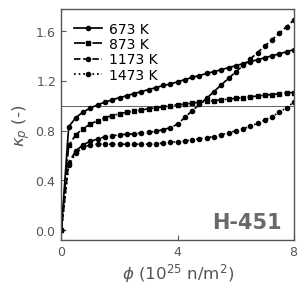
Figure 1: Fractional change in elastic modulus of grade H-451 graphite as a function of irradiation conditions.
Grade 2020 graphite
The temperature dependency of elastic modulus is given by Ho (1991) as below: where , is the elastic modulus of irradiated graphite at room temperature, and , is the elastic modulus of unirradiated graphite at room temperature. This model is considered valid up to 1100. Note that the room temperature is considered as 21 in Ho (1991). Transversely isotropic linear elastic constants at the room temperature are given by
The irradiation effects are accounted on the moduli, in terms of the fractional increase, (see Table 2 and Figure 2) as a function of fast neutron fluence and irradiation temperature, as:
The Poisson's ratios, and , are considered remaining constant during irradiation conditions.
Table 2: Fractional increase () in elastic modulus as a function of irradiation conditions for grade 2020 graphite as a function of fast neutron fluence, ( n/m) at various irradiation temperature, (K).
| Fast neutron fluence, ( n/m) | 673 K | 873 K | 1173 K |
|---|---|---|---|
| 1.0 | 0.043 | 0.031 | 0.023 |
| 4.0 | 0.133 | 0.098 | 0.074 |
| 10.0 | 0.240 | 0.183 | 0.139 |
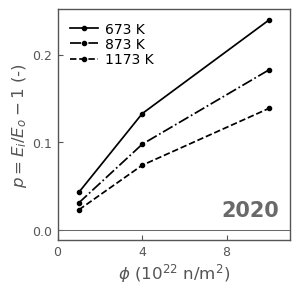
Figure 2: Fractional change in elastic modulus of grade 2020 graphite as a function of irradiation conditions.
Example Input Syntax
[Materials<<<{"href": "../../../syntax/Materials/index.html"}>>>]
  [elasticity_tensor]
    type = GraphiteGradeElasticityTensor<<<{"description": "Computes the linear transversely isotropic elasticity tensor for various graphite grades; H-451 and 2020.", "href": "GraphiteGradeElasticityTensor.html"}>>>
    temperature<<<{"description": "Coupled temperature (K)"}>>> = temperature
    graphite_grade<<<{"description": "The grade of graphite H_451 NG2020"}>>> = H_451
    fast_neutron_fluence<<<{"description": "Coupled fast (E>0.10 MeV) neutron fluence (n/m^2)"}>>> = fast_neutron_fluence
    flux_conversion_factor<<<{"description": "Convert fast neutron flux E>0.10 to E>0.18 MeV"}>>> = 0.85
  []
[]Input Parameters
- base_nameOptional parameter that allows the user to define multiple mechanics material systems on the same block, i.e. for multiple phases
C++ Type:std::string
Controllable:No
Description:Optional parameter that allows the user to define multiple mechanics material systems on the same block, i.e. for multiple phases
- blockThe list of blocks (ids or names) that this object will be applied
C++ Type:std::vector<SubdomainName>
Controllable:No
Description:The list of blocks (ids or names) that this object will be applied
- boundaryThe list of boundaries (ids or names) from the mesh where this object applies
C++ Type:std::vector<BoundaryName>
Controllable:No
Description:The list of boundaries (ids or names) from the mesh where this object applies
- computeTrueWhen false, MOOSE will not call compute methods on this material. The user must call computeProperties() after retrieving the MaterialBase via MaterialBasePropertyInterface::getMaterialBase(). Non-computed MaterialBases are not sorted for dependencies.
Default:True
C++ Type:bool
Controllable:No
Description:When false, MOOSE will not call compute methods on this material. The user must call computeProperties() after retrieving the MaterialBase via MaterialBasePropertyInterface::getMaterialBase(). Non-computed MaterialBases are not sorted for dependencies.
- constant_onNONEWhen ELEMENT, MOOSE will only call computeQpProperties() for the 0th quadrature point, and then copy that value to the other qps.When SUBDOMAIN, MOOSE will only call computeQpProperties() for the 0th quadrature point, and then copy that value to the other qps. Evaluations on element qps will be skipped
Default:NONE
C++ Type:MooseEnum
Controllable:No
Description:When ELEMENT, MOOSE will only call computeQpProperties() for the 0th quadrature point, and then copy that value to the other qps.When SUBDOMAIN, MOOSE will only call computeQpProperties() for the 0th quadrature point, and then copy that value to the other qps. Evaluations on element qps will be skipped
- declare_suffixAn optional suffix parameter that can be appended to any declared properties. The suffix will be prepended with a '_' character.
C++ Type:MaterialPropertyName
Unit:(no unit assumed)
Controllable:No
Description:An optional suffix parameter that can be appended to any declared properties. The suffix will be prepended with a '_' character.
- elasticity_tensor_prefactorOptional function to use as a scalar prefactor on the elasticity tensor.
C++ Type:FunctionName
Unit:(no unit assumed)
Controllable:No
Description:Optional function to use as a scalar prefactor on the elasticity tensor.
- fast_neutron_fluencefast_neutron_fluenceCoupled fast (E>0.10 MeV) neutron fluence (n/m^2)
Default:fast_neutron_fluence
C++ Type:MaterialPropertyName
Unit:(no unit assumed)
Controllable:No
Description:Coupled fast (E>0.10 MeV) neutron fluence (n/m^2)
Optional Parameters
- control_tagsAdds user-defined labels for accessing object parameters via control logic.
C++ Type:std::vector<std::string>
Controllable:No
Description:Adds user-defined labels for accessing object parameters via control logic.
- enableTrueSet the enabled status of the MooseObject.
Default:True
C++ Type:bool
Controllable:Yes
Description:Set the enabled status of the MooseObject.
- implicitTrueDetermines whether this object is calculated using an implicit or explicit form
Default:True
C++ Type:bool
Controllable:No
Description:Determines whether this object is calculated using an implicit or explicit form
- seed0The seed for the master random number generator
Default:0
C++ Type:unsigned int
Controllable:No
Description:The seed for the master random number generator
- use_displaced_meshFalseWhether or not this object should use the displaced mesh for computation. Note that in the case this is true but no displacements are provided in the Mesh block the undisplaced mesh will still be used.
Default:False
C++ Type:bool
Controllable:No
Description:Whether or not this object should use the displaced mesh for computation. Note that in the case this is true but no displacements are provided in the Mesh block the undisplaced mesh will still be used.
Advanced Parameters
- output_propertiesList of material properties, from this material, to output (outputs must also be defined to an output type)
C++ Type:std::vector<std::string>
Controllable:No
Description:List of material properties, from this material, to output (outputs must also be defined to an output type)
- outputsnone Vector of output names where you would like to restrict the output of variables(s) associated with this object
Default:none
C++ Type:std::vector<OutputName>
Controllable:No
Description:Vector of output names where you would like to restrict the output of variables(s) associated with this object
Outputs Parameters
- prop_getter_suffixAn optional suffix parameter that can be appended to any attempt to retrieve/get material properties. The suffix will be prepended with a '_' character.
C++ Type:MaterialPropertyName
Unit:(no unit assumed)
Controllable:No
Description:An optional suffix parameter that can be appended to any attempt to retrieve/get material properties. The suffix will be prepended with a '_' character.
- use_interpolated_stateFalseFor the old and older state use projected material properties interpolated at the quadrature points. To set up projection use the ProjectedStatefulMaterialStorageAction.
Default:False
C++ Type:bool
Controllable:No
Description:For the old and older state use projected material properties interpolated at the quadrature points. To set up projection use the ProjectedStatefulMaterialStorageAction.
Material Property Retrieval Parameters
Input Files
References
- F.H. Ho.
Graphite design handbook.
Technical Report DOE-HTGR-88111, General Atomics, 1991.
URL: https://www.osti.gov/servlets/purl/714896, doi:10.2172/714896.[BibTeX]