- temperatureThe coupled temperature (K)
C++ Type:std::vector<VariableName>
Unit:(no unit assumed)
Controllable:No
Description:The coupled temperature (K)
FeCrAlElasticityTensor
Computes Young's modulus and Poisson's ratio as a function of temperature for FeCrAl alloys.
Description
This model computes the isotropic elasticity tensor for FeCrAl alloys by calculating the Young's modulus and Poisson's ratio as a function of temperature. The Young's modulus of various commercial FeCrAl alloys (MA956, PM2000, Kanthal APMT, and Fecralloy) as a function of temperature has been obtained from the datasheets of the manufacturers and are tabulated below. In BISON, the Young's modulus is linearly interpolated between the known values.
Table 1: The Young's modulus as a function of temperature for MA956** (Corporation, 2004)
| Temperature (K) | Young's Modulus (GPa) |
|---|---|
| 310.45 | 172 |
| 362.30 | 170 |
| 424.44 | 167 |
| 506.42 | 161 |
| 592.27 | 153 |
| 657.76 | 146 |
| 754.04 | 139 |
| 828.41 | 131 |
| 900.57 | 121 |
| 984.39 | 114 |
| 1066.55 | 107 |
| 1146.44 | 99.4 |
| 1208.19 | 89.1 |
| 1269.02 | 77.0 |
| 1347.65 | 72.7 |
Table 2: The Young's modulus as a function of temperature for PM2000 (MatWeb, 2014)
| Temperature (K) | Young's Modulus (GPa) |
|---|---|
| 473.15 | 160 |
| 673.15 | 145 |
| 873.15 | 125 |
| 973.15 | 115 |
| 1073.15 | 110 |
| 1223.15 | 95 |
Table 3: The Young's modulus as a function of temperature for Kanthal APMT (Sandvik, 2012)
| Temperature (K) | Young's Modulus (GPa) |
|---|---|
| 293.15 | 220 |
| 373.15 | 210 |
| 473.15 | 205 |
| 673.15 | 190 |
| 873.15 | 170 |
| 1073.15 | 150 |
| 1273.15 | 130 |
For Fecralloy (MatWeb, 2014) the Young's modulus is only given at room temperature (293.15 K) as 180 GPa. The Poisson's ratio of the commercial alloys are independent of temperature and tabulated below.
Table 4: The Poisson's ratio of the commercial FeCrAl alloys
| Alloy | Poisson's Ratio |
|---|---|
| MA956 | 0.3 |
| PM2000 | 0.33 |
| Kanthal APMT | 0.3 |
| Fecralloy | 0.3 |
For the laboratory optimized FeCrAl alloys from Oak Ridge National Laboratory known as C06M, C35M, and C36M the temperature dependent Young's modulus and Poisson's ratio are given by Field et al. (2018): where is the Young's modulus (GPa), is Poisson's ratio, and is the temperature (C).
Range of Applicability and Uncertainty
The temperature range over which the models for the elastic constants are valid depends upon the material analyzed. For C06M, C35M, and C36M the correlations for both Young's modulus and Poisson's ratio are valid from 298 K to 1123 K. The piecewise linear data for Young's modulus is valid from 310.45 K to 1347.65 K for MA956, 293.15 K to 1273.15 K for Kanthal APMT, and 473.15 to 1347.65 for PM2000. The Young's modulus of Fecralloy is taken at room temperature (293.15 K).
Young's Modulus Uncertainty
The data for which the models for Young's modulus are based for Kanthal APMT, PM2000, MA956, and Fecralloy did not have associated experimental uncertainty. Therefore, the uncertainty in the models can not be directly computed. For conservatism on the best estimate model it is recommended that an uncertainty of 6% be taken for these alloys at all temperatures.
For the laboratory optimized alloys C06M, C35M, and C36M the experimental data used to develop the model are provided in the handbook. The measurement uncertainty is associated with the different experimental conditions in which the Young's modulus was measured, including heating and cooling. Figure 1 and Figure 2 illustrate the lower and upper bounds of the experimental data provided in the Handbook. A polynomial fit of the same order as the mean equation used for the model was applied to each data set with the equation provided on the figure. These polynomial fits represent the lower and upper uncertainties on the model. Figure 3 shows the Young's modulus model as a solid line with the associated uncertainty bands by dashed lines. Figure 4 illustrates the evolution of the lower and upper uncertainty on the mean as a function of temperature. It is observed that the lower uncertainty band is larger than the upper uncertainty band for all temperatures and the uncertainty is larger at higher temperatures.
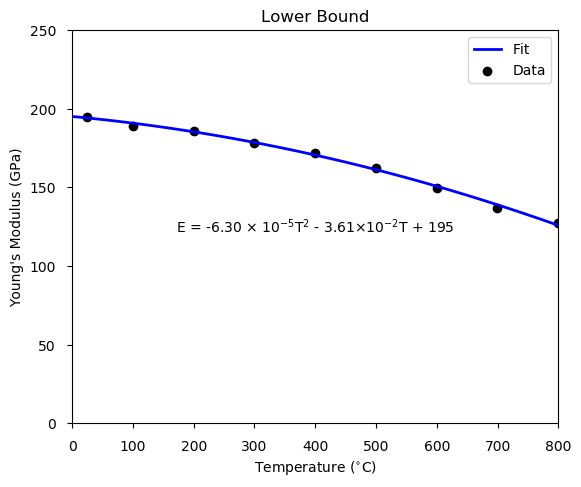
Figure 1: Linear fit to lower bound of experimental data from FeCrAl Handbook for Young's modulus model used for C06M, C35M, and C36M
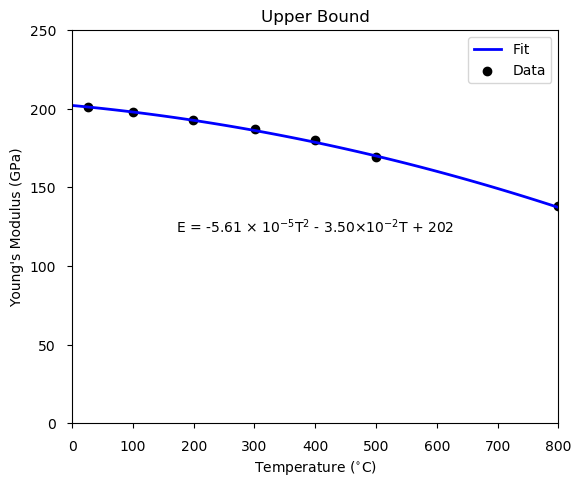
Figure 2: Linear fit to upper bound of experimental data from FeCrAl Handbook for Young's modulus model used for C06M, C35M, and C36M
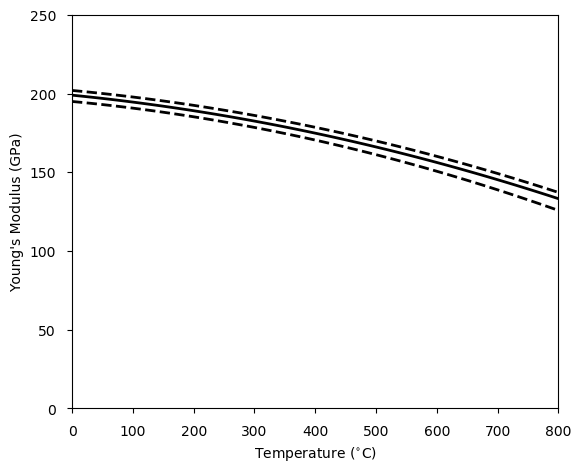
Figure 3: Young's modulus with associated uncertainty bands for the model used for C06M, C35M, and C36M
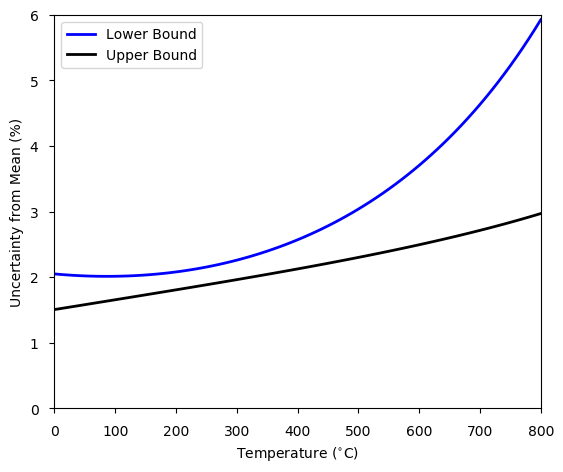
Figure 4: Percent difference from the mean for the lower and upper bound uncertainty on Young's modulus
Poisson's Ratio Uncertainty
The data for which the models for Poisson's ratio are based for Kanthal APMT, PM2000, MA956, and Fecralloy did not have associated experimental uncertainty. Therefore, the uncertainty in the models can not be directly computed. For conservatism on the best estimate model it is recommended that an uncertainty of 10% be taken for these alloys at all temperatures.
For the laboratory optimized alloys C06M, C35M, and C36M the experimental data used to develop the model are provided in the handbook. The measurement uncertainty is associated with the different experimental conditions in which the Poisson's ratio was measured, including heating and cooling. Figure 5 and Figure 6 illustrate the lower and upper bounds of the experimental data provided in the Handbook. A polynomial fit of the same order as the mean equation used for the model was applied to each data set with the equation provided on the figure. These polynomial fits represent the lower and upper uncertainties on the model. Figure 7 shows the Poisson's ratio model as a solid line with the associated uncertainty bands by dashed lines. Figure 8 illustrates the evolution of the lower and upper uncertainty on the mean as a function of temperature. It is observed that the lower uncertainty band is larger than the upper uncertainty band for all temperatures and the uncertainty is larger at higher temperatures.
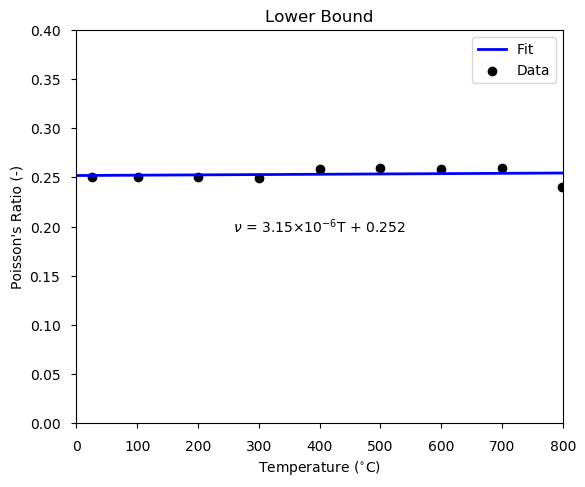
Figure 5: Linear fit to lower bound of experimental data from FeCrAl Handbook for Poisson's ratio model used for C06M, C35M, and C36M
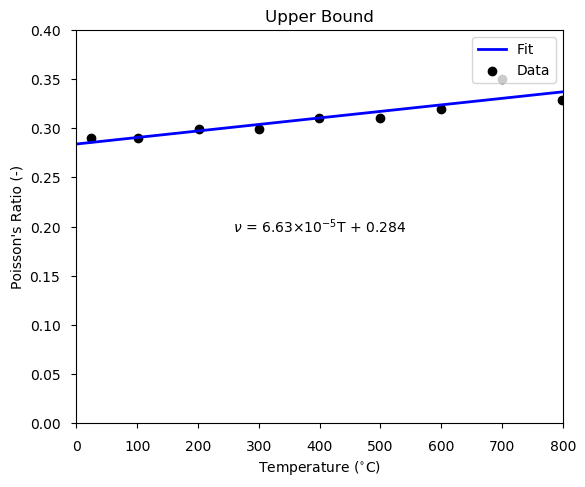
Figure 6: Linear fit to upper bound of experimental data from FeCrAl Handbook for Poisson's ratio model used for C06M, C35M, and C36M
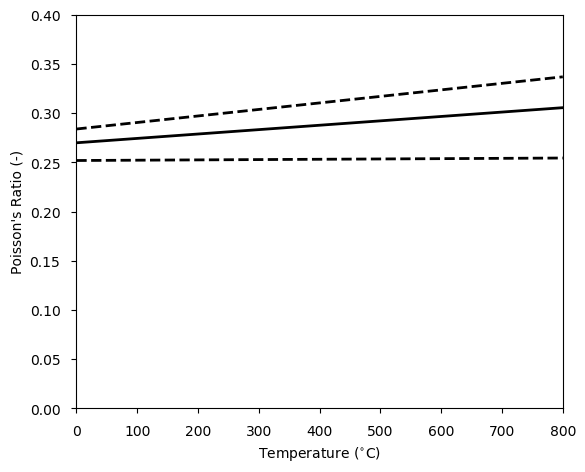
Figure 7: Poisson's ratio with associated uncertainty bands for the model used for C06M, C35M, and C36M
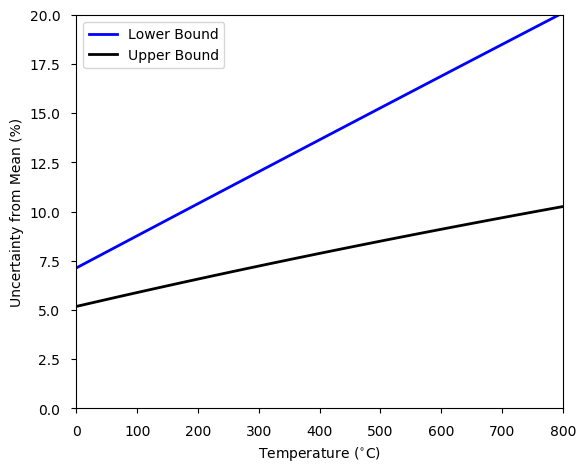
Figure 8: Percent difference from the mean for the lower and upper bound uncertainty on Poisson's ratio
Example Input Syntax
[Materials<<<{"href": "../../../syntax/Materials/index.html"}>>>]
  [elasticity_tensor]
    type = FeCrAlElasticityTensor<<<{"description": "Computes Young's modulus and Poisson's ratio as a function of temperature for FeCrAl alloys.", "href": "FeCrAlElasticityTensor.html"}>>>
    temperature<<<{"description": "The coupled temperature (K)"}>>> = temperature
    fecral_material_type<<<{"description": "The FeCrAl alloy being used for the cladding. Choices are: APMT C06M C35M C36M MA956 PM2000 FECRALLOY"}>>> = MA956
  []
[]Input Parameters
- base_nameOptional parameter that allows the user to define multiple mechanics material systems on the same block, i.e. for multiple phases
C++ Type:std::string
Controllable:No
Description:Optional parameter that allows the user to define multiple mechanics material systems on the same block, i.e. for multiple phases
- blockThe list of blocks (ids or names) that this object will be applied
C++ Type:std::vector<SubdomainName>
Controllable:No
Description:The list of blocks (ids or names) that this object will be applied
- boundaryThe list of boundaries (ids or names) from the mesh where this object applies
C++ Type:std::vector<BoundaryName>
Controllable:No
Description:The list of boundaries (ids or names) from the mesh where this object applies
- computeTrueWhen false, MOOSE will not call compute methods on this material. The user must call computeProperties() after retrieving the MaterialBase via MaterialBasePropertyInterface::getMaterialBase(). Non-computed MaterialBases are not sorted for dependencies.
Default:True
C++ Type:bool
Controllable:No
Description:When false, MOOSE will not call compute methods on this material. The user must call computeProperties() after retrieving the MaterialBase via MaterialBasePropertyInterface::getMaterialBase(). Non-computed MaterialBases are not sorted for dependencies.
- constant_onNONEWhen ELEMENT, MOOSE will only call computeQpProperties() for the 0th quadrature point, and then copy that value to the other qps.When SUBDOMAIN, MOOSE will only call computeQpProperties() for the 0th quadrature point, and then copy that value to the other qps. Evaluations on element qps will be skipped
Default:NONE
C++ Type:MooseEnum
Controllable:No
Description:When ELEMENT, MOOSE will only call computeQpProperties() for the 0th quadrature point, and then copy that value to the other qps.When SUBDOMAIN, MOOSE will only call computeQpProperties() for the 0th quadrature point, and then copy that value to the other qps. Evaluations on element qps will be skipped
- declare_suffixAn optional suffix parameter that can be appended to any declared properties. The suffix will be prepended with a '_' character.
C++ Type:MaterialPropertyName
Unit:(no unit assumed)
Controllable:No
Description:An optional suffix parameter that can be appended to any declared properties. The suffix will be prepended with a '_' character.
- elasticity_tensor_prefactorOptional function to use as a scalar prefactor on the elasticity tensor.
C++ Type:FunctionName
Unit:(no unit assumed)
Controllable:No
Description:Optional function to use as a scalar prefactor on the elasticity tensor.
- fecral_material_typeAPMTThe FeCrAl alloy being used for the cladding. Choices are: APMT C06M C35M C36M MA956 PM2000 FECRALLOY
Default:APMT
C++ Type:MooseEnum
Controllable:No
Description:The FeCrAl alloy being used for the cladding. Choices are: APMT C06M C35M C36M MA956 PM2000 FECRALLOY
- poissons_ratio_functionPoisson's ratio as a function of temperature.
C++ Type:FunctionName
Unit:(no unit assumed)
Controllable:No
Description:Poisson's ratio as a function of temperature.
- youngs_modulus_functionYoung's modulus as a function of temperature.
C++ Type:FunctionName
Unit:(no unit assumed)
Controllable:No
Description:Young's modulus as a function of temperature.
Optional Parameters
- control_tagsAdds user-defined labels for accessing object parameters via control logic.
C++ Type:std::vector<std::string>
Controllable:No
Description:Adds user-defined labels for accessing object parameters via control logic.
- enableTrueSet the enabled status of the MooseObject.
Default:True
C++ Type:bool
Controllable:Yes
Description:Set the enabled status of the MooseObject.
- implicitTrueDetermines whether this object is calculated using an implicit or explicit form
Default:True
C++ Type:bool
Controllable:No
Description:Determines whether this object is calculated using an implicit or explicit form
- seed0The seed for the master random number generator
Default:0
C++ Type:unsigned int
Controllable:No
Description:The seed for the master random number generator
- use_displaced_meshFalseWhether or not this object should use the displaced mesh for computation. Note that in the case this is true but no displacements are provided in the Mesh block the undisplaced mesh will still be used.
Default:False
C++ Type:bool
Controllable:No
Description:Whether or not this object should use the displaced mesh for computation. Note that in the case this is true but no displacements are provided in the Mesh block the undisplaced mesh will still be used.
Advanced Parameters
- output_propertiesList of material properties, from this material, to output (outputs must also be defined to an output type)
C++ Type:std::vector<std::string>
Controllable:No
Description:List of material properties, from this material, to output (outputs must also be defined to an output type)
- outputsnone Vector of output names where you would like to restrict the output of variables(s) associated with this object
Default:none
C++ Type:std::vector<OutputName>
Controllable:No
Description:Vector of output names where you would like to restrict the output of variables(s) associated with this object
Outputs Parameters
- poissons_ratio_scale_factor1Scale factor to be applied to the Poisson's ratio. Used for calibration and sensitivity studies
Default:1
C++ Type:double
Unit:(no unit assumed)
Controllable:No
Description:Scale factor to be applied to the Poisson's ratio. Used for calibration and sensitivity studies
- youngs_modulus_scale_factor1Scale factor to be applied to the Young's modulus. Used for calibration and sensitivity studies
Default:1
C++ Type:double
Unit:(no unit assumed)
Controllable:No
Description:Scale factor to be applied to the Young's modulus. Used for calibration and sensitivity studies
Advanced: Scaling Factors Parameters
- prop_getter_suffixAn optional suffix parameter that can be appended to any attempt to retrieve/get material properties. The suffix will be prepended with a '_' character.
C++ Type:MaterialPropertyName
Unit:(no unit assumed)
Controllable:No
Description:An optional suffix parameter that can be appended to any attempt to retrieve/get material properties. The suffix will be prepended with a '_' character.
- use_interpolated_stateFalseFor the old and older state use projected material properties interpolated at the quadrature points. To set up projection use the ProjectedStatefulMaterialStorageAction.
Default:False
C++ Type:bool
Controllable:No
Description:For the old and older state use projected material properties interpolated at the quadrature points. To set up projection use the ProjectedStatefulMaterialStorageAction.
Material Property Retrieval Parameters
Input Files
- (test/tests/solid_mechanics/fecral_elasticity_tensor/elasticity_PM2000.i)
- (test/tests/solid_mechanics/fecral_elasticity_tensor/elasticity_Fecralloy.i)
- (test/tests/solid_mechanics/fecral_elasticity_tensor/elasticity_APMT.i)
- (examples/accident_tolerant_fuel/uo2_fecral/uo2_fecral.i)
- (test/tests/solid_mechanics/fecral_elasticity_tensor/elasticity_C06M.i)
- (test/tests/solid_mechanics/fecral_elasticity_tensor/elasticity_MA956.i)
References
- Special Metals Corporation.
Special Metals Incoloy alloy MA956.
www.specialmetals.com/documents/Incoloy+alloy+MA956.pdf, 2004.[BibTeX]
- K. G. Field, M. A. Snead, Y. Yamamoto, and K. A. Terrani.
Handbook on the material properties of fecral alloys for nuclear power production applications.
Technical Report ORNL/SPR-2018/905 Rev. 1, Oak Ridge National Laboratory, 2018.[BibTeX]
- MatWeb.
Resistalloy International Fecralloy Electrical Resistance Steel.
http://www.matweb.com/search/datasheet.aspx?MatGUID=c2427c6297594858bedac2a4e5981d2f, 2014.[BibTeX]
- MatWeb.
Schwarzkopf Plansee PM 2000.
http://www.matweb.com/search/datasheet.aspx?matguid=21e9ec9a0de24b47bcf69ab11c375567, 2014.[BibTeX]
- Sandvik.
Kanthal APMT Material Database.
http://kanthal.com/en/products/material-datasheets/tube/kanthal-apmt/, 2012.[BibTeX]