- temperatureCoupled temperature
C++ Type:std::vector<VariableName>
Unit:(no unit assumed)
Controllable:No
Description:Coupled temperature
HighBurnupStructureFormation
Computes the local volume fraction of high burnup structure (HBS) as a function of burnup and temperature.
Description
The HighBurnupStructureFormation model computes the local volume fraction of high burnup structure (HBS) in UO as a function of burnup (or effective burnup) and temperature (Simon et al., 2023). It also computes the rate of change in HBS volume fraction with respect to burnup (or effective burnup).
In nuclear fuel under irradiation, in regions where substantial irradiation damage (high local burnup) is accompanied by a relatively low temperature, a dramatic change occurs to the as-fabricated microstructure. The restructuring involves the appearance of sub-micrometric grains free of extended defects and depleted of fission gas, and of micrometric gaseous pores at the grain boundaries. This phenomenon is referred to as High Burnup Structure (HBS) formation or, historically, rim effect (Barney and Wemple, 1958; Rondinella and Wiss, 2010). The latter definition relates to the fact that the restructuring in light water reactor (LWR) UO fuel starts at (and was originally thought to be limited to) the periphery of the pellet, where higher power density and burnup develop as a consequence of the fissile () concentration increase due to the capture of epithermal neutrons in the resonances of .
The formation of the HBS is gradual and depends on the local burnup and temperature. In particular, the HBS starts forming as a new phase within the regular fuel structure, with the local volume fraction of HBS progressively increasing with increasing local burnup. For example, Gerczak et al. (2018) investigated the HBS formation in UO using advanced electron microscopy techniques and focusing on the correlation between the restructuring and the spatial distribution of grain boundary misorientations. They pointed out that the HBS is predominantly defined by high-angle grain boundaries, and the presence of low-angle grain boundaries indicates an incomplete transition to the HBS. While the HBS development was complete at the pellet periphery for the analyzed sample, the presence of local "in transition" areas, corresponding to an incomplete restructuring (i.e., local volume fraction of HBS between 0 and 1) was clearly identified at intermediate radial locations (Gerczak et al., 2018).
The HighBurnupStructureFormation model computes the evolving volume fraction of restructured (HBS) fuel based on two different models from Barani et al. (2020) and Lassmann et al. (1995), which are detailed below (Simon et al., 2023). This quantity is calculated locally at each BISON engineering mesh point, which represents a region of fuel large enough to contain a statistically significant number of microstructural features. The model from Barani et al. (2020) is listed as the default (hbs_model = "JMAK_Barani"), but the user can select the Lassmann et al. (1995) HBS formation model using hbs_model = "Lassmann".
HBS formation model from Lassmann et al. (1995)
The model from Lassmann et al. describes a sudden transition to HBS when the burnup reaches a burnup threshold or around 60 to 75 MWd/kgU (Lassmann et al., 1995). The default value in BISON is set to 70 MWd/kgU, but can be selected using the threshold_burnup parameter. With this model, the HBS volume fraction ( - dimensionless) is therefore defined as
(1) where the burnup and is the burnup threshold.
The derivative of with respect to burnup is defined as 0.
HBS formation model from Barani et al. (2020)
In the model from Barani et al. (2020), the HBS volume fraction is computed as a function of the effective burnup, defined as the burnup accumulated below a threshold temperature for thermal annealing of defects. The effective burnup is calculated as:
(2)
where is the Heaviside step function, the absolute temperature, the threshold temperature, and the burnup. The considered threshold temperature is 1273.15 K.
The volume fraction of HBS is calculated using the Kolmogorov-Johnson-Mehl-Avrami (KJMA) formalism for phase transformations. The original KJMA formulation reads (Kolmogorov, 1937)
(3)
where is the volume fraction of the new phase, the transformation rate constant, the time and the so-called Avrami constant.
The specific expression proposed in Barani et al. (2020) to describe HBS formation considers the effective burnup in place of the time and values for the constants based on fitting to experimental data for the restructured volume fraction derived from Noirot et al. (2015) and Gerczak et al. (2018). The expression implemented in BISON reads:
(4)
where (dimensionless) is the volume fraction of HBS and (MWd/kg) the effective burnup (Eq. (2)). Eq. (4) corresponds to the model proposed in Barani et al. (2020) with modified coefficients based on a later development.
commentnote
Note that the values used in BISON differ slightly from the values listed in Barani et al. (2020) ( and ). The values used in BISON better fit the data. It is believed that the values provided in Barani et al. (2020) could have been a typo given that the results shown in Fig. 4 from Barani et al. (2020) correspond to the model with the BISON parameters.
The volume fraction of HBS as a function of the effective burnup according to Eq. (4) and the available experimental data are illustrated in Figure 1.
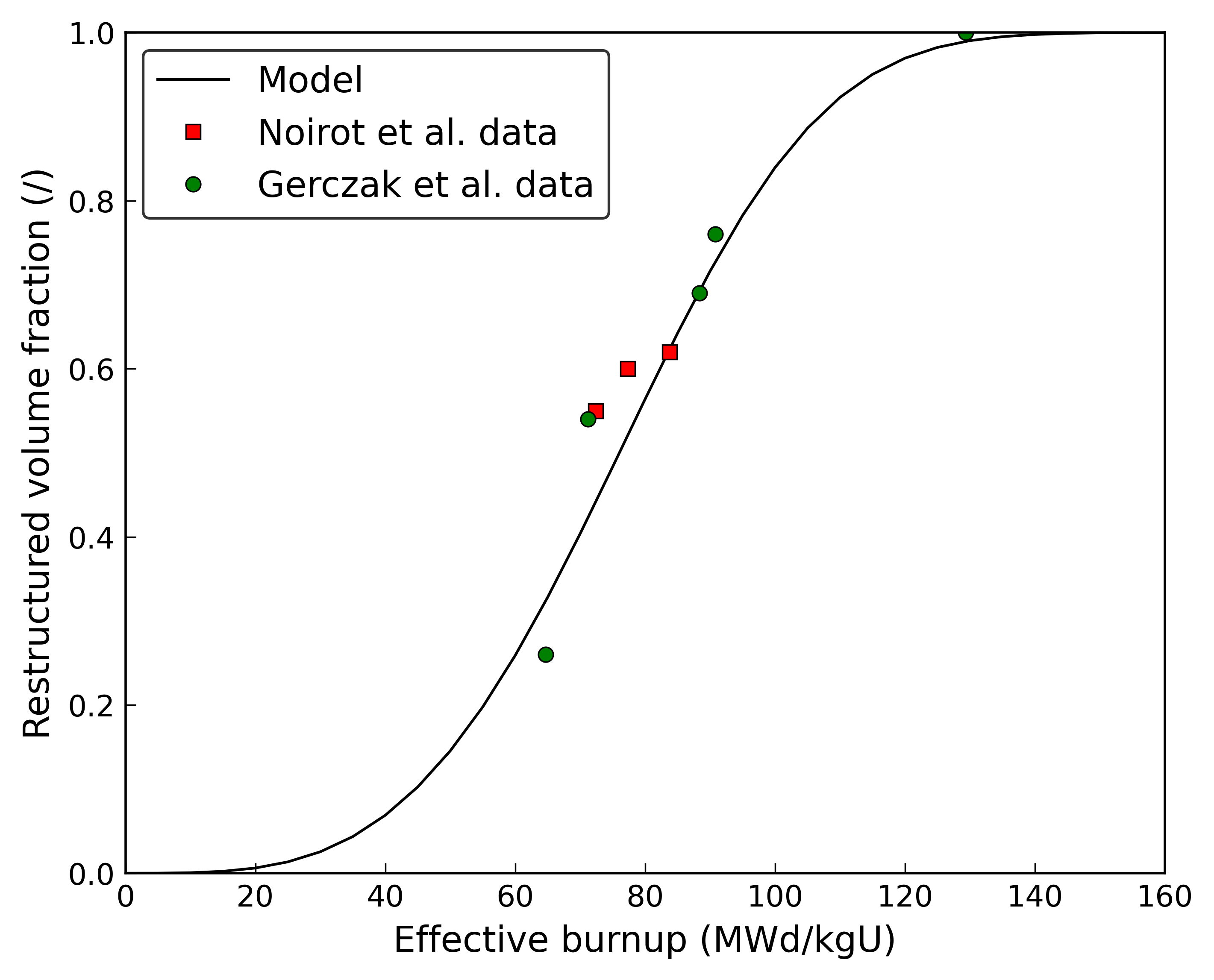
Figure 1: Volume fraction of HBS as a function of the effective burnup according to the model implemented in BISON and based on Barani et al. (2020). Experimental data derived from Noirot et al. (2015) and Gerczak et al. (2018) in Barani et al. (2020) and used for model fitting are also shown.
The derivative of as a function of the effective burnup is given by (5)
Example Input Syntax
[Materials<<<{"href": "../../syntax/Materials/index.html"}>>>]
  [hbs_formation]
    type = HighBurnupStructureFormation<<<{"description": "Computes the local volume fraction of high burnup structure (HBS) as a function of burnup and temperature.", "href": "HighBurnupStructureFormation.html"}>>>
    block<<<{"description": "The list of blocks (ids or names) that this object will be applied"}>>> = 0
    temperature<<<{"description": "Coupled temperature"}>>> = temperature
    burnup<<<{"description": "Coupled burnup"}>>> = burnup
    threshold_temperature<<<{"description": "Threshold temperature for effective burnup calculation in K for the `JMAK_Barani` model"}>>> = 1273.15 # default
    energy_per_fission<<<{"description": "Energy released per fission in J/fission"}>>> = 3.28451e-11 # default
    output_properties<<<{"description": "List of material properties, from this material, to output (outputs must also be defined to an output type)"}>>> = 'hbs_volume_fraction hbs_volume_fraction_burnup_rate'
    outputs<<<{"description": "Vector of output names where you would like to restrict the output of variables(s) associated with this object"}>>> = 'all'
  []
[]Input Parameters
- blockThe list of blocks (ids or names) that this object will be applied
C++ Type:std::vector<SubdomainName>
Controllable:No
Description:The list of blocks (ids or names) that this object will be applied
- boundaryThe list of boundaries (ids or names) from the mesh where this object applies
C++ Type:std::vector<BoundaryName>
Controllable:No
Description:The list of boundaries (ids or names) from the mesh where this object applies
- burnupCoupled burnup
C++ Type:std::vector<VariableName>
Unit:(no unit assumed)
Controllable:No
Description:Coupled burnup
- burnup_functionBurnup function
C++ Type:BurnupFunctionName
Unit:(no unit assumed)
Controllable:No
Description:Burnup function
- computeTrueWhen false, MOOSE will not call compute methods on this material. The user must call computeProperties() after retrieving the MaterialBase via MaterialBasePropertyInterface::getMaterialBase(). Non-computed MaterialBases are not sorted for dependencies.
Default:True
C++ Type:bool
Controllable:No
Description:When false, MOOSE will not call compute methods on this material. The user must call computeProperties() after retrieving the MaterialBase via MaterialBasePropertyInterface::getMaterialBase(). Non-computed MaterialBases are not sorted for dependencies.
- constant_onNONEWhen ELEMENT, MOOSE will only call computeQpProperties() for the 0th quadrature point, and then copy that value to the other qps.When SUBDOMAIN, MOOSE will only call computeQpProperties() for the 0th quadrature point, and then copy that value to the other qps. Evaluations on element qps will be skipped
Default:NONE
C++ Type:MooseEnum
Options:NONE, ELEMENT, SUBDOMAIN
Controllable:No
Description:When ELEMENT, MOOSE will only call computeQpProperties() for the 0th quadrature point, and then copy that value to the other qps.When SUBDOMAIN, MOOSE will only call computeQpProperties() for the 0th quadrature point, and then copy that value to the other qps. Evaluations on element qps will be skipped
- declare_suffixAn optional suffix parameter that can be appended to any declared properties. The suffix will be prepended with a '_' character.
C++ Type:MaterialPropertyName
Unit:(no unit assumed)
Controllable:No
Description:An optional suffix parameter that can be appended to any declared properties. The suffix will be prepended with a '_' character.
- energy_per_fission3.28451e-11Energy released per fission in J/fission
Default:3.28451e-11
C++ Type:double
Unit:(no unit assumed)
Controllable:No
Description:Energy released per fission in J/fission
- hbs_model_typeJMAK_BaraniType of HBS formation model to use.
Default:JMAK_Barani
C++ Type:MooseEnum
Options:Lassmann, JMAK_Barani
Controllable:No
Description:Type of HBS formation model to use.
- threshold_burnup70Threshold burnup in GWd/tU and MWd/kgU for HBS formation for the `Lassmann` model (60-75 MWd/kgU)
Default:70
C++ Type:double
Unit:(no unit assumed)
Controllable:No
Description:Threshold burnup in GWd/tU and MWd/kgU for HBS formation for the `Lassmann` model (60-75 MWd/kgU)
- threshold_temperature1273.15Threshold temperature for effective burnup calculation in K for the `JMAK_Barani` model
Default:1273.15
C++ Type:double
Unit:(no unit assumed)
Controllable:No
Description:Threshold temperature for effective burnup calculation in K for the `JMAK_Barani` model
Optional Parameters
- control_tagsAdds user-defined labels for accessing object parameters via control logic.
C++ Type:std::vector<std::string>
Controllable:No
Description:Adds user-defined labels for accessing object parameters via control logic.
- enableTrueSet the enabled status of the MooseObject.
Default:True
C++ Type:bool
Controllable:Yes
Description:Set the enabled status of the MooseObject.
- implicitTrueDetermines whether this object is calculated using an implicit or explicit form
Default:True
C++ Type:bool
Controllable:No
Description:Determines whether this object is calculated using an implicit or explicit form
- seed0The seed for the master random number generator
Default:0
C++ Type:unsigned int
Controllable:No
Description:The seed for the master random number generator
- use_displaced_meshFalseWhether or not this object should use the displaced mesh for computation. Note that in the case this is true but no displacements are provided in the Mesh block the undisplaced mesh will still be used.
Default:False
C++ Type:bool
Controllable:No
Description:Whether or not this object should use the displaced mesh for computation. Note that in the case this is true but no displacements are provided in the Mesh block the undisplaced mesh will still be used.
Advanced Parameters
- output_propertiesList of material properties, from this material, to output (outputs must also be defined to an output type)
C++ Type:std::vector<std::string>
Controllable:No
Description:List of material properties, from this material, to output (outputs must also be defined to an output type)
- outputsnone Vector of output names where you would like to restrict the output of variables(s) associated with this object
Default:none
C++ Type:std::vector<OutputName>
Controllable:No
Description:Vector of output names where you would like to restrict the output of variables(s) associated with this object
Outputs Parameters
- prop_getter_suffixAn optional suffix parameter that can be appended to any attempt to retrieve/get material properties. The suffix will be prepended with a '_' character.
C++ Type:MaterialPropertyName
Unit:(no unit assumed)
Controllable:No
Description:An optional suffix parameter that can be appended to any attempt to retrieve/get material properties. The suffix will be prepended with a '_' character.
- use_interpolated_stateFalseFor the old and older state use projected material properties interpolated at the quadrature points. To set up projection use the ProjectedStatefulMaterialStorageAction.
Default:False
C++ Type:bool
Controllable:No
Description:For the old and older state use projected material properties interpolated at the quadrature points. To set up projection use the ProjectedStatefulMaterialStorageAction.
Material Property Retrieval Parameters
Input Files
- (assessment/LWR/validation/LOCA_IFA_650/analysis/IFA_650_4/IFA_650_4_part2_gas_communication.i)
- (assessment/LWR/validation/LOCA_IFA_650/analysis/IFA_650_9/IFA_650_9_part1.i)
- (test/tests/axial_relocation/axial_relocation_eigenstrain_action_phasefield.i)
- (test/tests/axial_relocation/uo2_pulverization_phasefield.i)
- (test/tests/uo2_transient_fission_gas_release/uo2_pulverization_phasefield2_transient_FGR.i)
- (assessment/LWR/validation/LOCA_IFA_650/analysis/IFA_650_4/IFA_650_4_part1_gas_communication.i)
- (test/tests/axial_relocation/ad_uo2_pulverization_mesoscale.i)
- (test/tests/uo2_thermal/HBSporosity/test.i)
- (test/tests/high_burnup_structure_formation/hbs_formation_Lassmann.i)
- (test/tests/axial_relocation/uo2_pulverization_mesoscale.i)
- (assessment/LWR/validation/LOCA_IFA_650/analysis/IFA_650_4/IFA_650_4_part1.i)
- (test/tests/uo2_thermal/HBSporosity/ad_test.i)
- (assessment/LWR/validation/LOCA_IFA_650/analysis/IFA_650_4/IFA_650_4_part2.i)
- (test/tests/axial_relocation/ad_uo2_pulverization_phasefield2.i)
- (test/tests/sifgrs/uo2/polypole2_hbs.i)
- (test/tests/axial_relocation/uo2_pulverization_phasefield2.i)
- (test/tests/uo2_transient_fission_gas_release/ad_uo2_pulverization_phasefield2_transient_FGR.i)
- (test/tests/axial_relocation/ad_uo2_pulverization_phasefield.i)
- (assessment/LWR/validation/LOCA_IFA_650/analysis/IFA_650_9/IFA_650_9_part2.i)
- (test/tests/high_burnup_structure_formation/hbs_formation_varying_temperature.i)
- (test/tests/high_burnup_structure_formation/hbs_formation_constant_temperature.i)
- (assessment/LWR/validation/LOCA_IFA_650/analysis/IFA_650_4/IFA_650_4_part3_gas_communication.i)
- (test/tests/uo2_transient_fission_gas_release/uo2_pulverization_transient_FGR_1D.i)
References
- T. Barani, D. Pizzocri, F. Cappia, L. Luzzi, G. Pastore, and P. Van Uffelen.
Modeling high burnup structure in oxide fuels for application to fuel performance codes. part I: High burnup structure formation.
Journal of Nuclear Materials, 539:152296, 2020.
doi:10.1016/j.jnucmat.2020.152296.[BibTeX]
@article{barani2020_hbs, author = "Barani, T. and Pizzocri, D. and Cappia, F. and Luzzi, L. and Pastore, G. and Uffelen, P. Van", title = "Modeling high burnup structure in oxide fuels for application to fuel performance codes. part {I: H}igh burnup structure formation", journal = "Journal of Nuclear Materials", volume = "539", pages = "152296", doi = "10.1016/j.jnucmat.2020.152296", year = "2020" } - W. Barney and B. Wemple.
Metallography of UO$_2$-containing fuel elements.
Technical Report KAPL-1836, Knolls Atomic Power Laboratory, USA, 1958.[BibTeX]
@techreport{barney1958, author = "Barney, W. and Wemple, B.", address = "USA", institution = "Knolls Atomic Power Laboratory", number = "KAPL-1836", title = "Metallography of {UO$\_2$}-Containing Fuel Elements", year = "1958" } - T.J. Gerczak, C.M. Parish, P.D. Edmondson, C.A. Baldwin, and K.A. Terrani.
Restructuring in high burnup UO$_2$ studied using modern electron microscopy.
Journal of Nuclear Materials, 509:245–259, 2018.
doi:10.1016/j.jnucmat.2018.05.077.[BibTeX]
@article{gerczak2018, author = "Gerczak, T.J. and Parish, C.M. and Edmondson, P.D. and Baldwin, C.A. and Terrani, K.A.", title = "Restructuring in high burnup {UO$\_2$} studied using modern electron microscopy", journal = "Journal of Nuclear Materials", volume = "509", pages = "245-259", doi = "10.1016/j.jnucmat.2018.05.077", year = "2018" } - A.N. Kolmogorov.
On the statistical theory of crystallization of metals.
Ser. Mat., 3:355–359, 1937.[BibTeX]
@article{kolmogorov1937, author = "Kolmogorov, A.N.", title = "On the Statistical Theory of Crystallization of Metals", journal = "Ser. Mat.", volume = "3", pages = "355-359", year = "1937" } - K. Lassmann, C.T. Walker, J. van de Laar, and F. Lindström.
Modelling the high burnup UO$_2$ structure in LWR fuel.
Journal of Nuclear Materials, 226:1–8, 1995.[BibTeX]
@ARTICLE{lassmann.ea95, author = {Lassmann, K. and Walker, C.T. and van de Laar, J. and Lindstr\"om, F.}, title = "Modelling the high burnup {UO}$\_2$ structure in {LWR} fuel", journal = "Journal of Nuclear Materials", year = "1995", volume = "226", pages = "1-8" } - J. Noirot, Y. Pontillon, S. Yagnik, and J.A. Turnbull.
Post-irradiation examinations and high-temperature tests on undoped large-grain UO$_2$ discs.
Journal of Nuclear Materials, 462:77–84, 2015.
doi:10.1016/j.jnucmat.2015.03.008.[BibTeX]
@article{noirot2015, author = "Noirot, J. and Pontillon, Y. and Yagnik, S. and Turnbull, J.A.", title = "Post-irradiation examinations and high-temperature tests on undoped large-grain {UO$\_2$} discs", journal = "Journal of Nuclear Materials", volume = "462", pages = "77-84", doi = "10.1016/j.jnucmat.2015.03.008", year = "2015" } - V.V. Rondinella and T. Wiss.
The high burn-up structure in nuclear fuel.
Materials Today, 13(12):24–32, 2010.[BibTeX]
@ARTICLE{rondinella2010, author = "Rondinella, V.V. and Wiss, T.", title = "The high burn-up structure in nuclear fuel", journal = "Materials Today", year = "2010", volume = "13", pages = "24-32", number = "12", publisher = "Elsevier" } - Pierre-Clément A. Simon, Larry Kenneth Aagesen, Jr., Nathan Capps, Michael W. D. Cooper, Kyle A. Gamble, Logan H. Harbour, Christopher Matthews, Stephen R. Novascone, Daniel Schwen, and Brian Wirth.
Compare predictions of transient fission gas release by empirical and mechanistic models to experiments in high burnup UO$_2$ fuel.
Tech. Rep. INL/RPT-23-75026, Idaho National Laboratory, Idaho Falls, ID United States, 9 2023.
URL: https://www.osti.gov/biblio/2203701, doi:10.2172/2203701.[BibTeX]
@techreport{INL/RPT-23-75026,
    author = "Simon, Pierre-Cl\'{e}ment A. and Aagesen, Jr., Larry Kenneth and Capps, Nathan and Cooper, Michael W. D. and Gamble, Kyle A. and Harbour, Logan H. and Matthews, Christopher and Novascone, Stephen R. and Schwen, Daniel and Wirth, Brian",
    title = "Compare predictions of transient fission gas release by empirical and mechanistic models to experiments in high burnup {UO}$\_2$ fuel",
    doi = "10.2172/2203701",
    url = "https://www.osti.gov/biblio/2203701",
    type = "Tech. Rep.",
    number = "INL/RPT-23-75026",
    institution = "Idaho National Laboratory",
    address = "Idaho Falls, ID United States",
    year = "2023",
    month = "9"
}
(test/tests/high_burnup_structure_formation/hbs_formation_constant_temperature.i)
#--------------------------------------------------------------------------------------------------------------------------------
#
# This is a test for the high burnup structure (HBS) formation model implemented in the HighBurnupStructureFormation routine.
# The model computes the volume fraction of restructured fuel (HBS) as a function of the local effective burnup and temperature.
# The effective burnup is defined as the burnup accumulated below a threshold temperature for thermal annealing of defects.
# In this test, the temperature is kept constant below the threshold temperature of 1273.15 K. The fission rate is also constant.
#
#   - Geometry: cube of 10 mm side
#
#   - Single element
#
#   - Temperature = 1173.15 K
#
#   - Fission rate = 2.e+19/m^3s
#
#   - Irradiation time: 2.0e+08 s
#
# With these settings, the effective burnup coincides with the burnup and increases linearly, reaching a value of 0.1721 FIMA,
# or 165.5 MWd/kgU, at the end of the simulation at 2.0e+08 s. The calculated fraction of HBS increases monotonically, and
# takes values of 0.07727, 0.60758, 0.98035 and 0.99998 after 0.5e+08 s, 1.0e+08 s, 1.5e+08 s and 2.0e+08 s, respectively.
#
#--------------------------------------------------------------------------------------------------------------------------------

[Mesh]
  [generated_mesh]
    type = GeneratedMeshGenerator
    dim = 3
    nx = 1
    ny = 1
    nz = 1
    xmin = 0.
    xmax = 0.01
    ymin = 0.0
    ymax = 0.01
    zmin = 0.0
    zmax = 0.01
  []
[]

[Functions]
  [temperature_func]
    type = PiecewiseLinear
    x = '0.      2.e+08'
    y = '1173.15 1173.15 '
  []
  [fissionrate_func]
    type = PiecewiseLinear
    x = '0.     2.e+08'
    y = '2.e+19 2.e+19'
  []
[]

[Variables]
  [temperature]
    order = FIRST
    family = LAGRANGE
    initial_condition = 1173.15
  []
[]

[AuxVariables]
  [fission_rate]
    order = FIRST
    family = LAGRANGE
  []
  [burnup]
    order = FIRST
    family = LAGRANGE
  []
[]

[Kernels]
  [heat]
    type = HeatConduction
    variable = temperature
  []
[]

[AuxKernels]
  [fissionrate]
    type = FissionRateGeneral
    fission_rate_formulation = GENERIC
    block = 0
    variable = fission_rate
    value = 1
    fission_rate_function = fissionrate_func
    execute_on = 'initial timestep_begin'
  []
  [brnp]
    type = BurnupAux
    block = 0
    variable = burnup
    fission_rate = fission_rate
    density = 10421.5
    execute_on = 'initial timestep_end'
  []
[]

[BCs]
  [bottom_temp]
    type = FunctionDirichletBC
    variable = temperature
    function = temperature_func
    boundary = '1 2 3 4'
    preset = false
  []
[]

[Materials]
  [hbs_formation]
    type = HighBurnupStructureFormation
    block = 0
    temperature = temperature
    burnup = burnup
    threshold_temperature = 1273.15 # default
    energy_per_fission = 3.28451e-11 # default
    output_properties = 'hbs_volume_fraction hbs_volume_fraction_burnup_rate'
    outputs = 'all'
  []
  [thermal]
    type = HeatConductionMaterial
    block = 0
    specific_heat = 1.0
    thermal_conductivity = 100.
  []
[]

[Executioner]
  type = Transient

  solve_type = 'PJFNK'

  petsc_options = '-snes_ksp_ew'
  petsc_options_iname = '-ksp_gmres_restart'
  petsc_options_value = '101'

  line_search = 'none'

  l_max_its = 100
  nl_max_its = 100
  nl_rel_tol = 1e-8
  nl_abs_tol = 1e-6
  l_tol = 1e-5
  start_time = 0.0
  end_time = 2.e+08
  dtmax = 5.e+06
  dtmin = 1.

  [TimeStepper]
    type = IterationAdaptiveDT
    dt = 5.e+06
    optimal_iterations = 6
    linear_iteration_ratio = 100
  []
[]

[Postprocessors]
  [_dt]
    type = TimestepSize
  []
  [temperature]
    type = NodalVariableValue
    variable = temperature
    nodeid = 0
    execute_on = 'initial timestep_end'
  []
  [burnup]
    type = ElementalVariableValue
    elementid = 0
    variable = burnup
  []
  [effective_burnup]
    type = ElementAverageMaterialProperty
    mat_prop = effective_burnup
  []
  [hbs_volume_fraction]
    type = ElementAverageMaterialProperty
    mat_prop = hbs_volume_fraction
  []
  [hbs_volume_fraction_burnup_rate]
    type = ElementAverageMaterialProperty
    mat_prop = hbs_volume_fraction_burnup_rate
  []
[]

[Outputs]
  csv = true
  perf_graph = true
  [console]
    type = Console
    max_rows = 15
  []
[]
(assessment/LWR/validation/LOCA_IFA_650/analysis/IFA_650_4/IFA_650_4_part2_gas_communication.i)
[GlobalParams]
  density = 10452.96
  initial_porosity = 0.048
  order = SECOND
  family = LAGRANGE
  displacements = disp_x
  temperature = temperature
  energy_per_fission = 3.2e-11 #J/fission
[]

[Problem]
  type = ReferenceResidualProblem
  reference_vector = 'ref'
  extra_tag_vectors = 'ref'
  acceptable_multiplier = 10
  restart_file_base = 'IFA_650_4_part1_gas_communication_checkpoint_cp/LATEST'
[]

[Mesh]
  coord_type = RZ
  [layered1D_mesh]
    type = Layered1DMeshGenerator
    slices_per_block = 30
    slices_within_upper_plenum = 3
    pellet_outer_radius = 4.565e-3
    clad_gap_width = 0.085e-3
    clad_thickness = 0.725e-3
    fuel_height = 0.480
    plenum_height = 0.291185
    pellet_mesh_density = customize
    clad_mesh_density = customize
    nx_p = 11
    nx_c = 5
  []
  patch_update_strategy = auto
  partitioner = centroid
  centroid_partitioner_direction = y
[]

[Variables]
  [disp_x]
  []
  [temperature]
  []
[]

[Functions]
  [power_history]
    type = PiecewiseLinear
    data_file = power_history.csv
    scale_factor = 1.0
    format = columns
  []
  [axial_peaking_factors]
    type = PiecewiseBilinear
    data_file = axial_peaking_factors.csv
    axis = 1
    scale_factor = 1
  []
  [pressure_ramp]
    type = PiecewiseLinear
    data_file = coolant_pressure.csv
    scale_factor = 1
    format = columns
  []
  [average_htc]
    type = PiecewiseLinear
    data_file = average_coolant_htc.csv
    format = columns
    scale_factor = 1
  []
  [forced_times]
    type = PiecewiseLinear
    data_file = timestep_limiting.csv
    scale_factor = 1
    format = columns
  []
  [heat_sink_temperature]
    type = PiecewiseBilinear
    data_file = heater_temp.csv
    scale_factor = 1
    axis = 1
  []
  [clad_outer_temperature]
    type = PiecewiseBilinear
    data_file = clad_surface_temp.csv
    scale_factor = 1
    axis = 1
  []
  [heat_transfer_mode]
    type = PiecewiseConstant
    x = '-200  172489073 172489661'
    y = '9  9          8       '
    direction = 'right'
  []
  [clad_axial_pressure]
    type = CladdingAxialPressureFunction
    plenum_pressure = plenum_pressure
    coolant_pressure = pressure_ramp
    coolant_pressure_scaling_factor = 1.0
    fuel_pin_geometry = fuel_pin_geometry
  []
  [fuel_axial_pressure]
    type = ParsedFunction
    expression = plenum_pressure
    symbol_names = plenum_pressure
    symbol_values = plenum_pressure
  []
[]

[AuxVariables]
  [disp_y]
  []
  [disp_z]
  []
  [fast_neutron_flux]
    block = clad
  []
  [fast_neutron_fluence]
    block = clad
  []
  [grain_radius]
    block = fuel
  []
  [hoop_stress]
    order = CONSTANT
    family = MONOMIAL
  []
  [effective_creep_strain]
    block = clad
    order = CONSTANT
    family = MONOMIAL
  []
  [fract_beta_phase]
    order = CONSTANT
    family = MONOMIAL
  []
  [oxide_thickness]
    order = CONSTANT
    family = MONOMIAL
  []
  [burst]
    order = CONSTANT
    family = MONOMIAL
  []
  [gap_conductance]
    order = CONSTANT
    family = MONOMIAL
  []
  [coolant_htc]
    order = CONSTANT
    family = MONOMIAL
  []
  [creep_rate]
    order = CONSTANT
    family = MONOMIAL
  []
  [gap_thermal_conductivity]
    order = CONSTANT
    family = MONOMIAL
  []
  [layered_maximum_clad_radius]
    order = CONSTANT
    family = MONOMIAL
  []
  [layered_maximum_fuel_radius]
    order = FIRST
    family = LAGRANGE
  []
  [gap_layer_pressure]
    order = CONSTANT
    family = MONOMIAL
  []
  [gap_layer_moles]
    order = CONSTANT
    family = MONOMIAL
  []
  [gap_layer_mole_rate]
    order = CONSTANT
    family = MONOMIAL
  []
  [gap_layer_temperature]
    order = CONSTANT
    family = MONOMIAL
  []
  [gap_layer_volume]
    order = CONSTANT
    family = MONOMIAL
  []
  [plenum_layer_pressure]
    order = CONSTANT
    family = MONOMIAL
  []
  [total_moles]
    order = CONSTANT
    family = MONOMIAL
  []
[]

[Kernels]
  [heat]
    type = HeatConduction
    variable = temperature
    extra_vector_tags = 'ref'
  []
  [heat_ie]
    type = HeatConductionTimeDerivative
    variable = temperature
    extra_vector_tags = 'ref'
  []
  [heat_source]
    type = NeutronHeatSource
    variable = temperature
    block = fuel
    burnup_function = burnup
    axial_relocation_object = axial_relocation
    extra_vector_tags = 'ref'
  []
[]

[Physics]
  [SolidMechanics]
    [Layered1D]
      [fuel]
        add_scalar_variables = true
        out_of_plane_strain_name = strain_yy
        fuel_pin_geometry = fuel_pin_geometry
        out_of_plane_pressure_function = fuel_axial_pressure
        strain = finite
        block = fuel
        eigenstrain_names = 'fuel_thermal_strain fuel_swelling_strain fuel_relocation_strain axial_relocation_eigenstrain'
        decomposition_method = EigenSolution
        generate_output = 'stress_xx stress_yy stress_zz vonmises_stress'
        extra_vector_tags = 'ref'
        group_scalar_vars_in_reference_residual = true
        mesh_generator = layered1D_mesh
      []
      [clad]
        add_scalar_variables = true
        out_of_plane_strain_name = strain_yy
        fuel_pin_geometry = fuel_pin_geometry
        strain = finite
        out_of_plane_pressure_function = clad_axial_pressure
        block = clad
        eigenstrain_names = 'clad_thermal_strain clad_irradiation_strain'
        generate_output = 'stress_xx stress_yy stress_zz vonmises_stress strain_zz creep_strain_zz'
        decomposition_method = EigenSolution
        extra_vector_tags = 'ref'
        group_scalar_vars_in_reference_residual = true
        mesh_generator = layered1D_mesh
      []
    []
  []
[]

[Burnup]
  [burnup]
    block = fuel
    rod_ave_lin_pow = power_history
    axial_power_profile = axial_peaking_factors
    num_radial = 80
    num_axial = 11
    fuel_pin_geometry = fuel_pin_geometry
    fuel_volume_ratio = 1.0
    order = CONSTANT
    family = MONOMIAL
    RPF = RPF
    isotopes = 'U235 U238 Pu239 Pu240 Pu241 Pu242'
    isotope_fractions = '0.035 0.965 0 0 0 0'
  []
[]

[AuxKernels]
  [fast_neutron_flux]
    type = FastNeutronFluxAux
    block = clad
    variable = fast_neutron_flux
    rod_ave_lin_pow = power_history
    axial_power_profile = axial_peaking_factors
    factor = 3e13
    execute_on = timestep_begin
  []
  [fast_neutron_fluence]
    type = FastNeutronFluenceAux
    block = clad
    variable = fast_neutron_fluence
    fast_neutron_flux = fast_neutron_flux
    execute_on = timestep_begin
  []
  [grain_radius]
    type = GrainRadiusAux
    block = fuel
    variable = grain_radius
    temperature = temperature
    execute_on = linear
  []
  [hoop_stress]
    type = RankTwoScalarAux
    rank_two_tensor = stress
    variable = hoop_stress
    scalar_type = HoopStress
    execute_on = timestep_end
  []
  [effective_creep_strain]
    type = MaterialRealAux
    block = clad
    variable = effective_creep_strain
    property = effective_creep_strain
    execute_on = 'timestep_end'
  []
  [layered_maximum_fuel_radius]
    type = SpatialUserObjectAux
    block = fuel
    user_object = layered_maximum_fuel_radius
    variable = layered_maximum_fuel_radius
    execute_on = 'TIMESTEP_BEGIN'
  []
  [gap_layer_pressure]
    type = AxialGasCommunicationAux
    axial_gas_communication = axial_gas_communication
    variable = gap_layer_pressure
    output_option = 'LAYER_PRESSURE'
    execute_on = 'final timestep_end'
  []
  [gap_layer_moles]
    type = AxialGasCommunicationAux
    axial_gas_communication = axial_gas_communication
    output_option = 'LAYER_MOLES'
    variable = gap_layer_moles
    execute_on = 'timestep_end'
  []
  [gap_layer_mole_rate]
    type = AxialGasCommunicationAux
    axial_gas_communication = axial_gas_communication
    output_option = 'PLENUM_MOLE_RATE'
    variable = gap_layer_mole_rate
    execute_on = 'timestep_end'
  []
  [gap_layer_temperature]
    type = SpatialUserObjectAux
    user_object = gap_layer_temperature
    variable = gap_layer_temperature
    execute_on = 'timestep_end'
  []
  [gap_layer_volume]
    type = AxialGasCommunicationAux
    axial_gas_communication = axial_gas_communication
    output_option = 'LAYER_VOLUME'
    variable = gap_layer_volume
    execute_on = 'timestep_end'
  []
  [total_moles]
    type = AxialGasCommunicationAux
    axial_gas_communication = axial_gas_communication
    output_option = 'TOTAL_MOLES'
    variable = total_moles
    execute_on = 'TIMESTEP_END'
  []
  [fract_bphase]
    type = MaterialRealAux
    block = clad
    variable = fract_beta_phase
    property = fract_beta_phase
    execute_on = 'initial linear'
  []
  [oxide_thickness]
    type = MaterialRealAux
    boundary = 2
    variable = oxide_thickness
    property = oxide_scale_thickness
    execute_on = 'initial linear'
  []
  [hasburst]
    type = MaterialRealAux
    boundary = 2
    variable = burst
    property = failed
    execute_on = timestep_end
  []
  [conductance]
    type = MaterialRealAux
    boundary = 10
    property = gap_conductance
    variable = gap_conductance
    execute_on = 'initial linear'
  []
  [coolant_htc]
    type = MaterialRealAux
    property = coolant_channel_htc
    variable = coolant_htc
    boundary = 2
    execute_on = 'initial linear'
  []
  [creep_rate]
    type = MaterialRealAux
    block = clad
    variable = creep_rate
    property = creep_rate
    execute_on = timestep_end
  []
  [gas_th_cond]
    type = MaterialRealAux
    variable = gap_thermal_conductivity
    property = gap_conductivity
    boundary = 10
    execute_on = 'initial linear'
  []
[]

[AxialRelocation]
  [relocation]
    mesh_generator = layered1D_mesh
    rod_ave_lin_pow = power_history
    axial_direction = y
    fuel_blocks = fuel
    clad_blocks = clad
    contact_pressure_variable = contact_pressure
    out_of_plane_strain_variable = strain_yy
    penetration_variable = penetration
    clad_inner_volume_addition = 3.17755E-06 # Addition of the volume to bring the starting total volume to 21.5cm^3 to begin the transient experiment
    burnup_variable = burnup
    temperature = temperature
    axial_relocation_output_options = 'MASS_FRACTION PACKING_FRACTION'
    use_axial_gas_communication = true
  []
[]

[CoolantChannel]
  [convective_clad_surface] # apply convective boundary to clad outer surface
    boundary = 2
    variable = temperature
    heat_transfer_mode = heat_transfer_mode
    heat_transfer_coefficient = average_htc # Calculated from an initial simulation of the base irradiation using the inlet_pressure, inlet_massflux, and inlet_temperature commented out below.
    inlet_temperature = heat_sink_temperature # K
    effective_emissivity = 0.75
    # inlet_temperature = 580
    # inlet_pressure    = 15.3e6   # Pa
    # inlet_massflux    = 3800     # kg/m^2-sec
    rod_diameter = 0.01075 # m
    rod_pitch = 1.26e-2 # m
    compute_enthalpy = false
    linear_heat_rate = power_history
    axial_power_profile = axial_peaking_factors
    output_properties = 'coolant_channel_htype coolant_channel_hmode'
  []
[]

[Contact]
  [pellet_clad_mechanical]
    primary = 5
    secondary = 10
    penalty = 1e7
    formulation = kinematic
    model = frictionless
  []
[]

[ThermalContact]
  [thermal_contact]
    type = GasGapHeatTransfer
    variable = temperature
    primary = 5
    secondary = 10
    initial_gas_types = 'He Ar'
    initial_fractions = '0.05 0.95'
    # initial_moles = initial_moles
    # gas_released = fis_gas_released
    plenum_pressure = plenum_pressure
    contact_pressure = contact_pressure
    jump_distance_model = LANNING
    roughness_coef = 3.2
    refab_gas_types = 'He Ar'
    refab_fractions = '0.05 0.95'
    refab_time = 172387800
    refab_type = 0
    output_gas_mixture = true
    outputs = GasMixture
    execution_order_group = -2
  []
[]

[BCs]
  [no_x_all]
    type = DirichletBC
    variable = disp_x
    boundary = 12
    value = 0.0
  []
  [Pressure]
    [coolantPressure]
      boundary = 2
      function = pressure_ramp
      factor = 1.0
    []
  []
  [clad_outer_temp]
    type = FunctionDirichletBC
    boundary = 2
    variable = temperature
    function = clad_outer_temperature
  []
  [PlenumPressure]
    [plenumPressure]
      boundary = 9
      initial_pressure = 2.0e6
      startup_time = 0
      R = 8.3143
      output_initial_moles = initial_moles
      temperature = plenum_temp
      volume = 'clad_volume pellet_volume'
      output = plenum_pressure
      refab_time = 172387800
      refab_pressure = 4.0e6
      refab_temperature = 295.0
      refab_volume = 2.15e-05
      incremental_calculation = true
      execute_on = 'INITIAL LINEAR'
      axial_gas_communication = axial_gas_communication
    []
  []
[]

[LayeredPlenumTemperature]
  [plenum_temp]
    boundary = 5
    fuel_pin_geometry = fuel_pin_geometry
    out_of_plane_strain = strain_yy
    inner_surfaces = '5'
    outer_surfaces = '10'
    temperature = temperature
  []
[]

[Controls]
  [period1]
    type = TimePeriod
    disable_objects = 'BCs/clad_outer_temp'
    start_time = 172489043
    end_time = 172489661
  []
[]

[Materials]
  [fuel_thermal]
    type = UO2Thermal
    block = fuel
    thermal_conductivity_model = STAICU
    hbs_porosity_correction = KAMPF
    model_hbs_formation = true
    temperature = temperature
    burnup_function = burnup
    axial_relocation_object = axial_relocation
    gap_thermal_conductivity = layered_average_gap_conductivity
  []
  [relocation]
    type = UO2RelocationEigenstrain
    block = fuel
    burnup_function = burnup
    rod_ave_lin_pow = power_history
    axial_power_profile = axial_peaking_factors
    fuel_pin_geometry = fuel_pin_geometry
    burnup_relocation_stop = 0.024
    relocation_activation1 = 5000.0
    relocation_model = ESCORE_modified
    eigenstrain_name = fuel_relocation_strain
  []
  [fuel_thermal_strain]
    type = ComputeThermalExpansionEigenstrain
    block = fuel
    thermal_expansion_coeff = 10.0e-6
    stress_free_temperature = 295.0
    eigenstrain_name = fuel_thermal_strain
  []
  [fuel_swelling]
    type = UO2VolumetricSwellingEigenstrain
    gas_swelling_model_type = SIFGRS
    block = fuel
    burnup_function = burnup
    initial_fuel_density = 10452.96
    eigenstrain_name = fuel_swelling_strain
  []
  [fission_gas_release]
    type = UO2Sifgrs
    block = fuel
    temperature = temperature
    burnup_function = burnup
    grain_radius = grain_radius
    transient_option = MICROCRACKING_BURNUP
    diff_coeff_option = TURNBULL_D1_D2
    gbs_model = true
  []
  [fuel_elasticity_tensor]
    type = UO2IsotropicDamageElasticityTensor
    block = fuel
    fragmentation_model = BARANI
    temperature = temperature
    rod_ave_lin_pow = power_history
    #axial_relocation_object = axial_relocation
    crumbling_scale_factor = 0.0001
  []
  [fuel_stress]
    type = ComputeMultipleInelasticStress
    tangent_operator = elastic
    inelastic_models = 'fuel_creep'
    block = fuel
  []
  [fuel_creep]
    type = UO2CreepUpdate
    block = fuel
    temperature = temperature
    burnup_function = burnup
    initial_grain_radius = 5.0e-6
  []
  [HBS]
    type = HighBurnupStructureFormation
    block = fuel
    burnup_function = burnup
    temperature = temperature
    output_properties = 'hbs_volume_fraction'
    outputs = 'exodus'
  []
  [clad_elasticity_tensor]
    type = ZryElasticityTensor
    block = clad
  []
  [stress]
    type = ComputeMultipleInelasticStress
    tangent_operator = elastic
    inelastic_models = 'zrycreep'
    block = clad
  []
  [zrycreep]
    type = ZryCreepLOCAUpdate
    fast_neutron_flux = fast_neutron_flux
    fast_neutron_fluence = fast_neutron_fluence
    model_irradiation_creep = true
    model_primary_creep = true
    model_thermal_creep = true
    max_inelastic_increment = 5e-4
    zircaloy_material_type = stress_relief_annealed
    block = clad
  []
  [thermal_expansion]
    type = ZryThermalExpansionMATPROEigenstrain
    block = clad
    stress_free_temperature = 295.0
    eigenstrain_name = clad_thermal_strain
  []
  [irradiation_swelling]
    type = ZryIrradiationGrowthEigenstrain
    block = clad
    fast_neutron_fluence = fast_neutron_fluence
    zircaloy_material_type = stress_relief_annealed
    eigenstrain_name = clad_irradiation_strain
  []
  [clad_phase]
    type = ZrPhase
    block = clad
    temperature = temperature
    numerical_method = 2
  []
  [clad_oxidation]
    type = ZryOxidation
    boundary = 2
    temperature = temperature
    clad_inner_radius = 4.65e-03
    clad_outer_radius = 5.375e-03
    normal_operating_temperature_model = epri_kwu_ce
    high_temperature_model = cathcart
    use_coolant_channel = true
  []
  [clad_failure_criterion]
    type = ZryCladdingFailure
    boundary = 2
    failure_criterion = plastic_instability
    hoop_stress = hoop_stress
    #hoop_creep_strain = creep_strain_zz
    effective_strain_rate_creep = creep_rate
    temperature = temperature
    fraction_beta_phase = fract_beta_phase
  []
  [clad_thermal]
    type = ZryThermal
    block = clad
    temperature = temperature
  []
  [fuel_density]
    type = StrainAdjustedDensity
    block = fuel
    strain_free_density = 10452.96
  []
  [clad_density]
    type = StrainAdjustedDensity
    block = clad
    strain_free_density = 6551.0
  []
[]

[UserObjects]
  [terminator]
    type = Terminator
    expression = 'burst > 0'
    execute_on = timestep_end
  []
  [cladding_strain_yy]
    type = LayeredAverage
    block = clad
    num_layers = 11
    direction = y
    variable = strain_yy
    execute_on = 'initial timestep_end'
  []
  [fuel_strain_yy]
    type = LayeredAverage
    block = fuel
    num_layers = 10
    direction = y
    variable = strain_yy
    execute_on = 'initial timestep_end'
  []
  [layered_fuel_average]
    type = LayeredSideAverage
    variable = temperature
    direction = y
    num_layers = 30
    boundary = 2
    direction_min = 0
    direction_max = .48
    use_displaced_mesh = false
    execute_on = 'TIMESTEP_BEGIN'
  []
  [gap_layer_temperature]
    type = LayeredGasGapTemperatureUserObject
    direction = y
    num_layers = 33
    fuel_pin_geometry = fuel_pin_geometry
    gap_temp = gap_value
    variable = temperature
    boundary = '5'
    distance = pt_distance
    execute_on = 'INITIAL TIMESTEP_BEGIN'
    execution_order_group = -1
  []
  [cladding_failure_status]
    type = LayeredSideAverage
    variable = burst
    direction = y
    num_layers = 30
    boundary = 2
    direction_min = 0
    direction_max = .48
    execute_on = 'TIMESTEP_BEGIN'
  []
  [layered_maximum_fuel_radius]
    type = LayeredNodalExtremeValue
    variable = 'outer_fuel_radius'
    direction_min = 0.0
    direction_max = 0.48
    num_layers = 30
    direction = y
    boundary = 10
    value_type = max
    execute_on = 'INITIAL TIMESTEP_END'
  []

  [axial_gas_communication]
    type = AxialGasCommunication
    direction = y
    num_layers = 33
    distance = pt_distance
    fuel_pin_geometry = fuel_pin_geometry
    out_of_plane_strain_fuel = fuel_strain_yy
    out_of_plane_strain_cladding = cladding_strain_yy
    layered_clad_internal_volume = layered_clad_internal_volume
    layered_maximum_clad_radius = layered_maximum_clad_radius
    layered_maximum_fuel_radius = layered_maximum_fuel_radius
    layered_fuel_temperature = layered_fuel_average
    layered_gas_gap_temperature = gap_layer_temperature
    axial_relocation_object = axial_relocation
    cladding_failure_status = cladding_failure_status
    gas_mixture = gas_mixture_thermal_contact
    initial_pressure = 2.0e6
    material_input = 'fis_gas_released'
    execute_on = 'initial timestep_end'
    debug_output = true
  []
[]

[Postprocessors]
  [ave_temp_interior]
    type = LayeredSideAverageValuePostprocessor
    boundary = 9
    variable = temperature
    execute_on = 'initial linear'
    fuel_pin_geometry = fuel_pin_geometry
  []
  [pellet_volume_2]
    type = LayeredInternalVolumePostprocessor
    boundary = 8
    component = 0
    fuel_pin_geometry = fuel_pin_geometry
    out_of_plane_strain = strain_yy
    execute_on = 'initial linear'
  []
  [avg_clad_temp]
    type = LayeredSideAverageValuePostprocessor
    boundary = 7
    variable = temperature
    fuel_pin_geometry = fuel_pin_geometry
    execute_on = 'initial linear'
  []
  [fis_gas_produced]
    type = LayeredElementIntegralFisGasGeneratedSifgrsPostprocessor
    block = fuel
    fuel_pin_geometry = fuel_pin_geometry
  []
  [fis_gas_released]
    type = LayeredElementIntegralFisGasReleasedSifgrsPostprocessor
    block = fuel
    fuel_pin_geometry = fuel_pin_geometry
  []
  [fis_gas_grain]
    type = LayeredElementIntegralFisGasGrainSifgrsPostprocessor
    block = fuel
    outputs = exodus
    fuel_pin_geometry = fuel_pin_geometry
  []
  [fis_gas_boundary]
    type = LayeredElementIntegralFisGasBoundarySifgrsPostprocessor
    block = fuel
    outputs = exodus
    fuel_pin_geometry = fuel_pin_geometry
  []
  [fission_gas_release]
    type = FGRPercent
    fission_gas_released = fis_gas_released
    fission_gas_generated = fis_gas_produced
  []
  [average_coolant_htc]
    type = LayeredSideAverageValuePostprocessor
    boundary = 2
    variable = coolant_htc
    execute_on = 'initial linear'
    fuel_pin_geometry = fuel_pin_geometry
  []
  [average_burnup]
    type = RodAverageBurnup
    burnup_function = burnup
  []
  [temp_clad_max]
    type = NodalExtremeValue
    block = clad
    value_type = max
    variable = temperature
    execute_on = 'initial timestep_end'
  []
  [temp_fuel_max]
    type = NodalExtremeValue
    block = fuel
    value_type = max
    variable = temperature
    execute_on = 'initial timestep_end'
  []
  [betaph_fract_max]
    type = ElementExtremeValue
    value_type = max
    variable = fract_beta_phase
    block = clad
    execute_on = 'initial timestep_end'
  []
  [burst]
    type = ElementExtremeValue
    value_type = max
    variable = burst
    block = clad
    execute_on = 'initial timestep_end'
  []
  [timestep_material]
    type = MaterialTimeStepPostprocessor
    block = clad
    execute_on = 'initial timestep_end'
  []
  [peak_hoop_strain]
    type = ElementExtremeValue
    value_type = max
    variable = strain_zz
    block = clad
  []
  [zry_burst_opening_area]
    type = ZryBurstOpening
    fuel_pin_geometry = fuel_pin_geometry
    peak_hoop_strain = peak_hoop_strain
    estimate = limiting
    opening_shape = rectangle
    output = area
  []
  [plenum_volume]
    type = LayeredInternalVolumePostprocessor
    boundary = 9
    execute_on = 'initial TIMESTEP_BEGIN'
    component = 0
    fuel_pin_geometry = fuel_pin_geometry
    out_of_plane_strain = strain_yy
  []
  [gap_layer_pressure_min]
    type = ElementExtremeValue
    variable = gap_layer_pressure
    value_type = min
    execute_on = 'initial timestep_end'
  []
  [gap_layer_pressure_max]
    type = ElementExtremeValue
    variable = gap_layer_pressure
    value_type = max
    execute_on = 'initial timestep_end'
  []
  [gap_layer_moles]
    type = ElementExtremeValue
    value_type = max
    variable = gap_layer_moles
    execute_on = 'initial timestep_end'
  []
  [plenum_mole_rate]
    type = ElementAverageValue
    variable = gap_layer_mole_rate
    execute_on = 'initial timestep_end'
  []
  [total_moles]
    type = ElementExtremeValue
    value_type = max
    variable = total_moles
    execute_on = 'INITIAL TIMESTEP_END'
  []
[]

[Dampers]
  [limitT]
    type = BoundingValueNodalDamper
    variable = temperature
    max_value = 3200.0
    min_value = 0.0
  []
  [limitX]
    type = MaxIncrement
    max_increment = 1e-5
    variable = disp_x
  []
[]

[Executioner]
  type = Transient
  solve_type = 'PJFNK'

  petsc_options = '-snes_ksp_ew'
  petsc_options_iname = '-pc_type -pc_factor_mat_solver_package -ksp_gmres_restart'
  petsc_options_value = 'lu       superlu_dist                  51'

  line_search = 'none'

  l_max_its = 50
  l_tol = 1e-3
  nl_max_its = 100
  nl_rel_tol = 1e-4
  nl_abs_tol = 1e-8
  dtmax = 5e5
  dtmin = 1e-5
  end_time = 172489661 # End

  [TimeStepper]
    type = IterationAdaptiveDT
    dt = 200
    timestep_limiting_postprocessor = timestep_material
    optimal_iterations = 20
    iteration_window = 4
    linear_iteration_ratio = 100
    timestep_limiting_function = forced_times
    force_step_every_function_point = true
    max_function_change = 2000
    time_t = '172387800 172388043 172488043 172489043 172489073 172489661'
    time_dt = '1.0e04    1.0e04    10.0        5.0         3.0       5.0'
  []
[]

[VectorPostprocessors]
  [clad_radial_disp]
    type = NodalValueSampler
    variable = disp_x
    boundary = 2
    sort_by = y
    outputs = 'outfile_2'
  []
  [clad_out_temp]
    type = NodalValueSampler
    variable = temperature
    boundary = 2
    sort_by = y
    outputs = 'outfile_temp_2'
  []
[]

[PerformanceMetricOutputs]
[]

[Outputs]
  csv = true
  color = false
  perf_graph = true
  exodus = true
  [exodus2]
    type = Exodus
    file_base = IFA_650_4_gas_part2_out
    execute_on = 'initial timestep_end'
  []
  [checkpoint2]
    type = Checkpoint
    time_step_interval = 1
    num_files = 1
  []
  [outfile_2]
    type = CSV
    #execute_on = 'FINAL'
    #create_final_symlink = true
    file_base = 'clad2/new'
  []
  [outfile_temp_2]
    type = CSV
    execute_on = 'FINAL'
    create_final_symlink = true
  []
  [outfile_mass_2]
    type = CSV
    execute_on = 'FINAL'
    create_final_symlink = true
  []
  [GasMixture]
    type = CSV
    file_base = 'GasMixture/'
  []
[]
(assessment/LWR/validation/LOCA_IFA_650/analysis/IFA_650_9/IFA_650_9_part1.i)
initial_fuel_density = 10430.0

[GlobalParams]
  density = ${initial_fuel_density}
  initial_porosity = 0.048
  order = SECOND
  family = LAGRANGE
  displacements = disp_x
  temperature = temperature
  energy_per_fission = 3.2e-11 #J/fission
[]

[Problem]
  type = ReferenceResidualProblem
  reference_vector = 'ref'
  extra_tag_vectors = 'ref'
  acceptable_multiplier = 10
[]

[Mesh]
  coord_type = RZ
  [layered1D_mesh]
    type = Layered1DMeshGenerator
    slices_per_block = 30
    pellet_outer_radius = 4.565e-3
    clad_gap_width = 0.085e-3
    clad_thickness = 0.725e-3
    fuel_height = 0.480
    plenum_height = 0.262416
    pellet_mesh_density = customize
    clad_mesh_density = customize
    nx_p = 11
    nx_c = 5
  []
  patch_update_strategy = auto
  partitioner = centroid
  centroid_partitioner_direction = y
[]

[Variables]
  [disp_x]
  []
  [temperature]
    initial_condition = 295.0
  []
[]

[Functions]
  [power_history]
    type = PiecewiseLinear
    data_file = power_history.csv
    scale_factor = 1.0
    format = columns
  []
  [axial_peaking_factors]
    type = PiecewiseBilinear
    data_file = axial_peaking_factors.csv
    axis = 1
    scale_factor = 1
  []
  [pressure_ramp]
    type = PiecewiseLinear
    data_file = coolant_pressure.csv
    scale_factor = 1
    format = columns
  []
  [average_htc]
    type = PiecewiseBilinear
    data_file = average_coolant_htc.csv
    axis = 1
    scale_factor = 1
  []
  [forced_times]
    type = PiecewiseLinear
    data_file = timestep_limiting.csv
    scale_factor = 1
    format = columns
  []
  [heat_sink_temperature]
    type = PiecewiseBilinear
    data_file = heater_temp.csv
    scale_factor = 1
    axis = 1
  []
  [clad_outer_temperature]
    type = PiecewiseBilinear
    data_file = clad_surface_temp.csv
    scale_factor = 1
    axis = 1
  []
  [heat_transfer_mode]
    type = PiecewiseConstant
    x = '-200  200412461 200413048'
    y = '9  9          8       '
    direction = 'right'
  []
  [clad_axial_pressure]
    type = CladdingAxialPressureFunction
    plenum_pressure = plenum_pressure
    coolant_pressure = pressure_ramp
    coolant_pressure_scaling_factor = 1.0
    fuel_pin_geometry = fuel_pin_geometry
  []
  [fuel_axial_pressure]
    type = ParsedFunction
    expression = plenum_pressure
    symbol_names = plenum_pressure
    symbol_values = plenum_pressure
  []
[]

[AuxVariables]
  [disp_y]
  []
  [disp_z]
  []
  [fast_neutron_flux]
    block = clad
  []
  [fast_neutron_fluence]
    block = clad
  []
  [grain_radius]
    block = fuel
    initial_condition = 5.0e-6
  []
  [effective_creep_strain]
    block = clad
    order = CONSTANT
    family = MONOMIAL
  []
  [fract_beta_phase]
    order = CONSTANT
    family = MONOMIAL
  []
  [oxide_thickness]
    order = CONSTANT
    family = MONOMIAL
  []
  [burst]
    order = CONSTANT
    family = MONOMIAL
  []
  [gap_conductance]
    order = CONSTANT
    family = MONOMIAL
  []
  [coolant_htc]
    order = CONSTANT
    family = MONOMIAL
  []
  [creep_rate]
    order = CONSTANT
    family = MONOMIAL
  []
  [layered_maximum_clad_radius]
    order = CONSTANT
    family = MONOMIAL
  []
[]

[Kernels]
  [heat]
    type = HeatConduction
    variable = temperature
    extra_vector_tags = 'ref'
  []
  [heat_ie]
    type = HeatConductionTimeDerivative
    variable = temperature
    extra_vector_tags = 'ref'
  []
  [heat_source]
    type = NeutronHeatSource
    variable = temperature
    block = fuel
    burnup_function = burnup
    axial_relocation_object = axial_relocation
    extra_vector_tags = 'ref'
  []
[]

[Physics]
  [SolidMechanics]
    [Layered1D]
      [fuel]
        add_scalar_variables = true
        out_of_plane_strain_name = strain_yy
        fuel_pin_geometry = fuel_pin_geometry
        out_of_plane_pressure_function = fuel_axial_pressure
        strain = finite
        block = fuel
        eigenstrain_names = 'fuel_thermal_strain fuel_swelling_strain
          fuel_relocation_strain axial_relocation_eigenstrain'
        decomposition_method = EigenSolution
        cylindrical_axis_point1 = '0 0 0'
        cylindrical_axis_point2 = '0 1 0'
        generate_output = 'stress_xx stress_yy stress_zz vonmises_stress
          hoop_stress'
        extra_vector_tags = 'ref'
        group_scalar_vars_in_reference_residual = true
        mesh_generator = layered1D_mesh
      []
      [clad]
        add_scalar_variables = true
        out_of_plane_strain_name = strain_yy
        fuel_pin_geometry = fuel_pin_geometry
        strain = finite
        out_of_plane_pressure_function = clad_axial_pressure
        block = clad
        cylindrical_axis_point1 = '0 0 0'
        cylindrical_axis_point2 = '0 1 0'
        eigenstrain_names = 'clad_thermal_strain clad_irradiation_strain'
        generate_output = 'stress_xx stress_yy stress_zz vonmises_stress
          strain_zz creep_strain_zz hoop_stress'
        decomposition_method = EigenSolution
        extra_vector_tags = 'ref'
        group_scalar_vars_in_reference_residual = true
        mesh_generator = layered1D_mesh
      []
    []
  []
[]

[Burnup]
  [burnup]
    block = fuel
    rod_ave_lin_pow = power_history
    axial_power_profile = axial_peaking_factors
    num_radial = 80
    num_axial = 11
    fuel_pin_geometry = fuel_pin_geometry
    fuel_volume_ratio = 1.0
    order = CONSTANT
    family = MONOMIAL
    RPF = RPF
    isotopes = 'U235 U238 Pu239 Pu240 Pu241 Pu242'
    isotope_fractions = '0.035 0.965 0 0 0 0'
  []
[]

[AuxKernels]
  [fast_neutron_flux]
    type = FastNeutronFluxAux
    block = clad
    variable = fast_neutron_flux
    rod_ave_lin_pow = power_history
    axial_power_profile = axial_peaking_factors
    factor = 3e13
    execute_on = timestep_begin
  []
  [fast_neutron_fluence]
    type = FastNeutronFluenceAux
    block = clad
    variable = fast_neutron_fluence
    fast_neutron_flux = fast_neutron_flux
    execute_on = timestep_begin
  []
  [grain_radius]
    type = GrainRadiusAux
    block = fuel
    variable = grain_radius
    temperature = temperature
    execute_on = linear
  []
  [effective_creep_strain]
    type = MaterialRealAux
    block = clad
    variable = effective_creep_strain
    property = effective_creep_strain
    execute_on = 'timestep_end'
  []
  [fract_bphase]
    type = MaterialRealAux
    block = clad
    variable = fract_beta_phase
    property = fract_beta_phase
    execute_on = 'initial linear'
  []
  [oxide_thickness]
    type = MaterialRealAux
    boundary = 2
    variable = oxide_thickness
    property = oxide_scale_thickness
    execute_on = 'initial linear'
  []
  [hasburst]
    type = MaterialRealAux
    boundary = 2
    variable = burst
    property = failed
    execute_on = timestep_end
  []
  [conductance]
    type = MaterialRealAux
    boundary = 10
    property = gap_conductance
    variable = gap_conductance
    execute_on = 'initial linear'
  []
  [coolant_htc]
    type = MaterialRealAux
    property = coolant_channel_htc
    variable = coolant_htc
    boundary = 2
    execute_on = 'initial linear'
  []
  [creep_rate]
    type = MaterialRealAux
    block = clad
    variable = creep_rate
    property = creep_rate
    execute_on = timestep_end
  []
[]

[AxialRelocation]
  [rel]
    rod_ave_lin_pow = power_history
    axial_direction = y
    fuel_blocks = fuel
    clad_blocks = clad
    contact_pressure_variable = contact_pressure
    out_of_plane_strain_variable = strain_yy
    penetration_variable = penetration
    clad_inner_volume_addition = 0
    burnup_variable = burnup
    temperature = temperature
    gap_thickness_threshold = 0.00039
    axial_relocation_output_options = 'MASS_FRACTION'
    mesh_generator = layered1D_mesh
  []
[]

[CoolantChannel]
  [convective_clad_surface] # apply convective boundary to clad outer surface
    boundary = 2
    variable = temperature
    heat_transfer_mode = heat_transfer_mode
    heat_transfer_coefficient = average_htc # Calculated from an initial simulation of the base irradiation using the inlet_pressure, inlet_massflux, and inlet_temperature commented out below.
    inlet_temperature = heat_sink_temperature # K
    effective_emissivity = 0.75
    # inlet_temperature = 580
    # inlet_pressure    = 15.3e6   # Pa
    # inlet_massflux    = 3800     # kg/m^2-sec
    rod_diameter = 0.01075 # m
    rod_pitch = 1.26e-2 # m
    compute_enthalpy = false
    linear_heat_rate = power_history
    axial_power_profile = axial_peaking_factors
    output_properties = 'coolant_channel_htype coolant_channel_hmode'
  []
[]

[Contact]
  [pellet_clad_mechanical]
    primary = 5
    secondary = 10
    penalty = 1e7
    formulation = kinematic
    model = frictionless
  []
[]

[ThermalContact]
  [thermal_contact]
    type = GasGapHeatTransfer
    variable = temperature
    primary = 5
    secondary = 10
    initial_moles = initial_moles
    gas_released = fis_gas_released
    plenum_pressure = plenum_pressure
    contact_pressure = contact_pressure
    jump_distance_model = LANNING
    roughness_coef = 3.2
    refab_gas_types = 'He Ar'
    refab_fractions = '0.05 0.95'
    refab_time = 199159200
    refab_type = 0
  []
[]

[BCs]
  [no_x_all]
    type = DirichletBC
    variable = disp_x
    boundary = 12
    value = 0.0
  []
  [Pressure]
    [coolantPressure]
      boundary = 2
      function = pressure_ramp
      factor = 1.0
    []
  []
  [clad_outer_temp]
    type = FunctionDirichletBC
    boundary = 2
    variable = temperature
    function = clad_outer_temperature
  []
  [PlenumPressure]
    [plenumPressure]
      boundary = 9
      initial_pressure = 2.0e6
      startup_time = 0
      R = 8.3143
      output_initial_moles = initial_moles
      temperature = plenum_temp
      volume = 'clad_volume pellet_volume'
      material_input = fis_gas_released
      output = plenum_pressure
      refab_time = 199159200
      refab_pressure = 4.0e6
      refab_temperature = 295.0
      refab_volume = 1.9e-05
    []
  []
[]

[LayeredPlenumTemperature]
  [plenum_temp]
    boundary = 5
    fuel_pin_geometry = fuel_pin_geometry
    out_of_plane_strain = strain_yy
    inner_surfaces = '5'
    outer_surfaces = '10'
    temperature = temperature
  []
[]

[Controls]
  [period0]
    type = TimePeriod
    disable_objects = 'BCs/clad_outer_temp'
    start_time = -200.0
    end_time = 199159200.0
  []
[]

[UserObjects]
  [terminator]
    type = Terminator
    expression = 'burst > 0'
    execute_on = timestep_end
  []
[]

[Materials]
  [fuel_thermal]
    type = UO2Thermal
    block = fuel
    thermal_conductivity_model = STAICU
    hbs_porosity_correction = KAMPF
    model_hbs_formation = true
    temperature = temperature
    burnup_function = burnup
    axial_relocation_object = axial_relocation
    gap_thermal_conductivity = layered_average_gap_conductivity
  []
  [relocation]
    type = UO2RelocationEigenstrain
    block = fuel
    burnup_function = burnup
    rod_ave_lin_pow = power_history
    axial_power_profile = axial_peaking_factors
    fuel_pin_geometry = fuel_pin_geometry
    burnup_relocation_stop = 0.024
    relocation_activation1 = 5000.0
    relocation_model = ESCORE_modified
    eigenstrain_name = fuel_relocation_strain
  []
  [fuel_thermal_strain]
    type = ComputeThermalExpansionEigenstrain
    block = fuel
    thermal_expansion_coeff = 10.0e-6
    stress_free_temperature = 295.0
    eigenstrain_name = fuel_thermal_strain
  []
  [fuel_swelling]
    type = UO2VolumetricSwellingEigenstrain
    gas_swelling_model_type = SIFGRS
    block = fuel
    burnup_function = burnup
    initial_fuel_density = 10430.0
    eigenstrain_name = fuel_swelling_strain
  []
  [fission_gas_release]
    type = UO2Sifgrs
    block = fuel
    temperature = temperature
    burnup_function = burnup
    grain_radius = grain_radius
    transient_option = MICROCRACKING_BURNUP
    diff_coeff_option = TURNBULL_D1_D2
    gbs_model = true
  []
  [fuel_elasticity_tensor]
    type = UO2IsotropicDamageElasticityTensor
    block = fuel
    fragmentation_model = BARANI
    temperature = temperature
    rod_ave_lin_pow = power_history
    axial_relocation_object = axial_relocation
    crumbling_scale_factor = 0.0001
  []
  [fuel_stress]
    type = ComputeMultipleInelasticStress
    tangent_operator = elastic
    inelastic_models = 'fuel_creep'
    block = fuel
  []

  [fuel_creep]
    type = UO2CreepUpdate
    block = fuel
    temperature = temperature
    burnup_function = burnup
    initial_grain_radius = 5.0e-6
  []

  [HBS]
    type = HighBurnupStructureFormation
    block = fuel
    burnup_function = burnup
    temperature = temperature
    output_properties = 'hbs_volume_fraction'
    outputs = 'exodus'
  []

  [clad_elasticity_tensor]
    type = ZryElasticityTensor
    block = clad
  []
  [stress]
    type = ComputeMultipleInelasticStress
    tangent_operator = elastic
    inelastic_models = 'zrycreep'
    block = clad
  []
  [zrycreep]
    type = ZryCreepLOCAUpdate
    fast_neutron_flux = fast_neutron_flux
    fast_neutron_fluence = fast_neutron_fluence
    model_irradiation_creep = true
    model_primary_creep = true
    model_thermal_creep = true
    max_inelastic_increment = 5e-4
    zircaloy_material_type = stress_relief_annealed
    block = clad
  []
  [thermal_expansion]
    type = ZryThermalExpansionMATPROEigenstrain
    block = clad
    stress_free_temperature = 295.0
    eigenstrain_name = clad_thermal_strain
  []
  [irradiation_swelling]
    type = ZryIrradiationGrowthEigenstrain
    block = clad
    fast_neutron_fluence = fast_neutron_fluence
    zircaloy_material_type = stress_relief_annealed
    eigenstrain_name = clad_irradiation_strain
  []
  [clad_phase]
    type = ZrPhase
    block = clad
    temperature = temperature
    numerical_method = 2
  []
  [clad_oxidation]
    type = ZryOxidation
    boundary = 2
    temperature = temperature
    clad_inner_radius = 4.65e-03
    clad_outer_radius = 5.375e-03
    normal_operating_temperature_model = epri_kwu_ce
    high_temperature_model = cathcart
    use_coolant_channel = true
  []
  [clad_failure_criterion]
    type = ZryCladdingFailure
    boundary = 2
    failure_criterion = plastic_instability
    hoop_stress = hoop_stress
    effective_strain_rate_creep = creep_rate
    temperature = temperature
    fraction_beta_phase = fract_beta_phase
  []
  [clad_thermal]
    type = ZryThermal
    block = clad
    temperature = temperature
  []
  [fuel_density]
    type = StrainAdjustedDensity
    block = fuel
    strain_free_density = ${initial_fuel_density}
  []
  [clad_density]
    type = StrainAdjustedDensity
    block = clad
    strain_free_density = 6551.0
  []
[]

[Postprocessors]
  [ave_temp_interior]
    type = LayeredSideAverageValuePostprocessor
    boundary = 9
    variable = temperature
    execute_on = 'initial linear'
    fuel_pin_geometry = fuel_pin_geometry
  []
  [pellet_volume_2]
    type = LayeredInternalVolumePostprocessor
    boundary = 8
    component = 0
    fuel_pin_geometry = fuel_pin_geometry
    out_of_plane_strain = strain_yy
    execute_on = 'initial linear'
  []
  [avg_clad_temp]
    type = LayeredSideAverageValuePostprocessor
    boundary = 7
    variable = temperature
    fuel_pin_geometry = fuel_pin_geometry
    execute_on = 'initial linear'
  []
  [fis_gas_produced]
    type = LayeredElementIntegralFisGasGeneratedSifgrsPostprocessor
    block = fuel
    fuel_pin_geometry = fuel_pin_geometry
  []
  [fis_gas_released]
    type = LayeredElementIntegralFisGasReleasedSifgrsPostprocessor
    block = fuel
    fuel_pin_geometry = fuel_pin_geometry
  []
  [fis_gas_grain]
    type = LayeredElementIntegralFisGasGrainSifgrsPostprocessor
    block = fuel
    outputs = exodus
    fuel_pin_geometry = fuel_pin_geometry
  []
  [fis_gas_boundary]
    type = LayeredElementIntegralFisGasBoundarySifgrsPostprocessor
    block = fuel
    outputs = exodus
    fuel_pin_geometry = fuel_pin_geometry
  []
  [fission_gas_release]
    type = FGRPercent
    fission_gas_released = fis_gas_released
    fission_gas_generated = fis_gas_produced
  []
  [average_coolant_htc]
    type = LayeredSideAverageValuePostprocessor
    boundary = 2
    variable = coolant_htc
    execute_on = 'initial linear'
    fuel_pin_geometry = fuel_pin_geometry
  []
  [average_burnup]
    type = RodAverageBurnup
    burnup_function = burnup
  []
  [temp_clad_max]
    type = NodalExtremeValue
    block = clad
    value_type = max
    variable = temperature
    execute_on = 'initial timestep_end'
  []
  [betaph_fract_max]
    type = ElementExtremeValue
    value_type = max
    variable = fract_beta_phase
    block = clad
    execute_on = 'initial timestep_end'
  []
  [burst]
    type = ElementExtremeValue
    value_type = max
    variable = burst
    block = clad
    execute_on = 'initial timestep_end'
  []
  [timestep_material]
    type = MaterialTimeStepPostprocessor
    block = clad
    execute_on = 'initial timestep_end'
  []
  [peak_hoop_strain]
    type = ElementExtremeValue
    value_type = max
    variable = strain_zz
    block = clad
  []
  [zry_burst_opening_area]
    type = ZryBurstOpening
    fuel_pin_geometry = fuel_pin_geometry
    peak_hoop_strain = peak_hoop_strain
    estimate = limiting
    opening_shape = rectangle
    output = area
  []
[]

[Dampers]
  [limitT]
    type = BoundingValueNodalDamper
    variable = temperature
    max_value = 3200.0
    min_value = 0.0
  []
  [limitX]
    type = MaxIncrement
    max_increment = 1e-5
    variable = disp_x
  []
[]

[Executioner]
  type = Transient
  solve_type = 'PJFNK'

  petsc_options = '-snes_ksp_ew'
  petsc_options_iname = '-pc_type -pc_factor_mat_solver_package -ksp_gmres_restart'
  petsc_options_value = 'lu       superlu_dist                  51'

  line_search = 'none'

  l_max_its = 50
  l_tol = 1e-3
  nl_max_its = 30
  nl_rel_tol = 1e-4
  nl_abs_tol = 1e-8
  dtmax = 5e5
  dtmin = 1e-5
  start_time = -200.0
  end_time = 199159200 # End base irradiation
  #  end_time = 200412431 # Begin Blowdown
  # end_time = 200413048 # End

  [TimeStepper]
    type = IterationAdaptiveDT
    dt = 200
    timestep_limiting_postprocessor = timestep_material
    optimal_iterations = 20
    iteration_window = 4
    linear_iteration_ratio = 100
    timestep_limiting_function = forced_times
    force_step_every_function_point = true
    max_function_change = 2000
    time_t = '199159200 200312431 200411431 200412431 200412461 200413048'
    time_dt = '1.0e04    1.0e04    10.0        5.0         0.5        5.0'
  []
[]

[VectorPostprocessors]
  [clad_radial_disp]
    type = NodalValueSampler
    variable = disp_x
    boundary = 2
    sort_by = y
    outputs = 'outfile_1'
  []
  [clad_out_temp]
    type = NodalValueSampler
    variable = temperature
    boundary = 2
    sort_by = y
    outputs = 'outfile_temp_1'
  []
  [mass_fraction]
    type = LineValueSampler
    start_point = '0 0.01124 0'
    end_point = '0 0.47524 0'
    num_points = 30
    sort_by = y
    variable = layered_mass_fraction
    outputs = 'outfile_mass_1'
  []
[]

[PerformanceMetricOutputs]
[]

[Outputs]
  csv = true
  color = false
  perf_graph = true
  [exodus]
    type = Exodus
    file_base = IFA_650_9_part1_out
    execute_on = 'initial timestep_end'
  []
  [checkpoint]
    type = Checkpoint
    time_step_interval =  1
    num_files = 1
  []
  [outfile_1]
    type = CSV
    execute_on = 'FINAL'
    create_final_symlink = true
  []
  [outfile_temp_1]
    type = CSV
    execute_on = 'FINAL'
    create_final_symlink = true
  []
  [outfile_mass_1]
    type = CSV
    execute_on = 'FINAL'
    create_final_symlink = true
  []
[]
(test/tests/axial_relocation/axial_relocation_eigenstrain_action_phasefield.i)
# This input is designed to ensure that the pulverization model is properly created through
# the axial relocation action. Given the conditions provided the layered volume of pulverized
# fuel is calculated to be 5.07594e-6 m^3. In this case the phase_field option is used with
# evolve_bubble_pressure_hbs = true and using the 3D phase field criterion
# for pulverization.

[GlobalParams]
  order = FIRST
  family = LAGRANGE
  displacements = disp_x
  temperature = temperature
[]

[Mesh]
  coord_type = RZ
  [layered1D_mesh]
    type = Layered1DMeshGenerator
    elem_type = EDGE2
    slices_per_block = 5
    pellet_outer_radius = 4.5e-3
    fuel_height = 0.5
    include_plenum = false
    nx_p = 10
    clad_gap_width = 0.0
    pellet_mesh_density = customize
    pellet_bottom_coor = 0.0
  []
  patch_update_strategy = auto
[]

[Variables]
  [temperature]
    order = FIRST
    family = LAGRANGE
    initial_condition = 1200
  []
[]

[AuxVariables]
  [disp_y]
  []
  [disp_z]
  []
  [burnup]
    order = FIRST
    family = LAGRANGE
  []
  [strain_yy_0]
    order = CONSTANT
    family = MONOMIAL
  []
  [fission_rate]
    order = FIRST
    family = LAGRANGE
  []
[]

[Functions]
  [burnup_function]
    type = ParsedFunction
    expression = 'x*6.2857*t/4.275'
  []
  [power]
    type = PiecewiseLinear
    x = '0 100'
    y = '15000 15000'
  []
  [clad_displacement_function]
    type = ParsedFunction
    expression = '2.0e-5 * t * sin(pi * y / 0.5)'
  []
  [Fiss_func]
    type = ParsedFunction
    expression = '1.e19'
  []
[]

[Kernels]
  [heat]
    type = HeatConduction
    variable = temperature
  []
[]

[Physics]
  [SolidMechanics]
    [Layered1D]
      [gps_fuel]
        add_scalar_variables = true
        add_variables = true
        out_of_plane_strain_name = strain_yy
        fuel_pin_geometry = fuel_pin_geometry
        strain = finite
        block = fuel
        eigenstrain_names = 'axial_relocation_eigenstrain'
        decomposition_method = EigenSolution
        mesh_generator = layered1D_mesh
      []
      [gps_clad]
        add_scalar_variables = true
        add_variables = true
        out_of_plane_strain_name = strain_yy
        fuel_pin_geometry = fuel_pin_geometry
        strain = finite
        block = clad
        decomposition_method = EigenSolution
        mesh_generator = layered1D_mesh
      []
    []
  []
[]

[AuxKernels]
  [burnup]
    type = FunctionAux
    variable = burnup
    function = burnup_function
    execute_on = 'initial linear'
    block = fuel
  []
  [fissionrate]
    type = FissionRateGeneral
    fission_rate_formulation = GENERIC
    variable = fission_rate
    value = 1
    fission_rate_function = Fiss_func
    execute_on = 'initial timestep_begin'
  []
[]

[Contact]
  [pellet_clad_mechanical]
    primary = 5
    secondary = 10
    penalty = 1e7
    formulation = kinematic
    model = frictionless
  []
[]

[ThermalContact]
  [thermal_contact]
    type = GasGapHeatTransfer
    variable = temperature
    primary = 5
    secondary = 10
    gap_conductivity = 1
  []
[]

[BCs]
  [temperature]
    type = DirichletBC
    boundary = '10 12 5 2'
    variable = temperature
    value = 1200
  []
  [no_x_all]
    type = DirichletBC
    variable = disp_x
    boundary = 12
    value = 0.0
  []
  [inner_clad_displacement]
    type = FunctionDirichletBC
    variable = disp_x
    boundary = '5'
    function = clad_displacement_function
  []
[]

[Materials]
  [fuel_thermal]
    type = UO2Thermal
    block = fuel
    thermal_conductivity_model = STAICU
    hbs_porosity_correction = KAMPF
    model_hbs_formation = true
    temperature = temperature
    burnup = burnup
    output_properties = hbs_porosity
    outputs = exodus
  []
  [fuel_elasticity_tensor]
    type = ComputeIsotropicElasticityTensor
    block = fuel
    youngs_modulus = 2.e11
    poissons_ratio = .345
  []
  [fuel_stress]
    type = ComputeFiniteStrainElasticStress
    block = fuel
  []
  [clad_elasticity_tensor]
    type = ComputeIsotropicElasticityTensor
    block = clad
    youngs_modulus = 7.5e10
    poissons_ratio = 0.3
  []
  [clad_stress]
    type = ComputeFiniteStrainElasticStress
    block = clad
  []
  [clad_thermal]
    type = HeatConductionMaterial
    block = clad
    thermal_conductivity = 16.0
    specific_heat = 330.0
  []
  [hbs_formation]
    type = HighBurnupStructureFormation
    block = fuel
    temperature = temperature
    burnup = burnup
    threshold_temperature = 1273.15 # default
    output_properties = hbs_volume_fraction
    outputs = exodus
  []
  [fission_gas_release]
    type = UO2Sifgrs
    block = fuel
    temperature = temperature
    fission_rate = fission_rate
    burnup = burnup
    skip_bdr_model = true
    evolve_bubble_pressure_hbs = true
    hbs_model = true
    hbs_material = hbs_formation
  []
[]

[AxialRelocation]
  [relocation]
    rod_ave_lin_pow = power
    pulverization_threshold = PHASE_FIELD_3D
    fission_rate = fission_rate
    axial_direction = y
    fuel_blocks = fuel
    clad_blocks = clad
    contact_pressure_variable = contact_pressure
    out_of_plane_strain_variable = strain_yy_0
    penetration_variable = penetration
    clad_inner_volume_addition = 0
    burnup_variable = burnup
    temperature = temperature
    axial_relocation_output_options = MASS_FRACTION
    mesh_generator = layered1D_mesh
  []
[]

[Executioner]
  type = Transient

  solve_type = PJFNK

  petsc_options = '-snes_ksp_ew'
  petsc_options_iname = '-ksp_gmres_restart'
  petsc_options_value = '101'

  line_search = 'none'

  l_max_its = 100
  nl_max_its = 100
  nl_rel_tol = 1e-10
  nl_abs_tol = 1e-10
  l_tol = 1e-5
  start_time = 0.0
  num_steps = 14
  dt = 2
[]

[Outputs]
  exodus = true
  hide = 'penetration'
[]
(test/tests/axial_relocation/uo2_pulverization_phasefield.i)
# This file is to test the phase-field based pulverization criterion for UO2 fuel
# with evolve_bubble_pressure_hbs = false and using the 2D phase field criterion
# for pulverization.
# In the test 5 axial fuel slices are modeled without cladding with an outer fuel
# radius of 4.5 mm and slice height of 0.1 m. Ten radial finite elements are used.
# The burnup increases linearly from the fuel centerline to the fuel surface.
# Temperature is held at constant T = 673.15 K from t = 0 to t = 100, followed
# by a ramp in temperature from t = 100 to t = 110. Pulverization will occur
# during the ramp only, in the rim region where a significant amount of high burnup
# structure formation has begun. Local pulverization is tracked with the material
# property pulverized, which is 0 where pulverization has not occured and 1 where
# it has occurred. This material property is output to the exodus file for this test.

# At each time step, the porosity in the HBS region is calculated at each radial
# position using the correlation due to Kampf in the UO2Thermal material.
# The porosity, along with the hydrostatic stress, are used to calculate the
# critical pressure for grain boundary fracture using data from fits to phase-field
# fracture simulations. The current pressure of the most likely bubble
# size is compared to the critical pressure to determine whether pulverization has
# occurred at each quadrature point.

# Based upon the conditions and threshold given above at t = 110 s the outer three
# elements should be completely pulverized.  The inner radius of the third element
# is at a radius of 3.150 mm. Therefore the layered averaged pulverized fuel volume
# (in each layer in this case) is analytically determined by:
#
# V_p = pi * L * (R_o^2 - R_p^2)
#
# where L is the slice height (0.1 m), R_o is the outer fuel radius, and R_p is the
# radius into the fuel at which pulverization ends. Therefore:
#
# V_p = pi * (0.1) * (4.5e-3^2 - 3.150e-3^2)
# V_p = 3.24448e-6 m^3  in each layer.
#
# The layered_pulverized_fuel_volume AuxVariable computed by BISON gives
# a layered volume of pulverized fuel as 3.24448e-6 m^3.

[Mesh]
  coord_type = RZ
  [layered1D_mesh]
    type = Layered1DMeshGenerator
    elem_type = EDGE2
    slices_per_block = 5
    pellet_outer_radius = 4.5e-3
    include_clad = false
    fuel_height = 0.5
    include_plenum = false
    nx_p = 10
    pellet_mesh_density = customize
    pellet_bottom_coor = 0.0
  []
  patch_update_strategy = auto
  partitioner = centroid
  centroid_partitioner_direction = y
[]

[Variables]
  [temperature]
    order = FIRST
    family = LAGRANGE
    initial_condition = 600
  []
[]

[AuxVariables]
  [burnup]
    order = FIRST
    family = LAGRANGE
  []
  [fission_rate]
    order = FIRST
    family = LAGRANGE
  []
  [pulverized_aux]
    order = CONSTANT
    family = MONOMIAL
  []
  [layered_pulverized_fuel_volume]
    order = CONSTANT
    family = MONOMIAL
  []
[]

[Functions]
  [burnup_function]
    type = ParsedFunction
    expression = 'x*1.6*t/4.275'
  []
  [temperature_function]
    type = ParsedFunction
    expression = 'if(t < 100, 673.15, 673.15+(t-100)*15.5)'
  []
  [Fiss_func]
    type = ParsedFunction
    expression = '1.e19'
  []
[]

[Kernels]
  [heat]
    type = HeatConduction
    variable = temperature
  []
[]

[AuxKernels]
  [burnup]
    type = FunctionAux
    variable = burnup
    function = burnup_function
    execute_on = 'initial linear'
  []
  [fissionrate]
    type = FissionRateGeneral
    fission_rate_formulation = GENERIC
    variable = fission_rate
    value = 1
    fission_rate_function = Fiss_func
    execute_on = 'initial timestep_begin'
  []
  [pulverized]
    type = MaterialRealAux
    block = fuel
    variable = pulverized_aux
    property = pulverized
    execute_on = 'initial nonlinear'
  []
  [layered_pulverized_fuel_volume]
    type = SpatialUserObjectAux
    variable = layered_pulverized_fuel_volume
    execute_on = timestep_end
    block = fuel
    user_object = layered_pulverized_fuel_volume
  []
[]

[BCs]
  [temperature]
    type = FunctionDirichletBC
    boundary = '10 12'
    variable = temperature
    function = temperature_function
  []
[]

[Materials]
  [fission_gas_behavior]
    type = UO2Sifgrs
    block = fuel
    temperature = temperature
    fission_rate = fission_rate
    burnup = burnup
    skip_bdr_model = true
    hbs_model = true
    hbs_material = hbs_formation
    evolve_bubble_pressure_hbs = false
  []
  [uo2pulverizationmesoscale]
    type = UO2PulverizationMesoscale
    block = fuel
    temperature = temperature
    output_properties = pulverized
    pulverization_criterion_type = phase_field_2D
    outputs = exodus
  []
  [dummy_stress]
    type = GenericConstantRankTwoTensor
    tensor_name = 'stress'
    tensor_values = '-1e7 -1e7 -1e7 0 0 0'
  []
  [fuel_thermal]
    type = UO2Thermal
    block = fuel
    thermal_conductivity_model = STAICU
    hbs_porosity_correction = KAMPF
    model_hbs_formation = true
    temperature = temperature
    burnup_function = burnup_function
    output_properties = hbs_porosity
    outputs = exodus
  []
  [hbs_formation]
    type = HighBurnupStructureFormation
    temperature = temperature
    burnup = burnup
    threshold_temperature = 1273.15 # default
    output_properties = hbs_volume_fraction
    outputs = exodus
  []
[]

[UserObjects]
  [fuel_pin_geometry]
    type = Layered1DFuelPinGeometry
    include_clad = false
    mesh_generator = layered1D_mesh
  []
  [layered_pulverized_fuel_volume]
    type = LayeredVariableIntegral
    variable = pulverized_aux
    fuel_pin_geometry = fuel_pin_geometry
    direction = y
    execute_on = 'initial timestep_end'
    block = fuel
    num_layers = 5
  []
[]

[Executioner]
  type = Transient

  solve_type = PJFNK

  petsc_options = '-snes_ksp_ew'
  petsc_options_iname = '-pc_type'
  petsc_options_value = 'lu'

  line_search = 'none'

  l_max_its = 100
  nl_max_its = 100
  nl_rel_tol = 1e-8
  nl_abs_tol = 1e-10
  l_tol = 1e-5
  start_time = 0.0
  num_steps = 110
  dt = 1
[]

[Outputs]
  exodus = true
[]
(test/tests/uo2_transient_fission_gas_release/uo2_pulverization_phasefield2_transient_FGR.i)
# This file is to test the transient fission gas release model that accounts for
# the amount of fission gas released as a result of fuel pulverization. it is
# based on the input file called uo2_pulverization_mesoscale.i, which tests the
# pulverization criteria for UO2 fuel with evolve_bubble_pressure_hbs = true and
# using the 3D phase field criterion for pulverization.
# In the test 5 axial fuel slices are modeled without cladding with an outer fuel
# radius of 4.5 mm and slice height of 0.1 m. Ten radial finite elements are used.
# The burnup increases linearly from the fuel centerline to the fuel surface.
# Temperature is held at constant T = 673.15 K from t = 0 to t = 100, followed
# by a ramp in temperature from t = 100 to t = 125. Pulverization will occur
# during the ramp only, in the rim region where a significant amount of high burnup
# structure formation has begun. Local pulverization is tracked with the material
# property pulverized, which is 0 where pulverization has not occured and 1 where
# it has occurred. A material property uses the local pulverization to compute the
# amount of fission gas released as a results of fuel pulverization.
# This material property is output to the exodus file for this test.

# At each time step, the pulverized material property is computed, as well as
# the bubble radius and amount of fission gas in bubbles. These material property
# are then used to determine the amount of fission gas release due to pulverization.
# This amount predicted by the material block
# UO2PulverizationTransientFissionGasRelease is compared with analytical calculations
# made in the material block fission_gas_released_amount for verification.

# This input is the non-AD version.

hydrostatic_stress_constant = 1e7

[GlobalParams]
  value_range_behavior = WARN
[]

[Mesh]
  coord_type = RZ
  [layered1D_mesh]
    type = Layered1DMeshGenerator
    elem_type = EDGE2
    slices_per_block = 5
    pellet_outer_radius = 4.5e-3
    include_clad = false
    fuel_height = 0.5
    include_plenum = false
    nx_p = 10
    pellet_mesh_density = customize
    pellet_bottom_coor = 0.0
  []
  patch_update_strategy = auto
  partitioner = centroid
  centroid_partitioner_direction = y
[]

[Variables]
  [temperature]
    order = FIRST
    family = LAGRANGE
    initial_condition = 600
  []
[]

[AuxVariables]
  [burnup]
    order = FIRST
    family = LAGRANGE
  []
  [fission_rate]
    order = FIRST
    family = LAGRANGE
  []
  [pulverized_aux]
    order = CONSTANT
    family = MONOMIAL
  []
  [layered_pulverized_fuel_volume]
    order = CONSTANT
    family = MONOMIAL
  []
[]

[Functions]
  [burnup_function]
    type = ParsedFunction
    expression = 'x*1.6*t/4.275'
  []
  [temperature_function]
    type = ParsedFunction
    expression = 'if(t < 100, 900, 900+(t-100)*200)'
  []
  [Fiss_func]
    type = ParsedFunction
    expression = '1.e19'
  []
[]

[Kernels]
  [heat]
    type = HeatConduction
    variable = temperature
  []
[]

[AuxKernels]
  [burnup]
    type = FunctionAux
    variable = burnup
    function = burnup_function
    execute_on = 'initial linear'
  []
  [fissionrate]
    type = FissionRateGeneral
    fission_rate_formulation = GENERIC
    variable = fission_rate
    value = 1
    fission_rate_function = Fiss_func
    execute_on = 'initial timestep_begin'
  []
  [pulverized]
    type = MaterialRealAux
    block = fuel
    variable = pulverized_aux
    property = pulverized
    execute_on = 'initial nonlinear'
  []
  [layered_pulverized_fuel_volume]
    type = SpatialUserObjectAux
    variable = layered_pulverized_fuel_volume
    execute_on = timestep_end
    block = fuel
    user_object = layered_pulverized_fuel_volume
  []
[]

[BCs]
  [temperature]
    type = FunctionDirichletBC
    boundary = '10 12'
    variable = temperature
    function = temperature_function
  []
[]

[Materials]
  [fission_gas_behavior]
    type = UO2Sifgrs
    block = fuel
    temperature = temperature
    fission_rate = fission_rate
    burnup = burnup
    skip_bdr_model = true
    ig_bubble_model = MECHANISTIC_AAGESEN
    hbs_model = true
    hbs_material = hbs_formation
    pulverization_model = true
    pulverization_transient_fission_gas_release_material = UO2PulverizationTransientFissionGasRelease
    ig_diff_algorithm = FORMAS
    hydrostatic_stress_const = ${hydrostatic_stress_constant}
    igdiffcoeff_scalef_HBS = 1e24 # Ensures that all the generated fission gases diffuse from the HBS matrix to the HBS bubbles
  []
  [uo2pulverizationmesoscale]
    type = UO2PulverizationMesoscale
    block = fuel
    temperature = temperature
    output_properties = pulverized
    pulverization_criterion_type = phase_field_3D
    outputs = exodus
  []
  [dummy_stress]
    type = GenericConstantRankTwoTensor
    tensor_name = 'stress'
    tensor_values = '-${hydrostatic_stress_constant} -${hydrostatic_stress_constant} -${hydrostatic_stress_constant} 0 0 0'
  []
  [fuel_thermal]
    type = UO2Thermal
    block = fuel
    thermal_conductivity_model = STAICU
    hbs_porosity_correction = KAMPF
    model_hbs_formation = true
    temperature = temperature
    burnup_function = burnup_function
    output_properties = hbs_porosity
    outputs = exodus
  []
  [hbs_formation]
    type = HighBurnupStructureFormation
    block = fuel
    temperature = temperature
    burnup = burnup
    threshold_temperature = 1273.15 # default
    output_properties = hbs_volume_fraction
    outputs = exodus
  []
  [fission_gas_density_bubble_HBS] # moles/m^3
    type = ParsedMaterial
    block = fuel
    property_name = 'rho_FG_hbs'
    material_property_names = 'atom_per_bubble_GB_HBS bubble_GB_volume_density_HBS'
    constant_names = 'Na'
    constant_expressions = '6.02214076e23'
    expression = 'atom_per_bubble_GB_HBS * bubble_GB_volume_density_HBS / Na'
    outputs = exodus
  []
  [opened_pore_volume_fraction] # -
    type = ParsedMaterial
    block = fuel
    property_name = 'f_V_pul'
    material_property_names = 'hbs_porosity bubble_radius_GB_HBS'
    constant_names = 'fragment_size c_p  c_r  c_0'
    constant_expressions = '5e-5    0.03 5.17 0.02'
    expression = 'c_p * hbs_porosity + c_r * bubble_radius_GB_HBS/fragment_size + c_0'
    outputs = exodus
  []
  [fission_gas_released_amount_analytical] # moles/m^3
    type = ParsedMaterial
    block = fuel
    property_name = 'fis_gas_rel'
    material_property_names = 'f_V_pul rho_FG_hbs pulverized'
    expression = 'pulverized * f_V_pul * rho_FG_hbs'
    outputs = exodus
  []
  [UO2PulverizationTransientFissionGasRelease] # moles/m^3
    type = UO2PulverizationTransientFissionGasRelease
    block = fuel
    outputs = exodus
  []
[]

[UserObjects]
  [fuel_pin_geometry]
    type = Layered1DFuelPinGeometry
    include_clad = false
    mesh_generator = layered1D_mesh
  []
  [layered_pulverized_fuel_volume]
    type = LayeredVariableIntegral
    variable = pulverized_aux
    fuel_pin_geometry = fuel_pin_geometry
    direction = y
    execute_on = 'initial timestep_end'
    block = fuel
    num_layers = 5
  []
[]

[Postprocessors]
  [FG_amount_bubble_HBS]
    type = LayeredElementIntegralMaterialProperty
    mat_prop = rho_FG_hbs
    block = fuel
    fuel_pin_geometry = fuel_pin_geometry
  []
  [FGR_analytical]
    type = LayeredElementIntegralMaterialProperty
    mat_prop = fis_gas_rel
    block = fuel
    fuel_pin_geometry = fuel_pin_geometry
  []
  [FGR]
    type = LayeredElementIntegralMaterialProperty
    mat_prop = gas_concentration_release_pulverization
    block = fuel
    fuel_pin_geometry = fuel_pin_geometry
  []
  [FGR_pps_diff_bison_analytical]
    type = DifferencePostprocessor
    value1 = FGR_analytical
    value2 = FGR
  []
  [FG_pps_diff_total_released]
    type = DifferencePostprocessor
    value1 = FG_amount_bubble_HBS
    value2 = FGR
  []
  [volume_domain]
    type = LayeredElementIntegralMaterialProperty
    mat_prop = 1
    block = fuel
    execute_on = TIMESTEP_END
    fuel_pin_geometry = fuel_pin_geometry
  []
  [hbs_volume]
    type = LayeredElementIntegralMaterialProperty
    mat_prop = hbs_volume_fraction
    block = fuel
    execute_on = TIMESTEP_END
    fuel_pin_geometry = fuel_pin_geometry
  []
  [hbs_volume_fraction]
    type = ParsedPostprocessor
    pp_names = 'hbs_volume volume_domain'
    expression = 'hbs_volume / volume_domain'
    execute_on = TIMESTEP_END
  []
  [pulverized_volume]
    type = LayeredElementIntegralMaterialProperty
    mat_prop = pulverized
    block = fuel
    execute_on = TIMESTEP_END
    fuel_pin_geometry = fuel_pin_geometry
  []
[]

[Executioner]
  type = Transient

  solve_type = PJFNK

  petsc_options = '-snes_ksp_ew'
  petsc_options_iname = '-pc_type'
  petsc_options_value = 'lu'

  line_search = 'none'

  l_max_its = 100
  nl_max_its = 100
  nl_rel_tol = 1e-8
  nl_abs_tol = 1e-10
  l_tol = 1e-5
  start_time = 0.0
  num_steps = 125
  dt = 1
[]

[Outputs]
  exodus = true
  csv = true
  file_base = uo2_pulverization_phasefield2_transient_FGR_out
[]
(assessment/LWR/validation/LOCA_IFA_650/analysis/IFA_650_4/IFA_650_4_part1_gas_communication.i)
[GlobalParams]
  density = 10452.96
  initial_porosity = 0.048
  order = SECOND
  family = LAGRANGE
  displacements = disp_x
  temperature = temperature
  energy_per_fission = 3.2e-11 #J/fission
[]

[Problem]
  type = ReferenceResidualProblem
  reference_vector = 'ref'
  extra_tag_vectors = 'ref'
  acceptable_multiplier = 10
[]

[Mesh]
  coord_type = RZ
  [layered1D_mesh]
    type = Layered1DMeshGenerator
    slices_per_block = 30
    slices_within_upper_plenum = 3
    pellet_outer_radius = 4.565e-3
    clad_gap_width = 0.085e-3
    clad_thickness = 0.725e-3
    fuel_height = 0.480
    plenum_height = 0.291185
    pellet_mesh_density = customize
    clad_mesh_density = customize
    nx_p = 11
    nx_c = 5
  []
  patch_update_strategy = auto
  partitioner = centroid
  centroid_partitioner_direction = y
[]

[Variables]
  [disp_x]
  []
  [temperature]
    initial_condition = 295.0
  []
[]

[Functions]
  [power_history]
    type = PiecewiseLinear
    data_file = power_history.csv
    scale_factor = 1.0
    format = columns
  []
  [axial_peaking_factors]
    type = PiecewiseBilinear
    data_file = axial_peaking_factors.csv
    axis = 1
    scale_factor = 1
  []
  [pressure_ramp]
    type = PiecewiseLinear
    data_file = coolant_pressure.csv
    scale_factor = 1
    format = columns
  []
  [average_htc]
    type = PiecewiseLinear
    data_file = average_coolant_htc.csv
    format = columns
    scale_factor = 1
  []
  [forced_times]
    type = PiecewiseLinear
    data_file = timestep_limiting.csv
    scale_factor = 1
    format = columns
  []
  [heat_sink_temperature]
    type = PiecewiseBilinear
    data_file = heater_temp.csv
    scale_factor = 1
    axis = 1
  []
  [clad_outer_temperature]
    type = PiecewiseBilinear
    data_file = clad_surface_temp.csv
    scale_factor = 1
    axis = 1
  []
  [heat_transfer_mode]
    type = PiecewiseConstant
    x = '-200  172489073 172489661'
    y = '9  9          8       '
    direction = 'right'
  []
  [clad_axial_pressure]
    type = CladdingAxialPressureFunction
    plenum_pressure = plenum_pressure
    coolant_pressure = pressure_ramp
    coolant_pressure_scaling_factor = 1.0
    fuel_pin_geometry = fuel_pin_geometry
  []
  [fuel_axial_pressure]
    type = ParsedFunction
    expression = plenum_pressure
    symbol_names = plenum_pressure
    symbol_values = plenum_pressure
  []
[]

[AuxVariables]
  [disp_y]
  []
  [disp_z]
  []
  [fast_neutron_flux]
    block = clad
  []
  [fast_neutron_fluence]
    block = clad
  []
  [grain_radius]
    block = fuel
    initial_condition = 5.0e-6
  []
  [hoop_stress]
    order = CONSTANT
    family = MONOMIAL
  []
  [effective_creep_strain]
    block = clad
    order = CONSTANT
    family = MONOMIAL
  []
  [fract_beta_phase]
    order = CONSTANT
    family = MONOMIAL
  []
  [oxide_thickness]
    order = CONSTANT
    family = MONOMIAL
  []
  [burst]
    order = CONSTANT
    family = MONOMIAL
  []
  [gap_conductance]
    order = CONSTANT
    family = MONOMIAL
  []
  [coolant_htc]
    order = CONSTANT
    family = MONOMIAL
  []
  [creep_rate]
    order = CONSTANT
    family = MONOMIAL
  []
  [gap_thermal_conductivity]
    order = CONSTANT
    family = MONOMIAL
  []
  [layered_maximum_clad_radius]
    order = CONSTANT
    family = MONOMIAL
  []
  [layered_maximum_fuel_radius]
    order = FIRST
    family = LAGRANGE
  []
  [gap_layer_pressure]
    order = CONSTANT
    family = MONOMIAL
  []
  [gap_layer_moles]
    order = CONSTANT
    family = MONOMIAL
  []
  [gap_layer_mole_rate]
    order = CONSTANT
    family = MONOMIAL
  []
  [gap_layer_temperature]
    order = CONSTANT
    family = MONOMIAL
  []
  [gap_layer_volume]
    order = CONSTANT
    family = MONOMIAL
  []
  [plenum_layer_pressure]
    order = CONSTANT
    family = MONOMIAL
  []
  [total_moles]
    order = CONSTANT
    family = MONOMIAL
  []
[]

[Kernels]
  [heat]
    type = HeatConduction
    variable = temperature
    extra_vector_tags = 'ref'
  []
  [heat_ie]
    type = HeatConductionTimeDerivative
    variable = temperature
    extra_vector_tags = 'ref'
  []
  [heat_source]
    type = NeutronHeatSource
    variable = temperature
    block = fuel
    burnup_function = burnup
    axial_relocation_object = axial_relocation
    extra_vector_tags = 'ref'
  []
[]

[Physics]
  [SolidMechanics]
    [Layered1D]
      [fuel]
        add_scalar_variables = true
        out_of_plane_strain_name = strain_yy
        fuel_pin_geometry = fuel_pin_geometry
        out_of_plane_pressure_function = fuel_axial_pressure
        strain = finite
        block = fuel
        eigenstrain_names = 'fuel_thermal_strain fuel_swelling_strain fuel_relocation_strain axial_relocation_eigenstrain'
        decomposition_method = EigenSolution
        generate_output = 'stress_xx stress_yy stress_zz vonmises_stress'
        extra_vector_tags = 'ref'
        group_scalar_vars_in_reference_residual = true
        mesh_generator = layered1D_mesh
      []
      [clad]
        add_scalar_variables = true
        out_of_plane_strain_name = strain_yy
        fuel_pin_geometry = fuel_pin_geometry
        strain = finite
        out_of_plane_pressure_function = clad_axial_pressure
        block = clad
        eigenstrain_names = 'clad_thermal_strain clad_irradiation_strain'
        generate_output = 'stress_xx stress_yy stress_zz vonmises_stress strain_zz creep_strain_zz'
        decomposition_method = EigenSolution
        extra_vector_tags = 'ref'
        group_scalar_vars_in_reference_residual = true
        mesh_generator = layered1D_mesh
      []
    []
  []
[]

[Burnup]
  [burnup]
    block = fuel
    rod_ave_lin_pow = power_history
    axial_power_profile = axial_peaking_factors
    num_radial = 80
    num_axial = 11
    fuel_pin_geometry = fuel_pin_geometry
    fuel_volume_ratio = 1.0
    order = CONSTANT
    family = MONOMIAL
    RPF = RPF
    isotopes = 'U235 U238 Pu239 Pu240 Pu241 Pu242'
    isotope_fractions = '0.035 0.965 0 0 0 0'
  []
[]

[AuxKernels]
  [fast_neutron_flux]
    type = FastNeutronFluxAux
    block = clad
    variable = fast_neutron_flux
    rod_ave_lin_pow = power_history
    axial_power_profile = axial_peaking_factors
    factor = 3e13
    execute_on = timestep_begin
  []
  [fast_neutron_fluence]
    type = FastNeutronFluenceAux
    block = clad
    variable = fast_neutron_fluence
    fast_neutron_flux = fast_neutron_flux
    execute_on = timestep_begin
  []
  [grain_radius]
    type = GrainRadiusAux
    block = fuel
    variable = grain_radius
    temperature = temperature
    execute_on = linear
  []
  [hoop_stress]
    type = RankTwoScalarAux
    rank_two_tensor = stress
    variable = hoop_stress
    scalar_type = HoopStress
    execute_on = timestep_end
  []
  [effective_creep_strain]
    type = MaterialRealAux
    block = clad
    variable = effective_creep_strain
    property = effective_creep_strain
    execute_on = 'timestep_end'
  []
  [layered_maximum_fuel_radius]
    type = SpatialUserObjectAux
    block = fuel
    user_object = layered_maximum_fuel_radius
    variable = layered_maximum_fuel_radius
    execute_on = 'TIMESTEP_BEGIN'
  []
  [gap_layer_pressure]
    type = AxialGasCommunicationAux
    axial_gas_communication = axial_gas_communication
    variable = gap_layer_pressure
    output_option = 'LAYER_PRESSURE'
    execute_on = 'final timestep_end'
  []
  [gap_layer_moles]
    type = AxialGasCommunicationAux
    axial_gas_communication = axial_gas_communication
    output_option = 'LAYER_MOLES'
    variable = gap_layer_moles
    execute_on = 'timestep_end'
  []
  [gap_layer_mole_rate]
    type = AxialGasCommunicationAux
    axial_gas_communication = axial_gas_communication
    output_option = 'PLENUM_MOLE_RATE'
    variable = gap_layer_mole_rate
    execute_on = 'timestep_end'
  []
  [gap_layer_temperature]
    type = SpatialUserObjectAux
    user_object = gap_layer_temperature
    variable = gap_layer_temperature
    execute_on = 'timestep_end'
  []
  [gap_layer_volume]
    type = AxialGasCommunicationAux
    axial_gas_communication = axial_gas_communication
    output_option = 'LAYER_VOLUME'
    variable = gap_layer_volume
    execute_on = 'timestep_end'
  []
  [total_moles]
    type = AxialGasCommunicationAux
    axial_gas_communication = axial_gas_communication
    output_option = 'TOTAL_MOLES'
    variable = total_moles
    execute_on = 'TIMESTEP_END'
  []
  [fract_bphase]
    type = MaterialRealAux
    block = clad
    variable = fract_beta_phase
    property = fract_beta_phase
    execute_on = 'initial linear'
  []
  [oxide_thickness]
    type = MaterialRealAux
    boundary = 2
    variable = oxide_thickness
    property = oxide_scale_thickness
    execute_on = 'initial linear'
  []
  [hasburst]
    type = MaterialRealAux
    boundary = 2
    variable = burst
    property = failed
    execute_on = timestep_end
  []
  [conductance]
    type = MaterialRealAux
    boundary = 10
    property = gap_conductance
    variable = gap_conductance
    execute_on = 'initial linear'
  []
  [coolant_htc]
    type = MaterialRealAux
    property = coolant_channel_htc
    variable = coolant_htc
    boundary = 2
    execute_on = 'initial linear'
  []
  [creep_rate]
    type = MaterialRealAux
    block = clad
    variable = creep_rate
    property = creep_rate
    execute_on = timestep_end
  []
  [gas_th_cond]
    type = MaterialRealAux
    variable = gap_thermal_conductivity
    property = gap_conductivity
    boundary = 10
    execute_on = 'initial linear'
  []
[]

[AxialRelocation]
  [relocation]
    mesh_generator = layered1D_mesh
    rod_ave_lin_pow = power_history
    axial_direction = y
    fuel_blocks = fuel
    clad_blocks = clad
    contact_pressure_variable = contact_pressure
    out_of_plane_strain_variable = strain_yy
    penetration_variable = penetration
    clad_inner_volume_addition = 0
    burnup_variable = burnup
    temperature = temperature
    axial_relocation_output_options = 'MASS_FRACTION PACKING_FRACTION'
    use_axial_gas_communication = true
  []
[]

[CoolantChannel]
  [convective_clad_surface] # apply convective boundary to clad outer surface
    boundary = 2
    variable = temperature
    heat_transfer_mode = heat_transfer_mode
    heat_transfer_coefficient = average_htc # Calculated from an initial simulation of the base irradiation using the inlet_pressure, inlet_massflux, and inlet_temperature commented out below.
    inlet_temperature = heat_sink_temperature # K
    effective_emissivity = 0.75
    # inlet_temperature = 580
    # inlet_pressure    = 15.3e6   # Pa
    # inlet_massflux    = 3800     # kg/m^2-sec
    rod_diameter = 0.01075 # m
    rod_pitch = 1.26e-2 # m
    compute_enthalpy = false
    linear_heat_rate = power_history
    axial_power_profile = axial_peaking_factors
    output_properties = 'coolant_channel_htype coolant_channel_hmode'
  []
[]

[Contact]
  [pellet_clad_mechanical]
    primary = 5
    secondary = 10
    penalty = 1e7
    formulation = kinematic
    model = frictionless
  []
[]

[ThermalContact]
  [thermal_contact]
    type = GasGapHeatTransfer
    variable = temperature
    primary = 5
    secondary = 10
    initial_moles = 0.0170917878663391
    gas_released = fis_gas_released
    plenum_pressure = plenum_pressure
    contact_pressure = contact_pressure
    jump_distance_model = LANNING
    roughness_coef = 3.2
    refab_gas_types = 'He Ar'
    refab_fractions = '0.05 0.95'
    refab_time = 172387800
    refab_type = 0
    output_gas_mixture = true
    outputs = GasMixture
    execution_order_group = -2
  []
[]

[BCs]
  [no_x_all]
    type = DirichletBC
    variable = disp_x
    boundary = 12
    value = 0.0
  []
  [Pressure]
    [coolantPressure]
      boundary = 2
      function = pressure_ramp
      factor = 1.0
    []
  []
  [clad_outer_temp]
    type = FunctionDirichletBC
    boundary = 2
    variable = temperature
    function = clad_outer_temperature
  []
  [PlenumPressure]
    [plenumPressure]
      boundary = 9
      initial_pressure = 2.0e6
      startup_time = 0
      R = 8.3143
      output_initial_moles = initial_moles
      temperature = plenum_temp
      volume = 'clad_volume pellet_volume'
      output = plenum_pressure
      refab_time = 172387800
      refab_pressure = 4.0e6
      refab_temperature = 295.0
      refab_volume = 2.15e-05
      incremental_calculation = true
      execute_on = 'INITIAL LINEAR'
      axial_gas_communication = axial_gas_communication
    []
  []
[]

[LayeredPlenumTemperature]
  [plenum_temp]
    boundary = 5
    fuel_pin_geometry = fuel_pin_geometry
    out_of_plane_strain = strain_yy
    inner_surfaces = '5'
    outer_surfaces = '10'
    temperature = temperature
  []
[]

[Controls]
  [period0]
    type = TimePeriod
    disable_objects = 'BCs/clad_outer_temp'
    start_time = -200.0
    end_time = 172387800.0
  []
[]

[Materials]
  [fuel_thermal]
    type = UO2Thermal
    block = fuel
    thermal_conductivity_model = STAICU
    hbs_porosity_correction = KAMPF
    model_hbs_formation = true
    temperature = temperature
    burnup_function = burnup
    axial_relocation_object = axial_relocation
    gap_thermal_conductivity = layered_average_gap_conductivity
  []
  [relocation]
    type = UO2RelocationEigenstrain
    block = fuel
    burnup_function = burnup
    rod_ave_lin_pow = power_history
    axial_power_profile = axial_peaking_factors
    fuel_pin_geometry = fuel_pin_geometry
    burnup_relocation_stop = 0.024
    relocation_activation1 = 5000.0
    relocation_model = ESCORE_modified
    eigenstrain_name = fuel_relocation_strain
  []
  [fuel_thermal_strain]
    type = ComputeThermalExpansionEigenstrain
    block = fuel
    thermal_expansion_coeff = 10.0e-6
    stress_free_temperature = 295.0
    eigenstrain_name = fuel_thermal_strain
  []
  [fuel_swelling]
    type = UO2VolumetricSwellingEigenstrain
    gas_swelling_model_type = SIFGRS
    block = fuel
    burnup_function = burnup
    initial_fuel_density = 10452.96
    eigenstrain_name = fuel_swelling_strain
  []
  [fission_gas_release]
    type = UO2Sifgrs
    block = fuel
    temperature = temperature
    burnup_function = burnup
    grain_radius = grain_radius
    transient_option = MICROCRACKING_BURNUP
    diff_coeff_option = TURNBULL_D1_D2
    gbs_model = true
  []
  [fuel_elasticity_tensor]
    type = UO2IsotropicDamageElasticityTensor
    block = fuel
    fragmentation_model = BARANI
    temperature = temperature
    rod_ave_lin_pow = power_history
    axial_relocation_object = axial_relocation
    crumbling_scale_factor = 0.0001
  []
  [fuel_stress]
    type = ComputeMultipleInelasticStress
    tangent_operator = elastic
    inelastic_models = 'fuel_creep'
    block = fuel
  []
  [fuel_creep]
    type = UO2CreepUpdate
    block = fuel
    temperature = temperature
    burnup_function = burnup
    initial_grain_radius = 5.0e-6
  []
  [HBS]
    type = HighBurnupStructureFormation
    block = fuel
    burnup_function = burnup
    temperature = temperature
    output_properties = 'hbs_volume_fraction'
    outputs = 'exodus'
  []
  [clad_elasticity_tensor]
    type = ZryElasticityTensor
    block = clad
  []
  [stress]
    type = ComputeMultipleInelasticStress
    tangent_operator = elastic
    inelastic_models = 'zrycreep'
    block = clad
  []
  [zrycreep]
    type = ZryCreepLOCAUpdate
    fast_neutron_flux = fast_neutron_flux
    fast_neutron_fluence = fast_neutron_fluence
    model_irradiation_creep = true
    model_primary_creep = true
    model_thermal_creep = true
    max_inelastic_increment = 5e-4
    zircaloy_material_type = stress_relief_annealed
    block = clad
  []
  [thermal_expansion]
    type = ZryThermalExpansionMATPROEigenstrain
    block = clad
    stress_free_temperature = 295.0
    eigenstrain_name = clad_thermal_strain
  []
  [irradiation_swelling]
    type = ZryIrradiationGrowthEigenstrain
    block = clad
    fast_neutron_fluence = fast_neutron_fluence
    zircaloy_material_type = stress_relief_annealed
    eigenstrain_name = clad_irradiation_strain
  []
  [clad_phase]
    type = ZrPhase
    block = clad
    temperature = temperature
    numerical_method = 2
  []
  [clad_oxidation]
    type = ZryOxidation
    boundary = 2
    temperature = temperature
    clad_inner_radius = 4.65e-03
    clad_outer_radius = 5.375e-03
    normal_operating_temperature_model = epri_kwu_ce
    high_temperature_model = cathcart
    use_coolant_channel = true
  []
  [clad_failure_criterion]
    type = ZryCladdingFailure
    boundary = 2
    failure_criterion = overstrain
    hoop_stress = hoop_stress
    hoop_creep_strain = creep_strain_zz
    effective_strain_rate_creep = creep_rate
    temperature = temperature
    fraction_beta_phase = fract_beta_phase
  []
  [clad_thermal]
    type = ZryThermal
    block = clad
    temperature = temperature
  []
  [fuel_density]
    type = StrainAdjustedDensity
    block = fuel
    strain_free_density = 10452.96
  []
  [clad_density]
    type = StrainAdjustedDensity
    block = clad
    strain_free_density = 6551.0
  []
[]

[UserObjects]
  [terminator]
    type = Terminator
    expression = 'burst > 0'
    execute_on = timestep_end
  []
  [cladding_strain_yy]
    type = LayeredAverage
    block = clad
    num_layers = 11
    direction = y
    variable = strain_yy
    execute_on = 'initial timestep_end'
  []
  [fuel_strain_yy]
    type = LayeredAverage
    block = fuel
    num_layers = 10
    direction = y
    variable = strain_yy
    execute_on = 'initial timestep_end'
  []
  [layered_fuel_average]
    type = LayeredSideAverage
    variable = temperature
    direction = y
    num_layers = 30
    boundary = 2
    direction_min = 0
    direction_max = .48
    use_displaced_mesh = false
    execute_on = 'TIMESTEP_BEGIN'
  []
  [gap_layer_temperature]
    type = LayeredGasGapTemperatureUserObject
    direction = y
    num_layers = 33
    fuel_pin_geometry = fuel_pin_geometry
    gap_temp = gap_value
    variable = temperature
    boundary = '5'
    distance = pt_distance
    execute_on = 'INITIAL TIMESTEP_BEGIN'
    execution_order_group = -1
  []
  [cladding_failure_status]
    type = LayeredSideAverage
    variable = burst
    direction = y
    num_layers = 30
    boundary = 2
    direction_min = 0
    direction_max = .48
    execute_on = 'TIMESTEP_BEGIN'
  []
  [layered_maximum_fuel_radius]
    type = LayeredNodalExtremeValue
    variable = 'outer_fuel_radius'
    direction_min = 0.0
    direction_max = 0.48
    num_layers = 30
    direction = y
    boundary = 10
    value_type = max
    execute_on = 'INITIAL TIMESTEP_END'
  []

  [axial_gas_communication]
    type = AxialGasCommunication
    direction = y
    num_layers = 33
    distance = pt_distance
    fuel_pin_geometry = fuel_pin_geometry
    out_of_plane_strain_fuel = fuel_strain_yy
    out_of_plane_strain_cladding = cladding_strain_yy
    layered_clad_internal_volume = layered_clad_internal_volume
    layered_maximum_clad_radius = layered_maximum_clad_radius
    layered_maximum_fuel_radius = layered_maximum_fuel_radius
    layered_fuel_temperature = layered_fuel_average
    layered_gas_gap_temperature = gap_layer_temperature
    axial_relocation_object = axial_relocation
    cladding_failure_status = cladding_failure_status
    gas_mixture = gas_mixture_thermal_contact
    initial_pressure = 2.0e6
    material_input = 'fis_gas_released'
    execute_on = 'initial timestep_end'
    debug_output = true
    refab_time = 172387800
    refab_pressure = 4.0e6
    refab_temperature = 295.0
    refab_volume = 2.15e-05
  []
[]

[Postprocessors]
  [ave_temp_interior]
    type = LayeredSideAverageValuePostprocessor
    boundary = 9
    variable = temperature
    execute_on = 'initial linear'
    fuel_pin_geometry = fuel_pin_geometry
  []
  [pellet_volume_2]
    type = LayeredInternalVolumePostprocessor
    boundary = 8
    component = 0
    fuel_pin_geometry = fuel_pin_geometry
    out_of_plane_strain = strain_yy
    execute_on = 'initial linear'
  []
  [avg_clad_temp]
    type = LayeredSideAverageValuePostprocessor
    boundary = 7
    variable = temperature
    fuel_pin_geometry = fuel_pin_geometry
    execute_on = 'initial linear'
  []
  [fis_gas_produced]
    type = LayeredElementIntegralFisGasGeneratedSifgrsPostprocessor
    block = fuel
    fuel_pin_geometry = fuel_pin_geometry
  []
  [fis_gas_released]
    type = LayeredElementIntegralFisGasReleasedSifgrsPostprocessor
    block = fuel
    fuel_pin_geometry = fuel_pin_geometry
  []
  [fis_gas_grain]
    type = LayeredElementIntegralFisGasGrainSifgrsPostprocessor
    block = fuel
    outputs = exodus
    fuel_pin_geometry = fuel_pin_geometry
  []
  [fis_gas_boundary]
    type = LayeredElementIntegralFisGasBoundarySifgrsPostprocessor
    block = fuel
    outputs = exodus
    fuel_pin_geometry = fuel_pin_geometry
  []
  [fission_gas_release]
    type = FGRPercent
    fission_gas_released = fis_gas_released
    fission_gas_generated = fis_gas_produced
  []
  [average_coolant_htc]
    type = LayeredSideAverageValuePostprocessor
    boundary = 2
    variable = coolant_htc
    execute_on = 'initial linear'
    fuel_pin_geometry = fuel_pin_geometry
  []
  [average_burnup]
    type = RodAverageBurnup
    burnup_function = burnup
  []
  [temp_clad_max]
    type = NodalExtremeValue
    block = clad
    value_type = max
    variable = temperature
    execute_on = 'initial timestep_end'
  []
  [temp_fuel_max]
    type = NodalExtremeValue
    block = fuel
    value_type = max
    variable = temperature
    execute_on = 'initial timestep_end'
  []
  [betaph_fract_max]
    type = ElementExtremeValue
    value_type = max
    variable = fract_beta_phase
    block = clad
    execute_on = 'initial timestep_end'
  []
  [burst]
    type = ElementExtremeValue
    value_type = max
    variable = burst
    block = clad
    execute_on = 'initial timestep_end'
  []
  [timestep_material]
    type = MaterialTimeStepPostprocessor
    block = clad
    execute_on = 'initial timestep_end'
  []
  [peak_hoop_strain]
    type = ElementExtremeValue
    value_type = max
    variable = strain_zz
    block = clad
  []
  [zry_burst_opening_area]
    type = ZryBurstOpening
    fuel_pin_geometry = fuel_pin_geometry
    peak_hoop_strain = peak_hoop_strain
    estimate = limiting
    opening_shape = rectangle
    output = area
  []
  [plenum_volume]
    type = LayeredInternalVolumePostprocessor
    boundary = 9
    execute_on = 'initial TIMESTEP_BEGIN'
    component = 0
    fuel_pin_geometry = fuel_pin_geometry
    out_of_plane_strain = strain_yy
  []
  [gap_layer_pressure_min]
    type = ElementExtremeValue
    variable = gap_layer_pressure
    value_type = min
    execute_on = 'initial timestep_end'
  []
  [gap_layer_pressure_max]
    type = ElementExtremeValue
    variable = gap_layer_pressure
    value_type = max
    execute_on = 'initial timestep_end'
  []
  [gap_layer_moles]
    type = ElementExtremeValue
    value_type = max
    variable = gap_layer_moles
    execute_on = 'initial timestep_end'
  []
  [plenum_mole_rate]
    type = ElementAverageValue
    variable = gap_layer_mole_rate
    execute_on = 'initial timestep_end'
  []
  [total_moles]
    type = ElementExtremeValue
    value_type = max
    variable = total_moles
    execute_on = 'INITIAL TIMESTEP_END'
  []
[]

[Dampers]
  [limitT]
    type = BoundingValueNodalDamper
    variable = temperature
    max_value = 3200.0
    min_value = 0.0
  []
  [limitX]
    type = MaxIncrement
    max_increment = 1e-5
    variable = disp_x
  []
[]

[Executioner]
  type = Transient
  solve_type = 'PJFNK'

  petsc_options = '-snes_ksp_ew'
  petsc_options_iname = '-pc_type -pc_factor_mat_solver_package -ksp_gmres_restart'
  petsc_options_value = 'lu       superlu_dist                  51'

  line_search = 'none'

  l_max_its = 50
  l_tol = 1e-3
  nl_max_its = 30
  nl_rel_tol = 1e-4
  nl_abs_tol = 1e-8
  dtmax = 5e5
  dtmin = 1e-5
  start_time = -200.0
  end_time = 172387800 # End base irradiation

  [TimeStepper]
    type = IterationAdaptiveDT
    dt = 200
    timestep_limiting_postprocessor = timestep_material
    optimal_iterations = 20
    iteration_window = 4
    linear_iteration_ratio = 100
    timestep_limiting_function = forced_times
    force_step_every_function_point = true
    max_function_change = 2000
    time_t = '172387800 172388043 172488043 172489043 172489073 172489661'
    time_dt = '1.0e04    1.0e04    10.0        5.0         0.5        5.0'
  []
[]

[VectorPostprocessors]
  [clad_radial_disp]
    type = NodalValueSampler
    variable = disp_x
    boundary = 2
    sort_by = y
    outputs = 'outfile_1'
  []
  [clad_out_temp]
    type = NodalValueSampler
    variable = temperature
    boundary = 2
    sort_by = y
    outputs = 'outfile_temp_1'
  []
[]

[PerformanceMetricOutputs]
[]

[Outputs]
  csv = true
  color = false
  perf_graph = true
  exodus = true

  [checkpoint]
    type = Checkpoint
    time_step_interval = 1
    num_files = 1
  []
  [outfile_1]
    type = CSV
    # execute_on = 'FINAL'
    # create_final_symlink = true
    file_base = 'clad/new'
  []
  [outfile_temp_1]
    type = CSV
    execute_on = 'FINAL'
    create_final_symlink = true
  []
  [outfile_mass_1]
    type = CSV
    execute_on = 'FINAL'
    create_final_symlink = true
  []
  [GasMixture]
    type = CSV
    file_base = 'GasMixture/'
  []
[]
(test/tests/axial_relocation/ad_uo2_pulverization_mesoscale.i)
# This file is to test the mesoscale-informed pulverization criterion for UO2 fuel.
# In the test 5 axial fuel slices are modeled without cladding with an outer fuel
# radius of 4.5 mm and slice height of 0.1 m. Ten radial finite elements are used.
# The burnup increases linearly from the fuel centerline to the fuel surface.
# Temperature is held at constant T = 900 K from t = 0 to t = 100, followed
# by a ramp in temperature from t = 100 to t = 110. Pulverization will occur
# during the ramp only, in the rim region where a significant amount of high burnup
# structure formation has begun. Local pulverization is tracked with the material
# property pulverized, which is 0 where pulverization has not occured and 1 where
# it has occurred. This material property is output to the exodus file for this test.

# At each time step, the porosity in the HBS region is calculated at each radial
# position using the correlation due to Kampf in the UO2Thermal material.
# The porosity, along with the grain boundary strength and hydrostatic stress, are
# used to calculate the critical pressure for grain boundary fracture by the
# UO2PulverizationMesoscale material. The current pressure of the most likely bubble
# size is compared to the critical pressure to determine whether pulverization has
# occurred at each quadrature point.

# Based upon the conditions and threshold given above at t = 110 s the outer three
# elements should be completely pulverized.  The inner radius of the third element
# is at a radius of 3.150 mm. Therefore the layered averaged pulverized fuel volume
# (in each layer in this case) is analytically determined by:
#
# V_p = pi * L * (R_o^2 - R_p^2)
#
# where L is the slice height (0.1 m), R_o is the outer fuel radius, and R_p is the
# radius into the fuel at which pulverization ends. Therefore:
#
# V_p = pi * (0.1) * (4.5e-3^2 - 3.150e-3^2)
# V_p = 3.24448e-6 m^3  in each layer.
#
# The layered_pulverized_fuel_volume AuxVariable computed by BISON gives
# a layered volume of pulverized fuel as 3.24448e-6 m^3.

[Mesh]
  coord_type = RZ
  [layered1D_mesh]
    type = Layered1DMeshGenerator
    elem_type = EDGE2
    slices_per_block = 5
    pellet_outer_radius = 4.5e-3
    include_clad = false
    fuel_height = 0.5
    include_plenum = false
    nx_p = 10
    pellet_mesh_density = customize
    pellet_bottom_coor = 0.0
  []
  patch_update_strategy = auto
  partitioner = centroid
  centroid_partitioner_direction = y
[]

[Variables]
  [temperature]
    order = FIRST
    family = LAGRANGE
    initial_condition = 600
  []
[]

[AuxVariables]
  [burnup]
    order = FIRST
    family = LAGRANGE
  []
  [fission_rate]
    order = FIRST
    family = LAGRANGE
  []
  [pulverized_aux]
    order = CONSTANT
    family = MONOMIAL
  []
  [layered_pulverized_fuel_volume]
    order = CONSTANT
    family = MONOMIAL
  []
[]

[Functions]
  [burnup_function]
    type = ParsedFunction
    expression = 'x*1.6*t/4.275'
  []
  [temperature_function]
    type = ParsedFunction
    expression = 'if(t < 100, 900, 900+(t-100)*200)'
  []
  [Fiss_func]
    type = ParsedFunction
    expression = '1.e19'
  []
[]

[Kernels]
  [heat]
    type = ADHeatConduction
    variable = temperature
  []
[]

[AuxKernels]
  [burnup]
    type = FunctionAux
    variable = burnup
    function = burnup_function
    execute_on = 'initial linear'
  []
  [fissionrate]
    type = FissionRateGeneral
    fission_rate_formulation = GENERIC
    variable = fission_rate
    value = 1
    fission_rate_function = Fiss_func
    execute_on = 'initial timestep_begin'
  []
  [pulverized]
    type = ADMaterialRealAux
    block = fuel
    variable = pulverized_aux
    property = pulverized
    execute_on = 'initial nonlinear'
  []
  [layered_pulverized_fuel_volume]
    type = SpatialUserObjectAux
    variable = layered_pulverized_fuel_volume
    execute_on = timestep_end
    block = fuel
    user_object = layered_pulverized_fuel_volume
  []
[]

[BCs]
  [temperature]
    type = FunctionDirichletBC
    boundary = '10 12'
    variable = temperature
    function = temperature_function
  []
[]

[Materials]
  [fission_gas_behavior]
    type = ADUO2Sifgrs
    block = fuel
    temperature = temperature
    fission_rate = fission_rate
    burnup = burnup
    skip_bdr_model = true
    hbs_model = true
    hbs_material = hbs_formation
  []
  [uo2pulverizationmesoscale]
    type = ADUO2PulverizationMesoscale
    block = fuel
    temperature = temperature
    output_properties = pulverized
    outputs = exodus
  []
  [dummy_stress]
    type = ADGenericConstantRankTwoTensor
    tensor_name = 'stress'
    tensor_values = '-1e7 -1e7 -1e7 0 0 0'
  []
  [fuel_thermal]
    type = ADUO2Thermal
    block = fuel
    thermal_conductivity_model = STAICU
    hbs_porosity_correction = KAMPF
    model_hbs_formation = true
    temperature = temperature
    burnup_function = burnup_function
    output_properties = hbs_porosity
    outputs = exodus
  []
  [hbs_formation]
    type = ADHighBurnupStructureFormation
    block = fuel
    temperature = temperature
    burnup = burnup
    threshold_temperature = 1273.15 # default
    output_properties = hbs_volume_fraction
    outputs = exodus
  []
[]

[UserObjects]
  [fuel_pin_geometry]
    type = Layered1DFuelPinGeometry
    include_clad = false
    mesh_generator = layered1D_mesh
  []
  [layered_pulverized_fuel_volume]
    type = LayeredVariableIntegral
    variable = pulverized_aux
    fuel_pin_geometry = fuel_pin_geometry
    direction = y
    execute_on = 'initial timestep_end'
    block = fuel
    num_layers = 5
  []
[]

[Executioner]
  type = Transient

  solve_type = Newton

  petsc_options = '-snes_ksp_ew'
  petsc_options_iname = '-pc_type'
  petsc_options_value = 'lu'

  line_search = 'none'

  l_max_its = 100
  nl_max_its = 100
  nl_rel_tol = 1e-8
  nl_abs_tol = 1e-10
  l_tol = 1e-5
  start_time = 0.0
  num_steps = 110
  dt = 1
[]

[Outputs]
  exodus = true
[]
(test/tests/uo2_thermal/HBSporosity/test.i)
# This test case is prepared to test the thermal conductivity using the Halden model.
#
# The temperature is ramped on all BCs of the unit line from 500 K to 3000K over 100 Ms.
# The fission rate is 2e19 n/m3/s, so that the burnup goes from 0 to
#       ~ 8.6 at.% (82 MWd/kgU) at the end of the simulation.
#
# We employ an artificial porosity shape that varies from 0.05 (initial_porosity) to around 0.13.
#
# Thermal conductivity of UO2 fuel at 95%TD is computed using the Halden UO2 thermal
# conductivity model. Two different porosity correction methods (the Kampf and Lee models)
# are employed to compute the HBS thermal conductivity.
# The BISON predictions (BISON_k) compared to the expected results (exp_k)
# are summarized (see: post_processing.py --> comparison_results.csv) as:
#
#  exp_k_lee   BISON_k_lee percent_error_lee  exp_k_kampf  BISON_k_kampf  percent_error_kampf
# 1.923374665   1.923374674    -4.64E-07        1.923070652    1.92307065        8.73E-08
# 1.912817787   1.912817795    -4.58E-07        1.912332564    1.912332562       1.30E-07
# 1.903379731   1.90337974     -4.53E-07        1.902763112    1.902763108       1.61E-07
# 1.895060193   1.895060202    -4.48E-07        1.894338874    1.89433887        1.85E-07
# 1.887861419   1.887861427    -4.44E-07        1.887052808    1.887052804       2.05E-07

initial_fuel_density = 10431.0

[GlobalParams]
  order = FIRST
  family = LAGRANGE
[]

[Mesh]
  [geom]
    type = GeneratedMeshGenerator
    dim = 1
    elem_type= EDGE2
  []
[]

[Variables]
  [T]
    initial_condition = 500
  []
[]

[AuxVariables]
  [fission_rate]
  []
  [burnup]
  []
  [th_cond]
    order = CONSTANT
    family = MONOMIAL
  []
  [effective_burnup]
    order = CONSTANT
    family = MONOMIAL
  []
[]

[Kernels]
  [heat]
    type = HeatConduction
    variable = T
  []
  [heat_ie]
    type = HeatConductionTimeDerivative
    variable = T
  []
  [heat_source]
     type = NeutronHeatSource
     variable = T
     energy_per_fission = 3.2e-11
     fission_rate = fission_rate
  []
[]

[AuxKernels]
  [fissionrate]
    type = FissionRateGeneral
    fission_rate_formulation = GENERIC
    variable= fission_rate
    value = 2e19 # Standard fission_rate fissions/m^3/s
    execute_on = 'initial timestep_begin'
  []
  [th_cond]
    type = MaterialRealAux
    variable = th_cond
    property = thermal_conductivity
    execute_on = 'initial linear'
  []
  [burnup]
    type = BurnupAux
    variable = burnup
    density = ${initial_fuel_density} # 95% TD
    fission_rate = fission_rate
    execute_on = timestep_begin
  []
[]

[Functions]
  [temp_ramp]
    type = PiecewiseLinear
    x = '0.0 100.e6'
    y = '500 3000'
  []
[]

[BCs]
   [VariableT]
     type = FunctionDirichletBC
     boundary = 'left right'
     variable = T
     function = temp_ramp
   []
[]

[Materials]
  [fuel_thermalUO2]
    type = UO2Thermal
    temperature = T
    burnup = burnup
    initial_porosity = 0.05
    thermal_conductivity_model = HALDEN
    oxy_to_metal_ratio = 2.0
    Gd_content = 0.0
  []
  [density]
    type = ParsedMaterial
    property_name = density
    expression = ${initial_fuel_density}
  []
  [HBS_volume_fraction]
    type = HighBurnupStructureFormation
    burnup = burnup
    temperature = T
  []
[]

[Executioner]
  type = Transient
  start_time = 0
  num_steps = 100
  dt = 1.0e6
[]

[Postprocessors]
  [avg_th_cond]
    type = ElementAverageValue
    variable = th_cond
    execute_on = 'initial timestep_end'
  []
  [average_effective_burnup]
    type = ElementIntegralMaterialProperty
    mat_prop = effective_burnup
    execute_on = 'initial timestep_end'
  []
  [average_rod_burnup]
    type = ElementAverageValue
    variable = burnup
    execute_on = timestep_end
  []
  [average_fuel_T]
    type = ElementAverageValue
    variable = T
    execute_on = 'initial timestep_end'
  []
[]

[Outputs]
  csv = true
  file_base = 'test_default'
[]
(test/tests/high_burnup_structure_formation/hbs_formation_Lassmann.i)
#--------------------------------------------------------------------------------------------------------------------------------
#
# This is a test for the high burnup structure (HBS) formation model implemented in the HighBurnupStructureFormation routine.
# The model computes the volume fraction of restructured fuel (HBS) as a function of the local burnup defined in K. Lassmann
# et al., JNM 226, 1, 1995.
# In this test, the fission rate is linearly increasing with x to obtain a linearly increasing burnup and test that HBS
# formation is predicted at the desired threshold burnup.
#
#   - Geometry: 1D line
#
#   - 10 elements
#
#   - Temperature = 1173.15 K
#
#   - Fission rate = linearly increasing from 0 to 2.e+19 fission/m^3s
#
#   - Irradiation time: 2.0e+08 s
#
# With these settings, the burnup and increases linearly, reaching a value of 0.1721 FIMA, or 165.5 MWd/kgU, at the end of the
# simulation at 2.0e+08 s on the right side of the domain linearly decreasing to 0 towards the left side of the domain. HBS
# formation is predicted to start from the right where the threshold burnup is reached first, and progress to the left. The
# thickness of the HBS region is governed by the threshold burnup.
#
#--------------------------------------------------------------------------------------------------------------------------------

[Mesh]
  [generated_mesh]
    type = GeneratedMeshGenerator
    dim = 1
    nx = 10
    xmin = 0.
    xmax = 10
  []
[]

[Functions]
  [temperature_func]
    type = PiecewiseLinear
    x = '0.      2.e+08'
    y = '1173.15 1173.15'
  []
  [fissionrate_func]
    type = PiecewiseLinear
    x = '0.  10.'
    y = '0.  2.e+19'
    axis = 'x'
  []
[]

[Variables]
  [temperature]
    order = FIRST
    family = LAGRANGE
    initial_condition = 1173.15
  []
[]

[AuxVariables]
  [fission_rate]
    order = FIRST
    family = LAGRANGE
  []
  [burnup]
    order = FIRST
    family = LAGRANGE
  []
[]

[Kernels]
  [heat]
    type = HeatConduction
    variable = temperature
  []
[]

[AuxKernels]
  [fissionrate]
    type = FissionRateGeneral
    fission_rate_formulation = GENERIC
    block = 0
    variable = fission_rate
    value = 1
    fission_rate_function = fissionrate_func
    execute_on = 'initial timestep_begin'
  []
  [brnp]
    type = BurnupAux
    block = 0
    variable = burnup
    fission_rate = fission_rate
    density = 10421.5
    execute_on = 'initial timestep_end'
  []
[]

[BCs]
  [bottom_temp]
    type = FunctionDirichletBC
    variable = temperature
    function = temperature_func
    boundary = 'left right'
    preset = false
  []
[]

[Materials]
  [hbs_formation]
    type = HighBurnupStructureFormation
    block = 0
    temperature = temperature
    burnup = burnup
    hbs_model_type = Lassmann
    threshold_burnup = 70 # default
    energy_per_fission = 3.28451e-11 # default
    output_properties = 'hbs_volume_fraction hbs_volume_fraction_burnup_rate'
    outputs = 'all'
  []
  [thermal]
    type = HeatConductionMaterial
    block = 0
    specific_heat = 1.0
    thermal_conductivity = 100.
  []
[]

[Executioner]
  type = Transient

  solve_type = 'PJFNK'

  petsc_options = '-snes_ksp_ew'
  petsc_options_iname = '-ksp_gmres_restart'
  petsc_options_value = '101'

  line_search = 'none'

  l_max_its = 100
  nl_max_its = 100
  nl_rel_tol = 1e-8
  nl_abs_tol = 1e-6
  l_tol = 1e-5
  start_time = 0.0
  end_time = 2.e+08
  dtmax = 5.e+06
  dtmin = 1.

  [TimeStepper]
    type = IterationAdaptiveDT
    dt = 5.e+06
    optimal_iterations = 6
    linear_iteration_ratio = 100
  []
[]

[Postprocessors]
  [_dt]
    type = TimestepSize
  []
  [temperature]
    type = NodalVariableValue
    variable = temperature
    nodeid = 0
    execute_on = 'initial timestep_end'
  []
  [burnup]
    type = SideAverageValue
    boundary = right
    variable = burnup
  []
  [hbs_volume_fraction]
    type = ElementAverageMaterialProperty
    mat_prop = hbs_volume_fraction
  []
  [hbs_volume_fraction_burnup_rate]
    type = ElementAverageMaterialProperty
    mat_prop = hbs_volume_fraction_burnup_rate
  []
[]

[Outputs]
  csv = true
  perf_graph = true
  exodus = true
  [console]
    type = Console
    max_rows = 15
  []
[]
(test/tests/axial_relocation/uo2_pulverization_mesoscale.i)
# This file is to test the mesoscale-informed pulverization criterion for UO2 fuel.
# In the test 5 axial fuel slices are modeled without cladding with an outer fuel
# radius of 4.5 mm and slice height of 0.1 m. Ten radial finite elements are used.
# The burnup increases linearly from the fuel centerline to the fuel surface.
# Temperature is held at constant T = 900 K from t = 0 to t = 100, followed
# by a ramp in temperature from t = 100 to t = 110. Pulverization will occur
# during the ramp only, in the rim region where a significant amount of high burnup
# structure formation has begun. Local pulverization is tracked with the material
# property pulverized, which is 0 where pulverization has not occured and 1 where
# it has occurred. This material property is output to the exodus file for this test.

# At each time step, the porosity in the HBS region is calculated at each radial
# position using the correlation due to Kampf in the UO2Thermal material.
# The porosity, along with the grain boundary strength and hydrostatic stress, are
# used to calculate the critical pressure for grain boundary fracture by the
# UO2PulverizationMesoscale material. The current pressure of the most likely bubble
# size is compared to the critical pressure to determine whether pulverization has
# occurred at each quadrature point.

# Based upon the conditions and threshold given above at t = 110 s the outer three
# elements should be completely pulverized.  The inner radius of the third element
# is at a radius of 3.150 mm. Therefore the layered averaged pulverized fuel volume
# (in each layer in this case) is analytically determined by:
#
# V_p = pi * L * (R_o^2 - R_p^2)
#
# where L is the slice height (0.1 m), R_o is the outer fuel radius, and R_p is the
# radius into the fuel at which pulverization ends. Therefore:
#
# V_p = pi * (0.1) * (4.5e-3^2 - 3.150e-3^2)
# V_p = 3.24448e-6 m^3  in each layer.
#
# The layered_pulverized_fuel_volume AuxVariable computed by BISON gives
# a layered volume of pulverized fuel as 3.24448e-6 m^3.

[Mesh]
  coord_type = RZ
  [layered1D_mesh]
    type = Layered1DMeshGenerator
    elem_type = EDGE2
    slices_per_block = 5
    pellet_outer_radius = 4.5e-3
    include_clad = false
    fuel_height = 0.5
    include_plenum = false
    nx_p = 10
    pellet_mesh_density = customize
    pellet_bottom_coor = 0.0
  []
  patch_update_strategy = auto
  partitioner = centroid
  centroid_partitioner_direction = y
[]

[Variables]
  [temperature]
    order = FIRST
    family = LAGRANGE
    initial_condition = 600
  []
[]

[AuxVariables]
  [burnup]
    order = FIRST
    family = LAGRANGE
  []
  [fission_rate]
    order = FIRST
    family = LAGRANGE
  []
  [pulverized_aux]
    order = CONSTANT
    family = MONOMIAL
  []
  [layered_pulverized_fuel_volume]
    order = CONSTANT
    family = MONOMIAL
  []
[]

[Functions]
  [burnup_function]
    type = ParsedFunction
    expression = 'x*1.6*t/4.275'
  []
  [temperature_function]
    type = ParsedFunction
    expression = 'if(t < 100, 900, 900+(t-100)*200)'
  []
  [Fiss_func]
    type = ParsedFunction
    expression = '1.e19'
  []
[]

[Kernels]
  [heat]
    type = HeatConduction
    variable = temperature
  []
[]

[AuxKernels]
  [burnup]
    type = FunctionAux
    variable = burnup
    function = burnup_function
    execute_on = 'initial linear'
  []
  [fissionrate]
    type = FissionRateGeneral
    fission_rate_formulation = GENERIC
    variable = fission_rate
    value = 1
    fission_rate_function = Fiss_func
    execute_on = 'initial timestep_begin'
  []
  [pulverized]
    type = MaterialRealAux
    block = fuel
    variable = pulverized_aux
    property = pulverized
    execute_on = 'initial nonlinear'
  []
  [layered_pulverized_fuel_volume]
    type = SpatialUserObjectAux
    variable = layered_pulverized_fuel_volume
    execute_on = timestep_end
    block = fuel
    user_object = layered_pulverized_fuel_volume
  []
[]

[BCs]
  [temperature]
    type = FunctionDirichletBC
    boundary = '10 12'
    variable = temperature
    function = temperature_function
  []
[]

[Materials]
  [fission_gas_behavior]
    type = UO2Sifgrs
    block = fuel
    temperature = temperature
    fission_rate = fission_rate
    burnup = burnup
    skip_bdr_model = true
    hbs_model = true
    hbs_material = hbs_formation
  []
  [uo2pulverizationmesoscale]
    type = UO2PulverizationMesoscale
    block = fuel
    temperature = temperature
    output_properties = pulverized
    outputs = exodus
  []
  [dummy_stress]
    type = GenericConstantRankTwoTensor
    tensor_name = 'stress'
    tensor_values = '-1e7 -1e7 -1e7 0 0 0'
  []
  [fuel_thermal]
    type = UO2Thermal
    block = fuel
    thermal_conductivity_model = STAICU
    hbs_porosity_correction = KAMPF
    model_hbs_formation = true
    temperature = temperature
    burnup_function = burnup_function
    output_properties = hbs_porosity
    outputs = exodus
  []
  [hbs_formation]
    type = HighBurnupStructureFormation
    block = fuel
    temperature = temperature
    burnup = burnup
    threshold_temperature = 1273.15 # default
    output_properties = hbs_volume_fraction
    outputs = exodus
  []
[]

[UserObjects]
  [fuel_pin_geometry]
    type = Layered1DFuelPinGeometry
    include_clad = false
    mesh_generator = layered1D_mesh
  []
  [layered_pulverized_fuel_volume]
    type = LayeredVariableIntegral
    variable = pulverized_aux
    fuel_pin_geometry = fuel_pin_geometry
    direction = y
    execute_on = 'initial timestep_end'
    block = fuel
    num_layers = 5
  []
[]

[Executioner]
  type = Transient

  solve_type = PJFNK

  petsc_options = '-snes_ksp_ew'
  petsc_options_iname = '-pc_type'
  petsc_options_value = 'lu'

  line_search = 'none'

  l_max_its = 100
  nl_max_its = 100
  nl_rel_tol = 1e-8
  nl_abs_tol = 1e-10
  l_tol = 1e-5
  start_time = 0.0
  num_steps = 110
  dt = 1
[]

[Outputs]
  exodus = true
[]
(assessment/LWR/validation/LOCA_IFA_650/analysis/IFA_650_4/IFA_650_4_part1.i)
initial_fuel_density = 10452.96

[GlobalParams]
  density = ${initial_fuel_density}
  initial_porosity = 0.048
  order = SECOND
  family = LAGRANGE
  displacements = disp_x
  temperature = temperature
  energy_per_fission = 3.2e-11 #J/fission
[]

[Problem]
  type = ReferenceResidualProblem
  reference_vector = 'ref'
  extra_tag_vectors = 'ref'
  acceptable_multiplier = 10
[]

[Mesh]
  coord_type = RZ
  [layered1D_mesh]
    type = Layered1DMeshGenerator
    slices_per_block = 30
    pellet_outer_radius = 4.565e-3
    clad_gap_width = 0.085e-3
    clad_thickness = 0.725e-3
    fuel_height = 0.480
    plenum_height = 0.291185
    pellet_mesh_density = customize
    clad_mesh_density = customize
    nx_p = 11
    nx_c = 5
  []
  patch_update_strategy = auto
  partitioner = centroid
  centroid_partitioner_direction = y
[]

[Variables]
  [disp_x]
  []
  [temperature]
    initial_condition = 295.0
  []
[]

[Functions]
  [power_history]
    type = PiecewiseLinear
    data_file = power_history.csv
    scale_factor = 1.0
    format = columns
  []
  [axial_peaking_factors]
    type = PiecewiseBilinear
    data_file = axial_peaking_factors.csv
    axis = 1
    scale_factor = 1
  []
  [pressure_ramp]
    type = PiecewiseLinear
    data_file = coolant_pressure.csv
    scale_factor = 1
    format = columns
  []
  [average_htc]
    type = PiecewiseLinear
    data_file = average_coolant_htc.csv
    format = columns
    scale_factor = 1
  []
  [forced_times]
    type = PiecewiseLinear
    data_file = timestep_limiting.csv
    scale_factor = 1
    format = columns
  []
  [heat_sink_temperature]
    type = PiecewiseBilinear
    data_file = heater_temp.csv
    scale_factor = 1
    axis = 1
  []
  [clad_outer_temperature]
    type = PiecewiseBilinear
    data_file = clad_surface_temp.csv
    scale_factor = 1
    axis = 1
  []
  [heat_transfer_mode]
    type = PiecewiseConstant
    x = '-200  172489073 172489661'
    y = '9  9          8       '
    direction = 'right'
  []
  [clad_axial_pressure]
    type = CladdingAxialPressureFunction
    plenum_pressure = plenum_pressure
    coolant_pressure = pressure_ramp
    coolant_pressure_scaling_factor = 1.0
    fuel_pin_geometry = fuel_pin_geometry
  []
  [fuel_axial_pressure]
    type = ParsedFunction
    expression = plenum_pressure
    symbol_names = plenum_pressure
    symbol_values = plenum_pressure
  []
[]

[AuxVariables]
  [disp_y]
  []
  [disp_z]
  []
  [fast_neutron_flux]
    block = clad
  []
  [fast_neutron_fluence]
    block = clad
  []
  [grain_radius]
    block = fuel
    initial_condition = 5.0e-6
  []
  [hoop_stress]
    order = CONSTANT
    family = MONOMIAL
  []
  [effective_creep_strain]
    block = clad
    order = CONSTANT
    family = MONOMIAL
  []
  [fract_beta_phase]
    order = CONSTANT
    family = MONOMIAL
  []
  [oxide_thickness]
    order = CONSTANT
    family = MONOMIAL
  []
  [burst]
    order = CONSTANT
    family = MONOMIAL
  []
  [gap_conductance]
    order = CONSTANT
    family = MONOMIAL
  []
  [coolant_htc]
    order = CONSTANT
    family = MONOMIAL
  []
  [creep_rate]
    order = CONSTANT
    family = MONOMIAL
  []
  [layered_maximum_clad_radius]
    order = CONSTANT
    family = MONOMIAL
  []
[]

[Kernels]
  [heat]
    type = HeatConduction
    variable = temperature
    extra_vector_tags = 'ref'
  []
  [heat_ie]
    type = HeatConductionTimeDerivative
    variable = temperature
    extra_vector_tags = 'ref'
  []
  [heat_source]
    type = NeutronHeatSource
    variable = temperature
    block = fuel
    burnup_function = burnup
    axial_relocation_object = axial_relocation
    extra_vector_tags = 'ref'
  []
[]

[Physics]
  [SolidMechanics]
    [Layered1D]
      [fuel]
        add_scalar_variables = true
        out_of_plane_strain_name = strain_yy
        fuel_pin_geometry = fuel_pin_geometry
        out_of_plane_pressure_function = fuel_axial_pressure
        strain = finite
        block = fuel
        eigenstrain_names = 'fuel_thermal_strain fuel_swelling_strain fuel_relocation_strain axial_relocation_eigenstrain'
        decomposition_method = EigenSolution
        generate_output = 'stress_xx stress_yy stress_zz vonmises_stress'
        extra_vector_tags = 'ref'
        group_scalar_vars_in_reference_residual = true
        mesh_generator = layered1D_mesh
      []
      [clad]
        add_scalar_variables = true
        out_of_plane_strain_name = strain_yy
        fuel_pin_geometry = fuel_pin_geometry
        strain = finite
        out_of_plane_pressure_function = clad_axial_pressure
        block = clad
        eigenstrain_names = 'clad_thermal_strain clad_irradiation_strain'
        generate_output = 'stress_xx stress_yy stress_zz vonmises_stress strain_zz creep_strain_zz'
        decomposition_method = EigenSolution
        extra_vector_tags = 'ref'
        group_scalar_vars_in_reference_residual = true
        mesh_generator = layered1D_mesh
      []
    []
  []
[]

[Burnup]
  [burnup]
    block = fuel
    rod_ave_lin_pow = power_history
    axial_power_profile = axial_peaking_factors
    num_radial = 80
    num_axial = 11
    fuel_pin_geometry = fuel_pin_geometry
    fuel_volume_ratio = 1.0
    order = CONSTANT
    family = MONOMIAL
    RPF = RPF
    isotopes = 'U235 U238 Pu239 Pu240 Pu241 Pu242'
    isotope_fractions = '0.035 0.965 0 0 0 0'
  []
[]

[AuxKernels]
  [fast_neutron_flux]
    type = FastNeutronFluxAux
    block = clad
    variable = fast_neutron_flux
    rod_ave_lin_pow = power_history
    axial_power_profile = axial_peaking_factors
    factor = 3e13
    execute_on = timestep_begin
  []
  [fast_neutron_fluence]
    type = FastNeutronFluenceAux
    block = clad
    variable = fast_neutron_fluence
    fast_neutron_flux = fast_neutron_flux
    execute_on = timestep_begin
  []
  [grain_radius]
    type = GrainRadiusAux
    block = fuel
    variable = grain_radius
    temperature = temperature
    execute_on = linear
  []
  [hoop_stress]
    type = RankTwoScalarAux
    rank_two_tensor = stress
    variable = hoop_stress
    scalar_type = HoopStress
    execute_on = timestep_end
  []
  [effective_creep_strain]
    type = MaterialRealAux
    block = clad
    variable = effective_creep_strain
    property = effective_creep_strain
    execute_on = 'timestep_end'
  []
  [fract_bphase]
    type = MaterialRealAux
    block = clad
    variable = fract_beta_phase
    property = fract_beta_phase
    execute_on = 'initial linear'
  []
  [oxide_thickness]
    type = MaterialRealAux
    boundary = 2
    variable = oxide_thickness
    property = oxide_scale_thickness
    execute_on = 'initial linear'
  []
  [hasburst]
    type = MaterialRealAux
    boundary = 2
    variable = burst
    property = failed
    execute_on = timestep_end
  []
  [conductance]
    type = MaterialRealAux
    boundary = 10
    property = gap_conductance
    variable = gap_conductance
    execute_on = 'initial linear'
  []
  [coolant_htc]
    type = MaterialRealAux
    property = coolant_channel_htc
    variable = coolant_htc
    boundary = 2
    execute_on = 'initial linear'
  []
  [creep_rate]
    type = MaterialRealAux
    block = clad
    variable = creep_rate
    property = creep_rate
    execute_on = timestep_end
  []
[]

[AxialRelocation]
  [relocation]
    mesh_generator = layered1D_mesh
    rod_ave_lin_pow = power_history
    axial_direction = y
    fuel_blocks = fuel
    clad_blocks = clad
    contact_pressure_variable = contact_pressure
    out_of_plane_strain_variable = strain_yy
    penetration_variable = penetration
    clad_inner_volume_addition = 0
    burnup_variable = burnup
    temperature = temperature
    axial_relocation_output_options = MASS_FRACTION
  []
[]

[CoolantChannel]
  [convective_clad_surface] # apply convective boundary to clad outer surface
    boundary = 2
    variable = temperature
    heat_transfer_mode = heat_transfer_mode
    heat_transfer_coefficient = average_htc # Calculated from an initial simulation of the base irradiation using the inlet_pressure, inlet_massflux, and inlet_temperature commented out below.
    inlet_temperature = heat_sink_temperature # K
    effective_emissivity = 0.75
    # inlet_temperature = 580
    # inlet_pressure    = 15.3e6   # Pa
    # inlet_massflux    = 3800     # kg/m^2-sec
    rod_diameter = 0.01075 # m
    rod_pitch = 1.26e-2 # m
    compute_enthalpy = false
    linear_heat_rate = power_history
    axial_power_profile = axial_peaking_factors
    output_properties = 'coolant_channel_htype coolant_channel_hmode'
  []
[]

[Contact]
  [pellet_clad_mechanical]
    primary = 5
    secondary = 10
    penalty = 1e7
    formulation = kinematic
    model = frictionless
  []
[]

[ThermalContact]
  [thermal_contact]
    type = GasGapHeatTransfer
    variable = temperature
    primary = 5
    secondary = 10
    initial_moles = initial_moles
    gas_released = fis_gas_released
    plenum_pressure = plenum_pressure
    contact_pressure = contact_pressure
    jump_distance_model = LANNING
    roughness_coef = 3.2
    refab_gas_types = 'He Ar'
    refab_fractions = '0.05 0.95'
    refab_time = 172387800
    refab_type = 0
  []
[]

[BCs]
  [no_x_all]
    type = DirichletBC
    variable = disp_x
    boundary = 12
    value = 0.0
  []
  [Pressure]
    [coolantPressure]
      boundary = 2
      function = pressure_ramp
      factor = 1.0
    []
  []
  [clad_outer_temp]
    type = FunctionDirichletBC
    boundary = 2
    variable = temperature
    function = clad_outer_temperature
  []
  [PlenumPressure]
    [plenumPressure]
      boundary = 9
      initial_pressure = 2.0e6
      startup_time = 0
      R = 8.3143
      output_initial_moles = initial_moles
      temperature = plenum_temp
      volume = 'clad_volume pellet_volume'
      material_input = fis_gas_released
      output = plenum_pressure
      refab_time = 172387800
      refab_pressure = 4.0e6
      refab_temperature = 295.0
      refab_volume = 2.15e-05
    []
  []
[]

[LayeredPlenumTemperature]
  [plenum_temp]
    boundary = 5
    fuel_pin_geometry = fuel_pin_geometry
    out_of_plane_strain = strain_yy
    inner_surfaces = '5'
    outer_surfaces = '10'
    temperature = temperature
  []
[]

[Controls]
  [period0]
    type = TimePeriod
    disable_objects = 'BCs/clad_outer_temp'
    start_time = -200.0
    end_time = 172387800.0
  []
[]

[UserObjects]
  [terminator]
    type = Terminator
    expression = 'burst > 0'
    execute_on = timestep_end
  []
[]

[Materials]
  [fuel_thermal]
    type = UO2Thermal
    block = fuel
    thermal_conductivity_model = STAICU
    hbs_porosity_correction = KAMPF
    model_hbs_formation = true
    temperature = temperature
    burnup_function = burnup
    axial_relocation_object = axial_relocation
    gap_thermal_conductivity = layered_average_gap_conductivity
  []
  [relocation]
    type = UO2RelocationEigenstrain
    block = fuel
    burnup_function = burnup
    rod_ave_lin_pow = power_history
    axial_power_profile = axial_peaking_factors
    fuel_pin_geometry = fuel_pin_geometry
    burnup_relocation_stop = 0.024
    relocation_activation1 = 5000.0
    relocation_model = ESCORE_modified
    eigenstrain_name = fuel_relocation_strain
  []
  [fuel_thermal_strain]
    type = ComputeThermalExpansionEigenstrain
    block = fuel
    thermal_expansion_coeff = 10.0e-6
    stress_free_temperature = 295.0
    eigenstrain_name = fuel_thermal_strain
  []
  [fuel_swelling]
    type = UO2VolumetricSwellingEigenstrain
    gas_swelling_model_type = SIFGRS
    block = fuel
    burnup_function = burnup
    initial_fuel_density = 10452.96
    eigenstrain_name = fuel_swelling_strain
  []
  [fission_gas_release]
    type = UO2Sifgrs
    block = fuel
    temperature = temperature
    burnup_function = burnup
    grain_radius = grain_radius
    transient_option = MICROCRACKING_BURNUP
    diff_coeff_option = TURNBULL_D1_D2
    gbs_model = true
  []
  [fuel_elasticity_tensor]
    type = UO2IsotropicDamageElasticityTensor
    block = fuel
    fragmentation_model = BARANI
    temperature = temperature
    rod_ave_lin_pow = power_history
    axial_relocation_object = axial_relocation
    crumbling_scale_factor = 0.0001
  []
  [fuel_stress]
    type = ComputeMultipleInelasticStress
    tangent_operator = elastic
    inelastic_models = 'fuel_creep'
    block = fuel
  []
  [fuel_creep]
    type = UO2CreepUpdate
    block = fuel
    temperature = temperature
    burnup_function = burnup
    initial_grain_radius = 5.0e-6
  []
  [HBS]
    type = HighBurnupStructureFormation
    block = fuel
    burnup_function = burnup
    temperature = temperature
    output_properties = 'hbs_volume_fraction'
    outputs = 'exodus'
  []
  [clad_elasticity_tensor]
    type = ZryElasticityTensor
    block = clad
  []
  [stress]
    type = ComputeMultipleInelasticStress
    tangent_operator = elastic
    inelastic_models = 'zrycreep'
    block = clad
  []
  [zrycreep]
    type = ZryCreepLOCAUpdate
    fast_neutron_flux = fast_neutron_flux
    fast_neutron_fluence = fast_neutron_fluence
    model_irradiation_creep = true
    model_primary_creep = true
    model_thermal_creep = true
    max_inelastic_increment = 5e-4
    zircaloy_material_type = stress_relief_annealed
    block = clad
  []
  [thermal_expansion]
    type = ZryThermalExpansionMATPROEigenstrain
    block = clad
    stress_free_temperature = 295.0
    eigenstrain_name = clad_thermal_strain
  []
  [irradiation_swelling]
    type = ZryIrradiationGrowthEigenstrain
    block = clad
    fast_neutron_fluence = fast_neutron_fluence
    zircaloy_material_type = stress_relief_annealed
    eigenstrain_name = clad_irradiation_strain
  []
  [clad_phase]
    type = ZrPhase
    block = clad
    temperature = temperature
    numerical_method = 2
  []
  [clad_oxidation]
    type = ZryOxidation
    boundary = 2
    temperature = temperature
    clad_inner_radius = 4.65e-03
    clad_outer_radius = 5.375e-03
    normal_operating_temperature_model = epri_kwu_ce
    high_temperature_model = cathcart
    use_coolant_channel = true
  []
  [clad_failure_criterion]
    type = ZryCladdingFailure
    boundary = 2
    failure_criterion = overstrain
    hoop_stress = hoop_stress
    hoop_creep_strain = creep_strain_zz
    effective_strain_rate_creep = creep_rate
    temperature = temperature
    fraction_beta_phase = fract_beta_phase
  []
  [clad_thermal]
    type = ZryThermal
    block = clad
    temperature = temperature
  []
  [fuel_density]
    type = StrainAdjustedDensity
    block = fuel
    strain_free_density = ${initial_fuel_density}
  []
  [clad_density]
    type = StrainAdjustedDensity
    block = clad
    strain_free_density = 6551.0
  []
[]

[Postprocessors]
  [ave_temp_interior]
    type = LayeredSideAverageValuePostprocessor
    boundary = 9
    variable = temperature
    execute_on = 'initial linear'
    fuel_pin_geometry = fuel_pin_geometry
  []
  [pellet_volume_2]
    type = LayeredInternalVolumePostprocessor
    boundary = 8
    component = 0
    fuel_pin_geometry = fuel_pin_geometry
    out_of_plane_strain = strain_yy
    execute_on = 'initial linear'
  []
  [avg_clad_temp]
    type = LayeredSideAverageValuePostprocessor
    boundary = 7
    variable = temperature
    fuel_pin_geometry = fuel_pin_geometry
    execute_on = 'initial linear'
  []
  [fis_gas_produced]
    type = LayeredElementIntegralFisGasGeneratedSifgrsPostprocessor
    block = fuel
    fuel_pin_geometry = fuel_pin_geometry
  []
  [fis_gas_released]
    type = LayeredElementIntegralFisGasReleasedSifgrsPostprocessor
    block = fuel
    fuel_pin_geometry = fuel_pin_geometry
  []
  [fis_gas_grain]
    type = LayeredElementIntegralFisGasGrainSifgrsPostprocessor
    block = fuel
    outputs = exodus
    fuel_pin_geometry = fuel_pin_geometry
  []
  [fis_gas_boundary]
    type = LayeredElementIntegralFisGasBoundarySifgrsPostprocessor
    block = fuel
    outputs = exodus
    fuel_pin_geometry = fuel_pin_geometry
  []
  [fission_gas_release]
    type = FGRPercent
    fission_gas_released = fis_gas_released
    fission_gas_generated = fis_gas_produced
  []
  [average_coolant_htc]
    type = LayeredSideAverageValuePostprocessor
    boundary = 2
    variable = coolant_htc
    execute_on = 'initial linear'
    fuel_pin_geometry = fuel_pin_geometry
  []
  [average_burnup]
    type = RodAverageBurnup
    burnup_function = burnup
  []
  [temp_clad_max]
    type = NodalExtremeValue
    block = clad
    value_type = max
    variable = temperature
    execute_on = 'initial timestep_end'
  []
  [betaph_fract_max]
    type = ElementExtremeValue
    value_type = max
    variable = fract_beta_phase
    block = clad
    execute_on = 'initial timestep_end'
  []
  [burst]
    type = ElementExtremeValue
    value_type = max
    variable = burst
    block = clad
    execute_on = 'initial timestep_end'
  []
  [timestep_material]
    type = MaterialTimeStepPostprocessor
    block = clad
    execute_on = 'initial timestep_end'
  []
  [peak_hoop_strain]
    type = ElementExtremeValue
    value_type = max
    variable = strain_zz
    block = clad
  []
  [zry_burst_opening_area]
    type = ZryBurstOpening
    fuel_pin_geometry = fuel_pin_geometry
    peak_hoop_strain = peak_hoop_strain
    estimate = limiting
    opening_shape = rectangle
    output = area
  []
[]

[Dampers]
  [limitT]
    type = BoundingValueNodalDamper
    variable = temperature
    max_value = 3200.0
    min_value = 0.0
  []
  [limitX]
    type = MaxIncrement
    max_increment = 1e-5
    variable = disp_x
  []
[]

[Executioner]
  type = Transient
  solve_type = 'PJFNK'

  petsc_options = '-snes_ksp_ew'
  petsc_options_iname = '-pc_type -pc_factor_mat_solver_package -ksp_gmres_restart'
  petsc_options_value = 'lu       superlu_dist                  51'

  line_search = 'none'

  l_max_its = 50
  l_tol = 1e-3
  nl_max_its = 30
  nl_rel_tol = 1e-4
  nl_abs_tol = 1e-8
  dtmax = 5e5
  dtmin = 1e-5
  start_time = -200.0
  end_time = 172387800 # End base irradiation
  #  end_time = 172489043 # Begin Blowdown
  # end_time = 172489661 # End

  [TimeStepper]
    type = IterationAdaptiveDT
    dt = 200
    timestep_limiting_postprocessor = timestep_material
    optimal_iterations = 20
    iteration_window = 4
    linear_iteration_ratio = 100
    timestep_limiting_function = forced_times
    force_step_every_function_point = true
    max_function_change = 2000
    time_t = '172387800 172388043 172488043 172489043 172489073 172489661'
    time_dt = '1.0e04    1.0e04    10.0        5.0         0.5        5.0'
  []
[]

[VectorPostprocessors]
  [clad_radial_disp]
    type = NodalValueSampler
    variable = disp_x
    boundary = 2
    sort_by = y
    outputs = 'outfile_1'
  []
  [clad_out_temp]
    type = NodalValueSampler
    variable = temperature
    boundary = 2
    sort_by = y
    outputs = 'outfile_temp_1'
  []
  [mass_fraction]
    type = LineValueSampler
    start_point = '0 0.01124 0'
    end_point = '0 0.47524 0'
    num_points = 30
    sort_by = y
    variable = layered_mass_fraction
    outputs = 'outfile_mass_1'
  []
[]

[PerformanceMetricOutputs]
[]

[Outputs]
  csv = true
  color = false
  perf_graph = true
  [exodus]
    type = Exodus
    file_base = IFA_650_4_part1_out
    execute_on = 'initial timestep_end'
  []
  [checkpoint]
    type = Checkpoint
    time_step_interval =  1
    num_files = 1
  []
  [outfile_1]
    type = CSV
    execute_on = 'FINAL'
    create_final_symlink = true
  []
  [outfile_temp_1]
    type = CSV
    execute_on = 'FINAL'
    create_final_symlink = true
  []
  [outfile_mass_1]
    type = CSV
    execute_on = 'FINAL'
    create_final_symlink = true
  []
[]
(test/tests/uo2_thermal/HBSporosity/ad_test.i)
# This test case is prepared to test the thermal conductivity using the Halden model.
#
# The temperature is ramped on all BCs of the unit line from 500 K to 3000K over 100 Ms.
# The fission rate is 2e19 n/m3/s, so that the burnup goes from 0 to
#       ~ 8.6 at.% (82 MWd/kgU) at the end of the simulation.
#
# We employ an artificial porosity shape that varies from 0.05 (initial_porosity) to around 0.13.
#
# Thermal conductivity of UO2 fuel at 95%TD is computed using the Halden UO2 thermal
# conductivity model. Two different porosity correction methods (the Kampf and Lee models)
# are employed to compute the HBS thermal conductivity.
# The BISON predictions (BISON_k) compared to the expected results (exp_k)
# are summarized (see: post_processing.py --> comparison_results.csv) as:
#
#  exp_k_lee   BISON_k_lee percent_error_lee  exp_k_kampf  BISON_k_kampf  percent_error_kampf
# 1.923374665   1.923374674    -4.64E-07        1.923070652    1.92307065        8.73E-08
# 1.912817787   1.912817795    -4.58E-07        1.912332564    1.912332562       1.30E-07
# 1.903379731   1.90337974     -4.53E-07        1.902763112    1.902763108       1.61E-07
# 1.895060193   1.895060202    -4.48E-07        1.894338874    1.89433887        1.85E-07
# 1.887861419   1.887861427    -4.44E-07        1.887052808    1.887052804       2.05E-07

[GlobalParams]
  order = FIRST
  family = LAGRANGE
[]

[Mesh]
  [geom]
    type = GeneratedMeshGenerator
    dim = 1
    elem_type= EDGE2
  []
[]

[Variables]
  [T]
    initial_condition = 500
  []
[]

[AuxVariables]
  [fission_rate]
  []
  [burnup]
  []
  [th_cond]
    order = CONSTANT
    family = MONOMIAL
  []
  [effective_burnup]
    order = CONSTANT
    family = MONOMIAL
  []
[]

[Kernels]
  [heat]
    type = ADHeatConduction
    variable = T
  []
  [heat_ie]
    type = ADHeatConductionTimeDerivative
    variable = T
  []
  [heat_source]
     type = ADNeutronHeatSource
     variable = T
     energy_per_fission = 3.2e-11
     fission_rate = fission_rate
  []
[]

[AuxKernels]
  [fissionrate]
    type = FissionRateGeneral
    fission_rate_formulation = GENERIC
    variable= fission_rate
    value = 2e19 # Standard fission_rate fissions/m^3/s
    execute_on = 'initial timestep_begin'
  []
  [th_cond]
    type = ADMaterialRealAux
    variable = th_cond
    property = thermal_conductivity
    execute_on = 'initial linear'
  []
  [burnup]
    type = ADBurnupAux
    variable = burnup
    density = 10431.0 # 95% TD
    fission_rate = fission_rate
    execute_on = timestep_begin
  []
[]

[Functions]
  [temp_ramp]
    type = PiecewiseLinear
    x = '0.0 100.e6'
    y = '500 3000'
  []
[]

[BCs]
   [VariableT]
     type = ADFunctionDirichletBC
     boundary = 'left right'
     variable = T
     function = temp_ramp
   []
[]

[Materials]
  [fuel_thermalUO2]
    type = ADUO2Thermal
    temperature = T
    burnup = burnup
    initial_porosity = 0.05
    thermal_conductivity_model = HALDEN
    oxy_to_metal_ratio = 2.0
    Gd_content = 0.0
  []
  [density]
    type = ADParsedMaterial
    property_name = density
    expression = 10431.0
  []
  [HBS_volume_fraction]
    type = ADHighBurnupStructureFormation
    burnup = burnup
    temperature = T
  []
[]

[Executioner]
  type = Transient
  start_time = 0
  num_steps = 100
  dt = 1.0e6
[]

[Postprocessors]
  [avg_th_cond]
    type = ElementAverageValue
    variable = th_cond
    execute_on = 'initial timestep_end'
  []
  [average_effective_burnup]
    type = ADElementIntegralMaterialProperty
    mat_prop = effective_burnup
    execute_on = 'initial timestep_end'
  []
  [average_rod_burnup]
    type = ElementAverageValue
    variable = burnup
    execute_on = timestep_end
  []
  [average_fuel_T]
    type = ElementAverageValue
    variable = T
    execute_on = 'initial timestep_end'
  []
[]

[Outputs]
  csv = true
  file_base = 'ad_test_default'
[]
(assessment/LWR/validation/LOCA_IFA_650/analysis/IFA_650_4/IFA_650_4_part2.i)
initial_fuel_density = 10452.96

[GlobalParams]
  density = ${initial_fuel_density}
  initial_porosity = 0.048
  order = SECOND
  family = LAGRANGE
  displacements = disp_x
  temperature = temperature
  energy_per_fission = 3.2e-11 #J/fission
[]

[Problem]
  type = ReferenceResidualProblem
  reference_vector = 'ref'
  extra_tag_vectors = 'ref'
  acceptable_multiplier = 10
  restart_file_base = 'IFA_650_4_part1_checkpoint_cp/LATEST'
[]

[Mesh]
  coord_type = RZ
  [layered1D_mesh]
    type = Layered1DMeshGenerator
    slices_per_block = 30
    pellet_outer_radius = 4.565e-3
    clad_gap_width = 0.085e-3
    clad_thickness = 0.725e-3
    fuel_height = 0.480
    plenum_height = 0.291185
    pellet_mesh_density = customize
    clad_mesh_density = customize
    nx_p = 11
    nx_c = 5
  []
  patch_update_strategy = auto
  partitioner = centroid
  centroid_partitioner_direction = y
[]

[Variables]
  [disp_x]
  []
  [temperature]
  []
[]

[Functions]
  [power_history]
    type = PiecewiseLinear
    data_file = power_history.csv
    scale_factor = 1.0
    format = columns
  []
  [axial_peaking_factors]
    type = PiecewiseBilinear
    data_file = axial_peaking_factors.csv
    axis = 1
    scale_factor = 1
  []
  [pressure_ramp]
    type = PiecewiseLinear
    data_file = coolant_pressure.csv
    scale_factor = 1
    format = columns
  []
  [average_htc]
    type = PiecewiseLinear
    data_file = average_coolant_htc.csv
    format = columns
    scale_factor = 1
  []
  [forced_times]
    type = PiecewiseLinear
    data_file = timestep_limiting.csv
    scale_factor = 1
    format = columns
  []
  [heat_sink_temperature]
    type = PiecewiseBilinear
    data_file = heater_temp.csv
    scale_factor = 1
    axis = 1
  []
  [clad_outer_temperature]
    type = PiecewiseBilinear
    data_file = clad_surface_temp.csv
    scale_factor = 1
    axis = 1
  []
  [heat_transfer_mode]
    type = PiecewiseConstant
    x = '-200  172489073 172489661'
    y = '9  9          8       '
    direction = 'right'
  []
  [clad_axial_pressure]
    type = CladdingAxialPressureFunction
    plenum_pressure = plenum_pressure
    coolant_pressure = pressure_ramp
    coolant_pressure_scaling_factor = 1.0
    fuel_pin_geometry = fuel_pin_geometry
  []
  [fuel_axial_pressure]
    type = ParsedFunction
    expression = plenum_pressure
    symbol_names = plenum_pressure
    symbol_values = plenum_pressure
  []
[]

[AuxVariables]
  [disp_y]
  []
  [disp_z]
  []
  [fast_neutron_flux]
    block = clad
  []
  [fast_neutron_fluence]
    block = clad
  []
  [grain_radius]
    block = fuel
  []
  [hoop_stress]
    order = CONSTANT
    family = MONOMIAL
  []
  [effective_creep_strain]
    block = clad
    order = CONSTANT
    family = MONOMIAL
  []
  [fract_beta_phase]
    order = CONSTANT
    family = MONOMIAL
  []
  [oxide_thickness]
    order = CONSTANT
    family = MONOMIAL
  []
  [burst]
    order = CONSTANT
    family = MONOMIAL
  []
  [gap_conductance]
    order = CONSTANT
    family = MONOMIAL
  []
  [coolant_htc]
    order = CONSTANT
    family = MONOMIAL
  []
  [creep_rate]
    order = CONSTANT
    family = MONOMIAL
  []
  [layered_maximum_clad_radius]
    order = CONSTANT
    family = MONOMIAL
  []
[]

[Kernels]
  [heat]
    type = HeatConduction
    variable = temperature
    extra_vector_tags = 'ref'
  []
  [heat_ie]
    type = HeatConductionTimeDerivative
    variable = temperature
    extra_vector_tags = 'ref'
  []
  [heat_source]
    type = NeutronHeatSource
    variable = temperature
    block = fuel
    burnup_function = burnup
    axial_relocation_object = axial_relocation
    extra_vector_tags = 'ref'
  []
[]

[Physics]
  [SolidMechanics]
    [Layered1D]
      [fuel]
        add_scalar_variables = true
        out_of_plane_strain_name = strain_yy
        fuel_pin_geometry = fuel_pin_geometry
        out_of_plane_pressure_function = fuel_axial_pressure
        strain = finite
        block = fuel
        eigenstrain_names = 'fuel_thermal_strain fuel_swelling_strain fuel_relocation_strain axial_relocation_eigenstrain'
        decomposition_method = EigenSolution
        generate_output = 'stress_xx stress_yy stress_zz vonmises_stress'
        extra_vector_tags = 'ref'
        group_scalar_vars_in_reference_residual = true
        mesh_generator = layered1D_mesh
      []
      [clad]
        add_scalar_variables = true
        out_of_plane_strain_name = strain_yy
        fuel_pin_geometry = fuel_pin_geometry
        strain = finite
        out_of_plane_pressure_function = clad_axial_pressure
        block = clad
        eigenstrain_names = 'clad_thermal_strain clad_irradiation_strain'
        generate_output = 'stress_xx stress_yy stress_zz vonmises_stress strain_zz creep_strain_zz'
        decomposition_method = EigenSolution
        extra_vector_tags = 'ref'
        group_scalar_vars_in_reference_residual = true
        mesh_generator = layered1D_mesh
      []
    []
  []
[]

[Burnup]
  [burnup]
    block = fuel
    rod_ave_lin_pow = power_history
    axial_power_profile = axial_peaking_factors
    num_radial = 80
    num_axial = 11
    fuel_pin_geometry = fuel_pin_geometry
    fuel_volume_ratio = 1.0
    order = CONSTANT
    family = MONOMIAL
    RPF = RPF
    isotopes = 'U235 U238 Pu239 Pu240 Pu241 Pu242'
    isotope_fractions = '0.035 0.965 0 0 0 0'
  []
[]

[AuxKernels]
  [fast_neutron_flux]
    type = FastNeutronFluxAux
    block = clad
    variable = fast_neutron_flux
    rod_ave_lin_pow = power_history
    axial_power_profile = axial_peaking_factors
    factor = 3e13
    execute_on = timestep_begin
  []
  [fast_neutron_fluence]
    type = FastNeutronFluenceAux
    block = clad
    variable = fast_neutron_fluence
    fast_neutron_flux = fast_neutron_flux
    execute_on = timestep_begin
  []
  [grain_radius]
    type = GrainRadiusAux
    block = fuel
    variable = grain_radius
    temperature = temperature
    execute_on = linear
  []
  [hoop_stress]
    type = RankTwoScalarAux
    rank_two_tensor = stress
    variable = hoop_stress
    scalar_type = HoopStress
    execute_on = timestep_end
  []
  [effective_creep_strain]
    type = MaterialRealAux
    block = clad
    variable = effective_creep_strain
    property = effective_creep_strain
    execute_on = 'timestep_end'
  []
  [fract_bphase]
    type = MaterialRealAux
    block = clad
    variable = fract_beta_phase
    property = fract_beta_phase
    execute_on = 'initial linear'
  []
  [oxide_thickness]
    type = MaterialRealAux
    boundary = 2
    variable = oxide_thickness
    property = oxide_scale_thickness
    execute_on = 'initial linear'
  []
  [hasburst]
    type = MaterialRealAux
    boundary = 2
    variable = burst
    property = failed
    execute_on = timestep_end
  []
  [conductance]
    type = MaterialRealAux
    boundary = 10
    property = gap_conductance
    variable = gap_conductance
    execute_on = 'initial linear'
  []
  [coolant_htc]
    type = MaterialRealAux
    property = coolant_channel_htc
    variable = coolant_htc
    boundary = 2
    execute_on = 'initial linear'
  []
  [creep_rate]
    type = MaterialRealAux
    block = clad
    variable = creep_rate
    property = creep_rate
    execute_on = timestep_end
  []
[]

[AxialRelocation]
  [fuel_relo]
    mesh_generator = layered1D_mesh
    rod_ave_lin_pow = power_history
    axial_direction = y
    fuel_blocks = fuel
    clad_blocks = clad
    contact_pressure_variable = contact_pressure
    out_of_plane_strain_variable = strain_yy
    penetration_variable = penetration
    clad_inner_volume_addition = 3.17755E-06 # Addition of the volume to bring the starting total volume to 21.5cm^3 to begin the transient experiment
    burnup_variable = burnup
    temperature = temperature
    axial_relocation_output_options = MASS_FRACTION
  []
[]

[CoolantChannel]
  [convective_clad_surface] # apply convective boundary to clad outer surface
    boundary = 2
    variable = temperature
    heat_transfer_mode = heat_transfer_mode
    heat_transfer_coefficient = average_htc # Calculated from an initial simulation of the base irradiation using the inlet_pressure, inlet_massflux, and inlet_temperature commented out below.
    inlet_temperature = heat_sink_temperature # K
    effective_emissivity = 0.75
    # inlet_temperature = 580
    # inlet_pressure    = 15.3e6   # Pa
    # inlet_massflux    = 3800     # kg/m^2-sec
    rod_diameter = 0.01075 # m
    rod_pitch = 1.26e-2 # m
    compute_enthalpy = false
    linear_heat_rate = power_history
    axial_power_profile = axial_peaking_factors
    output_properties = 'coolant_channel_htype coolant_channel_hmode'
  []
[]

[Contact]
  [pellet_clad_mechanical]
    primary = 5
    secondary = 10
    penalty = 1e7
    formulation = kinematic
    model = frictionless
  []
[]

[ThermalContact]
  [thermal_contact]
    type = GasGapHeatTransfer
    variable = temperature
    primary = 5
    secondary = 10
    initial_gas_types = 'He Ar'
    initial_fractions = '0.05 0.95'
    initial_moles = initial_moles
    gas_released = fis_gas_released
    plenum_pressure = plenum_pressure
    contact_pressure = contact_pressure
    jump_distance_model = LANNING
    roughness_coef = 3.2
    refab_gas_types = 'He Ar'
    refab_fractions = '0.05 0.95'
    refab_time = 172387800
    refab_type = 0
  []
[]

[BCs]
  [no_x_all]
    type = DirichletBC
    variable = disp_x
    boundary = 12
    value = 0.0
  []
  [Pressure]
    [coolantPressure]
      boundary = 2
      function = pressure_ramp
      factor = 1.0
    []
  []
  [clad_outer_temp]
    type = FunctionDirichletBC
    boundary = 2
    variable = temperature
    function = clad_outer_temperature
  []
  [PlenumPressure]
    [plenumPressure]
      boundary = 9
      initial_pressure = 2.0e6
      startup_time = 0
      R = 8.3143
      output_initial_moles = initial_moles
      temperature = plenum_temp
      volume = 'clad_volume pellet_volume'
      material_input = fis_gas_released
      output = plenum_pressure
      refab_time = 172387800
      refab_pressure = 4.0e6
      refab_temperature = 295.0
      refab_volume = 2.15e-05
    []
  []
[]

[LayeredPlenumTemperature]
  [plenum_temp]
    boundary = 5
    fuel_pin_geometry = fuel_pin_geometry
    out_of_plane_strain = strain_yy
    inner_surfaces = '5'
    outer_surfaces = '10'
    temperature = temperature
  []
[]

[Controls]
  [period1]
    type = TimePeriod
    disable_objects = 'BCs/clad_outer_temp'
    start_time = 172489043
    end_time = 172489661
  []
[]

[UserObjects]
  [terminator]
    type = Terminator
    expression = 'burst > 0'
    execute_on = timestep_end
  []
[]

[Materials]
  [fuel_thermal]
    type = UO2Thermal
    block = fuel
    thermal_conductivity_model = STAICU
    hbs_porosity_correction = KAMPF
    model_hbs_formation = true
    temperature = temperature
    burnup_function = burnup
    axial_relocation_object = axial_relocation
    gap_thermal_conductivity = layered_average_gap_conductivity
  []
  [relocation]
    type = UO2RelocationEigenstrain
    block = fuel
    burnup_function = burnup
    rod_ave_lin_pow = power_history
    axial_power_profile = axial_peaking_factors
    fuel_pin_geometry = fuel_pin_geometry
    burnup_relocation_stop = 0.024
    relocation_activation1 = 5000.0
    relocation_model = ESCORE_modified
    eigenstrain_name = fuel_relocation_strain
  []
  [fuel_thermal_strain]
    type = ComputeThermalExpansionEigenstrain
    block = fuel
    thermal_expansion_coeff = 10.0e-6
    stress_free_temperature = 295.0
    eigenstrain_name = fuel_thermal_strain
  []
  [fuel_swelling]
    type = UO2VolumetricSwellingEigenstrain
    gas_swelling_model_type = SIFGRS
    block = fuel
    burnup_function = burnup
    initial_fuel_density = 10452.96
    eigenstrain_name = fuel_swelling_strain
  []
  [fission_gas_release]
    type = UO2Sifgrs
    block = fuel
    temperature = temperature
    burnup_function = burnup
    grain_radius = grain_radius
    transient_option = MICROCRACKING_BURNUP
    diff_coeff_option = TURNBULL_D1_D2
    gbs_model = true
  []
  [fuel_elasticity_tensor]
    type = UO2IsotropicDamageElasticityTensor
    block = fuel
    fragmentation_model = BARANI
    temperature = temperature
    rod_ave_lin_pow = power_history
    # axial_relocation_object = axial_relocation
    crumbling_scale_factor = 0.0001
  []
  [fuel_stress]
    type = ComputeMultipleInelasticStress
    tangent_operator = elastic
    inelastic_models = 'fuel_creep'
    block = fuel
  []
  [fuel_creep]
    type = UO2CreepUpdate
    block = fuel
    temperature = temperature
    burnup_function = burnup
    initial_grain_radius = 5.0e-6
  []
  [HBS]
    type = HighBurnupStructureFormation
    block = fuel
    burnup_function = burnup
    temperature = temperature
    output_properties = 'hbs_volume_fraction'
    outputs = 'exodus'
  []
  [clad_elasticity_tensor]
    type = ZryElasticityTensor
    block = clad
  []
  [stress]
    type = ComputeMultipleInelasticStress
    tangent_operator = elastic
    inelastic_models = 'zrycreep'
    block = clad
  []
  [zrycreep]
    type = ZryCreepLOCAUpdate
    fast_neutron_flux = fast_neutron_flux
    fast_neutron_fluence = fast_neutron_fluence
    model_irradiation_creep = true
    model_primary_creep = true
    model_thermal_creep = true
    max_inelastic_increment = 5e-4
    zircaloy_material_type = stress_relief_annealed
    block = clad
  []
  [thermal_expansion]
    type = ZryThermalExpansionMATPROEigenstrain
    block = clad
    stress_free_temperature = 295.0
    eigenstrain_name = clad_thermal_strain
  []
  [irradiation_swelling]
    type = ZryIrradiationGrowthEigenstrain
    block = clad
    fast_neutron_fluence = fast_neutron_fluence
    zircaloy_material_type = stress_relief_annealed
    eigenstrain_name = clad_irradiation_strain
  []
  [clad_phase]
    type = ZrPhase
    block = clad
    temperature = temperature
    numerical_method = 2
  []
  [clad_oxidation]
    type = ZryOxidation
    boundary = 2
    temperature = temperature
    clad_inner_radius = 4.65e-03
    clad_outer_radius = 5.375e-03
    normal_operating_temperature_model = epri_kwu_ce
    high_temperature_model = cathcart
    use_coolant_channel = true
  []
  [clad_failure_criterion]
    type = ZryCladdingFailure
    boundary = 2
    failure_criterion = plastic_instability
    hoop_stress = hoop_stress
    # hoop_creep_strain = creep_strain_zz
    effective_strain_rate_creep = creep_rate
    temperature = temperature
    fraction_beta_phase = fract_beta_phase
  []
  [clad_thermal]
    type = ZryThermal
    block = clad
    temperature = temperature
  []
  [fuel_density]
    type = StrainAdjustedDensity
    block = fuel
    strain_free_density = ${initial_fuel_density}
  []
  [clad_density]
    type = StrainAdjustedDensity
    block = clad
    strain_free_density = 6551.0
  []
[]

[Postprocessors]
  [ave_temp_interior]
    type = LayeredSideAverageValuePostprocessor
    boundary = 9
    variable = temperature
    execute_on = 'initial linear'
    fuel_pin_geometry = fuel_pin_geometry
  []
  [pellet_volume_2]
    type = LayeredInternalVolumePostprocessor
    boundary = 8
    component = 0
    fuel_pin_geometry = fuel_pin_geometry
    out_of_plane_strain = strain_yy
    execute_on = 'initial linear'
  []
  [avg_clad_temp]
    type = LayeredSideAverageValuePostprocessor
    boundary = 7
    variable = temperature
    fuel_pin_geometry = fuel_pin_geometry
    execute_on = 'initial linear'
  []
  [fis_gas_produced]
    type = LayeredElementIntegralFisGasGeneratedSifgrsPostprocessor
    block = fuel
    fuel_pin_geometry = fuel_pin_geometry
  []
  [fis_gas_released]
    type = LayeredElementIntegralFisGasReleasedSifgrsPostprocessor
    block = fuel
    fuel_pin_geometry = fuel_pin_geometry
  []
  [fis_gas_grain]
    type = LayeredElementIntegralFisGasGrainSifgrsPostprocessor
    block = fuel
    outputs = exodus
    fuel_pin_geometry = fuel_pin_geometry
  []
  [fis_gas_boundary]
    type = LayeredElementIntegralFisGasBoundarySifgrsPostprocessor
    block = fuel
    outputs = exodus
    fuel_pin_geometry = fuel_pin_geometry
  []
  [fission_gas_release]
    type = FGRPercent
    fission_gas_released = fis_gas_released
    fission_gas_generated = fis_gas_produced
  []
  [average_coolant_htc]
    type = LayeredSideAverageValuePostprocessor
    boundary = 2
    variable = coolant_htc
    execute_on = 'initial linear'
    fuel_pin_geometry = fuel_pin_geometry
  []
  [average_burnup]
    type = RodAverageBurnup
    burnup_function = burnup
  []
  [temp_clad_max]
    type = NodalExtremeValue
    block = clad
    value_type = max
    variable = temperature
    execute_on = 'initial timestep_end'
  []
  [betaph_fract_max]
    type = ElementExtremeValue
    value_type = max
    variable = fract_beta_phase
    block = clad
    execute_on = 'initial timestep_end'
  []
  [burst]
    type = ElementExtremeValue
    value_type = max
    variable = burst
    block = clad
    execute_on = 'initial timestep_end'
  []
  [timestep_material]
    type = MaterialTimeStepPostprocessor
    block = clad
    execute_on = 'initial timestep_end'
  []
  [peak_hoop_strain]
    type = ElementExtremeValue
    value_type = max
    variable = strain_zz
    block = clad
  []
  [zry_burst_opening_area]
    type = ZryBurstOpening
    fuel_pin_geometry = fuel_pin_geometry
    peak_hoop_strain = peak_hoop_strain
    estimate = limiting
    opening_shape = rectangle
    output = area
  []
[]

[Dampers]
  [limitT]
    type = BoundingValueNodalDamper
    variable = temperature
    max_value = 3200.0
    min_value = 0.0
  []
  [limitX]
    type = MaxIncrement
    max_increment = 1e-5
    variable = disp_x
  []
[]

[Executioner]
  type = Transient
  solve_type = 'PJFNK'

  petsc_options = '-snes_ksp_ew'
  petsc_options_iname = '-pc_type -pc_factor_mat_solver_package -ksp_gmres_restart'
  petsc_options_value = 'lu       superlu_dist                  51'

  line_search = 'none'

  l_max_its = 50
  l_tol = 1e-3
  nl_max_its = 100
  nl_rel_tol = 1e-4
  nl_abs_tol = 1e-8
  dtmax = 5e5
  dtmin = 1e-5
  #  end_time = 172387800 # End base irradiation
  #  end_time = 172489043 # Begin Blowdown
  end_time = 172489661 # End

  [TimeStepper]
    type = IterationAdaptiveDT
    dt = 200
    timestep_limiting_postprocessor = timestep_material
    optimal_iterations = 20
    iteration_window = 4
    linear_iteration_ratio = 100
    timestep_limiting_function = forced_times
    force_step_every_function_point = true
    max_function_change = 2000
    time_t = '172387800 172388043 172488043 172489043 172489073 172489661'
    time_dt = '1.0e04    1.0e04    10.0        5.0         3.0       5.0'
  []
[]

[VectorPostprocessors]
  [clad_radial_disp]
    type = NodalValueSampler
    variable = disp_x
    boundary = 2
    sort_by = y
    outputs = 'outfile_2'
  []
  [clad_out_temp]
    type = NodalValueSampler
    variable = temperature
    boundary = 2
    sort_by = y
    outputs = 'outfile_temp_2'
  []
  [mass_fraction]
    type = LineValueSampler
    start_point = '0 0.01124 0'
    end_point = '0 0.47524 0'
    num_points = 30
    sort_by = y
    variable = layered_mass_fraction
    outputs = 'outfile_mass_2'
  []
[]

[PerformanceMetricOutputs]
[]

[Outputs]
  csv = true
  color = false
  exodus = true
  execute_on = 'initial timestep_end'
  perf_graph = true
  [outfile_2]
    type = CSV
    execute_on = 'FINAL'
    create_final_symlink = true
  []
  [outfile_temp_2]
    type = CSV
    execute_on = 'FINAL'
    create_final_symlink = true
  []
  [outfile_mass_2]
    type = CSV
    execute_on = 'FINAL'
    create_final_symlink = true
  []
[]
(test/tests/axial_relocation/ad_uo2_pulverization_phasefield2.i)
# This file is to test the phase-field based pulverization criterion for UO2 fuel
# with evolve_bubble_pressure_hbs = true and using the 3D phase field criterion
# for pulverization.
# In the test 5 axial fuel slices are modeled without cladding with an outer fuel
# radius of 4.5 mm and slice height of 0.1 m. Ten radial finite elements are used.
# The burnup increases linearly from the fuel centerline to the fuel surface.
# Temperature is held at constant T = 673.15 K from t = 0 to t = 100, followed
# by a ramp in temperature from t = 100 to t = 125. Pulverization will occur
# during the ramp only, in the rim region where a significant amount of high burnup
# structure formation has begun. Local pulverization is tracked with the material
# property pulverized, which is 0 where pulverization has not occured and 1 where
# it has occurred. This material property is output to the exodus file for this test.

# At each time step, the porosity in the HBS region is calculated at each radial
# position using the correlation due to Kampf in the UO2Thermal material.
# The porosity, along with the hydrostatic stress, are used to calculate the
# critical pressure for grain boundary fracture using data from fits to phase-field
# fracture simulations. The current pressure of the most likely bubble
# size is compared to the critical pressure to determine whether pulverization has
# occurred at each quadrature point.

# Based upon the conditions and threshold given above at t = 110 s the outer three
# elements should be completely pulverized.  The inner radius of the third element
# is at a radius of 3.150 mm. Therefore the layered averaged pulverized fuel volume
# (in each layer in this case) is analytically determined by:
#
# V_p = pi * L * (R_o^2 - R_p^2)
#
# where L is the slice height (0.1 m), R_o is the outer fuel radius, and R_p is the
# radius into the fuel at which pulverization ends. Therefore:
#
# V_p = pi * (0.1) * (4.5e-3^2 - 3.150e-3^2)
# V_p = 3.24448e-6 m^3  in each layer.
#
# The layered_pulverized_fuel_volume AuxVariable computed by BISON gives
# a layered volume of pulverized fuel as 3.24448e-6 m^3.

[Mesh]
  coord_type = RZ
  [layered1D_mesh]
    type = Layered1DMeshGenerator
    elem_type = EDGE2
    slices_per_block = 5
    pellet_outer_radius = 4.5e-3
    include_clad = false
    fuel_height = 0.5
    include_plenum = false
    nx_p = 10
    pellet_mesh_density = customize
    pellet_bottom_coor = 0.0
  []
  patch_update_strategy = auto
  partitioner = centroid
  centroid_partitioner_direction = y
[]

[Variables]
  [temperature]
    order = FIRST
    family = LAGRANGE
    initial_condition = 600
  []
[]

[AuxVariables]
  [burnup]
    order = FIRST
    family = LAGRANGE
  []
  [fission_rate]
    order = FIRST
    family = LAGRANGE
  []
  [pulverized_aux]
    order = CONSTANT
    family = MONOMIAL
  []
  [layered_pulverized_fuel_volume]
    order = CONSTANT
    family = MONOMIAL
  []
[]

[Functions]
  [burnup_function]
    type = ParsedFunction
    expression = 'x*1.6*t/4.275'
  []
  [temperature_function]
    type = ParsedFunction
    expression = 'if(t < 100, 673.15, 673.15+(t-100)*15.5)'
  []
  [Fiss_func]
    type = ParsedFunction
    expression = '1.e19'
  []
[]

[Kernels]
  [heat]
    type = ADHeatConduction
    variable = temperature
  []
[]

[AuxKernels]
  [burnup]
    type = FunctionAux
    variable = burnup
    function = burnup_function
    execute_on = 'initial linear'
  []
  [fissionrate]
    type = FissionRateGeneral
    fission_rate_formulation = GENERIC
    variable = fission_rate
    value = 1
    fission_rate_function = Fiss_func
    execute_on = 'initial timestep_begin'
  []
  [pulverized]
    type = ADMaterialRealAux
    block = fuel
    variable = pulverized_aux
    property = pulverized
    execute_on = 'initial nonlinear'
  []
  [layered_pulverized_fuel_volume]
    type = SpatialUserObjectAux
    variable = layered_pulverized_fuel_volume
    execute_on = timestep_end
    block = fuel
    user_object = layered_pulverized_fuel_volume
  []
[]

[BCs]
  [temperature]
    type = FunctionDirichletBC
    boundary = '10 12'
    variable = temperature
    function = temperature_function
  []
[]

[Materials]
  [fission_gas_behavior]
    type = ADUO2Sifgrs
    block = fuel
    temperature = temperature
    fission_rate = fission_rate
    burnup = burnup
    skip_bdr_model = true
    hbs_model = true
    hbs_material = hbs_formation
  []
  [uo2pulverizationmesoscale]
    type = ADUO2PulverizationMesoscale
    block = fuel
    temperature = temperature
    output_properties = pulverized
    pulverization_criterion_type = phase_field_3D
    outputs = exodus
  []
  [dummy_stress]
    type = ADGenericConstantRankTwoTensor
    tensor_name = 'stress'
    tensor_values = '-1e7 -1e7 -1e7 0 0 0'
  []
  [fuel_thermal]
    type = ADUO2Thermal
    block = fuel
    thermal_conductivity_model = STAICU
    hbs_porosity_correction = KAMPF
    model_hbs_formation = true
    temperature = temperature
    burnup_function = burnup_function
    output_properties = hbs_porosity
    outputs = exodus
  []
  [hbs_formation]
    type = ADHighBurnupStructureFormation
    temperature = temperature
    burnup = burnup
    threshold_temperature = 1273.15 # default
    output_properties = hbs_volume_fraction
    outputs = exodus
  []
[]

[UserObjects]
  [fuel_pin_geometry]
    type = Layered1DFuelPinGeometry
    include_clad = false
    mesh_generator = layered1D_mesh
  []
  [layered_pulverized_fuel_volume]
    type = LayeredVariableIntegral
    variable = pulverized_aux
    fuel_pin_geometry = fuel_pin_geometry
    direction = y
    execute_on = 'initial timestep_end'
    block = fuel
    num_layers = 5
  []
[]

[Executioner]
  type = Transient

  solve_type = Newton

  petsc_options = '-snes_ksp_ew'
  petsc_options_iname = '-pc_type'
  petsc_options_value = 'lu'

  line_search = 'none'

  l_max_its = 100
  nl_max_its = 100
  nl_rel_tol = 1e-8
  nl_abs_tol = 1e-10
  l_tol = 1e-5
  start_time = 0.0
  num_steps = 125
  dt = 1
[]

[Outputs]
  exodus = true
[]
(test/tests/sifgrs/uo2/polypole2_hbs.i)
# This input is to test polypole-2 for UO2Sifgrs with the high burnup structure model
# The model is based on K. Lassmann et al., JNM 226, 1, 1995, where the intragranular
# Xe concentration in solid solution is assumed to increase linearly with burnup until
# the high-burnup structure forms at a given burnup threshold. At that point, the Xe
# concentration in the matrix decreases exponentially as it goes to the hbs pores.
#
# To reproduce the model and results published in K. Lassmann et al., JNM 226, 1, 1995,
# Xe diffusion is made effectively null to prevent Xe release from the grain interior.
# Intragranular bubble nucleation is also supressed (and initial_porosity = 0) as the
# paper only measures Xe concentration in teh matrix aways from bubbles and cracks.
# The results of this test (evolution of Xe_matrix) correspond to Fig. 4 from
# K. Lassmann et al., JNM 226, 1, 1995.

[Mesh]
  [mesh]
    type = FileMeshGenerator
    file = 1hex8_10mm_cube.e
  []
[]

[Functions]
  [temperature_function]
    type = ParsedFunction
    expression = '1700'
  []
  [fission_rate_function]
    type = ParsedFunction
    expression = '2.5e19'
  []
[]

[Variables]
  [temperature]
    initial_condition = 1700
  []
[]

[AuxVariables]
  [fission_rate]
  []
  [burnup]
  []
[]

[Kernels]
  [heat]
    type = HeatConduction
    variable = temperature
    diffusion_coefficient = 1
  []
[]

[AuxKernels]
  [fissionrate]
    type = FissionRateGeneral
    fission_rate_formulation = GENERIC
    variable = fission_rate
    value = 1
    fission_rate_function = fission_rate_function
    execute_on = 'initial timestep_begin'
  []
  [burnup_aux]
    type = BurnupAux
    variable = burnup
    fission_rate = fission_rate
    density = 10980 # kg/m3
  []
[]

[BCs]
  [bottom_temperature]
    type = FunctionDirichletBC
    variable = temperature
    function = temperature_function
    boundary = '1 2'
  []
[]

[Materials]
  [High_Burnup_Structure_Formation]
    type = HighBurnupStructureFormation
    temperature = temperature
    burnup = burnup
    hbs_model_type = Lassmann
  []
  [fission_gas_behavior]
    type = UO2Sifgrs
    skip_bdr_model = true
    ig_bubble_model = NUCLEATION_RESOLUTION
    nuclerate_scalef = 0
    initial_porosity = 0
    fract_yield = 0.268 # from 'K. Lassmann et al., JNM 226, 1, 1995' for Xe
    igdiffcoeff_scalef = 1e-12 # to suppress intragranular diffusion and prevent thermal release
    burnup = burnup
    hbs_model = true
    hbs_material = High_Burnup_Structure_Formation
    temperature = temperature
    fission_rate = fission_rate
    ig_diff_algorithm = POLYPOLE2
    output_properties = 'bubble_concentration_intra bubble_radius_intra gas_concentration_bubble_intra gas_concentration_matrix_intra deltav_v0_intra_total deltav_v0_bubble_GB gas_concentration_GB_bubble_volume_HBS'
    outputs = 'all'
  []
[]

[Executioner]
  type = Transient
  solve_type = Newton

  l_tol = 1e-12
  nl_abs_tol = 5e-16
  nl_rel_tol = 1e-17
  start_time = 0.0
  end_time = 2.6e8
  dt = 3e6
[]

[Postprocessors]
  [fis_gas_generated]
    type = ElementIntegralMaterialProperty
    mat_prop = gas_concentration_generated_total
  []
  [fis_gas_released]
    type = ElementIntegralMaterialProperty
    mat_prop = gas_concentration_release_total
  []
  [fgr_percent]
    type = FGRPercent
    fission_gas_released = fis_gas_released
    fission_gas_generated = fis_gas_generated
  []
  [intra_swelling_total]
    type = ElementIntegralMaterialProperty
    mat_prop = deltav_v0_intra_total
  []
  [inter_swelling_total]
    type = ElementIntegralMaterialProperty
    mat_prop = deltav_v0_bubble_GB
  []
  [inter_swelling_HBS]
    type = ElementIntegralMaterialProperty
    mat_prop = deltav_v0_bubble_GB_HBS
  []
  [gas_amount_bubble_intra_non_restructured]
    type = ElementIntegralMaterialProperty
    mat_prop = gas_concentration_bubble_intra_non_restructured
  []
  [gas_amount_matrix_intra_non_restructured]
    type = ElementIntegralMaterialProperty
    mat_prop = gas_concentration_matrix_intra_non_restructured
  []
  [bubble_amount_intra_non_restructured]
    type = ElementIntegralMaterialProperty
    mat_prop = bubble_concentration_intra_non_restructured
  []
  [bubble_radius_intra_average_non_restructured]
    type = ElementAverageMaterialProperty
    mat_prop = bubble_radius_intra_non_restructured
  []
  [bubble_pressure_intra_non_restructured]
    type = ElementAverageMaterialProperty
    mat_prop = bubble_pressure_intra_non_restructured
  []
  [temperature]
    type = ElementAverageValue
    variable = temperature
  []
  [fission_rate]
    type = ElementAverageValue
    variable = fission_rate
  []
  [gas_amount_hbs_GB_bubbles]
    type = ElementIntegralMaterialProperty
    mat_prop = gas_concentration_GB_bubble_volume_HBS
  []
  [gas_amount_hbs_GB_single_atoms]
    type = ElementIntegralMaterialProperty
    mat_prop = gas_concentration_GB_single_atom_volume_HBS
  []
  [gas_amount_hbs_matrix]
    type = ElementIntegralMaterialProperty
    mat_prop = gas_concentration_matrix_intra_HBS
  []
  [gas_amount_hbs_intra_bubbles]
    type = ElementIntegralMaterialProperty
    mat_prop = gas_concentration_bubble_intra_HBS
  []
  [bubble_pressure_intra_hbs]
    type = ElementAverageMaterialProperty
    mat_prop = bubble_pressure_intra_HBS
  []
  [gas_amount_hbs_intra_total]
    type = ElementIntegralMaterialProperty
    mat_prop = gas_concentration_intra_total_HBS
  []
  [bubble_amount_GB_hbs]
    type = ElementIntegralMaterialProperty
    mat_prop = bubble_GB_volume_density_HBS
  []
  [bubble_radius_GB_average_hbs]
    type = ElementAverageMaterialProperty
    mat_prop = bubble_radius_GB_HBS
  []
  [bubble_pressure_GB_hbs]
    type = ElementAverageMaterialProperty
    mat_prop = bubble_GB_pressure_HBS
  []
  [volume_domain]
    type = ElementIntegralMaterialProperty
    mat_prop = 1
  []
  [hbs_volume]
    type = ElementIntegralMaterialProperty
    mat_prop = hbs_volume_fraction
  []
  [hbs_volume_fraction]
    type = ParsedPostprocessor
    pp_names = 'hbs_volume volume_domain'
    expression = 'hbs_volume / volume_domain'
  []
  [grain_radius_total]
    type = ElementAverageMaterialProperty
    mat_prop = grain_radius_sifgrs
  []
  [burnup]
    type = ElementAverageValue
    variable = burnup
  []
[]

[Outputs]
  csv = true
[]
(test/tests/axial_relocation/uo2_pulverization_phasefield2.i)
# This file is to test the phase-field based pulverization criterion for UO2 fuel
# with evolve_bubble_pressure_hbs = true and using the 3D phase field criterion
# for pulverization.
# In the test 5 axial fuel slices are modeled without cladding with an outer fuel
# radius of 4.5 mm and slice height of 0.1 m. Ten radial finite elements are used.
# The burnup increases linearly from the fuel centerline to the fuel surface.
# Temperature is held at constant T = 673.15 K from t = 0 to t = 100, followed
# by a ramp in temperature from t = 100 to t = 125. Pulverization will occur
# during the ramp only, in the rim region where a significant amount of high burnup
# structure formation has begun. Local pulverization is tracked with the material
# property pulverized, which is 0 where pulverization has not occured and 1 where
# it has occurred. This material property is output to the exodus file for this test.

# At each time step, the porosity in the HBS region is calculated at each radial
# position using the correlation due to Kampf in the UO2Thermal material.
# The porosity, along with the hydrostatic stress, are used to calculate the
# critical pressure for grain boundary fracture using data from fits to phase-field
# fracture simulations. The current pressure of the most likely bubble
# size is compared to the critical pressure to determine whether pulverization has
# occurred at each quadrature point.

# Based upon the conditions and threshold given above at t = 110 s the outer three
# elements should be completely pulverized.  The inner radius of the third element
# is at a radius of 3.150 mm. Therefore the layered averaged pulverized fuel volume
# (in each layer in this case) is analytically determined by:
#
# V_p = pi * L * (R_o^2 - R_p^2)
#
# where L is the slice height (0.1 m), R_o is the outer fuel radius, and R_p is the
# radius into the fuel at which pulverization ends. Therefore:
#
# V_p = pi * (0.1) * (4.5e-3^2 - 3.150e-3^2)
# V_p = 3.24448e-6 m^3  in each layer.
#
# The layered_pulverized_fuel_volume AuxVariable computed by BISON gives
# a layered volume of pulverized fuel as 3.24448e-6 m^3.

[Mesh]
  coord_type = RZ
  [layered1D_mesh]
    type = Layered1DMeshGenerator
    elem_type = EDGE2
    slices_per_block = 5
    pellet_outer_radius = 4.5e-3
    include_clad = false
    fuel_height = 0.5
    include_plenum = false
    nx_p = 10
    pellet_mesh_density = customize
    pellet_bottom_coor = 0.0
  []
  patch_update_strategy = auto
  partitioner = centroid
  centroid_partitioner_direction = y
[]

[Variables]
  [temperature]
    order = FIRST
    family = LAGRANGE
    initial_condition = 600
  []
[]

[AuxVariables]
  [burnup]
    order = FIRST
    family = LAGRANGE
  []
  [fission_rate]
    order = FIRST
    family = LAGRANGE
  []
  [pulverized_aux]
    order = CONSTANT
    family = MONOMIAL
  []
  [layered_pulverized_fuel_volume]
    order = CONSTANT
    family = MONOMIAL
  []
[]

[Functions]
  [burnup_function]
    type = ParsedFunction
    expression = 'x*1.6*t/4.275'
  []
  [temperature_function]
    type = ParsedFunction
    expression = 'if(t < 100, 673.15, 673.15+(t-100)*15.5)'
  []
  [Fiss_func]
    type = ParsedFunction
    expression = '1.e19'
  []
[]

[Kernels]
  [heat]
    type = HeatConduction
    variable = temperature
  []
[]

[AuxKernels]
  [burnup]
    type = FunctionAux
    variable = burnup
    function = burnup_function
    execute_on = 'initial linear'
  []
  [fissionrate]
    type = FissionRateGeneral
    fission_rate_formulation = GENERIC
    variable = fission_rate
    value = 1
    fission_rate_function = Fiss_func
    execute_on = 'initial timestep_begin'
  []
  [pulverized]
    type = MaterialRealAux
    block = fuel
    variable = pulverized_aux
    property = pulverized
    execute_on = 'initial nonlinear'
  []
  [layered_pulverized_fuel_volume]
    type = SpatialUserObjectAux
    variable = layered_pulverized_fuel_volume
    execute_on = timestep_end
    block = fuel
    user_object = layered_pulverized_fuel_volume
  []
[]

[BCs]
  [temperature]
    type = FunctionDirichletBC
    boundary = '10 12'
    variable = temperature
    function = temperature_function
  []
[]

[Materials]
  [fission_gas_behavior]
    type = UO2Sifgrs
    block = fuel
    temperature = temperature
    fission_rate = fission_rate
    burnup = burnup
    skip_bdr_model = true
    hbs_model = true
    hbs_material = hbs_formation
  []
  [uo2pulverizationmesoscale]
    type = UO2PulverizationMesoscale
    block = fuel
    temperature = temperature
    output_properties = pulverized
    pulverization_criterion_type = phase_field_3D
    outputs = exodus
  []
  [dummy_stress]
    type = GenericConstantRankTwoTensor
    tensor_name = 'stress'
    tensor_values = '-1e7 -1e7 -1e7 0 0 0'
  []
  [fuel_thermal]
    type = UO2Thermal
    block = fuel
    thermal_conductivity_model = STAICU
    hbs_porosity_correction = KAMPF
    model_hbs_formation = true
    temperature = temperature
    burnup_function = burnup_function
    output_properties = hbs_porosity
    outputs = exodus
  []
  [hbs_formation]
    type = HighBurnupStructureFormation
    block = fuel
    temperature = temperature
    burnup = burnup
    threshold_temperature = 1273.15 # default
    output_properties = hbs_volume_fraction
    outputs = exodus
  []
[]

[UserObjects]
  [fuel_pin_geometry]
    type = Layered1DFuelPinGeometry
    include_clad = false
    mesh_generator = layered1D_mesh
  []
  [layered_pulverized_fuel_volume]
    type = LayeredVariableIntegral
    variable = pulverized_aux
    fuel_pin_geometry = fuel_pin_geometry
    direction = y
    execute_on = 'initial timestep_end'
    block = fuel
    num_layers = 5
  []
[]

[Executioner]
  type = Transient

  solve_type = PJFNK

  petsc_options = '-snes_ksp_ew'
  petsc_options_iname = '-pc_type'
  petsc_options_value = 'lu'

  line_search = 'none'

  l_max_its = 100
  nl_max_its = 100
  nl_rel_tol = 1e-8
  nl_abs_tol = 1e-10
  l_tol = 1e-5
  start_time = 0.0
  num_steps = 125
  dt = 1
[]

[Outputs]
  exodus = true
[]
(test/tests/uo2_transient_fission_gas_release/ad_uo2_pulverization_phasefield2_transient_FGR.i)
# This file is to test the transient fission gas release model that accounts for
# the amount of fission gas released as a result of fuel pulverization. it is
# based on the input file called uo2_pulverization_mesoscale.i, which tests the
# pulverization criteria for UO2 fuel with evolve_bubble_pressure_hbs = true and
# using the 3D phase field criterion for pulverization.
# In the test 5 axial fuel slices are modeled without cladding with an outer fuel
# radius of 4.5 mm and slice height of 0.1 m. Ten radial finite elements are used.
# The burnup increases linearly from the fuel centerline to the fuel surface.
# Temperature is held at constant T = 673.15 K from t = 0 to t = 100, followed
# by a ramp in temperature from t = 100 to t = 125. Pulverization will occur
# during the ramp only, in the rim region where a significant amount of high burnup
# structure formation has begun. Local pulverization is tracked with the material
# property pulverized, which is 0 where pulverization has not occured and 1 where
# it has occurred. A material property uses the local pulverization to compute the
# amount of fission gas released as a results of fuel pulverization.
# This material property is output to the exodus file for this test.

# At each time step, the pulverized material property is computed, as well as
# the bubble radius and amount of fission gas in bubbles. These material property
# are then used to determine the amount of fission gas release due to pulverization.
# This amount predicted by the material block
# UO2PulverizationTransientFissionGasRelease is compared with analytical calculations
# made in the material block fission_gas_released_amount for verification.

# This input is the AD version.

hydrostatic_stress_constant = 1e7

[GlobalParams]
  value_range_behavior = WARN
[]

[Mesh]
  coord_type = RZ
  [layered1D_mesh]
    type = Layered1DMeshGenerator
    elem_type = EDGE2
    slices_per_block = 5
    pellet_outer_radius = 4.5e-3
    include_clad = false
    fuel_height = 0.5
    include_plenum = false
    nx_p = 10
    pellet_mesh_density = customize
    pellet_bottom_coor = 0.0
  []
  patch_update_strategy = auto
  partitioner = centroid
  centroid_partitioner_direction = y
[]

[Variables]
  [temperature]
    order = FIRST
    family = LAGRANGE
    initial_condition = 600
  []
[]

[AuxVariables]
  [burnup]
    order = FIRST
    family = LAGRANGE
  []
  [fission_rate]
    order = FIRST
    family = LAGRANGE
  []
  [pulverized_aux]
    order = CONSTANT
    family = MONOMIAL
  []
  [layered_pulverized_fuel_volume]
    order = CONSTANT
    family = MONOMIAL
  []
[]

[Functions]
  [burnup_function]
    type = ParsedFunction
    expression = 'x*1.6*t/4.275'
  []
  [temperature_function]
    type = ParsedFunction
    expression = 'if(t < 100, 900, 900+(t-100)*200)'
  []
  [Fiss_func]
    type = ParsedFunction
    expression = '1.e19'
  []
[]

[Kernels]
  [heat]
    type = ADHeatConduction
    variable = temperature
  []
[]

[AuxKernels]
  [burnup]
    type = FunctionAux
    variable = burnup
    function = burnup_function
    execute_on = 'initial linear'
  []
  [fissionrate]
    type = FissionRateGeneral
    fission_rate_formulation = GENERIC
    variable = fission_rate
    value = 1
    fission_rate_function = Fiss_func
    execute_on = 'initial timestep_begin'
  []
  [pulverized]
    type = ADMaterialRealAux
    block = fuel
    variable = pulverized_aux
    property = pulverized
    execute_on = 'initial nonlinear'
  []
  [layered_pulverized_fuel_volume]
    type = SpatialUserObjectAux
    variable = layered_pulverized_fuel_volume
    execute_on = timestep_end
    block = fuel
    user_object = layered_pulverized_fuel_volume
  []
[]

[BCs]
  [temperature]
    type = FunctionDirichletBC
    boundary = '10 12'
    variable = temperature
    function = temperature_function
  []
[]

[Materials]
  [UO2PulverizationTransientFissionGasRelease] # moles/m^3
    type = ADUO2PulverizationTransientFissionGasRelease
    block = fuel
    outputs = exodus
  []
  [fission_gas_behavior]
    type = ADUO2Sifgrs
    block = fuel
    temperature = temperature
    fission_rate = fission_rate
    burnup = burnup
    skip_bdr_model = true
    ig_bubble_model = MECHANISTIC_AAGESEN
    hbs_model = true
    hbs_material = hbs_formation
    pulverization_model = true
    pulverization_transient_fission_gas_release_material = UO2PulverizationTransientFissionGasRelease
    ig_diff_algorithm = FORMAS
    hydrostatic_stress_const = ${hydrostatic_stress_constant}
    igdiffcoeff_scalef_HBS = 1e24 # Ensures that all the generated fission gases diffuse from the HBS matrix to the HBS bubbles
  []
  [uo2pulverizationmesoscale]
    type = ADUO2PulverizationMesoscale
    block = fuel
    temperature = temperature
    output_properties = pulverized
    pulverization_criterion_type = phase_field_3D
    outputs = exodus
  []
  [dummy_stress]
    type = ADGenericConstantRankTwoTensor
    tensor_name = 'stress'
    tensor_values = '-${hydrostatic_stress_constant} -${hydrostatic_stress_constant} -${hydrostatic_stress_constant} 0 0 0'
  []
  [fuel_thermal]
    type = ADUO2Thermal
    block = fuel
    thermal_conductivity_model = STAICU
    hbs_porosity_correction = KAMPF
    model_hbs_formation = true
    temperature = temperature
    burnup_function = burnup_function
    output_properties = hbs_porosity
    outputs = exodus
  []
  [hbs_formation]
    type = ADHighBurnupStructureFormation
    block = fuel
    temperature = temperature
    burnup = burnup
    threshold_temperature = 1273.15 # default
    output_properties = hbs_volume_fraction
    outputs = exodus
  []
  [fission_gas_density_bubble_HBS] # moles/m^3
    type = ADParsedMaterial
    block = fuel
    property_name = 'rho_FG_hbs'
    material_property_names = 'atom_per_bubble_GB_HBS bubble_GB_volume_density_HBS'
    constant_names = 'Na'
    constant_expressions = '6.02214076e23'
    expression = 'atom_per_bubble_GB_HBS * bubble_GB_volume_density_HBS / Na'
    outputs = exodus
  []
  [opened_pore_volume_fraction] # -
    type = ADParsedMaterial
    block = fuel
    property_name = 'f_V_pul'
    material_property_names = 'hbs_porosity bubble_radius_GB_HBS'
    constant_names = 'fragment_size c_p  c_r  c_0'
    constant_expressions = '5e-5    0.03 5.17 0.02'
    expression = 'c_p * hbs_porosity + c_r * bubble_radius_GB_HBS/fragment_size + c_0'
    outputs = exodus
  []
  [fission_gas_released_amount_analytical] # moles/m^3
    type = ADParsedMaterial
    block = fuel
    property_name = 'fis_gas_rel'
    material_property_names = 'f_V_pul rho_FG_hbs pulverized'
    expression = 'pulverized * f_V_pul * rho_FG_hbs'
    outputs = exodus
  []
[]

[UserObjects]
  [fuel_pin_geometry]
    type = Layered1DFuelPinGeometry
    include_clad = false
    mesh_generator = layered1D_mesh
  []
  [layered_pulverized_fuel_volume]
    type = LayeredVariableIntegral
    variable = pulverized_aux
    fuel_pin_geometry = fuel_pin_geometry
    direction = y
    execute_on = 'initial timestep_end'
    block = fuel
    num_layers = 5
  []
[]

[Postprocessors]
  [FG_amount_bubble_HBS]
    type = ADLayeredElementIntegralMaterialProperty
    mat_prop = rho_FG_hbs
    block = fuel
    fuel_pin_geometry = fuel_pin_geometry
  []
  [FGR_analytical]
    type = ADLayeredElementIntegralMaterialProperty
    mat_prop = fis_gas_rel
    block = fuel
    fuel_pin_geometry = fuel_pin_geometry
  []
  [FGR]
    type = ADLayeredElementIntegralMaterialProperty
    mat_prop = gas_concentration_release_pulverization
    block = fuel
    fuel_pin_geometry = fuel_pin_geometry
  []
  [FGR_pps_diff_bison_analytical]
    type = DifferencePostprocessor
    value1 = FGR_analytical
    value2 = FGR
  []
  [FG_pps_diff_total_released]
    type = DifferencePostprocessor
    value1 = FG_amount_bubble_HBS
    value2 = FGR
  []
  [volume_domain]
    type = ADLayeredElementIntegralMaterialProperty
    mat_prop = 1
    block = fuel
    execute_on = TIMESTEP_END
    fuel_pin_geometry = fuel_pin_geometry
  []
  [hbs_volume]
    type = ADLayeredElementIntegralMaterialProperty
    mat_prop = hbs_volume_fraction
    block = fuel
    execute_on = TIMESTEP_END
    fuel_pin_geometry = fuel_pin_geometry
  []
  [hbs_volume_fraction]
    type = ParsedPostprocessor
    pp_names = 'hbs_volume volume_domain'
    expression = 'hbs_volume / volume_domain'
    execute_on = TIMESTEP_END
  []
  [pulverized_volume]
    type = ADLayeredElementIntegralMaterialProperty
    mat_prop = pulverized
    block = fuel
    execute_on = TIMESTEP_END
    fuel_pin_geometry = fuel_pin_geometry
  []
[]

[Executioner]
  type = Transient

  solve_type = Newton

  petsc_options = '-snes_ksp_ew'
  petsc_options_iname = '-pc_type'
  petsc_options_value = 'lu'

  line_search = 'none'

  l_max_its = 100
  nl_max_its = 100
  nl_rel_tol = 1e-8
  nl_abs_tol = 1e-10
  l_tol = 1e-5
  start_time = 0.0
  num_steps = 125
  dt = 1
[]

[Outputs]
  exodus = true
  csv = true
  file_base = ad_uo2_pulverization_phasefield2_transient_FGR_out
[]
(test/tests/axial_relocation/ad_uo2_pulverization_phasefield.i)
# This file is to test the phase-field based pulverization criterion for UO2 fuel
# with evolve_bubble_pressure_hbs = false and using the 2D phase field criterion
# for pulverization.
# In the test 5 axial fuel slices are modeled without cladding with an outer fuel
# radius of 4.5 mm and slice height of 0.1 m. Ten radial finite elements are used.
# The burnup increases linearly from the fuel centerline to the fuel surface.
# Temperature is held at constant T = 673.15 K from t = 0 to t = 100, followed
# by a ramp in temperature from t = 100 to t = 110. Pulverization will occur
# during the ramp only, in the rim region where a significant amount of high burnup
# structure formation has begun. Local pulverization is tracked with the material
# property pulverized, which is 0 where pulverization has not occured and 1 where
# it has occurred. This material property is output to the exodus file for this test.

# At each time step, the porosity in the HBS region is calculated at each radial
# position using the correlation due to Kampf in the UO2Thermal material.
# The porosity, along with the hydrostatic stress, are used to calculate the
# critical pressure for grain boundary fracture using data from fits to phase-field
# fracture simulations. The current pressure of the most likely bubble
# size is compared to the critical pressure to determine whether pulverization has
# occurred at each quadrature point.

# Based upon the conditions and threshold given above at t = 110 s the outer three
# elements should be completely pulverized.  The inner radius of the third element
# is at a radius of 3.150 mm. Therefore the layered averaged pulverized fuel volume
# (in each layer in this case) is analytically determined by:
#
# V_p = pi * L * (R_o^2 - R_p^2)
#
# where L is the slice height (0.1 m), R_o is the outer fuel radius, and R_p is the
# radius into the fuel at which pulverization ends. Therefore:
#
# V_p = pi * (0.1) * (4.5e-3^2 - 3.150e-3^2)
# V_p = 3.24448e-6 m^3  in each layer.
#
# The layered_pulverized_fuel_volume AuxVariable computed by BISON gives
# a layered volume of pulverized fuel as 3.24448e-6 m^3.

[Mesh]
  coord_type = RZ
  [layered1D_mesh]
    type = Layered1DMeshGenerator
    elem_type = EDGE2
    slices_per_block = 5
    pellet_outer_radius = 4.5e-3
    include_clad = false
    fuel_height = 0.5
    include_plenum = false
    nx_p = 10
    pellet_mesh_density = customize
    pellet_bottom_coor = 0.0
  []
  patch_update_strategy = auto
  partitioner = centroid
  centroid_partitioner_direction = y
[]

[Variables]
  [temperature]
    order = FIRST
    family = LAGRANGE
    initial_condition = 600
  []
[]

[AuxVariables]
  [burnup]
    order = FIRST
    family = LAGRANGE
  []
  [fission_rate]
    order = FIRST
    family = LAGRANGE
  []
  [pulverized_aux]
    order = CONSTANT
    family = MONOMIAL
  []
  [layered_pulverized_fuel_volume]
    order = CONSTANT
    family = MONOMIAL
  []
[]

[Functions]
  [burnup_function]
    type = ParsedFunction
    expression = 'x*1.6*t/4.275'
  []
  [temperature_function]
    type = ParsedFunction
    expression = 'if(t < 100, 673.15, 673.15+(t-100)*15.5)'
  []
  [Fiss_func]
    type = ParsedFunction
    expression = '1.e19'
  []
[]

[Kernels]
  [heat]
    type = ADHeatConduction
    variable = temperature
  []
[]

[AuxKernels]
  [burnup]
    type = FunctionAux
    variable = burnup
    function = burnup_function
    execute_on = 'initial linear'
  []
  [fissionrate]
    type = FissionRateGeneral
    fission_rate_formulation = GENERIC
    variable = fission_rate
    value = 1
    fission_rate_function = Fiss_func
    execute_on = 'initial timestep_begin'
  []
  [pulverized]
    type = ADMaterialRealAux
    block = fuel
    variable = pulverized_aux
    property = pulverized
    execute_on = 'initial nonlinear'
  []
  [layered_pulverized_fuel_volume]
    type = SpatialUserObjectAux
    variable = layered_pulverized_fuel_volume
    execute_on = timestep_end
    block = fuel
    user_object = layered_pulverized_fuel_volume
  []
[]

[BCs]
  [temperature]
    type = FunctionDirichletBC
    boundary = '10 12'
    variable = temperature
    function = temperature_function
  []
[]

[Materials]
  [fission_gas_behavior]
    type = ADUO2Sifgrs
    block = fuel
    temperature = temperature
    fission_rate = fission_rate
    burnup = burnup
    skip_bdr_model = true
    hbs_model = true
    hbs_material = hbs_formation
    evolve_bubble_pressure_hbs = false
  []
  [uo2pulverizationmesoscale]
    type = ADUO2PulverizationMesoscale
    block = fuel
    temperature = temperature
    output_properties = pulverized
    pulverization_criterion_type = phase_field_2D
    outputs = exodus
  []
  [dummy_stress]
    type = ADGenericConstantRankTwoTensor
    tensor_name = 'stress'
    tensor_values = '-1e7 -1e7 -1e7 0 0 0'
  []
  [fuel_thermal]
    type = ADUO2Thermal
    block = fuel
    thermal_conductivity_model = STAICU
    hbs_porosity_correction = KAMPF
    model_hbs_formation = true
    temperature = temperature
    burnup_function = burnup_function
    output_properties = hbs_porosity
    outputs = exodus
  []
  [hbs_formation]
    type = ADHighBurnupStructureFormation
    block = fuel
    temperature = temperature
    burnup = burnup
    threshold_temperature = 1273.15 # default
    output_properties = hbs_volume_fraction
    outputs = exodus
  []
[]

[UserObjects]
  [fuel_pin_geometry]
    type = Layered1DFuelPinGeometry
    include_clad = false
    mesh_generator = layered1D_mesh
  []
  [layered_pulverized_fuel_volume]
    type = LayeredVariableIntegral
    variable = pulverized_aux
    fuel_pin_geometry = fuel_pin_geometry
    direction = y
    execute_on = 'initial timestep_end'
    block = fuel
    num_layers = 5
  []
[]

[Executioner]
  type = Transient

  solve_type = Newton

  petsc_options = '-snes_ksp_ew'
  petsc_options_iname = '-pc_type'
  petsc_options_value = 'lu'

  line_search = 'none'

  l_max_its = 100
  nl_max_its = 100
  nl_rel_tol = 1e-8
  nl_abs_tol = 1e-10
  l_tol = 1e-5
  start_time = 0.0
  num_steps = 110
  dt = 1
[]

[Outputs]
  exodus = true
[]
(assessment/LWR/validation/LOCA_IFA_650/analysis/IFA_650_9/IFA_650_9_part2.i)
initial_fuel_density = 10430.0

[GlobalParams]
  density = ${initial_fuel_density}
  initial_porosity = 0.048
  order = SECOND
  family = LAGRANGE
  displacements = disp_x
  temperature = temperature
  energy_per_fission = 3.2e-11 #J/fission
[]

[Problem]
  type = ReferenceResidualProblem
  reference_vector = 'ref'
  extra_tag_vectors = 'ref'
  acceptable_multiplier = 10
  restart_file_base = 'IFA_650_9_part1_checkpoint_cp/LATEST'
[]

[Mesh]
  coord_type = RZ
  [layered1D_mesh]
    type = Layered1DMeshGenerator
    slices_per_block = 30
    pellet_outer_radius = 4.565e-3
    clad_gap_width = 0.085e-3
    clad_thickness = 0.725e-3
    fuel_height = 0.480
    plenum_height = 0.262416
    pellet_mesh_density = customize
    clad_mesh_density = customize
    nx_p = 11
    nx_c = 5
  []
  patch_update_strategy = auto
  partitioner = centroid
  centroid_partitioner_direction = y
[]

[Variables]
  [disp_x]
  []
  [temperature]
  []
[]

[Functions]
  [power_history]
    type = PiecewiseLinear
    data_file = power_history.csv
    scale_factor = 1.0
    format = columns
  []
  [axial_peaking_factors]
    type = PiecewiseBilinear
    data_file = axial_peaking_factors.csv
    axis = 1
    scale_factor = 1
  []
  [pressure_ramp]
    type = PiecewiseLinear
    data_file = coolant_pressure.csv
    scale_factor = 1
    format = columns
  []
  [average_htc]
    type = PiecewiseBilinear
    data_file = average_coolant_htc.csv
    axis = 1
    scale_factor = 1
  []
  [forced_times]
    type = PiecewiseLinear
    data_file = timestep_limiting.csv
    scale_factor = 1
    format = columns
  []
  [heat_sink_temperature]
    type = PiecewiseBilinear
    data_file = heater_temp.csv
    scale_factor = 1
    axis = 1
  []
  [clad_outer_temperature]
    type = PiecewiseBilinear
    data_file = clad_surface_temp.csv
    scale_factor = 1
    axis = 1
  []
  [heat_transfer_mode]
    type = PiecewiseConstant
    x = '-200  200412461 200413048'
    y = '9  9          8       '
    direction = 'right'
  []
  [clad_axial_pressure]
    type = CladdingAxialPressureFunction
    plenum_pressure = plenum_pressure
    coolant_pressure = pressure_ramp
    coolant_pressure_scaling_factor = 1.0
    fuel_pin_geometry = fuel_pin_geometry
  []
  [fuel_axial_pressure]
    type = ParsedFunction
    expression = plenum_pressure
    symbol_names = plenum_pressure
    symbol_values = plenum_pressure
  []
[]

[AuxVariables]
  [disp_y]
  []
  [disp_z]
  []
  [fast_neutron_flux]
    block = clad
  []
  [fast_neutron_fluence]
    block = clad
  []
  [grain_radius]
    block = fuel
  []
  [effective_creep_strain]
    block = clad
    order = CONSTANT
    family = MONOMIAL
  []
  [fract_beta_phase]
    order = CONSTANT
    family = MONOMIAL
  []
  [oxide_thickness]
    order = CONSTANT
    family = MONOMIAL
  []
  [burst]
    order = CONSTANT
    family = MONOMIAL
  []
  [gap_conductance]
    order = CONSTANT
    family = MONOMIAL
  []
  [coolant_htc]
    order = CONSTANT
    family = MONOMIAL
  []
  [creep_rate]
    order = CONSTANT
    family = MONOMIAL
  []
  [layered_maximum_clad_radius]
    order = CONSTANT
    family = MONOMIAL
  []
[]

[Kernels]
  [heat]
    type = HeatConduction
    variable = temperature
    extra_vector_tags = 'ref'
  []
  [heat_ie]
    type = HeatConductionTimeDerivative
    variable = temperature
    extra_vector_tags = 'ref'
  []
  [heat_source]
    type = NeutronHeatSource
    variable = temperature
    block = fuel
    burnup_function = burnup
    axial_relocation_object = axial_relocation
    extra_vector_tags = 'ref'
  []
[]

[Physics]
  [SolidMechanics]
    [Layered1D]
      [fuel]
        add_scalar_variables = true
        out_of_plane_strain_name = strain_yy
        fuel_pin_geometry = fuel_pin_geometry
        out_of_plane_pressure_function = fuel_axial_pressure
        strain = finite
        block = fuel
        eigenstrain_names = 'fuel_thermal_strain fuel_swelling_strain
          fuel_relocation_strain axial_relocation_eigenstrain'
        decomposition_method = EigenSolution
        cylindrical_axis_point1 = '0 0 0'
        cylindrical_axis_point2 = '0 1 0'
        generate_output = 'stress_xx stress_yy stress_zz vonmises_stress
          hoop_stress'
        extra_vector_tags = 'ref'
        group_scalar_vars_in_reference_residual = true
        mesh_generator = layered1D_mesh
      []
      [clad]
        add_scalar_variables = true
        out_of_plane_strain_name = strain_yy
        fuel_pin_geometry = fuel_pin_geometry
        strain = finite
        out_of_plane_pressure_function = clad_axial_pressure
        block = clad
        cylindrical_axis_point1 = '0 0 0'
        cylindrical_axis_point2 = '0 1 0'
        eigenstrain_names = 'clad_thermal_strain clad_irradiation_strain'
        generate_output = 'stress_xx stress_yy stress_zz vonmises_stress
          strain_zz creep_strain_zz hoop_stress'
        decomposition_method = EigenSolution
        extra_vector_tags = 'ref'
        group_scalar_vars_in_reference_residual = true
        mesh_generator = layered1D_mesh
      []
    []
  []
[]

[Burnup]
  [burnup]
    block = fuel
    rod_ave_lin_pow = power_history
    axial_power_profile = axial_peaking_factors
    num_radial = 80
    num_axial = 11
    fuel_pin_geometry = fuel_pin_geometry
    fuel_volume_ratio = 1.0
    order = CONSTANT
    family = MONOMIAL
    RPF = RPF
    isotopes = 'U235 U238 Pu239 Pu240 Pu241 Pu242'
    isotope_fractions = '0.035 0.965 0 0 0 0'
  []
[]

[AuxKernels]
  [fast_neutron_flux]
    type = FastNeutronFluxAux
    block = clad
    variable = fast_neutron_flux
    rod_ave_lin_pow = power_history
    axial_power_profile = axial_peaking_factors
    factor = 3e13
    execute_on = timestep_begin
  []
  [fast_neutron_fluence]
    type = FastNeutronFluenceAux
    block = clad
    variable = fast_neutron_fluence
    fast_neutron_flux = fast_neutron_flux
    execute_on = timestep_begin
  []
  [grain_radius]
    type = GrainRadiusAux
    block = fuel
    variable = grain_radius
    temperature = temperature
    execute_on = linear
  []
  [effective_creep_strain]
    type = MaterialRealAux
    block = clad
    variable = effective_creep_strain
    property = effective_creep_strain
    execute_on = 'timestep_end'
  []
  [fract_bphase]
    type = MaterialRealAux
    block = clad
    variable = fract_beta_phase
    property = fract_beta_phase
    execute_on = 'initial linear'
  []
  [oxide_thickness]
    type = MaterialRealAux
    boundary = 2
    variable = oxide_thickness
    property = oxide_scale_thickness
    execute_on = 'initial linear'
  []
  [hasburst]
    type = MaterialRealAux
    boundary = 2
    variable = burst
    property = failed
    execute_on = timestep_end
  []
  [conductance]
    type = MaterialRealAux
    boundary = 10
    property = gap_conductance
    variable = gap_conductance
    execute_on = 'initial linear'
  []
  [coolant_htc]
    type = MaterialRealAux
    property = coolant_channel_htc
    variable = coolant_htc
    boundary = 2
    execute_on = 'initial linear'
  []
  [creep_rate]
    type = MaterialRealAux
    block = clad
    variable = creep_rate
    property = creep_rate
    execute_on = timestep_end
  []
[]

[AxialRelocation]
  [rel]
    rod_ave_lin_pow = power_history
    axial_direction = y
    fuel_blocks = fuel
    clad_blocks = clad
    contact_pressure_variable = contact_pressure
    out_of_plane_strain_variable = strain_yy
    penetration_variable = penetration
    clad_inner_volume_addition = 2.73291E-06 # Addition of the volume to bring the starting total volume to 19cm^3 to begin the transient experiment
    burnup_variable = burnup
    temperature = temperature
    gap_thickness_threshold = 0.00039
    axial_relocation_output_options = 'MASS_FRACTION'
    mesh_generator = layered1D_mesh
  []
[]

[CoolantChannel]
  [convective_clad_surface] # apply convective boundary to clad outer surface
    boundary = 2
    variable = temperature
    heat_transfer_mode = heat_transfer_mode
    heat_transfer_coefficient = average_htc # Calculated from an initial simulation of the base irradiation using the inlet_pressure, inlet_massflux, and inlet_temperature commented out below.
    inlet_temperature = heat_sink_temperature # K
    effective_emissivity = 0.75
    # inlet_temperature = 580
    # inlet_pressure    = 15.3e6   # Pa
    # inlet_massflux    = 3800     # kg/m^2-sec
    rod_diameter = 0.01075 # m
    rod_pitch = 1.26e-2 # m
    compute_enthalpy = false
    linear_heat_rate = power_history
    axial_power_profile = axial_peaking_factors
    output_properties = 'coolant_channel_htype coolant_channel_hmode'
  []
[]

[Contact]
  [pellet_clad_mechanical]
    primary = 5
    secondary = 10
    penalty = 1e7
    formulation = kinematic
    model = frictionless
  []
[]

[ThermalContact]
  [thermal_contact]
    type = GasGapHeatTransfer
    variable = temperature
    primary = 5
    secondary = 10
    initial_moles = initial_moles
    gas_released = fis_gas_released
    plenum_pressure = plenum_pressure
    contact_pressure = contact_pressure
    jump_distance_model = LANNING
    roughness_coef = 3.2
    refab_gas_types = 'He Ar'
    refab_fractions = '0.05 0.95'
    refab_time = 199159200
    refab_type = 0
  []
[]

[BCs]
  [no_x_all]
    type = DirichletBC
    variable = disp_x
    boundary = 12
    value = 0.0
  []
  [Pressure]
    [coolantPressure]
      boundary = 2
      function = pressure_ramp
      factor = 1.0
    []
  []
  [clad_outer_temp]
    type = FunctionDirichletBC
    boundary = 2
    variable = temperature
    function = clad_outer_temperature
  []
  [PlenumPressure]
    [plenumPressure]
      boundary = 9
      initial_pressure = 2.0e6
      startup_time = 0
      R = 8.3143
      output_initial_moles = initial_moles
      temperature = plenum_temp
      volume = 'clad_volume pellet_volume'
      material_input = fis_gas_released
      output = plenum_pressure
      refab_time = 199159200
      refab_pressure = 4.0e6
      refab_temperature = 295.0
      refab_volume = 1.9e-05
    []
  []
[]

[LayeredPlenumTemperature]
  [plenum_temp]
    boundary = 5
    fuel_pin_geometry = fuel_pin_geometry
    out_of_plane_strain = strain_yy
    inner_surfaces = '5'
    outer_surfaces = '10'
    temperature = temperature
  []
[]

[Controls]
  [period1]
    type = TimePeriod
    disable_objects = 'BCs/clad_outer_temp'
    start_time = 200412431
    end_time = 200413048
  []
[]

[UserObjects]
  [terminator]
    type = Terminator
    expression = 'burst > 0'
    execute_on = timestep_end
  []
[]

[Materials]
  [fuel_thermal]
    type = UO2Thermal
    block = fuel
    thermal_conductivity_model = STAICU
    hbs_porosity_correction = KAMPF
    model_hbs_formation = true
    temperature = temperature
    burnup_function = burnup
    axial_relocation_object = axial_relocation
    gap_thermal_conductivity = layered_average_gap_conductivity
  []
  [relocation]
    type = UO2RelocationEigenstrain
    block = fuel
    burnup_function = burnup
    rod_ave_lin_pow = power_history
    axial_power_profile = axial_peaking_factors
    fuel_pin_geometry = fuel_pin_geometry
    burnup_relocation_stop = 0.024
    relocation_activation1 = 5000.0
    relocation_model = ESCORE_modified
    eigenstrain_name = fuel_relocation_strain
  []
  [fuel_thermal_strain]
    type = ComputeThermalExpansionEigenstrain
    block = fuel
    thermal_expansion_coeff = 10.0e-6
    stress_free_temperature = 295.0
    eigenstrain_name = fuel_thermal_strain
  []
  [fuel_swelling]
    type = UO2VolumetricSwellingEigenstrain
    gas_swelling_model_type = SIFGRS
    block = fuel
    burnup_function = burnup
    initial_fuel_density = 10430.0
    eigenstrain_name = fuel_swelling_strain
  []
  [fission_gas_release]
    type = UO2Sifgrs
    block = fuel
    temperature = temperature
    burnup_function = burnup
    grain_radius = grain_radius
    transient_option = MICROCRACKING_BURNUP
    diff_coeff_option = TURNBULL_D1_D2
    gbs_model = true
  []
  [fuel_elasticity_tensor]
    type = UO2IsotropicDamageElasticityTensor
    block = fuel
    fragmentation_model = BARANI
    temperature = temperature
    rod_ave_lin_pow = power_history
    # axial_relocation_object = axial_relocation
    crumbling_scale_factor = 0.0001
  []
  [fuel_stress]
    type = ComputeMultipleInelasticStress
    tangent_operator = elastic
    inelastic_models = 'fuel_creep'
    block = fuel
  []

  [fuel_creep]
    type = UO2CreepUpdate
    block = fuel
    temperature = temperature
    burnup_function = burnup
    initial_grain_radius = 5.0e-6
  []

  [HBS]
    type = HighBurnupStructureFormation
    block = fuel
    burnup_function = burnup
    temperature = temperature
    output_properties = 'hbs_volume_fraction'
    outputs = 'exodus'
  []

  [clad_elasticity_tensor]
    type = ZryElasticityTensor
    block = clad
  []
  [stress]
    type = ComputeMultipleInelasticStress
    tangent_operator = elastic
    inelastic_models = 'zrycreep'
    block = clad
  []
  [zrycreep]
    type = ZryCreepLOCAUpdate
    fast_neutron_flux = fast_neutron_flux
    fast_neutron_fluence = fast_neutron_fluence
    model_irradiation_creep = true
    model_primary_creep = true
    model_thermal_creep = true
    max_inelastic_increment = 1e-3
    zircaloy_material_type = stress_relief_annealed
    block = clad
  []
  [thermal_expansion]
    type = ZryThermalExpansionMATPROEigenstrain
    block = clad
    stress_free_temperature = 295.0
    eigenstrain_name = clad_thermal_strain
  []
  [irradiation_swelling]
    type = ZryIrradiationGrowthEigenstrain
    block = clad
    fast_neutron_fluence = fast_neutron_fluence
    zircaloy_material_type = stress_relief_annealed
    eigenstrain_name = clad_irradiation_strain
  []
  [clad_phase]
    type = ZrPhase
    block = clad
    temperature = temperature
    numerical_method = 2
  []
  [clad_oxidation]
    type = ZryOxidation
    boundary = 2
    temperature = temperature
    clad_inner_radius = 4.65e-03
    clad_outer_radius = 5.375e-03
    normal_operating_temperature_model = epri_kwu_ce
    high_temperature_model = cathcart
    use_coolant_channel = true
  []
  [clad_failure_criterion]
    type = ZryCladdingFailure
    boundary = 2
    failure_criterion = plastic_instability
    hoop_stress = hoop_stress
    effective_strain_rate_creep = creep_rate
    temperature = temperature
    fraction_beta_phase = fract_beta_phase
  []
  [clad_thermal]
    type = ZryThermal
    block = clad
    temperature = temperature
  []
  [fuel_density]
    type = StrainAdjustedDensity
    block = fuel
    strain_free_density = ${initial_fuel_density}
  []
  [clad_density]
    type = StrainAdjustedDensity
    block = clad
    strain_free_density = 6551.0
  []
[]

[Postprocessors]
  [ave_temp_interior]
    type = LayeredSideAverageValuePostprocessor
    boundary = 9
    variable = temperature
    execute_on = 'initial linear'
    fuel_pin_geometry = fuel_pin_geometry
  []
  [pellet_volume_2]
    type = LayeredInternalVolumePostprocessor
    boundary = 8
    component = 0
    fuel_pin_geometry = fuel_pin_geometry
    out_of_plane_strain = strain_yy
    execute_on = 'initial linear'
  []
  [avg_clad_temp]
    type = LayeredSideAverageValuePostprocessor
    boundary = 7
    variable = temperature
    fuel_pin_geometry = fuel_pin_geometry
    execute_on = 'initial linear'
  []
  [fis_gas_produced]
    type = LayeredElementIntegralFisGasGeneratedSifgrsPostprocessor
    block = fuel
    fuel_pin_geometry = fuel_pin_geometry
  []
  [fis_gas_released]
    type = LayeredElementIntegralFisGasReleasedSifgrsPostprocessor
    block = fuel
    fuel_pin_geometry = fuel_pin_geometry
  []
  [fis_gas_grain]
    type = LayeredElementIntegralFisGasGrainSifgrsPostprocessor
    block = fuel
    outputs = exodus
    fuel_pin_geometry = fuel_pin_geometry
  []
  [fis_gas_boundary]
    type = LayeredElementIntegralFisGasBoundarySifgrsPostprocessor
    block = fuel
    outputs = exodus
    fuel_pin_geometry = fuel_pin_geometry
  []
  [fission_gas_release]
    type = FGRPercent
    fission_gas_released = fis_gas_released
    fission_gas_generated = fis_gas_produced
  []
  [average_coolant_htc]
    type = LayeredSideAverageValuePostprocessor
    boundary = 2
    variable = coolant_htc
    execute_on = 'initial linear'
    fuel_pin_geometry = fuel_pin_geometry
  []
  [average_burnup]
    type = RodAverageBurnup
    burnup_function = burnup
  []
  [temp_clad_max]
    type = NodalExtremeValue
    block = clad
    value_type = max
    variable = temperature
    execute_on = 'initial timestep_end'
  []
  [betaph_fract_max]
    type = ElementExtremeValue
    value_type = max
    variable = fract_beta_phase
    block = clad
    execute_on = 'initial timestep_end'
  []
  [burst]
    type = ElementExtremeValue
    value_type = max
    variable = burst
    block = clad
    execute_on = 'initial timestep_end'
  []
  [timestep_material]
    type = MaterialTimeStepPostprocessor
    block = clad
    execute_on = 'initial timestep_end'
  []
  [peak_hoop_strain]
    type = ElementExtremeValue
    value_type = max
    variable = strain_zz
    block = clad
  []
  [zry_burst_opening_area]
    type = ZryBurstOpening
    fuel_pin_geometry = fuel_pin_geometry
    peak_hoop_strain = peak_hoop_strain
    estimate = limiting
    opening_shape = rectangle
    output = area
  []
[]

[Dampers]
  [limitT]
    type = BoundingValueNodalDamper
    variable = temperature
    max_value = 3200.0
    min_value = 0.0
  []
  [limitX]
    type = MaxIncrement
    max_increment = 1e-5
    variable = disp_x
  []
[]

[Executioner]
  type = Transient
  solve_type = 'PJFNK'

  petsc_options = '-snes_ksp_ew'
  petsc_options_iname = '-pc_type -pc_factor_mat_solver_package -ksp_gmres_restart'
  petsc_options_value = 'lu       superlu_dist                  51'

  line_search = 'none'

  l_max_its = 50
  l_tol = 1e-3
  nl_max_its = 100
  nl_rel_tol = 1e-4
  nl_abs_tol = 1e-8
  dtmax = 5e5
  dtmin = 1e-5
  #  end_time = 199159200 # End base irradiation
  #  end_time = 200412431 # Begin Blowdown
  end_time = 200413048 # End

  [TimeStepper]
    type = IterationAdaptiveDT
    dt = 200
    timestep_limiting_postprocessor = timestep_material
    optimal_iterations = 20
    iteration_window = 4
    linear_iteration_ratio = 100
    timestep_limiting_function = forced_times
    force_step_every_function_point = true
    max_function_change = 2000
    time_t = '199159200 200312431 200411431 200412431 200412461 200413048'
    time_dt = '1.0e04    1.0e04    10.0        5.0         0.5        5.0'
  []
[]

[VectorPostprocessors]
  [clad_radial_disp]
    type = NodalValueSampler
    variable = disp_x
    boundary = 2
    sort_by = y
    outputs = 'outfile_2'
  []
  [clad_out_temp]
    type = NodalValueSampler
    variable = temperature
    boundary = 2
    sort_by = y
    outputs = 'outfile_temp_2'
  []
  [mass_fraction]
    type = LineValueSampler
    start_point = '0 0.01124 0'
    end_point = '0 0.47524 0'
    num_points = 30
    sort_by = y
    variable = layered_mass_fraction
    outputs = 'outfile_mass_2'
  []
[]

[PerformanceMetricOutputs]
[]

[Outputs]
  csv = true
  color = false
  exodus = true
  execute_on = 'initial timestep_end'
  perf_graph = true
  [outfile_2]
    type = CSV
    execute_on = 'FINAL'
    create_final_symlink = true
  []
  [outfile_temp_2]
    type = CSV
    execute_on = 'FINAL'
    create_final_symlink = true
  []
  [outfile_mass_2]
    type = CSV
    execute_on = 'FINAL'
    create_final_symlink = true
  []
[]
(test/tests/high_burnup_structure_formation/hbs_formation_varying_temperature.i)
#-----------------------------------------------------------------------------------------------------------------------------
#
# This is a test for the high burnup structure (HBS) formation model implemented in the HighBurnupStructureFormation routine.
# The model computes the volume fraction of HBS as a function of the local effective burnup and temperature.
# The effective burnup is defined as the burnup accumulated below a threshold temperature for thermal annealing of defects.
# This test, in particular, verifies the temperature dependence of the effective burnup and HBS volume fraction calculation.
# The temperature is kept below the threshold of 1273.15 K for time t < 1.00e+08 s and t > 1.75e+08 s, and above the threshold
# for 1.00e+08 s < t < 1.75e+08 s. The two transients consist of linear variations at a constant rate of 2*10^(-5) K/s between
# the reference low and high temperatures of 1173.15 K and 1373.15 K, respectively. The fission rate kept is constant.
#
#   - Geometry: cube of 10 mm side
#
#   - Single element
#
#   - Temperature < 1273.15 K for t < 1.00e+08 and t > 1.75e+08. Temperature > 1273.15 K for 1.00e+08 < t < 1.75e+08
#
#   - Fission rate = 2.e+19/m^3s
#
#   - Irradiation time: 2.00e+08 s
#
# With these settings, while the burnup increases linearly throughout the simulation, the effective burnup increase only for
# t < 1.e+08 and t > 1.75e+08, reaching a value of 0.10756 FIMA, or 103.5 MWd/kgU, at the end of the simulation (2.00e+08 s).
# The calculated fraction of HBS increases with increasing effective burnup, and takes values of 0.07727, 0.60758 and 0.87267
# after 0.50e+08 s, 1.00e+08 s and 2.00e+08 s, respectively.
#
#-----------------------------------------------------------------------------------------------------------------------------

[Mesh]
  [generated_mesh]
    type = GeneratedMeshGenerator
    dim = 3
    nx = 1
    ny = 1
    nz = 1
    xmin = 0.
    xmax = 0.01
    ymin = 0.0
    ymax = 0.01
    zmin = 0.0
    zmax = 0.01
  []
[]

[Functions]
  [temperature_func]
    type = PiecewiseLinear
    x = '0.       9.5e+07  1.05e+08  1.7e+08  1.8e+08  2.e+08'
    y = '1173.15  1173.15  1373.15   1373.15  1173.15  1173.15'
  []
  [fissionrate_func]
    type = PiecewiseLinear
    x = '0.     2.e+08'
    y = '2.e+19 2.e+19'
  []
[]

[Variables]
  [temperature]
    order = FIRST
    family = LAGRANGE
    initial_condition = 1173.15
  []
[]

[AuxVariables]
  [fission_rate]
    order = FIRST
    family = LAGRANGE
  []
  [burnup]
    order = FIRST
    family = LAGRANGE
  []
[]

[Kernels]
  [heat]
    type = HeatConduction
    variable = temperature
  []
[]

[AuxKernels]
  [fissionrate]
    type = FissionRateGeneral
    fission_rate_formulation = GENERIC
    block = 0
    variable = fission_rate
    value = 1
    fission_rate_function = fissionrate_func
    execute_on = 'initial timestep_begin'
  []
  [brnp]
    type = BurnupAux
    block = 0
    variable = burnup
    fission_rate = fission_rate
    density = 10421.5
    execute_on = 'initial timestep_end'
  []
[]

[BCs]
  [bottom_temp]
    type = FunctionDirichletBC
    variable = temperature
    function = temperature_func
    boundary = '1 2 3 4'
    preset = false
  []
[]

[Materials]
  [hbs_formation]
    type = HighBurnupStructureFormation
    block = 0
    temperature = temperature
    burnup = burnup
    threshold_temperature = 1273.15 # default
    energy_per_fission = 3.28451e-11 # default
    output_properties = 'hbs_volume_fraction hbs_volume_fraction_burnup_rate'
    outputs = 'all'
  []
  [thermal]
    type = HeatConductionMaterial
    block = 0
    specific_heat = 1.0
    thermal_conductivity = 100.
  []
[]

[Executioner]
  type = Transient

  solve_type = 'PJFNK'

  petsc_options = '-snes_ksp_ew'
  petsc_options_iname = '-ksp_gmres_restart'
  petsc_options_value = '101'

  line_search = 'none'

  l_max_its = 100
  nl_max_its = 100
  nl_rel_tol = 1e-8
  nl_abs_tol = 1e-6
  l_tol = 1e-5
  start_time = 0.0
  end_time = 2.e+08
  dtmax = 5.e+06
  dtmin = 1.

  [TimeStepper]
    type = IterationAdaptiveDT
    dt = 5.e+06
    optimal_iterations = 6
    linear_iteration_ratio = 100
  []
[]

[Postprocessors]
  [_dt]
    type = TimestepSize
  []
  [temperature]
    type = NodalVariableValue
    variable = temperature
    nodeid = 0
    execute_on = 'initial timestep_end'
  []
  [burnup]
    type = ElementalVariableValue
    elementid = 0
    variable = burnup
  []
  [effective_burnup]
    type = ElementAverageMaterialProperty
    mat_prop = effective_burnup
  []
  [hbs_volume_fraction]
    type = ElementAverageMaterialProperty
    mat_prop = hbs_volume_fraction
  []
  [hbs_volume_fraction_burnup_rate]
    type = ElementAverageMaterialProperty
    mat_prop = hbs_volume_fraction_burnup_rate
  []
[]

[Outputs]
  csv = true
  perf_graph = true
  [console]
    type = Console
    max_rows = 15
  []
[]
(test/tests/high_burnup_structure_formation/hbs_formation_constant_temperature.i)
#--------------------------------------------------------------------------------------------------------------------------------
#
# This is a test for the high burnup structure (HBS) formation model implemented in the HighBurnupStructureFormation routine.
# The model computes the volume fraction of restructured fuel (HBS) as a function of the local effective burnup and temperature.
# The effective burnup is defined as the burnup accumulated below a threshold temperature for thermal annealing of defects.
# In this test, the temperature is kept constant below the threshold temperature of 1273.15 K. The fission rate is also constant.
#
#   - Geometry: cube of 10 mm side
#
#   - Single element
#
#   - Temperature = 1173.15 K
#
#   - Fission rate = 2.e+19/m^3s
#
#   - Irradiation time: 2.0e+08 s
#
# With these settings, the effective burnup coincides with the burnup and increases linearly, reaching a value of 0.1721 FIMA,
# or 165.5 MWd/kgU, at the end of the simulation at 2.0e+08 s. The calculated fraction of HBS increases monotonically, and
# takes values of 0.07727, 0.60758, 0.98035 and 0.99998 after 0.5e+08 s, 1.0e+08 s, 1.5e+08 s and 2.0e+08 s, respectively.
#
#--------------------------------------------------------------------------------------------------------------------------------

[Mesh]
  [generated_mesh]
    type = GeneratedMeshGenerator
    dim = 3
    nx = 1
    ny = 1
    nz = 1
    xmin = 0.
    xmax = 0.01
    ymin = 0.0
    ymax = 0.01
    zmin = 0.0
    zmax = 0.01
  []
[]

[Functions]
  [temperature_func]
    type = PiecewiseLinear
    x = '0.      2.e+08'
    y = '1173.15 1173.15 '
  []
  [fissionrate_func]
    type = PiecewiseLinear
    x = '0.     2.e+08'
    y = '2.e+19 2.e+19'
  []
[]

[Variables]
  [temperature]
    order = FIRST
    family = LAGRANGE
    initial_condition = 1173.15
  []
[]

[AuxVariables]
  [fission_rate]
    order = FIRST
    family = LAGRANGE
  []
  [burnup]
    order = FIRST
    family = LAGRANGE
  []
[]

[Kernels]
  [heat]
    type = HeatConduction
    variable = temperature
  []
[]

[AuxKernels]
  [fissionrate]
    type = FissionRateGeneral
    fission_rate_formulation = GENERIC
    block = 0
    variable = fission_rate
    value = 1
    fission_rate_function = fissionrate_func
    execute_on = 'initial timestep_begin'
  []
  [brnp]
    type = BurnupAux
    block = 0
    variable = burnup
    fission_rate = fission_rate
    density = 10421.5
    execute_on = 'initial timestep_end'
  []
[]

[BCs]
  [bottom_temp]
    type = FunctionDirichletBC
    variable = temperature
    function = temperature_func
    boundary = '1 2 3 4'
    preset = false
  []
[]

[Materials]
  [hbs_formation]
    type = HighBurnupStructureFormation
    block = 0
    temperature = temperature
    burnup = burnup
    threshold_temperature = 1273.15 # default
    energy_per_fission = 3.28451e-11 # default
    output_properties = 'hbs_volume_fraction hbs_volume_fraction_burnup_rate'
    outputs = 'all'
  []
  [thermal]
    type = HeatConductionMaterial
    block = 0
    specific_heat = 1.0
    thermal_conductivity = 100.
  []
[]

[Executioner]
  type = Transient

  solve_type = 'PJFNK'

  petsc_options = '-snes_ksp_ew'
  petsc_options_iname = '-ksp_gmres_restart'
  petsc_options_value = '101'

  line_search = 'none'

  l_max_its = 100
  nl_max_its = 100
  nl_rel_tol = 1e-8
  nl_abs_tol = 1e-6
  l_tol = 1e-5
  start_time = 0.0
  end_time = 2.e+08
  dtmax = 5.e+06
  dtmin = 1.

  [TimeStepper]
    type = IterationAdaptiveDT
    dt = 5.e+06
    optimal_iterations = 6
    linear_iteration_ratio = 100
  []
[]

[Postprocessors]
  [_dt]
    type = TimestepSize
  []
  [temperature]
    type = NodalVariableValue
    variable = temperature
    nodeid = 0
    execute_on = 'initial timestep_end'
  []
  [burnup]
    type = ElementalVariableValue
    elementid = 0
    variable = burnup
  []
  [effective_burnup]
    type = ElementAverageMaterialProperty
    mat_prop = effective_burnup
  []
  [hbs_volume_fraction]
    type = ElementAverageMaterialProperty
    mat_prop = hbs_volume_fraction
  []
  [hbs_volume_fraction_burnup_rate]
    type = ElementAverageMaterialProperty
    mat_prop = hbs_volume_fraction_burnup_rate
  []
[]

[Outputs]
  csv = true
  perf_graph = true
  [console]
    type = Console
    max_rows = 15
  []
[]
(assessment/LWR/validation/LOCA_IFA_650/analysis/IFA_650_4/IFA_650_4_part3_gas_communication.i)
[GlobalParams]
  density = 10452.96
  initial_porosity = 0.048
  order = SECOND
  family = LAGRANGE
  displacements = disp_x
  temperature = temperature
  energy_per_fission = 3.2e-11 #J/fission
[]

[Problem]
  type = ReferenceResidualProblem
  reference_vector = 'ref'
  extra_tag_vectors = 'ref'
  acceptable_multiplier = 10
  restart_file_base = 'IFA_650_4_part2_gas_communication_checkpoint2_cp/LATEST'
[]

[Mesh]
  coord_type = RZ
  [layered1D_mesh]
    type = Layered1DMeshGenerator
    slices_per_block = 30
    slices_within_upper_plenum = 3
    pellet_outer_radius = 4.565e-3
    clad_gap_width = 0.085e-3
    clad_thickness = 0.725e-3
    fuel_height = 0.480
    plenum_height = 0.291185
    pellet_mesh_density = customize
    clad_mesh_density = customize
    nx_p = 11
    nx_c = 5
  []
  patch_update_strategy = auto
  partitioner = centroid
  centroid_partitioner_direction = y
[]

[Variables]
  [disp_x]
  []
  [temperature]
  []
[]

[Functions]
  [power_history]
    type = PiecewiseLinear
    data_file = power_history.csv
    scale_factor = 1.0
    format = columns
  []
  [axial_peaking_factors]
    type = PiecewiseBilinear
    data_file = axial_peaking_factors.csv
    axis = 1
    scale_factor = 1
  []
  [pressure_ramp]
    type = PiecewiseLinear
    data_file = coolant_pressure.csv
    scale_factor = 1
    format = columns
  []
  [average_htc]
    type = PiecewiseLinear
    data_file = average_coolant_htc.csv
    format = columns
    scale_factor = 1
  []
  [forced_times]
    type = PiecewiseLinear
    data_file = timestep_limiting.csv
    scale_factor = 1
    format = columns
  []
  [heat_sink_temperature]
    type = PiecewiseBilinear
    data_file = heater_temp.csv
    scale_factor = 1
    axis = 1
  []
  [clad_outer_temperature]
    type = PiecewiseBilinear
    data_file = clad_surface_temp.csv
    scale_factor = 1
    axis = 1
  []
  [heat_transfer_mode]
    type = PiecewiseConstant
    x = '-200  172489073 172489661'
    y = '9  9          8       '
    direction = 'right'
  []
  [clad_axial_pressure]
    type = CladdingAxialPressureFunction
    plenum_pressure = plenum_pressure
    coolant_pressure = pressure_ramp
    coolant_pressure_scaling_factor = 1.0
    fuel_pin_geometry = fuel_pin_geometry
  []
  [fuel_axial_pressure]
    type = ParsedFunction
    expression = plenum_pressure
    symbol_names = plenum_pressure
    symbol_values = plenum_pressure
  []
[]

[AuxVariables]
  [disp_y]
  []
  [disp_z]
  []
  [fast_neutron_flux]
    block = clad
  []
  [fast_neutron_fluence]
    block = clad
  []
  [grain_radius]
    block = fuel
  []
  [hoop_stress]
    order = CONSTANT
    family = MONOMIAL
  []
  [effective_creep_strain]
    block = clad
    order = CONSTANT
    family = MONOMIAL
  []
  [fract_beta_phase]
    order = CONSTANT
    family = MONOMIAL
  []
  [oxide_thickness]
    order = CONSTANT
    family = MONOMIAL
  []
  [burst]
    order = CONSTANT
    family = MONOMIAL
  []
  [gap_conductance]
    order = CONSTANT
    family = MONOMIAL
  []
  [coolant_htc]
    order = CONSTANT
    family = MONOMIAL
  []
  [creep_rate]
    order = CONSTANT
    family = MONOMIAL
  []
  [gap_thermal_conductivity]
    order = CONSTANT
    family = MONOMIAL
  []
  [layered_maximum_clad_radius]
    order = CONSTANT
    family = MONOMIAL
  []
  [layered_maximum_fuel_radius]
    order = FIRST
    family = LAGRANGE
  []
  [gap_layer_pressure]
    order = CONSTANT
    family = MONOMIAL
  []
  [gap_layer_moles]
    order = CONSTANT
    family = MONOMIAL
  []
  [gap_layer_mole_rate]
    order = CONSTANT
    family = MONOMIAL
  []
  [gap_layer_temperature]
    order = CONSTANT
    family = MONOMIAL
  []
  [gap_layer_volume]
    order = CONSTANT
    family = MONOMIAL
  []
  [plenum_layer_pressure]
    order = CONSTANT
    family = MONOMIAL
  []
  [total_moles]
    order = CONSTANT
    family = MONOMIAL
  []
[]

[Kernels]
  [heat]
    type = HeatConduction
    variable = temperature
    extra_vector_tags = 'ref'
  []
  [heat_ie]
    type = HeatConductionTimeDerivative
    variable = temperature
    extra_vector_tags = 'ref'
  []
  [heat_source]
    type = NeutronHeatSource
    variable = temperature
    block = fuel
    burnup_function = burnup
    axial_relocation_object = axial_relocation
    extra_vector_tags = 'ref'
  []
[]

[Physics]
  [SolidMechanics]
    [Layered1D]
      [fuel]
        add_scalar_variables = true
        out_of_plane_strain_name = strain_yy
        fuel_pin_geometry = fuel_pin_geometry
        out_of_plane_pressure_function = fuel_axial_pressure
        strain = finite
        block = fuel
        eigenstrain_names = 'fuel_thermal_strain fuel_swelling_strain fuel_relocation_strain axial_relocation_eigenstrain'
        decomposition_method = EigenSolution
        generate_output = 'stress_xx stress_yy stress_zz vonmises_stress'
        extra_vector_tags = 'ref'
        group_scalar_vars_in_reference_residual = true
        mesh_generator = layered1D_mesh
      []
      [clad]
        add_scalar_variables = true
        out_of_plane_strain_name = strain_yy
        fuel_pin_geometry = fuel_pin_geometry
        strain = finite
        out_of_plane_pressure_function = clad_axial_pressure
        block = clad
        eigenstrain_names = 'clad_thermal_strain clad_irradiation_strain'
        generate_output = 'stress_xx stress_yy stress_zz vonmises_stress strain_zz creep_strain_zz'
        decomposition_method = EigenSolution
        extra_vector_tags = 'ref'
        group_scalar_vars_in_reference_residual = true
        mesh_generator = layered1D_mesh
      []
    []
  []
[]

[Burnup]
  [burnup]
    block = fuel
    rod_ave_lin_pow = power_history
    axial_power_profile = axial_peaking_factors
    num_radial = 80
    num_axial = 11
    fuel_pin_geometry = fuel_pin_geometry
    fuel_volume_ratio = 1.0
    order = CONSTANT
    family = MONOMIAL
    RPF = RPF
    isotopes = 'U235 U238 Pu239 Pu240 Pu241 Pu242'
    isotope_fractions = '0.035 0.965 0 0 0 0'
  []
[]

[AuxKernels]
  [fast_neutron_flux]
    type = FastNeutronFluxAux
    block = clad
    variable = fast_neutron_flux
    rod_ave_lin_pow = power_history
    axial_power_profile = axial_peaking_factors
    factor = 3e13
    execute_on = timestep_begin
  []
  [fast_neutron_fluence]
    type = FastNeutronFluenceAux
    block = clad
    variable = fast_neutron_fluence
    fast_neutron_flux = fast_neutron_flux
    execute_on = timestep_begin
  []
  [grain_radius]
    type = GrainRadiusAux
    block = fuel
    variable = grain_radius
    temperature = temperature
    execute_on = linear
  []
  [hoop_stress]
    type = RankTwoScalarAux
    rank_two_tensor = stress
    variable = hoop_stress
    scalar_type = HoopStress
    execute_on = timestep_end
  []
  [effective_creep_strain]
    type = MaterialRealAux
    block = clad
    variable = effective_creep_strain
    property = effective_creep_strain
    execute_on = 'timestep_end'
  []
  [layered_maximum_fuel_radius]
    type = SpatialUserObjectAux
    block = fuel
    user_object = layered_maximum_fuel_radius
    variable = layered_maximum_fuel_radius
    execute_on = 'TIMESTEP_BEGIN'
  []
  [gap_layer_pressure]
    type = AxialGasCommunicationAux
    axial_gas_communication = axial_gas_communication
    variable = gap_layer_pressure
    output_option = 'LAYER_PRESSURE'
    execute_on = 'final timestep_end'
  []
  [gap_layer_moles]
    type = AxialGasCommunicationAux
    axial_gas_communication = axial_gas_communication
    output_option = 'LAYER_MOLES'
    variable = gap_layer_moles
    execute_on = 'timestep_end'
  []
  [gap_layer_mole_rate]
    type = AxialGasCommunicationAux
    axial_gas_communication = axial_gas_communication
    output_option = 'PLENUM_MOLE_RATE'
    variable = gap_layer_mole_rate
    execute_on = 'timestep_end'
  []
  [gap_layer_temperature]
    type = SpatialUserObjectAux
    user_object = gap_layer_temperature
    variable = gap_layer_temperature
    execute_on = 'timestep_end'
  []
  [gap_layer_volume]
    type = AxialGasCommunicationAux
    axial_gas_communication = axial_gas_communication
    output_option = 'LAYER_VOLUME'
    variable = gap_layer_volume
    execute_on = 'timestep_end'
  []
  [total_moles]
    type = AxialGasCommunicationAux
    axial_gas_communication = axial_gas_communication
    output_option = 'TOTAL_MOLES'
    variable = total_moles
    execute_on = 'TIMESTEP_END'
  []
  [fract_bphase]
    type = MaterialRealAux
    block = clad
    variable = fract_beta_phase
    property = fract_beta_phase
    execute_on = 'initial linear'
  []
  [oxide_thickness]
    type = MaterialRealAux
    boundary = 2
    variable = oxide_thickness
    property = oxide_scale_thickness
    execute_on = 'initial linear'
  []
  [hasburst]
    type = MaterialRealAux
    boundary = 2
    variable = burst
    property = failed
    execute_on = timestep_end
  []
  [conductance]
    type = MaterialRealAux
    boundary = 10
    property = gap_conductance
    variable = gap_conductance
    execute_on = 'initial linear'
  []
  [coolant_htc]
    type = MaterialRealAux
    property = coolant_channel_htc
    variable = coolant_htc
    boundary = 2
    execute_on = 'initial linear'
  []
  [creep_rate]
    type = MaterialRealAux
    block = clad
    variable = creep_rate
    property = creep_rate
    execute_on = timestep_end
  []
  [gas_th_cond]
    type = MaterialRealAux
    variable = gap_thermal_conductivity
    property = gap_conductivity
    boundary = 10
    execute_on = 'initial linear'
  []
[]

[AxialRelocation]
  [relocation]
    mesh_generator = layered1D_mesh
    rod_ave_lin_pow = power_history
    axial_direction = y
    fuel_blocks = fuel
    clad_blocks = clad
    contact_pressure_variable = contact_pressure
    out_of_plane_strain_variable = strain_yy
    penetration_variable = penetration
    clad_inner_volume_addition = 3.17755E-06 # Addition of the volume to bring the starting total volume to 21.5cm^3 to begin the transient experiment
    burnup_variable = burnup
    temperature = temperature
    axial_relocation_output_options = 'MASS_FRACTION PACKING_FRACTION'
    use_axial_gas_communication = true
  []
[]

[CoolantChannel]
  [convective_clad_surface] # apply convective boundary to clad outer surface
    boundary = 2
    variable = temperature
    heat_transfer_mode = heat_transfer_mode
    heat_transfer_coefficient = average_htc # Calculated from an initial simulation of the base irradiation using the inlet_pressure, inlet_massflux, and inlet_temperature commented out below.
    inlet_temperature = heat_sink_temperature # K
    effective_emissivity = 0.75
    # inlet_temperature = 580
    # inlet_pressure    = 15.3e6   # Pa
    # inlet_massflux    = 3800     # kg/m^2-sec
    rod_diameter = 0.01075 # m
    rod_pitch = 1.26e-2 # m
    compute_enthalpy = false
    linear_heat_rate = power_history
    axial_power_profile = axial_peaking_factors
    output_properties = 'coolant_channel_htype coolant_channel_hmode'
  []
[]

[Contact]
  [pellet_clad_mechanical]
    primary = 5
    secondary = 10
    penalty = 1e7
    formulation = kinematic
    model = frictionless
  []
[]

[ThermalContact]
  [thermal_contact]
    type = GasGapHeatTransfer
    variable = temperature
    primary = 5
    secondary = 10
    initial_gas_types = 'He Ar'
    initial_fractions = '0.05 0.95'
    # initial_moles = initial_moles
    # gas_released = fis_gas_released
    plenum_pressure = plenum_pressure
    contact_pressure = contact_pressure
    jump_distance_model = LANNING
    roughness_coef = 3.2
    refab_gas_types = 'He Ar'
    refab_fractions = '0.05 0.95'
    refab_time = 172387800
    refab_type = 0
    output_gas_mixture = true
    outputs = GasMixture
    execution_order_group = -2
  []
[]

[BCs]
  [no_x_all]
    type = DirichletBC
    variable = disp_x
    boundary = 12
    value = 0.0
  []
  [Pressure]
    [coolantPressure]
      boundary = 2
      function = pressure_ramp
      factor = 1.0
    []
  []
  [clad_outer_temp]
    type = FunctionDirichletBC
    boundary = 2
    variable = temperature
    function = clad_outer_temperature
  []
  [PlenumPressure]
    [plenumPressure]
      boundary = 9
      initial_pressure = 2.0e6
      startup_time = 0
      R = 8.3143
      output_initial_moles = initial_moles
      temperature = plenum_temp
      volume = 'clad_volume pellet_volume'
      output = plenum_pressure
      refab_time = 172387800
      refab_pressure = 4.0e6
      refab_temperature = 295.0
      refab_volume = 2.15e-05
      incremental_calculation = true
      execute_on = 'INITIAL LINEAR'
      axial_gas_communication = axial_gas_communication
    []
  []
[]

[LayeredPlenumTemperature]
  [plenum_temp]
    boundary = 5
    fuel_pin_geometry = fuel_pin_geometry
    out_of_plane_strain = strain_yy
    inner_surfaces = '5'
    outer_surfaces = '10'
    temperature = temperature
  []
[]

[Materials]
  [fuel_thermal]
    type = UO2Thermal
    block = fuel
    thermal_conductivity_model = STAICU
    hbs_porosity_correction = KAMPF
    model_hbs_formation = true
    temperature = temperature
    burnup_function = burnup
    axial_relocation_object = axial_relocation
    gap_thermal_conductivity = layered_average_gap_conductivity
  []
  [relocation]
    type = UO2RelocationEigenstrain
    block = fuel
    burnup_function = burnup
    rod_ave_lin_pow = power_history
    axial_power_profile = axial_peaking_factors
    fuel_pin_geometry = fuel_pin_geometry
    burnup_relocation_stop = 0.024
    relocation_activation1 = 5000.0
    relocation_model = ESCORE_modified
    eigenstrain_name = fuel_relocation_strain
  []
  [fuel_thermal_strain]
    type = ComputeThermalExpansionEigenstrain
    block = fuel
    thermal_expansion_coeff = 10.0e-6
    stress_free_temperature = 295.0
    eigenstrain_name = fuel_thermal_strain
  []
  [fuel_swelling]
    type = UO2VolumetricSwellingEigenstrain
    gas_swelling_model_type = SIFGRS
    block = fuel
    burnup_function = burnup
    initial_fuel_density = 10452.96
    eigenstrain_name = fuel_swelling_strain
  []
  [fission_gas_release]
    type = UO2Sifgrs
    block = fuel
    temperature = temperature
    burnup_function = burnup
    grain_radius = grain_radius
    transient_option = MICROCRACKING_BURNUP
    diff_coeff_option = TURNBULL_D1_D2
    gbs_model = true
  []
  [fuel_elasticity_tensor]
    type = UO2IsotropicDamageElasticityTensor
    block = fuel
    fragmentation_model = BARANI
    temperature = temperature
    rod_ave_lin_pow = power_history
    #axial_relocation_object = axial_relocation
    crumbling_scale_factor = 0.0001
  []
  [fuel_stress]
    type = ComputeMultipleInelasticStress
    tangent_operator = elastic
    inelastic_models = 'fuel_creep'
    block = fuel
  []
  [fuel_creep]
    type = UO2CreepUpdate
    block = fuel
    temperature = temperature
    burnup_function = burnup
    initial_grain_radius = 5.0e-6
  []
  [HBS]
    type = HighBurnupStructureFormation
    block = fuel
    burnup_function = burnup
    temperature = temperature
    output_properties = 'hbs_volume_fraction'
    outputs = 'exodus'
  []
  [clad_elasticity_tensor]
    type = ZryElasticityTensor
    block = clad
  []
  [stress]
    type = ComputeMultipleInelasticStress
    tangent_operator = elastic
    inelastic_models = 'zrycreep'
    block = clad
  []
  [zrycreep]
    type = ZryCreepLOCAUpdate
    fast_neutron_flux = fast_neutron_flux
    fast_neutron_fluence = fast_neutron_fluence
    model_irradiation_creep = true
    model_primary_creep = true
    model_thermal_creep = true
    max_inelastic_increment = 5e-4
    zircaloy_material_type = stress_relief_annealed
    block = clad
  []
  [thermal_expansion]
    type = ZryThermalExpansionMATPROEigenstrain
    block = clad
    stress_free_temperature = 295.0
    eigenstrain_name = clad_thermal_strain
  []
  [irradiation_swelling]
    type = ZryIrradiationGrowthEigenstrain
    block = clad
    fast_neutron_fluence = fast_neutron_fluence
    zircaloy_material_type = stress_relief_annealed
    eigenstrain_name = clad_irradiation_strain
  []
  [clad_phase]
    type = ZrPhase
    block = clad
    temperature = temperature
    numerical_method = 2
  []
  [clad_oxidation]
    type = ZryOxidation
    boundary = 2
    temperature = temperature
    clad_inner_radius = 4.65e-03
    clad_outer_radius = 5.375e-03
    normal_operating_temperature_model = epri_kwu_ce
    high_temperature_model = cathcart
    use_coolant_channel = true
  []
  [clad_failure_criterion]
    type = ZryCladdingFailure
    boundary = 2
    failure_criterion = plastic_instability
    hoop_stress = hoop_stress
    #hoop_creep_strain = creep_strain_zz
    effective_strain_rate_creep = creep_rate
    temperature = temperature
    fraction_beta_phase = fract_beta_phase
  []
  [clad_thermal]
    type = ZryThermal
    block = clad
    temperature = temperature
  []
  [fuel_density]
    type = StrainAdjustedDensity
    block = fuel
    strain_free_density = 10452.96
  []
  [clad_density]
    type = StrainAdjustedDensity
    block = clad
    strain_free_density = 6551.0
  []
[]

[UserObjects]
  [terminator]
    type = Terminator
    expression = 'gap_layer_pressure_max < 101325.01'
    execute_on = 'TIMESTEP_END'
  []
  [cladding_strain_yy]
    type = LayeredAverage
    block = clad
    num_layers = 11
    direction = y
    variable = strain_yy
    execute_on = 'initial timestep_end'
  []
  [fuel_strain_yy]
    type = LayeredAverage
    block = fuel
    num_layers = 10
    direction = y
    variable = strain_yy
    execute_on = 'initial timestep_end'
  []
  [layered_fuel_average]
    type = LayeredSideAverage
    variable = temperature
    direction = y
    num_layers = 30
    boundary = 2
    direction_min = 0
    direction_max = .48
    use_displaced_mesh = false
    execute_on = 'TIMESTEP_BEGIN'
  []
  [gap_layer_temperature]
    type = LayeredGasGapTemperatureUserObject
    direction = y
    num_layers = 33
    fuel_pin_geometry = fuel_pin_geometry
    gap_temp = gap_value
    variable = temperature
    boundary = '5'
    distance = pt_distance
    execute_on = 'INITIAL TIMESTEP_BEGIN'
    execution_order_group = -1
  []
  [cladding_failure_status]
    type = LayeredSideAverage
    variable = burst
    direction = y
    num_layers = 30
    boundary = 2
    direction_min = 0
    direction_max = .48
    execute_on = 'TIMESTEP_BEGIN'
  []
  [layered_maximum_fuel_radius]
    type = LayeredNodalExtremeValue
    variable = 'outer_fuel_radius'
    direction_min = 0.0
    direction_max = 0.48
    num_layers = 30
    direction = y
    boundary = 10
    value_type = max
    execute_on = 'INITIAL TIMESTEP_END'
  []

  [axial_gas_communication]
    type = AxialGasCommunication
    direction = y
    num_layers = 33
    distance = pt_distance
    fuel_pin_geometry = fuel_pin_geometry
    out_of_plane_strain_fuel = fuel_strain_yy
    out_of_plane_strain_cladding = cladding_strain_yy
    layered_clad_internal_volume = layered_clad_internal_volume
    layered_maximum_clad_radius = layered_maximum_clad_radius
    layered_maximum_fuel_radius = layered_maximum_fuel_radius
    layered_fuel_temperature = layered_fuel_average
    layered_gas_gap_temperature = gap_layer_temperature
    axial_relocation_object = axial_relocation
    cladding_failure_status = cladding_failure_status
    gas_mixture = gas_mixture_thermal_contact
    initial_pressure = 2.0e6
    equilibrium_pressure = 7.5e5
    material_input = 'fis_gas_released'
    execute_on = 'initial timestep_end'
    debug_output = true
  []
[]

[Postprocessors]
  [ave_temp_interior]
    type = LayeredSideAverageValuePostprocessor
    boundary = 9
    variable = temperature
    execute_on = 'initial linear'
    fuel_pin_geometry = fuel_pin_geometry
  []
  [pellet_volume_2]
    type = LayeredInternalVolumePostprocessor
    boundary = 8
    component = 0
    fuel_pin_geometry = fuel_pin_geometry
    out_of_plane_strain = strain_yy
    execute_on = 'initial linear'
  []
  [avg_clad_temp]
    type = LayeredSideAverageValuePostprocessor
    boundary = 7
    variable = temperature
    fuel_pin_geometry = fuel_pin_geometry
    execute_on = 'initial linear'
  []
  [fis_gas_produced]
    type = LayeredElementIntegralFisGasGeneratedSifgrsPostprocessor
    block = fuel
    fuel_pin_geometry = fuel_pin_geometry
  []
  [fis_gas_released]
    type = LayeredElementIntegralFisGasReleasedSifgrsPostprocessor
    block = fuel
    fuel_pin_geometry = fuel_pin_geometry
  []
  [fis_gas_grain]
    type = LayeredElementIntegralFisGasGrainSifgrsPostprocessor
    block = fuel
    outputs = exodus
    fuel_pin_geometry = fuel_pin_geometry
  []
  [fis_gas_boundary]
    type = LayeredElementIntegralFisGasBoundarySifgrsPostprocessor
    block = fuel
    outputs = exodus
    fuel_pin_geometry = fuel_pin_geometry
  []
  [fission_gas_release]
    type = FGRPercent
    fission_gas_released = fis_gas_released
    fission_gas_generated = fis_gas_produced
  []
  [average_coolant_htc]
    type = LayeredSideAverageValuePostprocessor
    boundary = 2
    variable = coolant_htc
    execute_on = 'initial linear'
    fuel_pin_geometry = fuel_pin_geometry
  []
  [average_burnup]
    type = RodAverageBurnup
    burnup_function = burnup
  []
  [temp_clad_max]
    type = NodalExtremeValue
    block = clad
    value_type = max
    variable = temperature
    execute_on = 'initial timestep_end'
  []
  [temp_fuel_max]
    type = NodalExtremeValue
    block = fuel
    value_type = max
    variable = temperature
    execute_on = 'initial timestep_end'
  []
  [betaph_fract_max]
    type = ElementExtremeValue
    value_type = max
    variable = fract_beta_phase
    block = clad
    execute_on = 'initial timestep_end'
  []
  [burst]
    type = ElementExtremeValue
    value_type = max
    variable = burst
    block = clad
    execute_on = 'initial timestep_end'
  []
  [timestep_material]
    type = MaterialTimeStepPostprocessor
    block = clad
    execute_on = 'initial timestep_end'
  []
  [peak_hoop_strain]
    type = ElementExtremeValue
    value_type = max
    variable = strain_zz
    block = clad
  []
  [zry_burst_opening_area]
    type = ZryBurstOpening
    fuel_pin_geometry = fuel_pin_geometry
    peak_hoop_strain = peak_hoop_strain
    estimate = limiting
    opening_shape = rectangle
    output = area
  []
  [plenum_volume]
    type = LayeredInternalVolumePostprocessor
    boundary = 9
    execute_on = 'initial TIMESTEP_BEGIN'
    component = 0
    fuel_pin_geometry = fuel_pin_geometry
    out_of_plane_strain = strain_yy
  []
  [gap_layer_pressure_min]
    type = ElementExtremeValue
    variable = gap_layer_pressure
    value_type = min
    execute_on = 'initial timestep_end'
  []
  [gap_layer_pressure_max]
    type = ElementExtremeValue
    variable = gap_layer_pressure
    value_type = max
    execute_on = 'initial timestep_end'
  []
  [gap_layer_moles]
    type = ElementExtremeValue
    value_type = max
    variable = gap_layer_moles
    execute_on = 'initial timestep_end'
  []
  [plenum_mole_rate]
    type = ElementAverageValue
    variable = gap_layer_mole_rate
    execute_on = 'initial timestep_end'
  []
  [total_moles]
    type = ElementExtremeValue
    value_type = max
    variable = total_moles
    execute_on = 'INITIAL TIMESTEP_END'
  []
[]

[Executioner]
  type = Transient
  solve_type = 'PJFNK'

  petsc_options = '-snes_ksp_ew'
  petsc_options_iname = '-pc_type -pc_factor_mat_solver_package -ksp_gmres_restart'
  petsc_options_value = 'lu       superlu_dist                  51'

  line_search = 'none'

  l_max_its = 50
  l_tol = 1e-3
  nl_max_its = 30
  nl_rel_tol = 1e-4
  nl_abs_tol = 1e-8
  dt = .1
  end_time = 172489651 # End
[]

[VectorPostprocessors]
  [clad_radial_disp]
    type = NodalValueSampler
    variable = disp_x
    boundary = 2
    sort_by = y
    outputs = 'outfile_3'
  []
  [clad_out_temp]
    type = NodalValueSampler
    variable = temperature
    boundary = 2
    sort_by = y
    outputs = 'outfile_temp_3'
  []
[]

[PerformanceMetricOutputs]
[]

[Outputs]
  csv = true
  color = false
  exodus = true
  [exodus3]
    type = Exodus
    file_base = IFA_650_4_gas_part3_out
    execute_on = 'initial timestep_end'
  []
  [checkpoint3]
    type = Checkpoint
    time_step_interval = 1
    num_files = 1
  []
  [outfile_3]
    type = CSV
    #execute_on = 'FINAL'
    #create_final_symlink = true
    file_base = 'clad3/new'
  []
  [outfile_temp_3]
    type = CSV
    execute_on = 'FINAL'
    create_final_symlink = true
  []
  [outfile_mass_3]
    type = CSV
    execute_on = 'FINAL'
    create_final_symlink = true
  []
  [GasMixture]
    type = CSV
    file_base = 'GasMixture/'
  []
[]
(test/tests/uo2_transient_fission_gas_release/uo2_pulverization_transient_FGR_1D.i)
# This file is to test the transient fission gas release model that accounts for
# the amount of fission gas released as a result of fuel pulverization.
# It uses evolve_bubble_pressure_hbs = true and the 3D phase field criterion for
# pulverization.
# Local pulverization is tracked with the material property pulverized, which is
# 0 where pulverization has not occured and 1 where it has occurred.
# A material property uses the local pulverization to compute the
# amount of fission gas released as a results of fuel pulverization.
# This material property is output to the exodus file for this test.

# At each time step, the pulverized material property is computed, as well as
# the bubble radius and amount of fission gas in bubbles. These material property
# are then used to determine the amount of fission gas release due to pulverization.
# This amount predicted by the material block
# UO2PulverizationTransientFissionGasRelease is compared with analytical calculations
# made in the material block fission_gas_released_amount for verification.

# This input is the non-AD version.

hydrostatic_stress_constant = 1e7

[GlobalParams]
  value_range_behavior = WARN
[]

[Mesh]
  type = GeneratedMesh
  dim = 1
  nx = 10
  xmax = 4.5e-3 # m pellet outer radius
[]

[Variables]
  [temperature]
    order = FIRST
    family = LAGRANGE
    initial_condition = 600
  []
[]

[AuxVariables]
  [burnup]
    order = FIRST
    family = LAGRANGE
  []
  [fission_rate]
    order = FIRST
    family = LAGRANGE
  []
  [pulverized_aux]
    order = CONSTANT
    family = MONOMIAL
  []
[]

[Functions]
  [burnup_function]
    type = ParsedFunction
    expression = 'x*1.6*t/4.275'
  []
  [temperature_function]
    type = ParsedFunction
    expression = 'if(t < 100, 900, 900+(t-100)*200)'
  []
  [Fiss_func]
    type = ParsedFunction
    expression = '1.e19'
  []
[]

[Kernels]
  [heat]
    type = HeatConduction
    variable = temperature
  []
[]

[AuxKernels]
  [burnup]
    type = FunctionAux
    variable = burnup
    function = burnup_function
    execute_on = 'initial linear'
  []
  [fissionrate]
    type = FissionRateGeneral
    fission_rate_formulation = GENERIC
    variable = fission_rate
    value = 1
    fission_rate_function = Fiss_func
    execute_on = 'initial timestep_begin'
  []
  [pulverized]
    type = MaterialRealAux
    variable = pulverized_aux
    property = pulverized
    execute_on = 'initial nonlinear'
  []
[]

[BCs]
  [temperature]
    type = FunctionDirichletBC
    boundary = 'left right'
    variable = temperature
    function = temperature_function
  []
[]

[Materials]
  [fission_gas_behavior]
    type = UO2Sifgrs
    temperature = temperature
    fission_rate = fission_rate
    burnup = burnup
    skip_bdr_model = true
    ig_bubble_model = MECHANISTIC_AAGESEN
    hbs_model = true
    hbs_material = hbs_formation
    pulverization_model = true
    pulverization_transient_fission_gas_release_material = UO2PulverizationTransientFissionGasRelease
    ig_diff_algorithm = FORMAS
    hydrostatic_stress_const = ${hydrostatic_stress_constant}
    igdiffcoeff_scalef_HBS = 1e24 # Ensures that all the generated fission gases diffuse from the HBS matrix to the HBS bubbles
    output_properties = 'bubble_concentration_intra_non_restructured bubble_radius_intra_non_restructured gas_concentration_bubble_intra_non_restructured gas_concentration_matrix_intra_non_restructured bubble_GB_volume_density_non_restructured bubble_radius_GB_non_restructured gas_concentration_GB_bubble_volume_non_restructured deltav_v0_intra_total bubble_concentration_intra_HBS bubble_radius_intra_HBS gas_concentration_bubble_intra_HBS gas_concentration_matrix_intra_HBS bubble_GB_volume_density_HBS bubble_radius_GB_HBS gas_concentration_GB_bubble_volume_HBS atom_per_bubble_GB_HBS gas_concentration_release_total'
    outputs = 'exodus'
  []
  [uo2pulverizationmesoscale]
    type = UO2PulverizationMesoscale
    temperature = temperature
    output_properties = pulverized
    pulverization_criterion_type = phase_field_3D
    outputs = exodus
  []
  [dummy_stress]
    type = GenericConstantRankTwoTensor
    tensor_name = 'stress'
    tensor_values = '-${hydrostatic_stress_constant} -${hydrostatic_stress_constant} -${hydrostatic_stress_constant} 0 0 0'
  []
  [fuel_thermal]
    type = UO2Thermal
    thermal_conductivity_model = STAICU
    hbs_porosity_correction = KAMPF
    model_hbs_formation = true
    temperature = temperature
    burnup_function = burnup_function
    output_properties = hbs_porosity
    outputs = exodus
  []
  [hbs_formation]
    type = HighBurnupStructureFormation
    temperature = temperature
    burnup = burnup
    threshold_temperature = 1273.15 # default
    output_properties = hbs_volume_fraction
    outputs = exodus
  []
  [fission_gas_density_bubble_HBS] # moles/m^3
    type = ParsedMaterial
    property_name = 'rho_FG_hbs'
    material_property_names = 'atom_per_bubble_GB_HBS bubble_GB_volume_density_HBS'
    constant_names = 'Na'
    constant_expressions = '6.02214076e23'
    expression = 'atom_per_bubble_GB_HBS * bubble_GB_volume_density_HBS / Na'
    outputs = exodus
  []
  [opened_pore_volume_fraction] # -
    type = ParsedMaterial
    property_name = 'f_V_pul'
    material_property_names = 'hbs_porosity bubble_radius_GB_HBS'
    constant_names = 'fragment_size c_p  c_r  c_0'
    constant_expressions = '5e-5    0.03 5.17 0.02'
    expression = 'c_p * hbs_porosity + c_r * bubble_radius_GB_HBS/fragment_size + c_0'
    outputs = exodus
  []
  [fission_gas_released_amount_analytical] # moles/m^3
    type = ParsedMaterial
    property_name = 'fis_gas_rel'
    material_property_names = 'f_V_pul rho_FG_hbs pulverized'
    expression = 'pulverized * f_V_pul * rho_FG_hbs'
    outputs = exodus
  []
  [UO2PulverizationTransientFissionGasRelease] # moles/m^3
    type = UO2PulverizationTransientFissionGasRelease
    output_properties = 'gas_concentration_release_pulverization'
    outputs = exodus
  []
[]

[Postprocessors]
  [FG_amount_bubble_HBS]
    type = ElementIntegralMaterialProperty
    mat_prop = rho_FG_hbs
  []
  [FGR_transient_pulverization_analytical]
    type = ElementIntegralMaterialProperty
    mat_prop = fis_gas_rel
  []
  [FGR_transient_pulverization]
    type = ElementIntegralMaterialProperty
    mat_prop = gas_concentration_release_pulverization
  []
  [FGR_pps_diff_bison_analytical]
    type = DifferencePostprocessor
    value1 = FGR_transient_pulverization_analytical
    value2 = FGR_transient_pulverization
  []
  [FG_pps_diff_total_released]
    type = DifferencePostprocessor
    value1 = FG_amount_bubble_HBS
    value2 = FGR_transient_pulverization
  []
  [fis_gas_generated]
    type = ElementIntegralMaterialProperty
    mat_prop = gas_concentration_generated_total
  []
  [fis_gas_released_total]
    type = ElementIntegralMaterialProperty
    mat_prop = gas_concentration_release_total
  []
  [fgr_percent]
    type = FGRPercent
    fission_gas_released = fis_gas_released_total
    fission_gas_generated = fis_gas_generated
  []
  [gas_amount_bubble_intra_non_restructured]
    type = ElementIntegralMaterialProperty
    mat_prop = gas_concentration_bubble_intra_non_restructured
  []
  [gas_amount_matrix_intra_non_restructured]
    type = ElementIntegralMaterialProperty
    mat_prop = gas_concentration_matrix_intra_non_restructured
  []
  [bubble_amount_intra_non_restructured]
    type = ElementIntegralMaterialProperty
    mat_prop = bubble_concentration_intra_non_restructured
  []
  [bubble_radius_intra_average_non_restructured]
    type = ElementAverageMaterialProperty
    mat_prop = bubble_radius_intra_non_restructured
  []
  [temperature]
    type = ElementAverageValue
    variable = temperature
  []
  [fission_rate]
    type = ElementAverageValue
    variable = fission_rate
  []
  [gas_amount_hbs_GB_bubbles]
    type = ElementIntegralMaterialProperty
    mat_prop = gas_concentration_GB_bubble_volume_HBS
  []
  [gas_amount_hbs_matrix]
    type = ElementIntegralMaterialProperty
    mat_prop = gas_concentration_matrix_intra_HBS
  []
  [gas_amount_hbs_intra_bubbles]
    type = ElementIntegralMaterialProperty
    mat_prop = gas_concentration_bubble_intra_HBS
  []
  [gas_amount_hbs_intra_total]
    type = ElementIntegralMaterialProperty
    mat_prop = gas_concentration_intra_total_HBS
  []
  [bubble_amount_GB_hbs]
    type = ElementIntegralMaterialProperty
    mat_prop = bubble_GB_volume_density_HBS
  []
  [bubble_radius_GB_average_hbs]
    type = ElementAverageMaterialProperty
    mat_prop = bubble_radius_GB_HBS
  []
  [volume_domain]
    type = ElementIntegralMaterialProperty
    mat_prop = 1
    execute_on = TIMESTEP_END
  []
  [hbs_volume]
    type = ElementIntegralMaterialProperty
    mat_prop = hbs_volume_fraction
    execute_on = TIMESTEP_END
  []
  [hbs_volume_fraction]
    type = ParsedPostprocessor
    pp_names = 'hbs_volume volume_domain'
    expression = 'hbs_volume / volume_domain'
    execute_on = TIMESTEP_END
  []
  [pulverized_volume]
    type = ElementIntegralMaterialProperty
    mat_prop = pulverized
    execute_on = TIMESTEP_END
  []
[]

[Executioner]
  type = Transient

  solve_type = PJFNK

  petsc_options = '-snes_ksp_ew'
  petsc_options_iname = '-pc_type'
  petsc_options_value = 'lu'

  line_search = 'none'

  l_max_its = 100
  nl_max_its = 100
  nl_rel_tol = 1e-8
  nl_abs_tol = 1e-8
  l_tol = 1e-5
  start_time = 0.0
  num_steps = 125
  dt = 1
[]

[Outputs]
  exodus = true
  csv = true
[]