- densityThe initial fuel density.
C++ Type:double
Unit:(no unit assumed)
Controllable:No
Description:The initial fuel density.
BurnupFunction
Computes burnup and radial power factor. Built by an Action.
commentnote:Often Created by an Action
This object can be set up automatically by using the Burnup action.
Description
The power density in a fuel pellet varies radially as a function of geometry, initial fuel characteristics, and irradiation history. At the beginning of irradiation (low burnup), the concentration of fissile material is uniform, which means that the radial power has a relatively small variation across the radius. With increasing burnup, the Pu concentration markedly increases near the fuel surface due to the capture of epithermal neutrons in the resonances of U. Consequently, the concentration of fissile material and the power density profile are steeper near the pellet surface. These aspects need to be captured in order to calculate the heat generation and temperature distribution in the pellet accurately.
For this purpose, BISON uses the DIONISIO model from Soba et al. (2013), Soba et al. (2014), and Soba and Denis (2017). This model computes the evolution of the concentrations of various heavy metal isotopes (specifically, U, U, U, Pu, Pu, Pu, Pu), in addition to Gd dopping for Gd and Gd (Sweet et al., 2023), locally across the radius of the fuel pellet and the coupled evolution of the radial power and burnup distributions. The model uses one-group cross sections that are function of radial position, U enrichment and radially averaged burnup, and are fitted to the results of extensive neutronics calculations performed with the CONDOR and HUEMUL codes. Neutronics calculations covered LWR-UO fuel rods with initial U enrichments from 0.7% to 12% and average burnups ranging from fresh fuel to 120 MWd/kgU (Soba et al., 2013; Soba et al., 2014; Soba and Denis, 2017).
The rate equations describing the evolution of the concentrations of each heavy metal isotope and gadolinia are where is the local concentration (number of atoms per unit volume), is the absorption cross section, is the capture cross section, and is the neutron flux. Note that decay terms are neglected in the BISON implementation.
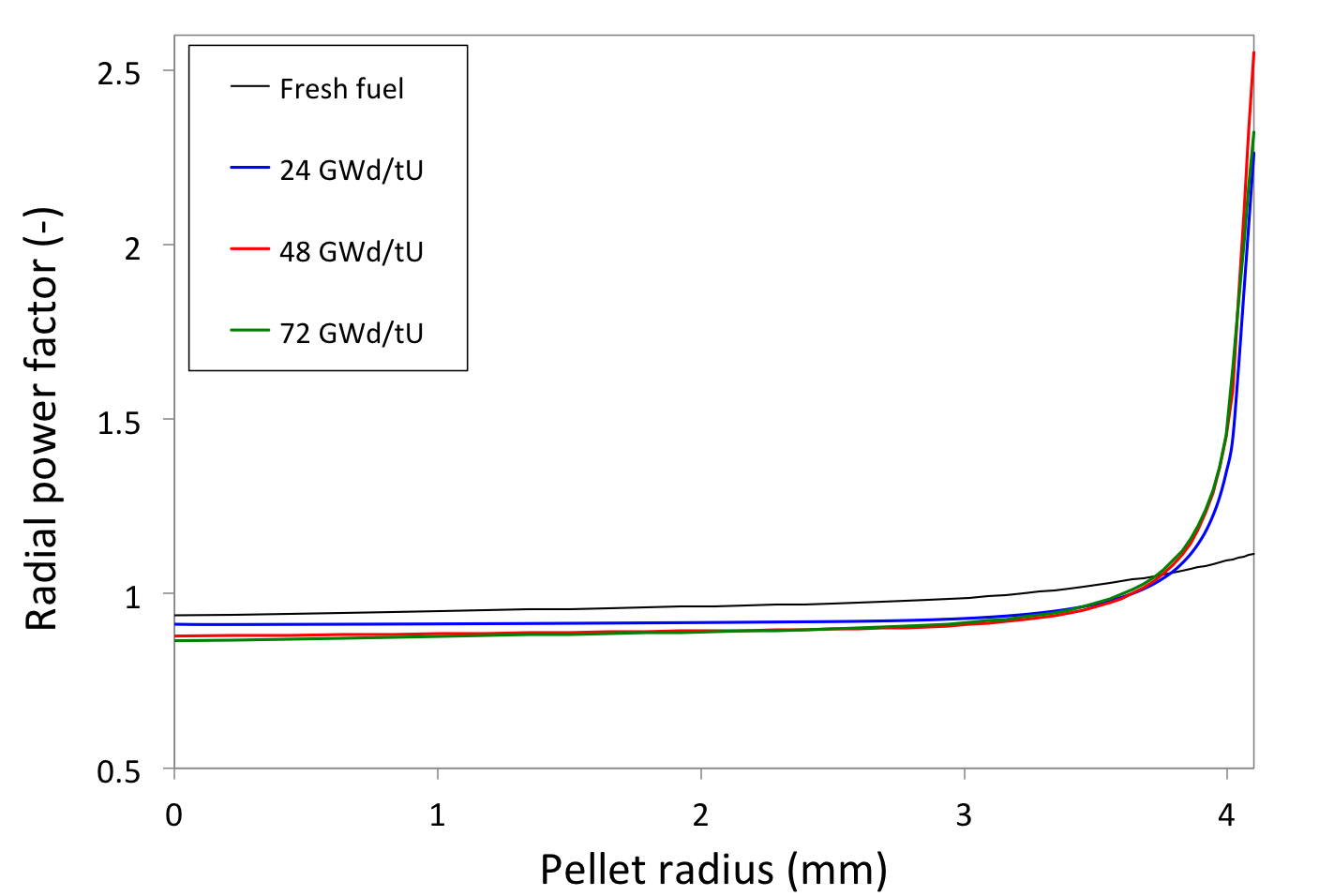
Figure 1: Example of calculated radial power form factors (normalized) at various radial average burnups.
The neutron flux, , is calculated in an approximate way using one-group diffusion theory. The neutron diffusion equation is solved in 1D cylindrical coordinates by finite difference.
The local power density at radial position , , which is needed for the thermal analysis is proportional to the neutron flux and the macroscopic cross section for fission, (1)
where is the fission cross section for isotope and is the concentration of isotope . The model computes the radial power profile in the fuel pellet based on Eq. (1). The radial power from factor at radial position is
(2)
with (3)
where and are the inner and outer fuel radii, respectively. The local burnup is computed based on the time integral of the local power density.
An example of model results is given in Figure 1, which illustrates radial power factor distributions at various burnup levels for a UO fuel pellet irradiated under typical PWR conditions.
commentnote:fuel volume ratio
To correctly model the burnup using the method described above, the relative volume of the fuel with respect to a right cylinder must be accounted for. Since a secondary grid is applied to the theoretical radius and height of a right circular cylinder this will result in an overrepresentation in the total neutron flux. This is corrected by the input parameter fuel_volume_ratio, which is simply the volume of the fuel over the volume of a right cylinder with the given outer radius and height measured with respect to the top and bottom of the fuel stack. The userobject FuelPinGeometry can automatically determine the volume of the fuel, however if the mesh is not precise enough, this can still result in an overrepresentation. A user input will overrule the automatically determined volume in the FuelPinGeometry to compensate for such a situation.
USi Radial Power Profile
BISON also contains the ability to estimate the radial power profile in USi fuel. The same formulation given above for UO is used with different cross sections and mass ratios. The cross sections for USi were generated using the DRAGON neutronics code by Javier Ortensi at INL.
Example Input Syntax
The burnup function is often created by the Burnup action, as shown below:
[Burnup<<<{"href": "../../syntax/Burnup/index.html"}>>>]
  [burnup2]
    block<<<{"description": "The blocks where radial power factor should be computed."}>>> = 2
    base_name<<<{"description": "Base name for the AuxVariables."}>>> = action_block2
    rod_ave_lin_pow<<<{"description": "Rod average linear power function."}>>> = power_profile
    axial_power_profile<<<{"description": "Axial power peaking function."}>>> = axial_peaking_factors
    num_radial<<<{"description": "Number of radial divisions in secondary grid used to compute radial power profile."}>>> = 80
    num_axial<<<{"description": "Number of axial divisions in secondary grid used to compute radial power profile."}>>> = 20
    a_upper<<<{"description": "The upper axial coordinate of the fuel stack. Required if fuel_pin_geometry is not specified."}>>> = 0.0205
    a_lower<<<{"description": "The lower axial coordinate of the fuel stack. Required if fuel_pin_geometry is not specified."}>>> = 0.0105
    fuel_inner_radius<<<{"description": "The inner radius of the fuel."}>>> = 0.0
    fuel_outer_radius<<<{"description": "The outer radius of the fuel."}>>> = 0.01
    fuel_volume_ratio<<<{"description": "Reduction factor for deviation from right circular cylinder fuel.  The ratio of actual volume to right circular cylinder volume."}>>> = 1.0
  []
[]It is also possible to directly use the BurnupFunction in an input file:
[Functions<<<{"href": "../../syntax/Functions/index.html"}>>>]
  [burnup2]
    type = BurnupFunction<<<{"description": "Computes burnup and radial power factor.  Built by an Action.", "href": "BurnupFunction.html"}>>>
    rod_ave_lin_pow<<<{"description": "Rod average linear power function."}>>> = power_profile
    axial_power_profile<<<{"description": "Axial power peaking function."}>>> = axial_peaking_factors
    num_radial<<<{"description": "Number of radial divisions in secondary grid used to compute radial power profile."}>>> = 80
    num_axial<<<{"description": "Number of axial divisions in secondary grid used to compute radial power profile."}>>> = 20
    a_upper<<<{"description": "The upper axial coordinate of the fuel stack. Required if fuel_pin_geometry is not specified."}>>> = 0.0205
    a_lower<<<{"description": "The lower axial coordinate of the fuel stack. Required if fuel_pin_geometry is not specified."}>>> = 0.0105
    fuel_inner_radius<<<{"description": "The inner radius of the fuel."}>>> = 0.0
    fuel_outer_radius<<<{"description": "The outer radius of the fuel."}>>> = 0.01
    fuel_volume_ratio<<<{"description": "Reduction factor for deviation from right circular cylinder fuel.  The ratio of actual volume to right circular cylinder volume."}>>> = 1.0
  []
[]Initial enrichment defaults to U235=5% and U238=95%. These isotopes and values can be customized through the use of isotopes and isotope_fractions. The complete list of available isotopes is U235, U238, Pu239, Pu240, Pu241, and Pu242.
[Burnup<<<{"href": "../../syntax/Burnup/index.html"}>>>]
  [burnup]
    block<<<{"description": "The blocks where radial power factor should be computed."}>>> = 0
    rod_ave_lin_pow<<<{"description": "Rod average linear power function."}>>> = power_profile
    axial_power_profile<<<{"description": "Axial power peaking function."}>>> = axial_peaking_factors
    num_radial<<<{"description": "Number of radial divisions in secondary grid used to compute radial power profile."}>>> = 80
    num_axial<<<{"description": "Number of axial divisions in secondary grid used to compute radial power profile."}>>> = 5
    a_upper<<<{"description": "The upper axial coordinate of the fuel stack. Required if fuel_pin_geometry is not specified."}>>> = 0.0082
    a_lower<<<{"description": "The lower axial coordinate of the fuel stack. Required if fuel_pin_geometry is not specified."}>>> = 0.0
    fuel_inner_radius<<<{"description": "The inner radius of the fuel."}>>> = 0
    fuel_outer_radius<<<{"description": "The outer radius of the fuel."}>>> = 0.0041
    fuel_volume_ratio<<<{"description": "Reduction factor for deviation from right circular cylinder fuel.  The ratio of actual volume to right circular cylinder volume."}>>> = 1
    isotopes<<<{"description": "Fuel isotopes: Gd155 Gd157 U235 U238 Pu239 Pu240 Pu241 Pu242.  Number of entries must match number of entries in isotope_fractions."}>>> = 'U235 U238'
    isotope_fractions<<<{"description": "The isotope fractions associated with the 'isotopes' input line.  Must sum to 1.0."}>>> = '0.045 0.955'
    RPF<<<{"description": "Specifies that the radial power factor is required."}>>> = RPF
  []
[]Input Parameters
- a_lowerThe lower axial coordinate of the fuel stack. Required if fuel_pin_geometry is not specified.
C++ Type:double
Unit:(no unit assumed)
Controllable:No
Description:The lower axial coordinate of the fuel stack. Required if fuel_pin_geometry is not specified.
- a_upperThe upper axial coordinate of the fuel stack. Required if fuel_pin_geometry is not specified.
C++ Type:double
Unit:(no unit assumed)
Controllable:No
Description:The upper axial coordinate of the fuel stack. Required if fuel_pin_geometry is not specified.
- axial_directionyCoordinate axis of the axial direction of the fuel stack (x, y, or z)
Default:y
C++ Type:MooseEnum
Controllable:No
Description:Coordinate axis of the axial direction of the fuel stack (x, y, or z)
- axial_power_profileAxial power peaking function.
C++ Type:FunctionName
Unit:(no unit assumed)
Controllable:No
Description:Axial power peaking function.
- bias1Bias for radial point spacing. Must be between 0.5 and 2.0
Default:1
C++ Type:double
Unit:(no unit assumed)
Controllable:No
Description:Bias for radial point spacing. Must be between 0.5 and 2.0
- energy_per_fission3.28451e-11The energy released per fission in J/fission.
Default:3.28451e-11
C++ Type:double
Unit:(no unit assumed)
Controllable:No
Description:The energy released per fission in J/fission.
- fuel_inner_radius0The inner radius of the fuel.
Default:0
C++ Type:double
Unit:(no unit assumed)
Controllable:No
Description:The inner radius of the fuel.
- fuel_outer_radius0.0041The outer radius of the fuel.
Default:0.0041
C++ Type:double
Unit:(no unit assumed)
Controllable:No
Description:The outer radius of the fuel.
- fuel_pin_geometryName of the UserObject that reads the pin geometry from the mesh.
C++ Type:UserObjectName
Controllable:No
Description:Name of the UserObject that reads the pin geometry from the mesh.
- fuel_typeUO2Fuel type. Choices are UO2 U3Si2
Default:UO2
C++ Type:MooseEnum
Controllable:No
Description:Fuel type. Choices are UO2 U3Si2
- fuel_volume_ratioReduction factor for deviation from right circular cylinder fuel. The ratio of actual volume to right circular cylinder volume.
C++ Type:double
Unit:(no unit assumed)
Controllable:No
Description:Reduction factor for deviation from right circular cylinder fuel. The ratio of actual volume to right circular cylinder volume.
- initial_burnup0Initial burnup to be applied in units of MWd/kgU
Default:0
C++ Type:double
Unit:(no unit assumed)
Controllable:No
Description:Initial burnup to be applied in units of MWd/kgU
- isotope_fractions0.05 0.95 The isotope fractions associated with the 'isotopes' input line. Must sum to 1.0.
Default:0.05 0.95
C++ Type:std::vector<double>
Unit:(no unit assumed)
Controllable:No
Description:The isotope fractions associated with the 'isotopes' input line. Must sum to 1.0.
- isotopesU235 U238Fuel isotopes: Gd155 Gd157 U235 U238 Pu239 Pu240 Pu241 Pu242. Number of entries must match number of entries in isotope_fractions.
Default:U235 U238
C++ Type:MultiMooseEnum
Controllable:No
Description:Fuel isotopes: Gd155 Gd157 U235 U238 Pu239 Pu240 Pu241 Pu242. Number of entries must match number of entries in isotope_fractions.
- num_axial20Number of axial divisions in secondary grid used to compute radial power profile.
Default:20
C++ Type:unsigned int
Controllable:No
Description:Number of axial divisions in secondary grid used to compute radial power profile.
- num_radial80Number of radial divisions in secondary grid used to compute radial power profile.
Default:80
C++ Type:unsigned int
Controllable:No
Description:Number of radial divisions in secondary grid used to compute radial power profile.
- offset0 0 0Translation, if any, of the rod centerline. For example, '0.1,0.2,0' for a rod with a centerline along the z axis that is 0.1 m in the x direction and 0.2 m in the y direction from the origin.
Default:0 0 0
C++ Type:libMesh::Point
Controllable:No
Description:Translation, if any, of the rod centerline. For example, '0.1,0.2,0' for a rod with a centerline along the z axis that is 0.1 m in the x direction and 0.2 m in the y direction from the origin.
- rod_ave_lin_powRod average linear power function.
C++ Type:FunctionName
Unit:(no unit assumed)
Controllable:No
Description:Rod average linear power function.
- rpf_activeTrueFlag for turning calculation of radial power factor on.
Default:True
C++ Type:bool
Controllable:No
Description:Flag for turning calculation of radial power factor on.
- rpf_inputThe radial power profile function. Used to specify the rpf from input
C++ Type:FunctionName
Unit:(no unit assumed)
Controllable:No
Description:The radial power profile function. Used to specify the rpf from input
- value1Default/scaling value.
Default:1
C++ Type:double
Unit:(no unit assumed)
Controllable:No
Description:Default/scaling value.
Optional Parameters
- built_by_action
C++ Type:std::string
Controllable:No
- control_tagsAdds user-defined labels for accessing object parameters via control logic.
C++ Type:std::vector<std::string>
Controllable:No
Description:Adds user-defined labels for accessing object parameters via control logic.
- enableTrueSet the enabled status of the MooseObject.
Default:True
C++ Type:bool
Controllable:No
Description:Set the enabled status of the MooseObject.
- fuel_molar_massThe molar mass of the entire fuel
C++ Type:double
Unit:(no unit assumed)
Controllable:No
Description:The molar mass of the entire fuel
- heavy_metal_molar_massThe molar mass of the heavy metal
C++ Type:double
Unit:(no unit assumed)
Controllable:No
Description:The molar mass of the heavy metal
Advanced Parameters
Input Files
References
- A. Soba and A. Denis.
Personal communication, 2017.[BibTeX]
- A. Soba, A. Denis, L. Romero, E. Villarino, and F. Sardella.
A high burnup model developed for the DIONISIO code.
Journal of Nuclear Materials, 433:160–166, 2013.[BibTeX]
- A. Soba, M. Lemes, M.E. González, A. Denis, and L. Romero.
Simulation of the behaviour of nuclear fuel under high burnup conditions.
Annals of Nuclear Energy, 70:147–156, 2014.[BibTeX]
- Ryan Terrence Sweet, Daniel J. vanWasshenova, Daniel Schwen, and Aysenur Toptan.
Compare mechanistic predictions for doped uo2 mechanical response and other properties with empirical models and experimental measurements.
Technical Report, Idaho National Laboratory, 9 2023.[BibTeX]