IFA-636.2 Rod 5
Overview
The IFA-636 fuel performance test was an experiment completed in the Halden reactor as part of the OECD Halden Reactor Project. The main objective of this experiment was to extend the database on the performance of UO-Gd-O fuel compared with commerical UO. The rod of interest investigated in this report is rod 5 which contained standard UO fuel pellets and had online measurements of fuel elongation. Fuel elongation prior to contact can provide information on whether or not the thermal expansion, densification, solid fuel swelling and gaseous fuel swelling models are behaving as expected. Upon contact with the cladding the fuel elongation behavior becomes dependent upon the friction between the fuel stack and cladding. In the experiment it was observed that densification only occured in the UO fuel whereas fuel elongation measurements in the Gd-doped fuel rods indicated essentially constant swelling with burnup. At burnups above 5 MWd/kgUO the swelling rate was observed to be about 0.5 - 0.6% V/V per 10 MWd/kgUO for both fuel types. The total burnup in rod 5 is approximately 34 MWd/kgUO.
Test Description
Rod Design Specifications
The specifications for IFA-636 rod 5 are summarized in Table 1.
Table 1: IFA-636 Rod 5 Rod Specifications
| Fuel Rod | Measurement | Unit |
|---|---|---|
| Overall length | 0.7288 | m |
| Fuel stack height | 0.393 | m |
| Nominal plenum height | 20.2 | mm |
| Fill gas composition | He | |
| Fill gas pressure | 0.1 | MPa |
| Fuel | Measurement | Unit |
| Material | UO | |
| Enrichment | 4.25 | |
| Density | 96.1 | |
| Inner diameter | - | mm |
| Outer diameter | 8.195 | mm |
| Pellet geometry | dished, chamfered | |
| Grain diameter | 9.36 | m |
| Pellet Dishing | Measurement | Unit |
| Chamfer width | 0.51 | mm |
| Chamfer depth | 0.13 | mm |
| Dish diameter | 4.95 | mm |
| Dish depth | 0.24 | mm |
| Cladding | Measurement | Unit |
| Material | Zr-4 | |
| Outer diameter | 9.5 | mm |
| Inner diameter | 8.357 | mm |
| Wall thickness | 0.5715 | mm |
Operating Conditions and Irradiation History
The power history of the IFA-636 experiment was provided by Halden as part of the Halden Research Project (HRP). Throughout the duration of the experiment there was an axial profile that resulted in higher power to the fuel at the top of the rod. A history of the average linear heating rate applied to the fuel is presented in Figure 1.
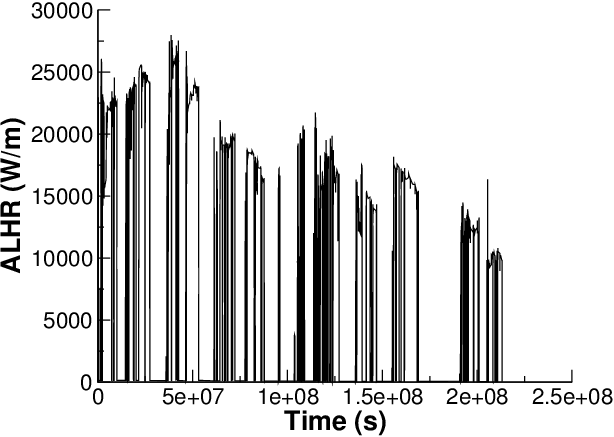
Figure 1: History of the average linear heating rate to the fuel for the IFA-636 rod 5 test.
The outer clad surface temperature was given in the Halden data and prescribed as a function Dirichlet boundary condition. For the fast flux to the cladding a factor of n m s per W/m was multiplied by the power profile. This factor is a typical value for the Halden Boiling Water Reactor. The coolant pressure for the duration of the experiment was set to 3.33 MPa.
Model Description
Geometry and Mesh
The geometric parameters specified in Table 1 were used to create the mesh for this simulation. The fuel was meshed as a smeared fuel rod with 11 radial and 40 axial quadratic elements. The plenum length was adjusted such that the initial void volume within the fuel element is equal to 5.4 cubic centimeters as given in the Halden report (Tverberg et al., 2005). A segment of the mesh is illustrated in Figure 2.
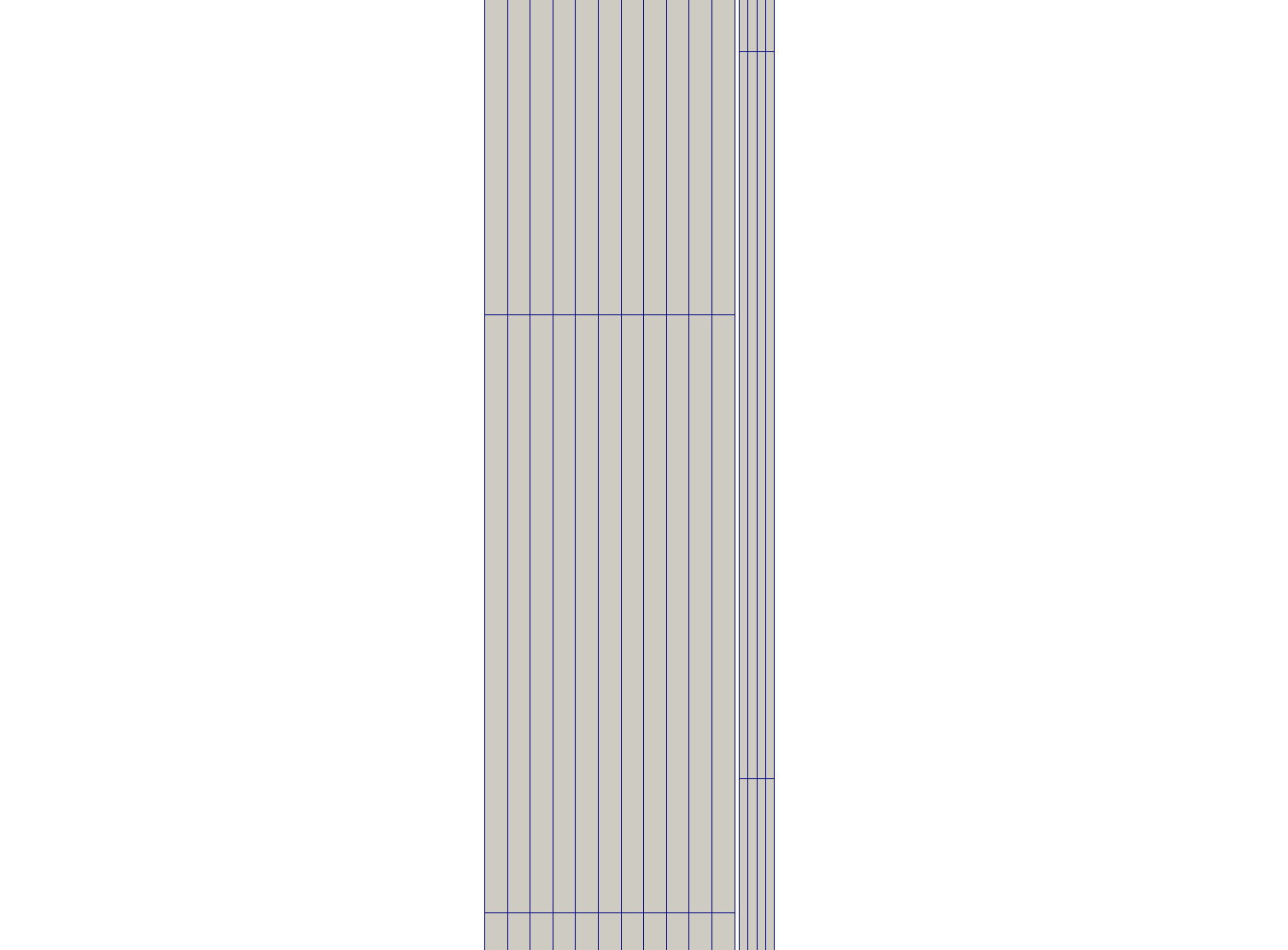
Figure 2: Segment of the mesh used for the fuel and cladding for the IFA-636 rod 5 simulation.
Material and Behavioral Models
The NFIR thermal conductivity model was used for the UO fuel. The fuel was modeled as elastic and fuel swelling was coupled to the fission gas release model. In addition fuel relocation was modeled using an activation power of 5 kW/m. Fission gas release was modeled using the Sifgrs model with a transient burst release model. The cladding material was modeled using a constant thermal conductivity of 16 W/m-K, and primary and secondary thermal, and irradiation creep were modeled.
Input files
The BISON input and all supporting files (power histories, axial power profile, fast neutron flux history, etc.) for this case are provided with the code distribution at bison/assessment/LWR/validation/IFA_636/analysis/
Results Comparison
In this section the BISON simulation results are compared against the experimental data and information provided by Halden. Measurements were provided for fuel elongation for rod 5. From the fuel elongation measurements a calculation of the volumetric strain in the fuel was determined. Halden takes experimental measurements every 15 minutes during the irradiation. To make the amount of data points manageable the program PowerCondense4 was used to condense the power history, axial profile, cladding temperature and cladding elongation. All condensed measurements were synchronized in time. Halden noted that the fuel elongation sensor present in rod 5 failed during irradiation. This failure is observed when the experimental data falls close to zero at an irradiation time of approximately 45 000 hours as illustrated in Figure 3. BISON underpredicts the fuel elongation early in life and overpredicts the fuel elongation late in life. To gain a better understanding of the behavior early in the irradiation a zoomed in version on the first 500 hours of irradiation is provided in Figure 4. The sharp increase in the BISON results immediately after the simulation starts is due to the fact that BISON assumes a reference temperature of 297 K for the thermal expansion.
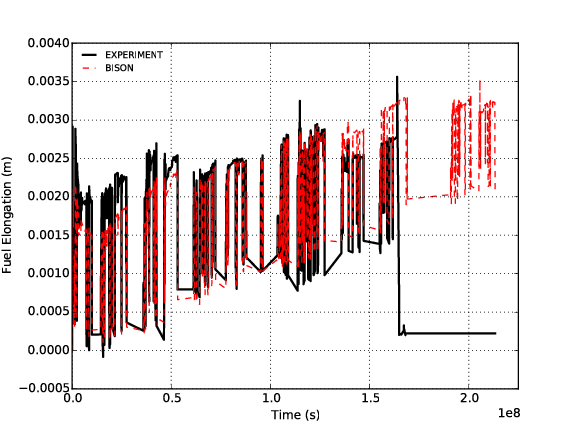
Figure 3: Comparison of BISON simulation results to the experimental measurements for fuel elongation for IFA-636 rod 5.
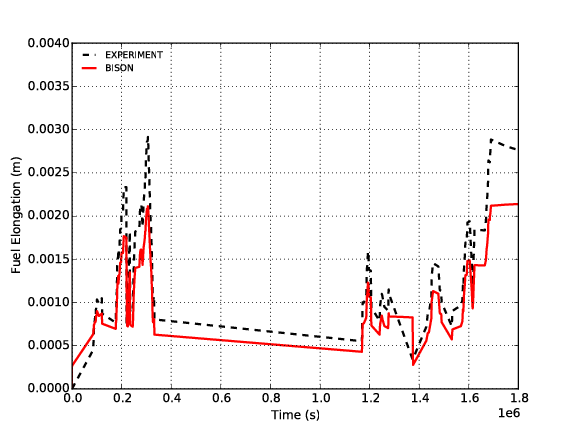
Figure 4: Comparison of BISON simulation results to the experimental measurements for fuel elongation for IFA-636 rod 5 for the first 500 hours of irradiation.
Halden stated in the report that the volumetric swelling rate was between 0.5% and 0.6% per 10 MWd/kgUO2 after a burnup of 5 MWd/kgUO2 as presented in Figure 5. A parametric study was completed comparing a BISON simulation using the total solid swelling and by assuming a solid swelling of 90% the calculated value because other fuel performance codes such as FALCON have indicated that prior to contact they automatically take 10% off the calculated value for solid swelling as it provided more accurate comparisons to experiments. The results indicate that the currently implemented solid swelling model within BISON results in an overprediction of the volumetric strain of approximately 10%.
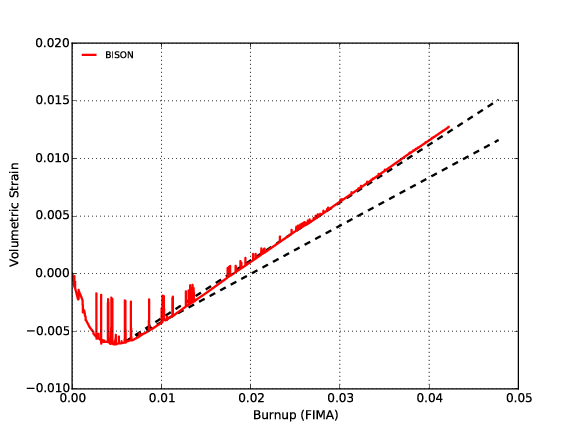
Figure 5: Volumetric strain predicted by BISON assuming total solid swelling and 90% solid swelling. The minimum and maximum swelling rates (0.5% and 0.6% per 10 MWd/kgUO2) given by Halden are superimposed. BISON appears to overpredict the volumetric strain.
References
- T. Tverberg, B. Volkov, and J. C. Kim.
Final report on the UO$_2$-Gd$_2$O$_3$ fuel performance test in IFA-636.
Technical Report HWR-817, Halden, September 2005.[BibTeX]