Zirconium Hydrides Experiments
Overview
Experiments were conducted over the decades to study the behavior of hydrogen in the zircaloy matrix. Here we use a modified version of the Hydrogen Nucleation-Growth-Dissolution (HNGD) model (Lacroix, 2019; Lacroix et al., 2021) in BISON to simulate the experiments from Sawatzky (Sawatzky, 1960) and Kammenzind. One of his experiments (case A96) was described in (Kammenzind et al., 1996) and the others are described by Merlino (Merlino, 2019).
Sawatzky
First experiment
An 2.54 cm hydrogen-loaded (130 wt.ppm) zircaloy-2 sample is subjected to a 58 K/cm temperature gradient for 34 days. The initial hydrogen distribution is uniform.
Second experiment
An 2.54 cm hydrogen-loaded (64 wt.ppm) zircaloy-2 sample is subjected to a 117 K/cm temperature gradient for 41 days. The initial hydrogen distribution is uniform.
Kammenzind
Asymmetrical cases
3.8 cm-long hydrogen-loaded samples of zircaloy are subjected to asymmetrical temperature profiles for a long period (95 to 209 days). In these cases the initial hydrogen distribution is not uniform. Instead, the hydrogen was loaded via electrolysis, resulting in a hydride on the "right-hand" side. During the annealing this rim dissolves, emitting hydrogen into the rest of the sample. The goal was to emulate the hydrogen pickup that occurs in a LWR.
Linear cases
2.5 cm-long hydrogen-loaded samples of zircaloy are subjected to linear temperature profiles for days. The initial hydrogen distribution is uniform. Four cases are shown here but additional data is available in Merlino's work (Merlino, 2019).
Modeling
HNGD Model
BISON uses the HNGD model (Lacroix, 2019; Lacroix et al., 2021). In this model, hydrogen is subjected to Fickian and Soret diffusion, hydride precipitation happens through nucleation and growth, both having their own kinetic behavior, and hydride dissolution kinetics are also accounted for. More details can be found in HydridePrecipitationRate.
HNGD Modifications
The HNGD model showed some limitations, particularly in the asymmetrical temperature cases in which precipitation would only occur in the coldest node. This non-physical behavior was addressed by modifying the expressions of the solubility () and supersolubility (), resulting in an update of the HNGD model.
Input files
The BISON input and all supporting files for these cases are provided with the code distribution at bison/assessment/LWR/validation/Cladding_Hydrogen_Behavior/analysis.
To avoid code duplication, the input files are built as follows: A base input file contains characteristics common to the entire assessment case. Base input files containing characteristics specific to the assessments within Kammezind and Sawatzky. Specific model, numerical, and configuration parameters are listed in .params files. X##.params and sawatzky#.params list the information specific to each sample. The base input file requires the information contained in the .params files and cannot run on its own. The Kammenzind assessment case requires information contained in the Kammenzind_type#.i files to run. To run a specific assessment case, the input file can be created by listing the input file and the desired parameters, such as, for A11a: Cladding_Hydrogen_Behavior_Base.i Kammenzind_Base.params Kammenzind_type1.i A11a.params. For Sawatzky #1 case: sawatzky1.params Sawatzky_Base.i.
Material and Behavioral Models
These simulations use the action HydrideAction, containing
TimeDerivative: for hydrogen in solid solution and as hydrides.
MatDiffusion: computes Fick's law for the hydrogen in solid solution
ThermoDiffusion: computes the Soret effect on the hydrogen in solid solution
HydrogenSource: computes the variation of the solid solution content due to precipitation/dissolution
HydrideSource: computes the variation of the hydride content due to precipitation/dissolution
ArrheniusMaterialProperty: computes the hydrogen diffusivity
HydrogenSolubility: computes the hydrogen solubility (also known as )
HydrogenSuperSolubility: computes the hydrogen supersolubility (also known as )
HydrideDissolutionKinetics: computes the kinetic factor for the dissolution
HydrideNucleationKinetics: computes the kinetic factor for the nucleation
HydrideGrowthKinetics: computes the kinetic factor for the growth
GenericConstantMaterial: contains the heat of transport of hydrogen (for Soret effect)
HydridePrecipitationRate: computes the Precipitation (or Dissolution) rate used by HydrogenSource and HydrideSource.
Details for all of the models listed above can be found on the linked BISON documentation pages.
Results
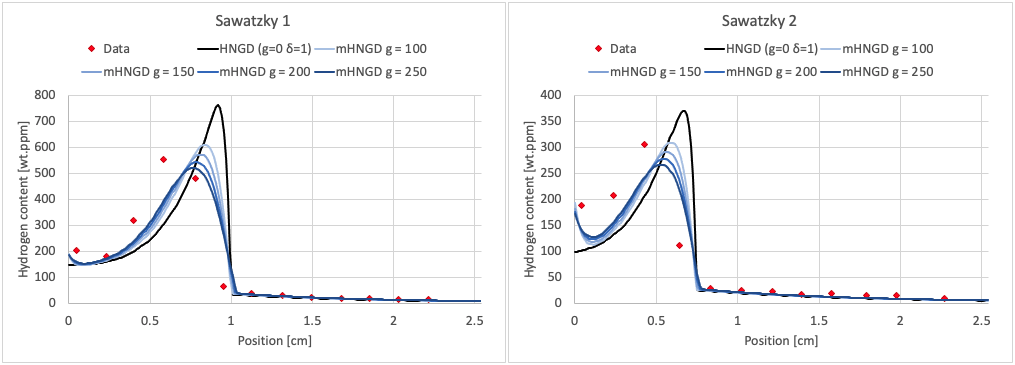
Figure 1: Simulation of Sawatzky's experiments (Sawatzky, 1960). The base HNGD model ( wt.ppm, ) is compared with the modified HNGD model using different values of the parameter ().
These experiments shown in Figure 1 were previously well predicted by the base HNGD model, and although there are noticeable changes it is still the case. The peculiar shape of the hydride profile is due to a dissolution-diffusion-precipitation cycle that makes the peak grow and shift towards the cold side. The introduction of the parameter causes an increase of solubility in the presence of hydrides. A higher solubility makes the cycle take place more easily, resulting in a lower and more shifted hydride peak.
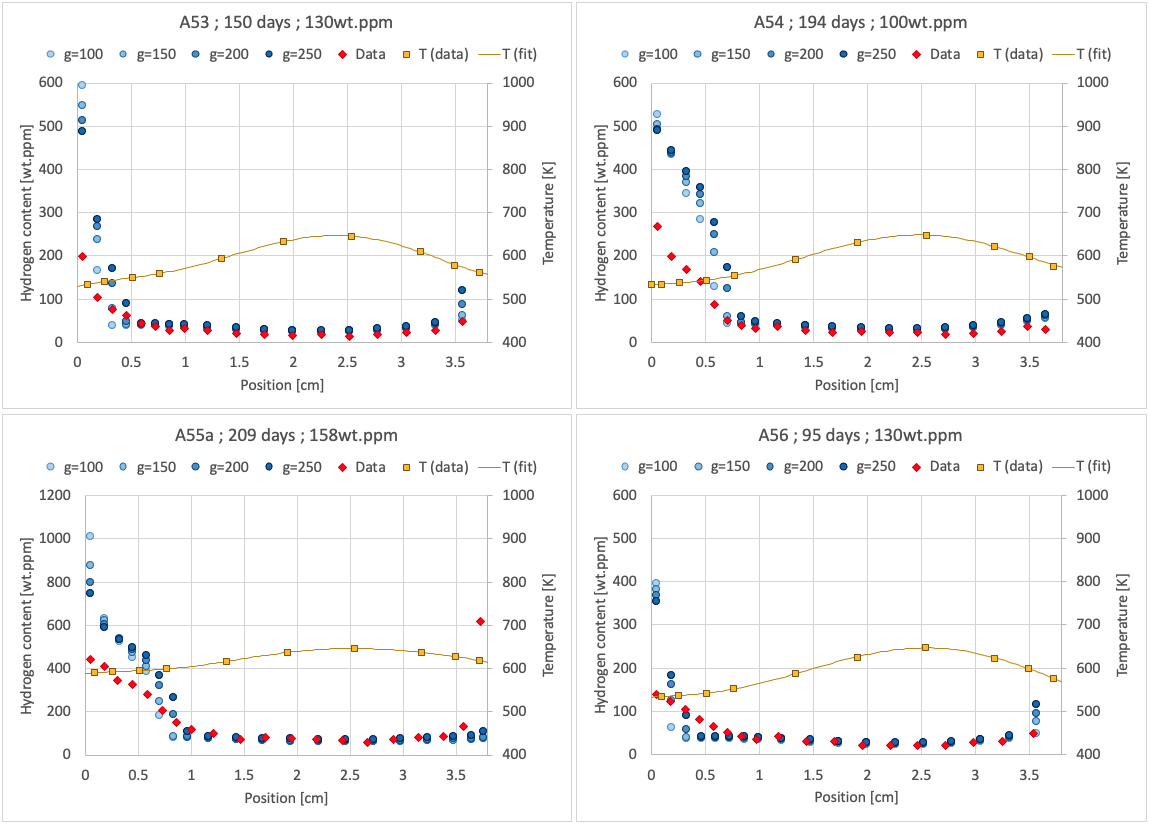
Figure 2: Simulation of asymmetrical cases described in (Merlino, 2019). Results using different values of the parameter are compared ().
The base HNGD model failed to predict any hydride profile in the simulations shown in Figure 2 and Figure 3. The hydrides on the cold side were precipitating in a single mesh point. The new model predicts hydrides on a domain 0.5 to 1 cm broad, which corresponds to experimental observations. The parameter impacts the height and thickness of the hydride peak, while the parameter is important when the hydride content reaches very high values (over ~8000 wt.ppm). It impacts the dissolution of the initial hydride rim. A higher causes more dissolution, resulting in a higher hydrogen content in the rest of the sample.
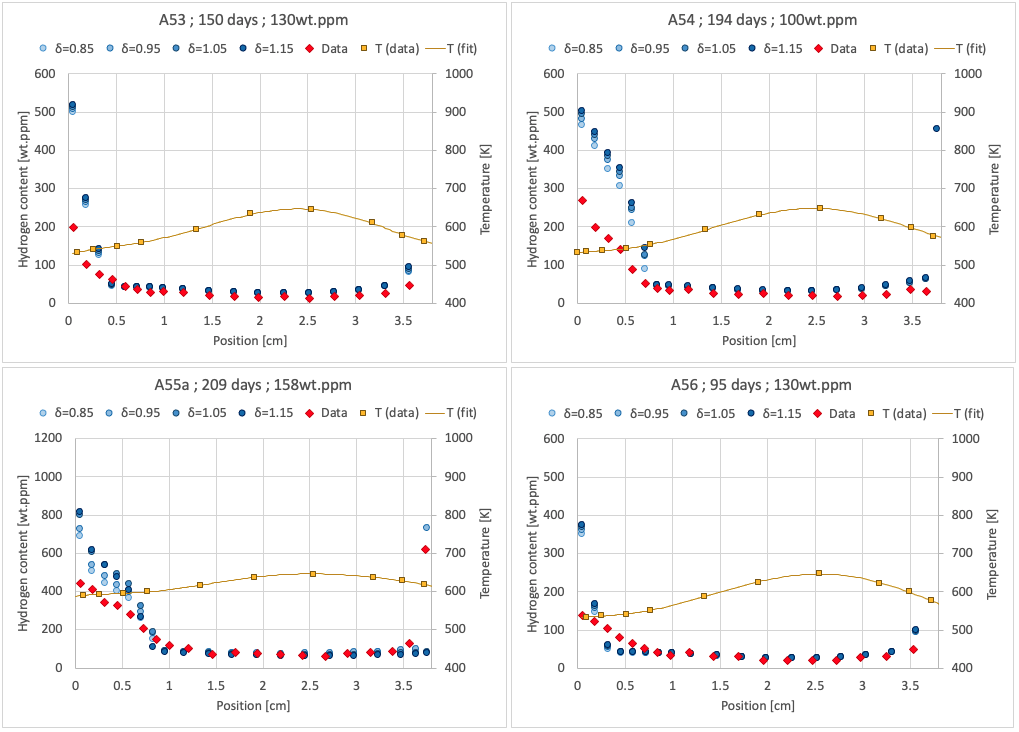
Figure 3: Simulation of asymmetrical cases described in (Merlino, 2019). Results using different values of the parameter are compared ( wt.ppm).
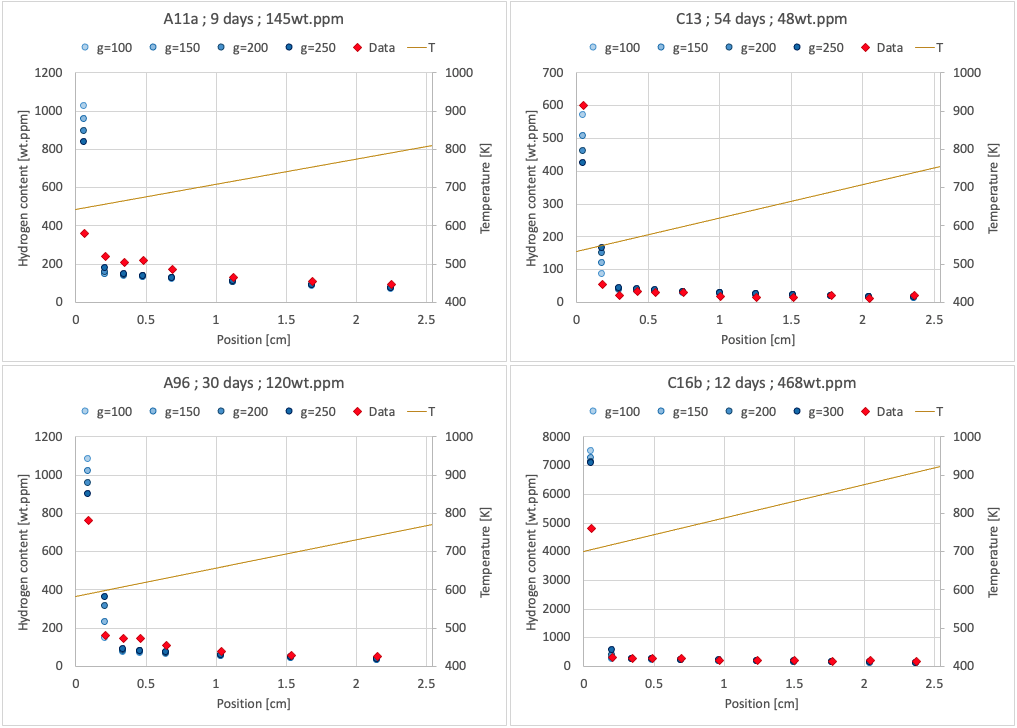
Figure 4: Simulation of linear cases described in (Merlino, 2019). Results using different values of the parameter are compared ().
In most of the linear cases such as the ones shown in Figure 4, hydrides precipitates were found in a single point when using the base HNGD model ( wt.ppm, ). Again, this issue is addressed by the introduction of the parameter . For example, in case C13, the update allows for hydrides to be present in the second slice, which was not previously the case.
Apart form the parameters , , and that were introduced in the update, the modified HNGD model uses the same parameters as the base model.
References
- BG Kammenzind, David G Franklin, H Richard Peters, and Walter J Duffin.
Hydrogen pickup and redistribution in alpha-annealed Zircaloy-4.
ASTM Special Technical Publication, 1295:338–369, 1996.[BibTeX]
- E. Lacroix.
Modeling Zirconium Hydride Precipitation and Dissolution in Zirconium Alloys.
PhD thesis, The Pennsylvania State University, 2019.[BibTeX]
- E. Lacroix, P.-C. A. Simon, A. T. Motta, and J.D. Almer.
Zirconium hydride precipitation and dissolution kinetics in the hysteresis region in zirconium alloys.
Zirconium in the Nuclear Industry: 19th International Symposium, ASTM STP 1597, pages 67–91, 2021.[BibTeX]
- J.T. Merlino.
Experiments in hydrogen distribution in thermal gradients calculated using bison.
M.Eng. paper in Nuclear Engineering, The Pennsylvania State University, 2019.[BibTeX]
- A. Sawatzky.
Hydrogen in zircaloy-2: its distribution and heat of transport.
Journal of Nuclear Materials, 2(4):321 – 328, 1960.
URL: http://www.sciencedirect.com/science/article/pii/0022311560900040, doi:http://dx.doi.org/10.1016/0022-3115(60)90004-0.[BibTeX]