Conjugate Heat Transfer
NekRS provides a built-in CHT module for simulations involving conforming fluid and solid domains. CHT can also be accomplished by coupling NekRS's flow solver with MOOSE via Cardinal, but here the standalone CHT solver in NekRS is tested. The conj_ht case verifies the CHT module against an analytical solution. The computational domain is illustrated in Figure 1. The domain consists of a fluid channel of height bounded by solid plates of equal height . The fluid channel and solid plates have length , and the domain is periodic in the transverse direction.
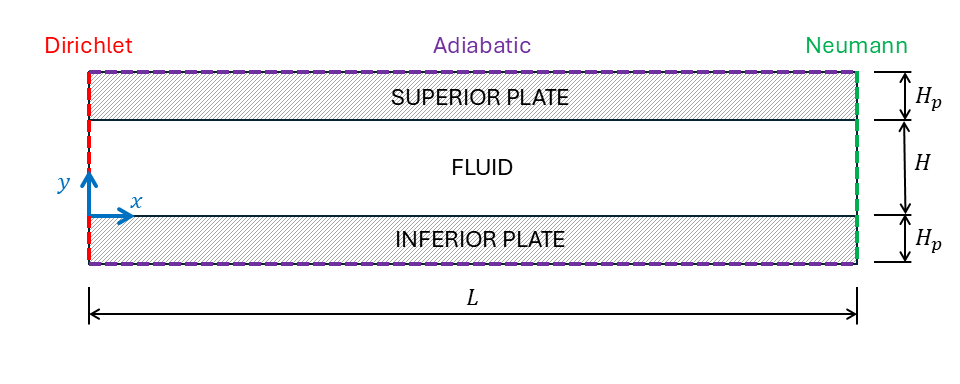
Figure 1: Geometry and boundary conditions for the conj_ht case.
Analytical solution
Fully developed hydrodynamic and thermal conditions are assumed. The velocity field is prescribed using the Poiseuille flow solution,
(1)A nondimensional uniform heat source, , is applied throughout both solid plates. The analytical temperature solution is
(2)Here, denotes the fluid temperature, while and denote the temperatures in the lower and upper solid plates, respectively. The conductivity ratio is defined as , where and are the solid and fluid thermal conductivities. The Reynolds and Péclet numbers are defined as
(3)Case parameters
The nondimensional parameters used in the conj_ht test are summarized in Table 1.
Table 1: Case properties and simulation parameters.
| Parameter | Variable | Value |
|---|---|---|
| Nondimensional channel height | 1 | |
| Nondimensional channel length | 8 | |
| Nondimensional plate height | 0.5 | |
| Reynolds number | 500 | |
| Péclet number | 1000 | |
| Heat source | 1 | |
| Fluid density | 1 | |
| Fluid volumetric heat capacity | 1 | |
| Solid volumetric heat capacity | 0.1 | |
| Solid-to-fluid conductivity ratio | 10 | |
| Pressure gradient | 0.012 |
Boundary conditions
Dirichlet boundary conditions are imposed at for both the velocity and temperature fields. An outflow boundary condition is imposed at for the velocity field. A Neumann boundary condition derived from the analytical solution is imposed for temperature,
(4)where is the outward unit normal vector. The conductivity is in the fluid and in the solid. Insulated boundary conditions are imposed on the outer surfaces of both solid plates.
Verification criteria
Verification of this case is performed by evaluating error norms of the streamwise velocity and temperature fields at steady state. NekRS offers a characteristics based integration scheme, Operator-Integration Factor Scheme (OIFS), for the advection operator, which allows NekRS to run with CFL > 1 (Fischer, 2003), depending on the number of steps chosen by the user for advection subcycling. This simulation is run with two solver modes, with and without advection subcycling enabled. The velocity error is defined as
(5)and the temperature error is defined as
(6)Here, is the prescribed Poiseuille velocity profile and is the piecewise analytical temperature solution in the fluid and solid domains. The simulations are considered to match the analytic solution when both error tolerances are satisfied for each solver mode,
(7)References
- PF Fischer.
Implementation considerations for the oifs/characteristics approach to convection problems.
Argonne National Laboratory, 2003.[Export]