Backward-Facing Step
The backward-facing step experiment of Driver and Seegmiller (Driver and Seegmiller, 1985) is a standard validation benchmark for RANS turbulence models. The predicted reattachment length downstream of the step is commonly used as a primary metric for assessing turbulence-model performance. The backward-facing step case verifies the - RANS model in NekRS by comparing the predicted skin-friction coefficient along the downstream wall with the experimental measurements of Driver and Seegmiller (Driver and Seegmiller, 1985).
Computational domain
The step is located at the origin, and the inlet and outlet boundaries are located at and , respectively, where is the step height. The upstream and downstream channel heights are and , respectively. The Reynolds number based on the inlet velocity and the step height is . The simulation is advanced to a quasi-steady state before the validation metrics are evaluated. Figure 1 shows the resulting streamwise velocity and turbulent kinetic energy fields.
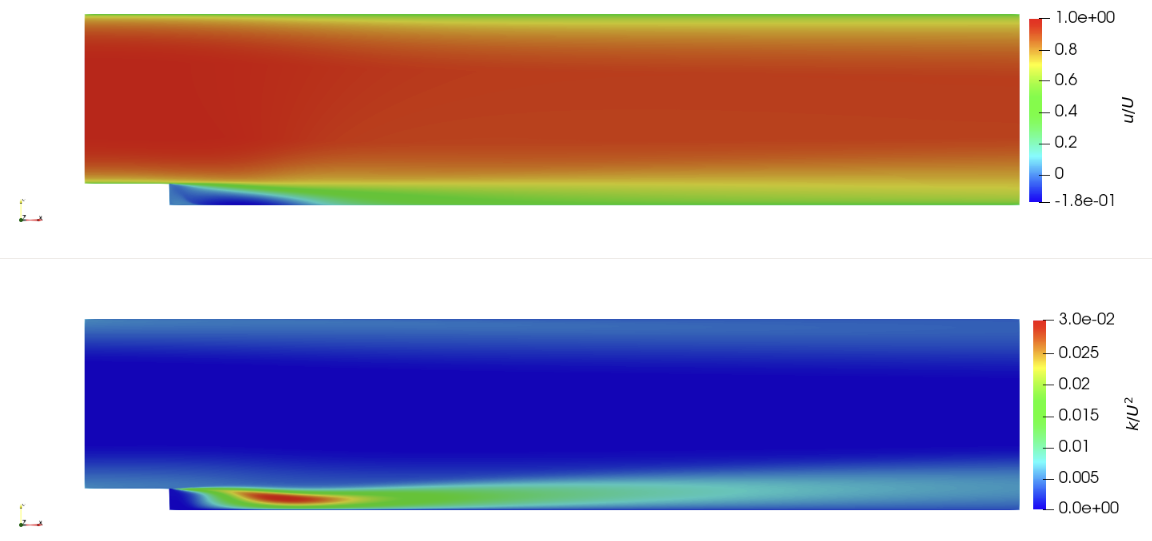
Figure 1: Quasi-steady streamwise velocity and turbulent kinetic energy contours.
Verification criterion
The test is qualified by comparing the computed skin-friction coefficient along the downstream wall, , with the experimental measurements of Driver and Seegmiller (Driver and Seegmiller, 1985). The skin-friction coefficient is defined as
(1)where is the wall shear stress, is the reference density, and is the reference inlet velocity. The test evaluates the norm of the difference between the computed and experimental skin-friction coefficients,
(2)Figure 2 compares the computed skin-friction coefficient profile with the experimental measurements. A polynomial fit to the experimental data is used to evaluate the error norm.
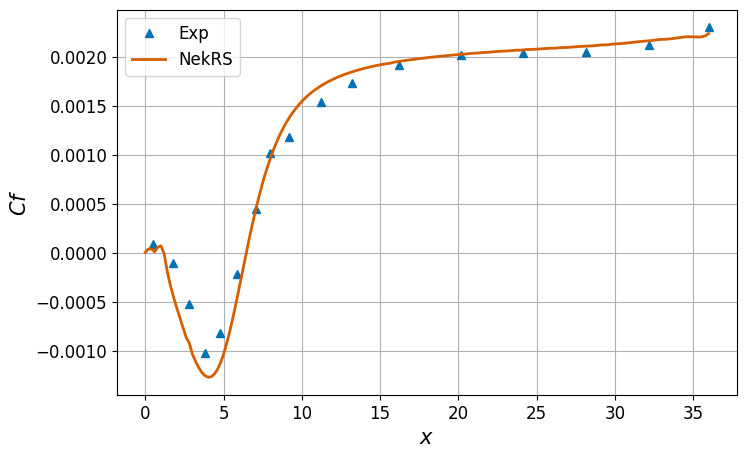
Figure 2: Comparison of the computed skin-friction coefficient with the experimental measurements of Driver and Seegmiller (Driver and Seegmiller, 1985).
References
- David M Driver and H Lee Seegmiller.
Features of a reattaching turbulent shear layer in divergent channelflow.
AIAA journal, 23(2):163–171, 1985.[Export]